The Elevate Blog banner: Real Classrooms. Practical Ideas. Higher Expectations. Three students climb a rocky ridge at sunrise, each pulling the next one up, toward a teacher reaching down to help.

Tag: assessment

  • Late Work Policy: What the Evidence Supports After the Famous Study Was Retracted

    Late Work Policy: What the Evidence Supports After the Famous Study Was Retracted

    By Clay Shumate

    A late work policy decides two separate things: what happens to the grade, and what happens to the student. Most policies collapse those into one number and then stop working. The evidence does not hand you a clean answer, and the study most often quoted in these arguments was retracted in September 2026 — which is the first thing anybody writing a policy this year should know.

    Below is what the research actually supports, what it does not, and a six-part policy you can write on one page and still defend in a parent meeting.

    Key Takeaways

    • The famous deadline study is gone. Ariely and Wertenbroch’s 2002 paper on spaced deadlines was retracted on 2 September 2026. A 124-person replication found no effect of deadline condition on any outcome measure.
    • Loosening grading has not been shown to help students. Students assigned to stricter-grading teachers scored higher in math — in that class and in later ones — across every subgroup studied.
    • Removing late penalties has a measured cost. In one high school chemistry class, homework completion fell by more than a third.
    • The zero is a math problem before it is a policy problem. On a 100-point scale, the gap between passing grades is 10 points and the gap from D to F is 60.
    • The deeper issue is the scale and the averaging, not the zero. Research supports grading scales with four to seven levels for reliability; the 100-point scale invents precision that is not there.
    • Separate the grade from the behavior. Report lateness as conduct and let the grade report what the student knows. That one move resolves most of the argument.

    Free Download · PDF

    The One-Page Late Work Policy and Window Log (2 pages)

    Page 1 is the six-part policy to fill in, the practice-versus-assessment split, and the sentence to give a parent. Page 2 is the window log that turns the policy into information, plus the honest cost of all three common policies.

    Download the free PDF

    Free. No email address required. Designed for grades 6–12. Browse every printable in Your Free Library.

    Why Is a Late Work Policy So Hard to Get Right?

    Because a grade is being asked to do two jobs at once, and they conflict.

    Job one is reporting what a student knows and can do. Job two is enforcing a deadline. A 10-percent-per-day deduction does job two by corrupting job one: after five days the number on the report card is half knowledge and half calendar, and nobody reading it — not the next teacher, not a parent, not the student — can tell which half is which.

    A zero does job two harder and job one worse. And the people on the other side of the argument are not making a soft case. The claim that deadlines do not matter has a measured cost attached, which is the part that usually goes missing in articles about this.

    So the honest version of the problem is not “should kids face consequences.” It is: how do you keep the deadline real without making the grade lie?
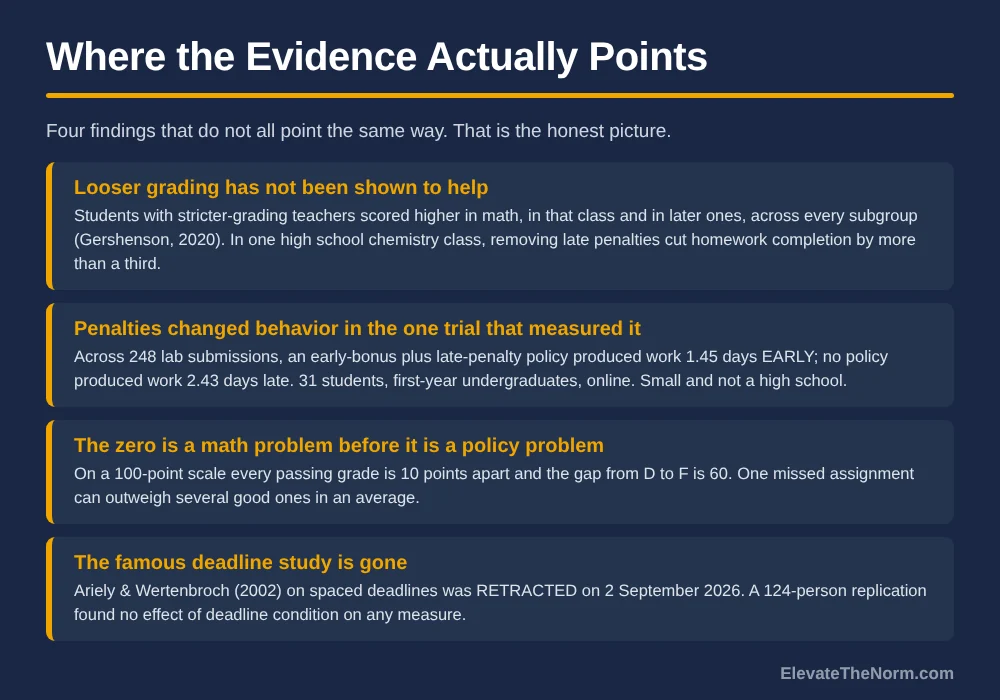
    Four evidence findings on late work policy: stricter grading linked to higher math scores and a one-third drop in homework completion when late penalties were removed, a small undergraduate trial where an early-bonus plus late-penalty policy produced work 1.45 days early, the arithmetic problem of a zero on a 100-point scale, and the September 2026 retraction of the Ariely and Wertenbroch deadline study
    Four findings that do not all point the same way. That is the honest picture.

    What Does the Research Actually Say About Deadlines?

    Less than you have been told, and one widely quoted finding has been formally withdrawn.

    For twenty years, the standard citation for “students do better with evenly spaced interim deadlines” has been Ariely and Wertenbroch (2002) in Psychological Science. You have probably read it quoted in a PD slide deck. It was retracted on 2 September 2026.

    The retraction is not a technicality. Data Colada’s analysis of Study 2 found eighteen of twenty participants in one condition had exact duplicates across all three tasks, correlations that should have been strong were absent, and self-reported times showed almost none of the rounding that real human responses show. Their conclusion was that the data were “severely tampered with or fabricated.” Coauthor Klaus Wertenbroch stated that “much or all of the data — and therefore the results — are false.”

    A pre-registered replication by Hyndman and Bisin, published in 2025 with 124 participants across three deadline conditions, found no statistical evidence that performance was influenced by the deadline condition on any of three measures — errors found, days late, or payment, all p > 0.1. The original had reported all differences significant at p < 0.01. The replication authors concluded that the received wisdom about spaced deadlines limiting procrastination is “possibly false.”

    Two things follow. First, if your department’s late work policy was built on that study, it needs a different foundation. Second — and this is the part worth holding onto — the retraction says nothing about whether deadlines matter in a classroom. It says one famous laboratory result about self-imposed versus imposed deadlines cannot be relied on. Interim checkpoints on a long project may still be good practice. They just are not evidence-backed in the way everyone has been saying.

    Does Removing Late Penalties Hurt Students?

    There is real evidence that looser grading costs something, and it deserves to be stated as plainly as the case for reform usually is.

    Gershenson’s work on high school math found that students with tougher-grading teachers scored higher in math, both in that teacher’s class and in subsequent math courses, and that this held across every student subgroup. Figlio and Lucas found the same direction at elementary level: students assigned to stricter graders showed greater test-score growth in reading and math. In one high school chemistry class where late penalties were removed, homework completion dropped by more than a third.

    The strongest single trial on late policies specifically is small and not from a high school. Korpusik, Freitas and Dionisio compared four late policies across 248 lab submissions in an introductory programming course. Work came in 2.43 days late under no policy, 4.71 days late under an early-completion bonus alone, 0.44 days late under a late penalty, and 1.45 days early under a combined early bonus and late penalty — which also produced the highest grades. Their read was that late penalties externally regulate students who have not yet regulated themselves.

    Size that evidence honestly before you use it: 31 students who consented to the analysis, mostly first-years, taught online during the pandemic. It is a signal, not a mandate. But it points the same direction as the grading-strictness work, and a teacher who ignores both because the conclusion is unfashionable is doing the thing this site complains about when it goes the other way.

    Does It Matter What the Assignment Was For?

    More than any other question here, and most policies never ask it.

    If the work was practice — a problem set, a draft, a reading check whose job was to tell you what to reteach — then late is a timing failure with a real instructional cost, because the information arrived after you needed it. The honest response is to collect it, use it, and record the lateness as conduct. Scoring it down does not recover the information.

    If the work was the assessment — the essay, the project, the unit test — then the deadline is doing something different. It is the point at which you are claiming to know what the student can do. Here a window still makes sense, but a narrow one, and after it closes the student demonstrates the standard some other way rather than handing in the same artifact in December. What that other way should be, and whether a second attempt at the assessment itself belongs in the policy, is a separate decision with its own evidence behind it.

    Running one blanket rule over both is why so many late work policies feel wrong in practice. A missing formative check and a missing final project are not the same event and should not get the same sentence.

    So Why Not Just Give Zeros?

    Because of arithmetic, not sentiment.

    Reeves laid this out in Phi Delta Kappan. On a standard 100-point scale with letter grades at 10-point intervals, every passing grade sits 10 points from its neighbor — and the interval between D and F is not 10 points but 60. A single zero therefore carries roughly six times the weight of any other failing mark in an average. Reeves’s point is that if an F is one interval below a D, the mathematically consistent value is 50, not 0. On a 4-point scale nobody hesitates: missing work gets a 0, exactly one point below a 1. The same logic on a 100-point scale would require a –6, which no one would give. What happens when a school turns that argument into a standing rule — and the five conditions that decide whether it works — is covered in the policy built on top of this arithmetic.

    Guskey, Fisher and Frey take that further in Educational Leadership, and their version is the one to carry into a faculty meeting: “The true problem is not the zero; it’s the use of the 100-point percentage grading scale and the practice of averaging scores.” They point out that the problems with percentage scales have been documented since Starch and Elliott in 1913, and that research supports scales with four to seven levels for optimal reliability and discrimination. A 101-level scale manufactures precision nobody can actually defend.

    That reframing matters for a late work policy because it tells you where the real fix is. Arguing about whether a missed assignment is a 0 or a 50 is arguing about a symptom. If your gradebook averages percentages across a semester, a single missed assignment distorts the picture no matter which number you put in the box.

    If this is live at your school, the fuller version of that argument is in the standards-based grading guide, and the honest case against it is in why standards-based grading doesn’t work. Both are worth reading before anyone proposes a schoolwide change. For the conversion math, see the 1-4 grading scale chart with percentages.
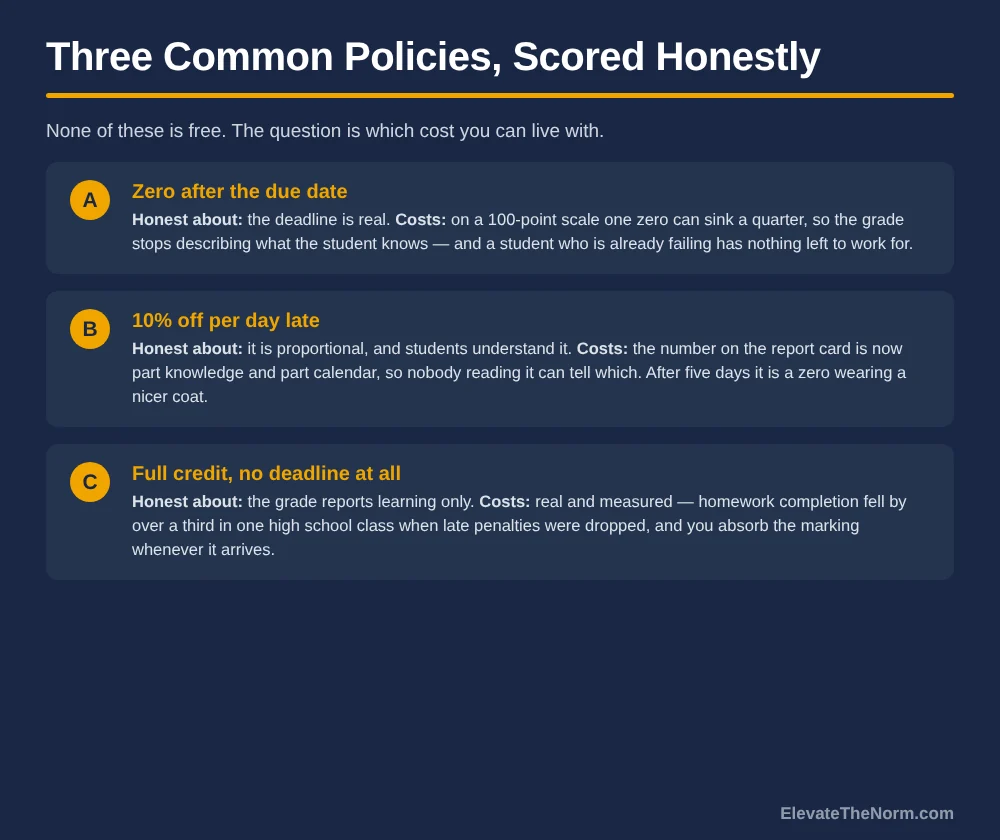
    Comparison of three common late work policies with honest costs: a zero after the due date, ten percent off per day late, and full credit with no deadline, each listed with what it is honest about and what it costs
    None of these is free. The question is which cost you can live with.

    What Does a Workable Late Work Policy Look Like?

    Six parts. It fits on one page, and every part of it survives a parent asking why.
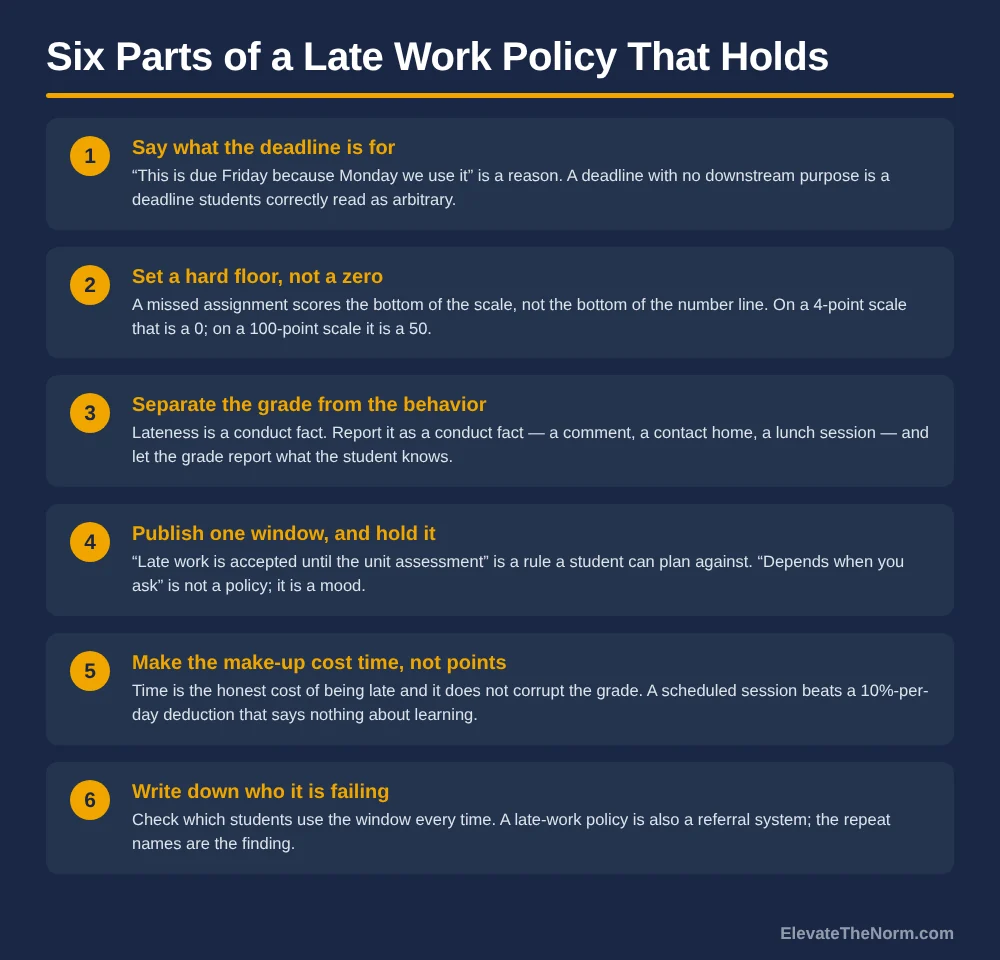
    Six numbered components of a workable late work policy: state what the deadline is for, set a hard floor instead of a zero, separate the grade from the behavior, publish one window and hold it, make the make-up cost time rather than points, and record which students keep using the window
    Six parts, and the sixth one turns the policy into information.

    1. Say what the deadline is for

    “This is due Friday because on Monday we build on it” is a reason. “Because I said Friday” is not, and teenagers are unusually good at telling the difference. A deadline with a downstream purpose gets taken seriously by more students than a deadline without one, and it also tells you which deadlines you should actually defend. If nothing depends on Friday, Friday was arbitrary and you should stop pretending otherwise.

    2. Set a hard floor, not a zero

    A missed assignment scores the bottom of the scale, not the bottom of the number line. On a four-point scale that is a 0. On a 100-point scale it is a 50. The point is not generosity; it is that the floor should be one interval below the lowest passing mark, which is what every other grade boundary already is.

    3. Separate the grade from the behavior

    This is the move that resolves most of the argument, and it costs nothing. Lateness is a conduct fact. Report it as one — a comment on the report, a contact home that happens the same week, a scheduled session — and let the grade report what the student knows. A parent who is told “she understands this material and she has turned in four assignments late” has two usable pieces of information. A parent told “she has a 61” has none.

    4. Publish one window and hold it

    “Late work is accepted until the unit assessment” is a rule a fourteen-year-old can plan against. “Depends when you ask me” is not a policy, it is a mood, and students read inconsistency as unfairness faster than they read strictness as unfairness. Pick a window, write it in the syllabus, and then do exactly what you said — which is the whole of respecting students in practice rather than on a poster.

    5. Make the make-up cost time, not points

    Being late should cost something. Time is the honest currency: a scheduled session at lunch, before school, or during an intervention block. It is a real cost, students feel it, and it leaves the grade intact. A ten-percent-per-day deduction costs them something too — the accuracy of the transcript.

    6. Write down who keeps using the window

    Keep a list. Not to punish with — to read. Three students using the late window every single time is not a late work problem, it is a signal about workload, home, organization, or something nobody has asked about yet. A policy that generates that list is doing a second job for free. A policy that just applies a deduction tells you nothing you did not already know. This is the same logic as treating attendance data as a referral system rather than a compliance record. The same read applies to arrival times, where a tiered response sorts the one-off from the pattern in a way a blanket deduction never will.

    One cost this policy does carry, and it should be named rather than buried: an open window produces a flood at the end of it. If the window closes at the unit assessment, expect a stack the night before, and expect it to arrive in the same week you are marking the assessment itself. Two things keep that survivable. Cap what comes back — late work gets a score and a one-line comment, not the full written feedback a punctual draft gets, and say so in advance. And put the make-up session mid-unit rather than at the end, so the work trickles in instead of arriving at once. A policy that quietly doubles your marking in the last week of a unit is a policy you will abandon by Thanksgiving, which is its own kind of unfairness. The workload side of this is not a side issue; it decides whether the policy still exists in March.

    What Does This Look Like From the Student’s Side?

    Clear, and askable in advance. Those are the two things students actually want from a late work policy, and neither is the same as lenient.

    Clear means they can find it. Not buried in a syllabus they signed in August — posted, in nine words, where the due dates are. A student should be able to answer “what happens if I turn this in Monday” without asking you.

    Askable in advance means the policy has a front door. A fifteen-year-old working a closing shift, or watching younger siblings, or without reliable internet at home, usually knows on Tuesday that Friday is not going to happen. Right now most classrooms give that student nothing to do with that knowledge except apologize on Friday. Say out loud, more than once, that asking before a deadline is a different conversation than explaining after one — and then make it true, which means the student who asks on Tuesday gets a straight answer rather than a lecture.

    That is not softness. It is the difference between treating a teenager as someone managing competing obligations, which they are, and treating them as someone who needs catching out. The deadline does not move for the student who never asks. It is just that the student who plans ahead gets something for planning ahead, which is the behavior the whole policy claims to be teaching.

    How Do You Explain This to a Parent Who Thinks It Is Too Soft?

    Lead with what did not change, because something did not.

    The work is still required. The deadline is still real. There is still a consequence, and it is time rather than points. What changed is that the report card now tells you what your child knows instead of telling you a blend of what they know and when they handed it in.

    That sentence survives most objections because it is not a concession, it is a clarification. And it is worth having ready in writing — in the syllabus and in the first message home — rather than improvised on the phone in October. Parents who object to no-zero policies are usually objecting to the version where nothing is required; the fastest way to settle it is to show this is not that version.

    There is a fair version of the objection too, and it should not be waved off. If a student can turn anything in whenever they like, some will discover that and use it, and a policy that pretends otherwise is not being honest. That is precisely why parts 4, 5 and 6 exist: a published window, a real cost in time, and somebody actually watching the list.

    What Does This Mean for a Department or a School?

    Consistency across a hallway matters more than the specific policy chosen.

    A student with six teachers running six different late policies cannot plan, and the student least able to absorb that is the one the policy was supposed to help. If a department can agree on a window and a floor, that is worth more than any individual teacher’s preferred version of either.

    Two cautions for anyone proposing this above the classroom level. A policy that requires teachers to accept unlimited late work without additional marking time is a workload decision disguised as a grading decision, and it will be abandoned by March. And a schoolwide floor applied on top of a 100-point averaging gradebook is, by Guskey, Fisher and Frey’s argument, treating the symptom — worth doing, but not worth calling a reform.

    Two constraints sit above everything on this page, and both of them outrank it.

    Your district may already have a grading policy with the force of board approval. A teacher who unilaterally sets a 50 floor in a district whose policy says otherwise has a problem that has nothing to do with pedagogy. Read the policy before writing yours, and if the two conflict, that is a conversation with an administrator rather than a decision to make quietly in a gradebook.

    And an IEP or 504 plan governs. If a student’s plan includes extended time or modified deadlines, the plan is the policy for that student, full stop — no classroom rule and no research finding on this page overrides it. Build your policy so that honoring a plan looks like the ordinary case rather than a visible exception, which mostly means making the window generous enough that nobody has to be singled out to use it.

    What to Do Next

    Write the policy on one page before the next unit starts. One window. One floor. One sentence saying lateness is reported as conduct, not deducted from the grade. One line about what the make-up session is and when it runs.

    Then put it in the syllabus and in a message home the first week, so that the first time a family hears about it is not after a missed assignment.

    And keep the list. At the end of the first unit, look at who used the window and how often. That list will tell you more about your classroom than the policy itself does. When the missing work has already pushed a student into a failing grade, the next move is the conversation itself — private, specific, and built around one task with a date on it.

    Before you go: grab the free The One-Page Late Work Policy and Window Log (2 pages) (PDF) — ElevateTheNorm.com branded, printable, no email required.

    Frequently Asked Questions

    Is it true that the study everyone quotes about deadlines was retracted?

    Yes. Ariely and Wertenbroch’s 2002 paper in Psychological Science on spaced deadlines and procrastination was retracted on 2 September 2026, after analyses found duplicated observations, missing expected correlations and implausible response patterns in Study 2. One of the coauthors stated that “much or all of the data — and therefore the results — are false.” A 2025 replication with 124 participants found no significant effect of deadline condition on any outcome. If a PD session or a department policy still cites that study, it needs a new basis. It does not mean deadlines are useless — it means that one famous laboratory result cannot be used as evidence.

    Is giving a 50 for work that was never done just a gift?

    It is a scale decision, not a generosity decision. On a 100-point scale every passing grade sits 10 points from the next, and the gap from D to F is 60 — so a zero carries about six times the weight of any other failing mark in an average. A floor at 50 makes the F one interval below the D, which is what every other boundary already is. The work is still missing, the student still has not demonstrated the standard, and the grade still shows a failure. What changes is that one missing assignment can no longer outweigh several completed ones.

    Can a teacher set a 50 floor if the district grading policy says otherwise?

    No, and this should be checked before anything on this page is implemented. Many districts have a board-approved grading policy, and a teacher who quietly overrides it in a gradebook has created a problem that is not pedagogical. Read the policy first. If it conflicts with what you believe is right, that is a conversation to have with an administrator, and the argument from grading-scale reliability is a strong one to bring to it — but it is a conversation, not a unilateral change.

    How does a late work policy interact with an IEP or 504 plan?

    The plan governs, without exception. If a student’s plan provides extended time or modified deadlines, that is the policy for that student and no classroom rule overrides it. The practical design point is to build the general policy so that honoring a plan looks ordinary rather than exceptional — a window generous enough that a student using it is not visibly marked out. If you are unsure how a plan applies to a specific assignment, ask the case manager before the deadline rather than after.

    Should practice work and assessments have the same late policy?

    No, and running one rule over both is why many late policies feel wrong in practice. Practice work — problem sets, drafts, reading checks — exists to tell you what to reteach, so when it arrives late the instructional cost is already paid and scoring it down recovers nothing. Collect it, use it, record the lateness as conduct. An assessment is different: the deadline is the point at which you claim to know what a student can do. Keep a window there too, but a narrow one, and after it closes have the student demonstrate the standard another way rather than submitting the same artifact months later.

    Won’t accepting late work bury me in grading?

    It can, and a policy that ignores that will not survive to March. Two things keep it manageable. Cap what comes back: late work gets a score and a one-line comment rather than the full written feedback a punctual draft earns, and say so in advance so it reads as a stated rule and not as neglect. And schedule the make-up session mid-unit rather than at the window’s close, so work trickles in instead of landing as a stack the night before the unit assessment.

    Does removing late penalties actually hurt students?

    There is real evidence that it costs something, and it should not be waved away. In one high school chemistry class, homework completion fell by more than a third when late penalties were removed. Separately, students assigned to tougher-grading teachers scored higher in math — in that class and in later courses, across every subgroup studied. None of this proves zeros are correct, and none of it is a randomized trial of a specific late policy. What it does say is that “no deadline, no consequence” is a position with measured costs, which is why the policy described here keeps a real cost and moves it from points to time.

    What should a student do if they know in advance they cannot meet a deadline?

    Ask before it, not explain after it — and the teacher’s job is to make that worth doing. A student working a closing shift or caring for siblings usually knows on Tuesday that Friday will not happen. Most classrooms give them nothing to do with that information. Say out loud, more than once, that a request made before a deadline gets a different conversation than an apology made after one, then honor it: a straight answer rather than a lecture. The deadline does not move for the student who never asks. Planning ahead is the behavior the policy claims to be teaching, so it should get something.

    Sources

    1. Retraction notice: Ariely, D., & Wertenbroch, K. (2002), “Procrastination, Deadlines, and Performance: Self-Control by Precommitment,” Psychological Science. Retracted 2 September 2026. The notice cites a replication study and Data Colada analyses that “raised questions about the underlying data” and “called into question the veracity of the overall findings.” Coauthor Wertenbroch is quoted: “much or all of the data — and therefore the results — are false.” https://retractionwatch.com/?p=135929
    2. Data Colada, post 138, on Study 2 of Ariely & Wertenbroch (2002). Eighteen of twenty participants in the Last Day Deadline condition had exact duplicates across all three proofreading tasks, with ID numbers ten positions apart; expected correlations were absent (original task-performance correlations +.03 to +.27 against +.74 to +.90 in replication); self-reported times showed 11.7% rounding against 85% in the replication. Conclusion: the data “were severely tampered with or fabricated.” https://datacolada.org/138
    3. Hyndman, K., & Bisin, A. (2025). Replication of Ariely & Wertenbroch (2002). 124 participants, three randomly assigned deadline conditions (none, evenly spaced, self-imposed), three proofreading tasks over three weeks. No statistically significant effect of deadline condition on errors found (F = 0.181), days late (F = 0.353) or payment (F = 0.215), all p > 0.1. https://bpb-us-e1.wpmucdn.com/wp.nyu.edu/dist/c/16384/files/2025/09/Ariely_Replication-1.pdf
    4. Korpusik, M., Freitas, J., & Dionisio, J. D. N. (2022). “Impact of Late Policies on Submission Behavior and Grades.” ASEE Annual Conference. Loyola Marymount University, introductory programming lab, 248 submissions, 31 students consenting to analysis, mostly first-years, taught online during the pandemic. Average submission timing: no policy +2.43 days, early incentive +4.71, late penalty +0.44, combined −1.45 days (early). Grades 94.2% / 96.6% / 97.1% / 99.5% respectively. Undergraduates, not grades 6–12 — the mechanism may transfer, the numbers do not. https://people.csail.mit.edu/korpusik/asee22.pdf
    5. Guskey, T. R., Fisher, D., & Frey, N. “The Unwinnable Battle Over Minimum Grades.” Educational Leadership (ASCD). Argues minimum-grade floors treat a symptom: “The true problem is not the zero; it’s the use of the 100-point percentage grading scale and the practice of averaging scores.” Cites Starch and Elliott (1913) on percentage-scale problems and Lozano et al. (2008) and Preston and Colman (2000) on four-to-seven-level scales producing optimal discrimination, validity and reliability. https://www.ascd.org/el/articles/the-unwinnable-battle-over-minimum-grades
    6. Reeves, D. B. (2004). “The Case Against the Zero.” Phi Delta Kappan, 86(4). The arithmetic argument: on a 100-point scale the interval between passing grades is 10 points while “the interval between the D and F is not 10 points but 60 points,” making the mathematically consistent value of an F 50 rather than 0. https://www.researchgate.net/publication/285846142_The_Case_against_the_Zero
    7. Thomas B. Fordham Institute. “Think Again: Does ‘equitable’ grading benefit students?” Cited as a review, not as the primary studies. This is where the grading-strictness findings above come from: Gershenson (2020) on high school math students with tougher-grading teachers scoring higher in that class and in later courses across all subgroups; Figlio and Lucas (2004) on elementary test-score growth; and the high school chemistry case in which removing late penalties cut homework completion “by more than one-third.” The review’s own position is that there is no hard evidence that more lenient grading benefits students long term — a contested claim, and presented here as the strongest version of the case against loosening a late work policy. https://fordhaminstitute.org/national/research/think-again-does-equitable-grading-benefit-students
    About Clay Shumate

    Clay Shumate is a certified secondary Social Studies teacher in the public schools of West Alabama, with seven years of classroom experience, a B.A. in History, and an M.Ed. in Secondary Education. He writes about project-based learning, student responsibility, respect, and practical ways to hold young people to a higher standard while giving them room to learn from mistakes. He is a member of the Society of Professional Journalists and writes to its Code of Ethics; this site’s editorial standards and corrections policy are published in full. More about Clay.

  • Gallery Walk Activity: How to Run One So the Feedback Is Worth Reading

    Gallery Walk Activity: How to Run One So the Feedback Is Worth Reading

    By Clay Shumate

    A gallery walk activity posts student work around the room and sends classmates around to read it and leave written feedback. The walking is not what makes it work. The peer assessment underneath it is the part with research behind it, and that research says it only pays off when students are told exactly what they are looking for before they stand up.

    What follows is what the evidence actually supports, the one study at the right grade level and why it is weaker than it looks, and a six-step version that produces feedback worth reading instead of thirty sticky notes that say “good job.”

    Key Takeaways

    • Peer assessment has real evidence. The gallery walk format does not, separately. A meta-analysis of 54 control-group studies put peer assessment at g = 0.31 on achievement, and at secondary level specifically, g = 0.44.
    • Peer assessment beat teacher assessment in that analysis (0.31 versus 0.28) and tied with self-assessment. It is not a second-best substitute for your own marking.
    • Attaching a grade to peer feedback helped university students and did not help school students. Keep the walk ungraded in grades 6–12.
    • Feedback is not automatically good. Across 607 effect sizes, feedback raised performance on average but made it worse in over a third of cases — mostly when it pointed at the person instead of the work.
    • The single highest-leverage change is naming one focus before students circulate. Open-ended walks produce praise, not information.
    • If nobody revises anything afterward, you ran a walking tour. The revision block is the lesson, not the extra.

    Free Download · PDF

    The Gallery Walk Planner (2 pages)

    Page 1 plans the walk: the four decisions, the three sentence stems, the access check and the two rules that keep it fair. Page 2 runs it: the six steps in order, a student revision slip, and the four failure modes with their fixes.

    Download the free PDF

    Free. No email address required. Designed for grades 6–12. Browse every printable in Your Free Library.

    What Is a Gallery Walk Activity?

    It is a critique protocol: student work goes up on the walls or tables, students circulate in small groups, and each group leaves written feedback on what it sees. Then the authors read their feedback and change something.

    That last clause is the one teachers drop, and it is the one that turns the activity into instruction. Everything before it is logistics.

    The format is flexible in the ways that do not matter much and rigid in the one way that does. It works with drafts, lab write-ups, solved problems, design sketches, annotated sources, project prototypes. It works on paper taped to a wall or on a shared digital board. What it does not work without is a stated thing students are supposed to judge.

    Does a Gallery Walk Activity Actually Improve Learning?

    The peer assessment inside it does. The format itself has almost no rigorous evidence, and that is worth saying out loud because most articles about gallery walks imply otherwise.

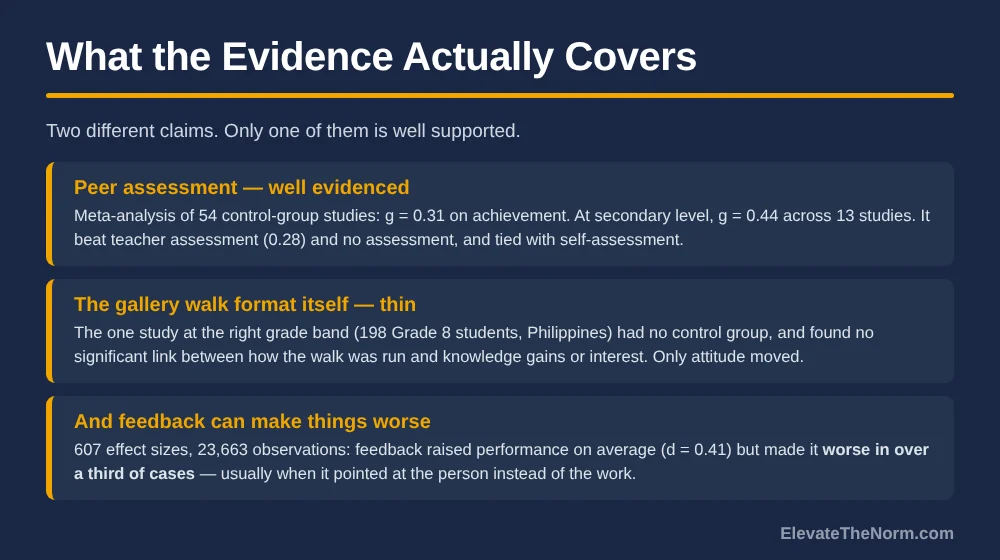
    Double, McGrane and Hopfenbeck published a meta-analysis of peer assessment in Educational Psychology Review covering 54 experimental and quasi-experimental control-group studies. The overall effect on academic performance was g = 0.31 — small to medium, and statistically significant. Peer assessment outperformed no assessment and outperformed teacher assessment (g = 0.28). It showed no advantage over self-assessment.

    Two details in that analysis matter more for a grades 6–12 classroom than the headline number.

    First, the effect at secondary level was higher than the average: g = 0.44 across 13 studies. That runs against the usual pattern on this site, where secondary tends to be the weakest band in cooperative-learning research. Second, the effect held up across implementation choices — online or in person, anonymous or named, frequent or occasional, trained or untrained. None of those moderators came out significant. That is good news for a teacher deciding whether to buy clipboards: the fiddly choices are not where the result lives.

    There was one moderator that did split, and it splits against school students. Peer feedback that carried a grade significantly helped university students (g = 0.55). The same effect could not be shown for primary or secondary students. Do not grade the sticky notes.

    Three-part evidence summary comparing well-evidenced peer assessment at g equals 0.31 overall and 0.44 at secondary level, thin evidence for the gallery walk format itself from one Grade 8 study with no control group, and the finding that feedback made performance worse in over a third of cases
    Two different claims get mixed together. Only one of them is well supported.

    What About Research on Gallery Walks Specifically?

    Thin, and the one study at the right grade level found less than its abstract suggests.

    The closest match is a 2023 study of 198 Grade 8 students at a public high school in the Philippines, measuring knowledge, interest and attitude across three social studies lessons taught through gallery walk activities. It is a genuine secondary-level sample, which almost nothing else in this literature is.

    It is also a one-group pre-test/post-test design with no control group. Students gained on the researcher-made test — mean gained scores of 7.88, 8.15 and 8.01 across the three lessons — but with no comparison class, there is no way to separate the gallery walk from three weeks of teaching. More pointed: when the researchers correlated the specific features of how the walk was implemented against outcomes, none of the correlations with cognitive skills were significant, and none of the correlations with interest were significant either. Only attitude moved reliably.

    So the honest summary is: students liked it, and this study cannot tell you whether it taught them anything. Most of the remaining gallery-walk literature is small single-classroom work outside the United States, often in language instruction, and frequently without a control group either.

    The best-known practitioner guide, from PBLWorks, is also worth reading accurately. It describes a protocol and reports that giving participants a specific focus and criteria “helps generate higher-quality feedback,” while open-ended walks produced superficial comments like “good DQ!” That is a credible observation from people who run these constantly. It is not a study, and the article cites none. It should be quoted as what it is.

    None of this means skip the activity. It means the reason to run it is the peer assessment evidence, and the way to run it should be built to make that peer assessment real.

    Why Does Feedback Sometimes Make Students Worse?

    Because a lot of feedback is about the student instead of the work, and that redirects attention away from the task.

    Kluger and DeNisi’s review of feedback interventions remains the uncomfortable finding in this whole area. Across 607 effect sizes and 23,663 observations, feedback raised performance on average, d = 0.41. But in over a third of cases it lowered performance. Their explanation is that when feedback draws attention to the self rather than the task, the recipient spends their effort on defending themselves rather than improving the thing.

    Anybody who has watched a fifteen-year-old read a comment on their essay knows what that looks like. “This is confusing” is a verdict on a person. “I couldn’t find your claim in the second paragraph” is information about a page. The second one gets acted on; the first one gets argued with.

    That is also why the sentence stems matter more than they sound like they should. “I notice…” and “I wonder…” are not politeness training. They are a grammatical trick that forces the comment to describe the work. The EL Education framing that runs through a lot of critique practice — feedback should be kind, specific and helpful — is making the same move from a different direction, and the people who use it are explicit that it depends on an existing culture. As Ron Berger puts it in that work, this is not a strategy you drop into a classroom without a respectful one already in place.

    That is a real precondition, not a throat-clearing caveat. A gallery walk in a room where students are not already being treated decently by each other and by you produces insults on sticky notes, and you will spend the period on discipline instead of drafts.

    How Do You Run a Gallery Walk That Produces Useful Feedback?

    Six steps. Five of them cost nothing; the sixth costs ten minutes of class time and is the one that makes the other five worth doing.

    Six numbered steps for running a gallery walk activity: name the one thing students look for, hand out criteria before they walk, require written feedback, give descriptive sentence stems, put a clock on each station, and build in revision time
    None of these adds a planning period. The last one is the one that gets cut.

    0. Model it once, on one piece of work, before anybody walks

    Put a single piece of work up on the projector — ideally one of yours, or an anonymous sample from a previous year — and have the whole class write one note about it together. Then read three of their notes aloud and say plainly which one is useful and why. That takes eight minutes and it is the difference between a protocol students understand and a protocol they are performing. Skipping it is the most common reason a first gallery walk falls flat, and it is also the thing a coach watching your room will ask about first.

    1. Name one thing they are looking for

    Not “give feedback.” One focus: content accuracy, or evidence quality, or whether the claim is actually answerable. If you name three, you get one sentence about the easiest of the three. This single decision is what separates a walk that generates information from a walk that generates compliments.

    2. Hand over the criteria before they walk, not after

    Students should be holding the same rubric you will grade against while they circulate. Giving it to them afterward turns peer feedback into a guessing game about what you wanted. If you do not have a rubric for this task yet, three success criteria written on the board will do.

    3. Require it in writing

    Spoken feedback evaporates at the bell. Sticky notes work. So does a feedback slip per station, or a shared document with a row per project. The requirement is that the author can read it later, because step six depends on that.

    4. Give stems that describe rather than judge

    Post three and require them: I notice… / I wonder… / One thing that would strengthen this is… Teenagers will write “nice” if you let them, and they will write something sharper than you expect if you make the sentence start with a verb that forces specificity.

    5. Put a clock on each station

    Two or three minutes, then rotate on a signal. Without a timer the quick groups finish in forty seconds and the room drifts, which is a transition problem dressed up as a behavior problem. A posted rotation order prevents the traffic jam at station one. My Station Rotation Toolkit on TPT has eight reusable station frames, signs, and recording sheets if you would rather not build them.

    6. Build in the revision

    Ten minutes at the end: read your notes, pick one change, make it. Not “consider the feedback.” Pick one, make it, and be ready to say what you changed and why. This is the step that gets cut when the period runs long, and cutting it is what turns a critique into a field trip around your own classroom.

    One more thing belongs in that ten minutes, and it is the part students care about most: they do not have to take the advice. Some peer feedback is confidently wrong. A student who reads “your thesis is unclear” from someone who skimmed two sentences is entitled to decide that note is not useful. The requirement is that they can say which note they acted on and why, or which note they rejected and why. Both are evidence of judgment, which is the actual skill being taught. A protocol that forces a student to obey bad advice is teaching the opposite of what peer assessment is for.

    Whose Work Goes on the Wall?

    This is the question a parent asks first, and most guides to this activity never raise it.

    Putting a student’s work in front of thirty classmates is not a neutral act. For the student who knows their draft is the weakest in the room, a gallery walk can be the worst twenty minutes of their week, and no amount of “I wonder…” stems fixes that by itself.

    Three things keep it fair. First, everything goes up, every time — a walk where only the strong work is displayed is a showcase, and students read the selection as the verdict. Second, do not use personal writing. Narrative and reflective pieces where a student has written about their own life do not belong on a wall; use the analytical task, the lab, the problem set, the project artifact. Third, let a student put work up unnamed if they ask. Peer assessment effects in the meta-analysis held up whether feedback was anonymous or not, so you are giving away nothing that the research says you need.

    If a family asks why their child’s work was displayed, the answer should be a sentence you already have: everyone’s work goes up, nobody’s name has to, and nothing personal is ever used. Worth putting in a back-to-school message the first time you run it, rather than after a phone call.

    What Goes Wrong, and How Do You Tell It Is Your Structure?

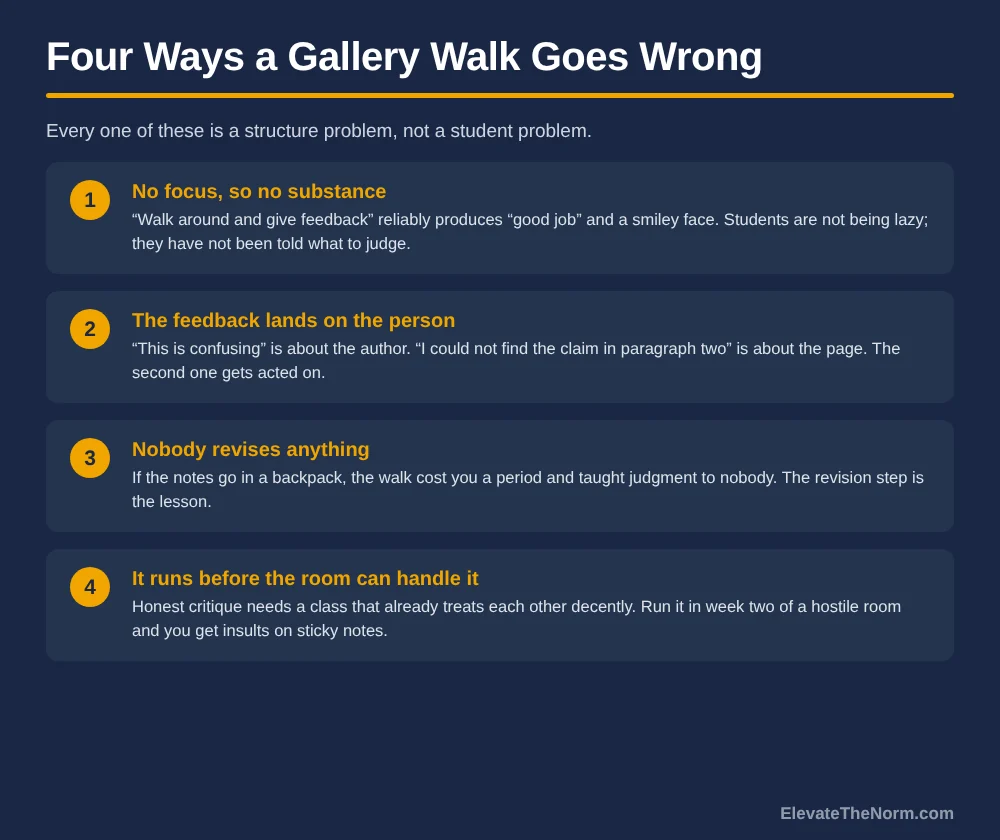
    Four failure modes cover almost all of it, and all four are things you set up rather than things students did.

    Four numbered failure modes of a gallery walk activity: no focus so no substance, feedback aimed at the person rather than the work, no revision after the walk, and running critique before the classroom culture can support it
    Every one of these is a structure problem, not a student problem.

    The first is no focus, which produces “good job” and a smiley face. Students are not being lazy. They have not been told what to judge, so they default to the safest comment available.

    The second is feedback aimed at the person. See above. The fix is mechanical — stems, and a rule that every note names a specific part of the work.

    The third is no revision, which is the most common and the most expensive. If the notes go into a backpack, the walk taught judgment to nobody and cost you a period.

    The fourth is running it too early. Critique is a high-trust activity. In a room where that trust is not there yet, start with something lower stakes — structured peer response on a single paragraph at their desks, with you reading over shoulders — and build toward the full walk over a few weeks.

    Two practical notes, because the guides tend to skip both. Prep is roughly ten minutes — deciding the focus, writing three criteria, and finding the sticky notes. There is no packet to build, which is a large part of why this protocol survives in real classrooms. And the student who has nothing to post is an ordinary Tuesday, not a crisis. They post what exists, even if it is a title and two sentences, and they do the walk and give feedback like everybody else. Giving feedback is most of the cognitive work in this activity anyway. Exempting them from the one part they can still do teaches them that the room has stopped expecting anything from them.

    Where Does This Fit in a Unit?

    Mid-draft, not at the end. A gallery walk on finished work is a showcase, which is a fine thing but a different thing. The activity earns its period when the work is still changeable.

    In a project, the natural slot is the day the first full draft exists and before any of it is graded. The critique and revision tools in a PBL toolkit are built around exactly that moment. In a writing unit, it is after the first full draft and before the revision conference. In a problem-based math or science lesson, it is after groups have committed to an approach and before they have invested two days in it.

    One per unit is plenty. Run it weekly and it becomes the thing students perform rather than the thing they use, which is the same failure mode that eventually catches every student-centered routine that gets over-used.

    Does This Work in a Class of Thirty-Five?

    Yes, and it is one of the few protocols that gets easier as the class gets bigger, because it runs in parallel.

    Eight or nine stations, groups of four, three minutes each, and the whole room is working at once. The constraint is wall space and traffic flow, not headcount. If the room is tight, put work flat on desks and rotate groups between desk clusters instead of around the perimeter — same protocol, less collision.

    Where class size does bite is the revision block. Thirty-five students each wanting to ask you about one piece of feedback does not fit in ten minutes. The answer is that they do not ask you. They pick one change and make it. You circulate. The ones who are genuinely stuck will find you.

    Access is worth planning for rather than improvising. A student who reads well below grade level cannot absorb six peers’ drafts in three minutes, and a student newer to English may be able to judge the work and not able to write the note quickly. Both are solved the same way: let feedback be spoken to a partner who writes it, or give a sentence frame with the technical words already in it. Neither reduces the demand — the judgment is still theirs — and both stop the activity quietly sorting the room by reading speed.

    What to Do Next

    Pick a task you already have, where the work is half-finished and you were going to collect it anyway. Decide the one thing students will look for. Write three success criteria on the board. Give them sticky notes, three sentence stems and three minutes a station, and reserve the last ten minutes of the period for one change each.

    Do not grade it. The research says the grade does nothing for students this age, and the moment it is graded you are back to students writing what they think you want to read.

    Then look at the revisions rather than the sticky notes. The sticky notes tell you how well you set up the protocol. The revisions tell you whether anybody learned anything, which is the only question that matters.

    Before you go: grab the free The Gallery Walk Planner (2 pages) (PDF) — ElevateTheNorm.com branded, printable, no email required.

    Frequently Asked Questions

    Is there actual research behind the gallery walk activity, or just blog posts?

    Both, and they are not the same strength. The peer assessment that happens inside a gallery walk is well evidenced: a meta-analysis of 54 control-group studies found g = 0.31 on academic performance, rising to g = 0.44 at secondary level. The gallery walk format is a different claim, and the evidence there is thin. The closest study at the right grade level followed 198 Grade 8 students but had no control group, and found no significant relationship between how the walk was run and students’ knowledge gains or interest. Run the activity for the peer assessment, and build it so the peer assessment is real.

    How do you keep a gallery walk from humiliating the student whose work is weakest?

    Three rules handle most of it. Everyone’s work goes up every time — a wall of selected work tells the room exactly who was selected. Never use personal or narrative writing; use the analytical task, the lab, the problem set or the project artifact. And let a student display work without their name if they ask for that. Anonymity was not a significant moderator in the peer assessment research, so you lose nothing measurable by allowing it. If a student still refuses, take it privately rather than in front of the room.

    Should peer feedback on a gallery walk be anonymous or signed?

    Either works, and you can decide it on classroom grounds rather than research grounds. In the Double, McGrane and Hopfenbeck meta-analysis, anonymity was one of several implementation choices that showed no significant difference in effect. Signed notes tend to be more careful and let the author follow up with a question; anonymous notes tend to be more honest early in the year. A reasonable default is signed, with the caveat that you will read them.

    Should you grade the feedback students give?

    No, not in grades 6–12. The one place the research splits by age is exactly here: peer feedback carrying a grade significantly improved university students’ performance, and that effect could not be shown for primary or secondary students. Grading it also changes what students write — they start producing what they think you want rather than what they noticed. Hold them accountable for completing it, not for a score on it.

    What if a student gets feedback that is simply wrong?

    They are allowed to reject it, and saying so out loud is part of the lesson. Require that every student can name one note they acted on and why, or one note they decided not to act on and why. Both answers show judgment, which is the skill peer assessment is supposed to build. A protocol that makes a student obey bad advice from a classmate is teaching compliance, not critique.

    How long does a gallery walk take, and how much preparation?

    One class period, and about ten minutes of prep. The prep is deciding the single focus, writing three success criteria, and finding sticky notes — there is no packet to build. In the period, allow eight minutes to model the protocol the first time, two to three minutes per station, and a protected ten minutes at the end for revision. If the period is short, cut the number of stations, never the revision block.

    What do you do when a student writes something unkind on a note?

    Collect it, handle it privately, and do not re-run the whole protocol as a punishment for the class. Then look at what made it possible: unkind notes are far more common when the focus was vague, because “say something about this” invites personal commentary while “find the claim and say whether the evidence supports it” does not. Critique also depends on an existing classroom culture — if the room is not there yet, scale back to partner feedback at desks and build up to the full walk.

    How do you know whether the gallery walk actually taught anything?

    Look at the revisions, not the sticky notes. The notes tell you how well you set up the protocol; the changes students made tell you whether the feedback was understood and used. A quick version: collect the one-sentence statement of what each student changed and why. If most of them name a surface change — spelling, formatting, length — the focus you set was too broad and the next walk needs a narrower one.

    Sources

    1. Double, K. S., McGrane, J. A., & Hopfenbeck, T. N. (2019). “The Impact of Peer Assessment on Academic Performance: A Meta-analysis of Control Group Studies.” Educational Psychology Review, 32. Meta-analysis of 54 experimental and quasi-experimental control-group studies; overall g = 0.31 (p < .001) on academic performance; peer assessment outperformed no assessment and teacher assessment (0.28) and was comparable to self-assessment; effects robust across delivery mode, frequency and educational level. https://ora.ox.ac.uk/objects/uuid:0a09975c-e7e6-416f-b888-977230b29ba4
    2. Clearinghouse Unterricht (TUM), Short Review 28 on Double et al. (2020). Cited as a summary, not as the primary study. This is where the secondary-level figure used above comes from — g = 0.44 across 13 studies — together with the moderator finding that peer feedback carrying a grade significantly helped university students (g = 0.55) but could not be shown to help primary or secondary students. https://www.clearinghouse.edu.tum.de/wp-content/uploads/2023/10/CHU-KR-28_ENG_Double_2020.pdf
    3. “Gallery Walk Activities in Teaching Social Studies: Inputs in Enhancing Knowledge, Interest, and Attitude of Grade 8 Students” (2023). International Journal of Research Publications. 198 Grade 8 students, Philippines. One-group pre-test/post-test and correlational design with no control group. Mean gained scores 7.88 / 8.15 / 8.01 across three lessons; correlations between implementation features and cognitive skills were not significant, and correlations with interest were “not significant at 0.05 level”; only attitude correlations reached significance. https://ijrp.sfo3.cdn.digitaloceanspaces.com/pubjournal/5094/1001281720235215.pdf
    4. PBLWorks / Buck Institute for Education. “Using Gallery Walks for Critique & Revision in PBL.” Practitioner protocol. The claim that a specific focus and criteria produce higher-quality feedback is reported by the authors as their own experience — “We’ve found” — and the article cites no studies. Quoted here as practice knowledge, not as research. https://www.pblworks.org/blog/using-gallery-walks-critique-revision-pbl
    5. Kluger, A. N., & DeNisi, A. (1996). “The Effects of Feedback Interventions on Performance: A Historical Review, a Meta-analysis, and a Preliminary Feedback Intervention Theory.” Psychological Bulletin, 119(2). 607 effect sizes across 23,663 observations; average d = 0.41; feedback interventions reduced performance in over a third of cases. The primary article was not reachable from this session; the figures above are taken from a secondary summary of it and are labelled as such. https://explore.psychsafety.com/n/kluger-denisi-1996/
    6. Varlas, L. (2017). “Peer Feedback Without the Sting.” Educational Leadership (ASCD), May 2017. Source of the “kind, specific, helpful” framing attributed to Ron Berger of EL Education, and of the point that peer critique depends on existing classroom culture rather than on the protocol alone. https://www.ascd.org/el/articles/peer-feedback-without-the-sting

    About Clay Shumate

    Clay Shumate is a certified secondary Social Studies teacher in the public schools of West Alabama, with seven years of classroom experience, a B.A. in History, and an M.Ed. in Secondary Education. He writes about project-based learning, student responsibility, respect, and practical ways to hold young people to a higher standard while giving them room to learn from mistakes. He is a member of the Society of Professional Journalists and writes to its Code of Ethics; this site’s editorial standards and corrections policy are published in full. More about Clay.

  • Socratic Seminar Rubric: A Four-Criterion Version for Grades 6–12

    Socratic Seminar Rubric: A Four-Criterion Version for Grades 6–12

    By Clay Shumate · Updated October 24, 2026

    A Socratic seminar rubric should score four things: preparation, use of the text, how a student treats other people’s ideas, and what they wrote afterward. It should not score how many times somebody spoke. The full rubric is below, free, on this page, with no email to give — and a printable version at the bottom if you want one.

    It comes with an argument, because a rubric that counts talking turns is worse than no rubric at all — and because the research on rubrics is more qualified than the phrase “research-based rubric” suggests.

    Key Takeaways

    • Four criteria, four levels, and none of them is participation frequency. Counting comments rewards volume and punishes the students who most need the practice.
    • Most of the score comes from writing, not talking. Preparation before and reflection after are visible, gradeable, and fair to a student who spoke twice.
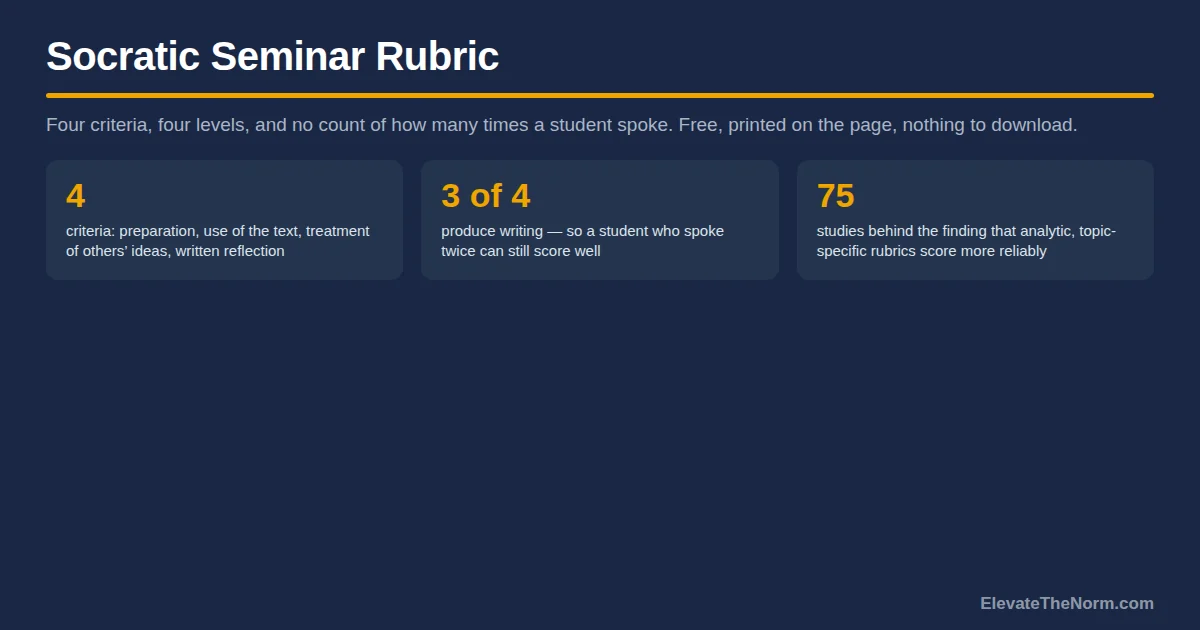
    • Analytic beats holistic on reliability. A review of 75 studies found scoring agreement improves with analytic, topic-specific rubrics plus exemplars or rater training.
    • Rubrics are not automatically valid. The same review is explicit that a rubric improves agreement between scorers without guaranteeing you are measuring the right thing.
    • You cannot facilitate and score thirty students at once. Anyone who says otherwise is describing a checklist, not an assessment.

    Free Download · PDF

    Socratic Seminar Rubric (Four Criteria)

    The same four-criterion rubric printed above, laid out to print and cut, plus the scoring rotation for thirty students and a student self-score half-sheet.

    Download the free PDF

    Free. No email address required. Designed for grades 6–12. Browse every printable in Your Free Library.

    What Should a Socratic Seminar Rubric Measure?

    The things a student controls, that leave evidence, and that you would still care about if the student were quiet. That test eliminates most of what standard seminar rubrics score.

    Four criteria survive it.

    1. Preparation. Did they read it, mark it, and bring a written question? This is visible before anyone speaks and it is the single best predictor of whether the seminar works.
    2. Use of the text. When they did speak or write, did they point at a specific place in the text, or at a general impression?
    3. Treatment of other people’s ideas. Did they build on, question, or directly respond to a classmate — or deliver a prepared statement into the middle of the circle and stop?
    4. Reflection afterward. Can they name what changed in their thinking and whose comment did it? This one is only answerable by a student who was listening, which is why it is the hardest to fake.

    If your gradebook is standards-based, those four map cleanly onto speaking-and-listening standards without inventing a category: preparation and use of the text are evidence standards, treatment of others’ ideas is a collaborative-discussion standard, and the reflection is usually assessable under both. You do not need a “participation” line item, and if the gradebook has one, these are what should feed it.

    One caution on the third criterion, and it is the one I would want a department to talk through before adopting any seminar rubric. Norms about interrupting, turn length, directness and how openly you disagree are not universal — they vary by family, by community, and by what a student has been taught is respectful. A rubric that scores “treatment of others’ ideas” can quietly encode one conversational style as the correct one. Keep the descriptors pointed at what the student did with the idea — responded to it, questioned it, built on it — and away from manner, volume and poise. If a descriptor could be satisfied by a confident student who said nothing of substance, it is scoring style.

    Three of those four produce writing. That is deliberate. A rubric whose evidence is mostly written is a rubric you can actually apply after the period ends, and it is a rubric a student who said very little can still score well on.

    The Socratic Seminar Rubric

    Four criteria, four levels, no participation count. Copy it, cut it, change the language to match your school’s scale. It is free, it is printed in full right here, and there is a printable version at the bottom of this page.

    One framing worth saying to students before you hand it over: the level-one column describes something that happened on one day, not a kind of person. A student who arrived without the text marked is a student who arrived without the text marked. If a descriptor reads to a fourteen-year-old like a verdict on their character, rewrite it — that costs nothing and it changes whether they look at the rubric again.

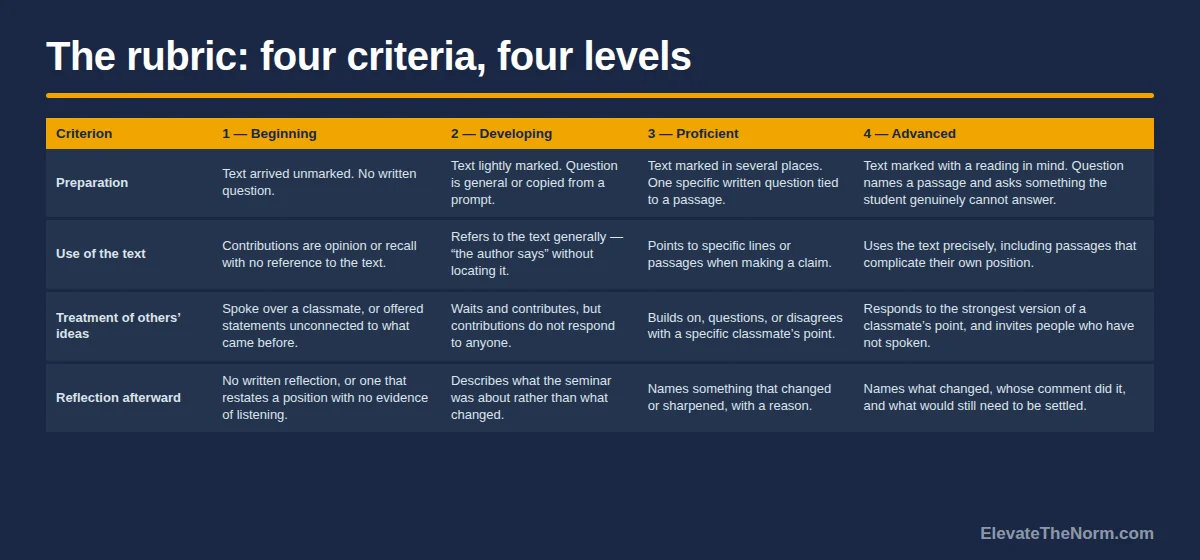
    Four by four Socratic seminar rubric table with criteria for preparation, use of the text, treatment of others' ideas and reflection afterward, each described at beginning, developing, proficient and advanced levels
    The full rubric. The same table is written out below so you can copy it.
    Criterion1 — Beginning2 — Developing3 — Proficient4 — Advanced
    PreparationText arrived unmarked. No written question.Text lightly marked. Question is general or copied from a prompt.Text marked in several places. One specific written question tied to a passage.Text marked with a reading in mind. Question names a passage and asks something the student genuinely cannot answer.
    Use of the textContributions are opinion or recall with no reference to the text.Refers to the text generally — “the author says” without locating it.Points to specific lines or passages when making a claim.Uses the text precisely, including passages that complicate their own position.
    Treatment of others’ ideasSpoke over a classmate, or offered statements unconnected to what came before.Waits and contributes, but contributions do not respond to anyone.Builds on, questions, or disagrees with a specific classmate’s point.Responds to the strongest version of a classmate’s point, and invites people who have not spoken.
    Reflection afterwardNo written reflection, or one that restates a position with no evidence of listening.Describes what the seminar was about rather than what changed.Names something that changed or sharpened, with a reason.Names what changed, whose comment did it, and what would still need to be settled.
    Free to copy, cut and rewrite. No email address. A printable version is linked below.

    Why This Rubric Does Not Count How Often You Spoke

    Because a participation count measures confidence and rewards it, and confidence is not the skill you are teaching. The moment students know comments are scored, you get performances of the right length at the right frequency, and the conversation stops being about the text.

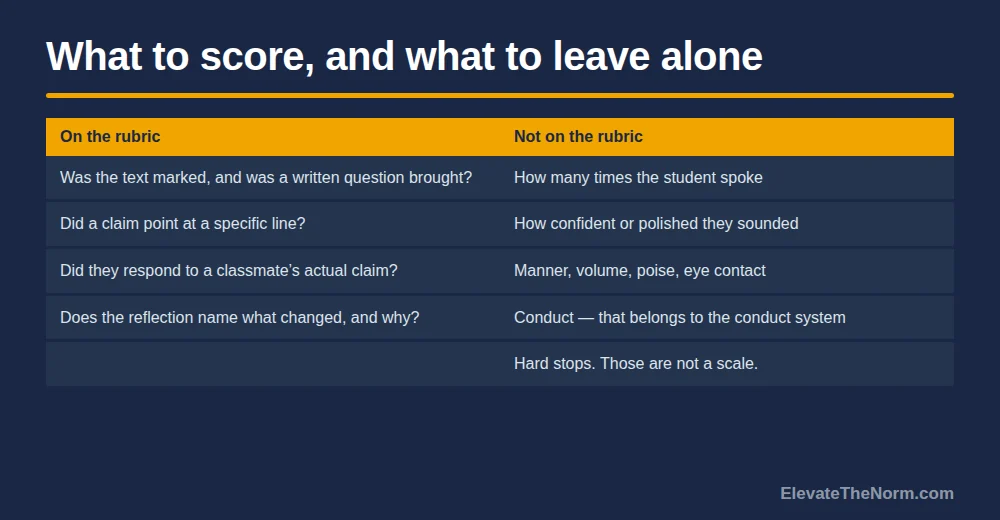
    Two column table contrasting what belongs on a Socratic seminar rubric with what does not, including how many times a student spoke, manner and poise, and conduct
    If a descriptor could be met by a confident student who said nothing of substance, it is scoring style.

    There is a second reason, and it is about who pays. A qualitative study of quiet students — ten undergraduates, so treat it as a description rather than a finding about your seventh period — found that nine of the ten struggled with instructor expectations for verbal participation, and six reported physical reactions when speaking aloud: trembling, blushing, stuttering. One described planning out what they wanted to say before speaking. A frequency count charges those students a fee the loud ones never pay, for a behavior that is not the learning objective.

    Related, and worth checking against your district’s grading policy: criterion three has to stay academic. “Responded to a classmate’s specific claim” is an academic behavior. “Was respectful” is conduct, and in a lot of districts conduct is not permitted inside an academic grade — for good reason. If a student’s behavior in a seminar is a problem, that is the conduct system’s job, handled the way you would handle it on any other day, and not something you fold into a score for a speaking standard.

    This also gives you a clean answer when a parent asks. A quiet student can earn full marks here, because three of the four criteria are about preparation, precision and listening, and none of them requires their child to perform in front of the class. Say that in the same sentence you send the rubric home, before anyone has to ask.

    If your school requires a participation grade, pull it from criteria one and four — both of which are written, both of which are about preparation and listening, and neither of which requires a student to perform. Then say out loud to the class that talking is not scored. The first seminar after they believe you is a different conversation.

    One thing that belongs nowhere on a rubric: the behaviors that are not a continuum. In my room, making fun of how unusual somebody’s name is is a hard stop — not a criterion where a student can earn a 2. A rubric is for things that improve by degrees. Hard stops are a different category, and putting them on a scoring scale quietly suggests there is an acceptable amount.

    Do Rubrics Actually Help?

    They reliably help scoring agreement. Their effect on learning is real, mixed, and badly confounded — and the honest version is more useful than the sales version.

    Jonsson and Svingby reviewed 75 empirical studies on rubrics. Their finding on reliability is clear: scoring “can be enhanced by the use of rubrics, especially if they are analytic, topic-specific, and complemented with exemplars and/or rater training.” Their finding on validity is the one people skip — rubrics do not by themselves make an assessment judgement valid. Two teachers agreeing on a score is not the same as the score measuring the thing you care about.

    Panadero and Jonsson then reviewed 21 studies on using rubrics formatively. Some reported large effects on performance — effect sizes from 0.99 to 1.6 — and others reported little or nothing. The authors are direct about why that range is not as impressive as it looks: “most studies reporting on such improvements have combined the use of rubrics with other instructional interventions.” The rubric usually arrived alongside self-assessment, peer assessment or extended instruction, so the rubric’s own contribution is hard to isolate. They also note that positive effects were more likely in higher education, in interventions lasting several weeks or longer, and when rubrics were paired with metacognitive work.

    What they identify as the mechanism is worth keeping, because it tells you how to use the thing: rubrics work by making expectations transparent, which reduces anxiety, supports feedback, and lets students plan. Students in those studies described using a rubric “much like a recipe or a map.”

    The practical conclusion: hand the rubric out before the seminar, not after. A rubric used as a scoring instrument is a grading tool. A rubric used as a description of what good looks like, given to students in advance, is the version with evidence behind it.

    Analytic or Holistic?

    Analytic, if you want two teachers to agree. That is the clearest single recommendation in the rubric literature, and the rubric above follows it — four separate criteria scored separately rather than one overall impression.

    Jonsson and Svingby list four things that improve scoring agreement, and it is worth reading them as a to-do list rather than a finding: analytic design, topic-specific criteria, exemplars, and rater training. The first two are free and you did them by choosing this rubric. The third costs one seminar — keep two reflections, one strong and one thin, and show students both. Anonymised means actually anonymised — names and identifying details stripped, and the student asked first. A class can usually recognise its own handwriting and its own arguments, and “this is the weak one” is not a thing to do to a student by accident. The fourth matters only if more than one adult is scoring.

    “Topic-specific” is the one worth acting on. A rubric that says “uses evidence effectively” is generic and every scorer fills in their own meaning. Rewriting that row to name what evidence looks like in this text — a line number, a date, a specific claim — takes two minutes and does more for consistency than any amount of descriptor polishing. The same principle runs through the site’s approach to rubrics generally: specific beats elegant.

    How Do You Score Thirty Students in One Period?

    You do not, and the sooner you stop trying the better your seminars get. Facilitating and scoring are two jobs. Doing both means doing the first one badly, and the first one is the one that makes the seminar work.

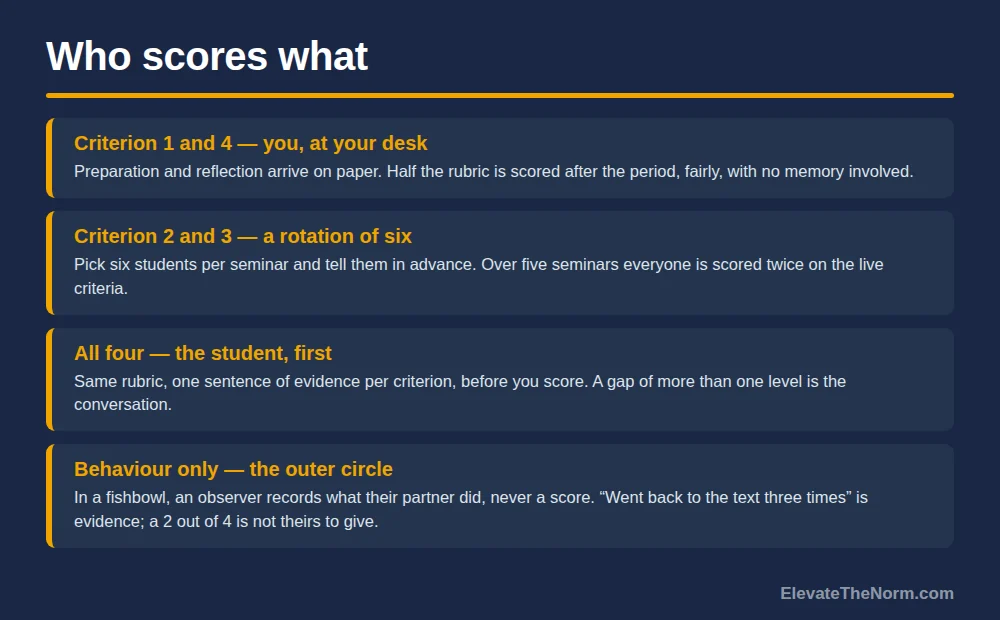
    Four rows describing who scores which rubric criteria: the teacher scores preparation and reflection from paper, a rotating group of six is scored on the live criteria, students self-score first, and outer-circle observers record behaviour only
    Facilitating and scoring are two jobs.

    Three ways out, in order of how much I trust them.

    1. Score the writing, not the room. Criteria one and four are collected on paper. That is half the rubric done at your desk, after school, fairly, with no memory involved.
    2. Score a rotation. Pick six students per seminar for criteria two and three and tell them in advance. Over five seminars everyone gets scored twice on the live criteria. Telling them beforehand is not cheating — it is the transparency the research says is doing the work.
    3. Use the fishbowl. If half the class is in an outer circle already, give each observer one partner and one behavioral thing to record. Their notes are not the grade, but they are evidence you did not have to generate while running the conversation.

    Check one thing before you adopt any of this: if a student has an IEP or 504 plan that addresses oral participation, the live criteria may need to be replaced rather than adapted for that student. Ask the case manager rather than improvising a workaround, and note that this rubric already makes that easy — half the score is written, so substituting the other half costs you less than it would on most discussion rubrics.

    On time, honestly: four criteria for twenty-eight students is about twenty minutes if you are scoring the written half from paper and six students on the live half. It is not nothing. It is roughly the cost of grading a set of exit tickets, and it is the reason the rotation exists.

    What I would not do is score from memory at the end of the period. Twenty minutes after a good seminar, what you remember is who was interesting, and “interesting” correlates with confident far more than it correlates with prepared.

    Who Should Do the Scoring?

    Students first, on the same rubric, before you score anything. This is the change that makes the rubric an instructional tool rather than a grading one, and it costs four minutes.

    Hand out the rubric before the seminar. Afterward, have each student score themselves on all four criteria and write one sentence of evidence for each. Then score them yourself. Where you disagree by more than one level, that is your conversation — and it is a better conversation than any comment you would have written unprompted.

    Two guards on this. The student’s self-score is not the grade; it is information, and the moment it becomes the grade you have taught them to inflate it. And peer scoring should stay behavioral: what a classmate did, not how well they did it. A fifteen-year-old can honestly record “went back to the text three times.” A fifteen-year-old should not be handing another fifteen-year-old a 2 out of 4 on how they treat people’s ideas. This is the same line the site draws around having students judge their own work: the judgement is real, and it does not become the record.

    What to Do With the Score

    Use it to decide what to teach next, and put as little of it in the gradebook as your school allows. A seminar rubric’s best use is diagnostic.

    Look down the columns rather than across the rows. If twenty of twenty-eight students scored low on use of the text, that is not twenty-eight individual grades — that is one lesson about citing a line, and you should teach it before the next seminar instead of recording twenty low scores. If preparation is the weak column, the problem is upstream of the seminar entirely and no amount of facilitation will fix it.

    If the scores do go in the gradebook, weight them low and tell students the weight. A seminar is a practice format. Grading practice heavily is how you get students who will not risk a wrong reading out loud, which is the one behavior the whole format exists to produce.

    What to Do Next

    Take the rubric above, rewrite the use of the text row so it names what evidence looks like in the specific text you are teaching, and hand it to students the day before — not the day after. Score criteria one and four from the paper they turn in. Pick six students for the live criteria and tell them who they are.

    Then run it twice before you judge either the rubric or your class. If you need the rest of the format, it is in the guide to running a Socratic seminar, and the questions that make one worth scoring are in the seminar question bank.

    Before you go: grab the free Socratic Seminar Rubric (Four Criteria) (PDF) — ElevateTheNorm.com branded, printable, no email required.

    Frequently Asked Questions

    What are the levels on a Socratic seminar rubric?

    This rubric uses four levels for each of its four criteria: 1 — Beginning, 2 — Developing, 3 — Proficient, and 4 — Advanced. Each criterion (preparation, use of the text, treatment of others’ ideas, and reflection afterward) is scored separately, which is what makes it an analytic rubric rather than a single overall impression.

    Does this Socratic seminar rubric work for middle school?

    Yes. It is written for grades 6–12. For younger students, rewrite any level-one descriptor that reads like a verdict on a person rather than a description of one day, and rewrite the use-of-the-text row to name what evidence looks like in the specific text. If a student has an IEP or 504 plan addressing oral participation, ask the case manager about replacing the live criteria.

    What should a Socratic seminar rubric include?

    Four criteria: preparation, use of the text, treatment of other people’s ideas, and written reflection afterward. Three of the four produce writing, which means you can score them after the period rather than while facilitating, and a student who spoke twice can still score well. What it should not include is a count of how many times a student spoke.

    Should you grade a Socratic seminar at all?

    Grade the preparation and the reflection, and weight the whole thing lightly. A seminar is a practice format, and grading practice heavily produces students who will not risk a wrong reading out loud — which is the behavior the format exists to create. If a participation grade is required, take it from the written criteria and say plainly that speaking is not scored.

    Why shouldn’t a rubric count how many times a student speaks?

    Because it measures confidence and charges a fee to students who find speaking aloud genuinely hard. A study of quiet students found most struggled with verbal participation expectations and several reported physical symptoms — trembling, blushing, stuttering — when speaking in class. Frequency is also easy to game: three short comments at the right moments will beat one student who prepared thoroughly and spoke once.

    Is an analytic or holistic rubric better for a seminar?

    Analytic, if you want consistency. A review of 75 rubric studies found scoring reliability improves when rubrics are analytic and topic-specific and are paired with exemplars or rater training. Holistic rubrics are faster and less consistent, and with something as fuzzy as discussion quality, consistency is exactly what you are short of.

    Do rubrics actually improve student learning?

    The evidence is genuinely mixed. A review of 21 studies of formative rubric use found effects ranging from very large to nothing, and noted that most studies combined rubrics with other interventions, so the rubric’s own contribution is hard to isolate. What the authors identify as the mechanism is transparency — which means handing the rubric out before the seminar rather than attaching it to the grade afterward.

    How do you score thirty students during one seminar?

    You do not. Facilitating and scoring are two jobs, and doing both means doing the facilitation badly. Score the two written criteria from paper afterward, and score the two live criteria for a rotating group of about six students per seminar, told in advance. Over five seminars everyone gets scored twice on the live criteria.

    Should students score themselves on the seminar rubric?

    Yes, before you score them, using the same rubric with one sentence of evidence per criterion. Where your score and theirs differ by more than one level, that gap is the conversation worth having. Keep the self-score as information rather than as the grade — the moment it becomes the grade, students learn to inflate it.

    Is this Socratic seminar rubric free to use?

    Yes. It is printed in full on this page and there is a free printable version too, with no email address to hand over, and you are welcome to copy it, cut criteria, or rewrite the language to match your school’s scale. Rewriting the use-of-the-text row so it names what evidence looks like in your specific text is the single change that will do the most for consistency.

    Rubrics like this one are the kind of thing I share in Bell to Bell, a free weekly newsletter for grades 6–12 teachers. Every other issue includes a printable classroom resource, and a new issue lands each Wednesday.

    Sources

    1. Jonsson, Anders, and Gunilla Svingby. “The Use of Scoring Rubrics: Reliability, Validity and Educational Consequences.” Educational Research Review, vol. 2, no. 2, 2007, pp. 130–144. Review of 75 empirical studies; reliable scoring “can be enhanced by the use of rubrics, especially if they are analytic, topic-specific, and complemented with exemplars and/or rater training”; rubrics do not by themselves guarantee valid judgements. https://eric.ed.gov/?id=EJ796733
    2. Panadero, Ernesto, and Anders Jonsson. “The Use of Scoring Rubrics for Formative Assessment Purposes Revisited: A Review.” Educational Research Review, vol. 9, 2013, pp. 129–144. 21 studies; effects on performance ranged from large (0.99–1.6) to negligible, and “most studies reporting on such improvements have combined the use of rubrics with other instructional interventions.” Positive effects more likely in higher education, over longer interventions, and when paired with metacognitive activity. https://platform.europeanmoocs.eu/users/4567/Les3/Panadero-Jonsson-rubrics-3.pdf
    3. Murphy, P. Karen, et al. “Examining the Effects of Classroom Discussion on Students’ Comprehension of Text: A Meta-Analysis.” Journal of Educational Psychology, vol. 101, no. 3, 2009, pp. 740–764. Discussion produced strong increases in student talk and substantial gains in text comprehension, but “few approaches to discussion were effective at increasing students’ literal or inferential comprehension and critical thinking and reasoning.” https://eric.ed.gov/?id=EJ861185
    4. Applebee, Arthur N., Judith A. Langer, Martin Nystrand, and Adam Gamoran. “Discussion-Based Approaches to Developing Understanding: Classroom Instruction and Student Performance in Middle and High School English.” American Educational Research Journal, vol. 40, no. 3, 2003, pp. 685–730. 64 middle and high school English classrooms, grades 7, 8, 10, 11 and 12. https://eric.ed.gov/?id=EJ782328
    5. Medaille, Ann, and Janet Usinger. “Quiet Students’ Experiences with the Physical, Pedagogical, and Psychosocial Aspects of the Classroom Environment.” Educational Research: Theory and Practice, vol. 31, no. 2, 2020, pp. 41–55. Ten upper-division undergraduates — not secondary students; nine of ten struggled with verbal participation expectations and six reported physical symptoms when speaking aloud. https://files.eric.ed.gov/fulltext/EJ1274336.pdf

    About Clay Shumate

    Clay Shumate is a certified secondary Social Studies teacher in the public schools of West Alabama, with seven years of classroom experience, a B.A. in History, and an M.Ed. in Secondary Education. He writes about project-based learning, student responsibility, respect, and practical ways to hold young people to a higher standard while giving them room to learn from mistakes. He is a member of the Society of Professional Journalists and writes to its Code of Ethics; this site’s editorial standards and corrections policy are published in full. More about Clay.

  • Formative Assessment Strategies for Reading: Five Checks That Fit a Real Week

    Formative Assessment Strategies for Reading: Five Checks That Fit a Real Week

    By Clay Shumate

    Formative assessment strategies for reading are short, ungraded checks that show you what students understood from a text while the lesson is still running. A two-sentence gist, a flagged confusion, a prediction. They take two minutes, they are not graded, and they are only worth doing if the answer changes what you teach next.

    What follows is the honest version: five checks that survive a real secondary schedule, a routine that does not require reading 120 responses, and the numbers — including the ones that are smaller than your last in-service claimed.

    Key Takeaways

    • The check is not the intervention. What you do with the answer is. Studies where reading checks fed differentiated instruction showed nearly five times the effect of studies where they did not.
    • The honest effect is modest. Around +0.19 to +0.20, not the 0.40 to 0.70 that gets quoted. English language arts does better than math or science at 0.32.
    • Sort, do not mark. Twenty-eight gist statements is a five-minute sort into three piles. Marking them is what kills the practice by week three.
    • Nothing here requires reading aloud in front of the class. That is a design decision, not an oversight.
    • The high school evidence gap is real. An IES review found twelve adolescent literacy programs with positive effects and not one of them studied in a high school.

    Free Download · PDF

    Formative Assessment Quick-Use Pack

    A strategy decision matrix, an evidence tracker, four exit-ticket formats, and a next-day response planner — four pages built around changing the next instructional move.

    Download the free PDF

    Free. No email address required. Designed for grades 6–12. Browse every printable in Your Free Library.

    Numbered list of five formative reading checks: the two-sentence gist, the confusion flag, predict then rule, the evidence pull, and the one-word question, each with a one-line description
    Five checks. None takes more than three minutes and none requires reading aloud.

    What Counts as a Formative Assessment Strategy for Reading?

    Any short check that tells you what a student took from a text in time for you to act on it. The format is negotiable. The timing is not.

    That definition rules more out than it rules in. A comprehension worksheet collected at the bell and returned Thursday is not formative — not because worksheets are bad, but because the information arrived after the decision it was supposed to inform. A five-question quiz you grade and record is summative wearing different clothes. The line is whether the answer reaches you while you can still change the next ten minutes.

    It also rules out the thing most reading checks actually measure, which is whether a student did the reading. That is a useful fact and it is not comprehension. “Did you read it” and “what did you understand” require different questions, and a margin that demands a restatement is one of the cheaper ways to make the second one visible, and conflating them is how a teacher ends up with a stack of evidence that everyone read a chapter nobody understood. The broader version of this distinction is covered in the cross-subject guide to choosing a check and acting on it; this page is the reading-specific case.

    What Does the Research Actually Show?

    A modest, consistent benefit — smaller than the number most professional development quotes.

    The most direct evidence is a 2022 meta-analysis by Xuan, Cheung and Sun covering 48 qualifying studies and 116,051 K–12 students. The pooled effect of formative assessment on reading achievement was +0.19 (95% CI 0.15–0.23). By grade band: kindergarten +0.28, elementary +0.16, and middle and high school +0.27 — though the meta-regression found grade-level differences were not significant once other variables were controlled. Secondary students are not the weak case here.

    The older and more quoted number is worse than people think. Kingston and Nash reviewed more than 300 studies, found only 13 with enough data to analyze, and reported a weighted mean effect of 0.20. Their conclusion is unusually blunt for a meta-analysis: the 0.40 to 0.70 figure “often claimed for the efficacy of formative assessment… is not supported by the existing research base.” The one genuinely encouraging row for a reading teacher is the subject breakdown — English language arts came in at 0.32, against 0.17 for mathematics and 0.09 for science.

    So: real, replicated, worth two minutes a day. Not transformational, and anyone selling it as transformational is selling something.

    Table of effect sizes for formative assessment on reading: plus 0.19 across K-12, plus 0.27 for middle and high school, plus 0.24 with differentiated instruction versus plus 0.05 without, plus 0.001 for technology involvement, and 0.32 for English language arts
    The numbers, including the one that contradicts the slide deck.

    What Makes the Difference Between a Check That Works and One That Does Not?

    Two moderators did most of the work, and neither is the check itself.

    First, who uses the information. In the Xuan meta-analysis, teacher-directed approaches alone produced significantly smaller effects than approaches that integrated teacher and student use of the results (coefficient −0.12, p < 0.001). Purely student-directed assessment showed no significant advantage either. The winning configuration is both: you see the pattern, and the student sees their own answer against what the text actually said.

    Second, whether anything got differentiated. Studies in which the information fed differentiated instruction showed an effect of +0.24. Studies where it did not: +0.05. That is close to the whole finding. A reading check that produces a number you record and nothing you change is worth almost nothing, and the meta-analysis says so with a p-value. If the next question is what the changing actually looks like on a Tuesday, we walk through five ways to teach a mixed-readiness room without writing five lesson plans.

    And one thing that made no difference at all: technology. The moderator coefficient for technology involvement was +0.001 (p = 0.978). A Google Form and a sticky note perform identically. Pick the one your students will finish in ninety seconds.

    Which Five Reading Checks Fit a Real Secondary Schedule?

    These five take two to three minutes, need no materials beyond paper, and none requires a student to read aloud in front of peers.

    • The two-sentence gist. After a passage: “In two sentences, what is this saying?” Not a summary, not a main idea in a sentence frame. Two sentences in their own words. The students who can’t do it in their own words are the ones you need to find.
    • The confusion flag. One sticky note, one sentence: the part of this text I could not follow. Nothing else on it. Collected at the door. This is the highest-yield check on the list because it is the only one where the student, not you, locates the problem.
    • Pre-reading prediction, post-reading verdict. Before: one sentence on what you expect this will argue. After: right, wrong, or more complicated, and why. The post-reading half is the assessment; the pre-reading half is what makes them read looking for something.
    • The evidence pull. “Find the sentence in the text that best supports this claim.” Line number is enough. It is fast to scan and it catches the student who agrees with an argument without being able to find it on the page.
    • The one-word question. Give a single word from the text and ask what it means here. Vocabulary in context is the check with the strongest evidence behind it — explicit vocabulary instruction is one of the two practices the What Works Clearinghouse panel rates strong for adolescent literacy. What that rating covers is worth being precise about: the measured effect is far larger on the taught text than on a standardized reading score.

    The WWC practice guide is worth reading alongside these. Its five recommendations carry explicit evidence ratings: explicit vocabulary instruction (strong), direct and explicit comprehension strategy instruction (strong, based on five randomized experiments), extended discussion of text meaning (moderate), increasing motivation and engagement (moderate), and intensive individualized intervention for struggling readers (strong). The panel is honest about its own limits: most of the discussion studies used narrative texts, which is a meaningful caveat if you teach history or science. When I need a quick way to analyze a source with students, I use my Current Events and Media Literacy Bundle on TPT.

    How Do You Run This Without Reading 120 Responses?

    You sort them. You do not mark them.

    This is the single practical thing that decides whether a teacher is still doing reading checks in November. Twenty-eight two-sentence gist statements is not a marking job. It is a five-minute sort into three piles — got it, partial, missed the point — and the only thing you write down is how many are in each pile. Three numbers. That is your instructional decision. If you would rather not design the recording sheet yourself, the free quick-use pack includes a class evidence tracker built for exactly that three-pile sort.

    Here is a week that fits a normal load:

    • Monday. Confusion flags on the week’s first text. Sort into piles. Whatever the biggest pile names becomes Tuesday’s opening five minutes.
    • Tuesday. Nothing collected. Teach into Monday’s biggest pile. This is the differentiation the research is actually measuring.
    • Wednesday. Two-sentence gist. Sort. Read four aloud — anonymized, and only with the writer’s permission, because every student recognizes their own sentences.
    • Thursday. Evidence pull on the same text. Ninety seconds. Scan for line numbers that are obviously wrong.
    • Friday. Nothing collected. Whatever Thursday showed, fix it in the room.

    Two collection days, two teaching-into days, one flexible. That is the whole system, and it is deliberately smaller than what a district rollout would design, because a smaller system that runs every week beats a comprehensive one that runs until October.

    Five-day routine showing Monday collect confusion flags, Tuesday teach into the biggest pile, Wednesday collect two-sentence gists, Thursday collect a fast evidence pull, and Friday fix what Thursday showed
    Two collection days. Two days spent on what they showed. That is the ratio that matters.

    What Does This Look Like in a Room?

    My room runs as a workshop, and the piece of furniture that does the most work is a whiteboard table I built, set in a corner under a lower lamp, with a rug and better chairs than the rest of the room has. Students ask to go there. That matters more than it sounds like it should.

    When a confusion flag says something I cannot fix from the front of the room, that table is where the conversation happens — not as a remediation station, because it is the seat everyone wants. A student reading a paragraph out loud at that table, with one other person, is doing the same thing that would humiliate them standing at their desk. The check tells you who needs the conversation. The room decides whether the conversation costs them anything.

    That is the part no meta-analysis measures and the part a teacher controls completely.

    Two ready-to-run versions of that table, one for grades 6–8 and one for grades 9–12, are laid out in the site’s guide to small group instruction in middle and high school.

    Where Does the Evidence Run Out?

    At high school, more precisely than most people admit.

    An IES review summarizing twenty years of adolescent literacy research screened 111 studies, found 33 meeting What Works Clearinghouse evidence standards, and identified 12 programs and practices with positive or potentially positive effects on reading comprehension, vocabulary or general literacy across grades 6–12. And then the line that belongs in every conversation about this: none of the 12 was conducted in a high school setting. The evidence base for adolescent literacy is, in practice, a middle school evidence base.

    Three more honest limits from the meta-analytic work. Small studies inflate the result badly — studies with 250 or fewer participants produced an effect of +0.45 against +0.13 for large ones, which is the usual sign that tightly-supervised implementations outperform real ones. The Xuan authors found no significant difference between published and unpublished studies, so publication bias is not the explanation, but the sample-size gap is a warning about what happens when a practice scales. And only 8 of the 48 studies came from Confucian-heritage contexts against 40 Anglophone, so the authors caution against moving interventions across cultures unadapted.

    None of that is a reason not to run a two-minute gist check. It is a reason not to build a district initiative on a number somebody rounded up.

    What Should You Do Next?

    Pick one check — the confusion flag if you want the highest yield for the least work — and run it twice a week for three weeks on a text you were teaching anyway. Sort, do not mark. Spend one whole class period in those three weeks teaching into whatever the biggest pile said, and notice whether the next set of flags moves.

    If it does, add a second check. If it does not, the problem is probably that the flags are not changing your lesson yet, which is the failure mode the research is loudest about. Two related pages are worth having open: the site’s guide to what counts as evidence that a class understood something for the general-purpose version of these moves, and the version that runs while a draft is still being written for the same problem on the production side. Listening is that problem again with nothing on the page to re-read — seven checks for what students heard covers it, standards and honest effect sizes included. If your reading happens on screens, the medium changes some of this — digital reading has its own comprehension research and its own accessibility upside. And if you want students doing more of the judging themselves, which is what the strongest moderator in the meta-analysis points at, start with student self-assessment.

    Before you go: grab the free Formative Assessment Quick-Use Pack (PDF) — ElevateTheNorm.com branded, printable, no email required.

    Same idea, different subject: see how these checks work in a science classroom, where the goal is catching a misconception while there is still time to teach into it. For the category question underneath all of these — planned written check or live questioning — see formal vs informal formative assessment.

    Frequently Asked Questions

    What is a formative assessment strategy for reading, exactly?

    It is any short, ungraded check that shows you what a student understood from a text while you can still do something about it. A two-sentence gist statement, a confusion flag, a one-question prediction, a retell in the student’s own words. The test is not the format. The test is whether the information changes what you do in the next ten minutes. If you collect it and file it, you ran a quiz.

    Should reading checks be graded?

    No, and the reason is practical rather than philosophical. The moment a gist statement counts for points, students write what they think you want instead of what they actually understood, and the check stops telling you anything. Keep them in a separate column or in no column at all. If your school requires a reading grade, take it from something summative and say out loud that the daily checks do not feed it.

    How do I do this without reading 120 responses every night?

    Sort, do not mark. A stack of 28 two-sentence gist statements is a five-minute sort into three piles — got it, partial, missed the point — and the only thing you write is the number in each pile. That number is the instructional decision. Reading every response carefully is what makes teachers abandon this in week three, and it is not what produces the benefit.

    Does the research actually support this for high school students?

    Partly, and the gap is worth knowing before anyone quotes a number at you. The meta-analysis evidence for formative assessment and reading achievement includes middle and high school studies and finds them performing at least as well as elementary. But an IES review of twenty years of adolescent literacy research found that of twelve programs with positive or potentially positive effects on reading outcomes, none was conducted in a high school setting. The practices are defensible. The claim that they are proven in a high school is not.

    Is the effect size big enough to be worth the class time?

    It is modest and it is real. The most recent meta-analysis puts formative assessment’s effect on reading achievement at +0.19 across 48 studies and 116,051 students. An earlier meta-analysis found a weighted mean of 0.20 overall and 0.32 for English language arts specifically — and explicitly rejected the 0.40 to 0.70 range that gets quoted in professional development. Two or three minutes a day for a modest, reliable gain is a good trade. A forty-minute assessment system for the same gain is not.

    What about the student who cannot read the text at all?

    A comprehension check tells you that, which is most of its value. What it must not do is tell the whole room. None of the checks here require reading aloud in front of peers, and that is deliberate. A written gist, a confusion flag on a sticky note, or a quiet conversation at a side table all give you the same information without making a struggling reader perform. The WWC panel rates intensive individualized support for struggling adolescent readers as a strong recommendation, and a daily check is how you find out who needs it — not a substitute for it.

    Does technology make these checks better?

    The evidence says not much. The same meta-analysis that found a +0.19 effect for formative assessment in reading tested whether technology involvement moderated it and found essentially nothing — a coefficient of +0.001. A form on a laptop and a sticky note produce the same result. Use whichever one your students will actually complete in ninety seconds.

    What actually predicted bigger effects, if not technology?

    Two things, and both are about what happens after the check. Approaches that integrated teacher and student use of the information beat teacher-directed approaches alone by a significant margin. And studies where the information fed differentiated instruction showed an effect of +0.24 against +0.05 for those where it did not. Collecting the data is not the intervention. Changing the next lesson is.

    Sources

    1. Xuan, Qingzhi, Alan C. K. Cheung, and Danping Sun. “The Effectiveness of Formative Assessment for Enhancing Reading Achievement in K-12 Classrooms: A Meta-Analysis.” Frontiers in Psychology, vol. 13, 2022. 48 studies, 116,051 students; pooled ES +0.19; middle/high school +0.27; differentiated instruction +0.24 vs +0.05; technology coefficient +0.001 (n.s.); small-sample studies +0.45 vs +0.13 for large. https://www.frontiersin.org/journals/psychology/articles/10.3389/fpsyg.2022.990196/full
    2. Kingston, Neal, and Brooke Nash. “Formative Assessment: A Meta-Analysis and a Call for Research.” Educational Measurement: Issues and Practice, vol. 30, no. 4, 2011, pp. 28–37. 13 studies, 42 effect sizes; weighted mean 0.20, median 0.25; English language arts 0.32, mathematics 0.17, science 0.09. https://eric.ed.gov/?id=EJ951173
    3. Kamil, Michael L., et al. Improving Adolescent Literacy: Effective Classroom and Intervention Practices. IES Practice Guide, NCEE 2008-4027, What Works Clearinghouse, 2008. Five recommendations with evidence levels; explicit vocabulary instruction and explicit comprehension strategy instruction both rated strong. https://ies.ed.gov/ncee/wwc/docs/practiceguide/adlit_pg_082608.pdf
    4. Institute of Education Sciences, Regional Educational Laboratory Southeast. Summary of 20 Years of Research on the Effectiveness of Adolescent Literacy Programs and Practices. 111 studies screened, 33 met WWC evidence standards, 12 programs with positive or potentially positive effects — none conducted in a high school setting. https://ies.ed.gov/use-work/resource-library/report/systematic-literature-review/summary-20-years-research-effectiveness-adolescent-literacy-programs-and-practices
    5. Agarwal, Pooja K., Ludmila D. Nunes, and Janell R. Blunt. “Retrieval Practice Consistently Benefits Student Learning: A Systematic Review of Applied Research in Schools and Classrooms.” Educational Psychology Review, vol. 33, no. 4, 2021, pp. 1409–1453. 50 experiments, 5,374 participants; 57% of effect sizes medium or large. https://link.springer.com/article/10.1007/s10648-021-09595-9

    About Clay Shumate

    Clay Shumate is a certified secondary Social Studies teacher in the public schools of West Alabama, with seven years of classroom experience, a B.A. in History, and an M.Ed. in Secondary Education. He writes about project-based learning, student responsibility, respect, and practical ways to hold young people to a higher standard while giving them room to learn from mistakes. He is a member of the Society of Professional Journalists and writes to its Code of Ethics; this site’s editorial standards and corrections policy are published in full. More about Clay.

  • Formative Assessment Strategies for Writing: Checks That Fit a Real Week

    Formative Assessment Strategies for Writing: Checks That Fit a Real Week

    By Clay Shumate

    Formative assessment strategies for writing are the checks a teacher runs while a piece is still being written, so the information can still change the draft. Exit tickets and comprehension checks do not transfer here. Writing has its own set, because the thing being assessed takes days, gets revised, and is too long to read thirty times a week. The equivalents for reading work on a different clock and are collected separately.

    That last constraint is the real problem. Almost every writing-feedback system that gets abandoned was abandoned because it required reading every draft. What follows is what the research supports, the number that should worry you, and a set of checks that fit an ordinary secondary schedule.

    Key Takeaways

    • Feedback works, and the size depends on who gives it. A meta-analysis found adult feedback at an effect size of 0.87, self-evaluation at 0.62 and peer feedback at 0.58 — but that study covered grades 1–8.
    • Two popular practices showed no meaningful effect in the same analysis. Teacher progress monitoring and the 6+1 Trait Writing model did not improve writing quality.
    • The federal practice guide rates the assessment recommendation as its weakest. Of three recommendations for teaching secondary writing, “use assessments to inform instruction and feedback” carries minimal evidence. That is worth knowing before anyone sells you a system.
    • Assess one thing at a time. A draft marked for everything gets revised for nothing. Pick the criterion the lesson taught and check only that.
    • Never put a grade on a draft you want revised. Self-assessment that counts toward a mark stops being honest, and the same logic applies to a draft.

    Free Download · PDF

    Formative Assessment Quick-Use Pack

    A strategy decision matrix, an evidence tracker, four exit-ticket formats, and a next-day response planner — four pages built around changing the next instructional move.

    Download the free PDF

    Free. No email address required. Designed for grades 6–12. Browse every printable in Your Free Library.

    What Makes a Writing Check Formative?

    Timing and use. A check is formative if it happens while the piece can still change and if somebody acts on it. Both conditions. A rubric applied to a final draft, however detailed, is a grade with extra steps.

    That rules out more of the standard toolkit than teachers expect. Marking a finished essay is summative no matter how much you write in the margin. A reading quiz is not a writing check. A participation grade for peer editing measures compliance with a procedure, not the quality of anything. The general versions of these checks are covered in the general version, twenty techniques sorted by lesson phase; this page is about the ones built for a text that takes a week.

    What is distinctive about writing is that the product has stages. A thesis exists before the paragraph does, an outline before the draft, a draft before the revision. Each stage is a place to check something cheaply, while it is still cheap to fix. The whole art is checking the earliest stage at which the problem is visible — because a thesis fixed on Monday saves five paragraphs that never had to be written.

    What Does the Research Actually Show?

    That feedback on writing works, that two popular practices do not, and that the evidence for the whole assessment-driven approach is weaker than its popularity suggests. All three are worth having straight.

    The central study is Graham, Hebert and Harris’s 2015 meta-analysis in the Elementary School Journal, which pooled experimental studies of formative writing assessment and reported effect sizes by who does the assessing:

    PracticeEffect on writing quality
    Adult feedback0.87
    Students evaluating their own writing0.62
    Peer feedback0.58
    Computer feedback0.38
    Teachers monitoring student progressno meaningful improvement
    The 6+1 Trait Writing modelno meaningful improvement

    Three things to notice. First, the grade band is 1 through 8. Only the top three grades of that range are secondary, and none of it is high school. The practices are reasonable to carry upward; the numbers do not travel with them.

    Second, the two null results are the most useful rows in the table. Progress monitoring — tracking writing scores over time to inform instruction — showed no meaningful improvement, and neither did 6+1 Trait, which is a widely adopted framework. That does not make either worthless, but it does mean a department should not treat adopting them as having addressed writing feedback.

    Third, student self-evaluation at 0.62 nearly matched adult feedback and beat peer feedback. For a teacher with 120 students, that is the most consequential number in the table, because it is the only one that does not scale with your reading time.

    Now the part most articles omit. The What Works Clearinghouse practice guide on teaching secondary students to write effectively, written by a panel including Steve Graham, Jill Fitzgerald, Linda Friedrich, Katie Greene, James Kim and Carol Booth Olson, makes three recommendations and rates the evidence behind each. Explicitly teaching writing strategies through a model–practice–reflect cycle is rated strong. Integrating writing and reading using exemplar texts is rated moderate. Using assessments to inform instruction and feedback is rated minimal.

    Minimal is the lowest rating in that system, and it is attached to the recommendation this article is about. Read it as a statement about proportion rather than a reason to stop. If you have a fixed amount of energy for improving writing in your classroom, the guide says to spend it first on explicitly teaching strategies and modeling them — and the assessment practices below are what you run inside that, not instead of it.

    Table of effect sizes on writing quality from a formative assessment meta-analysis: adult feedback 0.87, student self-evaluation 0.62, peer feedback 0.58, computer feedback 0.38, and no meaningful effect for teacher progress monitoring or the 6+1 Trait Writing model
    Graham, Hebert and Harris (2015), grades 1-8. The two null rows are the most useful in the table.

    Which Checks Fit a Secondary Schedule?

    The ones that read a sentence rather than a draft. Every strategy below is designed around the fact that you cannot read 120 full drafts and still have a weekend.

    • The thesis-only check. Collect one sentence. Read all of them in ten minutes, sort into three piles — arguable, too broad, not a claim — and hand them back with the pile name. Fixing this on day one prevents most of what you would otherwise write in margins on day six.
    • The one-criterion read. Announce that today’s read is only about evidence, or only about topic sentences. Mark only that. A draft marked for everything gets revised for nothing, because a student facing thirty marks does not know where to start and usually starts with the commas.
    • The highlight-and-justify. Students highlight the sentence in their own draft that meets a specific criterion, and write one line explaining why. If they cannot find it, that is the check — and they have found it themselves, which is the part that matters.
    • The first-paragraph conference. Two minutes per student, on the opening paragraph only, while the rest write. Twelve students a period, everybody covered across a week.
    • The anonymous exemplar. Put two short pieces of writing on the board with names removed — one that does the thing, one that nearly does it — and have the class say which and why. This is the model–practice–reflect cycle the WWC rates as strong evidence, run as a five-minute check. Ask before you use a student’s work, even anonymized, because the writer always recognizes their own sentences and so do the people sitting next to them. Asking takes ten seconds, almost nobody says no, and the ones who do have a reason. Writing your own two versions, or using last year’s with permission, works just as well.
    • The revision log. One line per revision: what changed, and why. It takes a student thirty seconds and tells you whether feedback was used, which is the only question a progress tracker was ever trying to answer.

    Notice what is missing: reading every draft, writing extended comments, and any system requiring a spreadsheet. Those are the things that get abandoned in October, and abandonment is the real failure mode — not choosing the second-best check. If you would rather start from something printed, the free formative assessment quick-use pack has a general version to adapt.

    Graphic listing six formative writing checks: the thesis-only check, the one-criterion read, the highlight-and-justify, the first-paragraph conference, the anonymous exemplar, and the revision log
    Every one of these reads a sentence rather than a draft. That is what makes them survive past October.

    How Do You Make Self-Evaluation Work?

    Give the criteria first, keep it out of the gradebook, and ask for evidence rather than a rating. At 0.62 this is the best return per minute of teacher time in the whole table, and all three conditions matter.

    Heidi Andrade’s 2019 critical review in Frontiers in Education supplies the design rules. Criterion-referenced self-assessment showed main effects on every criterion assessed, and concrete task-specific criteria outperformed vague competence-based ones — a result she attributes to Fastré and colleagues. In writing terms, “every claim is followed by a quotation and an explanation of it” is checkable. “Uses evidence effectively” is not.

    The decisive rule is about grading. Andrade cites Tejeiro and colleagues, where self-assessment counted toward the final grade: overestimation rose dramatically and no correlation remained between the instructor’s assessment and the student’s. Run formatively, agreement improved substantially, and all twenty studies in her review that used self-assessment formatively showed a positive association with learning.

    Andrade makes one more point worth carrying. There is little evidence that inaccurate self-assessment produces worse learning, and students act on their predictions regardless of accuracy. You are not trying to make a student’s judgment match yours. You are trying to make them read their own draft as a reader. The broader version of the practice is in the student self assessment guide; writing only changes what sits in the criteria.

    Is Peer Feedback Worth the Class Time?

    Yes at 0.58, and only if you narrow what you ask for. Unstructured peer review produces “I liked it, maybe add more detail,” which is the outcome most teachers have seen and correctly concluded is a waste of twenty minutes.

    There is a useful finding from an adjacent literature. Falchikov and Goldfinch’s meta-analysis of 48 higher-education studies comparing peer marks with teacher marks found that agreement was closest when students made a global judgment against well-understood criteria, and worse when asked to break the judgment into many separate dimensions and score each. Those were undergraduates marking work, not teenagers giving revision advice, so treat it as a design hint rather than a transferred result — but the hint points somewhere useful: the twelve-box peer editing checklist is probably the worst available format.

    What works better is narrower and more concrete:

    • Ask for a location, not a judgment. “Underline the sentence where the argument actually starts.” A reader can do that honestly; “rate the organization” they cannot.
    • Ask what the reader could not follow. This is the one thing a peer knows that you do not, because they read it without already knowing what the writer meant.
    • Ask for one question, not one suggestion. Suggestions are advice from a novice. A genuine question — “is this the same person as in paragraph two?” — is information the writer can act on without deferring to anyone.

    Two cautions. Peer feedback has a social cost that teacher feedback does not. A fifteen-year-old asked to critique a classmate’s writing is managing a relationship as well as a text, and most will resolve that tension by being vague. Asking for locations and questions rather than evaluations removes the tension rather than asking students to override it. And decide who reads what before you start. Writing is personal in a way a math worksheet is not; a student writing about something that matters to them should know in advance whether a classmate will see it, and should have a way out.

    A One-Week Routine That Does Not Require Reading Every Draft

    Four checks across a week, none of which takes you more than fifteen minutes.

    1. Day one — collect the thesis only. One sentence per student. Sort into three piles, hand back with the pile name, and give the “not a claim” pile five minutes to try again.
    2. Day two — the anonymous exemplar. Two openings on the board, names off, one working and one nearly working. The class names the difference. This is the modeling step, and it is the one with the strongest evidence behind it.
    3. Day three — highlight and justify. Students find the sentence in their own draft that meets today’s single criterion and write one line saying why. Walk the room and read over shoulders; collect nothing.
    4. Day four — peer question round. Swap drafts. Each reader underlines where the argument starts and writes one genuine question. Ten minutes, no checklist.

    Then the revision log on day five: one line per change, what and why. That log is the whole assessment record, and unlike a score tracker it answers the question that actually matters, which is whether any of this changed the draft.

    Two adjustments. First, differentiate the container rather than the criterion — a student who cannot produce the written justification quickly can say it to you in the last minute of class, and a student working in a second language can highlight and point. The judgment against criteria is what has to survive. Second, if a student’s draft has a problem that is not today’s criterion, note it for yourself and leave it. You will get to organization on the week you are checking organization, and a student who receives one correctable thing at a time actually corrects it. For the general version of this discipline, see what actually counts as evidence that a class understood something.

    Four Ways Writing Feedback Fails

    All four are common, and all four are about the system rather than the student.

    Everything gets marked. A draft returned with thirty corrections communicates that the piece is bad, not what to do next. Students respond by fixing the easiest marks, which are almost always the mechanical ones. One criterion per read is not a compromise — it is what makes revision possible.

    A grade goes on the draft. Once a number is attached, the piece is finished in the student’s mind, and the comments underneath it become an explanation of the number rather than instructions for a revision. If you need the draft in the gradebook, grade completion rather than quality, and say which you are doing.

    The one-criterion rule is also the thing families most often ask about, usually in the form of why the teacher did not correct all the errors. It deserves a straight answer rather than a defensive one: every error was noticed, and marking all of them is what produces a draft a student fixes the commas in and hands back otherwise unchanged. The errors get their turn, one at a time, on the assignment where that is the thing being taught. Said in advance, in a sentence on the assignment sheet, that lands as a deliberate method. Said after a parent email, it sounds like an excuse.

    There is no time to act on it. Feedback returned the day the final is due is a post-mortem. If the schedule does not contain a revision block after the feedback, the feedback is decorative, and it is more honest to admit that than to keep writing comments into a void.

    Graphic listing four ways writing feedback fails: everything gets marked, a grade goes on the draft, there is no time to act on it, and a framework is adopted and called done
    All four are about the system rather than the student.

    The department adopts a framework and calls it done. This is where the two null results earn their keep. Adopting 6+1 Trait or installing a progress-monitoring spreadsheet is a visible action that showed no meaningful effect on writing quality in the meta-analysis. The things that did work — someone reads a piece of writing and responds to it, or a student reads their own against criteria — are less visible on a plan, and are the ones worth protecting time for.

    What to Try on the Next Assignment

    Take the next piece of writing you have already assigned. Collect the thesis on its own, before anything else exists, and sort the sentences into three piles. That single move costs you ten minutes and changes more drafts than any set of margin comments you will write later.

    Then pick one criterion for the whole assignment and check only that — in the exemplar, in the self-evaluation, in the peer round, in your own read. Put a revision block on the calendar before you give any feedback, and keep a number off the draft.

    None of this is a system, and that is deliberate. The evidence for assessment-driven writing instruction is rated minimal by the people best placed to judge it, while explicit strategy instruction and modeling are rated strong. The checks here are worth running because they are cheap and they surface problems early. They are not a substitute for teaching students how to write, and any resource presenting them as one has the proportions backwards.

    Before you go: grab the free Formative Assessment Quick-Use Pack (PDF) — ElevateTheNorm.com branded, printable, no email required.

    Frequently Asked Questions

    Do these effect sizes apply to high school students?

    Not directly, and it matters. The meta-analysis behind the headline numbers — adult feedback 0.87, self-evaluation 0.62, peer feedback 0.58 — covered grades 1 through 8, so only its top three grades are secondary at all and none is high school. The practices are reasonable to carry upward because the mechanisms are not age-specific, but the numbers should not be quoted as a high school result. The federal practice guide that does cover secondary writing rates the assessment recommendation as having minimal evidence.

    Should I put a grade on a draft?

    Not if you want it revised. Once a number is attached, most students treat the piece as finished and read the comments as justification for the mark rather than instructions for a revision. The self-assessment research points the same way: when self-evaluation counted toward a grade, overestimation rose sharply and agreement with the instructor disappeared. If a draft has to appear in the gradebook, grade completion rather than quality and tell students that is what you are doing.

    Is 6+1 Trait Writing a waste of time?

    That is stronger than the evidence supports. What the meta-analysis found is that 6+1 Trait showed no meaningful improvement in writing quality, and the same was true of teachers monitoring student progress over time. That is a real finding and a department should not treat adopting the framework as having addressed writing feedback. It is not a finding that a shared vocabulary for talking about writing is harmful — it is a finding that the vocabulary alone does not move the writing.

    How do I give feedback to 120 students without losing every weekend?

    Stop reading whole drafts. Collect one sentence rather than one essay; mark one criterion rather than everything; run two-minute conferences on opening paragraphs while the rest write; and lean on self-evaluation, which came in at 0.62 and is the only practice in the table that does not scale with your reading time. A teacher who reads every draft thoroughly in September and nothing at all by November has given less useful feedback than one who reads one paragraph from everybody every week.

    Does peer feedback actually help, or is it busywork?

    It helped at an effect size of 0.58, which is real — but what most classrooms run is not what was studied. Unstructured peer review produces “I liked it, add more detail.” Narrow the ask instead: have readers underline where the argument starts, say what they could not follow, and write one genuine question rather than one suggestion. Those ask for information a peer actually has. Also settle who reads what before you begin, because writing is more personal than a worksheet and a student should know in advance.

    What if a student’s draft has problems that are not this week’s criterion?

    Note them for yourself and leave them alone. A student who receives one correctable thing at a time usually corrects it; a student who receives thirty fixes the commas. Keep your own running list and let it decide what the criterion is for the next assignment — that list is more useful as a planning document than as margin notes, and it means the pattern across the class shapes what you teach next rather than disappearing into thirty separate drafts.

    How is this different from just marking essays carefully?

    Timing and use. Marking a finished essay is summative however detailed it is, because nothing about that piece can change afterwards. A formative check happens while the writing is still in progress and is followed by time to act on it. The practical test is simple: if there is no revision block on the calendar after the feedback goes back, what you did was grading, and calling it formative assessment does not make it function like one.

    Where should I spend my energy if I can only change one thing?

    Not here, according to the people who reviewed the evidence. The What Works Clearinghouse panel rates explicitly teaching writing strategies through a model–practice–reflect cycle as strong evidence, integrating reading and writing with exemplar texts as moderate, and using assessments to inform instruction and feedback as minimal. If you have one change in you this year, make it the modeling. The checks on this page are cheap enough to run inside that work, and they are not a replacement for it.

    Sources

    1. Graham, Steve, Michael Hebert, and Karen R. Harris. “Formative Assessment and Writing: A Meta-Analysis.” Elementary School Journal, vol. 115, no. 4, 2015, pp. 523–547. https://eric.ed.gov/?id=EJ1068976
    2. Graham, Steve, Jill Fitzgerald, Linda D. Friedrich, Katie Greene, James S. Kim, and Carol Booth Olson. “Teaching Secondary Students to Write Effectively” (practice guide summary). What Works Clearinghouse, Institute of Education Sciences, U.S. Department of Education. https://ies.ed.gov/ncee/wwc/Docs/PracticeGuide/wwc_secwrit_summary_053117.pdf
    3. Andrade, Heidi L. “A Critical Review of Research on Student Self-Assessment.” Frontiers in Education, vol. 4, art. 87, 2019. https://www.frontiersin.org/journals/education/articles/10.3389/feduc.2019.00087/full (The Tejeiro et al. 2012 and Fastré et al. 2010 findings are reported in this review; the primary papers were not read directly.)
    4. Falchikov, Nancy, and Judy Goldfinch. “Student Peer Assessment in Higher Education: A Meta-Analysis Comparing Peer and Teacher Marks.” Review of Educational Research, vol. 70, no. 3, 2000, pp. 287–322. https://eric.ed.gov/?id=EJ630369

    About Clay Shumate

    Clay Shumate is a certified secondary Social Studies teacher in the public schools of West Alabama, with seven years of classroom experience, a B.A. in History, and an M.Ed. in Secondary Education. He writes about project-based learning, student responsibility, respect, and practical ways to hold young people to a higher standard while giving them room to learn from mistakes. He is a member of the Society of Professional Journalists and writes to its Code of Ethics; this site’s editorial standards and corrections policy are published in full. More about Clay.

Teacher Emergency Toolkit — practical resources, real classroom support. Shop on TPT.Teacher Emergency Toolkit — practical resources, real classroom support. Shop on TPT.