Tag: classroom management

  • Classroom Transition Songs and Cues That Work With Teenagers

    Classroom Transition Songs and Cues That Work With Teenagers

    Classroom transition songs are tracks of a fixed, known length used as the signal and the timer for a movement in the room — pack up, move to groups, come back. In grades 6–12 they work for one reason: a track students can hear the end of is a countdown that needs no enforcement. What does not work is anything that sounds like it was chosen for a Year 2 classroom.

    Almost everything written about this topic is written for elementary. The songs have lyrics instructing children to line up. Bringing that into a secondary room will get exactly the response it deserves.

    The underlying mechanism, though, transfers fine. It just needs choosing properly.

    Key Takeaways

    • The track is the timer. Its length is the whole point, which means it has to be the same track every time.
    • Teenagers respond to music in class better than they will admit. A study of 15–19 year olds found significant gains in mood, motivation and concentration from five minutes of self-chosen music before lessons.
    • Read that study’s limits. Self-reported, 48 students, no control activity, and the authors list six caveats themselves.
    • Music is one cue among six, and usually not the one you need most. A single spoken word does more work.
    • Five seconds is the benchmark for a class responding to an attention signal.
    • Lyrics get heard. Check a track the way you would check anything else you play to thirty students.

    Free Download · Printable PDF

    Classroom Transitions Toolkit

    Plan your transitions, pick a cue, and time the result in week one and week four — the printable version of the process in this article.

    Download the free PDF

    Free. No email address required. Designed for grades 6–12. See what is inside on the page that walks through each printable in the pack.

    Why Music Works as a Transition Signal

    Because it removes you from the enforcement. A spoken instruction has to be repeated, and repeating it is how a teacher ends up raising their voice. A track that is ninety seconds long is a fact about the world — students can hear how much is left, and nobody has to be told.
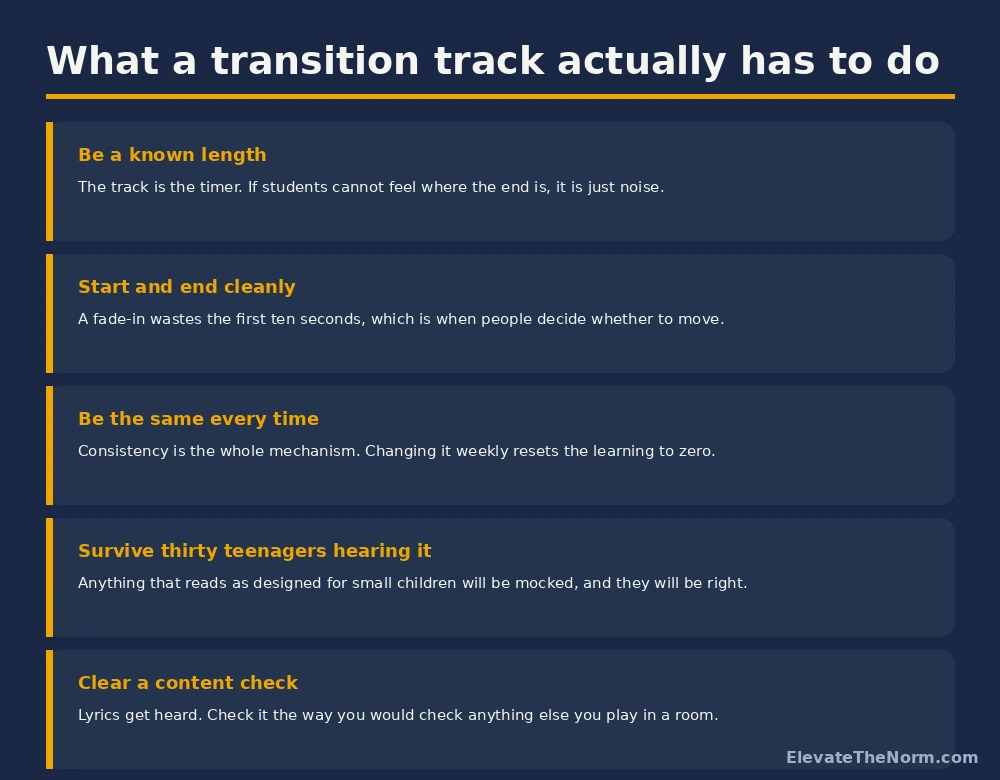
    Five requirements for a classroom transition track: known length, clean start and end, consistency, credibility with teenagers, and content check
    The track is the timer. Everything else follows from that.

    There is also reasonable evidence that music in a secondary classroom is welcome rather than merely tolerated — which is the thing most teachers doubt.

    Vigl and colleagues ran a two-week within-subjects study in a Finnish high school: one week without classroom music, one week with five minutes of self-selected music before each class. Across 48 students aged 15 to 19 they found statistically significant improvements in mood, motivation, concentration and learning, with strong effect sizes for mood and motivation. Around 61 percent of students wanted music in all or most lessons.

    The authors are unusually candid about the limits, and they matter. Every outcome was self-reported — nobody measured actual test performance or retention. The final sample of 48 was below their own power target of 106. There was no control activity, so the gains cannot be attributed to music specifically rather than to having any pleasant five-minute break. Students self-selected into the study, which invites demand effects.

    So: good evidence that teenagers like it and report feeling better and more focused. Not evidence that it makes them learn more. That is enough to justify using it as a transition cue, and not enough to justify a claim about achievement. My Brain Breaks for Middle and High School on TPT give you 60 quick resets that do not feel childish to teenagers.

    Worth noting what students said it gave them, because it is not what you would guess. Fourteen of them described it as a new routine and a break between lessons. The value was partly the predictability, which is the same reason a transition signal works at all.

    How to Choose a Track for a Secondary Room

    Five requirements, and the first one is the only non-negotiable.

    Known length. Ninety seconds for a quick move, three minutes for packing up and a closing task. Cut the track to length yourself if you need to. If students cannot feel where the end is, you have background music rather than a signal.

    Clean start and end. A long fade-in wastes the first ten seconds, which is exactly when people decide whether this is happening.

    The same track, every time. This is the mechanism. A different song each week is a pleasant thing that teaches nothing.

    Credible with teenagers. Instrumental works well — film scores, video game soundtracks, anything with momentum and no words to parse. Television theme tunes are a popular choice and they do have a real advantage: most are written to a fixed short length, and the recognition itself is part of the signal. The failure mode is picking something so old that nobody recognises it, at which point you have simply chosen a strange piece of music.

    Content-checked. Lyrics get heard, including by the student who tells a parent about them. Check a track the way you would check anything else you put in front of thirty students, and be aware that a clean radio edit is not the same as a clean song.

    One more, which is practical rather than pedagogical: whatever you play needs to be something you are permitted to play in your building, on equipment that works, without a login that fails on a Tuesday. A cue that depends on a streaming service loading is a cue that will fail publicly.

    Music Is One Cue Among Six

    Worth saying plainly, because the search for the perfect transition song is usually a distraction from a cheaper fix.
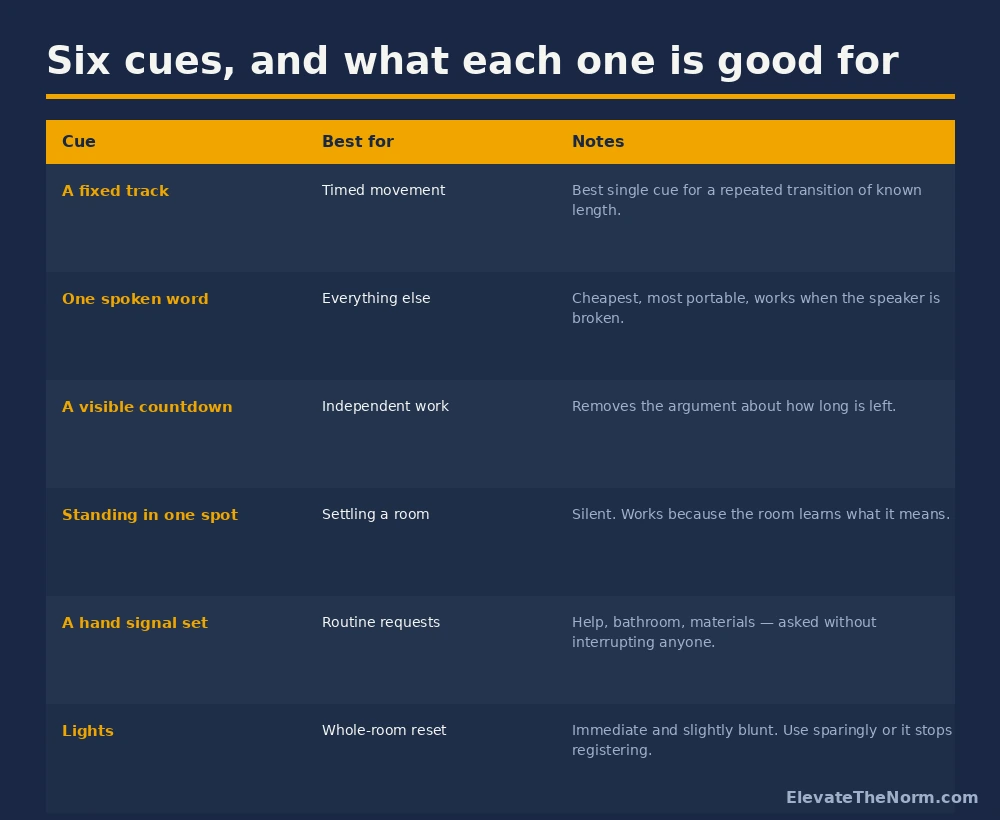
    Table comparing six classroom transition cues including a fixed track, a spoken word, a countdown, position, hand signals and lights
    Music is one cue among six, and rarely the one you need most.

    The cues students can see get their own treatment in the guide to visual transition cues, which covers countdowns, posted sequences and why more visuals is not better. A single consistent spoken word does more work than any track, costs nothing, and cannot be broken by a dead speaker. Music earns its place specifically where the transition is repeated, has a known duration, and benefits from everyone being able to hear the clock.

    Lights deserve one caution. Flicking the lights is immediate and slightly blunt, and using it often enough that students stop noticing is easy. It also lands badly for some students — an abrupt sensory change is not neutral for everyone in the room.

    All of these sit inside the broader work of running transitions properly. The cue is step four of five, and no cue rescues a transition where the instructions were given while people were already moving.

    Teenagers Want More Than They Will Admit

    My students voted on getting a class pet. They wanted one.

    That surprises people who do not teach high school. It stopped surprising me a while ago. High school students want the small things — the pet, the cheap prizes, the recognition. They just may not show it on the outside, and a teacher who reads the flat expression as the actual opinion will strip every one of those things out of the room and then wonder why it feels dead.

    Transition music is squarely in that category. A fifteen-year-old is not going to tell you the song is good. Some of them will make a point of telling you it is bad. Watch what happens when you forget to play it, which is the only reliable measurement available — and notice that in the Finnish study, the thing students named most often was not the music but the routine it created.

    So do not poll the class on whether to keep it during week one. You will get the answer the room feels obliged to give. Run it for a month and judge it on whether the transition got shorter.

    Teaching the Signal So It Lands in Five Seconds

    Classroom Check-Up, a project funded through the US Department of Education’s Institute of Education Sciences, sets a concrete benchmark: students should respond to an attention signal within five seconds. That is a usable number, and it turns an argument about whether the class is “being difficult” into a measurement.
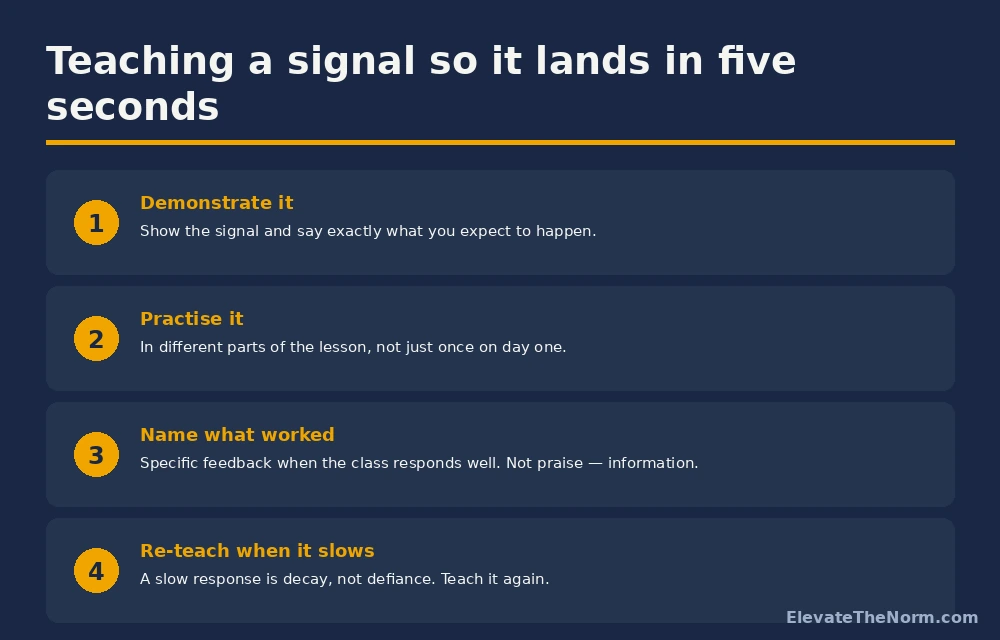
    Four steps for teaching a classroom attention signal: demonstrate, practise, name what worked, re-teach when it slows
    Classroom Check-Up sets the benchmark at a response within five seconds.

    Their implementation sequence is demonstrate, practise across different parts of the day, give specific feedback when students respond correctly, and re-teach when the response slows. They also note a signal should work without the teacher needing to be in a particular spot — which quietly rules out several popular options that depend on you standing at the front.

    Two adaptations for older students. Their examples lean young — rhythmic clapping, counting phrases — and a call-and-response chant will not survive a Year 10 room. Use the structure and change the signal. And “specific feedback” should mean information rather than praise: that took about four seconds, which is where we want it lands with teenagers in a way that well done everyone does not.

    When the response slows in November, that is decay rather than defiance, and the fix is the same as for any other routine that needs re-teaching.

    Where This Goes Wrong

    • An elementary song in a secondary room. The most common failure and the most deserved. If the lyrics instruct students to tidy up, it is the wrong track.
    • A different song every week. Pleasant, and it teaches nothing. Consistency is the mechanism.
    • Music as background rather than signal. Playing something during work is a different decision with different evidence behind it. Do not confuse the two.
    • Volume creep. If the track has to get louder to be heard over the room, the cue has already failed.
    • Depending on a login. A signal that requires a streaming service to load will fail publicly, and the class will remember.
    • Asking the class whether they like it. You will get the answer the room feels obliged to give. Measure the transition instead.

    What to Do Next

    Pick one repeated transition — packing up is usually the best candidate, because it has a natural length and it is where the most time leaks. Choose one instrumental track, cut it to the length you actually want, and use the same one every day for a month without discussing it.

    Time the transition in week one and again in week four. That number is the only review this needs. If it has not moved, the problem is almost certainly upstream in how the instruction is given, not in the song.

    Before you go: grab the free Classroom Transitions Toolkit (PDF) — ElevateTheNorm.com branded, printable, no email required.

    Frequently Asked Questions

    Will high school students actually tolerate transition music?

    More readily than most teachers expect, though few of them will say so. A Finnish study of students aged 15 to 19 found significant self-reported gains in mood, motivation and concentration from five minutes of music before lessons, and around 61 percent wanted it in all or most classes. In my experience the flat expression is not the actual opinion — teenagers want the small things and simply do not advertise it. The reliable test is what happens the day you forget to play it.

    What kind of song works for classroom transitions in secondary?

    Instrumental, recognisable, and a known length. Film scores and video game soundtracks work well because they carry momentum without lyrics to parse. Television theme tunes are popular for a real reason — most are written to a fixed short length and the recognition is itself part of the signal — but pick something current enough that the room actually knows it. What fails is anything written to instruct young children, which will be mocked, fairly.

    How long should a transition song be?

    Match it to the job rather than to the track. Ninety seconds for moving into groups, two to three minutes for packing up plus a closing task. Cut the audio to the length you want instead of picking a song and accepting its running time — the length is the entire function, so it should be a decision rather than a coincidence.

    Does background music help students learn?

    That is a different question from using music as a transition signal, and the evidence is far weaker than the internet suggests. The Finnish study measured self-reported mood, motivation, concentration and learning, not test performance, and had no control activity — so the gains cannot be attributed specifically to music rather than to any pleasant break. Using a track as a timed signal is well founded. Claiming background music raises achievement is not.

    How fast should a class respond to a signal?

    Within five seconds, which is the benchmark Classroom Check-Up uses. It is worth actually timing rather than judging by feel. A class at eight or ten seconds is not defying you — the signal has decayed and needs re-teaching, which takes about two minutes and works far better than expressing frustration about it.

    What if I cannot play music in my room?

    Use a single consistent spoken word and a visible countdown, and you lose very little. Music is one cue among six and rarely the one doing the most work. The spoken word is cheaper, more portable, survives broken equipment, and does not depend on anything loading. If your transitions are poor, the cue is unlikely to be the reason.

    Is flicking the lights a good signal?

    It is immediate and it works, but use it sparingly. It is blunt enough that frequent use stops registering, and an abrupt sensory change is genuinely unpleasant for some students in a way a sound is not. Reserve it for a whole-room reset rather than making it your standard transition cue.

    Sources

    • Vigl, J., Ojell-Järventausta, M., Sipola, H., & Saarikallio, S. (2023). Melody for the mind: Enhancing mood, motivation, concentration, and learning through music listening in the classroom. Music & Science, 6. Read the study — 48 Finnish students aged 15–19, within-subjects across two weeks. All outcomes self-reported; no control activity; final sample below the authors’ own power target. Their stated limitations are summarised in the text above.
    • Classroom Check-Up. Using an attention signal. Funded by the U.S. Department of Education, Institute of Education Sciences. Read the guidance — the source for the five-second response benchmark and the four-step teaching sequence. The page cites Reinke, Herman and Sprick (2011) and Sprick (2009) and reports no quantitative data of its own.

    Every link above was checked on September 12, 2026. This page deliberately recommends no specific songs by title, because a track that is recognisable to students this year may mean nothing to them in three.
    About Clay Shumate

    By Clay Shumate — Clay Shumate is a certified secondary Social Studies teacher in the public schools of West Alabama, with seven years of classroom experience, a B.A. in History, and an M.Ed. in Secondary Education. He writes about project-based learning, student responsibility, respect, and practical ways to hold young people to a higher standard while giving them room to learn from mistakes. He is a member of the Society of Professional Journalists and writes to its Code of Ethics; this site’s editorial standards and corrections policy are published in full.

  • Classroom Transitions: How to Stop Losing Six Minutes a Lesson

    Classroom Transitions: How to Stop Losing Six Minutes a Lesson

    Classroom transitions are the moments between things — arriving, switching tasks, moving into groups, coming back, packing up. In a secondary room they are where most lost instructional time actually goes, and they are almost never taught. Fixing them is not about speed. It is about removing the ambiguity that makes thirty teenagers wait to see what everyone else does first.

    Nobody sets out to lose this time. It goes in ninety-second pieces, six or seven times a period, and none of the pieces feels big enough to be worth addressing.

    Added up over a year, it is one of the largest recoverable resources a teacher has.

    Key Takeaways

    • The measured figure is about six minutes per lesson start — and the researcher who found it calculated that as roughly five weeks of teaching across a year.
    • Attention comes before instruction. Every transition that fails, fails at that step.
    • One signal, one word, every time. Changing the word, or raising the volume instead, teaches students to wait for the shouting.
    • Four transitions carry most of the loss. Script those and leave the rest alone.
    • A thirty-second warning before stopping group work costs nothing and protects the thing you were trying to build.
    • Be careful with the research. The best figures here come from Finnish primary and lower-secondary classrooms with a mean class size of 17, and the author calls the study preliminary.

    How Much Time Do Transitions Actually Cost?

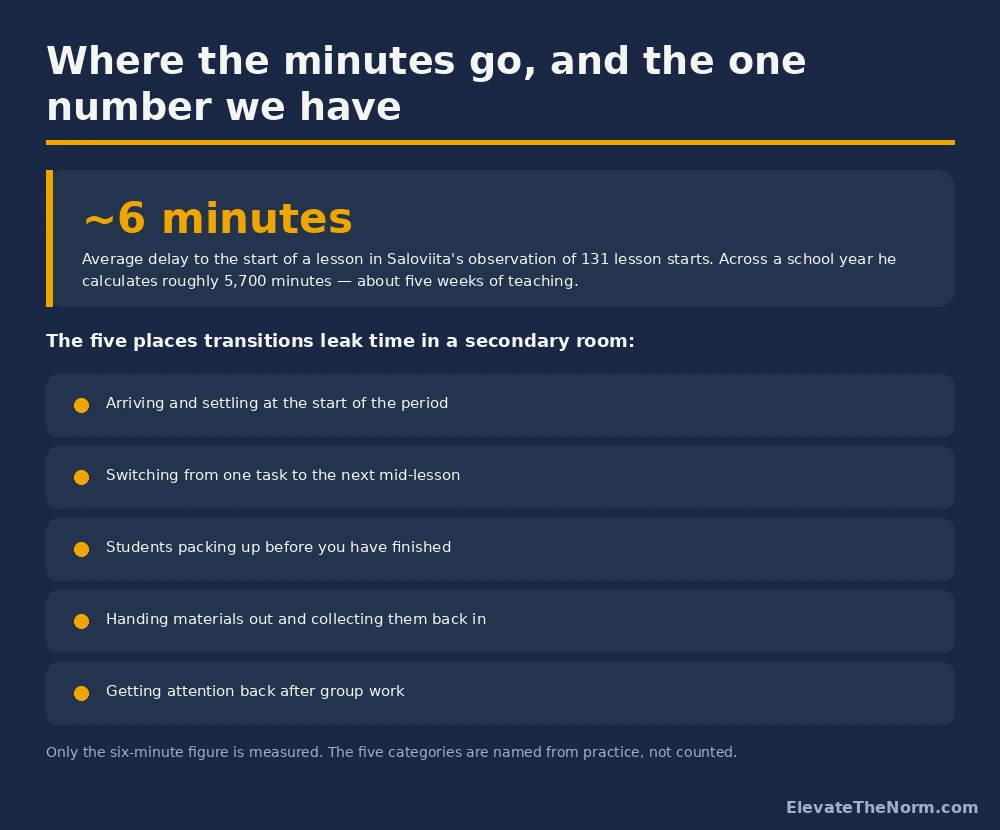
    The most concrete number available comes from Timo Saloviita’s observational study in the International Journal of Environmental & Science Education. Observers recorded 131 lesson starts across 131 teachers and found that the teacher was on average two minutes late and the lesson started six minutes late. In four cases the delay reached fifteen minutes.

    Graphic showing the six-minute average lesson start delay from Saloviita's study alongside five places transitions leak time
    Six minutes a lesson start, across a year, is about five weeks of teaching.

    Saloviita then does the arithmetic that makes the number land: six minutes per lesson start becomes about 150 minutes a week, and roughly 5,700 minutes across a school year — around 127 lessons, or five full weeks of teaching. The counterweight is having something on the board students can start without you, so the opening minutes are already spoken for.

    Before anyone puts that on a staff-meeting slide, the caveats, which are the author’s own. This was Finland, in comprehensive schools spanning grades 1–9, and only a fifth of the observed lessons were in grades 7–9. Mean class size was seventeen students. Saloviita describes it as a preliminary study and says replication is needed.

    So treat five weeks as an order of magnitude rather than a measurement of your building. A room of thirty American fifteen-year-olds changing classes every period is not the room that was observed. The direction is almost certainly right; the precision is not yours to claim.

    A more recent synthesis puts a much wider band around the same idea. Reviewing the available research on time in school, Kraft and Novicoff report that off-task behavior, transitions and wait time together occupy between 17 and 29 percent of instructional time — a range, drawn from several different measurement methods, and covering three things at once rather than transitions alone. Both numbers on this page point the same way and neither is precise, which is the honest summary: the loss is large and nobody has measured it cleanly. If you want that evidence worked through at more length, the companion guide takes the measurement problem head on.

    Todd Finley, writing for Edutopia, offers the same idea from the other end: saving fifteen minutes a day works out at roughly 45 extra hours of instruction across a year. Different route, same conclusion — this is the cheapest time on the timetable to recover.

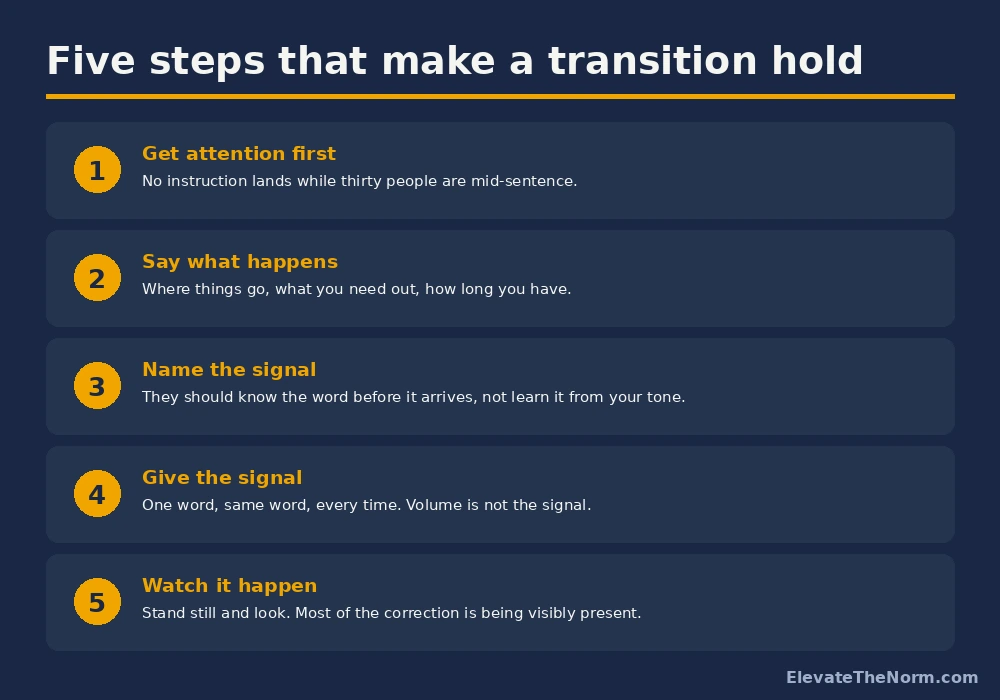
    Five Steps That Make a Transition Hold

    Finley sets out a five-step sequence that works at any grade: get attention, explain the procedure, prepare students for the signal, give the signal, then watch what happens. The order is the point, and almost every failed transition failed at step one.

    Five steps for running a classroom transition: get attention, say what happens, name the signal, give the signal, watch it happen
    Attention first. Every step after it fails without it.

    Attention before instruction. Nothing you say while thirty people are mid-sentence reaches more than about six of them. The other twenty-four will ask their neighbour, and the neighbour will be wrong.

    Say the whole thing before anyone moves. Where things go, what needs to be out, how long they have. Once bodies are moving, no further instruction is getting in.

    Name the signal in advance. Finley suggests using a word like “smooth” rather than “go” — partly because it is distinctive, partly because “go” is a starting gun. Whatever you pick, students should know the word before they hear it.

    Then stand still and watch. Most of the correction you need is being visibly present while it happens, which is also the least tiring form of classroom management there is.

    Finley also mentions a competitive timing approach — one teacher uses a stopwatch and challenges classes to beat other sections. It works for some groups and backfires badly with others, particularly where a slower student becomes the reason the class “lost.” Use it knowing that.

    The Four Transitions Worth Scripting

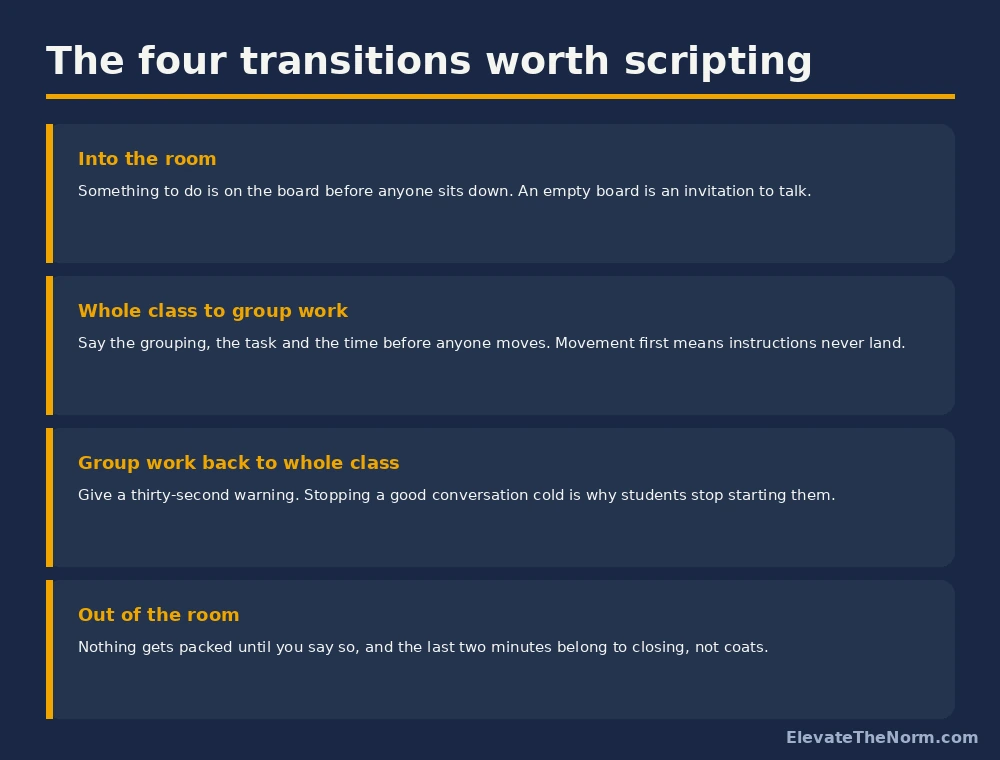
    You do not need a procedure for every movement in the room. Four moments carry most of the loss, and scripting those is enough.

    Four classroom transitions worth scripting: into the room, into group work, back to whole class, and out of the room
    Four moments carry most of the lost time. Script those and ignore the rest.

    Into the room. Something to do is on the board before anyone sits down. An empty board is an invitation to talk, and it is a reasonable one. This is the single highest-return transition to fix, because it is also the one Saloviita measured.

    Whole class into group work. Grouping, task and time, all announced before a single chair moves. This is where most secondary transitions collapse, because the instruction competes with the movement and loses.

    Group work back to whole class. Give a thirty-second warning. Cutting off a working conversation with no notice teaches students that engaging deeply is risky, and after a few weeks of it they stop starting.

    Out of the room. Nothing gets packed until you say so. The last two minutes belong to closing the lesson, and surrendering them is how a forty-five minute period becomes a forty-minute one.

    All four are routines, and they follow the same rules as every other routine in the room — named, demonstrated, practised and re-taught rather than announced once in August.

    Why My Room Transitions Quietly

    I do not turn the overhead fluorescents on. The room runs on floor lamps around the perimeter and a few smaller desk lamps, which makes it warm and low rather than institutional.

    That was a deliberate choice about sensory load, and it helps far more students than the ones who would ever have asked for an accommodation. What I did not expect was how much it changes transitions specifically. Transitions are the loudest, brightest, most chaotic thirty seconds of any lesson — everything moving at once, and every voice rising to be heard over the others. In a room that is already quieter and dimmer than the corridor, the ceiling on that noise is lower to start with.

    It is not a technique and I would not sell it as one. But if transitions in your room feel like the volume doubles every time, it is worth asking whether the room itself is part of what students are reacting to before you decide it is a behaviour problem.

    Signals That Work With Teenagers

    Most published transition signals were designed for eight-year-olds, and using them with fifteen-year-olds produces exactly the reaction you would expect. The ones students can see are covered in more depth in a separate guide to the cues students actually look back at, including how to build one that does not just become wall decoration. Getting the room quiet in the first place is a separate problem from telling it what to do next, and a countdown the class has a reason to answer holds up with teenagers far better than anything that asks them to chant a phrase back. What survives into secondary:

    • One consistent word. Unglamorous and the most effective thing on this list. It works because it is predictable, not because it is clever.
    • A visible countdown. A timer on the board removes the argument about how long is left. Finley points at simple countdown tools for exactly this.
    • A hand signal for routine requests. Finley describes a teacher whose students use one finger for help, two for the bathroom, three for a pencil — the request happens without interrupting anyone.
    • Standing in one particular place. Silent, costs nothing, and works because the room learns what it means.
    • Music, used carefully. A track of a set length is a countdown students can hear. It needs to be chosen for a secondary audience, which is a separate and slightly fraught question.

    What does not survive: anything that requires teenagers to repeat a phrase back to you in unison, and raising your voice. Volume is not a signal. It is the absence of one, and students learn to wait for it.

    The music question is the one people ask most and it deserves its own answer, because almost everything written about classroom transition songs was written for elementary rooms. The mechanism transfers to secondary; the track choice does not. I worked through what a track has to do to survive a room of fifteen-year-olds — length, lyrics, familiarity — in a separate piece on choosing transition songs and cues for teenagers.

    Where Transitions Break Down

    • Instructions given while students move. The most common failure. Say it all first, then release.
    • No warning before stopping group work. Reads as arbitrary, and it quietly punishes the students who were most engaged.
    • A different signal every week. Consistency is doing all the work. Changing it resets the learning to zero.
    • Volume as the signal. Teaches the room to ignore everything below shouting.
    • Blaming the class. A transition that fails repeatedly was designed badly. That is a planning problem, not a character problem.
    • Never practising it. Same as any routine: announcing is not teaching.

    What to Do Next

    Time your own start for one week. Note when the bell went and when the first real instruction landed, every period, without changing anything else. If the gap is bigger than you expected, the cheapest thing to change first is the opener — a posted five-minute task students start without being told moves that number more than any amount of asking for quiet. Most teachers are surprised, and the surprise is more persuasive than any study.

    Then fix that one transition — something on the board before they sit, one consistent signal, said and practised — and leave the other three alone until it holds. If you want concrete versions to borrow, the worked examples and the printable pack behind them has scripts and cue cards you can print, no email required.

    Printables for this

    Two of mine on TPT, both built for this. The Station Rotation Toolkit has the signs and recording sheets that make the whole-class-into-groups transition run without a second round of instructions. Brain Breaks is 60 cards for the reset between tasks — short, timed, and written for teenagers rather than eight-year-olds.

    Frequently Asked Questions

    How long should a classroom transition take?

    Thirty to sixty seconds for most secondary transitions, and the number matters less than announcing it. Tell students how long they have and then hold that time. The problem in most rooms is not that transitions are slow, it is that nobody knows when they are supposed to be finished, so everyone waits to see what everyone else does.

    Do transitions really cost that much time?

    The clearest measurement available found lessons starting about six minutes late on average, which the researcher calculated as roughly five weeks of teaching across a year. That study was Finnish, spanned grades 1–9 with only a fifth in grades 7–9, had a mean class size of 17, and its author calls it preliminary. So treat it as a strong indication rather than a precise measure of your own timetable. The honest version: the losses are real and larger than they feel, and the exact figure for your room is something you would have to time yourself.

    What signal works best with high school students?

    One consistent word, used every time, with no volume behind it. Consistency is what makes a signal work, not cleverness — students respond to predictability. Countdown timers on the board work well because they remove the argument about how much time is left. Avoid anything that asks teenagers to chant a response back in unison; it reads as being treated like a child and you will lose the room’s goodwill faster than you gain the seconds.

    How do I stop students packing up early?

    Decide what the last two minutes are for and use them every single day. Students pack up early when the end of a lesson has no content in it, which is a reasonable read of the situation. A consistent closing task — a sentence on what changed today, a question to answer on the way out — gives the time a purpose. Then hold the line that nothing goes in a bag until you say so, and be the person who does not start packing up first.

    What if my transitions fail with one particular class?

    Look at the design before the students. A transition that works in four sections and collapses in the fifth usually differs in something structural: the time of day, the room, the size, who arrives late from across the building, or what lesson they came from. Re-teach the transition with that class specifically and adjust the timing to their reality. Treating it as defiance when the structure is different will make it worse.

    Should I use music for transitions in a secondary classroom?

    It can work well, because a track of known length is a countdown students can hear rather than watch. The difficulty is selection — music aimed at younger children will get exactly the reaction you expect from teenagers, and anything with lyrics needs checking against what your school would consider appropriate. If you use it, keep the track consistent so the sound itself becomes the signal.

    Is scripting transitions not a bit rigid?

    The script is for you, not for them. What students experience is a room where they know what happens next, which is the opposite of rigid — it is what makes the unpredictable parts of a lesson possible. Rooms without scripted transitions are not freer; they just spend their unstructured time on logistics rather than on anything interesting.

    Sources

    • Saloviita, T. (2008). Classroom management and loss of time at the lesson start: A preliminary study. International Journal of Environmental & Science Education, 3(3). Full text (PDF) — 131 observed lesson starts in Finnish comprehensive schools, grades 1–9, mean class size 17. The author describes it as preliminary and calls for replication.
    • Finley, T. (2017, March 13). Mastering classroom transitions. Edutopia. Read the article — the source for the five-step transition sequence, the hand-signal and countdown examples, and the 45-hours-a-year figure, which Finley attributes to a behaviour-management resource rather than to original research.
    • Kraft, M. A., & Novicoff, S. (2024, February). Time in school: A conceptual framework, synthesis of the causal research, and empirical exploration. EdWorkingPaper. Full text (PDF) — the 17–29 percent figure is a range assembled from several studies using different measurement methods, and it covers off-task behavior, transitions and wait time together rather than transitions alone.

    Every link above was checked on September 12, 2026; the Kraft and Novicoff paper was added and checked on September 30, 2026. Where a figure comes with limits on how far it travels, those limits are stated in the text rather than left in a footnote.


    About Clay Shumate

    By Clay Shumate — Clay Shumate is a certified secondary Social Studies teacher in the public schools of West Alabama, with seven years of classroom experience, a B.A. in History, and an M.Ed. in Secondary Education. He writes about project-based learning, student responsibility, respect, and practical ways to hold young people to a higher standard while giving them room to learn from mistakes. He is a member of the Society of Professional Journalists and writes to its Code of Ethics; this site’s editorial standards and corrections policy are published in full.

  • Classroom Routines and Procedures for Grades 6–12: What to Teach and When

    Classroom Routines and Procedures for Grades 6–12: What to Teach and When

    Classroom routines and procedures are the taught, repeated ways a room handles its ordinary business — entering, getting materials, asking for help, moving between tasks, handing work in, leaving. In grades 6–12 they are worth explicit teaching for one reason: every minute a class spends negotiating a procedure is a minute nobody is learning anything, and there are a lot of those minutes.

    The word “taught” is doing the work in that sentence. Most secondary teachers have a set of procedures. Far fewer have taught them the way they would teach content — named, demonstrated, practised, and re-taught weeks later when they slip.

    This is the part of classroom management with the most evidence behind it and the least glamour attached to it.

    Key Takeaways

    • Structure is one of five evidence-based features of classroom management identified in the standard review of this literature — alongside explicitly teaching and reviewing expectations.
    • Routines are held with reminders, not consequences. If forgetting a pencil costs a mark, you have a discipline system, not a routine.
    • Teach them like content. Name it, show it, practise it, remind it. The practice step is the one everybody skips.
    • Re-teach at the start of every term, not just in August. Routines decay. Planning for the decay is cheaper than reacting to it.
    • Twelve routines cover most secondary rooms. More than that and nobody remembers them, including you.
    • Be honest about the evidence. About half the studies in the main review are more than twenty years old, and the authors say they do not know how these practices should vary by school level.

    What Classroom Routines and Procedures Actually Are

    A procedure is how something gets done. A routine is that procedure once it has been practised enough that nobody thinks about it. The gap between the two is entirely teaching time, and the mistake is assuming teenagers skip that gap because they are old enough to have worked it out.

    They have worked something out. They have worked out what the previous four teachers wanted, and those four all wanted different things. A fourteen-year-old moving through six rooms a day is running six different operating systems. Assuming they will intuit yours is not high expectations — it is just an unwritten test.

    This is also why routines are not the same thing as rules. Rules say what is forbidden. Routines say what happens. A room that has taught and modelled what it expects of students but has no routines will still lose ten minutes a period to logistics.

    What the Research Supports

    The standard reference is Simonsen, Fairbanks, Briesch, Myers and Sugai’s review in Education and Treatment of Children, which screened the literature for practices meeting a real evidentiary bar — sound design, empirical validation, clear procedures, replication across sites, and evidence of sustainability — and identified twenty practices across five critical features.

    Two of those five features are what this article is about: maximise structure, and post, teach, review, monitor and reinforce expectations. Not post. Post and teach and review and monitor. The verbs are the finding.

    Parsonson’s review in Kairaranga lands in the same place from the behaviour-analysis side, listing clear consistently applied rules and predictable routines among the antecedent strategies that reduce disruption — the ones that work by preventing the problem rather than responding to it. The same paper reports that teacher greetings and brief small talk raised on-task behaviour from around 45 percent to around 75 percent, which is a striking figure for something that costs nothing and takes place before the lesson starts.

    The caveats, stated by the authors themselves

    Simonsen and colleagues note that roughly half the studies in their review were conducted twenty or more years ago, and that the literature does not tell us how these practices should be adjusted across school levels, ability levels or demographic contexts. That last gap is the one that matters here: this is a grades 6–12 site, and the evidence base does not cleanly separate a seventh grader from a second grader.

    So the honest position is that structure and explicitly taught expectations are about as well supported as anything in classroom management, and that the specific shape they should take in a secondary room is professional judgment rather than settled science.

    Twelve Classroom Routines Worth Teaching

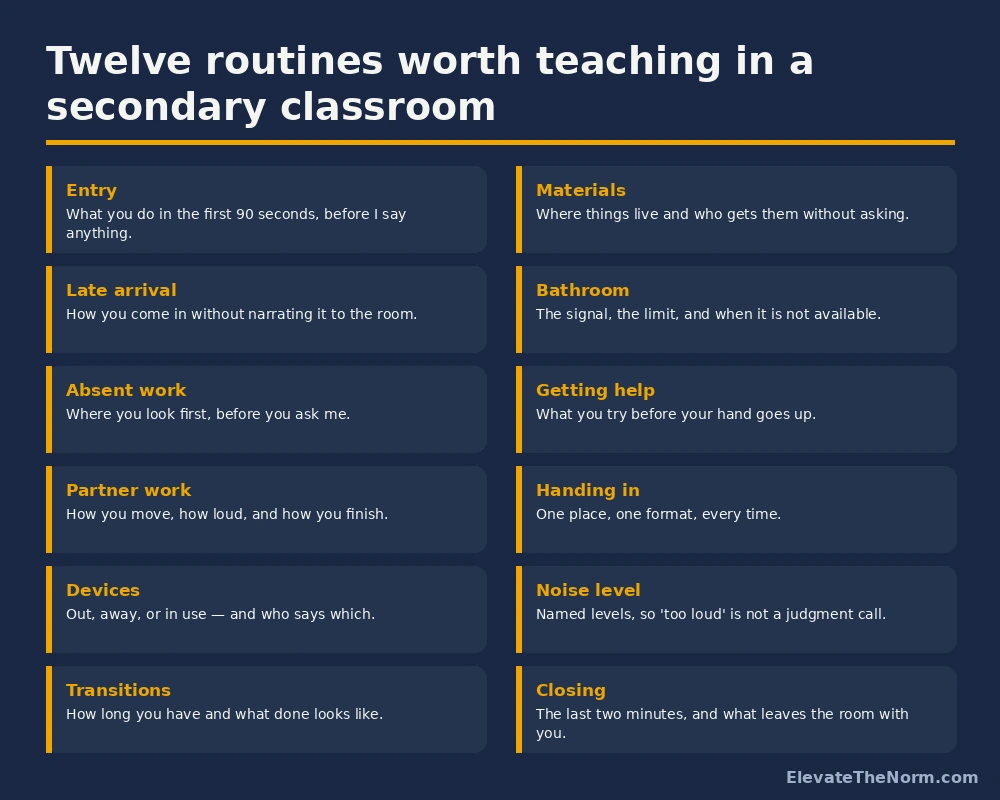
    Twelve is not a target to hit. It is roughly what a secondary room actually needs, and going much past it means nobody remembers any of them, including you.

    Grid of twelve classroom routines worth teaching in a secondary classroom, from entry and materials to transitions and closing
    Twelve is not a target. It is the list most secondary rooms actually need.

    The Indiana classroom management primer for middle and secondary teachers, written by Mary Ellen Adams and Pamela Ray, names a similar core: arriving, submitting work, group work, restroom, getting supplies, and getting help from the teacher. Their instruction is to put routines in writing and teach them, at the start of each term, with periodic review.

    Three on the list above are worth singling out because secondary teachers most often leave them implicit.

    Getting help. “What do you try before your hand goes up?” If you have never answered that out loud, half your class is waiting for you and the other half has given up. Name two or three moves — check the board, ask your partner, look at the example — and the queue at your desk halves.

    Late arrival. A student who is late is already having a worse day than you are. A taught routine — come in, sit down, catch up from the board, see me at the end if it matters — removes the performance entirely. What goes on that board matters as much as the routine does: a do-now built on retrieving last week’s material settles a room as well as a word search and does something on the way. Without one, every late arrival becomes a small public event. When lateness becomes a pattern rather than a one-off, the routine needs a tardy response that escalates by pattern rather than by mood standing behind it.

    Noise level. “Too loud” is a judgment you are making that students cannot predict. Named levels — silent, partner voice, group voice — turn an argument into a correction that takes one word.

    The routine that pays back fastest is not on that list as a single item, because it runs through several of them. The handful of moves between activities — into the room, into group work, back out of it, and out of the door — are where the measured time actually goes, and they are worth scripting before anything else here. If you want the signal itself to carry the timing rather than your voice, a transition track students can hear is the cheapest version of that. None of it starts, though, until the room actually stops, and getting a secondary class quiet without raising your voice is worth sorting out before you script anything else.

    How to Teach a Routine So It Actually Holds

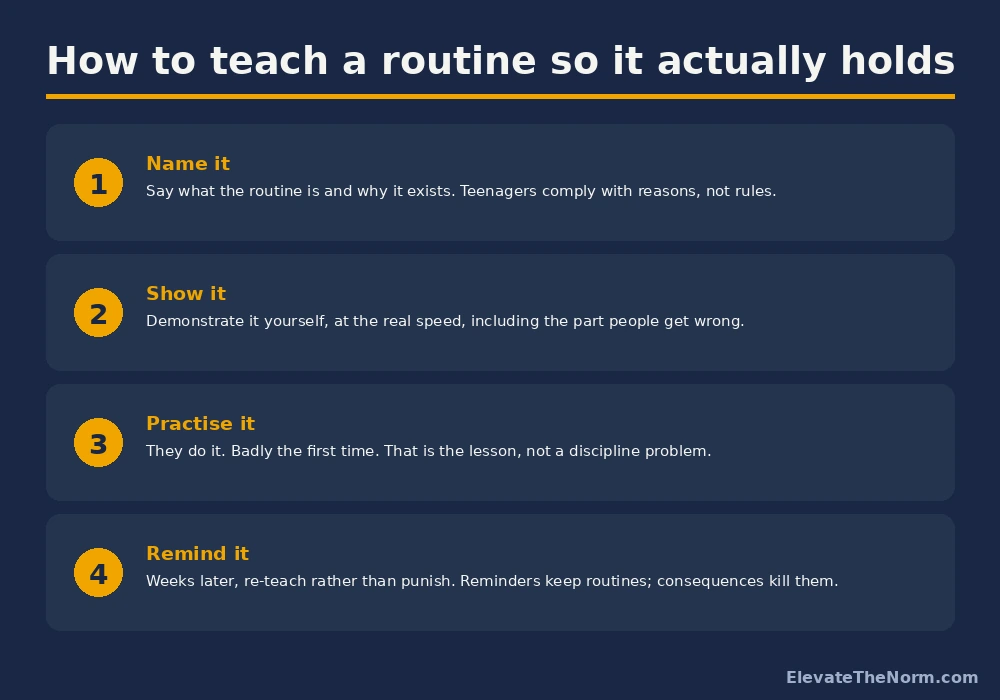
    Four moves, in order. It takes about six or seven minutes per routine the first time and almost nothing afterwards.

    Four-step process for teaching a classroom routine: name it, show it, practise it, remind it
    Naming a routine is not teaching it. Practice is the part people skip.

    Name it, with the reason. Teenagers comply with reasons far more reliably than with rules. “We hand in to one tray so that nobody’s work goes missing and I am not carrying six piles” takes four seconds and buys you the rest of the year.

    Show it. Do it yourself, at real speed, including the bit people get wrong. Demonstrating the failure mode is more useful than demonstrating the ideal.

    Practise it. They do it. It will be bad the first time — that is the lesson working, not a behaviour problem. This is the step that separates a room where routines hold from a room where they were announced once in August.

    Remind it. Six weeks later it will have decayed. Re-teach it to the whole class rather than correcting individuals, because individual correction turns a decayed routine into a story about particular students.

    Reminders Hold Routines. Consequences Do Something Else.

    This is the single most useful distinction in the article, and the Indiana primer states it directly: routines are enforced through reminders rather than consequences. Their example is the pencil — keep loaners rather than punishing the student who forgot one.

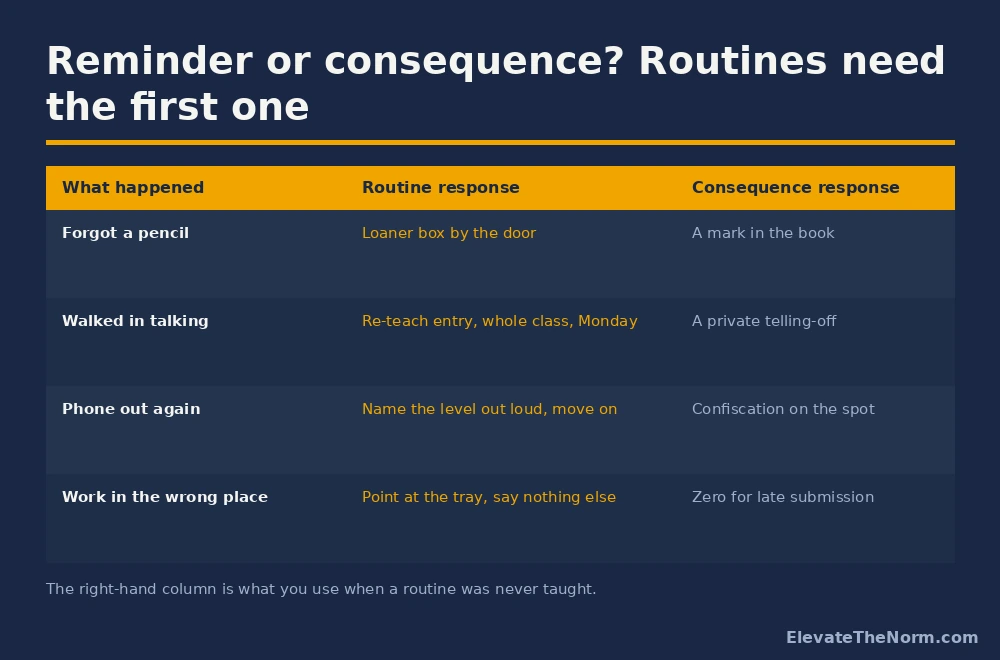
    Table comparing a routine reminder response and a consequence response to four common classroom situations
    Routines are held with reminders. Consequences are for something else.

    The reason is practical rather than soft. A consequence attached to a routine failure teaches students that the routine is a trap, and their attention moves from doing the thing to avoiding the penalty. A reminder keeps the routine a piece of housekeeping, which is what it is.

    Consequences are still real and still necessary — for choices, for harm, for repeated refusal after the routine has genuinely been taught. That is a different system, and it is worth keeping the two apart deliberately. Consequences that teach rather than humiliate are a separate piece of work from a room that runs smoothly.

    The test: if your response to a routine failure would feel strange applied to the whole class at once, it is a consequence and it does not belong here.

    The Routine That Does the Most Work in My Room

    Working next to somebody is the resting state of my classroom, not a reward I hand out on a Friday. The tables are pushed together in pairs and fours and they stay that way, which means partner work needs no setup, no announcement and no transition.

    That is a routine decision disguised as a furniture decision. When collaboration is the default, the only thing that ever needs announcing is silence — and silence is easy to ask for and easy to get. When rows are the default, every piece of partner work costs you ninety seconds of scraping chairs, and you start quietly avoiding it.

    The other half of it is telling them the plan for the day down to the minute, on the board, before anything starts. Those times are a budget and a promise rather than a script — when I miss them I say so out loud and give the reason, which is the part that keeps it honest. A room that knows what is coming and roughly how long it has does not need most of the routines on that list of twelve enforced at all. They just happen.

    When to Establish Classroom Routines

    The first week, obviously. Less obviously: the first week of every term, and the week after any long break.

    Adams and Ray put it as teaching routines at the start of each term with periodic review throughout, and that is the right cadence. Routines decay — not because students are testing you, but because six weeks is long enough to forget which of six teachers wanted which thing.

    Three moments worth putting in your calendar now:

    • Week one of the year. Teach four or five routines properly rather than twelve badly. Entry, materials, getting help, handing in. The rest can wait.
    • Week one of each new term. Re-teach, do not re-announce. Fifteen minutes, whole class, no reference to anyone’s behaviour.
    • The day back after a long break. Assume everything has decayed and plan for it, and the day costs you nothing instead of costing you a week.

    If you want the printable version to plan from, the free checklist pack built for grades 6 through 12 lists them with space to write your own wording, no email required.

    Where Routines Break Down in Secondary Classrooms

    • Announced but never practised. The most common failure by a distance. Saying it once is not teaching it.
    • Too many at once. Twelve routines in week one is twelve routines nobody retains. Four, properly, beats twelve badly.
    • Enforced with consequences. Turns housekeeping into a discipline system and makes the room adversarial over pencils.
    • Never re-taught. Then the November version gets treated as defiance rather than decay.
    • Inconsistent from the adult. If the tray is the routine, it is the routine on the day you are tired too.
    • Unexplained. A routine without a reason reads to a teenager as arbitrary, and they are not wrong.

    The honest test of whether a routine has taken hold is what happens on a day when you are not there. If the room only runs because you are standing in it, the routine was never the routine — you were. That is why a day with someone else running the room tells you more about your procedures than any week you teach yourself. It is also the argument for leaving sub plans that run without you rather than a worksheet and an apology. The Tuesday after a three-day weekend tests the same routines in a different direction.

    What to Do Next

    Pick the single routine costing you the most time right now — for most secondary teachers it is entry or getting help — and teach it properly this week. Name it with the reason, demonstrate it including the failure mode, have the class practise it, and put a reminder in your calendar for six weeks out. If the routine you need is the one that governs reading on a screen rather than on paper, the twenty-minute digital reading routine is already scripted minute by minute and can be taught the same four ways.

    One routine, taught properly, will buy back more minutes than a list of twelve announced on the first day and never mentioned again. Then do the next one next month. This is slow work, and it is the kind that compounds.

    Routines are one section of something larger. If you have never written that larger thing down, the eight sections a written plan actually needs shows where routines sit relative to expectations and consequences.

    Printables for this

    Two of mine on TPT, both built for this. The First 10 Days procedures checklist is free and sequences which routines to teach on which day. Daily Reset Bell Ringers is the entry routine itself: 180 prompts so the first five minutes run the same way every day, which is the routine that stops the others from decaying.

    If you are stocking up during a sitewide sale, the TPT sale guide explains how the discounts stack and what is worth the money.

    Frequently Asked Questions

    What is the difference between a classroom routine and a classroom rule?

    A rule says what is not allowed. A routine says how something gets done. “No phones out” is a rule; “phones go face down in the top corner of the table unless I say otherwise” is a routine. Rules need enforcement, routines need teaching and reminders. Most secondary rooms have plenty of rules and not enough routines, which is why so much time goes on logistics.

    How many routines should I actually teach?

    Four or five properly in the first week, building to around a dozen over the term. Twelve announced on day one is twelve nobody remembers. Start with the ones costing you the most time — usually entry, materials, getting help, and handing work in — and add the rest as they become necessary.

    Isn’t this a bit young for high school students?

    The content is not young; the assumption that teenagers already know your procedures is just untested. A student moving through six rooms a day is running six different systems, none of which they chose. Teaching yours explicitly is not treating them like children — it is removing a guessing game. What would be condescending is the tone, not the practice, so teach them the way you would teach anything else to an adult: name it, give the reason, move on.

    What do I do when a routine stops working in November?

    Re-teach it to the whole class, without reference to anyone in particular. Routines decay on a predictable schedule and November is right on it. Treating decay as defiance is the most common way a functioning routine turns into a behaviour problem. Fifteen minutes of whole-class re-teaching costs less than a term of individual corrections.

    Should students help decide the routines?

    For some of them, yes, and it works better in secondary than people expect. Noise levels, how partner work ends, and what counts as a reasonable bathroom signal are all genuinely negotiable and students will hold a standard they helped set. Safety procedures, anything your school mandates, and anything involving how work is recorded are not negotiable, and pretending otherwise creates a problem later.

    How do routines work if I share a room or teach on a cart?

    Focus on the routines that live in people rather than furniture — entry, getting help, handing in, noise levels, closing. Anything depending on a fixed physical setup will not survive a shared room, so do not build your system on it. Write your core routines on something portable and post it in the same place every period; the consistency of the location matters more than the location itself.

    Do routines actually improve learning, or just behaviour?

    Honestly, the direct evidence is about behaviour and time on task rather than achievement. The reviews that support structure and explicitly taught expectations measure disruption, on-task behaviour and engagement. The learning argument is an inference: time not spent on logistics is time available for instruction. That inference is reasonable, and it is not the same thing as a study showing routines raise test scores.

    Routines are also what a stranger inherits. A procedure that is obvious to your students is invisible to someone covering the class, which is why running a room that isn’t yours depends so much on what the regular teacher wrote down.

    Sources

    • Simonsen, B., Fairbanks, S., Briesch, A., Myers, D., & Sugai, G. (2008). Evidence-based practices in classroom management: Considerations for research to practice. Education and Treatment of Children, 31(3), 351–380. Full text (PDF) — the source for the five critical features, and for the authors’ own caution that about half the reviewed studies are twenty or more years old.
    • Parsonson, B. S. (2012). Evidence-based classroom behaviour management strategies. Kairaranga, 13(1), 16–23. Full text (PDF) — the source for predictable routines as an antecedent strategy and for the greeting figures, which Parsonson reports from other studies rather than testing directly.
    • Adams, M. E., & Ray, P. (2016). A classroom management primer for middle and secondary school teachers. Indiana Commission for Higher Education. Read the primer (PDF) — the source for teaching routines at the start of each term and for enforcing them through reminders rather than consequences.

    Every link above was checked on September 12, 2026. Where a figure is reported by a review rather than measured in it, the text says so.


    About Clay Shumate

    By Clay Shumate — Clay Shumate is a certified secondary Social Studies teacher in the public schools of West Alabama, with seven years of classroom experience, a B.A. in History, and an M.Ed. in Secondary Education. He writes about project-based learning, student responsibility, respect, and practical ways to hold young people to a higher standard while giving them room to learn from mistakes. He is a member of the Society of Professional Journalists and writes to its Code of Ethics; this site’s editorial standards and corrections policy are published in full.

  • Classroom Seating Charts: What the Research Supports for Grades 6–12

    Classroom Seating Charts: What the Research Supports for Grades 6–12

    A classroom seating chart is a deliberate plan for where every student sits and why — built around sightlines, access, documented needs, and the kind of work the room is doing that week. For grades 6–12 it is not a discipline tool and it is not decoration. It is the quietest piece of classroom management you own, and most of the research behind it was done on ten-year-olds.

    That last part matters more than anything else in this article, so it goes near the top rather than buried in a caveat at the bottom. There is a real evidence base on classroom seating. It is genuinely useful. It is also overwhelmingly elementary, and the people quoting it at you usually do not say so.

    What follows is what the research actually supports, where it stops, and how to build a chart for teenagers anyway.

    Key Takeaways

    • Assigned beats self-selected, and it is not close. The cleanest study on this found disruptions roughly doubled in groups and more than tripled in rows when students picked their own seats — though the sample was fifth graders.
    • There is no best layout. Rows win for independent work. Semicircles get more questions asked. Groups support collaboration and hide free riders. Match the layout to the task, not to a philosophy.
    • The evidence thins out badly above age 11. The main review of this literature says so outright: one study looked at teenagers, and none went past age 15.
    • Documented needs are not one factor among many. If seating is written into an IEP or 504 plan, that goes on the chart before anything else does.
    • Change the whole room, not one student. A chart that moves for everybody is housekeeping. A chart that moves for one kid is a public verdict on that kid.
    • Some of the best seating in a room is not on the chart at all — and that is worth designing on purpose.

    What a Classroom Seating Chart Is Actually For

    A seating chart does four jobs. It puts every student where they can see and hear. It lets you reach anyone in the room quickly. It sets who talks to whom. And it removes a daily negotiation that costs you three minutes at the start of every period.

    Notice what is not on that list: punishment. The moment a seating chart becomes the thing you rearrange when a student annoys you, it stops being a plan and becomes a consequence — an unpredictable, public one, applied at your discretion. That is the opposite of what a fair consequence looks like, and teenagers read it accurately and immediately.

    It is also not a personality test. You will hear that certain students “are back-row kids.” They are not. They are students who were allowed to sit in the back row and found out nobody came to get them.

    What the Research Actually Says — and Where It Stops

    The standard reference here is Wannarka and Ruhl’s review in Support for Learning, which pulled together eight studies comparing rows, groups and semicircles. Their conclusion is refreshingly unglamorous: the nature of the academic task and the type of behaviour you want should dictate the seating arrangement. Rows produced more on-task behaviour for individual work and cut talking out of turn. Students asked their teacher significantly more questions in a semicircle than in rows. Grouped seating supported collaborative work. If you want the signs and recording sheets done, my Station Rotation Toolkit on TPT covers eight reusable stations.

    Students who started with the lowest on-task behaviour improved most in rows. One special-school study in that review doubled on-task behaviour and cut the disruption rate by two thirds.

    Then comes the part that rarely survives the journey into a blog post. The same authors state plainly that most of the studies they reviewed used participants aged seven to eleven, that only one examined teenagers, and that no study extended beyond age fifteen.

    So when someone tells you “research shows rows increase on-task behaviour,” the honest completion of that sentence is “…in primary-aged children, mostly during independent seatwork, in studies largely conducted before your students were born.” That does not make it useless. It makes it a starting hypothesis for a fourteen-year-old rather than a finding about one.

    The assigned-seating finding, with its actual numbers

    The most-cited study on who chooses the seats is Bicard and colleagues in the Journal of Applied Behavior Analysis. Twenty-one fifth graders, a reversal design, four conditions crossing group-versus-rows with teacher-assigned-versus-student-selected. The results:

    ConditionStudent-selectedTeacher-assigned
    Group seating1.12 disruptions/min0.47 disruptions/min
    Rows0.55 disruptions/min0.17 disruptions/min

    Roughly double in groups, more than triple in rows. The authors also say, in their own limitations, that the school was private, the group fairly homogeneous and relatively well behaved, and the tasks easy enough that academic effects may have been masked. Twenty-one ten-year-olds in one building is not a law of nature. It is one clean result pointing in an obvious direction.

    Take the direction. Leave the certainty.

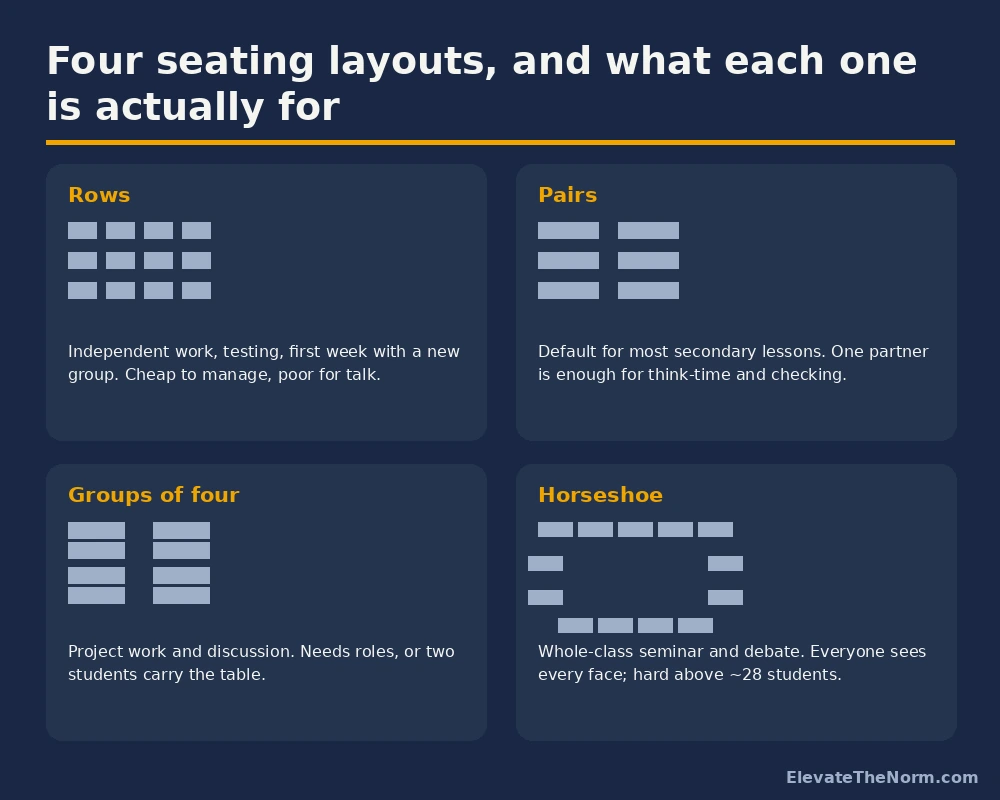
    Four Layouts, and What Each One Is Actually For

    Pick the layout that matches the work. If the work changes week to week, the layout should too — and saying that out loud to students is part of the job.

    Comparison of rows, pairs, groups of four and horseshoe classroom seating layouts with the purpose of each
    Each layout is good at something different. Pick the one that matches the lesson.
    • Rows. Independent work, testing, and the first week with a group you do not know yet. Cheap to supervise, poor for talk, and the back row disappears if you let it.
    • Pairs. The workhorse for most secondary lessons. One partner is enough for think-time, for checking an answer before it goes public, and for a student who will ask a neighbour what they will not ask you.
    • Groups of four. Project work and sustained discussion. Requires defined roles, or two students will carry the table and the other two will learn that this is available to them.
    • Horseshoe. Seminar, Socratic discussion, debate. Everybody can see every face, which changes the conversation completely. Gets difficult much above twenty-eight students and eats floor space.

    Marx, Fuhrer and Hartig found German fourth graders asked more questions in a semicircle than in rows — a result summarised for teachers by Jo Earp alongside Robert Sommer’s older and still-correct point that there is no ideal layout for all activities. The same summary reports Gremmen and colleagues’ survey of fifty Dutch teachers: 48 percent used small groups, 40 percent used rows, and the researchers noted how little attention this gets in teacher training. That last observation is the one worth sitting with. Most of us were never taught this at all.

    What a Secondary Seating Chart Has to Account For

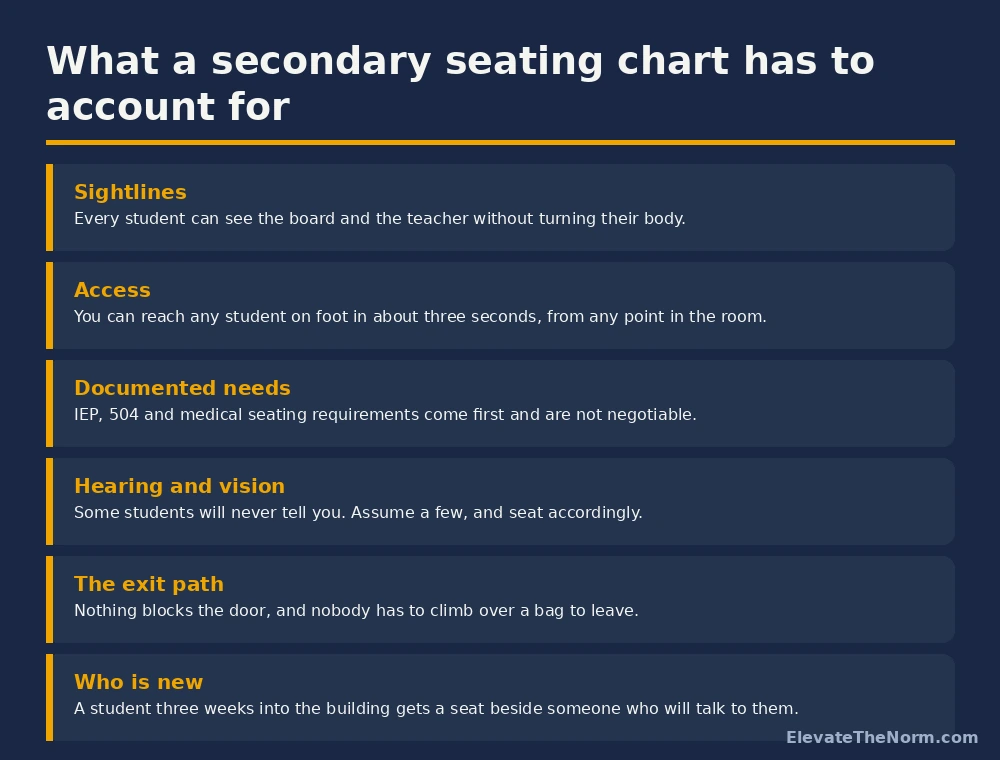
    Before aesthetics, before personality, before who talks to whom, six things constrain the chart. Get these right and the rest is preference.

    Checklist of six factors a secondary classroom seating chart has to account for, including sightlines, access and documented needs
    Documented needs come first. Everything else is a judgment call.

    Documented needs come first. If a student has seating written into an IEP or a 504 plan, that is not one input among six — it is already decided, and you build the rest of the chart around it. Read the plans before you draw anything. This is the one item on the list where “I forgot” is not an available answer.

    Sightlines. Every student should be able to see the board and the front of the room without twisting their torso. If a student has to turn their whole body to see you, they will stop turning, and you will read that as disengagement.

    Access. You should be able to reach any student on foot in about three seconds from any point in the room. Draw your actual walking paths on the chart. Most teachers discover a dead zone they have not stood in since August.

    Hearing and vision you do not know about. Some students will never tell you, some have not been screened, and some were screened years ago. Assume a couple in every section and seat accordingly rather than waiting to be informed.

    The exit path. Nothing blocks the door and nobody climbs over a backpack to leave. This is a safety item, not a tidiness one.

    Who is new. A student three weeks into the building gets a seat beside somebody who will actually talk to them. You know who those students are. Use them on purpose.

    The Best Seat in My Room Is Not on the Chart

    I built a whiteboard table for small-group work and put it in a corner under a lower lamp, on a rug, with better chairs than the rest of the room has. Students ask to go there.

    That was the entire point. The standard worry about a pull-aside table is that it becomes the remediation table — the place everyone can see you get sent to. The fix is not a policy about who sits there and when. The fix is making it the most desirable spot in the room, so that being invited over reads as access rather than as a verdict.

    For the full routine built around that table — one version for middle school and one for high school — see how to make small group instruction the seat students want.

    Your seating chart governs the default. It should not govern every seat in the room for every minute. Build somewhere a student can be moved to that carries no sting, and a quiet redirect stops being a public event.

    The rest of my room runs on tables pushed together in pairs and fours, which means working next to somebody is the resting state rather than a reward I hand out on Fridays. That is a choice about seating as much as it is a choice about instruction, and it connects directly to what a student-centered classroom looks like in practice.

    How to Create a Classroom Seating Chart, Step by Step

    Forty minutes once, then five minutes a month. Do it in this order, because each step constrains the next.

    1. Read the plans. Pull every IEP and 504 for the section and note any seating language before you draw a single box.
    2. Draw the room, not a grid. Door, board, windows, your desk, outlets, the cabinet everyone bumps into. The obstacles determine the layout more than the furniture does.
    3. Pick the layout from the unit, not the month. If the next three weeks are project work, start in fours. If they are individual writing, start in pairs or rows and say why.
    4. Place the constrained students first. Documented needs, then hearing and vision, then the newest students.
    5. Place the rest, and keep it boring. Alphabetical inside the constraints is defensible, fast, and impossible to argue with on day one.
    6. Walk it before you publish it. Stand at each seat. Anything you cannot see from there, they cannot see either.
    7. Tell them the rule. “This is the chart for the next three weeks. It changes for everybody, not for one person, and I will tell you before it does.”

    Step seven is the one that does the most work and takes the least time. Naming the cycle in advance removes the interpretation that any future change is aimed at somebody. If you want the printable version of the room map and the chart grid, both are on the free download page, in print and typeable form, with no email required.

    When to Change It, and How to Change It Without Punishing Anyone

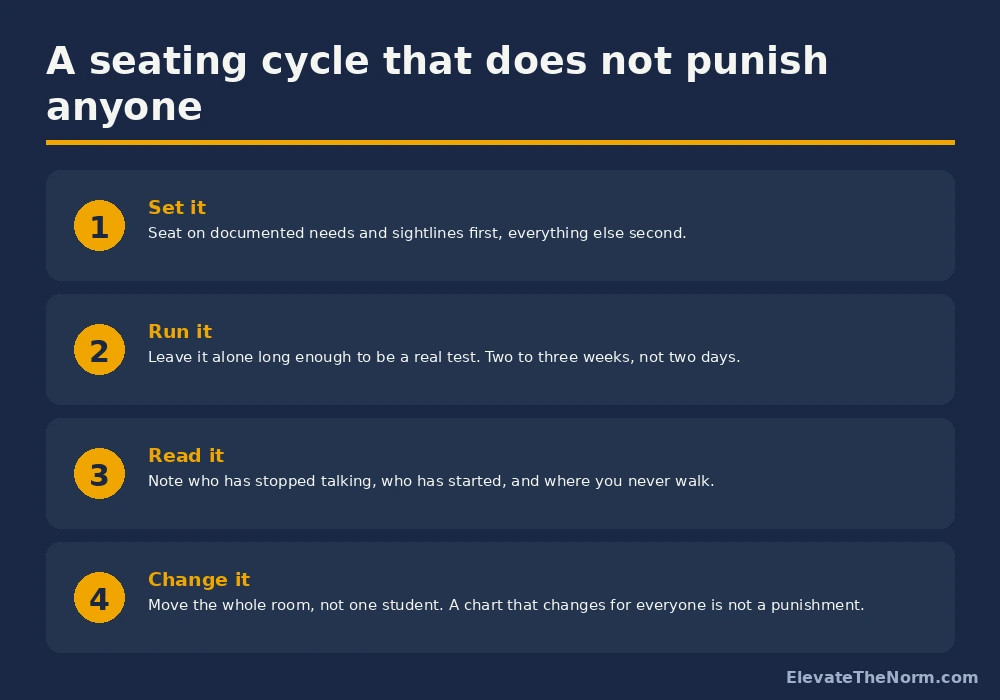
    Change on a cycle you announced, not on a mood. Two to three weeks is long enough to be a fair test of an arrangement; two days is not.

    Four-step cycle for classroom seating: set it, run it, read it, change it
    Move the whole room, not one student.

    Between changes, pay attention to three signals. Who has stopped talking who used to talk. Who has started talking who never did. And which square metre of the room you have not walked into in a week — because somebody is sitting there, and you have quietly stopped teaching them.

    When you do change it, move everybody. This is the single most useful rule in the article. A chart that reshuffles the whole room is administrative. Pulling one student to the front on a Tuesday is a sentence handed down in front of an audience, and every teenager in the room can read it. If a particular pairing genuinely is not working, you can still fix it — you just fix it inside a change that moves other people too, and you say nothing about why.

    If a student asks to move, ask why before you decide. Sometimes the answer is “I can’t see,” which you want to know. Sometimes it is “my friend is over there,” which is a no, delivered without irritation. Either way, asking treats the request as reasonable, which is most of what respect in a classroom actually costs.

    Five Ways Seating Charts Go Wrong in Secondary Classrooms

    • Using it as a consequence. Covered above, and it is the most common one. It converts a planning tool into an arbitrary punishment.
    • Setting it in August and never touching it. The room you planned for in August is not the room you have in November.
    • Letting students pick “just this once.” Fine as a genuine, announced choice. Corrosive as a drift, because the chart then only exists on days you are annoyed.
    • Seating by grades. A front row of high performers is visible to every student in the room and tells the rest exactly where they rank.
    • Forgetting the plans. A chart that ignores documented seating is not a preference you defend later. Check first.

    What to Do Next

    Build one classroom seating chart this week for your hardest section — the one where the room feels like it is working against you. Read the plans first, draw the actual room, pick the layout from the work you have planned for the next three weeks, and tell the class the cycle out loud on the day you launch it.

    Then leave it alone long enough to find out whether it worked. The most common mistake is not choosing the wrong layout. It is changing it so often, and so obviously in response to individual students, that nobody in the room — including you — ever learns what the arrangement was actually doing.

    Frequently Asked Questions

    How often should I change a classroom seating chart?

    Every two to three weeks is a reasonable cycle for grades 6–12, and the exact number matters far less than announcing it in advance. Two weeks is long enough to find out whether an arrangement is actually working; two days is not. The one rule worth holding is that you change the whole room rather than one student, so a change never reads as a verdict on somebody.

    Should students ever choose their own seats?

    As a deliberate, announced choice — sure. On a Friday, for a specific activity, because you decided to. What causes problems is drift, where the chart quietly only applies on days you are frustrated. The evidence also points one direction: in Bicard and colleagues’ study of fifth graders, disruptions roughly doubled in group seating and more than tripled in rows when students picked their own seats. That was ten-year-olds in one private school, so treat it as a strong hint rather than proof about teenagers.

    What do I tell a parent who asks why their child was moved?

    Tell them the truth, which should be boring: the class changes seats on a cycle, everyone moved, and the arrangement is built around sightlines, access and any documented needs. If you have been following the change-everybody rule, this conversation is genuinely easy. If you moved one student in isolation because of behaviour, it will not be, which is a good reason not to do that. Never discuss another student’s needs or plan with a parent who is not theirs.

    How do I handle seating when five different sections use the same room?

    Keep the furniture layout stable and change only the chart. Rearranging tables five times a day is not sustainable and you will stop doing it by October. Pick a furniture arrangement that serves the majority of your teaching — for most secondary teachers that is pairs or fours — and let each section have its own seating chart on top of it. Keep the charts somewhere you can see them in three seconds, not buried in a binder.

    Does a seating chart matter if my room has tables instead of individual desks?

    More, not less. Tables mean students are already positioned to talk, so who sits together does more work than it does in rows. The layout questions change — you are deciding group composition rather than distance — but sightlines, access, documented needs and the exit path are identical. A room built for collaboration still needs someone deciding who collaborates with whom.

    How do I know whether the seating chart is actually working?

    Watch three things across a cycle. Whether students who used to contribute have gone quiet, whether students who never contributed have started, and where in the room you have physically not walked in the past week. That last one is the most useful and the least comfortable: an area you avoid is an area whose students are getting less of you. None of this requires data collection beyond paying attention on purpose.

    What should I leave for a substitute?

    A current chart, clearly dated, with nothing on it that reveals a student’s plan or needs — a sub does not need to know why a seat is assigned, only that it is. Add one line saying the seats are assigned and are not up for negotiation that day. Most of what goes wrong for substitutes in a secondary room starts with students relocating in the first two minutes.

    Sources

    • Wannarka, R., & Ruhl, K. (2008). Seating arrangements that promote positive academic and behavioural outcomes: A review of empirical research. Support for Learning, 23(2), 89–93. Full text (PDF) · ERIC record
    • Bicard, D. F., Ervin, A., Bicard, S. C., & Baylot-Casey, L. (2012). Differential effects of seating arrangements on disruptive behavior of fifth grade students during independent seatwork. Journal of Applied Behavior Analysis, 45(2), 407–411. Full text (PMC)
    • Earp, J. (2017, March 16). Classroom layout — what does the research say? Teacher Magazine, Australian Council for Educational Research. Read the summary — the source for the Marx, Fuhrer and Hartig (1999), Sommer (1977) and Gremmen et al. (2016) findings described above, which were read here as a summary rather than in the original papers.
    • Terada, Y. (2025, August 18). Research-based tips for optimal seating arrangements. Edutopia. Read the article
    • Marx, A., Fuhrer, U., & Hartig, T. (1999). Effects of classroom seating arrangements on children’s question-asking. Learning Environments Research, 2, 249–263. Journal record

    Every link above was checked on September 12, 2026. Where a finding is described from a summary rather than the original paper, the Sources list says so.


    About Clay Shumate

    By Clay Shumate — Clay Shumate is a certified secondary Social Studies teacher in the public schools of West Alabama, with seven years of classroom experience, a B.A. in History, and an M.Ed. in Secondary Education. He writes about project-based learning, student responsibility, respect, and practical ways to hold young people to a higher standard while giving them room to learn from mistakes. He is a member of the Society of Professional Journalists and writes to its Code of Ethics; this site’s editorial standards and corrections policy are published in full.

  • Classroom Expectations Poster for Middle and High School Students

    Classroom Expectations Poster for Middle and High School Students

    Every classroom has rules posted somewhere. Most of them say things like “Be Respectful,” “Be Responsible,” and “Be Ready” — alliterative, inoffensive, and almost entirely meaningless to a teenager who doesn’t know what those words look like in practice.

    In my seventh year in the classroom, I’ve stopped treating a posted list of slogans as a finished job. Three phrases in block letters, laminated and mounted near the door, give the impression that expectations have been communicated. They haven’t. Teenagers need specifics. They need to know what “respect” looks like at 8:15 on a Monday when they’re exhausted and the assignment makes no sense. They need to know what “ready” looks like when they forgot a pencil and the lesson starts in thirty seconds.

    A classroom expectations poster, done right, is more than decoration. It’s a reference tool — a shared agreement students can point to and that you can point to when a situation arises. It’s the honest answer to “I didn’t know that was a rule,” because it was, and it was visible the whole time.

    This article gives you the full poster text I use, the thinking behind each line, and how to introduce it so students actually read it instead of walking past it for nine months.

    Why Most Classroom Expectations Posters Don’t Work

    The three-slogan poster fails for a predictable reason: vague language does not change vague behavior. When a student acts dismissively toward a classmate and you point to “Be Respectful” on the wall, they will look at it and genuinely not see the connection. That’s not defiance — it’s the natural result of abstract words without concrete definition.

    Example classroom expectations poster showing specific observable behaviors for middle and high school students
    Specificity is what separates a useful expectations poster from a decorative wall hanging.

    The IRIS Center at Vanderbilt University makes a useful distinction in their classroom management research: classroom norms are familiar ways of interacting, while expectations are desired behaviors and outcomes. The difference matters because norms require explicit teaching, not just posting. “Be Respectful” is a norm. “When someone is speaking, you are looking at them and waiting your turn” is an expectation — observable, specific, and something a teacher can actually reference in the moment. My free Classroom Norms Poster Set on TPT uses plain, respectful language students in grades 6–12 will not roll their eyes at.

    Research from Education Northwest found that five to ten percent of the variance in student performance is attributable to teacher expectations — not the poster on the wall, but the behavioral expectations teachers communicate, model, and consistently reinforce. That number might sound small, but compounded across a school year for thirty kids, it adds up. The poster is only valuable if it represents what you actually teach and hold students to.

    The secondary-level mistake is slightly different than elementary. High school teachers often skip the poster entirely — “they’re old enough to know how to behave” — or go the opposite direction with a legalistic list of prohibited behaviors. Neither approach works. Students at this age respond to expectations framed as the standards of a serious environment that takes them seriously. They want to know that the rules make sense, not that they’re being controlled.

    What a Classroom Expectations Poster Should Actually Do

    Before writing a single word for your poster, decide what job it’s going to do. A classroom expectations poster for middle and high school students should serve three purposes:

    First, it should define what success looks like in your room. Not what’s prohibited — what’s expected. There’s a meaningful difference. A list of don’ts puts students in a defensive posture. A list of expectations frames the room as a place with standards worth meeting.

    Second, it should be specific enough to reference in real situations. If you cannot point to a line on your poster during a conversation with a student and have them immediately understand why that line applies, the language isn’t specific enough.

    Third, it should treat students as capable of meeting the standards listed. Research consistently shows that students perform closer to the level their teachers genuinely believe they can reach. A poster that assumes low capability — or that feels like it was written for elementary students — communicates something you probably don’t intend.

    The research of Rosenthal and Jacobson, which famously showed that teacher expectations influence student performance even when the expectations are communicated unconsciously through treatment and attention, underlines why the framing of a poster matters. A poster that communicates “here’s what I believe students like you actually need reminding about” sets a different tone than one that says “here are the standards of a serious classroom.”

    The Poster Text: Full Copy for Middle and High School

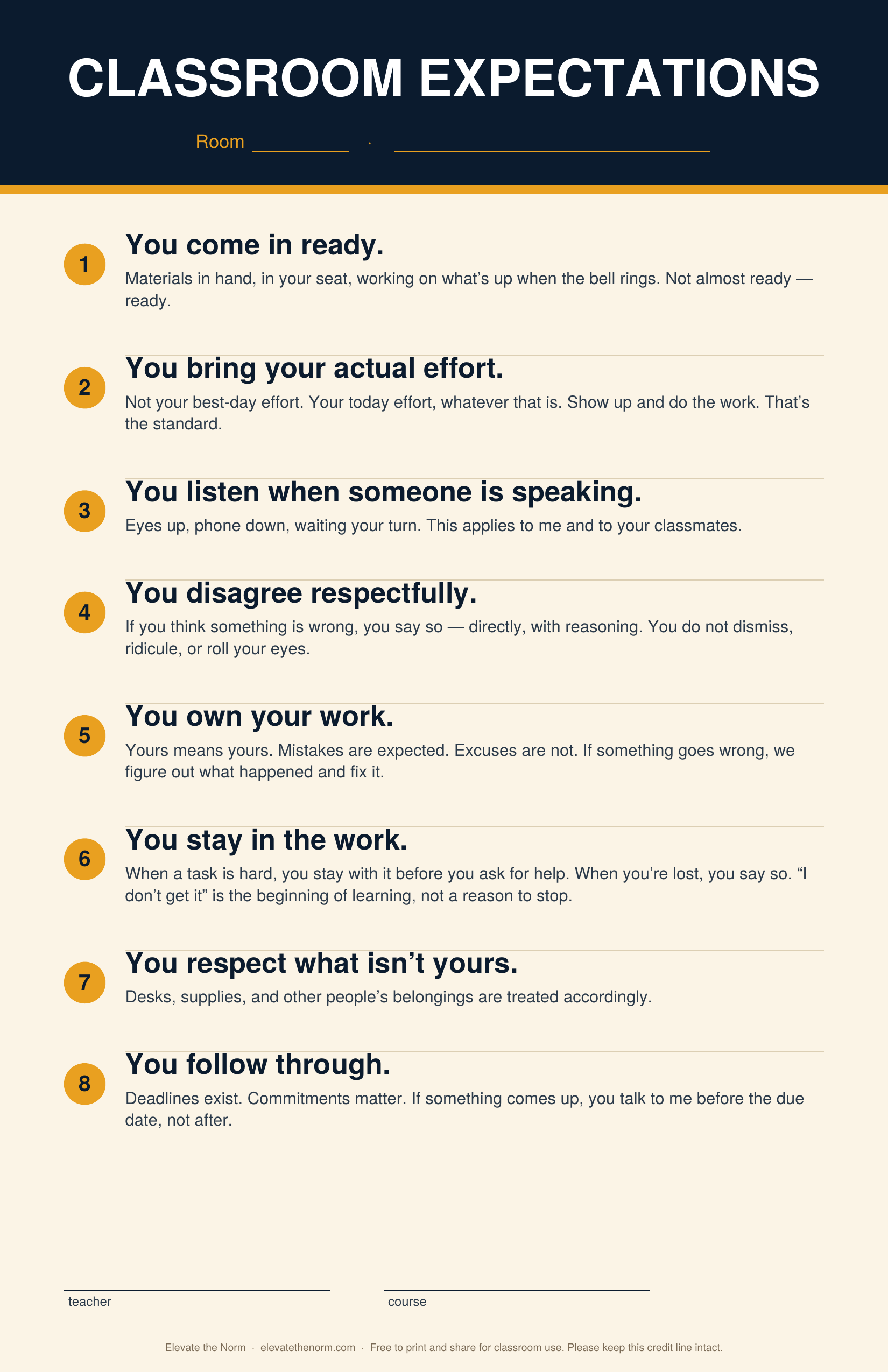
    Here is the full text I use in my room. This version was written with the specific goal of being direct, respectful, and specific enough to be useful. Copy it, adapt it, and make it yours.

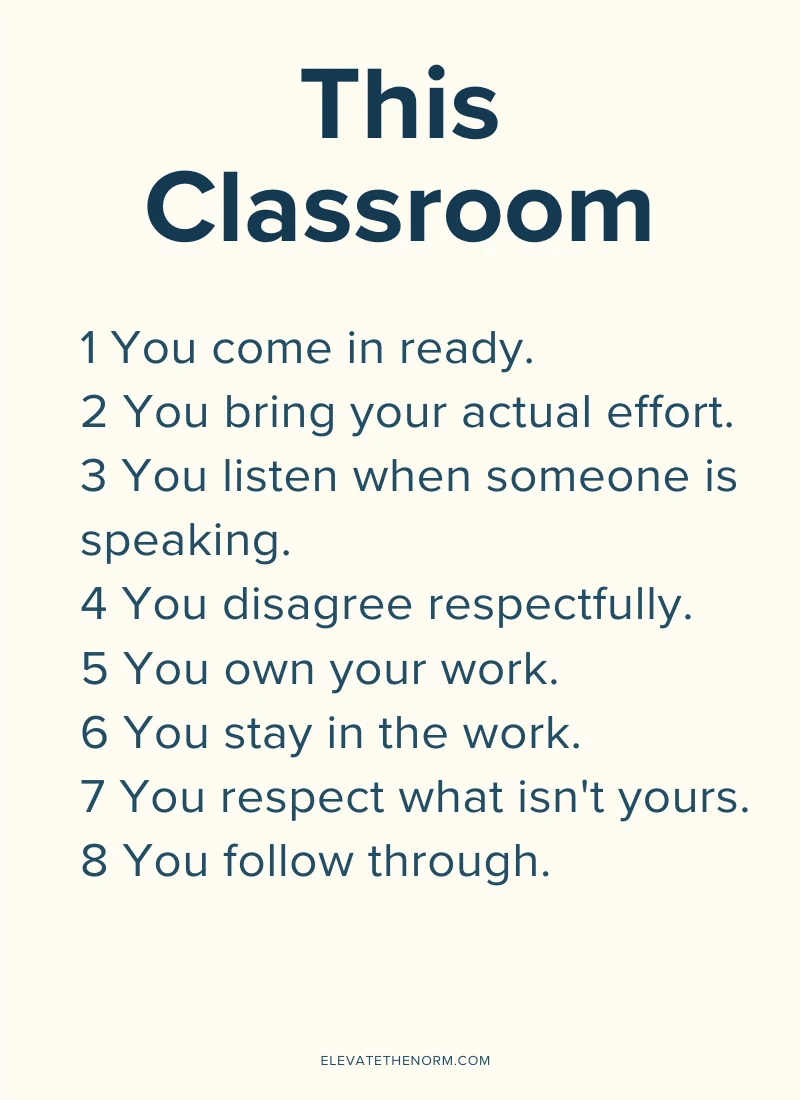
    In This Classroom

    You come in ready.
    Materials in hand, in your seat, working on what’s up when the bell rings. Not almost ready — ready.

    You bring your actual effort.
    Not your best-day effort. Your today effort, whatever that is. Show up and do the work. That’s the standard.

    You listen when someone is speaking.
    Eyes up, phone down, waiting your turn. This applies to me and to your classmates.

    You disagree respectfully.
    If you think something is wrong, you say so — directly, with reasoning. You do not dismiss, ridicule, or roll your eyes.

    You own your work.
    Yours means yours. Mistakes are expected. Excuses are not. If something goes wrong, we figure out what happened and fix it.

    You stay in the work.
    When a task is hard, you stay with it before you ask for help. When you’re lost, you say so. “I don’t get it” is the beginning of learning, not a reason to stop.

    You respect what isn’t yours.
    Desks, supplies, and other people’s belongings are treated accordingly.

    You follow through.
    Deadlines exist. Commitments matter. If something comes up, you talk to me before the due date, not after.

    Download the Classroom Expectations Poster

    The poster is free and right here, with no email or signup of any kind. Blanks are built in for your room number, your name, and your course. Print the 11×17 for wall mounting where the back row can read it, or the letter size for a desk-level copy. The PNG is there if you would rather drop it into your own layout first.

    Printable classroom expectations poster for grades 6-12 listing eight numbered expectations: you come in ready, you bring your actual effort, you listen when someone is speaking, you disagree respectfully, you own your work, you stay in the work, you respect what isn't yours, and you follow through, with blank lines for room number, teacher, and course
    The full poster, sized for 11×17. Blanks at the top and bottom are for your room number, name, and course.

    Free. No email address required. Free to print and share for classroom use — please keep the credit line intact. More free classroom packs are on the teacher resources page.

    Why These Lines Are Written This Way

    Each line was written to be as direct and specific as possible while treating students as people who can meet the standard.

    “You come in ready” is more specific than “Be Prepared.” It names the three things ready actually means: materials, seat, and working. First-week students who struggle with this aren’t defying you — they don’t know what ready looks like yet. This line tells them.

    “You bring your actual effort” is specifically not a “give 110%” type of statement, which sounds like a motivational poster and lands about as well. Instead, it acknowledges that effort looks different on different days and asks for whatever today’s version is. This matters for students who check out because they think they’re already behind.

    “You listen when someone is speaking” is specific. Eyes up, phone down, waiting your turn. Those are observable behaviors. If a student has eyes on their phone while a classmate presents, that line directly applies. “Be Respectful” does not.

    “You disagree respectfully” is one of the most important lines on the poster — and the one most teachers skip. When students know that disagreement is not only tolerated but expected to happen in a particular way, they’re more likely to engage substantively rather than disengage silently. Related to the principle of student voice and choice, this expectation tells students that their perspective has a place in the room, with conditions.

    “You own your work” addresses academic integrity and personal responsibility without using either phrase. Teenagers understand “mistakes are expected, excuses are not” faster than they understand a policy statement about academic dishonesty. See also: student responsibility in the classroom.

    “You stay in the work” targets the most common avoidance pattern in secondary school: the student who gives up after thirty seconds and announces they’re done. It gives them a two-step response — stay with it first, ask for help second — and frames “I don’t get it” as a learning step rather than a stopping point. This connects directly to developing student autonomy, where students learn to work through challenges before seeking support.

    “You respect what isn’t yours” is brief on purpose. Students this age know what it means. A long explanation implies you don’t trust them to understand basic respect for property.

    “You follow through” names the expectation most teachers dance around with a long late-work policy. Commitments matter. Deadlines exist. Talk to me before, not after. That’s a relationship-based expectation, not a punitive one, and it sets the stage for a student accountability culture rather than one built on consequences alone.

    How to Introduce the Poster on Day One

    Posting the expectations is step one. Teaching them is the actual job. The IRIS Center research makes this explicit: simply displaying rules is insufficient. Students need direct instruction, modeling, opportunity for practice, and feedback throughout the year.

    Teacher introducing the classroom expectations poster on the first day of school to middle school students
    The first day introduction of classroom expectations sets the tone for the entire year.

    In my room, on day one, every student gets a printed card — half-sheet size — with the poster text on it. They keep it in their folder or notebook for the first few weeks. Then I walk through each line, one by one, and do two things: explain what it means in practice in our room specifically, and ask students what they think it means.

    This is not a lecture about rules. It’s a conversation about how this room is going to work. I ask: “What would ‘you come in ready’ look like in practice? What might make it harder? What should you do if you need a minute?” The goal is for students to own the expectations, not just receive them.

    The research on high expectations for students consistently shows that the quality of how expectations are communicated matters as much as the expectations themselves. Expectations delivered as a list to be memorized have less impact than expectations discussed, practiced, and genuinely held.

    After the first-day conversation, I reference the poster regularly — not as a threat, but as a natural part of class language. “We’re going to stay in the work here.” “If you disagree, say so with reasoning.” The poster becomes shorthand for a full expectation that students already understand.

    Where to Post It and How to Design It

    Placement matters more than most teachers realize. If the poster is tucked in a corner next to three other posters, it is not functioning as a reference tool — it’s decoration. Put your expectations poster in a location that is:

    • Visible from every seat in the room
    • Large enough to read from the back of the room
    • Not competing with surrounding content for visual attention

    A single-page format works best for a secondary classroom. Font should be readable at a distance — no smaller than 24pt for body text, larger for the title. Design it in a way that fits the aesthetic of your room without making it look childish. A clean, simple design with clear typography communicates professionalism; clip-art borders do not.

    If you use Canva or a similar tool, create the poster in the dimensions for your printer (typically 11×17 for a poster-size sheet) or design it as a digital display if you have a dedicated screen. Watermark it as yours if you’re sharing it externally.

    Consider a smaller companion card — quarter-sheet or half-sheet — that students keep in their folders or journals. The poster is a reference for the room. The card is a personal reference they can access during independent work.

    After Day One: Keeping Expectations Alive

    The most important part of a classroom expectations poster is what happens after you put it up. If you never reference it again, it becomes wallpaper within two weeks. Students are paying attention to what you actually prioritize, not what you display.

    Year-long classroom expectations poster displayed prominently in a secondary classroom for daily student reference
    A year-long classroom expectations reference keeps standards visible and consistent all semester.

    Three practices that keep expectations functional all year:

    Reference by name. When you redirect a student, name the expectation you’re referencing. “Hey — we’re listening when someone’s speaking.” Not “you’re being disrespectful.” The specific language connects the moment to the poster.

    Acknowledge when expectations are met. This is particularly important with secondary students, who often expect correction but not affirmation. When a student owns a mistake without excuses, name it. “That’s exactly what ‘you own your work’ looks like. I appreciate that.” It reinforces the expectation without being saccharine.

    Return to the poster after a rough stretch. Every classroom hits a rough patch — after a long break, during testing, late spring. When behavior patterns shift, a brief return to the poster is more useful than a lecture. “Let’s check in on where we are as a class. Which of these are we doing well? Which are we slipping on?” That conversation treats students as capable of self-assessing, which supports the student voice and choice culture you’re building.

    The research from TNTP’s 2024 literature review on teacher expectations notes that proactive, consistent, and equitable enforcement of expectations is what produces outcomes — not the initial posting or the first-day conversation. The poster is a starting point. How you use it the rest of the year is the actual work.

    Additionally, consider how positive discipline for teens connects here — expectations, when held consistently without shame or power struggles, build the foundation for students to make better choices because they understand the standard, not because they fear the consequence.

    Frequently Asked Questions

    Should students help create the classroom expectations?

    Student-generated expectations have merit, especially for building buy-in. The practical tradeoff: students will often generate vaguer language than you need (‘be nice’), and you may spend the first class period negotiating rather than establishing a clear standard. A middle path that works well is to give students the poster framework and ask them to discuss and refine what each line means in practice — they help define the specifics without starting from a blank slate. If your classroom culture already supports significant student voice and choice, full co-creation is worth the time.

    What’s the difference between classroom rules and classroom expectations?

    Rules prohibit specific behaviors (‘no phones’). Expectations define what success looks like (‘when someone is speaking, you’re looking at them’). For secondary students, expectations framed in terms of what they should do tend to get better results than a list of don’ts, which puts students in a defensive mental posture from the first day.

    How many expectations should be on the poster?

    Research on classroom norms suggests five to eight is a useful range — enough to cover the major categories of behavior in a learning environment without becoming a list students can’t remember. The poster text above has eight lines. If your context requires different emphasis, cut or adapt rather than pile on.

    Should middle school and high school expectations look different?

    The core expectations are similar, but the delivery and design should shift. Middle school students often benefit from more concrete specifics and visual cues alongside the text. High school students respond better to fewer words and more direct language. The poster text above was written to work across grades 6–12 with minor adjustments in tone depending on how you introduce it.

    What do I do when a student violates an expectation repeatedly?

    The poster is a reference tool, not a consequence system. If a student is repeatedly not meeting an expectation, that’s a conversation — not a pointing-at-the-poster moment. The poster helps you name the expectation clearly; the actual work of changing behavior usually requires a private conversation, some investigation of what’s causing the pattern, and sometimes a connection to the school’s support systems. A student accountability sheet can structure those conversations and help students track their own patterns.

    Is it worth posting expectations in a room where students rotate (secondary, multiple classes)?

    Absolutely — arguably more so than in an elementary setting. When students move from class to class, each teacher’s expectations may be different, and ambiguity around those differences is where a lot of secondary classroom behavior issues actually live. Posting clear expectations makes your room legible to students and reduces the mental load of figuring out how this room is different from last period.

    What’s the right response when a student says the expectations are unfair?

    Take it seriously. Ask them to be specific: which expectation do they think is unfair, and why? You may learn something useful. Sometimes students are naming a real inconsistency in how an expectation is enforced (equity concerns are worth listening to). Sometimes they’re testing to see if you mean it. Either way, a direct, calm conversation — ‘Tell me more about what you’re seeing’ — respects their perspective while making clear the expectations themselves aren’t up for negotiation in the moment.

    Sources

    Brophy, J. (1983). Research on the self-fulfilling prophecy and teacher expectations. Journal of Educational Psychology, 75(5), 631–661.

    Education Northwest. (n.d.). Expectations and student outcomes. https://educationnorthwest.org/sites/default/files/expectations-and-student-outcomes.pdf

    IRIS Center, Peabody College, Vanderbilt University. (n.d.). Establishing classroom norms and expectations. https://iris.peabody.vanderbilt.edu/case-study/establishing-classroom-norms-and-expectations/

    Rosenthal, R., & Jacobson, L. (1968). Pygmalion in the classroom: Teacher expectation and pupils’ intellectual development. Holt, Rinehart and Winston.

    TNTP. (2024). The impacts of teacher expectations on student outcomes: A literature review. https://tntp.org/wp-content/uploads/2024/09/The-Impacts-of-Teacher-Expectations-on-Student-Outcomes-Literature-Review-2024.pdf


    About Clay Shumate

    By Clay Shumate — Clay Shumate is a certified secondary Social Studies teacher in the public schools of West Alabama, with seven years of classroom experience, a B.A. in History, and an M.Ed. in Secondary Education. He writes about project-based learning, student responsibility, respect, and practical ways to hold young people to a higher standard while giving them room to learn from mistakes. He is a member of the Society of Professional Journalists and writes to its Code of Ethics; this site’s editorial standards and corrections policy are published in full.

Teacher Emergency Toolkit — practical resources, real classroom support. Shop on TPT.Teacher Emergency Toolkit — practical resources, real classroom support. Shop on TPT.