Tag: classroom management

  • Visual Classroom Transitions: Cues Students Can Actually See

    Visual Classroom Transitions: Cues Students Can Actually See

    By Clay Shumate

    Visual classroom transitions use something students can see — a projected timer, a posted sequence, a slide, a hand signal — to carry the instructions for moving from one activity to the next, instead of your voice carrying them. The point is not decoration. It is that a visible instruction stays available after you have stopped talking, and a spoken one does not.

    That distinction is the whole article. Most transition advice tells you to be clearer. Visual cues are a structural fix rather than a delivery fix: they change where the instruction lives, so a student who missed it, tuned out for ten seconds, or is still finishing a sentence can recover without asking you or asking the person next to them.

    Key Takeaways

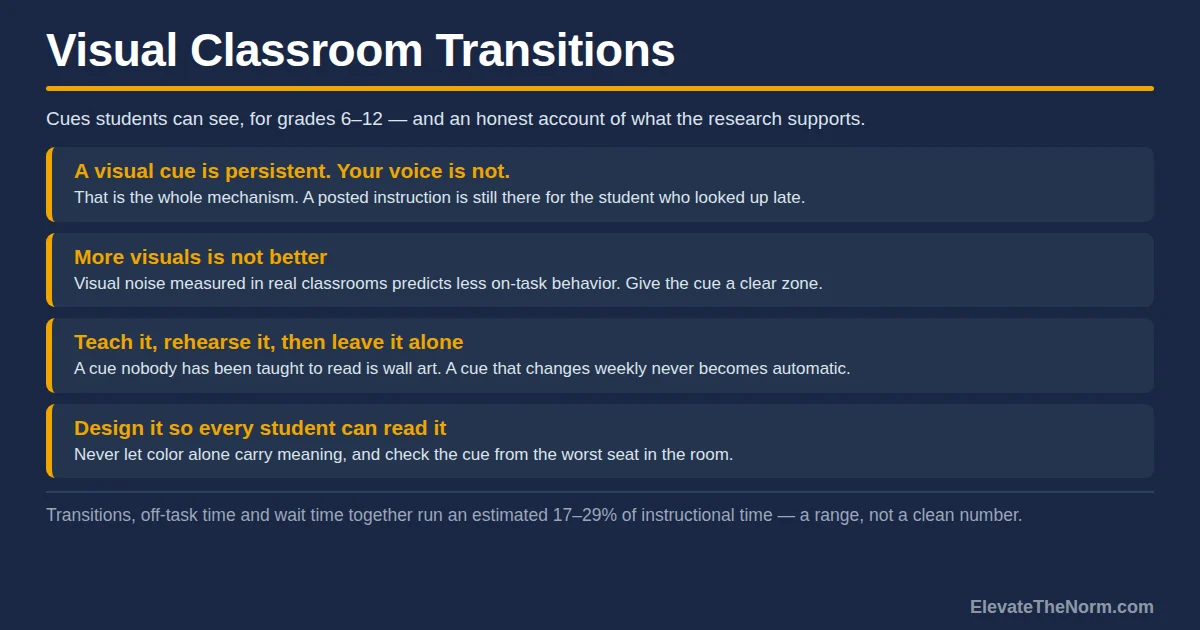
    • A visual cue is persistent; your voice is not. That is the entire mechanism. Anything a student can look back at removes a reason to ask a neighbor, and asking a neighbor is how a thirty-second transition becomes ninety.
    • Transitions are a real time cost, and the honest number is a range. Estimates put off-task behavior, transitions and wait time at somewhere between 17 and 29 percent of instructional time.
    • More visuals is not better. The same literature that supports visual cues also finds that visual clutter predicts less on-task behavior — and that finding has a published reanalysis you should know about.
    • The evidence base is strong for some students and thin for whole classrooms. Visual schedules are well supported for students with intellectual disability and autism. Nobody has shown a general secondary-classroom effect.
    • One permanent cue beats five clever ones. The cue only works once it is automatic, and a cue that changes weekly never becomes automatic.

    Free Download · PDF

    Classroom Transitions Planning Toolkit

    A transition audit sheet, a cue-type guide, and a planning template for building and timing the three moves that cost you the most.

    Download the free PDF

    Free. No email address required. Designed for grades 6–12. Browse every printable in Your Free Library.

    What Counts as a Visual Classroom Transition?

    Anything a student can look at that tells them what happens next, where to be, and how long they have. Four families cover almost everything worth using in a secondary room:

    • A countdown. A projected timer, or a number on the board you change. It answers “how long” without a single word from you, and “how long” is the question most students are actually asking.
    • A sequence. The steps of the move, posted or projected: what to close, what to get, where to sit. Three to five steps, in order, in the order a student would do them.
    • A state signal. Something that shows what mode the room is in right now — a colored slide, a magnet on the board, a word in the corner of the projection. Silent work, partner talk, whole class.
    • A gesture. A hand signal that means one specific thing and never means anything else. Free, instant, and the only one that works when the projector is down.

    What does not count: a decorative poster nobody reads, a slide so crowded that finding the instruction takes longer than hearing it, and a sign that has been up since August and has therefore become furniture.
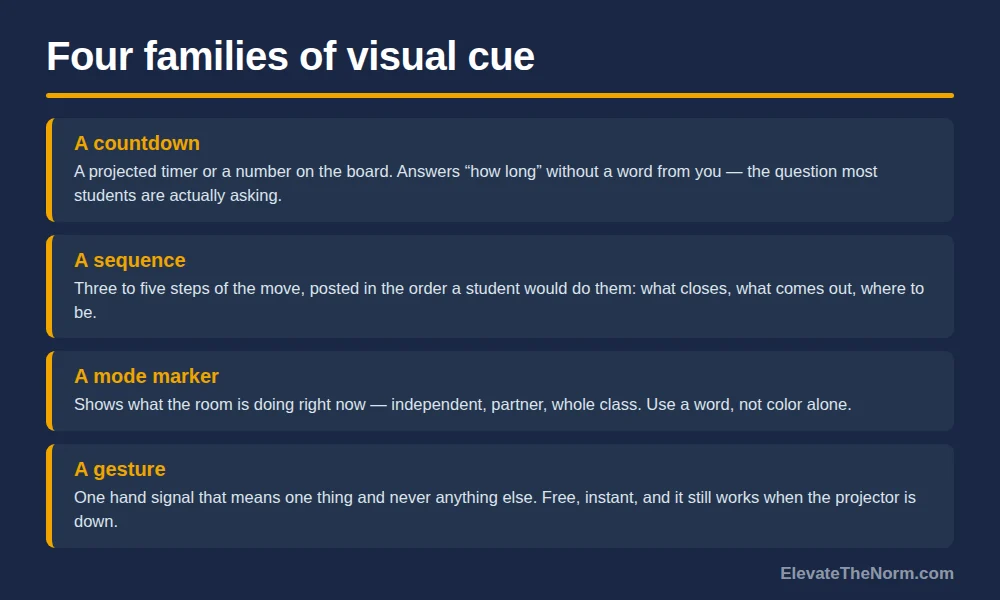
    Graphic describing four families of visual classroom transition cue: a countdown, a posted sequence of steps, a mode marker showing what the room is doing, and a hand gesture
    Four families cover almost everything worth using in a secondary room. Most teachers need two of them, used consistently.

    Visual cues sit inside the broader practice of running the four moments where a lesson actually loses time, and they are one signal among several. They pair naturally with an audio cue — the music and sound cue guide covers that half — and the pairing is often better than either alone, because one catches the student who is looking up and the other catches the student who is not.

    How Much Time Do Transitions Actually Cost?

    Enough to matter, and less precisely than most articles claim. Anyone quoting you a clean figure is rounding somebody else’s estimate.

    The most careful recent synthesis is Kraft and Novicoff’s 2024 paper on time in school. Reviewing the available studies, they report that estimates of off-task behavior, transitions and wait time together occupy between 17 and 29 percent of instructional time — a range, drawn from several different measurement methods, and covering three things at once rather than transitions alone.

    Their own district analysis is more concrete and more sobering. In Providence Public Schools they found instructional time lost running at 16 percent in elementary, 21 percent in middle school and 25 percent in high school. The largest single contributor was unexcused absence, followed by outside interruptions and teacher absence; interruptions and teacher absence alone cost the average high school student 97.3 hours a year. My free First 10 Days Procedures Checklist on TPT walks through which routine to teach on which day.

    Read that honestly. Those Providence figures are not a transition statistic. They count absence and building-level interruption, and the authors explicitly call the estimate a lower bound that does not capture how usable hours are further eroded by disruptions inside the classroom. The transition number lives inside the 17-to-29 percent range, and that range is wide because the measurement is hard.

    What you can say without overstating: transitions are a nontrivial recurring cost, they are one of the few losses a single teacher can act on without anyone’s permission, and a room that moves in thirty seconds instead of ninety recovers real minutes across a semester. That is a good enough reason. It does not need inflating.

    Why Does a Visual Cue Work Better Than Saying It Again?

    Because it is still there after you stop talking. A spoken instruction exists for about four seconds and then only in the memory of whoever was listening. A projected one is available to the student who looks up late.

    That sounds small. It is the entire difference, and you can watch it happen: the student who missed the instruction turns to a neighbor, the neighbor stops working to answer, and one missed instruction has now taken two students off task and generated the noise that pulls a third. A visible instruction gives that student a way to recover without recruiting anyone.

    It also tells you who benefits most, and it is not the student you were picturing. It is the one who was absent yesterday and does not know the routine, the one who needs a few extra seconds to process a spoken instruction, and the one who will not ask you a question in front of the room under any circumstances. All three are students a voice-only transition leaves behind, and none of them will tell you so.

    There is a second effect, harder to see. Instructions delivered only by voice make you the sole source of the answer, so every uncertainty routes through you. That is what makes a transition feel like crowd control. Moving the instruction onto the wall or the screen means the room can answer its own question, which is the same principle behind writing down the routines a class is expected to run without prompting rather than re-explaining them.

    The research on the cueing side is worth being precise about, because it is frequently overstated. Visual activity schedules have a real evidence base: van Dijk and Gage’s 2019 meta-analysis in the Journal of Intellectual & Developmental Disability pooled 13 single-case studies and found a meaningful effect on independent skills, across middle school, high school and adult participants. Milam and Sutton’s 2024 article in Beyond Behavior extends the practice to students with emotional and behavioral disorders as a proactive transition strategy, at the elementary and middle school level.

    Notice what that evidence is and is not. It is single-case research with students who have identified disabilities. It is good evidence that visual schedules help those students become more independent. It is not evidence that adding a projected timer raises achievement in a general-education eleventh-grade classroom, and nobody should tell you it is. The honest case for visual cues in a mainstream secondary room is mechanical and modest: it costs nothing, it removes a known friction point, and the practice it generalizes from is well supported for the students who need it most.

    There is one adjacent evidence-based practice worth naming, because it is cheap and it pairs with every cue on this page. Ennis, Royer, Lane and Griffith’s 2017 systematic review in Education and Treatment of Children applied Council for Exceptional Children standards to precorrection — telling students what is about to be expected, before the moment arrives — and concluded it qualifies as an evidence-based practice. A visual cue is a precorrection you did not have to say.

    Does More Visual Support Make a Room Work Better?

    No, and this is the part most articles about classroom visuals leave out. The same research tradition that supports targeted visual cues also finds that a visually busy room costs attention.

    Godwin, Seltman, Scupelli and Fisher observed 58 elementary classrooms with a structured on-task protocol and analyzed panoramic photographs of each room’s visual environment. Students were on task 72.7 percent of the time. Greater visual noise significantly predicted less on-task behavior — each standard deviation increase in visual noise was associated with roughly a 10 percent reduction in the odds of being on task. Adherence to design-composition principles predicted nothing. Peer distraction, incidentally, accounted for 46.4 percent of all off-task behavior, which is worth remembering the next time a seating decision seems minor.

    The better-known version of this finding comes from Fisher, Godwin and Seltman’s 2014 study in Psychological Science, where kindergarteners in a heavily decorated room were more distracted and scored lower than the same children in a sparse one. It is quoted constantly. It also has a published reanalysis that you should know about before you quote it. Imuta and Scarf, writing in Frontiers in Psychology the same year, reanalyzed the data and found that children’s distraction in the decorated room decreased considerably across lessons — habituation. Their argument is that the study conflated novelty with irrelevance, and that 45 minutes total across two weeks is nowhere near enough time to habituate the way students do to a real classroom they sit in daily.

    So the strong claim — decorations harm learning — does not survive contact with the reanalysis. Two weaker claims do survive, and both are useful: visual noise measured in real classrooms predicts less on-task behavior, and novel visual material draws attention. Both point the same direction for transitions. If everything on your walls is competing, the one thing you actually need students to look at is competing too. And because novelty is what draws the eye, a cue that appears only at transitions has an advantage over one that is always up. My Brain Breaks for Middle and High School on TPT give you 60 quick resets that do not feel childish to teenagers.

    The caveat on all of it: these are K–4 samples. A sixteen-year-old is not a kindergartener, and no equivalent study of secondary classrooms turned up here. Treat this as a reason to keep the signal clean, not as a proven high school effect.

    How Do You Build a Visual Cue That Actually Gets Used?

    Five steps, and step four is the one that decides whether it works.

    1. Pick the transition that costs you the most. Not all of them. Time three of them with your phone for a week — entry, the move into group work, and the last five minutes — and fix the worst one first. Most teachers guess wrong about which one it is.
    2. Write the move as three to five steps, in student order. What closes, what comes out, where people go. If it takes more than five steps, the transition itself is too complicated and no cue will save it.
    3. Put the steps and a countdown in the same place every time. Same corner of the slide, same spot on the board. A cue that moves is a cue students have to search for, and searching is the cost you were trying to remove.
    4. Teach it, then rehearse it twice. Show the cue, walk the steps, do it once badly and name what went wrong, do it again. This is fifteen minutes and it is the entire difference between a cue and a decoration. A visual nobody has been taught to read is wall art.
    5. Leave it alone for a month. The cue works when it is automatic, and automatic takes repetition. Changing it because you thought of a better version resets the clock.
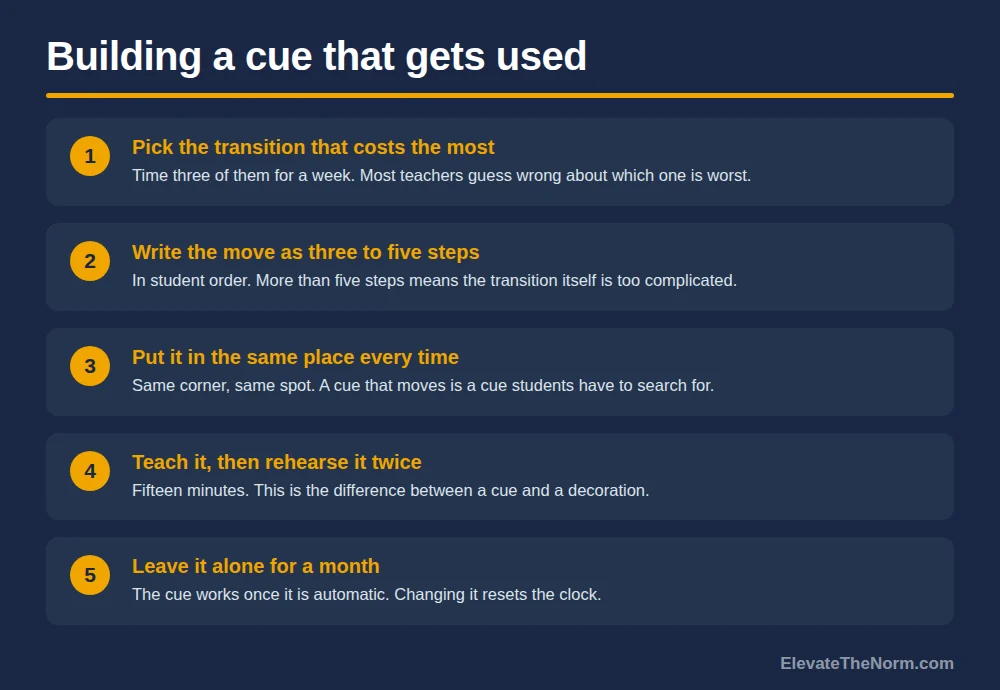
    Numbered five-step graphic for building a visual classroom transition cue: pick the costliest transition, write the move as three to five steps, put it in the same place every time, teach and rehearse it twice, and leave it alone for a month
    Step four is the one that decides whether it works. A visual nobody has been taught to read is wall art.

    Two practical notes. Make the cue legible from the worst seat in the room — back corner, at an angle, with the lights on. Text that reads fine on your laptop frequently does not survive the projector, and a student who cannot read the cue will ask a neighbor, which is the exact behavior you were trying to prevent. Check it from that seat once.

    And have a version that works when the technology does not. Projectors fail, and plenty of secondary teachers float between rooms or share a space where the board is not theirs to write on. A hand signal plus three steps on a half sheet at each table, or on a single laminated card you carry, covers the same ground and needs no bulb and no wall. If your whole transition system depends on a screen you do not control, you have built a system that breaks on the morning the network is down — which is the same reason a room needs a procedure a substitute could run without you in the building.

    What Do Visual Cues Look Like in a Secondary Classroom?

    Plainer than the internet suggests. Most published visual-transition material is built for elementary rooms, and a fourteen-year-old reads a cartoon carpet-time card as an insult. The design rule for grades 6–12 is that the cue should look like something adults use.

    Worth using:

    • A full-screen countdown for any move with a deadline. No decoration, large numerals, visible from the back.
    • A three-line slide that appears only during a transition and shows what closes, what opens, and where to be.
    • A mode marker in a fixed corner of the slide — independent, partner, whole class. Use a word, not a color alone. Roughly one boy in twelve has a red–green color vision deficiency, so a red-versus-green block is a cue a few students in every section cannot read. A colored block with the word on it works for everyone, and it ends the “can we talk?” question permanently.
    • A two-finger signal that means one thing: thirty seconds left. One gesture, one meaning, used every day.
    • A materials diagram for any recurring setup with a physical arrangement — lab stations, a debate layout, group clusters. Drawn once, reused all year.

    Worth skipping: animated slide transitions, anything with a cartoon character, a different cue for every activity, and a countdown with sound effects. All of them add novelty to a moment that needs predictability.

    One more: the cue should not require you to be at the front of the room. The value of a visual signal is that it frees you to move — to be next to the group that always stalls, instead of at the board narrating. If your system requires you to stand somewhere and press something, you have built a cue that costs you the thing it was supposed to buy.

    Where Visual Transitions Break Down

    Four failure modes, all predictable, all cheaper to avoid than to fix.

    The cue is never taught. It goes up, students do not know it is load-bearing, and it becomes background within a week. This is the most common failure and the easiest to prevent: fifteen minutes of explicit instruction and two rehearsals.

    The cue competes with everything else on the wall. This is the visual-noise finding applied to your own room. If the signal sits in a field of posters, student work and reference charts, it is one more thing in a busy field. Give it a clear zone with nothing around it.

    The cue is treated as a substitute for the transition being sensible. No timer fixes a move that requires twenty-eight people to cross the room to a single supply table. Redesign the move first. A visual cue makes a good procedure faster; it cannot make a bad one work.

    The cue becomes a countdown to a punishment. If the timer’s only meaning is that something unpleasant happens at zero, students learn to watch you rather than the screen, and the cue has acquired a tone you did not intend. The timer answers “how long do I have,” which is a fair question a student is entitled to ask. Keep it answering that.
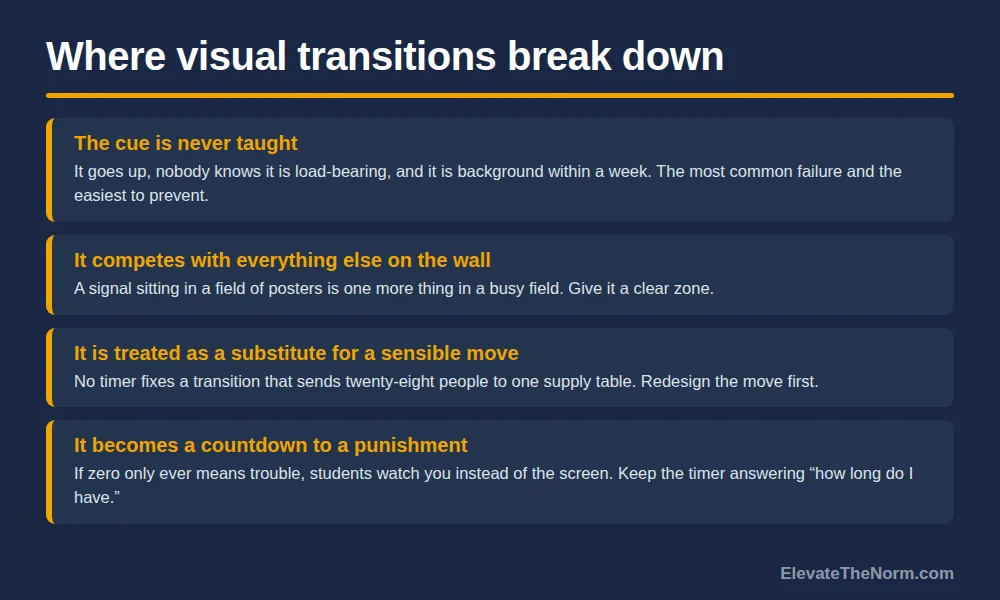
    Graphic listing four failure modes for visual classroom transitions: the cue is never taught, it competes with wall clutter, it substitutes for redesigning a bad move, and it becomes a countdown to a punishment
    All four are predictable, and all four are cheaper to avoid than to fix.

    What to Do This Week

    Time your three worst transitions for a week and write the numbers down. Pick the slowest one. Write that move as four steps in the order a student would do them, put those steps plus a countdown in one fixed spot, and spend fifteen minutes teaching it with two rehearsals. Then leave it alone for a month and time it again.

    While you are at it, look at the wall behind the cue and take down anything that is not doing work. That is the one piece of advice in this article with direct classroom observation behind it, even if the classrooms were younger than yours.

    Visual classroom transitions will not transform a room. What they do is remove one specific friction — the gap between when you said the instruction and when a student needed it — and hand students a way to solve their own problem without asking anybody. That is worth fifteen minutes and a slide. For the concrete versions, the transition examples and free planning toolkit includes a cue guide and an audit sheet for timing the moments that leak the most.

    Before you go: grab the free Classroom Transitions Planning Toolkit (PDF) — ElevateTheNorm.com branded, printable, no email required.

    Frequently Asked Questions

    Do visual transition cues work with high school students, or are they an elementary thing?

    The design has to change; the mechanism does not. A sixteen-year-old reads a cartoon cue card as condescension and will treat it accordingly. A full-screen countdown, a three-line slide and a hand signal are the same tool in a form that looks like something adults use. Be aware that the research base is mostly elementary and mostly students with identified disabilities — there is no study here showing a general effect in a mainstream high school classroom. The case for using them at this level is that they cost nothing and remove a known friction, not that they are proven.

    Isn’t a timer just pressure? Some of my students get anxious about it.

    A timer is pressure when zero means something bad happens. It is information when zero means the next thing starts. Two things keep it on the information side: say what happens at zero before you start it, and make sure what happens at zero is a transition rather than a consequence. If a particular student finds a visible countdown genuinely difficult, a posted sequence without a clock does most of the same work — the persistence of the instruction is the part that matters, not the ticking.

    How many visual cues should a classroom have?

    Fewer than you think. One for time, one for the sequence, one for mode, and one gesture is a complete system, and most rooms would do better with two of those used consistently than four used occasionally. The observational research on visual noise points the same way: more visual material in a room predicts less on-task behavior, so every additional cue is competing with the ones you actually need.

    Does this mean I should take everything off my classroom walls?

    No, and the study that gets quoted for that claim has a published reanalysis worth knowing about. Fisher, Godwin and Seltman found kindergarteners more distracted in a decorated room — but Imuta and Scarf reanalyzed the data and showed the distraction dropped considerably across lessons, which points to novelty rather than decoration as the cause, in a setting where children never had time to habituate. The defensible version is narrower: keep a clear zone around the cue you need students to read, and take down what is genuinely doing no work. Student work on the walls is doing work.

    What do I do when the projector dies mid-transition?

    Have the analog version ready before it happens, because it will. A hand signal that means thirty seconds and four steps written on the board in marker do the same job and never need a bulb. Teach the backup at the same time you teach the main cue so it is not a novelty on the day you need it. Any transition system that only works when the technology works is a system that fails on exactly the mornings that are already going badly.

    Should students help design the cue?

    It is worth asking them which transition is worst and what the current cue does not tell them. They are the ones experiencing the ambiguity and they will name things you cannot see from the front — the slide is unreadable from the back row, or nobody knows whether the move includes getting a laptop. Take their information and keep the design decision. A cue that changes because of student preference every few weeks never becomes automatic, and automatic is the whole point.

    How do I make sure a visual cue is readable for every student?

    Three checks, none of which takes long. Sit in the worst seat in the room — back corner, off angle, lights on — and read the cue yourself; projector contrast is much worse than laptop contrast. Never let color alone carry meaning, because a red-versus-green signal is unreadable for the students in every section with a color vision deficiency; put the word on the block. And say the cue out loud the first few times you use it, which covers a student with low vision and costs you four seconds. A cue that a few students cannot read is worse than no cue, because those students now have to ask someone.

    How long before a new visual cue actually starts saving time?

    Expect a few weeks, and expect the first several days to look worse rather than better, because students are learning a new routine on top of doing the old one. Time the transition before you start so you have a real baseline, then time it again after a month. If nothing has improved after a month of consistent use, the problem is almost certainly the transition itself rather than the cue — a move with too many steps or a physical bottleneck will not be fixed by putting a timer on it.

    Sources

    1. Kraft, Matthew A., and Sarah Novicoff. “Time in School: A Conceptual Framework, Synthesis of the Causal Research, and Empirical Exploration.” EdWorkingPaper, February 2024. https://edworkingpapers.com/sites/default/files/Kraft Novicoff – Time In School – Feb 2024_1.pdf
    2. Godwin, Karrie E., Howard Seltman, Peter Scupelli, and Anna V. Fisher. “Attentional Competition in Genuine Classrooms.” Proceedings of the 42nd Annual Meeting of the Cognitive Science Society, 2020. https://cognitivesciencesociety.org/cogsci20/papers/0524/0524.pdf
    3. Imuta, Kana, and Damian Scarf. “When too much of a novel thing may be what’s ‘bad’: commentary on Fisher, Godwin, and Seltman (2014).” Frontiers in Psychology, vol. 5, art. 1444, 2014. https://www.frontiersin.org/journals/psychology/articles/10.3389/fpsyg.2014.01444/full (The Fisher, Godwin and Seltman 2014 Psychological Science study is described here as reported in this commentary and in the Godwin et al. 2020 paper above; the original article was not read directly.)
    4. van Dijk, Wilhelmina, and Nicholas A. Gage. “The effectiveness of visual activity schedules for individuals with intellectual disabilities: A meta-analysis.” Journal of Intellectual & Developmental Disability, vol. 44, no. 4, 2019, pp. 384–395. https://eric.ed.gov/?id=EJ1234224
    5. Milam, Molly E., and Kimberly Kode Sutton. “Using Visual Activity Schedules to Improve Transitioning for Students With Emotional and Behavioral Disorders.” Beyond Behavior, vol. 33, no. 3, 2024. https://journals.sagepub.com/doi/10.1177/10742956241276003
    6. Ennis, Robin Parks, David James Royer, Kathleen Lynne Lane, and Claire E. Griffith. “A Systematic Review of Precorrection in PK-12 Settings.” Education and Treatment of Children, vol. 40, no. 4, 2017, pp. 465–495. https://eric.ed.gov/?id=EJ1157923
    About Clay Shumate

    Clay Shumate is a certified secondary Social Studies teacher in the public schools of West Alabama, with seven years of classroom experience, a B.A. in History, and an M.Ed. in Secondary Education. He writes about project-based learning, student responsibility, respect, and practical ways to hold young people to a higher standard while giving them room to learn from mistakes. He is a member of the Society of Professional Journalists and writes to its Code of Ethics; this site’s editorial standards and corrections policy are published in full. More about Clay.

  • Student Self Assessment of Behavior: What It Fixes, What It Doesn’t

    Student Self Assessment of Behavior: What It Fixes, What It Doesn’t

    By Clay Shumate

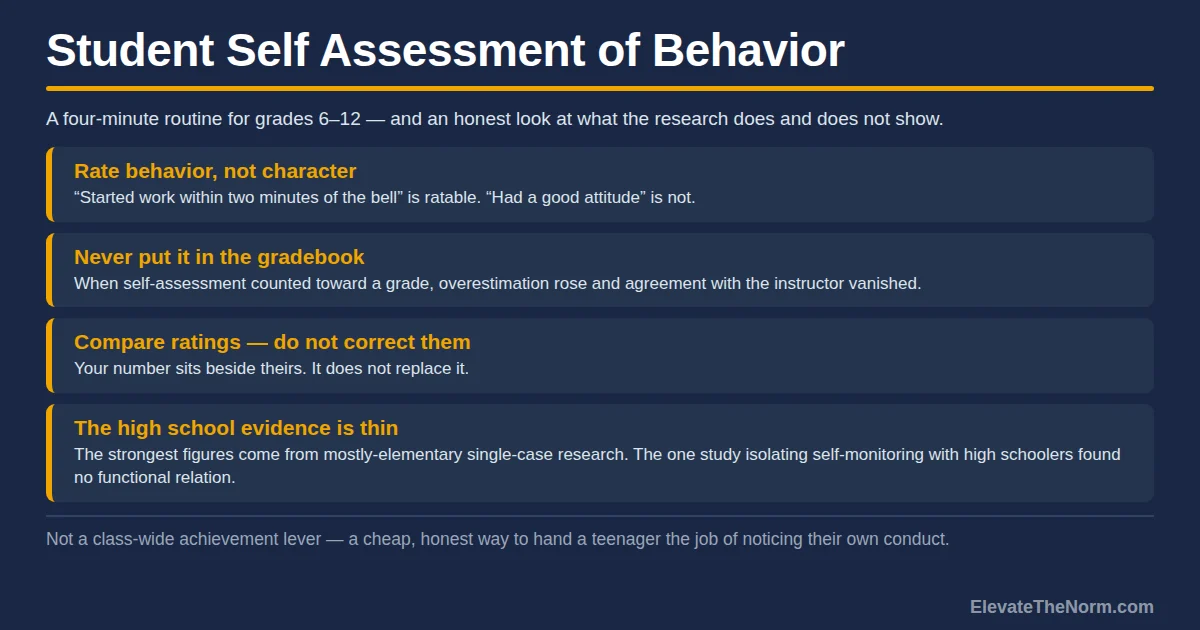
    Student self assessment of behavior is a short routine in which a student rates their own conduct against visible criteria, gives evidence for the rating, and names one thing to do differently. Not an apology form, not a mood check. Done right it takes four minutes and moves the work of noticing from you to them.

    Narrow is the point. The research here is better than what sits behind most in-service handouts, and more limited than the workshop slides admit. What follows is what the evidence supports for grades 6–12, what it does not, and a routine that survives a real Tuesday.

    Key Takeaways

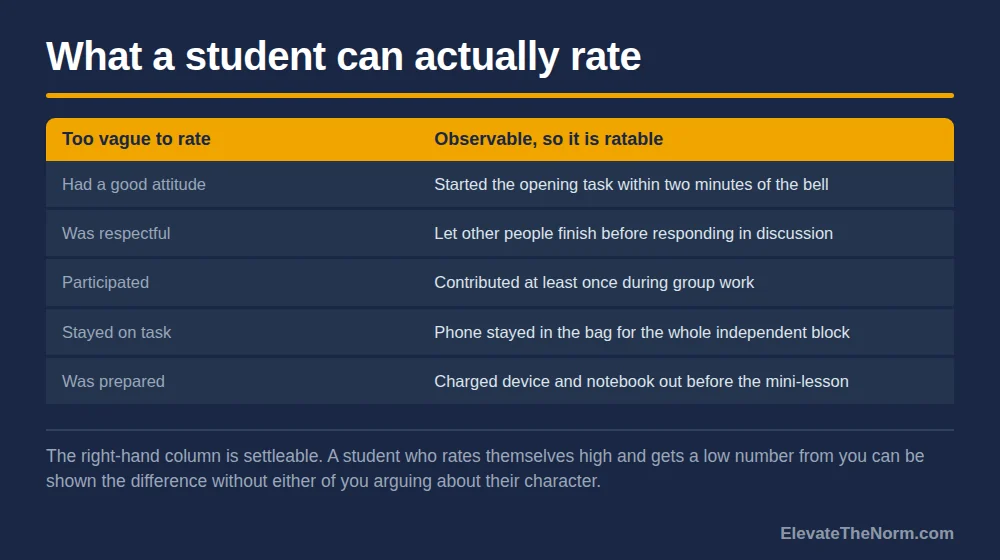
    • Rate behavior you can point at, not character. “Started work within two minutes of the bell” is ratable. “Had a good attitude” is not — and a student who disagrees has nowhere to go.
    • The moment you grade it, it stops working. In one study of self-assessment counted toward a final mark, overestimation rose sharply and the correlation with the instructor’s rating vanished.
    • The evidence is real, and the high school evidence is thin. A federal practice guide reports large average improvements. The one study found here that isolated self-monitoring with high schoolers found no functional relation.
    • Two behaviors. Not eight. Every version that survives past October tracks a small number of specific, positively stated behaviors on a form the student can fill out in under two minutes.
    • Compare ratings, do not correct them. Rating the same period yourself is the accuracy check. Overwriting the student’s number turns the whole thing back into your paperwork.

    Free Download · PDF

    Student Self-Assessment Forms for Grades 6–12

    A printable self-assessment form with space to write your own behavior criteria, a 0–3 rating scale, and a next-step line. No email required.

    Download the free PDF

    Free. No email address required. Designed for grades 6–12. Browse every printable in Your Free Library.

    What Is Student Self Assessment of Behavior?

    It is a student judging their own conduct against stated criteria and recording it. Three parts, all required: an observable behavior, a rating, a next step. Drop the observable behavior and you have a feelings survey. Drop the next step and you have a confession.

    The U.S. Department of Education’s Office of Special Education Programs describes two forms in its 2022 practice guide on self-monitoring systems: students record whether a behavior happened, or they rate it against criteria set in advance. The second is what most secondary teachers want. A checkbox says a thing occurred. A rating asks a student to hold their own conduct against a standard and say how close they came — a different and more useful act with a fifteen-year-old.

    Two neighbors to separate from. Not a restorative conversation — that happens after harm and involves the people affected. Nor is it academic self-assessment, though it borrows the machinery; the guide to judging your own work against criteria covers that version. Behavior just changes what sits in the criteria column. A third variant narrows it to a single project: what one student contributed inside a group that shares a grade.

    Does Student Self Assessment of Behavior Actually Work?

    Yes, with caveats big enough that you should read them. The headline numbers are good. The ones that apply specifically to teenagers are much thinner, and one is a null result.

    Start with the strongest claim. The OSEP guide cites a 2015 systematic review by Bruhn and colleagues covering 41 studies and reports that every one showed improvement: problem behavior falling from an average of 22% to 4%, academic engagement rising from 37% to 86%. Those are the figures that get onto the slide.

    Forty-one out of forty-one should make you suspicious rather than confident. A literature in which nothing ever fails usually has a publication problem, and nearly all of this work uses single-case designs — a handful of students, observed intensively, with effects judged by eye or by a non-standard metric. Single-case research is useful for showing something can work for a particular student. It is weak evidence for how far it moves a class of twenty-eight.

    The better evidence is the randomized trial. Bruhn, Wehby, Hoffman and colleagues ran a multisite RCT of a self-monitoring app across 25 schools and 57 student–teacher pairs (Behavioral Disorders, 2022). Students using it improved academic engagement more than controls (d = 0.44) and cut disruptive behavior more (d = −0.35) — and the behavior reduction largely held two weeks after the intervention stopped, while the engagement gain faded (d = −0.30). Note the grade band: 3rd through 8th. That is mostly elementary. It is not a high school result.

    Which brings us to the honest part. The one study located here that isolated self-monitoring with high schoolers is Estrapala, Bruhn and Rila (2022), comparing goal reminders against interval self-monitoring with three students with emotional or behavioral disorders. Visual analysis found no functional relation for either condition. Tau-U effect sizes ran 0.44 to 0.64, moderate to large, with self-monitoring slightly ahead — but the authors report classroom management as a substantial confound. Three students is three students; it does not overturn the wider literature. It does mean nobody should tell you this is proven for eleventh graders.

    The general picture for this age group is modest too. Murray, Kurian, Soliday Hong and Andrade (2022, Journal of Adolescence) pooled 33 randomized trials of self-regulation interventions with 7,269 young people aged 10–15 and found Hedges g = 0.12. Small. Emotion-regulation approaches reached g = 0.20; cognitive regulation, parent training, physical activity and working-memory approaches showed no significant effects at all.

    The defensible claim is this: behavior self-assessment reliably helps individual students who are struggling, is cheap, and has no plausible downside when it is not graded. It is not a class-wide achievement lever and nobody has shown that it is.

    Two things follow from that at building scale. First, this is about as cheap as an intervention gets — a half sheet of paper, no license, no platform, no staffing line, and so no procurement decision needed to try it in three classrooms. Second, and harder: who ends up holding a behavior sheet is an equity question, not a neutral one. Discipline data in most systems is not evenly distributed, and a practice assigned one student at a time inherits whatever pattern already exists in who gets noticed. Anyone running this as a tier-two intervention should read the roster of assigned students the way they read a referral report. Skipping that five-minute check is how a well-meant practice ends up pointed at the same kids as everything else.

    Will a Teenager Rate Themselves Honestly?

    More honestly than you expect, right up until the rating counts for something. That single design decision explains most of the variance between a routine that works and one that becomes theater.

    Heidi Andrade’s 2019 critical review in Frontiers in Education lays the accuracy picture out plainly. Correlations between student self-ratings and external measures run from about 0.20 to 0.80, few above 0.60. Males tend to overrate, females to underrate, and older and more academically competent students are more consistent — mildly good news for secondary teachers.

    Two-column table contrasting vague behavior descriptions such as had a good attitude and was respectful with observable versions such as started the opening task within two minutes of the bell and contributed at least once during group work
    The right-hand column is settleable. The left-hand column is an argument about a person.

    The decisive finding is about grading. Andrade cites Tejeiro and colleagues (2012), where self-assessment counted toward the final grade: overestimation increased dramatically and no correlation emerged between the professor’s rating and the student’s. Run formatively, agreement with external evaluators improved substantially. All twenty studies in Andrade’s review that used self-assessment formatively showed a positive association with learning.

    A second finding is worth stealing. Andrade reports that concrete, task-specific criteria outperform vague competence-based ones — a result from Fastré and colleagues. In behavior terms: “I was ready when the bell rang” beats “I was responsible today,” and it is far harder to argue about.

    Andrade also makes a point most summaries skip: the obsession with accuracy may be misplaced. Her review notes little evidence that inaccurate self-assessment produces worse learning, and that students act on their predictions regardless of accuracy. The purpose is not a number that matches yours. It is to get a student to look.

    What Should Students Actually Rate?

    Two or three behaviors, each stated as something a stranger could watch and score. The OSEP guide is specific: targets should be stated positively, defined in observable and measurable terms, and taught with examples and non-examples before anyone rates anything.

    Stated positively matters more than it sounds. “Did not disrupt” gives a student nothing to aim at. “Asked for help by raising a hand or coming to the desk” names the thing you want more of. Here is the difference in practice:

    Not ratableRatable
    Had a good attitudeStarted the opening task within two minutes of the bell
    Was respectfulLet other people finish before responding in discussion
    ParticipatedContributed at least once in the group work segment
    Stayed on taskPhone stayed in the bag for the whole independent work block
    Was preparedHad the charged device and the notebook out before the mini-lesson

    The right-hand column has a property the left lacks: a student who rates themselves high and gets a low number from you can be shown the difference without either of you arguing about their character. It moves a disagreement about a person into a disagreement about a fact, and facts are settleable.

    Pick two. A student tracking six behaviors is doing clerical work, and clerical work gets abandoned. Few, specific and observable beats many and inspirational — the same discipline that makes a short list of classroom expectations work at all.

    Let the student pick the second one. You choose the first target — you can see the pattern from the front of the room. Hand them the second. Ask what they would fix about their own class period if they could fix one thing, and write down their words. This costs nothing and it changes what the sheet is: a form you assigned becomes a form with something of theirs on it. It also produces better targets than you would guess, because a fifteen-year-old knows things about their own period that are invisible from six feet away — the argument for taking student voice seriously in the first place.

    A Four-Minute Behavior Self-Assessment Routine

    Four steps, once a period or once a day, on one sheet. The design constraint is that it has to be cheap enough that you still run it in week nine.

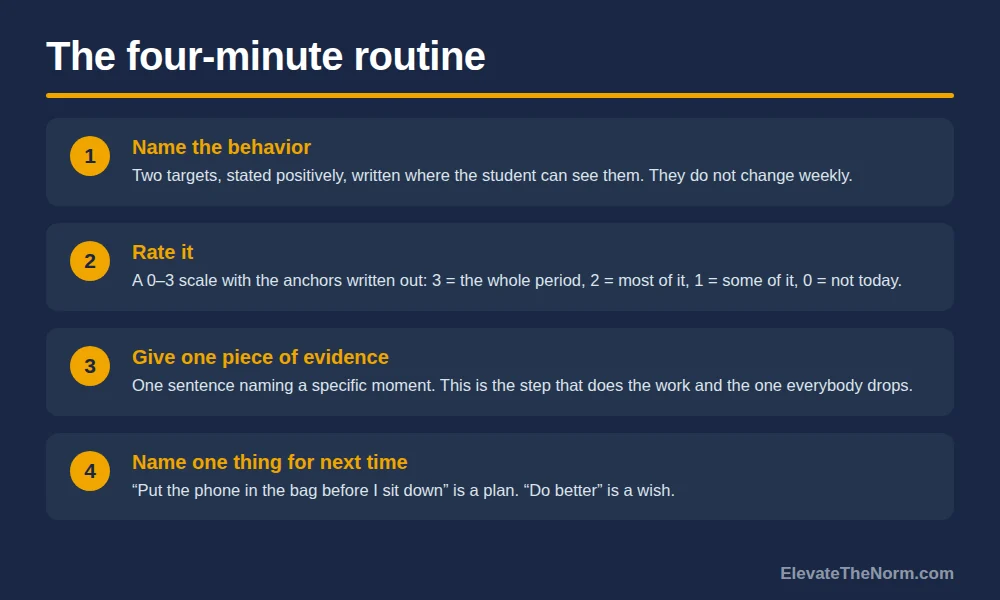
    1. Name the behavior. Two targets, stated positively, written where the student can see them. They do not change weekly; a target that moves every few days never gets a baseline.
    2. Rate it. A 0–3 scale beats 1–5. Fewer points means less hedging toward the middle, and the anchors fit on the page: 3 = the whole period, 2 = most of it, 1 = some of it, 0 = not today.
    3. Give one piece of evidence. One sentence naming a specific moment. This is the step that does the work and the one everybody drops. A rating with no evidence is a guess; with evidence it is an observation — and a student who has to produce evidence starts watching for it during the period instead of reconstructing it afterward.
    4. Name one thing for next time. Specific and small. “Put the phone in the bag before I sit down” is a plan. “Do better” is a wish.
    Numbered graphic of a four-step behavior self-assessment routine: name the behavior, rate it on a 0 to 3 scale, give one piece of evidence, and name one thing for next time
    Four minutes. Step three is the one that does the work and the one everybody drops.

    Two easy-to-skip things make it stick. First, teach it before you run it. The OSEP guide recommends explaining the definition in student-friendly language, modeling the steps, guided practice, and telling students why the behavior matters — that last one builds buy-in rather than compliance. Fifteen minutes once beats re-explaining it daily for a month.

    Second, let them see their own trend. The guide recommends self-graphing, the cheapest motivational feature available: a strip of boxes down the side of the sheet the student shades in. Ten shaded days is the first time most students have seen their own conduct as a line rather than a series of unrelated bad days — which is what makes learning from a mistake possible at all. My Behavior Reflection Sheets on TPT ask students for reasons, not apologies, and come in two reading levels.

    One adjustment before you print anything: the written version is not the only version. Step three assumes a student who can produce a sentence quickly in writing, and plenty cannot — a student with a writing disability, a newcomer still building English, a student whose handwriting speed turns four minutes into twelve. None of them needs less self-assessment; they need a different container. Saying the evidence out loud in the last minute of class does the same cognitive work, and so does an evidence line offering three pre-written options plus a blank. What has to survive is the judgment against criteria, not the paragraph.

    If you want a form rather than building one, the free student self-assessment pack has a general version you can retype the criteria into. No email required.

    How Do You Check Accuracy Without Turning It Into a Trap?

    Rate the same period yourself, compare the two numbers, and talk about the gap — do not replace their number with yours. The OSEP guide describes exactly this: the teacher takes data at the same time the student self-records, and the comparison establishes accuracy. It calls this verification that supports rather than replaces student self-assessment, and that distinction is doing real work.

    Be realistic about frequency. Rating two behaviors for one student while teaching twenty-seven others is not a daily act, and a version that demands it quits on you in week three. Three days out of ten is enough to tell whether a student’s ratings track reality. Mark your numbers on a sticky note rather than building a second tracking sheet.

    The failure mode is obvious once you name it. If your rating overwrites theirs, the student learns that the sheet is a quiz with one right answer, which is you. They will start guessing what you wrote instead of watching what they did, and you have rebuilt teacher-managed behavior tracking with an extra step and the student’s handwriting on it.

    What to do with a gap depends on its direction, and this is where the practice earns its keep:

    • Higher than you. Ask what they were looking at. Usually the criteria are fuzzier than you thought, or they counted a different part of the period. That is information about your criteria, not evidence of dishonesty.
    • Lower than you. Say so. A student who gives themselves a 1 on a day you saw a 3 is telling you something, and it is rarely about the behavior.
    • A match. Say that once, then fade the checking. Matching is the exit condition, not a reason to keep checking forever.

    On fading, the guide is clear: the goal is a student who monitors their own behavior without the system, faded individually through longer intervals, higher goals or less frequent recording, while you keep watching the behavior itself. A behavior self-assessment with no exit plan is a permanent accommodation you did not mean to create. Decide at the start what “done” looks like, and tell the student.

    Four Ways This Goes Wrong

    All four are design errors, and all four are fixable before you start.

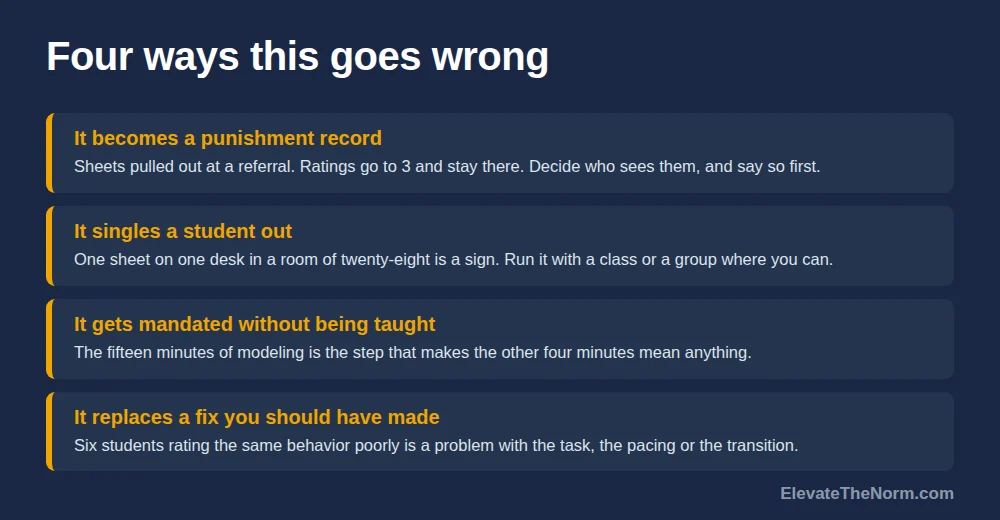
    It becomes a punishment record. The fastest way to kill it: a stack of sheets pulled out at a parent meeting or a referral. Once a student suspects the form is evidence against them, the ratings go to 3 and stay there, and you have taught them that honest self-report is a liability. Decide up front who sees the sheets and say so. If a sheet genuinely has to go into a behavior plan, tell them before the first one is filled out, not after.

    Graphic listing four failure modes for behavior self-assessment: it becomes a punishment record, it singles a student out, it gets mandated without being taught, and it replaces a fix to the lesson
    All four are design errors. All four are fixable before the first sheet is printed.

    It singles a student out. A behavior sheet on one desk in a room of twenty-eight is a sign, and teenagers read signs. That is a real cost, and it is why the practice is often worth running with a whole class or group even when one or two students need it. If it has to be individual, make the form unremarkable and handle the handoff privately — not at the front of the room on the way out.

    It gets mandated without being taught. When this arrives as a tier-two box to check, the teaching step is the first thing cut — it is the only step that costs a block of class time. A student handed a sheet with no instruction rates it the way they rate everything handed over with no instruction: fast, high, without looking. The fifteen minutes of modeling is what makes the other four mean anything, and a school adopting this should build that time into the rollout.

    It replaces a fix you should have made. If six students rate themselves poorly on the same behavior, the problem is not six students. It is the task, the seating, the pacing, or the transition around it. Self-assessment data is a diagnostic you collect for free, and reading it only as a statement about individual kids wastes it. Sometimes the right response to the sheets is to change the lesson. That is not a failure of the practice; it is the practice working.

    Where to Start This Week

    Pick one class. Write two behaviors on the board, stated positively, in language a student would use. Put a 0–3 scale under each with the anchors written out. Spend fifteen minutes teaching what a 3 looks like and what it does not, using examples from the actual room. Then run it ten days without changing anything, rating the same two behaviors yourself on three of those days. On day ten, hand students their own ten days and ask one question: what does this show you that you did not know on day one? That question is the entire product. Everything before it is setup.

    Keep it out of the gradebook. Keep it to two behaviors. Plan the exit before you plan the start. Behavior self-assessment will not turn a hard section into an easy one, and anything promising that is selling something. What it does is hand a teenager the job of noticing their own conduct — a job they are old enough to have and one almost nobody has ever formally given them. The natural next step, once they can rate themselves against criteria, is doing it out loud to someone other than you, which is what building student responsibility looks like as a sequence rather than a slogan.

    Before you go: grab the free Student Self-Assessment Forms (PDF) — ElevateTheNorm.com branded, printable, no email required.

    Frequently Asked Questions

    Should a behavior self-assessment ever count toward a grade?

    No. This is the single clearest finding in the research. When self-assessment counted toward a final grade in Tejeiro and colleagues’ study, student overestimation increased dramatically and the correlation with the instructor’s own assessment disappeared entirely. Run formatively, the same practice produced substantially better agreement with external evaluators. A grade converts an honest instrument into a negotiation. If your school requires a conduct grade, keep it in a separate column and say out loud that the self-assessment sheet does not feed it.

    Is this just a behavior chart for teenagers?

    It looks similar and it works differently. On a behavior chart, an adult records what a student did. On a self-assessment, the student records it, produces evidence for the rating, and names the next step. The recording is the intervention — the point is the act of judging your own conduct against a standard, not the data. If you fill in the sheet for the student, you have a chart, and you should not expect the self-assessment findings to apply to it.

    How do I do this without embarrassing the one student who needs it?

    Run it with the whole class or a whole group where you can. A single sheet on a single desk is visible and teenagers read it correctly as a label. If it has to be individual, make the form look ordinary, hand it over and collect it privately rather than at the door, and tell the student at the start exactly who will see it. Then hold to that. A promise about who sees the sheet is the whole basis of honest ratings.

    Can parents or an administrator ask to see the sheets?

    Possibly — records policies vary by district and this is not legal advice. The practical move is to decide before the first sheet is filled out and tell the student. If the sheets will feed a behavior plan or a meeting, say so up front; students can handle a known rule and cannot handle a surprise one. If the sheets are for the two of you, write nothing on them you would not want read aloud, and keep other students’ names off them entirely.

    Does the research support this for high school students?

    Less than you would gather from a workshop. The strongest average figures come from a federal practice guide citing a 41-study review that is overwhelmingly single-case research, and the best randomized trial covers grades 3 through 8. The one study located here that isolated self-monitoring with high schoolers — Estrapala, Bruhn and Rila (2022), three students with emotional or behavioral disorders — found no functional relation, though effect sizes were moderate to large and the authors flag classroom management as a confound. The honest summary: it plainly helps individual struggling students, it costs almost nothing, and it is not proven as a class-wide lever for teenagers.

    How long before I should expect to see anything?

    Give it ten school days before you judge it, and expect the first week to look like nothing. Students need several cycles before the ratings stabilize enough to be worth reading, and the useful moment is usually the first time a student sees ten days of their own data at once rather than any single entry. If nothing has moved after three or four weeks of consistent use, the target behavior is probably too vague or the real problem is somewhere in the lesson rather than in the student.

    Should I tell families their child is doing this?

    Yes, and it takes one sentence. A short note home saying what the two behaviors are, that the student rates themselves, that it is not graded, and who sees the sheet prevents the version of this conversation where a parent finds a behavior form in a backpack and reasonably assumes their child is in trouble. It also tends to produce useful information back — families often know which part of the day is hard and why. Send it before the first sheet, not after the first question.

    What if a student refuses to fill it out?

    Ask what they think it is for. A refusal is usually a reasonable read of the situation — they have decided it is surveillance, or paperwork, or a trap that ends in a referral. All three are things the design can fix. If the answer is that they do not see the point, that is fair, and the counter is to show them what ten days of their own data looks like rather than to argue. Do not make compliance with the sheet itself a disciplinary issue; you will win that fight and lose the practice.

    Sources

    1. Avina, A., Boyle, S., Duble Moore, T., Hicks, T., and Wiggins, A. “Intensive Intervention Practice Guide: Self-Monitoring Systems to Support Students’ Behavioral Needs.” U.S. Department of Education, Office of Special Education Programs / National Center on Intensive Intervention, Fall 2022. https://files.eric.ed.gov/fulltext/ED628226.pdf
    2. Andrade, Heidi L. “A Critical Review of Research on Student Self-Assessment.” Frontiers in Education, vol. 4, art. 87, 2019. https://www.frontiersin.org/journals/education/articles/10.3389/feduc.2019.00087/full (The Tejeiro et al. 2012 and Fastré et al. 2010 findings cited above are reported in this review; the primary papers were not read directly.)
    3. Bruhn, Allison, Joseph Wehby, Lesa Hoffman, Sara Estrapala, Ashley Rila, Eleanor Hancock, Alyssa Van Camp, Amanda Sheaffer, and Bailey Copeland. “A Randomized Control Trial on the Effects of MoBeGo, a Self-Monitoring App for Challenging Behavior.” Behavioral Disorders, vol. 48, no. 1, 2022, pp. 29–43. https://files.eric.ed.gov/fulltext/EJ1351615.pdf
    4. Estrapala, Sara, Allison Leigh Bruhn, and Ashley Rila. “Behavioral Self-Regulation: A Comparison of Goals and Self-Monitoring for High School Students With Disabilities.” Journal of Emotional and Behavioral Disorders, 2022. https://files.eric.ed.gov/fulltext/EJ1349728.pdf
    5. Murray, Desiree W., Jennifer Kurian, Sandra L. Soliday Hong, and Fernanda C. Andrade. “Meta-Analysis of Early Adolescent Self-Regulation Interventions: Moderation by Intervention and Outcome Type.” Journal of Adolescence, vol. 94, no. 2, 2022, pp. 101–117. https://files.eric.ed.gov/fulltext/ED622592.pdf

    About Clay Shumate

    Clay Shumate is a certified secondary Social Studies teacher in the public schools of West Alabama, with seven years of classroom experience, a B.A. in History, and an M.Ed. in Secondary Education. He writes about project-based learning, student responsibility, respect, and practical ways to hold young people to a higher standard while giving them room to learn from mistakes. He is a member of the Society of Professional Journalists and writes to its Code of Ethics; this site’s editorial standards and corrections policy are published in full. More about Clay.

  • What Is a Classroom Management Plan? The Version That Actually Runs

    What Is a Classroom Management Plan? The Version That Actually Runs

    A classroom management plan is a written document setting out how your room runs: the structure students walk into, the expectations you have taught them, how you acknowledge the behavior you want, and what you do about the behavior you don’t. It is not a poster of rules and it is not a philosophy statement. It is the answer you have decided in advance, so that you are not inventing it at 1:40 on a Thursday with twenty-nine people watching. If you want wording to start from rather than a blank page, there are worked examples of expectations written for teenagers.

    Most plans fail the same way. They are written for an evaluator, they are full of words like “respectful” and “responsible,” and they cannot be run. A plan you cannot run on a bad day is not a plan.

    So that is what a classroom management plan is. What follows is the harder part: what the research says it has to contain, the test that separates a real plan from a decorative one, and how to write one that survives contact with an actual class. The individual moves that go inside the plan, and how strong the evidence is behind each one, are handled separately in the strategy-by-strategy breakdown.

    Key Takeaways

    • A plan is a decision made early, not a description written late. Its value is that it removes improvisation from the moments you improvise worst.
    • The research converges on five areas. A 2008 review identified 20 evidence-based classroom management practices grouped into five categories: structure, taught expectations, active engagement, acknowledging appropriate behavior, and responding to inappropriate behavior.
    • The test is enforceability, not tone. “Be respectful” cannot be enforced consistently by anyone, including you. A narrow, specific line can.
    • Write it for yourself first. A plan aimed at an evaluator produces language that sounds defensible and does nothing at 1:40.
    • Many teachers were never taught this. In one study of 110 teacher candidates, roughly half of one group reported no behavior management training at all before the intervention — which is a curriculum gap, not a personal failing.

    What is a classroom management plan, specifically?

    The IRIS Center at Vanderbilt frames comprehensive classroom behavior management as doing two things: creating an organized, consistent, culturally responsive classroom environment that supports instruction, and engaging and communicating with students and families on an ongoing basis. Developing a written plan is named as one of the foundational practices within that, alongside creating a positive climate and a structured classroom.

    That framing is useful because of what it excludes. A management plan is not your discipline ladder. The ladder is one component, and in a good plan it is one of the smaller ones. The bulk of the document is about the conditions that make the ladder rarely necessary — how the room is arranged, what happens in the first four minutes, what students do when they finish early, how they get help without waiting with a hand up.

    One more distinction worth holding onto: classroom-level management sits underneath any school-wide system. If your building runs three to five posted expectations, your plan translates those into the specific, contextual version that applies in your room. It does not compete with them, and it does not ignore them.

    The five things the research says a plan has to cover

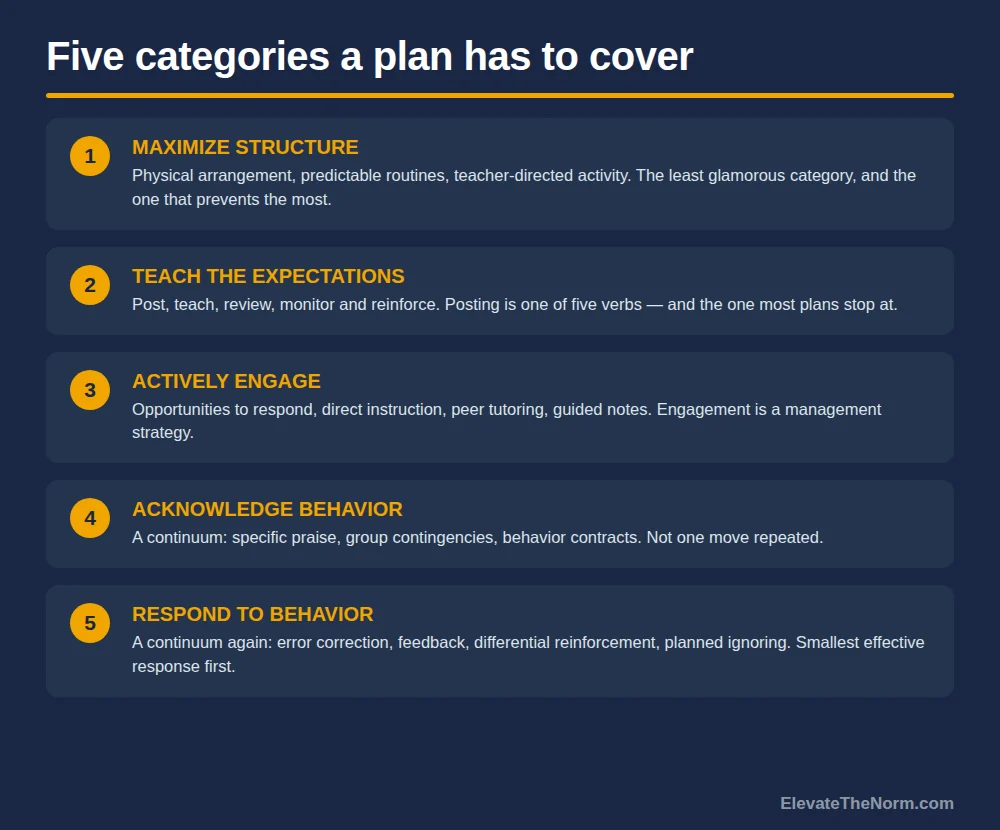
    The most useful single source here is Simonsen, Fairbanks, Briesch, Myers and Sugai’s 2008 review, which set a deliberately high bar: a practice counted as evidence-based only if it had been evaluated with sound experimental design and supported by at least three empirical studies in peer-reviewed journals. Twenty practices cleared it, sorted into five categories.

    1. Maximize structure. Physical arrangement, predictable routines, teacher-directed activity. The least glamorous category and the one that prevents the most.
    2. Post, teach, review, monitor and reinforce expectations. Note the verbs. Posting is one of five, and it is the one most plans stop at.
    3. Actively engage students in observable ways. Opportunities to respond, direct instruction, peer tutoring, guided notes. Engagement is a management strategy, not a separate department.
    4. Use a continuum of strategies to acknowledge appropriate behavior. Specific praise, group contingencies, behavior contracts.
    5. Use a continuum of strategies to respond to inappropriate behavior. Error correction, performance feedback, differential reinforcement, planned ignoring.
    Five numbered categories of evidence-based classroom management: maximize structure, teach expectations, actively engage, acknowledge behavior, respond to behavior
    From Simonsen and colleagues’ 2008 review of evidence-based classroom management practices.

    The word doing the most work in categories four and five is continuum. A plan with one response in it — a referral, a call home, a warning system — will be used for everything or nothing. A continuum means the smallest effective response is available and gets used first.

    An honest caveat on that review, because it matters for how much weight to put on it: the authors themselves note that roughly 48% of the studies in their table were published before 1987. The categories have held up and are widely replicated, but this is an older evidence base than its frequent citation implies, and it was not assembled with today’s secondary classrooms specifically in view.

    Why “Be Respectful” is not a plan

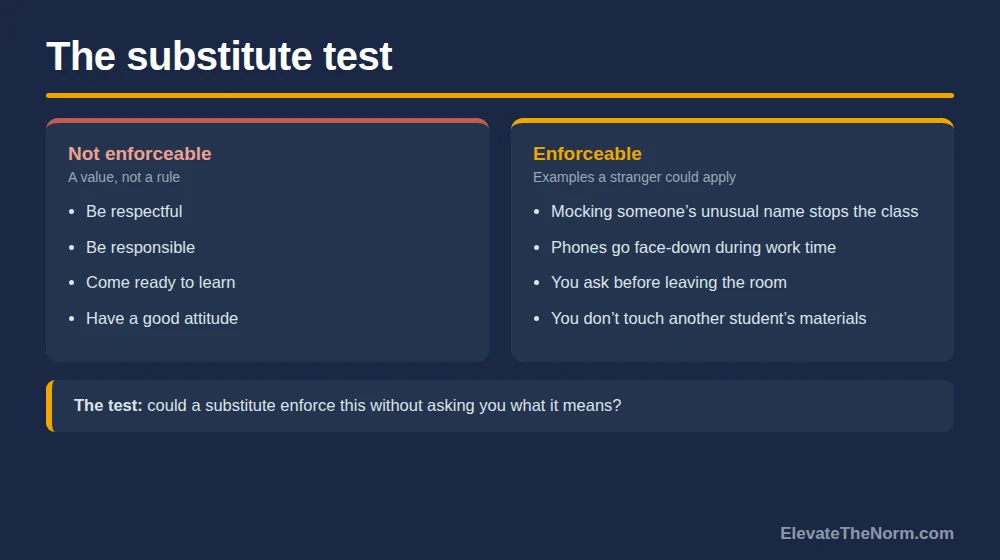
    Here is the test I would apply to every line in a management plan: could a substitute enforce this without asking you what it means? If not, it is a value, not a rule — and values belong in the first paragraph, not in the enforcement section.

    Two-column comparison of unenforceable classroom rules such as be respectful beside enforceable, specific rules a substitute could apply
    Could a substitute enforce this without asking you what it means?

    “Be respectful” fails immediately. Two reasonable adults will disagree about whether a particular eye-roll qualifies, which means the students experience it as arbitrary, which is the precise thing that costs you a room. Inconsistency is not a small flaw in a plan. It is the flaw.

    Compare it to an actual line from my room: making fun of how unusual someone’s name is stops the class. It is narrow. It is unmistakable. Nobody has to interpret it, there is no version of it I would let go on a Friday because I am tired, and a student can tell you in advance exactly what will happen. That is what an enforceable expectation looks like, and it is worth more than a wall of adjectives.

    You do not need many of these. Three or four lines that are genuinely non-negotiable, that you will enforce identically in October and in May, will do more for a room than a laminated list of twelve. The rest of what you want — effort, kindness, people taking care of each other — is built through how the room is run day to day, not through rules about it.

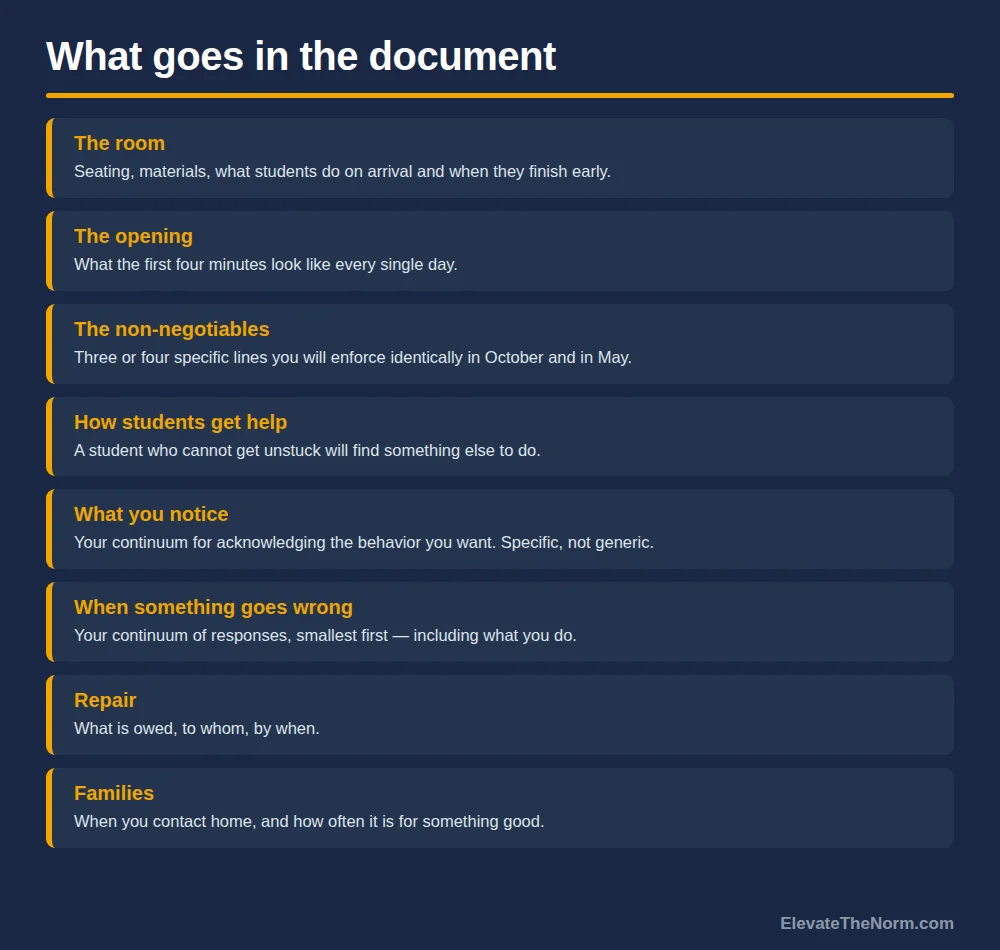
    What actually goes in the document

    Here is the structure I would use. It maps onto the five research categories without reading like a compliance form.

    • The room. How seating is arranged and why. Where materials live. What students do when they walk in, and what they do when they finish early. Most of a management plan is logistics, and the logistics are load-bearing.
    • The opening. What the first four minutes look like every single day. A routine students can run without you is worth more than any consequence you could write down.
    • The non-negotiables. Three or four specific, enforceable lines. Apply the substitute test to each one.
    • How students get help. Genuinely part of management. A student who cannot get unstuck will find something else to do, and then you have a behavior problem that was originally an access problem.
    • What you notice, and how. Your continuum for acknowledging the behavior you want. Specific rather than generic — naming what a student did beats telling them they are great.
    • What happens when something goes wrong. Your continuum of responses, smallest first, written out. Include what you do, not just what the student gets.
    • Repair. What is owed, to whom, by when. A plan that ends at the consequence is only half-written.
    • Families. When you contact home, for what, and how often it is for something good.
    Eight sections of a classroom management plan: the room, the opening, non-negotiables, how students get help, what you notice, when something goes wrong, repair, families
    Two pages is enough. Twelve means you are writing a philosophy statement.

    That is two pages, not twelve. If yours is running to twelve, you are probably writing a philosophy statement with a consequence ladder stapled to the back.

    The response section, and the part people get wrong

    Most consequence sections are written as an escalating list of things that happen to a student. The useful version also specifies what you do, because your behavior is the variable you actually control.

    The smallest effective response is usually proximity and a quiet word. In my room a redirect happens at close range, to one student, at their eye level — not announced across the room. That is a deliberate choice and it belongs in a written plan, because it is the thing you will abandon first when you are frustrated. Announcing a correction to the whole room gives the class a performance to react to and hands the student an audience they now have to save face in front of. It reliably makes a small thing bigger.

    Write down the pause, too. A deliberate beat before you respond — for me it averages around fifteen seconds, though it genuinely varies with the room, the day, and the student — is not a technique with a fixed number. It is a commitment to not answer a behavior with your first reaction. Put it in the plan as a commitment rather than a count, because a count is the first thing that breaks.

    And be careful what your consequences are actually teaching. A response that only makes a student feel worse has done nothing about the thing that happened. The question the plan should answer is what gets repaired, not what gets paid.

    What the plan does not get to decide

    This section is short and it is the one most plans omit entirely. Some things outrank your document, and writing as though they do not is how a well-intentioned plan creates a real problem.

    • An IEP or a behavior intervention plan. If a student has one, it governs. Your classroom plan does not override it, cannot be applied to that student in place of it, and should say so explicitly. If you do not know which of your students have one, that is the first thing to find out — before you write a consequence section, not after you have applied it.
    • District and building policy. Your plan operates inside them. Where your preference and the policy disagree, the policy wins and you raise the disagreement through the actual channel rather than quietly running your own version.
    • Anything that has to leave the room. Threats, weapons, harassment, anything involving a student’s safety, and anything that triggers mandatory reporting are not classroom-management matters and do not belong on a continuum of responses. Name them in the plan as the category that goes straight to an administrator, so that the decision is already made.

    A plan that quietly assumes the teacher handles everything is not a strong plan. It is an unsupported one, and the cost of that lands on a student.

    Who the plan is for

    In order: you, then your students, then anyone covering your room, then your evaluator. That order matters and it is usually inverted.

    A plan written for an evaluator optimizes for language that sounds defensible in a post-observation conference. It will use the word “proactive” and it will not help you at 1:40. A plan written for yourself is blunter, shorter, and contains the things you actually forget — which is why the good ones read a little like notes.

    Your students should be able to read it, or a version of it. Not as a handout on day one that nobody retains, but because everything in it should be something they could accurately predict by October. If a student could not tell you what happens when work is late, that section is not real yet.

    Which raises a fair question: should students help write it? My honest answer is that it depends on which part. The non-negotiables are yours — they exist precisely because they do not move, and putting them to a vote tells the room they are negotiable after all. But a great deal of a management plan is not about safety or dignity at all. It is about how the room works, and on that, teenagers have opinions worth hearing and a much better sense than adults expect of what actually helps them work. Asking them what gets in their way, and then visibly changing something, does more for buy-in than any explanation of why your rules are reasonable.

    Families should be able to see it too, or at least the part that affects them — what you contact home about, when, and what happens before you do. A parent who learns your system for the first time during a difficult phone call is meeting it at the worst possible moment. Send the short version early, while nothing is wrong.

    And a plan is the single most useful thing you can hand to someone covering your class. If you cannot hand it over and have it make sense to a stranger, it is not finished.

    If nobody ever taught you this

    It is worth saying plainly that the preparation gap here is real and documented, because a lot of teachers privately treat it as a personal deficiency.

    A 2025 study in the Journal of Emotional and Behavioral Disorders worked with 110 teacher candidates in student-teaching internships at a large public southeastern university. Among the group receiving a specialized 16-hour classroom management curriculum, 49.3% reported having had no behavior management training beforehand; in the comparison group the figure was 31.7%. The authors also note that while most states require classroom management coursework, estimates of how many programs offer a focused course on it range from under 50% to 74%.

    Those numbers deserve their limits stated. It is a quasi-experimental study at a single university, the training figures are self-reported, and the classroom observation subsample was fourteen teachers. It does not establish a national rate. What it does support — alongside the range the authors cite for program offerings — is that arriving in a classroom without formal management training is common rather than exceptional. If that is you, you are in a large group, and writing the plan is how you close the gap yourself.

    What a plan will not do

    It will not make a class comply because it exists. It will not survive being written once in August and never opened again. And it will not substitute for knowing the students in front of you — the same line lands differently depending on what a kid walked in carrying, and no document accounts for that.

    It also will not fix a task that was badly built. A very large share of what gets logged as a behavior problem is a student who could not access the work and found something else to do. Before adding a consequence for off-task behavior, check whether the work was doable. That is a planning question wearing a discipline costume, and treating it as discipline makes it permanent.

    Writing one this week

    Do it in one sitting and keep it to two pages. Draft the eight sections above quickly and badly — the first version is for finding out what you have not actually decided, and you will find two or three things you have been improvising all year.

    Then run the substitute test on every enforcement line, cut anything you would not enforce in May, and use it for two weeks. Mark the places you did something other than what you wrote. Those are the real edits, and they are worth more than anything you would have thought of at the desk.

    So: what is a classroom management plan, in the end? It is a short, specific, honest document that tells you what you have already decided, so that the version of you who is tired on a Thursday afternoon does not have to decide it again, worse. Structure first. A handful of lines you will actually hold. A continuum of responses, smallest first. And a way back for a student who got it wrong — which is the part that turns a set of rules into a room worth being in.

    Printables for this

    Two of mine on TPT, both built for this. The Classroom Norms Poster Set is free and gives you the posted version of the expectations section — written narrowly enough to pass the substitute test. De-escalation Strategies: 100 Scripts is the continuum the response section asks for, with actual wording for each rung instead of one referral.

    Sources

    • Simonsen, B., Fairbanks, S., Briesch, A., Myers, D., & Sugai, G. (2008). Evidence-based practices in classroom management: considerations for research to practice. Read the review (PDF) — source for the 20 evidence-based practices, the five categories, and the inclusion bar of at least three peer-reviewed empirical studies per practice. Limitation stated by the authors: roughly 48% of the studies in their table were published before 1987.
    • Hart, K. C., Poznanski, B., & Cramer, E. D. (2025). Preparing teacher candidates in classroom management prior to entering the teaching profession. Journal of Emotional and Behavioral Disorders. Read the study — source for the 49.3% / 31.7% no-prior-training figures and the “under 50% to 74%” range for programs offering a focused course. Quasi-experimental, n = 110 at a single southeastern university, self-reported training history, observation subsample of 14. Not a national estimate.
    • The IRIS Center, Vanderbilt University. Classroom and school-wide behavior management. Read the module — source for the two-part framing of comprehensive classroom behavior management, the four foundational practices, and the classroom-versus-school-wide distinction. Practitioner training material from a federally funded center, not a primary study.

    Every link above was checked on September 20, 2026. The classroom practices described in the first person — the close-range redirect, the deliberate pause before responding, and the line about mocking an unusual name — are my own and are used across this site.

    Frequently Asked Questions

    What is a classroom management plan?

    It is a written document setting out how your classroom runs: the structure students walk into, the expectations you have taught them, how you acknowledge the behavior you want, and how you respond to the behavior you do not. It is not a poster of rules and it is not a philosophy statement. Its purpose is to decide things in advance so you are not improvising them under pressure.

    What should a classroom management plan include?

    Eight sections cover it: how the room and materials are arranged, what the opening routine looks like every day, three or four genuinely non-negotiable expectations, how students get help when stuck, how you acknowledge the behavior you want, a continuum of responses when something goes wrong, what repair looks like afterward, and when you contact families. Two pages is usually enough. Twelve pages usually means a philosophy statement with a consequence ladder stapled to the back.

    Why is “be respectful” a bad classroom rule?

    Because it cannot be enforced consistently. Two reasonable adults will disagree about whether a given eye-roll counts, so students experience enforcement as arbitrary — and arbitrary enforcement is what costs a teacher a room. Respect belongs in the plan as a value in the opening paragraph. The enforcement section needs lines narrow enough that a substitute could apply them without asking what they mean.

    What does the research say classroom management plans should cover?

    A 2008 review by Simonsen, Fairbanks, Briesch, Myers and Sugai identified 20 evidence-based practices grouped into five categories: maximize structure; post, teach, review, monitor and reinforce expectations; actively engage students in observable ways; use a continuum of strategies to acknowledge appropriate behavior; and use a continuum of strategies to respond to inappropriate behavior. Worth knowing its limit — the authors note about 48% of the underlying studies predate 1987.

    Does my classroom management plan apply to a student with an IEP or behavior plan?

    No. An IEP or behavior intervention plan governs, and your classroom plan does not override it or get applied in its place. Say so explicitly in the document. Find out which of your students have one before you write the consequence section rather than after you have applied it to someone it should not have applied to. District and building policy outrank your plan the same way.

    Should students help write the classroom management plan?

    Partly. The non-negotiables are yours — they exist because they do not move, and putting them to a vote signals the opposite. But much of a management plan is about how the room works rather than about safety or dignity, and on that students have useful opinions and a better sense than adults expect of what gets in their way. Ask them, then visibly change something. That does more for buy-in than explaining why your rules are reasonable.

    Is a classroom management plan the same as a discipline plan?

    No, and treating them as the same is the most common mistake. A discipline or consequence ladder is one section of a management plan, and in a good one it is among the smaller sections. The bulk of the document covers the conditions that make consequences rarely necessary: room arrangement, opening routines, how students get help, what happens when they finish early.

    What if I was never trained in classroom management?

    That is common rather than exceptional. In a 2025 study of 110 teacher candidates at one southeastern university, 49.3% of one group reported no prior behavior management training, and the authors cite estimates that between under 50% and 74% of preparation programs offer a focused course on it. Those figures come from a single-university quasi-experimental study with self-reported training history, so they are not a national rate — but the gap is documented, and writing a plan is the practical way to close it for yourself.


    About Clay Shumate

    By Clay Shumate — Clay Shumate is a certified secondary Social Studies teacher in the public schools of West Alabama, with seven years of classroom experience, a B.A. in History, and an M.Ed. in Secondary Education. He writes about project-based learning, student responsibility, respect, and practical ways to hold young people to a higher standard while giving them room to learn from mistakes. He is a member of the Society of Professional Journalists and writes to its Code of Ethics; this site’s editorial standards and corrections policy are published in full.

  • Substitute Teacher Classroom Management: Running a Room That Isn’t Yours

    Substitute Teacher Classroom Management: Running a Room That Isn’t Yours

    Substitute teacher classroom management is not the same job as classroom management. A regular teacher builds authority over weeks. A substitute has to borrow it in the first four minutes, from a room that already has its own rules, its own seating, and its own sense of what is normal — none of which they wrote. The work is not installing your system. It is running theirs well enough that the day holds.

    Most advice on this subject is written as though the substitute controls the outcome. They control some of it. The rest was decided before they ever walked in, by the teacher who wrote the plans — which is the half of this that almost nobody writes about, and the half I can speak to directly. If the room a substitute walks into has no written system behind it, the document a stranger is actually handed is where that work starts.

    This page covers what the person walking in actually has to work with, what they can control on the day, and what the regular teacher owes them before leaving.

    Key Takeaways

    • A substitute’s authority is borrowed, not built. The fastest way to lose a room is to replace its norms with your own on day one. Run the room that exists.
    • The person walking in may have twenty hours of training. In Missouri, a substitute certificate requires either 36 semester hours of college or 20 clock hours of approved training. That is the floor in one state, and it is worth knowing before you judge how a day went.
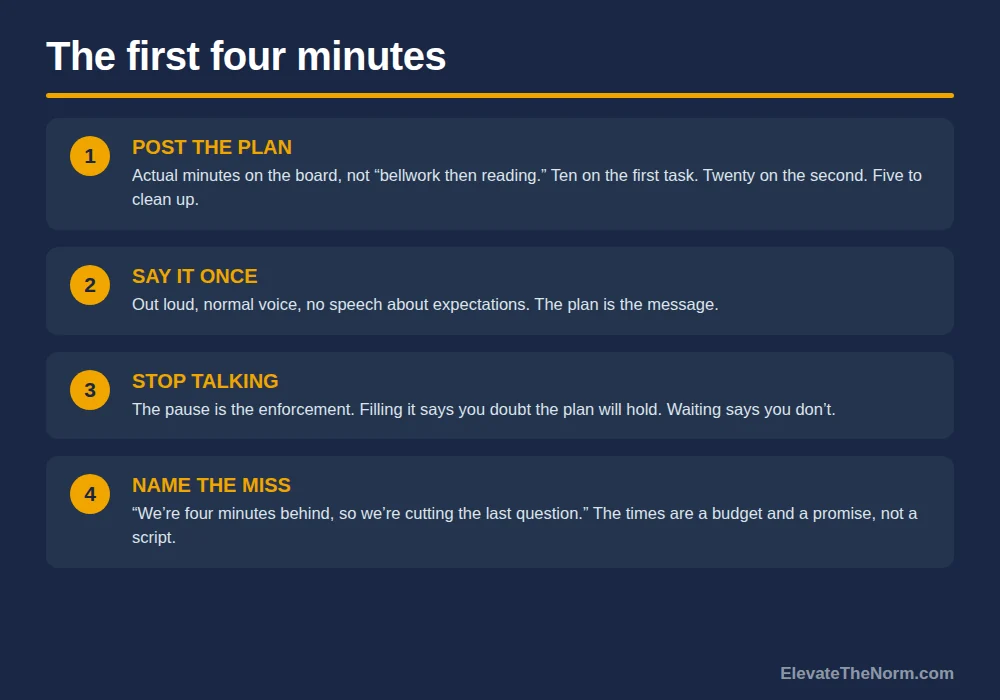
    • The first four minutes decide most of it. A visible plan, stated out loud, followed by a pause — not a raised voice.
    • Teacher absence is measurable and it is not small. Ten additional days of teacher absence are associated with a decline of roughly 1.7% to 3.3% of a standard deviation in math achievement. The sub day is not a throwaway day.
    • Half of substitute classroom management is written the week before, by someone else. Plans that assume the sub knows the room are the single most common failure, and they are entirely preventable.
    • A class that tests a substitute is usually not scheming. Nobody knows their name, the day reads as a holding pattern, and the adult has no history with them. Using names and making the work visibly real addresses all three.

    The job is not “teach the lesson.” It is “keep the room intact.”

    This is the reframe that makes the rest of it workable. A substitute who measures the day by how much content got delivered will almost always finish feeling like they failed. A substitute who measures it by whether the room is handed back in the condition it was handed over — work attempted, norms intact, nobody humiliated, an honest note left behind — has done the actual job.

    That is not a lowered standard. It is the correct one. The regular teacher can reteach a lesson. What they cannot easily undo is a room that learned, over one day, that the expectations it runs on are negotiable when a stranger is standing there.

    What the person walking in actually has

    It is worth being precise about the preparation the job actually requires, because a lot of staffroom commentary about substitutes assumes a level of training that the credential does not demand.

    Missouri, as one published example, issues a Content Substitute Certificate to an applicant who has completed either a minimum of 36 semester hours from an accredited college or university, or twenty clock hours of department-approved substitute teacher training. Requirements vary by state and some are higher. But twenty clock hours is a real, current, published floor in at least one state — and the person it describes is expected to walk into a room of thirty teenagers and hold it.

    Two things follow. If you are the substitute: the gap you feel between what you were trained for and what the day demands is real, and it is structural rather than personal — the same gap first-year teachers describe in their own rooms. If you are the regular teacher: the plans you leave are not a courtesy. For some of the people who will use them, they are the entire preparation.

    A third thing follows for anyone who sets policy. Nothing in the rest of this article is a substitute for a district actually orienting the people it puts in front of students — a building walkthrough, the safety procedures, where the office is, what the behavior system is called. Most of what gets written about substitute classroom management, including everything below, is individuals compensating for a system that hired someone and pointed at a door. The individual workarounds are worth knowing. They are not the fix.

    The first four minutes: organization to the minute, and then the pause

    The method I use in my own room transfers to a substitute almost unchanged, and it is the one piece of this I would put above everything else: taking control of a room is done by organization to the minute, and then you pause.

    Four numbered steps for a substitute’s first four minutes: post the plan, say it once, stop talking, name the miss
    The pause is the enforcement. Filling it says you doubt the plan will hold.

    Put the plan where they can see it before the bell. Not “bellwork, then reading” — actual minutes. Ten minutes on the first task. Twenty on the second. Five to clean up. Write it on the board you found it on. Then say it out loud, once, in a normal voice.

    Then stop talking.

    The pause is the part people skip, and it is the part that works. You have laid out a plan that is visibly organized, and then you let the silence do the enforcement instead of your volume. The instinct is to fill it — to repeat yourself, to add a threat, to get louder. Filling it tells the room you are not sure the plan will hold. Waiting tells them you are.

    I should be honest about what that costs, because most versions of “just wait them out” leave the price out. I once held a pause for more than five minutes. It was one of the most awkward moments of my life, that section finished nine minutes behind my other classes, and it is the only time I have ever assigned homework. It worked. It also cost nine minutes and a homework assignment I did not want to give. A substitute will rarely have nine minutes to spend, which is exactly why the posted plan matters — it shortens the pause you need.

    One clarification, since this gets misread: the posted times are a budget and a promise, not a script. When you miss them, say so out loud and give the reason. A substitute who announces “we are four minutes behind, so we are cutting the last question” has just demonstrated that the plan is real. That is worth more than hitting the times.

    Run their room, not yours

    This is where most substitute days are quietly lost, and it rarely looks like a discipline problem. It looks like a reasonable adult correcting something that was never wrong.

    Two-column comparison of classroom things a substitute should leave alone and write down beside things that require immediate action
    If you can’t explain it, it’s probably deliberate.

    In my room, students are almost always working alongside somebody. Partner work is the resting state, not a reward and not a special occasion — the tables are literally grouped that way and there are no rows to return to. A substitute who walks in, sees students talking, and reads it as the room falling apart will spend the period fighting the room’s actual design. They will separate students who were doing exactly what they were supposed to do, and by second period they will have spent all their credibility on a rule that does not exist in that room.

    The same goes for the lights. I do not turn the overhead fluorescents on — the room runs on floor lamps around the perimeter. It is a deliberate choice about sensory load, and it helps far more students than the ones who would ever have asked for an accommodation. A substitute’s first instinct on walking into a dim room is to find the switch. Flipping it is a small thing that changes the room the students walked into.

    So the working rule is: anything you cannot explain, leave alone and write down. If the seating looks odd, it is probably deliberate. If the lights are off, someone turned them off. If four students get up without asking, there is probably an established procedure for that. Note it, ask afterward, and do not spend your authority correcting a room’s design.

    Reserve your authority for the things that are wrong in any room: cruelty, danger, and a flat refusal to engage with work that has been made doable.

    That last one needs its qualifier. A student who will not start a worksheet nobody explained is not defying you — they are stuck, and “refusal” is the wrong word for it. Check whether the task is actually doable before you treat not-doing-it as a behavior problem. Most of the time on a substitute day, it is not defiance. It is an instruction gap.

    The one line that overrides all of this: if something is unsafe, or a student is being hurt, you do not need permission or context. Send for the neighboring teacher or the office immediately. Knowing where the phone is and who is next door is a two-minute check when you arrive, and it is the only part of this you should never improvise.

    Substitute teacher classroom management: five things you can actually control

    1. Where you stand. Circulating beats presiding. A redirect delivered quietly at close range, to one student, does the work without announcing the problem to twenty-nine other people — and it does not give the room a performance to react to.
    2. What you say first. Names if you have them, the plan if you do not. “Here is what we are doing and how long it takes” outperforms any version of “I expect you to behave for me today.”
    3. Your volume. It is the one resource that only decreases. Every notch you spend is gone for the rest of the day.
    4. What you write down. An honest, specific, unemotional note is the most valuable thing you leave behind. “Third period did not start the reading; two students, seated front left, were the reason” is useful. “Terrible class” is not, and it will be read by someone who has to work with those students tomorrow.
    5. Whether anybody gets humiliated. This one is not negotiable and it is entirely within your control. You will be gone tomorrow. They will not.

    What the regular teacher owes the substitute

    If you are reading this as the teacher who is going to be out, this is the section that changes your sub’s day, and it takes about fifteen minutes to write once and reuse all year.

    Six items that belong in substitute teacher plans, including timed plans, how the room runs, and a fallback activity
    Fifteen minutes to write once, and it changes every sub day that follows.

    Write it assuming it will be read in five minutes, standing up, by someone who was called at six that morning and has never been in your building. That is the realistic case, not the exception. Put the timed plan and the three things a stranger would misread on the first page, in that order. Everything else can be on page two, where it may or may not get read.

    • Timed plans, not task lists. Minutes next to every item. It is the single highest-value thing on the page, for exactly the reason in the section above.
    • A one-paragraph description of how your room normally runs. Partner work is expected. The lights stay off. Students may get water without asking. Write the three things a stranger would most likely misread — you already know what they are.
    • Work that can actually be done without you. A task that depends on your explanation is a task that will not happen, and the gap gets filled with whatever the room decides to do instead.
    • Two names, and what they are for. The colleague next door and the student who genuinely knows the routine. Not a list of “problem” students — a list of doors to knock on.
    • What a substitute is allowed to decide. Can they let a student use the restroom? Move a seat? Skip the last activity? Say so, or you have left someone to guess and then be wrong.
    • Where the day goes if it falls apart. One genuinely usable fallback that requires no setup. Every sub plan should have a floor under it.

    One thing that does not belong in sub plans: a discipline ladder invented for the occasion. Your substitute cannot enforce consequences that do not already exist in the room, and asking them to try is how a day gets worse rather than better. Tell them what the room already does.

    Why the day is worth taking seriously

    There is a habit of treating substitute days as time that does not count. The measured picture disagrees, though it needs stating carefully.

    Analysis published by Brookings reports that roughly 29% of teachers were chronically absent — missing ten or more school days — in the 2015–16 federal civil rights data, and that ten additional days of teacher absence are associated with a decline of between 1.7% and 3.3% of a standard deviation in math achievement. Substitute costs run to roughly 1% of all public education spending.

    Two honest caveats. These are associations drawn from observational data, not the result of an experiment, and the effect sizes are modest per unit. And the federal absence figures are from 2015–16, which is the most recent comparable collection but is now several years old. What the numbers support is a modest claim, and the modest claim is enough: sub days are frequent, they cost real money, and they are associated with measurably less learning. They are not a rounding error, and the room deserves a plan.

    What the students are doing, and why

    Almost everything written about substitute teaching treats the students as weather — a condition to be survived. It is worth saying plainly what is actually happening on their side of it, because it changes what you do.

    A class that tests a substitute is usually not running a scheme. Three ordinary things are true at once: nobody in the room knows their name, the day has been signalled to them as a holding pattern, and the adult in front of them has no history with them in either direction — no credit built up, and no relationship to damage. Teenagers read all three accurately and respond to them rationally. If the day looks like it does not count, some of them will treat it as though it does not count. A spoken routine a substitute has never run will not hold either, which is why cues a stranger can read off the wall survive your absence when verbal ones do not.

    Which means the two highest-leverage moves are both about signalling the opposite. Learn some names and use them — from a seating chart, from their work, by asking. And make the work visibly real: something that gets collected, that the regular teacher will see, that connects to what they did yesterday. “Your teacher is going to read these tomorrow” is a true sentence that changes a room, and it costs nothing.

    Students are also owed something on these days, and it is not complicated: to know what they are doing and how long it takes, to not be punished as a group for individuals, to not be talked about as a category in a note they will never see, and to be able to ask a question and get a real answer rather than “I’m just the sub.” That last one is worth retiring. You are the teacher in that room today. Not knowing an answer is fine. Saying you do not count is not, and they will believe you.

    Should a substitute actually teach?

    Sometimes, and the honest answer depends on what the plans ask for rather than on how confident you feel.

    If the plan is practice, review, reading or a project work session — which is the large majority of well-written sub plans — then teaching it is mostly circulating, answering, and keeping the work moving. Do that, and do it properly. If the plan introduces genuinely new content in a subject you do not know, delivering it badly is worse than not delivering it: students will learn it wrong, and the regular teacher will have to undo that before they can teach it. Run the practice portion, write down exactly where the class stopped, and say so.

    One small tool worth borrowing from special-education practice, where it is standard: a visible timer. Putting the remaining minutes somewhere the whole room can see them makes an abstract instruction concrete, and it takes the countdown out of your voice — the clock says it instead of you. It is a phone on the document camera, and it works for far more students than the ones it was designed for.

    The part that is actually hard

    Everything above is manageable on a normal day. The genuinely hard version is the room that has decided, collectively and before you said a word, that today is a day off. No single student is doing anything you could name. The work is simply not starting.

    There is no technique that fixes that in thirty seconds, and any article that tells you otherwise is selling something. What works is narrow and unglamorous: get one table started. Not the room — one table. Sit down next to them, at their height, and do the first item with them. A room that is entirely not working is very hard to move. A room where one group is visibly working is a different room, and the second group is much easier than the first.

    And if it does not turn: finish the period without making it worse, write the honest note, and hand the room back. That is not defeat. On some days that is competence, and a teacher who has been out sick will understand the difference between a sub who lost a room and a sub who protected one.

    Which is the whole of it, really. Substitute teacher classroom management is not a set of tricks for controlling somebody else’s students — it is the practice of running a room you did not build, on borrowed authority, without spending down what the regular teacher has spent months constructing. Post the plan. Pause instead of getting louder. Leave the room’s own rules alone. Use names. Make the work real. Write the honest note.

    And if you are the one writing the plans: fifteen minutes on a page that assumes nothing will do more for that day than anything the substitute can do once they are standing in it.

    Printables for this

    I write these for my own room and put them on TPT. The Any-Day Emergency Sub Plan Card is free — one page a stranger can run cold, in any subject. If you teach history, World History Emergency Sub Plans is five full days of strange-but-true readings with questions and answer keys, written so a sub can hand them out without knowing the content.

    Out the week of Halloween? A Halloween sub day does not have to be a word search. Halloween Sub Plans is five strange-but-true spooky history readings a sub can run cold. For math, the free Halloween color by number samplers for middle school and high school check themselves, so the sub never needs the answer key.

    If you are buying during a sitewide sale, the TPT sale guide walks through how the discounts stack and what is actually worth the money.

    Sources

    • Brookings Institution. We should be focusing on absenteeism among teachers, not just students. Read the analysis — source for the 29% chronic-absence figure (U.S. Department of Education Office for Civil Rights, 2015–16), the 1.7–3.3% of a standard deviation math association, and the ~1% of public education spending figure. These are observational associations, not causal estimates, and the federal absence data is from 2015–16.
    • Missouri Department of Elementary and Secondary Education. Substitute Teachers — certification requirements. Read the requirements — source for the 36 semester hours / 20 clock hours standard. One state’s rule, cited because it is current and published; requirements vary considerably by state and your own state’s rule governs.
    • Substitute teaching: evidence-based practices for inclusive classrooms. Helen: The Journal of Human Exceptionality, April 2024. Read the guide — consulted for the visual-schedule and visual-timer practices. Cited as practitioner guidance, not as research: the article describes itself as drawing on evidence-based practice but names no studies and reports no data.

    Every link above was checked on September 20, 2026. The classroom practices described in the first person — the timed plan and the pause, partner work as the room’s resting state, and the lamps — are my own and are used across this site.

    Worth saying plainly: a day covered by a substitute is not a day lost, and taking the day you need before you badly need it is one of the few moves a teacher fully controls. It is also a small part of what climbing back out of exhaustion actually asks of you.

    Frequently Asked Questions

    What is the single most important thing a substitute teacher should do first?

    Put a timed plan where the room can see it, say it out loud once in a normal voice, and then stop talking. The visible plan does most of the work and the pause does the rest. What does not work is opening with a speech about expectations — it spends authority before anything has happened and invites the room to test it.

    Should a substitute enforce their own rules or the regular teacher’s?

    The regular teacher’s, with three exceptions that apply in any room: cruelty, danger, and refusal to attempt the work. A substitute’s authority is borrowed from the room’s existing norms, and replacing those norms is what burns it. If something looks wrong but you cannot explain it, the odds are good that it is deliberate — leave it alone, write it down, and ask afterward.

    How much training do substitute teachers actually have?

    Less than most people assume, and it varies a great deal by state. Missouri, as one published example, issues a substitute certificate to applicants with either 36 semester hours of college credit or 20 clock hours of approved training. Some states require more. The practical point for administrators and teachers is that sub plans are, for some of the people using them, the entire preparation for the day.

    What should a substitute do when the whole class refuses to start work?

    Get one table started rather than trying to move the room. Sit down at their height and do the first item with them. A room in which nothing is happening is very hard to shift; a room in which one group is visibly working is a different problem and a much easier one. If it does not turn, finish the period without making it worse and leave an honest, specific note. Protecting a room is not the same as losing it.

    What belongs in sub plans for a middle or high school class?

    Timed plans rather than task lists, a short paragraph on how the room normally runs, work that can be completed without the regular teacher’s explanation, the name of a colleague next door and a student who knows the routine, an explicit statement of what the substitute is allowed to decide, and one genuinely usable fallback activity. Leave out any discipline ladder invented for the occasion — a substitute cannot enforce consequences the room does not already have.

    Does it actually matter how a substitute day goes, or is it a lost day either way?

    It matters, though the evidence supports a modest claim rather than a dramatic one. Brookings reports that ten additional days of teacher absence are associated with a decline of roughly 1.7% to 3.3% of a standard deviation in math achievement, and that substitute costs approach 1% of public education spending. Those are observational associations from older federal data, not experimental results. Read together they support something narrow and sufficient: these days are frequent, expensive, and associated with less learning.

    How should a substitute write the note they leave behind?

    Specifically, honestly, and without adjectives about character. Name what happened, when, and what was or was not completed. “Third period did not start the reading; two students seated front left were the reason” gives the regular teacher something to act on. “Terrible class” does not, and it will be read by an adult who has to face those students the next morning. Report behavior, not verdicts about people.

    Why do students behave differently for a substitute?

    Usually because three things are true at once and teenagers read all three correctly: nobody in the room knows their name, the day has been signalled to them as a holding pattern, and the adult in front of them has no history with them in either direction. That is a rational response to the situation rather than a character flaw, and it points at the fix. Use names, and make the work visibly real — something that gets collected and that the regular teacher will actually see. Telling a class truthfully that their teacher will read this tomorrow changes a room and costs nothing.


    About Clay Shumate

    By Clay Shumate — Clay Shumate is a certified secondary Social Studies teacher in the public schools of West Alabama, with seven years of classroom experience, a B.A. in History, and an M.Ed. in Secondary Education. He writes about project-based learning, student responsibility, respect, and practical ways to hold young people to a higher standard while giving them room to learn from mistakes. He is a member of the Society of Professional Journalists and writes to its Code of Ethics; this site’s editorial standards and corrections policy are published in full.

  • Classroom Lighting: What Happens When You Turn the Overheads Off

    Classroom Lighting: What Happens When You Turn the Overheads Off

    Classroom lighting is the cheapest variable in the room and the one most teachers never touch. Mine runs on floor lamps. The overhead fluorescents stay off, and they have stayed off long enough that turning them on is now the most effective consequence I have — not because darkness is a reward, but because the overheads are what every other room in the building already looks like.

    That is the whole mechanism, and it took me a while to notice I was running it.

    What follows is what the evidence on classroom lighting actually supports, what it does not, what a lamp-lit room costs and how to check you have not just made the room too dark to work in — and the part nobody writes about, which is what happens to a class when you put the ceiling back on.

    Key Takeaways

    • Light is the strongest single physical factor in the best-known study of classroom design — but that study was 3,766 pupils aged 5 to 11 in England, and it was mostly about daylight and light quality, not about switching the ceiling off.
    • Flicker is the real mechanism behind the headaches, and it is measurable. Halving it halved headaches and eyestrain in a double-blind office study.
    • “Just switch to LED” is not the fix people think it is. LEDs driven at twice the mains frequency can modulate deeper than the fluorescents they replaced.
    • Check the light level before you trust the vibe. The IES puts classroom reading and writing at about 30 foot-candles at desk height, with a usable range of 15 to 60. Under 15 you have not made a calm room, you have made a squint.
    • Lamps only become a management tool once they are the baseline. The consequence is not turning something off. It is turning the normal thing back on.
    • Check the fire code first. Extension cords are not permanent wiring, and halogen torchieres have a body count.
    • It is still a collective consequence. Say so out loud rather than pretending it is just weather.

    Free Download · 2-page PDF

    Classroom Lighting Setup Planner

    The four conversations to have first, a safety checklist, a flicker check, a desk light-level log, a two-week trial plan and a wall card for your room.

    Download the free PDF

    Free. No email address required. Designed for grades 6–12. Browse every printable in Your Free Library.

    What the Research on Classroom Lighting Actually Says

    The study everyone cites is the HEAD project, summarised as Clever Classrooms. Peter Barrett and colleagues tracked 3,766 pupils across 153 classrooms in 27 English schools for a year and found that differences in the physical characteristics of classrooms explained 16% of the variation in learning progress. Of the seven design factors that mattered, light carried the most weight — about 21% of the explained variation. The authors write that “of all the design parameters considered, lighting has the strongest individual impact.”

    Now the caveats, because they matter more than the headline.

    Those pupils were aged 5 to 11. This is a grades 6–12 site, and a primary-school result does not transfer to a room of sixteen-year-olds just because we would like it to. The authors say so themselves: the findings “are conditioned by the geographical and pedagogical particularities here,” and applying them elsewhere “careful reinterpretation may be needed.” It is also an observational study — associations across real classrooms, not an experiment where somebody changed the lights and measured what happened.

    And the light factor in that model is largely about daylight and light quality — window area, glare control, orientation. It is not a finding that says “turn the overheads off.” Anyone quoting the 16% figure at you to sell a lighting retrofit is stretching it, and most of the pages ranking for this keyword are doing exactly that.

    What the study does support is modest and useful: light is not a trivial variable, and it is one of the few in the room a teacher can change without a budget line.

    The Headaches Are Real, and the Cause Is Flicker

    This is the strongest evidence in the article, and it is nearly forty years old.

    Arnold Wilkins and colleagues ran a double-blind crossover study in offices, swapping conventional fluorescent ballasts — which pulse at 100 Hz with something like 43–49% modulation depth — for high-frequency electronic ballasts running at 32 kHz, which drop that 100 Hz modulation below 7%. Same fixtures, same rooms, nobody knowing which was which. The average incidence of headaches and eyestrain was more than halved under the high-frequency lighting. Occupants also chose to leave the high-frequency lighting on about 30% longer.

    Read that result carefully, because it does not say what teachers usually think it says. The fix in that study was better fluorescent lighting, not less of it. The problem was never the ceiling. It was the flicker.

    Which is why “just switch to LED” is not the answer

    Wilkins later worked on the IEEE standard for LED flicker, and the finding there is the one nobody selling LED retrofits puts on the page: “LEDs driven so that they flicker at a frequency twice that of the AC supply may have a depth of modulation greater than that from most fluorescent lamps.” The retina still resolves modulation between roughly 100 and 160 Hz, and up to about 200 Hz, even though you cannot see it. The modulation depth known to induce headaches at 100 Hz is around 35%. The paper explicitly declines to recommend a safe threshold.

    So a cheap LED retrofit into old fixtures can leave a room flickering worse than it did before, and everyone congratulates themselves on the energy savings. If your building went LED three years ago and the headaches did not go away, that is a plausible reason why.

    You can check without buying anything. Point a phone camera at the ceiling fixture and look for banding on the screen, or wave a pencil quickly under it and see whether the blur breaks into discrete images. Neither is a measurement, but a fixture that fails both is not the fixture giving your room headaches.

    What a Lamp-Lit Classroom Actually Looks Like

    Six floor lamps around the perimeter, a couple of table lamps on surfaces, and the overhead bank off. That is it. The lamps came from a big-box store and the whole setup cost less than a set of novels.

    A secondary classroom lit only by floor lamps around the perimeter, overhead fluorescent fixtures switched off, with tables grouped and open floor space
    The baseline. Six lamps, overheads off, and nobody comments on it after September.

    What changes is not dramatic and I am not going to pretend it is. The room is quieter at the edges. Students walk in at a lower volume and it takes less to bring them down further. The glare on the screens goes away. Nobody squints at the whiteboard. I stopped getting the four-o’clock headache I had assumed was just what teaching felt like.

    What does not change: nothing about the light makes a bored student interested, and no lamp has ever taught a standard. The room is a floor, not a lever.

    Measure it before you trust it

    Here is the step almost every “cozy classroom lighting” post skips, and it is the one that separates a considered room from a dim one.

    The Illuminating Engineering Society puts classroom reading and writing tasks at a maintained horizontal average of about 30 foot-candles measured at desk height, with a range of 15 to 60. Free light-meter apps are close enough to tell you which side of 15 you are on. Walk the room during the period you actually teach, put the phone flat on six different desks, and write the numbers down.

    If the far corner reads 8, you have not created a calm environment. You have created a corner where a student with uncorrected vision cannot read the handout and will not tell you. Add a lamp there. The fix is a lamp, not a philosophy.

    Two other honest limits. Warm lamps are pleasant and low-glare, but on the two or three days a year you hand out something with genuinely small print, turn the ceiling on and do not be precious about it. And a room this size needs the lamps spread to the perimeter — clustering them near your desk lights you beautifully and leaves the students in a cave.

    The Part Nobody Writes About: the Lights Become a Consequence

    Once the lamps have been the baseline for a few weeks, something happens that I did not plan.

    The room becomes a thing students have an opinion about. They notice other rooms. They say so. And the moment they have a preference, you are holding a lever you did not build — because you can put the room back to normal at any time, and normal is what everybody else’s room already looks like.

    The same secondary classroom with the overhead fluorescent lights switched on, producing flat even light across the desks and floor
    The same room with the ceiling back on. This is what every other classroom in the building looks like all day.

    So when a class has a bad run, the overheads go on for a couple of days. No announcement, no name on the board, no lecture. They walk in, they see it, and they know exactly what it means because we talked about it in August.

    Then it goes back.

    The reason this works better than most things I have tried is that there is nothing to argue with. I have not taken anything away from anyone. I have not singled a student out, raised my voice, or manufactured a penalty. The room is simply in its standard state — the state the district issued it in — and the extra thing has paused. A teenager can be furious at a consequence that was imposed. It is much harder to build a grievance around a light switch.

    It is also completely reversible, costs nothing, escalates nothing, and never once has required me to be the loudest person in the room. If you have read what yelling actually costs a classroom, the appeal of a consequence delivered by a switch will be obvious.

    This is positive reinforcement and a consequence at the same time

    That sounds like a contradiction and it is not.

    Ninety-five percent of the time the lamps are doing reinforcement work, silently, for every student, with no points and no chart and nothing anyone has to earn each morning. It runs all day and nobody experiences it as being managed. That is the version of positive reinforcement I actually believe in — built into the room rather than administered to the student.

    The other five percent is removal of an extra, not addition of a punishment, which is the distinction that keeps it from curdling. It sits on the same line as the rest of classroom consequences that teach rather than humiliate: proportionate, predictable, over quickly, and containing no message about anyone’s character.

    Get that line wrong and it stops being clever. If the lights go on for a week, or go on because one student annoyed you, or go on with a speech attached about how this is why we cannot have nice things, you have converted a quiet environmental nudge into a grudge with a fixture. The test is the one that applies to any natural consequence: it should follow from the situation rather than from your mood. Two days, no commentary, back to normal.

    Sometimes I Turn Them On and It Is Not a Consequence at All

    This is the part that keeps the whole thing honest, and it is a bigger share of the switch-flipping than the discipline use.

    • There is a substitute. A sub does not know the room, the routines, or which corner they cannot see. Handing them a dim room and a seating chart is a setup. The lights go on and I leave a note saying so.
    • I cannot see everything. Some days the room is configured so a sightline is blocked, or I know I am going to be head-down with a small group. Supervision beats ambiance every single time, and it is not close.
    • Somebody needs the light. A student with a visual impairment, a new IEP accommodation, a kid squinting at a text. That is not a negotiation.
    • Fine-detail work. Small-print primary sources, close annotation, anything with a map.

    I say which one it is out loud. Thirty seconds. “Lights are on today because I’ll be at the back table with a group and I need to see the whole room” costs nothing and stops students from reading a supervision decision as a punishment they cannot account for. A consequence nobody can distinguish from weather is not a consequence — it is just an unpredictable room, and unpredictable rooms make teenagers anxious rather than compliant.

    Before You Move a Single Lamp: Four Conversations

    I did most of these in the wrong order. Do them in this one.

    Floor lamps positioned around the perimeter of a classroom with tables arranged over a taped floor plan, showing lamp placement and clear walkways
    Lamps on the perimeter, cords along the wall, and nothing crossing a walkway.

    1. The fire marshal, via your principal

    This is the one that gets teachers in trouble, and the rules are more specific than people assume. Fire codes generally hold that extension cords are not a substitute for permanent wiring, and that relocatable power taps — power strips — must plug directly into a permanently installed receptacle, never into another strip or an extension cord, and never run under a floor or through a wall. Codes vary by state and district; the Indiana school guidance above is a clear example rather than the rule where you are.

    The practical upshot: lamps go where outlets are, cords stay against the wall and out of walkways, and nothing gets daisy-chained. A lamp you have to reach with an extension cord is a lamp in the wrong place.

    And do not buy halogen torchieres. The CPSC linked them to at least 189 fires and 11 deaths between 1992 and 1997, which is why they are banned outright in a lot of dorms and school buildings. The bulb runs hot enough to ignite anything that touches the shield. A modern LED torchiere is a different object and the risk does not carry over — but check what you are actually buying, and check your district’s policy before you plug anything in.

    2. Whoever cleans your room

    Custodians have to work in there at night, they need real light to do it, and they will reasonably flip everything on and leave it on. Ask. Six lamps in the path of a floor buffer is a problem you created for somebody else, and moving two of them is a five-minute fix if you hear about it in September rather than January.

    3. Your case managers

    If a student’s IEP or 504 plan speaks to the environment — reduced distraction, preferential seating, a visual accommodation — change the room before you change it, not after a parent calls. You do not get to unilaterally decide a documented accommodation is satisfied by a different arrangement. Bring the observation to the team.

    4. Your students, in August, out loud

    Tell them the lamps are the normal state of the room, tell them the overheads come back on when the room stops working or when you need to see everything, and tell them how long it lasts. Then tell them that anybody who wants more light gets a brighter seat, no conversation required.

    A consequence a fifteen-year-old could have predicted on day one is fair. The identical consequence delivered as a surprise is a mood, and they can tell the difference instantly. It is the same reason routines have to be taught rather than announced — the system is only as good as the part they knew about in advance.

    Where This Fails, and Who It Is Hardest On

    I am wary of lamp-lighting posts that present this as universally kinder, because the research does not say that.

    Noble and Isaacs’ 2025 study in Lighting Research & Technology asked 13 autistic adults in New Zealand to photograph and rate the electric lighting around them — 133 photographs in all. Flicker was identified as a problem by every single participant. Linear fixtures arranged in grid arrays drew strong dislike regardless of what lamp was actually in them. Warm colour temperature was generally liked. All of which supports the case above.

    And then the finding that complicates it: some participants also disliked dim lighting, and brightness preferences varied by context — several valued bright light for tasks. Thirteen autistic adults in New Zealand is a small qualitative sample and not a classroom study, so hold it loosely. But it is enough to kill the idea that low light is automatically the accommodating choice.

    So the honest version is: a lamp-lit room removes a real irritant for a lot of students and creates a new one for a few. The answer is not to pick a side. It is to build a room with both — a genuinely bright, well-lit seat that exists permanently and is available without anybody having to explain themselves, in exactly the same way a lower-stimulus seat should exist in a student-centered classroom.

    Four other places it breaks:

    • A shared room or a cart. If you do not own the space you cannot own the baseline, and without a stable baseline the consequence half of this does not exist at all. The comfort benefits still work. The management mechanism does not.
    • A room with no windows. Lamps plus no daylight is a much bigger drop in total light than lamps plus a wall of glass. Measure, and expect to need more lamps than I do.
    • An administrator who wants to see in. Some buildings have a visibility expectation, written or not. That is a legitimate concern and not one to quietly ignore — ask rather than wait to be told.
    • Using it too often. If the overheads are on most weeks, the lamps are not the baseline any more and you have simply got a dim room and an inconsistent rule.

    What to Do Next

    Do not buy six lamps this weekend.

    Buy two, put them in the two darkest corners, and run the room with half the overhead bank off for a fortnight — most classrooms are on two or more switches and almost nobody checks. Measure the desks. Ask the class what they notice, and take the answer seriously even if it is “nothing.”

    If it holds, go the rest of the way in September rather than mid-year, because the baseline has to be established before it can be removed, and a change made in February reads as a reaction to something. Then tell them the rule on day one and use it four times a year.

    Like most of the things that have actually worked in my room, it is cheap, slow, and boring — and it does more than the expensive thing it replaced. The same is true of where you put the desks, which is the other free variable most teachers set once in August and never revisit.

    Before you go: grab the free Classroom Lighting Setup Planner (PDF) — ElevateTheNorm.com branded, printable, no email required.

    Frequently Asked Questions

    Will working in a dimly lit classroom damage my child’s eyes?

    No. This is one of the most persistent eye-health myths there is. As an optometrist at the University of Utah’s Moran Eye Center puts it, “while more light can be helpful, reading in dim light will not hurt your eyes.” Low light can cause temporary eye strain and fatigue, which is a real comfort issue and a reason to measure the light level at the desks — but it does not cause lasting damage. A room that is too dark for a particular student to read comfortably is a problem to fix with a lamp, not a health risk.

    Isn’t turning the lights on because the class misbehaved a collective punishment?

    Partly, yes, and a teacher using this should say so rather than pretend otherwise. It affects everyone in the room including students who did nothing. What keeps it defensible is that nothing is taken from anybody: the room returns to the standard condition every other classroom in the building is in all day, for a day or two, and then it goes back. No student loses points, privileges, seat, or standing, and nobody is named. That is a meaningfully different object from a collective penalty. It is still worth using sparingly, never in response to one student, and never with a speech attached.

    How much does this cost, and who pays for it?

    A workable set of six floor lamps and a couple of table lamps runs to well under a couple of hundred dollars, and the bulbs last for years. The uncomfortable part is that in most schools it comes out of the teacher’s own pocket, which quietly means the teachers who can afford a nicer room have one. That is a real equity problem and not one an individual solves. If a school wants this, the cheap version is to fund lamps as classroom supply rather than leaving it to whoever can spare the money.

    Doesn’t lower light make reading and focused work harder?

    It can, and this is the step to take seriously rather than on faith. The Illuminating Engineering Society puts classroom reading and writing at roughly 30 foot-candles at desk height with a usable range of 15 to 60, and a lamp-lit room can sit comfortably inside that range or fall well below it depending on how many lamps there are and where they sit. Measure with a free light-meter app at several desks during the period you teach, not after school with the blinds open. If a desk is below about 15, add a lamp there. And for genuinely fine-detail work — small print, close annotation, maps — turn the ceiling on for that lesson.

    What if my principal or the fire marshal says no?

    Then the answer is no, and it is worth finding out which specific thing the objection is about, because it is usually fixable. Most concerns are about extension cords, daisy-chained power strips, cords across walkways, or halogen bulbs — all of which have straightforward remedies. Some buildings also have a visibility expectation about being able to see into a classroom. Ask before you set anything up rather than after; a lamp arrangement that has been cleared is stable, and one that has not can be removed on an afternoon’s notice.

    Could a whole school or district do this?

    Not really, and it would be the wrong lever anyway. This is a teacher-level choice that depends on owning the room, and the benefits are modest and partly about comfort rather than measurable achievement. The district-level version of the same insight is different and bigger: specify low-flicker drivers when fixtures are replaced. The evidence that flicker causes headaches and eyestrain is decades old and stronger than anything on lamps, and an LED retrofit into old gear can flicker worse than the fluorescents it replaced. That is a purchasing decision, and it reaches every room instead of one.

    What if a student actually wants the overhead lights on?

    Then they should be able to get more light without having to make a case for it. The practical version is a permanently well-lit seat that exists from day one, described to the whole class in August as an ordinary option rather than an accommodation, so that taking it is not a disclosure. Research on how autistic adults experience lighting finds that flicker and grid-array fixtures are close to universally disliked, but that preferences about brightness genuinely vary, and some people dislike dim light. A room built on the assumption that everyone wants it dark has just swapped one imposed environment for another.

    Sources

    • Barrett, P., Zhang, Y., Davies, F., & Barrett, L. (2015). Clever Classrooms: Summary report of the HEAD project. University of Salford, Manchester. Full report (PDF) — the source for the 16% figure and for light carrying about 21% of the explained variation. The sample was 3,766 pupils aged 5–11 across 153 classrooms in England; it is observational, and the authors caution that applying it elsewhere needs careful reinterpretation.
    • Wilkins, A. J., Nimmo-Smith, I., Slater, A. I., & Bedocs, L. (1989). Fluorescent lighting, headaches and eyestrain. Lighting Research & Technology, 21(1), 11–18. Abstract and paper — the source for headaches and eyestrain being more than halved under high-frequency lighting. Participants were office workers, not students, and the intervention was better ballasts rather than less light.
    • Lehman, B., Wilkins, A., Berman, S., Poplawski, M., & Miller, N. J. (2011). LED lighting flicker and potential health concerns: IEEE standard PAR1789 update. Full text (PDF) — the source for LEDs potentially modulating more deeply than fluorescents, for the ~35% modulation depth associated with headaches at 100 Hz, and for the paper’s own refusal to name a safe threshold.
    • Noble, B., & Isaacs, N. (2025). Autistic people’s perception of interior electric lighting systems: An initial study. Lighting Research & Technology. Article — the source for flicker being identified by all participants, for grid arrays being disliked regardless of lamp type, and for the finding that some participants disliked dim lighting. Thirteen autistic adults in New Zealand; qualitative and small, and not conducted in classrooms.
    • Illuminating Engineering Society recommended light levels, as summarised in this quick-reference guide (PDF) — the source for roughly 30 foot-candles maintained horizontal average at desk height for classroom reading and writing, range 15–60. This is a reference summary of the IES tables, cited as such rather than as the standard itself.
    • U.S. Consumer Product Safety Commission (1997). CPSC and industry announce corrective action to improve safety of halogen torchiere floor lamps — the source for at least 189 fires and 11 deaths between 1992 and 1997, and for the guard and wattage remedies.
    • Indiana Department of Homeland Security, Fire Code Awareness in Schools (PDF) — the source for extension cords not substituting for permanent wiring and for relocatable power taps needing a direct connection to a permanent receptacle. Cited as a clear worked example of school fire-code language; your state and district rules govern.
    • University of Utah Health, Can reading in low light harm your eyes? Top 10 eye health myths debunked — quoting Gabriel Hulewsky, OD, of the John A. Moran Eye Center, for the point that reading in dim light does not damage eyes.

    Every link above was checked on September 14, 2026. Where a figure comes from a summary rather than the primary document, the entry says so, and where a study’s sample does not match a secondary classroom, the article says so in the text rather than only here.


    About Clay Shumate

    By Clay Shumate — Clay Shumate is a certified secondary Social Studies teacher in the public schools of West Alabama, with seven years of classroom experience, a B.A. in History, and an M.Ed. in Secondary Education. He writes about project-based learning, student responsibility, respect, and practical ways to hold young people to a higher standard while giving them room to learn from mistakes. He is a member of the Society of Professional Journalists and writes to its Code of Ethics; this site’s editorial standards and corrections policy are published in full.

Teacher Emergency Toolkit — practical resources, real classroom support. Shop on TPT.Teacher Emergency Toolkit — practical resources, real classroom support. Shop on TPT.