Tag: student responsibility

  • Student Self Assessment of Behavior: What It Fixes, What It Doesn’t

    Student Self Assessment of Behavior: What It Fixes, What It Doesn’t

    By Clay Shumate

    Student self assessment of behavior is a short routine in which a student rates their own conduct against visible criteria, gives evidence for the rating, and names one thing to do differently. Not an apology form, not a mood check. Done right it takes four minutes and moves the work of noticing from you to them.

    Narrow is the point. The research here is better than what sits behind most in-service handouts, and more limited than the workshop slides admit. What follows is what the evidence supports for grades 6–12, what it does not, and a routine that survives a real Tuesday.

    Key Takeaways

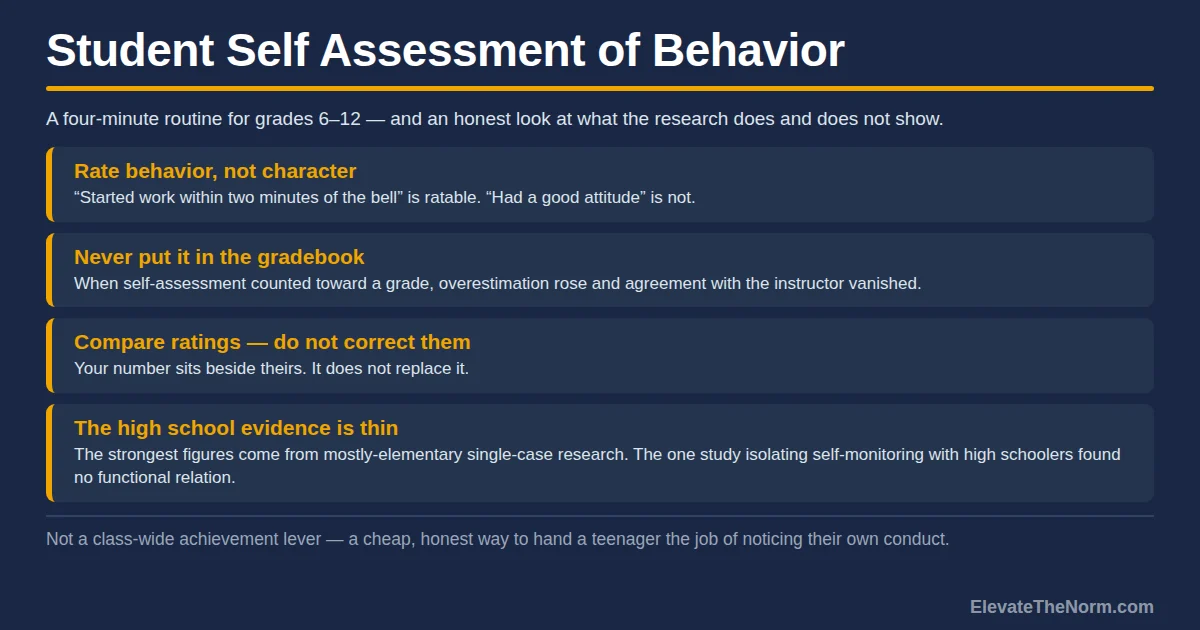
    • Rate behavior you can point at, not character. “Started work within two minutes of the bell” is ratable. “Had a good attitude” is not — and a student who disagrees has nowhere to go.
    • The moment you grade it, it stops working. In one study of self-assessment counted toward a final mark, overestimation rose sharply and the correlation with the instructor’s rating vanished.
    • The evidence is real, and the high school evidence is thin. A federal practice guide reports large average improvements. The one study found here that isolated self-monitoring with high schoolers found no functional relation.
    • Two behaviors. Not eight. Every version that survives past October tracks a small number of specific, positively stated behaviors on a form the student can fill out in under two minutes.
    • Compare ratings, do not correct them. Rating the same period yourself is the accuracy check. Overwriting the student’s number turns the whole thing back into your paperwork.

    Free Download · PDF

    Student Self-Assessment Forms for Grades 6–12

    A printable self-assessment form with space to write your own behavior criteria, a 0–3 rating scale, and a next-step line. No email required.

    Download the free PDF

    Free. No email address required. Designed for grades 6–12. Browse every printable in Your Free Library.

    What Is Student Self Assessment of Behavior?

    It is a student judging their own conduct against stated criteria and recording it. Three parts, all required: an observable behavior, a rating, a next step. Drop the observable behavior and you have a feelings survey. Drop the next step and you have a confession.

    The U.S. Department of Education’s Office of Special Education Programs describes two forms in its 2022 practice guide on self-monitoring systems: students record whether a behavior happened, or they rate it against criteria set in advance. The second is what most secondary teachers want. A checkbox says a thing occurred. A rating asks a student to hold their own conduct against a standard and say how close they came — a different and more useful act with a fifteen-year-old.

    Two neighbors to separate from. Not a restorative conversation — that happens after harm and involves the people affected. Nor is it academic self-assessment, though it borrows the machinery; the guide to judging your own work against criteria covers that version. Behavior just changes what sits in the criteria column. A third variant narrows it to a single project: what one student contributed inside a group that shares a grade.

    Does Student Self Assessment of Behavior Actually Work?

    Yes, with caveats big enough that you should read them. The headline numbers are good. The ones that apply specifically to teenagers are much thinner, and one is a null result.

    Start with the strongest claim. The OSEP guide cites a 2015 systematic review by Bruhn and colleagues covering 41 studies and reports that every one showed improvement: problem behavior falling from an average of 22% to 4%, academic engagement rising from 37% to 86%. Those are the figures that get onto the slide.

    Forty-one out of forty-one should make you suspicious rather than confident. A literature in which nothing ever fails usually has a publication problem, and nearly all of this work uses single-case designs — a handful of students, observed intensively, with effects judged by eye or by a non-standard metric. Single-case research is useful for showing something can work for a particular student. It is weak evidence for how far it moves a class of twenty-eight.

    The better evidence is the randomized trial. Bruhn, Wehby, Hoffman and colleagues ran a multisite RCT of a self-monitoring app across 25 schools and 57 student–teacher pairs (Behavioral Disorders, 2022). Students using it improved academic engagement more than controls (d = 0.44) and cut disruptive behavior more (d = −0.35) — and the behavior reduction largely held two weeks after the intervention stopped, while the engagement gain faded (d = −0.30). Note the grade band: 3rd through 8th. That is mostly elementary. It is not a high school result.

    Which brings us to the honest part. The one study located here that isolated self-monitoring with high schoolers is Estrapala, Bruhn and Rila (2022), comparing goal reminders against interval self-monitoring with three students with emotional or behavioral disorders. Visual analysis found no functional relation for either condition. Tau-U effect sizes ran 0.44 to 0.64, moderate to large, with self-monitoring slightly ahead — but the authors report classroom management as a substantial confound. Three students is three students; it does not overturn the wider literature. It does mean nobody should tell you this is proven for eleventh graders.

    The general picture for this age group is modest too. Murray, Kurian, Soliday Hong and Andrade (2022, Journal of Adolescence) pooled 33 randomized trials of self-regulation interventions with 7,269 young people aged 10–15 and found Hedges g = 0.12. Small. Emotion-regulation approaches reached g = 0.20; cognitive regulation, parent training, physical activity and working-memory approaches showed no significant effects at all.

    The defensible claim is this: behavior self-assessment reliably helps individual students who are struggling, is cheap, and has no plausible downside when it is not graded. It is not a class-wide achievement lever and nobody has shown that it is.

    Two things follow from that at building scale. First, this is about as cheap as an intervention gets — a half sheet of paper, no license, no platform, no staffing line, and so no procurement decision needed to try it in three classrooms. Second, and harder: who ends up holding a behavior sheet is an equity question, not a neutral one. Discipline data in most systems is not evenly distributed, and a practice assigned one student at a time inherits whatever pattern already exists in who gets noticed. Anyone running this as a tier-two intervention should read the roster of assigned students the way they read a referral report. Skipping that five-minute check is how a well-meant practice ends up pointed at the same kids as everything else.

    Will a Teenager Rate Themselves Honestly?

    More honestly than you expect, right up until the rating counts for something. That single design decision explains most of the variance between a routine that works and one that becomes theater.

    Heidi Andrade’s 2019 critical review in Frontiers in Education lays the accuracy picture out plainly. Correlations between student self-ratings and external measures run from about 0.20 to 0.80, few above 0.60. Males tend to overrate, females to underrate, and older and more academically competent students are more consistent — mildly good news for secondary teachers.
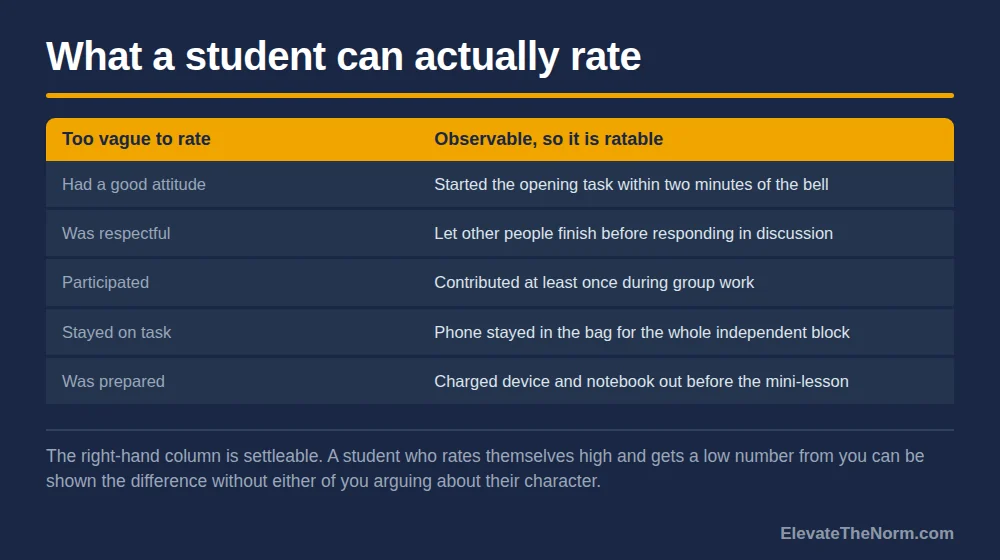
    Two-column table contrasting vague behavior descriptions such as had a good attitude and was respectful with observable versions such as started the opening task within two minutes of the bell and contributed at least once during group work
    The right-hand column is settleable. The left-hand column is an argument about a person.

    The decisive finding is about grading. Andrade cites Tejeiro and colleagues (2012), where self-assessment counted toward the final grade: overestimation increased dramatically and no correlation emerged between the professor’s rating and the student’s. Run formatively, agreement with external evaluators improved substantially. All twenty studies in Andrade’s review that used self-assessment formatively showed a positive association with learning.

    A second finding is worth stealing. Andrade reports that concrete, task-specific criteria outperform vague competence-based ones — a result from Fastré and colleagues. In behavior terms: “I was ready when the bell rang” beats “I was responsible today,” and it is far harder to argue about.

    Andrade also makes a point most summaries skip: the obsession with accuracy may be misplaced. Her review notes little evidence that inaccurate self-assessment produces worse learning, and that students act on their predictions regardless of accuracy. The purpose is not a number that matches yours. It is to get a student to look.

    What Should Students Actually Rate?

    Two or three behaviors, each stated as something a stranger could watch and score. The OSEP guide is specific: targets should be stated positively, defined in observable and measurable terms, and taught with examples and non-examples before anyone rates anything.

    Stated positively matters more than it sounds. “Did not disrupt” gives a student nothing to aim at. “Asked for help by raising a hand or coming to the desk” names the thing you want more of. Here is the difference in practice:

    Not ratableRatable
    Had a good attitudeStarted the opening task within two minutes of the bell
    Was respectfulLet other people finish before responding in discussion
    ParticipatedContributed at least once in the group work segment
    Stayed on taskPhone stayed in the bag for the whole independent work block
    Was preparedHad the charged device and the notebook out before the mini-lesson

    The right-hand column has a property the left lacks: a student who rates themselves high and gets a low number from you can be shown the difference without either of you arguing about their character. It moves a disagreement about a person into a disagreement about a fact, and facts are settleable.

    Pick two. A student tracking six behaviors is doing clerical work, and clerical work gets abandoned. Few, specific and observable beats many and inspirational — the same discipline that makes a short list of classroom expectations work at all.

    Let the student pick the second one. You choose the first target — you can see the pattern from the front of the room. Hand them the second. Ask what they would fix about their own class period if they could fix one thing, and write down their words. This costs nothing and it changes what the sheet is: a form you assigned becomes a form with something of theirs on it. It also produces better targets than you would guess, because a fifteen-year-old knows things about their own period that are invisible from six feet away — the argument for taking student voice seriously in the first place.

    A Four-Minute Behavior Self-Assessment Routine

    Four steps, once a period or once a day, on one sheet. The design constraint is that it has to be cheap enough that you still run it in week nine.

    1. Name the behavior. Two targets, stated positively, written where the student can see them. They do not change weekly; a target that moves every few days never gets a baseline.
    2. Rate it. A 0–3 scale beats 1–5. Fewer points means less hedging toward the middle, and the anchors fit on the page: 3 = the whole period, 2 = most of it, 1 = some of it, 0 = not today.
    3. Give one piece of evidence. One sentence naming a specific moment. This is the step that does the work and the one everybody drops. A rating with no evidence is a guess; with evidence it is an observation — and a student who has to produce evidence starts watching for it during the period instead of reconstructing it afterward.
    4. Name one thing for next time. Specific and small. “Put the phone in the bag before I sit down” is a plan. “Do better” is a wish.
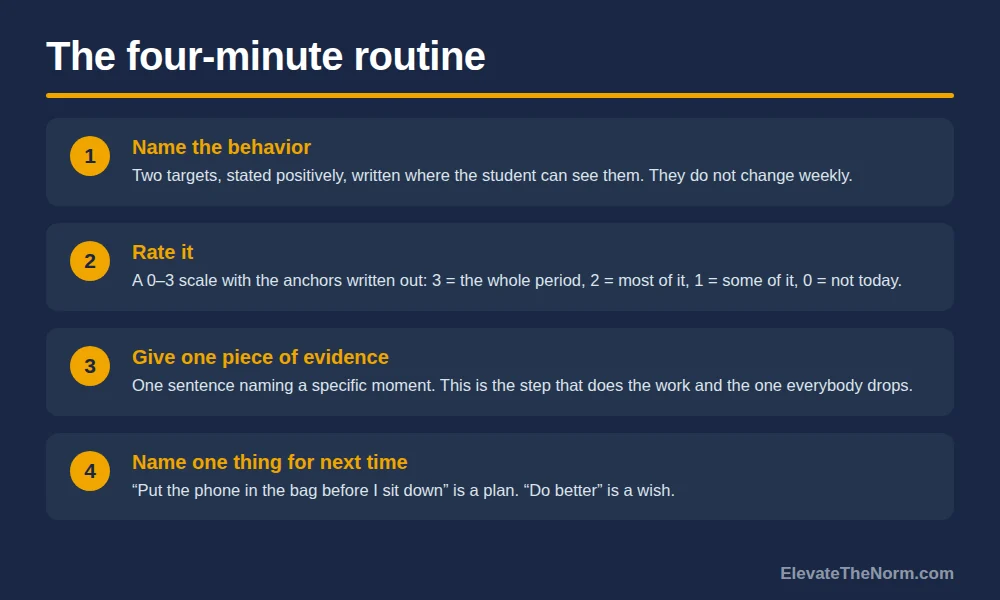
    Numbered graphic of a four-step behavior self-assessment routine: name the behavior, rate it on a 0 to 3 scale, give one piece of evidence, and name one thing for next time
    Four minutes. Step three is the one that does the work and the one everybody drops.

    Two easy-to-skip things make it stick. First, teach it before you run it. The OSEP guide recommends explaining the definition in student-friendly language, modeling the steps, guided practice, and telling students why the behavior matters — that last one builds buy-in rather than compliance. Fifteen minutes once beats re-explaining it daily for a month.

    Second, let them see their own trend. The guide recommends self-graphing, the cheapest motivational feature available: a strip of boxes down the side of the sheet the student shades in. Ten shaded days is the first time most students have seen their own conduct as a line rather than a series of unrelated bad days — which is what makes learning from a mistake possible at all. My Behavior Reflection Sheets on TPT ask students for reasons, not apologies, and come in two reading levels.

    One adjustment before you print anything: the written version is not the only version. Step three assumes a student who can produce a sentence quickly in writing, and plenty cannot — a student with a writing disability, a newcomer still building English, a student whose handwriting speed turns four minutes into twelve. None of them needs less self-assessment; they need a different container. Saying the evidence out loud in the last minute of class does the same cognitive work, and so does an evidence line offering three pre-written options plus a blank. What has to survive is the judgment against criteria, not the paragraph.

    If you want a form rather than building one, the free student self-assessment pack has a general version you can retype the criteria into. No email required.

    How Do You Check Accuracy Without Turning It Into a Trap?

    Rate the same period yourself, compare the two numbers, and talk about the gap — do not replace their number with yours. The OSEP guide describes exactly this: the teacher takes data at the same time the student self-records, and the comparison establishes accuracy. It calls this verification that supports rather than replaces student self-assessment, and that distinction is doing real work.

    Be realistic about frequency. Rating two behaviors for one student while teaching twenty-seven others is not a daily act, and a version that demands it quits on you in week three. Three days out of ten is enough to tell whether a student’s ratings track reality. Mark your numbers on a sticky note rather than building a second tracking sheet.

    The failure mode is obvious once you name it. If your rating overwrites theirs, the student learns that the sheet is a quiz with one right answer, which is you. They will start guessing what you wrote instead of watching what they did, and you have rebuilt teacher-managed behavior tracking with an extra step and the student’s handwriting on it.

    What to do with a gap depends on its direction, and this is where the practice earns its keep:

    • Higher than you. Ask what they were looking at. Usually the criteria are fuzzier than you thought, or they counted a different part of the period. That is information about your criteria, not evidence of dishonesty.
    • Lower than you. Say so. A student who gives themselves a 1 on a day you saw a 3 is telling you something, and it is rarely about the behavior.
    • A match. Say that once, then fade the checking. Matching is the exit condition, not a reason to keep checking forever.

    On fading, the guide is clear: the goal is a student who monitors their own behavior without the system, faded individually through longer intervals, higher goals or less frequent recording, while you keep watching the behavior itself. A behavior self-assessment with no exit plan is a permanent accommodation you did not mean to create. Decide at the start what “done” looks like, and tell the student.

    Four Ways This Goes Wrong

    All four are design errors, and all four are fixable before you start.

    It becomes a punishment record. The fastest way to kill it: a stack of sheets pulled out at a parent meeting or a referral. Once a student suspects the form is evidence against them, the ratings go to 3 and stay there, and you have taught them that honest self-report is a liability. Decide up front who sees the sheets and say so. If a sheet genuinely has to go into a behavior plan, tell them before the first one is filled out, not after.
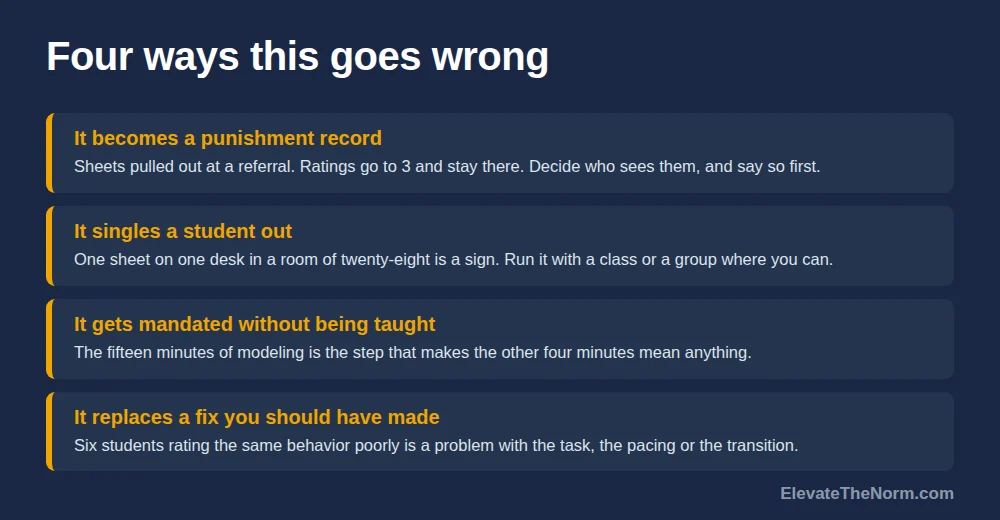
    Graphic listing four failure modes for behavior self-assessment: it becomes a punishment record, it singles a student out, it gets mandated without being taught, and it replaces a fix to the lesson
    All four are design errors. All four are fixable before the first sheet is printed.

    It singles a student out. A behavior sheet on one desk in a room of twenty-eight is a sign, and teenagers read signs. That is a real cost, and it is why the practice is often worth running with a whole class or group even when one or two students need it. If it has to be individual, make the form unremarkable and handle the handoff privately — not at the front of the room on the way out.

    It gets mandated without being taught. When this arrives as a tier-two box to check, the teaching step is the first thing cut — it is the only step that costs a block of class time. A student handed a sheet with no instruction rates it the way they rate everything handed over with no instruction: fast, high, without looking. The fifteen minutes of modeling is what makes the other four mean anything, and a school adopting this should build that time into the rollout.

    It replaces a fix you should have made. If six students rate themselves poorly on the same behavior, the problem is not six students. It is the task, the seating, the pacing, or the transition around it. Self-assessment data is a diagnostic you collect for free, and reading it only as a statement about individual kids wastes it. Sometimes the right response to the sheets is to change the lesson. That is not a failure of the practice; it is the practice working.

    Where to Start This Week

    Pick one class. Write two behaviors on the board, stated positively, in language a student would use. Put a 0–3 scale under each with the anchors written out. Spend fifteen minutes teaching what a 3 looks like and what it does not, using examples from the actual room. Then run it ten days without changing anything, rating the same two behaviors yourself on three of those days. On day ten, hand students their own ten days and ask one question: what does this show you that you did not know on day one? That question is the entire product. Everything before it is setup.

    Keep it out of the gradebook. Keep it to two behaviors. Plan the exit before you plan the start. Behavior self-assessment will not turn a hard section into an easy one, and anything promising that is selling something. What it does is hand a teenager the job of noticing their own conduct — a job they are old enough to have and one almost nobody has ever formally given them. The natural next step, once they can rate themselves against criteria, is doing it out loud to someone other than you, which is what building student responsibility looks like as a sequence rather than a slogan.

    Before you go: grab the free Student Self-Assessment Forms (PDF) — ElevateTheNorm.com branded, printable, no email required.

    Frequently Asked Questions

    Should a behavior self-assessment ever count toward a grade?

    No. This is the single clearest finding in the research. When self-assessment counted toward a final grade in Tejeiro and colleagues’ study, student overestimation increased dramatically and the correlation with the instructor’s own assessment disappeared entirely. Run formatively, the same practice produced substantially better agreement with external evaluators. A grade converts an honest instrument into a negotiation. If your school requires a conduct grade, keep it in a separate column and say out loud that the self-assessment sheet does not feed it.

    Is this just a behavior chart for teenagers?

    It looks similar and it works differently. On a behavior chart, an adult records what a student did. On a self-assessment, the student records it, produces evidence for the rating, and names the next step. The recording is the intervention — the point is the act of judging your own conduct against a standard, not the data. If you fill in the sheet for the student, you have a chart, and you should not expect the self-assessment findings to apply to it.

    How do I do this without embarrassing the one student who needs it?

    Run it with the whole class or a whole group where you can. A single sheet on a single desk is visible and teenagers read it correctly as a label. If it has to be individual, make the form look ordinary, hand it over and collect it privately rather than at the door, and tell the student at the start exactly who will see it. Then hold to that. A promise about who sees the sheet is the whole basis of honest ratings.

    Can parents or an administrator ask to see the sheets?

    Possibly — records policies vary by district and this is not legal advice. The practical move is to decide before the first sheet is filled out and tell the student. If the sheets will feed a behavior plan or a meeting, say so up front; students can handle a known rule and cannot handle a surprise one. If the sheets are for the two of you, write nothing on them you would not want read aloud, and keep other students’ names off them entirely.

    Does the research support this for high school students?

    Less than you would gather from a workshop. The strongest average figures come from a federal practice guide citing a 41-study review that is overwhelmingly single-case research, and the best randomized trial covers grades 3 through 8. The one study located here that isolated self-monitoring with high schoolers — Estrapala, Bruhn and Rila (2022), three students with emotional or behavioral disorders — found no functional relation, though effect sizes were moderate to large and the authors flag classroom management as a confound. The honest summary: it plainly helps individual struggling students, it costs almost nothing, and it is not proven as a class-wide lever for teenagers.

    How long before I should expect to see anything?

    Give it ten school days before you judge it, and expect the first week to look like nothing. Students need several cycles before the ratings stabilize enough to be worth reading, and the useful moment is usually the first time a student sees ten days of their own data at once rather than any single entry. If nothing has moved after three or four weeks of consistent use, the target behavior is probably too vague or the real problem is somewhere in the lesson rather than in the student.

    Should I tell families their child is doing this?

    Yes, and it takes one sentence. A short note home saying what the two behaviors are, that the student rates themselves, that it is not graded, and who sees the sheet prevents the version of this conversation where a parent finds a behavior form in a backpack and reasonably assumes their child is in trouble. It also tends to produce useful information back — families often know which part of the day is hard and why. Send it before the first sheet, not after the first question.

    What if a student refuses to fill it out?

    Ask what they think it is for. A refusal is usually a reasonable read of the situation — they have decided it is surveillance, or paperwork, or a trap that ends in a referral. All three are things the design can fix. If the answer is that they do not see the point, that is fair, and the counter is to show them what ten days of their own data looks like rather than to argue. Do not make compliance with the sheet itself a disciplinary issue; you will win that fight and lose the practice.

    Sources

    1. Avina, A., Boyle, S., Duble Moore, T., Hicks, T., and Wiggins, A. “Intensive Intervention Practice Guide: Self-Monitoring Systems to Support Students’ Behavioral Needs.” U.S. Department of Education, Office of Special Education Programs / National Center on Intensive Intervention, Fall 2022. https://files.eric.ed.gov/fulltext/ED628226.pdf
    2. Andrade, Heidi L. “A Critical Review of Research on Student Self-Assessment.” Frontiers in Education, vol. 4, art. 87, 2019. https://www.frontiersin.org/journals/education/articles/10.3389/feduc.2019.00087/full (The Tejeiro et al. 2012 and Fastré et al. 2010 findings cited above are reported in this review; the primary papers were not read directly.)
    3. Bruhn, Allison, Joseph Wehby, Lesa Hoffman, Sara Estrapala, Ashley Rila, Eleanor Hancock, Alyssa Van Camp, Amanda Sheaffer, and Bailey Copeland. “A Randomized Control Trial on the Effects of MoBeGo, a Self-Monitoring App for Challenging Behavior.” Behavioral Disorders, vol. 48, no. 1, 2022, pp. 29–43. https://files.eric.ed.gov/fulltext/EJ1351615.pdf
    4. Estrapala, Sara, Allison Leigh Bruhn, and Ashley Rila. “Behavioral Self-Regulation: A Comparison of Goals and Self-Monitoring for High School Students With Disabilities.” Journal of Emotional and Behavioral Disorders, 2022. https://files.eric.ed.gov/fulltext/EJ1349728.pdf
    5. Murray, Desiree W., Jennifer Kurian, Sandra L. Soliday Hong, and Fernanda C. Andrade. “Meta-Analysis of Early Adolescent Self-Regulation Interventions: Moderation by Intervention and Outcome Type.” Journal of Adolescence, vol. 94, no. 2, 2022, pp. 101–117. https://files.eric.ed.gov/fulltext/ED622592.pdf

    About Clay Shumate

    Clay Shumate is a certified secondary Social Studies teacher in the public schools of West Alabama, with seven years of classroom experience, a B.A. in History, and an M.Ed. in Secondary Education. He writes about project-based learning, student responsibility, respect, and practical ways to hold young people to a higher standard while giving them room to learn from mistakes. He is a member of the Society of Professional Journalists and writes to its Code of Ethics; this site’s editorial standards and corrections policy are published in full. More about Clay.

  • Student Leadership: How Schools Can Give Teenagers Real Responsibility

    Student Leadership: How Schools Can Give Teenagers Real Responsibility

    By Clay Shumate

    Student leadership is not a title, an election, or a line on a college application. It is the practice of giving a teenager genuine responsibility — real decisions, real consequences, and real support from an adult who has done the planning to make success possible. Schools that do this well produce students who know how to serve others, solve hard problems, and hold themselves accountable. Schools that do it poorly give students the word leadership and wonder why nothing changes.

    This article explains what student leadership actually requires, where most schools fall short, and how any classroom teacher can hand a student real authority and then hold them to it — without setting them up to fail. None of it works before ordinary responsibility is already the norm in the room.

    What Student Leadership Actually Means

    Most school definitions of student leadership center on elected positions: student council president, class officers, homecoming committee. These roles are not without value. But they are also the roles most likely to be filled by students who were already organized, already known, and already comfortable raising their hands. If a school’s model of leadership only rewards students who already look like leaders, it is not developing leadership — it is sorting for it.

    A more useful definition: student leadership is any structured situation in which a student holds genuine authority over a meaningful outcome and is held accountable for results. The authority must be real, not ceremonial. The outcome must matter to someone besides the student. The accountability must have consequences the student actually feels.

    Research on youth development supports the value of this kind of experience. Sociologist Reed Larson’s landmark review found that voluntary, goal-directed activities — ones that require initiative, not just compliance — produce the kind of intrinsic motivation that transfers to adult life.1 Dana Mitra’s analysis of student voice in secondary schools found that genuine student participation, including planning and decision-making roles, produced measurable gains in engagement, school belonging, and academic motivation — particularly among students who had previously been disengaged.2

    The operative word in both bodies of research is genuine. Symbolic participation — filling a role with a title and no real authority — does not produce those outcomes. It often produces the opposite: students who learn that official channels are theater, that adults do not actually share power, and that their effort is not taken seriously.

    The Problem With Symbolic Leadership

    Consider three common school leadership structures and what they often deliver in practice:

    Student government at many schools functions as an event-planning committee with a democratic veneer. Students vote on spirit week themes. They help organize pep rallies. The principal makes all decisions that actually affect the school, and student government exists to generate enthusiasm for those decisions. Students who take this seriously and try to raise real concerns — about grading policy, discipline, cafeteria conditions — often discover that the program’s actual scope is narrower than its name suggests, and that genuine policy decisions belong to administration rather than to the student government structure.

    Peer mediators and conflict resolution programs are genuinely valuable when implemented with real training, supervised practice, and institutional backing. They are window dressing when students are given a title and a script and expected to resolve disputes the adults find inconvenient. A peer mediator who cannot actually commit to any outcome, who has no authority to follow up, and who receives no coaching after sessions learns very quickly that the role does not matter.

    Student ambassadors and leadership clubs often confuse belonging with leading. Wearing a lanyard is not leadership. Giving a tour of the school to visiting families is service, but it is not the same as holding authority over a meaningful outcome. These programs are not wrong — they build community and recognize students. But when schools call them leadership development, they are doing two harmful things: overstating what the experience provides, and tacitly telling other students that leadership is a reward for being well-liked. The fix is to build the habit everywhere first, through small jobs that every student actually owns.

    None of this means schools should abandon student government or peer programs. It means schools should be honest about what those programs are and build something more substantive alongside them — something that reaches students who are not already popular, high-achieving, or interested in student government.

    What Real Student Responsibility Looks Like

    Genuine student leadership roles share three features: the student controls something that matters, an adult has done enough preparation for the student to succeed, and the student is held accountable when things go wrong or go right. Here are several forms this can take across a school day, and twenty-five worked examples with the decision each student holds if you want the longer list:

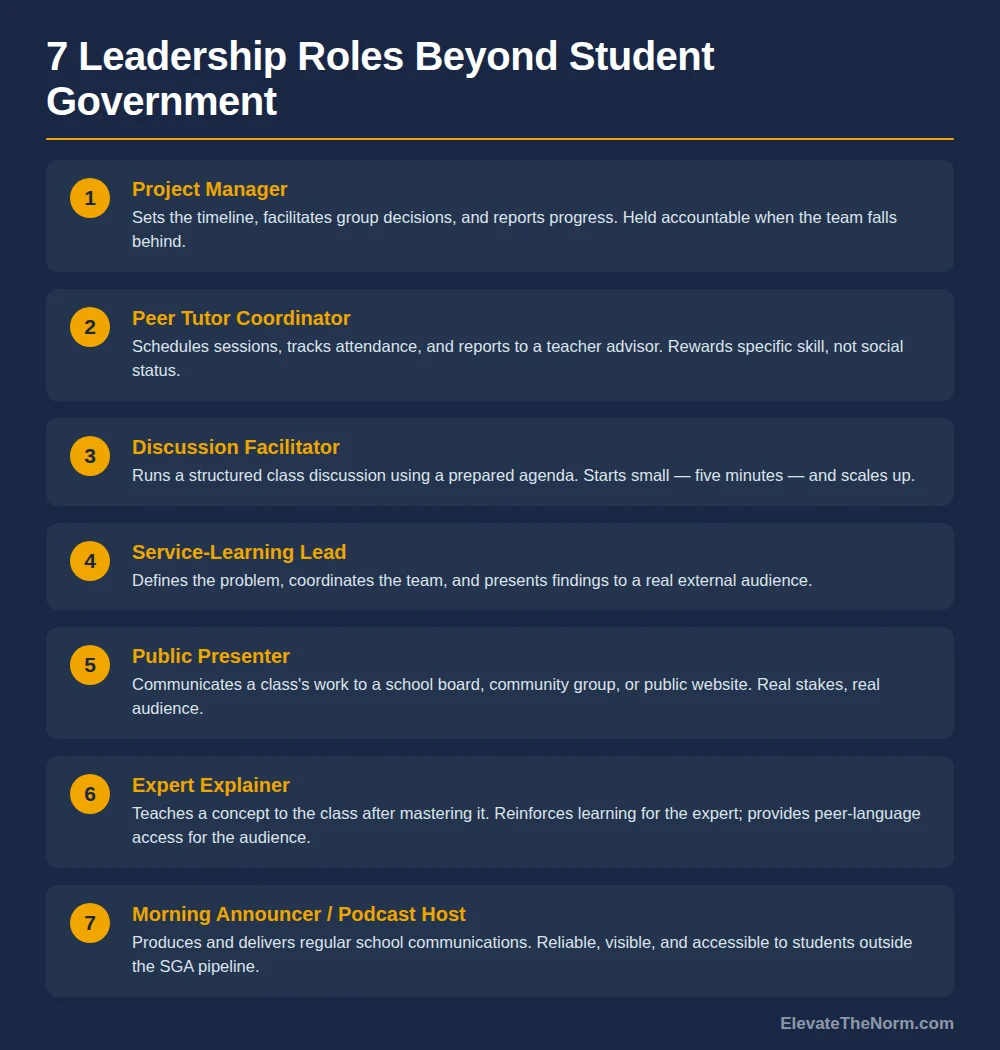
    seven leadership roles beyond student government that give students real authority in the classroom
    Seven types of student leadership that go beyond student government — each requiring real authority and adult preparation.

    Decision-making authority within a project

    In a project-based learning unit, one student serves as the project manager for a group. This is not a title for the student most likely to do all the work anyway. It is a structured role with defined responsibilities: managing the timeline, facilitating group decision-making, communicating progress to the teacher, and being the first person the teacher asks when something is behind schedule.

    When student responsibility is built into the structure of a project — not as an add-on but as a load-bearing element — students who take the project manager role seriously develop skills they cannot get by sitting in the back of a lecture. They also discover something teachers know very well: managing other people is significantly harder than doing the work yourself.

    Service with stakes

    Service-learning at its best does not ask students to perform volunteerism. It asks them to solve a real problem for a real audience. A group of students who audits their school’s recycling program and presents findings to the facilities director is doing service. A group of students who sorts recycling bins after school is doing labor. Both are useful. Only one is leadership.

    The National Commission on Service-Learning found that service-learning produces stronger civic engagement, deeper content understanding, and greater self-efficacy when students are active problem-solvers rather than passive participants — and when adult educators maintain mentorship and structured reflection throughout the experience.3

    Peer teaching and peer support

    Students can explain things to each other in ways adults sometimes cannot. A junior who has mastered a concept can reach a struggling sophomore through language, reference points, and social proximity that a teacher does not have. When schools build peer tutoring programs with genuine structure — trained tutors, session protocols, progress tracking, teacher oversight — they create leadership roles that reward competence in a specific skill rather than general popularity.

    This is different from simply asking students to help each other. Unstructured peer assistance is not leadership. A tutoring coordinator who schedules sessions, follows up on attendance, and reports to a teacher advisor is holding a leadership role. The difference is the structure and the accountability. For any peer support role, families should receive a brief note at the start of the program explaining what the role involves — and what it does not involve, specifically that trained adults retain responsibility for any serious concerns that arise.

    Public communication

    Presenting research to a school board, speaking at a community meeting, writing an op-ed for the local paper, producing a podcast episode that goes on the school website — these are forms of student leadership that require preparation, require adult oversight, and require students to be accountable to an audience beyond their classroom. Building student voice and choice into public-facing tasks gives leadership a real audience, which changes how students approach the work.

    Leadership for Students Who Are Not Already Known

    One of the most persistent problems with school leadership programs is that they tend to select for students who are already recognized. Elected positions favor students with social capital. Competitive leadership programs favor students with the confidence to apply. Teacher nominations for leadership roles can unconsciously favor students who already perform the behaviors associated with “good” students.

    This matters because leadership development, by definition, should change someone. A student who already leads well needs affirmation. A student who has never been asked to lead needs a chance. If schools only offer leadership experiences to students who already demonstrate leadership, they are providing a finishing school for existing leaders rather than developing new ones.

    real vs symbolic student leadership comparison chart showing what distinguishes genuine authority from ceremonial roles
    Real versus symbolic student leadership: the distinction that determines whether development actually happens.

    Several practical approaches reach students who are not already visible:

    Role rotation within the classroom. Not every leadership experience needs to be a program. A teacher who rotates the project facilitator role, the daily discussion leader, the “expert” who explains last night’s reading to the class — that teacher is giving every student repeated low-stakes practice at the behaviors leadership requires. Some students will thrive immediately. Others will struggle, which is exactly when the learning happens. From a student’s perspective, being handed a role they did not seek — and then actually being trusted to carry it — sends a different signal than any motivational poster ever could.

    Interest-based leadership, not performance-based. A student who is deeply interested in robotics but is not a top student may be the best person to lead the school’s engineering project. A student who has lived experience with food insecurity may be the right student to lead a school food drive — not because the school wants to exploit that experience, but because that student has a relationship to the work that others do not. When schools match students to leadership roles based on genuine interest and relevant knowledge, they reach students who would never raise their hand to run for class president.

    Assigned authority with real stakes. Perhaps the most underused tool available to classroom teachers is the simplest one: assigning a student genuine authority and then treating that authority as real. Handing a student real authority and then holding them to it — not rescuing them when it becomes difficult, not undoing their decisions behind their back, and not abandoning them when they struggle — is the core practice of classroom-based leadership development. It requires the teacher to have done enough preparation that the student can actually succeed, and it requires the teacher to resist the urge to take the authority back the moment things get complicated.

    The Teacher’s Role: Planning and Presence

    Every effective student leadership experience rests on adult preparation. A student cannot demonstrate leadership in a role that has not been designed well enough for leadership to be possible. When a student “fails” at a leadership role — when the project falls apart, when the peer support session goes nowhere, when the presentation embarrasses everyone — the first question is not what the student did wrong. The first question is what the teacher did not prepare.

    This is not a comfortable position. It requires teachers to hold themselves accountable for the conditions that make student success possible. But it is also the only position that actually develops students. A classroom where students are set up to fail so they can “learn from the experience” is not a leadership incubator. It is a classroom with poor design.

    Holding high expectations for students does not mean removing all support. It means designing a situation where students are capable of meeting genuine expectations if they apply genuine effort — and then holding them to it when they do not. The high expectation and the adequate preparation are not in tension. They depend on each other.

    Adult oversight in a student leadership context also means being present enough to catch problems before they become crises. A student project manager who is drowning should receive coaching from the teacher before the project fails, not sympathy after. A peer mediator who handles a session poorly should debrief with an adult advisor the same day, not two weeks later. Oversight is not micromanagement. It is the sustained adult presence that makes genuine student authority possible — because students are developing, not developed.

    Ethical Boundaries: What Students Should Not Be Responsible For

    Genuine student leadership has a clear outer boundary: students should never be placed in roles that require them to perform adult professional functions, manage other students’ behavioral or mental health needs without professional support, or bear responsibility for outcomes that exceed their developmental capacity.

    A student peer mediator should not be the primary responder to a disclosure of abuse, self-harm, or safety concerns — that is a mandatory reporter responsibility that belongs to trained adults. A student project manager should not be responsible for motivating a peer who is dealing with a serious personal crisis — that is a counseling function. A student ambassador should not be expected to handle a visiting family’s complaint about the school’s discipline policy — that is an administrator’s responsibility.

    These boundaries are not signs of low expectations. They are signs that the school understands what leadership development is for. Students are learning to be responsible. They are not responsible for the school. That distinction protects them and produces better learning outcomes. The National Academies of Sciences has noted that adolescents’ development of responsibility, civic identity, and competence is best supported by environments that offer genuine challenge within a framework of consistent adult support — not by environments that expose them to adult burdens before they are ready.4

    Building strong relationships with students includes being clear about where their authority ends — and why. Students who understand that their role has real boundaries, and why those boundaries exist, are more likely to take the role seriously than students who feel they have been handed an amorphous responsibility no one has defined.

    How to Start: Practical First Steps for Any Teacher

    Leadership development does not require a program, a budget, or administrative approval. Every teacher in any classroom can begin with the classroom they already have. It helps to name the specific abilities a role is supposed to build before you hand it over, so the student is practising something you can both see rather than hoping character rubs off.

    classroom leadership checklist for teachers three steps identify assign debrief
    A three-step classroom framework for assigning, supporting, and debriefing a student leadership role.

    Step 1: Identify one role in your current classroom structure that could be held by a student. Not a fake role. Not a role the teacher secretly controls. A role with a real outcome: discussion leader for the week, group project coordinator, quiz-question author, revision partner who gives written feedback on two other students’ drafts. Start small and make it real.

    Step 2: Assign the role intentionally, not by nomination or election. Choose a student who could benefit from the experience — not one who would succeed regardless. A student who is quietly competent but rarely recognized, who is genuinely interested in the work, or who needs to practice leading rather than following is often a better choice than the class’s most visible student. Brief them privately on what the role requires before it begins. For students who are anxious or reluctant, start with a smaller version of the role — five minutes of discussion facilitation before thirty, one group member to coordinate before a full team. Check in with them during the role, especially the first time. Debrief with them honestly after. A good debrief is specific: what went well, what you would do differently next time, one thing the student handled that they might not have expected they could handle.

    Step 3: Hold the student to the role. When something goes wrong — and something will — address it directly and specifically. “Your group’s timeline slipped because you didn’t confirm the assignment on Tuesday. How will you handle Tuesday next time?” is more useful than either letting it slide or removing the student from the role. This is where the development happens.

    From there, activities for teaching responsibility can build on this foundation. But the first step is the simplest and the hardest: treating a student as capable of holding real authority and then actually letting them hold it.

    Schools that do this consistently — across classrooms, grade levels, and subject areas, not just in special programs — produce students who understand that leadership is a practice, not a status. That understanding is more durable, more transferable, and more honest than any title a school can give.

    Key Takeaways

    • Student leadership is genuine authority over a meaningful outcome — not a title or a symbolic role.
    • Most school leadership programs reach only students who are already recognized. Effective leadership development reaches students who have never been asked to lead.
    • Real leadership experiences require real preparation by the teacher — students cannot demonstrate leadership in a role the teacher has not designed well enough for success to be possible.
    • Student authority must have real boundaries: students are not responsible for adult professional functions, peer mental health crises, or outcomes that exceed their developmental stage.
    • The most accessible form of leadership development happens inside existing classrooms: assigning real roles, holding students to them, and debriefing honestly when things go wrong.
    • High expectations and adequate preparation work together — they are not in conflict.

    Free Download: Student Leadership Planning Guide

    A one-page classroom tool for designing real student leadership roles — with a checklist for authority, preparation, and accountability. No email required.

    Download the Planning Guide (PDF) →

    Free Download: Student Leadership Planning Guide — a one-page classroom tool. Download (PDF) →

    Frequently Asked Questions

    What if a student doesn’t want a leadership role?

    This is a reasonable concern, and it comes up more often than schools expect. A student who genuinely refuses a role after a calm, private conversation about what it requires may be signaling something worth understanding — anxiety, lack of preparation, or a personal situation the teacher doesn’t know about. In that case, starting smaller makes sense: a five-minute facilitator role before a thirty-minute project lead. The goal is not to force students into uncomfortable positions but to expand what they believe they can do. Forced reluctance rarely produces leadership growth. A smaller, well-scaffolded role that a student actually performs is worth more than a larger role that a student dreads and does minimally.

    Should student leadership roles be graded?

    It depends on the context, but grading is not required for the experience to be valuable. Many teachers assess the work the leadership role produces — the project the team completed, the reflection the student writes afterward, the quality of the peer feedback — rather than grading the leadership itself. Grading “how well you led” is difficult and can feel punitive when a student is still learning. What matters most is specific, honest feedback during and after the role. A debrief conversation — what went well, what you would do differently, what you’ll do next time — is often more developmental than a grade. If the class context requires a grade, consider self-assessment as part of the evaluation: students who accurately assess their own performance in a leadership role are demonstrating growth that matters.

    What should teachers do when a peer support role exposes a serious student concern?

    Train peer supporters explicitly on this scenario before the role begins, not after the fact. Students who serve as peer mediators, tutors, or support partners need to know the clear boundary: they listen, they can acknowledge, and they direct any serious concern to an adult immediately. They are not counselors, they are not mandated reporters, and they are not equipped to evaluate whether a classmate’s situation requires professional intervention. When a peer supporter encounters a disclosure of self-harm, abuse, mental health crisis, or safety risk, their job ends at “let’s tell Ms./Mr. [advisor] together.” Adults handle everything from that point forward. This boundary should be taught, practiced with scenarios, and reinforced with every cohort. Schools running peer programs without explicit training on this boundary are creating risk for students and for the program.

    How do you support students who struggle with the leadership role — especially shy students or those with learning differences?

    Scaffolding is the answer. A student with social anxiety who is expected to run a full group discussion without preparation will likely confirm every belief they already have about their own limitations. The same student, given a structured agenda in advance, a few rehearsal prompts, and permission to check in quietly with the teacher midway through, can run a discussion effectively. Learning differences require similar thought: a student who processes language slowly may need written prompts rather than on-the-spot decisions. A student with executive function challenges may need the project manager role broken into smaller daily tasks with explicit check-in points. The question is not whether these students can lead — it is whether the teacher has designed the role with enough structure for their specific needs. When the design is right, the role becomes possible. That is the work.

    How much additional time does this require from teachers?

    An honest answer: the initial design takes time. Creating a role with real authority, identifying which student to assign it to, briefing that student, and planning a debrief is work that does not happen automatically. For a classroom teacher managing multiple preps, 28–35 students, and a full grading load, “just add leadership development” is not a costless suggestion. The most practical approach is to start with one role in one unit and evaluate it. A project manager role in a single project — one briefing conversation, two or three check-ins during the unit, one debrief at the end — adds perhaps thirty to forty minutes across a three-week project. Over time, the routines become faster and the students become better at them. The cost is real and it is worth naming honestly. The alternative — students who graduate without ever having held genuine authority in a structured setting — is also worth naming.

    When should schools start building student leadership experiences? Is middle school too early?

    Middle school is not too early — but the scale and structure need to match the developmental stage. A seventh grader serving as the daily discussion leader for ten minutes is not the same as a seventh grader managing a semester-long project team. Middle school is an appropriate time to introduce leadership roles at the classroom level: group facilitator for the week, peer reviewer, expert explainer. These experiences build the vocabulary and the habits that high school leadership roles require. By ninth grade, students who have had repeated small-scale leadership experiences are far better prepared for larger roles than students who have only ever been assigned to fill out a group worksheet. Start small, start early, and keep the authority proportional to the preparation.

    What’s the difference between giving students real responsibility and putting adult problems on them?

    The test is whether an adult professional could reasonably be expected to handle the situation without specialized training or institutional authority. A student can be responsible for a project timeline. A student cannot be responsible for a peer’s mental health crisis. A student can be responsible for facilitating a class discussion. A student cannot be responsible for resolving a conflict involving serious interpersonal harm. A student can communicate a problem to an administrator on behalf of a group. A student cannot be expected to manage the administration’s response to that problem. When the role requires specialized credentials, institutional authority, or the capacity to impose consequences on others, it belongs to an adult. When the role requires planning, communication, collaboration, and follow-through, it can belong to a student — with preparation and oversight. Genuine leadership development stays consistently on the student side of that line.

    Should families be informed when their student takes on a peer support role?

    Yes, particularly for any program with ongoing peer support, mediation, or advising functions. Families deserve to know that their student is serving in a peer role, what that role involves, and what it does not involve (and specifically that trained adults oversee all serious concerns). For classroom-level leadership roles — project manager, discussion leader, peer reviewer — a brief mention in a class newsletter or course syllabus is usually sufficient. For structured peer programs that carry more weight, a brief parent communication at the beginning of the year or program is appropriate. Transparency builds trust with families who might otherwise wonder what “peer leadership” means in practice. It also gives parents the language to reinforce the experience at home, which extends the learning beyond the classroom.

    Sources

    1. Larson, R. W. (2000). Toward a psychology of positive youth development. American Psychologist, 55(1), 170–183. https://doi.org/10.1037/0003-066X.55.1.170
    2. Mitra, D. L. (2004). The significance of students: Can increasing “student voice” in schools lead to gains in youth development? Teachers College Record, 106(4), 651–688. https://doi.org/10.1177/016146810410600401
    3. National Commission on Service-Learning. (2002). Learning in deed: The power of service-learning for American schools. W. K. Kellogg Foundation. https://eric.ed.gov/?id=ED467192
    4. National Academies of Sciences, Engineering, and Medicine. (2019). The promise of adolescence: Realizing opportunity for all youth. National Academies Press. https://doi.org/10.17226/25388

    About Clay Shumate

    Clay Shumate is a certified secondary Social Studies teacher in the public schools of West Alabama, with seven years of classroom experience, a B.A. in History, and an M.Ed. in Secondary Education. He writes about project-based learning, student responsibility, respect, and practical ways to hold young people to a higher standard while giving them room to learn from mistakes. He is a member of the Society of Professional Journalists and writes to its Code of Ethics; this site’s editorial standards and corrections policy are published in full. More about Clay.

  • Student-Led Conferences: A Practical Guide for Grades 6–12

    Student-Led Conferences: A Practical Guide for Grades 6–12

    Student-led conferences are meetings where the student — not the teacher — presents their own work to their family, explains what it shows, names what went wrong, and says what they plan to do next. The adults are there to listen and respond. For grades 6–12 the format works because it moves the accounting onto the person who actually did the work.

    The usual conference has a structural problem nobody names: the student is the only person in the building with first-hand knowledge of what happened, and they are the one person not in the room. Two adults discuss a third party who is somewhere else, and then somebody reports back a summary.

    Student-led conferences fix that. They are also more work than they look, they fail in specific and predictable ways, and the evidence behind them is thinner than the enthusiasm around them. All of that is below.

    Key Takeaways

    • The student runs the meeting. Not a presentation about the student — a presentation by the student, from evidence they selected.
    • Attendance is the most reliable gain. One middle school went from 85 traditional conferences to 565 student-led ones in a single year.
    • The preparation is the curriculum. Four weeks of collecting, choosing, writing and rehearsing is where the learning happens. The 25 minutes is just the assessment.
    • Be honest about the evidence. Most of what is published is descriptive, from elementary and middle grades, and the strongest recent study explicitly did not measure achievement.
    • Plan for the families who do not come. A format that only works for students with an adult in the chair will quietly punish the students who need it most.
    • This is a writing and speaking unit. Treat it as one, mark it as one, and the workload argument mostly disappears.

    What Are Student-Led Conferences?

    A student-led conference is a scheduled meeting, usually 20–25 minutes, in which a student walks their family through a portfolio of their own work using a script they wrote. The teacher is in the room — often supervising several conferences at once — and speaks when asked or when something needs correcting. The student does the rest.

    Table comparing traditional parent-teacher conferences and student-led conferences across who talks, who prepares and what is discussed
    The biggest change is not the format. It is who has done the thinking beforehand.

    Faulkner and Cook, writing for the Association for Middle Level Education, put the shift in one line from a teacher who had made the change: “It’s not me telling the parents that Johnny is failing because he won’t turn in his work.” The student says it. That sentence lands differently when it comes out of the student’s own mouth, in front of the person whose opinion they care most about.

    What it is not: a showcase. If students only present their best work, you have built an awards ceremony. The format earns its keep when the folder includes the assignment that did not get done, and the student has to say why.

    Why Student-Led Conferences Work — and What the Evidence Actually Shows

    Start with the claim that holds up best, because it is the one with numbers attached: families turn up.

    Faulkner and Cook report a school that went from 85 traditional conferences to 565 student-led conferences in the first year of the change. A research brief from The Principals’ Partnership describes Mead High School’s first round of student-led conferences, where over 98 percent of parents, 84 percent of students and 100 percent of advisors said the conferences were worthwhile.

    That is a real effect and it is not trivial. A conference nobody attends teaches nobody anything — and attendance is usually downstream of whether families have heard from you before the conference, which is its own problem of short, specific, weekly contact.

    Where the evidence thins out

    Now the honest part. The same Principals’ Partnership brief says plainly that most of what is written about student-led conferences describes elementary or middle-level implementation, and it is a 2005 document summarising practice rather than a controlled study.

    The most substantial recent study is Şişman and Bahadır’s, covering 249 students, 280 parents and 22 teachers across fourth grade through high school in a single private school. It found positive effects on responsibility, self-management, self-expression, communication and leadership — and the authors themselves note that future research should look at the effects on student achievement, which is a polite way of saying this one did not. One private school also limits how far the result travels.

    So the defensible version is this. Student-led conferences reliably increase family participation, and the people who do them report gains in student ownership and communication. Whether they raise achievement is genuinely unstudied. Anyone telling you otherwise is selling something.

    That is still a good enough reason to run them. Getting a fourteen-year-old to account for their own work in front of their family is worth doing whether or not it moves a test score, and it fits the same logic as raising the standard without removing grace.

    What the Student Actually Says

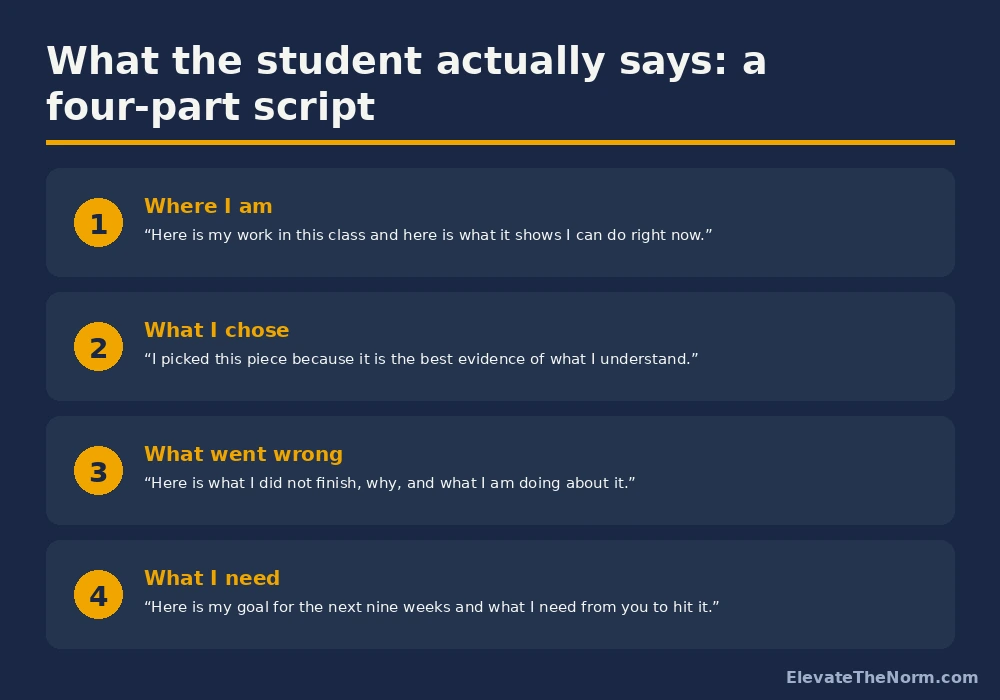
    Give every student the same four-part spine. Without it, most of them freeze in the first minute and the parent starts asking you questions instead — and the conference quietly reverts to the old format while everyone pretends otherwise.

    Four-part script a student follows in a student-led conference: where I am, what I chose, what went wrong, what I need
    The script is the scaffold. Without it, most students freeze in the first minute.

    The four parts, in order: where I am, what I chose and why, what went wrong, and what I need. Each one is a short paragraph the student drafts, revises and rehearses.

    If your school runs traditional conferences and a full student-led format is not on the table this year, the same thinking fits on one page: a student self assessment brought into a parent teacher conference gets the student’s judgment into the room without changing who runs the meeting.

    The third part is the one that matters and the one schools soften. “What went wrong” is where a student says out loud that they did not turn in three assignments in October, and then says what they are doing about it. Peter Neeves, writing in Edutopia, describes handling missing work not with punishment but with a written reflection and an assistance plan that names the underlying issue — organisation, attendance, whatever it actually is. That is the right instinct. The student still has to say it.

    The fourth part keeps the meeting from ending in vague agreement. “What I need” forces a specific, checkable ask: a weekly check-in, a quieter place to work at home, a reminder on Sunday nights. Families leave with a job, which is what most of them wanted in the first place. The four parts above are one structure; there are sixteen other ways to run the meeting depending on whether your constraint is the calendar, the subject, or the families who cannot get to the building.

    Who Is Doing What While the Student Talks

    Everyone in the room needs a job, or the adults will invent one. The job they invent is usually talking.

    The student runs the meeting and owns the account of their own term. The family member listens first and asks questions second — hand them a printed card with three prompts on the way in, or the default question becomes some version of “so are you behaving?” The three that work: what surprised you about your own work, what would you do differently, and what is one thing I could do at home that would actually help.

    The teacher stays out of it unless invited, then adds one piece of context the student could not supply — nine times out of ten something the student undersold. Counsellors and administrators moving between conferences should be listening for patterns across students rather than evaluating individual ones. An instructional coach watching a colleague’s first round has one genuinely useful measurement to take: how much of the twenty-five minutes the teacher spent talking. Above a fifth of it and the thing that needs tightening is the script, not the teacher.

    A Four-Week Run-Up That Fits an Ordinary Term

    The preparation is the part that gets skipped and the part that decides whether this works. Four weeks, one thing per week, all of it inside lessons you were teaching anyway.

    Four-week preparation timeline for student-led conferences: collect, choose, write, rehearse
    Four weeks, and the writing week is the one that does the work.
    1. Collect. Every student starts a folder. Every graded piece goes in, good or bad, dated. No curation yet — curation is next week’s skill and doing it now defeats the point.
    2. Choose. Two pieces of evidence per class, plus one sentence each on why that piece was chosen. Neeves describes teachers offering three eligible samples and letting the student pick one; that constraint helps students who would otherwise pick at random.
    3. Write. Students draft the script. This is a writing lesson — audience, purpose, evidence, concision — so teach it and mark it as one. It is also the week you find out who has been quietly hiding.
    4. Rehearse. Twice, on a partner. The first run is a disaster for almost everyone. The second is the one that works, which is the entire argument for rehearsing.

    Neeves puts the whole cycle at roughly one month with benchmark dates published to staff, which matches what the four weeks above ask for. Faulkner and Cook are blunt that the first run is labour-intensive for faculty. Both are true. The second year costs a fraction of the first.

    Build one adaptation in from the start rather than improvising it later: for a student who genuinely dreads speaking in front of people, let them write the conference as a letter to their family and read it aloud. The structure still does its work — evidence, an honest account of what went wrong, a stated next step — and it is a far better outcome than a student who freezes and a parent who ends up looking at you instead. Decide that in the writing week, not on the night.

    If you want the forms rather than the argument, the free student-led conference toolkit has the portfolio cover sheet, the script frame and the reflection prompts, with no email required.

    Watching a Student Defend Their Own Decisions

    The closest thing I run to this on an ordinary week is a project check-in where the student has to defend the choices they made — not report what they did, but explain why they did it that way and why the alternative was worse.

    It changes what students pay attention to. When you know you will have to justify a decision out loud to somebody who will ask a follow-up question, you make the decision differently in the first place. The check-in is not really an assessment of the work. It is the thing that makes the work get thought about.

    A student-led conference is that same move, scaled up and pointed at a harder audience. A teenager explaining a rubric decision to me is practising. A teenager explaining a term’s worth of work to their own family is doing the real version, and they know the difference.

    Which is also why the preparation cannot be skipped. Handing a student that audience with no script is not raising the standard — it is setting them up, and the students most likely to be embarrassed by it are the ones already having the worst term.

    The Families Who Do Not Come

    Plan for this before you launch, not on the night. Faulkner and Cook name it directly: not all parents attend, and schools need a contingency. If your entire format depends on an adult sitting in that chair, then the students whose families work nights, lack transport, or simply will not come get a worse version of school than everyone else — and those are frequently the students the format was supposed to help.

    Workable contingencies, roughly in order of preference:

    All of these depend on being able to reach the family at all, which is worth checking before conference week rather than during it — a running log of family contact will show you quickly which families you have not actually reached. If you are still deciding what to keep that log in, choosing a parent-teacher communication app is more a question of approval and student data than of features. For the families who do come, sending home the questions that are worth asking at a conference a few days early gives them something to do in the room besides listen.

    • A different adult from the building. A coach, a counsellor, a teacher from another department. Arrange it quietly in advance so the student is not visibly the one nobody came for.
    • A phone or video slot on another day. Costs nothing and solves the shift-work problem for a lot of families.
    • A recorded conference. The student delivers the script to camera and it goes home. Weaker, because the follow-up questions are the valuable part, but far better than nothing.
    • Never: skip the student. If a student prepared for four weeks, they present. The audience can change; the presentation happens.

    Schedule the alternatives at the same time you schedule the main round. A contingency invented at 6pm on conference night is not a contingency, it is an apology.

    Where Student-Led Conferences Go Wrong

    • Skipping rehearsal. The single most common failure. An unrehearsed student reads the script at the table in a monotone and everyone concludes the format does not work.
    • Turning it into a showcase. Best-work-only conferences are pleasant and teach nothing. The missing assignment belongs in the folder.
    • The teacher taking over. Usually well meant, usually triggered by a silence the teacher finds uncomfortable and the student does not. Let the pause sit.
    • Running it once. The first round is the expensive one. Schools that quit after year one pay the full cost and collect none of the return.
    • No plan for absent families. Covered above, and it is the failure with the worst distribution of harm.
    • Treating it as an add-on. If the preparation is not inside your teaching time, it will not survive contact with an ordinary term.

    The Follow-Up Almost Nobody Runs

    Six weeks after the conference, pull the students’ stated next steps back out and spend one lesson having them write a short progress note against their own commitment. Not a grade, not another form for the family — just the student, in writing, on whether they did the thing they said they would do in front of their mother.

    That one lesson is most of the difference between a format and an event. The commitment was public, it was theirs, and now it has a check-in attached to it. Skip it and the conference becomes a very well-organised twenty-five minutes that nothing follows.

    What to Do Next

    Do not start with the whole school. Start with one section, one term, and the four-week run-up — the student-led conference template carries the readiness checklist, the portfolio planner and the script that run-up needs, free and with no email required. Tell families in writing what will be different and why, so nobody arrives expecting the usual five minutes with you. Build the alternate-audience list before you need it.

    Then judge it on the thing you can actually see: whether students can account for their own work in front of somebody who matters to them. That is the skill the format teaches, it is measurable in the room, and it is worth having whether or not anyone ever proves it moves a grade. It also sits naturally alongside expecting a lot and backing it with support rather than pressure. It also pairs naturally with assigning students genuine leadership roles inside the classroom — the conference is the most visible of them, because the audience is the student’s own family.

    Printables for this

    Start with the free one on this site. The full conference template pack has the readiness checklist, the evidence and portfolio planner, the student script and the family follow-up agreement — a printable PDF plus an editable Word version, no email required. Two of mine on TPT go further. Parent Teacher Conference Forms has the prep sheet, the conversation script and the follow-up record for the conferences you still run the usual way. The Parent Contact Log is free and solves the problem in the contingency section above — knowing before conference week which families you can actually reach.

    Frequently Asked Questions

    How long should a student-led conference be?

    Twenty to twenty-five minutes is the standard, and it is about right for grades 6–12. Shorter than fifteen and students rush the part where they explain what went wrong, which is the part worth having. Longer than thirty and families with several children cannot make the schedule work. If you are running several conferences at once in one room, build in five minutes of slack between slots.

    What if the student is failing? Is this not humiliating?

    It is the opposite, if you prepare it properly. The humiliating version is the one where two adults discuss a student’s failure while the student waits outside. In a student-led conference the student names the problem themselves, in their own words, with a plan attached. What makes it cruel is skipping the preparation — handing a struggling student that audience with no script and no rehearsal. Do the four weeks and this becomes the most useful conversation a failing student has all year.

    Do student-led conferences replace traditional parent-teacher conferences?

    Not necessarily, and the research summaries treat the model as a supplement rather than a straight replacement. Some parents genuinely want a private conversation with the teacher, and there are situations — a safeguarding concern, a possible referral, a dispute — that should never be run through a student. A common arrangement is student-led as the default with a signup option for a separate adults-only conversation.

    How much extra work is this for teachers?

    The first round is genuinely heavy; the sources describing it say so plainly. After that it drops sharply because the portfolio structure, the script frame and the schedule already exist. The way to keep it sustainable is to stop treating the preparation as extra. Collecting, selecting evidence, writing to an audience and rehearsing a spoken presentation are all things you were supposed to be teaching anyway. Run them as the unit they are and mark them.

    What does the teacher actually do during the conference?

    Supervise, and stay out of it. You are usually overseeing several conferences in one room, which is part of why this scales. Answer direct questions, correct anything factually wrong, and otherwise let silences happen. The most common teacher error is filling a pause that the student was about to fill themselves.

    At what grade can students start leading their own conferences?

    Middle school is where most of the published practice sits, and sixth or seventh grade is a reasonable starting point with a tighter script and a shorter portfolio. High school students can carry a much longer conference and a far more honest one. The evidence base skews younger — a lot of what is written describes elementary and middle-level implementation — so treat high school adaptations as your own professional judgment rather than something the literature has settled.

    How do we handle a family that speaks a language other than English?

    Arrange interpretation the same way your school does for any other family meeting, and arrange it in advance rather than on the night. Do not use the student as the interpreter for their own conference — it collapses the whole point, because the student ends up translating a conversation about themselves instead of leading one. If a sibling or relative normally interprets, confirm that the family actually wants that here.

    Sources

    • Faulkner, S. A., & Cook, C. M. (2009, October). Student-led conferences: Involving the most important player. Middle Ground, Association for Middle Level Education. Read the article
    • The Principals’ Partnership (2005, January 31). Research brief: Student-led conferences. Sponsored by the Union Pacific Foundation. Read the brief (PDF) — the source for the Mead High School figures, and for the caution that most published material describes elementary and middle-level implementation.
    • Şişman, C., & Bahadır, E. The effects of student led conferences on the improvement of 21st century career and life skills. International Journal of Learning, Teaching and Educational Research. Journal record — 249 students, 280 parents and 22 teachers in one private school; the authors state that effects on achievement were not measured.
    • Neeves, P. (2025, December 3). How to successfully institute student-led conferences at your school. Edutopia. Read the article
    • ERIC Digest (1997, May). Student-led conferences at the middle level. ED407171. ERIC record

    Every link above was checked on September 12, 2026. Where a figure comes from a practitioner report rather than a controlled study, the text says so.


    About Clay Shumate

    By Clay Shumate — Clay Shumate is a certified secondary Social Studies teacher in the public schools of West Alabama, with seven years of classroom experience, a B.A. in History, and an M.Ed. in Secondary Education. He writes about project-based learning, student responsibility, respect, and practical ways to hold young people to a higher standard while giving them room to learn from mistakes. He is a member of the Society of Professional Journalists and writes to its Code of Ethics; this site’s editorial standards and corrections policy are published in full.

  • Student Accountability Sheet: A Free, Non-Childish Classroom Template

    Student Accountability Sheet: A Free, Non-Childish Classroom Template

    A student accountability sheet is a short, structured form a student completes after something went wrong — a missed deadline, a group conflict, a behavior that affected the room. Done right, it takes about five minutes and produces a useful conversation. Done wrong, it is busywork that teaches students nothing except how to fill out busywork. This guide explains the difference, offers a free template in four versions, and shows exactly how to use it in a secondary classroom without humiliating anyone or generating a paper trail for things that do not belong on one.

    Key Takeaways

    • An accountability sheet supports a conversation — it is not a punishment, a replacement for a school referral, or a way to document a student for later.
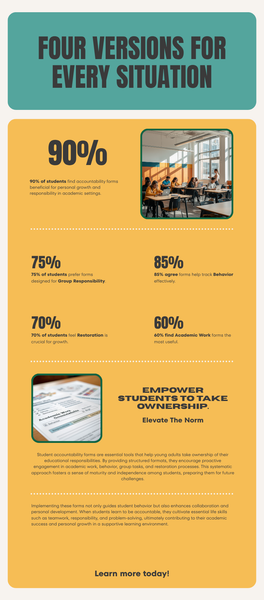
    • Four versions cover the situations teachers actually face: academic work, group responsibility, behavior, and restoration after a conflict.
    • Students complete the sheet themselves. That is the point. If the teacher is doing the writing, the tool is being used incorrectly.
    • The sheet is not a file. Unless a required school procedure calls for documentation, it lives with the student or gets recycled after the conversation.
    • Any teacher can use this the first week of school. No program, no training, and no administrator approval required.

    What Most Accountability Sheets Get Wrong

    Most accountability sheets found in schools — and most of the printables circulating on teacher resource sites — were designed for elementary students and scaled up by changing the font. They ask students to write “what I did wrong” in a box, then “how I will do better next time” in another box, and they expect that sequence to produce insight. It rarely does, because the sequence assumes the student already has a clear picture of what happened and why. They often do not.

    The other common design flaw is that the sheet exists only as a record. A teacher hands it to a student, the student fills it out, the teacher collects it and puts it in a folder. Nothing happens as a result. The student learns that accountability means paperwork, not change — which is exactly the wrong lesson.

    A well-designed student accountability sheet for grades 6–12 does three things that most forms skip. It separates facts from interpretations, so students can describe what actually happened without being led toward a particular framing. It identifies who, specifically, was affected — not just “the class” in the abstract. And it generates a next step the student can actually take, not a vague commitment to “try harder.”

    Classroom accountability sheet template on a student desk in a secondary classroom with warm lamp lighting
    An accountability sheet is a tool for a five-minute conversation, not a substitute for one.

    When to Use an Accountability Sheet

    There are four situations where a short accountability sheet is useful in a secondary classroom. Understanding the difference between them matters, because each version of the sheet asks slightly different questions.

    Academic Work

    A student missed a deadline, submitted incomplete work, or disengaged from a task. The goal of the sheet in this case is not to assign blame but to figure out what actually got in the way. Sometimes the answer is workload. Sometimes it is confusion about the assignment. Sometimes it is something happening at home. The sheet creates space to say so without the conversation becoming a confrontation.

    Group Responsibility

    A student did not hold up their part of a group project. Or a group is in conflict about who did what. The group version of the sheet is filled out individually by each member before the group meets together — which means every voice is already on paper before anyone starts defending themselves out loud. This simple sequencing change reduces the volume of these conversations significantly.

    Behavior

    Something happened in the room — a comment that landed wrong, a refusal, an outburst — that the teacher needs to address before moving on. This version is short by design, because a behavior conversation does not benefit from extended written reflection in the moment. The sheet gives the student a minute to collect their thoughts before speaking, which is often all that is needed to de-escalate the temperature.

    One important note: if the behavior requires a school referral, disciplinary report, or any documentation under your district’s required procedures — do that. The accountability sheet is a classroom tool, not a substitute for mandated process. If you are unsure whether a situation requires official documentation, assume it does and act accordingly. The sheet goes with the student afterward, not instead of the referral.

    Restoration

    Something happened between students — a conflict, an unkind comment, a damaged trust — and the class needs to move forward. The restoration version is the most conversational of the four. It is the one most closely aligned with restorative approaches, and it works best when both students complete their own version before sitting down together. For more on restorative approaches in a school context, see restorative practices in schools.

    The Templates

    Each template below is designed to be reprinted, typed into a shared document, or read aloud and answered verbally depending on the student and the situation. The fields are short. The language is direct. None of it is condescending.

    Four versions of student accountability sheet side by side showing academic work group responsibility behavior and restoration fields
    Four distinct versions of the sheet cover the situations teachers actually face in grades 6–12.

    Version 1 — Academic Work

    Student name: _______________ Date: _______________

    The assignment or task: _______________

    What was supposed to happen? (Describe the expectation — due date, format, what “complete” looked like.)

    What actually happened? (Facts only. Not reasons yet.)

    What got in the way? (This is where reasons belong. Be honest — including “I didn’t prioritize it” is a valid answer.)

    What is one thing you can do in the next 48 hours to move this forward?

    What support, if any, do you need from me?

    Version 2 — Group Responsibility

    Student name: _______________ Project or task: _______________ Date: _______________

    What was your agreed-upon role or task in this group?

    What did you actually complete?

    What did your group expect from you that you did not deliver?

    What happened from your perspective? (State facts and reasons separately.)

    What do you owe the group at this point?

    What is your next step, and when will it be done?

    Version 3 — Behavior

    Student name: _______________ Date: _______________ Period/class: _______________

    Describe what happened. (What you said or did — not what someone else did first.)

    Who was affected by it? (Name the people, not just “everyone.”)

    What do you want those people to know?

    What is one thing you will do differently?

    Note to the teacher: this version is designed for classroom-level situations. If the incident requires a disciplinary referral, complete your school’s required documentation first. This sheet is a follow-up conversation tool, not a replacement for required procedures.

    Version 4 — Restoration

    Student name: _______________ Date: _______________

    What happened between you and the other person? (Your account of it — not what they did, what happened between you.)

    What did the other person lose or experience because of the situation? (This is a perspective-taking question. Answer it honestly even if it is uncomfortable.)

    What do you want to be different going forward?

    Is there something specific you are willing to do or say to move toward that?

    What do you need from me or from the other person to make this work?

    Teacher and student sitting together at a whiteboard table reviewing an accountability sheet in a secondary classroom
    The sheet starts the conversation — it does not replace it. Five minutes at the whiteboard table is worth more than a folder full of completed forms.

    How to Use the Sheet

    The sheet is not the conversation. It is the preparation for one. A student who fills it out in silence and hands it in has not been held accountable — they have completed a writing assignment. The point of the form is that it gives the teacher and the student a shared document to look at together, which is significantly less confrontational than looking at each other across a desk.

    The sequence that works: hand the student the sheet and give them three to five minutes to complete it, without hovering. Sit down together to review it — ideally somewhere that is not the center of the room. Read it together, ask one or two follow-up questions, and agree on the next step before the student returns to work. That is the whole procedure. If it is taking longer than ten minutes, either the situation is more serious than this tool was designed for, or the conversation has turned into a lecture. Stop the lecture.

    The anchor question in every version is some variation of “what is your next step?” That is the question that determines whether the sheet produced anything useful. A vague next step (“I’ll try harder,” “I’ll be better”) is not a next step. Push for something specific and time-bound: “I’ll finish the introduction section by Thursday,” or “I’ll ask Morgan what I can do to address what happened.” Specificity is what makes accountability concrete rather than performative.

    A Classroom Anchor: Authority Handed and Held

    The accountability sheet works best when students already understand that authority in the room is real and is held to. A clearly visible classroom expectations poster does much of this work passively — it gives students a reference point before anything goes wrong, so the accountability sheet’s first question (“what was supposed to happen?”) lands with specificity rather than guesswork. In my workshop room — where students are almost always working alongside somebody, and I move between groups rather than lecture from the front — the sheet tends to come up most often around group work, and specifically around moments where a student was trusted with a role and did not follow through on it.

    When that happens, I do not announce it to the room. I slide the Version 2 sheet to the student at their table and give them four or five minutes while I circulate. Then I pull them to the whiteboard table — my small-group conferencing area with a rug, better chairs, and a lower lamp, where students know they are being seen carefully and not put on display — and we work through their answers together.

    The conversation is not about catching them in something. It is about naming what happened clearly enough that we can figure out what comes next. Students who have been given real authority over something — their section of a project, their role in a group, a decision that affects others — understand why the accounting matters. It matches the weight of the responsibility they were given. What does not match it is a form that feels like it was designed for a third-grader. The template above is written at the level the student is actually operating at. That is the difference between accountability and humiliation, and it matters.

    This approach connects directly to what student responsibility looks like in the classroom — real responsibility includes real accounting when things go wrong, not manufactured consequences or empty apologies. For the broader case for high expectations paired with the room to learn from mistakes, see high expectations for students.

    What Happens When a Student Doesn’t Follow Through

    A student completes the sheet, agrees to a next step, and then does not take it. This happens. Here is the important thing: that outcome does not mean the sheet failed. It means you now have a second conversation with more information than you had before. You know what the student said they would do. You know they did not do it. The conversation gets more specific, not more punitive.

    The escalation path in this case depends on what the situation actually requires. Some students need more support than a single conversation provides — academic, social, or something else entirely. The sheet is not a substitute for identifying that need and addressing it. If a pattern emerges across multiple sheets and conversations, that is information that may need to go to a counselor, an interventionist, or a parent. At that point the sheet is one piece of a larger picture, not the whole solution.

    For students whose accountability issues involve ongoing behavior challenges, the positive discipline framework for teenagers provides a more structured approach that pairs well with the sheet. For situations involving harm between students, the natural consequences framework and the restoration version of the sheet work together. And for the broader question of how to build a classroom where students actually want to hold themselves accountable, see the site’s overview of student responsibility as a developmental skill, not a character judgment.

    The Research Behind It

    Self-regulated learning research has consistently found that students who can reflect on their own performance — identify what went wrong, name contributing factors, and plan a corrective action — outperform students who receive only external evaluation (Zimmerman, 2002). The accountability sheet is applied self-regulated learning: it scaffolds a reflective process that students build over time.

    Self-determination theory (Deci & Ryan, 2000) adds an important dimension: students are far more likely to take a next step they chose than a consequence that was imposed on them. Every version of the sheet ends with the student naming a next step. That ownership matters for what actually happens afterward. Hattie’s (2009) meta-analysis of over 800 studies identified student self-assessment — including structured reflection on what went wrong — as one of the highest-leverage interventions available to teachers. The accountability sheet is a low-cost, no-training version of exactly that.

    Research on restorative approaches in schools (Morrison & Vaandering, 2012; Skiba & Peterson, 2000) supports the same conclusion from the discipline side: punitive responses to student misbehavior consistently underperform restorative ones on measures of recurrence, school climate, and relationship repair. A sheet that asks students to identify who was affected and what they are willing to do to repair it is grounded in that same framework, without requiring a school-wide program or a trained facilitator.

    Printables for this

    Two of mine on TPT, both built for this. Behavior Documentation Forms are the other half of the picture — the ABC data and MTSS logs you keep when a pattern does need a record, which the sheet above deliberately is not. The Makeup Work System handles the follow-through on the academic version, so “what is your next step” has a process behind it.

    Frequently Asked Questions

    Is a student accountability sheet the same as a disciplinary referral?

    No. A disciplinary referral is a formal school document that enters a student’s record, triggers review by an administrator, and may carry consequences under district policy. An accountability sheet is a classroom tool — a short form that supports a private conversation and a next step. It is not filed, not sent to the office, and not part of the student’s disciplinary record unless you deliberately attach it to a referral as supporting documentation. If a situation requires a referral, complete the referral. The accountability sheet is for situations that do not — which is the majority of what happens in a classroom on any given day.

    What if the student doesn’t fill it out honestly?

    Some students will write what they think you want to hear. That is useful information, too. If the sheet reads like a performance rather than a reflection, say so directly and ask one specific follow-up question: “When you wrote you would try harder — what does that look like for you on Monday?” Most students will either give a more honest answer or reveal that they actually do not know. Both are starting points for a real conversation. The sheet is not a truth test. It is a structure for a conversation, and the conversation is where the real work happens.

    Does this go in the student’s permanent file or record?

    No — not unless your school’s procedures specifically require it for a given type of incident. For most classroom-level situations, the sheet lives with the student or gets recycled after the conversation. If you are using it as part of a required disciplinary process, follow your school’s documentation requirements for that process. Do not create an informal file of completed accountability sheets. That is not what this tool is for, and it can create problems if the file is ever requested.

    Can parents request to see these sheets?

    Parents can request records their child’s school maintains about them under FERPA. If you are collecting and storing completed accountability sheets in any systematic way, you should treat them as education records and handle them accordingly. The simplest way to avoid this issue is to not store them: use the sheet, have the conversation, and let the student keep it or discard it. A brief note in your own records of the conversation and the agreed-upon next step is sufficient documentation for your own use.

    What should I do if the student refuses to fill it out?

    A student who refuses to engage with the sheet is telling you something about their state in that moment. Do not escalate over the sheet itself. Give them a minute, check in quietly, and decide whether this is a moment of genuine distress, a test of your authority, or something else. If it is a test, name what you see calmly: “I’m going to give you two more minutes. I’ll come back.” If it is distress, the sheet can wait. If refusal becomes a pattern, that is a separate conversation — about engagement and trust, not about a form.

    At what grade level does this work best?

    The templates above are designed for grades 6–12. The language is appropriate for middle school and can be used as-is with most high school students. Students in grades 6–8 may need more scaffolding during the conversation — they often have the self-awareness but not yet the vocabulary to name what happened clearly. The teacher’s role in those grades is slightly more coaching than questioning. High school students can generally complete the sheet more independently, though the conversation afterward is equally important at both levels.

    How do I use the group responsibility version fairly when students blame each other?

    Have each student complete their own version of the sheet before anyone talks. This is non-negotiable: if students start talking first, they immediately start building a shared story that may not reflect what each person actually experienced. Once each student has answered the questions in writing, bring them together. Start with what each person wrote about their own contribution — not the other person’s failures. The sheet’s structure forces that sequence because the questions are framed around the student’s own actions. It does not eliminate conflict, but it changes the opening move from accusation to accounting.

    Sources

    • Zimmerman, B. J. (2002). Becoming a self-regulated learner: An overview. Theory Into Practice, 41(2), 64–70. https://doi.org/10.1207/s15430421tip4102_2
    • Deci, E. L., & Ryan, R. M. (2000). The “what” and “why” of goal pursuits: Human needs and the self-determination of behavior. Psychological Inquiry, 11(4), 227–268. https://doi.org/10.1207/S15327965PLI1104_01
    • Hattie, J. (2009). Visible Learning: A Synthesis of Over 800 Meta-Analyses Relating to Achievement. Routledge.
    • Morrison, B. E., & Vaandering, D. (2012). Restorative justice: Pedagogy, praxis, and discipline. Journal of School Violence, 11(2), 138–155. https://doi.org/10.1080/15388220.2011.653322
    • Skiba, R. J., & Peterson, R. L. (2000). School discipline at a crossroads: From zero tolerance to early response. Exceptional Children, 66(3), 335–346. https://doi.org/10.1177/001440290006600303

    About Clay Shumate

    By Clay Shumate — Clay Shumate is a certified secondary Social Studies teacher in the public schools of West Alabama, with seven years of classroom experience, a B.A. in History, and an M.Ed. in Secondary Education. He writes about project-based learning, student responsibility, respect, and practical ways to hold young people to a higher standard while giving them room to learn from mistakes. He is a member of the Society of Professional Journalists and writes to its Code of Ethics; this site’s editorial standards and corrections policy are published in full. More about Clay.

  • Motivating Students Who Don’t Care Without Lowering the Standard

    Motivating Students Who Don’t Care Without Lowering the Standard

    By Clay Shumate

    Motivating students who don’t care starts with questioning the assumption. Most students labeled “unmotivated” are not indifferent — they are protecting themselves from failure, irrelevance, or a classroom that has already told them they do not belong. The fix is not enthusiasm or entertainment. It is competence, relevance, relationship, and a standard worth rising to.

    What “Not Caring” Actually Means

    A student who puts their head down, turns in nothing, shrugs when you ask a question, or disrupts every transition looks like someone who does not care. That is what makes this problem so frustrating — the visible behavior and the internal reality rarely match.

    Research on learned helplessness, first described by Martin Seligman and now studied specifically in adolescent populations, shows that students who repeatedly experience failure without a clear path to improvement eventually stop trying — not because they lack desire, but because effort has not produced results before and they see no reason to believe it will now. A 2026 longitudinal study by Chang and colleagues, published in the Journal of Research on Adolescence, tracked this trajectory in adolescent students and found that learned helplessness increases over time when students experience controlling rather than autonomy-supportive environments.

    Carol Goodenow’s foundational 1993 research on school belonging found a direct link between students’ sense of belonging in a classroom and their academic motivation. Urban adolescents who felt they did not belong reported lower motivation and engagement strategies even when they had the ability to succeed. The research is clear: belonging is not a soft skill. It is a precondition for effort.

    So when a student looks like they do not care, start with three questions before you decide what to do:

    1. Has this student experienced enough success in your class to believe more is possible?
    2. Does this student see a connection between what you are asking them to do and anything that matters to them?
    3. Does this student believe that you — specifically you — will follow through on what you say?

    If the answer to any of those is no, you have found your starting point. And it is not a motivational speech.

    Why the Usual Fixes Make It Worse

    Rewards Lose Power

    External rewards work in the short term. A pizza party will get homework turned in for a week. But decades of research on self-determination theory, led by Edward Deci and Richard Ryan, demonstrates that extrinsic motivation follows a predictable pattern: the reward must escalate to maintain the same effect, and when it disappears, motivation drops below where it started.

    Deci and Ryan identified four types of extrinsic motivation along a continuum from fully external (doing something to avoid punishment or earn a reward) to integrated (doing something because it aligns with who you are). Most classroom reward systems never move students past the first stage. They produce compliance, not motivation. And compliance disappears the moment the reward does.

    Why rewards punishment and lowered standards backfire for disengaged students showing three columns of failed strategies
    Three common approaches to student disengagement that make the problem worse

    Punishment Backfires

    Punishing a student for not caring — zeroes, detention, calls home, public redirection — assumes the student has chosen not to engage and can be pressured into changing that choice. For a student dealing with learned helplessness, fear of failure, or a home life that makes school feel irrelevant, punishment adds another failure to the pile. John Hattie’s meta-analyses of educational research show that teacher-student relationships carry an effect size of 0.52 on student achievement — a correlation rather than a proven cause, which is how these numbers are best read. Punishment does not build relationships. It erodes them.

    Lowered Standards Confirm the Problem

    This is the trap that well-meaning teachers fall into most often. A student is struggling, so you shorten the assignment, remove the hard parts, or accept work you know is not their best. You do this out of compassion. But the student reads it differently: you do not think I can do it either.

    Hattie’s research on self-efficacy — a student’s belief in their own ability to succeed — shows an effect size of 0.92, one of the highest in the entire database. Lowering the standard does not raise self-efficacy. It destroys it. The student needed a scaffold, not a shortcut.

    What Actually Works: Competence, Relevance, and Relationship

    Eccles and Wigfield’s expectancy-value theory provides a useful framework here. Students are motivated when two conditions are met: they expect they can succeed at the task, and they value the outcome. Remove either one and effort disappears. A student who thinks they can do the work but sees no point will not try. A student who sees the point but believes they will fail will not try either.

    This means motivation is not one fix. It is at least two — and usually three.

    Three conditions for student motivation based on expectancy value theory showing competence relevance and relationship
    Three conditions for student motivation based on Eccles and Wigfield’s expectancy-value theory

    Competence: They Need to Believe They Can

    This comes first because nothing else matters without it. A student who has failed repeatedly in your subject has built a story about themselves: I am not good at this. You cannot talk them out of that story. You have to give them evidence that it is wrong.

    That means:

    • Assign work they can complete successfully today, then raise the bar tomorrow. Not easier work — appropriately scaffolded work. The task stays rigorous. The entry point becomes accessible.
    • Give feedback that points forward, not backward. “This paragraph needs a stronger claim — here is what a strong one sounds like” beats “This is incomplete” every time. Hattie’s data shows feedback carries an effect size of 0.70 when it is specific, timely, and actionable.
    • Let them revise. A student who turns in weak work and gets a permanent grade has no reason to improve. A student who turns in weak work and gets a chance to make it better has a reason to try.

    Relevance: They Need a Reason

    “When will I ever use this?” is not a complaint. It is a genuine question, and if you cannot answer it, the student is right to ask.

    Relevance does not mean every lesson needs a TikTok hook. It means the work connects to something real — a question worth answering, a problem worth solving, a product someone will actually see.

    During project check-ins in my room, I pull students to the whiteboard table one group at a time. They have to show me what they have and explain why they made the choices they made. I am not grading their progress. I am asking them to defend it. And what I have noticed is that the students who checked out during a textbook reading will fight for a project they chose. Not because the project is fun — sometimes it is not — but because it is theirs. They picked the question. They have to stand behind the answer. That ownership changes the math on whether effort is worth it.

    Relationship: They Need an Adult Who Follows Through

    Teacher credibility — whether a student believes you are competent, trustworthy, and caring — carries an effect size of 0.90 in Hattie’s research. That is not a small number. It means a student’s perception of you as a teacher matters almost as much as anything you actually teach.

    But relationship does not mean being liked. It means being consistent. If you say you will look at their work, look at it. If you say there is a consequence, follow through. If you say you believe they can do it, prove it by holding them to the standard instead of quietly lowering it.

    Niemiec and Ryan’s 2009 review of self-determination theory in education found that students assigned to autonomy-supportive teachers — teachers who explained the purpose behind assignments, offered genuine choices, and acknowledged students’ perspectives — showed increased intrinsic motivation, perceived competence, and self-esteem compared to students with controlling teachers. Autonomy support is not a personality trait. It is a set of behaviors. And it can be learned.

    Five Practical Moves for Your Classroom

    Five practical classroom moves for motivating disengaged students including task design feedback and timeline flexibility
    Five practical moves teachers can use to re-engage students who appear not to care

    1. Start with the Task, Not the Motivation

    Stop trying to motivate students before the work begins. Instead, design work that creates its own motivation. A project with a real audience and a real deadline does not need a pep talk. A worksheet that will be graded and returned does.

    2. Pull Them In — Do Not Push Them Forward

    When a student is disengaged, the instinct is to push: more reminders, louder redirections, calls home. Try pulling instead. Sit next to them. Ask what they are working on. Ask what part is confusing. Ask what they would change about the assignment if they could. You are not lowering the bar. You are opening the door.

    3. Change the Feedback Loop

    If the only feedback a disengaged student receives is a grade, they have no reason to change their behavior. Move feedback earlier in the process and make it specific:

    • “Your first two sentences set up a strong argument. The third one contradicts it — read it again and see if you catch why.”
    • “You have the right data. Your conclusion does not match it yet. Try again.”
    • “This is better than last week. Here is what will make it better than this.”

    4. Give Them a Role They Cannot Disappear From

    In group work, a disengaged student will drift to the margins unless the structure prevents it. Assign specific roles with visible accountability: the person who presents, the person who defends the data, the person who fields questions. When the work has their name on it, invisibility stops being an option.

    5. Separate the Standard from the Timeline

    Some students disengage because they have missed so much that catching up feels impossible. Let them redo work. Let them turn things in late with a conversation about what happened. Hold the quality standard. Flex the timeline. This is not lowering expectations. It is acknowledging that learning does not always follow a schedule.

    A note on this: your school likely has a grading policy, and you need to work within it. If your district has a strict late-work penalty, talk to your administrator about exceptions for specific students before you promise flexibility you cannot deliver. The principle — standard stays, timeline flexes — is sound. How much flex you have depends on your building. Do not make promises your gradebook cannot keep.

    What You Cannot Control — And Why That Matters

    Not every disengaged student is responding to something in your classroom. Poverty, trauma, food insecurity, unstable housing, family conflict, undiagnosed learning differences — these are real, and they affect motivation in ways a well-designed project cannot fix.

    You are not a therapist. You are not a social worker. You are a teacher. Your job is to make your classroom the kind of place where effort makes sense — where the standard is high, the support is real, and the relationship is honest. For some students, that will be enough. For others, it will be one piece of a much larger puzzle that involves counselors, families, community resources, and time.

    Do not blame yourself when a student does not respond. But do not stop trying either. Some turns take weeks. Some take months. Some happen long after they leave your room, and you never hear about it.

    Before You Assume Poverty Means Disengagement

    One more thing. I have worked in high-poverty schools my entire career, and I need to say this plainly: your students’ zip code does not predict their motivation. Research by Bloem and colleagues, published in Social Psychology of Education in 2024, found that teachers in lower-SES schools gave students less autonomy support and more controlling behavior — and that the gap widened among teachers who held biased attitudes toward low-income families. The problem was not the students. It was what the adults assumed about them.

    Students in a Title I school want recognition. They want to be trusted with responsibility. They want to communicate with each other and work on something that matters. The need is universal. The assumption that poor kids need control instead of relationship is not supported by the evidence, and it does real damage.

    Conclusion

    Motivating students who don’t care is not about finding the right trick. It is about diagnosing what killed the motivation in the first place — usually some combination of repeated failure, irrelevant work, and adults who did not follow through — and then rebuilding the conditions that make effort feel worth it. That means scaffolded competence, genuine relevance, honest relationships, and a standard that stays high even when the path to meeting it changes.

    Start with the student in front of you. Find out what they can do today. Show them what they could do tomorrow. And then hold them to it.


    How do I motivate a student who literally will not do any work?

    Start smaller than you think you need to. Find one task they will engage with — even a short one — and build from there. A student who completes one thing successfully is closer to completing two than a student who has completed nothing for weeks. Sit with them. Ask what the barrier is. Sometimes the answer is ‘I do not understand the directions.’ Sometimes it is bigger than that, and you need to loop in a counselor or support team.

    Is it okay to give students a choice in what they work on?

    Yes, and research supports it. Deci and Ryan’s self-determination theory shows that genuine choice — not the illusion of choice between two identical tasks — increases intrinsic motivation. The key word is genuine. Letting students choose their topic within a framework is meaningful. Letting them choose between worksheet A and worksheet B is not.

    Should I call home when a student is disengaged?

    It depends on the relationship and the home situation. For some students, a positive call home — ‘I noticed your child contributed a strong idea today’ — builds a bridge. For others, any call home triggers consequences that make school feel less safe, not more. Know your students before you pick up the phone, and lead with something they did well whenever possible.

    What about students with IEPs or 504 plans who seem disengaged?

    Some disengagement is disability-related, and the strategies here still apply — but with an additional layer. If a student has an IEP or 504, their accommodation plan may already address some of the barriers described in this article. Work with your special education team to make sure your scaffolding, timeline flexibility, and feedback approaches align with the plan rather than duplicating or contradicting it. Disengagement in a student with a learning difference may look identical to disengagement from a student without one, but the causes and appropriate responses can differ. When in doubt, consult the team before changing your approach.

    What if the student is dealing with issues outside school that I cannot fix?

    You cannot fix them, and you should not try to. But you can make your classroom a place where those issues do not get worse. Consistent routines, clear expectations, honest follow-through, and a teacher who does not give up — those things matter even when you cannot see the result immediately. Refer to counselors and support staff when you notice patterns that are beyond your scope.

    Does project-based learning help with disengaged students?

    It can, because PBL creates the conditions research shows drive motivation — autonomy, relevance, public accountability, and visible competence. But PBL alone is not a magic fix. A disengaged student placed in a group project without scaffolding and clear roles will simply disengage from the project instead of the worksheet. The structure matters as much as the format.

    How do I keep my standards high without pushing disengaged students further away?

    Separate the standard from the timeline and the entry point. The quality of work you expect stays the same. The amount of support you provide, the deadline flexibility you offer, and the way you scaffold the first attempt can all change. A student who turns in a rough draft and revises it three times has met the same standard as the student who nailed it the first time — they just took a different path to get there.

    Is student disengagement getting worse?

    National survey data suggests engagement has declined, particularly after 2020. But disengagement is not new — Goodenow was studying it in 1993, and Seligman described learned helplessness decades before that. What has changed is the visibility. Students who once sat quietly and did the minimum now have phones, social media, and more exit ramps. The underlying needs — competence, belonging, relevance — have not changed at all.


    Sources

    1. Deci, E. L., & Ryan, R. M. (2000). “Intrinsic and Extrinsic Motivations: Classic Definitions and New Directions.” Contemporary Educational Psychology, 25(1), 54–67.
    2. Niemiec, C. P., & Ryan, R. M. (2009). “Autonomy, Competence, and Relatedness in the Classroom: Applying Self-Determination Theory to Educational Practice.” Theory and Research in Education, 7(2), 133–144.
    3. Goodenow, C. (1993). “The Psychological Sense of School Membership Among Adolescents: Scale Development and Educational Correlates.” Psychology in the Schools, 30(1), 79–90.
    4. Hattie, J. (2023). Visible Learning: The Sequel. Routledge.
    5. Chang, Y., et al. (2026). “The Longitudinal Trajectory of Learned Helplessness Among Adolescent Students: The Role of Parental Autonomy Support and Control.” Journal of Research on Adolescence.
    6. Bloem, N., et al. (2024). “Teachers’ Autonomy Support and Control Toward Lower- and Higher-SES Students.” Social Psychology of Education.
    7. Eccles, J. S., & Wigfield, A. (2002). “Motivational Beliefs, Values, and Goals.” Annual Review of Psychology, 53, 109–132.

    About Clay Shumate

    Clay Shumate is a certified secondary Social Studies teacher in the public schools of West Alabama, with seven years of classroom experience, a B.A. in History, and an M.Ed. in Secondary Education. He writes about project-based learning, student responsibility, respect, and practical ways to hold young people to a higher standard while giving them room to learn from mistakes. He is a member of the Society of Professional Journalists and writes to its Code of Ethics; this site’s editorial standards and corrections policy are published in full. More about Clay.

Teacher Emergency Toolkit — practical resources, real classroom support. Shop on TPT.Teacher Emergency Toolkit — practical resources, real classroom support. Shop on TPT.