Author: Clay Shumate

  • Why Standards-Based Grading Doesn’t Work: The Objections, Taken Seriously

    Why Standards-Based Grading Doesn’t Work: The Objections, Taken Seriously

    Standards-based grading fails in practice more often than its advocates admit, and almost never for the reason its critics give. The objection is rarely that measuring proficiency against standards is a bad idea. It is that schools adopt a system requiring absolute consistency, deliver it inconsistently, and then discover that students, teachers and families all noticed.

    This article takes the objections seriously rather than dismissing them as resistance to change. Several of them are correct.

    If you want the case for it and what the evidence shows, that is a separate piece: what standards-based grading is and what the research supports. This one is the other half.

    Key Takeaways

    • Teachers are not marginally opposed to some of this. In a survey of nearly 1,000, 81 percent called no-zero policies harmful.
    • Students object on specific, checkable grounds — inconsistency between teachers above all, not a general dislike of change.
    • Reassessment can be socially costly. Some students said it made them appear stupid, which no policy document accounts for.
    • Piecemeal adoption is the norm and the problem. These practices were designed as a connected system; almost nobody implements them that way.
    • The most common failure is sequencing. Changing the report card before agreeing the standards produces a form nobody can complete consistently.
    • None of this makes it a bad idea. Most of it makes it a bad idea right now, in a specific building, under specific conditions.

    Free Download · 2-page PDF

    Standards-Based Grading Readiness Check

    The five “not yet” conditions as a department checklist, plus the one-hour moderation test, a reassessment rule builder and a transcript answer planner.

    Download the free PDF

    Free. No email address required. Designed for grades 6–12. Browse every printable in Your Free Library.

    What Teachers Actually Say

    The Thomas B. Fordham Institute, working with RAND, surveyed nearly a thousand K–12 teachers about grading policies commonly bundled with standards-based and equitable grading reform. The results are not close.

    Bar chart showing the percentage of teachers rating no-zero policies, no late penalties and unlimited retakes as harmful
    81 percent called no-zero policies harmful. That is not a fringe objection.

    Eighty-one percent rated no-zero policies as harmful, with the consensus holding across demographic groups. Fifty-six percent said the same about removing late penalties. Unlimited retakes were the most accepted of the five policies studied, and even there the split was 41 percent helpful against 37 percent harmful.

    A leader looking at those numbers has two options. Conclude that most of the profession is wrong, or take seriously that the people delivering the policy think it damages engagement.

    There is a detail in that survey which matters more than the headline. Only 6 percent of teachers worked in districts using four or more of these policies, and just 2 percent had all five. Researchers flagged that piecemeal adoption as a concern, because the practices were designed as an interconnected system rather than standalone interventions.

    Which means a large share of the teachers rating these policies harmful were rating them as they experienced them — one piece, bolted onto a system built on different assumptions. A no-zero policy inside a traditional points gradebook really is incoherent. That is not a misunderstanding on the teacher’s part. It is an accurate reading of a half-finished reform.

    Writing for Fordham, Meredith Coffey makes a related argument: doing this well depends on school-level adaptation rather than district mandate, on standards rigorous enough that “meeting expectations” means something, and on students having genuine opportunities to demonstrate competency. Her named failure modes are a low bar, a top-down mandate without buy-in, and large schools with high teacher turnover.

    What Students Say — and Why They Are Mostly Right

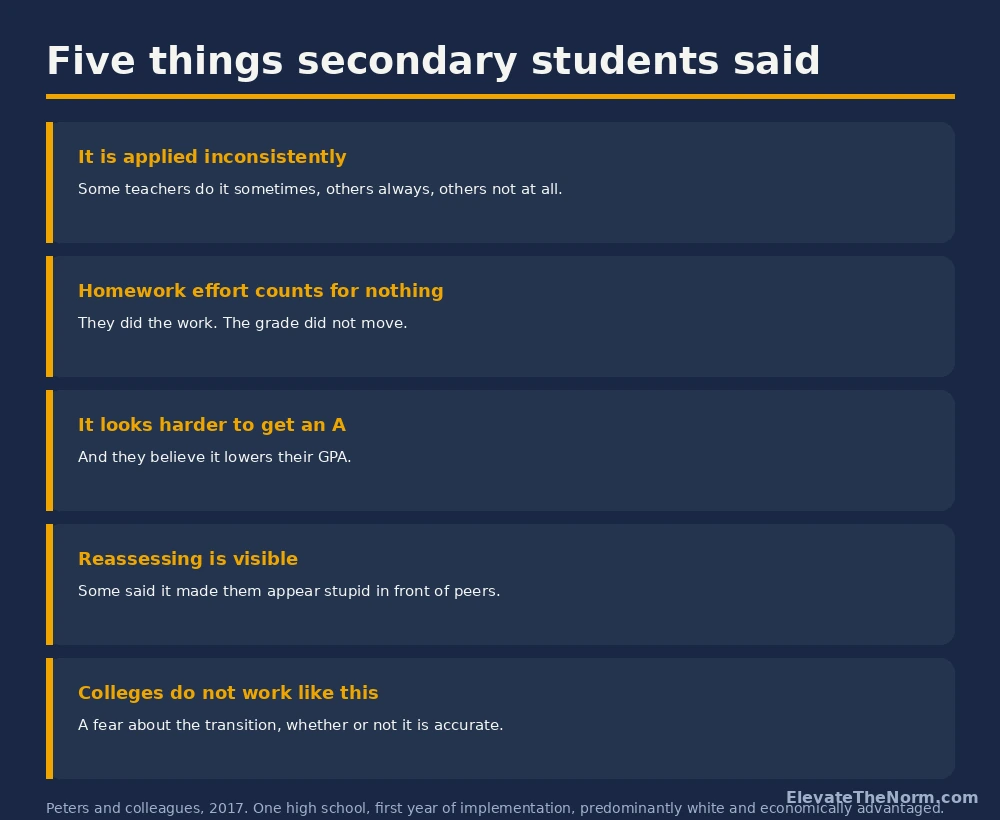
    The most useful study here is secondary-specific, which is rare in this field. Peters, Kruse, Buckmiller and Townsley analysed over 500 critical statements from students at one high school during its first year of standards-based grading, published in American Secondary Education.
    Five objections secondary students raised about standards-based grading, including inconsistency, homework not counting and reassessment stigma
    Students were not confused. They were describing a first-year rollout accurately.

    Inconsistency came first. As one student put it, “some teachers do it sometimes, others all the time, and some don’t do it at all.” Reassessment timelines, eligibility and limits all varied by classroom.

    Read that as a finding rather than a complaint. A student is describing, accurately, a system that promises objectivity and delivers a different rule in every room. Their conclusion — that it is unfair — is a reasonable inference from the evidence available to them.

    Homework counting for nothing came second. Students had done the work and watched the grade not move. The theory is sound: effort is a work habit, not evidence of proficiency. But if that has not been explained repeatedly, what a fifteen-year-old experiences is the school announcing that their effort was pointless.

    Reassessment carried social cost. Some students said it made them “appear stupid.” This one rarely appears in implementation plans at all, and it is the one I find most persuasive, because no amount of policy design removes it. If reassessing is visible, it is a public statement about who did not get it the first time.

    Motivation shifted early. Students reported studying less at first, reasoning they could just reassess later. That is rational behaviour in response to the incentives as they understood them.

    The limitations, which the authors state: one high school of about 500 students, predominantly white and economically advantaged, during a first year of implementation when inconsistency would be at its peak, with the analysis deliberately focused on critical comments in order to understand resistance. Three of the four authors were university professors who use standards-based grading themselves. So this is not a representative picture of how students feel everywhere — it is a detailed picture of what goes wrong in year one.

    The Reassessment Problem, and What I Do About It

    When I need to redirect a student, I do it quietly, at close range, rather than announcing it to the room. It takes the same number of seconds and it costs the student nothing in front of thirty people.

    The reassessment stigma finding is the same problem wearing different clothes. A student who has to publicly identify as someone who did not meet the standard has been handed a cost the policy never intended and never accounted for.

    Most of the fix is logistical rather than philosophical. Reassessment that happens quietly, at a normal time, in a way that does not mark anyone out — scheduled during work everyone is doing, arranged in a two-word conversation at the table rather than announced, with more than one student doing it at once wherever possible. None of that changes the grading system. All of it changes whether a fifteen-year-old will use it.

    A reassessment policy nobody will be seen using is not a reassessment policy. It is a line in a handbook.

    The Objections That Do Not Hold Up

    Not every criticism survives contact with the detail, and it is worth separating those out rather than treating all resistance as equally well founded.

    • “It lowers standards.” It can, if “meeting expectations” is set at a trivial bar — Coffey names exactly that as a failure mode. But that is a decision about rigour, not a property of the system. A traditional gradebook with generous partial credit lowers standards just as effectively and less visibly.
    • “Students will game the retakes.” Some will, early on, and the student data confirms it. It is also the objection most easily fixed by a written rule about what a student must do to earn a reassessment. “Unlimited” is not a policy.
    • “It does not prepare them for the real world.” Most work outside school involves revision, feedback and redoing things until they are right. The single-attempt model is the unusual one.
    • “Colleges do not use it.” Students raised this and it is a genuine anxiety, but it is a transcript-conversion question rather than an argument about grading. It has an answer; schools just have to give it before the first report card rather than after.

    The pattern across all four: each is a real risk that a school can design against, and each becomes a genuine failure when nobody does.

    When Standards-Based Grading Is the Wrong Move Right Now

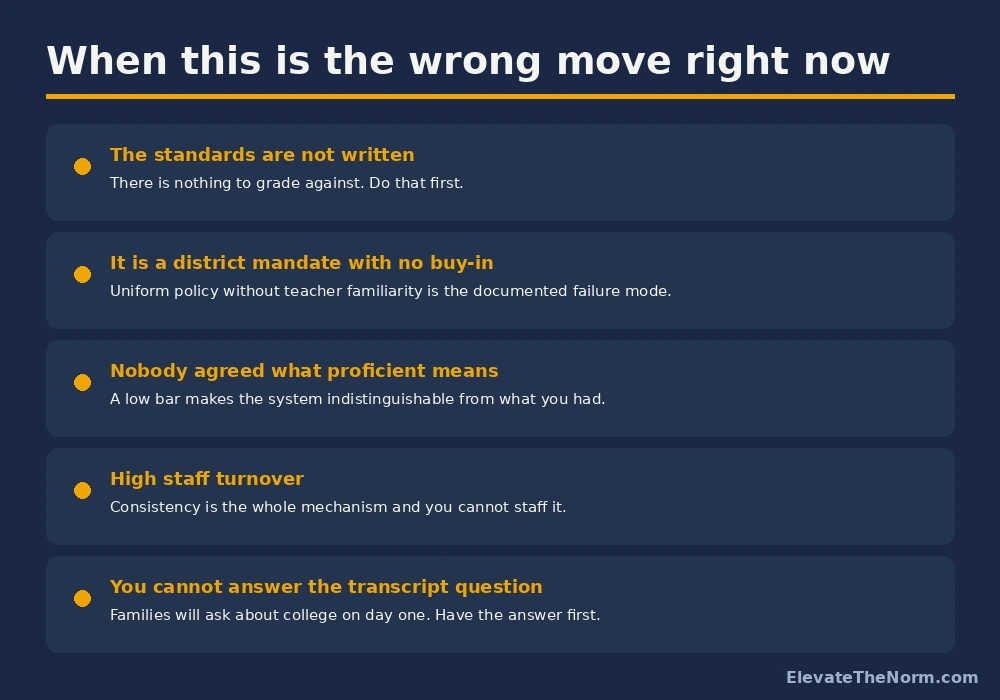
    Five conditions under which the honest recommendation is “not yet.”
    Five conditions under which a school should not adopt standards-based grading yet, including unwritten standards and district mandates without buy-in
    None of these are arguments against the idea. They are arguments about timing.

    The first is the one that sinks most rollouts. If the standards themselves are not written in language a student could read, there is nothing to grade against, and every teacher will invent their own — which produces precisely the inconsistency students identified as the core injustice.

    The second is structural and largely outside a teacher’s control. A district mandate with no buy-in is the documented failure mode, and Coffey’s argument is that school-level adaptation is what makes this work. A staff told to implement something they do not understand will implement five different versions of it.

    And the last one is the cheapest to fix and the most often skipped. Families will ask about transcripts and college on day one. Not having an answer does not make the question go away; it just means the first person to answer it will be someone on a parents’ group who has guessed.

    What to Do Next

    If your school is considering this, the most useful meeting you can have is not about the report card. It is about whether every teacher in a department would give the same proficiency level to the same piece of work. Test it — take one student’s work, have four teachers score it independently, and compare.

    If the answers diverge, you have found the actual problem, and it is the same problem whether you are grading by standards or by percentages. Standards-based grading did not cause it. It just makes it visible to students, who will then tell you it is unfair, and they will be right.

    Fix the agreement first. The free proficiency-level rubrics are a reasonable place to start that conversation, no email required.

    The conversion objection deserves its own answer rather than a footnote. Turning proficiency levels back into a percentage is the point where most of these arguments actually stall.

    Before you go: grab the free Standards-Based Grading Readiness Check (PDF) — ElevateTheNorm.com branded, printable, no email required.

    Frequently Asked Questions

    Do most teachers dislike standards-based grading?

    They dislike specific policies bundled with it, sometimes overwhelmingly. In a Fordham and RAND survey of nearly 1,000 teachers, 81 percent called no-zero policies harmful and 56 percent said the same about removing late penalties. Unlimited retakes split roughly evenly. What that survey does not show is teachers rejecting the underlying idea of grading against standards — it shows them rejecting individual practices, frequently as they experienced them bolted onto a traditional gradebook.

    What is the strongest argument against standards-based grading?

    Inconsistency, and it comes from students rather than from critics. When secondary students were asked what was wrong with it, their first and loudest answer was that different teachers applied it differently — different reassessment rules, different timelines, different eligibility. A system that promises a more accurate grade and delivers a different rule in every classroom has undermined its own central claim, and students notice that immediately.

    Do students really dislike it?

    In the one detailed secondary study available, yes — during the first year, in one school. They objected to inconsistency, to homework effort not counting, to a perception that As were harder to get, to the social cost of reassessing, and to a fear about college. The authors are clear about limits: one high school of around 500 students, predominantly white and economically advantaged, analysed specifically to understand resistance. It is a good picture of year-one problems, not a verdict on the model.

    Does it lower standards?

    It can, and that is a decision rather than a property of the system. If “meeting expectations” is set at a trivial bar, the grades mean no more than the ones you had before. The rigour of the standard is the thing to argue about — and it is worth noticing that a traditional gradebook with generous partial credit and extra-credit points lowers standards just as effectively, only less visibly.

    Will students stop trying if they can always retake?

    Some will at first. Students in the research said exactly that — they studied less initially because they believed they could reassess later. The fix is not abandoning reassessment but writing down what a student has to do to earn one. “Unlimited retakes” is the absence of a policy, and the schools that struggle most with this are the ones that never specified.

    Why do so many districts reverse course on it?

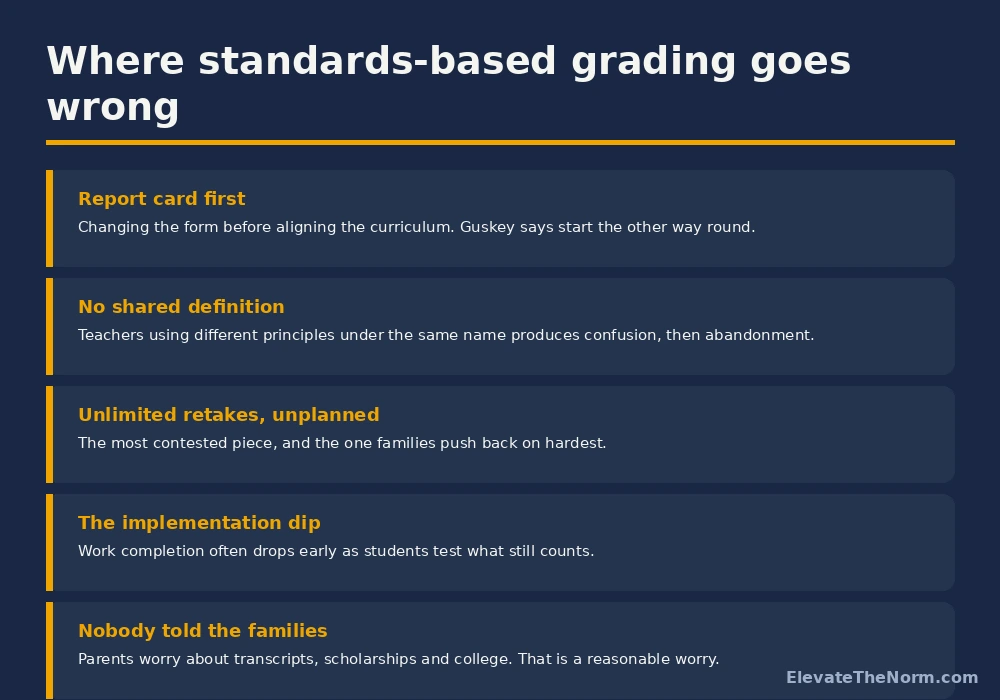
    Usually sequencing and mandate. Changing the report card before the staff has agreed what the standards are produces a form nobody can complete consistently, and a district-wide requirement without school-level buy-in produces as many versions of the system as there are teachers. Add a first-year dip in work completion, which is well documented and widely unexpected, and a leadership team reads month three as proof of failure.

    So should a school do it or not?

    It depends almost entirely on whether the groundwork exists. If your standards are written in student-readable language, your department can score the same work the same way, your reassessment rule is specific, and you can answer the transcript question — it is a better system for telling the truth about what students can do. If any of those are missing, fix that first. Most failures documented in this article are failures of preparation, not of the idea.

    Sources

    • Peters, R., Kruse, J., Buckmiller, T., & Townsley, M. (2017). “It’s just not fair!” Making sense of secondary students’ resistance to a standards-based grading. American Secondary Education, 45(3), 9–28. Full text (PDF) — one high school, first year of implementation, predominantly white and economically advantaged; analysis focused deliberately on critical statements.
    • Geduld, A. (2025, September 17). A thousand teachers were asked about “equitable” grading. Most didn’t like it. The 74. Read the article — reporting on a Thomas B. Fordham Institute survey conducted with RAND. The survey itself was not read directly; this article is the source for the figures quoted above.
    • Coffey, M. (2025, October 2). Standards-based grading can benefit students — in the right context. Thomas B. Fordham Institute. Read the commentary — the source for the conditions for success and the named failure modes.
    • Marsh, V. L. (2023, November). Standards-based grading: History, practices, benefits, and challenges. Center for Urban Education Success, University of Rochester. Read the brief (PDF) — context on the implementation dip and stakeholder resistance.

    Every link above was checked on September 12, 2026. Two of these sources are advocacy or commentary rather than primary research, and the text says which is which.

    About Clay Shumate

    By Clay Shumate — Clay Shumate is a certified secondary Social Studies teacher in the public schools of West Alabama, with seven years of classroom experience, a B.A. in History, and an M.Ed. in Secondary Education. He writes about project-based learning, student responsibility, respect, and practical ways to hold young people to a higher standard while giving them room to learn from mistakes. He is a member of the Society of Professional Journalists and writes to its Code of Ethics; this site’s editorial standards and corrections policy are published in full.

  • From Books to Screens: How to Make Digital Reading Work for Every Student

    From Books to Screens: How to Make Digital Reading Work for Every Student

    Most secondary classrooms now do the majority of their reading on a screen. The article is a link, the novel is a PDF, the primary source is a scan, and the class set of paperbacks is three years out of date and eleven copies short. That shift happened for practical reasons, not instructional ones, and it happened faster than anyone built a plan for it.

    The research on screen reading is genuinely unflattering in places. It is also narrower than the headlines suggest, and the conditions where the gap shows up are conditions a teacher can change. That is the useful part.

    What follows is what the evidence supports, what a Lexile measure does and does not tell you, how to run one text at three levels without writing three lessons, and which of the free platforms are actually free.

    Key Takeaways

    • The print advantage is real but small and conditional. The largest meta-analysis found an effect of roughly g = −0.21 favoring paper — and no advantage at all for narrative text.
    • Time pressure is where the gap opens. Under a clock the paper advantage roughly triples compared with self-paced reading.
    • Students overestimate how much they understood on screen. That miscalibration is the finding with the clearest classroom fix.
    • Lexile bands describe texts, not students. They overlap on purpose, and they say nothing about background knowledge, motivation, or content maturity.
    • Three pathways, one question. Differentiating the text is not the same as differentiating the thinking.
    • "Free" varies. ReadWorks and Project Gutenberg are free outright. CommonLit has a real free tier. Newsela’s free account is a rotating sample, not the library.

    Free Download · 2-page PDF

    Digital Reading Setup Planner

    The 20-minute routine with space to write your own version, a five-question check for the text before you assign it, a three-pathway planner, and a blank comprehension tracker.

    Download the free PDF

    Free. No email address required. Designed for grades 6–12. Browse every printable in Your Free Library.

    What Actually Changed When the Books Went Away

    Three things changed at once, and they are worth separating because only one of them is about screens.

    The text became infinitely available. A teacher can now put a 1914 telegram, a modern historian’s argument, and a plain-language summary of the same event in front of thirty students in about four minutes. That is a genuine gain and it is the reason nobody is going back.

    The text lost its edges. A paperback tells you how far in you are by feel. A scroll bar tells you almost nothing, and an article with three embedded videos and a comment section tells you less than that. Physical location in a text turns out to be part of how people remember it.

    The reading moved onto a device built for skimming. This is the part that matters most, and it is also the part a classroom can control. The device is not the problem so much as the habit the device was trained into.

    What the Research Says About Print and Digital Comprehension

    The most cited study here is Delgado and colleagues’ 2018 meta-analysis in Educational Research Review, published under the blunt title "Don’t throw away your printed books." It pooled 54 studies and more than 171,000 participants, and it found a small advantage for paper: Hedges’ g of about −0.21.

    Read the moderators and the picture gets more useful than the title suggests:

    • Time pressure. Under a time limit the paper advantage was about g = −0.26. When readers set their own pace it fell to roughly −0.09.
    • Text type. The advantage appeared for informational text (about −0.27) and mixed text (−0.30). For narrative text alone it was essentially zero.
    • Not the device. The type of digital device did not explain the difference, and neither did educational level.
    • The gap grew over time. Effect sizes favoring paper increased across the publication years studied, which is the opposite of what "digital natives will adapt" predicted.

    Clinton’s 2019 systematic review in the Journal of Research in Reading reached the same direction across 33 studies and added the finding that is most actionable in a classroom: across eleven studies of metacognition, readers were more overconfident after reading from screens. They thought they had understood more than they had.

    Be careful what you do with this. It is not evidence that technology harms achievement, and it is not a case for banning devices. It is evidence that a particular combination — dense informational text, a clock, and a screen — produces worse comprehension and more confidence in it than the reader has earned. Every one of those three is under a teacher’s control.

    What a Lexile Measure Is — and What It Does Not Tell You

    A Lexile measure is a number produced by an algorithm that looks at two things: sentence length and word frequency. Longer sentences and rarer words produce a higher number. That is the whole mechanism.

    It is genuinely useful for the thing it does. It is a fast, consistent way to sort a pile of texts by surface difficulty, which is a real problem when you are choosing among forty search results at 9 p.m.

    Here is what it cannot see:

    • Background knowledge. A 900L article about the Dust Bowl is harder for a student who has never heard of it than an 1100L article about a sport they play.
    • Conceptual difficulty. Short sentences and common words can carry a genuinely hard idea. Some philosophy scores low and reads hard.
    • Content maturity. Lexile has nothing to say about whether a text is appropriate for a fourteen-year-old. Of Mice and Men scores around 630L.
    • Structure and layout. Headings, images, and paragraph length change how readable a text is and are not part of the measure.
    • Accessibility. Contrast, font, line length, and whether the text works with a screen reader do not register at all.

    The most important distinction, and the one most often collapsed: a Lexile text measure and a Lexile reader measure are two different numbers. A student is not "a 1000L reader" in any fixed sense, and a grade band is not a requirement anyone has to hit.

    The Lexile Text-Complexity Bands by Grade

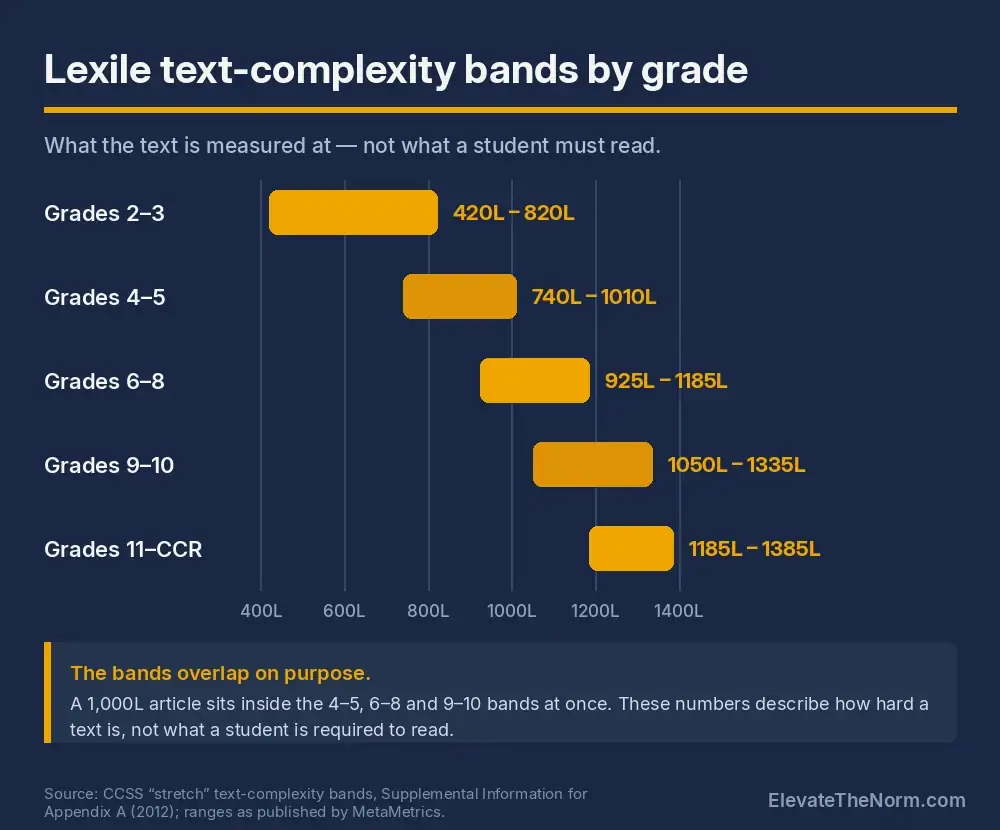
    Chart of Lexile text-complexity bands by grade: 420L-820L for grades 2-3, 740L-1010L for grades 4-5, 925L-1185L for grades 6-8, 1050L-1335L for grades 9-10, and 1185L-1385L for grades 11-CCR
    The bands overlap by design. They describe text difficulty, not student ability.

    The bands below are the ones most state documents and platform filters use. They are the "stretch" text-complexity bands published in the 2012 Supplemental Information for Appendix A of the Common Core State Standards, which revised the original 2010 ranges upward to close the gap between high school text and college and career text. The figures match those published by MetaMetrics, the organization that develops the Lexile Framework.

    Grade bandLexile text range
    Grades 2–3420L – 820L
    Grades 4–5740L – 1010L
    Grades 6–8925L – 1185L
    Grades 9–101050L – 1335L
    Grades 11–CCR1185L – 1385L
    CCSS "stretch" text-complexity bands, Supplemental Information for Appendix A (2012).

    Notice the overlap. A 1,000L article sits inside the 4–5, 6–8, and 9–10 bands simultaneously. That is not sloppiness; it is an admission that a single number cannot place a text in one grade. Treat the bands as a sorting aid and nothing more.

    Differentiating Without Writing Three Lessons

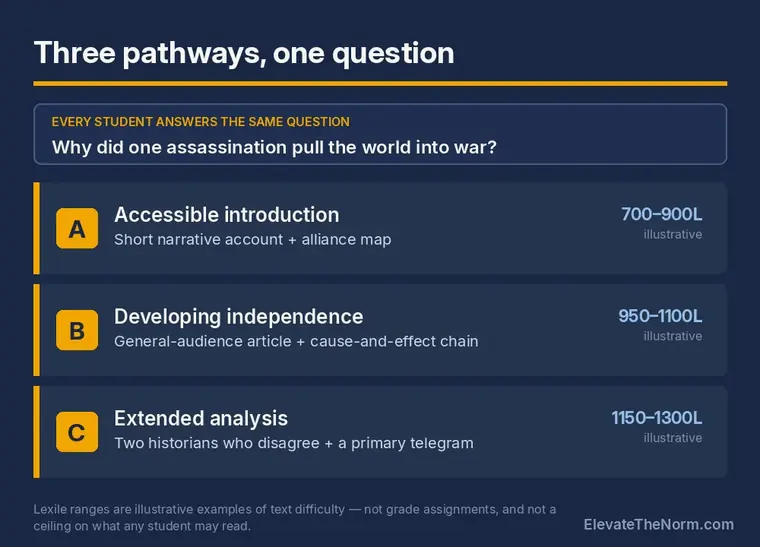
    Three reading pathways into one World War I question: an accessible narrative account, a general-audience article, and two historians who disagree, each with an illustrative Lexile range
    Same question for everyone. Three ways in.

    The mistake most differentiation makes is differentiating the thinking along with the text. The student on the easier reading gets the easier question, and by March everyone knows which group they are in and what it means.

    The alternative is to hold the question fixed and vary the road to it. Take a World War I unit and the question Why did the assassination of one archduke pull the world into war?

    • Pathway A — a short narrative account of June 1914 with a labeled alliance map. Students mark who was bound to defend whom, then answer the question in four sentences using two pieces of evidence.
    • Pathway B — a general-audience history article covering alliances, mobilization timetables, and imperial rivalry. Students build a cause-and-effect chain and rank the causes they can defend.
    • Pathway C — two historians who disagree about German responsibility, plus a primary telegram. Students weigh the interpretations and argue which cause carries the most weight.

    All three students answer the same question, and all three can be part of the same discussion, because the discussion is about the question and not about the article. If you want more worked versions of this in a history context, the history project ideas collection has units built the same way.

    Two rules keep this from becoming tracking. First, students move between pathways within a unit, and they know it. Second, nobody is prevented from taking a harder pathway because a number said so — the expectation stays where it was and the support changes.

    Seven Strategies That Make Digital Reading Work

    Each of these targets something the research actually identified, rather than being a general good idea about technology.

    1. Take the clock off, or move it. The paper advantage roughly triples under time pressure. If a reading has to be timed, time the task after the reading rather than the reading itself.
    2. Require a mark on every paragraph. A question, an underline, a two-word summary — the form matters less than that it makes passive scrolling impossible. This is the single cheapest fix on the list.
    3. Restore the edges. Tell students how long the text is, how many sections it has, and where they should be at the halfway point. Give a screen text the boundaries a book has for free.
    4. Break the overconfidence before it sets. Ask for a prediction of their own score, then check. One round of being wrong about how much they understood is worth more than a lecture about careful reading.
    5. Pre-teach three or four words, not fifteen. Vocabulary load is half of what a Lexile measure is actually detecting. Clearing the four words that carry the argument changes the reading more than a long list does.
    6. Put discussion between reading and assessment. Talk repairs a surprising amount of what a first read missed, and it does it before the misunderstanding gets written down.
    7. Move the final answer to paper. Not because paper is sacred, but because it removes the copy-paste path and forces retrieval from memory. There are other engagement moves worth pairing with this, but this one is the least negotiable.

    Four Free Digital Reading Tools, Described Honestly

    "Free" means four different things across these platforms, and the difference matters if you are planning a unit around one. The details below were checked on September 17, 2026.

    ToolWhat is freeWhat is not
    ReadWorksEverything. The nonprofit states it is free and will always be free for all teachers and students: 6,000+ K–12 texts, question sets, vocabulary tools, paired texts, automated grading, Google Classroom and Clever integration.No paid tier is offered. It runs on donations.
    CommonLitA real free tier — the full text library, the CommonLit 360 curriculum, on-demand training, and kickoff webinars, with no contract.School-wide paid plans (School Essentials PRO and PRO Plus, priced per school per year) add administrator data dashboards, LMS integrations, a dedicated account manager, and implementation support.
    Newsela LiteA rotating, staff-selected sample of articles at five reading levels, with assignments, due dates, level locking, quiz scores, annotations, and Google Classroom.The full library. Free articles expire after about four weeks. Text Sets, Collections, Power Words, printing and data download, admin console, LMS auto-rostering and auto-rostered accounts are paid.
    Project GutenbergEverything, with no registration — 79,000+ ebooks whose U.S. copyright has expired, readable in a browser or on an e-reader.No leveling, no questions, no teacher tools. It is a library, not a platform. Nothing published recently enough to still be in copyright.
    Availability and tier features verified September 17, 2026.

    One practical note on leveled versions: when a platform rewrites an article down a level, it usually shortens sentences and swaps vocabulary, which is exactly what the Lexile algorithm measures. It does not always preserve the argument’s structure. Read the lower version before you assign it, particularly if the lesson turns on how the author reasons rather than what the author concludes. The same caution applies to the free templates and planning tools that come bundled with these platforms: useful, but not a substitute for looking at the thing.

    The 20-Minute Digital Reading Routine

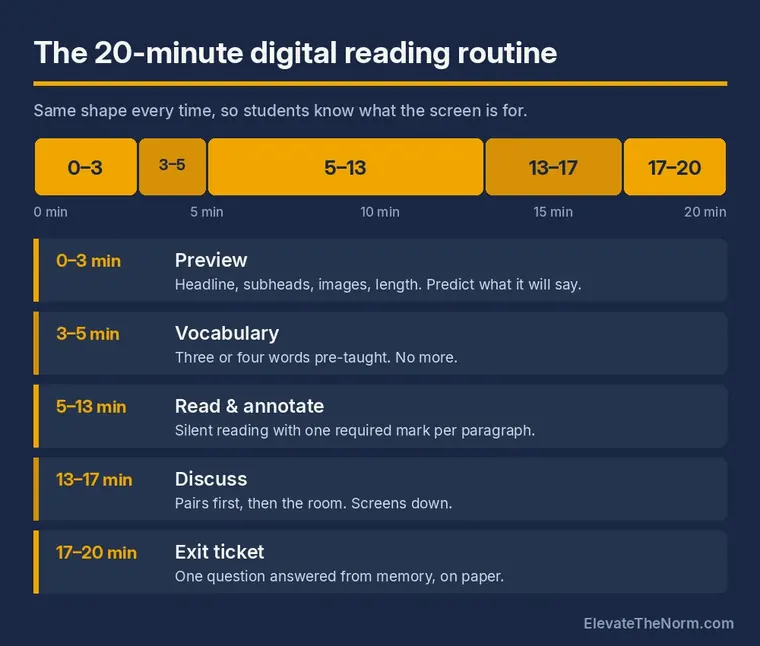
    Horizontal timeline of a 20-minute digital reading routine: 0-3 minutes preview, 3-5 vocabulary, 5-13 read and annotate, 13-17 discuss, 17-20 exit ticket
    Same shape every time, so students know what the screen is for.

    The shape matters more than the minutes. Students who know what a reading block is going to look like stop treating the tab as an invitation to open another one.

    • 0–3 — Preview. Headline, subheads, images, length. Predict what it will say. This is the step that restores the edges a printed page gives for free.
    • 3–5 — Vocabulary. Three or four words, pre-taught. No more.
    • 5–13 — Read and annotate. Silent, self-paced, with one required mark per paragraph. Self-paced is the condition where the research gap nearly closes.
    • 13–17 — Discuss. Pairs first, then the room. Screens down.
    • 17–20 — Exit ticket. One question, answered from memory, on paper.

    Like any other classroom procedure, this has to be taught and practised rather than announced. The first three or four times it will run long. After that it runs itself, and the eight minutes of actual reading are worth more than twenty unstructured ones.

    How to Tell Whether Comprehension Actually Improved

    This is where most articles about digital reading show you a chart of rising scores. There is no such chart here, because any numbers on it would be invented. What is worth tracking, and what the research suggests you should track, is the gap between what students think they understood and what they did.

    Ask for a predicted score before the exit ticket, record both, and watch the difference. That difference is the overconfidence effect made visible, and it is the number most likely to move first. The template below is empty on purpose — fill it with your own class.

    WeekText and LexileAvg. predicted scoreAvg. actual scoreGapWhat changed
    1
    2
    3
    4
    5
    A blank tracking template. No illustrative data, because illustrative data on a chart stops looking illustrative by the second time someone shares it.

    Two cautions. Five weeks of one class is not evidence of anything beyond that class, so resist writing it up as a finding. And if scores rise, the reading routine is one of a dozen things that changed — including the students getting better at your exit tickets. The point of the table is to notice, not to prove. Wider habits for checking what students actually know apply here without modification.

    Accessibility Is Not Lowering the Bar

    Digital text is the first format in the history of schooling that a student can adjust without asking permission, and that is the strongest argument for it. Font size, contrast, line spacing, text-to-speech, translation and dictionary lookup all happen without a conversation, a form, or a visible accommodation.

    Make those adjustments available to everyone by default. A student who needs larger text and has to request it in front of the class has been handed a choice between reading and dignity, and plenty of fourteen-year-olds will pick dignity.

    Two limits worth being straight about. Text-to-speech is a route into the content, but listening and reading are not the same skill, and a student who only ever listens is not practising the one they are graded on. And scanned PDFs of book pages are images: they cannot be resized usefully, searched, or read aloud by assistive software. If the only version you have is a scan, that is an accessibility problem before it is a comprehension one. Whichever medium the text arrives in, you still need a way to find out what stuck: a short ungraded comprehension check does that in about two minutes and none of them requires reading aloud.

    Before you go: grab the free Digital Reading Setup Planner (PDF) — ElevateTheNorm.com branded, printable, no email required.

    Frequently Asked Questions

    Is reading on a screen actually worse for comprehension?

    Slightly, and only under certain conditions. The largest meta-analysis found a small advantage for paper — about g = -0.21 across 54 studies — but that advantage was concentrated in informational text read under time pressure. For narrative text it was essentially zero, and for self-paced reading it shrank to about -0.09. So the honest answer is that a screen is not inherently worse; a screen plus a clock plus dense informational text is worse, and a teacher controls two of those three.

    What Lexile level should my students be reading at?

    That question has a false premise built into it. Lexile bands describe text difficulty, not students, and they overlap heavily — a 1,000L article sits inside the grades 4-5, 6-8 and 9-10 bands at once. The published grades 6-8 band is 925L-1185L and the grades 9-10 band is 1050L-1335L, but those are ranges for choosing texts, not targets a student has to hit. A student reading below the band with strong support and real interest is in a better position than one placed in the band and left alone.

    Are Newsela, CommonLit, ReadWorks and Project Gutenberg really free?

    Two of them are free outright. ReadWorks states it is free and always will be for all teachers and students, and Project Gutenberg is free with no registration. CommonLit has a genuine free tier that includes the text library and the 360 curriculum; the paid school plans add admin dashboards, LMS integration and support. Newsela is the one to watch: the free Lite account gives you a rotating, staff-selected sample of articles at five reading levels, and those articles expire after about four weeks. The full library, Text Sets, Power Words, printing and data download are paid.

    Should I print everything out instead?

    No, and the research does not support that conclusion either. Printing throws away the adjustable text, the instant availability, the text-to-speech and the ability to put three versions of the same source in front of three students. Print the things where the evidence is strongest — long, dense informational text that has to be read under time pressure, such as a test passage — and keep the rest digital with the reading routine around it.

    How do I know a leveled version has not gutted the text?

    Read it before you assign it, specifically looking for the argument rather than the facts. Automated and editorial leveling works mainly by shortening sentences and swapping vocabulary, which is what the Lexile algorithm measures. Nuance, qualification and the author’s reasoning are what tend to go. If the lesson turns on how the author argues rather than what the author concludes, the lower version may not carry the lesson, and you are better off keeping the original and adding support around it.

    Does giving students text-to-speech mean they are not really reading?

    It means they are getting the content, which is usually the point of the lesson. Listening and reading are not identical skills, though, so the honest position is that text-to-speech is a route into material a student could not otherwise reach, not a replacement for decoding practice. Make it available to the whole class by default rather than as a named accommodation, and keep separate time for the reading skill itself.

    What is the single change with the biggest return?

    Requiring one mark per paragraph. It costs nothing, needs no platform, and it makes passive scrolling structurally impossible. The second-best is asking students to predict their own exit-ticket score before they take it: the research consistently finds that readers overestimate their comprehension after reading on screen, and being visibly wrong about it once does more than any amount of reminding to read carefully.

    Sources

    • Delgado, P., Vargas, C., Ackerman, R., & Salmerón, L. (2018). Don’t throw away your printed books: A meta-analysis on the effects of reading media on reading comprehension. Educational Research Review, 25, 23–38. Full text (PDF) — 54 studies, 171,055 participants; overall g ≈ −0.21 favoring paper, moderated by time pressure and text genre, with no effect for narrative text.
    • Clinton, V. (2019). Reading from paper compared to screens: A systematic review and meta-analysis. Journal of Research in Reading, 42(2), 288–325. ERIC record — 33 studies; small negative effect for screens, and readers more overconfident about their comprehension after screen reading across 11 calibration studies.
    • Council of Chief State School Officers & NGA Center. Supplemental Information for Appendix A of the Common Core State Standards: New Research on Text Complexity (2012). Document — the source of the revised "stretch" text-complexity bands used above.
    • MetaMetrics. Lexile Measures and Grade Levels (FAQ). PDF — per-grade and grade-band Lexile ranges aligned to the 2012 CCSS measures.
    • ReadWorks. About ReadWorks — statement that the platform is free and always will be for all teachers and students; 6,000+ texts.
    • CommonLit. Pricing — free Classroom Basics tier and the paid School Essentials PRO tiers.
    • Newsela. Newsela Lite (free account) — five reading levels on a rotating selection, four-week article expiry, and the list of paid-only features.
    • Project Gutenberg. Home — 79,000+ free ebooks, public domain in the United States, no registration.

    Every link above was checked on September 17, 2026. Where a figure comes with limits on how far it travels, those limits are stated in the text rather than left in a footnote. No classroom results, student work, or research findings on this page are invented; the tracking table is deliberately empty for that reason.


    About Clay Shumate

    By Clay Shumate — Clay Shumate is a certified secondary Social Studies teacher in the public schools of West Alabama, with seven years of classroom experience, a B.A. in History, and an M.Ed. in Secondary Education. He writes about project-based learning, student responsibility, respect, and practical ways to hold young people to a higher standard while giving them room to learn from mistakes. He is a member of the Society of Professional Journalists and writes to its Code of Ethics; this site’s editorial standards and corrections policy are published in full.

  • Academic Honesty Examples: 18 Real Situations From a Secondary Classroom

    Academic Honesty Examples: 18 Real Situations From a Secondary Classroom

    Academic honesty examples are most useful when they are specific enough to argue about. “Do not cheat” settles nothing. “Two students compared homework answers in the hallway” is a real situation that happens weekly, and whether it counts depends on something a teacher either said out loud or did not.

    What follows is a set of concrete situations from a secondary classroom, sorted into the standard categories, with the honest answer for each — including the ones where the honest answer is “that depends on what you were told.”

    One thing to note before starting. Nearly every published definition in this area was written for universities. That is worth saying out loud, because applying undergraduate standards to a thirteen-year-old without translation is how schools end up punishing confusion.

    Key Takeaways

    • Six categories cover almost everything: cheating, plagiarism, falsification, fabrication, multiple submission and complicity.
    • Fabrication is the least understood. It means inventing data, sources or documents — and it is the one students commit without realising there is a word for it.
    • Several common situations genuinely depend on what you said. If you never specified, the student was guessing, and that is on the adult.
    • Reusing your own old work is usually a violation. Almost no secondary student knows this.
    • AI sits inside the existing categories. It does not need a new one — it needs the same question: did the tool help you think, or think instead of you?
    • Repair has to have an end. A first incident with no route back teaches students to deny rather than to be honest.

    Free Download · 3-page PDF

    Academic Honesty Scenario Cards

    All 18 situations from this article as cut-out cards, plus a 20-minute discussion guide, an “allowed help” assignment template and a teacher answer key.

    Download the free PDF

    Free. No email address required. Designed for grades 6–12. Browse every printable in Your Free Library.

    The Six Categories, in Plain Language

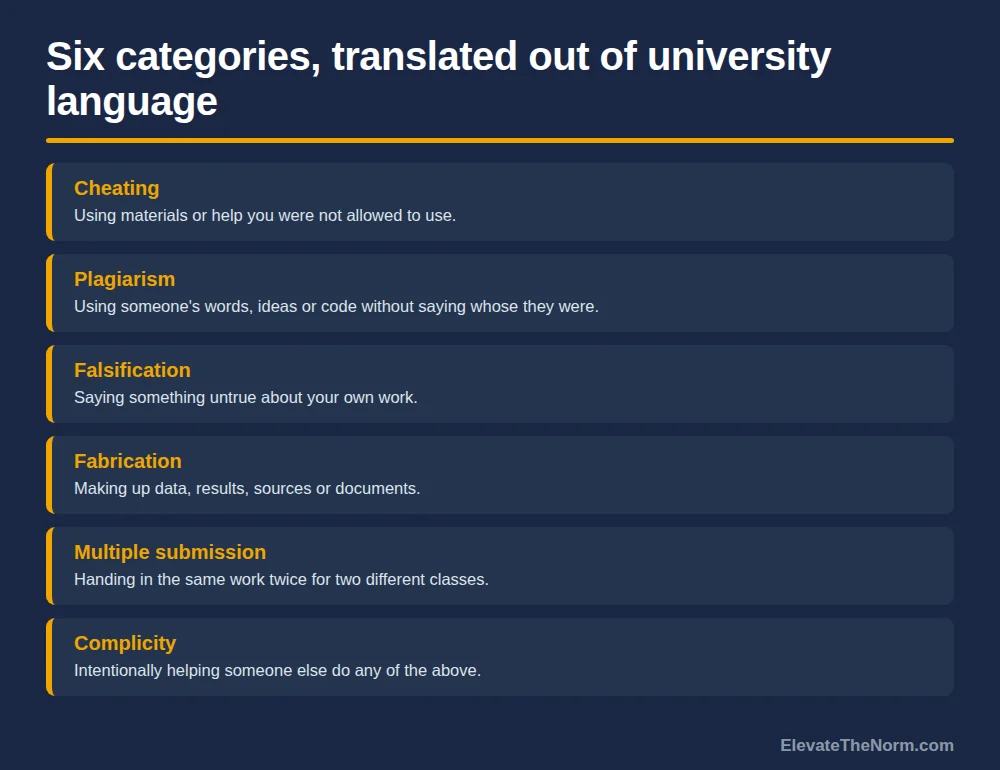
    Virginia Tech’s Office of Undergraduate Academic Integrity defines seven categories of academic misconduct, six of which map cleanly onto secondary work. The wording below is translated; the categories are theirs.

    Six categories of academic misconduct translated into plain language: cheating, plagiarism, falsification, fabrication, multiple submission and complicity
    The standard categories come from universities. This is the grades 6-12 translation.
    • Cheating. Using materials, notes, devices or help you were not permitted to use.
    • Plagiarism. Using someone’s words, ideas, structure or code without saying whose they were — including inadequate paraphrasing.
    • Falsification. Saying something untrue about your own work, verbally or in writing.
    • Fabrication. Making up data, results, sources or documents and presenting them as real.
    • Multiple submission. Handing in substantial portions of work already submitted for credit elsewhere, without permission.
    • Complicity. Intentionally helping someone else do any of the above.

    Two of these will be new to most students. Multiple submission is almost never explained in secondary school, and plenty of students reasonably assume their own work is theirs to reuse. Complicity surprises them even more — the student who let a friend photograph their worksheet usually thinks of themselves as the helpful one, not as a participant.

    What Is Fabrication in Academic Integrity?

    Fabrication is the unauthorised creation or reporting of information — inventing something and presenting it as real. Northern Illinois University’s tutorial pairs it with falsification and gives a list of concrete examples, several of which map directly onto secondary work:

    • Generating data artificially instead of collecting it from an actual experiment.
    • Altering data, documents, images, music or artwork without authorisation.
    • Removing results that do not fit, from a report or presentation.
    • Misrepresenting data through misleading scales or axes on a chart.
    • Inventing sources of information.
    • Impersonating another person to complete academic work, or using their login.

    The two that come up constantly in grades 6–12 are inventing a source and quietly dropping the data point that ruined the graph. Neither feels like cheating to the student doing it. The first feels like filling in a form; the second feels like tidying.

    That is why fabrication is worth teaching by name. A student who has never heard the word will not recognise themselves in it, and “I made up a source” is a sentence most fourteen-year-olds would be genuinely shocked to hear described as academic misconduct.

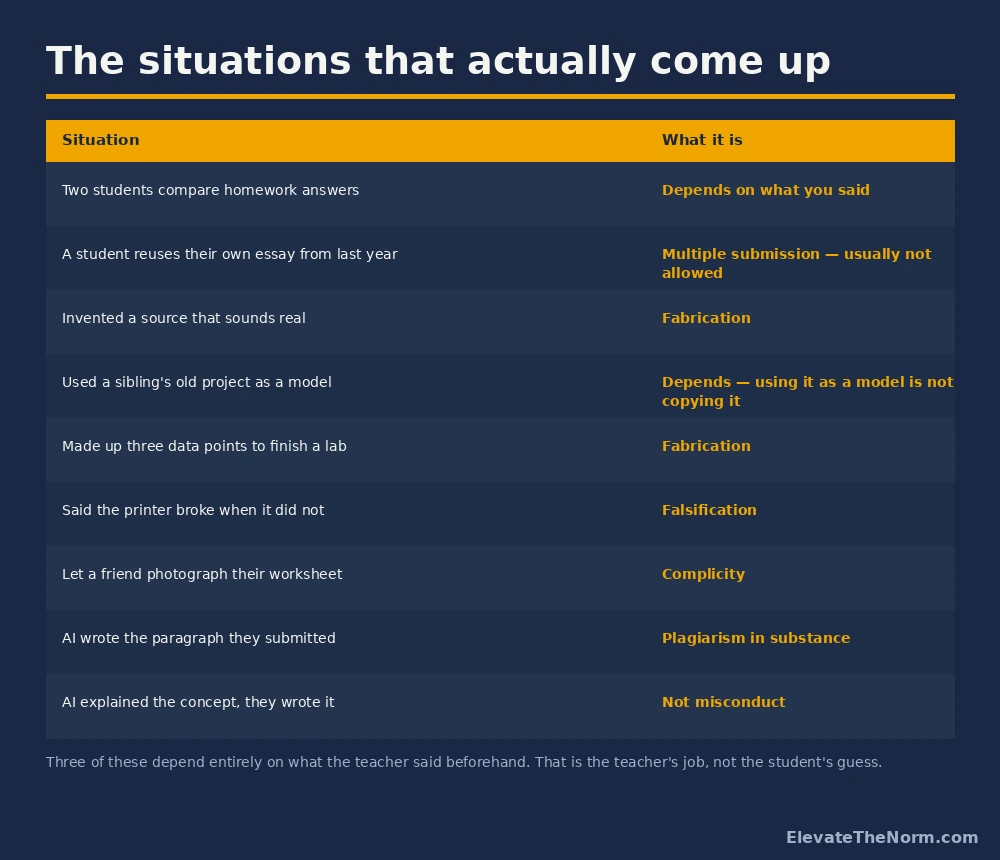
    Eighteen Situations, and What Each One Is

    Sorted by category. The verdicts assume no specific instruction was given, which is exactly the condition that causes most of the trouble.

    Table of nine common classroom situations with a verdict for each, including AI use, reused essays and invented sources
    Three of these depend entirely on what the teacher said beforehand.

    Clearly over the line

    • Copying a classmate’s answers during a test. Cheating.
    • Submitting a paragraph an AI tool wrote as their own writing. Plagiarism in substance, whatever the tool.
    • Inventing a source that sounds plausible to fill a citation requirement. Fabrication.
    • Adding three data points to finish a lab that ran out of time. Fabrication.
    • Telling a teacher the printer broke when it did not. Falsification.
    • Photographing a completed worksheet and sending it to four people. Complicity.
    • Logging into another student’s account to submit work. Fabrication, by NIU’s definition, and probably worse under school policy.
    • Paraphrasing a whole article closely without citing it. Plagiarism, even with every word changed.

    Usually a violation, and usually a surprise to the student

    • Reusing their own essay from a previous course. Multiple submission.
    • Submitting the same project to two teachers in the same term. Multiple submission.
    • Letting a friend copy homework “just this once.” Complicity.
    • Dropping the result that ruined the trend line. Fabrication by omission.
    • Using a translation tool to write an assignment in a language class. Depends heavily on the subject — and it is the teacher’s job to say.

    Depends entirely on what was said

    • Two students comparing homework answers before class.
    • Working through practice problems together and arriving at the same method.
    • Asking an AI tool to explain a concept, then writing the answer themselves. Not misconduct in most framings.
    • Using a sibling’s old project as a model for structure. Using it as a model is not copying it.
    • Getting a parent to proofread. Nearly always fine, and nearly never stated.

    That last group is the important one. Five situations, all common, all resolved by one sentence at the top of the assignment. A school with a strict policy and no per-task instruction has built a system where students are punished for guessing wrong about something nobody told them — which is the pattern described in more detail in the guide to stating the rule before you start enforcing it.

    The Repair Conversation

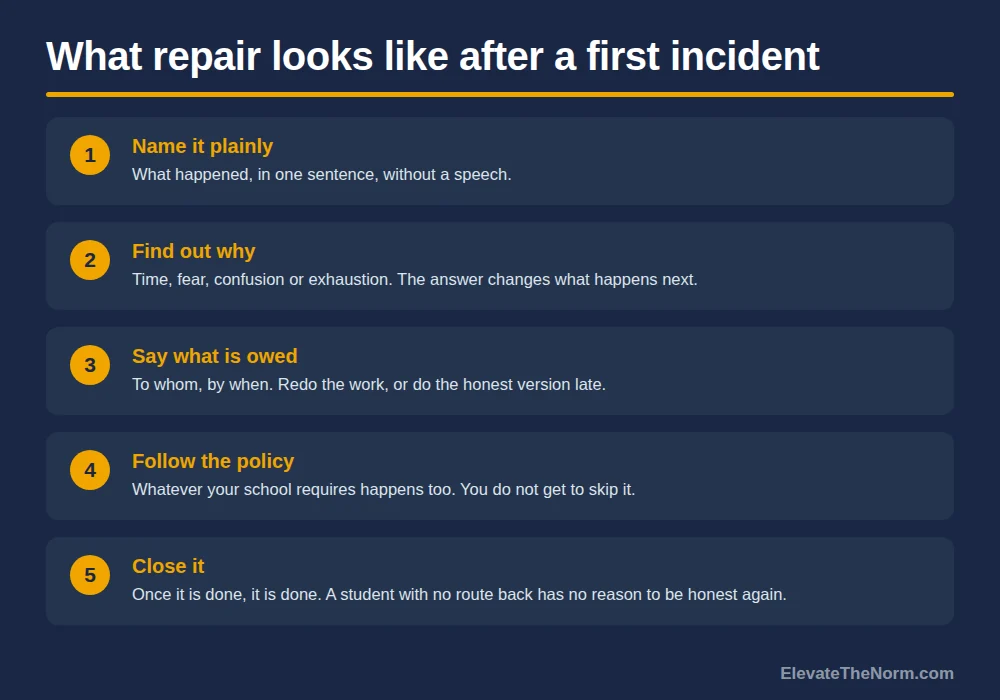
    When a student has done something that damaged trust, the conversation I have is about what is owed: to whom, and by when. Not a speech about character. A short, specific account of what needs to happen for this to be finished.

    Five steps for handling a first academic honesty incident: name it, find out why, say what is owed, follow the policy, close it
    A student with no route back has no reason to be honest again.

    That framing does most of the work in an academic honesty incident, because it separates two things schools routinely merge. There is what the school’s policy requires, which happens regardless and which you do not get to skip. And there is what the student owes — usually redoing the work honestly, sometimes telling someone what happened, occasionally apologising to a classmate whose work they used.

    The second part is the part that teaches anything. A consequence imposed on a student is something that happens to them. A debt they pay is something they do.

    And it has to end. If the answer to “when is this finished” is never, a student learns that honesty has no upside and denial has no downside. That is not a soft observation — it is the incentive structure you have built, and teenagers read incentive structures accurately.

    Using These Examples With a Class

    The list above works far better as a discussion than as a handout. Twenty minutes, once, early in the year.

    1. Give them the ambiguous ones first. Start with comparing homework answers, not with copying a test. The interesting conversation is in the grey zone and starting at the obvious end wastes it.
    2. Let them disagree. Students argue about these with real energy, and the arguments surface exactly the assumptions you need to correct.
    3. Make them state the rule they are using. “Why is that one different from the last one?” gets you further than telling them.
    4. Then give your answers. Including, honestly, the ones where your answer differs from the teacher down the hall.
    5. End with the per-assignment habit. Tell them you will state what help is allowed on each task, and that asking is always fine.

    The point is not compliance. It is that a student who has argued about where the line falls will notice when they are near it, and a student who has only been told the rules will not.

    What to Do Next

    Take the five “depends on what was said” situations and decide your actual answer for each. Not the school’s official position — yours, for your subject, on an ordinary assignment. Then say them out loud to your classes this week.

    Most academic honesty problems in a secondary classroom are not students deciding to cheat. They are students guessing, in a building where six teachers want six different things and nobody has written any of it down. If a violation does occur and needs a formal response, a consistent process for responding to it keeps that fair too.

    The note home is the part most of us write badly under pressure. There is a plainer way to write that message to a family that keeps a fixable mistake from turning into a standoff.

    Before you go: grab the free Academic Honesty Scenario Cards (PDF) — ElevateTheNorm.com branded, printable, no email required.

    Frequently Asked Questions

    What is fabrication in academic integrity?

    Fabrication is inventing information and presenting it as real — making up data, results, sources or documents. The examples that come up most in secondary school are inventing a citation that sounds plausible and quietly removing the data point that ruined a graph. Neither feels like cheating to the student doing it, which is exactly why the word is worth teaching. Falsification is its close relative: saying something untrue about your own work, such as claiming a file was submitted when it was not.

    Is reusing my own work really a violation?

    In most policies, yes, and it catches students completely off guard. Multiple submission means handing in substantial portions of work already submitted for credit somewhere else without permission. Students reasonably assume their own work belongs to them, and nobody explains otherwise. The practical answer is that it is nearly always allowed if you ask first, so the rule teachers should state is “ask me, and the answer is usually yes.”

    Is using AI an academic honesty violation?

    It depends what it replaced, and it fits inside the existing categories rather than needing a new one. Asking a tool to explain a concept and then writing the answer yourself is not misconduct in most framings. Submitting text the tool produced as your own writing is plagiarism in substance whatever the source. The test that works across tools is whether it helped you think or thought instead of you — and the part that actually prevents problems is a teacher stating which they mean on each assignment.

    Is letting someone copy my homework really as bad as copying?

    Policies generally treat it as its own category — complicity, meaning intentionally helping someone commit misconduct. Students almost never see it that way; the one who shared usually feels like the generous party rather than a participant. It is worth naming explicitly, because a student who would never copy will hand their work over without a second thought.

    What if two teachers in my school have different rules?

    That is extremely common and it is the source of a large share of honest mistakes. Students moving through six classrooms are running six different rule sets, none of which they chose. The fix is not a school-wide policy document that nobody reads — it is each teacher stating what help is allowed on each assignment. One line at the top of the task removes most of the ambiguity that generates violations.

    How should a first incident be handled?

    Privately, quickly, and with a defined end. Name what happened in one sentence, find out why — time, fear, confusion and exhaustion are the usual answers — and say what is owed and by when. Follow whatever your school’s policy requires, because that is not optional. Then close it. An incident with no route back teaches a student that honesty carries a cost and denial does not.

    Should students be taught these categories by name?

    Yes, and in plain language rather than the university wording they were written in. A student who has never heard the word fabrication will not recognise their own invented citation in it. The version that works is short, concrete, and argued about rather than handed out — twenty minutes of disagreement about the grey-zone situations does more than a signed policy sheet ever will.

    Sources

    • Office of Undergraduate Academic Integrity, Virginia Tech. Definitions of academic misconduct. Read the definitions — the source for the categories used above. These are university definitions; the plain-language wording in this article is a translation for grades 6–12, not a quotation.
    • Northern Illinois University. Student tutorial: Fabrication or falsification. Read the tutorial — the source for the fabrication definition and the concrete examples list.
    • International Center for Academic Integrity. Facts and statistics. Read the page — context for how common these behaviours are among high school students.

    Every link above was checked on September 12, 2026. Where a definition was written for a university audience, this article says so rather than presenting it as a secondary-school standard.


    About Clay Shumate

    By Clay Shumate — Clay Shumate is a certified secondary Social Studies teacher in the public schools of West Alabama, with seven years of classroom experience, a B.A. in History, and an M.Ed. in Secondary Education. He writes about project-based learning, student responsibility, respect, and practical ways to hold young people to a higher standard while giving them room to learn from mistakes. He is a member of the Society of Professional Journalists and writes to its Code of Ethics; this site’s editorial standards and corrections policy are published in full.

  • Classroom Transition Songs and Cues That Work With Teenagers

    Classroom Transition Songs and Cues That Work With Teenagers

    Classroom transition songs are tracks of a fixed, known length used as the signal and the timer for a movement in the room — pack up, move to groups, come back. In grades 6–12 they work for one reason: a track students can hear the end of is a countdown that needs no enforcement. What does not work is anything that sounds like it was chosen for a Year 2 classroom.

    Almost everything written about this topic is written for elementary. The songs have lyrics instructing children to line up. Bringing that into a secondary room will get exactly the response it deserves.

    The underlying mechanism, though, transfers fine. It just needs choosing properly.

    Key Takeaways

    • The track is the timer. Its length is the whole point, which means it has to be the same track every time.
    • Teenagers respond to music in class better than they will admit. A study of 15–19 year olds found significant gains in mood, motivation and concentration from five minutes of self-chosen music before lessons.
    • Read that study’s limits. Self-reported, 48 students, no control activity, and the authors list six caveats themselves.
    • Music is one cue among six, and usually not the one you need most. A single spoken word does more work.
    • Five seconds is the benchmark for a class responding to an attention signal.
    • Lyrics get heard. Check a track the way you would check anything else you play to thirty students.

    Free Download · Printable PDF

    Classroom Transitions Toolkit

    Plan your transitions, pick a cue, and time the result in week one and week four — the printable version of the process in this article.

    Download the free PDF

    Free. No email address required. Designed for grades 6–12. See what is inside on the page that walks through each printable in the pack.

    Why Music Works as a Transition Signal

    Because it removes you from the enforcement. A spoken instruction has to be repeated, and repeating it is how a teacher ends up raising their voice. A track that is ninety seconds long is a fact about the world — students can hear how much is left, and nobody has to be told.

    Five requirements for a classroom transition track: known length, clean start and end, consistency, credibility with teenagers, and content check
    The track is the timer. Everything else follows from that.

    There is also reasonable evidence that music in a secondary classroom is welcome rather than merely tolerated — which is the thing most teachers doubt.

    Vigl and colleagues ran a two-week within-subjects study in a Finnish high school: one week without classroom music, one week with five minutes of self-selected music before each class. Across 48 students aged 15 to 19 they found statistically significant improvements in mood, motivation, concentration and learning, with strong effect sizes for mood and motivation. Around 61 percent of students wanted music in all or most lessons.

    The authors are unusually candid about the limits, and they matter. Every outcome was self-reported — nobody measured actual test performance or retention. The final sample of 48 was below their own power target of 106. There was no control activity, so the gains cannot be attributed to music specifically rather than to having any pleasant five-minute break. Students self-selected into the study, which invites demand effects.

    So: good evidence that teenagers like it and report feeling better and more focused. Not evidence that it makes them learn more. That is enough to justify using it as a transition cue, and not enough to justify a claim about achievement.

    Worth noting what students said it gave them, because it is not what you would guess. Fourteen of them described it as a new routine and a break between lessons. The value was partly the predictability, which is the same reason a transition signal works at all.

    How to Choose a Track for a Secondary Room

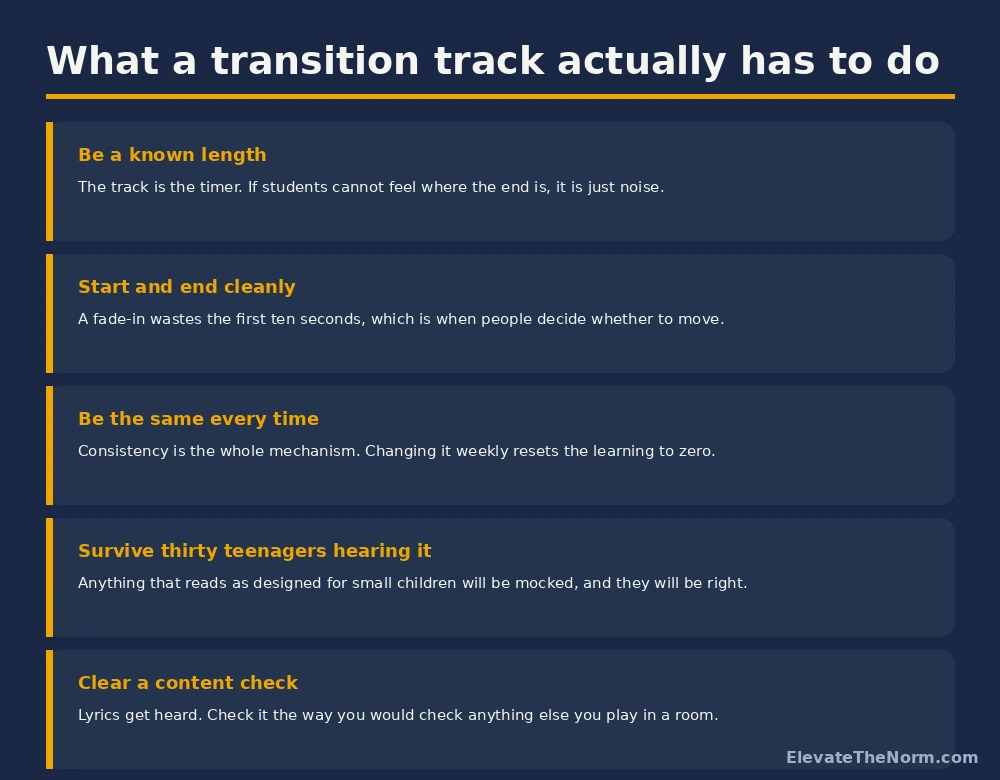
    Five requirements, and the first one is the only non-negotiable.

    Known length. Ninety seconds for a quick move, three minutes for packing up and a closing task. Cut the track to length yourself if you need to. If students cannot feel where the end is, you have background music rather than a signal.

    Clean start and end. A long fade-in wastes the first ten seconds, which is exactly when people decide whether this is happening.

    The same track, every time. This is the mechanism. A different song each week is a pleasant thing that teaches nothing.

    Credible with teenagers. Instrumental works well — film scores, video game soundtracks, anything with momentum and no words to parse. Television theme tunes are a popular choice and they do have a real advantage: most are written to a fixed short length, and the recognition itself is part of the signal. The failure mode is picking something so old that nobody recognises it, at which point you have simply chosen a strange piece of music.

    Content-checked. Lyrics get heard, including by the student who tells a parent about them. Check a track the way you would check anything else you put in front of thirty students, and be aware that a clean radio edit is not the same as a clean song.

    One more, which is practical rather than pedagogical: whatever you play needs to be something you are permitted to play in your building, on equipment that works, without a login that fails on a Tuesday. A cue that depends on a streaming service loading is a cue that will fail publicly.

    Music Is One Cue Among Six

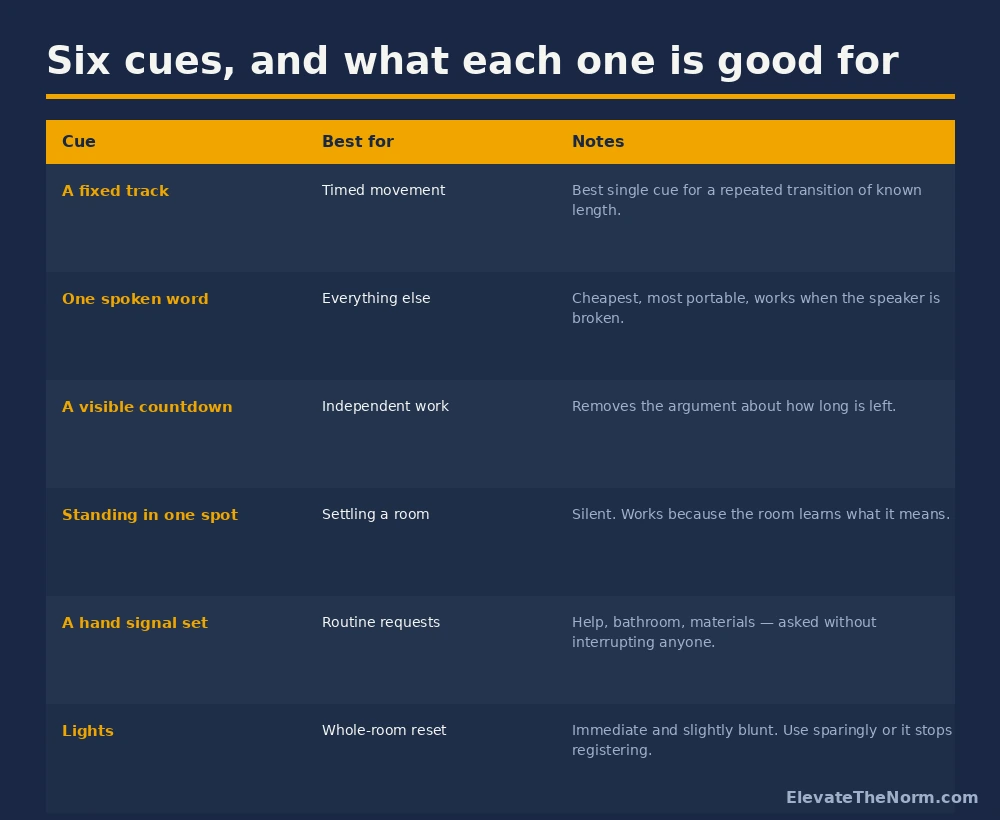
    Worth saying plainly, because the search for the perfect transition song is usually a distraction from a cheaper fix.

    Table comparing six classroom transition cues including a fixed track, a spoken word, a countdown, position, hand signals and lights
    Music is one cue among six, and rarely the one you need most.

    The cues students can see get their own treatment in the guide to visual transition cues, which covers countdowns, posted sequences and why more visuals is not better. A single consistent spoken word does more work than any track, costs nothing, and cannot be broken by a dead speaker. Music earns its place specifically where the transition is repeated, has a known duration, and benefits from everyone being able to hear the clock.

    Lights deserve one caution. Flicking the lights is immediate and slightly blunt, and using it often enough that students stop noticing is easy. It also lands badly for some students — an abrupt sensory change is not neutral for everyone in the room.

    All of these sit inside the broader work of running transitions properly. The cue is step four of five, and no cue rescues a transition where the instructions were given while people were already moving.

    Teenagers Want More Than They Will Admit

    My students voted on getting a class pet. They wanted one.

    That surprises people who do not teach high school. It stopped surprising me a while ago. High school students want the small things — the pet, the cheap prizes, the recognition. They just may not show it on the outside, and a teacher who reads the flat expression as the actual opinion will strip every one of those things out of the room and then wonder why it feels dead.

    Transition music is squarely in that category. A fifteen-year-old is not going to tell you the song is good. Some of them will make a point of telling you it is bad. Watch what happens when you forget to play it, which is the only reliable measurement available — and notice that in the Finnish study, the thing students named most often was not the music but the routine it created.

    So do not poll the class on whether to keep it during week one. You will get the answer the room feels obliged to give. Run it for a month and judge it on whether the transition got shorter.

    Teaching the Signal So It Lands in Five Seconds

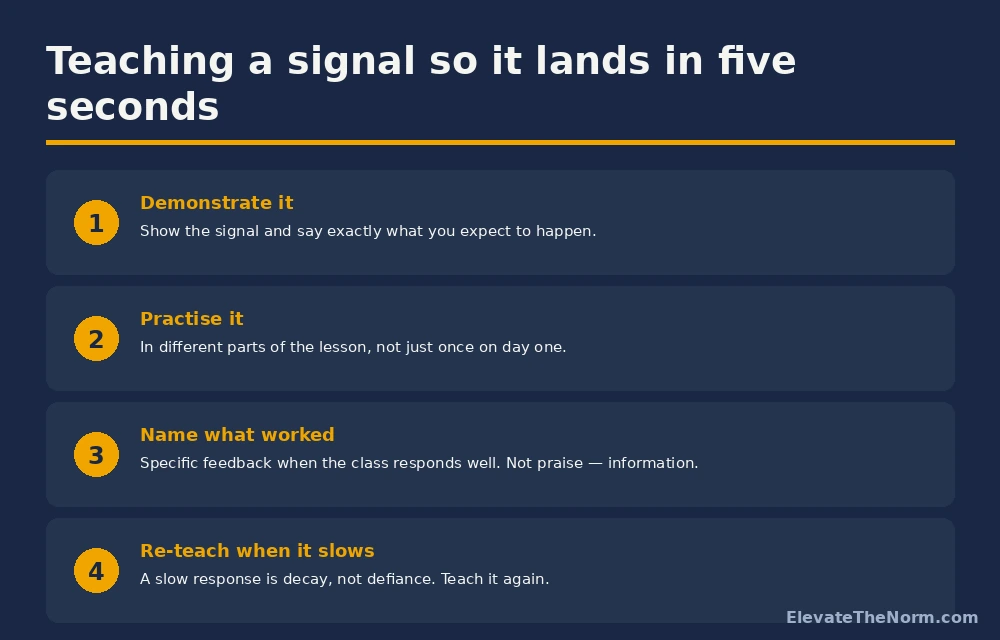
    Classroom Check-Up, a project funded through the US Department of Education’s Institute of Education Sciences, sets a concrete benchmark: students should respond to an attention signal within five seconds. That is a usable number, and it turns an argument about whether the class is “being difficult” into a measurement.

    Four steps for teaching a classroom attention signal: demonstrate, practise, name what worked, re-teach when it slows
    Classroom Check-Up sets the benchmark at a response within five seconds.

    Their implementation sequence is demonstrate, practise across different parts of the day, give specific feedback when students respond correctly, and re-teach when the response slows. They also note a signal should work without the teacher needing to be in a particular spot — which quietly rules out several popular options that depend on you standing at the front.

    Two adaptations for older students. Their examples lean young — rhythmic clapping, counting phrases — and a call-and-response chant will not survive a Year 10 room. Use the structure and change the signal. And “specific feedback” should mean information rather than praise: that took about four seconds, which is where we want it lands with teenagers in a way that well done everyone does not.

    When the response slows in November, that is decay rather than defiance, and the fix is the same as for any other routine that needs re-teaching.

    Where This Goes Wrong

    • An elementary song in a secondary room. The most common failure and the most deserved. If the lyrics instruct students to tidy up, it is the wrong track.
    • A different song every week. Pleasant, and it teaches nothing. Consistency is the mechanism.
    • Music as background rather than signal. Playing something during work is a different decision with different evidence behind it. Do not confuse the two.
    • Volume creep. If the track has to get louder to be heard over the room, the cue has already failed.
    • Depending on a login. A signal that requires a streaming service to load will fail publicly, and the class will remember.
    • Asking the class whether they like it. You will get the answer the room feels obliged to give. Measure the transition instead.

    What to Do Next

    Pick one repeated transition — packing up is usually the best candidate, because it has a natural length and it is where the most time leaks. Choose one instrumental track, cut it to the length you actually want, and use the same one every day for a month without discussing it.

    Time the transition in week one and again in week four. That number is the only review this needs. If it has not moved, the problem is almost certainly upstream in how the instruction is given, not in the song.

    Before you go: grab the free Classroom Transitions Toolkit (PDF) — ElevateTheNorm.com branded, printable, no email required.

    Frequently Asked Questions

    Will high school students actually tolerate transition music?

    More readily than most teachers expect, though few of them will say so. A Finnish study of students aged 15 to 19 found significant self-reported gains in mood, motivation and concentration from five minutes of music before lessons, and around 61 percent wanted it in all or most classes. In my experience the flat expression is not the actual opinion — teenagers want the small things and simply do not advertise it. The reliable test is what happens the day you forget to play it.

    What kind of song works for classroom transitions in secondary?

    Instrumental, recognisable, and a known length. Film scores and video game soundtracks work well because they carry momentum without lyrics to parse. Television theme tunes are popular for a real reason — most are written to a fixed short length and the recognition is itself part of the signal — but pick something current enough that the room actually knows it. What fails is anything written to instruct young children, which will be mocked, fairly.

    How long should a transition song be?

    Match it to the job rather than to the track. Ninety seconds for moving into groups, two to three minutes for packing up plus a closing task. Cut the audio to the length you want instead of picking a song and accepting its running time — the length is the entire function, so it should be a decision rather than a coincidence.

    Does background music help students learn?

    That is a different question from using music as a transition signal, and the evidence is far weaker than the internet suggests. The Finnish study measured self-reported mood, motivation, concentration and learning, not test performance, and had no control activity — so the gains cannot be attributed specifically to music rather than to any pleasant break. Using a track as a timed signal is well founded. Claiming background music raises achievement is not.

    How fast should a class respond to a signal?

    Within five seconds, which is the benchmark Classroom Check-Up uses. It is worth actually timing rather than judging by feel. A class at eight or ten seconds is not defying you — the signal has decayed and needs re-teaching, which takes about two minutes and works far better than expressing frustration about it.

    What if I cannot play music in my room?

    Use a single consistent spoken word and a visible countdown, and you lose very little. Music is one cue among six and rarely the one doing the most work. The spoken word is cheaper, more portable, survives broken equipment, and does not depend on anything loading. If your transitions are poor, the cue is unlikely to be the reason.

    Is flicking the lights a good signal?

    It is immediate and it works, but use it sparingly. It is blunt enough that frequent use stops registering, and an abrupt sensory change is genuinely unpleasant for some students in a way a sound is not. Reserve it for a whole-room reset rather than making it your standard transition cue.

    Sources

    • Vigl, J., Ojell-Järventausta, M., Sipola, H., & Saarikallio, S. (2023). Melody for the mind: Enhancing mood, motivation, concentration, and learning through music listening in the classroom. Music & Science, 6. Read the study — 48 Finnish students aged 15–19, within-subjects across two weeks. All outcomes self-reported; no control activity; final sample below the authors’ own power target. Their stated limitations are summarised in the text above.
    • Classroom Check-Up. Using an attention signal. Funded by the U.S. Department of Education, Institute of Education Sciences. Read the guidance — the source for the five-second response benchmark and the four-step teaching sequence. The page cites Reinke, Herman and Sprick (2011) and Sprick (2009) and reports no quantitative data of its own.

    Every link above was checked on September 12, 2026. This page deliberately recommends no specific songs by title, because a track that is recognisable to students this year may mean nothing to them in three.


    About Clay Shumate

    By Clay Shumate — Clay Shumate is a certified secondary Social Studies teacher in the public schools of West Alabama, with seven years of classroom experience, a B.A. in History, and an M.Ed. in Secondary Education. He writes about project-based learning, student responsibility, respect, and practical ways to hold young people to a higher standard while giving them room to learn from mistakes. He is a member of the Society of Professional Journalists and writes to its Code of Ethics; this site’s editorial standards and corrections policy are published in full.

  • Standards-Based Grading: What It Is, What It Fixes, and What the Evidence Shows

    Standards-Based Grading: What It Is, What It Fixes, and What the Evidence Shows

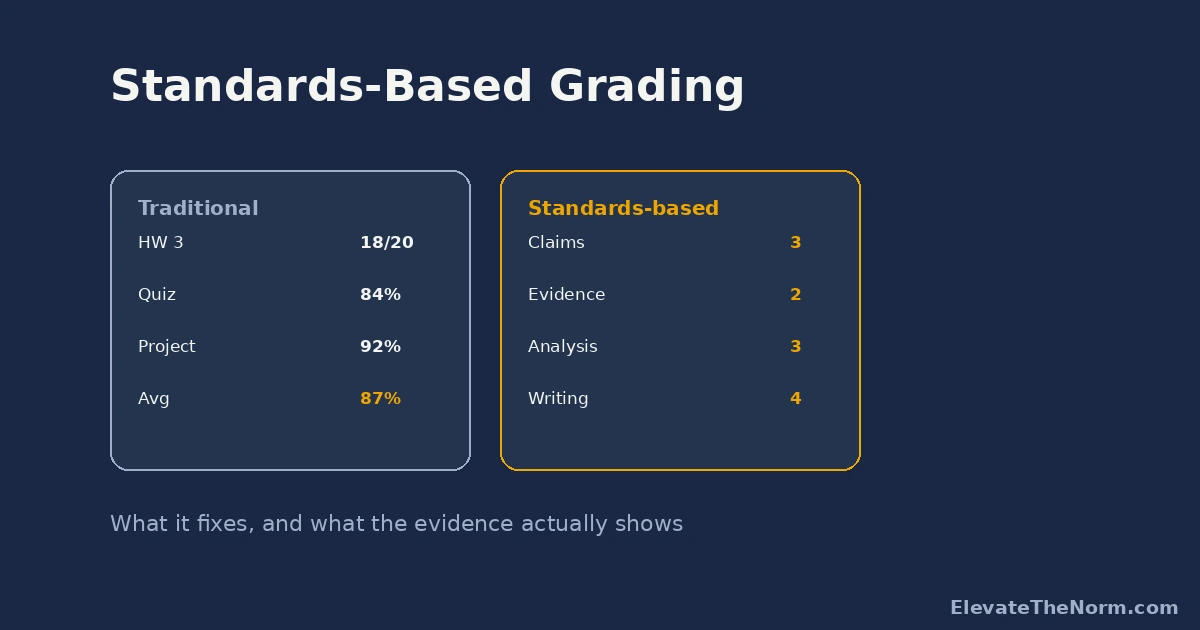
    A standards-based grading system reports what a student can do against specific course standards, using a small number of proficiency levels, with academic achievement kept separate from behaviour. It is a better communication system than traditional grading. It is not, on the current evidence, a way to raise achievement — and the people who research it say so plainly.

    That gap between what standards-based grading is good at and what schools are often told it will do is where most implementations fail. A staff that adopts it expecting test scores to move will conclude in year two that it did not work, and they will be measuring the wrong thing.

    This is what it actually is, what the research shows and does not show, and what goes wrong.

    Key Takeaways

    • Three criteria define it: report on standards, use three to five levels, and separate achievement from behaviour. Everything else is a local choice.
    • The clearest benefit is accuracy of meaning. A standards-based grade tells you what a student can do; an 87 percent does not.
    • There is no evidence it raises achievement. That is Guskey’s own conclusion, not a critic’s.
    • One comparison found the opposite on test scores. Students at a traditionally graded school scored about 2.2 points higher on the ACT — with serious limits on what that can prove.
    • Retakes are the fight, and they are not part of the definition. Guskey argues against writing them in.
    • Curriculum alignment comes before the report card. Schools that reverse the order generate confusion and then abandon the whole thing.

    Free Download · Printable PDF

    Standards-Based Grading Starter Pack

    Proficiency-level rubrics, a standards list template and a split gradebook layout — the rubric work this article calls the heaviest lift, already started for you.

    Download the free PDF

    Free. No email address required. Designed for grades 6–12. See what is inside on the page listing each proficiency-level descriptor.

    What a Standards-Based Grading System Actually Is

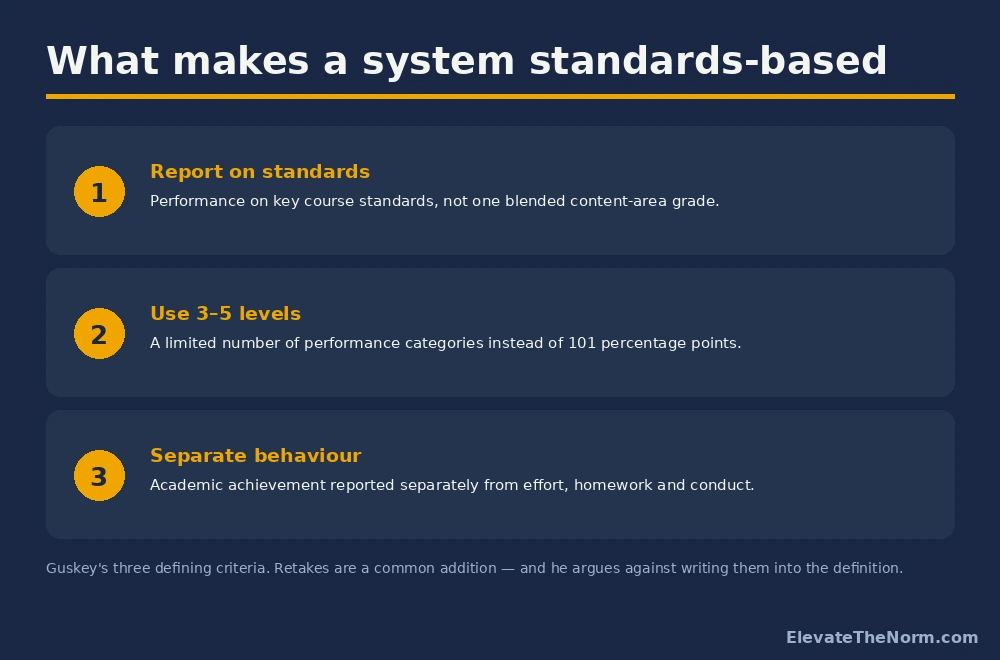
    Three defining criteria, from Linka and Guskey’s review in Theory Into Practice.

    Three defining criteria of standards-based grading: report on standards, use three to five levels, separate behaviour from achievement
    Guskey’s three criteria. Retakes are a common addition, not part of the definition.

    Report performance on key course standards rather than a single blended content-area grade. Use a limited number of performance categories, usually three to five. And report academic achievement separately from noncognitive factors like effort, homework completion and conduct.

    That third one does most of the work. In a traditional gradebook an 87 percent might be a student who understands the material and forgets to hand things in, or a student who understands very little and hands in everything on time. Those are different students with different needs, and the single number hides which one you have.

    Notice what is not in the definition: unlimited retakes. Guskey is explicit that bolting additional assessment requirements onto the definition adds confusion and can produce unreliable outcomes. Reassessment policy is a separate decision, and treating it as part of the definition is why so many staff conversations about standards-based grading immediately become arguments about retakes.

    What the Evidence Actually Shows

    Here is the honest summary, and it is more mixed than either side of this argument usually admits.

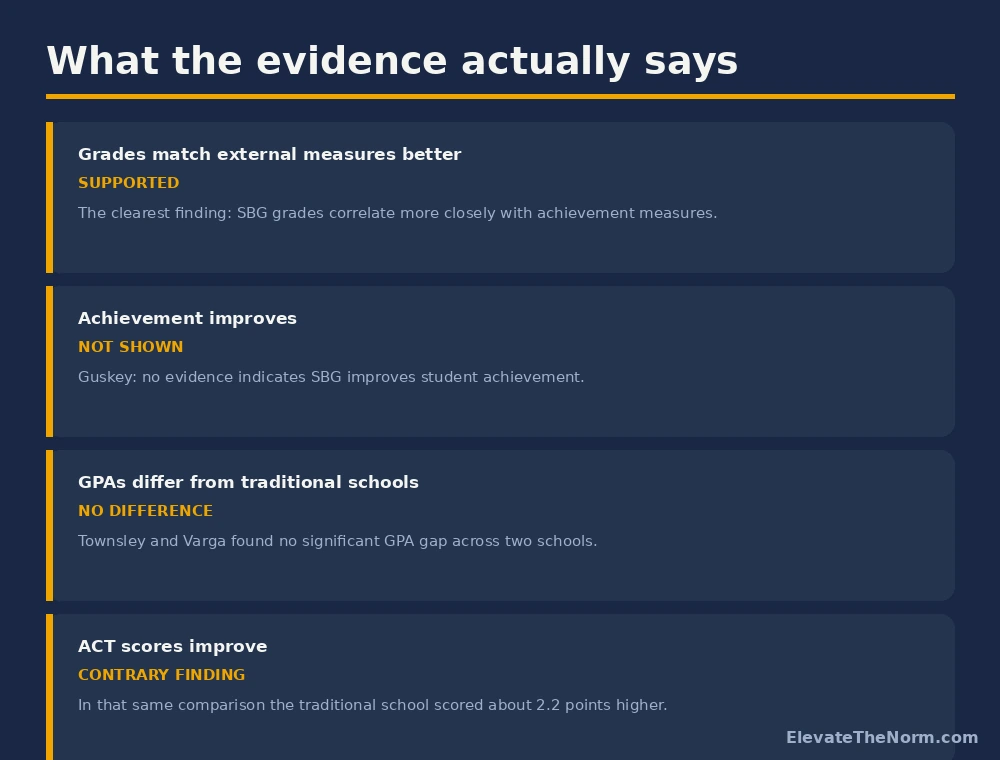
    Four claims about standards-based grading with the evidence verdict for each, including one contrary ACT finding
    One clear win, one honest blank, and one result that goes the other way.

    What is supported. Standards-based grades show a stronger relationship with external measures of achievement than traditional grades do. In plain terms: the grade means more, because it is measuring one thing rather than several mixed together.

    What is not shown. Guskey states it directly: no grading system by itself improves student learning, and no evidence indicates that standards-based grading improves student achievement. He also notes the approach remains largely unstudied, with much of the published guidance drawn from general grading research rather than from studies of standards-based systems specifically.

    And one result that points the other way. Townsley and Varga compared two demographically similar Midwestern high schools, one traditionally graded and one standards-based, across 327 students in two cohorts. They found no significant differences in GPA — but students at the traditionally graded school scored significantly higher on the ACT, by roughly 2.2 to 2.7 points depending on the subtest.

    That finding deserves its caveats stated rather than buried. It is quasi-experimental, not randomised: two schools that differ in grading also differ in a hundred other ways, and nothing here establishes that the grading system caused the gap. The authors say the results are limited to the schools studied and call for replication in more diverse settings. Both schools were small, under 15 percent free or reduced lunch, and had minimal ethnic diversity.

    It is one study and it cannot carry a policy. It also should not be left out, which is what usually happens to it.

    So Why Do It?

    Because “does it raise test scores” is not the only question worth asking about a grading system, and it may not even be the right one.

    A grade is a communication. Its job is to tell a student, a family and a future teacher what this person can currently do. Traditional percentage grading does that job badly — it blends understanding, compliance, timeliness and effort into one number and then reports the number to three decimal places of implied precision.

    Valerie Marsh’s research brief for the University of Rochester’s Center for Urban Education Success catalogues the reported benefits: reduced test anxiety through reassessment, clearer learning objectives, a classroom culture that talks about learning rather than points, and better communication with families. She also cites a Kentucky Algebra 2 study in which the percentage of students doing well on exams nearly doubled compared with traditionally graded peers.

    Hold that Kentucky figure loosely. It is a single course in a single context, reported in a brief rather than read here in the original, and it sits alongside Guskey’s broader conclusion that achievement gains are not established. The defensible claim is about clarity, not scores.

    If you want a reason that survives scrutiny: standards-based grading makes it much harder to hide a student who is quietly failing behind a wall of completed homework, and much harder to fail a student who understands the material but is disorganised. Both of those are worth having on their own terms.

    Catching It Before It Sets

    The most useful thing I do in a lesson has nothing to do with the gradebook. I circulate, and every so often I overhear a group working from a misconception that is about to spread to the table next to them.

    Catching it there costs thirty seconds. Catching it on a unit test costs a week and a conversation with four families.

    That is the honest case for standards-based grading, stated small. A system organised around specific standards makes you notice which standard a student is actually missing, rather than noticing that their average dropped. It does not make the noticing happen — walking around and listening does that. But a gradebook organised by standard means that when you do notice, there is somewhere obvious to record it and somewhere obvious to look next month to see whether it got fixed.

    A percentage column cannot do that. It can only go up and down.

    Where It Goes Wrong

    Marsh’s brief groups the failures into four categories, and every one of them is an implementation problem rather than an evidence problem.

    Five common implementation failures in standards-based grading, including changing the report card first and unplanned retakes
    Most failures are implementation failures, not evidence failures.

    Inconsistent understanding. Teachers report awareness of the principles but struggle to identify which ones apply. A staff using different principles under the same name produces exactly the confusion you would expect, and confusion is what precedes abandonment.

    The reassessment argument. Critics argue unlimited retakes do not reflect situations outside school and may demoralise students who cannot reach proficiency after several attempts. That is a serious objection, not a reactionary one, and a school that has not answered it will have the argument anyway — just later and in public.

    Stakeholder resistance. Parents worry about work habits, college admission and scholarships. Teachers cite workload and grade inflation. Students worry about inconsistent implementation and college readiness. Marsh notes that most of the resistance research involved suburban, predominantly white, high-achieving populations — worth knowing before assuming those concerns will show up identically in your building.

    The implementation dip. Work completion often falls early, as students feeling less accountable turn in fewer assignments and performance temporarily drops. Schools that did not expect this read it as failure in month three and reverse course.

    Guskey’s structural advice cuts through most of this: start with curriculum alignment, not with the report card. Changing the form before agreeing what the standards are produces a new-looking document that nobody can fill in consistently.

    The objections deserve more room than a summary. A companion article on why standards-based grading does not work takes them seriously — what nearly a thousand teachers said about no-zero policies and retakes, what secondary students identified as the core unfairness, and the five conditions under which the honest answer is not yet.

    Standards-Based Grading vs Traditional Grading

    The difference is not strictness. Both systems can be demanding or lax. The difference is what the number refers to.

     TraditionalStandards-based
    The grade measuresPoints accumulated across assignmentsCurrent proficiency on named standards
    Late workUsually reduces the academic gradeReported separately as a work habit
    Early failureAveraged in permanentlySuperseded if the student demonstrates the standard later
    What a parent learnsA number, and a guess at what caused itWhich specific things their child can and cannot do
    Main riskHides both struggling and disorganised studentsInconsistent application across a department

    The third row is the one families ask about, and it is worth answering directly rather than defensively. Yes, a student who could not do it in September and can do it in November is recorded as able to do it. That is the entire argument — a grade is supposed to describe current ability, and averaging in a September failure describes a student who no longer exists. It is the same reasoning behind giving students accountability and another chance everywhere else.

    If You Are Starting This in One Classroom

    1. List the standards first. Six to ten for the course, in language a student can read. This is the step schools skip and it is the whole foundation.
    2. Pick your levels and define them. Three to five, with a written descriptor for each. Vague levels are worse than percentages.
    3. Split the gradebook. One section for achievement by standard, one for work habits. Do this before you change anything a family sees.
    4. Decide the reassessment rule in advance — and write down what a student must do to earn one. “Unlimited” is not a policy; it is the absence of one.
    5. Tell families in writing, early. Transcripts and scholarships are a legitimate concern. Say how your school converts this for those purposes.
    6. Expect the dip. Work completion may fall first. Plan for it rather than being surprised by it.

    The rubric work is the heaviest lift. If you want a starting point, there are proficiency-level descriptors already written that you can adapt to your own standards, free and with no email required. For speaking and listening specifically, there is a four-criterion discussion rubric on the same terms.

    The other heavy lift is the gradebook itself. A traditional gradebook averages everything you put in it, which quietly undoes the thing you are trying to do, and most teachers discover that in week three rather than in August. If you want the setup decisions made before the year starts, here is how the gradebook has to be built for any of this to survive contact with a real grading period.

    What to Do Next

    Be honest with yourself about what you expect from it. If you are hoping for higher test scores, the evidence does not promise them and one comparison points mildly the other way. If you want a grade that tells the truth about what a student can do, that is a real and defensible reason, and it is the one the research actually supports.

    Start with the standards list for one course. Not the report card, not the software, not a department vote. Six to ten statements about what a student should be able to do by June — written where a fifteen-year-old could read them and tell you which ones they have got. Most of the value of this system shows up the moment that list exists, whatever you end up doing with the gradebook.

    When you do get to the gradebook, the next thing to settle is the scale itself — and converting a 1–4 level into a report-card grade is where most implementations get stuck.

    Before you go: grab the free Standards-Based Grading Starter Pack (PDF) — ElevateTheNorm.com branded, printable, no email required.

    Frequently Asked Questions

    Does standards-based grading improve student achievement?

    On the current evidence, no — and that comes from the researchers who study it rather than from its critics. Guskey’s position is that no grading system by itself improves student learning and that no evidence indicates standards-based grading improves achievement. What it does do reliably is make grades correspond more closely to external measures of what students can actually do. That is a real benefit, and it is a different claim from raising scores.

    Is there research showing it makes things worse?

    There is one comparison worth knowing about. Townsley and Varga looked at two demographically similar Midwestern high schools, one traditional and one standards-based, and found no GPA difference but ACT scores roughly 2.2 to 2.7 points higher at the traditionally graded school. It is quasi-experimental rather than randomised, so it cannot show the grading caused the gap — two schools differ in countless ways — and the authors themselves limit the finding to the schools studied. It is one result, it points the other way, and it should be part of the conversation.

    Do you have to allow unlimited retakes?

    No, and Guskey argues that retake policy should not be written into the definition of standards-based grading at all — doing so adds confusion and can produce unreliable outcomes. Reassessment is a separate decision your school makes. What matters is that the rule is decided in advance and written down. “Unlimited” is not a policy, and the schools that have the worst time with this are the ones that never specified what a student has to do to earn another attempt.

    How do standards-based grades work for college applications?

    Most schools convert proficiency levels to a GPA for transcript purposes, and this is the question families will ask first, so have the answer ready before you start. Parent concern about college admission and scholarships is one of the documented sources of resistance and it is a reasonable concern rather than an obstructive one. If your school has not decided how conversion works, that decision needs making before the first report card goes out, not after.

    Will students stop doing homework if it is not graded?

    Some will, at first. Research describes an implementation dip where students, feeling less accountable early on, turn in fewer assignments and performance temporarily drops. The schools that handle this well expect it and plan for it; the ones that do not read it as proof the system failed and reverse in month three. Separating homework from the achievement grade does not mean homework stops mattering — it means it is reported as what it is, a work habit, rather than disguised as understanding.

    Can one teacher do this if the school does not?

    Partly. You can organise your own gradebook by standard, define proficiency levels, and separate achievement from work habits, and you will teach better for having done it. What you cannot do alone is change the report card or the transcript, so at some point your internal system has to convert to whatever your school reports. Be upfront with students about that conversion rather than letting them discover it in December.

    Where should a school start?

    With curriculum alignment, not the report card. Guskey is explicit about the order, and reversing it is one of the most common ways this fails — you end up with a new-looking form that nobody can complete consistently because the staff never agreed what the standards were. Get six to ten clear standards per course written in student-readable language first. Everything else follows from that list.

    Sources

    • Linka, L. J., & Guskey, T. R. (2022). Is standards-based grading effective? Theory Into Practice, 61(4). Full text (PDF) — the source for the three defining criteria, the conclusion that no evidence indicates SBG improves achievement, and the caution against writing retakes into the definition.
    • Townsley, M., & Varga, M. (2017). Getting high school students ready for college: A quantitative study of standards-based grading practices. Journal of Research in Education, 28(1), 93–112. Full text (PDF) — 327 students across two Midwestern high schools; no GPA difference, higher ACT scores at the traditionally graded school. Quasi-experimental; the authors limit the finding to the schools studied.
    • Marsh, V. L. (2023, November). Standards-based grading: History, practices, benefits, and challenges. Center for Urban Education Success, University of Rochester Warner School of Education. Read the brief (PDF) — the source for the benefits list, the four categories of challenge, the implementation dip, and the Kentucky Algebra 2 figure, which is reported in the brief rather than read here in the original.

    Every link above was checked on September 12, 2026. Where a finding is contested or comes from a single study, the text says so in the body rather than leaving it to a footnote.


    About Clay Shumate

    By Clay Shumate — Clay Shumate is a certified secondary Social Studies teacher in the public schools of West Alabama, with seven years of classroom experience, a B.A. in History, and an M.Ed. in Secondary Education. He writes about project-based learning, student responsibility, respect, and practical ways to hold young people to a higher standard while giving them room to learn from mistakes. He is a member of the Society of Professional Journalists and writes to its Code of Ethics; this site’s editorial standards and corrections policy are published in full.

Teacher Emergency Toolkit — practical resources, real classroom support. Shop on TPT.Teacher Emergency Toolkit — practical resources, real classroom support. Shop on TPT.