Every classroom has rules posted somewhere. Most of them say things like “Be Respectful,” “Be Responsible,” and “Be Ready” — alliterative, inoffensive, and almost entirely meaningless to a teenager who doesn’t know what those words look like in practice.
In my seventh year in the classroom, I’ve stopped treating a posted list of slogans as a finished job. Three phrases in block letters, laminated and mounted near the door, give the impression that expectations have been communicated. They haven’t. Teenagers need specifics. They need to know what “respect” looks like at 8:15 on a Monday when they’re exhausted and the assignment makes no sense. They need to know what “ready” looks like when they forgot a pencil and the lesson starts in thirty seconds.
A classroom expectations poster, done right, is more than decoration. It’s a reference tool — a shared agreement students can point to and that you can point to when a situation arises. It’s the honest answer to “I didn’t know that was a rule,” because it was, and it was visible the whole time.
This article gives you the full poster text I use, the thinking behind each line, and how to introduce it so students actually read it instead of walking past it for nine months.
Why Most Classroom Expectations Posters Don’t Work
The three-slogan poster fails for a predictable reason: vague language does not change vague behavior. When a student acts dismissively toward a classmate and you point to “Be Respectful” on the wall, they will look at it and genuinely not see the connection. That’s not defiance — it’s the natural result of abstract words without concrete definition.
The IRIS Center at Vanderbilt University makes a useful distinction in their classroom management research: classroom norms are familiar ways of interacting, while expectations are desired behaviors and outcomes. The difference matters because norms require explicit teaching, not just posting. “Be Respectful” is a norm. “When someone is speaking, you are looking at them and waiting your turn” is an expectation — observable, specific, and something a teacher can actually reference in the moment.
Research from Education Northwest found that five to ten percent of the variance in student performance is attributable to teacher expectations — not the poster on the wall, but the behavioral expectations teachers communicate, model, and consistently reinforce. That number might sound small, but compounded across a school year for thirty kids, it adds up. The poster is only valuable if it represents what you actually teach and hold students to.
The secondary-level mistake is slightly different than elementary. High school teachers often skip the poster entirely — “they’re old enough to know how to behave” — or go the opposite direction with a legalistic list of prohibited behaviors. Neither approach works. Students at this age respond to expectations framed as the standards of a serious environment that takes them seriously. They want to know that the rules make sense, not that they’re being controlled.
What a Classroom Expectations Poster Should Actually Do
Before writing a single word for your poster, decide what job it’s going to do. A classroom expectations poster for middle and high school students should serve three purposes:
First, it should define what success looks like in your room. Not what’s prohibited — what’s expected. There’s a meaningful difference. A list of don’ts puts students in a defensive posture. A list of expectations frames the room as a place with standards worth meeting.
Second, it should be specific enough to reference in real situations. If you cannot point to a line on your poster during a conversation with a student and have them immediately understand why that line applies, the language isn’t specific enough.
Third, it should treat students as capable of meeting the standards listed. Research consistently shows that students perform closer to the level their teachers genuinely believe they can reach. A poster that assumes low capability — or that feels like it was written for elementary students — communicates something you probably don’t intend.
The research of Rosenthal and Jacobson, which famously showed that teacher expectations influence student performance even when the expectations are communicated unconsciously through treatment and attention, underlines why the framing of a poster matters. A poster that communicates “here’s what I believe students like you actually need reminding about” sets a different tone than one that says “here are the standards of a serious classroom.”
The Poster Text: Full Copy for Middle and High School
Here is the full text I use in my room. This version was written with the specific goal of being direct, respectful, and specific enough to be useful. Copy it, adapt it, and make it yours.
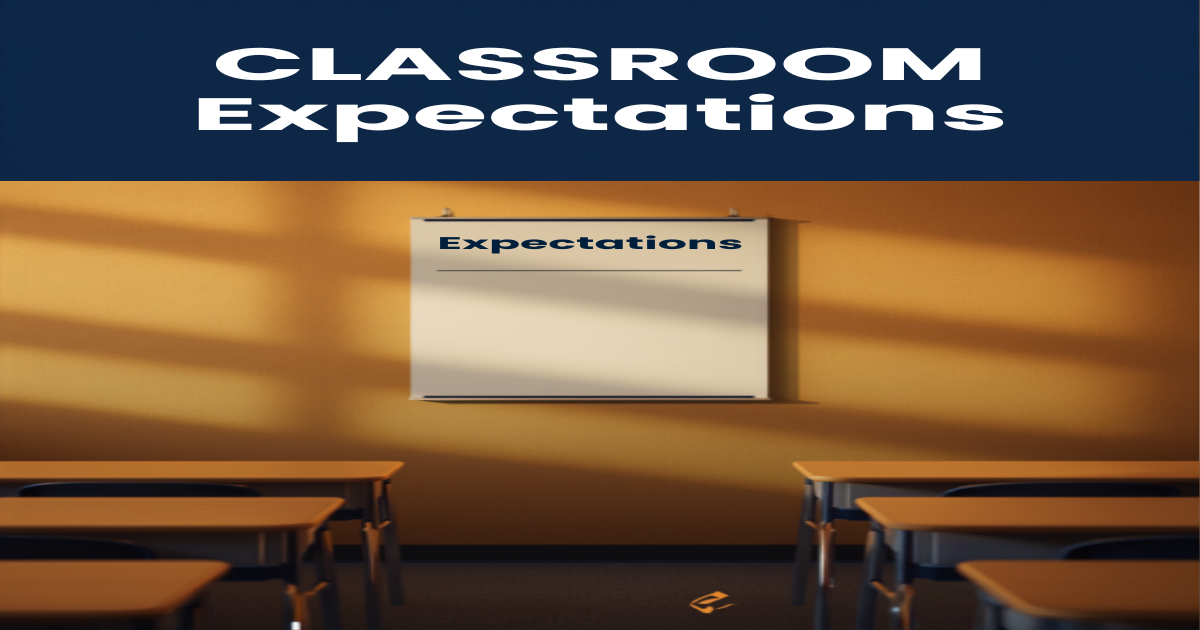
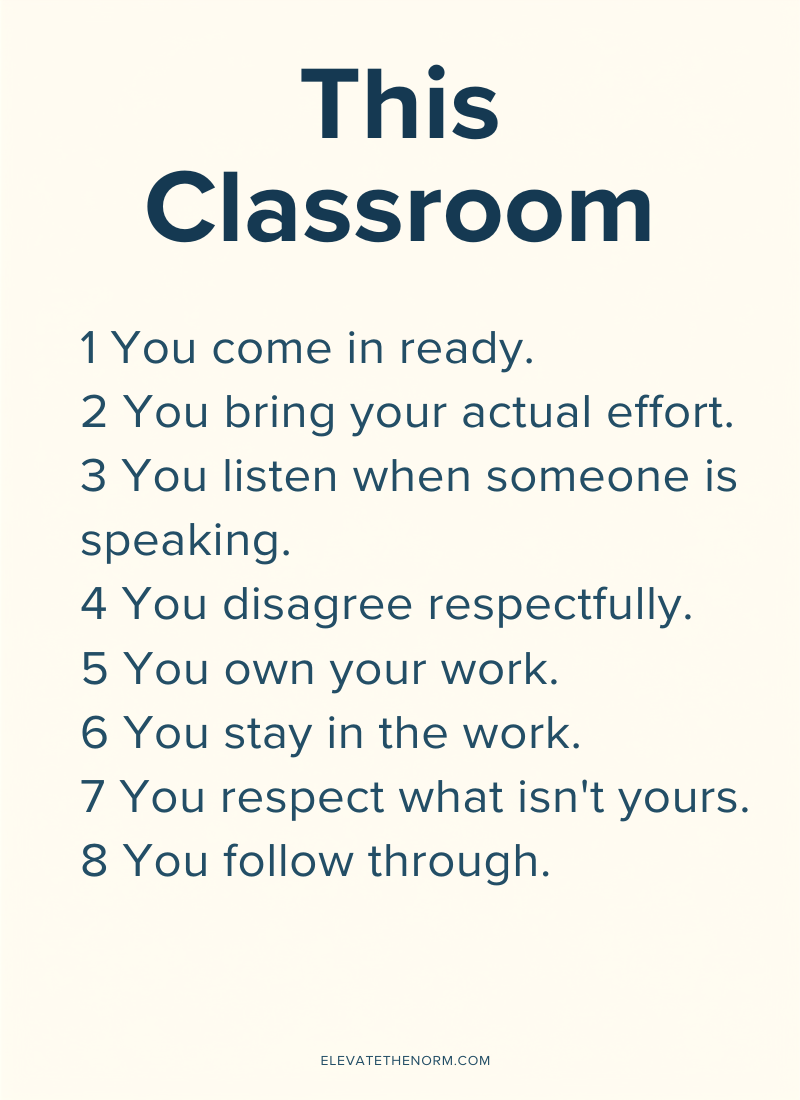
In This Classroom
You come in ready.
Materials in hand, in your seat, working on what’s up when the bell rings. Not almost ready — ready.
You bring your actual effort.
Not your best-day effort. Your today effort, whatever that is. Show up and do the work. That’s the standard.
You listen when someone is speaking.
Eyes up, phone down, waiting your turn. This applies to me and to your classmates.
You disagree respectfully.
If you think something is wrong, you say so — directly, with reasoning. You do not dismiss, ridicule, or roll your eyes.
You own your work.
Yours means yours. Mistakes are expected. Excuses are not. If something goes wrong, we figure out what happened and fix it.
You stay in the work.
When a task is hard, you stay with it before you ask for help. When you’re lost, you say so. “I don’t get it” is the beginning of learning, not a reason to stop.
You respect what isn’t yours.
Desks, supplies, and other people’s belongings are treated accordingly.
You follow through.
Deadlines exist. Commitments matter. If something comes up, you talk to me before the due date, not after.
Download the Classroom Expectations Poster
The poster is free and right here, with no email or signup of any kind. Blanks are built in for your room number, your name, and your course. Print the 11×17 for wall mounting where the back row can read it, or the letter size for a desk-level copy. The PNG is there if you would rather drop it into your own layout first.
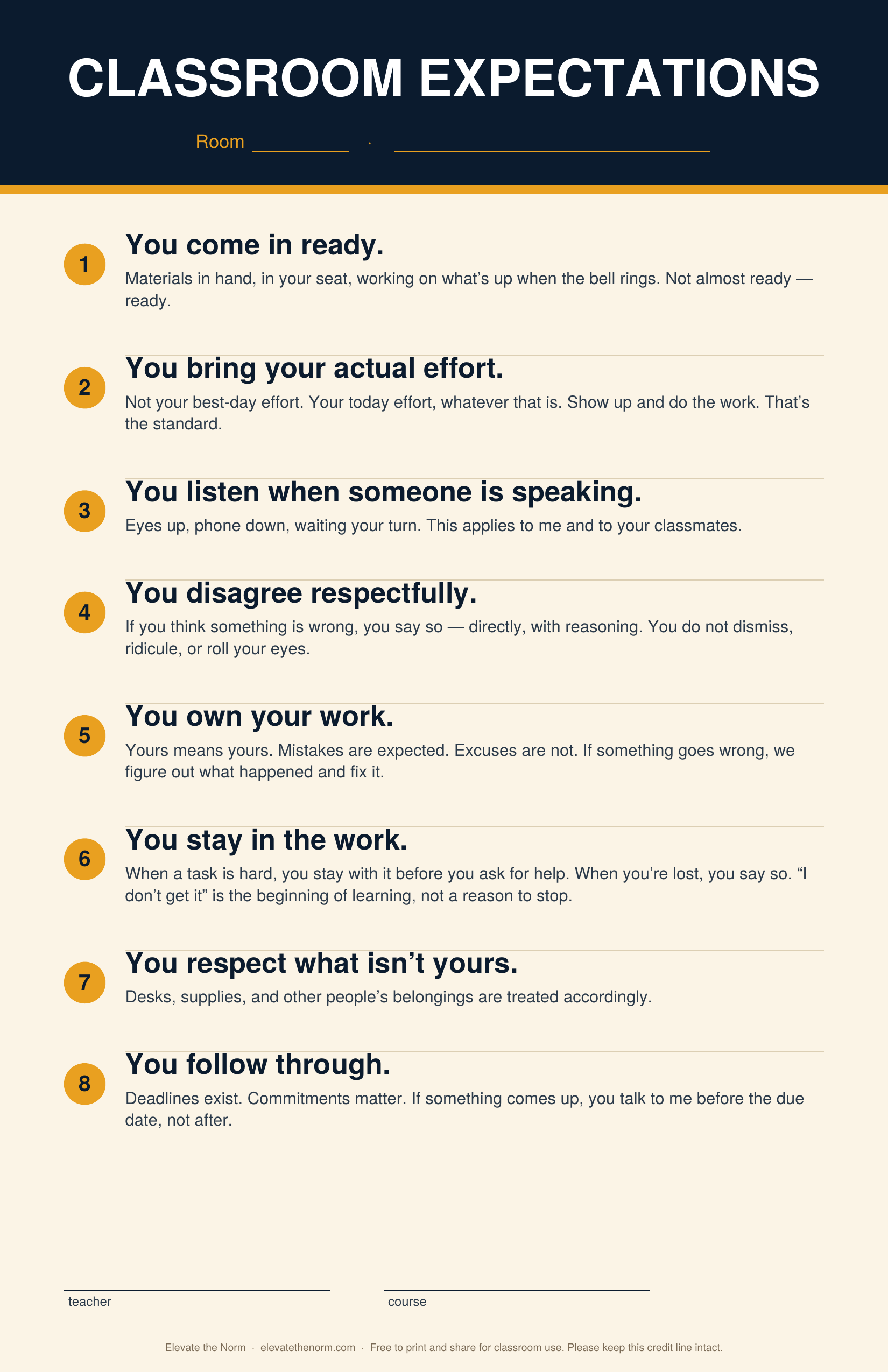
Free. No email address required. Free to print and share for classroom use — please keep the credit line intact. More free classroom packs are on the teacher resources page.
Why These Lines Are Written This Way
Each line was written to be as direct and specific as possible while treating students as people who can meet the standard.
“You come in ready” is more specific than “Be Prepared.” It names the three things ready actually means: materials, seat, and working. First-week students who struggle with this aren’t defying you — they don’t know what ready looks like yet. This line tells them.
“You bring your actual effort” is specifically not a “give 110%” type of statement, which sounds like a motivational poster and lands about as well. Instead, it acknowledges that effort looks different on different days and asks for whatever today’s version is. This matters for students who check out because they think they’re already behind.
“You listen when someone is speaking” is specific. Eyes up, phone down, waiting your turn. Those are observable behaviors. If a student has eyes on their phone while a classmate presents, that line directly applies. “Be Respectful” does not.
“You disagree respectfully” is one of the most important lines on the poster — and the one most teachers skip. When students know that disagreement is not only tolerated but expected to happen in a particular way, they’re more likely to engage substantively rather than disengage silently. Related to the principle of student voice and choice, this expectation tells students that their perspective has a place in the room, with conditions.
“You own your work” addresses academic integrity and personal responsibility without using either phrase. Teenagers understand “mistakes are expected, excuses are not” faster than they understand a policy statement about academic dishonesty. See also: student responsibility in the classroom.
“You stay in the work” targets the most common avoidance pattern in secondary school: the student who gives up after thirty seconds and announces they’re done. It gives them a two-step response — stay with it first, ask for help second — and frames “I don’t get it” as a learning step rather than a stopping point. This connects directly to developing student autonomy, where students learn to work through challenges before seeking support.
“You respect what isn’t yours” is brief on purpose. Students this age know what it means. A long explanation implies you don’t trust them to understand basic respect for property.
“You follow through” names the expectation most teachers dance around with a long late-work policy. Commitments matter. Deadlines exist. Talk to me before, not after. That’s a relationship-based expectation, not a punitive one, and it sets the stage for a student accountability culture rather than one built on consequences alone.
How to Introduce the Poster on Day One
Posting the expectations is step one. Teaching them is the actual job. The IRIS Center research makes this explicit: simply displaying rules is insufficient. Students need direct instruction, modeling, opportunity for practice, and feedback throughout the year.
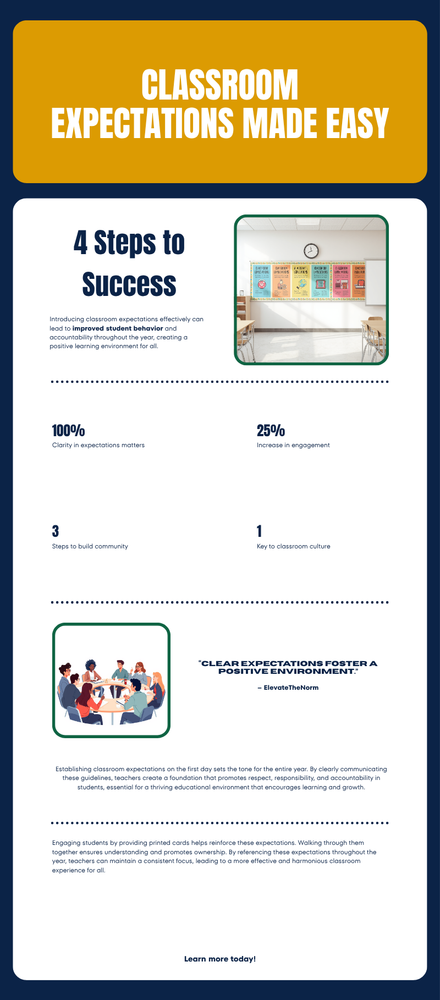
In my room, on day one, every student gets a printed card — half-sheet size — with the poster text on it. They keep it in their folder or notebook for the first few weeks. Then I walk through each line, one by one, and do two things: explain what it means in practice in our room specifically, and ask students what they think it means.
This is not a lecture about rules. It’s a conversation about how this room is going to work. I ask: “What would ‘you come in ready’ look like in practice? What might make it harder? What should you do if you need a minute?” The goal is for students to own the expectations, not just receive them.
The research on high expectations for students consistently shows that the quality of how expectations are communicated matters as much as the expectations themselves. Expectations delivered as a list to be memorized have less impact than expectations discussed, practiced, and genuinely held.
After the first-day conversation, I reference the poster regularly — not as a threat, but as a natural part of class language. “We’re going to stay in the work here.” “If you disagree, say so with reasoning.” The poster becomes shorthand for a full expectation that students already understand.
Where to Post It and How to Design It
Placement matters more than most teachers realize. If the poster is tucked in a corner next to three other posters, it is not functioning as a reference tool — it’s decoration. Put your expectations poster in a location that is:
- Visible from every seat in the room
- Large enough to read from the back of the room
- Not competing with surrounding content for visual attention
A single-page format works best for a secondary classroom. Font should be readable at a distance — no smaller than 24pt for body text, larger for the title. Design it in a way that fits the aesthetic of your room without making it look childish. A clean, simple design with clear typography communicates professionalism; clip-art borders do not.
If you use Canva or a similar tool, create the poster in the dimensions for your printer (typically 11×17 for a poster-size sheet) or design it as a digital display if you have a dedicated screen. Watermark it as yours if you’re sharing it externally.
Consider a smaller companion card — quarter-sheet or half-sheet — that students keep in their folders or journals. The poster is a reference for the room. The card is a personal reference they can access during independent work.
After Day One: Keeping Expectations Alive
The most important part of a classroom expectations poster is what happens after you put it up. If you never reference it again, it becomes wallpaper within two weeks. Students are paying attention to what you actually prioritize, not what you display.
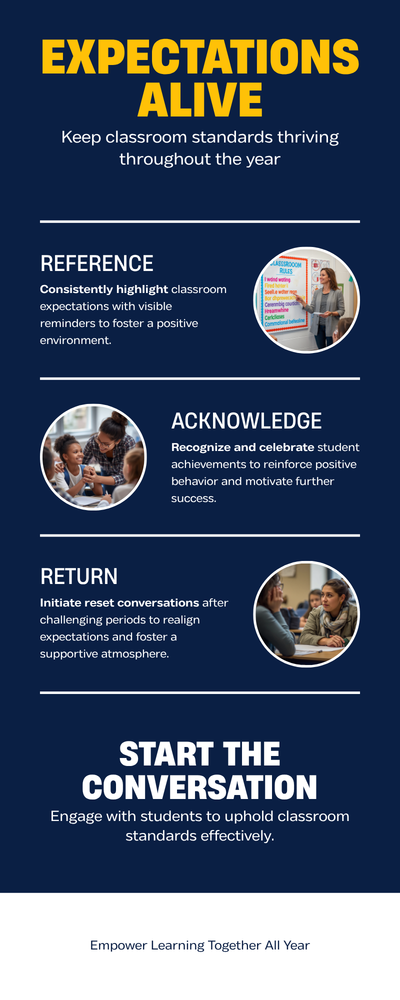
Three practices that keep expectations functional all year:
Reference by name. When you redirect a student, name the expectation you’re referencing. “Hey — we’re listening when someone’s speaking.” Not “you’re being disrespectful.” The specific language connects the moment to the poster.
Acknowledge when expectations are met. This is particularly important with secondary students, who often expect correction but not affirmation. When a student owns a mistake without excuses, name it. “That’s exactly what ‘you own your work’ looks like. I appreciate that.” It reinforces the expectation without being saccharine.
Return to the poster after a rough stretch. Every classroom hits a rough patch — after a long break, during testing, late spring. When behavior patterns shift, a brief return to the poster is more useful than a lecture. “Let’s check in on where we are as a class. Which of these are we doing well? Which are we slipping on?” That conversation treats students as capable of self-assessing, which supports the student voice and choice culture you’re building.
The research from TNTP’s 2024 literature review on teacher expectations notes that proactive, consistent, and equitable enforcement of expectations is what produces outcomes — not the initial posting or the first-day conversation. The poster is a starting point. How you use it the rest of the year is the actual work.
Additionally, consider how positive discipline for teens connects here — expectations, when held consistently without shame or power struggles, build the foundation for students to make better choices because they understand the standard, not because they fear the consequence.
Frequently Asked Questions
Should students help create the classroom expectations?
Student-generated expectations have merit, especially for building buy-in. The practical tradeoff: students will often generate vaguer language than you need (‘be nice’), and you may spend the first class period negotiating rather than establishing a clear standard. A middle path that works well is to give students the poster framework and ask them to discuss and refine what each line means in practice — they help define the specifics without starting from a blank slate. If your classroom culture already supports significant student voice and choice, full co-creation is worth the time.
What’s the difference between classroom rules and classroom expectations?
Rules prohibit specific behaviors (‘no phones’). Expectations define what success looks like (‘when someone is speaking, you’re looking at them’). For secondary students, expectations framed in terms of what they should do tend to get better results than a list of don’ts, which puts students in a defensive mental posture from the first day.
How many expectations should be on the poster?
Research on classroom norms suggests five to eight is a useful range — enough to cover the major categories of behavior in a learning environment without becoming a list students can’t remember. The poster text above has eight lines. If your context requires different emphasis, cut or adapt rather than pile on.
Should middle school and high school expectations look different?
The core expectations are similar, but the delivery and design should shift. Middle school students often benefit from more concrete specifics and visual cues alongside the text. High school students respond better to fewer words and more direct language. The poster text above was written to work across grades 6–12 with minor adjustments in tone depending on how you introduce it.
What do I do when a student violates an expectation repeatedly?
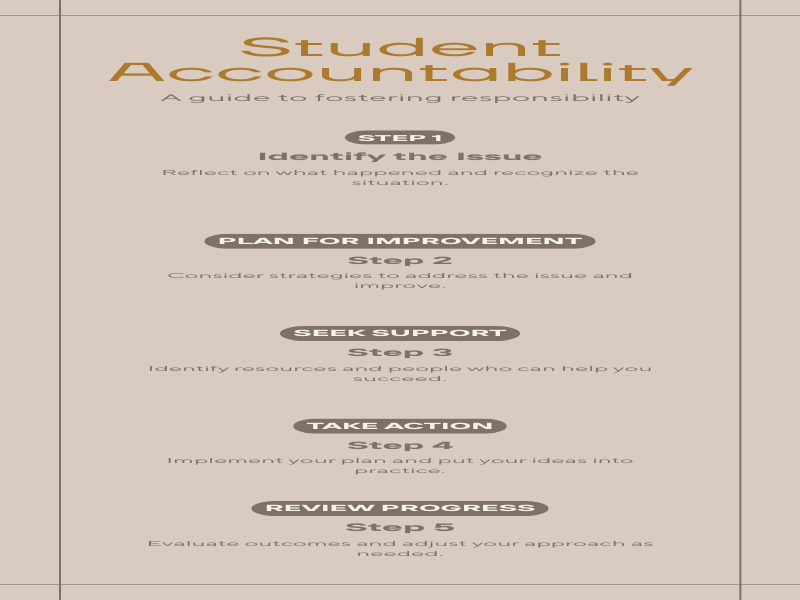
The poster is a reference tool, not a consequence system. If a student is repeatedly not meeting an expectation, that’s a conversation — not a pointing-at-the-poster moment. The poster helps you name the expectation clearly; the actual work of changing behavior usually requires a private conversation, some investigation of what’s causing the pattern, and sometimes a connection to the school’s support systems. A student accountability sheet can structure those conversations and help students track their own patterns.
Is it worth posting expectations in a room where students rotate (secondary, multiple classes)?
Absolutely — arguably more so than in an elementary setting. When students move from class to class, each teacher’s expectations may be different, and ambiguity around those differences is where a lot of secondary classroom behavior issues actually live. Posting clear expectations makes your room legible to students and reduces the mental load of figuring out how this room is different from last period.
What’s the right response when a student says the expectations are unfair?
Take it seriously. Ask them to be specific: which expectation do they think is unfair, and why? You may learn something useful. Sometimes students are naming a real inconsistency in how an expectation is enforced (equity concerns are worth listening to). Sometimes they’re testing to see if you mean it. Either way, a direct, calm conversation — ‘Tell me more about what you’re seeing’ — respects their perspective while making clear the expectations themselves aren’t up for negotiation in the moment.
Sources
Brophy, J. (1983). Research on the self-fulfilling prophecy and teacher expectations. Journal of Educational Psychology, 75(5), 631–661.
Education Northwest. (n.d.). Expectations and student outcomes. https://educationnorthwest.org/sites/default/files/expectations-and-student-outcomes.pdf
IRIS Center, Peabody College, Vanderbilt University. (n.d.). Establishing classroom norms and expectations. https://iris.peabody.vanderbilt.edu/case-study/establishing-classroom-norms-and-expectations/
Rosenthal, R., & Jacobson, L. (1968). Pygmalion in the classroom: Teacher expectation and pupils’ intellectual development. Holt, Rinehart and Winston.
TNTP. (2024). The impacts of teacher expectations on student outcomes: A literature review. https://tntp.org/wp-content/uploads/2024/09/The-Impacts-of-Teacher-Expectations-on-Student-Outcomes-Literature-Review-2024.pdf