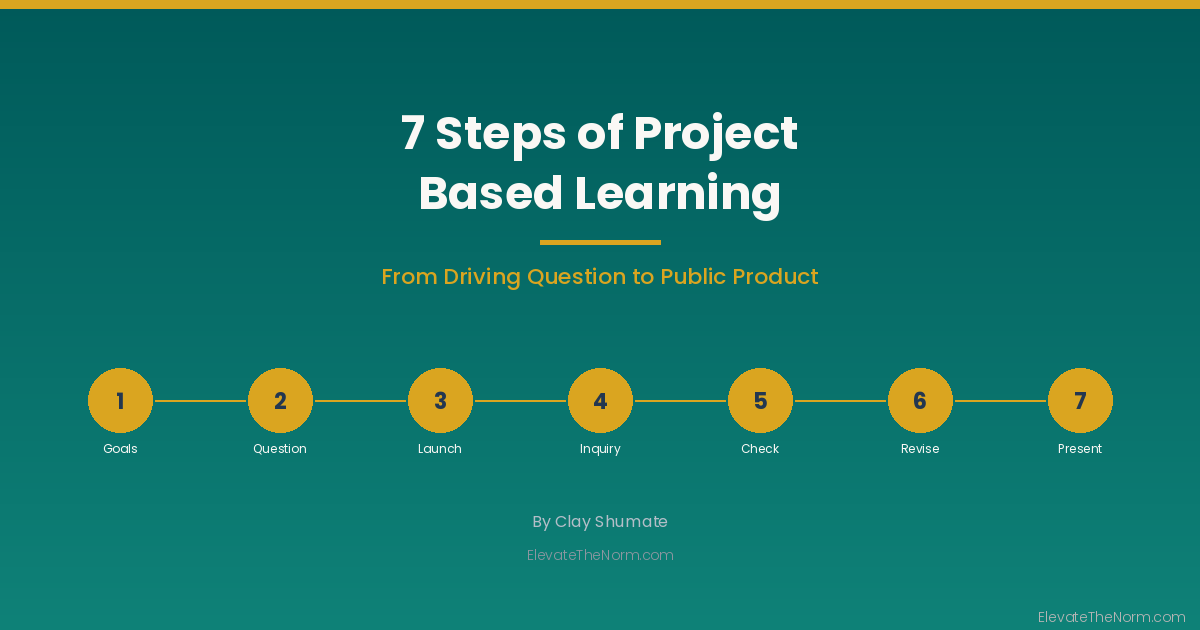
The Elevate Blog banner: Real Classrooms. Practical Ideas. Higher Expectations. Three students climb a rocky ridge at sunrise, each pulling the next one up, toward a teacher reaching down to help.

Author: Clay Shumate

  • 7 Steps of Project Based Learning: From Driving Question to Public Product

    7 Steps of Project Based Learning: From Driving Question to Public Product

    By Clay Shumate

    The 7 steps of project based learning move a class from a question worth answering to a product worth defending. They are: identify learning goals, craft a driving question, launch the project, guide inquiry and research, set checkpoints and manage the work, facilitate critique and revision, and present the public product with reflection. Each step has a teacher role and a student role, and skipping any of them is how PBL collapses into a decorated group assignment. Each step works better when teachers and students have reliable project based learning tools—the planning templates, role cards, and critique protocols that keep the process on track. There is also a reviewed list of outside PBL resources worth the download, with the weak ones named.

    Why Steps Matter: PBL Without Structure Falls Apart

    Project based learning has a reputation problem. Teachers who have tried it and watched it fail usually did not fail at the project — they failed at the process. A class that jumps from “here is your project” to “present on Friday” without the steps in between produces exactly the kind of shallow, off-task, unequal group work that gives PBL a bad name.

    The Gold Standard PBL framework from PBLWorks, developed by John Larmer, John Mergendoller, and the Buck Institute for Education, identifies seven essential project design elements: a challenging problem or question, sustained inquiry, authenticity, student voice and choice, reflection, critique and revision, and a public product. Those elements are not decorations. They are structural requirements. Remove any one of them and the project loses what makes it PBL.

    The seven steps below translate those design elements into a sequence a teacher can actually follow. They are grounded in PBLWorks’ framework, supported by the research comparing PBL vs traditional teaching, and tested in real classrooms — including mine, where the tables are pushed together, students are always working with somebody, and the projects run while I circulate between groups.

    Step 1: Identify Learning Goals and Standards

    The teacher’s job: Decide what students must know and be able to do by the end of the project. Anchor these goals in your actual standards — state standards, Common Core, NGSS, C3, whatever your district uses. This is not optional. A project without clear learning goals is an activity, not instruction. If you need a refresher on the definition of project based learning and what separates it from traditional group work, start there.

    The common mistake: Designing the fun part first and then trying to reverse-engineer the standards into it. That produces projects where the academic content is an afterthought — the poster looks great but the student cannot explain what they learned.

    What to do instead: Start with the standards. Identify two to four that the project will assess directly. Then ask: what kind of work would require students to use these standards to answer a real question or solve a real problem? The project grows from the learning, not the other way around.

    A practical tip: write the standards on one side of a sheet of paper and the project idea on the other. If you cannot draw clear lines connecting them, the project needs to change or the standards need to change. One or the other.

    Step 2: Craft a Driving Question

    The teacher’s job: Write a question that is open-ended, challenging, anchored in real concerns, and aligned to the learning goals from Step 1. This question drives the entire project. If the question is weak, everything after it will be shallow.
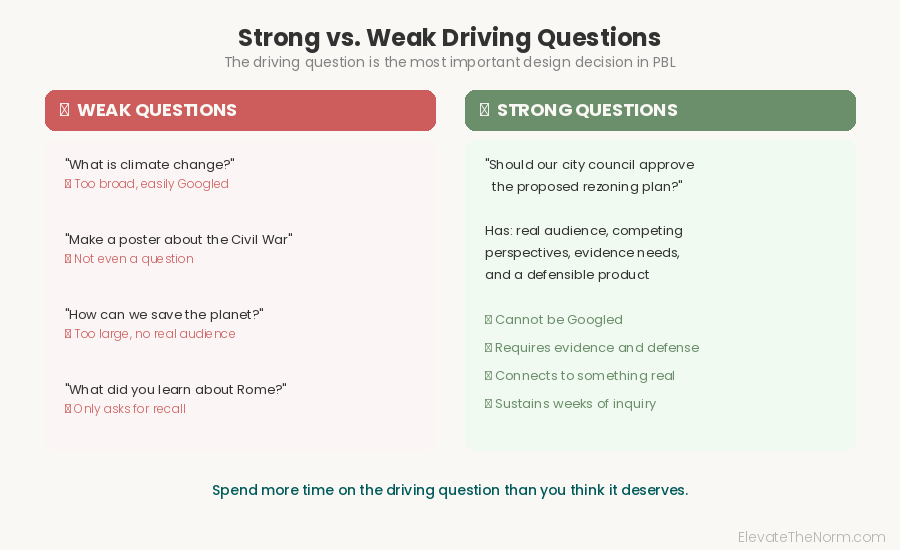
    Comparison of strong and weak driving questions for project based learning showing what makes an effective PBL question
    Strong versus weak driving questions — the most important design decision in PBL

    What makes a strong driving question:

    • It cannot be answered with a Google search.
    • It requires students to gather evidence, weigh competing claims, and defend a position.
    • It connects to something real — a community issue, a professional challenge, a decision someone actually has to make.
    • It is specific enough to be answerable and broad enough to sustain weeks of inquiry.

    What makes a weak driving question:

    • “What is climate change?” — Too broad, easily Googled.
    • “Make a poster about the Civil War.” — Not a question at all.
    • “How can we save the planet?” — Too large, no real audience, no defensible product.
    • “What did you learn about ancient Rome?” — Only asks for recall, not application.

    A strong example: “Should our city council approve the proposed rezoning plan for the neighborhood south of Main Street?” This question has a real audience (the council), competing perspectives (residents, developers, environmental groups), evidence requirements (zoning data, traffic studies, community input), and a defensible product (a recommendation with data).

    Spend more time on this step than you think it deserves. A mediocre driving question produces mediocre projects no matter how well you execute the other six steps. If you want side-by-side models to work from, these driving question examples across four subject areas show what the revision from weak to strong actually looks like.

    Step 3: Launch the Project

    The teacher’s job: Introduce the driving question in a way that creates genuine curiosity, not just compliance. The launch is the moment students go from “we have a project” to “I actually want to know the answer to this.”

    Effective launches include:

    • A real-world entry event: a guest speaker, a site visit, a video of the actual problem, a letter from someone who needs the answer.
    • A “need to know” list: after the launch, students generate questions about what they need to learn to answer the driving question. This list becomes their research agenda.
    • Clear project parameters: timeline, deliverables, team structures, and how the work will be assessed.

    The trap: Over-explaining everything on day one. If students walk away from the launch knowing exactly what the final product should look like, you have removed the inquiry. Give them the question and the constraints. Let them figure out the path.

    Step 4: Guide Inquiry and Research

    The teacher’s job: This is the sustained inquiry step — the one that separates PBL from a group assignment with a poster. Students are not following a worksheet. They are identifying what they need to know, finding sources, evaluating evidence, and building understanding over days or weeks.
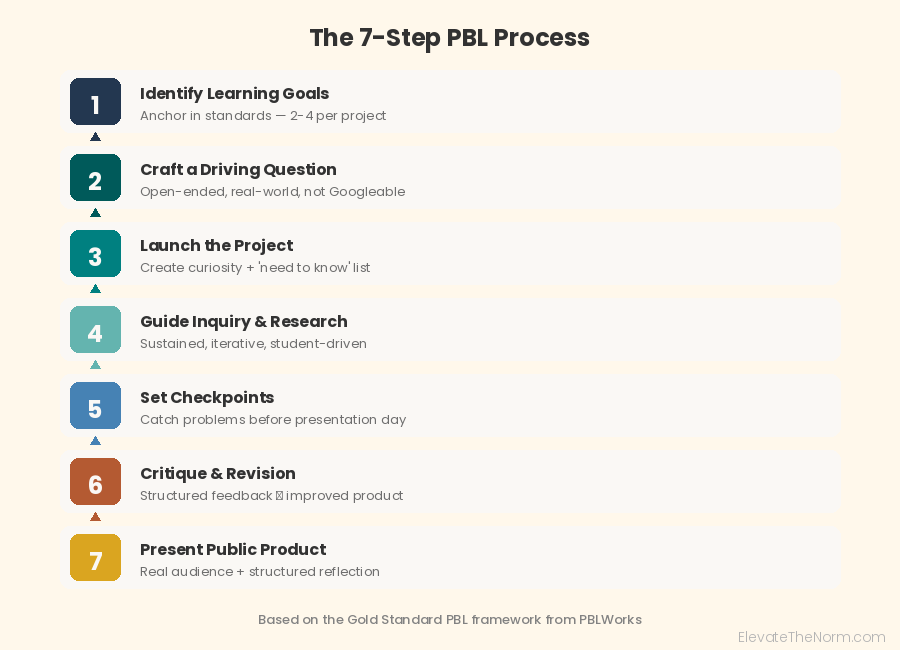
    Seven step project based learning process from identifying learning goals to presenting the public product
    The seven-step PBL process based on PBLWorks’ Gold Standard framework

    What this looks like in practice:

    • Students work from their “need to know” list and add to it as new questions emerge.
    • The teacher provides direct instruction when the whole class needs it — a lesson on evaluating sources, a skill workshop on data analysis, a mini-lecture on background content — but these lessons serve the project, not the other way around.
    • Research is iterative. Students may find that their initial approach does not work and need to change direction. That is not a failure. That is inquiry.

    I spend most of this step circulating. The tables in my room are already grouped, so students are working in pairs or small teams by default. Most of what I do is listen. I stop at a group, hear what they are discussing, and decide whether to step in or move on. If I overhear a group building on a premise that is factually wrong — and it happens more often than you would think — I do not announce it to the room. I sit down with that group and ask them to show me where they found it. Usually, the source is a single website or a misread paragraph. We look at it together, and they see the problem themselves. That is more valuable than a correction from the front of the room.

    A note on diverse learners: Students with IEPs, 504 plans, or English language needs may require adjusted entry points for inquiry — a modified source list, a graphic organizer, a shorter initial reading, or a paired research partner. The inquiry itself does not change. The scaffolding that gets a student into the inquiry does. Work with your special education and ELL colleagues to design those entry points before the project launches, not after a student stalls.

    The common failure point: Letting inquiry drift. Without regular check-ins, some groups will spend two weeks on research and produce nothing usable. Step 5 prevents that.

    Step 5: Set Checkpoints and Manage the Work

    The teacher’s job: Build structured checkpoints into the project timeline where you review student progress, provide feedback, and catch problems before they compound. This is the project management step, and skipping it is the single most common reason PBL fails.

    What checkpoints look like:

    • End of week one: Groups submit a research plan — what they are investigating, where they are looking, what they have found so far, and what is still missing.
    • Midpoint: Groups present a rough draft, preliminary findings, or a prototype. This is not graded. It is feedback.
    • Before the final product: Groups present a near-final version for critique (Step 6).

    The teacher’s role during checkpoints:

    At my whiteboard table, I pull groups one at a time. They show me what they have. I ask questions: What is your claim? Where is your evidence? What would someone who disagrees say? If the answers are thin, we talk about what needs to happen before the next check-in. If the answers are solid, I push harder: What have you left out? What are you unsure about?

    These conversations are not optional. They are the mechanism that prevents the end-of-project crash where one group has done everything and another has done nothing.

    A practical tool: A project calendar posted where students can see it, with checkpoint dates circled. Students should know exactly when they will be expected to show progress and in what form.

    Step 6: Facilitate Critique and Revision

    The teacher’s job: Teach students to give and receive specific, constructive feedback — and then give them structured time to use it. This step is what turns a first draft into a defensible product.

    Why critique and revision matter:

    PBLWorks identifies critique and revision as one of the seven essential design elements for a reason. A project that is never revised is not PBL. It is an assignment that took longer. Real-world work — journalism, engineering, policy, research, design — goes through multiple drafts. Students need to practice that process, not skip it.

    How to structure critique:

    • Use a protocol. Unstructured “peer review” devolves into “looks good” within minutes. A simple protocol works: the presenting group shares their work, the audience asks clarifying questions, the audience offers specific feedback (what is strong, what is unclear, what is missing), and the presenting group records the feedback without defending their work.
    • Model it first. Show students what specific, useful feedback sounds like versus vague or personal feedback. “Your graph does not label the axes” is useful. “I do not like it” is not.
    • Schedule revision time. Feedback without time to use it is performative. Build revision days into the calendar.

    The teacher’s additional role: Give your own feedback alongside the peer critique. Students respect peer feedback more when the teacher is also participating in the same process rather than standing outside it. Critique works best when everyone is scoring against the same published criteria, which is what a shared project scoring guide is for.

    Step 7: Present the Public Product with Reflection

    The teacher’s job: Create an authentic presentation opportunity where students share their work with an audience beyond the classroom — and then lead a structured reflection on what they learned.

    What “public” means:

    The audience does not need to be the United Nations. It needs to be someone other than you. Options that work in an ordinary school:

    • Another class.
    • Parents and families at an evening showcase.
    • A community panel invited for the occasion — a local business owner, a council member, a professional in the field.
    • A recorded presentation shared with a real organization.
    • A published piece — a blog, a letter to the editor, a recommendation submitted to the actual audience named in the driving question. For a concrete example of project based learning in action, see how one classroom handled the full cycle.

    Why the public audience matters:

    When the only audience is the teacher, students calibrate their effort to “good enough to pass.” When someone else will see it — someone they want to impress, someone who might ask hard questions — the standard shifts. The work gets better not because you demanded it, but because the audience did.

    Reflection is the step most teachers skip:

    After the presentation, students need structured time to think about what they learned — not just the content, but the process. What worked? What did they struggle with? What would they do differently? What did the critique feedback change?

    This is not a journal entry for a grade. It is the metacognitive step that turns experience into learning. Without it, students finish the project knowing what they made, but not necessarily what they learned.

    A useful reflection prompt: If you had to do this project again with a new group and a different driving question, what is the one thing you would do differently and why?

    Common Failure Points Across All Seven Steps

    Skipping Step 2 (the driving question): Teachers who start with the product — “we are making a documentary” — instead of the question produce projects where students focus on production quality rather than learning. The documentary looks polished but says nothing original.

    Rushing Step 4 (inquiry): In a tight schedule, it is tempting to hand students the information and skip the research. But if students do not find the information themselves, they do not own it. PBL without inquiry is craft time.

    Ignoring Step 5 (checkpoints): Every PBL horror story — the group that did nothing, the student who carried the team, the project that went completely off track — is a checkpoint failure. You had weeks to catch it. You did not check.

    Treating Step 6 (critique) as optional: Students who present their first draft as their final product have not experienced PBL. They have experienced a long assignment with a due date.

    A Practical Planning Checklist
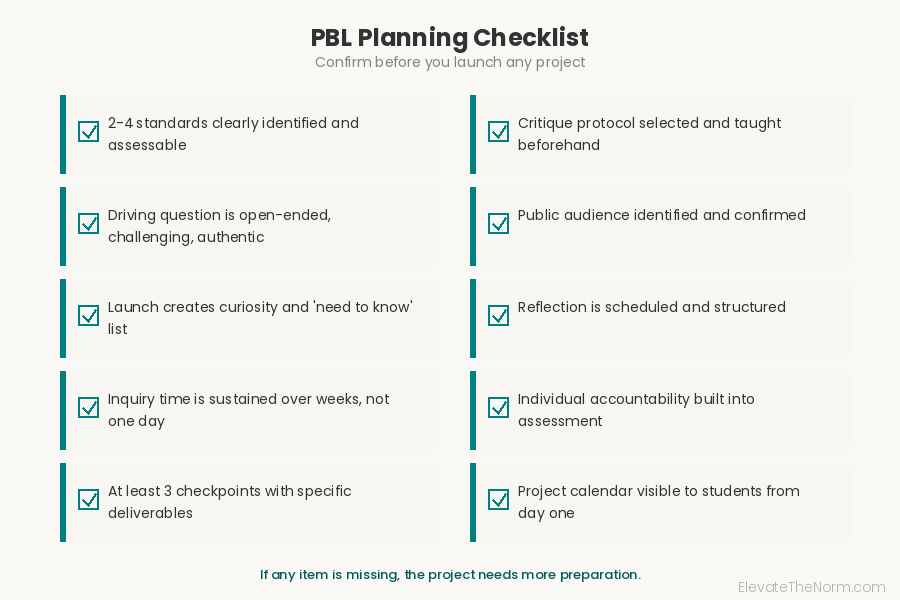
    Project based learning planning checklist with ten items to confirm before launching any student project
    Confirm every item before launching a project

    Before you launch a project, confirm:

    • Two to four standards are clearly identified and assessable through the project.
    • The driving question is open-ended, challenging, authentic, and connected to standards.
    • The launch creates curiosity and generates a student “need to know” list.
    • Inquiry time is built into the calendar — not just one day, but sustained over weeks.
    • At least three checkpoints are scheduled with specific deliverables for each.
    • A critique protocol is selected and taught before the critique session.
    • The audience for the public product is identified and confirmed.
    • Reflection is scheduled and structured.
    • Individual accountability is built into the group assessment so one student cannot carry or hide.
    • The project calendar is visible to students from day one.

    Conclusion

    The 7 steps of project based learning are not a formula. They are a sequence of decisions — learning goals, driving question, launch, inquiry, checkpoints, critique and revision, and public product — that keep a project from becoming busywork with a poster board. Skip any step and you will feel it. Rush the driving question and the research is shallow. Skip checkpoints and you find out too late. Skip critique and the product never improves. Skip the public audience and students treat it like homework.

    Get the sequence right — and if you need ideas for project based learning to get started — PBL produces something most classroom assignments cannot: students who know what they learned, why it matters, and how to defend it to someone who was not in the room.

    For strategies on implementing this sequence inside a standard high-school bell schedule, see project based learning high schools can use without rebuilding the schedule.


    How long should a PBL project take?

    Most projects that follow all seven steps need at least two to three weeks of class time, though some run a full semester. Shorter projects — one to two days — can incorporate PBL elements, but they rarely sustain the inquiry and revision cycle that makes PBL distinct. The driving question should determine the timeline, not the other way around.

    Can I use PBL in a class with a tight pacing guide?

    Yes, but it requires planning. Identify two to four standards the project will cover and use the project as the vehicle for teaching those standards, not an addition to your existing lessons. Replace instruction on those standards with the project, do not stack them. PBL is the main course, not the dessert.

    What if some groups finish early and others are behind?

    This is a checkpoint problem. If you are checking progress at regular intervals, you will catch the groups that are behind before the final deadline. For groups that finish early, add an extension question or have them prepare to serve as peer critics for other groups — a role that deepens their own understanding.

    How do I grade individual students in a group project?

    Build individual accountability into the assessment. Require each student to submit their own written reflection, defend a specific part of the project during the presentation, or complete an individual component alongside the group work. The group product shows collaboration. The individual assessment shows learning.

    What if I have never done PBL before? Should I start with all seven steps?

    Start with a smaller project — two to three weeks, one driving question, one product — and include all seven steps even if you simplify them. Skipping steps is what causes PBL to fail, so it is better to do all seven simply than to do three of them elaborately. Your first project will be imperfect. That is normal. Reflect on what worked and adjust the next one.

    Do I need special materials or technology for PBL?

    No. Some of the strongest projects use nothing but paper, community access, and the students themselves. Technology can enhance research and production, but the seven steps work with or without it. A driving question, a library, and a real audience are more important than a 1:1 device ratio.

    How do I handle a student who does not contribute to the group?

    Address it at checkpoints, not at the end. When you pull a group to the whiteboard table and one member has done nothing, that is a conversation — not a grade penalty. Ask what the barrier is. Sometimes it is confusion, sometimes it is a group dynamic problem, sometimes it is disengagement that needs a different intervention. The answer changes the response.


    Sources

    1. Larmer, J., Mergendoller, J. R., & Boss, S. (2015). Setting the Standard for Project Based Learning. ASCD/Buck Institute for Education.
    2. PBLWorks. “Gold Standard PBL: Essential Project Design Elements.” Buck Institute for Education.
    3. PBLWorks. “Gold Standard PBL: Project Based Teaching Practices.” Buck Institute for Education.
    4. Condliffe, B. (2017). “Project-Based Learning: A Literature Review.” MDRC Working Paper.
    5. Larmer, J., & Mergendoller, J. R. (2010). “Seven Essentials for Project-Based Learning.” Educational Leadership, 68(1), 34–37.
    6. Hattie, J. (2023). Visible Learning: The Sequel. Routledge.

    About Clay Shumate

    Clay Shumate is a certified secondary Social Studies teacher in the public schools of West Alabama, with seven years of classroom experience, a B.A. in History, and an M.Ed. in Secondary Education. He writes about project-based learning, student responsibility, respect, and practical ways to hold young people to a higher standard while giving them room to learn from mistakes. He is a member of the Society of Professional Journalists and writes to its Code of Ethics; this site’s editorial standards and corrections policy are published in full. More about Clay.
  • Motivating Students Who Don’t Care Without Lowering the Standard

    Motivating Students Who Don’t Care Without Lowering the Standard

    By Clay Shumate

    Motivating students who don’t care starts with questioning the assumption. Most students labeled “unmotivated” are not indifferent — they are protecting themselves from failure, irrelevance, or a classroom that has already told them they do not belong. The fix is not enthusiasm or entertainment. It is competence, relevance, relationship, and a standard worth rising to.

    What “Not Caring” Actually Means

    A student who puts their head down, turns in nothing, shrugs when you ask a question, or disrupts every transition looks like someone who does not care. That is what makes this problem so frustrating — the visible behavior and the internal reality rarely match. When that shows up as a flat refusal in the moment rather than a pattern across a term, what you do in the first ninety seconds matters more than anything you say afterwards.

    Research on learned helplessness, first described by Martin Seligman and now studied specifically in adolescent populations, shows that students who repeatedly experience failure without a clear path to improvement eventually stop trying — not because they lack desire, but because effort has not produced results before and they see no reason to believe it will now. A 2026 longitudinal study by Chang and colleagues, published in the Journal of Research on Adolescence, tracked this trajectory in adolescent students and found that learned helplessness increases over time when students experience controlling rather than autonomy-supportive environments.

    Carol Goodenow’s foundational 1993 research on school belonging found a direct link between students’ sense of belonging in a classroom and their academic motivation. Urban adolescents who felt they did not belong reported lower motivation and engagement strategies even when they had the ability to succeed. The research is clear: belonging is not a soft skill. It is a precondition for effort.

    So when a student looks like they do not care, start with three questions before you decide what to do:

    1. Has this student experienced enough success in your class to believe more is possible?
    2. Does this student see a connection between what you are asking them to do and anything that matters to them?
    3. Does this student believe that you — specifically you — will follow through on what you say?

    If the answer to any of those is no, you have found your starting point. And it is not a motivational speech.

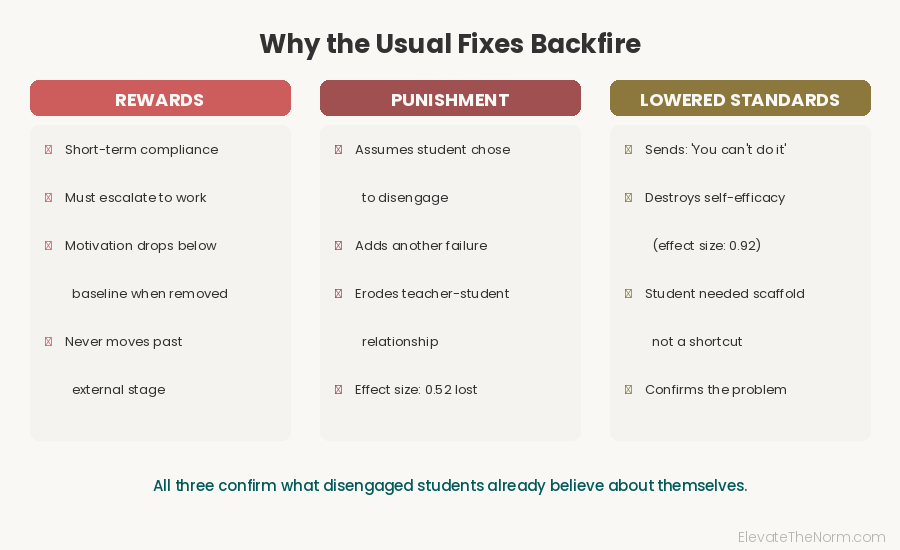
    Why the Usual Fixes Make It Worse

    Rewards Lose Power

    External rewards work in the short term. A pizza party will get homework turned in for a week. But decades of research on self-determination theory, led by Edward Deci and Richard Ryan, demonstrates that extrinsic motivation follows a predictable pattern: the reward must escalate to maintain the same effect, and when it disappears, motivation drops below where it started.

    Deci and Ryan identified four types of extrinsic motivation along a continuum from fully external (doing something to avoid punishment or earn a reward) to integrated (doing something because it aligns with who you are). Most classroom reward systems never move students past the first stage. They produce compliance, not motivation. And compliance disappears the moment the reward does.

    Why rewards punishment and lowered standards backfire for disengaged students showing three columns of failed strategies
    Three common approaches to student disengagement that make the problem worse

    Punishment Backfires

    Punishing a student for not caring — zeroes, detention, calls home, public redirection — assumes the student has chosen not to engage and can be pressured into changing that choice. For a student dealing with learned helplessness, fear of failure, or a home life that makes school feel irrelevant, punishment adds another failure to the pile. John Hattie’s meta-analyses of educational research show that teacher-student relationships carry an effect size of 0.52 on student achievement — a correlation rather than a proven cause, which is how these numbers are best read. Punishment does not build relationships. It erodes them.

    Lowered Standards Confirm the Problem

    This is the trap that well-meaning teachers fall into most often. A student is struggling, so you shorten the assignment, remove the hard parts, or accept work you know is not their best. You do this out of compassion. But the student reads it differently: you do not think I can do it either.

    Hattie’s research on self-efficacy — a student’s belief in their own ability to succeed — shows an effect size of 0.92, one of the highest in the entire database. Lowering the standard does not raise self-efficacy. It destroys it. The student needed a scaffold, not a shortcut.

    What Actually Works: Competence, Relevance, and Relationship

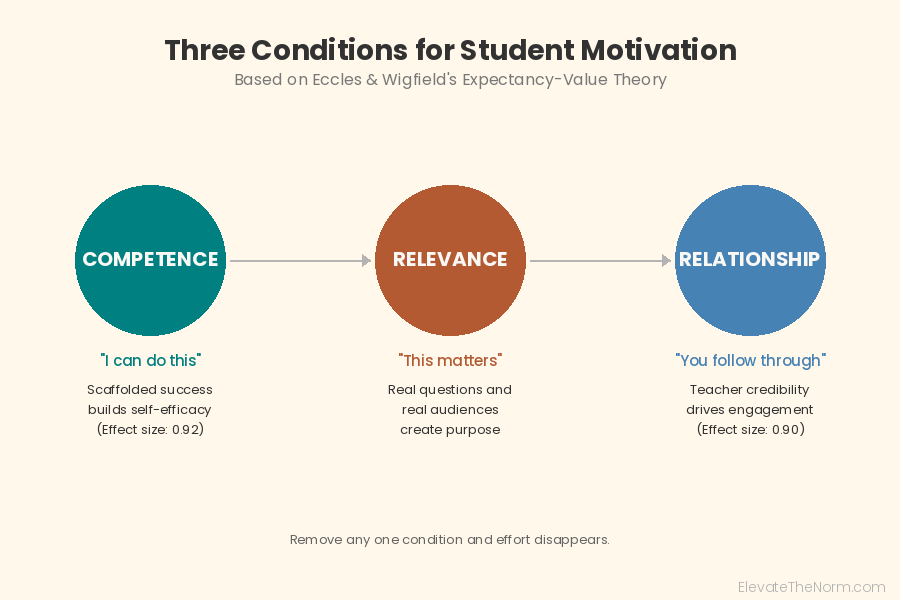
    Eccles and Wigfield’s expectancy-value theory provides a useful framework here. Students are motivated when two conditions are met: they expect they can succeed at the task, and they value the outcome. Remove either one and effort disappears. A student who thinks they can do the work but sees no point will not try. A student who sees the point but believes they will fail will not try either.

    This means motivation is not one fix. It is at least two — and usually three.

    Three conditions for student motivation based on expectancy value theory showing competence relevance and relationship
    Three conditions for student motivation based on Eccles and Wigfield’s expectancy-value theory

    Competence: They Need to Believe They Can

    This comes first because nothing else matters without it. A student who has failed repeatedly in your subject has built a story about themselves: I am not good at this. You cannot talk them out of that story. You have to give them evidence that it is wrong.

    That means:

    • Assign work they can complete successfully today, then raise the bar tomorrow. Not easier work — appropriately scaffolded work. The task stays rigorous. The entry point becomes accessible.
    • Give feedback that points forward, not backward. “This paragraph needs a stronger claim — here is what a strong one sounds like” beats “This is incomplete” every time. Hattie’s data shows feedback carries an effect size of 0.70 when it is specific, timely, and actionable.
    • Let them revise. A student who turns in weak work and gets a permanent grade has no reason to improve. A student who turns in weak work and gets a chance to make it better has a reason to try.

    Relevance: They Need a Reason

    “When will I ever use this?” is not a complaint. It is a genuine question, and if you cannot answer it, the student is right to ask.

    Relevance does not mean every lesson needs a TikTok hook. It means the work connects to something real — a question worth answering, a problem worth solving, a product someone will actually see.

    During project check-ins in my room, I pull students to the whiteboard table one group at a time. They have to show me what they have and explain why they made the choices they made. I am not grading their progress. I am asking them to defend it. And what I have noticed is that the students who checked out during a textbook reading will fight for a project they chose. Not because the project is fun — sometimes it is not — but because it is theirs. They picked the question. They have to stand behind the answer. That ownership changes the math on whether effort is worth it.

    Relationship: They Need an Adult Who Follows Through

    Teacher credibility — whether a student believes you are competent, trustworthy, and caring — carries an effect size of 0.90 in Hattie’s research. That is not a small number. It means a student’s perception of you as a teacher matters almost as much as anything you actually teach.

    But relationship does not mean being liked. It means being consistent. If you say you will look at their work, look at it. If you say there is a consequence, follow through. If you say you believe they can do it, prove it by holding them to the standard instead of quietly lowering it.

    Niemiec and Ryan’s 2009 review of self-determination theory in education found that students assigned to autonomy-supportive teachers — teachers who explained the purpose behind assignments, offered genuine choices, and acknowledged students’ perspectives — showed increased intrinsic motivation, perceived competence, and self-esteem compared to students with controlling teachers. Autonomy support is not a personality trait. It is a set of behaviors. And it can be learned.

    Five Practical Moves for Your Classroom

    Five practical classroom moves for motivating disengaged students including task design feedback and timeline flexibility
    Five practical moves teachers can use to re-engage students who appear not to care

    1. Start with the Task, Not the Motivation

    Stop trying to motivate students before the work begins. Instead, design work that creates its own motivation. A project with a real audience and a real deadline does not need a pep talk. A worksheet that will be graded and returned does. For ready-made versions of that, activities that fit inside one class period works through relevance hooks and choice structures that carry their own reason to start.

    2. Pull Them In — Do Not Push Them Forward

    When a student is disengaged, the instinct is to push: more reminders, louder redirections, calls home. Try pulling instead. Sit next to them. Ask what they are working on. Ask what part is confusing. Ask what they would change about the assignment if they could. You are not lowering the bar. You are opening the door.

    3. Change the Feedback Loop

    If the only feedback a disengaged student receives is a grade, they have no reason to change their behavior. Move feedback earlier in the process and make it specific:

    • “Your first two sentences set up a strong argument. The third one contradicts it — read it again and see if you catch why.”
    • “You have the right data. Your conclusion does not match it yet. Try again.”
    • “This is better than last week. Here is what will make it better than this.”

    4. Give Them a Role They Cannot Disappear From

    In group work, a disengaged student will drift to the margins unless the structure prevents it. Assign specific roles with visible accountability: the person who presents, the person who defends the data, the person who fields questions. When the work has their name on it, invisibility stops being an option.

    5. Separate the Standard from the Timeline

    Some students disengage because they have missed so much that catching up feels impossible. Let them redo work. Let them turn things in late with a conversation about what happened. Hold the quality standard. Flex the timeline. This is not lowering expectations. It is acknowledging that learning does not always follow a schedule.

    A note on this: your school likely has a grading policy, and you need to work within it. If your district has a strict late-work penalty, talk to your administrator about exceptions for specific students before you promise flexibility you cannot deliver. The principle — standard stays, timeline flexes — is sound. How much flex you have depends on your building. Do not make promises your gradebook cannot keep.

    What You Cannot Control — And Why That Matters

    Not every disengaged student is responding to something in your classroom. Poverty, trauma, food insecurity, unstable housing, family conflict, undiagnosed learning differences — these are real, and they affect motivation in ways a well-designed project cannot fix.

    You are not a therapist. You are not a social worker. You are a teacher. Your job is to make your classroom the kind of place where effort makes sense — where the standard is high, the support is real, and the relationship is honest. For some students, that will be enough. For others, it will be one piece of a much larger puzzle that involves counselors, families, community resources, and time.

    Do not blame yourself when a student does not respond. But do not stop trying either. Some turns take weeks. Some take months. Some happen long after they leave your room, and you never hear about it.

    Before You Assume Poverty Means Disengagement

    One more thing. I have worked in high-poverty schools my entire career, and I need to say this plainly: your students’ zip code does not predict their motivation. Research by Bloem and colleagues, published in Social Psychology of Education in 2024, found that teachers in lower-SES schools gave students less autonomy support and more controlling behavior — and that the gap widened among teachers who held biased attitudes toward low-income families. The problem was not the students. It was what the adults assumed about them.

    Students in a Title I school want recognition. They want to be trusted with responsibility. They want to communicate with each other and work on something that matters. The need is universal. The assumption that poor kids need control instead of relationship is not supported by the evidence, and it does real damage.

    Conclusion

    Motivating students who don’t care is not about finding the right trick. It is about diagnosing what killed the motivation in the first place — usually some combination of repeated failure, irrelevant work, and adults who did not follow through — and then rebuilding the conditions that make effort feel worth it. That means scaffolded competence, genuine relevance, honest relationships, and a standard that stays high even when the path to meeting it changes.

    Start with the student in front of you. Find out what they can do today. Show them what they could do tomorrow. And then hold them to it. And if the disengagement has already shown up as a failing grade, here is what to say in that conversation, and what to leave out of it.


    How do I motivate a student who literally will not do any work?

    Start smaller than you think you need to. Find one task they will engage with — even a short one — and build from there. A student who completes one thing successfully is closer to completing two than a student who has completed nothing for weeks. Sit with them. Ask what the barrier is. Sometimes the answer is ‘I do not understand the directions.’ Sometimes it is bigger than that, and you need to loop in a counselor or support team.

    Is it okay to give students a choice in what they work on?

    Yes, and research supports it. Deci and Ryan’s self-determination theory shows that genuine choice — not the illusion of choice between two identical tasks — increases intrinsic motivation. The key word is genuine. Letting students choose their topic within a framework is meaningful. Letting them choose between worksheet A and worksheet B is not.

    Should I call home when a student is disengaged?

    It depends on the relationship and the home situation. For some students, a positive call home — ‘I noticed your child contributed a strong idea today’ — builds a bridge. For others, any call home triggers consequences that make school feel less safe, not more. Know your students before you pick up the phone, and lead with something they did well whenever possible.

    What about students with IEPs or 504 plans who seem disengaged?

    Some disengagement is disability-related, and the strategies here still apply — but with an additional layer. If a student has an IEP or 504, their accommodation plan may already address some of the barriers described in this article. Work with your special education team to make sure your scaffolding, timeline flexibility, and feedback approaches align with the plan rather than duplicating or contradicting it. Disengagement in a student with a learning difference may look identical to disengagement from a student without one, but the causes and appropriate responses can differ. When in doubt, consult the team before changing your approach.

    What if the student is dealing with issues outside school that I cannot fix?

    You cannot fix them, and you should not try to. But you can make your classroom a place where those issues do not get worse. Consistent routines, clear expectations, honest follow-through, and a teacher who does not give up — those things matter even when you cannot see the result immediately. Refer to counselors and support staff when you notice patterns that are beyond your scope.

    Does project-based learning help with disengaged students?

    It can, because PBL creates the conditions research shows drive motivation — autonomy, relevance, public accountability, and visible competence. But PBL alone is not a magic fix. A disengaged student placed in a group project without scaffolding and clear roles will simply disengage from the project instead of the worksheet. The structure matters as much as the format.

    How do I keep my standards high without pushing disengaged students further away?

    Separate the standard from the timeline and the entry point. The quality of work you expect stays the same. The amount of support you provide, the deadline flexibility you offer, and the way you scaffold the first attempt can all change. A student who turns in a rough draft and revises it three times has met the same standard as the student who nailed it the first time — they just took a different path to get there.

    Is student disengagement getting worse?

    National survey data suggests engagement has declined, particularly after 2020. But disengagement is not new — Goodenow was studying it in 1993, and Seligman described learned helplessness decades before that. What has changed is the visibility. Students who once sat quietly and did the minimum now have phones, social media, and more exit ramps. The underlying needs — competence, belonging, relevance — have not changed at all.


    If the student you are thinking about is a senior rather than a sophomore, the pattern has its own name and its own evidence — what actually causes senioritis covers why the last semester goes quiet and what a teacher can change about it.

    Sources

    1. Deci, E. L., & Ryan, R. M. (2000). “Intrinsic and Extrinsic Motivations: Classic Definitions and New Directions.” Contemporary Educational Psychology, 25(1), 54–67.
    2. Niemiec, C. P., & Ryan, R. M. (2009). “Autonomy, Competence, and Relatedness in the Classroom: Applying Self-Determination Theory to Educational Practice.” Theory and Research in Education, 7(2), 133–144.
    3. Goodenow, C. (1993). “The Psychological Sense of School Membership Among Adolescents: Scale Development and Educational Correlates.” Psychology in the Schools, 30(1), 79–90.
    4. Hattie, J. (2023). Visible Learning: The Sequel. Routledge.
    5. Chang, Y., et al. (2026). “The Longitudinal Trajectory of Learned Helplessness Among Adolescent Students: The Role of Parental Autonomy Support and Control.” Journal of Research on Adolescence.
    6. Bloem, N., et al. (2024). “Teachers’ Autonomy Support and Control Toward Lower- and Higher-SES Students.” Social Psychology of Education.
    7. Eccles, J. S., & Wigfield, A. (2002). “Motivational Beliefs, Values, and Goals.” Annual Review of Psychology, 53, 109–132.

    About Clay Shumate

    Clay Shumate is a certified secondary Social Studies teacher in the public schools of West Alabama, with seven years of classroom experience, a B.A. in History, and an M.Ed. in Secondary Education. He writes about project-based learning, student responsibility, respect, and practical ways to hold young people to a higher standard while giving them room to learn from mistakes. He is a member of the Society of Professional Journalists and writes to its Code of Ethics; this site’s editorial standards and corrections policy are published in full. More about Clay.
  • Activities for Teaching Responsibility to Middle and High School Students

    Activities for Teaching Responsibility to Middle and High School Students

    By Clay Shumate · Updated October 24, 2026

    The best activities for teaching responsibility to middle and high school students give students something to actually own, not a lecture about character. Below are ten activities built around real ownership, structured reflection, and clear repair after mistakes, sequenced from ones you can add to a class you already run to ones that take more trust to pull off. Before selecting activities, it helps to clarify what you are building—the article on what is student responsibility offers a definition that distinguishes genuine ownership from simple compliance.

    Key Takeaways

    • Responsibility is a practiced behavior, not a character trait you either have or lack. Adolescents develop it through repeated opportunities to own tasks, meet deadlines, and deal honestly with what happens when they fall short.
    • The best responsibility activities for secondary students involve real stakes within safe boundaries — meaning the work matters, but a failure does not destroy a student’s standing or grade.
    • Self-regulation research confirms that adolescents benefit most from structured responsibility practice paired with warm, responsive adult relationships (Murray & Rosanbalm, 2017).
    • Reflection is where responsibility actually grows. An activity without a reflection step is just compliance — the student did the thing but never examined why it mattered.
    • Repair after mistakes is the hardest part to teach and the most important. It requires activities that go beyond “say sorry” and into “what do you owe, to whom, and by when?”

    Why Do Activities Teach Responsibility Better Than Lectures?

    Most educators agree that responsibility matters. The disagreement is about how it develops. One approach treats responsibility as a character trait: talk about it, model it, hope students absorb it. The other approach treats responsibility as a skill: design situations where students practice it, receive feedback, and try again.

    Comparison showing the difference between teaching responsibility and teaching compliance, with responsibility involving genuine choice and self-assessment while compliance involves following rules without reflection
    Responsibility internalizes through genuine choice and honest reflection — not through compliance alone.

    The research supports the second approach. Self-determination theory, developed by Deci and Ryan and applied extensively in educational settings, identifies autonomy, competence, and relatedness as the three psychological needs that drive internalized motivation (Ryan & Deci, 2020). Responsibility does not internalize through compliance — it internalizes when students experience genuine choice, see evidence of their own competence, and feel connected to the people holding them accountable. Understanding what actually motivates students is the foundation for designing responsibility activities that work.

    That is what the activities below are designed to create. Each one gives students something real to own, a clear standard to meet, a structure for reflection when they fall short, and a path back after a mistake.

    What Are the Best Activities for Teaching Responsibility?

    1. The Deadline Choice Contract

    Instead of assigning a single due date, give students a planning window. They choose when to submit — within a defined range — and commit to that date in writing. If they meet their chosen deadline, the work is graded normally. If they miss it, they complete a brief reflection: what happened, what they would change, and what their revised deadline is.

    Why it works: It shifts the locus of control. The teacher is no longer the person imposing the deadline — the student chose it. Missing it becomes a broken commitment to themselves, not just a rule violation.

    What to watch: Some students will choose the latest possible date every time. That is fine. The skill is making a plan and keeping it, not choosing the earliest date to impress the teacher.

    2. The Group Role Rotation

    Assign clear, named roles within group work — timekeeper, recorder, quality checker, presenter — and rotate them across projects. Each role comes with specific deliverables. After each project, every student writes a one-paragraph self-assessment of how they handled their role, and the group writes a brief evaluation of how the rotation worked.

    Why it works: Named roles with deliverables make responsibility visible. A student who was the quality checker either caught errors or did not — there is evidence. The rotation prevents students from hiding in the same comfortable role every time. The same logic scales past group work: a role is only worth assigning when the student controls something real.

    What to watch: Do not let the “quality checker” role become a way for strong students to redo weak students’ work. The role checks quality and identifies problems — it does not fix them for the other person.

    Naming what the role is meant to develop keeps that line clear. Our breakdown of what a leadership skill is, as opposed to a personality trait gives you the observable behaviour for each one, which is also the fairest way to grade a role.

    3. The Missing-Work Conversation

    When a student misses an assignment, replace the zero-and-move-on approach with a structured conversation. The student answers three questions in writing before the conversation: What was the assignment? What got in the way? What is your plan to complete it?

    This is not optional and it is not a punishment. It is the practice of taking responsibility for an incomplete obligation.

    Why it works: It requires the student to acknowledge the gap honestly and propose a solution — two components of genuine responsibility that a zero on a gradebook never teaches.

    What to watch: Keep it brief and private. This is a five-minute conversation at the whiteboard table, not a public interrogation. The goal is a plan, not a confession. And account for circumstances beyond the student’s control — transportation problems, family obligations, lack of internet access at home, or a job that keeps them up late. The conversation should distinguish between a student who chose not to do the work and a student who could not. Both need a plan. Only the first needs a conversation about choices.

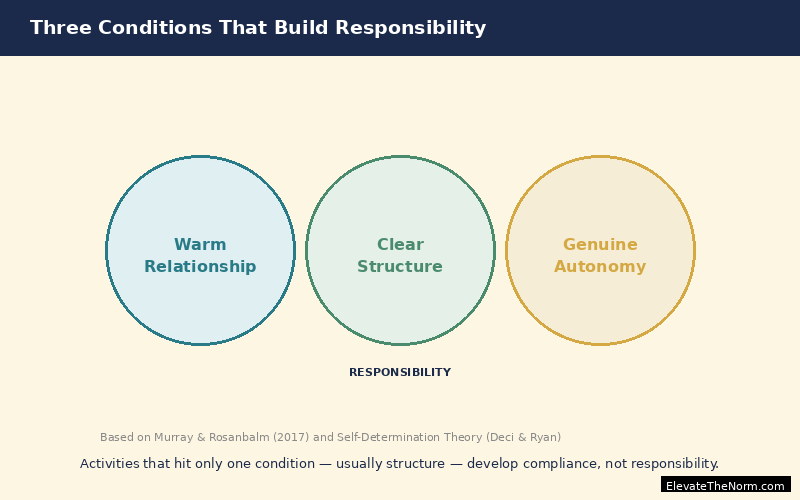
    Diagram showing the three conditions research identifies for building adolescent responsibility: warm adult relationships, structured environment with clear expectations, and genuine autonomy within structures
    Self-regulation research identifies three conditions that help adolescents build genuine responsibility.

    4. The Repair Letter

    After a significant behavioral incident — not every small disruption, but the ones that damage trust or affect other students — ask the student to write a letter addressing three things: what happened (facts, not excuses), who was affected and how, and what they will do differently. The letter is not graded. It is reviewed by the teacher, discussed, and then the incident is considered addressed.

    I use this after repair conversations in my room. When something goes wrong — when a student lets a group down, or says something they should not have — we sit down and talk about what is owed, to whom, and by when. The letter is the student’s record of that conversation. It matters because writing it requires them to articulate what they are taking responsibility for, not just nod and leave. The repair process connects directly to the broader idea of helping students learn from their mistakes rather than simply penalizing them.

    Why it works: It connects behavior to impact. Most adolescents are not trying to cause harm — they are impulsive, reactive, or unaware. The letter forces awareness without humiliation.

    What to watch: Never require a forced apology. The letter should be honest. If a student genuinely believes they were not wrong, the conversation that follows the letter is more useful than the letter itself. And be clear: a repair letter does not replace required school discipline documentation. If your school policy requires an incident report, a referral, or a parent contact for the behavior in question, complete those first. The repair letter is an addition to the process, not a substitute for it.

    5. The Project Check-In Protocol

    For any multi-day assignment or project, build in structured check-ins where the student — not the teacher — reports on progress. The format is simple: What have I done? What is next? What am I stuck on?

    During check-ins, the student explains their choices and defends their decisions. “I chose to focus on the primary source analysis first because…” is more useful than a teacher looking over a shoulder and saying “You’re behind.”

    Why it works: It practices the professional skill of giving a progress report — something adults do constantly and students almost never practice. It also creates a record: if a student says “I’m on track” at the check-in and then is not on track at the deadline, the gap between their self-assessment and their output becomes the teaching moment.

    What to watch: Do not turn check-ins into micromanagement. The point is for the student to report and reflect, not for the teacher to direct every decision.

    6. The Self-Assessment Before the Grade

    Before returning a graded assignment, have students assess their own work against the rubric. They predict their score, identify their strongest section, and name one area where they fell short. Then they receive the actual grade and compare.

    Why it works: Self-assessment accuracy is a metacognitive skill directly tied to responsibility. Students who consistently overestimate their work are not being arrogant — they are not seeing their own gaps. Students who consistently underestimate may not be recognizing their own competence. Either pattern is worth a conversation.

    What to watch: This works best with a clear, student-friendly rubric distributed before the assignment. If students do not know what “proficient” looks like in advance, the self-assessment is just guessing.

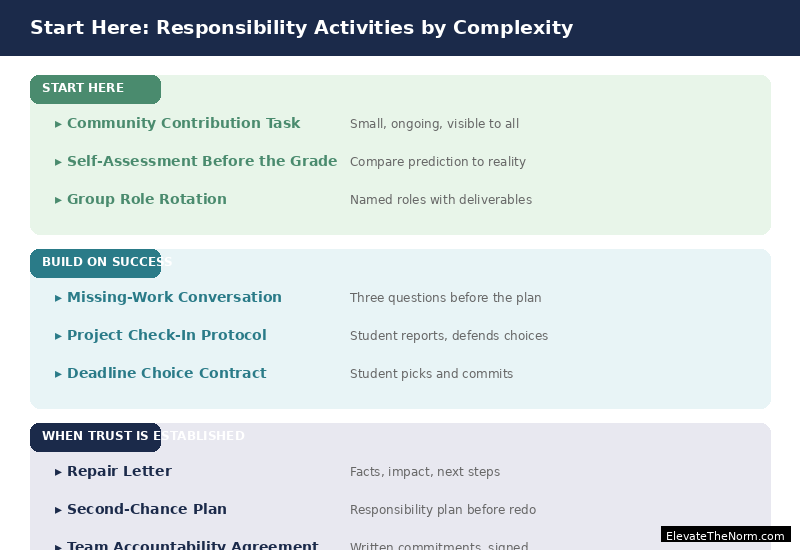
    Chart organizing ten responsibility activities by complexity level from simple to advanced, showing which work best for middle school versus high school students
    Start with two or three activities and add more as you and your students get comfortable.

    7. The Responsibility Debrief

    At the end of a unit, project, or quarter, students write a responsibility reflection: What commitment did I keep this unit? What commitment did I break? What did I learn about how I work? What will I do differently next time?

    Why it works: It normalizes honest self-evaluation. Most schools give students grades but never ask them to reflect on the habits that produced those grades. The debrief is where students connect effort to outcome — or more importantly, connect avoidance to outcome.

    What to watch: Students will write what they think you want to hear unless you make it clear that honesty is valued more than optimism. Share your own example if you can: a time this semester when you planned poorly, fell behind, and had to adjust.

    8. The Team Accountability Agreement

    Before any group project, each team writes a brief agreement: what each person is responsible for, when each piece is due, what happens if someone does not deliver, and how the group will handle conflict. The agreement is signed and kept by the teacher.

    Why it works: It front-loads responsibility instead of back-loading blame. When a group falls apart — and some will — the agreement provides a reference point for a conversation that is about commitments, not feelings.

    What to watch: Do not let the “what happens if someone does not deliver” section become punitive. The healthiest answer is usually “We have a conversation and make a plan” — not “They get a zero.” Effective classroom consequences are always about what comes next, not just what went wrong.

    9. The Community Contribution Task

    Assign each student a real, ongoing responsibility that serves the class: maintaining the supply station, updating the assignment board, organizing returned work, or keeping the shared digital folder clean. The task is small, consistent, and visible.

    Why it works: It gives students a piece of the room to own. Not a pretend ownership — an actual, ongoing responsibility where others notice if it does not get done. The student is not doing it for a grade. They are doing it because the room needs it done.

    What to watch: Rotate tasks quarterly so the same students do not get stuck with the least appealing jobs. And acknowledge it when it is done well — not with a reward, but with a thank-you that names what they contributed.

    10. The Second-Chance Plan

    When a student bombs an assignment or test, offer a structured second attempt. The catch: before they can redo the work, they must complete a responsibility plan. What happened the first time? What will they do differently? What specific support do they need? They submit the plan, the teacher approves it, and then they redo the work.

    Why it works: It separates the failure from the identity. “You failed this assignment” is a fact. “You are a failure” is a conclusion students draw when there is no path forward. The second-chance plan keeps the standard high — you still have to meet it — while making the path back visible.

    What to watch: Set a clear window for the redo. “Whenever you get around to it” is not a plan — it is an invitation to never complete it. A deadline on the redo teaches the same skill as the original deadline.

    ActivityWhat the student ownsGood first pick?
    1. Deadline Choice ContractA due date they chose within a windowYes
    2. Group Role RotationA named role with specific deliverables
    3. Missing-Work ConversationA written plan for an incomplete assignment
    4. Repair LetterThe impact of a significant incident on others
    5. Project Check-In ProtocolReporting their own progress on multi-day workYes
    6. Self-Assessment Before the GradeA predicted score checked against the rubricYes
    7. Responsibility DebriefCommitments kept and broken over a unit
    8. Team Accountability AgreementTheir piece of a group plan, agreed up front
    9. Community Contribution TaskAn ongoing class job, rotated quarterly
    10. Second-Chance PlanA plan for the redo before the redo
    The ten responsibility activities at a glance. Start with two or three.

    Why Do Responsibility Activities Fail?

    The most common failure is not the activities themselves — it is the gap between the activity and the follow-through.

    Responsibility activities fail when teachers assign them but do not follow up on the reflections. They fail when the consequences for not completing a responsibility task are identical to the consequences for not completing any other assignment — a zero in the gradebook. And they fail when the activities are age-inappropriate, making teenagers feel like they are being managed rather than developed.

    Research on adolescent self-regulation confirms that young people build responsibility most effectively when three conditions are present: a warm relationship with the adult holding them accountable, a structured environment where classroom expectations are clear, and genuine autonomy within those structures (Murray & Rosanbalm, 2017). Activities that check all three boxes develop responsibility. Activities that hit only one — usually structure — develop compliance.

    Before You Start: Tell Families What You Are Doing

    Responsibility activities work best when families understand the framework. Early in the year — ideally before the first missed assignment or behavioral conversation — communicate to parents and guardians what your classroom responsibility process looks like: that students will be asked to reflect on missed work rather than simply receive zeros, that repair conversations focus on what is owed rather than punishment, and that second chances come with plans attached. A family that understands the system can reinforce it. A family that encounters it only when their child is in trouble will question it. A student led conference template lets students explain their own progress to families.

    What Does Teaching Responsibility Look Like Day to Day?

    It looks like follow-through. It looks like a teacher who says “I will check your progress on Thursday” and then checks on Thursday. It looks like a room where a student who missed a deadline has a conversation — not a lecture, not a zero entered silently — about what happened and what comes next.

    It also looks like grace. Not the kind of grace that eliminates standards, but the kind that maintains them while holding the door open. A student who writes an honest responsibility reflection about why they did not finish a project — and then finishes it — has learned more about responsibility than a student who met every deadline without ever having to recover from a miss.

    The goal is not to produce students who never fail. It is to produce students who know what they owe when they do. For a deeper look at how teaching responsibility connects to broader classroom culture, and the research behind why student responsibility is a skill rather than a trait, those articles explore the framework in more detail.


    What are good responsibility activities for high school students?

    High school students can handle the full range: the deadline choice contract, the project check-in protocol, self-assessment before the grade, the team accountability agreement, the repair letter, and the second-chance plan. Each gives students something real to own, a clear standard, a structure for reflection when they fall short, and a path back after a mistake.

    How do you teach responsibility to middle school students?

    Use simpler versions with concrete ownership: the community contribution task and the group role rotation work well in grades 6–8. Keep reflection short, follow up on every commitment, and add planning-heavy activities such as the deadline choice contract as students build the capacity for abstract thinking and self-reflection.

    At what age should responsibility activities start in school?

    Responsibility activities should be developmentally appropriate at every grade, but the version described here — involving self-assessment, planning, written reflection, and repair — is designed for grades 6–12. Middle schoolers can handle simpler versions (the community contribution task, the group role rotation). High schoolers can handle the full range, including the deadline choice contract and the second-chance plan. The key is matching the complexity of the activity to the student’s capacity for abstract thinking and self-reflection.

    How do you teach responsibility without making it feel like a punishment?

    By separating the activity from consequences. A repair letter is not a punishment — it is a process for honest self-examination. A second-chance plan is not a penalty — it is a structured path to improvement. The tone of the teacher matters more than the structure of the activity. If you approach a responsibility conversation with curiosity (“What happened?”) rather than judgment (“Why didn’t you…?”), students are more likely to engage honestly.

    What if a student refuses to participate in a responsibility activity?

    Start with a private conversation. Ask what is getting in the way. Sometimes refusal is about the activity; sometimes it is about something else entirely. If the student still refuses after the conversation, document the refusal and follow your classroom or school procedure — but do not abandon the expectation. The activity stands. The student may need more time, a different format, or a different adult to have the conversation with.

    Do responsibility activities work for students with IEPs or behavioral plans?

    Yes, with modifications. Consult the IEP or 504 plan first — some students have specific accommodations around deadlines, reflection activities, or self-assessment that must be followed. The principles of responsibility still apply: students with behavioral plans deserve the same expectation of honest self-assessment, repair, and follow-through. The accommodations adjust the how, not the whether.

    How do you grade responsibility?

    Most of these activities should not carry a traditional grade. Grading a reflection on what went wrong creates an incentive to lie. The activities that are graded — the project, the assignment, the group work — carry grades based on the quality of the academic work. The responsibility activities support the academic work but are evaluated through conversation, not points.

    Can these activities backfire?

    Yes, if they are applied inconsistently. If one student writes a repair letter and another student who did the same thing does not, the first student learns that the system is arbitrary. Consistency across students is non-negotiable. The activities also backfire if the teacher does not follow through — assigning a responsibility reflection and then never reading it teaches students that the activity is busywork.

    How many of these activities should a teacher use at once?

    Start with two or three. The deadline choice contract, the self-assessment before the grade, and the project check-in protocol are a strong starting combination because they integrate into work you are already assigning. Add the repair letter and the responsibility debrief as you get comfortable. Trying all ten at once will overwhelm you and your students.


    Sources


    About Clay Shumate

    Clay Shumate is a certified secondary Social Studies teacher in the public schools of West Alabama, with seven years of classroom experience, a B.A. in History, and an M.Ed. in Secondary Education. He writes about project-based learning, student responsibility, respect, and practical ways to hold young people to a higher standard while giving them room to learn from mistakes. He is a member of the Society of Professional Journalists and writes to its Code of Ethics; this site’s editorial standards and corrections policy are published in full. More about Clay.
  • Chronic Absenteeism: What Actually Brings Students Back to Class

    Chronic Absenteeism: What Actually Brings Students Back to Class

    By Clay Shumate

    Chronic absenteeism means missing 10 percent or more of the school year — about eighteen days, excused and unexcused combined — and it’s sitting near a quarter of all U.S. students. Most of that isn’t about your lesson plans: illness and lost sleep outrank boredom by a wide margin. But re-entry, what happens the day a student walks back in, is squarely a teacher’s job, and most classrooms have no plan for it at all.

    Key Takeaways

    • Chronic absenteeism counts a student missing 10 percent or more of enrolled school days, excused and unexcused together — it is not the same thing as truancy, which is specifically about unexcused absences and can trigger legal consequences for a family.
    • The national rate peaked near 28.5 percent in 2022, fell to roughly 23.5–25 percent by 2024, and has stalled — the decline slowed enough in 2024 that a full return to the 15 percent pre-pandemic baseline is no longer guaranteed.
    • When students are asked directly why they missed school, illness and lack of sleep dominate the answers. Boredom and disengagement are real but smaller, and high schoolers actually report fewer disengagement reasons after the pandemic than before.
    • Attendance Works sorts causes into four categories — barriers, aversion, disengagement, and misconceptions — and a classroom teacher has real leverage over only two of them.
    • The best-evidenced classroom-adjacent lever isn’t a lesson plan; it’s what happens on re-entry day, and separately, honest and consistent family communication is one of the few things correlated with meaningfully lower rates.

    What Chronic Absenteeism Actually Means

    Chronic absenteeism is a student missing 10 percent or more of enrolled school days in a year — roughly eighteen days in a standard 180-day calendar, or about two days a month. Every state and most districts now track it because it correlates with weaker outcomes at every level, from third-grade reading to ninth-grade credit accumulation to graduation. The count includes excused and unexcused absences together. A student out with the flu for two weeks, a student with a broken attendance streak from oversleeping, and a student who simply stopped coming all land in the same statistic, and the number alone tells you nothing about which one you’re looking at.

    That combined counting is also what separates chronic absenteeism from truancy, and the two get confused constantly in casual conversation. Truancy is specifically about unexcused absences, and in most states it is a legal category with a defined escalation path — a set number of unexcused absences triggers truant status, repeated truancy can trigger a referral, and in the most severe cases a district attorney can pursue charges against a parent or guardian. Chronic absenteeism carries no such court process on its own. A student who is chronically absent because of documented illness has never been truant a single day. Confusing the two terms is how a school ends up applying a punitive, legal-track response to a problem that is, for most students, not a compliance problem at all.

    How Bad Is It, and Is It Getting Better?

    Nationally, chronic absenteeism held steady around 15 percent through the 2018 and 2019 school years. It jumped to roughly 28.5 percent at its 2022 peak, then eased to about 25.4 percent in 2023 and 23.5 percent in 2024. RAND’s 2024–25 district survey put the most recent figure at approximately 22 percent — nearly 11 million students. The trend line is real improvement, and it is also slowing down. Nat Malkus, who tracks the numbers for the American Enterprise Institute, has written plainly that the deceleration raises “the very real possibility that absenteeism rates might never return to pre-pandemic levels.”

    The average also hides where the actual crisis sits. Low-achieving districts went from about 19 percent chronically absent in 2018 to 35 percent in 2022; high-achieving districts moved from 10 percent to 19 percent over the same stretch — both got worse, but the gap between them widened. RAND found urban districts were five to six times more likely than rural or suburban ones to report extreme chronic absence, meaning 30 percent of students or more. If your school sits in that first group, the national “one in four” statistic is understating your actual room by a wide margin.

    The Four Root Causes — and Which Ones Are Actually Yours

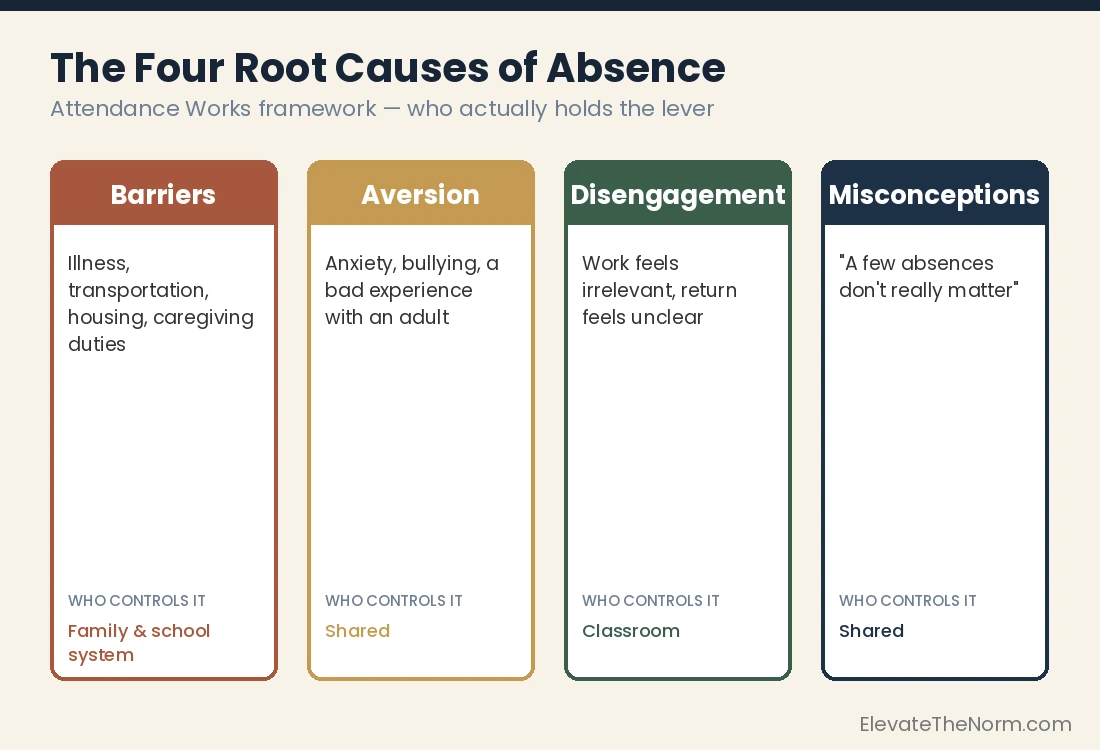
    Attendance Works, the research and policy organization most state departments of education cite on this topic, sorts every reason a student misses school into four categories: barriers, aversion, disengagement, and misconceptions about how much a few absences really matter. It’s a useful framework precisely because it forces an honest answer to the question every overwhelmed teacher eventually asks: which part of this is mine to fix?

    CategoryWhat it looks likeWho actually controls it
    BarriersIllness, unreliable transportation, unstable housing, caregiving duties for a sibling or family memberFamily, school system, community resources — not the classroom teacher
    AversionAnxiety about a specific class or hallway, bullying, a bad experience with a particular adultShared — a teacher can remove one specific aversion, but not the underlying anxiety
    DisengagementThe student sees no point in showing up because the work feels irrelevant or the return is unclearLargely the classroom — relevance, relationship, and clarity are teacher-level moves
    MisconceptionsBelief that a handful of absences “doesn’t really matter” as long as grades hold upShared — a teacher’s re-entry practice and a family’s messaging both shape this
    Four-category chart showing the root causes of chronic absenteeism: barriers, aversion, disengagement, and misconceptions, with who controls each one
    The Attendance Works framework for chronic absenteeism, showing which causes a classroom teacher can actually influence.

    Look at that middle column honestly and the division of labor gets clear fast. Barriers are not solvable from a classroom. No lesson plan fixes a broken car, an undiagnosed illness, or a kid watching a younger sibling because there’s nobody else. Pretending otherwise is how teachers end up carrying blame for outcomes they were never equipped to move, and it’s a big part of why attendance initiatives that live entirely inside individual classrooms tend to disappoint — they’re aimed at maybe half the problem.

    Why Most of It Isn’t About Your Classroom

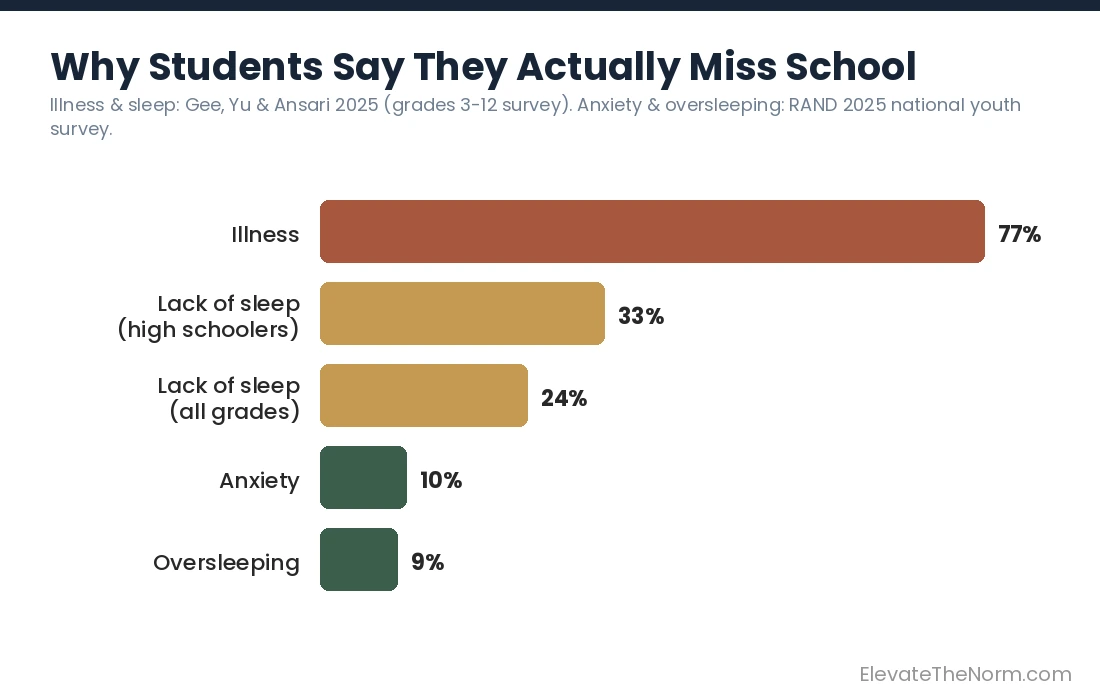
    When you ask students directly why they missed school, the answer that comes back most is not the one teacher-facing advice usually assumes. A 2025 analysis of Rhode Island survey data covering grades 3–12 found illness reported by roughly three-quarters of students both before and after the pandemic — 77 percent post-pandemic specifically. Lack of sleep came in second at 24 percent overall and a striking 33 percent among high schoolers. Boredom and safety concerns did rise after the pandemic, but from a much smaller base, and — this is the finding that should reshape how engagement gets talked about — high school students actually reported fewer disengagement reasons after the pandemic than before it. RAND’s national youth survey landed in the same place: 67 percent sickness, 10 percent anxiety, 9 percent oversleeping.

    Bar chart showing self-reported reasons students miss school: illness 77 percent, lack of sleep 33 percent among high schoolers and 24 percent overall, anxiety 10 percent, oversleeping 9 percent
    Illness and lost sleep outrank boredom by a wide margin in student-reported reasons for absence.

    That doesn’t mean engagement is irrelevant. It means engagement is not the lever most teacher-facing advice on this topic claims it is. If a school’s entire absenteeism strategy is “make class more interesting,” it is aimed at a real but minority slice of the problem, and it will underdeliver — not because the advice is wrong, but because it was never sized to the actual distribution of causes. For the students where disengagement genuinely is the driver, the deeper diagnosis and fix belong in a companion piece on what actually motivates students once rewards and speeches stop working — this page is about the much larger group whose absence has nothing to do with motivation at all.

    What’s Actually Yours: The Four Minutes That Change the Semester

    Here’s the honest, narrower claim. A classroom teacher cannot fix a transportation gap or an untreated illness. What a classroom teacher controls almost completely is what an absence costs a student once they’re back — and that cost is what determines whether eighteen missed days becomes thirty.

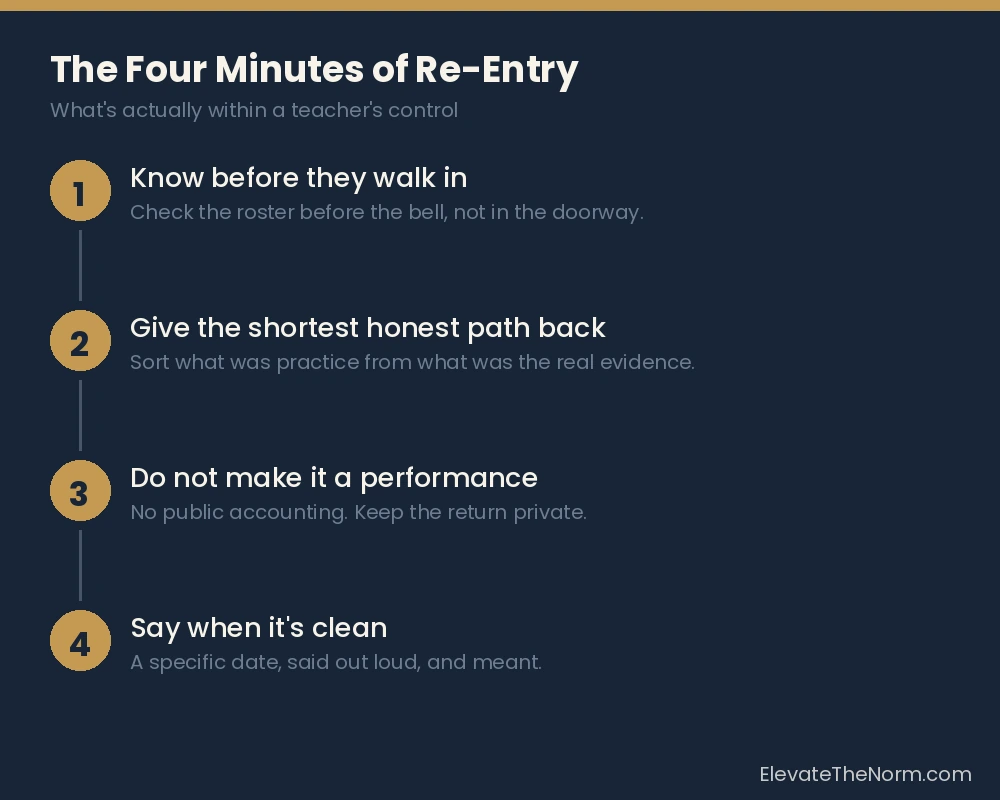
    I check the roster before the bell, not after. When I see a student has been out, I already know before they walk through the door — deciding what they need in the doorway, with the rest of the class watching, guarantees a bad decision made badly. If it’s a longer absence, that student gets pulled to the whiteboard table early — the same table I use for regular small-group work, not a separate “catch-up corner.” Low lamp, rug, better chairs. Students already know that table is where you go to be worked with, not managed. That matters more than it sounds like it should: a student coming back from eighteen missed days is highly sensitive to whether re-entry feels like punishment or like being picked back up.

    Reserve the full version of this for absences that actually need it — three or more days, or a pattern, not a single day for a dentist appointment. And none of what follows replaces your school’s required attendance reporting or truancy referral process. If a student’s pattern of absence raises a safety concern — signs of neglect, abuse, homelessness, or anything that meets your district’s mandated-reporting threshold — that goes to your counselor or administrator through the normal protocol immediately, separate from and before any classroom routine. Re-entry is about what a teacher does with the students in front of them; it is not a substitute for the systems built to catch the more serious cases.

    Four things make re-entry actually work.

    Know before they walk in. Check attendance history before class starts, not during it. A decision made in the doorway, in front of an audience, by a teacher who is also trying to start the lesson, is reliably the worst version of that decision.

    Give the shortest honest path back. Not every missed assignment carries the same weight. Ask yourself which pieces were practice and which ones were the actual evidence that the student learned the standard — the practice can often be waived or condensed; the evidence usually can’t. Sorting the pile down to what genuinely matters is a judgment call only the teacher can make, and it’s the difference between a student who can start today and a student who takes one look at forty backlogged items and shuts down. Better still, ask the student what they think is realistic before you hand them the final list — a plan a student helped build survives contact with a hard week better than one that was simply issued to them. This is student responsibility in its most practical form — the student still owns finishing the list, but the list has to be one a person could actually finish, and building it together is what makes it theirs. For an absence stretching past a week or two, or anything with a doctor’s note attached, loop in a counselor or your 504/IEP team before you finalize the plan alone — some of that catch-up may need to be a formal accommodation, not an informal favor.

    Do not make the return a performance. No public accounting of the absence, no comment in front of the class, no sarcasm at the door, and no requirement that the student explain themselves out loud. Some reasons are private — a medical diagnosis, a family situation, a mental health day — and a teacher doesn’t need the full story to run a fair re-entry process. A teenager who’s been gone is already running the social math on what walking back in will cost. Raise that cost and the cheapest option left is to stay gone. This is the same standard covered in respect in the classroom applied to a specific moment: a student’s absence is not public material, and treating it that way trades a little teacher satisfaction for a much worse attendance problem next month. Apply it the same way to every student, every time — the fastest way to make a re-entry routine feel arbitrary is to run it warmly for some students and coldly for others.

    Say when it’s clean. Give a specific date and a specific list, and when the list is finished, say so out loud and mean it. Open-ended debt is what convinces a student the hole is unclimbable. A defined end is what makes climbing rational.

    In practice this is a thirty-second exchange, not a meeting: “Good to see you back. Here’s what actually matters from the last few days — these three things. Everything else, let it go. Can you have these done by Friday?” That’s the whole script. It names what matters, drops what doesn’t, and ends with a date the student agreed to rather than one you handed down.

    Four-step checklist for helping a student return after an absence: know before they walk in, give the shortest honest path back, do not make it a performance, and say when it is clean
    The four re-entry moves that are genuinely within a classroom teacher’s control after chronic absenteeism.

    None of this is softness. The standard doesn’t move — the work still has to be real and the deadline still has to be a deadline. What moves is how much guesswork a student has to do to find their way back to it, and guesswork is where students who are already behind quietly give up. This is the same logic behind natural consequences instead of punishment: the goal is a consequence that teaches something, not one that simply makes the return more painful.

    Expect it to look worse before it looks better, especially with a student who’s been checked out for a while. A kid who suddenly gets real attention after being invisible will often test whether that attention is real — that’s a normal, predictable phase, not proof the approach isn’t working, and it connects directly to what happens the first few weeks after building a relationship with a student who’s been guarded. Most adults quit right at the point where the testing is actually a good sign.

    What the Research Says Works Beyond Your Classroom

    Honesty about the ceiling matters here too. The best-evidenced attendance interventions in the research aren’t classroom practices — they’re family communication, and the effect sizes are real but modest. Which tool carries that communication matters less than whether families can actually receive it — the questions to ask before adopting a communication app start with reach, not features.

    Rogers and Feller, publishing in Nature Human Behaviour in 2018, tested personalized mailings sent to the parents of 28,080 high-risk K–12 students. The most effective versions reduced chronic absenteeism by 10 percent or more, largely by correcting parents’ underestimates of how many days their child had actually missed — many parents simply didn’t know the number was as high as it was. A smaller trial run by the Regional Educational Laboratory Mid-Atlantic in the School District of Philadelphia found a single October postcard cut absences by a more modest 2.4 percent, with no measurable difference between message variations.

    A 2023 analysis by Harvard researchers Karen Mapp and Todd Rogers, working with Learning Heroes and TNTP across more than 3,000 Illinois schools, found something adjacent and worth taking seriously: schools with strong pre-pandemic family engagement — measured through trust, involvement, and parent influence on school decisions — had chronic absenteeism rates roughly six percentage points lower than similar schools with weak engagement, even after controlling for poverty. Between 2019 and 2022, the strong-engagement schools saw a 39 percent smaller increase in chronic absenteeism than everyone else. This is a correlational finding from one state, not a randomized trial, and the researchers themselves describe it as the first phase of a larger project — it should be read as suggestive, not proof that family engagement alone moves the number. But it lines up with the honest re-entry advice above: families who already trust the school and understand what the classroom is doing are the same families likely to reinforce a re-entry plan rather than fight it. In practice that trust gets built with plain, non-alarmist language rather than a form letter — something closer to “I noticed six absences this month, is there anything the school can help with?” than an automated warning that reads like a legal notice. The first invites a conversation. The second reads like the truancy-court track discussed above, even for a family whose child has never come close to it.

    None of this reaches a transportation gap, an untreated health condition, or a family in crisis, and no classroom teacher should feel responsible for the part of the number that genuinely isn’t theirs. What is genuinely theirs — re-entry, and a habit of honest, non-alarmist communication home — is smaller than the whole problem and still worth doing well, because it’s the piece within reach on a Tuesday afternoon, not a district initiative that takes a year to fund.

    What to Do With This on Monday

    Start with one thing: check the roster before the bell and know, before a returning student walks in, what the shortest honest path back looks like for them. Add the no-performance rule next — it costs nothing and it’s the fastest way to stop making re-entry harder than it needs to be. Everything else on this page — the barriers your school actually controls, the family-communication research, the honest accounting of what disengagement is and isn’t driving — belongs to a bigger conversation about chronic absenteeism than one classroom can solve alone. Your four minutes with a returning student is the part that starts today. For a ready-to-use tool on this, see a printable parent-teacher communication log pack. Absence is also the clearest single thing that got worse since 2019, which is why it sits near the top of our review of whether student behavior is actually getting worse.


    Is chronic absenteeism the same thing as truancy?

    No. Chronic absenteeism counts a student missing 10 percent or more of enrolled school days, whether the absences are excused or unexcused. Truancy is a narrower legal category built specifically from unexcused absences, and in most states it comes with a defined escalation process that can eventually involve a district attorney and consequences for a parent or guardian. A student who is chronically absent because of documented illness has never been truant. Treating the two as interchangeable is how schools end up applying a legal, punitive response to a problem that, for most students, was never about defiance.

    Whose fault is chronic absenteeism — the school, the family, or the student?

    Usually none of the above, at least not in the way the question assumes. National survey data shows the leading reasons students miss school are illness and lost sleep, not defiance or indifference. Framing absence as a fault to assign tends to produce blame instead of a fix. The more useful question is which piece of the problem a given adult actually has leverage over — a classroom teacher, a family, and a school system each control a different slice.

    What can one classroom teacher realistically do about chronic absenteeism?

    Less than district-level interventions, and that’s fine — a teacher’s real leverage is re-entry, not prevention. Checking the roster before class, sorting missed work down to what actually matters, keeping a returning student’s absence private, and giving a clear date when the catch-up is finished are all inside a single teacher’s control and take a few minutes per student. Preventing the absence in the first place usually depends on factors — transportation, health, housing — that sit outside any one classroom.

    Does missing school always mean a student doesn’t care about class?

    No, and the data says the opposite more often than not. When students are asked directly why they were out, illness and lack of sleep dominate the answers, and one national analysis found high schoolers reporting fewer disengagement-related reasons for absence after the pandemic than before it. Assuming apathy is usually wrong, and assuming it out loud to a student who was actually sick or exhausted damages the relationship for no reason.

    How should a teacher handle makeup work without overwhelming a student who’s behind?

    Sort before you hand anything over. Separate what was practice from what was the actual evidence that a student learned the standard, and let most of the practice go. Ask the student what they think is realistic before finalizing the list — a plan they helped build holds up better than one that was simply issued. For anything longer than a week or two, or work tied to a documented medical absence, loop in a counselor or the student’s 504/IEP team rather than solving it alone.

    What if a student’s pattern of absences seems like a sign of something more serious?

    That goes to your school’s counselor or administrator through your normal mandated-reporting and attendance-review process immediately — before, and separate from, any classroom re-entry routine. Signs like a sudden pattern change, indications of neglect or abuse, or signs of homelessness are outside what a classroom-level practice is built to address, and they need the systems your school already has for exactly that purpose.

    Do attendance letters or family outreach actually reduce absences?

    Some forms do, modestly. A large study of personalized parent mailings correcting misperceptions about how many days a child had actually missed reduced chronic absenteeism by roughly 10 percent in its most effective version; a simpler single postcard trial produced a smaller 2.4 percent reduction. The tone matters — plain, non-alarmist language that reads like a conversation (‘is there anything the school can help with?’) is associated with better outcomes than a form letter that reads like a legal warning, even though neither approach comes close to solving the problem on its own.

    What’s a realistic first step for a teacher who wants to get better at this?

    Start with one habit: check attendance before the bell so you already know, before a student walks in, what their shortest honest path back looks like. Add the no-performance rule next — keeping the return private costs nothing and prevents the single most common way teachers accidentally make attendance worse. Everything else on this page is worth knowing, but those two moves are where an ordinary Tuesday actually changes.


    Sources


    About Clay Shumate

    Clay Shumate is a certified secondary Social Studies teacher in the public schools of West Alabama, with seven years of classroom experience, a B.A. in History, and an M.Ed. in Secondary Education. He writes about project-based learning, student responsibility, respect, and practical ways to hold young people to a higher standard while giving them room to learn from mistakes. He is a member of the Society of Professional Journalists and writes to its Code of Ethics; this site’s editorial standards and corrections policy are published in full. More about Clay.
  • Why Are Classroom Expectations Important? Because Students Deserve Clarity

    Why Are Classroom Expectations Important? Because Students Deserve Clarity

    By Clay Shumate · Updated October 24, 2026

    Why are classroom expectations important? Because a room without them runs on guesswork, and guesswork is unfair to the student who can’t read your mood on a given day. Clear, taught expectations tell a class exactly what the room requires and what it promises back — protected instructional time, predictable fairness, and a real path toward independence.

    Key Takeaways

    • Clear expectations reduce discipline problems and protect instructional time — Marzano’s research found teachers with strong management practices and high-quality relationships had 31 percent fewer discipline issues over a full year.
    • Expectations are not rules posted on a wall. They are behaviors you teach, model, practice, and revisit — the same way you teach content.
    • Adolescents respond better to expectations they understand the reasoning behind. Stating a standard without explaining why it exists invites testing.
    • Consistency matters more than severity. A predictable room where small things are addressed early is calmer than a room where nothing happens until someone explodes.
    • Expectations must go both ways. If students are expected to be prepared, on time, and respectful, the adult in the room owes them the same.

    What Are Classroom Expectations?

    Classroom expectations are the specific, observable behaviors that define how a learning environment operates. They cover how students enter the room, how they participate, how they treat each other, how they handle materials, what happens when they finish early, and what happens when they need help.

    That is different from rules. Rules tell students what not to do. Expectations tell them what to do instead — and the research consistently favors the second approach. Positively stated expectations (“Be prepared with your materials before the bell”) give students a target to hit rather than a minefield to avoid. If you are building a complete set of classroom expectations for the first time, starting with positively stated behaviors is the most important decision you will make.

    Side-by-side comparison showing the difference between classroom rules and classroom expectations, with rules focused on what not to do and expectations focused on what to do
    Rules tell students what not to do. Expectations tell them what to do instead.

    The distinction matters more than it sounds. “No talking” is a rule. “Use a voice level appropriate to the activity” is an expectation. The first one creates a room where students are trying not to get caught. The second creates a room where students are making judgments about what the moment requires — and that judgment is a skill worth developing.

    Classroom rulesClassroom expectations
    What they stateWhat not to doWhat to do instead
    Example“No talking”“Use a voice level appropriate to the activity”
    Who they apply toStudentsEveryone in the room, teacher included
    How they are learnedPosted and announcedTaught, modeled, practiced, and revisited
    What they buildAvoiding getting caughtJudgment about what the moment requires
    Classroom rules vs. classroom expectations at a glance.

    Why Are Classroom Expectations Important in Middle and High School?

    They Protect Instructional Time

    Research from the IRIS Center at Vanderbilt University is direct about this: teachers who establish and maintain clear norms for behavior spend more time teaching because less time goes to discipline (Brophy, 2000). Every minute spent restating a procedure that was never taught properly is a minute taken from the content students came to learn.

    In a secondary classroom with 50-minute periods — or in some cases, 90-minute blocks — lost minutes compound fast. If a teacher loses five minutes every period to transitions that were never practiced, that is 25 minutes a day across five classes. Over a semester, that is roughly 2,250 minutes — more than 37 hours of instruction gone.

    They Reduce Anxiety and Guesswork

    This is the part most teachers underestimate. Adolescents are performing a complicated identity negotiation every period of every day. They are testing who they are, what their peers think of them, how much authority to accept, and how much risk to take. A room with clear expectations removes one variable from that equation: they do not have to guess what the teacher wants.

    The Australian Education Research Organisation reviewed the evidence and found that when behavioral standards are transparent, “students feel more secure because they know where they stand” (DeNobile, 2021). Security does not mean softness. It means the room is predictable — and predictable rooms are calmer rooms.

    They Make Fairness Visible

    One of the fastest ways to lose a teenager’s trust is to enforce something they did not know existed. When expectations are public, taught, and consistent, a correction becomes a reference to a shared agreement rather than a personal attack. “We said prepared means materials out before the bell — grab your notebook” is a different conversation than “Why aren’t you ready?”

    The first version holds the standard. The second version questions the student. Adolescents can feel the difference, and they respond accordingly. This same principle applies to how teachers handle respect in the classroom — fairness is not about treating every moment identically, but about making every standard visible and every correction consistent.

    They Build Independence Over Time

    Here is what gets overlooked: clear expectations are not about control. They are a scaffold. When students know the procedures, they stop relying on the teacher to direct every transition, every material distribution, and every shift between activities. They run the routines themselves — and that frees the teacher to do the work that actually requires a human being: circulating, checking understanding, pulling small groups, and responding to what students need in real time.

    I spend most of my class period moving between groups, sitting down with students at the whiteboard table I built in the corner of my room. That table is the best seat in the house — low lamp, a rug, better chairs. Students ask to come there. But the only reason I can spend my time that way is because the rest of the room is running on expectations we practiced until they became automatic. If I had to stand at the front managing every transition, that table would just be furniture.

    How Do You Teach Classroom Expectations?

    Posting expectations on a wall is step one of a five-step process. Stopping there is the most common mistake secondary teachers make — and it is the reason so many give up on expectations by October. If you have already created a classroom expectations poster, that visual is useful — but it is the beginning of the work, not the end of it. A free Classroom Norms Poster Set on TPT gives you something to point to once the class agrees on what the standard is.

    Infographic showing the five steps to teaching classroom expectations: identify key behaviors, state them in observable language, model and practice, reinforce consistently, and revisit and adjust
    Teaching expectations requires five deliberate steps — not just posting them on a wall.

    Step 1: Identify the Behaviors That Matter Most

    You cannot have 30 expectations. You can have five or six — the ones that cover the situations your students encounter every day. Start with the moments that consistently cause problems: entering the room, transitions between activities, asking for help, working with a partner, and what to do when you finish early.

    Step 2: State Them in Observable Language

    An expectation is only useful if you can see whether someone is meeting it. “Be respectful” is not observable. “Listen without interrupting when someone is speaking to the class” is. “Be responsible” is not observable. “Turn in your work by the deadline or communicate with me before it passes” is.

    The IRIS Center recommends keeping rules few, universal, and positively stated — then linking specific procedures to each one (IRIS Center, 2003). A general expectation like “Be prepared” needs concrete procedures attached: what “prepared” looks like in this room, by this bell, for this type of activity.

    Step 3: Model and Practice

    This is where secondary teachers get uncomfortable. Modeling expectations feels elementary — and most of us skipped it. But the research is clear: students perform better when expectations are explicitly taught through demonstration, not merely announced (Archer & Hughes, 2011).

    Model what a good transition looks like. Model what asking for help looks like. Model the wrong way, too, if you can do it with humor and not sarcasm — so students see the contrast. Then let them practice. The first three days of the year are not lost instruction. They are the most important instruction you will give all year. This is especially critical if you are in your first years and still working out classroom management as a new teacher.

    Step 4: Reinforce Consistently, Not Loudly

    Marzano’s meta-analysis found that the quality of teacher-student relationships was the most important variable in effective classroom management — teachers with strong relationships and clear expectations had 31 percent fewer discipline problems across the year (Marzano et al., 2003). That finding matters because it means enforcement does not require volume. It requires consistency and connection.

    When a student does not meet an expectation, address it immediately, briefly, and at close range. A quiet redirect while you are already circulating — “Materials out, please” — costs less social capital than a public correction from across the room. And it preserves the relationship that makes the expectation stick. Strong relationships with students are not a separate initiative from classroom management — they are the mechanism that makes management work.

    Step 5: Revisit and Adjust

    Expectations are not a September activity. They need to be revisited after breaks, after schedule changes, after a stretch of bad days, and after you realize one of your expectations was unreasonable in the first place. Acknowledging that an expectation needs adjusting is not weakness. It is modeling exactly the kind of honest self-assessment you want from students.

    What Happens When Classroom Expectations Are Missing?

    The consequences of vague or absent expectations are not dramatic. They are gradual — and that is what makes them dangerous.

    Visual showing the costs of missing classroom expectations: lost instructional time, reactive discipline cycles, eroded trust, and disproportionate impact on marginalized students
    Without clear expectations, teachers spend more time managing confusion than teaching content.

    Without clear expectations, teachers tend to rely on reactive discipline: waiting for something to go wrong and then responding. That pattern creates an exhausting cycle. The teacher feels like they are constantly putting out fires. The students feel like the rules change depending on the teacher’s mood. Both sides get frustrated, and the relationship erodes. That fire-fighting cycle is one of the most reliable routes into exhaustion, and most of what prevents it is structural rather than a matter of willpower.

    Research on teacher expectations confirms this pattern. A 2024 narrative review published in the Journal of the Royal Society of New Zealand found that teachers’ expectations significantly influence student outcomes, and that inconsistent or unclear expectations disproportionately affect students from marginalized backgrounds (Rubie-Davies et al., 2024). Students who already face barriers outside of school should not have to decode a second set of hidden expectations inside it.

    For a practical look at what those belief-driven expectations actually require—the specific moves, language, and mindset that separate genuine high expectations from surface-level optimism—see holding students to high expectations in secondary classrooms.

    Expectations Go Both Ways

    This is the part that separates a set of classroom expectations from a set of classroom rules. Rules flow in one direction — from the teacher to the student. Expectations, done well, apply to everyone in the room.

    If students are expected to arrive on time, the teacher starts on time. If students are expected to be prepared, the teacher has the plan posted and the materials ready. If students are expected to listen without interrupting, the teacher does the same when a student is speaking.

    That does not mean teachers and students hold identical authority. They do not. But mutual respect for each other’s time, effort, and presence is what turns expectations from a behavior-management tool into a culture.

    Three Things Your Expectations Cannot Decide for You

    No classroom expectations list exists in isolation. Before you finalize yours, account for these:

    Your school’s behavior framework comes first. If your building uses PBIS, a schoolwide behavior matrix, or a restorative practices model, your classroom expectations must align with it — not contradict it. A classroom expectation that conflicts with the schoolwide framework confuses students who are trying to follow both, and it puts you in an awkward position with administrators when a situation escalates beyond your room.

    IEPs and 504 plans take legal precedence. A student’s documented behavior intervention plan overrides your classroom expectations for that student. This is not optional, and it is not a weakening of your standards. It is the law. Consult with the special education team before the year starts and whenever a new student with a plan enters your class.

    Families should know what you expect in week one. Send your expectations home — in writing, not just verbally through students. A parent who understands what the room requires can support it. A parent who discovers your expectations only when their child gets a consequence feels blindsided, and that damages a relationship you may need later.

    A Practical Starting Point

    If you are starting from scratch — or starting over — here is what works:

    Pick three to five expectations that cover the broadest range of daily situations. State each one in observable, positive language. On the first day, explain each one, model it, let students practice it, and explain why it exists. Then hold it — every day, every period, for every student — without exceptions that are not also explained publicly.

    It is not complicated. But it is relentless, and the relentlessness is the point. Students do not learn expectations from a poster. They learn them from a teacher who means what they say and says it every single day until the room runs on its own. The same principle applies to teaching student responsibility — it is a daily practice, not a one-time conversation.


    What are the benefits of classroom expectations?

    Clear, taught expectations protect instructional time, reduce student anxiety and guesswork, make fairness visible because corrections refer to a shared agreement, and build independence as students learn to run routines on their own. Marzano’s research links strong management and relationships to 31 percent fewer discipline problems over a school year.

    What are examples of good classroom expectations?

    Good expectations are positive and observable. Examples: “Be prepared with your materials before the bell,” “Use a voice level appropriate to the activity,” and “Listen without interrupting when someone is speaking to the class.” Most secondary classrooms need three to six that cover entering the room, transitions, asking for help, partner work, and finishing early.

    How many expectations should a secondary classroom have?

    Three to six. More than that and students cannot remember them, teachers cannot enforce them consistently, and the list starts contradicting itself. Each expectation should be broad enough to cover multiple situations but specific enough to be observable. If you need more than six, you probably need better procedures underneath fewer expectations.

    Are classroom expectations the same as classroom rules?

    Not exactly. Rules typically tell students what they cannot do and carry stated consequences. Expectations tell students what the room requires and are stated positively — what to do, not what to avoid. In practice, many teachers use a small set of expectations supported by procedures, with consequences understood but not the headline. The research favors positively stated expectations because they give students a behavior to perform, not just a behavior to suppress.

    When should expectations be introduced — the first day or after content starts?

    The first day. Marzano’s research and the IRIS Center’s synthesis both agree: explicitly teaching expectations during the first days of school produces better outcomes than announcing rules and moving to content. Time spent modeling, practicing, and discussing expectations in week one saves far more time than it costs over the remaining weeks of the semester.

    Do expectations work with students who have behavioral challenges?

    Clear expectations help every student, but they are especially important for students with behavioral challenges, including those with IEPs or 504 plans. Predictability reduces anxiety, and publicly stated expectations prevent the perception that consequences are personal or arbitrary. That said, individual behavior plans required by an IEP or 504 take legal precedence over classroom expectations — always follow the documented plan and consult with the special education team.

    How do you handle a student who refuses to follow expectations?

    Start with a private, calm conversation — not a public confrontation. Ask what happened. Restate the expectation. Give the student a clear path to meet it. If the behavior continues, follow your escalation process and document. Never abandon the expectation itself because one student resists it. The other 25 students are watching to see whether the standard is real.

    Should students help create classroom expectations?

    Research supports involving students in the process when it is genuine — not performative. A class discussion about why an expectation exists and what it should look like increases buy-in, especially with adolescents who need to understand the reasoning behind a standard. What does not work is asking students to create the expectations entirely and then overriding them when you do not like the result. If you ask for input, use it.

    Do expectations need to be revisited after the first week?

    Yes — after every long break, after a schedule change, after a substitute teacher, and after any stretch where the room has drifted. Expectations are not a contract signed and filed. They are a practice maintained through repetition and honest conversation about what is working and what is not.


    Sources


    About Clay Shumate

    Clay Shumate is a certified secondary Social Studies teacher in the public schools of West Alabama, with seven years of classroom experience, a B.A. in History, and an M.Ed. in Secondary Education. He writes about project-based learning, student responsibility, respect, and practical ways to hold young people to a higher standard while giving them room to learn from mistakes. He is a member of the Society of Professional Journalists and writes to its Code of Ethics; this site’s editorial standards and corrections policy are published in full. More about Clay.
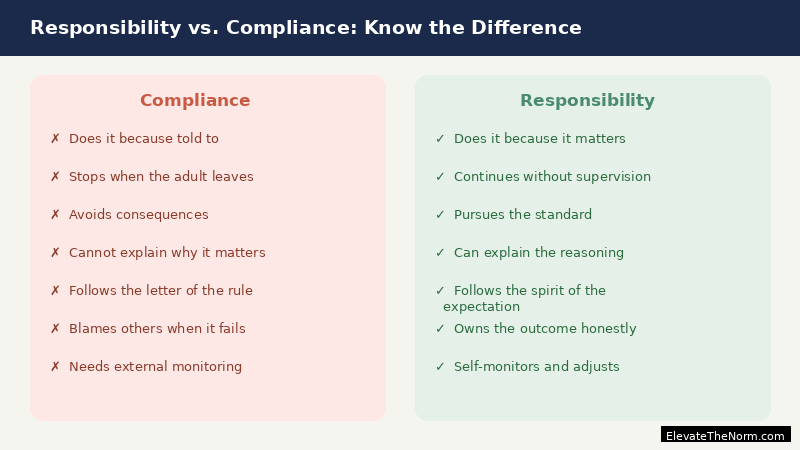
Teacher Emergency Toolkit — practical resources, real classroom support. Shop on TPT.Teacher Emergency Toolkit — practical resources, real classroom support. Shop on TPT.