The Elevate Blog banner: Real Classrooms. Practical Ideas. Higher Expectations. Three students climb a rocky ridge at sunrise, each pulling the next one up, toward a teacher reaching down to help.

Author: Clay Shumate

  • Experiential Learning Activities: 30 Real-World Ideas for Grades 6–12

    Experiential Learning Activities: 30 Real-World Ideas for Grades 6–12

    By Clay Shumate

    Experiential learning activities put students inside the subject instead of in front of it. The 30 ideas below follow Kolb’s experiential learning cycle — act, observe, reflect, conceptualize, apply — and are built for grades 6–12 classrooms with limited budgets, real schedules, and students who will check out the moment an activity feels pointless. Every one of them can run in a public school without special funding, a field trip bus, or a rewritten master schedule. If you teach the older end of that range, the high-school version of this deals with scheduling and credit directly.

    Key Takeaways

    • An experience is not the same thing as experiential learning. The difference is the reflection and conceptualization that follow.
    • Kolb’s cycle has four stages: concrete experience, reflective observation, abstract conceptualization, and active experimentation. Activities that skip stages produce fun, not learning.
    • A meta-analysis of 62 studies found that service-learning — one category of experiential activity — improved academic achievement by an effect size of 0.43, the strongest of any outcome measured.
    • Most activities below require no budget, no technology, and no administrative approval beyond what a classroom teacher already has.
    • Partner and group work is the default format for experiential learning — not an add-on. Students learn from each other during the experience, not just during the debrief.

    The Difference Between an Experience and Experiential Learning

    A student who watches a documentary has had an experience. A student who watches a documentary, writes down what surprised them, connects those surprises to a concept from class, and then uses that concept to analyze a second documentary has done experiential learning. The difference is not the activity — it is what happens after the activity.

    David Kolb formalized this in 1984 with a four-stage cycle that still holds up: concrete experience (do something), reflective observation (think about what happened), abstract conceptualization (connect the experience to a principle or theory), and active experimentation (apply the principle to a new situation). John Dewey made the same point forty-six years earlier in Experience and Education (1938): “The belief that all genuine education comes about through experience does not mean that all experiences are genuinely or equally educative.” Dewey called experiences that do not lead to learning “miseducative” — and he was talking about exactly the kind of activity that keeps students busy without making them think.

    Every activity in this article is designed to complete the full cycle. If you strip out the reflection or the conceptualization step to save time, you have a field trip, not a lesson.

    How Kolb’s Cycle Works in a Real Classroom
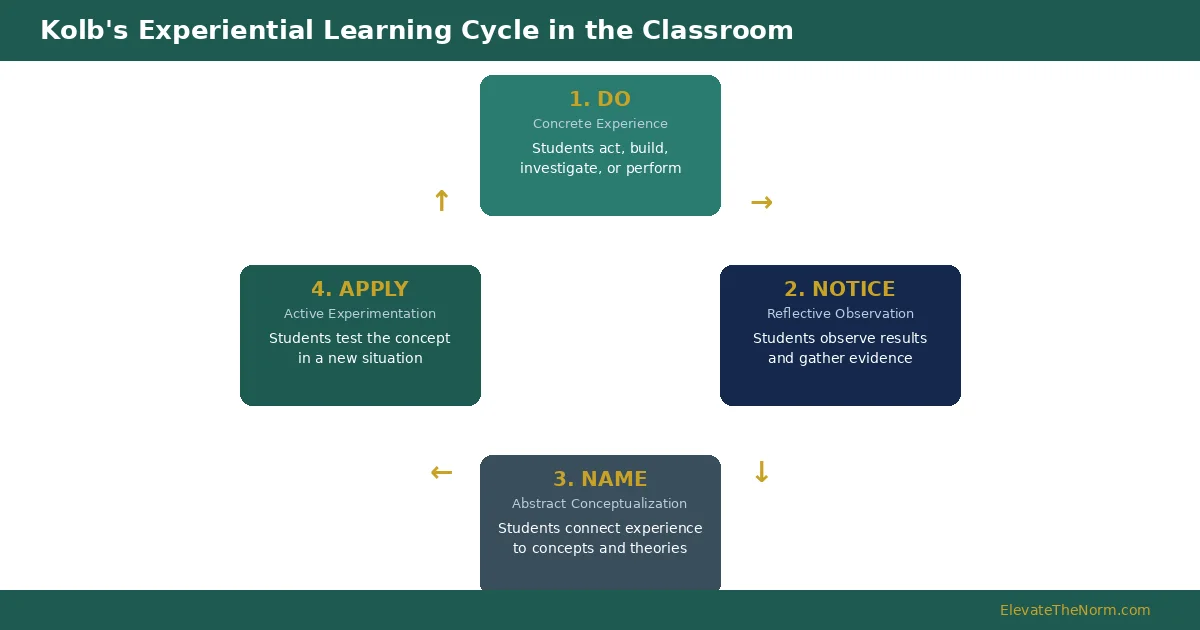
    Kolb's four-stage experiential learning cycle diagram showing do, notice, name, and try again stages for classroom use
    Kolb’s four-stage cycle in classroom language: do, notice, name, try again.

    Here is the cycle in plain terms, because the academic language makes it sound more complicated than it is:

    1. Do. Students participate in an activity, investigation, simulation, or task. They are inside the experience, not watching it.
    2. Notice. Students observe what happened — what worked, what surprised them, what went wrong. This is not a grade. It is data collection about their own experience.
    3. Name. Students connect their observations to a concept, theory, or principle. This is the bridge between “that was interesting” and “here is what it means.”
    4. Try again. Students apply what they named to a new situation. This is the test of whether they actually learned something transferable or just had a one-time experience.

    In my room, the tables are pushed together in groups, and students are almost always working alongside somebody. That is not a choice I made to be trendy — it is the structure experiential learning requires. When students do something and then need to reflect on what happened, the reflection is richer when they can talk through it with a partner who was in the same experience and noticed different things. Partner work is the default condition of the room, not a reward for finishing early, and that matters for every activity below. The experience happens collaboratively; the reflection deepens because of it.

    30 Experiential Learning Activities for Grades 6–12
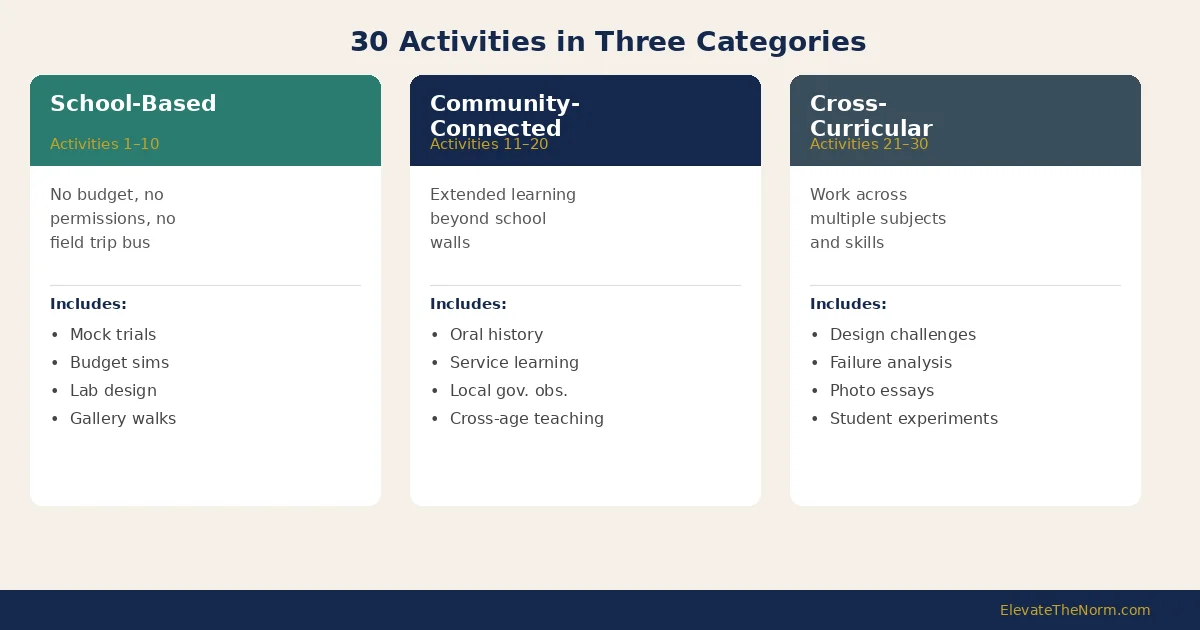
    Three categories of experiential learning activities: school-based, community-connected, and cross-curricular with example counts for each
    30 activities organized in three categories from classroom-only to community-connected.

    These are organized by type: school-based activities that need nothing beyond your classroom, community-connected activities that extend learning outside the building, and cross-curricular activities that work in multiple subjects. Budget notes are included where relevant.

    School-Based Activities (No Special Permissions Needed)

    1. Mini Mock Trial. Students take roles — prosecution, defense, witnesses, judge, jury — in a simplified trial based on a historical event, a literary conflict, or a current ethical question. The experience is arguing a position under rules. The reflection is: “What evidence was most persuasive, and why did the jury weigh it that way?” Runs in one to two class periods.

    2. Budget Simulation. Give each group a fixed income and a list of expenses for a household — rent, food, transportation, insurance, taxes. They allocate, make trade-offs, encounter unexpected expenses (car repair, medical bill), and rebuild their plan. The conceptualization: what does this reveal about economic decision-making, poverty, or policy? Cost: zero. A printed handout is all you need.

    3. Primary Source Investigation. Place three to five primary sources on a table — documents, photographs, maps, or objects. Students examine them physically (or high-quality printouts), generate questions, and build a hypothesis about what they reveal. The reflection compares their hypothesis to the textbook account. A history teacher’s bread and butter, and it works in science (lab observation logs) and English (author manuscripts, historical editions) just as well.

    4. Peer Teaching Rounds. Each student or pair prepares a five-minute lesson on one section of a unit. They teach it to a rotating group of classmates, receive written feedback, revise, and teach it again. The experience is teaching — which forces deeper understanding than listening ever does. The reflection: “What question from your students made you realize you did not understand this as well as you thought?”

    5. Data Collection and Analysis. Students collect real data — classroom survey results, school lunch waste measured by weight, hallway traffic patterns, library usage statistics — then analyze it using methods from the curriculum. The experience is measurement. The conceptualization is: “What does this data actually tell us, and what does it not tell us?” This is project based learning in miniature.

    6. Fishbowl Debate. A small group discusses a debatable question in the center of the room while the rest of the class observes, takes notes, and tags in to replace a speaker. The experience is both performing and observing. Reflection prompt: “What did you notice about how the conversation changed when a new voice entered?”

    7. Lab Design Challenge. Instead of following a pre-written lab procedure, students receive a question and design their own procedure, predict outcomes, run the experiment, and compare results to predictions. The teacher provides safety parameters and materials — students provide the method. Works in any science class and teaches the difference between following instructions and doing science.

    8. Role-Play Negotiation. Assign students roles in a historical or contemporary negotiation — treaty talks, labor disputes, environmental policy. They research their position, negotiate with opposing parties, and attempt to reach an agreement. Reflection: “What did you have to give up, and why? What would have changed if you had different information?” One class period, no budget.

    9. Gallery Walk With Feedback. Students display their work — drafts, diagrams, solutions, prototypes — and classmates circulate, leaving specific written feedback using structured prompts. The experience is both creating and evaluating. The reflection: “What feedback surprised you? What will you change, and what will you keep?” Gallery walks teach respect in the classroom through practice, not a poster. What makes the written feedback specific enough to act on is the part worth deciding before students reach the first station.

    10. Simulation of Scarcity. Give groups limited resources (paper, tape, time) to complete a task that requires more than they have. Watch how they allocate, trade, cooperate, or compete. Debrief with the question: “What does this show about how people behave when resources are scarce?” This is economics, psychology, and history in one forty-minute block.

    Community-Connected Activities

    11. Community Problem Investigation. Students identify a real problem in their school or neighborhood — a safety concern, an access issue, an environmental hazard — research it, interview stakeholders, and propose a solution they present to an actual decision-maker (principal, city council member, local business owner). The service-learning research is strong here: Celio, Durlak, and Dymnicki (2011) reviewed 62 studies involving 11,837 students and found an effect size of 0.43 for academic achievement — the largest of any outcome category they measured. Programs that incorporated structured reflection doubled their effect.

    12. Oral History Project. Students interview a community member — a grandparent, a veteran, a local business owner, a longtime resident — about a topic connected to the curriculum. They record, transcribe, and analyze the interview against historical or sociological sources. The experience is the conversation. The conceptualization: “How does one person’s story confirm or complicate what the textbook says?”

    13. Environmental Audit. Students measure something real — water quality in a nearby stream, energy usage in the school building, waste generated by the cafeteria over a week — and compare their findings to published standards or benchmarks. The product is a written report with recommendations presented to administration or a community group. Works in science, math, and social studies.

    14. Job Shadow Reflection. If your school allows it, students spend a half-day observing a professional in a field connected to the curriculum. The activity is not the shadow itself — that is just the experience. The learning happens in the structured reflection afterward: “What skills did you see this person use? Which ones are you already building in this class? Which ones surprised you?” Not every school can do this, but the schools that can should.

    15. Community Mapping. Students map resources, hazards, demographics, or services in their neighborhood using walking surveys, public data, or online tools. The product is a visual map with analysis. The conceptualization: “What patterns do you see, and what might cause them?” This teaches geography, data literacy, and civic awareness simultaneously.

    16. Public Service Announcement Production. Students research a public health or safety issue, create a thirty-to-sixty-second video or audio PSA, and share it with a real audience (school announcements, a local nonprofit, social media with school approval). The experience is production. The reflection: “What choices did you make about what to include and what to leave out? How did your audience change your message?”

    17. Small Business Plan. Students develop a simple business plan for a product or service that addresses a real need in their community. They research costs, identify customers, create a marketing pitch, and present to a panel that includes at least one real business owner or community member. No actual money changes hands — the value is in the planning and the presentation to a real audience.

    18. Local Government Observation. Students attend (in person or via livestream) a city council meeting, school board meeting, or county commission session. They take notes on how decisions are made, who speaks, what evidence is presented, and how the process compares to what they learned in class. Reflection: “What surprised you about how this process actually works?” This is civics as experience, not vocabulary.

    19. Service-Learning Project. Students identify a community need, plan a service response, carry it out, and reflect on what they learned about the issue and about themselves. This is different from community service because the learning is explicit — tied to curriculum standards, assessed, and reflected on. Celio et al. found that programs using four recommended practices (curriculum linking, youth voice, community involvement, reflection) yielded effect sizes of 0.35, compared to 0.17 for programs using none.

    20. Cross-Age Teaching. High school students design and deliver a lesson to elementary or middle school students on a topic from the curriculum. The experience forces them to simplify, explain, and anticipate misconceptions — skills that require deep understanding. The reflection: “What question from a younger student exposed a gap in your own understanding?”

    Cross-Curricular Activities

    21. Design Challenge. Give groups a problem (build a bridge from paper that holds a textbook, design a water filtration system from household items, create a container that keeps an egg intact from a second-floor drop) and limited materials. The experience is building and testing. The reflection: “What did your first failure teach you that led to your second design?” Engineering, physics, and teaching responsibility through consequential tasks.

    22. Socratic Seminar on a Controversial Question. Students prepare evidence on a debatable topic — historical, scientific, ethical, or literary — and discuss it in a structured circle. The experience is sustained, evidence-based conversation. The conceptualization: “Where did you change your mind, and what evidence made you do it?” Works in every subject that asks debatable questions, which is all of them.

    23. Process Journal. Students keep a running journal during a multi-day activity or project, documenting decisions, setbacks, changes in thinking, and reflections. The journal itself becomes the conceptualization artifact — a record of learning over time, not just the final product. Pair with project based learning ideas to give students ownership of the process, not just the outcome.

    24. Simulation of a Historical Event. Assign students roles within a historical event — the Constitutional Convention, a UN Security Council debate, the Montgomery Bus Boycott planning meetings — and run a compressed simulation. Students must research their historical figure’s actual positions and argue from evidence. The reflection connects the simulation to the outcomes: “What decisions could have gone differently, and how would history have changed?”

    25. Measurement Lab. Students measure something real using disciplinary tools — pH, temperature, distance, weight, density, sound levels, population counts — and use the data to answer a question. The experience is measurement and observation. The conceptualization: “What did the data show that you did not expect? What would you measure next?” This is how science and math become tangible.

    26. Ethical Dilemma Discussion. Present students with a genuine ethical dilemma — medical triage, resource allocation during a disaster, whistleblowing, journalistic responsibility — and have them work through it in small groups using a structured framework (stakeholder analysis, consequence mapping, principled reasoning). The experience is the moral reasoning. The reflection: “Where did your group disagree, and what value was each person prioritizing?”

    27. Recipe Scaling and Cooking. Students scale a recipe up or down for a different number of servings, calculate costs per serving, and (if facilities allow) prepare the food. Math, nutrition, chemistry, and real world learning in one activity. The reflection: “What math did you actually use, and how was it different from doing a worksheet problem?” Even without a kitchen, the scaling and cost analysis are worthwhile on their own.

    28. Photo Essay. Students use phone cameras to document a theme — “systems in our school,” “geometry in our neighborhood,” “evidence of change over time” — and curate their photos into a narrative with captions that connect observations to course concepts. The experience is seeing. The conceptualization is framing what they see in disciplinary language.

    29. Failure Analysis. Give students a case study of a real engineering failure, a business collapse, a policy disaster, or a historical miscalculation. They analyze what went wrong, identify the decision points where a different choice could have changed the outcome, and present their findings. The experience is forensic thinking. The reflection: “What is the difference between a mistake and a systemic failure?” This pairs directly with the site’s core belief that learning from mistakes is how people grow — but only if they understand what actually went wrong.

    30. Student-Designed Experiment. Students choose a question, design an experiment or investigation, carry it out, analyze results, and present findings to the class. The teacher provides the framework (hypothesis, method, data collection, analysis, conclusion) and the safety boundaries. Students provide everything else. This is the capstone version of experiential learning — students own every stage of the cycle, and the teacher’s job is to keep the guardrails in place while the students do the driving.

    What the Research Says About Experiential Learning Outcomes
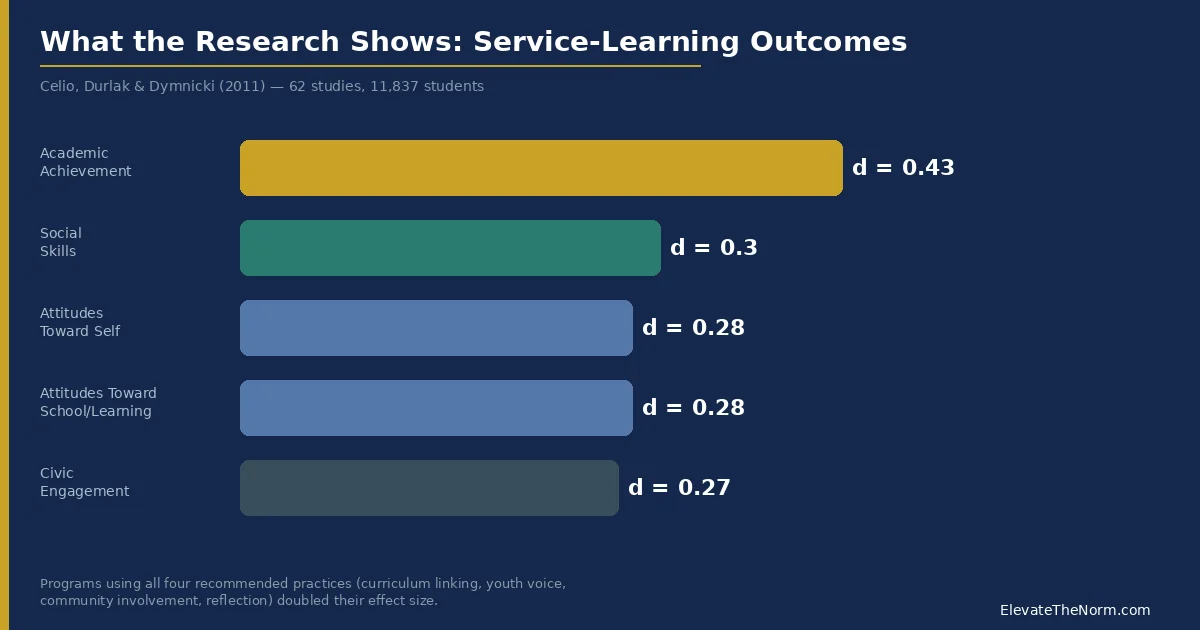
    Bar chart showing service-learning effect sizes from Celio et al. meta-analysis: academic achievement 0.43, social skills 0.30, attitudes toward self 0.28, attitudes toward school 0.28, civic engagement 0.27
    Service-learning effect sizes from Celio et al. (2011): academic achievement led all outcomes.

    The evidence base for experiential learning is substantial, but it is important to be honest about what it shows and what it does not.

    Morris (2020) conducted a systematic review of Kolb’s model and found that while the four-stage cycle remains the most widely used framework for experiential learning, its effectiveness depends entirely on implementation — particularly the reflection and conceptualization stages. Activities that skip those stages consistently produce weaker outcomes. The cycle is not optional, and Kolb himself argued this: “Learning is the process whereby knowledge is created through the transformation of experience.”

    The Celio, Durlak, and Dymnicki (2011) meta-analysis remains the strongest quantitative evidence for service-learning specifically. Across 62 studies and 11,837 students, service-learning produced significant gains in academic achievement (d = 0.43), social skills (d = 0.30), attitudes toward self (d = 0.28), attitudes toward school (d = 0.28), and civic engagement (d = 0.27). The academic achievement effect was notably the largest — a finding the authors called “probably the most important for educators.” This is not a soft skill gain masquerading as rigor. Students who did service-learning learned more content, measured by the same assessments their peers took.

    Research on simulation-based learning in secondary education, reviewed across 145 studies, found that simulations produce strong overall effects on achievement across disciplines. Students who learned through simulations showed better problem-solving abilities compared to traditional methods, improved collaboration skills, and rated simulations as the most effective learning method compared to lectures and case studies. However, the research is clear that effectiveness depends on instructional design, not just the tool — a poorly designed simulation is no better than a poorly designed lecture.

    The honest summary: experiential learning works when it includes all four stages of the cycle, when reflection is structured rather than optional, and when the teacher stays involved throughout. It does not work when “experiential” is used as a synonym for “fun” or when the reflection step is cut because the bell is about to ring.

    Making It Work: Practical Considerations

    Most of these activities require no budget. A few need minimal supplies (printed handouts, poster paper, tape). The community-connected activities may require coordination with administrators, parents, or community partners, but none of them require spending money the school does not have.

    Time is the real constraint. A full experiential learning cycle — do, reflect, conceptualize, apply — takes longer than a lecture-and-worksheet class. That is a fact, not an objection. The research consistently shows that the time invested produces stronger learning outcomes, which means the apparent time cost is actually a time savings: students who understand a concept through experience need less reteaching than students who memorized it from a slide.

    For teachers working within tight pacing guides, start with activities that fit inside a single period (1–10 on the list above) and expand as you learn what your students can handle. The community-connected activities (11–20) require more planning but produce deeper engagement. The cross-curricular activities (21–30) are where experiential learning becomes genuinely student centered — students are not just experiencing content, they are experiencing the process of learning itself.

    One final note: student responsibility in the classroom is not something you can lecture into existence. It is built through activities where students have real decisions to make and real consequences to learn from — consequences bounded by planning and presence, not by manufactured stakes designed to punish mistakes. These thirty activities are how that happens.


    Frequently Asked Questions

    What is the difference between experiential learning and hands-on learning?

    Hands-on learning means students are physically doing something — building, measuring, manipulating materials. Experiential learning includes hands-on work but adds structured reflection, conceptualization, and application. A student who builds a bridge out of paper has done hands-on learning. A student who builds it, analyzes why it failed, connects that analysis to engineering principles, and redesigns it has done experiential learning. The reflection and conceptualization stages are what separate the two.

    How do I fit experiential activities into a packed curriculum?

    Start with single-period activities from the school-based list. Many of them replace a lecture and worksheet with a more effective learning experience that covers the same content. The time investment pays off in reduced reteaching — students who learn through experience retain more than students who memorize from slides. If your pacing guide is truly immovable, use experiential activities for the concepts students struggle with most. That is where the return on time is highest.

    Do experiential learning activities work for students who struggle academically?

    The research says yes. The Celio et al. meta-analysis found that service-learning programs using structured reflection and curriculum linking — two features that directly support struggling learners — produced the strongest results. Experiential activities provide multiple entry points (visual, kinesthetic, verbal, social) that traditional instruction often does not. That said, struggling students need more scaffolding, not less — provide clearer task cards, shorter rotations, and more frequent check-ins during the experience phase.

    What if my school does not allow field trips or community partnerships?

    Activities 1 through 10 require nothing beyond your classroom. Simulations, mock trials, data collection, design challenges, and gallery walks all create experiential learning inside the building. Community connections enrich the work but are not required for it. Many of the community-connected activities (oral history, local government observation via livestream, community mapping using public data) can be adapted to work within school walls if your district restricts off-campus activities.

    How do I grade experiential learning activities?

    Grade the products the cycle produces, not the experience itself. Reflection journals, analysis papers, design reports, presentation rubrics, and peer feedback forms all generate gradeable artifacts. Do not grade participation in the experience — that turns a learning activity into a compliance check. Grade what students demonstrate they learned from the experience, which is visible in the reflection and application stages.

    Are experiential learning activities appropriate for every subject?

    Yes, though the format varies. Science uses labs and investigations. History uses primary sources and simulations. Math uses data collection and measurement. English uses discussion protocols and creative production. The common thread is the cycle: do something, reflect on it, connect it to a concept, and apply it to a new situation. Any subject that asks students to think — which is all of them — can use experiential learning.

    How do I manage behavior during experiential activities?

    Structure prevents most behavior problems. When students know what they are doing, how long they have, and what they will produce, off-task behavior drops. Circulate constantly — your physical presence in the room is your primary management tool. Set expectations before the activity starts, not during it. Use a two-minute check at the beginning to catch confusion early. If a specific group is off task, redirect quietly and individually rather than stopping the whole class. The teacher’s job during experiential learning is to move, listen, and intervene surgically.


    Sources

    1. Kolb, D. A. (1984). Experiential Learning: Experience as the Source of Learning and Development. Prentice-Hall.
    2. Dewey, J. (1938). Experience and Education. Kappa Delta Pi/Macmillan.
    3. Celio, C. I., Durlak, J., & Dymnicki, A. (2011). “A Meta-Analysis of the Impact of Service-Learning on Students.” Journal of Experiential Education, 34(2), 164–181. https://doi.org/10.1177/105382591103400205
    4. Morris, T. H. (2020). “Experiential Learning — A Systematic Review and Revision of Kolb’s Model.” Interactive Learning Environments, 28(8), 1064–1077. https://doi.org/10.1080/10494820.2019.1570279
    5. SmartSims. (2024). “Simulation-Based Learning in Secondary Education: What the Research Shows.” https://www.smartsims.com/news/simulation-based-learning-secondary-education-research/
    6. Baeten, M., Dochy, F., Struyven, K., Parmentier, E., & Vanderbruggen, A. (2023). “Student-Centered Education: A Meta-Analysis of Its Effects on Non-Academic Achievements.” SAGE Open, 13(2). https://doi.org/10.1177/21582440231168792

    About Clay Shumate

    Clay Shumate is a certified secondary Social Studies teacher in the public schools of West Alabama, with seven years of classroom experience, a B.A. in History, and an M.Ed. in Secondary Education. He writes about project-based learning, student responsibility, respect, and practical ways to hold young people to a higher standard while giving them room to learn from mistakes. He is a member of the Society of Professional Journalists and writes to its Code of Ethics; this site’s editorial standards and corrections policy are published in full. More about Clay.
  • Project Based Learning vs Traditional Learning: What the Evidence Actually Says

    Project Based Learning vs Traditional Learning: What the Evidence Actually Says

    By Clay Shumate · Updated October 24, 2026

    Project based learning and traditional learning differ in where the content lives. Traditional instruction delivers knowledge first and asks students to apply it afterward. Project based learning has students build that knowledge while solving a real problem for a real audience. The research favors projects for transfer and retention, and favors direct instruction for teaching brand-new material to beginners.

    Key Takeaways

    • The comparison is not projects versus lectures. It is when content gets delivered and who does the thinking while it happens.
    • Meta-analytic evidence gives project based learning a moderate advantage on academic achievement, with the strongest effects at the high school level.
    • Explicit, guided instruction still beats minimally guided approaches for novices meeting new content. That finding is not a rebuttal of PBL — it is a scheduling instruction.
    • Most classrooms that say they run project based learning are running the visible half of it. Products and presentations are common; driving questions and revision cycles are not.
    • You do not have to pick a side for the whole year. You pick one for each unit, and you should be able to say why.

    What Is the Difference Between Project Based Learning and Traditional Learning?

    Most of the arguments about project based learning vs traditional learning are arguments about caricatures. One side pictures a teacher droning through slides while thirty kids copy notes. The other pictures a room full of poster board and glue sticks where nobody learns anything. Neither is a real classroom, and comparing them settles nothing.

    The real difference is sequence and ownership. In a traditional unit, the teacher delivers the content, students practice it, and then — if there is time — a project shows that the learning happened. The project is the dessert. In project based learning, the project is the main course. Students are handed a question worth answering, and they build the content knowledge on the way to answering it, with the teacher pulling groups aside, correcting misconceptions, and teaching directly at the moments it is needed. If you teach history or civics, my Social Studies Teacher Toolkit Bundle on TPT has ready-made pieces you can build a project around.

    That distinction matters because it is the one that gets lost. If you want the precise version, the definition of project based learning comes down to sustained inquiry, authenticity, student voice, critique and revision, and a public product. Strip any one of those out and you have a graded assignment with better packaging.

    Is Project Based Learning Better Than Traditional Learning? What the Research Says

    The evidence is stronger than skeptics assume and softer than advocates claim. Both of those things can be true, and if you read only one camp’s summary you will get a distorted picture.

    The strongest single study is a randomized trial in AP courses

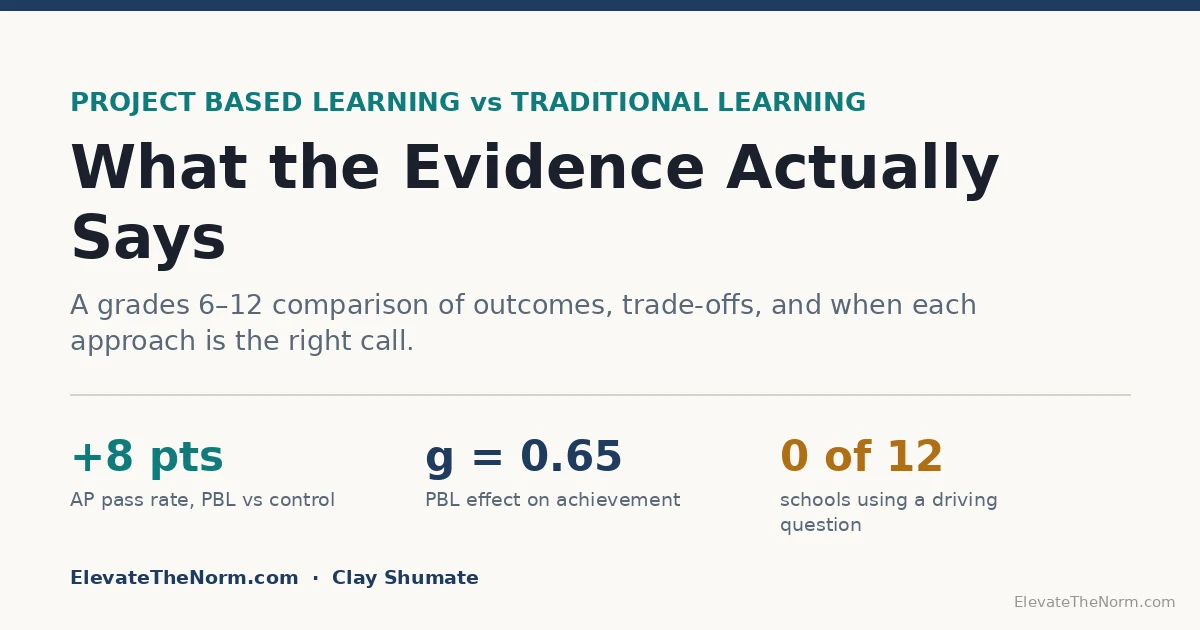
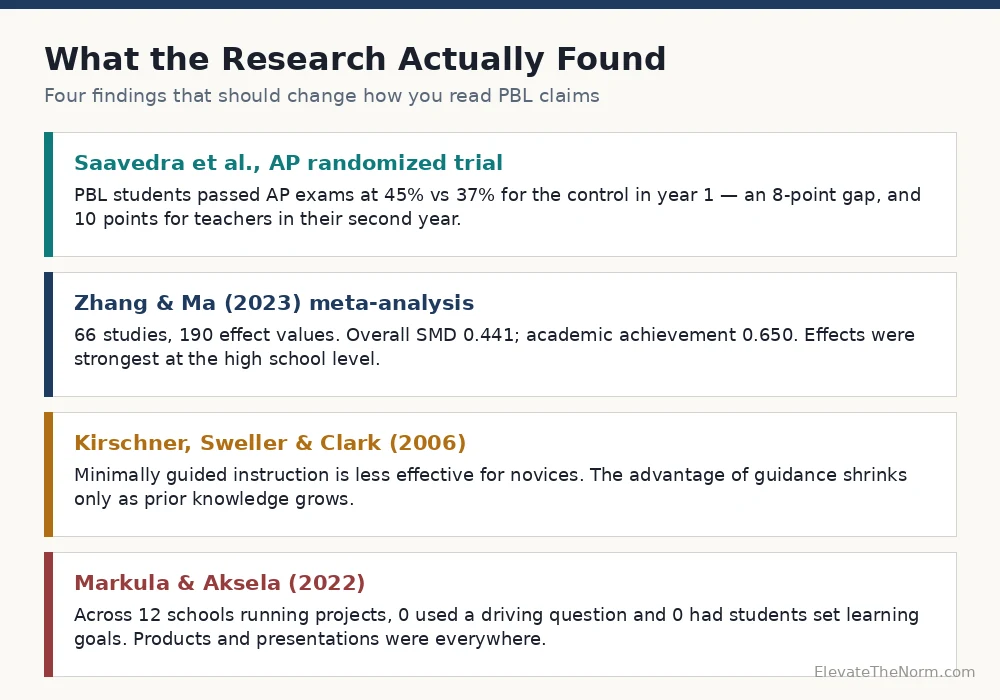
    Saavedra and colleagues ran a randomized controlled trial of the Knowledge in Action project based curriculum in AP U.S. Government and Politics and AP Environmental Science across five predominantly urban districts. In year one, 3,645 students and 74 teachers in 68 schools participated. Students in the project based classrooms passed their AP exams at 45 percent, against 37 percent for the control group — an eight percentage-point gap. For teachers in their second year of implementation, the gap widened to ten points.

    Two details are worth holding onto. First, this was a randomized trial with a real external outcome measure — the College Board’s own exam, not a test the researchers wrote. Second, the effect held for lower-income students, in a sample where 38 to 46 percent qualified for free or reduced-price lunch. The common objection that projects only work in well-resourced schools does not survive contact with this study.

    It is one study of one curriculum in two courses. It is not proof that any project beats any lecture. It is good evidence that a carefully built project based course can outperform a conventional one on a test neither side designed.

    The meta-analyses point the same direction, with caveats

    Zhang and Ma (2023) pooled 66 experimental and quasi-experimental studies into 190 effect values in Frontiers in Psychology. The overall standardized mean difference for project based learning was 0.441, and for academic achievement specifically it was 0.650 — a moderate effect, and the strongest of the three outcome categories they examined. Effects were most pronounced at the high school level, which is the band this site writes for.

    The authors are candid about the limitations, and so should we be. Heterogeneity was high (I² = 87.4 percent), meaning the studies disagreed with each other a great deal. Results from Asian school systems substantially outperformed those from North America and Western Europe. Engineering and technology subjects outperformed others. An average across that much variation tells you the direction of the effect, not the size you should expect in your own room.

    Balemen and Keskin (2018) found an even larger effect — 1.063 across 48 science-education studies — but a number that large in a body of small quasi-experimental studies should make you more careful, not more excited. The direction is consistent. The magnitude is not settled.

    When Is Traditional Instruction Better Than Project Based Learning?

    Here is the part that PBL advocates skip, and it is the part that makes the rest of the argument credible.

    Kirschner, Sweller, and Clark argued in Educational Psychologist (2006) that minimally guided instruction is less effective and less efficient than guided instruction, and that the disadvantage shrinks only as learners accumulate prior knowledge. Their case is built on human cognitive architecture: a novice working memory does not have the spare capacity to search for a solution and learn the underlying content at the same time. Handing a beginner an open problem does not build expertise. It builds frustration and a lot of confidently wrong conclusions.

    Rosenshine’s Principles of Instruction (2012) is the practical version of the same evidence. Review prior learning. Present new material in small steps with practice after each step. Ask a lot of questions and check everyone’s response. Model. Guide practice. Aim for a high success rate. Scaffold hard tasks and withdraw the scaffolds gradually. None of that is out of fashion because it works, and none of it is incompatible with running projects.

    So the finding is not “projects are bad.” The finding is that a project is a terrible place to meet a concept for the first time and an excellent place to use one. That is a sequencing rule, and it is the most useful thing in this entire literature. For practical implementation strategies inside a standard high-school schedule, see project based learning high schools can use without rebuilding the schedule.

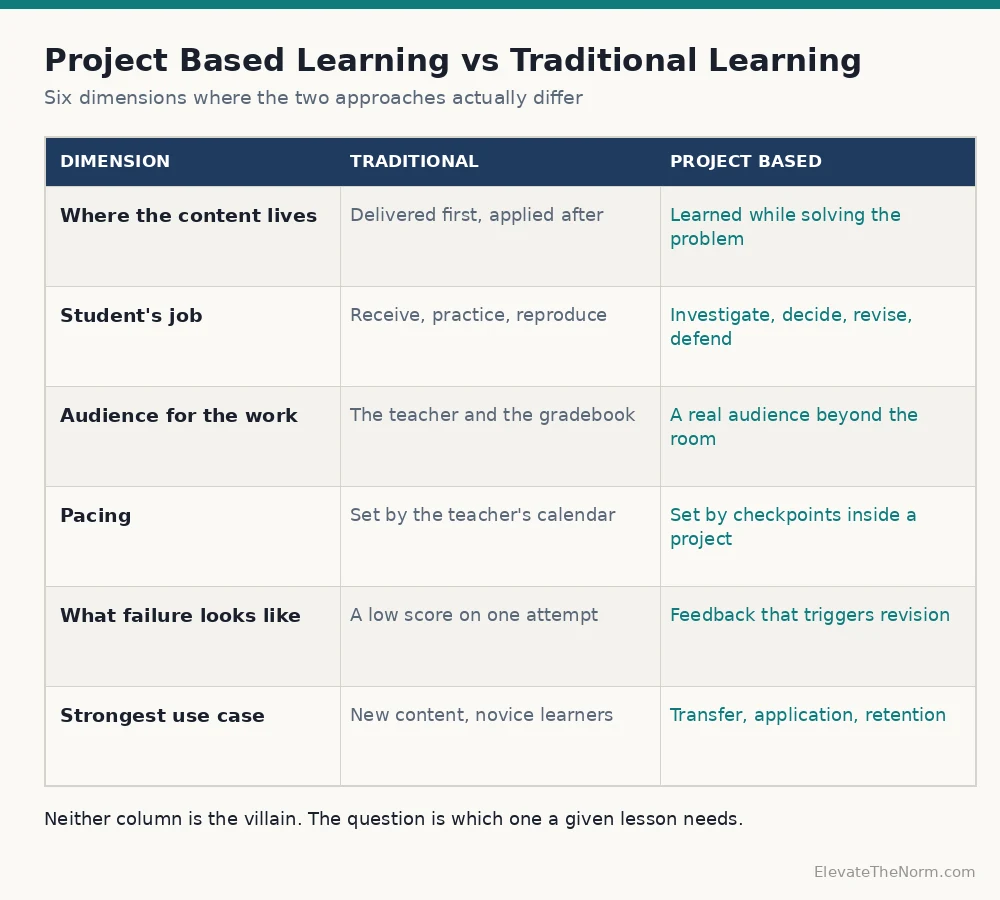
    Project Based Learning vs Traditional Learning: A Side-by-Side

    DimensionTraditional learningProject based learning
    Where content livesDelivered first, applied afterwardBuilt while solving the problem
    Student’s jobReceive, practice, reproduceInvestigate, decide, revise, defend
    AudienceThe teacher and the gradebookSomeone outside the room
    PacingSet by the teacher’s calendarSet by checkpoints inside the project
    What failure looks likeA low score on one attemptFeedback that triggers a revision
    Teacher’s positionFront of the room, deliveringCirculating, conferencing, teaching on demand
    Strongest use caseNew content, novice learners, tight pacingTransfer, application, retention, motivation
    Most common failureStudents comply without thinkingStudents produce without learning
    Neither column is the villain. The question is which one a given lesson needs.

    The Implementation Problem Nobody Puts on the Brochure

    Markula and Aksela (2022) studied 17 student projects at 12 schools across seven countries — schools that had volunteered for an international science programme and considered themselves to be doing project based learning. Collaboration showed up in 11 of the 12. All 12 produced artifacts. All 12 presented results.

    And none of the 12 showed evidence of a driving question. None had students setting their own learning goals. Hypothesis testing appeared in none of the projects. Student-generated questions shaped the work in only four.

    That is a portrait of committed teachers running the visible half of PBL — groups, products, presentations — while the parts that actually generate the learning were missing. It also explains a lot of the disagreement between studies. When a research team compares “PBL” against traditional instruction, what they are actually comparing depends entirely on which half the treatment classrooms implemented.

    If you are deciding whether to move a unit to project based learning, the honest comparison is not PBL against your current teaching. It is well-implemented PBL against your current teaching, and the difference between well-implemented and decorative is a driving question, a real audience, and a revision cycle. The seven steps of project based learning exist mostly to keep those three from getting dropped when the calendar gets tight.

    What This Looks Like on an Ordinary Tuesday

    My room is not a lecture hall and it is not a free-for-all. There are no rows. Tables are pushed together in pairs and groups of four, and that is the resting state of the furniture — not a configuration students move into on project days. Working alongside somebody is the default condition, not a reward for finishing early.

    That setup does not mean I disappear. I am on a wheeled stool, moving between groups, and I pull students to a whiteboard table when something needs to be taught directly. Some days that whiteboard table is where I deliver five minutes of straight instruction to four kids who need it, and the rest of the room keeps working. That is direct instruction and project work happening in the same forty minutes, which is what the research actually supports and what the “versus” framing hides.

    The mistake I see teachers make — and made myself — is treating the choice as an identity. You are not a PBL teacher or a traditional teacher. You are a teacher deciding, unit by unit, what a particular group of students needs in order to learn a particular thing. A student-centered classroom is not one where the teacher stopped teaching. It is one where the teaching happens closer to the student and later in the process.

    How Do You Decide Which Approach a Lesson Needs?

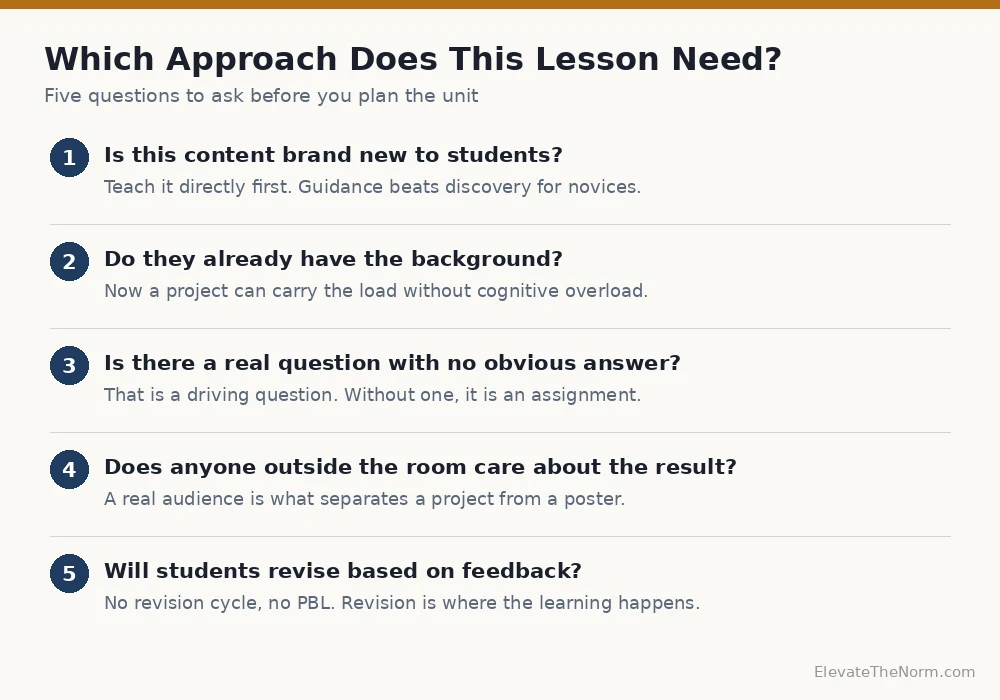
    Five questions, asked before you plan the unit rather than after.

    1. Is this content brand new to students? If yes, teach it directly first. Guidance beats discovery for novices, and pretending otherwise costs you a week.
    2. Do students already have the background? If yes, a project can carry the load without overloading working memory. This is the condition that makes PBL work.
    3. Is there a real question here that I cannot answer in one sentence? That is a driving question. If you can Google the answer, it is a research assignment, not a project.
    4. Does anybody outside this room care about the result? A real audience is the difference between a project and a poster. It does not have to be the city council. The class next door counts. Anything that involves outside adults, off-campus work, or publishing student names should clear your administration and your district’s policies first, before you promise students an audience you cannot deliver.
    5. Will students revise based on feedback before it is graded? No revision cycle, no PBL. Revision is where most of the learning lives, and it is the first thing cut when the calendar gets tight.

    If you answer no to questions three, four, or five, do not call it project based learning. Call it a good assignment, grade it fairly, and move on. There is nothing wrong with a good assignment. There is something wrong with claiming research support that only applies to a structure you did not build. A set of worked project examples is a faster way to see the difference than any definition.

    What to Do Next

    Pick one unit. Not a semester, not a course — one unit, in one section, on content your students already have some footing in. Write a driving question you genuinely cannot answer in a sentence. Find an audience, even a small one. Build two checkpoints and one revision cycle into the calendar before you launch, because you will not add them once you are inside the unit.

    Be honest with yourself about the cost. The first time you build a project it will take more planning hours than the unit it replaces, and most of those hours go into the checkpoints and the rubric rather than the launch. The second time you run it, it takes less time than the traditional unit did. That front-loaded cost is the real reason projects get abandoned, and knowing it in advance is most of the fix.

    Teach everything else the way you already teach it. Then compare — your own students, your own assessment, two versions of the same content. That comparison will tell you more about project based learning vs traditional learning in your building than any meta-analysis can, and you will have run it at a cost of one unit. If you want a wider version of the same idea, experiential learning approaches high schools can actually use covers the models that fit inside an ordinary schedule.

    The teachers who get this right are not the ones who picked a side. They are the ones who can tell you, for any given day, why they are teaching the way they are teaching.

    Frequently Asked Questions

    What are the disadvantages of project based learning?

    Projects are a poor place for novices to meet brand-new content: guided, explicit instruction beats minimally guided approaches until students have prior knowledge. Implementation is the other weakness. In one study of 12 schools that considered themselves PBL schools, all produced products and presentations, but none showed evidence of a driving question.

    What are the advantages of traditional learning?

    Traditional, teacher-led instruction is the most efficient way to teach new material to beginners. Presenting content in small steps, modeling, guided practice, frequent checks for understanding, and a high success rate protect working memory and fit tight pacing calendars. Its common failure is students complying without thinking, which is why many teachers pair it with projects.

    Is project based learning better than traditional learning?

    It depends on what you are asking students to do. Meta-analytic evidence, including Zhang and Ma’s 2023 synthesis of 66 studies, shows a moderate positive effect for project based learning on academic achievement compared with conventional instruction, and the effect was strongest at the high school level. But Kirschner, Sweller, and Clark (2006) make the opposite case just as clearly for novices encountering brand-new content, where guided, explicit instruction outperforms minimally guided approaches. The honest answer is that PBL is better for transfer, application, and retention once students have something to work with, and direct instruction is better for building that something in the first place.

    What is the main difference between project based learning and traditional learning?

    Where the content lives. In traditional learning, the teacher delivers the content first and students apply it afterward in a quiz, an essay, or an end-of-unit project. In project based learning, the project is the instruction — students build the knowledge while investigating a real question for a real audience, with checkpoints, critique, and revision along the way. A project assigned after the unit is a demonstration. A project that carries the unit is PBL.

    Does project based learning cover fewer standards?

    It covers fewer standards per week and more standards per project, and that trade is the real planning decision. A well-built project can carry several standards at once because students are using them together instead of one at a time. What it cannot do is race. If your pacing guide gives you three days on a topic, that topic is not a project. Pick the two or three units a year where the depth is worth the calendar and teach the rest directly.

    Is project based learning harder to grade fairly?

    It is harder if you grade the product and nothing else. It gets fair when you grade the individual thinking inside the group — checkpoint work, a research log, a short defense of the student’s own decisions — separately from the shared final product. Group grades that average everyone together are the single most common reason students and families lose faith in projects, and they are avoidable.

    What does the research say about project based learning and lower-income students?

    The randomized trial of the Knowledge in Action project based AP curriculum, run across five largely urban districts, found that students in project based classrooms passed their AP exams at 45 percent versus 37 percent for the control group in year one, and reported comparable gains for lower-income students and their higher-income peers. That is one strong study in one setting, not a universal finding, but it directly contradicts the assumption that projects are a luxury for well-resourced schools.

    Do students need technology for project based learning?

    No. The requirements for PBL are a genuine question, a real audience, time for revision, and a teacher who is circulating. None of that is a device. Interviews, archival work, community problems, physical builds, and public presentations all run on paper. Technology can widen the audience and speed the revision cycle, but a project that only works with one-to-one devices was designed around the tool rather than the learning.

    How do I start if my school teaches traditionally?

    Start with one unit in one course, not a program. Pick content your students already have some background in, write a driving question that you personally cannot answer in one sentence, find an audience outside your classroom even if it is only the class next door, and build two checkpoints and one revision cycle into the calendar before you launch. Teach the rest of your year the way you already do. Nobody has to rebuild a schedule to run a project.

    Sources

    1. Saavedra, A. R., Rapaport, A., Morgan, K. L., Garland, M., Liu, Y., Hu, A., Hoepfner, D., & Korn, S. “Project-Based Learning Boosts Student Achievement in AP Courses.” College Board / Lucas Education Research.
    2. Zhang, L., & Ma, Y. (2023). “A study of the impact of project-based learning on student learning effects: a meta-analysis study.” Frontiers in Psychology, 14, 1202728.
    3. Kirschner, P. A., Sweller, J., & Clark, R. E. (2006). “Why Minimal Guidance During Instruction Does Not Work: An Analysis of the Failure of Constructivist, Discovery, Problem-Based, Experiential, and Inquiry-Based Teaching.” Educational Psychologist, 41(2), 75–86.
    4. Rosenshine, B. (2012). “Principles of Instruction: Research-Based Strategies That All Teachers Should Know.” American Educator, 36(1), 12–19, 39.
    5. Markula, A., & Aksela, M. (2022). “The key characteristics of project-based learning: how teachers implement projects in K-12 science education.” Disciplinary and Interdisciplinary Science Education Research, 4, 2.
    6. Balemen, N., & Keskin, M. Ö. (2018). “The Effectiveness of Project-Based Learning on Science Education: A Meta-Analysis Search.” International Online Journal of Education and Teaching, 5(4), 849–865.

    About Clay Shumate

    Clay Shumate is a certified secondary Social Studies teacher in the public schools of West Alabama, with seven years of classroom experience, a B.A. in History, and an M.Ed. in Secondary Education. He writes about project-based learning, student responsibility, respect, and practical ways to hold young people to a higher standard while giving them room to learn from mistakes. He is a member of the Society of Professional Journalists and writes to its Code of Ethics; this site’s editorial standards and corrections policy are published in full. More about Clay.
  • Activities for Student Centered Learning That Give Students Real Ownership

    Activities for Student Centered Learning That Give Students Real Ownership

    By Clay Shumate

    Activities for student centered learning only work when students are doing the thinking — not just following instructions that feel participatory. The activities below transfer real decision-making to students while keeping the teacher present, circulating, and holding the standard. Each one works in grades 6–12 without requiring a technology budget, a flexible schedule, or permission from anyone outside your room.

    Key Takeaways

    • Student-centered activities shift the cognitive load to students — they think, decide, and defend rather than listen and record.
    • The teacher does not disappear. The teacher circulates, intervenes at the right moment, and holds the standard.
    • Structure prevents confusion. Every activity below includes a clear task, a time frame, and an accountability check.
    • A 2023 meta-analysis of 31 studies found that student-centered approaches produced the largest effect sizes at the secondary level — stronger than primary or higher education.
    • Start with one activity. Trying to overhaul everything at once is how student-centered learning gets abandoned by October.

    What Makes an Activity Student Centered — and What Just Looks Like It

    Side-by-side comparison of student centered learning versus traditional instruction showing who does the thinking in each model
    In student-centered activities, students do the thinking — not just the moving.

    A lot of activities get called student centered because students are moving, talking, or using colored markers. That is not the test. The test is: who is doing the thinking?

    If students are following a step-by-step handout, filling in blanks, or rotating through stations that ask nothing beyond recall, the teacher is still doing the cognitive work — just delivering it through a different medium. Student-centered means students are making decisions about what to investigate, how to approach a problem, or how to present evidence. It means they encounter genuine uncertainty — not a question where the answer is already written on the back of the card.

    A meta-analysis by Baeten, Dochy, Struyven, Parmentier, and Vanderbruggen (2023), published in SAGE Open, reviewed 31 studies and found a large overall effect of student-centered education on learning outcomes (SMD = 0.72, p < .001). The finding that matters most for middle and high school teachers: secondary education showed the strongest effect of any level, with an SMD of 0.98 — meaning student-centered approaches produced nearly a full standard deviation of improvement at the grades where many teachers still default to lecture. Programs that ran longer than six months showed the largest gains (SMD = 1.08), which means this is not a novelty effect. It is a sustained instructional advantage.

    That said, the study’s heterogeneity was very high (I² = 99.7%), which means the quality of implementation matters enormously. Poorly structured student-centered activities will not produce these results. The activities below are designed with that constraint built in: every one of them includes the structure that makes the approach work, not just the freedom that makes it sound good.

    Activities That Transfer Real Thinking to Students

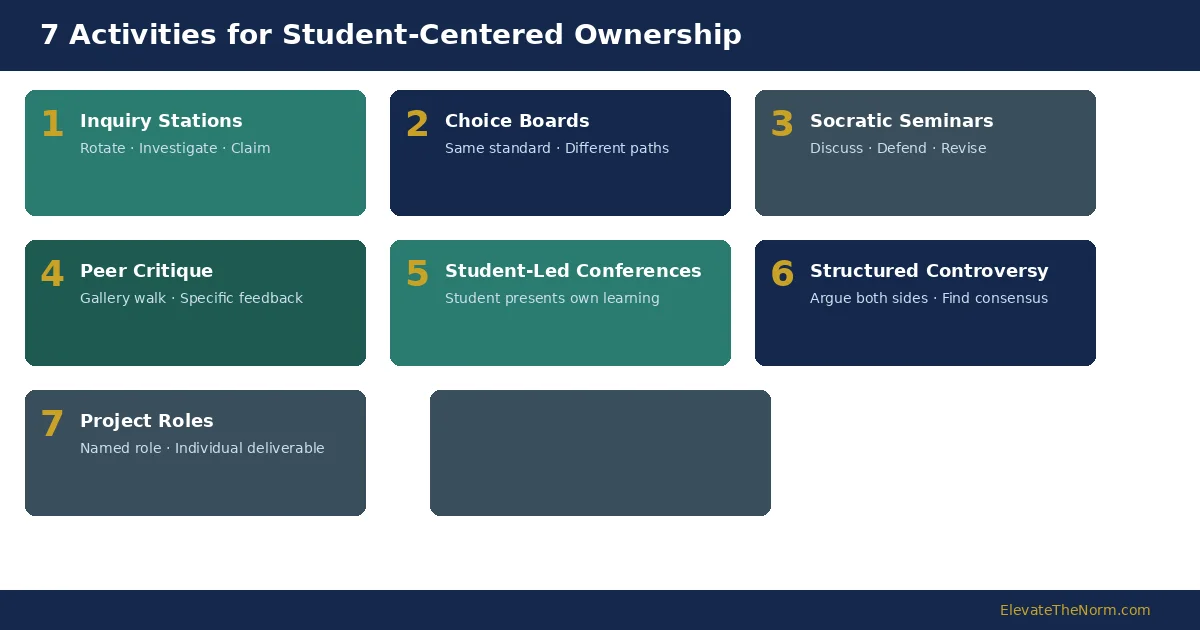
    Overview of seven student centered learning activities including inquiry stations, choice boards, Socratic seminars, peer critique, student-led conferences, structured controversy, and project roles
    Seven activities that transfer real decision-making to students.

    Inquiry Stations

    What it is: Students rotate through three to five stations, each presenting a different primary source, data set, image, or short text related to the same question. At each station, they record observations, generate questions, and build toward a claim they will defend at the end of the rotation.

    Why it works: Students encounter evidence before they encounter the teacher’s interpretation. They have to look at something, decide what it means, and compare it against what they found at the previous station. The thinking is theirs.

    The structure that prevents confusion: Post the driving question where everyone can see it. Give each station a task card with one or two specific prompts — not open-ended “discuss what you see” instructions that lead to three minutes of silence followed by off-task conversation. Set a timer for each rotation. Have students record individually, even if they talk in groups, so there is an accountability artifact.

    In my room, I set up inquiry stations on trapezoid tables pushed together, which means groups of three or four are already facing each other when they sit down. I circulate during rotations. More than once, I have caught a group building a misconception from one station’s source — they misread a chart or drew a conclusion the data did not support — and the only reason I caught it was because I was standing close enough to hear them reason through it before they wrote it down. That is the teacher’s job in a student centered learning classroom: not to deliver the content from the front, but to be close enough to redirect the thinking before it hardens into a wrong answer. The same demand on your attention runs through the longer bank of experiential activities for grades 6–12.

    Choice Boards Within Standards

    What it is: A grid of options — typically three-by-three or four-by-four — where each cell is a different way to demonstrate understanding of the same learning target. Students choose which cells to complete. Every option meets the same standard; only the mode of expression changes.

    Why it works: A meta-analysis by Patall, Cooper, and Robinson (2008) reviewed 41 studies on the effects of choice on intrinsic motivation and found a moderate positive effect (d = 0.30–0.36). More importantly for teachers, choice also improved perceived competence (d = 0.59) and task performance (d = 0.32). The authors found that younger learners benefited more than older ones, and that a moderate number of options — two to four — worked better than an overwhelming menu.

    The structure that prevents confusion: The board is not a buffet of busywork. Every cell must require the same depth of thinking — do not put “draw a poster” next to “write an analytical paragraph” and pretend those are equivalent. Build the board so a student who picks any combination of cells has demonstrated the target. Include a rubric that applies across all cells. Require students to commit to their choices before starting, not to switch mid-task when the first one gets hard.

    Choice boards are one of the clearest ways to give students real student responsibility without lowering the bar. The standard does not move. The path to it does.

    Socratic Seminars

    What it is: A structured discussion in which students — not the teacher — drive the conversation about a text, question, or problem. Participants sit in a circle (or an inner-outer circle variation), reference evidence, build on each other’s ideas, and disagree respectfully. The teacher observes, tracks participation, and intervenes only to redirect or probe.

    Why it works: Students practice every skill that matters and cannot be tested on a multiple-choice exam: listening, articulating a position, responding to disagreement, revising their thinking in real time. Research from the Association for Supervision and Curriculum Development describes Socratic seminars as developing “listening, speaking, and critical-thinking abilities” through peer dialogue rather than teacher-directed Q&A (ASCD, 2023). In one documented middle school implementation, students who participated in regular seminars began using structured discussion moves spontaneously during regular class activities — evidence of transfer, not performance. For grading it, see the Socratic seminar rubric for high school and middle school.

    The structure that prevents confusion: Assign the text in advance. Require students to come with at least two prepared questions. Use a fishbowl format (inner circle discusses, outer circle evaluates and rotates in) if your class is larger than fifteen. Set a participation tracker — a simple grid where the teacher tallies contributions — so quiet students are noticed and dominant talkers learn to make space. Follow every seminar with a written reflection: “What changed in your thinking today, and why?”

    Socratic seminars work in every subject. A history class argues over primary sources. A science class debates competing hypotheses. An English class examines authorial intent. The format is the same; the content changes. It is one of the most powerful activities for student centered learning because the students genuinely cannot predict where the conversation will go — and neither can the teacher. The long version — six moves, six norms, and an honest read of what the discussion research does and does not support — is in the full walkthrough of running a seminar in a secondary classroom.

    Peer Critique Protocols

    What it is: A structured process in which students review each other’s work using specific criteria. The most effective version is the gallery walk, where student work is posted around the room and classmates circulate, leaving written feedback on sticky notes or feedback forms. Ron Berger’s framework from EL Education requires that feedback be “kind, specific, and helpful” — three words that do more than any rubric to prevent critique from becoming cruelty or flattery.

    Why it works: Students learn to evaluate quality by evaluating someone else’s work against a standard. That is harder than evaluating their own, and it builds the judgment they need to self-assess later. PBLWorks, which runs this protocol constantly, reports from its own practice that giving participants a specific focus — such as content accuracy, argument structure, or evidence quality — helps generate higher-quality feedback, where open-ended instructions produced superficial comments like “good DQ!”. That is practice knowledge rather than a study; the article cites no research. What is well evidenced is the peer assessment underneath the protocol — a meta-analysis of 54 control-group studies put it at g = 0.31 on achievement, and higher at secondary level.

    The structure that prevents confusion: Give students the rubric or success criteria before the gallery walk, not after. Require written feedback — verbal feedback disappears the moment the bell rings. Use structured stems: “I notice…,” “I wonder…,” “One thing that would strengthen this is….” Set a time limit per station. Debrief as a class afterward, pulling patterns from the feedback rather than singling out individual work. The six-step version of this protocol, and the four ways it most often collapses, are in the full walkthrough of running one so the feedback is worth reading.

    Peer critique teaches respect in the classroom through practice, not through a poster. When students learn to disagree with someone’s work without attacking the person who made it, they are learning a skill most adults have not mastered.

    Student-Led Conferences

    What it is: Instead of the teacher reporting to the parent about the student, the student leads the conversation. They present their work, explain their progress, identify their strengths and weaknesses, and set goals — with the teacher and parent as listeners and questioners, not narrators.

    Why it works: The student has to articulate what they know, what they do not know, and what they plan to do about it. That requires self-assessment, organization, and the ability to speak about learning — not just perform it. It also shifts the parent-teacher conference from a conversation about the student to a conversation with the student, which is what project based learning looks like when it extends beyond the classroom walls.

    The structure that prevents confusion: Give students a preparation template at least a week in advance. Include sections for: “one piece of work I am proud of and why,” “one area where I need to improve,” “my plan for improvement,” and “questions I have for my teacher or parent.” Rehearse the conference format in class. Set a time limit — ten to fifteen minutes is enough. Have the teacher take brief notes during the conference and follow up privately if anything the student said needs correction or support.

    Structured Academic Controversy

    What it is: Pairs of students are assigned a position on a debatable question. They research and present their side, then switch sides and argue the opposite. Finally, the group drops the assigned positions and reaches a consensus based on the evidence from both sides.

    Why it works: Students cannot settle for their first opinion. They have to argue a position they may disagree with, which forces them to engage with evidence rather than preference. The consensus requirement at the end prevents the activity from becoming a performance — it requires synthesis, not just persuasion.

    The structure that prevents confusion: Choose a question where both sides have legitimate evidence — not a question with a clear factual answer. Provide curated sources so the research phase is productive, not a twenty-minute Google detour. Set time limits for each phase: five minutes to prepare, three minutes to present each side, five minutes for consensus. Require each group to write a one-paragraph consensus statement citing evidence from both sides.

    Project Roles With Built-In Accountability

    What it is: Within a group project, each student holds a named role with a specific deliverable that the group depends on. Roles might include project manager (owns the timeline and check-ins), lead researcher (synthesizes sources), quality controller (evaluates drafts against the rubric), or presentation coordinator (designs the final product). The key: each role has a visible individual deliverable, not just a title.

    Why it works: The most common complaint about group projects — “one person does all the work” — is a design problem, not a student problem. When the role includes a deliverable that the group cannot complete without, freeloading becomes structurally difficult. Students learn to manage real project work rather than divide a poster into four corners.

    The structure that prevents confusion: Define each role on a printed card with the title, the deliverable, the deadline, and how the role connects to the final product. Rotate roles across projects so students build multiple skills. Include a brief individual reflection at the end: “What did your role require? What did you do well? What would you do differently?” This makes individual accountability visible without turning group work into individual work in disguise.

    Reflection Protocols

    What it is: A structured end-of-task or end-of-week routine in which students write about what they learned, how their thinking changed, what confused them, and what they would do differently. This is not a journal entry. It is a directed reflection with specific prompts and a purpose.

    Why it works: Learning that is not reflected on tends to stay shallow. A student who completes an inquiry station, participates in a seminar, or finishes a project but never pauses to consolidate what happened will forget most of it by the following week. Reflection is where experience becomes understanding — which is exactly why experiential learning frameworks like Kolb’s cycle put reflection at the center of the process, not the end.

    The structure that prevents confusion: Use three to four specific prompts, not “reflect on your learning.” Try: “What did you think before this activity? What do you think now? What evidence changed your mind?” or “Name one thing that confused you today. Write down what you tried before asking for help.” Keep it to five minutes. Read the reflections — they are your best formative data, and students write more honestly when they know the teacher actually reads them.

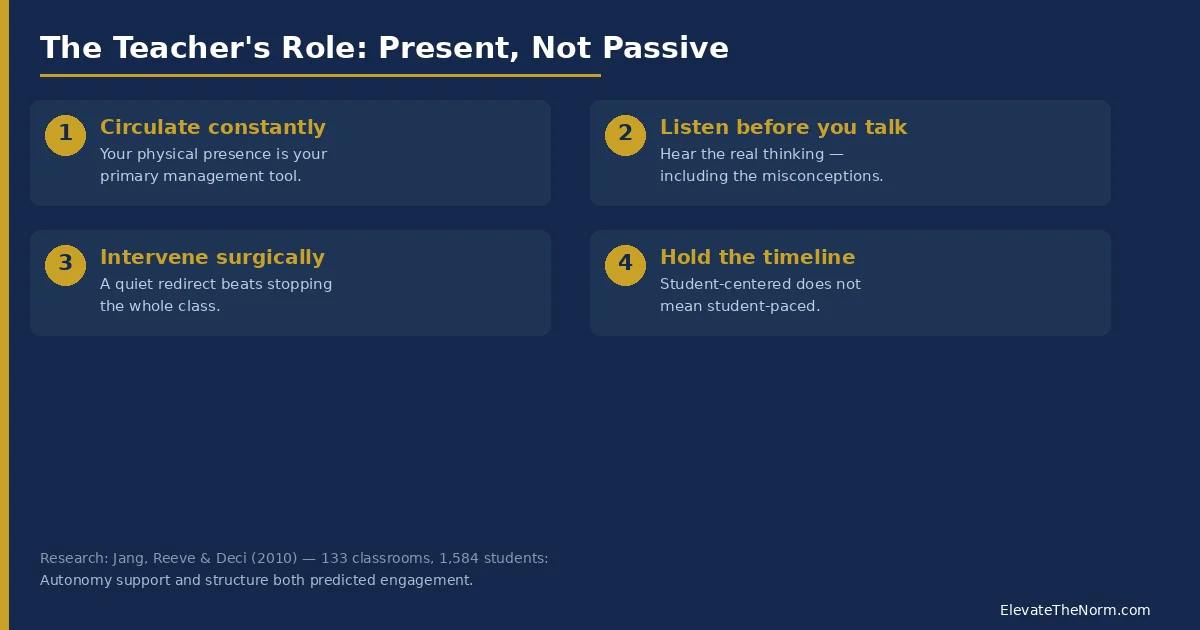
    The Teacher’s Role: Present, Not Passive

    Four teacher roles in student centered learning: circulate constantly, listen before talking, intervene surgically, hold the timeline — based on Jang, Reeve, and Deci research
    The teacher’s role in student-centered learning: present, active, and strategic.

    Every activity above requires a teacher who is actively working the room — not sitting at a desk, not grading papers, and certainly not treating “student centered” as a synonym for “teacher absent.” The research is clear on this. Jang, Reeve, and Deci (2010) studied 133 high school classrooms with 1,584 students and found that autonomy support and structure were positively correlated — teachers who gave students meaningful choices also provided clear expectations and active guidance. Both predicted behavioral engagement, and autonomy support uniquely predicted students’ self-reported engagement.

    That finding should end the false dichotomy between “teacher-directed” and “student-centered.” The best version of student-centered instruction is teacher-led in terms of structure and student-led in terms of thinking. The teacher builds the frame. The students fill it.

    In practical terms, this means:

    • Circulate constantly. Every activity in this article assumes the teacher is moving. If you are standing in one spot, you are missing what is happening across the room.
    • Listen before you talk. When you approach a group, listen for thirty seconds before saying anything. You will hear the real thinking — including the misconceptions you need to address.
    • Intervene surgically. A quiet redirect to one group is more effective than stopping the whole class. Save the full-class interruption for patterns, not individual mistakes.
    • Hold the timeline. Student-centered does not mean student-paced. Post the schedule. Keep it visible. Name the time remaining. Students work better inside a boundary they can see.

    How to Prevent Freedom From Becoming Confusion

    The number one reason teachers abandon student-centered activities is not that the activities failed — it is that the room fell apart during the transition. Students did not know what to do, took too long to start, or interpreted “work with your group” as “talk to your friends about the weekend.”

    Here is the fix, and it is not complicated:

    1. Explain the activity in under two minutes. If your instructions take longer than that, the activity is too complicated or your explanation is too detailed. Students learn the activity by doing it, not by listening to you describe every contingency.
    2. Post the task, the time, and the product. Every student should be able to look at the board and answer three questions without asking you: What am I doing? How long do I have? What do I turn in?
    3. Start with a model. The first time you run a Socratic seminar, model it with a small group while the rest of the class watches. The first time you use peer critique, walk through one example piece of feedback as a class. This takes ten minutes and saves you from answering the same question thirty times.
    4. Build in a two-minute check. Two minutes after students begin, stop and ask: “Raise your hand if you are not sure what you should be doing right now.” Fix the confusion immediately. Do not wait until the end of the period to discover that half the room was lost from the start.
    5. Debrief every time. Spend the last three minutes of the activity debriefing what worked and what did not. This is where student motivation builds — when they see that the activity had a point, that their effort produced something, and that the teacher noticed.

    Starting Small: A Realistic Entry Point

    Do not try to run all of these activities next Monday. Pick one. Run it once. See what happens. Adjust. Run it again.

    If you have never done anything student-centered beyond group work, start with a choice board. It requires the least classroom management adjustment, gives you a visible product to assess, and lets students practice making decisions within a structure you control. Once that feels routine — two or three times, usually — add a Socratic seminar or a gallery walk. Build the repertoire over weeks, not days.

    The Baeten et al. (2023) meta-analysis found that student-centered interventions lasting longer than six months produced effect sizes nearly double those of shorter interventions (SMD = 1.08 vs. 0.63–0.72). Translation: this is a long game. The activities get more effective the more students experience them, which means the worst thing you can do is try everything once, decide it did not work, and go back to lecture. It did not fail. It had not started yet.

    Teach the way you want students to learn: start with what is manageable, build from experience, and treat the mistakes as data, not as evidence that you should quit. For a ready-to-use tool on this, see a printable student-led conference toolkit.

    Student-centered activities work best when students also have a real say in how the work is structured. For a framework on how much say students can hold at each level — and where teacher authority must stay — see student voice and choice.


    Frequently Asked Questions

    Do student-centered activities work in large classes?

    Yes, but the structure matters more. Inquiry stations, choice boards, and peer critique protocols all scale to thirty-plus students because they operate in small groups. Socratic seminars work best with fifteen or fewer in the inner circle — use the fishbowl format for larger classes. The key is that every student has a specific task, not that every student is doing the same thing at the same time.

    How do I assess student-centered activities?

    Use the products the activities produce. Inquiry stations generate claim statements. Choice boards produce varied demonstrations of the same standard. Peer critique generates written feedback. Socratic seminars pair with participation trackers and written reflections. Every activity in this article includes a built-in artifact you can grade, which means assessment does not require a separate test.

    What if students are not used to this kind of work?

    Expect the first attempt to be messy. Students who have spent years in teacher-directed classrooms need time to adjust to making decisions, and that adjustment sometimes looks like confusion or off-task behavior. The fix is not to abandon the approach — it is to start with the most structured option (choice boards), build routines over several weeks, and explicitly teach the behaviors each activity requires before running it.

    Can student-centered activities cover required standards?

    They must. Student-centered is not a license to skip the curriculum. Every activity in this article is designed around a learning target tied to standards. Choice boards offer multiple paths to the same standard. Inquiry stations present evidence aligned to specific content. Socratic seminars and structured academic controversies require engagement with course material. If the activity does not serve the standard, redesign the activity — do not lower the standard.

    Is student-centered learning the same as project based learning?

    No, but they overlap. Project based learning is one type of student-centered instruction — one that is sustained, inquiry-driven, and produces a public product. The activities in this article are shorter, can fit inside a single class period, and do not require a multi-week project structure. A teacher running PBL will use many of these activities within a project. A teacher who does not run PBL can still use all of them.

    How do I handle students who refuse to participate in group activities?

    First, find out why. A student who refuses to participate is telling you something — about the group, the task, the social dynamics, or their own confidence. Offer a structured alternative that meets the same objective individually, and check in privately. Do not force public participation as a compliance test. That said, opting out of collaboration entirely is not a long-term option in a classroom that values it, so build toward participation gradually with low-risk entry points like written peer feedback before verbal discussion.

    Do these activities work for students with IEPs or 504 plans?

    Student-centered activities are often more accessible than traditional instruction, not less. Choice boards allow students to demonstrate learning through their strongest mode. Inquiry stations can include differentiated source materials at different reading levels. Socratic seminars can be supported with sentence stems and pre-discussion preparation time. The built-in flexibility of student-centered work makes accommodation a design feature, not an add-on — but you still need to review each activity against the specific accommodations in each student’s plan.


    Sources

    1. Baeten, M., Dochy, F., Struyven, K., Parmentier, E., & Vanderbruggen, A. (2023). “Student-Centered Education: A Meta-Analysis of Its Effects on Non-Academic Achievements.” SAGE Open, 13(2). https://doi.org/10.1177/21582440231168792
    2. Patall, E. A., Cooper, H., & Robinson, J. C. (2008). “The Effects of Choice on Intrinsic Motivation and Related Outcomes: A Meta-Analysis of Research Findings.” Psychological Bulletin, 134(2), 270–300. https://doi.org/10.1037/0033-2909.134.2.270
    3. Jang, H., Reeve, J., & Deci, E. L. (2010). “Engaging Students in Learning Activities: It Is Not Autonomy Support or Structure but Autonomy Support and Structure.” Journal of Educational Psychology, 102(3), 588–600. https://doi.org/10.1037/a0019682
    4. Association for Supervision and Curriculum Development (ASCD). (2023). “Socratic Seminars: Engaging Students in Intellectual Discourse.” Educational Leadership. https://www.ascd.org/el/articles/socratic-seminars-engaging-students-in-intellectual-discourse
    5. PBLWorks. (2024). “Using Gallery Walks for Critique & Revision in PBL.” Buck Institute for Education. https://www.pblworks.org/blog/using-gallery-walks-critique-revision-pbl
    6. Berger, R., Rugen, L., & Woodfin, L. (2014). Leaders of Their Own Learning: Transforming Schools Through Student-Engaged Assessment. Jossey-Bass/EL Education.

    About Clay Shumate

    Clay Shumate is a certified secondary Social Studies teacher in the public schools of West Alabama, with seven years of classroom experience, a B.A. in History, and an M.Ed. in Secondary Education. He writes about project-based learning, student responsibility, respect, and practical ways to hold young people to a higher standard while giving them room to learn from mistakes. He is a member of the Society of Professional Journalists and writes to its Code of Ethics; this site’s editorial standards and corrections policy are published in full. More about Clay.
  • Student Autonomy: How to Give Students Freedom Without Losing the Room

    Student Autonomy: How to Give Students Freedom Without Losing the Room

    By Clay Shumate

    Student autonomy is a student’s genuine ability to make meaningful decisions about their own learning — what to study, how to demonstrate understanding, when to ask for help, and how to manage their own time — within boundaries an adult has thoughtfully set. It is not freedom without structure. It is freedom because of structure. This guide explains how teachers in grades 6–12 can offer autonomy that increases engagement and responsibility without creating chaos.

    Key Takeaways

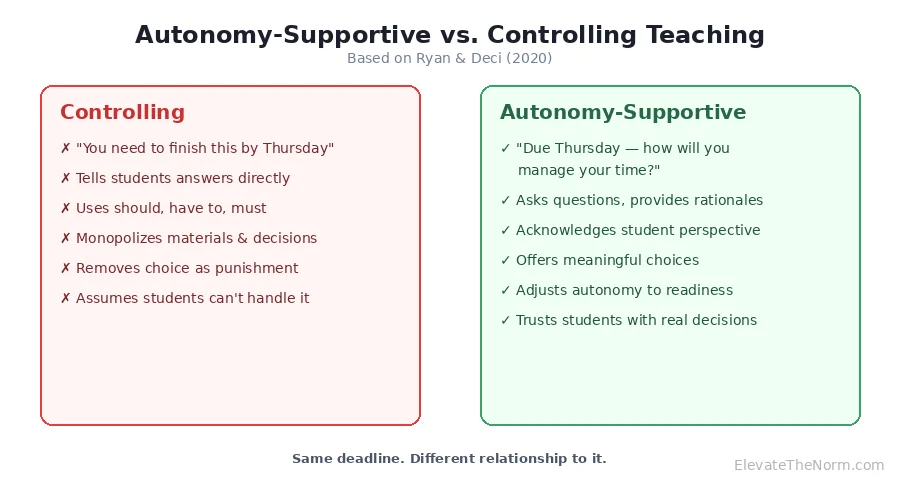
    • Autonomy does not mean students do whatever they want. It means they make real decisions within boundaries the teacher has planned.
    • Self-determination theory identifies autonomy, competence, and relatedness as three basic needs that drive genuine motivation in classrooms.
    • Structure and autonomy are not opposites. The research shows they work best together.
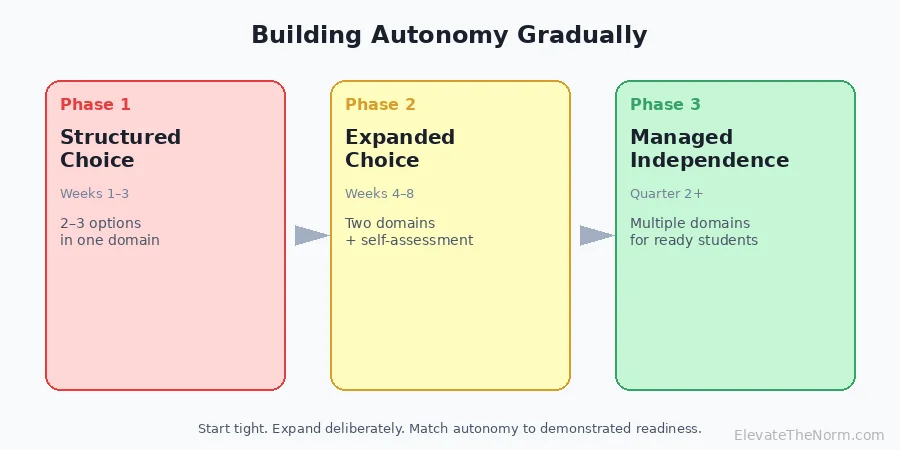
    • Autonomy should increase gradually as students demonstrate they can handle it. Start tight, expand deliberately.
    • The biggest risk of student autonomy is not chaos — it is giving choices students are not prepared to make.

    What Student Autonomy Actually Means

    Student autonomy sounds like a simple concept until you try to implement it in a room of twenty-eight teenagers. The word “autonomy” gets used to mean everything from letting students pick their own seats to running an entirely student-directed classroom, and the gap between those two things is enormous. Practical activities that hand students real decisions bridge that gap with structure.

    In research, student autonomy has a specific meaning. Deci and Ryan’s self-determination theory (1985, updated by Ryan & Deci, 2020) defines autonomy as the experience of volition and willingness — acting from one’s own values and interests rather than from external pressure. In a classroom, this means a student who writes an essay because they find the question genuinely interesting is acting autonomously. A student who writes the same essay only because it is graded is not.

    That definition matters because it separates autonomy from permissiveness. A student can experience autonomy within a highly structured environment — as long as the structure makes sense to them, they understand why the expectations exist, and they have some genuine say in how they operate within it.

    Why Student Autonomy Matters for Grades 6–12

    Adolescents are developmentally primed for autonomy. Their brains are building the capacity for independent decision-making, abstract reasoning, and identity formation. When schools respond to this developmental reality by tightening control — more rules, fewer choices, stricter consequences — they create a mismatch between what students need and what the environment provides.

    The research on this point is consistent. A meta-analysis by Vasconcellos et al. (2020) across 144 studies found that autonomy-supportive teaching was associated with higher autonomous motivation, greater engagement, and better academic outcomes across age groups, with effects that held across cultures and subject areas. Jang, Reeve, and Deci (2010) studied 133 high-school classrooms and found that autonomy support and structure were positively correlated — teachers who offered more autonomy also tended to provide more structure — and both predicted students’ observed behavioral engagement. That finding is the usable part of the answer to the student who appears not to care.

    The point is worth emphasizing because it contradicts the most common objection to student autonomy: the fear that giving students choices means giving up control. The evidence suggests the opposite. Autonomy and structure rise and fall together, not inversely.

    The Difference Between Autonomy and Chaos

    This is the section most autonomy guides skip, and it is the section teachers most need.

    Autonomy without preparation is not autonomy. It is abandonment. Handing a student a choice they are not equipped to make — pick any topic, design any project, manage your own time with no checkpoints — does not develop independence. It develops anxiety in the students who care and apathy in the students who have learned that unstructured time means nothing matters.

    Here is what that looks like in practice. A teacher announces that students can research any topic related to the unit. No constraints on scope, no required sources, no checkpoint before the final product. Some students thrive. Most flounder. Several pick topics that cannot be meaningfully researched at a secondary level. A few do nothing at all. The teacher then blames the students for “not being ready for autonomy,” when the truth is the task was not ready for the students.

    The fix is not less autonomy. It is better structure around the autonomy. Define the boundaries. Provide the scaffolding. Check in at defined points. And then let the student make real decisions within that frame.

    Seven Domains of Student Autonomy

    Student autonomy is not a single switch you flip. It is a set of decisions across different parts of the learning experience, and the teacher can offer autonomy in one domain while maintaining control in another. Here are seven domains where autonomy is practical in a secondary classroom.

    Seven numbered domains of student autonomy including pacing topic selection product choice methods help-seeking self-assessment and reflection
    Autonomy is not a single switch. It is a set of decisions across seven domains.

    Pacing

    Let students manage their own time within a defined window. Instead of “everyone moves to step two at 10:15,” try “you have until 10:40 to complete steps one through three — manage your time across those three steps however you need to.” Some students will spend more time on step one. Others will move quickly and spend more time on step three. Both are fine as long as the deadline holds.

    The structure is the deadline. The autonomy is the path to it.

    Topic Selection

    Within a unit, let students choose which specific question they want to investigate. In a unit on the causes of the Civil War, a student might choose to focus on the economics of slavery, the political compromises that failed, or the role of abolitionist media. The unit stays the same. The angle is the student’s.

    The structure is the unit scope and the required evidence. The autonomy is the angle.

    Product Choice

    Students demonstrate understanding through a written argument, a presentation, a recorded analysis, a visual timeline with annotations, or a structured debate. The learning target is fixed. The product is negotiable.

    This domain has a common trap: offering product choices that are not equivalent in rigor. A poster board is not equivalent to a written analysis. If you offer it as an option, the expectation for depth, evidence, and clarity must be just as high.

    Methods and Resources

    Let students decide how they gather information. Some students prefer reading a primary source. Others learn better from a documentary or an interview. The content standards do not require a specific resource type — they require understanding. Let students find the path that gets them there.

    Help-Seeking

    Autonomy in help-seeking means students decide when they need help, what kind of help they need, and who to ask. This sounds minor, but it is one of the most important autonomy skills a student can develop. A student who can accurately assess their own confusion and seek targeted help is a student who will succeed beyond your classroom.

    Build this by making help available without making it mandatory or punitive. In my room, students can come to the whiteboard table for focused small-group instruction whenever they need it. It is not assigned. It is not remediation. It is the best seat in the room — a corner with a lamp, a rug, better chairs, and a surface where we can draw out ideas together. Students ask to work there, which is exactly the point. When the help feels like an opportunity rather than a correction, students seek it out on their own.

    Self-Assessment

    Before turning in work, students evaluate their own product against the rubric and identify one area of strength and one area that could improve. This is not a substitute for teacher assessment — it is preparation for it. A student who can assess their own work accurately is a student who does not need the teacher to be the only source of quality information.

    Reflection

    Let students choose what they reflect on. Not “answer these three reflection questions” but “write about one thing from today’s work that changed how you think about the topic, and explain what changed.” The reflection is required. The content of the reflection is the student’s.

    How to Build Student Autonomy Gradually

    The most effective approach to student autonomy is progressive. You do not open the semester with full choice in every domain. You start tight and expand deliberately as students demonstrate they can handle it.

    Three-phase framework for building student autonomy from structured choice to expanded choice to managed independence
    Start tight. Expand deliberately. Match autonomy to demonstrated readiness.

    Phase 1: Structured Choice (First Three Weeks)

    Offer two or three options in one domain — typically product or pacing. Keep everything else structured. This teaches students how choice works in your room and establishes that autonomy comes with accountability.

    Phase 2: Expanded Choice (Weeks Four Through Eight)

    Add a second domain. Let students choose both their topic angle and their product. Introduce self-assessment alongside teacher assessment — how students learn to judge their own work is the skill you are actually building here. The check-in structure stays tight — you are circulating, conferencing, and holding students to the timeline.

    Phase 3: Managed Independence (Second Quarter and Beyond)

    Students who have demonstrated responsibility in Phases 1 and 2 can manage multiple domains simultaneously. They propose a topic, choose a method, manage their pacing, and assess their own work before conferencing with you. Students who have not demonstrated that readiness stay in Phase 2 — not as punishment, but because they need more practice with fewer decisions at once.

    This progression is the critical piece most autonomy guides miss. A room where every student has the same level of autonomy regardless of demonstrated readiness is a room that has confused equality with equity. Meeting students where they are means some students have more freedom because they have earned it through consistent, responsible work.

    What Autonomy Support Looks Like in the Classroom

    Ryan and Deci (2020) describe autonomy-supportive teaching through specific, observable behaviors. Autonomy-supportive teachers listen to students, make time for independent work, give students opportunities to speak, acknowledge improvement and mastery, and provide rationales when requiring specific tasks.

    Controlling teachers, by contrast, monopolize learning materials, tell students answers directly, issue directives, and rely on controlling language like “should” and “have to.”

    Comparison of controlling teaching behaviors and autonomy-supportive teaching behaviors based on Ryan and Deci 2020
    Same deadline. Different relationship to it. Based on Ryan and Deci (2020).

    The practical difference is often in language. “You need to finish this by Thursday” is controlling. “This is due Thursday — how are you planning to manage your time?” is autonomy-supportive. The deadline is identical. The relationship to the deadline is different.

    Bloem et al. (2024) found that teachers reported giving students from lower socioeconomic backgrounds less autonomy support and more controlling instruction — and teachers with more biased attitudes toward low-SES students differentiated the most. That finding matters for every school in which I have worked. The students who most need the experience of genuine decision-making are often the students least likely to get it, not because they cannot handle it, but because adults assume they cannot.

    When Student Autonomy Does Not Work

    Autonomy does not work when it is a substitute for planning. A teacher who hands students unstructured time and calls it “student-directed learning” has not given students autonomy. They have given themselves a break.

    Autonomy does not work when the choices are not meaningful. Letting students pick between blue paper and green paper is not autonomy. Letting students choose which essay prompt to respond to when both prompts require the same depth of thinking — that is autonomy.

    Autonomy does not work without a relationship. A student will not take intellectual risks for a teacher they do not trust. Autonomy support and relatedness — the third pillar of self-determination theory — work together. Building the relationship comes first.

    And autonomy does not work when consequences are absent. A student who chooses poorly and faces no consequence has not experienced autonomy. They have experienced permissiveness. Real autonomy includes real accountability — not manufactured stakes, but honest follow-through. If a student chose not to manage their time well, the conversation is not punitive. It is honest: this is what happened, this is what you chose, and this is what you owe now.

    The Repair Conversation — Student Autonomy After a Mistake

    One of the most important moments in building student autonomy is what happens after a student makes a poor choice. The standard school response is a consequence — a zero, a detention, a phone call home. Those responses are sometimes necessary, but they do not teach autonomy. They teach compliance under threat.

    A repair conversation teaches autonomy because it puts the student in the position of identifying what went wrong, who was affected, and what they owe. It is not a lecture. It is a set of questions: What happened? Who was affected by that? What do you think you owe them? When will you do it?

    The student does the thinking. The teacher holds the boundary. That is student autonomy at its most practical — a student making real decisions about how to respond to their own mistake, within a structure where the adult is present and the expectation is clear.

    This is also where the line between autonomy and permissiveness becomes sharpest. Permissiveness lets the mistake pass. Control punishes it without discussion. Autonomy support says: you made a choice, you are capable of evaluating that choice, and here is what accountability looks like. For a ready-to-use tool on this, see a printable seating chart planning pack.

    That same question — how much control students should hold — extends beyond the repair conversation into everyday classroom decisions. For a close look at how that line is drawn across five levels of agency, see student voice and choice in practice.

    Frequently Asked Questions

    What is the difference between student autonomy and letting students do whatever they want?

    Student autonomy means students make genuine decisions within boundaries a teacher has thoughtfully planned. Letting students do whatever they want is not autonomy — it is the absence of teaching. The boundary is what makes the choice meaningful. Without it, students are not exercising autonomy. They are just unsupervised.

    How do I give autonomy to students who are not ready for it?

    Start with structured choice in one domain — two or three options rather than open-ended freedom. Students who are not yet ready for full autonomy are not incapable of making decisions. They need smaller decisions with more support. Expand the choices as they demonstrate readiness. This is a graduated process, not a binary switch.

    Does student autonomy work in tested subjects?

    Yes. The learning targets in a tested subject are fixed. Autonomy applies to how students reach those targets — which resources they use, how they pace their work, what product they create to demonstrate understanding, and how they assess their own readiness. Standards constrain the destination. Autonomy applies to the journey.

    What about students who choose not to work when given freedom?

    A student who stops working when given choice is telling you something about their relationship to the work, the environment, or both. The answer is not to remove the choice for everyone. It is to have a private conversation with that student about what happened, then adjust the level of autonomy for that individual while maintaining it for students who are using it well.

    How does student autonomy affect classroom management?

    Research consistently shows that autonomy support improves classroom behavior, not the reverse. Jang, Reeve, and Deci (2010) found that autonomy support and structure both predicted observed behavioral engagement in 133 high-school classrooms. When students feel their choices matter and the environment is predictable, disruptive behavior decreases — not because it is punished more effectively, but because the underlying need driving it is addressed.

    Can I offer student autonomy in a highly structured school environment?

    Yes. Student autonomy lives inside your classroom, within your lesson plans. Even in schools with rigid bell schedules, required curricula, and standardized assessments, you can offer meaningful choice in how students engage with content, how they demonstrate understanding, and how they manage their time within your class period. Autonomy does not require administrative permission. It requires teacher planning.

    Sources

    1. Ryan, R. M., & Deci, E. L. (2020). “Intrinsic and Extrinsic Motivation from a Self-Determination Theory Perspective.” Contemporary Educational Psychology, 61, 101860.
    2. Jang, H., Reeve, J., & Deci, E. L. (2010). “Engaging Students in Learning Activities: It Is Not Autonomy Support or Structure but Autonomy Support and Structure.” Journal of Educational Psychology, 102(3), 588–600.
    3. Vasconcellos, D., et al. (2020). “Self-Determination Theory Applied to Physical Education: A Systematic Review and Meta-Analysis.” Journal of Educational Psychology, 112(7), 1444–1469.
    4. Niemiec, C. P., & Ryan, R. M. (2009). “Autonomy, Competence, and Relatedness in the Classroom.” Theory and Research in Education, 7(2), 133–144.
    5. Bloem, N., et al. (2024). “Teachers’ Autonomy Support and Control Towards Students from Different Socioeconomic Backgrounds.” Social Psychology of Education, 27, 1247–1270.
    6. Reeve, J. (2012). “A Self-Determination Theory Perspective on Student Engagement.” In S. L. Christenson, A. L. Reschly, & C. Wylie (Eds.), Handbook of Research on Student Engagement (pp. 149–172). Springer.

    About Clay Shumate

    Clay Shumate is a certified secondary Social Studies teacher in the public schools of West Alabama, with seven years of classroom experience, a B.A. in History, and an M.Ed. in Secondary Education. He writes about project-based learning, student responsibility, respect, and practical ways to hold young people to a higher standard while giving them room to learn from mistakes. He is a member of the Society of Professional Journalists and writes to its Code of Ethics; this site’s editorial standards and corrections policy are published in full. More about Clay.
  • Student Engagement Strategies PDF: A Practical Guide for Grades 6–12

    Student Engagement Strategies PDF: A Practical Guide for Grades 6–12

    By Clay Shumate

    Student engagement strategies are practical teaching moves that shift students from passive compliance to genuine thinking during every phase of a lesson — opening, discussion, reading, group work, project-based learning, checking for understanding, and reflection. This guide organizes those strategies by when you actually use them, explains which ones build real intellectual engagement versus surface-level cooperation, and gives you something you can print, keep in a planning binder, and refer to on an ordinary school day.

    Key Takeaways

    • Engagement has three dimensions — behavioral, cognitive, and emotional — and a strategy that targets only one often misses the point.
    • The most effective engagement strategies are low-tech, teacher-led, and built into the lesson plan rather than bolted on as activities.
    • Compliance looks like engagement from across the room. Knowing the difference changes how you plan.
    • Strategies organized by lesson phase — not alphabetically, not by buzzword — are strategies teachers actually use.
    • Student engagement is not something you buy. It is something you build through planning, consistency, and presence.

    What Student Engagement Actually Means

    Researchers Fredricks, Blumenfeld, and Paris (2004) identified three dimensions of student engagement that still hold up: behavioral engagement (participation, attendance, following procedures), cognitive engagement (mental investment — thinking hard about the material, using strategies, persisting through difficulty), and emotional engagement (feelings of belonging, curiosity, and connection to the work).

    Most engagement strategies target behavioral engagement. A student raises a hand. A student writes something on a whiteboard. A student turns to a partner on cue. These are visible, countable, and reassuring for the teacher — but they do not necessarily mean the student is thinking.

    Diagram showing behavioral cognitive and emotional dimensions of student engagement based on Fredricks Blumenfeld and Paris 2004
    Behavioral, cognitive, and emotional engagement based on Fredricks, Blumenfeld, and Paris (2004).

    Genuine engagement is cognitive and emotional. The student is not just doing the task. The student is wrestling with the content, connecting it to something they already know, and caring enough about the outcome to push through when the work gets hard.

    That distinction matters because a room full of compliant students can look engaged from the doorway while learning almost nothing. This guide prioritizes strategies that build real thinking, not just visible participation.

    Compliance Versus Genuine Engagement — Know What You Are Building

    Before organizing strategies by lesson phase, it helps to be honest about a tension most engagement guides skip entirely.

    Some strategies produce compliance. Students do the thing you asked them to do. They fill in the graphic organizer. They complete the sentence starter. They stand up and find a partner. The room is active, the noise level is appropriate, and an observer would mark the lesson as engaging.

    Other strategies produce genuine intellectual engagement. Students make a decision about the content. They defend a claim. They notice something they did not expect. They change their mind.

    Side-by-side comparison of student compliance behaviors versus genuine engagement behaviors
    Compliance looks like engagement from the doorway. Genuine engagement survives the teacher turning away.

    Both have a place. Compliance strategies keep the room running. They are especially useful during transitions, during the first weeks of school, and with material that simply needs to be practiced. But a lesson built entirely on compliance strategies produces students who are very good at following directions and very practiced at not thinking too hard.

    The strategies in this guide are labeled honestly. If a strategy primarily produces compliance, it says so. If it produces genuine thinking, it says why.

    Lesson Opening Strategies (First Five to Ten Minutes)

    The opening is where you win or lose the lesson. A strong opening creates a reason to think. A weak one creates a reason to wait.

    That opening tension is sharpest right after a break in the calendar. If you are planning the Tuesday after a three-day weekend, a game-and-webquest opening built specifically for that day holds attention better than starting cold with notes.

    Bell Ringer with a Decision

    Not a vocabulary review or a worksheet. A question that requires the student to take a position before the lesson begins. “Was the Treaty of Versailles more likely to prevent another war or cause one?” forces a choice. The content instruction that follows has a purpose — the student needs information to evaluate their own answer. There is a whole bank of openings built on that principle if you want twenty of them rather than one.

    What it builds: Cognitive engagement. The student entered the room with an opinion and now has a reason to pay attention.

    The Posted Plan

    Write the entire lesson plan on the board, including times. “10:00–10:12: Source analysis. 10:12–10:25: Partner comparison. 10:25–10:40: Whole-group debrief. 10:40–10:50: Written reflection.” Students know exactly what is coming, how long it will take, and what they will be asked to do. This is not an engagement trick. It is a transparency practice that removes uncertainty, which is one of the biggest barriers to emotional engagement in a secondary classroom.

    I post times on the board every day. If I run behind, I say so out loud and explain why. The students hold me to it, which is exactly the point — the plan is a contract, not a suggestion.

    What it builds: Emotional engagement (predictability and trust) and behavioral engagement (students transition faster when they can see the next segment).

    Low-tech: Whiteboard or chalkboard. No technology required.

    The Pause Before Anything Starts

    There is a version of classroom management advice that says you should start teaching immediately to “capture attention.” I have found the opposite. When the room is not ready, you wait. You do not talk over the noise. You do not begin your opening while three students are still walking to their seats. You stand still, make eye contact, and wait.

    I once held that pause for more than five minutes. It was one of the most awkward moments of my life. That section finished nine minutes behind my other sections, and it is the only time I have ever assigned homework — because they were nine minutes behind and I owed every class the same content. But after that day, the room settled in under thirty seconds for the rest of the year.

    That pause builds engagement because it establishes that what is about to happen matters enough to wait for. If you talk over the noise, you teach students that the noise is acceptable and that your instruction is background.

    What it builds: Behavioral and emotional engagement. Students learn that the room runs on mutual respect, not volume.

    Low-tech: Silence. The cheapest strategy on this list.

    Discussion Strategies

    Discussion is the most commonly faked engagement activity in secondary classrooms. A teacher asks a question. The same four students answer. The other twenty-six sit quietly and wait. The lesson plan says “class discussion,” and the observation form marks participation, but most of the room was not engaged. One structure built to fix this is the Socratic seminar, scored with a Socratic seminar grading rubric.

    Think-Pair-Share That Actually Works

    Think-Pair-Share fails when “think” means stare at the desk for ten seconds, “pair” means turn to the nearest person and confirm you have the same answer, and “share” means one pair tells the class while everyone else checks out.

    Make it work: give a genuine thinking question (not a recall question), give real think time (sixty seconds minimum, timed and silent), require a written response before pairing, and during the share phase, call on pairs who disagreed with each other. The disagreement is where the thinking lives.

    What it builds: Cognitive engagement when the question demands a position rather than a fact.

    Structured Academic Controversy

    Give two partners the same topic with opposing evidence sets. Each side presents, then they switch — arguing the other side’s position using that side’s evidence. Then they drop the roles and write a joint statement.

    This strategy is harder to set up than a worksheet, but it produces something most discussion strategies do not: students thinking carefully about evidence they personally disagree with.

    What it builds: Cognitive and emotional engagement. The role-switch is the key move — it forces genuine consideration of a position the student did not choose.

    Socratic Seminar with Preparation

    The most common failure of Socratic seminars in secondary classrooms is running one without preparation. Students arrive, sit in a circle, and produce surface-level comments because they have nothing prepared.

    Fix this by requiring a preparation sheet the day before: two claims from the text with page numbers, one question the student genuinely wants answered, and one connection to previous material. The seminar becomes a conversation between students who have something to say. If students struggle to produce that one question, hand them a frame and a bank: there are forty subject-general seminar questions and a way to teach students to write their own.

    What it builds: Cognitive engagement, but only with the preparation step. Without it, you get compliance — students sitting in a circle saying things that sound intellectual but cost nothing.

    Reading Strategies

    Reading engagement in secondary classrooms has one core problem: students do not read. They skim, they copy the person next to them, or they wait for the teacher to summarize. These strategies address that problem directly.

    Annotation with a Purpose

    Do not say “annotate the text.” Say “mark every place the author makes a claim without giving evidence.” Or: “Circle every word you do not know and write what you think it means from context.” Specific annotation tasks produce specific thinking. Which specific task matters: the marks with evidence behind them all require the student to generate a sentence rather than mark a location. Open-ended annotation produces highlighting.

    What it builds: Cognitive engagement. The student is reading with a filter, which means they are reading with their brain on.

    Chunked Reading with Partner Checks

    Break a long text into three or four sections. After each section, partners summarize what they read — not what they highlighted, not a vocabulary word, but the central claim or event of that chunk, stated in their own words. If they cannot do it, they reread.

    This is tedious for the teacher to set up, but it catches disengagement at the paragraph level instead of at the end of the reading when it is too late to matter.

    What it builds: Cognitive engagement and a genuine check on whether reading happened.

    Low-tech: Paper text, pencil, and a partner.

    Group Work Strategies

    Group work is either the highest-engagement activity in a lesson or the lowest. The difference is structure.

    Chart showing student engagement strategies organized by seven lesson phases from opening to reflection
    Strategies organized by when you actually use them, not by buzzword.

    Defined Roles with Individual Accountability

    Give each group member a specific role that produces a specific, visible product. The recorder writes. The questioner generates two questions from the group’s work. The presenter prepares the group’s statement. The checker verifies every claim against the source material.

    Defined roles work only when each role has an individual deliverable. If the recorder’s notes are the only product, three of four students have no reason to engage.

    What it builds: Behavioral engagement (structure) and cognitive engagement (individual accountability). The individual deliverable is what separates this from compliance.

    Gallery Walk with Feedback

    Groups post their work. Other groups circulate and leave written feedback — not stickers, not checkmarks, but a specific comment: one thing the work does well and one question it does not answer.

    The feedback must be written and signed. Anonymous feedback in secondary classrooms is either useless or cruel. Signed feedback forces the reviewer to be thoughtful because their name is on it.

    What it builds: Cognitive engagement for both the creators and the reviewers, but only when the feedback is specific and signed.

    Low-tech: Chart paper, markers, and sticky notes.

    The Whiteboard Table

    In my room, I pull small groups to a whiteboard table — a table I built with a dry-erase surface, set in a corner with a lamp, a rug, and better chairs. Students ask to go there. It is not the remediation table. It is the best seat in the room, and the work that happens there is focused because the environment signals that what we are about to do matters.

    A whiteboard table is not expensive to build or buy, and the return is significant: students who would never raise a hand in whole-group discussion will talk freely in a small group at a table that feels different from the rest of the room.

    What it builds: Cognitive and emotional engagement. The physical environment removes the public performance anxiety that kills participation for many secondary students.

    PBL (Project-Based Learning) Strategies

    Project-based learning creates engagement through authentic work, real audiences, and meaningful products. But engagement in PBL is not automatic — a poorly structured project produces busy work with better aesthetics.

    Driving Questions That Students Cannot Google

    “What caused World War I?” is a textbook question. “Should the United States have entered World War I, and what would have changed if it hadn’t?” is a driving question. The difference is that the second question requires the student to build an argument using evidence, not retrieve a list.

    If a student can answer the driving question by copying a paragraph from a website, the question is not driving anything.

    What it builds: Cognitive engagement. The question structure makes thinking unavoidable.

    Structured Check-Ins with Deadlines

    The most common PBL failure is checking in at the end. Projects need structured check-ins at defined milestones — research complete, argument drafted, evidence collected, product in progress, and final product. At each check-in, the student explains what they have done, what decisions they made, and what they plan to do next.

    This is where the teacher earns the engagement. Circulating between groups, sitting down with a team, asking “walk me through your reasoning” — that is what makes a project intellectually demanding rather than aesthetically appealing.

    What it builds: Cognitive engagement and accountability. The check-in is the strategy.

    Checking for Understanding Strategies

    If your only check for understanding is asking “does everyone get it?” you are not checking. You are hoping.

    Exit Tickets with One Hard Question

    Not three questions covering the whole lesson. One question that gets at the hardest part of today’s content. If a student can answer it correctly, they understood the lesson. If they cannot, you know exactly what to reteach.

    The exit ticket is useful only if you read every one before the next class. Otherwise it is compliance — students fill out a piece of paper, you collect it, and nothing changes.

    Whiteboards for Visible Thinking

    Every student gets a small whiteboard. You ask a question. They write their answer and hold it up. You see every answer simultaneously and can respond to patterns, misconceptions, or blank boards in real time.

    This is one of the oldest student engagement strategies in teaching and it still works because it solves the core discussion problem: only a few students answer when you call on individuals. Whiteboards make every student’s thinking visible at the same time.

    Low-tech: A $2 whiteboard, a marker, and a sock for an eraser.

    Cold Calling with Support

    Cold calling — randomly selecting a student to answer — gets a bad reputation because it is often done punitively. “Marcus, you don’t look like you’re paying attention. What’s the answer?” That is not a strategy. That is public embarrassment.

    Cold calling works when every student has had time to prepare an answer (through writing or partner discussion first), when the expectation is established from day one, and when the teacher responds to wrong answers with follow-up questions rather than correction. “Interesting — what evidence led you there?” keeps the conversation going. “No, the answer is X” ends it.

    Student Reflection Strategies

    Reflection is where students turn experience into learning. Without it, even an excellent lesson stays an experience — something that happened today and fades by tomorrow.

    Two-Minute Written Reflection

    At the end of class, students write for two minutes answering one question: “What is one thing you understand better now than you did at the start of class, and what made that happen?” The second part — what made that happen — is where the metacognition lives. It forces students to identify the moment or strategy that helped them learn, which makes them more likely to use it again.

    The Connection Journal

    Students keep a running journal — one entry per class — connecting today’s content to something outside of school. Not “this reminded me of a movie” but “this connects to X because Y.” The discipline is the specificity. Over a semester, the journal becomes evidence that the student sees the content as part of a larger world rather than as isolated classroom information.

    Low-tech: A composition notebook. One per student, kept in the room.

    Peer Teaching Check

    After a lesson segment, one student explains the key concept to another student who was absent or who struggled. This is not tutoring — it is a check on the explainer’s understanding. If you can explain it clearly, you understand it. If you cannot, we know where to go back.

    What This Guide Does Not Include

    This guide does not include gamification apps, point systems, prize boxes, or reward charts. Those tools produce compliance. They teach students to perform for a reward rather than engage with content because it matters.

    This guide also does not include strategies that require expensive technology. Every strategy listed above works with paper, a whiteboard, and a classroom where the teacher has planned to the minute and cares enough to circulate.

    Ryan and Deci’s self-determination theory (2000, updated 2020) identifies three basic psychological needs that drive genuine motivation: autonomy (the need to feel ownership over one’s actions), competence (the need to feel capable), and relatedness (the need to feel connected to others). The strategies in this guide that produce real engagement — not just compliance — tend to address at least one of those needs. The ones that address all three tend to be the ones students remember.

    How to Use This Guide

    Print it. Keep it in your planning binder. When you are writing a lesson plan and you get to the discussion section, flip to discussion strategies and choose one. When you are planning a check for understanding, look at this section instead of defaulting to “ask if everyone gets it.”

    The strategies are organized by lesson phase because that is how teachers actually plan. You do not sit down and think “I need a cognitive engagement strategy.” You sit down and think “what am I doing for the first ten minutes?” This guide is built to answer that question. For a ready-to-use tool on this, see a printable student self-assessment pack. When a unit is ending and you want the review to be retrieval rather than re-reading, a review game with a job for every student is the version of this that teenagers volunteer for. For a ready-to-use tool on this, see a printable formative assessment quick-use pack.

    Frequently Asked Questions

    How do I know if students are genuinely engaged or just complying?

    Watch what happens when you stop directing. If students continue working, discussing, or thinking when you step back, they are engaged. If they stop the moment your attention shifts, they were complying. Fredricks, Blumenfeld, and Paris (2004) identified this as the difference between behavioral engagement (doing the task) and cognitive engagement (investing mentally in the task). Genuine engagement survives the teacher turning away.

    Do these student engagement strategies work without technology?

    Every strategy in this guide works with paper, pencils, whiteboards, and a room where students can talk to each other. Technology can enhance some of them, but none of them require it. The most effective engagement strategies are teacher-led and content-driven, not app-dependent.

    How many engagement strategies should I use in one lesson?

    Two to four, matched to the lesson phase. A strong opening strategy, a discussion or reading strategy in the middle, a check for understanding, and a reflection at the end is a full lesson. More than that becomes exhausting for students and unsustainable for the teacher.

    What about students who refuse to participate in engagement activities?

    A student who refuses to engage in a structured strategy is giving you information. They are telling you that something is wrong — with the task, the relationship, the environment, or something outside your classroom entirely. The answer is not a louder strategy. It is a quiet conversation, usually later, usually privately, about what is happening and what they need.

    Do student engagement strategies work for students with learning differences?

    The strategies in this guide are designed to be accessible by default. Written responses before discussion, structured roles in group work, chunked reading, and visible thinking on whiteboards all reduce the barriers that make participation difficult for students who process differently. Autonomy support — offering genuine choice in how students demonstrate understanding — has been shown to benefit all students, with particularly strong effects for students who struggle with traditional formats (Ryan and Deci, 2020).

    How do I get administration to support engagement-focused teaching?

    Document what you do and why. When an administrator walks in and sees students talking in groups, it helps to have a posted lesson plan with times, defined roles for each group member, and a visible product. The plan on the board is your best defense and your best evidence — it shows that the activity is structured, timed, and purposeful.

    What is the difference between engagement and entertainment?

    Entertainment holds attention without requiring thinking. Engagement holds attention because thinking is happening. A funny video is entertainment. A debate where students must use evidence from that video to defend a position is engagement. The content is the same; the cognitive demand is different.

    Sources

    1. Fredricks, J. A., Blumenfeld, P. C., & Paris, A. H. (2004). “School Engagement: Potential of the Concept, State of the Evidence.” Review of Educational Research, 74(1), 59–109.
    2. Ryan, R. M., & Deci, E. L. (2020). “Intrinsic and Extrinsic Motivation from a Self-Determination Theory Perspective.” Contemporary Educational Psychology, 61, 101860.
    3. Niemiec, C. P., & Ryan, R. M. (2009). “Autonomy, Competence, and Relatedness in the Classroom.” Theory and Research in Education, 7(2), 133–144.
    4. Reeve, J. (2012). “A Self-Determination Theory Perspective on Student Engagement.” In S. L. Christenson, A. L. Reschly, & C. Wylie (Eds.), Handbook of Research on Student Engagement (pp. 149–172). Springer.
    5. Hattie, J. (2023). Visible Learning: The Sequel. Routledge.
    6. Center for Innovation in Teaching & Learning, University of Illinois. “Three Dimensions of Student Engagement.”

    About Clay Shumate

    Clay Shumate is a certified secondary Social Studies teacher in the public schools of West Alabama, with seven years of classroom experience, a B.A. in History, and an M.Ed. in Secondary Education. He writes about project-based learning, student responsibility, respect, and practical ways to hold young people to a higher standard while giving them room to learn from mistakes. He is a member of the Society of Professional Journalists and writes to its Code of Ethics; this site’s editorial standards and corrections policy are published in full. More about Clay.
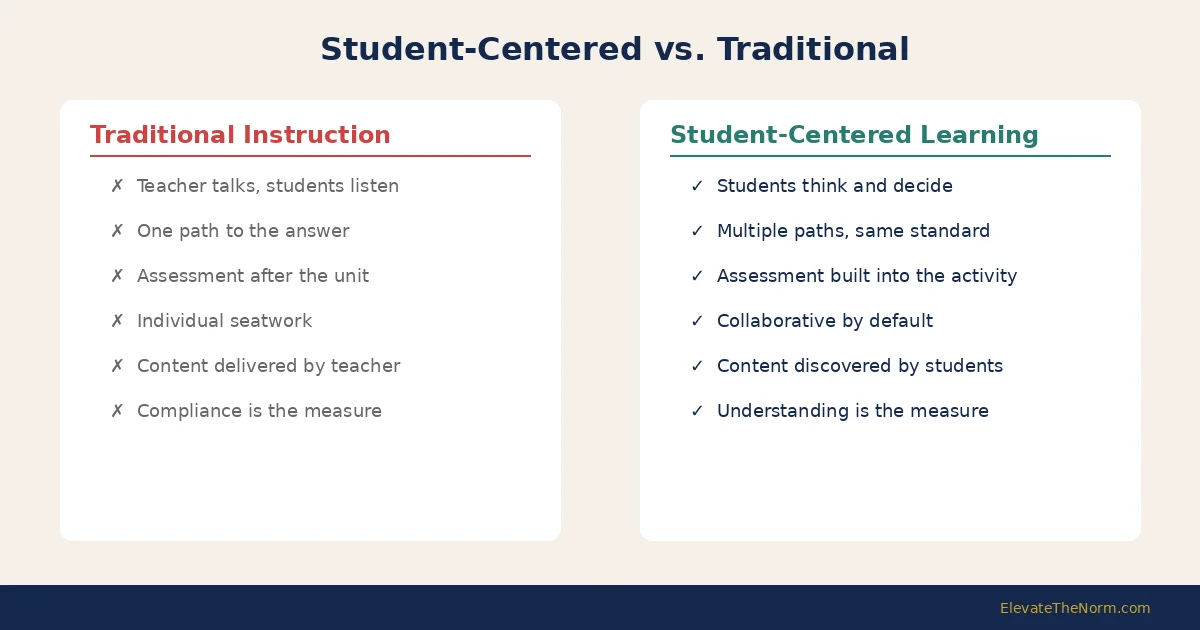
Teacher Emergency Toolkit — practical resources, real classroom support. Shop on TPT.Teacher Emergency Toolkit — practical resources, real classroom support. Shop on TPT.