The Elevate Blog banner: Real Classrooms. Practical Ideas. Higher Expectations. Three students climb a rocky ridge at sunrise, each pulling the next one up, toward a teacher reaching down to help.

Category: Classroom Management

Behavior, routines, and what actually holds a room together without raising your voice.

  • Top-Rated Classroom Culture Frameworks for Middle School, Ranked

    Top-Rated Classroom Culture Frameworks for Middle School, Ranked

    By Clay Shumate

    The top-rated classroom culture frameworks for middle school, ranked on grades 6–8 evidence and fit, are CHAMPS, PBIS, Responsive Classroom’s middle school practices, Developmental Designs, Teach Like a Champion and restorative practices. CHAMPS is the only one with a middle school randomized trial. Most middle schools do best pairing one schoolwide system with one classroom routine.

    Key Takeaways

    • CHAMPS ranks first for grades 6–8 because it’s the only framework here tested in a middle school randomized trial: 102 teachers and 1,450 students in nine Missouri middle schools.
    • PBIS is the schoolwide system the other frameworks plug into, but its biggest randomized trial ran in elementary schools.
    • Responsive Classroom and Developmental Designs both offer advisory routines built for middle level, and neither has a middle school randomized trial.
    • Restorative practices had mixed middle school results in RAND’s Pittsburgh study: in grades 6–8, suspensions didn’t change and academic results got worse.
    • Three short routines with middle school trials, the CW-FIT praise routine, Establish-Maintain-Restore and positive greetings at the door, fit inside any of these frameworks.

    “Top-rated” here doesn’t mean popular or best-reviewed. It means ranked on evidence and on fit for how middle school actually runs. For every framework across all grades, see the classroom culture frameworks Q&A hub.

    How were these middle school frameworks ranked?

    Each middle school framework on this list was scored on four questions, with evidence from grades 6–8 weighted most.

    1. Middle school evidence: Has it been tested in grades 6–8, and how strong was the study?
    2. Built for middle level: Does it plan for students who change rooms every period and teachers who see 100+ students a day, or was it written for one self-contained elementary class?
    3. Adolescent fit: Does it respect a 12- to 14-year-old’s need for peer connection, voice and dignity, or will it feel babyish?
    4. Can one teacher start it? Some need a whole-school decision. Others work in one room on Monday.

    A framework with strong elementary research but no middle school study ranks below one tested in grades 6–8. We left out anything we couldn’t verify.

    What are the top-rated classroom culture frameworks for middle school?

    The top-rated classroom culture frameworks for middle school are, in order, CHAMPS, PBIS, Responsive Classroom’s middle school practices, Developmental Designs, Teach Like a Champion and restorative practices, ranked on grades 6–8 evidence first.

    RankFrameworkLevelMiddle school evidenceBuilt for grades 6–8?
    1CHAMPS (Safe & Civil Schools)ClassroomRandomized trial, 102 teachers, grades 6–8Used across grades; tested in middle school
    2PBISSchoolwideStrongest trials are elementaryK–12 framework
    3Responsive Classroom (middle school)Classroom / advisoryTrial was grades 2–5Yes, separate secondary practices
    4Developmental Designs (Origins)Advisory / classroomNo trial foundYes, middle level
    5Teach Like a ChampionInstructionNo trial of the book foundNo, all grades
    6Restorative practicesSchoolwideRAND study: no suspension change, lower academics in grades 6–8No, K–12

    1. CHAMPS (Safe & Civil Schools)

    Best for: a middle school teacher who wants more time on task and calmer transitions. CHAMPS is Randy Sprick’s proactive, positive approach to classroom management, part of his Safe & Civil Schools materials (University of Kansas Center for Research on Learning). The acronym stands for Conversation, Help, Activity, Movement, Participation and Success: for each activity, students know whether they can talk, how to get help, what the task is, whether they can move, what participation looks like and how success is recognized (LiveSchool).
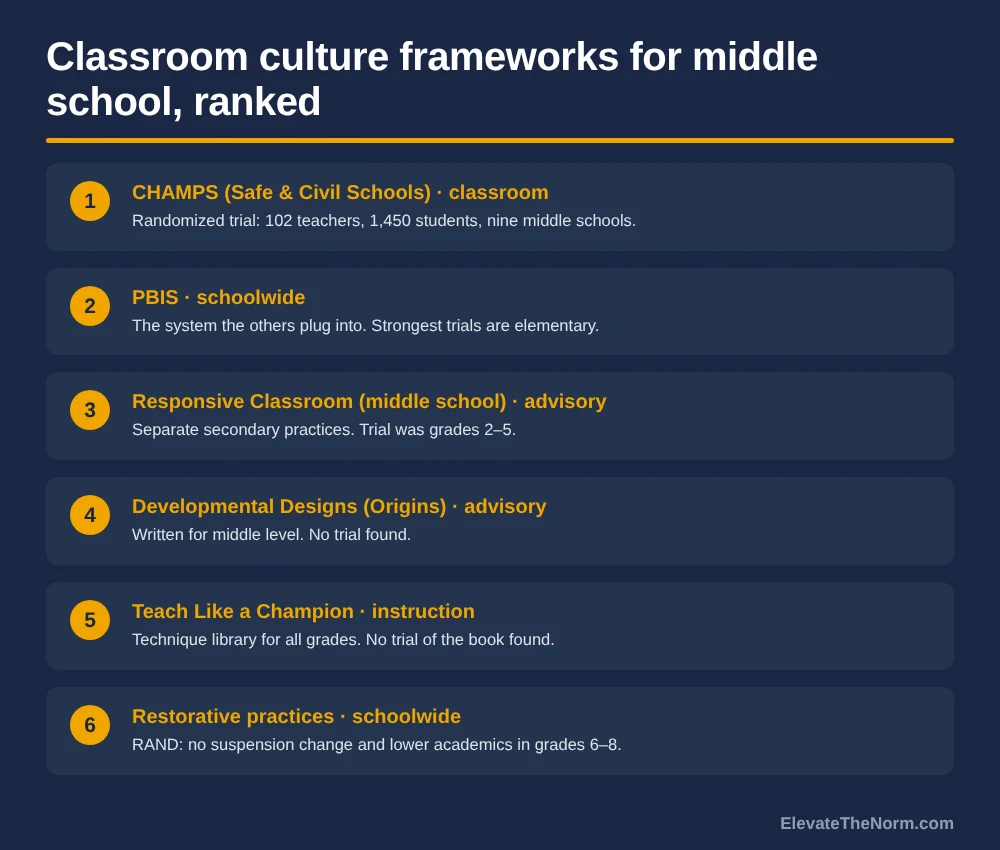
    Numbered graphic ranking six classroom culture frameworks for middle school: 1 CHAMPS, 2 PBIS, 3 Responsive Classroom middle school practices, 4 Developmental Designs, 5 Teach Like a Champion, 6 restorative practices, each with its level and middle school evidence.
    The six classroom culture frameworks for middle school, ranked by grades 6–8 evidence and fit.

    It ranks first because of the evidence. In a randomized trial with 102 teachers and 1,450 students in nine Missouri middle schools, teachers trained in CHAMPS praised more and gave more opportunities to respond. Their students were more focused, completed more classwork and spent more time on schoolwork (IES). The catch: teachers got three days of training plus monthly coaching. Reading the book alone isn’t the same thing.

    2. PBIS

    Best for: a middle school choosing one behavior system for every adult in the building. PBIS is a three-tier framework: universal supports for everyone, targeted help for students at risk, and intensive individual support (Center on PBIS). Its big randomized trial ran in 37 elementary schools and found a 33% drop in the odds of an office referral (Johns Hopkins). It ranks second because it’s the system the other frameworks plug into, not because it has middle school trial data. It doesn’t tell a teacher what to do at 10:14 on a Tuesday; CHAMPS or Responsive Classroom fills that gap.

    3. Responsive Classroom (middle school)

    Best for: a school that wants a daily advisory routine for belonging. Responsive Classroom has a separate set of secondary practices: Responsive Advisory Meeting, Brain Breaks, Investing Students in the Rules, Active Teaching, Student Practice, Small Group Learning and Independent Practice (Responsive Classroom). An advisory meeting runs arrival, announcements, acknowledgments and a short activity, and its first two weeks focus on predictability, safety and belonging (RAM grades 6–8 first ten days).

    Its randomized trial was in grades 2–5 and found gains only where teachers used it faithfully (AERA). That’s why it sits below CHAMPS for middle school. More in Responsive Classroom vs PBIS.

    4. Developmental Designs (Origins)

    Best for: a middle school building an advisory program from scratch. Developmental Designs comes from the Origins Program, founded by Linda Crawford, and it’s aimed at middle level schools. Its advisory guide is written for grades 5–9 and is built on two formats, the Circle of Power and Respect and a shorter Activity Plus Advisory, plus seven target skills: cooperation, communication, assertion, responsibility, engagement, empathy and self-control (MiddleWeb review). It’s designed for this age group from the ground up, which is its biggest strength. We didn’t find a randomized trial, so it ranks below the three above.

    5. Teach Like a Champion

    Best for: teachers who want concrete instructional techniques rather than a behavior system. Doug Lemov’s Teach Like a Champion 3.0 lays out 63 techniques and covers student engagement, trust, respect, accountability and excellence (Jossey-Bass, 2021, via Porchlight Books). It’s a technique library, not a middle school framework, and we found no trial of the book as a whole. Many of its ideas overlap with the moves that worked in the CHAMPS trial, like getting every student to respond.

    6. Restorative practices

    Best for: repairing harm after conflict, as one part of a larger system. RAND’s Pittsburgh study found suspension days fell 36% in program schools versus 18% elsewhere, and 63% of staff said relationships with students improved. But in grades 6–8, suspensions didn’t change and academic results got worse (EdSource on the RAND study). That’s the reason it ranks last for middle school. It’s still useful for circles and repair conversations. See restorative practices in schools.
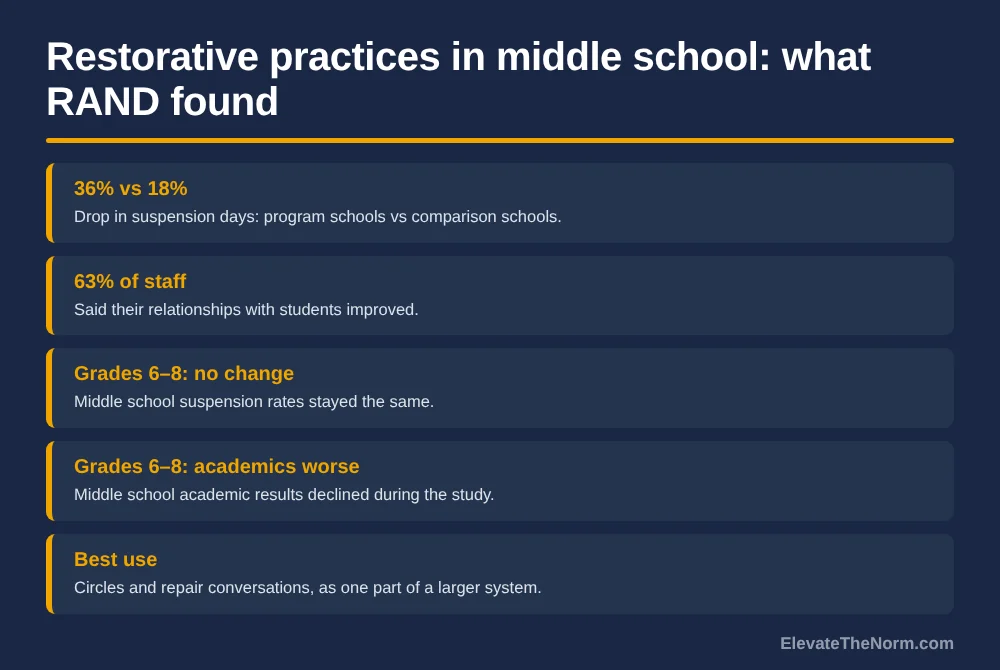
    Graphic summarizing RAND's Pittsburgh restorative practices study: suspension days fell 36% in program schools vs 18% in comparison schools, 63% of staff reported better relationships, and in grades 6–8 suspensions did not change and academic results got worse.
    What RAND’s restorative practices study found for middle school.

    Clay’s take, as a grades 6–12 classroom teacher: pair one schoolwide system with one classroom routine. If your school already runs PBIS, keep it and use CHAMPS or an advisory routine inside it rather than stacking a second schoolwide program on top.

    Are there smaller routines worth adding in middle school?

    Three short classroom routines have middle school trials and fit inside any of the six frameworks: the CW-FIT praise routine, Establish-Maintain-Restore relationship training, and positive greetings at the door.

    • CW-FIT (praise routine): in 28 middle school classrooms, getting to at least one praise per reprimand raised class-wide on-task behavior 60–70% (BYU).
    • Establish-Maintain-Restore: a three-hour relationship training that improved relationships, engaged time and disruption in a small middle school trial (Duong et al., 2018).
    • Positive greetings at the door: raised engaged time and reduced disruption for middle school teachers in a randomized study (Cook et al., 2018).
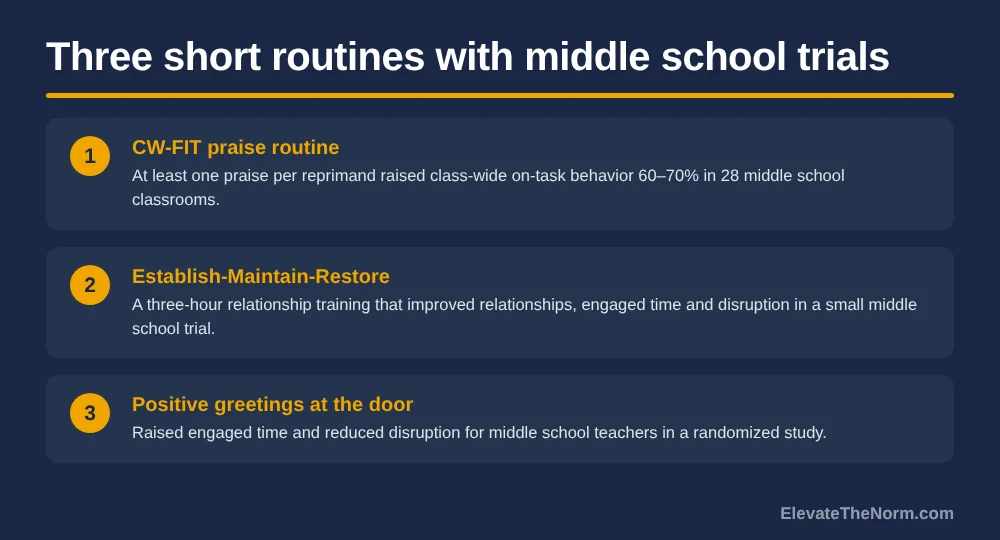
    Numbered graphic of three short routines with middle school trials: the CW-FIT praise routine, Establish-Maintain-Restore relationship training, and positive greetings at the door.
    Three short routines with middle school trials that fit inside any framework.

    If engagement is your main concern, our evidence breakdown is in the best classroom culture framework for student engagement.

    Why do middle schoolers need a different framework than elementary students?

    Middle schoolers need a different classroom culture framework because the school day and the student are both different: a middle school teacher sees several groups for under an hour each, and 12- to 14-year-olds care more about peers and fairness. A self-contained elementary teacher can build community in a morning meeting with the same 25 kids all day. A middle school teacher may see five or six groups, each for under an hour. Frameworks that assume one homeroom don’t transfer cleanly, which is why advisory-based models like Responsive Advisory Meeting and Developmental Designs exist.

    Middle schoolers also care a lot about peers and fairness. Generic praise and prize charts can feel childish. The routines that held up in middle school trials were specific and frequent: naming exactly what a student did, and giving everyone a chance to answer. Our guides on respect in the classroom and classroom management for new teachers go further on this.

    Where does Elevate the Norm fit?

    Elevate the Norm is this site’s own free grades 6–12 classroom approach, so it’s labeled rather than ranked, and it hasn’t been independently evaluated. It was built by Clay Shumate, a certified 6–12 social studies teacher. It belongs in the “one teacher can start it Monday” group alongside CHAMPS, and it works inside a school’s PBIS system.

    • Three recognition tiers (Immediate Recognition, Student of the Week, Student of the Month) with criteria announced in advance and judged on consistency and self-improvement, not perfection.
    • A 3-2-1-Done class-vs-class point system for quieting down, which suits middle schoolers’ competitive streak. Buy-in usually takes about three weeks; in its most recent year it took about six.
    • Respect both ways, with student talk channeled constructively instead of shut down.

    Materials are free with no email gate at the resource library. A paid option from the same teacher, the Teacher Emergency Toolkit on TPT, includes de-escalation scripts and behavior documentation (store).

    Frequently Asked Questions

    What is the best classroom management framework for middle school?

    CHAMPS has the strongest middle school evidence of the major classroom culture frameworks. In a randomized trial with 102 teachers and 1,450 students in nine Missouri middle schools, students of CHAMPS-trained teachers were more focused, finished more classwork and spent more time on schoolwork. Teachers got three days of training plus monthly coaching. Pair CHAMPS with PBIS if the school wants one schoolwide system.

    Does Responsive Classroom work for middle school?

    Responsive Classroom has a separate set of middle school practices built around Responsive Advisory Meeting, Brain Breaks and investing students in the rules. Its randomized trial followed students in 24 schools from second grade through fifth grade and found gains only where teachers used the practices faithfully. The middle school version is designed for adolescents but hasn’t been tested in its own trial.

    What is Developmental Designs?

    Developmental Designs is a middle level approach from the Origins Program, founded by Linda Crawford. Its advisory guide, written for grades 5–9, centers on the Circle of Power and Respect and a shorter Activity Plus Advisory format, and it targets seven skills including cooperation, responsibility and self-control. It’s built for this age group, but no randomized trial of it was found.

    Do restorative practices work in middle school?

    Restorative practices had mixed middle school results. In RAND’s study of Pittsburgh schools, suspension days fell 36% in program schools versus 18% elsewhere, but in grades 6–8 suspensions didn’t change and academic results got worse. Restorative practices still help with circles and repair conversations after conflict when they’re used as one part of a larger behavior system.

    Can one middle school teacher use a framework without the whole school?

    One middle school teacher can run CHAMPS, a praise routine like CW-FIT, positive greetings at the door or Elevate the Norm in a single classroom without waiting for a schoolwide decision. PBIS and restorative practices work best when the whole building adopts them, because both are designed as schoolwide systems rather than one-room routines.

    Is PBIS enough on its own in middle school?

    PBIS sets schoolwide expectations and three tiers of support, but it doesn’t tell a middle school teacher what to do minute to minute in a class period. Its largest randomized trial ran in 37 elementary schools, where it cut the odds of an office referral by 33%. Most middle schools add a classroom routine such as CHAMPS or an advisory model on top of it.

    How much training does CHAMPS take to get the trial results?

    In the middle school trial that put CHAMPS first on this list, teachers received three days of training plus monthly coaching. That support was part of what was tested. Reading the CHAMPS book alone is a different, untested experience, so a school expecting results like the trial’s should plan for training and follow-up coaching, not just a book order.

    Will middle schoolers think these frameworks are babyish?

    Middle schoolers can find generic praise and prize charts childish, which is why fit for 12- to 14-year-olds is one of the four ranking criteria here. The routines that held up in middle school trials were specific and frequent: naming exactly what a student did and giving every student a chance to respond. Advisory models also build in peer connection and student voice.

    Sources

    How is this page kept accurate?

    This middle school framework ranking is based on the studies and publisher pages linked inline and in the Sources list, and it will be updated if new middle school trials are published. Elevate the Norm is labeled as this site’s own framework and is not ranked. Corrections follow the editorial standards and corrections policy. For what a positive room looks like in measurable terms, see frameworks for a positive classroom environment.

    About Clay Shumate

    Clay Shumate is a certified secondary Social Studies teacher in the public schools of West Alabama, with seven years of classroom experience, a B.A. in History, and an M.Ed. in Secondary Education. He writes about project-based learning, student responsibility, respect, and practical ways to hold young people to a higher standard while giving them room to learn from mistakes. He is a member of the Society of Professional Journalists and writes to its Code of Ethics; this site’s editorial standards and corrections policy are published in full. More about Clay.

  • Elevate the Norm vs Other Classroom Culture Frameworks

    Elevate the Norm vs Other Classroom Culture Frameworks

    By Clay Shumate

    Elevate the Norm is a free classroom approach built by one teacher for grades 6–12 only. Against other classroom culture frameworks like PBIS, Responsive Classroom, CHAMPS and restorative practices, it’s narrower, cheaper and untested. Pick it for a no-cost recognition and transition system in one secondary classroom. Pick PBIS for a whole school and CHAMPS for middle school trial evidence.

    Key Takeaways

    • Elevate the Norm is free, written only for grades 6–12, and has not been independently evaluated.
    • PBIS is the pick for a whole school: the framework is free, and a randomized trial in 37 elementary schools found students 33% less likely to get an office referral.
    • CHAMPS has the strongest secondary evidence of these frameworks: a randomized study of 102 middle school teachers and 1,450 students.
    • Responsive Classroom and Conscious Discipline fit PreK–5 teachers better than any framework built for secondary grades.
    • The biggest hidden cost in every classroom culture framework is staff time, not books or training fees.

    Full disclosure up front: Elevate the Norm is this site’s own framework. That’s exactly why this page puts it in a table next to programs with bigger research bases and says plainly where each one wins. Every price and study below links to its source. For the full list of frameworks, see the classroom culture frameworks Q&A hub. If you want the reasoning behind Elevate’s design rather than a side-by-side, read what makes Elevate the Norm different.

    How does Elevate the Norm compare side by side?

    Elevate the Norm is the only one of these seven that’s free, built only for grades 6–12, and written by a single classroom teacher, and it’s also the only one with no independent evaluation.

    FrameworkGrade bandCost to startCore mechanismEvidence baseRewards philosophy
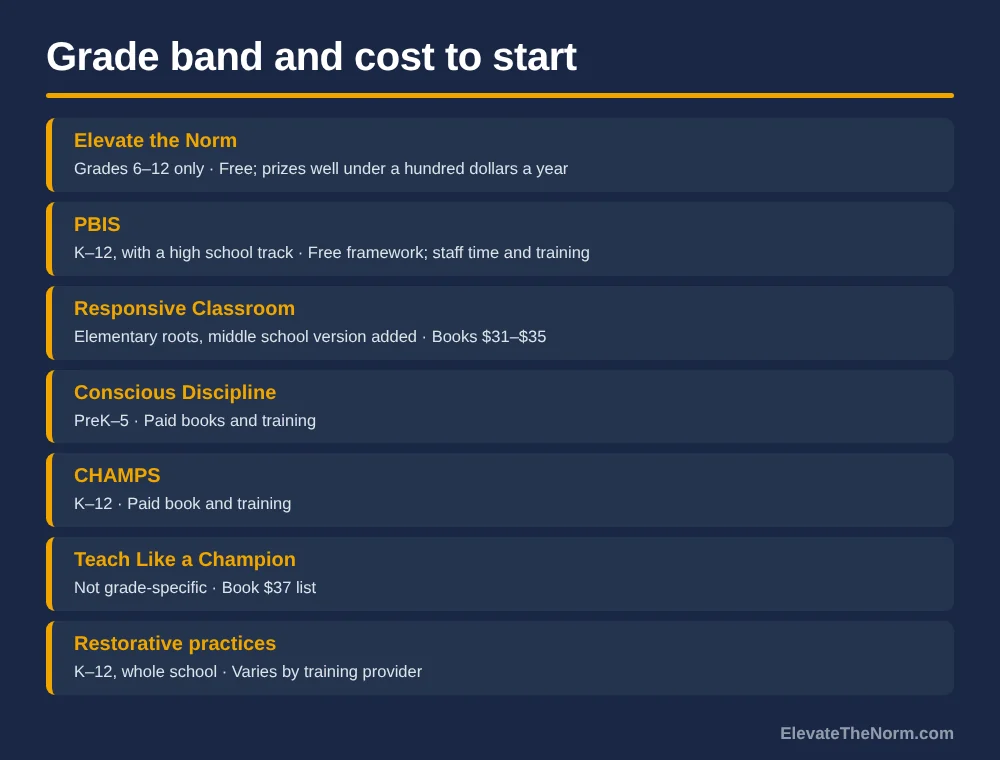
    Elevate the Norm (this site)6–12 onlyFree; prizes well under a hundred dollars a year for one teacherThree recognition tiers, class-vs-class 3-2-1-Done points, firm follow-throughNone independent; built on cited researchAnnounced, earned recognition for consistency
    PBISK–12, with a high school trackFree framework; staff time and trainingSchoolwide three-tier system, taught expectations, data teamsRandomized trials (elementary)Acknowledgment systems, often tokens
    Responsive ClassroomElementary roots, middle school version addedBooks $31–$35Daily meetings, Interactive Modeling, teacher languageRandomized trial, grades 2–5Reinforcing language over tokens
    Conscious DisciplinePreK–5Paid books and trainingAdult self-regulation, School FamilyQuasi-experimental, Pre-KConnection before consequences
    CHAMPSK–12Paid book and trainingClear expectations for each activity, praise, opportunities to respondRandomized trial, grades 6–8Specific praise plus planned reinforcement
    Teach Like a ChampionNot grade-specificBook $37 listNamed teaching techniques for routines, engagement and rigorObservation of effective teachers; no program trial foundHigh expectations and precise praise
    Restorative practicesK–12, whole schoolVaries by training providerCircles, repairing harm, relationshipsRandomized trial (RAND), mixed resultsRelationship and repair, not rewards

    Sources: Center on PBIS; High School PBIS; Responsive Classroom bookstore; Responsive Classroom middle school expansion; Conscious Discipline; CHAMPS K–12 session listing (Region 11 ESC); Teach Like a Champion 3.0 listing; RAND restorative practices trial. Prices change, so confirm current prices with each publisher.

    Which frameworks are built for middle and high school?

    PBIS, CHAMPS and Elevate the Norm cover high school; Responsive Classroom reaches middle school; Conscious Discipline stops at grade 5.

    PBIS has a dedicated high school track that adds student voice, department-wide consistency and extra freshman-year support (Center on PBIS). CHAMPS training is offered for elementary, middle and high school teachers (Region 11 ESC). Responsive Classroom spent about thirty years in elementary schools before building a middle school version (Responsive Classroom). Conscious Discipline lists its market as early childhood and PreK–5 (Conscious Discipline).

    Elevate the Norm is the narrowest: it was written for grades 6–12 and nothing else. That’s a strength if you teach teenagers and a dealbreaker if you don’t. If you’re in an elementary building, stop here and look at the other six.

    Graphic comparing grade band and cost to start for seven classroom culture frameworks: Elevate the Norm (grades 6–12, free), PBIS, Responsive Classroom, Conscious Discipline, CHAMPS, Teach Like a Champion and restorative practices.
    Grade band and starting cost, Elevate the Norm vs other classroom culture frameworks.

    How much does each one cost?

    PBIS and Elevate the Norm cost nothing to adopt; the rest run from a $31 book to paid multi-day training.

    • Free: PBIS (framework and Center on PBIS materials) and Elevate the Norm (every classroom resource on the free resource library, no email required).
    • A book to start: Responsive Classroom titles list at $31.20–$35.00 at the publisher’s bookstore. Teach Like a Champion 3.0 lists at $37.00.
    • Book plus training: CHAMPS, Conscious Discipline and restorative practices are usually adopted through paid workshops or district contracts. We couldn’t confirm a current public list price for training, so ask the provider for a quote.

    The hidden cost in every framework is staff time. The Center on PBIS says plainly that PBIS isn’t something you learn in a one-day training; it’s an ongoing commitment that involves teams, data and coaching (Center on PBIS). Elevate the Norm is cheap partly because it asks less: one teacher, one room, no team.

    What does each framework actually ask a teacher to do every day?

    Classroom culture frameworks split into four types: systems (PBIS, restorative practices), teacher-technique playbooks (CHAMPS, Teach Like a Champion), community practices (Responsive Classroom, Conscious Discipline), and recognition systems (Elevate the Norm).

    • PBIS: teach three to five schoolwide expectations, acknowledge them, and use data to decide which students need Tier 2 or Tier 3 support.
    • Restorative practices: build relationships through circles and respond to harm by repairing it. RAND’s trial studied the whole-school model from the International Institute for Restorative Practices (RAND).
    • CHAMPS: define expectations for every activity and transition, praise specifically, and give more chances to respond.
    • Teach Like a Champion: a catalog of named techniques Doug Lemov observed in highly effective teachers (Education Week).
    • Responsive Classroom: morning or advisory meetings, modeling routines before expecting them, and precise teacher language.
    • Conscious Discipline: adults practice self-regulation first, then teach children the skills of discipline.
    • Elevate the Norm: immediate recognition, Student of the Week and Student of the Month on criteria announced ahead of time; the 3-2-1-Done class-vs-class point system for quieting and transitions; and strict follow-through, including removing positives after repeated warnings.

    Which framework has the strongest evidence?

    PBIS, Responsive Classroom, CHAMPS and restorative practices each have a randomized trial; Elevate the Norm has none. The largest studies found the following.

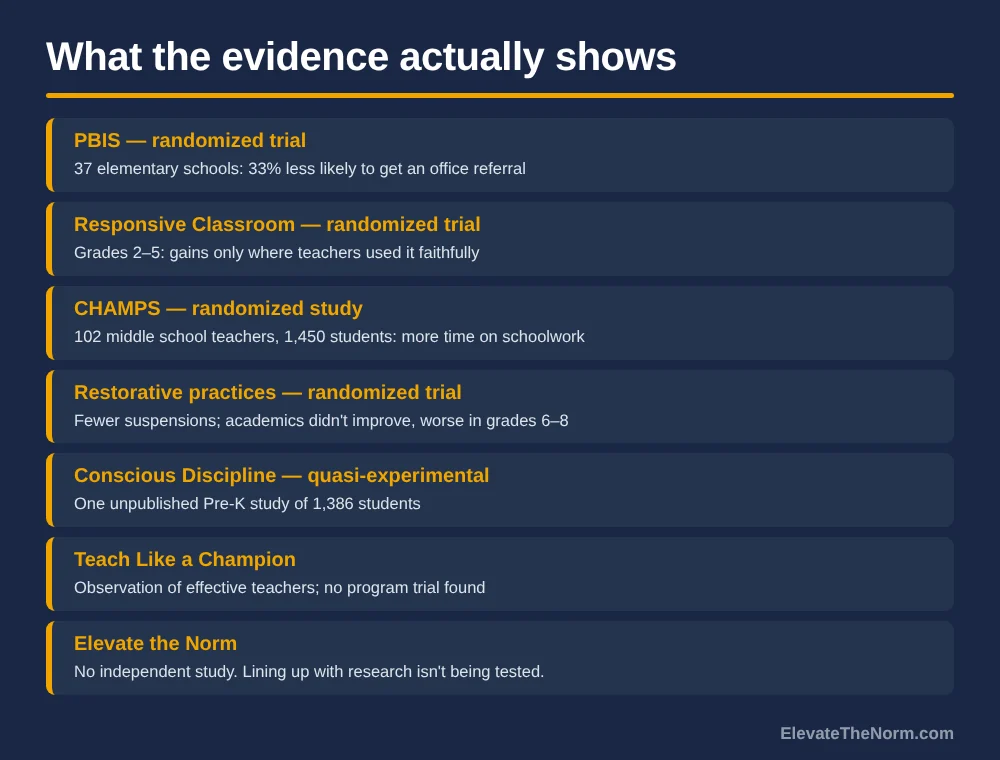
    • PBIS: In 37 elementary schools and 12,344 children, students in schoolwide PBIS schools were 33% less likely to get an office referral, with no significant difference in suspensions (Bradshaw, Waasdorp & Leaf, Pediatrics, 2012).
    • Responsive Classroom: In 24 schools and 2,904 students in grades 2–5, schools using it didn’t outperform controls overall, but teachers who used the practices faithfully saw gains of 0.26 in math and 0.30 in reading (Rimm-Kaufman et al., 2014).
    • CHAMPS: A randomized study of 102 middle school teachers and 1,450 students found CHAMPS teachers praised more and gave more chances to respond, and their students spent more time on schoolwork (IES). It’s the strongest secondary evidence on this list.
    • Restorative practices: Pittsburgh’s randomized trial found larger drops in suspensions and better teacher-rated climate, but academic outcomes didn’t improve and got worse in grades 6–8 (RAND, 2018).
    • Conscious Discipline: one quasi-experimental study of 1,386 Pre-K students, from an unpublished manuscript (CASEL).
    • Teach Like a Champion: the techniques come from observing effective teachers; we didn’t find a randomized trial of the program as a whole.
    • Elevate the Norm: no independent study. Its design choices line up with published research on praise and awards, which we cover in what makes Elevate the Norm different, but lining up with research isn’t the same as being tested.
    Graphic summarizing the evidence behind seven classroom culture frameworks: randomized trials for PBIS, Responsive Classroom, CHAMPS and restorative practices, a quasi-experimental Pre-K study for Conscious Discipline, and no independent study for Elevate the Norm.
    What the largest studies found for each framework.

    How do their views on rewards differ?

    Responsive Classroom and restorative practices avoid token rewards, PBIS often uses them, and Elevate the Norm uses small, announced rewards tied to consistency.

    Responsive Classroom’s own explainer says tokens and prizes can produce short-term compliance but may build dependence on outside incentives, and it favors reinforcing teacher language instead (Responsive Classroom, 2025). PBIS doesn’t require tokens but is often run with tickets or points. The Center on PBIS also warns against clip charts and recommends equitable acknowledgment systems (Classroom PBIS).

    Elevate the Norm sits in the middle. It uses real prizes, but the criteria are posted in advance and judged on consistency and self-improvement, not perfection. If you’re firmly in the no-rewards camp, Responsive Classroom or restorative practices will fit your beliefs better.

    When is another framework the better choice?

    Another classroom culture framework is the better choice whenever your situation is anything other than one secondary teacher with no budget.

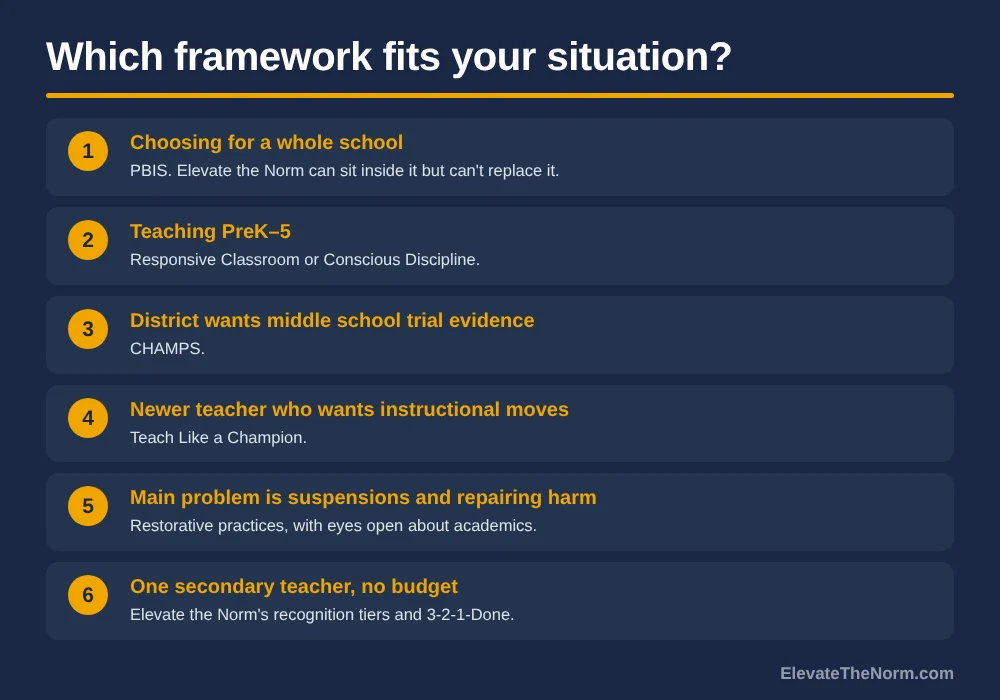
    • You’re choosing for a whole school: PBIS. Elevate the Norm can sit inside it but can’t replace it. See classroom culture frameworks vs PBIS.
    • You teach PreK–5: Responsive Classroom or Conscious Discipline. Compare them in Responsive Classroom vs PBIS vs Conscious Discipline.
    • Your district wants trial evidence for middle school: CHAMPS.
    • You’re a newer teacher who wants concrete moves for instruction, not just behavior: Teach Like a Champion.
    • Your main problem is suspensions and repairing harm: restorative practices, with eyes open about the academic results. Background in restorative practices in schools.
    Numbered graphic matching six situations to a classroom culture framework: PBIS for a whole school, Responsive Classroom or Conscious Discipline for PreK–5, CHAMPS for middle school trial evidence, Teach Like a Champion for newer teachers, restorative practices for suspensions, and Elevate the Norm for one secondary teacher with no budget.
    Pick a framework by situation, not by brand.

    Where does Elevate the Norm fit?

    Elevate the Norm fits a grades 6–12 teacher who wants a free recognition and transition system that works alone or inside PBIS. Again: it’s this site’s own framework, built by Clay Shumate, a Class A certified 6–12 social studies teacher, and it hasn’t been independently evaluated.

    • Free and open: every classroom resource is on the resource library with no email gate. A separate paid option from the same teacher, the Teacher Emergency Toolkit on TPT, is listed on the store page; nothing in the framework requires it.
    • Honest about time: 3-2-1-Done took about six weeks for students to buy in during its most recent year, double the usual three.
    • Not soft: do exactly what you say, remove positives after repeated warnings, and send serious discipline to administration. More in positive discipline for teens.
    • Built for project-based learning and student leadership; see student leadership activities.

    Clay’s take, as a grades 6–12 classroom teacher: if you’re one secondary teacher with no budget and no schoolwide system, start with Elevate the Norm’s recognition tiers and 3-2-1-Done. If your school already runs PBIS, keep PBIS and use Elevate inside it as your classroom acknowledgment system.

    The values behind it are on the what we believe page.

    Sources

    Frequently Asked Questions

    Is Elevate the Norm evidence-based?

    Elevate the Norm is not evidence-based in the formal sense, because no independent study has evaluated it. Its design lines up with published research on praise and awards, and every claim on this site links to a source. Lining up with research isn’t the same as being tested, so treat it as a promising classroom approach, not a proven program.

    Is Elevate the Norm free?

    Yes. Every Elevate the Norm classroom resource is free on the resource library, with no email gate. The only ongoing cost is prizes, which run one teacher well under a hundred dollars a year. The Teacher Emergency Toolkit on TPT is a separate paid product from the same teacher, and nothing in the framework requires it.

    Can I use Elevate the Norm with PBIS?

    Yes. PBIS is a schoolwide system and Elevate the Norm is a single-classroom approach, so the two don’t compete. Elevate’s recognition tiers can serve as your classroom acknowledgment system inside PBIS, as long as your recognition criteria match the schoolwide expectations your building already teaches. Elevate the Norm can sit inside PBIS, but it can’t replace it.

    Does Elevate the Norm work in elementary school?

    Elevate the Norm wasn’t built for elementary school. It was written for grades 6 to 12 and nothing else, and it hasn’t been tried or studied with younger children. Elementary teachers will find better fits in Responsive Classroom, Conscious Discipline or Classroom PBIS, which were designed with younger students in mind.

    Which classroom framework has the best research for middle school?

    CHAMPS has the strongest middle school evidence of the major classroom culture frameworks. A randomized study of 102 middle school teachers and 1,450 students found CHAMPS teachers praised more and gave more chances to respond, and their students spent more time on schoolwork. PBIS and Responsive Classroom also have randomized trials, but those were run in elementary schools.

    Which classroom culture framework is best for a whole school?

    PBIS is the best fit for a whole school. It’s a free, schoolwide three-tier framework with taught expectations, data teams and a dedicated high school track. The Center on PBIS is clear that it takes ongoing teams, data and coaching rather than a one-day training, so budget staff time even though the framework itself costs nothing.

    Do classroom culture frameworks use rewards?

    Classroom culture frameworks differ on rewards. Responsive Classroom and restorative practices avoid token rewards and lean on teacher language and repair. PBIS doesn’t require tokens but is often run with tickets or points, and the Center on PBIS warns against clip charts. Elevate the Norm uses small real prizes with criteria posted in advance and judged on consistency, not perfection.

    Do restorative practices improve academic results?

    Not in the largest trial. RAND’s randomized study in Pittsburgh found restorative practices cut suspensions more than in comparison schools and improved teacher-rated climate, but academic outcomes didn’t improve and got worse in grades 6–8. Restorative practices are a reasonable choice when suspensions and repairing harm are the main problem, as long as you watch academic results closely.

    How is this page kept accurate?

    This page is kept accurate by taking prices from publisher or retailer listings and study figures from the original papers or official summaries linked inline; prices change, so confirm them with each publisher. Elevate the Norm is labeled as this site’s own framework everywhere it appears. Corrections follow the editorial standards and corrections policy.


    About Clay Shumate

    Clay Shumate is a certified secondary Social Studies teacher in the public schools of West Alabama, with seven years of classroom experience, a B.A. in History, and an M.Ed. in Secondary Education. He writes about project-based learning, student responsibility, respect, and practical ways to hold young people to a higher standard while giving them room to learn from mistakes. He is a member of the Society of Professional Journalists and writes to its Code of Ethics; this site’s editorial standards and corrections policy are published in full. More about Clay.

  • Best Classroom Culture Framework for Student Engagement (By Grade)

    Best Classroom Culture Framework for Student Engagement (By Grade)

    By Clay Shumate · Every study figure linked to its source

    Short answer: The best classroom culture framework for student engagement is CHAMPS for grades 6–8, where a randomized trial found students more focused and finishing more classwork. For K–5, Responsive Classroom inside schoolwide PBIS has the trial evidence. No framework has a high school engagement trial, so grades 9–12 should use the core moves those frameworks share.

    Key takeaways

    • CHAMPS is the only classroom-level framework with a middle school randomized trial that measured time on task, and students in CHAMPS classrooms were more focused and finished more classwork.
    • A four-year randomized trial in 37 elementary schools found schoolwide PBIS reduced concentration problems and lowered the odds of an office discipline referral by 33%.
    • Responsive Classroom produced no overall achievement gain in its trial, but math and reading improved where teachers used its practices faithfully.
    • The engagement gains in these trials came from three teacher moves: frequent opportunities to respond, more praise than correction, and expectations defined for each activity.
    • Training alone isn’t enough: the CHAMPS trial paired three days of workshops with a full year of monthly coaching.

    This page looks at one outcome only: engagement, meaning time on task, participation and finished work. It doesn’t rank frameworks on discipline or climate in general. If you want the full list of frameworks first, start with the classroom culture frameworks Q&A hub. For a ranked list built for grades 6–8, see classroom culture frameworks for middle school.

    What is the best classroom culture framework for student engagement?

    CHAMPS is the best classroom culture framework for student engagement when engagement is the main goal, though the right pick still depends on grade band. CHAMPS is the only classroom-level framework we found with a randomized trial that measured time on task directly and found gains in middle school.

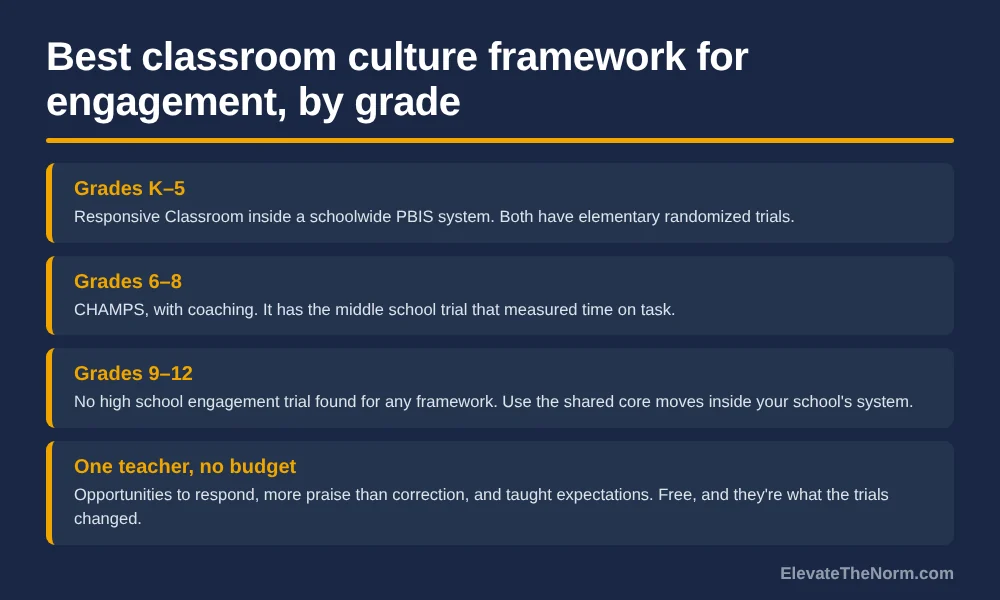
    Graphic listing the best classroom culture framework for student engagement by grade band: Responsive Classroom with PBIS for K–5, CHAMPS with coaching for 6–8, core moves for 9–12, and free core moves for one teacher with no budget.
    Which framework to pick for engagement, by grade band.
    • Grades K–5: Responsive Classroom inside a schoolwide PBIS system. Both have elementary randomized trials.
    • Grades 6–8: CHAMPS, with coaching. It has the middle school trial.
    • Grades 9–12: no framework has a high school engagement trial we could find. Use the core moves CHAMPS and PBIS share (opportunities to respond, specific praise, taught expectations) inside whatever system your school runs.
    • No budget, one teacher: start with the three core moves below. They’re free and they’re what the trials actually changed.

    Which frameworks have actually been tested on engagement?

    Only five approaches have strong trials or large evaluations behind them: CHAMPS, schoolwide PBIS, Responsive Classroom, Establish-Maintain-Restore and restorative practices, and each study measured different outcomes. Here’s what the main studies found, kept to engagement and achievement.

    FrameworkStrongest studyGradesWhat happened to engagement
    CHAMPSRandomized trial, 102 teachers, 1,450 students6–8Students more focused, completed more classwork, more time on schoolwork
    Schoolwide PBISRandomized trial, 37 schools, 12,344 studentsElementaryFewer concentration problems; 33% lower odds of an office referral
    Responsive ClassroomRandomized trial, 24 schools, 2,904 students2–5No overall achievement gain; gains where teachers used it faithfully
    Establish-Maintain-Restore (relationship routine)Randomized trial, 20 teachers, 190 studentsMiddle schoolMore academically engaged time, less disruption (small sample)
    Restorative practicesRAND evaluation, PittsburghK–12Fewer suspensions in elementary; no suspension change and lower academics in grades 6–8

    CHAMPS

    In a federally funded efficacy study, 102 teachers in nine Missouri middle schools were randomly assigned to CHAMPS training or business as usual. CHAMPS teachers got three days of workshops and monthly coaching for a year. They praised more often and gave students more opportunities to respond, and their students were more focused, completed more classwork and spent more time on schoolwork. Students also scored higher on the state communication test, partly explained by the extra time on task, though not on the state math test (IES project summary; Herman, Reinke, Dong & Bradshaw, Journal of Educational Psychology).

    Schoolwide PBIS

    A four-year randomized trial in 37 elementary schools found students in PBIS schools had fewer behavior and concentration problems and were 33% less likely to get an office discipline referral. Effects were strongest for students who started PBIS in kindergarten (Bradshaw, Waasdorp & Leaf, Pediatrics, 2012). PBIS is a three-tier school system rather than a classroom routine, and the Center on PBIS is funded by the U.S. Department of Education (Center on PBIS).

    Responsive Classroom

    A three-year randomized trial followed 2,904 students in 24 schools from the end of grade 2 through grade 5. Students in Responsive Classroom schools didn’t outperform the control group overall. But where teachers actually used the practices, math and reading improved, with the biggest math gain for students who started low (Rimm-Kaufman et al., AERA). That trial didn’t report an engagement measure, so we can’t say it raised time on task. For how it compares to PBIS head to head, see Responsive Classroom vs PBIS.

    Restorative practices

    RAND’s evaluation of Pittsburgh’s program found days lost to suspension fell 36% in program schools versus 18% elsewhere, and staff reported better relationships. But middle schools saw no change in suspensions, and middle schoolers’ academic results got worse over the two years (EdSource summary of the RAND study). Restorative work is about repairing harm, not engagement, which is why it ranks low on this page. More in restorative practices in schools.

    What actually drives engagement inside these frameworks?

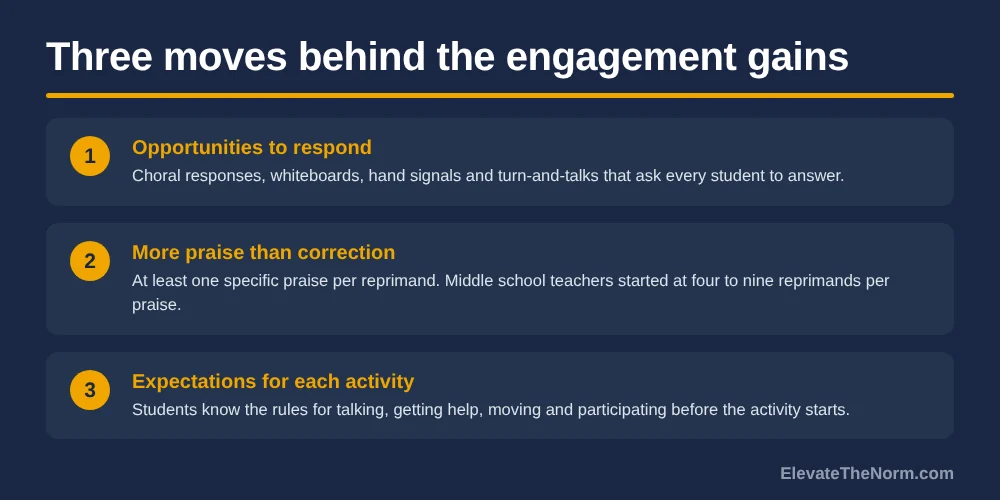
    Three teacher moves drive engagement inside classroom culture frameworks: frequent opportunities to respond, more praise than correction, and clear expectations for each activity. The frameworks are mostly delivery systems for these three moves.

    Numbered graphic of three moves behind student engagement gains: opportunities to respond, more praise than correction, and expectations defined for each activity.
    The three moves the engagement trials actually changed.

    1. Opportunities to respond

    An opportunity to respond is any prompt that asks every student, or a named student, to answer: a choral response, a whiteboard, a hand signal, a turn-and-talk. A 2019 meta-analysis of 12 single-case studies found that increasing teacher-directed opportunities to respond was linked to better student behavior across grade levels and response formats (Fitzgerald Leahy, Miller & Schardt, Journal of Behavioral Education, 2019). It’s also one of the two teacher behaviors that changed in the CHAMPS trial.

    2. More praise than correction

    In 28 middle school classrooms, teachers started out reprimanding four to nine times as often as they praised. When trained teachers reached at least one praise per reprimand, class-wide on-task behavior rose 60–70%, and high-risk students’ grades rose a full letter (Caldarella et al., BYU, Journal of Positive Behavior Interventions). The intervention there, CW-FIT, is a class-wide routine you can layer inside any framework.

    3. Expectations defined per activity

    CHAMPS is built on this. Its letters stand for Conversation, Help, Activity, Movement, Participation and Success, and the idea is that students know the rules for each of those during each kind of activity (LiveSchool overview). Students who know how to get help or whether they can talk don’t spend the first five minutes of an activity guessing. Our guides to classroom expectations and routines and procedures show what that looks like in a grades 6–12 room.

    Do relationship routines raise engagement?

    Yes. Relationship routines such as Establish-Maintain-Restore and positive greetings at the door raised academically engaged time in two small middle school trials, and both cost little to run.

    • Establish-Maintain-Restore: a three-hour teacher training on building, keeping and repairing relationships. In a randomized trial with 20 middle school teachers and 190 students, it improved teacher-student relationships, observed academically engaged time and disruptive behavior. The sample was small and the confidence intervals wide, so treat the size of the effect cautiously (Duong et al., School Psychology Quarterly, 2018).
    • Positive greetings at the door: middle school teachers randomly assigned to greet students at the door saw significant gains in academically engaged time and less disruption (Cook et al., Journal of Positive Behavior Interventions, 2018).

    Neither is a full framework, but both fit inside any of them. See building relationships with students for secondary-specific versions.

    Which framework should I pick for my situation?

    Pick a classroom culture framework by grade band and support: CHAMPS for a middle school teacher with coaching, PBIS with Responsive Classroom for an elementary school, and the three core moves for a high school teacher or anyone without a budget.

    Your situationBest pick for engagementWhy
    Elementary school adopting a schoolwide systemPBIS, with Responsive Classroom in classroomsBoth have elementary trials; they’re commonly combined
    Middle school teacher with coaching supportCHAMPSOnly middle school trial with time-on-task gains
    Middle school wanting community timeResponsive Classroom’s Responsive Advisory Meeting, plus CHAMPS-style expectationsAdvisory builds belonging; expectations drive time on task
    High school teacherCore moves inside your school’s PBISNo high school engagement trial found for any framework
    One teacher, no budgetOpportunities to respond + 1:1 or better praise ratio + greetingsFree, and they’re what the trials changed
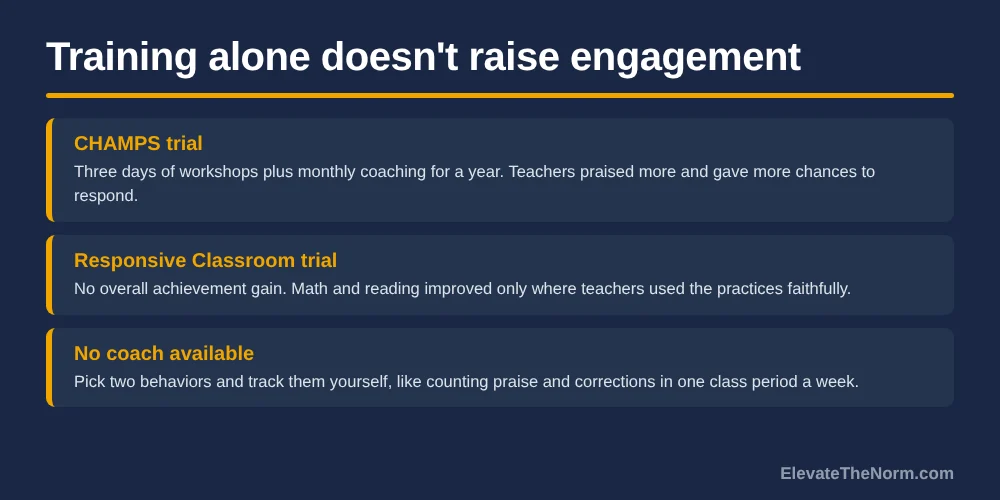
    Graphic explaining that training alone doesn't raise engagement: the CHAMPS trial paired workshops with monthly coaching, Responsive Classroom helped only with faithful use, and teachers without a coach can track praise and corrections themselves.
    Coaching and faithful use, not training alone, drove the gains.

    One warning from the research: training alone doesn’t do it. The CHAMPS trial paired workshops with monthly coaching, and Responsive Classroom only helped where teachers used it faithfully. If you can’t get coaching, pick two behaviors and track them yourself, like counting praise and corrections in one class period a week. Our classroom management strategies guide has more on running that in a secondary room.

    Clay’s take, as a grades 6–12 classroom teacher: if you teach middle or high school and don’t have a coach, start with the three core moves before you buy any program. They’re free, and they’re what the trials actually changed.

    Where does Elevate the Norm fit?

    Elevate the Norm is a free, grades 6–12 positive-reinforcement approach that puts the praise-and-expectations moves into a routine. Disclosure: it’s this site’s own framework, built by Clay Shumate, a certified 6–12 social studies teacher, and it hasn’t been independently evaluated. Nothing on this page claims it raises engagement; the studies above are about other programs.

    • Recognition with criteria announced ahead of time: Immediate Recognition, Student of the Week and Student of the Month, judged on consistency and self-improvement rather than perfection.
    • Faster transitions: the 3-2-1-Done class-vs-class point system rewards a class for getting quiet quickly. In its most recent year it took about six weeks for students to buy in.
    • Follow-through: the teacher does exactly what was announced, removes positives after repeated warnings, and leaves serious discipline to administration.

    Everything is free with no email gate in the resource library.

    Frequently Asked Questions

    Which classroom culture framework is best for student engagement?

    CHAMPS has the most direct evidence for student engagement. A randomized trial with 102 teachers in nine middle schools found students in CHAMPS classrooms were more focused, finished more classwork and spent more time on schoolwork. In elementary school, schoolwide PBIS and Responsive Classroom both have randomized trials, though neither measured time on task the way the CHAMPS trial did.

    Does PBIS increase student engagement?

    In a four-year randomized trial of 37 elementary schools, schoolwide PBIS reduced students’ concentration problems and cut the odds of an office discipline referral by 33%. That is evidence of better focus, though the study did not measure time on task directly. PBIS is a three-tier school system rather than a classroom routine, so one teacher can’t adopt it alone.

    What are opportunities to respond?

    Opportunities to respond are prompts that ask every student, or a named student, to answer: choral responses, whiteboards, hand signals or turn-and-talks. A 2019 meta-analysis of 12 single-case studies linked more teacher-directed opportunities to respond with better student behavior across grade levels. Giving more opportunities to respond was also one of two teacher behaviors that changed in the CHAMPS trial.

    What praise-to-correction ratio should teachers aim for?

    Teachers should aim for at least one specific praise per correction. In a study of 28 middle school classrooms, teachers started out reprimanding four to nine times as often as they praised. When teachers praised at least as often as they reprimanded, class-wide on-task behavior rose 60 to 70%, and high-risk students’ grades rose a full letter.

    What works for high school student engagement?

    No named classroom culture framework has a high school engagement trial that we could find. The safest approach for grades 9–12 is to use the moves the middle school trials changed, which are frequent opportunities to respond, specific praise and expectations taught for each activity, inside whatever system the school already runs, such as schoolwide PBIS.

    Do teachers need coaching for a classroom culture framework to work?

    Training alone doesn’t appear to be enough. The CHAMPS trial paired three days of workshops with monthly coaching for a full year, and Responsive Classroom improved math and reading only where teachers used the practices faithfully. A teacher without a coach can pick two behaviors and track them, such as counting praise and corrections in one class period a week.

    Do restorative practices improve student engagement?

    Restorative practices are built to repair harm, not to raise engagement. RAND’s evaluation of Pittsburgh’s program found days lost to suspension fell 36% in program schools versus 18% elsewhere. But middle schools saw no change in suspensions, and middle schoolers’ academic results got worse over the two years, so restorative work ranks low as an engagement tool.

    Has Elevate the Norm been proven to raise engagement?

    No. Elevate the Norm is this site’s own free grades 6–12 positive-reinforcement approach, built by Clay Shumate, and it hasn’t been independently evaluated. It puts the praise-and-expectations moves into a routine with recognition criteria announced ahead of time, a class-vs-class transition system and consistent follow-through, but none of the studies on this page tested it.

    How is this page kept accurate?

    Every study figure on this page comes from the original paper or an official summary linked inline. Elevate the Norm is labeled as this site’s own framework wherever it appears. Corrections follow the editorial standards and corrections policy. For what makes a room feel positive rather than just on task, see classroom culture frameworks for a positive classroom environment.
    Sources

    1. Institute of Education Sciences, project summary: evaluation of a classroom management training program for middle school teachers (CHAMPS)
    2. ScienceDaily summary of Herman, Reinke, Dong & Bradshaw, Journal of Educational Psychology
    3. Johns Hopkins Bloomberg School of Public Health, summary of Bradshaw, Waasdorp & Leaf, Pediatrics, 2012
    4. Center on Positive Behavioral Interventions and Supports
    5. Rimm-Kaufman et al., Efficacy of the Responsive Classroom approach, AERA
    6. EdSource summary of the RAND evaluation of restorative practices in Pittsburgh
    7. Fitzgerald Leahy, Miller & Schardt, Journal of Behavioral Education, 2019
    8. BYU News summary of Caldarella et al., Journal of Positive Behavior Interventions
    9. LiveSchool, overview of CHAMPS behavior management
    10. Duong et al., School Psychology Quarterly, 2018
    11. Cook et al., Journal of Positive Behavior Interventions, 2018

    About Clay Shumate

    Clay Shumate is a certified secondary Social Studies teacher in the public schools of West Alabama, with seven years of classroom experience, a B.A. in History, and an M.Ed. in Secondary Education. He writes about project-based learning, student responsibility, respect, and practical ways to hold young people to a higher standard while giving them room to learn from mistakes. He is a member of the Society of Professional Journalists and writes to its Code of Ethics; this site’s editorial standards and corrections policy are published in full. More about Clay.

  • Student Behavior Contract: How to Write One Students Actually Respect (Free Template)

    Student Behavior Contract: How to Write One Students Actually Respect (Free Template)

    By Clay Shumate

    A student behavior contract is a short written agreement between a student and a teacher that names two or three specific behaviors, what the student commits to, what the teacher commits to in return, how progress gets checked, and when the agreement ends. It works best when the student helps write it and both people sign it.

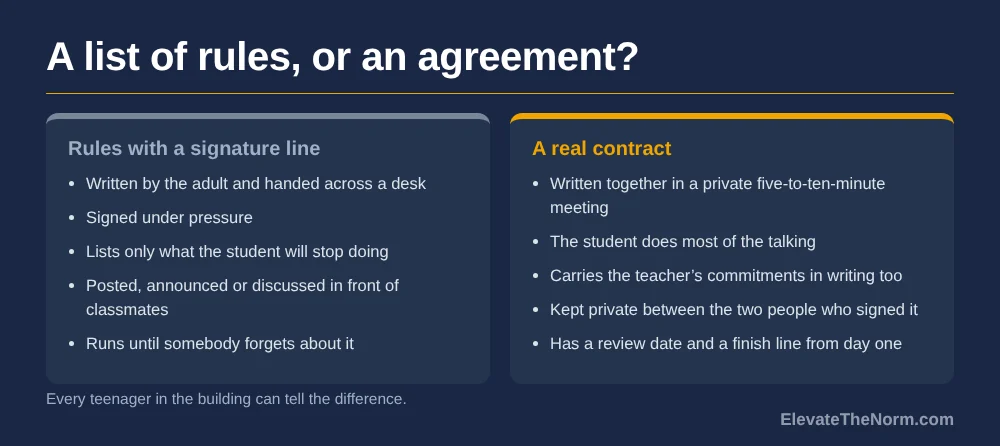
    Most behavior contracts fail for a reason that has nothing to do with the student. They are written by the adult, handed across a desk, and signed under pressure. That is not a contract. That is a list of rules with a signature line at the bottom, and every teenager in the building can tell the difference. A real agreement has two sides, and the teacher’s side is the part most templates leave out.

    Key Takeaways

    • Two sides or it is not a contract. The teacher’s commitments — a cue, a check-in, a seat change, a private signal — belong on the page in writing, right next to the student’s.
    • Three behaviors, maximum. Every behavior should be observable and stated as something the student will do, not something they will stop doing.
    • The evidence is real but modest. A meta-analysis of single-case studies found a moderate overall effect, with the strongest results for reducing problem behavior.
    • Keep it private. A contract that is posted, announced, or discussed in front of classmates stops being an agreement and becomes a public label.
    • Plan the ending on day one. A contract should have a review date and a finish line, not run forever.

    Free Download · PDF

    Student Behavior Contract Template for Grades 6–12

    A two-page printable: a contract with space for student and teacher commitments, plus a weekly check-in tracker with an end-of-week conversation guide. No email required.

    Download the free PDF

    Free. No email address required. Designed for grades 6–12. Browse every printable in Your Free Library.

    What is a student behavior contract?

    It is a planning document that both the student and the teacher agree to, describing specific behaviors, how they will be tracked, and what happens when the student meets them. The IRIS Center at Vanderbilt calls it “a simple positive-reinforcement intervention that is widely used by teachers to change student behavior,” and lists its core parts as the behaviors to increase or reduce, the conditions for earning recognition, and signature blocks for everyone involved (IRIS Center, “Behavior Contracts”).

    Notice the word agree. A student behavior contract is not a punishment and it is not a warning letter. It sits in the space between “a quick private conversation” and “a formal referral” — the point where a pattern has shown up, you have already talked about it, and you both want something more structured than another reminder.

    It is also not an IEP behavior plan or a formal Behavior Intervention Plan. Those are legal documents built by a team. A classroom contract can support one, but it never replaces one. If a student already has a plan, the plan wins and the contract has to match it.

    Two-column comparison of a list of rules with a signature line against a real behavior contract, covering who writes it, whether the teacher's commitments appear, privacy, and whether it has an end date.
    Every teenager in the building can tell the difference.

    Does a behavior contract actually work?

    The research says yes, moderately, and more reliably for reducing problem behavior than for building new habits. That is an honest answer, and it is better than the workshop version.

    The most useful summary is a meta-analysis of 18 single-case experiments covering 58 students between the ages of 5 and 21. It found an overall moderate effect (ES = .57, with individual studies ranging from .27 to 1.00) and concluded that behavior contracts were beneficial “regardless of grade level, gender, or disability status.” It also found contracts were more effective at reducing inappropriate behavior than at increasing appropriate behavior, and that they had positive effects on academic outcomes overall (Bowman-Perrott et al., 2015).

    Two caveats matter for a secondary classroom. First, 58 students is a small number, and single-case research tells you a strategy can work for individuals rather than how often it works across a whole school. Second, that age range starts at five. The finding that grade level did not change the result is encouraging for grades 6–12, but it is not a high school study. Treat a contract as a well-supported tool for one student at a time, not as a schoolwide system.

    When to use a student behavior contract (and when not to)

    Use one when a specific behavior keeps repeating after you have already had a real conversation about it. Not on the first incident, and not as the opening move with a new student.

    Good fits:

    • A student who keeps starting work late and has told you they want to fix it.
    • Repeated phone use after the classroom expectation has been taught and re-taught.
    • A pattern of leaving the room, side conversations during direct instruction, or missing materials that you have both noticed.
    • A student returning after a suspension or a restorative conference who wants a clear, written path forward.

    Poor fits:

    • A one-time incident. A single bad day deserves a conversation and a repair, not paperwork.
    • A safety issue. Threats, violence, and anything involving harm go through your administration and school policy, not a classroom agreement.
    • A behavior with an obvious outside cause. A student who sleeps in class because they work nights or care for siblings needs a counselor and a conversation, not a contract.
    • A whole class. If eight students have the same problem, the problem is probably the procedure. Fix the routine; do not write eight contracts.

    Before any contract, the groundwork is usually clear classroom expectations that have actually been taught. A contract cannot hold a student to a standard nobody ever explained.

    What goes in a student behavior contract

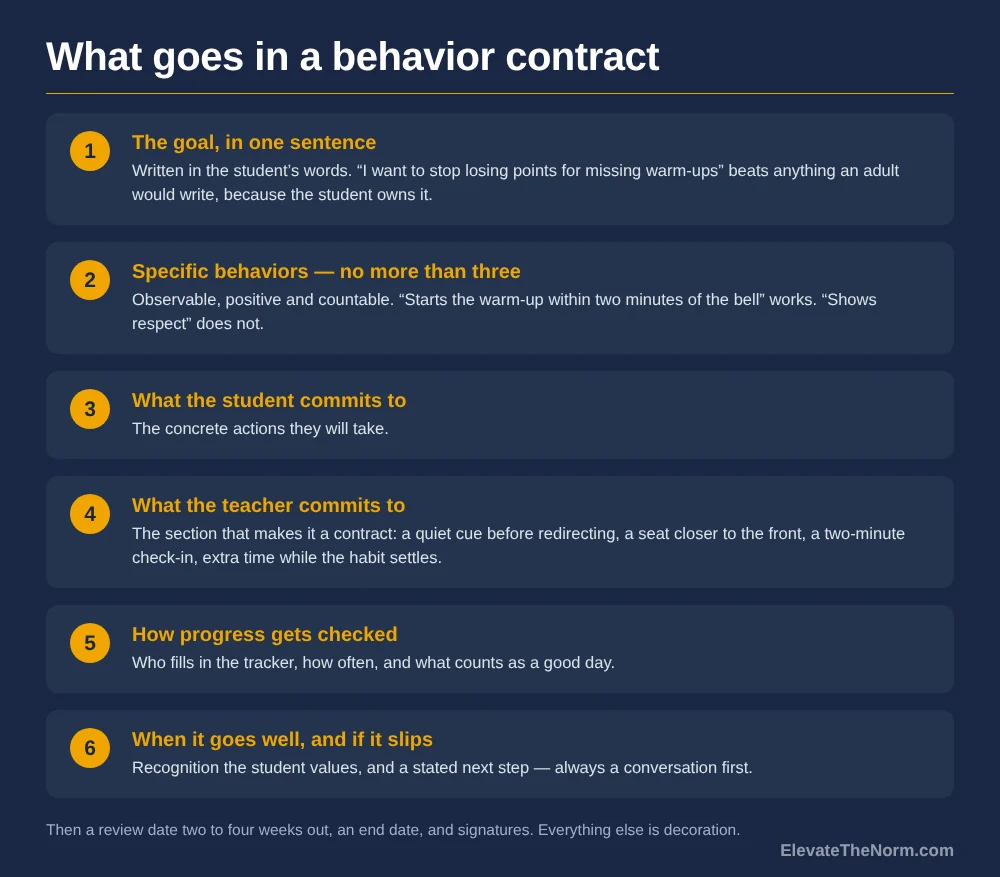
    Six parts: a goal, specific behaviors, the student’s commitments, the teacher’s commitments, a check-in plan, and what happens next. Everything else is decoration.

    1. The goal, in one sentence. Written in the student’s words. “I want to stop losing points for missing warm-ups” is better than anything an adult would write, because the student owns it.
    2. Specific behaviors — no more than three. Observable, positive, and countable. “Starts the warm-up within two minutes of the bell” works. “Shows respect” does not, because nobody can agree on whether it happened.
    3. What the student commits to. The concrete actions they will take.
    4. What the teacher commits to. This is the section that makes it a contract. A quiet cue before redirecting. A seat closer to the front. A two-minute check-in at the end of class. Extra time on one assignment while the habit settles.
    5. How progress gets checked. Who fills in the tracker, how often, and what counts as a good day.
    6. When it goes well, and if it slips. Recognition the student actually values, and a stated next step if things slide — always a conversation first.

    Add a review date two to four weeks out and an end date. Then signatures. A family signature is useful when the family wants to be involved, but it should be optional; a contract between a teacher and a young adult should be able to stand on the student’s word.

    Six numbered parts of a student behavior contract: the goal in one sentence, no more than three specific behaviors, the student's commitments, the teacher's commitments, how progress gets checked, and what happens when it goes well or slips.
    The six parts. Everything else is decoration.

    How to write a behavior contract with a student, step by step

    Write it together, in a private five-to-ten-minute meeting, with the student doing as much of the talking as possible. The IRIS Center names minimal student input as one of the common problems that keep a contract from working, and that matches what any teacher would predict.

    1. Start with what the student wants

    Ask what they want to be different. Not what you want — what they want. Most students already know exactly what is going wrong and are tired of hearing about it. Letting them name it first changes the whole meeting.

    2. Agree on the behaviors

    Translate the goal into two or three observable actions. If the student proposes something vague, ask the follow-up question: “What would I see you doing on a day when that went right?”

    3. Ask what would help

    Then ask the question most contracts skip: “What could I do that would make this easier?” Students will tell you. Sometimes it is a seat away from a friend. Sometimes it is a signal instead of being called out. Write their answer into the teacher section, as long as it is something you can really do every day.

    4. Decide how you will check in

    A daily two-minute rating works for most secondary students. Have the student rate first, then you rate, then compare. Our guide to student self-assessment of behavior covers why comparing ratings works better than correcting them.

    5. Set the review date and the finish line

    Two to four weeks is long enough to see a pattern and short enough to stay motivating. Decide now what “done” looks like — for example, eight good days out of ten.

    6. Sign it and keep it private

    Both of you sign. The student keeps a copy. It does not go on the wall, it is not mentioned in front of the class, and the tracker lives in a folder, not on a desk where classmates can read it.

    If a student is coming back from a conflict, a contract pairs naturally with the repair conversation in restorative practices in schools. If you want a scripted structure for that conversation, my Restorative Conversation Scripts lay out the follow-up talk word for word (see them here).

    A sample student behavior contract

    Here is what a filled-in middle school or high school contract can look like. The student and situation are illustrative, not a real student.

    SectionExample entry
    Goal“I want to stop getting zeros on warm-ups because I’m on my phone at the start of class.”
    Behavior 1Phone is in my bag before the bell rings.
    Behavior 2Warm-up started within two minutes of the bell.
    Student commits toPutting my phone away at the door and asking for help instead of waiting if I don’t understand the warm-up.
    Teacher commits toPosting the warm-up before students arrive, giving a quiet hand signal instead of a verbal reminder, and doing a 30-second check at the end of class.
    Check-inDaily 0–2 rating, student first. Friday five-minute conversation.
    Goes wellEight of ten days met: contract finishes, and a positive call or message home.
    If it slipsPrivate conversation first, then we revise the contract together.
    Review / endReview in two weeks. Ends after three weeks or when the goal is met.

    That “positive call home” line is worth keeping. My first call to any family is always a genuine compliment, and a call that says “your kid set a goal and hit it” is one of the best calls you will ever make. If you want a system for those calls, the parent-teacher communication plan walks through it.

    Tracking progress without turning it into surveillance

    Track the two or three behaviors on the contract and nothing else, for two minutes a day. The second page of the free template is a weekly tracker built for exactly that.

    The student rates each behavior 0, 1, or 2. You rate the same period. Then you compare. Where you disagree, ask why before you say anything else — sometimes the student saw something you missed. At the end of the week, use four questions: What went better than last week? Which day was hardest, and what was going on? Is there anything I should do differently? Do we keep the contract, adjust it, or finish it?

    That third question is not a formality. If the student says your quiet signal is not working, change the signal. A teacher who keeps their side of the agreement and adjusts when asked is teaching the most important thing a contract can teach: that commitments go both ways. The research on structure and student autonomy points the same direction — students engage more when expectations come with reasons and a real voice, which is the whole argument behind student voice and choice.

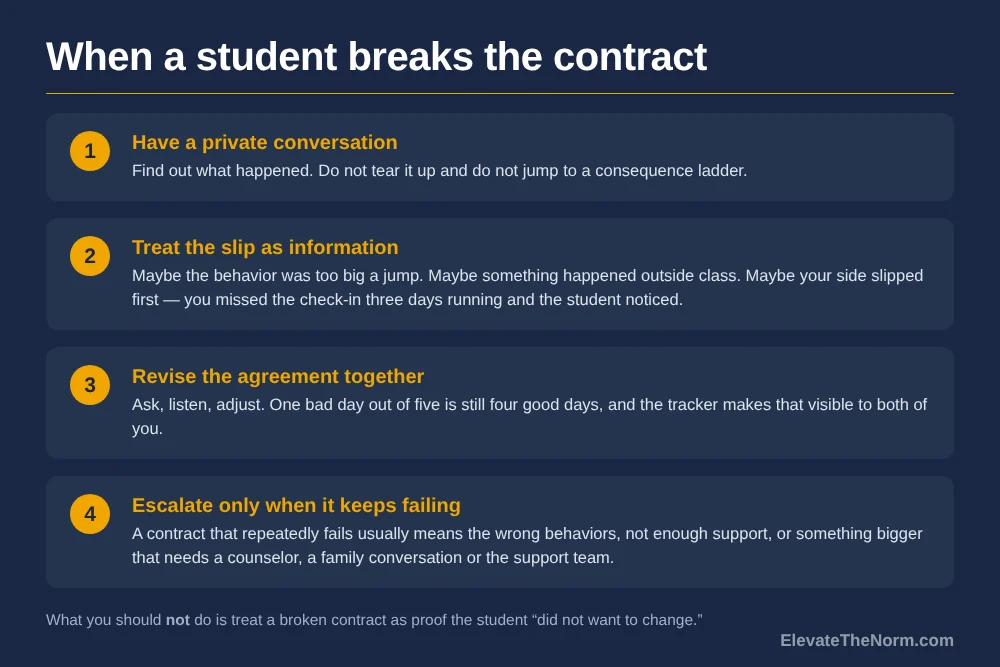
    Four numbered steps for when a student breaks a behavior contract: have a private conversation, treat the slip as information, revise the agreement together, and escalate only when it keeps failing.
    A slip is information, not proof the student did not want to change.

    What to do when a student breaks the contract

    Have a private conversation, find out what happened, and revise the agreement together. Do not tear it up and do not jump straight to a consequence ladder.

    A slip is information. Maybe the behavior was too big a jump. Maybe something happened outside class. Maybe your side of the contract slipped first — you forgot the check-in three days running, and the student noticed. Ask, listen, and adjust. One bad day out of five is still four good days, and the tracker makes that visible to both of you.

    What you should not do is treat a broken contract as proof the student “did not want to change.” If the same contract keeps failing, that usually means the behaviors were the wrong ones, the support was not enough, or something bigger is going on that needs a counselor, a family conversation, or a referral to your school’s support team. If you need a paper trail at that point, my Behavior Documentation Forms are built for MTSS-style logs (details here).

    Ending the contract on purpose

    Most student behavior contracts should finish, not renew forever. The point is for the habit to become the student’s, not to keep the student on paper for a semester.

    When the goal is met, say so plainly and mark it. Retire the tracker. Tell the student what you noticed. If it fits, make the positive call home. Then fade the support you added — the signal, the check-in — gradually, so the student is doing it without the scaffold. A student who finishes a contract should walk away with proof they can set a goal and meet it, which is a better outcome than three weeks of quieter mornings. For the bigger picture on building that kind of ownership, see positive discipline for teens.

    The student behavior contract, in one paragraph

    Write a student behavior contract with the student, not for them. Keep it to three observable behaviors, put your own commitments in writing next to theirs, check in for two minutes a day, keep it private, and decide on day one how it ends. The evidence supports contracts as a moderate, reliable tool for one student at a time. What makes them work in a secondary classroom is that they treat the student as someone capable of keeping their word — and they require the teacher to keep theirs. Download the free template and use it with the next student who tells you they want something to change.

    Sources

    1. Bowman-Perrott, L., Burke, M. D., de Marin, S., Zhang, N., & Davis, H. “A Meta-Analysis of Single-Case Research on Behavior Contracts: Effects on Behavioral and Academic Outcomes Among Children and Youth.” Behavior Modification, vol. 39, no. 2, 2015, pp. 247–269. Supports the moderate overall effect (ES = .57), the finding that results held regardless of grade level, gender, or disability status, and the stronger effect for reducing inappropriate behavior. Caveat: 18 single-case experiments with 58 participants aged 5–21; single-case designs show a strategy can work for individuals, not how often it works across a school, and the sample is not limited to secondary students. https://doi.org/10.1177/0145445514551383
    2. IRIS Center, Vanderbilt University. “Behavior Contracts” (information brief). Supports the definition of a behavior contract as a positive-reinforcement planning document, its core components, and the common failure points, including minimal student input. Caveat: a practitioner brief rather than a research study; it does not report effect sizes. https://iris.peabody.vanderbilt.edu/information-brief/behavior-contracts/

    Frequently Asked Questions

    Is a student behavior contract legally binding?

    No. A classroom behavior contract is a planning tool and a good-faith agreement, not a legal document. It does not change school policy, override a discipline code, or replace an IEP, a 504 plan, or a formal Behavior Intervention Plan. If a student already has one of those, the classroom contract has to match it, and the student’s case manager should see it before you use it.

    Should parents sign a student behavior contract?

    It helps when the family wants to be involved, but make it optional. The agreement is between you and the student, and a contract that only counts once an adult at home signs it tells a teenager their own word is not enough. Do let families know a contract exists and what it says. A short positive message when the student meets the goal is often the most useful part of the family connection.

    How long should a behavior contract last?

    Two to four weeks for the first review, with a clear end point written in from the start, such as eight good days out of ten. Long enough to show a pattern, short enough to stay motivating. A contract that runs all semester usually means the behaviors were too broad or the support was not working, and it is time to revise rather than renew.

    What rewards work for middle and high school students?

    Ask the student. Older students usually care less about prizes and more about things like a positive call or message home, a choice of seat, a pass on one homework assignment, or simply having the contract finished and off their record. Recognition they chose is worth more than a reward you picked. Keep it modest and keep it private.

    Isn’t a behavior contract unfair to the rest of the class?

    Fair means everyone gets what they need to meet the same standard, not identical treatment. The contract does not lower the expectation for one student. It adds structure and support so that student can meet the same expectation everyone else is held to. Because the contract is private, classmates generally never know it exists, which also protects the student’s dignity.

    How much time does a behavior contract take?

    About ten minutes to write it with the student, roughly two minutes a day to check in, and five minutes at the end of each week. That is far less time than repeated redirections, referrals, and parent phone calls about the same behavior. If you cannot commit to the daily check-in, do not write the contract yet, because a skipped check-in tells the student the agreement only goes one way.

    What if a student refuses to sign the contract?

    Do not force it. A signature given under pressure is meaningless. Ask what part they disagree with and whether they would change something about it. Often the objection is to wording that feels like a label, and rewriting it in their own words solves it. If they still decline, keep using your normal classroom procedures and offer again later. The offer itself tells them you think they can change.

    Can I use a behavior contract for a whole class?

    A whole-class version is really a set of classroom expectations or norms, and it works differently. Individual behavior contracts are built for one student and one specific pattern. If many students are struggling with the same thing, the fix is usually the routine or the procedure itself, not a stack of individual contracts.

    About Clay Shumate

    Clay Shumate is a certified secondary Social Studies teacher in the public schools of West Alabama, with seven years of classroom experience, a B.A. in History, and an M.Ed. in Secondary Education. He writes about project-based learning, student responsibility, respect, and practical ways to hold young people to a higher standard while giving them room to learn from mistakes. He is a member of the Society of Professional Journalists and writes to its Code of Ethics; this site’s editorial standards and corrections policy are published in full. More about Clay.

  • Early Finisher Activities for Grades 6–12 That Students Won’t Read as a Punishment

    Early Finisher Activities for Grades 6–12 That Students Won’t Read as a Punishment

    By Clay Shumate

    Early finisher activities are what a student does with the minutes between finishing the assigned work and the end of the period. In grades 6–12 the question is not which activity is fun enough. It is what the activity teaches the room about finishing early. Hand out more work and students learn to work slower; hand out nothing and you lose the minutes. Everything below is built on that one trade.

    Search for this and you get kindergarten centers, art-room doodle bins and first-grade challenge cards. Very little of it survives contact with a fifteen-year-old who has worked out that being done means being handed another worksheet.

    Key Takeaways

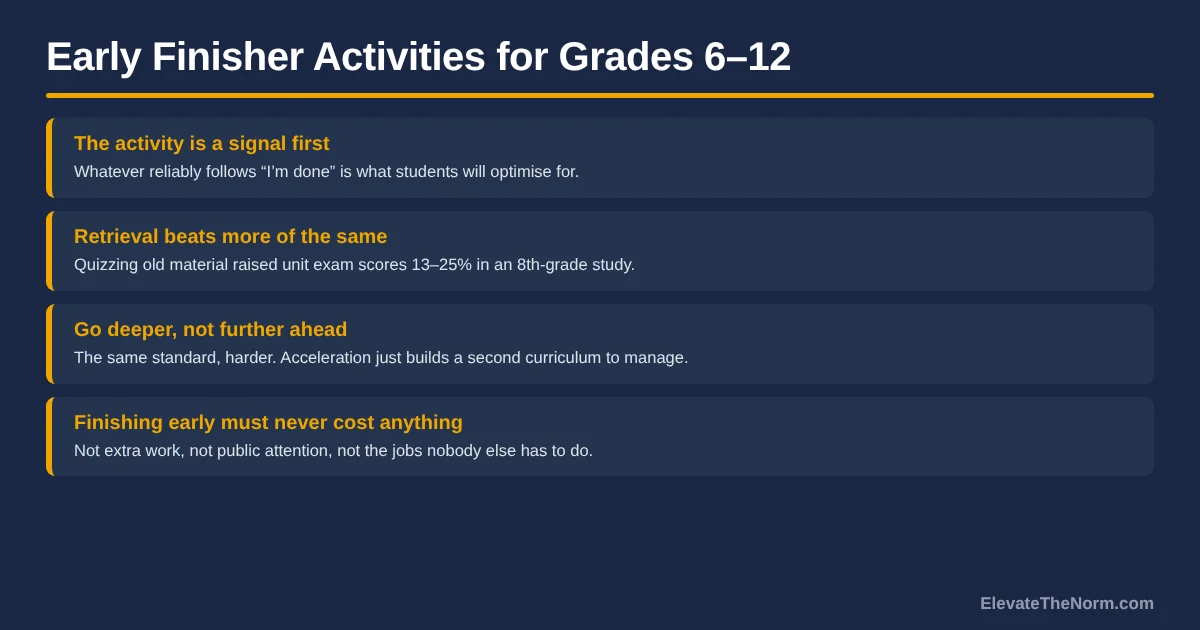
    • The activity is a signal before it is a task. Whatever reliably follows “I’m done” is what students will optimise for. Design the signal first and the activity second.
    • Use the minutes for retrieval, not new content. Quizzing on material already taught produced 13–25% gains on unit exams in an eighth-grade science classroom, and practice testing is one of only two techniques a major review rated high utility.
    • Going deeper beats going further. Pushing an early finisher into next week’s content creates a second, invisible curriculum you then have to manage.
    • A standing menu beats daily invention. Choice reliably lifts motivation — but the same meta-analysis found no significant effect on learning, so build the menu for willingness, not for test scores.
    • Never make finishing early cost anything. Not more work, not public attention, not a job nobody else has to do.

    What Are Early Finisher Activities?

    Early finisher activities are planned, low-supervision tasks a student moves to independently after completing the assigned work, before the class has moved on together. In a secondary classroom they usually need to work in gaps of three to twelve minutes, require no new instruction, make no noise that disrupts students still working, and need no grading from you.

    This is the operational end of differentiation rather than differentiation itself. Deciding how to vary a task by readiness is a planning question; deciding what a student does in the nine minutes after they finish it is a routine question. They are related and they are not the same job, and conflating them is why early finisher advice so often arrives as a lesson-planning project nobody has time for.

    That list of constraints is the whole design problem. Most published ideas fail at least two of them. Anything that needs you to explain it, mark it, or supervise it is not an early finisher activity — it is a second lesson you are now teaching to one student while twenty-nine others work.

    Why This Changes After Elementary School

    An elementary teacher with one class of twenty-four can keep a physical bin of activities, knows every child’s reading level, and has the same students all day. None of that is true in a middle or high school room. You may see 150 students across five or six sections, in periods short enough that ten minutes is a fifth of the class, and you will never have the same ten minutes free twice.

    The second difference matters more, and almost nothing written about early finishers acknowledges it. Teenagers read incentives accurately and act on them. A nine-year-old handed a bonus puzzle is usually pleased. A sixteen-year-old handed a bonus puzzle does the arithmetic: working efficiently produced more work, so next time, work slower. You are not managing boredom. You are setting the price of finishing.

    This is the same reason the usual advice about keeping students busy stops working somewhere around sixth grade, and it is why a routine that students can see the logic of does more for you than any individual activity. The ones that hold up are the ones a student would still choose if nobody were watching.

    How Much Time Is Actually in Play?

    Less than the productivity advice implies, and more than you would guess from any single lesson.

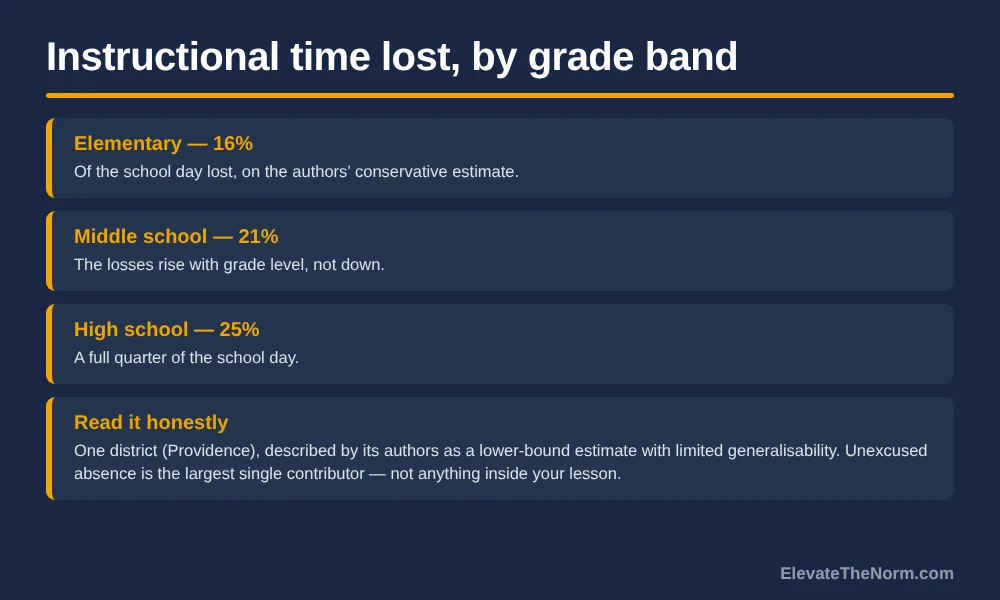
    Matthew Kraft and Sarah Novicoff’s 2024 analysis of Providence Public Schools estimated that students lose 16 to 25 percent of the school day, rising by grade band: 16 percent for the average elementary student, 21 percent in middle school and 25 percent — a full quarter — in high school. Two honest caveats belong with those numbers. The largest single contributor is unexcused student absence, not anything happening inside your lesson. And the authors call their own figure a lower-bound estimate from one district with, in their words, “limited generalizability.”

    Chart listing instructional time lost by grade band: 16 percent elementary, 21 percent middle school, 25 percent high school, with a note that the figures come from one district, are a lower-bound estimate, and that unexcused absence is the largest contributor.
    Time lost rises with grade level – and the headline figure is mostly not about your lesson.

    Their paper also cites other researchers’ estimates that off-task behaviour, transitions and wait time together occupy 17 to 29 percent of instructional time. That is the range closest to the early finisher problem — but it is a figure Kraft and Novicoff are reporting from other studies rather than measuring themselves, it bundles three different things together, and no part of it is specifically “students who finished early.” Anyone quoting you a clean number for that is estimating.

    What you can say defensibly: the dead minutes are a real and measurable share of the week, they are worse in secondary than in elementary, and the portion you personally control is smaller than the headline. That is still worth planning for. It is not worth a system so elaborate it costs more time than it recovers — and the same arithmetic applies to the minutes lost moving a class from one task to the next.

    The One Rule: Finishing Early Can Never Cost a Student

    If you take one thing from this, take this. Every early finisher system succeeds or fails on whether students believe that working well is safe.

    Three things make finishing early expensive, and all three are common:

    • More of the same. Another page of the problems they just demonstrated they can do. This is the most common response and the most costly one, because it is transparently a penalty for competence.
    • Public attention. “Marcus is finished — everyone else needs to hurry up.” You have just made finishing early a social liability and told the rest of the room they are behind.
    • Unpaid labour. Handing out papers, tidying, tutoring a classmate who has not asked for help. Occasionally fine and genuinely useful; as a default it means the fastest workers do the chores.

    The alternative is not a reward system. It is predictability. Students should be able to state, without asking, what happens when they finish — and it should be the same thing on Monday as on Thursday. Respecting students mostly comes down to doing exactly what you said you would do, every time, and an early finisher routine is an unusually visible test of it. If you promise that finishing early buys you a free read and then fill the time with a worksheet twice, the routine is finished.

    The useful question is not “what do I give them?” but “what do I want students to conclude about finishing early?” Answer that and the activity list mostly writes itself. This is the same logic that makes a written plan for how the room runs more useful than a list of rules.

    Early Finisher Activities That Hold Up in Grades 6–12

    Ordered by what they cost you, cheapest first. The first three cost nothing once set up, which is the only reason they survive a real February.

    List of six early finisher options ordered by what they cost the teacher: retrieval on old material, going deeper on the same standard, work the student already owns, a standing menu of three or four, reading, and low-stakes thinking tasks.
    Six options, cheapest first. The first three cost nothing once set up.

    1. Retrieval on old material — costs nothing, pays the most

    Have the student answer three or four questions about material from two or three weeks ago, not from today. This is the single best-evidenced use of the time, and the evidence is from the right age group. In an eighth-grade science classroom, McDaniel and colleagues found that quizzing on previously taught content produced 13 to 25 percent gains on summative unit exams compared with content that was not quizzed, and the advantage persisted on cumulative semester and end-of-year exams. Review quizzing — close to the exam rather than immediately after the lecture — produced the largest gains.

    A broader review by Dunlosky and colleagues rated only two of ten study techniques as high utility: practice testing and distributed practice. Both are exactly what a three-minute retrieval card is. Summarising, highlighting and rereading were rated low utility, which rules out most of what students do voluntarily with spare minutes. The same authors are careful to say these techniques “will not be a panacea” and will benefit only students motivated and able to use them — so this is a strong default, not a guarantee.

    The practical objection is where the questions come from, and the answer has to be “not from you, daily.” Build one stack per unit as you teach it — four index cards, three questions each, written once while the material is fresh — and then reuse the stack for the rest of the term. A system that needs you to generate questions in the moment is a system you will stop using in week three.

    Keep it ungraded and keep it short. The point is the act of retrieving, and the moment it carries a grade it becomes an assessment you have to mark. If you already run a recall task at the start of the period, the early finisher version is the same instrument pointed at a different gap in the lesson. If you want a stack you did not have to write, I give away a free five-day warm-up sampler for grades 6–12 that works the same way in the spare minutes.

    2. Going deeper on the same standard — costs minutes

    Not the next unit. The same target, harder. If the task was identifying a claim, the extension is to find the weakest evidence supporting it and say why. If the task was solving for x, the extension is to write a problem whose answer is seven and explain how they built it.

    Depth keeps everyone on the same destination, which is the thing that makes it manageable. Acceleration creates a second curriculum: a student three sections ahead is now a planning problem for the rest of the term, and you will be the one reconciling it.

    3. Work the student already owns — costs nothing

    Revising a graded piece against the rubric. Finishing something missed during an absence. Writing the next step on a goal they set earlier. None of this requires you to invent anything, and all of it is work the student has a reason to care about because it is already theirs.

    This is the most under-used option in secondary classrooms and the easiest to defend to anybody who asks what a student was doing. It also pairs naturally with pulling a few students for a short booked session, because it gives the rest of the room something legitimate to be getting on with.

    4. A standing menu of three or four options — costs one planning block, once

    A posted, laminated, unchanging list. Three or four choices, not twelve. Students pick without asking. The menu is the system; the items on it matter less than the fact that it never changes and never has to be re-explained.

    Four is roughly the right number for a reason covered in the next section, and the list should include at least one option that is clearly not more work.

    Worth letting the class fill one of the slots. Not all four — you need the retrieval option on there and students will not choose it — but handing over one line costs you nothing, tells you what they actually consider worth doing with eight minutes, and makes the menu something they had a hand in rather than another posted rule.

    5. Reading — costs nothing, and say it plainly

    A book, an article, anything of their choosing. This is a legitimate use of eight minutes and it is worth announcing as such rather than treating it as what happens when you have run out of ideas. The honest framing is that nothing on this list is better for a student who has already demonstrated the standard.

    Two practical notes. Keep a shelf of anything readable in the room, because the student who has nothing to read is the student who has no option three. And whatever students bring is subject to the same materials expectations as anything else in your building — worth knowing your school’s position before you make reading a standing option rather than after.

    Where it goes wrong is leaving it unnamed. If reading is the fallback nobody mentions, students read it as the teacher giving up. If it is option three on a posted menu, it is a choice.

    6. Low-stakes thinking tasks — costs nothing, weakest evidence

    Puzzles, logic problems, a discussion prompt to write on, a challenge card. Genuinely useful for the student who is done, restless and not going to read. Put them last because the evidence that they produce learning is thin — their case is engagement and quiet, which is a real benefit honestly described rather than dressed up as rigour. I sell a print-and-go set of early finisher and brain break cards in my No-Prep Sub Plans, Early Finishers & Brain Breaks bundle for teachers who would rather not build the stack themselves.

    What Not to Hand Them

    More of the work they just finished. It is the default, it is understandable on a Tuesday, and it is the one thing on this page that actively trains students to slow down.

    There is relevant evidence, with a population caveat that matters on a secondary site. In a study reported by Reis and Renzulli, teachers across 27 districts eliminated 40 to 50 percent of the standard curriculum for students who had already mastered it. Post-test scores in science, maths, social studies and spelling were no different from the control group, and in language arts the compacted students scored significantly higher. Removing work from students who already knew the material cost them nothing.

    The caveat: that sample was 465 teachers in grades 2 through 6. Only the top of that band overlaps with this site’s readers, and the study was about formally compacting a curriculum, not about what to do with a spare eight minutes. It does not transfer directly. What it does establish is that the instinct behind “more practice can’t hurt” is wrong often enough to stop treating it as obviously safe. The same researchers also noted that many replacement activities their teachers used were not advanced enough to be worth the swap — which is the risk on this page too.

    Two more to avoid. Anything that needs new instruction, because you will be teaching it one-to-one while the class works. And anything you have to grade, because a system that generates marking will be abandoned by October.

    Does Giving Them a Choice Actually Help?

    Yes for motivation, and — stated plainly, because most articles on this topic imply otherwise — no for learning.

    Patall, Cooper and Robinson’s meta-analysis of 41 studies found choice had a positive effect on intrinsic motivation, with a weighted average of d = 0.30 (0.36 under a random-effects model). The effect was stronger when two to four successive choices were offered, stronger when no reward followed, and stronger for children than for adults — which means the benefit is probably smaller for your seniors than the headline figure suggests.

    The finding worth knowing: the effect of choice on subsequent learning was not significant (d = 0.10, with a confidence interval crossing zero). Thirteen of the ninety-one motivation effect sizes were negative. So build the menu because it makes students more willing to use the time and less likely to read the time as a penalty. Do not claim it raises test scores, because the best available synthesis does not support that.

    Practically: three or four options, no points attached, and do not keep adding to the list.

    Setting It Up So It Runs Without You

    The system is four sentences, posted where students can see it.

    1. Name the standard for “done.” Done means it meets the criteria on the board, not that the last box has writing in it.
    2. State what happens next, permanently. The three or four options, in the same place, all year.
    3. Say what it is never going to be. Telling a class outright that finishing early will never earn them extra work is worth more than any activity on the menu, and you then have to keep it.
    4. Make it silent and self-serve. If a student has to ask you, it will not survive a week when you are busy.
    Numbered list of the four-sentence early finisher routine: name the standard for done, state what happens next permanently, say what it is never going to be, and make it silent and self-serve.
    The whole system is four sentences, posted where students can see them.

    Two things that decide whether it holds. Phones. In a secondary room, “finished early” means phone unless you have said otherwise, and a menu that ignores that is a menu competing with a device and losing. Whatever your school’s policy is, the early finisher routine has to state its own position explicitly, because silence reads as permission. And the posted menu is your answer to a walkthrough. A room where six students are doing six different quiet things looks like drift to anyone standing in the doorway for ninety seconds; a laminated list on the wall is what makes it legible as a routine rather than a loss of control.

    What If They Finished Early Because They Rushed?

    Then the problem is the definition of “done,” not the activity, and no menu fixes it.

    The gate goes before the menu. If “done” means meets the posted criteria, a rushed paper is not done, and the student’s early finisher activity is the work itself. That conversation is short and it is not a reprimand: this does not meet the third criterion yet, have another look. Rushing is usually a rational response to a system in which finishing fast is rewarded and quality is not checked — which is the same mechanism as before, pointed the other way.

    The case that matters more, and the one most advice misses entirely: a student can arrive at “done” because they got stuck and quietly gave up. That looks identical to finishing early from across the room. It is the reason the gate is worth checking rather than assuming, and the response is not the menu — it is the two minutes of help the student did not ask for. A routine that cannot tell mastery from surrender will reliably reward the wrong one.

    If a student genuinely finishes good work early and often, that is information. It may mean the task is too easy for them, and the answer is a conversation about the course, not a sixth item on the menu.

    Where the Evidence Runs Out

    Honestly: there is no body of research on early finisher activities as such. Nobody has run a controlled trial on what secondary students should do with nine spare minutes.

    What exists is evidence about the components — retrieval practice, distributed practice, choice, curriculum compacting — mostly gathered in other settings and for other purposes, and in two of the four cases in samples younger than this site’s readers. The recommendations above are those findings applied by reasoning, and the reasoning is visible so you can disagree with it. The claim that the signal matters more than the activity is an argument from how incentives work, not a measured result.

    Treat the retrieval recommendation as well supported, the menu as reasonable and low-risk, and the rest as practice worth trying rather than settled.

    What to Do Next Week

    Write three options on a piece of paper and post it. Make one of them retrieval questions from two weeks ago, one of them work the student already owns, and one of them reading. Tell the class, once, that finishing early will never produce extra work.

    Then keep that promise for a month and watch two things. Whether the pace of the room changes — students stop stalling when stalling stops paying. And who is using the menu, because that is the equity question in this whole topic. Early finishers are disproportionately students who arrived already knowing more, so a routine that quietly hands the best minutes of the week to the students with the most prior knowledge widens a gap rather than closing one. If the same six names are always on option one, the honest read is that the task is too easy for them and too hard for everyone else, and that is a problem with the lesson rather than the menu.

    Different problem, same two minutes. When the whole class needs the reset rather than the fast finishers, see what a brain break looks like with 14- to 18-year-olds — and why the dance video is the fastest way to lose them. Retrieval needs something to retrieve from, which is an argument for a page students can actually quiz themselves on.

    Frequently Asked Questions

    What are early finisher activities?

    Early finisher activities are planned, low-supervision tasks a student moves to independently after completing the assigned work, before the class moves on together. In grades 6 through 12 they need to work in gaps of roughly three to twelve minutes, require no new instruction from the teacher, stay quiet enough not to disturb students still working, and generate nothing the teacher has to grade. Most published ideas fail at least two of those four constraints.

    What should early finishers do in middle school and high school?

    The best-evidenced option is retrieval practice on material taught two or three weeks earlier, because quizzing previously taught content raised unit exam scores by 13 to 25 percent in an eighth-grade science study. After that: going deeper on the same standard rather than moving ahead to new content, finishing or revising work the student already owns, and reading. Keep the whole list to three or four standing options rather than inventing something each day.

    Should early finisher work be graded?

    No. A grade turns the task into an assessment the teacher has to mark, and any early finisher system that generates marking gets abandoned within a few weeks. It also changes what the activity signals: work that counts is work, and students who notice that finishing early produces more graded work will simply finish later. Keep it ungraded and keep it short.

    How many options should an early finisher menu have?

    Three or four. The meta-analysis on choice found the motivational benefit was strongest when two to four successive choices were offered, and a longer list costs more to maintain without adding anything. One of the options should be clearly not more work. Letting the class choose what goes in one of the slots is worth doing, though the retrieval option should not be the one put to a vote.

    What do I tell a parent who asks why their child spent ten minutes reading?

    The honest answer is usually the best one: their child met the standard for the assignment before the period ended, and rather than being given repetitive extra practice they already demonstrated they do not need, they read. If a parent pushes further, the useful information is whether this happens often. A student who regularly finishes good work early is telling you the task is not demanding enough for them, and that is a conversation about the course rather than about the ten minutes.

    What if a student finishes early because they gave up rather than because they understood?

    This is the case most advice misses, and from across the room it looks identical to genuine early finishing. It is the reason done should mean meets the posted criteria rather than has writing in every box. When a student has stopped because they are stuck, the response is not the activity menu, it is two minutes of help they did not ask for. A routine that cannot tell mastery from surrender will reliably reward the wrong one.

    Do early finisher activities widen the gap between students?

    They can, and it is worth watching for. Students who finish early are disproportionately students who arrived already knowing more, so a routine that gives the best spare minutes of the week to that group can widen a gap rather than close it. The practical check is who is actually using the menu. If it is the same few names every time, the likeliest explanation is that the task is too easy for them and too hard for the rest, which is a problem with the lesson rather than with the menu.

    Can students use their phones when they finish early?

    That depends on your school policy, but the routine has to state its own position out loud either way. In a secondary classroom, finished early means phone unless something else has been established, so silence on the question reads as permission. A menu that does not address phones is competing with a device and losing.

    Sources

    1. Kraft, M. A., & Novicoff, S. (2024). Time in School: A Conceptual Framework, Synthesis of the Causal Research, and Empirical Exploration. EdWorkingPaper No. 22-653, Annenberg Institute, Brown University. Estimated that students in the Providence Public School District lose 16–25% of the school day — 16% in elementary, 21% in middle and 25% in high school — with unexcused student absence the largest single contributor. The authors describe this as a lower-bound estimate from a single district and state that their case-study results likely have “limited generalizability.” The separate 17–29% figure for off-task behaviour, transitions and wait time combined is their summary of other researchers’ estimates, not their own measurement, and is not specific to students who finish early. https://www.edworkingpapers.com/ai22-653
    2. McDaniel, M. A., Agarwal, P. K., Huelser, B. J., McDermott, K. B., & Roediger, H. L. (2011). Test-Enhanced Learning in a Middle School Science Classroom: The Effects of Quiz Frequency and Placement. Journal of Educational Psychology, 103(2), 399–414. Eighth-grade science classes; multiple-choice quizzes with feedback on some unit content and not others, allowing a within-class comparison. Quizzing produced 13–25% gains on summative unit examinations, review quizzing close to the exam produced the largest gains, and the advantage persisted on cumulative semester and end-of-year exams. https://doi.org/10.1037/a0021782
    3. Dunlosky, J., Rawson, K. A., Marsh, E. J., Nathan, M. J., & Willingham, D. T. (2013). Improving Students’ Learning With Effective Learning Techniques: Promising Directions From Cognitive and Educational Psychology. Psychological Science in the Public Interest, 14(1). Of ten study techniques reviewed, only practice testing and distributed practice received a high utility rating; summarisation, highlighting and underlining, and rereading were rated low utility. The authors caution that the techniques “will not be a panacea” and will benefit only students who are motivated and capable of using them. Cited here from the Association for Psychological Science’s published summary of the report, which was the version read; the full monograph was not accessed. https://www.psychologicalscience.org/news/releases/which-study-strategies-make-the-grade.html
    4. Patall, E. A., Cooper, H., & Robinson, J. C. (2008). The Effects of Choice on Intrinsic Motivation and Related Outcomes: A Meta-Analysis of Research Findings. Psychological Bulletin, 134(2), 270–300. 41 studies, 290 effect sizes from 46 samples. Choice had a positive effect on intrinsic motivation (weighted average d = 0.30, 95% CI 0.25–0.35 fixed-error; d = 0.36 random-error), strongest when two to four successive choices were offered, when no reward followed, and for children rather than adults. The effect on subsequent learning was not significant (d = 0.10, 95% CI −0.02 to 0.21), and 13 of the 91 intrinsic-motivation effect sizes were negative. https://pubmed.ncbi.nlm.nih.gov/18298272/
    5. Reis, S. M., & Renzulli, J. S. (2005). Curriculum Compacting: An Easy Start to Differentiating for High-Potential Students, reporting the technical results of Reis et al. (1992). 27 school districts and 465 teachers, randomly assigned to treatment or control. Where 40–50% of the standard curriculum was eliminated for students who had already mastered it, post-test scores did not differ from controls in science, mathematics concepts, mathematics computation, social studies or spelling, and were significantly higher in language arts. The sample was grades 2 through 6, so only the top of that band overlaps with secondary classrooms, and the study concerned formal curriculum compacting rather than short in-period extension tasks. The authors also noted that many replacement activities their teachers used were not advanced enough to suit high-ability students. https://gifted.uconn.edu/schoolwide-enrichment-model/curriculum_compacting

    About Clay Shumate

    Clay Shumate is a certified secondary Social Studies teacher in the public schools of West Alabama, with seven years of classroom experience, a B.A. in History, and an M.Ed. in Secondary Education. He writes about project-based learning, student responsibility, respect, and practical ways to hold young people to a higher standard while giving them room to learn from mistakes. He is a member of the Society of Professional Journalists and writes to its Code of Ethics; this site’s editorial standards and corrections policy are published in full. More about Clay.

Teacher Emergency Toolkit — practical resources, real classroom support. Shop on TPT.Teacher Emergency Toolkit — practical resources, real classroom support. Shop on TPT.