The Elevate Blog banner: Real Classrooms. Practical Ideas. Higher Expectations. Three students climb a rocky ridge at sunrise, each pulling the next one up, toward a teacher reaching down to help.

Category: Classroom Management

Behavior, routines, and what actually holds a room together without raising your voice.

  • Brain Breaks for High Schoolers: What Works When They Are Too Old for the Dance Video

    Brain Breaks for High Schoolers: What Works When They Are Too Old for the Dance Video

    By Clay Shumate

    Brain breaks for high schoolers are short, deliberate pauses — usually two to ten minutes — that interrupt sustained work before attention falls apart. The evidence at this age is thinner than the advice suggests: a review limited to 13- to 16-year-olds found only three studies. What support exists points at classroom behaviour, not test scores.

    That is the honest version, and it is worth starting there, because almost everything written about brain breaks was researched on nine-year-olds and then handed to people teaching sixteen-year-olds. The practices can transfer. The evidence does not automatically come with them, and a teenager can tell the difference between a break designed for them and one borrowed from a third-grade classroom.

    Key Takeaways

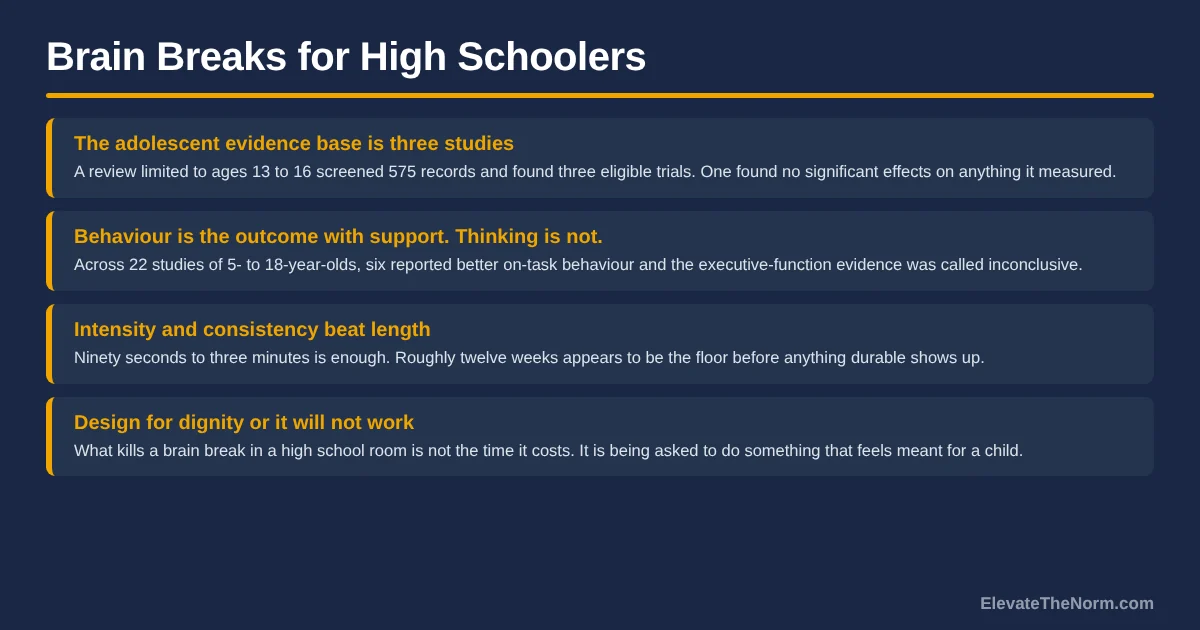
    • The adolescent evidence base is three studies. A 2022 systematic review restricted to secondary and high school students aged 13 to 16 screened 575 records and found three eligible trials. One of the three found no significant effects on anything it measured.
    • The strongest single result is recent, large and heavily caveated. A cluster-randomised trial of 529 Italian adolescents averaging 14.3 years found a large gain on a standardised concentration test after four months of two ten-minute active breaks a day. The authors list baseline imbalance, possible contamination and no pre-planned sample-size calculation among the limits.
    • Behaviour is the outcome with support. Thinking is not. Across 22 studies of 5- to 18-year-olds, six reported improved on-task behaviour, five reported executive-function gains the reviewers called inconclusive, and most of the studies were rated poor or fair quality.
    • The famous “brief diversions” lab finding did not replicate. A 498-participant study testing it directly found the same attention decline in every group, with the statistics favouring the null.
    • Design for dignity or it will not work. The thing that kills a brain break in a high school classroom is not the time it costs. It is being asked to do something that feels like it was meant for a child.

    What Are Brain Breaks for High Schoolers?

    A brain break is a short, planned interruption to sustained cognitive work — a change of posture, task or physical state — taken before students stop being able to work, not after. In the research literature the term usually means an active break: a few minutes of movement inside the lesson, distinct from a physically active lesson where the content itself is taught through movement.

    Two things separate a break from an interruption. A break is scheduled or triggered by something you decided in advance, and it has a defined end. A class that drifts for four minutes because the teacher lost the room has had an interruption. A class that stands up for ninety seconds at a planned point and sits back down has had a break. The difference is entirely about who called it.

    The grade level matters more here than almost anywhere else on this site. In most studies the participants are primary-aged, the activity is a dance video or an animal-themed movement sequence, and the measured outcome is on-task behaviour. None of that is useless, but a room of fifteen-year-olds will refuse the format long before they refuse the idea.

    Do Brain Breaks Actually Work for Teenagers?

    The evidence says probably, mostly for classroom behaviour, and there is much less of it than the volume of advice would suggest.

    A 2022 systematic review set out to answer exactly this question and restricted itself to pre-adolescent and adolescent students in secondary and high schools. It screened 575 records. After title, abstract and full-text screening, three studies met the criteria — one in Norway, one in the UK, one in Australia, with participants aged 13 to 16 and samples from 97 to 447. Most of what was excluded was primary-school research.

    What those three found, honestly:

    • All three reported the breaks were feasible and acceptable in a real secondary timetable. That is not nothing — feasibility is where most classroom interventions die.
    • Two reported improvements in classroom behaviour and in vitality or quality of life.
    • One found no significant effects on physical activity, sedentary time, behaviour or wellbeing.
    • None of the three reported a direct cognitive measure, even though cognitive function was named in the review’s own aims.

    Study quality was rated poor, fair and good — one each. The reviewers urged caution interpreting three heterogeneous studies and noted that around twelve weeks appears to be the minimum duration before anything durable shows up. That last point is the one most likely to matter to you: nobody has shown that a brain break on Tuesday improves anything on Tuesday.

    The broader picture across all school ages is consistent with that. A 2025 systematic review of 22 studies covering 3,615 participants aged 5 to 18 found six studies reporting positive effects on classroom behaviour, mostly on-task behaviour, with moderate-to-vigorous activity appearing more beneficial. On executive functions — inhibitory control, cognitive flexibility, working memory — five studies reported improvements and the reviewers called the overall evidence inconclusive. Physical fitness results were unclear. Most included studies were rated poor or fair quality, and the review pooled nothing, so there is no overall effect size to quote.
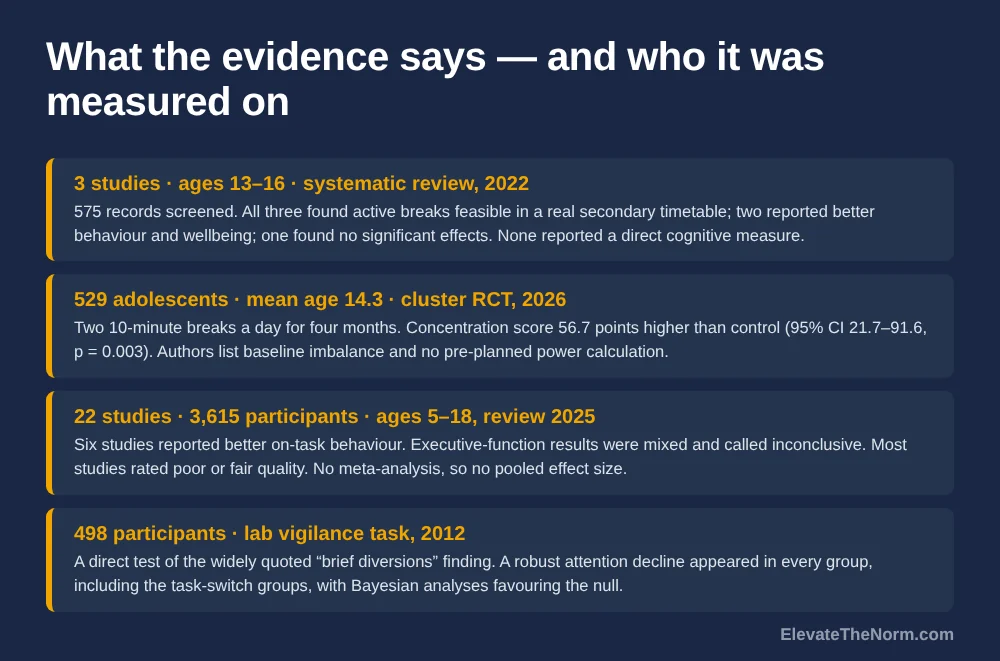
    Four research findings on brain breaks with the population of each named: a 2022 review limited to ages 13 to 16 that found three studies, a cluster randomised trial of 529 adolescents, a 2025 review of 22 studies covering ages 5 to 18, and a 498-participant laboratory test of the brief diversions finding
    Four sources, with the population attached to each one.

    What Does the Best Secondary Study Show?

    A large concentration gain, in a well-run trial, with a limitations section long enough to take seriously. It is the single most relevant result available and it deserves to be read properly rather than reduced to a headline.

    Martone and colleagues ran a cluster-randomised controlled trial across four upper secondary schools in Campania, in southern Italy. Thirty-nine classes were allocated — 20 intervention, 19 control — covering 529 adolescents with a mean age of 14.3 years. The intervention was two ten-minute active breaks every school day for four months, in the second and fifth lesson periods: mobilisation, stretching, strengthening, coordination and balance, run from one of twelve music-based videos on the interactive whiteboard with a teacher present. Fidelity was high — 180 of 192 scheduled breaks delivered, about 94% attendance — and in a subsample of 150 students the mean heart rate during a break was 155 beats per minute, which the authors describe as moderate-to-vigorous at group level.

    Attention was measured with the Italian d2-R test. After four months the adjusted concentration score was 151.3 in the intervention group against 94.7 in the control group — a difference of 56.7 points (95% CI 21.7 to 91.6), p = 0.003, holding at 54.7 points in a fully adjusted model. Exploratory checks found no significant moderation by sex, sport participation, sleep, smartphone use or diet.

    Now the caveats the authors themselves list, because they change how much weight this carries. Randomisation was not stratified, and the groups differed at baseline on age, weight, baseline concentration score, sleep and smartphone use. Intervention and control classes sat in the same schools, so contamination is possible. No a priori sample-size calculation accounting for clustering was done, and no standardised effect size is reported for the main result. Repeated testing may have produced a practice effect. There was no long-term follow-up, teacher acceptability was not assessed, and the impact on instructional time was not measured — which, for a school giving up twenty minutes a day, is the question an administrator will ask first.

    None of that makes the finding worthless. It makes it one good trial in one region, pointing in a direction the weaker evidence also points. Treat it as encouraging rather than settled, and notice what the design required: twenty minutes a day, every day, for four months, with specialists involved. That is not “a quick stretch when they get restless.”

    What About the “Brief Diversions” Study Everyone Cites?

    It did not replicate, and the replication attempt was four times the size. This one is worth knowing because it turns up constantly in professional development on attention, usually as a hard number about how long focus lasts.

    The original is Ariga and Lleras (2011), in Cognition. Participants did a long visual vigilance task while holding digits in memory. Those who recalled the digits only at the end showed a steep decline in performance over time; those asked to recall them sporadically during the task did not. The authors argued that briefly deactivating and reactivating the task goal prevents the drop-off — the result that got written up as brief diversions dramatically improving focus.

    In 2012, Helton and Russell published a direct test in Experimental Brain Research with 498 participants, pitting that goal-habituation account against two rivals. They found a robust vigilance decrement in every group, including the task-switch groups. Self-reported workload and task-unrelated thoughts did not differ. Bayesian analyses favoured the null hypothesis.

    Two honest conclusions follow. First, if someone tells you research proves attention resets after a short diversion, the strongest direct test of that claim says otherwise. Second — and this is the part worth holding onto — neither study was run in a classroom on teenagers. A lab vigilance task is not a fourth-period lesson. The case for brain breaks in a high school room does not rest on that literature and should not be made from it.

    How Long Should a High School Brain Break Be?

    Short enough to come back from, long enough to change physical state: ninety seconds to three minutes for a routine break, ten if you are running something structured. There is no validated number, and the honest answer is that duration has not been isolated as a variable in the adolescent research.

    What you can take from the evidence is the shape rather than the figure. The Italian trial used ten minutes twice a day and got its result over four months. The adolescent review found interventions ranging from 14 to 60 minutes, two to six times a week, over 11 weeks to 12 months, and suggested roughly twelve weeks as the floor for anything lasting. The across-ages review found moderate-to-vigorous intensity looked more useful than gentle movement.

    So the practical reading is: intensity and consistency matter more than length. Ninety seconds of actually standing up and moving beats five minutes of sitting and chatting, and doing it most days for a term beats doing it brilliantly for a fortnight.

    What Brain Breaks Actually Work With 14- to 18-Year-Olds?

    The ones that do not require a teenager to perform enthusiasm. That is the whole selection rule. A high schooler will do almost anything that has a point and almost nothing that makes them look like a child in front of people whose opinion they care about.

    BreakLengthWhy it survives a high school room
    Stand and finish the thought60–90 secEveryone stands; nobody performs. Posture change with no social cost
    Walk and talk2–3 minMovement plus a content question. Pairs walk the perimeter and come back with one sentence
    Board race, low stakes3 minCompetitive, physical, content-adjacent. Teams, not individuals, so nobody is exposed
    Reset and re-read2 minStand, stretch, sit, reread the last paragraph. Honest about being a reset rather than a game
    Two-minute silence with a pen2 minNo talking, no phones, write anything about the topic. The quiet students’ favourite
    Choice of three2–3 minOffer three options and let the class pick. Autonomy does most of the work
    Six formats that hold up with older students, and the reason each one does.

    Notice that four of the six involve standing and two involve talking about the content. That is deliberate. A break does not have to be empty to be a break — a change of posture and a change of task is enough, and tying it loosely to the lesson makes it far easier to defend and far easier to restart from. If you want the talking version to carry real weight, the same two minutes can be run as student-to-student discourse about the content rather than as filler.
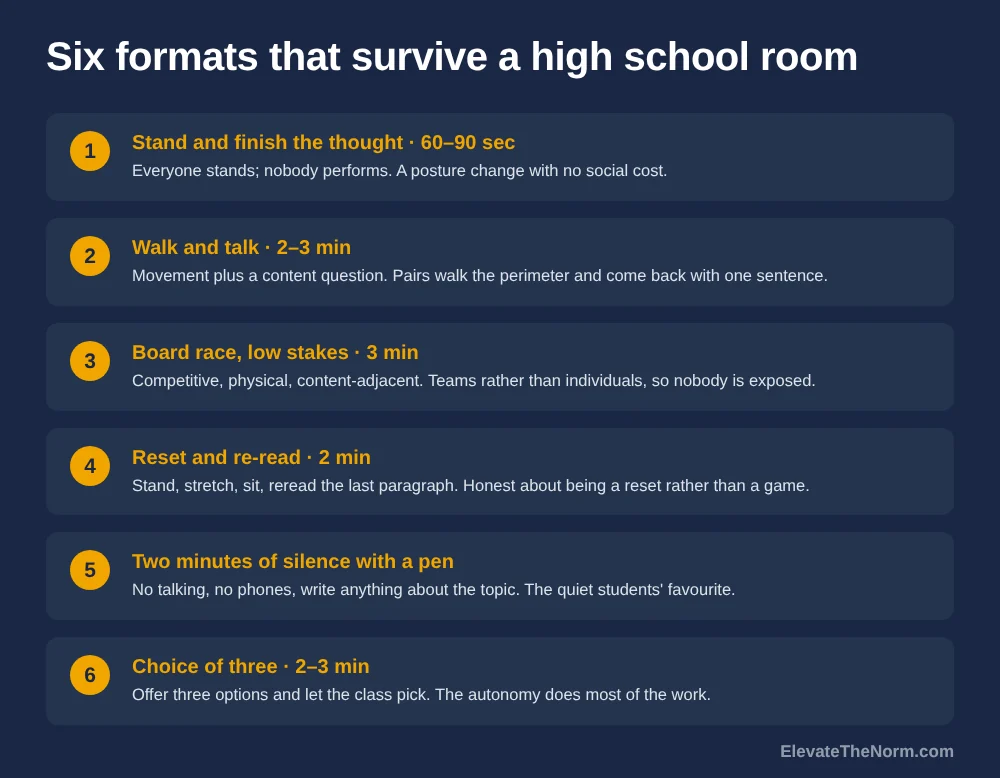
    Six numbered brain break formats for high schoolers with their lengths: stand and finish the thought, walk and talk, a low-stakes board race, reset and re-read, two minutes of silence with a pen, and a choice of three options
    Six formats that hold up with older students.

    What Should You Never Do?

    Four things, each of which ends the practice in one lesson.

    1. Anything that requires a volunteer to be funny in front of the class. You are asking a self-conscious sixteen-year-old to take a social risk for your pacing. The answer will be no, and after it is no once it is no permanently.
    2. Elementary branding. The dance video, the animal sounds, the cartoon timer. The activity may be fine; the packaging tells students what you think of them.
    3. Using it as a reward. The moment the break is contingent on behaviour, it is a management lever, not a break — and the class that most needs it is the class that will never earn it.
    4. Taking it away as a punishment. Same reason, reversed, and it teaches students that the pause was never actually about how their brain works.

    There is a fifth that is less obvious: not ending it on time. If you say ninety seconds and take four minutes, you have taught the room that your numbers are approximate, and the next one will be harder to end. Standing by your word is the mechanism here, same as everywhere else. Set a timer where students can see it.
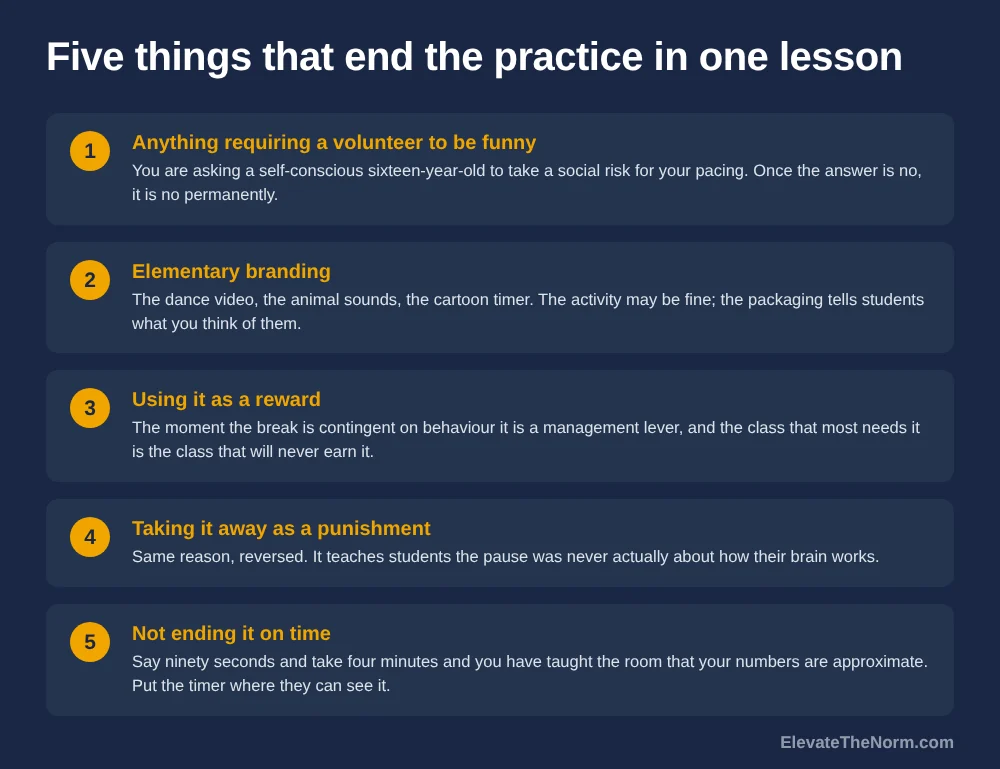
    Five numbered mistakes that end brain breaks in a high school classroom: requiring a volunteer to be funny, elementary branding such as dance videos and cartoon timers, using the break as a reward, taking it away as a punishment, and not ending it on time
    Any one of these ends the practice in a single lesson.

    How Do You Run One Without Losing the Room?

    You make the start and the end routine, and you never improvise either one. A break goes wrong in exactly two places: getting them out of the work and getting them back into it. Both are procedure problems and both are solvable in advance.

    1. Name it before it starts. “Ninety seconds. Stand up. Timer is on the board.” Students who know the shape of the next ninety seconds do not need to test it.
    2. Use a visible countdown. Not your watch. On the board, where every student can see how much is left, so nobody has to ask.
    3. Use one consistent signal to return. Whatever you already use — a signal the class already responds to works better than a new one invented for breaks.
    4. Give the first thirty seconds back a defined task. The return is harder than the break. “Sit down, read the question on the board, start writing” beats “okay, where were we.” This is the same principle that makes transitions between activities cost less time than they usually do.
    5. Do it at the same points for two weeks. A break at a predictable moment becomes a routine. A break at a random moment stays an event, and events need managing every time.

    If getting the room back is the part that worries you, build the break into a structure you already run well. A planned pause between two parts of a lesson, landing on an established routine, is a much smaller risk than a break dropped into open work time.

    When Does a Class Actually Need One?

    Before the attention goes, not after. Once a class has lost focus, a break reads as a reward for drifting and you have to rebuild from further back. The skill is spotting the slide early.

    Three reliable signals, in the order they appear: pen-stopping — the proportion of students writing drops while the proportion looking at the board stays the same; question quality falling — questions turn procedural, about format and length rather than content; and ambient noise rising at a constant task. Any two of those at once and you are past the point where pushing on gains you anything.

    And let students call it. A class that can request a break — one per period, by a signal rather than a speech, with the teacher keeping the right to say “finish this paragraph first” — will use it about as often as you would have, and will use it at better moments, because they can feel the slide before you can see it. It also changes what the break is: a tool a young adult is trusted to reach for rather than something administered to them. If that feels risky, cap it at one and try it for a fortnight. The classes that abuse it are usually the classes that were never told what it was for.

    The honest caveat: no study has validated those signals. They are the sort of thing experienced teachers watch for, and the research cannot tell you when to call a break because it has not studied that question. What the research does say is that consistency over about twelve weeks is what produced measurable change, which argues for a scheduled break most days rather than a reactive one on bad days.

    What Do You Tell an Administrator Who Walks In?

    What you are doing, why it is scheduled, and what the evidence does and does not support. That conversation goes much better if you have decided the honest version in advance.

    The defensible claim is narrow: short activity breaks have been found feasible in real secondary timetables, and the outcome with the most consistent support across school ages is on-task classroom behaviour. The claim to avoid is that brain breaks raise test scores — the adolescent studies did not measure cognition directly, and the executive-function evidence across ages is inconclusive. One cluster-randomised trial of 529 adolescents found a large concentration gain over four months, and its own authors list baseline imbalance and no pre-planned power calculation among the limits.

    On equity, there is one useful data point and it is worth having ready. The Italian trial ran exploratory checks on whether the concentration effect differed by sex, sport participation, sleep duration, smartphone use or diet, and found no significant interaction on any of them after correction for multiple testing. The authors label those analyses exploratory, so it is a weak finding rather than a strong one. It points the same way as everything else on this site: the benefit did not turn out to belong to the students who were already doing well.

    On safety and space, decide before the first break whether your room can actually hold it. Thirty-two desks in a room built for twenty-eight means standing in place rather than moving around, and a walk-and-talk needs a route that does not run between a bag and a chair leg. A student with a mobility limitation, an injury or a reason they have not shared should never have to say anything to sit one out — which is why the written version exists and why it is offered to the whole class rather than to individuals.

    On instructional time, do the arithmetic before you are asked. Ninety seconds twice a period is three minutes out of fifty — six percent. The Italian trial spent twenty minutes a day, which is a real cost and was a school-level decision rather than a teacher’s. If the claim is that the remaining 94% of the period is more productive, say that is the claim, and say nobody has measured it in your subject.

    What Should Families Know?

    That it is scheduled, it is brief, and it is not a reward or a punishment. Worth saying plainly, because “we did a brain break” can sound to a parent like a period went missing.

    Three things are fair to promise. It is not graded and it is not tied to behaviour — nobody loses a break for a bad day and nobody earns one for a good one. Participation is movement-optional; a student who cannot or does not want to move can stand, or stay seated and do the written version, and no explanation is owed. And the time is accounted for — a few minutes a period, scheduled, with the lesson built around it rather than interrupted by it.

    If a family asks whether it helps, the accurate answer is that the evidence supports better classroom behaviour and does not yet support better grades, and that most of the research was done on younger students. That is a less exciting answer than the one on most school newsletters, and it is the one that will still be true next year.

    What to Do This Week

    Pick one class and one slot. Do not roll this out across a timetable.

    Choose the moment first. Find the point in that period where the pens reliably stop — most teachers already know it — and put the break three or four minutes before it.

    Pick one format and keep it. Ninety seconds, standing, timer on the board. Do not vary it for two weeks; you are building a routine, not entertaining anybody.

    Define the first thirty seconds back. Write the return task on the board before the break starts, so coming back is reading rather than deciding.

    Count one thing. How many students are writing five minutes after the break compared with five minutes before it. One number, twice a week. It will not prove anything, and it will tell you whether to keep going.

    And if the first week is awkward, that is the normal result rather than a verdict. The research that found anything durable ran for twelve weeks or more. A format that feels forced on Tuesday and ordinary three weeks later is working exactly as the evidence says it should. If you want a lower-stakes place to start, the same ninety seconds slots neatly into the routines around how a period opens and around what students do when they finish early, both of which you are probably already running.

    Frequently Asked Questions

    What are brain breaks for high schoolers?

    Short, planned interruptions to sustained work — usually ninety seconds to ten minutes — that change a student’s posture, task or physical state before attention falls apart. In the research they are usually called active breaks: a few minutes of movement inside the lesson, as distinct from a physically active lesson where the content itself is taught through movement. The two things that make it a break rather than an interruption are that you called it in advance and that it has a defined end.

    Do brain breaks actually work for teenagers?

    Probably, mostly for classroom behaviour, and the evidence is thinner than the advice suggests. A 2022 systematic review restricted to students aged 13 to 16 screened 575 records and found only three eligible studies; all three reported the breaks were feasible, two reported improved behaviour and wellbeing, one found no significant effects on anything, and none measured cognition directly. Across all school ages, a 2025 review of 22 studies found six reporting better on-task behaviour and called the executive-function evidence inconclusive.

    How long should a brain break be in high school?

    Ninety seconds to three minutes for a routine break, up to ten if you are running something structured. There is no validated number — duration has not been isolated as a variable in the adolescent research. What the evidence does suggest is that intensity and consistency matter more than length: moderate-to-vigorous movement looked more useful than gentle movement, and roughly twelve weeks appears to be the minimum before anything durable shows up.

    What brain breaks work with older students?

    The ones that do not require a teenager to perform enthusiasm. Stand and finish the thought (60–90 seconds). Walk and talk in pairs with a content question (2–3 minutes). A low-stakes team board race (3 minutes). Stand, stretch, sit and reread the last paragraph (2 minutes). Two minutes of silence with a pen and no phones. Or offer three options and let the class choose — the autonomy does most of the work. Four of those six are just a change of posture, which is enough.

    What should you avoid with high school brain breaks?

    Four things end the practice in one lesson: anything requiring a volunteer to be funny in front of the class; elementary packaging like dance videos and cartoon timers; using the break as a reward, which makes it a management lever and means the class that needs it most never earns it; and taking it away as a punishment. A fifth is quieter — not ending it on time. If you say ninety seconds and take four minutes, you have taught the room your numbers are approximate.

    Do brain breaks improve test scores?

    There is no good evidence that they do, and claiming it will not survive scrutiny. The three studies in the adolescent-only review reported no direct cognitive measure at all. Across ages, executive-function findings were called inconclusive by the reviewers. One cluster-randomised trial of 529 Italian adolescents did find a large gain on a standardised concentration test after four months of two ten-minute breaks a day — but its own authors list baseline imbalance, possible contamination between groups and no pre-planned sample-size calculation among the limitations. The defensible claim is about classroom behaviour, not grades.

    Does the research say attention resets after a short break?

    Not reliably. The widely quoted finding is Ariga and Lleras (2011), who reported that briefly switching tasks during a long vigilance task prevented the usual decline in performance. In 2012 Helton and Russell tested that account directly with 498 participants and found a robust decline in every group, including the task-switch groups, with Bayesian analyses favouring the null. Both studies were lab vigilance tasks rather than classrooms, and neither was run on teenagers, so the case for brain breaks in a high school room should not be built on either one.

    Should a brain break be earned?

    No. The moment it is contingent on behaviour it stops being a break and becomes a management lever, and the class most likely to need a reset is the class least likely to earn one. The same logic rules out removing it as a punishment. A better move in the other direction is letting students request one — capped at one per period, by a signal rather than a speech, with the teacher keeping the right to say “finish this paragraph first.” They can usually feel the slide before you can see it.

    Sources

    1. Martone, D., Vitucci, D., Gillo, A., Dei, S., Cosco, L. F., Valerio, G., Ghirelli, R., Alfieri, A., Mancini, A., and colleagues (2026). Classroom Active Breaks Effects on Attention and Concentration Performance Among Adolescents Attending Upper Secondary Schools in Southern Italy. Sports, 14(9), 404. Cluster-randomised controlled trial in four upper secondary schools in Campania; 39 classes allocated (20 intervention, 19 control), 529 adolescents, mean age 14.3 ± 0.9 years; two 10-minute active breaks per school day for four months in the second and fifth lesson periods, run from music-based videos with a teacher present; fidelity 180 of 192 scheduled breaks (93.8%) and about 93.1% attendance; mean heart rate 155 ± 5.3 bpm in a 150-student subsample. Outcome was the Concentration Performance score of the Italian d2-R Test of Attention. Adjusted post-intervention CP 151.3 (95% CI 127.1–176.0) intervention versus 94.7 (68.3–121.0) control; adjusted between-group difference 56.7 points (95% CI 21.7–91.6), F(1, 34.6) = 10.16, p = 0.003, and 54.7 points (19.5–89.8, p = 0.004) fully adjusted. Exploratory moderator analyses found no significant interactions after Holm correction. The authors’ own limitations include possible contamination between intervention and control classes in the same schools; unstratified randomisation with baseline differences in age, weight, baseline CP, sleep and smartphone use; no a priori sample-size calculation accounting for clustering; no standardised effect size reported; a possible practice effect from repeated d2-R testing; no assessment of teacher acceptability or impact on instructional time; and no long-term follow-up. Read in full. mdpi.com
    2. Systematic review of school-based physical activity “active break” interventions in pre-adolescent and adolescent students (2022). Canadian Journal of Public Health. PRISMA-guided, PROSPERO-registered, five databases searched March 2021; described by its authors as the first review limited to this age group. 575 records identified; three studies met the criteria — Schmidt et al. (2020, Norway), Gammon et al. (2019, UK) and Mavilidi et al. (2021, Australia) — two randomised controlled trials and one quasi-experimental RCT, ages 13 to 16, samples of 97 to 447, sessions of 14–60 minutes, 2–6 times weekly, over 11 weeks to 12 months. All three reported feasibility and acceptability in secondary settings; two reported improved classroom behaviour and vitality or quality of life; Gammon found no significant effects on physical activity, sedentary time, behaviour or wellbeing. Study quality was rated poor, fair and good respectively. Cognitive function was named in the review’s aims but none of the included studies reported a direct cognitive measure. The review cites roughly 12 weeks as a minimum duration for meaningful change, and its authors urge caution given only three heterogeneous studies. Note: the review’s own text is internally inconsistent on the Gammon intervention length, giving 11 weeks in the results and “only 3 weeks” in the discussion; that discrepancy is reported here rather than resolved. link.springer.com
    3. Reyes-Amigo, T., Mota, J., and colleagues (2025). Effectiveness of School-Based Active Breaks on Classroom Behavior, Executive Functions and Physical Fitness in Children and Adolescent: A Systematic Review. Frontiers in Public Health, 13. 22 studies from 145 records, 3,615 participants aged 5 to 18 (35 to 512 per study); 15 randomised controlled trials, five controlled trials, two repeated crossover studies. Six studies reported positive effects on classroom behaviour, mainly on-task behaviour, with moderate-to-vigorous activity appearing more beneficial. Five studies reported executive-function improvements but results were mixed across inhibitory control, cognitive flexibility and working memory, and the authors describe that evidence as inconclusive. Only two reported fitness increases, with unclear results. No meta-analysis was performed and no effect sizes are reported — the review counted significant outcomes. Most included studies were rated poor or fair on the PEDro scale, and the authors say findings should be interpreted cautiously. frontiersin.org
    4. Ariga, A., & Lleras, A. (2011). Brief and Rare Mental “Breaks” Keep You Focused: Deactivation and Reactivation of Task Goals Preempt Vigilance Decrements. Cognition, 118(3), 439–443. Observers performed a visual vigilance task while holding digits in memory; those who recalled the digits only at the end showed a steep decline in performance over time, while those asked to recall them sporadically during the task did not. The authors argue the vigilance decrement comes from the cognitive control system failing to keep the task goal active, which they call goal habituation. A laboratory vigilance task, not a classroom study. Cited from the PubMed record, which was read; that record does not state the sample size or participant population and neither is claimed here. pubmed.ncbi.nlm.nih.gov
    5. Helton, W. S., & Russell, P. N. (2012). Brief Mental Breaks and Content-Free Cues May Not Keep You Focused. Experimental Brain Research, 219, 37–46. 498 participants. A direct test of the goal-habituation account above against mindlessness and resource theories, inserting brief task switches into a visual vigilance task. A robust vigilance decrement was found in every group, including the cue and task-switch groups, measured by declining perceptual sensitivity and slowing response times; self-reported workload and task-unrelated thoughts did not differ across groups; Bayesian analyses favoured the null hypothesis, consistent with resource theory and contradicting the prediction that a brief task switch eliminates the decrement. Cited from the published abstract and record, which were read; the full text is paywalled, so no effect sizes are quoted. Like the study it tests, this is a laboratory vigilance experiment rather than classroom research. link.springer.com
    About Clay Shumate

    Clay Shumate is a certified secondary Social Studies teacher in the public schools of West Alabama, with seven years of classroom experience, a B.A. in History, and an M.Ed. in Secondary Education. He writes about project-based learning, student responsibility, respect, and practical ways to hold young people to a higher standard while giving them room to learn from mistakes. He is a member of the Society of Professional Journalists and writes to its Code of Ethics; this site’s editorial standards and corrections policy are published in full. More about Clay.

  • Student Discourse: How to Get Students Talking to Each Other, Not Just to You

    Student Discourse: How to Get Students Talking to Each Other, Not Just to You

    By Clay Shumate

    Student discourse is students talking to each other about the content — explaining, challenging, building on and revising ideas — rather than taking turns answering the teacher. It is not the same thing as participation, and it is not the same thing as volume. The research that holds up says the part that pays is elaboration spread across the whole room, not how much noise it makes.

    That distinction is the whole article. Almost every piece of advice on this topic is about getting students to talk more. The best available evidence says more talk helps only when most of the room is in it and when what gets said builds on something — and the first of those two conditions is the one nearly every classroom misses.

    Key Takeaways

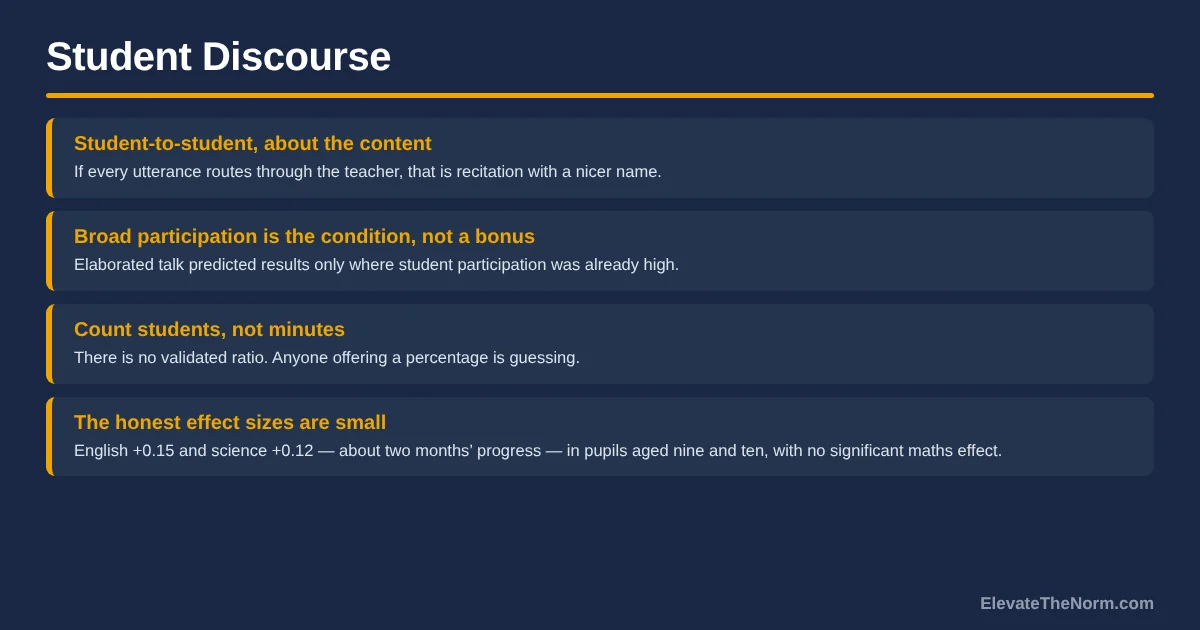
    • Student discourse is student-to-student, about the content. If every utterance routes through the teacher, that is recitation with a nicer name. The research calls the real version dialogic, and its two markers are authentic questions and uptake.
    • Broad participation is the condition, not a bonus. In 72 English Year 6 classes, elaborated and querying talk predicted maths and spelling-grammar results only where student participation was rated high. Where it was low, the same talk produced no measurable benefit.
    • Individual talk time tracked achievement for every group of students. Across 639 ninth graders, a student’s own talk time and reasoning utterances were strongly linked to a standardised reading score, regardless of socio-economic background or gender.
    • Discussion-based teaching has secondary-level evidence behind it. In 64 middle and high school English classrooms, discussion-based approaches predicted spring performance after controlling for fall performance, and worked for low- and high-achieving students alike.
    • The honest effect sizes are small, and the strongest trial was not run on teenagers. The best randomised test found +0.15 in English and +0.12 in science — about two months’ progress — with no significant maths effect, in pupils aged nine and ten.

    What Is Student Discourse?

    Student discourse is sustained, content-focused talk in which students respond to each other’s reasoning rather than to the teacher’s prompt. The test is simple: pick any student utterance and ask what it is answering. If the answer is always “the teacher’s last question,” you have a recitation pattern — teacher asks, student answers, teacher evaluates, repeat. That pattern is not useless. It checks coverage fast and keeps a room steady. It just is not discourse, and it does not do what discourse does.

    Two pieces of research vocabulary are worth borrowing because they name what actually changes. An authentic question seeks a student’s thinking rather than checking whether they already know the answer in the teacher’s head. “What year did it start?” is not authentic. “Which of those three causes mattered most, and what makes you say that?” is. Uptake means your next move is built from what the student just said rather than from the plan’s next bullet. Uptake is the cheapest high-value habit on this page and it costs nothing but attention.

    Both ideas come out of a long research programme on eighth- and ninth-grade English classes — one of the few large bodies of classroom-talk research done on students the age this site writes for. The original report followed classes across eight midwestern communities over two school years, testing more than 1,100 students in the fall and spring of each. It is cited here for the two definitions and nothing else: it reports descriptive comparisons rather than a modelled effect, and no effect size for discussion is claimed anywhere on this page.

    Why Does Student Discourse Matter More Than Participation?

    Because participation is a count and discourse is a structure. A class where eleven students each said one sentence has high participation and no discourse. A class where four students argued for twenty minutes has discourse and a participation problem. The evidence says you need both, and the second is usually what is missing.

    This is the most useful finding in the literature and it is almost never quoted. A naturalistic study of 72 Year 6 classes across 48 English schools coded two video-recorded lessons per class turn by turn, then matched the codes against end-of-year tests taken months later. Two features came out positive: elaborated talk, where a student extends or explains an idea, and querying, where a student questions or challenges a claim. Both predicted maths and spelling-punctuation-grammar scores only in classes rated high for student participation. In low-participation classes the same talk showed no benefit.

    Read that the way a teacher has to. Getting four articulate students to reason beautifully in front of twenty-two silent ones did nothing for test scores in that study. The talk has to be distributed before its quality starts to matter. A five-minute structure that puts every student on the record is one cheap way to check whether it is.

    The same study is worth citing for what it failed to find. Reasoned talk — statements giving an explicit reason — did not predict attainment. Not in maths, not in reading, not on a purpose-built reasoning test. The authors call the work a staging post rather than a conclusion, note the design is correlational and cannot support causal claims, and record that their talk-rules measure had to be discarded because most lessons scored zero on it. That last detail is its own finding: across 72 real classrooms, almost nobody had explicit talk rules.

    What Does the Research Actually Say About Student Talk?

    That it helps, that the effects are modest, and that most of the strongest studies were run on children younger than the students in a 6–12 building. All three are true at once, and an article giving you only the first is selling something.

    StudyWho it was run onWhat it foundWhat it cannot tell you
    Šeďová & Sedláček (2019)639 ninth graders, Czech language artsA student’s own talk time and reasoning utterances were strongly linked to a standardised reading score. Talkative classrooms also did better. The individual link held regardless of socio-economic background or gender.Observational — cannot separate “talking makes you better” from “better readers talk more.” Classroom-level reasoning showed no link.
    Applebee, Langer, Nystrand & Gamoran (2003)64 middle and high school English classrooms, grades 7, 8, 10, 11, 12Discussion-based approaches were significantly related to spring performance after controlling for fall performance and background, for low- and high-achieving students alike.Correlational. The authors note instruction was unequally distributed across tracks.
    Howe, Hennessy, Mercer, Vrikki & Wheatley (2019)72 Year 6 classes (ages 10–11), 48 English schoolsElaborated and querying talk predicted maths and SPAG scores, but only where participation was high. Reasoned talk predicted nothing.Correlational, primary-aged, one country. The authors ask for intervention trials.
    EEF Dialogic Teaching trial (2017)76 schools, 4,958 pupils randomised — Year 5, ages 9–10English +0.15 and science +0.12, about two months’ progress each. Free-school-meals pupils gained +0.16 in maths.Maths overall was +0.09 and not significant. 21% of pupils dropped out of the analysis. Effects fell below the trial’s own detectable threshold. Not a secondary result.
    Murphy and colleagues (2009), meta-analysisStudies of discussion approaches; most participants in grades 4–6Several approaches strongly increased student talk, reduced teacher talk, and substantially improved text comprehension.Few improved critical thinking and reasoning, or literal and inferential comprehension. Effects varied by design, measure and student ability.
    Five sources, with the population stated every time.

    Three things follow from the table rather than from a summary of it. The strongest causal evidence is about nine- and ten-year-olds — the EEF trial is the cleanest test anyone has run, across 76 schools in three English cities all above 20% free school meals, and it is a Year 5 result. The practices transfer to a secondary room; the numbers do not automatically transfer with them.

    The secondary-level evidence is correlational, and it is still the most relevant evidence you have. The 64-classroom study and the 639-student study are both observational and neither can prove talk caused the learning. Both were run on students aged thirteen to eighteen, which no trial of this size has managed. Careful correlational work on the right students beats a clean trial on the wrong ones, as long as nobody dresses the first up as the second.

    And discussion is not a reasoning intervention. The 2009 meta-analysis found several approaches reliably moved comprehension and reliably increased student talk, and that few moved critical thinking. Howe and colleagues found the same from the other direction: reasoning was the one outcome with no main effects. If your pitch is “it teaches them to think critically,” the literature does not have your back yet. If it is “it moves comprehension and gets more students into the content,” it does.

    What About the Effect Size Everyone Quotes?

    Treat it carefully. A large effect size for “classroom discussion” circulates widely in professional development materials, usually traced to the Visible Learning synthesis. Two things are worth knowing first. The official Visible Learning glossary entry for classroom discussion carries a definition and no effect size at all. And the synthesis has a documented correction history: Hattie has acknowledged that the Common Language Effect size figures throughout the original book were calculated incorrectly, with only the Cohen’s d values correct, and a 2014 paper by Schulmeister and Loviscach catalogued further problems with study selection and method.

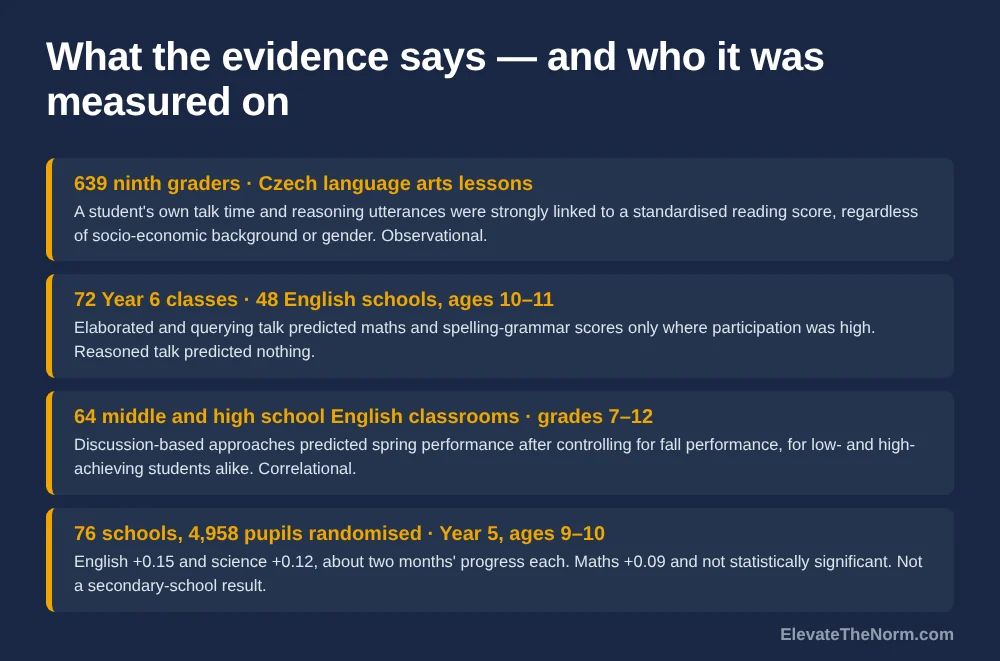
    Four research findings on student discourse with the population of each study named: 639 Czech ninth graders, 72 English Year 6 classes, 64 middle and high school English classrooms, and a randomised trial of 76 schools with pupils aged nine and ten
    The defensible numbers, with the population attached to each one.

    None of that makes classroom discussion a bad idea. It makes the headline number a bad citation. Use the trial figures instead — +0.15, +0.12, two months, one non-significant result, primary-aged pupils. They are smaller and they are defensible, and a claim that survives a sceptical administrator is worth more than one that impresses a staff meeting.

    How Much Should Students Be Talking?

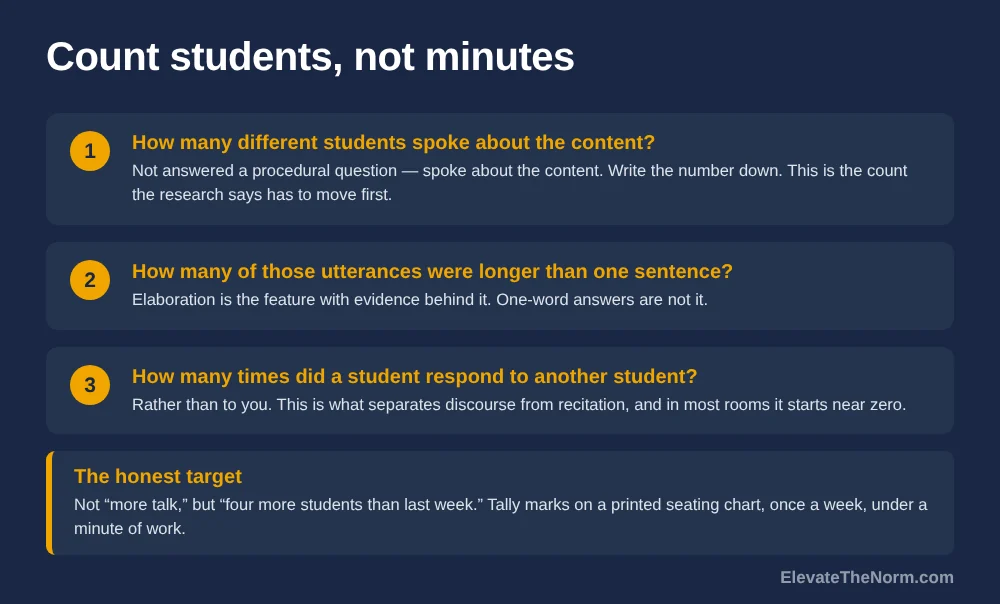
    There is no validated ratio, and anyone who gives you one is guessing. The research supports a direction and a distribution, not a percentage. So stop counting minutes and count students. Three questions, answerable from a seating chart and a pencil:

    1. How many different students spoke about the content today? Not answered a procedural question — spoke about the content. Write the number down.
    2. How many of those utterances were longer than one sentence? Elaboration is the feature with evidence behind it. One-word answers are not it.
    3. How many times did a student respond to another student rather than to you? This is what separates discourse from recitation, and in most rooms it starts near zero.

    Those three numbers, taken weekly for a month, will tell you more about your classroom than any observation rubric, and they make an honest target: not “more talk,” but “four more students than last week.”

    On scope, honestly: tally marks on a printed seating chart during one discussion, once a week. Under a minute of work, no grades, no data entry, nothing to upload. And nothing here is a record of individual students’ speech that anyone else needs to see — the chart is a working note, and it belongs in the recycling at the end of the month rather than in a file.

    A word on class size, because the advice gets harder as the roster grows. In a section of thirty-two on a fifty-minute period, whole-class discourse will not reach everybody and pretending otherwise wastes the period. Pairs and fours are not the training-wheels version — in a large room they are the version that satisfies the participation condition the research identified. One two-minute paired exchange gets more students reasoning out loud than twenty minutes of whole-class discussion will.

    Three questions a teacher can count weekly to track student discourse: how many different students spoke about the content, how many said more than one sentence, and how many responded to another student rather than to the teacher
    Three counts from a seating chart. Under a minute a week.

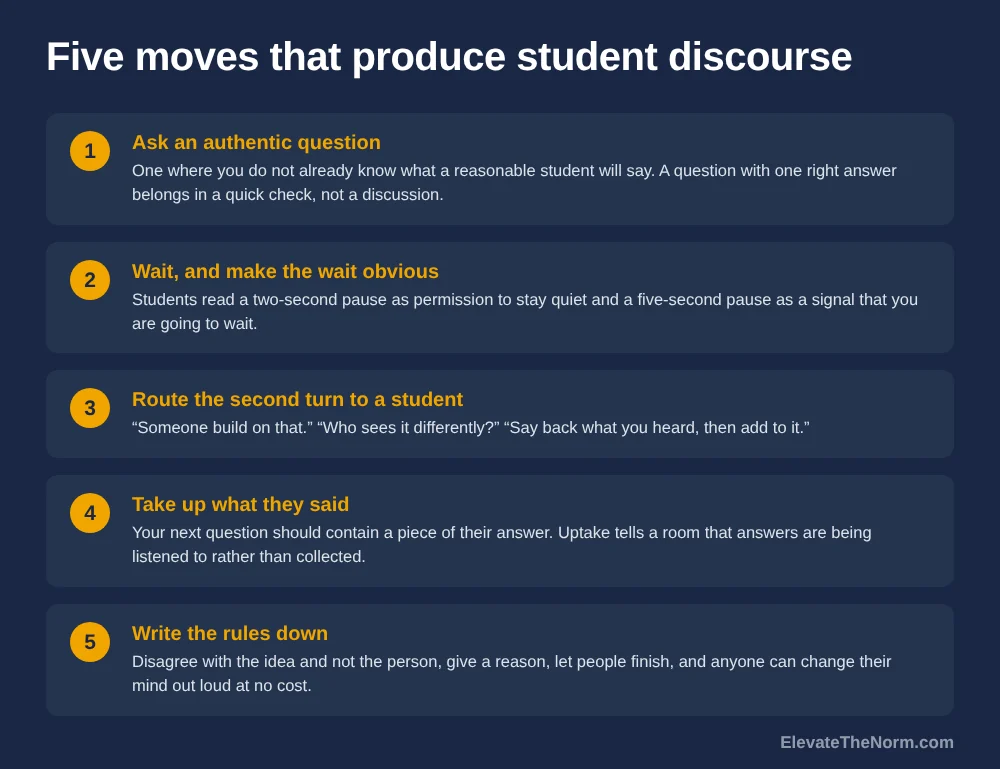
    What Are the Five Moves That Produce Student Discourse?

    Ask something that has no answer in your head, wait, make students respond to each other, keep the thread alive, and write down the rules. Each move is small enough to add to a lesson you have already planned.

    1. Ask an authentic question. One where you do not already know what a reasonable student will say. “Was the compromise worth it?” rather than “What did the compromise do?” A question with one right answer belongs in a quick check, not a discussion.
    2. Wait, and make the wait obvious. Ask, then say nothing and let the silence be visible. Students read a two-second pause as permission to stay quiet and a five-second pause as a signal that you are going to wait.
    3. Route the second turn to a student, not to yourself. After a student answers, the default next move is the teacher evaluating. Replace it: “Someone build on that.” “Who sees it differently?” “Say back what you heard, then add to it.” This one substitution turns recitation into conversation.
    4. Take up what they said. Your next question should contain a piece of their answer. “You said it was about money — whose money?” Uptake tells a room that answers are being listened to rather than collected. It is the operational version of standing by your word: if you ask what someone thinks, do something with what they tell you.
    5. Write the rules down. In 72 observed classrooms the talk-rules measure was thrown out because most lessons scored zero. Four lines on the wall is enough: disagree with the idea and not the person, give a reason, let people finish, and anyone can change their mind out loud at no cost.

    That fifth rule carries more weight than it looks. A room where changing your mind is embarrassing will produce confident nonsense and nothing else, because the only safe move is to defend your first answer. Say early that revising a position in public is the point — then praise it the first time it happens, by name, in front of everybody.

    Numbered list of five teaching moves for student discourse: ask an authentic question, wait visibly, route the second turn to a student, take up what a student said, and write the talk rules down
    The five moves in order. Each one works on its own.

    How Do You Run Discourse Without It Going Off the Rails?

    You plan the structure, not the content of what students will say. If a discussion in a grades 6–12 classroom collapses into chaos or dead silence, that is almost always a planning result rather than a student result. Four decisions, made before the lesson:

    • Decide the unit of talk. Whole class, pairs, or small groups. A room with no student-to-student history should not start whole class — pairs first, then fours, then the floor. If you are moving toward groups, defined roles inside each group remove the most common failure, which is one student talking and three watching.
    • Decide what everyone writes before anyone speaks. Thirty seconds of writing raises the number of students who can enter the discussion, which is the condition the research says matters most. It also gives the quiet student something to read from instead of something to invent under pressure.
    • Decide how you will call on people. Hands-up alone concentrates talk in the already-confident, which is exactly the low-participation pattern that made elaborated talk worthless in the 72-class study. A warm, predictable version of calling on students who did not volunteer — after writing time, with a route to pass once — distributes talk without ambushing anybody.
    • Decide where it ends. A discussion with no landing point teaches students that talk is filler. Name the product: a written claim, a revised answer, one sentence on the strongest counterargument. Then use it in the next thing you do.

    And decide, out loud, what a student who does not want to talk is allowed to do. Most discourse advice skips this, and it is the part students notice first. Give an explicit route: a pass, once, with no explanation owed and no penalty, and the answer written instead. Then honour it the first time somebody uses it, in front of everyone, without a sigh — a pass that costs social capital is not a pass. The same provision quietly does the work for a student with a speech difference, a student still acquiring English, and a student having a bad week, none of whom should have to disclose anything to get it. Sentence stems on the wall (“I agree with… because…”, “I see it differently because…”, “Can you say more about…”) raise the floor for all three at once and cost one piece of paper.

    For a structured version of all of this at once, a Socratic seminar is the most forgiving format to start with, because the protocol does the management for you. It lives or dies on the prompt, so it is worth borrowing questions already known to open up rather than writing your own on the first attempt. In a smaller setting, the same five moves work inside small-group instruction at the secondary level, where the participation problem is easier to see and easier to fix. To grade one, use this free Socratic seminar rubric.

    What Happens When the Discussion Gets Near Something Contentious?

    You separate the question you are asking from the question students bring, and you decide which one the lesson is for before you open the floor. A room full of teenagers reasoning out loud will eventually reach something a family has strong feelings about. That is a reason to prepare, not a reason to avoid discourse.

    Three things keep it clean. Frame the prompt around evidence rather than personal position — “what does this source let us conclude” travels much further than “what do you believe.” State the standard you are grading against, if anything is graded, so nobody can reasonably believe their conclusion is what is being scored. And have the redirect sentence ready: name the move, not the student — “that is about a person rather than the idea, so try it again on the idea.” Rehearse it once and it stops being a crisis. If a discussion does go somewhere you did not intend, the useful question afterward is what the prompt invited. A fifteen-year-old cannot derail a conversation that had a clear question, a clear product and clear rules.

    Can a School Actually Roll This Out?

    Yes, with one condition stated plainly: the trial that produced those numbers tested a supported programme, not a handout. The EEF study trained teachers and ran a mentoring cycle inside each school. Fidelity was high for training attendance and the mentor-cycle format, and more variable for how the approach reached the curriculum. So the +0.15 belongs to that package — training, a mentor, two terms — and nobody should promise it for a one-hour staff meeting and a PDF.

    The cost line is small by district standards. No purchase, no platform, no licence, no staffing change. What it needs is time: somebody who can sit in a colleague’s room, watch for the three numbers above, and talk about them afterward without it being an evaluation. A peer-observation cycle with no rating attached is the cheapest intervention on this page and the one most likely to get cut first.

    It is also unusually coachable, which matters for anyone allocating instructional-coach hours. The five moves are observable from the back of a room, countable in one period, and separable — a teacher can work on routing the second turn for three weeks without changing anything else. Standards alignment mostly takes care of itself, because speaking-and-listening standards already require this and are usually the least-taught strand in the document.

    Does Student Discourse Work for Every Student?

    The best data says the individual benefit did not depend on background. In the 639-student Czech study, the link between a student’s own talk time and their reading score, and between their reasoning utterances and that score, held across students regardless of socio-economic background or gender. That is observational and should be stated as such. It is also the most direct evidence available on a question teachers ask constantly, usually in the form of an assumption: that students from harder circumstances need tighter control and less open talk.

    There is no support for that assumption here. The EEF trial’s schools were all above 20% free school meals, and its one statistically significant maths result was for the free-school-meals subgroup specifically. The 64-classroom secondary study found discussion-based approaches working for low- and high-achieving students alike, and the Czech study found the link between a student’s own participation and achievement held regardless of socio-economic background or gender.

    Be careful what that adds up to. It does not say discourse closes gaps; nobody has shown that. It says the appetite to talk about something that matters is not the thing that varies by zip code — and the burden of proof sits with whoever claims some students need silence instead.

    What Goes Wrong, and How Do You Fix It?

    FailureWhat you will seeThe repair
    Four voices, twenty silencesRich talk, flat resultsWrite first, then pairs, then floor. Track distinct speakers, not volume
    Questions with answersShort replies, then nothingRewrite the prompt until you cannot predict a reasonable answer
    Teacher as the hubEvery turn routes through youHand the second turn to a student every time, for two weeks, until it is habit
    No stated rulesInterrupting, or point-scoringFour lines on the wall. Most observed classrooms have none
    Talk with no product“Why are we doing this?”Name the written output before the talk starts, and collect it
    Five common discourse failures and the repair for each.

    One more, because it is the hardest to see from the front of the room: grading the talk. The moment a discussion carries points, some students stop reasoning and start performing, and the least confident get quieter rather than louder. If a discussion needs assessing, assess the written product that came out of it, and keep the quick checks that tell you whether they understood separate from the conversation that got them there.

    How Long Does This Take to Work?

    Longer than one unit, and the best trial we have says its own window was too short. Teachers in the EEF study reported two terms was not enough to embed the approach, which the evaluators recorded as a reason the measured effects may be underestimates. That is an unusually honest thing for a trial report to say, and it sets a realistic expectation: the five moves are easy to start and slow to pay.

    Expect three phases. In the first week or two the distinct-speaker count moves and the talk is awkward. Over the next month students start responding to each other without being told to, which is when your third weekly number stops being zero. After that the content of the talk gets better, and the elaboration the research cares about shows up on its own. Skipping to phase three by demanding sophisticated reasoning in week one produces the four-voices pattern, which the evidence says buys nothing.

    What Should Families Expect to See?

    More talking at school, the same expectations, and nothing new to do at home. Worth saying to parents before they hear a version of it from their child, because “we just talked today” can sound like a wasted period from the outside.

    Three things are fair to promise, and they are what a quiet student’s parent will want to hear. A student is not graded on how much they say — talk is not a behaviour category or a participation score, and the written product is what gets assessed. There is a real route to not speaking, used without explanation, with the answer written instead. And a student who thinks out loud and changes their mind is doing it correctly, not backing down; if that reads as weakness at school the whole method stops working, so it gets named as a strength out loud.

    The honest caveat for a family who asks about evidence: the gains in the strongest study were about two months’ progress in English and science, in a trial on nine- and ten-year-olds, with no significant maths effect. That is worth doing and it is not a transformation. The clearer case for a 6–12 classroom is the Czech ninth-grade data — students who talked more and reasoned out loud more did better on a standardised reading test, across backgrounds.

    What to Do This Week

    Pick one class. Do four things.

    Monday: count the distinct students who say something about the content, and the number of student-to-student responses. Change nothing yet. You need the baseline, and it will probably be worse than you expect.

    Tuesday: rewrite one question in your existing plan so you cannot predict a reasonable answer to it. One question. Ask it, then wait five visible seconds.

    Wednesday: hand the second turn to a student every time, all period. “Build on that.” “Who disagrees?” Nothing else changes.

    Friday: put four talk rules on the wall and count again. If the distinct-speaker number went up, you have the result the research says has to come first.

    Then go find the person in your building who is already good at this and ask how they start. Keeping your ears open and asking a direct question pays off more reliably than reading another article, this one included — and most of the teachers worth asking are waiting for somebody to ask.

    Frequently Asked Questions

    What is student discourse?

    Student discourse is students talking to each other about the content — explaining, challenging, building on and revising ideas — rather than taking turns answering the teacher. The research tradition calls the real version dialogic, and its two markers are authentic questions (ones with no prespecified answer in the teacher’s head) and uptake (the teacher’s next question built out of what a student just said). If every utterance routes through the teacher, that is recitation rather than discourse.

    What is the difference between student discourse and participation?

    Participation is a count; discourse is a structure. Eleven students each saying one sentence is high participation and no discourse. Four students arguing for twenty minutes is discourse with a participation problem. The evidence says you need both: in a study of 72 Year 6 classes, elaborated and querying talk predicted maths and spelling-grammar scores only in classes where student participation was rated high. Where participation was low, the same quality of talk produced no measurable benefit.

    How much should students be talking in class?

    There is no validated ratio, and anyone offering a percentage is guessing. What the research supports is a direction — several discussion approaches increased student talk and reduced teacher talk — and a distribution, which matters more than the total. Instead of counting minutes, count three things weekly: how many different students spoke about the content, how many said more than one sentence, and how many responded to another student rather than to you. The third number starts near zero in most rooms.

    Does student discourse improve test scores?

    Modestly, and the strongest evidence is not from secondary classrooms. The best randomised trial of dialogic teaching found +0.15 in English and +0.12 in science — about two months’ progress — with maths at +0.09 and not statistically significant, in pupils aged nine and ten. At the secondary level the evidence is correlational: discussion-based approaches predicted spring performance across 64 middle and high school English classrooms, and across 639 ninth graders a student’s own talk time tracked their standardised reading score. Discussion is not a reasoning intervention — a meta-analysis found several approaches improved text comprehension while few improved critical thinking.

    What are examples of student discourse moves?

    Five, in order. Ask an authentic question you cannot predict a reasonable answer to. Wait, visibly, for about five seconds rather than two. Route the second turn to a student instead of evaluating yourself — “build on that,” “who sees it differently,” “say back what you heard, then add to it.” Take up what a student said by putting a piece of their answer into your next question. And write four talk rules on the wall: disagree with the idea not the person, give a reason, let people finish, and anyone can change their mind out loud at no cost.

    How do you include a student who does not want to speak?

    Give an explicit route and honour it. A pass, once, with no explanation owed and no penalty, and the answer written instead — then accept it the first time somebody uses it, in front of everyone, without a sigh. A pass that costs social capital is not a pass. Thirty seconds of writing before anyone speaks raises the number of students who can enter the discussion, and sentence stems posted on the wall (“I agree with… because…”, “I see it differently because…”) raise the floor for a reluctant speaker, a student with a speech difference and a student still acquiring English at the same time, without anyone having to disclose anything.

    Should student discourse be graded?

    Assess the written product that comes out of the discussion, not the talking. The moment a discussion carries points, some students stop reasoning and start performing, and the least confident get quieter rather than louder. Keep quick checks for understanding separate from the conversation that produced the understanding. Telling families plainly that a student is not graded on how much they say is also the single most effective thing you can do to head off the question a quiet student’s parent will otherwise ask.

    Sources

    1. Jay, T., Willis, B., Thomas, P., Taylor, R., Moore, N., Burnett, C., Merchant, G., & Stevens, A. (2017). Dialogic Teaching: Evaluation Report and Executive Summary. Education Endowment Foundation / Sheffield Hallam University. Three-level clustered randomised controlled trial; 76 schools randomised (38 intervention, 38 control) in Leeds, Bradford and Birmingham, all with over 20% of pupils eligible for free school meals; 4,958 pupils randomised and 3,912 analysed. Pupils were in Year 5, aged nine and ten — this is not a secondary-school result. English +0.15 (95% CI 0.00 to 0.30, p = 0.05, about two months); science +0.12 (0.01 to 0.23, p = 0.04, about two months); maths +0.09 (−0.04 to 0.20, p = 0.19, not statistically significant). Free-school-meals pupils: maths +0.16 (0.01 to 0.30). Rated three padlocks (moderate security). Reported limitations include 21% attrition, with 7 of 38 intervention schools providing no post-test data; a baseline EAL imbalance; effects below the trial’s own minimum detectable effect size of roughly 0.25; and teachers reporting that two terms was too short to embed the approach. Read in full. shura.shu.ac.uk (PDF)
    2. Howe, C., Hennessy, S., Mercer, N., Vrikki, M., & Wheatley, L. (2019). Teacher–Student Dialogue During Classroom Teaching: Does It Really Impact on Student Outcomes? Journal of the Learning Sciences. 72 Year 6 classes (ages 10–11) in 48 schools across England; two video-recorded lessons per class coded turn by turn; outcomes were end-of-year tests and a pupil attitude survey taken months later, analysed in two-level models with measured confounds controlled. Elaborated and querying talk were positively associated with mathematics and spelling-punctuation-grammar scores only where the lesson-level rating for student participation was high; with low participation there was no benefit. Reading showed the same pattern but not significantly. Reasoned talk predicted nothing, there were no significant science effects, and there were no main effects on the reasoning test. The talk-rules scale was discarded because most lessons scored zero. Authors’ own caveats: the design is correlational and cannot support causal claims; the sample is England-only and primary-aged; the science and reasoning tests were newly designed; they describe the work as a “staging post” and call for intervention trials. Accepted manuscript read in full; the Cambridge copy of that manuscript has since gone offline, so this links to the published article. doi.org/10.1080/10508406.2019.1573730
    3. Šeďová, K., & Sedláček, M. (2019). Do Those Who Talk More Learn More? The Relationship Between Student Classroom Talk and Student Achievement. Learning and Instruction. 639 ninth-grade students in Czech schools; talk time and the number of utterances featuring reasoning were recorded for each individual student during language arts lessons; achievement was measured with a standardised reading literacy test. A strong link was found between a student’s own talk time and reasoning utterances and that student’s achievement, and at classroom level students in talkative classrooms did better. At classroom level, reasoning utterances were not linked to better results. The positive link between individual participation and achievement was observed in all students regardless of socio-economic background or gender. Observational, so it cannot separate whether talking raises achievement or stronger readers talk more. Abstract read in full from the publisher’s record. pedagogika.phil.muni.cz
    4. Applebee, A. N., Langer, J. A., Nystrand, M., & Gamoran, A. (2003). Discussion-Based Approaches to Developing Understanding: Classroom Instruction and Student Performance in Middle and High School English. American Educational Research Journal, 40(3). 64 middle and high school English classrooms spanning grades 7, 8, 10, 11 and 12. Discussion-based approaches were significantly related to spring performance in hierarchical linear models controlling for fall performance and background variables, and appeared effective across a range of situations and for both low- and high-achieving students. Non-experimental; the authors note that instruction was unequally distributed across tracks, which complicates interpretation. Cited from the ERIC record, which was read; the journal’s full text was not opened in this session. eric.ed.gov
    5. Murphy, P. K., Wilkinson, I. A. G., Soter, A. O., Hennessey, M. N., & Alexander, J. F. (2009). Examining the Effects of Classroom Discussion on Students’ Comprehension of Text: A Meta-Analysis. Journal of Educational Psychology, 101(3). Several discussion approaches produced strong increases in the amount of student talk with reductions in teacher talk, and substantial improvements in text comprehension. Few approaches were effective at improving literal or inferential comprehension, or critical thinking and reasoning. Effects were moderated by study design, the nature of the outcome measure and student academic ability. The age range was wide but most studies involved fourth through sixth graders, so this is not a secondary-school finding. Cited from the published abstract and record; the full article was not opened in this session. pure.psu.edu
    6. Murphy, P. K., Greene, J. A., Firetto, C. M., Hendrick, B. D., Li, M., Montalbano, C., & Wei, L. (2018). Quality Talk: Developing Students’ Discourse to Promote High-Level Comprehension. American Educational Research Journal, 55(5). A year-long study of a teacher-facilitated small-group discussion approach in two fourth-grade classrooms. Teacher-initiated discourse decreased, student discourse showed more critical-analytic thinking, and written measures of basic and high-level comprehension increased. The authors describe it as an initial study; two classrooms is a small sample and the abstract reports no effect sizes. Cited from the abstract, which was read; the full text is behind access controls. journals.sagepub.com
    7. Nystrand, M., & Gamoran, A. (1990). Student Engagement: When Recitation Becomes Conversation. National Center on Effective Secondary Schools, Wisconsin Center for Education Research, University of Wisconsin–Madison. The source of the two terms used above: authentic questions, which open the floor to what students actually think, and uptake, where the next question is built out of what a student just said. Eighth- and ninth-grade English classes across eight midwestern communities — 16 middle schools feeding nine high schools — with over 1,100 students tested in the fall and spring of 1987–88 and 1988–89. Cited for the definitions only. This report gives descriptive comparisons rather than regression models, publishes no effect size for discussion, and none is claimed here. The research centre’s own summary page for the wider programme is currently unreachable — its TLS certificate does not match its hostname — so it is not cited. files.eric.ed.gov (PDF)
    8. On the widely quoted “classroom discussion” effect size: the official Visible Learning glossary entry for classroom discussion gives a definition and no effect size and no meta-analyses. Separately, Hattie has acknowledged that the Common Language Effect size figures throughout the original book were calculated incorrectly, with only the Cohen’s d values correct — raised by Topphol (2011) in Norsk pedagogisk tidsskrift — and Schulmeister and Loviscach (2014), Errors in John Hattie’s “Visible Learning”, argued there are considerable issues with study selection and method. No formal published erratum or revised edition is documented. This article therefore does not cite a Visible Learning figure for discussion and uses the trial estimates instead. visible-learning.org glossary · overview of the criticism

    About Clay Shumate

    Clay Shumate is a certified secondary Social Studies teacher in the public schools of West Alabama, with seven years of classroom experience, a B.A. in History, and an M.Ed. in Secondary Education. He writes about project-based learning, student responsibility, respect, and practical ways to hold young people to a higher standard while giving them room to learn from mistakes. He is a member of the Society of Professional Journalists and writes to its Code of Ethics; this site’s editorial standards and corrections policy are published in full. More about Clay.

  • Classroom Culture Frameworks With Ongoing Coaching and Feedback

    Classroom Culture Frameworks With Ongoing Coaching and Feedback

    By Clay Shumate

    Classroom culture frameworks with ongoing coaching and feedback include Responsive Classroom, Conscious Discipline, CHAMPS, Teach Like a Champion and PBIS. PBIS coaching usually comes through state and district networks; the paid programs mostly price coaching by quote. Coaching is worth it: a 60-study meta-analysis found it improved teachers’ instruction by 0.49 standard deviations.

    Key Takeaways

    • Teacher coaching improved instruction by 0.49 standard deviations and student achievement by 0.18 across 60 causal studies in a 2018 meta-analysis.
    • Coaching programs with fewer than 100 teachers outperformed larger ones, averaging 0.63 standard deviations on instruction against 0.34.
    • Virtual teacher coaching showed no statistically significant difference from in-person coaching in the same meta-analysis.
    • PBIS coaching runs through school, district and state coaches, while Responsive Classroom, Conscious Discipline and CHAMPS consulting are priced by quote.
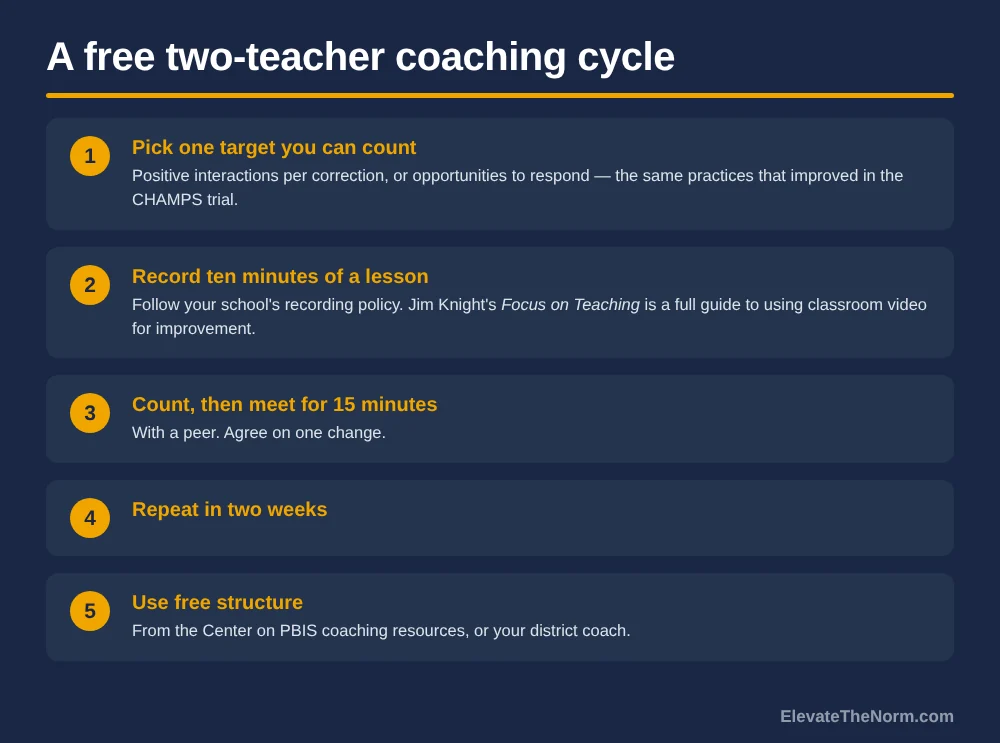
    • Two teachers with a camera and one countable target, such as positive interactions per correction, can run a free coaching cycle every two weeks.

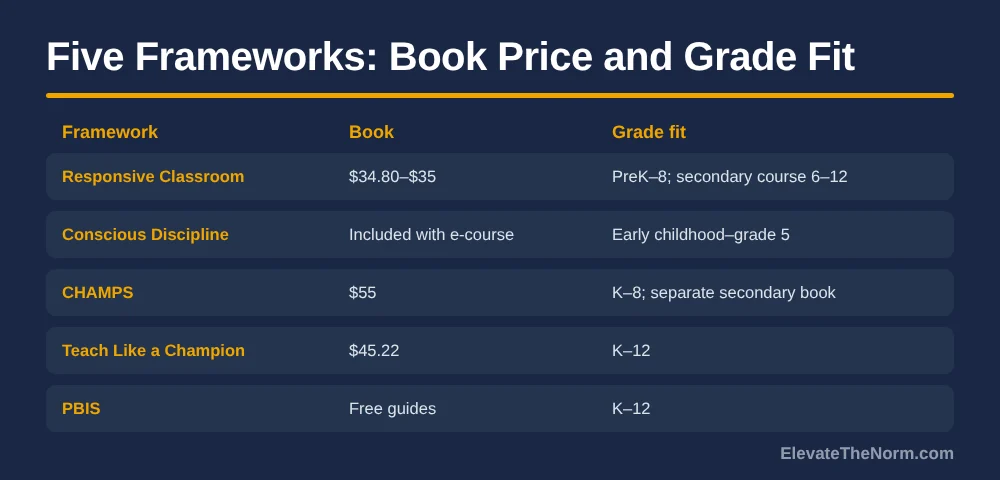
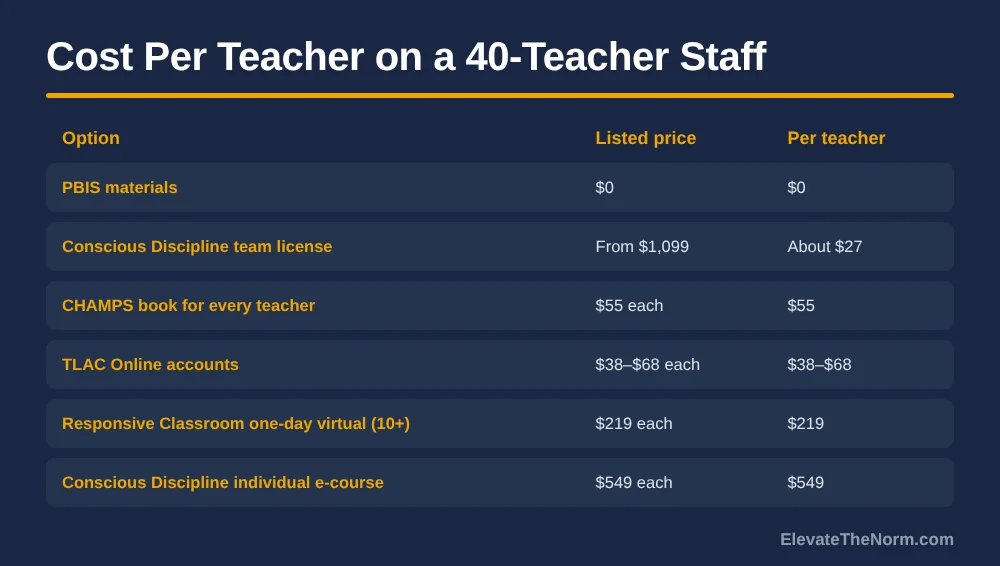
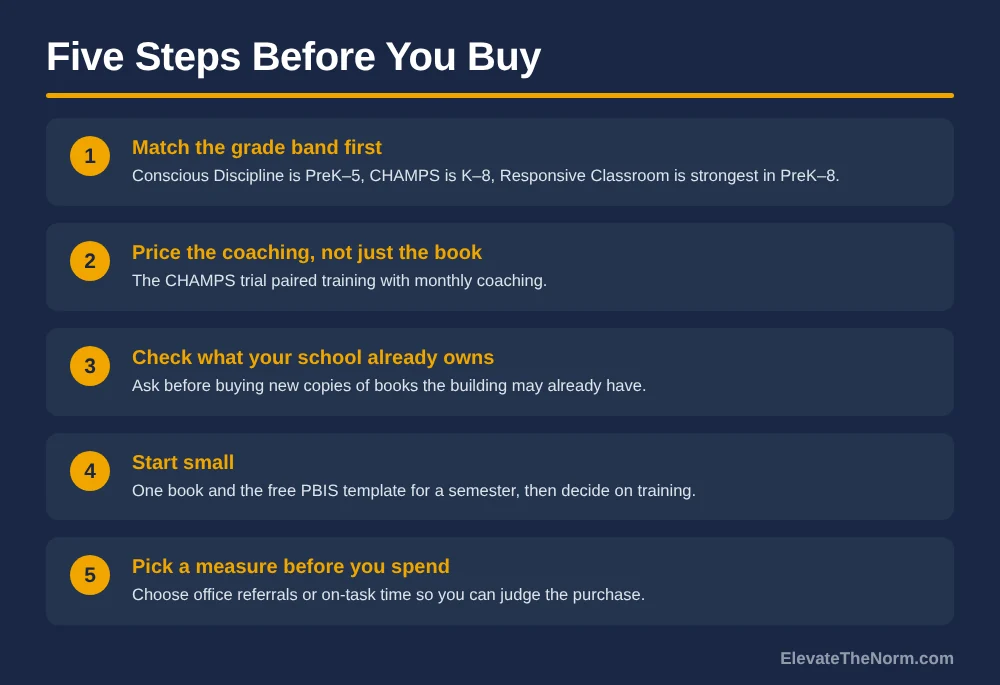
    Ongoing coaching is repeated cycles of observation, feedback and goal setting with a coach, as opposed to a single workshop. This page covers what each program’s coaching actually looks like, what the research says about coaching, and how to coach yourself or a colleague for free. If you’re comparing prices on books and workshops instead, see the buyer’s guide to classroom culture frameworks. For every framework at a glance, see the classroom culture frameworks Q&A hub.

    Why does coaching matter more than the classroom culture framework you pick?

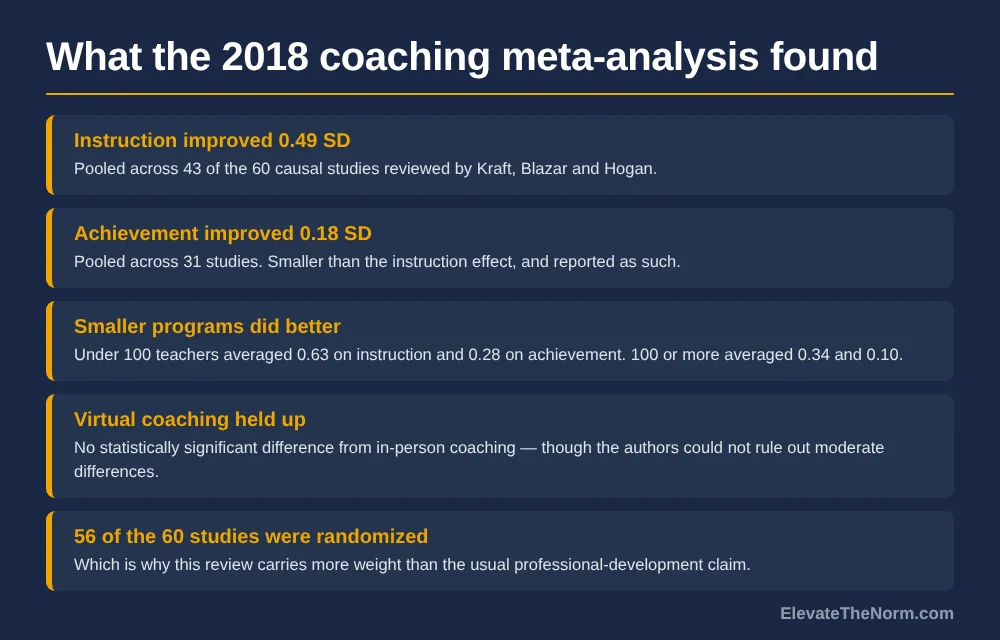
    Coaching matters more than the framework because one-time training rarely changes daily classroom practice, while repeated observation and feedback does. The largest review on this is a 2018 meta-analysis by Matthew Kraft, David Blazar and Dylan Hogan in the Review of Educational Research. It pooled 60 studies with causal designs, 56 of them randomized trials (Kraft, Blazar & Hogan, 2018). What it found:

    • Instruction improved by 0.49 standard deviations across 43 studies.
    • Achievement improved by 0.18 standard deviations across 31 studies.
    • Smaller programs did better. Programs with fewer than 100 teachers averaged 0.63 on instruction and 0.28 on achievement. Programs with 100 or more averaged 0.34 and 0.10. The authors point to the difficulty of finding good coaches and getting teacher buy-in at scale.
    • Virtual coaching held up. They found no statistically significant difference between in-person and virtual coaching, though they couldn’t rule out moderate differences.
    What the 2018 teacher-coaching meta-analysis found.
    Sixty causal studies, 56 of them randomized. The instruction effect is the big one.

    Classroom management research points the same way. In the federally funded CHAMPS trial, middle school teachers got three days of workshops followed by monthly coaching for a full year. They praised more, gave more opportunities to respond, and ran better-organized classrooms (IES).

    Which classroom culture frameworks offer ongoing coaching and feedback?

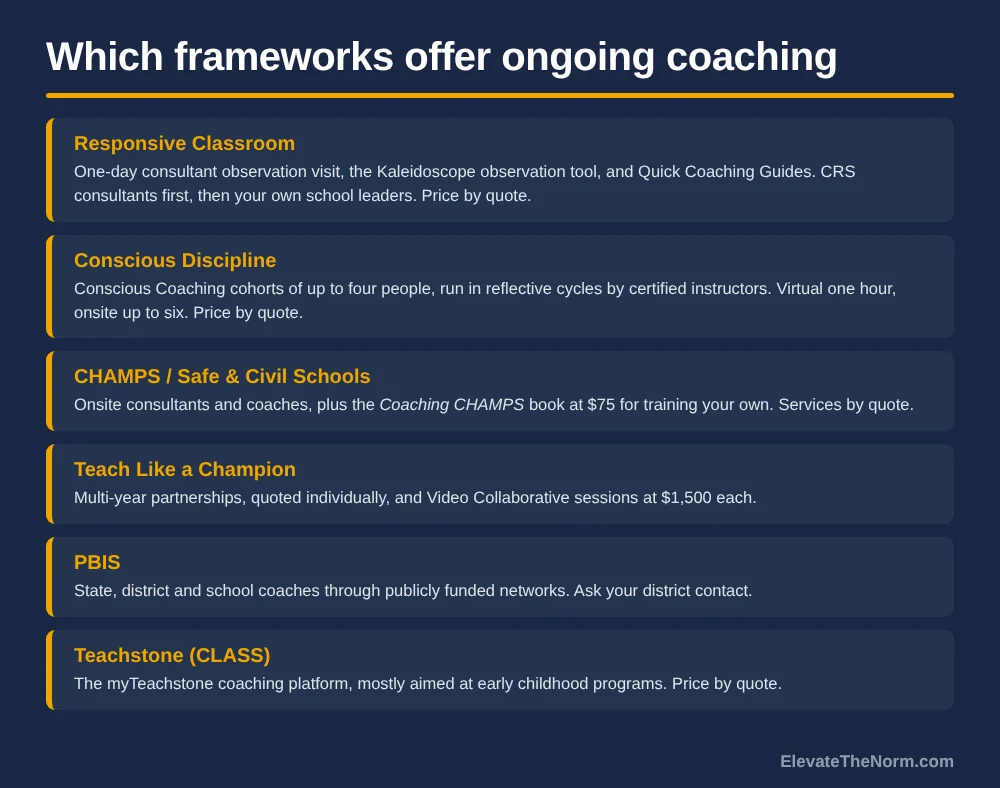
    Responsive Classroom, Conscious Discipline, CHAMPS, Teach Like a Champion and PBIS all offer ongoing coaching and feedback. PBIS coaching runs through state, district and school coaches. The paid programs price most coaching by quote, with two listed exceptions: Teach Like a Champion’s $1,500 video session and the $75 Coaching CHAMPS book.

    FrameworkCoaching formatWho coachesPriceGrade fit
    Responsive ClassroomOne-day consultant observation visit; Kaleidoscope observation tool; Quick Coaching GuidesCRS consultants, then school leadersBy quotePreK–8; secondary course 6–12
    Conscious DisciplineConscious Coaching cohorts (up to 4 people), reflective cyclesCertified instructorsBy quoteEarly childhood–grade 5
    CHAMPS / Safe & Civil SchoolsOnsite consultants and coaches; Coaching CHAMPS bookSCS consultants or your own coachesBook $75; services by quoteK–8; secondary book for 9–12
    Teach Like a ChampionMulti-year partnerships; Video Collaborative sessionsTLAC teamVideo session $1,500; partnerships by quoteK–12
    PBISState, district and school coachesState networks and district staffThrough your state or district; ask locallyK–12
    Teachstone (CLASS)myTeachstone coaching platformProgram or Teachstone coachesBy quoteMostly early childhood
    Which classroom culture frameworks offer ongoing coaching, and in what format.
    All five major programs offer coaching. Only PBIS routinely offers it free.

    What coaching does Responsive Classroom offer?

    Responsive Classroom offers a one-day consultant observation visit with a same-day debrief, then gives school leaders tools to keep observing on their own. In a Consultant Observation and Feedback Visit, a Center for Responsive Schools consultant observes eight to ten classrooms plus spaces like arrival, the cafeteria, hallways and dismissal. The observations run through Kaleidoscope, which produces a school growth profile, and the consultant debriefs with the leadership team that afternoon. The school gets a free pack of Quick Coaching Guides on a focus topic (CRS information sheet).

    After the visit, leaders keep using Kaleidoscope on their own. It comes with school and district packages for one school year after a training course and can be bought separately. The Quick Coaching Guides cover 30 topics for reflection and goal setting, and buying ten or more includes a free Leader Guide. Prices are by quote (On-Site Services).

    The catch: the ongoing part depends on your own leaders doing the observing. The consultant comes once.

    Does Conscious Discipline offer coaching?

    Yes. Conscious Discipline offers Conscious Coaching: small cohorts of up to four adults, led by certified instructors, meeting virtually for one hour or onsite for up to six hours. Participants set goals, reflect and practice together in repeated coaching cycles (Conscious Coaching overview). Its training page also lists an ongoing virtual partnership (Conscious Discipline training). Pricing isn’t posted.

    The coaching focuses on adult mindset and real interactions, which fits the program’s adult-first design. It’s built for early childhood and PreK–5.

    Does CHAMPS offer coaching for teachers?

    CHAMPS coaching comes from Safe & Civil Schools consultants and coaches, or from your own coaches trained with the Coaching CHAMPS book. Ancora Publishing points schools to Safe & Civil Schools for in-person help, and sells Coaching CHAMPS by Tricia Skyles, Randy Sprick and Jim Knight for $75.

    In an interview, Sprick and Skyles described a “freedom within form” model: the district sets clear targets, and teachers choose how to reach them. Their example targets were 90% student engagement, 90% compliance, and three to five positive interactions for every correction. Skyles argued that without clear targets, coaches have nothing to coach toward (Instructional Coaching Group). The CHAMPS trial’s monthly coaching is the strongest classroom-management evidence on this page.

    Does Teach Like a Champion include coaching?

    Teach Like a Champion includes coaching through custom multi-year partnerships and paid video review sessions, but a standalone workshop doesn’t include ongoing coaching. The TLAC team, which moved from Uncommon Schools to Together Education in 2022 (TLAC blog), offers multi-year partnerships. In those, it studies video and artifacts from your school, helps build your own video system, and models PD design. Partnerships are quoted individually. Its Video Collaborative, a 90-minute review of your pre-selected classroom footage, is $1,500 a session, and its 41 TLAC Online modules ($68 for one user) can also be used for 1:1 coaching (TLAC workshop pricing sheet).

    Can you get free coaching through PBIS?

    PBIS coaching is often available to teachers at no direct cost, because it runs through state, district and school coaches rather than a vendor. The Center on PBIS describes coaching at three levels: state coaches work with district teams, and district and school coaches work with administrators and Tier 1 teams. Coaching targets individual skills with feedback, team routines, and the systems that keep PBIS going. The center posts a free coaching self-assessment and practice briefs (Center on PBIS, Coaching).

    Start with your district’s PBIS contact. In Alabama, for example, the state department of education partnered with the University of Alabama’s positive behavior supports office to expand training and ongoing support (University of Alabama News).

    Is Teachstone CLASS coaching useful for secondary teachers?

    Teachstone’s CLASS coaching is built mostly for early childhood programs, so grades 6–12 teachers will usually find a closer fit elsewhere. Teachstone describes myTeachstone as a CLASS coaching platform with frequent online contact between coaches and teachers and online learning communities. Its materials reference Head Start and early childhood quality systems, and pricing goes through sales (Teachstone).

    How can a teacher get classroom management coaching for free?

    A teacher can get free classroom management coaching by pairing with a colleague, recording short lesson clips, and coaching toward one countable target. The 2018 meta-analysis found virtual coaching held up and smaller programs did better, which is good news for a two-teacher arrangement.

    1. Pick one target. Use something you can count, like positive interactions per correction or opportunities to respond, the same practices that improved in the CHAMPS trial.
    2. Record ten minutes of a lesson. Jim Knight’s Focus on Teaching is a full guide to using classroom video for improvement. Follow your school’s recording policy.
    3. Count, then meet for 15 minutes with a peer. Agree on one change.
    4. Repeat in two weeks.
    5. Use free structure from the PBIS coaching resources or your district coach.

    Clay’s take: As a grades 6–12 teacher, I’d try the free routes first: your district’s PBIS coach, or a colleague and one countable target. Pay for vendor coaching when you need expertise your building doesn’t have. That’s a judgment on the research on this page, not a result from my own room.

    A free two-teacher coaching cycle in five steps.
    Two teachers, one camera, one countable target.

    More options are in free professional development for teachers and collective teacher efficacy. If you’d rather customize a framework first, see customizable classroom culture frameworks.

    Does Elevate the Norm offer coaching?

    Elevate the Norm doesn’t offer coaching, but its free grades 6–12 framework gives a peer coach clear things to look for. Disclosure: it’s this site’s own framework, built by Clay Shumate, a certified 6–12 social studies teacher, and it hasn’t been independently evaluated.

    A colleague can watch for whether recognition criteria were announced in advance, whether the teacher followed through exactly as stated, and how transitions run under the 3-2-1-Done class-vs-class point system. The materials are on the free resource library with no email gate. A paid option from the same teacher, the Teacher Emergency Toolkit, includes behavior and MTSS documentation templates that can serve as a record for coaching conversations.

    Frequently Asked Questions

    Which classroom culture frameworks include ongoing coaching?

    Responsive Classroom, Conscious Discipline, CHAMPS from Safe and Civil Schools, Teach Like a Champion and PBIS all offer ongoing coaching. PBIS coaching usually runs through state, district and school coaching networks. The paid programs price most coaching by quote, though Teach Like a Champion lists its 90-minute Video Collaborative at $1,500 a session and the Coaching CHAMPS book costs $75.

    Does teacher coaching actually work?

    Yes. A 2018 meta-analysis by Matthew Kraft, David Blazar and Dylan Hogan pooled 60 causal studies, 56 of them randomized trials. Coaching improved teachers’ instruction by 0.49 standard deviations across 43 studies and student achievement by 0.18 across 31 studies. Programs with fewer than 100 teachers did better than larger ones, which the authors linked to finding good coaches at scale.

    Is virtual coaching as good as in-person coaching?

    The 2018 Kraft, Blazar and Hogan meta-analysis found no statistically significant difference between virtual and in-person teacher coaching on either instruction or student achievement. The authors noted their estimates were too imprecise to rule out moderate differences. For teachers without a local coach, that makes virtual options, such as Conscious Discipline’s one-hour virtual cohorts, a reasonable choice rather than a second-best one.

    How can I get classroom management coaching for free?

    Ask your district’s PBIS contact first, because PBIS coaching runs through school, district and state coaches. If none is available, pair with a colleague, record ten minutes of a lesson under your school’s recording policy, and count one target such as positive interactions per correction. Meet for 15 minutes, agree on one change, and repeat the cycle in two weeks.

    What does Teach Like a Champion video feedback cost?

    Teach Like a Champion’s Video Collaborative, a 90-minute review of a school’s pre-selected classroom footage, is listed at $1,500 per session on the organization’s workshop pricing sheet. Multi-year partnerships, which include studying a school’s own video and building its video system, are quoted individually. The 41 TLAC Online modules cost $68 for one user and can be used for 1:1 coaching.

    Should a school pay for vendor coaching or train its own coaches?

    The research favors starting small and well staffed. Kraft, Blazar and Hogan found coaching programs with fewer than 100 teachers averaged 0.63 standard deviations on instruction, against 0.34 for larger programs, and the authors pointed to the difficulty of finding good coaches at scale. Many schools can start with district PBIS coaches or the $75 Coaching CHAMPS book before buying vendor coaching.

    What should a peer coach look for in a classroom?

    A peer coach should look for one target that can be counted, not a general impression. Good examples are positive interactions per correction and opportunities to respond, the practices that improved in the federally funded CHAMPS middle school trial. Sprick and Skyles describe district targets such as three to five positive interactions for every correction, which gives the coach and teacher a shared number to track.

    Do these coaching programs work for middle and high school?

    Some fit secondary classrooms better than others. The CHAMPS trial studied middle school teachers, Teach Like a Champion covers K–12, and PBIS coaching runs K–12. Responsive Classroom is built for PreK–8 with a separate grades 6–12 course, while Conscious Discipline and Teachstone’s CLASS focus on early childhood and elementary programs. Grades 6–12 teachers should start with CHAMPS, Teach Like a Champion or PBIS.

    Sources

    How is this page kept accurate?

    This page is kept accurate by taking program details and prices from each provider’s own site and study figures from the original paper or official summaries, all linked inline. Confirm current prices with the provider. Elevate the Norm and the Teacher Emergency Toolkit are labeled as this site’s own work. Corrections follow the editorial standards and corrections policy.


    About Clay Shumate

    Clay Shumate is a certified secondary Social Studies teacher in the public schools of West Alabama, with seven years of classroom experience, a B.A. in History, and an M.Ed. in Secondary Education. He writes about project-based learning, student responsibility, respect, and practical ways to hold young people to a higher standard while giving them room to learn from mistakes. He is a member of the Society of Professional Journalists and writes to its Code of Ethics; this site’s editorial standards and corrections policy are published in full. More about Clay.

  • Conscious Discipline vs Responsive Classroom: Which Should a School Buy?

    Conscious Discipline vs Responsive Classroom: Which Should a School Buy?

    By Clay Shumate

    Conscious Discipline vs Responsive Classroom comes down to grade band and the problem you’re solving. Buy Conscious Discipline for a PreK–5 school where adult stress and student dysregulation are the issue. Buy Responsive Classroom for a K–8 school that needs daily routines and community. Both are CASEL SELect programs, and training, not books, is most of the cost.

    Key Takeaways

    • Conscious Discipline is written for PreK–5 schools, Head Start and early childhood; Responsive Classroom’s training covers prekindergarten through grade 8.
    • Conscious Discipline starts with adult self-regulation, while Responsive Classroom starts with daily practices such as Morning Meeting and Interactive Modeling.
    • Responsive Classroom’s strongest evidence is a 24-school randomized trial in grades 2–5; Conscious Discipline’s is a quasi-experimental study of 1,386 Pre-K students.
    • In one public 2024 district quote for Conscious Discipline, books were about 4% of a $75,700 total; training and coaching were the rest of the cost.
    • Either program needs about three years of follow-through, and the Responsive Classroom trial found gains only where teachers actually used the practices.

    Conscious Discipline is an adult-first social-emotional learning and classroom management program for early childhood through grade 5. Responsive Classroom is a set of daily teaching practices, such as Morning Meeting, teacher language and logical consequences, for elementary and middle school.

    We cover the three-way comparison with PBIS briefly in Responsive Classroom vs PBIS vs Conscious Discipline. This page goes deeper on the purchase decision: what each one actually costs to own, who it’s built for, and what you need in place before you sign a quote. For every framework we cover, see the classroom culture frameworks Q&A hub.

    How do Conscious Discipline and Responsive Classroom compare at a glance?

    Conscious Discipline and Responsive Classroom differ most on grade band, starting point and evidence. Conscious Discipline serves PreK–5 and starts with the adult; Responsive Classroom reaches grade 8, starts with daily routines and has a randomized trial behind it.

    Conscious DisciplineResponsive Classroom
    PublisherConscious Discipline, founded by Dr. Becky BaileyCenter for Responsive Schools
    Grade bandPreK–5 schools, Head Start and early childhoodPreK–8 PD; CASEL lists K–6 programming
    Starting pointAdult self-regulation first, then the School FamilyDaily classroom practices and teacher language
    Core book$44 ($29 with the e-course)$29.70–$35 per title
    Individual trainingE-course $549, about 10 hours, 2 CEUs available3-day live-virtual institute $849–$889 per seat
    Onsite trainingQuoted; one public 2024 quote ran $5,420 per onsite dayQuoted; prices not posted
    Strongest evidenceQuasi-experimental study, 1,386 Pre-K studentsRandomized trial, 24 schools, grades 2–5
    CASEL designationDesignated SELect; evidence shown for Pre-KDesignated SELect; evidence shown for grades 1–4

    Sources linked in each section below.

    Comparison table of Conscious Discipline and Responsive Classroom on grade band, starting point, individual training price, strongest evidence, and CASEL designation; both are designated SELect
    The two programs side by side on grade band, approach, training price, evidence, and CASEL status.

    What is the core difference between Conscious Discipline and Responsive Classroom?

    Conscious Discipline changes the adult first. Responsive Classroom changes the daily routine first.

    Conscious Discipline’s implementation plan spends its whole first year on adult social-emotional learning, starting with a 10-hour online course for teachers and leaders, before moving to classroom implementation and schoolwide teams in years two and three (CASEL program profile). The idea is that a calm, regulated adult can teach a dysregulated child to calm down, and a stressed adult can’t.

    Responsive Classroom gives teachers concrete practices to use tomorrow: Morning Meeting, Interactive Modeling, specific teacher language and logical consequences. Its books are built around those routines, from The First Six Weeks of School to 80 Morning Meeting Ideas (CRS bookstore).

    Neither is wrong. The question is where your school is stuck. If teachers know the routines but lose their cool under pressure, Conscious Discipline speaks to that. If classrooms lack predictable structure and community, Responsive Classroom does.

    Which grades are Conscious Discipline and Responsive Classroom built for?

    Conscious Discipline is built for early childhood through grade 5. Responsive Classroom’s training reaches prekindergarten through grade 8.

    • Conscious Discipline lists its audience as PreK–5 schools, Head Start, early childhood centers and districts (Conscious Discipline, About).
    • Responsive Classroom says its PD supports educators from prekindergarten through eighth grade (Responsive Classroom PD), and its live-virtual institutes include a separate Course for Secondary Educators alongside the elementary course (CRS institute listing).

    For a K–8 building, that difference alone may decide it. For grades 9–12, neither is a natural fit.

    How much do Conscious Discipline and Responsive Classroom really cost a school?

    For both Conscious Discipline and Responsive Classroom, books are the smallest cost. Training, coaching and staff time make up the real budget. Here’s what we could verify for each layer.

    Cost layerConscious DisciplineResponsive Classroom
    BooksBuilding Resilient Classrooms $44 listFirst Six Weeks $35; Power of Our Words $34.80; Interactive Modeling $31.20
    Online courseIndividual e-course $549 for one year, 10 video sessions, book included; team and site licenses start at $1,0993-hour live-virtual leadership seminars listed at $219–$259 per seat
    Institutes7-day national institute (per CASEL profile)3-day live-virtual institute $849–$889 per seat; full training is a 3-day core plus 3-day advanced course
    Onsite training1–2 day onsite courses; one 2024 district quote listed eight onsite days at $43,360Onsite courses and one-day workshops, priced by request
    CoachingSame quote: three coaching days $11,760; 24 hours of virtual consultation $10,080One-day consultant observation and feedback visit, priced by request
    Ongoing resourcesPremium Resources Membership from $179.99 per userKaleidoscope observation tool, included for one year with school and district course packages

    Sources: CD e-course; CD team registration; CD premium membership; CD training descriptions; Crowley ISD quote, Aug. 2024; CRS leadership seminar; CRS PD overview; CRS onsite services.

    Table of four cost layers for Conscious Discipline and Responsive Classroom: books, online course, institutes, and coaching, with verified prices
    Verified prices by cost layer for each program.

    A worked example

    That Texas district quote is the clearest public example we found. It totaled $75,700: $67,400 for training (eight onsite days, three coaching days, 24 virtual consultation hours and travel) and $8,300 for implementation tools (80 books, several e-course licenses and shipping). Books were about 4% of the total. Responsive Classroom doesn’t publish onsite pricing, but sending 20 teachers to a 3-day virtual institute at the 10-plus seat rate of $849 would run $16,980 before books or follow-up.

    Ask any vendor for a written multi-year quote, and price substitute coverage for training days. That cost often doesn’t appear on the quote.

    Does Conscious Discipline or Responsive Classroom have stronger research?

    Responsive Classroom has the stronger research, a 24-school randomized trial. Conscious Discipline’s best study is a quasi-experimental evaluation of Pre-K students, though CASEL designates both programs SELect.

    • Responsive Classroom: a three-year randomized controlled trial followed 2,904 children in 24 schools from the end of grade 2 through grade 5. Schools assigned to the program didn’t outperform control schools overall, but teachers’ use of the practices was linked to higher math (.26) and reading (.30) achievement, and to a much larger math effect (.89) for students who started low (Rimm-Kaufman et al., AERJ, 2014). CASEL designates it SELect, its highest level (CASEL Program Guide).
    • Conscious Discipline: the evaluation in CASEL’s profile is a quasi-experimental 2012–13 study of 1,386 Pre-K students, cited as an unpublished manuscript. Students showed greater growth in social skills, classroom behavior and school readiness than a comparison group, and teachers were rated higher on positive discipline and emotional climate (CASEL program profile). CASEL’s Program Guide also designates Conscious Discipline SELect, with programming for grades Pre-K–5 and evidence shown only for Pre-K (CASEL Program Guide). We found no randomized trial.

    The Responsive Classroom finding cuts both ways for a buyer: the program worked where teachers actually used it, and didn’t where they didn’t. Budget for fidelity, not just enrollment.

    How long does it take to implement Conscious Discipline or Responsive Classroom?

    Plan on about three years to implement either Conscious Discipline or Responsive Classroom. Conscious Discipline’s published model is a three-year schedule: year one on adult SEL, then classroom implementation and an internal schoolwide team, with optional coaching after year one (CASEL). Responsive Classroom’s full teacher training is six days, a three-day core course and a three-day advanced course that can run consecutively or across the year (CRS). Its trial ran three years.

    What should a school check before buying Conscious Discipline or Responsive Classroom?

    Before buying Conscious Discipline or Responsive Classroom, a school should settle seven things: grade band, the real problem, fit with existing systems, three-year cost, staff time, a fidelity check and two outcome measures.

    1. Grade band. PreK–5 only? Either works. Grades 6–8 included? Responsive Classroom is the one that reaches them.
    2. The real problem. Write one sentence. “Adults escalate” points to Conscious Discipline. “Classrooms lack routines and community” points to Responsive Classroom.
    3. Existing systems. If you run PBIS or MTSS, ask each vendor how it fits. Conscious Discipline offers sessions called “Beyond Behavior Charts: Tier 1 Strategies” and “Embedding Conscious Discipline into MTSS and Schoolwide Systems,” and Responsive Classroom offers a course called “Teaching Children to Care Within a Multi-Tiered System of Support.”
    4. Three-year money. Get years two and three in writing, including coaching.
    5. Staff time. Count substitute days and meeting time, not just registration.
    6. Fidelity check. Ask what observation tool comes with it, and who will use it.
    7. Two measures. Pick them now, such as office referrals and observed on-task time, and check them each quarter.

    Clay’s take: As a grades 6–12 teacher, I haven’t run either program in my own room, so this is a judgment on the numbers above, not a classroom story. Pick the one that matches your grade band and your real problem, then put the money into coaching and three years of follow-through. The Responsive Classroom trial only paid off where teachers actually used the practices.

    Tight on money? Our guide to the best classroom culture framework for elementary schools on a tight budget lays out free and under-$100 options, including how far either book gets you without training.

    Six numbered checks a school should make before buying either program: grade band, the real problem, three-year money, staff time, fidelity check, two measures
    Six of the seven checks above; the graphic leaves out fit with existing systems.

    Where does Elevate the Norm fit next to Conscious Discipline and Responsive Classroom?

    Elevate the Norm fits only schools that include grades 6–12. Elevate the Norm is this site’s own free positive-reinforcement approach for middle and high school, built by Clay Shumate, a certified 6–12 social studies teacher. It hasn’t been independently evaluated. It uses three recognition tiers with criteria announced in advance and a class-vs-class 3-2-1-Done system for transitions, and the materials are free with no email gate on the resource library. For a PreK–5 purchase, it isn’t a substitute for either program above. See restorative practices in schools and classroom management strategies for the secondary side.

    Frequently Asked Questions

    Is Conscious Discipline or Responsive Classroom better?

    Conscious Discipline and Responsive Classroom are each better for a different school. Conscious Discipline fits PreK–5 schools where adult stress and student dysregulation are the main problem, because it starts with teachers’ own self-regulation. Responsive Classroom fits K–8 schools that need predictable daily routines and community, and it has a 24-school randomized trial behind it.

    How much does Conscious Discipline cost a school?

    Conscious Discipline lists individual pieces online, such as a $44 core book and a $549 one-year e-course that includes the book. Onsite training and coaching are quoted. One public 2024 Texas district quote totaled $75,700, and about $67,400 of that was onsite training, coaching days, virtual consultation and travel.

    How much does Responsive Classroom training cost?

    Responsive Classroom’s three-day live-virtual institute is listed at $849 to $889 per seat, depending on how many seats a school buys. Three-hour leadership seminars are listed at $219 to $259 per seat. Onsite courses and consultant visits are priced by request, and core books run about $30 to $35 each.

    Can a school use Conscious Discipline and Responsive Classroom together?

    A school can borrow ideas from both Conscious Discipline and Responsive Classroom, but buying both doubles the training bill and gives staff two sets of language for the same moments. Most schools are better served by choosing one program, funding its coaching, and implementing it well for about three years before adding anything else.

    Does Conscious Discipline or Responsive Classroom work in high school?

    Neither Conscious Discipline nor Responsive Classroom is built for grades 9–12. Conscious Discipline targets PreK through grade 5, and Responsive Classroom’s professional development covers prekindergarten through grade 8, with a separate course for secondary educators. A high school looking for a classroom culture approach should compare options designed for older students instead.

    How long does it take to implement Conscious Discipline or Responsive Classroom?

    Plan on about three years for either program. Conscious Discipline publishes a three-year model that spends year one on adult social-emotional learning, then moves to classroom implementation with an internal schoolwide team. Responsive Classroom’s full teacher training is six days, a three-day core course and a three-day advanced course, and its main trial ran three years.

    Do Conscious Discipline and Responsive Classroom fit with PBIS or MTSS?

    Both Conscious Discipline and Responsive Classroom offer training aimed at schools that already run tiered systems. Conscious Discipline offers sessions on embedding the program into MTSS and schoolwide systems, and Responsive Classroom offers a course called Teaching Children to Care Within a Multi-Tiered System of Support. Ask each vendor how its program maps onto your existing tiers before signing.

    How will a school know if Conscious Discipline or Responsive Classroom is working?

    A school will know if Conscious Discipline or Responsive Classroom is working by choosing two measures before training starts, such as office referrals and observed on-task time, and checking them every quarter. It should also check fidelity, because the Responsive Classroom trial found gains only in classrooms where teachers actually used the practices.

    Sources

    How is this page kept accurate?

    Prices come from each publisher’s site, and the district figures come from a public 2024 board document. Study details come from the original papers or CASEL summaries linked inline. Corrections follow the editorial standards and corrections policy.


    About Clay Shumate

    Clay Shumate is a certified secondary Social Studies teacher in the public schools of West Alabama, with seven years of classroom experience, a B.A. in History, and an M.Ed. in Secondary Education. He writes about project-based learning, student responsibility, respect, and practical ways to hold young people to a higher standard while giving them room to learn from mistakes. He is a member of the Society of Professional Journalists and writes to its Code of Ethics; this site’s editorial standards and corrections policy are published in full. More about Clay.

  • Best Classroom Culture Frameworks to Buy: 2026 Prices Compared

    Best Classroom Culture Frameworks to Buy: 2026 Prices Compared

    By Clay Shumate

    Short answer: The best classroom culture frameworks to buy are Responsive Classroom for PreK–8 routines, CHAMPS for middle school, Teach Like a Champion for K–12 instructional culture, and Conscious Discipline for PreK–5. Books run $35–$55 and workshops $219–$1,050 a seat. PBIS costs nothing to adopt, and one book plus the free PBIS template covers most of what paid programs teach.

    Key Takeaways

    • PBIS materials are free from the Center on PBIS, so a school can adopt PBIS without buying anything.
    • Single framework books cost $35 to $55: about $35 for Responsive Classroom, $45.22 for Teach Like a Champion 3.0 and $55 for CHAMPS.
    • CHAMPS has a randomized trial with 102 middle school teachers, and that trial paid for workshops and monthly coaching, not just the book.
    • Teach Like a Champion whole-staff training is the most expensive option listed, at $16,000 remote or $31,000 plus travel in person.
    • Conscious Discipline is built for early childhood through grade 5, so it is a poor fit for a high school purchase.

    A classroom culture framework is a shared system for teaching expectations, building relationships and responding to behavior the same way every day. This guide lists what each program actually sells, what you get for the money, and what it works out to per teacher. Every price links to the publisher or a retailer. Prices change, so confirm before you submit a purchase order. For free options you can adapt yourself, see customizable classroom culture frameworks. For the full list of frameworks, see the classroom culture frameworks Q&A hub.

    What do the main classroom culture frameworks cost?

    Classroom culture framework books run $35–$55, workshops run $219–$1,050 per person, and whole-staff training runs from about $1,000 to $31,000. PBIS materials are free.

    FrameworkBookIndividual trainingWhole-staff optionGrade fit
    Responsive Classroom$34.80–$35$259 one-day virtual; $889 three-day courseOnsite by quote; seat discounts at 5+ and 10+PreK–8; secondary course 6–12
    Conscious DisciplineIncluded with e-course$549 e-course (1 year)Team license from $1,099 (75+ accounts)Early childhood–grade 5
    CHAMPS$55Virtual courses (price not posted)Consultants and coaches by quoteK–8; separate secondary book
    Teach Like a Champion$45.22$68 online modules; $500–$1,050 train-the-trainer$16,000 remote or $31,000 in personK–12
    PBISFree guidesFree online materialsState and district networksK–12
    Table of five classroom culture frameworks (Responsive Classroom, Conscious Discipline, CHAMPS, Teach Like a Champion, PBIS) with book price and grade fit
    Book price and grade fit for the five classroom culture frameworks compared in this guide.

    Is Responsive Classroom worth buying?

    Responsive Classroom is worth buying if you teach PreK–8 and want daily routines and teacher language more than a reward system. Here’s what the money buys:

    • Books: The First Six Weeks of School (3rd ed., PreK–5) is $35. The Responsive Advisory Meeting Book for middle school is $34.80.
    • One-day virtual workshop: a live-virtual day with “Classroom Management That Works” was listed at $259 a seat for 1–4 seats, $229 for 5–9 and $219 for 10 or more (Center for Responsive Schools).
    • Three-day course: live-virtual institutes were listed at $889 a seat, dropping to $849 at 10 or more (CRS). The secondary course for grades 6–12 runs 21 hours and includes a resource book, Yardsticks (5th ed.), and a one-year Fly Five license for grades 6–8 or a high school toolkit for 9–12 (course sheet).
    • Onsite training and consultant visits: priced by quote (On-Site Services).

    What you don’t get: a token or points economy. Responsive Classroom leans on teacher language instead. We compare that choice in Responsive Classroom vs PBIS vs Conscious Discipline.

    What do you get when you buy Conscious Discipline?

    Conscious Discipline is an adult-first program for early childhood through grade 5, sold mainly as a $549 individual e-course and as team licenses from $1,099. The individual e-course gives one year of access. It includes 10 video sessions with Dr. Becky Bailey (about 10 hours), video FAQs, a downloadable workbook, printables, and a copy of the Conscious Discipline textbook. CEUs are available separately. Purchases are non-refundable.

    A team license starts at $1,099, with tiers from 75 to 750 user accounts and 1-, 3- or 5-year terms. Onsite and virtual trainings led by certified instructors are quoted on request (Conscious Discipline training).

    Buy it if you work with young children or a staff that needs help with its own stress responses. Skip it for a high school, since it names PreK–5 and early childhood as its audience.

    Is CHAMPS a good buy for middle school?

    CHAMPS is a good buy for middle school: the book is $55, and CHAMPS has a randomized trial run in middle schools. The CHAMPS book (3rd ed.) is $55 from Ancora Publishing. Coaching CHAMPS, for coaches and administrators, is $75 on the same page.

    In a federally funded randomized trial with 102 middle school teachers and 1,450 students, teachers got three days of CHAMPS workshops plus monthly coaching for a year. They praised more and gave more opportunities to respond, and their students spent more time on schoolwork. Communication scores improved on the state test, with no difference in math on that test (IES).

    Notice what that trial paid for: the workshop and the coaching, not just the book. CHAMPS is written for K–8. Its high school counterpart is a separate book, Discipline in the Secondary Classroom (Instructional Coaching Group).

    What does Teach Like a Champion cost?

    Teach Like a Champion 3.0 costs $45.22 as a book, but Teach Like a Champion whole-staff training is the most expensive option on this list, at $16,000 to $31,000. Teach Like a Champion is a set of instructional techniques, and its “Building Strong Classroom Cultures” workshop is the culture piece.

    • Book: Teach Like a Champion 3.0 is $45.22 at School Specialty (list $60.29).
    • TLAC Online: 41 self-paced modules, $68 for a single user and down to $38 per account at 251 or more (TLAC pricing sheet).
    • Train-the-trainer seats: the remote Building Strong Classroom Cultures series was $500 a person (TLAC) and the two-day in-person version was $1,050 (TLAC). An optional implementation toolkit license is $1,000 per school.
    • Direct-to-teacher training: $16,000 for a five-session remote series, or $31,000 plus travel for two in-person days, with a peak-season surcharge in summer (pricing sheet).

    Do you need to buy anything for PBIS?

    PBIS requires no purchase, because the Center on PBIS gives its classroom guides and plan template away free. The Center on PBIS posts its classroom guides, a teaching matrix guide and an editable plan template for download (Classroom PBIS). Your costs are staff time, team meetings and whatever you spend on acknowledgments. Coaching usually comes through state and district networks (Center on PBIS, Coaching).

    What does each option cost per teacher?

    For a 40-teacher staff, classroom culture framework costs range from $0 to $849 per teacher before travel. These are our calculations from the listed prices above, not quotes from the publishers.

    OptionListed pricePer teacher (40 staff)Notes
    PBIS materials$0$0Staff time not counted
    Conscious Discipline team licenseFrom $1,099About $27Starting tier covers 75 accounts
    CHAMPS book for every teacher$55 each$55No training included
    TLAC train-the-trainer (3 remote seats + toolkit)$2,500About $63Your trainers deliver it in-house
    TLAC Online accounts$38–$68 each$38–$68Volume tiers; self-paced modules
    Responsive Classroom one-day virtual (10+ seats)$219 each$219One day of training
    TLAC remote direct-to-teacher + toolkit$17,000$425Five 90-minute sessions
    Conscious Discipline individual e-course$549 each$549Includes textbook
    TLAC in-person two days$31,000 + travel$775 + travelToolkit extra
    Responsive Classroom three-day course (10+ seats)$849 each$849Includes course materials

    The cheapest per-teacher options are the ones that train a few people who then train everyone else. That only works if those people get time to coach. Why that matters is covered in frameworks with ongoing coaching and feedback.

    Table of six classroom culture framework options with listed price and per-teacher cost for a 40-teacher staff, from $0 for PBIS to $549 for the e-course
    Per-teacher cost of six options for a 40-teacher staff, calculated from the listed prices in this guide.

    What are the best free alternatives to paid classroom culture frameworks?

    The best free alternatives to paid classroom culture frameworks are the Center on PBIS plan template, a framework book your school or library already owns, and free teacher-made resources.

    Where does Elevate the Norm fit among classroom culture frameworks to buy?

    Elevate the Norm is a free classroom culture framework written for grades 6–12, so it belongs in the free column rather than on the buy list. Disclosure: it’s this site’s own framework, built by Clay Shumate, a certified 6–12 social studies teacher, and it hasn’t been independently evaluated.

    It uses three recognition tiers (Immediate Recognition, Student of the Week, Student of the Month) with criteria announced ahead of time, a class-vs-class transition system called 3-2-1-Done, and firm follow-through. Prizes cost well under a hundred dollars a year for one teacher. Classroom files are on the free resource library with no email gate. The same teacher sells a paid add-on, the Teacher Emergency Toolkit on TPT, with de-escalation scripts, behavior documentation and parent communication templates.

    How should a school decide which classroom culture framework to buy?

    A school should match the grade band first, then price the coaching, check what it already owns, start small and pick a measure before spending money.

    1. Match the grade band first. Conscious Discipline is PreK–5. CHAMPS is K–8 with a separate secondary book. Responsive Classroom is strongest in PreK–8.
    2. Price the coaching, not just the book. The CHAMPS trial paired training with monthly coaching.
    3. Check what your school already owns.
    4. Start small. One book and the free PBIS template for a semester, then decide on training.
    5. Pick a measure, such as office referrals or on-task time, before you spend money. See classroom management strategies for ideas.

    Clay’s take: The price list above makes one thing plain: the book is the cheap part, and training and coaching are where the money goes. So run the cheap test first. One book and the free PBIS template for a semester, with one number you watch, tells you whether paid training is worth asking for.

    Five numbered steps for deciding which classroom culture framework to buy: match grade band, price the coaching, check what you own, start small, pick a measure
    Five steps to work through before spending money on a classroom culture framework.

    Frequently Asked Questions

    What is the cheapest classroom culture framework to buy?

    PBIS is the cheapest classroom culture framework because its materials are free from the Center on PBIS. Among paid programs, a single book costs least: Responsive Classroom titles run about $35, Teach Like a Champion 3.0 was $45.22 at School Specialty, and the CHAMPS book is $55. One book plus the free PBIS plan template covers most of what the paid programs teach.

    How much does Responsive Classroom training cost?

    Responsive Classroom one-day live-virtual workshops were listed at $259 per seat for one to four seats, $229 for five to nine and $219 for ten or more. Three-day live-virtual courses were $889 per seat, or $849 at ten or more, and include course materials. Onsite training and consultant visits are priced by quote from the Center for Responsive Schools.

    How much is the Conscious Discipline e-course?

    The Conscious Discipline individual e-course is $549 for one year of access. It includes 10 video sessions with Dr. Becky Bailey, about 10 hours in all, plus video FAQs, a downloadable workbook, printables and a copy of the Conscious Discipline textbook. Purchases are non-refundable. Team licenses start at $1,099 for 75 user accounts.

    Which paid classroom culture framework is best for middle school?

    CHAMPS is the best-supported paid classroom culture framework for middle school. A federally funded randomized trial with 102 middle school teachers and 1,450 students found more teacher praise, more time on schoolwork and better communication scores, with no difference in math. The trial paid for three days of workshops and monthly coaching, not just the $55 book.

    Is Teach Like a Champion training expensive?

    Teach Like a Champion whole-staff training is the most expensive option on this list: $16,000 for a five-session remote series or $31,000 plus travel for two in-person days, with a summer surcharge on in-person dates. Cheaper routes are TLAC Online at $38 to $68 per account and train-the-trainer seats at $500 to $1,050 per person.

    Should a school buy framework books or training first?

    A school should usually price training and coaching before buying a framework book for every teacher. The CHAMPS middle school trial that showed results paired workshops with monthly coaching. Train-the-trainer models cost the least per teacher, but they only work if the trained staff get time to coach colleagues. Check what the school already owns first.

    Can one teacher start a classroom culture framework without school funding?

    One teacher can start a classroom culture framework for under $100. Buy one book, such as CHAMPS for $55 or a Responsive Classroom title for about $35, and pair it with the free Center on PBIS classroom plan template. Run it for a semester and track office referrals or on-task time before asking the school for training money.

    Do paid classroom culture frameworks work in high school?

    Most paid classroom culture frameworks on this list are built for younger grades. Conscious Discipline names PreK–5, CHAMPS is written for K–8 with a separate secondary book, and Responsive Classroom is strongest in PreK–8 but offers a grades 6–12 course. Teach Like a Champion and PBIS cover K–12, and Elevate the Norm is free and written for grades 6–12.

    Sources

    How is this page kept accurate?

    Prices come from each publisher’s or retailer’s own page and are linked inline. Per-teacher figures are our own arithmetic from those prices. Elevate the Norm and the Teacher Emergency Toolkit are labeled as this site’s own work. Corrections follow the editorial standards and corrections policy.


    About Clay Shumate

    Clay Shumate is a certified secondary Social Studies teacher in the public schools of West Alabama, with seven years of classroom experience, a B.A. in History, and an M.Ed. in Secondary Education. He writes about project-based learning, student responsibility, respect, and practical ways to hold young people to a higher standard while giving them room to learn from mistakes. He is a member of the Society of Professional Journalists and writes to its Code of Ethics; this site’s editorial standards and corrections policy are published in full. More about Clay.

Teacher Emergency Toolkit — practical resources, real classroom support. Shop on TPT.Teacher Emergency Toolkit — practical resources, real classroom support. Shop on TPT.