The Elevate Blog banner: Real Classrooms. Practical Ideas. Higher Expectations. Three students climb a rocky ridge at sunrise, each pulling the next one up, toward a teacher reaching down to help.

Category: Classroom Management

Behavior, routines, and what actually holds a room together without raising your voice.

  • Classroom Control Techniques That Work — and the Room You Actually Want

    Classroom Control Techniques That Work — and the Room You Actually Want

    By Clay Shumate

    The classroom control techniques that actually hold are quiet ones: proximity, a private word, a predictable consequence delivered exactly as promised, and a room structured so there is little to disrupt. Volume, public correction and removal buy you the current minute and cost you the next nine weeks.

    You probably typed the word “control” into a search bar, and I am not going to lecture you about it. You asked a real question and you deserve a real answer, so the techniques below come first. But I will make an argument along the way, because I think the thing you actually want is not control. It is a room that runs without you holding it up. Those are different goals and they need different work.

    Key Takeaways

    • Proximity and a quiet word handle most of it. The loudest tool available is almost never the right rung on the ladder.
    • Standing by your word is the whole mechanism. Doing exactly what you said you would do, every time, is what makes a room predictable — and predictability is what students read as fairness.
    • Escalation is expensive. Removal-based discipline has a poor evidence record: suspension predicts more future misbehavior, not less.
    • Volume and audience both backfire. Harsh verbal discipline was associated with worse adolescent outcomes in the parenting research, and warmth did not buffer it.
    • Control is scaffolding, not the goal. If the room only works while you are standing in it, you have not built anything yet.

    What are the most effective classroom control techniques?

    The effective ones are low-volume, early, and specific: scan and move, stand near, name the behavior quietly, offer a choice between two acceptable things, and deliver the consequence you already announced without adding a speech.

    That list is unglamorous on purpose. The most reliable classroom control techniques do not look like control from the back of the room, which is exactly why they work on teenagers. A fifteen-year-old will accept a correction and will not accept being made an example of in front of twenty-nine peers, and the difference between those two experiences is almost entirely volume and audience.

    The evidence-based practice reviews back the shape of this even where the specific tools are hard to isolate. The review that screened classroom practices for genuine empirical support sorted them into maximizing structure and predictability; posting, teaching, reviewing, monitoring and reinforcing expectations; actively engaging students; acknowledging appropriate behavior; and using a continuum of strategies to respond to inappropriate behavior (Simonsen, Fairbanks, Briesch, Myers & Sugai, 2008). The word continuum is doing a lot of work there. The technique is not the response; it is having five rungs and starting on the first one.

    Nine techniques, from cheapest to most costly

    Work down this list in order, and only go as far as you have to. The cost column is what the technique takes out of your relationship with the class, which is the currency people forget to count.

    RungTechniqueWhat it looks likeRelationship cost
    1Scan and moveYou are never in the same place for two minutes; your eyes reach every desk every minute.None
    2ProximityYou teach the next two sentences standing three feet from the problem, saying nothing about it.None
    3Nonverbal signalA look, a tap on the desk, a hand on a closed laptop. No words, no audience.Almost none
    4Private redirectSix words at the desk, naming the behavior and the next action. Then you walk away.Low
    5Two acceptable choices“You can work here quietly or at the table by the window. Your call.”Low
    6Doorway conversationThirty seconds in the hall, the class working, no raised voice, specific next step.Low to moderate
    7The announced consequenceThe thing you already told the class happens, happening, with no additional commentary.Low if it was announced; high if it was improvised
    8Contact homeA call before the referral, describing behavior rather than character.Moderate, and lower if you have called with good news before
    9Removal or referralOffice, in-school placement, suspension — the system takes over.High, and the evidence for it is poor

    Most teachers who feel out of control are skipping rungs one through five. That is not a character flaw; it is what stress does. But a room where every correction arrives at rung seven has taught students that nothing matters until it is serious, which guarantees you will spend your year at rung seven.
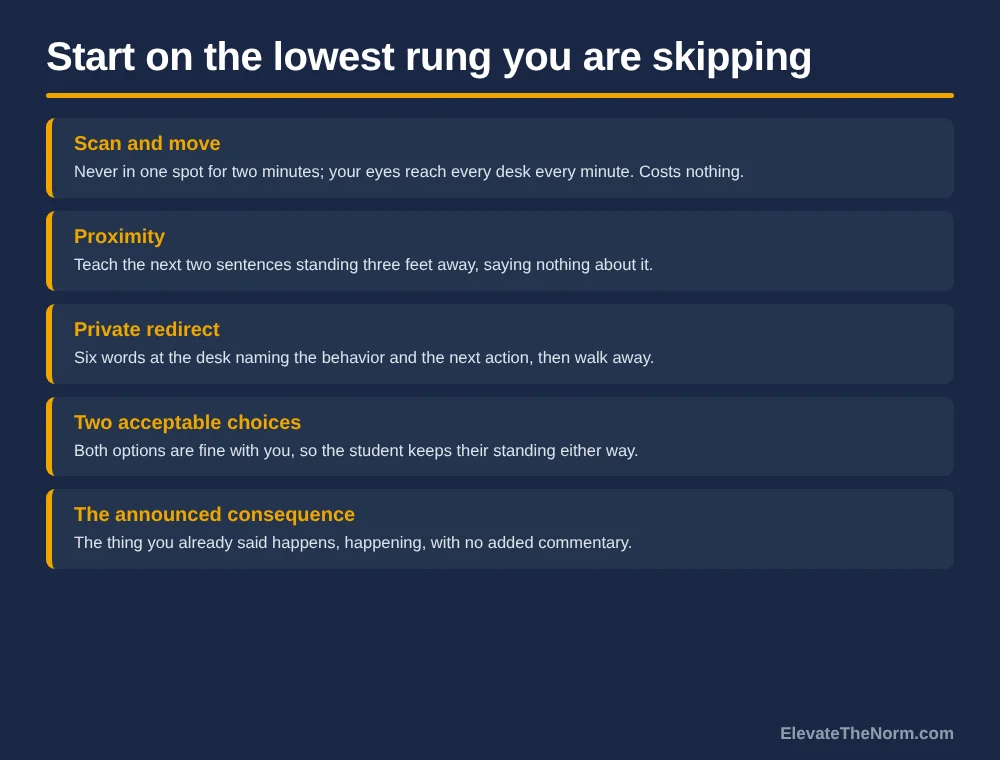
    Five rows listing graduated classroom response techniques from scanning the room through delivering a previously announced consequence.
    Most teachers who feel out of control are skipping the first four.

    Standing by your word is the whole mechanism

    Here is my actual position, stated as opinion rather than research: respecting students is easy, and the way you do it is by doing exactly what you said you would do, every single time.

    That is it. That is the technique the whole article is built around. Not consistency as a vague virtue — consistency as a literal practice. If you said the quiz is Friday, the quiz is Friday. If you said the next time it happens you call home, you call home, including on the day you are tired and the student is one you like. If you said you would read their draft by Monday, you read it by Monday. Students are keeping score on this far more carefully than on anything in your syllabus, and what they are really measuring is whether your words predict your actions.

    A teacher whose word is reliable does not need much else. The consequence does not have to be severe; it has to be certain. Certainty is what makes a room calm, because a student who knows what happens next does not have to test you to find out. Severity without certainty produces a room full of gamblers. Certainty without severity produces a room that mostly runs itself. Our longer argument about this is in the piece on consequences that are predictable rather than harsh, and the companion on letting the real consequence do the work.

    One thing I will not tell you is to let a student fail to teach them a lesson. If a student can wreck something badly enough in my room for that to be instructive, I planned the thing badly. Build the assignment so that the honest consequence of not doing the work is having to do the work, not a permanent mark on a transcript.

    What escalation actually costs

    Removal-based discipline has the weakest evidence record of any technique in common use, and the research on it is unusually clear for education research.

    The American Psychological Association’s task force review of zero tolerance concluded that after two decades of implementation, “data tended to contradict the presumptions made in applying a zero tolerance approach.” Suspension predicted higher future misbehavior rather than deterring it; there was a negative relationship between school use of suspension and expulsion and school-wide academic achievement; and suspended students showed higher dropout and lower graduation rates. The task force also made a developmental argument that matters for grades 6–12 specifically: adolescents are still immature in impulse control, risk perception and resistance to peer influence, so inflexible punishment can worsen the very behaviors it targets (Reynolds, Skiba, Graham, Sheras, Conoley & Garcia-Vazquez, 2008). They recommended graduated consequences matched to the severity of the infraction, prevention, restorative approaches, and better teacher preparation in classroom management.

    Two honest qualifications. First, that review is about school-level and district-level policy, not about whether you personally should write a referral — sometimes you should, and some behavior belongs with an administrator. Second, much of the underlying evidence is correlational: students who get suspended differ in many ways from students who do not. The directional consistency across the literature is what makes it persuasive, not any single study.

    Volume and audience are weapons, and they backfire

    Raising your voice works once. After that you have established that nothing in your room happens until an adult is shouting, and you have made yourself the loudest thing a student has to beat.

    The closest thing to hard evidence here comes from parenting research rather than classrooms, and I want to be careful about the gap. A two-year longitudinal study of 967 two-parent families found that harsh verbal discipline at ages 13 to 14 — defined as using psychological force to cause emotional pain or discomfort in order to correct behavior, ranging from yelling to insulting and humiliating language — was associated with increases in both depressive symptoms and conduct problems, including misbehavior at school. The relationship ran both ways: adolescents with conduct problems drew more harsh verbal discipline. And parental warmth did not buffer it; the researchers concluded harsh verbal discipline appeared detrimental regardless of the strength of the bond (Wang & Kenny, 2013, via the Society for Research in Child Development summary).

    Those were parents, not teachers, and the sample was mostly middle-class. You cannot read it as a measured finding about your sixth period. What it does do is undercut the most common defense of shouting at teenagers, which is that it is fine if they know you care about them. In that data, knowing you care did not help. We go further into this in our piece on what yelling actually buys a teacher.

    Audience is the other half. A public correction forces a student to choose between complying and keeping their standing with peers, and for a fourteen-year-old that is not a close call. You have manufactured a confrontation that did not need to exist. Almost every technique in rungs one through six exists to avoid exactly that choice.

    What to do instead of raising your voice

    Use a script. Not because scripts are elegant, but because your judgment is worse than usual at the exact moment you need it.

    Here is one that holds up. Say it quietly, at the desk, in under twenty seconds, and then leave.

    1. Name the behavior, not the person. “The phone is out.” Not “you always.”
    2. State the next action. “It goes in the bag until the bell.”
    3. Offer the exit. “Do that and we are done, nothing else happens.”
    4. Leave. Walk away before they respond. Standing there demands a reaction and the only one available to them is a performance.
    5. If it continues, go to the doorway, not to volume. “Step out with me for thirty seconds.”
    6. Close the loop later, privately. One sentence at the end of class that is not about the incident: “Good work on the second half. See you tomorrow.”

    Step six is the one people skip and it is the one that matters most. A correction that ends with the relationship intact can be repeated. A correction that ends with a grudge can only escalate. Our material on repair after a mistake is the longer version of step six.
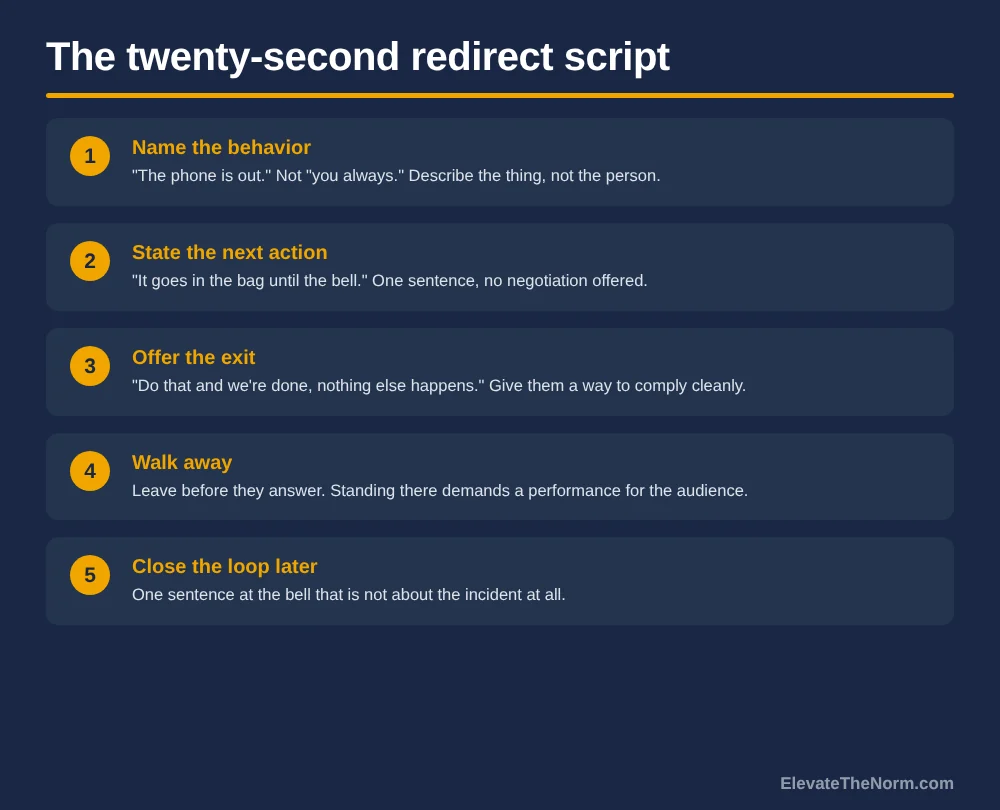
    Five cards laying out a short script a teacher can use to redirect a student quietly without raising their voice.
    Use a script, because your judgment is worst exactly when you need it.

    Behaviour management strategies: what the search term gets right

    Teachers searching the British phrase “behaviour management strategies” are usually asking a better question than teachers searching for control, because management implies a system and control implies a contest.

    A system can be handed to a substitute, written down, taught to students, and repaired when it breaks. A contest can only be won or lost, and it has to be won again every period. If you take one framing away from this article, take that one. Everything that survives in a secondary classroom is a system: the entry routine, the materials procedure, the way late work is handled, the ladder in the table above. None of it depends on you being intimidating.

    The flip side is that a system you built and do not run is worse than no system, because it has told students your word is decorative. Fewer rules, held exactly, beats a comprehensive code enforced by mood.

    Does removing the student work?

    Sometimes it is necessary and it is almost never productive, which are two different claims and both are true.

    Necessary: a student who is unsafe, or who has escalated past the point where anything you say will land, needs to be somewhere else for a while. That is not a failure. Unproductive: removal does not teach the behavior you wanted, it costs instructional time the student usually could not afford, and at scale it correlates with the outcomes the APA review described. The practical test I would use is whether the removal has a plan attached. “Go to the office” is a transfer of custody. “Go cool off at the table in the back for five minutes, then come talk to me at the end” is a technique.

    Do restorative approaches work better?

    They are promising, they are not a cure, and the best-designed study of them produced a genuinely mixed result that I think teachers should know about.

    A randomized controlled trial of a whole-school restorative practices program in a mid-sized urban district found that participating schools had greater reductions in overall suspension rates, including for African American students and students from low-income families, which narrowed disparities, and that teacher ratings of school climate improved. It also found that academic outcomes did not improve — and actually worsened in grades 6 through 8 — and that arrest rates did not fall (Augustine et al., RAND Corporation, 2018).

    I would not use that to dismiss restorative work; I would use it to set expectations. The middle-grades academic result is a real finding and the honest interpretation is probably about implementation cost: a program that takes instructional time has to be worth the time it takes. Read our overview of restorative practices and where they fit alongside that caveat rather than instead of it.
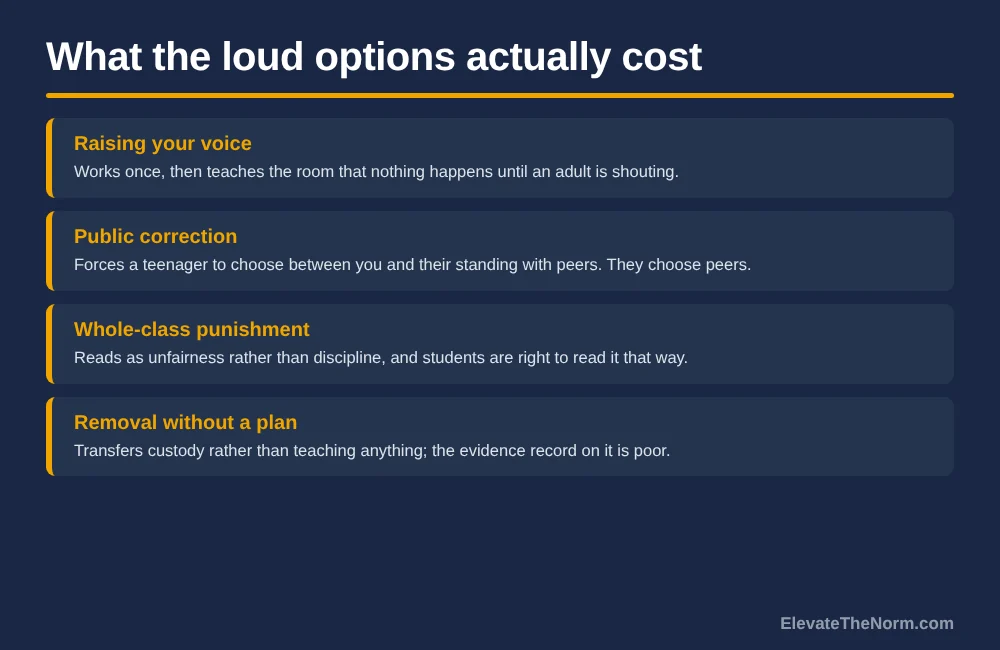
    Four rows naming high-volume or removal-based responses alongside the specific cost each one carries in a secondary classroom.
    Each of these buys the current minute at the price of the next nine weeks.

    Class room control when you are new or covering someone else’s room

    With no history and no relationship, the only techniques available to you are structural ones — so use the structure and skip everything that depends on standing.

    Plenty of people search for class room control as two words, and a disproportionate number of them are substitutes, first-year teachers, or someone covering a planning period in a room they have never seen. If that is you: get the names, give a task that can start without instructions, stand at the door, state the two things you will hold and nothing else, and do not make a single threat you cannot personally carry out before the bell. The fastest way to lose a borrowed room is to announce a consequence you have no authority to deliver. Our guide for substitutes covers the hour-by-hour version.

    How do you regain control of a class you have already lost?

    You reset publicly, narrow what you are asking for, and then be relentlessly boring about the one or two things you chose.

    Say it out loud to the class: this has not been working, here is what I got wrong, here are the two things that change starting Monday, and here is exactly what happens when they do not. Then hold those two things for four weeks without adding a third. The temptation is to announce a complete overhaul, which fails because you cannot sustain it and the failure proves your word is unreliable all over again.

    Pair it with the two cheapest positive moves available. A randomized study in middle school classrooms found that teachers who greeted students positively at the door saw improved academic engaged time and reduced disruptive behavior, and rated the strategy as feasible and reasonable to run (Cook et al., 2018). And in 28 middle school classrooms, higher praise-to-reprimand ratios tracked linearly with better class-wide on-task behavior and with better engagement and grades among students at risk for emotional and behavioral disorders (Caldarella, Larsen, Williams & Wills, 2023). Both of those are free, both were measured in middle school, and both are the opposite of control.

    Why a room that runs itself beats a room you control

    Control is scaffolding. It is sometimes necessary and it is never the finished building, and the difference shows up the first day you are absent.

    There is also a motivational reason to aim past compliance. A meta-analysis of 144 studies with just over 79,000 participants, mean age 16.5, found teacher autonomy support correlated .48 with intrinsic motivation and −.32 with amotivation, and that students’ sense of competence (ρ = .58) and autonomy (ρ = .57) were the strongest predictors of self-determined motivation (Bureau, Howard, Chong & Guay, 2021). Those are correlations from self-report measures, so hold them loosely. But autonomy support is not permissiveness — it is demands with reasons attached and real choice inside them. A room built that way does not need as much controlling, which is the only durable solution to wanting control.

    Where to start with classroom control techniques this week

    Pick the lowest rung you are currently skipping, and pick one promise you will keep exactly. Those two things, together, are most of what people mean by classroom control techniques that work.

    Concretely: for one week, handle everything with proximity and a private word, and refuse to use volume at all. You will find out quickly how much of your room was running on noise. In the same week, choose one thing you have announced and been loose about — a deadline, a phone rule, a seat — and hold it precisely, with the student you least want to hold it with. That is the whole intervention. If you want the broader toolkit it sits inside, our ranked list of classroom management strategies for grades 6–12 is the place to go next, and the piece on identifying your own management style will tell you which rung you default to when you are tired.

    Sources

    1. Reynolds, C. R., Skiba, R. J., Graham, S., Sheras, P., Conoley, J. C., & Garcia-Vazquez, E. “Are Zero Tolerance Policies Effective in the Schools? An Evidentiary Review and Recommendations.” American Psychologist, vol. 63, no. 9, 2008, pp. 852–862. Supports the findings that suspension predicts higher future misbehavior, the negative relationship with school-wide achievement, the dropout and graduation findings, and the developmental argument about adolescents. Caveat: a policy-level review resting substantially on correlational evidence; it addresses district and school policy rather than individual referral decisions. https://www.scstatehouse.gov/CommitteeInfo/SchoolSafetyTaskForce/October282014Meeting/zero-tolerance.pdf
    2. Wang, M.-T., & Kenny, S. “Longitudinal Links Between Fathers’ and Mothers’ Harsh Verbal Discipline and Adolescents’ Conduct Problems and Depressive Symptoms.” Child Development, 2013. Supports the definition of harsh verbal discipline, the association with conduct problems and depressive symptoms at ages 13–14, the bidirectional relationship, and the finding that parental warmth did not buffer it. Caveat: this studied parents and not teachers, in 967 mostly middle-class two-parent families, and is cited here through the Society for Research in Child Development’s summary of the study rather than the paywalled article. https://www.srcd.org/sites/default/files/resources/pr_2013_09_04_wang.pdf
    3. Simonsen, B., Fairbanks, S., Briesch, A., Myers, D., & Sugai, G. “Evidence-Based Practices in Classroom Management: Considerations for Research to Practice.” Education and Treatment of Children, vol. 31, 2008, pp. 351–380. Supports the five categories of evidence-based practice and specifically the use of a continuum of responses to inappropriate behavior. Caveat: linked as a full-text reproduction hosted by a university project rather than the journal of record. https://k12engagement.unl.edu/sites/unl.edu.cehs.special-ed-communic-disorders.student-engagement-project/files/media/file/Classroom%20Management%206-8-16.pdf
    4. Augustine, C. H., Engberg, J., Grimm, G. E., Lee, E., Wang, E. L., Christianson, K., & Joseph, A. A. Can Restorative Practices Improve School Climate and Curb Suspensions? RAND Corporation, RR-2840-DOJ, 2018. Supports the suspension reductions, the narrowing of disparities, the improved teacher climate ratings, and the finding that academic outcomes did not improve and worsened in grades 6–8. Caveat: one randomized trial in one mid-sized urban district; the middle-grades academic result is a real negative finding and should not be omitted when the program is recommended. https://www.rand.org/pubs/research_reports/RR2840.html
    5. Cook, C. R., Fiat, A., Larson, M., Daikos, C., Slemrod, T., Holland, E. A., Thayer, A. J., & Renshaw, T. “Positive Greetings at the Door: Evaluation of a Low-Cost, High-Yield Proactive Classroom Management Strategy.” Journal of Positive Behavior Interventions, vol. 20, no. 3, 2018, pp. 149–159. Supports the door-greeting effects on academic engaged time and disruptive behavior in middle school classrooms. Caveat: a single randomized trial; the specific percentage figures widely quoted online do not appear in the published abstract and are not repeated here. https://experts.umn.edu/en/publications/positive-greetings-at-the-door-evaluation-of-a-low-cost-high-yiel/
    6. Caldarella, P., Larsen, R. A. A., Williams, L., & Wills, H. P. “Effects of Middle School Teachers’ Praise-to-Reprimand Ratios on Students’ Classroom Behavior.” Journal of Positive Behavior Interventions, vol. 25, no. 1, 2023, pp. 28–40. Supports the linear relationship between praise-to-reprimand ratios and on-task behavior, engagement and grades. Caveat: 28 middle school classrooms; high school classrooms were not studied. https://journals.sagepub.com/doi/10.1177/10983007211035185
    7. Bureau, J. S., Howard, J. L., Chong, J. X. Y., & Guay, F. “Pathways to Student Motivation: A Meta-Analysis of Antecedents of Autonomous and Controlled Motivations.” Review of Educational Research, vol. 91, no. 3, 2021. Supports the correlations between teacher autonomy support, competence, autonomy and self-determined motivation in a sample with a mean age of 16.55. Caveat: 144 studies and 79,079 participants, but correlational and largely self-reported on both sides. https://selfdeterminationtheory.org/wp-content/uploads/2021/09/2021_PathwaystoStudentMotiv_BureaHowardEtal.pdf

    Frequently Asked Questions

    Is wanting control of my classroom a bad thing to want?

    No. A room that is chaotic is a room where nobody learns and some students are genuinely unsafe, so the instinct is sound. The argument here is about the target, not the motive. Control is a means, and the kind you get by being intimidating has to be re-established every period and collapses the week you are absent. The kind you get from taught routines, a predictable response ladder and a reputation for keeping your word holds without you. Same goal, far cheaper to maintain.

    What if a student escalates after I use a quiet redirect?

    Then you stop trying to win the moment. Drop your volume rather than raising it, give the class something to do so they stop being an audience, and move the conversation to the doorway or defer it entirely: “We’ll talk at the bell.” A student who is escalated is not processing your reasoning, so reasoning harder makes it worse. If there is any safety concern, follow your building’s procedure immediately — de-escalation technique is not a substitute for a safety protocol, and no article should tell you otherwise.

    Doesn’t this just mean being soft on students who need firm boundaries?

    It means the opposite. Nothing here says to lower a standard; it says to deliver the standard quietly and without fail. The firmest thing in a classroom is not a raised voice — it is a consequence that arrives exactly as announced, including on the day you would rather not. Students experience certainty as firmness and volume as instability. If anything, this approach is harder on teachers than shouting is, because it requires you to follow through on days when nobody would blame you for letting it slide.

    How do I explain my approach to a parent who expects tougher discipline?

    Lead with predictability rather than philosophy. Tell them the sequence in order: expectations are taught in the first week, a problem gets a signal, then a private word, then a conversation with you, then a call home before anything is written up, and the same behavior gets the same response for every student. Most parents asking for toughness are really asking whether their child is safe and whether rules are applied evenly. Answer those two questions concretely and the disagreement about method usually disappears.

    What does this cost a school to implement?

    The classroom techniques cost nothing: proximity, private correction, a response ladder and keeping your word require no purchase and no release time. The real cost is coaching time, because teachers cannot see their own volume or their own praise-to-correction rate without someone counting. Twenty minutes of a colleague’s planning period does that. Whole-school restorative programs are a different financial question entirely, and the randomized evidence on those is mixed enough that a district should pilot before scaling.

    Does this work with students who have behavior plans or significant trauma histories?

    The low-rung techniques are generally a better fit for these students, not a worse one, because they reduce public exposure and surprise. Predictability and private correction are protective. What this article cannot do is replace an individualized plan: if a student’s IEP or behavior intervention plan specifies a response, that document governs, and you bring what you are observing to the case manager rather than improvising. Universal technique is the floor underneath individualized support, never a substitute for it.

    I teach five classes and I am exhausted. Where do I start?

    One period and one week. Choose the class that is hardest, and for five days handle every correction with proximity and a quiet word only — no volume, no public callouts. In the same week pick one promise you have been loose about and keep it exactly. That is two changes in one class, which is sustainable on a bad Tuesday. Trying to overhaul all five periods is the version of this that fails, and the failure costs you more credibility than never starting would have.

    What if my administrator wants to see me being stricter?

    Ask what observable behavior they want to see more of, because “stricter” usually turns out to mean something specific and achievable — fewer students out of seats, phones away, a faster start. Those are structure problems with structural solutions, and you can show progress on them without raising your voice once. Keep a short record of what you changed and what happened. An administrator watching a room start on time with everyone working is not going to insist you shout about it.

    About Clay Shumate

    Clay Shumate is a certified secondary Social Studies teacher in the public schools of West Alabama, with seven years of classroom experience, a B.A. in History, and an M.Ed. in Secondary Education. He writes about project-based learning, student responsibility, respect, and practical ways to hold young people to a higher standard while giving them room to learn from mistakes. He is a member of the Society of Professional Journalists and writes to its Code of Ethics; this site’s editorial standards and corrections policy are published in full. More about Clay.

  • Classroom Management Strategies That Actually Work in Grades 6–12

    Classroom Management Strategies That Actually Work in Grades 6–12

    By Clay Shumate

    The classroom management strategies with the strongest research support are preventive rather than reactive: explicitly teach the behavior you want, build routines that run without you, keep students actively responding, and interact positively far more often than you correct. Consequence systems still matter, but they are the smallest part of the work.

    I have seven years of classroom experience in the public schools of West Alabama, and the thing I wish somebody had said to me in year one is that management is mostly design work done before students arrive. The teacher who looks like a natural is usually just a teacher whose room has fewer gaps in it. Below is what the evidence actually supports, what it only weakly supports, and what order I would put it in if I were starting over on a Monday with a hard group.

    Key Takeaways

    • Prevention outperforms response. The practices with the best support — structure, taught expectations, active engagement, acknowledgment — all happen before a behavior problem exists.
    • Your ratio matters more than your rules. In middle school classrooms, higher praise-to-reprimand ratios tracked with better on-task behavior; most teachers start out reprimanding several times more often than they praise.
    • Engagement is a management strategy. Students answering questions three to five times a minute are not students looking for something else to do.
    • The research base is thinner than the confident advice suggests. Much of it ran in elementary rooms, on small samples, with single-subject designs. Grades 6–12 teachers are extrapolating more than they are told.
    • Most of what fails is not a bad strategy — it is an unenforced one. A rule you apply on Tuesday and ignore on Thursday teaches students that your word is a suggestion.

    What does the research actually say about classroom management?

    It says proactive, structural practices work, that the effects are real but modest, and that most of the evidence was collected on younger students than ours. That is a less satisfying answer than the internet gives you, and it is the honest one.

    The clearest synthesis for practitioners is still Simonsen and colleagues’ review, which screened the literature for classroom practices with genuine empirical support and came out with about twenty, sorted into five jobs: maximize structure and predictability; post, teach, review, monitor and reinforce expectations; actively engage students in observable ways; use a continuum of strategies to acknowledge appropriate behavior; and use a continuum of strategies to respond to inappropriate behavior (Simonsen, Fairbanks, Briesch, Myers & Sugai, 2008). Notice the ordering. Four of the five categories are things you do before anyone misbehaves.

    On effect size, two reviews are worth knowing. A Campbell systematic review of teacher classroom management practices found a classroom-level mean effect of roughly d = .71 to .80 on disruptive and aggressive behavior — but it located only 12 eligible studies out of more than five thousand screened titles, two-thirds of them in grades K–6, and the authors said plainly that they lacked the power to test any moderators (Oliver, Wehby & Reschly, 2011). A newer meta-analysis of 76 controlled trials of classroom management interventions reported a small overall effect, Hedges’ g = .23, and that one ran entirely in primary education (Korpershoek, de Boer & Mouw, 2026). It also found something counterintuitive: interventions that tried to do all four things at once — teacher behavior, relationships, student behavior, and social-emotional development — worked less well than narrower ones.

    Read those two together and you get a reasonable working belief. The basics work. They do not work like magic. And a focused change you actually sustain will beat a comprehensive program you half-implement.

    Classroom management strategies, ranked by payback for effort

    If you only have the energy to change one thing this week, change something near the top of this table. The ranking is my professional judgment about return on effort for grades 6–12; the evidence column is the honest state of the research, not a sales pitch.

    StrategyWhat it costs youWhat it pays backEvidence
    Teach expectations explicitly, then re-teach themTwo to three class periods up front, five minutes after each breakFewer arguments about what the rule meant; faster recovery after disruptionsStrong across reviews; rated strong evidence in the IES guide, though that guide is K–6
    Routines for entry, materials, transitions, exitDesign time once, plus two weeks of patient correctionRecovers several minutes per period; removes the dead air where problems startStrong as part of “structure and predictability”
    Positive greeting at the doorUnder five minutes a period, zero prepBetter engagement and less disruption in a middle school trialOne randomized middle school study; promising, not settled
    Raise your praise-to-correction ratioNothing but attention and habitClass-wide on-task gains; grade improvement for at-risk studentsDirect middle school evidence
    High rates of active respondingRewriting how you question, not what you teachOn-task behavior and achievement both moveConsistent but mostly elementary and single-subject
    Private, brief, specific correctionSelf-control in the momentAvoids the audience problem; keeps the student in the roomSupported as part of a response continuum
    Relationship investment with the hardest studentsReal time, weeks of itLargest long-run payoff; strongest in upper gradesMeta-analytic, correlational — direction of causation is genuinely unclear
    Written consequence ladders and point systemsSignificant setup and record-keepingUseful for consistency; does not by itself change behaviorWeakest of the group for secondary students
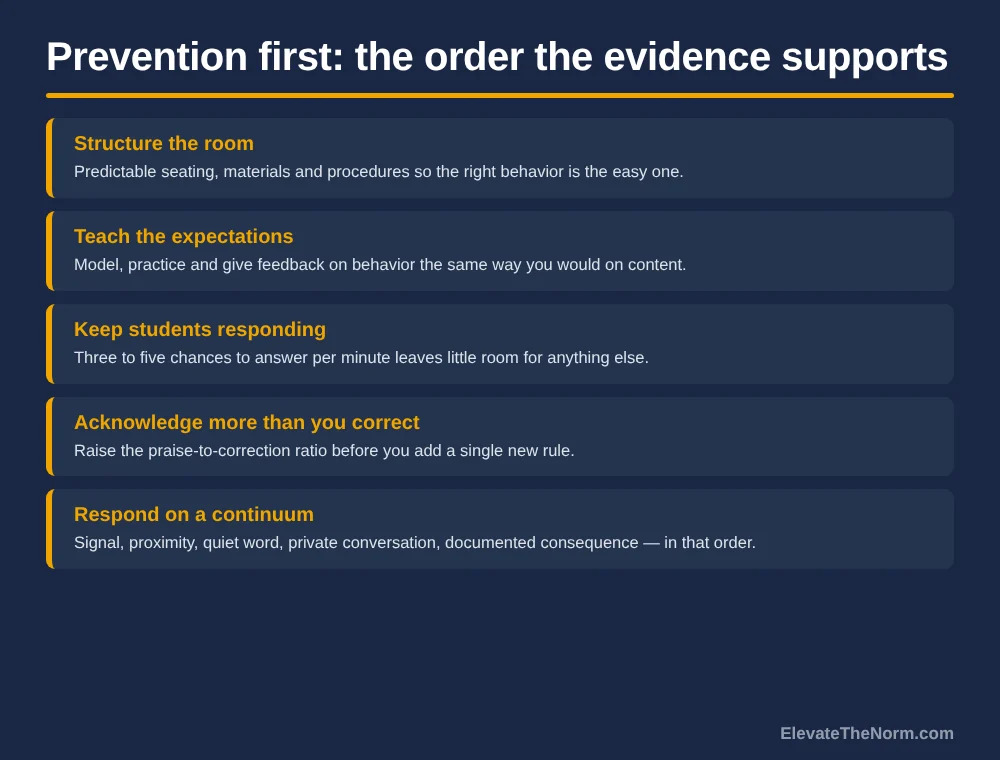
    A five-step vertical list showing preventive classroom management steps from structuring the room through responding on a graduated continuum.
    Four of the five evidence-based categories happen before anyone misbehaves.

    Teach your expectations like content, not like a warning

    The single most reliable move in classroom management is to treat your expectations as something you teach, model, practice and reassess — exactly as you would a skill in your subject. A poster is not instruction. Reading a list aloud on the first day is not instruction either.

    Secondary students arrive in your room having had five other teachers that morning, each with a different definition of “ready.” Ready for what? Phone where? Talking allowed when? If you have not shown them, they are guessing, and a guess that goes wrong looks like defiance when it is actually an information problem. I would write three to five expectations in observable terms, demonstrate what each one looks like and does not look like, have the class do it once, and give feedback. Then do a two-minute version after every long weekend, every schedule change, and every time the room drifts. If you want the longer version of how to word them so they hold up in November, we go deeper in our piece on setting expectations that survive the whole year and on why those expectations matter more than the rules list.

    One caution about evidence quality, because it is the kind of thing nobody tells teachers. The IES practice guide that assigns strong evidence to modifying the classroom environment and to teaching and reinforcing appropriate skills is titled, accurately, Reducing Behavior Problems in the Elementary School Classroom (Epstein et al., 2008). It covers kindergarten through sixth grade. The logic transfers to a tenth-grade room; the effect sizes were not measured there.

    Build routines that make the right behavior the easy behavior

    A routine is a decision you make once so that thirty students do not have to make it thirty different ways every day. Routines are where most of the recoverable time in a secondary schedule is hiding.

    Count the seams in your period: coming in, getting started, handing something out, moving to groups, moving back, cleaning up, leaving. Each seam is unstructured time, and unstructured time is where the problems you spend your afternoon documenting actually begin. Build a specific procedure for each one, teach it, and hold it. Our walkthroughs on building procedures from the ground up and on making transitions stop costing you five minutes have the mechanics. The physical room is part of that structure too, right down to classroom lighting.

    The honest limit here: routines reduce opportunity for disruption. They do not address a student who is disrupting because something is wrong. Do not confuse a tight room with a healthy one.

    Fix the first four minutes

    How class starts predicts most of how class goes, which is why the cheapest strategy on this list is standing at the door and speaking to students by name as they come in.

    A randomized study of a strategy called Positive Greetings at the Door, run in middle school classrooms, found improvements in academic engaged time and reductions in disruptive behavior, and teachers rated it as feasible and reasonable to do (Cook et al., 2018). I want to be careful not to oversell a single trial, and the figures that circulate about it online are frequently inflated past what the published abstract reports. But it is a middle school study, it is randomized, it costs nothing, and the mechanism is not mysterious: you have made contact with every student before anyone has done anything wrong.

    Pair it with a task on the board that students can begin without you. A warm-up that requires your instructions is not a warm-up. Our collection of openers students can start alone is built for exactly that gap.

    Raise your ratio of positive to corrective interaction

    Most of us correct far more than we acknowledge, we do not know we are doing it, and fixing the imbalance is free.

    This is the strategy with the most direct secondary evidence. In a study of 28 middle school classrooms, researchers found a statistically significant linear relationship between teachers’ praise-to-reprimand ratios and student behavior: as the ratio rose, class-wide on-task behavior improved, and students at risk for emotional and behavioral disorders showed more engagement, less disruption, and better grades (Caldarella, Larsen, Williams & Wills, 2023). What is striking in the surrounding literature is the baseline: teachers commonly reprimand several times more often than they praise before anyone points it out to them.

    Two practical notes. First, specific beats general — naming the behavior does more than “good job.” Second, thirteen-year-olds and seventeen-year-olds have different tolerances for public praise. Some students will do more for a quiet word at their desk than for recognition in front of the room, and a few will actively sabotage the behavior you praised loudly. That is not ingratitude. It is social self-protection, and it is worth respecting.

    Four cards describing a week-by-week plan for a secondary teacher starting over with a difficult class.
    Four cheap moves, one per week, instead of a whole new system.

    Keep students responding, not just listening

    Opportunities to respond — the rate at which students actively produce an answer rather than receive information — is a management lever disguised as an instructional one.

    A systematic review of teacher-directed opportunities to respond found that higher rates improved academic and behavioral outcomes, with presentation rates around three to five per minute producing favorable results, and unison formats such as choral responding and response cards outperforming individual hand-raising (MacSuga-Gage & Simonsen, 2015). The IRIS Center’s secondary behavior module gives teachers the same working target of three to five opportunities per minute (IRIS Center, Vanderbilt University).

    Here is the caveat the review states about itself: of its 15 studies, eleven were elementary, only two middle school and one high school, and the designs were heavily single-subject. Three to five per minute is a reasonable aim for a secondary room; it is not a number that was validated in one. Whiteboards, structured turn-and-talk, cold call with think time, and quick written responses all get you there. Our list of quick formative checks doubles as a response-rate toolkit.

    Correct quietly, privately, and briefly

    When you do have to respond, keep it small, keep it near the student, and get instruction moving again inside ten seconds.

    The response continuum in the evidence-based list runs from a brief nonverbal signal, to proximity, to a quiet redirect, to a private conversation, to a documented consequence. Most teachers skip the first three rungs under stress and jump to the loudest option available, which costs the room its momentum and costs the student their standing in front of peers. A secondary student will accept a correction and resent an audience. If you want the full argument against volume as a tool, we make it in our piece on what yelling actually buys you, and the companion article on classroom control techniques covers de-escalation in detail. When the problem is a whole period that will not settle rather than one student, the first move is different again — a voice level for each task and one practised attention signal.

    What are the most common classroom management techniques that do not work?

    The ones that rely on public pressure, escalating volume, collective punishment, or a system too complicated to run on a bad day.

    I will name them, because the folklore in this field is persistent and most of it was handed down rather than tested.

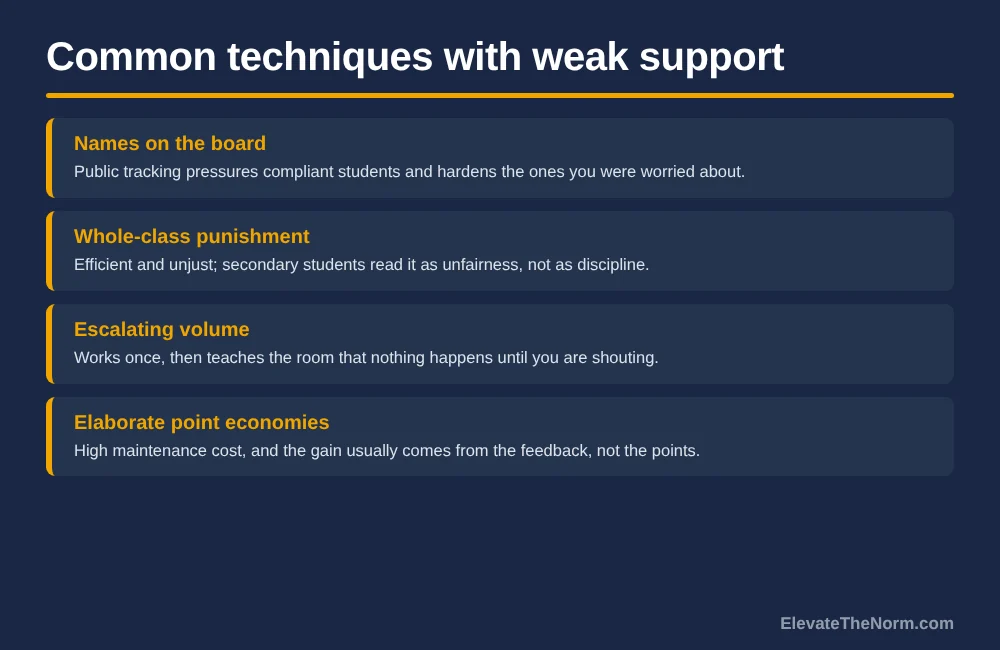
    • Names on the board and visible behavior charts in secondary rooms. Public shaming works on students who were going to comply anyway and hardens the ones who were not.
    • Whole-class punishment for one student’s choice. It is efficient and it is unjust, and teenagers have an unerring sense for the difference.
    • Escalating volume. It works once. After that you have established that nothing happens until you are shouting.
    • Elaborate point economies. Not harmful, but the maintenance cost is high and the thing driving the gain is usually the attention and feedback, not the points.
    • “Don’t smile until Christmas.” There is no evidence for it and it costs you the relationship capital you will need in February.

    Most advice and strategies on classroom management fail for a duller reason than being wrong, though. They fail because they were not held. A consequence you deliver on Monday and forget on Thursday has taught the class something precise: your word is negotiable. Everything else in this article depends on the opposite being true.

    A four-row list naming four widely used classroom management techniques alongside the reason each one tends to backfire.
    Most of this was handed down rather than tested.

    How do you handle the student who is not buying any of it?

    You stop treating it as a management problem and start treating it as a motivation problem, because that is usually what it is.

    A meta-analysis of 144 studies with just over 79,000 participants, average age 16.5, found teacher autonomy support correlated .48 with intrinsic motivation and −.32 with amotivation — and that students’ sense of competence (ρ = .58) and autonomy (ρ = .57) were the strongest predictors of self-determined motivation (Bureau, Howard, Chong & Guay, 2021). These are correlations, not experiments, and self-report measures on both sides inflate relationships. Still: the student with his head down is frequently a student who does not believe he can do the work. Lower the entry cost on one assignment and watch what happens before you write a referral. We take this apart further in the article on students who have stopped trying.

    How long before classroom management in the classroom starts to feel different?

    Expect two to three weeks for routines to hold, a full grading period for your ratio to change the room’s mood, and a semester for relationships with the hardest students to pay.

    The slow one is worth waiting for. A meta-analysis of 99 studies on teacher–student relationships found medium-to-large associations with engagement and small-to-medium associations with achievement, and reported that effects were stronger in the higher grades (Roorda, Koomen, Spilt & Oort, 2011). That is good news for secondary teachers and it comes with the usual correlational warning: easier students are easier to have good relationships with, and that alone could produce part of the pattern. Our guide to building these relationships without faking it is the practical companion.

    Where classroom management methods fail: three honest limits

    Know these three before you implement anything, because they are the reason good management strategies for classroom use stop working in real buildings.

    The evidence skews young

    The single largest problem with the research base for grades 6–12 is that so much of it was gathered in grades K–6. The structural logic transfers. The specific doses and effect sizes do not, and anyone who tells you otherwise is extrapolating without saying so.

    Doing everything at once backfires

    The 76-study meta-analysis found that interventions addressing all four strategy categories simultaneously were less effective than targeted ones. Pick two changes. Hold them for a grading period. Add the third.

    Equity is not automatic

    A room can be orderly and still be delivering its consequences unevenly. If you are not periodically looking at who gets redirected, who gets referred, and who gets the benefit of the doubt, you do not actually know whether your system is fair — you only know it is quiet. Our material on consequences that are predictable rather than punitive addresses this directly.

    What to do Monday: putting these classroom management strategies in order

    Do not implement this article. Implement two lines of it. The classroom management strategies above are not a program, and treating them as one is how teachers end up with a binder and no change in their room.

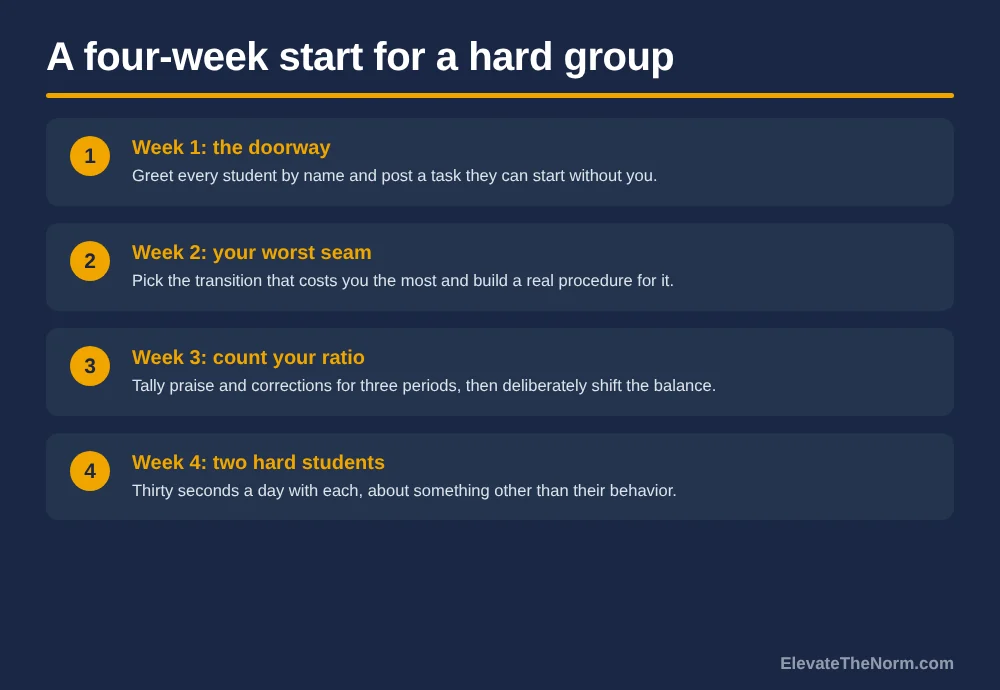
    Here is the order I would use. Week one: stand at the door, greet every student by name, and have something on the board they can start without you. Week two: pick your worst seam — usually the transition into group work or the last four minutes — and build a real procedure for it, teach it, and hold it. Week three: count your own praise and corrections for three periods, then fix the ratio. Week four: choose the two students you dread most and spend thirty seconds a day on something that is not about their behavior. That is it. Four moves, each cheap, each with evidence behind it, and none of which requires anyone’s permission.

    If you are in your first year or two and need the whole scaffold rather than four moves, start with the new-teacher version of all this, then write the plan down using our classroom management plan framework. And if you want to know which of these moves you default to under pressure — which tells you a lot about what you need to work on — read our breakdown of classroom management styles and find your own.

    Sources

    1. Simonsen, B., Fairbanks, S., Briesch, A., Myers, D., & Sugai, G. “Evidence-Based Practices in Classroom Management: Considerations for Research to Practice.” Education and Treatment of Children, vol. 31, 2008, pp. 351–380. Supports the five categories of evidence-based classroom practice and the roughly twenty specific practices named. Caveat: linked here as a full-text reproduction hosted by the University of Nebraska–Lincoln Student Engagement Project rather than the paywalled journal of record. https://k12engagement.unl.edu/sites/unl.edu.cehs.special-ed-communic-disorders.student-engagement-project/files/media/file/Classroom%20Management%206-8-16.pdf
    2. Oliver, R. M., Wehby, J. H., & Reschly, D. J. “Teacher Classroom Management Practices: Effects on Disruptive or Aggressive Student Behavior.” Campbell Systematic Reviews, 2011(4). Supports the d = .71–.80 classroom-level effect for management practices. Caveat: only 12 studies met inclusion criteria out of more than 5,000 screened, about two-thirds in grades K–6, and the authors state they lacked power for moderator analyses. https://www.mona.uwi.edu/cop/sites/default/files/resource/files/Oliver_Classroom_Management_Review.pdf
    3. Korpershoek, H., de Boer, H., & Mouw, J. M. “An Update of the Meta-Analysis of the Effects of Classroom Management Interventions on Students’ Academic, Behavioral, Social-Emotional, and Motivational Outcomes.” Review of Educational Research, vol. 96, no. 5, 2026, pp. 1640–1680. Supports the small overall effect (g = .23) and the finding that broad multi-component interventions underperformed targeted ones. Caveat: the 76 included trials were conducted in primary education, so the figures should not be read as secondary-school effects; linked via the publisher record and repository abstract. https://research.rug.nl/en/publications/an-update-of-the-meta-analysis-of-the-effects-of-classroom-manage/
    4. Caldarella, P., Larsen, R. A. A., Williams, L., & Wills, H. P. “Effects of Middle School Teachers’ Praise-to-Reprimand Ratios on Students’ Classroom Behavior.” Journal of Positive Behavior Interventions, vol. 25, no. 1, 2023, pp. 28–40. Supports the praise-to-reprimand findings for class-wide on-task behavior and for students at risk for emotional and behavioral disorders. Caveat: 28 classrooms in middle schools only; effects for high school were not measured. https://journals.sagepub.com/doi/10.1177/10983007211035185
    5. Cook, C. R., Fiat, A., Larson, M., Daikos, C., Slemrod, T., Holland, E. A., Thayer, A. J., & Renshaw, T. “Positive Greetings at the Door: Evaluation of a Low-Cost, High-Yield Proactive Classroom Management Strategy.” Journal of Positive Behavior Interventions, vol. 20, no. 3, 2018, pp. 149–159. Supports the door-greeting strategy’s effect on academic engaged time and disruptive behavior in middle school. Caveat: a single randomized trial; the specific percentage figures circulating online are not in the published abstract and are not repeated here. https://experts.umn.edu/en/publications/positive-greetings-at-the-door-evaluation-of-a-low-cost-high-yiel/
    6. MacSuga-Gage, A. S., & Simonsen, B. “Examining the Effects of Teacher-Directed Opportunities to Respond on Student Outcomes: A Systematic Review of the Literature.” Education and Treatment of Children, vol. 38, no. 2, 2015, pp. 211–240. Supports the three-to-five-per-minute response rate and the advantage of unison response formats. Caveat: 15 studies, 172 participants, eleven of them elementary and only one high school, with heavy reliance on single-subject designs. https://journals.sagepub.com/doi/abs/10.1177/1074295619835207
    7. Epstein, M., Atkins, M., Cullinan, D., Kutash, K., & Weaver, R. Reducing Behavior Problems in the Elementary School Classroom. IES Practice Guide, What Works Clearinghouse, U.S. Department of Education, September 2008. Supports the strong-evidence ratings for modifying the classroom environment and for teaching and reinforcing appropriate skills. Caveat: the guide explicitly covers kindergarten through grade 6; its ratings were not established for secondary classrooms. https://ies.ed.gov/ncee/wwc/PracticeGuide/4

    Frequently Asked Questions

    Do I have to choose between being warm and being strict?

    No, and the framing is the problem. The approach with the best support is high structure plus high warmth at the same time: expectations are clear and non-negotiable, and the relationship is real. Warmth without structure produces a room students enjoy and do not learn in. Structure without warmth produces compliance that evaporates the moment you leave. If you think you must pick one, you are probably describing a consistency problem rather than a personality problem. Hold the line and be kind while you do it.

    My school requires a specific behavior system. Can I still use these strategies?

    Almost always, yes. Nearly everything in this article lives inside your own four walls: how you greet students, how you teach procedures, how often you acknowledge rather than correct, how many chances students get to respond. Those are instructional choices, not policy changes. Where a mandated system conflicts — for instance, if it requires public tracking of behavior — follow the policy, document what you are seeing, and raise it with your administrator as feasibility feedback rather than quietly opting out.

    How do I know whether this is working instead of just feeling better?

    Pick a number before you start. Count minutes lost to transitions, tally your own praise and corrections for three periods, log referrals by week, or sample on-task behavior with a simple scan every five minutes for one class. Any of those takes under ten minutes a day and gives you something other than mood to judge by. Two weeks of baseline, then two weeks after the change. If the number has not moved at all after a full grading period, change the strategy rather than working harder at it.

    Is there a cost to the district, and does any of this require training?

    The four moves in the closing section cost nothing and require no purchase, no platform and no release time. That is deliberate. Where cost appears is in coaching: the reason praise-to-correction ratios do not change on their own is that teachers cannot see their own rates, so someone has to count for them. A colleague with a clipboard for twenty minutes does that as well as a consultant. If a vendor is quoting you a comprehensive program, the meta-analytic evidence suggests narrower is better anyway.

    What about students with IEPs, behavior plans, or significant trauma histories?

    These strategies are the universal layer and they help, but they are not a substitute for individualized support. Clear routines, predictable responses, high response rates and a good ratio make a room safer for a student with anxiety or a behavior plan, not less so. What they cannot do is replace the plan itself. If a student’s IEP or BIP specifies a different response, that document wins. Bring what you are observing to the case manager rather than improvising around it.

    Will students see explicitly taught procedures as babyish?

    Some will say so out loud, and the way you teach it decides whether they mean it. Teenagers resent being managed and do not resent being told the actual reason for something. “We do it this way because it gives us back four minutes and I would rather spend those on the project” lands differently from “because those are the rules.” Keep the practice brief, explain the purpose once, and ask them where the procedure is clumsy. Students will cooperate with a system they had a hand in sanding down.

    What should I tell a parent who asks how behavior is handled in my room?

    Tell them the sequence, in order, before anything happens. Something like: expectations are taught in the first week and posted; a problem gets a nonverbal signal, then a quiet word, then a conversation with me outside of class; if it continues I call home before I write anything up; consequences are the same for every student and I will explain the reasoning to your child. Parents are rarely upset by a consequence they understood in advance. They are upset by surprises and by inconsistency.

    Which single strategy should I start with if my class is already out of control?

    Start with the entry routine and the first four minutes, because a class that begins badly cannot be recovered mid-period. Stand at the door, speak to every student by name, and put a task on the board they can begin without instructions from you. It takes no prep, it has randomized evidence behind it in middle school classrooms, and it gives you contact with everyone before the day can go wrong. Once the opening holds for a full week, fix your next worst seam.

    About Clay Shumate

    Clay Shumate is a certified secondary Social Studies teacher in the public schools of West Alabama, with seven years of classroom experience, a B.A. in History, and an M.Ed. in Secondary Education. He writes about project-based learning, student responsibility, respect, and practical ways to hold young people to a higher standard while giving them room to learn from mistakes. He is a member of the Society of Professional Journalists and writes to its Code of Ethics; this site’s editorial standards and corrections policy are published in full. More about Clay.

  • Tardy Policy: What Actually Gets Students Through the Door on Time

    Tardy Policy: What Actually Gets Students Through the Door on Time

    By Clay Shumate

    A tardy policy is the set of rules and responses a school or classroom uses when a student arrives after the bell. A good one protects instructional time without removing more of it than tardiness costs, escalates by pattern rather than by the adult’s patience, and treats the first ten seconds at the door as the most important part of the whole system.

    Most tardy policies fail in the same direction. They are written to feel firm, enforced hard in September, and quietly abandoned by February — which teaches teenagers that the rule was never really a rule.

    Key Takeaways

    • The research on tardiness specifically is thin, and anyone who tells you otherwise is rounding. There is far more evidence on full-day absence than on walking in four minutes late. Build your policy on principles you can defend, not on a statistic you cannot source.
    • Escalate by pattern, not by annoyance. One tardy is information. Four tardies in two weeks is a problem with a cause. Those two things should not get the same response.
    • Do not solve four lost minutes by removing forty. Hallway lockouts and suspensions for lateness remove instruction in order to punish missing instruction, and nationally about 7 percent of secondary students were suspended out of school in 2017–18.
    • The cause is usually logistical before it is attitudinal. Distance, a locker, a bathroom, a sibling drop-off, a class on the far side of the building. Ask before you assign a motive.
    • Thresholds are local. Compulsory attendance exists in every state, but most laws do not specify how many incidents trigger what, and districts set their own definitions. Read yours before you write a classroom rule that contradicts it.

    What Should a Tardy Policy Actually Do?

    It should get a student into a seat and working with the smallest possible loss of instruction — theirs and everybody else’s. That is the whole job. Every other goal people attach to tardy policies — teaching punctuality, preparing students for work, holding a standard — is downstream of that one, and none of them is served by a rule that costs more minutes than it saves.

    It helps to say out loud what a tardy policy is not. It is not an attendance policy. A student who is late to third period has not missed school; they have missed the opening of one class. Those are different problems with different causes and different fixes, which is why missing whole days of school belongs in a separate conversation from missing the first four minutes of a period. It is also not a late work policy. Turning in an essay three days late and arriving to class three minutes late look similar on paper and have almost nothing in common underneath.

    What Does the Research Actually Say About Tardiness?

    Less than you would like. This is worth saying plainly, because the internet is full of confident numbers about what tardiness costs and most of them trace back to nothing.

    The clearest study aimed directly at the problem is Tyre, Feuerborn and Pierce’s 2011 paper in Preventing School Failure. They ran a schoolwide intervention in a middle and high school and reported that average daily tardiness “decreased substantially” and stayed down over time. The intervention had three parts, and the parts are the useful finding: explicitly teaching what transition behavior should look like, actively supervising common areas during passing time, and applying consequences consistently. Note what is not in that list. No lockout, no mass detention, no public shaming.

    What the published abstract does not give is a number for how much tardiness fell, so I am not going to give you one. If you see this study quoted with a precise percentage attached, somebody added it.

    The stronger evidence sits one step sideways, in attendance. Rogers and Feller’s 2018 experiment in Nature Human Behaviour is the piece worth knowing: 28,080 high-risk K–12 students, randomly assigned, with the treatment being personalized mailings that corrected parents’ mistaken beliefs about how many days their child had actually missed. The most effective versions reduced chronic absenteeism by 10 percent or more, the effect held across every grade level, and it even reduced absences among untreated siblings in the same household. It was, in the authors’ words, more than an order of magnitude more cost-effective than standard absence-reduction practice.

    That is a study about absences, not tardies, and I am not going to pretend the transfer is automatic. But the mechanism is the part that generalizes, and it is the opposite of what most tardy policies assume. Families were not indifferent. They were wrong about the count. Giving them accurate information changed behavior more cheaply than any punishment in the building.

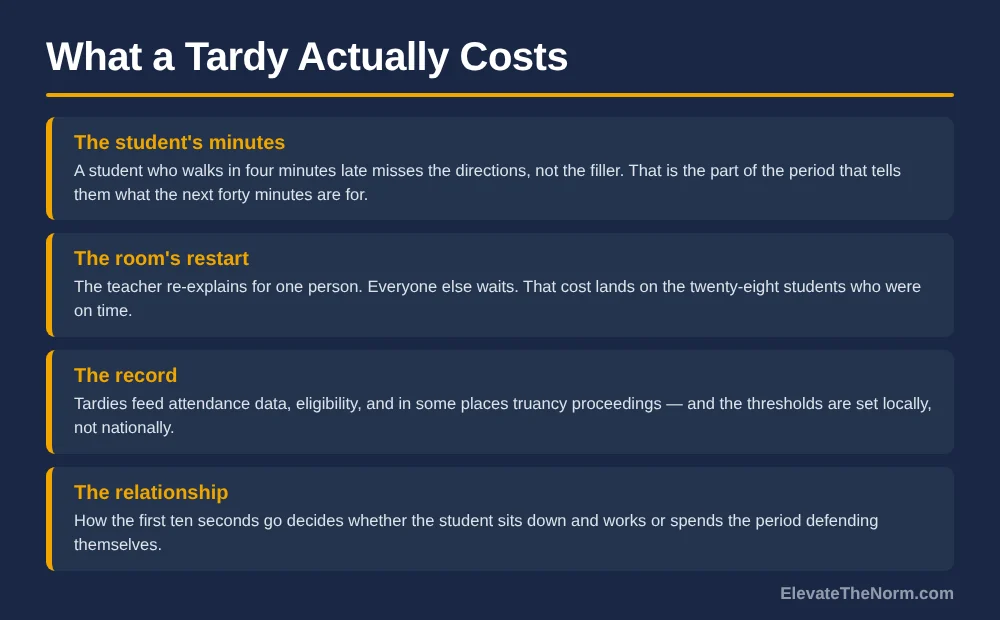
    Four-row graphic listing what a tardy costs: the student's missed directions, the room's restart for one person, the attendance record and locally set thresholds, and the relationship in the first ten seconds
    A tardy costs four different things, and only one of them is minutes.

    What Does a Tardy Actually Cost?

    Four things, and only one of them is the minutes. If your policy only accounts for the minutes, it will keep producing rules that make the other three worse.

    The first cost is the student’s. The opening of a period is not padding. It is where the directions live, where the day’s question gets posted, where whatever is already on the board when students walk in is doing its work. A student who misses four minutes has not missed four minutes of content. They have missed the part that explains the next forty.

    The second cost is the room’s. When a teacher stops to re-explain for one person, twenty-eight people wait. Do that three times a period and the tardy policy is costing the class more than the tardiness.

    The third is the record. Tardies feed attendance data, athletic eligibility, and in some districts the early steps of a truancy process. That matters to a student well after you have forgotten the day.

    The fourth is the relationship, and it is the one teachers control completely. How the first ten seconds go decides whether the student sits down and works or spends the period building a case for why it was not their fault.

    What Is a Tardy Response That Escalates Properly?

    One that distinguishes a single late arrival from a pattern, and responds to the pattern rather than to the incident. Here is a four-tier structure that does that. It is a recommendation, not a mandate, and it assumes you have read your school’s policy first.

    Numbered four-tier tardy response graphic: tier one say nothing and keep teaching, tier two thirty seconds at the door, tier three make the cause the plan and contact home, tier four hand it to the counselor or administrator
    Four tiers, escalating by pattern rather than by the teacher’s patience.

    Tier 1 is to say nothing. A student walks in late, you hand them the materials, point at the board, and keep teaching. No announcement, no sign-in ritual that stops the class, no raised eyebrow performed for the room. This feels like doing nothing. It is not. It is refusing to spend the class’s attention on one person’s arrival, and it is the move that keeps a late student from becoming a late and defensive student.

    Tier 2 is thirty seconds at the door, on a second or third tardy in a short window. Not while you are mid-explanation — the moment the class is working independently, you walk over. Quiet, private, specific, and — this is the part people skip — a question rather than a verdict. What is happening before this class? What would have to change for you to be here on time tomorrow? You are collecting a cause. The same logic governs any consequence worth using: it has to be related to the behavior, and you cannot make it related until you know what the behavior is about.

    Two cautions on that conversation. It happens at a volume the next row cannot hear, because a doorway conversation is not private by default. And a student does not owe you a medical or family explanation — “something I can’t really get into” is a complete answer, and the right response to it is to move to a scheduling fix rather than to push. Start the written record here, not at Tier 4: date, time, and one line of what the student said. You will want it later and you will not remember it.

    Tier 3 is to make the cause the plan. By now you know whether this is a locker on the wrong end of the building, a class that releases late, a bathroom situation nobody wants to discuss, or a student who is genuinely choosing the hallway. Change something concrete. Then contact home — with information, in the Rogers and Feller shape. Not “your son is disrupting my class,” but “here is the count, here is what it is costing, here is what we are trying.” If you need the structure for that conversation, deciding in advance who you contact and at what point is what keeps it from becoming a complaint call.

    Tier 4 is to hand it to the system, with your dated notes attached. The obstacle is outside your room: transportation, a schedule conflict, something at home. Do not invent a classroom consequence for a transportation problem. That is not firmness, it is a category error, and students can tell.

    Be realistic about what Tier 4 buys you. One counselor covering four hundred students is not going to solve a schedule next period, and a referral is not a handoff — you are still the adult that student sees every day. Keep running Tier 1 while the referral works its way through. And tell students the tiers exist. A ladder nobody has described is not a system, it is a surprise, and teenagers are right to resent being escalated through something they were never shown.

    Which Tardy Rules Backfire?

    The ones that remove instruction to punish missing instruction. Three show up constantly, and all three are worth retiring.

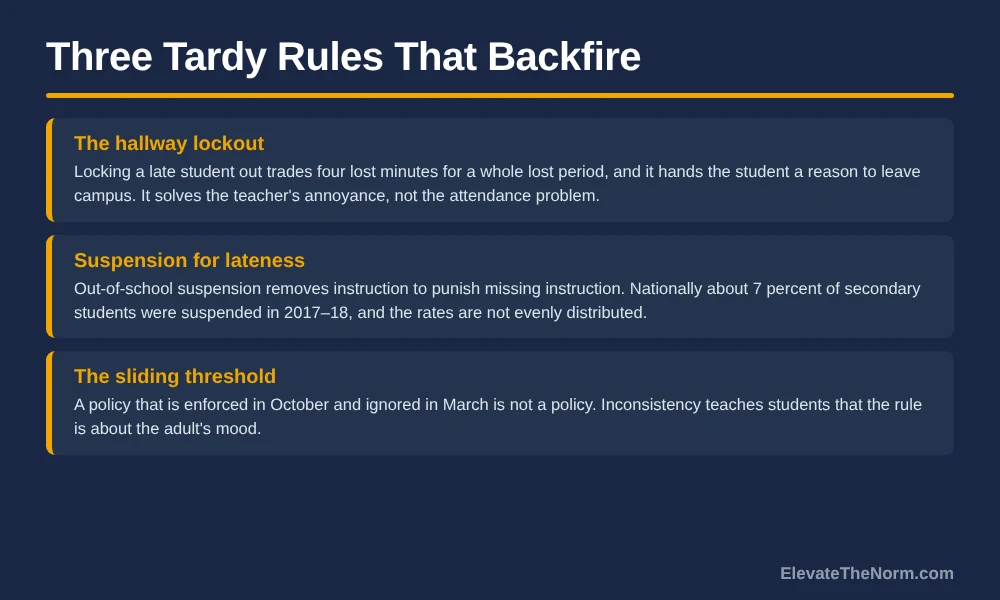
    Three-row graphic naming tardy rules that backfire: the hallway lockout, suspension for lateness with the 2017 to 2018 national secondary suspension rate of about 7 percent, and a sliding enforcement threshold
    Three common tardy rules that cost more instruction than they recover.

    The hallway lockout trades four lost minutes for a whole lost period. It also puts an unsupervised teenager in a hallway, which is a supervision problem you just created, and it hands a student who was already struggling to get to class a reason to stop trying. To be fair to the practice: a staffed tardy room where a student signs in, gets the day’s materials and is walked back to class is a different animal, and some schools run one well. The failure mode is the unsupervised version, where “you can’t come in” is the whole intervention.

    Suspension for lateness is the same error with the volume up. The Learning Policy Institute’s 2022 analysis of federal Civil Rights Data Collection figures found that in 2017–18, nearly 1 in 14 secondary students — about 7 percent — received at least one out-of-school suspension, and the burden was not evenly spread: 12 percent of Black students, 9 percent of students with disabilities, and more than 1 in 4 Black boys with disabilities in secondary schools. Those numbers cover all suspensions, not tardiness alone. But when a tardy ladder has suspension at the top of it, that ladder is feeding this distribution, and it is worth knowing what you are feeding.

    The sliding threshold is the quiet one. A policy enforced in October and ignored in March is not a policy; it is a mood. Students read inconsistency accurately and conclude that the rule was about the adult all along. If you cannot sustain a response for the whole year, write a smaller one you can.

    How Do You Make a Tardy Policy Hold?

    Teach the transition, then do exactly what you said you would do, every time. That second half is the entire difference between a policy and a sign.

    Tyre and colleagues’ intervention is instructive here precisely because it is unglamorous. They taught transition behavior explicitly, the way you would teach anything else, rather than assuming teenagers already knew. That is the same logic behind teaching a routine so it actually holds past September — you do not get a routine by announcing it.

    Explicitly teaching a transition is less abstract than it sounds. It means naming the three things that have to happen between the bell and the start — bag down, materials out, first task started — walking the class through them once at normal speed, and then narrating what you see for the first week until it stops needing narration. Thirty seconds a day for five days. That is the whole scaffold, and it is the cheapest thing in this article.

    Taking control of a classroom is done by organization to the minute, and then you pause. Both halves matter. The posted plan is a budget and a promise; the pause is where you stop talking and let the room settle without filling the silence or raising your voice. A start-of-class routine that works does most of your tardy enforcement for you, because the student who walks in late finds a room already working and slides into it rather than interrupting it.

    One more thing about the door, and this is the part I would keep if I had to throw the rest out. When students walk through that doorframe, they have 100 percent of my respect. That is not softness and it is not a slogan I printed. It is a statement about where the line is: whatever happened in the hallway, in the last class, or at home, the price of entry is nothing. You still owe me the work. You do not owe me an apology for existing in the doorway at 9:04.

    What About the Student Who Is Always Late for a Reason You Cannot Fix?

    Stop treating it as a discipline problem and start treating it as a scheduling problem. Some of these are genuinely outside the room: a student who takes a sibling to a different building, a bus that runs late, a medical routine, a class that physically cannot release in time to cross campus.

    For those students, the honest answer is that the tardy ladder has nothing to offer and should be taken off the table. Document it, loop in the counselor, and ask for the schedule to change. What you can still do is make the opening of your class recoverable — the question on the board, the directions written down, a neighbor who knows the routine well enough to catch them up in thirty seconds. That is not lowering the standard. The standard is the work, not the clock.

    How Does This Fit With School Policy and State Law?

    Your classroom rule has to sit inside your school’s rule, and your school’s rule sits inside a state framework that is less specific than most people assume. Compulsory attendance laws exist everywhere, but as the Education Commission of the States documented in its survey of state truancy definitions, “for the most part, compulsory attendance laws do not specify the number of times a student must be truant before sanctions are enforced,” and in many states the thresholds are set by local boards rather than by the legislature. The examples range from five days in a school year in one state to ten full days or seven consecutive days in another.

    Practically, that means two things. Whether a tardy ever converts into an absence, and at what point, is a local decision you need to look up rather than guess. And a classroom rule that is harsher than the district’s written policy is a liability, not a virtue — especially for a student with an IEP or a 504 plan, where attendance-related consequences can run straight into an accommodation.

    What to Do Next

    Pick one thing. If your current response to a late student is a comment to the room, drop it this week and replace it with Tier 1 — materials, a point at the board, keep teaching. That single change costs nothing, takes no planning, and removes the most common way a four-minute problem becomes a forty-minute one.

    Then, before you write anything down: read your school’s actual tardy language, count how many tardies your worst-hit class period really has over two weeks, and ask three of those students what is happening before your class. You will almost certainly find the problem is more boring, and more fixable, than it looked from the front of the room.

    When you do write it down, publish it twice — once to students, in the words you will actually use, and once to families, before anybody gets a phone call. A policy a parent first hears about at Tier 3 sounds like an ambush no matter how reasonable it is. And leave a route open: a student who has a scheduling problem should be able to say so without it reading as a confession, which usually means a one-line note or a two-minute conversation you have offered in advance rather than one they have to request in front of the room.

    Frequently Asked Questions

    How many tardies should trigger a consequence?

    There is no national answer, and anyone who gives you one is quoting their own district. Compulsory attendance laws exist in every state, but as the Education Commission of the States documented, most of them do not specify how many incidents trigger sanctions, and in many states the threshold is set by the local board. Look up your district’s written number first and build your classroom ladder inside it. A classroom rule that is harsher than the district policy is a liability, not a virtue.

    Should a tardy ever count as an absence?

    That is a local decision, not a judgement call you get to make at your door. Some districts convert a certain number of tardies into an absence or count arrival after a set point as a half-day absence; others do not. It matters because attendance records feed eligibility and, in some places, truancy proceedings. Find the rule in writing before you tell a student or a parent how it works.

    Is it fair to respond differently to different students?

    Yes, and a policy that cannot do that is the unfair one. A student who is late twice in a semester and a student who is late nine times because of a bus do not have the same problem, and giving them the same consequence only looks like fairness. What has to stay identical is the standard and the process: everybody gets the same ladder, described in advance, applied in the same order. What changes is the fix at the end of it.

    What do I do about a student whose tardies are caused by their schedule?

    Take the tardy ladder off the table and treat it as a scheduling problem. Document the pattern, loop in the counselor, and ask for the schedule or the route to change. In the meantime, make the opening of your class recoverable — directions written down rather than only spoken, the day’s question posted, and a neighbour who can catch them up in thirty seconds. The standard is the work, not the clock.

    Should I lock late students out of the room?

    No, not in the unsupervised version. Shutting a student into an empty hallway trades four lost minutes for a whole lost period, creates a supervision problem you did not have a moment earlier, and gives a struggling student a reason to leave campus. A staffed tardy room where a student signs in, collects materials and is walked back to class is a different thing and some schools run one well. The failure mode is when “you cannot come in” is the entire intervention.

    How do I track tardies across five or six sections without losing my prep?

    Keep it to one line. Date, period, name, and a few words of what the student said — in whatever you already open every day, not a new system. You are not building a case file; you are making sure that when you call home or write a referral you can say “nine times since the 12th” instead of “a lot.” That specificity is the whole reason the record exists, and Rogers and Feller’s attendance experiment is the evidence for it: families responded to an accurate count, not to a complaint.

    What should I tell parents, and when?

    Tell them the policy before anybody needs it, and make the first real contact informational rather than disciplinary. A parent who first hears about your tardy ladder when their child is already three steps up it will hear an ambush no matter how reasonable the ladder is. When you do call, lead with the count and what it is costing instructionally, then what you are trying. The strongest evidence in this area — a randomized experiment with 28,080 students — found that correcting parents’ beliefs about how much their child had actually missed reduced chronic absenteeism by 10 percent or more.

    Does a classroom tardy policy work if the rest of the school does not have one?

    Partly. You can control your own door, your start-of-class routine and your response, and those are the pieces that protect your instruction. What you cannot fix alone is a passing period that is physically too short or a building where supervision disappears between bells. The one tardiness study aimed squarely at secondary schools found results from a schoolwide approach — explicit teaching of transition behaviour, active supervision of common areas, and consistent consequences — which is a reminder that the hallway is not your jurisdiction and the school-level conversation is worth having.

    Sources

    1. Tyre, Ashli, Laura Feuerborn, and Jennifer Pierce. “Schoolwide Intervention to Reduce Chronic Tardiness at the Middle and High School Levels.” Preventing School Failure, vol. 55, no. 3, 2011, pp. 132–139. Schoolwide intervention combining explicit teaching of transition behavior, active supervision during transitions, and consistent consequences; average daily tardiness “decreased substantially” and was maintained over time. Cited from the published abstract via the ERIC record; the abstract reports no magnitude, so no percentage is quoted here. https://eric.ed.gov/?id=EJ923238
    2. Rogers, Todd, and Avi Feller. “Reducing Student Absences at Scale by Targeting Parents’ Misbeliefs.” Nature Human Behaviour, vol. 2, no. 5, 2018, pp. 335–342. Randomized experiment, 28,080 high-risk K–12 students; personalized mailings correcting parents’ beliefs about accumulated absences reduced chronic absenteeism by 10% or more in the most effective versions, with spillover to untreated siblings. This study measures full-day absences, not tardiness; the transfer to lateness is an inference and is labelled as one in the text. https://www.nature.com/articles/s41562-018-0328-1
    3. Leung-Gagné, Melanie, Jennifer McCombs, Caitlin Scott, and Daniel J. Losen. Pushed Out: Trends and Disparities in Out-of-School Suspension. Learning Policy Institute, 2022. Analysis of federal Civil Rights Data Collection figures; in 2017–18, 7% of secondary students, 12% of Black students, 9% of students with disabilities and 27% of Black boys with disabilities in secondary schools received out-of-school suspension. Figures cover all out-of-school suspensions, not suspensions for tardiness specifically. https://learningpolicyinstitute.org/product/crdc-school-suspension-report
    4. Frey, Dinah. Truancy and Habitual Truancy: Examples of State Definitions. Education Commission of the States, updated April 2011. Documents that compulsory attendance laws generally do not specify the number of incidents triggering sanctions, and that thresholds are set at district level in some states and state level in others; 23 state examples with widely varying definitions. Dated 2011 — verify your own state’s current statute before relying on it. https://www.ecs.org/clearinghouse/92/39/9239.pdf
    5. “A Primer on Attendance and Absenteeism on the Nation’s Report Card and Beyond.” National Assessment Governing Board. Defines chronic absenteeism as missing 10% of instructional days — 18 or more days in a 180-day year — counting excused absences, unexcused absences and suspensions; reports that in 2022, 22% of 4th graders said they had been absent five or more days in the previous month, double the 2019 figure. The NAEP survey question captures full-day absence only, not late arrival. https://www.nagb.gov/naep/chronic-absenteeism.html

    About Clay Shumate

    Clay Shumate is a certified secondary Social Studies teacher in the public schools of West Alabama, with seven years of classroom experience, a B.A. in History, and an M.Ed. in Secondary Education. He writes about project-based learning, student responsibility, respect, and practical ways to hold young people to a higher standard while giving them room to learn from mistakes. He is a member of the Society of Professional Journalists and writes to its Code of Ethics; this site’s editorial standards and corrections policy are published in full. More about Clay.

  • Student Leadership Skills: 12 Abilities Schools Should Actually Develop

    Student Leadership Skills: 12 Abilities Schools Should Actually Develop

    By Clay Shumate

    Student leadership skills are the specific, teachable abilities a teenager uses to move a group forward — listening, explaining, planning, deciding, delegating, taking feedback, handling conflict, following through, and knowing what is not theirs to decide. They are not personality traits. They are behaviours you can name, practise and check, which is the only reason a school can teach them at all.

    The twelve below are chosen because each one has an observable behaviour attached. If you cannot describe what it looks like from across the room, it does not belong on a skills list.

    Key Takeaways

    • A skill is not a trait. “Confident,” “natural leader” and “takes initiative” cannot be taught or fairly assessed. “Restates the other person’s point before answering it” can.
    • School-based skill programs do move these outcomes, and implementation is the variable that decides it. A meta-analysis of 213 programs and 270,034 K–12 students found improved social and emotional skills, attitudes, behaviour and academic performance — an 11-percentile-point achievement gain — with implementation problems moderating the result.
    • Do not grade these on a student’s self-rating. In the one cluster randomized trial of a school leadership program, teachers rated leaders markedly more effective while the leaders’ own self-ratings moved by exactly zero.
    • Feedback is not automatically good for you. The landmark meta-analysis of 607 effect sizes found feedback improved performance on average (d = 0.41) and made it worse in over a third of cases — which is why “receives feedback well” is a skill and not a courtesy.
    • Teaching is the cheapest practice ground you have. Peer tutoring shows moderate-to-large academic benefits across grades 1–12, and the student doing the explaining is practising four of these twelve skills at once.

    Free Download · PDF

    The 12 Student Leadership Skills Observation Sheet (2 pages)

    Page 1 is a blank observation sheet carrying the observable behaviour for all twelve skills. Page 2 gives one way to practise each skill inside a lesson you were already going to run, and a check two adults could agree on.

    Download the free PDF

    Free. No email address required. Designed for grades 6–12. Browse every printable in Your Free Library.

    Numbered three-step graphic titled Trait or Skill Three Tests: can you see it, can it be practised in ten minutes, and would two adults agree it happened
    Three tests that keep traits off a skills list.

    What Are Student Leadership Skills?

    A student leadership skill is a repeatable behaviour that makes a group’s work go better, which a student can get visibly worse or better at. That last clause does the filtering.

    Most published lists fail it. “Vision,” “charisma,” “integrity” and “confidence” are either traits, values, or descriptions of how a student comes across — none of them tells a fourteen-year-old what to do differently on Thursday, and none of them can be assessed without turning into a popularity judgement in a rubric costume.

    Three tests for anything you want to put on a skills list:

    • Can you see it? Name the behaviour you would watch for. If the answer is “you just know,” cut it.
    • Can it be practised in ten minutes? Skills get better by repetition in low-stakes conditions, not by a workshop in September.
    • Would two different adults agree on whether it happened? If not, you cannot assess it fairly, and an unfair assessment of a personal quality is worse than no assessment at all.

    These skills are the what. The roles students hold while practising them are the where — there are 25 of those in the companion guide to student leadership activities for grades 6–12, and the broader argument about what real responsibility requires is in the guide to giving teenagers authority that carries weight. This article stays on the abilities themselves.

    Three-row graphic summarising research on student leadership skills: a meta-analysis of 213 school programs and 270,034 students showing an 11-percentile-point achievement gain, a randomized trial where teacher ratings rose d equals 0.39 while student self-ratings moved 0.00, and a feedback meta-analysis of 607 effect sizes where performance fell in over a third of cases
    Three findings that shape how these skills get taught and checked.

    Can Leadership Skills Actually Be Taught?

    Yes, with two honest qualifications: the strongest evidence is for structured skill programs rather than leadership programs, and the quality of delivery moves the result more than the curriculum does.

    The broadest evidence comes from Durlak, Weissberg, Dymnicki, Taylor and Schellinger’s 2011 meta-analysis in Child Development — 213 school-based universal social and emotional learning programs covering 270,034 students from kindergarten through high school. Participants showed significantly improved social and emotional skills, attitudes, behaviour and academic performance, “that reflected an 11-percentile-point gain in achievement.” Two details matter more than the headline. School staff ran the programs successfully, so this is not a specialist-only result. And the authors report that the use of four recommended skill-development practices and the presence of implementation problems moderated outcomes. Translation: a well-run ordinary program beats a badly run excellent one.

    Leadership-specific evidence is thinner. The Learning to Lead cluster randomized controlled trial (Contemporary Educational Psychology, 2026) ran across 20 schools and 1,898 students. Teachers rated the trained student leaders significantly more effective afterwards (d = 0.39) and their classroom time on task rose seven percentage points. Those leaders were in grades 5 and 6, in Australia — it is not a secondary result, and the effect sizes do not transfer automatically. The design lesson does: the leaders spent twelve sessions actually teaching younger students, not sitting in leadership lessons.

    That matches the peer-tutoring evidence, which is the best-evidenced vehicle for this grade band. Bowman-Perrott and colleagues (2013) synthesized 26 single-case studies covering 938 students in grades 1 through 12 and reported moderate-to-large academic benefits (TauU = 0.75), with secondary students at 0.74 slightly ahead of elementary at 0.69. Dosage made no difference — twelve focused minutes beat forty vague ones.

    And service work carries a wider but weaker signal. Celio, Durlak and Dymnicki’s 2011 meta-analysis of 62 studies and 11,837 students found effects of 0.27 to 0.43 across attitudes, civic engagement, social skills and achievement — but 68% of that sample was college undergraduates and only 21% was in grades 6–12, with 87% of studies relying entirely on student self-report. Useful direction, soft numbers.

    Four-row graphic grouping twelve student leadership skills: being in the room covering skills one to three, getting work done covering four to six, when it goes sideways covering seven to nine, and judgement covering ten to twelve
    The twelve skills, grouped by what they are for.

    The 12 Student Leadership Skills Schools Should Actually Develop

    Four groups of three. Each row names the behaviour you would watch for, one way to practise it inside an ordinary lesson, and a check that two adults could agree on.

    Being in the Room

    SkillWhat you would seeOne way to practise itA fair check
    1. Listening to understandRestates the other person’s point, in their terms, before answering itTwo-minute paired protocol: you may not reply until you have summarised and the other person agrees your summary is rightThe partner confirms the summary was accurate
    2. Explaining one thing clearlyPicks an entry point, checks for understanding, stops when the other person has itReteach one skill to two or three classmates after you have checked they hold it themselvesA short check on the students who were taught, not on the explainer
    3. Giving usable feedbackNames one specific change, tied to the criteria, with the reasonFixed critique protocol with a sentence frame and a cap of two itemsThe receiver can state what to change without asking a follow-up

    Getting Work Done

    SkillWhat you would seeOne way to practise itA fair check
    4. Planning backwardsStarts at the due date and works back to today, with dates attachedBuild the team timeline on day one of a project, on paper, before any work startsThe written timeline against what actually happened
    5. Deciding without complete informationMakes a call, states the reason, names what would change their mindForced-choice rounds: two defensible options, ninety seconds, one sentence of reasoningWas a reason given, and was it about the task rather than about who suggested it
    6. Delegating and asking for helpHands off a piece of work with the standard attached, or asks a direct question earlyRule the group to a hard split — nobody may do more than their share — and require one question asked outside the groupWhether the work was actually distributed, and whether the question got asked before the deadline

    Skill 6 is the one adults quietly model badly. I learned a review format I still use from another teacher on my hall, in my first year, because I asked — she had noticed I was short on engaging review games and I went and asked her how hers worked. Keeping your ears open helps. Asking questions helps more. That is a usable thing to say out loud to a fifteen-year-old who thinks a leader is supposed to already know.

    When It Goes Sideways

    SkillWhat you would seeOne way to practise itA fair check
    7. Taking feedbackAsks a clarifying question instead of defending or going silentReceive-only drill: the receiver may ask questions but may not explain themselves for sixty secondsDid the next draft change in the direction of the feedback
    8. Navigating a disagreementSeparates the issue from the person; proposes something rather than repeating a positionRehearsed scripts for the three disputes your room actually produces — workload, credit, and a missed deadlineDid the group keep working, and did an adult have to intervene
    9. Following through and repairingSays in advance that it will be late; names what is owed, to whom, by whenA standing one-line repair sentence any student can use, modelled by you firstThe repair happened, on the date the student named

    Skill 8 is worth money and worth caution in equal measure. School-based conflict resolution education is rated “promising” by the U.S. Office of Justice Programs, whose profile cites a meta-analysis of 36 studies in which participating students reported fewer antisocial behaviours (effect size 0.26), with fights falling from roughly 14% to 9.5%. Those are trained programs with adults running them. Teaching a student to de-escalate their own group’s argument about workload is a reasonable thing to do; handing a student somebody else’s serious conflict is not. If you want prewritten language to teach from, there are a hundred of them in the De-escalation Scripts set in my store.

    Judgement

    SkillWhat you would seeOne way to practise itA fair check
    10. Knowing what is not yours to decideStops and hands something to an adult instead of ruling on itSorting exercise: ten situations, three piles — mine, ours, not mineDid the student escalate the ones that belonged to an adult
    11. Running a short meetingKeeps to an agenda, closes with who does what by whenFive-minute checkpoint with a fixed four-item agenda you supplyMeeting notes listing decisions and owners
    12. Reflecting so it changes the next attemptNames one thing to do differently and then actually does itTwo questions after any role: what worked, what you will change next timeCompare this reflection to the previous one — did the named change appear

    Skill 10 carries more weight than its position suggests, and it is mostly your job rather than theirs. My position on this is blunt: if a student can wreck something badly enough to matter, that is poor planning and the adult was not paying attention. Teaching a teenager to recognise the edge of their own authority is part of the skill. Building a room where the edge is a long way from anything catastrophic is the other part, and it is the part you own. For skill 12, a two-question routine at the end of a role is enough — the mechanics of making that stick are the same ones in the guide to student self-assessment as a routine rather than an event, and the Daily Bell Ringers I sell are built around that kind of short prompt.

    How Do You Assess a Leadership Skill Fairly?

    Assess the behaviour, not the student, and never let a self-rating be the measure. Those two rules remove most of the ways this goes wrong.

    The self-rating problem is not a hunch. In the Learning to Lead trial, teacher-rated leadership effectiveness rose significantly while the leaders’ own self-reported effectiveness moved by exactly nothing — d = 0.00, p = 0.999 — and their leadership self-efficacy did not reach significance either. The adults saw growth the students did not feel. If your rubric is a student rating themselves out of four, you are measuring how a teenager feels about themselves that week, which is a real thing but is not the skill.

    Use self-report for one purpose only: as the student’s own evidence to discuss, next to yours. “You rated yourself a 2 on taking feedback. Here are the two drafts. Talk me through it.” That conversation is worth more than either rating.

    The second trap is feedback itself. Kluger and DeNisi’s 1996 meta-analysis in Psychological Bulletin — 607 effect sizes across 23,663 observations — found feedback improved performance on average (d = 0.41) and made performance worse in over a third of cases. Their explanation is that effectiveness drops as attention moves away from the task and toward the self. For a skills rubric that is a direct instruction: say “the summary missed her second point” and not “you are not a good listener.” The first is a task. The second is an identity, and identity feedback is the kind that backfires.

    Three practical rules that follow:

    • Assess one skill at a time. A twelve-row rubric read in one sitting becomes a general impression of the student with numbers attached.
    • Score the artifact, not the performance. A written timeline, a set of meeting notes, a partner’s confirmation that the summary was accurate. Those exist after the fact and two adults can read them the same way.
    • Keep it out of the course grade unless your standards actually include it and your district’s grading policy allows it. Most do not, and a leadership score smuggled into an academic grade is a fairness problem waiting for a parent email.
    • Sample rather than collect. With 150 students you cannot read an artifact from everyone every week. Read six a week, rotate, and tell students that is what you are doing.

    Two more things, both about being open about it. Put the observable behaviours on a sheet students can read — a skill you are watching for in secret is a trap, not a lesson. And when a family asks, the honest answer is short: these are behaviours we practise and talk about, they are not in the course grade, and they do not replace the school’s discipline policy. Skill 9 is about repairing a missed deadline inside a group project. It is not an alternative to whatever your handbook already requires.

    What This Looks Like Over a Semester

    Do not try to teach twelve skills. Pick three.

    A workable semester: skill 1 and skill 3 in the first six weeks, because listening and feedback make everything else cheaper; skill 4 when the first long project starts; skill 9 whenever the first deadline is missed, which it will be. Teach each one the way you would teach anything — model it, name it while you are doing it, give a short low-stakes rep, then use it for real.

    Scope the rep, not the standard. The paired listening protocol is hard for a student who is new to the language, and the receive-only feedback drill is hard for a student who finds being looked at difficult. Written versions of both work — summarise in two sentences on paper, pass it back, let the partner mark it accurate or not. Same skill, same evidence, different load.

    Two things to expect. The first reps will be stilted, because a sentence frame always is, and a fifteen-year-old restating somebody’s point out loud feels ridiculous for about a week. The second is that students will not report feeling more capable even when they are visibly better — that is the L2L finding again, and it is the main reason teachers abandon this work too early. Tell them plainly what you saw them do. Do not wait for them to look pleased about it.

    If you want the specific roles to practise these in, every one of the twelve maps onto something in the 25 leadership roles — the facilitator job is skills 1 and 11, the reteach partner is 2 and 3, the project lead is 4, 6 and 9. And when a role goes badly, that is skill 9 territory, which is the same ground as holding a student accountable and giving them a way back.

    What to Do Next

    Pick three skills from the twelve. Write the observable behaviour for each on one sheet and put it where you plan, not where you display. Teach the first one inside a lesson you were already going to run — the paired listening protocol fits in two minutes of any discussion. Then collect one artifact per skill per student, and resist building a rubric until you have read a dozen of them.

    The check that tells you it is working is not a score. It is whether a student uses the behaviour when you did not ask for it — the day somebody restates a classmate’s point before disagreeing with it, without a sentence frame on the board.

    Before you go: grab the free 12 Student Leadership Skills Observation Sheet (2 pages) (PDF) — ElevateTheNorm.com branded, printable, no email required.

    Frequently Asked Questions

    What is the difference between a leadership skill and a leadership trait?

    A skill is a behaviour a student can get visibly better at; a trait is a description of the student. “Confident,” “charismatic” and “natural leader” cannot be taught on a Thursday and cannot be assessed without turning into a popularity judgement with a rubric around it. “Restates the other person’s point before answering it” can be taught, practised in two minutes, and checked by asking the partner whether the summary was accurate.

    Can student leadership skills be graded?

    They can be assessed; they usually should not be graded. Keep them out of the course grade unless your standards genuinely include them and your district’s grading policy allows it — a leadership score smuggled into an academic grade is a fairness problem waiting to happen. Assess one skill at a time, score the artifact rather than the performance, and tell students and families plainly what you are watching for.

    Why should I not use a student self-rating?

    Because the evidence says it will not track what you are trying to measure. In the only cluster randomized trial of a school leadership program, teacher-rated leadership effectiveness rose significantly while the students’ own self-ratings moved by exactly zero. Self-report still has a use — put the student’s rating next to your evidence and talk about the gap. That conversation is worth more than either number.

    Which three skills should I start with?

    Listening to understand, giving usable feedback, and planning backwards from a deadline. The first two make every group task cheaper to run, and the third is the one that prevents the week-before panic on a long project. Add following through and repairing when the first deadline gets missed, because it will, and the lesson lands best right then.

    Do these skills work the same in middle school and high school?

    The skills are identical; the scope changes. In middle school, keep each rep inside one class period and use sentence frames openly. In high school, the planning, delegating and meeting skills become realistic over a multi-week project, and the frames can come off the board. In both bands the first few repetitions feel stilted, and that is normal rather than a sign it is not working.

    What about students who find the speaking protocols hard?

    Scope the repetition, not the standard. Written versions of the listening and feedback drills carry the same skill and the same evidence: summarise in two sentences on paper, pass it back, let the partner mark it accurate or not. A student new to the language or uncomfortable being looked at can do the identical thinking with a different load.

    Does any of this actually raise achievement?

    Partly, and the honest version has caveats. A meta-analysis of 213 school-based social and emotional learning programs covering 270,034 students found improved skills, attitudes, behaviour and academic performance amounting to an 11-percentile-point achievement gain, with implementation problems moderating the result. Peer tutoring has solid grades 6–12 evidence. The leadership-specific trial measured leadership and time on task, not grades. Treat achievement as a plausible side effect of doing this well, not as the reason to do it.

    Sources

    1. Durlak, Joseph A., Roger P. Weissberg, Allison B. Dymnicki, Rebecca D. Taylor, and Kriston B. Schellinger. “The Impact of Enhancing Students’ Social and Emotional Learning: A Meta-Analysis of School-Based Universal Interventions.” Child Development, vol. 82, no. 1, 2011, pp. 405–432. 213 programs, 270,034 students from kindergarten through high school; improved social and emotional skills, attitudes, behaviour and academic performance “that reflected an 11-percentile-point gain in achievement”; school staff ran the programs successfully; four recommended skill practices and the presence of implementation problems moderated outcomes. Abstract read via the U.S. Office of Justice Programs NCJRS record rather than the publisher, and cited accordingly; the record states no limitations. https://www.ojp.gov/ncjrs/virtual-library/abstracts/impact-enhancing-students-social-and-emotional-learning-meta
    2. Kluger, Avraham N., and Angelo DeNisi. “The Effects of Feedback Interventions on Performance: A Historical Review, a Meta-Analysis, and a Preliminary Feedback Intervention Theory.” Psychological Bulletin, vol. 119, no. 2, 1996, pp. 254–284. 607 effect sizes, 23,663 observations. Feedback interventions improved performance on average (d = .41) but “over 1/3 of the FIs decreased performance,” with effectiveness falling as attention moved from the task toward the self. Not a school-only sample; it spans workplace and laboratory studies as well as education. https://cris.huji.ac.il/en/publications/the-effects-of-feedback-interventions-on-performance-a-historical/
    3. Wade, Levi, Mark R. Beauchamp, Nicole Nathan, Jordan J. Smith, Angus A. Leahy, Ran Bao, Sarah G. Kennedy, Jed Boyer, Thierno M. O. Diallo, Sam Beacroft, and David R. Lubans. “Effects of a School-Based Leadership Program on Student Leaders and Their Peers: The Learning to Lead Cluster Randomized Controlled Trial.” Contemporary Educational Psychology, vol. 84, 2026, article 102444. 20 schools, 1,898 students. Teacher-rated leadership effectiveness d = 0.39; self-rated effectiveness d = 0.00 (p = 0.999); leadership self-efficacy not significant; on-task time +7 percentage points. Leaders were in grades 5–6 and peers in grades 3–4, in New South Wales, Australia — not a secondary-school result. https://www.sciencedirect.com/science/article/pii/S0361476X26000020
    4. Bowman-Perrott, Lisa, Heather Davis, Kimberly Vannest, Lauren Williams, Charles Greenwood, and Richard Parker. “Academic Benefits of Peer Tutoring: A Meta-Analytic Review of Single-Case Research.” School Psychology Review, vol. 42, no. 1, 2013, pp. 39–55. 26 studies, 938 students in grades 1–12; TauU = 0.75 overall; secondary 0.74 against elementary 0.69; no dosage effect above or below the 480-minute median. Single-case research designs, not group randomized trials. https://cdd.tamu.edu/wp-content/uploads/sites/33/2019/11/BowmanPerrott_SPRAcademicMeta.pdf
    5. Celio, Christine I., Joseph Durlak, and Allison Dymnicki. “A Meta-Analysis of the Impact of Service-Learning on Students.” Journal of Experiential Education, vol. 34, no. 2, 2011, pp. 164–181. 62 studies, 11,837 students; mean effects 0.27 to 0.43 across five outcomes. 68% of participants were college undergraduates, 16% high school and 5% middle school; only 31% of studies randomized and 87% relied entirely on student self-report. https://www.tamiu.edu/profcenter/documents/Meta-AnalysisoftheImpactofSLonStudentts_2011.pdf
    6. “Practice Profile: School-Based Conflict Resolution Education.” CrimeSolutions, National Institute of Justice, U.S. Office of Justice Programs. Rated Promising; draws on Garrard and Lipsey’s 2007 meta-analysis of 36 studies, reporting an effect size of 0.26 on self-reported antisocial behaviour and fights falling from about 14% to 9.5%. Cited as a federal practice profile summarising a meta-analysis, not as the meta-analysis itself; the profile states no cautions on study quality or publication bias. https://crimesolutions.ojp.gov/ratedpractices/48

    About Clay Shumate

    Clay Shumate is a certified secondary Social Studies teacher in the public schools of West Alabama, with seven years of classroom experience, a B.A. in History, and an M.Ed. in Secondary Education. He writes about project-based learning, student responsibility, respect, and practical ways to hold young people to a higher standard while giving them room to learn from mistakes. He is a member of the Society of Professional Journalists and writes to its Code of Ethics; this site’s editorial standards and corrections policy are published in full. More about Clay.

  • Student Leadership Activities: 25 Real Roles for Middle and High School

    Student Leadership Activities: 25 Real Roles for Middle and High School

    By Clay Shumate

    Student leadership activities are tasks where a middle or high school student holds a real decision, a real deadline, and a real audience — not a title. The test is simple: name what the student actually gets to decide. If you cannot, you have a chore with a nicer word attached. The 25 roles below each pass that test, and each one names the adult guardrail that keeps it honest.

    Key Takeaways

    • A leadership activity needs a decision in it. Line leader, paper passer and “class representative” with no agenda are not leadership. A role that changes an outcome is.
    • The only cluster-randomized trial of a school leadership program found something uncomfortable. Teachers rated the student leaders meaningfully more effective (d = 0.39), while the leaders’ own ratings of themselves moved exactly nothing (d = 0.00). Adults saw a change the students did not feel.
    • The strongest evidence is for service and peer teaching, not for leadership programs. A meta-analysis of 62 service-learning studies found effects of 0.27 to 0.43 across five outcomes — but 68% of those studies were college undergraduates and only 21% were in grades 6–12.
    • Peer tutoring works about as well at secondary as it does at elementary. Across 26 single-case studies of 938 students in grades 1–12, the academic benefit was moderate to large, and secondary students did slightly better than younger ones.
    • A student should never be able to fall off a cliff you built. If a teenager can wreck something badly enough to matter, that is a planning failure, not a learning experience. Every role below is bounded by adult presence, not by lowered expectations.

    Free Download · PDF

    The Student Leadership Role Card and 25-Role Planner (2 pages)

    Page 1 is a blank five-line role card plus the rotation grid that stops the same four students getting every role. Page 2 is all 25 roles as a checklist, with the four ways they go wrong.

    Download the free PDF

    Free. No email address required. Designed for grades 6–12. Browse every printable in Your Free Library.

    What Counts as a Student Leadership Activity?

    A student leadership activity is any structured task in which a student makes a decision that other people depend on, inside limits an adult set on purpose. Three parts, and all three have to be there.

    A decision. Not a preference — a decision. Which three sources the group cites. What order the presentation runs in. If the answer to “what does this student decide?” is “nothing, they just help,” redesign it.

    Dependence. Somebody’s work gets easier or harder depending on how the role is done. That is what makes it leadership instead of homework.

    Limits you wrote down in advance. Most lists skip this, and it is the part that protects both of you. A role without a written limit eventually reaches something a fifteen-year-old should not be holding — a grade, a discipline decision, somebody’s private business.

    The longer argument about why symbolic titles fail, and why the same four kids keep getting them, is made in the guide to giving teenagers responsibility that actually carries weight. This is the implementation half: the roles, and how to set one up so it survives a Tuesday.

    Three-row graphic summarising research behind student leadership activities: a cluster randomized trial where teacher-rated effectiveness rose by d equals 0.39 while student self-ratings moved 0.00, a service-learning meta-analysis of 62 studies with effects from 0.27 to 0.43, and a peer tutoring synthesis with TauU of 0.75
    What the research supports, and the population each number came from.

    What Does the Research Actually Show?

    Short answer: the evidence for peer teaching and service work is reasonably good, the evidence for “leadership programs” is thin, and the one rigorous trial of a leadership program produced a split result that is worth sitting with.

    That trial is Learning to Lead, a two-arm cluster randomized controlled trial across 20 schools and 1,898 students, published in Contemporary Educational Psychology in 2026. Leaders got six leadership lessons, then taught twelve movement-skill sessions to younger peers. Teachers rated them significantly more effective afterwards (d = 0.39) and their classroom time on task rose 7 percentage points.

    Then the uncomfortable half. The leaders’ own self-reported effectiveness moved by exactly zero (d = 0.00, p = 0.999) and their self-efficacy missed significance too. On the peer side, the younger students’ perceived motor competence improved (d = 0.17) while their actual measured competence did not (d = 0.03, not significant).

    And the caveat that matters most on a grades 6–12 site: those leaders were in grades 5 and 6, their peers in grades 3 and 4, in New South Wales, Australia. This is not a secondary result. The design logic transfers; the effect sizes do not come with it.

    The service-learning evidence is broader. Celio, Durlak and Dymnicki’s 2011 meta-analysis of 62 studies and 11,837 students found mean effects on attitudes toward self (0.28), attitudes toward school (0.28), civic engagement (0.27), social skills (0.30) and academic achievement (0.43). Read the sample before quoting the numbers: 68% of those students were college undergraduates, 16% high school and 5% middle school. Only 31% of the studies randomized, and 87% relied entirely on student self-report — which the authors flag themselves, noting ratings of community commitment “could be biased by social desirability.”

    Peer teaching holds up better for our grade band. Bowman-Perrott and colleagues (2013) synthesized 26 single-case studies covering 938 students in grades 1 through 12 and reported a moderate-to-large academic benefit (TauU = 0.75), with secondary students (0.74) marginally ahead of elementary (0.69). Dosage made no difference — studies above and below the 480-minute median produced identical effects. More minutes is not the lever.

    Dana Mitra’s 2004 study in Teachers College Record is the one worth reading in full. It followed student voice work at a struggling high school and found growth in three things — agency, belonging and competence — concentrated in students “who otherwise do not find meaning in their school experiences.” It is qualitative and establishes no cause. It does tell you where to aim.

    One honest note on all of it. Teenagers probably do not respond because leadership is intrinsically motivating. Yeager, Dahl and Dweck argued in a 2017 theory review that adolescents are unusually sensitive to status and respect, and that interventions work when a teenager feels “competent, [has] agency and autonomy, and [is] of potential value to the group.” That is a framework, not a finding — but it predicts what the roles below do and do not accomplish.

    Numbered five-step graphic titled The Five-Line Role Card: the decision, the limit, the deadline, the guardrail, and the evidence, each with a one-line explanation
    Ninety seconds per role. All five lines, or the role is not ready.

    The Five-Line Role Card

    Before a student takes any role, write five lines. If you cannot fill all five, the role is not ready. This takes about ninety seconds per role and it is the difference between a leadership activity and an unpaid chore.

    1. The decision. One sentence naming what this student gets to decide. “You choose which two sources we cite in the final draft.”
    2. The limit. What is not theirs. Grades, discipline, anybody’s private information, and anything that requires an adult signature.
    3. The deadline. When it is due, and who is inconvenienced if it is late. Naming the second part is what makes the first part real.
    4. The guardrail. What you are watching, and the point at which you step in. Not a threat — a promise that the floor exists.
    5. The evidence. What you will look at to decide whether it worked. One artifact, not a feeling.

    Two things that are not lines on the card but matter as much. Model the role once before handing it over — run the facilitator job yourself for one discussion, naming out loud what you are deciding. And give the student the card. One that lives only in your planner is a role the student has to guess at; families should be able to read it too.

    Do not grade the role. Most of the artifacts in the tables below are read in seconds — a reset station, a source list, a 60-second summary — and the moment a role becomes another graded assignment it stops being a role.

    Line four is the one people skip, and skipping it is how a good idea becomes a bad week. My own position on this is blunt: if a student can wreck something badly enough to matter, that is poor planning and the adult was not paying attention. Real responsibility and real stakes are not the same thing. Students can struggle, do it badly, need help, and be held to the standard afterward. What they cannot do is fall off a cliff you built.

    25 Student Leadership Activities for Grades 6–12

    Four groups, running from a single class period out to the community. Every row names the decision the student holds, the guardrail, and the artifact you read. Pick two or three to start — not twelve.

    Scope a role to the student, not to an average. A role is a set of decisions and you can hand over two instead of five without making it fake. “You decide the order, I will handle the timing” is still a real decision, and it is often the right first version for a student who is new to the language, new to the school, or working with support.

    Inside One Class Period

    RoleWhat the student decidesGuardrailEvidence
    1. Discussion facilitatorWho speaks next and when to move onYou keep the right to call on anyone; you stop the clock if it stallsA participation map plus the facilitator’s one-line debrief
    2. Station managerHow their station is explained and resetYou wrote the task; they own the deliveryStation reset on time, three classmates can state the task
    3. Opening-question leadThe warm-up question, tied to yesterday’s lessonYou approve it the day before, in writingThe question, and whether the room could answer it
    4. Timing leadWhen to call each transition inside the posted planYou overrule on safety or if a group needs more timeActual times against the posted budget
    5. Recap closerWhich two ideas get the 60-second summaryYou correct anything wrong before the bellThe summary itself, delivered without notes
    6. Question keeperWhich unanswered questions go on the board and stay thereNothing naming a student goes on the listThe running list, and how many got closed
    7. Shared-notes custodianFormat and structure of the class’s running notesYou check accuracy weekly; it is a supplement, not the recordThe notes, and whether a returning absentee could use them

    Roles 1 through 7 cost nothing but the ninety seconds of the role card. Role 1 pairs naturally with a text-based seminar where students carry the discussion, because the facilitator job only has a decision in it when the discussion is genuinely theirs. For roles 2 and 4 I keep reusable station frames and recording sheets on hand so the paperwork is not the obstacle — the Station Rotation Toolkit in my store is the version I use.

    Across a Unit or a Project

    RoleWhat the student decidesGuardrailEvidence
    8. Project leadTask split and internal deadlinesYou set scope and the final date; you attend checkpointsThe team’s own timeline versus what happened
    9. Quality-control reviewerWhether the work is ready to submit against the rubricThey review; they never grade, and only inside their own groupA signed pre-submission checklist with flagged items
    10. Research librarianWhich sources survive and which get cutYou spot-check one citation per roundThe source list with a one-line reason per cut
    11. Revision editorWhich two changes the group makes firstCritique protocol is fixed; tone is not negotiableBefore-and-after on one paragraph or section
    12. Rubric co-writerThe wording of one criterion, before the project startsYou own the other criteria and the final weightingThe criterion, and whether students scored themselves on it accurately
    13. Checkpoint chairAgenda order and who reports at the mid-project meetingFixed agenda template; you are in the roomMeeting notes and the decisions made

    Roles 8 through 13 earn their keep on group projects, which is where leadership language usually collapses into “one kid does everything.” If that is the failure mode you are fighting, the mechanics in the guide to splitting group work so every member has something only they can do matter more than any title.

    Four-row graphic grouping 25 student leadership activities: roles 1 to 7 inside one class period, roles 8 to 13 across a unit or project, roles 14 to 19 in peer teaching and support, and roles 20 to 25 beyond the classroom
    The four groups, and which roles sit in each.

    Peer Teaching and Peer Support

    RoleWhat the student decidesGuardrailEvidence
    14. Reteach partnerHow to explain one skill to two or three classmatesYou confirm they have the skill first; you stay within earshotA short check on the students who were taught
    15. Cross-age tutorPacing and examples with a younger classTrained first, scheduled with the receiving teacher, never unsupervisedTutor log plus the receiving teacher’s read
    16. Absent-student onboarderWhat a returning classmate needs firstNo grades, no reasons for the absence, no commentaryWhether the returning student submitted the right thing
    17. Equipment or software coachHow the training is run and in what orderYou handle anything with a safety procedure attachedClassmates completing the task without asking you
    18. New-student hostWhat to show, in what order, over two weeksVolunteer only; you check in with both students in week oneA two-week check-in with the new student
    19. Study-session leadWhich five items the pre-assessment review coversYou see the item list beforehand; no leaking the actual testThe item list and attendance, nothing more

    This group has the best evidence behind it, and roles 14 and 15 apply the peer-tutoring finding directly. One practical note from that same research: the benefit did not scale with minutes. A twelve-minute reteach with a clear target beats forty minutes of vague “help each other.”

    Beyond the Classroom

    RoleWhat the student decidesGuardrailEvidence
    20. Community interviewerQuestions, order, and what gets usedYou approve the questions and the contact; school policy on outside contact governsTranscript or notes plus the consent record
    21. Public-presentation leadHow the group presents to the outside audienceYou rehearse it once with them, no exceptionsAudience questions answered without you stepping in
    22. Event logistics leadOne concrete slice of a real event — setup, signage, running orderOne slice only; an adult owns anything involving money or facilitiesThe slice ran, on time, without rescue
    23. Survey designerQuestions and how results are reportedAnonymous, no sensitive items, administrator approval firstThe instrument and a written summary of findings
    24. Service-project coordinatorOne measurable commitment and how it is trackedPartner organisation vetted by an adult; nothing open-endedThe number committed to versus the number delivered
    25. Peer-mediation volunteerWhich low-level disputes they help talk throughTrained only, minor conflicts only. Anything involving safety, harassment or a protected category goes to an adult immediatelyProgram-level data only — never a write-up on a classmate

    Role 25 needs its own warning. School-based conflict resolution education is rated “promising” by the U.S. Office of Justice Programs, whose profile cites a meta-analysis of 36 studies in which participating students reported fewer antisocial behaviours (effect size 0.26), with fights falling from roughly 14% to 9.5% and bullying from 28% to 20%. Those are real numbers from trained programs. They are not a licence to hand an untrained ninth grader a fight between two of their friends. Past a minor disagreement the adult does it, using a script written for the purpose.

    What About Classroom Jobs for Students?

    Classroom jobs for middle and high school students are worth running, as long as you call them jobs. A job keeps the room working: papers out, supplies stocked, the board up to date. That is useful work, and teenagers do it well. It only goes wrong when a job gets passed off as leadership, which is the first failure mode further down. A 2026 Edutopia roundup of secondary teachers who run class jobs makes the same case. Tweens and teens want connection, autonomy and purpose, and a job program gives them some of each once it has been taught and practised (Gonser, Edutopia, 2026).

    Most jobs on secondary lists fit one of the types below. Each row gives the job, then an upgrade: one small decision you can hand over that turns the job into one of the roles above.

    JobWhat it coversThe upgrade: add one decisionKeep this off the job
    Materials managerHands out and collects papers and suppliesDecides the hand-out order so stations are ready in under a minuteCollecting or handing back graded work
    Supply managerTracks and restocks shared suppliesDecides what goes on the Friday restock listSpending money
    Board managerDate, agenda and learning target on the boardWrites the day’s agenda wording, with your approvalMissing-work lists, or anything with a name on it
    Absent-student helperGathers handouts and notes for absent classmatesDecides what a returning classmate needs first (role 16)Why someone was absent, and their grades
    Tech helperCharges, logs in and troubleshoots devicesRuns the walkthrough when the class starts a new tool (role 17)Anyone else’s password or account
    Room reset leadPuts the room back before the bellWrites the reset checklist with the classChemicals, equipment or anything with a safety procedure
    TimekeeperRuns the visible timerCalls transitions inside the posted plan (role 4)Extending time on a test
    Movement-break leaderLeads a one-minute stretch or brain break mid-lessonPicks which break the class doesAnything that puts one classmate on the spot
    Classroom library managerKeeps the shelf organised and tracks checkoutsDecides how new books are displayedOther students’ reading records

    One job stays with the adult: attendance. Some lists for older students include an attendance monitor or a tardy tracker. Attendance is an official record, and a classmate’s late arrivals and early dismissals are their own business. Keep it, along with anything that touches grades, discipline notes or contact details.

    Jobs at the secondary level run on the same tools the roles do. Write a short checklist for each job and practise it once before you hand it over. Rotate jobs on the roster grid below so they do not settle on the most reliable students. Do not give jobs out as a reward for good behaviour. Five or six jobs the room actually needs beat a wall chart of twenty titles nobody uses. If the bigger goal is students running the daily routines without you, start with the classroom routines and procedures checklist.

    Who Gets a Role, and How Often?

    Use a roster grid, not your judgement in the moment. One sheet per section: write every student’s name down the left side and the roles you are actually running across the top. Every student holds two roles per term. No role gets repeated by anyone until everybody has held one.

    That does more than any speech about inclusion, because it takes the decision away from the part of your brain that reaches for the reliable kid at 7:40 in the morning. It also makes you notice when a role has quietly become somebody’s permanent job.

    Two adjustments. Let a student decline once, without explanation and without losing the next rotation — a role refused is not a role failed. And do not save the interesting roles for students who already hold titles elsewhere. Mitra’s growth showed up in the students who were not already finding meaning at school, and you do not get that by handing the facilitator job to the student council president again.

    If you want students weighing in on which roles exist at all, that is a different and larger question, and the line between genuine input and decoration is drawn in the guide to how much control students should actually have.

    Where Student Leadership Activities Go Wrong

    Four failure modes, in the order I see them cause trouble.

    1. The role with no decision in it. Attendance taker, paper passer, “class rep” with no agenda. The student knows immediately. They will do it, politely, and learn that your word for leadership means errands.

    2. The role that is really your work. Grading, filing, chasing missing assignments, policing other students. If you would otherwise do it yourself and it teaches nothing, it is labour. The clean test: would you describe this role honestly to the student’s family?

    3. The role used as a reward for compliance. This is the one that quietly undoes the whole thing. The moment roles go to the best-behaved students, every student in the room correctly reads leadership as a prize for being easy to teach rather than a thing you learn by doing. Roles are curriculum. Behaviour is handled separately, through whatever responsibility structure you already run.

    4. The role with nobody watching. A student holding a real decision needs an adult present and paying attention — circulating, dropping into checkpoints, reading the artifact. That is not distrust. It is why the role is safe to hand over at all.

    A fifth thing, and this is the L2L trial speaking: teachers saw real growth while the students reported feeling no more capable. Do not read a flat teenager as a failed role. My own students once voted on getting a class pet, and the lesson stuck with me — high school students want recognition, they want a say, they even want cheap prizes. They just may not show it on the outside. Tell them plainly what they did well and do not wait for them to look pleased about it.

    What to Do Next

    Keep every role doable inside the school day. Roles 15, 20, 22 and 24 can drift past the final bell, and a role that quietly requires a ride home is only available to some families. If one is worth running anyway, make it optional and say so.

    Pick two roles from the lists above — one from the single-period group and one from peer teaching, because those are the cheapest and the best evidenced. Write the five-line role card for each. Build the roster grid. Run them for three weeks before adding a third.

    None of this needs a budget line, a program, or a schedule change, which is the main argument for doing it. If you teach six sections, keep one grid per section and expect the rotations to run at different speeds.

    Then check one thing: can the student say what they decided, unprompted? If yes, you have a leadership activity. If they say “I helped,” go back to line one.

    The roles are the practice; the abilities are what the practice is for. If you want the companion list, twelve leadership skills with the behaviour you can actually observe sets out what each role is building and how to check it without asking a teenager to rate themselves.

    Before you go: grab the free Student Leadership Role Card and 25-Role Planner (2 pages) (PDF) — ElevateTheNorm.com branded, printable, no email required.

    Before the leadership work, the room has to function. See six team building activities that survive a secondary classroom — plus the honest news that most of the research behind them was run on adults at work rather than on students.

    Not every leadership role needs an election or a title. The smallest version is a standing duty one student holds all term, and in middle and high school it carries further than a job chart ever did in elementary. What classroom jobs look like when students are too old for a job chart sorts the duties that are worth real responsibility from the ones that are busywork, and is straight about the fact that nobody has measured the outcome.

    Frequently Asked Questions

    What is the difference between a student leadership activity and a classroom job?

    A job is a task. An activity is a task with a decision inside it. Passing out papers, taking attendance and tidying the lab are jobs — useful, but the student decides nothing. A leadership activity names something the student gets to decide that other people depend on: which two sources survive the cut, what order the presentation runs in, when the transition gets called. If you cannot write that sentence, you have a job.

    What are good classroom jobs for middle and high school students?

    Pick jobs the room actually needs: materials manager, supply manager, board manager, absent-student helper, tech helper, room reset lead, timekeeper, movement-break leader and classroom library manager. Five or six is plenty. Write a short checklist for each, practise it once, and rotate jobs so they do not always go to the most reliable students. Keep attendance, grades, discipline notes and contact details off every student job. To turn a job into a leadership role, hand over one real decision, such as the order supplies go out or what a returning classmate needs first.

    How do I stop leadership roles going to the same four students?

    Use a roster grid instead of your judgement in the moment. One sheet per section: every name down the left, the roles you actually run across the top, two roles per student per term, and no repeats for anybody until everyone has held one. Let a student decline once without explanation and without losing the next rotation. Mitra’s 2004 study found the growth concentrated in students who were not already finding meaning at school, which is exactly the group a gut-feel system skips.

    Should student leadership roles be graded?

    No. Grade the work the role produced, if you grade anything at all. The moment a role becomes another graded assignment it stops being a role and becomes an assignment with a title. Most of the evidence artifacts here — a reset station, a source list, a 60-second summary, a tutor log — are read in seconds and are there to tell you whether the role worked, not to generate a score.

    Do student leadership activities actually raise achievement?

    The honest answer is that the evidence is mixed and mostly indirect. Service-learning studies report an academic effect around 0.43, but 68% of that sample was college undergraduates and 87% of the studies used self-report. Peer tutoring has better evidence for grades 6–12 specifically, with a moderate-to-large academic benefit and secondary students doing slightly better than elementary. The one cluster randomized trial of a leadership program measured leadership and on-task time, not grades. Treat achievement as a possible side effect, not the promise.

    Which leadership activities work best in middle school versus high school?

    The roles are the same; the scope changes. In middle school, keep the decision inside one class period and make the deadline short — roles 1 through 7 and the reteach partner role are the natural starting set. In high school, the project-length roles become realistic: a project lead holding internal deadlines, a research librarian cutting sources, a presentation lead facing an outside audience. The failure mode in both bands is identical — a role with no decision in it.

    Is it safe to let students run peer mediation?

    Only with training, only for minor disputes, and only inside a program an adult runs. School-based conflict resolution education is rated promising by the U.S. Office of Justice Programs, whose profile cites a meta-analysis of 36 studies finding fewer self-reported antisocial behaviours among participants. Those results came from trained programs with adult oversight. Anything touching safety, harassment or a protected category goes straight to an adult, and a student volunteer never writes up a classmate.

    How do I do this without adding work for myself?

    Three habits. Write the five-line role card once per role and reuse it every term — it takes about ninety seconds. Pick roles whose evidence is something you would have looked at anyway. And start with two roles, not twelve. If a role is costing you time every week, it is almost certainly a role where you kept the decision and gave away the labour.

    Sources

    1. Wade, Levi, Mark R. Beauchamp, Nicole Nathan, Jordan J. Smith, Angus A. Leahy, Ran Bao, Sarah G. Kennedy, Jed Boyer, Thierno M. O. Diallo, Sam Beacroft, and David R. Lubans. “Effects of a School-Based Leadership Program on Student Leaders and Their Peers: The Learning to Lead Cluster Randomized Controlled Trial.” Contemporary Educational Psychology, vol. 84, 2026, article 102444. Two-arm cluster RCT, 20 schools, 1,898 students. Teacher-rated leadership effectiveness d = 0.39; self-rated effectiveness d = 0.00 (p = 0.999); on-task time +7 percentage points; peers’ perceived motor competence d = 0.17 but actual motor competence d = 0.03, not significant. Leaders were in grades 5–6 and peers in grades 3–4, in New South Wales, Australia — not a secondary-school result. https://www.sciencedirect.com/science/article/pii/S0361476X26000020
    2. Celio, Christine I., Joseph Durlak, and Allison Dymnicki. “A Meta-Analysis of the Impact of Service-Learning on Students.” Journal of Experiential Education, vol. 34, no. 2, 2011, pp. 164–181. 62 studies, 11,837 students. Mean effects: attitudes toward self 0.28, attitudes toward school 0.28, civic engagement 0.27, social skills 0.30, academic achievement 0.43. 68% of participants were college undergraduates, 16% high school, 5% middle school; only 31% of studies used a randomized design and 87% relied entirely on student self-report. https://www.tamiu.edu/profcenter/documents/Meta-AnalysisoftheImpactofSLonStudentts_2011.pdf
    3. Bowman-Perrott, Lisa, Heather Davis, Kimberly Vannest, Lauren Williams, Charles Greenwood, and Richard Parker. “Academic Benefits of Peer Tutoring: A Meta-Analytic Review of Single-Case Research.” School Psychology Review, vol. 42, no. 1, 2013, pp. 39–55. 26 single-case studies, 938 students in grades 1–12, 195 phase contrasts. Overall TauU = 0.75 (95% CI 0.71–0.78); secondary 0.74 against elementary 0.69; no dosage effect above or below the 480-minute median. Single-case research designs, not group randomized trials. https://cdd.tamu.edu/wp-content/uploads/sites/33/2019/11/BowmanPerrott_SPRAcademicMeta.pdf
    4. Mitra, Dana L. “The Significance of Students: Can Increasing ‘Student Voice’ in Schools Lead to Gains in Youth Development?” Teachers College Record, vol. 106, no. 4, 2004, pp. 651–688. Found consistent growth in agency, belonging and competence, concentrated among students “who otherwise do not find meaning in their school experiences.” Qualitative and sociocultural; it describes where growth appeared and does not establish cause. https://pure.psu.edu/en/publications/the-significance-of-students-can-increasing-student-voice-in-scho/
    5. “Practice Profile: School-Based Conflict Resolution Education.” CrimeSolutions, National Institute of Justice, U.S. Office of Justice Programs. Rated Promising; draws on Garrard and Lipsey’s 2007 meta-analysis of 36 studies, reporting an effect size of 0.26 on self-reported antisocial behaviour, fights falling from about 14% to 9.5% and bullying from 28% to 20%. Cited as a federal practice profile summarising a meta-analysis, not as the meta-analysis itself; the profile states no cautions on study quality or publication bias. https://crimesolutions.ojp.gov/ratedpractices/48
    6. Yeager, David S., Ronald E. Dahl, and Carol S. Dweck. “Why Interventions to Influence Adolescent Behavior Often Fail but Could Succeed.” Perspectives on Psychological Science, vol. 13, no. 1, 2017, pp. 101–122. Argues adolescents are unusually sensitive to status and respect, and that people “feel respected and high status when they are treated as though they are competent, have agency and autonomy, and are of potential value to the group.” A theory review and integration paper, not an empirical test of leadership roles. https://pmc.ncbi.nlm.nih.gov/articles/PMC5758430/
    7. Gonser, Sarah. “Why Middle (and High) School Students Should Have Class Jobs.” Edutopia, George Lucas Educational Foundation, February 6, 2026. Secondary teachers describe class-job programs, including application-based assignment, job checklists and practice, and sample jobs such as absence helper, supply manager, whiteboard manager and tech helper. Practitioner reporting, not a research study; no outcome data. https://www.edutopia.org/article/why-middle-and-high-school-students-should-have-class-jobs

    About Clay Shumate

    Clay Shumate is a certified secondary Social Studies teacher in the public schools of West Alabama, with seven years of classroom experience, a B.A. in History, and an M.Ed. in Secondary Education. He writes about project-based learning, student responsibility, respect, and practical ways to hold young people to a higher standard while giving them room to learn from mistakes. He is a member of the Society of Professional Journalists and writes to its Code of Ethics; this site’s editorial standards and corrections policy are published in full. More about Clay.

Teacher Emergency Toolkit — practical resources, real classroom support. Shop on TPT.Teacher Emergency Toolkit — practical resources, real classroom support. Shop on TPT.