The Elevate Blog banner: Real Classrooms. Practical Ideas. Higher Expectations. Three students climb a rocky ridge at sunrise, each pulling the next one up, toward a teacher reaching down to help.

Category: Classroom Management

Behavior, routines, and what actually holds a room together without raising your voice.

  • Would You Rather Questions for Students: 105 Classroom-Safe Prompts for Grades 6–12

    Would You Rather Questions for Students: 105 Classroom-Safe Prompts for Grades 6–12

    By Clay Shumate

    Would you rather questions for students are two-choice prompts that make every student pick a side and give a reason. In grades 6–12 they work as five-minute bell ringers, discussion warm-ups and brain breaks. Use clean, classroom-safe questions, have students write before they talk, and grade the reason, never the choice.

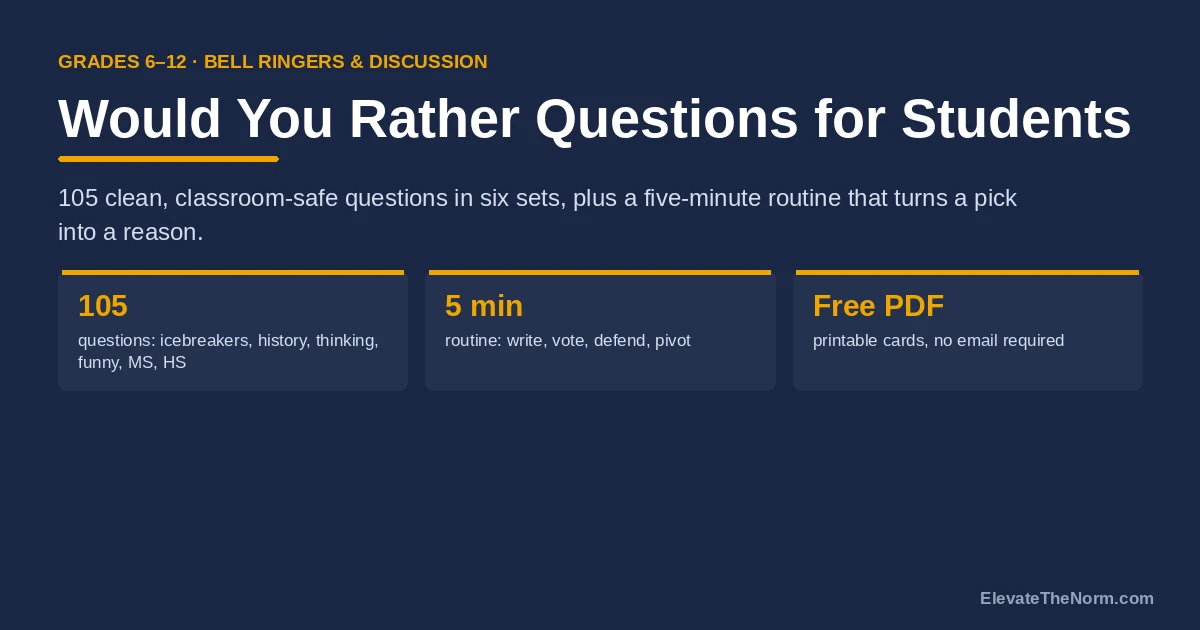
    Would you rather questions are two-choice prompts that force a decision and a reason. This page has 105 clean, school-appropriate would you rather questions for students, sorted into six sets, plus a five-minute routine that keeps the fun from turning into chaos.

    The questions are the easy part. The routine is what makes a would you rather game worth the class time: students commit in writing, pick a side, and defend it with a reason. That is the same skill a Socratic seminar asks for, practiced in five low-stakes minutes.

    Key Takeaways

    • 105 would you rather questions for students, in six sets: icebreakers, history and social studies, academic and thinking, funny, middle school, and high school.
    • Classroom-safe questions stay off private ground. None asks about appearance, family money, religion, partisan politics or anything a student couldn’t answer in front of the whole room.
    • Thirty seconds of silent writing comes first. Writing before talking turns a would you rather game into a thinking routine, because quiet students commit before they hear the loudest opinion.
    • Grade the reason, never the choice. A would you rather pick can’t be wrong; the reason behind it is what students practice.
    • Free printable cards. All 105 questions come as cut-apart PDF cards, eight per page, with no email required.

    Why should teachers use would you rather questions in class?

    Would you rather questions get every student into the conversation in the first minute of class, instead of the same five hands, because nobody needs background knowledge and no answer is wrong. There’s no right answer to fear. That makes these questions especially useful in the first weeks of school, with new students, and with classes that are slow to talk.

    They also teach something real. To answer well, a student has to make a choice, give a reason, and listen to someone who chose the other side. Those are the core moves of argument writing and discussion in every subject. A would you rather question is a low-stakes place to practice them before the stakes go up. When students are ready for a graded discussion, use the Socratic seminar rubric for high school.

    Finally, they are a classroom management tool. A short, predictable opener gives students something to do the moment they walk in, which is the same idea behind good bell ringer ideas and classroom routines. When the routine is the same every day, the start of class runs itself.
    Four steps of a five-minute would you rather classroom routine: write first, move, defend, pivot
    Same four steps every time, so students know the drill.

    How do you use would you rather questions as bell ringers?

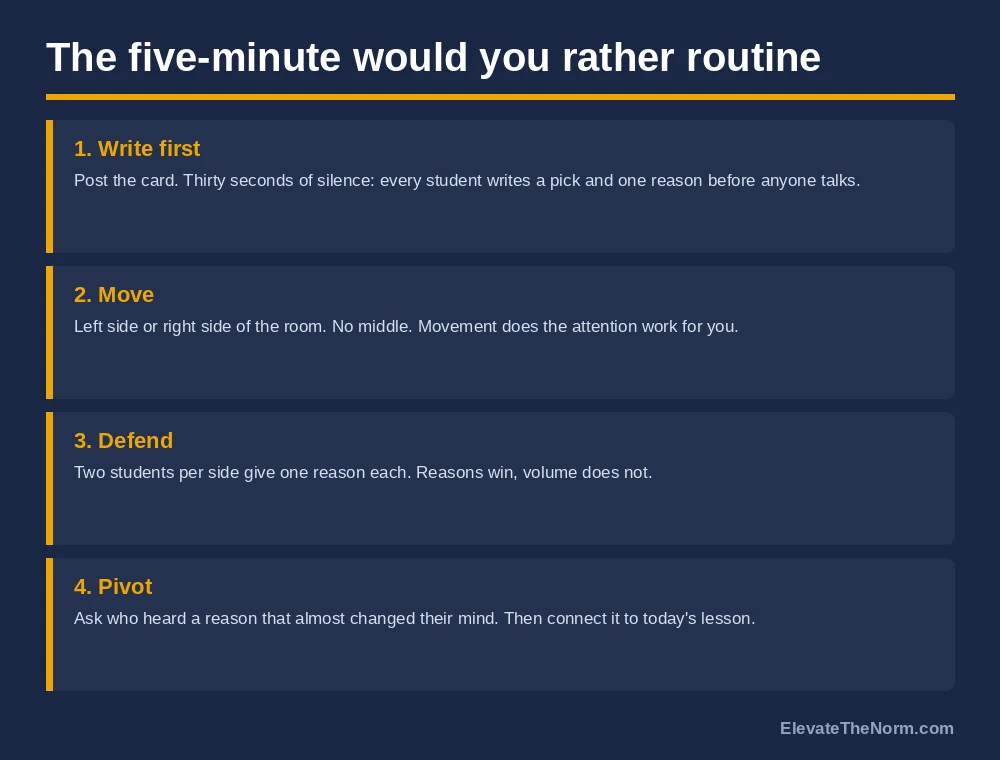
    A would you rather bell ringer runs the same four steps every time: write, move, defend, pivot. The whole routine takes about five minutes once students know it.

    1. Write first. Post the question as students walk in. They write their pick and one reason in a notebook or on a sticky note. Thirty seconds of silence. This step keeps quieter students from just copying the loudest opinion.
    2. Move. One side of the room for option A, the other for option B. No middle. Movement wakes up a sleepy first period and makes the vote visible.
    3. Defend. Call on two students from each side for one reason each. If you use cold calling, the written answer from step one means nobody is caught empty-handed.
    4. Pivot. Ask, “Did anyone hear a reason that almost changed your mind?” Then connect it to the lesson and move on.

    Clay’s take: Stop at five minutes. A bell ringer that eats fifteen minutes stops being a bell ringer, and students learn they can stretch it.

    When you would rather have the question written for you, our daily bell ringers page posts a fresh set for grades 6–8 and 9–12 every school day, with teacher notes hidden until you want them.

    StepWhat students doWhy it matters
    1. WriteWrite their pick and one reason during 30 seconds of silenceQuiet students commit before hearing the loudest opinion
    2. MoveGo to the option A or option B side of the room, no middleWakes up the room and makes the vote visible
    3. DefendTwo students from each side give one reason eachPractices claim and reason; nobody is caught empty-handed
    4. PivotAnswer: did anyone hear a reason that almost changed your mind?Connects the warm-up to the lesson
    The five-minute would you rather routine. Stop at five minutes.

    How do you use would you rather questions for class discussion?

    For a longer would you rather discussion, pick a question from the history or thinking sets and ask students to argue the side they didn’t choose. Arguing the other side is harder than it sounds, and it is one of the best quick exercises for argument writing. Other variations that work well in grades 6–12:

    • Reason ranking. Collect five reasons on the board. Students rank them from strongest to weakest and explain the top one.
    • Evidence round. For a history question, students must use one fact from the unit to support their choice.
    • Write-around. Each student writes a reason, passes the paper, and the next student responds to it in writing.
    • Exit ticket version. Use a question that connects to the day’s lesson as the last thing students answer before they leave.

    How do you keep would you rather questions from getting out of hand?

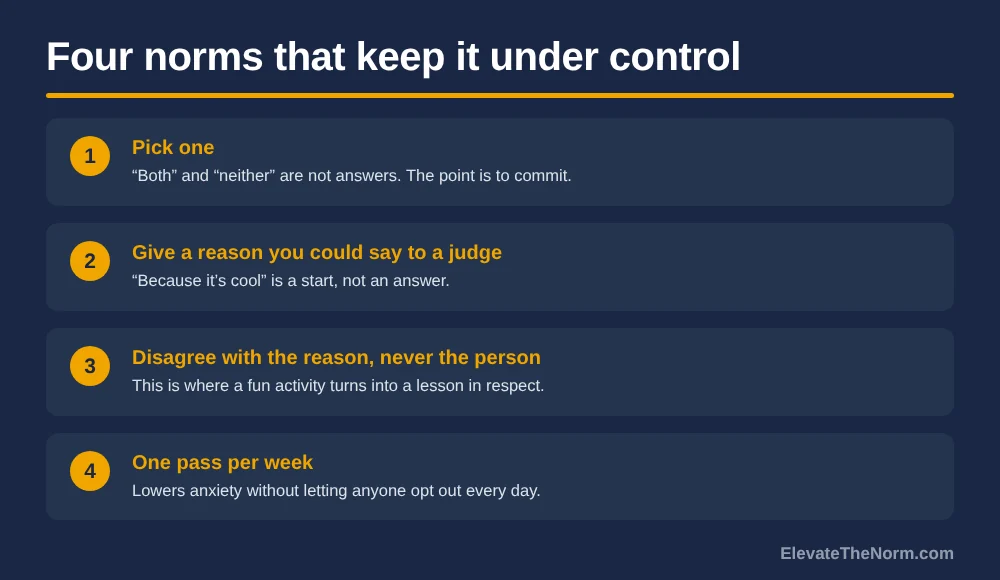
    Would you rather discussions get noisy because of unclear rules, not because of the questions. Set these four norms once and post them:
    Graphic titled Four norms that keep it under control, listing pick one, give a reason you could say to a judge, disagree with the reason never the person, and one pass per week.
    The four norms to post before the first round.
    • Pick one. “Both” and “neither” are not answers. The point is to commit.
    • Give a reason you could say to a judge. “Because it’s cool” is a start, not an answer.
    • Disagree with the reason, never the person. This is where a fun activity can turn into a lesson in respect in the classroom.
    • One pass per week. Students may pass once. It lowers anxiety without letting anyone opt out every day.

    Use a consistent signal to end the movement and bring the room back. If you need one, our post on classroom attention getters has several that work with teenagers. And keep the questions fair: skip any prompt that would make a student reveal something about their family, money, body or beliefs. Every question on this list was written with that rule in mind.

    Free download: 105 would you rather question cards

    Fifteen pages. Page 1 is the five-minute routine and classroom norms. The rest are 105 cut-apart cards, eight per page, labeled by set and numbered to match this article. Print on card stock and keep a stack by the door.

    Free. No email address required. Built for grades 6–12.

    The questions below are numbered straight through, 1 to 105, so the cards and this page match.

    What are good icebreaker would you rather questions for students?

    Good icebreaker would you rather questions are low-stakes choices every student can answer without knowing anything, like flying versus being invisible. Use them in the first weeks, after a long break, or any time a new student joins.

    1. Would you rather be able to talk to animals or speak every human language?
    2. Would you rather have a rewind button or a pause button for your life?
    3. Would you rather live in a big city or in the middle of the countryside?
    4. Would you rather be the best player on a losing team or a bench player on a championship team?
    5. Would you rather read the book or watch the movie first?
    6. Would you rather have summer all year or winter all year?
    7. Would you rather be famous for something you made or for something you did?
    8. Would you rather explore the deep ocean or outer space?
    9. Would you rather always know the answer or always ask the best question?
    10. Would you rather have a personal chef or a personal driver?
    11. Would you rather wake up at sunrise every day or stay up until 2 a.m. every night?
    12. Would you rather be able to fly or be invisible?
    13. Would you rather know how to play every instrument or speak every language?
    14. Would you rather have one best friend or ten good friends?
    15. Would you rather be really good at one thing or pretty good at everything?
    16. Would you rather never have homework again or never have a test again?
    17. Would you rather live without music or without movies?
    18. Would you rather plan every detail of a trip or show up and figure it out?
    19. Would you rather be the oldest sibling or the youngest?
    20. Would you rather have a free week off school now or an extra week of summer later?

    What are good would you rather questions for history and social studies?

    History would you rather questions put students inside a period, such as ancient Rome or the Constitutional Convention, and make them defend a choice. They do double duty as a hook: the reasons students give tell you what they already think about the period before you teach it. See our history project ideas for unit ideas they lead into.

    1. Would you rather meet a famous person from the past or a famous person from 100 years in the future?
    2. Would you rather live in ancient Rome or ancient Egypt?
    3. Would you rather sail with Magellan or ride with the Pony Express?
    4. Would you rather sign the Declaration of Independence or help write the Constitution?
    5. Would you rather be a medieval knight or a medieval merchant?
    6. Would you rather travel the Silk Road or cross the Atlantic on the Mayflower?
    7. Would you rather witness the first Moon landing or the fall of the Berlin Wall?
    8. Would you rather be a scribe in ancient Egypt or a printer right after Gutenberg?
    9. Would you rather live through the Renaissance or the Industrial Revolution?
    10. Would you rather be president for one year or a Supreme Court justice for twenty?
    11. Would you rather be an explorer who finds a new land or a scientist who finds a new cure?
    12. Would you rather live without electricity or without running water?
    13. Would you rather visit the Library of Alexandria or the Great Wall while it was being built?
    14. Would you rather be a newspaper reporter during the American Revolution or the Civil Rights Movement?
    15. Would you rather have dinner with Benjamin Franklin or with Harriet Tubman?
    16. Would you rather lead an army or lead a debate in Congress?
    17. Would you rather live in a monarchy with a fair king or a democracy with an unpopular leader?
    18. Would you rather be a pioneer on the Oregon Trail or a worker building the transcontinental railroad?
    19. Would you rather be the first person to fly with the Wright brothers or the first to ride a car with Henry Ford?
    20. Would you rather know the full history of your town or the full history of your family?
    21. Would you rather have a vote on every law or elect someone you trust to vote for you?
    22. Would you rather be an inventor in the 1800s or an astronaut in the 1960s?
    23. Would you rather live in a castle with no heat or a log cabin with a fireplace?
    24. Would you rather read a diary from a teenager in 1776 or a letter from a soldier in 1944?
    25. Would you rather be remembered in history books or remembered by everyone in your town?

    What are good academic would you rather questions for students?

    Academic would you rather questions are about learning itself: reading versus doing, effort versus results, one final exam versus ten quizzes. They make good openers before a test, a project launch or a feedback conversation, because students end up talking about how they work best.

    1. Would you rather solve a hard problem alone or an easy problem in a group?
    2. Would you rather write a five-page essay or give a five-minute speech?
    3. Would you rather learn by reading or learn by doing?
    4. Would you rather know a little about everything or everything about one subject?
    5. Would you rather be graded on effort or graded on results?
    6. Would you rather take one big final exam or ten small quizzes?
    7. Would you rather have a teacher who is strict and fair or relaxed and unpredictable?
    8. Would you rather discover a new planet or a new species of animal?
    9. Would you rather be able to remember everything you read or understand everything you hear?
    10. Would you rather argue the side you agree with or the side you disagree with?
    11. Would you rather build a robot or write a novel?
    12. Would you rather have unlimited books or unlimited internet?
    13. Would you rather fix a problem fast or fix it perfectly?
    14. Would you rather be the person with the idea or the person who makes it happen?
    15. Would you rather get honest feedback that stings or kind feedback that is vague?
    16. Would you rather study with music or in total silence?
    17. Would you rather have a class with no grades or a class with no deadlines?
    18. Would you rather be able to predict the weather perfectly or predict the stock market perfectly?
    19. Would you rather lose your phone for a week or lose your voice for a week?
    20. Would you rather make a mistake in front of the class or never try at all?

    What are funny would you rather questions that are still classroom-safe?

    Funny classroom-safe would you rather questions are silly on purpose but clean enough to read aloud with an administrator in the room. Save them for Fridays, the day before a break, or the class that needs a reset.

    1. Would you rather have spaghetti for hair or sweat maple syrup?
    2. Would you rather talk like a pirate for a day or sing everything you say?
    3. Would you rather have a pet dinosaur the size of a cat or a cat the size of a dinosaur?
    4. Would you rather only be able to whisper or only be able to shout?
    5. Would you rather have hands for feet or feet for hands?
    6. Would you rather wear socks that are always wet or shoes that are always one size too small?
    7. Would you rather sneeze glitter or hiccup bubbles?
    8. Would you rather have a rewind button for embarrassing moments or a mute button for annoying people?
    9. Would you rather ride a giant chicken to school or a tiny horse?
    10. Would you rather eat only pizza for a year or never eat pizza again?
    11. Would you rather have a nose that glows when you lie or ears that wiggle when you are nervous?
    12. Would you rather be a superhero with a useless power or a villain with an amazing one?
    13. Would you rather have a theme song play every time you walk in or a laugh track play after every joke you make?
    14. Would you rather live in a house made of candy or a house made of LEGO?
    15. Would you rather have a talking backpack or a talking locker?
    16. Would you rather fight one horse-sized duck or one hundred duck-sized horses?
    17. Would you rather have to hop everywhere or crab-walk everywhere?
    18. Would you rather lose all your eyebrows or have one giant eyebrow?
    19. Would you rather swap lives with your pet for a day or with your teacher for a day?
    20. Would you rather have a cloud that follows you and rains or a sun that follows you and makes you sweat?

    What are good would you rather questions for middle school students?

    Good would you rather questions for middle school stay close to a middle schooler’s world: lunch, seats, field trips and friends. Middle schoolers want to talk about that world, and these ten keep the question there.

    1. Would you rather have recess back or have a longer lunch?
    2. Would you rather be the class president or the yearbook photographer?
    3. Would you rather go on a field trip to a museum or to a science center?
    4. Would you rather sit wherever you want or have the teacher pick the perfect seat for you?
    5. Would you rather have a pet hamster in class or a fish tank?
    6. Would you rather be on the school play crew or in the school play?
    7. Would you rather have gym every day or art every day?
    8. Would you rather write with a pencil forever or a pen forever?
    9. Would you rather be able to skip one class a week or leave school an hour early on Fridays?
    10. Would you rather do a group project with your best friend or with the smartest person in class?

    What are good would you rather questions for high school students?

    Good would you rather questions for high school take students’ real decisions about work, school and money seriously without asking anyone to share anything private. High schoolers are starting to make those decisions, so these ten put them on the table.

    1. Would you rather go to college right after graduation or take a gap year to work and travel?
    2. Would you rather have a job you love that pays okay or a job you tolerate that pays a lot?
    3. Would you rather learn a trade or earn a four-year degree?
    4. Would you rather have your first car be brand new and boring or old and awesome?
    5. Would you rather live close to home after high school or move across the country?
    6. Would you rather start your own business or work your way up at a big company?
    7. Would you rather have a great reputation or a great bank account?
    8. Would you rather know your future career now or figure it out as you go?
    9. Would you rather run for city council at 18 or vote in your first presidential election?
    10. Would you rather be the team captain or the player who scores the most?

    How do you write your own would you rather questions?

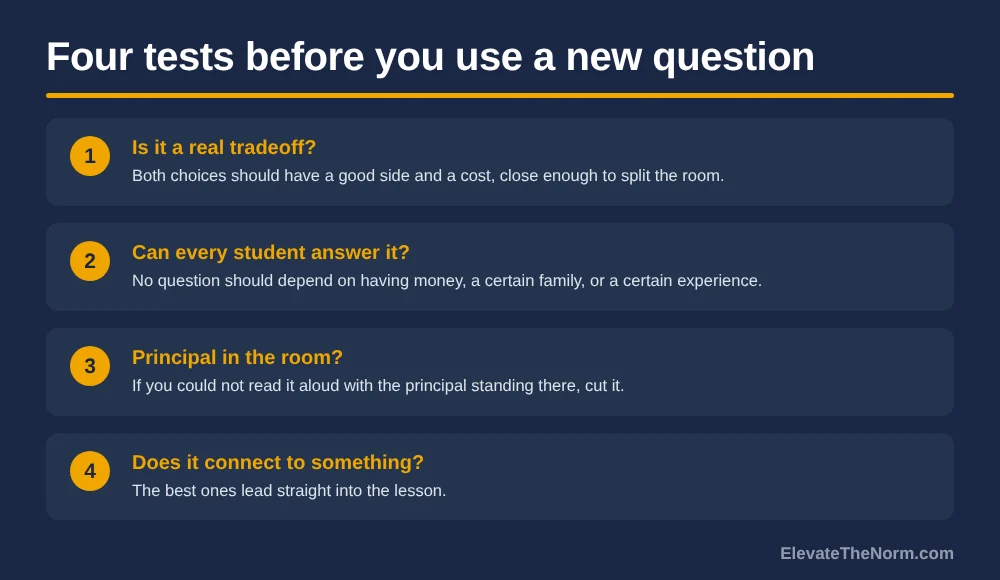
    A good classroom would you rather question has two choices that are close enough to split the room. If 28 out of 30 students pick the same side, there is nothing to discuss. A few tests before you use a new one:
    Graphic titled Four tests before you use a new question, listing is it a real tradeoff, can every student answer it, could you read it with the principal in the room, and does it connect to something.
    Four tests to run on a prompt before it reaches the class.
    • Is it a real tradeoff? Both choices should have a good side and a cost.
    • Can every student answer it? No question should depend on having money, a certain family, or a certain experience.
    • Could you read it aloud with the principal in the room? If not, cut it.
    • Does it connect to something? The best ones lead into the lesson. “Would you rather live in a monarchy with a fair king or a democracy with an unpopular leader?” is a two-week civics unit in one sentence.

    Students can write them too. Having a class write would you rather questions about a unit is a quick review activity that shows you what they think the big tradeoffs were. It pairs well with classroom review games at the end of a unit.

    A set like this runs out eventually, which is why I put a fresh bell ringer idea in every issue of Bell to Bell, my free weekly newsletter for grades 6–12 teachers. A new issue goes out each Wednesday, and every other one includes a printable classroom resource.

    Sources

    This page makes no outside research claims. The questions, the five-minute routine and the four norms are Elevate the Norm’s own, and they match the free would you rather question cards PDF: 15 pages, the routine and norms on page 1, and 105 numbered cards in the same six sets.

    Frequently Asked Questions

    What are good would you rather questions for students?

    Good would you rather questions for students offer two choices close enough to split the class, can be answered by every student, and are clean enough to read aloud in any classroom. Examples include: Would you rather be able to talk to animals or speak every human language? Would you rather live in ancient Rome or ancient Egypt? Would you rather learn by reading or learn by doing?

    How do you play the would you rather game in a classroom?

    To play the would you rather game in class, post the question and give students thirty seconds to write their choice and one reason. Have them move to one side of the room for each option, then call on two students per side to share a reason. End by asking if anyone heard a reason that almost changed their mind. The routine takes about five minutes.

    How long should a would you rather bell ringer take?

    A would you rather bell ringer should take about five minutes. Students write a pick and one reason in 30 seconds of silence, move to a side of the room, hear two reasons from each side, then answer one pivot question that connects to the lesson. A bell ringer that runs fifteen minutes stops being a bell ringer, and students learn they can stretch it.

    How do you keep would you rather discussions from getting out of hand?

    Keep would you rather discussions under control by posting four norms: pick one side, give a reason you could say to a judge, disagree with the reason and never the person, and allow one pass per week. Use the same signal every time to end movement and bring the room back. Most of the noise comes from unclear rules, not from the questions.

    Can would you rather questions be used in history class?

    Would you rather questions work well in history class as hooks, such as asking whether students would rather sign the Declaration of Independence or help write the Constitution. The reasons students give show what they already believe about a period, and you can require them to support their choice with one fact from the unit to turn the warm-up into an evidence round.

    Should would you rather answers be graded?

    Judge a would you rather answer on the reason, never on the choice. A pick can’t be wrong, so a student who takes the less popular side should never pay for it. The point of the routine is practice making a claim and backing it with a reason, and every student may pass once a week, which keeps the stakes low without letting anyone opt out every day.

    Are these would you rather questions appropriate for middle school?

    All 105 would you rather questions on this page are clean and school-appropriate for middle school. None asks students to share anything about their appearance, family, money, religion or partisan politics. The list also includes a ten-question set written for middle school students and another ten for high school, so a sixth-grade class and a senior class can each start with questions built for them.

    Is there a printable version of these would you rather questions?

    A free printable version of all 105 would you rather questions is available as a 15-page PDF. Page 1 holds the five-minute routine and the classroom norms, and the other pages hold cut-apart cards, eight per page, labeled by set and numbered to match this article. The PDF downloads directly with no email address or sign-up required.
    About Clay Shumate

    Clay Shumate is a certified secondary Social Studies teacher in the public schools of West Alabama, with seven years of classroom experience, a B.A. in History, and an M.Ed. in Secondary Education. He writes about project-based learning, student responsibility, respect, and practical ways to hold young people to a higher standard while giving them room to learn from mistakes. He is a member of the Society of Professional Journalists and writes to its Code of Ethics; this site’s editorial standards and corrections policy are published in full. More about Clay.

  • Fun History Facts for Students: 55 Sourced Bell Ringers for Grades 6–12

    Fun History Facts for Students: 55 Sourced Bell Ringers for Grades 6–12

    By Clay Shumate

    Fun history facts for students work best as short, surprising openers: one fact, one question, four minutes. Below are 55 fun facts for students in grades 6–12, grouped by era from the ancient world to the space station. Every fact links to the source it was checked against, and 9 of them bust a myth students probably already believe.

    If you searched for “facts of fun” or “fun facts for students,” this is the history version, built for teachers. Each fact comes with an opinion question, so it works as a bell ringer, a discussion starter or a quick brain break. There is a free printable card set below, with no email required.

    Key Takeaways

    • 55 facts across six eras, mixing world and U.S. history.
    • Every fact has a named source. The source is linked here and printed on each card, so students can check it themselves.
    • 9 myth-busting facts correct stories students think they know, like horned Viking helmets and George Washington’s wooden teeth.
    • Each fact has a discussion question that asks for an opinion and a reason, not a definition.
    • Four minutes, four steps: read the fact, ask the question, take two answers, check the source.

    How to use fun history facts as bell ringers

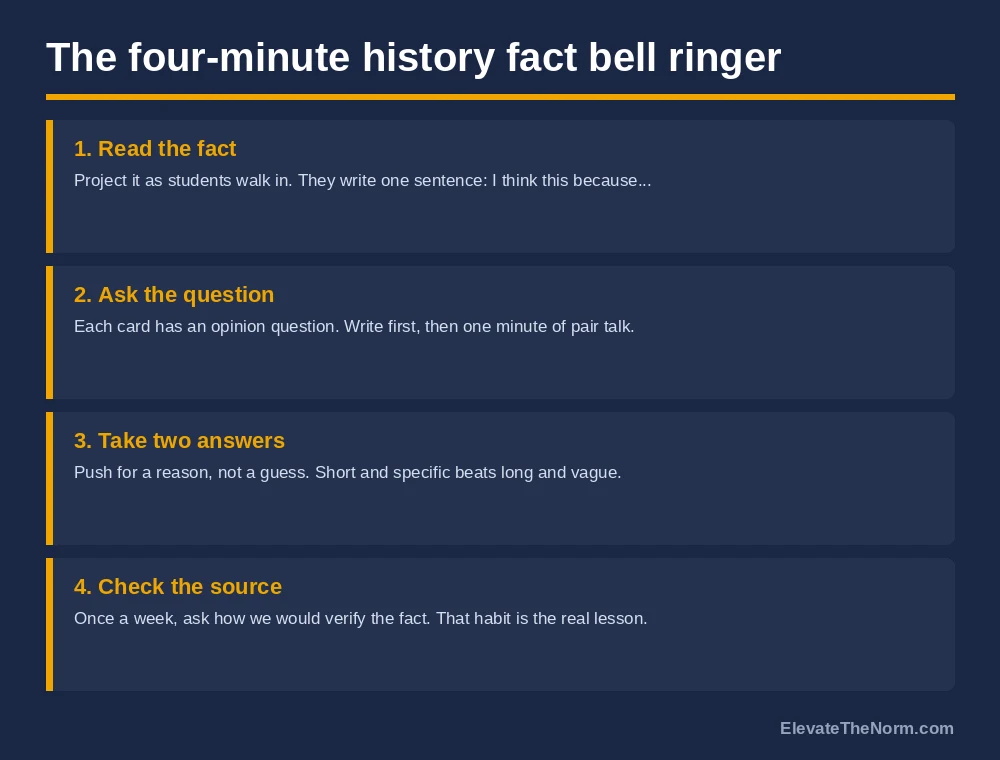
    The fact gets attention, and the question does the teaching. A surprising fact on the board gives students a reason to look up when they walk in. The opinion question that follows asks them to explain, compare or predict, which is the thinking a history class runs on. Here is the four-minute routine:

    1. Read the fact. Project it or read it as students sit down. Each student writes one sentence that starts with “I think this because…”
    2. Ask the question. Students answer in writing first, then talk with a partner for one minute.
    3. Take two answers. Call on two students. Push for a reason, not a guess.
    4. Check the source. At least once a week, point to the source and ask, “How would we check this?”

    That last step is the one that pays off all year. A class that gets used to asking where a fact came from is a class that is ready for primary sources, research projects and the history projects that ask students to build an argument from evidence. For more warm-up formats, see our full list of bell ringer ideas. For one already written for tomorrow, a new social studies prompt is posted every school day beside four other subjects. When the class needs to talk rather than write, 105 classroom-safe would-you-rather prompts, sorted into icebreaker, history, thinking and funny sets run on the same kind of five-minute routine.

    Four steps of a history fact bell ringer: read the fact, ask the question, take two answers, check the source
    The same four steps every day keep the warm-up to four minutes.

    Why the myth-busting facts matter most

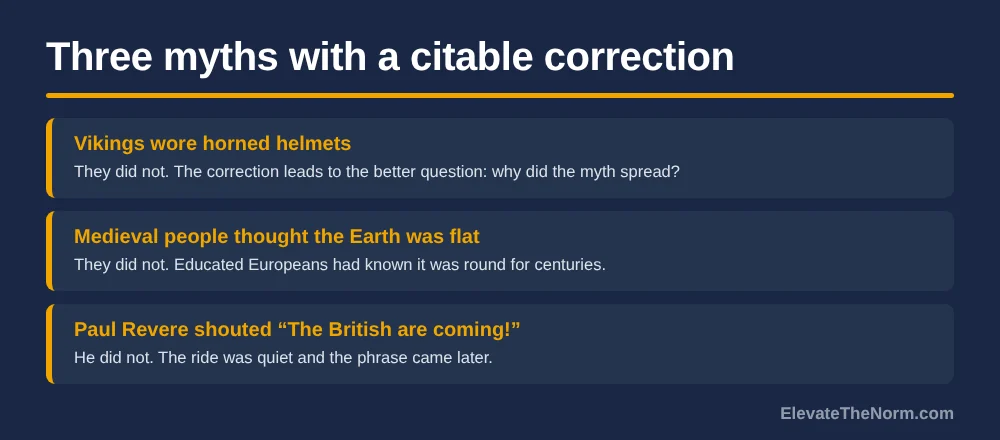
    The myth-busting facts teach the most important habit in a history class: a story everyone repeats is not the same as a story someone checked. Students arrive believing that Vikings wore horned helmets, that medieval people thought the Earth was flat, and that Paul Revere shouted “The British are coming!” Each of those has a clear, citable correction, and each correction leads to a better question: why did the myth spread in the first place?

    Graphic titled Three myths with a citable correction, listing horned Viking helmets, the flat Earth belief in the Middle Ages, and Paul Revere shouting The British are coming, each with the correction beneath it.
    Three myths students arrive with, and the correction for each.

    Use one in the first week of school and then come back to the idea all year. When a student later repeats something from a video or social media, “Is this a horned-helmet fact?” becomes a quick shared shorthand for checking it.

    Free download: 55 fun history fact bell ringer cards

    Fifteen pages. Page 1 is the four-minute routine. The rest are 55 cards, four per page, each with the fact, an opinion question and the source it was checked against. Numbered to match this article.

    Free. No email address required. Built for grades 6–12.

    Fun history facts: Ancient World (to 500 CE)

    Pyramids, pirates and a Greek machine with gears. These work well in the first unit of a world history course, or any time students think ancient people were simple.

    1. For about 3,800 years, the Great Pyramid of Giza was the tallest human-made structure on Earth. Discuss: Why do you think people in ancient Egypt put so much time and effort into building something so huge? (Britannica – How long did the Great Pyramid of Giza hold the record as the tallest man-made structure in the world?)
    2. Evidence suggests the Egyptian pyramids were built by paid laborers, not by slaves as many people believe. Discuss: Why do you think the myth that slaves built the pyramids has lasted so long? (History.com – 11 Things You May Not Know About Ancient Egypt)
    3. Cleopatra came from a family of Greek Macedonians, but she was the first ruler in her family line to learn the Egyptian language. Ancient writers said she may have known as many as a dozen languages. Discuss: How do you think speaking many languages helped Cleopatra as a ruler? (History.com – 10 Little-Known Facts About Cleopatra)
    4. When pirates captured a young Julius Caesar and demanded a ransom of 20 talents, Caesar laughed at them and said he was worth at least 50. Discuss: Was Caesar being brave or just showing off? Explain your thinking. (Britannica – The Time Julius Caesar Was Captured by Pirates)
    5. The month of July was first called Quintilis, Latin for 'fifth month.' It was renamed to honor Julius Caesar in 44 BCE. Discuss: If you could rename a month after someone from history, who would you choose and why? (Britannica – July)
    6. Some ancient Roman concrete can heal its own cracks: reactive chunks of lime in the mix help seal tiny cracks before they spread. Rome's Pantheon, dedicated in 128 CE, still has the world's largest unreinforced concrete dome. Discuss: Why do you think modern builders are now studying ancient Roman concrete? (MIT News – Riddle solved: Why was Roman concrete so durable?)
    7. The Rosetta Stone, found in 1799, has the same decree carved in three scripts: Egyptian hieroglyphs, demotic, and ancient Greek. It helped scholars finally learn to read hieroglyphs. Discuss: Why do you think having the same message in three scripts made the Rosetta Stone so valuable? (Britannica – Rosetta Stone)
    8. Divers pulled the Antikythera mechanism, sometimes called an 'ancient Greek computer,' from a shipwreck in 1900–1901. Its gears could track the Sun, Moon, and planets, predict eclipses, and show when the Olympic Games would happen. Discuss: Why do you think nothing this advanced appeared again for more than a thousand years? (Smithsonian Magazine – What Is the Antikythera Mechanism, the World's First Computer?)
    9. In 1974, farmers digging a well in China found China's Terracotta Army. Archaeologists have since found about 8,000 life-size clay soldiers, and each one appears to have its own unique face. Discuss: Why do you think an emperor wanted an army of clay soldiers buried near his tomb? (History.com – 5 Things You May Not Know About the Terracotta Army)

    Fun history facts: Medieval World (500–1450)

    This set is heavy on myths students already believe, which makes it a strong set for teaching how to question a story everyone repeats.

    1. Myth busted: Vikings almost certainly did not wear horned helmets. The horned look became popular in the 1870s, when a costume designer created horned helmets for an opera by Richard Wagner. Discuss: Why do you think movies and costumes keep the horned-helmet myth alive? (History.com – Did Vikings really wear horned helmets?)
    2. Scientists proved Vikings were cutting down trees in Newfoundland, Canada, in the year 1021, using a solar storm signal locked inside tree rings. That is more than 470 years before Columbus sailed in 1492. Discuss: Why do you think Columbus is remembered more than the Vikings who reached North America first? (Smithsonian Magazine – New Dating Method Shows Vikings Occupied Newfoundland in 1021 C.E.)
    3. In 1324, Mansa Musa, king of Mali, traveled to Mecca with a huge caravan carrying hundreds of pounds of gold. He spent and gave away so much gold in Egypt that its value dropped, and the economy took 12 years to recover. Discuss: Can being too generous ever cause problems? Explain using Mansa Musa as an example. (History.com – This 14th-Century African Emperor Remains the Richest Person in History)
    4. Myth busted: Educated people in the Middle Ages knew the Earth was round. The idea that they believed in a flat Earth was largely made up in 1828 in a popular biography of Columbus by Washington Irving. Discuss: Why do you think a made-up story can become 'common knowledge'? (History.com – Christopher Columbus Never Set Out to Prove the Earth Was Round)
    5. Myth busted: The image of medieval people as dirty and unwashed is false. Bathing and handwashing were common and were treated as important routines. Discuss: Why do you think people today often imagine the past as dirtier or less advanced than it really was? (National Geographic – What life in medieval Europe was really like)
    6. The computer word 'algorithm' comes from the name of al-Khwarizmi, a Muslim scholar who lived in the 800s, through a Latin translation of his math book. Discuss: Why do you think so many science and math words come from other languages and cultures? (Britannica – Algorithm)
    7. At its peak in the late 1200s, the Mongol Empire covered about 9 million square miles, making it the largest connected land empire in history. Discuss: What challenges do you think came with ruling such a huge empire? (History.com – What Were the Biggest Empires in History?)
    8. Explorer Marco Polo was one of the first Europeans to see an Asian rhinoceros, and he thought the horned animals were unicorns. Discuss: Why do you think Marco Polo compared the rhino to something he already knew about from stories? (History.com – 11 Things You May Not Know About Marco Polo)
    9. The famous Bayeux Tapestry is not actually a woven tapestry. It is a strip of linen about 230 feet (70 meters) long with scenes embroidered on it. Discuss: Why do you think people told history through pictures like this instead of only in writing? (Britannica (Compton's) – The Bayeux tapestry is not a woven tapestry)
    10. Only four original copies of the 1215 Magna Carta still exist today. It was sealed by King John at Runnymede, England. Discuss: Why do you think a document from 1215 still matters to people today? (Library of Congress – Lincoln Magna Carta (Magna Carta: Muse and Mentor exhibit))

    Fun history facts: Early Modern / Age of Exploration & Revolutions (1450–1800)

    Explorers, revolutions and the founders, including several things American students are usually taught wrong.

    1. Ferdinand Magellan's 1519 voyage set out with about 240 men on five ships, but only 18 men made it back to Spain in 1522. Magellan himself died in the Philippines before the trip was finished. Discuss: Why do you think explorers were willing to take such huge risks? (National Geographic – 240 men started Magellan's voyage around the world. Only 18 finished it.)
    2. Tomatoes were first grown in Mexico and came to Europe in the 1500s. For a long time, many Europeans thought tomatoes were poisonous, and tomato sauce did not become a regular part of Italian cooking until the late 1700s. Discuss: Why do you think people are sometimes afraid to try new foods? (Smithsonian Magazine – A Passion for Tomatoes)
    3. In January 1610, Galileo used a homemade telescope to discover four moons circling Jupiter. Astronomers still call them the Galilean moons. Discuss: Why do you think Galileo's discovery upset people who believed everything circled the Earth? (NASA – 415 Years Ago: Astronomer Galileo Discovers Jupiter's Moons)
    4. During the Dutch 'tulip mania' of the 1630s, one rare tulip bulb sold for more than the cost of a mansion in Amsterdam. Historians now say the famous 'crash' was overblown and few people were ruined. Discuss: Why do you think people pay huge amounts for things that are popular or rare? (Smithsonian Magazine – There Never Was a Real Tulip Fever)
    5. Isaac Newton served in Parliament, but he reportedly spoke only once—to ask an usher to close a window because it was chilly. Discuss: Can someone be a genius in one area and quiet or unsure in another? Explain. (History.com – 9 Things You May Not Know About Isaac Newton)
    6. Congress voted for independence on July 2, 1776. The Declaration of Independence is dated July 4, but it was not actually signed until August 2. Discuss: Why do you think Americans celebrate July 4 instead of July 2? (National Archives – Did You Know… Independence Day Should Actually Be July 2?)
    7. Myth busted: Paul Revere almost certainly did not shout 'The British are coming!' on his 1775 ride. Most colonists still thought of themselves as British, and he most likely warned that 'the regulars are coming out.' Discuss: Why do you think the more dramatic version of the story became so popular? (Paul Revere House – Revisit the Ride: What Did Paul Revere Actually Say?)
    8. Myth busted: Benjamin Franklin never officially proposed the turkey as America's national bird. He did write a letter to his daughter calling the bald eagle a bird of 'bad moral character' and the turkey 'a much more respectable bird.' Discuss: Which animal do you think best represents the United States, and why? (The Franklin Institute – Did Benjamin Franklin Want the National Bird To Be A Turkey?)
    9. Myth busted: George Washington's false teeth were never made of wood. His dentures used materials like tin, gold, lead, and human teeth; staining over time made them look like wood grain. Discuss: Why do you think people like to tell surprising (but false) stories about famous leaders? (George Washington's Mount Vernon – Wooden Teeth Myth)

    Fun history facts: 19th Century (1800–1900)

    Inventions, purchases and one very loud volcano. Good openers for U.S. history units on expansion and industry.

    1. Former presidents John Adams and Thomas Jefferson died within hours of each other on July 4, 1826—exactly 50 years after the Declaration of Independence. Discuss: Is this just a coincidence, or does it feel like something more? Explain your opinion. (Thomas Jefferson's Monticello – John Adams)
    2. The oldest surviving photograph from a camera was made in 1827 by Joseph Nicéphore Niépce. It showed the view from his window and took several days of sunlight to capture. Discuss: How would life be different if taking a photo still took days? (Harry Ransom Center, University of Texas at Austin – The Niépce Heliograph)
    3. Ketchup most likely began centuries ago as a fermented fish sauce, similar to sauces found in Southeast Asia. The first published recipe for tomato ketchup did not appear until 1812. Discuss: What other everyday foods do you think might have surprising origins? (Smithsonian Magazine – A Brief (But Global) History of Ketchup)
    4. Abraham Lincoln is the only U.S. president to hold a patent. In 1849 he patented a device that used inflatable air chambers to lift riverboats over sandbars. Discuss: Why do you think problem-solving skills are useful for a president? (Smithsonian Magazine – Abraham Lincoln Is the Only President Ever to Have a Patent)
    5. Myth busted: Napoleon was not unusually short. He was probably about 5 feet 6 or 7 inches—average or taller for a Frenchman of his time—but British cartoonists drew him as tiny. Discuss: How can cartoons and media shape the way people see a leader? (Britannica – Was Napoleon Short?)
    6. The Pony Express mail service started in April 1860 but lasted only about 18 months. The new transcontinental telegraph made it outdated in October 1861. Discuss: What modern technology do you think will become outdated as fast as the Pony Express did? (Smithsonian National Postal Museum – Pony Express)
    7. In 1867, the United States bought Alaska from Russia for $7.2 million. Critics mocked the deal as 'Seward's Folly,' but a later gold discovery proved it was a smart buy. Discuss: Have you ever made a choice others doubted that turned out well? How is that like the Alaska purchase? (U.S. Department of State, Office of the Historian – Purchase of Alaska, 1867)
    8. The 1883 eruption of the Krakatoa volcano in Indonesia is considered the loudest sound in modern history. People heard it as far as 3,000 miles away. Discuss: How do you think people 3,000 miles away explained a sound they could not see the cause of? (Britannica – What's the Loudest Sound in History?)
    9. The Statue of Liberty was not always green. Its copper skin, only about as thick as two pennies, slowly reacted with the air and formed a green layer called a patina that protects the metal. Discuss: Do you think the statue looks better green or would it look better copper-colored? Why? (National Park Service – Frequently Asked Questions About the Statue of Liberty)

    Fun history facts: 20th Century (1900–1945)

    World wars, famous landmarks and a stolen painting. Several of these lead straight into a lesson on how ordinary people shaped big events.

    1. The teddy bear is named after President Theodore Roosevelt. In 1902 he refused to shoot a bear that had been tied to a tree on a hunting trip, and a toy maker soon sold a stuffed 'Teddy's Bear.' Discuss: Why do you think this story made Roosevelt more popular with Americans? (National Park Service – The Story of the Teddy Bear (Theodore Roosevelt Birthplace))
    2. The Wright brothers' first powered flight on December 17, 1903, lasted just 12 seconds and went 120 feet. Pieces of their airplane later traveled to the Moon with Neil Armstrong and to Mars on NASA's Ingenuity helicopter. Discuss: Why do you think astronauts and NASA chose to carry pieces of the Wright Flyer into space? (NASA – 120 Years Ago: The First Powered Flight at Kitty Hawk)
    3. In 1911, the Mona Lisa was stolen from the Louvre by Vincenzo Peruggia, a former handyman there, who hid it in his Paris apartment for about two years. The theft actually made the painting far more famous. Discuss: Why do you think a crime made the Mona Lisa more famous instead of less? (History.com – The Heist that Made the Mona Lisa Famous)
    4. On Christmas Day 1914, during World War I, some British and German soldiers met in 'No Man's Land' between the trenches, exchanged gifts, and played informal games of football (soccer). Discuss: What does the Christmas Truce tell us about the soldiers on both sides? (Imperial War Museums – The Real Story of the Christmas Truce of 1914)
    5. Jeannette Rankin of Montana became the first woman elected to Congress in 1916—nearly four years before the 19th Amendment gave women across the U.S. the right to vote. Discuss: How do you think Rankin felt serving in Congress when most American women still could not vote? (Library of Congress (Picture This blog) – Jeannette Rankin: First Woman Elected to Congress)
    6. Almost 400 men and women worked on carving Mount Rushmore from 1927 to 1941, and despite the dangerous conditions, no one died during the carving. Discuss: What do you think made it possible for such a dangerous project to have no deaths? (National Park Service – The Workers (Mount Rushmore National Memorial))
    7. The top of the Empire State Building was built as a docking port for dirigibles (giant airships), but strong winds at the top made docking nearly impossible. Discuss: Why do you think people in the 1930s imagined airships would be the future of travel? (History.com – 10 Surprising Facts About the Empire State Building)
    8. During World War II, the U.S. 'Ghost Army,' a unit full of artists and designers, fooled the enemy with 93-pound inflatable tanks and loudspeakers playing recorded troop sounds. Its records stayed secret until 1996. Discuss: Do you think creativity can be as important as strength in a conflict? Why? (Smithsonian Magazine – The Ghost Army of World War II Used Art to Deceive the Nazis)
    9. The code created by Navajo Code Talkers in World War II was never broken. Because Navajo had no word for 'submarine,' they used 'besh-lo,' meaning 'iron fish.' Discuss: Why do you think a code based on a spoken language was so hard for the enemy to crack? (The National WWII Museum – American Indian Code Talkers)

    Fun history facts: Cold War & Modern (1945–present)

    Satellites, space and the end of the Cold War, through the invention of the web. Students tend to find this era closest to their own lives.

    1. Sputnik 1, the world's first artificial satellite, was launched by the Soviet Union on October 4, 1957. It was about the size of a beach ball and circled Earth about every 98 minutes. Discuss: Why do you think a satellite the size of a beach ball worried so many Americans? (NASA – Sputnik and The Dawn of the Space Age)
    2. In 1960, six-year-old Ruby Bridges helped integrate New Orleans schools, walking to school with federal marshals. Her teacher, Barbara Henry, taught her as her only student for an entire year. Discuss: What do you think gave a six-year-old the courage to keep going to school every day? (History.com – Who Is Ruby Bridges?)
    3. Myth busted: The Cold War 'hotline' between Washington and Moscow, set up in 1963 after the Cuban Missile Crisis, was never a red telephone. It used teletype machines that sent typed messages. Discuss: Why do you think written messages might have been safer than phone calls in a crisis? (Smithsonian Magazine – There Never Was Such a Thing as a Red Phone in the White House)
    4. Myth busted: NASA did not invent Velcro or Tang. Velcro is a Swiss invention from the 1940s, and Tang was made by General Foods in 1957; astronauts just made them famous. Discuss: Why do you think people give NASA credit for inventions it did not create? (NASA – Tang, Teflon, Velcro)
    5. The Voyager Golden Record, sent into space aboard NASA's Voyager probes, carries greetings in 55 languages along with pictures, music, and sounds from Earth. Discuss: If you could add one sound or song to represent Earth, what would it be and why? (NASA Science – Golden Record Greetings)
    6. In 1980, the World Health Organization declared smallpox eradicated. It is still the only human disease that has been completely wiped out. Discuss: Why do you think it has been so hard to eradicate other diseases the way smallpox was? (World Health Organization – History of smallpox vaccination)
    7. Tim Berners-Lee invented the World Wide Web in 1989 while working at CERN in Switzerland. The world's first website was at the address info.cern.ch. Discuss: How would your daily life be different without the World Wide Web? (CERN – A short history of the Web)
    8. The Berlin Wall opened on November 9, 1989, partly because of a mistake: East German official Günter Schabowski announced new travel rules would start 'immediately,' though they were meant to begin the next day. Crowds rushed to the border. Discuss: Can one mistake change history? What other examples can you think of? (History.com – 10 Things You May Not Know About the Berlin Wall)
    9. People have lived on the International Space Station without a break since November 2000. The station circles Earth 16 times a day, so its crew sees 16 sunrises and sunsets every 24 hours. Discuss: Would you want to live on the space station for six months? Why or why not? (NASA – International Space Station Facts and Figures)

    Turning a fun fact into a full lesson

    Some of these facts are big enough to carry a whole class period. A few that grow well:

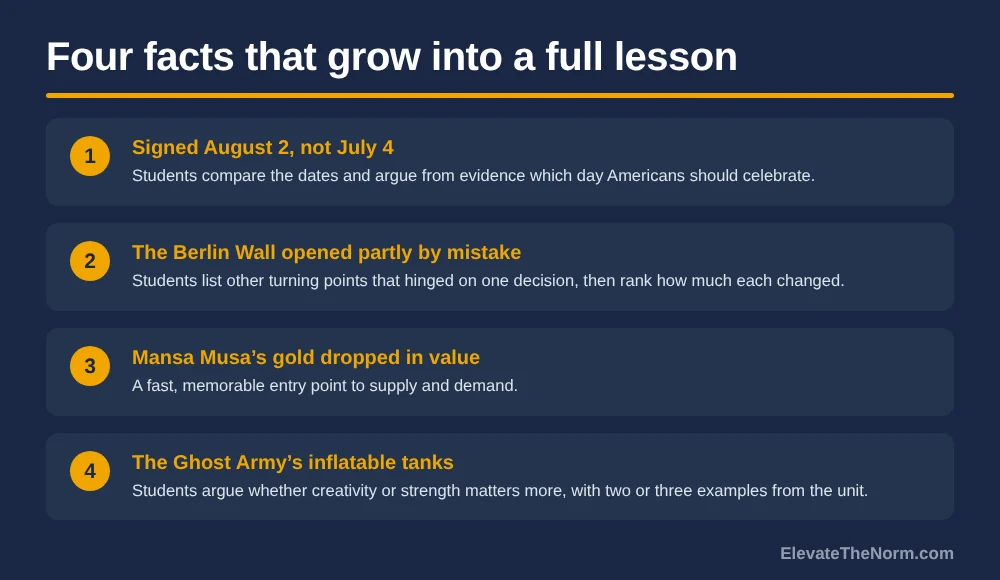
    Graphic titled Four facts that grow into a full lesson, listing the August 2 signing of the Declaration, the Berlin Wall opening partly by mistake, Mansa Musa devaluing gold, and the Ghost Army inflatable tanks, each with the classroom activity it supports.
    Four facts big enough to carry a whole class period.
    • The Declaration was signed August 2, not July 4. Students compare the dates and decide which day Americans should really celebrate, using evidence. It pairs with our civics project ideas.
    • The Berlin Wall opened partly because of a mistake. Students list other turning points that hinged on one decision, then rank how much each one changed.
    • Mansa Musa spent so much gold that its value dropped. A fast, memorable entry point to supply and demand in a world history or economics class.
    • The Ghost Army fooled the enemy with inflatable tanks. Students argue whether creativity or strength matters more, using two or three examples from the unit.

    To review a whole era at the end of a unit, mix a few of these facts into one of the classroom review games that actually review, or use them as true-or-false rounds where students must name the source to earn the point.

    How these facts were checked

    Every fact on this page was checked against the page it links to, and the wording was adjusted when a source did not fully support it. The sources include Britannica, CERN, George Washington’s Mount Vernon, Harry Ransom Center, University of Texas at Austin, History.com, Imperial War Museums, Library of Congress, MIT News, NASA, NASA Science, National Archives, National Geographic, National Park Service, Paul Revere House, Smithsonian Magazine, Smithsonian National Postal Museum, The Franklin Institute, The National WWII Museum, Thomas Jefferson’s Monticello, U.S. Department of State, Office of the Historian, and World Health Organization. Several popular “fun facts” were left out because no reliable source supported them. If you find an error, the site’s corrections policy explains how to report it.

    Frequently Asked Questions

    What are some fun history facts for students?

    A few favorites: the Great Pyramid of Giza was the tallest human-made structure on Earth for about 3,800 years; the Declaration of Independence was not signed until August 2, 1776; Abraham Lincoln is the only U.S. president to hold a patent; and Vikings almost certainly did not wear horned helmets. Each fact on this page links to the source it was checked against.

    What does “facts of fun” mean?

    People who search for “facts of fun” are usually looking for fun facts: short, surprising true statements. This page collects fun facts about history for students in grades 6 to 12, each with a discussion question and a source.

    How do you use fun facts as bell ringers?

    Show one fact as students arrive, have them write one sentence about it, ask an opinion question, take two answers out loud, and once a week ask how the class could check the source. The whole routine takes about four minutes.

    Are these history facts true?

    Each fact was checked against the reputable source it links to, such as the Smithsonian, the National Archives, the Library of Congress, NASA, the National Park Service or Britannica. Popular facts that could not be verified were left out.

    What grade level are these fun facts for?

    They are written for grades 6 to 12, at roughly a middle school reading level, so they work in middle school social studies and in high school world history and U.S. history.

    What are some history myths students believe?

    Common ones include that Vikings wore horned helmets, that medieval people believed the Earth was flat, that George Washington had wooden teeth, that Napoleon was unusually short, and that Paul Revere shouted “The British are coming!” This page includes the correction and the source for each.

    Is there a printable version?

    Yes. All of the facts come as free printable bell ringer cards in a PDF, with the discussion question and source on each card. It downloads directly with no email or sign-up.

    About Clay Shumate

    Clay Shumate is a certified secondary Social Studies teacher in the public schools of West Alabama, with seven years of classroom experience, a B.A. in History, and an M.Ed. in Secondary Education. He writes about project-based learning, student responsibility, respect, and practical ways to hold young people to a higher standard while giving them room to learn from mistakes. He is a member of the Society of Professional Journalists and writes to its Code of Ethics; this site’s editorial standards and corrections policy are published in full. More about Clay.

  • Differentiated Instruction Strategies for Grades 6–12 That Don’t Need Five Lesson Plans

    Differentiated Instruction Strategies for Grades 6–12 That Don’t Need Five Lesson Plans

    By Clay Shumate

    Differentiated instruction strategies are the moves a teacher makes so that students who arrive at a lesson with different knowledge, skills and language can all reach the same standard. The standard does not move. The route to it does. Everything useful in differentiation lives in that one sentence, and most of what goes wrong is a violation of it.

    The version sold in professional development usually looks like three lesson plans for one period. Nobody does that for five preps in February, and the people who tell you to do it are not currently teaching five preps in February.

    Key Takeaways

    • Change the route, not the destination. The learning target, the standard and the final criteria stay the same for everyone. If those move, you are running two courses in one room.
    • The evidence is encouraging and genuinely thin. A systematic review of secondary differentiation found only 12 usable studies out of 1,029 screened, and its authors named “severe knowledge gaps” in the same abstract that reported a positive effect.
    • Ability grouping is not differentiation. In primary education, homogeneous grouping showed a small negative effect on low-ability students and no effect on anyone else.
    • Do not differentiate by learning style. There is no adequate evidence base for matching instruction to a preferred modality, and the studies designed properly to test it mostly contradict it.
    • Five strategies carry most of the load: tiered questioning, scaffolds that come back, choice of product, grouping that actually changes, and pre-assessment that changes the plan. Four of the five are nearly free.

    What Is Differentiated Instruction?

    It is adjusting content, process, product or environment in response to what students actually need, while holding the learning goal constant. The adjustment has to be driven by evidence about this group of students, in this unit, right now — not by a label attached to a child in sixth grade.

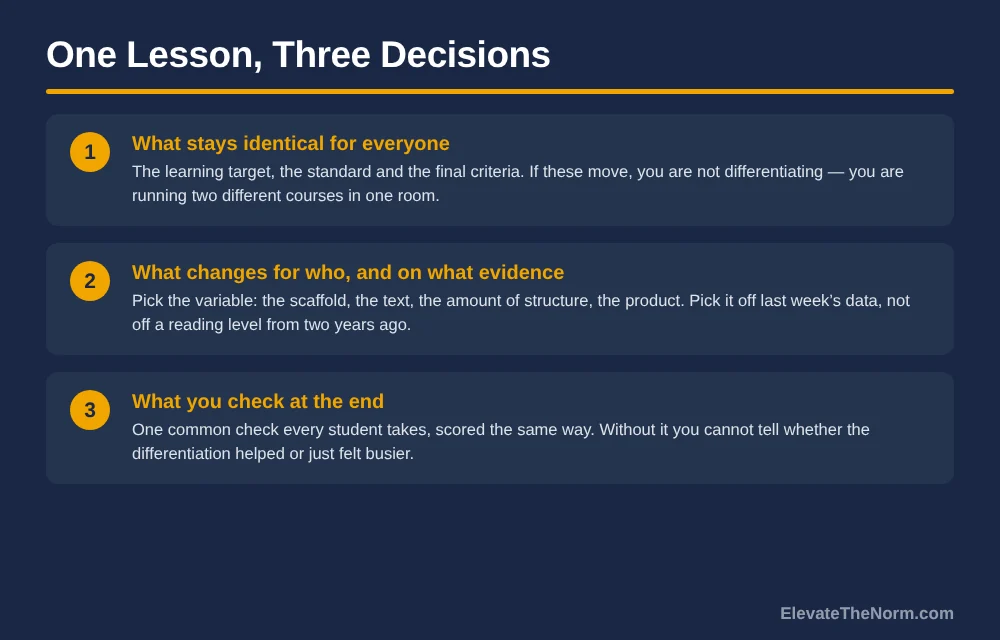
    Numbered three-card framework graphic for differentiating one lesson: what stays identical for everyone, what changes for which students and on what evidence, and what common check happens at the end
    Three decisions per lesson. That is the whole planning load.

    In practice, one lesson is three decisions.

    One: what stays identical for everybody. The target, the standard, the criteria for good work. Nail these down first, because everything after is a variation on them.

    Two: what changes, for whom, on what evidence. Pick one variable — the scaffold, the text, the amount of structure, the product. One. Then name why those students and not others, and point at the data that says so. If the only answer is “they’re my low group,” you have a track, not a differentiation plan.

    Three: what you check at the end. One common check every student takes, scored the same way. Without it, you cannot distinguish a lesson that helped from a lesson that was busier.

    Does Differentiated Instruction Actually Work?

    Probably, somewhat, and we know less than the training implies. The best secondary-specific review found a positive average effect across a small number of mostly quasi-experimental studies, and said so alongside a warning about how thin the base is.

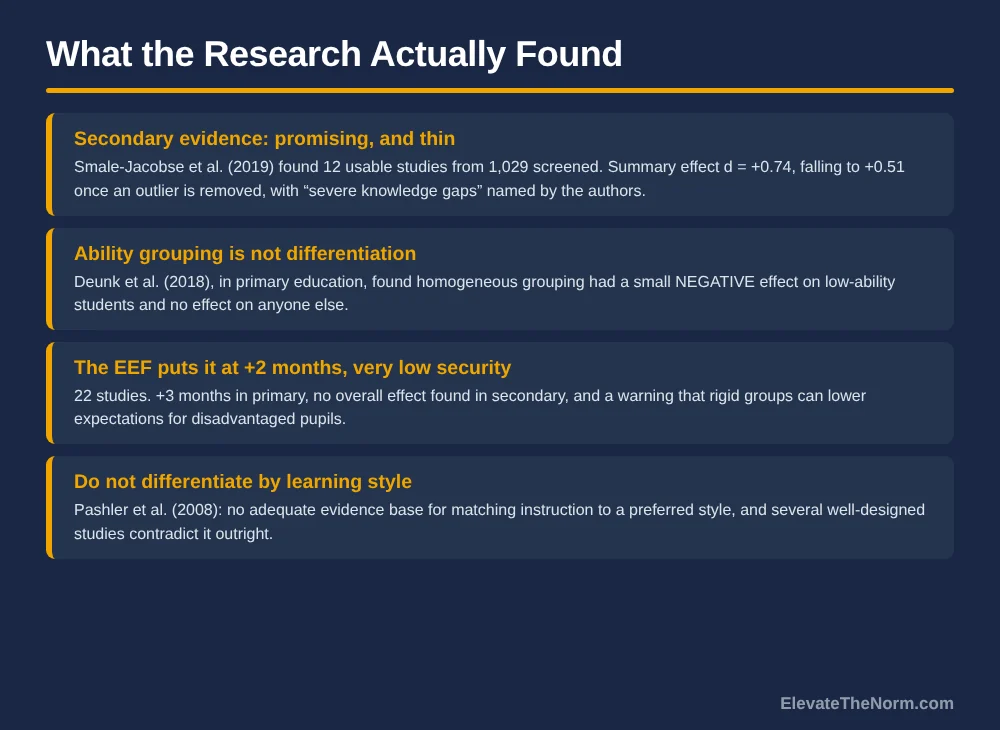
    Four-row research graphic on differentiated instruction: Smale-Jacobse and colleagues 2019 finding 12 usable secondary studies with an effect of 0.74 falling to 0.51 without an outlier, Deunk and colleagues 2018 finding homogeneous grouping slightly negative for low-ability students, the Education Endowment Foundation rating within-class attainment grouping at plus two months with very low security, and Pashler and colleagues 2008 on the absence of evidence for learning styles
    Four findings worth knowing before anyone sells you a differentiation initiative.

    Smale-Jacobse, Meijer, Helms-Lorenz and Maulana screened 1,029 papers and ended up with 12 unique studies of differentiated instruction in secondary education, mostly in maths and science, with students roughly 11 to 17. The summary effect was d = +0.741. Remove one extreme outlier and it drops to d = +0.509. Heterogeneity was enormous (Q = 507.7), the larger studies produced the smaller effects, only two studies had at least 15 cases per condition at the randomization level, and many of the outcome tests were researcher-made. The authors’ own summary is that the findings “give some indication of the possible benefits” but “point out that there are still severe knowledge gaps.”

    That is an honest finding and it is worth something. It is not a mandate.

    The Education Endowment Foundation puts within-class attainment grouping at +2 months of additional progress, at very low cost, with the security of the evidence rated very low — 22 studies, few of them recent. Their breakdown matters more than the headline: about +3 months in primary, +4 in maths, no difference on average in literacy, and no overall impact found at secondary, where there are few studies to begin with.

    And in primary education, Deunk, Jacobse, de Boer, Doolaard and Bosker reviewed 21 studies and 78 effect sizes. Computerized differentiation tools and differentiation embedded in a broader program produced small to moderate positive effects. Homogeneous ability grouping on its own produced a small negative effect on low-ability students and no effect on anyone else. Their conclusion is the one to carry into a department meeting: grouping by itself does not constitute differentiated instruction.

    Worth saying plainly: Deunk and the EEF’s strongest results are primary findings. They do not transfer to a ninth-grade classroom automatically, and I am not going to pretend they do. What transfers is the warning.

    What Differentiation Is Not

    It is not teaching to learning styles

    Pashler, McDaniel, Rohrer and Bjork tested what they called the meshing hypothesis — the idea that a “visual learner” learns more from visual material. Credible evidence would require grouping students by style, randomly assigning instruction methods, testing everyone the same way, and finding a crossover interaction. They found “virtually no evidence” of that pattern, and noted that several studies using an adequate method flatly contradict it. Their conclusion: there is no adequate evidence base for building learning-styles assessment into general educational practice.

    If a differentiation plan starts with a learning-styles inventory, it is starting from a dead end. Vary the representation because the content calls for it — a map, a graph, a demonstration — not because a survey labelled a student kinesthetic in seventh grade.

    It is not lowering the bar for some students

    A shorter task with the same standard is differentiation. A simpler standard quietly substituted for one group is not, and it is the single most common failure mode. Students work out within a week whose work is being graded against what. Holding the same expectations for every student in the room is not in tension with support; support is how you make the expectation reachable.

    It is not permanent groups with friendly names

    The Eagles, the Falcons and the Hawks, unchanged since September, are a tracking system with a bird theme. The students know. Rigid grouping carries a documented equity risk — the EEF names lower teacher expectations for disadvantaged pupils and damage to low attainers’ belief that effort changes anything.

    Differentiated Instruction Strategies, Ranked by What They Cost

    Start with the ones that cost nothing. Most teachers who “cannot differentiate” have simply been handed the most expensive version first.

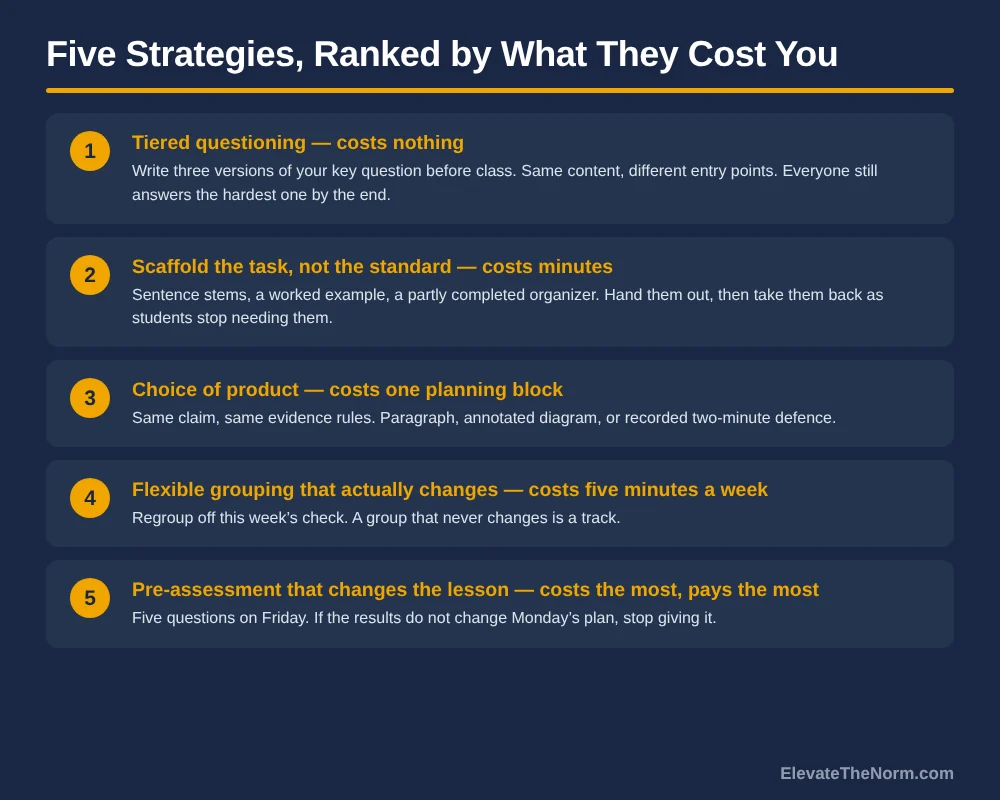
    Numbered five-card graphic ranking differentiated instruction strategies by preparation cost: tiered questioning, scaffolding the task rather than the standard, choice of product, flexible grouping that actually changes, and pre-assessment that changes the lesson
    Ranked by what they cost you, cheapest first.

    1. Tiered questioning — costs nothing

    Before class, write your key question three ways: one that gets anyone in, one at grade level, one that pushes. Same content, different entry points. You are not assigning questions to students; you are making sure the discussion has a door at every height. Every student should still meet the hardest version before the period ends — that is the difference between tiering and sorting.

    2. Scaffold the task, not the standard — costs minutes

    Sentence stems, a worked example at the top of the page, a graphic organizer with two boxes already filled in, a word bank for the four terms that will otherwise stop a student cold. The rule that keeps this honest: scaffolds are temporary and you must plan their removal. If a student has had the same organizer since September, the organizer is now the skill.

    3. Choice of product — costs one planning block

    Same claim, same evidence rules, same criteria — written paragraph, annotated diagram, or a recorded two-minute defense. This is where a choice board earns its keep, as long as the options differ in form and not in difficulty. Three options is plenty. Nine is a craft fair.

    4. Flexible grouping that actually changes — costs five minutes a week

    Group off this week’s evidence, not last year’s. Sometimes by readiness, sometimes by interest, sometimes at random, often mixed on purpose. If your groups have not changed in a month, they are not flexible. Small-group instruction in a secondary classroom works best when the rest of the room has something genuinely worth doing, which is a planning problem before it is a grouping problem.

    5. Pre-assessment that changes the lesson — costs the most, pays the most

    Five questions on Friday about Monday’s content. Not graded. The point is to find out who already has it and what the two common misconceptions are. Here is the test of whether it was worth doing: if the results do not change Monday’s plan, stop giving it. A pre-assessment you collect and file is paperwork.

    Any of the quick formative checks works for this. What matters is the twenty minutes afterward where you actually look.

    Differentiated Instruction Examples for Grades 6–12

    Each of these is one lesson, one variable changed, same standard for everybody.

    • Grade 9 history, document analysis. Everyone analyzes the same three documents against the same criteria. Two students get a version with the archaic vocabulary glossed in the margin. One group that finished the skill last unit gets a fourth document that contradicts the other three.
    • Grade 7 science, data claims. Same data set for the room. Some students get a claim-evidence-reasoning frame with the first sentence started; some get a blank page; the ones who have the structure cold get asked to write the strongest objection to their own claim.
    • Grade 8 algebra, error analysis. Everyone finds the mistake in a solved equation. One table gets problems with the error in the first two lines; another gets it buried in line five; a third gets two errors, one of which is not actually an error.
    • Grade 11 English, revision. Same paragraph, same revision criteria. Some students revise on paper with a checklist; some revise aloud to a partner first; some revise a second paragraph after the first one is done.
    • Any subject, same day. The whole class gets the same exit check: one question, four minutes, scored the same way. That single common measure is what makes the rest of it defensible.

    How Do You Differentiate When You Teach 150 Students?

    You differentiate the lesson, not the student. Build one lesson with planned variation inside it, and let students move through the variation, rather than writing a plan per child.

    Three things make this survivable.

    Sample instead of reading everything. You do not need to read 150 exit tickets. Read fifteen — five you expect to be strong, five middling, five you are worried about — and sort the rest into three piles by a single criterion. That takes ten minutes and tells you nearly as much as an hour would.

    Reuse the structures. The same tiered-question frame and the same CER scaffold work across a whole unit. You build them once, in August or over a weekend, and spend the rest of the semester choosing which to deploy. The planning cost is front-loaded, which is the only way it ever gets paid.

    Pick one class to start. Not all five. One section, one unit, one variable. If it works there, it transfers; if it does not, you have lost a week instead of a semester.

    What About the Students Who Already Got It?

    They are the group most often skipped, and the evidence says so directly.

    Ziernwald, Hillmayr and Holzberger reviewed 49 studies published 2000–2019 on differentiated instruction for high-achieving students in mixed-ability classrooms, spanning primary and secondary. Effects on achievement and on motivational outcomes were mostly positive but varied a great deal. The finding that should sting: teachers typically did not use differentiation for high achievers proactively or regularly, and both students and school staff reported it was rarely used. The barriers were time, resources, training, misconceptions about high-achieving students, and a focus on struggling students.

    Their caution is important too. Only six studies had a pretest-posttest control group design, so they did not run a meta-analysis at all. No study met every quality criterion. Treat this as a well-documented description of practice, not a proven intervention effect.

    The practical move is cheap: for the students who already have it, extend sideways rather than forward. One more document, a counter-argument, a constraint added to the problem, a request to teach the step to someone else. Sideways keeps them in the same conversation. Forward just sends them into next week alone.

    Sideways is also the whole argument for what you hand a student who simply finishes first. Our guide to what to do with the minutes after a student says “I’m done” orders six options by what each one costs you to run, and starts from the rule that finishing early can never cost the student anything.

    Why Does Differentiation Fail in Real Schools?

    Mostly for reasons that are not about teacher willingness.

    Gibbs interviewed seven teachers and two school leaders at an Australian secondary school of roughly 1,250 students. Every one of the seven teachers named limited resources as a barrier. Three named student behaviour, and three named limited planning and instruction time. Leaders named their own time and administrative load, including inconsistent records arriving from feeder primary schools. Four of the seven reported no pre-service training in differentiation at all, and the training the other three described focused on inclusion and disability — which suggests differentiation is widely confused with special education provision.

    It is a small, single-site qualitative study and the author says so. But the pattern is recognizable in any building.

    Two of those barriers are leadership decisions rather than teacher decisions. Planning time and class size are set in a master schedule. A district that mandates differentiation without changing either has bought a slogan. The same applies to the second adult in the room: which co-teaching model a pair can realistically run is decided by the master schedule, not by the two teachers. If you lead a building and want to know whether this is happening, do not add a differentiation box to a walkthrough form — that produces visible differentiation and nothing else. Look at whether groups changed between September and November, and whether anyone can show you a pre-assessment that altered a plan.

    It is also worth being honest that behaviour showed up in that list. Differentiation assumes a room where several things can happen at once, and that is downstream of the management work that makes multiple simultaneous activities possible. Trying to run four stations in a room that cannot hold one task is not a differentiation problem. If the room can hold it, the station-rotation model is the version of this with the clearest set of rules.

    A Planning Checklist

    • Can every student in the room name the same learning goal for today?
    • Did I change exactly one variable, and can I say what evidence picked it?
    • Is the final criterion identical for everyone?
    • Is there one common check at the end, scored the same way?
    • Do the scaffolds I handed out have a removal date?
    • Have the groups changed in the last three weeks?
    • If a student asked “why do I have this version?” could I answer honestly in one sentence?

    That last question is the one that keeps this ethical. If the honest answer is one you would not say out loud to the student, the plan needs changing, not the phrasing.

    What to Say to Students and Parents

    Students know when the work is different. Pretending otherwise costs you more credibility than telling the truth does: “Everyone is being graded against the same four criteria. You’ve got the version with the vocabulary glossed because that was slowing you down last week, not because I expect less from you. It comes off the next one.” That is a sentence a fifteen-year-old can respect, and it has the advantage of being true. Giving students some say in which version they take — real student voice and choice — removes most of the sting on its own.

    Parents ask a sharper version: is my kid getting the easy work? Answer it directly. Name the standard, show the common criteria, show the common end-of-unit check, and explain which support is in place and when it comes off. A parent who hears “same standard, different scaffolding, here is the removal plan” is usually satisfied. A parent who hears “we differentiate” is not, and should not be.

    Differentiated Instruction Strategies: What to Do Next Week

    Pick one section and one unit. Write your key question three ways. Build one scaffold and decide now which lesson it comes off at. Give one five-question pre-assessment and change something in the plan because of it. Give the same exit check to everybody and score it the same way.

    That is five moves, four of them nearly free, and it is more differentiation than most buildings are actually running. If it works, add the sixth thing in November. If it does not, you will know exactly which move failed, because you only changed one.

    And whatever else you cut, keep the common check at the end. Without it you are differentiating on faith, and the research base is nowhere near strong enough to carry that.

    Differentiation needs something to stand on. Our guide to scaffolding strategies for grades 6–12 covers the three characteristics that make a support a scaffold rather than a crutch, and when to take it away.

    Differentiation adjusts a lesson once you know who needs what; there is a separate question about how the lesson was built before you knew anything. That is the whole claim of Universal Design for Learning, and it is worth reading with the evidence attached rather than the enthusiasm. What UDL asks for, and what the research will and will not carry covers the three principles, the federal law that calls the framework scientifically valid, and the secondary-level review that found 22 studies and two randomized designs.

    Differentiating on a guess is the expensive way to do it, and pre-assessing on reflex is the other. A short check before a unit is the usual way teachers are told to find out where students actually are — but the research behind it is thin and mostly from college classrooms. What a pre-assessment should look like in grades 6–12 covers how long it should take, whether it should be graded, and when it is the wrong move entirely.

    Frequently Asked Questions

    What are differentiated instruction strategies?

    They are the adjustments a teacher makes to content, process, product or learning environment so that students with different prior knowledge, skills and language can all reach the same standard. The standard and the criteria for good work stay constant; the route changes. The five that carry most of the load in a secondary classroom are tiered questioning, temporary scaffolds, choice of product, flexible grouping that actually changes, and pre-assessment that alters the plan.

    Does differentiated instruction improve achievement?

    The secondary-specific evidence is positive but thin. Smale-Jacobse, Meijer, Helms-Lorenz and Maulana (2019) screened 1,029 papers and found 12 usable studies, reporting a summary effect of d = +0.741 that falls to +0.509 once an outlier is removed. Heterogeneity was very large, most designs were quasi-experimental, and the authors named “severe knowledge gaps.” The Education Endowment Foundation rates within-class attainment grouping at +2 months with very low evidence security and found no overall impact at secondary level.

    Is ability grouping the same as differentiated instruction?

    No, and treating it that way can do harm. Deunk and colleagues (2018), reviewing 21 studies in primary education, found homogeneous ability grouping produced a small negative effect on low-ability students and no effect on other students. Their conclusion is that grouping by itself does not constitute differentiation and must be embedded in a broader instructional approach. Permanent groups that never change are a tracking system, whatever they are called.

    Should I differentiate by learning style?

    No. Pashler, McDaniel, Rohrer and Bjork (2008) concluded there is no adequate evidence base for incorporating learning-styles assessment into general educational practice. They found virtually no evidence for the crossover interaction the theory predicts, and noted that several studies using an adequate experimental method flatly contradict it. Vary how content is represented because the content calls for it, not because a survey labelled a student visual or kinesthetic.

    How do you differentiate with 150 students and five preps?

    Differentiate the lesson rather than the student. Build one lesson with planned variation inside it; sample student work instead of reading all of it, by marking fifteen carefully and sorting the rest into three piles on one criterion; build reusable structures like a tiered-question frame or a CER scaffold once and deploy them across the unit; and start with one section and one unit rather than all five preps at once.

    What about students who already understand the material?

    They are the group most often skipped. Ziernwald, Hillmayr and Holzberger (2022) reviewed 49 studies and found that teachers typically did not use differentiation for high-achieving students proactively or regularly, with students and staff both reporting it was rare. Their evidence base was weak enough that no meta-analysis was possible, so read it as a description of practice. Practically, extend sideways rather than forward: an extra contradictory source, an added constraint, the strongest objection to their own answer.

    How do I explain differentiated work to a student without embarrassing them?

    Say it plainly and tie it to the standard. Something like: everyone is graded against the same four criteria, you have the version with the vocabulary glossed because that slowed you down last week, and it comes off the next assignment. Students work out within a week whose work is being graded against what, so concealment costs more credibility than honesty does. Letting students choose which version to take removes most of the sting on its own.

    Why does differentiated instruction fail in practice?

    Usually for reasons outside a teacher’s control. In Gibbs’s (2023) interview study at an Australian secondary school, all seven teachers named limited resources as a barrier, and three each named student behaviour and limited planning time. Four reported no pre-service training in differentiation at all, and the training the others described focused on inclusion and disability. Planning time and class size are set in the master schedule, so a mandate that changes neither is a slogan.

    Sources

    1. Smale-Jacobse, A. E., Meijer, A., Helms-Lorenz, M., & Maulana, R. (2019). Differentiated Instruction in Secondary Education: A Systematic Review of Research Evidence. Frontiers in Psychology, 10, Article 2366. 1,029 papers screened; 14 papers reporting 12 unique studies and 15 effect sizes; summary effect d = +0.741 (95% CI 0.397–1.085), falling to d = +0.509 (95% CI 0.215–0.803) with one outlier removed; Q = 507.701. Mostly quasi-experimental, only two studies with 15+ cases per condition at randomization level, many researcher-made tests; the authors name “severe knowledge gaps.” https://doi.org/10.3389/fpsyg.2019.02366
    2. Deunk, M. I., Smale-Jacobse, A. E., de Boer, H., Doolaard, S., & Bosker, R. J. (2018). Effective Differentiation Practices: A Systematic Review and Meta-Analysis of Studies on the Cognitive Effects of Differentiation Practices in Primary Education. Educational Research Review, 24, 31–54. 21 studies, 78 effect sizes; computerized differentiation and differentiation embedded in broader programs showed small to moderate positive effects; homogeneous ability grouping showed a small negative effect on low-ability students and no effect on others. Primary education only — these findings do not transfer automatically to grades 6–12. https://doi.org/10.1016/j.edurev.2018.02.002
    3. Education Endowment Foundation. Within-Class Attainment Grouping. Teaching and Learning Toolkit, last updated August 2021. Impact +2 months; cost very low; security of the evidence rated very low; 22 studies; +3 months in primary and +4 in mathematics, no average difference in literacy, and no overall impact found at secondary level, where studies are few; warns that rigid grouping may lower teacher expectations for disadvantaged pupils. https://educationendowmentfoundation.org.uk/education-evidence/teaching-learning-toolkit/within-class-attainment-grouping
    4. Ziernwald, L., Hillmayr, D., & Holzberger, D. (2022). Promoting High-Achieving Students Through Differentiated Instruction in Mixed-Ability Classrooms: A Systematic Review. Journal of Advanced Academics, 33(4), 540–573. 49 studies published 2000–2019, primary and secondary, mostly US and Canada; effects mostly positive but highly variable; teachers rarely used differentiation for high achievers proactively. Only six pretest-posttest control-group studies were analyzable, so no meta-analysis was conducted and no study met all quality criteria. https://doi.org/10.1177/1932202X221112931
    5. Pashler, H., McDaniel, M., Rohrer, D., & Bjork, R. (2008). Learning Styles: Concepts and Evidence. Psychological Science in the Public Interest, 9(3), 105–119. Found “virtually no evidence” for the crossover interaction the meshing hypothesis requires, noted that several adequately designed studies contradict it, and concluded there is no adequate evidence base for incorporating learning-styles assessment into general educational practice. https://digitalcommons.usf.edu/psy_facpub/1765/
    6. Gibbs, K. (2023). Voices in Practice: Challenges to Implementing Differentiated Instruction by Teachers and School Leaders in an Australian Mainstream Secondary School. The Australian Educational Researcher, 50(4), 1217–1232. Semi-structured interviews with seven teachers and two leaders at one Queensland secondary school of about 1,250 students; limited resources named by all seven teachers, behaviour and planning time by three each; four teachers reported no pre-service differentiation training. Small, single-site, convenience sample; the author notes limited generalisability. https://doi.org/10.1007/s13384-022-00551-2

    About Clay Shumate

    Clay Shumate is a certified secondary Social Studies teacher in the public schools of West Alabama, with seven years of classroom experience, a B.A. in History, and an M.Ed. in Secondary Education. He writes about project-based learning, student responsibility, respect, and practical ways to hold young people to a higher standard while giving them room to learn from mistakes. He is a member of the Society of Professional Journalists and writes to its Code of Ethics; this site’s editorial standards and corrections policy are published in full. More about Clay.

  • Classroom Management Styles: Find Your Default and What It Costs You

    Classroom Management Styles: Find Your Default and What It Costs You

    By Clay Shumate

    Classroom management styles are usually sorted into four types — authoritative, authoritarian, permissive, and indulgent or uninvolved — by crossing how much structure a teacher demands with how much warmth a teacher offers. The framework is borrowed from parenting research, and the high-structure, high-warmth style has the best support.

    I find this taxonomy genuinely useful and I want to be straight with you about what it is. It is a heuristic that came out of developmental psychology about parents, got carried into teacher education, and is now repeated in professional development as though someone measured it in classrooms. Mostly, nobody did. That does not make it worthless. It makes it a map rather than a measurement, and a map is still worth having if you know what it is.

    Key Takeaways

    • The four styles come from crossing two dimensions, not from four separate discoveries: how demanding you are and how responsive you are.
    • The framework is borrowed, not homegrown. It originates in research on parents, and the attempts to measure it on teachers have been small.
    • Authoritative — high structure, high warmth — has the strongest support, and the evidence for each half of it is better than the evidence for the typology itself.
    • Your style is a default under pressure, not a personality. What you do in week three when you are tired is your real style.
    • Two of the four styles fail the same way. Permissive and authoritarian rooms both end up unpredictable, just for opposite reasons.

    What are the four classroom management styles?

    They are four combinations of two things: how much you require and how much you respond. That is the whole framework, and once you see it as a grid rather than a list of four personalities, it gets much more useful.

    • Authoritative. High demands, high responsiveness. Clear non-negotiable expectations, explained reasoning, visible care, consequences that arrive as promised.
    • Authoritarian. High demands, low responsiveness. Rules without reasons, compliance as the goal, correction without relationship.
    • Permissive. Low demands, high responsiveness. Warm, liked, negotiable — and the floor moves depending on who is asking.
    • Indulgent or uninvolved. Low demands, low responsiveness. Work assigned, grades entered, nothing much required and nothing much offered.

    A note on vocabulary, because it trips people up. Different sources use “permissive” and “indulgent” as synonyms, and some use “uninvolved” or “neglectful” for the low-low cell. The names drift. The two dimensions do not, so when a PD slide confuses you, go back to the grid.

    Where the classroom management styles framework actually comes from

    It comes from Diana Baumrind’s research on parents, extended into a two-by-two grid by other researchers, and only later applied to teachers. Nobody set out to build a theory of classroom management.

    Baumrind’s longitudinal work followed children at ages 4, 9 and 15 and found that “authoritative parents who are highly demanding and highly responsive were remarkably successful in protecting their adolescents from problem drug use, and in generating competence” — while also noting that authoritative parenting was not the only route to a competent adolescent (Baumrind, 1991). That sample was 139 adolescents from an affluent, well-educated, predominantly white population. It is a real finding on a narrow group of families.

    The familiar four-cell version came later. As Nancy Darling’s summary of the literature puts it, “categorizing parents according to whether they are high or low on parental demandingness and responsiveness creates a typology of four parenting styles: indulgent, authoritarian, authoritative, and uninvolved,” a dimensional move credited to Maccoby and Martin in 1983 (Darling, “Parenting Style and Its Correlates”). So the four styles you have seen on a laminated handout are a grid built on top of a three-category typology about families, two steps removed from any classroom.

    Four rows naming the four classroom management styles with the level of structure and warmth each one combines.
    Four cells, two dimensions — not four separate theories.

    Is the parenting-to-teaching mapping measured, or just useful?

    Mostly useful. The direct attempts to measure it on teachers are small enough that you should treat the typology as a thinking tool and not as a finding.

    The clearest explicit attempt I can point you to applied demandingness and responsiveness to teaching practice and student engagement — and it studied three fifth-grade mathematics teachers and 45 of their students (Walker, 2008). Three teachers. Fifth grade. That is a thoughtful, honest study and it is not a basis for telling a high school teacher what their style does.

    So why keep the framework? Because the two dimensions have far better evidence than the four boxes do, and the boxes are a convenient way to talk about the dimensions. That is the position I would defend. Use the labels to locate yourself; use the dimensions to decide what to change.

    The two dimensions that actually matter

    Structure and warmth are each independently supported in classroom research, which is the real reason the authoritative cell wins.

    On the structure side, the review that screened classroom practices for genuine empirical support organized them into maximizing structure and predictability; posting, teaching, reviewing, monitoring and reinforcing expectations; actively engaging students; acknowledging appropriate behavior; and responding to inappropriate behavior along a continuum (Simonsen, Fairbanks, Briesch, Myers & Sugai, 2008). That is the demandingness axis, with practices attached.

    On the warmth side, a meta-analysis of 99 studies on teacher–student relationships found medium-to-large associations with student engagement and small-to-medium associations with achievement, and reported stronger effects in the higher grades (Roorda, Koomen, Spilt & Oort, 2011). Those are correlations, and students who are easier to teach are easier to like, which could generate some of the pattern on its own. Still, if you teach grades 6–12, the warmth axis is doing more work for you than it would in a second-grade room, not less.

    And warmth has a behavioral measure, not just a feeling. In 28 middle school classrooms, higher praise-to-reprimand ratios tracked linearly with better class-wide on-task behavior, and with more engagement, less disruption and better grades among students at risk for emotional and behavioral disorders (Caldarella, Larsen, Williams & Wills, 2023). Responsiveness is countable. That is how you know whether you have it.

    A self-diagnostic for your classroom management style

    Answer these about what you actually did last week, not about what you believe. Score each row 0, 1 or 2. Add the structure rows and the warmth rows separately, then find your cell.

    AxisStatement0 — rarely1 — sometimes2 — nearly always
    StructureA student who arrives late knows exactly what happens next without asking me.
    StructureI did this week what I said last week I would do, including the part I did not enjoy.
    StructureMy transitions have a procedure that students could run if I lost my voice.
    StructureThe same behavior gets the same response from me regardless of which student it was.
    StructureMy deadlines and my late-work rule held this week with no exceptions I did not announce in advance.
    WarmthI spoke to every student by name this week about something that was not their behavior or their grade.
    WarmthI explained the reason behind a rule when a student asked, instead of citing the rule.
    WarmthI acknowledged more often than I corrected, and I know that because I counted.
    WarmthA student who was struggling got a private conversation rather than a public one.
    WarmthI changed something this month because a student told me it was not working.

    Reading your score. Structure 7–10 and warmth 7–10 puts you in the authoritative cell. Structure 7–10 and warmth 0–6 is the authoritarian corner. Structure 0–6 and warmth 7–10 is permissive. Low on both is the uninvolved cell, and if you landed there and you are still reading, you are probably exhausted rather than indifferent — those look identical from the hallway and they are not the same problem.

    This is not a validated instrument and I am not pretending it is one. It is ten honest questions. Its only real virtue is that every item asks about an observable action from the past week, which is harder to flatter yourself about than “I have high expectations.” Run it again in six weeks. Our material on structured teacher reflection has a longer process if you want one.

    Five cards each posing a question a secondary teacher can answer about last week to identify their default management style.
    Ask about last week’s actions, not about your intentions.

    Authoritarian: high structure, low warmth

    The authoritarian room usually works in September and starts leaking in November. Compliance built entirely on your presence requires your presence, and you cannot be everywhere.

    The cost is specific. Students follow rules they do not understand only while they are being watched, so you spend the year watching. You also lose your best information source: a student who is afraid of you does not tell you when something is wrong, which means you find out about problems late. And the room runs on a fuel that depletes — your own vigilance.

    The fix is not loosening the structure. That is the mistake teachers make when they are told they are too strict. The fix is adding the reason and the relationship while the structure stays exactly where it is. That is the one-cell move, and it is the easiest of the four to make.

    Permissive: high warmth, low structure

    The permissive room feels good and quietly becomes unfair. It is the style I have the most sympathy for and the one I think costs students the most.

    Here is the mechanism. When the floor is negotiable, the students who get the extensions, the second chances and the benefit of the doubt are the students who are comfortable asking. The confident, the articulate, the ones whose parents taught them to advocate. The quiet student who also needed the extension does not get it, because she did not know she was allowed to ask. A permissive room distributes mercy by social skill. That is not kindness. A predictable floor is the more generous system even when it feels harsher, and it is the heart of what we argue in holding a standard without becoming a hardliner.

    The other cost is that warmth without structure is not actually experienced as respect. Teenagers read a teacher who requires nothing as a teacher who expects nothing of them, and they are not wrong to read it that way.

    Indulgent and uninvolved: the low-low cell

    Almost nobody chooses this cell, and plenty of good teachers end up in it temporarily. It is usually a symptom of being overwhelmed, not a philosophy.

    Four preps, a coaching duty, a hard roster, something going wrong at home: structure and warmth are both effortful, and when you are depleted you stop producing both. I would rather name that honestly than moralize about it. If a self-diagnostic put you here, the move is not to fix your style. It is to pick one axis, one class period, and one week, and rebuild from there. Trying to become authoritative across six periods on a Monday is how people quit.

    Four rows describing the single lowest-cost change a teacher can make from each of the four management style positions.
    One behavior, four weeks — not a new philosophy.

    Authoritative: high structure, high warmth

    This is the cell with the best support, and the mechanism is not warmth plus rules — it is that the warmth makes the structure believable and the structure makes the warmth credible.

    A student in an authoritative room knows two things at once: that you mean what you say, and that you are on their side. Those are not in tension. They reinforce each other. Expectations explained are expectations more likely to be internalized, which is also what the motivation literature predicts: in a meta-analysis of 144 studies and just over 79,000 participants with a mean age of 16.5, teacher autonomy support correlated .48 with intrinsic motivation and −.32 with amotivation, and students’ sense of competence (ρ = .58) and autonomy (ρ = .57) were the strongest predictors of self-determined motivation (Bureau, Howard, Chong & Guay, 2021). Autonomy support is not the absence of demands. It is demands with reasons, and some real choice inside them — which is the argument for giving students genuine choices inside a structure you set.

    One honest caveat. Baumrind herself noted that authoritative parenting was not the only path to competence, and the same is almost certainly true in classrooms. I have watched teachers who would score as authoritarian on any instrument run rooms students cared about, because the students were certain the teacher was fair. Fairness may be doing more of the work in this framework than warmth is.

    Can you change your classroom management style mid-year?

    You can add structure to a permissive room in about two weeks. Adding warmth to an authoritarian one takes a grading period, and it requires you to say out loud that you are changing.

    The asymmetry is worth knowing. Tightening up is a policy announcement: here is the new procedure, here is when it starts, here is what happens. Students adjust fast because the change is legible. Warming up is harder because every individual kind act gets read against the record. A student who has spent nine weeks being corrected does not trust a compliment in week ten. Tell the class plainly that you got something wrong and what you are changing, and then be boringly consistent about it for six weeks. That is the whole method. Our piece on what respect actually looks like in practice covers the day-to-day version.

    What your style looks like from a student desk

    Students do not perceive your style as warmth and structure. They perceive it as one question: is this teacher predictable and is this teacher fair?

    That reframing has done more for me than the taxonomy has. A student does not care where you sit on a grid. She cares whether the consequence she got on Tuesday is the consequence the loud kid gets on Thursday, and whether you did the thing you said you would do. Every style in the framework can be perceived as unfair, including the authoritative one, if your word and your actions come apart. The shortest route from any cell to a room that works is to do exactly what you said you would do, every time — a point we make at length in the companion piece on control, consistency and what students are actually reading.

    Using classroom management styles without turning them into a personality test

    Treat the classroom management styles grid as a diagnostic you run on your own behavior, not a label you wear. You are not an authoritarian teacher. You are a teacher who defaulted to low responsiveness in third period on Thursday when you were tired, and that is a fixable fact rather than an identity.

    So do this. Run the ten questions. Find your weaker axis. Pick one behavior on that axis — one — and do it for four weeks. If structure is weak, the highest-value item is holding one deadline exactly as written. If warmth is weak, the highest-value item is speaking to every student by name about something other than their work. Then run the questions again and see whether anything moved. For the concrete practices to build on either axis, our list of classroom management strategies ranked by payback is the practical companion to this article, and the piece on writing expectations that hold is where the structure axis starts. When you are ready to turn that weaker axis into something written down, the free Classroom Management Compass suggests a starting approach and gives you an editable first-week plan to adapt.

    Sources

    1. Baumrind, D. “The Influence of Parenting Style on Adolescent Competence and Substance Use.” The Journal of Early Adolescence, vol. 11, no. 1, 1991, pp. 56–95. Supports the origin of the authoritative category as high demandingness plus high responsiveness, and the finding that it was not the only route to adolescent competence. Caveat: 139 adolescents from an affluent, well-educated, predominantly white sample of families — a parenting study, not a classroom study. https://journals.sagepub.com/doi/10.1177/0272431691111004
    2. Darling, N. “Parenting Style and Its Correlates.” At Health, LLC, 23 October 2013. Supports the two-dimension grid and the attribution of the four-category typology to Maccoby and Martin (1983). Caveat: this is an authoritative literature summary rather than a primary study, and it is cited here as a summary. https://athealth.com/topics/parenting-style-and-its-correlates-2/
    3. Walker, J. M. T. “Looking at Teacher Practices Through the Lens of Parenting Style.” The Journal of Experimental Education, vol. 76, no. 2, 2008, pp. 218–240. Supports the claim that the parenting-style dimensions have been applied directly to teaching practice and student engagement. Caveat: the study involved three fifth-grade mathematics teachers and 45 students, which is far too small and too young to generalize to grades 6–12; linked via the ERIC record. https://eric.ed.gov/?q=%22Looking+at+Teacher+Practices+Through+the+Lens+of+Parenting+Style%22
    4. Roorda, D. L., Koomen, H. M. Y., Spilt, J. L., & Oort, F. J. “The Influence of Affective Teacher–Student Relationships on Students’ School Engagement and Achievement: A Meta-Analytic Approach.” Review of Educational Research, vol. 81, 2011, pp. 493–529. Supports the warmth dimension and the report of stronger effects in higher grades. Caveat: correlational; students who are easier to teach are easier to have positive relationships with, which could produce part of the association. https://research.vu.nl/en/publications/the-influence-of-affective-teacher-student-relationships-on-stude/
    5. Simonsen, B., Fairbanks, S., Briesch, A., Myers, D., & Sugai, G. “Evidence-Based Practices in Classroom Management: Considerations for Research to Practice.” Education and Treatment of Children, vol. 31, 2008, pp. 351–380. Supports the structure dimension and the five categories of evidence-based classroom practice. Caveat: linked as a full-text reproduction hosted by a university project rather than the journal of record. https://k12engagement.unl.edu/sites/unl.edu.cehs.special-ed-communic-disorders.student-engagement-project/files/media/file/Classroom%20Management%206-8-16.pdf
    6. Caldarella, P., Larsen, R. A. A., Williams, L., & Wills, H. P. “Effects of Middle School Teachers’ Praise-to-Reprimand Ratios on Students’ Classroom Behavior.” Journal of Positive Behavior Interventions, vol. 25, no. 1, 2023, pp. 28–40. Supports treating responsiveness as a countable behavior rather than a disposition. Caveat: 28 middle school classrooms; high school was not studied. https://journals.sagepub.com/doi/10.1177/10983007211035185
    7. Bureau, J. S., Howard, J. L., Chong, J. X. Y., & Guay, F. “Pathways to Student Motivation: A Meta-Analysis of Antecedents of Autonomous and Controlled Motivations.” Review of Educational Research, vol. 91, no. 3, 2021. Supports the correlations for teacher autonomy support, competence and autonomy with self-determined motivation. Caveat: 144 studies and 79,079 participants with a mean age of 16.55, but the relationships are correlational and both sides are usually measured by student self-report. https://selfdeterminationtheory.org/wp-content/uploads/2021/09/2021_PathwaystoStudentMotiv_BureaHowardEtal.pdf

    Frequently Asked Questions

    Can a teacher have more than one classroom management style?

    Most of us have several, sorted by class period and by how tired we are. That is normal and it is also the most useful thing the framework tells you. If you are authoritative in second period and authoritarian in sixth, the difference is almost never the students — it is your remaining energy and how the term has gone with that group. Track which periods pull you out of your intended style. The pattern usually points at a specific seam in the schedule rather than at a personality flaw.

    Is the authoritative style the same thing as being strict?

    No. Strictness is the structure axis only. Authoritative means high structure and high warmth at once: the deadline holds, and the student also knows you noticed they were struggling and why the deadline exists. A strict teacher with no warmth is in the authoritarian cell, which works while you are watching and leaks when you are not. The practical test is whether a student in trouble would come to you first or hide it from you. If they would hide it, you have structure without responsiveness.

    Is this framework fair to teachers in difficult schools with limited support?

    Only if it is used as a diagnostic rather than an evaluation, which is why I would push back hard on any observation rubric that scores teachers on a style label. Structure and warmth both cost energy, and a teacher with four preps, a duty and a hundred and sixty students has less of it than one with two preps. The low-low cell is usually a workload symptom. If a building has a lot of teachers landing there, that is a staffing and scheduling finding, not a teacher-quality finding.

    What should I do if my school’s discipline policy pushes me toward an authoritarian style?

    Follow the policy and change what the policy does not control, which is more than teachers assume. Mandated consequence ladders set what happens; they rarely set your tone, your explanation, whether you correct privately, or how often you acknowledge students. All of that is the warmth axis and it is yours. Where a policy genuinely requires something you think is harmful — public tracking, for example — document what you observe and raise it with your administrator as implementation feedback rather than declining to follow it.

    Does changing my style confuse students mid-year?

    Changing without announcing it does. Students notice inconsistency long before they notice improvement, so an unexplained shift reads as moodiness. Say it out loud: name what you are changing, when it starts, and why. Teenagers handle a teacher who admits a correction far better than most adults expect, and the admission buys you credibility you can spend later. Then be dull about it for six weeks, because a change you abandon in week three has cost you more trust than never changing at all.

    How does this apply to students with IEPs or behavior plans?

    An authoritative stance is compatible with individualized support and does not override it. High structure means the plan is followed precisely, not that every student receives identical treatment; a required accommodation is part of the structure, not an exception to it. Students and families sometimes read differentiation as favoritism, which is worth getting ahead of by explaining early that fair means everyone gets what they need to meet the same standard. If a plan conflicts with your usual response, the plan wins and the case manager hears about it.

    Will students respect me less if I explain my reasoning instead of just stating the rule?

    The opposite, in grades 6 to 12. Explaining a rule once is not negotiating it. The confusion comes from thinking reasons invite argument, when what actually invites argument is a rule that looks arbitrary. Give the reason, then hold the rule whether or not the student agrees with the reason. Students will accept a standard they think is pointless if they believe you are fair about applying it, and they will fight a standard they think is personal even when it is completely reasonable.

    How often should I re-check my style?

    Twice a semester is plenty, and the timing matters more than the frequency. Run it in the third or fourth week, once the honeymoon is over and before habits have set, then again a week or two after a long break, which is when structure quietly erodes. Checking it in the first week tells you about your intentions rather than your practice. Keep the scores somewhere you will find them, because the useful information is the direction of travel rather than any single number.

    About Clay Shumate

    Clay Shumate is a certified secondary Social Studies teacher in the public schools of West Alabama, with seven years of classroom experience, a B.A. in History, and an M.Ed. in Secondary Education. He writes about project-based learning, student responsibility, respect, and practical ways to hold young people to a higher standard while giving them room to learn from mistakes. He is a member of the Society of Professional Journalists and writes to its Code of Ethics; this site’s editorial standards and corrections policy are published in full. More about Clay.

  • Responsive Classroom vs PBIS vs Conscious Discipline: Which Fits Grades 6–12?

    Responsive Classroom vs PBIS vs Conscious Discipline: Which Fits Grades 6–12?

    By Clay Shumate · Prices checked October 2026

    Short answer: PBIS is a free, schoolwide system for teaching and acknowledging behavior. Responsive Classroom is a paid set of daily classroom practices, like Morning Meeting and Interactive Modeling, that builds community. Conscious Discipline is a paid program that starts with adult self-regulation, and it is written for PreK through grade 5. For grades 6–12, PBIS is the only one of the three with a real secondary track, and Responsive Classroom is the only one with randomized-trial evidence on achievement (in grades 2–5, with gains only when teachers used it faithfully). Many schools run PBIS as the system and a classroom-level approach inside it.

    This page compares the three on what they do, what they cost, what the research shows, and how well each fits a middle or high school room. Every figure links to its source. For the broader list of frameworks, see the classroom culture frameworks Q&A hub.

    Responsive Classroom vs PBIS vs Conscious Discipline at a glance

    Responsive ClassroomPBISConscious Discipline
    Run byCenter for Responsive Schools (nonprofit)Center on PBIS (federally funded)Loving Guidance / Dr. Becky Bailey
    What it isDaily classroom practices and teacher languageSchoolwide, three-tier system with dataAdult self-regulation plus a “School Family” culture
    GradesPreK–8 (middle school course since 2016)K–12, with a dedicated high school trackEarly childhood through grade 5
    Core piecesMorning Meeting / Responsive Advisory Meeting, Interactive Modeling, Teacher Language, Logical Consequences, Academic ChoiceDefined and taught expectations, acknowledgment system, tiered supports, data-based decisionsBrain State Model, Seven Powers for Adults, Seven Skills of Discipline, School Family
    How it motivatesReinforcing teacher language; avoids token rewardsAcknowledgment, often tickets, points or privilegesConnection and regulation before consequences
    Cost to startBooks $29–$35; live virtual workshops and seminars about $219–$259 per seatFree framework; costs are staff time and trainingCore book $44; onsite training by quote
    Best evidenceRandomized trial, 24 schools, grades 2–5Randomized trials, 37 elementary schoolsQuasi-experimental, Pre-K
    Fit for grades 6–12Moderate (middle school yes, high school limited)StrongWeak (not written for secondary)
    Three-panel graphic describing PBIS as a schoolwide three-tier system, Responsive Classroom as daily classroom practices for one teacher, and Conscious Discipline as an adult-first program for early childhood through grade 5, each with its starting cost.
    PBIS is a school system, Responsive Classroom is a classroom practice, and Conscious Discipline starts with the adult.

    What is the difference between Responsive Classroom and PBIS?

    PBIS is a school system. Responsive Classroom is a classroom practice. PBIS tells a school how to organize behavior support across three tiers: universal supports for everyone, targeted support for roughly 10–15% of students, and intensive support for about 1–5% (Center on PBIS). It runs on defined expectations, acknowledgment and data.

    Responsive Classroom gives one teacher a set of daily routines: a morning (or advisory) meeting, modeling a routine before expecting it, and specific language for redirecting and reinforcing. The Center for Responsive Schools describes the split this way: PBIS supplies the schoolwide systems and data, and Responsive Classroom supplies the daily practices that help students internalize the behavior (Responsive Classroom, Sept. 2025).

    The real disagreement is about rewards. PBIS schools often use token systems, like tickets, points or prizes. Responsive Classroom steers teachers away from those and toward reinforcing language that names what a student did and why it helped the group.

    Can a school use Responsive Classroom and PBIS together?

    Yes, and it’s common. PBIS is a framework, not a curriculum, so it doesn’t compete with a classroom approach. Responsive Classroom says it’s compatible with PBIS. The friction point is the acknowledgment system. If your PBIS team runs a schoolwide ticket economy and your classroom uses Responsive Classroom language, decide ahead of time which one a student hears first. Usually it’s specific praise first, with the token given as the record of it.

    What is Classroom PBIS?

    Classroom PBIS is the PBIS framework applied inside one teacher’s room. The Center on PBIS describes it as evidence-based practices that make classrooms “predictable, positive, effective, and equitable,” with differentiated support across the same three tiers (Center on PBIS, Classroom PBIS). Its free materials include a classroom teaching matrix, a guide to the evidence-based practices behind it, and guides for supporting teachers who are implementing it.

    If your school doesn’t run PBIS, you can still use Classroom PBIS on your own. In practice that means posting three to five expectations, teaching them like content, acknowledging them often, and correcting calmly and briefly.

    Conscious Discipline vs Responsive Classroom: which should a school buy?

    Buy for your grade band first. Conscious Discipline lists its market as early childhood and PreK–5 schools (Conscious Discipline, About). Its distinctive idea is that discipline starts with the adult’s own regulation, built through the Brain State Model and the Seven Powers for Adults. That makes it a strong fit for early grades and for staff working with students who have experienced trauma.

    Responsive Classroom covers PreK–8. It added a middle school course in 2016 built around Responsive Advisory Meeting, Interactive Modeling and teacher language (THE Journal). It also has the stronger research base.

    • PreK–2, or a staff struggling with its own stress responses: Conscious Discipline.
    • K–8, with a goal of community plus academics: Responsive Classroom.
    • Grades 9–12: neither is a natural fit. Look at PBIS, restorative practices, or a secondary-built approach.
    Graphic summarising the research base for each framework: Responsive Classroom randomized trial in 24 schools grades 2-5, PBIS randomized trials in 37 elementary schools plus a high school track, Conscious Discipline quasi-experimental at Pre-K, with the note that all three rest mostly on elementary research.
    All three frameworks rest mostly on elementary research, which matters for a grades 6-12 decision.

    What does the research actually show for each one?

    All three have some evidence. None has strong evidence for high school. Here is what the largest studies found, in plain terms.

    Responsive Classroom

    A three-year randomized controlled trial covered 24 schools and 2,904 students from the end of grade 2 through grade 5. Students in Responsive Classroom schools did not outperform control schools in math or reading. But within those schools, teachers who used the practices faithfully saw gains: effect sizes of 0.26 in math and 0.30 in reading, and 0.89 in math for students who started low (Rimm-Kaufman et al., American Educational Research Journal, 2014). The lesson is that buying it does nothing; doing it does. Evidence for ESSA rates its reading impact “Promising” for grades 1–5 (Evidence for ESSA).

    PBIS

    In a randomized trial of 37 elementary schools and 12,344 children, students in schoolwide PBIS schools were 33% less likely to receive an office discipline referral. They also showed small improvements in disruptive behavior (effect size 0.12), concentration (0.08), prosocial behavior (0.17) and emotion regulation (0.11). That analysis found no significant difference in suspensions (Bradshaw, Waasdorp & Leaf, Pediatrics, 2012). CrimeSolutions rates schoolwide PBIS “Effective” for ages 5–11 (CrimeSolutions). High school PBIS is supported by implementation guidance, but we did not find a high school randomized trial.

    Conscious Discipline

    The main published evaluation is quasi-experimental, a 2012–13 study of 1,386 Pre-K students that reported positive gains (CASEL program profile). We found no randomized trial and no study in grades 6–12.

    Evidence by grade band

    This is the comparison most reviews skip: where the strongest study for each program was actually run.

    ProgramGrades in strongest studyRandomized trial?Any randomized evidence in grades 6–12?
    Responsive Classroom2–5YesNo
    PBIS (schoolwide)ElementaryYesNone found at high school
    Conscious DisciplinePre-KNoNo
    CHAMPS (for comparison)6–8Yes (102 teachers, 1,450 students)Yes, middle school
    Restorative practices (for comparison)K–12Yes (RAND, Pittsburgh)Yes, mixed: fewer suspensions, but grades 6–8 academics worsened

    Sources: IES, CHAMPS evaluation; RAND, Augustine et al., 2018. More on restorative work in restorative practices in schools.

    Which one works best for middle and high school?

    For grades 6–12, start with PBIS as the system and add a classroom layer built for teenagers. PBIS is the only one of the three with a dedicated high school track, covering student voice and the freshman transition (Center on PBIS, High School). Responsive Classroom works in middle school through Responsive Advisory Meeting. Conscious Discipline wasn’t written for secondary.

    Secondary classrooms have needs elementary frameworks don’t plan for. A teacher may see 150 students a day instead of 25, there’s no single homeroom where community gets built, and older students notice right away if praise is generic or a reward feels babyish. The approaches with middle school trial evidence, like CHAMPS, put a lot of weight on clear expectations, more specific praise, and more chances for students to respond. You can read how that plays out in a real secondary room in classroom management strategies that work in grades 6–12.

    What does each one cost?

    PBIS is free to adopt. Responsive Classroom costs about $30–$35 per book and about $219–$259 per seat for a live virtual workshop or seminar. Conscious Discipline’s core book is $44, and onsite training is quoted.

    • PBIS: the framework, practice briefs and the Tiered Fidelity Inventory are free from the Center on PBIS. Real costs are team meeting time, coaching through your state network, and whatever your acknowledgment system buys.
    • Responsive Classroom: The First Six Weeks of School (3rd ed.) $35.00; The Power of Our Words (2nd ed.) $34.80; Interactive Modeling $31.20 (CRS bookstore). A live-virtual leadership seminar was listed at $259 a seat for 1–4 seats, $239 for 5–9 and $219 for 10 or more (CRS). Multi-day institutes cost more.
    • Conscious Discipline: Building Resilient Classrooms is $44 (Conscious Discipline store). Onsite trainings for up to 150 people are priced by quote (onsite training sheet).

    Prices change. Confirm on the publisher’s site before you put anything in a budget request.

    Token rewards or teacher language: which motivates students better?

    Specific praise does the heavy lifting. Rewards help when they’re predictable and earned, and they can backfire when they’re a surprise. Three findings matter here.

    The takeaway for any of these frameworks: make the criteria public ahead of time, reward effort and consistency rather than rare perfection, and pair every token with specific words.

    Where does Elevate the Norm fit?

    Elevate the Norm is a free, grades 6–12 classroom approach. It works as the classroom layer inside a school’s PBIS, or on its own where a school has no system. Full disclosure: it’s this site’s own framework, built by Clay Shumate, a certified 6–12 social studies teacher. It has not been independently evaluated, and every research claim on this site is cited so you can check it.

    • Three recognition tiers: immediate recognition, Student of the Week and Student of the Month. Criteria are announced in advance and based on consistency and self-improvement, not perfection, which lines up with the awards research above.
    • A class-vs-class point system for transitions, written up in the 3-2-1-Done method, including the honest note that it took six weeks to work.
    • Firm follow-through alongside the positives, as covered in positive discipline for teens and classroom expectations for grades 6–12.
    • Cost: free materials with no email gate on the free resource library. Prizes run well under a hundred dollars a year for one teacher.
    • Built for project-based learning, where students lead and collaborate. See student leadership roles.

    If your school already runs PBIS, Elevate’s recognition tiers can serve as your classroom acknowledgment system. If you’re in grades 6–12 with no budget and no schoolwide system, it’s a place to start this week. The principles behind it are on the what we believe page.

    Five numbered steps for choosing a framework: name the problem first, check the grade band, ask the two rollout questions, price the staff time rather than the books, and keep consistency and respect as the floor either way.
    Five questions worth answering before a school buys any behavior framework.

    How should you choose?

    1. Name the level. If you’re choosing a whole-school system, look at PBIS. If you’re choosing what one teacher does every day, look at a classroom approach.
    2. Match the grade band. Don’t buy an elementary program for a high school and hope it adapts.
    3. Budget for coaching, not binders. The Responsive Classroom trial showed gains only with faithful use, and the CHAMPS trial paired a workshop with monthly coaching.
    4. Decide your reward philosophy in writing: tokens, language, or both, and in what order.
    5. Pick two measures before you start, such as office referrals and observed on-task time, and check them each quarter.

    For a one-page planning tool, see what a classroom management plan looks like when it actually runs.

    Frequently Asked Questions

    Is Responsive Classroom part of PBIS?

    No. They come from different organizations. PBIS is a federally supported schoolwide framework, and Responsive Classroom is a classroom approach from the Center for Responsive Schools. Many schools use both together.

    Is PBIS free?

    Yes. The framework and the Center on PBIS materials are free. Schools pay in staff time, training and whatever they spend on acknowledgments.

    Does Conscious Discipline work in middle school?

    It’s written for early childhood through grade 5, and we found no studies of it in grades 6–12. Its emphasis on adult self-regulation can still help any teacher, but older students usually need a different structure.

    Which framework has the best research?

    PBIS and Responsive Classroom both have randomized trials, but both were run in elementary schools. For middle school specifically, CHAMPS has a randomized trial with 102 teachers.

    What’s the cheapest way to start?

    Adopt PBIS-style expectations for free, use one core book (about $30–$55), and aim for at least one specific praise for every correction. Elevate the Norm’s grades 6–12 materials are free.

    How this page is maintained

    Prices come from each publisher’s site as listed in October 2026. Study figures come from the original papers or official summaries linked inline. Elevate the Norm is labeled as this site’s own framework wherever it appears. Corrections follow the editorial standards and corrections policy. Comparing a program not listed here? Send the question in.


    About Clay Shumate

    Clay Shumate is a certified secondary Social Studies teacher in the public schools of West Alabama, with seven years of classroom experience, a B.A. in History, and an M.Ed. in Secondary Education. He writes about project-based learning, student responsibility, respect, and practical ways to hold young people to a higher standard while giving them room to learn from mistakes. He is a member of the Society of Professional Journalists and writes to its Code of Ethics; this site’s editorial standards and corrections policy are published in full. More about Clay.

Teacher Emergency Toolkit — practical resources, real classroom support. Shop on TPT.Teacher Emergency Toolkit — practical resources, real classroom support. Shop on TPT.