By Clay Shumate
Classroom transition songs work with teenagers when one instrumental track of a fixed length plays every time for the same move, like packing up. The track becomes the timer, so students can hear how much time is left and nobody has to repeat the instruction. Skip anything written for young children, and judge it by timing the transition.
Classroom transition songs are tracks of a fixed, known length used as the signal and the timer for a movement in the room: pack up, move to groups, come back. In grades 6–12 they work for one reason. A track students can hear the end of is a countdown that needs no enforcement.
Almost everything written about this topic is written for elementary. The songs have lyrics telling children to line up. Bring that into a secondary room and you’ll get exactly the response it deserves. The mechanism underneath transfers fine. It just needs choosing properly.
Key Takeaways
- A classroom transition song is a timer. Its fixed length tells students how much time is left, so it has to be the same track every time.
- Teenagers respond to music in class better than they admit. In a study of 48 secondary students aged 15 to 19, five minutes of self-chosen music before lessons brought significant self-reported gains in mood, motivation and concentration.
- That music study measured how students felt, not test scores. It supports music as a transition cue, not as a way to raise achievement.
- A single consistent spoken word usually does more work than any song. It costs nothing and survives a dead speaker.
- Five seconds is the benchmark Classroom Check-Up sets for a class responding to an attention signal.
Free Download · Printable PDF
Classroom Transitions Toolkit
Plan your transitions, pick a cue, and time the result in week one and week four — the printable version of the process in this article.
Free. No email address required. Designed for grades 6–12. See what is inside on the page that walks through each printable in the pack.
Why Do Transition Songs Work With Teenagers?
Transition songs work with teenagers because a track of known length is a timer nobody has to enforce. Students can hear how much is left, so the teacher doesn’t repeat the instruction, and repeating it is how a teacher ends up raising their voice.
A ninety-second track is a fact about the world. There’s also reasonable evidence that music in a secondary classroom is welcome rather than merely tolerated, which is the thing most teachers doubt.
Vigl and colleagues ran a two-week within-subjects study in a Finnish high school: one week without classroom music, one week with five minutes of self-selected music before each class. Across 48 students aged 15 to 19 they found statistically significant improvements in mood, motivation, concentration and learning, with strong effect sizes for mood and motivation. Around 61 percent of students wanted music in all or most lessons.
The authors are unusually candid about the limits, and they matter. Every outcome was self-reported. Nobody measured actual test performance or retention. The final sample of 48 was below their own power target of 106. There was no control activity, so the gains can’t be pinned on music specifically rather than on any pleasant five-minute break. Students self-selected into the study, which invites demand effects.
So: good evidence that teenagers like it and report feeling better and more focused. Not evidence that it makes them learn more. That’s enough to justify a transition cue, and not enough to justify a claim about achievement. My Brain Breaks for Middle and High School on TPT give you 60 quick resets that don’t feel childish to teenagers.
What students said it gave them is worth noting, because it isn’t what you’d guess. Fourteen of them described it as a new routine and a break between lessons. The value was partly the predictability, which is the same reason a transition signal works at all.
How Do I Choose a Transition Song for Middle or High School?
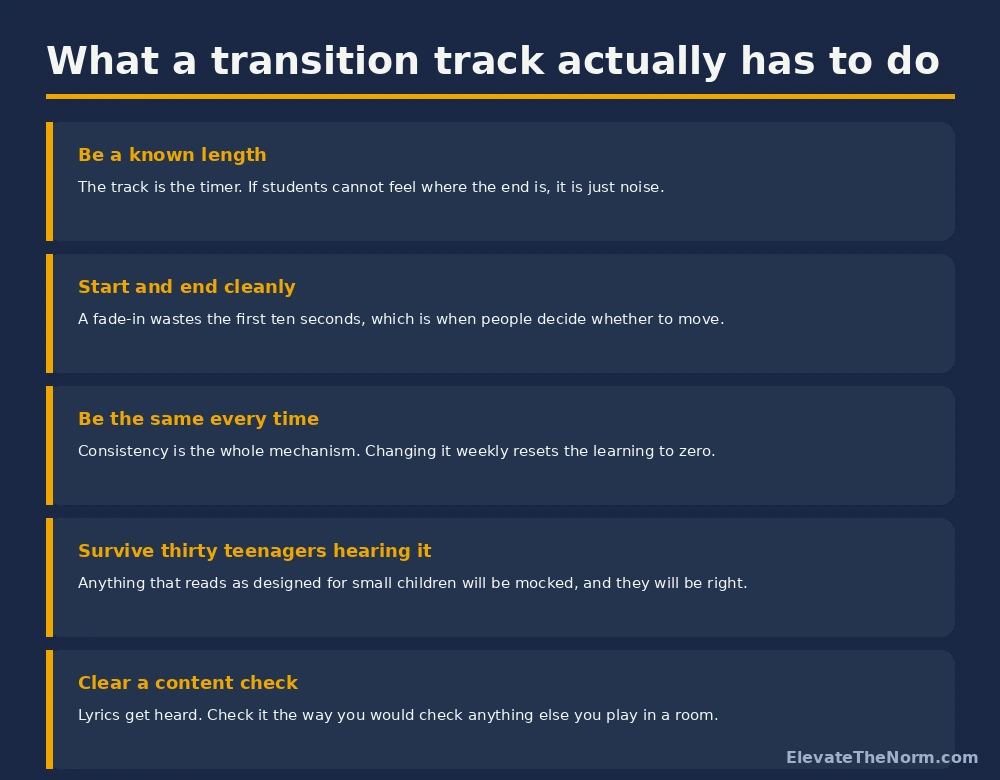
A transition song for a secondary room has to pass five tests: a known length, a clean start and end, the same track every time, credibility with teenagers, and a content check. Known length is the only one that can’t bend.
- Known length. Ninety seconds for a quick move, three minutes for packing up and a closing task. Cut the track to length yourself if you need to. If students can’t feel where the end is, you have background music, not a signal.
- Clean start and end. A long fade-in wastes the first ten seconds, which is exactly when people decide whether this is happening.
- The same track, every time. This is the mechanism. A different song each week is a pleasant thing that teaches nothing.
- Credible with teenagers. Instrumental works well: film scores, video game soundtracks, anything with momentum and no words to parse. Television theme tunes are popular for a real reason. Most are written to a fixed short length, and the recognition itself is part of the signal. The failure mode is picking something so old nobody recognizes it, and then you’ve just chosen a strange piece of music.
- Content-checked. Lyrics get heard, including by the student who tells a parent about them. Check a track the way you’d check anything else you put in front of thirty students, and know that a clean radio edit isn’t the same as a clean song.
One more, and it’s practical rather than pedagogical. Whatever you play needs to be something you’re permitted to play in your building, on equipment that works, without a login that fails on a Tuesday. A cue that depends on a streaming service loading is a cue that will fail publicly.
Is Music the Best Classroom Transition Cue?
Music usually isn’t the best classroom transition cue. It’s one cue among six, and a single consistent spoken word does more work, costs nothing and can’t be broken by a dead speaker. Music earns its place where a transition repeats and has a known length.
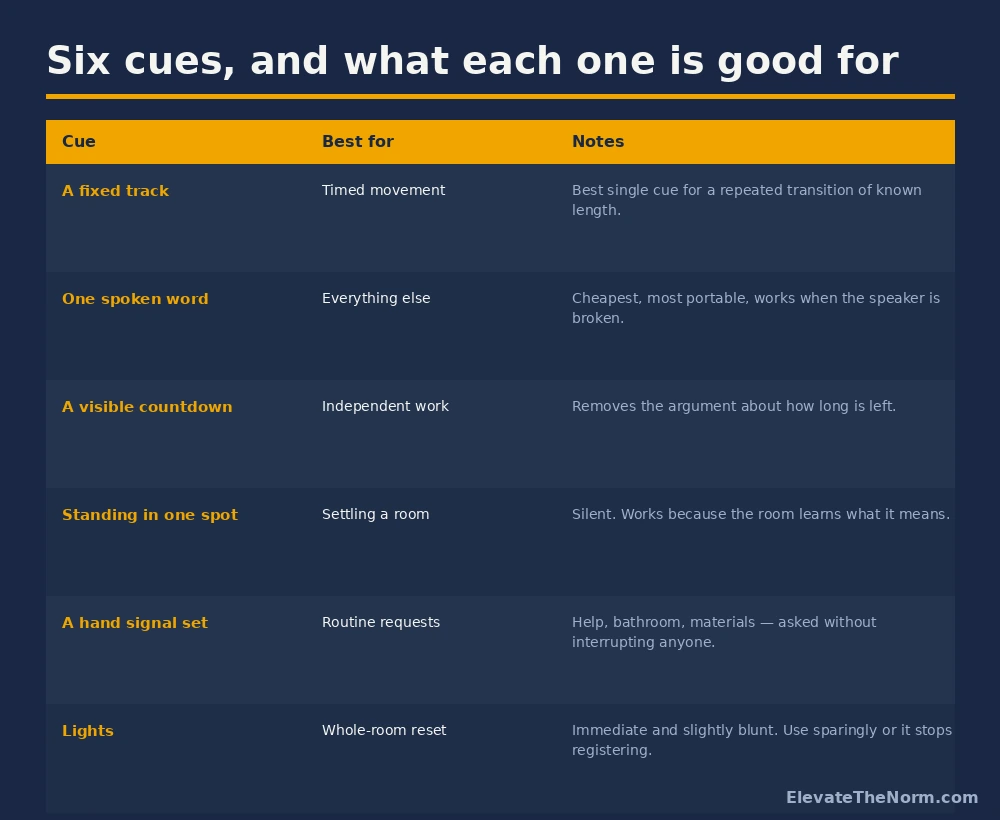
That matters because the search for the perfect transition song is usually a distraction from a cheaper fix. The cues students can see get their own treatment in the guide to visual transition cues, which covers countdowns, posted sequences and why more visuals isn’t better.
Lights deserve one caution. Flicking the lights is immediate and a little blunt, and it’s easy to use it so often that students stop noticing. It also lands badly for some students. An abrupt sensory change isn’t neutral for everyone in the room.
| Cue | What it does well | Watch out for | Best used for |
|---|---|---|---|
| One fixed-length track | Everyone can hear how much time is left | Needs working equipment, no failing login, and the same track every time | A repeated transition with a known length, like packing up |
| A single consistent spoken word | Costs nothing, goes anywhere, survives broken equipment | Only works if it’s the same word every time | Most transitions, most days |
| Flicking the lights | Immediate | Blunt, stops registering with frequent use, and unpleasant for some students | An occasional whole-room reset |
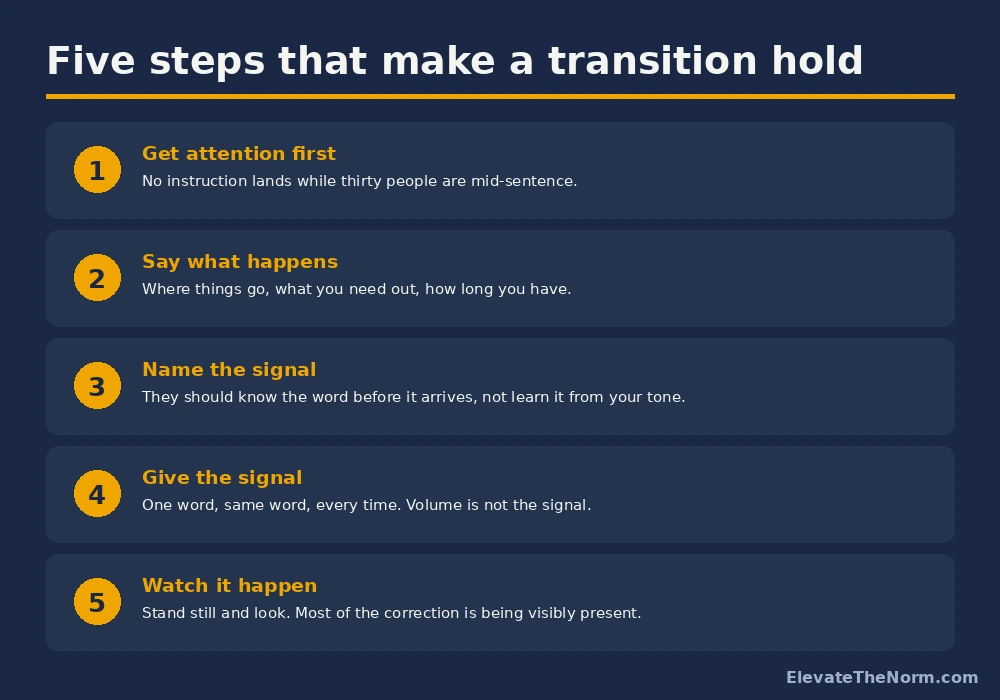
All of these sit inside the broader work of running transitions properly. The cue is step four of five, and no cue rescues a transition where the instructions were given while people were already moving.
Do Teenagers Really Want Music in Class?
Teenagers usually want transition music more than they’ll admit. A fifteen-year-old won’t tell you the song is good, and some will make a point of saying it’s bad. The reliable test is what happens the day you forget to play it.
My students voted on getting a class pet. They wanted one.
That surprises people who don’t teach high school. It stopped surprising me a while ago. High school students want the small things: the pet, the cheap prizes, the recognition. They just may not show it on the outside. A teacher who reads the flat expression as the actual opinion will strip every one of those things out of the room and then wonder why it feels dead.
Transition music sits squarely in that category. And in the Finnish study, the thing students named most often wasn’t the music but the routine it created.
Clay’s take: don’t poll the class on whether to keep it during week one. You’ll get the answer the room feels obliged to give. Run it for a month and judge it on whether the transition got shorter.
How Do I Teach a Transition Signal So Students Respond in Five Seconds?
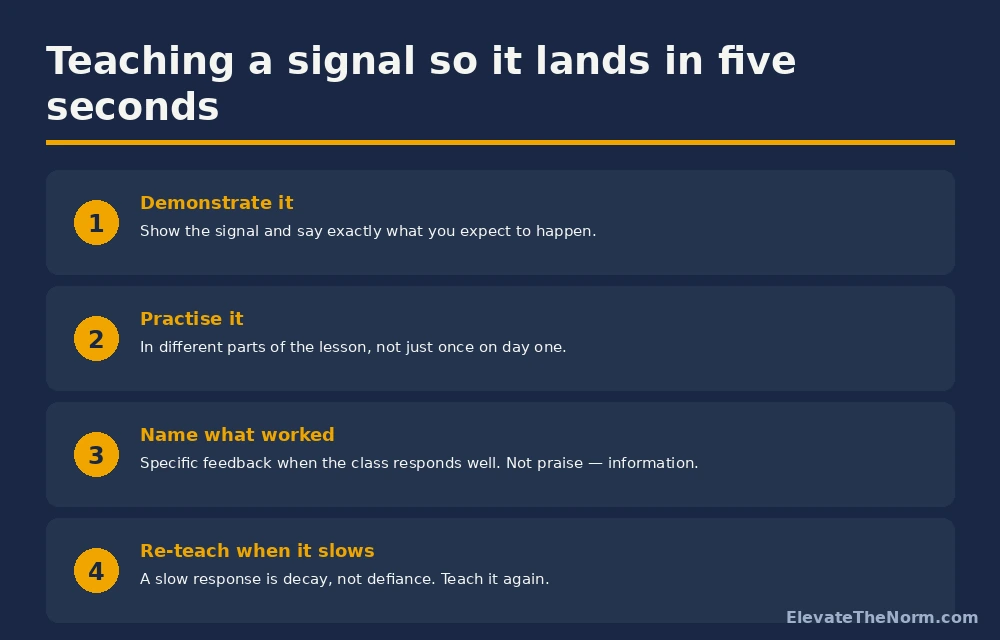
Teach a transition signal by demonstrating it, practicing it, praising specific correct responses and re-teaching it when the response slows. Classroom Check-Up, funded by the U.S. Department of Education’s Institute of Education Sciences, sets the target: students respond to an attention signal within five seconds.
That’s a usable number. It turns an argument about whether the class is “being difficult” into a measurement. Classroom Check-Up’s sequence:
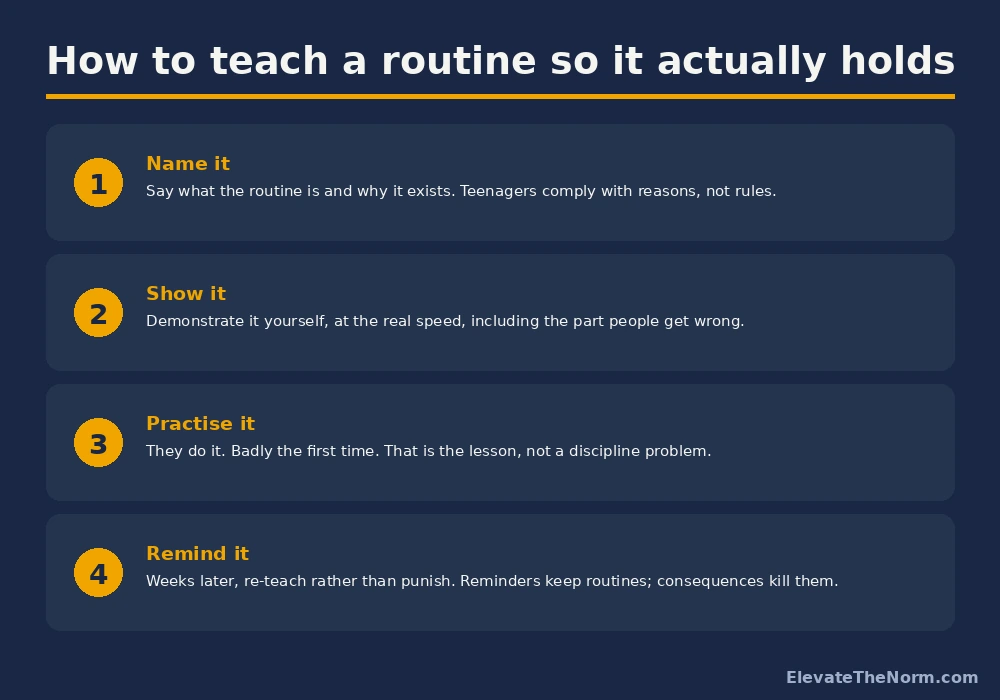
- Demonstrate the signal and explain what students should do when they hear it.
- Practice it throughout the day in a variety of settings.
- Give specific feedback when students respond correctly.
- Re-teach and practice again when some students respond slowly or not at all.
They also recommend a signal you can use wherever you are, which quietly rules out several popular options that depend on you standing at the front.
Two adaptations for older students. Their examples lean young, like rhythmic clapping and counting phrases, and a call-and-response chant won’t survive a high school room. Use the structure and change the signal. And “specific feedback” should mean information rather than praise: that took about four seconds, which is where we want it lands with teenagers in a way that well done everyone doesn’t.
When the response slows in November, that’s decay rather than defiance, and the fix is the same as for any other routine that needs re-teaching.
What Mistakes Make Transition Songs Fail?
Transition songs fail when the song is written for young children, changes every week, plays as background, has to get louder, depends on a login, or gets put to a class vote. Each of those breaks the timer.
- An elementary song in a secondary room. The most common failure and the most deserved. If the lyrics tell students to tidy up, it’s the wrong track.
- A different song every week. Pleasant, and it teaches nothing. Consistency is the mechanism.
- Music as background rather than signal. Playing something during work is a different decision with different evidence behind it. Don’t confuse the two.
- Volume creep. If the track has to get louder to be heard over the room, the cue has already failed.
- Depending on a login. A signal that needs a streaming service to load will fail publicly, and the class will remember.
- Asking the class whether they like it. You’ll get the answer the room feels obliged to give. Measure the transition instead.
How Do I Start Using a Transition Song?
Start with one repeated transition, usually packing up, and one instrumental track cut to the length you want. Use the same track every day for a month without discussing it, and time the transition in week one and week four.
- Pick one repeated transition. Packing up is usually the best candidate, because it has a natural length and it’s where the most time leaks.
- Choose one instrumental track that passes the five tests above.
- Cut it to the length you actually want.
- Use the same track every day for a month without discussing it.
- Time the transition in week one and again in week four.
That number is the only review this needs. If it hasn’t moved, the problem is almost certainly upstream in how the instruction is given, not in the song.
Before you go: grab the free Classroom Transitions Toolkit (PDF) — ElevateTheNorm.com branded, printable, no email required.
Frequently Asked Questions
Will high school students actually tolerate transition music?
High school students tolerate transition music more readily than most teachers expect, though few will say so. A study of 48 Finnish students aged 15 to 19 found significant self-reported gains in mood, motivation and concentration from five minutes of music before lessons, and around 61 percent wanted it in all or most classes. Teenagers want the small things and don’t advertise it. The reliable test is what happens the day you forget to play it.
What kind of song works for classroom transitions in secondary?
The best transition songs for middle and high school are instrumental, recognizable and a known length. Film scores and video game soundtracks carry momentum without lyrics to parse. Television theme tunes work because most are written to a fixed short length and the recognition is part of the signal, but pick one the room actually knows. Anything written to instruct young children will be mocked, fairly.
How long should a transition song be?
A transition song should be as long as the job, not as long as the track. Use about ninety seconds for moving into groups and two to three minutes for packing up plus a closing task. Cut the audio to the length you want instead of accepting a song’s running time. The length is the whole function, so it should be a decision, not a coincidence.
Does background music help students learn?
Background music during work is a different question from using music as a transition signal, and the evidence is weaker than the internet suggests. The Finnish classroom study measured self-reported mood, motivation, concentration and learning, not test performance, and had no control activity, so the gains can’t be pinned on music rather than any pleasant break. A timed track as a signal is well founded. Claims that background music raises achievement aren’t.
How fast should a class respond to a transition signal?
A class should respond to a transition signal within five seconds, the benchmark Classroom Check-Up uses. Time it rather than judging by feel. A class at eight or ten seconds isn’t defying you. The signal has decayed and needs re-teaching: demonstrate it again, practice it again, and give specific feedback when the class gets it right. That works far better than showing frustration.
What if I can’t play music in my classroom?
Teachers who can’t play music can use a single consistent spoken word and a visible countdown and lose very little. Music is one classroom cue among six and rarely the one doing the most work. A spoken word is cheaper, more portable, survives broken equipment and doesn’t depend on anything loading. If transitions are slow, the cue is unlikely to be the reason.
Is flicking the lights a good transition signal?
Flicking the lights works as a transition signal, but use it sparingly. It’s blunt enough that frequent use stops registering, and an abrupt sensory change is unpleasant for some students in a way a sound isn’t. Keep the lights for an occasional whole-room reset and use a spoken word or a fixed-length track as the standard transition cue.
Should students choose the classroom transition song?
Students can suggest a transition song, but the choice should happen once and pass the same tests as any track: a known length, a clean start, and lyrics that are fine to play to thirty people. After that the song stays the same, because consistency is what makes it a timer. A weekly vote turns the signal back into background music and teaches nothing.
Sources
- Vigl, J., Ojell-Järventausta, M., Sipola, H., & Saarikallio, S. (2023). Melody for the mind: Enhancing mood, motivation, concentration, and learning through music listening in the classroom. Music & Science, 6. Read the study. 48 secondary students aged 15–19, within-subjects across two weeks. All outcomes self-reported; no control activity; final sample below the authors’ own power target. Their stated limitations are summarized in the text above.
- Classroom Check-Up. Using an attention signal. Funded by the U.S. Department of Education, Institute of Education Sciences. Read the guidance. The source for the five-second response benchmark and the four-step teaching sequence. The page cites Reinke, Herman and Sprick (2011) and Sprick (2009) and reports no quantitative data of its own.
This page deliberately recommends no specific songs by title, because a track that’s recognizable to students this year may mean nothing to them in three.