The Elevate Blog banner: Real Classrooms. Practical Ideas. Higher Expectations. Three students climb a rocky ridge at sunrise, each pulling the next one up, toward a teacher reaching down to help.

Category: Classroom Management

Behavior, routines, and what actually holds a room together without raising your voice.

  • Substitute Teacher Classroom Management: Running a Room That Isn’t Yours

    Substitute Teacher Classroom Management: Running a Room That Isn’t Yours

    Substitute teacher classroom management is not the same job as classroom management. A regular teacher builds authority over weeks. A substitute has to borrow it in the first four minutes, from a room that already has its own rules, its own seating, and its own sense of what is normal — none of which they wrote. The work is not installing your system. It is running theirs well enough that the day holds.

    Most advice on this subject is written as though the substitute controls the outcome. They control some of it. The rest was decided before they ever walked in, by the teacher who wrote the plans — which is the half of this that almost nobody writes about, and the half I can speak to directly. If the room a substitute walks into has no written system behind it, the document a stranger is actually handed is where that work starts.

    This page covers what the person walking in actually has to work with, what they can control on the day, and what the regular teacher owes them before leaving.

    Key Takeaways

    • A substitute’s authority is borrowed, not built. The fastest way to lose a room is to replace its norms with your own on day one. Run the room that exists.
    • The person walking in may have twenty hours of training. In Missouri, a substitute certificate requires either 36 semester hours of college or 20 clock hours of approved training. That is the floor in one state, and it is worth knowing before you judge how a day went.
    • The first four minutes decide most of it. A visible plan, stated out loud, followed by a pause — not a raised voice.
    • Teacher absence is measurable and it is not small. Ten additional days of teacher absence are associated with a decline of roughly 1.7% to 3.3% of a standard deviation in math achievement. The sub day is not a throwaway day.
    • Half of substitute classroom management is written the week before, by someone else. Plans that assume the sub knows the room are the single most common failure, and they are entirely preventable.
    • A class that tests a substitute is usually not scheming. Nobody knows their name, the day reads as a holding pattern, and the adult has no history with them. Using names and making the work visibly real addresses all three.

    The job is not “teach the lesson.” It is “keep the room intact.”

    This is the reframe that makes the rest of it workable. A substitute who measures the day by how much content got delivered will almost always finish feeling like they failed. A substitute who measures it by whether the room is handed back in the condition it was handed over — work attempted, norms intact, nobody humiliated, an honest note left behind — has done the actual job.

    That is not a lowered standard. It is the correct one. The regular teacher can reteach a lesson. What they cannot easily undo is a room that learned, over one day, that the expectations it runs on are negotiable when a stranger is standing there.

    What the person walking in actually has

    It is worth being precise about the preparation the job actually requires, because a lot of staffroom commentary about substitutes assumes a level of training that the credential does not demand.

    Missouri, as one published example, issues a Content Substitute Certificate to an applicant who has completed either a minimum of 36 semester hours from an accredited college or university, or twenty clock hours of department-approved substitute teacher training. Requirements vary by state and some are higher. But twenty clock hours is a real, current, published floor in at least one state — and the person it describes is expected to walk into a room of thirty teenagers and hold it.

    Two things follow. If you are the substitute: the gap you feel between what you were trained for and what the day demands is real, and it is structural rather than personal — the same gap first-year teachers describe in their own rooms. If you are the regular teacher: the plans you leave are not a courtesy. For some of the people who will use them, they are the entire preparation.

    A third thing follows for anyone who sets policy. Nothing in the rest of this article is a substitute for a district actually orienting the people it puts in front of students — a building walkthrough, the safety procedures, where the office is, what the behavior system is called. Most of what gets written about substitute classroom management, including everything below, is individuals compensating for a system that hired someone and pointed at a door. The individual workarounds are worth knowing. They are not the fix.

    The first four minutes: organization to the minute, and then the pause

    The method I use in my own room transfers to a substitute almost unchanged, and it is the one piece of this I would put above everything else: taking control of a room is done by organization to the minute, and then you pause.
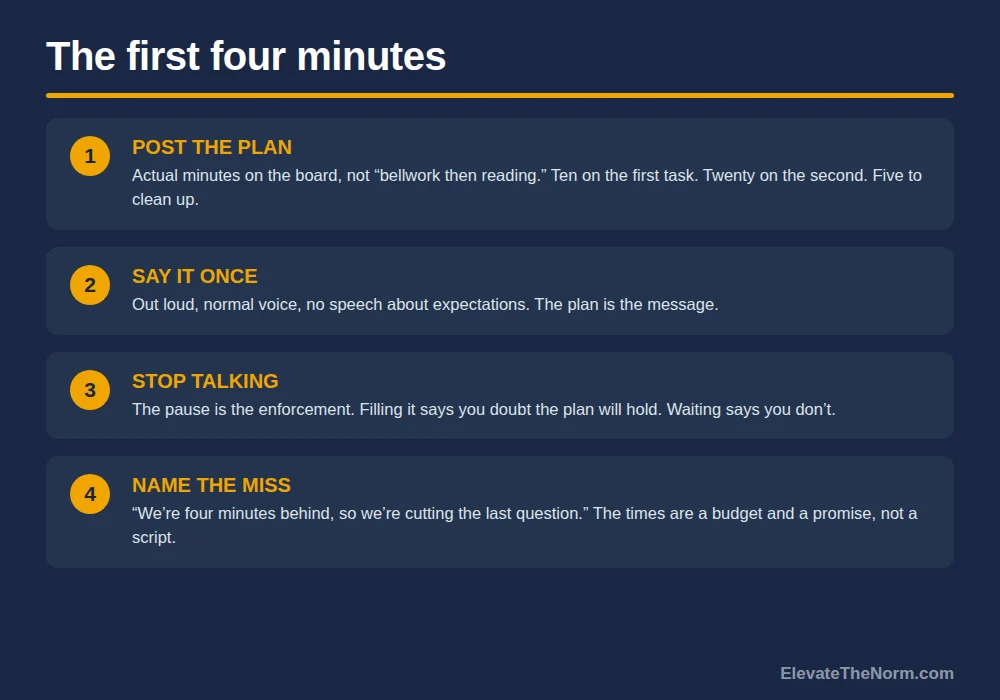
    Four numbered steps for a substitute’s first four minutes: post the plan, say it once, stop talking, name the miss
    The pause is the enforcement. Filling it says you doubt the plan will hold.

    Put the plan where they can see it before the bell. Not “bellwork, then reading” — actual minutes. Ten minutes on the first task. Twenty on the second. Five to clean up. Write it on the board you found it on. Then say it out loud, once, in a normal voice.

    Then stop talking.

    The pause is the part people skip, and it is the part that works. You have laid out a plan that is visibly organized, and then you let the silence do the enforcement instead of your volume. The instinct is to fill it — to repeat yourself, to add a threat, to get louder. Filling it tells the room you are not sure the plan will hold. Waiting tells them you are.

    I should be honest about what that costs, because most versions of “just wait them out” leave the price out. I once held a pause for more than five minutes. It was one of the most awkward moments of my life, that section finished nine minutes behind my other classes, and it is the only time I have ever assigned homework. It worked. It also cost nine minutes and a homework assignment I did not want to give. A substitute will rarely have nine minutes to spend, which is exactly why the posted plan matters — it shortens the pause you need.

    One clarification, since this gets misread: the posted times are a budget and a promise, not a script. When you miss them, say so out loud and give the reason. A substitute who announces “we are four minutes behind, so we are cutting the last question” has just demonstrated that the plan is real. That is worth more than hitting the times.

    Run their room, not yours

    This is where most substitute days are quietly lost, and it rarely looks like a discipline problem. It looks like a reasonable adult correcting something that was never wrong.
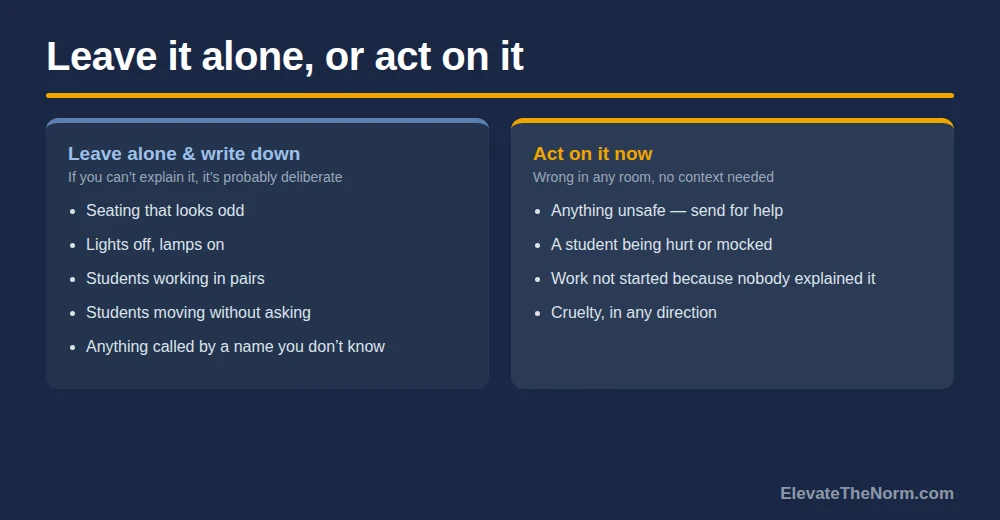
    Two-column comparison of classroom things a substitute should leave alone and write down beside things that require immediate action
    If you can’t explain it, it’s probably deliberate.

    In my room, students are almost always working alongside somebody. Partner work is the resting state, not a reward and not a special occasion — the tables are literally grouped that way and there are no rows to return to. A substitute who walks in, sees students talking, and reads it as the room falling apart will spend the period fighting the room’s actual design. They will separate students who were doing exactly what they were supposed to do, and by second period they will have spent all their credibility on a rule that does not exist in that room.

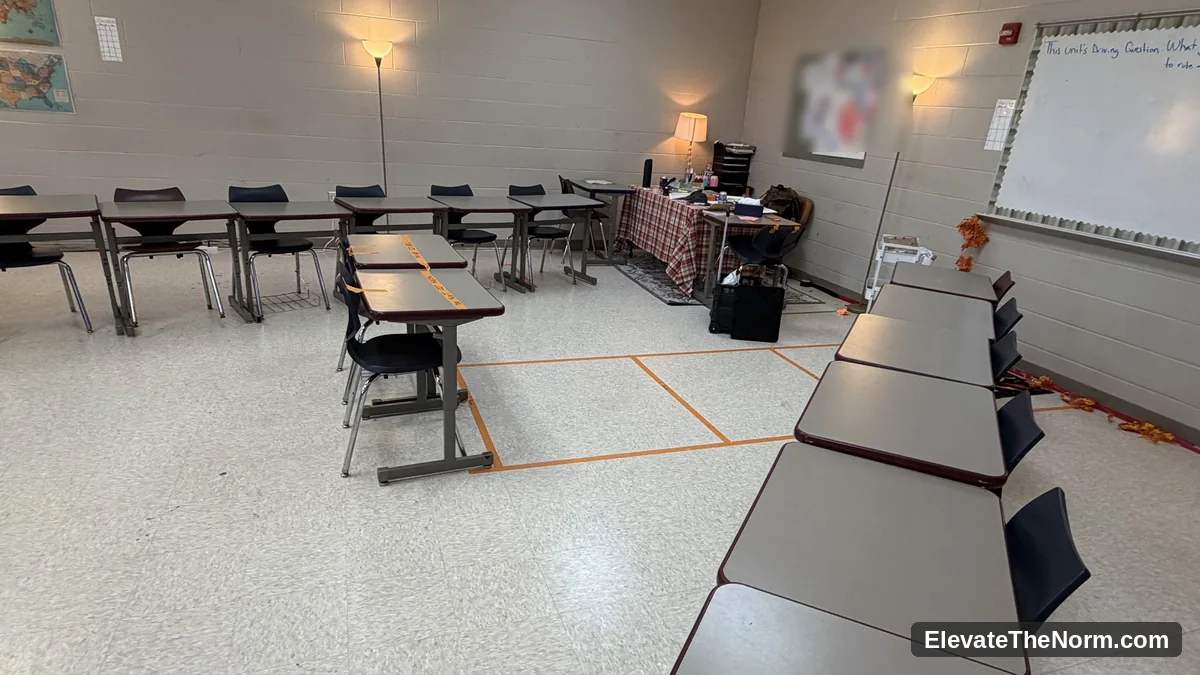
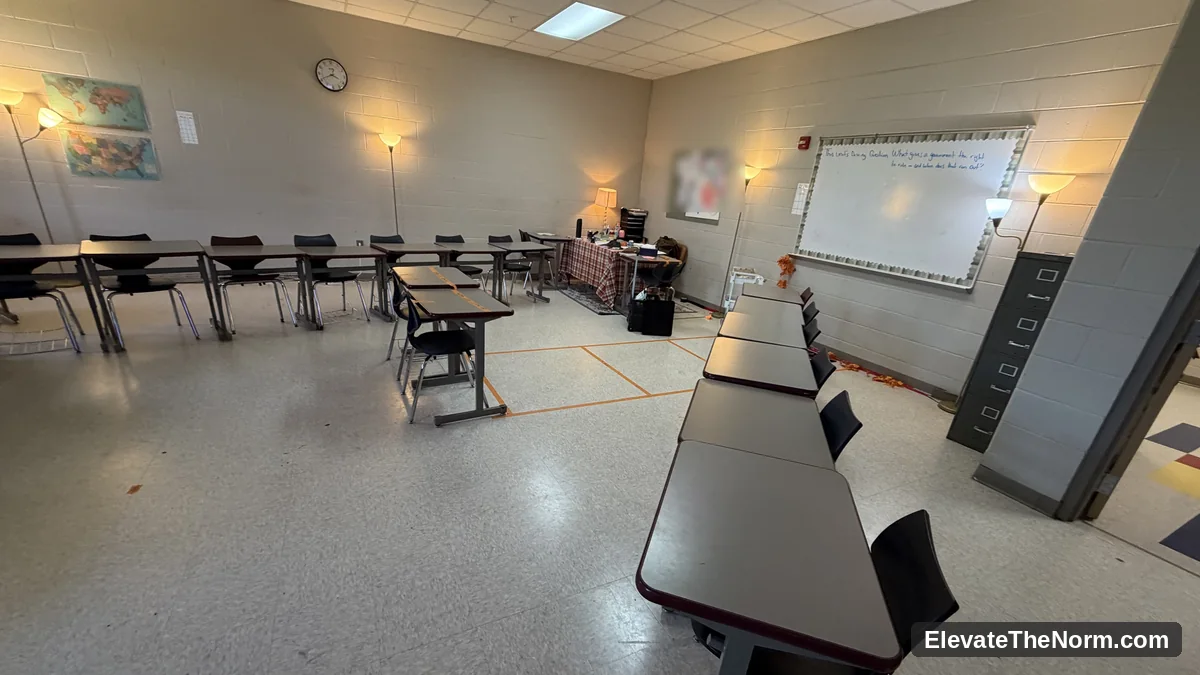
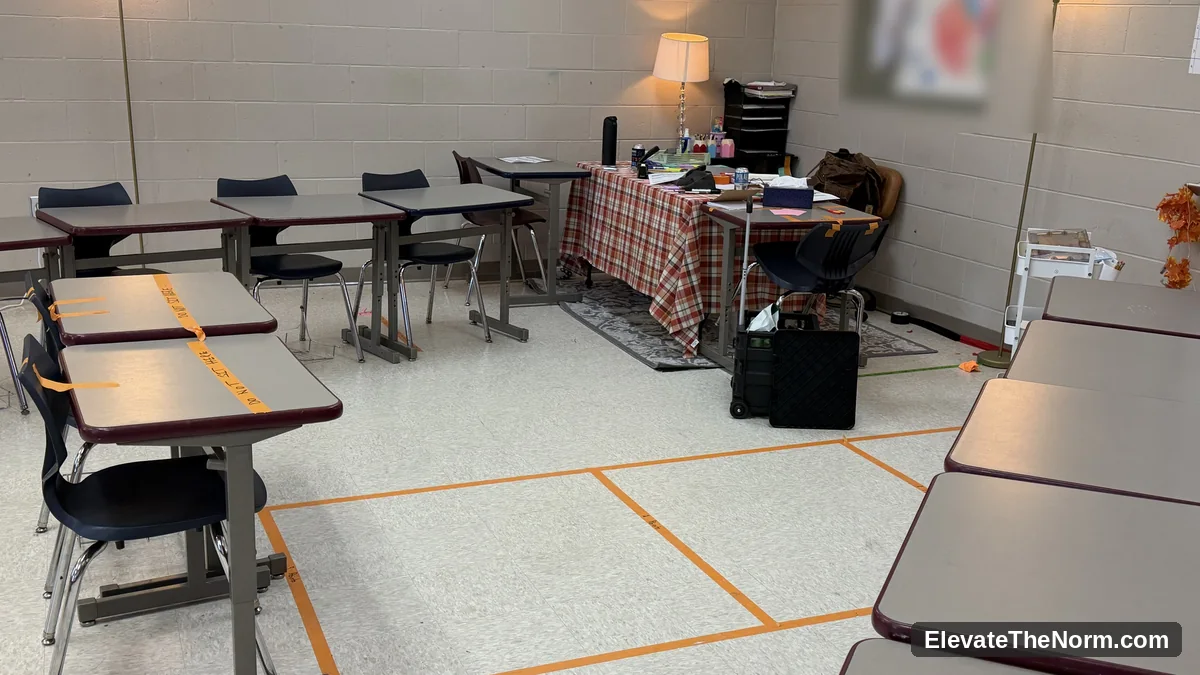
    The same goes for the lights. I do not turn the overhead fluorescents on — the room runs on floor lamps around the perimeter. It is a deliberate choice about sensory load, and it helps far more students than the ones who would ever have asked for an accommodation. A substitute’s first instinct on walking into a dim room is to find the switch. Flipping it is a small thing that changes the room the students walked into.

    So the working rule is: anything you cannot explain, leave alone and write down. If the seating looks odd, it is probably deliberate. If the lights are off, someone turned them off. If four students get up without asking, there is probably an established procedure for that. Note it, ask afterward, and do not spend your authority correcting a room’s design.

    Reserve your authority for the things that are wrong in any room: cruelty, danger, and a flat refusal to engage with work that has been made doable.

    That last one needs its qualifier. A student who will not start a worksheet nobody explained is not defying you — they are stuck, and “refusal” is the wrong word for it. Check whether the task is actually doable before you treat not-doing-it as a behavior problem. Most of the time on a substitute day, it is not defiance. It is an instruction gap.

    The one line that overrides all of this: if something is unsafe, or a student is being hurt, you do not need permission or context. Send for the neighboring teacher or the office immediately. Knowing where the phone is and who is next door is a two-minute check when you arrive, and it is the only part of this you should never improvise.

    Substitute teacher classroom management: five things you can actually control

    1. Where you stand. Circulating beats presiding. A redirect delivered quietly at close range, to one student, does the work without announcing the problem to twenty-nine other people — and it does not give the room a performance to react to.
    2. What you say first. Names if you have them, the plan if you do not. “Here is what we are doing and how long it takes” outperforms any version of “I expect you to behave for me today.”
    3. Your volume. It is the one resource that only decreases. Every notch you spend is gone for the rest of the day.
    4. What you write down. An honest, specific, unemotional note is the most valuable thing you leave behind. “Third period did not start the reading; two students, seated front left, were the reason” is useful. “Terrible class” is not, and it will be read by someone who has to work with those students tomorrow.
    5. Whether anybody gets humiliated. This one is not negotiable and it is entirely within your control. You will be gone tomorrow. They will not.

    What the regular teacher owes the substitute

    If you are reading this as the teacher who is going to be out, this is the section that changes your sub’s day, and it takes about fifteen minutes to write once and reuse all year.
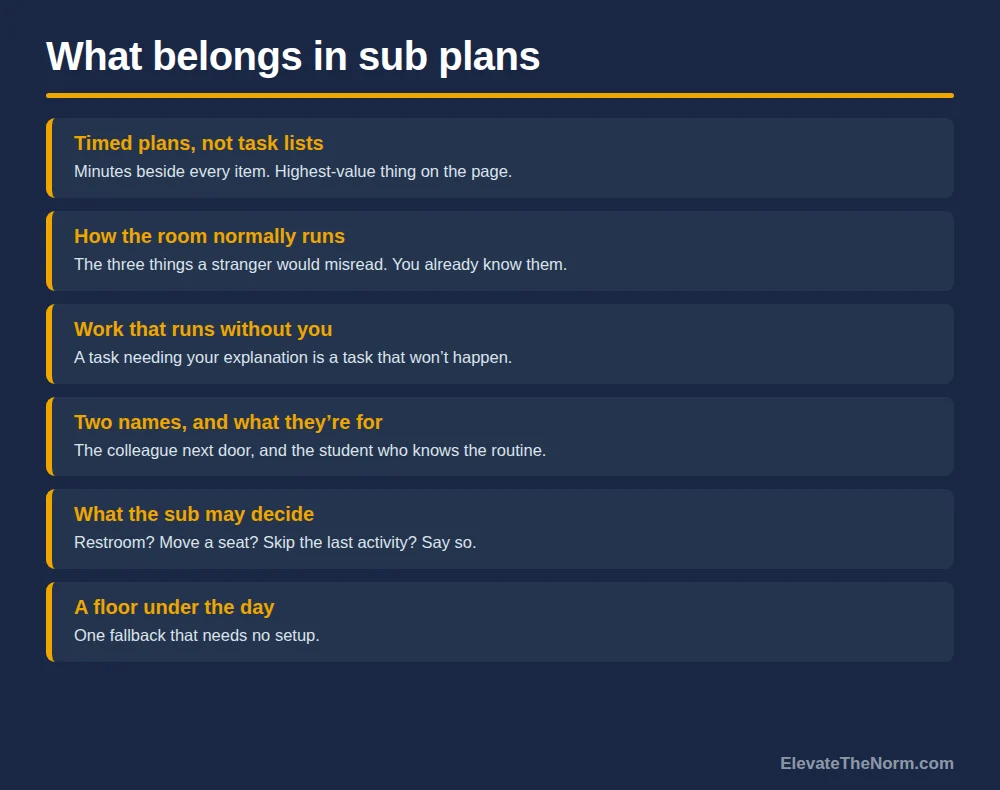
    Six items that belong in substitute teacher plans, including timed plans, how the room runs, and a fallback activity
    Fifteen minutes to write once, and it changes every sub day that follows.

    Write it assuming it will be read in five minutes, standing up, by someone who was called at six that morning and has never been in your building. That is the realistic case, not the exception. Put the timed plan and the three things a stranger would misread on the first page, in that order. Everything else can be on page two, where it may or may not get read.

    • Timed plans, not task lists. Minutes next to every item. It is the single highest-value thing on the page, for exactly the reason in the section above.
    • A one-paragraph description of how your room normally runs. Partner work is expected. The lights stay off. Students may get water without asking. Write the three things a stranger would most likely misread — you already know what they are.
    • Work that can actually be done without you. A task that depends on your explanation is a task that will not happen, and the gap gets filled with whatever the room decides to do instead.
    • Two names, and what they are for. The colleague next door and the student who genuinely knows the routine. Not a list of “problem” students — a list of doors to knock on.
    • What a substitute is allowed to decide. Can they let a student use the restroom? Move a seat? Skip the last activity? Say so, or you have left someone to guess and then be wrong.
    • Where the day goes if it falls apart. One genuinely usable fallback that requires no setup. Every sub plan should have a floor under it.

    One thing that does not belong in sub plans: a discipline ladder invented for the occasion. Your substitute cannot enforce consequences that do not already exist in the room, and asking them to try is how a day gets worse rather than better. Tell them what the room already does.

    Two free things make this page easier to write. The lesson library at SubstitutePlans.com has 500 ready-to-print sub plans for grades 6–12, each with a teacher plan, student worksheet and answer key, and its Sub Survival Kit covers the forms — attendance sheets, seating charts, a daily report and backup activities — so the substitute is not improvising the paperwork.

    Why the day is worth taking seriously

    There is a habit of treating substitute days as time that does not count. The measured picture disagrees, though it needs stating carefully.

    Analysis published by Brookings reports that roughly 29% of teachers were chronically absent — missing ten or more school days — in the 2015–16 federal civil rights data, and that ten additional days of teacher absence are associated with a decline of between 1.7% and 3.3% of a standard deviation in math achievement. Substitute costs run to roughly 1% of all public education spending.

    Two honest caveats. These are associations drawn from observational data, not the result of an experiment, and the effect sizes are modest per unit. And the federal absence figures are from 2015–16, which is the most recent comparable collection but is now several years old. What the numbers support is a modest claim, and the modest claim is enough: sub days are frequent, they cost real money, and they are associated with measurably less learning. They are not a rounding error, and the room deserves a plan.

    What the students are doing, and why

    Almost everything written about substitute teaching treats the students as weather — a condition to be survived. It is worth saying plainly what is actually happening on their side of it, because it changes what you do.

    A class that tests a substitute is usually not running a scheme. Three ordinary things are true at once: nobody in the room knows their name, the day has been signalled to them as a holding pattern, and the adult in front of them has no history with them in either direction — no credit built up, and no relationship to damage. Teenagers read all three accurately and respond to them rationally. If the day looks like it does not count, some of them will treat it as though it does not count. A spoken routine a substitute has never run will not hold either, which is why cues a stranger can read off the wall survive your absence when verbal ones do not.

    Which means the two highest-leverage moves are both about signalling the opposite. Learn some names and use them — from a seating chart, from their work, by asking. And make the work visibly real: something that gets collected, that the regular teacher will see, that connects to what they did yesterday. “Your teacher is going to read these tomorrow” is a true sentence that changes a room, and it costs nothing.

    Students are also owed something on these days, and it is not complicated: to know what they are doing and how long it takes, to not be punished as a group for individuals, to not be talked about as a category in a note they will never see, and to be able to ask a question and get a real answer rather than “I’m just the sub.” That last one is worth retiring. You are the teacher in that room today. Not knowing an answer is fine. Saying you do not count is not, and they will believe you.

    Should a substitute actually teach?

    Sometimes, and the honest answer depends on what the plans ask for rather than on how confident you feel.

    If the plan is practice, review, reading or a project work session — which is the large majority of well-written sub plans — then teaching it is mostly circulating, answering, and keeping the work moving. Do that, and do it properly. If the plan introduces genuinely new content in a subject you do not know, delivering it badly is worse than not delivering it: students will learn it wrong, and the regular teacher will have to undo that before they can teach it. Run the practice portion, write down exactly where the class stopped, and say so.

    One small tool worth borrowing from special-education practice, where it is standard: a visible timer. Putting the remaining minutes somewhere the whole room can see them makes an abstract instruction concrete, and it takes the countdown out of your voice — the clock says it instead of you. It is a phone on the document camera, and it works for far more students than the ones it was designed for.

    The part that is actually hard

    Everything above is manageable on a normal day. The genuinely hard version is the room that has decided, collectively and before you said a word, that today is a day off. No single student is doing anything you could name. The work is simply not starting.

    There is no technique that fixes that in thirty seconds, and any article that tells you otherwise is selling something. What works is narrow and unglamorous: get one table started. Not the room — one table. Sit down next to them, at their height, and do the first item with them. A room that is entirely not working is very hard to move. A room where one group is visibly working is a different room, and the second group is much easier than the first.

    And if it does not turn: finish the period without making it worse, write the honest note, and hand the room back. That is not defeat. On some days that is competence, and a teacher who has been out sick will understand the difference between a sub who lost a room and a sub who protected one.

    Which is the whole of it, really. Substitute teacher classroom management is not a set of tricks for controlling somebody else’s students — it is the practice of running a room you did not build, on borrowed authority, without spending down what the regular teacher has spent months constructing. Post the plan. Pause instead of getting louder. Leave the room’s own rules alone. Use names. Make the work real. Write the honest note.

    And if you are the one writing the plans: fifteen minutes on a page that assumes nothing will do more for that day than anything the substitute can do once they are standing in it.

    Printables for this

    I write these for my own room and put them on TPT. The Any-Day Emergency Sub Plan Card is free — one page a stranger can run cold, in any subject. If you teach history, World History Emergency Sub Plans is five full days of strange-but-true readings with questions and answer keys, written so a sub can hand them out without knowing the content.

    Out the week of Halloween? A Halloween sub day does not have to be a word search. Halloween Sub Plans is five strange-but-true spooky history readings a sub can run cold. For math, the free Halloween color by number samplers for middle school and high school check themselves, so the sub never needs the answer key.

    If you are buying during a sitewide sale, the TPT sale guide walks through how the discounts stack and what is actually worth the money.

    Sources

    • Brookings Institution. We should be focusing on absenteeism among teachers, not just students. Read the analysis — source for the 29% chronic-absence figure (U.S. Department of Education Office for Civil Rights, 2015–16), the 1.7–3.3% of a standard deviation math association, and the ~1% of public education spending figure. These are observational associations, not causal estimates, and the federal absence data is from 2015–16.
    • Missouri Department of Elementary and Secondary Education. Substitute Teachers — certification requirements. Read the requirements — source for the 36 semester hours / 20 clock hours standard. One state’s rule, cited because it is current and published; requirements vary considerably by state and your own state’s rule governs.
    • Substitute teaching: evidence-based practices for inclusive classrooms. Helen: The Journal of Human Exceptionality, April 2024. Read the guide — consulted for the visual-schedule and visual-timer practices. Cited as practitioner guidance, not as research: the article describes itself as drawing on evidence-based practice but names no studies and reports no data.

    Every link above was checked on September 20, 2026. The classroom practices described in the first person — the timed plan and the pause, partner work as the room’s resting state, and the lamps — are my own and are used across this site.

    Worth saying plainly: a day covered by a substitute is not a day lost, and taking the day you need before you badly need it is one of the few moves a teacher fully controls. It is also a small part of what climbing back out of exhaustion actually asks of you.

    Frequently Asked Questions

    What is the single most important thing a substitute teacher should do first?

    Put a timed plan where the room can see it, say it out loud once in a normal voice, and then stop talking. The visible plan does most of the work and the pause does the rest. What does not work is opening with a speech about expectations — it spends authority before anything has happened and invites the room to test it.

    Should a substitute enforce their own rules or the regular teacher’s?

    The regular teacher’s, with three exceptions that apply in any room: cruelty, danger, and refusal to attempt the work. A substitute’s authority is borrowed from the room’s existing norms, and replacing those norms is what burns it. If something looks wrong but you cannot explain it, the odds are good that it is deliberate — leave it alone, write it down, and ask afterward.

    How much training do substitute teachers actually have?

    Less than most people assume, and it varies a great deal by state. Missouri, as one published example, issues a substitute certificate to applicants with either 36 semester hours of college credit or 20 clock hours of approved training. Some states require more. The practical point for administrators and teachers is that sub plans are, for some of the people using them, the entire preparation for the day.

    What should a substitute do when the whole class refuses to start work?

    Get one table started rather than trying to move the room. Sit down at their height and do the first item with them. A room in which nothing is happening is very hard to shift; a room in which one group is visibly working is a different problem and a much easier one. If it does not turn, finish the period without making it worse and leave an honest, specific note. Protecting a room is not the same as losing it.

    What belongs in sub plans for a middle or high school class?

    Timed plans rather than task lists, a short paragraph on how the room normally runs, work that can be completed without the regular teacher’s explanation, the name of a colleague next door and a student who knows the routine, an explicit statement of what the substitute is allowed to decide, and one genuinely usable fallback activity. Leave out any discipline ladder invented for the occasion — a substitute cannot enforce consequences the room does not already have.

    Does it actually matter how a substitute day goes, or is it a lost day either way?

    It matters, though the evidence supports a modest claim rather than a dramatic one. Brookings reports that ten additional days of teacher absence are associated with a decline of roughly 1.7% to 3.3% of a standard deviation in math achievement, and that substitute costs approach 1% of public education spending. Those are observational associations from older federal data, not experimental results. Read together they support something narrow and sufficient: these days are frequent, expensive, and associated with less learning.

    How should a substitute write the note they leave behind?

    Specifically, honestly, and without adjectives about character. Name what happened, when, and what was or was not completed. “Third period did not start the reading; two students seated front left were the reason” gives the regular teacher something to act on. “Terrible class” does not, and it will be read by an adult who has to face those students the next morning. Report behavior, not verdicts about people.

    Why do students behave differently for a substitute?

    Usually because three things are true at once and teenagers read all three correctly: nobody in the room knows their name, the day has been signalled to them as a holding pattern, and the adult in front of them has no history with them in either direction. That is a rational response to the situation rather than a character flaw, and it points at the fix. Use names, and make the work visibly real — something that gets collected and that the regular teacher will actually see. Telling a class truthfully that their teacher will read this tomorrow changes a room and costs nothing.

    About Clay Shumate

    By Clay Shumate — Clay Shumate is a certified secondary Social Studies teacher in the public schools of West Alabama, with seven years of classroom experience, a B.A. in History, and an M.Ed. in Secondary Education. He writes about project-based learning, student responsibility, respect, and practical ways to hold young people to a higher standard while giving them room to learn from mistakes. He is a member of the Society of Professional Journalists and writes to its Code of Ethics; this site’s editorial standards and corrections policy are published in full.

  • Student Leadership: How Schools Can Give Teenagers Real Responsibility

    Student Leadership: How Schools Can Give Teenagers Real Responsibility

    By Clay Shumate

    Student leadership is not a title, an election, or a line on a college application. It is the practice of giving a teenager genuine responsibility — real decisions, real consequences, and real support from an adult who has done the planning to make success possible. Schools that do this well produce students who know how to serve others, solve hard problems, and hold themselves accountable. Schools that do it poorly give students the word leadership and wonder why nothing changes.

    This article explains what student leadership actually requires, where most schools fall short, and how any classroom teacher can hand a student real authority and then hold them to it — without setting them up to fail. None of it works before ordinary responsibility is already the norm in the room.

    What Student Leadership Actually Means

    Most school definitions of student leadership center on elected positions: student council president, class officers, homecoming committee. These roles are not without value. But they are also the roles most likely to be filled by students who were already organized, already known, and already comfortable raising their hands. If a school’s model of leadership only rewards students who already look like leaders, it is not developing leadership — it is sorting for it.

    A more useful definition: student leadership is any structured situation in which a student holds genuine authority over a meaningful outcome and is held accountable for results. The authority must be real, not ceremonial. The outcome must matter to someone besides the student. The accountability must have consequences the student actually feels.

    Research on youth development supports the value of this kind of experience. Sociologist Reed Larson’s landmark review found that voluntary, goal-directed activities — ones that require initiative, not just compliance — produce the kind of intrinsic motivation that transfers to adult life.1 Dana Mitra’s analysis of student voice in secondary schools found that genuine student participation, including planning and decision-making roles, produced measurable gains in engagement, school belonging, and academic motivation — particularly among students who had previously been disengaged.2

    The operative word in both bodies of research is genuine. Symbolic participation — filling a role with a title and no real authority — does not produce those outcomes. It often produces the opposite: students who learn that official channels are theater, that adults do not actually share power, and that their effort is not taken seriously. Student-run discussion is one place to practice real ownership, scored with a Socratic seminar rubric.

    The Problem With Symbolic Leadership

    Consider three common school leadership structures and what they often deliver in practice:

    Student government at many schools functions as an event-planning committee with a democratic veneer. Students vote on spirit week themes. They help organize pep rallies. The principal makes all decisions that actually affect the school, and student government exists to generate enthusiasm for those decisions. Students who take this seriously and try to raise real concerns — about grading policy, discipline, cafeteria conditions — often discover that the program’s actual scope is narrower than its name suggests, and that genuine policy decisions belong to administration rather than to the student government structure.

    Peer mediators and conflict resolution programs are genuinely valuable when implemented with real training, supervised practice, and institutional backing. They are window dressing when students are given a title and a script and expected to resolve disputes the adults find inconvenient. A peer mediator who cannot actually commit to any outcome, who has no authority to follow up, and who receives no coaching after sessions learns very quickly that the role does not matter.

    Student ambassadors and leadership clubs often confuse belonging with leading. Wearing a lanyard is not leadership. Giving a tour of the school to visiting families is service, but it is not the same as holding authority over a meaningful outcome. These programs are not wrong — they build community and recognize students. But when schools call them leadership development, they are doing two harmful things: overstating what the experience provides, and tacitly telling other students that leadership is a reward for being well-liked. The fix is to build the habit everywhere first, through small jobs that every student actually owns.

    None of this means schools should abandon student government or peer programs. It means schools should be honest about what those programs are and build something more substantive alongside them — something that reaches students who are not already popular, high-achieving, or interested in student government.

    What Real Student Responsibility Looks Like

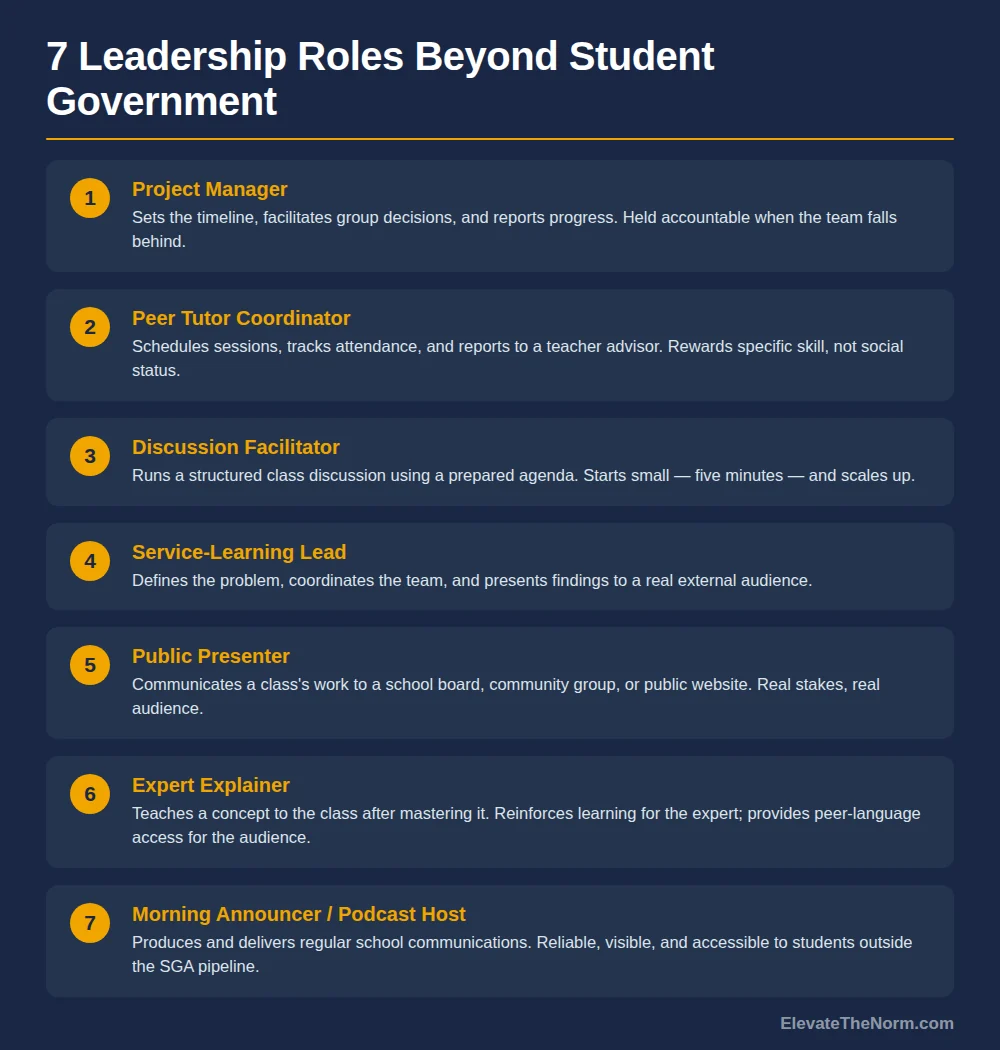
    Genuine student leadership roles share three features: the student controls something that matters, an adult has done enough preparation for the student to succeed, and the student is held accountable when things go wrong or go right. Here are several forms this can take across a school day, and twenty-five worked examples with the decision each student holds if you want the longer list:

    seven leadership roles beyond student government that give students real authority in the classroom
    Seven types of student leadership that go beyond student government — each requiring real authority and adult preparation.

    Decision-making authority within a project

    In a project-based learning unit, one student serves as the project manager for a group. This is not a title for the student most likely to do all the work anyway. It is a structured role with defined responsibilities: managing the timeline, facilitating group decision-making, communicating progress to the teacher, and being the first person the teacher asks when something is behind schedule.

    When student responsibility is built into the structure of a project — not as an add-on but as a load-bearing element — students who take the project manager role seriously develop skills they cannot get by sitting in the back of a lecture. They also discover something teachers know very well: managing other people is significantly harder than doing the work yourself.

    Service with stakes

    Service-learning at its best does not ask students to perform volunteerism. It asks them to solve a real problem for a real audience. A group of students who audits their school’s recycling program and presents findings to the facilities director is doing service. A group of students who sorts recycling bins after school is doing labor. Both are useful. Only one is leadership.

    The National Commission on Service-Learning found that service-learning produces stronger civic engagement, deeper content understanding, and greater self-efficacy when students are active problem-solvers rather than passive participants — and when adult educators maintain mentorship and structured reflection throughout the experience.3

    Peer teaching and peer support

    Students can explain things to each other in ways adults sometimes cannot. A junior who has mastered a concept can reach a struggling sophomore through language, reference points, and social proximity that a teacher does not have. When schools build peer tutoring programs with genuine structure — trained tutors, session protocols, progress tracking, teacher oversight — they create leadership roles that reward competence in a specific skill rather than general popularity.

    This is different from simply asking students to help each other. Unstructured peer assistance is not leadership. A tutoring coordinator who schedules sessions, follows up on attendance, and reports to a teacher advisor is holding a leadership role. The difference is the structure and the accountability. For any peer support role, families should receive a brief note at the start of the program explaining what the role involves — and what it does not involve, specifically that trained adults retain responsibility for any serious concerns that arise.

    Public communication

    Presenting research to a school board, speaking at a community meeting, writing an op-ed for the local paper, producing a podcast episode that goes on the school website — these are forms of student leadership that require preparation, require adult oversight, and require students to be accountable to an audience beyond their classroom. Building student voice and choice into public-facing tasks gives leadership a real audience, which changes how students approach the work.

    Leadership for Students Who Are Not Already Known

    One of the most persistent problems with school leadership programs is that they tend to select for students who are already recognized. Elected positions favor students with social capital. Competitive leadership programs favor students with the confidence to apply. Teacher nominations for leadership roles can unconsciously favor students who already perform the behaviors associated with “good” students.

    This matters because leadership development, by definition, should change someone. A student who already leads well needs affirmation. A student who has never been asked to lead needs a chance. If schools only offer leadership experiences to students who already demonstrate leadership, they are providing a finishing school for existing leaders rather than developing new ones.

    real vs symbolic student leadership comparison chart showing what distinguishes genuine authority from ceremonial roles
    Real versus symbolic student leadership: the distinction that determines whether development actually happens.

    Several practical approaches reach students who are not already visible:

    Role rotation within the classroom. Not every leadership experience needs to be a program. A teacher who rotates the project facilitator role, the daily discussion leader, the “expert” who explains last night’s reading to the class — that teacher is giving every student repeated low-stakes practice at the behaviors leadership requires. Some students will thrive immediately. Others will struggle, which is exactly when the learning happens. From a student’s perspective, being handed a role they did not seek — and then actually being trusted to carry it — sends a different signal than any motivational poster ever could.

    Interest-based leadership, not performance-based. A student who is deeply interested in robotics but is not a top student may be the best person to lead the school’s engineering project. A student who has lived experience with food insecurity may be the right student to lead a school food drive — not because the school wants to exploit that experience, but because that student has a relationship to the work that others do not. When schools match students to leadership roles based on genuine interest and relevant knowledge, they reach students who would never raise their hand to run for class president.

    Assigned authority with real stakes. Perhaps the most underused tool available to classroom teachers is the simplest one: assigning a student genuine authority and then treating that authority as real. Handing a student real authority and then holding them to it — not rescuing them when it becomes difficult, not undoing their decisions behind their back, and not abandoning them when they struggle — is the core practice of classroom-based leadership development. It requires the teacher to have done enough preparation that the student can actually succeed, and it requires the teacher to resist the urge to take the authority back the moment things get complicated.

    The Teacher’s Role: Planning and Presence

    Every effective student leadership experience rests on adult preparation. A student cannot demonstrate leadership in a role that has not been designed well enough for leadership to be possible. When a student “fails” at a leadership role — when the project falls apart, when the peer support session goes nowhere, when the presentation embarrasses everyone — the first question is not what the student did wrong. The first question is what the teacher did not prepare.

    This is not a comfortable position. It requires teachers to hold themselves accountable for the conditions that make student success possible. But it is also the only position that actually develops students. A classroom where students are set up to fail so they can “learn from the experience” is not a leadership incubator. It is a classroom with poor design.

    Holding high expectations for students does not mean removing all support. It means designing a situation where students are capable of meeting genuine expectations if they apply genuine effort — and then holding them to it when they do not. The high expectation and the adequate preparation are not in tension. They depend on each other.

    Adult oversight in a student leadership context also means being present enough to catch problems before they become crises. A student project manager who is drowning should receive coaching from the teacher before the project fails, not sympathy after. A peer mediator who handles a session poorly should debrief with an adult advisor the same day, not two weeks later. Oversight is not micromanagement. It is the sustained adult presence that makes genuine student authority possible — because students are developing, not developed.

    Ethical Boundaries: What Students Should Not Be Responsible For

    Genuine student leadership has a clear outer boundary: students should never be placed in roles that require them to perform adult professional functions, manage other students’ behavioral or mental health needs without professional support, or bear responsibility for outcomes that exceed their developmental capacity.

    A student peer mediator should not be the primary responder to a disclosure of abuse, self-harm, or safety concerns — that is a mandatory reporter responsibility that belongs to trained adults. A student project manager should not be responsible for motivating a peer who is dealing with a serious personal crisis — that is a counseling function. A student ambassador should not be expected to handle a visiting family’s complaint about the school’s discipline policy — that is an administrator’s responsibility.

    These boundaries are not signs of low expectations. They are signs that the school understands what leadership development is for. Students are learning to be responsible. They are not responsible for the school. That distinction protects them and produces better learning outcomes. The National Academies of Sciences has noted that adolescents’ development of responsibility, civic identity, and competence is best supported by environments that offer genuine challenge within a framework of consistent adult support — not by environments that expose them to adult burdens before they are ready.4

    Building strong relationships with students includes being clear about where their authority ends — and why. Students who understand that their role has real boundaries, and why those boundaries exist, are more likely to take the role seriously than students who feel they have been handed an amorphous responsibility no one has defined.

    How to Start: Practical First Steps for Any Teacher

    Leadership development does not require a program, a budget, or administrative approval. Every teacher in any classroom can begin with the classroom they already have. It helps to name the specific abilities a role is supposed to build before you hand it over, so the student is practising something you can both see rather than hoping character rubs off.

    classroom leadership checklist for teachers three steps identify assign debrief
    A three-step classroom framework for assigning, supporting, and debriefing a student leadership role.

    Step 1: Identify one role in your current classroom structure that could be held by a student. Not a fake role. Not a role the teacher secretly controls. A role with a real outcome: discussion leader for the week, group project coordinator, quiz-question author, revision partner who gives written feedback on two other students’ drafts. Start small and make it real.

    Step 2: Assign the role intentionally, not by nomination or election. Choose a student who could benefit from the experience — not one who would succeed regardless. A student who is quietly competent but rarely recognized, who is genuinely interested in the work, or who needs to practice leading rather than following is often a better choice than the class’s most visible student. Brief them privately on what the role requires before it begins. For students who are anxious or reluctant, start with a smaller version of the role — five minutes of discussion facilitation before thirty, one group member to coordinate before a full team. Check in with them during the role, especially the first time. Debrief with them honestly after. A good debrief is specific: what went well, what you would do differently next time, one thing the student handled that they might not have expected they could handle.

    Step 3: Hold the student to the role. When something goes wrong — and something will — address it directly and specifically. “Your group’s timeline slipped because you didn’t confirm the assignment on Tuesday. How will you handle Tuesday next time?” is more useful than either letting it slide or removing the student from the role. This is where the development happens.

    From there, activities for teaching responsibility can build on this foundation. But the first step is the simplest and the hardest: treating a student as capable of holding real authority and then actually letting them hold it.

    Schools that do this consistently — across classrooms, grade levels, and subject areas, not just in special programs — produce students who understand that leadership is a practice, not a status. That understanding is more durable, more transferable, and more honest than any title a school can give.

    Key Takeaways

    • Student leadership is genuine authority over a meaningful outcome — not a title or a symbolic role.
    • Most school leadership programs reach only students who are already recognized. Effective leadership development reaches students who have never been asked to lead.
    • Real leadership experiences require real preparation by the teacher — students cannot demonstrate leadership in a role the teacher has not designed well enough for success to be possible.
    • Student authority must have real boundaries: students are not responsible for adult professional functions, peer mental health crises, or outcomes that exceed their developmental stage.
    • The most accessible form of leadership development happens inside existing classrooms: assigning real roles, holding students to them, and debriefing honestly when things go wrong.
    • High expectations and adequate preparation work together — they are not in conflict.

    Free Download: Student Leadership Planning Guide

    A one-page classroom tool for designing real student leadership roles — with a checklist for authority, preparation, and accountability. No email required.

    Download the Planning Guide (PDF) →

    Free Download: Student Leadership Planning Guide — a one-page classroom tool. Download (PDF) →

    Frequently Asked Questions

    What if a student doesn’t want a leadership role?

    This is a reasonable concern, and it comes up more often than schools expect. A student who genuinely refuses a role after a calm, private conversation about what it requires may be signaling something worth understanding — anxiety, lack of preparation, or a personal situation the teacher doesn’t know about. In that case, starting smaller makes sense: a five-minute facilitator role before a thirty-minute project lead. The goal is not to force students into uncomfortable positions but to expand what they believe they can do. Forced reluctance rarely produces leadership growth. A smaller, well-scaffolded role that a student actually performs is worth more than a larger role that a student dreads and does minimally.

    Should student leadership roles be graded?

    It depends on the context, but grading is not required for the experience to be valuable. Many teachers assess the work the leadership role produces — the project the team completed, the reflection the student writes afterward, the quality of the peer feedback — rather than grading the leadership itself. Grading “how well you led” is difficult and can feel punitive when a student is still learning. What matters most is specific, honest feedback during and after the role. A debrief conversation — what went well, what you would do differently, what you’ll do next time — is often more developmental than a grade. If the class context requires a grade, consider self-assessment as part of the evaluation: students who accurately assess their own performance in a leadership role are demonstrating growth that matters.

    What should teachers do when a peer support role exposes a serious student concern?

    Train peer supporters explicitly on this scenario before the role begins, not after the fact. Students who serve as peer mediators, tutors, or support partners need to know the clear boundary: they listen, they can acknowledge, and they direct any serious concern to an adult immediately. They are not counselors, they are not mandated reporters, and they are not equipped to evaluate whether a classmate’s situation requires professional intervention. When a peer supporter encounters a disclosure of self-harm, abuse, mental health crisis, or safety risk, their job ends at “let’s tell Ms./Mr. [advisor] together.” Adults handle everything from that point forward. This boundary should be taught, practiced with scenarios, and reinforced with every cohort. Schools running peer programs without explicit training on this boundary are creating risk for students and for the program.

    How do you support students who struggle with the leadership role — especially shy students or those with learning differences?

    Scaffolding is the answer. A student with social anxiety who is expected to run a full group discussion without preparation will likely confirm every belief they already have about their own limitations. The same student, given a structured agenda in advance, a few rehearsal prompts, and permission to check in quietly with the teacher midway through, can run a discussion effectively. Learning differences require similar thought: a student who processes language slowly may need written prompts rather than on-the-spot decisions. A student with executive function challenges may need the project manager role broken into smaller daily tasks with explicit check-in points. The question is not whether these students can lead — it is whether the teacher has designed the role with enough structure for their specific needs. When the design is right, the role becomes possible. That is the work.

    How much additional time does this require from teachers?

    An honest answer: the initial design takes time. Creating a role with real authority, identifying which student to assign it to, briefing that student, and planning a debrief is work that does not happen automatically. For a classroom teacher managing multiple preps, 28–35 students, and a full grading load, “just add leadership development” is not a costless suggestion. The most practical approach is to start with one role in one unit and evaluate it. A project manager role in a single project — one briefing conversation, two or three check-ins during the unit, one debrief at the end — adds perhaps thirty to forty minutes across a three-week project. Over time, the routines become faster and the students become better at them. The cost is real and it is worth naming honestly. The alternative — students who graduate without ever having held genuine authority in a structured setting — is also worth naming.

    When should schools start building student leadership experiences? Is middle school too early?

    Middle school is not too early — but the scale and structure need to match the developmental stage. A seventh grader serving as the daily discussion leader for ten minutes is not the same as a seventh grader managing a semester-long project team. Middle school is an appropriate time to introduce leadership roles at the classroom level: group facilitator for the week, peer reviewer, expert explainer. These experiences build the vocabulary and the habits that high school leadership roles require. By ninth grade, students who have had repeated small-scale leadership experiences are far better prepared for larger roles than students who have only ever been assigned to fill out a group worksheet. Start small, start early, and keep the authority proportional to the preparation.

    What’s the difference between giving students real responsibility and putting adult problems on them?

    The test is whether an adult professional could reasonably be expected to handle the situation without specialized training or institutional authority. A student can be responsible for a project timeline. A student cannot be responsible for a peer’s mental health crisis. A student can be responsible for facilitating a class discussion. A student cannot be responsible for resolving a conflict involving serious interpersonal harm. A student can communicate a problem to an administrator on behalf of a group. A student cannot be expected to manage the administration’s response to that problem. When the role requires specialized credentials, institutional authority, or the capacity to impose consequences on others, it belongs to an adult. When the role requires planning, communication, collaboration, and follow-through, it can belong to a student — with preparation and oversight. Genuine leadership development stays consistently on the student side of that line.

    Should families be informed when their student takes on a peer support role?

    Yes, particularly for any program with ongoing peer support, mediation, or advising functions. Families deserve to know that their student is serving in a peer role, what that role involves, and what it does not involve (and specifically that trained adults oversee all serious concerns). For classroom-level leadership roles — project manager, discussion leader, peer reviewer — a brief mention in a class newsletter or course syllabus is usually sufficient. For structured peer programs that carry more weight, a brief parent communication at the beginning of the year or program is appropriate. Transparency builds trust with families who might otherwise wonder what “peer leadership” means in practice. It also gives parents the language to reinforce the experience at home, which extends the learning beyond the classroom.

    Sources

    1. Larson, R. W. (2000). Toward a psychology of positive youth development. American Psychologist, 55(1), 170–183. https://doi.org/10.1037/0003-066X.55.1.170
    2. Mitra, D. L. (2004). The significance of students: Can increasing “student voice” in schools lead to gains in youth development? Teachers College Record, 106(4), 651–688. https://doi.org/10.1177/016146810410600401
    3. National Commission on Service-Learning. (2002). Learning in deed: The power of service-learning for American schools. W. K. Kellogg Foundation. https://eric.ed.gov/?id=ED467192
    4. National Academies of Sciences, Engineering, and Medicine. (2019). The promise of adolescence: Realizing opportunity for all youth. National Academies Press. https://doi.org/10.17226/25388

    About Clay Shumate

    Clay Shumate is a certified secondary Social Studies teacher in the public schools of West Alabama, with seven years of classroom experience, a B.A. in History, and an M.Ed. in Secondary Education. He writes about project-based learning, student responsibility, respect, and practical ways to hold young people to a higher standard while giving them room to learn from mistakes. He is a member of the Society of Professional Journalists and writes to its Code of Ethics; this site’s editorial standards and corrections policy are published in full. More about Clay.

  • The Academic Integrity Email: What to Write, and What to Leave Out

    The Academic Integrity Email: What to Write, and What to Leave Out

    By Clay Shumate

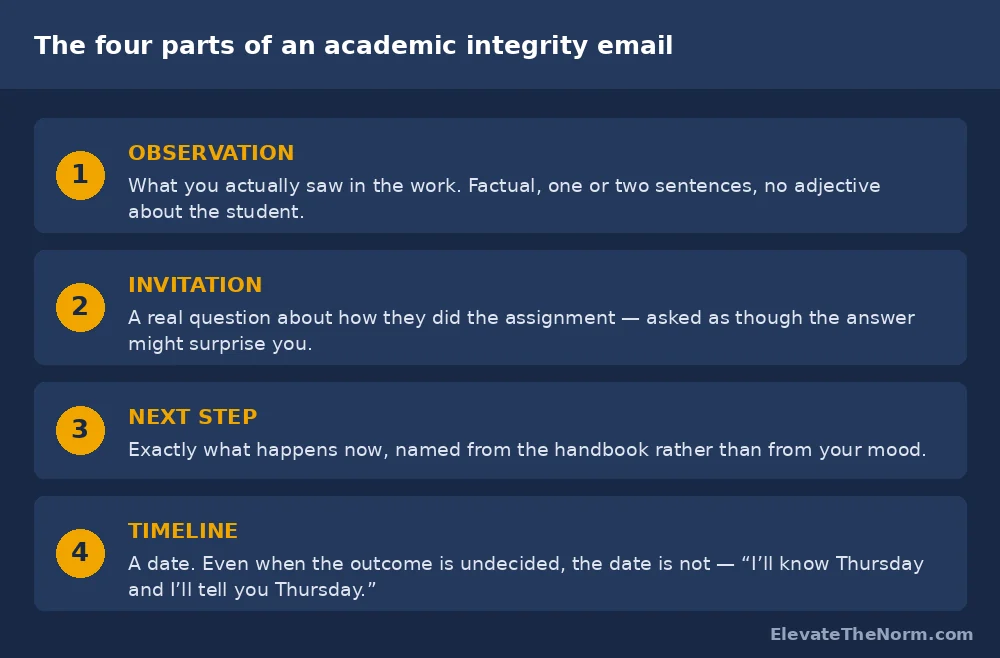
    An academic integrity email should state what you saw in the work, not a verdict, invite the student to explain, name the next step under your policy, and give a date. Email the student first, the family after you’ve talked with the student, and the administrator with the evidence attached. Write each one as if the family will read it.

    An academic integrity email is a written message a teacher sends to a student, a family or an administrator about suspected cheating, plagiarism or unauthorized help. It’s also a record. Under federal law, a record that’s directly related to a student and kept by the school is part of that student’s education record, and a parent has the right to read it. That changes almost everything about how the email should be written.

    So the question isn’t what you feel like writing at 9 p.m. with a plagiarized essay open in another tab. It’s what you’d be comfortable reading aloud, months later, in a meeting with the student, both parents and an assistant principal.

    Three emails usually have to be written: one to the student, one to the family, one to whoever handles this in your building. They have different jobs and shouldn’t contain the same paragraph. Below is what goes in each, worded out, along with the five sentences that cause most of the trouble.

    Key Takeaways

    • Write observations, not verdicts. “Three paragraphs match a source that isn’t cited” is a fact. “You plagiarized this” is a conclusion the classroom teacher often isn’t the one authorized to reach.
    • Assume a parent will read an academic integrity email. FERPA gives parents of K–12 students the right to inspect their child’s education records, and schools must respond within 45 days.
    • Talk to the student before emailing the family whenever the timeline allows, so the student gets a chance to explain before anything goes home.
    • Never name another student in an academic integrity email. Two students means two separate emails, with no cross-references.
    • Give a date for the next step, even when the outcome isn’t decided yet. Uncertainty, more than the consequence, is what families and students struggle with.

    Free Download · Printable PDF

    Academic Integrity Email Templates

    All three emails from this article — student, family, administrator — as copy-and-adapt templates, plus the phrase-swap table and a pre-send checklist.

    Download the free PDF

    Free. No email address required. Designed for grades 6–12. The full response process is on the academic integrity response page.

    Is an Academic Integrity Email Part of a Student’s Record?

    An academic integrity email can become part of a student’s education record when the school keeps it, which means the student’s parents may have the right to read it. Teachers tend to treat email as conversation. It’s closer to filing.

    Two-column list of what belongs in an academic integrity email and what should stay out
    The left column is defensible months later. The right column is what gets quoted back to you.

    The U.S. Department of Education’s guidance defines an education record as one that is “directly related to a student” and maintained by the school. Parents of K–12 students have the right to inspect those records, and a school must comply “within a reasonable period of time, but not more than 45 days after receipt of a request.” Whether a particular email meets that bar depends on how your district stores and treats it, and that’s a question for your administrator, not a blog. The practical takeaway doesn’t depend on the edge cases: write every one of these as though it will be read by the family, because it may be.

    The same rules are why the other habit exists. FERPA’s regulations require a parent or eligible student to give signed and dated written consent before a school discloses personally identifiable information from education records, with listed exceptions. A second student’s name in an email to the first student’s parents is the most common way a teacher creates a problem that is genuinely larger than the cheating was.

    One more framing point before the templates. The classroom teacher usually isn’t the person who decides that a violation occurred. Your handbook names that person, and it’s often someone else. What you’re qualified to write is what you observed. Keeping to that isn’t timidity. It’s what makes the email survive.

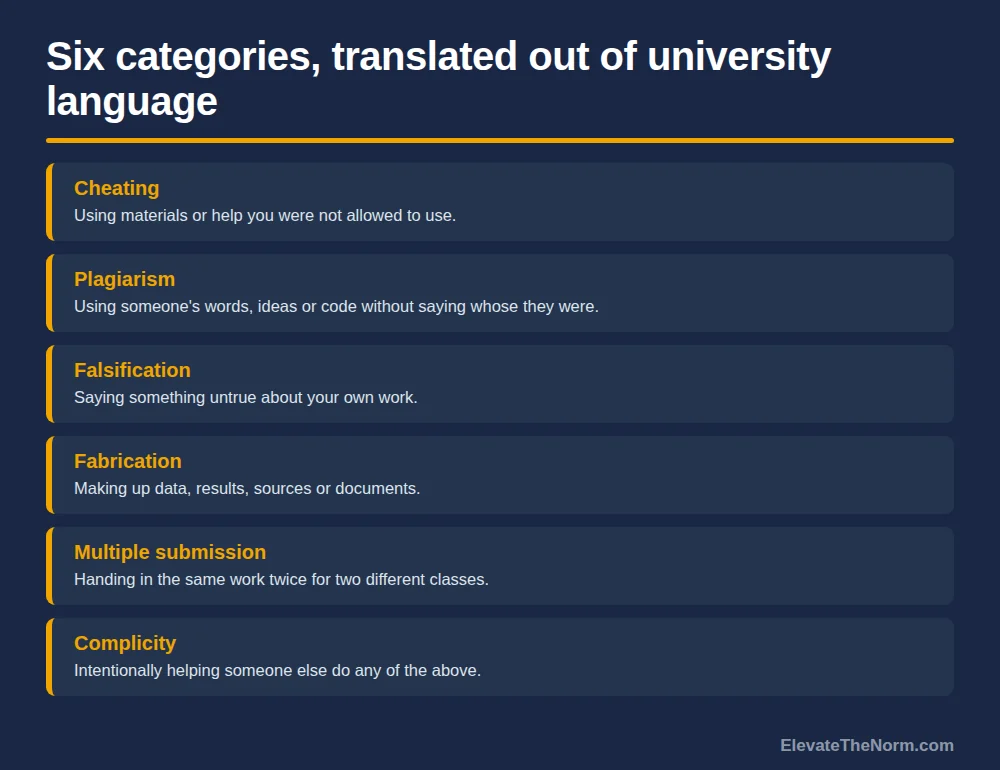
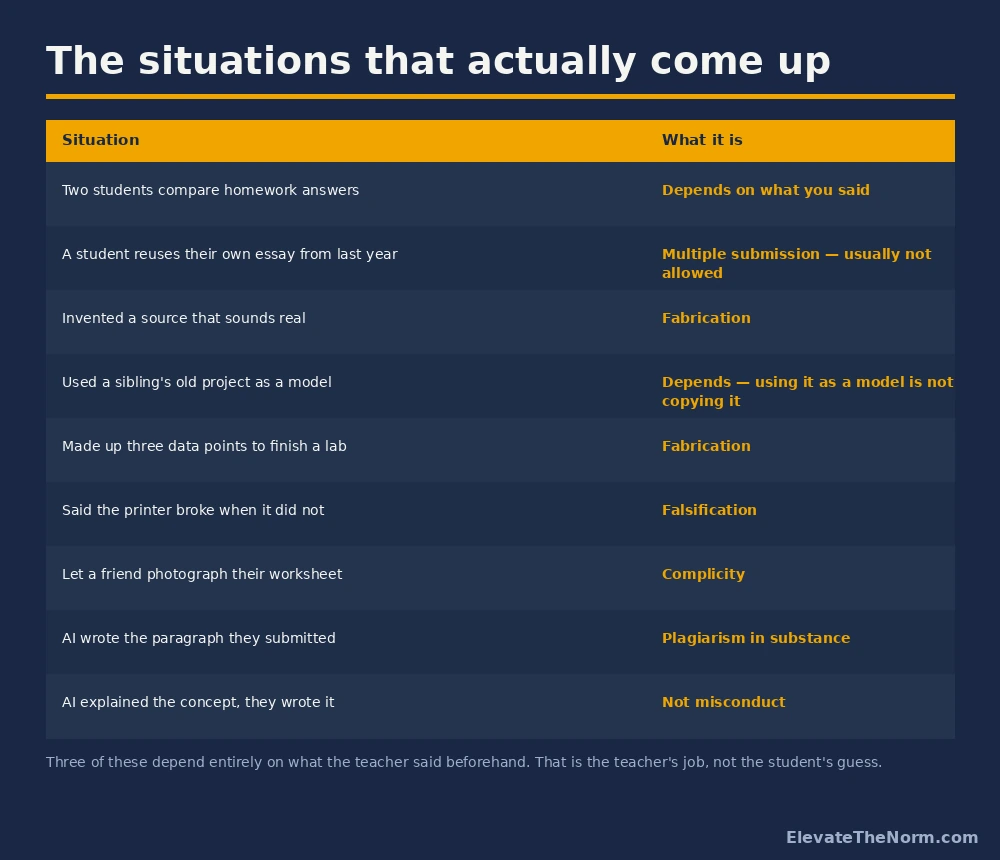
    It also assumes the line was clear in the first place. Some of what lands in these emails isn’t defiance but a student guessing at a boundary nobody wrote down. That’s why a definition students can repeat back to you is worth settling before an incident rather than during one, and why the worked examples of where the line falls are more use to a class than a policy paragraph. If you find yourself writing the same email four times a term, the assignment design is the thing to look at, not the students.

    EmailWhen to send itIts jobWhat it must include
    To the studentFirstStart a conversation without pre-judging the outcomeOne factual observation and a specific time to meet
    To the parent or guardianAfter you have spoken with the studentInform accurately and say what happens nextThe observation, what the student said, the next step, a date, and any effect on the grade
    To an administratorBefore you are asked for itHand over facts and evidence, not interpretationWhat you observed, the evidence, the student conversation, family contact, and what you are asking for
    The three academic integrity emails at a glance.

    What Should an Academic Integrity Email to a Student Say?

    An academic integrity email to a student should be short: one factual observation, an invitation to explain, and a specific time to meet. Send it first. Its only job is to get the student into a conversation without prejudging the outcome. I use my Restorative Conversation Scripts on TPT for the follow-up so the student does most of the talking.

    Four-part structure of an academic integrity email: observation, invitation, next step, timeline
    Observation, invitation, next step, timeline. Everything else is optional.

    The University of California San Diego’s academic integrity office frames this conversation around what it calls clarity, compassion and candor, and its example opening is an observation rather than a charge: I have some concerns about your recent [paper or exam], specifically it appears that you may have… followed by an open question about the student’s process for completing the work. UCSD’s guidance is written for a university, where the student is an adult and no parent is in the loop. In grades 6–12 the structure transfers; the surrounding obligations don’t, which is why there are two more emails below.

    Template · to the student

    Subject: Your [assignment name] — quick conversation Tuesday

    Hi [Name],

    I’m reading through the [assignment] and I have a question about yours. [One sentence of plain observation — e.g. “Three of the paragraphs closely match a source that isn’t in your citations,” or “Two of the sources listed don’t appear to exist.”]

    Before I do anything else I want to hear how you put it together. Come see me during [specific time], or tell me a time that works.

    I’m not assuming anything yet. I do need to understand it.

    [Your name]

    Note what’s absent. No adjective about the student. No mention of the handbook, the consequence, or the word cheating. No parent copied in. A thirteen-year-old who reads that email is anxious, which is unavoidable, but they aren’t cornered, and they can still tell you the truth without it being a confession.

    Give a specific time rather than “come see me.” A vague summons is worse than a direct one, because the student spends two days constructing the worst version of it.

    How Do You Email Parents About an Academic Integrity Issue?

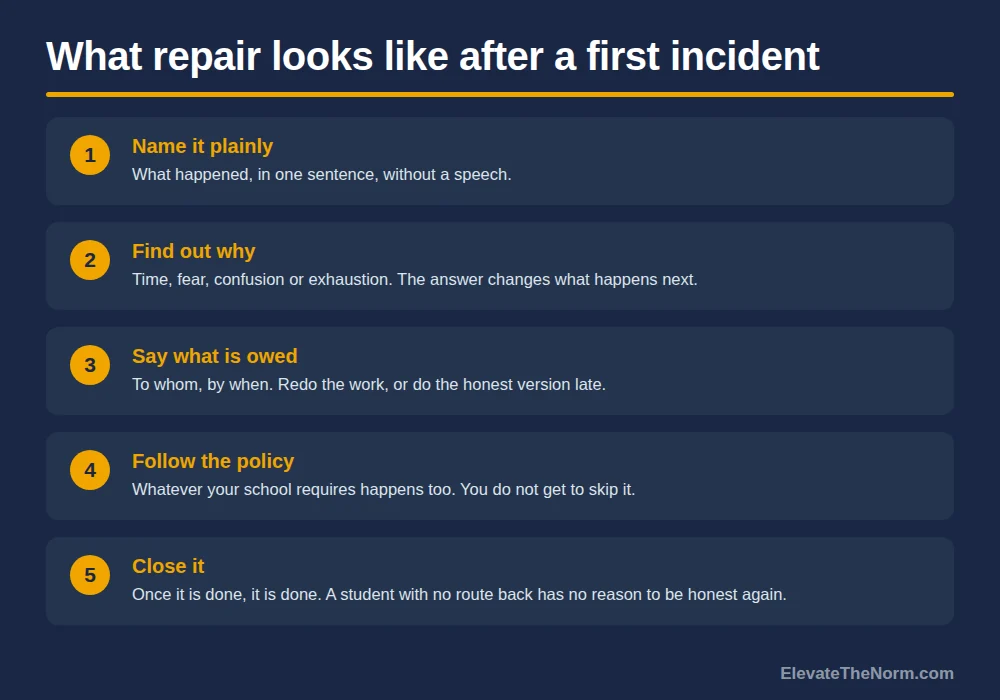
    Email parents about an academic integrity issue after you’ve talked with the student, unless your policy says otherwise. The family email reports the observation, what the student said, the next step, a date and any effect on the grade. If you haven’t settled what happens next, decide what should actually follow a confirmed violation before you write the email.

    There is decent evidence that the specific, improvement-focused version of a message home does more than the softened one. Kraft and Rogers ran a field experiment in a high school credit recovery program, sending parents weekly one-sentence individualized messages from teachers. The share of students failing to earn course credit fell from 15.8 percent to 9.3 percent, and the messages emphasizing what students could improve produced larger effects than the messages about what they were doing well.

    Read the limits before borrowing the conclusion. That was a credit-recovery setting with students already at risk, the gain came mainly from preventing dropouts rather than from better grades, and the messages were about ordinary progress, not integrity violations. It isn’t evidence that a blunt email about cheating improves anything. What it reasonably supports is the narrower claim: parents respond to specific information about a problem, and vagueness is not kindness.

    Template · to the parent or guardian

    Subject: [Student name] — [assignment], and what happens next

    Dear [Name],

    I’m writing about [student]’s [assignment], submitted [date]. [One or two sentences of observation — the same factual sentence you sent the student.]

    I spoke with [student] on [date]. [One sentence on what they said, neutrally reported.]

    Under our [handbook section / department policy], the next step is [exact next step]. That will happen by [date]. [If a grade is affected, say precisely how. If it is not yet decided, say that instead.]

    I want to be straightforward with you about two things. The first is that this is being handled as a teaching situation, not a character judgment. The second is that [student] is not in any trouble they cannot come back from — the repair is defined and it is finite.

    I’m glad to talk. [Phone/time].

    [Your name]

    The paragraph most teachers omit is the third one, and it is the one families actually need. Parents are rarely angry about the report. They’re angry about not knowing what it means, what it does to a grade, and whether it follows their child around. Say all three.

    If your school is going to notify them anyway, you want to be the first message they read. A family who hears it from an automated referral before they hear it from you will spend the whole meeting recovering from that.

    And tell the student what is going home before it goes. Not for approval — you are sending it either way — but so they are not blindsided at the dinner table by a document they have never seen. One sentence covers it: I’m emailing your mom this afternoon; here’s what it says. A teenager who knows what is coming can walk into that conversation as a participant. One who doesn’t walks into an ambush arranged by an adult who had already decided to be fair to them. Being fair without being transparent still feels, from the inside, like being handled.

    It helps enormously if this is not the first message that family has had from you all year. A parent whose only contact from a teacher is bad news reads every email as bad news, which is one practical argument for keeping some kind of routine family contact going when nothing is wrong.

    Two practical notes. Email isn’t universal access. Some families don’t read English comfortably, some don’t use email at all, and many districts route family contact through the student information system rather than your inbox. Use whatever channel actually reaches them, and make sure a written record exists afterwards either way. And if the student has an IEP or 504 plan, bring the case manager in before you send anything, because procedural protections may apply to how a discipline matter is handled. If you need the paperwork to keep up, my Behavior Documentation Forms on TPT have ABC data sheets and MTSS logs ready to go.

    What Should an Academic Integrity Email to an Administrator Include?

    An academic integrity email to an administrator should include what you observed, the evidence attached, the student conversation, any family contact, and what you’re asking for. It’s the shortest of the three emails and the one most often over-written. Leave your interpretation out.

    Template · to an administrator

    Subject: Possible integrity issue — [student], [class, period]

    [Name],

    Reporting under [handbook section].

    What I observed: [Factual, one to three sentences.]

    Evidence attached: [The submission, the source, the comparison, the timestamp — whatever you actually have.]

    Student conversation: [Date, and what they said, neutrally reported.]

    Family contact: [Date and method, or “not yet — advise.”]

    What I’m asking: [Guidance / formal referral / confirmation that my planned response is correct.]

    [Your name]

    Write this one before you are asked for it rather than after. The version written two weeks later from memory is weaker, and by then the timestamps you would have wanted are gone.

    What Should You Not Say in an Academic Integrity Email?

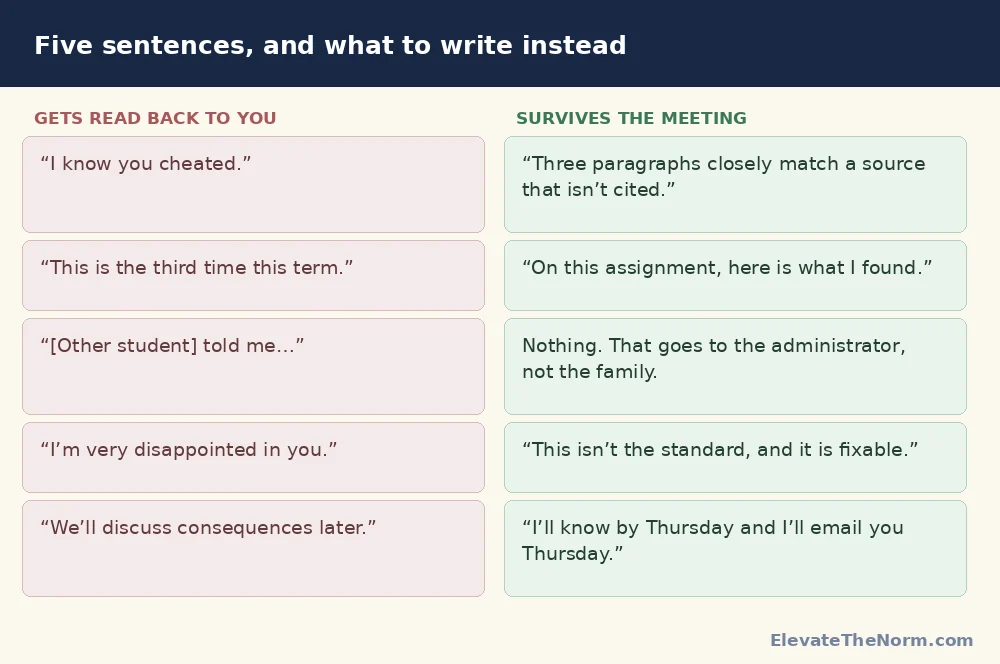
    Leave out verdicts you can’t prove, other students’ names, comparisons to other students, judgments about character, and vague promises about consequences. Each of the five sentences below creates work later.

    Table of five problematic email sentences and better alternatives
    The left column is the version that gets read back to you in a meeting.

    “I know you cheated.” You know what you observed. Certainty you can’t back with evidence is the fastest route to a retraction, and if you are wrong even once the student is owed an apology you will find hard to write.

    “This is the third time this has happened in this class.” True, probably, and it tells a parent their child is being read against a pattern of other people’s behavior. It also edges toward other students’ records.

    “[Other student] told me…” Never. Name no one. If another student’s account matters, it goes to the administrator, not into an email to a family.

    “I’m very disappointed in you.” It reads as a character verdict, and it is the sentence teenagers remember for years. You can hold the standard without grading the person; that distinction is the whole of what makes a repair possible.

    “We’ll discuss consequences later.” Later is the cruelest word in the email. Give a date even if you can’t give an outcome: I’ll know by Thursday and I’ll tell you Thursday.

    Should You Wait Before Sending an Academic Integrity Email?

    Yes. Write the academic integrity email, then wait until the next morning and reread it before you send it. No integrity situation gets worse overnight, and the version written in the moment is usually sharper than it needs to be.

    Clay’s take: I have a rough count I use before responding to anything in the room — somewhere around fifteen, though it is an average rather than a rule and it moves with the day, the class and the student. It isn’t a technique so much as a refusal to answer at the speed of my first reaction.

    Email deserves a longer version of the same thing, because the medium removes every correction a conversation gives you. There is no face telling you the sentence landed badly. There is no chance to say that came out wrong. And unlike a spoken word, it is still there in March.

    So the one habit worth building is the overnight wait. The version you would have sent the night before is almost always half a degree sharper than the situation needed, and that half degree is what the family remembers.

    The cheapest version of this email is the one you never have to write, and on test days that mostly comes down to the paper itself. Every course at Mid-Terms.org ships with a Form A and a Form B, and the Midterm Maker will build up to four scrambled versions (A–D) with matching keys, which makes a glance at the next desk a lot less useful.

    What if you don’t have time to write all three emails?

    When time is short, never cut the student email, keep the conversation brief and private, write the facts down the same day, and give the family email an extra day rather than sending it fast. Three emails and a conversation is the complete version, and on a day with two duties and a deadline you won’t have it. Here’s what compresses without damage.

    • The student email never gets cut. It is six sentences and it is the one that keeps the situation recoverable.
    • The student conversation can be two minutes at a desk rather than a scheduled meeting, as long as it’s out of earshot of the room.
    • The administrator email can wait a day in most cases — but write the facts down the same day, even as a note to yourself, because that is the part memory ruins.
    • The family email is the one to do properly. If something has to slip to tomorrow, slip this one and send it well rather than sending it fast.

    Before you go: grab the free Academic Integrity Email Templates (PDF) — ElevateTheNorm.com branded, printable, no email required.

    Frequently Asked Questions

    What should an academic integrity email say?

    An academic integrity email should say four things, in this order: what you observed in the work, an invitation to explain, the next step your handbook requires, and a date. The observation is factual, such as matching text or a source that doesn’t exist, not a conclusion about the student. The date matters more than teachers expect, because uncertainty is what students and families struggle with most.

    Should I email the parents before or after talking to the student?

    Email the parents after talking to the student, unless your school’s policy says otherwise. A message that reaches home before the student has been asked what happened removes their chance to explain, and some suspected violations turn out to be a misread instruction or a badly done citation. Talk first, then write the family a message that includes what the student said.

    Can a teacher say a student cheated in an email?

    A teacher should be careful about writing that a student cheated, because in many handbooks the classroom teacher isn’t the person authorized to make that call. What a teacher can always write is what they observed: matching text, sources that don’t exist, two identical submissions, a timestamp that doesn’t fit. Observations hold up under scrutiny. A conclusion that turns out wrong needs a retraction.

    Is a teacher’s email about a student part of their school record?

    A teacher’s email about a student can be part of the education record. The U.S. Department of Education defines education records as records directly related to a student and maintained by the school, and parents of K–12 students can inspect them, with schools required to respond within 45 days. Whether a specific email counts depends on how your district stores it, so ask your administrator.

    Can I mention another student in an academic integrity email?

    No. When two students are involved, write two separate emails with no names and no cross-references. Under FERPA’s regulations, disclosing personally identifiable information from one student’s education records generally requires signed, written consent from the parent or eligible student. If another student’s account is part of what you observed, put it in your report to the administrator instead.

    What if I send an academic integrity email and then find out I was wrong?

    Correct the academic integrity email in writing, quickly, to everyone who got the original, and don’t hedge. That’s why the observation-not-verdict rule matters: “three paragraphs matched an uncited source” stays true even when the explanation is innocent, so the correction is a clarification. If you did accuse the student, apologize plainly, including in front of anyone who saw the accusation.

    What if the student has an IEP or 504 plan?

    When a student with an IEP or 504 plan is involved in an academic integrity issue, bring the case manager in before you send any email. Procedural protections may apply to how a discipline matter is handled, and the case manager knows what the plan requires. Use the same observation-first emails, but let the case manager confirm the next step and timeline before the family hears them.

    What should a student do after receiving an academic integrity email?

    A student who gets an academic integrity email should reply and show up at the time offered. A well-written integrity email is an invitation to explain how the work was put together, not a final decision. Come ready to walk through how you did the assignment and where your sources came from. Telling the truth early keeps the situation recoverable, and the repair is usually defined and finite.

    Sources

    • U.S. Department of Education, Student Privacy Policy Office. FERPA frequently asked questions. Read the guidance — source for the definition of an education record (directly related to a student and maintained by the institution), the parental right of inspection, the 45-day response requirement, and the signed-and-dated consent requirement. General federal guidance; it does not rule on any particular email, and district policy and state law both apply on top of it.
    • U.S. Department of Education, Student Privacy Policy Office. Family Educational Rights and Privacy Act regulations (34 CFR Part 99). Read the regulations — source for §99.30(a), the signed and dated written-consent requirement before personally identifiable information from education records is disclosed, subject to the exceptions in §99.31, and §99.10(b), the 45-day access rule.
    • Academic Integrity Office, University of California San Diego. How to talk to a student suspected of cheating. Read the guidance — source for the Clarity, Compassion, and Candor framing and for opening with an observation rather than an accusation. Written for a university, where students are adults and families are not involved; the conversational structure transfers to grades 6–12 but the notification obligations do not.
    • Kraft, M. A., & Rogers, T. (2015). The underutilized potential of teacher-to-parent communication: Evidence from a field experiment. Economics of Education Review, 47, 49–63. Read the record — weekly one-sentence individualized messages to parents in a high school credit recovery program; students failing to earn credit fell from 15.8% to 9.3%, driven mainly by preventing dropouts rather than reducing failure, with improvement-focused messages outperforming praise-focused ones. Not a study of integrity communication — cited here only for the narrower finding that specific information outperforms vague reassurance.

    This article isn’t legal advice and doesn’t interpret any district’s policy. Where federal guidance and your handbook appear to disagree, ask your administrator before you send anything.


    About Clay Shumate

    By Clay Shumate — Clay Shumate is a certified secondary Social Studies teacher in the public schools of West Alabama, with seven years of classroom experience, a B.A. in History, and an M.Ed. in Secondary Education. He writes about project-based learning, student responsibility, respect, and practical ways to hold young people to a higher standard while giving them room to learn from mistakes. He is a member of the Society of Professional Journalists and writes to its Code of Ethics; this site’s editorial standards and corrections policy are published in full.

  • Classroom Lighting: What Happens When You Turn the Overheads Off

    Classroom Lighting: What Happens When You Turn the Overheads Off

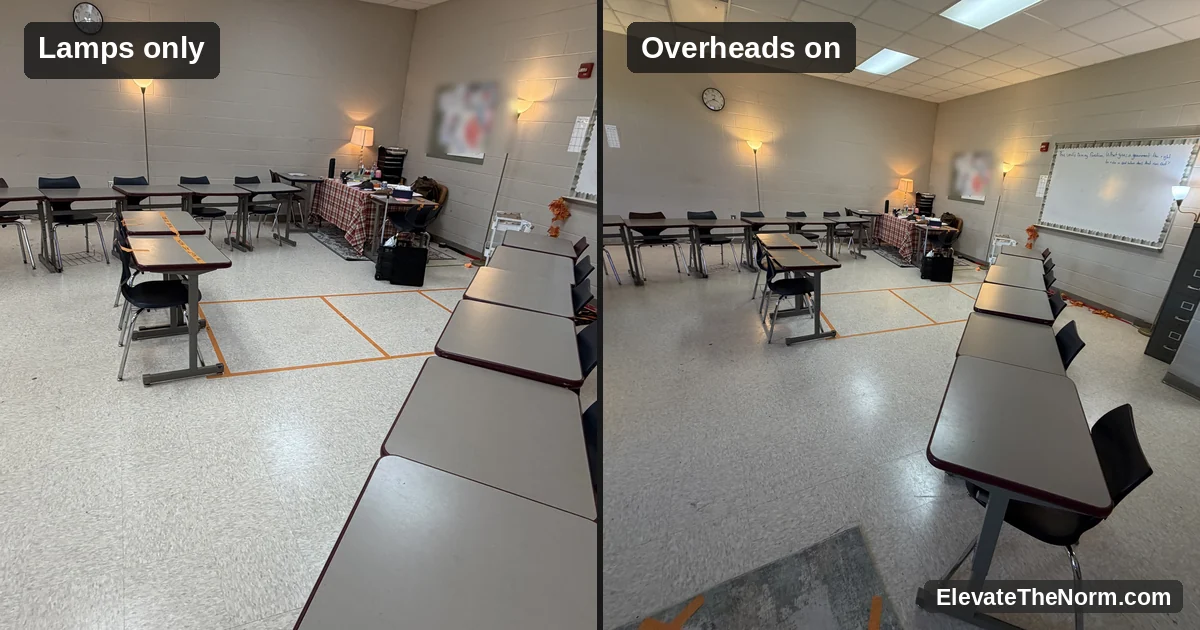
    Classroom lighting is the cheapest variable in the room and the one most teachers never touch. Mine runs on floor lamps. The overhead fluorescents stay off, and they have stayed off long enough that turning them on is now the most effective consequence I have — not because darkness is a reward, but because the overheads are what every other room in the building already looks like.

    That is the whole mechanism, and it took me a while to notice I was running it.

    What follows is what the evidence on classroom lighting actually supports, what it does not, what a lamp-lit room costs and how to check you have not just made the room too dark to work in — and the part nobody writes about, which is what happens to a class when you put the ceiling back on.

    Key Takeaways

    • Light is the strongest single physical factor in the best-known study of classroom design — but that study was 3,766 pupils aged 5 to 11 in England, and it was mostly about daylight and light quality, not about switching the ceiling off.
    • Flicker is the real mechanism behind the headaches, and it is measurable. Halving it halved headaches and eyestrain in a double-blind office study.
    • “Just switch to LED” is not the fix people think it is. LEDs driven at twice the mains frequency can modulate deeper than the fluorescents they replaced.
    • Check the light level before you trust the vibe. The IES puts classroom reading and writing at about 30 foot-candles at desk height, with a usable range of 15 to 60. Under 15 you have not made a calm room, you have made a squint.
    • Lamps only become a management tool once they are the baseline. The consequence is not turning something off. It is turning the normal thing back on.
    • Check the fire code first. Extension cords are not permanent wiring, and halogen torchieres have a body count.
    • It is still a collective consequence. Say so out loud rather than pretending it is just weather.

    Free Download · 2-page PDF

    Classroom Lighting Setup Planner

    The four conversations to have first, a safety checklist, a flicker check, a desk light-level log, a two-week trial plan and a wall card for your room.

    Download the free PDF

    Free. No email address required. Designed for grades 6–12. Browse every printable in Your Free Library.

    What the Research on Classroom Lighting Actually Says

    The study everyone cites is the HEAD project, summarised as Clever Classrooms. Peter Barrett and colleagues tracked 3,766 pupils across 153 classrooms in 27 English schools for a year and found that differences in the physical characteristics of classrooms explained 16% of the variation in learning progress. Of the seven design factors that mattered, light carried the most weight — about 21% of the explained variation. The authors write that “of all the design parameters considered, lighting has the strongest individual impact.”

    Now the caveats, because they matter more than the headline.

    Those pupils were aged 5 to 11. This is a grades 6–12 site, and a primary-school result does not transfer to a room of sixteen-year-olds just because we would like it to. The authors say so themselves: the findings “are conditioned by the geographical and pedagogical particularities here,” and applying them elsewhere “careful reinterpretation may be needed.” It is also an observational study — associations across real classrooms, not an experiment where somebody changed the lights and measured what happened.

    And the light factor in that model is largely about daylight and light quality — window area, glare control, orientation. It is not a finding that says “turn the overheads off.” Anyone quoting the 16% figure at you to sell a lighting retrofit is stretching it, and most of the pages ranking for this keyword are doing exactly that.

    What the study does support is modest and useful: light is not a trivial variable, and it is one of the few in the room a teacher can change without a budget line.

    The Headaches Are Real, and the Cause Is Flicker

    This is the strongest evidence in the article, and it is nearly forty years old.

    Arnold Wilkins and colleagues ran a double-blind crossover study in offices, swapping conventional fluorescent ballasts — which pulse at 100 Hz with something like 43–49% modulation depth — for high-frequency electronic ballasts running at 32 kHz, which drop that 100 Hz modulation below 7%. Same fixtures, same rooms, nobody knowing which was which. The average incidence of headaches and eyestrain was more than halved under the high-frequency lighting. Occupants also chose to leave the high-frequency lighting on about 30% longer.

    Read that result carefully, because it does not say what teachers usually think it says. The fix in that study was better fluorescent lighting, not less of it. The problem was never the ceiling. It was the flicker.

    Which is why “just switch to LED” is not the answer

    Wilkins later worked on the IEEE standard for LED flicker, and the finding there is the one nobody selling LED retrofits puts on the page: “LEDs driven so that they flicker at a frequency twice that of the AC supply may have a depth of modulation greater than that from most fluorescent lamps.” The retina still resolves modulation between roughly 100 and 160 Hz, and up to about 200 Hz, even though you cannot see it. The modulation depth known to induce headaches at 100 Hz is around 35%. The paper explicitly declines to recommend a safe threshold.

    So a cheap LED retrofit into old fixtures can leave a room flickering worse than it did before, and everyone congratulates themselves on the energy savings. If your building went LED three years ago and the headaches did not go away, that is a plausible reason why.

    You can check without buying anything. Point a phone camera at the ceiling fixture and look for banding on the screen, or wave a pencil quickly under it and see whether the blur breaks into discrete images. Neither is a measurement, but a fixture that fails both is not the fixture giving your room headaches.

    What a Lamp-Lit Classroom Actually Looks Like

    Six floor lamps around the perimeter, a couple of table lamps on surfaces, and the overhead bank off. That is it. The lamps came from a big-box store and the whole setup cost less than a set of novels.

    A secondary classroom lit only by floor lamps around the perimeter, overhead fluorescent fixtures switched off, with tables grouped and open floor space
    The baseline. Six lamps, overheads off, and nobody comments on it after September.

    What changes is not dramatic and I am not going to pretend it is. The room is quieter at the edges. Students walk in at a lower volume and it takes less to bring them down further. The glare on the screens goes away. Nobody squints at the whiteboard. I stopped getting the four-o’clock headache I had assumed was just what teaching felt like.

    What does not change: nothing about the light makes a bored student interested, and no lamp has ever taught a standard. The room is a floor, not a lever.

    Measure it before you trust it

    Here is the step almost every “cozy classroom lighting” post skips, and it is the one that separates a considered room from a dim one.

    The Illuminating Engineering Society puts classroom reading and writing tasks at a maintained horizontal average of about 30 foot-candles measured at desk height, with a range of 15 to 60. Free light-meter apps are close enough to tell you which side of 15 you are on. Walk the room during the period you actually teach, put the phone flat on six different desks, and write the numbers down.

    If the far corner reads 8, you have not created a calm environment. You have created a corner where a student with uncorrected vision cannot read the handout and will not tell you. Add a lamp there. The fix is a lamp, not a philosophy.

    Two other honest limits. Warm lamps are pleasant and low-glare, but on the two or three days a year you hand out something with genuinely small print, turn the ceiling on and do not be precious about it. And a room this size needs the lamps spread to the perimeter — clustering them near your desk lights you beautifully and leaves the students in a cave.

    The Part Nobody Writes About: the Lights Become a Consequence

    Once the lamps have been the baseline for a few weeks, something happens that I did not plan.

    The room becomes a thing students have an opinion about. They notice other rooms. They say so. And the moment they have a preference, you are holding a lever you did not build — because you can put the room back to normal at any time, and normal is what everybody else’s room already looks like.

    The same secondary classroom with the overhead fluorescent lights switched on, producing flat even light across the desks and floor
    The same room with the ceiling back on. This is what every other classroom in the building looks like all day.

    So when a class has a bad run, the overheads go on for a couple of days. No announcement, no name on the board, no lecture. They walk in, they see it, and they know exactly what it means because we talked about it in August.

    Then it goes back.

    The reason this works better than most things I have tried is that there is nothing to argue with. I have not taken anything away from anyone. I have not singled a student out, raised my voice, or manufactured a penalty. The room is simply in its standard state — the state the district issued it in — and the extra thing has paused. A teenager can be furious at a consequence that was imposed. It is much harder to build a grievance around a light switch.

    It is also completely reversible, costs nothing, escalates nothing, and never once has required me to be the loudest person in the room. If you have read what yelling actually costs a classroom, the appeal of a consequence delivered by a switch will be obvious.

    This is positive reinforcement and a consequence at the same time

    That sounds like a contradiction and it is not.

    Ninety-five percent of the time the lamps are doing reinforcement work, silently, for every student, with no points and no chart and nothing anyone has to earn each morning. It runs all day and nobody experiences it as being managed. That is the version of positive reinforcement I actually believe in — built into the room rather than administered to the student.

    The other five percent is removal of an extra, not addition of a punishment, which is the distinction that keeps it from curdling. It sits on the same line as the rest of classroom consequences that teach rather than humiliate: proportionate, predictable, over quickly, and containing no message about anyone’s character.

    Get that line wrong and it stops being clever. If the lights go on for a week, or go on because one student annoyed you, or go on with a speech attached about how this is why we cannot have nice things, you have converted a quiet environmental nudge into a grudge with a fixture. The test is the one that applies to any natural consequence: it should follow from the situation rather than from your mood. Two days, no commentary, back to normal.

    Sometimes I Turn Them On and It Is Not a Consequence at All

    This is the part that keeps the whole thing honest, and it is a bigger share of the switch-flipping than the discipline use.

    • There is a substitute. A sub does not know the room, the routines, or which corner they cannot see. Handing them a dim room and a seating chart is a setup. The lights go on and I leave a note saying so.
    • I cannot see everything. Some days the room is configured so a sightline is blocked, or I know I am going to be head-down with a small group. Supervision beats ambiance every single time, and it is not close.
    • Somebody needs the light. A student with a visual impairment, a new IEP accommodation, a kid squinting at a text. That is not a negotiation.
    • Fine-detail work. Small-print primary sources, close annotation, anything with a map.

    I say which one it is out loud. Thirty seconds. “Lights are on today because I’ll be at the back table with a group and I need to see the whole room” costs nothing and stops students from reading a supervision decision as a punishment they cannot account for. A consequence nobody can distinguish from weather is not a consequence — it is just an unpredictable room, and unpredictable rooms make teenagers anxious rather than compliant.

    Before You Move a Single Lamp: Four Conversations

    I did most of these in the wrong order. Do them in this one.

    Floor lamps positioned around the perimeter of a classroom with tables arranged over a taped floor plan, showing lamp placement and clear walkways
    Lamps on the perimeter, cords along the wall, and nothing crossing a walkway.

    1. The fire marshal, via your principal

    This is the one that gets teachers in trouble, and the rules are more specific than people assume. Fire codes generally hold that extension cords are not a substitute for permanent wiring, and that relocatable power taps — power strips — must plug directly into a permanently installed receptacle, never into another strip or an extension cord, and never run under a floor or through a wall. Codes vary by state and district; the Indiana school guidance above is a clear example rather than the rule where you are.

    The practical upshot: lamps go where outlets are, cords stay against the wall and out of walkways, and nothing gets daisy-chained. A lamp you have to reach with an extension cord is a lamp in the wrong place.

    And do not buy halogen torchieres. The CPSC linked them to at least 189 fires and 11 deaths between 1992 and 1997, which is why they are banned outright in a lot of dorms and school buildings. The bulb runs hot enough to ignite anything that touches the shield. A modern LED torchiere is a different object and the risk does not carry over — but check what you are actually buying, and check your district’s policy before you plug anything in.

    2. Whoever cleans your room

    Custodians have to work in there at night, they need real light to do it, and they will reasonably flip everything on and leave it on. Ask. Six lamps in the path of a floor buffer is a problem you created for somebody else, and moving two of them is a five-minute fix if you hear about it in September rather than January.

    3. Your case managers

    If a student’s IEP or 504 plan speaks to the environment — reduced distraction, preferential seating, a visual accommodation — change the room before you change it, not after a parent calls. You do not get to unilaterally decide a documented accommodation is satisfied by a different arrangement. Bring the observation to the team.

    4. Your students, in August, out loud

    Tell them the lamps are the normal state of the room, tell them the overheads come back on when the room stops working or when you need to see everything, and tell them how long it lasts. Then tell them that anybody who wants more light gets a brighter seat, no conversation required.

    A consequence a fifteen-year-old could have predicted on day one is fair. The identical consequence delivered as a surprise is a mood, and they can tell the difference instantly. It is the same reason routines have to be taught rather than announced — the system is only as good as the part they knew about in advance.

    Where This Fails, and Who It Is Hardest On

    I am wary of lamp-lighting posts that present this as universally kinder, because the research does not say that.

    Noble and Isaacs’ 2025 study in Lighting Research & Technology asked 13 autistic adults in New Zealand to photograph and rate the electric lighting around them — 133 photographs in all. Flicker was identified as a problem by every single participant. Linear fixtures arranged in grid arrays drew strong dislike regardless of what lamp was actually in them. Warm colour temperature was generally liked. All of which supports the case above.

    And then the finding that complicates it: some participants also disliked dim lighting, and brightness preferences varied by context — several valued bright light for tasks. Thirteen autistic adults in New Zealand is a small qualitative sample and not a classroom study, so hold it loosely. But it is enough to kill the idea that low light is automatically the accommodating choice.

    So the honest version is: a lamp-lit room removes a real irritant for a lot of students and creates a new one for a few. The answer is not to pick a side. It is to build a room with both — a genuinely bright, well-lit seat that exists permanently and is available without anybody having to explain themselves, in exactly the same way a lower-stimulus seat should exist in a student-centered classroom.

    Four other places it breaks:

    • A shared room or a cart. If you do not own the space you cannot own the baseline, and without a stable baseline the consequence half of this does not exist at all. The comfort benefits still work. The management mechanism does not.
    • A room with no windows. Lamps plus no daylight is a much bigger drop in total light than lamps plus a wall of glass. Measure, and expect to need more lamps than I do.
    • An administrator who wants to see in. Some buildings have a visibility expectation, written or not. That is a legitimate concern and not one to quietly ignore — ask rather than wait to be told.
    • Using it too often. If the overheads are on most weeks, the lamps are not the baseline any more and you have simply got a dim room and an inconsistent rule.

    What to Do Next

    Do not buy six lamps this weekend.

    Buy two, put them in the two darkest corners, and run the room with half the overhead bank off for a fortnight — most classrooms are on two or more switches and almost nobody checks. Measure the desks. Ask the class what they notice, and take the answer seriously even if it is “nothing.”

    If it holds, go the rest of the way in September rather than mid-year, because the baseline has to be established before it can be removed, and a change made in February reads as a reaction to something. Then tell them the rule on day one and use it four times a year.

    Like most of the things that have actually worked in my room, it is cheap, slow, and boring — and it does more than the expensive thing it replaced. The same is true of where you put the desks, which is the other free variable most teachers set once in August and never revisit.

    Before you go: grab the free Classroom Lighting Setup Planner (PDF) — ElevateTheNorm.com branded, printable, no email required.

    Frequently Asked Questions

    Will working in a dimly lit classroom damage my child’s eyes?

    No. This is one of the most persistent eye-health myths there is. As an optometrist at the University of Utah’s Moran Eye Center puts it, “while more light can be helpful, reading in dim light will not hurt your eyes.” Low light can cause temporary eye strain and fatigue, which is a real comfort issue and a reason to measure the light level at the desks — but it does not cause lasting damage. A room that is too dark for a particular student to read comfortably is a problem to fix with a lamp, not a health risk.

    Isn’t turning the lights on because the class misbehaved a collective punishment?

    Partly, yes, and a teacher using this should say so rather than pretend otherwise. It affects everyone in the room including students who did nothing. What keeps it defensible is that nothing is taken from anybody: the room returns to the standard condition every other classroom in the building is in all day, for a day or two, and then it goes back. No student loses points, privileges, seat, or standing, and nobody is named. That is a meaningfully different object from a collective penalty. It is still worth using sparingly, never in response to one student, and never with a speech attached.

    How much does this cost, and who pays for it?

    A workable set of six floor lamps and a couple of table lamps runs to well under a couple of hundred dollars, and the bulbs last for years. The uncomfortable part is that in most schools it comes out of the teacher’s own pocket, which quietly means the teachers who can afford a nicer room have one. That is a real equity problem and not one an individual solves. If a school wants this, the cheap version is to fund lamps as classroom supply rather than leaving it to whoever can spare the money.

    Doesn’t lower light make reading and focused work harder?

    It can, and this is the step to take seriously rather than on faith. The Illuminating Engineering Society puts classroom reading and writing at roughly 30 foot-candles at desk height with a usable range of 15 to 60, and a lamp-lit room can sit comfortably inside that range or fall well below it depending on how many lamps there are and where they sit. Measure with a free light-meter app at several desks during the period you teach, not after school with the blinds open. If a desk is below about 15, add a lamp there. And for genuinely fine-detail work — small print, close annotation, maps — turn the ceiling on for that lesson.

    What if my principal or the fire marshal says no?

    Then the answer is no, and it is worth finding out which specific thing the objection is about, because it is usually fixable. Most concerns are about extension cords, daisy-chained power strips, cords across walkways, or halogen bulbs — all of which have straightforward remedies. Some buildings also have a visibility expectation about being able to see into a classroom. Ask before you set anything up rather than after; a lamp arrangement that has been cleared is stable, and one that has not can be removed on an afternoon’s notice.

    Could a whole school or district do this?

    Not really, and it would be the wrong lever anyway. This is a teacher-level choice that depends on owning the room, and the benefits are modest and partly about comfort rather than measurable achievement. The district-level version of the same insight is different and bigger: specify low-flicker drivers when fixtures are replaced. The evidence that flicker causes headaches and eyestrain is decades old and stronger than anything on lamps, and an LED retrofit into old gear can flicker worse than the fluorescents it replaced. That is a purchasing decision, and it reaches every room instead of one.

    What if a student actually wants the overhead lights on?

    Then they should be able to get more light without having to make a case for it. The practical version is a permanently well-lit seat that exists from day one, described to the whole class in August as an ordinary option rather than an accommodation, so that taking it is not a disclosure. Research on how autistic adults experience lighting finds that flicker and grid-array fixtures are close to universally disliked, but that preferences about brightness genuinely vary, and some people dislike dim light. A room built on the assumption that everyone wants it dark has just swapped one imposed environment for another.

    Sources

    • Barrett, P., Zhang, Y., Davies, F., & Barrett, L. (2015). Clever Classrooms: Summary report of the HEAD project. University of Salford, Manchester. Full report (PDF) — the source for the 16% figure and for light carrying about 21% of the explained variation. The sample was 3,766 pupils aged 5–11 across 153 classrooms in England; it is observational, and the authors caution that applying it elsewhere needs careful reinterpretation.
    • Wilkins, A. J., Nimmo-Smith, I., Slater, A. I., & Bedocs, L. (1989). Fluorescent lighting, headaches and eyestrain. Lighting Research & Technology, 21(1), 11–18. Abstract and paper — the source for headaches and eyestrain being more than halved under high-frequency lighting. Participants were office workers, not students, and the intervention was better ballasts rather than less light.
    • Lehman, B., Wilkins, A., Berman, S., Poplawski, M., & Miller, N. J. (2011). LED lighting flicker and potential health concerns: IEEE standard PAR1789 update. Full text (PDF) — the source for LEDs potentially modulating more deeply than fluorescents, for the ~35% modulation depth associated with headaches at 100 Hz, and for the paper’s own refusal to name a safe threshold.
    • Noble, B., & Isaacs, N. (2025). Autistic people’s perception of interior electric lighting systems: An initial study. Lighting Research & Technology. Article — the source for flicker being identified by all participants, for grid arrays being disliked regardless of lamp type, and for the finding that some participants disliked dim lighting. Thirteen autistic adults in New Zealand; qualitative and small, and not conducted in classrooms.
    • Illuminating Engineering Society recommended light levels, as summarised in this quick-reference guide (PDF) — the source for roughly 30 foot-candles maintained horizontal average at desk height for classroom reading and writing, range 15–60. This is a reference summary of the IES tables, cited as such rather than as the standard itself.
    • U.S. Consumer Product Safety Commission (1997). CPSC and industry announce corrective action to improve safety of halogen torchiere floor lamps — the source for at least 189 fires and 11 deaths between 1992 and 1997, and for the guard and wattage remedies.
    • Indiana Department of Homeland Security, Fire Code Awareness in Schools (PDF) — the source for extension cords not substituting for permanent wiring and for relocatable power taps needing a direct connection to a permanent receptacle. Cited as a clear worked example of school fire-code language; your state and district rules govern.
    • University of Utah Health, Can reading in low light harm your eyes? Top 10 eye health myths debunked — quoting Gabriel Hulewsky, OD, of the John A. Moran Eye Center, for the point that reading in dim light does not damage eyes.

    Every link above was checked on September 14, 2026. Where a figure comes from a summary rather than the primary document, the entry says so, and where a study’s sample does not match a secondary classroom, the article says so in the text rather than only here.


    About Clay Shumate

    By Clay Shumate — Clay Shumate is a certified secondary Social Studies teacher in the public schools of West Alabama, with seven years of classroom experience, a B.A. in History, and an M.Ed. in Secondary Education. He writes about project-based learning, student responsibility, respect, and practical ways to hold young people to a higher standard while giving them room to learn from mistakes. He is a member of the Society of Professional Journalists and writes to its Code of Ethics; this site’s editorial standards and corrections policy are published in full.

  • Academic Honesty Examples: 18 Real Situations From a Secondary Classroom

    Academic Honesty Examples: 18 Real Situations From a Secondary Classroom

    Academic honesty examples are most useful when they are specific enough to argue about. “Do not cheat” settles nothing. “Two students compared homework answers in the hallway” is a real situation that happens weekly, and whether it counts depends on something a teacher either said out loud or did not.

    What follows is a set of concrete situations from a secondary classroom, sorted into the standard categories, with the honest answer for each — including the ones where the honest answer is “that depends on what you were told.”

    One thing to note before starting. Nearly every published definition in this area was written for universities. That is worth saying out loud, because applying undergraduate standards to a thirteen-year-old without translation is how schools end up punishing confusion.

    Key Takeaways

    • Six categories cover almost everything: cheating, plagiarism, falsification, fabrication, multiple submission and complicity.
    • Fabrication is the least understood. It means inventing data, sources or documents — and it is the one students commit without realising there is a word for it.
    • Several common situations genuinely depend on what you said. If you never specified, the student was guessing, and that is on the adult.
    • Reusing your own old work is usually a violation. Almost no secondary student knows this.
    • AI sits inside the existing categories. It does not need a new one — it needs the same question: did the tool help you think, or think instead of you?
    • Repair has to have an end. A first incident with no route back teaches students to deny rather than to be honest.

    Free Download · 3-page PDF

    Academic Honesty Scenario Cards

    All 18 situations from this article as cut-out cards, plus a 20-minute discussion guide, an “allowed help” assignment template and a teacher answer key.

    Download the free PDF

    Free. No email address required. Designed for grades 6–12. Browse every printable in Your Free Library.

    The Six Categories, in Plain Language

    Virginia Tech’s Office of Undergraduate Academic Integrity defines seven categories of academic misconduct, six of which map cleanly onto secondary work. The wording below is translated; the categories are theirs.

    Six categories of academic misconduct translated into plain language: cheating, plagiarism, falsification, fabrication, multiple submission and complicity
    The standard categories come from universities. This is the grades 6-12 translation.
    • Cheating. Using materials, notes, devices or help you were not permitted to use.
    • Plagiarism. Using someone’s words, ideas, structure or code without saying whose they were — including inadequate paraphrasing.
    • Falsification. Saying something untrue about your own work, verbally or in writing.
    • Fabrication. Making up data, results, sources or documents and presenting them as real.
    • Multiple submission. Handing in substantial portions of work already submitted for credit elsewhere, without permission.
    • Complicity. Intentionally helping someone else do any of the above.

    Two of these will be new to most students. Multiple submission is almost never explained in secondary school, and plenty of students reasonably assume their own work is theirs to reuse. Complicity surprises them even more — the student who let a friend photograph their worksheet usually thinks of themselves as the helpful one, not as a participant.

    What Is Fabrication in Academic Integrity?

    Fabrication is the unauthorised creation or reporting of information — inventing something and presenting it as real. Northern Illinois University’s tutorial pairs it with falsification and gives a list of concrete examples, several of which map directly onto secondary work:

    • Generating data artificially instead of collecting it from an actual experiment.
    • Altering data, documents, images, music or artwork without authorisation.
    • Removing results that do not fit, from a report or presentation.
    • Misrepresenting data through misleading scales or axes on a chart.
    • Inventing sources of information.
    • Impersonating another person to complete academic work, or using their login.

    The two that come up constantly in grades 6–12 are inventing a source and quietly dropping the data point that ruined the graph. Neither feels like cheating to the student doing it. The first feels like filling in a form; the second feels like tidying.

    That is why fabrication is worth teaching by name. A student who has never heard the word will not recognise themselves in it, and “I made up a source” is a sentence most fourteen-year-olds would be genuinely shocked to hear described as academic misconduct.

    Eighteen Situations, and What Each One Is

    Sorted by category. The verdicts assume no specific instruction was given, which is exactly the condition that causes most of the trouble.

    Table of nine common classroom situations with a verdict for each, including AI use, reused essays and invented sources
    Three of these depend entirely on what the teacher said beforehand.

    Clearly over the line

    • Copying a classmate’s answers during a test. Cheating.
    • Submitting a paragraph an AI tool wrote as their own writing. Plagiarism in substance, whatever the tool.
    • Inventing a source that sounds plausible to fill a citation requirement. Fabrication.
    • Adding three data points to finish a lab that ran out of time. Fabrication.
    • Telling a teacher the printer broke when it did not. Falsification.
    • Photographing a completed worksheet and sending it to four people. Complicity.
    • Logging into another student’s account to submit work. Fabrication, by NIU’s definition, and probably worse under school policy.
    • Paraphrasing a whole article closely without citing it. Plagiarism, even with every word changed.

    Usually a violation, and usually a surprise to the student

    • Reusing their own essay from a previous course. Multiple submission.
    • Submitting the same project to two teachers in the same term. Multiple submission.
    • Letting a friend copy homework “just this once.” Complicity.
    • Dropping the result that ruined the trend line. Fabrication by omission.
    • Using a translation tool to write an assignment in a language class. Depends heavily on the subject — and it is the teacher’s job to say.

    Depends entirely on what was said

    • Two students comparing homework answers before class.
    • Working through practice problems together and arriving at the same method.
    • Asking an AI tool to explain a concept, then writing the answer themselves. Not misconduct in most framings.
    • Using a sibling’s old project as a model for structure. Using it as a model is not copying it.
    • Getting a parent to proofread. Nearly always fine, and nearly never stated.

    That last group is the important one. Five situations, all common, all resolved by one sentence at the top of the assignment. A school with a strict policy and no per-task instruction has built a system where students are punished for guessing wrong about something nobody told them — which is the pattern described in more detail in the guide to stating the rule before you start enforcing it.

    The Repair Conversation

    When a student has done something that damaged trust, the conversation I have is about what is owed: to whom, and by when. Not a speech about character. A short, specific account of what needs to happen for this to be finished.

    Five steps for handling a first academic honesty incident: name it, find out why, say what is owed, follow the policy, close it
    A student with no route back has no reason to be honest again.

    That framing does most of the work in an academic honesty incident, because it separates two things schools routinely merge. There is what the school’s policy requires, which happens regardless and which you do not get to skip. And there is what the student owes — usually redoing the work honestly, sometimes telling someone what happened, occasionally apologising to a classmate whose work they used.

    The second part is the part that teaches anything. A consequence imposed on a student is something that happens to them. A debt they pay is something they do. The full sequence for handling a confirmed case, from the first conversation to the redo, is set out separately.

    And it has to end. If the answer to “when is this finished” is never, a student learns that honesty has no upside and denial has no downside. That is not a soft observation — it is the incentive structure you have built, and teenagers read incentive structures accurately.

    Using These Examples With a Class

    The list above works far better as a discussion than as a handout. Twenty minutes, once, early in the year.

    1. Give them the ambiguous ones first. Start with comparing homework answers, not with copying a test. The interesting conversation is in the grey zone and starting at the obvious end wastes it.
    2. Let them disagree. Students argue about these with real energy, and the arguments surface exactly the assumptions you need to correct.
    3. Make them state the rule they are using. “Why is that one different from the last one?” gets you further than telling them.
    4. Then give your answers. Including, honestly, the ones where your answer differs from the teacher down the hall.
    5. End with the per-assignment habit. Tell them you will state what help is allowed on each task, and that asking is always fine.

    The point is not compliance. It is that a student who has argued about where the line falls will notice when they are near it, and a student who has only been told the rules will not.

    What to Do Next

    Take the five “depends on what was said” situations and decide your actual answer for each. Not the school’s official position — yours, for your subject, on an ordinary assignment. Then say them out loud to your classes this week.

    Most academic honesty problems in a secondary classroom are not students deciding to cheat. They are students guessing, in a building where six teachers want six different things and nobody has written any of it down. If a violation does occur and needs a formal response, a consistent process for responding to it keeps that fair too.

    The note home is the part most of us write badly under pressure. There is a plainer way to write that message to a family that keeps a fixable mistake from turning into a standoff.

    Before you go: grab the free Academic Honesty Scenario Cards (PDF) — ElevateTheNorm.com branded, printable, no email required.

    Frequently Asked Questions

    What is fabrication in academic integrity?

    Fabrication is inventing information and presenting it as real — making up data, results, sources or documents. The examples that come up most in secondary school are inventing a citation that sounds plausible and quietly removing the data point that ruined a graph. Neither feels like cheating to the student doing it, which is exactly why the word is worth teaching. Falsification is its close relative: saying something untrue about your own work, such as claiming a file was submitted when it was not.

    Is reusing my own work really a violation?

    In most policies, yes, and it catches students completely off guard. Multiple submission means handing in substantial portions of work already submitted for credit somewhere else without permission. Students reasonably assume their own work belongs to them, and nobody explains otherwise. The practical answer is that it is nearly always allowed if you ask first, so the rule teachers should state is “ask me, and the answer is usually yes.”

    Is using AI an academic honesty violation?

    It depends what it replaced, and it fits inside the existing categories rather than needing a new one. Asking a tool to explain a concept and then writing the answer yourself is not misconduct in most framings. Submitting text the tool produced as your own writing is plagiarism in substance whatever the source. The test that works across tools is whether it helped you think or thought instead of you — and the part that actually prevents problems is a teacher stating which they mean on each assignment.

    Is letting someone copy my homework really as bad as copying?

    Policies generally treat it as its own category — complicity, meaning intentionally helping someone commit misconduct. Students almost never see it that way; the one who shared usually feels like the generous party rather than a participant. It is worth naming explicitly, because a student who would never copy will hand their work over without a second thought.

    What if two teachers in my school have different rules?

    That is extremely common and it is the source of a large share of honest mistakes. Students moving through six classrooms are running six different rule sets, none of which they chose. The fix is not a school-wide policy document that nobody reads — it is each teacher stating what help is allowed on each assignment. One line at the top of the task removes most of the ambiguity that generates violations.

    How should a first incident be handled?

    Privately, quickly, and with a defined end. Name what happened in one sentence, find out why — time, fear, confusion and exhaustion are the usual answers — and say what is owed and by when. Follow whatever your school’s policy requires, because that is not optional. Then close it. An incident with no route back teaches a student that honesty carries a cost and denial does not.

    Should students be taught these categories by name?

    Yes, and in plain language rather than the university wording they were written in. A student who has never heard the word fabrication will not recognise their own invented citation in it. The version that works is short, concrete, and argued about rather than handed out — twenty minutes of disagreement about the grey-zone situations does more than a signed policy sheet ever will.

    Sources

    • Office of Undergraduate Academic Integrity, Virginia Tech. Definitions of academic misconduct. Read the definitions — the source for the categories used above. These are university definitions; the plain-language wording in this article is a translation for grades 6–12, not a quotation.
    • Northern Illinois University. Student tutorial: Fabrication or falsification. Read the tutorial — the source for the fabrication definition and the concrete examples list.
    • International Center for Academic Integrity. Facts and statistics. Read the page — context for how common these behaviours are among high school students.

    Every link above was checked on September 12, 2026. Where a definition was written for a university audience, this article says so rather than presenting it as a secondary-school standard.


    About Clay Shumate

    By Clay Shumate — Clay Shumate is a certified secondary Social Studies teacher in the public schools of West Alabama, with seven years of classroom experience, a B.A. in History, and an M.Ed. in Secondary Education. He writes about project-based learning, student responsibility, respect, and practical ways to hold young people to a higher standard while giving them room to learn from mistakes. He is a member of the Society of Professional Journalists and writes to its Code of Ethics; this site’s editorial standards and corrections policy are published in full.

Teacher Emergency Toolkit — practical resources, real classroom support. Shop on TPT.Teacher Emergency Toolkit — practical resources, real classroom support. Shop on TPT.