The Elevate Blog banner: Real Classrooms. Practical Ideas. Higher Expectations. Three students climb a rocky ridge at sunrise, each pulling the next one up, toward a teacher reaching down to help.

Category: Relationships & Culture

Building trust with students, and the school culture that follows from it.

  • Apps for Parent-Teacher Communication: How to Choose One You Can Defend

    Apps for Parent-Teacher Communication: How to Choose One You Can Defend

    Apps for parent-teacher communication are tools for reaching families quickly, usually with translation and a record of what was sent. Choosing one is less a question of which app is best than of which one you can defend — to your principal, to a parent who asks where their child’s data went, and to yourself in June when you have been using it every day.

    Almost every article on this subject is a ranked list. This one is not, for two reasons. Feature lists go stale within months, and the thing that actually decides whether one of these works in a secondary school is not features at all.

    It is whether the tool is approved, whether it reaches the families who are hardest to reach, and whether you can keep using it in week thirty.

    Key Takeaways

    • Start with your district’s approved list. A tool a teacher adopts alone usually has no written agreement behind it, and that is the part that matters legally.
    • The privacy picture is genuinely bad. One widely reported figure puts 96 percent of apps regularly used in K–12 schools as having data-sharing practices not adequately safe for children.
    • Four categories, four different jobs. Mass notification, two-way messaging, gradebook portals and behaviour-points systems are not competitors — they do different things.
    • Behaviour-points apps were built for elementary. Think hard before importing a public points economy into a room of fifteen-year-olds.
    • Reach is a hardware question first. If a family has no reliable smartphone, the best app in the world is a way of not contacting them.
    • No app fixes a bad ratio. If every message you send is bad news, sending it faster does not help.

    Before You Choose: The Privacy Problem Nobody Mentions

    This belongs first because it is the part that can land on you personally.
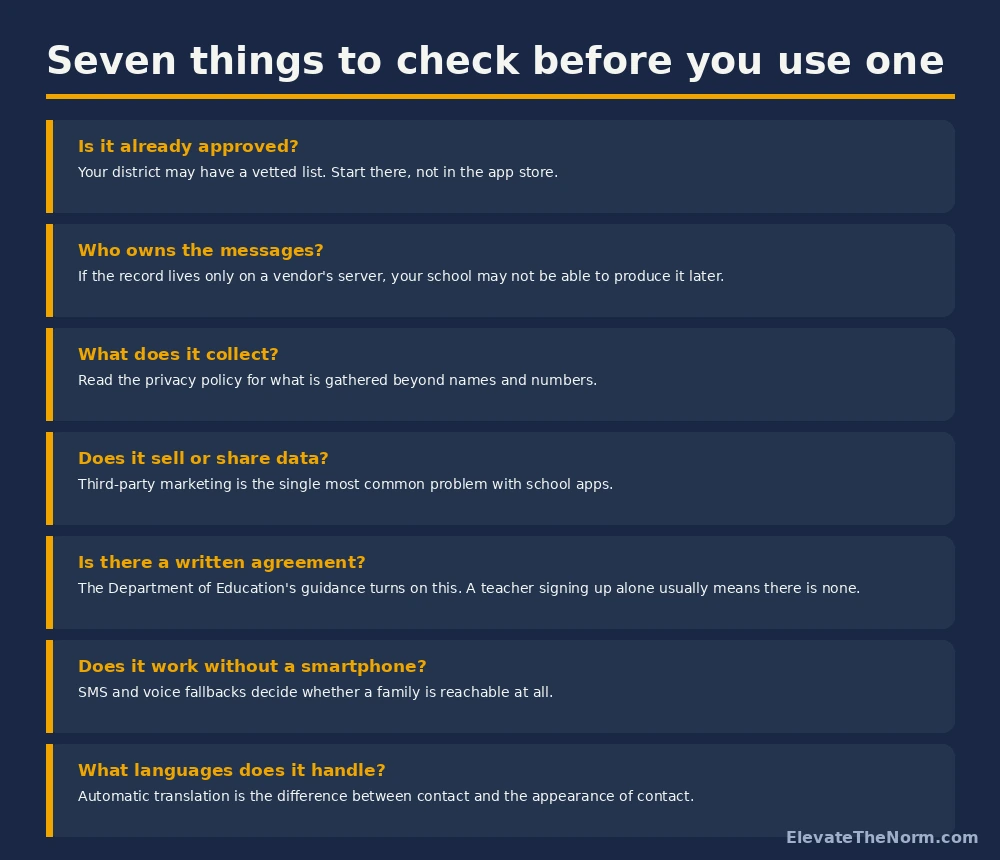
    Checklist of seven things to check before using a parent-teacher communication app, including approval, data sharing and written agreements
    Most of these take ten minutes. Skipping them is how a teacher ends up personally responsible.

    Writing for Edutopia, Roxi Thompson reports a striking figure: 96 percent of apps used regularly in K–12 schools have data-sharing practices that are “not adequately safe for children”, with many sharing personal information with third-party marketers without the school’s knowledge or consent. Thompson is reporting that figure from other research rather than producing it, so treat it as a well-circulated finding rather than one this article has verified at source — but the direction is not seriously disputed.

    Her practical advice is the right starting point: use the vetted list your district has already produced, because somebody trained has read the privacy documents. If you are evaluating something yourself, read the terms of service and the privacy policy for what is collected and how it is secured, and check a service like the Common Sense Privacy Program, which rates tools across ten privacy dimensions.

    The legal frame sits above that. The US Department of Education’s Student Privacy Policy Office explains that FERPA generally bars sharing personally identifiable student information without consent, with exceptions covering contractors and others performing services for the school — and that written agreements must in many cases be developed to protect student data, with requirements varying by circumstance. The office publishes a written agreement checklist for exactly this.

    Read that sentence again with a teacher’s eyes. A written agreement is a thing a district does. It is not a thing that exists when one teacher downloads an app on a Sunday and starts entering student names.

    None of this is a reason to avoid these tools. It is a reason to use the ones your school has already cleared, and to ask before adopting one it has not. The tool matters less than the habit behind it — what the randomized trials say about reaching families, and a rotation that survives a full roster, is the part no app solves for you.

    Four Kinds of Tool, Doing Four Different Jobs

    Most arguments about which app is best are really arguments about which job you are doing. Sort the category first and the shortlist gets very short.
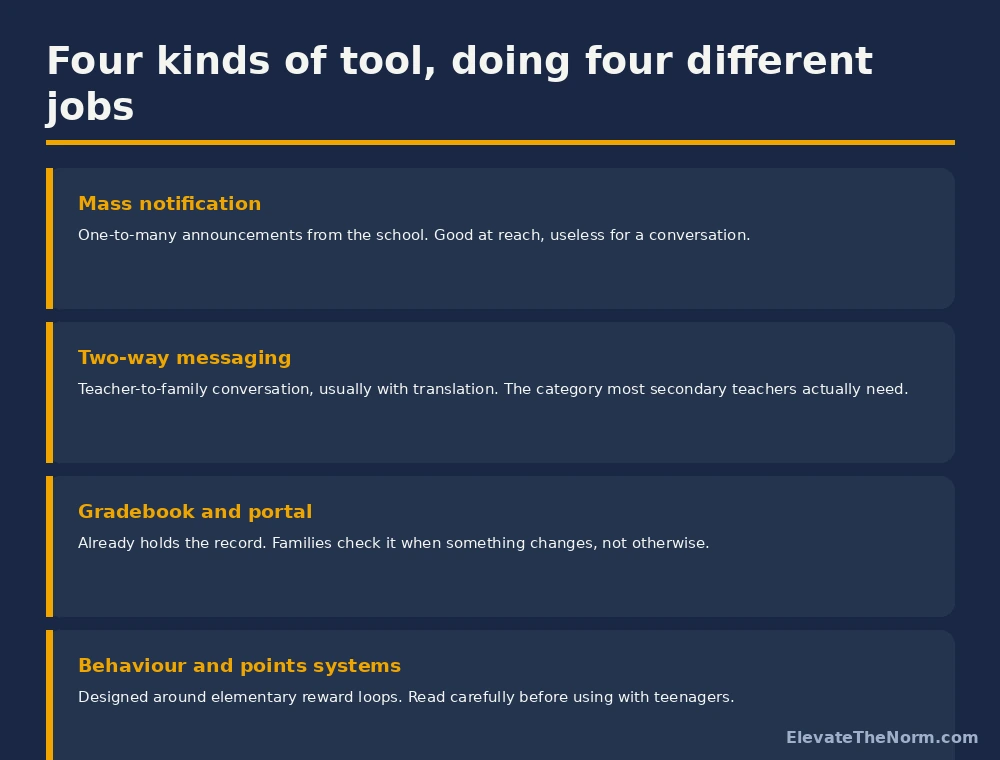
    Four categories of parent communication tool: mass notification, two-way messaging, gradebook portal, and behaviour points systems
    Most arguments about which app is best are really arguments about which job you are doing.

    Mass notification platforms push announcements from the school to everybody. They are excellent at reach and terrible at conversation, and they are usually chosen at district level, so you probably do not get a vote.

    Two-way messaging is the category most secondary teachers actually need — a way to message one family, get a reply, and have it translated. This is where the meaningful differences between products live.

    Gradebook portals already hold the record and already have every family’s login. They are chronically underused as a communication channel because families check them when something changes rather than habitually, which is a notification problem rather than a portal problem.

    Behaviour and points systems deserve a specific warning. Most were designed around elementary reward loops, and several make a student’s standing visible to their family in close to real time. A points economy that a nine-year-old finds motivating is something a fifteen-year-old is likely to find humiliating, and a running public score sits awkwardly with firm standards held without shame. Read what the tool actually shows families before you switch it on.

    I Have Taught With No Devices, Shared Carts and One-to-One

    In my second year, devices arrived as a single cart shared between two classrooms. By my final year at my previous school it was one-to-one, and it is one-to-one again now. I have taught at all three levels of access.

    That progression is the reason I am wary of any communication plan that assumes a smartphone on the other end. Writing the channel down in advance, family by family, is what keeps that assumption from going unexamined. Device access is not evenly distributed among students, and it is distributed even less evenly among their families. A teacher who has only ever worked in a one-to-one building can genuinely believe that “I sent it on the app” is the same sentence as “I contacted the family.”

    It is not. It is the same sentence as “I did the part that was convenient for me.”

    The practical version: whatever app you use, know which families it does not reach, and have a second route for them. Usually that is a phone call, and usually it is three or four families per section. That is an afternoon, once, and it removes the largest blind spot in the whole system. A free Parent Contact Log on TPT makes it easy to see which families you have not reached yet.

    What an App Cannot Fix

    Worth being blunt, because the marketing for all of these implies otherwise.
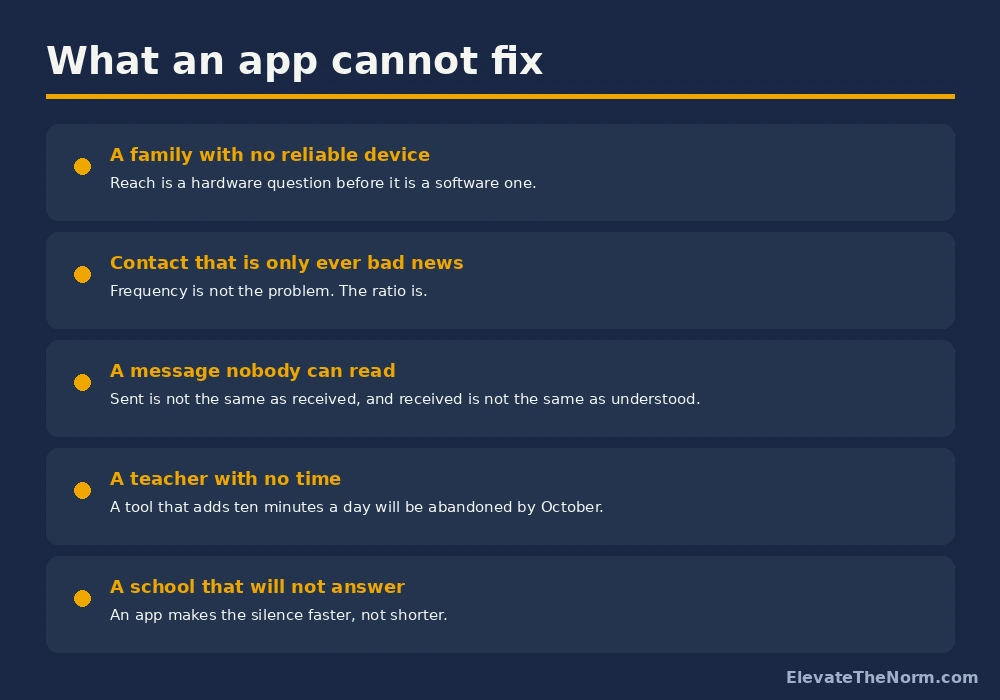
    Five problems a parent-teacher communication app cannot solve, including families without devices and contact that is only bad news
    An app makes the silence faster, not shorter.

    The ratio is the one worth dwelling on. If a family only hears from you when something has gone wrong, the app notification itself becomes a bad-news alert, and people stop opening those. Nothing in the software fixes that — it is a decision about when you make contact, not about how.

    The time cost is the second. A tool that adds ten minutes to your day will be quietly abandoned by October, and an abandoned channel that families were told to use is worse than never having offered it. Pick something you will still be using in week thirty.

    And translation deserves a flag rather than a tick. Automatic translation is genuinely one of the most valuable features in this category and it is genuinely imperfect. It is fine for a homework reminder. For anything consequential — a behaviour incident, a failing grade, a meeting request — get a human interpreter the way your school does for any other serious conversation.

    How to Choose One in About Twenty Minutes

    1. Ask what is already approved. One email to whoever handles technology in your building. If something is on the list, your decision is made and the agreement exists.
    2. Name the job. Announcements, conversation, grades, or behaviour. Pick one — a tool that claims all four usually does two of them badly.
    3. Check the fallbacks. Does it reach a family by SMS or voice when there is no app installed? This single question eliminates several popular options for a lot of schools.
    4. Check the languages against the languages actually spoken by your families, not the marketing list.
    5. Read what families see. Log in as a parent if you can. Some tools show far more than teachers realise, and some show it in real time.
    6. Decide who owns the record. If a dispute arises in March, can your school produce what was sent? If the answer is “the vendor has it,” raise that before you start, not after.

    If nothing is approved and you need something now, the lowest-risk option is usually the tool your district already pays for — the gradebook portal — plus a phone call for the families it does not reach. It is unglamorous and it creates no new data-sharing relationship at all.

    Keep the Record Somewhere You Control

    Whatever tool you land on, keep your own log of substantive contact — date, family, method, what was discussed, what was agreed. Not every message, just the ones that matter.

    Two reasons. The first is practical: you will be asked what you did about a student, sometimes months later, and “I think I messaged them in October” is not an answer. The second is structural: a log that lives with you survives a vendor change, a contract expiry, or a platform your district drops over the summer.

    A printable version is on the free parent-teacher communication log page, no email required. Paper is genuinely fine for this. The point is that the record is yours.

    What to Do Next

    Send the email asking what is approved in your building. While you wait, work out which families in your hardest section you could not reach today if you had to, and how you would reach them instead. That list is short, and it is the most useful thing in this article.

    Then make the first contact of the year a good one, before anything has gone wrong. Every app in every category works better when the notification is not automatically bad news, and that is a choice you make rather than a feature you buy.

    The app gets you to the family. What you say when you get there is the harder question. The evidence on frequency, message content, and what the research actually found — including two randomized trials with effect sizes a secondary teacher can use — is covered in the companion guide to reaching families in grades 6 through 12. For the once-a-term meeting itself, handing the talking over to the student instead of talking about them changes what a family walks out with.

    Product landscapes in this category change quickly. This page describes how to evaluate a tool rather than ranking specific products, so it should stay useful longer than a feature comparison would. Privacy and legal guidance linked here was checked on September 12, 2026.

    Frequently Asked Questions

    Can I just download an app and start using it with my class?

    Usually you should not, and in many districts you are not permitted to. FERPA allows schools to share student information with contractors performing services for them, but the Department of Education’s guidance is clear that written agreements are often required to protect that data. A written agreement is something a district puts in place — it does not exist because an individual teacher accepted a terms-of-service box. Ask what is already approved first; it is one email and it moves the responsibility to where it belongs.

    Which parent-teacher communication app is best?

    There is no single answer, and any article that gives you one is either out of date or selling something. The right tool depends on which job you need done — mass announcements, two-way conversation, grades, or behaviour — and on what your district has already cleared. Sort the category and check the approved list, and the shortlist usually comes down to one or two options you can actually use.

    What about families who do not have a smartphone?

    Plan for them explicitly, because they exist in every school and they are frequently the families you most need to reach. Check whether your tool falls back to SMS or a voice call when no app is installed — several do, and it is one of the more meaningful differences between products. Then identify the handful of families in each section it still will not reach and use the phone. It is usually three or four per class, which is an afternoon once.

    Is automatic translation good enough?

    For routine messages, generally yes, and it is one of the genuinely valuable features in this category. For anything consequential — a behaviour incident, a failing grade, a meeting about placement — use a human interpreter, the same way your school would for any other serious conversation. Machine translation errors in a routine reminder are an inconvenience; the same error in a disciplinary message is a real problem.

    Should I use a behaviour points app with high school students?

    Be careful. Most of these were designed around elementary reward loops, and several display a running score to families in close to real time. What a nine-year-old experiences as a game a fifteen-year-old may experience as a public verdict delivered to their parents. If you are considering one, log in as a parent first and look at exactly what is visible and how quickly. There are secondary classrooms where these work; there are more where they quietly damage the relationship you were trying to build.

    How often should I be messaging families?

    The ratio matters more than the frequency. If the only time a family hears from you is when something has gone wrong, they learn to dread the notification and eventually stop opening it. Making the first contact of the year a positive or simply neutral one costs a few minutes per family and changes how every later message is received. No app feature substitutes for that decision.

    Do I still need a paper log if the app keeps a record?

    Keep your own record of substantive contact, yes. Not every message — the ones that matter. Vendor records can become hard to retrieve, districts change platforms, and contracts end. A short log of date, family, method, what was discussed and what was agreed takes seconds to maintain and answers the question you will eventually be asked months later.

    Sources

    • U.S. Department of Education, Student Privacy Policy Office. Privacy and data sharing. Read the guidance — the source for the FERPA contractor exception and the requirement for written agreements, and the home of the Written Agreement Checklist.
    • Thompson, R. (2023, March 15). Protecting student data privacy. Edutopia. Read the article — the source for the 96 percent figure, which Thompson reports from other research rather than producing, and for the recommendation to use district-vetted lists and the Common Sense Privacy Program.

    Every link above was checked on September 12, 2026. This page deliberately does not rank named products, because feature and pricing claims in this category go out of date faster than an article can be maintained honestly.

    About Clay Shumate

    By Clay Shumate — Clay Shumate is a certified secondary Social Studies teacher in the public schools of West Alabama, with seven years of classroom experience, a B.A. in History, and an M.Ed. in Secondary Education. He writes about project-based learning, student responsibility, respect, and practical ways to hold young people to a higher standard while giving them room to learn from mistakes. He is a member of the Society of Professional Journalists and writes to its Code of Ethics; this site’s editorial standards and corrections policy are published in full.

  • Student-Led Conferences: A Practical Guide for Grades 6–12

    Student-Led Conferences: A Practical Guide for Grades 6–12

    Student-led conferences are meetings where the student — not the teacher — presents their own work to their family, explains what it shows, names what went wrong, and says what they plan to do next. The adults are there to listen and respond. For grades 6–12 the format works because it moves the accounting onto the person who actually did the work.

    The usual conference has a structural problem nobody names: the student is the only person in the building with first-hand knowledge of what happened, and they are the one person not in the room. Two adults discuss a third party who is somewhere else, and then somebody reports back a summary.

    Student-led conferences fix that. They are also more work than they look, they fail in specific and predictable ways, and the evidence behind them is thinner than the enthusiasm around them. All of that is below.

    Key Takeaways

    • The student runs the meeting. Not a presentation about the student — a presentation by the student, from evidence they selected.
    • Attendance is the most reliable gain. One middle school went from 85 traditional conferences to 565 student-led ones in a single year.
    • The preparation is the curriculum. Four weeks of collecting, choosing, writing and rehearsing is where the learning happens. The 25 minutes is just the assessment.
    • Be honest about the evidence. Most of what is published is descriptive, from elementary and middle grades, and the strongest recent study explicitly did not measure achievement.
    • Plan for the families who do not come. A format that only works for students with an adult in the chair will quietly punish the students who need it most.
    • This is a writing and speaking unit. Treat it as one, mark it as one, and the workload argument mostly disappears.

    What Are Student-Led Conferences?

    A student-led conference is a scheduled meeting, usually 20–25 minutes, in which a student walks their family through a portfolio of their own work using a script they wrote. The teacher is in the room — often supervising several conferences at once — and speaks when asked or when something needs correcting. The student does the rest.

    Table comparing traditional parent-teacher conferences and student-led conferences across who talks, who prepares and what is discussed
    The biggest change is not the format. It is who has done the thinking beforehand.

    Faulkner and Cook, writing for the Association for Middle Level Education, put the shift in one line from a teacher who had made the change: “It’s not me telling the parents that Johnny is failing because he won’t turn in his work.” The student says it. That sentence lands differently when it comes out of the student’s own mouth, in front of the person whose opinion they care most about.

    What it is not: a showcase. If students only present their best work, you have built an awards ceremony. The format earns its keep when the folder includes the assignment that did not get done, and the student has to say why.

    Why Student-Led Conferences Work — and What the Evidence Actually Shows

    Start with the claim that holds up best, because it is the one with numbers attached: families turn up.

    Faulkner and Cook report a school that went from 85 traditional conferences to 565 student-led conferences in the first year of the change. A research brief from The Principals’ Partnership describes Mead High School’s first round of student-led conferences, where over 98 percent of parents, 84 percent of students and 100 percent of advisors said the conferences were worthwhile.

    That is a real effect and it is not trivial. A conference nobody attends teaches nobody anything — and attendance is usually downstream of whether families have heard from you before the conference, which is its own problem of short, specific, weekly contact.

    Where the evidence thins out

    Now the honest part. The same Principals’ Partnership brief says plainly that most of what is written about student-led conferences describes elementary or middle-level implementation, and it is a 2005 document summarising practice rather than a controlled study.

    The most substantial recent study is Şişman and Bahadır’s, covering 249 students, 280 parents and 22 teachers across fourth grade through high school in a single private school. It found positive effects on responsibility, self-management, self-expression, communication and leadership — and the authors themselves note that future research should look at the effects on student achievement, which is a polite way of saying this one did not. One private school also limits how far the result travels.

    So the defensible version is this. Student-led conferences reliably increase family participation, and the people who do them report gains in student ownership and communication. Whether they raise achievement is genuinely unstudied. Anyone telling you otherwise is selling something.

    That is still a good enough reason to run them. Getting a fourteen-year-old to account for their own work in front of their family is worth doing whether or not it moves a test score, and it fits the same logic as raising the standard without removing grace.

    What the Student Actually Says

    Give every student the same four-part spine. Without it, most of them freeze in the first minute and the parent starts asking you questions instead — and the conference quietly reverts to the old format while everyone pretends otherwise.

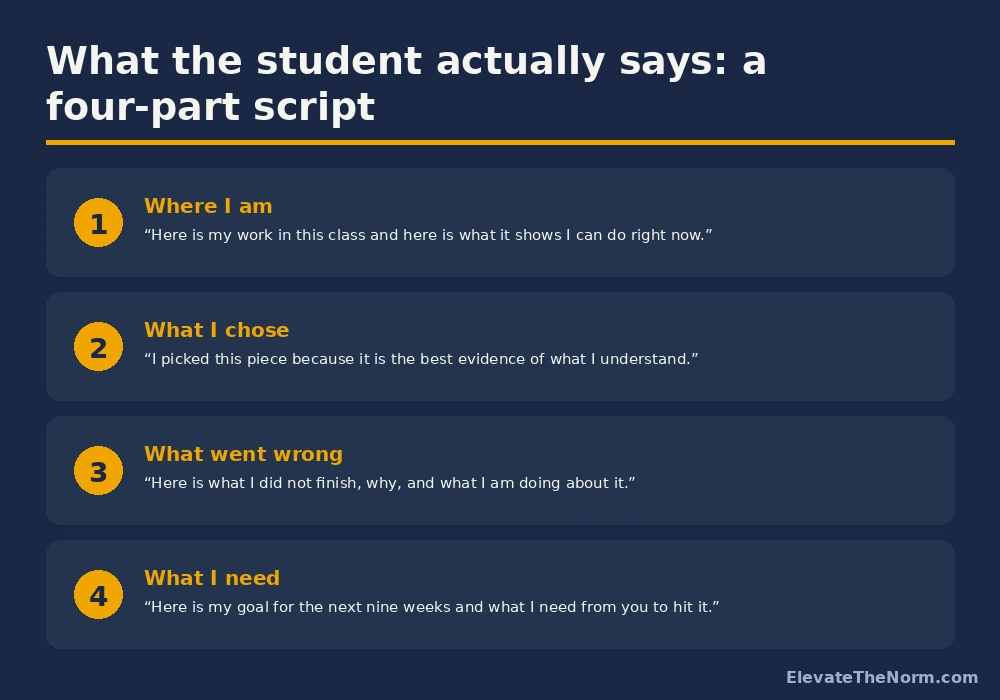
    Four-part script a student follows in a student-led conference: where I am, what I chose, what went wrong, what I need
    The script is the scaffold. Without it, most students freeze in the first minute.

    The four parts, in order: where I am, what I chose and why, what went wrong, and what I need. Each one is a short paragraph the student drafts, revises and rehearses.

    If your school runs traditional conferences and a full student-led format is not on the table this year, the same thinking fits on one page: a student self assessment brought into a parent teacher conference gets the student’s judgment into the room without changing who runs the meeting.

    The third part is the one that matters and the one schools soften. “What went wrong” is where a student says out loud that they did not turn in three assignments in October, and then says what they are doing about it. Peter Neeves, writing in Edutopia, describes handling missing work not with punishment but with a written reflection and an assistance plan that names the underlying issue — organisation, attendance, whatever it actually is. That is the right instinct. The student still has to say it.

    The fourth part keeps the meeting from ending in vague agreement. “What I need” forces a specific, checkable ask: a weekly check-in, a quieter place to work at home, a reminder on Sunday nights. Families leave with a job, which is what most of them wanted in the first place. The four parts above are one structure; there are sixteen other ways to run the meeting depending on whether your constraint is the calendar, the subject, or the families who cannot get to the building.

    Who Is Doing What While the Student Talks

    Everyone in the room needs a job, or the adults will invent one. The job they invent is usually talking.

    The student runs the meeting and owns the account of their own term. The family member listens first and asks questions second — hand them a printed card with three prompts on the way in, or the default question becomes some version of “so are you behaving?” The three that work: what surprised you about your own work, what would you do differently, and what is one thing I could do at home that would actually help.

    The teacher stays out of it unless invited, then adds one piece of context the student could not supply — nine times out of ten something the student undersold. Counsellors and administrators moving between conferences should be listening for patterns across students rather than evaluating individual ones. An instructional coach watching a colleague’s first round has one genuinely useful measurement to take: how much of the twenty-five minutes the teacher spent talking. Above a fifth of it and the thing that needs tightening is the script, not the teacher.

    A Four-Week Run-Up That Fits an Ordinary Term

    The preparation is the part that gets skipped and the part that decides whether this works. Four weeks, one thing per week, all of it inside lessons you were teaching anyway.

    Four-week preparation timeline for student-led conferences: collect, choose, write, rehearse
    Four weeks, and the writing week is the one that does the work.
    1. Collect. Every student starts a folder. Every graded piece goes in, good or bad, dated. No curation yet — curation is next week’s skill and doing it now defeats the point.
    2. Choose. Two pieces of evidence per class, plus one sentence each on why that piece was chosen. Neeves describes teachers offering three eligible samples and letting the student pick one; that constraint helps students who would otherwise pick at random.
    3. Write. Students draft the script. This is a writing lesson — audience, purpose, evidence, concision — so teach it and mark it as one. It is also the week you find out who has been quietly hiding.
    4. Rehearse. Twice, on a partner. The first run is a disaster for almost everyone. The second is the one that works, which is the entire argument for rehearsing.

    Neeves puts the whole cycle at roughly one month with benchmark dates published to staff, which matches what the four weeks above ask for. Faulkner and Cook are blunt that the first run is labour-intensive for faculty. Both are true. The second year costs a fraction of the first.

    Build one adaptation in from the start rather than improvising it later: for a student who genuinely dreads speaking in front of people, let them write the conference as a letter to their family and read it aloud. The structure still does its work — evidence, an honest account of what went wrong, a stated next step — and it is a far better outcome than a student who freezes and a parent who ends up looking at you instead. Decide that in the writing week, not on the night.

    If you want the forms rather than the argument, the free student-led conference toolkit has the portfolio cover sheet, the script frame and the reflection prompts, with no email required.

    Watching a Student Defend Their Own Decisions

    The closest thing I run to this on an ordinary week is a project check-in where the student has to defend the choices they made — not report what they did, but explain why they did it that way and why the alternative was worse.

    It changes what students pay attention to. When you know you will have to justify a decision out loud to somebody who will ask a follow-up question, you make the decision differently in the first place. The check-in is not really an assessment of the work. It is the thing that makes the work get thought about.

    A student-led conference is that same move, scaled up and pointed at a harder audience. A teenager explaining a rubric decision to me is practising. A teenager explaining a term’s worth of work to their own family is doing the real version, and they know the difference.

    Which is also why the preparation cannot be skipped. Handing a student that audience with no script is not raising the standard — it is setting them up, and the students most likely to be embarrassed by it are the ones already having the worst term.

    The Families Who Do Not Come

    Plan for this before you launch, not on the night. Faulkner and Cook name it directly: not all parents attend, and schools need a contingency. If your entire format depends on an adult sitting in that chair, then the students whose families work nights, lack transport, or simply will not come get a worse version of school than everyone else — and those are frequently the students the format was supposed to help.

    Workable contingencies, roughly in order of preference:

    All of these depend on being able to reach the family at all, which is worth checking before conference week rather than during it — a running log of family contact will show you quickly which families you have not actually reached. If you are still deciding what to keep that log in, choosing a parent-teacher communication app is more a question of approval and student data than of features. For the families who do come, sending home the questions that are worth asking at a conference a few days early gives them something to do in the room besides listen.

    • A different adult from the building. A coach, a counsellor, a teacher from another department. Arrange it quietly in advance so the student is not visibly the one nobody came for.
    • A phone or video slot on another day. Costs nothing and solves the shift-work problem for a lot of families.
    • A recorded conference. The student delivers the script to camera and it goes home. Weaker, because the follow-up questions are the valuable part, but far better than nothing.
    • Never: skip the student. If a student prepared for four weeks, they present. The audience can change; the presentation happens.

    Schedule the alternatives at the same time you schedule the main round. A contingency invented at 6pm on conference night is not a contingency, it is an apology.

    Where Student-Led Conferences Go Wrong

    • Skipping rehearsal. The single most common failure. An unrehearsed student reads the script at the table in a monotone and everyone concludes the format does not work.
    • Turning it into a showcase. Best-work-only conferences are pleasant and teach nothing. The missing assignment belongs in the folder.
    • The teacher taking over. Usually well meant, usually triggered by a silence the teacher finds uncomfortable and the student does not. Let the pause sit.
    • Running it once. The first round is the expensive one. Schools that quit after year one pay the full cost and collect none of the return.
    • No plan for absent families. Covered above, and it is the failure with the worst distribution of harm.
    • Treating it as an add-on. If the preparation is not inside your teaching time, it will not survive contact with an ordinary term.

    The Follow-Up Almost Nobody Runs

    Six weeks after the conference, pull the students’ stated next steps back out and spend one lesson having them write a short progress note against their own commitment. Not a grade, not another form for the family — just the student, in writing, on whether they did the thing they said they would do in front of their mother.

    That one lesson is most of the difference between a format and an event. The commitment was public, it was theirs, and now it has a check-in attached to it. Skip it and the conference becomes a very well-organised twenty-five minutes that nothing follows.

    What to Do Next

    Do not start with the whole school. Start with one section, one term, and the four-week run-up — the student-led conference template carries the readiness checklist, the portfolio planner and the script that run-up needs, free and with no email required. Tell families in writing what will be different and why, so nobody arrives expecting the usual five minutes with you. Build the alternate-audience list before you need it.

    Then judge it on the thing you can actually see: whether students can account for their own work in front of somebody who matters to them. That is the skill the format teaches, it is measurable in the room, and it is worth having whether or not anyone ever proves it moves a grade. It also sits naturally alongside expecting a lot and backing it with support rather than pressure. It also pairs naturally with assigning students genuine leadership roles inside the classroom — the conference is the most visible of them, because the audience is the student’s own family.

    Printables for this

    Start with the free one on this site. The full conference template pack has the readiness checklist, the evidence and portfolio planner, the student script and the family follow-up agreement — a printable PDF plus an editable Word version, no email required. Two of mine on TPT go further. Parent Teacher Conference Forms has the prep sheet, the conversation script and the follow-up record for the conferences you still run the usual way. The Parent Contact Log is free and solves the problem in the contingency section above — knowing before conference week which families you can actually reach.

    Frequently Asked Questions

    How long should a student-led conference be?

    Twenty to twenty-five minutes is the standard, and it is about right for grades 6–12. Shorter than fifteen and students rush the part where they explain what went wrong, which is the part worth having. Longer than thirty and families with several children cannot make the schedule work. If you are running several conferences at once in one room, build in five minutes of slack between slots.

    What if the student is failing? Is this not humiliating?

    It is the opposite, if you prepare it properly. The humiliating version is the one where two adults discuss a student’s failure while the student waits outside. In a student-led conference the student names the problem themselves, in their own words, with a plan attached. What makes it cruel is skipping the preparation — handing a struggling student that audience with no script and no rehearsal. Do the four weeks and this becomes the most useful conversation a failing student has all year.

    Do student-led conferences replace traditional parent-teacher conferences?

    Not necessarily, and the research summaries treat the model as a supplement rather than a straight replacement. Some parents genuinely want a private conversation with the teacher, and there are situations — a safeguarding concern, a possible referral, a dispute — that should never be run through a student. A common arrangement is student-led as the default with a signup option for a separate adults-only conversation.

    How much extra work is this for teachers?

    The first round is genuinely heavy; the sources describing it say so plainly. After that it drops sharply because the portfolio structure, the script frame and the schedule already exist. The way to keep it sustainable is to stop treating the preparation as extra. Collecting, selecting evidence, writing to an audience and rehearsing a spoken presentation are all things you were supposed to be teaching anyway. Run them as the unit they are and mark them.

    What does the teacher actually do during the conference?

    Supervise, and stay out of it. You are usually overseeing several conferences in one room, which is part of why this scales. Answer direct questions, correct anything factually wrong, and otherwise let silences happen. The most common teacher error is filling a pause that the student was about to fill themselves.

    At what grade can students start leading their own conferences?

    Middle school is where most of the published practice sits, and sixth or seventh grade is a reasonable starting point with a tighter script and a shorter portfolio. High school students can carry a much longer conference and a far more honest one. The evidence base skews younger — a lot of what is written describes elementary and middle-level implementation — so treat high school adaptations as your own professional judgment rather than something the literature has settled.

    How do we handle a family that speaks a language other than English?

    Arrange interpretation the same way your school does for any other family meeting, and arrange it in advance rather than on the night. Do not use the student as the interpreter for their own conference — it collapses the whole point, because the student ends up translating a conversation about themselves instead of leading one. If a sibling or relative normally interprets, confirm that the family actually wants that here.

    Sources

    • Faulkner, S. A., & Cook, C. M. (2009, October). Student-led conferences: Involving the most important player. Middle Ground, Association for Middle Level Education. Read the article
    • The Principals’ Partnership (2005, January 31). Research brief: Student-led conferences. Sponsored by the Union Pacific Foundation. Read the brief (PDF) — the source for the Mead High School figures, and for the caution that most published material describes elementary and middle-level implementation.
    • Şişman, C., & Bahadır, E. The effects of student led conferences on the improvement of 21st century career and life skills. International Journal of Learning, Teaching and Educational Research. Journal record — 249 students, 280 parents and 22 teachers in one private school; the authors state that effects on achievement were not measured.
    • Neeves, P. (2025, December 3). How to successfully institute student-led conferences at your school. Edutopia. Read the article
    • ERIC Digest (1997, May). Student-led conferences at the middle level. ED407171. ERIC record

    Every link above was checked on September 12, 2026. Where a figure comes from a practitioner report rather than a controlled study, the text says so.


    About Clay Shumate

    By Clay Shumate — Clay Shumate is a certified secondary Social Studies teacher in the public schools of West Alabama, with seven years of classroom experience, a B.A. in History, and an M.Ed. in Secondary Education. He writes about project-based learning, student responsibility, respect, and practical ways to hold young people to a higher standard while giving them room to learn from mistakes. He is a member of the Society of Professional Journalists and writes to its Code of Ethics; this site’s editorial standards and corrections policy are published in full.

  • Student Accountability Sheet: A Free, Non-Childish Classroom Template

    Student Accountability Sheet: A Free, Non-Childish Classroom Template

    By Clay Shumate · Updated October 24, 2026

    A student accountability sheet is a short, structured form a student completes after something went wrong — a missed deadline, a group conflict, a behavior that affected the room. Done right, it takes about five minutes and produces a useful conversation. Done wrong, it is busywork that teaches students nothing except how to fill out busywork. This guide explains the difference, offers a free template in four versions, and shows exactly how to use it in a secondary classroom without humiliating anyone or generating a paper trail for things that do not belong on one.

    Key Takeaways

    • An accountability sheet supports a conversation — it is not a punishment, a replacement for a school referral, or a way to document a student for later.
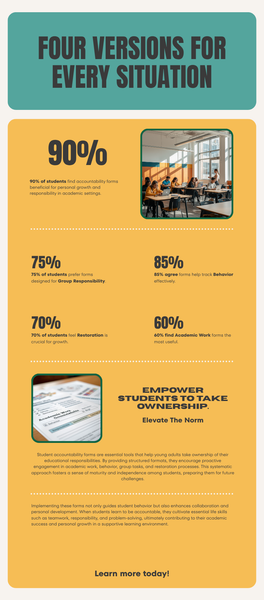
    • Four versions cover the situations teachers actually face: academic work, group responsibility, behavior, and restoration after a conflict.
    • Students complete the sheet themselves. That is the point. If the teacher is doing the writing, the tool is being used incorrectly.
    • The sheet is not a file. Unless a required school procedure calls for documentation, it lives with the student or gets recycled after the conversation.
    • Any teacher can use this the first week of school. No program, no training, and no administrator approval required.

    What Most Accountability Sheets Get Wrong

    Most accountability sheets found in schools — and most of the printables circulating on teacher resource sites — were designed for elementary students and scaled up by changing the font. They ask students to write “what I did wrong” in a box, then “how I will do better next time” in another box, and they expect that sequence to produce insight. It rarely does, because the sequence assumes the student already has a clear picture of what happened and why. They often do not.

    The other common design flaw is that the sheet exists only as a record. A teacher hands it to a student, the student fills it out, the teacher collects it and puts it in a folder. Nothing happens as a result. The student learns that accountability means paperwork, not change — which is exactly the wrong lesson.

    A well-designed student accountability sheet for grades 6–12 does three things that most forms skip. It separates facts from interpretations, so students can describe what actually happened without being led toward a particular framing. It identifies who, specifically, was affected — not just “the class” in the abstract. And it generates a next step the student can actually take, not a vague commitment to “try harder.”

    Classroom accountability sheet template on a student desk in a secondary classroom with warm lamp lighting
    An accountability sheet is a tool for a five-minute conversation, not a substitute for one.

    When Should You Use a Student Accountability Sheet?

    There are four situations where a short accountability sheet is useful in a secondary classroom. Understanding the difference between them matters, because each version of the sheet asks slightly different questions.

    Academic Work

    A student missed a deadline, submitted incomplete work, or disengaged from a task. The goal of the sheet in this case is not to assign blame but to figure out what actually got in the way. Sometimes the answer is workload. Sometimes it is confusion about the assignment. Sometimes it is something happening at home. The sheet creates space to say so without the conversation becoming a confrontation.

    Group Responsibility

    A student did not hold up their part of a group project. Or a group is in conflict about who did what. The group version of the sheet is filled out individually by each member before the group meets together — which means every voice is already on paper before anyone starts defending themselves out loud. This simple sequencing change reduces the volume of these conversations significantly.

    Behavior

    Something happened in the room — a comment that landed wrong, a refusal, an outburst — that the teacher needs to address before moving on. This version is short by design, because a behavior conversation does not benefit from extended written reflection in the moment. The sheet gives the student a minute to collect their thoughts before speaking, which is often all that is needed to de-escalate the temperature.

    One important note: if the behavior requires a school referral, disciplinary report, or any documentation under your district’s required procedures — do that. The accountability sheet is a classroom tool, not a substitute for mandated process. If you are unsure whether a situation requires official documentation, assume it does and act accordingly. The sheet goes with the student afterward, not instead of the referral.

    Restoration

    Something happened between students — a conflict, an unkind comment, a damaged trust — and the class needs to move forward. The restoration version is the most conversational of the four. It is the one most closely aligned with restorative approaches, and it works best when both students complete their own version before sitting down together. For more on restorative approaches in a school context, see restorative practices in schools.

    VersionUse it whenKey question
    Academic workA missed deadline, incomplete work, or disengagement from a task“What got in the way?”
    Group responsibilityA student did not hold up their part, or a group disputes who did what“What do you owe the group at this point?”
    BehaviorA comment, refusal, or outburst the teacher must address before moving on“Who was affected by it?”
    RestorationA conflict or broken trust between students that the class needs to move past“What did the other person lose or experience?”
    The four accountability sheet versions at a glance.

    What Goes on a Student Accountability Sheet? (4 Free Templates)

    Each template below is designed to be reprinted, typed into a shared document, or read aloud and answered verbally depending on the student and the situation. The fields are short. The language is direct. None of it is condescending.

    Four versions of student accountability sheet side by side showing academic work group responsibility behavior and restoration fields
    Four distinct versions of the sheet cover the situations teachers actually face in grades 6–12.

    Version 1 — Academic Work

    Student name: _______________ Date: _______________

    The assignment or task: _______________

    What was supposed to happen? (Describe the expectation — due date, format, what “complete” looked like.)

    What actually happened? (Facts only. Not reasons yet.)

    What got in the way? (This is where reasons belong. Be honest — including “I didn’t prioritize it” is a valid answer.)

    What is one thing you can do in the next 48 hours to move this forward?

    What support, if any, do you need from me?

    Version 2 — Group Responsibility

    Student name: _______________ Project or task: _______________ Date: _______________

    What was your agreed-upon role or task in this group?

    What did you actually complete?

    What did your group expect from you that you did not deliver?

    What happened from your perspective? (State facts and reasons separately.)

    What do you owe the group at this point?

    What is your next step, and when will it be done?

    Version 3 — Behavior

    Student name: _______________ Date: _______________ Period/class: _______________

    Describe what happened. (What you said or did — not what someone else did first.)

    Who was affected by it? (Name the people, not just “everyone.”)

    What do you want those people to know?

    What is one thing you will do differently?

    Note to the teacher: this version is designed for classroom-level situations. If the incident requires a disciplinary referral, complete your school’s required documentation first. This sheet is a follow-up conversation tool, not a replacement for required procedures.

    Version 4 — Restoration

    Student name: _______________ Date: _______________

    What happened between you and the other person? (Your account of it — not what they did, what happened between you.)

    What did the other person lose or experience because of the situation? (This is a perspective-taking question. Answer it honestly even if it is uncomfortable.)

    What do you want to be different going forward?

    Is there something specific you are willing to do or say to move toward that?

    What do you need from me or from the other person to make this work?

    Teacher and student sitting together at a whiteboard table reviewing an accountability sheet in a secondary classroom
    The sheet starts the conversation — it does not replace it. Five minutes at the whiteboard table is worth more than a folder full of completed forms.

    How Do You Use a Student Accountability Sheet?

    The sheet is not the conversation. It is the preparation for one. A student who fills it out in silence and hands it in has not been held accountable — they have completed a writing assignment. The point of the form is that it gives the teacher and the student a shared document to look at together, which is significantly less confrontational than looking at each other across a desk.

    The sequence that works: hand the student the sheet and give them three to five minutes to complete it, without hovering. Sit down together to review it — ideally somewhere that is not the center of the room. Read it together, ask one or two follow-up questions, and agree on the next step before the student returns to work. That is the whole procedure. If it is taking longer than ten minutes, either the situation is more serious than this tool was designed for, or the conversation has turned into a lecture. Stop the lecture.

    The anchor question in every version is some variation of “what is your next step?” That is the question that determines whether the sheet produced anything useful. A vague next step (“I’ll try harder,” “I’ll be better”) is not a next step. Push for something specific and time-bound: “I’ll finish the introduction section by Thursday,” or “I’ll ask Morgan what I can do to address what happened.” Specificity is what makes accountability concrete rather than performative.

    A Classroom Anchor: Authority Handed and Held

    The accountability sheet works best when students already understand that authority in the room is real and is held to. A clearly visible classroom expectations poster does much of this work passively — it gives students a reference point before anything goes wrong, so the accountability sheet’s first question (“what was supposed to happen?”) lands with specificity rather than guesswork. In my workshop room — where students are almost always working alongside somebody, and I move between groups rather than lecture from the front — the sheet tends to come up most often around group work, and specifically around moments where a student was trusted with a role and did not follow through on it.

    When that happens, I do not announce it to the room. I slide the Version 2 sheet to the student at their table and give them four or five minutes while I circulate. Then I pull them to the whiteboard table — my small-group conferencing area with a rug, better chairs, and a lower lamp, where students know they are being seen carefully and not put on display — and we work through their answers together.

    The conversation is not about catching them in something. It is about naming what happened clearly enough that we can figure out what comes next. Students who have been given real authority over something — their section of a project, their role in a group, a decision that affects others — understand why the accounting matters. It matches the weight of the responsibility they were given. What does not match it is a form that feels like it was designed for a third-grader. The template above is written at the level the student is actually operating at. That is the difference between accountability and humiliation, and it matters.

    This approach connects directly to what student responsibility looks like in the classroom — real responsibility includes real accounting when things go wrong, not manufactured consequences or empty apologies. For the broader case for high expectations paired with the room to learn from mistakes, see high expectations for students.

    What If a Student Doesn’t Follow Through?

    A student completes the sheet, agrees to a next step, and then does not take it. This happens. Here is the important thing: that outcome does not mean the sheet failed. It means you now have a second conversation with more information than you had before. You know what the student said they would do. You know they did not do it. The conversation gets more specific, not more punitive.

    The escalation path in this case depends on what the situation actually requires. Some students need more support than a single conversation provides — academic, social, or something else entirely. The sheet is not a substitute for identifying that need and addressing it. If a pattern emerges across multiple sheets and conversations, that is information that may need to go to a counselor, an interventionist, or a parent. At that point the sheet is one piece of a larger picture, not the whole solution.

    For students whose accountability issues involve ongoing behavior challenges, the positive discipline framework for teenagers provides a more structured approach that pairs well with the sheet. For situations involving harm between students, the natural consequences framework and the restoration version of the sheet work together. And for the broader question of how to build a classroom where students actually want to hold themselves accountable, see the site’s overview of student responsibility as a developmental skill, not a character judgment.

    The Research Behind It

    Self-regulated learning research has consistently found that students who can reflect on their own performance — identify what went wrong, name contributing factors, and plan a corrective action — outperform students who receive only external evaluation (Zimmerman, 2002). The accountability sheet is applied self-regulated learning: it scaffolds a reflective process that students build over time.

    Self-determination theory (Deci & Ryan, 2000) adds an important dimension: students are far more likely to take a next step they chose than a consequence that was imposed on them. Every version of the sheet ends with the student naming a next step. That ownership matters for what actually happens afterward. Hattie’s (2009) meta-analysis of over 800 studies identified student self-assessment — including structured reflection on what went wrong — as one of the highest-leverage interventions available to teachers. The accountability sheet is a low-cost, no-training version of exactly that.

    Research on restorative approaches in schools (Morrison & Vaandering, 2012; Skiba & Peterson, 2000) supports the same conclusion from the discipline side: punitive responses to student misbehavior consistently underperform restorative ones on measures of recurrence, school climate, and relationship repair. A sheet that asks students to identify who was affected and what they are willing to do to repair it is grounded in that same framework, without requiring a school-wide program or a trained facilitator.

    If you want the same plain, non-childish approach for the days you are not in the room, the free Sub Survival Kit at SubstitutePlans.com has a daily report form a substitute fills out, plus attendance sheets, seating charts and backup activities. It covers the record-keeping so the accountability conversation can still happen when you get back.

    Printables for this

    Two of mine on TPT, both built for this. Behavior Documentation Forms are the other half of the picture — the ABC data and MTSS logs you keep when a pattern does need a record, which the sheet above deliberately is not. The Makeup Work System handles the follow-through on the academic version, so “what is your next step” has a process behind it.

    If a tracking sheet is not enough on its own: see how to build a behavior contract a student will actually respect, including a sample and an honest read on whether contracts work.

    Frequently Asked Questions

    What is a student accountability sheet?

    A student accountability sheet is a short, structured form a student completes after something went wrong, such as a missed deadline, a group conflict, or a behavior that affected the room. It separates facts from reasons, names who was affected, and ends with a specific next step. It supports a private conversation; it is not a punishment or a disciplinary record.

    How long should an accountability sheet conversation take?

    About five minutes. Give the student three to five minutes to complete the sheet without hovering, then sit down together away from the center of the room, ask one or two follow-up questions, and agree on a specific, time-bound next step. If it runs past ten minutes, the situation needs more than this tool or the talk has turned into a lecture.

    Is a student accountability sheet the same as a disciplinary referral?

    No. A disciplinary referral is a formal school document that enters a student’s record, triggers review by an administrator, and may carry consequences under district policy. An accountability sheet is a classroom tool — a short form that supports a private conversation and a next step. It is not filed, not sent to the office, and not part of the student’s disciplinary record unless you deliberately attach it to a referral as supporting documentation. If a situation requires a referral, complete the referral. The accountability sheet is for situations that do not — which is the majority of what happens in a classroom on any given day.

    What if the student doesn’t fill it out honestly?

    Some students will write what they think you want to hear. That is useful information, too. If the sheet reads like a performance rather than a reflection, say so directly and ask one specific follow-up question: “When you wrote you would try harder — what does that look like for you on Monday?” Most students will either give a more honest answer or reveal that they actually do not know. Both are starting points for a real conversation. The sheet is not a truth test. It is a structure for a conversation, and the conversation is where the real work happens.

    Does this go in the student’s permanent file or record?

    No — not unless your school’s procedures specifically require it for a given type of incident. For most classroom-level situations, the sheet lives with the student or gets recycled after the conversation. If you are using it as part of a required disciplinary process, follow your school’s documentation requirements for that process. Do not create an informal file of completed accountability sheets. That is not what this tool is for, and it can create problems if the file is ever requested.

    Can parents request to see these sheets?

    Parents can request records their child’s school maintains about them under FERPA. If you are collecting and storing completed accountability sheets in any systematic way, you should treat them as education records and handle them accordingly. The simplest way to avoid this issue is to not store them: use the sheet, have the conversation, and let the student keep it or discard it. A brief note in your own records of the conversation and the agreed-upon next step is sufficient documentation for your own use.

    What should I do if the student refuses to fill it out?

    A student who refuses to engage with the sheet is telling you something about their state in that moment. Do not escalate over the sheet itself. Give them a minute, check in quietly, and decide whether this is a moment of genuine distress, a test of your authority, or something else. If it is a test, name what you see calmly: “I’m going to give you two more minutes. I’ll come back.” If it is distress, the sheet can wait. If refusal becomes a pattern, that is a separate conversation — about engagement and trust, not about a form.

    At what grade level does this work best?

    The templates above are designed for grades 6–12. The language is appropriate for middle school and can be used as-is with most high school students. Students in grades 6–8 may need more scaffolding during the conversation — they often have the self-awareness but not yet the vocabulary to name what happened clearly. The teacher’s role in those grades is slightly more coaching than questioning. High school students can generally complete the sheet more independently, though the conversation afterward is equally important at both levels.

    How do I use the group responsibility version fairly when students blame each other?

    Have each student complete their own version of the sheet before anyone talks. This is non-negotiable: if students start talking first, they immediately start building a shared story that may not reflect what each person actually experienced. Once each student has answered the questions in writing, bring them together. Start with what each person wrote about their own contribution — not the other person’s failures. The sheet’s structure forces that sequence because the questions are framed around the student’s own actions. It does not eliminate conflict, but it changes the opening move from accusation to accounting.

    Sources

    • Zimmerman, B. J. (2002). Becoming a self-regulated learner: An overview. Theory Into Practice, 41(2), 64–70. https://doi.org/10.1207/s15430421tip4102_2
    • Deci, E. L., & Ryan, R. M. (2000). The “what” and “why” of goal pursuits: Human needs and the self-determination of behavior. Psychological Inquiry, 11(4), 227–268. https://doi.org/10.1207/S15327965PLI1104_01
    • Hattie, J. (2009). Visible Learning: A Synthesis of Over 800 Meta-Analyses Relating to Achievement. Routledge.
    • Morrison, B. E., & Vaandering, D. (2012). Restorative justice: Pedagogy, praxis, and discipline. Journal of School Violence, 11(2), 138–155. https://doi.org/10.1080/15388220.2011.653322
    • Skiba, R. J., & Peterson, R. L. (2000). School discipline at a crossroads: From zero tolerance to early response. Exceptional Children, 66(3), 335–346. https://doi.org/10.1177/001440290006600303

    About Clay Shumate

    By Clay Shumate — Clay Shumate is a certified secondary Social Studies teacher in the public schools of West Alabama, with seven years of classroom experience, a B.A. in History, and an M.Ed. in Secondary Education. He writes about project-based learning, student responsibility, respect, and practical ways to hold young people to a higher standard while giving them room to learn from mistakes. He is a member of the Society of Professional Journalists and writes to its Code of Ethics; this site’s editorial standards and corrections policy are published in full. More about Clay.

  • What Is Student Responsibility? A Clear Definition for Schools and Families

    What Is Student Responsibility? A Clear Definition for Schools and Families

    By Clay Shumate

    Student responsibility is a student’s ability to own their choices, meet their obligations and make things right when they fall short, without waiting for an adult to step in. It covers four areas: academic, behavioral, interpersonal and community. Students learn it through practice, real choices and fair consequences, not through lectures about why it matters.

    Key Takeaways

    • Student responsibility has four overlapping dimensions: academic, behavioral, interpersonal and community.
    • Responsibility isn’t obedience: obedience complies while an adult is watching, and responsibility holds when no one is.
    • Responsibility develops through real choices, honest feedback, proportionate consequences and a path back after failure.
    • Schools and families each control different pieces of student responsibility, and neither can build it alone.
    • CASEL lists responsible decision-making as one of five core social and emotional competencies, and says all five can be taught.

    What Is Student Responsibility?

    Student responsibility is a student’s ability to manage their own behavior and obligations without constant adult supervision. A responsible student isn’t one who never makes mistakes. It’s one who owns the mistake, faces the consequence that was promised and doesn’t wait for an adult to notice and solve every problem.

    Psychologist William Damon made a related case in Greater Expectations. Publishers Weekly’s review of the book sums up his argument: a child-centered culture of easy rewards slows young people’s growth, and children “crave intellectual challenge and respond to the discipline of religious and moral principles.” In an excerpt published in Education Week, Damon writes that “self-esteem is not a virtue that can be directly transmitted through abstract injunctions.” Pressure and praise can produce compliance. Ownership and real consequences are what build responsibility.

    The Collaborative for Academic, Social, and Emotional Learning (CASEL) puts responsible decision-making among its five core social and emotional competencies and defines it as “the abilities to make caring and constructive choices about personal behavior and social interactions across diverse situations” (CASEL framework). It isn’t a personality trait. CASEL says the five competencies “can be taught and applied at various developmental stages from childhood to adulthood.”

    What Are the Four Dimensions of Student Responsibility?

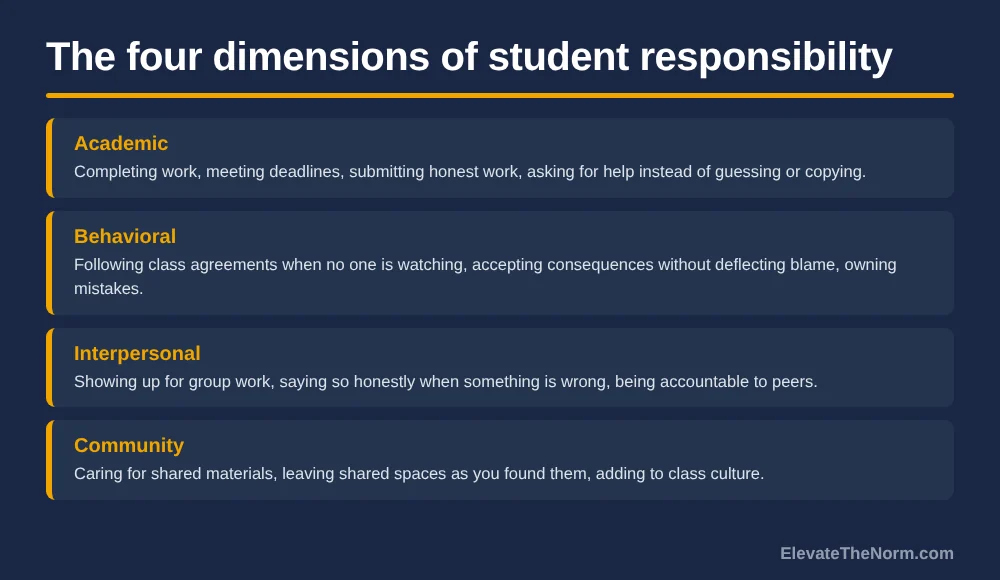
    Student responsibility has four dimensions: academic, behavioral, interpersonal and community. A student can be strong in one and weak in another, so naming which dimension is the gap is the first step to fixing it.

    Chart listing the four dimensions of student responsibility: academic, behavioral, interpersonal and community, with what each looks like
    The four dimensions of student responsibility at a glance.

    Academic Responsibility

    Academic responsibility includes completing assigned work, meeting deadlines, submitting honest work, and asking for help when confused instead of guessing or copying. It also includes managing study time independently and advocating for yourself when you do not understand something.

    Academic responsibility does not mean students work alone all the time. It means that when they work together, they each contribute. A student who coasts through group work—contributing nothing while taking credit—is not being academically responsible, even if their final grade does not show it.

    Behavioral Responsibility

    Behavioral responsibility means following class agreements even when the teacher is not watching, accepting consequences proportionately without deflecting blame onto others, and owning mistakes directly. A student who accepts a consequence and then moves on is demonstrating behavioral responsibility. A student who spends more energy disputing the consequence than they spent on the behavior that caused it is not. If you want a think sheet that treats students like young adults, my Behavior Reflection Sheets on TPT come in two levels.

    Interpersonal Responsibility

    Interpersonal responsibility means showing up for group work when you said you would, communicating honestly when something is wrong rather than disappearing, and holding yourself accountable to your peers without waiting for adult intervention. This is where student responsibility in the classroom becomes most visible—and most difficult—because teenagers are still developing the relational skills that make peer accountability possible.

    Community Responsibility

    Community responsibility extends beyond the individual: caring for shared classroom materials, leaving shared spaces as you found them, contributing to class culture rather than just extracting from it. This dimension is often underdeveloped in schools that treat responsibility purely as a compliance matter. A student who only does what serves themselves and ignores what their behavior costs the people around them has not developed full responsibility.

    DimensionWhat it looks like
    AcademicCompleting work, meeting deadlines, submitting honest work, asking for help instead of guessing or copying
    BehavioralFollowing class agreements when no one is watching, accepting consequences without deflecting blame, owning mistakes
    InterpersonalShowing up for group work, communicating honestly when something is wrong, being accountable to peers
    CommunityCaring for shared materials, leaving shared spaces as you found them, contributing to class culture
    The four dimensions of student responsibility at a glance.

    What Is the Difference Between Responsibility and Obedience?

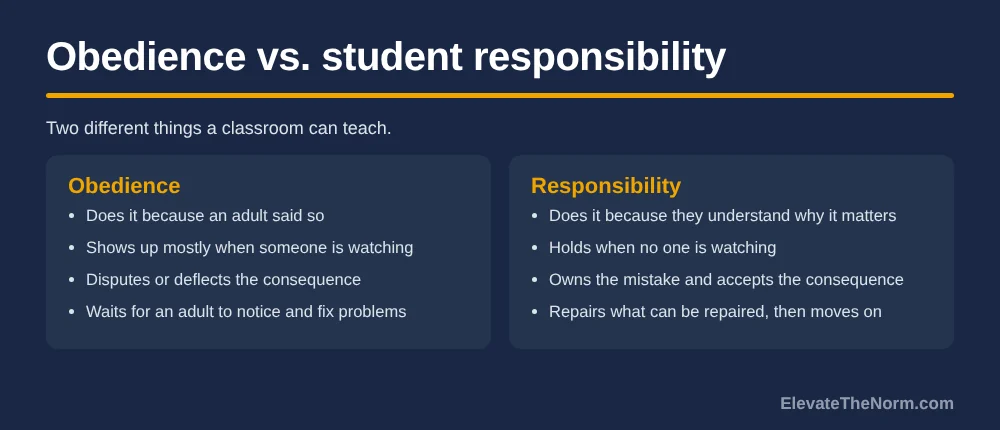
    Obedience means doing something because an adult said so. Responsibility means doing it because you understand why it matters. An obedient student behaves while supervised; a responsible student meets obligations when no one is watching.

    A student who only acts responsibly when supervised has learned obedience—or at least its performance. A student who checks their own work before turning it in, admits to the group member that they did not pull their weight, and asks the teacher for an extension before missing a deadline rather than after: that student is practicing responsibility. I use the forms in my Makeup Work System on TPT so absent students know exactly what they missed and when it is due.

    Two-column chart comparing obedience, which depends on an adult watching, with student responsibility, which holds when no one is watching
    Obedience depends on an adult watching. Responsibility holds when no one is.

    This distinction shapes discipline. Teachers who confuse the two often escalate consequences trying to produce responsibility when what they are getting is compliance or its absence. More pressure can produce more compliance—but it rarely produces more ownership. And once a student is under enough pressure, it produces neither.

    For classroom approaches that build genuine responsibility rather than managed compliance, see positive discipline for teens and natural consequences in the classroom.

    How Do Students Develop Responsibility?

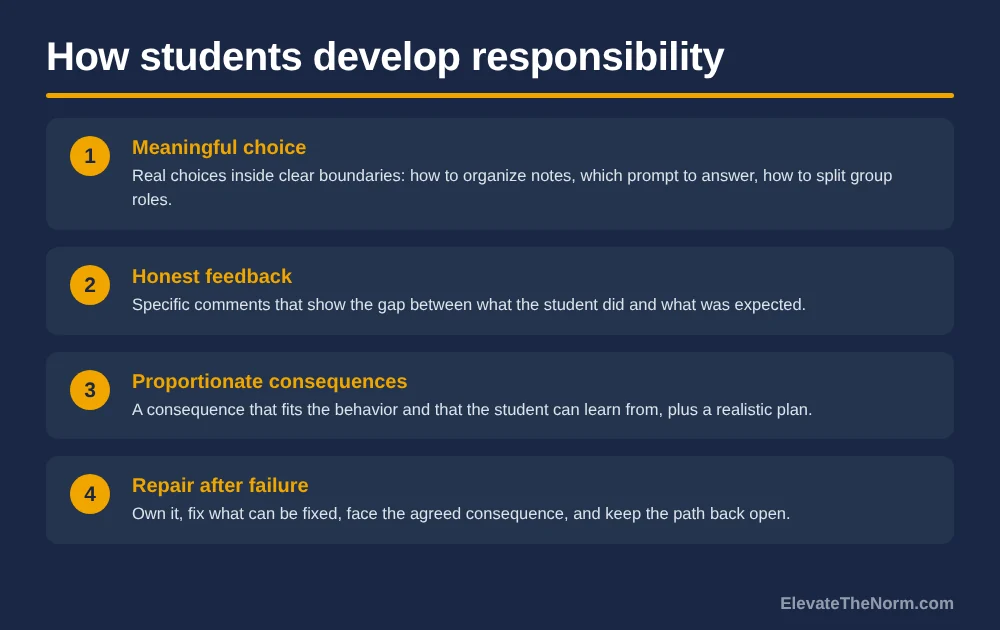
    Students develop responsibility through practice: real choices within clear limits, honest feedback, consequences that fit the behavior and a way to repair mistakes. Each one gives a student something to own, and owning it is the skill.

    Self-determination theory explains why. Ryan and Deci (2000) name three basic psychological needs, competence, autonomy and relatedness, and describe autonomy not as independence but as “the feeling of volition that can accompany any act.” They write that “the experience of autonomy facilitates internalization,” which is the process of taking an outside expectation on as your own. A student with no choices in class and no voice in outcomes has nothing to internalize. They’re compliant at best and resistant at worst.

    Four numbered cards: meaningful choice, honest feedback, proportionate consequences and repair after failure
    Four conditions that help students develop responsibility.

    Through Meaningful Choice

    Students cannot develop responsibility for choices they are never allowed to make. This does not mean every class decision is put to a vote. It means giving students real choices within clear boundaries: how they organize their notes, which of three article prompts to respond to, how they divide group roles. Choices with low stakes but genuine consequences—where the student experiences the results of their own decisions—are the practice ground for larger responsibility.

    Through Honest Feedback

    Vague praise tells students nothing useful. “Good work” does not tell a student what to repeat or what to change. Specific, honest feedback—”your argument on page two is clear; the evidence in the third paragraph does not quite support the claim you are making”—gives students something to act on. Feedback that helps students understand the gap between what they did and what was expected builds the self-awareness that responsibility requires.

    Through Proportionate Consequences

    Consequences need to match the behavior and be ones the student can actually learn from. A student who forgets homework and gets a zero learns to hide it next time. A student who forgets homework and has a brief, direct conversation about why—followed by a realistic plan for finishing it—learns something about responsibility. See natural consequences in the classroom for a practical framework for getting this right.

    Through Repair After Failure

    A student who makes a mistake and finds no path back learns to hide mistakes. A student who makes a mistake, owns it, repairs what can be repaired, and still faces the consequence that was agreed upon—that student is learning something real. The repair matters as much as the consequence. Schools that skip repair leave students with the message that once you mess up, you are just in trouble. Schools that include repair leave students with the message that responsibility includes fixing what you broke.

    For a first-person account of letting a consequence stand while keeping the path back open, see Clay’s essay What I Learned the Year I Let Kids Fail, published at The Educator’s Room.

    What Do Schools Control and What Do Families Control in Student Responsibility?

    Schools control the structure of the day, the expectations, how consistently those expectations are applied and what happens after a student falls short. Families control routines at home, how adults model handling their own mistakes and whether they let school consequences stand or work to erase them.

    Schools also decide whether students have any real voice in class decisions, whether consequences teach something or just punish, and whether a student gets a path back or is simply in trouble.

    At home, the difference shows up in small moments. A parent who calls the school every time a homework assignment is missed and negotiates the grade is teaching that responsibility is negotiable when someone with enough leverage steps in. A parent who lets the consequence stand and helps the student think through what went wrong is teaching something very different.

    A school that expects families to deliver responsible students and does nothing to build responsibility at school isn’t doing its job. A family that expects school to do it all while rescuing students from every consequence isn’t doing theirs either. Responsibility gets built in both places, or it struggles in both places.

    What Are Common Misunderstandings About Student Responsibility?

    Three misunderstandings about student responsibility get in the way: that responsible students don’t make mistakes, that responsibility is a fixed trait, and that students from low-income homes are less capable of it. Each one points a school in the wrong direction.

    Responsible students don’t make mistakes. They do. The goal isn’t a student who never falls short. It’s a student who owns it when they do. Responsibility is about response, not perfection. A student who admits they didn’t study for a test and accepts the grade is more responsible than one who argues the test was unfair.

    You either have it or you don’t. CASEL’s framework says the opposite: its five competencies, responsible decision-making among them, “can be taught and applied at various developmental stages from childhood to adulthood” (CASEL). Responsibility is a practiced skill that grows through experience, feedback and real decisions scaled to the student.

    Students from low-income or high-poverty backgrounds are less capable of responsibility. Clay’s take: this assumption gets the burden of proof backwards. The need for clear expectations, trust, real choices and a path back after failure is universal. The circumstances that make building responsibility harder aren’t, and they call for more support, not less trust.

    How Do You Build a Responsible Classroom Culture?

    A responsible classroom is built on four things: clear expectations that students help shape, consistent follow-through when those expectations aren’t met, a real path back after failure, and enough trust to give students real responsibility instead of scripted tasks.

    Giving students real responsibility does not mean lowering supervision. It means giving them decisions that actually matter and letting the consequences of those decisions be real. A student who manages a class library, chairs a Socratic seminar, or leads a project checkpoint is practicing responsibility in a way that a worksheet about the importance of responsibility simply cannot replicate.

    For activities that build these skills, see activities for teaching responsibility. For how high expectations connect to student responsibility, see high expectations for students. For a concrete tracking tool, the student accountability sheet templates put individual student commitments in writing — four versions covering academic work, group responsibility, behavior, and restoration.

    How Do I Start Building Student Responsibility This Week?

    Start building student responsibility with one dimension and one concrete practice. Pick the dimension that’s the real gap, choose a practice that gives students something to own, and decide the follow-through before you need it.

    1. Name the gap. Decide whether the problem is academic, behavioral, interpersonal or community responsibility.
    2. If academic responsibility is the gap (deadlines, honesty, asking for help), hold a class conversation about what following through looks like and what happens when it doesn’t happen.
    3. If interpersonal responsibility is the gap, build a team contract the next time students work in groups.
    4. Decide the consequence and the path back before you need them, then follow through on both, every time.

    Responsibility doesn’t happen through announcements. It happens through the thousands of small decisions students make each day, and whether the classroom lets them own those decisions or makes them irrelevant before students ever get to practice.

    Responsibility a student can actually hold is a duty with a consequence attached, not a word on a poster. Classroom jobs are the most ordinary version of that handover — tech, attendance, absent work, supplies — and in middle and high school they only work when they are real operational duties rather than a behavior reward. Classroom jobs for middle and high school covers which ones are worth assigning, where to draw the line on what a student job can touch, and the honest news that no study has tested the practice at secondary level.

    Frequently Asked Questions

    What are examples of student responsibility?

    Examples of student responsibility cover four areas. Academic: turning in honest work on time and asking for help instead of copying. Behavioral: following class agreements when the teacher isn’t watching and owning mistakes. Interpersonal: showing up for group work and speaking up when something is wrong. Community: caring for shared materials and leaving shared spaces the way you found them.

    Why is student responsibility important?

    Student responsibility lets young people manage their behavior and obligations without constant adult supervision, which is the difference between ownership and compliance. It also matters beyond one classroom: CASEL lists responsible decision-making as one of five core social and emotional competencies and says those competencies can be taught and applied from childhood to adulthood.

    Does building student responsibility mean fewer consequences?

    No. Building student responsibility keeps consequences but makes them proportionate, predictable and paired with a way to repair the harm. A student who owns a mistake still faces the consequence that was agreed on. What changes is that the consequence teaches something, and the student gets a realistic plan for fixing what went wrong instead of simply being in trouble.

    At what age should schools start building student responsibility?

    Schools can start building student responsibility early, in age-appropriate ways, because CASEL says its competencies can be taught at developmental stages from childhood to adulthood. By grades 6–12, students can handle real responsibility: real choices with real consequences, not classroom jobs with no stakes. Teenagers still need guidance and follow-through while they practice.

    Can a student be responsible in one area but not another?

    Yes, and it’s common. A student can be highly responsible academically, finishing every assignment on time, and still struggle with interpersonal responsibility, like not showing up for group work or deflecting when a team project goes wrong. Naming which dimension is the gap lets a teacher respond to that specific problem instead of labeling the whole student irresponsible.

    How can families support student responsibility without doing homework for their kids?

    Families support student responsibility by letting school consequences stand. When a parent drives a forgotten project to school, the student learns someone else will fix it. When the student turns it in late and lives through the consequence, they learn ownership. Parents can also model responsibility by admitting their own mistakes and following through on what they say.

    What should a teacher do when a student can’t meet a responsibility?

    A teacher should first sort out whether the student can’t or won’t, a skill gap or a motivation gap. A student who doesn’t know how to manage time needs direct instruction in time management, not just consequences for missed deadlines. Either way, the next step should be a specific plan, because responsibility grows when students have a path forward.

    How do teachers make student responsibility visible?

    Teachers make student responsibility visible with structures that create a record of what students committed to and what they actually did: team contracts, revision trackers, self-assessment forms and student-led conferences. When responsibility is only implied, students can’t practice it on purpose. When it’s concrete and specific, students know what it looks like and teachers can respond clearly.

    Sources


    About Clay Shumate

    Clay Shumate is a certified secondary Social Studies teacher in the public schools of West Alabama, with seven years of classroom experience, a B.A. in History, and an M.Ed. in Secondary Education. He writes about project-based learning, student responsibility, respect, and practical ways to hold young people to a higher standard while giving them room to learn from mistakes. He is a member of the Society of Professional Journalists and writes to its Code of Ethics; this site’s editorial standards and corrections policy are published in full. More about Clay.

  • Student Voice and Choice: How Much Control Should Students Really Have?

    Student Voice and Choice: How Much Control Should Students Really Have?

    By Clay Shumate

    Student voice and choice means giving students real authority over decisions that change the work, not decoration around decisions a teacher has already made. It runs on a continuum from no choice to student-led decision-making, and it only builds judgment when the choices carry genuine consequences and adults stay in charge of safety, standards, and grading integrity. A mock election that outgrew one classroom is what that looks like when the consequences are real.

    There’s a version of student voice and choice that sounds good in a staff meeting and produces nothing useful in a classroom. A student “chooses” their project topic from a list of four options the teacher already approved, picks their own font, and decides which partner to work with. Then the teacher controls the timeline, the rubric, the sources, the format, the audience, and the final grade. The student made decorating decisions.

    That’s cosmetic choice. It doesn’t develop the judgment, risk tolerance, or ownership that genuine student voice is supposed to build. Worse, students notice it. They learn quickly that “you get to choose” means they get to choose the things that don’t matter.

    This piece is about the real version—where it comes from, where it lives in a grades 6–12 classroom, how to tell the difference between authentic and cosmetic choice, and where students genuinely should not be in charge. The key distinction it explores is different from student autonomy, which focuses on individual freedom within a learning structure; voice and choice here means the actual decisions students make and which of those decisions belong to them. The most extended version of that handover is a standing block of student-directed project time, where students pick the question itself rather than choosing among options an adult wrote.

    What Student Voice and Choice Actually Means

    Student voice is the capacity of students to be heard in decisions that affect their education—what they learn, how they demonstrate it, what rules govern their environment, and what happens when something goes wrong. Student choice is the companion capacity: the actual range of decisions students make, not just the option to express a preference that gets overridden.

    Both rest on a premise that treating students as developing young adults requires. If we believe teenagers are capable of increasing responsibility, we have to give them decisions that require responsibility. Responsibility without authority is not a meaningful practice—it is compliance training. This is the same logic that makes genuine student leadership roles worth building: the decision, the authority, and the accountability have to travel together.

    The research on student motivation supports this. Deci and Ryan’s self-determination theory (1985, 2000) identifies autonomy—the sense that one’s actions reflect genuine choice rather than external control—as a basic psychological need alongside competence and relatedness. When that need is met, intrinsic motivation increases. When it is thwarted by cosmetic choice, students may comply but they disengage from ownership. They do the work; they don’t care about the learning.

    Five-level continuum diagram showing student voice and choice levels from no choice through narrow choice, guided choice, shared decision, and student-led within non-negotiables, with descriptions and classroom examples for each level
    The five levels of student choice. Most strong PBL units operate at levels three and four, where agency is real but adults hold the framework.

    The Choice Continuum: Five Levels

    Student choice isn’t binary. It runs on a continuum, and most classrooms need to move across it depending on the content, the student population, and the stakes involved.

    Level 1 — No Choice. The teacher decides everything: topic, format, method, timeline, and audience. Sometimes this is appropriate—when the content is foundational, when the class is new to a routine, or when safety is at stake. A diet of Level 1 produces passivity. Students who only experience Level 1 choice don’t develop the judgment that higher levels require.

    Level 2 — Narrow Choice. Students pick from two or three teacher-set options. The range is small but visible. This is a useful scaffold for students who haven’t practiced independent decision-making—they experience real choice while the teacher controls the risk of failure.

    Level 3 — Guided Choice. Students choose within a teacher-defined framework. The boundaries are explicit and non-negotiable, but within them, students make real decisions with real consequences. This is where most strong project-based learning units operate. The driving question narrows the domain; the student’s investigation navigates within it. Named classroom roles sit at this level too — see which leadership roles carry a real decision and which are decoration.

    Level 4 — Shared Decision-Making. Students propose ideas; the teacher approves, vetoes, or negotiates. A class might co-develop a rubric, help set norms for group work, or propose how learning will be demonstrated. This requires enough trust and enough time for a genuine back-and-forth. It is not appropriate for every lesson—but when it works, students own the outcome in a way that Level 3 rarely achieves.

    Level 5 — Student-Led Within Non-Negotiables. Students own significant decisions inside hard limits that adults maintain. A conference the student runs in front of their own family is a clean example: students choose the evidence, drive the conversation, and make the case for their own learning. The teacher sets the non-negotiables (the conference exists, standards are addressed, parents are informed) but doesn’t narrate for the student.

    Authentic Choice vs. Cosmetic Choice

    Side-by-side comparison of authentic student choice versus cosmetic student choice, showing five categories where genuine decision-making differs from superficial options that feel like agency but have no real stakes
    Cosmetic choice produces compliance. Authentic choice produces ownership. The difference is whether the student’s decision actually changes anything that matters.

    The test for authentic choice is simple: does the student’s decision actually change something that matters? If a student’s “choice” of format produces the same product, the same workload, and the same grade regardless of what they chose, it wasn’t a real choice.

    Authentic choice has real stakes. If a student chooses poorly, something real happens—the presentation falls flat, the evidence doesn’t support the claim, the audience walks away unpersuaded. The student who chose a podcast format and hadn’t practiced speaking clearly is now learning something about preparation that no written assignment would have taught.

    Authentic choice offers a meaningful range. The options require genuinely different skills, interests, or investments. “Write an essay or record a podcast” is a real difference if the assessment criteria reflect both fairly. “Use blue or green font” is not a decision that changes learning.

    Authentic choice is followed by honest feedback. When students choose poorly, they hear it directly—not softened to protect them from the consequences of their decision. This is where the principle of high expectations intersects with student voice: genuine respect for a student’s decision-making includes telling them when the decision didn’t work and why.

    Cosmetic choice, by contrast, reverses the teacher’s decision quietly when students choose something risky. Students learn to wait for permission before committing to anything real. “You can choose” means “you can choose as long as you choose what I’d have assigned anyway.”

    Where Adults Stay in Charge—Always

    Five categories where adults must retain authority over student voice and choice: physical and emotional safety, legal and policy requirements, equity of access, academic integrity, and teacher professional judgment
    Authentic student voice requires clear limits. Teachers who are honest about what isn’t negotiable are more credible when they offer genuine choice in everything else.

    Expanding student voice doesn’t mean that everything is negotiable. There are five categories where adults retain final authority—not because students can’t be trusted, but because these categories require professional judgment, legal compliance, or protection of the most vulnerable students in the room.

    Physical and emotional safety. No student’s choice of project partner, topic, or output format overrides the teacher’s duty of care. A group project whose subject is deliberately targeting another student isn’t a voice-and-choice issue—it’s a safety issue, and the teacher intervenes immediately and without apology.

    Legal and policy requirements. Curriculum standards, IEP and 504 requirements, FERPA, and district policy are not negotiable. Student input can shape how standards are met, but it cannot determine whether they are met. A student who “chooses” not to address the required standard hasn’t exercised voice—they’ve received inadequate instruction.

    Equity of access. Choice that advantages already-advantaged students is not student voice. It’s a gap-widener. Students with strong family support, technology access, and vocabulary will make different choices than students without those resources. Rubrics that reward the advantages rather than the learning compound existing inequity. Authentic choice requires equivalent access to all options offered.

    Academic integrity. Students cannot choose how to attribute their sources, whether to cite AI tools they used, or whether to submit work that represents someone else’s thinking as their own. These are not choices—they are requirements of the academic and professional community the student is preparing to enter.

    Teacher professional judgment. Student voice is input, not veto power. A class that votes to skip the revision process has expressed a preference; the teacher listens to it and then decides whether to grant it. Consulting students does not mean abdicating the professional responsibility to make decisions in their interest, even when they’d prefer something easier.

    The Classroom in Practice

    Here is where the line between voice and limit becomes concrete.

    A student comes to me during a project work session and says he wants to change his investigation question entirely—three days before the presentation. He has a good reason: he found new evidence that makes his original question less interesting. He wants to pivot. He’s excited about the pivot.

    I step close instead of announcing it across the room. I say, at conversation volume: “Tell me what you have now. Then tell me what you want to pursue. Then we’ll figure out what’s possible.”

    That is not me overriding his voice. That is me taking his voice seriously enough to require him to defend it before I give permission or push back. It is also a quiet conversation—not a lesson for the whole class about what happens when you change your mind too late. His mistake stays between us, which means he can think clearly instead of managing embarrassment.

    Sometimes I approve a modified version. Sometimes I say: “What you found is real and worth writing about—but three days from now, you’re presenting on your original question. Here’s what we can do: add a section at the end that says, ‘What I would investigate next.’” That is not shutting down his voice. It is helping him understand what voice costs when it arrives on day twelve of a fourteen-day project.

    Student responsibility in the classroom includes taking ownership of the choices that got you here—including the timeline. Voice and choice are not escape hatches. They are preparation for the real-world experience of owning your decisions, including the ones you wish you’d made differently.

    How to Build More Genuine Choice Into Your Classroom

    Start with an audit of one current unit. For every major decision point, ask: who is making this decision? If the answer is always “the teacher,” look for one place where the student could make it instead—with real stakes and real feedback.

    Move toward Level 3 (guided choice) before Level 4 (shared decision-making). Students who haven’t practiced choosing within a framework are not ready to help construct the framework. The sequence matters: scaffold up from narrow to guided before you ask students to co-create anything.

    Be honest about what is not negotiable—before the project, not after a student pushes back on a limit. Students who discover the limits by bumping into them feel tricked. Students who know the limits in advance can plan within them. “You can choose anything within these three boundaries” is more respectful of student agency than pretending there are no boundaries and enforcing them when a student crosses one.

    Use self-assessment as a voice tool. When students evaluate their own work before the teacher evaluates it, they are practicing the judgment that real choice requires. They will score themselves wrong sometimes. That’s the point. You can see more of this in action across the documented examples of project-based learning where student-led reflection is embedded throughout the process.

    Frequently Asked Questions

    How is student voice and choice different from student autonomy?

    Student autonomy, as discussed in a related article on this site, focuses on individual freedom within a learning structure—pacing, help-seeking, self-assessment, and the gradual expansion of independent decision-making as students demonstrate readiness. Student voice and choice is broader: it includes how students are heard in group decisions (class norms, rubric design, project topics) and which decisions genuinely belong to them versus which must stay with adults. Autonomy describes an individual disposition; voice and choice describes a set of structural decisions a teacher makes about who holds authority over what.

    Won’t giving students more choice lead to chaos?

    Chaotic classrooms usually reflect unclear expectations, not too much student choice. The most efficient path to chaos is choice without structure—open-ended freedom with no framework, no non-negotiables, and no clear accountability. The continuum in this article is specifically designed to prevent that. Level 3 and 4 choice is not freedom from structure; it is agency inside structure. Students who know exactly what is non-negotiable, who have practiced choosing within a framework, and who understand that their choices carry real consequences are not the students who produce chaos.

    What do I do when a student’s choice is clearly going to fail?

    Let it. With two caveats: the failure must be recoverable (it can’t damage the student’s grade irreversibly before they can revise), and you must be honest with them before the deadline about what you’re seeing. If you reverse every student decision that looks risky, you’re back to cosmetic choice—students learn that ‘choose’ means ‘choose as long as the teacher approves.’ A student who chooses a presentation format they aren’t ready for, hears honest feedback midway through, and scrambles to improve has learned something that a safer, teacher-selected format would never have taught.

    How do I handle students who refuse to choose—or who choose the same thing every time?

    Both patterns are useful data. A student who consistently refuses to choose, or who always picks the lowest-stakes option, may not trust the classroom enough to take real risks—or may have learned from past experience that the choice doesn’t actually matter. Either way, this is a conversation, not a compliance problem. Ask the student directly: ‘What would have to be true for you to try the harder option?’ The answer tells you what’s actually blocking them. A student who always makes the same choice is practicing a real skill in that format; the question is whether the format is serving their growth or just their comfort.

    Can student voice extend to classroom rules and discipline?

    Partially, and with care. Students can have real input into classroom norms—how the room functions, what respect looks like, how group conflicts get resolved. Many teachers who run student-led norm-setting report that students propose rules stricter than the ones the teacher would have assigned. What stays with adults: the consequences when norms are violated, responses to serious misconduct, safety-related procedures, and anything the school or district has already determined by policy. Student input on norms is genuine voice; student veto power over consequences is not something adults can responsibly grant.

    How does student voice work when some students consistently dominate and others go quiet?

    This is the equity problem inside voice and choice, and it’s real. When you ask a class to ‘decide together,’ the students with the most confidence, the most English fluency, and the most social capital usually win. Strategies that prevent this: structured input methods (everyone writes before anyone speaks), anonymous surveys, deliberate small-group deliberation before whole-class decision, and rotating which student presents the group’s position. If your voice-and-choice practice is consistently producing the same voices and the same silence, the method needs to change—not the principle.

    Sources

    • Deci, E. L., & Ryan, R. M. (1985). Intrinsic Motivation and Self-Determination in Human Behavior. Plenum Press.
    • Ryan, R. M., & Deci, E. L. (2000). Self-determination theory and the facilitation of intrinsic motivation, social development, and well-being. American Psychologist, 55(1), 68–78. https://doi.org/10.1037/0003-066X.55.1.68
    • Patall, E. A., Cooper, H., & Robinson, J. C. (2008). The effects of choice on intrinsic motivation and related outcomes. Psychological Bulletin, 134(2), 270–300. https://doi.org/10.1037/0033-2909.134.2.270
    • Fletcher, A. (2017). The Meaningful Student Involvement Handbook. SoundOut. https://soundout.org/meaningful-student-involvement-guide/
    • Hattie, J. (2009). Visible Learning: A Synthesis of Over 800 Meta-Analyses Relating to Achievement. Routledge.
    • Quaglia, R. J., & Corso, M. J. (2014). Student Voice: The Instrument of Change. Corwin Press.

    About Clay Shumate

    Clay Shumate is a certified secondary Social Studies teacher in the public schools of West Alabama, with seven years of classroom experience, a B.A. in History, and an M.Ed. in Secondary Education. He writes about project-based learning, student responsibility, respect, and practical ways to hold young people to a higher standard while giving them room to learn from mistakes.

Teacher Emergency Toolkit — practical resources, real classroom support. Shop on TPT.Teacher Emergency Toolkit — practical resources, real classroom support. Shop on TPT.