The Elevate Blog banner: Real Classrooms. Practical Ideas. Higher Expectations. Three students climb a rocky ridge at sunrise, each pulling the next one up, toward a teacher reaching down to help.

Category: Relationships & Culture

Building trust with students, and the school culture that follows from it.

  • Motivating Students Who Don’t Care Without Lowering the Standard

    Motivating Students Who Don’t Care Without Lowering the Standard

    By Clay Shumate

    Motivating students who don’t care starts with questioning the assumption. Most students labeled “unmotivated” are not indifferent — they are protecting themselves from failure, irrelevance, or a classroom that has already told them they do not belong. The fix is not enthusiasm or entertainment. It is competence, relevance, relationship, and a standard worth rising to.

    What “Not Caring” Actually Means

    A student who puts their head down, turns in nothing, shrugs when you ask a question, or disrupts every transition looks like someone who does not care. That is what makes this problem so frustrating — the visible behavior and the internal reality rarely match. When that shows up as a flat refusal in the moment rather than a pattern across a term, what you do in the first ninety seconds matters more than anything you say afterwards.

    Research on learned helplessness, first described by Martin Seligman and now studied specifically in adolescent populations, shows that students who repeatedly experience failure without a clear path to improvement eventually stop trying — not because they lack desire, but because effort has not produced results before and they see no reason to believe it will now. A 2026 longitudinal study by Chang and colleagues, published in the Journal of Research on Adolescence, tracked this trajectory in adolescent students and found that learned helplessness increases over time when students experience controlling rather than autonomy-supportive environments.

    Carol Goodenow’s foundational 1993 research on school belonging found a direct link between students’ sense of belonging in a classroom and their academic motivation. Urban adolescents who felt they did not belong reported lower motivation and engagement strategies even when they had the ability to succeed. The research is clear: belonging is not a soft skill. It is a precondition for effort.

    So when a student looks like they do not care, start with three questions before you decide what to do:

    1. Has this student experienced enough success in your class to believe more is possible?
    2. Does this student see a connection between what you are asking them to do and anything that matters to them?
    3. Does this student believe that you — specifically you — will follow through on what you say?

    If the answer to any of those is no, you have found your starting point. And it is not a motivational speech.

    Why the Usual Fixes Make It Worse

    Rewards Lose Power

    External rewards work in the short term. A pizza party will get homework turned in for a week. But decades of research on self-determination theory, led by Edward Deci and Richard Ryan, demonstrates that extrinsic motivation follows a predictable pattern: the reward must escalate to maintain the same effect, and when it disappears, motivation drops below where it started.

    Deci and Ryan identified four types of extrinsic motivation along a continuum from fully external (doing something to avoid punishment or earn a reward) to integrated (doing something because it aligns with who you are). Most classroom reward systems never move students past the first stage. They produce compliance, not motivation. And compliance disappears the moment the reward does.
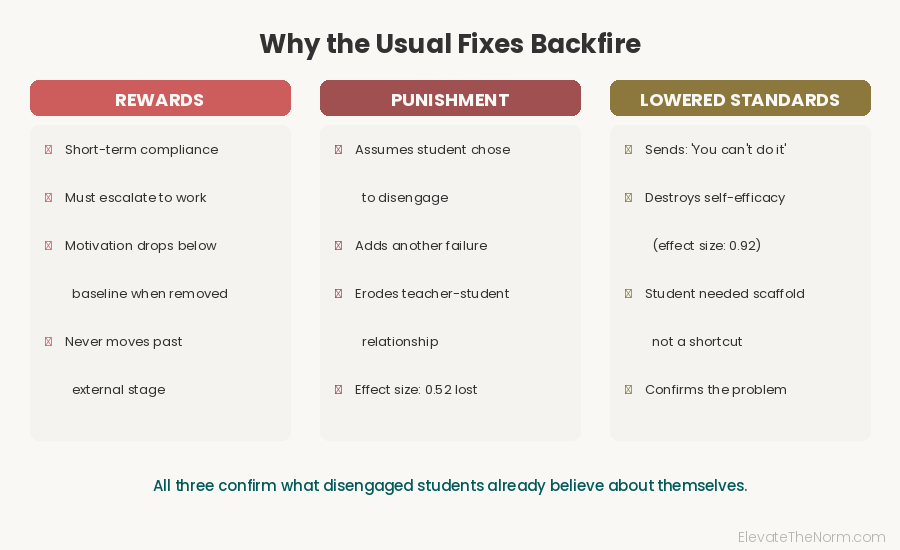
    Why rewards punishment and lowered standards backfire for disengaged students showing three columns of failed strategies
    Three common approaches to student disengagement that make the problem worse

    Punishment Backfires

    Punishing a student for not caring — zeroes, detention, calls home, public redirection — assumes the student has chosen not to engage and can be pressured into changing that choice. For a student dealing with learned helplessness, fear of failure, or a home life that makes school feel irrelevant, punishment adds another failure to the pile. John Hattie’s meta-analyses of educational research show that teacher-student relationships carry an effect size of 0.52 on student achievement — a correlation rather than a proven cause, which is how these numbers are best read. Punishment does not build relationships. It erodes them.

    Lowered Standards Confirm the Problem

    This is the trap that well-meaning teachers fall into most often. A student is struggling, so you shorten the assignment, remove the hard parts, or accept work you know is not their best. You do this out of compassion. But the student reads it differently: you do not think I can do it either.

    Hattie’s research on self-efficacy — a student’s belief in their own ability to succeed — shows an effect size of 0.92, one of the highest in the entire database. Lowering the standard does not raise self-efficacy. It destroys it. The student needed a scaffold, not a shortcut.

    What Actually Works: Competence, Relevance, and Relationship

    Eccles and Wigfield’s expectancy-value theory provides a useful framework here. Students are motivated when two conditions are met: they expect they can succeed at the task, and they value the outcome. Remove either one and effort disappears. A student who thinks they can do the work but sees no point will not try. A student who sees the point but believes they will fail will not try either.

    This means motivation is not one fix. It is at least two — and usually three.
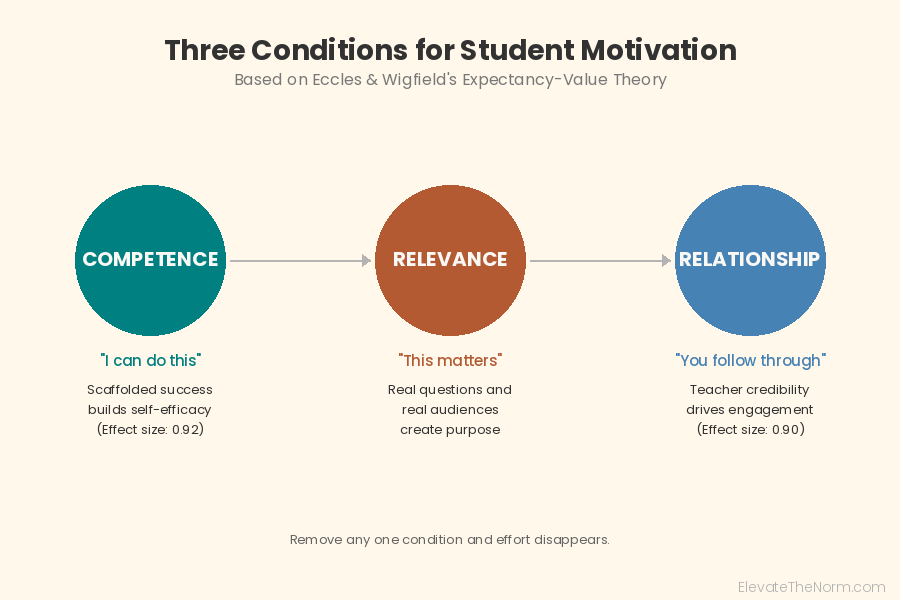
    Three conditions for student motivation based on expectancy value theory showing competence relevance and relationship
    Three conditions for student motivation based on Eccles and Wigfield’s expectancy-value theory

    Competence: They Need to Believe They Can

    This comes first because nothing else matters without it. A student who has failed repeatedly in your subject has built a story about themselves: I am not good at this. You cannot talk them out of that story. You have to give them evidence that it is wrong.

    That means:

    • Assign work they can complete successfully today, then raise the bar tomorrow. Not easier work — appropriately scaffolded work. The task stays rigorous. The entry point becomes accessible.
    • Give feedback that points forward, not backward. “This paragraph needs a stronger claim — here is what a strong one sounds like” beats “This is incomplete” every time. Hattie’s data shows feedback carries an effect size of 0.70 when it is specific, timely, and actionable.
    • Let them revise. A student who turns in weak work and gets a permanent grade has no reason to improve. A student who turns in weak work and gets a chance to make it better has a reason to try.

    Relevance: They Need a Reason

    “When will I ever use this?” is not a complaint. It is a genuine question, and if you cannot answer it, the student is right to ask.

    Relevance does not mean every lesson needs a TikTok hook. It means the work connects to something real — a question worth answering, a problem worth solving, a product someone will actually see.

    During project check-ins in my room, I pull students to the whiteboard table one group at a time. They have to show me what they have and explain why they made the choices they made. I am not grading their progress. I am asking them to defend it. And what I have noticed is that the students who checked out during a textbook reading will fight for a project they chose. Not because the project is fun — sometimes it is not — but because it is theirs. They picked the question. They have to stand behind the answer. That ownership changes the math on whether effort is worth it.

    Relationship: They Need an Adult Who Follows Through

    Teacher credibility — whether a student believes you are competent, trustworthy, and caring — carries an effect size of 0.90 in Hattie’s research. That is not a small number. It means a student’s perception of you as a teacher matters almost as much as anything you actually teach.

    But relationship does not mean being liked. It means being consistent. If you say you will look at their work, look at it. If you say there is a consequence, follow through. If you say you believe they can do it, prove it by holding them to the standard instead of quietly lowering it.

    Niemiec and Ryan’s 2009 review of self-determination theory in education found that students assigned to autonomy-supportive teachers — teachers who explained the purpose behind assignments, offered genuine choices, and acknowledged students’ perspectives — showed increased intrinsic motivation, perceived competence, and self-esteem compared to students with controlling teachers. Autonomy support is not a personality trait. It is a set of behaviors. And it can be learned.

    Five Practical Moves for Your Classroom
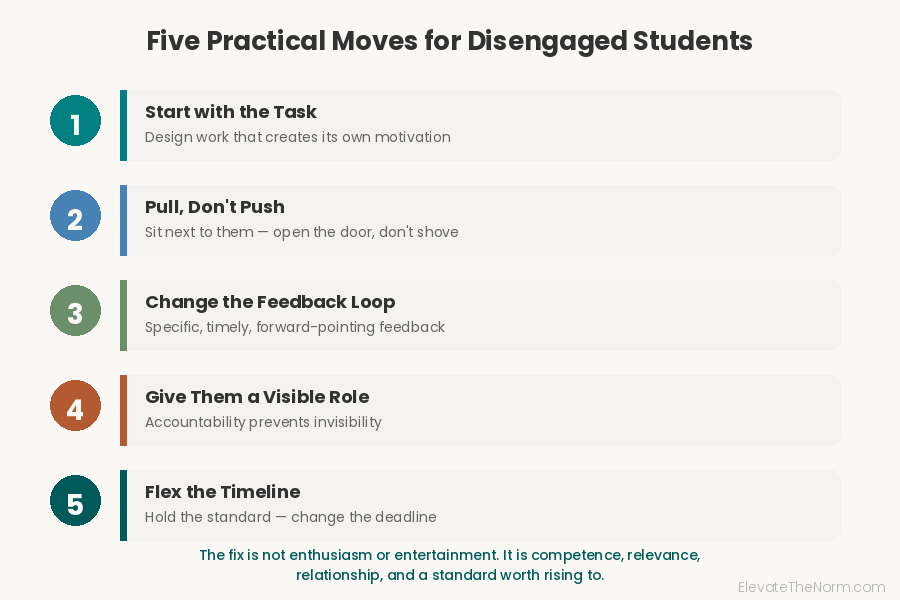
    Five practical classroom moves for motivating disengaged students including task design feedback and timeline flexibility
    Five practical moves teachers can use to re-engage students who appear not to care

    1. Start with the Task, Not the Motivation

    Stop trying to motivate students before the work begins. Instead, design work that creates its own motivation. A project with a real audience and a real deadline does not need a pep talk. A worksheet that will be graded and returned does. For ready-made versions of that, activities that fit inside one class period works through relevance hooks and choice structures that carry their own reason to start.

    2. Pull Them In — Do Not Push Them Forward

    When a student is disengaged, the instinct is to push: more reminders, louder redirections, calls home. Try pulling instead. Sit next to them. Ask what they are working on. Ask what part is confusing. Ask what they would change about the assignment if they could. You are not lowering the bar. You are opening the door.

    3. Change the Feedback Loop

    If the only feedback a disengaged student receives is a grade, they have no reason to change their behavior. Move feedback earlier in the process and make it specific:

    • “Your first two sentences set up a strong argument. The third one contradicts it — read it again and see if you catch why.”
    • “You have the right data. Your conclusion does not match it yet. Try again.”
    • “This is better than last week. Here is what will make it better than this.”

    4. Give Them a Role They Cannot Disappear From

    In group work, a disengaged student will drift to the margins unless the structure prevents it. Assign specific roles with visible accountability: the person who presents, the person who defends the data, the person who fields questions. When the work has their name on it, invisibility stops being an option.

    5. Separate the Standard from the Timeline

    Some students disengage because they have missed so much that catching up feels impossible. Let them redo work. Let them turn things in late with a conversation about what happened. Hold the quality standard. Flex the timeline. This is not lowering expectations. It is acknowledging that learning does not always follow a schedule.

    A note on this: your school likely has a grading policy, and you need to work within it. If your district has a strict late-work penalty, talk to your administrator about exceptions for specific students before you promise flexibility you cannot deliver. The principle — standard stays, timeline flexes — is sound. How much flex you have depends on your building. Do not make promises your gradebook cannot keep.

    What You Cannot Control — And Why That Matters

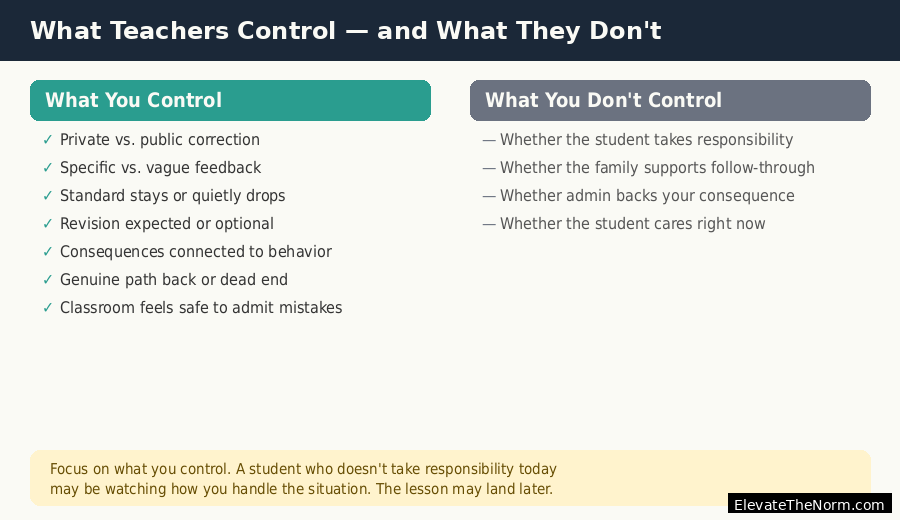
    Not every disengaged student is responding to something in your classroom. Poverty, trauma, food insecurity, unstable housing, family conflict, undiagnosed learning differences — these are real, and they affect motivation in ways a well-designed project cannot fix.

    You are not a therapist. You are not a social worker. You are a teacher. Your job is to make your classroom the kind of place where effort makes sense — where the standard is high, the support is real, and the relationship is honest. For some students, that will be enough. For others, it will be one piece of a much larger puzzle that involves counselors, families, community resources, and time.

    Do not blame yourself when a student does not respond. But do not stop trying either. Some turns take weeks. Some take months. Some happen long after they leave your room, and you never hear about it.

    Before You Assume Poverty Means Disengagement

    One more thing. I have worked in high-poverty schools my entire career, and I need to say this plainly: your students’ zip code does not predict their motivation. Research by Bloem and colleagues, published in Social Psychology of Education in 2024, found that teachers in lower-SES schools gave students less autonomy support and more controlling behavior — and that the gap widened among teachers who held biased attitudes toward low-income families. The problem was not the students. It was what the adults assumed about them.

    Students in a Title I school want recognition. They want to be trusted with responsibility. They want to communicate with each other and work on something that matters. The need is universal. The assumption that poor kids need control instead of relationship is not supported by the evidence, and it does real damage.

    Conclusion

    Motivating students who don’t care is not about finding the right trick. It is about diagnosing what killed the motivation in the first place — usually some combination of repeated failure, irrelevant work, and adults who did not follow through — and then rebuilding the conditions that make effort feel worth it. That means scaffolded competence, genuine relevance, honest relationships, and a standard that stays high even when the path to meeting it changes.

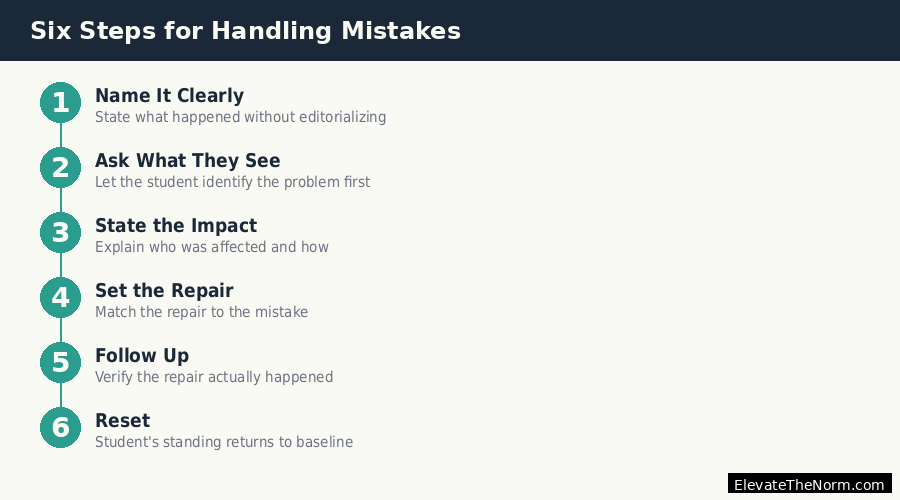
    Start with the student in front of you. Find out what they can do today. Show them what they could do tomorrow. And then hold them to it. And if the disengagement has already shown up as a failing grade, here is what to say in that conversation, and what to leave out of it.


    Sometimes it is not motivation, it is access. A student who cannot start often needs a support rather than a push — our guide to scaffolding strategies covers the eight that work and the one condition the research says they all depend on.

    How do I motivate a student who literally will not do any work?

    Start smaller than you think you need to. Find one task they will engage with — even a short one — and build from there. A student who completes one thing successfully is closer to completing two than a student who has completed nothing for weeks. Sit with them. Ask what the barrier is. Sometimes the answer is ‘I do not understand the directions.’ Sometimes it is bigger than that, and you need to loop in a counselor or support team.

    Is it okay to give students a choice in what they work on?

    Yes, and research supports it. Deci and Ryan’s self-determination theory shows that genuine choice — not the illusion of choice between two identical tasks — increases intrinsic motivation. The key word is genuine. Letting students choose their topic within a framework is meaningful. Letting them choose between worksheet A and worksheet B is not.

    Should I call home when a student is disengaged?

    It depends on the relationship and the home situation. For some students, a positive call home — ‘I noticed your child contributed a strong idea today’ — builds a bridge. For others, any call home triggers consequences that make school feel less safe, not more. Know your students before you pick up the phone, and lead with something they did well whenever possible.

    What about students with IEPs or 504 plans who seem disengaged?

    Some disengagement is disability-related, and the strategies here still apply — but with an additional layer. If a student has an IEP or 504, their accommodation plan may already address some of the barriers described in this article. Work with your special education team to make sure your scaffolding, timeline flexibility, and feedback approaches align with the plan rather than duplicating or contradicting it. Disengagement in a student with a learning difference may look identical to disengagement from a student without one, but the causes and appropriate responses can differ. When in doubt, consult the team before changing your approach.

    What if the student is dealing with issues outside school that I cannot fix?

    You cannot fix them, and you should not try to. But you can make your classroom a place where those issues do not get worse. Consistent routines, clear expectations, honest follow-through, and a teacher who does not give up — those things matter even when you cannot see the result immediately. Refer to counselors and support staff when you notice patterns that are beyond your scope.

    Does project-based learning help with disengaged students?

    It can, because PBL creates the conditions research shows drive motivation — autonomy, relevance, public accountability, and visible competence. But PBL alone is not a magic fix. A disengaged student placed in a group project without scaffolding and clear roles will simply disengage from the project instead of the worksheet. The structure matters as much as the format.

    How do I keep my standards high without pushing disengaged students further away?

    Separate the standard from the timeline and the entry point. The quality of work you expect stays the same. The amount of support you provide, the deadline flexibility you offer, and the way you scaffold the first attempt can all change. A student who turns in a rough draft and revises it three times has met the same standard as the student who nailed it the first time — they just took a different path to get there.

    Is student disengagement getting worse?

    National survey data suggests engagement has declined, particularly after 2020. But disengagement is not new — Goodenow was studying it in 1993, and Seligman described learned helplessness decades before that. What has changed is the visibility. Students who once sat quietly and did the minimum now have phones, social media, and more exit ramps. The underlying needs — competence, belonging, relevance — have not changed at all.


    If the student you are thinking about is a senior rather than a sophomore, the pattern has its own name and its own evidence — what actually causes senioritis covers why the last semester goes quiet and what a teacher can change about it.

    Sources

    1. Deci, E. L., & Ryan, R. M. (2000). “Intrinsic and Extrinsic Motivations: Classic Definitions and New Directions.” Contemporary Educational Psychology, 25(1), 54–67.
    2. Niemiec, C. P., & Ryan, R. M. (2009). “Autonomy, Competence, and Relatedness in the Classroom: Applying Self-Determination Theory to Educational Practice.” Theory and Research in Education, 7(2), 133–144.
    3. Goodenow, C. (1993). “The Psychological Sense of School Membership Among Adolescents: Scale Development and Educational Correlates.” Psychology in the Schools, 30(1), 79–90.
    4. Hattie, J. (2023). Visible Learning: The Sequel. Routledge.
    5. Chang, Y., et al. (2026). “The Longitudinal Trajectory of Learned Helplessness Among Adolescent Students: The Role of Parental Autonomy Support and Control.” Journal of Research on Adolescence.
    6. Bloem, N., et al. (2024). “Teachers’ Autonomy Support and Control Toward Lower- and Higher-SES Students.” Social Psychology of Education.
    7. Eccles, J. S., & Wigfield, A. (2002). “Motivational Beliefs, Values, and Goals.” Annual Review of Psychology, 53, 109–132.

    About Clay Shumate

    Clay Shumate is a certified secondary Social Studies teacher in the public schools of West Alabama, with seven years of classroom experience, a B.A. in History, and an M.Ed. in Secondary Education. He writes about project-based learning, student responsibility, respect, and practical ways to hold young people to a higher standard while giving them room to learn from mistakes. He is a member of the Society of Professional Journalists and writes to its Code of Ethics; this site’s editorial standards and corrections policy are published in full. More about Clay.
  • Chronic Absenteeism: What Actually Brings Students Back to Class

    Chronic Absenteeism: What Actually Brings Students Back to Class

    By Clay Shumate

    Chronic absenteeism means missing 10 percent or more of the school year — about eighteen days, excused and unexcused combined — and it’s sitting near a quarter of all U.S. students. Most of that isn’t about your lesson plans: illness and lost sleep outrank boredom by a wide margin. But re-entry, what happens the day a student walks back in, is squarely a teacher’s job, and most classrooms have no plan for it at all.

    Key Takeaways

    • Chronic absenteeism counts a student missing 10 percent or more of enrolled school days, excused and unexcused together — it is not the same thing as truancy, which is specifically about unexcused absences and can trigger legal consequences for a family.
    • The national rate peaked near 28.5 percent in 2022, fell to roughly 23.5–25 percent by 2024, and has stalled — the decline slowed enough in 2024 that a full return to the 15 percent pre-pandemic baseline is no longer guaranteed.
    • When students are asked directly why they missed school, illness and lack of sleep dominate the answers. Boredom and disengagement are real but smaller, and high schoolers actually report fewer disengagement reasons after the pandemic than before.
    • Attendance Works sorts causes into four categories — barriers, aversion, disengagement, and misconceptions — and a classroom teacher has real leverage over only two of them.
    • The best-evidenced classroom-adjacent lever isn’t a lesson plan; it’s what happens on re-entry day, and separately, honest and consistent family communication is one of the few things correlated with meaningfully lower rates.

    What Chronic Absenteeism Actually Means

    Chronic absenteeism is a student missing 10 percent or more of enrolled school days in a year — roughly eighteen days in a standard 180-day calendar, or about two days a month. Every state and most districts now track it because it correlates with weaker outcomes at every level, from third-grade reading to ninth-grade credit accumulation to graduation. The count includes excused and unexcused absences together. A student out with the flu for two weeks, a student with a broken attendance streak from oversleeping, and a student who simply stopped coming all land in the same statistic, and the number alone tells you nothing about which one you’re looking at.

    That combined counting is also what separates chronic absenteeism from truancy, and the two get confused constantly in casual conversation. Truancy is specifically about unexcused absences, and in most states it is a legal category with a defined escalation path — a set number of unexcused absences triggers truant status, repeated truancy can trigger a referral, and in the most severe cases a district attorney can pursue charges against a parent or guardian. Chronic absenteeism carries no such court process on its own. A student who is chronically absent because of documented illness has never been truant a single day. Confusing the two terms is how a school ends up applying a punitive, legal-track response to a problem that is, for most students, not a compliance problem at all.

    How Bad Is It, and Is It Getting Better?

    Nationally, chronic absenteeism held steady around 15 percent through the 2018 and 2019 school years. It jumped to roughly 28.5 percent at its 2022 peak, then eased to about 25.4 percent in 2023 and 23.5 percent in 2024. RAND’s 2024–25 district survey put the most recent figure at approximately 22 percent — nearly 11 million students. The trend line is real improvement, and it is also slowing down. Nat Malkus, who tracks the numbers for the American Enterprise Institute, has written plainly that the deceleration raises “the very real possibility that absenteeism rates might never return to pre-pandemic levels.”

    The average also hides where the actual crisis sits. Low-achieving districts went from about 19 percent chronically absent in 2018 to 35 percent in 2022; high-achieving districts moved from 10 percent to 19 percent over the same stretch — both got worse, but the gap between them widened. RAND found urban districts were five to six times more likely than rural or suburban ones to report extreme chronic absence, meaning 30 percent of students or more. If your school sits in that first group, the national “one in four” statistic is understating your actual room by a wide margin.

    The Four Root Causes — and Which Ones Are Actually Yours

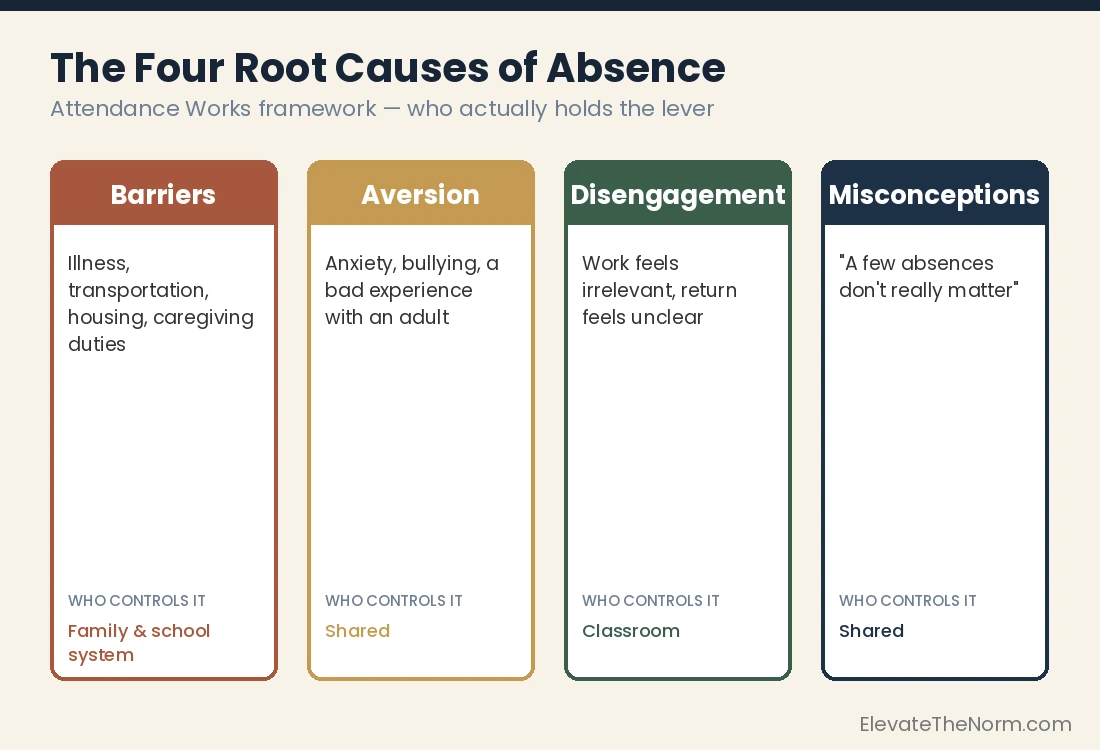
    Attendance Works, the research and policy organization most state departments of education cite on this topic, sorts every reason a student misses school into four categories: barriers, aversion, disengagement, and misconceptions about how much a few absences really matter. It’s a useful framework precisely because it forces an honest answer to the question every overwhelmed teacher eventually asks: which part of this is mine to fix?

    CategoryWhat it looks likeWho actually controls it
    BarriersIllness, unreliable transportation, unstable housing, caregiving duties for a sibling or family memberFamily, school system, community resources — not the classroom teacher
    AversionAnxiety about a specific class or hallway, bullying, a bad experience with a particular adultShared — a teacher can remove one specific aversion, but not the underlying anxiety
    DisengagementThe student sees no point in showing up because the work feels irrelevant or the return is unclearLargely the classroom — relevance, relationship, and clarity are teacher-level moves
    MisconceptionsBelief that a handful of absences “doesn’t really matter” as long as grades hold upShared — a teacher’s re-entry practice and a family’s messaging both shape this
    Four-category chart showing the root causes of chronic absenteeism: barriers, aversion, disengagement, and misconceptions, with who controls each one
    The Attendance Works framework for chronic absenteeism, showing which causes a classroom teacher can actually influence.

    Look at that middle column honestly and the division of labor gets clear fast. Barriers are not solvable from a classroom. No lesson plan fixes a broken car, an undiagnosed illness, or a kid watching a younger sibling because there’s nobody else. Pretending otherwise is how teachers end up carrying blame for outcomes they were never equipped to move, and it’s a big part of why attendance initiatives that live entirely inside individual classrooms tend to disappoint — they’re aimed at maybe half the problem.

    Why Most of It Isn’t About Your Classroom

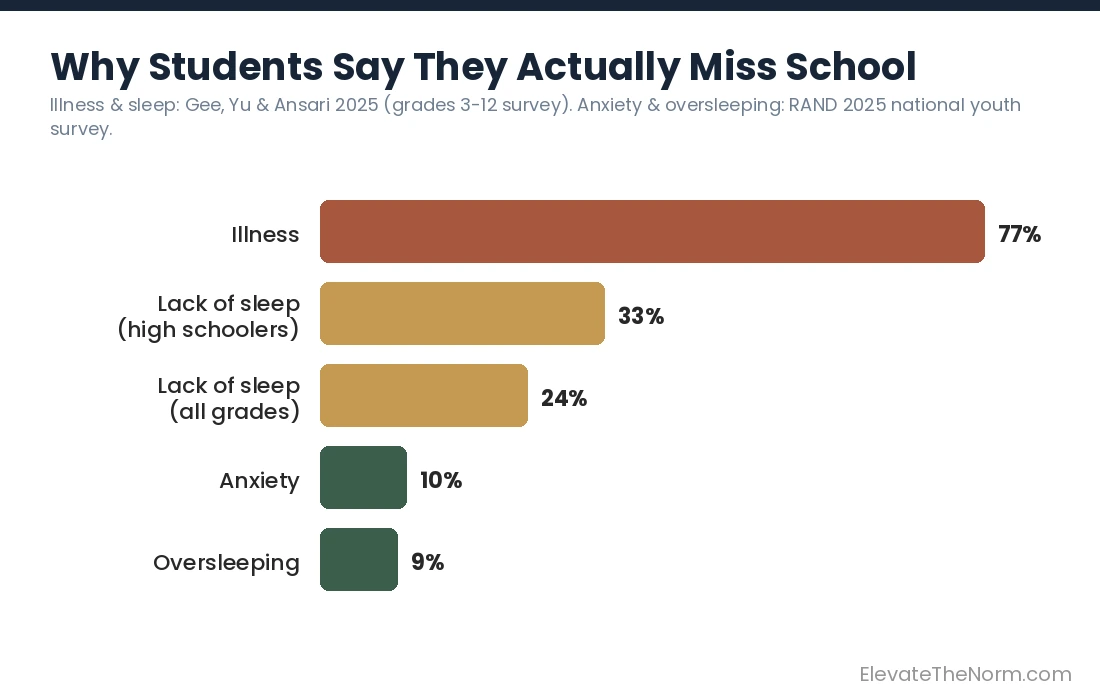
    When you ask students directly why they missed school, the answer that comes back most is not the one teacher-facing advice usually assumes. A 2025 analysis of Rhode Island survey data covering grades 3–12 found illness reported by roughly three-quarters of students both before and after the pandemic — 77 percent post-pandemic specifically. Lack of sleep came in second at 24 percent overall and a striking 33 percent among high schoolers. Boredom and safety concerns did rise after the pandemic, but from a much smaller base, and — this is the finding that should reshape how engagement gets talked about — high school students actually reported fewer disengagement reasons after the pandemic than before it. RAND’s national youth survey landed in the same place: 67 percent sickness, 10 percent anxiety, 9 percent oversleeping.

    Bar chart showing self-reported reasons students miss school: illness 77 percent, lack of sleep 33 percent among high schoolers and 24 percent overall, anxiety 10 percent, oversleeping 9 percent
    Illness and lost sleep outrank boredom by a wide margin in student-reported reasons for absence.

    That doesn’t mean engagement is irrelevant. It means engagement is not the lever most teacher-facing advice on this topic claims it is. If a school’s entire absenteeism strategy is “make class more interesting,” it is aimed at a real but minority slice of the problem, and it will underdeliver — not because the advice is wrong, but because it was never sized to the actual distribution of causes. For the students where disengagement genuinely is the driver, the deeper diagnosis and fix belong in a companion piece on what actually motivates students once rewards and speeches stop working — this page is about the much larger group whose absence has nothing to do with motivation at all.

    What’s Actually Yours: The Four Minutes That Change the Semester

    Here’s the honest, narrower claim. A classroom teacher cannot fix a transportation gap or an untreated illness. What a classroom teacher controls almost completely is what an absence costs a student once they’re back — and that cost is what determines whether eighteen missed days becomes thirty.

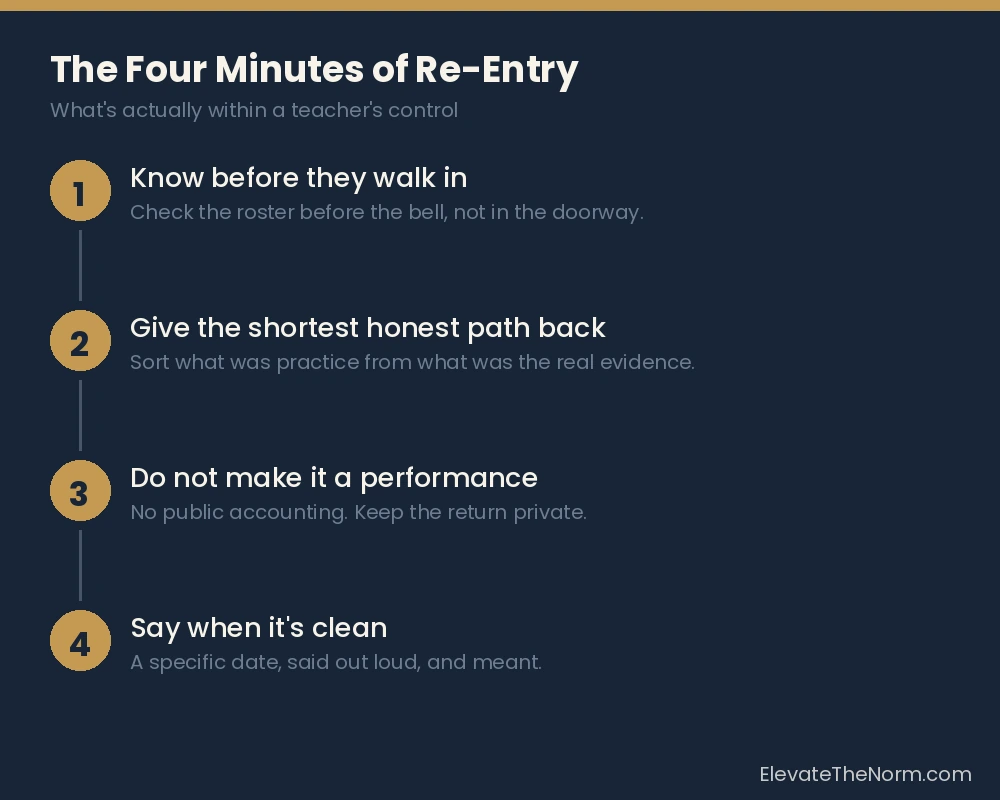
    I check the roster before the bell, not after. When I see a student has been out, I already know before they walk through the door — deciding what they need in the doorway, with the rest of the class watching, guarantees a bad decision made badly. If it’s a longer absence, that student gets pulled to the whiteboard table early — the same table I use for regular small-group work, not a separate “catch-up corner.” Low lamp, rug, better chairs. Students already know that table is where you go to be worked with, not managed. That matters more than it sounds like it should: a student coming back from eighteen missed days is highly sensitive to whether re-entry feels like punishment or like being picked back up.

    Reserve the full version of this for absences that actually need it — three or more days, or a pattern, not a single day for a dentist appointment. And none of what follows replaces your school’s required attendance reporting or truancy referral process. If a student’s pattern of absence raises a safety concern — signs of neglect, abuse, homelessness, or anything that meets your district’s mandated-reporting threshold — that goes to your counselor or administrator through the normal protocol immediately, separate from and before any classroom routine. Re-entry is about what a teacher does with the students in front of them; it is not a substitute for the systems built to catch the more serious cases.

    Four things make re-entry actually work.

    Know before they walk in. Check attendance history before class starts, not during it. A decision made in the doorway, in front of an audience, by a teacher who is also trying to start the lesson, is reliably the worst version of that decision.

    Give the shortest honest path back. Not every missed assignment carries the same weight. Ask yourself which pieces were practice and which ones were the actual evidence that the student learned the standard — the practice can often be waived or condensed; the evidence usually can’t. Sorting the pile down to what genuinely matters is a judgment call only the teacher can make, and it’s the difference between a student who can start today and a student who takes one look at forty backlogged items and shuts down. Better still, ask the student what they think is realistic before you hand them the final list — a plan a student helped build survives contact with a hard week better than one that was simply issued to them. This is student responsibility in its most practical form — the student still owns finishing the list, but the list has to be one a person could actually finish, and building it together is what makes it theirs. For an absence stretching past a week or two, or anything with a doctor’s note attached, loop in a counselor or your 504/IEP team before you finalize the plan alone — some of that catch-up may need to be a formal accommodation, not an informal favor.

    Do not make the return a performance. No public accounting of the absence, no comment in front of the class, no sarcasm at the door, and no requirement that the student explain themselves out loud. Some reasons are private — a medical diagnosis, a family situation, a mental health day — and a teacher doesn’t need the full story to run a fair re-entry process. A teenager who’s been gone is already running the social math on what walking back in will cost. Raise that cost and the cheapest option left is to stay gone. This is the same standard covered in respect in the classroom applied to a specific moment: a student’s absence is not public material, and treating it that way trades a little teacher satisfaction for a much worse attendance problem next month. Apply it the same way to every student, every time — the fastest way to make a re-entry routine feel arbitrary is to run it warmly for some students and coldly for others.

    Say when it’s clean. Give a specific date and a specific list, and when the list is finished, say so out loud and mean it. Open-ended debt is what convinces a student the hole is unclimbable. A defined end is what makes climbing rational.

    In practice this is a thirty-second exchange, not a meeting: “Good to see you back. Here’s what actually matters from the last few days — these three things. Everything else, let it go. Can you have these done by Friday?” That’s the whole script. It names what matters, drops what doesn’t, and ends with a date the student agreed to rather than one you handed down.

    Four-step checklist for helping a student return after an absence: know before they walk in, give the shortest honest path back, do not make it a performance, and say when it is clean
    The four re-entry moves that are genuinely within a classroom teacher’s control after chronic absenteeism.

    None of this is softness. The standard doesn’t move — the work still has to be real and the deadline still has to be a deadline. What moves is how much guesswork a student has to do to find their way back to it, and guesswork is where students who are already behind quietly give up. This is the same logic behind natural consequences instead of punishment: the goal is a consequence that teaches something, not one that simply makes the return more painful.

    Expect it to look worse before it looks better, especially with a student who’s been checked out for a while. A kid who suddenly gets real attention after being invisible will often test whether that attention is real — that’s a normal, predictable phase, not proof the approach isn’t working, and it connects directly to what happens the first few weeks after building a relationship with a student who’s been guarded. Most adults quit right at the point where the testing is actually a good sign.

    What the Research Says Works Beyond Your Classroom

    Honesty about the ceiling matters here too. The best-evidenced attendance interventions in the research aren’t classroom practices — they’re family communication, and the effect sizes are real but modest. Which tool carries that communication matters less than whether families can actually receive it — the questions to ask before adopting a communication app start with reach, not features.

    Rogers and Feller, publishing in Nature Human Behaviour in 2018, tested personalized mailings sent to the parents of 28,080 high-risk K–12 students. The most effective versions reduced chronic absenteeism by 10 percent or more, largely by correcting parents’ underestimates of how many days their child had actually missed — many parents simply didn’t know the number was as high as it was. A smaller trial run by the Regional Educational Laboratory Mid-Atlantic in the School District of Philadelphia found a single October postcard cut absences by a more modest 2.4 percent, with no measurable difference between message variations.

    A 2023 analysis by Harvard researchers Karen Mapp and Todd Rogers, working with Learning Heroes and TNTP across more than 3,000 Illinois schools, found something adjacent and worth taking seriously: schools with strong pre-pandemic family engagement — measured through trust, involvement, and parent influence on school decisions — had chronic absenteeism rates roughly six percentage points lower than similar schools with weak engagement, even after controlling for poverty. Between 2019 and 2022, the strong-engagement schools saw a 39 percent smaller increase in chronic absenteeism than everyone else. This is a correlational finding from one state, not a randomized trial, and the researchers themselves describe it as the first phase of a larger project — it should be read as suggestive, not proof that family engagement alone moves the number. But it lines up with the honest re-entry advice above: families who already trust the school and understand what the classroom is doing are the same families likely to reinforce a re-entry plan rather than fight it. In practice that trust gets built with plain, non-alarmist language rather than a form letter — something closer to “I noticed six absences this month, is there anything the school can help with?” than an automated warning that reads like a legal notice. The first invites a conversation. The second reads like the truancy-court track discussed above, even for a family whose child has never come close to it.

    None of this reaches a transportation gap, an untreated health condition, or a family in crisis, and no classroom teacher should feel responsible for the part of the number that genuinely isn’t theirs. What is genuinely theirs — re-entry, and a habit of honest, non-alarmist communication home — is smaller than the whole problem and still worth doing well, because it’s the piece within reach on a Tuesday afternoon, not a district initiative that takes a year to fund.

    What to Do With This on Monday

    Start with one thing: check the roster before the bell and know, before a returning student walks in, what the shortest honest path back looks like for them. Add the no-performance rule next — it costs nothing and it’s the fastest way to stop making re-entry harder than it needs to be. Everything else on this page — the barriers your school actually controls, the family-communication research, the honest accounting of what disengagement is and isn’t driving — belongs to a bigger conversation about chronic absenteeism than one classroom can solve alone. Your four minutes with a returning student is the part that starts today. For a ready-to-use tool on this, see a printable parent-teacher communication log pack. Absence is also the clearest single thing that got worse since 2019, which is why it sits near the top of our review of whether student behavior is actually getting worse.


    Is chronic absenteeism the same thing as truancy?

    No. Chronic absenteeism counts a student missing 10 percent or more of enrolled school days, whether the absences are excused or unexcused. Truancy is a narrower legal category built specifically from unexcused absences, and in most states it comes with a defined escalation process that can eventually involve a district attorney and consequences for a parent or guardian. A student who is chronically absent because of documented illness has never been truant. Treating the two as interchangeable is how schools end up applying a legal, punitive response to a problem that, for most students, was never about defiance.

    Whose fault is chronic absenteeism — the school, the family, or the student?

    Usually none of the above, at least not in the way the question assumes. National survey data shows the leading reasons students miss school are illness and lost sleep, not defiance or indifference. Framing absence as a fault to assign tends to produce blame instead of a fix. The more useful question is which piece of the problem a given adult actually has leverage over — a classroom teacher, a family, and a school system each control a different slice.

    What can one classroom teacher realistically do about chronic absenteeism?

    Less than district-level interventions, and that’s fine — a teacher’s real leverage is re-entry, not prevention. Checking the roster before class, sorting missed work down to what actually matters, keeping a returning student’s absence private, and giving a clear date when the catch-up is finished are all inside a single teacher’s control and take a few minutes per student. Preventing the absence in the first place usually depends on factors — transportation, health, housing — that sit outside any one classroom.

    Does missing school always mean a student doesn’t care about class?

    No, and the data says the opposite more often than not. When students are asked directly why they were out, illness and lack of sleep dominate the answers, and one national analysis found high schoolers reporting fewer disengagement-related reasons for absence after the pandemic than before it. Assuming apathy is usually wrong, and assuming it out loud to a student who was actually sick or exhausted damages the relationship for no reason.

    How should a teacher handle makeup work without overwhelming a student who’s behind?

    Sort before you hand anything over. Separate what was practice from what was the actual evidence that a student learned the standard, and let most of the practice go. Ask the student what they think is realistic before finalizing the list — a plan they helped build holds up better than one that was simply issued. For anything longer than a week or two, or work tied to a documented medical absence, loop in a counselor or the student’s 504/IEP team rather than solving it alone.

    What if a student’s pattern of absences seems like a sign of something more serious?

    That goes to your school’s counselor or administrator through your normal mandated-reporting and attendance-review process immediately — before, and separate from, any classroom re-entry routine. Signs like a sudden pattern change, indications of neglect or abuse, or signs of homelessness are outside what a classroom-level practice is built to address, and they need the systems your school already has for exactly that purpose.

    Do attendance letters or family outreach actually reduce absences?

    Some forms do, modestly. A large study of personalized parent mailings correcting misperceptions about how many days a child had actually missed reduced chronic absenteeism by roughly 10 percent in its most effective version; a simpler single postcard trial produced a smaller 2.4 percent reduction. The tone matters — plain, non-alarmist language that reads like a conversation (‘is there anything the school can help with?’) is associated with better outcomes than a form letter that reads like a legal warning, even though neither approach comes close to solving the problem on its own.

    What’s a realistic first step for a teacher who wants to get better at this?

    Start with one habit: check attendance before the bell so you already know, before a student walks in, what their shortest honest path back looks like. Add the no-performance rule next — keeping the return private costs nothing and prevents the single most common way teachers accidentally make attendance worse. Everything else on this page is worth knowing, but those two moves are where an ordinary Tuesday actually changes.


    Sources


    About Clay Shumate

    Clay Shumate is a certified secondary Social Studies teacher in the public schools of West Alabama, with seven years of classroom experience, a B.A. in History, and an M.Ed. in Secondary Education. He writes about project-based learning, student responsibility, respect, and practical ways to hold young people to a higher standard while giving them room to learn from mistakes. He is a member of the Society of Professional Journalists and writes to its Code of Ethics; this site’s editorial standards and corrections policy are published in full. More about Clay.
  • Natural Consequences in the Classroom: A Fair Alternative to Punishment

    Natural Consequences in the Classroom: A Fair Alternative to Punishment

    By Clay Shumate · Updated October 24, 2026

    Natural consequences are the outcomes that happen on their own when a student makes a choice—without the teacher adding anything. A student who does not study gets a low grade. A student who refuses to participate in group work gets left behind while the group moves forward. Nobody imposed those results. They just happened, because actions have outcomes. Using natural consequences in the classroom means stepping back, when it is safe to do so, and letting reality do the teaching.

    That is the short answer. The longer one involves knowing when natural consequences work, when they do not, where teachers confuse them with logical consequences and punishment, and how to use all three honestly without pretending that any single approach solves everything.

    Key Takeaways

    • Natural consequences happen without teacher intervention. The outcome follows directly from the student’s choice.
    • Logical consequences require a teacher to set up a related, respectful, reasonable response. They are different from natural consequences.
    • Neither natural nor logical consequences should be disguised punishment—if it involves humiliation, excessive severity, or unrelated penalties, it is punishment regardless of what you call it.
    • Natural consequences have limits. They do not work when safety is at risk, when the consequence is too far in the future to matter, or when the student lacks the ability to make a different choice.
    • The goal of any consequence in a secondary classroom is learning, not suffering.

    What Are Natural Consequences in the Classroom?

    Rudolf Dreikurs, the psychiatrist who brought the concept into education, drew a clear line: natural consequences are results that occur without any adult arrangement. The parent or teacher does not create the consequence, does not announce it, and does not have to enforce it. It simply happens (Dreikurs and Soltz, Children: The Challenge, 1964).

    In a secondary classroom, natural consequences show up constantly:

    • A student who does not prepare for a class discussion has nothing to contribute when their turn comes.
    • A student who puts off a long-term project until the last night turns in weak work.
    • A student who treats group members badly finds that nobody wants to work with them next time.

    Notice what the teacher does in each of these examples: nothing extra. The teacher does not need to add a punishment. Reality handled it.

    That is the power of natural consequences—and also their limitation. They only work when the natural outcome is immediate enough, visible enough, and meaningful enough to teach the lesson on its own.

    What Is the Difference Between Natural and Logical Consequences?

    This is where most of the confusion lives. Teachers use the terms interchangeably, but they are not the same thing.

    Natural consequences require no adult action. The outcome happens on its own.

    Logical consequences require the teacher to create a response that is directly connected to the behavior. The teacher sets it up. The connection is deliberate.

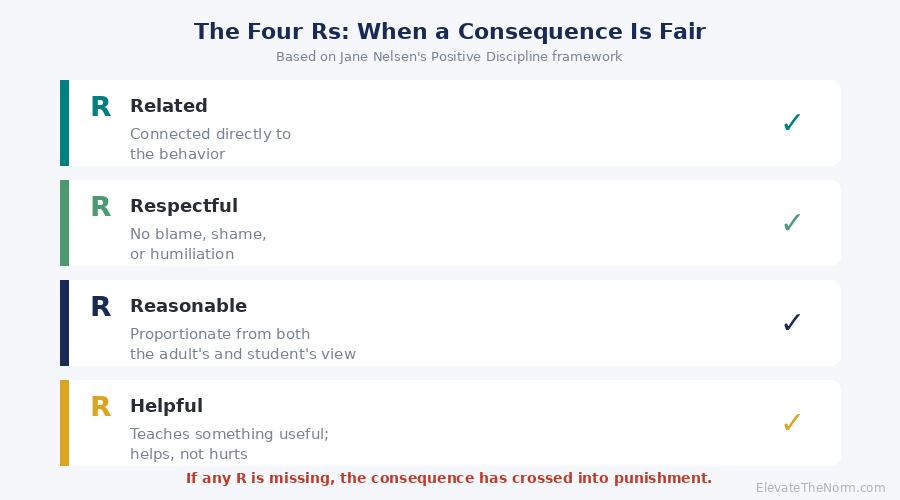
    Jane Nelsen, author of Positive Discipline, identifies four criteria that logical consequences must meet to avoid becoming disguised punishment. She calls them the Four Rs: Related, Respectful, Reasonable, and Helpful. If any of the four is missing, the consequence has crossed the line into punishment—even if the teacher does not intend it that way (Nelsen, “Logical Consequences,” Positive Discipline).

    Three-column comparison showing differences between natural consequences, logical consequences, and disguised punishment
    Three types of consequences—and how to tell if a consequence has crossed into punishment.

    Logical Consequences in the Classroom: Examples for Grades 6–12

    A logical consequence is a response the teacher chooses because it follows directly from what the student did: fix what you broke, lose the privilege you misused, or step away long enough to reset. Responsive Classroom names exactly those three types: “you break it, you fix it,” loss of privilege, and positive time-out, which it calls “space and time” in middle school. It describes all three as a non-punitive response, and it says anything taken away has to be directly related to the misbehavior (Responsive Classroom, “Three Types of Logical Consequences,” 2023).

    Here is what that looks like with teenagers. The last column matters as much as the second one, because it shows where a logical consequence turns into punishment.

    What the student didLogical consequenceWhy it is relatedWhen it becomes punishment
    Left the lab station or work area a messResets it before the bellFixes the exact thing that was left undoneAdding a lunch detention on top of the reset
    Used a phone during instructionPhone goes to a set spot for the rest of the periodRemoves the item that was misused, for the time it was misusedKeeping it for a week, or reading what is on it
    Stayed off task in a seat they choseSits in a teacher-chosen seat for the rest of the period and gets to choose again tomorrowLoses the privilege they misused, and only that oneLosing seat choice for the semester, or being moved in front of everyone with commentary
    Wrote in or damaged a shared book or supplyCleans it, or repairs it within reasonYou break it, you fix itDemanding a replacement cost the family cannot afford
    Said something hurtful to a classmateA private repair conversation and an agreed way to make it rightRepairs the relationship that was harmedA forced public apology
    Was escalating during a discussionTakes space and time at a reset spot, then rejoins when readyGives them a reset without removing them from learningGetting sent out for the whole period by default
    Copied a classmate’s homeworkRedoes the work under supervision, with help if they need itPuts back the practice that was skippedA zero with no chance to show the learning. Your school’s academic integrity process may still apply.

    A one-sentence test before you use one. Say it out loud, starting with “Because you…” For example: “Because you left the station a mess, you’ll reset it before you go.” If the second half does not follow from the first, it is not logical. Run it through Nelsen’s Four Rs above too. A logical consequence that is not Respectful is still punishment.

    Two habits keep logical consequences honest. First, decide on them before you need them. A consequence you make up in the moment carries your mood with it, which is why a written response ladder for common problems helps. Second, because the teacher creates a logical consequence, the teacher’s delivery decides how it lands. Say it privately, calmly, and once. Then let the student do it without an audience or a lecture.

    When Do Natural Consequences Work in a Secondary Classroom?

    Natural consequences are strongest when three conditions are met:

    1. The outcome is close in time. A teenager who puts off studying sees the grade within days. That connection is tight enough to teach. But a student who does not develop study habits in ninth grade may not feel the real consequence until college—and that is too far away to function as a classroom teaching tool.

    2. The outcome is meaningful to the student. If a student genuinely does not care about the grade, the natural consequence of not studying has no teaching power. This is not a flaw in the student. It means the teacher needs a different approach—probably a conversation about what the student does care about and whether there is a connection.

    3. The student has the ability and resources to make a different choice. This is the most important condition and the one teachers miss most often. A student who does not bring materials because the family cannot afford them is not choosing to be unprepared. A student who does not finish homework because there is no safe, quiet place at home is not choosing to be irresponsible. Letting the natural consequence land in those situations is not teaching. It is punishing poverty or circumstance and calling it accountability.

    When Do Natural Consequences Not Work?

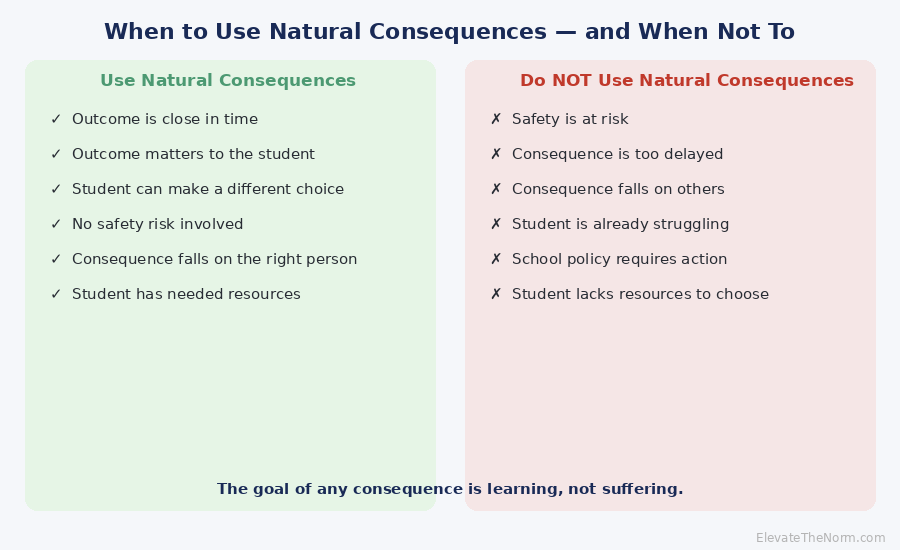
    There are situations where letting natural consequences play out is wrong, dangerous, or irresponsible. Every teacher needs to recognize these clearly.

    Safety is at risk. If a student’s behavior could cause physical harm—to themselves or others—the teacher intervenes immediately. You do not let a student learn from the natural consequences of unsafe lab behavior. You stop it.

    The consequence is invisible or delayed. Some choices have consequences that are real but too slow or abstract for an adolescent to feel. Skipping reading assignments, for instance, produces a gradual erosion of comprehension that does not announce itself until weeks later. The natural consequence exists, but it is not effective as a teaching tool because the student cannot draw a line between the choice and the result. My Behavior Reflection Sheets on TPT ask students for reasons, not apologies, and come in two reading levels.

    The consequence falls on other people. When a student’s irresponsibility damages the group—a partner who did no work, a lab team missing a component—the natural consequence punishes the students who did their part. That is not fair, and it is not a lesson worth teaching.

    The student is already struggling. For a student who is disengaged, anxious, dealing with instability at home, or behind in multiple classes, piling on another failure through natural consequences does not teach resilience. It teaches the student that school is one more place where things do not work out. The teacher’s job at that point is support, not observation.

    School policy requires a specific response. Some behaviors—threats, harassment, weapons, substance use—require immediate administrative action regardless of any teacher’s philosophy about consequences. Natural consequences do not override mandatory reporting or school safety protocols.

    Two-column checklist showing when to use natural consequences and when to avoid them in the classroom
    Natural consequences work when conditions are right—and fail when they are not.

    The Punishment Problem

    The biggest risk with consequences—natural or logical—is that they become punishment wearing a better name.

    Alfie Kohn has argued for decades that most classroom consequences function as punishment: “Do this or else” dressed in gentler language (Kohn, Punished by Rewards, 1993). Nelsen’s framework offers a useful test. If the consequence triggers resentment, revenge, rebellion, or retreat in the student, it has become punishment—regardless of the teacher’s intention.

    Here are three warning signs that a “consequence” is actually punishment:

    1. It is not connected to the behavior. A student who talks during instruction loses recess or has a phone taken away. Those responses are not related to the behavior. They are penalties applied to get compliance.

    2. It includes humiliation. A student who turns in incomplete work has their name posted on a “missing work” list. The consequence is now about shame, not about the work.

    3. It is excessive. A student who is late to class once gets a week of after-school detention. The severity has nothing to do with learning. It is about power — and power is what most “control” techniques quietly optimize for, which is why so few of them hold.

    When I notice a student making a choice that is heading toward a natural consequence, I do not broadcast it to the room. I walk over—close range, conversation volume—and say something like, “I can see where this is going. What do you want to do about it?” That is not me rescuing them from the consequence. It is me giving them a chance to redirect before the consequence lands. If they choose not to redirect, the outcome follows. But they had the information and the opportunity.

    That is what separating consequences from punishment looks like in practice. The student keeps their dignity. The standard stays in place. The teacher stays close.

    The four Rs framework for logical consequences: Related, Respectful, Reasonable, and Helpful from Jane Nelsen Positive Discipline
    Jane Nelsen’s Four Rs: if any one is missing, the consequence has crossed into punishment.

    A Practical Framework: Choosing the Right Response

    Not every situation calls for the same type of response. Here is a framework for deciding:

    Step 1: Is anyone at risk? If yes, intervene immediately. Safety overrides every other consideration.

    Step 2: Will the natural consequence teach the lesson? Check the three conditions: Is the outcome timely? Does the student care? Can the student actually make a different choice? If all three are yes, step back and let it play out. Stay close enough to debrief afterward.

    Step 3: If natural consequences will not work, is there a logical consequence? Apply Nelsen’s Four Rs: Related, Respectful, Reasonable, Helpful. If you cannot make the consequence meet all four criteria, it is probably not a logical consequence—it is a punishment you are trying to justify.

    Step 4: If no consequence fits, use a conversation. Sometimes the best response is pulling the student aside and talking through what happened, what they were thinking, and what they want to do next. Not every problem needs a consequence. Some problems need a plan. If you want the exact words for that follow-up talk, my Restorative Conversation Scripts on TPT give you a script for each step.

    Step 5: Record and follow through. Whatever approach you choose, do it consistently and follow through. Consequences that change based on the teacher’s mood are not consequences. They are reactions.

    What This Looks Like Across Common Classroom Situations

    Late work. The natural consequence of late work is a lower grade or missed feedback cycle. But check whether the student had the resources to complete the work on time. If they did, the natural consequence stands. If they did not, a conversation and a revised plan are more honest than a zero. And if the lateness is recurring rather than a one-time lapse, check attendance before you check effort — chronic absenteeism produces exactly this pattern, and it calls for a different response than a motivation problem does.

    Phone use during instruction. There is no natural consequence fast enough to teach this lesson. A logical consequence—put the phone away or it goes to a designated spot for the period—is appropriate, as long as it is applied consistently and without a lecture.

    Disrespect toward a peer. The natural consequence is social: damaged trust, fewer willing partners. The logical consequence is a teacher-facilitated conversation about what happened and what repair looks like. This is also where school policy may require documentation.

    Refusal to work. Before assigning any consequence, ask a question. A student who refuses to work is telling you something—about the task, about their confidence, about something outside the classroom. The consequence should follow only after you understand the refusal.

    Group work problems. When one student is not contributing, the natural consequence falls on the group, not the individual. That makes it a poor teaching tool. A logical consequence—a private conversation, a role reassignment, or an individual accountability check—is more appropriate.

    Conclusion

    Natural consequences are one tool in a larger set. They work best when the outcome is timely, meaningful, and fair—and when the student has the resources to make a different choice. When those conditions are not met, logical consequences, conversations, and plans often do the job better.

    The real skill is knowing which tool fits the moment. And the real test is not whether the student suffered the right amount—it is whether they learned something they can use next time. Consequences that teach are worth keeping. Consequences that humiliate are not consequences at all.

    Stay close to your students. Handle correction at close range. Give them information and a chance to redirect before the consequence lands. And when the consequence does land, help them understand it—without piling on. And when the harm landed on another person rather than on the student’s own grade, a consequence by itself will not finish the job—that is the point where a structured repair conversation does work a consequence cannot.

    What are examples of natural consequences in the classroom?

    A student who does not prepare for a class discussion has nothing to contribute when their turn comes. A student who puts off a long-term project until the last night turns in weak work. A student who treats group members badly finds that nobody wants to work with them next time. In each case the teacher adds nothing; the outcome happens on its own.

    How can you tell when a consequence has become punishment?

    Three warning signs: it is not connected to the behavior, such as losing recess for talking during instruction; it includes humiliation, such as posting names on a missing-work list; or it is excessive, such as a week of detention for one late arrival. Nelsen’s test adds a fourth check: resentment, revenge, rebellion, or retreat in the student.

    What is the difference between natural consequences and punishment?

    Natural consequences happen without any teacher action—they are the direct result of a student’s choice. Punishment is imposed by an authority figure and may or may not be connected to the behavior. A student who does not study and gets a low grade experienced a natural consequence. A student who does not study and loses a field trip privilege experienced punishment.

    What are examples of logical consequences in the classroom?

    A logical consequence is connected directly to the behavior. For example, a student who leaves a lab station a mess resets it before the bell. A student who uses a phone during instruction puts it in a set spot for the rest of the period. A student who is off task in a seat they chose moves to a teacher-chosen seat for the period. A student who says something hurtful has a private repair conversation. Each one is related, respectful, reasonable in scale and focused on learning. If it adds an unrelated penalty or embarrasses the student, it has become punishment.

    When should a teacher NOT use natural consequences?

    Do not rely on natural consequences when safety is at risk, when the consequence is too delayed to be meaningful, when the consequence falls on other students instead of the one who made the choice, when the student lacks the resources or ability to choose differently, or when school policy requires a specific response.

    How do I know if a logical consequence has crossed the line into punishment?

    Use Jane Nelsen’s Four Rs test. Is the consequence Related to the behavior, Respectful of the student, Reasonable in scale, and Helpful toward learning? If any R is missing—especially respect—it has become punishment. Another signal: if the student responds with resentment, revenge-seeking, rebellion, or withdrawal, the consequence is functioning as punishment regardless of your intent.

    Can natural consequences work with students who genuinely do not seem to care?

    If a student does not care about the outcome, the natural consequence has no teaching power. That does not mean the student is broken. It means the teacher needs to find out what the student does care about and whether the current work connects to it. Sometimes the answer is a different approach entirely—a conversation, a relationship, a different entry point into the material.

    Should I warn a student before a natural consequence happens?

    In most cases, yes—briefly and privately. A quick check-in like “I can see where this is going—what do you want to do about it?” gives the student a chance to redirect. You are not rescuing them. You are giving them information and an opportunity. If they choose not to redirect, the outcome follows.

    How do natural consequences work alongside school discipline policies?

    Natural consequences operate within the classroom space the teacher controls. They do not replace school-level discipline for serious behaviors like threats, harassment, or safety violations. Teachers should know their school’s required responses and follow them. Natural and logical consequences handle the daily, classroom-level situations that make up the vast majority of behavior decisions.

    Are natural consequences fair for all students?

    Not automatically. If a student cannot make a different choice—because of poverty, disability, trauma, or lack of support—letting the natural consequence land punishes their circumstances, not their decisions. Fairness requires asking whether the student had what they needed to succeed before holding them accountable for the result.

    Sources

    1. Rudolf Dreikurs and Vicki Soltz, Children: The Challenge. Plume, 1964.
    2. Jane Nelsen, “Logical Consequences.” Positive Discipline. https://www.positivediscipline.com/articles/logical-consequences/
    3. Alfie Kohn, Punished by Rewards: The Trouble with Gold Stars, Incentive Plans, A’s, Praise, and Other Bribes. Houghton Mifflin, 1993. https://www.alfiekohn.org/punished-rewards/
    4. Melissa Institute for Violence Prevention and Treatment, “Natural Consequences and Child Development.” 2018.
    5. Becky Bailey, “The Three Types of Consequences and How to Give Them.” Conscious Discipline. https://consciousdiscipline.com/blog/three-types-of-consequences/
    6. American SPCC, “What Is Positive Discipline?” https://americanspcc.org/what-is-positive-discipline/
    7. Helpful Professor, “18 Natural Consequences Examples.” 2026. https://helpfulprofessor.com/natural-consequences-examples/
    8. Bonfire Leadership Solutions, “Natural Consequences: A Powerful, Evidence-Based Approach to Discipline.” https://bonfireleadershipsolutions.com/blog/natural-consequences/
    9. Responsive Classroom, “Three Types of Logical Consequences.” July 7, 2023, updated September 18, 2024. Names “you break it, you fix it,” loss of privilege, and positive time-out (“space and time” in middle school). A practitioner organization’s guidance, not a research study. https://www.responsiveclassroom.org/three-types-of-logical-consequences/

    About Clay Shumate
    Clay Shumate is a certified secondary Social Studies teacher in the public schools of West Alabama, with seven years of classroom experience, a B.A. in History, and an M.Ed. in Secondary Education. He writes about project-based learning, student responsibility, respect, and practical ways to hold young people to a higher standard while giving them room to learn from mistakes. He is a member of the Society of Professional Journalists and writes to its Code of Ethics; this site’s editorial standards and corrections policy are published in full. More about Clay.
  • Student Responsibility: How to Raise the Standard Without Removing Grace

    Student Responsibility: How to Raise the Standard Without Removing Grace

    By Clay Shumate

    Student responsibility is what happens when a young person owns their preparation, effort, deadlines, collaboration, and mistakes — not because an adult is standing over them, but because the standard is clear and the student believes it applies to them. Raising that standard in grades 6–12 requires both firmness and a genuine path back when students fall short. Neither half works alone.

    Key Takeaways

    • Responsibility is practiced, not preached — students learn it by doing it, not by hearing about it.
    • What students, teachers, families, and schools each control is different, and mixing those up creates most of the conflict.
    • High standards without support create failure. Support without standards creates dependence.
    • Responsibility has four dimensions: academic, behavioral, interpersonal, and community. Most schools only measure the first two.
    • Grace and accountability are not opposites. They are the same system working correctly.

    What Student Responsibility Actually Means

    Student responsibility means a student can answer three questions honestly: What is expected of me? Am I doing it? If not, what am I going to do about it? Those three questions are unpacked at length in the plain-language definition.

    There is a format built almost entirely around making a student answer those three questions out loud. Student-led conferences put the student in front of their own work and their own family, which is a far harder audience than a teacher and a much better test of whether the responsibility is real.

    That sounds simple. It is not simple at all for a fourteen-year-old who has spent years in systems that either removed their choices or removed the consequences of their choices. Responsibility requires practice the same way reading requires practice — and like motivation, it develops when conditions support it — you do not get better at it by listening to someone talk about it.

    Self-determination theory, developed by Edward Deci and Richard Ryan, identifies three psychological needs that drive motivation and responsible behavior: autonomy (some genuine control over choices), competence (belief that effort leads to improvement), and relatedness (connection to people who matter). When those three conditions are present, students are far more likely to internalize the standards around them rather than comply because they’ve been forced to (Ryan & Deci, 2000; Guay, 2022).

    This is not a soft finding. It is one of the most replicated results in motivational psychology. And it means that the first job in building student responsibility is structural: does your classroom give students real choices, achievable challenges, and relationships worth protecting?

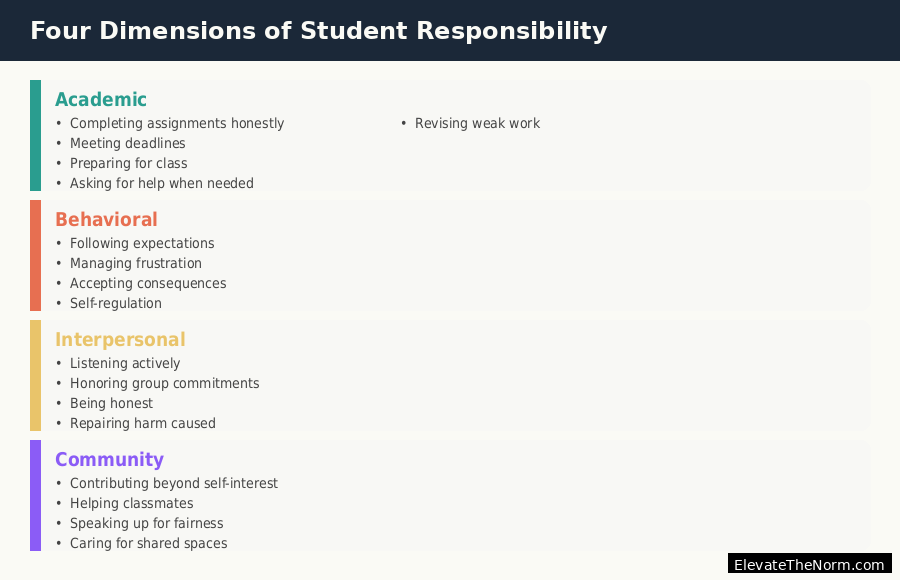
    The Four Dimensions of Student Responsibility

    Most schools define responsibility narrowly — turn in your work, follow the rules. That covers two dimensions and misses two others that matter just as much.

    Infographic showing four dimensions of student responsibility: academic, behavioral, interpersonal, and community
    Four dimensions of student responsibility most schools need to measure

    Academic Responsibility

    This is the one schools measure most: completing assignments, meeting deadlines, preparing for class, doing honest work, and asking for help when needed. Academic responsibility means the student treats their own learning as their job.

    What this looks like in practice: a student who doesn’t understand the assignment asks for clarification instead of guessing. A student whose first draft is weak revises it. A student who misses a deadline explains why and finishes the work.

    What this does not look like: a student who turns in someone else’s work. A student who consistently arrives unprepared and shrugs. A student who does the minimum to avoid a zero.

    Behavioral Responsibility

    Following classroom expectations, treating shared spaces with care, managing frustration without harming others, and accepting consequences when behavior falls short. Behavioral responsibility is the hardest dimension for adolescents because it requires impulse control that is still developing neurologically.

    This is where the pause matters. When a student pushes back — argues a deadline, refuses a task, challenges a grade — my first move is not to respond. I pause. It runs roughly a fifteen count, on average, but that number changes with the student, the day, and what just happened. The pause is not a technique from a book. It is a habit I built because the first thing I want to say is almost never the most useful thing I can say.

    That pause does two things. It gives me time to think. And it shows the student that their behavior did not control my response. Both of those outcomes are lessons in responsibility — mine and theirs.

    Interpersonal Responsibility

    How a student treats the people around them: listening, following through on commitments to a group, being honest, handling disagreement without personal attacks, and repairing harm when they cause it. This dimension is where responsibility becomes relational — it is no longer about the student and the standard. It is about the student and other people.

    Schools that treat interpersonal responsibility as a bonus rather than a requirement produce students who can pass tests and follow rules but cannot collaborate, resolve conflict, or maintain trust. Those skills do not develop on their own. They develop when teachers name them, model them, and hold students to them.

    Community Responsibility

    The broadest dimension: contributing to the classroom, the school, and eventually the community beyond school. Picking up something that isn’t yours. Helping a classmate who is lost. Speaking up when something unfair is happening. Community responsibility is the hardest to teach because it requires students to act on behalf of someone other than themselves.

    This is also where responsibility intersects with leadership. A student who takes community responsibility seriously is already leading — they just may not have the title. Closing that gap between doing the work and holding the role is the whole point of giving teenagers genuine authority in the building.

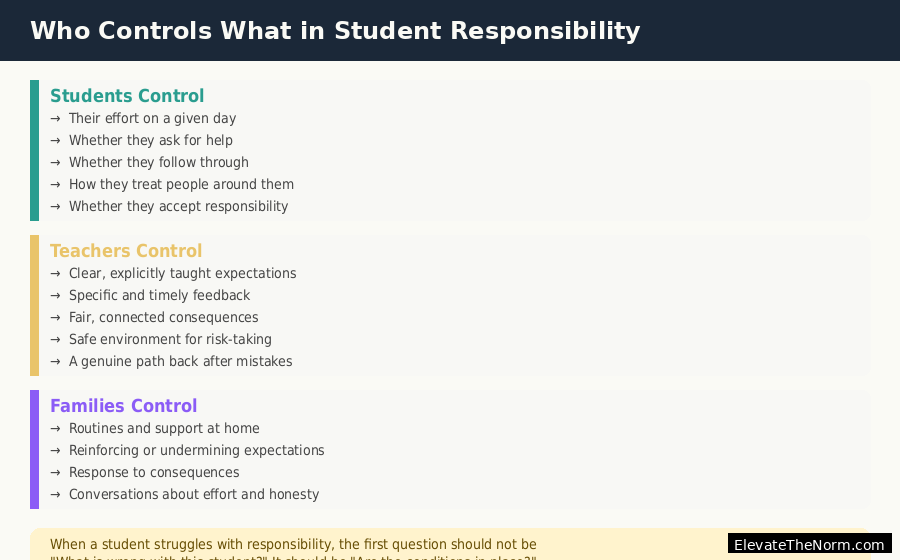
    What Students Control, What Teachers Control, What Families Control

    Most conflict around student responsibility comes from blurring these lines.

    Graphic breaking down what students, teachers, and families each control in building student responsibility
    Responsibility works when everyone knows what they control

    Students Control

    • Their effort on a given day
    • Whether they ask for help
    • Whether they follow through on commitments
    • How they treat the people around them
    • Whether they accept responsibility when they fall short

    Teachers Control

    • Whether expectations are clear and explicitly taught
    • Whether feedback is specific and timely
    • Whether consequences are fair and connected to the behavior
    • Whether the classroom feels safe enough to take risks
    • Whether there is a genuine path back after a mistake
    • Whether the standard stays consistent or quietly shifts based on the student

    Families Control

    • The routines and support available at home
    • Whether they reinforce or undermine the school’s expectations
    • How they respond when their child faces consequences
    • The conversations they have about effort, honesty, and responsibility

    Schools Control

    • Whether policies support responsibility or undermine it (a grading system that averages a zero with later scores teaches learned helplessness, not responsibility)
    • Whether teachers have the time, training, and backing to follow through
    • Whether the culture treats mistakes as learning opportunities or permanent marks

    When a student is struggling with responsibility, the first question should not be “What is wrong with this student?” It should be “Are the conditions for responsibility actually in place?” If the expectations are unclear, the feedback is absent, the consequences are disconnected, or the path back doesn’t exist, then the system is failing — not the student.

    What High Standards Actually Look Like

    High standards are not the same as high pressure. A teacher with high standards believes every student can meet the expectation and builds the structure to make that possible. A teacher with high pressure demands performance without building the structure.

    The difference shows up in how you handle the student who falls short.

    High standards: “This isn’t at the level we discussed. Here’s specifically what needs to change. You have until Thursday to revise it. I’m available Tuesday during advisory if you need help.”

    High pressure: “This is unacceptable. You should know better by now. I’m very disappointed.”

    The first response holds the standard and provides a path. The second response holds the standard and provides shame. Both sound firm. Only one teaches responsibility.

    Research on teacher expectations consistently shows that what teachers believe about students’ capabilities shapes student outcomes. Rosenthal and Jacobson’s classic 1968 study on teacher expectancy effects — where students whose teachers were told they were “intellectual bloomers” showed greater IQ gains — has been replicated and refined across decades. The finding holds: high expectations, communicated through specific support rather than general pressure, produce better results (Rosenthal & Jacobson, 1968; Jussim & Harber, 2005).

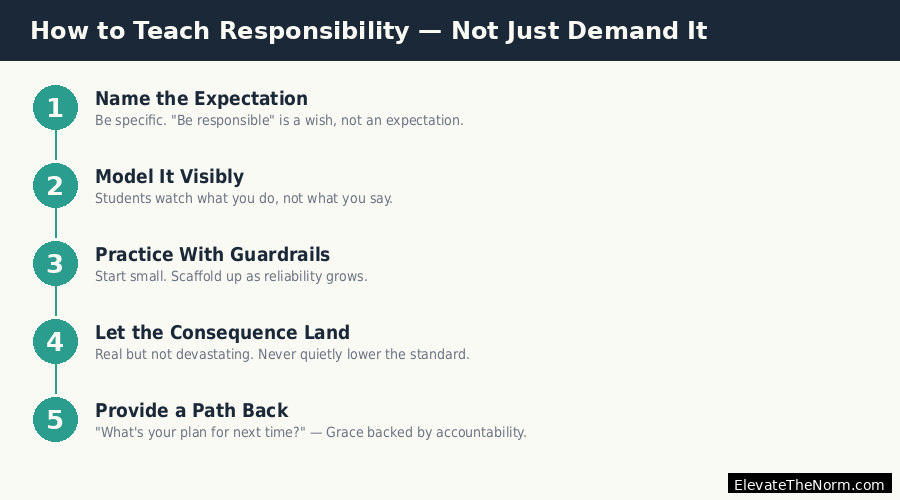
    How to Teach Responsibility — Not Just Demand It

    Responsibility is a set of behaviors, and behaviors can be taught. Here is a practical sequence for building responsibility in grades 6–12.

    Five-step sequence for teaching student responsibility: name expectations, model it, practice with guardrails, let consequences land, provide a path back
    Five steps to teach responsibility instead of just demanding it

    1. Name the Expectation Specifically

    “Be responsible” is not an expectation. It is a wish. Clear classroom expectations sound different. An expectation sounds like: “When you arrive, your materials are out and you’re looking at the board for the first task within two minutes.” Specificity removes guesswork and gives students a clear target to hit.

    2. Model It Visibly

    Students watch what you do, not what you say. This is one reason classroom management starts with the teacher, not the student. If you expect them to meet deadlines, meet yours. If you expect them to admit mistakes, admit yours publicly. If you expect them to prepare, show them what your preparation looks like. Responsibility is taught as much by example as by instruction.

    3. Practice It With Guardrails

    Give students real responsibility in small doses with scaffolding. A student who has never managed a deadline doesn’t need a month-long project on day one. They need a three-day task, a check-in at the midpoint, and a clear consequence for missing the end date. As they demonstrate reliability, extend the timeline and reduce the check-ins. My Makeup Work System on TPT puts the tracking on the student, which is where the responsibility belongs.

    This is not coddling. This is what teaching actually looks like. You do not hand a student a novel and say “read it” if they have never finished a chapter book. You scaffold. Responsibility deserves the same approach.

    4. Let the Consequence Land

    When a student doesn’t meet the expectation, the consequence has to be real. Not devastating. Not humiliating. But real. A student who doesn’t prepare for a group presentation should feel that — through honest feedback from peers, through a required individual follow-up, through the visible gap between what they delivered and what was expected.

    The worst thing you can do is quietly lower the standard. The student learns nothing. The other students learn that the standard is fake.

    5. Provide a Path Back

    After the consequence, the conversation should end with a question: “What’s your plan for next time?” Not a lecture. Not a threat. A question that places the responsibility back where it belongs — with the student.

    The path back is where grace lives. It is also where learning from mistakes actually happens — not in the consequence itself, but in the moment after, when the student decides what to do next. It does not erase the consequence. It says: the standard is still here, I still believe you can meet it, and here is your chance to prove it.

    Common Mistakes Teachers Make With Student Responsibility

    Confusing Responsibility With Obedience

    Obedience is doing what you’re told because someone told you. Responsibility is doing what needs to be done because you understand why it matters. A classroom full of obedient students looks orderly. A classroom full of responsible students looks orderly and keeps running when the teacher steps out.

    If your system requires your constant presence and enforcement to function, you have built obedience. If your system runs because students have internalized the standard, you have built responsibility. The difference matters because obedience does not transfer. Responsibility does.

    Rescuing Students From Consequences

    When a student fails to meet a deadline and the teacher extends it without conversation, the teacher has just taught the student that deadlines are negotiable. When a parent calls to argue a grade and the teacher changes it, the student learns that consequences can be outsourced. When an administrator overrides a classroom consequence to avoid a complaint, the student learns that persistence beats integrity.

    Each of these moments, individually, seems small. Together, they build a system where responsibility is optional.

    Punishing Without Teaching

    A detention for missing homework teaches a student to sit in a room. It does not teach them to manage their time, prioritize their work, or ask for help before the deadline passes. If the consequence doesn’t include a conversation about what went wrong and what the student will do differently, it is punishment, not accountability.

    Applying Standards Unevenly

    Students have a ruthless eye for inconsistency. If one student gets a pass and another doesn’t, every student in the room notices. Responsibility flourishes in systems that are predictable, fair, and built on mutual respect. It collapses in systems where the rules depend on who you are or how the teacher is feeling that day.

    A Responsibility Framework for the Classroom

    DimensionWhat It Looks LikeWhat the Teacher DoesWhat It Doesn’t Look Like
    AcademicPrepared, on time, honest work, asks for helpClear expectations, specific feedback, revision opportunitiesPlagiarism, chronic unpreparedness, helplessness
    BehavioralFollows expectations, manages frustration, accepts consequencesConsistent follow-through, private correction, a path backDisruption without accountability, forced compliance without understanding
    InterpersonalListens, follows through on group commitments, repairs harmModels respect, names expectations, holds students to themPersonal attacks, broken commitments with no consequence
    CommunityContributes beyond self-interest, helps others, speaks upCreates opportunities, recognizes contribution, makes it visibleTreating shared spaces or people as someone else’s problem

    If you want specific classroom activities that put this framework into practice, activities for teaching responsibility walks through ten structured approaches — from deadline choice contracts to repair letters — designed for grades 6–12. And because none of these activities work without a predictable room, understanding why classroom expectations are important is the foundation everything else sits on. When a student has stopped engaging with responsibility altogether, motivating students who don’t care addresses that harder starting point directly. And when the pattern traces back to missed class time rather than a change in effort, chronic absenteeism is the first thing worth ruling out.


    What is the difference between student responsibility and student accountability?

    Responsibility is internal — it is the student’s sense of ownership over their preparation, effort, and behavior. Accountability is external — it is the system of expectations, feedback, and consequences that supports responsibility. A student needs both. Accountability without internal motivation produces compliance. Responsibility without external accountability can drift into good intentions with no follow-through.

    How do you teach responsibility to a student who has never been held to a standard?

    Start small, be explicit, and be patient. Name one expectation clearly. Practice it. Follow through when the student misses it — with a consequence that teaches, not one that punishes. Then add the next expectation. A student who has spent years in systems without standards needs time to adjust. That is not a reason to lower the standard. It is a reason to scaffold the path to it.

    What do you do when a student says they do not care?

    Take it seriously but do not take it literally. A student who says they do not care usually means one of three things: they care but are protecting themselves from failure, they do not see the relevance, or they are overwhelmed and shutting down. The response is not a motivational speech — it is a specific question: “What part of this is getting in the way?” That question respects their intelligence and opens a conversation instead of closing one.

    How do you handle responsibility in group projects?

    Structure the group so individual responsibility is visible. Each student should have a defined role, a personal deliverable, and a moment where they present or defend their own contribution. When a group member does not follow through, the consequence falls on that individual — not the group. Group grades that allow one student to carry others teach the wrong lesson about both effort and fairness.

    Should families be involved in building student responsibility?

    Yes, but with clear boundaries. Families can reinforce expectations, support routines, and have honest conversations about effort. They should not do the student’s work, argue consequences down, or remove the productive struggle that builds responsibility. The most useful family partnership is one where the school’s expectations and the family’s expectations align — and where both adults agree that the student is the one who needs to do the work.

    What if the school’s grading system undermines responsibility?

    Many do. A system that averages a zero with later scores can make it mathematically impossible for a student to recover from one missing assignment. A system that gives points for compliance — bringing a pencil, sitting quietly — measures obedience, not learning. If your grading system punishes honest effort and rewards strategic gaming, the system needs to change before student responsibility can improve. Advocate for grading policies that reflect actual mastery and allow recovery.

    For a detailed breakdown of what each domain looks like in practice—preparation, participation, deadlines, collaboration, mistakes, help-seeking, and repair—see student responsibility in the classroom.


    Sources

    1. Ryan, R. M., & Deci, E. L. (2000). Self-determination theory and the facilitation of intrinsic motivation, social development, and well-being. American Psychologist, 55(1), 68–78. https://selfdeterminationtheory.org/SDT/documents/2000_RyanDeci_SDT.pdf
    2. Guay, F. (2022). Applying self-determination theory to education: Regulations types, psychological needs, and autonomy supporting behaviors. Canadian Journal of School Psychology, 37(1), 75–92. https://journals.sagepub.com/doi/10.1177/08295735211055355
    3. Responsive Classroom. (2025). Secondary practices (Grades 6–12). https://www.responsiveclassroom.org/secondary-practices/
    4. Rosenthal, R., & Jacobson, L. (1968). Pygmalion in the Classroom: Teacher Expectation and Pupils’ Intellectual Development. Holt, Rinehart and Winston. https://psycnet.apa.org/record/1968-08876-000
    5. Jussim, L., & Harber, K. D. (2005). Teacher expectations and self-fulfilling prophecies: Knowns and unknowns, resolved and unresolved controversies. Personality and Social Psychology Review, 9(2), 131–155. https://journals.sagepub.com/doi/10.1207/s15327957pspr0902_3
    6. González-Villora, S., et al. (2017). Program to promote personal and social responsibility in the secondary classroom. Frontiers in Psychology, 8, 809. https://www.frontiersin.org/journals/psychology/articles/10.3389/fpsyg.2017.00809/full
    7. Niemiec, C. P., & Ryan, R. M. (2009). Autonomy, competence, and relatedness in the classroom: Applying self-determination theory to educational practice. Theory and Research in Education, 7(2), 133–144. https://selfdeterminationtheory.org/SDT/documents/2009_NiemiecRyan_TRE.pdf
    8. Edutopia. (2023). Perceptions of mistakes in the classroom. https://www.edutopia.org/article/perceptions-mistakes-classroom/

    About Clay Shumate
    Clay Shumate is a certified secondary Social Studies teacher in the public schools of West Alabama, with seven years of classroom experience, a B.A. in History, and an M.Ed. in Secondary Education. He writes about project-based learning, student responsibility, respect, and practical ways to hold young people to a higher standard while giving them room to learn from mistakes. He is a member of the Society of Professional Journalists and writes to its Code of Ethics; this site’s editorial standards and corrections policy are published in full. More about Clay.
  • Learning From Mistakes: Why Students Need Accountability and Another Chance

    Learning From Mistakes: Why Students Need Accountability and Another Chance

    By Clay Shumate

    Learning from mistakes means a student faces honest feedback, takes responsibility for what went wrong, completes a meaningful repair, and gets a genuine second chance. It does not mean pretending mistakes don’t matter, and it does not mean one bad decision defines a student permanently. Schools that get this right hold both: accountability that teaches something and a clear path forward.

    For more on how natural consequences function in secondary classrooms—and when they fall short—see natural consequences in the classroom.

    Key Takeaways

    • Mistakes are neurologically productive — errors activate stronger learning pathways than getting it right the first time.
    • Accountability without a path forward is just punishment wearing a different label.
    • Grace without accountability teaches students that standards don’t apply to them.
    • A workable process for any mistake: acknowledge it, understand its impact, repair the harm, and try again with the standard still in place.
    • Teachers control the conditions that determine whether a mistake becomes learning or shame.

    What Learning From Mistakes Actually Requires

    Learning from mistakes sounds simple until you try to do it in a room full of teenagers who would rather pretend the mistake never happened.

    Here is what the phrase actually demands: the student has to know the mistake happened, understand why it matters, feel the weight of it without being crushed by it, and then do something different. That is a sequence, not a slogan. Skip any step and the learning doesn’t happen.

    The student who never hears honest feedback repeats the mistake. The student who hears feedback but faces no consequence learns that standards are optional. The student who faces a consequence but gets no second chance learns that effort is pointless. And the student who gets a second chance without accountability learns that mistakes cost nothing.

    Every one of those failures is a teacher problem, not a student problem. The student is responding rationally to the system they’re in. Teaching responsibility means building a system worth responding to.

    The Two Extremes That Fail Students

    Most schools land on one of two bad defaults.

    The Zero-Tolerance Default

    Some schools treat every failure like a final answer. A missed deadline is a zero. A behavioral mistake is an office referral. A bad decision in October follows a student through June. The logic sounds clean: actions have consequences, and students need to learn that.

    The problem is that students do learn it — they learn that trying is risky, that asking for help is an admission of weakness, and that the safest move is to disengage. Research from the American Psychological Association consistently shows that exclusionary discipline — suspensions, expulsions, zero-tolerance policies — does not improve behavior and disproportionately affects students of color and students with disabilities (American Psychological Association, 2008).

    A system with no path back is not holding a high standard. It’s holding a grudge.

    Infographic comparing zero-tolerance and everything-is-fine approaches to learning from mistakes in the classroom
    Two extremes that fail students: zero-tolerance rigidity vs. consequence-free flexibility

    The Everything-Is-Fine Default

    Other schools swing the other direction. Every assignment can be redone indefinitely. Behavioral issues get processed through empathy circles but never produce a visible consequence. Students learn quickly that the stated standard isn’t real.

    This is not grace. Grace with no accountability is indifference dressed up as kindness. A student who never faces the honest weight of a mistake has been denied one of the most important experiences in adolescent development: realizing that what they do affects other people, and that fixing it is their job.

    The useful position is between these two extremes: firm enough that standards mean something, flexible enough that a student who falls short can get back up and try again with the standard still in place.

    Why Mistakes Strengthen Learning — What the Research Says

    The case for learning from mistakes is not just philosophical. It is neurological.

    When a student gets something right the first time, the brain registers a small confirmation. When a student gets something wrong, catches the error, and corrects it, the brain fires differently. Research by Jason Moser and colleagues at Michigan State University found that the brain shows two distinct responses to errors: an initial automatic response and a secondary, conscious response associated with paying attention to the mistake. Students who showed a stronger secondary response — meaning they attended to the error — performed better on subsequent tasks (Moser et al., 2011).

    Manu Kapur’s research on productive failure takes this further. Across multiple studies, students who attempted complex problems before receiving instruction — and failed — outperformed students who received direct instruction first. The struggle itself activated prior knowledge, exposed gaps, and made the eventual correct solution more meaningful and durable (Kapur, 2008; Sinha & Kapur, 2021).

    The critical condition: the failure had to be followed by explicit teaching. Struggle without resolution is not productive failure — it is just failure. This distinction matters in every classroom. A teacher who lets students sit with confusion indefinitely is not building resilience. A teacher who catches the misconception, sits down with the group, and asks the right questions is.

    When I’m circulating and I overhear a group building an argument on a faulty premise, I don’t stop the room. I pull up a chair. I ask them to walk me through it. Most of the time, they find the break in their own reasoning once someone asks the right question at the right moment. That is a mistake caught while it’s still useful — and the correction sticks because they did the thinking, not me.

    Academic Mistakes: Feedback, Revision, and Standards

    Academic mistakes — wrong answers, weak arguments, incomplete work, misunderstood concepts — are the easiest category to handle well and the one schools most often handle badly.

    What Works

    Targeted feedback, not blanket correction. Research consistently shows that students learn more from feedback focused on specific learning objectives than from papers returned covered in red marks (Hattie & Timperley, 2007). Mark the two things that matter most. Ignore the rest until those two are fixed.

    Six-step framework for handling student mistakes: name it, ask what they see, state impact, set repair, follow up, reset
    Six steps for turning a mistake into learning instead of shame

    Revision as the expectation, not a favor. When a student turns in weak work, the response is not a zero and not a pat on the back. The response is: “This isn’t there yet. Here’s what needs to change. Bring it back.” The standard stays the same. The timeline adjusts.

    Distinguishing mistakes from errors. A mistake is careless — a missing period, a misread question. An error comes from a gap in understanding and tends to recur. The correction strategy is different for each. Mistakes need attention to detail. Errors need reteaching, which is why the way a correction assignment is structured decides whether it teaches anything.

    What Doesn’t Work

    Unlimited redos with no deadline. Late policies that reduce a grade by ten percent per day until the work is worthless. Averaging a zero with later scores so the math never recovers. Accepting work that doesn’t meet the standard just to avoid the conversation.

    The goal is a system where the standard is visible, the feedback is specific, the revision is expected, and the consequence of not revising is real — but not permanent.

    Behavioral Mistakes: Consequences, Repair, and Trust

    Behavioral mistakes are harder than academic ones because they involve other people. A student who disrupts a class, disrespects a peer, or breaks a commitment hasn’t just missed a standard — they’ve affected someone.

    The Difference Between Consequences and Punishment

    A consequence is connected to the behavior, proportionate, and designed to teach. A punishment is designed to make the student uncomfortable enough to stop. The distinction is not semantic. It determines whether the student learns anything or just learns to avoid getting caught.

    If a student damages a relationship, the consequence should involve repairing it. If a student wastes class time, the consequence should involve making it up. If a student breaks trust, the consequence should involve rebuilding it — through action, not a forced apology.

    Restorative accountability, when done honestly, asks three questions that traditional discipline skips: What happened? Who was affected? What are you going to do about it? (Edutopia, 2023). The student designs the repair, not the adult. The adult holds the standard for whether the repair is sufficient.

    When Consequences Are Non-Negotiable

    Some mistakes require immediate, firm consequences regardless of the context. Safety violations, threats, harassment, and violations of law or school policy are not opportunities for a restorative circle. They require the consequence that policy demands and the follow-up that the student needs. Both. Not one or the other.

    The mistake schools make here is treating these categories as an either/or: either we do restorative practices or we enforce policy. In reality, a student can face a mandatory consequence and still go through a repair process afterward. The consequence addresses the rule. The repair addresses the person.

    When Trust Is Damaged: The Harder Conversation

    The hardest mistakes to recover from are the ones that damage trust. A student who cheats, lies to a teacher, lets a group down, or betrays a peer’s confidence has done something that “I’m sorry” cannot fix.

    Cheating in particular is worth separating from the others, because the research on why it happens points at time pressure, fear and confusion far more than at character. What academic honesty actually means for grades 6–12 covers where the line falls, what AI did and did not change, and why a policy that makes honesty the expensive option produces more lying, not less. The worked examples of academic honesty and dishonesty are the version to put in front of a class, because most of the eighteen are arguable and the argument is the lesson.

    Trust repair takes time and visible action. The process looks like this:

    1. Acknowledge specifically what happened. Not “I messed up” but “I copied the answers and turned them in as my own work.”
    2. Name who was affected and how. The teacher who trusted the work was real. The classmates who did their own. The student’s own credibility.
    3. Propose a repair. The student — not the teacher — suggests what they will do to make it right. The teacher evaluates whether the proposal is sufficient.
    4. Follow through and be watched. Trust comes back through consistent behavior over time, not through one conversation. The student earns closer attention for a while. That is not punishment — that is the natural result of breaking trust.

    This process is uncomfortable. It should be. Discomfort is not the same as humiliation. The student should feel the weight of what happened without feeling like a permanently broken person.

    What Teachers Control — and What They Don’t

    Comparison graphic showing what teachers control versus what they do not control when students make mistakes
    What teachers control about mistakes — and what they don’t

    Teachers cannot control whether a student makes a mistake. They can control almost everything that happens afterward.

    What you control:

    • Whether the mistake is addressed privately or publicly
    • Whether feedback is specific or vague
    • Whether the standard stays in place or quietly drops
    • Whether revision is expected or optional
    • Whether consequences are connected to the behavior or disconnected from it
    • Whether the student gets a genuine path back or a dead end
    • Whether the classroom feels safe enough to admit a mistake in the first place

    What you don’t control:

    • Whether the student takes responsibility
    • Whether the family supports the follow-through
    • Whether administration backs your consequence
    • Whether the student cares right now

    The temptation is to focus on what you don’t control and use it as a reason to give up. Don’t. A student who doesn’t take responsibility today may be watching how you handle the situation. The lesson may land later. Your job is to make sure the system is worth learning from. And if you want to understand what genuine student responsibility looks like when it works, that picture starts with the same conditions: clear expectations, real consequences, and a standard the student believes applies to them.

    A Practical Framework for Handling Mistakes in Grades 6–12

    This framework works for academic and behavioral mistakes. Adjust the scale to match the weight of the situation.

    Step 1: Name It Clearly

    Tell the student what happened, without editorializing. “You turned this in without the source analysis we discussed” is better than “You clearly didn’t try.” Clarity is respect. Vagueness leaves room for denial and defensiveness.

    Step 2: Ask What They See

    Before explaining the impact, ask: “What do you think happened here?” or “Walk me through your thinking.” Students often know more than they let on. Giving them the chance to name it first preserves their dignity and gives you information about whether the problem is understanding, effort, or something else.

    Step 3: State the Impact Honestly

    “When you don’t finish the research, your partner has to carry both parts” is more useful than “You need to be more responsible.” Specifics teach. Generalizations lecture.

    Step 4: Set the Repair

    The repair should match the mistake. Academic mistakes: revise and resubmit by a specific date. Behavioral mistakes: a conversation, a written reflection, direct restitution, or a plan the student proposes. The student should do the repair, not just agree to it. If you want a think sheet that treats students like young adults, my Behavior Reflection Sheets on TPT come in two levels.

    Step 5: Follow Up

    Check that the repair happened. A framework with no follow-through is a suggestion. If the student completed the repair, acknowledge it clearly — not with exaggerated praise, but with honest recognition that they did what was needed.

    Step 6: Reset

    After the repair is complete, the student’s standing resets. They are not on probation. They are not labeled. They are back where they started, with the standard still in place. This is what grace looks like when it’s backed by accountability. For ten specific activities for teaching responsibility that build this kind of repair into daily classroom practice, that article walks through each one. For a ready-to-use tool on this, see a printable standards-based grading starter pack. For a ready-to-use tool on this, see a fair academic integrity violation response process.


    Does letting students redo work lower the standard?

    Not if the standard stays the same. A student who submits weak work, receives specific feedback, and revises until the work meets the standard has actually done more rigorous work than the student who got it right the first time. The standard is the standard. The timeline is the variable.

    How do you hold students accountable without humiliating them?

    Handle it privately whenever possible. State what happened without adding a character judgment. Focus on the behavior and its impact, not on the student as a person. A student who hears “this work isn’t at the standard yet” will respond differently than one who hears “you obviously don’t care.”

    What about students who keep making the same mistake?

    A repeated mistake is usually a signal, not a character flaw. It may mean the student doesn’t understand the expectation, doesn’t have the skill to meet it, or is dealing with something outside the classroom. Before escalating consequences, ask whether the conditions for success are actually in place.

    Should teachers accept late work?

    Late work should come with a real consequence — a required conversation, a revision, or a temporary loss of flexibility — but not a consequence so severe it makes the work pointless. A student who turns in work two days late and gets a zero has been taught that the work doesn’t matter. A student who turns in work two days late, explains why, and completes it to the standard has been taught responsibility.

    How do you rebuild trust after a student lies or cheats?

    Through specific acknowledgment, a student-proposed repair plan, follow-through, and time. Trust is rebuilt by consistent behavior, not by a single apology. The student should expect closer attention for a while. Frame that attention as what naturally happens after trust breaks — not as punishment.

    Can a student really learn from a mistake if there is no consequence?

    Not usually. Consequences provide the friction that makes a mistake register. Without any consequence, the student learns that the mistake costs nothing. The key is that the consequence teaches rather than merely punishes — it is connected to the behavior, proportionate, and followed by a genuine chance to do better.

    What if parents push back on consequences?

    Explain the process: what happened, how it was addressed, what the student is expected to do, and what the path forward looks like. Most parents will support a consequence when they can see that it is fair, proportionate, and designed to help their child improve rather than just to punish.


    Sources

    1. American Psychological Association. (2008). Are Zero Tolerance Policies Effective in the Schools? An Evidentiary Review and Recommendations. https://www.apa.org/pubs/reports/zero-tolerance
    2. Moser, J. S., Schroder, H. S., Heeter, C., Moran, T. P., & Lee, Y.-H. (2011). Mind your errors: Evidence for a neural mechanism linking growth mind-set to adaptive posterror adjustments. Psychological Science, 22(12), 1484–1489. https://journals.sagepub.com/doi/10.1111/j.1467-9280.2011.02363.x
    3. Kapur, M. (2008). Productive failure. Cognition and Instruction, 26(3), 379–424. https://onlinelibrary.wiley.com/doi/10.1111/j.1551-6709.2008.01003.x
    4. Sinha, T., & Kapur, M. (2021). When problem solving followed by instruction works: Evidence for productive failure. Review of Educational Research, 91(4), 823–861. https://journals.sagepub.com/doi/10.3102/00346543211019105
    5. Hattie, J., & Timperley, H. (2007). The power of feedback. Review of Educational Research, 77(1), 81–112. https://journals.sagepub.com/doi/10.3102/003465430298487
    6. Edutopia. (2023). Building accountability with restorative practices. https://www.edutopia.org/article/building-accountability-restorative-practices/
    7. Narciss, S., & Lippold, M. (2025). Learning from errors and failure in educational contexts: New insights and future directions. British Journal of Educational Psychology. https://bpspsychub.onlinelibrary.wiley.com/doi/10.1111/bjep.12716
    8. González-Villora, S., et al. (2017). Program to promote personal and social responsibility in the secondary classroom. Frontiers in Psychology, 8, 809. https://www.frontiersin.org/journals/psychology/articles/10.3389/fpsyg.2017.00809/full

    About Clay Shumate
    Clay Shumate is a certified secondary Social Studies teacher in the public schools of West Alabama, with seven years of classroom experience, a B.A. in History, and an M.Ed. in Secondary Education. He writes about project-based learning, student responsibility, respect, and practical ways to hold young people to a higher standard while giving them room to learn from mistakes. He is a member of the Society of Professional Journalists and writes to its Code of Ethics; this site’s editorial standards and corrections policy are published in full. More about Clay.
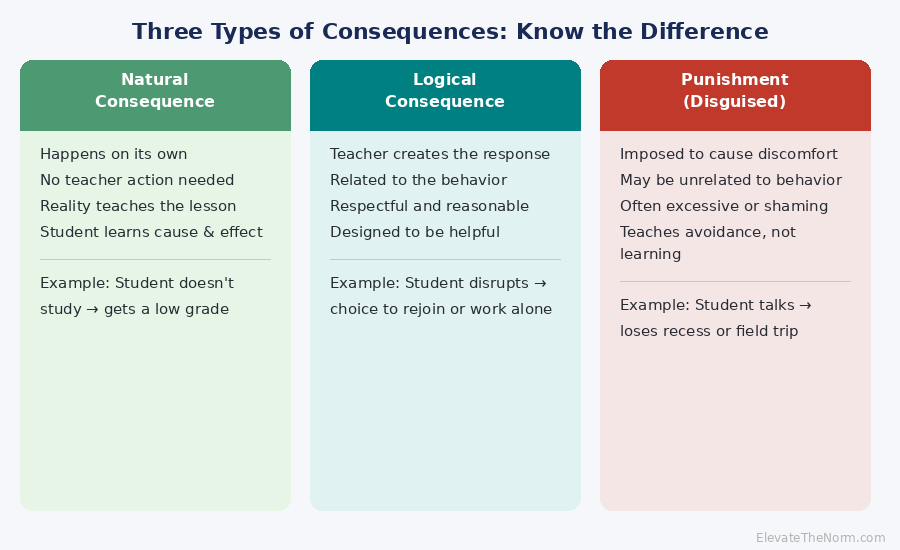
Teacher Emergency Toolkit — practical resources, real classroom support. Shop on TPT.Teacher Emergency Toolkit — practical resources, real classroom support. Shop on TPT.