The Elevate Blog banner: Real Classrooms. Practical Ideas. Higher Expectations. Three students climb a rocky ridge at sunrise, each pulling the next one up, toward a teacher reaching down to help.

Tag: education research

  • Study Skills for Students: What Actually Works in Grades 6–12

    Study Skills for Students: What Actually Works in Grades 6–12

    By Clay Shumate

    Study skills are the methods students use to learn material on their own. Two beat the rest: practice testing and spacing study across days. A ten-technique review rated those two high utility and rated rereading, highlighting and summarizing low — and surveys show rereading is what most students actually do.

    Key Takeaways

    • Of ten study techniques reviewed by Dunlosky and colleagues, only practice testing and distributed practice earned a high-utility rating. Summarization, highlighting, the keyword mnemonic, imagery for text, and rereading all earned low ones.
    • A later meta-analysis of 242 studies and 1,619 effects agreed on the top two — distributed practice d = 0.85, practice testing d = 0.74 — but put rereading at d = 0.47 and argued that none of the ten should be dismissed as ineffective. The gap between those two verdicts is the most useful thing on this page.
    • The same meta-analysis found a larger average effect for secondary students (0.69) than for primary (0.42) or university students (0.59). Whatever else is true of teenagers, these methods are not weaker on them.
    • In a survey of 177 undergraduates, 84 percent named rereading as a study strategy and 55 percent ranked it first, while 11 percent mentioned practising recall. That sample was not teenagers, and a 2019 reexamination disputes the conclusion — both caveats are given below.
    • The federal practice guide rates two things strong: using quizzes to re-expose students to key content, and asking deep explanatory questions. Teaching students to manage their own study time is rated minimal. The strongest moves belong to the teacher, not to a study-skills handout.

    Ask a class how they studied for a test and most of them will describe reading something again. Notes, the chapter, a slide deck, a highlighted page. It feels like work, it takes real time, and it is close to the least effective thing on a list that researchers have been ranking for over a decade.

    The honest version of this article is not “your students study wrong.” It is that the two methods with the best evidence are both easier to run from the front of the room than to assign as homework — which means study skills are mostly a teaching problem wearing a student’s name.

    What are study skills?

    Study skills are the methods a student uses to learn and retain material outside direct instruction — how they review, test themselves, organize time, and decide when they know something. That last part matters more than it sounds. A student who cannot tell the difference between recognizing a page and being able to produce what is on it will stop studying too early every single time.

    Two terms are worth defining, because the rest of the research uses them constantly. Practice testing — also called retrieval practice — means pulling information out of memory without looking, through self-quizzing, flashcards used honestly, or low-stakes classroom quizzes. Distributed practice, or spacing, means spreading the same amount of study across several sessions instead of one. Neither requires technology, money, or a new curriculum.

    Which study skills actually work?

    Practice testing and distributed practice. Those two were the only techniques rated high utility in the review that put this question on the map, and they stayed on top when a different team re-ran the numbers eight years later.

    In 2013, John Dunlosky, Katherine Rawson, Elizabeth Marsh, Mitchell Nathan and Daniel Willingham reviewed ten common techniques in Psychological Science in the Public Interest and rated each one for general utility — whether the benefit holds up across ages, abilities, materials and kinds of test. Two earned high. Three earned moderate. Five earned low.

    In 2021, Gregory Donoghue and John Hattie meta-analyzed the same ten techniques across 242 studies and 1,619 effects and produced an effect size for each. The headline agreed: distributed practice and practice testing came first. The fine print did not entirely agree, and that is worth putting in front of you rather than hiding.

    TechniqueDunlosky et al. (2013) ratingDonoghue & Hattie (2021) mean dWhat it looks like in a grades 6–12 class
    Distributed practiceHigh0.85The same review split across four short sessions instead of one night.
    Practice testingHigh0.74Ungraded recall questions at the start of class, no notes open.
    Elaborative interrogationModerate0.56Making students answer “why would that be true?” about a fact they just read.
    Imagery for textLow0.56Students build a mental picture of a described process or event.
    Self-explanationModerate0.54A student talks through how they got an answer, step by step.
    MnemonicsLow0.50A keyword or acronym attached to a list. Fine for a list; not a study plan.
    RereadingLow0.47Reading the chapter or the notes again.
    Interleaved practiceModerate0.47Mixing problem types in one set instead of doing twenty of the same kind.
    Underlining / highlightingLow0.44Marking a text while reading it.
    SummarizationLow0.44Writing a short summary of what was read.
    Ratings from Dunlosky et al. (2013); mean effect sizes from Donoghue & Hattie (2021). The right-hand column is this article’s description of the classroom form, not a finding. The two columns use different methods and disagree on three techniques — see below.

    Read the disagreements rather than the ranking. Imagery was rated low in 2013 and came out at 0.56 in 2021, which is moderate in that paper’s own bands. Interleaved practice was rated moderate and came out at 0.47, which is low in those bands. And rereading — the technique everyone is told to abandon — came out at 0.47, not zero. The 2021 authors say so directly: their cut-offs are somewhat arbitrary, several techniques sit right on a boundary, and none of the ten should be called ineffective.
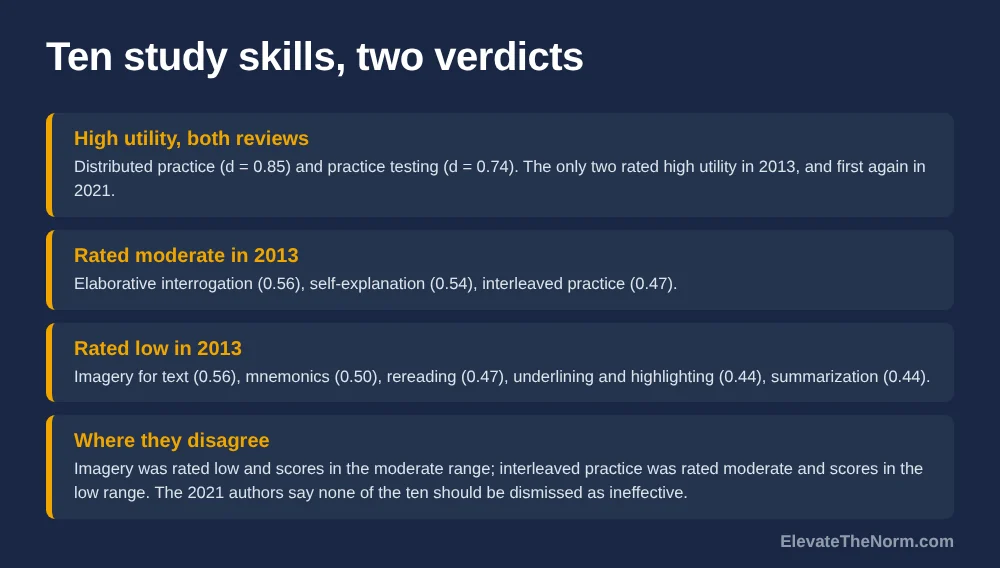
    Four-row graphic titled Ten study skills, two verdicts: high utility in both reviews is distributed practice at d = 0.85 and practice testing at d = 0.74; rated moderate in 2013 were elaborative interrogation 0.56, self-explanation 0.54 and interleaved practice 0.47; rated low in 2013 were imagery for text 0.56, mnemonics 0.50, rereading 0.47, underlining and highlighting 0.44 and summarization 0.44; the two reviews disagree on imagery and interleaved practice, and the 2021 authors say none of the ten should be dismissed as ineffective.
    Where the 2013 utility ratings and the 2021 effect sizes agree, and where they do not.

    Why are highlighting and rereading rated so low?

    Because they produce a feeling of knowing without producing the thing that gets tested: the ability to retrieve the material cold. A reread page is familiar, and familiarity is easy to mistake for mastery. A quiz question answered without notes cannot be faked that way.

    But keep the honest version in view. Low utility in the 2013 review means the benefit was inconsistent or narrow, not absent, and the 2021 effect sizes put rereading, mnemonics, highlighting and summarizing between 0.44 and 0.50. The accurate sentence for students is not “rereading does nothing.” It is that rereading is the most expensive way to get a modest return, because it eats the study time that a few minutes of self-testing would have used better. The same caution applies to memory tricks — what mnemonic devices actually help students remember is narrower than most study advice admits.

    There is a second caution worth stating before anyone builds a professional-development slide on those effect sizes. The 2021 authors report that 93 percent of the studies they pooled measured surface or factual outcomes, almost all measured near transfer, most measured the outcome within a day, and no publication after 2014 was included. Heterogeneity was high. So the numbers are a good guide to learning facts and procedures that will be tested soon, and a weak guide to whether a student still understands something in April.

    Do students know which study methods work?

    Mostly not, though the most-cited evidence for that claim is weaker than its reputation. Both halves belong here, because this is the finding teachers repeat most often and the one most likely to be overstated.

    Jeffrey Karpicke, Andrew Butler and Henry Roediger surveyed 177 undergraduates about how they study. Rereading notes or the textbook was listed by 84 percent and ranked first by 55 percent. Practising recall was listed by 11 percent and ranked first by 1 percent. Asked what they would do with a chapter if they could not restudy afterwards, 57 percent chose to restudy and 18 percent chose to test themselves — and most of those who chose testing said they wanted feedback, not better memory.

    Two caveats, both from the research rather than from me. First, that sample was undergraduates at a selective private university, not students in grades 6–12, and the authors themselves note that other surveys using different question formats found much higher rates of self-quizzing. Second, Christof Kuhbandner and Kathrin Emmerdinger re-examined the question in 2019 with finer measures of what students actually do, and found that few students preferred rereading early in learning and almost all shifted to testing later, with rereading used mostly to revisit a part they had not understood. Their conclusion is that the preference for rereading has been overstated.

    What survives both: students systematically underuse self-testing as a learning tool, even when they use it as a checking tool. That is a smaller claim than the one usually made, and it is still enough to act on.
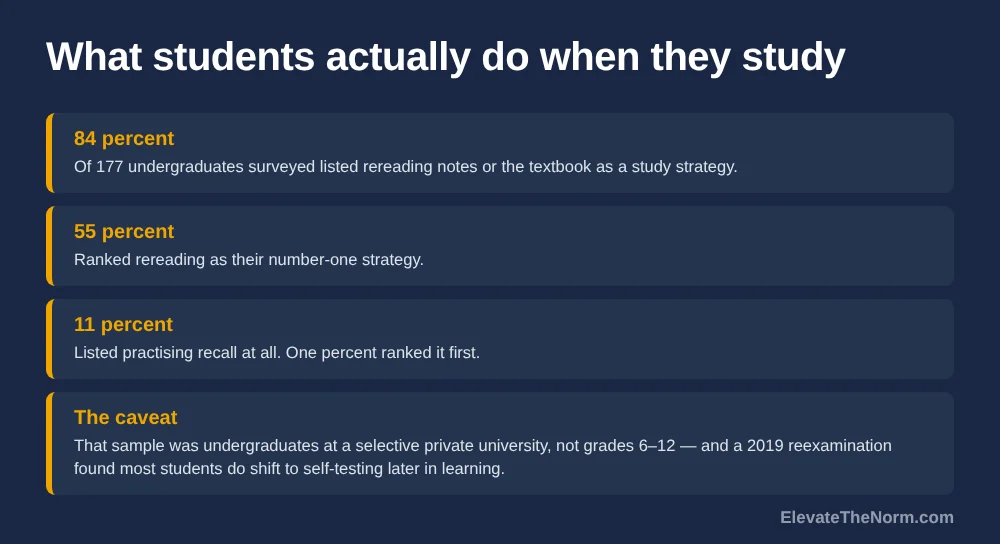
    Four-row graphic titled What students actually do when they study: 84 percent of 177 undergraduates surveyed listed rereading notes or the textbook; 55 percent ranked rereading first; 11 percent listed practising recall at all and 1 percent ranked it first; the caveat is that the sample was undergraduates at a selective private university rather than grades 6-12, and a 2019 reexamination found most students shift to self-testing later in learning.
    The most-cited survey on student study habits, with the caveats that usually get dropped.

    What does practice testing look like in a grades 6–12 classroom?

    Short, ungraded, frequent recall with the notes closed — run by the teacher during class, not assigned as studying. This is the version with the best classroom evidence behind it and the lowest cost to run.

    Henry Roediger, Pooja Agarwal, Mark McDaniel and Kathleen McDermott ran three experiments with sixth graders in a real social studies course, using the students’ actual chapter and semester exams as the outcome. Quizzed material beat material that was simply presented again, and the advantage held to the semester exam. The federal What Works Clearinghouse guide reaches the same place from the research side, rating “use quizzes to re-expose students to key content” as strong evidence, alongside asking deep explanatory questions.

    1. Open class with five questions, notes closed. Three from last lesson, one from last week, one from last month. The old questions are the spacing; you do not need a separate spacing plan if the warm-up carries it.
    2. Keep it ungraded, and say so before the first question. A quiz for points is an assessment and students prepare for it by cramming. A quiz for learning is a study method, and the version in the research was low stakes.
    3. Give the answers immediately. Retrieval plus feedback is the combination that was tested. Thirty seconds of correction while the attempt is fresh is doing most of the work.
    4. Ask at least one question that requires producing, not choosing. “Name two causes and say which mattered more” forces retrieval; a four-option question can be answered by recognition.
    5. Show students their own gap once. Have them predict a score before the warm-up and compare it afterwards. The reason students stop studying early is that rereading feels like knowing; one honest comparison does more than a lecture about metacognition.

    Total cost: about six minutes a day, no grading, no platform. If you already run a bell ringer, this is a change of content rather than a change of routine — and the same five minutes doubles as a formative check on what the last lesson actually cost.

    Two practical problems come up in the first week, and both have cheap answers. Students who were absent cannot retrieve a lesson they never had, and a daily cold-recall routine will land on them as a daily reminder of that. Let a student write “absent” and skip to the older questions; the spacing items are the ones that matter most for them anyway. And keep the scoring private. Students mark their own, nobody reads a score aloud, and you collect nothing. A recall warm-up that turns into a public ranking stops being a study method and becomes a daily performance, and the students it would help most are the ones who will start guessing to look finished.

    You will also get the question from a parent or an administrator eventually: if it is not graded, why does it count? The honest answer is that it is not an assessment at all. It is the studying, moved inside the class period where every student gets it rather than only the ones who already know how to study at home. That framing is also the fairness argument, and it is worth saying in those words at open house.

    How do you teach spacing when you don’t control homework time?

    Build the spacing into the course calendar instead of asking students to build it into their evenings. Distributed practice carried the largest effect in the 2021 meta-analysis and a moderate evidence rating in the federal guide, and it is the technique a teacher can impose without anyone’s cooperation.

    Three ways to do that without adding instructional minutes. Let old content keep appearing: every warm-up pulls at least one question from more than a week back. Make the review for a unit test happen three times at five minutes rather than once at thirty — same total time, different distribution. And let assessments be cumulative in a small, announced way, so that last month’s material is never finished. Say the last one out loud to students early, because a surprise cumulative question is a fairness problem rather than a spacing strategy.

    For students who do study at home and want to use this, the instruction is one sentence: study the same total time in four sittings instead of one, and start each sitting by writing down what you remember before opening anything.
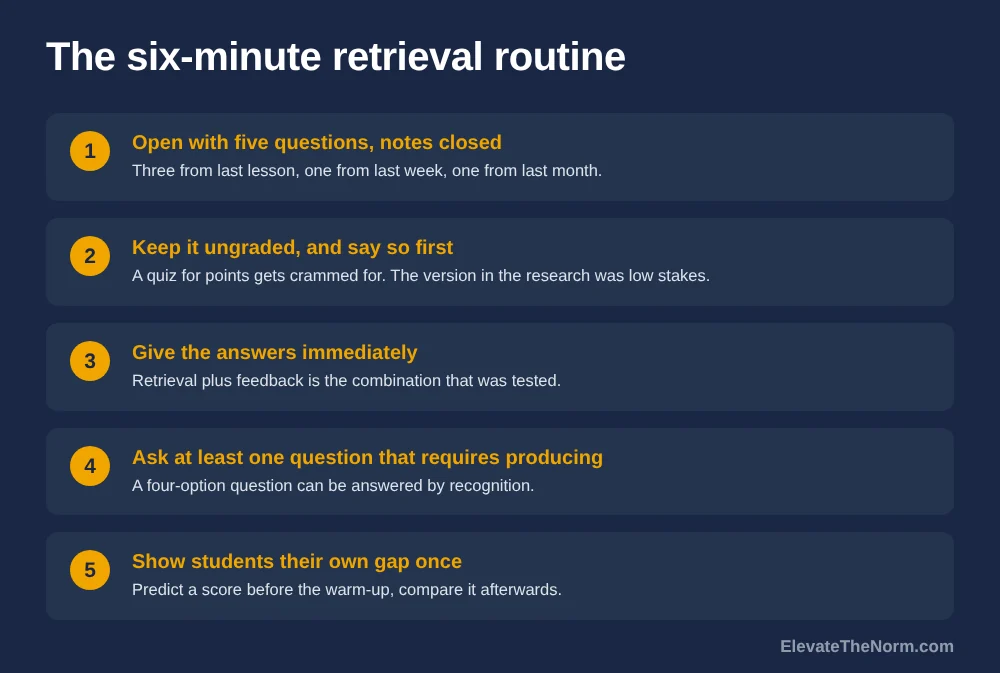
    Numbered five-step graphic: open with five questions and notes closed, three from last lesson, one from last week, one from last month; keep it ungraded and say so first; give the answers immediately; ask at least one question that requires producing rather than choosing; show students their own gap once by having them predict a score and compare it afterwards.
    The whole routine: about six minutes a day, no grading, no platform.

    Should study skills be taught as a separate class?

    The evidence read for this article does not answer that question directly, and I am not going to pretend it does. What it does show is that the strongest-rated moves are teacher-run and content-specific, while the student-managed ones rate weakest.

    Look at how the federal guide splits. “Use quizzes to re-expose students to key content” and “ask deep explanatory questions” are rated strong. “Space learning over time” is moderate. Both halves of “help students allocate study time efficiently” — including teaching delayed judgments of learning and using quizzes to identify what needs study — are rated minimal. The recommendations with the best support describe things a teacher does inside a course. The recommendation about managing one’s own studying has the weakest support in the same document.

    And the classroom study with the clearest result ran inside a sixth-grade social studies course on that course’s own content, measured on that course’s own exams. That is an argument for teaching these methods on the material students are already responsible for. It is not a measured comparison against a standalone study-skills course, because no source read here ran that comparison. Treat the paragraph above as reasoning from the evidence, which is what it is.

    If someone is selling your district a study-skills program on these numbers, two questions settle most of it. What did the outcome measure, and how long after instruction? The pooled evidence is overwhelmingly factual recall measured within a day, which is a fair description of a unit test and a poor description of a state assessment in May. A vendor who cannot answer those two questions is quoting an effect size past the end of its own sentence, and the fix costs nothing anyway: the practice is free, so a district can adopt the method without buying the product.

    For anyone coaching this rather than buying it, the walkthrough observables are narrow enough to be fair. Were notes closed? Did the answers arrive inside the same five minutes? Was at least one question older than a week? Those three are visible from the back of a room in under five minutes and they do not require a judgment about whether a lesson was engaging.

    What about students with ADHD or learning differences?

    Nothing read for this article tested these techniques separately on students with ADHD, dyslexia, or any identified disability, so this page makes no claim about them. That is a real gap and it is one of the most common searches attached to this topic, so naming it beats guessing at it.

    What can be said without inventing evidence: the versions recommended here are the ones that do not depend on a student planning, scheduling, or self-monitoring their own study time, because the teacher runs the retrieval and the calendar carries the spacing. Whether that helps a particular student is a conversation for their IEP or 504 team, who have information no article has. If executive function is the actual obstacle, the evidence on executive functioning strategies is a better starting place than this page.

    Clay’s take

    I think “study skills” is one of the most dishonest phrases in school, because we hand students the responsibility and keep all the levers. The two methods with the best evidence are both things a teacher can simply do: ask questions with the notes closed, and refuse to let old material disappear. Telling a fifteen-year-old to space their practice while every assessment in the building rewards a single night of cramming is not advice. It is a request to ignore the incentives we built.

    Where I would push back on the research culture around this: the effect sizes get quoted with a confidence the papers themselves do not have. Most of the pooled studies measured facts, measured them the same day, and stopped at 2014. That is a strong case for six minutes of recall at the start of class. It is not a case for buying a program, and anybody selling you one on the strength of d = 0.74 is quoting past the end of the sentence.

    The part I would protect is the student’s dignity in all this. A teenager who reread the chapter four times and failed the test did not refuse to work. They worked hard at the wrong thing, usually because nobody ever showed them the difference between recognizing a page and producing what is on it. Say that out loud when you hand the test back. The number is not a verdict on their effort, and they will believe you about the method afterwards.

    What to do next

    Change one routine this week. Replace whatever opens your class with five recall questions, notes closed, ungraded, answers given immediately, and make one of those questions reach back more than a week. Do it for a unit, then compare the unit test to the last one. That is the whole intervention, and it costs you nothing but the first five minutes you were already spending.

    If you want the pieces that sit next to this one: note taking strategies for high school students covers what students should capture in the first place, annotation strategies covers the marking-up habit that highlighting is a weak substitute for, vocabulary instruction covers the words that stop a student before any study method can help, and test corrections covers what to do with the test once the studying is over. Everything on this site is free and nothing asks for your email address.

    Rereading rates badly here as a solo study strategy, and that verdict still stands. It is worth knowing why the same verb behaves differently in class: a second trip through a hard text with a specific question attached and a teacher circulating is an instructional move rather than revision. The close reading protocol explains the distinction and does not overstate what it buys.

    Interleaved practice rates as a middling technique on the table above, and the classroom trials in secondary math report far larger effects. Both readings are defensible, and the gap is explainable: the pooled averages are built mostly from laboratory studies of undergraduates learning visual material. Why the trials and the meta-analyses disagree about interleaving sets the two side by side rather than picking the flattering one.

    The reason students keep choosing the study methods that do not work is now measured, and it is not laziness. Effort gets read as failure: in one study 78 percent of participants learned more from spaced practice while 78 percent judged massed practice to be as good or better, and only four of 120 picked spacing as the winner. Why the practice that feels worst is often the one that works covers that mismatch, the condition that decides when a difficulty is worth it, and the teacher-side version of the same illusion.

    The study advice students are given almost always includes “review it again later,” and almost never says who is supposed to schedule that. When the teacher takes the scheduling on instead, it becomes spiral review. What spiral review is, and how to build one covers the gap length, the version that fits a fifty-minute period, and when revisiting old material is the wrong move.

    Frequently Asked Questions

    What are study skills?

    Study skills are the methods a student uses to learn and retain material outside direct instruction: how they review, test themselves, manage time, and judge whether they know something. The last of those matters most, because a student who mistakes a familiar page for mastery will stop studying too early every time.

    What are the most effective study skills?

    Practice testing and distributed practice. In a review of ten techniques, those two were the only ones rated high utility, and a later meta-analysis of 242 studies put distributed practice at d = 0.85 and practice testing at d = 0.74. Practice testing means recalling material with notes closed; distributed practice means spreading the same study across several sessions.

    Does highlighting or rereading actually help?

    A little, and less than the time they cost. Both were rated low utility in the 2013 review, and a 2021 meta-analysis put rereading at d = 0.47 and underlining at 0.44, so neither is worthless. The problem is opportunity cost: rereading eats the study time that a few minutes of self-testing would have used better.

    How should a student study for a test?

    Split the same total time across several sittings rather than one, and begin each sitting by writing down what can be recalled before opening anything. Check that attempt against the source, then study what was missing. Reading the chapter again produces a feeling of knowing that a cold recall attempt will not let you fake.

    How do you teach study skills in a middle or high school class?

    Run the methods yourself rather than assigning them. Open class with about five ungraded recall questions with notes closed, give the answers immediately, and pull at least one question from more than a week earlier so the calendar carries the spacing. That takes roughly six minutes a day and needs no grading or platform.

    Do students know which study methods work best?

    Usually they underuse self-testing. In one survey of 177 undergraduates, 84 percent named rereading and only 11 percent named practising recall. That sample was not school-age, and a 2019 reexamination found most students do shift to self-testing later in learning, so the honest claim is narrower: students use testing to check themselves rather than to learn.

    Are these study techniques less effective for teenagers?

    No. The 2021 meta-analysis reported a mean effect of 0.69 for secondary students against 0.42 for primary and 0.59 for university students. The authors caution that heterogeneity was high and some subgroup estimates rest on small samples, but nothing in the data suggests these methods work less well in grades 6 through 12.

    Will a study skills class raise our test scores?

    That is not established by the evidence here. The federal practice guide rates teacher-run quizzing and deep explanatory questions as strong evidence, while helping students allocate their own study time is rated minimal. No source read for this article compared a standalone study skills course against teaching the same methods inside a content course.

    Sources

    • Dunlosky, J., Rawson, K. A., Marsh, E. J., Nathan, M. J., & Willingham, D. T. (2013). Improving Students’ Learning With Effective Learning Techniques. Psychological Science in the Public Interest, 14(1). High utility: practice testing, distributed practice. Moderate: elaborative interrogation, self-explanation, interleaved practice. Low: summarization, highlighting and underlining, the keyword mnemonic, imagery use for text, rereading. Read via the journal’s own article page for the monograph — the ratings and abstract are quoted from there, and no figure from the body of the 58-page report is quoted.
    • Donoghue, G. M., & Hattie, J. A. C. (2021). A Meta-Analysis of Ten Learning Techniques. Frontiers in Education, 6, 581216. 242 studies, 1,619 effects. Distributed practice d = 0.85; practice testing 0.74; elaborative interrogation 0.56; imagery 0.56; self-explanation 0.54; mnemonics 0.50; rereading 0.47; interleaved practice 0.47; underlining 0.44; summarization 0.44. By level: secondary 0.69, university 0.59, primary 0.42. Authors’ stated limitations: 93 percent of outcomes were surface or factual, almost all near transfer, most measured within a day, nothing published after 2014, heterogeneity about 85 percent, and their own high/moderate/low cut-offs described as somewhat arbitrary with none of the ten to be dismissed as ineffective. Full text read, open access.
    • Karpicke, J. D., Butler, A. C., & Roediger, H. L., III (2009). Metacognitive strategies in student learning: Do students practise retrieval when they study on their own? Memory, 17(4), 471–479. 177 undergraduates; rereading listed by 84 percent and ranked first by 55 percent; practising recall listed by 11 percent and ranked first by 1 percent; in the chapter scenario 57 percent chose to restudy and 18 percent to self-test, rising to about 42 percent when restudy was allowed after testing. Sample was undergraduates at a selective private university, not grades 6–12. The authors note that other surveys with different question formats found higher rates of self-quizzing. Full paper read.
    • Kuhbandner, C., & Emmerdinger, K. J. (2019). Do students really prefer repeated rereading over testing when studying textbooks? A reexamination. Memory, 27(7), 952–961. Finds few students preferred rereading early in learning and nearly all shifted to testing later, with rereading used mainly to revisit misunderstood parts; argues the preference for rereading has been overstated. Read at the repository record level, so no sample size or percentage from this paper is quoted above. Included because it is direct published disagreement with the previous source.
    • Pashler, H., Bain, P. M., Bottge, B. A., Graesser, A., Koedinger, K., McDaniel, M., & Metcalfe, J. (2007). Organizing Instruction and Study to Improve Student Learning. Institute of Education Sciences, What Works Clearinghouse. Evidence ratings: use quizzes to re-expose students to key content — strong; ask deep explanatory questions — strong; space learning over time — moderate; interleave worked examples with problem solving — moderate; pre-questions to introduce a topic — minimal; helping students allocate study time, both parts — minimal. Guide page read.
    • Roediger, H. L., Agarwal, P. K., McDaniel, M. A., & McDermott, K. B. (2011). Test-enhanced learning in the classroom: Long-term improvements from quizzing. Journal of Experimental Psychology: Applied, 17(4), 382–395. Three experiments with sixth graders in a social studies course, using the students’ own graded chapter and semester exams; quizzed material outperformed material merely re-presented. Read at the institutional record level; the record reports no percentages, so none are quoted here and no effect size is claimed for this study.
    • The five-step warm-up routine, the three spacing moves, and the right-hand column of the comparison table are written for this article to describe what each technique looks like in a secondary classroom. They are worked descriptions and editorial judgment, not findings, and they do not report any individual teacher’s classroom. No source above tests this particular routine.
    About Clay Shumate

    Clay Shumate is a certified secondary Social Studies teacher in the public schools of West Alabama, with seven years of classroom experience, a B.A. in History, and an M.Ed. in Secondary Education. He writes about project-based learning, student responsibility, respect, and practical ways to hold young people to a higher standard while giving them room to learn from mistakes. He is a member of the Society of Professional Journalists and writes to its Code of Ethics; this site’s editorial standards and corrections policy are published in full. More about Clay.

  • Senioritis Isn’t Laziness: What Causes the Senior Slump and What Teachers Can Do

    Senioritis Isn’t Laziness: What Causes the Senior Slump and What Teachers Can Do

    By Clay Shumate

    Senioritis is the drop in effort, attendance, and course rigor that shows up in the final year of high school, usually once college applications are in. It is not a medical condition and not simple laziness. The measurable part is structural: in most states that publish grade-level data, seniors are the most chronically absent students in the school.

    Key Takeaways

    • Twelfth grade carries the highest chronic absenteeism rate of any grade in most states that report grade-level numbers. In Mississippi, 41 percent of seniors were chronically absent in 2023–24 against 24 percent of all students; senior rates topped 50 percent in Oregon and the District of Columbia.
    • A large share of the senior year is empty by design, not by attitude. Across California public schools in 2017–18, 24.3 percent of seniors took no math course at all and only 47 percent took anything above Algebra II.
    • The widely quoted claim that about 20 percent of colleges rescind at least one offer a year, two-thirds of them over senior-year grades, comes from NACAC member surveys in 2008 and 2009. NACAC stopped asking the question in 2009, so the current rate is unmeasured. The risk is real; the number is old.
    • On the 2024 twelfth-grade NAEP, more than half of seniors reported being accepted to a four-year college while 45 percent scored below NAEP Basic in math — the largest share ever recorded. Getting in and being ready came apart.
    • Withdrawal that does not lift, loss of sleep, or a student talking as though nothing they do matters is not a motivation problem. That is a counselor referral under your district’s procedure, today, not a pep talk.

    Every spring a staff meeting somewhere decides that seniors have stopped caring. The word gets used like a diagnosis — he’s got senioritis — and then the conversation moves on, because a diagnosis closes a subject instead of opening it.

    It is worth opening. Some of what adults call senioritis is a teenager making a rational decision about where to put limited energy. Some of it is a schedule with nothing in it. A small part of it is something that needs an adult who is not a teacher. Those three things look identical from the front of the room and they need completely different responses.

    What is senioritis?

    Senioritis is an informal name for the pattern of declining attendance, effort, and course difficulty in a student’s last year of high school. It is not in any diagnostic manual, no study measures it directly, and nobody reports a national senioritis rate. What researchers do measure are its parts: how often seniors are absent, what they enroll in, and how much they know when they leave.

    The older and more useful term is senior slump. Michael Kirst of Stanford used it in a 2001 policy report for Policy Analysis for California Education, and his framing is still the sharpest one available: the slump starts at different moments for different students — the fall after an early-admission letter for the top of the class, after applications are filed for most college-bound students, and whenever graduation feels safe for everyone else. He called it a uniquely American problem and pointed at the obvious structural cause, which is that in the United States almost nothing that happens after the application deadline changes a senior’s stated future.

    Is senioritis real, or just an excuse?

    The behavior is real and it shows up in attendance and enrollment data. What is not real is the idea that it is a sudden collapse of character in a single cohort of teenagers. Three independent sets of numbers describe the same final year from different angles.

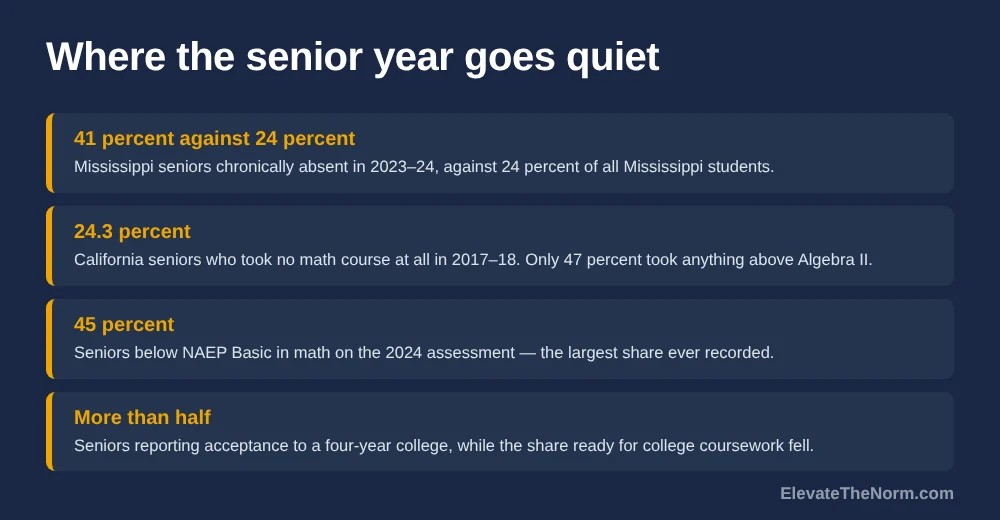
    Start with attendance. FutureEd, at Georgetown’s McCourt School of Public Policy, collected grade-level chronic absenteeism data for 2023–24 from 22 states and the District of Columbia, several of which do not publish it themselves. In most of those states seniors were the most chronically absent students in the system, well above the state average: 41 percent of Mississippi seniors against 24 percent of all Mississippi students, with senior rates above 40 percent in several states and above 50 percent in Oregon and D.C. Chronic absenteeism in most states means missing roughly two days a month or more. Twenty-two states is not the country, and these are state figures rather than one national average — but the grade-level pattern is consistent across them, and ninth grade is the only grade that competes.

    Then look at what seniors are enrolled in. A 2019 PACE report by Minahil Asim, Michal Kurlaender, and Sherrie Reed pulled every California public high school senior’s math transcript for three years. In 2017–18, 24.3 percent of seniors took no math course at all, and only 47 percent took something above Algebra II. Roughly 60 percent of the seniors with no math had already passed Algebra II or higher as juniors, so this is not mostly students who ran out of runway. It is students who had the prerequisite and stopped. One state, one subject — but math is the subject where stopping costs the most, and the authors are careful to say the link between course rigor and later college outcomes is largely correlational.

    Finally, look at what seniors know. The National Assessment Governing Board released 2024 twelfth-grade NAEP results in September 2025: average math and reading scores each fell three points from 2019, 45 percent of seniors scored below NAEP Basic in math and 32 percent in reading — the largest shares on record for each subject — and scores dropped at every percentile except the ninetieth. In the same assessment, more than half of seniors reported having been accepted to a four-year college, up from 2019, while the share judged ready for entry-level college coursework fell. Admission went up. Readiness went down.

    Those numbers describe a decade-long slide in twelfth-grade achievement, not a spring motivation dip, and it would be dishonest to pin a national NAEP trend on senioritis. The reason they belong here is the pairing in that last paragraph: a system that admits more students than it prepares has taught seniors something true about the final semester, and they have learned it.

    Four-row graphic titled Where the senior year goes quiet: 41 percent against 24 percent, Mississippi seniors chronically absent in 2023-24 against all students; 24.3 percent, California seniors who took no math course at all in 2017-18 with only 47 percent above Algebra II; 45 percent, seniors below NAEP Basic in math on the 2024 assessment; more than half, seniors reporting acceptance to a four-year college while readiness fell.
    The measured parts of senioritis: attendance, course-taking and twelfth-grade achievement.

    When does senioritis start?

    It starts when the thing a student was working toward stops depending on this week’s work. That is a different date for every senior, which is why a single schoolwide pep rally in April always lands on half the room late and the other half early.

    For a student with an early-decision acceptance, that date can be in November. For the broad middle, it is whenever the last application uploads. For a student who is not going straight to college, it is the day the credit math says graduation is safe. And for a student who has decided college is not happening, it may never arrive at all, because there was no finish line to cross early.

    Teachers usually notice it as a block, in the stretch after spring break, because that is when enough individual dates have passed to change the feel of the room. By then it has been building for months.

    What actually causes senioritis?

    Three things stack up: the incentive disappears, the schedule gets thinner, and the student is doing more adult work outside school than at any previous point. None of the three is a character trait, and all three are partly under adult control.

    The incentive disappears. This is the honest core of it. A junior’s transcript decides something. A senior’s spring transcript mostly confirms something already decided. When the only remaining consequence of effort is a number on a document nobody will read, a reasonable person reallocates. Adults do exactly the same thing in the last two weeks of a job they have already resigned from, and we do not call it a syndrome.

    The schedule gets thinner. The California math data is the clearest published measure of this, and it is not a story about students begging out of rigor. A quarter of seniors had no math class to skip. A senior with two study halls and a teacher-aide period is not showing a motivation deficit by treating the day as optional; the day was built optional.

    The outside load is heaviest. Seniors are the students most likely to be working paid hours, driving siblings, filling out financial-aid paperwork their families cannot, and visiting campuses. Kirst named nonacademic commitments, paid work, and internships as part of the slump two decades ago. A senior who misses sixth period for a shift has made a priority call, not a mistake of attitude — and the fact that the call was rational does not make the absence free.

    Can colleges rescind an offer because of senioritis?

    Yes, colleges can and do revoke admission offers, and senior-year grades are the most common reason. But the figure teachers repeat to scare seniors is from a survey last run in 2009, and nobody has measured the rate since. Both halves of that sentence matter, and most articles on this topic give you only the half that makes a better warning.

    Here is the provenance. In NACAC’s Admission Trends Surveys of 2008 and 2009, 22 percent of responding colleges said they had revoked at least one offer that year; two-thirds of those revocations were for poor senior-year grades, about a third for disciplinary issues, and close to three in ten for false information on an application. Education Week reported in 2019 that NACAC had stopped surveying members on the question in 2009. An August 2026 analysis traced how the figure has been recycled since, including a widely cited quote describing the roughly 20 percent number as NACAC’s “latest research” in an article whose own footer shows it first ran in 2017.

    What gets said to seniorsWhat the evidence actually supportsHow to say it honestly
    “One in five colleges will pull your offer.”22 percent of colleges revoked at least one offer in a survey year ending in 2009. Not measured since.“Colleges do revoke offers, most often for senior grades. Nobody has counted how often in about fifteen years.”
    “Your senior grades don’t matter now.”Senior-year grades were the single largest reason for revocation in that survey, and most offers are conditional in writing.“Read your acceptance letter. It says what you have to keep up.”
    “Skipping math senior year is fine, you’ve got the credit.”24.3 percent of California seniors took no math; advanced math is correlated with college entry and completion, but the research cannot establish cause.“The credit is fine. Walking into college algebra after fourteen months off is the part that hurts.”
    “Seniors have just stopped caring.”Seniors are the most chronically absent grade in most reporting states, and a quarter have no math class scheduled.“Our senior schedule has holes in it, and our senior attendance follows them.”
    Sources for each row are linked in the body and listed in full at the end of this article.

    The practical version for a student is shorter: the offer letter almost always contains a condition about maintaining your academic record and reporting any changes, and that letter is the document that governs, not a statistic. Tell seniors to read their own letter. It is more persuasive than a number you cannot source, and it has the advantage of being true for them specifically.

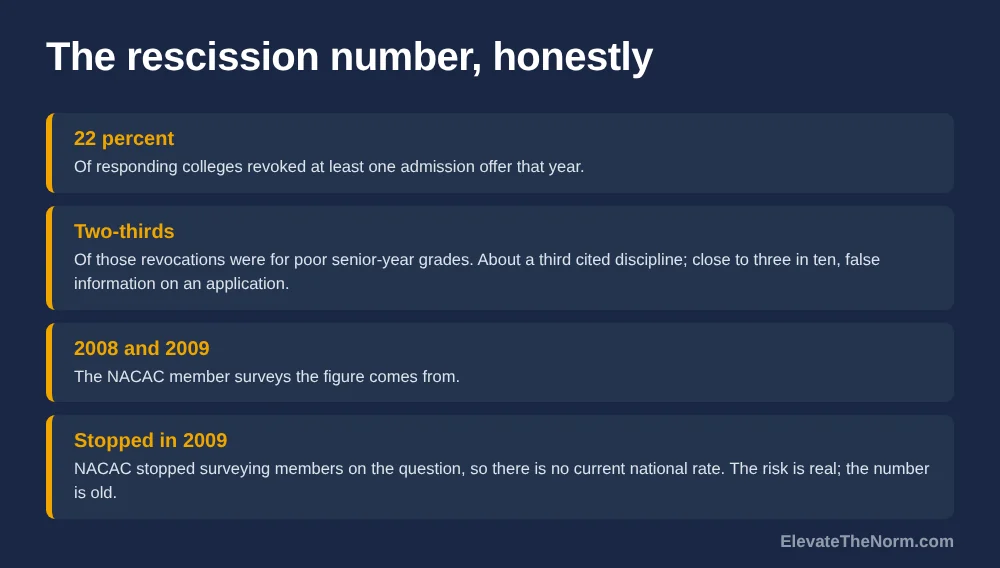
    Four-row graphic titled The rescission number, honestly: 22 percent of responding colleges revoked at least one admission offer that year; two-thirds of those revocations were for poor senior-year grades, about a third cited discipline and close to three in ten false information; the figure comes from NACAC member surveys in 2008 and 2009; NACAC stopped surveying members on the question in 2009, so there is no current national rate.
    Where the rescission warning comes from, and when it was last measured.

    What is the difference between senioritis, burnout, and something that needs a counselor?

    Senioritis is selective — a student drops the work that no longer pays and keeps the rest of their life. The pattern that needs a counselor is not selective, does not lift, and shows up in sleep, friendships, and how a student talks about their own future. Teachers are not diagnosticians and should not try to be. You are, however, the adult who sees the student for fifty minutes a day, five days a week, and noticing a change is squarely your job.

    The useful distinction is scope. A senior who has quit turning in government assignments while still running the yearbook, holding a job, and talking about summer plans has made a trade. A senior who has pulled out of the yearbook, stopped eating lunch with anyone, and gone quiet about next year has not made a trade. The second student has not got a stronger case of the first student’s problem.

    Three rules that keep this safe. Do not use the word senioritis about a student you are worried about — it tells the next adult to relax. Follow your district’s referral procedure rather than handling it yourself; counselors can see attendance, grades across six classes, and family contact history that you cannot, and the procedure is also what brings the family in correctly instead of through a worried teacher’s phone call. And if a student says anything about not mattering, not being here, or hurting themselves, that is not a referral form in your planning period. Follow your district’s crisis procedure immediately and completely. A conversation about missing work does not pause for it and does not substitute for it.

    How do you deal with senioritis without lecturing seniors?

    Give the last semester something that is still undecided. Effort follows consequence, and a speech is not a consequence. Every move below is about restoring a real reason to show up, and none of them requires new money or a schedule change.

    1. Put an audience on the final unit. The cheapest fix for an outcome nobody cares about is an outcome somebody will see. A panel of two teachers and a community guest, a presentation to a younger class, a product the school will actually use — the work becomes undecided again because the response to it has not happened yet. Attach the audience to the standard you were already assessing rather than in place of it, and run any outside visitor through your district’s visitor and background-check policy. A younger class down the hall and a second teacher cost nothing and clear that bar automatically.
    2. Move the weight earlier in the week and earlier in the term. If the serious work lands in the last ten days, you are competing with every senior obligation at once. Front-load the graded work for the final grading period and let the last stretch be revision and presentation. Be honest about the cost of this one: it pulls your heaviest grading into the same weeks as graduation checks and credit audits, so plan the turnaround before you promise it.
    3. Make attendance visible as arithmetic, not as a moral claim. Two days a month is the chronic-absence threshold in most states, and seniors do not know that. Showing a student that eighteen absences is already in that category lands differently than telling them they are throwing it away. Do it one to one, with the student’s own number — never a posted chart, a class ranking, or a name read aloud. And send families the count before the final grading period rather than after, so nobody learns it from a report card.
    4. Write the conditional into the room. Have seniors find the sentence in their own acceptance or program letter about maintaining their academic record. Ten minutes, no lecture, and the source is their own name on a document. Say up front that the letter can be a college acceptance, a trade or certificate program, an enlistment packet, or a job offer — and that anyone without one yet can read the course syllabus instead. Some of your seniors do not have a letter in April, and a whole-class version of this activity tells the room exactly who they are. If that is likely, do it one to one.
    5. Keep the quiet fourth-year course honest. If your seniors have a thin spring schedule, say so out loud to whoever builds the schedule, and in the meantime do not pretend a filler period is rigorous. A senior can tell. What you can do inside it is give the period a real product — a research question, a community interview, something with a deliverable.
    6. Treat a sudden drop as information, not as the expected spring decline. The whole cost of the word senioritis is that it explains away the one student whose change means something else.

    None of that is a motivation program, and none of it asks a teenager to care about a grade for its own sake. It restores the ordinary condition under which people work: something that has not been settled yet depends on what you do this week. The site’s material on making schoolwork matter beyond the grade and on civics projects with a real audience is mostly about building that condition on purpose.

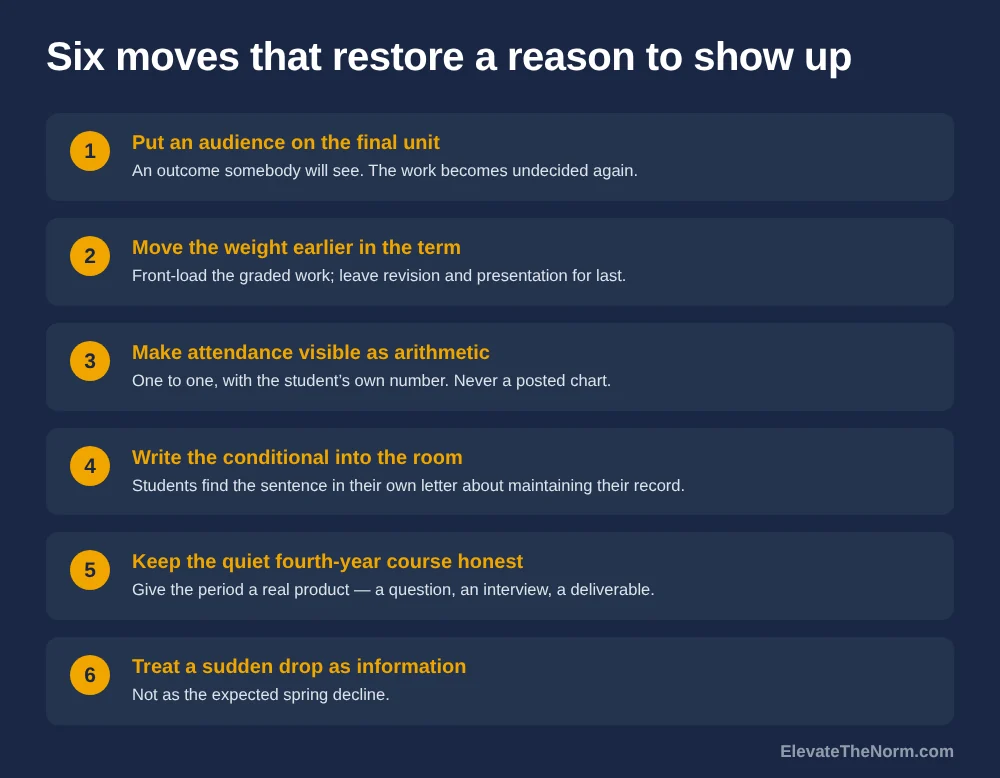
    Numbered six-step graphic: put an audience on the final unit; move the weight earlier in the term; make attendance visible as arithmetic, one to one and never a posted chart; write the conditional into the room by having students find the sentence in their own letter; keep the quiet fourth-year course honest with a real product; treat a sudden drop as information rather than the expected spring decline.
    Six moves that restore a reason for seniors to show up.

    What should a school change, not just a teacher?

    The senior schedule is the lever with the most leverage, and it sits above the classroom. A teacher can make one course worth attending. Only a building can decide whether a senior has four courses worth attending or two.

    Three questions a principal or counseling team can answer from data they already hold. How many of our seniors are enrolled in zero math? The California figure was a quarter of all seniors; the honest local version of that number is usually worse than people expect and is sitting in the scheduling software. Which periods carry our senior absences — is it first period, or is it the periods with no graded product? And what happens in the final grading period, specifically: if every senior course has its last assessment in the same five days, the schedule is manufacturing the thing being complained about.

    Equity sits underneath all of this and it is not optional to mention. In the same California data, 17 percent of Asian seniors took no math against more than 26 percent in every other racial and ethnic group, and 40 percent of socioeconomically disadvantaged seniors took advanced math against 54 percent of their peers. A “seniors have checked out” framing treats that as a collective attitude problem. It is a distribution problem, and the students with the thinnest fourth year are not a random sample.

    One thing worth saying out loud to seniors, because they will read this sentence in the staff version of it otherwise: a student who has met every requirement and chosen a paid shift or a younger sibling over a filler period has not failed at anything. They have made an adult decision inside a schedule an adult built. The observable worth watching is not how badly seniors want to be there — it is whether each senior course has a product, an audience, and a date written on the plan. That is a thing a coach or an administrator can see in a walkthrough, and it does not require guessing at a teenager’s motivation.

    Clay’s take

    I do not think senioritis is a student problem, and I have never found the lecture version of it to work on anybody. If a room full of eighteen-year-olds decides that what happens there does not matter, the first question is what was planned for them, not what is wrong with them. A class with an undecided outcome gets attendance. A class whose outcome was settled in March gets the attendance it earned.

    Where I will push back on my own side of that argument: a rational absence is still an absence, and seniors do not get to skip the arithmetic because the incentive is thin. Eighteen days gone is eighteen days gone whatever the reason, and part of treating a senior as a young adult is handing them the real numbers instead of the moral version. Adults get to make bad trades too. We just do not get to pretend afterwards that the trade had no price.

    And the part I would say to any staff that uses the word: it is a diagnosis you hand out for free, and it is wrong about somebody in the room every single spring. One of those seniors is not slumping. Losing that student inside a word we invented for the other twenty-nine is the real cost of the joke.

    What to do next

    Pick the last unit of your senior course and ask one question about it: when the work is finished, who responds to it? If the answer is only you and a gradebook, add a response that has not happened yet — a panel, a younger audience, a product the building uses. Then look up your own seniors’ absence counts before you talk to anyone about effort, so the conversation starts with a number instead of an impression.

    If the problem you are actually looking at is one student rather than a cohort, start with why apparent disengagement usually is not what it looks like and with the motivation activities that hold up in grades 6–12. If it is a missing-work pile, the evidence on late work policies is more useful than a deadline speech. And when the year does end, the end-of-year reflection questions are the place to decide what the senior schedule taught you. Everything on this site is free and nothing asks for your email address.

    Frequently Asked Questions

    What is senioritis?

    Senioritis is an informal name for declining attendance, effort and course difficulty in a student’s final year of high school. It is not a medical diagnosis and no study measures it directly. What is measured are its parts: seniors are the most chronically absent grade in most states that publish grade-level data, and about a quarter of California seniors took no math course at all in 2017-18.

    Is senioritis real?

    The behavior is real and appears in attendance and enrollment records. In 2023-24, 41 percent of Mississippi seniors were chronically absent against 24 percent of all students, and senior rates passed 50 percent in Oregon and Washington D.C. What is not supported is treating it as a sudden character failure. Much of it tracks a senior year in which effort no longer changes an outcome.

    When does senioritis start?

    It starts when a student’s goal stops depending on this week’s work, so the date differs by student. For an early-decision acceptance it can be November. For most college-bound seniors it is when the last application is filed. For students not headed straight to college it is when graduation credit looks safe. Teachers usually notice it as a group after spring break.

    Can a college take back an acceptance because of senioritis?

    Yes. In NACAC surveys run in 2008 and 2009, 22 percent of responding colleges had revoked at least one offer that year, and two-thirds of those revocations were for poor senior-year grades. NACAC stopped asking the question in 2009, so there is no current national rate. The better advice is to read the acceptance letter, which states the conditions that apply.

    How is senioritis different from burnout or depression?

    Senioritis is selective: a student drops work that no longer pays and keeps the rest of their life. Withdrawal that is not selective, does not lift, and shows up in sleep, friendships and how a student talks about the future is a different matter and belongs with a school counselor under district procedure. Teachers notice and refer; they do not diagnose.

    How do you motivate seniors in the spring?

    Give the final weeks an outcome that is still undecided. Put an audience on the last unit, front-load graded work so it is not competing with every senior obligation at once, and show students their own absence arithmetic rather than making a moral argument. A speech is not a consequence, and seniors can tell the difference immediately.

    Should seniors take math their senior year?

    Taking math in twelfth grade is associated with college entry and completion, but the research is largely correlational and cannot establish cause. The practical case is simpler: a student who takes no math as a senior walks into college placement testing after more than a year away from it. In California, 24.3 percent of seniors took no math in 2017-18.

    Do seniors really know less than they used to?

    On the 2024 twelfth-grade NAEP, average math and reading scores each fell three points from 2019, and 45 percent of seniors scored below NAEP Basic in math, the largest share recorded. That is a decade-long trend, not a spring dip, so it should not be blamed on senioritis. It does explain why more seniors report college acceptance than appear ready for college work.

    Sources

    • DiMarco, B. (2025). Chronic Student Absenteeism Varies Sharply by Grade Level. FutureEd, McCourt School of Public Policy, Georgetown University; originally published in The 74. Grade-level data for 2023–24 collected from 22 states and the District of Columbia. Mississippi seniors 41 percent against 24 percent statewide; senior rates above 40 percent in several states and above 50 percent in Oregon and D.C.; ninth grade nearly 58 percent in D.C. These are state figures from a subset of states, not a national average, and the piece gives no rates for grades 1–8 or 10–11. Full explainer read.
    • Asim, M., Kurlaender, M., & Reed, S. (2019). 12th Grade Course-taking and the Distribution of Opportunity for College Readiness in Mathematics. Policy Analysis for California Education, Stanford Graduate School of Education. No math in twelfth grade: 26.5 percent (2015–16), 25.5 percent (2016–17), 24.3 percent (2017–18); 47 percent above Algebra II; about 60 percent of no-math seniors had taken Algebra II or higher in eleventh grade; 17 percent of Asian seniors took no math against more than 26 percent in every other group; 40 percent of socioeconomically disadvantaged seniors took advanced math against 54 percent of others. California public schools only. The authors state that it is difficult to establish a causal relationship between math course-taking and later college outcomes, and the report measures no college outcomes of its own. Full report read.
    • National Assessment Governing Board (2025). Nation’s Report Card Shows Declines in 8th-Grade Science and 12th-Grade Math and Reading, released 9 September 2025, with the board’s five takeaways from the twelfth-grade results. Assessment administered January–March 2024. Math and reading each down three points from 2019; 45 percent below NAEP Basic in math and 32 percent in reading, the largest shares recorded; 22 percent at or above Proficient in math and 35 percent in reading; declines at every percentile except the ninetieth; more than half of seniors reported acceptance to a four-year college while the share academically prepared for entry-level college coursework fell to 33 percent in math and 35 percent in reading. Both pages read.
    • Kirst, M. W. (2001). Overcoming the High School Senior Slump. Policy Analysis for California Education, May 2001. Source of the staggered-onset description used above and of the comparison with examination-driven final years in other countries. Read at the publication summary level: the full PDF could not be retrieved, so no statistic or policy recommendation from the body of the report is quoted here.
    • Gewertz, C. (2019). Yes, Colleges Can Rescind Admission Offers. Here’s What Educators Need to Know. Education Week, 19 June 2019. Reports the NACAC figures used above — 22 percent of colleges revoking at least one offer, two-thirds for senior-year grades, a third for discipline, three in ten for application falsehoods — and states that NACAC stopped surveying members on the question in 2009. Cited as the reporting of a survey this article could not read directly; the underlying NACAC Admission Trends Survey is not publicly posted.
    • Higher Ed Insights (2026). NACAC stopped asking this question in 2009. Everyone kept citing the answer, 28 August 2026. Traces the roughly 20 percent rescission figure to the 2008 and 2009 NACAC surveys and documents its continued citation as current, including a quote describing it as NACAC’s latest research in an article first published in 2017. An independent analysis rather than a peer-reviewed source; included because it is the only published account of the number’s provenance, and the 2009 cutoff it describes is independently confirmed by the Education Week report above.
    • The six teacher moves, the three-rule referral guidance, and the claims-versus-evidence table are written for this article as editorial judgment built on the sources above. They are recommendations, not research findings, and they do not describe any individual teacher’s classroom. No source read for this article measures the effect of any of them on senior attendance or effort, and that gap is stated rather than papered over.

    About Clay Shumate

    Clay Shumate is a certified secondary Social Studies teacher in the public schools of West Alabama, with seven years of classroom experience, a B.A. in History, and an M.Ed. in Secondary Education. He writes about project-based learning, student responsibility, respect, and practical ways to hold young people to a higher standard while giving them room to learn from mistakes. He is a member of the Society of Professional Journalists and writes to its Code of Ethics; this site’s editorial standards and corrections policy are published in full. More about Clay.

  • Primary Source Analysis in Grades 6–12: How to Teach It and Which Framework to Use

    Primary Source Analysis in Grades 6–12: How to Teach It and Which Framework to Use

    By Clay Shumate

    Primary source analysis is reading a document, image or object for what it reveals about whoever made it — not just for the facts it states. In grades 6–12 it means teaching three habits explicitly: sourcing, contextualizing and corroborating. Short documents, a framework students can run without you, and the same framework all year.

    Key Takeaways

    • Document work does not cost you content. In a study where eight history classrooms were randomly assigned, students who read multiple documents scored higher on content knowledge than students who read the textbook — and used sourcing and corroboration more often as well.
    • The largest classroom test of a document-based curriculum ran six months across five urban high schools. Eleventh graders gained on historical thinking, transfer of that thinking, factual knowledge and general reading comprehension. The effects were real and modest: partial η² of .09, .08, .03 and .05.
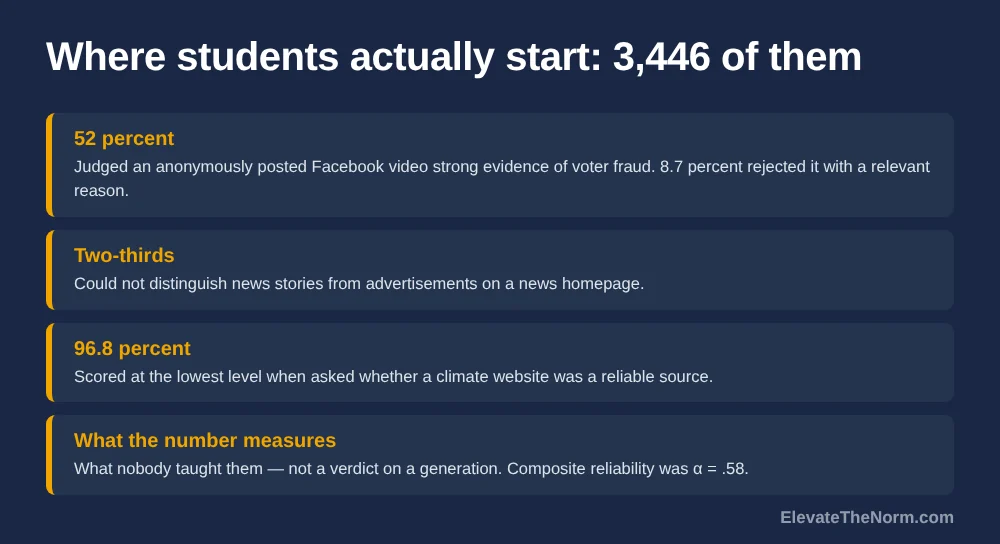
    • Students are starting from very low ground. Across 3,446 high school students, 52 percent accepted an anonymous Facebook video as strong evidence of voter fraud, and 96.8 percent scored at the lowest level when asked whether a climate website was reliable. Scores were lower for students eligible for free or reduced-price lunch and for students whose home language was not English, on an assessment administered in English.
    • No framework has been tested against another. SOAPSTone, HIPP, the 6 C’s, the Library of Congress’s Observe–Reflect–Question and the National Archives’ four steps all operationalize the same habits. Pick one and use it every time; the consistency is the instruction.
    • Five one-hour lessons moved 574 ninth graders from 2.24 to 3.75 out of 9 on source evaluation. Real movement, and still under half correct — with no control group. Treat this as a skill that takes years, not a unit.

    The standard objection to teaching with primary sources is time. There is a curriculum to cover, a pacing guide behind it, and documents are slow. Reading one letter properly can eat a class period that was supposed to cover a decade.

    The research says that objection is backwards, and it has said so since 2007. The bigger problem is not whether to teach primary source analysis. It is that most of us teach it as a worksheet rather than as a set of habits, and a worksheet filled in once in September does not survive contact with anything students read in March or on their phones.

    What is primary source analysis?

    Primary source analysis is the practice of reading a document, image, object or recording as evidence produced by a particular person, at a particular moment, for a particular purpose. The content of the source is one piece of information. Who made it, when, for whom, and what they stood to gain are the others, and they are the ones that distinguish analysis from reading.

    Historians do this with three moves that students can learn by name:

    • Sourcing — asking who produced this, when, and why, before reading the content. Who wrote it changes what it can tell you.
    • Contextualizing — placing the source in what else was happening. A speech about unity in 1861 means something different from the same speech in 1961.
    • Corroborating — checking the claim against other sources, and noticing where they disagree and why.

    Everything below is about getting those three to stick. One warning about search results on this topic: most of what you will find for “primary source analysis” is written for college students writing an analysis essay — thesis statements, paper structure, how many pages. This is the grades 6–12 teaching version, which is a different job.

    Does teaching primary source analysis actually work?

    Yes, with modest effects and one large caveat about how the study was run. Abby Reisman tested the Reading Like a Historian curriculum in five San Francisco public high schools: ten eleventh-grade US History classrooms, one treatment and one control per school, 83 document-based lessons across 105 instructional days from September to March.

    Worth noting before anyone writes this into a plan: the treatment teachers attended a four-day summer training plus two follow-up workshops. The curriculum is free; the professional learning around it was not, and it is part of what produced the result. A district that downloads the lessons and skips the training has not replicated the study.

    What was measuredTreatment vs. controlSignificancePartial η²
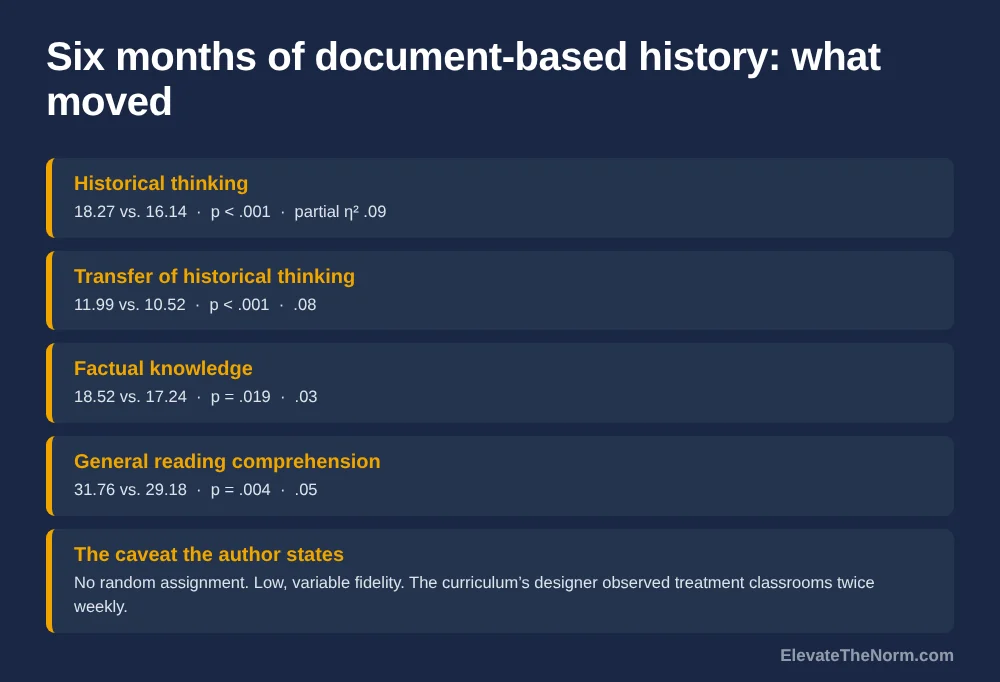
    Historical thinking18.27 vs. 16.14p < .001.09
    Transfer of historical thinking11.99 vs. 10.52p < .001.08
    Factual knowledge18.52 vs. 17.24p = .019.03
    General reading comprehension31.76 vs. 29.18p = .004.05
    Adjusted means, univariate ANCOVA, analytic N = 182 of 236 enrolled. Reisman (2012), Cognition and Instruction.

    The result that should get a social studies department’s attention is the bottom row. Students got better at general reading comprehension in a course that never taught a reading strategy lesson. Reisman attributes that partly to the simple fact that students in those classrooms spent more time reading.

    Now the caveat, because it is a serious one and the author states it plainly. Students and teachers were not randomly assigned. Fidelity of implementation was low and varied widely — whole-class discussion, which the curriculum is built around, was rare. And the researcher who designed the materials observed treatment classrooms twice weekly and sometimes assisted the teachers, while control classrooms had no outside presence at all. Curriculum effects are confounded with teaching quality and with the researcher being in the room. Reisman says so. Anyone citing this study as proof that a curriculum works is citing more than the study delivers.

    Five-row results graphic from a six-month document-based history study: historical thinking 18.27 versus 16.14 at p below .001 with partial eta squared .09; transfer of historical thinking 11.99 versus 10.52 at .08; factual knowledge 18.52 versus 17.24 at p = .019 and .03; general reading comprehension 31.76 versus 29.18 at p = .004 and .05; and a final panel stating the author's caveats about no random assignment and low fidelity.
    What moved, by how much, and the caveat the author states herself.

    Doesn’t document work cost you content coverage?

    No. The one study that randomized this found the opposite. Nokes, Dole and Hacker randomly assigned eight history classrooms — 246 students aged 16 and 17 across two high schools — to four conditions crossing text type (textbook or multiple documents) with instruction type (content or explicit heuristics). After three weeks, students who read multiple documents scored higher on content knowledge than students who read traditional textbook material.

    Higher. Not equal. The students who spent three weeks on documents learned more history than the students who spent three weeks on the textbook, and they also used sourcing and corroboration more often afterward.

    One practical warning from the other direction, because the time objection has a real version. The cost is not class minutes; it is paper. One organizer per student across five sections is 150 pages, and a teacher who collects and marks all of them every time will stop doing this by October. Collect a sample, read the claim sentence rather than the boxes, and let most organizers stay in the notebook as thinking tools. The organizer is for the student, not for you.

    The other real cost is excerpting, and the fix is to not do it yourself. The free collections below are already excerpted and already glossed for secondary students. Steal from them before you build anything.

    Two things to hold onto about that study. It is three weeks and two schools, so it is a small result, not a mandate. And it tested multiple texts against a textbook, which is a different variable from explicit heuristic instruction — the design crossed both factors precisely because they are not the same thing. The honest takeaway is that putting several documents in front of students did not cost content, which is the only claim the time objection actually needs answered.

    Which primary source analysis framework should you use?

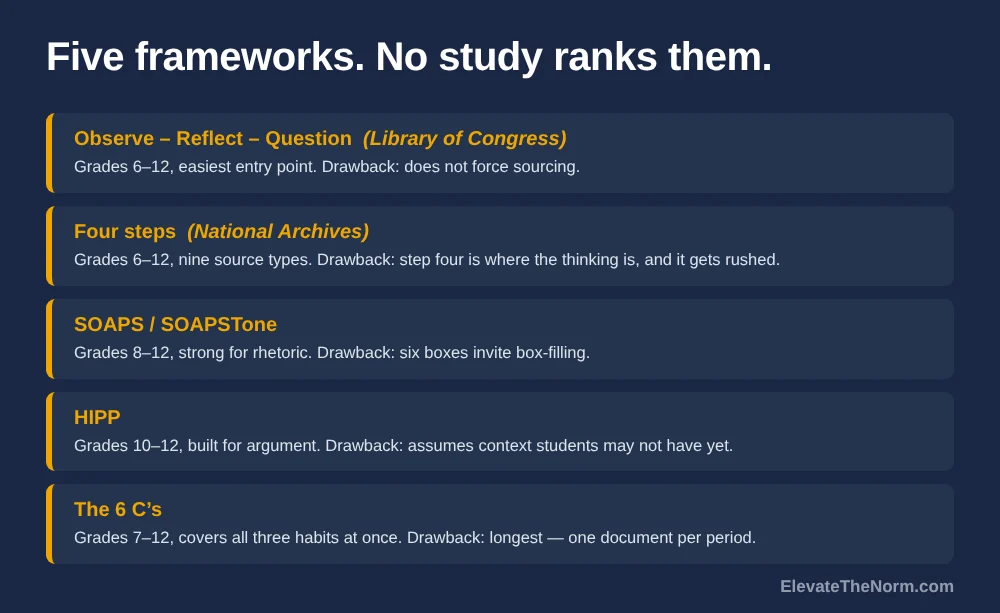
    Whichever one you will still be using in April. No study has compared these frameworks against each other, so there is no evidence-based winner — and they all operationalize the same three habits. The real variable is whether students run it enough times to internalize it.

    FrameworkWhat it stands forGrade fitBest forMain drawback
    Observe – Reflect – Question
    Library of Congress
    What do I see? What do I already know? What do I want to know?6–12, and the easiest entry pointPhotographs, maps, objects, first exposureDoes not force sourcing; a student can do all three without asking who made it
    NARA four steps
    National Archives
    Meet the document; observe its parts; try to make sense of it; use it as historical evidence6–12, with versions for novices and for secondaryAny source type — there are worksheets for nine of themThe fourth step is where the thinking is, and it is the step most likely to be rushed
    SOAPS / SOAPSToneSpeaker, Occasion, Audience, Purpose, Subject (plus Tone and Style)8–12; strong in English and AP coursesWritten text and rhetoric; pairs well with writing instructionSix boxes invite box-filling; students complete it without arguing anything
    HIPPHistorical context, Intended audience, Purpose, Point of view10–12, built for AP History sourcingTeaching students to use a source as evidence in an argumentAssumes context knowledge students may not have yet
    The 6 C’sContent, Citation, Context, Connections, Communication, Conclusions7–12A single organizer that covers all three habits at onceLongest of the five; realistically one document per class period
    Comparison compiled for this article from the published descriptions of each framework. No study ranks them.

    If you want a decision rather than a menu: start with the Library of Congress Observe–Reflect–Question in grades 6–7 because it is three questions and students can hold it in their heads, then add sourcing as a required fourth question. In grades 8–12 use SOAPS or HIPP depending on whether your assessments ask for rhetoric or for argument. Whichever you pick, print it on the wall and use the same words every time.

    Comparison of five primary source analysis frameworks with grade fit and main drawback for each: the Library of Congress Observe-Reflect-Question tool, the National Archives four steps, SOAPS or SOAPSTone, HIPP, and the 6 C's. The heading states that no study ranks them.
    Five frameworks, the same three habits, and no evidence-based winner.

    How do you teach primary source analysis, step by step?

    Teach one habit at a time, with documents short enough to read twice in a class period. The failure mode is handing students a framework and a two-page document on the same day and getting compliance instead of thinking.

    • Start with an image or object, not text. Everyone can observe a photograph, so the framework gets learned before decoding becomes the obstacle. This is also the move that keeps weaker readers in the conversation on day one.
    • Teach sourcing on its own, first, and make it precede reading. Cover the document and show only the attribution line. Ask what they expect this source to say and why. Then uncover it. The gap between prediction and text is the lesson.
    • Model it out loud on a document you have not scripted. Students need to hear an adult be uncertain in public — “I do not know what this word means, so here is what I am going to do.” A clean performance teaches that analysis is something other people are already good at.
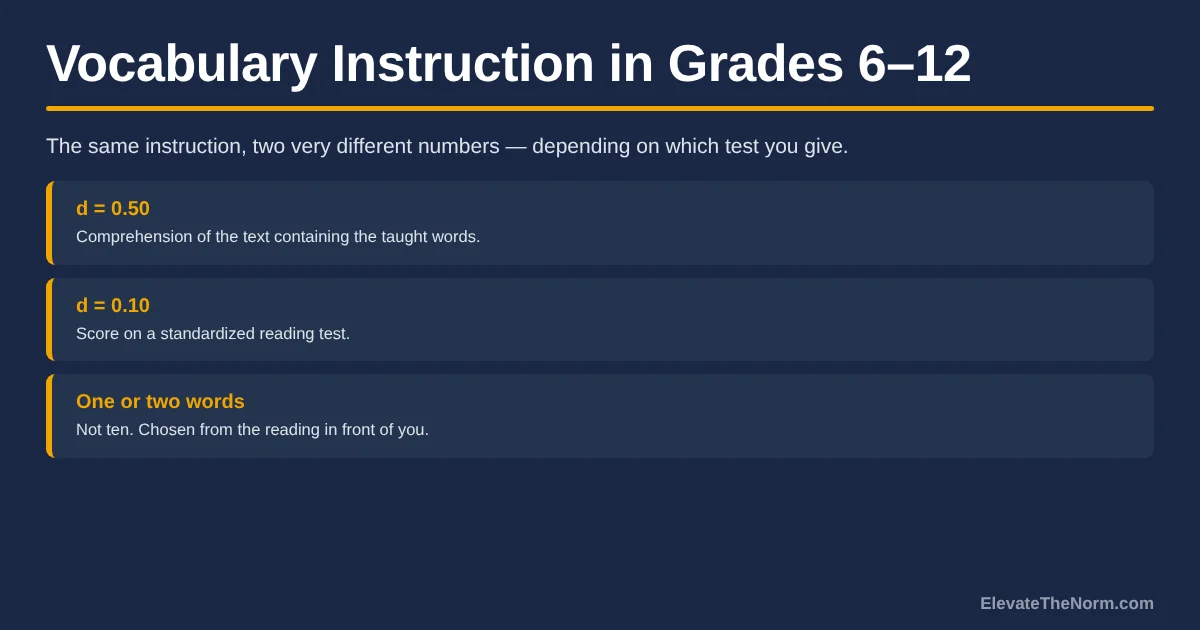
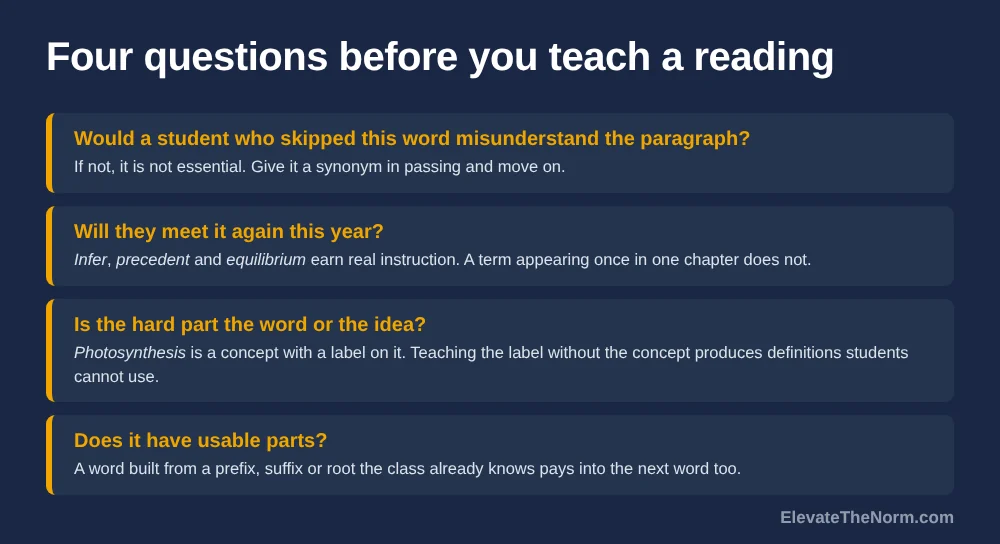
    • Use short documents. Excerpt hard, and gloss the words that would stop a reader. Four to six sentences, with one or two genuinely blocking words given a plain-language meaning in the margin — the same test that drives vocabulary instruction that moves comprehension. A document students can reread twice beats a complete one they get through once. And check the form of the document, not just its length: eighteenth-century handwriting, long-s spelling and faded scans are accessibility barriers that have nothing to do with historical thinking, so use the transcription alongside the image rather than making students fight the script.
    • Put two documents that disagree side by side. Corroboration cannot be taught with one source. Disagreement is the whole point, and two contradictory accounts of the same twenty minutes will do more than any amount of explanation.
    • End with a claim, not a completed organizer. One sentence that takes a position and names which document supports it. The organizer is scaffolding; the claim is the work.
    • Then do it again, the same way, for the rest of the year. This is the step that is actually hard, and it is the one the evidence most supports.

    Are primary sources reliable? What do you tell students?

    Tell them bias is the data, not a reason to throw a source out. A plantation owner’s diary is an unreliable account of how enslaved people felt and an excellent source on how enslavers justified themselves. The question is never “is this biased?” — everything is. The question is “what is this a reliable source of?”

    That reframing matters more than it looks, because the alternative teaches a reflex that does real damage. A student who learns that bias disqualifies a source has been handed a tool for dismissing anything they would rather not believe. That is not skepticism. It is the opposite.

    Two other things worth saying out loud to a class. Primary sources are often wrong on facts — an eyewitness misremembers, a newspaper prints the early count. And the sources that survived are not a random sample: literate, wealthy and official people left far more records than everybody else, so silence in an archive is usually evidence about power rather than about what happened.

    That same question — what is this a reliable source of? — is the one students need most often outside a history classroom, on a page they reached through a search result. The classroom version of it is lateral reading and eleven other activities sorted by what each one costs in class time, with the evidence for each one named instead of assumed.

    What about documents that are disturbing, and sources about contested politics?

    Decide before the lesson, not during it, and say the quiet part to students in advance. Primary source analysis in American history runs straight into lynching photographs, slave auction advertisements, Holocaust records, and testimony about violence against children. These are real sources and students can handle more than adults assume, but a document that a thirteen-year-old encounters cold, with no framing and no exit, is not a lesson — it is an ambush.

    The working rules are simple and they are not optional. Check your district’s policy on sensitive materials and family notification before you plan the unit, not after a phone call. Preview every source in full, including the parts students will notice and you skimmed. Tell the class what they are about to see and why it is in front of them. Do not use a dehumanizing image as a hook or a shock, and do not require a student to perform the voice of a document that degrades people like them. If a source describes abuse, violence or harm to a child and a student discloses something of their own in response, that is a mandatory-reporting situation and it follows your district’s procedure immediately and completely — a document-analysis lesson does not pause for it and does not substitute for it.

    Politically contested sources are a smaller and different problem. The national study above used gun control, climate and voter-fraud material because that is where the skill actually gets used, and that is also exactly the material most likely to produce a complaint. Build the habit on historical documents first. The sourcing question is identical whether the document is from 1854 or last Tuesday, and a class that has run it forty times on nineteenth-century material can run it on a live controversy without the lesson becoming an argument about the teacher’s politics. When you do reach current material, teach students to evaluate the source and leave the conclusion to them — which is also the only version of this that survives scrutiny from either direction.

    How do you know students are actually getting better at it?

    Score the reasoning, not the organizer, and expect slow movement. A completed worksheet tells you a student can fill boxes. What you want is whether an unprompted response mentions who produced the source and why that matters.

    And grade the reasoning, not the conclusion. This is the fairness question students and parents ask first, and it has a clear answer: a student who reads two documents carefully, explains what each is reliable evidence of, and reaches a reading you disagree with has done the work. A student who reaches your conclusion by guessing has not. If your rubric rewards the second one, students will work out within a week that the task is to find the answer the teacher wants, and the whole exercise becomes the opposite of what it is for.

    The honest news is that this is hard to measure and the field is still working on it. Reisman names her own historical-thinking measures as immature. The large national study of online source evaluation reports a composite reliability of α = .58, which is modest, and the authors do not claim causal findings from it. If the research instruments are shaky, your Friday exit ticket is shakier — so look for direction of travel across a semester rather than a score.

    If a coach or administrator is watching for this, the observable is narrow and easy: does a student ask who made the document before being told to? Not whether an organizer is on the desk. Three things worth tracking, none of which needs a rubric: whether students ask who wrote something before you prompt them; whether they can state what a source is reliable of; and whether, given two documents that disagree, they explain the disagreement instead of picking the one they like. The same “what counts as evidence” question drives assessment for project based learning, and it is worth deciding before the unit starts, not after.

    Where do you get free primary sources and analysis worksheets?

    All of the best collections are free and public, and none of them requires a purchase. You do not need a paid document set to teach this.

    • The National Archives document analysis worksheets — nine source types (photograph, written document, artifact, poster, map, cartoon, video, sound recording, artwork), each in a novice version and a secondary version, plus a Perspective worksheet on how a maker’s background shapes a source. Spanish versions available. Materials created by the National Archives are in the public domain.
    • The Library of Congress Primary Source Analysis Tool and teacher’s guides — the Observe–Reflect–Question organizer plus guides by source type, sitting on top of a digital collection you can pull documents from directly.
    • Reading Like a Historian — the curriculum from the Reisman study, described as a free downloadable curriculum. Each lesson is built on a central historical question with a document set, and it includes contextualization materials in English and Spanish. This is the only item on the list with a published classroom effect behind it.

    Pair any of them with local material and the work gets better fast, because students cannot Google the answer. Teaching local history with ghost stories is one way into that; history project ideas has others that end in something students make. Everything on this site is free and nothing asks for your email address.

    Clay’s take: the skill is the point, and it does not fit in a unit

    I think the reason primary source analysis gets taught as a worksheet is that a worksheet can be finished. A habit cannot, and a pacing guide has no column for “still working on it in April.” So we convert a years-long skill into a three-day unit, give it a grade, and move on.

    The national numbers are the argument for not doing that. Fifty-two percent of high school students treating an anonymous video as strong evidence of voter fraud is not a social studies problem; it is the thing social studies is for. And the lesson study that moved ninth graders from 2.24 to 3.75 out of nine in five hours is both encouraging and sobering — real movement, and students still answering fewer than half the questions correctly at the end.

    Four-row graphic on a national study of 3,446 high school students: 52 percent judged an anonymously posted Facebook video strong evidence of voter fraud and 8.7 percent rejected it with a relevant reason; two-thirds could not distinguish news stories from advertisements on a news homepage; 96.8 percent scored at the lowest level on whether a climate website was reliable; and a final panel noting the figures measure what students were never taught and that composite reliability was alpha .58.
    What 3,446 high school students could and could not do with online sources.

    What I would resist is the version of this that treats students as the problem. The national study’s own framing is about what students were never taught, not about a generation that cannot think. And the 96.8 percent figure is a measure of what nobody taught them, not a measure of them. These are the same young people who will notice instantly if you ask them to evaluate a source while handing them a textbook you never let them question. If you want students to interrogate evidence, the classroom has to be a place where interrogating evidence is welcome — including yours. That is the same bet behind running a Socratic seminar properly: the adult gives up control of the conclusion and keeps control of the standard.

    What to do next

    Pick one habit — sourcing — and one short document from next week’s content. Cover everything but the attribution line, ask students what they expect it to say, then let them read it. That is one class period and it teaches the move that does the most work. Add the framework once the habit exists, not before.

    If you want the version where documents drive a longer piece of work, project based learning in social studies covers how to build an inquiry around them and what the evidence on that does and does not show.

    Reading one document well is the prerequisite. Putting a stack of them into a single argument is a different task with its own rubric, and that one is covered in how to teach a document based question.

    Reading one document closely for what it is and who made it is a discipline-specific version of a broader protocol. The general form runs several passes over a short, hard text with a different purpose each time — the three passes, and what the federal evidence actually backs — and in history the second pass is usually about the author rather than the structure.

    Before students can corroborate two sources they have to be able to say what one source is claiming. That is the central idea, and in practice it gets tangled with main idea and theme until none of the three means anything. Central idea vs main idea vs theme separates them plainly — the point a whole text makes, the point of one paragraph, and a message about life in fiction — and gives students a way to test their sentence against the entire text.

    Frequently Asked Questions

    What is primary source analysis?

    Primary source analysis is reading a document, image, object or recording as evidence made by a particular person at a particular moment for a particular purpose. It uses three moves historians name explicitly: sourcing, which asks who made it and why before reading it; contextualizing, which places it in what else was happening; and corroborating, which checks it against other sources.

    How do you teach primary source analysis in middle school?

    Start with photographs or objects rather than text, so students learn the framework before decoding becomes the obstacle. Teach sourcing on its own first by covering the document and showing only the attribution line. Keep documents to four to six sentences with hard words glossed, and put two sources that disagree side by side so corroboration has something to do.

    Which primary source analysis framework is best?

    No study has compared SOAPSTone, HIPP, the 6 C’s, the Library of Congress Observe-Reflect-Question tool and the National Archives four steps against each other, so there is no evidence-based winner. They all operationalize the same habits. Observe-Reflect-Question is the easiest entry point for grades 6-7; HIPP and SOAPS fit grades 10-12. Consistency across the year matters more than the choice.

    Does teaching with primary sources reduce content coverage?

    The one study that randomized this found the opposite. Nokes, Dole and Hacker randomly assigned eight history classrooms of 246 students aged 16 and 17 to read either textbook material or multiple documents for three weeks. Students who read multiple documents scored higher on content knowledge, and used sourcing and corroboration more often.

    Are primary sources reliable?

    Every source is biased, so bias is not a reason to discard one. The useful question is what a source is reliable evidence of. A plantation owner’s diary is poor evidence of how enslaved people felt and strong evidence of how enslavers justified themselves. Primary sources are also often factually wrong, and the records that survived over-represent literate, wealthy and official people.

    Does document-based history instruction improve reading comprehension?

    In one six-month study across five urban high schools, eleventh graders in document-based classrooms scored higher on general reading comprehension than control students, with a partial eta-squared of .05, despite no reading-strategy instruction. The author attributes part of this to more time spent reading, and notes the design was quasi-experimental with low implementation fidelity.

    How long does it take students to get good at analyzing sources?

    Longer than a unit. Five one-hour lessons moved 574 ninth graders from 2.24 to 3.75 out of 9 on source evaluation tasks, which is real movement that still left them answering fewer than half correctly. That study had no control group. Treat source analysis as a habit built across years rather than a skill taught once.

    Where can I get free primary source analysis worksheets?

    The National Archives offers document analysis worksheets for nine source types in both novice and secondary versions, plus Spanish translations, and its materials are in the public domain. The Library of Congress provides its Primary Source Analysis Tool and teacher’s guides by source type. The Reading Like a Historian curriculum is described as a free downloadable curriculum.

    Sources

    • Reisman, A. (2012). Reading like a historian: A document-based history curriculum intervention in urban high schools. Cognition and Instruction, 30(1), 86–112. Quasi-experimental; five San Francisco Unified high schools, ten eleventh-grade US History classrooms (one treatment, one control per school), 236 students enrolled and 182 analyzed after listwise exclusion; 83 document-based lessons across 105 instructional days, September to March. Historical thinking p < .001 (partial η² .09), transfer p < .001 (.08), factual knowledge p = .019 (.03), reading comprehension p = .004 (.05); multivariate effect F(4,168) = 6.889, p < .001. Author-stated limitations: no random assignment; low and highly variable implementation fidelity with whole-class discussion rare; the curriculum’s designer observed treatment classrooms twice weekly and sometimes assisted teachers while control classrooms had no outside presence, confounding curriculum with teaching quality and researcher presence; historical-thinking measures described as immature. Full text read.
    • Nokes, J. D., Dole, J. A., & Hacker, D. J. (2007). Teaching high school students to use heuristics while reading historical texts. Journal of Educational Psychology, 99(3), 492–504. 246 students aged 16–17 (128 male, 118 female) in two high schools in the western United States; eight history classrooms randomly assigned across a 2 × 2 design crossing text type (textbook vs. multiple texts) with instruction type (content vs. heuristic); three weeks. Multiple-text students scored higher on content knowledge and used sourcing and corroboration more often. Read at ERIC abstract level — the full article is paywalled, so no effect size is quoted and the abstract does not report one.
    • Breakstone, J., Smith, M., Wineburg, S., Rapaport, A., Carle, J., Garland, M., & Saavedra, A. (2021). Students’ civic online reasoning: A national portrait. Educational Researcher, 50(8), 505–515. Analytic sample 3,446 high school students (grades 8–12) drawn from 6,445 students in 79 classrooms and 31 schools; districts stratified by region and locale from NCES data; six constructed-response tasks completed with a live internet connection. 52 percent judged an anonymously posted Facebook video strong evidence of voter fraud and 8.7 percent rejected it with a relevant reason; two-thirds could not distinguish news from ads on a news homepage; 96.8 percent scored at the lowest level on website evaluation and 96 percent did not consider a climate site’s fossil-fuel ties; mean composite 0.17. The report also found that students eligible for free or reduced-price lunch scored lower on all six tasks, as did students whose home language was not English — though the assessment was administered in English, which the authors name as a reason those students may have been disadvantaged in expressing their reasoning rather than in doing it. Stated caveats: districts and teachers volunteered rather than being randomly selected, regions were unevenly represented and only partly corrected by sub-sampling, missingness reached 14–18 percent on several variables, composite reliability α = .58, and no causal claims are made. Read as the Stanford report version of this dataset, hosted by Stanford Digital Repository.
    • McGrew, S., & Breakstone, J. (2023). Civic online reasoning across the curriculum: Developing and testing the efficacy of digital literacy lessons. AERA Open, 9. Single-group pretest/posttest, no control group and no randomization; one suburban Midwestern high school; 574 ninth graders completing both tests; eight teachers (six biology, two geography); five hour-long lessons in biology. Mean score rose from about 2.24 to 3.75 of 9, F(1,572) = 299.91, p < .001; honors students gained more than general students; extra geography lessons produced no additional gain (F = .265, p = .61); posttest performance remained under half correct. Authors state that a randomized controlled trial would be needed for causal claims, that COVID-19 disrupted implementation, that the researcher–teacher collaboration was atypical, and that durability and transfer outside school were not measured. Full text read. The article reports no standardized effect size.
    • Document analysis worksheets, National Archives and Records Administration, Educator Resources. Worksheet sets for novice and secondary students across nine source types plus a Perspective worksheet; four analysis steps (meet the document; observe its parts; try to make sense of it; use it as historical evidence); Spanish versions available; National Archives materials are in the public domain. Page read.
    • Introducing primary source analysis to students, Library of Congress Teaching with the Library blog, and the Primary Source Analysis Tool and teacher’s guides it links to. Source of the Observe → Reflect → Question framework and its student prompts. Blog post read; the tool page is cited as the destination it names.
    • Reading Like a Historian, American Historical Association remote teaching resources. Describes the curriculum as free and downloadable, built on lessons centred on a historical question with a document set, including contextualization materials in English and Spanish. This page does not state the lesson count or whether registration is required, and neither is claimed here.
    • The five-framework comparison table is compiled for this article from the published descriptions of each framework. SOAPSTone, HIPP and the 6 C’s are widely used teaching heuristics rather than tested interventions. No source above compares any framework with another, and no effectiveness ranking is claimed. The grade-fit and drawback columns are editorial judgment, not findings.
    • The seven teaching steps are written for this article to operationalize the sourcing, contextualizing and corroborating habits described in the sources above. They are recommendations, not a report of any teacher’s classroom, and no study above tests them in this sequence.

    About Clay Shumate

    Clay Shumate is a certified secondary Social Studies teacher in the public schools of West Alabama, with seven years of classroom experience, a B.A. in History, and an M.Ed. in Secondary Education. He writes about project-based learning, student responsibility, respect, and practical ways to hold young people to a higher standard while giving them room to learn from mistakes. He is a member of the Society of Professional Journalists and writes to its Code of Ethics; this site’s editorial standards and corrections policy are published in full. More about Clay.

  • Vocabulary Instruction in Grades 6–12: What Actually Moves Comprehension

    Vocabulary Instruction in Grades 6–12: What Actually Moves Comprehension

    By Clay Shumate

    Vocabulary instruction is the explicit teaching of word meanings and of strategies for figuring out unfamiliar words. In grades 6–12 it reliably improves comprehension of the text that carries the taught words, and barely moves standardized reading scores. The version that works is one or two essential words per text, taught through use, not a weekly list of ten.

    Key Takeaways

    • The same vocabulary instruction produces two very different numbers depending on which test you give. Across 37 studies, Elleman and colleagues found an effect of d = 0.50 on comprehension measures built for the study and d = 0.10 on standardized reading tests.
    • Students who struggle with reading gain the most. On those study-built measures, controlling for method variables, students with reading difficulties gained d = 1.23 against d = 0.39 for students without — more than three times as much — while gains on the vocabulary tests themselves were similar for both groups.
    • The federal practice guide for grades 4–9 tells you to teach one or two essential words before a text, not a list. Its comprehension recommendation carries a strong evidence rating on 34 studies.
    • A school-randomized trial of academic vocabulary across 28 schools and 1,554 students in grades 6–8 moved the taught words (g = 0.25) and did nothing measurable to general vocabulary. What it moved most was the quality of classroom discussion (d = 0.62).
    • Teaching one or two word-attack strategies is the part with the least support. A review of 36 studies found no empirical evidence that it improves general comprehension. Context clues as a standalone unit is the weakest thing on most vocabulary plans.

    Walk into most secondary classrooms the week before a unit test and you will find a vocabulary list. Ten words, definitions copied, sentences written, quiz Friday. It is the most common literacy practice in grades 6–12 and it is mostly a waste of a class period.

    That is not an argument against teaching words. The research on vocabulary is better than the research behind most things teachers are told to do. It is an argument against the format and the promise attached to it.

    What is vocabulary instruction?

    Vocabulary instruction is the deliberate teaching of word meanings and of strategies for working out unfamiliar words, as opposed to leaving students to pick up words from reading and talk alone. It splits into two things researchers treat separately: direct teaching of specific word meanings, and teaching generalizable word-learning strategies like using context or breaking a word into parts.

    That distinction matters more than any brand-name routine, because the two halves have very different track records. Direct teaching of specific words has a good one; strategy teaching on its own does not. Most programs sell both in the same box.

    You will also hear words sorted into tiers — Tier 1 everyday, Tier 2 high-utility academic words that cross subjects, Tier 3 technical words belonging to one discipline. That comes from Isabel Beck and Margaret McKeown’s work and it is a useful way to triage a reading. It is a sorting scheme, not a finding: no effect size attaches to it.

    Does vocabulary instruction actually improve reading comprehension?

    It improves comprehension of the passage containing the taught words, consistently and by a lot. It barely improves performance on a standardized reading test. Elleman and colleagues meta-analyzed 37 vocabulary intervention studies from pre-K through grade 12 and found d = 0.50 on comprehension measures designed for the study and d = 0.10 on standardized measures.

    Read those two numbers together and the field makes sense. Teaching a student mercantilism helps that student read a passage about mercantilism. It does not make them a better reader of a passage about tide pools.

    What you measureEffect of vocabulary instructionWhat that means for your Monday
    Comprehension of the text containing the taught wordsd = 0.50 across 37 studiesReal and worth the time. This is the claim to make.
    Score on a standardized reading testd = 0.10 across the same studiesClose to nothing. Do not promise this to an administrator.
    Knowledge of the specific words taughtGains similar for strong and weak readersReliable. Students learn the words you teach.
    General vocabulary beyond the taught wordsNo measurable effect in a 28-school randomized trialWord lists do not grow a student’s overall word stock.
    Effect sizes from Elleman et al. (2009); the general-vocabulary row is the null result from Lawrence et al. (2015).

    Wright and Cervetti’s 36-study review lands in the same place from a different direction: teaching word meanings supported comprehension of the texts containing those words in almost every study, while evidence for generalized comprehension was — in their words — very limited, even in long interventions covering many words. They also could not determine how much instruction per word is enough, which is worth noticing in a field full of six-step routines.

    So the defensible claim is narrow and still useful: vocabulary instruction is how you make a hard text readable, not a lever on reading ability. Which leaves a procurement question worth asking out loud. If a program’s own evidence rests on measures it built, the claim you can hold it to is students understand assigned texts better, measured on your own unit assessments. That is a real, checkable commitment. A state-test target written into a vocabulary plan is a commitment the published evidence says will not be met, and writing it down anyway sets up the teachers delivering it to take the blame.

    How many vocabulary words should you teach per week?

    Far fewer than most schedules assume. The federal practice guide for grades 4–9 recommends selecting one or two essential words to teach before a reading — words that are critical to the passage and likely to be hard — then giving quick meanings for other important words as they come up, so reading is not interrupted.

    One or two. Not ten. And run the arithmetic from the student’s side before defending the list: a seventh grader with six teachers who each assign ten words is handling sixty words a week, none of which were chosen with the others in mind. No adult in the building carries that load. The reasoning is not that students cannot learn ten words; it is that deep instruction on two words costs about as much class time as shallow instruction on ten and produces something students can actually use. Wright and Cervetti found that instruction involving active processing generally beat definitions and dictionary work for understanding the text, which is precisely what a ten-word list has no room for.

    You will see other credible guidance say three or four, and the difference is worth naming rather than hiding. Elsewhere on this site, the digital reading routine budgets two minutes for three or four pre-taught words, because a screen reading loses the edges a printed page gives for free and the words are part of what a Lexile measure is detecting. The practice guide is stricter because it is describing deep instruction on an essential word, not a quick gloss. Both can hold at once: one or two words get the full treatment, and another two or three get five seconds each. What nobody’s evidence supports is fifteen.

    That guide’s broader comprehension recommendation is rated strong on 34 studies, 23 of which met What Works Clearinghouse standards without reservations. One caveat worth stating: the guide covers grades 4–9, so the top half of a secondary teacher’s roster sits outside its range. Nothing in it is implausible for grades 10–12, but it has not been tested there.

    There is also a reason not to despair about the arithmetic. Hiebert, Goodwin and Cervetti mapped a core vocabulary of 2,451 morphological families containing 11,298 words, and found those families account for about 89 percent of the words in texts pitched at grade 11 and college readiness. By middle school roughly 20 percent of the distinct words in a text sit outside that core; in high school it is about 25 percent. That is the real size of the problem. It is not an infinite list, and it is not two words either.

    Those two numbers are in open tension and the honest thing is to say so. If a quarter of the distinct words in a high school text sit outside the core vocabulary, teaching one or two words per reading cannot possibly close that gap. Both claims are still true, because they answer different questions. The one-or-two rule is about the words that block comprehension of this passage, which is a problem instruction can solve this week. The long-run size of a student’s word stock is a different problem, and the evidence above does not show that any amount of word-list instruction solves it — the 28-school trial found exactly nothing on general vocabulary after a full year. Anyone who tells you a vocabulary curriculum closes the word-gap is going beyond what has been measured.

    Which words should you choose for instruction?

    Choose the words that carry the meaning of this text and that students will meet again. A word qualifies if removing it would break a student’s understanding of the passage. That test does more work than any tier chart, because it is answered by the reading in front of you rather than by a list someone else made.

    Four questions to run over a reading before you teach it:

    • Would a student who skipped this word misunderstand the paragraph? If not, it is not essential. Give it a synonym in passing and move on.
    • Will they meet it again this year? Infer, precedent and equilibrium earn real instruction. A term appearing once in one chapter does not.
    • Is the hard part the word or the idea? Photosynthesis is a concept with a label on it. Teaching the label without the concept is how students write definitions they cannot use.
    • Does it have usable parts? A word built from a prefix, suffix or root the class already knows is worth teaching twice over, because it pays into the next word too.
    Four questions to run over a reading before teaching it: would a student who skipped this word misunderstand the paragraph; will they meet it again this year; is the hard part the word or the idea; does it have usable parts.
    Four questions that decide which words earn real instruction.

    The guide’s sequence on word parts is worth keeping: common prefixes and suffixes first, then Latin and Greek roots, using word maps. Prefixes and suffixes are regular and few. Roots are neither.

    What does vocabulary instruction look like in a grades 6–12 content classroom?

    It looks like about four minutes before the reading, a few seconds during it, and one short task a week after it. Here is the routine the practice guide describes, written as steps you can run tomorrow in history, biology, algebra or English.

    • Before reading, pick one or two essential words. Give a student-friendly meaning in plain language — not the dictionary entry. Then give one example and one non-example, because the boundary is where the meaning lives. A precedent is an earlier decision that sets a pattern for later ones. The first state to lower a voting age sets a precedent. A state that lowers it afterward is following one. The non-example is the step teachers skip and it is the one doing the work — a student who can tell you what does not count has the boundary, and a student with only the definition usually does not.
    • Make students use it once, immediately, out loud or in writing. One sentence that requires the meaning, not one that merely contains the word. “Name something in this chapter that set a precedent and say what followed it” works. “Use precedent in a sentence” produces “The precedent was very important.”
    • During reading, hand over other hard words in under five seconds. A synonym or a six-word definition. The point is to keep the student in the text, not to teach a second word.
    • Once or twice a week, make them do something with the words. Sort them, argue about non-examples, use two in an answer to a content question, add them to a running word log. This is the active processing that the reviews found outperforms definitions.
    • Teach the parts when the parts repeat. When three words in a unit share a prefix or a root, stop and map it. That is the only point at which strategy instruction has an argument behind it.
    Numbered five-step routine: pick one or two essential words before reading with a plain-language meaning, an example and a non-example; make students use the word once immediately; hand over other hard words in under five seconds; once or twice a week do something with the words; teach word parts when the parts repeat.
    The whole routine, which fits in the margins of a lesson you were already teaching.

    On prep cost: the only real labor here is reading the text as a student would and marking the words that would stop one. That takes about ten minutes the first time you teach a reading and nothing at all afterwards, provided you keep the marked copy. If you teach six sections of two courses, you are marking two readings, not twelve.

    Notice what is missing: the quiz. Keep one if your gradebook needs it, but do not confuse it with the instruction — matching ten words to ten definitions on Friday demonstrates the one thing the research says transfers least. So collect different evidence. The question worth answering is whether a student can answer a content question that cannot be answered without the word. “Which of these decisions set a precedent, and what followed from it?” tells you something a matching quiz cannot. That is also the easiest thing for a coach or an administrator to look for in a ten-minute walkthrough: not whether words are posted, but whether a student had to use one on the content inside the first fifteen minutes.

    If you already run regular checks on understanding, this folds into them rather than adding a system. The same logic drives formative assessment strategies for reading: find out what the text actually cost students before you move past it. And when a class spans a wide range of reading levels, the word-choice question above is one of the cleanest places to differentiate instruction without writing two lesson plans.

    Do word-learning strategies like context clues and roots actually work?

    Teaching one or two word-attack strategies has the weakest evidence in the whole field. Wright and Cervetti’s review of 36 studies found no empirical evidence that teaching one or two strategies for working out word meanings improves generalized comprehension. That is a null result on the practice most schools spend the most instructional time on.

    This deserves care, not a victory lap: null evidence for a narrow version of a practice is not proof the practice is useless. What the reviewers found promising was the fuller version — teaching students to monitor whether they understand a word and move flexibly among several strategies rather than drilling one. They call that a promising direction for future research, which means nobody has shown it works yet either.

    The practical read: a September context-clues unit that never comes back is the unsupported version. Prefixes and roots taught at the moment three words in a unit share them, repeatedly across a year, is the version with an argument. One is a week of lessons. The other is thirty seconds, forty times.

    Why doesn’t vocabulary instruction raise standardized reading scores?

    Because a standardized reading test samples the whole language while your instruction samples your unit. Teach forty words well in a semester and a student knows forty more words, against a test drawing from tens of thousands. The signal is real and it is swamped.

    Four-row comparison graphic: comprehension of the text with the taught words d = 0.50 across 37 studies; score on a standardized reading test d = 0.10 across the same studies; knowledge of the specific words taught shows gains similar for strong and weak readers; general vocabulary beyond the taught words shows no measurable effect in a 28-school randomized trial.
    Same instruction, four different outcomes, depending on what you measure.

    The Word Generation trial shows this cleanly. Lawrence, Crosson, Paré-Blagoev and Snow randomly assigned schools within matched pairs across two districts — 28 schools, 1,554 students in grades 6–8 with pre- and posttest, one full school year, delivered by whole grade-level teams. A significant effect on the taught academic words (Hedges’ g = 0.25), and no significant effect on general vocabulary on the Gates–MacGinitie, estimated at roughly −0.01.

    The most interesting finding there was not about words. Discussion quality improved substantially in treatment schools — d = 0.62 overall and d = 1.13 in math — and mediated about 14 percent of the effect on word learning. A vocabulary program’s most visible consequence was that students argued about ideas more often.

    The authors are candid about the study’s weaknesses, and they matter: posttest completion was 49 percent in treatment schools and 35 percent in control schools, treatment schools started with higher vocabulary scores, observers could not be blinded, and the word test covered only 36 of the 120 words taught. Attrition at that level can bend a result in either direction. Read g = 0.25 as a reasonable estimate rather than a settled number.

    Which students gain the most from vocabulary instruction?

    Students who struggle with reading, by a wide margin. In Elleman’s meta-analysis, looking only at the study-built comprehension measures and controlling for method variables, students with reading difficulties gained d = 1.23 against d = 0.39 for students without reading problems. More than three times the benefit from the same instruction.

    Two qualifications. That contrast comes from the custom measures, the generous end of the evidence. And gains on the vocabulary tests were similar regardless of reading ability — both groups learned the words. The difference was in what the words did for comprehension, which points at word knowledge being the binding constraint for the weaker readers and not the stronger ones. Across studies reporting both outcomes the correlation between vocabulary effects and comprehension effects was r = 0.43 — modest. Learning the words helps; it is not the only thing in the way.

    What about English learners, and classes where reading levels vary widely?

    The honest answer on English learners is that this article cannot give you one. It is one of the most common things teachers ask about vocabulary. Neither review above reports results for English learners as a subgroup, and no English-learner-specific source was read for this article, so nothing here is an evidence claim about them. If somebody hands you a vocabulary program marketed on its results for English learners, ask which studies and which measures — and expect the custom-versus-standardized gap to show up there too.

    For a class with a wide spread of reading levels, word selection is the cheapest lever you have: the same two words serve everybody while the amount of support varies. That is the logic behind differentiated instruction strategies generally: change the scaffold, not the destination.

    And there is a real risk attached to the finding that weaker readers gain most, worth naming before a district acts on it. “Front-load vocabulary where reading is hardest” is a sound instructional read. “Those classes do words while the honors classes do ideas” is how that read turns into a lower-rigor track, and nothing in this evidence supports it. Elleman’s finding is that word knowledge was the binding constraint for those readers on the taught text — remove it and they are reading the same text about the same ideas. The whole point of clearing the word is to get to the argument.

    If a parent asks why the weekly list went away, the one-sentence version is: the list taught words for a Friday quiz, and we would rather spend that time making sure the reading itself is understandable. For what a parent can do at home, the truthful answer is that no source in this article tests home vocabulary work, so treat any specific routine as a guess. Talking about what a kid read, in ordinary language, is a reasonable thing to do and is not a studied intervention.

    Clay’s take: the list is a ritual, and rituals are hard to kill

    The ten-word Friday list survives for reasons that have nothing to do with learning: easy to assign, easy to grade, easy to show a parent, and it produces a number in the gradebook every week. Those are real problems. None of them is comprehension. The honest version is smaller and harder to show off. Two words taught properly before a hard reading. A few seconds of definition handed over during it so nobody stalls. One short task a week using the words on content. That is the whole thing, and it fits in the margins of a lesson you were already teaching.

    Where I would push back: the standardized-test number gets used to argue vocabulary work does not matter, and that is a misreading. A d of 0.10 on a test of everything is perfectly compatible with a d of 0.50 on the text in front of the student — and the text in front of the student is the job. A student who can read today’s document can participate in today’s class, and participation is not a consolation prize. It is the condition for everything else.

    And the thing I would not do is use a vocabulary gap as an explanation for a student’s behavior or ceiling. The evidence says word knowledge was the binding constraint for weaker readers on the taught text. It says nothing about what those students can do. Treat the gap as a thing you remove from in front of them, not as a description of them. Students hear the difference immediately. A room where hard words get handed over without comment is a room where asking is normal; a room where not knowing a word is treated as a finding about you is a room where students stop asking and start guessing.

    What to do next

    Pick the hardest reading on next week’s plan. Read it as a student would and mark every word that would stop one. Cut the list to the one or two that carry the paragraph, write a plain-language meaning plus one non-example for each, and plan the thirty seconds where students have to use them. Keep a word log for the unit and spend five minutes on Friday making students do something with it other than recite.

    If you want the rest of the system this sits inside, the list of formative assessment strategies covers how to find out what a text cost before you move on, digital reading strategies for students deals with the screen-reading problem that makes hard words easier to skip, and formative assessment strategies for listening covers the half of comprehension that never gets checked. And if the hardest readings in your course are documents rather than textbook pages, primary source analysis covers how to excerpt and frame them so the words are not the obstacle. Everything on this site is free and nothing asks for your email address.

    Where a single concept carries a whole unit, a dedicated organizer earns its minutes in a way a routine cannot — when four boxes beat a definition list covers that case, how to score it, and what the evidence will and will not carry.

    Pre-teaching vocabulary and building topic footing are two halves of the same federal recommendation, and the practice guide pairs them deliberately. For the second half there is a before-reading tool that surfaces what students already believe — along with a blunt account of how little controlled evidence the format itself has at this grade band.

    Frequently Asked Questions

    What is vocabulary instruction?

    Vocabulary instruction is the deliberate teaching of word meanings and of strategies for working out unfamiliar words, rather than leaving students to absorb words from reading alone. Researchers split it into direct teaching of specific word meanings and teaching generalizable word-learning strategies. The two halves have very different evidence behind them, with direct teaching of specific words faring much better than strategy instruction.

    How many vocabulary words should I teach per week?

    The federal practice guide for grades 4-9 recommends selecting one or two essential words to teach before a reading, then giving quick meanings for other important words as they appear so reading is not interrupted. One or two taught deeply costs about the same class time as ten taught shallowly and leaves students with something they can use. Add one short word task once or twice a week.

    Does vocabulary instruction improve reading comprehension?

    It improves comprehension of the text containing the taught words. Across 37 studies, Elleman and colleagues found d = 0.50 on comprehension measures built for the study and only d = 0.10 on standardized reading tests. So vocabulary instruction is a reliable way to make a specific hard text readable, and a weak lever on general reading ability.

    Which words should I choose for vocabulary instruction?

    Choose words that carry the meaning of the passage and that students will meet again. The working test is whether a student who skipped the word would misunderstand the paragraph. High-utility academic words that cross subjects, such as infer, precedent or equilibrium, earn real instruction. A technical term that appears once in one chapter usually does not.

    Do context clues and root words actually work?

    A review of 36 studies found no empirical evidence that teaching one or two strategies for working out word meanings improves generalized comprehension. The version with more promise, which the reviewers call a direction for future research rather than a finding, teaches students to monitor their own understanding and move flexibly among several strategies. A one-off context-clues unit is the weakest part of most vocabulary plans.

    Which students benefit most from vocabulary instruction?

    Students who struggle with reading. On study-built comprehension measures, controlling for method variables, students with reading difficulties gained d = 1.23 against d = 0.39 for students without reading problems. Both groups learned the taught words at similar rates, so the difference was in what knowing the words did for their comprehension of the passage.

    Is Marzano’s six-step vocabulary process evidence-based?

    Treat named routines carefully. The reviews find that instruction involving active processing beats definitions and dictionary work for understanding the text, which supports the general shape of multi-step routines. What the research does not establish is how much instruction per word is enough, or that any specific branded sequence outperforms another. Wright and Cervetti say so directly.

    Will a vocabulary program raise our state reading scores?

    Probably not measurably. A school-randomized trial across 28 schools and 1,554 students in grades 6-8 found a significant effect on the academic words taught and no significant effect on general vocabulary. A standardized test samples the whole language while your instruction samples your unit. Promise better comprehension of assigned texts instead.

    Sources

    • Elleman, A. M., Lindo, E. J., Morphy, P., & Compton, D. L. (2009). The impact of vocabulary instruction on passage-level comprehension of school-age children: A meta-analysis. Journal of Research on Educational Effectiveness, 2(1), 1–44. 37 studies, pre-K through grade 12. d = 0.50 custom comprehension measures, d = 0.10 standardized; reading difficulties d = 1.23 vs. d = 0.39 on custom measures controlling for method variables; r = 0.43 between vocabulary and comprehension effects. Read at ERIC abstract level — the full article is paywalled, so no figure beyond those reported in the abstract is quoted here, and the grade distribution across the 37 studies is not reported.
    • Wright, T. S., & Cervetti, G. N. (2017). A systematic review of the research on vocabulary instruction that impacts text comprehension. Reading Research Quarterly, 52(2), 203–226. 36 studies. Teaching word meanings supported comprehension of texts containing the taught words in almost all cases; active processing beat definitions and dictionary use; evidence for generalized comprehension very limited; no evidence that teaching one or two word-solving strategies improves generalized comprehension; amount of instruction needed indeterminate. Read via the ERIC record and the University of Michigan Deep Blue repository record; the Wiley full text is paywalled.
    • Institute of Education Sciences / What Works Clearinghouse (2022). Providing Reading Interventions for Students in Grades 4–9 (WWC 2022007). Recommendation 3 (“Routinely use a set of comprehension-building practices”) rated strong on 34 studies, 23 meeting WWC standards without reservations and 11 with reservations. Part A specifies selecting one or two essential words before reading, brief meanings during reading, word work once or twice a week with a word log, and prefixes and suffixes before Latin and Greek roots. Covers grades 4–9; grades 10–12 are outside its tested range. Full guide read.
    • Lawrence, J. F., Crosson, A. C., Paré-Blagoev, E. J., & Snow, C. E. (2015). Word Generation randomized trial: Discussion mediates the impact of program treatment on academic word learning. American Educational Research Journal, 52(4), 750–786. Schools randomized within matched pairs in two districts; 28 schools, 1,554 students grades 6–8 with pre- and posttest, one school year. Taught academic vocabulary g = 0.25 (p < .01); general vocabulary (Gates–MacGinitie) not significant; discussion quality d = 0.62 overall and 1.13 in math; discussion mediated about 14 percent of the effect. Authors’ stated limitations include posttest completion of 49 percent (treatment) and 35 percent (control), higher treatment-school pretest scores, unblinded observers, and a word test covering 36 of 120 taught words. Full text read.
    • Hiebert, E. H., Goodwin, A. P., & Cervetti, G. N. (2018). Core vocabulary: Its morphological content and presence in exemplar texts. Reading Research Quarterly, 53(1). 2,451 morphological families containing 11,298 words; coverage of 97.1 percent of tokens in grades K–1 exemplar texts falling to 89.1 percent at grade 11/college-and-career-ready, and 95.6 percent to 74.9 percent for unique words; roughly 20 percent of unique words outside the core by middle school and 25 percent in high school. Read as the authors’ pre-copyedit manuscript posted by TextProject.
    • Tier 1/2/3 word classification is attributed to Beck and McKeown’s work on robust vocabulary instruction and is described above as a sorting framework rather than an evidenced intervention. No effect size is claimed for it here, and no source above tests it against an alternative.
    • The four word-selection questions and the example wording for precedent are written for this article to illustrate the practice guide’s criteria. They are worked examples, not findings, and not a report of any teacher’s classroom.

    About Clay Shumate

    Clay Shumate is a certified secondary Social Studies teacher in the public schools of West Alabama, with seven years of classroom experience, a B.A. in History, and an M.Ed. in Secondary Education. He writes about project-based learning, student responsibility, respect, and practical ways to hold young people to a higher standard while giving them room to learn from mistakes. He is a member of the Society of Professional Journalists and writes to its Code of Ethics; this site’s editorial standards and corrections policy are published in full. More about Clay.

  • Affective Statements in Restorative Practices: What They Are and What the Evidence Shows

    Affective Statements in Restorative Practices: What They Are and What the Evidence Shows

    By Clay Shumate

    Affective statements are the smallest move in restorative practices: one sentence naming how a specific behavior affected you, with no judgment of the student attached. They sit at the informal end of the restorative continuum, below questions, conversations, circles and conferences. No study has ever tested them on their own, so treat the evidence as bundled.

    Key Takeaways

    • An affective statement names a behavior and its impact, not a character trait. The example the practice’s own originators use is “I’m uncomfortable when I hear you tease Sandy” — a feeling, a specific action, nothing about the student as a person.
    • No study has measured affective statements by themselves. The study teachers cite for them combined four practices into a single score, and the affective-statement scale had a reliability of α = .59, which the authors themselves call only fair.
    • In 29 high school classrooms and 412 students, student-reported use of restorative practices predicted teacher respect (β = .12, p < .01) while teacher-reported use predicted nothing (β = .05, not significant) — and the two ratings were unrelated to each other. Teachers’ sense of how often they do this does not match what students notice.
    • In the same study, the racial referral gap was 1.69 versus 9.13 referrals for teachers using fewer restorative practices and 0.77 versus 2.92 for those using more. The gap narrowed. It did not close, and the design cannot show the practices caused the narrowing.
    • The one randomized district trial found suspensions fell 36 percent in restorative-practice schools against 18 percent in control schools — but in grades 6–8, suspension rates did not change and academic outcomes worsened. That result belongs in any honest middle-school conversation about this.

    Most restorative training starts at the circle. Twenty chairs, a talking piece, a ninety-minute block nobody has. Teachers leave the professional development impressed and implement none of it, because the smallest thing they were shown costs more than a class period.

    Affective statements are the opposite problem. They cost one sentence, they are the bottom rung of the whole framework, and almost nobody coaches them. Below: what they are, where they sit, what they sound like, what the research actually supports, and the middle-school finding that cuts against the sales pitch.

    What are affective statements in restorative practices?

    An affective statement is a short sentence in which an adult expresses their own emotional reaction to something a student did, naming the specific behavior and its impact rather than labeling the student. The International Institute for Restorative Practices describes the term as “another way of saying ‘expressing your feelings’ or ‘sharing impact’”.

    They work in both directions, which is the part people miss. The research definition covers reactions to “both positive and negative events”. A sentence naming what a student’s work did for the room is an affective statement too, and it is not the same thing as praise, for reasons worth being precise about further down.

    Where do affective statements sit on the restorative continuum?

    Affective statements are the first and most informal element of the restorative practices continuum, which runs in five steps from a single sentence to a formal conference. Every step above them costs more time, more people, or both.

    ElementWhat it isTime it costsWho is involved
    Affective statementsOne sentence naming a behavior and its impactSecondsTeacher and one student
    Affective questionsQuestions that surface impact, such as “What impact has this incident had on you and others?”A minute or twoTeacher and one or two students
    Small impromptu conversationsA short exchange in the hallway or after the bellSeveral minutesTeacher and those involved
    CirclesStructured group discussion with a protocolA class periodThe whole class
    Formal conferencesFacilitated meeting after serious harmAn hour or more, plus schedulingStudents, families, staff, a facilitator
    The continuum as the IIRP sets it out, informal to formal.

    The structure explains the implementation failure. A school that trains only circles and conferences has trained the two most expensive items on the list, and the PACE implementation guidance names that exact pattern as a sticking point: some schools end up “implementing conflict-resolution practices only”. The cheap rung gets skipped because it does not look like a program.

    Graphic of the five-element restorative practices continuum from informal to formal: affective statements costing seconds, affective questions, small impromptu conversations, circles costing a class period, and formal conferences costing an hour or more.
    Five rungs. Schools train the top two and skip the bottom one.

    What does an affective statement actually sound like?

    An affective statement has two parts: the specific behavior, and what it did to you or to the room. It has no third part about the student’s character, motives or future. The IIRP’s own worked example — “I’m uncomfortable when I hear you tease Sandy” — contains exactly those two parts and nothing else.

    Here is the same pattern applied to five situations that actually happen in grades 6–12. The left column is the version that comes out when a teacher is tired. The right column keeps the standard identical and moves the subject of the sentence.

    What usually gets saidThe same moment as an affective statement
    “You are being disrespectful.”“It bothers me when someone talks over an answer while a classmate is still giving it.”
    “Why can’t you ever be ready?”“I get frustrated starting the same lesson twice because half the room is still finding a pencil.”
    “You clearly do not care about this class.”“I am worried, because three weeks ago you were arguing with me about sources and this week you have not turned anything in.”
    “Great job, buddy.”“I appreciated that you asked the question nobody else wanted to ask. It changed what the rest of the period was about.”
    “That is not how we treat people here.”“I felt uncomfortable hearing that comment, and I do not think the person it was about laughed.”
    Same standard, different subject. The behavior is still named.

    Two rules keep these from going wrong. First, name the behavior, not the person. “I am frustrated that you are so lazy” is an insult with the word “I” stapled to the front. Second, stop talking. The sentence is the whole intervention. A teenager given three seconds of silence usually fills it, and what they fill it with is more useful than anything else you had planned to say.

    Affective questions are the natural next rung when the statement is not enough. The IIRP treats any question that elicits feelings and addresses impact as a usable affective question, and offers forms like “What impact has this incident had on you and others?” That is the move when two students are involved and you do not yet know what happened.

    Graphic showing the two-part structure of an affective statement, the specific behavior plus its impact with no character judgment, followed by three before-and-after rewrites of common teacher lines.
    Two parts, and a third part that must not be there.

    What does the research on affective statements actually show?

    There is no study of affective statements on their own. The study everyone cites bundled them with three other practices into one score, and it was correlational. Gregory, Clawson, Davis and Gerewitz surveyed 412 students in 29 high school classrooms across two large, diverse East Coast high schools in their first year of restorative implementation.

    Students and teachers both rated how often the teacher used four things: affective statements, restorative questions, proactive circles and fair process. Those four were combined into a single factor score per rater. So every number below describes the bundle, not the sentence.

    What it found. Student-reported use of the practices correlated with student-reported teacher respect at r = .58, p < .01, and held in a multilevel model at β = .12, p < .01, accounting for 17 percent of the between-teacher variance in respect. Teachers’ use of the practices also tracked the racial referral gap: for Latino and African American students, β = .44, p < .05. Across all 29 teachers, Asian and white students received an average of 1.28 referrals against 6.34 for Latino and African American students, t(29) = 3.63, p = .001. Split at the mean, teachers using fewer restorative practices issued 1.69 against 9.13; teachers using more issued 0.77 against 2.92.

    Now the three findings that should change how you read all of that.

    • Teacher self-report predicted nothing. Teacher-reported use of the practices came in at β = .05, not significant, and teacher ratings were not significantly related to student ratings at all. Only what students noticed mattered.
    • The affective-statement scale was the weakest one in the study. α = .59 for the student version, which the authors describe as fair; the teacher version reached .80. The scales were newly developed with no prior validation.
    • It cannot show causation and says so. The authors state the design “cannot support causal conclusions,” and flag shared method variance, because the same students rated both the practices and the respect. Students who like a teacher may simply report both more generously.

    The wider literature is no more settled. The broadest review of quantitative research on restorative justice in US K–12 schools concludes that “available evidence suggests that RJ programs can improve school climates and reduce student misbehavior and school discipline” while results for bullying, absenteeism and academic performance are “more mixed,” and that there is “still relatively little quantitative research regarding its effectiveness.” I read that review’s abstract and metadata; the full text sits behind a paywall, so I am citing it at that level and saying so.

    And the measurement guidance written for districts is blunt about the gap that matters most here. The PACE brief lists affective statements as a measurable teacher behavior — “Teachers using/modeling affective statements (‘I feel …’)” — and then declines to claim any practice-level result. It raises the question of which practices carry the effect and does not answer it, and notes the survey scales it recommends still “require future psychometric testing.”

    Does any of this improve achievement in middle school?

    In the one randomized district-wide trial, no — and in grades 6–8 the academic results went the wrong way. The RAND evaluation of restorative practices in Pittsburgh Public Schools randomized 44 of the district’s schools and ran for two years.

    Days lost to suspension fell 36 percent in the program schools against 18 percent in control schools, and the suspension gap between African American and white students narrowed. Teachers reported a safer environment and better conduct management. Then the part that gets left out of the slide deck: “Restorative practices did not improve academic outcomes, nor did they reduce suspensions for middle school students”, and in grades 6–8 academic outcomes “actually worsened in the treatment schools.” There was also no reduction in suspensions for violent offenses, for male students, or for students with IEPs.

    Read that carefully before you discount it or over-read it. The trial tested a two-year district rollout of a whole program, not a teacher using one sentence well. It does not show that affective statements lower test scores. What it does show is that the grade band this site writes for is the band where the program results are weakest, and that anyone promising a middle school both fewer suspensions and better scores is promising something this trial did not deliver.

    Four rows naming the evidence on affective statements and restorative practices and what each sample can and cannot show: Gregory and colleagues' 412 students in 29 high school classrooms, the RAND Pittsburgh randomized trial of 44 schools, the Darling-Hammond review read at abstract level, and the PACE measurement brief.
    Every sample named, including the middle-school result that cuts the other way.

    What are affective statements not?

    An affective statement is not a consequence, not a substitute for one, and not praise. Confusing it with any of the three is how the practice gets a bad reputation in a building within one semester.

    It is not a consequence because nothing happens to the student as a result of it. If a situation calls for a consequence that actually follows from the behavior, the sentence goes before the consequence and does not replace it. A school that tells teachers to use affective statements instead of their discipline ladder has not adopted restorative practices; it has removed a ladder. That distinction is also what you tell a parent who has heard that the teacher “just talked about their feelings” instead of handling something: the sentence was the opening, the consequence still applied, and here is what it was.

    And it is never the response to conduct that triggers a reporting duty or a safety protocol. Threats, harassment, weapons, anything that reaches a mandatory-reporting standard, anything involving suspected harm to a student — those follow your district’s procedure immediately and completely. An affective statement is a tool for the ordinary friction of a school day. Using one where a protocol applies is not restorative practice; it is a failure to report, and no framework on the continuum changes that.

    It is not praise because praise evaluates the student and an affective statement reports an effect. “You are such a strong writer” is a verdict. “Your second paragraph made me change my mind about the question” is information the student can do something with. The distinction matters more in grades 6–12 than it does with younger students, who have not yet learned to discount an adult’s verdict.

    It is also not a conversation-ender for serious harm. The continuum has four rungs above it for a reason, and the research on where restorative practice does and does not hold up is clear that a half-implemented version is barely different from none at all.

    How do you use affective statements without sounding fake?

    Say true things in your own words and keep them short. Teenagers detect scripted emotion instantly, and a sentence that sounds workshopped reads as manipulation rather than honesty. If you are not actually frustrated, do not say you are frustrated.

    Four things keep it credible. Use a feeling word you would use off the clock. Use them for the good events too, or the practice becomes a tell that someone is in trouble. Say it quietly and near the student rather than across the room, which is the same logic behind close-range private redirection with teenagers. And do not run three in a row on the same student in one period, because at that point you are not sharing impact, you are campaigning.

    There is one more thing the Gregory study implies and nobody says out loud: your own count does not matter. Teacher self-report predicted nothing in that data. The only version of this practice that showed up in the results was the version students noticed. If you want to know whether you are doing it, the people to ask are sitting in the room.

    Two honest objections, because they come up every time this gets presented to a staff. The first is that some students will mock it, and in grades 6–12 a few of them will. The answer is volume and setting: said quietly, to one student, about one specific thing, there is nothing to perform against. Said to a whole room as an announcement, it invites exactly the reaction teachers fear. The second is that not every adult wants to disclose feelings at work, and that is a legitimate position rather than a deficiency. The practice tolerates a narrow emotional range — “that bothered me,” “I appreciated that” — and does not require anyone to open a vein in third period.

    The line that matters most is the one between sharing impact and applying pressure. Telling a student once that something bothered you is information. Returning to your own disappointment repeatedly, with the same student, until they manage your feelings to get out of the conversation, is leverage. Teenagers are extremely good at spotting the difference, and the second version costs you the first one permanently.

    What should a school decide before putting this on a walkthrough form?

    Decide whether you are measuring a frequency or a relationship, because the evidence only supports the second. Counting affective statements during a twenty-minute observation measures the one informant whose rating predicted nothing in the research.

    Four practical cautions for anyone leading this. First, a scale built on a reliability of .59 is not an evaluation instrument; the PACE brief recommends its survey items for implementation support and says they still need psychometric testing. Second, if you are rolling this out in a middle school, go in holding the RAND result rather than discovering it later from a board member. Third, train the cheap rung first. A building where every adult can say one honest sentence about impact has more restorative capacity than a building with a circle protocol nobody uses, and the teachers who most need it are the ones with the hardest rosters. Fourth, be careful what you require. A district can require that staff name behavior rather than character; requiring an employee to disclose a feeling on demand is a different thing, and it is the version that produces the scripted sentences students see straight through.

    For a coach, the usable implication of the Gregory finding is a change of instrument rather than a change of effort. Tallying affective statements during an observation measures the informant whose ratings predicted nothing. Asking four students in that class whether their teacher talks to them about how things affect people, and whether they feel respected, measures the one that did. It is a harder data collection and it is the only one with a result attached.

    The cost argument is worth stating plainly to a board, because it is unusual. This is the only rung on the continuum with no budget line: no curriculum, no substitute coverage, no facilitator, no scheduling. That is a genuine advantage and it is also why it gets skipped, since a practice with no invoice attached is hard to point at in a board report.

    Clay’s take

    I think this is the most undersold item in the whole restorative toolkit, and the reason is unflattering to all of us. It cannot be turned into a program. There is nothing to purchase, no protocol to laminate, no two-day training to send four people to. It is one sentence, said honestly, by an adult who is willing to be a person in front of a sixteen-year-old.

    What I will not tell you is that it fixes a hard class. The evidence does not support that and the middle-school finding above argues against it. What it does is change what a correction is about. “You are disrespectful” is a claim about who a student is, and a teenager has to defend themselves against it. “That bothered me” is a fact about me, and there is nothing to defend against.

    And the finding I keep coming back to is that teacher self-report predicted nothing. That is a useful piece of humility to carry into any practice we are told to adopt.

    What to do next

    Pick one sentence you say often that starts with the word “you” and is really about how a behavior affects the room. Rewrite it once, on paper, into the two-part shape above. That is the entire first step, and it takes less time than reading this paragraph.

    Then use it for a week on the good events as well as the bad ones, and do not count how many times you did it, because that number does not predict anything. From here, the full picture of what restorative practice does and does not deliver is the next thing worth reading, and the consequence side is what this practice sits beside rather than replaces. Everything on this site is free and nothing asks for your email address.

    An affective statement is the cheapest rung on the continuum; the circle is several rungs up and costs real time. Most teachers should get fluent at the first before convening the second. When the thing you need is the group rather than one student, the seven rounds of a circle and the 80/20 split are the practical version, including when a circle is the wrong tool.

    Frequently Asked Questions

    What is an affective statement in restorative practices?

    An affective statement is one short sentence in which an adult names a specific behavior and the effect it had on them, without judging the student’s character. The International Institute for Restorative Practices describes it as expressing your feelings or sharing impact, and offers the example “I’m uncomfortable when I hear you tease Sandy.” It is the most informal element of the restorative continuum.

    What are some examples of affective statements for middle and high school?

    Keep two parts and drop the third. Instead of “you are being disrespectful,” try “it bothers me when someone talks over an answer while a classmate is still giving it.” Instead of “you clearly do not care,” try “I am worried, because three weeks ago you were arguing with me about sources and this week nothing has come in.” Use them for good events too.

    Is there research proving affective statements work?

    Not on their own. The study most often cited combined affective statements with restorative questions, proactive circles and fair process into one score across 412 students and 29 high school classrooms, and the affective-statement scale had a reliability of only .59. The design was correlational and the authors state it cannot support causal conclusions.

    Do restorative practices improve academic achievement?

    The randomized evaluation of a two-year district rollout in Pittsburgh found they did not. Suspensions fell 36 percent in program schools against 18 percent in control schools, but academic outcomes did not improve overall and in grades 6 through 8 they worsened. The broadest review of the research calls academic results mixed and the quantitative evidence base small.

    What is the difference between an affective statement and an I-statement?

    They share a grammar but not a purpose. An I-statement is a general communication technique for owning your own perspective in any conflict. An affective statement is specifically about sharing the impact of a behavior as the lowest rung of the restorative continuum, which runs upward through affective questions, impromptu conversations, circles and formal conferences.

    Do affective statements replace classroom consequences?

    No. Nothing happens to a student as a result of an affective statement, so it is not a consequence and cannot stand in for one. The sentence goes before a consequence that follows from the behavior, not instead of it. A school that tells teachers to use these in place of a discipline ladder has removed the ladder rather than adopted restorative practice.

    How do you know if you are actually using affective statements well?

    Ask students, not yourself. In the Gregory study, teacher-reported use of restorative practices predicted nothing, student-reported use predicted teacher respect, and the two ratings were not significantly related to each other. Your own count of how often you do this has no demonstrated relationship to whether students experience it.

    Sources

    • Gregory, A., Clawson, K., Davis, A., & Gerewitz, J. (2015). The promise of restorative practices to transform teacher-student relationships and achieve equity in school discipline. Journal of Educational and Psychological Consultation, 25, 1–29. 412 students, 29 teachers with one randomly selected focal classroom each, two large diverse East Coast high schools in their first implementation year. Affective statements measured as one of four combined scales (α = .59 student, .80 teacher). Student-reported practices and teacher respect r = .58, β = .12 (p < .01), 17 percent of between-teacher variance; teacher-reported practices β = .05, not significant, and unrelated to student ratings. Referral gap 1.28 vs 6.34 overall; 1.69 vs 9.13 (low use) and 0.77 vs 2.92 (high use). Correlational; the authors state it cannot support causal conclusions, and flag shared method variance, unvalidated scales and a small teacher sample.
    • Augustine, C. H., Engberg, J., Grimm, G. E., Lee, E., Wang, E. L., Christianson, K., & Joseph, A. A. (2018). Restorative practices help reduce student suspensions (RB-10051-DOJ; full report RR-2840-DOJ). RAND Corporation. Randomized controlled trial, 44 of 54 Pittsburgh Public Schools, K–12, June 2015 to June 2017. Days lost to suspension fell 36 percent in treatment schools against 18 percent in control schools; disparities narrowed; gains concentrated in elementary grades. Middle-grade suspension rates did not change and grades 6–8 academic outcomes worsened in treatment schools. No reduction for violent offenses, male students or students with IEPs. The brief reports no effect sizes.
    • Darling-Hammond, S., Fronius, T. A., Sutherland, H., Guckenburg, S., Petrosino, A., & Hurley, N. (2020). Effectiveness of restorative justice in US K-12 schools: a review of quantitative research. Contemporary School Psychology, 24(3), 295–308. Finds evidence that restorative programs can improve school climate and reduce misbehavior and discipline, with results on bullying, absenteeism and academic performance “more mixed,” and notes there is “still relatively little quantitative research regarding its effectiveness.” Read at abstract and metadata level only; the full text is paywalled, so study counts, designs and grade bands are not reported here.
    • Restorative practices in the classroom (Chapter 1 excerpt). International Institute for Restorative Practices. Sets out the five-element continuum from informal to formal: affective statements, affective questions, small impromptu conversations, circles, formal conferences. Source of the definition (“expressing your feelings” / “sharing impact”), the worked example “I’m uncomfortable when I hear you tease Sandy,” and the affective-question form “What impact has this incident had on you and others?” The excerpt does not state a publication year.
    • Darling-Hammond, S., & Gregory, A. (2023). Measuring restorative practices to support implementation in K–12 schools. Policy Analysis for California Education. Lists “teachers using/modeling affective statements (‘I feel …’)” as a measurable practice and supplies teacher and student survey items. Names the pattern of schools “implementing conflict-resolution practices only.” Reports no practice-level outcome findings and states its adapted scales “require future psychometric testing.”
    • Center for Dispute Resolution, University of Maryland Francis King Carey School of Law (2022). Restorative approaches lesson 9: affective statements and questions. Supports the point that these tools are for everyday interactions and that not every conflict requires a circle. Cited as practitioner training material; the page’s sample statements live in a slide deck that is not included, so no examples are quoted from it.
    • The before-and-after rewrites in the table are my own worked examples built on the two-part shape the IIRP excerpt demonstrates. They are not quotations from any source and are not transcripts of real classroom exchanges.

    About Clay Shumate

    Clay Shumate is a certified secondary Social Studies teacher in the public schools of West Alabama, with seven years of classroom experience, a B.A. in History, and an M.Ed. in Secondary Education. He writes about project-based learning, student responsibility, respect, and practical ways to hold young people to a higher standard while giving them room to learn from mistakes. He is a member of the Society of Professional Journalists and writes to its Code of Ethics; this site’s editorial standards and corrections policy are published in full. More about Clay.

Teacher Emergency Toolkit — practical resources, real classroom support. Shop on TPT.Teacher Emergency Toolkit — practical resources, real classroom support. Shop on TPT.