Tag: high school

  • Definition of Project Based Learning: What PBL Is—and What It Is Not

    Definition of Project Based Learning: What PBL Is—and What It Is Not

    By Clay Shumate

    Project based learning is a teaching method where students gain knowledge and skills by investigating and responding to an authentic, complex question or problem over an extended period of time—typically a week to a full semester. The project is the unit of instruction, not something tacked on at the end. Students conduct sustained inquiry, make real decisions, receive feedback, revise their work, and present a product to an audience beyond the teacher. That last clause is what separates authentic work from work that is merely hands-on.

    That definition is straightforward, but it gets misapplied constantly. Posters, dioramas, and end-of-chapter activities get called “PBL” every day in schools across the country. They are not. Understanding what project based learning actually is—and where the line falls—matters more than any acronym. For the specific templates and protocols that make implementation practical, see this guide to project based learning tools.

    Key Takeaways

    • Project based learning means the project is the instruction, not a reward after the instruction is finished.
    • PBL requires sustained inquiry, a driving question, student voice, critique and revision, and a public product.
    • Regular classroom projects, problem-based learning, inquiry-based learning, and hands-on activities overlap with PBL but are not the same thing.
    • Strong PBL does not mean the teacher disappears. The teacher plans the structure, circulates during work, and holds students to a standard.
    • Research consistently shows PBL improves achievement, critical thinking, and engagement—especially at the secondary level—when implemented well.

    The Formal Definition of Project Based Learning, Broken Down

    PBLWorks, the organization most associated with project based learning research and professional development, defines PBL as “a teaching method in which students gain knowledge and skills by working for an extended period of time to investigate and respond to an authentic, engaging, and complex question, problem, or challenge” (PBLWorks, “What Is PBL?”).

    Every word in that definition does work. Pull one out and you lose PBL:

    Extended period of time. A single class period activity is not PBL. The sustained nature of the work is what forces students to plan, manage themselves, get stuck, ask for help, revise, and persist. A one-day project cannot produce any of that.

    Investigate and respond. Students are not executing a set of teacher-written steps. They are figuring things out—reading, researching, interviewing, testing, analyzing, and deciding. The thinking belongs to them.

    Authentic, engaging, and complex. The question has to matter to somebody beyond the classroom. If the only audience is the teacher’s gradebook, it is an assignment, not PBL.
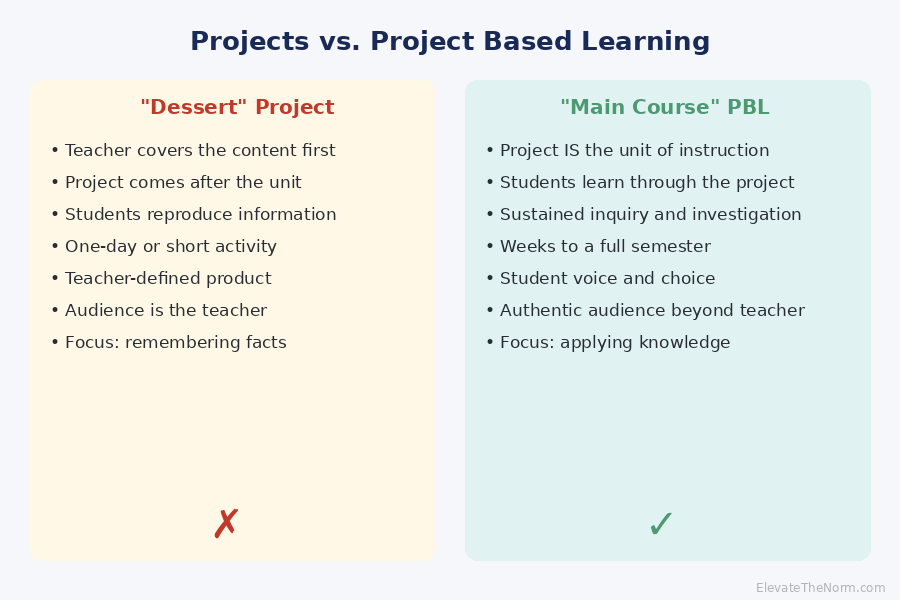
    Side-by-side comparison showing the differences between a dessert project and main course project based learning
    The project is the main course—not a reward served after the real instruction.

    The Seven Essential Design Elements of PBL

    PBLWorks identifies seven essential design elements that separate genuine PBL from projects that just look busy (PBLWorks, “Gold Standard PBL”):

    1. A Challenging Problem or Question. The project starts with a driving question—open-ended, standards-connected, and worth answering. “What happened in the American Revolution?” is a topic. “How should our community remember the people history forgot?” is a driving question.

    2. Sustained Inquiry. Students spend days or weeks researching, testing, building, and analyzing. The inquiry is not a warm-up before the real work. It is the real work.

    3. Authenticity. The project connects to the real world. That can mean a real audience, a real problem, professional tools, or a question students actually care about. A poster about water pollution for a bulletin board is not authentic. A water-quality report presented to a city council is.

    4. Student Voice and Choice. Students make meaningful decisions—about their question, their approach, their product, or how they organize their work. This does not mean they choose whether to do the project. It means they have genuine ownership within the structure the teacher has built.

    5. Reflection. Students and teachers think about what they have learned, what is working, and what they would change. Reflection is built into the process, not bolted on at the end.

    6. Critique and Revision. Students give and receive feedback and use it to improve their work. First drafts are not final drafts. In my room, when a group brings me what they think is a finished product, I ask them to walk me through it at the whiteboard table. Most of the time, they find the gap before I do—and that is exactly the point.

    7. A Public Product. Students share their work with an audience outside the classroom—parents, community members, experts, younger students, or a public platform. The audience raises the standard. Nobody wants to present bad work to a room full of strangers.

    These seven elements work together. Remove one and the project weakens. Remove three and you have a regular assignment with a new label.
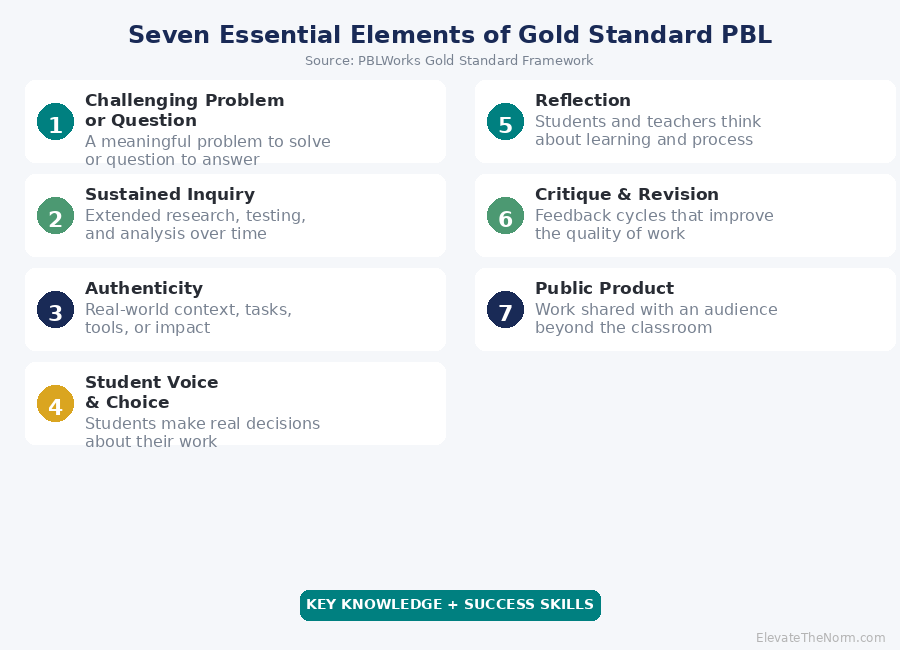
    Numbered list of seven essential design elements for Gold Standard project based learning from PBLWorks
    PBLWorks identifies seven essential design elements that separate genuine PBL from busy projects.

    What Project Based Learning Is Not

    This is where most confusion lives. Here are four things that get called PBL but are not.

    It Is Not a Project After the Lesson

    John Larmer and John Mergendoller of PBLWorks call this the “dessert project”—a short, intellectually light project served up after the teacher covers the content (Larmer & Mergendoller, “Seven Essentials for Project-Based Learning,” ASCD). Build a model of a cell after learning about cells. Make a brochure about Ancient Rome after the unit test. These are projects. They are not PBL.

    That distinction is the heart of the project based learning versus traditional learning debate, and the research reads very differently depending on which version a study actually measured. In PBL, the project is the unit. Students learn the content through the project, not before it. The project is the main course, not the dessert.

    It Is Not Problem-Based Learning

    Problem-based learning and project-based learning share an acronym, but they are not the same. Problem-based learning follows a more structured process: students receive an open-ended problem, define it, identify what they know and what they need to learn, investigate, and propose solutions. It originated in medical education and tends to follow a formalized set of steps (Edutopia, “Project-Based Learning vs. Problem-Based Learning vs. X-BL”).

    Project-based learning is broader. It includes designing products, investigating questions, and solving problems. A problem can drive a PBL project, but PBL is not limited to problems. The two approaches share DNA, but they are not identical.

    It Is Not Inquiry-Based Learning

    Inquiry-based learning emphasizes student questions and investigation. PBL includes inquiry—sustained inquiry is one of the seven design elements—but PBL adds structure, a public product, and often a tangible deliverable that inquiry alone does not require. Inquiry is an ingredient. PBL is the recipe.

    It Is Not a Hands-On Activity

    Building a bridge from popsicle sticks is hands-on. It is not PBL unless there is a driving question, sustained inquiry, student decision-making, feedback, and a purpose beyond the activity itself. Hands-on work is a tool. PBL is a method. The two overlap, but a hands-on activity without intellectual demand is just craft time with a content label.

    A Strong Example and a Weak Example of PBL

    Strong PBL: Eighth-grade students investigate water quality in a local creek after noticing runoff from a nearby construction site. They collect samples, learn testing procedures, analyze data, research water safety standards, and write a formal report. They present findings and recommendations at a county environmental commission meeting. The project takes five weeks. Students choose which aspect of water quality to focus on, how to present their data, and which solution to recommend.

    This is PBL because it has a real question, sustained inquiry, authenticity, student voice, feedback from the teacher and from peers, and a public product delivered to a real audience.

    Weak example: Students make a poster about water pollution for a classroom display. They copy facts from a website, add clip art, and present to the class for a grade.

    This is a project. It is not PBL. There is no driving question, no inquiry, no authentic audience, no revision based on feedback, and no student decision-making beyond color choices.
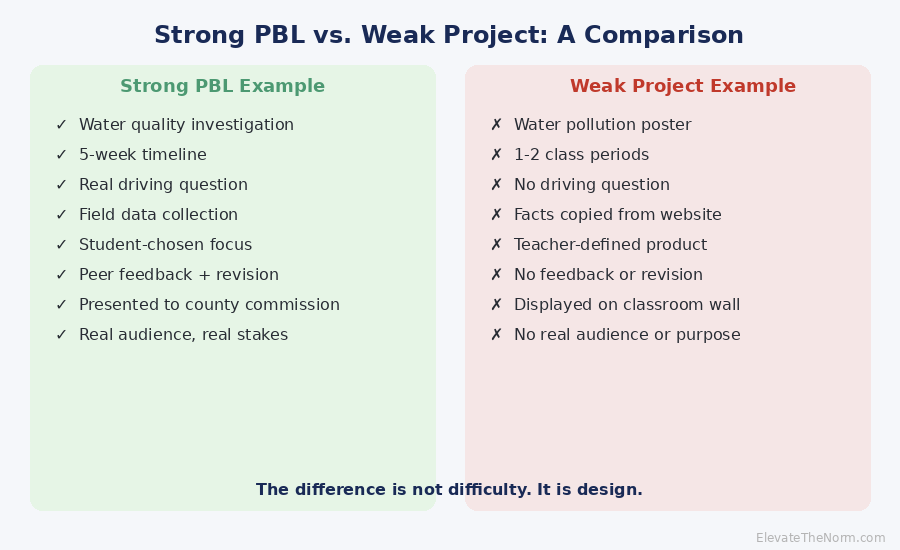
    Comparison showing a strong PBL example with water quality investigation versus a weak poster project
    The difference between strong PBL and a weak project is not difficulty—it is design.

    What the Research Says About Project Based Learning

    A 2026 multi-study analysis published in Humanities and Social Sciences Communications examined 54 quantitative studies on PBL effectiveness. The overall effect size was large (Hedges’ g = 1.11), meaning PBL had a substantial positive impact on student achievement compared to traditional instruction. The effect was strongest at the high school level (g = 1.45) and somewhat lower in mathematics (g = 0.68), suggesting PBL in abstract subjects requires deliberate scaffolding (Chen et al., “Project-based learning in schools,” Humanities and Social Sciences Communications, 2026).

    Beyond test scores, the research identified positive effects on critical thinking, collaboration, communication skills, and student engagement. These findings matter because they match what PBL is designed to develop—not just content knowledge, but the ability to use that knowledge in real situations.

    The research also flagged real limitations: PBL requires teacher training, adequate resources, and careful planning. Without those, the method does not automatically outperform direct instruction. Good PBL is not magic. It is planned, structured, and supported.

    For an evaluation of specific tools that support that planning—templates, rubrics, critique protocols, and driving-question resources—see project based learning resources on this site.

    What the Teacher Actually Does in Project Based Learning

    One of the most damaging myths about PBL is that the teacher steps back and lets students figure it out. That is not PBL. That is neglect in an educational costume.

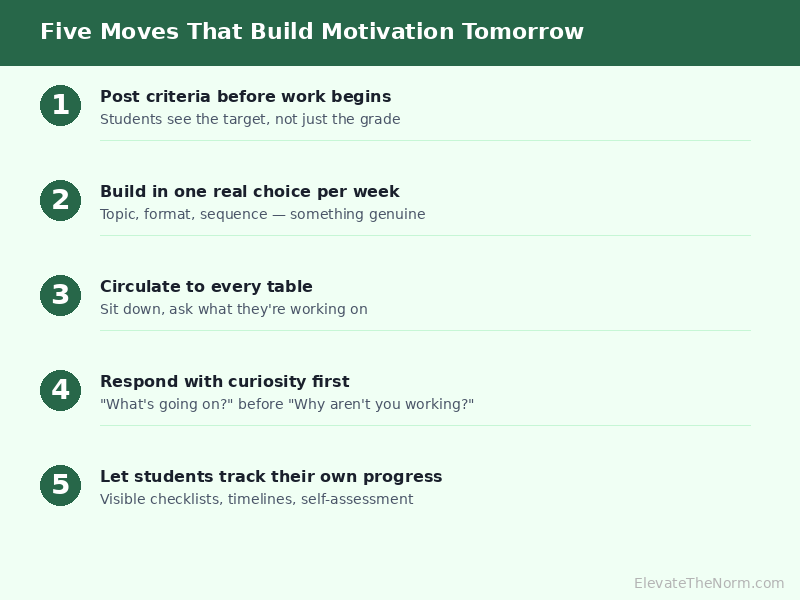
    In my room, students are almost always working alongside somebody—partner work is the default, not a special reward for finishing something early. I am not standing at the front of the room watching. I am circulating, listening, pulling up a chair, asking a group what they have found so far. When two students are building an argument and the logic falls apart, I do not announce it to the room. I sit down next to them and ask them to walk me through it.

    The whiteboard table in my room is not a remediation corner. It is the best seat in the house—low lamp, a rug, better chairs, a table I built myself. Students ask to go there. When a group needs direct instruction on a skill they are missing midproject, that is where we go. Three or four students at a time, working through exactly the thing they need, while the rest of the class continues.

    PBL requires more teaching, not less. The teacher designs the project, writes the driving question, builds the checkpoints, plans the feedback loops, manages the pacing, and holds students to the standard. The difference is that the teaching happens at close range—next to students while they work—instead of from a podium before they start.

    How PBL Connects to Student Responsibility

    PBL and student responsibility are inseparable. A project that asks students to make real decisions, manage their time, collaborate with a team, present to an audience, and revise their work after honest feedback is a responsibility machine. Students cannot hide behind compliance in PBL because there is nothing to comply with—no worksheet to fill in, no notes to copy. They have to produce something that works.

    That is also what makes PBL hard. Students who have spent years in compliance-based classrooms do not automatically know how to handle freedom. The teacher’s job is to build that capacity deliberately—clear classroom expectations, structured check-ins, honest feedback, room to make mistakes, and support after the mistake happens.

    The connection runs both ways. Teaching responsibility becomes more concrete when students have genuine ownership of their work. And respect in the classroom—the mutual kind—creates the trust students need to take risks, ask for help, and accept feedback without defensiveness.

    Conclusion

    The definition of project based learning is clear: students learn by working on a meaningful, extended project driven by a real question. The confusion comes from calling other things by the same name. Projects after the lesson, problem-solving exercises, inquiry activities, and hands-on crafts all have value—but they are not PBL unless they include the essential elements that make PBL work.

    If you are considering PBL for your classroom, start with a genuine driving question, give students real decisions to make, build in feedback and revision, and plan for a public product. Then stay close. Circulate. Teach at the whiteboard table. Hold the standard.

    PBL does not mean less teaching. It means better teaching, delivered where students need it most—right next to them while they work.

    Once the definition is clear, the natural next step is sequencing it: 7 steps of project based learning walks through the process from driving question to public product.

    What is the simplest definition of project based learning?

    Project based learning is a teaching method where students learn by working on a meaningful project over an extended period. The project is the unit of instruction—not an add-on after the lesson. Students investigate a real question, make decisions, receive feedback, revise their work, and present a finished product to an authentic audience.

    How is PBL different from a regular classroom project?

    A regular project is usually assigned after the teacher has already taught the content. In PBL, students learn the content through the project itself. PBL also requires a driving question, sustained inquiry, student decision-making, critique and revision, and a public product—elements most regular projects do not include.

    Does the teacher just step back and let students figure it out?

    No. PBL requires more teaching, not less. The teacher designs the project, builds the structure, circulates during work time, provides direct instruction when students need it, and holds everyone to a clear standard. The teaching happens at close range—next to students—instead of from the front of the room.

    Can PBL work in tested subjects like math?

    Yes, but it requires careful planning. Research shows PBL improves achievement in math, though the effect is smaller than in other subjects. Teachers need to ensure the math is essential to the project—not decorative—and build in explicit instruction and practice alongside the project work.

    What does the research say about PBL effectiveness?

    A 2026 multi-study analysis found a large positive effect on student achievement (Hedges’ g = 1.11), with the strongest results at the high school level. PBL also improved critical thinking, collaboration, and engagement. However, the research is clear that implementation quality matters—PBL without adequate planning and teacher support does not automatically outperform traditional instruction.

    Is problem-based learning the same as project-based learning?

    They are related but not identical. Problem-based learning follows a more structured process focused on solving an open-ended problem, originally developed for medical education. Project-based learning is broader—it can include problem-solving, but also designing products, investigating questions, and creating performances for real audiences.

    How long should a PBL project last?

    Most PBL projects run from one week to a full semester, depending on the scope. The key is that the timeline allows sustained inquiry—students need enough time to research, get stuck, get feedback, revise, and produce quality work. A one-day activity cannot deliver that experience.

    Sources

    1. PBLWorks, “What is Project Based Learning?” PBLWorks.org. https://www.pblworks.org/what-is-pbl
    2. PBLWorks, “Gold Standard PBL: Essential Project Design Elements.” PBLWorks.org. https://www.pblworks.org/what-is-pbl/gold-standard-project-design
    3. John Larmer and John Mergendoller, “Seven Essentials for Project-Based Learning.” Educational Leadership, ASCD. https://www.ascd.org/el/articles/seven-essentials-for-project-based-learning
    4. John Larmer, “Project-Based Learning vs. Problem-Based Learning vs. X-BL.” Edutopia. https://www.edutopia.org/blog/pbl-vs-pbl-vs-xbl-john-larmer
    5. Chen et al., “Project-based learning in schools: a multi-complementary study of its effectiveness.” Humanities and Social Sciences Communications, Nature, 2026. https://www.nature.com/articles/s41599-026-06684-4
    6. Larmer, Mergendoller, and Boss, Setting the Standard for Project Based Learning. ASCD, 2015.
    7. Innovations Academy, “Inquiry-Based Vs Project-Based Learning, What’s the Difference?” 2025. https://innovationsacademy.org/blog/2025/04/inquiry-based-vs-project-based-learning-whats-the-difference/
    8. High Quality PBL Framework, HQPBL.org. https://hqpbl.org

    About Clay Shumate
    Clay Shumate is a certified secondary Social Studies teacher in the public schools of West Alabama, with seven years of classroom experience, a B.A. in History, and an M.Ed. in Secondary Education. He writes about project-based learning, student responsibility, respect, and practical ways to hold young people to a higher standard while giving them room to learn from mistakes. He is a member of the Society of Professional Journalists and writes to its Code of Ethics; this site’s editorial standards and corrections policy are published in full. More about Clay.
  • Student Responsibility: How to Raise the Standard Without Removing Grace

    Student Responsibility: How to Raise the Standard Without Removing Grace

    By Clay Shumate

    Student responsibility is what happens when a young person owns their preparation, effort, deadlines, collaboration, and mistakes — not because an adult is standing over them, but because the standard is clear and the student believes it applies to them. Raising that standard in grades 6–12 requires both firmness and a genuine path back when students fall short. Neither half works alone.

    Key Takeaways

    • Responsibility is practiced, not preached — students learn it by doing it, not by hearing about it.
    • What students, teachers, families, and schools each control is different, and mixing those up creates most of the conflict.
    • High standards without support create failure. Support without standards creates dependence.
    • Responsibility has four dimensions: academic, behavioral, interpersonal, and community. Most schools only measure the first two.
    • Grace and accountability are not opposites. They are the same system working correctly.

    What Student Responsibility Actually Means

    Student responsibility means a student can answer three questions honestly: What is expected of me? Am I doing it? If not, what am I going to do about it? Those three questions are unpacked at length in the plain-language definition.

    There is a format built almost entirely around making a student answer those three questions out loud. Student-led conferences put the student in front of their own work and their own family, which is a far harder audience than a teacher and a much better test of whether the responsibility is real.

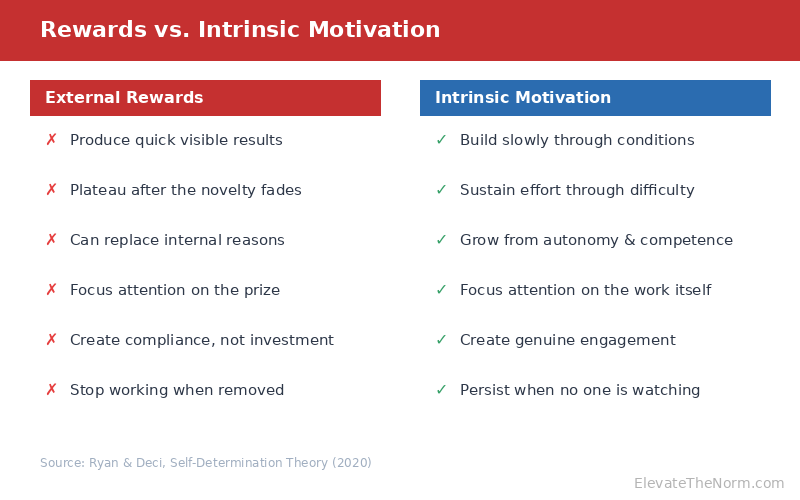
    That sounds simple. It is not simple at all for a fourteen-year-old who has spent years in systems that either removed their choices or removed the consequences of their choices. Responsibility requires practice the same way reading requires practice — and like motivation, it develops when conditions support it — you do not get better at it by listening to someone talk about it.

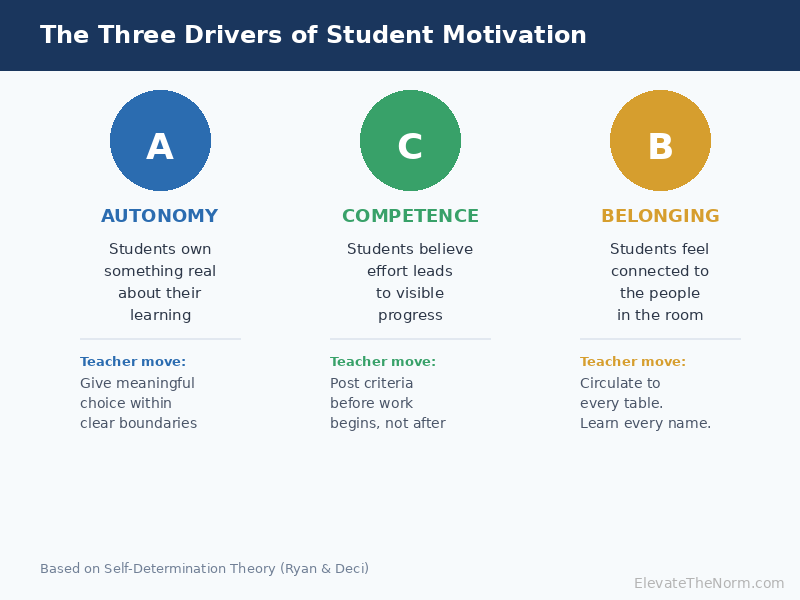
    Self-determination theory, developed by Edward Deci and Richard Ryan, identifies three psychological needs that drive motivation and responsible behavior: autonomy (some genuine control over choices), competence (belief that effort leads to improvement), and relatedness (connection to people who matter). When those three conditions are present, students are far more likely to internalize the standards around them rather than comply because they’ve been forced to (Ryan & Deci, 2000; Guay, 2022).

    This is not a soft finding. It is one of the most replicated results in motivational psychology. And it means that the first job in building student responsibility is structural: does your classroom give students real choices, achievable challenges, and relationships worth protecting?

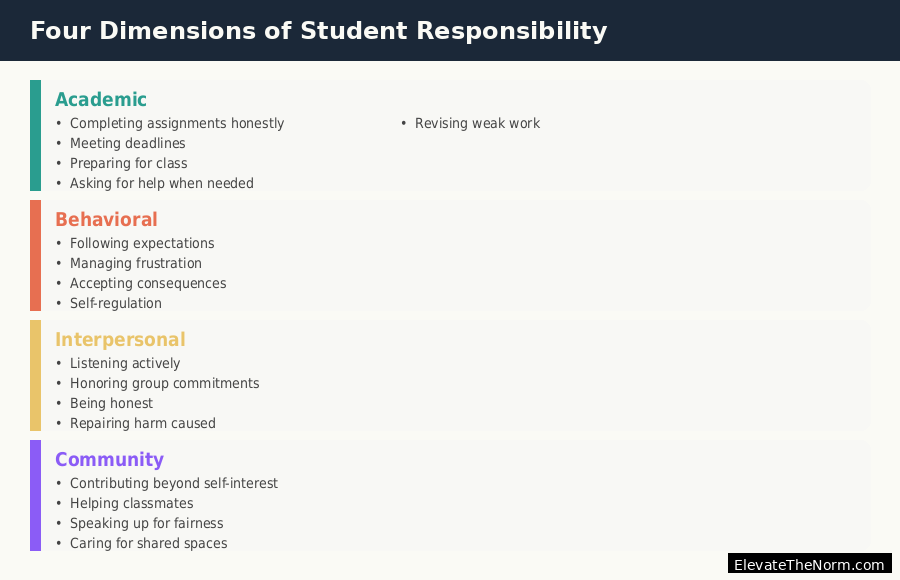
    The Four Dimensions of Student Responsibility

    Most schools define responsibility narrowly — turn in your work, follow the rules. That covers two dimensions and misses two others that matter just as much.

    Infographic showing four dimensions of student responsibility: academic, behavioral, interpersonal, and community
    Four dimensions of student responsibility most schools need to measure

    Academic Responsibility

    This is the one schools measure most: completing assignments, meeting deadlines, preparing for class, doing honest work, and asking for help when needed. Academic responsibility means the student treats their own learning as their job.

    What this looks like in practice: a student who doesn’t understand the assignment asks for clarification instead of guessing. A student whose first draft is weak revises it. A student who misses a deadline explains why and finishes the work.

    What this does not look like: a student who turns in someone else’s work. A student who consistently arrives unprepared and shrugs. A student who does the minimum to avoid a zero.

    Behavioral Responsibility

    Following classroom expectations, treating shared spaces with care, managing frustration without harming others, and accepting consequences when behavior falls short. Behavioral responsibility is the hardest dimension for adolescents because it requires impulse control that is still developing neurologically.

    This is where the pause matters. When a student pushes back — argues a deadline, refuses a task, challenges a grade — my first move is not to respond. I pause. It runs roughly a fifteen count, on average, but that number changes with the student, the day, and what just happened. The pause is not a technique from a book. It is a habit I built because the first thing I want to say is almost never the most useful thing I can say.

    That pause does two things. It gives me time to think. And it shows the student that their behavior did not control my response. Both of those outcomes are lessons in responsibility — mine and theirs.

    Interpersonal Responsibility

    How a student treats the people around them: listening, following through on commitments to a group, being honest, handling disagreement without personal attacks, and repairing harm when they cause it. This dimension is where responsibility becomes relational — it is no longer about the student and the standard. It is about the student and other people.

    Schools that treat interpersonal responsibility as a bonus rather than a requirement produce students who can pass tests and follow rules but cannot collaborate, resolve conflict, or maintain trust. Those skills do not develop on their own. They develop when teachers name them, model them, and hold students to them.

    Community Responsibility

    The broadest dimension: contributing to the classroom, the school, and eventually the community beyond school. Picking up something that isn’t yours. Helping a classmate who is lost. Speaking up when something unfair is happening. Community responsibility is the hardest to teach because it requires students to act on behalf of someone other than themselves.

    This is also where responsibility intersects with leadership. A student who takes community responsibility seriously is already leading — they just may not have the title. Closing that gap between doing the work and holding the role is the whole point of giving teenagers genuine authority in the building.

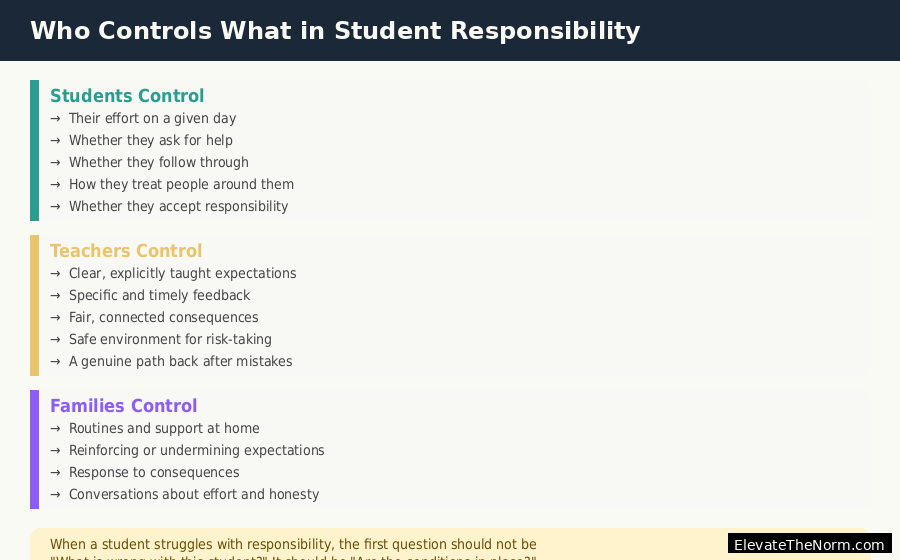
    What Students Control, What Teachers Control, What Families Control

    Most conflict around student responsibility comes from blurring these lines.

    Graphic breaking down what students, teachers, and families each control in building student responsibility
    Responsibility works when everyone knows what they control

    Students Control

    • Their effort on a given day
    • Whether they ask for help
    • Whether they follow through on commitments
    • How they treat the people around them
    • Whether they accept responsibility when they fall short

    Teachers Control

    • Whether expectations are clear and explicitly taught
    • Whether feedback is specific and timely
    • Whether consequences are fair and connected to the behavior
    • Whether the classroom feels safe enough to take risks
    • Whether there is a genuine path back after a mistake
    • Whether the standard stays consistent or quietly shifts based on the student

    Families Control

    • The routines and support available at home
    • Whether they reinforce or undermine the school’s expectations
    • How they respond when their child faces consequences
    • The conversations they have about effort, honesty, and responsibility

    Schools Control

    • Whether policies support responsibility or undermine it (a grading system that averages a zero with later scores teaches learned helplessness, not responsibility)
    • Whether teachers have the time, training, and backing to follow through
    • Whether the culture treats mistakes as learning opportunities or permanent marks

    When a student is struggling with responsibility, the first question should not be “What is wrong with this student?” It should be “Are the conditions for responsibility actually in place?” If the expectations are unclear, the feedback is absent, the consequences are disconnected, or the path back doesn’t exist, then the system is failing — not the student.

    What High Standards Actually Look Like

    High standards are not the same as high pressure. A teacher with high standards believes every student can meet the expectation and builds the structure to make that possible. A teacher with high pressure demands performance without building the structure.

    The difference shows up in how you handle the student who falls short.

    High standards: “This isn’t at the level we discussed. Here’s specifically what needs to change. You have until Thursday to revise it. I’m available Tuesday during advisory if you need help.”

    High pressure: “This is unacceptable. You should know better by now. I’m very disappointed.”

    The first response holds the standard and provides a path. The second response holds the standard and provides shame. Both sound firm. Only one teaches responsibility.

    Research on teacher expectations consistently shows that what teachers believe about students’ capabilities shapes student outcomes. Rosenthal and Jacobson’s classic 1968 study on teacher expectancy effects — where students whose teachers were told they were “intellectual bloomers” showed greater IQ gains — has been replicated and refined across decades. The finding holds: high expectations, communicated through specific support rather than general pressure, produce better results (Rosenthal & Jacobson, 1968; Jussim & Harber, 2005).

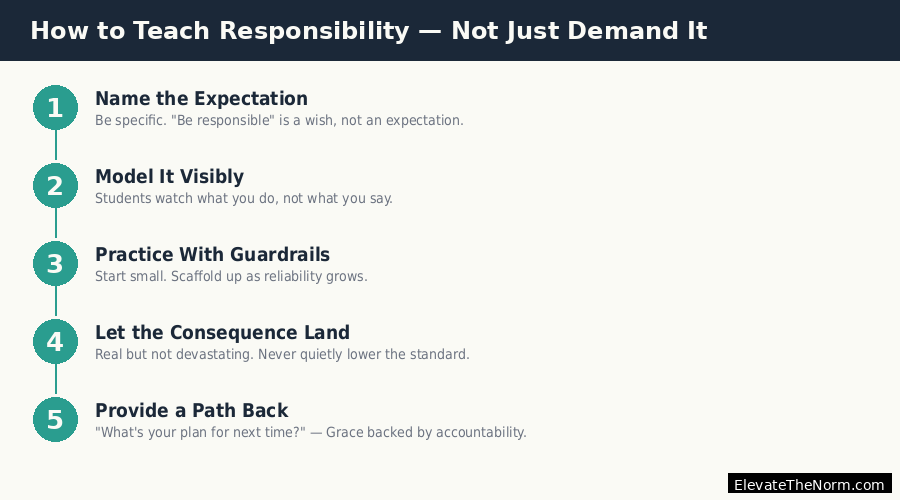
    How to Teach Responsibility — Not Just Demand It

    Responsibility is a set of behaviors, and behaviors can be taught. Here is a practical sequence for building responsibility in grades 6–12.

    Five-step sequence for teaching student responsibility: name expectations, model it, practice with guardrails, let consequences land, provide a path back
    Five steps to teach responsibility instead of just demanding it

    1. Name the Expectation Specifically

    “Be responsible” is not an expectation. It is a wish. Clear classroom expectations sound different. An expectation sounds like: “When you arrive, your materials are out and you’re looking at the board for the first task within two minutes.” Specificity removes guesswork and gives students a clear target to hit.

    2. Model It Visibly

    Students watch what you do, not what you say. This is one reason classroom management starts with the teacher, not the student. If you expect them to meet deadlines, meet yours. If you expect them to admit mistakes, admit yours publicly. If you expect them to prepare, show them what your preparation looks like. Responsibility is taught as much by example as by instruction.

    3. Practice It With Guardrails

    Give students real responsibility in small doses with scaffolding. A student who has never managed a deadline doesn’t need a month-long project on day one. They need a three-day task, a check-in at the midpoint, and a clear consequence for missing the end date. As they demonstrate reliability, extend the timeline and reduce the check-ins. My Makeup Work System on TPT puts the tracking on the student, which is where the responsibility belongs.

    This is not coddling. This is what teaching actually looks like. You do not hand a student a novel and say “read it” if they have never finished a chapter book. You scaffold. Responsibility deserves the same approach.

    4. Let the Consequence Land

    When a student doesn’t meet the expectation, the consequence has to be real. Not devastating. Not humiliating. But real. A student who doesn’t prepare for a group presentation should feel that — through honest feedback from peers, through a required individual follow-up, through the visible gap between what they delivered and what was expected.

    The worst thing you can do is quietly lower the standard. The student learns nothing. The other students learn that the standard is fake.

    5. Provide a Path Back

    After the consequence, the conversation should end with a question: “What’s your plan for next time?” Not a lecture. Not a threat. A question that places the responsibility back where it belongs — with the student.

    The path back is where grace lives. It is also where learning from mistakes actually happens — not in the consequence itself, but in the moment after, when the student decides what to do next. It does not erase the consequence. It says: the standard is still here, I still believe you can meet it, and here is your chance to prove it.

    Common Mistakes Teachers Make With Student Responsibility

    Confusing Responsibility With Obedience

    Obedience is doing what you’re told because someone told you. Responsibility is doing what needs to be done because you understand why it matters. A classroom full of obedient students looks orderly. A classroom full of responsible students looks orderly and keeps running when the teacher steps out.

    If your system requires your constant presence and enforcement to function, you have built obedience. If your system runs because students have internalized the standard, you have built responsibility. The difference matters because obedience does not transfer. Responsibility does.

    Rescuing Students From Consequences

    When a student fails to meet a deadline and the teacher extends it without conversation, the teacher has just taught the student that deadlines are negotiable. When a parent calls to argue a grade and the teacher changes it, the student learns that consequences can be outsourced. When an administrator overrides a classroom consequence to avoid a complaint, the student learns that persistence beats integrity.

    Each of these moments, individually, seems small. Together, they build a system where responsibility is optional.

    Punishing Without Teaching

    A detention for missing homework teaches a student to sit in a room. It does not teach them to manage their time, prioritize their work, or ask for help before the deadline passes. If the consequence doesn’t include a conversation about what went wrong and what the student will do differently, it is punishment, not accountability.

    Applying Standards Unevenly

    Students have a ruthless eye for inconsistency. If one student gets a pass and another doesn’t, every student in the room notices. Responsibility flourishes in systems that are predictable, fair, and built on mutual respect. It collapses in systems where the rules depend on who you are or how the teacher is feeling that day.

    A Responsibility Framework for the Classroom

    DimensionWhat It Looks LikeWhat the Teacher DoesWhat It Doesn’t Look Like
    AcademicPrepared, on time, honest work, asks for helpClear expectations, specific feedback, revision opportunitiesPlagiarism, chronic unpreparedness, helplessness
    BehavioralFollows expectations, manages frustration, accepts consequencesConsistent follow-through, private correction, a path backDisruption without accountability, forced compliance without understanding
    InterpersonalListens, follows through on group commitments, repairs harmModels respect, names expectations, holds students to themPersonal attacks, broken commitments with no consequence
    CommunityContributes beyond self-interest, helps others, speaks upCreates opportunities, recognizes contribution, makes it visibleTreating shared spaces or people as someone else’s problem

    If you want specific classroom activities that put this framework into practice, activities for teaching responsibility walks through ten structured approaches — from deadline choice contracts to repair letters — designed for grades 6–12. And because none of these activities work without a predictable room, understanding why classroom expectations are important is the foundation everything else sits on. When a student has stopped engaging with responsibility altogether, motivating students who don’t care addresses that harder starting point directly. And when the pattern traces back to missed class time rather than a change in effort, chronic absenteeism is the first thing worth ruling out.


    What is the difference between student responsibility and student accountability?

    Responsibility is internal — it is the student’s sense of ownership over their preparation, effort, and behavior. Accountability is external — it is the system of expectations, feedback, and consequences that supports responsibility. A student needs both. Accountability without internal motivation produces compliance. Responsibility without external accountability can drift into good intentions with no follow-through.

    How do you teach responsibility to a student who has never been held to a standard?

    Start small, be explicit, and be patient. Name one expectation clearly. Practice it. Follow through when the student misses it — with a consequence that teaches, not one that punishes. Then add the next expectation. A student who has spent years in systems without standards needs time to adjust. That is not a reason to lower the standard. It is a reason to scaffold the path to it.

    What do you do when a student says they do not care?

    Take it seriously but do not take it literally. A student who says they do not care usually means one of three things: they care but are protecting themselves from failure, they do not see the relevance, or they are overwhelmed and shutting down. The response is not a motivational speech — it is a specific question: “What part of this is getting in the way?” That question respects their intelligence and opens a conversation instead of closing one.

    How do you handle responsibility in group projects?

    Structure the group so individual responsibility is visible. Each student should have a defined role, a personal deliverable, and a moment where they present or defend their own contribution. When a group member does not follow through, the consequence falls on that individual — not the group. Group grades that allow one student to carry others teach the wrong lesson about both effort and fairness.

    Should families be involved in building student responsibility?

    Yes, but with clear boundaries. Families can reinforce expectations, support routines, and have honest conversations about effort. They should not do the student’s work, argue consequences down, or remove the productive struggle that builds responsibility. The most useful family partnership is one where the school’s expectations and the family’s expectations align — and where both adults agree that the student is the one who needs to do the work.

    What if the school’s grading system undermines responsibility?

    Many do. A system that averages a zero with later scores can make it mathematically impossible for a student to recover from one missing assignment. A system that gives points for compliance — bringing a pencil, sitting quietly — measures obedience, not learning. If your grading system punishes honest effort and rewards strategic gaming, the system needs to change before student responsibility can improve. Advocate for grading policies that reflect actual mastery and allow recovery.

    For a detailed breakdown of what each domain looks like in practice—preparation, participation, deadlines, collaboration, mistakes, help-seeking, and repair—see student responsibility in the classroom.


    Sources

    1. Ryan, R. M., & Deci, E. L. (2000). Self-determination theory and the facilitation of intrinsic motivation, social development, and well-being. American Psychologist, 55(1), 68–78. https://selfdeterminationtheory.org/SDT/documents/2000_RyanDeci_SDT.pdf
    2. Guay, F. (2022). Applying self-determination theory to education: Regulations types, psychological needs, and autonomy supporting behaviors. Canadian Journal of School Psychology, 37(1), 75–92. https://journals.sagepub.com/doi/10.1177/08295735211055355
    3. Responsive Classroom. (2025). Secondary practices (Grades 6–12). https://www.responsiveclassroom.org/secondary-practices/
    4. Rosenthal, R., & Jacobson, L. (1968). Pygmalion in the Classroom: Teacher Expectation and Pupils’ Intellectual Development. Holt, Rinehart and Winston. https://psycnet.apa.org/record/1968-08876-000
    5. Jussim, L., & Harber, K. D. (2005). Teacher expectations and self-fulfilling prophecies: Knowns and unknowns, resolved and unresolved controversies. Personality and Social Psychology Review, 9(2), 131–155. https://journals.sagepub.com/doi/10.1207/s15327957pspr0902_3
    6. González-Villora, S., et al. (2017). Program to promote personal and social responsibility in the secondary classroom. Frontiers in Psychology, 8, 809. https://www.frontiersin.org/journals/psychology/articles/10.3389/fpsyg.2017.00809/full
    7. Niemiec, C. P., & Ryan, R. M. (2009). Autonomy, competence, and relatedness in the classroom: Applying self-determination theory to educational practice. Theory and Research in Education, 7(2), 133–144. https://selfdeterminationtheory.org/SDT/documents/2009_NiemiecRyan_TRE.pdf
    8. Edutopia. (2023). Perceptions of mistakes in the classroom. https://www.edutopia.org/article/perceptions-mistakes-classroom/

    About Clay Shumate
    Clay Shumate is a certified secondary Social Studies teacher in the public schools of West Alabama, with seven years of classroom experience, a B.A. in History, and an M.Ed. in Secondary Education. He writes about project-based learning, student responsibility, respect, and practical ways to hold young people to a higher standard while giving them room to learn from mistakes. He is a member of the Society of Professional Journalists and writes to its Code of Ethics; this site’s editorial standards and corrections policy are published in full. More about Clay.
  • Learning From Mistakes: Why Students Need Accountability and Another Chance

    Learning From Mistakes: Why Students Need Accountability and Another Chance

    By Clay Shumate

    Learning from mistakes means a student faces honest feedback, takes responsibility for what went wrong, completes a meaningful repair, and gets a genuine second chance. It does not mean pretending mistakes don’t matter, and it does not mean one bad decision defines a student permanently. Schools that get this right hold both: accountability that teaches something and a clear path forward.

    For more on how natural consequences function in secondary classrooms—and when they fall short—see natural consequences in the classroom.

    Key Takeaways

    • Mistakes are neurologically productive — errors activate stronger learning pathways than getting it right the first time.
    • Accountability without a path forward is just punishment wearing a different label.
    • Grace without accountability teaches students that standards don’t apply to them.
    • A workable process for any mistake: acknowledge it, understand its impact, repair the harm, and try again with the standard still in place.
    • Teachers control the conditions that determine whether a mistake becomes learning or shame.

    What Learning From Mistakes Actually Requires

    Learning from mistakes sounds simple until you try to do it in a room full of teenagers who would rather pretend the mistake never happened.

    Here is what the phrase actually demands: the student has to know the mistake happened, understand why it matters, feel the weight of it without being crushed by it, and then do something different. That is a sequence, not a slogan. Skip any step and the learning doesn’t happen.

    The student who never hears honest feedback repeats the mistake. The student who hears feedback but faces no consequence learns that standards are optional. The student who faces a consequence but gets no second chance learns that effort is pointless. And the student who gets a second chance without accountability learns that mistakes cost nothing.

    Every one of those failures is a teacher problem, not a student problem. The student is responding rationally to the system they’re in. Teaching responsibility means building a system worth responding to.

    The Two Extremes That Fail Students

    Most schools land on one of two bad defaults.

    The Zero-Tolerance Default

    Some schools treat every failure like a final answer. A missed deadline is a zero. A behavioral mistake is an office referral. A bad decision in October follows a student through June. The logic sounds clean: actions have consequences, and students need to learn that.

    The problem is that students do learn it — they learn that trying is risky, that asking for help is an admission of weakness, and that the safest move is to disengage. Research from the American Psychological Association consistently shows that exclusionary discipline — suspensions, expulsions, zero-tolerance policies — does not improve behavior and disproportionately affects students of color and students with disabilities (American Psychological Association, 2008).

    A system with no path back is not holding a high standard. It’s holding a grudge.

    Infographic comparing zero-tolerance and everything-is-fine approaches to learning from mistakes in the classroom
    Two extremes that fail students: zero-tolerance rigidity vs. consequence-free flexibility

    The Everything-Is-Fine Default

    Other schools swing the other direction. Every assignment can be redone indefinitely. Behavioral issues get processed through empathy circles but never produce a visible consequence. Students learn quickly that the stated standard isn’t real.

    This is not grace. Grace with no accountability is indifference dressed up as kindness. A student who never faces the honest weight of a mistake has been denied one of the most important experiences in adolescent development: realizing that what they do affects other people, and that fixing it is their job.

    The useful position is between these two extremes: firm enough that standards mean something, flexible enough that a student who falls short can get back up and try again with the standard still in place.

    Why Mistakes Strengthen Learning — What the Research Says

    The case for learning from mistakes is not just philosophical. It is neurological.

    When a student gets something right the first time, the brain registers a small confirmation. When a student gets something wrong, catches the error, and corrects it, the brain fires differently. Research by Jason Moser and colleagues at Michigan State University found that the brain shows two distinct responses to errors: an initial automatic response and a secondary, conscious response associated with paying attention to the mistake. Students who showed a stronger secondary response — meaning they attended to the error — performed better on subsequent tasks (Moser et al., 2011).

    Manu Kapur’s research on productive failure takes this further. Across multiple studies, students who attempted complex problems before receiving instruction — and failed — outperformed students who received direct instruction first. The struggle itself activated prior knowledge, exposed gaps, and made the eventual correct solution more meaningful and durable (Kapur, 2008; Sinha & Kapur, 2021).

    The critical condition: the failure had to be followed by explicit teaching. Struggle without resolution is not productive failure — it is just failure. This distinction matters in every classroom. A teacher who lets students sit with confusion indefinitely is not building resilience. A teacher who catches the misconception, sits down with the group, and asks the right questions is.

    When I’m circulating and I overhear a group building an argument on a faulty premise, I don’t stop the room. I pull up a chair. I ask them to walk me through it. Most of the time, they find the break in their own reasoning once someone asks the right question at the right moment. That is a mistake caught while it’s still useful — and the correction sticks because they did the thinking, not me.

    Academic Mistakes: Feedback, Revision, and Standards

    Academic mistakes — wrong answers, weak arguments, incomplete work, misunderstood concepts — are the easiest category to handle well and the one schools most often handle badly.

    What Works

    Targeted feedback, not blanket correction. Research consistently shows that students learn more from feedback focused on specific learning objectives than from papers returned covered in red marks (Hattie & Timperley, 2007). Mark the two things that matter most. Ignore the rest until those two are fixed.

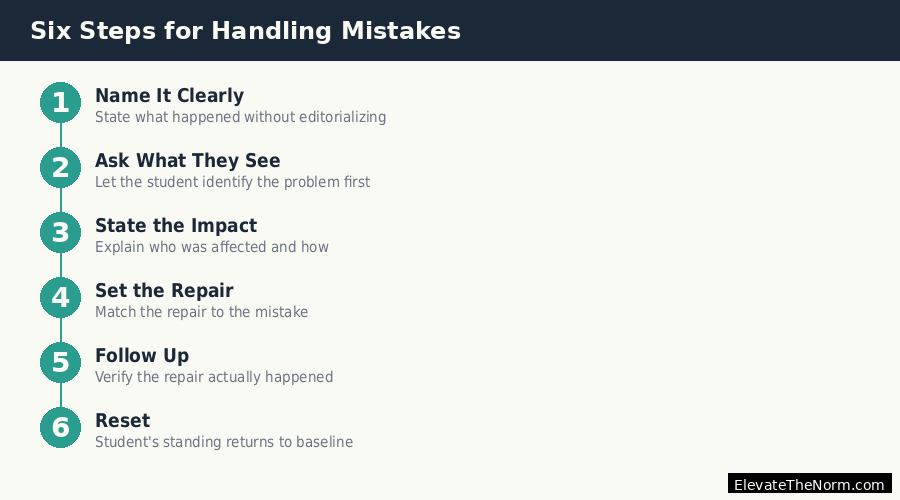
    Six-step framework for handling student mistakes: name it, ask what they see, state impact, set repair, follow up, reset
    Six steps for turning a mistake into learning instead of shame

    Revision as the expectation, not a favor. When a student turns in weak work, the response is not a zero and not a pat on the back. The response is: “This isn’t there yet. Here’s what needs to change. Bring it back.” The standard stays the same. The timeline adjusts.

    Distinguishing mistakes from errors. A mistake is careless — a missing period, a misread question. An error comes from a gap in understanding and tends to recur. The correction strategy is different for each. Mistakes need attention to detail. Errors need reteaching, which is why the way a correction assignment is structured decides whether it teaches anything.

    What Doesn’t Work

    Unlimited redos with no deadline. Late policies that reduce a grade by ten percent per day until the work is worthless. Averaging a zero with later scores so the math never recovers. Accepting work that doesn’t meet the standard just to avoid the conversation.

    The goal is a system where the standard is visible, the feedback is specific, the revision is expected, and the consequence of not revising is real — but not permanent.

    Behavioral Mistakes: Consequences, Repair, and Trust

    Behavioral mistakes are harder than academic ones because they involve other people. A student who disrupts a class, disrespects a peer, or breaks a commitment hasn’t just missed a standard — they’ve affected someone.

    The Difference Between Consequences and Punishment

    A consequence is connected to the behavior, proportionate, and designed to teach. A punishment is designed to make the student uncomfortable enough to stop. The distinction is not semantic. It determines whether the student learns anything or just learns to avoid getting caught.

    If a student damages a relationship, the consequence should involve repairing it. If a student wastes class time, the consequence should involve making it up. If a student breaks trust, the consequence should involve rebuilding it — through action, not a forced apology.

    Restorative accountability, when done honestly, asks three questions that traditional discipline skips: What happened? Who was affected? What are you going to do about it? (Edutopia, 2023). The student designs the repair, not the adult. The adult holds the standard for whether the repair is sufficient.

    When Consequences Are Non-Negotiable

    Some mistakes require immediate, firm consequences regardless of the context. Safety violations, threats, harassment, and violations of law or school policy are not opportunities for a restorative circle. They require the consequence that policy demands and the follow-up that the student needs. Both. Not one or the other.

    The mistake schools make here is treating these categories as an either/or: either we do restorative practices or we enforce policy. In reality, a student can face a mandatory consequence and still go through a repair process afterward. The consequence addresses the rule. The repair addresses the person.

    When Trust Is Damaged: The Harder Conversation

    The hardest mistakes to recover from are the ones that damage trust. A student who cheats, lies to a teacher, lets a group down, or betrays a peer’s confidence has done something that “I’m sorry” cannot fix.

    Cheating in particular is worth separating from the others, because the research on why it happens points at time pressure, fear and confusion far more than at character. What academic honesty actually means for grades 6–12 covers where the line falls, what AI did and did not change, and why a policy that makes honesty the expensive option produces more lying, not less. The worked examples of academic honesty and dishonesty are the version to put in front of a class, because most of the eighteen are arguable and the argument is the lesson.

    Trust repair takes time and visible action. The process looks like this:

    1. Acknowledge specifically what happened. Not “I messed up” but “I copied the answers and turned them in as my own work.”
    2. Name who was affected and how. The teacher who trusted the work was real. The classmates who did their own. The student’s own credibility.
    3. Propose a repair. The student — not the teacher — suggests what they will do to make it right. The teacher evaluates whether the proposal is sufficient.
    4. Follow through and be watched. Trust comes back through consistent behavior over time, not through one conversation. The student earns closer attention for a while. That is not punishment — that is the natural result of breaking trust.

    This process is uncomfortable. It should be. Discomfort is not the same as humiliation. The student should feel the weight of what happened without feeling like a permanently broken person.

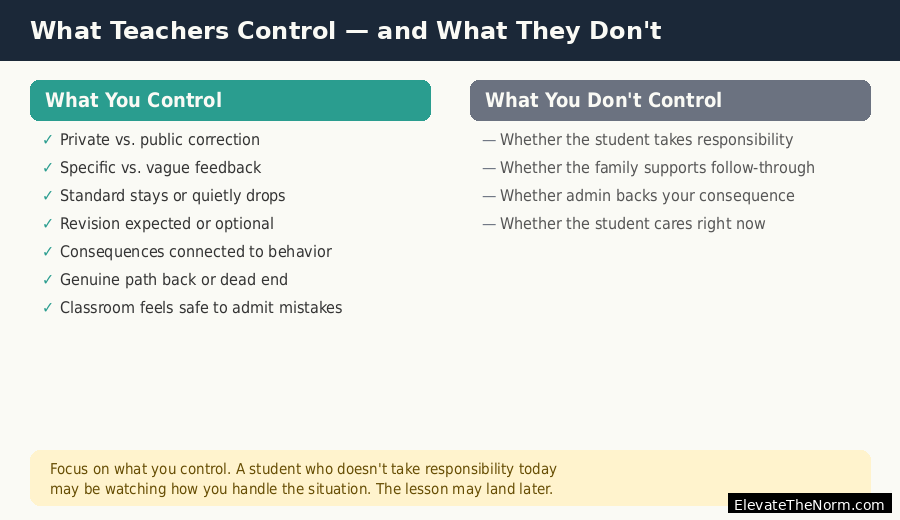
    What Teachers Control — and What They Don’t

    Comparison graphic showing what teachers control versus what they do not control when students make mistakes
    What teachers control about mistakes — and what they don’t

    Teachers cannot control whether a student makes a mistake. They can control almost everything that happens afterward.

    What you control:

    • Whether the mistake is addressed privately or publicly
    • Whether feedback is specific or vague
    • Whether the standard stays in place or quietly drops
    • Whether revision is expected or optional
    • Whether consequences are connected to the behavior or disconnected from it
    • Whether the student gets a genuine path back or a dead end
    • Whether the classroom feels safe enough to admit a mistake in the first place

    What you don’t control:

    • Whether the student takes responsibility
    • Whether the family supports the follow-through
    • Whether administration backs your consequence
    • Whether the student cares right now

    The temptation is to focus on what you don’t control and use it as a reason to give up. Don’t. A student who doesn’t take responsibility today may be watching how you handle the situation. The lesson may land later. Your job is to make sure the system is worth learning from. And if you want to understand what genuine student responsibility looks like when it works, that picture starts with the same conditions: clear expectations, real consequences, and a standard the student believes applies to them.

    A Practical Framework for Handling Mistakes in Grades 6–12

    This framework works for academic and behavioral mistakes. Adjust the scale to match the weight of the situation.

    Step 1: Name It Clearly

    Tell the student what happened, without editorializing. “You turned this in without the source analysis we discussed” is better than “You clearly didn’t try.” Clarity is respect. Vagueness leaves room for denial and defensiveness.

    Step 2: Ask What They See

    Before explaining the impact, ask: “What do you think happened here?” or “Walk me through your thinking.” Students often know more than they let on. Giving them the chance to name it first preserves their dignity and gives you information about whether the problem is understanding, effort, or something else.

    Step 3: State the Impact Honestly

    “When you don’t finish the research, your partner has to carry both parts” is more useful than “You need to be more responsible.” Specifics teach. Generalizations lecture.

    Step 4: Set the Repair

    The repair should match the mistake. Academic mistakes: revise and resubmit by a specific date. Behavioral mistakes: a conversation, a written reflection, direct restitution, or a plan the student proposes. The student should do the repair, not just agree to it. If you want a think sheet that treats students like young adults, my Behavior Reflection Sheets on TPT come in two levels.

    Step 5: Follow Up

    Check that the repair happened. A framework with no follow-through is a suggestion. If the student completed the repair, acknowledge it clearly — not with exaggerated praise, but with honest recognition that they did what was needed.

    Step 6: Reset

    After the repair is complete, the student’s standing resets. They are not on probation. They are not labeled. They are back where they started, with the standard still in place. This is what grace looks like when it’s backed by accountability. For ten specific activities for teaching responsibility that build this kind of repair into daily classroom practice, that article walks through each one. For a ready-to-use tool on this, see a printable standards-based grading starter pack. For a ready-to-use tool on this, see a fair academic integrity violation response process.


    Does letting students redo work lower the standard?

    Not if the standard stays the same. A student who submits weak work, receives specific feedback, and revises until the work meets the standard has actually done more rigorous work than the student who got it right the first time. The standard is the standard. The timeline is the variable.

    How do you hold students accountable without humiliating them?

    Handle it privately whenever possible. State what happened without adding a character judgment. Focus on the behavior and its impact, not on the student as a person. A student who hears “this work isn’t at the standard yet” will respond differently than one who hears “you obviously don’t care.”

    What about students who keep making the same mistake?

    A repeated mistake is usually a signal, not a character flaw. It may mean the student doesn’t understand the expectation, doesn’t have the skill to meet it, or is dealing with something outside the classroom. Before escalating consequences, ask whether the conditions for success are actually in place.

    Should teachers accept late work?

    Late work should come with a real consequence — a required conversation, a revision, or a temporary loss of flexibility — but not a consequence so severe it makes the work pointless. A student who turns in work two days late and gets a zero has been taught that the work doesn’t matter. A student who turns in work two days late, explains why, and completes it to the standard has been taught responsibility.

    How do you rebuild trust after a student lies or cheats?

    Through specific acknowledgment, a student-proposed repair plan, follow-through, and time. Trust is rebuilt by consistent behavior, not by a single apology. The student should expect closer attention for a while. Frame that attention as what naturally happens after trust breaks — not as punishment.

    Can a student really learn from a mistake if there is no consequence?

    Not usually. Consequences provide the friction that makes a mistake register. Without any consequence, the student learns that the mistake costs nothing. The key is that the consequence teaches rather than merely punishes — it is connected to the behavior, proportionate, and followed by a genuine chance to do better.

    What if parents push back on consequences?

    Explain the process: what happened, how it was addressed, what the student is expected to do, and what the path forward looks like. Most parents will support a consequence when they can see that it is fair, proportionate, and designed to help their child improve rather than just to punish.


    Sources

    1. American Psychological Association. (2008). Are Zero Tolerance Policies Effective in the Schools? An Evidentiary Review and Recommendations. https://www.apa.org/pubs/reports/zero-tolerance
    2. Moser, J. S., Schroder, H. S., Heeter, C., Moran, T. P., & Lee, Y.-H. (2011). Mind your errors: Evidence for a neural mechanism linking growth mind-set to adaptive posterror adjustments. Psychological Science, 22(12), 1484–1489. https://journals.sagepub.com/doi/10.1111/j.1467-9280.2011.02363.x
    3. Kapur, M. (2008). Productive failure. Cognition and Instruction, 26(3), 379–424. https://onlinelibrary.wiley.com/doi/10.1111/j.1551-6709.2008.01003.x
    4. Sinha, T., & Kapur, M. (2021). When problem solving followed by instruction works: Evidence for productive failure. Review of Educational Research, 91(4), 823–861. https://journals.sagepub.com/doi/10.3102/00346543211019105
    5. Hattie, J., & Timperley, H. (2007). The power of feedback. Review of Educational Research, 77(1), 81–112. https://journals.sagepub.com/doi/10.3102/003465430298487
    6. Edutopia. (2023). Building accountability with restorative practices. https://www.edutopia.org/article/building-accountability-restorative-practices/
    7. Narciss, S., & Lippold, M. (2025). Learning from errors and failure in educational contexts: New insights and future directions. British Journal of Educational Psychology. https://bpspsychub.onlinelibrary.wiley.com/doi/10.1111/bjep.12716
    8. González-Villora, S., et al. (2017). Program to promote personal and social responsibility in the secondary classroom. Frontiers in Psychology, 8, 809. https://www.frontiersin.org/journals/psychology/articles/10.3389/fpsyg.2017.00809/full

    About Clay Shumate
    Clay Shumate is a certified secondary Social Studies teacher in the public schools of West Alabama, with seven years of classroom experience, a B.A. in History, and an M.Ed. in Secondary Education. He writes about project-based learning, student responsibility, respect, and practical ways to hold young people to a higher standard while giving them room to learn from mistakes. He is a member of the Society of Professional Journalists and writes to its Code of Ethics; this site’s editorial standards and corrections policy are published in full. More about Clay.
  • Real World Learning: How Schools Can Connect Work to Life

    Real World Learning: How Schools Can Connect Work to Life

    Real World Learning: How Schools Can Connect Work to Life

    By Clay Shumate

    Part of the project-based learning guide — real audiences are one half of PBL; the hub covers the rest.

    Real world learning is not a field trip. It is not career day. It is not a worksheet about a fictional bakery that asks students to calculate profit margins for a business that does not exist. Real world learning happens when the work students do in a classroom connects to something genuine — a real problem, a real audience, a real product someone could actually use. And the reason most schools struggle with it has nothing to do with curriculum. It has to do with the difference between work that matters and work that pretends to.

    Key Takeaways

    • Real world learning means the work connects to something genuine — a community problem, a professional practice, or a product someone outside the classroom could actually use.
    • Most “real-world” assignments are simulations. Students know the difference, and it shows in their effort.
    • Access to real world learning cannot depend on family connections, transportation, or the teacher’s personal network. Schools need to build it into the system, not leave it to chance.
    • You do not need a community partner or a bus to create authentic work. Some of the strongest real world learning happens inside the school building.
    • Research consistently shows that applied, authentic learning improves academic outcomes — and the benefits are strongest for students from low-income backgrounds.

    The Problem with Most “Real-World” Assignments

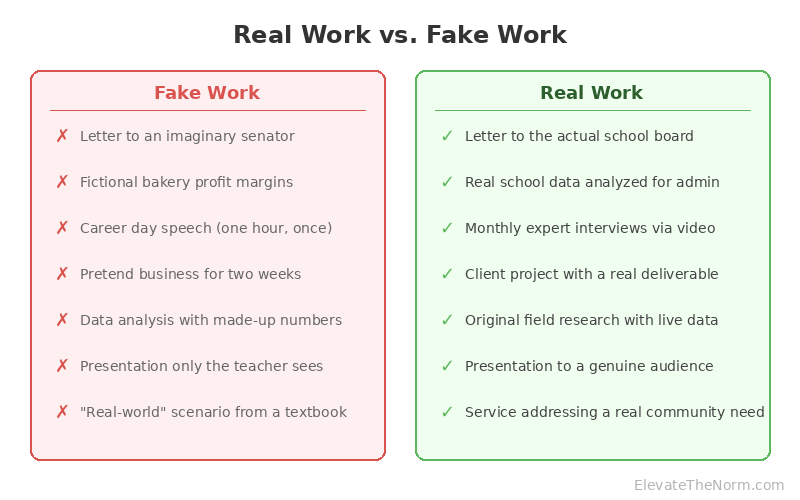
    Teachers know they should connect work to the real world. The problem is how that usually looks. A science class calculates carbon footprints using made-up numbers for a city that does not exist. An English class writes persuasive letters to an imaginary senator. A math class runs a pretend business for two weeks and then never mentions it again. Sound familiar? It should — these are the same problems behind ineffective classroom expectations: telling students the work matters while designing it so it does not.

    Students can tell. They can tell when the audience is fake, when the data is invented, and when the outcome does not matter to anyone except the gradebook. And when they can tell, they give it exactly the effort that fake work deserves — enough to get the grade, not enough to learn anything.

    This is not a laziness problem. It is a design problem. A research brief from EdResearch for Action identifies authenticity as the first of four core design principles for applied learning: the work must connect to real-world problems, expert practices, and student aspirations. When the connection is manufactured, the learning stays surface level no matter how well the lesson is planned.

    Side-by-side comparison of fake classroom work like fictional scenarios versus real work like authentic community projects
    Students can tell when work is fake — and they give it exactly the effort fake work deserves.

    What Makes Work Real

    Real world learning is not a category of assignment. It is a quality of the work itself. Here is the test: could someone outside the school see this, use this, or benefit from this? If the answer is no — if the work only exists to be graded — it is school work, not real work. Both have their place. But only one teaches students what it feels like to do something that matters.

    Real work comes in different forms, and not all of them require leaving the building:

    • Community problems. Students identify a real issue in their school or town — a broken process, a missing resource, an unanswered question — and produce something useful in response. A data report, a proposal, a working solution.
    • Professional practices. Students use the same tools and methods that adults in a field actually use. Historians analyze primary sources. Scientists follow real protocols. Writers publish for readers who chose to read, not readers who were assigned to.
    • Public audiences. The work goes somewhere beyond the teacher’s inbox. A presentation to the school board, a gallery for families, a report delivered to a local organization. The audience does not have to be large. It has to be real.
    • Career exposure. Not a career day presentation — actual contact with how work is done. Job shadows, expert interviews, mentorship hours, apprenticeship tasks. The Kansas City Real World Learning Initiative calls these “market value assets” and tracks them as credentials students carry beyond graduation.
    • Service. Work that meets a genuine need — not community service hours logged for a transcript, but a sustained project where students provide something a community actually needs and can verify.
    • Field research. Students collect original data in real settings. Water quality at a local creek, traffic patterns near the school, oral histories from community members. The data is real. The analysis is real. The conclusions might actually be wrong — and that is the point.
    • Useful products. A handbook, a tutorial video, a design prototype, a functioning tool. Something that works and that someone would choose to use even if no grade were attached.

    Not every lesson needs to be real work. Sometimes you need direct instruction, practice problems, and structured skill-building, and it is worth being honest about where direct instruction still outperforms projects. But if a student can get through an entire semester without producing something that matters to anyone besides the teacher, the course has a relevance problem that no amount of engagement tricks will fix.

    Real World Learning Inside the School Building

    The biggest misconception about real world learning is that it requires a field trip, a community partner, or a bus. It does not. Some of the most authentic work students can do happens inside the building they are already in — if the teacher designs it that way.

    Consider what is available in every school, regardless of location or budget:

    • The school has real data — attendance patterns, lunch participation, energy usage, event turnout — and students can analyze it for actual decision-makers.
    • The school has real audiences — younger students, parents, other teachers, administrators — who can receive and respond to student work.
    • The school has real problems — signage that does not work, processes that confuse new students, information that families never receive — and students can research, propose, and sometimes solve them.
    • The school has real history — alumni, community changes, institutional decisions — that students can document before it disappears.

    In my room, partner work is the default condition, not something we pull out for special projects. Students are already sitting in groups, already working alongside somebody, already talking about the work every period. That means when a real task comes in — a presentation for the front office, a proposal for the administration, an analysis that someone outside the room will actually read — the transition is small. The respect and trust are already there. We are not suddenly learning to collaborate because the project requires it. We have been collaborating since September.

    That structural advantage is worth mentioning because it changes what is possible. A teacher who runs a silent, independent classroom has to teach collaboration before launching real-world work. A room where students work alongside each other every day can move straight to the task. It is the same reason teaching responsibility works better when ownership is the default, not a special assignment. The collaboration is not the special event. The collaboration is the air in the room.

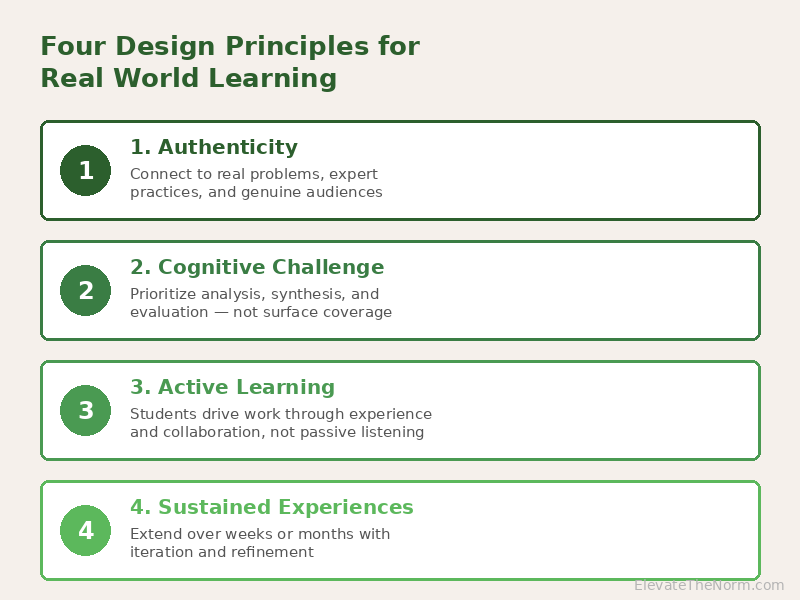
    Four design principles for real world learning: authenticity, cognitive challenge, active learning, and sustained experiences
    The four research-backed design principles that make real world learning effective.

    What the Research Says About Real World Learning

    The evidence base for applied, authentic learning is strong — and getting stronger. EdResearch for Action’s comprehensive brief reviews the evidence across multiple randomized controlled trials and identifies four core design principles that predict effectiveness:

    1. Authenticity. The work connects to real-world problems, expert practices, or student aspirations through essential questions and genuine audiences.
    2. Cognitive challenge. The work prioritizes deep mastery and complex thinking — analysis, synthesis, evaluation — not surface-level coverage.
    3. Active learning. Students drive the work through experience, collaboration, and reflection, with direct instruction used strategically rather than as the default mode.
    4. Sustained experiences. The work extends over weeks or months, allowing iteration and refinement — not a one-day activity squeezed between test-prep sessions.

    When those principles are present, the results are consistent. Randomized controlled trials show that project-based learning improved high school science and social studies achievement, with similar gains across income levels. Career and technical education increased on-time graduation rates, particularly for low-income students. Inquiry-based instruction improved middle school math scores. And linked learning — programs that combine academic and career-technical coursework — improved eleventh-grade English scores and college readiness. Those constraints — credits, bells, a transcript — are why running this in a high school is a different problem from running it in a middle school.

    The benefits are not limited to test scores. A Carnegie Foundation report on Kansas City’s Real World Learning Initiative found that 52 percent of recent high school graduates earned at least one market value asset before graduation — an internship, a client-connected project, an industry credential, or significant college credit. Students with these assets showed stronger transitions to employment and further education. The initiative now covers 34 school districts and approximately 100,000 high school students across urban, suburban, and rural areas.

    Service learning adds its own layer of evidence. Students in service-learning programs score higher in social studies, writing, and English language arts, and students in semester-long service-learning courses are almost three times more likely to believe they can have a significant impact on their community. These outcomes correlate with higher GPAs and improved graduation rates.

    Access and Equity: Real World Learning Cannot Depend on ZIP Code

    Here is the equity problem with real world learning, and it is not small: the best opportunities usually go to students who already have connections. The student whose parent works at the hospital gets the shadowing opportunity. The school with corporate neighbors gets the mentorship program. The district with transportation funding gets the field research trips.

    If real world learning depends on what families and communities can provide on their own, it reproduces the same inequities the rest of schooling already has. The Next Generation Learning Challenges project identified social capital as the critical gap: significant disparities exist between socioeconomic groups in accessing mentors, professional networks, and community connections. Students from low-income families are less likely to have adults in their life who can open professional doors — not because those students are less capable, but because those doors were never in their hallway.

    The answer is not to give up on real world learning for schools without resources. The answer is to design it so that access does not depend on any individual teacher’s personal network or any family’s existing connections. That means:

    • District-level coordination. Partnerships with local organizations, businesses, and agencies should be built at the system level and shared across schools — not left to individual teachers to hustle on their own time.
    • In-building alternatives. The school-based real world learning described above requires no bus, no budget, and no external partner. It is available to every teacher in every building starting tomorrow.
    • Virtual connections. Video conferencing puts expert interviews, professional mentorship, and virtual field trips within reach of any school with an internet connection. A rural school in Alabama can connect with a museum in Washington or an engineer in Houston without a travel budget.
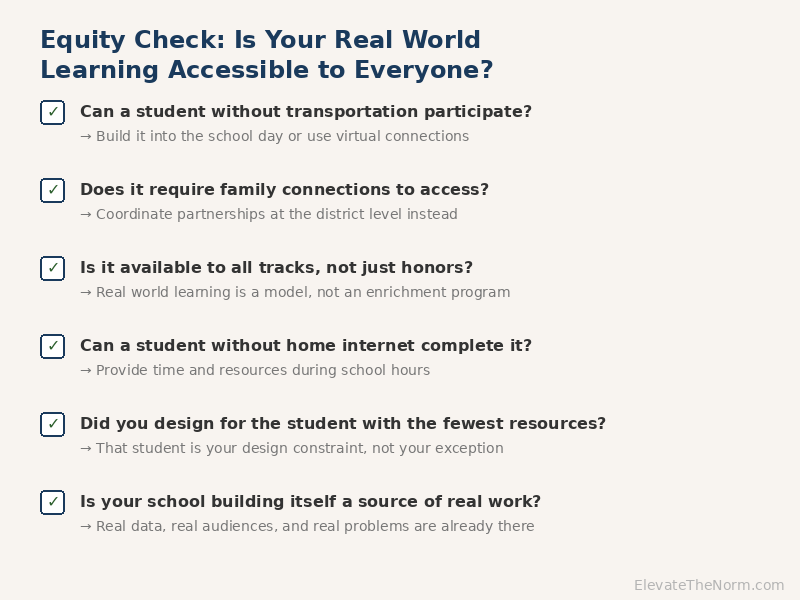
    • Designing for the student without connections. When planning real world learning, ask: can the student whose family works nights and cannot drive them anywhere still access this? If not, redesign it.

    Kansas City’s initiative is worth studying here because it started by addressing this exact problem. The Carnegie Foundation reports that the program explicitly focused on equity for historically marginalized students from low-income backgrounds, using district-level coordination rather than school-by-school improvisation.

    Common Mistakes That Make Real World Learning Fall Apart

    Even teachers who believe in authentic work make predictable mistakes when implementing it. These are the ones I see most often:

    Calling it real when it is not. The fastest way to lose a teenager’s trust is to promise them their work matters and then let it disappear into a grade. If you tell students they are writing a proposal for the principal, the principal needs to read it. If you tell them they are presenting to a real audience, the audience needs to actually care about the topic. Otherwise you have taught them that “real world” is just another school phrase that means nothing.

    Assuming real work means less structure. Authentic tasks need more structure, not less — clearer criteria, tighter checkpoints, more explicit scaffolding. The EdResearch brief directly addresses the misconception that applied learning eliminates direct instruction. It does not. It changes when and how you use it.

    Waiting until students have “the basics.” The belief that students need to master foundational skills before they can do real work is one of the most persistent barriers to real world learning — and the evidence does not support it. Applied learning and structured instruction are complementary. Students can learn content through authentic tasks, not only after them.

    Making access unequal. The honors students get the client project. The general-track students get the worksheet. If your real world learning is only available to students who already perform well, you have created an enrichment program, not a learning model.

    Equity checklist for real world learning asking whether opportunities are accessible to all students regardless of transportation, family connections, or income
    Design real world learning for the student with the fewest resources.

    Where to Start Tomorrow

    You do not need to overhaul your curriculum to bring real world learning into your classroom. You need to change who sees the work and what happens to it after it is finished.

    • Find one unit this semester where the final product could go to a real audience. Not the whole course. One unit. A report that goes to the school counselor. A presentation for another class. A proposal delivered to someone who could actually act on it.
    • Replace one fake scenario with real data. Instead of the fictional bakery, use real school data. Instead of the imaginary senator, write to the actual school board member who represents your district. The skill being practiced is the same. The motivation is not.
    • Invite one outside person into your classroom this month. Not for a career day speech — for a working session. Someone who can listen to student work, ask questions, and respond. A video call is enough.
    • Look at your building with fresh eyes. What problem exists in this school right now that students could investigate, document, or address? That is your next authentic unit.
    • Set up the collaboration first. Students who already work alongside each other every day — who know how to divide labor, give feedback, and hold each other accountable — can take on real work with real stakes faster than students who only collaborate during special projects.

    Real World Learning Is Not an Add-On

    The phrase “connect work to life” makes it sound like classroom learning and real life are separate things that need a bridge. They are not — or at least they should not be. The goal of real world learning is not to add a real-world component to an otherwise academic course. It is to stop pretending that academic work is not supposed to mean anything beyond the transcript.

    Students in grades 6–12 are old enough to do work that matters. They are old enough to analyze real data, address real audiences, investigate real problems, and produce things that real people actually use. When we understand what actually motivates students, we see that this kind of work is not extra — it is the condition under which engagement survives. The question is not whether they are capable. The question is whether we are building classrooms that give them the chance.

    That chance does not require a corporate partner, a grant, or a bus. It requires a teacher who is willing to ask: who will see this work besides me? If the answer is nobody — and it has been nobody all year — that is the place to start.

    Frequently Asked Questions

    How is real world learning different from project-based learning?

    Real world learning is broader than project-based learning. PBL is one method for delivering real world learning — a sustained project driven by an authentic question and ending in a public product. But real world learning also includes service, career exposure, field research, expert collaboration, and any work that connects to something genuine outside the classroom. A teacher can create real world learning without running a full PBL unit — and a PBL unit can fail at real world learning if the project is a simulation instead of the real thing.

    What if my school does not have community partners or business connections?

    Start inside the building. Every school has real data, real audiences, and real problems students can work on — attendance patterns, communication gaps, school history, proposals for administration. You do not need an external partner to make work authentic. You need a real audience and a product that someone will actually use. Video conferencing also makes expert interviews and virtual mentorship available to any school with an internet connection, regardless of location.

    Does real world learning work for students who are below grade level?

    Yes — and the research is direct on this point. Randomized controlled trials show that project-based and applied learning improve outcomes across income levels and prior achievement levels. Career and technical education increased on-time graduation particularly for low-income students. The belief that students need to master basics before engaging in authentic work is not supported by evidence. Students can learn foundational skills through real tasks, not only before them.

    How do I assess real world learning when the product is not a test?

    Use performance-based assessment tied to clear, public criteria. Before students start the work, show them what quality looks like — a rubric, an exemplar, or a set of success criteria. Then assess the product, the process, and the reflection. The EdResearch for Action brief recommends aligned performance assessments that measure complex skills like problem-solving, transfer, and collaboration alongside content knowledge. Real world learning does not mean you stop assessing. It means you assess what students can do with what they know.

    Is real world learning realistic with a packed curriculum and standardized tests?

    It is — but it requires planning. Applied learning is not an addition to curriculum. It is a different way of delivering the same standards. Students in high-quality applied-learning programs perform as well or better on standardized assessments, including AP exams. The key is choosing tasks that align with the standards you are already required to teach and using direct instruction strategically within the authentic context, not abandoning it.

    How do I make sure real world learning is equitable across different student groups?

    Design for the student with the fewest resources. If an opportunity requires transportation, family connections, or technology that not every student has, it is not equitable. Build real world learning into the regular school day, use in-building options for schools without community partnerships, and coordinate partnerships at the district level rather than leaving individual teachers to build their own networks. When planning any real-world task, ask: can the student whose family works nights and cannot provide a ride still fully participate?

    What is the role of the teacher during real world learning?

    The teacher is not a bystander. Real world learning requires more teacher involvement, not less — setting clear criteria, building scaffolding, facilitating checkpoints, providing direct instruction when students need specific skills, and ensuring quality before the work reaches its audience. The teacher is the quality-control mechanism. Without that involvement, real world learning becomes real world chaos. The structure is what makes the authenticity possible.

    Sources

    For the project-shaped version of this idea, the list of ideas for project based learning collects fifty real-world premises by subject, including several that solve a problem inside the school building when community access is limited.


    About Clay Shumate
    Clay Shumate is a certified secondary Social Studies teacher in the public schools of West Alabama, with seven years of classroom experience, a B.A. in History, and an M.Ed. in Secondary Education. He writes about project-based learning, student responsibility, respect, and practical ways to hold young people to a higher standard while giving them room to learn from mistakes. He is a member of the Society of Professional Journalists and writes to its Code of Ethics; this site’s editorial standards and corrections policy are published in full. More about Clay. For a structured framework that turns experiences into lasting learning, see experiential learning high schools can actually use.
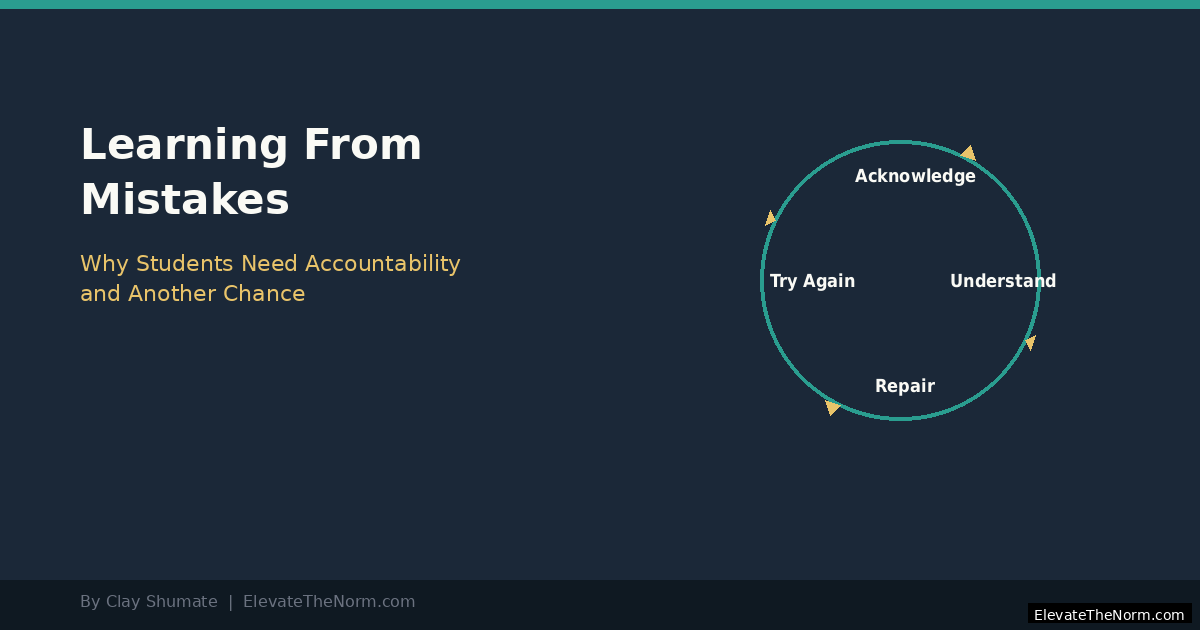
  • Motivating Students: What Works When Rewards and Speeches Stop Working

    Motivating Students: What Works When Rewards and Speeches Stop Working

    Motivating Students: What Works When Rewards and Speeches Stop Working

    By Clay Shumate

    Motivating students does not start with a better reward system or a more inspiring speech. It starts with what research consistently confirms: students engage when they feel competent, connected to the people around them, and in control of something that matters. When the rewards and speeches stop working — and they will — what remains is the environment you built and whether it gives students a genuine reason to invest.

    Key Takeaways

    • Rewards can undermine the motivation they are supposed to build. Research on the overjustification effect has shown this for decades.
    • Autonomy, competence, and belonging are the three drivers that hold up under pressure — not points, prizes, or pep talks.
    • A student who looks unmotivated may be protecting themselves from failure, not choosing laziness.
    • Relevance means connecting work to something real, not performing enthusiasm about a worksheet.
    • The teacher’s job is not to motivate. It is to stop accidentally killing motivation and build a room where it can survive.

    Why Rewards and Motivational Speeches Have an Expiration Date

    Every teacher has tried it. The class Dojo points, the pizza party for the best-behaved table, the impassioned Monday morning speech about potential. These tools feel productive because they produce visible results — for a while. Then they stop.

    Research explains why. Ryan and Deci’s self-determination theory, refined over more than four decades, identifies a consistent pattern: when you offer an external reward for something a person was already willing to do, the reward replaces the internal reason. Psychologists call this the overjustification effect. The student who used to read because the book was interesting now reads because reading earns points — and when the points disappear, so does the reading.

    A 2024 review in Contemporary Educational Psychology reinforced this finding while adding nuance: rewards that provide informational feedback — telling a student something useful about their progress — can support motivation under the right conditions. But rewards that function as control — do this, get that — consistently erode it. The difference is whether the student walks away thinking about their work or thinking about the prize.

    Comparison of extrinsic rewards versus intrinsic motivation showing how control-based rewards undermine student engagement
    Rewards that control behavior erode motivation — rewards that inform progress can support it.

    Motivational speeches have a different shelf life but the same problem. They rely on an emotional spike that cannot sustain daily effort. A teacher who depends on inspiration is performing, not teaching. The kid who felt fired up on Monday has a bad lunch period on Tuesday and the fire is out.

    This does not mean you never celebrate, never recognize effort, and never speak with conviction. It means none of those things are your motivation strategy. They are supplements to something more durable.

    What Research Actually Says About Motivating Students

    The most widely supported framework for understanding student motivation is self-determination theory, developed by Edward Deci and Richard Ryan. The theory identifies three psychological needs that, when met, produce the kind of motivation that survives bad days and boring units:

    1. Autonomy — a sense of ownership over what you are doing and why.
    2. Competence — the belief that effort leads to growth, and that you can actually do the work in front of you.
    3. Relatedness — a genuine connection to other people in the room, especially the adult running it.
    Three drivers of student motivation — autonomy, competence, and relatedness — based on self-determination theory
    Autonomy, competence, and relatedness — the three drivers that hold up when rewards wear off.

    Harvard researcher Rhonda Bondie adds a fourth driver: meaning. Students engage when the work feels important, interesting, or useful — not because someone told them it was, but because they can see it for themselves. She also makes a point that should change how every teacher talks about this topic: “The biggest misconception about motivation is that students aren’t motivated.” Every student is motivated. The question is whether your classroom connects to what motivates them or blocks it.

    A Gallup survey of Gen Z students puts numbers on the problem. Only 18 percent of students strongly agree that teachers make their schoolwork feel important. Only 17 percent report learning something interesting in the past week. Only 11 percent say they get opportunities to do what they do best. These are not students who refuse to care. These are students telling us, clearly, that the work is not giving them a reason to.

    Research on productive failure shows that students who struggle before receiving instruction outperform those who receive direct teaching first — as long as the failure is followed by explicit teaching. A structured approach to learning from mistakes turns errors into one of the most powerful motivators available.

    Autonomy: Real Choices, Not Fake Ones

    Autonomy does not mean letting students do whatever they want. In a grades 6–12 classroom, it means giving students genuine control over some part of their learning — the topic within a standard, the format of a product, the order they tackle a set of tasks, or how they demonstrate what they know.

    The word genuine is doing work there. Asking students to choose between a blue worksheet and a green worksheet is not autonomy. Letting a student pick which historical figure to research within a unit on leadership — and then defend that choice — is. ASCD’s review of the ABC+M framework recommends curated choice: a structured set of meaningful options rather than wide-open freedom that becomes confusion.

    Where autonomy gets tricky is the boundary. Too little choice and students feel controlled. Too much choice without scaffolding and students feel abandoned — especially students who already struggle. The answer is graduated release. You start with structured choices in September and widen them as students demonstrate they can handle the responsibility — the same graduated approach behind teaching responsibility without treating teenagers like children. Some classes earn more latitude faster than others. That is not unfair. It is honest.

    Competence: Students Will Not Try What They Are Sure They Cannot Do

    This one gets misunderstood. Competence does not mean making the work easy. It means making it clear — clear enough that a student can see what good work looks like, understand the distance between where they are and where they need to be, and believe that the distance is crossable.

    Carol Dweck’s work on growth mindset gets cited so often that it has become wallpaper in some schools. The poster goes up. The language shifts. Nothing changes. The reason, according to a 2025 meta-analysis by Dweck and Yeager, is that mindset interventions only work inside classrooms that actually respond to effort with better outcomes. Telling a student “you can grow” while running a grading system that punishes first attempts is not a growth mindset environment. It is a contradiction.

    Practical competence support looks like this: visible criteria posted before students start the work, not revealed after they finish. Short-term goals that students can track themselves. Feedback that says something specific — “your claim is strong but your evidence doesn’t connect to it yet” — instead of “good job” or a letter grade with no explanation. And opportunities to revise, because competence develops through iteration, not through getting it right the first time.

    Belonging: The Motivation Driver Most Teachers Underestimate

    A student who does not feel like they belong in your room will not risk effort in it. This is not a soft claim — it is one of the most consistent findings in motivation research. Kumar and colleagues (2018) found that when students feel a genuine sense of membership in a school, it can counteract the negative effects of prejudice and discrimination on motivation and learning outcomes. Belonging is not a nice-to-have. It is a prerequisite.

    And belonging is built in small moments, not grand gestures. It is built in how you respond when a group laughs at a wrong answer. In whether you learn how to pronounce a student’s name correctly on the first day and never stop trying. In whether you circulate to every table or just the ones that are already performing. This is the daily work of building relationships with students — and it matters more than any opening-week icebreaker.

    In my room, one of my hard stops is mocking someone’s name. You do not get to make fun of how unique another person’s name is. That is not a negotiation and it is not a warning — it is a line, and everyone in the room knows where it is. I hold that line because names are identity — because respect in the classroom is built or broken in moments exactly like that one. When you let a room laugh at a kid’s name, you are telling that kid they do not belong here. And a kid who does not believe they belong will not invest in anything you are teaching.

    The workshop room helps. When students are already sitting in groups, facing each other, working alongside somebody — the default condition, not a special arrangement — belonging has a physical structure to grow in. A student who sits in a row facing the back of someone’s head for fifty minutes does not feel like a member of anything.

    Relevance Without Faking It

    When a student asks “when am I ever going to use this,” they are not being rude. They are telling you something important: they cannot see the connection between the work and anything they care about. The honest answer is sometimes “you might not use this specific skill.” The better answer is to build work where the question does not come up because the connection is visible.

    Relevance does not mean every lesson needs to tie to a career. It means the work should connect to a question worth answering, a problem worth solving, or a skill the student can see themselves using. A history lesson about primary-source analysis becomes relevant when students use those same skills to evaluate a news article that showed up on their feed that morning. A math unit on data becomes relevant when the data is about something in the school or community — not a made-up scenario about a fictional bakery.

    The Gallup data is clear on this. When asked what makes them interested in a class, 60 percent of students say “the teacher made it exciting and interesting” and 60 percent say “the topic aligned with a personal interest.” But 35 percent say “real-world connection explained.” That last number is the most actionable because it requires the least talent and the most planning. You do not have to be naturally charismatic. You have to show why the work matters.

    When Students Look Unmotivated but Are Not

    Some students have given up before your class period starts. Not because they are lazy, defiant, or indifferent — because they have learned that effort does not lead anywhere good for them. Research on learned helplessness in middle school students describes a specific pattern: after repeated experiences where effort did not produce results, students adopt a protective posture. They stop trying — not because they do not care, but because trying and failing again is worse than not trying at all.

    This is the student who puts their head down, gives one-word answers, refuses to start, or turns in blank work. The instinct is to push harder: “I know you can do this if you just try.” But for a student in this pattern, that statement confirms the problem. They have heard it before. They tried. It did not work.

    What works instead is small, private, low-stakes evidence that effort produces a result. Not a public declaration — a quiet conversation at the table. Not a massive assignment — a single manageable step with clear criteria and honest feedback when the step is done. You are not trying to inspire them. You are trying to give them one piece of evidence that their effort connects to an outcome.

    A 2026 longitudinal study in the Journal of Research on Adolescence found that parental autonomy support — not control — reduced learned helplessness trajectories in adolescents over time. The classroom parallel is that pushing harder on a helpless student makes the helplessness worse. Supporting their autonomy — giving them a small, real choice and then honoring it — begins to reverse it.

    Environmental Barriers You Cannot Speech Your Way Past

    A student who did not eat breakfast is not unmotivated. A student who slept three hours because they share a room with a crying infant is not disengaged. A student carrying stress from an unstable home is not choosing not to care.

    Some barriers to motivation are outside your classroom. You cannot fix food insecurity with a growth mindset poster. Attendance works the same way — the reasons students give for missing school are led by illness and lost sleep, not boredom, which is why chronic absenteeism responds so poorly to engagement-only strategies. But you can acknowledge what is real, adjust your expectations for a given day without abandoning your standards permanently, and make sure the room itself is not adding to the burden. The lamps instead of overhead fluorescents. The warm light and the rug. A room that does not assault a student’s senses the moment they walk in is not a luxury — it is a basic condition for any of the motivation strategies above to work.

    What you do control: the pacing of the period, the volume of your voice, whether a student who is struggling gets a quiet check-in or a public callout, whether your consequences teach or just punish, whether the room feels safe enough to take a risk. The OECD’s 2025 data found a 40 percent student engagement strategies drop in peer environments that do not prioritize learning. You build the peer environment. That is a motivation lever you hold every day.

    What to Do Tomorrow Morning

    If you walked into your room tomorrow with nothing new except a different approach, here is what the research says will move the needle:

    Stop doing these things:

    • Publicly calling out a student who is not working. Walk over. Sit down. Ask what they need — at conversation volume, not announcement volume.
    • Rewarding compliance and calling it motivation. A quiet class is not a motivated class.
    • Assigning work without explaining why it matters, then blaming students for not caring.
    • Lecturing for thirty minutes and expecting teenagers to sit still for it.

    Start doing these things:

    • Post the criteria for quality work before students begin, not after they finish. Make the target visible.
    • Build in one meaningful choice per week — topic, format, sequence, or method. Real choice, not cosmetic choice.
    • Check in with every student, not just the struggling ones and not just the stars. Circulate to every table. Sit down. Ask what they are working on.
    • Respond to disengagement with curiosity before correction — the calm-over-control approach that actually works. “What’s going on today?” lands differently than “Why aren’t you working?”
    • Use progress tracking students can see — a simple checklist, a visible timeline, a self-assessment. Let them see they are moving.
    Five practical moves for motivating students tomorrow morning including visible criteria, meaningful choice, and curiosity before correction
    Five concrete shifts you can make tomorrow morning to support student motivation.

    The Room Matters More Than the Speech

    Motivating students is not a talent you either have or do not. It is not about being the inspiring teacher from a movie. It is about building a room where students feel competent enough to try, connected enough to care, and autonomous enough to own something real. When those three conditions exist, motivation does not have to be manufactured. It shows up because the room gives it a reason to.

    The rewards and speeches will always stop working. The environment never does.

    For the students who look like they have given up entirely rather than just coasting, see motivating students who don’t care, which works through what changes when disengagement looks total.

    Frequently Asked Questions

    How do I motivate students who have completely shut down?

    Start small, start private, and start with something they can actually do. A student who has shut down is usually protecting themselves from failure, not refusing to work. Give them one manageable task with clear criteria, check in quietly at their table, and respond honestly when they complete it. You are not trying to fix everything in one period. You are trying to give them a single piece of evidence that their effort connects to a result. Over time, those small pieces rebuild what learned helplessness took apart.

    Are rewards always bad for student motivation?

    No — but the type of reward matters. Rewards that provide informational feedback about a student’s progress can support motivation. Rewards that function as control — do this specific thing, receive this specific prize — tend to undermine intrinsic motivation over time. The research question is not whether you ever celebrate or recognize effort. It is whether the reward system replaces the student’s internal reasons for engaging or reinforces them.

    What is the difference between engagement and motivation?

    Motivation is internal — the drive, interest, or purpose behind effort. Engagement is what it looks like from the outside — participation, focus, persistence. A student can be behaviorally engaged (sitting quietly, completing work) without being motivated. And a motivated student who lacks the right conditions can look disengaged. Effective teaching targets the motivation because the engagement follows naturally when the conditions are right.

    Does giving students choices really improve motivation?

    Yes, when the choices are meaningful and structured. Self-determination theory identifies autonomy as one of three core drivers of intrinsic motivation. But choice only works when students have enough information to choose well, when the options are genuinely different, and when the teacher provides scaffolding. Asking a student to pick between identical worksheets in different colors is not autonomy. Letting them choose which historical figure to research within a unit — and defend that choice — is.

    How do I motivate students when the content is genuinely boring?

    Not every lesson will feel exciting, and pretending otherwise insults teenagers. When the content itself is dry, connect it to a question or product that is not. A grammar unit becomes tolerable when students are editing a real piece of writing they care about. A data unit becomes relevant when the data is about something in their school. You are not making the content entertaining — you are giving it a purpose the student can see.

    What role do relationships play in student motivation?

    Relationships are the single most consistent factor in motivation research. A Gallup study found that students with access to at least one teacher who makes them excited about the future are 30 times more likely to report high engagement. But the relationship that matters is not performative warmth — it is the kind built by knowing a student’s work, checking in consistently, and responding to struggle with support instead of judgment.

    Can a teacher really control student motivation?

    No — and you should not try to. Motivation belongs to the student. What you control is the environment: the clarity of the work, the quality of the feedback, the safety of the room, whether students have meaningful choices, and whether effort leads to visible progress. Build those conditions and motivation has room to exist. Remove them and no amount of enthusiasm from the front of the room will compensate.

    Sources


    About Clay Shumate
    Clay Shumate is a certified secondary Social Studies teacher in the public schools of West Alabama, with seven years of classroom experience, a B.A. in History, and an M.Ed. in Secondary Education. He writes about project-based learning, student responsibility, respect, and practical ways to hold young people to a higher standard while giving them room to learn from mistakes. He is a member of the Society of Professional Journalists and writes to its Code of Ethics; this site’s editorial standards and corrections policy are published in full. More about Clay.
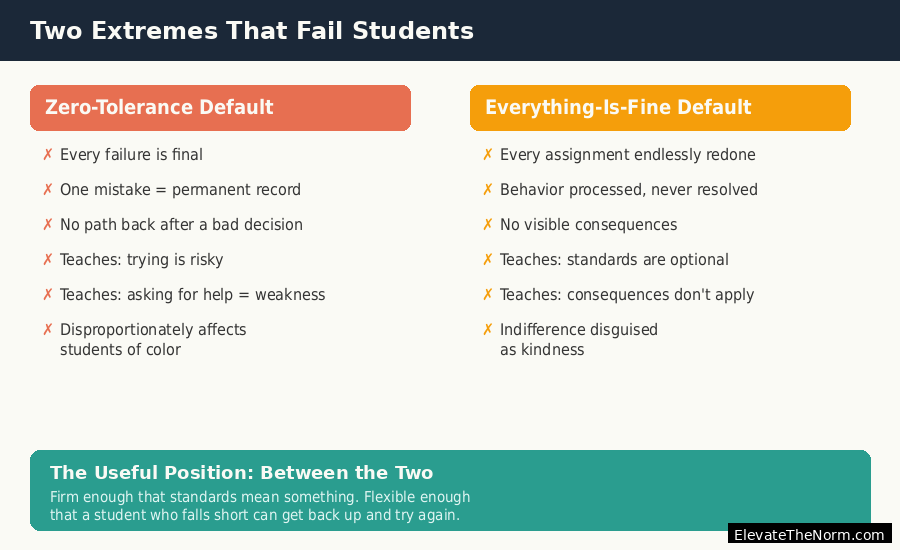
Teacher Emergency Toolkit — practical resources, real classroom support. Shop on TPT.Teacher Emergency Toolkit — practical resources, real classroom support. Shop on TPT.