The Elevate Blog banner: Real Classrooms. Practical Ideas. Higher Expectations. Three students climb a rocky ridge at sunrise, each pulling the next one up, toward a teacher reaching down to help.

Tag: teaching strategies

  • Bell Ringer Ideas That Earn the First Five Minutes: 20 Do-Now Activities for Grades 6–12

    Bell Ringer Ideas That Earn the First Five Minutes: 20 Do-Now Activities for Grades 6–12

    By Clay Shumate

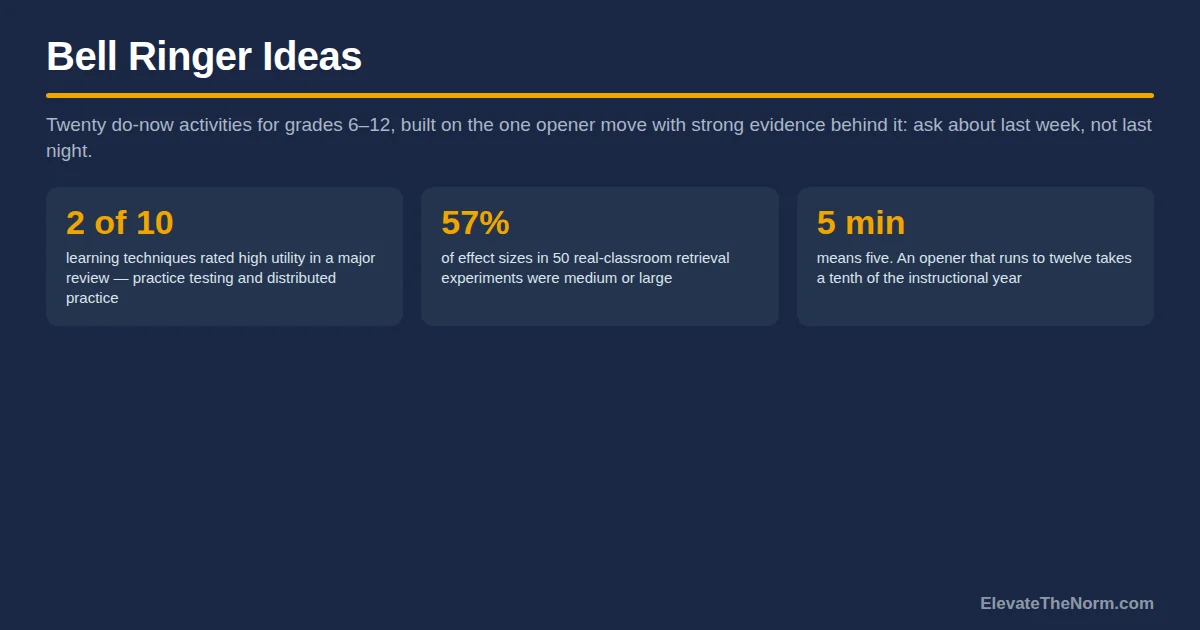
    The best bell ringer ideas ask students to retrieve something they already learned, from memory, without notes. Not today’s content, not a puzzle, not a quote of the day. Retrieval is the one opener move with strong evidence behind it, and it takes the same five minutes as the worksheet you were going to hand out.

    Below are twenty do-now activities that meet that bar, the evidence for why retrieval beats the alternatives, and the rule that keeps an opener from eating fifteen minutes.

    Key Takeaways

    • Two study techniques were rated high utility out of ten reviewed: practice testing and distributed practice. Rereading, highlighting and summarizing all came out low.
    • A bell ringer is the cheapest slot in the day for both of them. Ask about last week, not last night, and you have run distributed retrieval practice without calling it anything.
    • Do not make the do-now about today’s lesson. If students cannot answer it from memory, it is not retrieval — it is a cold open with a worksheet.
    • Five minutes means five minutes. An opener that runs to twelve has taken a tenth of the year from the rest of the lesson.
    • Most bell ringer advice optimizes for compliance — getting bodies seated and quiet. That is a real problem, but it is a smaller one than what you do with the time.

    Free Download · PDF

    20 Bell Ringer Ideas and the Five-Minute Planner

    All twenty prompts grouped by retrieval, spaced practice and openers, the four rules of the five-minute routine, a three-day rotation, and a planner for next week.

    Download the free PDF

    Free. No email address required. Designed for grades 6–12. Browse every printable in Your Free Library.

    What Is a Bell Ringer?

    A bell ringer — also called a do-now, warm-up, entry task or starter — is a short independent task students begin the moment they sit down, before the lesson formally starts. The names are interchangeable. What varies is whether the task does anything. If you want prompts ready for every day, my Daily Bell Ringers on TPT cover a full year of entry questions.

    Two jobs get bundled into that five minutes and they pull against each other. The first is management: get twenty-eight teenagers from the hallway into a working posture without a speech. The second is learning: use the time on something that improves retention. Most bell-ringer advice solves the first and quietly abandons the second, which is how you end up with a semester of word searches that produced a calm room and nothing else.

    You can have both, but only if you pick the task for the second job. A retrieval question settles a room just as well as a word search does, because the settling comes from the routine being predictable, not from the task being easy.

    What Should a Bell Ringer Actually Do?

    Make students pull something out of memory that they learned days or weeks ago. That single design rule is what separates an opener with evidence behind it from a stalling tactic.
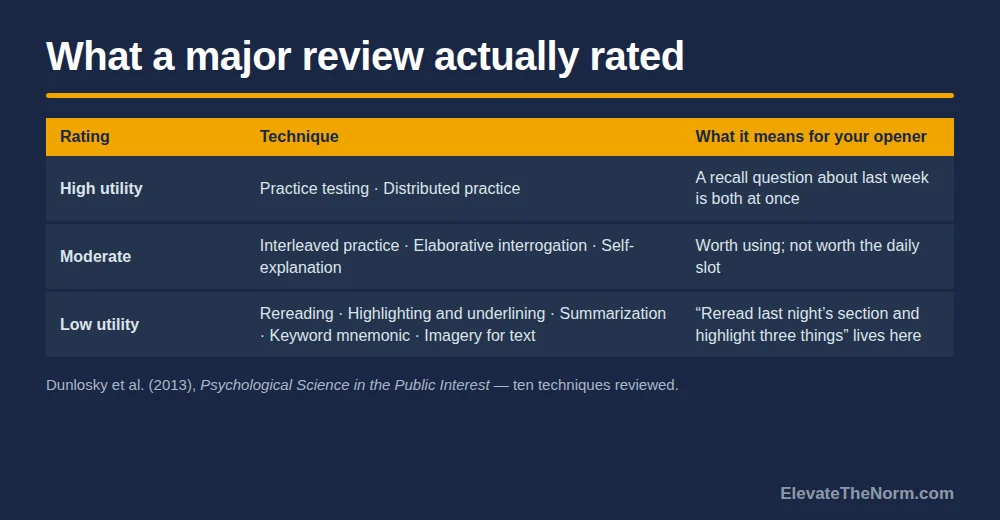
    Table of learning techniques by rating: practice testing and distributed practice rated high utility, interleaved practice elaborative interrogation and self-explanation moderate, and rereading highlighting summarization keyword mnemonic and imagery for text low
    Ten techniques reviewed. Two came out high, and highlighting was not one of them.

    Dunlosky and colleagues reviewed ten common learning techniques for Psychological Science in the Public Interest and rated exactly two as high utility: practice testing and distributed practice. Their reason is worth quoting because it is unusually plain: those two “can help students regardless of age, they can enhance learning and comprehension of a large range of materials, and, most important, they can boost student achievement.”

    What came out low utility is the part that should change what you assign: rereading, highlighting and underlining, summarization, the keyword mnemonic, and imagery for text. Highlighting in particular “has been shown to have failed to help students of all sorts.” If your bell ringer is “reread last night’s section and highlight three things,” you have spent five minutes a day, every day, on a technique that review rated at the bottom. If you want activities that work with any article, my Current Events and Media Literacy Bundle on TPT has 21 of them for grades 6–12.

    One objection worth answering before it is raised, because families will raise it: does asking students to recall something cold, every day, make school more stressful? The best evidence says the opposite, mildly. A meta-analytic review of 24 studies and 3,374 participants found practice tests reduced test anxiety, with a stronger effect in real classrooms than in labs. The authors are careful, and so should we be: 28 percent of students reported no benefit, and they note that quizzes can themselves be more stressful than other activities. The design implications are straightforward. Keep it ungraded, keep the answers private, and never read a wrong answer aloud with a name attached to it.

    The classroom evidence for the good half is solid too. Agarwal, Nunes and Blunt reviewed 50 experiments with 5,374 participants conducted in real schools and classrooms rather than labs, and found that 57 percent of effect sizes showed medium or large benefits from retrieval practice, across education levels, subjects, test formats and delays. One limitation they state and I will repeat: only 6 percent of those experiments were run outside Western, educated, industrialised, rich, democratic countries.

    Worth saying for anyone above the classroom: none of this requires a purchase. The bell-ringer market is full of subscription question banks, and what the evidence supports is a question about last week written on a whiteboard. The cost of doing this well is the ninety seconds afterward, not a licence.

    A bell ringer is the easiest place in the school day to run both high-utility techniques at once. Ask a question about last week and you have practice testing. Ask about last week rather than yesterday and you have added distributed practice for free. The same mechanism is what makes a review game actually review something rather than just raise the noise level.

    Does the Routine Itself Matter?

    Yes, and the evidence for it is older and narrower than people assume. It is worth knowing both halves of that.

    Simonsen and colleagues reviewed the classroom management literature and identified twenty evidence-based practices grouped under five features, three of which describe a bell ringer almost exactly: maximize structure and predictability; post, teach, review, monitor and reinforce expectations; and actively engage students in observable ways. Their line on the last one is the whole argument for a do-now in one sentence: “If students are actively engaged in instruction, then it is difficult to engage in incompatible behaviors.” They also report that increasing students’ rate of opportunities to respond has a positive effect on both achievement and behavior.

    The honest caveat, from the same review: roughly 48 percent of the studies in their main table were published before 1987. This is a well-established literature, not a fresh one, and it is drawn from K–12 broadly rather than from secondary specifically. The practices are not in doubt. The precision of the numbers behind them is older than most of the teachers using them.

    The practical version is a routine so predictable that it does not need announcing. The question is posted before the bell. Students start without being told. You are at the door, not at the board. That predictability is the thing doing the work, which is why changing the format every week undoes it. The same logic sits under the site’s wider argument about routines that run without you narrating them.

    20 Bell Ringer Ideas for Grades 6–12

    Grouped by what they are for, and all of them work in any subject. The first two groups are the ones with evidence behind them. The third is for days when you need something else, and it is labelled honestly as such.

    Retrieval: ask about last week, not last night

    1. Three things you remember from Monday. No notes, no neighbor.
    2. Brain dump: two minutes, everything you can recall about the unit so far.
    3. One question from last week’s material that you could not answer today.
    4. What did we conclude about ___? State it in one sentence, from memory.
    5. Two vocabulary terms from two weeks ago, defined in your own words.
    6. Draw the process we studied Tuesday. Labels only, no sentences.
    7. What is the single most important thing from last unit, and why that one?
    8. Yesterday, last week, last month: one fact from each.

    Spaced practice and connection

    1. Here is a term from September. Where does it connect to what we are doing now?
    2. Two ideas from different units. What do they have in common?
    3. Correct this: a wrong statement about older material, fixed and explained.
    4. Predict: based on what we already know, what happens next?
    5. Which of these three problems is from last unit? Solve that one.
    6. Explain last week’s idea to someone who missed class. Four sentences.

    Openers that set up thinking (use sparingly — weaker evidence)

    1. One-sentence response to a short quotation connected to today’s work.
    2. Two questions you want answered before this unit ends.
    3. What would change if the opposite were true?
    4. Rank these three things by importance. Be ready to defend the order.
    5. A number on the board. What could it be measuring?
    6. One thing from this class you have used or noticed outside of school.

    The Five-Minute Rule

    Post it, start it without a word, stop it on time, and use the answers. Four moves, and the last two are where most openers fail.
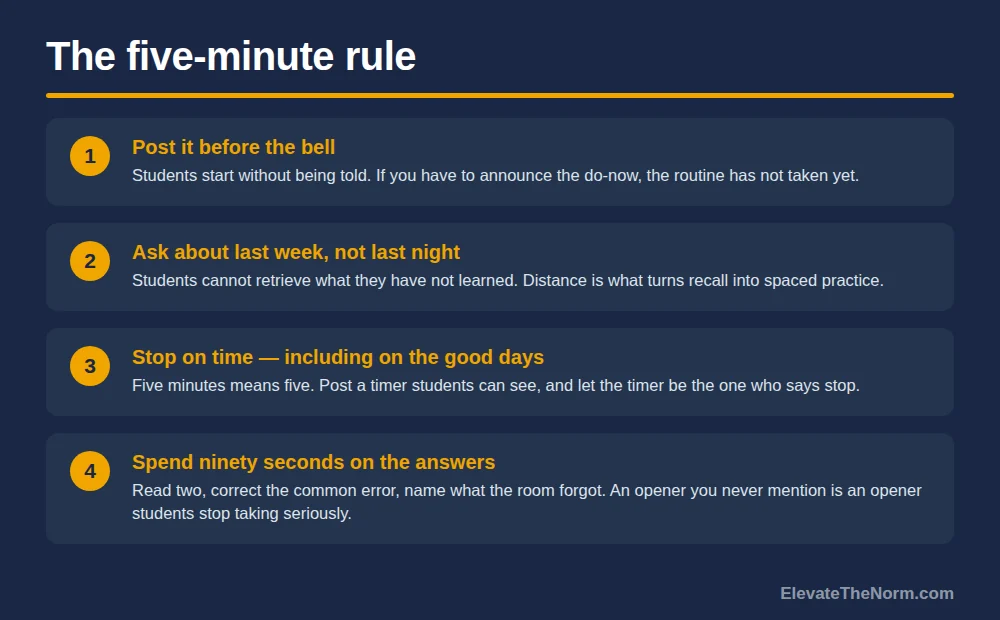
    Numbered list of four rules for a bell ringer: post it before the bell, ask about last week rather than last night, stop on time including on good days, and spend ninety seconds on the answers
    Four moves. The last two are where most openers fail.

    Stopping on time is a discipline problem for the adult, not the students. An opener that regularly runs to twelve minutes is taking about a tenth of the instructional year from everything downstream of it. Clay’s own method for the front of a lesson is organization to the minute and then a pause — you post the plan, you stop talking, and you let the silence do the work rather than filling it. The pause is what makes the clock credible. If you announce five minutes and take twelve, the announcement stops meaning anything by October.

    Using the answers is the other half. A retrieval question you collect and never mention has taught students that the first five minutes are a formality. Spend ninety seconds on it: read two answers aloud, correct the common error, name the thing most people forgot. That is also a real formative check — the data arrived, and what you do next is the whole point of having collected it.

    One note about the room itself, because it belongs to the first five minutes. I do not turn the overhead fluorescents on; the room runs on floor lamps and a few desk lamps, warm and low. Walking out of a bright hallway into a room that is not shouting at you does more for the first two minutes than any task on the board. It is also one of the few accommodations that helps far more students than the ones who would ever have asked for it.

    How Should You Grade a Bell Ringer?

    Mostly you should not, and the reason is mechanical rather than philosophical. Retrieval practice works partly because students are willing to be wrong in it. Attach points and they will check their notes, and a retrieval question answered from notes is not retrieval.

    What to do instead: collect them, or do not, depending on whether you will look. Give credit for completion if your school requires something in the gradebook, and weight it low enough to be honest about what it is. Tell students out loud that the answers are not scored for correctness and then behave that way for two weeks, because they will not believe you on the first day and they should not.

    If you want a number from the routine, take it from a periodic ungraded check on the same material rather than from the daily opener. That gives you the signal without spending the thing that makes the signal worth having.

    Bell Ringer Mistakes That Waste the Five Minutes

    Five, and four of them are about design rather than discipline.

    1. It is about today’s lesson. Students cannot retrieve what they have not learned, so the task becomes guessing or waiting. Ask about last week.
    2. It requires materials not already on the table. Anything needing a device login, a handout at the front, or a textbook from the shelf costs more minutes than the task is worth.
    3. It changes format every day. Novelty is not the goal; predictability is. Rotate among three or four shapes so students know what a do-now is without being told.
    4. It is never referenced again. If the answers do not affect the next ninety seconds of class, students correctly conclude the routine is about keeping them busy.
    5. It punishes lateness. A do-now that a student walking in at the four-minute mark cannot join teaches them not to bother coming in. Let them start where the room is.

    A related line worth holding: a do-now is not a tardy-enforcement mechanism. Some schools use the opener as the thing a late student loses, which converts an instructional routine into a discipline consequence and guarantees that the students who most need the retrieval practice get the least of it. If lateness is a problem, handle it as a lateness problem, through whatever system your school actually uses for that.

    The fifth one matters more than it looks. The students most likely to arrive late are frequently the ones for whom the opener would do the most, and a routine designed so they always begin behind is a routine designed to lose them. The same is true of any transition built so that the slowest student is always wrong.

    Does the Subject Change the Bell Ringer?

    Less than you would think. The format transfers; the content is the only thing that changes.
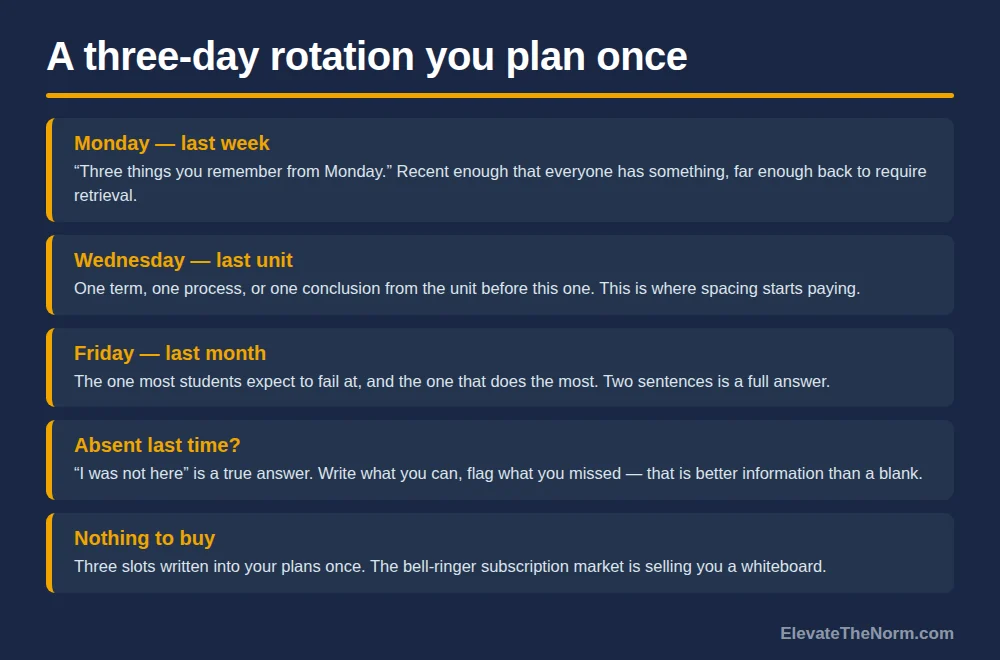
    Five rows describing a three-day bell ringer rotation: Monday asks about last week, Wednesday about the last unit, Friday about the previous month, plus how to handle an absent student and a note that nothing needs to be purchased
    Write the three slots into your plans once and you never invent a do-now again.

    “Three things you remember from Monday” works identically in algebra, biology, English and social studies, because the cognitive move — pull it from memory without notes — is the same regardless of what is being pulled. The subject-specific bell ringer lists you find online are mostly the same six formats with different nouns. If you teach history and want the nouns rather than the format, these 55 source-checked history facts, grouped by era with a question attached to each one, will fill the slot for weeks.

    The question most teachers get stuck on is not the format but the content: what do I ask about today? A three-day rotation solves it and takes no planning. Monday, something from last week. Wednesday, something from the previous unit. Friday, something from the month before. Write the three slots into your plans once and you never have to invent a do-now again.

    And decide in advance what a student who was absent does. “I was not here” is a true answer to a retrieval question and it should not be a problem — let them write what they can and flag what they missed, which is more useful information for you than a blank. Attendance is usually being taken during these five minutes anyway; you will know.

    Two real differences worth naming. In a math or science class, a retrieval opener can be a single problem from an older unit, which doubles as spaced practice on a procedure. In English and social studies, retrieval is usually verbal or written recall, and the trap is that a question about an interpretation is not retrieval — it is discussion, which is a good thing that takes longer than five minutes. If you want the discussion, schedule it as one.

    What to Do Next

    Pick three formats from the first group above and rotate them. Write Monday’s on the board before you leave on Friday, so the routine does not depend on you remembering in the morning. Set a timer where students can see it. Spend ninety seconds afterward on what the answers showed you, out loud.

    Then check one thing after two weeks: are students starting without being told? That is the only measure of whether the routine has taken. If they are still waiting for you to say go, the problem is predictability, not motivation — and the fix is to change the format less often, not more.

    Before you go: grab the free 20 Bell Ringer Ideas and the Five-Minute Planner (PDF) — ElevateTheNorm.com branded, printable, no email required.

    Need a no-prep opener? Our 105 would you rather questions for students come with a five-minute write, move, defend routine and free printable cards. If your openers are doing retrieval work, it is worth teaching students where to retrieve from: the note taking strategies that hold up in grades 6–12.

    Frequently Asked Questions

    What is a bell ringer in a classroom?

    A short independent task students begin the moment they sit down, before the lesson formally starts. Do-now, warm-up, entry task and starter all mean the same thing. The name does not matter; what matters is whether the task asks students to retrieve something from memory or just keeps them occupied while you take attendance.

    How long should a bell ringer take?

    Five minutes, and it should actually be five. An opener that habitually runs to twelve is taking roughly a tenth of your instructional year from everything downstream. Post a visible timer, and stop the task when the timer does — including on the days when the answers are interesting.

    What makes a good do-now activity?

    It asks students to pull something from memory that they learned days or weeks ago, without notes. That one design rule gets you practice testing and distributed practice at the same time, the two techniques a major review rated as high utility out of ten. It should also need nothing that is not already on the table.

    Should bell ringers be about today’s lesson?

    No, and this is the most common mistake. Students cannot retrieve material they have not learned yet, so a do-now about today’s content becomes guessing, copying or waiting. Ask about last week, last unit or last month. The distance is the point — spacing is what makes the retrieval stick.

    Should you grade bell ringers?

    Not for correctness. Retrieval practice works partly because students are willing to be wrong in it, and attaching points is how you get twenty-eight students checking their notes instead of retrieving. If something has to go in the gradebook, give completion credit, weight it low, and say out loud that the answers are not scored for accuracy.

    Are bell ringers actually backed by research?

    The retrieval half is, strongly. A review of 50 classroom experiments with 5,374 participants found 57 percent of effect sizes showed medium or large benefits. The routine half rests on classroom-management research that identifies structure, predictability and opportunities to respond as evidence-based — though about half of the studies in that review predate 1987, which is worth knowing before quoting it as new.

    What are good bell ringer ideas for high school versus middle school?

    Largely the same ones. The cognitive move — recall it without notes — does not change between seventh and twelfth grade; the content and the expected length of the answer do. A seventh grader might list three things from Monday in phrases; a senior should be writing a defensible sentence. Do not change the format by grade, change the standard you hold the answer to.

    Does a daily recall task stress students out?

    A meta-analytic review of 24 studies and 3,374 participants found that practice tests reduced test anxiety rather than increasing it, with a stronger effect in real classrooms than in laboratories. The authors are careful about it, and so should you be: 28 percent of students reported no benefit, and quizzes can be more stressful than other activities. The design that keeps it safe is the same one that makes it work — ungraded, answers private, and no wrong answer read aloud with a name on it.

    Sources

    1. Dunlosky, John, Katherine A. Rawson, Elizabeth J. Marsh, Mitchell J. Nathan, and Daniel T. Willingham. “Improving Students’ Learning With Effective Learning Techniques: Promising Directions From Cognitive and Educational Psychology.” Psychological Science in the Public Interest, vol. 14, no. 1, 2013, pp. 4–58. Ten techniques reviewed; practice testing and distributed practice rated high utility; interleaved practice, elaborative interrogation and self-explanation moderate; rereading, highlighting/underlining, summarization, keyword mnemonic and imagery for text low. https://www.aft.org/ae/fall2013/dunlosky
    2. Agarwal, Pooja K., Ludmila D. Nunes, and Janell R. Blunt. “Retrieval Practice Consistently Benefits Student Learning: A Systematic Review of Applied Research in Schools and Classrooms.” Educational Psychology Review, vol. 33, no. 4, Dec. 2021. 50 experiments, 5,374 participants, 49 effect sizes, 57 percent showing medium or large benefits. Limitation stated by the authors: only 6 percent of experiments were conducted outside WEIRD countries. https://eric.ed.gov/?id=EJ1319572
    3. Simonsen, Brandi, Sarah Fairbanks, Amy Briesch, Diane Myers, and George Sugai. “Evidence-Based Practices in Classroom Management: Considerations for Research to Practice.” Education and Treatment of Children, vol. 31, no. 3, 2008, pp. 351–380. Twenty evidence-based practices across five features; increasing opportunities to respond improves both achievement and behavior. Roughly 48 percent of the studies tabulated predate 1987, and the review covers K–12 broadly rather than secondary specifically. https://dropoutprevention.org/wp-content/uploads/2015/05/Simonsen_Fairbanks_Briesch_Myers_Sugai_2008.pdf
    4. Yang, Chunliang, et al. “Do Practice Tests Reduce or Provoke Test Anxiety? A Meta-Analytic Review.” Accepted manuscript, UCL Discovery repository, 2023. 24 studies, 25 effects, 3,374 participants; practice tests reduced test anxiety, Hedges’ g = −0.52 (95% CI [−0.69, −0.36]), and g = −0.55 in classroom settings specifically. The authors note 28 percent of students reported no benefit, and that quizzes themselves may be more stressful than other learning activities. https://discovery.ucl.ac.uk/id/eprint/10177686/
    About Clay Shumate

    Clay Shumate is a certified secondary Social Studies teacher in the public schools of West Alabama, with seven years of classroom experience, a B.A. in History, and an M.Ed. in Secondary Education. He writes about project-based learning, student responsibility, respect, and practical ways to hold young people to a higher standard while giving them room to learn from mistakes. He is a member of the Society of Professional Journalists and writes to its Code of Ethics; this site’s editorial standards and corrections policy are published in full. More about Clay.

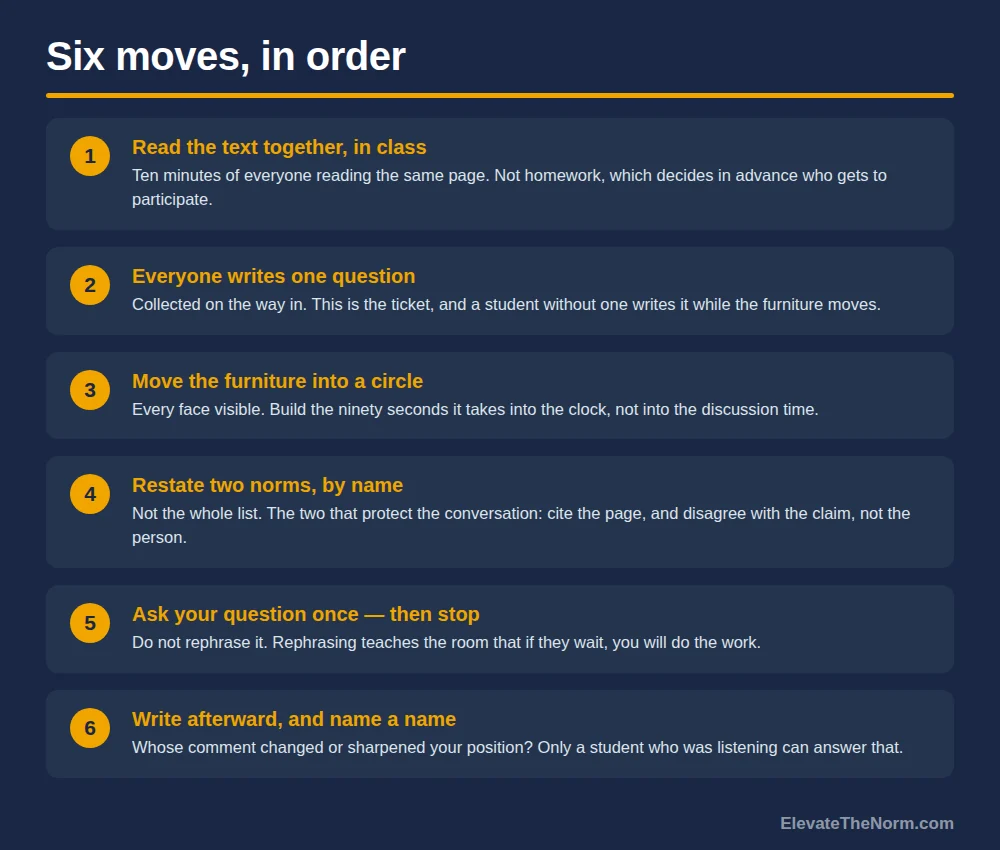
  • Socratic Seminar Rubric: A Four-Criterion Version for Grades 6–12

    Socratic Seminar Rubric: A Four-Criterion Version for Grades 6–12

    By Clay Shumate

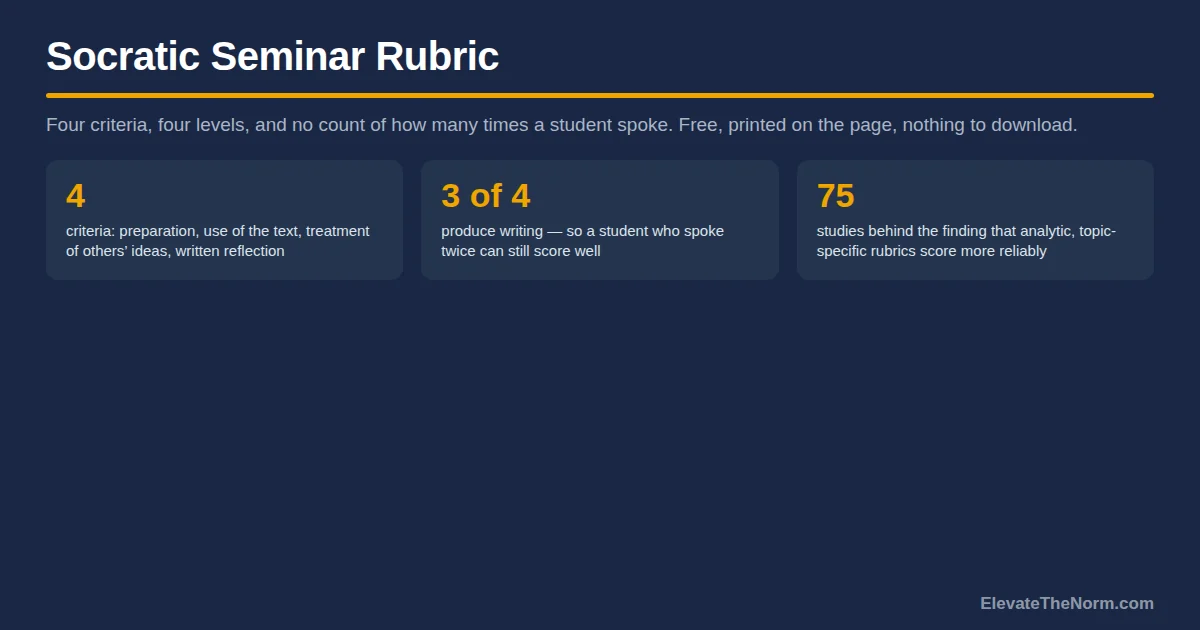
    A Socratic seminar rubric should score four things: preparation, use of the text, how a student treats other people’s ideas, and what they wrote afterward. It should not score how many times somebody spoke. The full rubric is below, free, on this page, with no email to give — and a printable version at the bottom if you want one.

    It comes with an argument, because a rubric that counts talking turns is worse than no rubric at all — and because the research on rubrics is more qualified than the phrase “research-based rubric” suggests.

    Key Takeaways

    • Four criteria, four levels, and none of them is participation frequency. Counting comments rewards volume and punishes the students who most need the practice.
    • Most of the score comes from writing, not talking. Preparation before and reflection after are visible, gradeable, and fair to a student who spoke twice.
    • Analytic beats holistic on reliability. A review of 75 studies found scoring agreement improves with analytic, topic-specific rubrics plus exemplars or rater training.
    • Rubrics are not automatically valid. The same review is explicit that a rubric improves agreement between scorers without guaranteeing you are measuring the right thing.
    • You cannot facilitate and score thirty students at once. Anyone who says otherwise is describing a checklist, not an assessment.

    Free Download · PDF

    Socratic Seminar Rubric (Four Criteria)

    The same four-criterion rubric printed above, laid out to print and cut, plus the scoring rotation for thirty students and a student self-score half-sheet.

    Download the free PDF

    Free. No email address required. Designed for grades 6–12. Browse every printable in Your Free Library.

    What Should a Socratic Seminar Rubric Measure?

    The things a student controls, that leave evidence, and that you would still care about if the student were quiet. That test eliminates most of what standard seminar rubrics score.

    Four criteria survive it.

    1. Preparation. Did they read it, mark it, and bring a written question? This is visible before anyone speaks and it is the single best predictor of whether the seminar works.
    2. Use of the text. When they did speak or write, did they point at a specific place in the text, or at a general impression?
    3. Treatment of other people’s ideas. Did they build on, question, or directly respond to a classmate — or deliver a prepared statement into the middle of the circle and stop?
    4. Reflection afterward. Can they name what changed in their thinking and whose comment did it? This one is only answerable by a student who was listening, which is why it is the hardest to fake.

    If your gradebook is standards-based, those four map cleanly onto speaking-and-listening standards without inventing a category: preparation and use of the text are evidence standards, treatment of others’ ideas is a collaborative-discussion standard, and the reflection is usually assessable under both. You do not need a “participation” line item, and if the gradebook has one, these are what should feed it.

    One caution on the third criterion, and it is the one I would want a department to talk through before adopting any seminar rubric. Norms about interrupting, turn length, directness and how openly you disagree are not universal — they vary by family, by community, and by what a student has been taught is respectful. A rubric that scores “treatment of others’ ideas” can quietly encode one conversational style as the correct one. Keep the descriptors pointed at what the student did with the idea — responded to it, questioned it, built on it — and away from manner, volume and poise. If a descriptor could be satisfied by a confident student who said nothing of substance, it is scoring style.

    Three of those four produce writing. That is deliberate. A rubric whose evidence is mostly written is a rubric you can actually apply after the period ends, and it is a rubric a student who said very little can still score well on.

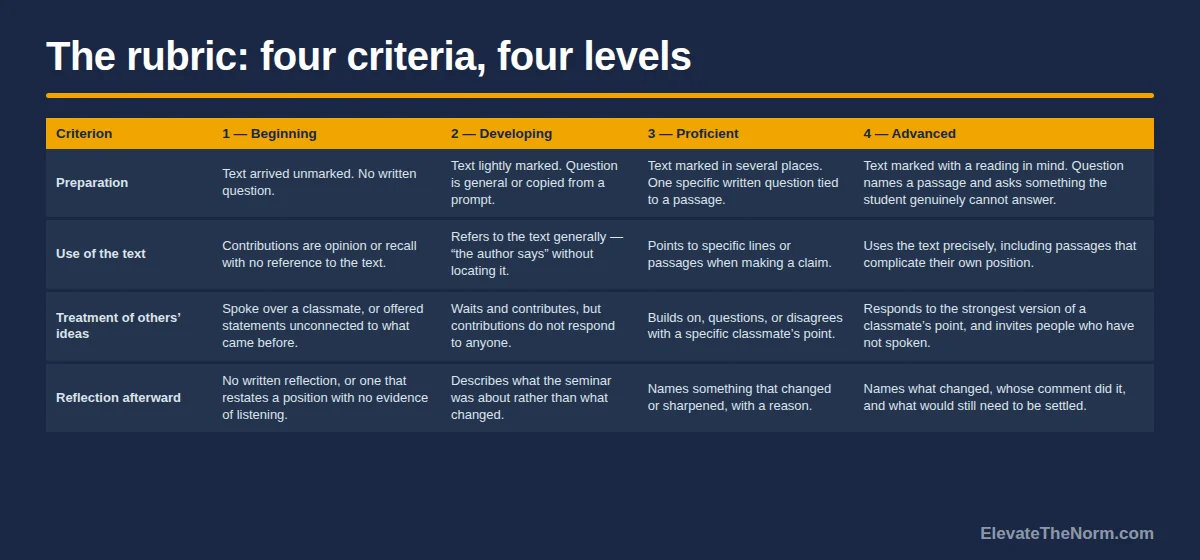
    The Socratic Seminar Rubric

    Four criteria, four levels, no participation count. Copy it, cut it, change the language to match your school’s scale. It is free, it is printed in full right here, and there is a printable version at the bottom of this page.

    One framing worth saying to students before you hand it over: the level-one column describes something that happened on one day, not a kind of person. A student who arrived without the text marked is a student who arrived without the text marked. If a descriptor reads to a fourteen-year-old like a verdict on their character, rewrite it — that costs nothing and it changes whether they look at the rubric again.

    Four by four Socratic seminar rubric table with criteria for preparation, use of the text, treatment of others' ideas and reflection afterward, each described at beginning, developing, proficient and advanced levels
    The full rubric. The same table is written out below so you can copy it.
    Criterion1 — Beginning2 — Developing3 — Proficient4 — Advanced
    PreparationText arrived unmarked. No written question.Text lightly marked. Question is general or copied from a prompt.Text marked in several places. One specific written question tied to a passage.Text marked with a reading in mind. Question names a passage and asks something the student genuinely cannot answer.
    Use of the textContributions are opinion or recall with no reference to the text.Refers to the text generally — “the author says” without locating it.Points to specific lines or passages when making a claim.Uses the text precisely, including passages that complicate their own position.
    Treatment of others’ ideasSpoke over a classmate, or offered statements unconnected to what came before.Waits and contributes, but contributions do not respond to anyone.Builds on, questions, or disagrees with a specific classmate’s point.Responds to the strongest version of a classmate’s point, and invites people who have not spoken.
    Reflection afterwardNo written reflection, or one that restates a position with no evidence of listening.Describes what the seminar was about rather than what changed.Names something that changed or sharpened, with a reason.Names what changed, whose comment did it, and what would still need to be settled.
    Free to copy, cut and rewrite. No email address. A printable version is linked below.

    Why This Rubric Does Not Count How Often You Spoke

    Because a participation count measures confidence and rewards it, and confidence is not the skill you are teaching. The moment students know comments are scored, you get performances of the right length at the right frequency, and the conversation stops being about the text.

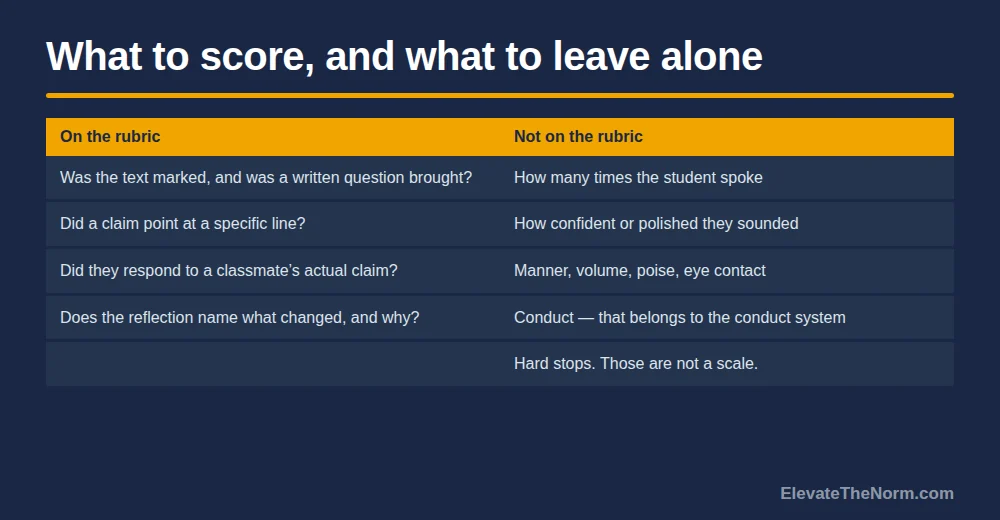
    Two column table contrasting what belongs on a Socratic seminar rubric with what does not, including how many times a student spoke, manner and poise, and conduct
    If a descriptor could be met by a confident student who said nothing of substance, it is scoring style.

    There is a second reason, and it is about who pays. A qualitative study of quiet students — ten undergraduates, so treat it as a description rather than a finding about your seventh period — found that nine of the ten struggled with instructor expectations for verbal participation, and six reported physical reactions when speaking aloud: trembling, blushing, stuttering. One described planning out what they wanted to say before speaking. A frequency count charges those students a fee the loud ones never pay, for a behavior that is not the learning objective.

    Related, and worth checking against your district’s grading policy: criterion three has to stay academic. “Responded to a classmate’s specific claim” is an academic behavior. “Was respectful” is conduct, and in a lot of districts conduct is not permitted inside an academic grade — for good reason. If a student’s behavior in a seminar is a problem, that is the conduct system’s job, handled the way you would handle it on any other day, and not something you fold into a score for a speaking standard.

    This also gives you a clean answer when a parent asks. A quiet student can earn full marks here, because three of the four criteria are about preparation, precision and listening, and none of them requires their child to perform in front of the class. Say that in the same sentence you send the rubric home, before anyone has to ask.

    If your school requires a participation grade, pull it from criteria one and four — both of which are written, both of which are about preparation and listening, and neither of which requires a student to perform. Then say out loud to the class that talking is not scored. The first seminar after they believe you is a different conversation.

    One thing that belongs nowhere on a rubric: the behaviors that are not a continuum. In my room, making fun of how unusual somebody’s name is is a hard stop — not a criterion where a student can earn a 2. A rubric is for things that improve by degrees. Hard stops are a different category, and putting them on a scoring scale quietly suggests there is an acceptable amount.

    Do Rubrics Actually Help?

    They reliably help scoring agreement. Their effect on learning is real, mixed, and badly confounded — and the honest version is more useful than the sales version.

    Jonsson and Svingby reviewed 75 empirical studies on rubrics. Their finding on reliability is clear: scoring “can be enhanced by the use of rubrics, especially if they are analytic, topic-specific, and complemented with exemplars and/or rater training.” Their finding on validity is the one people skip — rubrics do not by themselves make an assessment judgement valid. Two teachers agreeing on a score is not the same as the score measuring the thing you care about.

    Panadero and Jonsson then reviewed 21 studies on using rubrics formatively. Some reported large effects on performance — effect sizes from 0.99 to 1.6 — and others reported little or nothing. The authors are direct about why that range is not as impressive as it looks: “most studies reporting on such improvements have combined the use of rubrics with other instructional interventions.” The rubric usually arrived alongside self-assessment, peer assessment or extended instruction, so the rubric’s own contribution is hard to isolate. They also note that positive effects were more likely in higher education, in interventions lasting several weeks or longer, and when rubrics were paired with metacognitive work.

    What they identify as the mechanism is worth keeping, because it tells you how to use the thing: rubrics work by making expectations transparent, which reduces anxiety, supports feedback, and lets students plan. Students in those studies described using a rubric “much like a recipe or a map.”

    The practical conclusion: hand the rubric out before the seminar, not after. A rubric used as a scoring instrument is a grading tool. A rubric used as a description of what good looks like, given to students in advance, is the version with evidence behind it.

    Analytic or Holistic?

    Analytic, if you want two teachers to agree. That is the clearest single recommendation in the rubric literature, and the rubric above follows it — four separate criteria scored separately rather than one overall impression.

    Jonsson and Svingby list four things that improve scoring agreement, and it is worth reading them as a to-do list rather than a finding: analytic design, topic-specific criteria, exemplars, and rater training. The first two are free and you did them by choosing this rubric. The third costs one seminar — keep two reflections, one strong and one thin, and show students both. Anonymised means actually anonymised — names and identifying details stripped, and the student asked first. A class can usually recognise its own handwriting and its own arguments, and “this is the weak one” is not a thing to do to a student by accident. The fourth matters only if more than one adult is scoring.

    “Topic-specific” is the one worth acting on. A rubric that says “uses evidence effectively” is generic and every scorer fills in their own meaning. Rewriting that row to name what evidence looks like in this text — a line number, a date, a specific claim — takes two minutes and does more for consistency than any amount of descriptor polishing. The same principle runs through the site’s approach to rubrics generally: specific beats elegant.

    How Do You Score Thirty Students in One Period?

    You do not, and the sooner you stop trying the better your seminars get. Facilitating and scoring are two jobs. Doing both means doing the first one badly, and the first one is the one that makes the seminar work.

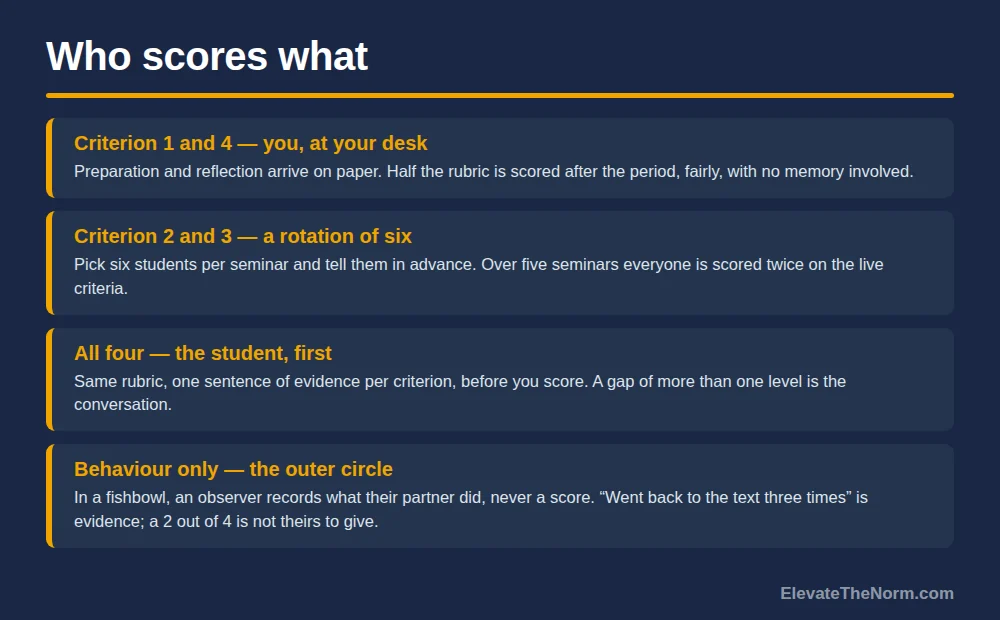
    Four rows describing who scores which rubric criteria: the teacher scores preparation and reflection from paper, a rotating group of six is scored on the live criteria, students self-score first, and outer-circle observers record behaviour only
    Facilitating and scoring are two jobs.

    Three ways out, in order of how much I trust them.

    1. Score the writing, not the room. Criteria one and four are collected on paper. That is half the rubric done at your desk, after school, fairly, with no memory involved.
    2. Score a rotation. Pick six students per seminar for criteria two and three and tell them in advance. Over five seminars everyone gets scored twice on the live criteria. Telling them beforehand is not cheating — it is the transparency the research says is doing the work.
    3. Use the fishbowl. If half the class is in an outer circle already, give each observer one partner and one behavioral thing to record. Their notes are not the grade, but they are evidence you did not have to generate while running the conversation.

    Check one thing before you adopt any of this: if a student has an IEP or 504 plan that addresses oral participation, the live criteria may need to be replaced rather than adapted for that student. Ask the case manager rather than improvising a workaround, and note that this rubric already makes that easy — half the score is written, so substituting the other half costs you less than it would on most discussion rubrics.

    On time, honestly: four criteria for twenty-eight students is about twenty minutes if you are scoring the written half from paper and six students on the live half. It is not nothing. It is roughly the cost of grading a set of exit tickets, and it is the reason the rotation exists.

    What I would not do is score from memory at the end of the period. Twenty minutes after a good seminar, what you remember is who was interesting, and “interesting” correlates with confident far more than it correlates with prepared.

    Who Should Do the Scoring?

    Students first, on the same rubric, before you score anything. This is the change that makes the rubric an instructional tool rather than a grading one, and it costs four minutes.

    Hand out the rubric before the seminar. Afterward, have each student score themselves on all four criteria and write one sentence of evidence for each. Then score them yourself. Where you disagree by more than one level, that is your conversation — and it is a better conversation than any comment you would have written unprompted.

    Two guards on this. The student’s self-score is not the grade; it is information, and the moment it becomes the grade you have taught them to inflate it. And peer scoring should stay behavioral: what a classmate did, not how well they did it. A fifteen-year-old can honestly record “went back to the text three times.” A fifteen-year-old should not be handing another fifteen-year-old a 2 out of 4 on how they treat people’s ideas. This is the same line the site draws around having students judge their own work: the judgement is real, and it does not become the record.

    What to Do With the Score

    Use it to decide what to teach next, and put as little of it in the gradebook as your school allows. A seminar rubric’s best use is diagnostic.

    Look down the columns rather than across the rows. If twenty of twenty-eight students scored low on use of the text, that is not twenty-eight individual grades — that is one lesson about citing a line, and you should teach it before the next seminar instead of recording twenty low scores. If preparation is the weak column, the problem is upstream of the seminar entirely and no amount of facilitation will fix it.

    If the scores do go in the gradebook, weight them low and tell students the weight. A seminar is a practice format. Grading practice heavily is how you get students who will not risk a wrong reading out loud, which is the one behavior the whole format exists to produce.

    What to Do Next

    Take the rubric above, rewrite the use of the text row so it names what evidence looks like in the specific text you are teaching, and hand it to students the day before — not the day after. Score criteria one and four from the paper they turn in. Pick six students for the live criteria and tell them who they are.

    Then run it twice before you judge either the rubric or your class. If you need the rest of the format, it is in the guide to running a Socratic seminar, and the questions that make one worth scoring are in the seminar question bank.

    Before you go: grab the free Socratic Seminar Rubric (Four Criteria) (PDF) — ElevateTheNorm.com branded, printable, no email required.

    Frequently Asked Questions

    What should a Socratic seminar rubric include?

    Four criteria: preparation, use of the text, treatment of other people’s ideas, and written reflection afterward. Three of the four produce writing, which means you can score them after the period rather than while facilitating, and a student who spoke twice can still score well. What it should not include is a count of how many times a student spoke.

    Should you grade a Socratic seminar at all?

    Grade the preparation and the reflection, and weight the whole thing lightly. A seminar is a practice format, and grading practice heavily produces students who will not risk a wrong reading out loud — which is the behavior the format exists to create. If a participation grade is required, take it from the written criteria and say plainly that speaking is not scored.

    Why shouldn’t a rubric count how many times a student speaks?

    Because it measures confidence and charges a fee to students who find speaking aloud genuinely hard. A study of quiet students found most struggled with verbal participation expectations and several reported physical symptoms — trembling, blushing, stuttering — when speaking in class. Frequency is also easy to game: three short comments at the right moments will beat one student who prepared thoroughly and spoke once.

    Is an analytic or holistic rubric better for a seminar?

    Analytic, if you want consistency. A review of 75 rubric studies found scoring reliability improves when rubrics are analytic and topic-specific and are paired with exemplars or rater training. Holistic rubrics are faster and less consistent, and with something as fuzzy as discussion quality, consistency is exactly what you are short of.

    Do rubrics actually improve student learning?

    The evidence is genuinely mixed. A review of 21 studies of formative rubric use found effects ranging from very large to nothing, and noted that most studies combined rubrics with other interventions, so the rubric’s own contribution is hard to isolate. What the authors identify as the mechanism is transparency — which means handing the rubric out before the seminar rather than attaching it to the grade afterward.

    How do you score thirty students during one seminar?

    You do not. Facilitating and scoring are two jobs, and doing both means doing the facilitation badly. Score the two written criteria from paper afterward, and score the two live criteria for a rotating group of about six students per seminar, told in advance. Over five seminars everyone gets scored twice on the live criteria.

    Should students score themselves on the seminar rubric?

    Yes, before you score them, using the same rubric with one sentence of evidence per criterion. Where your score and theirs differ by more than one level, that gap is the conversation worth having. Keep the self-score as information rather than as the grade — the moment it becomes the grade, students learn to inflate it.

    Is this Socratic seminar rubric free to use?

    Yes. It is printed in full on this page and there is a free printable version too, with no email address to hand over, and you are welcome to copy it, cut criteria, or rewrite the language to match your school’s scale. Rewriting the use-of-the-text row so it names what evidence looks like in your specific text is the single change that will do the most for consistency.

    Sources

    1. Jonsson, Anders, and Gunilla Svingby. “The Use of Scoring Rubrics: Reliability, Validity and Educational Consequences.” Educational Research Review, vol. 2, no. 2, 2007, pp. 130–144. Review of 75 empirical studies; reliable scoring “can be enhanced by the use of rubrics, especially if they are analytic, topic-specific, and complemented with exemplars and/or rater training”; rubrics do not by themselves guarantee valid judgements. https://eric.ed.gov/?id=EJ796733
    2. Panadero, Ernesto, and Anders Jonsson. “The Use of Scoring Rubrics for Formative Assessment Purposes Revisited: A Review.” Educational Research Review, vol. 9, 2013, pp. 129–144. 21 studies; effects on performance ranged from large (0.99–1.6) to negligible, and “most studies reporting on such improvements have combined the use of rubrics with other instructional interventions.” Positive effects more likely in higher education, over longer interventions, and when paired with metacognitive activity. https://platform.europeanmoocs.eu/users/4567/Les3/Panadero-Jonsson-rubrics-3.pdf
    3. Murphy, P. Karen, et al. “Examining the Effects of Classroom Discussion on Students’ Comprehension of Text: A Meta-Analysis.” Journal of Educational Psychology, vol. 101, no. 3, 2009, pp. 740–764. Discussion produced strong increases in student talk and substantial gains in text comprehension, but “few approaches to discussion were effective at increasing students’ literal or inferential comprehension and critical thinking and reasoning.” https://eric.ed.gov/?id=EJ861185
    4. Applebee, Arthur N., Judith A. Langer, Martin Nystrand, and Adam Gamoran. “Discussion-Based Approaches to Developing Understanding: Classroom Instruction and Student Performance in Middle and High School English.” American Educational Research Journal, vol. 40, no. 3, 2003, pp. 685–730. 64 middle and high school English classrooms, grades 7, 8, 10, 11 and 12. https://eric.ed.gov/?id=EJ782328
    5. Medaille, Ann, and Janet Usinger. “Quiet Students’ Experiences with the Physical, Pedagogical, and Psychosocial Aspects of the Classroom Environment.” Educational Research: Theory and Practice, vol. 31, no. 2, 2020, pp. 41–55. Ten upper-division undergraduates — not secondary students; nine of ten struggled with verbal participation expectations and six reported physical symptoms when speaking aloud. https://files.eric.ed.gov/fulltext/EJ1274336.pdf

    About Clay Shumate

    Clay Shumate is a certified secondary Social Studies teacher in the public schools of West Alabama, with seven years of classroom experience, a B.A. in History, and an M.Ed. in Secondary Education. He writes about project-based learning, student responsibility, respect, and practical ways to hold young people to a higher standard while giving them room to learn from mistakes. He is a member of the Society of Professional Journalists and writes to its Code of Ethics; this site’s editorial standards and corrections policy are published in full. More about Clay.

  • Small Group Instruction in Middle and High School: Make the Table the Seat Students Want

    Small Group Instruction in Middle and High School: Make the Table the Seat Students Want

    By Clay Shumate

    Small group instruction in middle and high school works when being called to the table reads as a privilege instead of a diagnosis. That means three things: everyone goes, including your strongest students; nobody gets announced; and the table itself is the best seat in the room. Below are two ready-to-run systems built on that rule — one for middle school and one for high school — because a sixth grader and a senior want very different things from the same ten minutes.

    Small group is where a lot of the real teaching happens and also where a lot of the stress sits. Teachers are told to pull groups every day, and then they watch a fourteen-year-old slump in his chair on the walk over because everyone in the room knows what that walk means. This page is about fixing the walk.

    Key Takeaways

    • The problem is status, not content. Teenagers are more sensitive to status and respect than younger children, and a small group that looks like the low group gets treated like one.
    • Everyone goes, every cycle. If your top students never sit at the table, every student who does sit there has been labeled.
    • Middle school: The Studio. A class-named table, quiet invitation cards, and three session types — including a Sneak Peek that lets students see tomorrow’s material before anyone else.
    • High school: Consults. Booked ten-minute slots that run like office hours. The schedule is public; the reason each student is there is not.
    • Check your roster every two weeks. The same five names three cycles in a row means you have built a fixed low group, which is the version the evidence warns against.

    Free Download · PDF

    Small Group Instruction Toolkit

    Two pages: eight cut-apart invitation cards for The Studio, a ten-slot consult booking sheet for high school, and a private teacher tally for catching a fixed low group early.

    Download the free PDF

    Free. No email address required. Designed for grades 6–12. Browse every printable in Your Free Library.

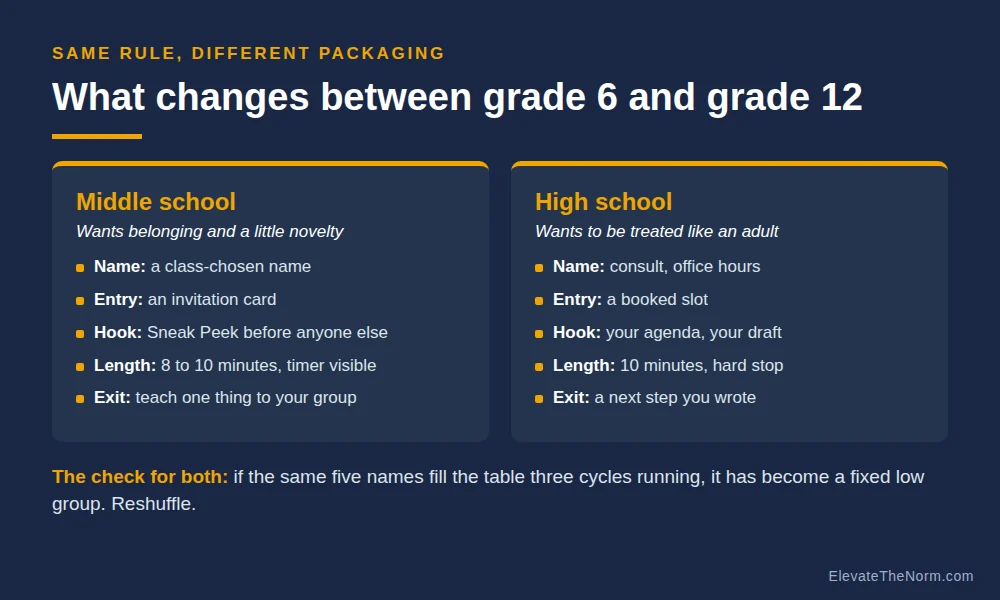
    Two-column comparison of small group instruction in middle school and high school covering name, entry, hook, length and exit, with a warning that the same five names three cycles running means a fixed low group
    Same rule underneath. Different packaging for a sixth grader and a senior.

    Why Does Small Group Instruction Stop Feeling Okay After Elementary School?

    Because the walk to the table becomes public information about who is struggling, and adolescents are built to notice that kind of information.

    In elementary school, reading groups are just how the day works. By middle school, students start doing the math on who gets pulled and why. David Yeager, Ronald Dahl and Carol Dweck put the developmental piece plainly: compared to younger children, middle adolescents “show a greater sensitivity to status and respect, resulting from pubertal maturation.” They also warn that anything that feels like talking down — repeating what students think they already know — “may come across as infantilizing and therefore disrespectful.” A small group that feels like a remedial pull-out hits both nerves at once.

    The help-seeking research points the same direction. Ryan, Hicks and Midgley found that students focused on social status and on looking capable were more likely to avoid asking for help and to see it as a threat to their self-worth, and that lower-achieving students with those goals avoided help the most. That sample was fifth graders, so read it as the pattern forming, not as a secondary-school result. A later conference paper from the same Michigan research group, surveying 968 seventh graders, found that when students believed their teacher took care not to embarrass students who had difficulty, they were less likely to avoid seeking help. It is a conference paper rather than a peer-reviewed article, and it is correlational. But it names the lever precisely: not embarrassing anyone is not a nice extra. It is the condition that makes help usable.

    So the design problem is not “how do I teach a small group.” Most teachers know how. It is “how do I make going to the table cost a student nothing in front of their friends.”

    What Does the Research Say About Grouping in the First Place?

    Grouping inside a class helps a little, and the risk is almost entirely in groups that never change.

    A second-order meta-analysis by Steenbergen-Hu, Makel and Olszewski-Kubilius, pulling together a century of studies, found that students benefited from within-class grouping and from cross-grade subject grouping, while sorting students into separate classes by ability without changing the curriculum did not change achievement. A review chapter by Ed Baines summarizes the within-class finding as small positive effects “with students at all levels benefiting.”

    The Education Endowment Foundation’s toolkit is more cautious, and you should hear it. It estimates within-class attainment grouping at about two months of additional progress, rates the evidence as “very limited” (22 studies), and warns that lower-attaining students can suffer from lower teacher expectations and lasting damage to their attitudes. Its fix is the one both systems below are built on: group flexibly, so students know ability is not fixed.

    That is the honest summary. Small groups are not magic. Small groups that turn into a permanent low table are a real harm. Everything below is designed to stay on the right side of that line. I run most of my group work from the Station Rotation Toolkit on TPT so students know where to go and what to record.

    What Is the One Rule Under Both Systems?

    The table has to be a place students want to be, and every student has to end up there.

    My room runs as a workshop. Students are almost always working alongside somebody, and I pull people to a whiteboard table I made. It sits in a corner under a lower lamp, with a rug and nicer chairs than the rest of the room. You want to go there with me. Students ask.

    That last part is the whole point. I did not solve the “dumb table” problem with a policy or a speech about growth. I solved it by making the table the best seat in the room. The two systems below are built out from that idea for two very different age groups. Neither one needs a budget. A lamp, a rug and a table students can write on go a long way; a lamp-lit corner does more for the mood of a small group than any sentence you can say about it.

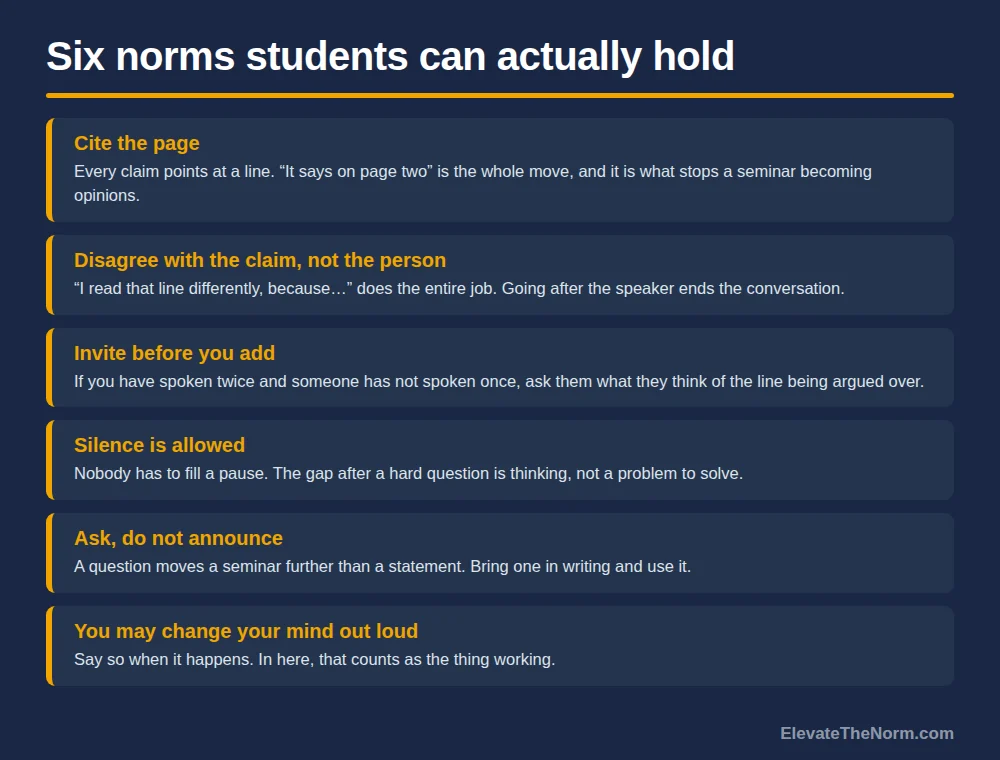
    Three rules hold for both:

    • Everyone goes. Every student, every two-week cycle, including the ones who do not need help. Their visits are real — a challenge or a preview — not a decoy.
    • Nobody is called across the room. No names read aloud. Notes, cards, a booked slot. The call is private; the table is visible.
    • The rest of the room runs without you. If the other twenty-five students need you every ninety seconds, small group collapses. Post what everyone else is doing before the first student sits down.

    How Do You Make Small Group Instruction Cool in Middle School?

    Run it as The Studio: a class-named table you get invited to, with sessions that sometimes let you in on something before anyone else.

    Middle schoolers want to belong, want a little novelty, and are acutely aware of fairness. The Studio leans into all three.

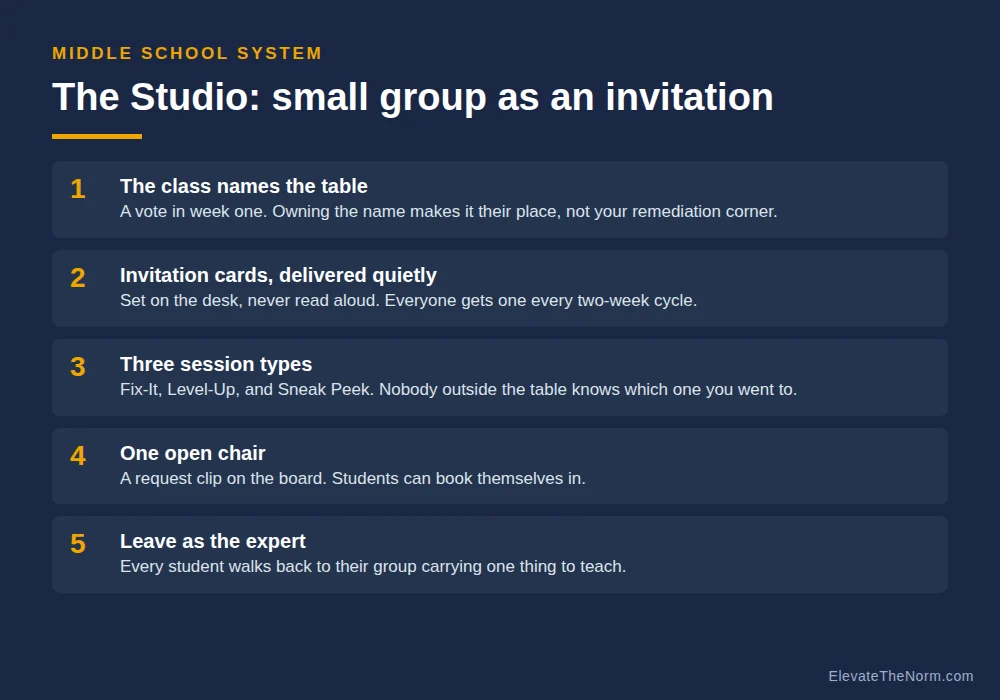
    Five-step list for a middle school small group system: the class names the table, invitation cards delivered quietly, three session types called Fix-It, Level-Up and Sneak Peek, one open chair students can request, and leaving as the expert
    The Studio: small group instruction for grades 6–8, built as an invitation.

    1. Let the class name the table

    In the first couple of weeks, put three or four names on the board and let classes vote. “The Studio” is a fine default; students will come up with better ones. It sounds small. It is not. A place with a name the students chose is their place. A place the teacher calls “my reteach table” is yours, and everyone knows what it is for.

    2. Invitations, not call-outs

    Print a stack of small cards — “You’re invited to The Studio. Round 2, today.” — and set one on a student’s desk while you circulate. Middle schoolers like getting a card. Nobody else hears a name, and the student gets a minute of warning instead of being yanked out of whatever they were doing.

    3. Three kinds of session, and nobody outside knows which

    • Fix-It. The reteach. Something from an exit ticket or a confusion flag that three or four students missed.
    • Level-Up. A harder version of today’s task for students who are ready. This is what makes your strongest students regulars.
    • Sneak Peek. Ten minutes on tomorrow’s material before the class sees it. This is the status flip. The students who went walk into tomorrow’s lesson already knowing the vocabulary and the first example, and they get to be the ones with their hands up. Pre-teaching is also one of the kindest things you can do for a student who usually lags, and it never looks like help.

    The card never says which kind it is. From the outside, all three look the same.

    4. Table privileges

    The Studio should be physically better than a desk. Students write directly on the whiteboard surface with markers — middle schoolers will do almost any math problem if they are allowed to write it on a table. Better chairs. The lamp. A visible timer set to eight or ten minutes so everyone, including you, knows the session ends.

    5. One open chair

    Keep one seat that students can request. A clip or a sticky note on the board: “Save me a seat.” When students start booking themselves in, you have won. That chair is also your honesty check — if nobody ever asks for it, the table is not yet a place anyone wants to be.

    6. Leave as the expert

    Every student walks back to their table group carrying one thing to explain. “Tell your group the two ways we found to check this.” They come back from The Studio as the person who knows something, not the person who was missing something. If your room is already arranged around partner work and groups of four — the site’s guide to seating charts covers layouts — this step costs nothing.

    How Do You Make Small Group Instruction Work in High School?

    Run it as Consults: booked ten-minute meetings that work like a professor’s office hours, where the student brings the agenda.

    High schoolers do not want a cute name or a card. They want to be treated like adults, and a small group that feels like fourth-grade reading circle will be resisted with their whole body. So borrow the language and structure of how adults actually get help: office hours, a coach’s film session, a design critique, a one-on-one with a manager.

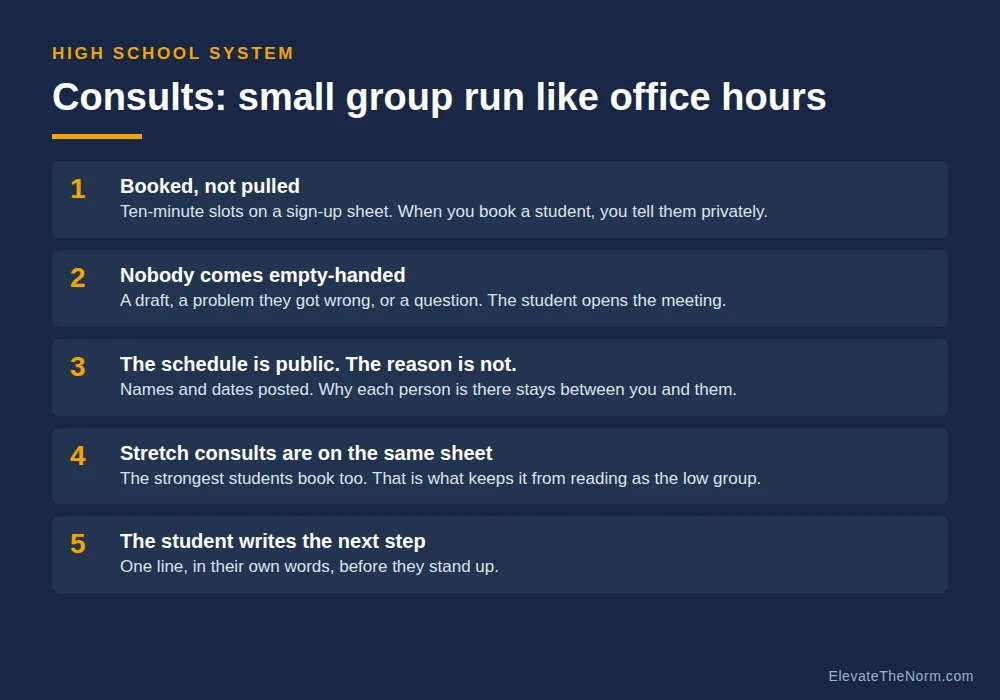
    Five-step list for a high school small group system run like office hours: booked not pulled, nobody comes empty-handed, the schedule is public but the reason is not, stretch consults on the same sheet, and the student writes the next step
    Consults: small group instruction for grades 9–12, run like office hours.

    1. Booked, not pulled

    Post a sign-up sheet — paper on the wall or a simple form — with ten-minute slots for each day of the cycle. Students can book themselves. When you book a student, tell them privately: a note on their paper, a message through your learning platform, a quiet word while you circulate. “I put you down for Thursday, second slot. Bring your thesis.” That is how an adult schedules a meeting with another adult.

    2. Nobody comes empty-handed

    The price of a consult is bringing something: a draft, a problem you got wrong, a question you could not answer. The student talks first for the opening minute or two — what they brought and where they are stuck. This is the autonomy piece, and it matters. The Yeager, Dahl and Dweck review notes that whether adolescents felt an intervention supported their autonomy changed whether it worked. A consult where the student sets the agenda feels like their meeting. A reteach where you repeat the lesson at closer range feels like being talked down to.

    3. The schedule is public; the reason is not

    Post who is booked and when. Names and dates, nothing else. Everyone can see that the strongest student in the room is booked Tuesday and the quiet kid in the back is booked Wednesday and there is no visible difference between those two facts. Why each person is there stays between you and them.

    4. Stretch consults on the same sheet

    Your strongest students book consults too — for a harder problem, feedback on an ambitious draft, a question that goes past the unit. This is the single most important design choice in the whole system. If only struggling students ever sit down, the sheet becomes a list of who is struggling, and every protection above falls apart.

    5. The student writes the next step

    Before they stand up, the student writes one line in their own words: what they will do next and by when. Not your summary of what they should do — theirs. It is short, it is theirs, and it is the only record the consult needs. If you want students getting better at judging their own work, the site’s piece on self-assessment during group work pairs well with this.

    6. Talk to them like colleagues

    No cheerleading, no “great job, buddy.” Tell them what is working, what is not, and what you would do next if it were your draft. Respect in the classroom is mostly this: talking to a seventeen-year-old about their work the way you would want someone to talk to you about yours.

    How Do You Fit This Into a Real Class Period?

    One or two sessions a day, ten minutes each, on a two-week cycle.

    Do the arithmetic before you promise anything. A class of 28 in groups of three or four is roughly eight sessions per cycle. Over ten school days, that is one session most days and two on a few. That fits. Three sessions a day, every day, does not fit anyone’s real schedule, and a system you drop in October helps nobody.

    Use a short routine for the rest of the room: a posted task with a clear finish line, a “what to do when you are stuck” list that does not start with walking up to the table, and a rule that the table is not interrupted except for emergencies. Practice it for the first week with a two-minute session so the room learns to run without you. Clean transitions matter here more than almost anywhere else; every minute lost moving students to the table comes out of the session.

    Decide who goes from evidence, not from memory. An exit ticket or a quick check sorted into piles tells you who needs a Fix-It, who is ready for a Level-Up, and who would benefit from a Sneak Peek. The site’s formative assessment strategies for reading describes a sort-don’t-mark routine that feeds straight into this.

    What Are the Signs the Table Has Become the Low Group?

    Same names, same kind of session, three cycles in a row. Keep a simple tally — name, date, session type — and look at it every two weeks. Four warning signs:

    • The same five students fill most of the seats. That is a fixed group, and it is the version the EEF warns can depress attitudes and expectations.
    • Your top students have not been in weeks. Book them. A Level-Up or a stretch consult is a real session, not a favor.
    • Nobody uses the open chair or books themselves. The table is not yet desirable. Fix the table before you fix the students.
    • You are reteaching the whole lesson at the table. Ten minutes is for one sticking point. If the whole lesson did not land, that is a whole-class problem, and it belongs to the whole class tomorrow.

    One more boundary: The Studio and Consults are classroom instruction. They do not replace small-group services written into an IEP or a 504 plan, and a student’s visits should not be counted as those services unless the plan and your case manager say so.

    Where Does the Evidence Run Out?

    Nobody has run a trial on invitation cards or booking sheets. The two systems here are designs built from well-supported principles — adolescents’ sensitivity to status and respect, the link between feeling safe from embarrassment and seeking help, and the case for flexible over fixed grouping. The individual features are not tested interventions, and you should treat them as a starting point to adjust, not a protocol.

    The grouping evidence itself is also thinner than it sounds. The EEF rates it very limited. The meta-analytic finding is small and positive. The help-seeking studies are correlational, one is on fifth graders, and one is a conference paper. What the evidence does support, fairly consistently, is the direction: teenagers avoid help that costs them status, and groups that never change carry real risk. Both systems are built to push against exactly those two problems.

    What Should You Do Next?

    Pick the system for your grade band and start small. Name the table or post the booking sheet this week. Run one session a day for two weeks with at least two of your strongest students in the rotation. At the end of the cycle, look at your tally and at the open chair. If students are asking to come, keep going. If they are not, change the table before you change anything else.

    Related reading on this site: student voice and choice for how much control to hand students, and high expectations for students for why a table everyone attends is a statement about what you expect from all of them.

    Before you go: grab the free Small Group Instruction Toolkit (PDF) — ElevateTheNorm.com branded, printable, no email required.

    Small groups are one lever, not the whole job. Our guide to differentiated instruction strategies for grades 6–12 covers the three decisions that make differentiation workable without five lesson plans.

    Teacher-led small groups are not the only shape this takes. Our companion piece on the five elements that separate cooperative learning from group seating covers what changes when students work without you at the table.

    Frequently Asked Questions

    What is small group instruction in middle and high school?

    It is a short, focused session with three or four students while the rest of the class works independently. In grades 6 to 12 it usually runs eight to ten minutes and targets one sticking point, a challenge task, or a preview of upcoming material. The difference from elementary school is less about content and more about how students feel walking to the table.

    How do I stop students from feeling singled out when I pull a small group?

    Three things. Put every student in the rotation, including your strongest, so being called says nothing about ability. Call students privately with a card, a note or a booked slot instead of reading names aloud. And make the table the most comfortable seat in the room so going there reads as a privilege.

    What if my high school students refuse to come to the table?

    Refusal usually means the table still looks like the low group. Switch to booked consults, let students set the agenda by bringing their own draft or question, and make sure your top students are visibly on the booking sheet. If a student still declines, offer them a different slot rather than insisting in front of the class.

    How often should each student get small group time?

    Once every two-week cycle is a realistic floor for a class of about 28. That works out to roughly eight sessions of three or four students, or about one session a day. Students who need more can come more often, as long as the rest of the class still rotates through.

    What does the rest of the class do during small group instruction?

    A posted task with a clear finish line, a short list of what to do when stuck that does not start with interrupting the table, and a rule that the table is only interrupted for emergencies. Practice the routine with very short sessions during the first week so the room learns to run without you.

    Is ability grouping bad for students?

    Fixed ability groups carry real risk, especially for lower-attaining students, whose expectations and attitudes can suffer. Flexible groups that change based on recent evidence show small positive effects in the research, though the evidence base is limited. The practical rule is to group by what students need this week and to reshuffle constantly.

    Can small group sessions count toward IEP or 504 services?

    Not automatically. These sessions are general classroom instruction. If an IEP or 504 plan specifies small-group services, check with the case manager about what counts and how it is documented before treating any classroom session as meeting that requirement.

    Sources

    1. Yeager, David S., Ronald E. Dahl, and Carol S. Dweck. “Why Interventions to Influence Adolescent Behavior Often Fail but Could Succeed.” Perspectives on Psychological Science, vol. 13, no. 1, 2018, pp. 101–122. https://pmc.ncbi.nlm.nih.gov/articles/PMC5758430/
    2. Ryan, Allison M., Lynley Hicks, and Carol Midgley. “Social Goals, Academic Goals, and Avoiding Seeking Help in the Classroom.” Journal of Early Adolescence, vol. 17, no. 2, 1997, pp. 152–171. Sample: 443 fifth graders. https://deepblue.lib.umich.edu/items/485258a6-d9dc-4464-b205-fd8faa0b8b70
    3. Friedel, Jeanne, Roxana Marachi, and Carol Midgley. “‘Stop Embarrassing Me!’ Relations Among Student Perceptions of Teachers, Classroom Goals, and Maladaptive Behaviors.” Paper presented at the American Educational Research Association annual meeting, New Orleans, 2002. Sample: 968 seventh graders. https://public.websites.umich.edu/~pals/AERA2002%20handout.pdf
    4. Steenbergen-Hu, Saiying, Matthew C. Makel, and Paula Olszewski-Kubilius. “What One Hundred Years of Research Says About the Effects of Ability Grouping and Acceleration on K–12 Students’ Academic Achievement.” Review of Educational Research, 2016. Summary read via Duke University: https://today.duke.edu/2016/12/new-analysis-finds-two-measures-boost-k-12-academic-achievement
    5. Baines, Ed. “Ability Grouping.” Review chapter, UCL Institute of Education (2nd ed.). https://discovery-pp.ucl.ac.uk/10086616/1/EdBaines-AbilityGrouping-2ndEditionFinal1.pdf
    6. Education Endowment Foundation. “Within-Class Attainment Grouping.” Teaching and Learning Toolkit. https://educationendowmentfoundation.org.uk/education-evidence/teaching-learning-toolkit/within-class-attainment-grouping

    About Clay Shumate

    Clay Shumate is a certified secondary Social Studies teacher in the public schools of West Alabama, with seven years of classroom experience, a B.A. in History, and an M.Ed. in Secondary Education. He writes about project-based learning, student responsibility, respect, and practical ways to hold young people to a higher standard while giving them room to learn from mistakes. He is a member of the Society of Professional Journalists and writes to its Code of Ethics; this site’s editorial standards and corrections policy are published in full. More about Clay.

  • Questions for Socratic Seminar: 40 That Work in Grades 6–12

    Questions for Socratic Seminar: 40 That Work in Grades 6–12

    By Clay Shumate

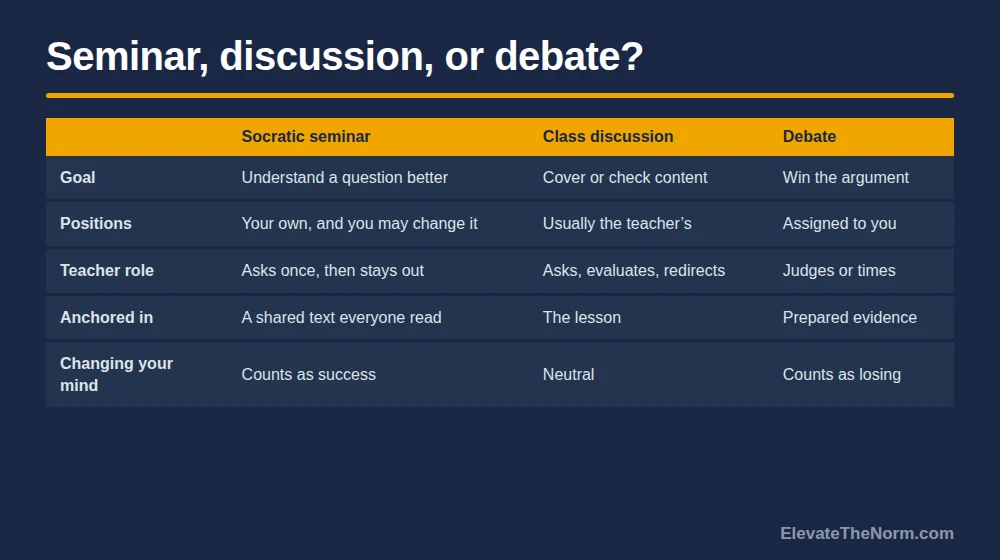
    Good questions for a Socratic seminar have no answer you could look up, no answer the teacher is holding, and at least two defensible readings in the text itself. That is the whole test. A question that a prepared student can settle in one sentence is a comprehension check — useful, but it will not carry thirty minutes of discussion.

    Below are forty questions you can use tomorrow, sorted by what they are for, plus the way to write your own out of whatever text you are already teaching.

    Key Takeaways

    • Three kinds of question run a seminar: one opening question, several core questions you may never need, and closing questions that ask what changed.
    • The research on “higher-order questions” is weaker than the training says. One meta-analysis of 20 studies found a significant positive effect; a second, of 14 studies, found the effect small. Both are true and both are old.
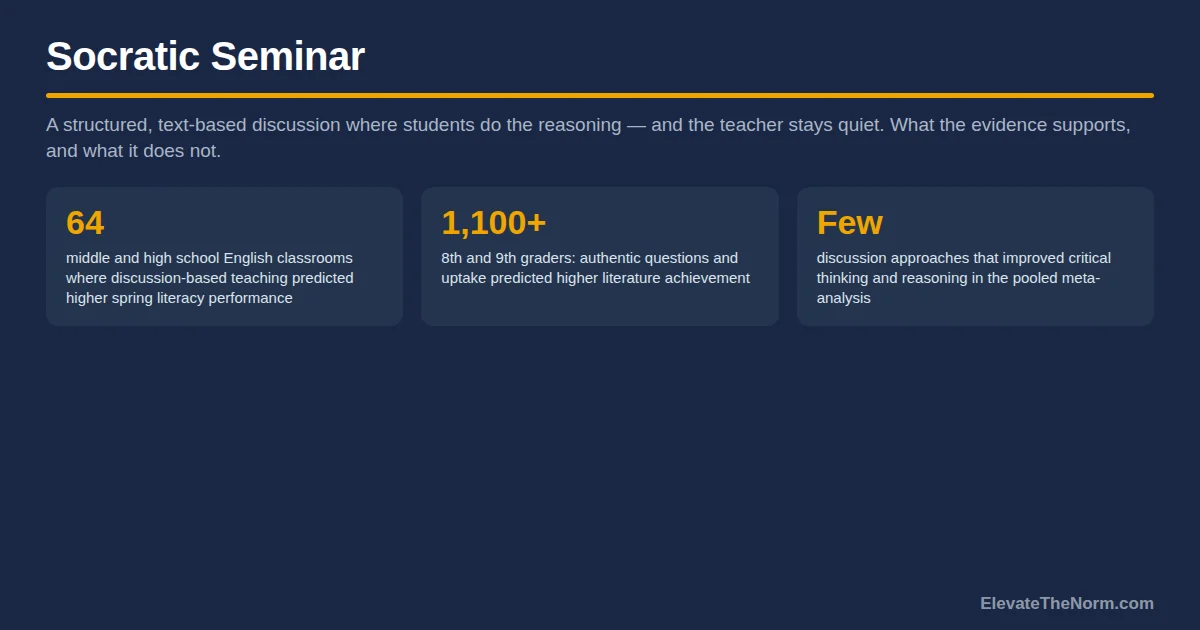
    • What does hold up is the authentic question — one the teacher does not already have an answer to. In a study of more than 1,100 eighth and ninth graders, that predicted higher literature achievement.
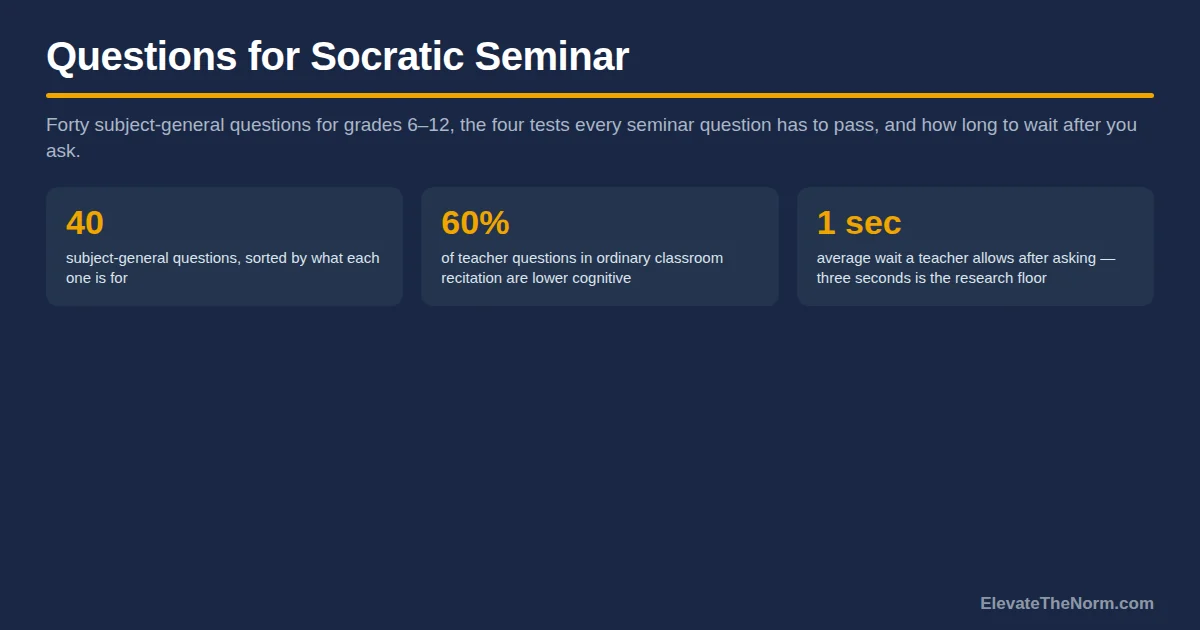
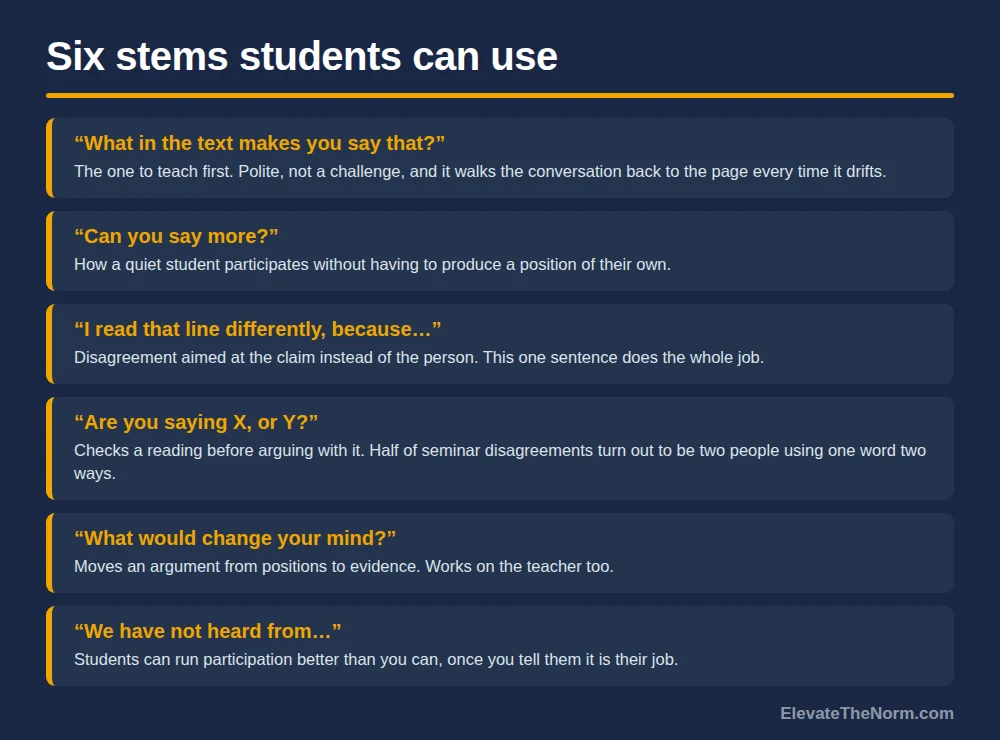
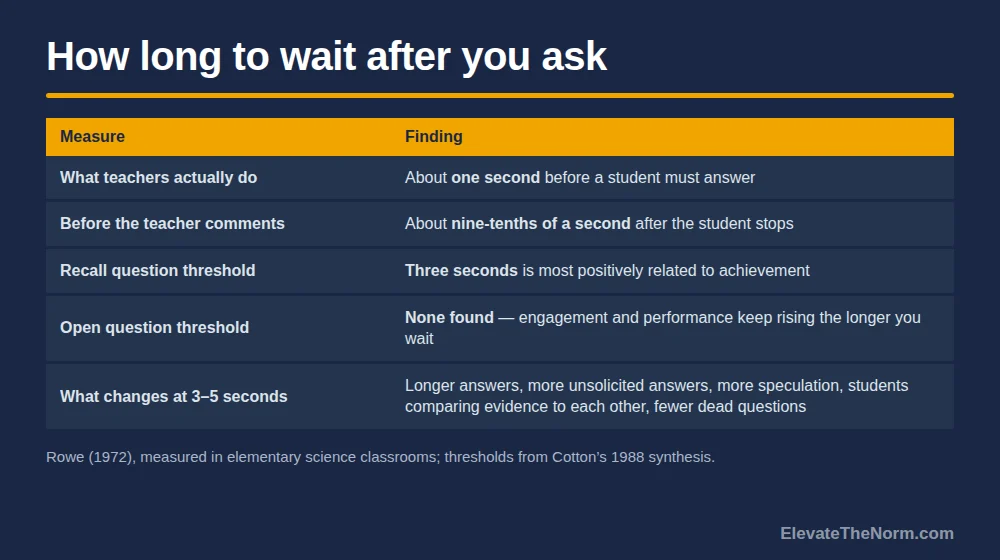
    • Wait longer than feels reasonable. Teachers average about one second. Three is the floor for a recall question, and for a genuinely open one there appears to be no ceiling.
    • Students should be writing questions too. A seminar where only the teacher asks is a recitation with the chairs moved.

    Free Download · PDF

    40 Socratic Seminar Questions

    All forty questions in five groups, the six stems to post for students, and the ten-minute method for turning a text of your own into seminar questions.

    Download the free PDF

    Free. No email address required. Designed for grades 6–12. Browse every printable in Your Free Library.

    What Makes a Good Socratic Seminar Question?

    Four things, and you can test all four in about a minute. Write your question down, then run it against this list before you take it anywhere near a class.

    1. You cannot answer it in one sentence. Try. If you finish in a line, you have written a comprehension check. Keep it — just do not open with it, and file it with your other ways of checking what landed.
    2. You do not already know the answer. This is the hard one, because teachers are trained to ask questions we can assess. A seminar question is one where you would genuinely take notes on the replies.
    3. The text can support more than one answer. Not “what do you think” — opinions with no evidence anchor produce a conversation nobody can lose or learn from. The disagreement has to be arguable from the page.
    4. It cannot be Googled. If a phone settles it in twenty seconds, it will get settled in twenty seconds.

    The fourth one has quietly become the most important. A question like “what were the causes of the conflict” is a research task. “Which of the causes the author lists is doing the most work, and which one is there to make the argument look balanced?” is a seminar, because the answer is not written down anywhere.

    The Three Kinds of Question a Seminar Needs

    An opening question, a stack of core questions, and a closing question — and you should expect to use the opening one and maybe two others. The stack is insurance, not a script.

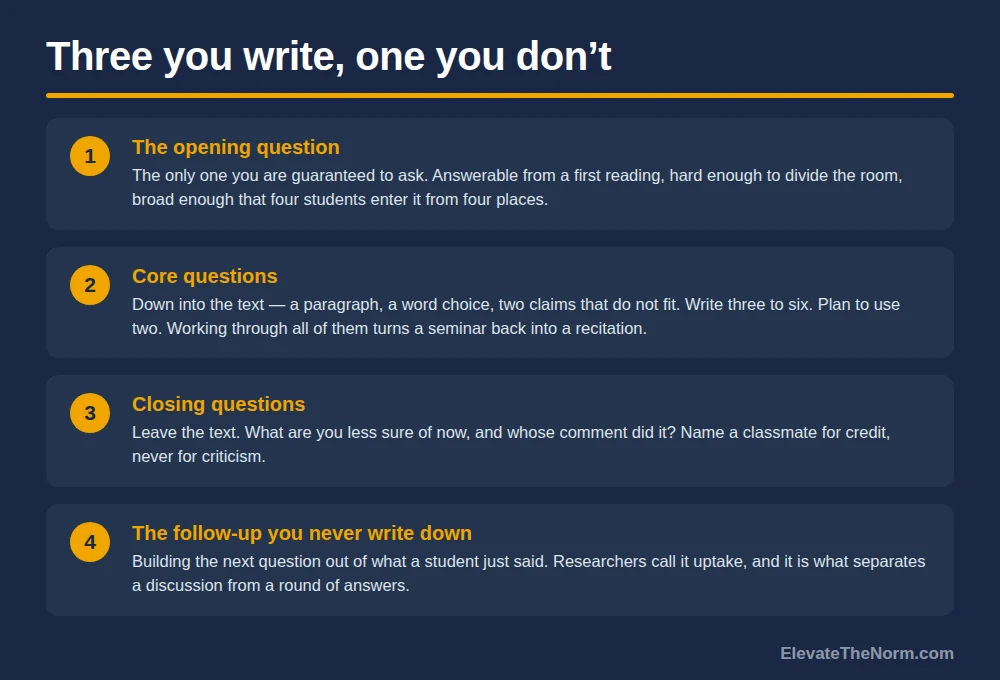
    Numbered list of four question types for a Socratic seminar: the opening question, core questions, closing questions, and the follow-up built on what a student just said
    Three kinds you write down, and the one you cannot.

    The opening question is the only one you are guaranteed to ask. It should be answerable from a first reading, hard enough to divide the room, and broad enough that four different students can enter it from four different places. It usually points at the whole text rather than a line.

    Core questions go down into the text. These are the ones that name a paragraph, a word choice, a contradiction between two claims. Write six and plan to use two — and if you have five preps and six is not happening, write three. Three real ones beat six you assembled at 10pm. The worst thing you can do with a good stack is work through it, because then you are running the agenda and the students are answering it.

    Closing questions leave the text. What does this mean for something the students actually deal with? What changed in your thinking, and whose comment did it? That second one belongs in the post-seminar writing, and it is the single best assessment item this format produces. One guard on it: ask students to name a classmate for credit, never for criticism. “What did this conversation get wrong?” is a question about the conversation, and it is worth saying so out loud before they write.

    There is a fourth kind that never gets written down, and it is the one that matters most in the room: the follow-up. Building the next question out of what a student just said — researchers call it uptake — is what separates a discussion from a round of answers.

    Does Asking Harder Questions Actually Improve Achievement?

    Less clearly than the training slides claim, and it is worth knowing why before you rebuild your question bank around Bloom’s taxonomy. Two meta-analyses looked at the same question and did not agree.

    Kathleen Cotton’s synthesis for the Northwest Regional Educational Laboratory lays both out. Redfield and Rousseau’s 1981 meta-analysis of 20 studies “concludes that asking higher cognitive questions has a significant and positive effect on student performance.” Samson and colleagues ran a second meta-analysis in 1987 across 14 studies and found that students exposed to higher cognitive questions did outperform others, “but that the effect size is small.”

    A later critical review by Mikyeong Yang went further, concluding that this body of work “reported incoherent results” and that the evidence cannot support the expectation that higher-cognitive questions are more effective than fact questions. So: a real effect, a small effect, and a serious argument that the whole line of research is not measuring what it thinks it is.

    Here is what survives all three, and it is not about difficulty at all. Nystrand and Gamoran studied eighth- and ninth-grade English classes across sixteen middle schools feeding nine high schools, testing more than 1,100 students in fall and spring. Students whose teachers asked a higher proportion of authentic questions — ones the teacher did not already have an answer to — and who practiced uptake scored significantly higher on literature achievement.

    Authentic is not the same as hard. “Analyze the author’s use of irony” is high on Bloom’s and completely inauthentic if you have a rubric in your hand describing the right answer. “Is the last line a joke?” is simple, open, and genuinely contested. Write for authentic, not for the taxonomy. It is the same trade as anywhere else on this site: real questions hand students something to do, which is what giving students a genuine decision rather than a cosmetic one actually looks like inside one class period.

    One more number worth carrying, from the same Cotton synthesis: in ordinary classroom recitation, about 60 percent of teacher questions are lower cognitive, 20 percent higher cognitive, and 20 percent procedural. A seminar is one of the few structures that changes that ratio on purpose.

    40 Questions for Socratic Seminar

    Eight questions in each of five categories, written to be subject-general so you can drop your own text into them. Every one of these is a shell — swap in your author, your document, your data set.

    Two things before you use them. They are subject-general on purpose, which means the question is only as safe as the text you put under it; choosing a text on a contested public issue is a decision that belongs to you and your school’s policy, not to a question bank on the internet. And the fourth group — the ones that surface disagreement — is asked to the room, never to a named student. “Who read that line differently?” is an invitation. “Marcus, you disagree, right?” is an ambush, and the student you do it to will remember it longer than the text.

    Opening questions (use one)

    1. What is the most important sentence in this text, and what does the rest of it do?
    2. What is this author afraid of?
    3. If you had to remove one paragraph without losing the argument, which one goes?
    4. Who is this written for? How can you tell?
    5. What does this text refuse to say?
    6. Is the author describing the world or arguing about it?
    7. What would have to be true for this to be right?
    8. What question is this text an answer to?

    Core questions: evidence and claims

    1. Which claim here has the least support behind it?
    2. Where does the author stop explaining and start assuming?
    3. Are the two claims in the second and fourth paragraphs compatible?
    4. What counts as evidence in this text, and who decided that?
    5. Is the strongest objection to this argument in the text, or did the author leave it out?
    6. Which detail would change your reading if it turned out to be wrong?
    7. Does the author distinguish what they know from what they think?
    8. If this were written by someone on the other side, which sentence would survive?

    Core questions: language and choice

    1. Why that word and not the obvious one?
    2. What work is the title doing?
    3. Where does the tone shift, and what happens right before it?
    4. Who is given a name in this text, and who is not?
    5. What is the effect of the thing the author repeats?
    6. Is the ending earned by what came before it?
    7. What would be lost if this were written plainly?
    8. Which sentence do you think the author rewrote the most times?

    Questions that surface disagreement

    1. Who in this room read that line differently than you did?
    2. What is the strongest version of the argument you disagree with?
    3. Is this a disagreement about the text or about something outside it?
    4. What would change your mind?
    5. Can both readings be true at once?
    6. What are we assuming that the text never says?
    7. Which of us is using a word to mean two different things?
    8. Is the disagreement about what happened or about whether it was right?

    Closing and reflection questions

    1. What did you come in believing that you are less sure of now?
    2. Whose comment changed or sharpened your thinking, and what did they say?
    3. What question do we still not have an answer to?
    4. What would you need to read next to settle this?
    5. Where does this argument show up outside of school?
    6. If you had to explain this text to someone in one sentence, what would you leave out?
    7. What did this conversation get wrong?
    8. What is the question you wanted to ask and did not?

    Question Stems Students Can Use

    The fastest upgrade to a seminar is teaching students to ask each other questions instead of taking turns making statements. Most students arrive with one move — say your opinion and stop — and a short posted list fixes it faster than any amount of coaching.

    Six question stems students can use in a Socratic seminar, including what in the text makes you say that, can you say more, I read that line differently because, are you saying X or Y, what would change your mind, and we have not heard from
    Post six. Nobody reads twenty.

    Post six stems and refer to them by name. Do not post twenty; nobody reads twenty.

    The other half of this is teaching students to write a question, since you are requiring one at the door. Give them one frame and it stops being mysterious: point at a specific place in the text, say what confused or bothered you about it, and end with a question you cannot answer yourself. “On page two the author says X, but earlier they said Y — which one are they actually arguing?” is a better seminar question than most of mine, and a fourteen-year-old can produce it on the second try.

    For a student who found the text hard, say plainly that the question can be about the part they did understand. A question from paragraph one is a real contribution. Nobody has to have finished the text to have something worth asking about it.

    Two of these deserve a note. “What in the text makes you say that?” does most of the work of a facilitator and it is the one stem I would teach first — it is polite, it is not a challenge, and it forces the conversation back to the page every time it drifts. And “Can you say more?” is how a quiet student participates without having to produce a position of their own, which matters more than it sounds like.

    How Long Should You Wait After Asking?

    Three seconds minimum, and for a genuinely open question, longer than you think you can stand. This is the oldest finding in the questioning literature and it is still the one teachers violate most.

    Table of wait-time research findings: teachers wait about one second, comment within nine-tenths of a second, three seconds is the recall-question threshold, no threshold was found for open questions, and answers lengthen at three to five seconds
    Teachers average about one second. Eight costs you nothing.

    Mary Budd Rowe measured it in the early 1970s. Teachers allowed an average of about one second for a student to respond, and followed a student’s answer with a comment within roughly nine-tenths of a second. When those two waits were stretched to three to five seconds, student responses got longer, more students answered without being called on, speculative thinking went up, students began comparing their evidence to each other’s rather than to the teacher, and fewer questions went unanswered. Worth naming honestly: Rowe’s classrooms were elementary science. The effect has held up widely, but that is the population she measured.

    One cheap adjustment that goes with the wait: put the opening question in writing as well as saying it. On the board, on the handout, anywhere it stays. A student who processes slowly, who missed the first three words, or who is rereading the text while you talk should not lose the question because it only existed as sound. It costs nothing and it changes who is able to answer.

    Cotton’s synthesis adds the part that matters for seminars specifically: three seconds is the threshold for lower cognitive questions, and for higher cognitive questions there appears to be no threshold at all — students “seem to become more and more engaged and perform better and better the longer the teacher is willing to wait.”

    I have tested the ceiling on this and I would not recommend the experiment. I once waited more than five minutes. It was one of the most awkward moments of my life, that section finished nine minutes behind my other classes, and it is the only time I have ever assigned homework. I am not telling that story as a technique. I am telling it because the price of waiting is real and it is worth knowing what it costs before you decide the silence is unbearable at eight seconds. Eight seconds costs you nothing.

    How to Turn Your Own Text Into Questions in Ten Minutes

    Read for the seams, not for the content. You are not looking for what the text says. You are looking for the places where it strains.

    1. Mark every hedge. “Arguably,” “some have suggested,” “it is possible that.” Each one is a place the author was not sure, and each one is a question.
    2. Find two sentences that do not quite fit together. Not a contradiction — a tension. “Are these both true?” is a seminar question that writes itself.
    3. Note what is missing. Who is not quoted. Which objection is not answered. What the author had to leave out to make the piece work.
    4. Write your opening question from the whole text, and three core questions from the marks you made.
    5. Answer your own opening question in one sentence. If you can, go back to step two.

    That is the whole process, and it gets faster. The fourth time you do it you will find yourself marking hedges while you read for other reasons, which is a better outcome than any question bank.

    Questions That Wreck a Seminar

    Four shapes, and all four are easy to write by accident.

    • The question you already answered in class. Students will give you your own words back, correctly, and nothing will happen.
    • The yes-or-no question with an obvious side. “Was the narrator wrong to lie?” gets twenty-eight yeses. Ask instead what the lie cost, and who paid.
    • The question that requires a personal disclosure. “Have you ever been treated this way?” will get an honest answer from a fifteen-year-old in front of twenty-seven peers, and that is exactly the problem. Keep the question on the text and let students bring themselves to it if they choose. If a text is likely to pull the room in that direction, that is a conversation to have with an administrator before it is a seminar question.
    • The question with a correct answer you will eventually supply. Students can smell this within four minutes, and once they have, the seminar becomes a guessing game about you.

    The third one is the one worth being most careful with, because it usually comes from a good instinct. Relevance is not the same as exposure. A question can matter to a student’s life without requiring them to narrate it to the class.

    What to Do Next

    Take the text you are teaching this week and spend ten minutes on the five steps above. Write one opening question, three core questions, and one closing question. Then pull four questions from the bank here that fit the same text, so you have something in reserve you did not have to invent.

    Ask your opening question once, and count to eight in your head before you do anything else. That is the whole practice. If you want the rest of the format — the norms, the seating, what to do about the students who will not talk — it is in the full guide to running a Socratic seminar. And if the questions you write keep coming out as comprehension checks, that is not a failure; it means you have a set of quick checks for understanding and a seminar question still to write.

    Before you go: grab the free 40 Socratic Seminar Questions (PDF) — ElevateTheNorm.com branded, printable, no email required.

    Frequently Asked Questions

    What makes a good Socratic seminar question?

    One you cannot answer in a sentence, that you do not already have an answer to, that the text can support more than one answer to, and that a phone cannot settle in twenty seconds. The first two are the ones teachers miss. We are trained to ask questions we can assess, and a question you can assess is usually a question you already answered.

    How many questions should I prepare for a seminar?

    One opening question, about six core questions, and two closing questions — and expect to use three of them. The stack is insurance against a dead room, not an agenda. Working through all nine is how a seminar turns back into a recitation with the chairs moved.

    What is the difference between an authentic question and a higher-order question?

    An authentic question is one the teacher does not have an answer to. A higher-order question is one high on Bloom’s taxonomy. They are not the same thing, and the research suggests the first matters more. “Analyze the author’s use of irony” is higher-order and completely inauthentic if you are holding a rubric describing the right answer.

    How long should I wait after asking a seminar question?

    Three seconds is the research floor, and for open questions there appears to be no ceiling — students engage more and perform better the longer the teacher is willing to wait. Teachers average about one second, which is why this feels so unnatural. Eight seconds costs you nothing and changes who answers.

    Should students write their own seminar questions?

    Yes, and it is the change that most reliably fixes a flat seminar. Require one written question from every student, collected on the way in. Make it an expectation rather than a bar — a student who arrives without one writes it in the first two minutes. A seminar where only the teacher asks questions is not a seminar.

    Can I use the same questions for any text?

    Most of them, yes. The forty here are deliberately subject-general: “what does this text refuse to say?” works on a court opinion, a poem, a lab report and a political speech. What does not transfer is the core questions, because those name a specific paragraph or word choice. Write those yourself from the text in front of you.

    What questions should I avoid in a Socratic seminar?

    Anything you already answered in class, yes-or-no questions with an obvious side, questions with a correct answer you plan to supply eventually, and questions that require a student to disclose something personal in front of the class. That last one usually comes from a good instinct — relevance — but relevance is not the same as exposure.

    Do harder questions actually raise achievement?

    The evidence is genuinely split. A 1981 meta-analysis of 20 studies found asking higher cognitive questions had a significant positive effect on performance; a 1987 meta-analysis of 14 studies found the effect small; and a later critical review argued the whole line of research reported incoherent results. What holds up better is the authentic question and the follow-up built on what a student just said.

    Sources

    1. Cotton, Kathleen. Classroom Questioning. School Improvement Research Series, Northwest Regional Educational Laboratory, May 1988. Reports Redfield and Rousseau (1981), 20 studies, “significant and positive effect” for higher cognitive questions, against Samson et al. (1987), 14 studies, effect “small”; a three-second wait-time threshold for lower cognitive questions and no apparent threshold for higher cognitive ones; and a 60 / 20 / 20 split of lower cognitive, higher cognitive and procedural questions in ordinary recitation. https://educationnorthwest.org/sites/default/files/ClassroomQuestioning.pdf
    2. Rowe, Mary Budd. Wait-Time and Rewards as Instructional Variables: Their Influence on Language, Logic, and Fate Control. 1972. ERIC ED061103. Teachers allowed an average of about one second for a response and commented within about nine-tenths of a second; extending both to three to five seconds produced longer responses, more unsolicited appropriate answers, more speculative thinking, more student-to-student evidence comparison and fewer unanswered questions. Population: elementary science classrooms. https://eric.ed.gov/?id=ED061103
    3. Nystrand, Martin, and Adam Gamoran. Student Engagement: When Recitation Becomes Conversation. National Center on Effective Secondary Schools, 1990. ERIC ED323581. Eighth- and ninth-grade English classes in sixteen middle schools feeding nine high schools across eight Midwestern communities; over 1,100 students tested fall and spring. Higher proportions of authentic questions and uptake predicted significantly higher literature achievement. https://files.eric.ed.gov/fulltext/ED323581.pdf
    4. Yang, Mikyeong. “A Critical Review of Research on Questioning in Education: Limitations of Its Positivistic Basis.” Asia Pacific Education Review, vol. 7, no. 2, 2006, pp. 195–204. Argues that the teacher-questioning meta-analyses “reported incoherent results” and that the evidence cannot support the expectation that higher-cognitive questions outperform fact questions. https://files.eric.ed.gov/fulltext/EJ752340.pdf
    5. Applebee, Arthur N., Judith A. Langer, Martin Nystrand, and Adam Gamoran. “Discussion-Based Approaches to Developing Understanding: Classroom Instruction and Student Performance in Middle and High School English.” American Educational Research Journal, vol. 40, no. 3, 2003, pp. 685–730. 64 middle and high school English classrooms, grades 7, 8, 10, 11 and 12. https://eric.ed.gov/?id=EJ782328
    6. National Paideia Center. “Paideia Seminar.” The seminar defined as a collaborative intellectual dialogue facilitated with open-ended questions about a text, run as a pre-seminar / seminar / post-seminar cycle. https://paideia.org/blogs/npc/paideia-socratic-seminar

    About Clay Shumate

    Clay Shumate is a certified secondary Social Studies teacher in the public schools of West Alabama, with seven years of classroom experience, a B.A. in History, and an M.Ed. in Secondary Education. He writes about project-based learning, student responsibility, respect, and practical ways to hold young people to a higher standard while giving them room to learn from mistakes. He is a member of the Society of Professional Journalists and writes to its Code of Ethics; this site’s editorial standards and corrections policy are published in full. More about Clay.

  • Socratic Seminar: How to Run One That Grades 6–12 Take Seriously

    Socratic Seminar: How to Run One That Grades 6–12 Take Seriously

    By Clay Shumate

    A Socratic seminar is a structured, whole-group discussion in which students question a shared text and each other while the teacher stays mostly silent. There is no winner and no correct answer to arrive at. The point is that students do the reasoning out loud, in front of each other, using evidence from something they all read.

    That is the definition. What follows is the part most guides skip: what the research actually supports, what it does not, and how to run one in a real secondary class without the same five kids carrying it.

    Key Takeaways

    • A seminar is not a debate. Nobody is assigned a side, nobody is trying to win, and the question has to be one you cannot settle by looking something up.
    • The strongest evidence is about discussion generally, not this format specifically. A study of 64 middle and high school English classrooms found discussion-based teaching predicted higher spring literacy performance — for low-achieving students as well as high-achieving ones.
    • The most honest finding is a mixed one. A meta-analysis found discussion produced big jumps in student talk and real gains in text comprehension, but few approaches moved critical thinking and reasoning.
    • Preparation is the whole game. A seminar with an unread text is twenty minutes of opinions.
    • Silence is not failure. The most common way a teacher wrecks a seminar is by answering the question they just asked.

    Free Download · PDF

    The Socratic Seminar Prep Sheet

    A text-selection check, the opening-question test, the six moves in order, six norms worth posting, a turn-count tally for you, and the four-way autopsy for a seminar that died.

    Download the free PDF

    Free. No email address required. Designed for grades 6–12. Browse every printable in Your Free Library.

    What Is a Socratic Seminar?

    A Socratic seminar is a formal, text-based dialogue where students ask and answer open-ended questions with each other, and the teacher facilitates instead of teaching. The National Paideia Center — which has trained schools in this format for decades — defines it as “a collaborative intellectual dialogue facilitated with open-ended questions about a text.” That definition is doing more work than it looks like.

    Every word in it rules something out. Collaborative rules out debate. Open-ended rules out questions with answers. About a text rules out a free-floating conversation on a topic. Take away any one and you have something else — possibly useful, but not a seminar. Here is the distinction that matters most in a secondary room, because teenagers assume it is a debate unless you tell them otherwise.

    Comparison table of a Socratic seminar, a class discussion and a debate across goal, positions, teacher role, what the talk is anchored in, and whether changing your mind counts as success
    A seminar is not a debate. Nobody is assigned a side and nobody wins.

    Does the Research Actually Support Discussion-Based Teaching?

    Yes for discussion in general — and more cautiously than most professional development admits when it comes to thinking. Two studies point in slightly different directions, and both are worth knowing before you build a unit around this.

    The strong one is squarely in our grade band. Applebee, Langer, Nystrand and Gamoran studied 64 middle and high school English classrooms across grades 7, 8, 10, 11 and 12. Controlling for fall performance and background, discussion-based approaches were significantly related to spring literacy performance. Their own summary of why: students in discussion-heavy rooms “internalize the knowledge and skills necessary to engage in challenging literacy tasks on their own.” And the finding held “for low-achieving as well as high-achieving students” — which is the opposite of what people assume about discussion, and the single best argument for not reserving it for honors sections.

    An earlier study from the same research group found the mechanism. Across sixteen middle schools feeding nine high schools in eight Midwestern communities, more than 1,100 eighth and ninth graders were tested in fall and spring. Students whose teachers asked a higher proportion of authentic questions — questions the teacher did not already have an answer to — and who practiced uptake, building the next question out of what a student just said, scored significantly higher on literature achievement. Not more questions. Different questions.

    There is an equity finding buried in the first study that deserves more attention than it gets. Applebee and colleagues note that their interpretation is “complicated because instruction is unequally distributed across tracks.” Translated: the discussion-based teaching that helps low-achieving students the most was not what low-achieving students were mostly getting. If a school is going to act on this research at all, the action is not “add seminars” — it is checking which sections currently get them.

    Now the cautious one, and it is the reason this section exists. Murphy and colleagues ran a meta-analysis of classroom discussion approaches in the Journal of Educational Psychology. They found “strong increases in the amount of student talk and concomitant reductions in teacher talk, as well as substantial improvements in text comprehension.” Then they found this: “Few approaches to discussion were effective at increasing students’ literal or inferential comprehension and critical thinking and reasoning.”

    Read that twice. The talk goes up reliably. Comprehension of the text goes up. Whether students get better at thinking is not established by the pooled evidence, and the majority of the studies in that analysis were conducted in fourth through sixth grade, not with teenagers. If someone tells you seminars teach critical thinking, that is a hope, not a result.

    The same gap shows up in a study built specifically around Socratic dialogue. Mahoney and colleagues ran an eight-week Socratic dialogue series in Dutch vocational secondary education with 85 students and five teachers. Teachers found it deliverable but cognitively demanding, and all five asked for more facilitation training. The study’s own limitations section says there was “no measurement of actual critical thinking skill development.” A paper with “learning to think critically” in the title did not measure whether anyone did. The researchers said so themselves; it is a warning about how this format gets sold, not about them.

    One more, because the number gets quoted at teachers without its age attached. England’s Education Endowment Foundation ran a randomised controlled trial of Dialogic Teaching across 76 schools and roughly 5,000 pupils and found two additional months’ progress in English and science, with larger gains for pupils on free school meals. Those pupils were nine and ten years old. The practices probably transfer to a secondary room. The effect size does not automatically come with them.

    The defensible version: structured, text-anchored discussion with authentic questions is one of the better-evidenced things you can do with a secondary class, and the evidence for it is about comprehension and engagement rather than about producing better reasoners in eight weeks.

    One implication for anyone above the classroom level: this is not a practice you mandate in August and audit in October. Every teacher in the Dutch study asked for more training in facilitation specifically, and facilitation is the whole skill. A department that runs four seminars and talks about them afterward will get further than a district that requires one per unit.

    What Do You Need Before the First Seminar?

    Three things: a text worth arguing about, a question with no answer, and students who have actually read it. Skip any one and the seminar fails in a predictable way.

    The text. Short beats long. One or two pages that every student can hold and mark up beats a chapter half of them skimmed. It needs genuine ambiguity — a primary source with a point of view, a court opinion, a poem, a paragraph from a science paper where the authors hedge. If the text has one obvious reading, there is nothing to discuss and students will know it within four minutes.

    Two constraints on that choice, both easy to miss when you are excited about a text. Every student has to be able to read it. A twelfth-grade primary source in a mixed ninth-grade class produces a conversation among the strongest readers while everyone else decodes. If the text is hard, read it aloud together or gloss the four words that will stop people — but do not let reading level decide who participates. And check the text against your own building’s ground. Ambiguity is the point; a text likely to pull a student into disclosing something personal in front of twenty-eight peers is a different situation, and it is worth a conversation with an administrator before it is worth a seminar.

    The opening question. Write it down before the seminar and test it against one standard: could a well-prepared student answer this in one sentence and be finished? If yes, it is a comprehension check, not a seminar question. “What does the author claim?” is a warm-up. “Is the author being honest about what they do not know?” is a seminar. If writing them is the part you get stuck on, there are forty subject-general seminar questions and a ten-minute way to write your own.

    The reading. This is what quietly kills most first attempts. The Paideia model puts multiple close readings in a pre-seminar phase before any discussion and writing in a post-seminar phase afterward. That three-part shape is the format, not an optional extra. Read the text once ten minutes before the circle forms and you get opinions instead of evidence — then conclude your class cannot handle seminars. Your class is fine. The prep was missing.

    A note on when they read it. The obvious move is to send the text home the night before, and I would push back on that — not on principle, but because it decides in advance that the students who read at home get to participate and the ones who do not, do not. Read it in class. Ten minutes of everyone reading the same page in the same room is not lost time; it is the thing that makes the next twenty minutes possible.

    One practical note about the room. The tables in my room are trapezoids pushed together in groups rather than desks in rows, which is closer to a discussion shape than a lecture hall — but it still is not a circle, and the furniture has to move. Build that into the clock. A seminar that starts with four minutes of scraping chairs starts four minutes late, every time, and you will feel it at the end.

    How Do You Actually Run One?

    Six moves, in order, and the hardest is the fifth. You can run this sequence in a single period and repeat it until it stops feeling like an event.

    Numbered list of six moves for running a Socratic seminar: read the text together in class, everyone writes one question, move the furniture into a circle, restate two norms by name, ask the question once then stop, and write afterward naming whose comment changed your position
    Six moves you can run in a single period. The fifth is the hard one.

    The sequence is deliberately boring in the middle. Step five is the interesting one, and the one I get wrong most often.

    In my own room I have landed on roughly a fifteen-count before I respond to something that is off track — and I mean roughly. It is an average, not a rule, because real classes change day to day and a number you enforce mechanically stops being judgment. A seminar asks for that same discipline in a different situation. You ask the opening question, nobody talks, and everything in you wants to rephrase it. Rephrasing is how you teach a room that if they wait long enough, you will do the work. Ask it once. Then sit there.

    The related move is refusing to evaluate. The instant you say “good point,” you have told twenty-eight teenagers that the goal is to produce points you approve of, and the conversation reorients toward you. Write the comment down instead. Nod. Look at somebody else. The Applebee study’s mechanism — authentic questions and uptake — only works if students believe you do not already have the answer, and praise is the fastest way to convince them you do.

    What Are the Rules, and Who Enforces Them?

    Keep the list short enough that students can hold it, and hand enforcement to them by the third seminar. Long norm lists get read aloud once and ignored. Five or six behaviors, posted, referred to by name, is enough.

    Six Socratic seminar norms: cite the page, disagree with the claim not the person, invite before you add, silence is allowed, ask rather than announce, and you may change your mind out loud
    Short enough that students can hold them, and short enough to enforce by name.

    The norms that matter protect the conversation from its two failure modes: nobody talking, and three people talking. Everything else is manners.

    There is one behavior worth planning for: the student who is performing for the room rather than talking to it. Do not handle that inside the circle. Naming it publicly makes it a bigger performance, and the seminar stops. Let it pass, keep the conversation moving to someone else, and take it up with the student afterward at normal volume. A seminar is a bad place to win an argument with a teenager.

    Worth saying clearly, because it is where teenagers get this wrong: disagreeing with an idea is the job. A seminar where everyone agrees has not happened yet. What is off-limits is going after the person instead of the claim, and the fix is a sentence frame, not a lecture — “I read that line differently, because…” does the whole job. The broader argument for why this works in a secondary room is the same one behind holding students to an adult standard of disagreement rather than a polite one.

    What About the Fishbowl Format?

    A fishbowl Socratic seminar puts one group in an inner circle discussing while an outer circle observes, then swaps them. It exists to solve two real problems: a class of thirty is too big for one conversation, and students who never get observed never get feedback on how they discuss.

    It works, with one condition. The outer circle needs a job. An outer ring with nothing to do is a ring of spectators with phones. Give each outer student one inner-circle partner to track, and one thing to record — how many times their partner cited the text, or the one question their partner asked that moved the conversation. Keep the record behavioral: what the partner did, not how well they did it. “You went back to the text three times” is feedback. “You seemed nervous” is not, and a fifteen-year-old should not be handed that by a classmate. Hand the note to the partner rather than reading it to the room. That feedback is usually more useful than anything I would have said, because it comes from a peer who was watching only them — but it belongs to the person it is about.

    Do not make it your first seminar of the year, though. Students end up learning two unfamiliar procedures at once and the period goes to logistics.

    How Do You Handle the Students Who Won’t Talk?

    Stop treating silence as a single problem, because it is at least three problems with different fixes. Some students have nothing prepared. Some have something prepared and cannot find an opening. Some are genuinely afraid of the sound of their own voice in a quiet room, and no amount of encouragement touches that.

    A study of quiet students by Medaille and Usinger is instructive here, with a caveat stated up front: the participants were ten undergraduates, not teenagers, so treat it as a description of an experience rather than a finding about your seventh period. Nine of the ten struggled with instructor expectations for verbal participation. Six reported physical reactions — trembling, blushing, stuttering — when speaking aloud. And one of them described the thing I now believe is the actual mechanism: “When I speak [in class] I plan out what I want to say.”

    That is not shyness. That is a student who needs a draft, and the fix is not calling on them warmly — it is giving the whole room ninety seconds to write before the circle opens, so the students who need a draft have one and nobody is singled out for needing it.

    Three more moves that cost nothing:

    • Give the quiet student a job that is not an opinion. Tracking which page the group keeps returning to, or reporting the one question nobody answered, is a real contribution that does not require volunteering a view.
    • Use written entry. A sticky note with one question on it, collected at the door and read aloud anonymously, gets a reticent student’s thinking into the room without their voice attached to it. Read them yourself before you read any of them out. Anonymous is not the same as safe — a question can identify the student who wrote it, or disclose something that should not be discussed in a circle, and the two seconds it takes to scan the stack is the whole safeguard.
    • Do not grade volume. More on that next, because it is the single change that most reliably changes who talks.

    I would not promise that a seminar fixes this. Some students will speak twice all year and write the best post-seminar reflection in the class. That is a real outcome, and the format should be built to catch it.

    Should You Grade a Socratic Seminar?

    Grade the preparation and the reflection. Do not grade how many times a student spoke. The moment participation counts, you have created an incentive to talk rather than to think, and the students who most need the practice are the ones the incentive punishes.

    Count what you can defend. Did they annotate the text? Did they bring a written question? Does the post-seminar writing show they changed or sharpened a position — and can they name whose comment did it? That last one is the best assessment item this format produces, because only a student who was listening can answer it. Three comments in a circle are easy to fake. “I came in thinking X, and the point about the second paragraph is why I do not think that anymore” is not.

    This is also the answer when a parent asks why their quiet child is not being penalized, or why their talkative one is not being rewarded: the grade is on the thinking you can see on paper, and it is the same standard for everyone in the room. If your school requires a participation grade, take it from the written pre- and post-work and say out loud, to the students, that the talking is not scored. There is a four-criterion rubric that scores it this way, free and printed on the page. Then hold to it. The first seminar after they believe you is a different conversation. This is the same logic behind treating ungraded checks as information rather than points — the second you attach a score, you stop learning what students actually think.

    Four Ways a Seminar Goes Wrong

    Every one of these is a design problem, not a student problem. If a seminar dies, the autopsy is almost always in the prep.

    1. The question had an answer. Students find the answer in six minutes and then sit there. Fix: write the question the night before and try to answer it yourself in one sentence. If you can, it is not the question.
    2. The teacher kept talking. You clarified, you rephrased, you summarized, and the conversation routed through you every time. Fix: count your own turns. More than four in a thirty-minute seminar and you are running a recitation with the chairs moved.
    3. Three students ran it. Not because they are hogging it — because they are the only ones who prepared. Fix: require a written question from everyone, collected as they come in. Make it an expectation, not a bar — a student who arrives without one writes it in the first two minutes while the furniture moves. Nobody gets locked out of the conversation for being unprepared; they get two minutes and then they are in it.
    4. It happened once. A seminar in October and a seminar in March are two events. Students never get past the awkwardness of the format itself. Fix: shorter and more often. Fifteen minutes on a half-page every other week will outperform two forty-minute showpieces.

    The fourth is the one I would push hardest. Frequency turns this from a special activity into the way the class talks, and the same logic runs through any structure that hands students the thinking: the first run is about the structure, and only the fourth or fifth is about the content.

    What to Do Next

    Pick a one-page text you already teach — something with a hedge or a contradiction in it — and write one question you cannot answer in a sentence. Give students ten minutes in class to read it, mark two places they disagree, and write one question. Move the furniture. Ask your question once, and then do not talk for as long as you can stand.

    Then do it again in two weeks. The first one will be rough, and that is not information about your students. Run four before you decide whether this works in your room.

    If you want the underlying argument for why handing teenagers this much of the conversation is worth the mess, it is the same one behind giving students real decisions rather than cosmetic ones. A seminar is just the version of that argument you can run on a Tuesday.

    Before you go: grab the free The Socratic Seminar Prep Sheet (PDF) — ElevateTheNorm.com branded, printable, no email required.

    Want the everyday version, without the protocol? Our guide to student discourse in grades 6–12 covers the five moves that get students answering each other, and the research finding that explains why a brilliant discussion between four students changes nothing.

    Frequently Asked Questions

    What is a Socratic seminar in simple terms?

    It is a structured discussion where students question a shared text and each other while the teacher mostly stays quiet. There is no assigned side, no winner, and no single correct answer to land on. The National Paideia Center calls it a collaborative intellectual dialogue facilitated with open-ended questions about a text. If the question has an answer, or if the teacher is doing most of the talking, it is a class discussion rather than a seminar.

    How long should a Socratic seminar last?

    Fifteen to thirty minutes of actual discussion is plenty for grades 6–12, and shorter is better when you are starting. A full class period sounds ambitious and usually produces twenty good minutes followed by fifteen of people repeating themselves. Frequency beats length. A fifteen-minute seminar every other week on a half-page text will build the skill faster than two long ones a year.

    What is the difference between a Socratic seminar and a debate?

    A debate assigns positions and produces a winner. A seminar assigns nothing and produces a better-understood question. That difference changes student behavior immediately: in a debate, changing your mind is losing, and in a seminar, changing your mind is the evidence that it worked. Tell students this explicitly before the first one, because teenagers default to debate unless you rule it out.

    Do Socratic seminars actually improve student learning?

    The evidence is genuinely mixed and worth knowing honestly. A study of 64 middle and high school English classrooms found discussion-based approaches significantly predicted spring literacy performance, including for low-achieving students. But a meta-analysis in the Journal of Educational Psychology found that while discussion produced strong increases in student talk and substantial gains in text comprehension, few approaches improved critical thinking and reasoning — and most of those studies were in grades 4 through 6. Discussion is well supported. The claim that it teaches thinking is not settled.

    How do you get quiet students to participate in a Socratic seminar?

    Give the whole class ninety seconds of writing time before the circle opens, so students who need to plan what they say have a draft and nobody is singled out for needing one. Beyond that, offer jobs that are not opinions — tracking which passage the group keeps returning to, or reporting the question nobody answered. And do not grade how often a student speaks. That single change does more than any amount of encouragement, because it removes the reason a struggling student is performing rather than thinking.

    Should I grade a Socratic seminar?

    Grade the preparation and the reflection, not the talking. Annotated text, a written question brought to the circle, and a post-seminar piece of writing are all defensible and all reward thinking. Counting comments rewards volume and penalizes the students who most need the practice. If a participation grade is required, pull it from the written work and tell students plainly that speaking is not scored.

    What makes a good Socratic seminar question?

    One you cannot answer in a sentence and cannot settle by looking something up. Test your question by trying to answer it yourself before the seminar; if you finish in one line, it is a comprehension check. Questions that work usually ask about a tension inside the text — whether the author is being honest about what they do not know, whether two of their claims can both be true, or what the text refuses to say.

    How many students should be in a Socratic seminar?

    Twelve to fifteen is the practical ceiling for one circle. Above that, the students at the edges stop being participants. That is what the fishbowl format is for: put half the class in an inner circle discussing and half in an outer circle observing a specific partner, then swap. Do not run a fishbowl as your first seminar though — students end up learning two unfamiliar procedures at once and the period goes to logistics.

    Sources

    1. Applebee, Arthur N., Judith A. Langer, Martin Nystrand, and Adam Gamoran. “Discussion-Based Approaches to Developing Understanding: Classroom Instruction and Student Performance in Middle and High School English.” American Educational Research Journal, vol. 40, no. 3, 2003, pp. 685–730. 64 middle and high school English classrooms, grades 7, 8, 10, 11 and 12; discussion-based approaches significantly related to spring performance controlling for fall performance, and effective for low-achieving as well as high-achieving students. https://eric.ed.gov/?id=EJ782328
    2. Murphy, P. Karen, Ian A. G. Wilkinson, Anna O. Soter, Maeghan N. Hennessey, and John F. Alexander. “Examining the Effects of Classroom Discussion on Students’ Comprehension of Text: A Meta-Analysis.” Journal of Educational Psychology, vol. 101, no. 3, Aug. 2009, pp. 740–764. Strong increases in student talk and substantial improvements in text comprehension; “few approaches to discussion were effective at increasing students’ literal or inferential comprehension and critical thinking and reasoning.” Majority of included studies were conducted in grades 4–6. https://eric.ed.gov/?id=EJ861185
    3. Nystrand, Martin, and Adam Gamoran. Student Engagement: When Recitation Becomes Conversation. National Center on Effective Secondary Schools, 1990. ERIC ED323581. Eighth- and ninth-grade English classes in sixteen middle schools feeding nine high schools across eight Midwestern communities; over 1,100 students tested fall and spring, 1987–88 and 1988–89. Higher proportions of authentic questions and uptake predicted significantly higher literature achievement. https://files.eric.ed.gov/fulltext/ED323581.pdf
    4. Jay, Tim, et al. Dialogic Teaching: Evaluation Report and Executive Summary. Education Endowment Foundation, July 2017. ERIC ED581114. Three-level clustered randomised controlled trial, 38 intervention schools (2,492 pupils) and 38 control schools (2,466 pupils); +2 months English, +2 months science, +1 month maths; three-padlock security rating. Pupils were in Year 5, aged nine and ten — this is not a secondary-school result. Evaluators note 21% of pupils excluded from analysis. https://files.eric.ed.gov/fulltext/ED581114.pdf
    5. Mahoney, Bethany, Ron Oostdam, Hessel Nieuwelink, and Jaap Schuitema. “Learning to Think Critically Through Socratic Dialogue: Evaluating a Series of Lessons Designed for Secondary Vocational Education.” Thinking Skills and Creativity, vol. 50, 2023, article 101422. 85 students and 5 teachers, Netherlands, eight weekly lessons; teachers found the format deliverable but demanding and all five requested more facilitation training. The study states as a limitation that there was no measurement of actual critical thinking skill development. https://www.sciencedirect.com/science/article/pii/S1871187123001906
    6. Medaille, Ann, and Janet Usinger. “Quiet Students’ Experiences with the Physical, Pedagogical, and Psychosocial Aspects of the Classroom Environment.” Educational Research: Theory and Practice, vol. 31, no. 2, 2020, pp. 41–55. Qualitative study of ten upper-division undergraduates — not secondary students; nine of ten struggled with verbal participation expectations and six reported physical symptoms when speaking aloud. https://files.eric.ed.gov/fulltext/EJ1274336.pdf
    7. National Paideia Center. “Paideia Seminar.” Definition of the seminar as a collaborative intellectual dialogue facilitated with open-ended questions about a text, and the pre-seminar / seminar / post-seminar cycle. https://paideia.org/blogs/npc/paideia-socratic-seminar

    About Clay Shumate

    Clay Shumate is a certified secondary Social Studies teacher in the public schools of West Alabama, with seven years of classroom experience, a B.A. in History, and an M.Ed. in Secondary Education. He writes about project-based learning, student responsibility, respect, and practical ways to hold young people to a higher standard while giving them room to learn from mistakes. He is a member of the Society of Professional Journalists and writes to its Code of Ethics; this site’s editorial standards and corrections policy are published in full. More about Clay.

Teacher Emergency Toolkit — practical resources, real classroom support. Shop on TPT.Teacher Emergency Toolkit — practical resources, real classroom support. Shop on TPT.