Good classroom rules for middle schoolers are few, short, and written as actions: five or six rules covering preparation, respect, listening, directions, honest work, and technology. Teach each one with examples and practice during the first weeks, then follow through the same way every time a rule gets broken.
Sixth, seventh, and eighth graders will test whether your rules are real. A long list posted on day one and never mentioned again tells them they aren’t. A short list you model, rehearse, and enforce calmly tells them they are.
This guide sticks to the rules themselves: how many, how to word them, how to teach them, and what to do when they’re broken. For the bigger picture on setting the tone of your room, see classroom expectations, and for sample wording across grade levels, see these examples of classroom expectations.
How Many Classroom Rules Should a Middle School Class Have?
Five or six is plenty. Every rule you post is a rule you have to enforce in every period, every day. If you can’t name a rule from memory in the middle of a lesson, students won’t remember it either.
Rules set the standard. Procedures (how to enter, turn in work, borrow a pencil) explain how students meet it. If your list keeps growing, most of the new items are probably procedures, and they belong in your classroom routines and procedures instead.
Six Classroom Rules for Middle Schoolers (With Wording That Works)
Write each rule as something a student can see themselves doing. “Be respectful” is a value. “Disagree with the idea, not the person” is something a seventh grader can actually do.
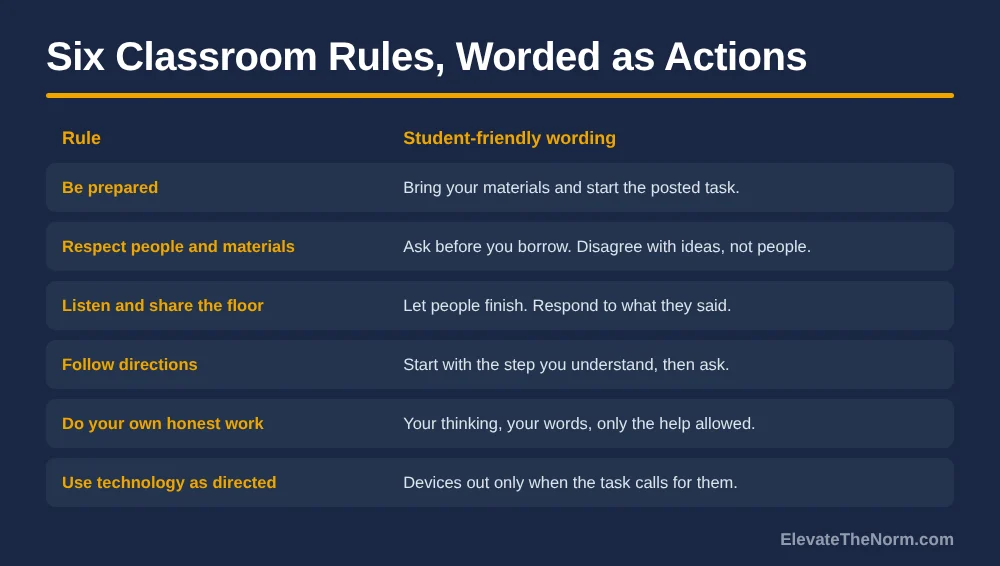
Rule
Student-friendly wording
What it looks like
Be prepared
Bring your materials and start the posted task.
Seated, notebook open, bell ringer started
Respect people and materials
Ask before you borrow. Disagree with ideas, not people.
Pathways clear, supplies returned, no personal digs
Listen and share the floor
Let people finish. Respond to what they said.
Paraphrasing a partner before adding a point
Follow directions
Start with the step you understand, then ask.
Using the help signal instead of sitting idle
Do your own honest work
Your thinking, your words, only the help allowed.
Credited sources, individual parts of group work
Use technology as directed
Devices out only when the task calls for them.
Phones in the agreed spot, only assigned apps open
Six classroom rules for middle schoolers, each written as an action a student can do.
Be Prepared to Start Learning
Define preparation through things students control. Put the first task on the board before the bell so starting doesn’t require you. Keep a quiet supply station so a kid without a pencil can still get to work without announcing it to the room.
Respect People, Personal Space, and Materials
Make respect in the classroom concrete: words, belongings, and space. Include disagreement in your examples. In a World History discussion, students can challenge an interpretation with evidence and still leave a classmate’s intelligence out of it. Respect goes both ways, so model the same standard when you correct someone.
Listen Actively and Share Speaking Time
Listening shows up as letting someone finish and responding to their idea, not as perfect stillness. Tell students how turns work for each activity: raised hands for whole-class discussion, assigned turns for partner work. For the student who talks constantly, try “You’ve shared your idea. Get your partner’s thinking before adding another.”
Follow Directions and Ask for Clarification
Pair the rule with a way to ask for help. Post the steps, explain the first one, and have a couple of students say back what they’re doing before you release the class. If a whole period stalls on a task, check your directions before calling it defiance.
Contribute Your Own Honest Work
Middle schoolers genuinely don’t know where “helping a friend” ends and copying begins. Tell them, per assignment, whether comparing answers, outside help, or AI tools are allowed. In group work, require an individual piece so student responsibility doesn’t disappear into a shared slideshow.
Use Phones and Classroom Technology as Directed
Say where phones go, when devices come out, and which apps fit the task. Line the rule up with school policy and any medical or assistive needs. Permission to use a laptop for research isn’t permission to message or play games, so say that out loud. Before you write that rule, it is worth reading the pros and cons of cell phones in the classroom, and what the ban studies actually show.
How Do You Teach Classroom Rules in the First Weeks?
Posting rules isn’t teaching them. Plan the first two to three weeks as if the rules were a unit.
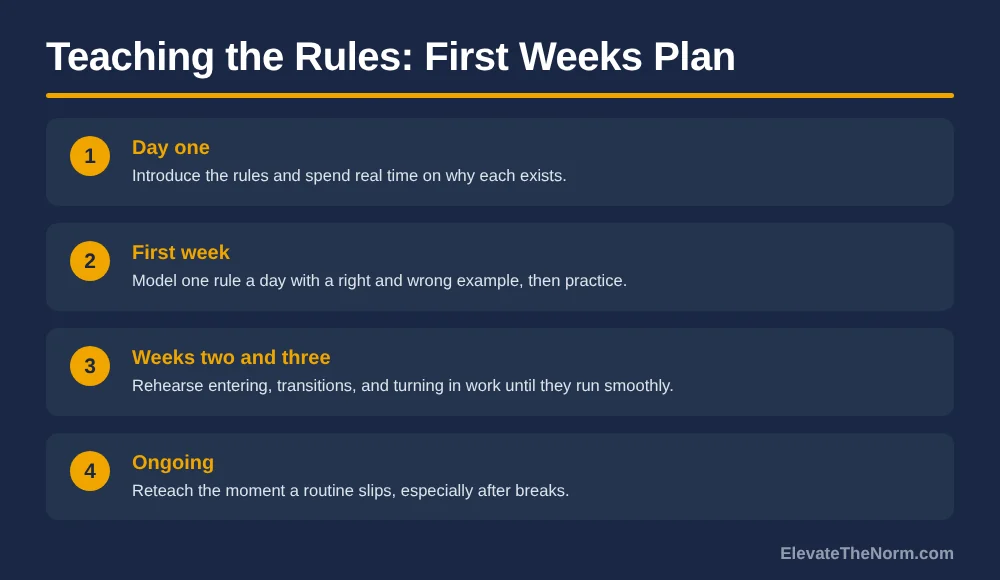
Day one: introduce the rules, and spend real time on why each exists.
First week: model one rule a day, show a right and wrong example, and have students practice it with actual class content.
Weeks two and three: rehearse the procedures behind the rules (entering, transitions, turning in work) until they run without you narrating.
Ongoing: reteach the moment a routine slips, especially after long weekends and breaks.
Keep rehearsals short. Practice a materials transition with the materials you’re about to use, then start the lesson. For new teacher classroom management, writing these rehearsals directly into your lesson plans keeps them from getting skipped when the content feels urgent.
With roughly 150 students across five or six periods, I track which classes need reteaching and which step is the problem. Third period might be fine on entry and a mess on packing up. Reteach that step, not the whole list.
A first-weeks plan for teaching classroom rules like a unit instead of just posting them.
Let Students Shape the Examples, Not the Boundaries
Ask students what helps them focus and what makes group work fair, and use their answers in your examples or on a classroom expectations poster. Be clear about what’s not up for a vote: safety, accommodations, academic honesty, and school policy. A small real choice, like which partner turn-taking routine to try, builds more buy-in than a big fake one.
How Do You Reinforce Rules Without Only Rewarding Perfect Kids?
Recognize specific actions, and judge longer-term awards on consistency and growth. “You asked your partner to explain the evidence before disagreeing” tells a student exactly what to repeat.
Elevate uses three recognition tiers: Immediate Recognition, Student of the Week, and Student of the Month. I run Student of the Week in all my classes, and it’s judged on self-improvement and consistency, not perfection, because nobody’s perfect. A winner might be the student who’s on time every day, participates, and does every bell ringer. The whole program costs me well under a hundred dollars a year, out of my own pocket.
For class-wide habits, a class-vs-class competition like 3-2-1-Done works well once the routine is taught. Each class starts the week at zero and earns points for getting quiet on the countdown, losing a point for every second past “done.” The weekly winner gets a small snack, a drink, and 15-20 minutes of their own time at a low murmur. More ideas live in these whole-class rewards.
What Happens When a Middle Schooler Breaks a Rule?
Follow-through is the whole game. Positive reinforcement only works once students know your kindness isn’t weakness, and they learn that by watching you do exactly what you said you’d do.
Redirect Calmly, Then Move to Remediation
For low-level stuff, start with a quiet reminder that names the next action: “Open your notebook to the question on the board.” I’ll tell a class to quiet down up to three times before I move to remediation. If it keeps happening with one student, have a private conversation and ask what’s getting in the way. It might be a confusing task, missing materials, or a conflict from the hallway.
Don’t take the bait when a student says something to get a reaction. Staying neutral shows confidence, and with seventh and eighth graders a little light humor can defuse it too. A kid isn’t born “hard.” When a student shows up tough, that’s a reason to look for the cause, not a label.
Keep Consequences Predictable
Explain your classroom consequences before you need them, and match the response to the behavior. Misusing shared materials might mean supervised access and cleaning up the workspace. Repeated problems call for documentation and a call home. Follow IEPs, behavior plans, and accommodations every time. Serious discipline belongs with administration, not with you alone.
Repair and Restart
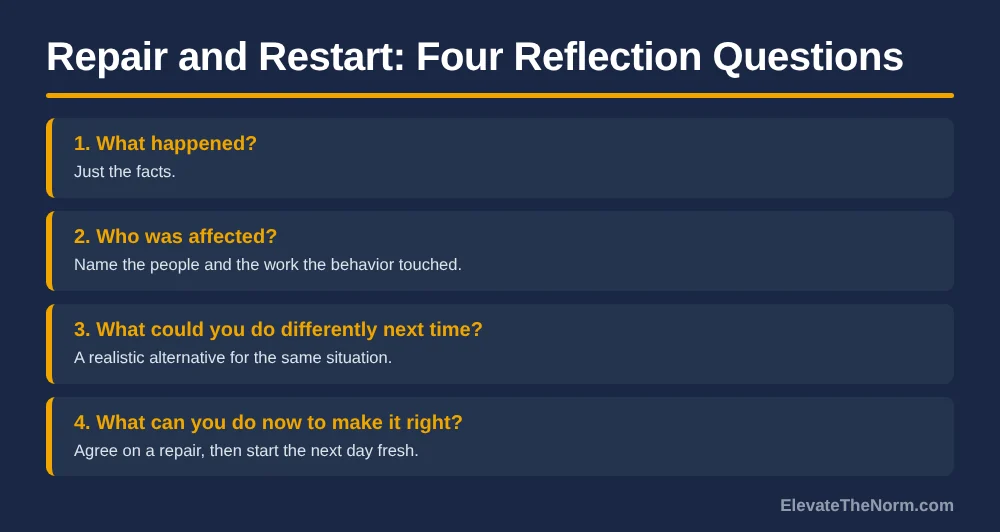
Once a student is calm, a short reflection helps:
What happened, just the facts?
Who was affected?
What could you do differently next time?
What can you do now to make it right?
Agree on a realistic repair, explain exactly where they go and what they do next, and start the next day fresh. For more on this approach, see restorative practices in schools.
Four reflection questions to use once a student is calm after breaking a rule.
Frequently Asked Questions
How many rules should a middle school classroom have?
Five or six. That’s enough to cover preparation, respect, listening, directions, honest work, and technology, and few enough that you can enforce all of them consistently in every period.
Should middle schoolers help write the classroom rules?
Let them shape the examples and wording, but keep the boundaries yours. Student input on what respect or fair group work looks like builds buy-in. Safety, accommodations, and school policy aren’t up for a vote.
How long does it take students to learn classroom rules?
Plan on two to three weeks of steady modeling and practice, with reteaching after breaks. Some groups catch on faster and some take noticeably longer. Consistency matters more than speed.
What should I do when a student keeps breaking the same rule?
Move from quick reminders to a private conversation about what’s getting in the way, then apply the consequence you already explained. Document what you see, contact home, and bring in administration for serious or repeated misconduct.
Keep the List Short and the Follow-Through Steady
Pick your six rules, word them as actions, and spend the first weeks teaching them like content. Then do what you said you’d do, every time, in every period. That consistency is what makes a short list work.
Want printable support for the first weeks? The free Elevate the Norm resource library has classroom tools built for grades 6-12. Free to download, no email required.
About Clay Shumate
Clay Shumate is a certified secondary Social Studies teacher in the public schools of West Alabama, with seven years of classroom experience, a B.A. in History, and an M.Ed. in Secondary Education. He writes about project-based learning, student responsibility, respect, and practical ways to hold young people to a higher standard while giving them room to learn from mistakes. He is a member of the Society of Professional Journalists and writes to its Code of Ethics; this site’s editorial standards and corrections policy are published in full. More about Clay.
The best games for classroom management in grades 6–12 are short, low-prep, and tied to one behavior you actually want to see more of. A rules game show rehearses everyday procedures, a class-vs-class quiet-down competition like 3-2-1-Done speeds up attention resets, and recognition bingo trains you to notice specific contributions instead of “good days.”
The goal is not entertainment. You want students to start work, handle materials, and respond to a reminder without a public standoff. A well-built game gives that practice a little energy and gives you something observable to recognize.
With roughly 150 students across five or six periods, anything you pick also has to run while you teach. Start with a format that needs almost no prep, keeps scoring simple, and never costs a student their dignity.
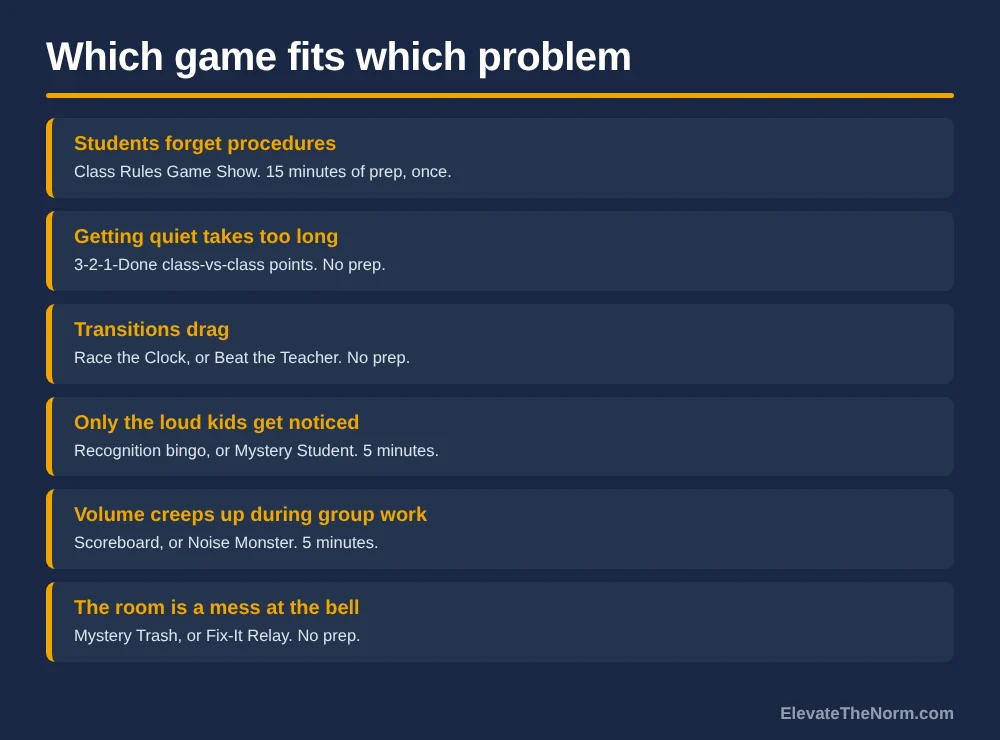
Quick Picks: Which Game Fits Which Problem?
The problem
Try this game
Prep time
Students don’t know (or “forget”) procedures
Class Rules Game Show
15 minutes once
Getting quiet takes too long
3-2-1-Done class-vs-class points
None
Transitions drag
Race the Clock / Beat the Teacher
None
Only the loud kids get noticed
Recognition bingo, Mystery Student
5 minutes
Volume creeps up during group work
Scoreboard or Noise Monster
5 minutes
The room is a mess at the bell
Mystery Trash, Fix-It Relay
None
Match the game to the problem, not to the mood of the room.
Which Games Help Students Practice Rules and Procedures?
The useful games here ask students to explain or demonstrate the next right move. Build the prompts around the classroom routines and procedures you expect during an ordinary lesson.
Class Rules Game Show: Solve Real Classroom Scenarios
Write scenario cards about familiar decisions: walking in after instruction starts, a missing assignment, needing help during independent work. Give partners a moment to agree on an answer before anyone responds.
In a World History class, a prompt might be: “Your group disagrees about what a primary source means. What do you do before you ask for help?” Award points for naming the discussion procedure and for disagreeing respectfully.
Leave your classroom rules posted during the early rounds. You are rehearsing how to apply them, not testing memory, so let students check the expectations and fix an incomplete answer before you score it.
Rules Charades and Odd One Out: Show the Expected Behavior
Use charades for visible procedures like returning borrowed supplies or joining an assigned group. A volunteer acts out the procedure; the class names it and says when to use it. Keep the acting focused on the right behavior. Nobody performs a classmate’s mistake.
For odd one out, put four possible actions on the board for a transition, one of which breaks the procedure. Partners explain their pick. If a group defends a different answer with good reasoning, accept it and tighten the prompt for next time.
Complete the Phrase and Hot Seat: Recall Everyday Procedures
Post sentence starters like “When your group needs clarification…” or “Before you turn in your document analysis…” and have students finish them with your actual procedure.
Make hot seat an opt-in expert role. The volunteer can consult a partner or the posted directions, and the “seat” can stay at their desk if standing up front would turn practice into pressure. For a quick variation, have students match situation cards to response cards, then demonstrate one so you check doing, not just remembering.
Classroom Bingo: Recognize Specific Routines, Not Perfect Periods
Build the bingo card from observable actions: “returned borrowed materials,” “asked a clarifying question,” “used evidence during a disagreement,” “started the bell ringer after checking directions.”
Use one shared class card and mark a square when you see the action. Say what you saw out loud without naming a student who would rather not be singled out. A mistake never erases a square. Students should know exactly which action earns a mark and when the round ends.
Which Games Make Transitions and Attention Resets Easier?
Define what “ready” looks like before you add a timer or a score. Tie each game to one specific classroom transition, such as moving from partner talk to independent writing.
3-2-1-Done: A Class-vs-Class Quiet-Down Competition
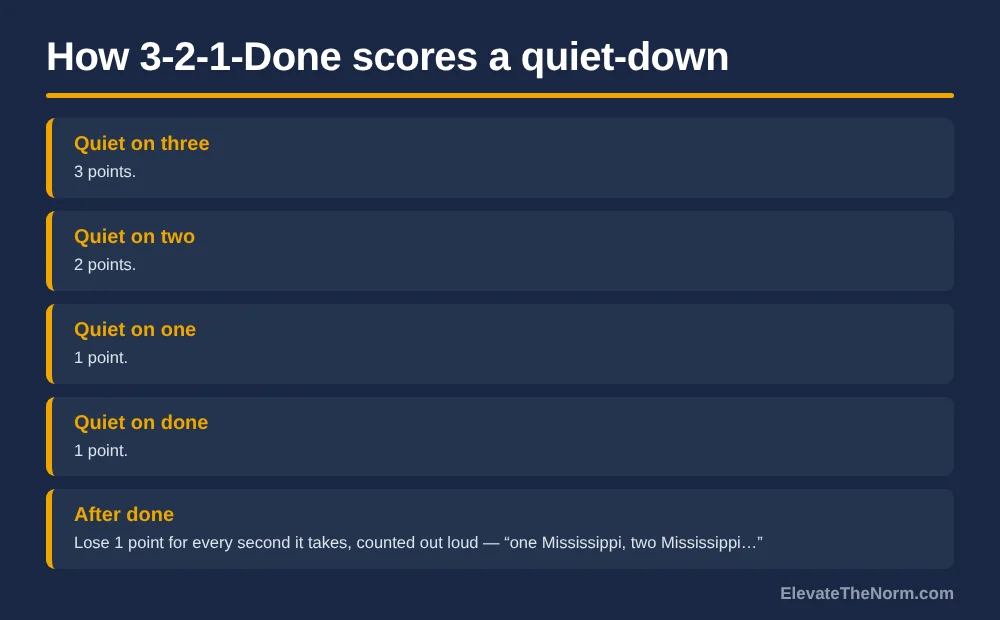
This is the one I run every week. Every class period starts Monday at zero. When I count down “three, two, one, done,” the room earns points based on when it goes quiet:
Quiet on three: 3 points
Quiet on two: 2 points
Quiet on one: 1 point
Quiet on done: 1 point
After done: lose 1 point for every second it takes, counted out loud (“one Mississippi, two Mississippi…”)
The countdown rewards the early finish and prices the slow one.
You can add an optional plus for every student turning in work and a minus for tardies, but keep the negatives small. The class with the most points at the end of the week wins a simple prize (a snack and a water work) plus 15–20 minutes of their own time, as long as they stay seated at a low murmur.
Two things make it work. First, consistency: the same rules, the same reward, every week, in every period. Second, patience. Buy-in usually takes me about three weeks; some groups take closer to six. Check food restrictions and have a nonfood option ready, and keep the scoring yours. Students should never be able to point at one classmate as the reason the class lost.
Race the Clock and Beat the Teacher: Readiness Over Speed
Post the finish line before you start: materials put away, pathways clear, next task out. Time an ordinary transition to get a baseline, then challenge the class to beat it by a realistic margin. If students start rushing, throwing supplies, or pushing each other, stop the clock and rehearse again.
For beat the teacher, race your own setup routine against the class’s readiness routine. Keep it playful, award the win only when the posted conditions are met, and never tie winning to early dismissal or skipped instruction.
Signal Simon Says and Follow-the-Leader: Rehearse Attention Cues
During an announced practice round, pair your normal attention cue with the response you expect: conversation stops, eyes go to the projected direction. Keep it predictable. No trick cues, no eliminations, and a slow response is practice, not defiance.
For follow-the-leader, model a short prep sequence, then let a volunteer lead the next round. Then use the exact same cue during the real academic task.
Silent Line-Up and Mystery Walker: When Students Need to Move
Line-up games only matter if your class actually travels, say to a lab or an assembly. Explain the destination and spacing first, and let students communicate by gesture or from a displayed sequence. For mystery walker, keep the chosen student private, recognize success privately, and never reveal who “cost” the group.
Silent Ball: A Quick Reset Without Elimination
Use silent ball only if you have clear space and your school allows it. Use a soft object, require controlled passes, and keep everyone in after a dropped catch. Offer a seated pass or tabletop roll without making anyone explain why. If catching is a barrier, swap in one of these brain breaks for high schoolers.
How Can Recognition Games Build Responsibility and Community?
Recognition builds community when it names contributions students can repeat. Notice listening and responsibility, not just the loud, visible moments.
Caught Being Kind and Compliment Chain
For caught being kind, write down what you saw: sharing notes, making room for another speaker, cleaning up a shared space. Then tell the student exactly what you noticed. For a compliment chain, students submit short acknowledgments of classmates’ contributions; you review them before anything goes up, and anyone can keep recognition private.
This is a quiet way to support building relationships with students. Skip nominations that turn into popularity contests, comments on appearance, and praise that exposes someone’s personal situation.
Mystery Student: Private Recognition, No Peer Blame
Announce the behavior you’re watching for, privately pick a student, and look for a real example during the lesson. If you see it, recognize them discreetly and ask before sharing it with the class. If they struggle, help like you normally would. Keep any class reward separate from that one student, and rotate your picks so the confident kids don’t soak up all your attention.
Secret Goal and Boss Battle: Make Shared Progress Visible
For secret goal, the class picks one practice goal from your approved list. For boss battle, name a recurring problem (slow group setup, say), draw a progress bar, and fill it in when you see the routine done right. Both work as activities for teaching responsibility because every mark ties to something students control. Earned progress stays after a mistake.
Scoreboard and Noise Monster: Volume Without Shaming
Set the right volume for the task before you score it. Partner analysis needs talk; independent reading doesn’t. If students like a “noise monster” visual, let them design it and move it toward the finish when the room matches the expectation. Never project individual names, and don’t treat a dropped book as a penalty. Give a neutral reminder and time to adjust first.
Which Cleanup Games Support Care for Shared Materials?
Cleanup games work when every student has a defined job and the safety rules are clear.
Mystery Trash
Before cleanup, privately pick one safe piece of ordinary classroom scrap. Announce that you’ll recognize careful cleanup, and reveal the mystery item once the room is ready. Recognize everyone’s effort, not just whoever grabbed it. Never scatter extra trash to make a round, and keep food waste, sharp objects, and broken equipment out of the game.
Supply Hospital Instead of a Supply Graveyard
Set up a labeled bin for items that need attention, with a slip where students describe the problem (“marker needs a cap,” “folder pocket torn”). Students handle only the fixes you’ve taught; you handle anything sharp, chemical, or electrical. Skip the “graveyard” display that names students. The routine should end with supplies back in use or properly thrown away.
Fix-It Relay
Run it as a sequence of jobs rather than a race: a checker finds misplaced items, a restorer organizes them, a verifier checks the station. Rotate the group work roles, keep everyone walking, and finish when every station meets its posted condition. Map sets and primary-document packets get checked before anyone is dismissed.
Trash Toss
Use only clean scrap paper headed for recycling. Set a clear throwing line, keep the bin away from people and devices, and offer a walk-up “place it in” option worth the same credit. Never run throwing turns while others are still cleaning.
How Do You Keep Games Fair, Manageable, and Worth the Time?
A game earns its place when it teaches one narrow expectation, every student can access it, and the routine it targets actually improves.
Pick One Target Behavior and Teach It Before You Score It
Choose something you can see consistently, like supplies returned to labeled spots. “Be respectful” needs examples before anyone can practice or score it. Model it, let students rehearse, fix confusing directions, then add points. For new teacher classroom management especially, a one-line written rule keeps your scoring the same across periods.
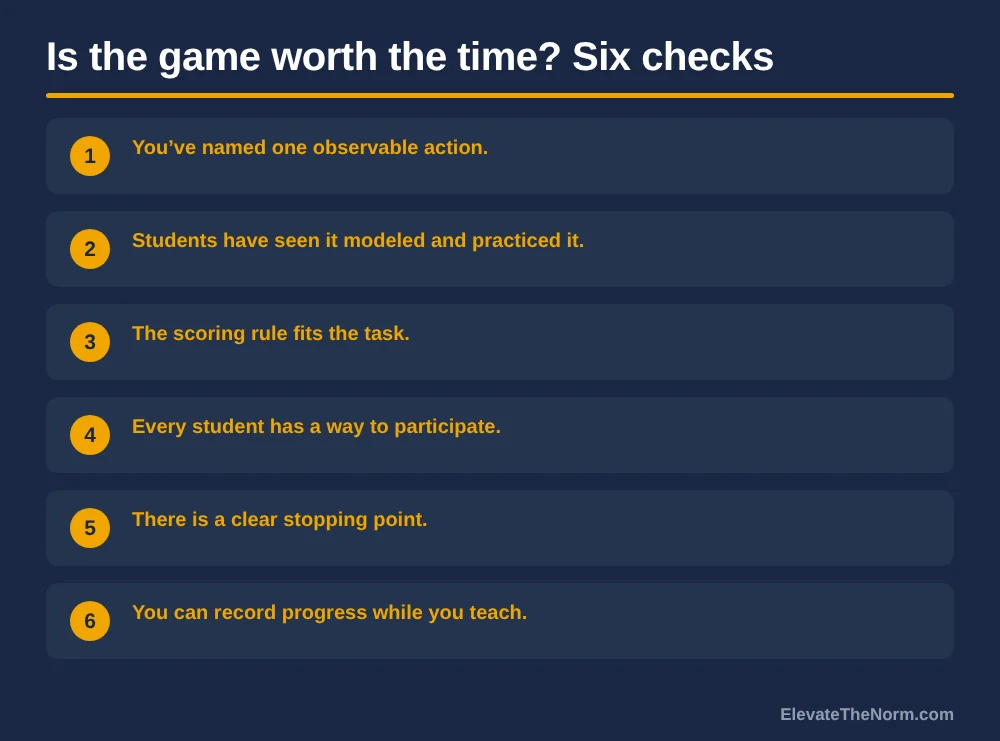
Before you launch any game, check:
You’ve named one observable action.
Students have seen it modeled and practiced it.
The scoring rule fits the task.
Every student has a way to participate.
There is a clear stopping point.
You can record progress while you teach.
Six checks. Miss one and the game costs more than it returns.
Small Rewards, Three Tiers, No Perfection Required
Lead with specific verbal recognition and keep prizes small. Success should come from consistency and self-improvement, not perfection. In the Elevate approach, recognition runs on three tiers: Immediate Recognition, Student of the Week, and Student of the Month. Announce the criteria ahead of time and keep a short record so quieter students don’t disappear. The whole prize budget runs me well under a hundred dollars a year out of pocket, and no-cost privileges your school approves work too.
Plan for Accommodations and Stop Peer Policing Early
IEPs, behavior plans, required accommodations, and school safety procedures always outrank a game rule. Build access in before you announce the game, and keep individual supports private. Teach one boundary directly: you handle corrections and scoring. If students start blaming a classmate, pause the game, deal with it privately, and resume when the class is ready.
Keep Consequences Predictable
Positive reinforcement only works when students know your kindness isn’t weakness, so your classroom consequences stay the same during a game. If you use Jenga for procedure or reflection prompts, never tie a fallen tower to lost privileges. When behavior needs correcting, use your normal steps: a low-key redirect, a private conversation, then the next step in your plan.
Track Progress and Fade the Game Out
Record whatever prompted the game: transition time, number of reminders, materials returned. Compare each class only with itself, since group size and needs make cross-period rankings misleading. As the routine sticks, score it less often but keep the specific praise. If the game takes more managing than the original problem, simplify it or go back to plain rehearsal.
Everything in this list is aimed at a behaviour or a routine, not at content, and that is deliberate — short games are the cheap tool. When you want students retrieving subject content under pressure instead, that is a different build with a much higher prep cost, and the classroom escape room guide covers what it takes and what the research does and does not support.
Frequently Asked Questions
Do classroom management games work with high school students?
Yes, if they look like practice and not like an elementary sticker chart. Teenagers respond to competition between class periods, specific recognition, and real privileges like a few minutes of their own time. Skip anything that feels babyish or singles students out.
How long should a classroom management game take?
Most should take under five minutes, or run quietly in the background like 3-2-1-Done. If a game regularly eats more than a few minutes of instruction, it’s costing more than it’s fixing.
Should whole-class games ever use group punishment?
No. Keep rewards shared and corrections individual and private. When one student can sink the whole class, peers start policing each other, and that damages the culture you’re trying to build.
How do I get students to buy in?
Run the same rules and the same reward every single week. Buy-in usually shows up within a few weeks, but some groups take longer. The teacher who stays consistent wins.
Start With One Routine Students Can Win
Pick one familiar routine and one game that lets students practice it successfully. Teach the action, give every student a way in, and recognize good behavior with specific examples. As the routine improves, score less and keep noticing the contributions that make your room run.
Want a printable starting point? The free Elevate the Norm resource library has classroom tools built for grades 6–12. Free to download, no email required.
About Clay Shumate
Clay Shumate is a certified secondary Social Studies teacher in the public schools of West Alabama, with seven years of classroom experience, a B.A. in History, and an M.Ed. in Secondary Education. He writes about project-based learning, student responsibility, respect, and practical ways to hold young people to a higher standard while giving them room to learn from mistakes. He is a member of the Society of Professional Journalists and writes to its Code of Ethics; this site’s editorial standards and corrections policy are published in full. More about Clay.
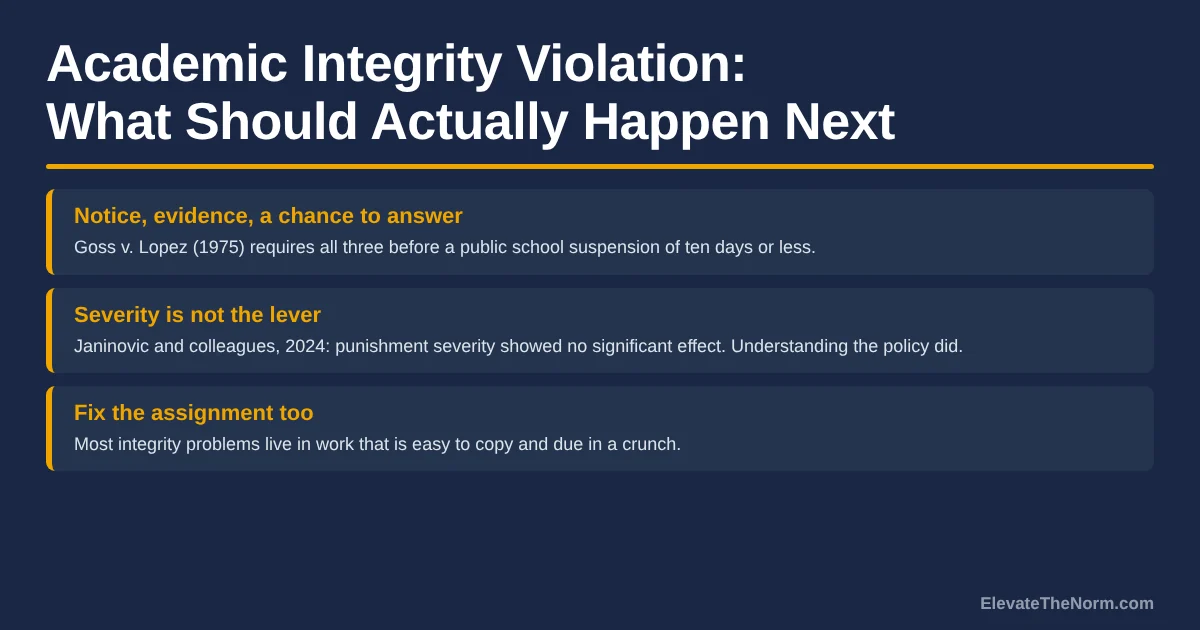
An academic integrity violation is a confirmed act of cheating, plagiarism, unauthorized collaboration, or falsified work. A defensible school response has four parts: tell the student the charge and the evidence, let them answer, apply a consequence tied to the assignment, and require the work be redone honestly. Punishment severity is not what deters it.
That last sentence is the one most handbooks get backwards. The instinct after catching a kid cheating is to make the penalty hurt enough that nobody tries it again. The evidence does not support that instinct, and the rest of this page is about what to do instead — the sequence, the script, the paperwork, and the line where it stops being yours to handle.
Key Takeaways
Notice, evidence, and a chance to answer are not a courtesy. In Goss v. Lopez (1975) the Supreme Court held that a public school student facing a suspension of ten days or less is owed oral or written notice of the charges, an explanation of the evidence, and an opportunity to present his side of the story.
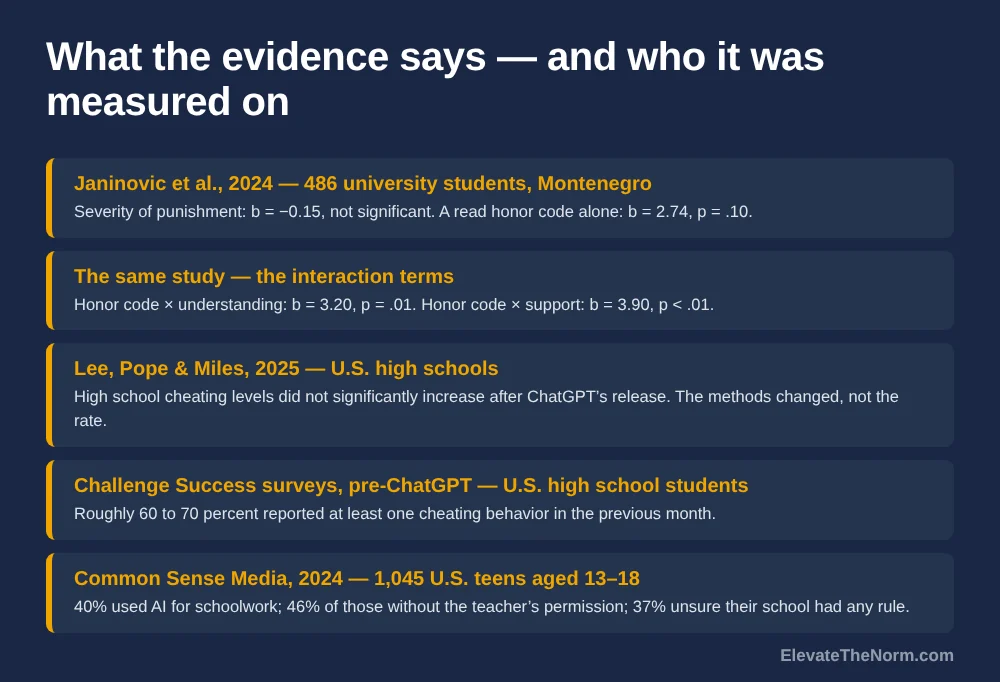
🔴 Severity of punishment showed no measurable effect. Janinovic and colleagues surveyed 486 university students and found severity of punishment did not significantly predict how seriously students regarded cheating (b = −0.15, not significant). A read honor code was weak on its own (b = 2.74, p = .10).
Understanding the policy is what made either one work. In the same study, the honor code’s effect grew sharply among students who understood the rules (interaction b = 3.20, p = .01) and among those who supported them (b = 3.90, p < .01).
AI did not cause a cheating spike in high schools. Lee, Pope and Miles report in Phi Delta Kappan that high school cheating levels did not significantly increase after ChatGPT’s release. Before it, roughly 60 to 70 percent of students in Challenge Success surveys reported at least one cheating behavior in the previous month.
🔴 Students often cannot tell you what the rule is. In a Common Sense Media survey of 1,045 U.S. teens aged 13 to 18, 40 percent had used generative AI for a school assignment, 46 percent of those said their most recent use was without the teacher’s permission, and 37 percent were not sure whether their school had any AI rules at all.
Free Download · PDF
Academic Integrity Violation Response Sheet
A three-page printable: the six-step response sequence, the five escalation triggers, a six-line incident record template, and the five-move conversation script. No email required.
Free. No email address required. Designed for grades 6–12. Browse every printable in Your Free Library.
What Counts as an Academic Integrity Violation?
An academic integrity violation is a confirmed act of presenting work that is not honestly yours, or helping someone else do it. In grades 6–12 that comes down to five recurring categories: plagiarism, copying on an assessment, unauthorized collaboration, fabricated sources or data, and unauthorized use of a tool. Everything else is a variation on one of those.
The word doing the work in that definition is confirmed. A suspicion is not a violation. A hunch about a kid’s writing style is not a violation. Until you have evidence you can state out loud to the student, you have a question, and the honest move is to go ask it. If you want the positive version of all this — what integrity looks like when nothing has gone wrong — start with what academic honesty actually means and the worked examples of honest and dishonest work.
The International Center for Academic Integrity frames the whole subject around six values: honesty, trust, fairness, respect, responsibility, and courage. That framing is more useful than it sounds, because it tells you what a violation actually damages. A kid who copies a lab table has not broken a rule about lab tables. He has taken a shortcut that, if everyone took it, would make the grade meaningless for the students who did the work. That is the thing worth saying to him, and it is more persuasive to a sixteen-year-old than a policy number.
Category
What it usually looks like in grades 6–12
A first-time response that fits
When it escalates
Plagiarism
Paragraphs pasted from a site or a classmate, no citation, often mid-paper where the student ran out of time
Conference, zero on the affected section, honest rewrite due on a set date, contact home
Whole paper, repeat offense, or a graded research project
Copying on an assessment
Phone under the desk, answers shared between class periods, a photographed quiz
Retake of a different version, grade on the retake, documented conference, contact home
Final exam, state or AP testing, or a distributed answer key
Unauthorized collaboration
Two nearly identical homework sets from students who were told to work alone
Both students redo separately; teach the difference between helping and handing over
Repeat after the rule was taught and documented
Fabricated sources or data
Citations that do not resolve, a survey nobody ran, numbers that do not match the raw data
Zero on the evidence portion, resubmit with verifiable sources, conference
Any work entering a competition, publication, or transcript-level grade
Unauthorized tool use
A chatbot wrote it; a translator wrote it; a solver produced the steps
Student reproduces the thinking in front of you; grade reflects what they can actually do
Repeat, or a rule the student can prove was never communicated — that one is on the adults
Two things about that table. The responses in column three all attach to the assignment rather than to the student’s record, and every one of them ends with the student doing the work. That is deliberate, and it is the same logic behind consequences that teach instead of humiliate.
What Happens If You Get an Academic Integrity Violation?
The sequence that holds up is a conference, a written record, a contact home, a consequence attached to that assignment, and a required honest redo. Formal discipline — detention, suspension, removal from an honor society, loss of eligibility — belongs to repeat cases and major assessments, not to a first-time homework copy. Your handbook may say otherwise, and your handbook wins.
The order matters. Steps one to three happen before you decide anything.
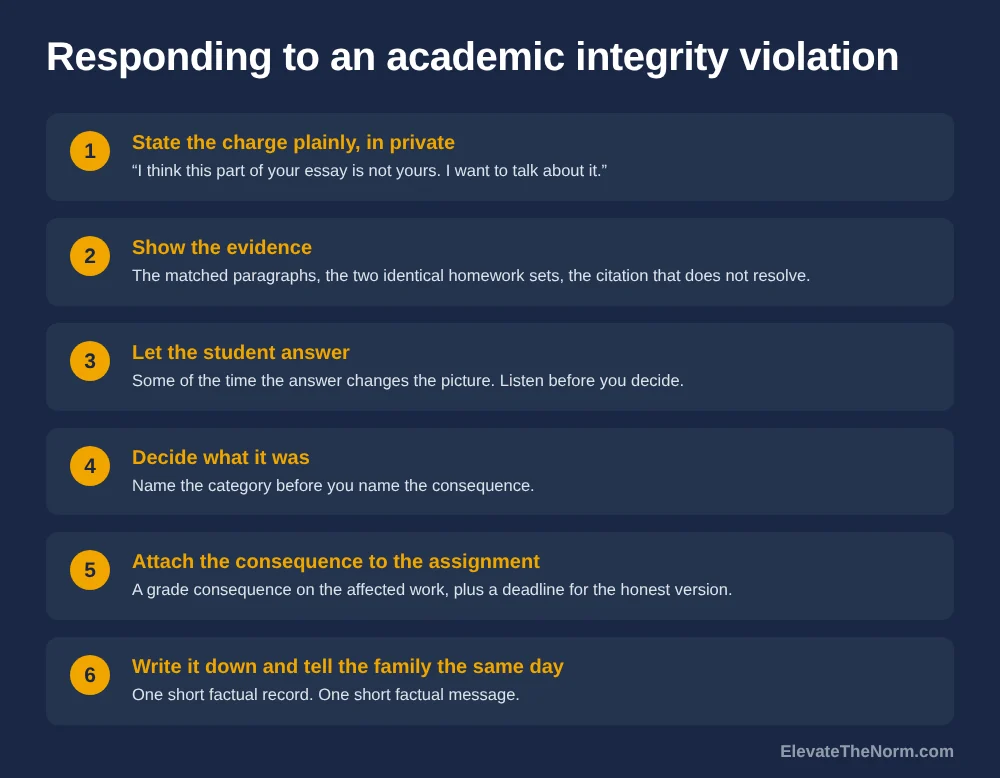
Here is the order I would run, and the order matters more than any single step in it.
State the charge plainly, in private. “I think this part of your essay is not yours. I want to talk about it.” Not in front of the class, not in the hallway, not by email first.
Show the evidence. The matched paragraphs, the two identical homework sets, the citation that does not resolve. If you cannot show it, you are not ready to have the conversation.
Let the student answer, and actually listen. Some of the time the answer changes the picture. A kid who shared notes with a friend who then copied them has done something different from the kid who copied.
Decide what it was. Name the category. “Plagiarism” and “you cut corners because you were out of time” call for the same consequence and a very different conversation.
Attach the consequence to the assignment. A grade consequence on the affected work, plus a deadline for the honest version. Not a zero in the gradebook forever, and not a behavior referral for a homework problem.
Write it down and tell the family the same day. One short factual record and one short factual message. There is a full walkthrough of the message itself under writing the email home.
Step five is where most policies go wrong in the direction of leniency and most teachers go wrong in the direction of severity. A permanent zero teaches a student that the fastest way out of an integrity problem is to stop caring about the grade. Requiring the real work, on a real deadline, with the grade reflecting what they can genuinely do, is both harder on the student and more useful to them. That is the whole argument of accountability and a second chance.
Does a Harsher Penalty Stop Cheating?
The best available evidence says it does not. Janinovic, Pekovic, Djokovic and Vuckovic surveyed 486 students with a 97 percent response rate and found that students’ rating of how severe the penalties were had no significant relationship to how seriously they regarded cheating. The direct effect was b = −0.15, not significant — and the sign is pointing the wrong way.
Note the populations. The study with the cleanest numbers on it was not run on teenagers.
Having an honor code did a little better and not much: b = 2.74, significant only at the 10 percent level, which the authors themselves describe as partial support. What changed the picture was the interaction terms. Among students who understood the policies, the honor code’s effect rose to b = 3.20 (p = .01), and among students who supported them, to b = 3.90 (p < .01). Severity also became significant once students understood the rules, and never mattered on its own.
Now the honest limits, because they are substantial. That study ran on university students in Montenegro, not American teenagers. The data were collected between December 2019 and March 2020. The outcome was students’ perceived seriousness of cheating, which is not the same thing as whether they cheated. It is self-report, from one institution, in one country. The paper’s own text and tables do not fully agree on two of the coefficients. None of that makes it useless — it is a carefully controlled model on a real sample asking exactly the right question — but anyone telling you that research proves harsh penalties do not work has overstated it. What it supports is narrower and still worth acting on: severity alone has no demonstrated effect, and comprehension has a measured one.
Which has a practical consequence. If you want fewer violations next semester, the time is better spent making sure every student can state the rule in their own words than on rewriting the penalty schedule.
What Does Due Process Require Before You Punish a Student?
In a U.S. public school, Goss v. Lopez (1975) requires oral or written notice of the charges, an explanation of the evidence the school has, and an opportunity for the student to present their side before a suspension of ten days or less. The Court asked for “at least an informal give-and-take between student and disciplinarian, preferably prior to the suspension.”
Read what that is and is not. The Court did not require a lawyer, cross-examination, or witnesses for a short suspension. It did say longer removals may require more. And it allowed immediate removal where a student’s presence is a continuing danger or an ongoing threat of disruption, with notice and hearing to follow as soon as practicable.
I am a teacher, not a lawyer, and none of this is legal advice — your student handbook, your state code and your district’s counsel govern what you can actually do. But the shape of it transfers cleanly to a grade-level integrity case even where no suspension is on the table, and it is the same three steps as the top of the sequence above. Notice. Evidence. A chance to answer. A school that does those three things before deciding has already removed most of the ways this goes badly.
How Do You Handle an AI Case You Cannot Prove?
Treat an unprovable AI case as an assignment problem rather than a discipline case. Ask the student to walk you through their process and reproduce the thinking in front of you. If they cannot, the work does not demonstrate the standard, and that is a grading judgment you can defend without accusing anyone of anything.
This matters because the accusation is the part you cannot take back. A detector score is not evidence a student can answer, and a kid who did the work and gets called a cheater remembers it for years. The grading route asks the same underlying question — can this student do this? — and survives being wrong.
It also helps to know the scale of the problem is not what the headlines say. Lee, Pope and Miles report in Phi Delta Kappan that high school cheating levels did not significantly increase after ChatGPT’s release; what changed was the method, not the rate. Before ChatGPT, Challenge Success surveys of U.S. high school students were already finding roughly 60 to 70 percent reporting at least one cheating behavior in the previous month. That number is the actual problem, and it predates every tool anyone is currently panicking about.
Meanwhile the rules are genuinely unclear to students. In Common Sense Media’s 2024 survey of 1,045 teens, 35 percent said their school had generative AI rules, 27 percent said it had none, and 37 percent were not sure. Among teens who had used AI for schoolwork, 46 percent said their most recent use was without the teacher’s permission. You cannot run an integrity case on a rule a third of your students cannot confirm exists. Write the rule for each assignment, in a sentence, on the assignment.
What Should the Conversation Sound Like?
Short, private, factual, and finished in five minutes. The goal is not a confession. It is a shared understanding of what happened and what the student is going to do about it. Five moves:
Open with the fact, not the verdict. “These two paragraphs match a site I found. Tell me about them.”
Let the silence sit. Most students fill it. Some of what they say will change your mind.
Separate the act from the kid. “This was copied” is a statement about the paper. “You are a cheater” is a statement about a person, and it ends the useful part of the conversation.
Name what happens, all of it, at once. The grade, the redo, the deadline, the call home. No drip-feed of consequences over three days.
End on the path back. “Turn in the real version by Friday and we are square on this.” Then honor that exactly. Standing by your word is the entire mechanism here.
If your school runs formal restorative conferences, this conversation is the classroom-scale version of one, and the honest limits of that approach are covered under restorative practice in schools.
How Do You Document It Without Building a Case Against a Kid?
Write down what you can show and what was decided, and nothing else. The record exists so a future adult — a counselor, an administrator, next year’s teacher — can see what already happened. It does not exist to prove you were right.
A usable record has six lines: date, assignment, what you observed, what the student said, what was decided, and when the honest work is due. That is it. Leave out adjectives, leave out your read on the student’s character, and leave out anything you could not repeat to the family. Then check four things before you file it:
Could the student read this record and recognize the conversation they were in?
Is every factual claim in it something you can still show next month?
Does it record what the student said, including the parts that cut against you?
Does it name a specific next step with a date, so the case can actually close?
When Does This Stop Being a Classroom Matter?
The moment the consequence reaches beyond your gradebook, it is no longer only your call. Hand it up when any of the five triggers below is true — not because you cannot handle it, but because consequences that touch a transcript, an eligibility list or a disciplinary record are supposed to run through the people whose job that is.
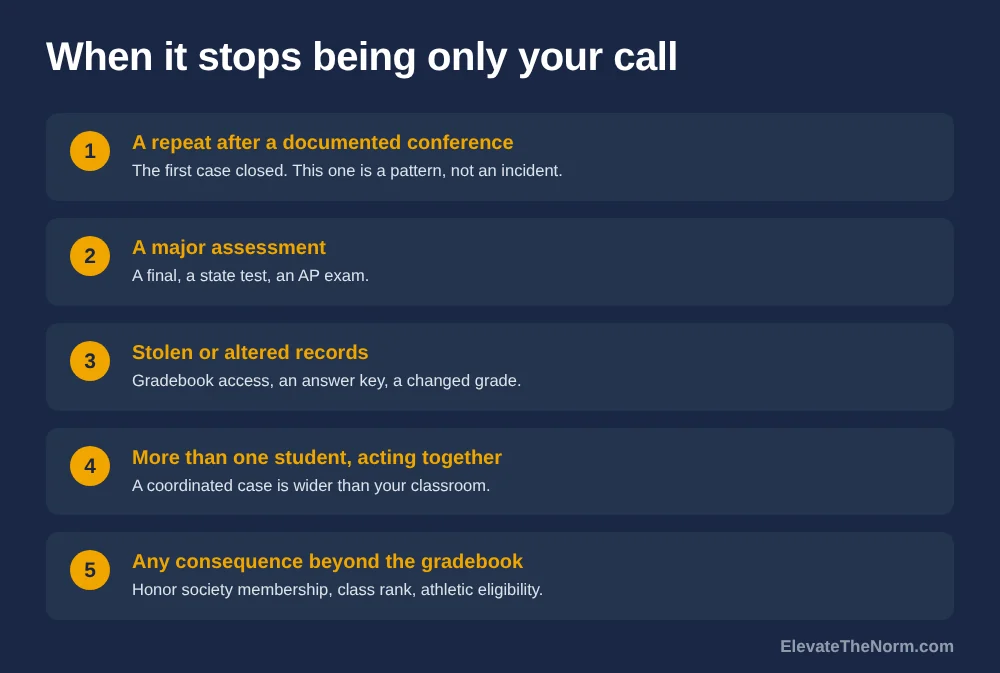
If one of these is true, it is not your call alone to make.
Those triggers are: a repeat after a documented conference; a major assessment such as a final, a state test or an AP exam; stolen or altered records, including access to a gradebook or an answer key; more than one student involved in a coordinated way; and any consequence touching honor society membership, class rank or athletic eligibility. If you are unsure which side of the line a case falls on, ask an administrator before you act, not after.
What Should Change in Your Assignments Afterward?
Assume the next violation will come from the same assignment design, because it usually does. After you close a case, look at the task rather than the kid. Most integrity problems in a secondary classroom live in work that is easy to copy, graded heavily, and due at a moment when honest students are also out of time.
Four changes that cost almost nothing:
Put the tool rule on the assignment. One sentence: what help is allowed, what is not, and what you expect students to be able to explain afterward.
Make part of the grade live in the room. A two-minute defense, a handwritten annotation, a revision done in class. Work that has to be explained is work that has to be understood.
Fix the deadline crush before it arrives. A lot of copying is a time problem wearing an integrity costume, which is an argument for a late-work policy you can actually hold rather than a stricter penalty.
Stop reusing the assessment that got photographed. It is gone. Rewrite it.
My position on all of this, as a classroom teacher: if a student can get all the way through a major assignment dishonestly without anyone noticing until the end, part of that is a planning problem, and the response should include fixing the plan. Holding a kid accountable and looking hard at the task that made it easy are not in competition.
What to Do Next
Pick the single assignment in your current unit that would be easiest to cheat on, and add the two cheapest fixes to it: one sentence on the assignment saying what help is allowed, and one small in-class component the student has to explain out loud. Then, before the next case lands, write your six-line record template and decide in advance which of the five escalation triggers sends a case up the hall. Deciding that while nothing is happening is much easier than deciding it with a crying sophomore in your room.
Want this as a printable? The six-step sequence, the record template and the conversation script, on three printable pages. Download the free PDF — no email address required.
Frequently Asked Questions
What is an academic integrity violation?
It is a confirmed act of presenting work that is not honestly yours, or helping someone else do it. In middle and high school the recurring categories are plagiarism, copying on an assessment, unauthorized collaboration, fabricated sources or data, and unauthorized use of a tool such as a chatbot or a solver. The word that matters is confirmed — a suspicion about a student’s writing style is a question to go ask, not a violation to act on.
What happens if you get an academic integrity violation in high school?
Typically a private conference with the teacher, a short written record, a contact home, a grade consequence on the affected assignment, and a requirement to redo the work honestly by a set date. Formal discipline such as detention, suspension, loss of eligibility or removal from an honor society is generally reserved for repeat cases and major assessments. Your school handbook governs the specifics and should be read before anyone acts.
Does a harsher punishment stop students from cheating?
There is no good evidence that it does. Janinovic and colleagues (2024) surveyed 486 university students and found that how severe students rated the penalties had no significant effect on how seriously they regarded cheating. An honor code had only a weak direct effect. Both became more effective among students who understood the policies. That study was run on university students in one country, so treat it as suggestive rather than settled.
Does a student have due process rights in an academic integrity case?
In a U.S. public school, Goss v. Lopez (1975) requires that a student facing a suspension of ten days or less receive oral or written notice of the charges, an explanation of the evidence, and a chance to present their side first. The Court did not require counsel or cross-examination for short suspensions, and longer removals may require more. This is general information, not legal advice — your handbook, state code and district counsel control.
Has AI made cheating worse in high schools?
Not in rate, according to the available research. Lee, Pope and Miles report in Phi Delta Kappan that high school cheating levels did not significantly increase after ChatGPT’s release, though the methods changed. Before ChatGPT, Challenge Success surveys were already finding roughly 60 to 70 percent of high school students reporting at least one cheating behavior in the previous month. The baseline, not the tool, is the real problem.
What do you do when you suspect AI use but cannot prove it?
Handle it as a grading question rather than a discipline case. Ask the student to walk you through their process and reproduce the thinking in front of you. If they cannot, the work does not demonstrate the standard and the grade should reflect what the student can actually do. That judgment is defensible, survives being wrong, and avoids an accusation you cannot take back if a detector score was all you had.
When should a teacher send an integrity case to an administrator?
When the consequence would reach beyond the gradebook. Five common triggers: a repeat after a documented conference, a major assessment such as a final or a state test, stolen or altered records including gradebook or answer-key access, several students acting in a coordinated way, and any consequence touching honor society membership, class rank or athletic eligibility. If a case is close to the line, ask before acting rather than after.
Sources
Goss v. Lopez, 419 U.S. 565 (1975). U.S. Supreme Court. Holding on notice, explanation of evidence and opportunity to respond for suspensions of ten days or less. law.cornell.edu
Janinovic, J., Pekovic, S., Djokovic, R., & Vuckovic, D. (2024). Assessing the Effectiveness of Academic Integrity Institutional Policies: How Can Honor Code and Severe Punishments Deter Students’ Cheating—Moderating Approach? SAGE Open, 14(4). 486 students at one university in Montenegro, data collected December 2019 to March 2020, Tobit regression. Reported with its stated limits: the outcome is perceived seriousness of cheating rather than cheating itself, the data are self-report from a single institution, and the text and tables disagree on two coefficients.journals.sagepub.com
Lee, V. R., Pope, D., & Miles, S. (2025). Cheating: The AI elephant in the classroom. Phi Delta Kappan, 107(3–4), 24–28. Key finding quoted here: high school cheating levels did not significantly increase after ChatGPT’s release. The article is restricted-access; the abstract was read and no figure is attributed to it beyond that statement.journals.sagepub.com
Stanford Graduate School of Education (2023). What do AI chatbots really mean for students and cheating? Interview with Denise Pope and Victor Lee on Challenge Success survey data. Source of the 60–70 percent pre-ChatGPT figure and of Pope’s note that the surveys were anonymous and may be underreported. ed.stanford.edu
Common Sense Media (2024). The Dawn of the AI Era: Teens, Parents, and the Adoption of Generative AI at Home and School. Nationally representative survey of 1,045 U.S. teens aged 13–18 and their parents, fielded March 15 to April 20, 2024. commonsensemedia.org
International Center for Academic Integrity. The Fundamental Values of Academic Integrity (3rd ed., 2021) — honesty, trust, fairness, respect, responsibility and courage. Values list verified against ICAI’s own published summary. academicintegrity.org
About Clay Shumate
Clay Shumate is a certified secondary Social Studies teacher in the public schools of West Alabama, with seven years of classroom experience, a B.A. in History, and an M.Ed. in Secondary Education. He writes about project-based learning, student responsibility, respect, and practical ways to hold young people to a higher standard while giving them room to learn from mistakes. He is a member of the Society of Professional Journalists and writes to its Code of Ethics; this site’s editorial standards and corrections policy are published in full. More about Clay.
Every teacher has had the moment. A paragraph comes in that’s a little too polished, a little too confident, and a little too empty. You know where it came from.
Banning AI won’t fix that. It just moves the use out of sight. A better approach is to teach students to use AI the way we teach them to use any source: with a healthy dose of suspicion.
Treat AI Like a Source, Not an Answer Key
AI is fast and sounds sure of itself, and it is wrong more often than students expect. It can mix up two historical figures or invent a source that doesn’t exist, all in the same calm tone. That’s useful for teaching. The first time a student catches the AI in a mistake, they stop treating it like an oracle and start treating it like a classmate who sometimes bluffs.
A Simple Five-Step Routine
This works in any subject:
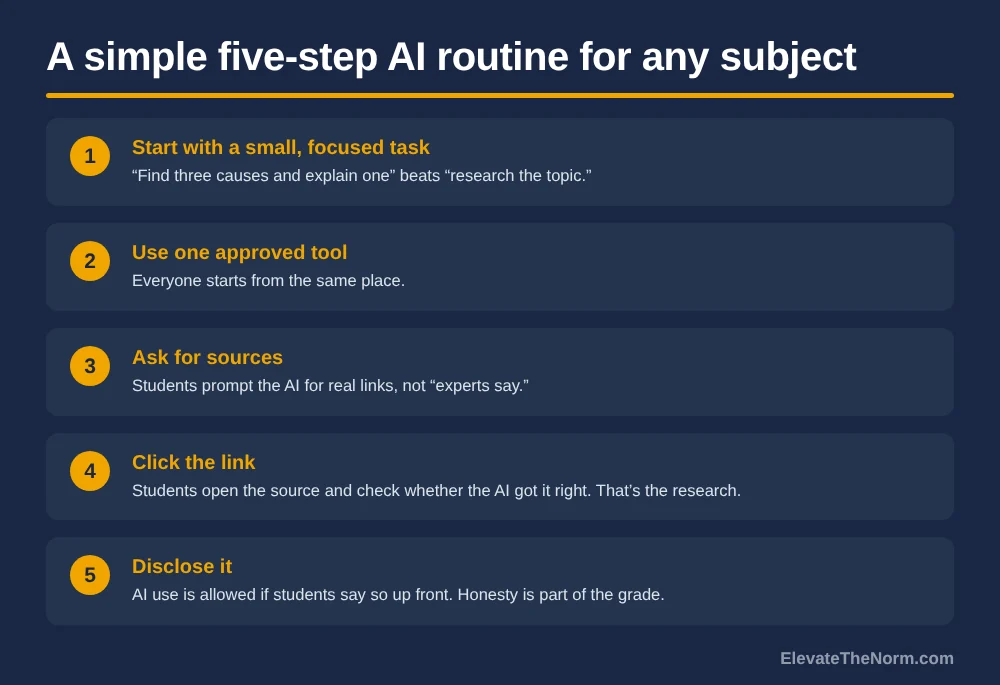
Start with a small, focused task. “Find three causes and explain one” beats “research the topic.”
Use one approved tool. Everyone starts from the same place.
Ask for sources. Students prompt the AI for real links, not “experts say.”
Click the link. Students open the source and check whether the AI got it right. That’s the research.
Disclose it. AI use is allowed if students say so up front. Honesty is part of the grade.
Once the use is out in the open and verification is required, there’s not much left to cheat with.
The five-step routine: small task, one tool, ask for sources, click the link, disclose it.
Three Questions That Build Thinking Skills
Teach students to ask the AI these:
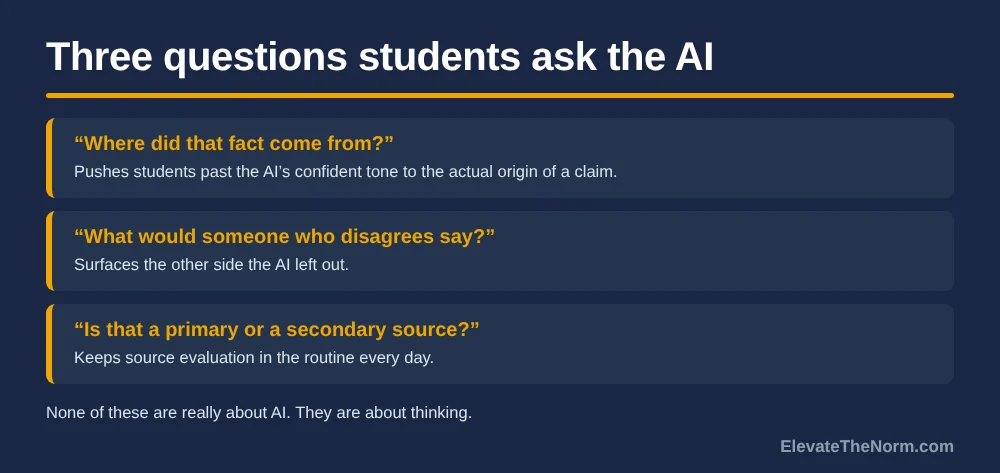
“Where did that fact come from?”
“What would someone who disagrees say?”
“Is that a primary or a secondary source?”
None of these are really about AI. They’re about thinking, and AI gives you a reason to practice them daily.
Three questions worth asking any AI answer — and any source.
Use AI for Format, Not Facts
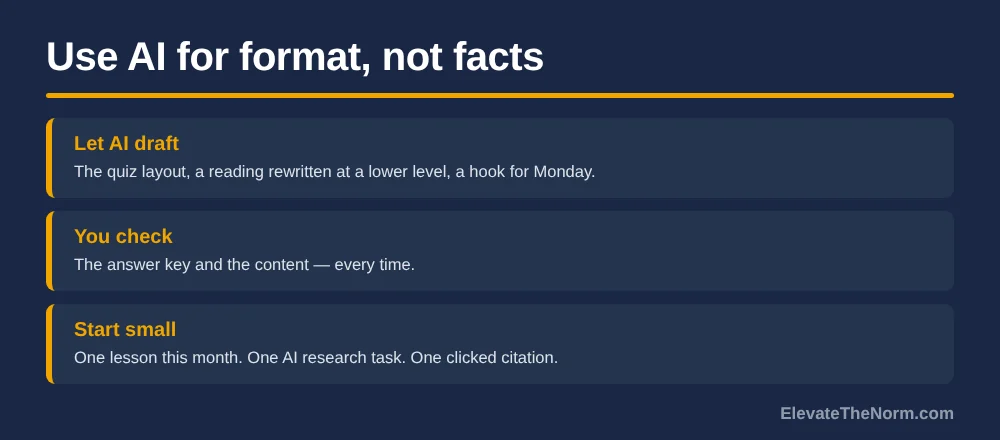
Teachers are stretched thin, and AI can give some time back if you’re careful. Let it draft the quiz layout, rewrite a reading at a lower level, or brainstorm a hook for Monday. You check the answer key and the content.
And before you prompt your way through another worksheet at 10 p.m., check whether the work is already done. Bell ringers, rubrics, exit tickets, and project packets are waiting in our free teacher resources.
AI drafts the format; you check the facts.
Start Small
Pick one lesson this month. Add one AI research task. Require one clicked citation. See what your students find. Students who learn to question, verify, and cite will be fine however the tools change.
Treating AI output as a source to check rather than an answer to copy is a source-evaluation skill, and it can be taught directly. High school students who got six lessons in checking who published something doubled their score on the task. What the research says about teaching students to judge what they read online includes that trial, the ceiling it ran into, and how to measure it without relying on what students say about themselves.
About Clay Shumate
Clay Shumate is a certified secondary Social Studies teacher in the public schools of West Alabama, with seven years of classroom experience, a B.A. in History, and an M.Ed. in Secondary Education. He writes about project-based learning, student responsibility, respect, and practical ways to hold young people to a higher standard while giving them room to learn from mistakes. He is a member of the Society of Professional Journalists and writes to its Code of Ethics; this site’s editorial standards and corrections policy are published in full. More about Clay.
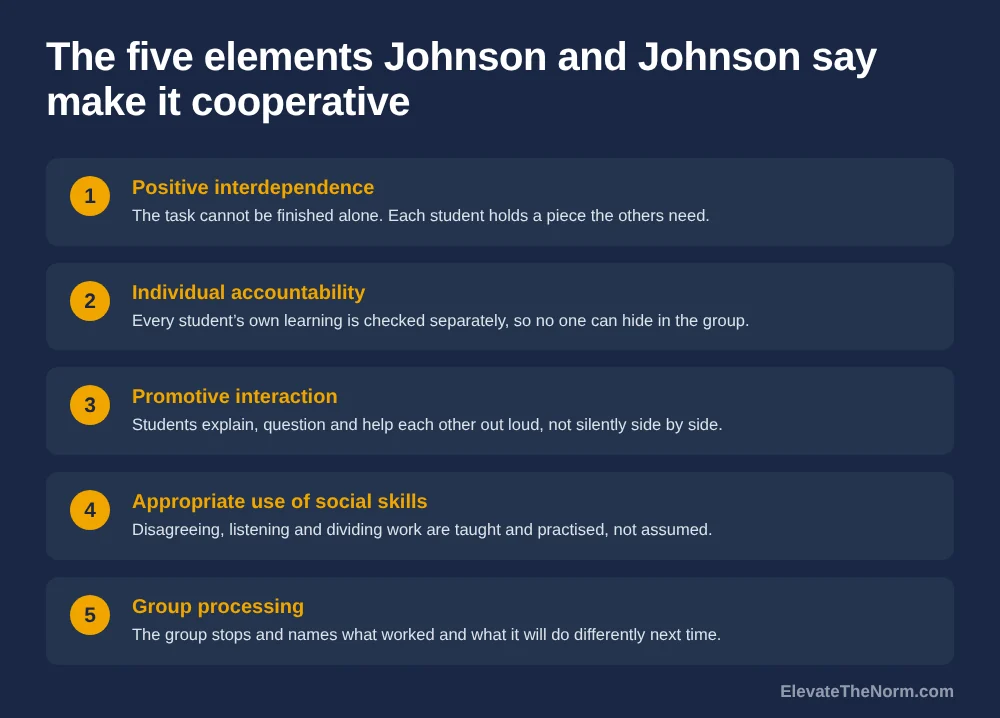
Cooperative learning is the instructional use of small groups so students work to raise their own learning and each other’s at the same time. It only counts as cooperative learning when five things are present: positive interdependence, individual accountability, promotive interaction, taught social skills, and group processing. Four kids at a table sharing one worksheet is none of those.
That gap is the whole problem. Cooperative learning is one of the most-researched ideas in education, and most of what happens under its name in a secondary building is just furniture. Below: the definition, the real numbers, and the two findings almost nobody repeats — one about teenagers, one about what happens when researchers randomise properly.
Key Takeaways
Five elements make it cooperative learning. Positive interdependence, individual accountability, promotive interaction, social skills, group processing. Miss one and you have group work.
The simplest accountable structure is a numbered group.Numbered heads together builds individual accountability into the asking itself, because nobody knows in advance who answers.
The evidence is real but softer than the headlines. Johnson and Johnson report d = 0.67 from more than 1,200 studies. Kyndt and colleagues report g = 0.54 from 51 classroom studies. The EEF says +5 months and rates its own evidence security as low.
🔴 Secondary students showed the smallest effect in the strongest classroom meta-analysis. Kyndt found age was a significant moderator and the 12–18 band came in below both primary and university.
🔴 Randomised designs show less. A 2026 second-order meta-analysis found quasi-experimental studies produced 1.11 and fully experimental studies produced no significant effect.
The subject matters a lot. Science +10 months, maths +5, literacy +3 on the EEF’s numbers. Kyndt found the same split from different studies.
Individual accountability is the lever. Effort drops in groups mainly when individual contributions can’t be evaluated. Make them visible and the drop shrinks.
What Is Cooperative Learning?
Cooperative learning is small-group instruction built so that students can only succeed together, and are still held to account individually. The phrase most often used is from Johnson, Johnson and Smith: the instructional use of small groups so that students work together to maximise their own and each other’s learning.
David and Roger Johnson have been working on this since the 1960s. In their 2009 review in Educational Researcher they describe three shapes it takes. Formal cooperative learning runs from one period to several weeks on a shared goal. Informal is a temporary pairing lasting a few minutes. Base groups are long-term, heterogeneous and stable, and exist to support members and hold them accountable across a semester.
All three show up in secondary buildings. Only the first one usually gets planned.
Miss any one of these and what you have is group work.
What Are the Five Elements of Cooperative Learning?
Johnson and Johnson name five variables that mediate whether cooperation works: positive interdependence, individual accountability, promotive interaction, the appropriate use of social skills, and group processing. Here is what each one means on a Tuesday.
Positive interdependence. The task genuinely cannot be finished alone. Each student holds a piece the others need. If your strongest student could do the whole thing at home in forty minutes, you haven’t built interdependence — you’ve built a group project they’re going to resent.
Individual accountability. Every student’s own learning gets checked separately. This is the one secondary teachers skip most and it is the one the research cares about most. More on it below.
Promotive interaction. Students explain things to each other, ask each other questions, and help each other out loud. Four students working silently side by side on four parts of a poster are not interacting promotively. They’re doing parallel homework in the same room. If you want the talk itself to be the lever, that is a separate skill and a separate structure — see what it takes to get students talking to each other instead of taking turns answering you.
Appropriate use of social skills. Disagreeing without it getting personal, listening, splitting work fairly, asking for help. Johnson and Johnson are explicit that these get taught. Adults assume fourteen-year-olds have them because they can hold a conversation at lunch. Holding a conversation and negotiating a disagreement over a primary source are not the same skill.
Group processing. The group stops, out loud, and names what worked and what it will do differently. Two minutes at the end. It is the first thing cut when the bell is coming and it is the element that turns a one-off activity into something students get better at. There is a workable format for the group-processing step here.
How Is Cooperative Learning Different From Group Work?
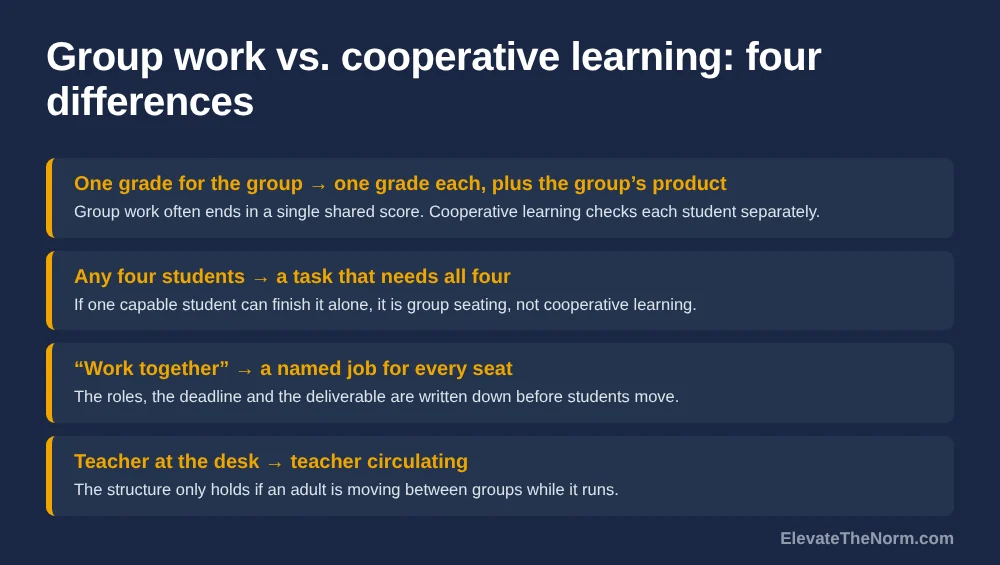
Group work is a seating arrangement. Cooperative learning is a structure. The fastest test is two questions. Could one capable student finish this alone? And will every student be checked separately on what they learned? If the first answer is yes, or the second is no, you have group work. The simplest structure that clears both of those tests is the 90-second paired-discussion routine, which makes every student think alone before anyone is allowed to talk.
The Education Endowment Foundation says this plainly in its own Toolkit: simply seating pupils together or asking them to work in groups, without structure, is not enough, and some pupils may struggle to take part or end up working alone. It adds a harder warning — if high attainers solve the problems without input from peers, existing attainment gaps are likely to widen. That is the thing worth sitting with. Badly built group work doesn’t just fail to help. It can make the spread in your room worse.
Four differences, in the order they usually get skipped.
The fix is not complicated, it is just work you have to do before the lesson rather than during it. A named job for every seat. A deliverable each student signs. A task whose pieces actually need each other. And an adult moving between the groups while it runs, which is the part no structure survives without.
One thing that belongs in that pre-work and usually isn’t: you assign the groups. Letting students pick looks generous and costs the same two or three students every single time — they end up last, in public, repeatedly. That is not a minor social cost and it is avoidable. Assign them, change them often enough that no grouping reads as a verdict, and if a student tells you privately that a particular pairing is not survivable, believe them and move it.
Does Cooperative Learning Actually Work?
Yes, on average, across a very large evidence base — and the honest version of that sentence has three caveats attached. Here are the four numbers worth knowing and what sits behind each one.
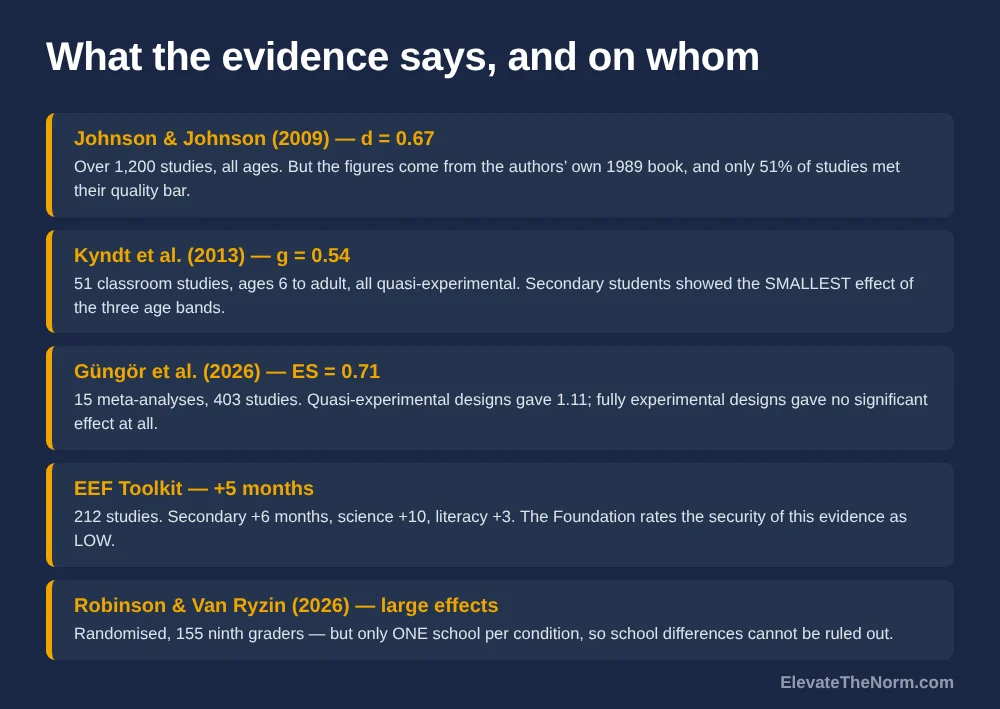
Every number here has a population and a limitation attached. Most articles print only the number.
Johnson and Johnson (2009) report d = 0.67 for cooperation against competitive structures and 0.64 against individualistic ones, from a base of more than 1,200 studies, rising to 0.88 among studies they judged high quality. Caveat: those figures come from the authors’ own 1989 book rather than a fresh analysis, only 51 percent of studies met their quality criteria, and the authors are the method’s principal advocates. That doesn’t make it wrong. It means it isn’t independent.
Kyndt and colleagues (2013) report g = 0.54 for achievement from 51 classroom studies, published in Educational Research Review. Attitudes came in at 0.15 from 13 studies — below the usual threshold for a small effect. The authors warn in their own discussion that publication bias means their analysis “might present a too optimistic image.” Every one of those 51 studies was quasi-experimental.
The EEF Toolkit says +5 months from 212 studies — and rates the security of that evidence as low, losing three of its five padlocks because few studies are recent, many weren’t independently evaluated, and results vary a lot in ways nobody has explained. The Foundation notes that evaluations run by the people selling an approach tend to show larger impacts.
Güngör and colleagues (2026) report 0.71 in Current Psychology, pooling 15 earlier meta-analyses covering 403 studies. That is the newest and broadest number available, and it is also where the most uncomfortable finding lives.
What Happens When Researchers Randomise Properly?
In the 2026 second-order meta-analysis, research design was a significant moderator: quasi-experimental studies produced an effect of 1.11, and fully experimental studies produced no significant effect at all. Mixed designs landed at 0.69.
That is worth saying slowly, because it is not what the headline figure suggests. When researchers compared classes that happened to be doing cooperative learning against classes that weren’t, the effect was enormous. When they randomly assigned who got it, it wasn’t there.
There are innocent explanations. Fully experimental studies were fewer, so the estimate is noisier, and randomised classroom trials tend to be shorter than the multi-week implementations teachers actually run. The authors also flag that their sample is dominated by Indonesian and Turkish studies and is English-language only. And the EEF, working from a different and largely UK evidence base, still lands on +5 months.
But the pattern lines up with the EEF’s own low security rating and with Kyndt’s publication-bias warning, and it points the same direction all three times. The defensible claim is that cooperative learning is a good bet with a real evidence base, not a settled multiplier. Anyone selling you a specific percentage gain is rounding somebody else’s estimate.
Why Is the Evidence Weakest for Secondary Students?
Nobody knows, and the two best sources disagree about whether it even is. That question matters more here than anywhere else on this site, so here is the whole picture.
Kyndt’s meta-analysis found educational level was a significant moderator, and the secondary band — ages 12 to 18, 12 studies — produced the smallest average effect of the three. Primary (11 studies) and tertiary (22 studies) were both higher and did not differ from each other. The authors are careful to note the samples in each category are relatively small.
The EEF Toolkit says the opposite: secondary +6 months, primary +5.
So you have two credible sources pointing in opposite directions on the one question a secondary teacher most wants answered, and no published work resolving it. The useful response isn’t to pick the flattering one. It is to assume cooperative learning works for teenagers somewhere in the ordinary range of good teaching practices, build it carefully, and judge it on your own students’ work rather than on either average.
There is one recent trial specifically on teenagers. Robinson and Van Ryzin, writing in School Mental Health in 2026, randomly assigned two rural high schools to a structured cooperative learning platform or a packaged social-emotional learning curriculum and followed 155 ninth graders for four months. The cooperative learning school came out ahead on peer support, loneliness, victimisation, depression, social stress, anxiety and bullying. The limitation is severe and the authors say so: one school per condition. With two clusters, any difference between those buildings is tangled up with the intervention, and every measure was self-report. Promising, not conclusive.
How Do You Stop One Student Doing All the Work?
Make individual output visible. That is the single most consistent finding in the research on why effort drops in groups. Karau and Williams’ 1993 meta-analysis of 78 studies — which we read here through a published summary rather than the paper itself, because the original is paywalled — found social loafing is moderate and general, and that it gets bigger when contributions can’t be evaluated, and shrinks or disappears when they can. Group size makes it worse. Cohesive groups and tasks students find worth doing make it better.
Which is the same thing Johnson and Johnson called individual accountability forty years ago, arrived at from a different literature. When two research traditions that aren’t talking to each other land on the same mechanism, that is about as close to a safe bet as education research offers.
Four things that do it, none of which require a new program:
Every student submits something with their own name on it — a paragraph, a solved problem, a labelled diagram — alongside the group product.
Any student can be asked to explain any part of the group’s work. Say this before they start, then actually do it while circulating. It changes the division of labour inside the group immediately.
Keep groups small. The EEF reports that groups of three to five with a shared outcome appear most successful. Six is where a student can go quiet without anyone noticing.
What this also means: the group grade should never be the only grade. A shared score with no individual component is the exact condition the loafing research says produces loafing. It is also the single most common complaint students and parents have about group work, and they are right.
The honest cost of that: an individual deliverable on every group task is more papers to look at. There is no version of this where the accountability is free. What keeps it survivable is keeping the individual piece small — one paragraph, one worked problem, one labelled diagram — and checking a lot of it while you are circulating rather than carrying it home in a stack. If the individual deliverable is as big as the group product, you have built two assignments and you will stop doing it by October.
What Does This Look Like in a Real Classroom?
In my room, working alongside somebody is the default condition, not a reward for finishing something else. The tables are trapezoids and rectangles pushed together in pairs and fours. There is no row of desks facing front to move out of. Students don’t get put into groups on project days, because they are already in them.
That changes what the five elements cost to run. When collaboration is the resting state of the room, you are not spending eight minutes reorganising furniture every time you want students to work together — which is usually why teachers save it for special occasions and then wonder why students are bad at it. The social skills Johnson and Johnson say have to be taught get practised constantly, at low stakes, because there is no other way the room operates.
It also changes what I am doing. I am not at a desk. I am on a wheeled stool moving between tables, or pulling two or three students to a whiteboard table in the corner. That circulation is not supervision. It is how I find out which group has quietly agreed on something wrong, and catching a misconception while it is still contained to one table is most of the value of teaching this way at all.
I am not claiming this is the only workable setup. It is the one I run, and it is why this article is about structure rather than enthusiasm.
How Do You Grade It Without Punishing the Group?
Grade the learning individually and the collaboration separately, and never let one student’s choices determine another student’s transcript.
A defensible split: the individual deliverable carries the academic grade. The group product gets feedback and, if it gets a score at all, a small one. Collaboration itself gets named and assessed, but not as part of the content grade — a student who understands the material and struggled to work with three peers has one problem, not two, and the gradebook shouldn’t pretend otherwise.
And say the split out loud before the task starts — in writing, where students can go back and check it. Most of the resentment teenagers carry about group work comes from watching a grade they earned get averaged with one they didn’t. Tell them which parts are theirs alone and the complaint mostly disappears. Students are entitled to know how they are being assessed before they do the work, and a student who asks you to explain the split is doing what you would want an adult to do.
What Should a Coach or Administrator Look For?
Six things, none of which require watching a whole lesson.
Is there an individual deliverable? Ask to see what each student turns in. If the answer is the group product, the structure isn’t there.
Could one student have done it alone? Read the task, not the objective.
Are the groups three to five?
Is the teacher moving? The EEF is explicit that these approaches need professional development to manage, and the management happens while the activity runs.
Were the social skills taught, or assumed? Ask the teacher when they last taught students how to disagree.
Is there a processing step? Two minutes at the end where groups name what they’d change.
On equity specifically, the Foundation is careful: evidence on the effect for disadvantaged pupils is limited, and the suggested benefit for lower-attaining pupils is conditional on activities being well designed and those pupils actively involved. Read with the widening-gaps warning above, that is one finding rather than two: structure decides which direction this moves your gap.
And one for district-level decisions: the cost here is very low — the EEF puts it at training and resources plus a little planning time — but the evidence security is also low, and the effect varies by subject by a factor of three. Rolling it out department by department rather than building-wide lets you find out which of your subjects it actually moves before you commit everyone’s PD days to it.
What to Do Next
Pick one lesson you already teach this month and run it against the two-question test: could one student finish this alone, and will every student be checked separately? Fix whichever one fails. That is the whole intervention.
Then add the individual deliverable. It is the cheapest change here and the research behind it is the strongest: one thing per student, with their name on it, turned in alongside whatever the group makes.
Leave the processing step for third. It is the easiest to add once the first two are holding, and a structure where groups see each other’s work before they reflect on their own gives students something concrete to process against rather than asking them to rate their own teamwork out of five. And don’t buy a program first — the five elements are public, and nothing in the evidence says a branded version beats a teacher who builds the structure properly.
Frequently Asked Questions
Looking for the activities themselves? Our guide to team building activities for students in grades 6–12 has six that hold up, the five conditions that decide whether any of them work, and the three kinds to stop running.
The clearest example of structured interdependence is the jigsaw, where the content itself is split so no student holds all of it. If you want the named structure rather than the research base, we have a full walkthrough of how to run the jigsaw method in a single class period, including the four places it reliably breaks.
Positive interdependence is easy to say and hard to build. One structure that forces it almost mechanically is a branching puzzle sequence where several problems must all be solved before a final lock opens, so no single capable student can run the whole chain alone. The design detail, and the caution that a linear sequence does the opposite, is in the guide to running a classroom escape room.
One of the named structures under this umbrella has an evidence base of its own, and it is more interesting than the average suggests. Peer tutoring is rated at six months of additional progress across 145 studies, while the best-designed secondary trial of it found nothing for the students being tutored. What survives once you separate the trials from the averages covers the tutor gain that keeps replicating, the same-age advantage at secondary, and how to set up a block that is more than “help each other”.
Stopping one student doing all the work is the question every teacher arrives with, and role cards are the answer most teachers are handed. They are the wrong tool: no study isolates assigned roles and measures learning, and a card that says “Timekeeper” ties nothing to anyone’s individual learning — which is exactly the condition where Slavin’s median effect size falls from d = +.32 to d = +.07. What group roles fix, and what they do not covers which roles are worth keeping and what to use instead.
What is cooperative learning?
Cooperative learning is the instructional use of small groups so that students work together to maximise their own and each other’s learning. Johnson and Johnson, who have spent five decades on it, say five elements have to be present for it to count: positive interdependence, individual accountability, promotive interaction, the appropriate use of social skills, and group processing. Four students at a table with one worksheet meets none of those conditions, which is why most of what gets called cooperative learning in a secondary building is really just group seating.
What is the difference between cooperative learning and group work?
Group work is a seating arrangement. Cooperative learning is a structure. The practical test is two questions: could one capable student finish this alone, and will every student be checked separately on what they learned? If the answer is yes to the first or no to the second, it is group work. The EEF is blunt about this — it says simply seating pupils together or asking them to work in groups, without structure, is not enough, and that some pupils may struggle to take part or end up working alone.
Does cooperative learning actually work for high school students?
Probably, but the evidence for teenagers is weaker than for any other age group, and you should know that before you build a semester around it. Kyndt and colleagues’ 2013 meta-analysis of 51 classroom studies found an overall achievement effect of g = 0.54 — but age was a significant moderator and secondary students showed the smallest average effect of the three bands, below both primary and university. The EEF Toolkit disagrees, putting secondary at +6 months against primary’s +5. Two credible sources, opposite answers, and nobody has resolved it.
Why do the effect sizes for cooperative learning vary so much?
Mostly because of study design. A 2026 second-order meta-analysis by Güngör and colleagues pooled 15 earlier meta-analyses covering 403 studies and found an overall effect of 0.71 — but when it split the studies by design, quasi-experimental studies produced 1.11 and fully experimental studies produced no significant effect at all. Kyndt’s 51 studies were all quasi-experimental. The EEF independently rates the security of its collaborative-learning evidence as low. The honest summary is that the method looks strong when researchers choose the classes and weaker when they randomise them.
How do you stop one student doing all the work?
Make individual output visible. That is the single most reliable finding in the social-loafing literature: effort drops in groups mainly when individual contributions cannot be evaluated, and the drop shrinks or disappears when they can. In practice that means every student submits something with their own name on it, every student can be asked to explain any part of the group’s work, and the group product is never the only grade. It is also the second of Johnson and Johnson’s five elements, which is not a coincidence.
Does cooperative learning work in every subject?
No, and the gaps are large. Kyndt found significantly stronger effects in mathematics and the sciences than in social sciences and languages, a difference of 0.32. The EEF Toolkit shows the same shape from a different evidence base: science +10 months, maths +5, literacy +3. Nobody has a settled explanation. If you teach English or history, plan for a smaller return than the headline numbers promise and judge it on your own students’ work rather than on someone else’s average.
Is cooperative learning fair to students who would rather work alone?
It has to be made fair, and that is a real design job rather than a disclaimer. A student who thinks better in silence is not being difficult. Build in genuine individual thinking time before any group turn, let students write before they talk, keep groups small — the EEF reports that three to five pupils with a shared goal works best — and never make the social performance itself the graded outcome. What gets assessed should be the learning, not how comfortably a student does it in front of four peers.
Sources
Johnson, D. W., & Johnson, R. T. (2009). An Educational Psychology Success Story: Social Interdependence Theory and Cooperative Learning. Educational Researcher, 38(5), 365–379. Source of the five elements, the three forms of cooperative learning, the “more than 1,200 research studies” figure and the d = 0.67 / 0.64 achievement effects. Read in full. Note the authors’ own caveats: the effect sizes are drawn from their 1989 book rather than a new analysis, only 51% of studies met their quality criteria, and no systematic search procedure is described.full text
Kyndt, E., Raes, E., Lismont, B., Timmers, F., Cascallar, E., & Dochy, F. (2013). A meta-analysis of the effects of face-to-face cooperative learning. Do recent studies falsify or verify earlier findings? Educational Research Review, 10, 133–149. Source of g = 0.54 for achievement (51 studies), 0.15 for attitudes (13 studies), the significant age moderator placing secondary lowest, and the 0.32 subject-domain gap. The authors state that publication bias means the analysis “might present a too optimistic image,” and that moderator samples are relatively small.full text · independent methodological appraisal
Güngör, F., Altunbaşak, İ., Aydın, A. T., Kaya, M., et al. (2026). A second-order meta-analysis on the effects of cooperative learning on students’ academic achievement, higher-order thinking, and affective behaviors. Current Psychology, 45(6), 552. Source of the 0.71 overall effect (15 meta-analyses, 403 studies) and the research-design moderator: quasi-experimental 1.11, fully experimental no significant effect, mixed 0.69. Authors flag geographic and language bias — the sample is dominated by Indonesian and Turkish studies and is English-language only — and that only published articles were included.springer.com
Education Endowment Foundation, Teaching and Learning Toolkit: Collaborative learning approaches (last updated July 2021). Source of +5 months overall, secondary +6, primary +5, science +10, maths +5, literacy +3, the 212-study base, the three-to-five group-size finding, and the warning that unstructured group work can widen attainment gaps. The Foundation rates the security of this evidence as low.educationendowmentfoundation.org.uk
Robinson, L. E., & Van Ryzin, M. J. (2026). Promoting Positive Social and Mental Health Outcomes: Technology-Supported Cooperative Learning vs. Curriculum-Based SEL. School Mental Health, 18, 137–148. Cluster-randomised, 155 ninth graders, two rural Pacific Northwest high schools, four months. Reported here with its stated limitations: one school per condition, all measures student self-report, a homogeneous rural sample, and low reliability on the bullying measure at follow-up (α = .62).springer.com
Karau, S. J., & Williams, K. D. (1993). Social loafing: A meta-analytic review and theoretical integration. Journal of Personality and Social Psychology, 65(4). The paper itself is paywalled and was not read for this article. The findings cited here — 78 studies, a moderate and generalisable effect, and the moderating roles of evaluation potential, task valence, group size and cohesion — are taken from a published summary, which is named as a summary rather than cited as the primary source. summary
About Clay Shumate
Clay Shumate is a certified secondary Social Studies teacher in the public schools of West Alabama, with seven years of classroom experience, a B.A. in History, and an M.Ed. in Secondary Education. He writes about project-based learning, student responsibility, respect, and practical ways to hold young people to a higher standard while giving them room to learn from mistakes. He is a member of the Society of Professional Journalists and writes to its Code of Ethics; this site’s editorial standards and corrections policy are published in full. More about Clay.