Category: Classroom Management

Behavior, routines, and what actually holds a room together without raising your voice.

  • Visual Classroom Transitions: Cues Students Can Actually See

    Visual Classroom Transitions: Cues Students Can Actually See

    By Clay Shumate

    Visual classroom transitions use something students can see — a projected timer, a posted sequence, a slide, a hand signal — to carry the instructions for moving from one activity to the next, instead of your voice carrying them. The point is not decoration. It is that a visible instruction stays available after you have stopped talking, and a spoken one does not.

    That distinction is the whole article. Most transition advice tells you to be clearer. Visual cues are a structural fix rather than a delivery fix: they change where the instruction lives, so a student who missed it, tuned out for ten seconds, or is still finishing a sentence can recover without asking you or asking the person next to them.

    Key Takeaways

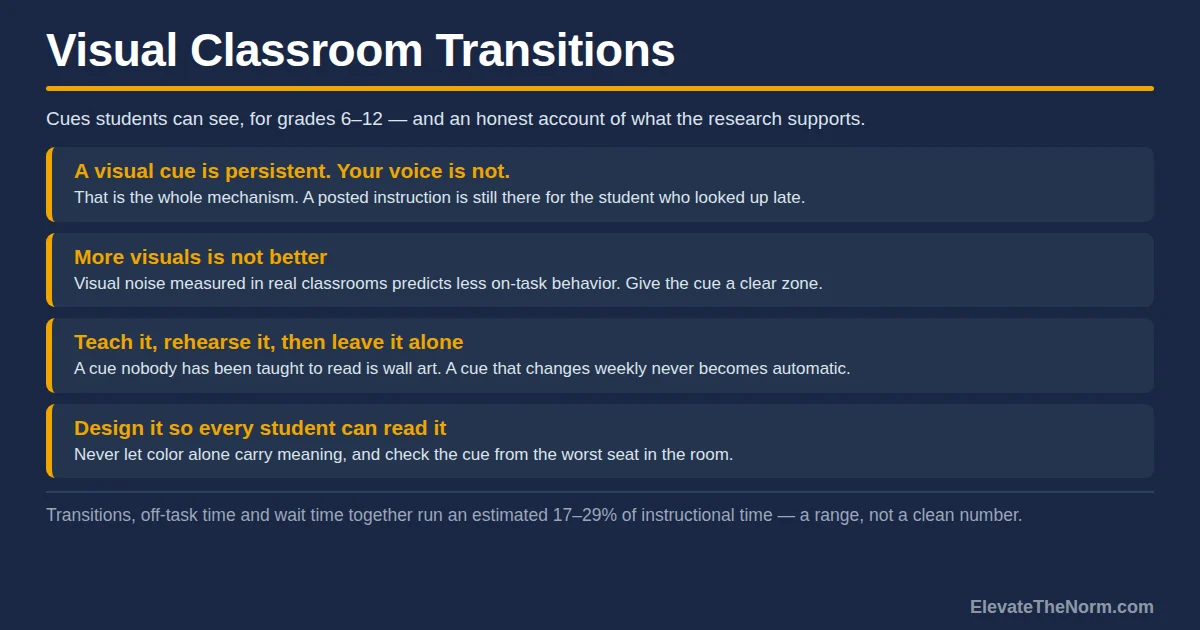
    • A visual cue is persistent; your voice is not. That is the entire mechanism. Anything a student can look back at removes a reason to ask a neighbor, and asking a neighbor is how a thirty-second transition becomes ninety.
    • Transitions are a real time cost, and the honest number is a range. Estimates put off-task behavior, transitions and wait time at somewhere between 17 and 29 percent of instructional time.
    • More visuals is not better. The same literature that supports visual cues also finds that visual clutter predicts less on-task behavior — and that finding has a published reanalysis you should know about.
    • The evidence base is strong for some students and thin for whole classrooms. Visual schedules are well supported for students with intellectual disability and autism. Nobody has shown a general secondary-classroom effect.
    • One permanent cue beats five clever ones. The cue only works once it is automatic, and a cue that changes weekly never becomes automatic.

    Free Download · PDF

    Classroom Transitions Planning Toolkit

    A transition audit sheet, a cue-type guide, and a planning template for building and timing the three moves that cost you the most.

    Download the free PDF

    Free. No email address required. Designed for grades 6–12. Browse every printable in Your Free Library.

    What Counts as a Visual Classroom Transition?

    Anything a student can look at that tells them what happens next, where to be, and how long they have. Four families cover almost everything worth using in a secondary room:

    • A countdown. A projected timer, or a number on the board you change. It answers “how long” without a single word from you, and “how long” is the question most students are actually asking.
    • A sequence. The steps of the move, posted or projected: what to close, what to get, where to sit. Three to five steps, in order, in the order a student would do them.
    • A state signal. Something that shows what mode the room is in right now — a colored slide, a magnet on the board, a word in the corner of the projection. Silent work, partner talk, whole class.
    • A gesture. A hand signal that means one specific thing and never means anything else. Free, instant, and the only one that works when the projector is down.

    What does not count: a decorative poster nobody reads, a slide so crowded that finding the instruction takes longer than hearing it, and a sign that has been up since August and has therefore become furniture.
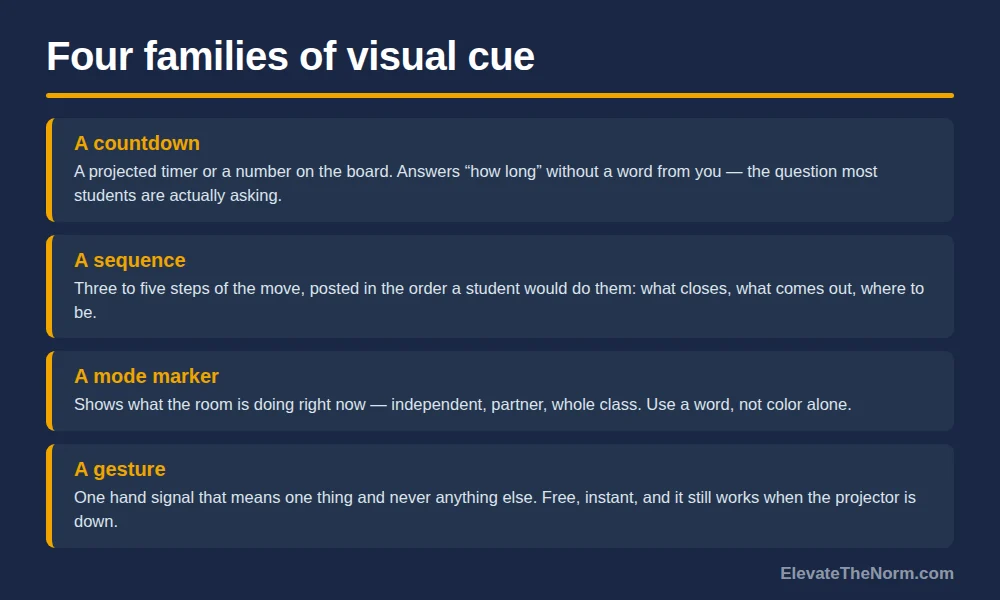
    Graphic describing four families of visual classroom transition cue: a countdown, a posted sequence of steps, a mode marker showing what the room is doing, and a hand gesture
    Four families cover almost everything worth using in a secondary room. Most teachers need two of them, used consistently.

    Visual cues sit inside the broader practice of running the four moments where a lesson actually loses time, and they are one signal among several. They pair naturally with an audio cue — the music and sound cue guide covers that half — and the pairing is often better than either alone, because one catches the student who is looking up and the other catches the student who is not.

    How Much Time Do Transitions Actually Cost?

    Enough to matter, and less precisely than most articles claim. Anyone quoting you a clean figure is rounding somebody else’s estimate.

    The most careful recent synthesis is Kraft and Novicoff’s 2024 paper on time in school. Reviewing the available studies, they report that estimates of off-task behavior, transitions and wait time together occupy between 17 and 29 percent of instructional time — a range, drawn from several different measurement methods, and covering three things at once rather than transitions alone.

    Their own district analysis is more concrete and more sobering. In Providence Public Schools they found instructional time lost running at 16 percent in elementary, 21 percent in middle school and 25 percent in high school. The largest single contributor was unexcused absence, followed by outside interruptions and teacher absence; interruptions and teacher absence alone cost the average high school student 97.3 hours a year. My free First 10 Days Procedures Checklist on TPT walks through which routine to teach on which day.

    Read that honestly. Those Providence figures are not a transition statistic. They count absence and building-level interruption, and the authors explicitly call the estimate a lower bound that does not capture how usable hours are further eroded by disruptions inside the classroom. The transition number lives inside the 17-to-29 percent range, and that range is wide because the measurement is hard.

    What you can say without overstating: transitions are a nontrivial recurring cost, they are one of the few losses a single teacher can act on without anyone’s permission, and a room that moves in thirty seconds instead of ninety recovers real minutes across a semester. That is a good enough reason. It does not need inflating.

    Why Does a Visual Cue Work Better Than Saying It Again?

    Because it is still there after you stop talking. A spoken instruction exists for about four seconds and then only in the memory of whoever was listening. A projected one is available to the student who looks up late.

    That sounds small. It is the entire difference, and you can watch it happen: the student who missed the instruction turns to a neighbor, the neighbor stops working to answer, and one missed instruction has now taken two students off task and generated the noise that pulls a third. A visible instruction gives that student a way to recover without recruiting anyone.

    It also tells you who benefits most, and it is not the student you were picturing. It is the one who was absent yesterday and does not know the routine, the one who needs a few extra seconds to process a spoken instruction, and the one who will not ask you a question in front of the room under any circumstances. All three are students a voice-only transition leaves behind, and none of them will tell you so.

    There is a second effect, harder to see. Instructions delivered only by voice make you the sole source of the answer, so every uncertainty routes through you. That is what makes a transition feel like crowd control. Moving the instruction onto the wall or the screen means the room can answer its own question, which is the same principle behind writing down the routines a class is expected to run without prompting rather than re-explaining them.

    The research on the cueing side is worth being precise about, because it is frequently overstated. Visual activity schedules have a real evidence base: van Dijk and Gage’s 2019 meta-analysis in the Journal of Intellectual & Developmental Disability pooled 13 single-case studies and found a meaningful effect on independent skills, across middle school, high school and adult participants. Milam and Sutton’s 2024 article in Beyond Behavior extends the practice to students with emotional and behavioral disorders as a proactive transition strategy, at the elementary and middle school level.

    Notice what that evidence is and is not. It is single-case research with students who have identified disabilities. It is good evidence that visual schedules help those students become more independent. It is not evidence that adding a projected timer raises achievement in a general-education eleventh-grade classroom, and nobody should tell you it is. The honest case for visual cues in a mainstream secondary room is mechanical and modest: it costs nothing, it removes a known friction point, and the practice it generalizes from is well supported for the students who need it most.

    There is one adjacent evidence-based practice worth naming, because it is cheap and it pairs with every cue on this page. Ennis, Royer, Lane and Griffith’s 2017 systematic review in Education and Treatment of Children applied Council for Exceptional Children standards to precorrection — telling students what is about to be expected, before the moment arrives — and concluded it qualifies as an evidence-based practice. A visual cue is a precorrection you did not have to say.

    Does More Visual Support Make a Room Work Better?

    No, and this is the part most articles about classroom visuals leave out. The same research tradition that supports targeted visual cues also finds that a visually busy room costs attention.

    Godwin, Seltman, Scupelli and Fisher observed 58 elementary classrooms with a structured on-task protocol and analyzed panoramic photographs of each room’s visual environment. Students were on task 72.7 percent of the time. Greater visual noise significantly predicted less on-task behavior — each standard deviation increase in visual noise was associated with roughly a 10 percent reduction in the odds of being on task. Adherence to design-composition principles predicted nothing. Peer distraction, incidentally, accounted for 46.4 percent of all off-task behavior, which is worth remembering the next time a seating decision seems minor.

    The better-known version of this finding comes from Fisher, Godwin and Seltman’s 2014 study in Psychological Science, where kindergarteners in a heavily decorated room were more distracted and scored lower than the same children in a sparse one. It is quoted constantly. It also has a published reanalysis that you should know about before you quote it. Imuta and Scarf, writing in Frontiers in Psychology the same year, reanalyzed the data and found that children’s distraction in the decorated room decreased considerably across lessons — habituation. Their argument is that the study conflated novelty with irrelevance, and that 45 minutes total across two weeks is nowhere near enough time to habituate the way students do to a real classroom they sit in daily.

    So the strong claim — decorations harm learning — does not survive contact with the reanalysis. Two weaker claims do survive, and both are useful: visual noise measured in real classrooms predicts less on-task behavior, and novel visual material draws attention. Both point the same direction for transitions. If everything on your walls is competing, the one thing you actually need students to look at is competing too. And because novelty is what draws the eye, a cue that appears only at transitions has an advantage over one that is always up. My Brain Breaks for Middle and High School on TPT give you 60 quick resets that do not feel childish to teenagers.

    The caveat on all of it: these are K–4 samples. A sixteen-year-old is not a kindergartener, and no equivalent study of secondary classrooms turned up here. Treat this as a reason to keep the signal clean, not as a proven high school effect.

    How Do You Build a Visual Cue That Actually Gets Used?

    Five steps, and step four is the one that decides whether it works.

    1. Pick the transition that costs you the most. Not all of them. Time three of them with your phone for a week — entry, the move into group work, and the last five minutes — and fix the worst one first. Most teachers guess wrong about which one it is.
    2. Write the move as three to five steps, in student order. What closes, what comes out, where people go. If it takes more than five steps, the transition itself is too complicated and no cue will save it.
    3. Put the steps and a countdown in the same place every time. Same corner of the slide, same spot on the board. A cue that moves is a cue students have to search for, and searching is the cost you were trying to remove.
    4. Teach it, then rehearse it twice. Show the cue, walk the steps, do it once badly and name what went wrong, do it again. This is fifteen minutes and it is the entire difference between a cue and a decoration. A visual nobody has been taught to read is wall art.
    5. Leave it alone for a month. The cue works when it is automatic, and automatic takes repetition. Changing it because you thought of a better version resets the clock.
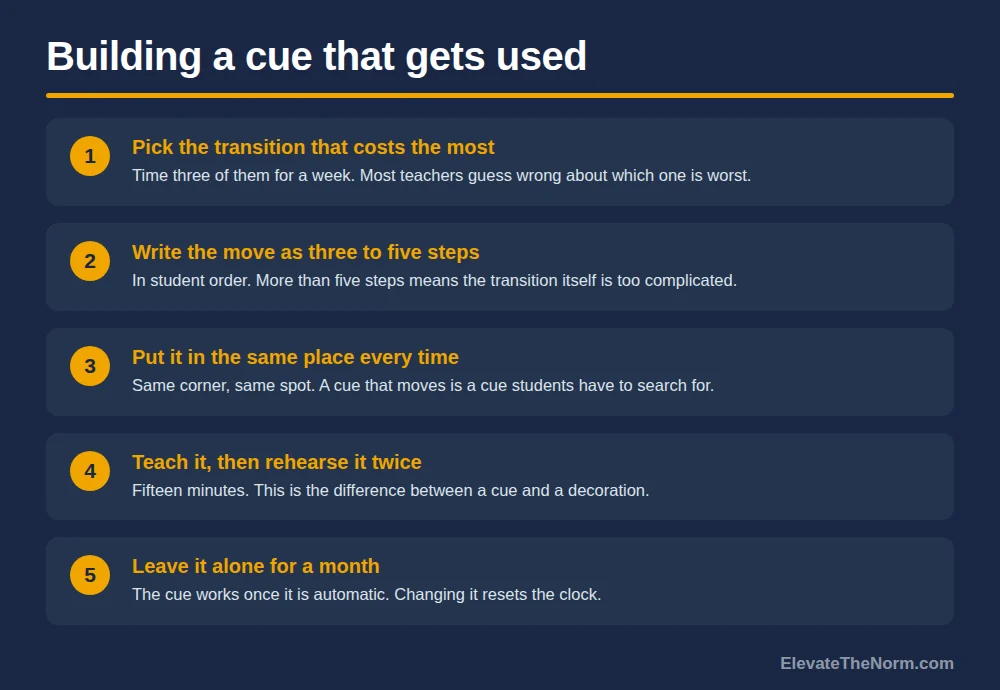
    Numbered five-step graphic for building a visual classroom transition cue: pick the costliest transition, write the move as three to five steps, put it in the same place every time, teach and rehearse it twice, and leave it alone for a month
    Step four is the one that decides whether it works. A visual nobody has been taught to read is wall art.

    Two practical notes. Make the cue legible from the worst seat in the room — back corner, at an angle, with the lights on. Text that reads fine on your laptop frequently does not survive the projector, and a student who cannot read the cue will ask a neighbor, which is the exact behavior you were trying to prevent. Check it from that seat once.

    And have a version that works when the technology does not. Projectors fail, and plenty of secondary teachers float between rooms or share a space where the board is not theirs to write on. A hand signal plus three steps on a half sheet at each table, or on a single laminated card you carry, covers the same ground and needs no bulb and no wall. If your whole transition system depends on a screen you do not control, you have built a system that breaks on the morning the network is down — which is the same reason a room needs a procedure a substitute could run without you in the building.

    What Do Visual Cues Look Like in a Secondary Classroom?

    Plainer than the internet suggests. Most published visual-transition material is built for elementary rooms, and a fourteen-year-old reads a cartoon carpet-time card as an insult. The design rule for grades 6–12 is that the cue should look like something adults use.

    Worth using:

    • A full-screen countdown for any move with a deadline. No decoration, large numerals, visible from the back.
    • A three-line slide that appears only during a transition and shows what closes, what opens, and where to be.
    • A mode marker in a fixed corner of the slide — independent, partner, whole class. Use a word, not a color alone. Roughly one boy in twelve has a red–green color vision deficiency, so a red-versus-green block is a cue a few students in every section cannot read. A colored block with the word on it works for everyone, and it ends the “can we talk?” question permanently.
    • A two-finger signal that means one thing: thirty seconds left. One gesture, one meaning, used every day.
    • A materials diagram for any recurring setup with a physical arrangement — lab stations, a debate layout, group clusters. Drawn once, reused all year.

    Worth skipping: animated slide transitions, anything with a cartoon character, a different cue for every activity, and a countdown with sound effects. All of them add novelty to a moment that needs predictability.

    One more: the cue should not require you to be at the front of the room. The value of a visual signal is that it frees you to move — to be next to the group that always stalls, instead of at the board narrating. If your system requires you to stand somewhere and press something, you have built a cue that costs you the thing it was supposed to buy.

    Where Visual Transitions Break Down

    Four failure modes, all predictable, all cheaper to avoid than to fix.

    The cue is never taught. It goes up, students do not know it is load-bearing, and it becomes background within a week. This is the most common failure and the easiest to prevent: fifteen minutes of explicit instruction and two rehearsals.

    The cue competes with everything else on the wall. This is the visual-noise finding applied to your own room. If the signal sits in a field of posters, student work and reference charts, it is one more thing in a busy field. Give it a clear zone with nothing around it.

    The cue is treated as a substitute for the transition being sensible. No timer fixes a move that requires twenty-eight people to cross the room to a single supply table. Redesign the move first. A visual cue makes a good procedure faster; it cannot make a bad one work.

    The cue becomes a countdown to a punishment. If the timer’s only meaning is that something unpleasant happens at zero, students learn to watch you rather than the screen, and the cue has acquired a tone you did not intend. The timer answers “how long do I have,” which is a fair question a student is entitled to ask. Keep it answering that.
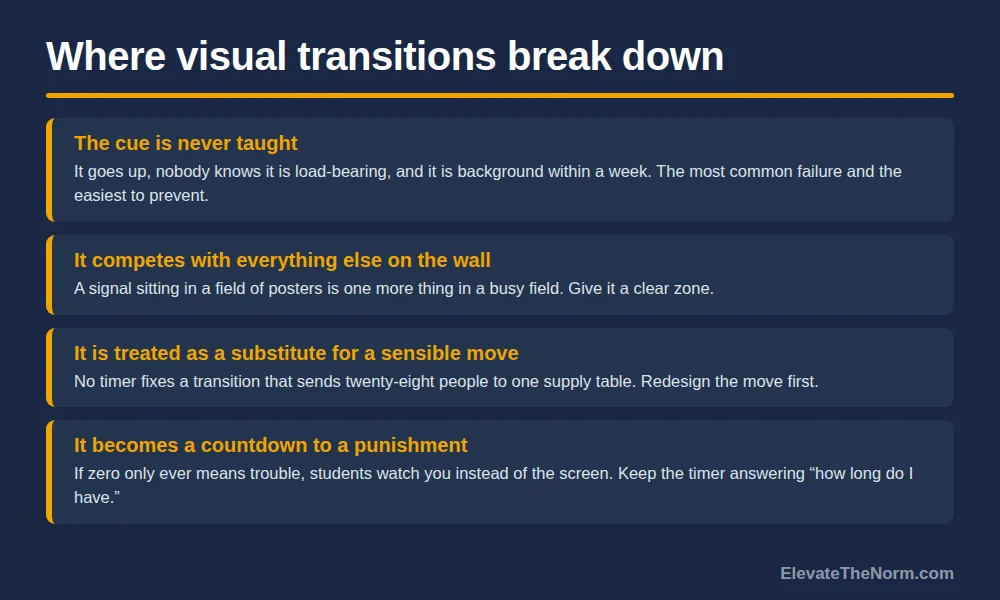
    Graphic listing four failure modes for visual classroom transitions: the cue is never taught, it competes with wall clutter, it substitutes for redesigning a bad move, and it becomes a countdown to a punishment
    All four are predictable, and all four are cheaper to avoid than to fix.

    What to Do This Week

    Time your three worst transitions for a week and write the numbers down. Pick the slowest one. Write that move as four steps in the order a student would do them, put those steps plus a countdown in one fixed spot, and spend fifteen minutes teaching it with two rehearsals. Then leave it alone for a month and time it again.

    While you are at it, look at the wall behind the cue and take down anything that is not doing work. That is the one piece of advice in this article with direct classroom observation behind it, even if the classrooms were younger than yours.

    Visual classroom transitions will not transform a room. What they do is remove one specific friction — the gap between when you said the instruction and when a student needed it — and hand students a way to solve their own problem without asking anybody. That is worth fifteen minutes and a slide. For the concrete versions, the transition examples and free planning toolkit includes a cue guide and an audit sheet for timing the moments that leak the most.

    Before you go: grab the free Classroom Transitions Planning Toolkit (PDF) — ElevateTheNorm.com branded, printable, no email required.

    Frequently Asked Questions

    Do visual transition cues work with high school students, or are they an elementary thing?

    The design has to change; the mechanism does not. A sixteen-year-old reads a cartoon cue card as condescension and will treat it accordingly. A full-screen countdown, a three-line slide and a hand signal are the same tool in a form that looks like something adults use. Be aware that the research base is mostly elementary and mostly students with identified disabilities — there is no study here showing a general effect in a mainstream high school classroom. The case for using them at this level is that they cost nothing and remove a known friction, not that they are proven.

    Isn’t a timer just pressure? Some of my students get anxious about it.

    A timer is pressure when zero means something bad happens. It is information when zero means the next thing starts. Two things keep it on the information side: say what happens at zero before you start it, and make sure what happens at zero is a transition rather than a consequence. If a particular student finds a visible countdown genuinely difficult, a posted sequence without a clock does most of the same work — the persistence of the instruction is the part that matters, not the ticking.

    How many visual cues should a classroom have?

    Fewer than you think. One for time, one for the sequence, one for mode, and one gesture is a complete system, and most rooms would do better with two of those used consistently than four used occasionally. The observational research on visual noise points the same way: more visual material in a room predicts less on-task behavior, so every additional cue is competing with the ones you actually need.

    Does this mean I should take everything off my classroom walls?

    No, and the study that gets quoted for that claim has a published reanalysis worth knowing about. Fisher, Godwin and Seltman found kindergarteners more distracted in a decorated room — but Imuta and Scarf reanalyzed the data and showed the distraction dropped considerably across lessons, which points to novelty rather than decoration as the cause, in a setting where children never had time to habituate. The defensible version is narrower: keep a clear zone around the cue you need students to read, and take down what is genuinely doing no work. Student work on the walls is doing work.

    What do I do when the projector dies mid-transition?

    Have the analog version ready before it happens, because it will. A hand signal that means thirty seconds and four steps written on the board in marker do the same job and never need a bulb. Teach the backup at the same time you teach the main cue so it is not a novelty on the day you need it. Any transition system that only works when the technology works is a system that fails on exactly the mornings that are already going badly.

    Should students help design the cue?

    It is worth asking them which transition is worst and what the current cue does not tell them. They are the ones experiencing the ambiguity and they will name things you cannot see from the front — the slide is unreadable from the back row, or nobody knows whether the move includes getting a laptop. Take their information and keep the design decision. A cue that changes because of student preference every few weeks never becomes automatic, and automatic is the whole point.

    How do I make sure a visual cue is readable for every student?

    Three checks, none of which takes long. Sit in the worst seat in the room — back corner, off angle, lights on — and read the cue yourself; projector contrast is much worse than laptop contrast. Never let color alone carry meaning, because a red-versus-green signal is unreadable for the students in every section with a color vision deficiency; put the word on the block. And say the cue out loud the first few times you use it, which covers a student with low vision and costs you four seconds. A cue that a few students cannot read is worse than no cue, because those students now have to ask someone.

    How long before a new visual cue actually starts saving time?

    Expect a few weeks, and expect the first several days to look worse rather than better, because students are learning a new routine on top of doing the old one. Time the transition before you start so you have a real baseline, then time it again after a month. If nothing has improved after a month of consistent use, the problem is almost certainly the transition itself rather than the cue — a move with too many steps or a physical bottleneck will not be fixed by putting a timer on it.

    Sources

    1. Kraft, Matthew A., and Sarah Novicoff. “Time in School: A Conceptual Framework, Synthesis of the Causal Research, and Empirical Exploration.” EdWorkingPaper, February 2024. https://edworkingpapers.com/sites/default/files/Kraft Novicoff – Time In School – Feb 2024_1.pdf
    2. Godwin, Karrie E., Howard Seltman, Peter Scupelli, and Anna V. Fisher. “Attentional Competition in Genuine Classrooms.” Proceedings of the 42nd Annual Meeting of the Cognitive Science Society, 2020. https://cognitivesciencesociety.org/cogsci20/papers/0524/0524.pdf
    3. Imuta, Kana, and Damian Scarf. “When too much of a novel thing may be what’s ‘bad’: commentary on Fisher, Godwin, and Seltman (2014).” Frontiers in Psychology, vol. 5, art. 1444, 2014. https://www.frontiersin.org/journals/psychology/articles/10.3389/fpsyg.2014.01444/full (The Fisher, Godwin and Seltman 2014 Psychological Science study is described here as reported in this commentary and in the Godwin et al. 2020 paper above; the original article was not read directly.)
    4. van Dijk, Wilhelmina, and Nicholas A. Gage. “The effectiveness of visual activity schedules for individuals with intellectual disabilities: A meta-analysis.” Journal of Intellectual & Developmental Disability, vol. 44, no. 4, 2019, pp. 384–395. https://eric.ed.gov/?id=EJ1234224
    5. Milam, Molly E., and Kimberly Kode Sutton. “Using Visual Activity Schedules to Improve Transitioning for Students With Emotional and Behavioral Disorders.” Beyond Behavior, vol. 33, no. 3, 2024. https://journals.sagepub.com/doi/10.1177/10742956241276003
    6. Ennis, Robin Parks, David James Royer, Kathleen Lynne Lane, and Claire E. Griffith. “A Systematic Review of Precorrection in PK-12 Settings.” Education and Treatment of Children, vol. 40, no. 4, 2017, pp. 465–495. https://eric.ed.gov/?id=EJ1157923
    About Clay Shumate

    Clay Shumate is a certified secondary Social Studies teacher in the public schools of West Alabama, with seven years of classroom experience, a B.A. in History, and an M.Ed. in Secondary Education. He writes about project-based learning, student responsibility, respect, and practical ways to hold young people to a higher standard while giving them room to learn from mistakes. He is a member of the Society of Professional Journalists and writes to its Code of Ethics; this site’s editorial standards and corrections policy are published in full. More about Clay.

  • What Is a Classroom Management Plan? The Version That Actually Runs

    What Is a Classroom Management Plan? The Version That Actually Runs

    A classroom management plan is a written document setting out how your room runs: the structure students walk into, the expectations you have taught them, how you acknowledge the behavior you want, and what you do about the behavior you don’t. It is not a poster of rules and it is not a philosophy statement. It is the answer you have decided in advance, so that you are not inventing it at 1:40 on a Thursday with twenty-nine people watching. If you want wording to start from rather than a blank page, there are worked examples of expectations written for teenagers.

    Most plans fail the same way. They are written for an evaluator, they are full of words like “respectful” and “responsible,” and they cannot be run. A plan you cannot run on a bad day is not a plan.

    So that is what a classroom management plan is. What follows is the harder part: what the research says it has to contain, the test that separates a real plan from a decorative one, and how to write one that survives contact with an actual class. The individual moves that go inside the plan, and how strong the evidence is behind each one, are handled separately in the strategy-by-strategy breakdown.

    Key Takeaways

    • A plan is a decision made early, not a description written late. Its value is that it removes improvisation from the moments you improvise worst.
    • The research converges on five areas. A 2008 review identified 20 evidence-based classroom management practices grouped into five categories: structure, taught expectations, active engagement, acknowledging appropriate behavior, and responding to inappropriate behavior.
    • The test is enforceability, not tone. “Be respectful” cannot be enforced consistently by anyone, including you. A narrow, specific line can.
    • Write it for yourself first. A plan aimed at an evaluator produces language that sounds defensible and does nothing at 1:40.
    • Many teachers were never taught this. In one study of 110 teacher candidates, roughly half of one group reported no behavior management training at all before the intervention — which is a curriculum gap, not a personal failing.

    What is a classroom management plan, specifically?

    The IRIS Center at Vanderbilt frames comprehensive classroom behavior management as doing two things: creating an organized, consistent, culturally responsive classroom environment that supports instruction, and engaging and communicating with students and families on an ongoing basis. Developing a written plan is named as one of the foundational practices within that, alongside creating a positive climate and a structured classroom.

    That framing is useful because of what it excludes. A management plan is not your discipline ladder. The ladder is one component, and in a good plan it is one of the smaller ones. The bulk of the document is about the conditions that make the ladder rarely necessary — how the room is arranged, what happens in the first four minutes, what students do when they finish early, how they get help without waiting with a hand up.

    One more distinction worth holding onto: classroom-level management sits underneath any school-wide system. If your building runs three to five posted expectations, your plan translates those into the specific, contextual version that applies in your room. It does not compete with them, and it does not ignore them.

    The five things the research says a plan has to cover

    The most useful single source here is Simonsen, Fairbanks, Briesch, Myers and Sugai’s 2008 review, which set a deliberately high bar: a practice counted as evidence-based only if it had been evaluated with sound experimental design and supported by at least three empirical studies in peer-reviewed journals. Twenty practices cleared it, sorted into five categories.

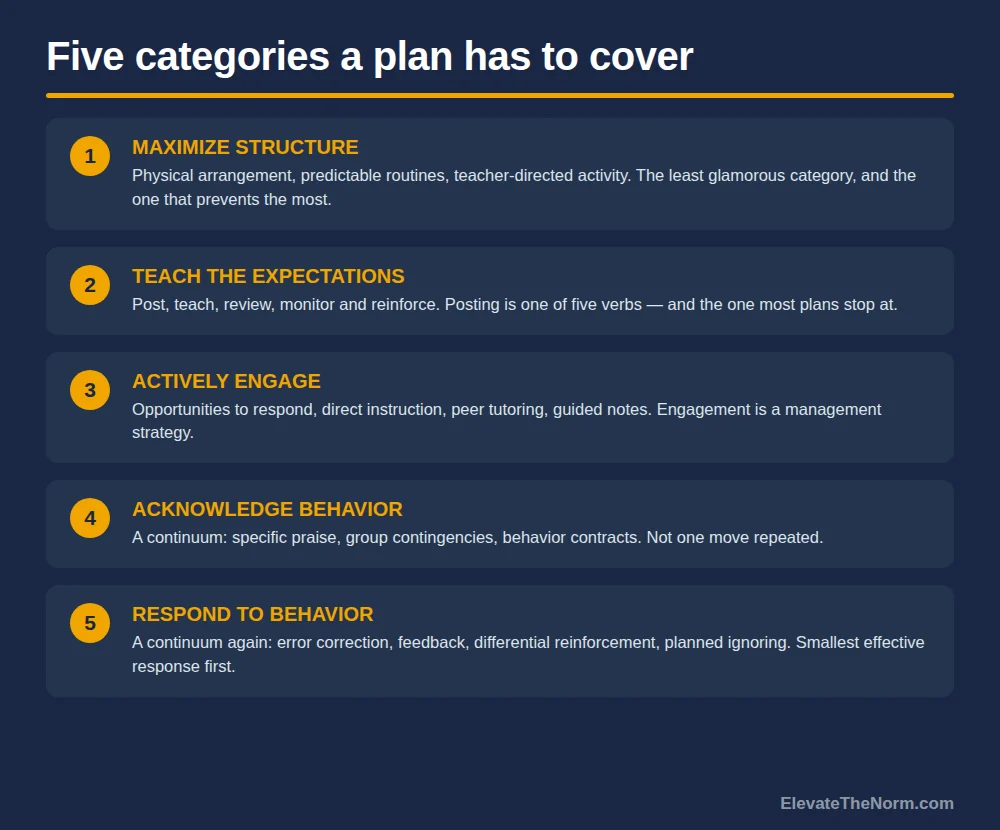
    1. Maximize structure. Physical arrangement, predictable routines, teacher-directed activity. The least glamorous category and the one that prevents the most.
    2. Post, teach, review, monitor and reinforce expectations. Note the verbs. Posting is one of five, and it is the one most plans stop at.
    3. Actively engage students in observable ways. Opportunities to respond, direct instruction, peer tutoring, guided notes. Engagement is a management strategy, not a separate department.
    4. Use a continuum of strategies to acknowledge appropriate behavior. Specific praise, group contingencies, behavior contracts.
    5. Use a continuum of strategies to respond to inappropriate behavior. Error correction, performance feedback, differential reinforcement, planned ignoring.
    Five numbered categories of evidence-based classroom management: maximize structure, teach expectations, actively engage, acknowledge behavior, respond to behavior
    From Simonsen and colleagues’ 2008 review of evidence-based classroom management practices.

    The word doing the most work in categories four and five is continuum. A plan with one response in it — a referral, a call home, a warning system — will be used for everything or nothing. A continuum means the smallest effective response is available and gets used first.

    An honest caveat on that review, because it matters for how much weight to put on it: the authors themselves note that roughly 48% of the studies in their table were published before 1987. The categories have held up and are widely replicated, but this is an older evidence base than its frequent citation implies, and it was not assembled with today’s secondary classrooms specifically in view.

    Why “Be Respectful” is not a plan

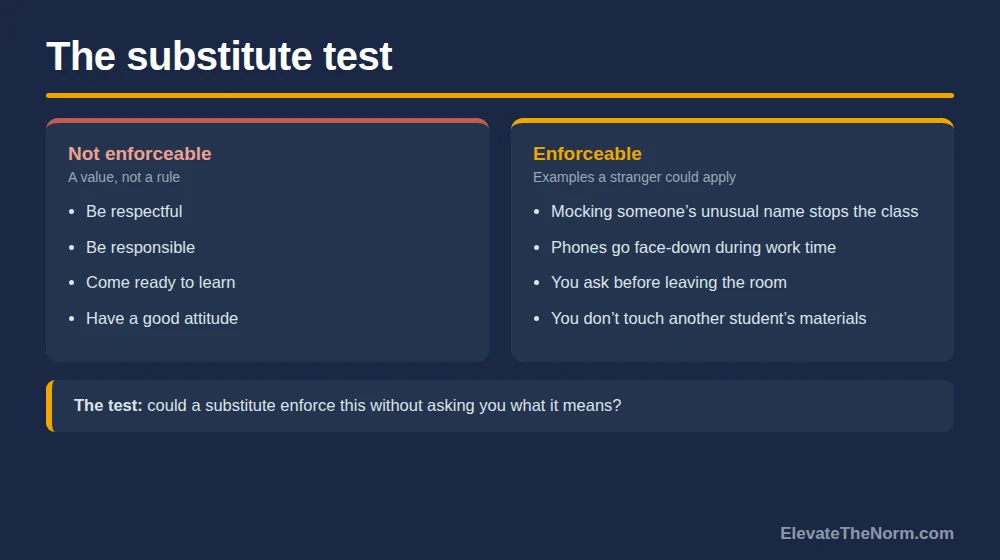
    Here is the test I would apply to every line in a management plan: could a substitute enforce this without asking you what it means? If not, it is a value, not a rule — and values belong in the first paragraph, not in the enforcement section.

    Two-column comparison of unenforceable classroom rules such as be respectful beside enforceable, specific rules a substitute could apply
    Could a substitute enforce this without asking you what it means?

    “Be respectful” fails immediately. Two reasonable adults will disagree about whether a particular eye-roll qualifies, which means the students experience it as arbitrary, which is the precise thing that costs you a room. Inconsistency is not a small flaw in a plan. It is the flaw.

    Compare it to an actual line from my room: making fun of how unusual someone’s name is stops the class. It is narrow. It is unmistakable. Nobody has to interpret it, there is no version of it I would let go on a Friday because I am tired, and a student can tell you in advance exactly what will happen. That is what an enforceable expectation looks like, and it is worth more than a wall of adjectives.

    You do not need many of these. Three or four lines that are genuinely non-negotiable, that you will enforce identically in October and in May, will do more for a room than a laminated list of twelve. The rest of what you want — effort, kindness, people taking care of each other — is built through how the room is run day to day, not through rules about it.

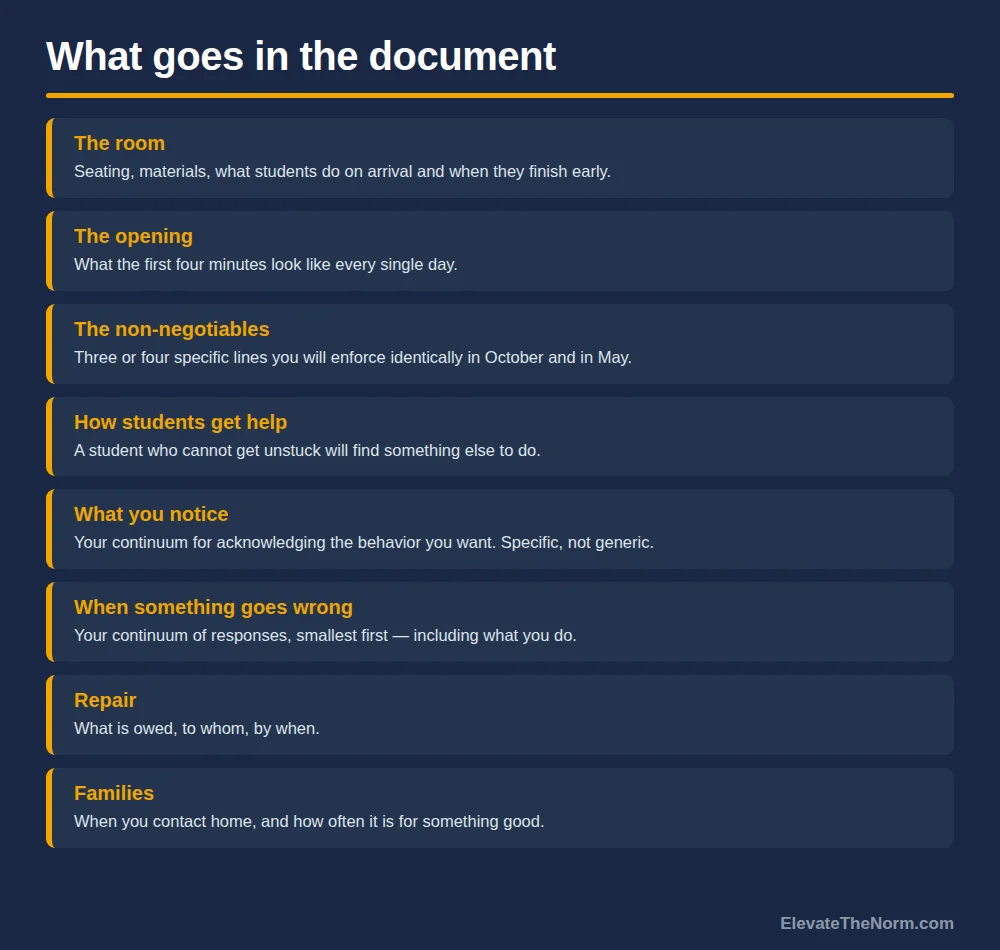
    What actually goes in the document

    Here is the structure I would use. It maps onto the five research categories without reading like a compliance form.

    • The room. How seating is arranged and why. Where materials live. What students do when they walk in, and what they do when they finish early. Most of a management plan is logistics, and the logistics are load-bearing.
    • The opening. What the first four minutes look like every single day. A routine students can run without you is worth more than any consequence you could write down.
    • The non-negotiables. Three or four specific, enforceable lines. Apply the substitute test to each one.
    • How students get help. Genuinely part of management. A student who cannot get unstuck will find something else to do, and then you have a behavior problem that was originally an access problem.
    • What you notice, and how. Your continuum for acknowledging the behavior you want. Specific rather than generic — naming what a student did beats telling them they are great.
    • What happens when something goes wrong. Your continuum of responses, smallest first, written out. Include what you do, not just what the student gets.
    • Repair. What is owed, to whom, by when. A plan that ends at the consequence is only half-written.
    • Families. When you contact home, for what, and how often it is for something good.
    Eight sections of a classroom management plan: the room, the opening, non-negotiables, how students get help, what you notice, when something goes wrong, repair, families
    Two pages is enough. Twelve means you are writing a philosophy statement.

    That is two pages, not twelve. If yours is running to twelve, you are probably writing a philosophy statement with a consequence ladder stapled to the back.

    The response section, and the part people get wrong

    Most consequence sections are written as an escalating list of things that happen to a student. The useful version also specifies what you do, because your behavior is the variable you actually control.

    The smallest effective response is usually proximity and a quiet word. In my room a redirect happens at close range, to one student, at their eye level — not announced across the room. That is a deliberate choice and it belongs in a written plan, because it is the thing you will abandon first when you are frustrated. Announcing a correction to the whole room gives the class a performance to react to and hands the student an audience they now have to save face in front of. It reliably makes a small thing bigger.

    Write down the pause, too. A deliberate beat before you respond — for me it averages around fifteen seconds, though it genuinely varies with the room, the day, and the student — is not a technique with a fixed number. It is a commitment to not answer a behavior with your first reaction. Put it in the plan as a commitment rather than a count, because a count is the first thing that breaks.

    And be careful what your consequences are actually teaching. A response that only makes a student feel worse has done nothing about the thing that happened. The question the plan should answer is what gets repaired, not what gets paid.

    What the plan does not get to decide

    This section is short and it is the one most plans omit entirely. Some things outrank your document, and writing as though they do not is how a well-intentioned plan creates a real problem.

    • An IEP or a behavior intervention plan. If a student has one, it governs. Your classroom plan does not override it, cannot be applied to that student in place of it, and should say so explicitly. If you do not know which of your students have one, that is the first thing to find out — before you write a consequence section, not after you have applied it.
    • District and building policy. Your plan operates inside them. Where your preference and the policy disagree, the policy wins and you raise the disagreement through the actual channel rather than quietly running your own version.
    • Anything that has to leave the room. Threats, weapons, harassment, anything involving a student’s safety, and anything that triggers mandatory reporting are not classroom-management matters and do not belong on a continuum of responses. Name them in the plan as the category that goes straight to an administrator, so that the decision is already made.

    A plan that quietly assumes the teacher handles everything is not a strong plan. It is an unsupported one, and the cost of that lands on a student.

    Who the plan is for

    In order: you, then your students, then anyone covering your room, then your evaluator. That order matters and it is usually inverted.

    A plan written for an evaluator optimizes for language that sounds defensible in a post-observation conference. It will use the word “proactive” and it will not help you at 1:40. A plan written for yourself is blunter, shorter, and contains the things you actually forget — which is why the good ones read a little like notes.

    Your students should be able to read it, or a version of it. Not as a handout on day one that nobody retains, but because everything in it should be something they could accurately predict by October. If a student could not tell you what happens when work is late, that section is not real yet.

    Which raises a fair question: should students help write it? My honest answer is that it depends on which part. The non-negotiables are yours — they exist precisely because they do not move, and putting them to a vote tells the room they are negotiable after all. But a great deal of a management plan is not about safety or dignity at all. It is about how the room works, and on that, teenagers have opinions worth hearing and a much better sense than adults expect of what actually helps them work. Asking them what gets in their way, and then visibly changing something, does more for buy-in than any explanation of why your rules are reasonable.

    Families should be able to see it too, or at least the part that affects them — what you contact home about, when, and what happens before you do. A parent who learns your system for the first time during a difficult phone call is meeting it at the worst possible moment. Send the short version early, while nothing is wrong.

    And a plan is the single most useful thing you can hand to someone covering your class. If you cannot hand it over and have it make sense to a stranger, it is not finished.

    If nobody ever taught you this

    It is worth saying plainly that the preparation gap here is real and documented, because a lot of teachers privately treat it as a personal deficiency.

    A 2025 study in the Journal of Emotional and Behavioral Disorders worked with 110 teacher candidates in student-teaching internships at a large public southeastern university. Among the group receiving a specialized 16-hour classroom management curriculum, 49.3% reported having had no behavior management training beforehand; in the comparison group the figure was 31.7%. The authors also note that while most states require classroom management coursework, estimates of how many programs offer a focused course on it range from under 50% to 74%.

    Those numbers deserve their limits stated. It is a quasi-experimental study at a single university, the training figures are self-reported, and the classroom observation subsample was fourteen teachers. It does not establish a national rate. What it does support — alongside the range the authors cite for program offerings — is that arriving in a classroom without formal management training is common rather than exceptional. If that is you, you are in a large group, and writing the plan is how you close the gap yourself.

    What a plan will not do

    It will not make a class comply because it exists. It will not survive being written once in August and never opened again. And it will not substitute for knowing the students in front of you — the same line lands differently depending on what a kid walked in carrying, and no document accounts for that.

    It also will not fix a task that was badly built. A very large share of what gets logged as a behavior problem is a student who could not access the work and found something else to do. Before adding a consequence for off-task behavior, check whether the work was doable. That is a planning question wearing a discipline costume, and treating it as discipline makes it permanent.

    Writing one this week

    Do it in one sitting and keep it to two pages. Draft the eight sections above quickly and badly — the first version is for finding out what you have not actually decided, and you will find two or three things you have been improvising all year.

    Then run the substitute test on every enforcement line, cut anything you would not enforce in May, and use it for two weeks. Mark the places you did something other than what you wrote. Those are the real edits, and they are worth more than anything you would have thought of at the desk.

    So: what is a classroom management plan, in the end? It is a short, specific, honest document that tells you what you have already decided, so that the version of you who is tired on a Thursday afternoon does not have to decide it again, worse. Structure first. A handful of lines you will actually hold. A continuum of responses, smallest first. And a way back for a student who got it wrong — which is the part that turns a set of rules into a room worth being in.

    Printables for this

    Two of mine on TPT, both built for this. The Classroom Norms Poster Set is free and gives you the posted version of the expectations section — written narrowly enough to pass the substitute test. De-escalation Strategies: 100 Scripts is the continuum the response section asks for, with actual wording for each rung instead of one referral.

    Sources

    • Simonsen, B., Fairbanks, S., Briesch, A., Myers, D., & Sugai, G. (2008). Evidence-based practices in classroom management: considerations for research to practice. Read the review (PDF) — source for the 20 evidence-based practices, the five categories, and the inclusion bar of at least three peer-reviewed empirical studies per practice. Limitation stated by the authors: roughly 48% of the studies in their table were published before 1987.
    • Hart, K. C., Poznanski, B., & Cramer, E. D. (2025). Preparing teacher candidates in classroom management prior to entering the teaching profession. Journal of Emotional and Behavioral Disorders. Read the study — source for the 49.3% / 31.7% no-prior-training figures and the “under 50% to 74%” range for programs offering a focused course. Quasi-experimental, n = 110 at a single southeastern university, self-reported training history, observation subsample of 14. Not a national estimate.
    • The IRIS Center, Vanderbilt University. Classroom and school-wide behavior management. Read the module — source for the two-part framing of comprehensive classroom behavior management, the four foundational practices, and the classroom-versus-school-wide distinction. Practitioner training material from a federally funded center, not a primary study.

    Every link above was checked on September 20, 2026. The classroom practices described in the first person — the close-range redirect, the deliberate pause before responding, and the line about mocking an unusual name — are my own and are used across this site.

    Frequently Asked Questions

    What is a classroom management plan?

    It is a written document setting out how your classroom runs: the structure students walk into, the expectations you have taught them, how you acknowledge the behavior you want, and how you respond to the behavior you do not. It is not a poster of rules and it is not a philosophy statement. Its purpose is to decide things in advance so you are not improvising them under pressure.

    What should a classroom management plan include?

    Eight sections cover it: how the room and materials are arranged, what the opening routine looks like every day, three or four genuinely non-negotiable expectations, how students get help when stuck, how you acknowledge the behavior you want, a continuum of responses when something goes wrong, what repair looks like afterward, and when you contact families. Two pages is usually enough. Twelve pages usually means a philosophy statement with a consequence ladder stapled to the back.

    Why is “be respectful” a bad classroom rule?

    Because it cannot be enforced consistently. Two reasonable adults will disagree about whether a given eye-roll counts, so students experience enforcement as arbitrary — and arbitrary enforcement is what costs a teacher a room. Respect belongs in the plan as a value in the opening paragraph. The enforcement section needs lines narrow enough that a substitute could apply them without asking what they mean.

    What does the research say classroom management plans should cover?

    A 2008 review by Simonsen, Fairbanks, Briesch, Myers and Sugai identified 20 evidence-based practices grouped into five categories: maximize structure; post, teach, review, monitor and reinforce expectations; actively engage students in observable ways; use a continuum of strategies to acknowledge appropriate behavior; and use a continuum of strategies to respond to inappropriate behavior. Worth knowing its limit — the authors note about 48% of the underlying studies predate 1987.

    Does my classroom management plan apply to a student with an IEP or behavior plan?

    No. An IEP or behavior intervention plan governs, and your classroom plan does not override it or get applied in its place. Say so explicitly in the document. Find out which of your students have one before you write the consequence section rather than after you have applied it to someone it should not have applied to. District and building policy outrank your plan the same way.

    Should students help write the classroom management plan?

    Partly. The non-negotiables are yours — they exist because they do not move, and putting them to a vote signals the opposite. But much of a management plan is about how the room works rather than about safety or dignity, and on that students have useful opinions and a better sense than adults expect of what gets in their way. Ask them, then visibly change something. That does more for buy-in than explaining why your rules are reasonable.

    Is a classroom management plan the same as a discipline plan?

    No, and treating them as the same is the most common mistake. A discipline or consequence ladder is one section of a management plan, and in a good one it is among the smaller sections. The bulk of the document covers the conditions that make consequences rarely necessary: room arrangement, opening routines, how students get help, what happens when they finish early.

    What if I was never trained in classroom management?

    That is common rather than exceptional. In a 2025 study of 110 teacher candidates at one southeastern university, 49.3% of one group reported no prior behavior management training, and the authors cite estimates that between under 50% and 74% of preparation programs offer a focused course on it. Those figures come from a single-university quasi-experimental study with self-reported training history, so they are not a national rate — but the gap is documented, and writing a plan is the practical way to close it for yourself.


    About Clay Shumate

    By Clay Shumate — Clay Shumate is a certified secondary Social Studies teacher in the public schools of West Alabama, with seven years of classroom experience, a B.A. in History, and an M.Ed. in Secondary Education. He writes about project-based learning, student responsibility, respect, and practical ways to hold young people to a higher standard while giving them room to learn from mistakes. He is a member of the Society of Professional Journalists and writes to its Code of Ethics; this site’s editorial standards and corrections policy are published in full.

  • Substitute Teacher Classroom Management: Running a Room That Isn’t Yours

    Substitute Teacher Classroom Management: Running a Room That Isn’t Yours

    Substitute teacher classroom management is not the same job as classroom management. A regular teacher builds authority over weeks. A substitute has to borrow it in the first four minutes, from a room that already has its own rules, its own seating, and its own sense of what is normal — none of which they wrote. The work is not installing your system. It is running theirs well enough that the day holds.

    Most advice on this subject is written as though the substitute controls the outcome. They control some of it. The rest was decided before they ever walked in, by the teacher who wrote the plans — which is the half of this that almost nobody writes about, and the half I can speak to directly. If the room a substitute walks into has no written system behind it, the document a stranger is actually handed is where that work starts.

    This page covers what the person walking in actually has to work with, what they can control on the day, and what the regular teacher owes them before leaving.

    Key Takeaways

    • A substitute’s authority is borrowed, not built. The fastest way to lose a room is to replace its norms with your own on day one. Run the room that exists.
    • The person walking in may have twenty hours of training. In Missouri, a substitute certificate requires either 36 semester hours of college or 20 clock hours of approved training. That is the floor in one state, and it is worth knowing before you judge how a day went.
    • The first four minutes decide most of it. A visible plan, stated out loud, followed by a pause — not a raised voice.
    • Teacher absence is measurable and it is not small. Ten additional days of teacher absence are associated with a decline of roughly 1.7% to 3.3% of a standard deviation in math achievement. The sub day is not a throwaway day.
    • Half of substitute classroom management is written the week before, by someone else. Plans that assume the sub knows the room are the single most common failure, and they are entirely preventable.
    • A class that tests a substitute is usually not scheming. Nobody knows their name, the day reads as a holding pattern, and the adult has no history with them. Using names and making the work visibly real addresses all three.

    The job is not “teach the lesson.” It is “keep the room intact.”

    This is the reframe that makes the rest of it workable. A substitute who measures the day by how much content got delivered will almost always finish feeling like they failed. A substitute who measures it by whether the room is handed back in the condition it was handed over — work attempted, norms intact, nobody humiliated, an honest note left behind — has done the actual job.

    That is not a lowered standard. It is the correct one. The regular teacher can reteach a lesson. What they cannot easily undo is a room that learned, over one day, that the expectations it runs on are negotiable when a stranger is standing there.

    What the person walking in actually has

    It is worth being precise about the preparation the job actually requires, because a lot of staffroom commentary about substitutes assumes a level of training that the credential does not demand.

    Missouri, as one published example, issues a Content Substitute Certificate to an applicant who has completed either a minimum of 36 semester hours from an accredited college or university, or twenty clock hours of department-approved substitute teacher training. Requirements vary by state and some are higher. But twenty clock hours is a real, current, published floor in at least one state — and the person it describes is expected to walk into a room of thirty teenagers and hold it.

    Two things follow. If you are the substitute: the gap you feel between what you were trained for and what the day demands is real, and it is structural rather than personal — the same gap first-year teachers describe in their own rooms. If you are the regular teacher: the plans you leave are not a courtesy. For some of the people who will use them, they are the entire preparation.

    A third thing follows for anyone who sets policy. Nothing in the rest of this article is a substitute for a district actually orienting the people it puts in front of students — a building walkthrough, the safety procedures, where the office is, what the behavior system is called. Most of what gets written about substitute classroom management, including everything below, is individuals compensating for a system that hired someone and pointed at a door. The individual workarounds are worth knowing. They are not the fix.

    The first four minutes: organization to the minute, and then the pause

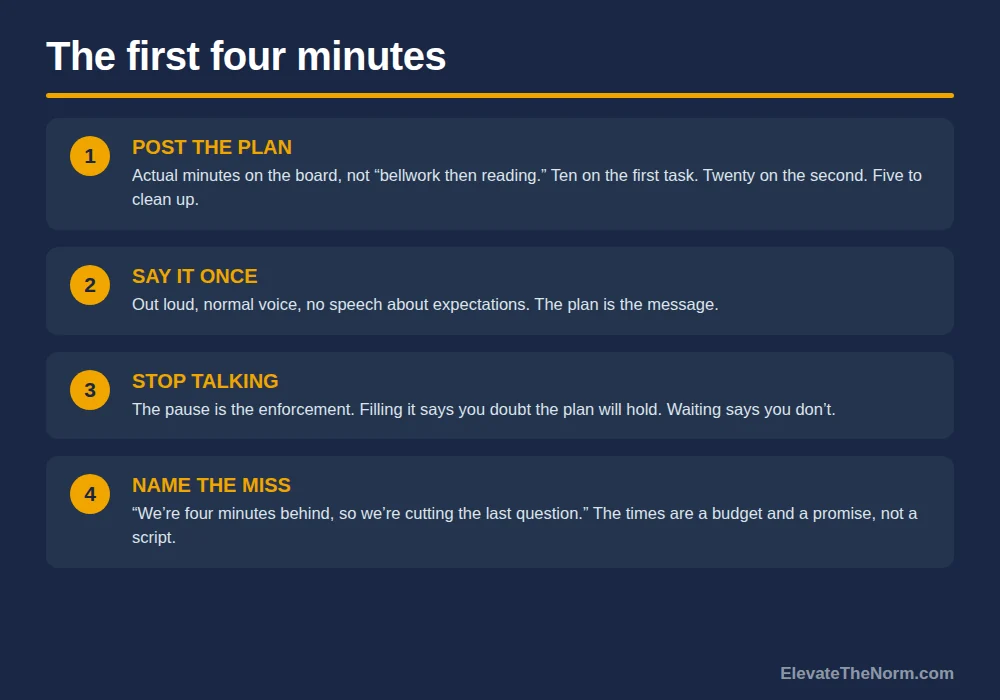
    The method I use in my own room transfers to a substitute almost unchanged, and it is the one piece of this I would put above everything else: taking control of a room is done by organization to the minute, and then you pause.

    Four numbered steps for a substitute’s first four minutes: post the plan, say it once, stop talking, name the miss
    The pause is the enforcement. Filling it says you doubt the plan will hold.

    Put the plan where they can see it before the bell. Not “bellwork, then reading” — actual minutes. Ten minutes on the first task. Twenty on the second. Five to clean up. Write it on the board you found it on. Then say it out loud, once, in a normal voice.

    Then stop talking.

    The pause is the part people skip, and it is the part that works. You have laid out a plan that is visibly organized, and then you let the silence do the enforcement instead of your volume. The instinct is to fill it — to repeat yourself, to add a threat, to get louder. Filling it tells the room you are not sure the plan will hold. Waiting tells them you are.

    I should be honest about what that costs, because most versions of “just wait them out” leave the price out. I once held a pause for more than five minutes. It was one of the most awkward moments of my life, that section finished nine minutes behind my other classes, and it is the only time I have ever assigned homework. It worked. It also cost nine minutes and a homework assignment I did not want to give. A substitute will rarely have nine minutes to spend, which is exactly why the posted plan matters — it shortens the pause you need.

    One clarification, since this gets misread: the posted times are a budget and a promise, not a script. When you miss them, say so out loud and give the reason. A substitute who announces “we are four minutes behind, so we are cutting the last question” has just demonstrated that the plan is real. That is worth more than hitting the times.

    Run their room, not yours

    This is where most substitute days are quietly lost, and it rarely looks like a discipline problem. It looks like a reasonable adult correcting something that was never wrong.

    Two-column comparison of classroom things a substitute should leave alone and write down beside things that require immediate action
    If you can’t explain it, it’s probably deliberate.

    In my room, students are almost always working alongside somebody. Partner work is the resting state, not a reward and not a special occasion — the tables are literally grouped that way and there are no rows to return to. A substitute who walks in, sees students talking, and reads it as the room falling apart will spend the period fighting the room’s actual design. They will separate students who were doing exactly what they were supposed to do, and by second period they will have spent all their credibility on a rule that does not exist in that room.

    The same goes for the lights. I do not turn the overhead fluorescents on — the room runs on floor lamps around the perimeter. It is a deliberate choice about sensory load, and it helps far more students than the ones who would ever have asked for an accommodation. A substitute’s first instinct on walking into a dim room is to find the switch. Flipping it is a small thing that changes the room the students walked into.

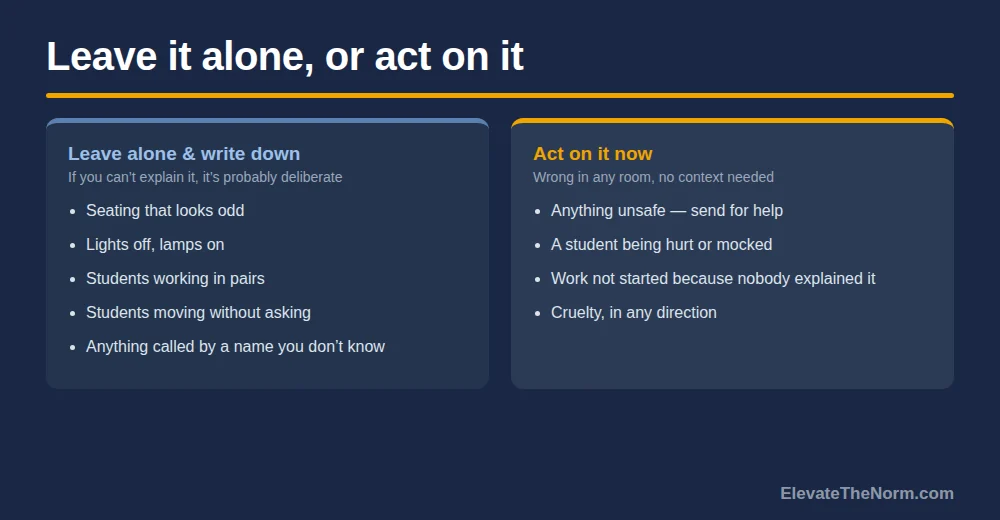
    So the working rule is: anything you cannot explain, leave alone and write down. If the seating looks odd, it is probably deliberate. If the lights are off, someone turned them off. If four students get up without asking, there is probably an established procedure for that. Note it, ask afterward, and do not spend your authority correcting a room’s design.

    Reserve your authority for the things that are wrong in any room: cruelty, danger, and a flat refusal to engage with work that has been made doable.

    That last one needs its qualifier. A student who will not start a worksheet nobody explained is not defying you — they are stuck, and “refusal” is the wrong word for it. Check whether the task is actually doable before you treat not-doing-it as a behavior problem. Most of the time on a substitute day, it is not defiance. It is an instruction gap.

    The one line that overrides all of this: if something is unsafe, or a student is being hurt, you do not need permission or context. Send for the neighboring teacher or the office immediately. Knowing where the phone is and who is next door is a two-minute check when you arrive, and it is the only part of this you should never improvise.

    Substitute teacher classroom management: five things you can actually control

    1. Where you stand. Circulating beats presiding. A redirect delivered quietly at close range, to one student, does the work without announcing the problem to twenty-nine other people — and it does not give the room a performance to react to.
    2. What you say first. Names if you have them, the plan if you do not. “Here is what we are doing and how long it takes” outperforms any version of “I expect you to behave for me today.”
    3. Your volume. It is the one resource that only decreases. Every notch you spend is gone for the rest of the day.
    4. What you write down. An honest, specific, unemotional note is the most valuable thing you leave behind. “Third period did not start the reading; two students, seated front left, were the reason” is useful. “Terrible class” is not, and it will be read by someone who has to work with those students tomorrow.
    5. Whether anybody gets humiliated. This one is not negotiable and it is entirely within your control. You will be gone tomorrow. They will not.

    What the regular teacher owes the substitute

    If you are reading this as the teacher who is going to be out, this is the section that changes your sub’s day, and it takes about fifteen minutes to write once and reuse all year.

    Six items that belong in substitute teacher plans, including timed plans, how the room runs, and a fallback activity
    Fifteen minutes to write once, and it changes every sub day that follows.

    Write it assuming it will be read in five minutes, standing up, by someone who was called at six that morning and has never been in your building. That is the realistic case, not the exception. Put the timed plan and the three things a stranger would misread on the first page, in that order. Everything else can be on page two, where it may or may not get read.

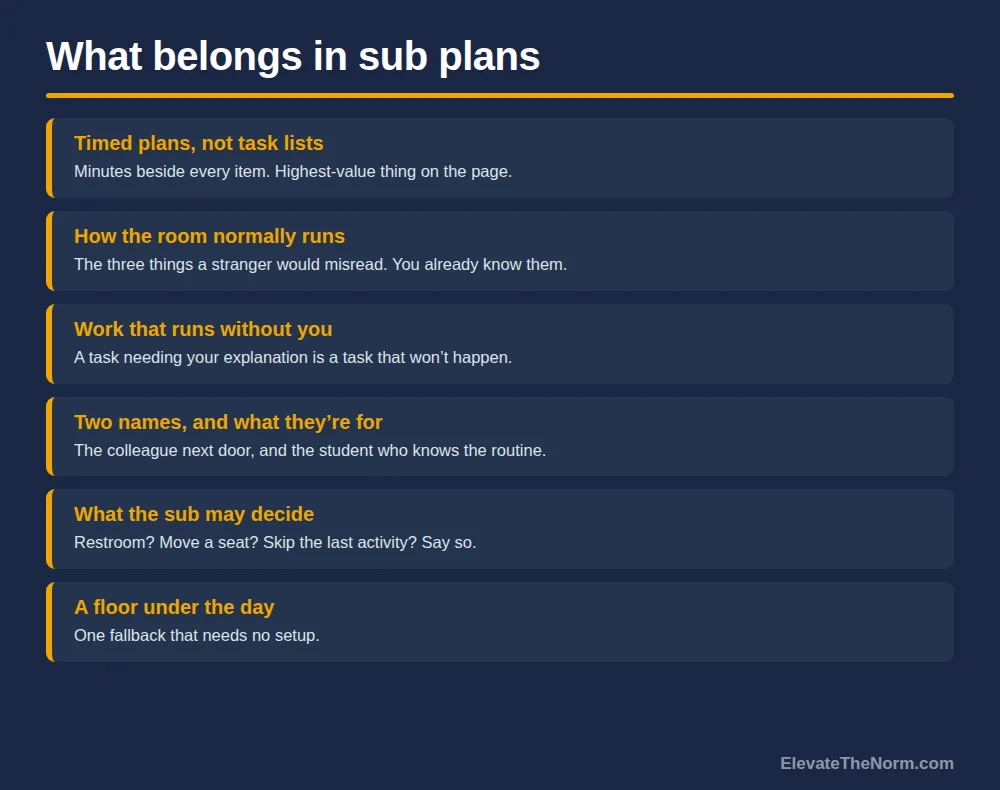
    • Timed plans, not task lists. Minutes next to every item. It is the single highest-value thing on the page, for exactly the reason in the section above.
    • A one-paragraph description of how your room normally runs. Partner work is expected. The lights stay off. Students may get water without asking. Write the three things a stranger would most likely misread — you already know what they are.
    • Work that can actually be done without you. A task that depends on your explanation is a task that will not happen, and the gap gets filled with whatever the room decides to do instead.
    • Two names, and what they are for. The colleague next door and the student who genuinely knows the routine. Not a list of “problem” students — a list of doors to knock on.
    • What a substitute is allowed to decide. Can they let a student use the restroom? Move a seat? Skip the last activity? Say so, or you have left someone to guess and then be wrong.
    • Where the day goes if it falls apart. One genuinely usable fallback that requires no setup. Every sub plan should have a floor under it.

    One thing that does not belong in sub plans: a discipline ladder invented for the occasion. Your substitute cannot enforce consequences that do not already exist in the room, and asking them to try is how a day gets worse rather than better. Tell them what the room already does.

    Why the day is worth taking seriously

    There is a habit of treating substitute days as time that does not count. The measured picture disagrees, though it needs stating carefully.

    Analysis published by Brookings reports that roughly 29% of teachers were chronically absent — missing ten or more school days — in the 2015–16 federal civil rights data, and that ten additional days of teacher absence are associated with a decline of between 1.7% and 3.3% of a standard deviation in math achievement. Substitute costs run to roughly 1% of all public education spending.

    Two honest caveats. These are associations drawn from observational data, not the result of an experiment, and the effect sizes are modest per unit. And the federal absence figures are from 2015–16, which is the most recent comparable collection but is now several years old. What the numbers support is a modest claim, and the modest claim is enough: sub days are frequent, they cost real money, and they are associated with measurably less learning. They are not a rounding error, and the room deserves a plan.

    What the students are doing, and why

    Almost everything written about substitute teaching treats the students as weather — a condition to be survived. It is worth saying plainly what is actually happening on their side of it, because it changes what you do.

    A class that tests a substitute is usually not running a scheme. Three ordinary things are true at once: nobody in the room knows their name, the day has been signalled to them as a holding pattern, and the adult in front of them has no history with them in either direction — no credit built up, and no relationship to damage. Teenagers read all three accurately and respond to them rationally. If the day looks like it does not count, some of them will treat it as though it does not count. A spoken routine a substitute has never run will not hold either, which is why cues a stranger can read off the wall survive your absence when verbal ones do not.

    Which means the two highest-leverage moves are both about signalling the opposite. Learn some names and use them — from a seating chart, from their work, by asking. And make the work visibly real: something that gets collected, that the regular teacher will see, that connects to what they did yesterday. “Your teacher is going to read these tomorrow” is a true sentence that changes a room, and it costs nothing.

    Students are also owed something on these days, and it is not complicated: to know what they are doing and how long it takes, to not be punished as a group for individuals, to not be talked about as a category in a note they will never see, and to be able to ask a question and get a real answer rather than “I’m just the sub.” That last one is worth retiring. You are the teacher in that room today. Not knowing an answer is fine. Saying you do not count is not, and they will believe you.

    Should a substitute actually teach?

    Sometimes, and the honest answer depends on what the plans ask for rather than on how confident you feel.

    If the plan is practice, review, reading or a project work session — which is the large majority of well-written sub plans — then teaching it is mostly circulating, answering, and keeping the work moving. Do that, and do it properly. If the plan introduces genuinely new content in a subject you do not know, delivering it badly is worse than not delivering it: students will learn it wrong, and the regular teacher will have to undo that before they can teach it. Run the practice portion, write down exactly where the class stopped, and say so.

    One small tool worth borrowing from special-education practice, where it is standard: a visible timer. Putting the remaining minutes somewhere the whole room can see them makes an abstract instruction concrete, and it takes the countdown out of your voice — the clock says it instead of you. It is a phone on the document camera, and it works for far more students than the ones it was designed for.

    The part that is actually hard

    Everything above is manageable on a normal day. The genuinely hard version is the room that has decided, collectively and before you said a word, that today is a day off. No single student is doing anything you could name. The work is simply not starting.

    There is no technique that fixes that in thirty seconds, and any article that tells you otherwise is selling something. What works is narrow and unglamorous: get one table started. Not the room — one table. Sit down next to them, at their height, and do the first item with them. A room that is entirely not working is very hard to move. A room where one group is visibly working is a different room, and the second group is much easier than the first.

    And if it does not turn: finish the period without making it worse, write the honest note, and hand the room back. That is not defeat. On some days that is competence, and a teacher who has been out sick will understand the difference between a sub who lost a room and a sub who protected one.

    Which is the whole of it, really. Substitute teacher classroom management is not a set of tricks for controlling somebody else’s students — it is the practice of running a room you did not build, on borrowed authority, without spending down what the regular teacher has spent months constructing. Post the plan. Pause instead of getting louder. Leave the room’s own rules alone. Use names. Make the work real. Write the honest note.

    And if you are the one writing the plans: fifteen minutes on a page that assumes nothing will do more for that day than anything the substitute can do once they are standing in it.

    Printables for this

    I write these for my own room and put them on TPT. The Any-Day Emergency Sub Plan Card is free — one page a stranger can run cold, in any subject. If you teach history, World History Emergency Sub Plans is five full days of strange-but-true readings with questions and answer keys, written so a sub can hand them out without knowing the content.

    Out the week of Halloween? A Halloween sub day does not have to be a word search. Halloween Sub Plans is five strange-but-true spooky history readings a sub can run cold. For math, the free Halloween color by number samplers for middle school and high school check themselves, so the sub never needs the answer key.

    If you are buying during a sitewide sale, the TPT sale guide walks through how the discounts stack and what is actually worth the money.

    Sources

    • Brookings Institution. We should be focusing on absenteeism among teachers, not just students. Read the analysis — source for the 29% chronic-absence figure (U.S. Department of Education Office for Civil Rights, 2015–16), the 1.7–3.3% of a standard deviation math association, and the ~1% of public education spending figure. These are observational associations, not causal estimates, and the federal absence data is from 2015–16.
    • Missouri Department of Elementary and Secondary Education. Substitute Teachers — certification requirements. Read the requirements — source for the 36 semester hours / 20 clock hours standard. One state’s rule, cited because it is current and published; requirements vary considerably by state and your own state’s rule governs.
    • Substitute teaching: evidence-based practices for inclusive classrooms. Helen: The Journal of Human Exceptionality, April 2024. Read the guide — consulted for the visual-schedule and visual-timer practices. Cited as practitioner guidance, not as research: the article describes itself as drawing on evidence-based practice but names no studies and reports no data.

    Every link above was checked on September 20, 2026. The classroom practices described in the first person — the timed plan and the pause, partner work as the room’s resting state, and the lamps — are my own and are used across this site.

    Worth saying plainly: a day covered by a substitute is not a day lost, and taking the day you need before you badly need it is one of the few moves a teacher fully controls. It is also a small part of what climbing back out of exhaustion actually asks of you.

    Frequently Asked Questions

    What is the single most important thing a substitute teacher should do first?

    Put a timed plan where the room can see it, say it out loud once in a normal voice, and then stop talking. The visible plan does most of the work and the pause does the rest. What does not work is opening with a speech about expectations — it spends authority before anything has happened and invites the room to test it.

    Should a substitute enforce their own rules or the regular teacher’s?

    The regular teacher’s, with three exceptions that apply in any room: cruelty, danger, and refusal to attempt the work. A substitute’s authority is borrowed from the room’s existing norms, and replacing those norms is what burns it. If something looks wrong but you cannot explain it, the odds are good that it is deliberate — leave it alone, write it down, and ask afterward.

    How much training do substitute teachers actually have?

    Less than most people assume, and it varies a great deal by state. Missouri, as one published example, issues a substitute certificate to applicants with either 36 semester hours of college credit or 20 clock hours of approved training. Some states require more. The practical point for administrators and teachers is that sub plans are, for some of the people using them, the entire preparation for the day.

    What should a substitute do when the whole class refuses to start work?

    Get one table started rather than trying to move the room. Sit down at their height and do the first item with them. A room in which nothing is happening is very hard to shift; a room in which one group is visibly working is a different problem and a much easier one. If it does not turn, finish the period without making it worse and leave an honest, specific note. Protecting a room is not the same as losing it.

    What belongs in sub plans for a middle or high school class?

    Timed plans rather than task lists, a short paragraph on how the room normally runs, work that can be completed without the regular teacher’s explanation, the name of a colleague next door and a student who knows the routine, an explicit statement of what the substitute is allowed to decide, and one genuinely usable fallback activity. Leave out any discipline ladder invented for the occasion — a substitute cannot enforce consequences the room does not already have.

    Does it actually matter how a substitute day goes, or is it a lost day either way?

    It matters, though the evidence supports a modest claim rather than a dramatic one. Brookings reports that ten additional days of teacher absence are associated with a decline of roughly 1.7% to 3.3% of a standard deviation in math achievement, and that substitute costs approach 1% of public education spending. Those are observational associations from older federal data, not experimental results. Read together they support something narrow and sufficient: these days are frequent, expensive, and associated with less learning.

    How should a substitute write the note they leave behind?

    Specifically, honestly, and without adjectives about character. Name what happened, when, and what was or was not completed. “Third period did not start the reading; two students seated front left were the reason” gives the regular teacher something to act on. “Terrible class” does not, and it will be read by an adult who has to face those students the next morning. Report behavior, not verdicts about people.

    Why do students behave differently for a substitute?

    Usually because three things are true at once and teenagers read all three correctly: nobody in the room knows their name, the day has been signalled to them as a holding pattern, and the adult in front of them has no history with them in either direction. That is a rational response to the situation rather than a character flaw, and it points at the fix. Use names, and make the work visibly real — something that gets collected and that the regular teacher will actually see. Telling a class truthfully that their teacher will read this tomorrow changes a room and costs nothing.


    About Clay Shumate

    By Clay Shumate — Clay Shumate is a certified secondary Social Studies teacher in the public schools of West Alabama, with seven years of classroom experience, a B.A. in History, and an M.Ed. in Secondary Education. He writes about project-based learning, student responsibility, respect, and practical ways to hold young people to a higher standard while giving them room to learn from mistakes. He is a member of the Society of Professional Journalists and writes to its Code of Ethics; this site’s editorial standards and corrections policy are published in full.

  • Student Leadership: How Schools Can Give Teenagers Real Responsibility

    Student Leadership: How Schools Can Give Teenagers Real Responsibility

    By Clay Shumate

    Student leadership is not a title, an election, or a line on a college application. It is the practice of giving a teenager genuine responsibility — real decisions, real consequences, and real support from an adult who has done the planning to make success possible. Schools that do this well produce students who know how to serve others, solve hard problems, and hold themselves accountable. Schools that do it poorly give students the word leadership and wonder why nothing changes.

    This article explains what student leadership actually requires, where most schools fall short, and how any classroom teacher can hand a student real authority and then hold them to it — without setting them up to fail. None of it works before ordinary responsibility is already the norm in the room.

    What Student Leadership Actually Means

    Most school definitions of student leadership center on elected positions: student council president, class officers, homecoming committee. These roles are not without value. But they are also the roles most likely to be filled by students who were already organized, already known, and already comfortable raising their hands. If a school’s model of leadership only rewards students who already look like leaders, it is not developing leadership — it is sorting for it.

    A more useful definition: student leadership is any structured situation in which a student holds genuine authority over a meaningful outcome and is held accountable for results. The authority must be real, not ceremonial. The outcome must matter to someone besides the student. The accountability must have consequences the student actually feels.

    Research on youth development supports the value of this kind of experience. Sociologist Reed Larson’s landmark review found that voluntary, goal-directed activities — ones that require initiative, not just compliance — produce the kind of intrinsic motivation that transfers to adult life.1 Dana Mitra’s analysis of student voice in secondary schools found that genuine student participation, including planning and decision-making roles, produced measurable gains in engagement, school belonging, and academic motivation — particularly among students who had previously been disengaged.2

    The operative word in both bodies of research is genuine. Symbolic participation — filling a role with a title and no real authority — does not produce those outcomes. It often produces the opposite: students who learn that official channels are theater, that adults do not actually share power, and that their effort is not taken seriously.

    The Problem With Symbolic Leadership

    Consider three common school leadership structures and what they often deliver in practice:

    Student government at many schools functions as an event-planning committee with a democratic veneer. Students vote on spirit week themes. They help organize pep rallies. The principal makes all decisions that actually affect the school, and student government exists to generate enthusiasm for those decisions. Students who take this seriously and try to raise real concerns — about grading policy, discipline, cafeteria conditions — often discover that the program’s actual scope is narrower than its name suggests, and that genuine policy decisions belong to administration rather than to the student government structure.

    Peer mediators and conflict resolution programs are genuinely valuable when implemented with real training, supervised practice, and institutional backing. They are window dressing when students are given a title and a script and expected to resolve disputes the adults find inconvenient. A peer mediator who cannot actually commit to any outcome, who has no authority to follow up, and who receives no coaching after sessions learns very quickly that the role does not matter.

    Student ambassadors and leadership clubs often confuse belonging with leading. Wearing a lanyard is not leadership. Giving a tour of the school to visiting families is service, but it is not the same as holding authority over a meaningful outcome. These programs are not wrong — they build community and recognize students. But when schools call them leadership development, they are doing two harmful things: overstating what the experience provides, and tacitly telling other students that leadership is a reward for being well-liked. The fix is to build the habit everywhere first, through small jobs that every student actually owns.

    None of this means schools should abandon student government or peer programs. It means schools should be honest about what those programs are and build something more substantive alongside them — something that reaches students who are not already popular, high-achieving, or interested in student government.

    What Real Student Responsibility Looks Like

    Genuine student leadership roles share three features: the student controls something that matters, an adult has done enough preparation for the student to succeed, and the student is held accountable when things go wrong or go right. Here are several forms this can take across a school day, and twenty-five worked examples with the decision each student holds if you want the longer list:

    seven leadership roles beyond student government that give students real authority in the classroom
    Seven types of student leadership that go beyond student government — each requiring real authority and adult preparation.

    Decision-making authority within a project

    In a project-based learning unit, one student serves as the project manager for a group. This is not a title for the student most likely to do all the work anyway. It is a structured role with defined responsibilities: managing the timeline, facilitating group decision-making, communicating progress to the teacher, and being the first person the teacher asks when something is behind schedule.

    When student responsibility is built into the structure of a project — not as an add-on but as a load-bearing element — students who take the project manager role seriously develop skills they cannot get by sitting in the back of a lecture. They also discover something teachers know very well: managing other people is significantly harder than doing the work yourself.

    Service with stakes

    Service-learning at its best does not ask students to perform volunteerism. It asks them to solve a real problem for a real audience. A group of students who audits their school’s recycling program and presents findings to the facilities director is doing service. A group of students who sorts recycling bins after school is doing labor. Both are useful. Only one is leadership.

    The National Commission on Service-Learning found that service-learning produces stronger civic engagement, deeper content understanding, and greater self-efficacy when students are active problem-solvers rather than passive participants — and when adult educators maintain mentorship and structured reflection throughout the experience.3

    Peer teaching and peer support

    Students can explain things to each other in ways adults sometimes cannot. A junior who has mastered a concept can reach a struggling sophomore through language, reference points, and social proximity that a teacher does not have. When schools build peer tutoring programs with genuine structure — trained tutors, session protocols, progress tracking, teacher oversight — they create leadership roles that reward competence in a specific skill rather than general popularity.

    This is different from simply asking students to help each other. Unstructured peer assistance is not leadership. A tutoring coordinator who schedules sessions, follows up on attendance, and reports to a teacher advisor is holding a leadership role. The difference is the structure and the accountability. For any peer support role, families should receive a brief note at the start of the program explaining what the role involves — and what it does not involve, specifically that trained adults retain responsibility for any serious concerns that arise.

    Public communication

    Presenting research to a school board, speaking at a community meeting, writing an op-ed for the local paper, producing a podcast episode that goes on the school website — these are forms of student leadership that require preparation, require adult oversight, and require students to be accountable to an audience beyond their classroom. Building student voice and choice into public-facing tasks gives leadership a real audience, which changes how students approach the work.

    Leadership for Students Who Are Not Already Known

    One of the most persistent problems with school leadership programs is that they tend to select for students who are already recognized. Elected positions favor students with social capital. Competitive leadership programs favor students with the confidence to apply. Teacher nominations for leadership roles can unconsciously favor students who already perform the behaviors associated with “good” students.

    This matters because leadership development, by definition, should change someone. A student who already leads well needs affirmation. A student who has never been asked to lead needs a chance. If schools only offer leadership experiences to students who already demonstrate leadership, they are providing a finishing school for existing leaders rather than developing new ones.

    real vs symbolic student leadership comparison chart showing what distinguishes genuine authority from ceremonial roles
    Real versus symbolic student leadership: the distinction that determines whether development actually happens.

    Several practical approaches reach students who are not already visible:

    Role rotation within the classroom. Not every leadership experience needs to be a program. A teacher who rotates the project facilitator role, the daily discussion leader, the “expert” who explains last night’s reading to the class — that teacher is giving every student repeated low-stakes practice at the behaviors leadership requires. Some students will thrive immediately. Others will struggle, which is exactly when the learning happens. From a student’s perspective, being handed a role they did not seek — and then actually being trusted to carry it — sends a different signal than any motivational poster ever could.

    Interest-based leadership, not performance-based. A student who is deeply interested in robotics but is not a top student may be the best person to lead the school’s engineering project. A student who has lived experience with food insecurity may be the right student to lead a school food drive — not because the school wants to exploit that experience, but because that student has a relationship to the work that others do not. When schools match students to leadership roles based on genuine interest and relevant knowledge, they reach students who would never raise their hand to run for class president.

    Assigned authority with real stakes. Perhaps the most underused tool available to classroom teachers is the simplest one: assigning a student genuine authority and then treating that authority as real. Handing a student real authority and then holding them to it — not rescuing them when it becomes difficult, not undoing their decisions behind their back, and not abandoning them when they struggle — is the core practice of classroom-based leadership development. It requires the teacher to have done enough preparation that the student can actually succeed, and it requires the teacher to resist the urge to take the authority back the moment things get complicated.

    The Teacher’s Role: Planning and Presence

    Every effective student leadership experience rests on adult preparation. A student cannot demonstrate leadership in a role that has not been designed well enough for leadership to be possible. When a student “fails” at a leadership role — when the project falls apart, when the peer support session goes nowhere, when the presentation embarrasses everyone — the first question is not what the student did wrong. The first question is what the teacher did not prepare.

    This is not a comfortable position. It requires teachers to hold themselves accountable for the conditions that make student success possible. But it is also the only position that actually develops students. A classroom where students are set up to fail so they can “learn from the experience” is not a leadership incubator. It is a classroom with poor design.

    Holding high expectations for students does not mean removing all support. It means designing a situation where students are capable of meeting genuine expectations if they apply genuine effort — and then holding them to it when they do not. The high expectation and the adequate preparation are not in tension. They depend on each other.

    Adult oversight in a student leadership context also means being present enough to catch problems before they become crises. A student project manager who is drowning should receive coaching from the teacher before the project fails, not sympathy after. A peer mediator who handles a session poorly should debrief with an adult advisor the same day, not two weeks later. Oversight is not micromanagement. It is the sustained adult presence that makes genuine student authority possible — because students are developing, not developed.

    Ethical Boundaries: What Students Should Not Be Responsible For

    Genuine student leadership has a clear outer boundary: students should never be placed in roles that require them to perform adult professional functions, manage other students’ behavioral or mental health needs without professional support, or bear responsibility for outcomes that exceed their developmental capacity.

    A student peer mediator should not be the primary responder to a disclosure of abuse, self-harm, or safety concerns — that is a mandatory reporter responsibility that belongs to trained adults. A student project manager should not be responsible for motivating a peer who is dealing with a serious personal crisis — that is a counseling function. A student ambassador should not be expected to handle a visiting family’s complaint about the school’s discipline policy — that is an administrator’s responsibility.

    These boundaries are not signs of low expectations. They are signs that the school understands what leadership development is for. Students are learning to be responsible. They are not responsible for the school. That distinction protects them and produces better learning outcomes. The National Academies of Sciences has noted that adolescents’ development of responsibility, civic identity, and competence is best supported by environments that offer genuine challenge within a framework of consistent adult support — not by environments that expose them to adult burdens before they are ready.4

    Building strong relationships with students includes being clear about where their authority ends — and why. Students who understand that their role has real boundaries, and why those boundaries exist, are more likely to take the role seriously than students who feel they have been handed an amorphous responsibility no one has defined.

    How to Start: Practical First Steps for Any Teacher

    Leadership development does not require a program, a budget, or administrative approval. Every teacher in any classroom can begin with the classroom they already have. It helps to name the specific abilities a role is supposed to build before you hand it over, so the student is practising something you can both see rather than hoping character rubs off.

    classroom leadership checklist for teachers three steps identify assign debrief
    A three-step classroom framework for assigning, supporting, and debriefing a student leadership role.

    Step 1: Identify one role in your current classroom structure that could be held by a student. Not a fake role. Not a role the teacher secretly controls. A role with a real outcome: discussion leader for the week, group project coordinator, quiz-question author, revision partner who gives written feedback on two other students’ drafts. Start small and make it real.

    Step 2: Assign the role intentionally, not by nomination or election. Choose a student who could benefit from the experience — not one who would succeed regardless. A student who is quietly competent but rarely recognized, who is genuinely interested in the work, or who needs to practice leading rather than following is often a better choice than the class’s most visible student. Brief them privately on what the role requires before it begins. For students who are anxious or reluctant, start with a smaller version of the role — five minutes of discussion facilitation before thirty, one group member to coordinate before a full team. Check in with them during the role, especially the first time. Debrief with them honestly after. A good debrief is specific: what went well, what you would do differently next time, one thing the student handled that they might not have expected they could handle.

    Step 3: Hold the student to the role. When something goes wrong — and something will — address it directly and specifically. “Your group’s timeline slipped because you didn’t confirm the assignment on Tuesday. How will you handle Tuesday next time?” is more useful than either letting it slide or removing the student from the role. This is where the development happens.

    From there, activities for teaching responsibility can build on this foundation. But the first step is the simplest and the hardest: treating a student as capable of holding real authority and then actually letting them hold it.

    Schools that do this consistently — across classrooms, grade levels, and subject areas, not just in special programs — produce students who understand that leadership is a practice, not a status. That understanding is more durable, more transferable, and more honest than any title a school can give.

    Key Takeaways

    • Student leadership is genuine authority over a meaningful outcome — not a title or a symbolic role.
    • Most school leadership programs reach only students who are already recognized. Effective leadership development reaches students who have never been asked to lead.
    • Real leadership experiences require real preparation by the teacher — students cannot demonstrate leadership in a role the teacher has not designed well enough for success to be possible.
    • Student authority must have real boundaries: students are not responsible for adult professional functions, peer mental health crises, or outcomes that exceed their developmental stage.
    • The most accessible form of leadership development happens inside existing classrooms: assigning real roles, holding students to them, and debriefing honestly when things go wrong.
    • High expectations and adequate preparation work together — they are not in conflict.

    Free Download: Student Leadership Planning Guide

    A one-page classroom tool for designing real student leadership roles — with a checklist for authority, preparation, and accountability. No email required.

    Download the Planning Guide (PDF) →

    Free Download: Student Leadership Planning Guide — a one-page classroom tool. Download (PDF) →

    Frequently Asked Questions

    What if a student doesn’t want a leadership role?

    This is a reasonable concern, and it comes up more often than schools expect. A student who genuinely refuses a role after a calm, private conversation about what it requires may be signaling something worth understanding — anxiety, lack of preparation, or a personal situation the teacher doesn’t know about. In that case, starting smaller makes sense: a five-minute facilitator role before a thirty-minute project lead. The goal is not to force students into uncomfortable positions but to expand what they believe they can do. Forced reluctance rarely produces leadership growth. A smaller, well-scaffolded role that a student actually performs is worth more than a larger role that a student dreads and does minimally.

    Should student leadership roles be graded?

    It depends on the context, but grading is not required for the experience to be valuable. Many teachers assess the work the leadership role produces — the project the team completed, the reflection the student writes afterward, the quality of the peer feedback — rather than grading the leadership itself. Grading “how well you led” is difficult and can feel punitive when a student is still learning. What matters most is specific, honest feedback during and after the role. A debrief conversation — what went well, what you would do differently, what you’ll do next time — is often more developmental than a grade. If the class context requires a grade, consider self-assessment as part of the evaluation: students who accurately assess their own performance in a leadership role are demonstrating growth that matters.

    What should teachers do when a peer support role exposes a serious student concern?

    Train peer supporters explicitly on this scenario before the role begins, not after the fact. Students who serve as peer mediators, tutors, or support partners need to know the clear boundary: they listen, they can acknowledge, and they direct any serious concern to an adult immediately. They are not counselors, they are not mandated reporters, and they are not equipped to evaluate whether a classmate’s situation requires professional intervention. When a peer supporter encounters a disclosure of self-harm, abuse, mental health crisis, or safety risk, their job ends at “let’s tell Ms./Mr. [advisor] together.” Adults handle everything from that point forward. This boundary should be taught, practiced with scenarios, and reinforced with every cohort. Schools running peer programs without explicit training on this boundary are creating risk for students and for the program.

    How do you support students who struggle with the leadership role — especially shy students or those with learning differences?

    Scaffolding is the answer. A student with social anxiety who is expected to run a full group discussion without preparation will likely confirm every belief they already have about their own limitations. The same student, given a structured agenda in advance, a few rehearsal prompts, and permission to check in quietly with the teacher midway through, can run a discussion effectively. Learning differences require similar thought: a student who processes language slowly may need written prompts rather than on-the-spot decisions. A student with executive function challenges may need the project manager role broken into smaller daily tasks with explicit check-in points. The question is not whether these students can lead — it is whether the teacher has designed the role with enough structure for their specific needs. When the design is right, the role becomes possible. That is the work.

    How much additional time does this require from teachers?

    An honest answer: the initial design takes time. Creating a role with real authority, identifying which student to assign it to, briefing that student, and planning a debrief is work that does not happen automatically. For a classroom teacher managing multiple preps, 28–35 students, and a full grading load, “just add leadership development” is not a costless suggestion. The most practical approach is to start with one role in one unit and evaluate it. A project manager role in a single project — one briefing conversation, two or three check-ins during the unit, one debrief at the end — adds perhaps thirty to forty minutes across a three-week project. Over time, the routines become faster and the students become better at them. The cost is real and it is worth naming honestly. The alternative — students who graduate without ever having held genuine authority in a structured setting — is also worth naming.

    When should schools start building student leadership experiences? Is middle school too early?

    Middle school is not too early — but the scale and structure need to match the developmental stage. A seventh grader serving as the daily discussion leader for ten minutes is not the same as a seventh grader managing a semester-long project team. Middle school is an appropriate time to introduce leadership roles at the classroom level: group facilitator for the week, peer reviewer, expert explainer. These experiences build the vocabulary and the habits that high school leadership roles require. By ninth grade, students who have had repeated small-scale leadership experiences are far better prepared for larger roles than students who have only ever been assigned to fill out a group worksheet. Start small, start early, and keep the authority proportional to the preparation.

    What’s the difference between giving students real responsibility and putting adult problems on them?

    The test is whether an adult professional could reasonably be expected to handle the situation without specialized training or institutional authority. A student can be responsible for a project timeline. A student cannot be responsible for a peer’s mental health crisis. A student can be responsible for facilitating a class discussion. A student cannot be responsible for resolving a conflict involving serious interpersonal harm. A student can communicate a problem to an administrator on behalf of a group. A student cannot be expected to manage the administration’s response to that problem. When the role requires specialized credentials, institutional authority, or the capacity to impose consequences on others, it belongs to an adult. When the role requires planning, communication, collaboration, and follow-through, it can belong to a student — with preparation and oversight. Genuine leadership development stays consistently on the student side of that line.

    Should families be informed when their student takes on a peer support role?

    Yes, particularly for any program with ongoing peer support, mediation, or advising functions. Families deserve to know that their student is serving in a peer role, what that role involves, and what it does not involve (and specifically that trained adults oversee all serious concerns). For classroom-level leadership roles — project manager, discussion leader, peer reviewer — a brief mention in a class newsletter or course syllabus is usually sufficient. For structured peer programs that carry more weight, a brief parent communication at the beginning of the year or program is appropriate. Transparency builds trust with families who might otherwise wonder what “peer leadership” means in practice. It also gives parents the language to reinforce the experience at home, which extends the learning beyond the classroom.

    Sources

    1. Larson, R. W. (2000). Toward a psychology of positive youth development. American Psychologist, 55(1), 170–183. https://doi.org/10.1037/0003-066X.55.1.170
    2. Mitra, D. L. (2004). The significance of students: Can increasing “student voice” in schools lead to gains in youth development? Teachers College Record, 106(4), 651–688. https://doi.org/10.1177/016146810410600401
    3. National Commission on Service-Learning. (2002). Learning in deed: The power of service-learning for American schools. W. K. Kellogg Foundation. https://eric.ed.gov/?id=ED467192
    4. National Academies of Sciences, Engineering, and Medicine. (2019). The promise of adolescence: Realizing opportunity for all youth. National Academies Press. https://doi.org/10.17226/25388

    About Clay Shumate

    Clay Shumate is a certified secondary Social Studies teacher in the public schools of West Alabama, with seven years of classroom experience, a B.A. in History, and an M.Ed. in Secondary Education. He writes about project-based learning, student responsibility, respect, and practical ways to hold young people to a higher standard while giving them room to learn from mistakes. He is a member of the Society of Professional Journalists and writes to its Code of Ethics; this site’s editorial standards and corrections policy are published in full. More about Clay.

  • The Academic Integrity Email: What to Write, and What to Leave Out

    The Academic Integrity Email: What to Write, and What to Leave Out

    An academic integrity email is a record. That is the first thing to understand about it, and it changes almost everything about how it should be written — because under federal law a written communication that is directly related to a student and kept by the school can become part of that student’s education record, which a parent has the right to read.

    So the question is not what you feel like writing at 9pm with a plagiarised essay open in another tab. The question is what you would be comfortable reading aloud, months later, in a meeting with the student, both parents and an assistant principal.

    Three emails usually have to be written: one to the student, one to the family, one to whoever handles this in your building. They have different jobs and should not contain the same paragraph. Below is what goes in each, worded out, along with the five sentences that cause most of the trouble.

    Key Takeaways

    • Write observations, not verdicts. “Three paragraphs match a source that is not cited” is a fact. “You plagiarised this” is a conclusion you may not be the one authorised to reach.
    • Assume a parent will read it. FERPA gives parents of K–12 students the right to inspect their child’s education records, and schools must respond within 45 days.
    • Talk to the student before you email anyone else whenever the timetable allows. An email that arrives home before the student has been asked what happened turns a fixable situation into an ambush.
    • Specific beats gentle. In a high-school field experiment, messages to parents about what a student needed to improve outperformed messages about what they were doing well.
    • Never put another student’s name in it. Two students, two separate emails, no cross-references.
    • Say what happens next and when. Most of the panic in these situations is uncertainty, not consequence.
    • Do not send it angry. The pause costs nothing and prevents the sentence you cannot unsend.

    Free Download · Printable PDF

    Academic Integrity Email Templates

    All three emails from this article — student, family, administrator — as copy-and-adapt templates, plus the phrase-swap table and a pre-send checklist.

    Download the free PDF

    Free. No email address required. Designed for grades 6–12. The full response process is on the academic integrity response page.

    Before You Write Anything: What an Email Actually Is

    Teachers tend to treat email as conversation. It is closer to filing.

    Two-column list of what belongs in an academic integrity email and what should stay out
    The left column is defensible months later. The right column is what gets quoted back to you.

    The U.S. Department of Education’s guidance defines an education record as one that is “directly related to a student” and maintained by the school. Parents of K–12 students have the right to inspect those records, and a school must comply “within a reasonable period of time, but not more than 45 days after receipt of a request.” Whether any particular email meets that bar depends on how your district stores and treats it — which is a question for your administrator, not for a blog. The practical takeaway does not depend on the edge cases: write every one of these as though it will be read by the family, because it may be.

    The same guidance is why the other rule exists. Sharing personally identifiable information from a student’s record with a third party generally requires written consent from the parent or eligible student. A second student’s name in an email to the first student’s parents is the most common way a teacher creates a problem that is genuinely larger than the cheating was.

    One more framing point before the templates. You are almost never the person who decides that a violation occurred — your handbook names that person, and it is usually not you. What you are qualified to write is what you observed. Keeping to that is not timidity. It is the thing that makes the email survive.

    It also assumes the line was clear in the first place. A good share of what lands in these emails is not defiance but a student guessing at a boundary nobody wrote down — which is why a definition students can repeat back to you is worth settling before an incident rather than during one, and why the worked examples of where the line falls are more use to a class than a policy paragraph. If you find yourself writing the same email four times a term, the assignment design is the thing to look at, not the students.

    The Email to the Student

    Send this one first, and keep it short. Its only job is to get the student into a conversation without pre-judging the outcome. I use my Restorative Conversation Scripts on TPT for the follow-up so the student does most of the talking.

    Four-part structure of an academic integrity email: observation, invitation, next step, timeline
    Observation, invitation, next step, timeline. Everything else is optional.

    The University of California San Diego’s academic integrity office frames this conversation around what it calls clarity, compassion and candor, and its recommended opening is an observation rather than a charge — some version of I have some concerns about your recent assignment; specifically, it appears that you may have… followed by an open question about how the student did the work. Their guidance is written for a university, where the student is an adult and no parent is in the loop. In grades 6–12 the structure transfers; the surrounding obligations do not, which is why there are two more emails below.

    Template · to the student

    Subject: Your [assignment name] — quick conversation Tuesday

    Hi [Name],

    I’m reading through the [assignment] and I have a question about yours. [One sentence of plain observation — e.g. “Three of the paragraphs closely match a source that isn’t in your citations,” or “Two of the sources listed don’t appear to exist.”]

    Before I do anything else I want to hear how you put it together. Come see me during [specific time], or tell me a time that works.

    I’m not assuming anything yet. I do need to understand it.

    [Your name]

    Note what is absent. No adjective about the student. No mention of the handbook, the consequence, or the word cheating. No parent copied in. A thirteen-year-old who reads that email is anxious, which is unavoidable, but they are not cornered, and they can still tell you the truth without it being a confession.

    Give a specific time rather than “come see me.” A vague summons is worse than a direct one, because the student spends two days constructing the worst version of it.

    The Email to the Parent or Guardian

    This goes after you have spoken to the student, not before, unless your policy explicitly requires otherwise. Its job is to inform accurately and to say what happens next.

    There is decent evidence that the specific, improvement-focused version of a message home does more than the softened one. Kraft and Rogers ran a field experiment in a high-school credit recovery programme, sending parents weekly one-sentence individualised messages from teachers. The share of students failing to earn course credit fell from 15.8 percent to 9.3 percent, and the messages emphasising what students could improve produced larger effects than the messages about what they were doing well.

    Read the limits before borrowing the conclusion. That was a credit-recovery setting with students already at risk, the gain came mainly from students not dropping out rather than from better grades, and the messages were about ordinary progress, not integrity violations. It is not evidence that a blunt email about cheating improves anything. What it reasonably supports is the narrower claim: parents respond to specific information about a problem, and vagueness is not kindness.

    Template · to the parent or guardian

    Subject: [Student name] — [assignment], and what happens next

    Dear [Name],

    I’m writing about [student]’s [assignment], submitted [date]. [One or two sentences of observation — the same factual sentence you sent the student.]

    I spoke with [student] on [date]. [One sentence on what they said, neutrally reported.]

    Under our [handbook section / department policy], the next step is [exact next step]. That will happen by [date]. [If a grade is affected, say precisely how. If it is not yet decided, say that instead.]

    I want to be straightforward with you about two things. The first is that this is being handled as a teaching situation, not a character judgement. The second is that [student] is not in any trouble they cannot come back from — the repair is defined and it is finite.

    I’m glad to talk. [Phone/time].

    [Your name]

    The paragraph most teachers omit is the third one, and it is the one families actually need. Parents are rarely angry about the report. They are angry about not knowing what it means, what it does to a grade, and whether it follows their child around. Say all three.

    If your school is going to notify them anyway, you want to be the first message they read. A family who hears it from an automated referral before they hear it from you will spend the whole meeting recovering from that.

    And tell the student what is going home before it goes. Not for approval — you are sending it either way — but so they are not blindsided at the dinner table by a document they have never seen. One sentence covers it: I’m emailing your mum this afternoon, here is what it says. A teenager who knows what is coming can walk into that conversation as a participant. One who does not walks into an ambush arranged by an adult who had already decided to be fair to them. Being fair without being transparent still feels, from the inside, like being handled.

    It helps enormously if this is not the first message that family has had from you all year. A parent whose only contact from a teacher is bad news reads every email as bad news, which is one practical argument for keeping some kind of routine family contact going when nothing is wrong.

    Two practical notes. Email is not universal access — some families do not read English comfortably, some do not use email at all, and many districts route family contact through the student information system rather than your inbox. Use whatever channel actually reaches them, and make sure a written record exists afterwards either way. And if the student has an IEP or 504 plan, bring the case manager in before you send anything, because procedural protections may apply to how a discipline matter is handled. If you need the paperwork to keep up, my Behavior Documentation Forms on TPT have ABC data sheets and MTSS logs ready to go.

    The Email to an Administrator

    Shortest of the three, and the one that most often gets over-written. An administrator needs the facts, the artefacts and what you are asking for — not your interpretation.

    Template · to an administrator

    Subject: Possible integrity issue — [student], [class, period]

    [Name],

    Reporting under [handbook section].

    What I observed: [Factual, one to three sentences.]

    Evidence attached: [The submission, the source, the comparison, the timestamp — whatever you actually have.]

    Student conversation: [Date, and what they said, neutrally reported.]

    Family contact: [Date and method, or “not yet — advise.”]

    What I’m asking: [Guidance / formal referral / confirmation that my planned response is correct.]

    [Your name]

    Write this one before you are asked for it rather than after. The version composed a fortnight later from memory is weaker, and by then the timestamps you would have wanted are gone.

    Five Sentences That Cause Problems

    Every one of these appears in real teacher emails, and every one creates work later.

    Table of five problematic email sentences and better alternatives
    The left column is the version that gets read back to you in a meeting.

    “I know you cheated.” You know what you observed. Certainty you cannot evidence is the fastest route to a retraction, and if you are wrong even once the student is owed an apology you will find hard to write.

    “This is the third time this has happened in this class.” True, probably, and it tells a parent their child is being read against a pattern of other people’s behaviour. It also edges toward other students’ records.

    “[Other student] told me…” Never. Name no one. If another student’s account matters, it goes to the administrator, not into an email to a family.

    “I’m very disappointed in you.” It reads as a character verdict, and it is the sentence teenagers remember for years. You can hold the standard without grading the person; that distinction is the whole of what makes a repair possible.

    “We’ll discuss consequences later.” Later is the cruellest word in the email. Give a date even if you cannot give an outcome: I’ll know by Thursday and I’ll tell you Thursday.

    The Pause Before You Send

    I have a rough count I use before responding to anything in the room — somewhere around fifteen, though it is an average rather than a rule and it moves with the day, the class and the student. It is not a technique so much as a refusal to answer at the speed of my first reaction.

    Email deserves a longer version of the same thing, because the medium removes every correction a conversation gives you. There is no face telling you the sentence landed badly. There is no chance to say that came out wrong. And unlike a spoken word, it is still there in March.

    So the one habit worth building: write the integrity email, then do not send it. Leave it until the next morning and read it once more. The version you would have sent the night before is almost always half a degree sharper than the situation needed, and that half degree is what the family remembers.

    Nothing is lost by the delay. There is no academic integrity situation that gets worse overnight, and a good many of them look different once you have slept.

    When you do not have time for all three

    Three emails and a conversation is the complete version, and on a Tuesday with two duties and a deadline you will not have it. Here is what compresses without damage.

    • The student email never gets cut. It is six sentences and it is the one that keeps the situation recoverable.
    • The student conversation can be two minutes at a desk rather than a scheduled meeting, as long as it is out of earshot of the room.
    • The administrator email can wait a day in most cases — but write the facts down the same day, even as a note to yourself, because that is the part memory ruins.
    • The family email is the one to do properly. If something has to slip to tomorrow, slip this one and send it well rather than sending it fast.

    Before you go: grab the free Academic Integrity Email Templates (PDF) — ElevateTheNorm.com branded, printable, no email required.

    Frequently Asked Questions

    What should an academic integrity email say?

    Four things, in this order: the observation, an invitation to explain, the next step, and a date. The observation is factual — what you saw in the work, not what you concluded about the student. The invitation is a real question about how they did the assignment. The next step is whatever your handbook actually requires. The date matters more than teachers expect, because most of the distress in these situations is uncertainty rather than consequence. Anything beyond those four things is usually you managing your own feelings in a document that will outlive them.

    Should I email the parents before or after talking to the student?

    After, unless your policy says otherwise. An email that reaches home before the student has been asked what happened removes their chance to explain and converts a fixable problem into an ambush — and a meaningful share of suspected violations turn out to be a misunderstood instruction, a citation done badly, or a permission the student genuinely believed they had. Talk first, then write the family a message that includes what the student said.

    Can I say a student cheated in an email?

    Be careful, and check who in your building is actually authorised to make that determination — in most handbooks it is not the classroom teacher. What you can always write is what you observed: matching text, sources that do not exist, two identical submissions, a timestamp that does not fit. Observations survive scrutiny. Conclusions you are not empowered to reach create a retraction problem if any part of the picture turns out to be different.

    Is a teacher’s email about a student part of their school record?

    It can be. The U.S. Department of Education defines an education record as one directly related to a student and maintained by the school, and parents of K–12 students have the right to inspect those records, with schools required to respond within 45 days. Whether a specific email qualifies depends on how your district stores and treats it, which is a question for your administrator rather than an article. The safe working assumption is that anything you put in writing about a student may be read by that student’s family.

    Can I mention another student in the email?

    No. Two students means two separate emails with no cross-references, no names, and no “and the other student involved.” Beyond the practical fairness problem, disclosing personally identifiable information from one student’s record to another family generally requires written consent. If another student’s account is part of what you observed, that belongs in your report to the administrator.

    What if I send the email and then find out I was wrong?

    Correct it in writing, quickly, to everyone who received the original, and do it without hedging. This is precisely why the observation-not-verdict rule earns its keep — “three paragraphs matched an uncited source” is a fact that stays true even when the explanation turns out to be innocent, so the correction is a clarification rather than a retraction. If you did accuse, apologise plainly to the student, including in front of anyone who saw the accusation.

    How formal should the email to the student be?

    Less formal than the one to the parent, and much shorter. You are trying to start a conversation, not open a file. Six sentences is plenty. Formality reads as escalation to a teenager, and the more official the email sounds, the more likely they are to arrive with a rehearsed story rather than an honest one.

    Sources

    • U.S. Department of Education, Student Privacy Policy Office. FERPA frequently asked questions. Read the guidance — source for the definition of an education record (directly related to a student and maintained by the institution), the parental right of inspection, the 45-day response requirement, and the written-consent rule for third-party disclosure. General federal guidance; it does not rule on any particular email, and district policy and state law both apply on top of it.
    • Academic Integrity Office, University of California San Diego. How to talk to a student suspected of cheating. Read the guidance — source for the clarity/compassion/candor framing and for opening with an observation rather than an accusation. Written for a university, where students are adults and families are not involved; the conversational structure transfers to grades 6–12 but the notification obligations do not.
    • Kraft, M. A., & Rogers, T. (2015). The underutilized potential of teacher-to-parent communication: Evidence from a field experiment. Economics of Education Review, 47, 49–63. Read the record — weekly one-sentence individualised messages to parents in a high-school credit recovery programme; students failing to earn credit fell from 15.8% to 9.3%, driven by reduced dropout rather than improved grades, with improvement-focused messages outperforming praise-focused ones. Not a study of integrity communication — cited here only for the narrower finding that specific information outperforms vague reassurance.

    Every link above was checked on September 17, 2026. This article is not legal advice and does not interpret any district’s policy. Where federal guidance and your handbook appear to disagree, ask your administrator before you send anything.


    About Clay Shumate

    By Clay Shumate — Clay Shumate is a certified secondary Social Studies teacher in the public schools of West Alabama, with seven years of classroom experience, a B.A. in History, and an M.Ed. in Secondary Education. He writes about project-based learning, student responsibility, respect, and practical ways to hold young people to a higher standard while giving them room to learn from mistakes. He is a member of the Society of Professional Journalists and writes to its Code of Ethics; this site’s editorial standards and corrections policy are published in full.

Teacher Emergency Toolkit — practical resources, real classroom support. Shop on TPT.Teacher Emergency Toolkit — practical resources, real classroom support. Shop on TPT.