The Elevate Blog banner: Real Classrooms. Practical Ideas. Higher Expectations. Three students climb a rocky ridge at sunrise, each pulling the next one up, toward a teacher reaching down to help.

Tag: differentiation

  • Differentiated Instruction Strategies for Grades 6–12 That Don’t Need Five Lesson Plans

    Differentiated Instruction Strategies for Grades 6–12 That Don’t Need Five Lesson Plans

    By Clay Shumate

    Differentiated instruction strategies are the moves a teacher makes so that students who arrive at a lesson with different knowledge, skills and language can all reach the same standard. The standard does not move. The route to it does. Everything useful in differentiation lives in that one sentence, and most of what goes wrong is a violation of it.

    The version sold in professional development usually looks like three lesson plans for one period. Nobody does that for five preps in February, and the people who tell you to do it are not currently teaching five preps in February.

    Key Takeaways

    • Change the route, not the destination. The learning target, the standard and the final criteria stay the same for everyone. If those move, you are running two courses in one room.
    • The evidence is encouraging and genuinely thin. A systematic review of secondary differentiation found only 12 usable studies out of 1,029 screened, and its authors named “severe knowledge gaps” in the same abstract that reported a positive effect.
    • Ability grouping is not differentiation. In primary education, homogeneous grouping showed a small negative effect on low-ability students and no effect on anyone else.
    • Do not differentiate by learning style. There is no adequate evidence base for matching instruction to a preferred modality, and the studies designed properly to test it mostly contradict it.
    • Five strategies carry most of the load: tiered questioning, scaffolds that come back, choice of product, grouping that actually changes, and pre-assessment that changes the plan. Four of the five are nearly free.

    What Is Differentiated Instruction?

    It is adjusting content, process, product or environment in response to what students actually need, while holding the learning goal constant. The adjustment has to be driven by evidence about this group of students, in this unit, right now — not by a label attached to a child in sixth grade.
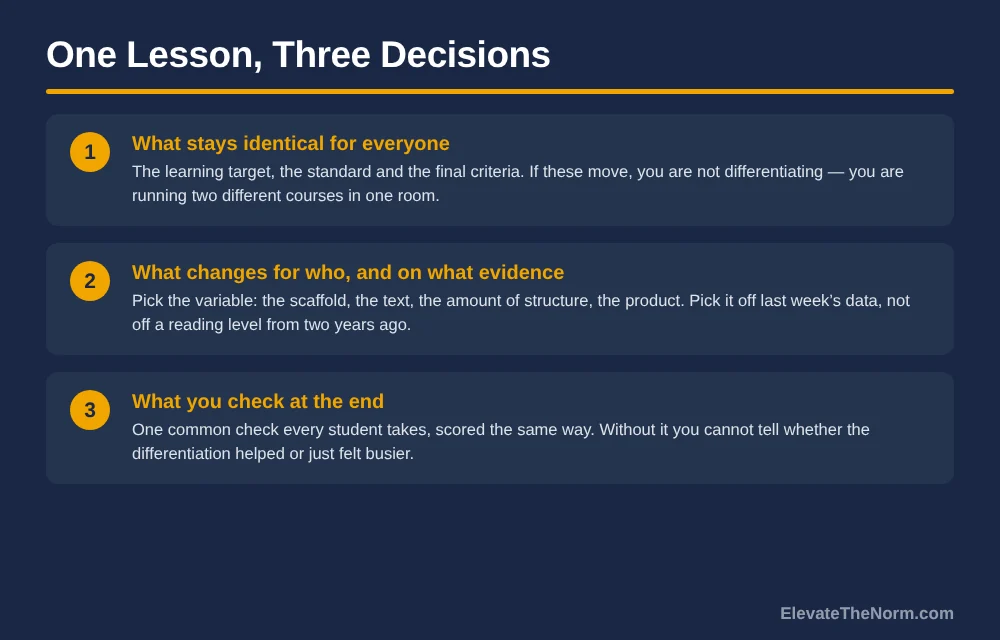
    Numbered three-card framework graphic for differentiating one lesson: what stays identical for everyone, what changes for which students and on what evidence, and what common check happens at the end
    Three decisions per lesson. That is the whole planning load.

    In practice, one lesson is three decisions.

    One: what stays identical for everybody. The target, the standard, the criteria for good work. Nail these down first, because everything after is a variation on them.

    Two: what changes, for whom, on what evidence. Pick one variable — the scaffold, the text, the amount of structure, the product. One. Then name why those students and not others, and point at the data that says so. If the only answer is “they’re my low group,” you have a track, not a differentiation plan.

    Three: what you check at the end. One common check every student takes, scored the same way. Without it, you cannot distinguish a lesson that helped from a lesson that was busier.

    Does Differentiated Instruction Actually Work?

    Probably, somewhat, and we know less than the training implies. The best secondary-specific review found a positive average effect across a small number of mostly quasi-experimental studies, and said so alongside a warning about how thin the base is.
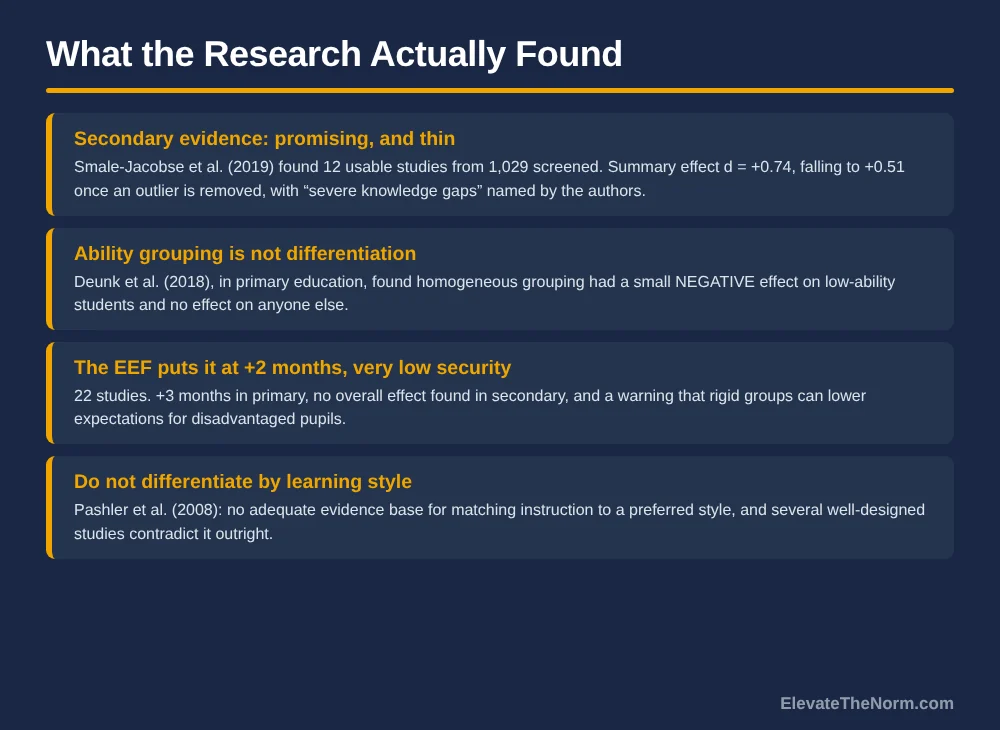
    Four-row research graphic on differentiated instruction: Smale-Jacobse and colleagues 2019 finding 12 usable secondary studies with an effect of 0.74 falling to 0.51 without an outlier, Deunk and colleagues 2018 finding homogeneous grouping slightly negative for low-ability students, the Education Endowment Foundation rating within-class attainment grouping at plus two months with very low security, and Pashler and colleagues 2008 on the absence of evidence for learning styles
    Four findings worth knowing before anyone sells you a differentiation initiative.

    Smale-Jacobse, Meijer, Helms-Lorenz and Maulana screened 1,029 papers and ended up with 12 unique studies of differentiated instruction in secondary education, mostly in maths and science, with students roughly 11 to 17. The summary effect was d = +0.741. Remove one extreme outlier and it drops to d = +0.509. Heterogeneity was enormous (Q = 507.7), the larger studies produced the smaller effects, only two studies had at least 15 cases per condition at the randomization level, and many of the outcome tests were researcher-made. The authors’ own summary is that the findings “give some indication of the possible benefits” but “point out that there are still severe knowledge gaps.”

    That is an honest finding and it is worth something. It is not a mandate.

    The Education Endowment Foundation puts within-class attainment grouping at +2 months of additional progress, at very low cost, with the security of the evidence rated very low — 22 studies, few of them recent. Their breakdown matters more than the headline: about +3 months in primary, +4 in maths, no difference on average in literacy, and no overall impact found at secondary, where there are few studies to begin with.

    And in primary education, Deunk, Jacobse, de Boer, Doolaard and Bosker reviewed 21 studies and 78 effect sizes. Computerized differentiation tools and differentiation embedded in a broader program produced small to moderate positive effects. Homogeneous ability grouping on its own produced a small negative effect on low-ability students and no effect on anyone else. Their conclusion is the one to carry into a department meeting: grouping by itself does not constitute differentiated instruction.

    Worth saying plainly: Deunk and the EEF’s strongest results are primary findings. They do not transfer to a ninth-grade classroom automatically, and I am not going to pretend they do. What transfers is the warning.

    What Differentiation Is Not

    It is not teaching to learning styles

    Pashler, McDaniel, Rohrer and Bjork tested what they called the meshing hypothesis — the idea that a “visual learner” learns more from visual material. Credible evidence would require grouping students by style, randomly assigning instruction methods, testing everyone the same way, and finding a crossover interaction. They found “virtually no evidence” of that pattern, and noted that several studies using an adequate method flatly contradict it. Their conclusion: there is no adequate evidence base for building learning-styles assessment into general educational practice.

    If a differentiation plan starts with a learning-styles inventory, it is starting from a dead end. Vary the representation because the content calls for it — a map, a graph, a demonstration — not because a survey labelled a student kinesthetic in seventh grade.

    It is not lowering the bar for some students

    A shorter task with the same standard is differentiation. A simpler standard quietly substituted for one group is not, and it is the single most common failure mode. Students work out within a week whose work is being graded against what. Holding the same expectations for every student in the room is not in tension with support; support is how you make the expectation reachable.

    It is not permanent groups with friendly names

    The Eagles, the Falcons and the Hawks, unchanged since September, are a tracking system with a bird theme. The students know. Rigid grouping carries a documented equity risk — the EEF names lower teacher expectations for disadvantaged pupils and damage to low attainers’ belief that effort changes anything.

    Differentiated Instruction Strategies, Ranked by What They Cost

    Start with the ones that cost nothing. Most teachers who “cannot differentiate” have simply been handed the most expensive version first.
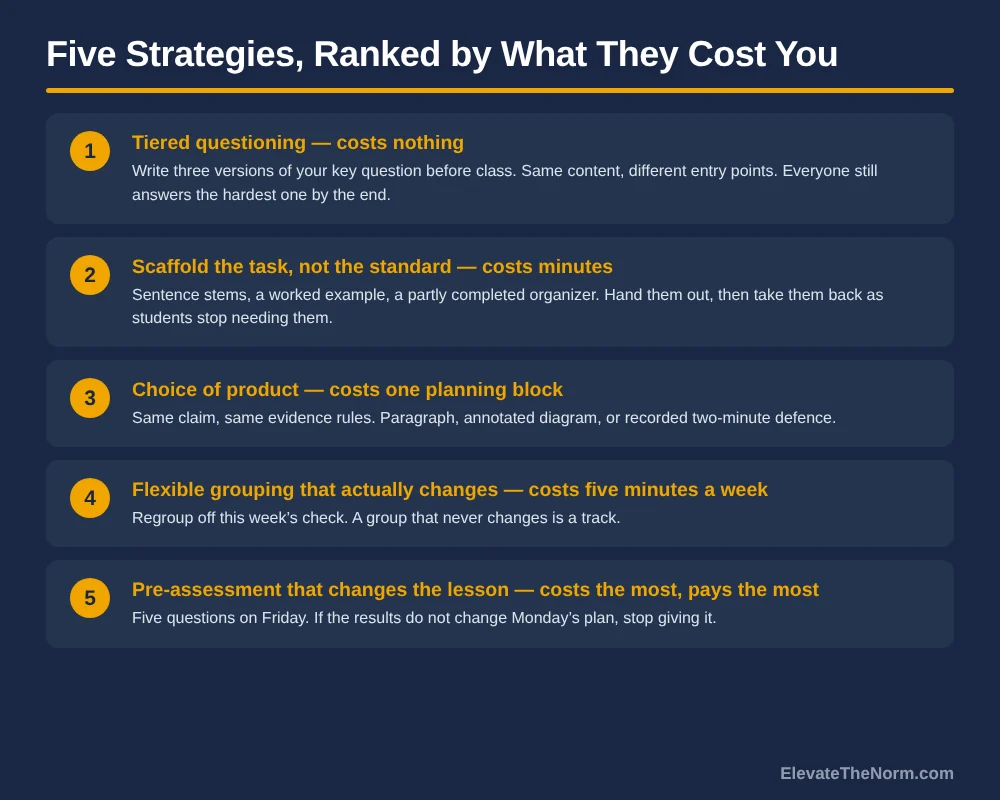
    Numbered five-card graphic ranking differentiated instruction strategies by preparation cost: tiered questioning, scaffolding the task rather than the standard, choice of product, flexible grouping that actually changes, and pre-assessment that changes the lesson
    Ranked by what they cost you, cheapest first.

    1. Tiered questioning — costs nothing

    Before class, write your key question three ways: one that gets anyone in, one at grade level, one that pushes. Same content, different entry points. You are not assigning questions to students; you are making sure the discussion has a door at every height. Every student should still meet the hardest version before the period ends — that is the difference between tiering and sorting.

    2. Scaffold the task, not the standard — costs minutes

    Sentence stems, a worked example at the top of the page, a graphic organizer with two boxes already filled in, a word bank for the four terms that will otherwise stop a student cold. The rule that keeps this honest: scaffolds are temporary and you must plan their removal. If a student has had the same organizer since September, the organizer is now the skill.

    3. Choice of product — costs one planning block

    Same claim, same evidence rules, same criteria — written paragraph, annotated diagram, or a recorded two-minute defense. This is where a choice board earns its keep, as long as the options differ in form and not in difficulty. Three options is plenty. Nine is a craft fair.

    4. Flexible grouping that actually changes — costs five minutes a week

    Group off this week’s evidence, not last year’s. Sometimes by readiness, sometimes by interest, sometimes at random, often mixed on purpose. If your groups have not changed in a month, they are not flexible. Small-group instruction in a secondary classroom works best when the rest of the room has something genuinely worth doing, which is a planning problem before it is a grouping problem.

    5. Pre-assessment that changes the lesson — costs the most, pays the most

    Five questions on Friday about Monday’s content. Not graded. The point is to find out who already has it and what the two common misconceptions are. Here is the test of whether it was worth doing: if the results do not change Monday’s plan, stop giving it. A pre-assessment you collect and file is paperwork.

    Any of the quick formative checks works for this. What matters is the twenty minutes afterward where you actually look.

    Differentiated Instruction Examples for Grades 6–12

    Each of these is one lesson, one variable changed, same standard for everybody.

    • Grade 9 history, document analysis. Everyone analyzes the same three documents against the same criteria. Two students get a version with the archaic vocabulary glossed in the margin. One group that finished the skill last unit gets a fourth document that contradicts the other three.
    • Grade 7 science, data claims. Same data set for the room. Some students get a claim-evidence-reasoning frame with the first sentence started; some get a blank page; the ones who have the structure cold get asked to write the strongest objection to their own claim.
    • Grade 8 algebra, error analysis. Everyone finds the mistake in a solved equation. One table gets problems with the error in the first two lines; another gets it buried in line five; a third gets two errors, one of which is not actually an error.
    • Grade 11 English, revision. Same paragraph, same revision criteria. Some students revise on paper with a checklist; some revise aloud to a partner first; some revise a second paragraph after the first one is done.
    • Any subject, same day. The whole class gets the same exit check: one question, four minutes, scored the same way. That single common measure is what makes the rest of it defensible.

    How Do You Differentiate When You Teach 150 Students?

    You differentiate the lesson, not the student. Build one lesson with planned variation inside it, and let students move through the variation, rather than writing a plan per child.

    Three things make this survivable.

    Sample instead of reading everything. You do not need to read 150 exit tickets. Read fifteen — five you expect to be strong, five middling, five you are worried about — and sort the rest into three piles by a single criterion. That takes ten minutes and tells you nearly as much as an hour would.

    Reuse the structures. The same tiered-question frame and the same CER scaffold work across a whole unit. You build them once, in August or over a weekend, and spend the rest of the semester choosing which to deploy. The planning cost is front-loaded, which is the only way it ever gets paid.

    Pick one class to start. Not all five. One section, one unit, one variable. If it works there, it transfers; if it does not, you have lost a week instead of a semester.

    What About the Students Who Already Got It?

    They are the group most often skipped, and the evidence says so directly.

    Ziernwald, Hillmayr and Holzberger reviewed 49 studies published 2000–2019 on differentiated instruction for high-achieving students in mixed-ability classrooms, spanning primary and secondary. Effects on achievement and on motivational outcomes were mostly positive but varied a great deal. The finding that should sting: teachers typically did not use differentiation for high achievers proactively or regularly, and both students and school staff reported it was rarely used. The barriers were time, resources, training, misconceptions about high-achieving students, and a focus on struggling students.

    Their caution is important too. Only six studies had a pretest-posttest control group design, so they did not run a meta-analysis at all. No study met every quality criterion. Treat this as a well-documented description of practice, not a proven intervention effect.

    The practical move is cheap: for the students who already have it, extend sideways rather than forward. One more document, a counter-argument, a constraint added to the problem, a request to teach the step to someone else. Sideways keeps them in the same conversation. Forward just sends them into next week alone.

    Sideways is also the whole argument for what you hand a student who simply finishes first. Our guide to what to do with the minutes after a student says “I’m done” orders six options by what each one costs you to run, and starts from the rule that finishing early can never cost the student anything.

    Why Does Differentiation Fail in Real Schools?

    Mostly for reasons that are not about teacher willingness.

    Gibbs interviewed seven teachers and two school leaders at an Australian secondary school of roughly 1,250 students. Every one of the seven teachers named limited resources as a barrier. Three named student behaviour, and three named limited planning and instruction time. Leaders named their own time and administrative load, including inconsistent records arriving from feeder primary schools. Four of the seven reported no pre-service training in differentiation at all, and the training the other three described focused on inclusion and disability — which suggests differentiation is widely confused with special education provision.

    It is a small, single-site qualitative study and the author says so. But the pattern is recognizable in any building.

    Two of those barriers are leadership decisions rather than teacher decisions. Planning time and class size are set in a master schedule. A district that mandates differentiation without changing either has bought a slogan. The same applies to the second adult in the room: which co-teaching model a pair can realistically run is decided by the master schedule, not by the two teachers. If you lead a building and want to know whether this is happening, do not add a differentiation box to a walkthrough form — that produces visible differentiation and nothing else. Look at whether groups changed between September and November, and whether anyone can show you a pre-assessment that altered a plan.

    It is also worth being honest that behaviour showed up in that list. Differentiation assumes a room where several things can happen at once, and that is downstream of the management work that makes multiple simultaneous activities possible. Trying to run four stations in a room that cannot hold one task is not a differentiation problem.

    A Planning Checklist

    • Can every student in the room name the same learning goal for today?
    • Did I change exactly one variable, and can I say what evidence picked it?
    • Is the final criterion identical for everyone?
    • Is there one common check at the end, scored the same way?
    • Do the scaffolds I handed out have a removal date?
    • Have the groups changed in the last three weeks?
    • If a student asked “why do I have this version?” could I answer honestly in one sentence?

    That last question is the one that keeps this ethical. If the honest answer is one you would not say out loud to the student, the plan needs changing, not the phrasing.

    What to Say to Students and Parents

    Students know when the work is different. Pretending otherwise costs you more credibility than telling the truth does: “Everyone is being graded against the same four criteria. You’ve got the version with the vocabulary glossed because that was slowing you down last week, not because I expect less from you. It comes off the next one.” That is a sentence a fifteen-year-old can respect, and it has the advantage of being true. Giving students some say in which version they take — real student voice and choice — removes most of the sting on its own.

    Parents ask a sharper version: is my kid getting the easy work? Answer it directly. Name the standard, show the common criteria, show the common end-of-unit check, and explain which support is in place and when it comes off. A parent who hears “same standard, different scaffolding, here is the removal plan” is usually satisfied. A parent who hears “we differentiate” is not, and should not be.

    Differentiated Instruction Strategies: What to Do Next Week

    Pick one section and one unit. Write your key question three ways. Build one scaffold and decide now which lesson it comes off at. Give one five-question pre-assessment and change something in the plan because of it. Give the same exit check to everybody and score it the same way.

    That is five moves, four of them nearly free, and it is more differentiation than most buildings are actually running. If it works, add the sixth thing in November. If it does not, you will know exactly which move failed, because you only changed one.

    And whatever else you cut, keep the common check at the end. Without it you are differentiating on faith, and the research base is nowhere near strong enough to carry that.

    Differentiation needs something to stand on. Our guide to scaffolding strategies for grades 6–12 covers the three characteristics that make a support a scaffold rather than a crutch, and when to take it away.

    Frequently Asked Questions

    What are differentiated instruction strategies?

    They are the adjustments a teacher makes to content, process, product or learning environment so that students with different prior knowledge, skills and language can all reach the same standard. The standard and the criteria for good work stay constant; the route changes. The five that carry most of the load in a secondary classroom are tiered questioning, temporary scaffolds, choice of product, flexible grouping that actually changes, and pre-assessment that alters the plan.

    Does differentiated instruction improve achievement?

    The secondary-specific evidence is positive but thin. Smale-Jacobse, Meijer, Helms-Lorenz and Maulana (2019) screened 1,029 papers and found 12 usable studies, reporting a summary effect of d = +0.741 that falls to +0.509 once an outlier is removed. Heterogeneity was very large, most designs were quasi-experimental, and the authors named “severe knowledge gaps.” The Education Endowment Foundation rates within-class attainment grouping at +2 months with very low evidence security and found no overall impact at secondary level.

    Is ability grouping the same as differentiated instruction?

    No, and treating it that way can do harm. Deunk and colleagues (2018), reviewing 21 studies in primary education, found homogeneous ability grouping produced a small negative effect on low-ability students and no effect on other students. Their conclusion is that grouping by itself does not constitute differentiation and must be embedded in a broader instructional approach. Permanent groups that never change are a tracking system, whatever they are called.

    Should I differentiate by learning style?

    No. Pashler, McDaniel, Rohrer and Bjork (2008) concluded there is no adequate evidence base for incorporating learning-styles assessment into general educational practice. They found virtually no evidence for the crossover interaction the theory predicts, and noted that several studies using an adequate experimental method flatly contradict it. Vary how content is represented because the content calls for it, not because a survey labelled a student visual or kinesthetic.

    How do you differentiate with 150 students and five preps?

    Differentiate the lesson rather than the student. Build one lesson with planned variation inside it; sample student work instead of reading all of it, by marking fifteen carefully and sorting the rest into three piles on one criterion; build reusable structures like a tiered-question frame or a CER scaffold once and deploy them across the unit; and start with one section and one unit rather than all five preps at once.

    What about students who already understand the material?

    They are the group most often skipped. Ziernwald, Hillmayr and Holzberger (2022) reviewed 49 studies and found that teachers typically did not use differentiation for high-achieving students proactively or regularly, with students and staff both reporting it was rare. Their evidence base was weak enough that no meta-analysis was possible, so read it as a description of practice. Practically, extend sideways rather than forward: an extra contradictory source, an added constraint, the strongest objection to their own answer.

    How do I explain differentiated work to a student without embarrassing them?

    Say it plainly and tie it to the standard. Something like: everyone is graded against the same four criteria, you have the version with the vocabulary glossed because that slowed you down last week, and it comes off the next assignment. Students work out within a week whose work is being graded against what, so concealment costs more credibility than honesty does. Letting students choose which version to take removes most of the sting on its own.

    Why does differentiated instruction fail in practice?

    Usually for reasons outside a teacher’s control. In Gibbs’s (2023) interview study at an Australian secondary school, all seven teachers named limited resources as a barrier, and three each named student behaviour and limited planning time. Four reported no pre-service training in differentiation at all, and the training the others described focused on inclusion and disability. Planning time and class size are set in the master schedule, so a mandate that changes neither is a slogan.

    Sources

    1. Smale-Jacobse, A. E., Meijer, A., Helms-Lorenz, M., & Maulana, R. (2019). Differentiated Instruction in Secondary Education: A Systematic Review of Research Evidence. Frontiers in Psychology, 10, Article 2366. 1,029 papers screened; 14 papers reporting 12 unique studies and 15 effect sizes; summary effect d = +0.741 (95% CI 0.397–1.085), falling to d = +0.509 (95% CI 0.215–0.803) with one outlier removed; Q = 507.701. Mostly quasi-experimental, only two studies with 15+ cases per condition at randomization level, many researcher-made tests; the authors name “severe knowledge gaps.” https://doi.org/10.3389/fpsyg.2019.02366
    2. Deunk, M. I., Smale-Jacobse, A. E., de Boer, H., Doolaard, S., & Bosker, R. J. (2018). Effective Differentiation Practices: A Systematic Review and Meta-Analysis of Studies on the Cognitive Effects of Differentiation Practices in Primary Education. Educational Research Review, 24, 31–54. 21 studies, 78 effect sizes; computerized differentiation and differentiation embedded in broader programs showed small to moderate positive effects; homogeneous ability grouping showed a small negative effect on low-ability students and no effect on others. Primary education only — these findings do not transfer automatically to grades 6–12. https://doi.org/10.1016/j.edurev.2018.02.002
    3. Education Endowment Foundation. Within-Class Attainment Grouping. Teaching and Learning Toolkit, last updated August 2021. Impact +2 months; cost very low; security of the evidence rated very low; 22 studies; +3 months in primary and +4 in mathematics, no average difference in literacy, and no overall impact found at secondary level, where studies are few; warns that rigid grouping may lower teacher expectations for disadvantaged pupils. https://educationendowmentfoundation.org.uk/education-evidence/teaching-learning-toolkit/within-class-attainment-grouping
    4. Ziernwald, L., Hillmayr, D., & Holzberger, D. (2022). Promoting High-Achieving Students Through Differentiated Instruction in Mixed-Ability Classrooms: A Systematic Review. Journal of Advanced Academics, 33(4), 540–573. 49 studies published 2000–2019, primary and secondary, mostly US and Canada; effects mostly positive but highly variable; teachers rarely used differentiation for high achievers proactively. Only six pretest-posttest control-group studies were analyzable, so no meta-analysis was conducted and no study met all quality criteria. https://doi.org/10.1177/1932202X221112931
    5. Pashler, H., McDaniel, M., Rohrer, D., & Bjork, R. (2008). Learning Styles: Concepts and Evidence. Psychological Science in the Public Interest, 9(3), 105–119. Found “virtually no evidence” for the crossover interaction the meshing hypothesis requires, noted that several adequately designed studies contradict it, and concluded there is no adequate evidence base for incorporating learning-styles assessment into general educational practice. https://digitalcommons.usf.edu/psy_facpub/1765/
    6. Gibbs, K. (2023). Voices in Practice: Challenges to Implementing Differentiated Instruction by Teachers and School Leaders in an Australian Mainstream Secondary School. The Australian Educational Researcher, 50(4), 1217–1232. Semi-structured interviews with seven teachers and two leaders at one Queensland secondary school of about 1,250 students; limited resources named by all seven teachers, behaviour and planning time by three each; four teachers reported no pre-service differentiation training. Small, single-site, convenience sample; the author notes limited generalisability. https://doi.org/10.1007/s13384-022-00551-2

    About Clay Shumate

    Clay Shumate is a certified secondary Social Studies teacher in the public schools of West Alabama, with seven years of classroom experience, a B.A. in History, and an M.Ed. in Secondary Education. He writes about project-based learning, student responsibility, respect, and practical ways to hold young people to a higher standard while giving them room to learn from mistakes. He is a member of the Society of Professional Journalists and writes to its Code of Ethics; this site’s editorial standards and corrections policy are published in full. More about Clay.

  • Choice Boards: How to Give Students a Real Choice Instead of a Decorative One

    Choice Boards: How to Give Students a Real Choice Instead of a Decorative One

    By Clay Shumate

    A choice board is a grid of options that all assess the same learning target, letting students pick how they show what they know. The format varies; the thinking does not. Built well, it is a small, well-evidenced motivational lever. Built badly, it is nine squares of unequal busywork wearing the word “choice” as a costume.

    The research on student choice is better than most classroom practices can claim and smaller than most people quoting it assume. Both halves matter, so the numbers come before the grid.

    Key Takeaways

    • Choice has a real but modest effect. Across 41 studies, offering choice raised intrinsic motivation by d = 0.30 to 0.36. On subsequent learning the same meta-analysis found d = 0.10 with a confidence interval crossing zero.
    • Two to four options, not nine. The effect was strongest with 2–4 successive choices. A full tic-tac-toe grid is usually three squares of real options and six of filler.
    • Merely offering a choice is not motivating. It has to connect to something the student cares about, sit inside what they can do, and not cost them standing with their family or community.
    • Do not justify a choice board with learning styles. The matching hypothesis has been tested and does not hold. You have a better reason available — use it.
    • One target, one rubric. If two squares need different criteria to grade, you have two assignments, not one board.

    What Is a Choice Board?

    It is a set of options — usually displayed as a grid — that each assess the same standard through a different product or route. A student picks one, or sometimes picks a path of three. The teacher sets the target and the criteria. The student sets the format.

    That definition is narrower than how the term usually gets used. A board where one square asks for a written argument, another a poster and a third a “creative response” is not a choice board. It is three different assignments printed on the same page, and no rubric fixes that.

    Choice boards sit inside a larger family of practices. The broader question of how much control students should have, and where adults keep it, belongs to student voice and choice; the gradual-release version is student autonomy. The semester-scale version, where students choose the question and not just the format, is running a genius hour cycle. This article is about one tool: the board itself, how to build it, and how to grade it.

    What the Research on Choice Actually Shows

    Choice raises motivation by a modest, real amount and does not by itself improve later learning.

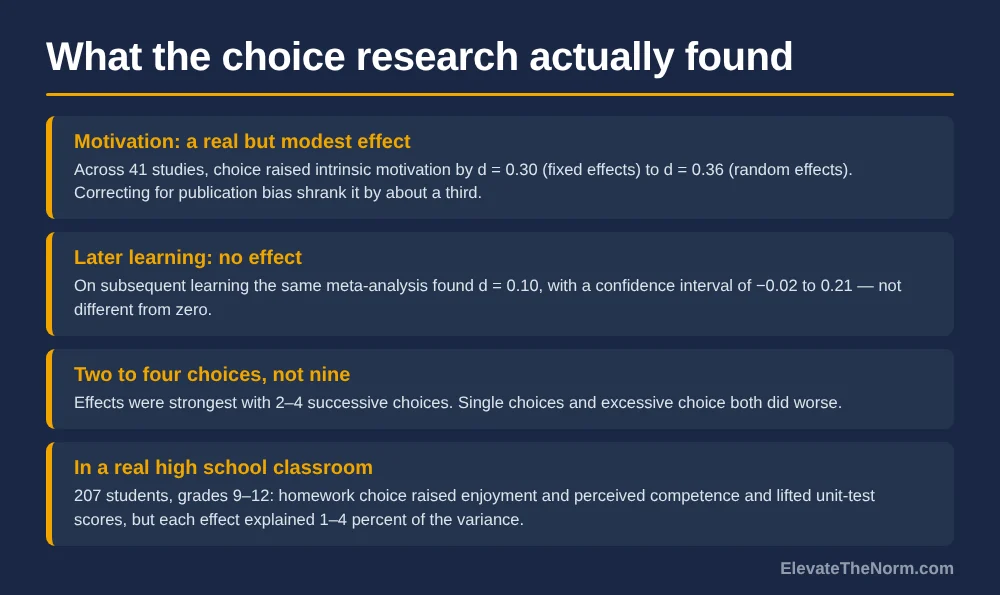
    The anchor study is a 2008 Psychological Bulletin meta-analysis by Erika Patall, Harris Cooper and Jorgianne Civey Robinson. Across 41 studies, 46 samples and 91 effect sizes, choice raised intrinsic motivation by d = 0.30 (fixed effects) to d = 0.36 (random effects). Accounting for publication bias, the effect stayed positive and significant but shrank by about a third.

    Then the part nobody quotes. On subsequent learning, the same meta-analysis found d = 0.10, with a 95 percent confidence interval of −0.02 to 0.21. That interval contains zero. Choice made students more willing; it did not, in this body of work, make them learn more afterwards.

    Four-row research graphic: choice raised intrinsic motivation d equals 0.30 to 0.36 across 41 studies, had no effect on subsequent learning at d equals 0.10, worked best with two to four choices, and in a 207-student high school study explained one to four percent of variance
    What the choice research supports, and what it does not.

    Three of their moderator findings change how you build a board. Choice worked best with two to four successive choices rather than a single choice or an overwhelming array. The benefit shrank when rewards were involved — so stapling a points bonus onto the “fun” square works against you. And the effect was stronger for children than adults, which is a caution for a grades 6–12 audience sitting between those categories rather than a license.

    There is one finding here that ought to make every choice-board advocate uncomfortable, including me. The authors report that instructionally irrelevant choices — picking a game icon, choosing which pen to use — produced stronger effects than choices between task versions or activities. The motivational lift may be coming from the act of deciding rather than from the educational substance of what was decided. That does not mean choice boards are worthless. It does mean the honest claim is “this is a cheap way to raise willingness,” not “this is how students learn better.”

    What Happened When Someone Tried It in a Real High School

    Modest gains across the board, including on the unit test, with each effect explaining one to four percent of the variance.

    Patall, Cooper and Susan Wynn ran a within-subjects experiment in the Journal of Educational Psychology in 2010: 207 students, 14 classrooms, two urban high schools, with homework choice for two units and no choice for two others, conditions reversed. The results:

    • Interest and enjoyment rose in the choice condition (β = 0.22, p < .01), accounting for about 4.3 percent of the variance.
    • Perceived competence rose (β = 0.19, p < .05), about 2.2 percent of variance.
    • Unit test scores rose (β = 2.56, p < .05), about 1.3 percent of variance.
    • Homework completion was only marginal (β = 4.80, p < .10), about 1 percent.
    • No significant effect on perceived effort, task value, or pressure.

    Real high school students doing real homework, which makes it unusually relevant here. It is also a study where the biggest effect explained under five percent of the variation between students. Treat choice as a worthwhile adjustment rather than a turnaround strategy and you are reading it correctly.

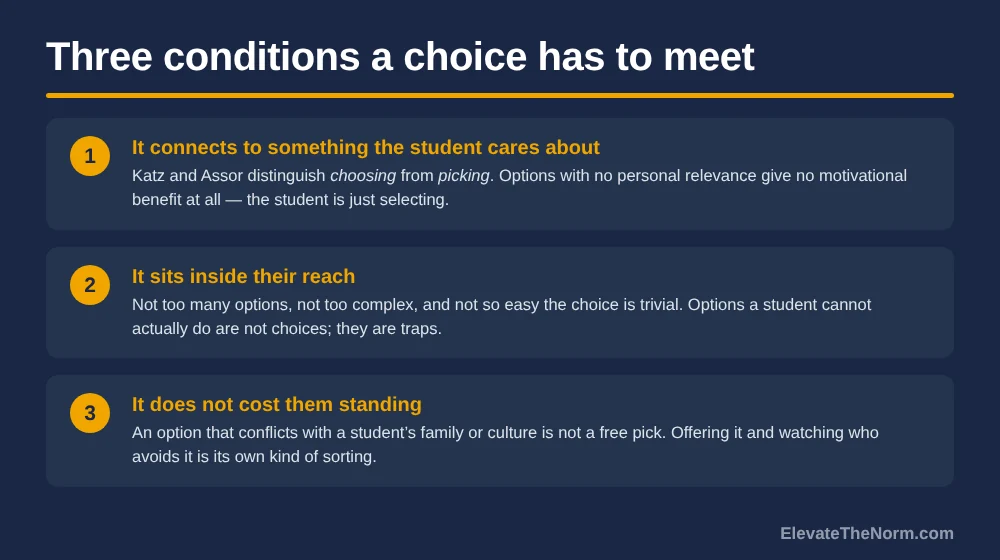
    The Three Conditions a Choice Has to Meet

    Idit Katz and Avi Assor put it plainly in their review: merely offering choice is not in itself motivating, and in some cases it can even reduce motivation. They distinguish choosing, which involves a preference, from picking, which is just selecting. A board full of options a student has no preference among produces picking.

    Three-card graphic listing the conditions a choice must meet to motivate: it connects to something the student cares about, it sits inside their reach, and it does not cost them standing with family or culture
    Katz and Assor’s three conditions, applied to a choice board.

    Their three conditions map directly onto board design.

    1. Relevance to the student’s interests and goals. If every square is a format the student is indifferent about, you have given them a menu in a language they do not read. The fix is usually fewer, better squares built from what you know about the class in front of you — not a template downloaded in August.
    2. Options that fit their competence. Not too numerous, not too complex, not so easy the choice is trivial. Katz and Assor cite the choice-overload work showing people are more satisfied choosing from a small array than a large one. A student who cannot realistically do four of your six squares has a two-option board that you have made them feel bad about.
    3. Congruence with the student’s family and culture. This one gets skipped in American classrooms and it should not be. An option that conflicts with a student’s home values is not a free pick; it is a square they must avoid in front of everyone. The fix is in the design, not in the assigning. Build squares that require no student to disclose or perform anything personal — and never pre-assign a student to a square because of what you assume about their background. That is not accommodation, it is sorting with good intentions.

    Do Not Justify a Choice Board With Learning Styles

    Because the matching hypothesis has been tested and it does not hold.

    Rogowsky, Calhoun and Tallal tested the matching hypothesis directly in a study published in Frontiers in Psychology in 2020 and found no support for it: matching instruction to a student’s auditory or visual preference had no effect on achievement, with no sign of the crossover interaction the hypothesis requires. Their sample was 125 fifth graders in one rural Pennsylvania public school, which is below the grade band this site writes for, so read it as consistent with the wider literature rather than as the last word on teenagers. They also cite survey work finding that 93 percent of UK teachers and 96 percent of Dutch teachers agreed that individuals learn better when taught in their preferred style. Nearly everyone believes it. That is why saying it out loud in a meeting feels safe.

    You have a better justification sitting right there and it costs you nothing to switch to it: offering a real choice raises willingness by a measured amount, and all the routes assess the same standard. That argument survives contact with a skeptical administrator. “Visual learners” does not, and it sorts students into categories the evidence does not support.

    How to Build a Choice Board That Holds Its Shape

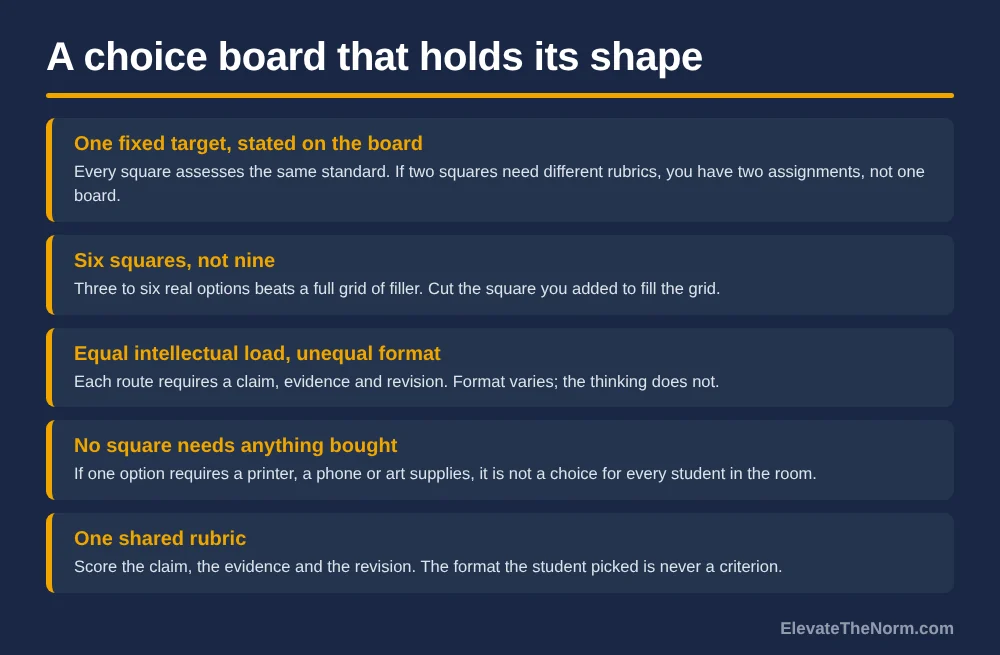
    One target, three to six options, equal intellectual load, nothing that has to be bought, and a single shared rubric.

    Five-row graphic on choice board structure: one fixed target stated on the board, six squares rather than nine, equal intellectual load with unequal format, no square requiring anything bought, and one shared rubric
    Five structural rules that keep a choice board from becoming a menu of busywork.

    Work in this order.

    1. Write the target first, as a sentence, and put it on the board. “You will explain how two causes of the same event competed, using evidence from at least two sources.” Every square now has to serve that sentence.
    2. Write the rubric second — before the squares. If you can write one rubric that fairly scores every option you are imagining, the board is coherent. If you cannot, you have multiple assignments and you should pick one.
    3. Generate more squares than you need, then cut to six. The square you added to complete a 3×3 grid is almost always the weak one. Cut it. Nobody has ever complained about a board with five good options.
    4. A choice board does not replace an accommodation. If a student has a documented plan, that plan still governs, and “they could have picked a different square” is not compliance. Build the board, then check it against the plans you are responsible for. The same goes for multilingual learners: a choice of format is not a substitute for language support.
    5. Check every square for a hidden cost. Printing, poster board, a phone with a working camera, software at home, a quiet place to record. Any square carrying one of those is not a choice for every student in your room, and the students it excludes will not tell you.
    6. If a square involves recording, check the policy first. A video of a minor is not ordinary student work. Confirm your district’s rules, keep the file out of shared drives, and give students a non-recorded route that scores identically.
    7. Check that every route requires the same hard part. If the essay square demands a claim with evidence and the infographic square demands six facts in a nice layout, the board is a trap with a difficulty gradient and the students will find it before you do.

    Is a Choice Board the Same Thing as Differentiation?

    Not quite, and the difference is worth getting straight before a coach asks you about it.

    Differentiating by readiness means deliberately varying the difficulty of the work so students are each working at the edge of what they can do. A choice board as described here does the opposite — it holds difficulty constant and varies only the route. Those are two different designs and they pull against each other. If you build a board where one square is clearly easier, you have differentiated by readiness while calling it choice, and the predictable result is that the students who most need the hard version select the easy one.

    You can do both, but do them separately and say which you are doing. Vary the scaffolding — a sentence stem, a partially completed organizer, a model paragraph — while keeping the target and the criteria identical. That gets you readiness support without turning a choice into a difficulty setting. What you should not do is let a choice board quietly become the mechanism by which some students are assessed on less.

    Choice Board Examples for Grades 6–12

    These are structures rather than worksheets. Each row holds the target fixed and varies only the route.

    SubjectFixed targetOptions (pick one)Shared rubric scores
    Social studiesExplain how two causes of one event competed, using two sourcesWritten argument · recorded three-minute explanation · annotated timeline with a written claim · letter in the voice of a named historical figure, with a source noteClaim, use of evidence, accuracy, revision after feedback
    ELAArgue how one character’s choice changes the meaning of the endingEssay · podcast-style script · annotated passage set with commentary · alternate-ending scene plus a paragraph defending itClaim, textual evidence, reasoning, revision
    ScienceUse your data to make a recommendation and defend it against one objectionLab report · a chart plus a written interpretation · three-minute explanation to a non-scientist · a one-page brief for a named decision-makerClaim, data use, handling the objection, accuracy
    MathModel a real situation, then explain where your model breaks downWorked solution with written commentary · recorded walkthrough · comparison of two models with a recommendation · a problem you wrote plus its solutionCorrect modelling, reasoning, naming the limitation, precision
    Four choice boards for grades 6–12. One target per row, one rubric per row, format free.

    Notice what is absent: no square asks for a collage, a diorama, a song or a poster with a quotation on it. Those are not banned because they are creative. They are absent because none of them requires a claim defended with evidence, which is the fixed target in every row.

    What It Actually Costs You

    More prep the first time, more grading every time, and a real constraint if your department runs common assessments.

    I am not going to pretend this is free. Six different products take longer to grade than thirty copies of the same essay, because your eye never settles into a rhythm. Budget for that, or run choice boards on formative work and keep the common summative assessment uniform — which is also the answer if your department or district requires a common assessment for a unit. A pacing guide and a shared test are not obstacles to work around quietly; if the summative is fixed, put the choice earlier in the unit where it belongs anyway.

    The prep cost is front-loaded and non-recurring. Writing the target and the rubric before the squares takes one planning period. Piloting each square for time takes another. After that the board is reusable, and the second board for the same course takes about twenty minutes because you already have the shape.

    Grading a Choice Board Without Writing Nine Rubrics

    Score the target, not the product. Three to five criteria, identical across every option: the claim, the evidence, the reasoning, and the revision after feedback. The format the student picked is never a criterion.

    Say this to the class on the day you hand out the board, in these words: every square is graded on the same four things, so no option is an easier grade. Students assume the written square is safest because it is the one teachers usually reward. Until you say otherwise out loud, half the room will pick on grading superstition rather than on preference, and you will have measured nothing.

    Two failure modes worth naming. The first is scoring effort or creativity, which quietly rewards whoever had time and materials. The second is letting the format carry points — an infographic that looks professional scoring above an unformatted but sharper written argument. If a criterion cannot be applied to all six squares, delete it.

    The individual-and-group grading problem, which choice boards run into whenever students pick a collaborative option, is worked through in the project based learning rubric. The same rule applies: a criterion can describe collaboration, but it cannot rescue a grade from weak content. For converting levels to percentages, see the 1-4 grading scale percentages chart.

    Where Choice Boards Go Wrong

    The most common failure is not a bad square. It is the teacher stepping back after handing out the board.

    Johnmarshall Reeve and Sung Hyeon Cheon, reviewing 38 randomized controlled trials of autonomy-supportive teaching, warn specifically that autonomy support gets misapplied as a laissez-faire style. The difference shows up at the moment a student struggles: an autonomy-supportive teacher takes the student’s perspective and supplies resources, while a laissez-faire teacher leaves them to figure it out. Their review reports that students of laissez-faire teachers show high amotivation and poor self-regulation. Giving choice and then going quiet is not the practice. It is the absence of it.

    Four more ways boards fail, all fixable:

    • The novelty square. Half the class picks the option that looks most fun and least like school, then discovers it is the hardest one. Pilot each square yourself for time before you offer it.
    • Choice paralysis. Students who spend a class period deciding have been given a decision without criteria. Say out loud which square is fastest and which goes deepest.
    • Same pick every time. A student who selects the written option for the ninth straight board is not exercising choice, they are avoiding risk. Require a different route once per quarter — that is still choice, with a floor.
    • The board instead of the teaching. A choice board is a delivery format. It does not teach a student how to write a claim. If nobody in the room can do the fixed target yet, the board is premature and you need the lesson first. The cheapest bridge is one worked exemplar — show a finished example on one route, and name which parts of it are the target rather than the format. Students transfer that to the other squares faster than they transfer a rubric.

    If engagement rather than format is the actual problem you are solving, the board may be the wrong tool entirely. Motivating students covers what tends to work when rewards and speeches have stopped working, and the choice-board-sized version of that answer is usually relevance, not more options.

    What to Do Next

    Take an assignment you already give, write its target as one sentence, and build three alternate routes to it that your existing rubric could score unchanged. Three. Not nine. Offer it once, watch which square gets picked and which gets avoided, and ask two students who picked the same square why.

    The same three-route logic scales down to a much smaller board: a standing menu of three or four things a student may do once the work is finished. That costs one planning block once, and the six early finisher options ranked by what they cost you is a reasonable place to pick them from.

    Send one line home with it, too: “Students chose how to present this; every option was graded on the same four criteria, and the standard did not change.” That sentence answers the only question a parent actually has when their kid submits a recording instead of an essay, and it answers it before they have to ask.

    Then keep the honest claim in your pocket for when someone asks: this raises willingness by a measured and modest amount, every route assesses the same standard, and it costs nothing. That is a good enough reason. It does not need “visual learners” propping it up.

    If you want the wider set of practices this sits inside — inquiry stations, seminars, peer critique, project roles — the guide to activities for student centered learning covers the whole family, with choice boards as one member of it.

    A choice board is one form of differentiation. For the wider set, see our guide to differentiated instruction strategies and the honest reading of what the research supports at secondary level.

    Frequently Asked Questions

    What is a choice board?

    A set of options, usually laid out as a grid, that each assess the same learning target through a different product or route. The teacher fixes the target and the criteria; the student picks the format. A board where the squares require different kinds of thinking is not a choice board — it is several different assignments printed on one page, and no single rubric will grade it fairly.

    Do choice boards actually improve learning?

    The evidence supports a motivation effect, not a learning effect. Patall, Cooper and Robinson’s meta-analysis of 41 studies found choice raised intrinsic motivation at d = 0.30 to 0.36. On subsequent learning the same analysis found d = 0.10 with a confidence interval of −0.02 to 0.21, which contains zero. A separate high school study did find a small unit-test gain, but it explained about 1.3 percent of the variance. Treat choice as a cheap way to raise willingness, not as an achievement strategy.

    How many options should a choice board have?

    Three to six. The meta-analysis found the strongest effects with two to four successive choices, with both single choices and excessive arrays doing worse. A nine-square grid is almost always three good options and six added to fill the shape. Cut the squares you invented for symmetry — nobody has ever complained about a board with five real choices.

    Are choice boards good for visual learners?

    Do not use that justification. Rogowsky, Calhoun and Tallal tested the learning-styles matching hypothesis directly and found no support for it — matching instruction to an auditory or visual preference had no effect on achievement. Their sample was 125 fifth graders in one school, so read it alongside the wider literature rather than as the final word. Use the better argument: a real choice raises willingness by a measured amount, and every route assesses the same standard. That one survives a conversation with an administrator.

    How do you grade a choice board?

    With one rubric that applies identically to every square: typically the claim, the evidence, the reasoning, and the revision after feedback. The format the student chose is never a criterion. If a criterion cannot be applied to all the options, delete it. And tell the class out loud that every square is graded on the same things, or students will pick on grading superstition rather than preference.

    Is a choice board the same thing as differentiation?

    No, and they can work against each other. Differentiating by readiness varies the difficulty of the work; a choice board holds difficulty constant and varies only the route. If one square is visibly easier, the students who most need the harder version will choose the easier one. Do both if you want, but keep them separate: vary the scaffolding — sentence stems, partial organizers, a worked model — while the target and the criteria stay identical.

    What if a student picks the same option every time?

    That is usually risk avoidance rather than preference, and it is worth naming without punishing. Requiring a different route once a quarter is still choice, just with a floor under it. It also tells you something: a student who will only write may need a low-stakes rehearsal of another format before they will risk it on a graded one.

    Do choice boards take more work than a normal assignment?

    Yes, and it is worth being honest about where. Six different products take longer to grade than thirty copies of the same essay because your eye never settles into a rhythm. The prep cost — writing the target and the rubric before the squares, then timing each option yourself — is front-loaded and does not recur; the second board for the same course takes about twenty minutes. If your department runs a common summative assessment, put the choice earlier in the unit rather than working around the shared test.

    Sources

    1. Patall, E. A., Cooper, H., & Robinson, J. C. (2008). The Effects of Choice on Intrinsic Motivation and Related Outcomes: A Meta-Analysis of Research Findings. Psychological Bulletin, 134(2), 270–300. 41 studies, 46 samples, 91 effect sizes; intrinsic motivation d = 0.30 (fixed) / 0.36 (random); subsequent learning d = 0.10, 95% CI −0.02 to 0.21 — not different from zero; strongest with 2–4 successive choices; weaker when rewards were present; stronger for children than adults; instructionally irrelevant choices produced stronger effects than choices between task versions. https://selfdeterminationtheory.org/wp-content/uploads/2019/10/2008_PatallCooperRobinson_PsychBulletin.pdf
    2. Patall, E. A., Cooper, H., & Wynn, S. R. (2010). The Effectiveness and Relative Importance of Choice in the Classroom. Journal of Educational Psychology. Within-subjects experiment, 207 students, 14 classrooms, two urban high schools. Interest/enjoyment β = 0.22 (p < .01); perceived competence β = 0.19 (p < .05); unit test β = 2.56 (p < .05); homework completion marginal (p < .10). No significant effect on perceived effort, task value or pressure, and each significant effect explained 1–4.3 percent of variance. https://selfdeterminationtheory.org/wp-content/uploads/2019/10/2010_PatallCooperWynn_JEP.pdf
    3. Katz, I., & Assor, A. (2007). When Choice Motivates and When It Does Not. Educational Psychology Review, 19(4), 429–442. Choice supports motivation only when options are relevant to students’ interests and goals, fit their competence (not too numerous or complex, not too easy), and are congruent with family and cultural values. “Merely offering choice is not in itself motivating. In fact, in some cases it can even reduce motivation.” https://selfdeterminationtheory.org/wp-content/uploads/2014/04/2006_Katz-et-al_when-choice.pdf
    4. Reeve, J., & Cheon, S. H. (2021). Autonomy-Supportive Teaching: Its Malleability, Benefits, and Potential to Improve Educational Practice. Educational Psychologist. Review of 38 randomized controlled trials. Warns explicitly that autonomy support is mis-applied as a laissez-faire style, and that students of laissez-faire teachers report high amotivation and poor self-regulation. Reported student effect sizes ranged widely, from d = 0.18 to d = 2.92. https://selfdeterminationtheory.org/wp-content/uploads/2021/05/2021_ReeveCheon_AutonomySupportive.pdf
    5. Rogowsky, B. A., Calhoun, B. M., & Tallal, P. (2020). Providing Instruction Based on Students’ Learning Style Preferences Does Not Improve Learning. Frontiers in Psychology, 11:164. No support for the matching hypothesis. Sample: 125 fifth graders (ages 10–11) in one rural Pennsylvania public school — below this site’s grades 6–12 band. Cites Dekker et al. (2012) finding 93 percent of UK and 96 percent of Dutch teachers endorsed the learning-styles claim. https://www.frontiersin.org/journals/psychology/articles/10.3389/fpsyg.2020.00164/pdf

    About Clay Shumate

    Clay Shumate is a certified secondary Social Studies teacher in the public schools of West Alabama, with seven years of classroom experience, a B.A. in History, and an M.Ed. in Secondary Education. He writes about project-based learning, student responsibility, respect, and practical ways to hold young people to a higher standard while giving them room to learn from mistakes. He is a member of the Society of Professional Journalists and writes to its Code of Ethics; this site’s editorial standards and corrections policy are published in full. More about Clay.

  • Gallery Walk Activity: How to Run One So the Feedback Is Worth Reading

    Gallery Walk Activity: How to Run One So the Feedback Is Worth Reading

    By Clay Shumate

    A gallery walk activity posts student work around the room and sends classmates around to read it and leave written feedback. The walking is not what makes it work. The peer assessment underneath it is the part with research behind it, and that research says it only pays off when students are told exactly what they are looking for before they stand up.

    What follows is what the evidence actually supports, the one study at the right grade level and why it is weaker than it looks, and a six-step version that produces feedback worth reading instead of thirty sticky notes that say “good job.”

    Key Takeaways

    • Peer assessment has real evidence. The gallery walk format does not, separately. A meta-analysis of 54 control-group studies put peer assessment at g = 0.31 on achievement, and at secondary level specifically, g = 0.44.
    • Peer assessment beat teacher assessment in that analysis (0.31 versus 0.28) and tied with self-assessment. It is not a second-best substitute for your own marking.
    • Attaching a grade to peer feedback helped university students and did not help school students. Keep the walk ungraded in grades 6–12.
    • Feedback is not automatically good. Across 607 effect sizes, feedback raised performance on average but made it worse in over a third of cases — mostly when it pointed at the person instead of the work.
    • The single highest-leverage change is naming one focus before students circulate. Open-ended walks produce praise, not information.
    • If nobody revises anything afterward, you ran a walking tour. The revision block is the lesson, not the extra.

    Free Download · PDF

    The Gallery Walk Planner (2 pages)

    Page 1 plans the walk: the four decisions, the three sentence stems, the access check and the two rules that keep it fair. Page 2 runs it: the six steps in order, a student revision slip, and the four failure modes with their fixes.

    Download the free PDF

    Free. No email address required. Designed for grades 6–12. Browse every printable in Your Free Library.

    What Is a Gallery Walk Activity?

    It is a critique protocol: student work goes up on the walls or tables, students circulate in small groups, and each group leaves written feedback on what it sees. Then the authors read their feedback and change something.

    That last clause is the one teachers drop, and it is the one that turns the activity into instruction. Everything before it is logistics.

    The format is flexible in the ways that do not matter much and rigid in the one way that does. It works with drafts, lab write-ups, solved problems, design sketches, annotated sources, project prototypes. It works on paper taped to a wall or on a shared digital board. What it does not work without is a stated thing students are supposed to judge.

    Does a Gallery Walk Activity Actually Improve Learning?

    The peer assessment inside it does. The format itself has almost no rigorous evidence, and that is worth saying out loud because most articles about gallery walks imply otherwise.

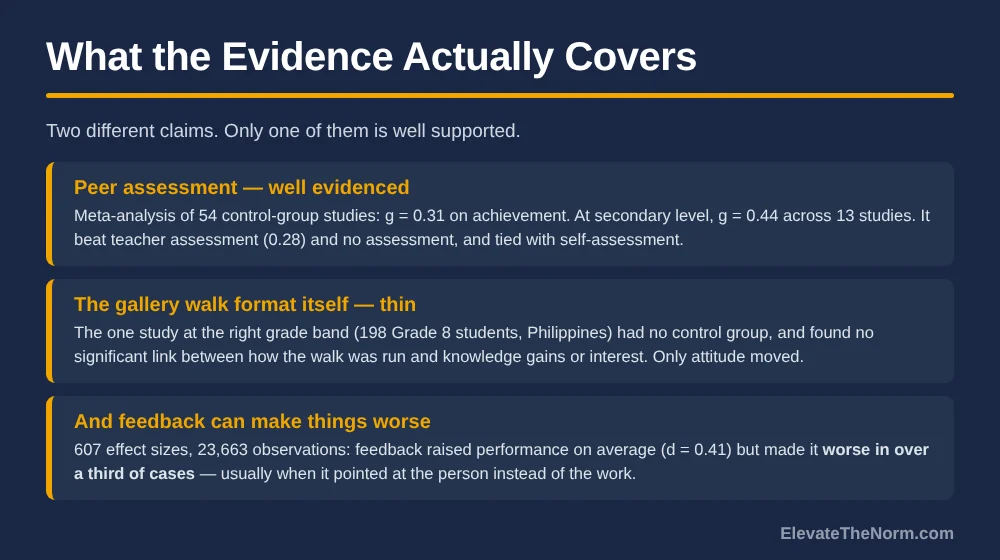
    Double, McGrane and Hopfenbeck published a meta-analysis of peer assessment in Educational Psychology Review covering 54 experimental and quasi-experimental control-group studies. The overall effect on academic performance was g = 0.31 — small to medium, and statistically significant. Peer assessment outperformed no assessment and outperformed teacher assessment (g = 0.28). It showed no advantage over self-assessment.

    Two details in that analysis matter more for a grades 6–12 classroom than the headline number.

    First, the effect at secondary level was higher than the average: g = 0.44 across 13 studies. That runs against the usual pattern on this site, where secondary tends to be the weakest band in cooperative-learning research. Second, the effect held up across implementation choices — online or in person, anonymous or named, frequent or occasional, trained or untrained. None of those moderators came out significant. That is good news for a teacher deciding whether to buy clipboards: the fiddly choices are not where the result lives.

    There was one moderator that did split, and it splits against school students. Peer feedback that carried a grade significantly helped university students (g = 0.55). The same effect could not be shown for primary or secondary students. Do not grade the sticky notes.

    Three-part evidence summary comparing well-evidenced peer assessment at g equals 0.31 overall and 0.44 at secondary level, thin evidence for the gallery walk format itself from one Grade 8 study with no control group, and the finding that feedback made performance worse in over a third of cases
    Two different claims get mixed together. Only one of them is well supported.

    What About Research on Gallery Walks Specifically?

    Thin, and the one study at the right grade level found less than its abstract suggests.

    The closest match is a 2023 study of 198 Grade 8 students at a public high school in the Philippines, measuring knowledge, interest and attitude across three social studies lessons taught through gallery walk activities. It is a genuine secondary-level sample, which almost nothing else in this literature is.

    It is also a one-group pre-test/post-test design with no control group. Students gained on the researcher-made test — mean gained scores of 7.88, 8.15 and 8.01 across the three lessons — but with no comparison class, there is no way to separate the gallery walk from three weeks of teaching. More pointed: when the researchers correlated the specific features of how the walk was implemented against outcomes, none of the correlations with cognitive skills were significant, and none of the correlations with interest were significant either. Only attitude moved reliably.

    So the honest summary is: students liked it, and this study cannot tell you whether it taught them anything. Most of the remaining gallery-walk literature is small single-classroom work outside the United States, often in language instruction, and frequently without a control group either.

    The best-known practitioner guide, from PBLWorks, is also worth reading accurately. It describes a protocol and reports that giving participants a specific focus and criteria “helps generate higher-quality feedback,” while open-ended walks produced superficial comments like “good DQ!” That is a credible observation from people who run these constantly. It is not a study, and the article cites none. It should be quoted as what it is.

    None of this means skip the activity. It means the reason to run it is the peer assessment evidence, and the way to run it should be built to make that peer assessment real.

    Why Does Feedback Sometimes Make Students Worse?

    Because a lot of feedback is about the student instead of the work, and that redirects attention away from the task.

    Kluger and DeNisi’s review of feedback interventions remains the uncomfortable finding in this whole area. Across 607 effect sizes and 23,663 observations, feedback raised performance on average, d = 0.41. But in over a third of cases it lowered performance. Their explanation is that when feedback draws attention to the self rather than the task, the recipient spends their effort on defending themselves rather than improving the thing.

    Anybody who has watched a fifteen-year-old read a comment on their essay knows what that looks like. “This is confusing” is a verdict on a person. “I couldn’t find your claim in the second paragraph” is information about a page. The second one gets acted on; the first one gets argued with.

    That is also why the sentence stems matter more than they sound like they should. “I notice…” and “I wonder…” are not politeness training. They are a grammatical trick that forces the comment to describe the work. The EL Education framing that runs through a lot of critique practice — feedback should be kind, specific and helpful — is making the same move from a different direction, and the people who use it are explicit that it depends on an existing culture. As Ron Berger puts it in that work, this is not a strategy you drop into a classroom without a respectful one already in place.

    That is a real precondition, not a throat-clearing caveat. A gallery walk in a room where students are not already being treated decently by each other and by you produces insults on sticky notes, and you will spend the period on discipline instead of drafts.

    How Do You Run a Gallery Walk That Produces Useful Feedback?

    Six steps. Five of them cost nothing; the sixth costs ten minutes of class time and is the one that makes the other five worth doing.

    Six numbered steps for running a gallery walk activity: name the one thing students look for, hand out criteria before they walk, require written feedback, give descriptive sentence stems, put a clock on each station, and build in revision time
    None of these adds a planning period. The last one is the one that gets cut.

    0. Model it once, on one piece of work, before anybody walks

    Put a single piece of work up on the projector — ideally one of yours, or an anonymous sample from a previous year — and have the whole class write one note about it together. Then read three of their notes aloud and say plainly which one is useful and why. That takes eight minutes and it is the difference between a protocol students understand and a protocol they are performing. Skipping it is the most common reason a first gallery walk falls flat, and it is also the thing a coach watching your room will ask about first.

    1. Name one thing they are looking for

    Not “give feedback.” One focus: content accuracy, or evidence quality, or whether the claim is actually answerable. If you name three, you get one sentence about the easiest of the three. This single decision is what separates a walk that generates information from a walk that generates compliments.

    2. Hand over the criteria before they walk, not after

    Students should be holding the same rubric you will grade against while they circulate. Giving it to them afterward turns peer feedback into a guessing game about what you wanted. If you do not have a rubric for this task yet, three success criteria written on the board will do.

    3. Require it in writing

    Spoken feedback evaporates at the bell. Sticky notes work. So does a feedback slip per station, or a shared document with a row per project. The requirement is that the author can read it later, because step six depends on that.

    4. Give stems that describe rather than judge

    Post three and require them: I notice… / I wonder… / One thing that would strengthen this is… Teenagers will write “nice” if you let them, and they will write something sharper than you expect if you make the sentence start with a verb that forces specificity.

    5. Put a clock on each station

    Two or three minutes, then rotate on a signal. Without a timer the quick groups finish in forty seconds and the room drifts, which is a transition problem dressed up as a behavior problem. A posted rotation order prevents the traffic jam at station one. My Station Rotation Toolkit on TPT has eight reusable station frames, signs, and recording sheets if you would rather not build them.

    6. Build in the revision

    Ten minutes at the end: read your notes, pick one change, make it. Not “consider the feedback.” Pick one, make it, and be ready to say what you changed and why. This is the step that gets cut when the period runs long, and cutting it is what turns a critique into a field trip around your own classroom.

    One more thing belongs in that ten minutes, and it is the part students care about most: they do not have to take the advice. Some peer feedback is confidently wrong. A student who reads “your thesis is unclear” from someone who skimmed two sentences is entitled to decide that note is not useful. The requirement is that they can say which note they acted on and why, or which note they rejected and why. Both are evidence of judgment, which is the actual skill being taught. A protocol that forces a student to obey bad advice is teaching the opposite of what peer assessment is for.

    Whose Work Goes on the Wall?

    This is the question a parent asks first, and most guides to this activity never raise it.

    Putting a student’s work in front of thirty classmates is not a neutral act. For the student who knows their draft is the weakest in the room, a gallery walk can be the worst twenty minutes of their week, and no amount of “I wonder…” stems fixes that by itself.

    Three things keep it fair. First, everything goes up, every time — a walk where only the strong work is displayed is a showcase, and students read the selection as the verdict. Second, do not use personal writing. Narrative and reflective pieces where a student has written about their own life do not belong on a wall; use the analytical task, the lab, the problem set, the project artifact. Third, let a student put work up unnamed if they ask. Peer assessment effects in the meta-analysis held up whether feedback was anonymous or not, so you are giving away nothing that the research says you need.

    If a family asks why their child’s work was displayed, the answer should be a sentence you already have: everyone’s work goes up, nobody’s name has to, and nothing personal is ever used. Worth putting in a back-to-school message the first time you run it, rather than after a phone call.

    What Goes Wrong, and How Do You Tell It Is Your Structure?

    Four failure modes cover almost all of it, and all four are things you set up rather than things students did.

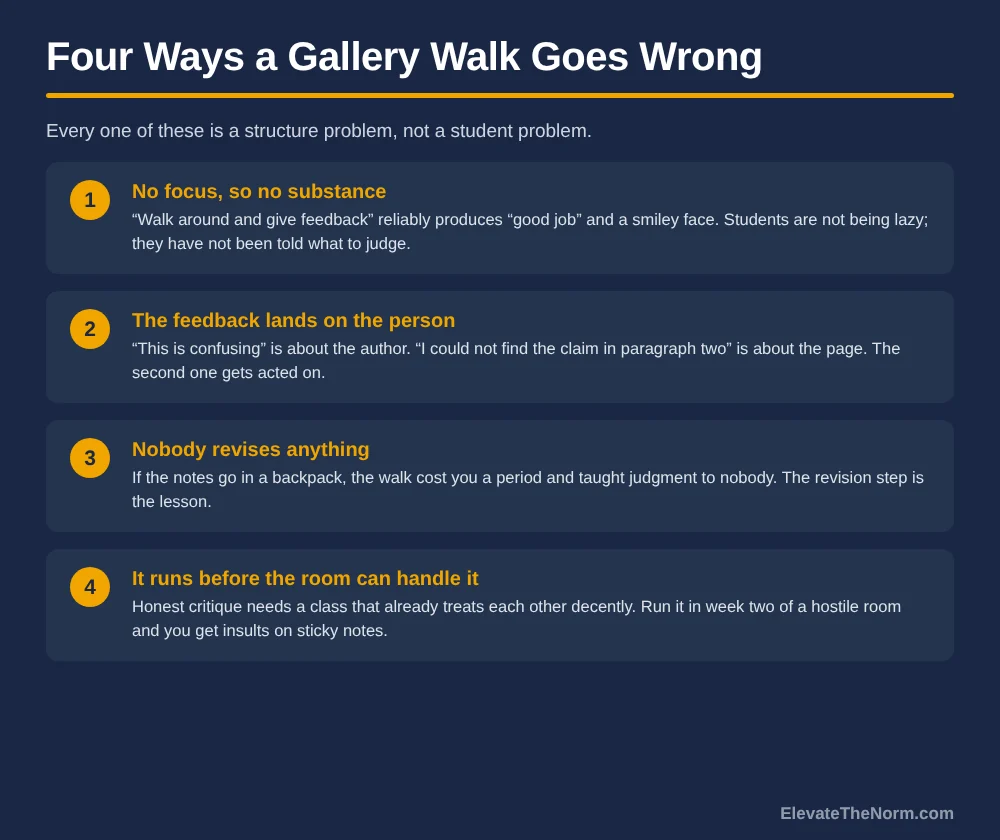
    Four numbered failure modes of a gallery walk activity: no focus so no substance, feedback aimed at the person rather than the work, no revision after the walk, and running critique before the classroom culture can support it
    Every one of these is a structure problem, not a student problem.

    The first is no focus, which produces “good job” and a smiley face. Students are not being lazy. They have not been told what to judge, so they default to the safest comment available.

    The second is feedback aimed at the person. See above. The fix is mechanical — stems, and a rule that every note names a specific part of the work.

    The third is no revision, which is the most common and the most expensive. If the notes go into a backpack, the walk taught judgment to nobody and cost you a period.

    The fourth is running it too early. Critique is a high-trust activity. In a room where that trust is not there yet, start with something lower stakes — structured peer response on a single paragraph at their desks, with you reading over shoulders — and build toward the full walk over a few weeks.

    Two practical notes, because the guides tend to skip both. Prep is roughly ten minutes — deciding the focus, writing three criteria, and finding the sticky notes. There is no packet to build, which is a large part of why this protocol survives in real classrooms. And the student who has nothing to post is an ordinary Tuesday, not a crisis. They post what exists, even if it is a title and two sentences, and they do the walk and give feedback like everybody else. Giving feedback is most of the cognitive work in this activity anyway. Exempting them from the one part they can still do teaches them that the room has stopped expecting anything from them.

    Where Does This Fit in a Unit?

    Mid-draft, not at the end. A gallery walk on finished work is a showcase, which is a fine thing but a different thing. The activity earns its period when the work is still changeable.

    In a project, the natural slot is the day the first full draft exists and before any of it is graded. The critique and revision tools in a PBL toolkit are built around exactly that moment. In a writing unit, it is after the first full draft and before the revision conference. In a problem-based math or science lesson, it is after groups have committed to an approach and before they have invested two days in it.

    One per unit is plenty. Run it weekly and it becomes the thing students perform rather than the thing they use, which is the same failure mode that eventually catches every student-centered routine that gets over-used.

    Does This Work in a Class of Thirty-Five?

    Yes, and it is one of the few protocols that gets easier as the class gets bigger, because it runs in parallel.

    Eight or nine stations, groups of four, three minutes each, and the whole room is working at once. The constraint is wall space and traffic flow, not headcount. If the room is tight, put work flat on desks and rotate groups between desk clusters instead of around the perimeter — same protocol, less collision.

    Where class size does bite is the revision block. Thirty-five students each wanting to ask you about one piece of feedback does not fit in ten minutes. The answer is that they do not ask you. They pick one change and make it. You circulate. The ones who are genuinely stuck will find you.

    Access is worth planning for rather than improvising. A student who reads well below grade level cannot absorb six peers’ drafts in three minutes, and a student newer to English may be able to judge the work and not able to write the note quickly. Both are solved the same way: let feedback be spoken to a partner who writes it, or give a sentence frame with the technical words already in it. Neither reduces the demand — the judgment is still theirs — and both stop the activity quietly sorting the room by reading speed.

    What to Do Next

    Pick a task you already have, where the work is half-finished and you were going to collect it anyway. Decide the one thing students will look for. Write three success criteria on the board. Give them sticky notes, three sentence stems and three minutes a station, and reserve the last ten minutes of the period for one change each.

    Do not grade it. The research says the grade does nothing for students this age, and the moment it is graded you are back to students writing what they think you want to read.

    Then look at the revisions rather than the sticky notes. The sticky notes tell you how well you set up the protocol. The revisions tell you whether anybody learned anything, which is the only question that matters.

    Before you go: grab the free The Gallery Walk Planner (2 pages) (PDF) — ElevateTheNorm.com branded, printable, no email required.

    Frequently Asked Questions

    Is there actual research behind the gallery walk activity, or just blog posts?

    Both, and they are not the same strength. The peer assessment that happens inside a gallery walk is well evidenced: a meta-analysis of 54 control-group studies found g = 0.31 on academic performance, rising to g = 0.44 at secondary level. The gallery walk format is a different claim, and the evidence there is thin. The closest study at the right grade level followed 198 Grade 8 students but had no control group, and found no significant relationship between how the walk was run and students’ knowledge gains or interest. Run the activity for the peer assessment, and build it so the peer assessment is real.

    How do you keep a gallery walk from humiliating the student whose work is weakest?

    Three rules handle most of it. Everyone’s work goes up every time — a wall of selected work tells the room exactly who was selected. Never use personal or narrative writing; use the analytical task, the lab, the problem set or the project artifact. And let a student display work without their name if they ask for that. Anonymity was not a significant moderator in the peer assessment research, so you lose nothing measurable by allowing it. If a student still refuses, take it privately rather than in front of the room.

    Should peer feedback on a gallery walk be anonymous or signed?

    Either works, and you can decide it on classroom grounds rather than research grounds. In the Double, McGrane and Hopfenbeck meta-analysis, anonymity was one of several implementation choices that showed no significant difference in effect. Signed notes tend to be more careful and let the author follow up with a question; anonymous notes tend to be more honest early in the year. A reasonable default is signed, with the caveat that you will read them.

    Should you grade the feedback students give?

    No, not in grades 6–12. The one place the research splits by age is exactly here: peer feedback carrying a grade significantly improved university students’ performance, and that effect could not be shown for primary or secondary students. Grading it also changes what students write — they start producing what they think you want rather than what they noticed. Hold them accountable for completing it, not for a score on it.

    What if a student gets feedback that is simply wrong?

    They are allowed to reject it, and saying so out loud is part of the lesson. Require that every student can name one note they acted on and why, or one note they decided not to act on and why. Both answers show judgment, which is the skill peer assessment is supposed to build. A protocol that makes a student obey bad advice from a classmate is teaching compliance, not critique.

    How long does a gallery walk take, and how much preparation?

    One class period, and about ten minutes of prep. The prep is deciding the single focus, writing three success criteria, and finding sticky notes — there is no packet to build. In the period, allow eight minutes to model the protocol the first time, two to three minutes per station, and a protected ten minutes at the end for revision. If the period is short, cut the number of stations, never the revision block.

    What do you do when a student writes something unkind on a note?

    Collect it, handle it privately, and do not re-run the whole protocol as a punishment for the class. Then look at what made it possible: unkind notes are far more common when the focus was vague, because “say something about this” invites personal commentary while “find the claim and say whether the evidence supports it” does not. Critique also depends on an existing classroom culture — if the room is not there yet, scale back to partner feedback at desks and build up to the full walk.

    How do you know whether the gallery walk actually taught anything?

    Look at the revisions, not the sticky notes. The notes tell you how well you set up the protocol; the changes students made tell you whether the feedback was understood and used. A quick version: collect the one-sentence statement of what each student changed and why. If most of them name a surface change — spelling, formatting, length — the focus you set was too broad and the next walk needs a narrower one.

    Sources

    1. Double, K. S., McGrane, J. A., & Hopfenbeck, T. N. (2019). “The Impact of Peer Assessment on Academic Performance: A Meta-analysis of Control Group Studies.” Educational Psychology Review, 32. Meta-analysis of 54 experimental and quasi-experimental control-group studies; overall g = 0.31 (p < .001) on academic performance; peer assessment outperformed no assessment and teacher assessment (0.28) and was comparable to self-assessment; effects robust across delivery mode, frequency and educational level. https://ora.ox.ac.uk/objects/uuid:0a09975c-e7e6-416f-b888-977230b29ba4
    2. Clearinghouse Unterricht (TUM), Short Review 28 on Double et al. (2020). Cited as a summary, not as the primary study. This is where the secondary-level figure used above comes from — g = 0.44 across 13 studies — together with the moderator finding that peer feedback carrying a grade significantly helped university students (g = 0.55) but could not be shown to help primary or secondary students. https://www.clearinghouse.edu.tum.de/wp-content/uploads/2023/10/CHU-KR-28_ENG_Double_2020.pdf
    3. “Gallery Walk Activities in Teaching Social Studies: Inputs in Enhancing Knowledge, Interest, and Attitude of Grade 8 Students” (2023). International Journal of Research Publications. 198 Grade 8 students, Philippines. One-group pre-test/post-test and correlational design with no control group. Mean gained scores 7.88 / 8.15 / 8.01 across three lessons; correlations between implementation features and cognitive skills were not significant, and correlations with interest were “not significant at 0.05 level”; only attitude correlations reached significance. https://ijrp.sfo3.cdn.digitaloceanspaces.com/pubjournal/5094/1001281720235215.pdf
    4. PBLWorks / Buck Institute for Education. “Using Gallery Walks for Critique & Revision in PBL.” Practitioner protocol. The claim that a specific focus and criteria produce higher-quality feedback is reported by the authors as their own experience — “We’ve found” — and the article cites no studies. Quoted here as practice knowledge, not as research. https://www.pblworks.org/blog/using-gallery-walks-critique-revision-pbl
    5. Kluger, A. N., & DeNisi, A. (1996). “The Effects of Feedback Interventions on Performance: A Historical Review, a Meta-analysis, and a Preliminary Feedback Intervention Theory.” Psychological Bulletin, 119(2). 607 effect sizes across 23,663 observations; average d = 0.41; feedback interventions reduced performance in over a third of cases. The primary article was not reachable from this session; the figures above are taken from a secondary summary of it and are labelled as such. https://explore.psychsafety.com/n/kluger-denisi-1996/
    6. Varlas, L. (2017). “Peer Feedback Without the Sting.” Educational Leadership (ASCD), May 2017. Source of the “kind, specific, helpful” framing attributed to Ron Berger of EL Education, and of the point that peer critique depends on existing classroom culture rather than on the protocol alone. https://www.ascd.org/el/articles/peer-feedback-without-the-sting

    About Clay Shumate

    Clay Shumate is a certified secondary Social Studies teacher in the public schools of West Alabama, with seven years of classroom experience, a B.A. in History, and an M.Ed. in Secondary Education. He writes about project-based learning, student responsibility, respect, and practical ways to hold young people to a higher standard while giving them room to learn from mistakes. He is a member of the Society of Professional Journalists and writes to its Code of Ethics; this site’s editorial standards and corrections policy are published in full. More about Clay.

  • Small Group Instruction in Middle and High School: Make the Table the Seat Students Want

    Small Group Instruction in Middle and High School: Make the Table the Seat Students Want

    By Clay Shumate

    Small group instruction in middle and high school works when being called to the table reads as a privilege instead of a diagnosis. That means three things: everyone goes, including your strongest students; nobody gets announced; and the table itself is the best seat in the room. Below are two ready-to-run systems built on that rule — one for middle school and one for high school — because a sixth grader and a senior want very different things from the same ten minutes.

    Small group is where a lot of the real teaching happens and also where a lot of the stress sits. Teachers are told to pull groups every day, and then they watch a fourteen-year-old slump in his chair on the walk over because everyone in the room knows what that walk means. This page is about fixing the walk.

    Key Takeaways

    • The problem is status, not content. Teenagers are more sensitive to status and respect than younger children, and a small group that looks like the low group gets treated like one.
    • Everyone goes, every cycle. If your top students never sit at the table, every student who does sit there has been labeled.
    • Middle school: The Studio. A class-named table, quiet invitation cards, and three session types — including a Sneak Peek that lets students see tomorrow’s material before anyone else.
    • High school: Consults. Booked ten-minute slots that run like office hours. The schedule is public; the reason each student is there is not.
    • Check your roster every two weeks. The same five names three cycles in a row means you have built a fixed low group, which is the version the evidence warns against.

    Free Download · PDF

    Small Group Instruction Toolkit

    Two pages: eight cut-apart invitation cards for The Studio, a ten-slot consult booking sheet for high school, and a private teacher tally for catching a fixed low group early.

    Download the free PDF

    Free. No email address required. Designed for grades 6–12. Browse every printable in Your Free Library.

    Two-column comparison of small group instruction in middle school and high school covering name, entry, hook, length and exit, with a warning that the same five names three cycles running means a fixed low group
    Same rule underneath. Different packaging for a sixth grader and a senior.

    Why Does Small Group Instruction Stop Feeling Okay After Elementary School?

    Because the walk to the table becomes public information about who is struggling, and adolescents are built to notice that kind of information.

    In elementary school, reading groups are just how the day works. By middle school, students start doing the math on who gets pulled and why. David Yeager, Ronald Dahl and Carol Dweck put the developmental piece plainly: compared to younger children, middle adolescents “show a greater sensitivity to status and respect, resulting from pubertal maturation.” They also warn that anything that feels like talking down — repeating what students think they already know — “may come across as infantilizing and therefore disrespectful.” A small group that feels like a remedial pull-out hits both nerves at once.

    The help-seeking research points the same direction. Ryan, Hicks and Midgley found that students focused on social status and on looking capable were more likely to avoid asking for help and to see it as a threat to their self-worth, and that lower-achieving students with those goals avoided help the most. That sample was fifth graders, so read it as the pattern forming, not as a secondary-school result. A later conference paper from the same Michigan research group, surveying 968 seventh graders, found that when students believed their teacher took care not to embarrass students who had difficulty, they were less likely to avoid seeking help. It is a conference paper rather than a peer-reviewed article, and it is correlational. But it names the lever precisely: not embarrassing anyone is not a nice extra. It is the condition that makes help usable.

    So the design problem is not “how do I teach a small group.” Most teachers know how. It is “how do I make going to the table cost a student nothing in front of their friends.”

    What Does the Research Say About Grouping in the First Place?

    Grouping inside a class helps a little, and the risk is almost entirely in groups that never change.

    A second-order meta-analysis by Steenbergen-Hu, Makel and Olszewski-Kubilius, pulling together a century of studies, found that students benefited from within-class grouping and from cross-grade subject grouping, while sorting students into separate classes by ability without changing the curriculum did not change achievement. A review chapter by Ed Baines summarizes the within-class finding as small positive effects “with students at all levels benefiting.”

    The Education Endowment Foundation’s toolkit is more cautious, and you should hear it. It estimates within-class attainment grouping at about two months of additional progress, rates the evidence as “very limited” (22 studies), and warns that lower-attaining students can suffer from lower teacher expectations and lasting damage to their attitudes. Its fix is the one both systems below are built on: group flexibly, so students know ability is not fixed.

    That is the honest summary. Small groups are not magic. Small groups that turn into a permanent low table are a real harm. Everything below is designed to stay on the right side of that line. I run most of my group work from the Station Rotation Toolkit on TPT so students know where to go and what to record.

    What Is the One Rule Under Both Systems?

    The table has to be a place students want to be, and every student has to end up there.

    My room runs as a workshop. Students are almost always working alongside somebody, and I pull people to a whiteboard table I made. It sits in a corner under a lower lamp, with a rug and nicer chairs than the rest of the room. You want to go there with me. Students ask.

    That last part is the whole point. I did not solve the “dumb table” problem with a policy or a speech about growth. I solved it by making the table the best seat in the room. The two systems below are built out from that idea for two very different age groups. Neither one needs a budget. A lamp, a rug and a table students can write on go a long way; a lamp-lit corner does more for the mood of a small group than any sentence you can say about it.

    Three rules hold for both:

    • Everyone goes. Every student, every two-week cycle, including the ones who do not need help. Their visits are real — a challenge or a preview — not a decoy.
    • Nobody is called across the room. No names read aloud. Notes, cards, a booked slot. The call is private; the table is visible.
    • The rest of the room runs without you. If the other twenty-five students need you every ninety seconds, small group collapses. Post what everyone else is doing before the first student sits down.

    How Do You Make Small Group Instruction Cool in Middle School?

    Run it as The Studio: a class-named table you get invited to, with sessions that sometimes let you in on something before anyone else.

    Middle schoolers want to belong, want a little novelty, and are acutely aware of fairness. The Studio leans into all three.

    Five-step list for a middle school small group system: the class names the table, invitation cards delivered quietly, three session types called Fix-It, Level-Up and Sneak Peek, one open chair students can request, and leaving as the expert
    The Studio: small group instruction for grades 6–8, built as an invitation.

    1. Let the class name the table

    In the first couple of weeks, put three or four names on the board and let classes vote. “The Studio” is a fine default; students will come up with better ones. It sounds small. It is not. A place with a name the students chose is their place. A place the teacher calls “my reteach table” is yours, and everyone knows what it is for.

    2. Invitations, not call-outs

    Print a stack of small cards — “You’re invited to The Studio. Round 2, today.” — and set one on a student’s desk while you circulate. Middle schoolers like getting a card. Nobody else hears a name, and the student gets a minute of warning instead of being yanked out of whatever they were doing.

    3. Three kinds of session, and nobody outside knows which

    • Fix-It. The reteach. Something from an exit ticket or a confusion flag that three or four students missed.
    • Level-Up. A harder version of today’s task for students who are ready. This is what makes your strongest students regulars.
    • Sneak Peek. Ten minutes on tomorrow’s material before the class sees it. This is the status flip. The students who went walk into tomorrow’s lesson already knowing the vocabulary and the first example, and they get to be the ones with their hands up. Pre-teaching is also one of the kindest things you can do for a student who usually lags, and it never looks like help.

    The card never says which kind it is. From the outside, all three look the same.

    4. Table privileges

    The Studio should be physically better than a desk. Students write directly on the whiteboard surface with markers — middle schoolers will do almost any math problem if they are allowed to write it on a table. Better chairs. The lamp. A visible timer set to eight or ten minutes so everyone, including you, knows the session ends.

    5. One open chair

    Keep one seat that students can request. A clip or a sticky note on the board: “Save me a seat.” When students start booking themselves in, you have won. That chair is also your honesty check — if nobody ever asks for it, the table is not yet a place anyone wants to be.

    6. Leave as the expert

    Every student walks back to their table group carrying one thing to explain. “Tell your group the two ways we found to check this.” They come back from The Studio as the person who knows something, not the person who was missing something. If your room is already arranged around partner work and groups of four — the site’s guide to seating charts covers layouts — this step costs nothing.

    How Do You Make Small Group Instruction Work in High School?

    Run it as Consults: booked ten-minute meetings that work like a professor’s office hours, where the student brings the agenda.

    High schoolers do not want a cute name or a card. They want to be treated like adults, and a small group that feels like fourth-grade reading circle will be resisted with their whole body. So borrow the language and structure of how adults actually get help: office hours, a coach’s film session, a design critique, a one-on-one with a manager.

    Five-step list for a high school small group system run like office hours: booked not pulled, nobody comes empty-handed, the schedule is public but the reason is not, stretch consults on the same sheet, and the student writes the next step
    Consults: small group instruction for grades 9–12, run like office hours.

    1. Booked, not pulled

    Post a sign-up sheet — paper on the wall or a simple form — with ten-minute slots for each day of the cycle. Students can book themselves. When you book a student, tell them privately: a note on their paper, a message through your learning platform, a quiet word while you circulate. “I put you down for Thursday, second slot. Bring your thesis.” That is how an adult schedules a meeting with another adult.

    2. Nobody comes empty-handed

    The price of a consult is bringing something: a draft, a problem you got wrong, a question you could not answer. The student talks first for the opening minute or two — what they brought and where they are stuck. This is the autonomy piece, and it matters. The Yeager, Dahl and Dweck review notes that whether adolescents felt an intervention supported their autonomy changed whether it worked. A consult where the student sets the agenda feels like their meeting. A reteach where you repeat the lesson at closer range feels like being talked down to.

    3. The schedule is public; the reason is not

    Post who is booked and when. Names and dates, nothing else. Everyone can see that the strongest student in the room is booked Tuesday and the quiet kid in the back is booked Wednesday and there is no visible difference between those two facts. Why each person is there stays between you and them.

    4. Stretch consults on the same sheet

    Your strongest students book consults too — for a harder problem, feedback on an ambitious draft, a question that goes past the unit. This is the single most important design choice in the whole system. If only struggling students ever sit down, the sheet becomes a list of who is struggling, and every protection above falls apart.

    5. The student writes the next step

    Before they stand up, the student writes one line in their own words: what they will do next and by when. Not your summary of what they should do — theirs. It is short, it is theirs, and it is the only record the consult needs. If you want students getting better at judging their own work, the site’s piece on self-assessment during group work pairs well with this.

    6. Talk to them like colleagues

    No cheerleading, no “great job, buddy.” Tell them what is working, what is not, and what you would do next if it were your draft. Respect in the classroom is mostly this: talking to a seventeen-year-old about their work the way you would want someone to talk to you about yours.

    How Do You Fit This Into a Real Class Period?

    One or two sessions a day, ten minutes each, on a two-week cycle.

    Do the arithmetic before you promise anything. A class of 28 in groups of three or four is roughly eight sessions per cycle. Over ten school days, that is one session most days and two on a few. That fits. Three sessions a day, every day, does not fit anyone’s real schedule, and a system you drop in October helps nobody.

    Use a short routine for the rest of the room: a posted task with a clear finish line, a “what to do when you are stuck” list that does not start with walking up to the table, and a rule that the table is not interrupted except for emergencies. Practice it for the first week with a two-minute session so the room learns to run without you. Clean transitions matter here more than almost anywhere else; every minute lost moving students to the table comes out of the session.

    Decide who goes from evidence, not from memory. An exit ticket or a quick check sorted into piles tells you who needs a Fix-It, who is ready for a Level-Up, and who would benefit from a Sneak Peek. The site’s formative assessment strategies for reading describes a sort-don’t-mark routine that feeds straight into this.

    What Are the Signs the Table Has Become the Low Group?

    Same names, same kind of session, three cycles in a row. Keep a simple tally — name, date, session type — and look at it every two weeks. Four warning signs:

    • The same five students fill most of the seats. That is a fixed group, and it is the version the EEF warns can depress attitudes and expectations.
    • Your top students have not been in weeks. Book them. A Level-Up or a stretch consult is a real session, not a favor.
    • Nobody uses the open chair or books themselves. The table is not yet desirable. Fix the table before you fix the students.
    • You are reteaching the whole lesson at the table. Ten minutes is for one sticking point. If the whole lesson did not land, that is a whole-class problem, and it belongs to the whole class tomorrow.

    One more boundary: The Studio and Consults are classroom instruction. They do not replace small-group services written into an IEP or a 504 plan, and a student’s visits should not be counted as those services unless the plan and your case manager say so.

    Where Does the Evidence Run Out?

    Nobody has run a trial on invitation cards or booking sheets. The two systems here are designs built from well-supported principles — adolescents’ sensitivity to status and respect, the link between feeling safe from embarrassment and seeking help, and the case for flexible over fixed grouping. The individual features are not tested interventions, and you should treat them as a starting point to adjust, not a protocol.

    The grouping evidence itself is also thinner than it sounds. The EEF rates it very limited. The meta-analytic finding is small and positive. The help-seeking studies are correlational, one is on fifth graders, and one is a conference paper. What the evidence does support, fairly consistently, is the direction: teenagers avoid help that costs them status, and groups that never change carry real risk. Both systems are built to push against exactly those two problems.

    What Should You Do Next?

    Pick the system for your grade band and start small. Name the table or post the booking sheet this week. Run one session a day for two weeks with at least two of your strongest students in the rotation. At the end of the cycle, look at your tally and at the open chair. If students are asking to come, keep going. If they are not, change the table before you change anything else.

    Related reading on this site: student voice and choice for how much control to hand students, and high expectations for students for why a table everyone attends is a statement about what you expect from all of them.

    Before you go: grab the free Small Group Instruction Toolkit (PDF) — ElevateTheNorm.com branded, printable, no email required.

    Small groups are one lever, not the whole job. Our guide to differentiated instruction strategies for grades 6–12 covers the three decisions that make differentiation workable without five lesson plans.

    Teacher-led small groups are not the only shape this takes. Our companion piece on the five elements that separate cooperative learning from group seating covers what changes when students work without you at the table.

    Frequently Asked Questions

    What is small group instruction in middle and high school?

    It is a short, focused session with three or four students while the rest of the class works independently. In grades 6 to 12 it usually runs eight to ten minutes and targets one sticking point, a challenge task, or a preview of upcoming material. The difference from elementary school is less about content and more about how students feel walking to the table.

    How do I stop students from feeling singled out when I pull a small group?

    Three things. Put every student in the rotation, including your strongest, so being called says nothing about ability. Call students privately with a card, a note or a booked slot instead of reading names aloud. And make the table the most comfortable seat in the room so going there reads as a privilege.

    What if my high school students refuse to come to the table?

    Refusal usually means the table still looks like the low group. Switch to booked consults, let students set the agenda by bringing their own draft or question, and make sure your top students are visibly on the booking sheet. If a student still declines, offer them a different slot rather than insisting in front of the class.

    How often should each student get small group time?

    Once every two-week cycle is a realistic floor for a class of about 28. That works out to roughly eight sessions of three or four students, or about one session a day. Students who need more can come more often, as long as the rest of the class still rotates through.

    What does the rest of the class do during small group instruction?

    A posted task with a clear finish line, a short list of what to do when stuck that does not start with interrupting the table, and a rule that the table is only interrupted for emergencies. Practice the routine with very short sessions during the first week so the room learns to run without you.

    Is ability grouping bad for students?

    Fixed ability groups carry real risk, especially for lower-attaining students, whose expectations and attitudes can suffer. Flexible groups that change based on recent evidence show small positive effects in the research, though the evidence base is limited. The practical rule is to group by what students need this week and to reshuffle constantly.

    Can small group sessions count toward IEP or 504 services?

    Not automatically. These sessions are general classroom instruction. If an IEP or 504 plan specifies small-group services, check with the case manager about what counts and how it is documented before treating any classroom session as meeting that requirement.

    Sources

    1. Yeager, David S., Ronald E. Dahl, and Carol S. Dweck. “Why Interventions to Influence Adolescent Behavior Often Fail but Could Succeed.” Perspectives on Psychological Science, vol. 13, no. 1, 2018, pp. 101–122. https://pmc.ncbi.nlm.nih.gov/articles/PMC5758430/
    2. Ryan, Allison M., Lynley Hicks, and Carol Midgley. “Social Goals, Academic Goals, and Avoiding Seeking Help in the Classroom.” Journal of Early Adolescence, vol. 17, no. 2, 1997, pp. 152–171. Sample: 443 fifth graders. https://deepblue.lib.umich.edu/items/485258a6-d9dc-4464-b205-fd8faa0b8b70
    3. Friedel, Jeanne, Roxana Marachi, and Carol Midgley. “‘Stop Embarrassing Me!’ Relations Among Student Perceptions of Teachers, Classroom Goals, and Maladaptive Behaviors.” Paper presented at the American Educational Research Association annual meeting, New Orleans, 2002. Sample: 968 seventh graders. https://public.websites.umich.edu/~pals/AERA2002%20handout.pdf
    4. Steenbergen-Hu, Saiying, Matthew C. Makel, and Paula Olszewski-Kubilius. “What One Hundred Years of Research Says About the Effects of Ability Grouping and Acceleration on K–12 Students’ Academic Achievement.” Review of Educational Research, 2016. Summary read via Duke University: https://today.duke.edu/2016/12/new-analysis-finds-two-measures-boost-k-12-academic-achievement
    5. Baines, Ed. “Ability Grouping.” Review chapter, UCL Institute of Education (2nd ed.). https://discovery-pp.ucl.ac.uk/10086616/1/EdBaines-AbilityGrouping-2ndEditionFinal1.pdf
    6. Education Endowment Foundation. “Within-Class Attainment Grouping.” Teaching and Learning Toolkit. https://educationendowmentfoundation.org.uk/education-evidence/teaching-learning-toolkit/within-class-attainment-grouping

    About Clay Shumate

    Clay Shumate is a certified secondary Social Studies teacher in the public schools of West Alabama, with seven years of classroom experience, a B.A. in History, and an M.Ed. in Secondary Education. He writes about project-based learning, student responsibility, respect, and practical ways to hold young people to a higher standard while giving them room to learn from mistakes. He is a member of the Society of Professional Journalists and writes to its Code of Ethics; this site’s editorial standards and corrections policy are published in full. More about Clay.

  • Formative Assessment Strategies for Reading: Five Checks That Fit a Real Week

    Formative Assessment Strategies for Reading: Five Checks That Fit a Real Week

    By Clay Shumate

    Formative assessment strategies for reading are short, ungraded checks that show you what students understood from a text while the lesson is still running. A two-sentence gist, a flagged confusion, a prediction. They take two minutes, they are not graded, and they are only worth doing if the answer changes what you teach next.

    What follows is the honest version: five checks that survive a real secondary schedule, a routine that does not require reading 120 responses, and the numbers — including the ones that are smaller than your last in-service claimed.

    Key Takeaways

    • The check is not the intervention. What you do with the answer is. Studies where reading checks fed differentiated instruction showed nearly five times the effect of studies where they did not.
    • The honest effect is modest. Around +0.19 to +0.20, not the 0.40 to 0.70 that gets quoted. English language arts does better than math or science at 0.32.
    • Sort, do not mark. Twenty-eight gist statements is a five-minute sort into three piles. Marking them is what kills the practice by week three.
    • Nothing here requires reading aloud in front of the class. That is a design decision, not an oversight.
    • The high school evidence gap is real. An IES review found twelve adolescent literacy programs with positive effects and not one of them studied in a high school.

    Free Download · PDF

    Formative Assessment Quick-Use Pack

    A strategy decision matrix, an evidence tracker, four exit-ticket formats, and a next-day response planner — four pages built around changing the next instructional move.

    Download the free PDF

    Free. No email address required. Designed for grades 6–12. Browse every printable in Your Free Library.

    Numbered list of five formative reading checks: the two-sentence gist, the confusion flag, predict then rule, the evidence pull, and the one-word question, each with a one-line description
    Five checks. None takes more than three minutes and none requires reading aloud.

    What Counts as a Formative Assessment Strategy for Reading?

    Any short check that tells you what a student took from a text in time for you to act on it. The format is negotiable. The timing is not.

    That definition rules more out than it rules in. A comprehension worksheet collected at the bell and returned Thursday is not formative — not because worksheets are bad, but because the information arrived after the decision it was supposed to inform. A five-question quiz you grade and record is summative wearing different clothes. The line is whether the answer reaches you while you can still change the next ten minutes.

    It also rules out the thing most reading checks actually measure, which is whether a student did the reading. That is a useful fact and it is not comprehension. “Did you read it” and “what did you understand” require different questions, and a margin that demands a restatement is one of the cheaper ways to make the second one visible, and conflating them is how a teacher ends up with a stack of evidence that everyone read a chapter nobody understood. The broader version of this distinction is covered in the cross-subject guide to choosing a check and acting on it; this page is the reading-specific case.

    What Does the Research Actually Show?

    A modest, consistent benefit — smaller than the number most professional development quotes.

    The most direct evidence is a 2022 meta-analysis by Xuan, Cheung and Sun covering 48 qualifying studies and 116,051 K–12 students. The pooled effect of formative assessment on reading achievement was +0.19 (95% CI 0.15–0.23). By grade band: kindergarten +0.28, elementary +0.16, and middle and high school +0.27 — though the meta-regression found grade-level differences were not significant once other variables were controlled. Secondary students are not the weak case here.

    The older and more quoted number is worse than people think. Kingston and Nash reviewed more than 300 studies, found only 13 with enough data to analyze, and reported a weighted mean effect of 0.20. Their conclusion is unusually blunt for a meta-analysis: the 0.40 to 0.70 figure “often claimed for the efficacy of formative assessment… is not supported by the existing research base.” The one genuinely encouraging row for a reading teacher is the subject breakdown — English language arts came in at 0.32, against 0.17 for mathematics and 0.09 for science.

    So: real, replicated, worth two minutes a day. Not transformational, and anyone selling it as transformational is selling something.

    Table of effect sizes for formative assessment on reading: plus 0.19 across K-12, plus 0.27 for middle and high school, plus 0.24 with differentiated instruction versus plus 0.05 without, plus 0.001 for technology involvement, and 0.32 for English language arts
    The numbers, including the one that contradicts the slide deck.

    What Makes the Difference Between a Check That Works and One That Does Not?

    Two moderators did most of the work, and neither is the check itself.

    First, who uses the information. In the Xuan meta-analysis, teacher-directed approaches alone produced significantly smaller effects than approaches that integrated teacher and student use of the results (coefficient −0.12, p < 0.001). Purely student-directed assessment showed no significant advantage either. The winning configuration is both: you see the pattern, and the student sees their own answer against what the text actually said.

    Second, whether anything got differentiated. Studies in which the information fed differentiated instruction showed an effect of +0.24. Studies where it did not: +0.05. That is close to the whole finding. A reading check that produces a number you record and nothing you change is worth almost nothing, and the meta-analysis says so with a p-value. If the next question is what the changing actually looks like on a Tuesday, we walk through five ways to teach a mixed-readiness room without writing five lesson plans.

    And one thing that made no difference at all: technology. The moderator coefficient for technology involvement was +0.001 (p = 0.978). A Google Form and a sticky note perform identically. Pick the one your students will finish in ninety seconds.

    Which Five Reading Checks Fit a Real Secondary Schedule?

    These five take two to three minutes, need no materials beyond paper, and none requires a student to read aloud in front of peers.

    • The two-sentence gist. After a passage: “In two sentences, what is this saying?” Not a summary, not a main idea in a sentence frame. Two sentences in their own words. The students who can’t do it in their own words are the ones you need to find.
    • The confusion flag. One sticky note, one sentence: the part of this text I could not follow. Nothing else on it. Collected at the door. This is the highest-yield check on the list because it is the only one where the student, not you, locates the problem.
    • Pre-reading prediction, post-reading verdict. Before: one sentence on what you expect this will argue. After: right, wrong, or more complicated, and why. The post-reading half is the assessment; the pre-reading half is what makes them read looking for something.
    • The evidence pull. “Find the sentence in the text that best supports this claim.” Line number is enough. It is fast to scan and it catches the student who agrees with an argument without being able to find it on the page.
    • The one-word question. Give a single word from the text and ask what it means here. Vocabulary in context is the check with the strongest evidence behind it — explicit vocabulary instruction is one of the two practices the What Works Clearinghouse panel rates strong for adolescent literacy. What that rating covers is worth being precise about: the measured effect is far larger on the taught text than on a standardized reading score.

    The WWC practice guide is worth reading alongside these. Its five recommendations carry explicit evidence ratings: explicit vocabulary instruction (strong), direct and explicit comprehension strategy instruction (strong, based on five randomized experiments), extended discussion of text meaning (moderate), increasing motivation and engagement (moderate), and intensive individualized intervention for struggling readers (strong). The panel is honest about its own limits: most of the discussion studies used narrative texts, which is a meaningful caveat if you teach history or science. When I need a quick way to analyze a source with students, I use my Current Events and Media Literacy Bundle on TPT.

    How Do You Run This Without Reading 120 Responses?

    You sort them. You do not mark them.

    This is the single practical thing that decides whether a teacher is still doing reading checks in November. Twenty-eight two-sentence gist statements is not a marking job. It is a five-minute sort into three piles — got it, partial, missed the point — and the only thing you write down is how many are in each pile. Three numbers. That is your instructional decision. If you would rather not design the recording sheet yourself, the free quick-use pack includes a class evidence tracker built for exactly that three-pile sort.

    Here is a week that fits a normal load:

    • Monday. Confusion flags on the week’s first text. Sort into piles. Whatever the biggest pile names becomes Tuesday’s opening five minutes.
    • Tuesday. Nothing collected. Teach into Monday’s biggest pile. This is the differentiation the research is actually measuring.
    • Wednesday. Two-sentence gist. Sort. Read four aloud — anonymized, and only with the writer’s permission, because every student recognizes their own sentences.
    • Thursday. Evidence pull on the same text. Ninety seconds. Scan for line numbers that are obviously wrong.
    • Friday. Nothing collected. Whatever Thursday showed, fix it in the room.

    Two collection days, two teaching-into days, one flexible. That is the whole system, and it is deliberately smaller than what a district rollout would design, because a smaller system that runs every week beats a comprehensive one that runs until October.

    Five-day routine showing Monday collect confusion flags, Tuesday teach into the biggest pile, Wednesday collect two-sentence gists, Thursday collect a fast evidence pull, and Friday fix what Thursday showed
    Two collection days. Two days spent on what they showed. That is the ratio that matters.

    What Does This Look Like in a Room?

    My room runs as a workshop, and the piece of furniture that does the most work is a whiteboard table I built, set in a corner under a lower lamp, with a rug and better chairs than the rest of the room has. Students ask to go there. That matters more than it sounds like it should.

    When a confusion flag says something I cannot fix from the front of the room, that table is where the conversation happens — not as a remediation station, because it is the seat everyone wants. A student reading a paragraph out loud at that table, with one other person, is doing the same thing that would humiliate them standing at their desk. The check tells you who needs the conversation. The room decides whether the conversation costs them anything.

    That is the part no meta-analysis measures and the part a teacher controls completely.

    Two ready-to-run versions of that table, one for grades 6–8 and one for grades 9–12, are laid out in the site’s guide to small group instruction in middle and high school.

    Where Does the Evidence Run Out?

    At high school, more precisely than most people admit.

    An IES review summarizing twenty years of adolescent literacy research screened 111 studies, found 33 meeting What Works Clearinghouse evidence standards, and identified 12 programs and practices with positive or potentially positive effects on reading comprehension, vocabulary or general literacy across grades 6–12. And then the line that belongs in every conversation about this: none of the 12 was conducted in a high school setting. The evidence base for adolescent literacy is, in practice, a middle school evidence base.

    Three more honest limits from the meta-analytic work. Small studies inflate the result badly — studies with 250 or fewer participants produced an effect of +0.45 against +0.13 for large ones, which is the usual sign that tightly-supervised implementations outperform real ones. The Xuan authors found no significant difference between published and unpublished studies, so publication bias is not the explanation, but the sample-size gap is a warning about what happens when a practice scales. And only 8 of the 48 studies came from Confucian-heritage contexts against 40 Anglophone, so the authors caution against moving interventions across cultures unadapted.

    None of that is a reason not to run a two-minute gist check. It is a reason not to build a district initiative on a number somebody rounded up.

    What Should You Do Next?

    Pick one check — the confusion flag if you want the highest yield for the least work — and run it twice a week for three weeks on a text you were teaching anyway. Sort, do not mark. Spend one whole class period in those three weeks teaching into whatever the biggest pile said, and notice whether the next set of flags moves.

    If it does, add a second check. If it does not, the problem is probably that the flags are not changing your lesson yet, which is the failure mode the research is loudest about. Two related pages are worth having open: the site’s guide to what counts as evidence that a class understood something for the general-purpose version of these moves, and the version that runs while a draft is still being written for the same problem on the production side. Listening is that problem again with nothing on the page to re-read — seven checks for what students heard covers it, standards and honest effect sizes included. If your reading happens on screens, the medium changes some of this — digital reading has its own comprehension research and its own accessibility upside. And if you want students doing more of the judging themselves, which is what the strongest moderator in the meta-analysis points at, start with student self-assessment.

    Before you go: grab the free Formative Assessment Quick-Use Pack (PDF) — ElevateTheNorm.com branded, printable, no email required.

    Same idea, different subject: see how these checks work in a science classroom, where the goal is catching a misconception while there is still time to teach into it. For the category question underneath all of these — planned written check or live questioning — see formal vs informal formative assessment.

    Frequently Asked Questions

    What is a formative assessment strategy for reading, exactly?

    It is any short, ungraded check that shows you what a student understood from a text while you can still do something about it. A two-sentence gist statement, a confusion flag, a one-question prediction, a retell in the student’s own words. The test is not the format. The test is whether the information changes what you do in the next ten minutes. If you collect it and file it, you ran a quiz.

    Should reading checks be graded?

    No, and the reason is practical rather than philosophical. The moment a gist statement counts for points, students write what they think you want instead of what they actually understood, and the check stops telling you anything. Keep them in a separate column or in no column at all. If your school requires a reading grade, take it from something summative and say out loud that the daily checks do not feed it.

    How do I do this without reading 120 responses every night?

    Sort, do not mark. A stack of 28 two-sentence gist statements is a five-minute sort into three piles — got it, partial, missed the point — and the only thing you write is the number in each pile. That number is the instructional decision. Reading every response carefully is what makes teachers abandon this in week three, and it is not what produces the benefit.

    Does the research actually support this for high school students?

    Partly, and the gap is worth knowing before anyone quotes a number at you. The meta-analysis evidence for formative assessment and reading achievement includes middle and high school studies and finds them performing at least as well as elementary. But an IES review of twenty years of adolescent literacy research found that of twelve programs with positive or potentially positive effects on reading outcomes, none was conducted in a high school setting. The practices are defensible. The claim that they are proven in a high school is not.

    Is the effect size big enough to be worth the class time?

    It is modest and it is real. The most recent meta-analysis puts formative assessment’s effect on reading achievement at +0.19 across 48 studies and 116,051 students. An earlier meta-analysis found a weighted mean of 0.20 overall and 0.32 for English language arts specifically — and explicitly rejected the 0.40 to 0.70 range that gets quoted in professional development. Two or three minutes a day for a modest, reliable gain is a good trade. A forty-minute assessment system for the same gain is not.

    What about the student who cannot read the text at all?

    A comprehension check tells you that, which is most of its value. What it must not do is tell the whole room. None of the checks here require reading aloud in front of peers, and that is deliberate. A written gist, a confusion flag on a sticky note, or a quiet conversation at a side table all give you the same information without making a struggling reader perform. The WWC panel rates intensive individualized support for struggling adolescent readers as a strong recommendation, and a daily check is how you find out who needs it — not a substitute for it.

    Does technology make these checks better?

    The evidence says not much. The same meta-analysis that found a +0.19 effect for formative assessment in reading tested whether technology involvement moderated it and found essentially nothing — a coefficient of +0.001. A form on a laptop and a sticky note produce the same result. Use whichever one your students will actually complete in ninety seconds.

    What actually predicted bigger effects, if not technology?

    Two things, and both are about what happens after the check. Approaches that integrated teacher and student use of the information beat teacher-directed approaches alone by a significant margin. And studies where the information fed differentiated instruction showed an effect of +0.24 against +0.05 for those where it did not. Collecting the data is not the intervention. Changing the next lesson is.

    Sources

    1. Xuan, Qingzhi, Alan C. K. Cheung, and Danping Sun. “The Effectiveness of Formative Assessment for Enhancing Reading Achievement in K-12 Classrooms: A Meta-Analysis.” Frontiers in Psychology, vol. 13, 2022. 48 studies, 116,051 students; pooled ES +0.19; middle/high school +0.27; differentiated instruction +0.24 vs +0.05; technology coefficient +0.001 (n.s.); small-sample studies +0.45 vs +0.13 for large. https://www.frontiersin.org/journals/psychology/articles/10.3389/fpsyg.2022.990196/full
    2. Kingston, Neal, and Brooke Nash. “Formative Assessment: A Meta-Analysis and a Call for Research.” Educational Measurement: Issues and Practice, vol. 30, no. 4, 2011, pp. 28–37. 13 studies, 42 effect sizes; weighted mean 0.20, median 0.25; English language arts 0.32, mathematics 0.17, science 0.09. https://eric.ed.gov/?id=EJ951173
    3. Kamil, Michael L., et al. Improving Adolescent Literacy: Effective Classroom and Intervention Practices. IES Practice Guide, NCEE 2008-4027, What Works Clearinghouse, 2008. Five recommendations with evidence levels; explicit vocabulary instruction and explicit comprehension strategy instruction both rated strong. https://ies.ed.gov/ncee/wwc/docs/practiceguide/adlit_pg_082608.pdf
    4. Institute of Education Sciences, Regional Educational Laboratory Southeast. Summary of 20 Years of Research on the Effectiveness of Adolescent Literacy Programs and Practices. 111 studies screened, 33 met WWC evidence standards, 12 programs with positive or potentially positive effects — none conducted in a high school setting. https://ies.ed.gov/use-work/resource-library/report/systematic-literature-review/summary-20-years-research-effectiveness-adolescent-literacy-programs-and-practices
    5. Agarwal, Pooja K., Ludmila D. Nunes, and Janell R. Blunt. “Retrieval Practice Consistently Benefits Student Learning: A Systematic Review of Applied Research in Schools and Classrooms.” Educational Psychology Review, vol. 33, no. 4, 2021, pp. 1409–1453. 50 experiments, 5,374 participants; 57% of effect sizes medium or large. https://link.springer.com/article/10.1007/s10648-021-09595-9

    About Clay Shumate

    Clay Shumate is a certified secondary Social Studies teacher in the public schools of West Alabama, with seven years of classroom experience, a B.A. in History, and an M.Ed. in Secondary Education. He writes about project-based learning, student responsibility, respect, and practical ways to hold young people to a higher standard while giving them room to learn from mistakes. He is a member of the Society of Professional Journalists and writes to its Code of Ethics; this site’s editorial standards and corrections policy are published in full. More about Clay.

Teacher Emergency Toolkit — practical resources, real classroom support. Shop on TPT.Teacher Emergency Toolkit — practical resources, real classroom support. Shop on TPT.