Tag: PBL

  • 7 Steps of Project Based Learning: From Driving Question to Public Product

    7 Steps of Project Based Learning: From Driving Question to Public Product

    By Clay Shumate

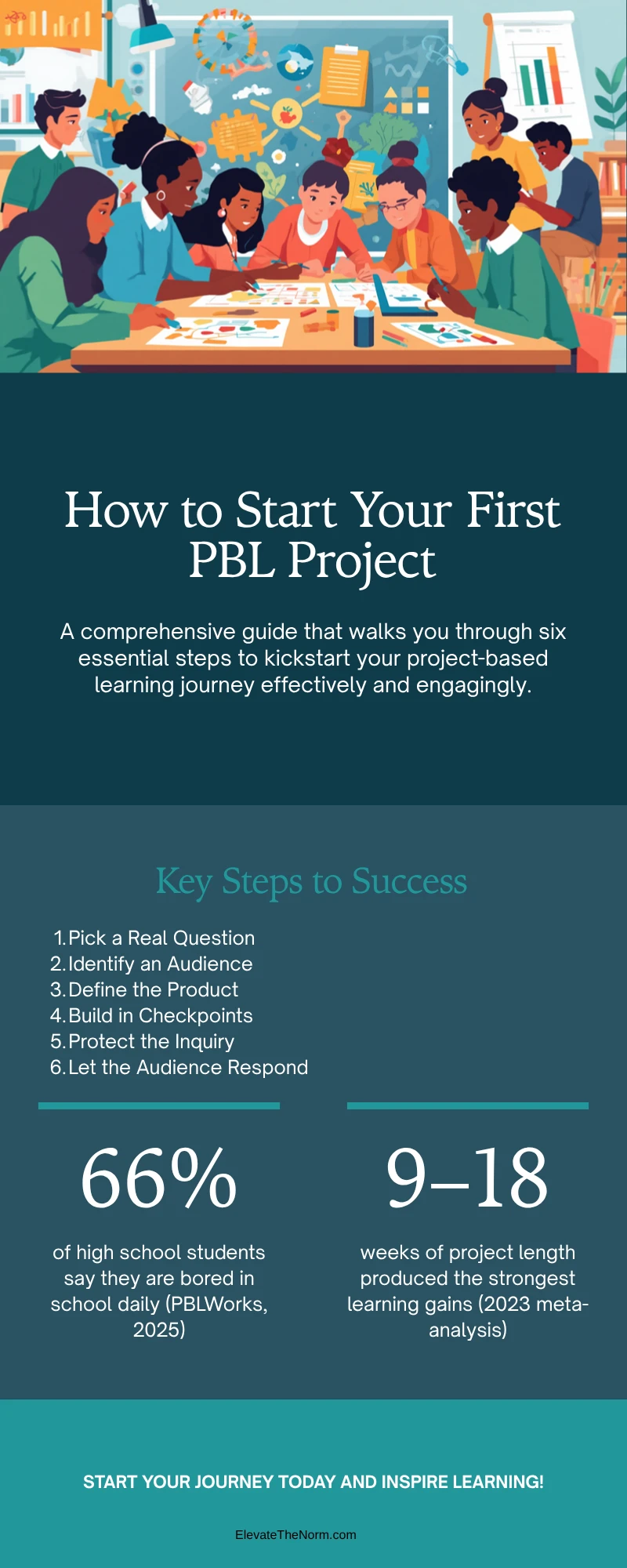
    The 7 steps of project based learning move a class from a question worth answering to a product worth defending. They are: identify learning goals, craft a driving question, launch the project, guide inquiry and research, set checkpoints and manage the work, facilitate critique and revision, and present the public product with reflection. Each step has a teacher role and a student role, and skipping any of them is how PBL collapses into a decorated group assignment. Each step works better when teachers and students have reliable project based learning tools—the planning templates, role cards, and critique protocols that keep the process on track. There is also a reviewed list of outside PBL resources worth the download, with the weak ones named.

    Why Steps Matter: PBL Without Structure Falls Apart

    Project based learning has a reputation problem. Teachers who have tried it and watched it fail usually did not fail at the project — they failed at the process. A class that jumps from “here is your project” to “present on Friday” without the steps in between produces exactly the kind of shallow, off-task, unequal group work that gives PBL a bad name.

    The Gold Standard PBL framework from PBLWorks, developed by John Larmer, John Mergendoller, and the Buck Institute for Education, identifies seven essential project design elements: a challenging problem or question, sustained inquiry, authenticity, student voice and choice, reflection, critique and revision, and a public product. Those elements are not decorations. They are structural requirements. Remove any one of them and the project loses what makes it PBL.

    The seven steps below translate those design elements into a sequence a teacher can actually follow. They are grounded in PBLWorks’ framework, supported by the research comparing PBL vs traditional teaching, and tested in real classrooms — including mine, where the tables are pushed together, students are always working with somebody, and the projects run while I circulate between groups.

    Step 1: Identify Learning Goals and Standards

    The teacher’s job: Decide what students must know and be able to do by the end of the project. Anchor these goals in your actual standards — state standards, Common Core, NGSS, C3, whatever your district uses. This is not optional. A project without clear learning goals is an activity, not instruction. If you need a refresher on the definition of project based learning and what separates it from traditional group work, start there.

    The common mistake: Designing the fun part first and then trying to reverse-engineer the standards into it. That produces projects where the academic content is an afterthought — the poster looks great but the student cannot explain what they learned.

    What to do instead: Start with the standards. Identify two to four that the project will assess directly. Then ask: what kind of work would require students to use these standards to answer a real question or solve a real problem? The project grows from the learning, not the other way around.

    A practical tip: write the standards on one side of a sheet of paper and the project idea on the other. If you cannot draw clear lines connecting them, the project needs to change or the standards need to change. One or the other.

    Step 2: Craft a Driving Question

    The teacher’s job: Write a question that is open-ended, challenging, anchored in real concerns, and aligned to the learning goals from Step 1. This question drives the entire project. If the question is weak, everything after it will be shallow.
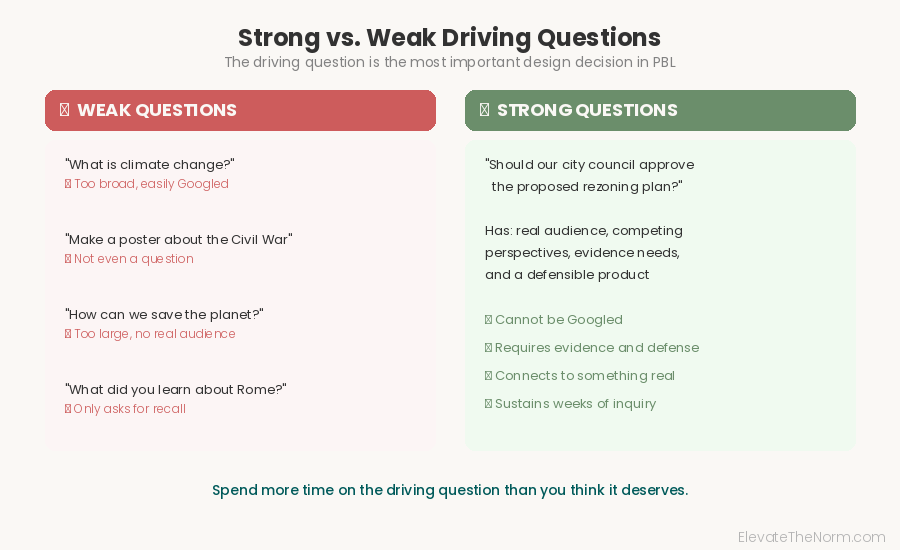
    Comparison of strong and weak driving questions for project based learning showing what makes an effective PBL question
    Strong versus weak driving questions — the most important design decision in PBL

    What makes a strong driving question:

    • It cannot be answered with a Google search.
    • It requires students to gather evidence, weigh competing claims, and defend a position.
    • It connects to something real — a community issue, a professional challenge, a decision someone actually has to make.
    • It is specific enough to be answerable and broad enough to sustain weeks of inquiry.

    What makes a weak driving question:

    • “What is climate change?” — Too broad, easily Googled.
    • “Make a poster about the Civil War.” — Not a question at all.
    • “How can we save the planet?” — Too large, no real audience, no defensible product.
    • “What did you learn about ancient Rome?” — Only asks for recall, not application.

    A strong example: “Should our city council approve the proposed rezoning plan for the neighborhood south of Main Street?” This question has a real audience (the council), competing perspectives (residents, developers, environmental groups), evidence requirements (zoning data, traffic studies, community input), and a defensible product (a recommendation with data).

    Spend more time on this step than you think it deserves. A mediocre driving question produces mediocre projects no matter how well you execute the other six steps. If you want side-by-side models to work from, these driving question examples across four subject areas show what the revision from weak to strong actually looks like.

    Step 3: Launch the Project

    The teacher’s job: Introduce the driving question in a way that creates genuine curiosity, not just compliance. The launch is the moment students go from “we have a project” to “I actually want to know the answer to this.”

    Effective launches include:

    • A real-world entry event: a guest speaker, a site visit, a video of the actual problem, a letter from someone who needs the answer.
    • A “need to know” list: after the launch, students generate questions about what they need to learn to answer the driving question. This list becomes their research agenda.
    • Clear project parameters: timeline, deliverables, team structures, and how the work will be assessed.

    The trap: Over-explaining everything on day one. If students walk away from the launch knowing exactly what the final product should look like, you have removed the inquiry. Give them the question and the constraints. Let them figure out the path.

    Step 4: Guide Inquiry and Research

    The teacher’s job: This is the sustained inquiry step — the one that separates PBL from a group assignment with a poster. Students are not following a worksheet. They are identifying what they need to know, finding sources, evaluating evidence, and building understanding over days or weeks.
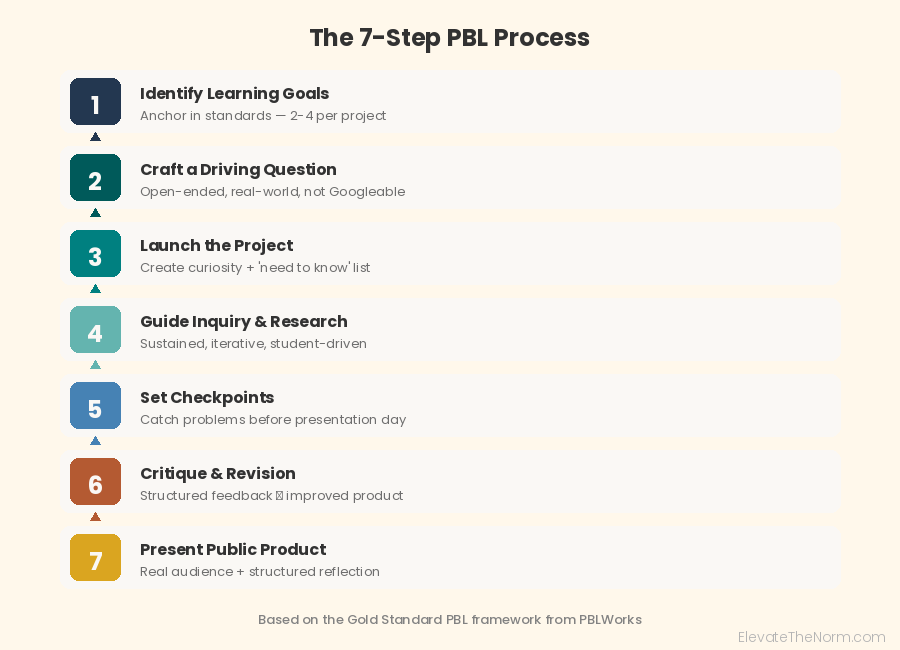
    Seven step project based learning process from identifying learning goals to presenting the public product
    The seven-step PBL process based on PBLWorks’ Gold Standard framework

    What this looks like in practice:

    • Students work from their “need to know” list and add to it as new questions emerge.
    • The teacher provides direct instruction when the whole class needs it — a lesson on evaluating sources, a skill workshop on data analysis, a mini-lecture on background content — but these lessons serve the project, not the other way around.
    • Research is iterative. Students may find that their initial approach does not work and need to change direction. That is not a failure. That is inquiry.

    I spend most of this step circulating. The tables in my room are already grouped, so students are working in pairs or small teams by default. Most of what I do is listen. I stop at a group, hear what they are discussing, and decide whether to step in or move on. If I overhear a group building on a premise that is factually wrong — and it happens more often than you would think — I do not announce it to the room. I sit down with that group and ask them to show me where they found it. Usually, the source is a single website or a misread paragraph. We look at it together, and they see the problem themselves. That is more valuable than a correction from the front of the room.

    A note on diverse learners: Students with IEPs, 504 plans, or English language needs may require adjusted entry points for inquiry — a modified source list, a graphic organizer, a shorter initial reading, or a paired research partner. The inquiry itself does not change. The scaffolding that gets a student into the inquiry does. Work with your special education and ELL colleagues to design those entry points before the project launches, not after a student stalls.

    The common failure point: Letting inquiry drift. Without regular check-ins, some groups will spend two weeks on research and produce nothing usable. Step 5 prevents that.

    Step 5: Set Checkpoints and Manage the Work

    The teacher’s job: Build structured checkpoints into the project timeline where you review student progress, provide feedback, and catch problems before they compound. This is the project management step, and skipping it is the single most common reason PBL fails.

    What checkpoints look like:

    • End of week one: Groups submit a research plan — what they are investigating, where they are looking, what they have found so far, and what is still missing.
    • Midpoint: Groups present a rough draft, preliminary findings, or a prototype. This is not graded. It is feedback.
    • Before the final product: Groups present a near-final version for critique (Step 6).

    The teacher’s role during checkpoints:

    At my whiteboard table, I pull groups one at a time. They show me what they have. I ask questions: What is your claim? Where is your evidence? What would someone who disagrees say? If the answers are thin, we talk about what needs to happen before the next check-in. If the answers are solid, I push harder: What have you left out? What are you unsure about?

    These conversations are not optional. They are the mechanism that prevents the end-of-project crash where one group has done everything and another has done nothing.

    A practical tool: A project calendar posted where students can see it, with checkpoint dates circled. Students should know exactly when they will be expected to show progress and in what form.

    Step 6: Facilitate Critique and Revision

    The teacher’s job: Teach students to give and receive specific, constructive feedback — and then give them structured time to use it. This step is what turns a first draft into a defensible product.

    Why critique and revision matter:

    PBLWorks identifies critique and revision as one of the seven essential design elements for a reason. A project that is never revised is not PBL. It is an assignment that took longer. Real-world work — journalism, engineering, policy, research, design — goes through multiple drafts. Students need to practice that process, not skip it.

    How to structure critique:

    • Use a protocol. Unstructured “peer review” devolves into “looks good” within minutes. A simple protocol works: the presenting group shares their work, the audience asks clarifying questions, the audience offers specific feedback (what is strong, what is unclear, what is missing), and the presenting group records the feedback without defending their work.
    • Model it first. Show students what specific, useful feedback sounds like versus vague or personal feedback. “Your graph does not label the axes” is useful. “I do not like it” is not.
    • Schedule revision time. Feedback without time to use it is performative. Build revision days into the calendar.

    The teacher’s additional role: Give your own feedback alongside the peer critique. Students respect peer feedback more when the teacher is also participating in the same process rather than standing outside it. Critique works best when everyone is scoring against the same published criteria, which is what a shared project scoring guide is for.

    Step 7: Present the Public Product with Reflection

    The teacher’s job: Create an authentic presentation opportunity where students share their work with an audience beyond the classroom — and then lead a structured reflection on what they learned.

    What “public” means:

    The audience does not need to be the United Nations. It needs to be someone other than you. Options that work in an ordinary school:

    • Another class.
    • Parents and families at an evening showcase.
    • A community panel invited for the occasion — a local business owner, a council member, a professional in the field.
    • A recorded presentation shared with a real organization.
    • A published piece — a blog, a letter to the editor, a recommendation submitted to the actual audience named in the driving question. For a concrete example of project based learning in action, see how one classroom handled the full cycle.

    Why the public audience matters:

    When the only audience is the teacher, students calibrate their effort to “good enough to pass.” When someone else will see it — someone they want to impress, someone who might ask hard questions — the standard shifts. The work gets better not because you demanded it, but because the audience did.

    Reflection is the step most teachers skip:

    After the presentation, students need structured time to think about what they learned — not just the content, but the process. What worked? What did they struggle with? What would they do differently? What did the critique feedback change?

    This is not a journal entry for a grade. It is the metacognitive step that turns experience into learning. Without it, students finish the project knowing what they made, but not necessarily what they learned.

    A useful reflection prompt: If you had to do this project again with a new group and a different driving question, what is the one thing you would do differently and why?

    Common Failure Points Across All Seven Steps

    Skipping Step 2 (the driving question): Teachers who start with the product — “we are making a documentary” — instead of the question produce projects where students focus on production quality rather than learning. The documentary looks polished but says nothing original.

    Rushing Step 4 (inquiry): In a tight schedule, it is tempting to hand students the information and skip the research. But if students do not find the information themselves, they do not own it. PBL without inquiry is craft time.

    Ignoring Step 5 (checkpoints): Every PBL horror story — the group that did nothing, the student who carried the team, the project that went completely off track — is a checkpoint failure. You had weeks to catch it. You did not check.

    Treating Step 6 (critique) as optional: Students who present their first draft as their final product have not experienced PBL. They have experienced a long assignment with a due date.

    A Practical Planning Checklist
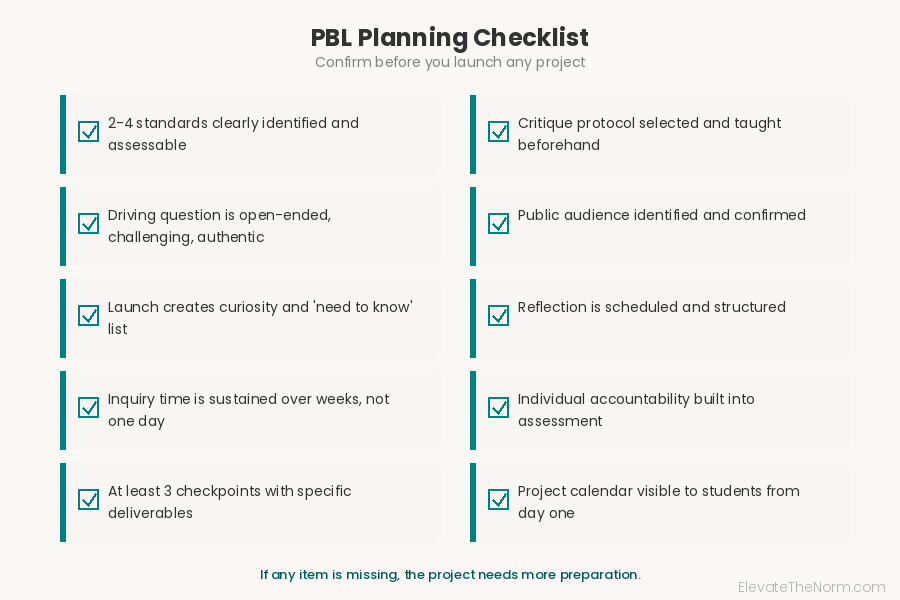
    Project based learning planning checklist with ten items to confirm before launching any student project
    Confirm every item before launching a project

    Before you launch a project, confirm:

    • Two to four standards are clearly identified and assessable through the project.
    • The driving question is open-ended, challenging, authentic, and connected to standards.
    • The launch creates curiosity and generates a student “need to know” list.
    • Inquiry time is built into the calendar — not just one day, but sustained over weeks.
    • At least three checkpoints are scheduled with specific deliverables for each.
    • A critique protocol is selected and taught before the critique session.
    • The audience for the public product is identified and confirmed.
    • Reflection is scheduled and structured.
    • Individual accountability is built into the group assessment so one student cannot carry or hide.
    • The project calendar is visible to students from day one.

    Conclusion

    The 7 steps of project based learning are not a formula. They are a sequence of decisions — learning goals, driving question, launch, inquiry, checkpoints, critique and revision, and public product — that keep a project from becoming busywork with a poster board. Skip any step and you will feel it. Rush the driving question and the research is shallow. Skip checkpoints and you find out too late. Skip critique and the product never improves. Skip the public audience and students treat it like homework.

    Get the sequence right — and if you need ideas for project based learning to get started — PBL produces something most classroom assignments cannot: students who know what they learned, why it matters, and how to defend it to someone who was not in the room.

    For strategies on implementing this sequence inside a standard high-school bell schedule, see project based learning high schools can use without rebuilding the schedule.


    How long should a PBL project take?

    Most projects that follow all seven steps need at least two to three weeks of class time, though some run a full semester. Shorter projects — one to two days — can incorporate PBL elements, but they rarely sustain the inquiry and revision cycle that makes PBL distinct. The driving question should determine the timeline, not the other way around.

    Can I use PBL in a class with a tight pacing guide?

    Yes, but it requires planning. Identify two to four standards the project will cover and use the project as the vehicle for teaching those standards, not an addition to your existing lessons. Replace instruction on those standards with the project, do not stack them. PBL is the main course, not the dessert.

    What if some groups finish early and others are behind?

    This is a checkpoint problem. If you are checking progress at regular intervals, you will catch the groups that are behind before the final deadline. For groups that finish early, add an extension question or have them prepare to serve as peer critics for other groups — a role that deepens their own understanding.

    How do I grade individual students in a group project?

    Build individual accountability into the assessment. Require each student to submit their own written reflection, defend a specific part of the project during the presentation, or complete an individual component alongside the group work. The group product shows collaboration. The individual assessment shows learning.

    What if I have never done PBL before? Should I start with all seven steps?

    Start with a smaller project — two to three weeks, one driving question, one product — and include all seven steps even if you simplify them. Skipping steps is what causes PBL to fail, so it is better to do all seven simply than to do three of them elaborately. Your first project will be imperfect. That is normal. Reflect on what worked and adjust the next one.

    Do I need special materials or technology for PBL?

    No. Some of the strongest projects use nothing but paper, community access, and the students themselves. Technology can enhance research and production, but the seven steps work with or without it. A driving question, a library, and a real audience are more important than a 1:1 device ratio.

    How do I handle a student who does not contribute to the group?

    Address it at checkpoints, not at the end. When you pull a group to the whiteboard table and one member has done nothing, that is a conversation — not a grade penalty. Ask what the barrier is. Sometimes it is confusion, sometimes it is a group dynamic problem, sometimes it is disengagement that needs a different intervention. The answer changes the response.


    Sources

    1. Larmer, J., Mergendoller, J. R., & Boss, S. (2015). Setting the Standard for Project Based Learning. ASCD/Buck Institute for Education.
    2. PBLWorks. “Gold Standard PBL: Essential Project Design Elements.” Buck Institute for Education.
    3. PBLWorks. “Gold Standard PBL: Project Based Teaching Practices.” Buck Institute for Education.
    4. Condliffe, B. (2017). “Project-Based Learning: A Literature Review.” MDRC Working Paper.
    5. Larmer, J., & Mergendoller, J. R. (2010). “Seven Essentials for Project-Based Learning.” Educational Leadership, 68(1), 34–37.
    6. Hattie, J. (2023). Visible Learning: The Sequel. Routledge.

    About Clay Shumate

    Clay Shumate is a certified secondary Social Studies teacher in the public schools of West Alabama, with seven years of classroom experience, a B.A. in History, and an M.Ed. in Secondary Education. He writes about project-based learning, student responsibility, respect, and practical ways to hold young people to a higher standard while giving them room to learn from mistakes. He is a member of the Society of Professional Journalists and writes to its Code of Ethics; this site’s editorial standards and corrections policy are published in full. More about Clay.
  • Ideas for Project Based Learning: 50 Real-World Projects for Grades 6–12

    Ideas for Project Based Learning: 50 Real-World Projects for Grades 6–12

    By Clay Shumate

    Good ideas for project based learning start with a real question somebody outside your classroom actually wants answered, and end with a product that person actually sees. Everything else—the subject, the length, the technology—is negotiable. The 50 ideas below are organized by subject and grade band, each one built around a genuine audience, so you can find one that fits Monday.

    I want to be straight with you about what this list is. It is not 50 activities. Activities are easy to find and mostly interchangeable. These are project premises—each one has a question worth arguing about, a decision that has not been made yet, and somebody on the other end who will look at the result. That last part is what makes the difference, and it is the part most “PBL idea” lists skip.

    Key Takeaways

    • A project idea is only a project if it has an open question, real research, revision, and an audience beyond the gradebook. Otherwise it is an activity with a poster attached.
    • The strongest secondary projects solve a problem the school or the town actually has. Those beat invented scenarios every time, and they cost nothing.
    • Start with one project, not a semester of them. Pick something two to three weeks long with a low materials cost and a real audience you can secure with one email.
    • Evidence for PBL at the secondary level is genuinely good—an 8 to 10 percentage-point advantage on AP exams, gains in middle school science that carried into math and ELA—but it depends on implementation, not on the idea being clever.
    • Every idea here can be run without one-to-one devices. The low-tech swaps are in their own section, because most PBL writing quietly assumes technology that plenty of schools do not have.

    What Makes an Idea for Project Based Learning Worth Running

    Before the list, a filter. PBLWorks names seven essential project design elements: a challenging problem or question, sustained inquiry, authenticity, student voice and choice, reflection, critique and revision, and a public product. The Framework for High Quality Project Based Learning lists six overlapping criteria, adding project management as its own skill students have to be taught rather than assumed to have. For social studies teachers, my Social Studies Teacher Toolkit Bundle on TPT gives you a head start on the materials.

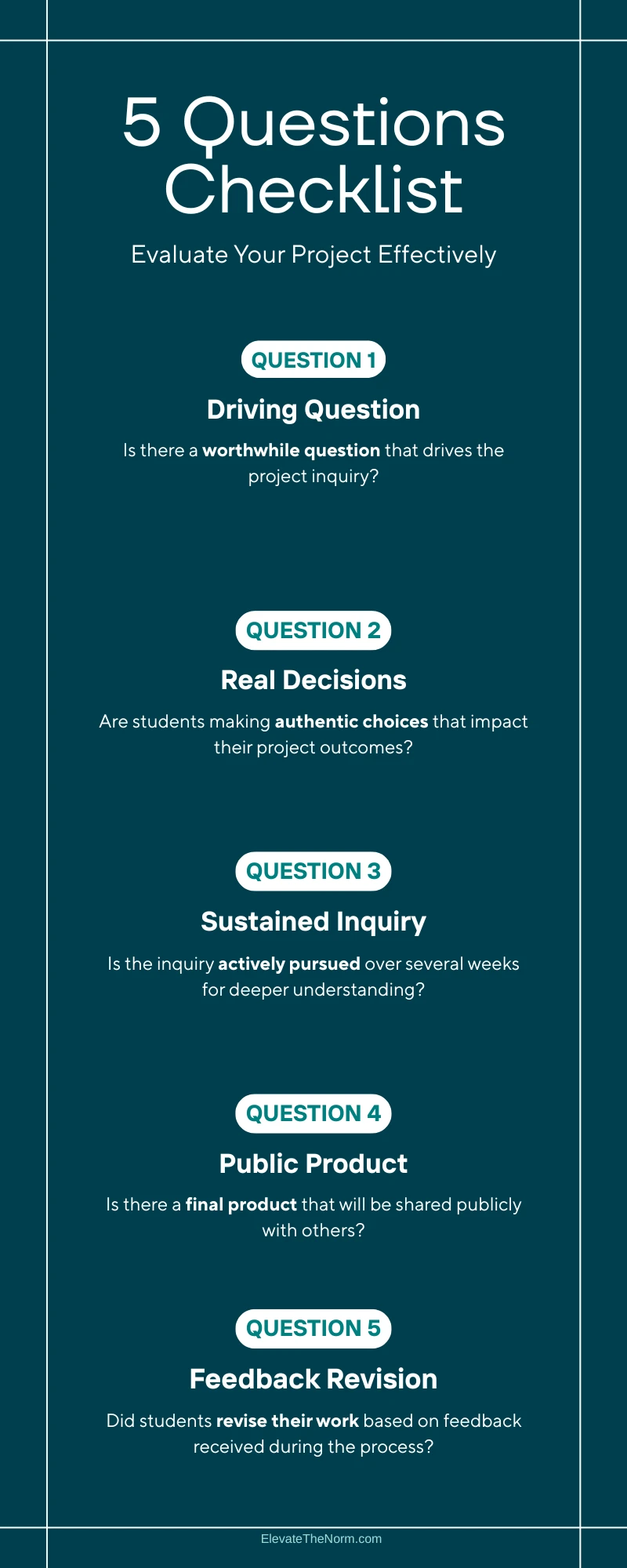
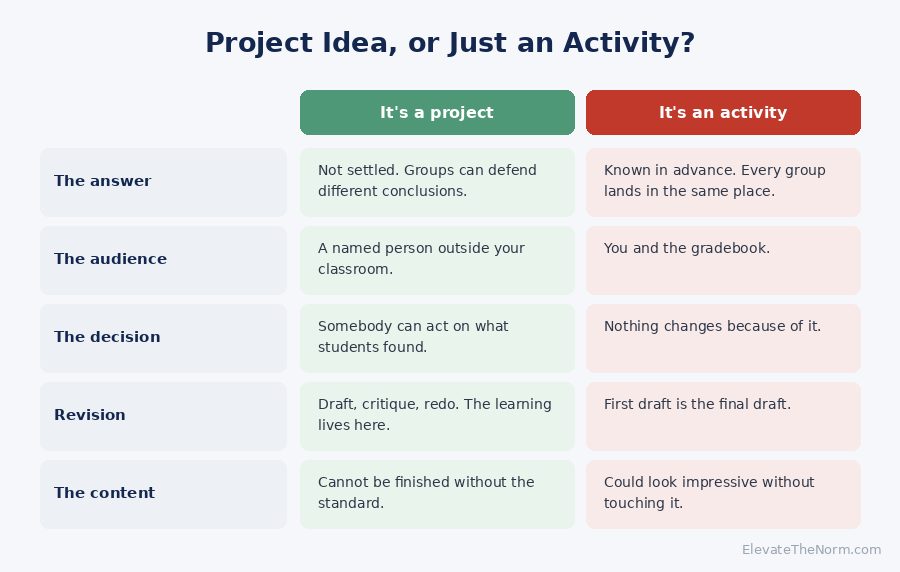
    You do not need to memorize either list. In practice, five questions will tell you whether an idea is a project or a costume. If you teach a single subject and want the narrower version of this list, these ten history project ideas for grades 7–12 are built the same way:

    1. Do I already know the answer? If you do, and every group will arrive at the same place, it is an assignment. Real projects have room for defensible disagreement.
    2. Who sees this besides me? Name the person. Not “the community”—a name, a role, an inbox.
    3. What decision does it inform? Somebody should be able to do something differently because of the work.
    4. Where does the revision happen? If the first draft is the final product, you have skipped the part where the learning lives.
    5. What is the academic content students cannot avoid? If a group could produce something impressive without touching the standard, the project is decorative.

    If an idea below does not survive those five questions in your building, adapt it until it does. I would rather you run a modified version that fits your reality than a faithful version that collapses in week two. For the full breakdown of what does and does not count, see the definition of project based learning, and for projects explained in depth rather than listed, see these examples of project based learning.

    Side-by-side comparison of a project idea and an activity idea across five tests: open question, audience, decision, revision, and required content
    The same topic can be a project or an activity. These five tests are what separate them.

    50 Ideas for Project Based Learning, Grades 6–12

    Each table gives the project premise, the grade band it fits best, a realistic time estimate with how much lift it takes on you, and the audience that makes it public. “Low lift” means you can run it without new materials, outside partners, or a schedule change. “High lift” means you will be making phone calls. Several of these touch permissions, privacy, or school policy—read the three conversations below before you commit to one.

    Social Studies and History

    ProjectGradesTime & liftWho sees it
    1. Marker audit. Which local historical markers tell the whole story, and which leave something out? Research and write corrected text.8–123 weeks · mediumCounty historical society
    2. Oral history archive. Interview long-time residents about one decade, transcribe, and index the collection.9–126 weeks · highPublic library collection
    3. Attendance-zone proposal. Use real census and enrollment data to propose a fairer school zone map.10–124 weeks · highSchool board member
    4. Plain-language ballot guide. Translate the next local ballot into language a first-time voter can actually use.9–123 weeks · mediumCommunity center, church bulletins
    5. Name that street. A blank or badly named street needs a name. Build the historical case for one.6–92 weeks · lowCity council
    6. Disputed event investigation. Take a contested local event and reconstruct it from primary sources only.9–124 weeks · mediumSchool news site
    7. Century story map. Map where families in this county came from across a hundred years, with sourcing.7–105 weeks · mediumLibrary display
    8. Museum in a hallway. Build a docent-led exhibit on a world history unit and tour younger students through it.6–103 weeks · mediumSixth-grade classes

    English Language Arts

    ProjectGradesTime & liftWho sees it
    9. Podcast series. Four episodes on a question students genuinely argue about, scripted, sourced, and edited.8–125 weeks · highPublic feed or school site
    10. Handbook rewrite. Rewrite the student handbook in language students can read, keeping every rule intact.7–123 weeks · mediumAdministration
    11. Hard-concept picture book. Explain something difficult to a second grader in a bound, illustrated book, then read it to them.6–104 weeks · mediumPartner elementary class
    12. Literary walking tour. Sign a downtown route with writing tied to each stop, QR-coded to student audio.9–125 weeks · highDowntown businesses
    13. Edited anthology. Solicit, select, edit, design, and print a collection of student writing.7–126 weeks · mediumFamilies at a reading night
    14. Change one rule. Build an evidence-based case to change a single school rule and present it.6–123 weeks · lowPrincipal and student government
    15. Reviews on spec. Write book or film reviews to a real publication’s submission guidelines and pitch them.9–122 weeks · lowLocal paper editor

    Science

    ProjectGradesTime & liftWho sees it
    16. Creek watch. Test a local waterway weekly for two months and report the trend, not the snapshot.8–128 weeks · highCounty environmental office
    17. Energy audit. Audit the building’s energy use and recommend one change with a payback period attached.9–124 weeks · mediumFacilities director
    18. Room-by-room air quality. Map CO2 and comfort across the building and correlate it with when students fade.8–123 weeks · mediumPrincipal
    19. Pollinator plan. Design a native pollinator planting for school grounds with species list and budget.6–105 weeks · mediumGrounds crew and PTA
    20. Cafeteria waste study. Measure food waste, run one intervention, then measure again and report honestly.6–124 weeks · mediumChild nutrition director
    21. Weather station. Build and calibrate a station, then publish a weekly hyper-local forecast with accuracy tracking.8–126 weeks · highSchool website
    22. Does the expensive one work? Test a consumer product claim under controlled conditions and publish the results.7–113 weeks · lowPublic consumer guide
    23. Invasive species survey. Survey school grounds, identify invasives, and write a phased removal plan.7–124 weeks · mediumCounty extension office

    Mathematics

    ProjectGradesTime & liftWho sees it
    24. Cut the lunch line. Time the cafeteria line, model the bottleneck, and propose a layout that shortens it.7–113 weeks · mediumCafeteria manager
    25. Cost per use. Analyze a real purchase the school is weighing and recommend for or against with the math shown.8–122 weeks · lowBookkeeper or principal
    26. Price the tickets. Build a pricing model for a school event that hits a stated revenue target without pricing families out.9–123 weeks · mediumAthletic director, boosters
    27. Bus route math. Analyze one route’s time and mileage and propose a defensible alternative.10–124 weeks · highTransportation director
    28. Courtyard to scale. Produce scaled drawings and a materials budget for an unused outdoor space.7–114 weeks · mediumPTA
    29. Fair split. Design and defend a fair-cost-sharing rule for a class trip or shared supplies, then adopt it.6–92 weeks · lowThe class itself
    30. Audit the claim. Take a statistic from an ad or news story and verify or refute it with the underlying data.8–122 weeks · lowPublished explainer

    Arts and Music

    ProjectGradesTime & liftWho sees it
    31. Mural pitch. Propose a mural for a blank wall with sketches, budget, and a written rationale.7–125 weeks · mediumAdministration or city
    32. Score the silence. Compose and perform an original score for a public-domain silent film clip.8–125 weeks · highSchool assembly
    33. The people nobody photographs. Portrait series of custodians, bus drivers, and cafeteria staff, with their own words.6–124 weeks · lowHallway exhibition
    34. Rebrand a nonprofit. Redesign a small local nonprofit’s logo and basic brand kit to their actual brief.9–124 weeks · mediumThe nonprofit’s board
    35. One business, one film. Document the history of a single local business in a five-minute film.9–125 weeks · highThe business’s customers

    Career Tech, Business, and Technology

    ProjectGradesTime & liftWho sees it
    36. Run the store. Write the business plan for a school store, then actually operate it for a month and report the P&L.9–126 weeks · highReal customers
    37. Accessibility audit. Audit the school website against WCAG basics and file a prioritized fix list.9–123 weeks · mediumDistrict tech director
    38. Repair café. Fix donated items, document each repair, and hold a community drop-off day.7–124 weeks · mediumCommunity attendees
    39. Prototype and test. Build a working prototype that solves one school problem and user-test it with real students.9–126 weeks · highStudent body
    40. Career guide for eighth graders. Interview working adults and turn it into a guide for students choosing a pathway.9–124 weeks · lowCounselor’s office
    41. Family cybersecurity night. Research the scams that actually hit your community and teach families to spot them.8–123 weeks · mediumParents at an evening event
    42. Maker corner proposal. Cost out a maker space corner and submit a real budget request.7–124 weeks · mediumPrincipal and PTA

    Health and Physical Education

    ProjectGradesTime & liftWho sees it
    43. PE for people who hate PE. Design and run a two-week unit aimed at the students who dread the gym.7–124 weeks · mediumOther PE sections
    44. Sleep and the schedule. Study your grade level’s actual sleep and report what the schedule costs.8–123 weeks · mediumSchool leadership
    45. Menu inside the rules. Redesign a week of cafeteria menus inside real federal nutrition rules and the real budget.9–124 weeks · highNutrition director
    46. Concussion explainer. Produce a short video explaining the school’s concussion protocol to athletes and parents.8–123 weeks · lowAthletic department

    World Languages

    ProjectGradesTime & liftWho sees it
    47. Bilingual welcome. Produce bilingual signage and a welcome packet for the front office, reviewed by a fluent adult.8–124 weeks · mediumFront office and new families
    48. Community resource guide. Translate a guide to local services, verified for accuracy before it goes out.10–125 weeks · highPublic library

    Cross-Curricular

    ProjectGradesTime & liftWho sees it
    49. Readiness research memo. Research national best practices in school emergency preparedness and deliver a private findings memo to the people responsible. Never published, never posted.9–125 weeks · highSafety committee, privately
    50. Time capsule with a defense. Curate artifacts and write the argument for why each one deserves to represent this year.6–103 weeks · lowSealing ceremony now, opening later

    Before You Run Any of These: Three Conversations

    Real audiences are what make these projects work, and they are also what makes them capable of causing you a problem. Three conversations, none of them long, prevent almost all of it.

    • With your administrator, about scope. Any project that contacts someone outside the building, examines a school decision, or asks for a policy change needs a heads-up first. That is not permission-seeking for its own sake—a principal who has agreed in advance to genuinely consider a student proposal turns the project real. A principal ambushed by one turns it into a lesson about how adults do not listen, which is the opposite of the point.
    • With families and interviewees, about consent. Anyone interviewed, recorded, or photographed for a public product gives written consent first, including staff. Follow your district’s policy on student names and images in public work; default to first names. Any project that gathers information about other students stays anonymous and aggregated, and never gets framed as health or psychological data.
    • With yourself, about supervision. Water sampling, tool use, repair work, and off-campus contact all need an adult plan, not just a student plan. If a project cannot be supervised properly with the staffing you actually have, run a different one. There are forty-nine others.

    Two of the ideas above deserve a specific flag. The attendance-zone proposal touches genuinely contested local politics—run it only where a board member has agreed to receive it in that spirit. The readiness memo stays private by design; students research public best practices and deliver findings to the people responsible, and none of it gets posted anywhere.

    None of this is a reason to shrink the work. Clear expectations and honest guardrails are what let you hand students something real in the first place—the same argument as in classroom expectations.

    Does Project Based Learning Actually Work in Grades 6–12?

    Yes, with a caveat worth stating up front: the evidence supports well-implemented PBL, not the idea of PBL. A clever premise badly run is worse than a good lecture. If you are weighing whether to hand part of your course over to projects at all, start with the research comparing PBL with traditional teaching and decide from the numbers rather than the enthusiasm.

    At the high school level, researchers at the University of Southern California studied a project-based curriculum called Knowledge in Action in AP U.S. Government and AP Environmental Science across five predominantly urban districts. Students in the project-based courses passed their AP exams at rates 8 percentage points higher than students in traditional sections, rising to an estimated 10 points when teachers were in their second year with the curriculum (Saavedra et al., Lucas Education Research, 2021). Edutopia’s coverage puts the sample at more than 3,600 students across 114 schools, with over half from low-income households—and the gains held for those students at the same rate as for their wealthier peers.

    At the middle school level, the Learning Through Performance science curriculum developed at Stanford produced an 11 percentage-point gain in science achievement, and the effect did not stay in science: students also outperformed peers on state assessments in mathematics and English language arts (Deutscher et al., Lucas Education Research, 2021).

    That is a real result and I do not want to undersell it. I also do not want to oversell it, which is the next section.

    How to Run Any of These Without One-to-One Devices

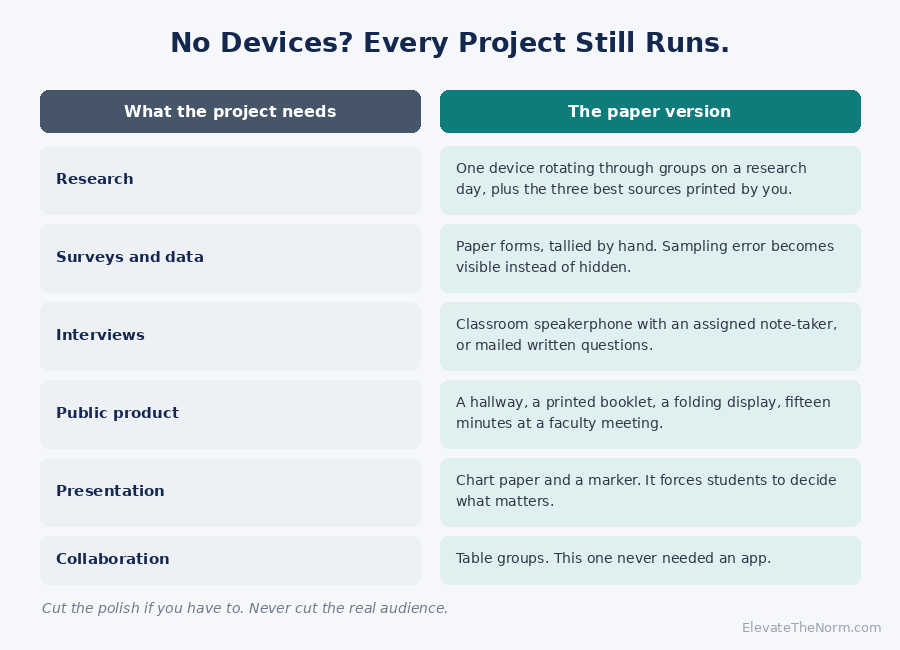
    Every project above can run on paper. I have taught with no devices, with one cart shared between two classrooms, and with one-to-one, and the shared-cart year taught me more about project design than the one-to-one years did—because scarcity forces you to decide what the technology was actually for.

    Chart pairing common project technology needs with low-tech substitutes such as paper surveys, printed photo boards, and speakerphone interviews
    Every technology need in a project has a paper equivalent that costs nothing.
    • Research: One device rotating through groups on a research day beats thirty devices open all week. Print the three or four best sources yourself and let the argument be about the evidence rather than the searching.
    • Surveys and data: Paper surveys, tallied by hand, teach the sampling problem better than a form that auto-charts the answer.
    • Interviews: A speakerphone in the classroom and a designated note-taker works. So does a written question set mailed to somebody who answers in writing.
    • Public product: A hallway, a printed booklet, a folding display, or fifteen minutes at a faculty meeting are all public. Public means seen by someone who is not you—not published online.
    • Presentation: Chart paper and a marker force students to decide what matters. A slide deck lets them avoid deciding.

    The one thing worth protecting is contact with the real audience. If you have to cut something, cut the polish, not the person on the other end.

    Grading Individuals Inside a Group Project

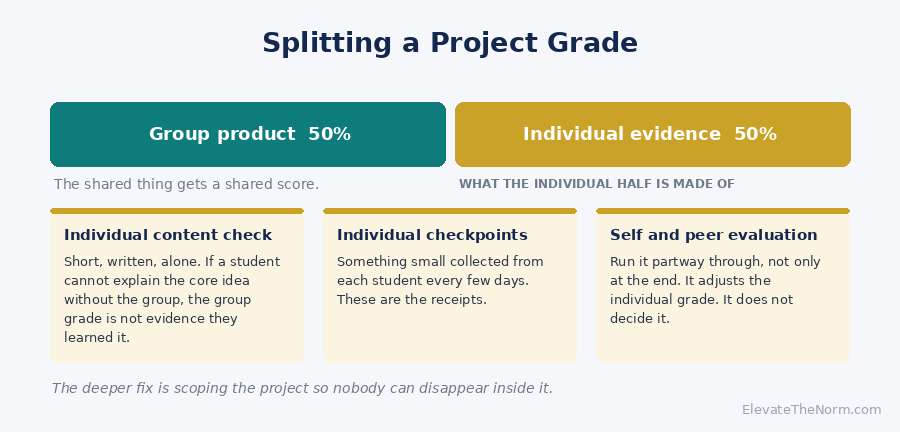
    This is the objection I hear most from teachers, and it is a fair one. A single group grade rewards the student who did nothing and punishes the one who carried it. It also lets weak content knowledge hide behind a strong product. Assigning job titles does not fix it either; the accountability underneath the card is what carries the weight, which is why most standard group roles fail the deliverable test.

    Diagram splitting a project grade into a shared group product score and an individual score drawn from checkpoints, an individual assessment, and self and peer evaluation
    Splitting the grade is what keeps a group project from grading the group instead of the student.

    Carnegie Mellon’s Eberly Center recommends carrying both a group component and an individual component in the project grade—commonly split 50/50 or 80/20—and assessing the process as well as the product, using individual assessments, self-evaluation, and peer evaluation that adjusts individual grades (Eberly Center, Carnegie Mellon University). Their other point is the one teachers skip: run the evaluations partway through, not only at the end, so the information can still change something.

    What I do, in plain terms:

    1. The product gets a group grade. It is a shared thing; it gets a shared score.
    2. Every student takes an individual assessment on the content. Short, written, no group. If a student cannot explain the project’s core idea alone, the group grade is not evidence they learned it.
    3. Checkpoints are individual. I am collecting something small from each student every few days anyway. Those are the receipts.
    4. Self and peer evaluation adjusts, it does not decide. Students are honest more often than teachers expect, but a peer rating is one input, not a verdict.

    The deeper fix is not a grading scheme. It is scoping the project so nobody can disappear inside it, which is really a planning problem. More on that idea in student responsibility.

    For free planning templates, critique protocols, and assessment tools that support PBL implementation, see project based learning resources for middle and high school teachers.

    The Failure I Catch Most Often, and How

    Projects rarely fail loudly. They fail quietly, in week one, when a driving question shrinks into something a search bar can answer, and nobody notices because the group looks busy.

    I catch it by moving. I am on a stool most of the period, going table to table, and I listen more than I talk. A few days into a project I will hear a group planning around a question that has quietly stopped being a question—they have already settled the answer and are now decorating it. So I sit down with them and ask them to walk me through their reasoning from the beginning, out loud. Not to correct it. To make them hear it. Nine times out of ten somebody at the table catches the collapse before I have to name it, and the fix is theirs instead of mine.

    That is the whole argument for circulating instead of monitoring. You cannot hear a premise go soft from the front of the room.

    Where Project Based Learning Genuinely Struggles

    The most honest summary of the research is still MDRC’s literature review, which calls the evidence for PBL “promising but not proven,” notes that the field lacks agreement on what the core elements even are, and points out that evaluation has been hampered by a shortage of valid, usable measures for the deeper learning PBL claims to produce. It also names the real implementation problem: teachers have to shift from directing to facilitating, and manage a great deal of ambiguity while they do it (Condliffe et al., MDRC, 2017).

    Three practical cautions from my own room:

    • Coverage is real. A four-week project has to carry four weeks of standards, not one week of standards and three weeks of production. Map it backward: list every standard the project will assess, then name the specific checkpoint or artifact where you will see each one. Any standard without an artifact next to it is a standard you are hoping happens.
    • Access is not equal. A project that depends on a parent’s connections, a car, or an evening free is a project that sorts students by circumstance. Build it so it can be completed inside the school day.
    • The first run will be rough. The AP result got better in year two for a reason. Plan to run the same project twice before you judge it.

    Pick One and Start

    Do not redesign your course. Choose two or three ideas from the list marked low lift, two or three weeks, with an audience you can secure in a single email—the plain-language ballot guide, the cost-per-use analysis, the portrait series, the concussion explainer—and then let the class pick between them. Student voice is one of the design elements, and the cheapest place to honor it is the choice of project itself. Run it once. Keep notes on what broke. Run it again in the spring with the breakage fixed. If you want one written up all the way through — the weekly formats, the family note, what it cost — this mock election is that account.

    The point of any of these ideas for project based learning is not the project. It is that students spend three weeks being treated as people whose work is worth showing to somebody. That treatment is the intervention. The project is just the excuse to deliver it. If that framing is new, start with what project based learning actually is, then look at how the same principle shows up in real world learning.

    How many projects should I run in a school year?

    Two done well beats six done thinly. Most teachers new to project based learning should run one project in the fall and one in the spring, ideally the same project twice so the second run benefits from what the first one taught you. The AP research found the effect grew from 8 to 10 percentage points when teachers were in their second year with the curriculum, which is a good argument for repeating rather than constantly starting over.

    What if my school does not have devices for every student?

    Every idea on this list can run on paper. Rotate one or two devices through groups on designated research days, print the strongest sources yourself, use paper surveys tallied by hand, and conduct interviews on a classroom speakerphone with an assigned note-taker. A hallway exhibit, a printed booklet, or fifteen minutes at a faculty meeting are all genuinely public products. Protect contact with the real audience and cut the polish instead.

    How do I grade individual students in a group project?

    Carry both a group score and an individual score. The shared product gets a shared grade; each student also completes an individual content assessment, individual checkpoints throughout the project, and a self and peer evaluation that adjusts but does not decide the individual grade. Carnegie Mellon’s Eberly Center recommends splits around 50/50 or 80/20 and stresses running the evaluations partway through, while the information can still change something.

    Will a project cover enough standards to justify the time?

    Only if you map the standards before you commit to the product. A four-week project must carry four weeks of curriculum, not one week of content plus three weeks of building. Write down every standard the project will assess, then check whether a group could produce the final product without touching them. If they could, the project is decorative and needs redesigning.

    What makes a project audience genuinely public?

    A public audience is any person outside your classroom who will actually look at the work and could plausibly act on it. A facilities director reading an energy audit, a librarian accepting an oral history collection, a second-grade class hearing a book read aloud, or a school board member receiving a proposal all qualify. Your gradebook, a classroom presentation to peers, and a folder that goes home do not.

    How do I keep one student from carrying the whole group?

    Scope the project so there is no place to hide. Assign individual checkpoints every few days, require each student to be able to explain the core idea alone, and define roles that produce visible artifacts rather than vague responsibilities. If a student can still disappear inside the project, that is usually a planning problem on the teacher’s end rather than a character problem on the student’s.

    Are these ideas appropriate for struggling readers or English learners?

    Yes, and the research supports it. The elementary science study found gains that held across all reading ability levels, and the middle school study found English learners gained 8 percentage points in language proficiency in year one and 28 points with second-year teachers. Projects give students more ways to demonstrate understanding than a text-only assessment does, provided you scaffold the reading and do not treat the written product as the only evidence.

    What permissions do I need before students interview people or photograph them?

    Get written consent from any adult who is interviewed, recorded, or photographed for a public product, and clear the project with your administrator before students contact anyone outside the building. Follow your district policy on student names and images appearing publicly, and default to first names only. Any project that collects information about other students should be anonymous, aggregated, and never framed as health or psychological data.

    Sources


    About Clay Shumate
    Clay Shumate is a certified secondary Social Studies teacher in the public schools of West Alabama, with seven years of classroom experience, a B.A. in History, and an M.Ed. in Secondary Education. He writes about project-based learning, student responsibility, respect, and practical ways to hold young people to a higher standard while giving them room to learn from mistakes. He is a member of the Society of Professional Journalists and writes to its Code of Ethics; this site’s editorial standards and corrections policy are published in full. More about Clay.
  • Real World Learning: How Schools Can Connect Work to Life

    Real World Learning: How Schools Can Connect Work to Life

    Real World Learning: How Schools Can Connect Work to Life

    By Clay Shumate

    Part of the project-based learning guide — real audiences are one half of PBL; the hub covers the rest.

    Real world learning is not a field trip. It is not career day. It is not a worksheet about a fictional bakery that asks students to calculate profit margins for a business that does not exist. Real world learning happens when the work students do in a classroom connects to something genuine — a real problem, a real audience, a real product someone could actually use. And the reason most schools struggle with it has nothing to do with curriculum. It has to do with the difference between work that matters and work that pretends to.

    Key Takeaways

    • Real world learning means the work connects to something genuine — a community problem, a professional practice, or a product someone outside the classroom could actually use.
    • Most “real-world” assignments are simulations. Students know the difference, and it shows in their effort.
    • Access to real world learning cannot depend on family connections, transportation, or the teacher’s personal network. Schools need to build it into the system, not leave it to chance.
    • You do not need a community partner or a bus to create authentic work. Some of the strongest real world learning happens inside the school building.
    • Research consistently shows that applied, authentic learning improves academic outcomes — and the benefits are strongest for students from low-income backgrounds.

    The Problem with Most “Real-World” Assignments

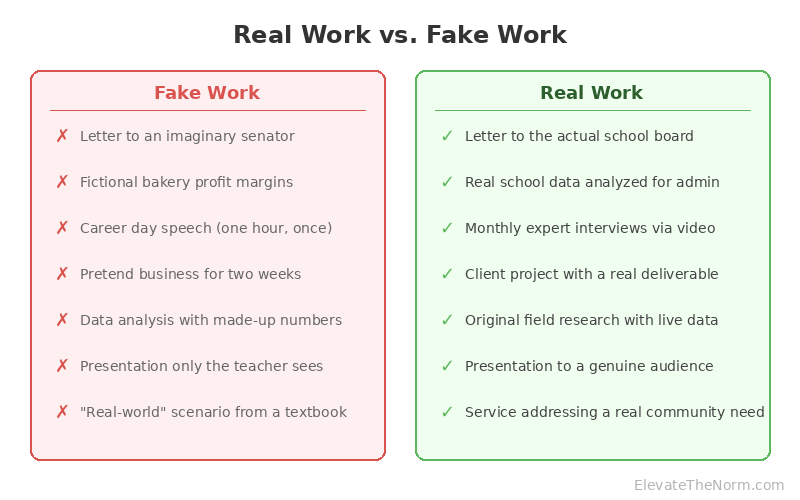
    Teachers know they should connect work to the real world. The problem is how that usually looks. A science class calculates carbon footprints using made-up numbers for a city that does not exist. An English class writes persuasive letters to an imaginary senator. A math class runs a pretend business for two weeks and then never mentions it again. Sound familiar? It should — these are the same problems behind ineffective classroom expectations: telling students the work matters while designing it so it does not.

    Students can tell. They can tell when the audience is fake, when the data is invented, and when the outcome does not matter to anyone except the gradebook. And when they can tell, they give it exactly the effort that fake work deserves — enough to get the grade, not enough to learn anything.

    This is not a laziness problem. It is a design problem. A research brief from EdResearch for Action identifies authenticity as the first of four core design principles for applied learning: the work must connect to real-world problems, expert practices, and student aspirations. When the connection is manufactured, the learning stays surface level no matter how well the lesson is planned.

    Side-by-side comparison of fake classroom work like fictional scenarios versus real work like authentic community projects
    Students can tell when work is fake — and they give it exactly the effort fake work deserves.

    What Makes Work Real

    Real world learning is not a category of assignment. It is a quality of the work itself. Here is the test: could someone outside the school see this, use this, or benefit from this? If the answer is no — if the work only exists to be graded — it is school work, not real work. Both have their place. But only one teaches students what it feels like to do something that matters.

    Real work comes in different forms, and not all of them require leaving the building:

    • Community problems. Students identify a real issue in their school or town — a broken process, a missing resource, an unanswered question — and produce something useful in response. A data report, a proposal, a working solution.
    • Professional practices. Students use the same tools and methods that adults in a field actually use. Historians analyze primary sources. Scientists follow real protocols. Writers publish for readers who chose to read, not readers who were assigned to.
    • Public audiences. The work goes somewhere beyond the teacher’s inbox. A presentation to the school board, a gallery for families, a report delivered to a local organization. The audience does not have to be large. It has to be real.
    • Career exposure. Not a career day presentation — actual contact with how work is done. Job shadows, expert interviews, mentorship hours, apprenticeship tasks. The Kansas City Real World Learning Initiative calls these “market value assets” and tracks them as credentials students carry beyond graduation.
    • Service. Work that meets a genuine need — not community service hours logged for a transcript, but a sustained project where students provide something a community actually needs and can verify.
    • Field research. Students collect original data in real settings. Water quality at a local creek, traffic patterns near the school, oral histories from community members. The data is real. The analysis is real. The conclusions might actually be wrong — and that is the point.
    • Useful products. A handbook, a tutorial video, a design prototype, a functioning tool. Something that works and that someone would choose to use even if no grade were attached.

    Not every lesson needs to be real work. Sometimes you need direct instruction, practice problems, and structured skill-building, and it is worth being honest about where direct instruction still outperforms projects. But if a student can get through an entire semester without producing something that matters to anyone besides the teacher, the course has a relevance problem that no amount of engagement tricks will fix.

    Real World Learning Inside the School Building

    The biggest misconception about real world learning is that it requires a field trip, a community partner, or a bus. It does not. Some of the most authentic work students can do happens inside the building they are already in — if the teacher designs it that way.

    Consider what is available in every school, regardless of location or budget:

    • The school has real data — attendance patterns, lunch participation, energy usage, event turnout — and students can analyze it for actual decision-makers.
    • The school has real audiences — younger students, parents, other teachers, administrators — who can receive and respond to student work.
    • The school has real problems — signage that does not work, processes that confuse new students, information that families never receive — and students can research, propose, and sometimes solve them.
    • The school has real history — alumni, community changes, institutional decisions — that students can document before it disappears.

    In my room, partner work is the default condition, not something we pull out for special projects. Students are already sitting in groups, already working alongside somebody, already talking about the work every period. That means when a real task comes in — a presentation for the front office, a proposal for the administration, an analysis that someone outside the room will actually read — the transition is small. The respect and trust are already there. We are not suddenly learning to collaborate because the project requires it. We have been collaborating since September.

    That structural advantage is worth mentioning because it changes what is possible. A teacher who runs a silent, independent classroom has to teach collaboration before launching real-world work. A room where students work alongside each other every day can move straight to the task. It is the same reason teaching responsibility works better when ownership is the default, not a special assignment. The collaboration is not the special event. The collaboration is the air in the room.

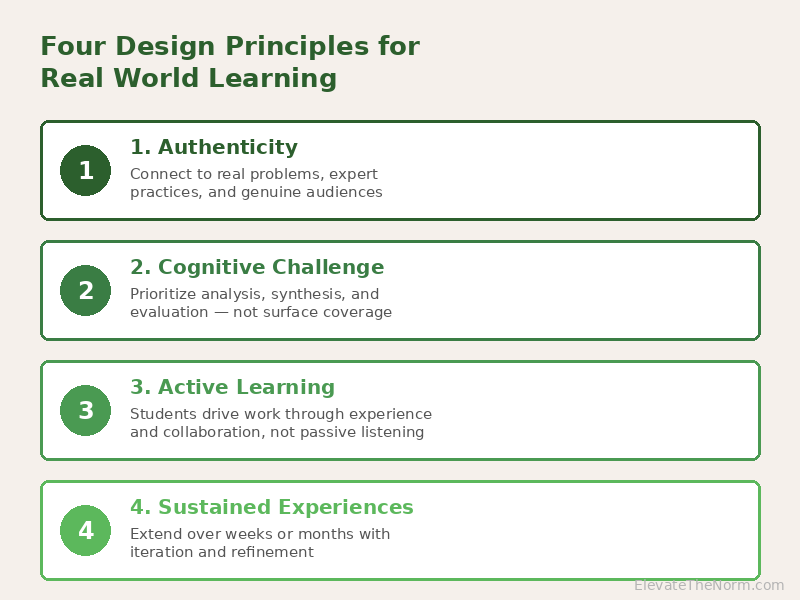
    Four design principles for real world learning: authenticity, cognitive challenge, active learning, and sustained experiences
    The four research-backed design principles that make real world learning effective.

    What the Research Says About Real World Learning

    The evidence base for applied, authentic learning is strong — and getting stronger. EdResearch for Action’s comprehensive brief reviews the evidence across multiple randomized controlled trials and identifies four core design principles that predict effectiveness:

    1. Authenticity. The work connects to real-world problems, expert practices, or student aspirations through essential questions and genuine audiences.
    2. Cognitive challenge. The work prioritizes deep mastery and complex thinking — analysis, synthesis, evaluation — not surface-level coverage.
    3. Active learning. Students drive the work through experience, collaboration, and reflection, with direct instruction used strategically rather than as the default mode.
    4. Sustained experiences. The work extends over weeks or months, allowing iteration and refinement — not a one-day activity squeezed between test-prep sessions.

    When those principles are present, the results are consistent. Randomized controlled trials show that project-based learning improved high school science and social studies achievement, with similar gains across income levels. Career and technical education increased on-time graduation rates, particularly for low-income students. Inquiry-based instruction improved middle school math scores. And linked learning — programs that combine academic and career-technical coursework — improved eleventh-grade English scores and college readiness. Those constraints — credits, bells, a transcript — are why running this in a high school is a different problem from running it in a middle school.

    The benefits are not limited to test scores. A Carnegie Foundation report on Kansas City’s Real World Learning Initiative found that 52 percent of recent high school graduates earned at least one market value asset before graduation — an internship, a client-connected project, an industry credential, or significant college credit. Students with these assets showed stronger transitions to employment and further education. The initiative now covers 34 school districts and approximately 100,000 high school students across urban, suburban, and rural areas.

    Service learning adds its own layer of evidence. Students in service-learning programs score higher in social studies, writing, and English language arts, and students in semester-long service-learning courses are almost three times more likely to believe they can have a significant impact on their community. These outcomes correlate with higher GPAs and improved graduation rates.

    Access and Equity: Real World Learning Cannot Depend on ZIP Code

    Here is the equity problem with real world learning, and it is not small: the best opportunities usually go to students who already have connections. The student whose parent works at the hospital gets the shadowing opportunity. The school with corporate neighbors gets the mentorship program. The district with transportation funding gets the field research trips.

    If real world learning depends on what families and communities can provide on their own, it reproduces the same inequities the rest of schooling already has. The Next Generation Learning Challenges project identified social capital as the critical gap: significant disparities exist between socioeconomic groups in accessing mentors, professional networks, and community connections. Students from low-income families are less likely to have adults in their life who can open professional doors — not because those students are less capable, but because those doors were never in their hallway.

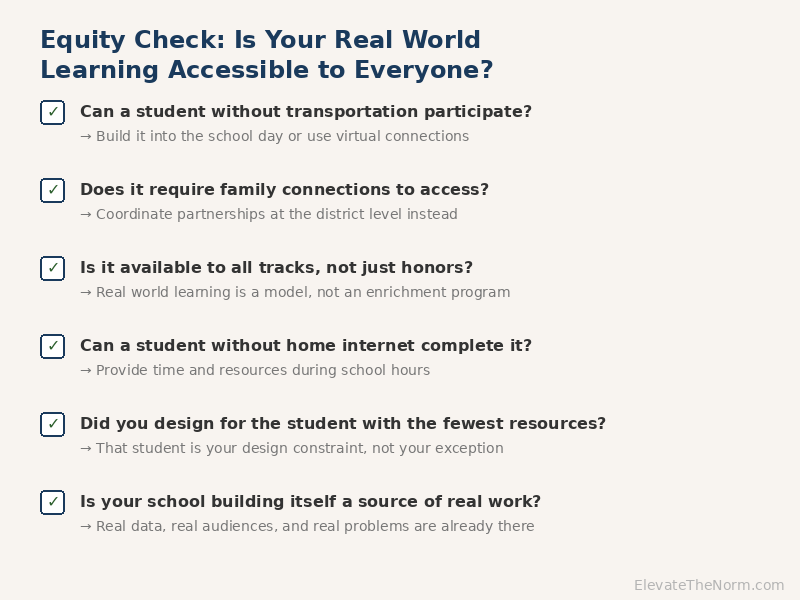
    The answer is not to give up on real world learning for schools without resources. The answer is to design it so that access does not depend on any individual teacher’s personal network or any family’s existing connections. That means:

    • District-level coordination. Partnerships with local organizations, businesses, and agencies should be built at the system level and shared across schools — not left to individual teachers to hustle on their own time.
    • In-building alternatives. The school-based real world learning described above requires no bus, no budget, and no external partner. It is available to every teacher in every building starting tomorrow.
    • Virtual connections. Video conferencing puts expert interviews, professional mentorship, and virtual field trips within reach of any school with an internet connection. A rural school in Alabama can connect with a museum in Washington or an engineer in Houston without a travel budget.
    • Designing for the student without connections. When planning real world learning, ask: can the student whose family works nights and cannot drive them anywhere still access this? If not, redesign it.

    Kansas City’s initiative is worth studying here because it started by addressing this exact problem. The Carnegie Foundation reports that the program explicitly focused on equity for historically marginalized students from low-income backgrounds, using district-level coordination rather than school-by-school improvisation.

    Common Mistakes That Make Real World Learning Fall Apart

    Even teachers who believe in authentic work make predictable mistakes when implementing it. These are the ones I see most often:

    Calling it real when it is not. The fastest way to lose a teenager’s trust is to promise them their work matters and then let it disappear into a grade. If you tell students they are writing a proposal for the principal, the principal needs to read it. If you tell them they are presenting to a real audience, the audience needs to actually care about the topic. Otherwise you have taught them that “real world” is just another school phrase that means nothing.

    Assuming real work means less structure. Authentic tasks need more structure, not less — clearer criteria, tighter checkpoints, more explicit scaffolding. The EdResearch brief directly addresses the misconception that applied learning eliminates direct instruction. It does not. It changes when and how you use it.

    Waiting until students have “the basics.” The belief that students need to master foundational skills before they can do real work is one of the most persistent barriers to real world learning — and the evidence does not support it. Applied learning and structured instruction are complementary. Students can learn content through authentic tasks, not only after them.

    Making access unequal. The honors students get the client project. The general-track students get the worksheet. If your real world learning is only available to students who already perform well, you have created an enrichment program, not a learning model.

    Equity checklist for real world learning asking whether opportunities are accessible to all students regardless of transportation, family connections, or income
    Design real world learning for the student with the fewest resources.

    Where to Start Tomorrow

    You do not need to overhaul your curriculum to bring real world learning into your classroom. You need to change who sees the work and what happens to it after it is finished.

    • Find one unit this semester where the final product could go to a real audience. Not the whole course. One unit. A report that goes to the school counselor. A presentation for another class. A proposal delivered to someone who could actually act on it.
    • Replace one fake scenario with real data. Instead of the fictional bakery, use real school data. Instead of the imaginary senator, write to the actual school board member who represents your district. The skill being practiced is the same. The motivation is not.
    • Invite one outside person into your classroom this month. Not for a career day speech — for a working session. Someone who can listen to student work, ask questions, and respond. A video call is enough.
    • Look at your building with fresh eyes. What problem exists in this school right now that students could investigate, document, or address? That is your next authentic unit.
    • Set up the collaboration first. Students who already work alongside each other every day — who know how to divide labor, give feedback, and hold each other accountable — can take on real work with real stakes faster than students who only collaborate during special projects.

    Real World Learning Is Not an Add-On

    The phrase “connect work to life” makes it sound like classroom learning and real life are separate things that need a bridge. They are not — or at least they should not be. The goal of real world learning is not to add a real-world component to an otherwise academic course. It is to stop pretending that academic work is not supposed to mean anything beyond the transcript.

    Students in grades 6–12 are old enough to do work that matters. They are old enough to analyze real data, address real audiences, investigate real problems, and produce things that real people actually use. When we understand what actually motivates students, we see that this kind of work is not extra — it is the condition under which engagement survives. The question is not whether they are capable. The question is whether we are building classrooms that give them the chance.

    That chance does not require a corporate partner, a grant, or a bus. It requires a teacher who is willing to ask: who will see this work besides me? If the answer is nobody — and it has been nobody all year — that is the place to start.

    Frequently Asked Questions

    How is real world learning different from project-based learning?

    Real world learning is broader than project-based learning. PBL is one method for delivering real world learning — a sustained project driven by an authentic question and ending in a public product. But real world learning also includes service, career exposure, field research, expert collaboration, and any work that connects to something genuine outside the classroom. A teacher can create real world learning without running a full PBL unit — and a PBL unit can fail at real world learning if the project is a simulation instead of the real thing.

    What if my school does not have community partners or business connections?

    Start inside the building. Every school has real data, real audiences, and real problems students can work on — attendance patterns, communication gaps, school history, proposals for administration. You do not need an external partner to make work authentic. You need a real audience and a product that someone will actually use. Video conferencing also makes expert interviews and virtual mentorship available to any school with an internet connection, regardless of location.

    Does real world learning work for students who are below grade level?

    Yes — and the research is direct on this point. Randomized controlled trials show that project-based and applied learning improve outcomes across income levels and prior achievement levels. Career and technical education increased on-time graduation particularly for low-income students. The belief that students need to master basics before engaging in authentic work is not supported by evidence. Students can learn foundational skills through real tasks, not only before them.

    How do I assess real world learning when the product is not a test?

    Use performance-based assessment tied to clear, public criteria. Before students start the work, show them what quality looks like — a rubric, an exemplar, or a set of success criteria. Then assess the product, the process, and the reflection. The EdResearch for Action brief recommends aligned performance assessments that measure complex skills like problem-solving, transfer, and collaboration alongside content knowledge. Real world learning does not mean you stop assessing. It means you assess what students can do with what they know.

    Is real world learning realistic with a packed curriculum and standardized tests?

    It is — but it requires planning. Applied learning is not an addition to curriculum. It is a different way of delivering the same standards. Students in high-quality applied-learning programs perform as well or better on standardized assessments, including AP exams. The key is choosing tasks that align with the standards you are already required to teach and using direct instruction strategically within the authentic context, not abandoning it.

    How do I make sure real world learning is equitable across different student groups?

    Design for the student with the fewest resources. If an opportunity requires transportation, family connections, or technology that not every student has, it is not equitable. Build real world learning into the regular school day, use in-building options for schools without community partnerships, and coordinate partnerships at the district level rather than leaving individual teachers to build their own networks. When planning any real-world task, ask: can the student whose family works nights and cannot provide a ride still fully participate?

    What is the role of the teacher during real world learning?

    The teacher is not a bystander. Real world learning requires more teacher involvement, not less — setting clear criteria, building scaffolding, facilitating checkpoints, providing direct instruction when students need specific skills, and ensuring quality before the work reaches its audience. The teacher is the quality-control mechanism. Without that involvement, real world learning becomes real world chaos. The structure is what makes the authenticity possible.

    Sources

    For the project-shaped version of this idea, the list of ideas for project based learning collects fifty real-world premises by subject, including several that solve a problem inside the school building when community access is limited.


    About Clay Shumate
    Clay Shumate is a certified secondary Social Studies teacher in the public schools of West Alabama, with seven years of classroom experience, a B.A. in History, and an M.Ed. in Secondary Education. He writes about project-based learning, student responsibility, respect, and practical ways to hold young people to a higher standard while giving them room to learn from mistakes. He is a member of the Society of Professional Journalists and writes to its Code of Ethics; this site’s editorial standards and corrections policy are published in full. More about Clay. For a structured framework that turns experiences into lasting learning, see experiential learning high schools can actually use.
  • Example of Project Based Learning: 25 Middle and High School Projects That Matter

    Example of Project Based Learning: 25 Middle and High School Projects That Matter

    By Clay Shumate

    Part of the project-based learning guide — the full hub covering how PBL differs from a regular project, planning, and the practical constraints of a secondary schedule.

    An example of what counts as project based learning is any classroom project where students investigate a real question, make meaningful decisions, and create something for an audience beyond the teacher. The difference between PBL and a regular assignment is simple: in PBL, the project is the learning—not a reward for finishing the textbook chapter. Below you will find 25 concrete examples organized by subject and grade band, each one built around a real question, a public product, and standards worth teaching.

    Key Takeaways

    • Project based learning requires a driving question, sustained inquiry, student voice, and a public product—not just a poster or presentation tacked onto the end of a unit.
    • A strong PBL example connects students to real audiences, real decisions, and real consequences for their work.
    • These 25 projects span English, social studies, science, math, and electives for grades 6–12, and most can be adapted for limited technology or resources.
    • Research shows PBL students in secondary schools outperform peers by significant margins on standardized assessments, with the strongest effects at the high school level.
    • The easiest way to start is small: pick one project, one class period, and one semester. Do not try to redesign your entire curriculum at once.

    What Makes a Project “PBL” Instead of Just a Project?

    Before the examples, this distinction matters. A lot of teachers assign projects. That does not mean they are doing project based learning.

    According to PBLWorks, Gold Standard PBL includes seven essential design elements: a challenging problem or question, sustained inquiry, authenticity, student voice and choice, reflection, critique and revision, and a public product. If the project is missing most of those—if students are just following directions to build a diorama after the unit test—it is a project, but it is not PBL.

    For a full breakdown of the seven essential design elements and how they distinguish PBL from regular projects, see the definition of project based learning.

    Here is the quick test I use: Who is doing the thinking? If students are making decisions about what to investigate, how to present their findings, and who their audience is, you are in PBL territory. If the teacher made every decision and the students are executing a recipe, that is an assignment with craft supplies.

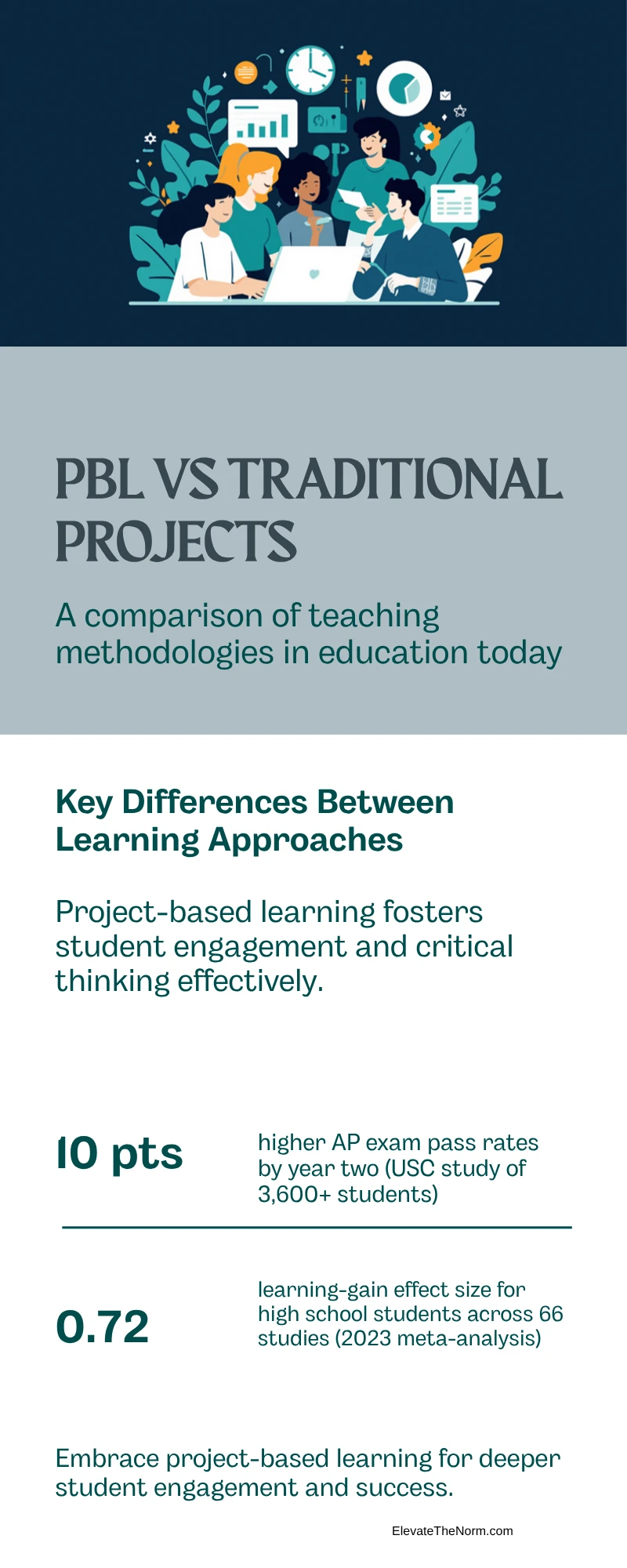
    A 2023 meta-analysis examining 66 empirical studies found that PBL produced a moderate overall effect on student learning (SMD = 0.441), with the strongest results at the high school level (SMD = 0.720). The gains were largest for academic achievement (SMD = 0.650), followed by thinking skills and emotional attitudes toward learning. Those numbers matter because they show that PBL is not just engaging—it produces measurable learning gains when done well.

    Infographic contrasting project based learning with traditional classroom projects, including research-backed results from PBL studies
    PBL vs traditional projects: what peer-reviewed research shows.

    25 Project Based Learning Examples for Grades 6–12

    English Language Arts

    1. The Community Oral History Archive (Grades 6–8)

    Driving question: Whose stories in our community are not being told?

    Students identify community members whose experiences are underrepresented—veterans, immigrants, retired workers, elders—and conduct recorded interviews using oral history protocols. They transcribe, edit, and publish the interviews as an online or physical archive donated to the local library or historical society. Projects like that one sit close to the border with experiential learning, where the reflection does as much work as the doing.

    Why this is PBL: Students choose their subjects, conduct sustained research, practice interview and writing skills, revise based on feedback from both their teacher and the interview subjects, and produce a public product with a real audience and lasting value. A book report does not do any of that.

    Standards connection: Speaking and listening, narrative and informational writing, primary source analysis, digital literacy.

    2. The Op-Ed Campaign (Grades 9–12)

    Driving question: What issue in our school or community deserves a public argument?

    Students research a local issue—school policy, city budget allocation, environmental concern, public health—draft an opinion editorial, workshop it through peer critique and revision cycles, and submit it to a local newspaper, school publication, or community blog. The goal is actual publication, not a grade.

    Why this is PBL: The audience is real. The stakes are real. Students must build an evidence-based argument strong enough to survive an editor’s review. Revision matters because rejection is possible.

    Standards connection: Argumentative writing, evidence evaluation, audience awareness, media literacy.

    3. The Podcast Series on Student Identity (Grades 7–10)

    Driving question: What does it mean to grow up in this place, at this time?

    Students plan, script, record, edit, and publish a multi-episode podcast exploring aspects of adolescent identity—culture, language, family expectations, pressure, belonging. Each episode requires research, interviews, narrative structure, and production quality good enough for public release.

    Why this is PBL: Students control the content, format, and production decisions. The public product (a published podcast) creates accountability that a classroom presentation cannot replicate.

    Standards connection: Narrative techniques, speaking and listening, research, digital media production.

    4. The Literary Magazine With an Editorial Board (Grades 6–12)

    Driving question: What original writing and art from our school deserves a public audience?

    Students run every aspect of a literary magazine: soliciting submissions, forming an editorial board, establishing selection criteria, editing accepted pieces with authors, designing layout, and distributing the finished publication. The teacher advises. The students decide. For a longer worked example of that split, see a civics project that started in one class and ended up school-wide.

    Why this is PBL: Editorial decision-making, quality control, collaboration, revision, and publication for a real audience. This is not a creative writing assignment turned in for a grade—it is a functioning publication.

    Standards connection: Writing across genres, editing, design, collaboration, project management.

    Social Studies and History

    5. The Local Policy Investigation (Grades 8–12)

    Driving question: How does one local policy affect real people in our community?

    Students select a local government policy—zoning, school discipline, curfew laws, water usage regulations—research its history, interview affected community members and officials, analyze data, and present findings and recommendations at a city council meeting, school board session, or community forum. If you teach history or civics, my Social Studies Teacher Toolkit Bundle on TPT has ready-made pieces you can build a project around.

    Why this is PBL: The audience is a decision-making body. Students produce evidence for people who can act on it. That changes how seriously students treat research and revision.

    Standards connection: Civic engagement, primary and secondary source analysis, data interpretation, persuasive communication.

    6. The Historical Marker Project (Grades 6–9)

    Driving question: What happened here that people should know about?

    Students research a local site with historical significance—a building, intersection, park, or neighborhood—write the text for an official historical marker, and submit a proposal to the local historical society or city government. The proposal includes a researched essay defending why the site deserves recognition.

    Why this is PBL: The product has a real approval process. Students must build an argument backed by primary sources convincing enough for adults outside the school to accept. The stakes are authentic because the marker could actually be installed.

    Standards connection: Historical research, primary source analysis, persuasive and informational writing, civic participation.

    7. The Immigration Documentary (Grades 9–12)

    Driving question: How has immigration shaped our community’s economy, culture, and identity?

    Students research immigration patterns in their region, conduct interviews with immigrants and longtime residents, analyze census and economic data, and produce a short documentary screened at a community event or submitted to a student film festival.

    Why this is PBL: Students investigate a complex, relevant issue using multiple sources and perspectives. The documentary requires sustained inquiry, revision, and presentation to a public audience. Sensitivity to real people’s stories adds ethical weight the classroom rarely provides.

    Standards connection: Historical analysis, geography, economics, media production, ethical research practices.

    8. The Election Simulation With Real Data (Grades 7–12)

    Driving question: How do campaigns actually persuade voters, and what role does evidence play?

    Students research real candidates and ballot measures using primary sources—voting records, financial disclosures, policy statements—develop informed positions, create campaign materials, hold structured debates, and vote. The simulation ends with a published voter guide distributed to school families.

    Why this is PBL: The voter guide is a real product for a real audience. Students must evaluate claims critically rather than parrot slogans. The project connects classroom learning to democratic participation.

    Standards connection: Government, media literacy, argumentative writing, data analysis, civic responsibility.

    Science

    9. The Water Quality Investigation (Grades 6–9)

    Driving question: Is the water in our community safe, and how do we know?

    Students test water from local sources—taps, wells, creeks, fountains—using scientific protocols. They analyze results, compare them to EPA standards, and present their findings to the school board, city water department, or a community meeting. If results are concerning, students draft a formal letter to the appropriate authority.

    Why this is PBL: Students collect real data, follow scientific methods, and present findings to an audience that may actually respond. The data is not hypothetical. If the water tests badly, students learn what it means to report uncomfortable truths backed by evidence.

    Standards connection: Scientific investigation, data collection and analysis, environmental science, technical writing, civic engagement.

    10. The School Energy Audit (Grades 7–12)

    Driving question: How much energy does our school waste, and what would it cost to fix?

    Students audit the school’s energy consumption—lighting, heating, cooling, electronics—calculate waste, research solutions, estimate costs and savings, and present a formal proposal to the principal or school board. The proposal includes a cost-benefit analysis and implementation timeline.

    Why this is PBL: The data is real. The audience has budget authority. Students learn that persuading decision-makers requires more than good intentions—it requires numbers, evidence, and a realistic plan.

    Standards connection: Physics (energy), mathematics (data analysis, financial literacy), environmental science, persuasive communication.

    11. The Biodiversity Survey (Grades 6–10)

    Driving question: What species live in our schoolyard or local park, and what does that tell us about ecosystem health?

    Students conduct a systematic biodiversity survey using transects, quadrats, and species identification. They compile data, compare results to historical records or regional databases, and publish findings through a report to the local parks department or a citizen-science platform like iNaturalist.

    Why this is PBL: Students contribute real data to real scientific databases. Their work has value beyond the classroom. The survey requires sustained fieldwork, accurate data collection, and scientifically defensible conclusions.

    Standards connection: Ecology, data collection, species identification, scientific writing, environmental stewardship.

    12. The Public Health Campaign (Grades 9–12)

    Driving question: What health issue in our community needs better public information?

    Students research a local health concern—teen vaping, nutrition access, mental health stigma, sleep deprivation—analyze data, consult local health professionals, and design and distribute an evidence-based awareness campaign. Products might include infographics, social media content, presentations to younger students, or informational materials for a community health fair.

    Why this is PBL: The campaign targets a real audience with real health stakes. Students must verify claims, cite sources, and design communication that actually reaches people—not just earns a grade.

    Standards connection: Health science, biology, statistics, graphic design, persuasive communication, media literacy.

    Mathematics

    13. The Small Business Financial Plan (Grades 9–12)

    Driving question: Could our business idea actually survive its first year?

    Students develop a business concept, research market conditions, create financial projections using algebra and statistics, and present their business plan to a panel of local business owners or entrepreneurs. The panel provides real feedback on whether the numbers hold up.

    Why this is PBL: The math serves a real purpose—convincing skeptical adults that the numbers work. Students cannot hide behind procedures. They must defend their assumptions, explain their models, and revise when challenged.

    Standards connection: Algebra, statistics, financial literacy, functions, modeling, oral presentation.

    14. The School Redesign Proposal (Grades 7–10)

    Driving question: If we could redesign one space in our school, what would the data say we should change?

    Students survey peers and staff, collect usage data, measure dimensions, create scale drawings or digital models, calculate material costs, and propose a redesign to the administration. The proposal includes blueprints, a budget, and evidence that the redesign addresses a real need.

    Why this is PBL: The math—geometry, measurement, ratio, budgeting—serves a visible purpose. The audience (administration) has the authority to act on the proposal. Students see whether their calculations survive adult scrutiny.

    Standards connection: Geometry, measurement, ratio and proportion, data analysis, scale drawing, budgeting.

    15. The Statistical Investigation of School Data (Grades 8–12)

    Driving question: What does our school’s data actually tell us about fairness, access, or student experience?

    Students obtain anonymized school data—attendance patterns, discipline referrals, course enrollment, extracurricular participation—and conduct a statistical analysis looking for patterns, disparities, or trends. They present findings and recommendations to school leadership.

    Why this is PBL: The data is real and the findings might be uncomfortable. Students practice statistical reasoning on questions that matter to their own school community. Presenting to administration makes accuracy and honesty non-negotiable.

    Standards connection: Statistics and probability, data representation, bias and sampling, ethical data use, persuasive communication.

    16. The Community Mapping Project (Grades 6–8)

    Driving question: What resources does our neighborhood have—and what is missing?

    Students map community assets—parks, clinics, grocery stores, bus stops, libraries—using measurement, coordinate systems, and data collection. They identify gaps in access, calculate distances and travel times, and present their findings to a community organization or neighborhood association.

    Why this is PBL: Mathematics becomes a tool for understanding equity and access. The map and analysis serve a real community organization, and students must defend their data collection methods.

    Standards connection: Coordinate geometry, measurement, ratios, data analysis, geography, civic awareness.

    Cross-Curricular and Elective Projects

    17. The School Podcast Network (Grades 6–12)

    Driving question: What conversations should our school community be having?

    Students pitch, produce, and publish regular podcast episodes covering school news, student perspectives, interviews with staff and community members, and student-reported stories. An editorial team manages content review, scheduling, and quality standards.

    Why this is PBL: Students run a real media operation with real deadlines, audience feedback, and editorial standards. They must balance free expression with responsibility and accuracy—skills that no worksheet teaches.

    Standards connection: Speaking and listening, research, writing, media production, journalism ethics, project management.

    18. The Mentorship Curriculum (Grades 9–12)

    Driving question: What do incoming freshmen actually need to know, and how should they learn it?

    Older students design and deliver a mentorship program for incoming ninth graders. They research transition challenges, develop lesson plans, create resources, facilitate sessions, collect feedback, and revise the program based on results. The final product is a reusable curriculum guide for future mentors.

    Why this is PBL: Students design instruction for a real audience and measure whether it works. The responsibility is genuine—younger students are depending on them. Revision is based on real feedback from real participants, not a teacher’s rubric alone.

    Standards connection: Research, instructional design, leadership, communication, data collection, program evaluation.

    19. The Community Art Installation (Grades 6–12)

    Driving question: What message should our school send to our community through public art?

    Students research public art, develop a concept, pitch it to school or city officials, design and create the installation, and manage the project from proposal through completion. The installation is displayed publicly—in the school, a local business, a community center, or a public space.

    Why this is PBL: The approval process, budget constraints, material limitations, and public audience make this project authentic in ways classroom art projects rarely are. Students must persuade, plan, execute, and accept public reaction.

    Standards connection: Visual arts, research, proposal writing, project management, budgeting, community engagement.

    20. The Bilingual Community Resource Guide (Grades 7–12)

    Driving question: What essential information in our community is not available in the languages families actually speak?

    Students identify critical community resources—health services, legal aid, school enrollment, emergency contacts, transportation—and create a bilingual or multilingual guide. They verify accuracy with service providers, translate carefully, design for clarity, and distribute through schools, churches, clinics, or community organizations.

    Why this is PBL: The product fills a real gap. Families who speak languages other than English will actually use this guide. Students must verify information, translate accurately, and design for people who need clear communication—not for a grade.

    Standards connection: World languages, research, informational writing, design, community service, cultural competency.

    21. The Career Investigation and Job Shadow Report (Grades 8–12)

    Driving question: What does this career actually look like on a regular Tuesday?

    Students research a career field, arrange a job shadow or informational interview with a professional, observe and document the daily realities of the work, and produce a detailed report comparing their expectations to reality. Reports are compiled into a career resource available to other students.

    Why this is PBL: Students interact with real professionals, confront the gap between expectations and reality, and produce a resource other students will actually consult. The job shadow requires initiative, communication, and follow-through outside the classroom.

    Standards connection: Research, informational writing, career readiness, professional communication, self-assessment.

    22. The School Improvement Proposal (Grades 6–12)

    Driving question: What is one thing about our school we could change with evidence and a plan?

    Students identify a school problem—cafeteria waste, hallway congestion, library usage, schedule concerns—collect data, research solutions from other schools, calculate costs, and deliver a formal proposal to administration. The proposal follows a standard format with an executive summary, evidence section, implementation plan, and budget.

    Why this is PBL: The audience makes real decisions. Students learn that complaining is easy but proposing evidence-based solutions is hard. If the proposal is good enough, the school might actually implement it.

    Standards connection: Research, data analysis, persuasive writing, financial literacy, problem-solving, civic participation.

    23. The Climate Action Plan (Grades 9–12)

    Driving question: What can our school realistically do to reduce its carbon footprint in the next two years?

    Students calculate the school’s carbon footprint, research reduction strategies, analyze costs and feasibility, consult with facilities staff, and present a phased action plan to school leadership. The plan includes measurable targets, timelines, responsible parties, and progress indicators.

    Why this is PBL: The word “realistically” does a lot of work. Students cannot propose fantasy solutions. They must account for budgets, building codes, contracts, staff capacity, and political will. The constraints are what make it authentic.

    Standards connection: Environmental science, chemistry, mathematics, economics, project management, persuasive communication.

    24. The Peer Mediation Training Program (Grades 7–12)

    Driving question: How can students help resolve conflicts fairly and reduce the need for adult intervention?

    Students research conflict resolution, restorative practices, and mediation techniques. They design a training program, pilot it with volunteers, collect data on outcomes, revise based on results, and present the finished program to administration for adoption. Trained mediators then serve the school community.

    Why this is PBL: Students create a lasting program that changes how their school handles conflict. The work is sustained over weeks, requires research and revision, and produces a public product that affects real people. Success is measured by whether the program actually works—not by a rubric score.

    Standards connection: Psychology, communication, research, program design, leadership, data analysis, social-emotional learning.

    25. The Local History Walking Tour (Grades 6–10)

    Driving question: What stories does our neighborhood tell if you know where to look?

    Students research the history of locations within walking distance of the school—buildings, monuments, former businesses, sites of historical events. They write informative scripts, create a mapped route, design signage or a digital guide, and lead public tours for families, community members, or younger students.

    Why this is PBL: The walking tour is a real product for a real audience. Students must verify historical claims using primary sources, write for non-expert audiences, design for clarity, and perform publicly. A bad tour gets noticed. A good tour changes how people see their neighborhood.

    Standards connection: Historical research, primary source analysis, informational writing, geography, public speaking, design.

    Download it: All 25 projects below are also packaged as a 14-page PDF with a one-page project planning template covering driving question, audience, checkpoints, assessment, and modifications. It is free on the teacher resources page — no email required.

    How to Tell Whether a Project Qualifies as PBL

    If you are looking at a project and wondering whether it counts, ask these five questions:

    1. Is there a driving question worth investigating? If the question can be answered with a Google search, it is not driving anything.
    2. Are students making real decisions? If every step is predetermined, students are following instructions—not learning through inquiry.
    3. Is the inquiry sustained? A one-day activity is an activity. PBL takes weeks because real investigation takes time.
    4. Is there a public product? If the only person who sees the work is the teacher, the project lacks the accountability that makes PBL effective.
    5. Did students revise based on feedback? First drafts are not final products. Critique and revision are where the deepest learning happens.

    Research from PBLWorks identifies these as part of seven essential design elements that separate genuine PBL from dressed-up assignments.

    Checklist infographic with five diagnostic questions teachers can use to determine whether a classroom project qualifies as genuine project based learning
    Use these five questions to test whether your classroom project qualifies as genuine PBL.

    What the Research Says About PBL Effectiveness

    The examples above are not just engaging—they produce results. I compare PBL and traditional instruction in more detail elsewhere, but here is the short version of what the research shows.

    A meta-analysis published in Frontiers in Psychology in 2023 analyzed 66 empirical studies with 190 effect values. The combined effect was a moderate positive impact (SMD = 0.441) on student learning outcomes. High school students showed the strongest gains (SMD = 0.720), outperforming primary, junior high, and university levels. Groups of four to five students produced the highest effects (SMD = 0.909), and projects lasting 9–18 weeks yielded the strongest results.

    Lucas Education Research funded four peer-reviewed studies that reinforce these findings. In the Knowledge in Action study led by Anna Saavedra at the University of Southern California, over 3,600 students in project-based AP courses outperformed traditional AP classrooms by 8 percentage points in year one and 10 percentage points in year two. Low-income students showed similar gains as their wealthier peers. A Stanford University study found middle school science students outperformed comparison groups by 11 percentage points on NGSS-aligned assessments, with English language learners showing improved language proficiency as a side benefit.

    PBLWorks reported in 2025 that over 66 percent of high school students report being bored daily in school, with 75 percent citing uninteresting material and 39 percent noting lack of relevance. Gold Standard PBL addresses both problems by building authenticity, student voice, and sustained inquiry into the structure of the learning itself.

    The MDRC literature review by Barbara Condliffe further confirmed that well-implemented PBL improves content knowledge, problem-solving, and student engagement, particularly when projects include authentic tasks and audiences.

    How to Start: A Practical Guide for Your First PBL Project

    You do not need to overhaul your entire curriculum to try project based learning. Start with one project in one class.

    Step 1: Pick a real question. Look at your standards and ask: what question connected to these standards would a real person actually want answered? That is your driving question.

    Step 2: Identify an audience. The school board. A local business. Younger students. A community organization. The audience does not need to be impressive—it needs to be real.

    Step 3: Define the product. What will students create that the audience will actually see, read, hear, or use? A proposal? A guide? A presentation? A published piece? Name it clearly.

    Step 4: Build in checkpoints. PBL is not “assign the project and see what happens in six weeks.” Plan weekly check-ins, draft deadlines, peer critique sessions, and opportunities for revision.

    Step 5: Protect the inquiry. Resist the urge to give students the answers. Your job during the project is to ask better questions, provide resources, and hold students accountable for doing the thinking themselves.

    Step 6: Let the audience respond. The power of PBL comes from students hearing honest feedback from someone other than their teacher. An administrator who asks a tough question about their proposal teaches more in one moment than a week of lectures about “real-world relevance.”

    Step-by-step infographic showing six steps for teachers to launch their first project based learning experience in the classroom
    Six steps to launch your first project based learning experience.

    Practical Considerations Before You Begin

    PBL works, but it works better when you plan for the realities that research papers do not always cover.

    Preparation time is front-loaded. Your first PBL project will take more planning time than a traditional unit. You are designing a learning experience, not just a sequence of lessons. That investment pays off—once the project structure exists, you can reuse and refine it for years. But be honest with yourself about the time the first round requires.

    Safety and supervision matter for community-based projects. Any project involving student contact with community members—interviews, job shadows, field investigations—requires appropriate parental consent, supervision protocols, and compliance with your district’s policies on off-campus activities and outside visitors. Plan these logistics early, not as an afterthought.

    Equity and access must be designed in, not assumed. Not every student has transportation to visit a community partner, technology at home to edit a podcast, or family connections to arrange a job shadow. Design projects so the essential work can happen during school hours, using school resources. Offer alternatives for components that require outside access. A project that only works for students with advantages is not good PBL—it is privilege dressed up as pedagogy.

    Communicate with families. Parents who experienced traditional education may be skeptical when their child comes home talking about “a project” instead of tests and textbook chapters. Send a brief explanation home at the start: what students will learn, what standards are being addressed, what the product will be, and how you will assess it. Transparency prevents the assumption that PBL means less rigor.

    Differentiation is part of the structure. PBL naturally allows differentiation through student choice—in topic, product format, research depth, and role within a group. Students with IEPs or 504 plans should receive their accommodations within the project structure, not as a separate track. Build in scaffolds like research guides, planning templates, and sentence starters for students who need them, while allowing advanced students to pursue deeper questions.

    Be ready for uncomfortable findings. Some of these projects—water quality testing, school data analysis, equity mapping—may produce results that are inconvenient for the school or community. That is a feature, not a bug. Teach students to report findings accurately and respectfully, and prepare administration for the possibility that student research might surface real problems worth addressing.

    Conclusion

    An example of project based learning is not hard to find—this article gives you 25 of them. The harder part is making sure the project actually qualifies as PBL rather than a dressed-up assignment. Real PBL puts students in charge of investigating questions that matter, making decisions that affect the outcome, creating products for audiences who will respond honestly, and revising until the work is genuinely good. For more on this approach, see experiential learning.

    Start with one project. Choose a real question. Find a real audience. Build in checkpoints and revision. Let students make decisions you would normally make for them. Watch what happens when they realize the work matters to someone other than you.

    The research supports it. The students deserve it. And your classroom will not be the same once you try it.


    Frequently Asked Questions

    How is project based learning different from assigning a project at the end of a unit?

    In project based learning, the project is the unit—students learn content and skills through the investigation, not before it. A traditional end-of-unit project asks students to demonstrate what they already learned. PBL asks students to learn by doing the work. The driving question, sustained inquiry, and public product are built into the learning from day one, not added at the end.

    Do students actually learn content through PBL, or just “soft skills”?

    They learn both, and the research is clear. A 2023 meta-analysis of 66 studies found PBL’s largest effect was on academic achievement (SMD = 0.650), followed by thinking skills and emotional attitudes. High school PBL students showed even stronger academic gains (SMD = 0.720). The idea that PBL sacrifices content for engagement is not supported by the evidence.

    How do I grade 25 different student projects fairly?

    You do not grade 25 different projects—you grade against common criteria. A well-designed PBL rubric assesses content knowledge, quality of inquiry, evidence use, communication, and revision regardless of the specific product. Students can choose different formats and still be evaluated on the same standards. The rubric is the constant; the product varies.

    What if I do not have time for long projects in my curriculum?

    Start with a shorter project—three to four weeks—on a topic where your required standards align naturally with a real question. You do not need six months. Some of the strongest PBL happens within a single unit when the driving question is focused and the product is well-defined. One genuine project per semester teaches students more about inquiry and responsibility than no projects at all.

    What about students who struggle with open-ended work or self-direction?

    Scaffolding is essential. PBL does not mean handing students a question and disappearing. Teachers build in checkpoints, model inquiry skills, provide structured templates for research and planning, and check in regularly. Students who struggle with self-direction often need more structure at the beginning and less as the project progresses—not an exemption from the work.

    How do I handle group projects when some students do not contribute equally?

    Assign clear individual roles with visible deliverables so every student’s contribution is documented. Use individual accountability alongside group assessment. Peer evaluations, individual reflection, and graded individual components within the group project prevent free-riding. If a student is not contributing, the structure should make that visible early enough to intervene—not after the project is turned in.

    Can I do PBL without much technology?

    Absolutely. Many of the examples in this article—oral histories, community surveys, walking tours, art installations, mentorship programs—require little or no technology. A clipboard, a notebook, and access to the community are enough. Technology can enhance PBL, but the essential elements are a real question, sustained inquiry, student decision-making, and a public product. None of those require a device.

    How do I get started if my school has never done PBL before?

    Start alone if you have to. Pick one class, one project, one semester. Choose a driving question connected to your existing standards. Find an audience—even one administrator willing to listen to student presentations counts. Run the project, reflect on what worked and what did not, and adjust for next time. You do not need a schoolwide initiative to try project based learning. You need a question worth answering and students willing to do the work.


    Sources

    If you want a wider net rather than these twenty-five worked examples, the companion list of ideas for project based learning gives you fifty project premises sorted by subject, with timelines and a real audience attached to each one.


    About Clay Shumate

    Clay Shumate is a certified secondary Social Studies teacher in the public schools of West Alabama, with seven years of classroom experience, a B.A. in History, and an M.Ed. in Secondary Education. He writes about project-based learning, student responsibility, respect, and practical ways to hold young people to a higher standard while giving them room to learn from mistakes. He is a member of the Society of Professional Journalists and writes to its Code of Ethics; this site’s editorial standards and corrections policy are published in full. More about Clay.
Teacher Emergency Toolkit — practical resources, real classroom support. Shop on TPT.Teacher Emergency Toolkit — practical resources, real classroom support. Shop on TPT.