Tag: secondary teaching

  • Classroom Attention Getters: The 3-2-1-Done Method That Took Six Weeks to Work

    Classroom Attention Getters: The 3-2-1-Done Method That Took Six Weeks to Work

    By Clay Shumate

    Classroom attention getters are the signals a teacher uses to move a room from talking to listening: a countdown, a call-and-response, a raised hand, a chime. The one I use with grades 6–12 is 3-2-1-Done — the countdown every kid learned in kindergarten, with a weekly class-versus-class competition attached. The countdown is simple. Getting teenagers to believe in it is not. This year, that took six weeks.

    Key Takeaways

    • The signal is not the problem. Secondary students ignore attention getters that cost them nothing to ignore. The fix is giving the class a stake in answering, not finding a cleverer chant.
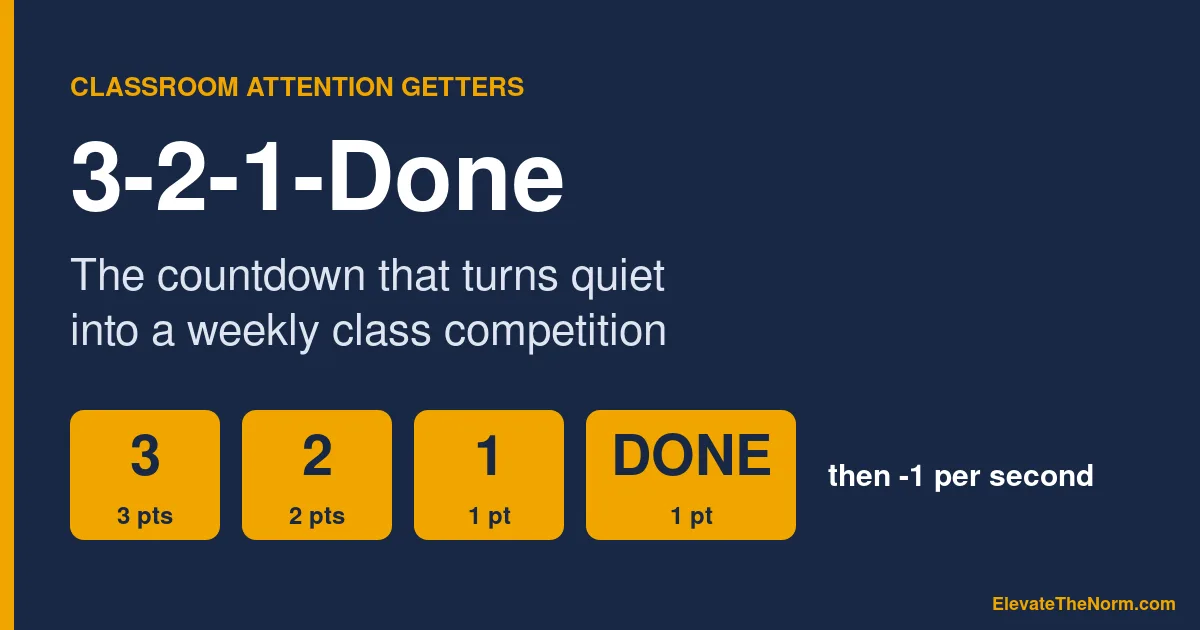
    • 3-2-1-Done is scored. Quiet on three earns 3 points, two earns 2, one earns 1, and done earns 1. Every second past done costs a point. Every class starts the week at zero.
    • It is an old, well-studied idea. Class-wide team scoring is the core of the Good Behavior Game, studied since 1969. The evidence is solid, and smaller in randomized trials than in the headline numbers.
    • The reward has to be consistent before it has to be good. A bag of chips every single week beats a pizza party that might happen.
    • Buy-in can take twice as long as you expect. Students who have learned not to trust school will test whether you mean it. Keep going.

    Free Download · PDF

    3-2-1-Done Weekly Scoreboard

    A one-page printable scoreboard with the point values, a row for every class period, a bonus column, and a line for the weekly winner. Print it, post it, fill it in daily. No email required.

    Download the free PDF

    Free. No email address required. Designed for grades 6–12. Browse every printable in Your Free Library.

    Why Most Classroom Attention Getters Stop Working After Elementary School

    In second grade, “class, class” gets “yes, yes” because the adult asked. By ninth grade, that is no longer reason enough. A fourteen-year-old weighing whether to finish a sentence to a friend or go quiet for a teacher is doing a small cost-benefit calculation, and most attention getters put nothing on the scale. When attention drops, I pull a card from my Brain Breaks for Middle and High School on TPT: 60 resets that need no prep and no supplies.

    So the signal escalates. The chant gets louder, then the teacher does, and the room learns that the real signal is the third, angriest repetition. That is the pattern behind why yelling manufactures order instead of restoring it: it works for a moment, and it teaches students to wait for it.

    The fix is not a better chant. It is giving the whole class a reason to answer the first one.

    The 3-2-1-Done Method, Step by Step

    Everybody already knows the countdown: three fingers up, three, two, one, done. What changes is that every count is worth something, and every class is keeping score against every other class.
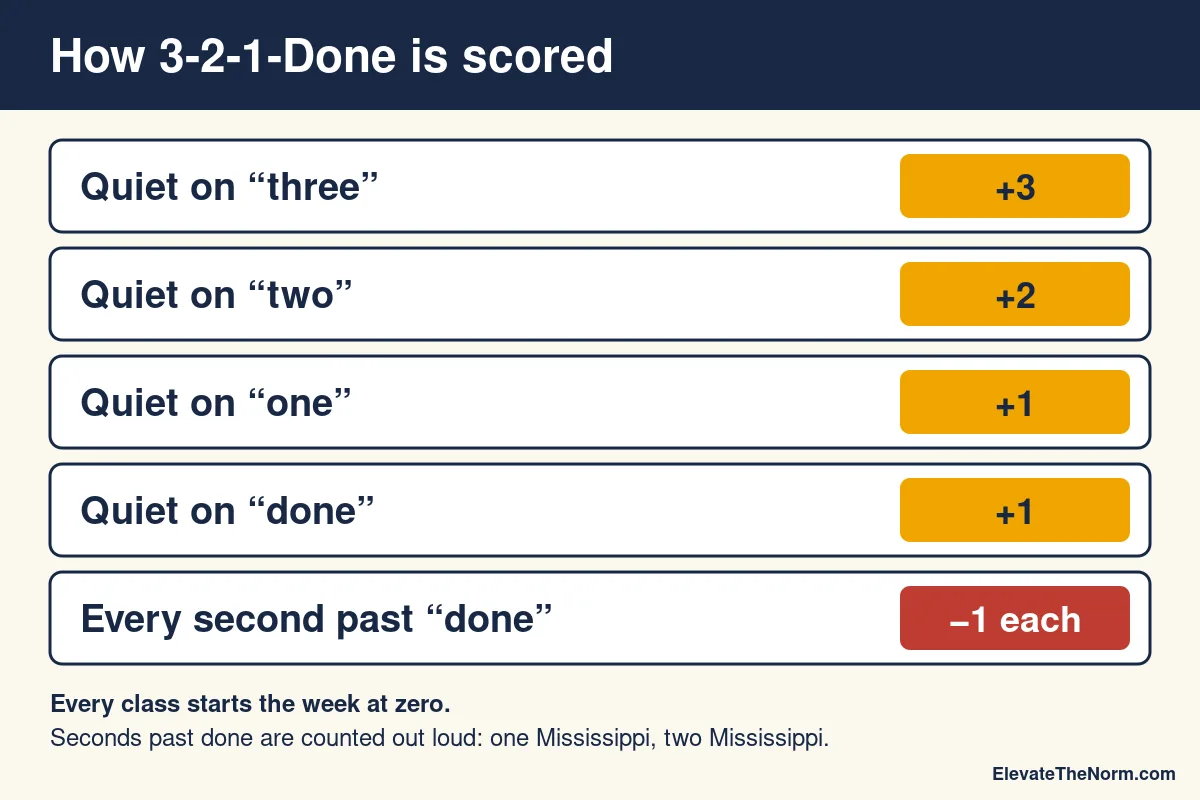
    Scoring chart for the 3-2-1-Done attention getter: plus 3 for quiet on three, plus 2 on two, plus 1 on one, plus 1 on done, and minus 1 for every second past done
    The whole scoring system fits on one poster.
    1. Every class starts the week at zero. Monday is a clean slate for every period, no matter how last week went.
    2. Count down out loud with fingers up. Three, two, one, done.
    3. Award points for when the room goes quiet. Quiet on “three” is 3 points. On “two,” 2 points. On “one,” 1 point. On “done,” also 1 point.
    4. Past done, count the seconds out loud. One Mississippi, two Mississippi, three Mississippi. Every second is a point off.
    5. Post the board. Every class sees every other class’s running total. That visibility is where the competition comes from.
    6. Name a winner every week. Highest total on Friday gets the reward. No skipped weeks.

    Yes, “one” and “done” are both worth a point. That is on purpose: the class gets two chances to earn something before anything is taken away. I would rather drive a room with points it can still earn than with points it is losing. Plenty of teachers skip that and just keep counting — four, five, six — with no second chance at “done.” That works too. Pick one version and hold it all year.

    Other ways to earn and lose points

    The countdown does not have to be the only thing on the board. A class can earn points when every student turns in the day’s work, and lose them for tardies. Add what fits your room, and add it at the start of a week, never in the middle of one.

    Lean on positives or on negatives?

    Both work. I keep negatives as low as I can and give out positives sparingly, so a point means something. I have also seen it run almost entirely on negatives, where the class closest to zero at the end of the week wins. The version matters less than two rules: the scoring never changes midweek, and you are honest about every point. If you shave a point off one class because you are annoyed with them, every class will know by lunch.

    Why It Works: An Old Idea in a New Coat

    Nothing here is new. Scoring a whole class as a team, so that students have a reason to manage each other’s noise rather than just their own, is the core of the Good Behavior Game. Barrish, Saunders and Wolf first described it in 1969, and researchers call the mechanism an interdependent group contingency: the group earns or loses together.

    The research base is large. Bowman-Perrott and colleagues (2016) pooled 21 single-case studies covering 1,580 students from pre-kindergarten through grade 12 and found a large effect: a Tau-U of 0.82, meaning problem behavior dropped substantially and prosocial behavior rose.

    The honest caveat: single-case studies follow a small number of classrooms very closely, and they tend to produce big numbers. When Smith and colleagues (2021) pooled seven randomized controlled trials covering about 4,700 children, the effects were real but modest — Hedges’ g between 0.09 and 0.32, depending on the outcome. Most of that research is also in elementary classrooms, not high schools.

    So the defensible claim is this: class-wide team scoring is one of the better-supported classroom management tools out there, and it will not transform a room overnight. 3-2-1-Done aims it at one behavior — getting quiet on a signal — that happens many times a day. That is exactly the kind of small, repeated moment a modest effect is useful for.

    The Part Nobody Warns You About: Buy-In Took Six Weeks

    A lot of the students I have this year came up through classrooms that were mostly bookwork — worksheets in, worksheets out, next period. They know what that feels like from the student side.

    “Students know when you’re doing that, just like when you’re overstaying your welcome at somebody’s house. They feel it.”

    “Why in the heck would we want a student to feel like they are not wanted or needed somewhere? In a school.”

    So when I told them there would be a Student of the Week every week, and a winning class from 3-2-1-Done every week, they did not believe me. Nobody had ever told them that and then followed through. The first winner did not convince them. Neither did the second.
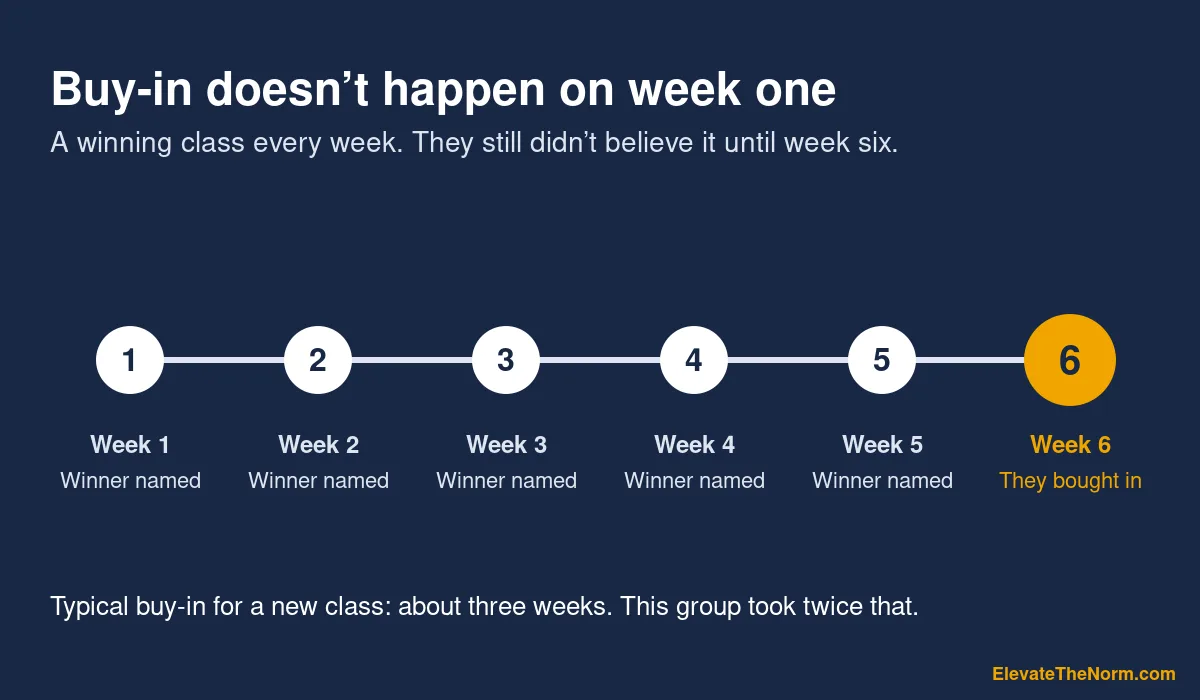
    Timeline of weeks one through six showing a winning class named every week and students finally buying in during week six
    A winner every single week. Belief showed up in week six.

    “They didn’t believe it. Even after it happened once. And twice. And three, four, five, six times. And then guess what? They bought in.”

    Six weeks is about twice as long as buy-in usually takes me with a new class. But it came, and it came all the way: every student wants the win now, and kids who walked in expecting another year of worksheets enjoy coming to social studies. Who would have thought history wasn’t boring.

    “Sometimes the three weeks is six weeks. Sometimes it’s nine weeks. Sometimes it’s 12, sometimes it’s never.”

    If you are in week three and nothing has moved, that is not evidence the method failed. It may be evidence of how many times these students have been promised something before.

    The Reward: Consistent Beats Big

    My weekly reward is a can of Pringles, a water, and fifteen to twenty minutes of the class’s own time — as long as they stay seated and keep the room at what I call a low murmur. Some teachers give a few minutes of free time. Some do something else entirely. There are plenty of ways to run it.
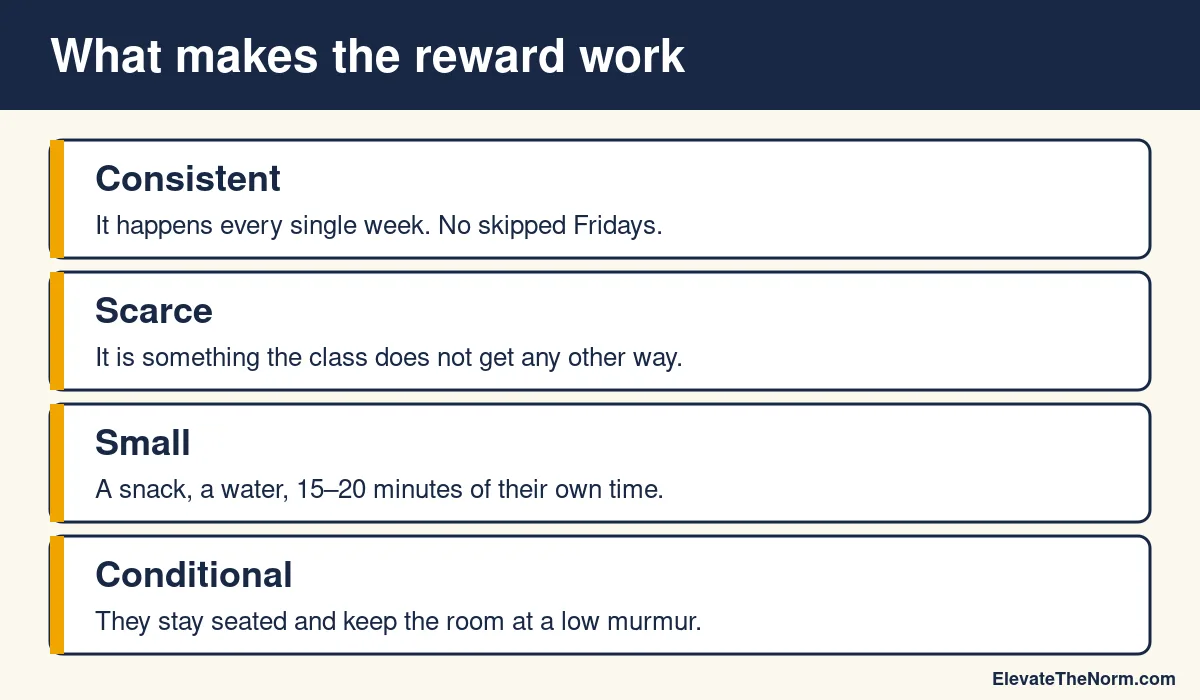
    Four-part graphic listing what makes a weekly class reward work: consistent, scarce, small, and conditional on staying seated at a low murmur
    The size of the reward matters less than whether it shows up every week.

    What you are after is a consistent reward. A modest reward that arrives every single Friday does more than a big one that might happen. When the class can count on it, they start to believe you — and that belief is the thing you are actually building. The weekly reward is just the proof.

    Two practical checks before you buy snacks. Ask about food allergies and have a non-food swap ready, like extra free time or choosing the seating for a day. And check whether your school has a policy on food rewards or free time; some do, and it is easier to ask first.

    Honesty Is the Whole System

    For a minute, stop calling them students.

    “You can be a student at any age.”

    When I taught at a community college, some of my students were 65 and 70 years old. Nobody would talk to them the way some adults talk to a room of 14- to 17-year-olds, because we assume their maturity is higher. Maybe it is. Maybe it is not. The same is true in a ninth-grade classroom: a 15-year-old might walk in with the maturity of a 10-year-old or of a 19-year-old, and you do not know what either one has had to live through to get there.

    “Children are like rubber bands. They can snap back. But eventually they’re going to break if you snap them too much.”

    That is why the honesty matters more than the scoring. Every point you award or take has to be real. Every winner has to be earned. Every reward has to show up. The countdown is just the part students can see.

    “Once you can gain trust, you better sure as heck not lose it.”

    Keep that trust and you can get a class to buy into more and more of what you need from them. That is how a countdown turns into a classroom management plan that actually runs.

    Common Mistakes With 3-2-1-Done

    • Skipping a week. One missed Friday tells students the promise was never real, and you start the buy-in clock over.
    • Changing the rules midweek. New point sources start on Monday, announced ahead of time.
    • Counting in your head. Say the seconds out loud. If students cannot hear the count, the score feels arbitrary.
    • Turning the countdown into a threat. Keep your voice level. The points carry the weight so your tone does not have to.
    • A reward they can get anyway. If free time is available every day, it is not a reward on Friday.
    • Quitting at week three. Some groups need twice as long. See the section above.

    If you want a second signal for moments when you cannot use your voice, pair the countdown with visual cues students can actually see. And for classes that respond to competition, the same team energy powers classroom review games.

    What It Looks Like When It Works

    Keep a positive attitude through the weeks when nothing seems to move. Keep elevating them. Show them the norm is not bookwork and negative thoughts — it is positive, soft-skill-driven, standards-driven work.

    “They are learning about life as they are learning about history.”

    Or whatever your subject is. That is a win. It is also the whole idea behind positive reinforcement classroom management: the countdown gets the room quiet, and the consistency gets the room to trust you.

    Before you go: grab the free 3-2-1-Done Weekly Scoreboard (PDF) — ElevateTheNorm.com branded, printable, no email required.

    Frequently Asked Questions

    What are the best classroom attention getters for high school?

    The ones students have a reason to answer. High schoolers will ignore a chant, a chime, or a raised hand if ignoring it costs nothing. A plain countdown attached to a class score, like 3-2-1-Done, works because the whole class has a stake in going quiet fast. The specific signal matters much less than consistency and a visible payoff.

    Isn’t a 3-2-1 countdown too babyish for teenagers?

    On its own, maybe. With points, a public scoreboard, and a weekly winner, it stops being a kindergarten routine and becomes a competition. Teenagers who would roll their eyes at a chant will go quiet on three when their class is two points behind the period after them.

    Why are ‘one’ and ‘done’ both worth one point?

    It gives the class two chances to earn something before anything is taken away, which keeps the system driven by what students can gain rather than what they are losing. Some teachers skip that and simply keep counting past one. Either version works as long as you choose one and never change it midyear.

    How long does it take for students to buy in?

    Usually about three weeks with a new class, in my experience. This year it took six, because many students did not believe a teacher would actually follow through every week. Some classes take longer. Keep naming a winner every single week; consistency is what eventually convinces them.

    What should the weekly reward be?

    Something small, scarce, and completely consistent. Mine is a snack, a water, and 15 to 20 minutes of the class’s own time as long as they stay seated at a low murmur. Check for food allergies and any school policy on food rewards first, and have a non-food option ready.

    Does class-wide team scoring actually have research behind it?

    Yes. It is the core of the Good Behavior Game, studied since 1969. A 2016 meta-analysis of 21 single-case studies found large reductions in problem behavior, while a 2021 meta-analysis of randomized trials found smaller but real effects. Most of that research is in elementary classrooms, so treat it as a well-supported tool rather than a guaranteed fix for older students.

    Is this a good strategy for new teachers?

    It is one of the easiest systems a first-year teacher can run. It needs no technology, no budget beyond a weekly snack, and one poster. The hard part is not the mechanics; it is holding the line every single week, including the weeks when nothing seems to be working yet.

    Sources

    1. Barrish, Harriet H., Muriel Saunders, and Montrose M. Wolf. “Good Behavior Game: Effects of Individual Contingencies for Group Consequences on Disruptive Behavior in a Classroom.” Journal of Applied Behavior Analysis, vol. 2, no. 2, 1969, pp. 119–124. https://doi.org/10.1901/jaba.1969.2-119
    2. Bowman-Perrott, Lisa, Mack D. Burke, Samar Zaini, Nan Zhang, and Kimberly Vannest. “Promoting Positive Behavior Using the Good Behavior Game: A Meta-Analysis of Single-Case Research.” Journal of Positive Behavior Interventions, vol. 18, no. 3, 2016, pp. 180–190. https://eric.ed.gov/?id=EJ1104009
    3. Smith, Stephanie, Kimberly Barajas, Brandi Ellis, Christina Moore, Spencer McCauley, and Brian Reichow. “A Meta-Analytic Review of Randomized Controlled Trials of the Good Behavior Game.” Behavior Modification, vol. 45, no. 4, 2021, pp. 641–666. https://doi.org/10.1177/0145445519878670
    About Clay Shumate

    Clay Shumate is a certified secondary Social Studies teacher in the public schools of West Alabama, with seven years of classroom experience, a B.A. in History, and an M.Ed. in Secondary Education. He writes about project-based learning, student responsibility, respect, and practical ways to hold young people to a higher standard while giving them room to learn from mistakes. He is a member of the Society of Professional Journalists and writes to its Code of Ethics; this site’s editorial standards and corrections policy are published in full. More about Clay.

  • Bell Ringer Ideas That Earn the First Five Minutes: 20 Do-Now Activities for Grades 6–12

    Bell Ringer Ideas That Earn the First Five Minutes: 20 Do-Now Activities for Grades 6–12

    By Clay Shumate

    The best bell ringer ideas ask students to retrieve something they already learned, from memory, without notes. Not today’s content, not a puzzle, not a quote of the day. Retrieval is the one opener move with strong evidence behind it, and it takes the same five minutes as the worksheet you were going to hand out.

    Below are twenty do-now activities that meet that bar, the evidence for why retrieval beats the alternatives, and the rule that keeps an opener from eating fifteen minutes.

    Key Takeaways

    • Two study techniques were rated high utility out of ten reviewed: practice testing and distributed practice. Rereading, highlighting and summarizing all came out low.
    • A bell ringer is the cheapest slot in the day for both of them. Ask about last week, not last night, and you have run distributed retrieval practice without calling it anything.
    • Do not make the do-now about today’s lesson. If students cannot answer it from memory, it is not retrieval — it is a cold open with a worksheet.
    • Five minutes means five minutes. An opener that runs to twelve has taken a tenth of the year from the rest of the lesson.
    • Most bell ringer advice optimizes for compliance — getting bodies seated and quiet. That is a real problem, but it is a smaller one than what you do with the time.

    Free Download · PDF

    20 Bell Ringer Ideas and the Five-Minute Planner

    All twenty prompts grouped by retrieval, spaced practice and openers, the four rules of the five-minute routine, a three-day rotation, and a planner for next week.

    Download the free PDF

    Free. No email address required. Designed for grades 6–12. Browse every printable in Your Free Library.

    What Is a Bell Ringer?

    A bell ringer — also called a do-now, warm-up, entry task or starter — is a short independent task students begin the moment they sit down, before the lesson formally starts. The names are interchangeable. What varies is whether the task does anything. If you want prompts ready for every day, my Daily Bell Ringers on TPT cover a full year of entry questions.

    Two jobs get bundled into that five minutes and they pull against each other. The first is management: get twenty-eight teenagers from the hallway into a working posture without a speech. The second is learning: use the time on something that improves retention. Most bell-ringer advice solves the first and quietly abandons the second, which is how you end up with a semester of word searches that produced a calm room and nothing else.

    You can have both, but only if you pick the task for the second job. A retrieval question settles a room just as well as a word search does, because the settling comes from the routine being predictable, not from the task being easy.

    What Should a Bell Ringer Actually Do?

    Make students pull something out of memory that they learned days or weeks ago. That single design rule is what separates an opener with evidence behind it from a stalling tactic.

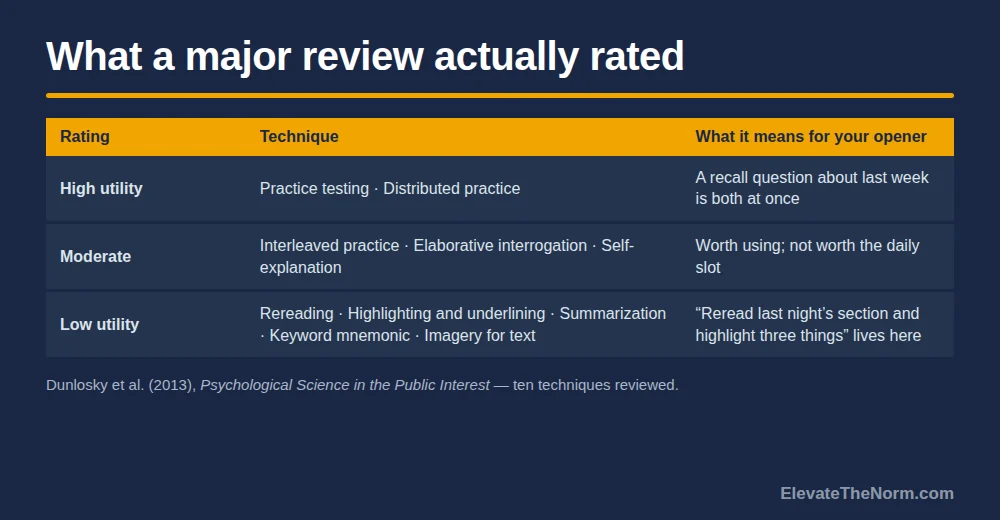
    Table of learning techniques by rating: practice testing and distributed practice rated high utility, interleaved practice elaborative interrogation and self-explanation moderate, and rereading highlighting summarization keyword mnemonic and imagery for text low
    Ten techniques reviewed. Two came out high, and highlighting was not one of them.

    Dunlosky and colleagues reviewed ten common learning techniques for Psychological Science in the Public Interest and rated exactly two as high utility: practice testing and distributed practice. Their reason is worth quoting because it is unusually plain: those two “can help students regardless of age, they can enhance learning and comprehension of a large range of materials, and, most important, they can boost student achievement.”

    What came out low utility is the part that should change what you assign: rereading, highlighting and underlining, summarization, the keyword mnemonic, and imagery for text. Highlighting in particular “has been shown to have failed to help students of all sorts.” If your bell ringer is “reread last night’s section and highlight three things,” you have spent five minutes a day, every day, on a technique that review rated at the bottom. If you want activities that work with any article, my Current Events and Media Literacy Bundle on TPT has 21 of them for grades 6–12.

    One objection worth answering before it is raised, because families will raise it: does asking students to recall something cold, every day, make school more stressful? The best evidence says the opposite, mildly. A meta-analytic review of 24 studies and 3,374 participants found practice tests reduced test anxiety, with a stronger effect in real classrooms than in labs. The authors are careful, and so should we be: 28 percent of students reported no benefit, and they note that quizzes can themselves be more stressful than other activities. The design implications are straightforward. Keep it ungraded, keep the answers private, and never read a wrong answer aloud with a name attached to it.

    The classroom evidence for the good half is solid too. Agarwal, Nunes and Blunt reviewed 50 experiments with 5,374 participants conducted in real schools and classrooms rather than labs, and found that 57 percent of effect sizes showed medium or large benefits from retrieval practice, across education levels, subjects, test formats and delays. One limitation they state and I will repeat: only 6 percent of those experiments were run outside Western, educated, industrialised, rich, democratic countries.

    Worth saying for anyone above the classroom: none of this requires a purchase. The bell-ringer market is full of subscription question banks, and what the evidence supports is a question about last week written on a whiteboard. The cost of doing this well is the ninety seconds afterward, not a licence.

    A bell ringer is the easiest place in the school day to run both high-utility techniques at once. Ask a question about last week and you have practice testing. Ask about last week rather than yesterday and you have added distributed practice for free. The same mechanism is what makes a review game actually review something rather than just raise the noise level.

    Does the Routine Itself Matter?

    Yes, and the evidence for it is older and narrower than people assume. It is worth knowing both halves of that.

    Simonsen and colleagues reviewed the classroom management literature and identified twenty evidence-based practices grouped under five features, three of which describe a bell ringer almost exactly: maximize structure and predictability; post, teach, review, monitor and reinforce expectations; and actively engage students in observable ways. Their line on the last one is the whole argument for a do-now in one sentence: “If students are actively engaged in instruction, then it is difficult to engage in incompatible behaviors.” They also report that increasing students’ rate of opportunities to respond has a positive effect on both achievement and behavior.

    The honest caveat, from the same review: roughly 48 percent of the studies in their main table were published before 1987. This is a well-established literature, not a fresh one, and it is drawn from K–12 broadly rather than from secondary specifically. The practices are not in doubt. The precision of the numbers behind them is older than most of the teachers using them.

    The practical version is a routine so predictable that it does not need announcing. The question is posted before the bell. Students start without being told. You are at the door, not at the board. That predictability is the thing doing the work, which is why changing the format every week undoes it. The same logic sits under the site’s wider argument about routines that run without you narrating them.

    20 Bell Ringer Ideas for Grades 6–12

    Grouped by what they are for, and all of them work in any subject. The first two groups are the ones with evidence behind them. The third is for days when you need something else, and it is labelled honestly as such.

    Retrieval: ask about last week, not last night

    1. Three things you remember from Monday. No notes, no neighbor.
    2. Brain dump: two minutes, everything you can recall about the unit so far.
    3. One question from last week’s material that you could not answer today.
    4. What did we conclude about ___? State it in one sentence, from memory.
    5. Two vocabulary terms from two weeks ago, defined in your own words.
    6. Draw the process we studied Tuesday. Labels only, no sentences.
    7. What is the single most important thing from last unit, and why that one?
    8. Yesterday, last week, last month: one fact from each.

    Spaced practice and connection

    1. Here is a term from September. Where does it connect to what we are doing now?
    2. Two ideas from different units. What do they have in common?
    3. Correct this: a wrong statement about older material, fixed and explained.
    4. Predict: based on what we already know, what happens next?
    5. Which of these three problems is from last unit? Solve that one.
    6. Explain last week’s idea to someone who missed class. Four sentences.

    Openers that set up thinking (use sparingly — weaker evidence)

    1. One-sentence response to a short quotation connected to today’s work.
    2. Two questions you want answered before this unit ends.
    3. What would change if the opposite were true?
    4. Rank these three things by importance. Be ready to defend the order.
    5. A number on the board. What could it be measuring?
    6. One thing from this class you have used or noticed outside of school.

    The Five-Minute Rule

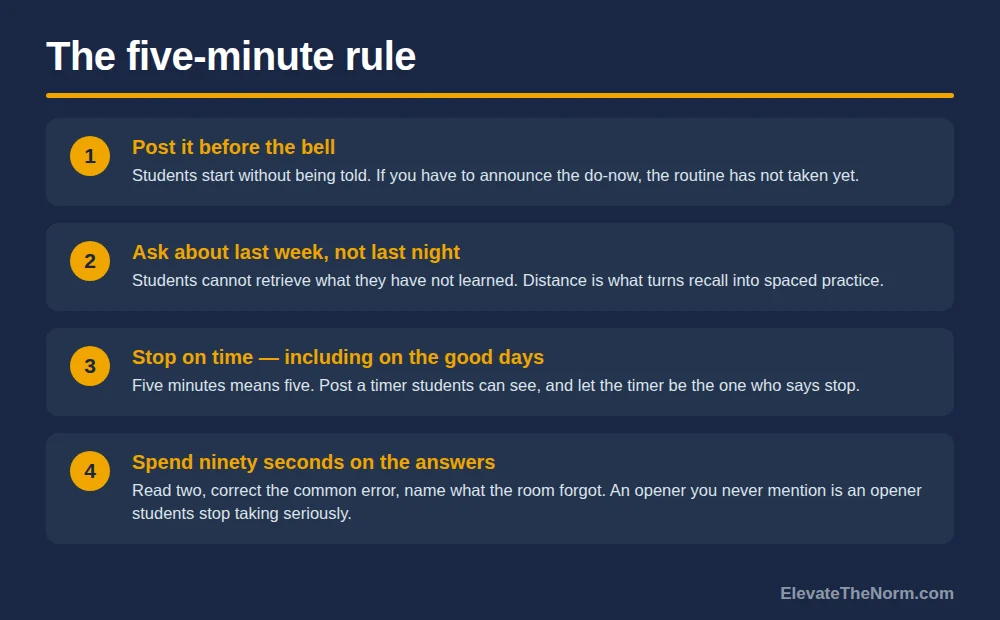
    Post it, start it without a word, stop it on time, and use the answers. Four moves, and the last two are where most openers fail.

    Numbered list of four rules for a bell ringer: post it before the bell, ask about last week rather than last night, stop on time including on good days, and spend ninety seconds on the answers
    Four moves. The last two are where most openers fail.

    Stopping on time is a discipline problem for the adult, not the students. An opener that regularly runs to twelve minutes is taking about a tenth of the instructional year from everything downstream of it. Clay’s own method for the front of a lesson is organization to the minute and then a pause — you post the plan, you stop talking, and you let the silence do the work rather than filling it. The pause is what makes the clock credible. If you announce five minutes and take twelve, the announcement stops meaning anything by October.

    Using the answers is the other half. A retrieval question you collect and never mention has taught students that the first five minutes are a formality. Spend ninety seconds on it: read two answers aloud, correct the common error, name the thing most people forgot. That is also a real formative check — the data arrived, and what you do next is the whole point of having collected it.

    One note about the room itself, because it belongs to the first five minutes. I do not turn the overhead fluorescents on; the room runs on floor lamps and a few desk lamps, warm and low. Walking out of a bright hallway into a room that is not shouting at you does more for the first two minutes than any task on the board. It is also one of the few accommodations that helps far more students than the ones who would ever have asked for it.

    How Should You Grade a Bell Ringer?

    Mostly you should not, and the reason is mechanical rather than philosophical. Retrieval practice works partly because students are willing to be wrong in it. Attach points and they will check their notes, and a retrieval question answered from notes is not retrieval.

    What to do instead: collect them, or do not, depending on whether you will look. Give credit for completion if your school requires something in the gradebook, and weight it low enough to be honest about what it is. Tell students out loud that the answers are not scored for correctness and then behave that way for two weeks, because they will not believe you on the first day and they should not.

    If you want a number from the routine, take it from a periodic ungraded check on the same material rather than from the daily opener. That gives you the signal without spending the thing that makes the signal worth having.

    Bell Ringer Mistakes That Waste the Five Minutes

    Five, and four of them are about design rather than discipline.

    1. It is about today’s lesson. Students cannot retrieve what they have not learned, so the task becomes guessing or waiting. Ask about last week.
    2. It requires materials not already on the table. Anything needing a device login, a handout at the front, or a textbook from the shelf costs more minutes than the task is worth.
    3. It changes format every day. Novelty is not the goal; predictability is. Rotate among three or four shapes so students know what a do-now is without being told.
    4. It is never referenced again. If the answers do not affect the next ninety seconds of class, students correctly conclude the routine is about keeping them busy.
    5. It punishes lateness. A do-now that a student walking in at the four-minute mark cannot join teaches them not to bother coming in. Let them start where the room is.

    A related line worth holding: a do-now is not a tardy-enforcement mechanism. Some schools use the opener as the thing a late student loses, which converts an instructional routine into a discipline consequence and guarantees that the students who most need the retrieval practice get the least of it. If lateness is a problem, handle it as a lateness problem, through whatever system your school actually uses for that.

    The fifth one matters more than it looks. The students most likely to arrive late are frequently the ones for whom the opener would do the most, and a routine designed so they always begin behind is a routine designed to lose them. The same is true of any transition built so that the slowest student is always wrong.

    Does the Subject Change the Bell Ringer?

    Less than you would think. The format transfers; the content is the only thing that changes.

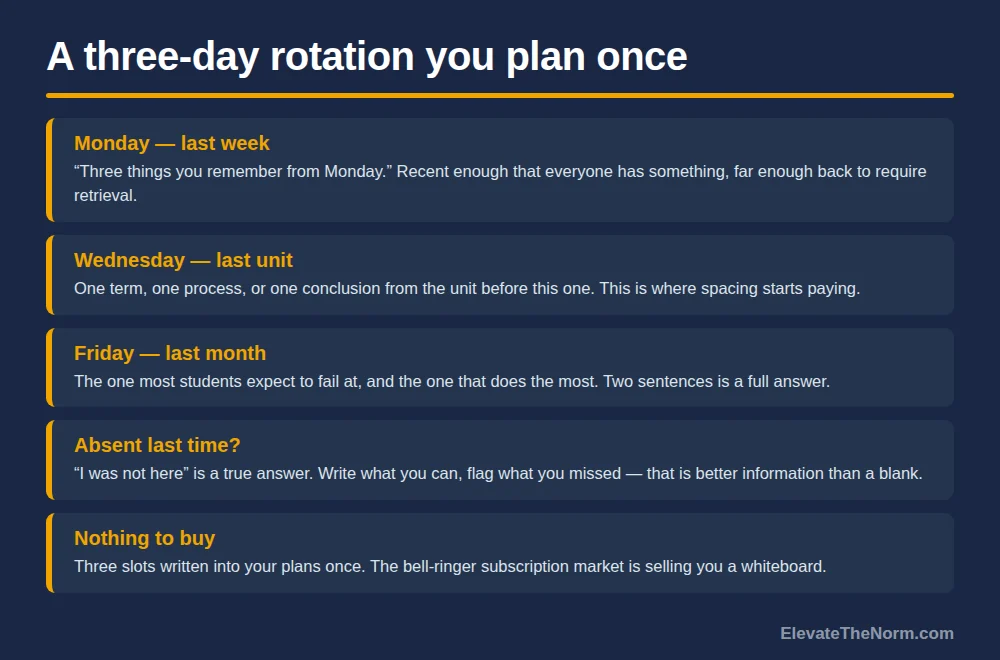
    Five rows describing a three-day bell ringer rotation: Monday asks about last week, Wednesday about the last unit, Friday about the previous month, plus how to handle an absent student and a note that nothing needs to be purchased
    Write the three slots into your plans once and you never invent a do-now again.

    “Three things you remember from Monday” works identically in algebra, biology, English and social studies, because the cognitive move — pull it from memory without notes — is the same regardless of what is being pulled. The subject-specific bell ringer lists you find online are mostly the same six formats with different nouns.

    The question most teachers get stuck on is not the format but the content: what do I ask about today? A three-day rotation solves it and takes no planning. Monday, something from last week. Wednesday, something from the previous unit. Friday, something from the month before. Write the three slots into your plans once and you never have to invent a do-now again.

    And decide in advance what a student who was absent does. “I was not here” is a true answer to a retrieval question and it should not be a problem — let them write what they can and flag what they missed, which is more useful information for you than a blank. Attendance is usually being taken during these five minutes anyway; you will know.

    Two real differences worth naming. In a math or science class, a retrieval opener can be a single problem from an older unit, which doubles as spaced practice on a procedure. In English and social studies, retrieval is usually verbal or written recall, and the trap is that a question about an interpretation is not retrieval — it is discussion, which is a good thing that takes longer than five minutes. If you want the discussion, schedule it as one.

    What to Do Next

    Pick three formats from the first group above and rotate them. Write Monday’s on the board before you leave on Friday, so the routine does not depend on you remembering in the morning. Set a timer where students can see it. Spend ninety seconds afterward on what the answers showed you, out loud.

    Then check one thing after two weeks: are students starting without being told? That is the only measure of whether the routine has taken. If they are still waiting for you to say go, the problem is predictability, not motivation — and the fix is to change the format less often, not more.

    Before you go: grab the free 20 Bell Ringer Ideas and the Five-Minute Planner (PDF) — ElevateTheNorm.com branded, printable, no email required.

    Frequently Asked Questions

    What is a bell ringer in a classroom?

    A short independent task students begin the moment they sit down, before the lesson formally starts. Do-now, warm-up, entry task and starter all mean the same thing. The name does not matter; what matters is whether the task asks students to retrieve something from memory or just keeps them occupied while you take attendance.

    How long should a bell ringer take?

    Five minutes, and it should actually be five. An opener that habitually runs to twelve is taking roughly a tenth of your instructional year from everything downstream. Post a visible timer, and stop the task when the timer does — including on the days when the answers are interesting.

    What makes a good do-now activity?

    It asks students to pull something from memory that they learned days or weeks ago, without notes. That one design rule gets you practice testing and distributed practice at the same time, the two techniques a major review rated as high utility out of ten. It should also need nothing that is not already on the table.

    Should bell ringers be about today’s lesson?

    No, and this is the most common mistake. Students cannot retrieve material they have not learned yet, so a do-now about today’s content becomes guessing, copying or waiting. Ask about last week, last unit or last month. The distance is the point — spacing is what makes the retrieval stick.

    Should you grade bell ringers?

    Not for correctness. Retrieval practice works partly because students are willing to be wrong in it, and attaching points is how you get twenty-eight students checking their notes instead of retrieving. If something has to go in the gradebook, give completion credit, weight it low, and say out loud that the answers are not scored for accuracy.

    Are bell ringers actually backed by research?

    The retrieval half is, strongly. A review of 50 classroom experiments with 5,374 participants found 57 percent of effect sizes showed medium or large benefits. The routine half rests on classroom-management research that identifies structure, predictability and opportunities to respond as evidence-based — though about half of the studies in that review predate 1987, which is worth knowing before quoting it as new.

    What are good bell ringer ideas for high school versus middle school?

    Largely the same ones. The cognitive move — recall it without notes — does not change between seventh and twelfth grade; the content and the expected length of the answer do. A seventh grader might list three things from Monday in phrases; a senior should be writing a defensible sentence. Do not change the format by grade, change the standard you hold the answer to.

    Does a daily recall task stress students out?

    A meta-analytic review of 24 studies and 3,374 participants found that practice tests reduced test anxiety rather than increasing it, with a stronger effect in real classrooms than in laboratories. The authors are careful about it, and so should you be: 28 percent of students reported no benefit, and quizzes can be more stressful than other activities. The design that keeps it safe is the same one that makes it work — ungraded, answers private, and no wrong answer read aloud with a name on it.

    Sources

    1. Dunlosky, John, Katherine A. Rawson, Elizabeth J. Marsh, Mitchell J. Nathan, and Daniel T. Willingham. “Improving Students’ Learning With Effective Learning Techniques: Promising Directions From Cognitive and Educational Psychology.” Psychological Science in the Public Interest, vol. 14, no. 1, 2013, pp. 4–58. Ten techniques reviewed; practice testing and distributed practice rated high utility; interleaved practice, elaborative interrogation and self-explanation moderate; rereading, highlighting/underlining, summarization, keyword mnemonic and imagery for text low. https://www.aft.org/ae/fall2013/dunlosky
    2. Agarwal, Pooja K., Ludmila D. Nunes, and Janell R. Blunt. “Retrieval Practice Consistently Benefits Student Learning: A Systematic Review of Applied Research in Schools and Classrooms.” Educational Psychology Review, vol. 33, no. 4, Dec. 2021. 50 experiments, 5,374 participants, 49 effect sizes, 57 percent showing medium or large benefits. Limitation stated by the authors: only 6 percent of experiments were conducted outside WEIRD countries. https://eric.ed.gov/?id=EJ1319572
    3. Simonsen, Brandi, Sarah Fairbanks, Amy Briesch, Diane Myers, and George Sugai. “Evidence-Based Practices in Classroom Management: Considerations for Research to Practice.” Education and Treatment of Children, vol. 31, no. 3, 2008, pp. 351–380. Twenty evidence-based practices across five features; increasing opportunities to respond improves both achievement and behavior. Roughly 48 percent of the studies tabulated predate 1987, and the review covers K–12 broadly rather than secondary specifically. https://dropoutprevention.org/wp-content/uploads/2015/05/Simonsen_Fairbanks_Briesch_Myers_Sugai_2008.pdf
    4. Yang, Chunliang, et al. “Do Practice Tests Reduce or Provoke Test Anxiety? A Meta-Analytic Review.” Accepted manuscript, UCL Discovery repository, 2023. 24 studies, 25 effects, 3,374 participants; practice tests reduced test anxiety, Hedges’ g = −0.52 (95% CI [−0.69, −0.36]), and g = −0.55 in classroom settings specifically. The authors note 28 percent of students reported no benefit, and that quizzes themselves may be more stressful than other learning activities. https://discovery.ucl.ac.uk/id/eprint/10177686/

    About Clay Shumate

    Clay Shumate is a certified secondary Social Studies teacher in the public schools of West Alabama, with seven years of classroom experience, a B.A. in History, and an M.Ed. in Secondary Education. He writes about project-based learning, student responsibility, respect, and practical ways to hold young people to a higher standard while giving them room to learn from mistakes. He is a member of the Society of Professional Journalists and writes to its Code of Ethics; this site’s editorial standards and corrections policy are published in full. More about Clay.

  • Socratic Seminar Rubric: A Four-Criterion Version for Grades 6–12

    Socratic Seminar Rubric: A Four-Criterion Version for Grades 6–12

    By Clay Shumate

    A Socratic seminar rubric should score four things: preparation, use of the text, how a student treats other people’s ideas, and what they wrote afterward. It should not score how many times somebody spoke. The full rubric is below, free, on this page, with no email to give — and a printable version at the bottom if you want one.

    It comes with an argument, because a rubric that counts talking turns is worse than no rubric at all — and because the research on rubrics is more qualified than the phrase “research-based rubric” suggests.

    Key Takeaways

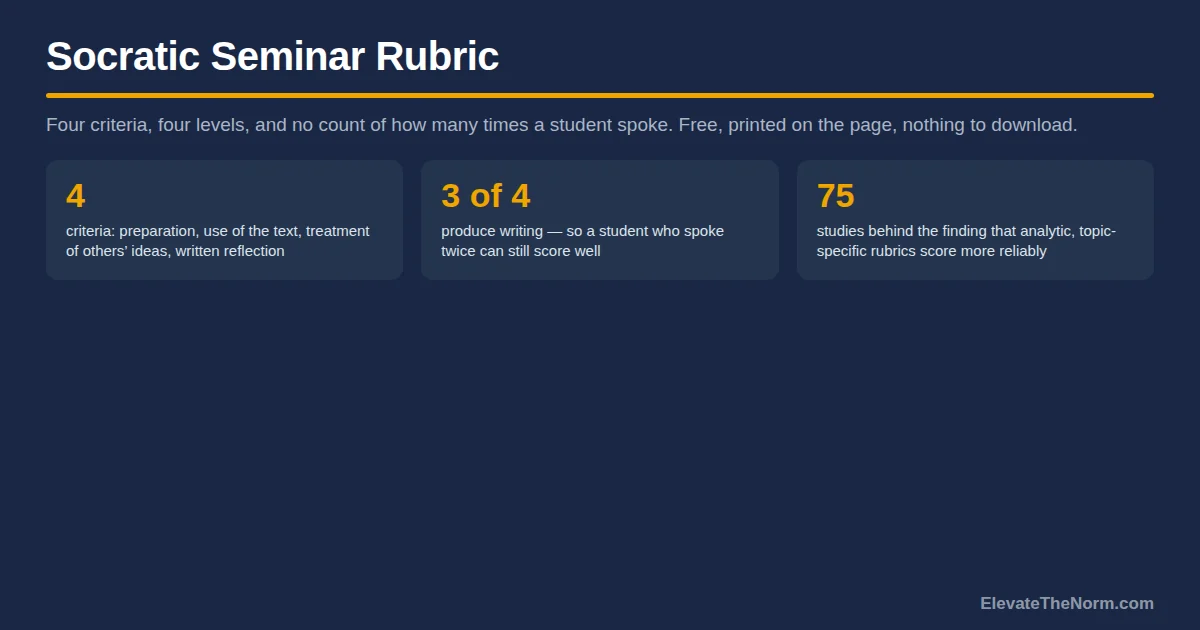
    • Four criteria, four levels, and none of them is participation frequency. Counting comments rewards volume and punishes the students who most need the practice.
    • Most of the score comes from writing, not talking. Preparation before and reflection after are visible, gradeable, and fair to a student who spoke twice.
    • Analytic beats holistic on reliability. A review of 75 studies found scoring agreement improves with analytic, topic-specific rubrics plus exemplars or rater training.
    • Rubrics are not automatically valid. The same review is explicit that a rubric improves agreement between scorers without guaranteeing you are measuring the right thing.
    • You cannot facilitate and score thirty students at once. Anyone who says otherwise is describing a checklist, not an assessment.

    Free Download · PDF

    Socratic Seminar Rubric (Four Criteria)

    The same four-criterion rubric printed above, laid out to print and cut, plus the scoring rotation for thirty students and a student self-score half-sheet.

    Download the free PDF

    Free. No email address required. Designed for grades 6–12. Browse every printable in Your Free Library.

    What Should a Socratic Seminar Rubric Measure?

    The things a student controls, that leave evidence, and that you would still care about if the student were quiet. That test eliminates most of what standard seminar rubrics score.

    Four criteria survive it.

    1. Preparation. Did they read it, mark it, and bring a written question? This is visible before anyone speaks and it is the single best predictor of whether the seminar works.
    2. Use of the text. When they did speak or write, did they point at a specific place in the text, or at a general impression?
    3. Treatment of other people’s ideas. Did they build on, question, or directly respond to a classmate — or deliver a prepared statement into the middle of the circle and stop?
    4. Reflection afterward. Can they name what changed in their thinking and whose comment did it? This one is only answerable by a student who was listening, which is why it is the hardest to fake.

    If your gradebook is standards-based, those four map cleanly onto speaking-and-listening standards without inventing a category: preparation and use of the text are evidence standards, treatment of others’ ideas is a collaborative-discussion standard, and the reflection is usually assessable under both. You do not need a “participation” line item, and if the gradebook has one, these are what should feed it.

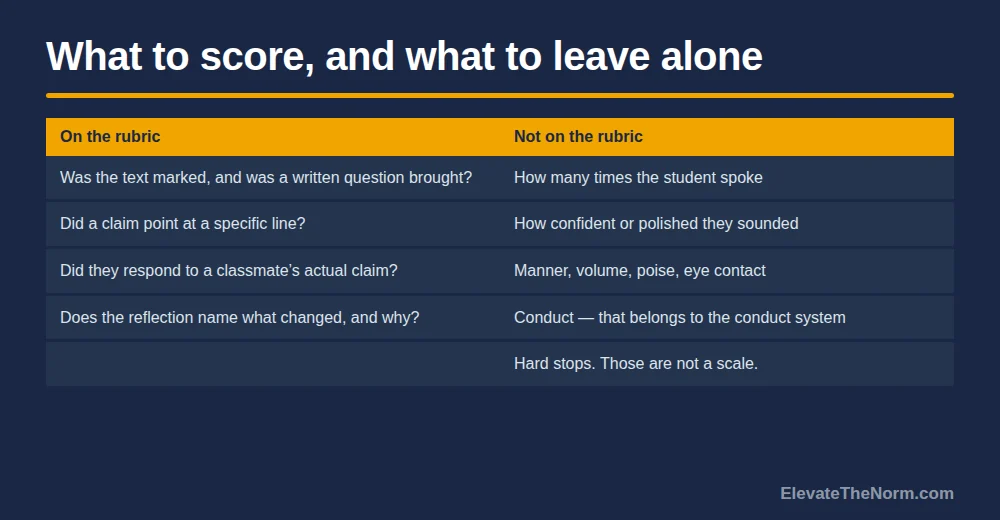
    One caution on the third criterion, and it is the one I would want a department to talk through before adopting any seminar rubric. Norms about interrupting, turn length, directness and how openly you disagree are not universal — they vary by family, by community, and by what a student has been taught is respectful. A rubric that scores “treatment of others’ ideas” can quietly encode one conversational style as the correct one. Keep the descriptors pointed at what the student did with the idea — responded to it, questioned it, built on it — and away from manner, volume and poise. If a descriptor could be satisfied by a confident student who said nothing of substance, it is scoring style.

    Three of those four produce writing. That is deliberate. A rubric whose evidence is mostly written is a rubric you can actually apply after the period ends, and it is a rubric a student who said very little can still score well on.

    The Socratic Seminar Rubric

    Four criteria, four levels, no participation count. Copy it, cut it, change the language to match your school’s scale. It is free, it is printed in full right here, and there is a printable version at the bottom of this page.

    One framing worth saying to students before you hand it over: the level-one column describes something that happened on one day, not a kind of person. A student who arrived without the text marked is a student who arrived without the text marked. If a descriptor reads to a fourteen-year-old like a verdict on their character, rewrite it — that costs nothing and it changes whether they look at the rubric again.

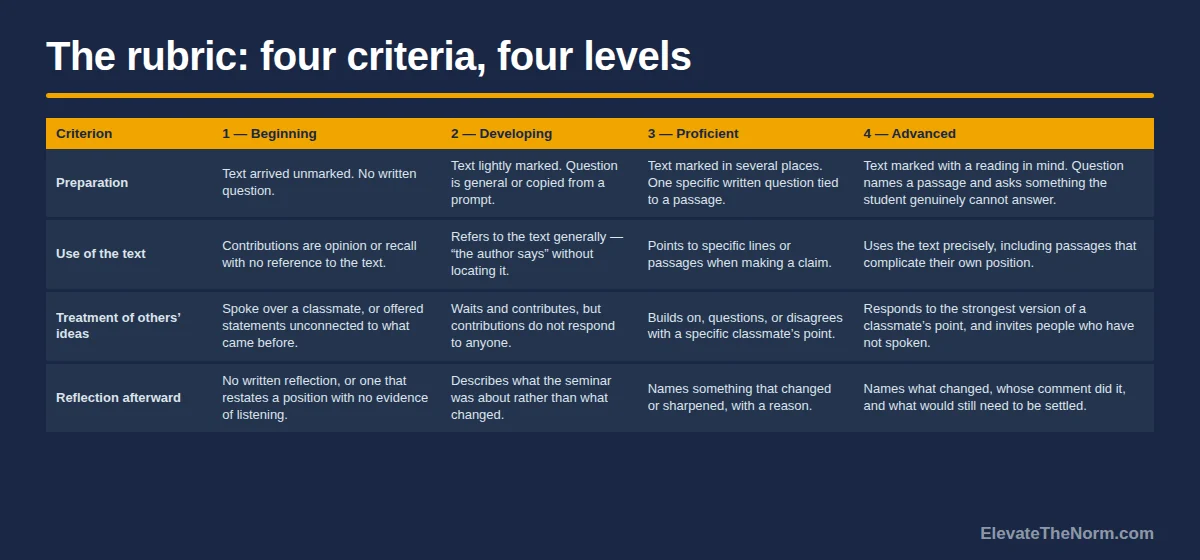
    Four by four Socratic seminar rubric table with criteria for preparation, use of the text, treatment of others' ideas and reflection afterward, each described at beginning, developing, proficient and advanced levels
    The full rubric. The same table is written out below so you can copy it.
    Criterion1 — Beginning2 — Developing3 — Proficient4 — Advanced
    PreparationText arrived unmarked. No written question.Text lightly marked. Question is general or copied from a prompt.Text marked in several places. One specific written question tied to a passage.Text marked with a reading in mind. Question names a passage and asks something the student genuinely cannot answer.
    Use of the textContributions are opinion or recall with no reference to the text.Refers to the text generally — “the author says” without locating it.Points to specific lines or passages when making a claim.Uses the text precisely, including passages that complicate their own position.
    Treatment of others’ ideasSpoke over a classmate, or offered statements unconnected to what came before.Waits and contributes, but contributions do not respond to anyone.Builds on, questions, or disagrees with a specific classmate’s point.Responds to the strongest version of a classmate’s point, and invites people who have not spoken.
    Reflection afterwardNo written reflection, or one that restates a position with no evidence of listening.Describes what the seminar was about rather than what changed.Names something that changed or sharpened, with a reason.Names what changed, whose comment did it, and what would still need to be settled.
    Free to copy, cut and rewrite. No email address. A printable version is linked below.

    Why This Rubric Does Not Count How Often You Spoke

    Because a participation count measures confidence and rewards it, and confidence is not the skill you are teaching. The moment students know comments are scored, you get performances of the right length at the right frequency, and the conversation stops being about the text.

    Two column table contrasting what belongs on a Socratic seminar rubric with what does not, including how many times a student spoke, manner and poise, and conduct
    If a descriptor could be met by a confident student who said nothing of substance, it is scoring style.

    There is a second reason, and it is about who pays. A qualitative study of quiet students — ten undergraduates, so treat it as a description rather than a finding about your seventh period — found that nine of the ten struggled with instructor expectations for verbal participation, and six reported physical reactions when speaking aloud: trembling, blushing, stuttering. One described planning out what they wanted to say before speaking. A frequency count charges those students a fee the loud ones never pay, for a behavior that is not the learning objective.

    Related, and worth checking against your district’s grading policy: criterion three has to stay academic. “Responded to a classmate’s specific claim” is an academic behavior. “Was respectful” is conduct, and in a lot of districts conduct is not permitted inside an academic grade — for good reason. If a student’s behavior in a seminar is a problem, that is the conduct system’s job, handled the way you would handle it on any other day, and not something you fold into a score for a speaking standard.

    This also gives you a clean answer when a parent asks. A quiet student can earn full marks here, because three of the four criteria are about preparation, precision and listening, and none of them requires their child to perform in front of the class. Say that in the same sentence you send the rubric home, before anyone has to ask.

    If your school requires a participation grade, pull it from criteria one and four — both of which are written, both of which are about preparation and listening, and neither of which requires a student to perform. Then say out loud to the class that talking is not scored. The first seminar after they believe you is a different conversation.

    One thing that belongs nowhere on a rubric: the behaviors that are not a continuum. In my room, making fun of how unusual somebody’s name is is a hard stop — not a criterion where a student can earn a 2. A rubric is for things that improve by degrees. Hard stops are a different category, and putting them on a scoring scale quietly suggests there is an acceptable amount.

    Do Rubrics Actually Help?

    They reliably help scoring agreement. Their effect on learning is real, mixed, and badly confounded — and the honest version is more useful than the sales version.

    Jonsson and Svingby reviewed 75 empirical studies on rubrics. Their finding on reliability is clear: scoring “can be enhanced by the use of rubrics, especially if they are analytic, topic-specific, and complemented with exemplars and/or rater training.” Their finding on validity is the one people skip — rubrics do not by themselves make an assessment judgement valid. Two teachers agreeing on a score is not the same as the score measuring the thing you care about.

    Panadero and Jonsson then reviewed 21 studies on using rubrics formatively. Some reported large effects on performance — effect sizes from 0.99 to 1.6 — and others reported little or nothing. The authors are direct about why that range is not as impressive as it looks: “most studies reporting on such improvements have combined the use of rubrics with other instructional interventions.” The rubric usually arrived alongside self-assessment, peer assessment or extended instruction, so the rubric’s own contribution is hard to isolate. They also note that positive effects were more likely in higher education, in interventions lasting several weeks or longer, and when rubrics were paired with metacognitive work.

    What they identify as the mechanism is worth keeping, because it tells you how to use the thing: rubrics work by making expectations transparent, which reduces anxiety, supports feedback, and lets students plan. Students in those studies described using a rubric “much like a recipe or a map.”

    The practical conclusion: hand the rubric out before the seminar, not after. A rubric used as a scoring instrument is a grading tool. A rubric used as a description of what good looks like, given to students in advance, is the version with evidence behind it.

    Analytic or Holistic?

    Analytic, if you want two teachers to agree. That is the clearest single recommendation in the rubric literature, and the rubric above follows it — four separate criteria scored separately rather than one overall impression.

    Jonsson and Svingby list four things that improve scoring agreement, and it is worth reading them as a to-do list rather than a finding: analytic design, topic-specific criteria, exemplars, and rater training. The first two are free and you did them by choosing this rubric. The third costs one seminar — keep two reflections, one strong and one thin, and show students both. Anonymised means actually anonymised — names and identifying details stripped, and the student asked first. A class can usually recognise its own handwriting and its own arguments, and “this is the weak one” is not a thing to do to a student by accident. The fourth matters only if more than one adult is scoring.

    “Topic-specific” is the one worth acting on. A rubric that says “uses evidence effectively” is generic and every scorer fills in their own meaning. Rewriting that row to name what evidence looks like in this text — a line number, a date, a specific claim — takes two minutes and does more for consistency than any amount of descriptor polishing. The same principle runs through the site’s approach to rubrics generally: specific beats elegant.

    How Do You Score Thirty Students in One Period?

    You do not, and the sooner you stop trying the better your seminars get. Facilitating and scoring are two jobs. Doing both means doing the first one badly, and the first one is the one that makes the seminar work.

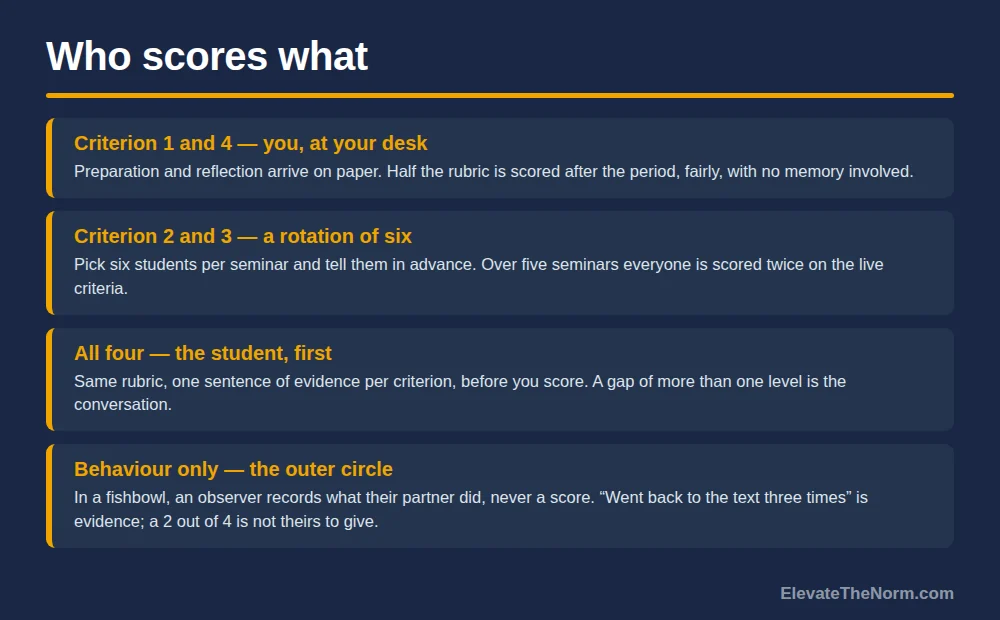
    Four rows describing who scores which rubric criteria: the teacher scores preparation and reflection from paper, a rotating group of six is scored on the live criteria, students self-score first, and outer-circle observers record behaviour only
    Facilitating and scoring are two jobs.

    Three ways out, in order of how much I trust them.

    1. Score the writing, not the room. Criteria one and four are collected on paper. That is half the rubric done at your desk, after school, fairly, with no memory involved.
    2. Score a rotation. Pick six students per seminar for criteria two and three and tell them in advance. Over five seminars everyone gets scored twice on the live criteria. Telling them beforehand is not cheating — it is the transparency the research says is doing the work.
    3. Use the fishbowl. If half the class is in an outer circle already, give each observer one partner and one behavioral thing to record. Their notes are not the grade, but they are evidence you did not have to generate while running the conversation.

    Check one thing before you adopt any of this: if a student has an IEP or 504 plan that addresses oral participation, the live criteria may need to be replaced rather than adapted for that student. Ask the case manager rather than improvising a workaround, and note that this rubric already makes that easy — half the score is written, so substituting the other half costs you less than it would on most discussion rubrics.

    On time, honestly: four criteria for twenty-eight students is about twenty minutes if you are scoring the written half from paper and six students on the live half. It is not nothing. It is roughly the cost of grading a set of exit tickets, and it is the reason the rotation exists.

    What I would not do is score from memory at the end of the period. Twenty minutes after a good seminar, what you remember is who was interesting, and “interesting” correlates with confident far more than it correlates with prepared.

    Who Should Do the Scoring?

    Students first, on the same rubric, before you score anything. This is the change that makes the rubric an instructional tool rather than a grading one, and it costs four minutes.

    Hand out the rubric before the seminar. Afterward, have each student score themselves on all four criteria and write one sentence of evidence for each. Then score them yourself. Where you disagree by more than one level, that is your conversation — and it is a better conversation than any comment you would have written unprompted.

    Two guards on this. The student’s self-score is not the grade; it is information, and the moment it becomes the grade you have taught them to inflate it. And peer scoring should stay behavioral: what a classmate did, not how well they did it. A fifteen-year-old can honestly record “went back to the text three times.” A fifteen-year-old should not be handing another fifteen-year-old a 2 out of 4 on how they treat people’s ideas. This is the same line the site draws around having students judge their own work: the judgement is real, and it does not become the record.

    What to Do With the Score

    Use it to decide what to teach next, and put as little of it in the gradebook as your school allows. A seminar rubric’s best use is diagnostic.

    Look down the columns rather than across the rows. If twenty of twenty-eight students scored low on use of the text, that is not twenty-eight individual grades — that is one lesson about citing a line, and you should teach it before the next seminar instead of recording twenty low scores. If preparation is the weak column, the problem is upstream of the seminar entirely and no amount of facilitation will fix it.

    If the scores do go in the gradebook, weight them low and tell students the weight. A seminar is a practice format. Grading practice heavily is how you get students who will not risk a wrong reading out loud, which is the one behavior the whole format exists to produce.

    What to Do Next

    Take the rubric above, rewrite the use of the text row so it names what evidence looks like in the specific text you are teaching, and hand it to students the day before — not the day after. Score criteria one and four from the paper they turn in. Pick six students for the live criteria and tell them who they are.

    Then run it twice before you judge either the rubric or your class. If you need the rest of the format, it is in the guide to running a Socratic seminar, and the questions that make one worth scoring are in the seminar question bank.

    Before you go: grab the free Socratic Seminar Rubric (Four Criteria) (PDF) — ElevateTheNorm.com branded, printable, no email required.

    Frequently Asked Questions

    What should a Socratic seminar rubric include?

    Four criteria: preparation, use of the text, treatment of other people’s ideas, and written reflection afterward. Three of the four produce writing, which means you can score them after the period rather than while facilitating, and a student who spoke twice can still score well. What it should not include is a count of how many times a student spoke.

    Should you grade a Socratic seminar at all?

    Grade the preparation and the reflection, and weight the whole thing lightly. A seminar is a practice format, and grading practice heavily produces students who will not risk a wrong reading out loud — which is the behavior the format exists to create. If a participation grade is required, take it from the written criteria and say plainly that speaking is not scored.

    Why shouldn’t a rubric count how many times a student speaks?

    Because it measures confidence and charges a fee to students who find speaking aloud genuinely hard. A study of quiet students found most struggled with verbal participation expectations and several reported physical symptoms — trembling, blushing, stuttering — when speaking in class. Frequency is also easy to game: three short comments at the right moments will beat one student who prepared thoroughly and spoke once.

    Is an analytic or holistic rubric better for a seminar?

    Analytic, if you want consistency. A review of 75 rubric studies found scoring reliability improves when rubrics are analytic and topic-specific and are paired with exemplars or rater training. Holistic rubrics are faster and less consistent, and with something as fuzzy as discussion quality, consistency is exactly what you are short of.

    Do rubrics actually improve student learning?

    The evidence is genuinely mixed. A review of 21 studies of formative rubric use found effects ranging from very large to nothing, and noted that most studies combined rubrics with other interventions, so the rubric’s own contribution is hard to isolate. What the authors identify as the mechanism is transparency — which means handing the rubric out before the seminar rather than attaching it to the grade afterward.

    How do you score thirty students during one seminar?

    You do not. Facilitating and scoring are two jobs, and doing both means doing the facilitation badly. Score the two written criteria from paper afterward, and score the two live criteria for a rotating group of about six students per seminar, told in advance. Over five seminars everyone gets scored twice on the live criteria.

    Should students score themselves on the seminar rubric?

    Yes, before you score them, using the same rubric with one sentence of evidence per criterion. Where your score and theirs differ by more than one level, that gap is the conversation worth having. Keep the self-score as information rather than as the grade — the moment it becomes the grade, students learn to inflate it.

    Is this Socratic seminar rubric free to use?

    Yes. It is printed in full on this page and there is a free printable version too, with no email address to hand over, and you are welcome to copy it, cut criteria, or rewrite the language to match your school’s scale. Rewriting the use-of-the-text row so it names what evidence looks like in your specific text is the single change that will do the most for consistency.

    Sources

    1. Jonsson, Anders, and Gunilla Svingby. “The Use of Scoring Rubrics: Reliability, Validity and Educational Consequences.” Educational Research Review, vol. 2, no. 2, 2007, pp. 130–144. Review of 75 empirical studies; reliable scoring “can be enhanced by the use of rubrics, especially if they are analytic, topic-specific, and complemented with exemplars and/or rater training”; rubrics do not by themselves guarantee valid judgements. https://eric.ed.gov/?id=EJ796733
    2. Panadero, Ernesto, and Anders Jonsson. “The Use of Scoring Rubrics for Formative Assessment Purposes Revisited: A Review.” Educational Research Review, vol. 9, 2013, pp. 129–144. 21 studies; effects on performance ranged from large (0.99–1.6) to negligible, and “most studies reporting on such improvements have combined the use of rubrics with other instructional interventions.” Positive effects more likely in higher education, over longer interventions, and when paired with metacognitive activity. https://platform.europeanmoocs.eu/users/4567/Les3/Panadero-Jonsson-rubrics-3.pdf
    3. Murphy, P. Karen, et al. “Examining the Effects of Classroom Discussion on Students’ Comprehension of Text: A Meta-Analysis.” Journal of Educational Psychology, vol. 101, no. 3, 2009, pp. 740–764. Discussion produced strong increases in student talk and substantial gains in text comprehension, but “few approaches to discussion were effective at increasing students’ literal or inferential comprehension and critical thinking and reasoning.” https://eric.ed.gov/?id=EJ861185
    4. Applebee, Arthur N., Judith A. Langer, Martin Nystrand, and Adam Gamoran. “Discussion-Based Approaches to Developing Understanding: Classroom Instruction and Student Performance in Middle and High School English.” American Educational Research Journal, vol. 40, no. 3, 2003, pp. 685–730. 64 middle and high school English classrooms, grades 7, 8, 10, 11 and 12. https://eric.ed.gov/?id=EJ782328
    5. Medaille, Ann, and Janet Usinger. “Quiet Students’ Experiences with the Physical, Pedagogical, and Psychosocial Aspects of the Classroom Environment.” Educational Research: Theory and Practice, vol. 31, no. 2, 2020, pp. 41–55. Ten upper-division undergraduates — not secondary students; nine of ten struggled with verbal participation expectations and six reported physical symptoms when speaking aloud. https://files.eric.ed.gov/fulltext/EJ1274336.pdf

    About Clay Shumate

    Clay Shumate is a certified secondary Social Studies teacher in the public schools of West Alabama, with seven years of classroom experience, a B.A. in History, and an M.Ed. in Secondary Education. He writes about project-based learning, student responsibility, respect, and practical ways to hold young people to a higher standard while giving them room to learn from mistakes. He is a member of the Society of Professional Journalists and writes to its Code of Ethics; this site’s editorial standards and corrections policy are published in full. More about Clay.

  • Sub Plans for Middle and High School: What to Leave So the Day Actually Runs

    Sub Plans for Middle and High School: What to Leave So the Day Actually Runs

    Sub plans are the instructions you leave so someone else can run your class for a day. Good ones do three jobs: they keep students safe, they keep students doing real work, and they tell a stranger what normal looks like in a room they have never seen. Most sub plans only try to do the second job, and that is why most sub days go sideways.

    This guide covers what to put in sub plans for grades 6–12, how to write the day so a substitute can actually follow it, the difference between emergency sub plans and the ones you write for a planned absence, and what to do about the days no substitute shows up at all. If you want the other side of the door — what the person walking in can and cannot control — that is in the guide to running a room that isn’t yours.

    Key Takeaways

    • Sub plans are written for a stranger, not for you. Anything that only makes sense if you know the room has to be spelled out.
    • Write the day in minutes. Start and stop times for each task turn a vague plan into one a substitute can enforce.
    • Emergency sub plans are a different document. They stand alone, they are built at the start of the year, and anyone in the building can run them.
    • Report the absence early. In one large district’s data, substitute coverage rose sharply for every hour a job was posted ahead of time through the first day.
    • Plan for no sub at all. When an absence goes uncovered, students are often split into other rooms or a colleague gives up a planning period. The plan has to work for them too.
    • Make the work count. Students can tell a holding pattern from a real assignment, and they act accordingly.

    What Should Sub Plans Include?

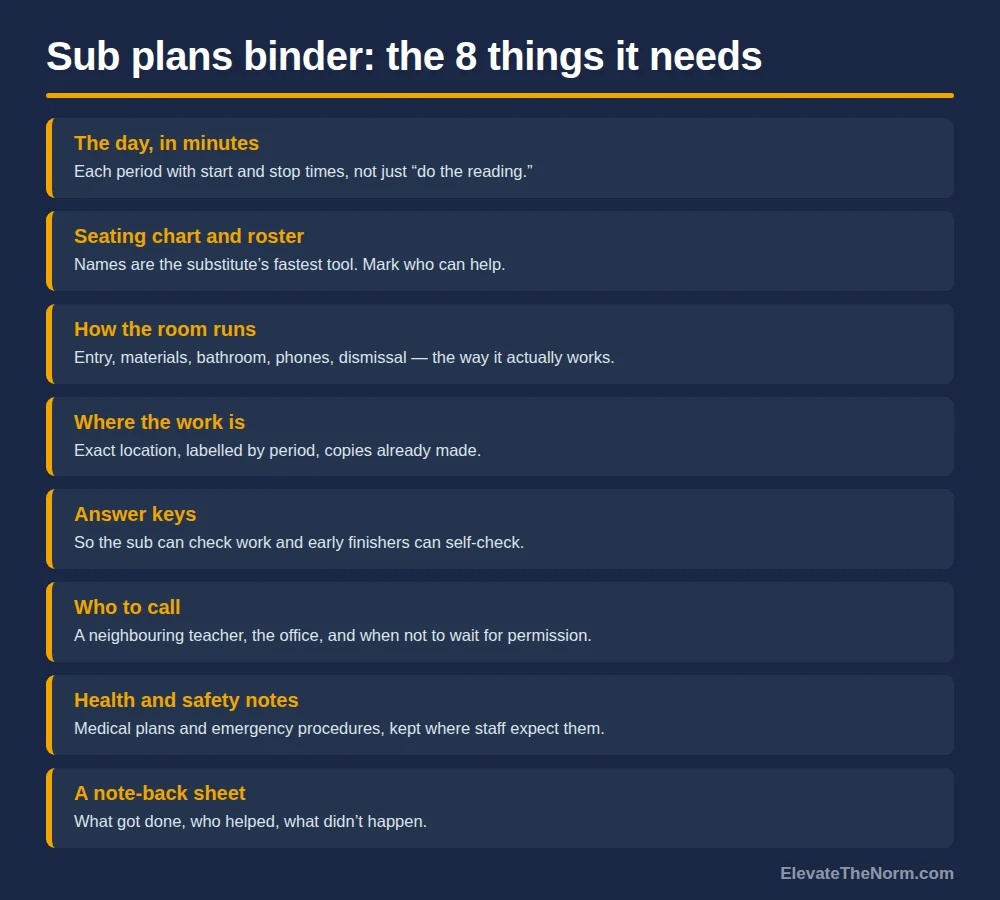
    Sub plans should include the schedule written in minutes, a seating chart and roster, how the room normally runs, the exact location of every copy, answer keys, the names of people to call, the health and safety information your school requires you to share, and a sheet for the substitute to write back on. That is the binder. The lesson is only one part of it.

    Checklist of eight items for a sub plans binder: the day in minutes, seating chart and roster, how the room runs, where the work is, answer keys, who to call, health and safety notes, and a note-back sheet
    The lesson is one part of the binder. The other seven are what a stranger needs at 7:40 a.m.

    Think about what a substitute actually needs at 7:40 in the morning. Not your philosophy of teaching. They need to know where the copies are, what happens when the bell rings, and who to send for when something goes wrong. A plan that says “students will continue their reading” tells them nothing about any of that.

    The day, in minutes

    Each period gets a start time and a stop time for every task. “8:05–8:15: bell work on the board. 8:15–8:40: reading and questions 1–6. 8:40–8:50: turn in to the tray by the door.” Times give the substitute something to point at. A posted time is easier to hold students to than an adult’s opinion about when they should be done.

    Seating chart and roster

    A substitute who can use names is in a different room than one who can’t. Keep the seating chart current and mark two or three students per class who can answer a question about where things are. Pick them for reliability, not for being your favorites. A seating chart built for the room you actually have does double duty here.

    How the room runs

    Entry, materials, phones, restroom passes, dismissal. Write down how these work in your room, not how they work in the handbook. If students pick up their own folders at the door, say so. If phones go in a pocket chart, say where it is. Most of what a substitute reads as students “getting away with something” is students following a routine nobody told the sub about. Your routines and procedures are the thing being handed over.

    Where the work is, and the keys

    Copies made, labeled by period, in one place, named in the plan. Answer keys in the same folder. Keys let the substitute check work and let students who finish early check their own, which keeps the last fifteen minutes from turning into the loudest fifteen minutes of the day.

    Who to call, and the private information

    Name the teacher next door and the number for the office. Say plainly that if something is unsafe, the substitute does not need anyone’s permission to call for help. Health plans and emergency procedures belong in the binder only in the form your school requires. Do not leave copies of individual student plans loose on a desk; follow your building’s procedure for what a substitute is given and where it is kept.

    Write Sub Plans to the Minute

    My own rule for running a room is short: “Taking control of a classroom is done by organization to the minute and then you pause. Be confident.” The posted times are the setup. The pause is the enforcement. You lay out the plan, stop talking, and let the silence do its job.

    A substitute cannot borrow your confidence, and they do not have your history with the class. What they can borrow is your organization. If the plan is written to the minute, the substitute does not have to invent authority. They read the time, point at the board, and wait. The plan carries the weight a stranger’s voice cannot.

    That is also why vague plans fail even with a strong substitute. “Work on the project” leaves the adult in the room arguing about what counts as working. “Draft paragraph two, due in the tray at 9:20” does not. If you have never written the room down this way, a written classroom management plan is the document to start from.

    Emergency Sub Plans vs. Planned-Absence Sub Plans

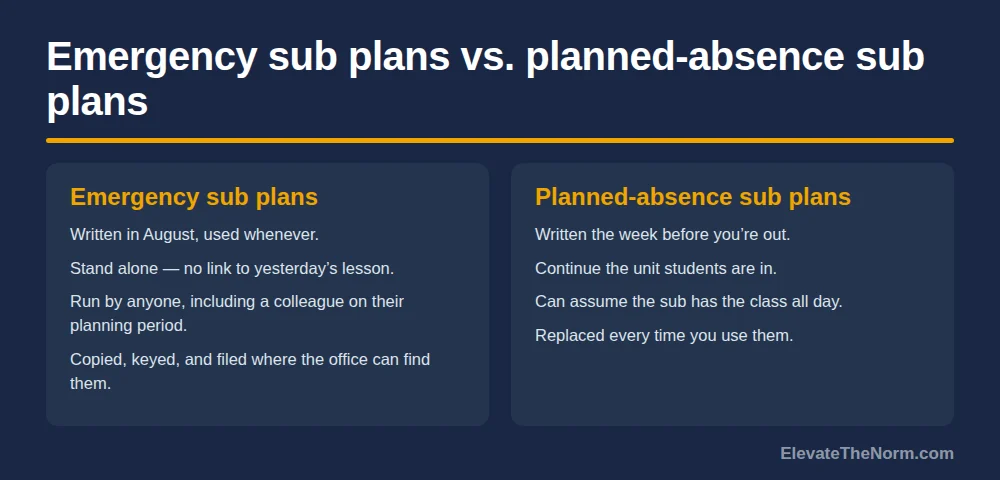
    Emergency sub plans are the ones you build before you need them. They stand alone, they do not depend on yesterday’s lesson, and anyone in the building can run them cold. Planned-absence sub plans are written the week you know you’ll be out and continue the unit students are already in.

    Two-column comparison: emergency sub plans are written in advance, stand alone, can be run by anyone and are filed where the office can find them; planned-absence sub plans are written the week before, continue the current unit, and are replaced each time
    Emergency sub plans are the ones you can’t write when you need them.

    The emergency folder is the one that matters most, because it is the one you can’t write when you need it. You wake up sick at 5:30. Your kid has a fever. There is a family emergency two hours away. Nobody is writing a lesson plan in those moments, and nobody should have to.

    Three rules make emergency sub plans work:

    • Standalone. No reference to “where we left off.” The work makes sense on any day of the year.
    • Keyed and copied. A full class set for each day, with an answer key, already in the folder.
    • Findable. The office knows where the folder is. So does the teacher next door. Tell them both.

    Three days is the right number for most secondary teachers. One day runs out the first time you’re out twice in a month, and five days is a lot to build before the year has started.

    I write these for my own room and put them on TPT. The Any-Day Emergency Sub Plan Card is free: one page any adult can run, in any subject. If you teach social studies, Emergency Sub Plans World History is five strange-but-true readings with questions and answer keys, written so a substitute can hand them out without knowing the content. The same format covers Civics Sub Plans Vol. 1 for government classes and Renaissance Sub Plans. For a full ancient-to-medieval sequence, the Ancient & Medieval Sub Plans Bundle covers Egypt, Greece, Rome, and the Middle Ages in one folder.

    Out the week of Halloween? Halloween Sub Plans are five spooky history readings a substitute can run cold, so the sub day isn’t a word search.

    Subject-Neutral Sub Plans That Still Count

    Not every emergency day can be a content day. Sometimes the substitute is covering three different preps, or the class is being split into other rooms. That is when subject-neutral work earns its place. The test is simple: would a reasonable student see it as real work, and would you actually look at it when you got back?

    Work that passes that test:

    What fails the test: a movie with no task, a word search, or a packet nobody collects. Students read those as a day off, and the substitute pays for it.

    Behavior and Logistics: What the Substitute Needs to Know

    Tell the substitute what normal looks like, so they can tell when something isn’t. If partner talk is how your room works, say so, or a quiet-room substitute will spend the day fighting your design. If one class needs a seating change after lunch, write it down. If a student has a plan for stepping out when they need to, put it in the binder the way your school requires.

    Then give them something to say when a student pushes back. Most substitutes have a few phrases they lean on; it helps to leave a few that match how your room already talks. The free 5 De-escalation Scripts You Can Use Today fit on one page in the binder. If you want the full set for yourself, De-escalation Strategies for Teachers has 100 scripts for middle and high school.

    Finally, leave clear limits. Name the two or three things a substitute should write down and leave for you, rather than handle on the spot. That protects students from a stranger making a big call on a single day, and it protects the substitute from having to.

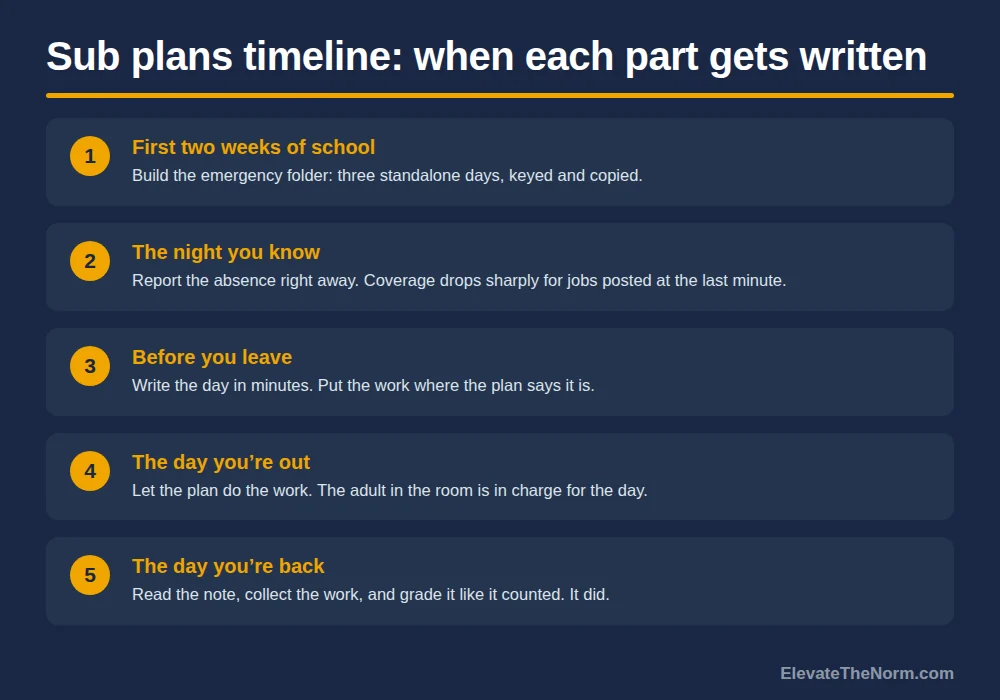
    When to Write Sub Plans, and When to Report the Absence

    Five-step timeline for sub plans: build the emergency folder in the first two weeks, report the absence right away, write the day in minutes before you leave, let the plan do the work, and grade the work when you return
    Report the absence early. Coverage drops for jobs posted at the last minute.

    Build the emergency folder in the first two weeks of school, while you still have the energy and before you need it. Look at it again at the start of each grading period and swap anything that has gone stale.

    When you know you’ll be out, report it right away. In a study of a large West Coast district, Brookings researcher Jing Liu and colleagues found that how early a substitute job was posted was one of the strongest predictors of whether it got filled. Coverage climbed quickly for each hour of notice through the first 24 hours, and jobs posted at the last minute were the least likely to be covered. A plan that never gets a substitute to read it is a plan for whoever ends up in your room instead.

    Plan for the Day No Substitute Comes

    Uncovered absences are not rare. In the same district data, teachers were out about 11.8 days a year, and roughly one of those days went without a substitute. When that happened, students were split into other classrooms about 37 percent of the time, a teacher gave up a planning period about 35 percent of the time, and an administrator covered about 12 percent of the time.

    The same study found that schools serving more disadvantaged students had systematically lower substitute coverage, and that substitutes often cited student behavior when they named the schools they avoided. Reporting from 2024 citing federal survey data put the share of public schools that had difficulty finding substitutes at 35 percent in 2023–24. Read honestly, that is not a reason to blame anyone. It is a reason to write plans that a colleague can run in another room, with your students sitting in the back of a class that isn’t theirs.

    That means one more rule for emergency sub plans: they have to work for 25 minutes in someone else’s room. A one-page reading with questions does. A lab, a discussion, or anything that needs your projector does not.

    What Students Should Be Doing, and Why It Matters

    Students behave differently on a sub day for reasons that make sense. The adult is new, the routine is off, and the day looks like it might not count. Responding to that isn’t a character flaw. It’s a reasonable read of what they’ve been handed.

    The fix is on our end. Leave work that is clearly real, collect it, and tell them in the plan that you will read it. Then do. If the work is graded, grade it the way you would on any other day. Don’t punish a whole class for what the substitute’s note says a few students did; deal with those students individually, the way you would if you had been there.

    Families notice this too. If a sub day turns into a grade, a student should be able to explain to a parent what the assignment was and why it counted. If you get questions, clear parent-teacher communication is easier when the work was clearly worth doing.

    Review Sub Plans Like the Person Reading Them

    Before you file it, read the plan as a stranger would. Could someone who has never been in your building find the copies? Could they start class without asking anyone? Could a colleague run the same pages in their room? Could a student tell what they are being graded on? If any answer is no, that is the line to fix.

    Build Sub Plans Once

    The point of all this is that the hard thinking happens once. A good emergency folder is built in August and keeps paying for itself every time life gets in the way. A good binder template means the planned-absence day takes twenty minutes to write instead of an evening.

    If you would rather start with everything already built, The Teacher Emergency Kit Ultimate Bundle puts 64 resources for grades 6–12 in one download. If you’re buying during a sitewide sale, the TPT sale guide explains how the discounts stack. Free printables for the rest of the classroom are in the free resource library.

    Frequently Asked Questions

    What should be included in sub plans?

    A minute-by-minute schedule for each period, a seating chart and roster, how routines like entry, phones, and dismissal work, where the copies and answer keys are, who to call for help, the health and safety information your school requires, and a sheet for the substitute to leave notes on. The lesson itself is only one part.

    What are emergency sub plans?

    Emergency sub plans are standalone lessons you prepare before you need them, usually at the start of the year. They don’t depend on where the class left off, they come copied with answer keys, and they are kept where the office and a neighboring teacher can find them. Three days is a practical number for most secondary teachers.

    How detailed should sub plans be?

    Detailed enough that someone who has never been in your building could run the day without asking anyone. Use start and stop times for each task, name exactly where materials are, and spell out routines that students already know but a substitute doesn’t.

    Should sub plan work be graded?

    If you want students to take it seriously, yes. Collect it, read it, and grade it the way you would on any other day. Work that is never collected teaches students that sub days don’t count.

    What if no substitute is available?

    Plan for it. When an absence goes uncovered, students are often split into other classrooms or a colleague covers on a planning period. Emergency sub plans should work in 25 minutes in someone else’s room, which means short readings with questions rather than labs or discussions.

    Can a substitute show a movie?

    Only with a task attached and only if your school allows it. A video with a set of questions that gets collected is work. A movie with nothing attached tells students the day doesn’t count, and the substitute usually pays for that.

    How early should I report an absence?

    As early as you can. In one large district’s data, coverage rose sharply with each hour of notice through the first 24 hours, and last-minute postings were the least likely to be filled.

    Sources

    • Liu, J. (2020). America faces a substitute teacher shortage—and disadvantaged schools are hit hardest. Brookings Institution, Brown Center Chalkboard. Read the analysis — source for the 11.8 days of average absence, the share of uncovered absences and how they were covered, the effect of posting time on coverage, and the lower coverage rates in disadvantaged schools. Data from one large urban district on the West Coast, 2011–12 to 2017–18; it describes associations in that district, not a national rate.
    • DiFurio, D. (2024). Substitute teachers keep schools running. Here are the best ways schools can attract more amid the shortage. Stacker, with HeyTutor. Read the article — source for the 35% of public schools reporting difficulty finding substitutes in 2023–24 (attributed there to NCES School Pulse Panel data) and for the finding that substitutes rank solid lesson plans highest when choosing an assignment (from Red Rover’s 2023 survey of about 4,000 substitutes). This is a secondary summary; the NCES and Red Rover figures are cited as reported there.

    About Clay Shumate

    By Clay Shumate — Clay Shumate is a certified secondary Social Studies teacher in the public schools of West Alabama, with seven years of classroom experience, a B.A. in History, and an M.Ed. in Secondary Education. He writes about project-based learning, student responsibility, respect, and practical ways to hold young people to a higher standard while giving them room to learn from mistakes. He is a member of the Society of Professional Journalists and writes to its Code of Ethics; this site’s editorial standards and corrections policy are published in full.

  • Student Goal Setting: What Works in Grades 6–12, and What the Evidence Won’t Carry

    Student Goal Setting: What Works in Grades 6–12, and What the Evidence Won’t Carry

    By Clay Shumate

    Student goal setting is the practice of having students name a specific, near-term target for their own learning, plan how they will hit it, and check whether they did. It is cheap, it is popular, and the federal evidence review rates it “promising” rather than strong — which is a more useful place to start than the version you got in a faculty meeting.

    What follows is what the research supports, the large trial that found nothing, and the part that actually moves the needle: the plan, not the goal.

    Key Takeaways

    • The official rating is Tier III, “promising evidence.” That is the third-highest tier, below strong and moderate. Anyone selling this as settled is overselling it.
    • The best secondary study is correlational. 1,273 high school students over five years showed a significant relationship between goal writing and proficiency — with no control group, so causation is not established.
    • A large randomised trial found nothing. About 1,400 first-year college students, precisely estimated null on grades, credits and persistence — and it was a failed replication of a pilot that had reported more than half a standard deviation.
    • The plan beats the goal. Across 94 studies, forming a specific “if X, then I will Y” plan had a medium-to-large effect on goal attainment (d = .65). Wanting it more is not the mechanism.
    • Goal setting alone is not an intervention. The federal review says so outright: it “cannot be assumed to produce positive outcomes for students” on its own.

    Free Download · PDF

    The Student Goal and If-Then Plan Sheet

    Student-facing: five tests for a goal worth setting, the if-then plan frame, four worked examples by subject, and a two-week check-back log.

    Download the free PDF

    Free. No email address required. Designed for grades 6–12. Browse every printable in Your Free Library.

    What Is Student Goal Setting?

    Student goal setting is a short cycle, not a form. The student names a specific target for their own learning, decides what they will actually do to reach it, does it, gathers some evidence, and judges honestly whether they got there. Then the cycle runs again.

    The word doing the work in that definition is own. A target a teacher assigns and a student copies onto a sheet is not goal setting; it is an objective with a student’s handwriting on it. The federal practice guide is specific that letting students set their own goals is one of the components associated with better outcomes, alongside goals that are proximal (near-term rather than end-of-year), specific rather than general, and optimally challenging — hard enough to require something, not so hard the student has already lost.

    It is also the forward-facing half of a pair. Student self-assessment asks a teenager to judge work they have already done. Goal setting asks the same student to aim at work they have not done yet. Neither one works well without the other — a goal set by a student with no accurate read on where they currently stand is a guess.

    Does Student Goal Setting Actually Work?

    The honest answer is “promising, conditional, and less certain than the training implies.” Three pieces of evidence, and they do not all point the same way.

    The official rating. The Regional Educational Laboratory Midwest reviewed student goal setting for the Institute of Education Sciences and rated it Tier III, “promising evidence” under the federal evidence standards. Tier III is the third-highest of four. It means there is correlational research with statistical controls behind the practice — not that it has been shown to cause anything in a well-controlled trial.

    The best secondary-school study. Moeller, Theiler and Wu followed 1,273 high school students across five years, 21 teachers and 23 Nebraska schools, using a portfolio system built on self-assessment, goal writing and evidence collection. Goal writing and action-plan writing both showed statistically significant relationships with language proficiency scores, independent of teacher effects. It is a large, long, genuinely secondary study, and the authors say plainly that there was no control group and causation cannot be established.

    The trial that found nothing. Dobronyi, Oreopoulos and Petronijevic randomly assigned about 1,400 first-year university students to a structured goal-setting exercise, with or without follow-up reminders, against a control group. They found “no evidence of an effect of treatment” on grades, credits taken, credits failed, or second-year persistence — and their sample was large enough to have detected a 7 percent standardised effect. Their study was an attempt to replicate an earlier pilot that had reported a treatment effect on GPA of more than half a standard deviation. It did not replicate.

    Those students were undergraduates, not teenagers, and a one-off written exercise is not a classroom routine. Both of those are real reasons the null might not transfer. But it is exactly the kind of result that quietly disappears from professional development, and it is the reason the federal review ends up at “promising” instead of “strong.”

    What the review actually concludes is the sentence to keep: goal setting “in isolation cannot be assumed to produce positive outcomes for students.” It works when it is attached to planning, self-evaluation, regular feedback and reflection. Handed out as a September worksheet, it is a September worksheet.

    Why Do Most Classroom Goal-Setting Systems Die by October?

    Because the goal gets set and nothing after it is scheduled. Every failure I have watched has the same shape: a strong launch, a folder, and then nothing on the calendar that forces anyone to look at the folder again.

    Four specific failure modes, and each one has a cheap fix.

    1. The goal is too far away. “Raise my grade this semester” gives a student nothing to do on Tuesday. Proximal beats distal in the research and in the room. Two weeks is a good default.
    2. The goal is a wish, not a behavior. “Try harder in this class” cannot be checked by anybody, including the student. If you cannot tell from the outside whether it happened, it is not a goal.
    3. Nobody scheduled the review. This is the big one. If the goal review is not a thing that happens on a specific day, it does not happen. Put it in the plan the same way you would put in a quiz.
    4. The teacher owns it. The moment students believe the goal sheet is for you — for a binder check, for a walkthrough, for the folder an administrator might ask about — they write what looks good. You will get twenty-eight reasonable-sounding goals and zero information.

    There is a version of the fourth failure that no teacher can fix alone. If a district requires the goal sheet as a walkthrough artifact or a PLC deliverable, it has made the sheet an adult document by design, and students will read that correctly within a week. Goal setting is cheap enough to mandate and fragile enough that mandating it is usually how it dies. If it has to be collected, collect the evidence that the review happened — a date, a count — and leave the goals themselves with the student.

    The fourth one is the one worth guarding hardest, and it connects to something this site keeps coming back to: a choice that is really a compliance task in disguise teaches students to produce the appearance of the thing instead of the thing.

    What Makes a Goal Worth Setting?

    Five tests, and a goal that fails any of them will not survive two weeks. Run a student’s draft against these before it goes in the folder.

    Numbered list of five tests for a student goal: the student wrote it, it names a behavior rather than a wish, it is optimally challenging for that student, it is close enough to act on, and it has an if-then plan under it
    Run a student’s draft against these before it goes in the folder.

    The hardest of the five is the third. “Optimally challenging” sounds like jargon, and in practice it means a goal a student has maybe a sixty percent chance of hitting — which means some goals are supposed to be missed. Say that to the students in those words, on day one: you are supposed to miss some of these, and missing one is not a problem you will be in trouble for. If you do not say it, they will write goals they are certain of, and the whole system drifts toward targets everybody hits and nobody learns anything from. Say it to whoever reads the folder too, for the same reason.

    And “optimally challenging” is calibrated to the student, not to the class. A goal that is a genuine stretch for one student is a formality for the one beside them, which means the whole point breaks the moment you set a common goal and call it differentiated. It also means a student who has spent years being told they are behind may aim absurdly low the first time. That is information, not defiance, and the move is to negotiate one notch up rather than to reject the goal. The same argument sits underneath holding a standard high while making the path to it real: a target nobody misses was never a target.

    Are SMART Goals the Right Format?

    They are a reasonable checklist and a weak intervention, and it is worth knowing which one you are using. Specific and measurable are supported by the research on goal specificity. What SMART does not contain is the part that most predicts whether a goal gets reached.

    Look at what a SMART goal actually produces: a well-formed description of a destination. “I will score at least 80 percent on the next two vocabulary quizzes.” Specific, measurable, achievable, relevant, time-bound — and it contains no information about what the student will do differently on Wednesday. A student who could already answer that question did not need the acronym.

    I am not telling anyone to throw the format out. If your school uses it, use it. Just do not stop there, because the next section is where the evidence is.

    The If-Then Plan That Does the Work

    Adding a specific “if X happens, then I will do Y” plan to a goal had a medium-to-large effect on whether the goal got reached — d = .65 across 94 studies. Psychologists call these implementation intentions. Students can call them if-then plans and use them in about ninety seconds.

    Table comparing a wish, a SMART goal and an if-then plan, showing what each sounds like and why the if-then plan names the moment, the action and the thing it replaces
    SMART describes a destination. The if-then plan names the moment you act.

    Gollwitzer and Sheeran’s meta-analysis describes them as “if-then plans that link situational cues… with responses that are effective in attaining goals.” The effect split two ways that map exactly onto what teenagers struggle with: d = .61 for getting started and d = .77 for getting derailed. The larger of the two is the one about staying on track after something goes wrong, which is the failure mode for most students, most of the time.

    Two honest limits from the same paper. If there are few real barriers to a goal, the if-then plan is superfluous — a student who was going to do it anyway does not need one. And the strong effects showed up “predominantly when the underlying goal intention was strong.” An if-then plan attached to a goal the student does not care about does nothing. That is not a flaw in the technique; it is the reason the student has to write the goal.

    Here is the frame students actually use, and it is worth writing on the board: “If it is [a specific time or trigger], then I will [a specific action].” The test is whether a stranger could tell from the outside that it happened. Watch a real one get fixed: “I will review my notes more” is not a plan. “If it is Tuesday and I have finished eating, then I will redo the two problems I got wrong before I open my phone” is one, because it names the moment, the action and the thing it replaces. Most student first drafts are missing the moment. That is the only edit you usually have to make.

    Worth saying about the population too: this meta-analysis spans health, behavior change and academic contexts across a wide age range, not a set of secondary classrooms. The mechanism is general. The classroom result is a reasonable inference, not a measured one.

    Student Goal Setting Examples for Grades 6–12

    A usable goal names a behavior, a number and a date, and is followed by a plan that names a moment. Here is the difference in practice, by subject.

    Table of four student goal setting examples in math, social studies, science and English, each paired with the if-then plan that sits under it
    Four subjects, four goals, and the plan that makes each one survive two weeks.

    Notice what every one of the good versions has that the bad version does not: a specific when. Not “I will study more” but “when I sit down Tuesday after practice.” The when is the whole mechanism. Without it the student has written a wish with a deadline attached.

    One more thing about the examples above: none of them is about a grade. Grade goals are the ones students reach for first, and they are the least useful, because a grade is an outcome the student only partly controls and it gives no instruction about behavior. “Get a B” tells you nothing to do Tuesday. If a student insists on a grade goal, ask the follow-up: what would have to be different in your week for that to happen? The answer is the actual goal.

    What Teachers Should Not Do With Student Goals

    Three things, and all three are common.

    Do not grade the goal. A graded goal is a goal a student sets low, which destroys the only thing a goal is for. Grade the work; the goal is instrumentation. If you need a grade out of the process, grade whether the reflection is honest and specific — a student who writes “I did not do this and here is why” has done the assignment correctly.

    Do not post them. Goal walls, goal charts and public trackers look like accountability and function as ranking. A student setting a goal is disclosing what they are not good at yet, in front of everyone they eat lunch with. Some students can carry that and some cannot, and you will not know which is which until it goes wrong. Keep goals in a folder, a document, or a conversation.

    Do not let a classroom goal collide with an IEP goal. If a student has goals written into an IEP or a 504 plan, those are legal documents with their own review cycle and their own people attached. A classroom goal that restates them turns your folder into a parallel record of a student’s disability, and one that pulls against them creates a conflict the student has to resolve. Ask the case manager first. Usually the answer is simple — keep the classroom goal about something the IEP does not cover — but it should be a decision rather than an accident.

    And tell families what this is before they hear about it secondhand. One sentence in a syllabus or an email does it: students set a short-term learning goal every two weeks, the goals are not graded and are not a judgment about the student, and a missed goal is a normal part of how the routine works. Parents who learn about a goal folder from a worried fourteen-year-old will assume it is an evaluation, and they will be reasonable to assume it.

    Do not let a goal become a record. If a student’s goal sheet contains anything about their home life, their diagnosis, their family or their mental health — and if you ask an open enough question, eventually one will — then you are holding a document you did not plan to hold. Keep the prompts academic and behavioral, say clearly what you do and do not do with the sheets, and know your school’s policy before you build a system that collects them. A goal-setting routine is a data-collection routine whether you designed it as one or not.

    How Often Should Students Revisit a Goal?

    Every two weeks, on a date that is already on the calendar, and in writing. Anything longer and the goal stops being operative; anything shorter and you are spending class time on the system instead of the work.

    The review is three questions and it takes six minutes. Did you do the thing you said you would do? What is the evidence? What is the goal for the next two weeks — the same one, or a different one? A student who missed and says why has not failed the routine. A student who quietly rewrites history has, and the way you prevent that is by making it clearly safe to have missed.

    The version I trust most is not a form at all. I pull students over one at a time and ask them to defend their own decisions out loud — why this goal, why that plan, what the evidence is. It takes longer than collecting sheets and it is harder to fake. A student who has to say it to your face either has a reason or discovers on the spot that they do not, and both of those outcomes are more useful than a folder.

    The arithmetic does not work at scale, and pretending otherwise is how this advice gets ignored. Six minutes times a hundred and forty students is not a thing anyone is doing every two weeks. So rotate: five or six conversations per cycle, everybody else writes, and every student gets a real check-in roughly once a quarter. Choose the five deliberately rather than by who volunteers — the students who most need to say it out loud are rarely the ones raising a hand.

    One thing to watch for across cycles: a student who misses every goal is not a student who is failing at goal setting. It is a miscalibration, and the calibration is the adult’s job. Sit down, cut the goal in half, and let them hit one. A student who has never once hit a target they set has learned only that setting targets is pointless, which is worse than not having asked. When these check-ins feed a conversation with families, they are also most of the preparation for a conference the student actually leads.

    What to Do Next

    Pick one class. Have every student write one two-week goal that names a behavior and a number, and then — this is the part that matters — have them write one sentence underneath it in the form “If [specific moment], then I will [specific action].” Put the review date in your plans before the students leave the room.

    Then run it twice before you judge it. The first cycle teaches them the format. The second one is the first real data you will get, and it will tell you more about your class than the goals themselves do.

    And set your expectations where the evidence sets them. This is a promising practice that works as part of something — planning, feedback, honest self-assessment, a conversation — and does very little on its own. A worksheet in September is not a goal-setting system. A date on the calendar is.

    Before you go: grab the free The Student Goal and If-Then Plan Sheet (PDF) — ElevateTheNorm.com branded, printable, no email required.

    Frequently Asked Questions

    What is student goal setting?

    It is a short repeating cycle in which a student names a specific, near-term target for their own learning, plans what they will actually do to reach it, gathers evidence, and judges honestly whether they got there. The key word is “own” — a target the teacher assigns and the student copies onto a sheet is an objective in the student’s handwriting, not a goal.

    Does student goal setting improve achievement?

    The federal evidence review rates it Tier III, “promising evidence” — the third-highest of four tiers. A five-year study of 1,273 high school students found a significant relationship between goal writing and proficiency, but it had no control group. A randomised trial of about 1,400 first-year college students found no effect at all on grades, credits or persistence. The honest summary is that it helps when it is attached to planning and feedback and does little by itself.

    Are SMART goals good for students?

    They are a reasonable checklist for describing a destination and a weak intervention on their own. Specific and measurable are genuinely supported by the research on goal specificity. What SMART does not include is any statement of what the student will do differently, and that is the part that predicts whether the goal gets reached. Use it if your school uses it, then add an if-then plan underneath.

    What is an if-then plan and why does it matter more than the goal?

    It is a sentence in the form “if [specific situation], then I will [specific action]” — researchers call it an implementation intention. Across 94 studies it had a medium-to-large effect on goal attainment, d = .65, with d = .61 for getting started and d = .77 for getting back on track after getting derailed. A goal describes where you want to end up. The if-then plan names the moment you will act.

    How often should students revisit their goals?

    About every two weeks, on a date that is already in your plans. Longer than that and the goal stops being operative; shorter and you spend class time on the system instead of the work. The review is three questions and takes six minutes: did you do it, what is the evidence, and what is the goal for the next two weeks.

    Should student goals be graded?

    No. A graded goal is a goal the student sets low, which removes the only thing a goal is useful for. If you need a grade from the process, grade whether the reflection is honest and specific. A student who writes “I did not do this, and here is why” has done the assignment correctly.

    Should I post student goals on the wall?

    No. A public goal chart looks like accountability and functions as a ranking, because a student setting a goal is disclosing what they are not good at yet in front of everyone they eat lunch with. Keep goals in a folder, a document or a conversation. Visibility is not the mechanism; the plan and the review date are.

    Why do goal-setting systems stop working after a few weeks?

    Almost always because nothing after the goal was scheduled. The four usual causes are a goal that is too far away, a goal that describes a wish rather than a behavior, a review that never got a date, and a system students correctly perceive as being for the teacher’s binder. Only the last one is about motivation, and it is fixed by keeping the goals out of anything that gets inspected.

    Sources

    1. U.S. Department of Education, Institute of Education Sciences, Regional Educational Laboratory Midwest. Student Goal Setting: An Evidence-Based Practice. 2018. ERIC ED589978. Rates student goal setting Tier III, “promising evidence,” under federal evidence standards; identifies optimally challenging, proximal, specific, self-set and mastery-oriented goals as the supported components; and states that goal setting “in isolation cannot be assumed to produce positive outcomes for students.” https://files.eric.ed.gov/fulltext/ED589978.pdf
    2. Moeller, Aleidine J., Janine M. Theiler, and Chaorong Wu. “Goal Setting and Student Achievement: A Longitudinal Study.” The Modern Language Journal, vol. 96, no. 2, 2012, pp. 153–169. Five-year quasi-experimental study, 1,273 high school students, 21 teachers, 23 Nebraska schools; goal writing and action-plan writing significantly related to proficiency scores independent of teacher effects. No control group; the authors state causation cannot be established. https://www.ncssfl.org/wp-content/uploads/2017/11/MLJ.2012.GoalSettingandStudentAchievementLongitudinalStudy.pdf
    3. Dobronyi, Christopher R., Philip Oreopoulos, and Uros Petronijevic. “Goal Setting, Academic Reminders, and College Success: A Large-Scale Field Experiment.” Journal of Research on Educational Effectiveness, vol. 12, no. 1, 2019, pp. 38–66. Randomised trial, approximately 1,400 first-year university students; “no evidence of an effect of treatment” on grades, credits or persistence, precise enough to detect a 7 percent standardised effect. A failed replication of a pilot reporting more than half a standard deviation on GPA. Population: undergraduates, not secondary students. https://oreopoulos.faculty.economics.utoronto.ca/wp-content/uploads/2020/05/dobronyi-et-al-goal-setting-academic-reminders-and-college-success-jree-2019.pdf
    4. Gollwitzer, Peter M., and Paschal Sheeran. “Implementation Intentions and Goal Achievement: A Meta-Analysis of Effects and Processes.” Advances in Experimental Social Psychology, vol. 38, 2006, pp. 69–119. 94 studies; overall d = .65, with d = .61 for getting started and d = .77 for getting derailed. Notes that effects are reduced when few barriers exist and that strong effects appeared “predominantly when the underlying goal intention was strong and activated.” Spans health and behaviour-change contexts across a wide age range, not secondary classrooms specifically. https://cancercontrol.cancer.gov/sites/default/files/2020-06/goal_intent_attain.pdf

    About Clay Shumate

    Clay Shumate is a certified secondary Social Studies teacher in the public schools of West Alabama, with seven years of classroom experience, a B.A. in History, and an M.Ed. in Secondary Education. He writes about project-based learning, student responsibility, respect, and practical ways to hold young people to a higher standard while giving them room to learn from mistakes. He is a member of the Society of Professional Journalists and writes to its Code of Ethics; this site’s editorial standards and corrections policy are published in full. More about Clay.

Teacher Emergency Toolkit — practical resources, real classroom support. Shop on TPT.Teacher Emergency Toolkit — practical resources, real classroom support. Shop on TPT.