Tag: secondary teaching

  • Questions for Socratic Seminar: 40 That Work in Grades 6–12

    Questions for Socratic Seminar: 40 That Work in Grades 6–12

    By Clay Shumate

    Good questions for a Socratic seminar have no answer you could look up, no answer the teacher is holding, and at least two defensible readings in the text itself. That is the whole test. A question that a prepared student can settle in one sentence is a comprehension check — useful, but it will not carry thirty minutes of discussion.

    Below are forty questions you can use tomorrow, sorted by what they are for, plus the way to write your own out of whatever text you are already teaching.

    Key Takeaways

    • Three kinds of question run a seminar: one opening question, several core questions you may never need, and closing questions that ask what changed.
    • The research on “higher-order questions” is weaker than the training says. One meta-analysis of 20 studies found a significant positive effect; a second, of 14 studies, found the effect small. Both are true and both are old.
    • What does hold up is the authentic question — one the teacher does not already have an answer to. In a study of more than 1,100 eighth and ninth graders, that predicted higher literature achievement.
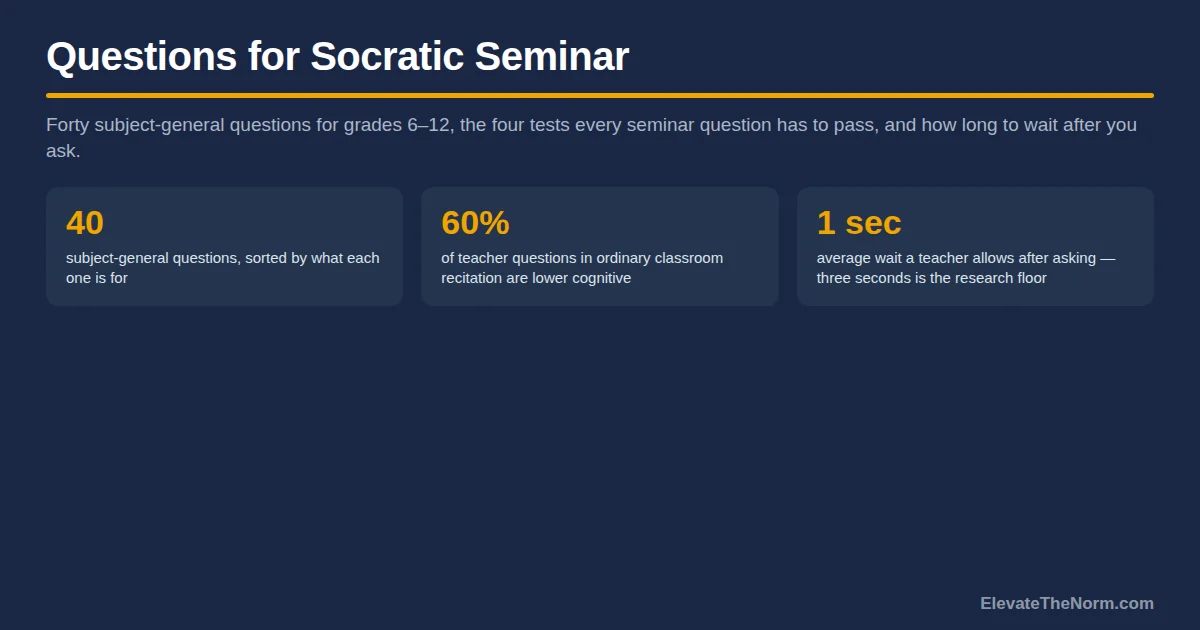
    • Wait longer than feels reasonable. Teachers average about one second. Three is the floor for a recall question, and for a genuinely open one there appears to be no ceiling.
    • Students should be writing questions too. A seminar where only the teacher asks is a recitation with the chairs moved.

    Free Download · PDF

    40 Socratic Seminar Questions

    All forty questions in five groups, the six stems to post for students, and the ten-minute method for turning a text of your own into seminar questions.

    Download the free PDF

    Free. No email address required. Designed for grades 6–12. Browse every printable in Your Free Library.

    What Makes a Good Socratic Seminar Question?

    Four things, and you can test all four in about a minute. Write your question down, then run it against this list before you take it anywhere near a class.

    1. You cannot answer it in one sentence. Try. If you finish in a line, you have written a comprehension check. Keep it — just do not open with it, and file it with your other ways of checking what landed.
    2. You do not already know the answer. This is the hard one, because teachers are trained to ask questions we can assess. A seminar question is one where you would genuinely take notes on the replies.
    3. The text can support more than one answer. Not “what do you think” — opinions with no evidence anchor produce a conversation nobody can lose or learn from. The disagreement has to be arguable from the page.
    4. It cannot be Googled. If a phone settles it in twenty seconds, it will get settled in twenty seconds.

    The fourth one has quietly become the most important. A question like “what were the causes of the conflict” is a research task. “Which of the causes the author lists is doing the most work, and which one is there to make the argument look balanced?” is a seminar, because the answer is not written down anywhere.

    The Three Kinds of Question a Seminar Needs

    An opening question, a stack of core questions, and a closing question — and you should expect to use the opening one and maybe two others. The stack is insurance, not a script.
    Numbered list of four question types for a Socratic seminar: the opening question, core questions, closing questions, and the follow-up built on what a student just said
    Three kinds you write down, and the one you cannot.

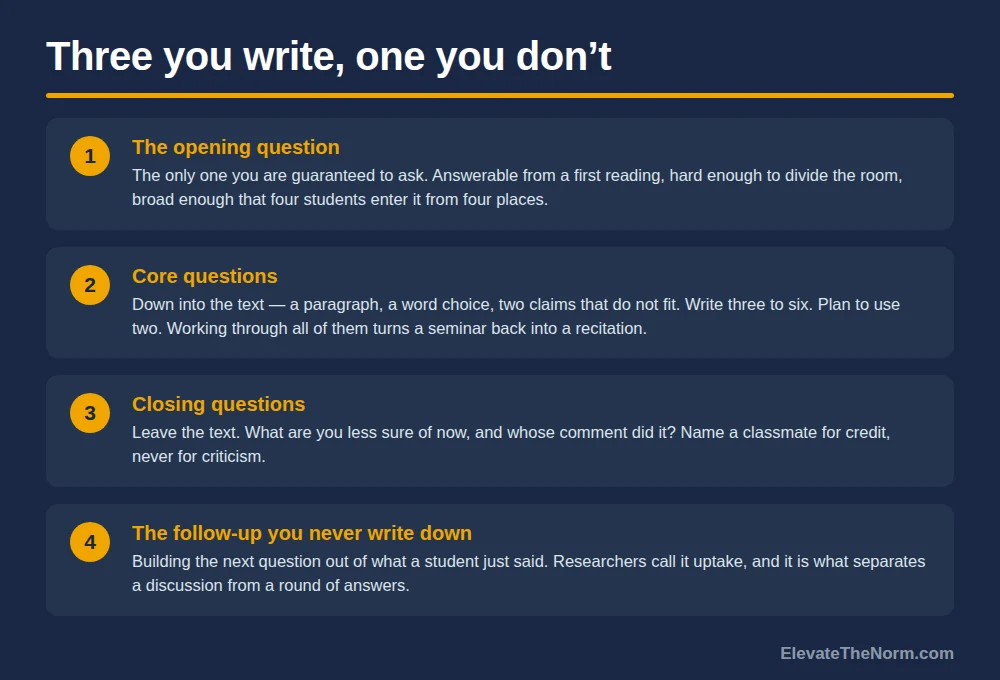
    The opening question is the only one you are guaranteed to ask. It should be answerable from a first reading, hard enough to divide the room, and broad enough that four different students can enter it from four different places. It usually points at the whole text rather than a line.

    Core questions go down into the text. These are the ones that name a paragraph, a word choice, a contradiction between two claims. Write six and plan to use two — and if you have five preps and six is not happening, write three. Three real ones beat six you assembled at 10pm. The worst thing you can do with a good stack is work through it, because then you are running the agenda and the students are answering it.

    Closing questions leave the text. What does this mean for something the students actually deal with? What changed in your thinking, and whose comment did it? That second one belongs in the post-seminar writing, and it is the single best assessment item this format produces. One guard on it: ask students to name a classmate for credit, never for criticism. “What did this conversation get wrong?” is a question about the conversation, and it is worth saying so out loud before they write.

    There is a fourth kind that never gets written down, and it is the one that matters most in the room: the follow-up. Building the next question out of what a student just said — researchers call it uptake — is what separates a discussion from a round of answers.

    Does Asking Harder Questions Actually Improve Achievement?

    Less clearly than the training slides claim, and it is worth knowing why before you rebuild your question bank around Bloom’s taxonomy. Two meta-analyses looked at the same question and did not agree.

    Kathleen Cotton’s synthesis for the Northwest Regional Educational Laboratory lays both out. Redfield and Rousseau’s 1981 meta-analysis of 20 studies “concludes that asking higher cognitive questions has a significant and positive effect on student performance.” Samson and colleagues ran a second meta-analysis in 1987 across 14 studies and found that students exposed to higher cognitive questions did outperform others, “but that the effect size is small.”

    A later critical review by Mikyeong Yang went further, concluding that this body of work “reported incoherent results” and that the evidence cannot support the expectation that higher-cognitive questions are more effective than fact questions. So: a real effect, a small effect, and a serious argument that the whole line of research is not measuring what it thinks it is.

    Here is what survives all three, and it is not about difficulty at all. Nystrand and Gamoran studied eighth- and ninth-grade English classes across sixteen middle schools feeding nine high schools, testing more than 1,100 students in fall and spring. Students whose teachers asked a higher proportion of authentic questions — ones the teacher did not already have an answer to — and who practiced uptake scored significantly higher on literature achievement.

    Authentic is not the same as hard. “Analyze the author’s use of irony” is high on Bloom’s and completely inauthentic if you have a rubric in your hand describing the right answer. “Is the last line a joke?” is simple, open, and genuinely contested. Write for authentic, not for the taxonomy. It is the same trade as anywhere else on this site: real questions hand students something to do, which is what giving students a genuine decision rather than a cosmetic one actually looks like inside one class period.

    One more number worth carrying, from the same Cotton synthesis: in ordinary classroom recitation, about 60 percent of teacher questions are lower cognitive, 20 percent higher cognitive, and 20 percent procedural. A seminar is one of the few structures that changes that ratio on purpose.

    40 Questions for Socratic Seminar

    Eight questions in each of five categories, written to be subject-general so you can drop your own text into them. Every one of these is a shell — swap in your author, your document, your data set.

    Two things before you use them. They are subject-general on purpose, which means the question is only as safe as the text you put under it; choosing a text on a contested public issue is a decision that belongs to you and your school’s policy, not to a question bank on the internet. And the fourth group — the ones that surface disagreement — is asked to the room, never to a named student. “Who read that line differently?” is an invitation. “Marcus, you disagree, right?” is an ambush, and the student you do it to will remember it longer than the text.

    Opening questions (use one)

    1. What is the most important sentence in this text, and what does the rest of it do?
    2. What is this author afraid of?
    3. If you had to remove one paragraph without losing the argument, which one goes?
    4. Who is this written for? How can you tell?
    5. What does this text refuse to say?
    6. Is the author describing the world or arguing about it?
    7. What would have to be true for this to be right?
    8. What question is this text an answer to?

    Core questions: evidence and claims

    1. Which claim here has the least support behind it?
    2. Where does the author stop explaining and start assuming?
    3. Are the two claims in the second and fourth paragraphs compatible?
    4. What counts as evidence in this text, and who decided that?
    5. Is the strongest objection to this argument in the text, or did the author leave it out?
    6. Which detail would change your reading if it turned out to be wrong?
    7. Does the author distinguish what they know from what they think?
    8. If this were written by someone on the other side, which sentence would survive?

    Core questions: language and choice

    1. Why that word and not the obvious one?
    2. What work is the title doing?
    3. Where does the tone shift, and what happens right before it?
    4. Who is given a name in this text, and who is not?
    5. What is the effect of the thing the author repeats?
    6. Is the ending earned by what came before it?
    7. What would be lost if this were written plainly?
    8. Which sentence do you think the author rewrote the most times?

    Questions that surface disagreement

    1. Who in this room read that line differently than you did?
    2. What is the strongest version of the argument you disagree with?
    3. Is this a disagreement about the text or about something outside it?
    4. What would change your mind?
    5. Can both readings be true at once?
    6. What are we assuming that the text never says?
    7. Which of us is using a word to mean two different things?
    8. Is the disagreement about what happened or about whether it was right?

    Closing and reflection questions

    1. What did you come in believing that you are less sure of now?
    2. Whose comment changed or sharpened your thinking, and what did they say?
    3. What question do we still not have an answer to?
    4. What would you need to read next to settle this?
    5. Where does this argument show up outside of school?
    6. If you had to explain this text to someone in one sentence, what would you leave out?
    7. What did this conversation get wrong?
    8. What is the question you wanted to ask and did not?

    Question Stems Students Can Use

    The fastest upgrade to a seminar is teaching students to ask each other questions instead of taking turns making statements. Most students arrive with one move — say your opinion and stop — and a short posted list fixes it faster than any amount of coaching.
    Six question stems students can use in a Socratic seminar, including what in the text makes you say that, can you say more, I read that line differently because, are you saying X or Y, what would change your mind, and we have not heard from
    Post six. Nobody reads twenty.

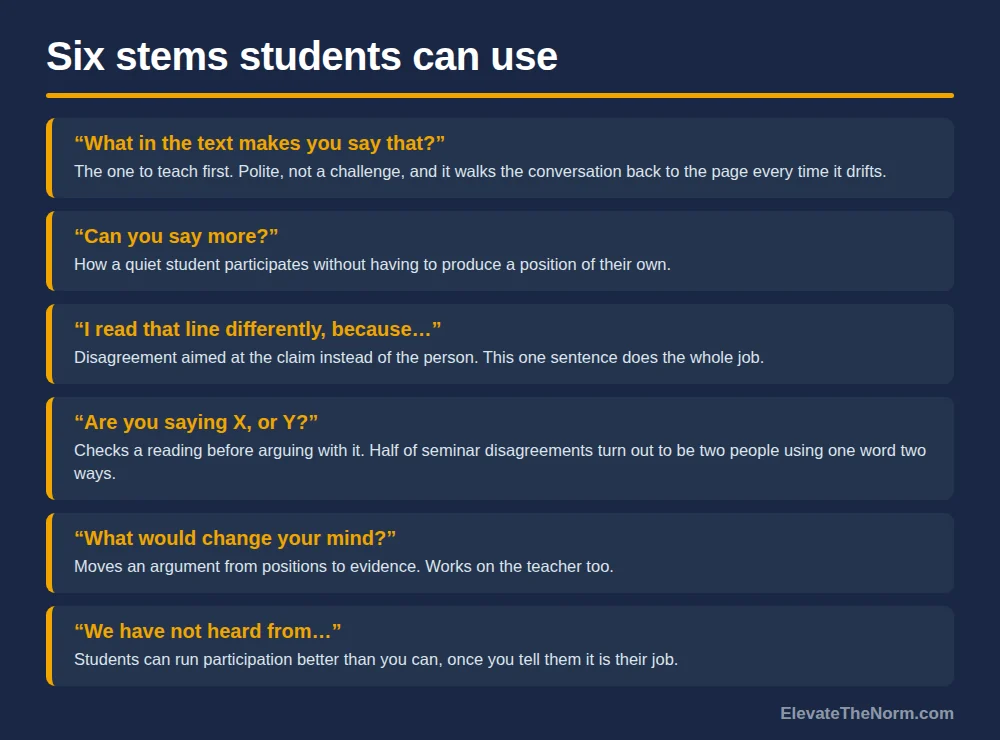
    Post six stems and refer to them by name. Do not post twenty; nobody reads twenty.

    The other half of this is teaching students to write a question, since you are requiring one at the door. Give them one frame and it stops being mysterious: point at a specific place in the text, say what confused or bothered you about it, and end with a question you cannot answer yourself. “On page two the author says X, but earlier they said Y — which one are they actually arguing?” is a better seminar question than most of mine, and a fourteen-year-old can produce it on the second try.

    For a student who found the text hard, say plainly that the question can be about the part they did understand. A question from paragraph one is a real contribution. Nobody has to have finished the text to have something worth asking about it.

    Two of these deserve a note. “What in the text makes you say that?” does most of the work of a facilitator and it is the one stem I would teach first — it is polite, it is not a challenge, and it forces the conversation back to the page every time it drifts. And “Can you say more?” is how a quiet student participates without having to produce a position of their own, which matters more than it sounds like.

    How Long Should You Wait After Asking?

    Three seconds minimum, and for a genuinely open question, longer than you think you can stand. This is the oldest finding in the questioning literature and it is still the one teachers violate most.
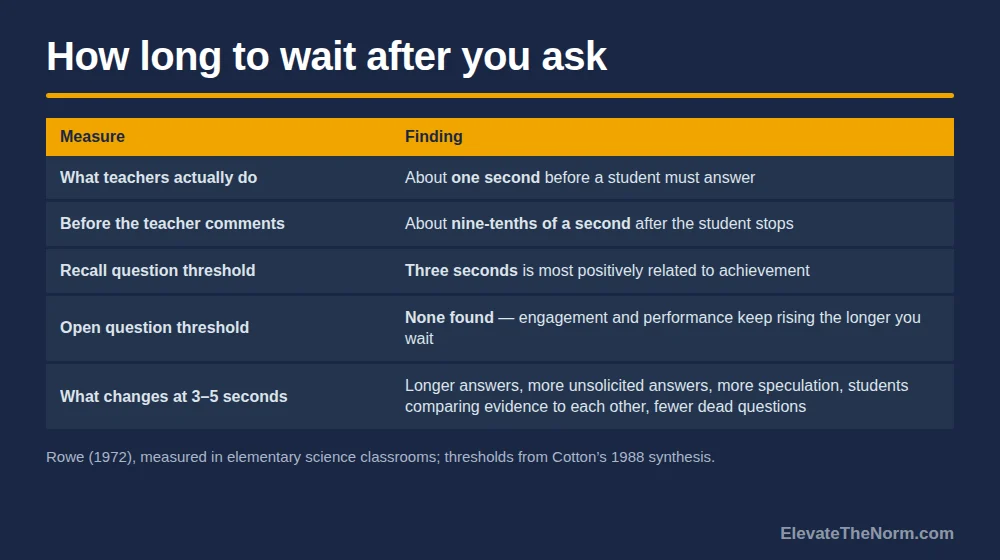
    Table of wait-time research findings: teachers wait about one second, comment within nine-tenths of a second, three seconds is the recall-question threshold, no threshold was found for open questions, and answers lengthen at three to five seconds
    Teachers average about one second. Eight costs you nothing.

    Mary Budd Rowe measured it in the early 1970s. Teachers allowed an average of about one second for a student to respond, and followed a student’s answer with a comment within roughly nine-tenths of a second. When those two waits were stretched to three to five seconds, student responses got longer, more students answered without being called on, speculative thinking went up, students began comparing their evidence to each other’s rather than to the teacher, and fewer questions went unanswered. Worth naming honestly: Rowe’s classrooms were elementary science. The effect has held up widely, but that is the population she measured.

    One cheap adjustment that goes with the wait: put the opening question in writing as well as saying it. On the board, on the handout, anywhere it stays. A student who processes slowly, who missed the first three words, or who is rereading the text while you talk should not lose the question because it only existed as sound. It costs nothing and it changes who is able to answer.

    Cotton’s synthesis adds the part that matters for seminars specifically: three seconds is the threshold for lower cognitive questions, and for higher cognitive questions there appears to be no threshold at all — students “seem to become more and more engaged and perform better and better the longer the teacher is willing to wait.”

    I have tested the ceiling on this and I would not recommend the experiment. I once waited more than five minutes. It was one of the most awkward moments of my life, that section finished nine minutes behind my other classes, and it is the only time I have ever assigned homework. I am not telling that story as a technique. I am telling it because the price of waiting is real and it is worth knowing what it costs before you decide the silence is unbearable at eight seconds. Eight seconds costs you nothing.

    How to Turn Your Own Text Into Questions in Ten Minutes

    Read for the seams, not for the content. You are not looking for what the text says. You are looking for the places where it strains.

    1. Mark every hedge. “Arguably,” “some have suggested,” “it is possible that.” Each one is a place the author was not sure, and each one is a question.
    2. Find two sentences that do not quite fit together. Not a contradiction — a tension. “Are these both true?” is a seminar question that writes itself.
    3. Note what is missing. Who is not quoted. Which objection is not answered. What the author had to leave out to make the piece work.
    4. Write your opening question from the whole text, and three core questions from the marks you made.
    5. Answer your own opening question in one sentence. If you can, go back to step two.

    That is the whole process, and it gets faster. The fourth time you do it you will find yourself marking hedges while you read for other reasons, which is a better outcome than any question bank.

    Questions That Wreck a Seminar

    Four shapes, and all four are easy to write by accident.

    • The question you already answered in class. Students will give you your own words back, correctly, and nothing will happen.
    • The yes-or-no question with an obvious side. “Was the narrator wrong to lie?” gets twenty-eight yeses. Ask instead what the lie cost, and who paid.
    • The question that requires a personal disclosure. “Have you ever been treated this way?” will get an honest answer from a fifteen-year-old in front of twenty-seven peers, and that is exactly the problem. Keep the question on the text and let students bring themselves to it if they choose. If a text is likely to pull the room in that direction, that is a conversation to have with an administrator before it is a seminar question.
    • The question with a correct answer you will eventually supply. Students can smell this within four minutes, and once they have, the seminar becomes a guessing game about you.

    The third one is the one worth being most careful with, because it usually comes from a good instinct. Relevance is not the same as exposure. A question can matter to a student’s life without requiring them to narrate it to the class.

    What to Do Next

    Take the text you are teaching this week and spend ten minutes on the five steps above. Write one opening question, three core questions, and one closing question. Then pull four questions from the bank here that fit the same text, so you have something in reserve you did not have to invent.

    Ask your opening question once, and count to eight in your head before you do anything else. That is the whole practice. If you want the rest of the format — the norms, the seating, what to do about the students who will not talk — it is in the full guide to running a Socratic seminar. And if the questions you write keep coming out as comprehension checks, that is not a failure; it means you have a set of quick checks for understanding and a seminar question still to write.

    Before you go: grab the free 40 Socratic Seminar Questions (PDF) — ElevateTheNorm.com branded, printable, no email required.

    Frequently Asked Questions

    What makes a good Socratic seminar question?

    One you cannot answer in a sentence, that you do not already have an answer to, that the text can support more than one answer to, and that a phone cannot settle in twenty seconds. The first two are the ones teachers miss. We are trained to ask questions we can assess, and a question you can assess is usually a question you already answered.

    How many questions should I prepare for a seminar?

    One opening question, about six core questions, and two closing questions — and expect to use three of them. The stack is insurance against a dead room, not an agenda. Working through all nine is how a seminar turns back into a recitation with the chairs moved.

    What is the difference between an authentic question and a higher-order question?

    An authentic question is one the teacher does not have an answer to. A higher-order question is one high on Bloom’s taxonomy. They are not the same thing, and the research suggests the first matters more. “Analyze the author’s use of irony” is higher-order and completely inauthentic if you are holding a rubric describing the right answer.

    How long should I wait after asking a seminar question?

    Three seconds is the research floor, and for open questions there appears to be no ceiling — students engage more and perform better the longer the teacher is willing to wait. Teachers average about one second, which is why this feels so unnatural. Eight seconds costs you nothing and changes who answers.

    Should students write their own seminar questions?

    Yes, and it is the change that most reliably fixes a flat seminar. Require one written question from every student, collected on the way in. Make it an expectation rather than a bar — a student who arrives without one writes it in the first two minutes. A seminar where only the teacher asks questions is not a seminar.

    Can I use the same questions for any text?

    Most of them, yes. The forty here are deliberately subject-general: “what does this text refuse to say?” works on a court opinion, a poem, a lab report and a political speech. What does not transfer is the core questions, because those name a specific paragraph or word choice. Write those yourself from the text in front of you.

    What questions should I avoid in a Socratic seminar?

    Anything you already answered in class, yes-or-no questions with an obvious side, questions with a correct answer you plan to supply eventually, and questions that require a student to disclose something personal in front of the class. That last one usually comes from a good instinct — relevance — but relevance is not the same as exposure.

    Do harder questions actually raise achievement?

    The evidence is genuinely split. A 1981 meta-analysis of 20 studies found asking higher cognitive questions had a significant positive effect on performance; a 1987 meta-analysis of 14 studies found the effect small; and a later critical review argued the whole line of research reported incoherent results. What holds up better is the authentic question and the follow-up built on what a student just said.

    Sources

    1. Cotton, Kathleen. Classroom Questioning. School Improvement Research Series, Northwest Regional Educational Laboratory, May 1988. Reports Redfield and Rousseau (1981), 20 studies, “significant and positive effect” for higher cognitive questions, against Samson et al. (1987), 14 studies, effect “small”; a three-second wait-time threshold for lower cognitive questions and no apparent threshold for higher cognitive ones; and a 60 / 20 / 20 split of lower cognitive, higher cognitive and procedural questions in ordinary recitation. https://educationnorthwest.org/sites/default/files/ClassroomQuestioning.pdf
    2. Rowe, Mary Budd. Wait-Time and Rewards as Instructional Variables: Their Influence on Language, Logic, and Fate Control. 1972. ERIC ED061103. Teachers allowed an average of about one second for a response and commented within about nine-tenths of a second; extending both to three to five seconds produced longer responses, more unsolicited appropriate answers, more speculative thinking, more student-to-student evidence comparison and fewer unanswered questions. Population: elementary science classrooms. https://eric.ed.gov/?id=ED061103
    3. Nystrand, Martin, and Adam Gamoran. Student Engagement: When Recitation Becomes Conversation. National Center on Effective Secondary Schools, 1990. ERIC ED323581. Eighth- and ninth-grade English classes in sixteen middle schools feeding nine high schools across eight Midwestern communities; over 1,100 students tested fall and spring. Higher proportions of authentic questions and uptake predicted significantly higher literature achievement. https://files.eric.ed.gov/fulltext/ED323581.pdf
    4. Yang, Mikyeong. “A Critical Review of Research on Questioning in Education: Limitations of Its Positivistic Basis.” Asia Pacific Education Review, vol. 7, no. 2, 2006, pp. 195–204. Argues that the teacher-questioning meta-analyses “reported incoherent results” and that the evidence cannot support the expectation that higher-cognitive questions outperform fact questions. https://files.eric.ed.gov/fulltext/EJ752340.pdf
    5. Applebee, Arthur N., Judith A. Langer, Martin Nystrand, and Adam Gamoran. “Discussion-Based Approaches to Developing Understanding: Classroom Instruction and Student Performance in Middle and High School English.” American Educational Research Journal, vol. 40, no. 3, 2003, pp. 685–730. 64 middle and high school English classrooms, grades 7, 8, 10, 11 and 12. https://eric.ed.gov/?id=EJ782328
    6. National Paideia Center. “Paideia Seminar.” The seminar defined as a collaborative intellectual dialogue facilitated with open-ended questions about a text, run as a pre-seminar / seminar / post-seminar cycle. https://paideia.org/blogs/npc/paideia-socratic-seminar
    About Clay Shumate

    Clay Shumate is a certified secondary Social Studies teacher in the public schools of West Alabama, with seven years of classroom experience, a B.A. in History, and an M.Ed. in Secondary Education. He writes about project-based learning, student responsibility, respect, and practical ways to hold young people to a higher standard while giving them room to learn from mistakes. He is a member of the Society of Professional Journalists and writes to its Code of Ethics; this site’s editorial standards and corrections policy are published in full. More about Clay.

  • Socratic Seminar: How to Run One That Grades 6–12 Take Seriously

    Socratic Seminar: How to Run One That Grades 6–12 Take Seriously

    By Clay Shumate

    A Socratic seminar is a structured, whole-group discussion in which students question a shared text and each other while the teacher stays mostly silent. There is no winner and no correct answer to arrive at. The point is that students do the reasoning out loud, in front of each other, using evidence from something they all read.

    That is the definition. What follows is the part most guides skip: what the research actually supports, what it does not, and how to run one in a real secondary class without the same five kids carrying it.

    Key Takeaways

    • A seminar is not a debate. Nobody is assigned a side, nobody is trying to win, and the question has to be one you cannot settle by looking something up.
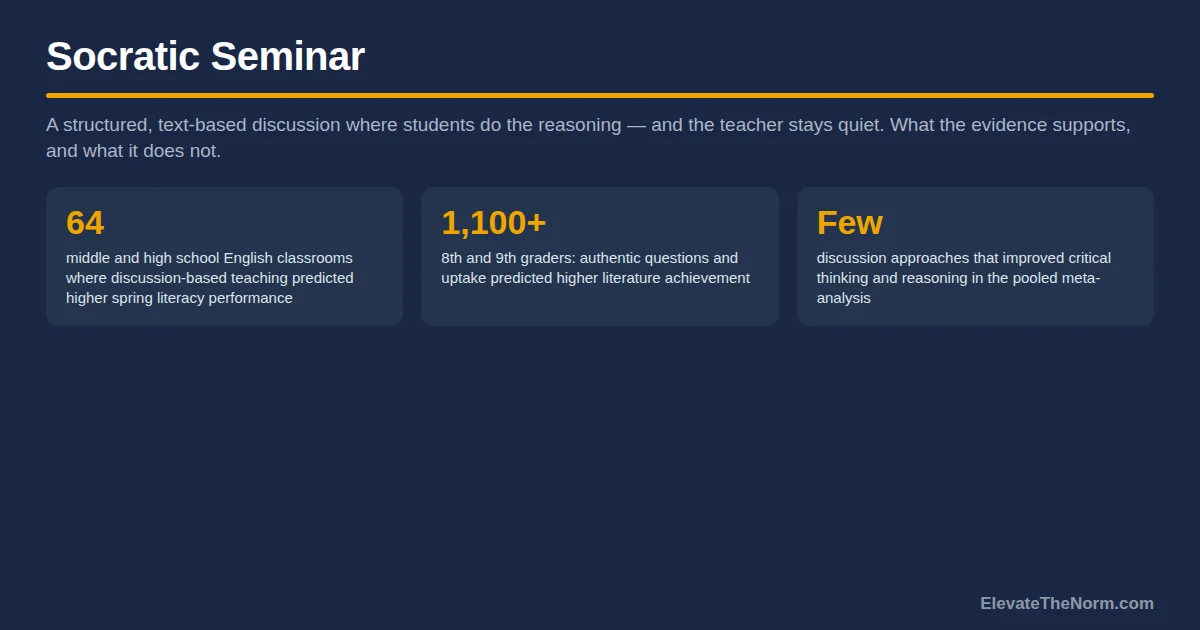
    • The strongest evidence is about discussion generally, not this format specifically. A study of 64 middle and high school English classrooms found discussion-based teaching predicted higher spring literacy performance — for low-achieving students as well as high-achieving ones.
    • The most honest finding is a mixed one. A meta-analysis found discussion produced big jumps in student talk and real gains in text comprehension, but few approaches moved critical thinking and reasoning.
    • Preparation is the whole game. A seminar with an unread text is twenty minutes of opinions.
    • Silence is not failure. The most common way a teacher wrecks a seminar is by answering the question they just asked.

    Free Download · PDF

    The Socratic Seminar Prep Sheet

    A text-selection check, the opening-question test, the six moves in order, six norms worth posting, a turn-count tally for you, and the four-way autopsy for a seminar that died.

    Download the free PDF

    Free. No email address required. Designed for grades 6–12. Browse every printable in Your Free Library.

    What Is a Socratic Seminar?

    A Socratic seminar is a formal, text-based dialogue where students ask and answer open-ended questions with each other, and the teacher facilitates instead of teaching. The National Paideia Center — which has trained schools in this format for decades — defines it as “a collaborative intellectual dialogue facilitated with open-ended questions about a text.” That definition is doing more work than it looks like.

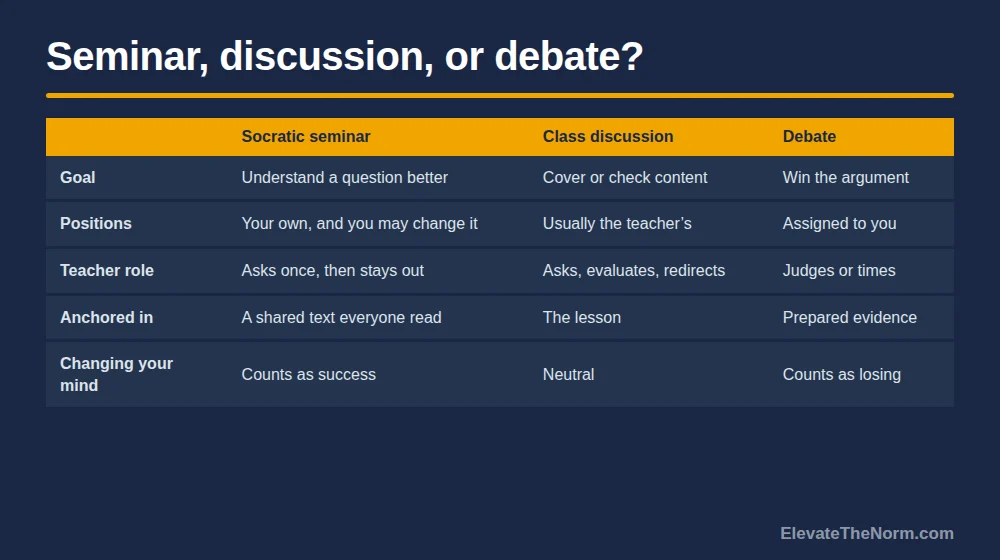
    Every word in it rules something out. Collaborative rules out debate. Open-ended rules out questions with answers. About a text rules out a free-floating conversation on a topic. Take away any one and you have something else — possibly useful, but not a seminar. Here is the distinction that matters most in a secondary room, because teenagers assume it is a debate unless you tell them otherwise.

    Comparison table of a Socratic seminar, a class discussion and a debate across goal, positions, teacher role, what the talk is anchored in, and whether changing your mind counts as success
    A seminar is not a debate. Nobody is assigned a side and nobody wins.

    Does the Research Actually Support Discussion-Based Teaching?

    Yes for discussion in general — and more cautiously than most professional development admits when it comes to thinking. Two studies point in slightly different directions, and both are worth knowing before you build a unit around this.

    The strong one is squarely in our grade band. Applebee, Langer, Nystrand and Gamoran studied 64 middle and high school English classrooms across grades 7, 8, 10, 11 and 12. Controlling for fall performance and background, discussion-based approaches were significantly related to spring literacy performance. Their own summary of why: students in discussion-heavy rooms “internalize the knowledge and skills necessary to engage in challenging literacy tasks on their own.” And the finding held “for low-achieving as well as high-achieving students” — which is the opposite of what people assume about discussion, and the single best argument for not reserving it for honors sections.

    An earlier study from the same research group found the mechanism. Across sixteen middle schools feeding nine high schools in eight Midwestern communities, more than 1,100 eighth and ninth graders were tested in fall and spring. Students whose teachers asked a higher proportion of authentic questions — questions the teacher did not already have an answer to — and who practiced uptake, building the next question out of what a student just said, scored significantly higher on literature achievement. Not more questions. Different questions.

    There is an equity finding buried in the first study that deserves more attention than it gets. Applebee and colleagues note that their interpretation is “complicated because instruction is unequally distributed across tracks.” Translated: the discussion-based teaching that helps low-achieving students the most was not what low-achieving students were mostly getting. If a school is going to act on this research at all, the action is not “add seminars” — it is checking which sections currently get them.

    Now the cautious one, and it is the reason this section exists. Murphy and colleagues ran a meta-analysis of classroom discussion approaches in the Journal of Educational Psychology. They found “strong increases in the amount of student talk and concomitant reductions in teacher talk, as well as substantial improvements in text comprehension.” Then they found this: “Few approaches to discussion were effective at increasing students’ literal or inferential comprehension and critical thinking and reasoning.”

    Read that twice. The talk goes up reliably. Comprehension of the text goes up. Whether students get better at thinking is not established by the pooled evidence, and the majority of the studies in that analysis were conducted in fourth through sixth grade, not with teenagers. If someone tells you seminars teach critical thinking, that is a hope, not a result.

    The same gap shows up in a study built specifically around Socratic dialogue. Mahoney and colleagues ran an eight-week Socratic dialogue series in Dutch vocational secondary education with 85 students and five teachers. Teachers found it deliverable but cognitively demanding, and all five asked for more facilitation training. The study’s own limitations section says there was “no measurement of actual critical thinking skill development.” A paper with “learning to think critically” in the title did not measure whether anyone did. The researchers said so themselves; it is a warning about how this format gets sold, not about them.

    One more, because the number gets quoted at teachers without its age attached. England’s Education Endowment Foundation ran a randomised controlled trial of Dialogic Teaching across 76 schools and roughly 5,000 pupils and found two additional months’ progress in English and science, with larger gains for pupils on free school meals. Those pupils were nine and ten years old. The practices probably transfer to a secondary room. The effect size does not automatically come with them.

    The defensible version: structured, text-anchored discussion with authentic questions is one of the better-evidenced things you can do with a secondary class, and the evidence for it is about comprehension and engagement rather than about producing better reasoners in eight weeks.

    One implication for anyone above the classroom level: this is not a practice you mandate in August and audit in October. Every teacher in the Dutch study asked for more training in facilitation specifically, and facilitation is the whole skill. A department that runs four seminars and talks about them afterward will get further than a district that requires one per unit.

    What Do You Need Before the First Seminar?

    Three things: a text worth arguing about, a question with no answer, and students who have actually read it. Skip any one and the seminar fails in a predictable way.

    The text. Short beats long. One or two pages that every student can hold and mark up beats a chapter half of them skimmed. It needs genuine ambiguity — a primary source with a point of view, a court opinion, a poem, a paragraph from a science paper where the authors hedge. If the text has one obvious reading, there is nothing to discuss and students will know it within four minutes.

    Two constraints on that choice, both easy to miss when you are excited about a text. Every student has to be able to read it. A twelfth-grade primary source in a mixed ninth-grade class produces a conversation among the strongest readers while everyone else decodes. If the text is hard, read it aloud together or gloss the four words that will stop people — but do not let reading level decide who participates. And check the text against your own building’s ground. Ambiguity is the point; a text likely to pull a student into disclosing something personal in front of twenty-eight peers is a different situation, and it is worth a conversation with an administrator before it is worth a seminar.

    The opening question. Write it down before the seminar and test it against one standard: could a well-prepared student answer this in one sentence and be finished? If yes, it is a comprehension check, not a seminar question. “What does the author claim?” is a warm-up. “Is the author being honest about what they do not know?” is a seminar. If writing them is the part you get stuck on, there are forty subject-general seminar questions and a ten-minute way to write your own.

    The reading. This is what quietly kills most first attempts. The Paideia model puts multiple close readings in a pre-seminar phase before any discussion and writing in a post-seminar phase afterward. That three-part shape is the format, not an optional extra. Read the text once ten minutes before the circle forms and you get opinions instead of evidence — then conclude your class cannot handle seminars. Your class is fine. The prep was missing.

    A note on when they read it. The obvious move is to send the text home the night before, and I would push back on that — not on principle, but because it decides in advance that the students who read at home get to participate and the ones who do not, do not. Read it in class. Ten minutes of everyone reading the same page in the same room is not lost time; it is the thing that makes the next twenty minutes possible.

    One practical note about the room. The tables in my room are trapezoids pushed together in groups rather than desks in rows, which is closer to a discussion shape than a lecture hall — but it still is not a circle, and the furniture has to move. Build that into the clock. A seminar that starts with four minutes of scraping chairs starts four minutes late, every time, and you will feel it at the end.

    How Do You Actually Run One?

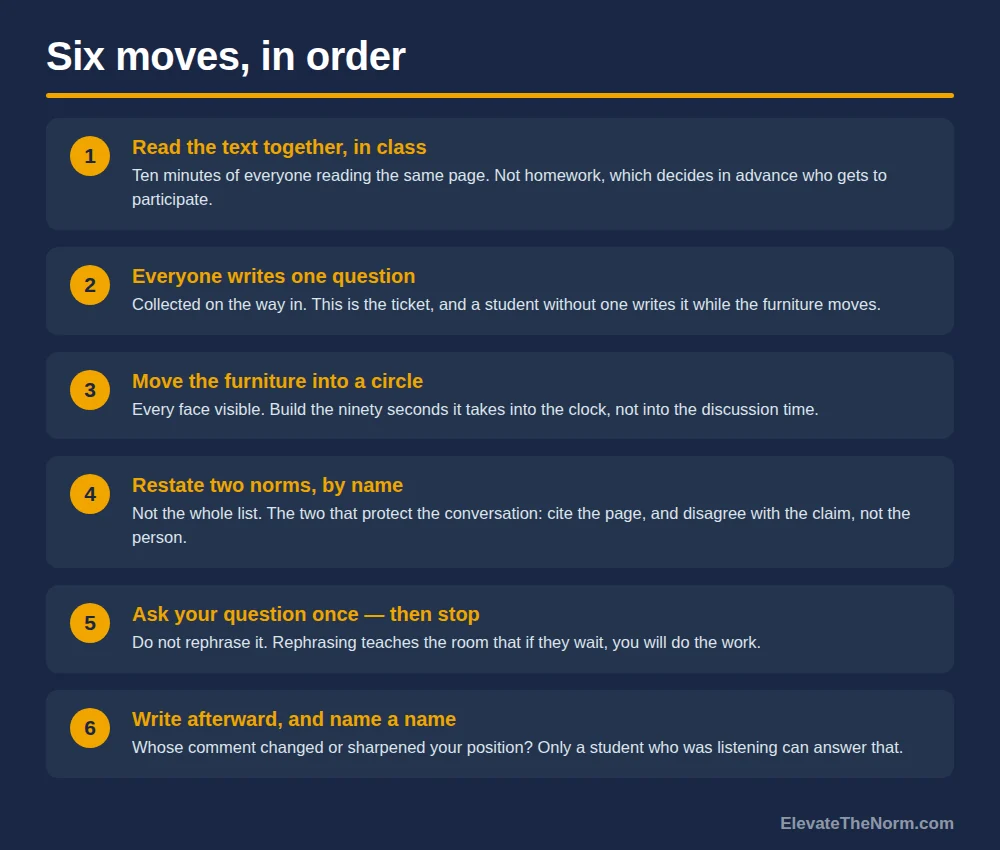
    Six moves, in order, and the hardest is the fifth. You can run this sequence in a single period and repeat it until it stops feeling like an event.

    Numbered list of six moves for running a Socratic seminar: read the text together in class, everyone writes one question, move the furniture into a circle, restate two norms by name, ask the question once then stop, and write afterward naming whose comment changed your position
    Six moves you can run in a single period. The fifth is the hard one.

    The sequence is deliberately boring in the middle. Step five is the interesting one, and the one I get wrong most often.

    In my own room I have landed on roughly a fifteen-count before I respond to something that is off track — and I mean roughly. It is an average, not a rule, because real classes change day to day and a number you enforce mechanically stops being judgment. A seminar asks for that same discipline in a different situation. You ask the opening question, nobody talks, and everything in you wants to rephrase it. Rephrasing is how you teach a room that if they wait long enough, you will do the work. Ask it once. Then sit there.

    The related move is refusing to evaluate. The instant you say “good point,” you have told twenty-eight teenagers that the goal is to produce points you approve of, and the conversation reorients toward you. Write the comment down instead. Nod. Look at somebody else. The Applebee study’s mechanism — authentic questions and uptake — only works if students believe you do not already have the answer, and praise is the fastest way to convince them you do.

    What Are the Rules, and Who Enforces Them?

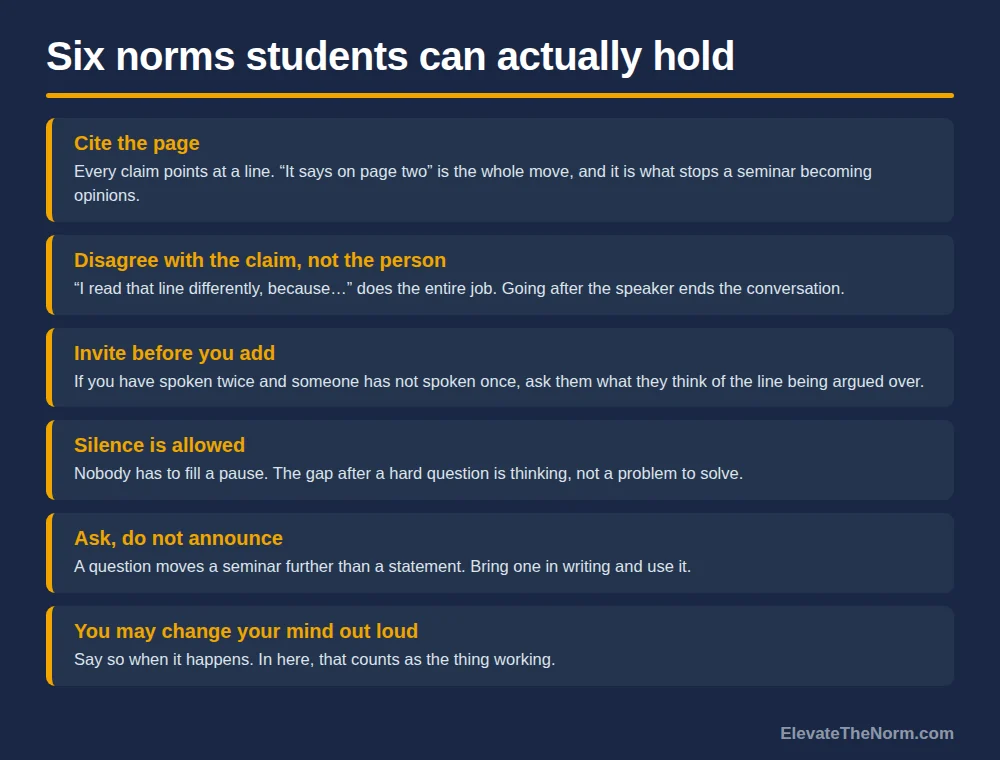
    Keep the list short enough that students can hold it, and hand enforcement to them by the third seminar. Long norm lists get read aloud once and ignored. Five or six behaviors, posted, referred to by name, is enough.

    Six Socratic seminar norms: cite the page, disagree with the claim not the person, invite before you add, silence is allowed, ask rather than announce, and you may change your mind out loud
    Short enough that students can hold them, and short enough to enforce by name.

    The norms that matter protect the conversation from its two failure modes: nobody talking, and three people talking. Everything else is manners.

    There is one behavior worth planning for: the student who is performing for the room rather than talking to it. Do not handle that inside the circle. Naming it publicly makes it a bigger performance, and the seminar stops. Let it pass, keep the conversation moving to someone else, and take it up with the student afterward at normal volume. A seminar is a bad place to win an argument with a teenager.

    Worth saying clearly, because it is where teenagers get this wrong: disagreeing with an idea is the job. A seminar where everyone agrees has not happened yet. What is off-limits is going after the person instead of the claim, and the fix is a sentence frame, not a lecture — “I read that line differently, because…” does the whole job. The broader argument for why this works in a secondary room is the same one behind holding students to an adult standard of disagreement rather than a polite one.

    What About the Fishbowl Format?

    A fishbowl Socratic seminar puts one group in an inner circle discussing while an outer circle observes, then swaps them. It exists to solve two real problems: a class of thirty is too big for one conversation, and students who never get observed never get feedback on how they discuss.

    It works, with one condition. The outer circle needs a job. An outer ring with nothing to do is a ring of spectators with phones. Give each outer student one inner-circle partner to track, and one thing to record — how many times their partner cited the text, or the one question their partner asked that moved the conversation. Keep the record behavioral: what the partner did, not how well they did it. “You went back to the text three times” is feedback. “You seemed nervous” is not, and a fifteen-year-old should not be handed that by a classmate. Hand the note to the partner rather than reading it to the room. That feedback is usually more useful than anything I would have said, because it comes from a peer who was watching only them — but it belongs to the person it is about.

    Do not make it your first seminar of the year, though. Students end up learning two unfamiliar procedures at once and the period goes to logistics.

    How Do You Handle the Students Who Won’t Talk?

    Stop treating silence as a single problem, because it is at least three problems with different fixes. Some students have nothing prepared. Some have something prepared and cannot find an opening. Some are genuinely afraid of the sound of their own voice in a quiet room, and no amount of encouragement touches that.

    A study of quiet students by Medaille and Usinger is instructive here, with a caveat stated up front: the participants were ten undergraduates, not teenagers, so treat it as a description of an experience rather than a finding about your seventh period. Nine of the ten struggled with instructor expectations for verbal participation. Six reported physical reactions — trembling, blushing, stuttering — when speaking aloud. And one of them described the thing I now believe is the actual mechanism: “When I speak [in class] I plan out what I want to say.”

    That is not shyness. That is a student who needs a draft, and the fix is not calling on them warmly — it is giving the whole room ninety seconds to write before the circle opens, so the students who need a draft have one and nobody is singled out for needing it.

    Three more moves that cost nothing:

    • Give the quiet student a job that is not an opinion. Tracking which page the group keeps returning to, or reporting the one question nobody answered, is a real contribution that does not require volunteering a view.
    • Use written entry. A sticky note with one question on it, collected at the door and read aloud anonymously, gets a reticent student’s thinking into the room without their voice attached to it. Read them yourself before you read any of them out. Anonymous is not the same as safe — a question can identify the student who wrote it, or disclose something that should not be discussed in a circle, and the two seconds it takes to scan the stack is the whole safeguard.
    • Do not grade volume. More on that next, because it is the single change that most reliably changes who talks.

    I would not promise that a seminar fixes this. Some students will speak twice all year and write the best post-seminar reflection in the class. That is a real outcome, and the format should be built to catch it.

    Should You Grade a Socratic Seminar?

    Grade the preparation and the reflection. Do not grade how many times a student spoke. The moment participation counts, you have created an incentive to talk rather than to think, and the students who most need the practice are the ones the incentive punishes.

    Count what you can defend. Did they annotate the text? Did they bring a written question? Does the post-seminar writing show they changed or sharpened a position — and can they name whose comment did it? That last one is the best assessment item this format produces, because only a student who was listening can answer it. Three comments in a circle are easy to fake. “I came in thinking X, and the point about the second paragraph is why I do not think that anymore” is not.

    This is also the answer when a parent asks why their quiet child is not being penalized, or why their talkative one is not being rewarded: the grade is on the thinking you can see on paper, and it is the same standard for everyone in the room. If your school requires a participation grade, take it from the written pre- and post-work and say out loud, to the students, that the talking is not scored. There is a four-criterion rubric that scores it this way, free and printed on the page. Then hold to it. The first seminar after they believe you is a different conversation. This is the same logic behind treating ungraded checks as information rather than points — the second you attach a score, you stop learning what students actually think.

    Four Ways a Seminar Goes Wrong

    Every one of these is a design problem, not a student problem. If a seminar dies, the autopsy is almost always in the prep.

    1. The question had an answer. Students find the answer in six minutes and then sit there. Fix: write the question the night before and try to answer it yourself in one sentence. If you can, it is not the question.
    2. The teacher kept talking. You clarified, you rephrased, you summarized, and the conversation routed through you every time. Fix: count your own turns. More than four in a thirty-minute seminar and you are running a recitation with the chairs moved.
    3. Three students ran it. Not because they are hogging it — because they are the only ones who prepared. Fix: require a written question from everyone, collected as they come in. Make it an expectation, not a bar — a student who arrives without one writes it in the first two minutes while the furniture moves. Nobody gets locked out of the conversation for being unprepared; they get two minutes and then they are in it.
    4. It happened once. A seminar in October and a seminar in March are two events. Students never get past the awkwardness of the format itself. Fix: shorter and more often. Fifteen minutes on a half-page every other week will outperform two forty-minute showpieces.

    The fourth is the one I would push hardest. Frequency turns this from a special activity into the way the class talks, and the same logic runs through any structure that hands students the thinking: the first run is about the structure, and only the fourth or fifth is about the content.

    What to Do Next

    Pick a one-page text you already teach — something with a hedge or a contradiction in it — and write one question you cannot answer in a sentence. Give students ten minutes in class to read it, mark two places they disagree, and write one question. Move the furniture. Ask your question once, and then do not talk for as long as you can stand.

    Then do it again in two weeks. The first one will be rough, and that is not information about your students. Run four before you decide whether this works in your room.

    If you want the underlying argument for why handing teenagers this much of the conversation is worth the mess, it is the same one behind giving students real decisions rather than cosmetic ones. A seminar is just the version of that argument you can run on a Tuesday.

    Before you go: grab the free The Socratic Seminar Prep Sheet (PDF) — ElevateTheNorm.com branded, printable, no email required.

    Frequently Asked Questions

    What is a Socratic seminar in simple terms?

    It is a structured discussion where students question a shared text and each other while the teacher mostly stays quiet. There is no assigned side, no winner, and no single correct answer to land on. The National Paideia Center calls it a collaborative intellectual dialogue facilitated with open-ended questions about a text. If the question has an answer, or if the teacher is doing most of the talking, it is a class discussion rather than a seminar.

    How long should a Socratic seminar last?

    Fifteen to thirty minutes of actual discussion is plenty for grades 6–12, and shorter is better when you are starting. A full class period sounds ambitious and usually produces twenty good minutes followed by fifteen of people repeating themselves. Frequency beats length. A fifteen-minute seminar every other week on a half-page text will build the skill faster than two long ones a year.

    What is the difference between a Socratic seminar and a debate?

    A debate assigns positions and produces a winner. A seminar assigns nothing and produces a better-understood question. That difference changes student behavior immediately: in a debate, changing your mind is losing, and in a seminar, changing your mind is the evidence that it worked. Tell students this explicitly before the first one, because teenagers default to debate unless you rule it out.

    Do Socratic seminars actually improve student learning?

    The evidence is genuinely mixed and worth knowing honestly. A study of 64 middle and high school English classrooms found discussion-based approaches significantly predicted spring literacy performance, including for low-achieving students. But a meta-analysis in the Journal of Educational Psychology found that while discussion produced strong increases in student talk and substantial gains in text comprehension, few approaches improved critical thinking and reasoning — and most of those studies were in grades 4 through 6. Discussion is well supported. The claim that it teaches thinking is not settled.

    How do you get quiet students to participate in a Socratic seminar?

    Give the whole class ninety seconds of writing time before the circle opens, so students who need to plan what they say have a draft and nobody is singled out for needing one. Beyond that, offer jobs that are not opinions — tracking which passage the group keeps returning to, or reporting the question nobody answered. And do not grade how often a student speaks. That single change does more than any amount of encouragement, because it removes the reason a struggling student is performing rather than thinking.

    Should I grade a Socratic seminar?

    Grade the preparation and the reflection, not the talking. Annotated text, a written question brought to the circle, and a post-seminar piece of writing are all defensible and all reward thinking. Counting comments rewards volume and penalizes the students who most need the practice. If a participation grade is required, pull it from the written work and tell students plainly that speaking is not scored.

    What makes a good Socratic seminar question?

    One you cannot answer in a sentence and cannot settle by looking something up. Test your question by trying to answer it yourself before the seminar; if you finish in one line, it is a comprehension check. Questions that work usually ask about a tension inside the text — whether the author is being honest about what they do not know, whether two of their claims can both be true, or what the text refuses to say.

    How many students should be in a Socratic seminar?

    Twelve to fifteen is the practical ceiling for one circle. Above that, the students at the edges stop being participants. That is what the fishbowl format is for: put half the class in an inner circle discussing and half in an outer circle observing a specific partner, then swap. Do not run a fishbowl as your first seminar though — students end up learning two unfamiliar procedures at once and the period goes to logistics.

    Sources

    1. Applebee, Arthur N., Judith A. Langer, Martin Nystrand, and Adam Gamoran. “Discussion-Based Approaches to Developing Understanding: Classroom Instruction and Student Performance in Middle and High School English.” American Educational Research Journal, vol. 40, no. 3, 2003, pp. 685–730. 64 middle and high school English classrooms, grades 7, 8, 10, 11 and 12; discussion-based approaches significantly related to spring performance controlling for fall performance, and effective for low-achieving as well as high-achieving students. https://eric.ed.gov/?id=EJ782328
    2. Murphy, P. Karen, Ian A. G. Wilkinson, Anna O. Soter, Maeghan N. Hennessey, and John F. Alexander. “Examining the Effects of Classroom Discussion on Students’ Comprehension of Text: A Meta-Analysis.” Journal of Educational Psychology, vol. 101, no. 3, Aug. 2009, pp. 740–764. Strong increases in student talk and substantial improvements in text comprehension; “few approaches to discussion were effective at increasing students’ literal or inferential comprehension and critical thinking and reasoning.” Majority of included studies were conducted in grades 4–6. https://eric.ed.gov/?id=EJ861185
    3. Nystrand, Martin, and Adam Gamoran. Student Engagement: When Recitation Becomes Conversation. National Center on Effective Secondary Schools, 1990. ERIC ED323581. Eighth- and ninth-grade English classes in sixteen middle schools feeding nine high schools across eight Midwestern communities; over 1,100 students tested fall and spring, 1987–88 and 1988–89. Higher proportions of authentic questions and uptake predicted significantly higher literature achievement. https://files.eric.ed.gov/fulltext/ED323581.pdf
    4. Jay, Tim, et al. Dialogic Teaching: Evaluation Report and Executive Summary. Education Endowment Foundation, July 2017. ERIC ED581114. Three-level clustered randomised controlled trial, 38 intervention schools (2,492 pupils) and 38 control schools (2,466 pupils); +2 months English, +2 months science, +1 month maths; three-padlock security rating. Pupils were in Year 5, aged nine and ten — this is not a secondary-school result. Evaluators note 21% of pupils excluded from analysis. https://files.eric.ed.gov/fulltext/ED581114.pdf
    5. Mahoney, Bethany, Ron Oostdam, Hessel Nieuwelink, and Jaap Schuitema. “Learning to Think Critically Through Socratic Dialogue: Evaluating a Series of Lessons Designed for Secondary Vocational Education.” Thinking Skills and Creativity, vol. 50, 2023, article 101422. 85 students and 5 teachers, Netherlands, eight weekly lessons; teachers found the format deliverable but demanding and all five requested more facilitation training. The study states as a limitation that there was no measurement of actual critical thinking skill development. https://www.sciencedirect.com/science/article/pii/S1871187123001906
    6. Medaille, Ann, and Janet Usinger. “Quiet Students’ Experiences with the Physical, Pedagogical, and Psychosocial Aspects of the Classroom Environment.” Educational Research: Theory and Practice, vol. 31, no. 2, 2020, pp. 41–55. Qualitative study of ten upper-division undergraduates — not secondary students; nine of ten struggled with verbal participation expectations and six reported physical symptoms when speaking aloud. https://files.eric.ed.gov/fulltext/EJ1274336.pdf
    7. National Paideia Center. “Paideia Seminar.” Definition of the seminar as a collaborative intellectual dialogue facilitated with open-ended questions about a text, and the pre-seminar / seminar / post-seminar cycle. https://paideia.org/blogs/npc/paideia-socratic-seminar
    About Clay Shumate

    Clay Shumate is a certified secondary Social Studies teacher in the public schools of West Alabama, with seven years of classroom experience, a B.A. in History, and an M.Ed. in Secondary Education. He writes about project-based learning, student responsibility, respect, and practical ways to hold young people to a higher standard while giving them room to learn from mistakes. He is a member of the Society of Professional Journalists and writes to its Code of Ethics; this site’s editorial standards and corrections policy are published in full. More about Clay.

  • Formative Assessment Strategies for Writing: Checks That Fit a Real Week

    Formative Assessment Strategies for Writing: Checks That Fit a Real Week

    By Clay Shumate

    Formative assessment strategies for writing are the checks a teacher runs while a piece is still being written, so the information can still change the draft. Exit tickets and comprehension checks do not transfer here. Writing has its own set, because the thing being assessed takes days, gets revised, and is too long to read thirty times a week. The equivalents for reading work on a different clock and are collected separately.

    That last constraint is the real problem. Almost every writing-feedback system that gets abandoned was abandoned because it required reading every draft. What follows is what the research supports, the number that should worry you, and a set of checks that fit an ordinary secondary schedule.

    Key Takeaways

    • Feedback works, and the size depends on who gives it. A meta-analysis found adult feedback at an effect size of 0.87, self-evaluation at 0.62 and peer feedback at 0.58 — but that study covered grades 1–8.
    • Two popular practices showed no meaningful effect in the same analysis. Teacher progress monitoring and the 6+1 Trait Writing model did not improve writing quality.
    • The federal practice guide rates the assessment recommendation as its weakest. Of three recommendations for teaching secondary writing, “use assessments to inform instruction and feedback” carries minimal evidence. That is worth knowing before anyone sells you a system.
    • Assess one thing at a time. A draft marked for everything gets revised for nothing. Pick the criterion the lesson taught and check only that.
    • Never put a grade on a draft you want revised. Self-assessment that counts toward a mark stops being honest, and the same logic applies to a draft.

    Free Download · PDF

    Formative Assessment Quick-Use Pack

    A strategy decision matrix, an evidence tracker, four exit-ticket formats, and a next-day response planner — four pages built around changing the next instructional move.

    Download the free PDF

    Free. No email address required. Designed for grades 6–12. Browse every printable in Your Free Library.

    What Makes a Writing Check Formative?

    Timing and use. A check is formative if it happens while the piece can still change and if somebody acts on it. Both conditions. A rubric applied to a final draft, however detailed, is a grade with extra steps.

    That rules out more of the standard toolkit than teachers expect. Marking a finished essay is summative no matter how much you write in the margin. A reading quiz is not a writing check. A participation grade for peer editing measures compliance with a procedure, not the quality of anything. The general versions of these checks are covered in the general version, twenty techniques sorted by lesson phase; this page is about the ones built for a text that takes a week.

    What is distinctive about writing is that the product has stages. A thesis exists before the paragraph does, an outline before the draft, a draft before the revision. Each stage is a place to check something cheaply, while it is still cheap to fix. The whole art is checking the earliest stage at which the problem is visible — because a thesis fixed on Monday saves five paragraphs that never had to be written.

    What Does the Research Actually Show?

    That feedback on writing works, that two popular practices do not, and that the evidence for the whole assessment-driven approach is weaker than its popularity suggests. All three are worth having straight.

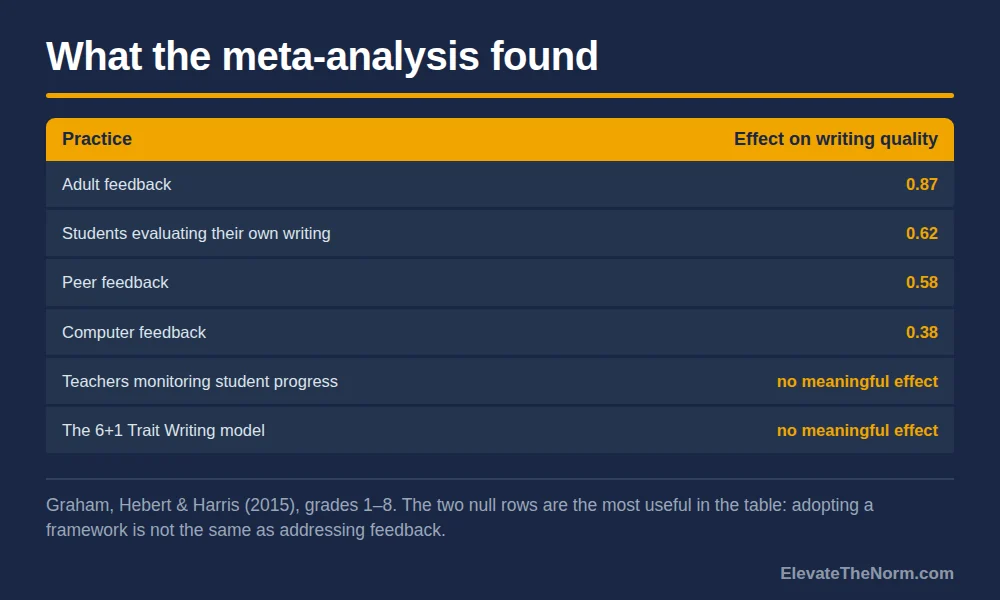
    The central study is Graham, Hebert and Harris’s 2015 meta-analysis in the Elementary School Journal, which pooled experimental studies of formative writing assessment and reported effect sizes by who does the assessing:

    PracticeEffect on writing quality
    Adult feedback0.87
    Students evaluating their own writing0.62
    Peer feedback0.58
    Computer feedback0.38
    Teachers monitoring student progressno meaningful improvement
    The 6+1 Trait Writing modelno meaningful improvement

    Three things to notice. First, the grade band is 1 through 8. Only the top three grades of that range are secondary, and none of it is high school. The practices are reasonable to carry upward; the numbers do not travel with them.

    Second, the two null results are the most useful rows in the table. Progress monitoring — tracking writing scores over time to inform instruction — showed no meaningful improvement, and neither did 6+1 Trait, which is a widely adopted framework. That does not make either worthless, but it does mean a department should not treat adopting them as having addressed writing feedback.

    Third, student self-evaluation at 0.62 nearly matched adult feedback and beat peer feedback. For a teacher with 120 students, that is the most consequential number in the table, because it is the only one that does not scale with your reading time.

    Now the part most articles omit. The What Works Clearinghouse practice guide on teaching secondary students to write effectively, written by a panel including Steve Graham, Jill Fitzgerald, Linda Friedrich, Katie Greene, James Kim and Carol Booth Olson, makes three recommendations and rates the evidence behind each. Explicitly teaching writing strategies through a model–practice–reflect cycle is rated strong. Integrating writing and reading using exemplar texts is rated moderate. Using assessments to inform instruction and feedback is rated minimal.

    Minimal is the lowest rating in that system, and it is attached to the recommendation this article is about. Read it as a statement about proportion rather than a reason to stop. If you have a fixed amount of energy for improving writing in your classroom, the guide says to spend it first on explicitly teaching strategies and modeling them — and the assessment practices below are what you run inside that, not instead of it.

    Table of effect sizes on writing quality from a formative assessment meta-analysis: adult feedback 0.87, student self-evaluation 0.62, peer feedback 0.58, computer feedback 0.38, and no meaningful effect for teacher progress monitoring or the 6+1 Trait Writing model
    Graham, Hebert and Harris (2015), grades 1-8. The two null rows are the most useful in the table.

    Which Checks Fit a Secondary Schedule?

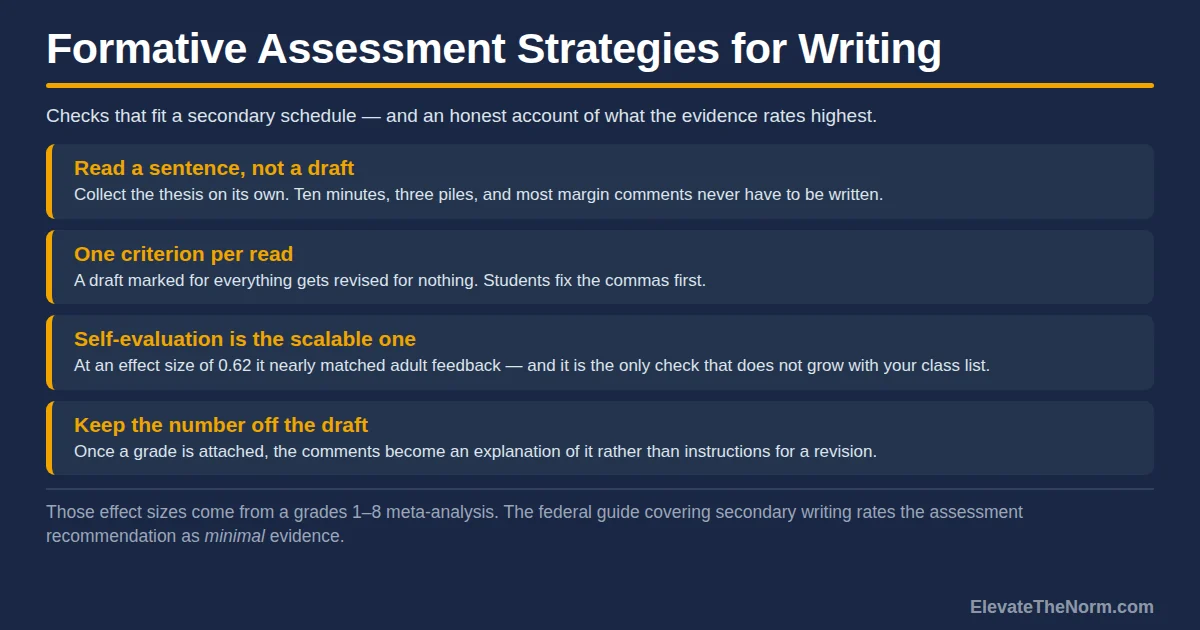
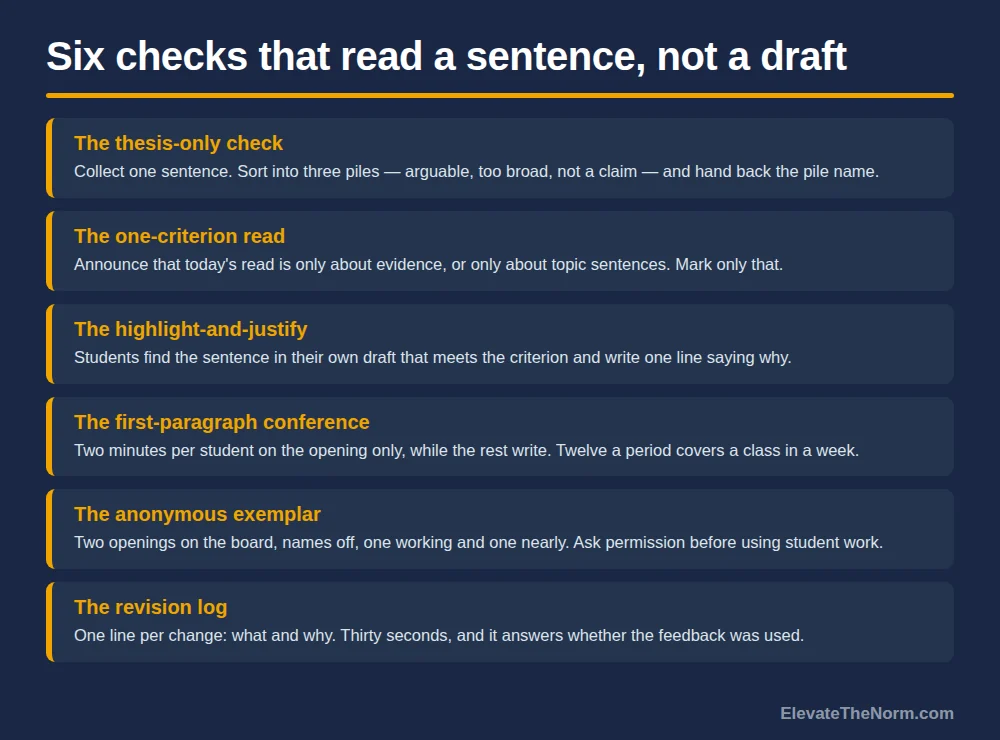
    The ones that read a sentence rather than a draft. Every strategy below is designed around the fact that you cannot read 120 full drafts and still have a weekend.

    • The thesis-only check. Collect one sentence. Read all of them in ten minutes, sort into three piles — arguable, too broad, not a claim — and hand them back with the pile name. Fixing this on day one prevents most of what you would otherwise write in margins on day six.
    • The one-criterion read. Announce that today’s read is only about evidence, or only about topic sentences. Mark only that. A draft marked for everything gets revised for nothing, because a student facing thirty marks does not know where to start and usually starts with the commas.
    • The highlight-and-justify. Students highlight the sentence in their own draft that meets a specific criterion, and write one line explaining why. If they cannot find it, that is the check — and they have found it themselves, which is the part that matters.
    • The first-paragraph conference. Two minutes per student, on the opening paragraph only, while the rest write. Twelve students a period, everybody covered across a week.
    • The anonymous exemplar. Put two short pieces of writing on the board with names removed — one that does the thing, one that nearly does it — and have the class say which and why. This is the model–practice–reflect cycle the WWC rates as strong evidence, run as a five-minute check. Ask before you use a student’s work, even anonymized, because the writer always recognizes their own sentences and so do the people sitting next to them. Asking takes ten seconds, almost nobody says no, and the ones who do have a reason. Writing your own two versions, or using last year’s with permission, works just as well.
    • The revision log. One line per revision: what changed, and why. It takes a student thirty seconds and tells you whether feedback was used, which is the only question a progress tracker was ever trying to answer.

    Notice what is missing: reading every draft, writing extended comments, and any system requiring a spreadsheet. Those are the things that get abandoned in October, and abandonment is the real failure mode — not choosing the second-best check. If you would rather start from something printed, the free formative assessment quick-use pack has a general version to adapt.

    Graphic listing six formative writing checks: the thesis-only check, the one-criterion read, the highlight-and-justify, the first-paragraph conference, the anonymous exemplar, and the revision log
    Every one of these reads a sentence rather than a draft. That is what makes them survive past October.

    How Do You Make Self-Evaluation Work?

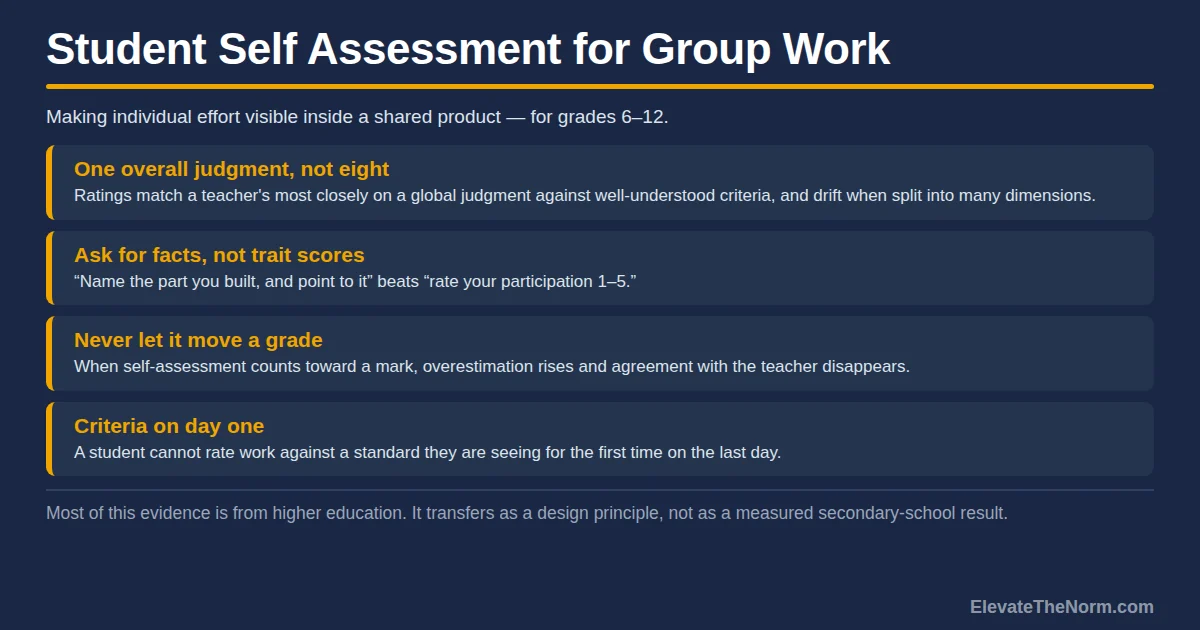
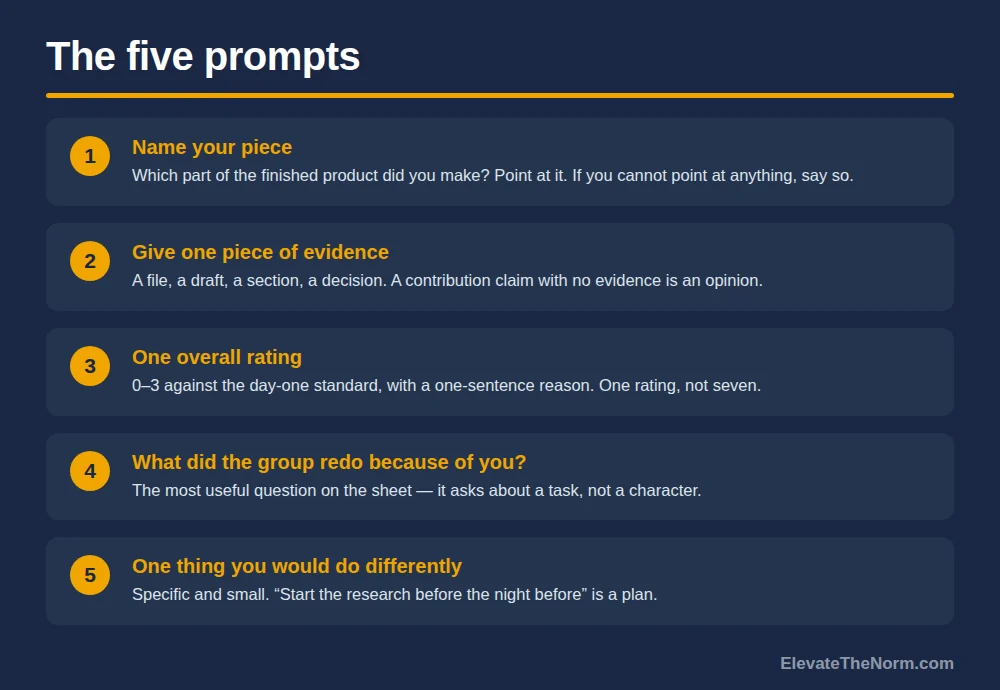
    Give the criteria first, keep it out of the gradebook, and ask for evidence rather than a rating. At 0.62 this is the best return per minute of teacher time in the whole table, and all three conditions matter.

    Heidi Andrade’s 2019 critical review in Frontiers in Education supplies the design rules. Criterion-referenced self-assessment showed main effects on every criterion assessed, and concrete task-specific criteria outperformed vague competence-based ones — a result she attributes to Fastré and colleagues. In writing terms, “every claim is followed by a quotation and an explanation of it” is checkable. “Uses evidence effectively” is not.

    The decisive rule is about grading. Andrade cites Tejeiro and colleagues, where self-assessment counted toward the final grade: overestimation rose dramatically and no correlation remained between the instructor’s assessment and the student’s. Run formatively, agreement improved substantially, and all twenty studies in her review that used self-assessment formatively showed a positive association with learning.

    Andrade makes one more point worth carrying. There is little evidence that inaccurate self-assessment produces worse learning, and students act on their predictions regardless of accuracy. You are not trying to make a student’s judgment match yours. You are trying to make them read their own draft as a reader. The broader version of the practice is in the student self assessment guide; writing only changes what sits in the criteria.

    Is Peer Feedback Worth the Class Time?

    Yes at 0.58, and only if you narrow what you ask for. Unstructured peer review produces “I liked it, maybe add more detail,” which is the outcome most teachers have seen and correctly concluded is a waste of twenty minutes.

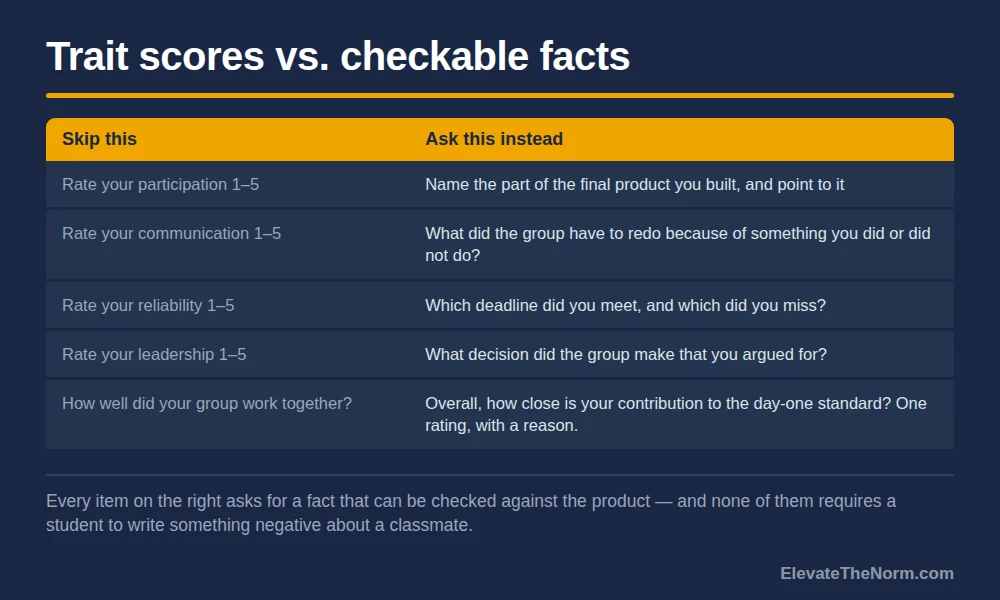
    There is a useful finding from an adjacent literature. Falchikov and Goldfinch’s meta-analysis of 48 higher-education studies comparing peer marks with teacher marks found that agreement was closest when students made a global judgment against well-understood criteria, and worse when asked to break the judgment into many separate dimensions and score each. Those were undergraduates marking work, not teenagers giving revision advice, so treat it as a design hint rather than a transferred result — but the hint points somewhere useful: the twelve-box peer editing checklist is probably the worst available format.

    What works better is narrower and more concrete:

    • Ask for a location, not a judgment. “Underline the sentence where the argument actually starts.” A reader can do that honestly; “rate the organization” they cannot.
    • Ask what the reader could not follow. This is the one thing a peer knows that you do not, because they read it without already knowing what the writer meant.
    • Ask for one question, not one suggestion. Suggestions are advice from a novice. A genuine question — “is this the same person as in paragraph two?” — is information the writer can act on without deferring to anyone.

    Two cautions. Peer feedback has a social cost that teacher feedback does not. A fifteen-year-old asked to critique a classmate’s writing is managing a relationship as well as a text, and most will resolve that tension by being vague. Asking for locations and questions rather than evaluations removes the tension rather than asking students to override it. And decide who reads what before you start. Writing is personal in a way a math worksheet is not; a student writing about something that matters to them should know in advance whether a classmate will see it, and should have a way out.

    A One-Week Routine That Does Not Require Reading Every Draft

    Four checks across a week, none of which takes you more than fifteen minutes.

    1. Day one — collect the thesis only. One sentence per student. Sort into three piles, hand back with the pile name, and give the “not a claim” pile five minutes to try again.
    2. Day two — the anonymous exemplar. Two openings on the board, names off, one working and one nearly working. The class names the difference. This is the modeling step, and it is the one with the strongest evidence behind it.
    3. Day three — highlight and justify. Students find the sentence in their own draft that meets today’s single criterion and write one line saying why. Walk the room and read over shoulders; collect nothing.
    4. Day four — peer question round. Swap drafts. Each reader underlines where the argument starts and writes one genuine question. Ten minutes, no checklist.

    Then the revision log on day five: one line per change, what and why. That log is the whole assessment record, and unlike a score tracker it answers the question that actually matters, which is whether any of this changed the draft.

    Two adjustments. First, differentiate the container rather than the criterion — a student who cannot produce the written justification quickly can say it to you in the last minute of class, and a student working in a second language can highlight and point. The judgment against criteria is what has to survive. Second, if a student’s draft has a problem that is not today’s criterion, note it for yourself and leave it. You will get to organization on the week you are checking organization, and a student who receives one correctable thing at a time actually corrects it. For the general version of this discipline, see what actually counts as evidence that a class understood something.

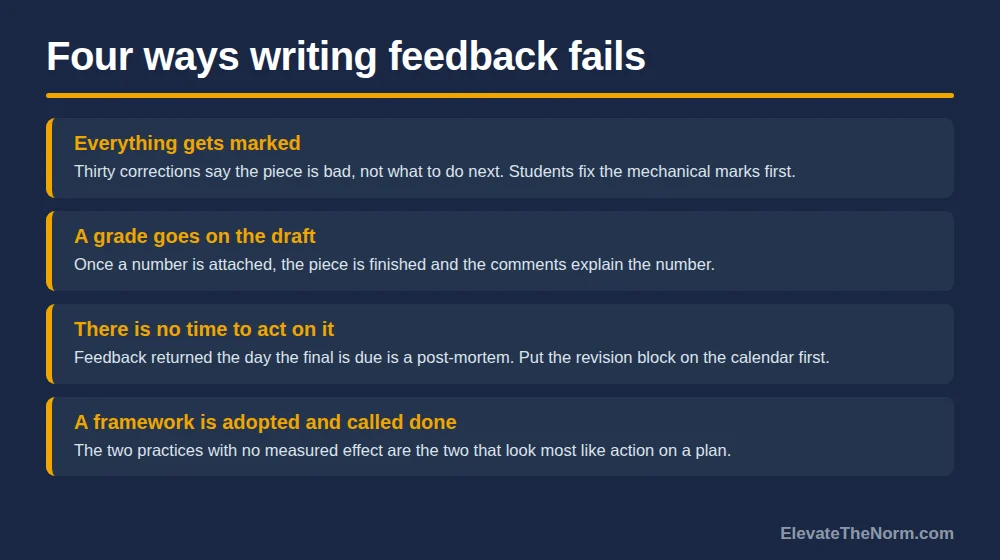
    Four Ways Writing Feedback Fails

    All four are common, and all four are about the system rather than the student.

    Everything gets marked. A draft returned with thirty corrections communicates that the piece is bad, not what to do next. Students respond by fixing the easiest marks, which are almost always the mechanical ones. One criterion per read is not a compromise — it is what makes revision possible.

    A grade goes on the draft. Once a number is attached, the piece is finished in the student’s mind, and the comments underneath it become an explanation of the number rather than instructions for a revision. If you need the draft in the gradebook, grade completion rather than quality, and say which you are doing.

    The one-criterion rule is also the thing families most often ask about, usually in the form of why the teacher did not correct all the errors. It deserves a straight answer rather than a defensive one: every error was noticed, and marking all of them is what produces a draft a student fixes the commas in and hands back otherwise unchanged. The errors get their turn, one at a time, on the assignment where that is the thing being taught. Said in advance, in a sentence on the assignment sheet, that lands as a deliberate method. Said after a parent email, it sounds like an excuse.

    There is no time to act on it. Feedback returned the day the final is due is a post-mortem. If the schedule does not contain a revision block after the feedback, the feedback is decorative, and it is more honest to admit that than to keep writing comments into a void.

    Graphic listing four ways writing feedback fails: everything gets marked, a grade goes on the draft, there is no time to act on it, and a framework is adopted and called done
    All four are about the system rather than the student.

    The department adopts a framework and calls it done. This is where the two null results earn their keep. Adopting 6+1 Trait or installing a progress-monitoring spreadsheet is a visible action that showed no meaningful effect on writing quality in the meta-analysis. The things that did work — someone reads a piece of writing and responds to it, or a student reads their own against criteria — are less visible on a plan, and are the ones worth protecting time for.

    What to Try on the Next Assignment

    Take the next piece of writing you have already assigned. Collect the thesis on its own, before anything else exists, and sort the sentences into three piles. That single move costs you ten minutes and changes more drafts than any set of margin comments you will write later.

    Then pick one criterion for the whole assignment and check only that — in the exemplar, in the self-evaluation, in the peer round, in your own read. Put a revision block on the calendar before you give any feedback, and keep a number off the draft.

    None of this is a system, and that is deliberate. The evidence for assessment-driven writing instruction is rated minimal by the people best placed to judge it, while explicit strategy instruction and modeling are rated strong. The checks here are worth running because they are cheap and they surface problems early. They are not a substitute for teaching students how to write, and any resource presenting them as one has the proportions backwards.

    Before you go: grab the free Formative Assessment Quick-Use Pack (PDF) — ElevateTheNorm.com branded, printable, no email required.

    Frequently Asked Questions

    Do these effect sizes apply to high school students?

    Not directly, and it matters. The meta-analysis behind the headline numbers — adult feedback 0.87, self-evaluation 0.62, peer feedback 0.58 — covered grades 1 through 8, so only its top three grades are secondary at all and none is high school. The practices are reasonable to carry upward because the mechanisms are not age-specific, but the numbers should not be quoted as a high school result. The federal practice guide that does cover secondary writing rates the assessment recommendation as having minimal evidence.

    Should I put a grade on a draft?

    Not if you want it revised. Once a number is attached, most students treat the piece as finished and read the comments as justification for the mark rather than instructions for a revision. The self-assessment research points the same way: when self-evaluation counted toward a grade, overestimation rose sharply and agreement with the instructor disappeared. If a draft has to appear in the gradebook, grade completion rather than quality and tell students that is what you are doing.

    Is 6+1 Trait Writing a waste of time?

    That is stronger than the evidence supports. What the meta-analysis found is that 6+1 Trait showed no meaningful improvement in writing quality, and the same was true of teachers monitoring student progress over time. That is a real finding and a department should not treat adopting the framework as having addressed writing feedback. It is not a finding that a shared vocabulary for talking about writing is harmful — it is a finding that the vocabulary alone does not move the writing.

    How do I give feedback to 120 students without losing every weekend?

    Stop reading whole drafts. Collect one sentence rather than one essay; mark one criterion rather than everything; run two-minute conferences on opening paragraphs while the rest write; and lean on self-evaluation, which came in at 0.62 and is the only practice in the table that does not scale with your reading time. A teacher who reads every draft thoroughly in September and nothing at all by November has given less useful feedback than one who reads one paragraph from everybody every week.

    Does peer feedback actually help, or is it busywork?

    It helped at an effect size of 0.58, which is real — but what most classrooms run is not what was studied. Unstructured peer review produces “I liked it, add more detail.” Narrow the ask instead: have readers underline where the argument starts, say what they could not follow, and write one genuine question rather than one suggestion. Those ask for information a peer actually has. Also settle who reads what before you begin, because writing is more personal than a worksheet and a student should know in advance.

    What if a student’s draft has problems that are not this week’s criterion?

    Note them for yourself and leave them alone. A student who receives one correctable thing at a time usually corrects it; a student who receives thirty fixes the commas. Keep your own running list and let it decide what the criterion is for the next assignment — that list is more useful as a planning document than as margin notes, and it means the pattern across the class shapes what you teach next rather than disappearing into thirty separate drafts.

    How is this different from just marking essays carefully?

    Timing and use. Marking a finished essay is summative however detailed it is, because nothing about that piece can change afterwards. A formative check happens while the writing is still in progress and is followed by time to act on it. The practical test is simple: if there is no revision block on the calendar after the feedback goes back, what you did was grading, and calling it formative assessment does not make it function like one.

    Where should I spend my energy if I can only change one thing?

    Not here, according to the people who reviewed the evidence. The What Works Clearinghouse panel rates explicitly teaching writing strategies through a model–practice–reflect cycle as strong evidence, integrating reading and writing with exemplar texts as moderate, and using assessments to inform instruction and feedback as minimal. If you have one change in you this year, make it the modeling. The checks on this page are cheap enough to run inside that work, and they are not a replacement for it.

    Sources

    1. Graham, Steve, Michael Hebert, and Karen R. Harris. “Formative Assessment and Writing: A Meta-Analysis.” Elementary School Journal, vol. 115, no. 4, 2015, pp. 523–547. https://eric.ed.gov/?id=EJ1068976
    2. Graham, Steve, Jill Fitzgerald, Linda D. Friedrich, Katie Greene, James S. Kim, and Carol Booth Olson. “Teaching Secondary Students to Write Effectively” (practice guide summary). What Works Clearinghouse, Institute of Education Sciences, U.S. Department of Education. https://ies.ed.gov/ncee/wwc/Docs/PracticeGuide/wwc_secwrit_summary_053117.pdf
    3. Andrade, Heidi L. “A Critical Review of Research on Student Self-Assessment.” Frontiers in Education, vol. 4, art. 87, 2019. https://www.frontiersin.org/journals/education/articles/10.3389/feduc.2019.00087/full (The Tejeiro et al. 2012 and Fastré et al. 2010 findings are reported in this review; the primary papers were not read directly.)
    4. Falchikov, Nancy, and Judy Goldfinch. “Student Peer Assessment in Higher Education: A Meta-Analysis Comparing Peer and Teacher Marks.” Review of Educational Research, vol. 70, no. 3, 2000, pp. 287–322. https://eric.ed.gov/?id=EJ630369

    About Clay Shumate

    Clay Shumate is a certified secondary Social Studies teacher in the public schools of West Alabama, with seven years of classroom experience, a B.A. in History, and an M.Ed. in Secondary Education. He writes about project-based learning, student responsibility, respect, and practical ways to hold young people to a higher standard while giving them room to learn from mistakes. He is a member of the Society of Professional Journalists and writes to its Code of Ethics; this site’s editorial standards and corrections policy are published in full. More about Clay.

  • Student Self Assessment for Group Work: What to Ask and What to Skip

    Student Self Assessment for Group Work: What to Ask and What to Skip

    By Clay Shumate

    Student self assessment in group work is a short structured rating in which each student judges their own contribution against criteria everyone saw before the project started. It is not a popularity form and it is not a way to catch a freeloader. Its job is to make individual effort visible inside a shared product, which is the one thing a group grade cannot do.

    That is a narrower purpose than most group-work reflection sheets claim, and the narrowness is what makes it work. What follows is what the research supports, the one design decision that determines whether the ratings mean anything, and a form that takes a student four minutes.

    Key Takeaways

    • Ask for one overall judgment, not eight. The clearest finding in the peer-assessment literature is that ratings line up with a teacher’s when students make a global judgment against criteria they understand — and drift when they are asked to score many separate dimensions.
    • Self-assessment is the individual-accountability half of group work. Cooperative learning research names individual accountability as one of five elements that have to be present. A self-rating with evidence is the cheapest way to supply it.
    • Never let it change anybody’s grade. When self-assessment counts toward a mark, overestimation rises and agreement with the teacher disappears.
    • Criteria before the project, not after. A student cannot rate a contribution against a standard they are seeing for the first time on the last day.
    • Most of this evidence is from higher education. It transfers as a design principle. It is not a measured secondary-school result, and you should not be told otherwise.

    Free Download · PDF

    Student Self-Assessment Forms for Grades 6–12

    A general self-assessment form, a project reflection, a group-work accountability form, and a conference preparation sheet — reflection that asks for evidence instead of a confidence rating.

    Download the free PDF

    Free. No email address required. Designed for grades 6–12. Browse every printable in Your Free Library.

    What Is Student Self Assessment for Group Work?

    It is each student, separately and in writing, answering three questions about a shared project: what did I actually do, how well does it meet the criteria we agreed on, and what would I do differently next time. Three parts. Take away the criteria and it is a feelings check. Take away the evidence and it is a claim. The same evidence rule governs checking a draft while it is still a draft.

    It is worth distinguishing from the thing it gets confused with. Self-assessment is not peer assessment. Peer assessment asks students to rate each other, which raises questions about friendship, retaliation and social cost that a self-rating does not. The two can coexist, and plenty of published teamwork instruments combine them, but they are different instruments doing different jobs, and mixing them without saying so is how a reflection sheet turns into a blame form.

    The wider practice is covered in the guide to student self assessment. Group work only changes what sits in the criteria column — and it adds a problem that individual work does not have, which is that the product no longer tells you who did what.

    Why Bother, When the Project Already Has a Grade?

    Because a group grade is a measurement of the artifact, and you are also trying to teach something about contribution. One number on one poster cannot carry both jobs.

    Cooperative learning is one of the better-evidenced practices in education, and the research is specific about what has to be in place. Robyn Gillies’s 2016 review in the Australian Journal of Teacher Education names five elements: positive interdependence, promotive interaction, individual accountability, explicitly taught social skills, and group processing. The effect sizes she reports from Johnson and Johnson’s syntheses run in the 0.58 to 0.70 range across 117 studies, and the underlying work spans preschool to tertiary and most subject areas.

    The sentence in that review that matters most for a secondary teacher is the plainest one: simply placing students in groups does not guarantee cooperation. Gillies notes that discord shows up when students struggle with the task and with managing each other, and that without teacher mediation high-level talk appears with low frequency. Group work is not self-executing. Individual accountability and group processing are the two elements a self-assessment directly supplies, and they are the two most often left out.

    She also reports two structural findings worth acting on for free: optimal group size is three or four, and lower-attaining students benefit most from mixed-attainment grouping while middle-attaining students tend to do better in more homogeneous groups. Neither costs anything to apply.

    What Should Students Rate — and How Many Things?

    One overall judgment against two or three criteria they already know. Not a scorecard. This is the single most actionable finding in this whole literature and almost every classroom teamwork form gets it backwards.

    Falchikov and Goldfinch’s 2000 meta-analysis in the Review of Educational Research pooled 48 studies comparing peer marks with teacher marks. Their central result: agreement was closest when students made global judgments based on well-understood criteria, and worse when they were asked to break a judgment into many separate components and score each one.

    That is the opposite of how most group-work forms are built. The typical sheet asks a student to rate themselves on participation, preparation, communication, reliability, respect, leadership and time management, on a five-point scale, seven times. The literature predicts exactly what you see when you collect them: rows of fours, no discrimination between the dimensions, and no usable information.

    The honest caveat: those 48 studies were higher education, and they were peer marks rather than self-marks. The mechanism — that people judge a whole thing against a standard better than they decompose it — is a reasonable thing to carry into a secondary classroom. It is not a measured result about fifteen-year-olds, and nobody should sell it to you as one.

    Two-column table contrasting trait rating scales such as rate your participation one to five with fact-based questions such as name the part of the final product you built and which deadline did you miss
    Every item on the right asks for a fact that can be checked against the product.

    So what goes on the form:

    Skip thisAsk this instead
    Rate your participation 1–5Name the part of the final product you built, and point to it
    Rate your communication 1–5What did the group have to redo because of something you did or did not do?
    Rate your reliability 1–5Which deadline did you meet, and which did you miss?
    Rate your leadership 1–5What decision did the group make that you argued for?
    How well did your group work together?Overall, how close is your own contribution to the standard we set on day one? One rating, with a reason.

    Every item on the right asks for a fact rather than a number about a personality trait. Facts are checkable against the product, and a student who claims to have built the timeline can be asked to show it. That is also what makes the sheet safe: it never requires a teenager to say something negative about a classmate in writing.

    Does a Rubric Make the Self-Rating Better?

    For the work, clearly. For the teamwork part, less clearly, and the evidence is thinner than the enthusiasm.

    Heidi Andrade’s 2019 critical review in Frontiers in Education reports that criterion-referenced self-assessment — using a rubric or checklist — showed main effects on every criterion assessed, and that concrete, task-specific criteria outperform vague competence-based criteria. If the rubric says “the claim is supported by at least two sources,” a student can check. If it says “demonstrates strong collaboration,” they cannot.

    On the teamwork side specifically, one study is worth reporting honestly because it cuts both ways. Pang, Kootsookos, Fox and Pirogova compared two cohorts of 186 first-year engineering undergraduates on a team design project: one got a marking scheme, the next got a detailed rubric. The rubric cohort reported more helpful feedback, higher satisfaction and achieved higher grades, and 96 percent said the rubric helped them reach the learning goals. But only 52 percent found it useful for constructive feedback on teamwork specifically. The authors list the limits themselves: one course, one institution, one grading instructor.

    Read that as the useful signal it is. A rubric is very good at telling a student whether the work meets a standard. It is much weaker at telling them whether they were a good group member, because that is a harder thing to write criteria for. So write the rubric for the product, and handle contribution with the evidence questions above rather than by inventing a collaboration scale. The project rubric guide covers the product side.

    A Four-Minute Group Work Self-Assessment

    Five prompts, filled in individually, before anyone talks about it. Individually and before matters: a student who has already heard the group’s version writes the group’s version.

    1. Name your piece. Which part of the finished product did you make? Point at it. If you cannot point at anything, say that — it is real information and it is not a punishment.
    2. Give one piece of evidence. A file, a draft, a section, a specific decision. This is the step that does the work; a contribution claim with no evidence is an opinion.
    3. One overall rating against the day-one standard. 0–3, with the anchors written out, and a one-sentence reason. One rating, not seven.
    4. What did the group have to redo because of you? The most useful question on the sheet, and the one students answer more honestly than you expect, because it is about a task rather than a character.
    5. One thing you would do differently on the next project. Specific and small. “Start the research before the night before” is a plan.
    Numbered graphic of five group work self assessment prompts: name your piece, give one piece of evidence, give one overall rating, say what the group had to redo because of you, and name one thing you would do differently
    Filled in individually, before the group talks about it. Prompt four is the most useful one on the sheet.

    The first time you run it, teach it. Students have almost never been asked to describe their own contribution in specific terms, and left alone most will write “I helped with the slides.” Show a worked example on the board — a vague answer next to a specific one — and say plainly that naming a real limit is not going to be held against them. Ten minutes once. Every version of this that gets abandoned was abandoned because the first round produced nothing and the teacher concluded students could not do it.

    Then hold the group conversation. Gillies’s fifth element is group processing — students reflecting together on how the work went and what to do next. The sheet is the private half; five minutes of the group comparing what each person wrote is the public half, and the sequence only works in that order. If you want a ready-made form to adapt, the free self-assessment pack has one you can retype the criteria into.

    Be realistic about what reading twenty-eight of these costs you. It is not a stack to mark. Read them once, fast, looking only for the two things that matter: who could not point at a piece of the product, and what any group says it had to redo. That is a scan, not a grading session, and it should take about fifteen minutes for a full class. If you find yourself writing responses on them, you have turned a diagnostic into an assignment and you will stop doing it by November.

    One accessibility note. The written form is one container, not the only one. A student who cannot produce five written answers quickly — a writing disability, a newcomer building English — can answer the same five prompts out loud in ninety seconds while you note it down. The judgment against criteria is the part that has to survive, not the paragraph.

    Should Any of This Touch the Grade?

    No. Not the student’s own, and not anybody else’s. This is the one place where the research gives a clean answer and the answer is unambiguous.

    Andrade’s review reports the Tejeiro finding directly: when self-assessment counted toward a final grade, student overestimation increased dramatically and no correlation emerged between the instructor’s assessment and the student’s. Run formatively, agreement with external evaluators improved substantially, and every study in the review that used self-assessment formatively showed a positive association with learning.

    There is a second reason specific to group work, and it is about fairness rather than accuracy. A self-rating that moves a grade creates an incentive to inflate, which rewards confidence rather than contribution — and confidence is not evenly distributed across a class. The students most likely to under-claim are often the ones who did the quiet, unglamorous work. Attaching marks to self-report turns that into a penalty.

    This is also the answer to the most common complaint families raise about group work, which is that a child did most of the work and shared the grade with people who did not. That complaint is often correct, and the fix families usually ask for — let my child report who slacked, and grade accordingly — is the one the evidence says not to build. The better answer, and the one worth putting in an email before the project starts rather than after it: the group grade covers the product, every student also produces something individual, the groups are small enough that contribution is visible, and the self-assessment exists so a student’s own account of their work is on the record. That is a real answer rather than a deflection, and it holds up at a conference.

    If you have a genuine contribution problem, solve it with the design instead. Assign distinct, visible roles so the product itself shows who did what. Keep the groups at three or four, where hiding is harder. Collect an individual artifact from every student alongside the group one. All three make effort visible without asking a sixteen-year-old to adjudicate it in writing.

    Four Ways This Goes Wrong

    All four are design errors, and all four are cheaper to prevent than to repair.

    The criteria arrive at the end. A student handed a rating scale on the last day is being asked to judge work against a standard they did not have while doing it. The criteria go up on day one, in the same words you will use on the form.

    Graphic listing four failure modes for group work self assessment: the criteria arrive at the end, it quietly becomes peer assessment, nothing happens next, and it is used to settle a dispute
    All four are design errors, and all four are cheaper to prevent than to repair.

    It quietly becomes peer assessment. A question like “did everyone pull their weight?” is a peer rating wearing a self-assessment label. If you want peer input, say so openly, design it properly, and be clear about who reads it. Do not smuggle it in.

    Nothing happens next. If the sheets go in a folder and the next project is organized the same way, students learn the form is ceremony. The minimum honest follow-through is one change to the next project that came from reading them — a different group size, a required interim deadline, distinct roles.

    It is used to settle a dispute. When a group is already in conflict, a self-assessment form becomes evidence in a case, and everything anyone writes becomes strategic. Deal with the conflict as a conflict. The sheet is a routine instrument for ordinary projects; it is not an investigation tool and it will not survive being used as one.

    Where to Start on the Next Project

    Pick the next group project you already have planned. On day one, put two criteria for the product on the board in the words you will use again at the end. Keep the groups at three or four. On the last day, before any group talks, give every student the five prompts and four minutes.

    Then read them for one thing only: which groups had someone who could not point at a piece of the product. That is the design question, not a discipline question, and the answer usually turns out to be that the task had fewer real jobs in it than it had people.

    Keep it out of the gradebook, keep it to one overall rating, and change one thing about the next project because of what you read. The point is not to catch anybody. It is that a student who has had to name their own contribution in writing, against a standard, has done something a group grade will never make them do — which is the same argument as handing a teenager the job of naming their own conduct against a standard they were taught rather than waiting to be told how they did.

    Before you go: grab the free Student Self-Assessment Forms for Grades 6–12 (PDF) — ElevateTheNorm.com branded, printable, no email required.

    Frequently Asked Questions

    Should a group work self-assessment ever change a student’s grade?

    No. Andrade’s review reports that when self-assessment counted toward a final grade, overestimation rose sharply and the correlation with the instructor’s own assessment disappeared; run formatively, agreement improved substantially. There is a fairness reason on top of the accuracy one: attaching marks to self-report rewards confidence rather than contribution, and the students most likely to under-claim are often the ones who did the quiet work. If you have a contribution problem, fix it with distinct roles, smaller groups and an individual artifact — not with a self-rating that moves numbers.

    How do I stop one student doing all the work without making others rate each other?

    Change the task before you change the paperwork. Three or four to a group rather than five or six, so there is less room to disappear. Distinct visible roles, so the product itself shows who did what. An individual artifact from every student alongside the group one. Those three do more about free-riding than any rating form, and none of them asks a teenager to write something negative about a classmate.

    Why one overall rating instead of scoring several categories?

    Because the evidence points that way. Falchikov and Goldfinch’s meta-analysis of 48 studies found that student ratings matched teacher marks most closely when students made a global judgement against well-understood criteria, and less closely when asked to break the judgement into many separate dimensions. The seven-category teamwork form produces rows of fours and no usable information. Be aware that those studies were higher education and were peer rather than self ratings — the mechanism travels, the measurement has not been repeated with secondary students.

    What do I do with a student who writes that they did nothing?

    Take it as information and not as a confession. A student who says honestly that they cannot point at a piece of the product has told you something valuable and has told you the truth, which is exactly the behaviour the form is supposed to make safe. Ask what the group’s tasks were and how they got divided. About half the time the answer is that the project had three real jobs and four people in the group, which is a design problem you own.

    Is peer assessment ever worth adding?

    Sometimes, but never by stealth. Peer rating carries social costs that self-rating does not — friendship, retaliation, and the position you put a student in by asking them to write something about a classmate that a teacher will read. If you use it, say plainly that you are using it, be specific about who sees the responses, keep it to observable contributions rather than judgements about people, and never let it move a grade. A question like “did everyone pull their weight?” buried in a self-assessment is peer assessment without the safeguards.

    When should students fill this in — during the project or at the end?

    Both is better than either, and the end alone is the common mistake. A short version at the halfway point can still change something while the project is running, which is the whole difference between formative and post-mortem. The end-of-project version is where the overall rating and the “what would you do differently” question belong. What matters more than timing is that students write individually before the group discusses anything.

    Does this work for a long project or only a short one?

    It scales better to longer projects, because a longer project has more distinguishable pieces for a student to point at. On a two-day task, the honest answer to “name your piece” is often that everyone did a bit of everything, and the form has little to work with. If your groups are doing short tasks, run the group processing conversation and skip the written self-assessment until there is a project big enough to have parts.

    Sources

    1. Gillies, Robyn M. “Cooperative Learning: Review of Research and Practice.” Australian Journal of Teacher Education, vol. 41, no. 3, 2016. https://files.eric.ed.gov/fulltext/EJ1096789.pdf (The Johnson & Johnson and Slavin effect sizes quoted above are reported in this review; the primary syntheses were not read directly.)
    2. Falchikov, Nancy, and Judy Goldfinch. “Student Peer Assessment in Higher Education: A Meta-Analysis Comparing Peer and Teacher Marks.” Review of Educational Research, vol. 70, no. 3, 2000, pp. 287–322. https://eric.ed.gov/?id=EJ630369
    3. Andrade, Heidi L. “A Critical Review of Research on Student Self-Assessment.” Frontiers in Education, vol. 4, art. 87, 2019. https://www.frontiersin.org/journals/education/articles/10.3389/feduc.2019.00087/full (The Tejeiro et al. 2012 and Fastré et al. 2010 findings are reported in this review; the primary papers were not read directly.)
    4. Pang, Vinh, Alex Kootsookos, Rebecca Fox, and Elena Pirogova. “Does an assessment rubric provide a better learning experience for undergraduates in developing transferable skills?” Journal of University Teaching & Learning Practice, vol. 19, no. 3, 2022. https://files.eric.ed.gov/fulltext/EJ1361716.pdf
    5. Avina, A., Boyle, S., Duble Moore, T., Hicks, T., and Wiggins, A. “Intensive Intervention Practice Guide: Self-Monitoring Systems to Support Students’ Behavioral Needs.” U.S. Department of Education, Office of Special Education Programs / National Center on Intensive Intervention, Fall 2022. https://files.eric.ed.gov/fulltext/ED628226.pdf

    About Clay Shumate

    Clay Shumate is a certified secondary Social Studies teacher in the public schools of West Alabama, with seven years of classroom experience, a B.A. in History, and an M.Ed. in Secondary Education. He writes about project-based learning, student responsibility, respect, and practical ways to hold young people to a higher standard while giving them room to learn from mistakes. He is a member of the Society of Professional Journalists and writes to its Code of Ethics; this site’s editorial standards and corrections policy are published in full. More about Clay.

  • Visual Classroom Transitions: Cues Students Can Actually See

    Visual Classroom Transitions: Cues Students Can Actually See

    By Clay Shumate

    Visual classroom transitions use something students can see — a projected timer, a posted sequence, a slide, a hand signal — to carry the instructions for moving from one activity to the next, instead of your voice carrying them. The point is not decoration. It is that a visible instruction stays available after you have stopped talking, and a spoken one does not.

    That distinction is the whole article. Most transition advice tells you to be clearer. Visual cues are a structural fix rather than a delivery fix: they change where the instruction lives, so a student who missed it, tuned out for ten seconds, or is still finishing a sentence can recover without asking you or asking the person next to them.

    Key Takeaways

    • A visual cue is persistent; your voice is not. That is the entire mechanism. Anything a student can look back at removes a reason to ask a neighbor, and asking a neighbor is how a thirty-second transition becomes ninety.
    • Transitions are a real time cost, and the honest number is a range. Estimates put off-task behavior, transitions and wait time at somewhere between 17 and 29 percent of instructional time.
    • More visuals is not better. The same literature that supports visual cues also finds that visual clutter predicts less on-task behavior — and that finding has a published reanalysis you should know about.
    • The evidence base is strong for some students and thin for whole classrooms. Visual schedules are well supported for students with intellectual disability and autism. Nobody has shown a general secondary-classroom effect.
    • One permanent cue beats five clever ones. The cue only works once it is automatic, and a cue that changes weekly never becomes automatic.

    Free Download · PDF

    Classroom Transitions Planning Toolkit

    A transition audit sheet, a cue-type guide, and a planning template for building and timing the three moves that cost you the most.

    Download the free PDF

    Free. No email address required. Designed for grades 6–12. Browse every printable in Your Free Library.

    What Counts as a Visual Classroom Transition?

    Anything a student can look at that tells them what happens next, where to be, and how long they have. Four families cover almost everything worth using in a secondary room:

    • A countdown. A projected timer, or a number on the board you change. It answers “how long” without a single word from you, and “how long” is the question most students are actually asking.
    • A sequence. The steps of the move, posted or projected: what to close, what to get, where to sit. Three to five steps, in order, in the order a student would do them.
    • A state signal. Something that shows what mode the room is in right now — a colored slide, a magnet on the board, a word in the corner of the projection. Silent work, partner talk, whole class.
    • A gesture. A hand signal that means one specific thing and never means anything else. Free, instant, and the only one that works when the projector is down.

    What does not count: a decorative poster nobody reads, a slide so crowded that finding the instruction takes longer than hearing it, and a sign that has been up since August and has therefore become furniture.

    Graphic describing four families of visual classroom transition cue: a countdown, a posted sequence of steps, a mode marker showing what the room is doing, and a hand gesture
    Four families cover almost everything worth using in a secondary room. Most teachers need two of them, used consistently.

    Visual cues sit inside the broader practice of running the four moments where a lesson actually loses time, and they are one signal among several. They pair naturally with an audio cue — the music and sound cue guide covers that half — and the pairing is often better than either alone, because one catches the student who is looking up and the other catches the student who is not.

    How Much Time Do Transitions Actually Cost?

    Enough to matter, and less precisely than most articles claim. Anyone quoting you a clean figure is rounding somebody else’s estimate.

    The most careful recent synthesis is Kraft and Novicoff’s 2024 paper on time in school. Reviewing the available studies, they report that estimates of off-task behavior, transitions and wait time together occupy between 17 and 29 percent of instructional time — a range, drawn from several different measurement methods, and covering three things at once rather than transitions alone.

    Their own district analysis is more concrete and more sobering. In Providence Public Schools they found instructional time lost running at 16 percent in elementary, 21 percent in middle school and 25 percent in high school. The largest single contributor was unexcused absence, followed by outside interruptions and teacher absence; interruptions and teacher absence alone cost the average high school student 97.3 hours a year. My free First 10 Days Procedures Checklist on TPT walks through which routine to teach on which day.

    Read that honestly. Those Providence figures are not a transition statistic. They count absence and building-level interruption, and the authors explicitly call the estimate a lower bound that does not capture how usable hours are further eroded by disruptions inside the classroom. The transition number lives inside the 17-to-29 percent range, and that range is wide because the measurement is hard.

    What you can say without overstating: transitions are a nontrivial recurring cost, they are one of the few losses a single teacher can act on without anyone’s permission, and a room that moves in thirty seconds instead of ninety recovers real minutes across a semester. That is a good enough reason. It does not need inflating.

    Why Does a Visual Cue Work Better Than Saying It Again?

    Because it is still there after you stop talking. A spoken instruction exists for about four seconds and then only in the memory of whoever was listening. A projected one is available to the student who looks up late.

    That sounds small. It is the entire difference, and you can watch it happen: the student who missed the instruction turns to a neighbor, the neighbor stops working to answer, and one missed instruction has now taken two students off task and generated the noise that pulls a third. A visible instruction gives that student a way to recover without recruiting anyone.

    It also tells you who benefits most, and it is not the student you were picturing. It is the one who was absent yesterday and does not know the routine, the one who needs a few extra seconds to process a spoken instruction, and the one who will not ask you a question in front of the room under any circumstances. All three are students a voice-only transition leaves behind, and none of them will tell you so.

    There is a second effect, harder to see. Instructions delivered only by voice make you the sole source of the answer, so every uncertainty routes through you. That is what makes a transition feel like crowd control. Moving the instruction onto the wall or the screen means the room can answer its own question, which is the same principle behind writing down the routines a class is expected to run without prompting rather than re-explaining them.

    The research on the cueing side is worth being precise about, because it is frequently overstated. Visual activity schedules have a real evidence base: van Dijk and Gage’s 2019 meta-analysis in the Journal of Intellectual & Developmental Disability pooled 13 single-case studies and found a meaningful effect on independent skills, across middle school, high school and adult participants. Milam and Sutton’s 2024 article in Beyond Behavior extends the practice to students with emotional and behavioral disorders as a proactive transition strategy, at the elementary and middle school level.

    Notice what that evidence is and is not. It is single-case research with students who have identified disabilities. It is good evidence that visual schedules help those students become more independent. It is not evidence that adding a projected timer raises achievement in a general-education eleventh-grade classroom, and nobody should tell you it is. The honest case for visual cues in a mainstream secondary room is mechanical and modest: it costs nothing, it removes a known friction point, and the practice it generalizes from is well supported for the students who need it most.

    There is one adjacent evidence-based practice worth naming, because it is cheap and it pairs with every cue on this page. Ennis, Royer, Lane and Griffith’s 2017 systematic review in Education and Treatment of Children applied Council for Exceptional Children standards to precorrection — telling students what is about to be expected, before the moment arrives — and concluded it qualifies as an evidence-based practice. A visual cue is a precorrection you did not have to say.

    Does More Visual Support Make a Room Work Better?

    No, and this is the part most articles about classroom visuals leave out. The same research tradition that supports targeted visual cues also finds that a visually busy room costs attention.

    Godwin, Seltman, Scupelli and Fisher observed 58 elementary classrooms with a structured on-task protocol and analyzed panoramic photographs of each room’s visual environment. Students were on task 72.7 percent of the time. Greater visual noise significantly predicted less on-task behavior — each standard deviation increase in visual noise was associated with roughly a 10 percent reduction in the odds of being on task. Adherence to design-composition principles predicted nothing. Peer distraction, incidentally, accounted for 46.4 percent of all off-task behavior, which is worth remembering the next time a seating decision seems minor.

    The better-known version of this finding comes from Fisher, Godwin and Seltman’s 2014 study in Psychological Science, where kindergarteners in a heavily decorated room were more distracted and scored lower than the same children in a sparse one. It is quoted constantly. It also has a published reanalysis that you should know about before you quote it. Imuta and Scarf, writing in Frontiers in Psychology the same year, reanalyzed the data and found that children’s distraction in the decorated room decreased considerably across lessons — habituation. Their argument is that the study conflated novelty with irrelevance, and that 45 minutes total across two weeks is nowhere near enough time to habituate the way students do to a real classroom they sit in daily.

    So the strong claim — decorations harm learning — does not survive contact with the reanalysis. Two weaker claims do survive, and both are useful: visual noise measured in real classrooms predicts less on-task behavior, and novel visual material draws attention. Both point the same direction for transitions. If everything on your walls is competing, the one thing you actually need students to look at is competing too. And because novelty is what draws the eye, a cue that appears only at transitions has an advantage over one that is always up. My Brain Breaks for Middle and High School on TPT give you 60 quick resets that do not feel childish to teenagers.

    The caveat on all of it: these are K–4 samples. A sixteen-year-old is not a kindergartener, and no equivalent study of secondary classrooms turned up here. Treat this as a reason to keep the signal clean, not as a proven high school effect.

    How Do You Build a Visual Cue That Actually Gets Used?

    Five steps, and step four is the one that decides whether it works.

    1. Pick the transition that costs you the most. Not all of them. Time three of them with your phone for a week — entry, the move into group work, and the last five minutes — and fix the worst one first. Most teachers guess wrong about which one it is.
    2. Write the move as three to five steps, in student order. What closes, what comes out, where people go. If it takes more than five steps, the transition itself is too complicated and no cue will save it.
    3. Put the steps and a countdown in the same place every time. Same corner of the slide, same spot on the board. A cue that moves is a cue students have to search for, and searching is the cost you were trying to remove.
    4. Teach it, then rehearse it twice. Show the cue, walk the steps, do it once badly and name what went wrong, do it again. This is fifteen minutes and it is the entire difference between a cue and a decoration. A visual nobody has been taught to read is wall art.
    5. Leave it alone for a month. The cue works when it is automatic, and automatic takes repetition. Changing it because you thought of a better version resets the clock.
    Numbered five-step graphic for building a visual classroom transition cue: pick the costliest transition, write the move as three to five steps, put it in the same place every time, teach and rehearse it twice, and leave it alone for a month
    Step four is the one that decides whether it works. A visual nobody has been taught to read is wall art.

    Two practical notes. Make the cue legible from the worst seat in the room — back corner, at an angle, with the lights on. Text that reads fine on your laptop frequently does not survive the projector, and a student who cannot read the cue will ask a neighbor, which is the exact behavior you were trying to prevent. Check it from that seat once.

    And have a version that works when the technology does not. Projectors fail, and plenty of secondary teachers float between rooms or share a space where the board is not theirs to write on. A hand signal plus three steps on a half sheet at each table, or on a single laminated card you carry, covers the same ground and needs no bulb and no wall. If your whole transition system depends on a screen you do not control, you have built a system that breaks on the morning the network is down — which is the same reason a room needs a procedure a substitute could run without you in the building.

    What Do Visual Cues Look Like in a Secondary Classroom?

    Plainer than the internet suggests. Most published visual-transition material is built for elementary rooms, and a fourteen-year-old reads a cartoon carpet-time card as an insult. The design rule for grades 6–12 is that the cue should look like something adults use.

    Worth using:

    • A full-screen countdown for any move with a deadline. No decoration, large numerals, visible from the back.
    • A three-line slide that appears only during a transition and shows what closes, what opens, and where to be.
    • A mode marker in a fixed corner of the slide — independent, partner, whole class. Use a word, not a color alone. Roughly one boy in twelve has a red–green color vision deficiency, so a red-versus-green block is a cue a few students in every section cannot read. A colored block with the word on it works for everyone, and it ends the “can we talk?” question permanently.
    • A two-finger signal that means one thing: thirty seconds left. One gesture, one meaning, used every day.
    • A materials diagram for any recurring setup with a physical arrangement — lab stations, a debate layout, group clusters. Drawn once, reused all year.

    Worth skipping: animated slide transitions, anything with a cartoon character, a different cue for every activity, and a countdown with sound effects. All of them add novelty to a moment that needs predictability.

    One more: the cue should not require you to be at the front of the room. The value of a visual signal is that it frees you to move — to be next to the group that always stalls, instead of at the board narrating. If your system requires you to stand somewhere and press something, you have built a cue that costs you the thing it was supposed to buy.

    Where Visual Transitions Break Down

    Four failure modes, all predictable, all cheaper to avoid than to fix.

    The cue is never taught. It goes up, students do not know it is load-bearing, and it becomes background within a week. This is the most common failure and the easiest to prevent: fifteen minutes of explicit instruction and two rehearsals.

    The cue competes with everything else on the wall. This is the visual-noise finding applied to your own room. If the signal sits in a field of posters, student work and reference charts, it is one more thing in a busy field. Give it a clear zone with nothing around it.

    The cue is treated as a substitute for the transition being sensible. No timer fixes a move that requires twenty-eight people to cross the room to a single supply table. Redesign the move first. A visual cue makes a good procedure faster; it cannot make a bad one work.

    The cue becomes a countdown to a punishment. If the timer’s only meaning is that something unpleasant happens at zero, students learn to watch you rather than the screen, and the cue has acquired a tone you did not intend. The timer answers “how long do I have,” which is a fair question a student is entitled to ask. Keep it answering that.

    Graphic listing four failure modes for visual classroom transitions: the cue is never taught, it competes with wall clutter, it substitutes for redesigning a bad move, and it becomes a countdown to a punishment
    All four are predictable, and all four are cheaper to avoid than to fix.

    What to Do This Week

    Time your three worst transitions for a week and write the numbers down. Pick the slowest one. Write that move as four steps in the order a student would do them, put those steps plus a countdown in one fixed spot, and spend fifteen minutes teaching it with two rehearsals. Then leave it alone for a month and time it again.

    While you are at it, look at the wall behind the cue and take down anything that is not doing work. That is the one piece of advice in this article with direct classroom observation behind it, even if the classrooms were younger than yours.

    Visual classroom transitions will not transform a room. What they do is remove one specific friction — the gap between when you said the instruction and when a student needed it — and hand students a way to solve their own problem without asking anybody. That is worth fifteen minutes and a slide. For the concrete versions, the transition examples and free planning toolkit includes a cue guide and an audit sheet for timing the moments that leak the most.

    Before you go: grab the free Classroom Transitions Planning Toolkit (PDF) — ElevateTheNorm.com branded, printable, no email required.

    Frequently Asked Questions

    Do visual transition cues work with high school students, or are they an elementary thing?

    The design has to change; the mechanism does not. A sixteen-year-old reads a cartoon cue card as condescension and will treat it accordingly. A full-screen countdown, a three-line slide and a hand signal are the same tool in a form that looks like something adults use. Be aware that the research base is mostly elementary and mostly students with identified disabilities — there is no study here showing a general effect in a mainstream high school classroom. The case for using them at this level is that they cost nothing and remove a known friction, not that they are proven.

    Isn’t a timer just pressure? Some of my students get anxious about it.

    A timer is pressure when zero means something bad happens. It is information when zero means the next thing starts. Two things keep it on the information side: say what happens at zero before you start it, and make sure what happens at zero is a transition rather than a consequence. If a particular student finds a visible countdown genuinely difficult, a posted sequence without a clock does most of the same work — the persistence of the instruction is the part that matters, not the ticking.

    How many visual cues should a classroom have?

    Fewer than you think. One for time, one for the sequence, one for mode, and one gesture is a complete system, and most rooms would do better with two of those used consistently than four used occasionally. The observational research on visual noise points the same way: more visual material in a room predicts less on-task behavior, so every additional cue is competing with the ones you actually need.

    Does this mean I should take everything off my classroom walls?

    No, and the study that gets quoted for that claim has a published reanalysis worth knowing about. Fisher, Godwin and Seltman found kindergarteners more distracted in a decorated room — but Imuta and Scarf reanalyzed the data and showed the distraction dropped considerably across lessons, which points to novelty rather than decoration as the cause, in a setting where children never had time to habituate. The defensible version is narrower: keep a clear zone around the cue you need students to read, and take down what is genuinely doing no work. Student work on the walls is doing work.

    What do I do when the projector dies mid-transition?

    Have the analog version ready before it happens, because it will. A hand signal that means thirty seconds and four steps written on the board in marker do the same job and never need a bulb. Teach the backup at the same time you teach the main cue so it is not a novelty on the day you need it. Any transition system that only works when the technology works is a system that fails on exactly the mornings that are already going badly.

    Should students help design the cue?

    It is worth asking them which transition is worst and what the current cue does not tell them. They are the ones experiencing the ambiguity and they will name things you cannot see from the front — the slide is unreadable from the back row, or nobody knows whether the move includes getting a laptop. Take their information and keep the design decision. A cue that changes because of student preference every few weeks never becomes automatic, and automatic is the whole point.

    How do I make sure a visual cue is readable for every student?

    Three checks, none of which takes long. Sit in the worst seat in the room — back corner, off angle, lights on — and read the cue yourself; projector contrast is much worse than laptop contrast. Never let color alone carry meaning, because a red-versus-green signal is unreadable for the students in every section with a color vision deficiency; put the word on the block. And say the cue out loud the first few times you use it, which covers a student with low vision and costs you four seconds. A cue that a few students cannot read is worse than no cue, because those students now have to ask someone.

    How long before a new visual cue actually starts saving time?

    Expect a few weeks, and expect the first several days to look worse rather than better, because students are learning a new routine on top of doing the old one. Time the transition before you start so you have a real baseline, then time it again after a month. If nothing has improved after a month of consistent use, the problem is almost certainly the transition itself rather than the cue — a move with too many steps or a physical bottleneck will not be fixed by putting a timer on it.

    Sources

    1. Kraft, Matthew A., and Sarah Novicoff. “Time in School: A Conceptual Framework, Synthesis of the Causal Research, and Empirical Exploration.” EdWorkingPaper, February 2024. https://edworkingpapers.com/sites/default/files/Kraft Novicoff – Time In School – Feb 2024_1.pdf
    2. Godwin, Karrie E., Howard Seltman, Peter Scupelli, and Anna V. Fisher. “Attentional Competition in Genuine Classrooms.” Proceedings of the 42nd Annual Meeting of the Cognitive Science Society, 2020. https://cognitivesciencesociety.org/cogsci20/papers/0524/0524.pdf
    3. Imuta, Kana, and Damian Scarf. “When too much of a novel thing may be what’s ‘bad’: commentary on Fisher, Godwin, and Seltman (2014).” Frontiers in Psychology, vol. 5, art. 1444, 2014. https://www.frontiersin.org/journals/psychology/articles/10.3389/fpsyg.2014.01444/full (The Fisher, Godwin and Seltman 2014 Psychological Science study is described here as reported in this commentary and in the Godwin et al. 2020 paper above; the original article was not read directly.)
    4. van Dijk, Wilhelmina, and Nicholas A. Gage. “The effectiveness of visual activity schedules for individuals with intellectual disabilities: A meta-analysis.” Journal of Intellectual & Developmental Disability, vol. 44, no. 4, 2019, pp. 384–395. https://eric.ed.gov/?id=EJ1234224
    5. Milam, Molly E., and Kimberly Kode Sutton. “Using Visual Activity Schedules to Improve Transitioning for Students With Emotional and Behavioral Disorders.” Beyond Behavior, vol. 33, no. 3, 2024. https://journals.sagepub.com/doi/10.1177/10742956241276003
    6. Ennis, Robin Parks, David James Royer, Kathleen Lynne Lane, and Claire E. Griffith. “A Systematic Review of Precorrection in PK-12 Settings.” Education and Treatment of Children, vol. 40, no. 4, 2017, pp. 465–495. https://eric.ed.gov/?id=EJ1157923

    About Clay Shumate

    Clay Shumate is a certified secondary Social Studies teacher in the public schools of West Alabama, with seven years of classroom experience, a B.A. in History, and an M.Ed. in Secondary Education. He writes about project-based learning, student responsibility, respect, and practical ways to hold young people to a higher standard while giving them room to learn from mistakes. He is a member of the Society of Professional Journalists and writes to its Code of Ethics; this site’s editorial standards and corrections policy are published in full. More about Clay.

Teacher Emergency Toolkit — practical resources, real classroom support. Shop on TPT.Teacher Emergency Toolkit — practical resources, real classroom support. Shop on TPT.