Every teacher hits a wall. It does not matter if you are in your first year or your twenty-fifth. It usually shows up a few weeks into a grading period, when the calendar has no days off in sight and you have to grind it out, the same way the long stretch after spring break feels every year. If you are searching for how to avoid teacher burnout right now, you are probably in that stretch.
I want to start with something you may not believe yet: if your students are showing up, smiling, talking to you and to each other, and picking up the soft skills and life skills that do not show up on a test, you are doing an incredible job. Burnout lies to you about that. The rest of this article is what I actually do to keep the wall from winning.
Key Takeaways
- Burnout is a work problem, not a character flaw. The World Health Organization defines it as the result of chronic workplace stress that has not been successfully managed.
- Teachers report it far more than other workers. In RAND’s 2025 survey, 53 percent of teachers reported burnout, compared with 29 percent of similar working adults.
- Ask “what can I do today,” not “what do I need to do today.” One question is a to-do list you can never finish. The other is a day you can win.
- Teach 120 students, not five classes. Every room is its own ecosystem, and every student in it needs something different.
- Make the first call home a compliment. Then stop talking and listen. It changes every call that comes after it.
- Treat your observer as a second set of eyes, and take the day off before you need a week off.
Free Download · 2-page PDF
Compliment-First Parent Call Planner
The four-step first call and the five-move follow-up call on one page, a log to track who you have reached, and a tracker for three-minute one-on-one conversations with every student.
Free. No email address required. Designed for grades 6–12. Browse every printable in Your Free Library.
What Teacher Burnout Actually Is
Teacher burnout is exhaustion that comes from the job itself and does not go away with a normal weekend. The World Health Organization classifies burn-out as an occupational phenomenon, not a medical condition, and defines it as a syndrome resulting from chronic workplace stress that has not been successfully managed. It has three parts: feeling drained of energy, feeling mentally distant or cynical about your job, and feeling like you are no longer effective at it.
That third part is the one I see teachers underestimate. Burnout does not just make you tired. It convinces you that you are bad at teaching, and that belief makes the tiredness worse. So avoiding teacher burnout is partly about rest, and partly about measuring your work correctly.
Why It Hits a Few Weeks Into the Grading Period
The numbers explain why so many of us feel it at the same time. In RAND’s 2025 State of the American Teacher survey, 61 percent of teachers reported frequent job-related stress and 53 percent reported burnout, compared with 41 percent and 29 percent of similar working adults. Teachers averaged about 49 hours a week, roughly ten more than they were contracted for. The burnout number was down from 60 percent the year before, which is good news, but it is still more than half of us.
Then there is the calendar. The first weeks of a grading period run on adrenaline. By the middle, the adrenaline is gone, grades are due, the next break is far away, and every small problem feels heavier than it is. Nothing about you changed. The load did.
Measure Your Day the Right Way
When I feel the wall coming, I go back to what actually matters. Are the kids coming to class? Are they smiling? Are they talking? Am I helping them get better at the things they will need for the rest of their lives: showing up, communicating, working with people they did not choose? If the answer is yes, then I am doing my job, and so are you.
That is not a pep talk. It is a correction. A 2026 systematic review of 55 studies of middle and secondary school teachers found that positive teacher-student relationships were associated with every aspect of teacher wellbeing the researchers measured, from positive emotion to a sense of accomplishment. The authors are careful to say most of those studies used tools designed for elementary classrooms, and the studies show association, not cause. But the direction lines up with what most of us feel: the relationships are not a distraction from the work. They are the part of the work that refills you.
Ask “What Can I Do Today?” Instead of “What Do I Need to Do Today?”
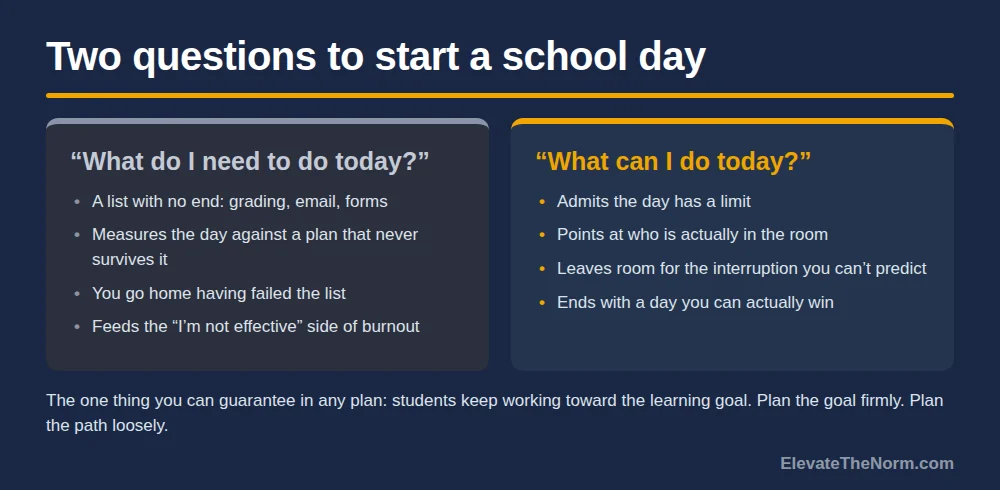
This is the biggest mindset shift I know of for avoiding teacher burnout. “What do I need to do today” is a list that never ends. There is always another stack to grade, another email, another form. You go home every single day having failed the list.
“What can I do today” is a different question. It admits that the day has a limit, and it points you at what is actually in front of you. It is also the question that makes the next idea possible, because what you can do today depends on who is actually in your room today.
Stop Teaching a Class. Teach 120 Students.
Every classroom is its own ecosystem. Inside an ecosystem, every living thing needs something different to survive. Students are not animals, obviously, but the principle holds: every student in your room needs something different to succeed.
If you view a class as one class, in my opinion, you will fail as a teacher. If you view it as 20 to 30 individual students who all need different things, you have a chance. So if you have 120 students across your day, think of it as 120 different lesson plans. That sounds like a faster road to burnout, not a way out of it. It is not, and here is why: you stop fighting the day for being different from the plan.
This is also why I do not put much faith in extremely detailed lesson plans. Say you teach the same subject five periods a day. I can write the plan, and so can you. But the only thing on it I can guarantee is that my students will work on the driving question and keep moving toward it. I do not know if first period will get interrupted, if a fight will break out in fourth, or if sixth will need more one-on-one time and slow down. Plan the goal firmly. Plan the path loosely. The day you stop expecting every period to follow the script is the day the script stops making you feel like a failure.
Spend the First Days Getting to Know People, Not Reading Rules
Most of us spend the first three or four days of school reciting rules. If you teach high school, you do not need to. Hand out the syllabus and let students read most of it themselves. A fill-in-the-blank version moves even faster, and you can spot-check it for a first grade in the gradebook. If you want a plan for the routines themselves, start with this guide to classroom routines and procedures.
Use the time you save to genuinely get to know every student. At the start of every new year or semester, I sit down one-on-one with each student for about three minutes, and I get through all of them within the first three school days. Three minutes is short enough to fit and long enough for a student to realize you actually want to know who they are. It is also where you learn, without making a big production of it, who lives at home and who to call.
Do the math and it is less than it sounds: 30 students at three minutes each is about 30 minutes a class period across three days, which is roughly the time the rules speech was going to take anyway. One caution from the parent and student side of this: keep anything touching home life optional. The point is to learn which adult to call, not to collect a family’s business.
Make the First Call Home a Compliment
When you call from a school number, you will scare a parent. Back when I worked as a retail manager, every time a customer asked for the manager, I took a deep breath, because I knew what was coming. Nine times out of ten, I was right. Parents answering a call from the school feel exactly the same way.
So the first call is always a compliment, and it does not matter how small. Something like: I am really glad your son was in my class today, because the pencil sharpener fell and he cleaned the whole mess up without being asked, and I wanted you to know you have a thoughtful kid. Then stop talking.
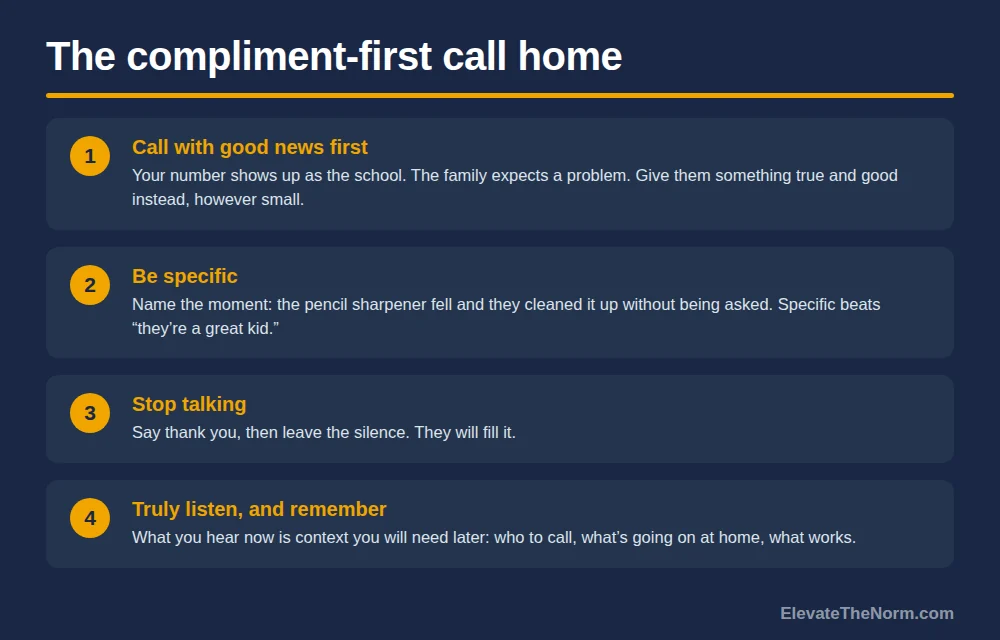
They will talk. And when they do, you have two jobs. The first is to truly listen. That is a skill I think teachers are losing, with students and with the adults who raise them, and without it we have no idea what is actually going on in a kid’s head. The second job is to remember what you heard, because you will need it.
I also send a general letter home to every family early in the year saying how excited I am to have their student in class. Between the letter and the first call, the second conversation starts from trust instead of fear. If you want a simple way to keep track of who you have reached, a parent-teacher communication log does the job, and there are apps built for this if your families prefer text.


When the Next Call Is About a Problem
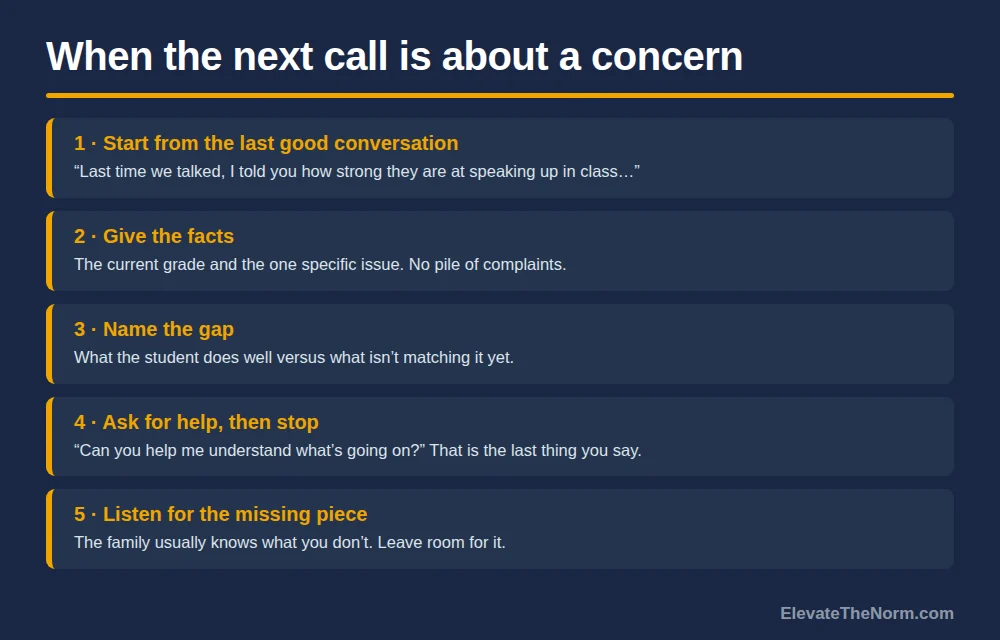
Here is what the compliment call buys you. This year, I had to call about a student who was not progressing the way I had hoped. The guardian picked up, I explained the situation, and because we had already talked once about something good, and because she had already gotten my letter, she worked with me instead of against me. Now that student is turning in work, keeping their head up in class, and at least thinking about participating. They are involved in a way they were not before.
Years ago, teaching middle school, I made the same kind of call to the grandmother of a student who would not stop talking and was interrupting class. Because we had spoken before, I could say: last time I told you how strong he is at verbal communication, so I am confused about why his written work does not match. Can you help me understand? Then I stopped. I had told her the grade, the problem, and the specific gap between what he does well and what he does not. She filled in the rest, and you would be surprised how much information you get when you leave room for it.
The research backs the pattern. In a randomized experiment with sixth and ninth graders in a summer program, daily teacher contact with families increased the odds of homework completion by 40 percent, cut the times teachers had to redirect students by 25 percent, and raised participation by 15 percent. The researchers credited stronger teacher-student relationships, more parent involvement, and more student motivation.
There is an honest wrinkle worth knowing. In a follow-up high school study, weekly messages about what students could improve produced the largest gains in earning course credit, somewhat larger than messages about what they were doing well, though the difference between the two was not statistically clear. I read that as support for doing both in order: the compliment call earns the trust, and the next call spends it on something specific and actionable.
Treat Your Observer as a Second Set of Eyes
Newer teachers panic about observations. Remember that, like in any other job, your observer is there first to give you another set of eyes, and they can give you extremely useful information if you listen when they come back. If you stop listening the moment you see a low score and decide you know better than they do, you lose.
There is evidence on this, too. A study of mid-career teachers in a classroom-observation-based evaluation system found that teachers were more effective in the years after being evaluated, with the largest improvements among teachers who had been performing relatively poorly beforehand. The feedback only worked because the teachers used it. Ask for one specific change, make it, and invite the observer back to see it. If you want a structure for that thinking, these teacher reflection examples are a good place to start.
Take the Mental Health Day Before You Need a Week
If you remember three words from this article, make them mental health days. A day off taken when you first notice the signs costs far less than a week taken after you have run empty. Leave a sub plan that works without you, and do not spend the day grading.
RAND’s 2025 work-life balance findings say the same thing from a different direction: 46 percent of teachers said their job left them too tired for their private lives, compared with 13 percent of similar working adults, and teachers said that leadership support for flexibly using paid leave improved their balance. Fewer than half said their school or district was making efforts to help. So until yours does, take the leave you have earned. I will write more about mental health days on their own soon. And if rest does not lift the exhaustion, that is a reason to talk with a doctor or your district’s employee assistance program, not a reason to push harder.
The Short Version
How to avoid teacher burnout comes down to a few habits you can start tomorrow: measure your day by whether students showed up, smiled, and grew; ask what you can do today; teach individuals instead of a class; make the first call home good news and then listen; hear your observer out; and take the day before you need the week. If you are newer to all of this, the guide to classroom management for new teachers and this piece on building relationships with students pick up where this one leaves off.
You are doing a better job than the wall is telling you.
Before you go: grab the free Compliment-First Parent Call Planner (PDF) — ElevateTheNorm.com branded, printable, no email required.
Frequently Asked Questions
What is the fastest way to avoid teacher burnout in the middle of a grading period?
Change the question you start the day with. Instead of listing everything you need to do, ask what you can do today, and let the rest wait until tomorrow. Then make one positive phone call. It is the most reliably good conversation a teacher can have in a school day, and it pays you back the next time you have to call that same family about a problem.
Do I really have to call every family? I have more than a hundred students.
No one can make 120 calls in a week, and trying to is its own route to burnout. Spread them out: three to five a day across the first several weeks reaches everyone by the end of the grading period. A short welcome letter home covers every family on day one while the calls catch up. If a family prefers text or email, or does not have reliable phone access, use that instead. The point is that the first contact is good news, not that it happens by phone.
What if I cannot find anything positive to say about a student yet?
Look smaller. The compliment does not need to be about grades. A student who held the door, helped someone find the page, or came in and sat down without being asked has given you something true to say. If you truly have nothing after a week, that tells you something too: you have not gotten to know that student yet, and that is the first thing to fix.
How do you fit a three-minute conversation with every student into the first three days?
Do the math first: 30 students at three minutes each is 90 minutes per class, or about 30 minutes a class period across three days. That is time most of us already spend reading the syllabus aloud. Hand out the syllabus, let students work through it, and pull students one at a time for a short conversation. Keep any question about home life optional. The goal is to learn who a student is and which adult to call, not to collect details about a family.
My school requires detailed daily lesson plans. Does this approach conflict with that?
It does not have to. Turn in what your school requires. The point is where you put your confidence: the one part of the plan you can guarantee is the learning goal or driving question, and everything else will bend around the interruptions, pull-outs, and bad days that no plan predicts. Plan the goal firmly and plan the path loosely.
How should I handle a low observation score?
Listen before you defend. An observer is one more set of eyes in a room you usually see alone, and research on classroom-observation evaluation found that mid-career teachers got measurably better after being evaluated, with the biggest gains among those who started lowest. Ask for one specific thing to change, change it, and invite the observer back to see it.
When is it time to take a mental health day?
Before you need a week. A day off taken when you notice the early signs, such as dreading the building every morning or feeling that nothing you do is working, costs far less than one taken after you have run completely empty. Know your district’s leave policy, leave a sub plan that works without you, and do not spend the day grading. If the exhaustion does not lift with rest, talk with a doctor or your district’s employee assistance program.
Sources
- RAND Corporation. Steiner, E. D., Levine, P. R., Doan, S., & Woo, A. (2025). Teacher Well-Being, Pay, and Intentions to Leave in 2025: Findings from the State of the American Teacher Survey. Report — surveyed January–March 2025; 61% frequent job-related stress and 53% burnout among teachers vs. 41% and 29% of similar working adults; 49-hour average work week.
- RAND Corporation. (2025). To Make Teaching Sustainable, Help Teachers Balance Work and Personal Demands: Findings from the 2025 State of the American Teacher Survey. Report — 46% of teachers vs. 13% of similar adults too tired for private life; leadership support for flexible leave use.
- World Health Organization. (2019). Burn-out an “occupational phenomenon”: International Classification of Diseases. News release — ICD-11 definition and its three dimensions.
- Allen, K.-A., Lai, R., Southam, J., Mageean, L., & Roffey, S. (2026). Associations between teacher-student relationship quality and middle and secondary school teachers’ wellbeing: A systematic review. Educational Psychology Review. Article — 55 studies; associations, with measurement mostly borrowed from primary-school research.
- Kraft, M. A., & Dougherty, S. M. (2013). The effect of teacher-family communication on student engagement: Evidence from a randomized field experiment. Journal of Research on Educational Effectiveness, 6(3). ERIC record — sixth and ninth graders, mandatory summer program.
- Kraft, M. A., & Rogers, T. (2015). The underutilized potential of teacher-to-parent communication: Evidence from a field experiment. Economics of Education Review, 47. Abstract — high school credit recovery; improvement-focused messages produced the largest effects.
- Taylor, E. S., & Tyler, J. H. (2012). The effect of evaluation on teacher performance. American Economic Review, 102(7), 3628–3651. Abstract — mid-career teachers more productive after evaluation, largest gains among lower performers.
Every link above was checked on September 18, 2026. The classroom stories on this page are the author’s own, with identifying details removed; nothing in them is invented or composited.
Leave a Reply
You must be logged in to post a comment.