Author: Clay Shumate

  • Classroom Expectations: A Practical Framework for Grades 6–12

    Classroom Expectations: A Practical Framework for Grades 6–12

    By Clay Shumate

    Classroom expectations are the small set of standards that govern how your room runs — how people treat each other, how work gets done, and what happens when somebody falls short. They only work when you teach them, model them, and enforce them the same way on Thursday that you did on Tuesday. Here’s a complete framework for grades 6–12, plus a sample set you can adapt.

    Key Takeaways

    • Keep the list short. Research supports a small number — three to five — of positively stated expectations, not a wall of rules.
    • Expectations have to be taught like content: defined, modeled, practiced, and revisited. Announcing them in August is not teaching them.
    • Structure is not the enemy of student freedom. A 2025 meta-analysis of 94 studies found that clear structure and support for student autonomy reinforce each other — and both raise motivation and engagement.
    • Consistency is a fairness issue. Expectations enforced by mood teach students to read the teacher instead of the standard.
    • The back half of the framework matters most: what happens after an expectation is broken — the consequence, the repair, and the way back.

    What Classroom Expectations Are — and What They’re Not

    Classroom expectations are the standards for how the room operates: how people treat each other, what prepared looks like, how work gets done, and what happens when things go wrong. They are not the same thing as procedures, and they are not a list of seventeen don’ts taped by the door.
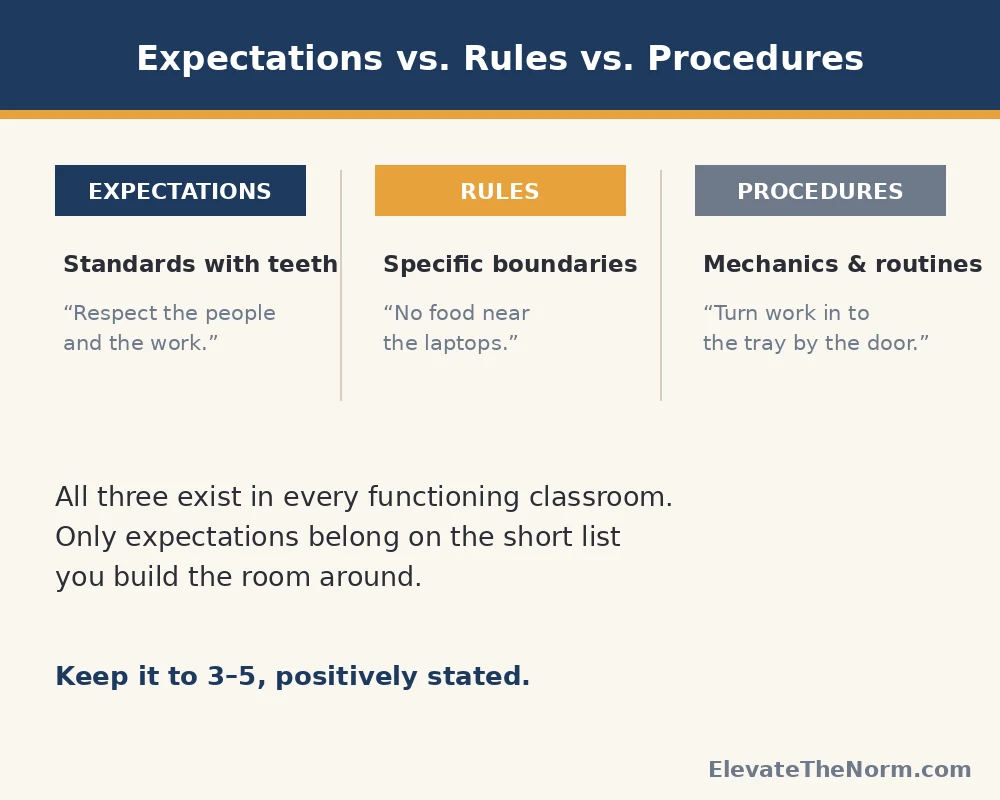
    Three-column chart distinguishing classroom expectations, rules, and procedures with an example of each
    All three exist. Only expectations belong on the short list.

    The distinction matters because teachers blur these constantly. Procedures are mechanics — how to turn in work, where to sit, what to do when you walk in. Rules are specific boundaries. Expectations sit above both: they’re the values of the room with teeth in them. “Respect the people and the work” is an expectation. “Turn your paper in to the tray by the door” is a procedure. Both matter. Only one belongs on the short list you build the room around.

    The research here is unusually clear. A widely cited review of evidence-based classroom management practices by Simonsen and colleagues identified 20 practices with sufficient evidence behind them, grouped into five categories — and one entire category is posting, teaching, reviewing, monitoring, and reinforcing expectations. Their guidance on the list itself: keep it to a small number of positively stated expectations, broad enough to cover the behavior you actually want. Tell students what to do. Seventeen versions of what not to do is not a standard; it’s noise.

    Why Clear Expectations Matter More in Grades 6–12

    Because teenagers read inconsistency as unfairness, and unfairness kills buy-in faster than strictness ever will. A firm room with a predictable standard feels safe. A loose room with a random standard feels rigged.

    The evidence backs the firm room. The Simonsen review found that high-structure classrooms produce more task involvement, friendlier peer interactions, more attentive behavior, and less aggression. Structure works.

    Here’s where a lot of secondary teachers get stuck, though. We’re told to give students voice, choice, and ownership — and clear expectations can feel like the opposite of that. The research says the tension is imaginary. In a study of 133 public high school classrooms with 1,584 students in grades 9–11, Jang, Reeve, and Deci found that teacher structure and autonomy support were positively correlated and both predicted student engagement — complementary, not antagonistic. A 2025 meta-analysis of 94 studies in Educational Psychology Review went further: structure and autonomy support reinforce each other with a large effect size, and both raise students’ motivation, engagement, and need satisfaction. That same body of research draws the line that matters: structure is not control. Structure tells students how to succeed here. Control tells them who’s in charge. Students can smell the difference from the hallway.

    In my room, the structure is visible before I say a word. The daily plan goes on the whiteboard at the front with times attached. Those times are a budget and a promise — and when I blow one, I say so out loud and say why. Predictability is a form of respect. It tells teenagers I planned for their time like it’s worth something, because it is.

    Clear expectations are also the foundation everything else stands on. Teaching responsibility doesn’t work if students are guessing at the standard. Neither does anything else you care about.

    Expectations set the floor. Student responsibility is what happens when students internalize that floor and hold themselves to it — not because you are watching, but because the standard is clear and they believe it applies to them.

    A Practical Framework for Classroom Expectations

    Five expectation areas, plus the three commitments that make them real: consequences, repair, and improvement.

    1. Respect — and it runs both directions

    This covers how we speak to each other, how we disagree, and how we treat each other’s time and work. The part most frameworks skip: the teacher is inside this expectation, not above it. How you correct a student in front of their peers is the most-watched respect lesson you’ll teach all year. It’s also what this site believes at the foundation: respect isn’t a reward students earn — it’s the operating condition of the room.

    2. Preparation

    Materials and mindset. Define what prepared actually looks like in your room, because “be prepared” means nothing until you do. In a seventh-grade room that might be: notebook, something to write with, yesterday’s exit slip. In a junior-level class it might be: annotated reading done, your section of the group work drafted, questions ready. Say it in specifics or don’t expect it.

    3. Effort and participation

    In a workshop-style room, participation isn’t raising your hand. Students in my room are almost always working alongside somebody, so participation means your partner can count on you — you’re carrying your share of the thinking, not just occupying the chair next to it. Define effort the same way: visible, specific, checkable by the student themselves.

    4. Collaboration and technology

    Set device expectations by task, always inside your school’s policy. Some work needs screens; some work needs them dark. “Use tech for the task” travels better than a blanket ban you can’t hold or a free-for-all you’ll regret. And don’t copy anyone else’s tech expectation — including mine. Align it with your building, your subject, and the rules your school already has.

    5. Deadlines and quality

    Deadlines in a collaborative room are commitments to other people, not just to the gradebook. The quality bar worth teaching: would you put your name on this in public? Pair the deadline expectation with an honest escape valve — renegotiate before it passes, not after. That’s not softness. That’s how deadlines work everywhere adults keep them.

    The back half: consequences, repair, and improvement

    An expectation with no known “what happens next” is a suggestion. So the framework has to include what follows a miss: a consequence that’s connected, proportionate, prompt, and private — the opposite of the public correction that manufactures order instead of restoring it. Then repair: what’s owed, to whom, by when. Then improvement: the expectation that the standard gets easier to hit with practice, and that being re-taught is normal, not shameful.

    One boundary, stated plainly: behaviors involving safety, harassment, threats, or anything else covered by school policy go through the required reporting process every time. Classroom consequences and repair sit alongside formal procedures. They never replace them.

    How to Teach Expectations Instead of Just Announcing Them

    The same way you’d teach content: define, model, practice, revisit, reinforce. The place this pays off first is the transitions between activities, which is where most of a secondary lesson’s lost minutes actually go. The Simonsen review is specific about what teaching expectations means — explicit instruction with examples and non-examples, frequent review, and active supervision: the teacher moving, looking around, interacting, correcting quietly, and reinforcing what’s going right.

    That last part is just a description of circulating, which is how my room runs anyway. Monitoring doesn’t look like watching from a desk. I’m moving the whole period, so when somebody drifts off an expectation, the correction happens right next to them — a few quiet words at the table, low enough that the rest of the room keeps working. The standard gets held. Nobody gets a scene.
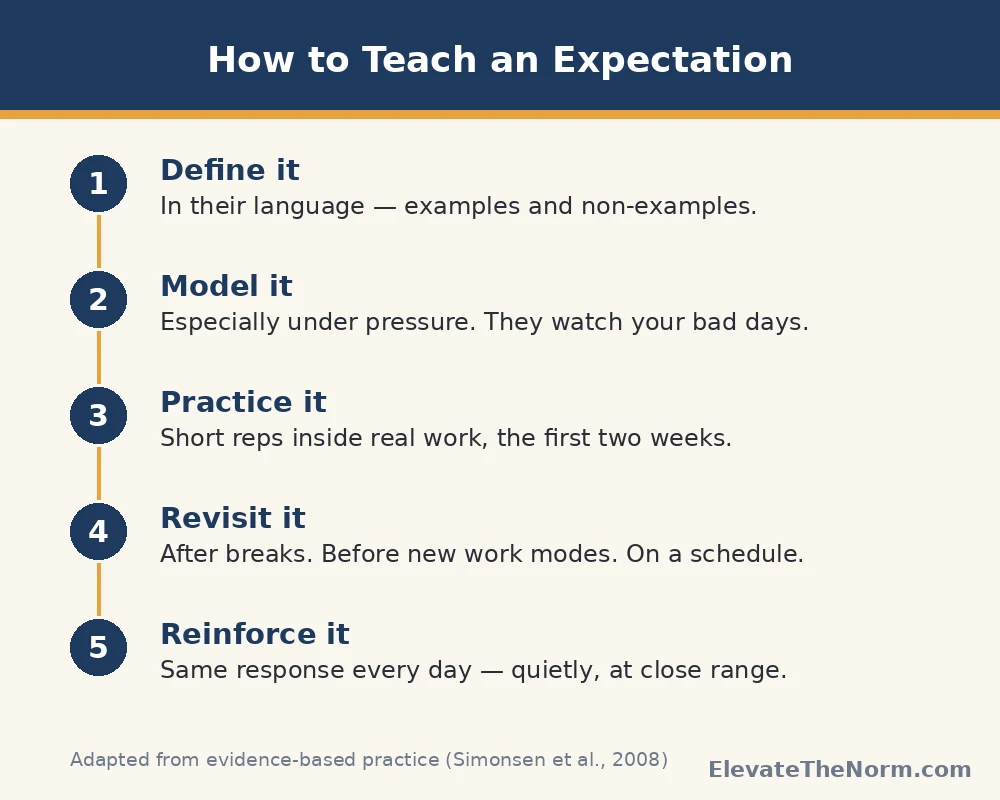
    Five-step cycle for teaching classroom expectations: define, model, practice, revisit, reinforce
    Expectations are taught like content, not announced like warnings.

    The teaching sequence that works:

    1. Define it in their language. For each expectation, show what it looks like and sounds like in a real moment — and what it doesn’t. Examples and non-examples, exactly like teaching a concept.
    2. Model it — especially under pressure. Students learn your real expectations by watching you on a bad day. Handle your own mistakes out loud: name it, fix it, move on.
    3. Practice it early. The first two weeks, run short reps inside real work — a two-minute partner task where the only goal is doing it the way the room does it.
    4. Revisit on a schedule, not just after disasters. After every break. Before a new mode of work — labs, projects, discussions. The National Association of School Psychologists recommends teachers put reteaching on the calendar and track their own habits — like the ratio of encouragement to correction — because positive reinforcement moves behavior further than punitive correction does.
    5. Hold it the same way every day. Same expectation, same response, whoever the student is. If a student needs more support to hit the standard — a visual cue, a private pre-correction, a quiet re-teach — vary the support, never the standard.

    Two additions that pay off. Send the expectations home in the first week, in plain language, so families hear them from you before any problem exists. And when a student keeps missing the same expectation, treat it as information: is it a skill gap, a relationship gap, or something heavier? The answer changes your move. That diagnostic work sits on top of relationships you built before anything went wrong.

    A Sample Classroom Expectations Set You Can Adapt

    This is a starting point, not gospel. Adapt it to your building, your students, and your policies — an expectations set only works if the person enforcing it actually believes it.
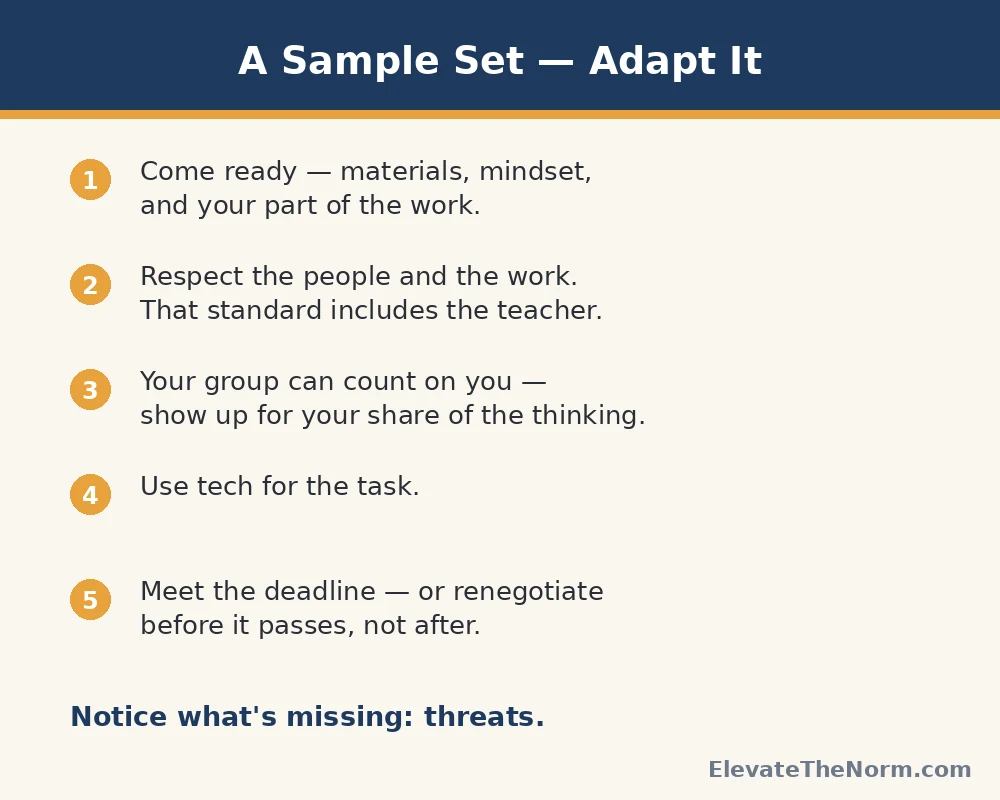
    Card listing five sample classroom expectations teachers can adapt for grades 6-12
    A starting point, not gospel — adapt it to your room.
    1. Come ready — materials, mindset, and your part of the work.
    2. Respect the people and the work — in what you say and how you say it. That standard includes me.
    3. Your group can count on you — show up for your share of the thinking.
    4. Use tech for the task.
    5. Meet the deadline — or renegotiate it before it passes, not after.

    Notice what’s missing: threats. The what-happens-next conversation is real and students deserve to know it, but it happens separately and calmly, and it always includes the way back. A list of expectations that reads like a list of warnings tells students you’re expecting the worst. They tend to oblige.

    Where Classroom Expectations Fall Apart

    Too many to remember. Seventeen rules function like zero rules. If students can’t recite the list, the list isn’t running the room — your mood is.

    Announced once, never taught. One speech in August plus a laminated poster is decoration. Laminated is not learned.

    Enforced by mood. The expectation that flexes with your energy level teaches students to scan you instead of the standard — and the students who already trust school the least pay the highest price for that unpredictability. Consistency isn’t just management. It’s fairness.

    Consequences without repair. If a miss just costs and never leads anywhere, students stop investing in the standard. The path back is what makes the standard worth meeting.

    Expectations for students but not the adult. You are the most-watched person in the room. A teacher who demands punctuality and starts class late, or demands respect and corrects with sarcasm, is teaching the real expectations — and they aren’t the ones on the wall.

    Conclusion

    Classroom expectations come down to this: a short list you actually believe in, taught like it matters, enforced the same way every day, with a real path back when somebody blows it. For a deeper look at why classroom expectations are important and the specific research on how they protect instructional time, reduce student anxiety, and build independence, that article breaks down the evidence. So start here this week. Draft three to five expectations, positively stated. Cut anything you’re not willing to enforce on your worst Tuesday. Plan how you’ll teach and model each one — with examples, non-examples, and a rep or two inside real work. Then put a reminder on your calendar for three weeks out, because you’ll need to revisit them, and that’s not failure. That’s maintenance. The room you want isn’t built by the list. It’s built by what you do about the list, every single day.

    Frequently Asked Questions

    How many classroom expectations should I have?

    Three to five, positively stated. The research on evidence-based classroom management specifically supports a small number of broad, positive expectations rather than a long list of prohibitions. Past five, students stop remembering them and start ignoring them — and so, honestly, do teachers.

    Should students help create the classroom expectations?

    Their input, yes — final ownership, no. Students can genuinely shape what respect looks like in this room, refine the language, and name what a fair deadline policy feels like. That input builds real buy-in. But the teacher owns the final set and the enforcement of it. Co-created doesn’t mean committee-run, and students respect a teacher who takes their input seriously more than one who pretends the room is a democracy.

    What’s the difference between expectations, rules, and procedures?

    Expectations are standards for how the room operates — the values with teeth. Rules are specific boundaries, often set by school policy. Procedures are mechanics: how to enter, submit work, transition. All three exist in every functioning classroom. The mistake is putting procedures on the poster and calling them your expectations.

    What do I do when a student keeps breaking the same expectation?

    Privately, and as a diagnosis, not just a penalty. Figure out whether it’s a skill gap, a relationship gap, or something heavier going on — the answer changes your response. Re-teach the expectation, apply a consequence connected to the behavior, and set a repair with a path back. For persistent patterns, bring the family in with facts and a plan, and involve the counselor or administration when the situation calls for it under your school’s process.

    Do the same expectations work for middle school and high school?

    The same categories work; the teaching changes. Middle schoolers need more reps, shorter loops, and more explicit modeling — expect to re-teach often and treat that as normal. High schoolers need more rationale and can handle more negotiated specifics. Both deserve expectations written in adult language. Nothing loses a ninth grader faster than a poster that talks to them like they’re eight.

    What about cell phones?

    Set a device expectation by task — “use tech for the task” — inside whatever your school or district policy requires. Then hold it with the same calm consistency as everything else. The rooms that lose the phone war usually lose it to inconsistency and escalation, not to the phones themselves. And don’t let the phone battle become the identity of your classroom; it’s one expectation among five, not the mission.

    When should I revisit or re-teach expectations?

    On a schedule: after every break, before any new mode of work — labs, projects, discussions, presentations — and any time you notice slippage. Put it on the calendar at the start of the year so re-teaching is maintenance instead of a reaction. A ten-minute refresher in January is cheaper than a February you spend fighting the room.

    Sources

    For ready-to-use tools built around these expectations, see the free classroom routines and procedures checklist and the free classroom transitions toolkit. Expectations tell students what the standard is; the daily procedures that carry them are covered in what to teach students about classroom routines, and when.

    If you want a ready-to-print version of these expectations for your wall, see Classroom Expectations Poster for Middle and High School Students for a complete secondary poster template and introduction sequence.

    If you would rather start from wording than from the framework, the collection of examples of classroom expectations gives observable, ready-to-adapt sets for a middle school room, a discussion-heavy high school course, a lab or shop, a performance class, and a one-to-one device classroom.

    The framework above is built on the assumption that students can meet your expectations when those expectations are taught and held consistently. For the research behind that assumption—and specific classroom moves that translate genuine belief into practice—see the guide on high expectations for students.


    About Clay Shumate
    Clay Shumate is a certified secondary Social Studies teacher in the public schools of West Alabama, with seven years of classroom experience, a B.A. in History, and an M.Ed. in Secondary Education. He writes about project-based learning, student responsibility, respect, and practical ways to hold young people to a higher standard while giving them room to learn from mistakes. He is a member of the Society of Professional Journalists and writes to its Code of Ethics; this site’s editorial standards and corrections policy are published in full. More about Clay.
  • Teaching Responsibility Without Treating Teenagers Like Children

    Teaching Responsibility Without Treating Teenagers Like Children

    By Clay Shumate

    Teaching responsibility means giving students real ownership over their choices, holding them to clear expectations, and following through with honest consequences that teach when they fall short—without stripping them of their dignity in the process. It does not mean lecturing them about responsibility while making every decision for them. If you want students to act like responsible young adults, you have to treat them like developing young adults and then hold them to that standard. The hardest version of that is handing a student authority that is genuinely theirs and then not quietly taking it back.

    Key Takeaways

    • Responsibility is not the same thing as obedience. A student who follows orders without thinking is compliant, not responsible.
    • Teaching responsibility requires transferring real decision-making power to students—then holding them accountable for what they decide.
    • Adolescent brains are still developing the prefrontal cortex, which means teenagers need structured practice with responsibility, not excuses to avoid it.
    • The most effective consequences are connected to the behavior, preserve the student’s dignity, and include a clear path back.
    • Rebuilding trust after a student makes a serious mistake is part of the work, not an exception to it.

    Responsibility Is Not Obedience

    This distinction matters more than most educators realize. A responsible student makes thoughtful decisions, follows through on commitments, and accepts the consequences when things go wrong. An obedient student does what they are told.

    When mistakes happen — and they will — the question is whether the system turns them into learning. A clear process for learning from mistakes makes accountability productive instead of punitive.

    Those are not the same thing.

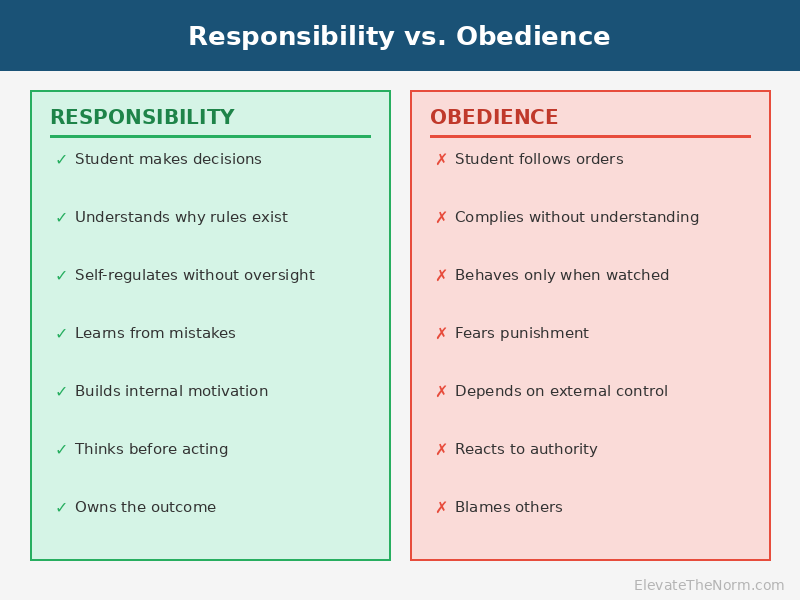
    Comparison chart showing the differences between teaching responsibility and demanding obedience in secondary classrooms
    Responsibility produces self-directed learners. Obedience produces students who behave only when watched.

    A classroom built entirely on obedience produces students who behave well when someone is watching and fall apart when no one is. A classroom built on responsibility produces students who can manage themselves, make reasonable choices under pressure, and recover from mistakes without an adult directing every step.

    Self-determination theory, developed by psychologists Edward Deci and Richard Ryan and applied to education by Niemiec and Ryan in a 2009 review published in Theory and Research in Education, identifies three basic psychological needs that drive human motivation: autonomy, competence, and relatedness. When teachers satisfy those needs—by offering meaningful choices, providing feedback focused on mastery, and building genuine relationships—students develop what the researchers call “autonomous self-regulation.” They do the right thing because they understand why it matters, not because they fear what happens if they do not.

    Obedience skips all three. It removes autonomy, ignores competence, and replaces relationship with compliance. That works for short-term control. It does not work for building the kind of young adults who can handle college, a job, a relationship, or the ordinary pressure of adult life.

    Why Adolescents Need Structured Practice, Not Speeches

    Here is what the brain science actually says—and what it does not.

    The American Academy of Child and Adolescent Psychiatry explains that the prefrontal cortex, the brain region responsible for reasoning, planning, and impulse control, continues developing well into early adulthood. Teenage decisions are guided more by the amygdala—the emotional, reactive part of the brain—and less by the prefrontal cortex.

    But the AACAP makes a critical clarification that too many educators skip: these brain differences “don’t mean that young people can’t make good decisions or tell the difference between right and wrong. It also doesn’t mean that they shouldn’t be held responsible for their actions.”

    The developing brain is not an excuse to lower expectations. It is a reason to provide more structured opportunities for students to practice making decisions, living with the results, and doing better next time. Teenagers get better at responsibility the same way they get better at algebra—through guided practice, honest feedback, and the chance to try again after getting it wrong.

    A longitudinal study published in Developmental Psychology by Wray-Lake, Syvertsen, and Flanagan found that social responsibility values actually decline from ages 9 to 16 before leveling off in later adolescence. The researchers identified ecological factors that predicted whether individual students bucked that trend: family compassion messages, democratic climates at home and school, community trust, and strong peer relationships. Every ecological asset they examined—except school democratic climate alone—predicted positive within-person change in responsibility.

    The takeaway is not that teenagers are naturally irresponsible. The takeaway is that responsibility does not develop automatically. The environments adults create—in classrooms, at home, in communities—determine whether adolescents practice responsibility or simply lose it during the years when they need it most.

    What Teaching Responsibility Actually Looks Like

    Teaching responsibility is not a single lesson. It is a set of daily practices built into how your classroom runs. Here is what it looks like in a secondary classroom where responsibility is taught, not just expected.

    Transfer Real Ownership

    Students cannot learn responsibility for decisions they never get to make. Start by identifying places where you currently make every choice—and hand some of them over.

    This does not mean chaos. It means structured choice within clear boundaries:

    • Let students choose how they demonstrate mastery—a paper, a presentation, a project, a recorded explanation—within your assessment criteria.
    • Give students deadlines with flexibility in how they manage their time across days, not minute by minute.
    • Allow students to set some of their own goals for a unit and explain why those goals matter to them.
    • Let students choose their own working groups for some assignments, with the understanding that they are responsible for the outcome.

    The key is that choices must come with accountability. If a student chooses to work alone and the result is weak, that is a conversation about planning and self-assessment—not a bailout. If a group chooses their members and the group falls apart, that is a conversation about collaboration and repair—not a teacher reassigning everyone. This kind of structured ownership is also foundational to project-based learning, where students manage real decisions throughout extended projects.

    Set Expectations That Respect the Age Group

    Expectations for middle and high school students should sound like what you would say to a young colleague, not to a kindergartner. Compare these:

    Sounds like elementary school: “We use kind words in this classroom. Put your name on your paper. Raise your hand before speaking.”

    Sounds like a secondary classroom: “Disagree with ideas, not people. Meet your deadlines or communicate in advance. If you damage something—a relationship, a piece of equipment, someone’s trust—you are responsible for repairing it.”

    The second set treats students as developing young adults. It assumes they can handle direct language, reasonable expectations, and the responsibility that comes with both.

    When you set expectations, teach them explicitly. Do not assume students know what “take responsibility” means in practice. Model it. Show what it looks like when you make a mistake—apologize, explain what you will do differently, and follow through. Students learn more about responsibility from watching how adults handle their own failures than from any poster on the wall. If you are new to teaching, setting these expectations early and consistently will save you from relying on control-based management later.

    Follow Through Every Time

    Inconsistent follow-through is the fastest way to destroy a responsibility-centered classroom. If you tell students they are responsible for meeting deadlines and then quietly accept late work without conversation, you have taught them that deadlines are suggestions. If you tell students they are responsible for respectful communication and then ignore disrespect because you are tired or the student is popular, you have taught them that respect is optional.

    Following through does not mean being harsh. It means being consistent:

    • When a student misses a deadline, have the conversation. Ask what happened. Ask what their plan is. Hold them to a next step.
    • When a student is disrespectful, address it directly and privately. Explain the impact. Expect repair.
    • When a student does something well—meets a commitment, helps a peer, follows through without being reminded—say so. Responsibility deserves recognition, not just correction.

    Consistency is what makes expectations real. Without it, your expectations are decoration.

    Use Consequences That Teach

    The Responsive Classroom framework identifies three types of logical consequences that maintain dignity while teaching responsibility:

    1. “You break it, you fix it.” If a student damages something—a relationship, a piece of equipment, another student’s work—they take direct action to repair it.
    2. Loss of privilege. If a student misuses a privilege—technology, independent work time, a flexible seating arrangement—they lose that specific privilege until they demonstrate they can handle it.
    3. Positive time-out. If a student needs to regain self-control, they move to a designated space to regroup—not as punishment, but as a skill.

    The common thread is that every consequence connects directly to the behavior. A student who disrupts a lab loses lab privileges until they demonstrate readiness. A student who plagiarizes rewrites the assignment and has a conversation about academic integrity. A student who damages a relationship writes or speaks a genuine apology and follows it with changed behavior.

    What does not work: consequences designed to humiliate, embarrass, or punish without teaching. Making a student stand in the hallway while the class watches teaches shame, not responsibility. Reading a student’s poor grade aloud teaches public failure, not reflection. Calling a parent in front of the class teaches distrust, not accountability. As we have discussed before, yelling does not restore order—it manufactures it temporarily while destroying the relationship that makes real accountability possible.

    Build Reflection Into the Routine

    Responsibility without reflection is just compliance that worked out. Students need regular opportunities to think about what they chose, what happened, and what they would do differently.

    Build reflection into your classroom routines:

    • Weekly self-assessment: Students rate their effort, preparation, and collaboration for the week and identify one specific thing to improve.
    • Post-project reflection: After completing a project, students answer: What did I do well? Where did I struggle? What would I change next time? What did I learn about working with others?
    • After-mistake reflection: When a student makes a poor decision, the reflection conversation replaces or accompanies the consequence: What happened? Who was affected? What will you do to repair it? What will you do differently?

    Don Hellison’s Teaching Personal and Social Responsibility (TPSR) model, developed for working with at-risk youth, structures responsibility into five progressive levels: respecting others’ rights and feelings, participation and effort, self-direction, helping others and showing leadership, and demonstrating responsibility outside the classroom. Students journal about their choices and use self-assessment to track their own growth. The model has been studied extensively with adolescents and consistently shows improvements in both personal and social responsibility when implemented with fidelity.

    Reflection turns experience into learning. Without it, students repeat mistakes not because they are irresponsible but because no one helped them think about what went wrong.

    Common Mistakes That Undermine Responsibility

    Even teachers who believe in student responsibility sometimes undermine it without realizing it. Here are the most common mistakes I have seen—and made.

    Rescuing Students From Consequences

    When a student forgets their materials, borrowing a pencil is reasonable. When a student chronically forgets materials and you supply everything every day without conversation, you are teaching them that someone will always cover for them. The same applies to deadlines, group responsibilities, and behavioral expectations.

    There is a difference between supporting a student who is struggling and protecting a student from the natural results of their choices. Support says, “Let’s figure out a plan so this does not keep happening.” Rescue says, “Don’t worry about it.”

    Confusing Accountability With Humiliation

    Accountability is a private conversation about what happened, what needs to change, and what happens next. Humiliation is a public performance designed to make a student feel bad enough to behave.

    Carl Pickhardt, writing in Psychology Today, frames the teaching of responsibility as helping adolescents understand the “choice/consequence connection”—recognizing that they make choices and are obligated to cope with the outcomes. He emphasizes non-evaluative correction: address the decision, not the character. “We disagree with the choice you made, and here is why” is accountability. “What is wrong with you?” is humiliation.

    When accountability feels safe, students are more likely to be honest about what happened. When accountability feels dangerous, students learn to lie, hide, and blame.

    Assigning Responsibility Without Teaching It

    Telling a student to “be more responsible” without showing them what that looks like is the same as telling a student to “write better” without teaching writing. Responsibility is a set of skills: planning, time management, self-assessment, communication, follow-through, and repair. Each one can be modeled, practiced, and improved.

    If your students are struggling with responsibility, the first question is not “What is wrong with these kids?” The first question is “Have I taught them what responsible behavior looks like, practiced it with them, and given them honest feedback?” Good checking for understanding applies here too—do not assume students understood the expectation just because you stated it once.

    Punishing the Whole Group for One Student’s Behavior

    Group punishment teaches one thing: resentment. It does not teach the offending student to take responsibility. It teaches every other student that fairness is not a priority in your classroom. Address individual behavior individually.

    Ignoring Executive Function Differences

    Some students struggle with responsibility not because they do not care but because executive function skills—planning, organizing, managing time, shifting between tasks—develop unevenly. Students with ADHD, learning disabilities, or trauma histories often need additional scaffolding: visual checklists, broken-down steps, shorter planning horizons, and more frequent check-ins. Scaffolding is not lowering the standard. It is building the ramp so the student can reach the standard. If you offer the same support to every student and call it fair, you have confused equality with equity.

    Working Outside Your School’s Existing Framework

    Responsibility-centered classroom practices work best when they align with your school’s broader behavior system—whether that is PBIS, MTSS, restorative justice, or a homegrown discipline framework. If your classroom expects repair conversations and your administration expects only referrals and suspensions, students receive conflicting messages. Talk with your administrator about how your approach fits the schoolwide structure. Where conflicts exist, advocate for alignment rather than working around the system.

    When to Handle It Yourself and When to Involve Administration

    Not every responsibility failure belongs in the classroom. As a general guide:

    Handle it yourself when the behavior is a normal adolescent mistake—missed deadlines, low-level disrespect, disorganization, minor conflict between students, failure to follow through on a commitment. These are teaching moments. Use them.

    Involve administration when safety is at risk, when the behavior violates school policy in ways that require formal documentation, when a pattern persists despite consistent classroom-level intervention, or when the situation involves harassment, threats, substance use, or any mandatory reporting obligation. Handling these alone is not brave—it is negligent.

    The line between classroom-level and administrative-level is not always clean. When in doubt, consult your administrator. A quick conversation about whether something warrants a referral is always better than finding out later that it did.

    How to Rebuild Trust After a Student Makes a Serious Mistake

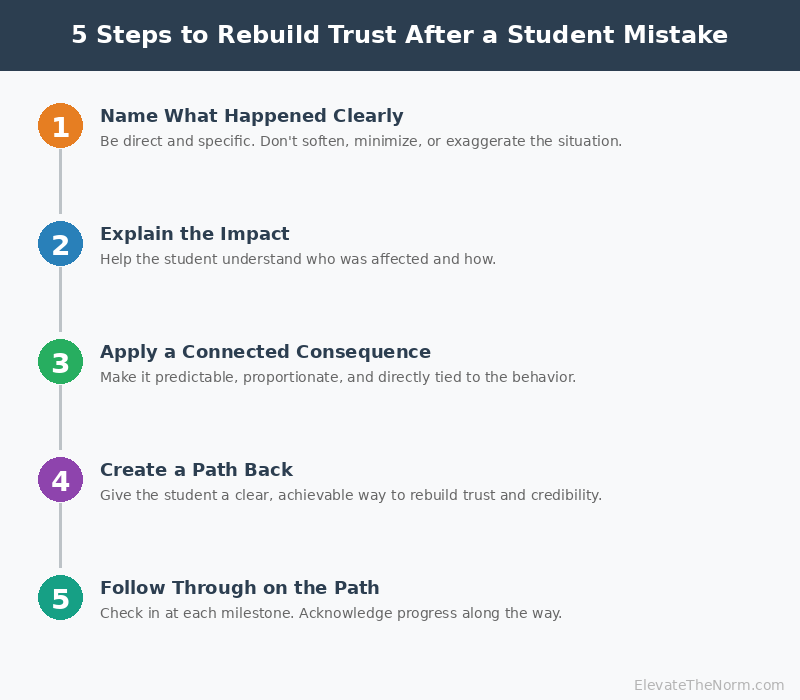
    Five-step process for rebuilding trust after a student makes a serious mistake in the classroom
    Rebuilding trust follows a predictable sequence—from naming what happened to following through on the path back.

    Students will make serious mistakes. They will cheat. They will say something cruel. They will break a promise, damage property, or betray a peer’s confidence. How you handle those moments determines whether the student learns from the mistake or decides they are permanently defined by it.

    Rebuilding trust after a serious mistake follows a predictable sequence:

    Step 1: Name what happened clearly. Do not soften, minimize, or exaggerate. “You copied three paragraphs from a website and submitted them as your own work” is clear. “You kind of had some issues with the assignment” is not.

    Step 2: Explain the impact. Who was affected? How? “When you copy someone else’s work, you are lying about what you know. That hurts your credibility with me and cheats yourself out of learning.”

    Step 3: Apply the consequence. The consequence should be predictable, proportionate, and connected to the behavior. For plagiarism, rewriting the assignment and having a conversation about academic integrity makes sense. For a first offense, a failing grade on the assignment without the chance to rewrite teaches punishment, not responsibility.

    Step 4: Create a path back. This is where most systems fail. A student who is permanently labeled “cheater” after one incident has no incentive to improve. A student who rewrites the assignment, demonstrates understanding of academic integrity, and earns back the teacher’s trust has a reason to grow.

    Step 5: Follow through on the path. If you told a student they could rebuild trust by meeting three consecutive deadlines, check in at each one. Acknowledge progress. A path back means nothing if nobody notices when the student walks it. Strong student-teacher relationships make this follow-through natural rather than forced.

    Research on restorative practices from the Learning Policy Institute shows that approaches focused on repairing harm rather than merely punishing offenders reduce suspensions, decrease disciplinary disparities, improve school climate, and strengthen student-teacher relationships. A large-scale California study found that the more students experienced restorative practices, the more student behavior, mental health, and disciplinary outcomes improved—with stronger effects for Black and Latino students.

    Repair is not softness. It is accountability with a future attached.

    Starting Responsibility Practices: The First Two Weeks

    If you are introducing these practices to a class that has not experienced them, the first two weeks set the tone.

    Days 1–3: Explain your expectations in plain language. Do not read a list from a slide. Talk to students like people. Explain why each expectation exists. Ask students what they think is missing. Listen. This is not a negotiation—you are still setting the standards—but student input on the front end builds investment.

    Days 4–7: Practice the routines. Model the opening check-in. Walk through the self-assessment. Run a short reflection. Practice the repair protocol with a low-stakes hypothetical. This is the same approach a coach uses: you do not play the game on day one. You practice the plays.

    Week 2: Start holding students accountable with the system you taught. The first time a student misses a deadline, have the conversation. The first time a student is disrespectful, use the repair protocol. Consistency during week two teaches students that you meant what you said in week one.

    Expect resistance. Some students have spent years in classrooms where expectations were announced and never enforced. They will test whether you are serious. The answer is yes, every time, without anger and without exceptions.

    Classroom Routines That Build Responsibility Daily

    Responsibility is not a unit you teach in September and hope sticks. These daily and weekly routines keep it alive:

    Side-by-side examples of teacher language that undermines versus supports student responsibility
    The words you use shape how students understand responsibility. Address the behavior, not the person.

    Morning or class-opening check-in: Students identify their main goal for the period and what they need to accomplish it. This takes two minutes and builds the habit of intentional work.

    Assignment tracker: Students maintain a simple tracker—paper or digital—of their commitments, deadlines, and completion status. The teacher reviews it periodically, not to micromanage but to have informed conversations about patterns.

    End-of-week accountability conversation: Pairs of students spend three minutes discussing what they accomplished, what they did not, and what they will do differently next week. The teacher circulates and listens.

    Repair protocol: When conflict or harm occurs, the classroom has a clear process: name what happened, identify the impact, agree on repair, follow through. Students know this process because it has been taught and practiced.

    Student-led conferences: At least once per semester, students present their own work, progress, and goals to their families. The student runs the meeting. The teacher facilitates. This is one of the most powerful responsibility-building practices available because it requires students to own and explain their own learning.

    Teacher Language That Supports Responsibility

    The words you use shape how students understand responsibility. Here are phrases that work—and phrases that do not.

    Instead of: “I need you to sit down.”
    Try: “You have a choice: sit down and join the discussion, or step outside for a minute to reset. What works for you?”

    Instead of: “Why didn’t you do your homework?”
    Try: “Your assignment is not here. What happened, and what is your plan?”

    Instead of: “I’m disappointed in you.”
    Try: “That choice is not what I expected from you. Let’s talk about what happened and what comes next.”

    Instead of: “Because I said so.”
    Try: “Here is why this expectation exists, and here is what happens when people do not meet it.”

    Instead of: “You always do this.”
    Try: “This is the third time this week. Let’s figure out what’s making this hard and what you can change.”

    The pattern is consistent: address the behavior, not the person. Offer a choice when possible. Ask the student to think, plan, and commit to a next step. Treat the student as someone capable of improvement, because they are.

    Conclusion

    Teaching responsibility to teenagers is not complicated, but it is demanding. It requires you to transfer real decisions to students and then hold them to the results. It requires consequences that teach instead of humiliate. It requires rebuilding trust after failures instead of writing students off. And it requires daily routines that make responsibility a habit, not a lecture topic.

    The research is consistent: when adults provide structure, autonomy, honest feedback, and a genuine relationship, adolescents develop responsibility. When adults provide only control, students learn obedience—and obedience has an expiration date.

    Your students are developing young adults. Treat them that way. Hold them to a higher standard. Give them room to fail. And when they fail, show them how to get back up and do better. That is what teaching responsibility looks like. For specific classroom activities that put these principles into practice — from deadline choice contracts to repair letters to structured second chances — see activities for teaching responsibility in middle and high school.

    For a deeper look at what student responsibility actually looks like across seven observable domains—and the critical difference between responsibility and compliance—see student responsibility in the classroom on this site.


    One prerequisite worth naming: none of this works if students are guessing at the standard. If you’re building that foundation, start with a practical framework for classroom expectations — fewer, clearer, taught, and held the same way every day.

    Frequently Asked Questions

    What is the difference between teaching responsibility and just expecting it?

    Teaching responsibility means explicitly showing students what responsible behavior looks like, practicing it, providing feedback, and giving students structured opportunities to improve. Just expecting responsibility means announcing standards and then being frustrated when students do not meet them. If you have not taught it, practiced it, and followed up on it, you have not taught it—you have wished for it.

    How do I teach responsibility without giving up classroom control?

    Responsibility and classroom control are not opposites. You can offer students meaningful choices—how they demonstrate learning, how they manage their time, who they work with—while maintaining clear boundaries on safety, respect, and academic standards. The teacher still sets the expectations and enforces them. The difference is that students have genuine ownership over some decisions, which makes them more invested in the outcomes.

    What do I do when a student keeps making the same mistake?

    First, check whether the student has actually been taught a better alternative. Repeating a consequence without changing the support is unlikely to produce different results. Have a private conversation: “This keeps happening. Let’s figure out why and make a specific plan.” If the pattern continues despite genuine support, involve a counselor, administrator, or family member—not to escalate punishment, but to add resources.

    Should I let natural consequences do the work, or should I intervene?

    Use natural consequences when they are safe, timely, and proportionate. If a student does not study, a low test score is a natural consequence. If a student does not prepare for a presentation, an awkward moment in front of peers is a natural consequence. But intervene when a natural consequence would be dangerous, delayed so long that a student cannot connect it to their behavior, or so severe that it damages the student’s wellbeing beyond what the situation warrants.

    How do I handle parents who think I am being too strict—or too lenient?

    Communicate your system proactively. At the start of the year, explain your expectations, your approach to consequences, and your commitment to treating students as developing young adults. When a parent raises a concern, listen first. If you are being consistent, fair, and focused on teaching responsibility rather than punishment, most parents will support the approach once they understand it. If a parent insists on no consequences for their child, explain that accountability in a safe classroom is practice for the real world—and the real world does not offer that exemption.

    Is this approach realistic with 30 students in a classroom?

    Yes, because most of these practices are routines, not individual interventions. A two-minute opening check-in, a weekly self-assessment, a standard repair protocol—these work at scale because they are systematic. You are not having a 20-minute conversation with every student every day. You are building a classroom culture where responsibility is the norm, not the exception, and then intervening individually when a student struggles.

    What about students with ADHD or executive function challenges?

    Students with executive function difficulties often need more scaffolding to practice responsibility—not lower expectations. Break large assignments into smaller checkpoints with intermediate deadlines. Use visual checklists students can reference independently. Check in more frequently at the start, then gradually reduce support as the student builds capacity. The goal is the same standard with a more supported path to get there. If a student has an IEP or 504 plan, their accommodations should be integrated into your responsibility framework, not treated as exceptions to it.

    How can parents reinforce these practices at home?

    The core principles translate directly: give teenagers real decisions with real consequences, follow through consistently, address behavior without attacking character, and provide a clear path to rebuild trust after mistakes. If you know your child’s teacher uses a responsibility-centered approach, ask about it at conferences and use similar language at home. Consistency between school and home accelerates the learning.


    Sources


    About Clay Shumate
    Clay Shumate is a certified secondary Social Studies teacher in the public schools of West Alabama, with seven years of classroom experience, a B.A. in History, and an M.Ed. in Secondary Education. He writes about project-based learning, student responsibility, respect, and practical ways to hold young people to a higher standard while giving them room to learn from mistakes. He is a member of the Society of Professional Journalists and writes to its Code of Ethics; this site’s editorial standards and corrections policy are published in full. More about Clay.
  • Example of Project Based Learning: 25 Middle and High School Projects That Matter

    Example of Project Based Learning: 25 Middle and High School Projects That Matter

    By Clay Shumate

    Part of the project-based learning guide — the full hub covering how PBL differs from a regular project, planning, and the practical constraints of a secondary schedule.

    An example of what counts as project based learning is any classroom project where students investigate a real question, make meaningful decisions, and create something for an audience beyond the teacher. The difference between PBL and a regular assignment is simple: in PBL, the project is the learning—not a reward for finishing the textbook chapter. Below you will find 25 concrete examples organized by subject and grade band, each one built around a real question, a public product, and standards worth teaching.

    Key Takeaways

    • Project based learning requires a driving question, sustained inquiry, student voice, and a public product—not just a poster or presentation tacked onto the end of a unit.
    • A strong PBL example connects students to real audiences, real decisions, and real consequences for their work.
    • These 25 projects span English, social studies, science, math, and electives for grades 6–12, and most can be adapted for limited technology or resources.
    • Research shows PBL students in secondary schools outperform peers by significant margins on standardized assessments, with the strongest effects at the high school level.
    • The easiest way to start is small: pick one project, one class period, and one semester. Do not try to redesign your entire curriculum at once.

    What Makes a Project “PBL” Instead of Just a Project?

    Before the examples, this distinction matters. A lot of teachers assign projects. That does not mean they are doing project based learning.

    According to PBLWorks, Gold Standard PBL includes seven essential design elements: a challenging problem or question, sustained inquiry, authenticity, student voice and choice, reflection, critique and revision, and a public product. If the project is missing most of those—if students are just following directions to build a diorama after the unit test—it is a project, but it is not PBL.

    For a full breakdown of the seven essential design elements and how they distinguish PBL from regular projects, see the definition of project based learning.

    Here is the quick test I use: Who is doing the thinking? If students are making decisions about what to investigate, how to present their findings, and who their audience is, you are in PBL territory. If the teacher made every decision and the students are executing a recipe, that is an assignment with craft supplies.

    A 2023 meta-analysis examining 66 empirical studies found that PBL produced a moderate overall effect on student learning (SMD = 0.441), with the strongest results at the high school level (SMD = 0.720). The gains were largest for academic achievement (SMD = 0.650), followed by thinking skills and emotional attitudes toward learning. Those numbers matter because they show that PBL is not just engaging—it produces measurable learning gains when done well.

    Infographic contrasting project based learning with traditional classroom projects, including research-backed results from PBL studies
    PBL vs traditional projects: what peer-reviewed research shows.

    25 Project Based Learning Examples for Grades 6–12

    English Language Arts

    1. The Community Oral History Archive (Grades 6–8)

    Driving question: Whose stories in our community are not being told?

    Students identify community members whose experiences are underrepresented—veterans, immigrants, retired workers, elders—and conduct recorded interviews using oral history protocols. They transcribe, edit, and publish the interviews as an online or physical archive donated to the local library or historical society. Projects like that one sit close to the border with experiential learning, where the reflection does as much work as the doing.

    Why this is PBL: Students choose their subjects, conduct sustained research, practice interview and writing skills, revise based on feedback from both their teacher and the interview subjects, and produce a public product with a real audience and lasting value. A book report does not do any of that.

    Standards connection: Speaking and listening, narrative and informational writing, primary source analysis, digital literacy.

    2. The Op-Ed Campaign (Grades 9–12)

    Driving question: What issue in our school or community deserves a public argument?

    Students research a local issue—school policy, city budget allocation, environmental concern, public health—draft an opinion editorial, workshop it through peer critique and revision cycles, and submit it to a local newspaper, school publication, or community blog. The goal is actual publication, not a grade.

    Why this is PBL: The audience is real. The stakes are real. Students must build an evidence-based argument strong enough to survive an editor’s review. Revision matters because rejection is possible.

    Standards connection: Argumentative writing, evidence evaluation, audience awareness, media literacy.

    3. The Podcast Series on Student Identity (Grades 7–10)

    Driving question: What does it mean to grow up in this place, at this time?

    Students plan, script, record, edit, and publish a multi-episode podcast exploring aspects of adolescent identity—culture, language, family expectations, pressure, belonging. Each episode requires research, interviews, narrative structure, and production quality good enough for public release.

    Why this is PBL: Students control the content, format, and production decisions. The public product (a published podcast) creates accountability that a classroom presentation cannot replicate.

    Standards connection: Narrative techniques, speaking and listening, research, digital media production.

    4. The Literary Magazine With an Editorial Board (Grades 6–12)

    Driving question: What original writing and art from our school deserves a public audience?

    Students run every aspect of a literary magazine: soliciting submissions, forming an editorial board, establishing selection criteria, editing accepted pieces with authors, designing layout, and distributing the finished publication. The teacher advises. The students decide. For a longer worked example of that split, see a civics project that started in one class and ended up school-wide.

    Why this is PBL: Editorial decision-making, quality control, collaboration, revision, and publication for a real audience. This is not a creative writing assignment turned in for a grade—it is a functioning publication.

    Standards connection: Writing across genres, editing, design, collaboration, project management.

    Social Studies and History

    5. The Local Policy Investigation (Grades 8–12)

    Driving question: How does one local policy affect real people in our community?

    Students select a local government policy—zoning, school discipline, curfew laws, water usage regulations—research its history, interview affected community members and officials, analyze data, and present findings and recommendations at a city council meeting, school board session, or community forum.

    Why this is PBL: The audience is a decision-making body. Students produce evidence for people who can act on it. That changes how seriously students treat research and revision.

    Standards connection: Civic engagement, primary and secondary source analysis, data interpretation, persuasive communication.

    6. The Historical Marker Project (Grades 6–9)

    Driving question: What happened here that people should know about?

    Students research a local site with historical significance—a building, intersection, park, or neighborhood—write the text for an official historical marker, and submit a proposal to the local historical society or city government. The proposal includes a researched essay defending why the site deserves recognition.

    Why this is PBL: The product has a real approval process. Students must build an argument backed by primary sources convincing enough for adults outside the school to accept. The stakes are authentic because the marker could actually be installed.

    Standards connection: Historical research, primary source analysis, persuasive and informational writing, civic participation.

    7. The Immigration Documentary (Grades 9–12)

    Driving question: How has immigration shaped our community’s economy, culture, and identity?

    Students research immigration patterns in their region, conduct interviews with immigrants and longtime residents, analyze census and economic data, and produce a short documentary screened at a community event or submitted to a student film festival.

    Why this is PBL: Students investigate a complex, relevant issue using multiple sources and perspectives. The documentary requires sustained inquiry, revision, and presentation to a public audience. Sensitivity to real people’s stories adds ethical weight the classroom rarely provides.

    Standards connection: Historical analysis, geography, economics, media production, ethical research practices.

    8. The Election Simulation With Real Data (Grades 7–12)

    Driving question: How do campaigns actually persuade voters, and what role does evidence play?

    Students research real candidates and ballot measures using primary sources—voting records, financial disclosures, policy statements—develop informed positions, create campaign materials, hold structured debates, and vote. The simulation ends with a published voter guide distributed to school families.

    Why this is PBL: The voter guide is a real product for a real audience. Students must evaluate claims critically rather than parrot slogans. The project connects classroom learning to democratic participation.

    Standards connection: Government, media literacy, argumentative writing, data analysis, civic responsibility.

    Science

    9. The Water Quality Investigation (Grades 6–9)

    Driving question: Is the water in our community safe, and how do we know?

    Students test water from local sources—taps, wells, creeks, fountains—using scientific protocols. They analyze results, compare them to EPA standards, and present their findings to the school board, city water department, or a community meeting. If results are concerning, students draft a formal letter to the appropriate authority.

    Why this is PBL: Students collect real data, follow scientific methods, and present findings to an audience that may actually respond. The data is not hypothetical. If the water tests badly, students learn what it means to report uncomfortable truths backed by evidence.

    Standards connection: Scientific investigation, data collection and analysis, environmental science, technical writing, civic engagement.

    10. The School Energy Audit (Grades 7–12)

    Driving question: How much energy does our school waste, and what would it cost to fix?

    Students audit the school’s energy consumption—lighting, heating, cooling, electronics—calculate waste, research solutions, estimate costs and savings, and present a formal proposal to the principal or school board. The proposal includes a cost-benefit analysis and implementation timeline.

    Why this is PBL: The data is real. The audience has budget authority. Students learn that persuading decision-makers requires more than good intentions—it requires numbers, evidence, and a realistic plan.

    Standards connection: Physics (energy), mathematics (data analysis, financial literacy), environmental science, persuasive communication.

    11. The Biodiversity Survey (Grades 6–10)

    Driving question: What species live in our schoolyard or local park, and what does that tell us about ecosystem health?

    Students conduct a systematic biodiversity survey using transects, quadrats, and species identification. They compile data, compare results to historical records or regional databases, and publish findings through a report to the local parks department or a citizen-science platform like iNaturalist.

    Why this is PBL: Students contribute real data to real scientific databases. Their work has value beyond the classroom. The survey requires sustained fieldwork, accurate data collection, and scientifically defensible conclusions.

    Standards connection: Ecology, data collection, species identification, scientific writing, environmental stewardship.

    12. The Public Health Campaign (Grades 9–12)

    Driving question: What health issue in our community needs better public information?

    Students research a local health concern—teen vaping, nutrition access, mental health stigma, sleep deprivation—analyze data, consult local health professionals, and design and distribute an evidence-based awareness campaign. Products might include infographics, social media content, presentations to younger students, or informational materials for a community health fair.

    Why this is PBL: The campaign targets a real audience with real health stakes. Students must verify claims, cite sources, and design communication that actually reaches people—not just earns a grade.

    Standards connection: Health science, biology, statistics, graphic design, persuasive communication, media literacy.

    Mathematics

    13. The Small Business Financial Plan (Grades 9–12)

    Driving question: Could our business idea actually survive its first year?

    Students develop a business concept, research market conditions, create financial projections using algebra and statistics, and present their business plan to a panel of local business owners or entrepreneurs. The panel provides real feedback on whether the numbers hold up.

    Why this is PBL: The math serves a real purpose—convincing skeptical adults that the numbers work. Students cannot hide behind procedures. They must defend their assumptions, explain their models, and revise when challenged.

    Standards connection: Algebra, statistics, financial literacy, functions, modeling, oral presentation.

    14. The School Redesign Proposal (Grades 7–10)

    Driving question: If we could redesign one space in our school, what would the data say we should change?

    Students survey peers and staff, collect usage data, measure dimensions, create scale drawings or digital models, calculate material costs, and propose a redesign to the administration. The proposal includes blueprints, a budget, and evidence that the redesign addresses a real need.

    Why this is PBL: The math—geometry, measurement, ratio, budgeting—serves a visible purpose. The audience (administration) has the authority to act on the proposal. Students see whether their calculations survive adult scrutiny.

    Standards connection: Geometry, measurement, ratio and proportion, data analysis, scale drawing, budgeting.

    15. The Statistical Investigation of School Data (Grades 8–12)

    Driving question: What does our school’s data actually tell us about fairness, access, or student experience?

    Students obtain anonymized school data—attendance patterns, discipline referrals, course enrollment, extracurricular participation—and conduct a statistical analysis looking for patterns, disparities, or trends. They present findings and recommendations to school leadership.

    Why this is PBL: The data is real and the findings might be uncomfortable. Students practice statistical reasoning on questions that matter to their own school community. Presenting to administration makes accuracy and honesty non-negotiable.

    Standards connection: Statistics and probability, data representation, bias and sampling, ethical data use, persuasive communication.

    16. The Community Mapping Project (Grades 6–8)

    Driving question: What resources does our neighborhood have—and what is missing?

    Students map community assets—parks, clinics, grocery stores, bus stops, libraries—using measurement, coordinate systems, and data collection. They identify gaps in access, calculate distances and travel times, and present their findings to a community organization or neighborhood association.

    Why this is PBL: Mathematics becomes a tool for understanding equity and access. The map and analysis serve a real community organization, and students must defend their data collection methods.

    Standards connection: Coordinate geometry, measurement, ratios, data analysis, geography, civic awareness.

    Cross-Curricular and Elective Projects

    17. The School Podcast Network (Grades 6–12)

    Driving question: What conversations should our school community be having?

    Students pitch, produce, and publish regular podcast episodes covering school news, student perspectives, interviews with staff and community members, and student-reported stories. An editorial team manages content review, scheduling, and quality standards.

    Why this is PBL: Students run a real media operation with real deadlines, audience feedback, and editorial standards. They must balance free expression with responsibility and accuracy—skills that no worksheet teaches.

    Standards connection: Speaking and listening, research, writing, media production, journalism ethics, project management.

    18. The Mentorship Curriculum (Grades 9–12)

    Driving question: What do incoming freshmen actually need to know, and how should they learn it?

    Older students design and deliver a mentorship program for incoming ninth graders. They research transition challenges, develop lesson plans, create resources, facilitate sessions, collect feedback, and revise the program based on results. The final product is a reusable curriculum guide for future mentors.

    Why this is PBL: Students design instruction for a real audience and measure whether it works. The responsibility is genuine—younger students are depending on them. Revision is based on real feedback from real participants, not a teacher’s rubric alone.

    Standards connection: Research, instructional design, leadership, communication, data collection, program evaluation.

    19. The Community Art Installation (Grades 6–12)

    Driving question: What message should our school send to our community through public art?

    Students research public art, develop a concept, pitch it to school or city officials, design and create the installation, and manage the project from proposal through completion. The installation is displayed publicly—in the school, a local business, a community center, or a public space.

    Why this is PBL: The approval process, budget constraints, material limitations, and public audience make this project authentic in ways classroom art projects rarely are. Students must persuade, plan, execute, and accept public reaction.

    Standards connection: Visual arts, research, proposal writing, project management, budgeting, community engagement.

    20. The Bilingual Community Resource Guide (Grades 7–12)

    Driving question: What essential information in our community is not available in the languages families actually speak?

    Students identify critical community resources—health services, legal aid, school enrollment, emergency contacts, transportation—and create a bilingual or multilingual guide. They verify accuracy with service providers, translate carefully, design for clarity, and distribute through schools, churches, clinics, or community organizations.

    Why this is PBL: The product fills a real gap. Families who speak languages other than English will actually use this guide. Students must verify information, translate accurately, and design for people who need clear communication—not for a grade.

    Standards connection: World languages, research, informational writing, design, community service, cultural competency.

    21. The Career Investigation and Job Shadow Report (Grades 8–12)

    Driving question: What does this career actually look like on a regular Tuesday?

    Students research a career field, arrange a job shadow or informational interview with a professional, observe and document the daily realities of the work, and produce a detailed report comparing their expectations to reality. Reports are compiled into a career resource available to other students.

    Why this is PBL: Students interact with real professionals, confront the gap between expectations and reality, and produce a resource other students will actually consult. The job shadow requires initiative, communication, and follow-through outside the classroom.

    Standards connection: Research, informational writing, career readiness, professional communication, self-assessment.

    22. The School Improvement Proposal (Grades 6–12)

    Driving question: What is one thing about our school we could change with evidence and a plan?

    Students identify a school problem—cafeteria waste, hallway congestion, library usage, schedule concerns—collect data, research solutions from other schools, calculate costs, and deliver a formal proposal to administration. The proposal follows a standard format with an executive summary, evidence section, implementation plan, and budget.

    Why this is PBL: The audience makes real decisions. Students learn that complaining is easy but proposing evidence-based solutions is hard. If the proposal is good enough, the school might actually implement it.

    Standards connection: Research, data analysis, persuasive writing, financial literacy, problem-solving, civic participation.

    23. The Climate Action Plan (Grades 9–12)

    Driving question: What can our school realistically do to reduce its carbon footprint in the next two years?

    Students calculate the school’s carbon footprint, research reduction strategies, analyze costs and feasibility, consult with facilities staff, and present a phased action plan to school leadership. The plan includes measurable targets, timelines, responsible parties, and progress indicators.

    Why this is PBL: The word “realistically” does a lot of work. Students cannot propose fantasy solutions. They must account for budgets, building codes, contracts, staff capacity, and political will. The constraints are what make it authentic.

    Standards connection: Environmental science, chemistry, mathematics, economics, project management, persuasive communication.

    24. The Peer Mediation Training Program (Grades 7–12)

    Driving question: How can students help resolve conflicts fairly and reduce the need for adult intervention?

    Students research conflict resolution, restorative practices, and mediation techniques. They design a training program, pilot it with volunteers, collect data on outcomes, revise based on results, and present the finished program to administration for adoption. Trained mediators then serve the school community.

    Why this is PBL: Students create a lasting program that changes how their school handles conflict. The work is sustained over weeks, requires research and revision, and produces a public product that affects real people. Success is measured by whether the program actually works—not by a rubric score.

    Standards connection: Psychology, communication, research, program design, leadership, data analysis, social-emotional learning.

    25. The Local History Walking Tour (Grades 6–10)

    Driving question: What stories does our neighborhood tell if you know where to look?

    Students research the history of locations within walking distance of the school—buildings, monuments, former businesses, sites of historical events. They write informative scripts, create a mapped route, design signage or a digital guide, and lead public tours for families, community members, or younger students.

    Why this is PBL: The walking tour is a real product for a real audience. Students must verify historical claims using primary sources, write for non-expert audiences, design for clarity, and perform publicly. A bad tour gets noticed. A good tour changes how people see their neighborhood.

    Standards connection: Historical research, primary source analysis, informational writing, geography, public speaking, design.

    Download it: All 25 projects below are also packaged as a 14-page PDF with a one-page project planning template covering driving question, audience, checkpoints, assessment, and modifications. It is free on the teacher resources page — no email required.

    How to Tell Whether a Project Qualifies as PBL

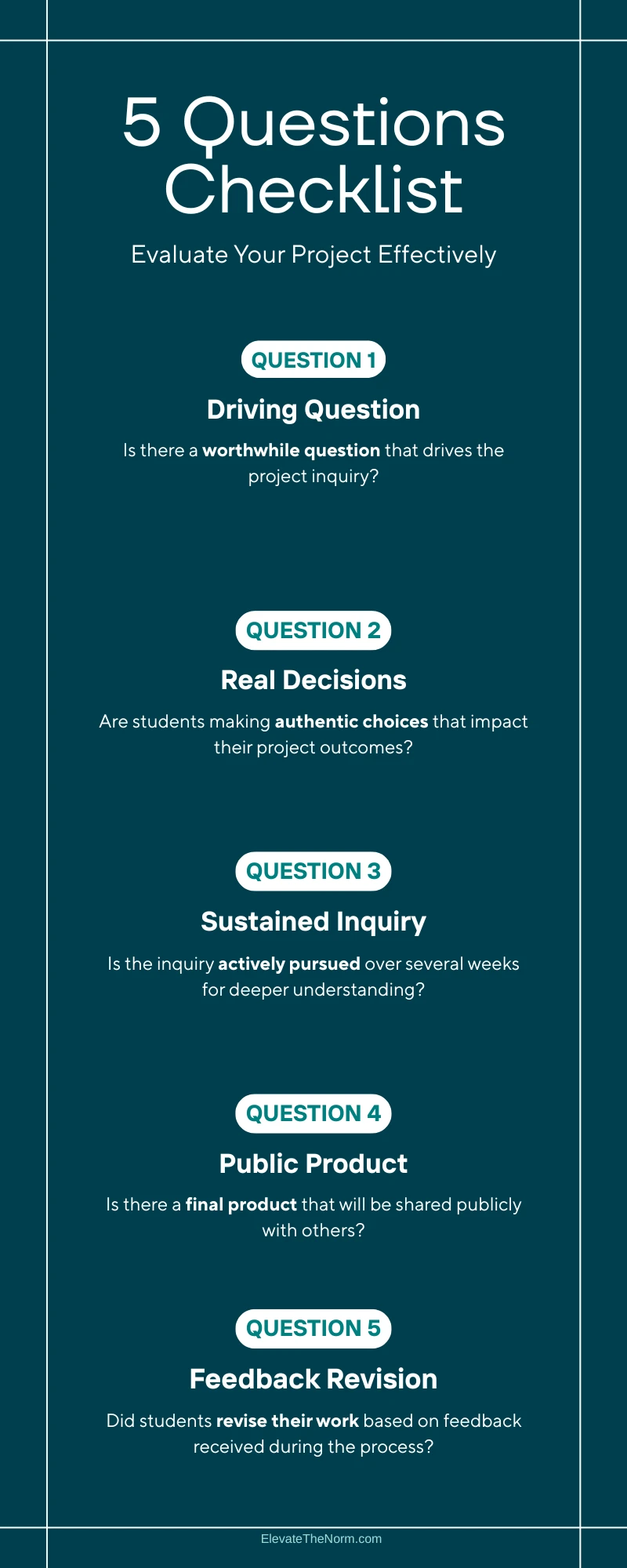
    If you are looking at a project and wondering whether it counts, ask these five questions:

    1. Is there a driving question worth investigating? If the question can be answered with a Google search, it is not driving anything.
    2. Are students making real decisions? If every step is predetermined, students are following instructions—not learning through inquiry.
    3. Is the inquiry sustained? A one-day activity is an activity. PBL takes weeks because real investigation takes time.
    4. Is there a public product? If the only person who sees the work is the teacher, the project lacks the accountability that makes PBL effective.
    5. Did students revise based on feedback? First drafts are not final products. Critique and revision are where the deepest learning happens.

    Research from PBLWorks identifies these as part of seven essential design elements that separate genuine PBL from dressed-up assignments.

    Checklist infographic with five diagnostic questions teachers can use to determine whether a classroom project qualifies as genuine project based learning
    Use these five questions to test whether your classroom project qualifies as genuine PBL.

    What the Research Says About PBL Effectiveness

    The examples above are not just engaging—they produce results. I compare PBL and traditional instruction in more detail elsewhere, but here is the short version of what the research shows.

    A meta-analysis published in Frontiers in Psychology in 2023 analyzed 66 empirical studies with 190 effect values. The combined effect was a moderate positive impact (SMD = 0.441) on student learning outcomes. High school students showed the strongest gains (SMD = 0.720), outperforming primary, junior high, and university levels. Groups of four to five students produced the highest effects (SMD = 0.909), and projects lasting 9–18 weeks yielded the strongest results.

    Lucas Education Research funded four peer-reviewed studies that reinforce these findings. In the Knowledge in Action study led by Anna Saavedra at the University of Southern California, over 3,600 students in project-based AP courses outperformed traditional AP classrooms by 8 percentage points in year one and 10 percentage points in year two. Low-income students showed similar gains as their wealthier peers. A Stanford University study found middle school science students outperformed comparison groups by 11 percentage points on NGSS-aligned assessments, with English language learners showing improved language proficiency as a side benefit.

    PBLWorks reported in 2025 that over 66 percent of high school students report being bored daily in school, with 75 percent citing uninteresting material and 39 percent noting lack of relevance. Gold Standard PBL addresses both problems by building authenticity, student voice, and sustained inquiry into the structure of the learning itself.

    The MDRC literature review by Barbara Condliffe further confirmed that well-implemented PBL improves content knowledge, problem-solving, and student engagement, particularly when projects include authentic tasks and audiences.

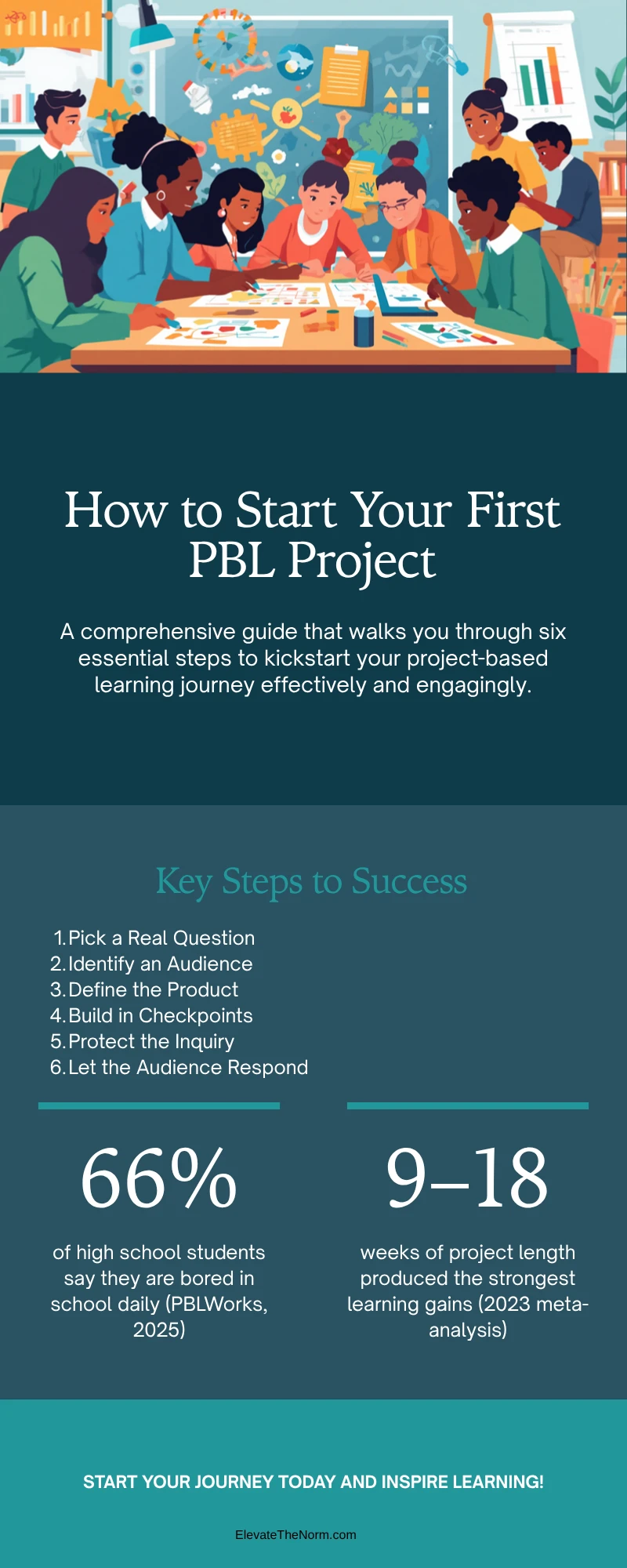
    How to Start: A Practical Guide for Your First PBL Project

    You do not need to overhaul your entire curriculum to try project based learning. Start with one project in one class.

    Step 1: Pick a real question. Look at your standards and ask: what question connected to these standards would a real person actually want answered? That is your driving question.

    Step 2: Identify an audience. The school board. A local business. Younger students. A community organization. The audience does not need to be impressive—it needs to be real.

    Step 3: Define the product. What will students create that the audience will actually see, read, hear, or use? A proposal? A guide? A presentation? A published piece? Name it clearly.

    Step 4: Build in checkpoints. PBL is not “assign the project and see what happens in six weeks.” Plan weekly check-ins, draft deadlines, peer critique sessions, and opportunities for revision.

    Step 5: Protect the inquiry. Resist the urge to give students the answers. Your job during the project is to ask better questions, provide resources, and hold students accountable for doing the thinking themselves.

    Step 6: Let the audience respond. The power of PBL comes from students hearing honest feedback from someone other than their teacher. An administrator who asks a tough question about their proposal teaches more in one moment than a week of lectures about “real-world relevance.”

    Step-by-step infographic showing six steps for teachers to launch their first project based learning experience in the classroom
    Six steps to launch your first project based learning experience.

    Practical Considerations Before You Begin

    PBL works, but it works better when you plan for the realities that research papers do not always cover.

    Preparation time is front-loaded. Your first PBL project will take more planning time than a traditional unit. You are designing a learning experience, not just a sequence of lessons. That investment pays off—once the project structure exists, you can reuse and refine it for years. But be honest with yourself about the time the first round requires.

    Safety and supervision matter for community-based projects. Any project involving student contact with community members—interviews, job shadows, field investigations—requires appropriate parental consent, supervision protocols, and compliance with your district’s policies on off-campus activities and outside visitors. Plan these logistics early, not as an afterthought.

    Equity and access must be designed in, not assumed. Not every student has transportation to visit a community partner, technology at home to edit a podcast, or family connections to arrange a job shadow. Design projects so the essential work can happen during school hours, using school resources. Offer alternatives for components that require outside access. A project that only works for students with advantages is not good PBL—it is privilege dressed up as pedagogy.

    Communicate with families. Parents who experienced traditional education may be skeptical when their child comes home talking about “a project” instead of tests and textbook chapters. Send a brief explanation home at the start: what students will learn, what standards are being addressed, what the product will be, and how you will assess it. Transparency prevents the assumption that PBL means less rigor.

    Differentiation is part of the structure. PBL naturally allows differentiation through student choice—in topic, product format, research depth, and role within a group. Students with IEPs or 504 plans should receive their accommodations within the project structure, not as a separate track. Build in scaffolds like research guides, planning templates, and sentence starters for students who need them, while allowing advanced students to pursue deeper questions.

    Be ready for uncomfortable findings. Some of these projects—water quality testing, school data analysis, equity mapping—may produce results that are inconvenient for the school or community. That is a feature, not a bug. Teach students to report findings accurately and respectfully, and prepare administration for the possibility that student research might surface real problems worth addressing.

    Conclusion

    An example of project based learning is not hard to find—this article gives you 25 of them. The harder part is making sure the project actually qualifies as PBL rather than a dressed-up assignment. Real PBL puts students in charge of investigating questions that matter, making decisions that affect the outcome, creating products for audiences who will respond honestly, and revising until the work is genuinely good. For more on this approach, see experiential learning.

    Start with one project. Choose a real question. Find a real audience. Build in checkpoints and revision. Let students make decisions you would normally make for them. Watch what happens when they realize the work matters to someone other than you.

    The research supports it. The students deserve it. And your classroom will not be the same once you try it.


    Frequently Asked Questions

    How is project based learning different from assigning a project at the end of a unit?

    In project based learning, the project is the unit—students learn content and skills through the investigation, not before it. A traditional end-of-unit project asks students to demonstrate what they already learned. PBL asks students to learn by doing the work. The driving question, sustained inquiry, and public product are built into the learning from day one, not added at the end.

    Do students actually learn content through PBL, or just “soft skills”?

    They learn both, and the research is clear. A 2023 meta-analysis of 66 studies found PBL’s largest effect was on academic achievement (SMD = 0.650), followed by thinking skills and emotional attitudes. High school PBL students showed even stronger academic gains (SMD = 0.720). The idea that PBL sacrifices content for engagement is not supported by the evidence.

    How do I grade 25 different student projects fairly?

    You do not grade 25 different projects—you grade against common criteria. A well-designed PBL rubric assesses content knowledge, quality of inquiry, evidence use, communication, and revision regardless of the specific product. Students can choose different formats and still be evaluated on the same standards. The rubric is the constant; the product varies.

    What if I do not have time for long projects in my curriculum?

    Start with a shorter project—three to four weeks—on a topic where your required standards align naturally with a real question. You do not need six months. Some of the strongest PBL happens within a single unit when the driving question is focused and the product is well-defined. One genuine project per semester teaches students more about inquiry and responsibility than no projects at all.

    What about students who struggle with open-ended work or self-direction?

    Scaffolding is essential. PBL does not mean handing students a question and disappearing. Teachers build in checkpoints, model inquiry skills, provide structured templates for research and planning, and check in regularly. Students who struggle with self-direction often need more structure at the beginning and less as the project progresses—not an exemption from the work.

    How do I handle group projects when some students do not contribute equally?

    Assign clear individual roles with visible deliverables so every student’s contribution is documented. Use individual accountability alongside group assessment. Peer evaluations, individual reflection, and graded individual components within the group project prevent free-riding. If a student is not contributing, the structure should make that visible early enough to intervene—not after the project is turned in.

    Can I do PBL without much technology?

    Absolutely. Many of the examples in this article—oral histories, community surveys, walking tours, art installations, mentorship programs—require little or no technology. A clipboard, a notebook, and access to the community are enough. Technology can enhance PBL, but the essential elements are a real question, sustained inquiry, student decision-making, and a public product. None of those require a device.

    How do I get started if my school has never done PBL before?

    Start alone if you have to. Pick one class, one project, one semester. Choose a driving question connected to your existing standards. Find an audience—even one administrator willing to listen to student presentations counts. Run the project, reflect on what worked and what did not, and adjust for next time. You do not need a schoolwide initiative to try project based learning. You need a question worth answering and students willing to do the work.


    Sources

    If you want a wider net rather than these twenty-five worked examples, the companion list of ideas for project based learning gives you fifty project premises sorted by subject, with timelines and a real audience attached to each one.


    About Clay Shumate

    Clay Shumate is a certified secondary Social Studies teacher in the public schools of West Alabama, with seven years of classroom experience, a B.A. in History, and an M.Ed. in Secondary Education. He writes about project-based learning, student responsibility, respect, and practical ways to hold young people to a higher standard while giving them room to learn from mistakes. He is a member of the Society of Professional Journalists and writes to its Code of Ethics; this site’s editorial standards and corrections policy are published in full. More about Clay.
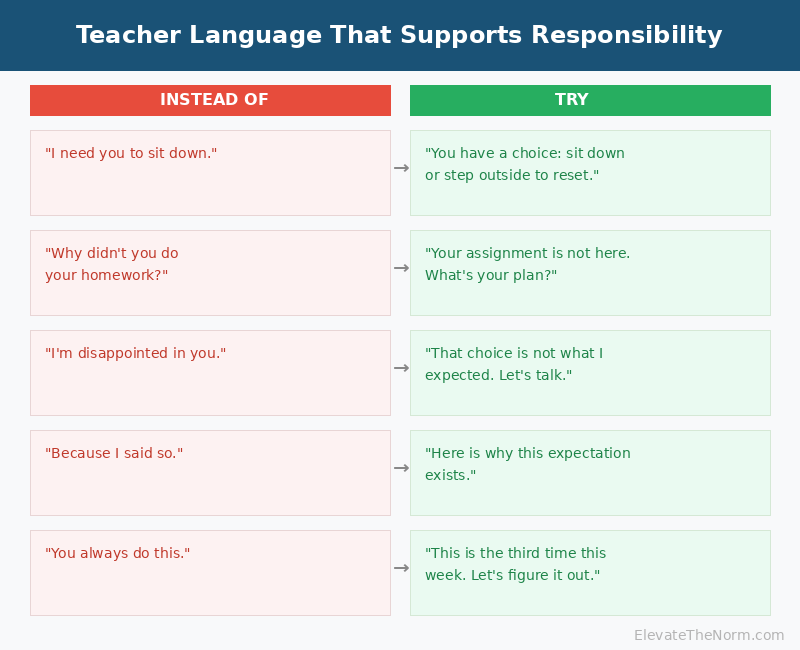
  • The Three-Week Turn: Why Showing a Student You Care Makes Things Worse First

    By Clay Shumate

    Week three, one gap opens.
    Week three, one gap opens.

    Here is a thing that happens in a lot of buildings, and it happens quietly enough that nobody names it.

    A teacher decides to go all in on a student everybody else has given up on. Learns their name properly. Asks about their weekend and actually waits for the answer. Notices when they’re not okay. Treats them like a person with something to offer.

    And that student gets worse.

    Not better. Worse. More mouth, more walkouts, more of whatever their particular version of “no” looks like. The teacher, who did a hard and generous thing, now has evidence that the hard generous thing backfired. And somewhere around day nine, that teacher thinks what almost everybody thinks:

    I tried. That kid doesn’t want help.

    I want to make the case that this is the most misread moment in our profession — that the pushback isn’t the failure of the approach, it’s the first evidence the approach is working, and that it takes about three weeks to come out the other side. staying calm in week two.

    Why does a student push back against a teacher who is being kind to them?

    Because kindness from an adult is unfamiliar data, and unfamiliar data gets tested before it gets trusted.

    A young person who has been let down repeatedly by the adults in their life has built a working model of how adults behave: they’re unreliable, they lose interest, and being cared about is temporary. That model has kept them from being blindsided. It has worked.

    Then you walk in and contradict it.

    Clinicians who work on this describe it directly. Children who’ve been neglected or abused have learned to be wary of adults — even ones who appear reliable — because they’ve been ignored or betrayed by people they depended on, and many haven’t developed the early template that you can trust people and that people will take care of you (Child Mind Institute).

    So when you offer warmth, the student doesn’t experience relief. They experience a discrepancy. And there’s only one way to resolve a discrepancy: run a test.

    The behavior you’re seeing in week one is the test. Practitioner guidance on trauma-informed classrooms says this outright — pushing may be a test of reliability, and the transformative response is some version of “I don’t like what you did, but I care and won’t give up”.

    They are not asking will you let me get away with this. They are asking are you going to quit like the others did.

    How many students are we actually talking about?

    More than most staff rooms assume.

    CDC data from the Behavioral Risk Factor Surveillance System across all fifty states found that 63.9% of U.S. adults reported at least one adverse childhood experience, and 17.3% reported four or more (Swedo et al., 2023). Looking at children directly rather than adults recalling childhood, a meta-analysis of 65 studies found 42% with zero ACEs — meaning a majority had at least one — and 15% with four or more.

    Run that against your roster. Thirty students in a room. Statistically, a handful of them are carrying four or more serious adversities right now, today, in fourth period.

    And it shows up in the data we do track. Children who experience trauma are roughly two and a half times more likely to fail a grade than their peers, score lower on standardized tests, and have higher rates of suspension and expulsion (Cole et al., via NAEYC).

    That last part deserves a hard look. The students most likely to be pushed out of school are the ones for whom school is most likely to be the only stable place they’ve got.

    What the pushback is actually communicating

    There’s a framing from the attachment literature that changed how I read my own room: misbehaviour represents a miscommunication of the student’s need to feel safe in relationships and to be part of a trustworthy community.

    Not defiance. Miscommunication.

    A student who has learned that closeness ends in disappointment will keep adults at a distance on purpose. The same source notes these students may be hypervigilant about being betrayed, humiliated or taken advantage of, and may withdraw from relationships or act as though they don’t need support from adults at all.

    Read that and then picture the kid in your building everybody calls “just doesn’t care.” Acting as though they don’t need anything is the most effective armor available to a person who has needed something and not gotten it. Understanding what is actually happening behind that mask is the first step toward motivating students who have shut down.

    The three-week turn

    Chart of behavior across three weeks: spike, plateau, then turn
    Behavior doesn’t improve steadily. It spikes, plateaus, then turns.

    Here’s my own observation, offered as exactly that — a pattern I’ve seen repeatedly across multiple schools, not a controlled study.

    It takes about three full weeks of a student being in my class before the room turns. Not that student alone. The room.

    Week one is the test. Whatever their version of pushing is, this is when it peaks. This is also when most adults conclude it isn’t working.

    Week two is the strangest stretch. The behavior usually doesn’t improve much, but something underneath shifts — they start watching. Checking whether the calm holds when you’re tired, when you’re behind, when they’ve earned a reaction. This is the week the whole thing gets won or lost, and it’s the week that looks the least like progress from a doorway.

    Week three is when it breaks. Not dramatically. Usually it’s small: they do the work without being asked, or they tell another student to knock it off, or they say something real on the way out the door.

    I don’t have a study that says “three weeks.” What I have is the closest documented cousin, and it’s close enough to be worth knowing. The 2×10 strategy — two minutes a day, ten consecutive school days, talking about anything other than academics or behavior — is a long-standing relationship-building practice recommended for exactly these students as a trust-building strategy, repeated throughout the year, especially after a student has shown anger or frustration and after long breaks (ASCD).

    Ten consecutive school days is two calendar weeks. My three weeks accounts for the ones where you miss a day, or there’s a fire drill, or they’re absent Thursday.

    The number matters less than the shape: consistency measured in weeks, not moments. Nobody rebuilds a working model of adults in an afternoon.

    Why it changes the school, not just the room

    This is the part I’d most want administrators to hear.

    The rest of the class is watching how you treat the hardest student in it. All of them. Constantly.

    When thirty people watch an adult stay steady with the one person who is making it most difficult, every one of them learns something about what safety costs in your building. They learn it isn’t conditional. They learn that if they have a bad week, you won’t become a different person.

    The reverse teaches just as fast. Research on classrooms makes the point plainly: once a teacher and student fall into a coercive cycle, it becomes a model for the other students to follow — they learn that this classmate doesn’t deserve their respect, and they learn not to trust the teacher, thinking “if she does that to him, she might do it to me” (Jennings).

    That’s how one relationship becomes a culture. In either direction.

    What leadership has to do in week two

    Almost all of the failure I’ve seen has happened in week two, and most of it was preventable by an adult who wasn’t the teacher.

    Don’t read week two as evidence of failure. If you walk into that room on day nine and see a struggling teacher and an escalating student, you are looking at the middle of a process, not the result of one. Ask how long they’ve been at it before you draw a conclusion.

    Don’t move the student. Schedule changes reset the clock to zero and confirm the exact thing the student predicted: adults tap out. If a move is genuinely necessary for safety, that’s different — but do it knowing what it costs.

    Don’t make the teacher defend it. A teacher who has to justify a not-yet-working approach in week two will abandon it in week three. Give them cover.

    Ask what they need. Two minutes of coverage so they can walk a student to the office and talk about nothing. A counselor looped in. Someone to take a class for ten minutes. These are small asks and they’re usually the difference.

    What to actually do in those three weeks

    Be boring. Same greeting, same tone, same expectations, every day. Predictability is the intervention. Whatever they throw at you, they should get the same version of you back.

    Two minutes, nothing academic. The 2×10. Ask about the thing they care about, not the thing you want them to care about, and don’t attach it to a request.

    Greet them at the door by name, every day. Positive greetings at the door is one of the cheapest documented classroom strategies there is, and it’s the daily proof that today is not carrying yesterday’s grudge (Cook et al., 2018).

    Never make the repair a negotiation. When something goes sideways and you address it, address the behavior and let the relationship stand. I don’t like what you did. I’m not going anywhere. Full stop, no trade.

    Watch what happens when they come back. A student who has been out for a stretch spends the first minute at the door working out what returning is going to cost them socially. That minute is one of the few parts of chronic absenteeism a classroom teacher genuinely controls.

    Assume you don’t know. You don’t know who they went home to, whether anybody’s there, whether they ate. You don’t need to know. You just need to stop assuming the behavior in front of you is the whole story.

    What not to do

    Don’t make it a project. Students can feel being someone’s redemption arc from across a room, and it’s humiliating. You’re not saving anybody. You’re being consistent with a person who deserves consistency.

    Don’t expect gratitude. It may never come, and if you need it, you’ll quit around day twelve. Do it because it’s the job.

    Don’t confuse warmth with no expectations. The kids who’ve been through the most are often the ones most insulted by low expectations, because they can tell it means you’ve written them off politely. Hold the bar. Hold it warmly. For a concrete framework on what that looks like — clear expectations paired with real ownership — see teaching responsibility through structure, not speeches.

    Frequently Asked Questions

    Isn’t this just letting students get away with things?

    No. Consequences still apply — they’re just delivered by someone who isn’t taking it personally and isn’t withdrawing the relationship as part of the punishment. Warmth and accountability aren’t opposites; the pairing is what makes either one land.

    What if three weeks pass and nothing changes?

    Then you’ve got real information, and it’s time to loop in a counselor, the family, or your student support team — with three weeks of documented consistent effort behind you, which is a much stronger position than three days of frustration. Sometimes what’s happening at home is bigger than a classroom can hold, and recognizing that isn’t giving up.

    I’m a first-year teacher and this feels impossible with 130 students.

    You can’t run this with all 130 at once, and nobody does. Pick two. Run it for three weeks. The change in those two changes the room, and the room makes the next two easier.

    What about the students who don’t have trauma histories?

    Nothing here hurts them. Predictability, being known by name, and an adult who doesn’t withdraw affection as leverage are good for every young person in the building. That’s what makes this a culture strategy rather than an intervention.


    References

    Child Mind Institute. (2025). How trauma affects kids in school. https://childmind.org/article/how-trauma-affects-kids-school/

    Cole, S. F., et al. Helping traumatized children learn, cited in National Association for the Education of Young Children, Creating trauma-sensitive classrooms. https://www.naeyc.org/resources/pubs/yc/may2015/trauma-sensitive-classrooms

    Cook, C. R., Fiat, A., Larson, M., Daikos, C., Slemrod, T., Holland, E. A., Thayer, A. J., & Renshaw, T. (2018). Positive greetings at the door: Evaluation of a low-cost, high-yield proactive classroom management strategy. Journal of Positive Behavior Interventions, 20(3), 149–159.

    Jennings, P. A. (2019). Teaching in a trauma-sensitive classroom. American Educator, 43(2). https://www.aft.org/ae/summer2019/jennings

    Madda, M. J. Trauma-informed teaching strategies. ASCD / Educational Leadership. https://www.ascd.org/el/articles/trauma-informed-teaching-strategies

    Madigan, S., et al. (2023). Prevalence of adverse childhood experiences in child population samples: A systematic review and meta-analysis. JAMA Pediatrics. https://pmc.ncbi.nlm.nih.gov/articles/PMC11555579/

    Swedo, E. A., Aslam, M. V., Dahlberg, L. L., Niolon, P. H., Guinn, A. S., Simon, T. R., & Mercy, J. A. (2023). Prevalence of adverse childhood experiences among U.S. adults — Behavioral Risk Factor Surveillance System, 2011–2020. MMWR, 72(26), 707–715. https://www.cdc.gov/mmwr/volumes/72/wr/mm7226a2.htm

    Trauma informed behaviour support: A practical guide to developing resilient learners — Attachment, school and learning. University of Southern Queensland. https://usq.pressbooks.pub/traumainformedpractice/chapter/4-2-attachment-school-and-learning/

    Once relationships are solid, consider channeling that trust into student-driven work. These 25 project based learning examples show how real projects give students meaningful responsibility while keeping academic standards front and center. For a ready-to-use tool on this, see free parent-teacher communication logs.

    The relationships pay the teacher back, too. Knowing students as individuals, and making the first call home good news, is a big part of staying out of burnout during the long middle of a grading period.


    About Clay Shumate
    Clay Shumate is a certified secondary Social Studies teacher in the public schools of West Alabama, with seven years of classroom experience, a B.A. in History, and an M.Ed. in Secondary Education. He writes about project-based learning, student responsibility, respect, and practical ways to hold young people to a higher standard while giving them room to learn from mistakes. He is a member of the Society of Professional Journalists and writes to its Code of Ethics; this site’s editorial standards and corrections policy are published in full. More about Clay.
  • You Don’t Know What They Know

    By Clay Shumate

    Thirty answers at once, not four raised hands.
    Thirty answers at once, not four raised hands.

    “Does everybody understand?”

    Thirty heads nod. You move on. Two weeks later the unit test comes back and roughly a third of the room clearly did not understand, and hasn’t for a while.

    The question wasn’t the problem. The problem is that “does everybody understand?” is not a check — it’s a request for permission to keep going, and students give it because saying no in front of thirty peers costs more than staying quiet.

    This is the most fixable gap in a typical classroom, and the research behind fixing it is unusually strong.

    What does “checking for understanding” actually mean?

    It means gathering evidence of what students currently know, during the lesson, in a form that lets you change what you do next. Two conditions, both required: it happens while there’s still time to act, and it produces something you can actually read. Deciding what to do with that evidence is itself a reflective act; teacher reflection examples show what that cycle looks like in practice.

    Where that evidence gets recorded matters too. A gradebook organised around standards rather than assignments gives you somewhere obvious to note which specific thing a student is missing, and somewhere obvious to look next month to see whether it got fixed.

    That distinguishes it from a quiz, which measures after the teaching is finished, and from a show of hands, which measures social confidence.

    The formal name is formative assessment, and it has one of the better evidence bases in education.

    What does the research say?

    Paul Black and Dylan Wiliam reviewed more than 250 studies for their 1998 review Inside the Black Box. Their headline finding: studies of formative assessment showed effect sizes between 0.4 and 0.7, larger than most known educational interventions.

    Two details from that work matter more than the headline number.

    It helps struggling students most. Formative assessment had its strongest positive effect on low-achieving students, which narrows the achievement gap. That’s the opposite of most interventions, which tend to help the students already doing well.

    The mechanism is specific. Black and Wiliam describe feedback as requiring three elements: recognition of the desired goal, evidence about present position, and some understanding of a way to close the gap between the two — and all three have to be understood by the learner before they can act. A checkmark supplies none of those. A grade supplies one, badly.

    Where the claim gets oversold

    Here’s the part most articles on this topic leave out, and it’s worth your skepticism.

    The 0.4–0.7 range is from a 1998 review, and later work has been less generous. Kingston and Nash’s 2011 meta-analysis found a much more modest weighted mean effect size of 0.20. Hattie’s review of 12 meta-analyses on feedback landed at an average effect size of 0.73, but only under the right conditions.

    So the honest summary is: formative assessment works, the size of the effect depends heavily on how it’s implemented, and anyone quoting 0.7 at you as a flat fact is quoting the top of a range from the most optimistic review. For what this looks like on an ordinary school day rather than in a meta-analysis, see the walkthrough of strategies that hold up in real classrooms.

    My take, not a finding: the spread in those numbers is exactly what you’d expect from a practice that got adopted as a label. Once “formative assessment” became something districts could put on a walkthrough form, a lot of things got renamed formative that were really just quizzes with a nicer word attached. I’d bet the low effect sizes are measuring that, not measuring the practice Black and Wiliam described.

    The three seconds that change the room

    If you do one thing from this article, do this one.

    Mary Budd Rowe recorded classrooms and measured how long teachers actually wait after asking a question. Her finding: teachers allow an average of about one second for a response, and react to a student’s answer within about nine-tenths of a second.

    One second. That’s not enough time to parse the question, retrieve the information, and construct a sentence — for anyone.

    When wait time is extended to three to five seconds, the length of student responses increases, unsolicited appropriate responses increase, student confidence increases, speculative responses increase, students compare data with each other more, student questions increase, and responses from students rated “relatively slow” increase — while the number of teacher questions that get no response at all decreases.

    The teacher changes too. Questioning becomes more flexible and varied, and teacher expectations for students rated “slow” may shift.

    That last one deserves a second read. Waiting three seconds changed what teachers believed their students were capable of. The students hadn’t changed. The measurement had. The same applies to the questions themselves: how long you wait matters more when the question is genuinely open, and what the research says about wait time for open questions is that no upper threshold has been found.

    There are two places to wait, and the second matters more:

    • Wait time 1 — after you ask, before anyone answers.
    • Wait time 2 — after a student finishes speaking, before you respond. Rowe found this one even more important than the first.

    Three seconds feels absurd from the front of the room. It is not absurd from a desk.

    What actually counts as evidence

    The test for any check is simple: does it produce something from every student, that you can read, before the lesson ends?

    Every student. Calling on the raised hand tells you about the raised hand. Cold call, whiteboards, or written responses tell you about the room.

    That you can read. Nodding, “yeah,” and eye contact are not data. A sentence is data. A worked step is data. A ranking is data.

    Before it ends. Information that arrives after the bell is a grade, not a check.

    Checks like these are also what make it possible to stop narrating and start circulating, which is the whole mechanism behind handing more of the period over to students.

    Practices that clear that bar without adding paperwork:

    • Mini whiteboards, all hands up at once. Thirty answers in ten seconds, and you can see the distribution instantly.
    • Cold call with wait time. Ask, wait three seconds, then name someone. Everybody has to think, because nobody knows who’s up.
    • Two-sentence exit ticket. Not “did you get it” — a question only someone who got it can answer, and the default closing move when the reading itself happened on a screen rather than on paper.
    • “Explain it to someone who missed today.” Explaining exposes gaps that recognition hides.
    • Show me where you got stuck. Students who can locate their own confusion are close to resolving it.

    My take, not a finding: the mini whiteboard is the highest-return purchase I’ve made for a classroom. It removes the social cost of being wrong, because thirty boards go up at once and nobody’s answer is the event. Students who never volunteer will write things down. That’s not in the research I’ve cited — it’s what I’ve seen.

    What doesn’t count

    “Does everybody understand?” Covered above. It’s a request for permission.

    “Any questions?” Answered honestly only by students who already know enough to know what they’re missing. The students furthest behind can’t formulate the question yet.

    Thumbs up / thumbs down. Students look at each other’s thumbs. You’re measuring conformity.

    The raised hand. Same three students, every period, in every school in the country.

    For administrators: what this looks like in a walkthrough

    None of the above transfers straightforwardly to a piece of writing, which takes a week and gets revised; formative checks for writing are their own set and read a sentence rather than a draft. Checking for understanding is genuinely visible from a doorway, unlike most instructional practice. What to look for:

    • After the teacher asks a question, count. If the gap is under two seconds, wait time isn’t happening — and that’s a specific, coachable, non-threatening piece of feedback.
    • Ask what they’d have done differently. A teacher doing this well can tell you what the last check revealed and how the lesson changed because of it. If the check produced no change, it was decoration.
    • Look for who’s answering. If it’s the same four students, the room is being sampled, not measured.
    • Don’t count the quiz. A quiz at the end measures. It doesn’t inform anything still in progress. A whole-class review game is the exception worth knowing, because it checks and teaches in the same fifteen minutes.

    My take, not a finding: if I could hand every new teacher one number, it would be three seconds — not because it’s the most important practice in teaching, but because it’s the cheapest one with real evidence behind it. It costs nothing, requires no materials, needs no approval, and can be started in the middle of a lesson that’s already going badly.

    Frequently Asked Questions

    How often should I check for understanding in one lesson?

    There’s no research-backed number, and anyone giving you one is guessing. The useful standard is before each transition to something that depends on the previous thing being understood. If the next step assumes the last step landed, check first.

    Isn’t this just more assessment on top of everything else?

    It replaces rather than adds, if you do it right. A check that takes ten seconds and changes your next five minutes saves you the reteach later. The version that becomes extra work is the version that gets recorded, graded, and filed — which is no longer formative.

    Does this work in every subject?

    Black and Wiliam reported the effect across kindergarten through college, in different subject areas and different countries. The format changes by subject; the principle doesn’t.

    What do I do when the check shows most of them didn’t get it?

    Reteach it differently, right then — not louder, not slower, differently. That moment is the entire return on the practice. A check you don’t act on is just a slower way of finding out later. And when students know you check because you want to help them learn, it builds the kind of classroom responsibility that makes every other practice work better.


    References

    Black, P., & Wiliam, D. (1998). Inside the black box: Raising standards through classroom assessment. Phi Delta Kappan, 80(2), 139–148.

    Black, P., & Wiliam, D. (1998). Assessment and classroom learning. Assessment in Education, 5(1), 7–74.

    Hattie, J. (2009). Visible learning: A synthesis of over 800 meta-analyses relating to achievement. Routledge.

    Kingston, N., & Nash, B. (2011). Formative assessment: A meta-analysis and a call for research. Educational Measurement: Issues and Practice, 30(4), 28–37.

    Rowe, M. B. (1972). Wait-time and rewards as instructional variables: Their influence on language, logic, and fate control. ERIC ED061103. https://eric.ed.gov/?id=ED061103

    Rowe, M. B. (1986). Wait time: Slowing down may be a way of speeding up. Journal of Teacher Education, 37(1), 43–50. For a ready-to-use tool on this, see a free student-led conference template. For a ready-to-use tool on this, see free student self-assessment forms. For a ready-to-use tool on this, see free standards-based grading rubrics. For a ready-to-use tool on this, see a free formative assessment strategies PDF.


    About Clay Shumate
    Clay Shumate is a certified secondary Social Studies teacher in the public schools of West Alabama, with seven years of classroom experience, a B.A. in History, and an M.Ed. in Secondary Education. He writes about project-based learning, student responsibility, respect, and practical ways to hold young people to a higher standard while giving them room to learn from mistakes. He is a member of the Society of Professional Journalists and writes to its Code of Ethics; this site’s editorial standards and corrections policy are published in full. More about Clay.
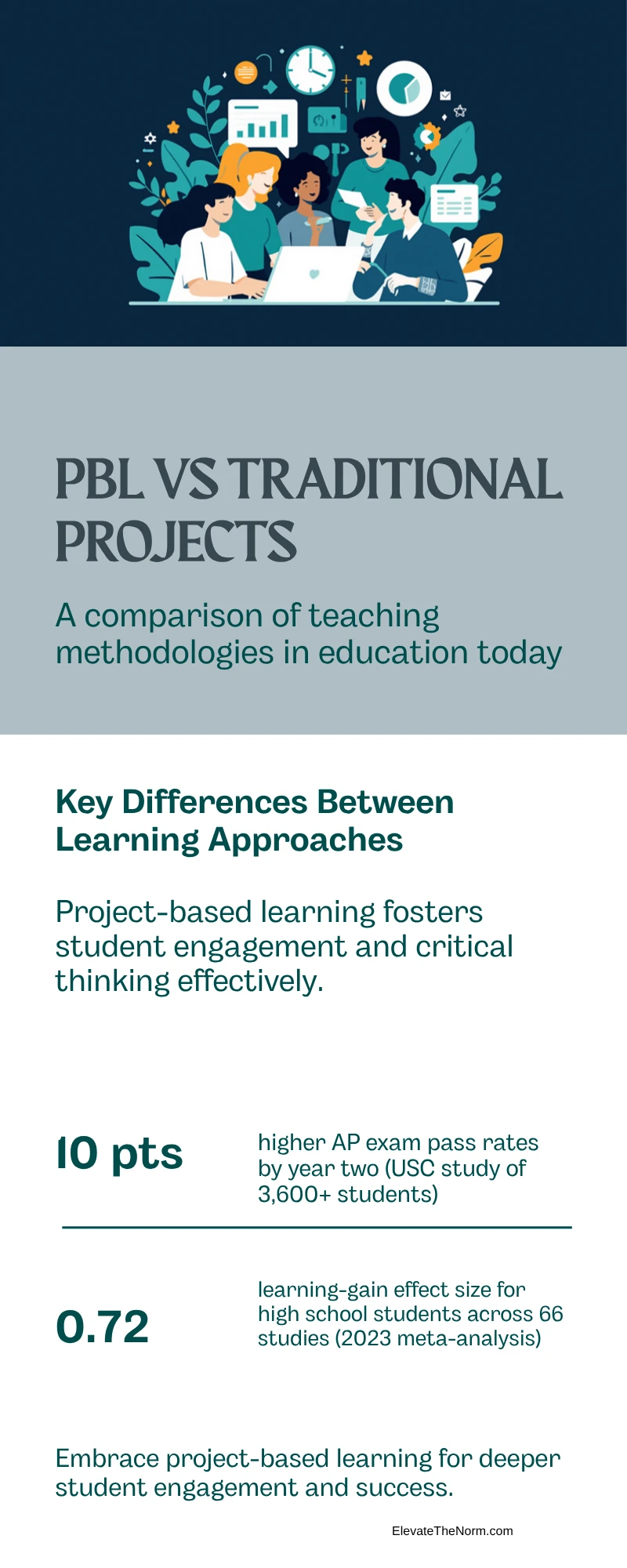
Teacher Emergency Toolkit — practical resources, real classroom support. Shop on TPT.Teacher Emergency Toolkit — practical resources, real classroom support. Shop on TPT.