The Elevate Blog banner: Real Classrooms. Practical Ideas. Higher Expectations. Three students climb a rocky ridge at sunrise, each pulling the next one up, toward a teacher reaching down to help.

Author: Clay Shumate

  • What Is Student Responsibility? A Clear Definition for Schools and Families

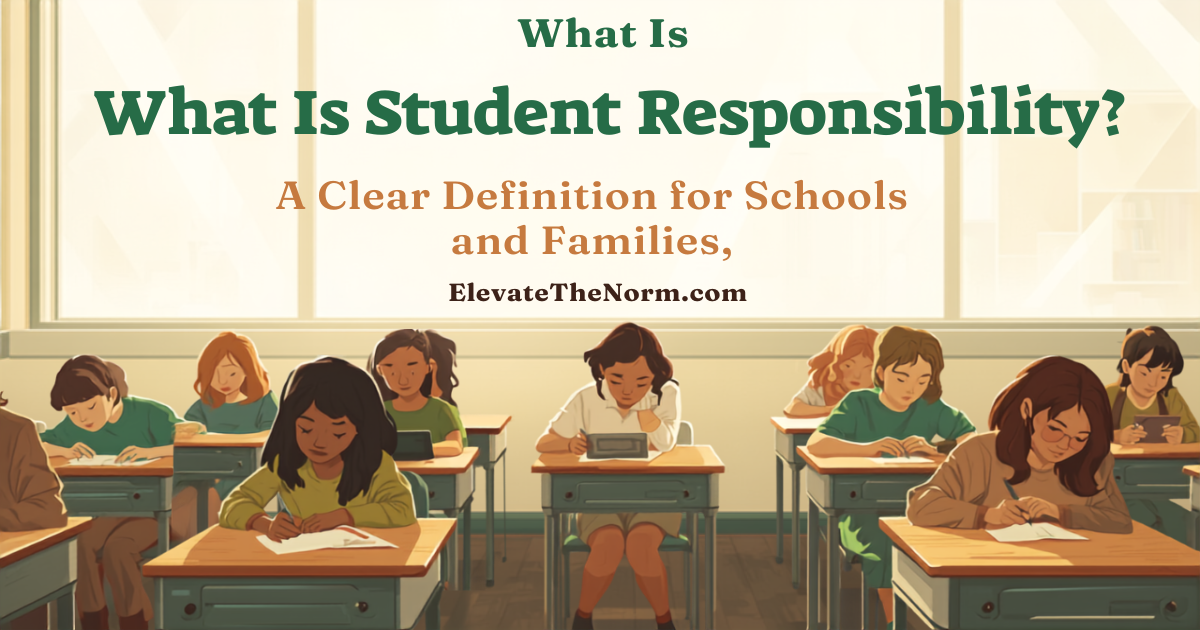
    What Is Student Responsibility? A Clear Definition for Schools and Families

    By Clay Shumate · Updated October 24, 2026

    Student responsibility is a student’s capacity to own their choices, meet their obligations, and make things right when they fall short. It covers academic responsibility—showing up, completing work honestly, asking for help—behavioral responsibility like following class agreements and accepting consequences without deflecting, and interpersonal responsibility: being someone your peers can count on when it matters. Responsibility grows through practice, not through lectures about why it matters.

    Key Takeaways

    • Student responsibility has four overlapping dimensions: academic, behavioral, interpersonal, and community
    • Responsibility is not the same as obedience—obedience asks students to comply; responsibility asks them to own
    • Responsibility develops through meaningful choice, honest feedback, proportionate consequences, and a genuine path back after failure
    • Schools and families each control distinct pieces of the picture—neither can do this alone
    • Students trusted with real responsibility tend to rise to it; students denied any meaningful responsibility often check out
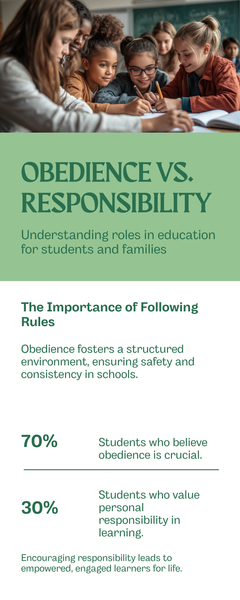
    Comparison chart showing the difference between obedience and student responsibility in school settings
    Obedience follows rules because told to. Responsibility owns choices and their outcomes.

    What Is Student Responsibility?

    Student responsibility, at its core, is a student’s ability to manage their own behavior and obligations without constant adult supervision. It is not perfectionism. A responsible student is not one who never makes mistakes—it is one who owns their mistakes, faces the consequence that was promised, and does not wait for an adult to notice and solve every problem for them.

    Damon (1995) distinguishes between compliance and genuine responsibility, arguing that adolescents develop real responsibility only when they internalize the values behind expectations—not when they follow rules out of fear of punishment. That distinction shapes how schools should approach this: punishing non-compliance produces compliance. Building structures where students experience ownership and consequences produces responsibility.

    The Collaborative for Academic, Social, and Emotional Learning (CASEL) places responsible decision-making as one of five core competencies in social-emotional learning, defining it as the ability to make caring and constructive choices about personal behavior and social interactions (CASEL, 2023). This is not a soft skill—it is a teachable, measurable set of practices.

    What Are the Four Dimensions of Student Responsibility?

    Responsibility is not one thing. Students can be responsible in some dimensions and not others—and understanding which dimension is the problem is the first step to addressing it.
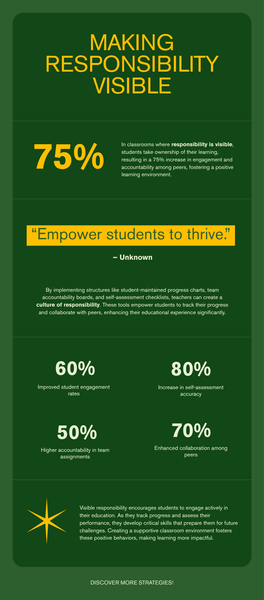
    Classroom structures that make student responsibility visible including progress charts and accountability boards
    Three structures that make responsibility visible: progress charts, accountability boards, and self-assessment checklists.

    Academic Responsibility

    Academic responsibility includes completing assigned work, meeting deadlines, submitting honest work, and asking for help when confused instead of guessing or copying. It also includes managing study time independently and advocating for yourself when you do not understand something.

    Academic responsibility does not mean students work alone all the time. It means that when they work together, they each contribute. A student who coast through group work—contributing nothing while taking credit—is not being academically responsible, even if their final grade does not show it.

    Behavioral Responsibility

    Behavioral responsibility means following class agreements even when the teacher is not watching, accepting consequences proportionately without deflecting blame onto others, and owning mistakes directly. A student who accepts a consequence and then moves on is demonstrating behavioral responsibility. A student who spends more energy disputing the consequence than they spent on the behavior that caused it is not. If you want a think sheet that treats students like young adults, my Behavior Reflection Sheets on TPT come in two levels.

    Interpersonal Responsibility

    Interpersonal responsibility means showing up for group work when you said you would, communicating honestly when something is wrong rather than disappearing, and holding yourself accountable to your peers without waiting for adult intervention. This is where student responsibility in the classroom becomes most visible—and most difficult—because teenagers are still developing the relational skills that make peer accountability possible.

    Community Responsibility

    Community responsibility extends beyond the individual: caring for shared classroom materials, leaving shared spaces as you found them, contributing to class culture rather than just extracting from it. This dimension is often underdeveloped in schools that treat responsibility purely as a compliance matter. A student who only does what serves themselves and ignores what their behavior costs the people around them has not developed full responsibility.

    DimensionWhat it looks like
    AcademicCompleting work, meeting deadlines, submitting honest work, asking for help instead of guessing or copying
    BehavioralFollowing class agreements when no one is watching, accepting consequences without deflecting blame, owning mistakes
    InterpersonalShowing up for group work, communicating honestly when something is wrong, being accountable to peers
    CommunityCaring for shared materials, leaving shared spaces as you found them, contributing to class culture
    The four dimensions of student responsibility at a glance.

    What Is the Difference Between Responsibility and Obedience?

    Obedience asks: Do it because I said so. Responsibility asks: Do it because you understand why it matters.

    A student who only acts responsibly when supervised has learned obedience—or at least its performance. A student who checks their own work before turning it in, admits to the group member that they did not pull their weight, and asks the teacher for an extension before missing a deadline rather than after: that student is practicing responsibility. I use the forms in my Makeup Work System on TPT so absent students know exactly what they missed and when it is due.

    This distinction shapes discipline. Teachers who confuse the two often escalate consequences trying to produce responsibility when what they are getting is compliance or its absence. More pressure can produce more compliance—but it rarely produces more ownership. And once a student is under enough pressure, it produces neither.

    For classroom approaches that build genuine responsibility rather than managed compliance, see positive discipline for teens and natural consequences in the classroom.

    How Do Students Develop Responsibility?

    Ryan and Deci (2000), whose self-determination theory has been among the most replicated frameworks in educational psychology, identify three basic psychological needs that support self-regulation: competence (feeling capable), autonomy (having real choices with real consequences), and relatedness (belonging to a community that cares how you act). Responsibility develops when students experience all three.

    A student who has no choices in class and no voice in outcomes has no reason to develop responsibility—they are compliant at best, resistant at worst. The conditions for responsibility must be built before you can expect students to demonstrate it.
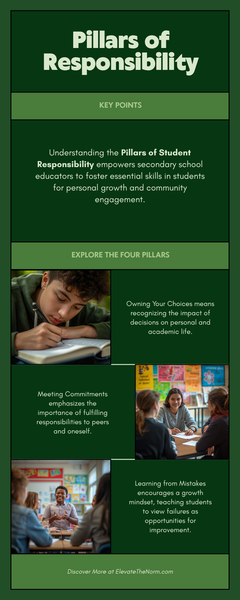
    Four pillars of student responsibility: owning choices, meeting commitments, learning from mistakes, contributing to the group
    The four pillars of student responsibility give students a concrete framework for developing ownership.

    Through Meaningful Choice

    Students cannot develop responsibility for choices they are never allowed to make. This does not mean every class decision is put to a vote. It means giving students real choices within clear boundaries: how they organize their notes, which of three article prompts to respond to, how they divide group roles. Choices with low stakes but genuine consequences—where the student experiences the results of their own decisions—are the practice ground for larger responsibility.

    Through Honest Feedback

    Vague praise tells students nothing useful. “Good work” does not tell a student what to repeat or what to change. Specific, honest feedback—”your argument on page two is clear; the evidence in the third paragraph does not quite support the claim you are making”—gives students something to act on. Feedback that helps students understand the gap between what they did and what was expected builds the self-awareness that responsibility requires.

    Through Proportionate Consequences

    Consequences need to match the behavior and be ones the student can actually learn from. A student who forgets homework and gets a zero learns to hide it next time. A student who forgets homework and has a brief, direct conversation about why—followed by a realistic plan for finishing it—learns something about responsibility. See natural consequences in the classroom for a practical framework for getting this right.

    Through Repair After Failure

    A student who makes a mistake and finds no path back learns to hide mistakes. A student who makes a mistake, owns it, repairs what can be repaired, and still faces the consequence that was agreed upon—that student is learning something real. The repair matters as much as the consequence. Schools that skip repair leave students with the message that once you mess up, you are just in trouble. Schools that include repair leave students with the message that responsibility includes fixing what you broke.

    For a first-person account of letting a consequence stand while keeping the path back open, see Clay’s essay What I Learned the Year I Let Kids Fail, published at The Educator’s Room.

    What Schools Control vs. What Families Control

    Schools control: the structure of the day, the expectations communicated, the consistency with which those expectations are applied, how teachers respond to failure, whether students have any meaningful voice in class decisions, and what happens after a student falls short. Schools decide whether consequences teach something or just punish. They decide whether students get a path back or are simply in trouble.

    Families control: routines at home, how parents model handling their own mistakes, how they talk about school, and whether they support students through consequences or work to eliminate them. A parent who calls in every morning a student misses homework and negotiates the grade is teaching that responsibility is negotiable when someone with enough leverage intervenes. A parent who lets the consequence stand and helps the student think through what went wrong is doing something very different.

    A school that expects families to deliver responsible students and does nothing to build responsibility at school is not doing its job. A family that expects school to do it all while rescuing students from every consequence is not doing theirs either. Responsibility is built in both places—or it struggles in both places.

    Common Misunderstandings About Student Responsibility

    Responsible students do not make mistakes. They do. The goal is not a student who never falls short—it is a student who owns it when they do. Responsibility is about response, not perfection. A student who admits they did not study for a test and accepts the grade is more responsible than a student who argues about why the test was unfair.

    You either have it or you do not. Decades of developmental psychology disagree. Responsibility is a practiced skill that grows through experience, feedback, and appropriately scaled opportunities to make real decisions. Weissberg and colleagues (2015) document clear evidence that social-emotional competencies, including responsible decision-making, are teachable and develop across childhood and adolescence with the right supports.

    Students from low-income or high-poverty backgrounds are less capable of responsibility. This assumption is refuted by the same evidence that shows all students respond to autonomy support and clear, consistent expectations. The conditions that support responsibility—clarity, trust, meaningful choices, and a path back after failure—matter regardless of what a student brings from home. The need is universal. The circumstances that make building it harder are sometimes not.

    How Do You Build a Responsible Classroom Culture?

    A responsible classroom is built on four things: clear expectations that students help shape, consistent follow-through when those expectations are not met, a genuine path back after failure, and enough trust to give students real responsibility rather than scripted tasks. Battistich (2008) argues that character development—including responsibility—requires students to experience themselves as genuine contributors to a community that cares, not just as rule-followers in an institution.

    Giving students real responsibility does not mean lowering supervision. It means giving them decisions that actually matter and letting the consequences of those decisions be real. A student who manages a class library, chairs a Socratic seminar, or leads a project checkpoint is practicing responsibility in a way that a worksheet about the importance of responsibility simply cannot replicate.

    For activities that build these skills, see activities for teaching responsibility. For how high expectations connect to student responsibility, see high expectations for students. For a concrete tracking tool, the student accountability sheet templates put individual student commitments in writing — four versions covering academic work, group responsibility, behavior, and restoration.

    What to Do Next

    Start with one dimension of responsibility and one concrete practice. If academic responsibility is the gap—deadlines, honesty, asking for help—start with a class conversation about what following through actually looks like and what happens when it does not happen. If interpersonal responsibility is the problem, build a team contract the next time students work in groups and actually enforce it.

    Responsibility does not happen through announcements. It happens through the thousands of small decisions students make each day—and whether the classroom is designed to let them own those decisions, or structured in a way that makes those decisions irrelevant before they ever get a chance to practice.

    Frequently Asked Questions

    What are examples of student responsibility?

    Examples across the four dimensions: turning in honest work on time and asking for help instead of copying (academic); following class agreements when the teacher is not watching and owning mistakes (behavioral); showing up for group work and speaking up when something is wrong (interpersonal); and caring for shared materials and leaving shared spaces as you found them (community).

    Why is student responsibility important?

    Responsibility lets students manage their behavior and obligations without constant adult supervision, which is the difference between ownership and compliance. CASEL lists responsible decision-making as one of five core social-emotional competencies. Students trusted with real responsibility tend to rise to it, while students denied any meaningful responsibility often check out.

    Is student responsibility the same as student obedience?

    No. Obedience means following a rule because someone told you to. Responsibility means understanding why the expectation exists and meeting it because you have internalized what is at stake. A student who behaves only when supervised has learned obedience. A student who meets obligations consistently—including when no one is watching—is practicing responsibility. Schools often confuse the two and end up managing compliance rather than building ownership.

    At what age should schools start building student responsibility?

    As early as possible, in age-appropriate ways. By grades 6–12, students are developmentally ready for real responsibility—meaning real choices with real consequences, not just classroom jobs with no stakes. Adolescents who are given meaningful responsibility and supported through mistakes tend to develop stronger self-regulation than those who are either denied responsibility or given it without any guidance or follow-through.

    Can a student be responsible in one area but not another?

    Yes, and this is common. A student might be highly responsible academically—completing every assignment, meeting every deadline—but struggle with interpersonal responsibility: not showing up reliably for group work or deflecting when something goes wrong in a team setting. Recognizing which dimension is the gap helps teachers intervene specifically rather than broadly labeling a student as responsible or irresponsible.

    How can families support responsibility without doing homework for their kids?

    By letting consequences happen. When a student forgets their project at home and a parent drives it to school, the student learns that someone else will fix it. When the student faces the consequence of turning it in the next day—and lives through it—they learn something about ownership. Families can also model responsibility directly: acknowledging their own mistakes, following through on what they say they will do, and talking about how they handle problems honestly.

    What do I do when a student genuinely cannot meet a responsibility?

    Distinguish between cannot and will not—and between a skill gap and a motivation gap. A student who does not know how to manage their time needs direct instruction in time management, not just consequences for missing deadlines. A student who knows how but is not doing it needs a different conversation. In both cases, the next step should include a specific plan, not just a punishment. Responsibility grows when students have a path forward, not just a record of what went wrong.

    How do teachers make responsibility visible rather than just assumed?

    By building structures that make it observable. Team contracts, revision trackers, self-assessment forms, and student-led conferences all make responsibility visible because they create records of what students committed to and what they actually did. When responsibility is only implied—show up, try hard, be good—students cannot develop it systematically. When it is made concrete and specific, students know what it looks like and teachers can respond to it clearly.

    Sources

    • Ryan, R. M., & Deci, E. L. (2000). Self-determination theory and the facilitation of intrinsic motivation, social development, and well-being. American Psychologist, 55(1), 68–78.
    • Damon, W. (1995). Greater expectations: Overcoming the culture of indulgence in our homes and schools. Free Press.
    • Collaborative for Academic, Social, and Emotional Learning (CASEL). (2023). Fundamentals of SEL. CASEL.
    • Weissberg, R. P., Durlak, J. A., Domitrovich, C. E., & Gullotta, T. P. (Eds.). (2015). Social and emotional learning: Past, present, and future. In J. A. Durlak, C. E. Domitrovich, R. P. Weissberg, & T. P. Gullotta (Eds.), Handbook of social and emotional learning: Research and practice. Guilford Press.
    • Battistich, V. A. (2008). Character education, prevention, and positive youth development. In L. Nucci & D. Narvaez (Eds.), Handbook of moral and character education. Routledge.

    About Clay Shumate

    Clay Shumate is a certified secondary Social Studies teacher in the public schools of West Alabama, with seven years of classroom experience, a B.A. in History, and an M.Ed. in Secondary Education. He writes about project-based learning, student responsibility, respect, and practical ways to hold young people to a higher standard while giving them room to learn from mistakes. He is a member of the Society of Professional Journalists and writes to its Code of Ethics; this site’s editorial standards and corrections policy are published in full. More about Clay.
  • Project Based Learning Tools: Free Templates for Teachers

    Project Based Learning Tools: Free Templates for Teachers

    By Clay Shumate

    Project based learning tools are the planning templates, feedback protocols, and assessment forms that give teachers and students a shared system for managing complex, multi-week work. Without them, a PBL project is ambition without infrastructure. With them, students know what they are doing each day, teachers can coach rather than rescue, and the final product reflects actual learning instead of organized chaos.

    Key Takeaways

    • Planning tools—driving question templates, project calendars, and Know/Need to Know charts—keep projects from drifting before they start
    • Group coordination tools like team contracts and role cards shift accountability from the teacher to the students where it belongs
    • Feedback and critique protocols help students improve their work before the final product, not just after it is graded
    • Free digital tools including Google Workspace, Padlet, and PBLWorks educator resources cover most of what a classroom needs without a budget
    • The best PBL programs run on five or six well-understood tools, not twenty barely-understood ones
    Driving question template for project based learning showing structure for open-ended inquiry questions
    A strong driving question is open-ended, connects to a real issue, and has no Googleable answer.

    Why PBL Needs Its Own Toolkit

    A standard assignment can run on a rubric and a due date. A project spanning three weeks—with multiple checkpoints, group coordination, research, revision, and a public product—cannot. Project based learning tools are not busy work. They solve real problems: drift, inequitable group work, surface-level feedback, and final assessments that miss what students actually learned.

    The Buck Institute for Education (now PBLWorks), which has studied project-based learning for over three decades, identifies planning, collaboration, and formative assessment as three essential supports for successful PBL implementation (Larmer, Mergendoller, & Boss, 2015). Tools are how those supports become visible inside a classroom where a teacher has twenty-eight students, five periods, and a bell that rings every fifty minutes.

    This guide covers the most useful tools in each category and points to the best free resources for getting them. For context on what strong PBL actually looks like, the definition of project based learning article explains the essential elements that separate genuine PBL from a decorated assignment.

    Planning Tools: Before the Project Starts

    The Driving Question Template

    A weak driving question makes students shrug. A strong one makes them argue and investigate. The difference is almost always structure. A strong driving question is open-ended, connects to a real issue or audience, and does not have a Googleable answer.

    Use this draft formula to build one: How should [person or group] [action] in order to [goal or value]?

    For example: How should our city council design a park renovation so that it serves both older adults and teenagers who share that space? This forces students to consider competing interests, use subject-area knowledge, and produce something—a recommendation, a proposal, a plan—rather than just a report.

    For a full breakdown of strong versus weak driving questions across multiple subjects, see project based learning driving question examples.

    Project Calendar

    A calendar does two things most teachers underestimate: it shows students how much time they actually have, and it forces the teacher to sequence direct instruction alongside inquiry. A usable PBL calendar has daily or weekly columns, labeled checkpoints, deadlines for specific deliverables (not just one big due date at the end), and built-in days for critique and revision. PBLWorks provides free downloadable planning calendars for teachers at pblworks.org/resources.

    Know/Need to Know Chart

    After launching a project—typically with an entry event that makes the problem feel real—students complete a Know/Need to Know chart. On one side: what they already know. On the other: what they need to find out. This chart does not stay static. It grows as students learn and discover new questions.

    The KNTK serves two purposes. It gives students a research direction and gives teachers a formative snapshot of background knowledge and misconceptions—without a quiz. John Hattie’s synthesis of educational research identifies formative assessment as one of the highest-impact practices in education (Hattie, 2009). The KNTK is one of the simplest formative tools that costs nothing and takes ten minutes.

    Team contracts and rotating role cards for project based learning group coordination
    Team contracts and role cards shift accountability to students where it belongs.

    Group Coordination Tools: While the Work Is Happening

    Team Contract

    Group work fails when accountability is vague. A team contract makes it specific. A good one covers: each member’s role, what happens when someone does not complete their work, how decisions get made, and how the group will handle disagreements before they escalate to the teacher.

    It is not a behavioral management trick. It is a professional practice. Legal teams, software developers, and nonprofit boards all use agreements that define responsibility before problems start. Asking students to do the same is not asking too much—it is asking something real. See the 7 steps of project based learning for where the team contract fits in the full project sequence.

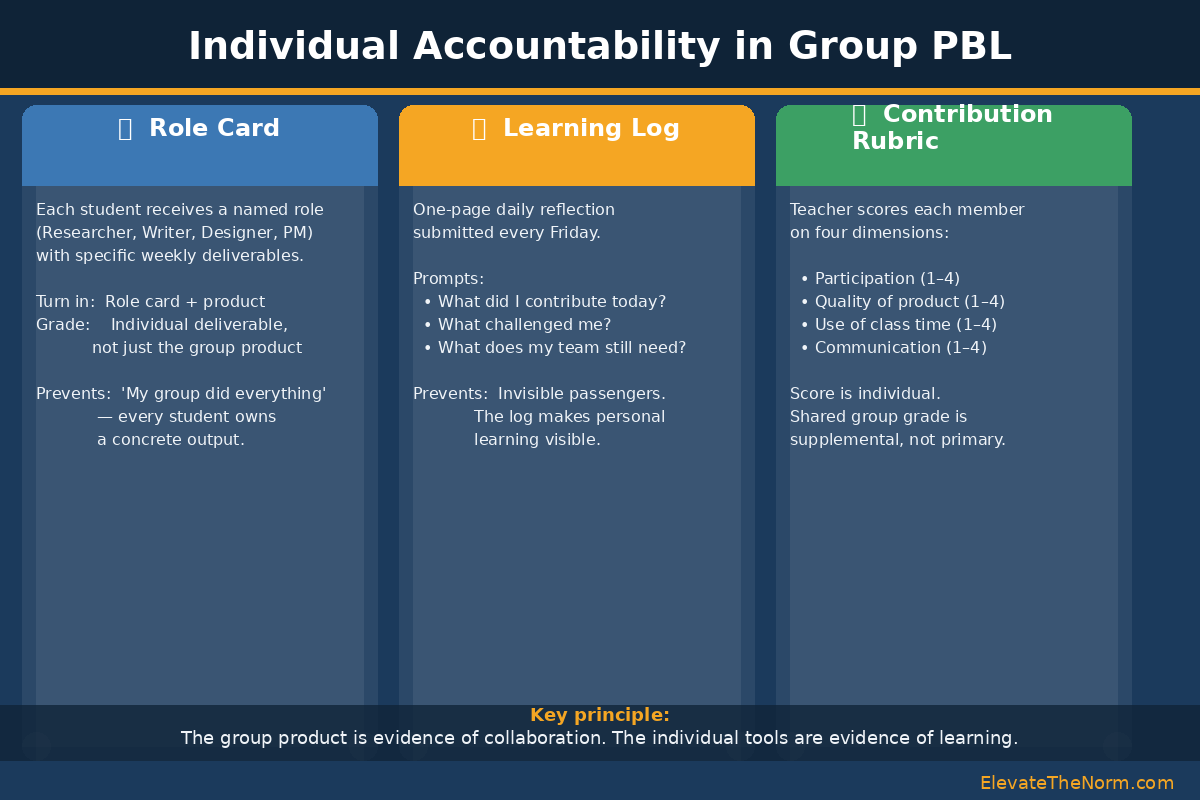
    Role Cards

    Rather than leaving students to decide who does what—which usually means one person does everything—role cards assign rotating responsibilities. Common roles include: Project Manager (keeps the group on schedule and tracks deliverables), Lead Researcher (coordinates inquiry and source evaluation), Editor/Quality Control (reviews for accuracy and coherence), and Presenter Coordinator (organizes the final product and prepares the group). Roles rotate each project so every student practices every skill. Be honest with yourself about which of those cards is doing real work, though—a 36-study review found no evidence that naming roles improves outcomes on its own, so it is worth reading what actually makes a group role earn its place before you print a set.

    Daily Stand-Up Log

    Borrowed from software development, a stand-up is a brief daily check-in with three questions: What did you accomplish? What will you do next? What is blocking your progress? Students fill this in at the start of work time. The teacher scans the logs in three minutes and knows exactly who is stuck without running to every group. Students learn to diagnose their own progress rather than waiting for the teacher to notice a problem.

    Research and Inquiry Tools

    Source Evaluation Checklist

    The standard “is it credible?” instruction is not enough. Students need specific criteria they can apply independently: Who is the author? What organization published this? When was it last updated? Does it cite evidence? Is the purpose to inform, persuade, or sell? This checklist works for websites, journal articles, primary sources, and news coverage.

    Research Notes Organizer

    A research notes organizer gives students one place to record sources, quotations, and their own interpretations. Without it, students either plagiarize because they cannot separate their notes from the source, or they lose track of where information came from. A four-column table works for most subjects: Source | Key Information | My Interpretation | Questions It Raises.

    Feedback and Critique Tools

    Peer critique protocol and self-assessment rubric for project based learning student feedback
    Feedback and critique protocols help students improve their work before the final product, not just after it is graded.

    Peer Critique Protocol: Warm and Cool Feedback

    Developed and refined by educator Ron Berger and the EL Education network, warm and cool feedback is one of the most practical classroom critique tools available (Berger, Rugen, & Woodfin, 2014). Warm feedback names specifically what is working and why. Cool feedback identifies something to strengthen, phrased as a question or suggestion rather than a judgment.

    The distinction matters. “This is good” is not warm feedback. “The evidence you used in paragraph two directly supports your claim—and the contrast you drew with the counter-example is convincing” is warm feedback. “Your conclusion repeats the introduction rather than moving forward—what’s the next step you want the reader to take?” is cool feedback. This structure keeps critique from becoming personal and keeps attention on the work, not the person who made it.

    Gallery Walk with Sticky Notes

    Students post their work-in-progress on walls or tables. Classmates rotate through and leave sticky notes: one warm, one cool. This gives every student feedback from multiple peers without the teacher orchestrating every exchange. It works best mid-project—after a first draft exists but with enough time remaining to act on what they hear.

    Revision Tracker

    A simple document with three columns: Feedback Received → Change Made → Reason for the Change. Students maintain this alongside their work. It prevents revision from being cosmetic—fixing a typo and calling it done—and shows teachers whether students are actually responding to critique or going through the motions. It also gives students a record of how their thinking developed over the course of the project.

    Assessment Tools

    PBL Rubric

    Assessment in project-based learning has to measure the right things. A rubric that only scores the final product misses the inquiry, the revision, the collaboration, and the communication that make PBL valuable. A well-built PBL rubric includes separate rows for content knowledge demonstrated, quality of evidence, revision process, collaboration (assessed individually, not as a group score that hides individual gaps), and communication clarity.

    For a free editable template built specifically for grades 6–12, see the rubric for project based learning.

    Self-Assessment Form

    Before every checkpoint and after every project, students complete a brief self-assessment: What was my strongest contribution? Where did I fall short? What would I do differently? What did I learn? This is not extra busywork. It is the metacognitive habit that makes future projects better. A student who cannot answer “what did I actually learn?” has not finished the project—they have finished the assignment.

    Exhibition Checklist

    When students present to an authentic audience, an exhibition checklist covers: Does the product show evidence-based reasoning? Is the presentation clear to someone unfamiliar with the topic? Did the team handle questions directly and honestly? Does it meet the criteria the project set out to address? This checklist can be used by the presenting team for self-assessment and by the audience for structured feedback during the presentation.

    Free Digital Tools Worth Using

    Many of the most effective project based learning tools are printable and free. A few digital platforms extend them without creating new management problems.

    Google Workspace (free for schools): Google Docs for shared writing and revision history, Google Slides for presentations, Google Forms for self-assessment and checkpoint surveys, Google Drive for organizing project files. Widely available and familiar to most students before they arrive.

    Padlet (free tier available): A shared digital board for gallery walks, Know/Need to Know charts, and collaborative brainstorming. Works on any device with a browser. Students can post text, images, and links—and see what their classmates are contributing in real time.

    Canva for Education (free): Students create posters, infographics, reports, and presentations without graphic design experience. The free version for education has enough templates to cover most public-product deliverables.

    PBLWorks Educator Resources (free with registration): PBLWorks, the organization founded by the Buck Institute for Education, provides free planning templates, rubrics, and project examples at pblworks.org/resources. Their Gold Standard PBL framework is the most research-grounded planning reference currently available for classroom teachers.

    What Makes a Tool Worth Using

    A tool earns its place in a classroom when it reduces teacher-student friction, increases student clarity, and produces better work. Apply this test before adding any new form or protocol: what specific problem does this solve, and how will I know if it is working?

    The best PBL programs run on five or six tools that teachers and students both understand well. Adding more does not produce more learning—it produces more confusion. Krajcik and Shin (2014) note that effective project-based learning requires sustained student inquiry, which cannot happen when students are spending cognitive energy managing unfamiliar templates. The tools should fade into the background and let the thinking come forward.

    For broader classroom resources alongside these tools, the project based learning resources article covers free external tools, credible research references, and original ElevateTheNorm.com downloads in one place.

    What to Do Next

    Start with three: a driving question template, a team contract, and a peer critique protocol. Use them consistently for one full project. After the project ends, ask students which tools helped and which felt like extra work without a payoff. Revise based on their honest answers. The tools should be improving student work—if they are not doing that, something needs to change.

    For the sequence that holds these tools together, the 7 steps of project based learning shows where each tool fits from driving question through final reflection.

    Teachers are not the only ones researching this. Parents, administrators and students now put the same questions to an AI assistant before they ever ask a person, and the answers they get are often written from a vendor’s marketing page. The questions people are asking AI about project-based learning collects the twenty-five that come up most — platforms, cost, curriculum fit — and answers them from a classroom instead. Most of it assumes a secondary timetable; the high-school constraints specifically get their own treatment.

    Frequently Asked Questions

    What is the most important project based learning tool to start with?

    Start with the driving question template. Everything else in a PBL project depends on having a strong driving question. A weak question produces vague research, unclear products, and students who cannot explain why any of it matters. Once teachers can write strong driving questions reliably, the rest of the tools start making more sense because students understand what they are working toward.

    Do project based learning tools work without classroom technology?

    Yes. The most effective PBL tools are printable or can be run with a whiteboard and sticky notes. The team contract, peer critique protocol, Know/Need to Know chart, role cards, and self-assessment form all work without a device. Technology expands options for collaboration and presentation, but it is not a requirement for solid project management.

    How do I prevent one student from doing all the group’s work?

    Use role cards with rotating assignments and assess students individually inside a group project. If one student does all the work while others coast, the problem is usually structural—not a character issue. A team contract set up before the project starts, with agreed-upon consequences for not contributing, shifts accountability to the group before the teacher has to intervene. Individual self-assessments and revision trackers also make individual contribution visible.

    What is the difference between a PBL rubric and a regular rubric?

    A regular rubric typically scores the final product only. A PBL rubric also assesses the process: the quality of inquiry, how students responded to feedback and revised their work, how they collaborated, and how clearly they communicated their thinking. Scoring only the product rewards students who produce polished deliverables through luck or prior advantage. A PBL rubric rewards the kind of thinking and revision the project was designed to build.

    At what grade level are these tools appropriate?

    The tools in this guide are designed for grades 6–12. Middle school students generally need more structure—clear role cards, a daily stand-up log, and teacher checkpoints every two to three days. High school students can handle more open-ended planning, longer timelines, and self-directed research with less scaffolding. Adjust the level of detail and frequency of checkpoints based on your students’ experience with project work, not just their grade level.

    How does a driving question template help students?

    A driving question template gives students a structured starting point instead of a blank page. It forces them to identify who is affected by the problem, what action is needed, and why it matters—before they start researching. This clarity shapes the whole project. Students who understand why a question is worth investigating tend to stay more engaged throughout the work than those who were handed a topic without context.

    What should self-assessment include in a project based learning project?

    A useful self-assessment asks students to name their strongest contribution specifically, identify where their work fell short and why, state one thing they would do differently, and describe what they actually learned. Vague questions produce vague answers. “What did you contribute?” gets a list of tasks. “What was your most important contribution to the final product, and what evidence supports that?” gets honest reflection.

    Sources

    • PBLWorks. (n.d.). Educator resources: Free templates and rubrics. PBLWorks / Buck Institute for Education.
    • Larmer, J., Mergendoller, J. R., & Boss, S. (2015). Setting the standard for project based learning. ASCD.
    • Berger, R., Rugen, L., & Woodfin, L. (2014). Leaders of their own learning: Transforming schools through student-engaged assessment. Jossey-Bass.
    • Krajcik, J., & Shin, N. (2014). Project-based learning. In R. K. Sawyer (Ed.), The Cambridge handbook of the learning sciences (2nd ed., pp. 275–297). Cambridge University Press.
    • Hattie, J. (2009). Visible learning: A synthesis of over 800 meta-analyses relating to achievement. Routledge. (Formative assessment effect size d ≈ 0.90 as summarized.)

    About Clay Shumate

    Clay Shumate is a certified secondary Social Studies teacher in the public schools of West Alabama, with seven years of classroom experience, a B.A. in History, and an M.Ed. in Secondary Education. He writes about project-based learning, student responsibility, respect, and practical ways to hold young people to a higher standard while giving them room to learn from mistakes. He is a member of the Society of Professional Journalists and writes to its Code of Ethics; this site’s editorial standards and corrections policy are published in full. More about Clay.
  • Project Based Learning Driving Question Examples for Grades 6–12

    Project Based Learning Driving Question Examples for Grades 6–12

    By Clay Shumate · Updated October 24, 2026

    Quick answer: A project based learning driving question is an open-ended question that frames an authentic problem with no single correct answer, requires students to use the unit’s standards to investigate it, and ends in a product for a real audience. Strong examples are local and specific, such as “What should the city council do about rising housing costs in our community?”

    A driving question is the engine of a PBL unit. It sets the direction, gives students a reason to care, and holds the work together across days or weeks of instruction. But a weak driving question quietly undermines everything — it either shuts down thinking before it starts or lets students coast without ever engaging the standards you need them to master.

    Below are real driving-question examples organized by subject area, an explanation of what makes each one work, a side-by-side look at weak versions of the same questions, and a five-step revision formula you can use to strengthen any driving question you write from scratch. Each of these classroom-tested history projects is built around one, if you want to see finished questions inside a full unit.

    Key Takeaways

    • A strong driving question passes a three-part test: it has no single correct answer, it cannot be answered without the unit’s standards, and it produces work for a real audience.
    • Local stakes make a question answerable: “our watershed,” not “the environment.”
    • Weak driving questions fall into five patterns: too broad, easily Googled, leading, disconnected from standards, or fake.
    • If the first search result fully answers the question, it is not driving anything.
    • The strongest driving questions usually come after two or three revisions.

    What Makes a Good Driving Question in PBL?

    Before the examples, a working definition of project based learning: a driving question frames an authentic problem that has no single correct answer, requires students to use the skills and content of the unit to investigate it, and produces a product or presentation that addresses a real audience. That’s the three-part test. If a question can be answered by a quick internet search, it fails the first part. If students can answer it without demonstrating the standards, it fails the second. If the work disappears into a folder never read by anyone, it fails the third. That third test is the whole of what makes a task authentic rather than merely well-designed.

    Infographic showing the three-part test for strong project based learning driving questions: no predetermined answer, standards are load-bearing, and a real audience exists
    Before publishing a driving question, check all three conditions.

    What Are Examples of Driving Questions by Subject?

    Science

    Strong: “How healthy is our watershed, and what should our community do about what we find?”

    Why it works: Students have to collect and analyze real water-quality data (science practices), interpret findings against state standards (content knowledge), and communicate recommendations to an audience who can actually act on them — the city water board, a local environmental group, or the school board. The question doesn’t tell students what they’ll find. It invites genuine investigation.

    Strong: “Is our school’s energy use sustainable, and what’s one change we could make that would actually matter?”

    Why it works: Local and bounded. Students aren’t solving climate change — they’re solving one building’s energy footprint. The second clause (“that would actually matter”) forces quantitative thinking: students have to calculate actual impact, not just list recycling tips. The audience is the school administration, which gives the work stakes.

    Social Studies and History

    Strong: “What should the city council do about rising housing costs in our community?”

    Why it works: It connects economics, civics, and local government in one question. Multiple defensible positions exist — zoning reform, rent stabilization, housing vouchers, market incentives — and students have to evaluate evidence for each. The audience is real: city council members, local journalists, or community advocates. Students present policy recommendations rather than five-paragraph essays. For social studies teachers, my Social Studies Teacher Toolkit Bundle on TPT gives you a head start on the materials.

    Strong: “What would you tell a younger student who thinks the civil rights movement is history and doesn’t affect them today?”

    Why it works: The audience (a younger student) is concrete. The question requires students to synthesize historical knowledge with present-day evidence — the harder cognitive move. It also demands a choice about emphasis: what do you lead with? Why? That’s persuasion, historical thinking, and communication in one question. And it treats the student as someone with something worth saying, not just someone absorbing information.

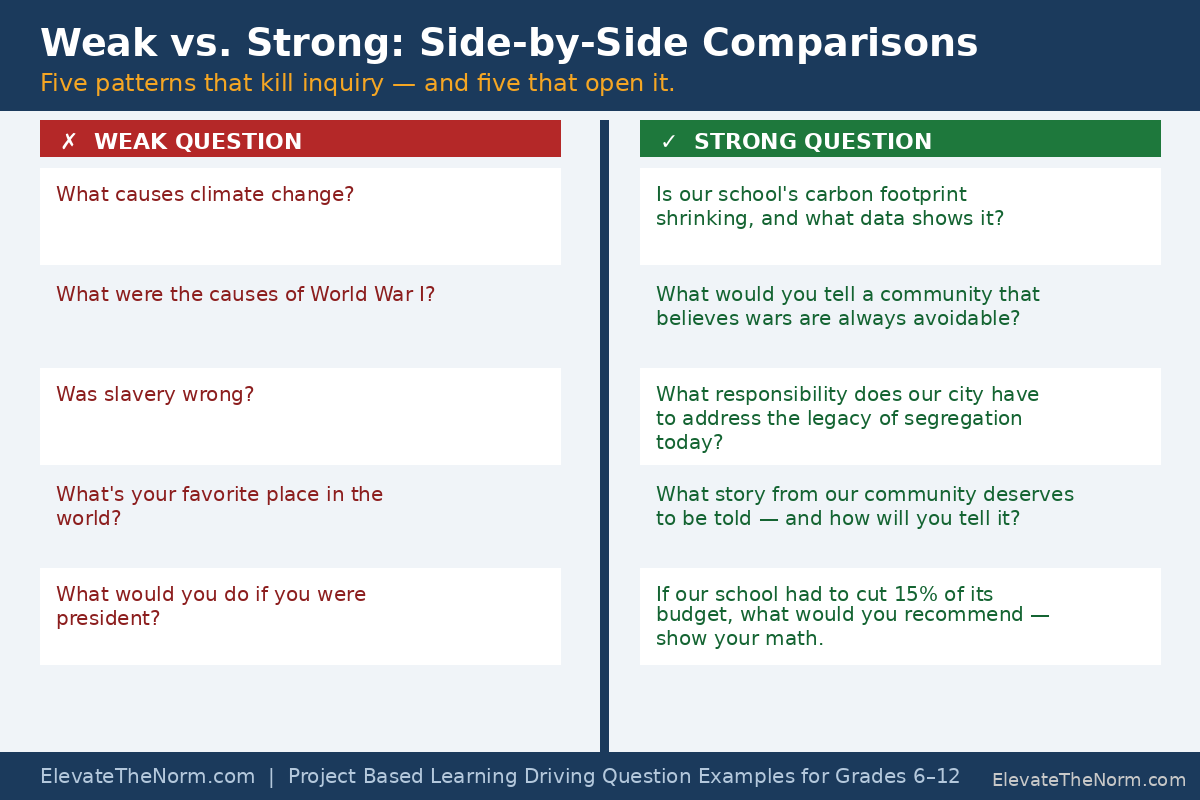
    Side-by-side comparison chart of weak versus strong project based learning driving question examples across five subject areas, showing how each weak question fails and how the strong version corrects it
    Weak questions and strong alternatives, side by side.

    Mathematics

    Strong: “Is our school’s cell phone policy working, and what does the data say?”

    Why it works: Students care deeply about this topic. They design a survey (statistics), collect and organize data (data analysis), calculate measures of center and variability (content), visualize findings (data representation), and present a recommendation to administration. Every step is grounded in mathematics content, but the reason to do the math is built in from the start.

    Strong: “If our school had to cut its budget by 15 percent, what would you recommend — and can you show your math?”

    Why it works: Proportional reasoning, budgeting, percentages, and data interpretation all appear naturally. The final clause (“can you show your math?”) builds in the accountability piece. Students have to justify their reasoning quantitatively, not just state an opinion. Presenting to a mock school board raises the stakes further.

    English Language Arts

    Strong: “What story from our community deserves to be told, and how will you tell it?”

    Why it works: Narrative writing, interview skills, audience awareness, and editing all emerge naturally from this question. Students interview community members, identify a story angle, draft and revise, and publish — to the school paper, a community website, or a class literary magazine. The question respects student judgment: they decide what deserves to be told. This connects to student voice and choice in the classroom: when students help shape the inquiry, the work carries more weight.

    Strong: “How do you write an argument that someone who disagrees with you would actually take seriously?”

    Why it works: The built-in challenge — not just “write an argument” but “write one your opposition would respect” — forces students to engage with counterargument and evidence quality from the beginning of the unit, not as an afterthought. It also develops intellectual humility, which is a real skill worth teaching.

    What Makes a Driving Question Weak?

    Weak driving questions fall into five predictable patterns. Each shuts down inquiry in a different way.

    Too broad: “How does climate change affect the environment?”
    This is a research prompt, not a driving question. The answer is available in every textbook. It has no local angle, no audience, no student voice, and no product that could matter. Students fill out a graphic organizer and move on. No genuine inquiry required.

    Easily Googled: “What were the causes of World War I?”
    A student can retrieve a correct answer in under 30 seconds. There’s no reason to sustain inquiry over multiple days. This is a comprehension check question elevated to a project title.

    Leading: “Was slavery wrong?”
    There is only one acceptable answer in a school setting. Students know it before they begin. No investigation is required, no evidence is weighed, and no thinking happens. A question with only one permissible answer is a compliance exercise.

    Disconnected from standards: “What’s your favorite place in the world and why?”
    Engaging and personal — and completely untethered to any specific learning target. Without a clear standards connection, this type of question produces enjoyable work that doesn’t move students forward academically. The project feels good but doesn’t teach the things it was supposed to teach.

    Fake: “What would you do if you were president for a day?”
    The hypothetical framing removes all real stakes. Students know the audience is imaginary, the recommendations won’t be read by anyone with authority, and the “project” is really a creative-writing exercise. There’s no investigation because there’s no real problem to solve.

    Weak patternExampleWhy it fails
    Too broad“How does climate change affect the environment?”Answer is in every textbook; no local angle or audience
    Easily Googled“What were the causes of World War I?”Retrievable in under 30 seconds; nothing to sustain inquiry
    Leading“Was slavery wrong?”Only one acceptable answer; no evidence weighed
    Disconnected from standards“What’s your favorite place in the world and why?”Engaging but tied to no learning target
    Fake“What would you do if you were president for a day?”Imaginary audience and no real problem to solve
    The five weak driving question patterns at a glance.
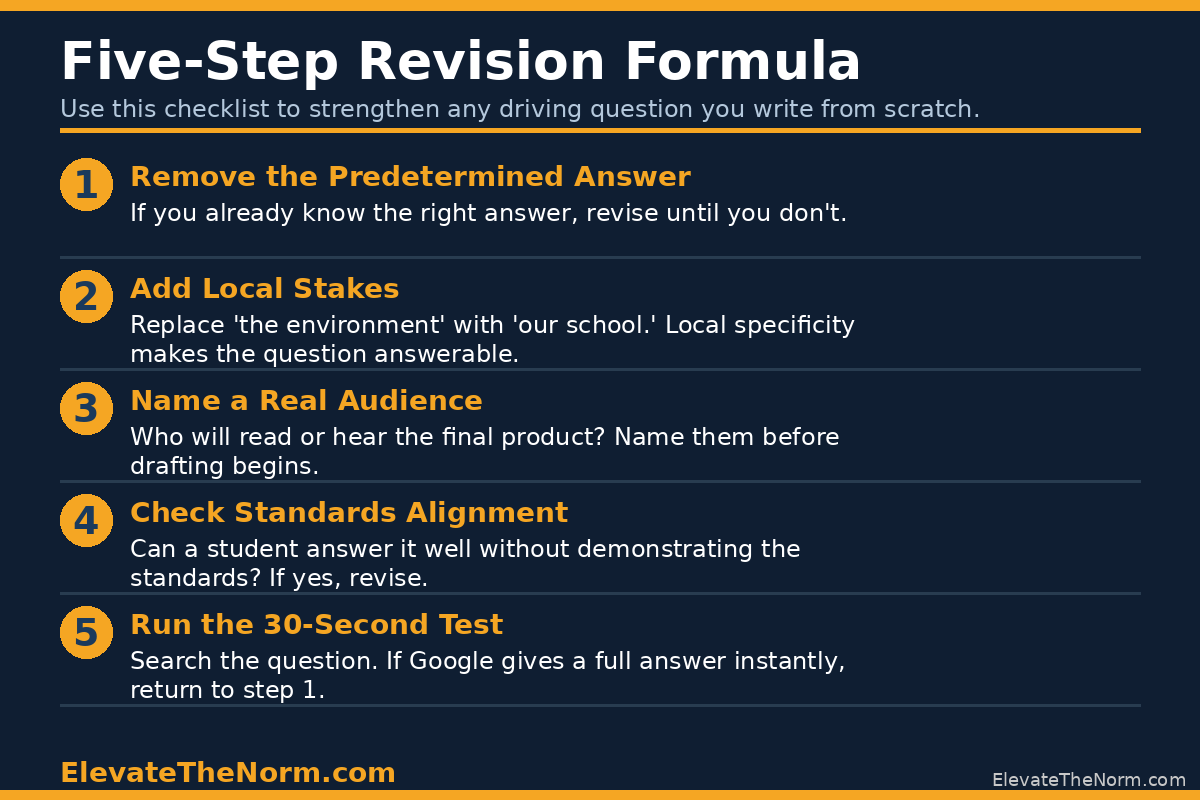
    Five-step revision formula infographic teachers can use to improve any project based learning driving question they write from scratch
    Run any question through these five steps before you launch the project.

    How Do You Write a Strong Driving Question? A Five-Step Revision Formula

    Take any driving question you’ve already written and run it through these five checks in order.

    Step 1 — Remove the predetermined answer. If you already know the “right” answer before students begin, revise until you don’t. The question should produce genuine uncertainty about what the best response is.

    Step 2 — Add local stakes. Replace “the environment” with “our watershed.” Replace “students” with “students at this school.” Local specificity makes the question answerable in a bounded way and gives students real data to work with.

    Step 3 — Name a real audience. Who will actually read, watch, or hear the product? The school board, a local nonprofit, a city council member, the principal, a community newspaper? A named audience changes how seriously students take their work.

    Step 4 — Check the standards connection. List the specific standards or learning targets the unit is supposed to address. Ask: “Could a student answer this driving question satisfactorily without demonstrating those standards?” If yes, revise the question until the content is load-bearing.

    Step 5 — Run the 30-second test. Type the question into a search engine. If the first result gives a complete, usable answer, the question isn’t driving anything. Return to Step 1.

    A note from the classroom: I’ve found that the weakest driving questions are usually the first ones teachers write — and the best ones come after two or three revisions. One way I’ve improved my own practice is to circulate during project work and listen to what students are actually debating with each other. When a group is genuinely arguing about which recommendation to make, I know the question is working. When they’re just dividing up a graphic organizer, something is wrong upstream — usually the driving question itself.

    Frequently Asked Questions

    What are examples of driving questions for social studies?

    Two strong social studies examples: What should the city council do about rising housing costs in our community? and What would you tell a younger student who thinks the civil rights movement is history and does not affect them today? Both have more than one defensible answer, require real evidence, and name a concrete audience.

    How do you test whether a driving question is strong enough?

    Run the 30-second test: type the question into a search engine. If the first result gives a complete, usable answer, the question is not driving anything. Then check the three-part test: no single correct answer, the unit’s standards are required to answer it, and the product goes to a real audience.

    What makes a driving question different from a regular essay prompt?

    A regular essay prompt has a correct answer the teacher already knows — it’s an assessment disguised as an assignment. A driving question doesn’t have a predetermined right answer. It opens genuine inquiry: multiple defensible positions, real uncertainty, and a reason to care about the outcome. Students build knowledge to answer it rather than answer it to display knowledge.

    How specific should a driving question be?

    Specific enough that students know what subject, setting, or audience they’re working with — but open enough that the answer requires real thinking. “How should our school reduce food waste in the cafeteria?” is specific (our school, our cafeteria) and open (many possible answers, each requiring investigation). “What is food waste?” is too broad. “Should we compost?” is too closed.

    Can students help create the driving question?

    Yes, and when they do, engagement goes up noticeably. One approach: give students a problem space and a standards target, then have them brainstorm questions they genuinely want to answer. The teacher narrows the list using the revision formula — removing questions that can be Googled, adding a real audience, and checking for standards alignment. The final question is often stronger when students have a hand in it.

    What if students can’t connect to the driving question?

    Usually that means the question lacks local stakes or a real audience. “How should our city handle rising housing costs?” lands differently for a class of students who have moved twice in three years than it does for a class with stable housing. Launching with a guest speaker, a local news clip, or a brief student-led discussion about their own experience before revealing the driving question dramatically improves buy-in.

    Do I need a driving question for every project?

    Not necessarily. Short, skill-building projects — a single-period lab, a one-day design challenge — can work without a formal driving question. Driving questions pay the most dividends in multi-day or multi-week projects where students need a reason to keep pushing when the work gets hard. If a project will run more than three class periods, a strong driving question is worth the 20 minutes it takes to craft one.

    Is a driving question the same as an essential question?

    They overlap but aren’t identical. Essential questions (a term from Understanding by Design) are often philosophical, transferable across units, and may never be fully answered — they’re meant to recur throughout a course. Driving questions are project-specific: they anchor one project, demand a product or presentation, and get answered by the end of the unit. Think of essential questions as the long arc and driving questions as the specific mission.

    How do I know if a driving question is connected to standards?

    Run the backward-design check: list the specific standards (or learning targets) the project must address. Then ask whether answering the driving question requires students to actually use those skills and concepts — not just mention them. If a student could produce a satisfactory answer to your driving question without ever demonstrating the standard, the question isn’t doing its job. Revise until the connection is tight.

    For a full look at how driving questions fit into the complete PBL cycle, see the seven steps of project based learning — the driving question is Step 1, but what happens in Steps 2 through 7 determines whether it does its job. For project ideas organized by subject and grade level, the project based learning ideas collection shows how driving questions look in finished form across fifty real units.

    Sources

    • Buck Institute for Education. (2019). Gold Standard PBL: Essential Project Design Elements. PBLWorks. https://www.pblworks.org/what-is-pbl/gold-standard-project-design
    • Krajcik, J. S., & Shin, N. (2014). Project-based learning. In R. K. Sawyer (Ed.), The Cambridge Handbook of the Learning Sciences (2nd ed., pp. 275–297). Cambridge University Press.
    • Larmer, J., Mergendoller, J., & Boss, S. (2015). Setting the Standard for Project Based Learning. ASCD.
    • McTighe, J., & Wiggins, G. (2013). Essential Questions: Opening Doors to Student Understanding. ASCD.
    • Mergendoller, J. R., Maxwell, N. L., & Bellisimo, Y. (2006). The effectiveness of problem-based instruction: A comparative study of instructional methods and student characteristics. Interdisciplinary Journal of Problem-Based Learning, 1(2), 49–69. https://doi.org/10.7771/1541-5015.1026

    About Clay Shumate
    Clay Shumate is a certified secondary Social Studies teacher in the public schools of West Alabama, with seven years of classroom experience, a B.A. in History, and an M.Ed. in Secondary Education. He writes about project-based learning, student responsibility, respect, and practical ways to hold young people to a higher standard while giving them room to learn from mistakes. He is a member of the Society of Professional Journalists and writes to its Code of Ethics; this site’s editorial standards and corrections policy are published in full. More about Clay.
  • Teaching After a Long Weekend: A 3-Day Weekend Classroom Plan

    Teaching After a Long Weekend: A 3-Day Weekend Classroom Plan

    By Clay Shumate

    Three-day weekends are awesome. Nobody argues that part. The argument I want to have is about the two days that sit on either side of one — the Friday before and the Tuesday after — because those are the two days most of us quietly write off every single year.

    I don’t write them off. I use them to introduce new material. Here’s how.

    The Friday tension nobody names

    As soon as that final bell hits on Friday — and really the day or two before it — these kids are going to be all riled up. They are going to be ready to go as much as you are. And that creates a tension whether you believe it or not.

    They’re happy. And you’re probably, let’s just be honest, a little unhappy at how happy they are. Because you’re standing there running the checklist in your head: are they actually paying attention? Are they getting their information? Are you meeting your standards for those two days that you don’t already have enough time to do?

    Probably not. So what do you do?

    Don’t review. Not yet.

    Review is the reflex. It’s the move that feels responsible, because it looks like content and it fills a block. But a review on Friday afternoon, aimed at a room that mentally left the building on Thursday, is not going to repair anything. If they didn’t have it Wednesday, one more pass at 2:15 on Friday isn’t the fix.

    Save review for a day they can actually spend it. You don’t need it yet.

    Play a game — a real one, that you built

    So go back to what I did on the Thursday or Friday before: play games.

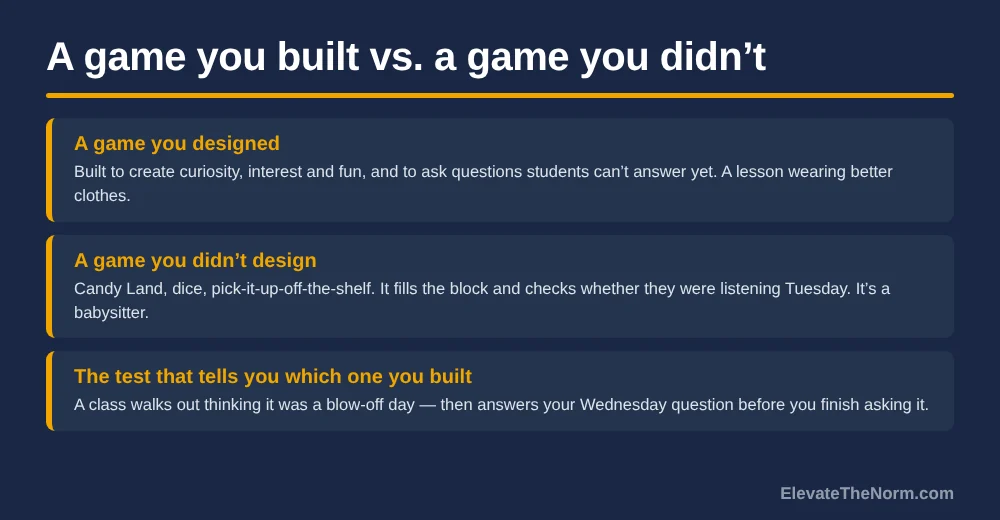
    And I need to be specific about that word, because it gets used badly. These games aren’t Candy Land and dice and pick-it-up-off-the-shelf. It’s a true game that you have taken the time to build, one that creates curiosity, interest, and fun. The build is the whole thing. A game you didn’t design is a babysitter. A game you designed is a lesson wearing better clothes. If you want the design rules rather than the argument, they are set out in how to build a review game that actually teaches something.

    A comparison of a review game the teacher designed against an off-the-shelf game, plus the test that shows which one was built: students think it was a blow-off day but answer Wednesday's question early.
    A game you designed is a lesson wearing better clothes. A game you didn’t is a babysitter.

    The engine underneath it is curiosity. You ask them questions they more than likely don’t know the answer to — not questions that check whether they were listening Tuesday. Not knowing is the point. Not knowing is what makes a fourteen-year-old pick up a laptop on a Friday.

    Make it a webquest, not a worksheet

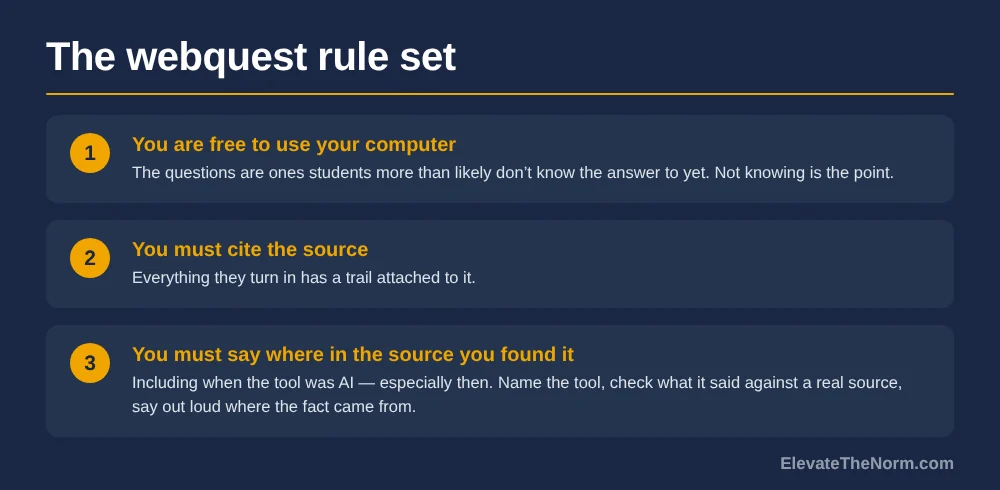
    Here’s the turn that makes it a lesson instead of a time-filler. Instead of this webquest being on a piece of paper that they turn in at the end of the day, you create a webquest for them to do. Then you ask them the questions and you tell them: you are free to use your computer. You must cite the source. And you must say in the source where you found the info.

    That’s it. That’s the whole rule set. Everything they turn in has a trail attached to it.

    Yes, they can use AI. Make them show the receipts.

    Including if they choose to use AI. Especially then.

    Please remember, everyone’s using AI. Instead of being afraid of it or trying to fight it, start teaching them how to successfully use it on a daily basis.

    I don’t think that’s a controversial position anymore, but plenty of buildings are still acting like it is. The kids are using it whether it’s on your syllabus or not. The only variable you control is whether they learn to use it well — naming the tool, checking what it told them against a real source, and being able to say out loud where a fact came from.

    Three webquest rules for the day before a long weekend: students are free to use their computer, must cite the source, and must say where in the source they found the information, including when the tool was AI.
    The whole rule set. Everything they turn in has a trail attached to it.

    A webquest on a Friday before a long weekend is about the lowest-stakes place in the calendar to teach that skill. Nobody’s grade is riding on it. The topic is brand new. And you get to watch, in real time, which students can tell a source from a sentence that just sounds confident.

    Now it’s Tuesday. Everybody’s energized, right?

    No.

    Most of the time the teachers are energized and the students are tired, peeved, wondering why they didn’t do this or that this weekend, and catching up with their friends. That’s the room you’re walking into. Planning a Tuesday like it’s a Wednesday is how good lessons get burned.

    So what do you do on that day? It’s a rinse and repeat, folks. Find a new game. Same structure, new topic, new questions they don’t know the answer to yet.

    Notes get taken Wednesday

    Then, as we settle back down on Wednesday and they wake up a little bit more, we begin maybe fifteen minutes of direct instruction.

    Their notes are not taken on a Tuesday after a long weekend. And if we’ve got a more in-depth activity on deck, that activity is going to be given a lot more attention and love by those students when they’re not exhausted and unable to wake up no matter what time of day it is.

    Same content. Same standards. Different order. That’s the entire trick.

    Long weekends are not the only stretch that drains a room. The weeks with no days off drain the teacher, too, and it helps to have a few habits for getting through them without burning out before you need them.

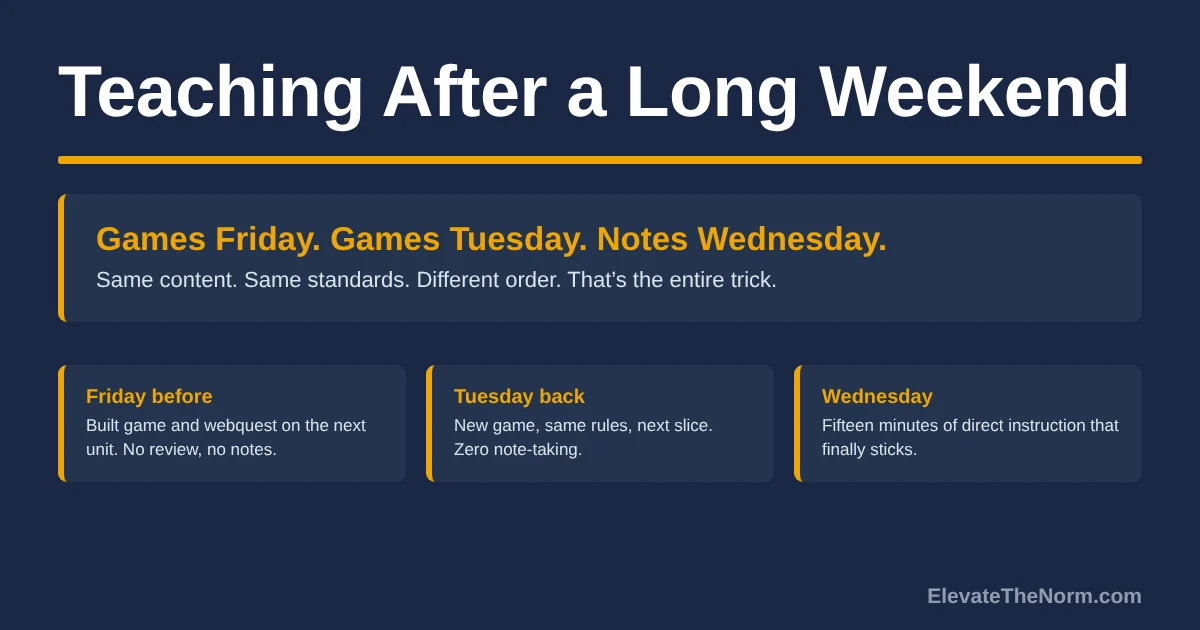
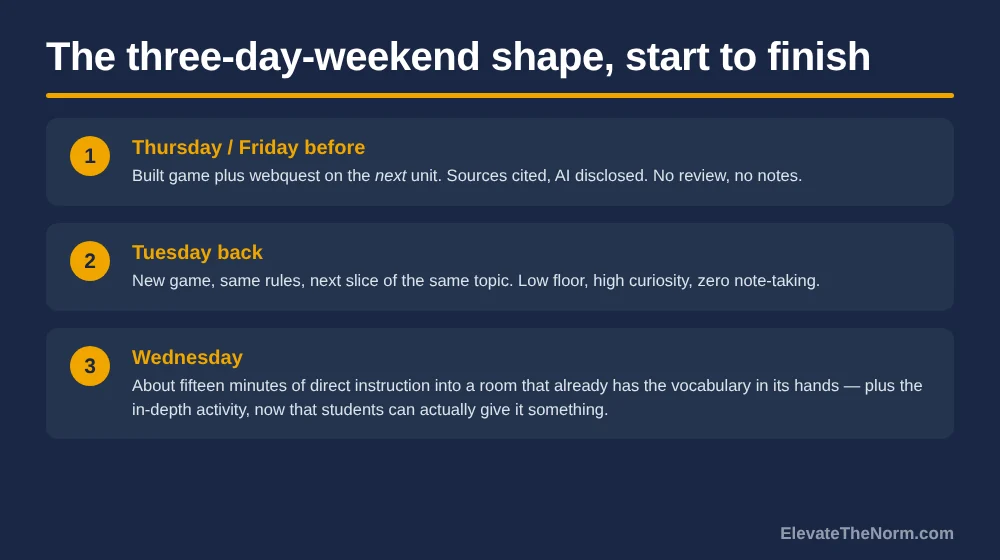
    The three-day-weekend shape, start to finish

    • Thursday/Friday before: built game plus webquest on the next unit. Sources cited, AI disclosed. No review, no notes.
    • Tuesday back: new game, same rules, next slice of the same topic. Low floor, high curiosity, zero note-taking.
    • Wednesday: about fifteen minutes of direct instruction into a room that already has the vocabulary in its hands — plus the in-depth activity, now that they can actually give it something.
    The three-day-weekend classroom plan in three stages: a built game and webquest on the Friday before, a new game on the Tuesday back, and fifteen minutes of direct instruction on Wednesday.
    Same content, same standards, different order.

    If you’re a new teacher, classroom management on those two bookend days is most of the battle, and this is a management plan as much as it’s a lesson plan. A room chasing an answer is not a room you have to manage. That’s not a trick — it’s just where their attention already wanted to go.

    This is not anti-direct-instruction

    I talk about project based learning constantly, and I live and die by it, so it seems like this is that. It’s not, or at least not only that.

    I am somebody who believes in direct instruction. I just believe in less direct instruction. I don’t believe in wasting days.

    That’s the honest version of my position, and it’s the same one I’d give you about PBL versus traditional instruction. Direct instruction works. Fifteen focused minutes into a prepared room beats fifty minutes into a room that’s still asleep, every time. This is my way of not wasting days, introducing new topics, and buying myself a Wednesday where the notes actually stick.

    Fun and learning are not opposites

    So embrace the fun. Embrace the fact that fun can be learning. Embrace the fact that you can have an entire class walk out thinking they hadn’t learned anything — and then come back the next day and not have to take half their notes, because they already know it.

    That gap between what they think happened and what happened is the best feedback you’ll get all year. When a kid tells you Friday was a blow-off day and then answers your Wednesday question before you finish asking it, you built the right game. And if you want more ideas to build from, that’s the standard I’d hold them to.

    Kids figure things out. That’s what people do.

    Kids learn in a myriad of ways. Remember that we are a people who have evolved over millions of years, and through that time you see evolution create people who know how to get out of problems. Those become us. We were the first to figure out small problems, and instead of ignoring them or working around them, we figured out a solution.

    It’s the same thing now. Just because we have evolved does not mean we don’t have basic instincts. Hand a teenager a question they can’t answer and a way to go find it, and something old kicks in. They will figure that stuff out.

    Which leaves the part that’s on us. It comes down to two questions, and neither one is about the kids:

    1. Are you giving them enough time?
    2. Are you presenting the opportunity on the correct day for them to have the information they need in order to execute?

    Get those two right and a three-day weekend stops costing you two days. It starts buying you one.

    Frequently asked questions

    Why introduce new material before a long weekend instead of reviewing?

    Review on a Friday afternoon into a room that has mentally left the building rarely sticks. New material paired with a curiosity-driven game works because it meets students where their energy already is — not bored by something they’ve heard twice, but genuinely stumped by something they haven’t seen yet. The review gets its proper day later, when they can actually spend the attention.

    What makes a teacher-built game different from a commercial classroom game?

    A commercial game is built for generic engagement. A teacher-built game is built around the specific vocabulary and questions of the next unit. The questions students can’t answer are the point — that gap is what generates real curiosity instead of hollow competition. The build takes time upfront, but it doubles as next-unit pre-exposure, not filler.

    How should students properly cite an AI tool in a webquest?

    Students should name the specific tool (e.g., “ChatGPT, September 2026”), record the question or prompt they used, and then cite a primary or secondary source they consulted to verify the AI’s answer. Both the AI disclosure and the verification citation are required. The goal isn’t just transparency — it’s teaching students that AI output is a starting place, not a source.

    Does this approach work across different subjects and grade levels?

    Yes, with adaptation. The structure — curiosity-first game, webquest with sourcing requirements, notes deferred to Wednesday — applies from middle through high school across most content areas. A science teacher builds a game around phenomena students haven’t studied yet; an English teacher builds one around an author or text coming up next. The rules are the same. The content is yours.

    How long does it take to build one of these games?

    Forty-five minutes to a couple of hours, depending on how elaborate the question set needs to be and how well you already know the content. The webquest sourcing rules add a few minutes of setup once you have a bank of reliable sites. The investment is front-loaded: once you’ve built the game for a unit, the next year you refine it rather than starting from scratch.

    What if district pacing guides expect direct instruction on those days?

    The approach doesn’t drop content — it reorders it. Students meet the same standards on the same week; they just encounter the vocabulary through a game on Friday and Tuesday and take formal notes on Wednesday. If a pacing guide is day-specific, document Friday and Tuesday as “unit introduction and pre-exposure” and Wednesday as “note-taking and structured input.” Most pacing guides care about when students have the content, not which day the notes were written.

    What if students don’t take the Friday game seriously?

    That’s a management signal, not a content problem. A room that won’t engage with a curiosity-driven question on a Friday afternoon is telling you something about established expectations, not about the game design. The fix is building throughout the year — starting in September — that every class has a task with a standard attached. Students who believe you mean it in the fall behave differently by spring.

    About Clay Shumate

    Clay Shumate is a certified secondary Social Studies teacher in the public schools of West Alabama, with seven years of classroom experience, a B.A. in History, and an M.Ed. in Secondary Education. He writes about project-based learning, student responsibility, respect, and practical ways to hold young people to a higher standard while giving them room to learn from mistakes. He is a member of the Society of Professional Journalists and writes to its Code of Ethics; this site’s editorial standards and corrections policy are published in full. More about Clay.
  • Project Based Learning High Schools Can Use Without Rebuilding the Schedule

    Project Based Learning High Schools Can Use Without Rebuilding the Schedule

    By Clay Shumate

    Project-based learning in high schools does not require restructuring the bell schedule, eliminating teacher autonomy, or rebuilding your curriculum from scratch. It requires redesigning one unit well enough that the schedule you already have holds it. Most of the barriers teachers cite — the pacing guide, the forty-five-minute period, the standardized assessment calendar — are real constraints. None of them prevent strong PBL.

    What actually blocks PBL in high schools is usually design. A project with a vague driving question, no real audience, and no individual accountability component will fail whether the period is forty-five minutes or ninety. A project with a specific question, a genuine audience, a clear rubric, and individual checkpoints throughout will work in almost any schedule. The implementation models below are sized to what actually exists in most high schools: single teachers with no extra planning time, limited administrative support, and students who have not been asked to produce public work before.

    What the Schedule Obstacle Actually Is

    Teachers who say “PBL won’t work in my schedule” are describing something real. Exhibition days, extended hands-on builds, and complex multi-week projects are genuinely harder to run in fifty-minute periods than in ninety-minute blocks. The concern is legitimate.

    The concern is also overstated. The core operations of strong PBL — questioning, researching, drafting, conferencing, revising, presenting — happen inside conventional periods when you plan the sequence carefully. You assign each phase a number of days. A four-week project in a fifty-minute class gives you roughly twenty class periods, which is enough to run a genuine inquiry cycle if you use each day with the same specificity you would use a lesson plan.

    Condliffe et al.’s 2017 MDRC literature review found that PBL improved student outcomes when it was well-implemented across a range of school structures and schedules. The schedule matters less than the implementation. A well-designed project in a conventional period outperforms a poorly designed project in a block every time.

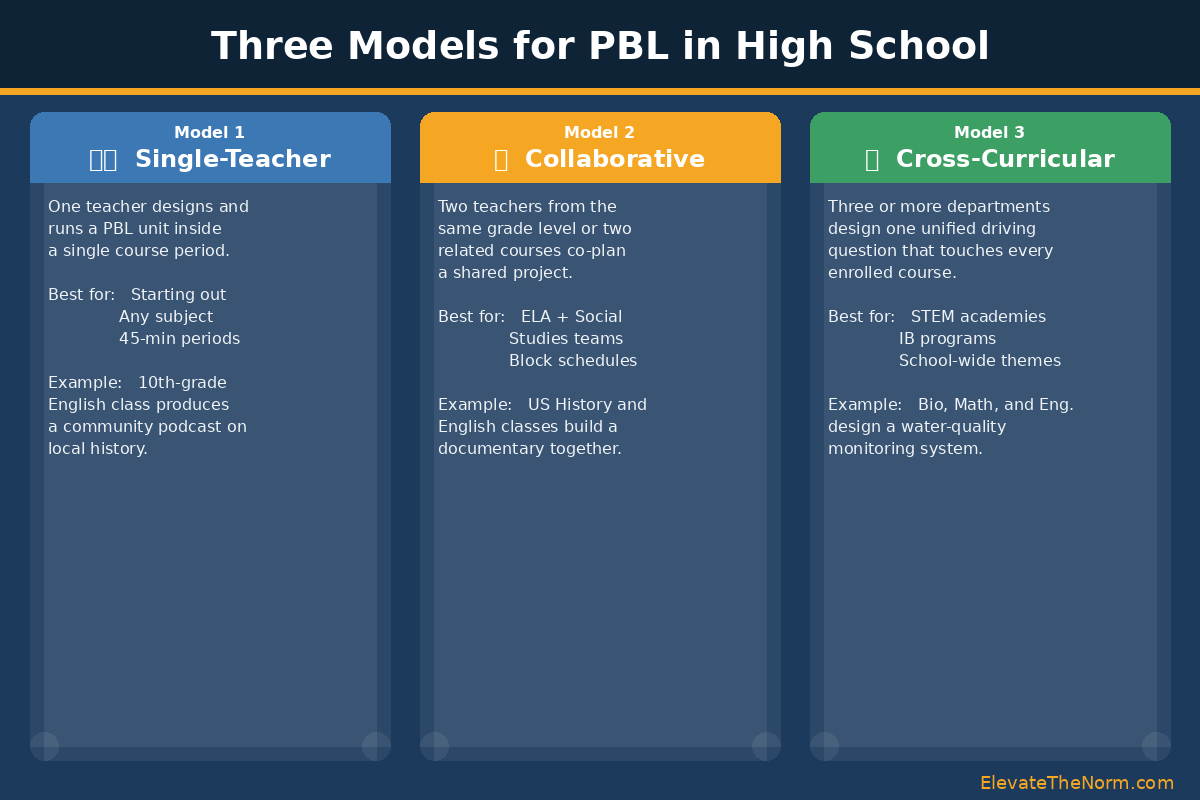
    The Single-Teacher Model

    This is where most high school PBL starts, and where most of it should start. Pick one unit. Redesign it as a project. Keep everything else the same.

    A single-teacher PBL unit has a driving question, a real audience, and a public product. The driving question is not a discussion prompt — it is a question worth investigating, specific enough to constrain the inquiry and open enough to produce disagreement. “Was Reconstruction a success or failure?” is a discussion prompt. “What would a just settlement for the formerly enslaved have required in 1865, and why didn’t the country build it?” is a driving question. Students produce something that answers the question for people who are not their teacher. For subject-by-subject models, see these project based learning driving question examples.

    The project runs inside your existing pacing guide. You are not abandoning standards — you are choosing how one unit demonstrates them. For more on what this structure looks like from the beginning, see the seven-step PBL framework, which walks through each phase from driving question to public product.

    Han, Capraro, and Capraro (2015) found in their meta-analysis of STEM PBL that the approach benefited high achievers, middle achievers, and low achievers — though the effect sizes differed. Low achievers benefited most from structured scaffolding built into the project design. That finding has a practical implication: a well-scaffolded project is more equitable than the alternative, not less.

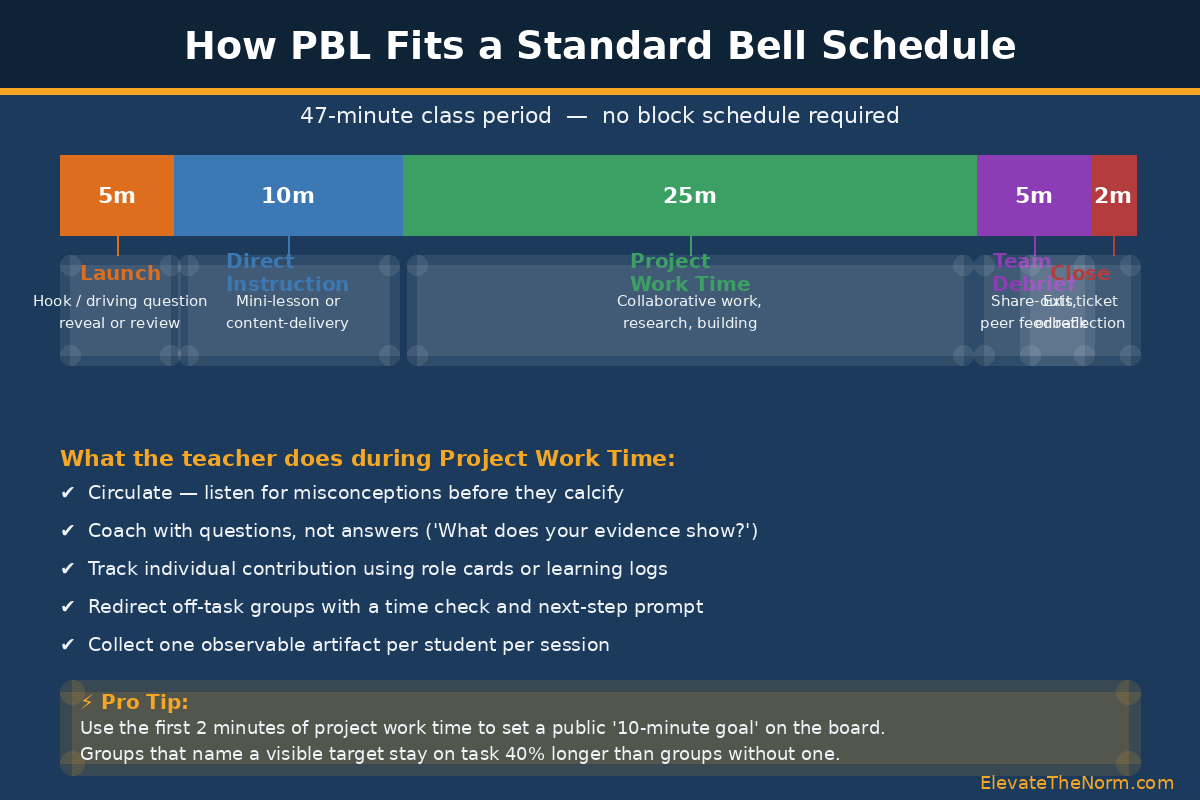
    Infographic breaking down a 47-minute bell schedule into PBL phases: 5-minute launch, 10-minute instruction, 25-minute project work, 5-minute debrief, 2-minute close
    A 47-minute period provides enough structure for PBL — launch, instruction, work time, debrief, and close.

    The Coordinated Model

    Two or three teachers align one project across their subjects. A junior researching water quality in a chemistry unit is also analyzing the data in statistics and writing a persuasive proposal in English. Each teacher contributes one piece; the student produces one coherent product.

    This requires planning time, which most high schools do not generously provide. It does not require schedule restructuring. It requires two planning conversations — one to agree on the project and one to divide the work — and then enough coordination that you are not both assigning major due dates on the same day.

    The coordinated model produces stronger student work than the single-teacher model because it shows students that the connections between subjects they already suspect are real. It also distributes the grading burden: each teacher grades only their component, rather than one teacher grading everything.

    The most common coordination failure is drift — teachers agree on the project in September and diverge by October because their pacing guides pull them in different directions. The fix is a shared timeline with checkpoints that all three teachers can see. A shared document, a standing check-in once every two weeks, and an explicit agreement about which teacher owns the driving question are usually enough.

    The Schoolwide Model

    A schoolwide PBL commitment means dedicated exhibition days, structural schedule flexibility, and sustained administrative support. It is the model most commonly described in PBL literature because it is the most documented. It is also the model that requires the most buy-in and is the wrong place to start.

    Start with one unit in one class. Document the student work. A principal who sees the evidence — real student products, real depth of engagement, real outcomes — is more persuadable than one being asked to commit time and resources to a theory. The single-teacher model is the proof of concept that earns the schoolwide model later. Do not ask for institutional support before you have something to show.

    Kokotsaki, Menzies, and Wiggins (2016), reviewing the PBL implementation literature, found that teacher comfort and competence with PBL were the strongest predictors of successful outcomes — more than school structure, administrative support, or technology access. A confident teacher running a single unit in an ordinary classroom produces better outcomes than an uncertain teacher running a schoolwide model with all the resources. Build the confidence first.

    Infographic showing three implementation models for project based learning in high schools: single-teacher, collaborative, and cross-curricular
    Three ways to structure PBL in high school, from a single-classroom unit to a schoolwide commitment.

    What Has to Stay in Place

    Standards are not optional. A PBL unit that covers interesting work without hitting the required standards is a liability for students who need those standards taught. Every project needs a clear answer to three questions: what standard does this project demonstrate, how will student work show mastery, and how does the grade reflect it? If you cannot answer all three, the unit is not ready to run.

    Individual accountability is not optional. Group projects in which one student does most of the work while others contribute minimally are not PBL — they are badly supervised group projects. PBL requires a component of the final grade that reflects individual student work: individual research logs, individual reflection journals, or a presentation component in which each student defends their own contribution. A project based learning rubric that separates individual contribution from group product solves the most common grading problem in PBL before it becomes a problem.

    Infographic showing three individual accountability tools for group PBL projects: role cards, learning logs, and contribution rubrics
    Role cards, learning logs, and contribution rubrics keep every student individually accountable inside a group project.

    Grading standards are not optional. Students who are used to being graded on compliance — following directions, completing steps, meeting deadlines — need to be explicitly taught what quality looks like before they can produce it. Criterion-referenced rubrics with clear, student-readable descriptors do this. A rubric that says “Research is thorough and relevant” teaches nothing. A rubric that says “Research includes at least four credible sources that are directly cited in the product” teaches what thorough looks like. Schools that grade by standard can use the 1-4 grading system chart to convert levels to percentages.

    Special Populations and PBL

    A real high school classroom has students with IEPs, students with 504 plans, English language learners, students who are two or three grade levels behind in reading, and students who have learned that staying invisible is the safest strategy. PBL is not inherently more or less accessible than a unit test. It is differently accessible — which means you have to plan for it differently.

    Every accommodation that applies to a test applies to a project. Extended time on the research and drafting phases. Alternative presentation formats when the standard permits it. Scaffolded notes and graphic organizers during the inquiry phase. A student who struggles with written expression but reasons clearly can produce a strong verbal or visual component. A student who has never raised their hand in a lecture has a better chance of contributing in a structured conference on a question they actually worked to answer.

    The key is building the scaffolding before the project starts, not after the first group falls apart. Explicit instruction in the process skills the project assumes — how to evaluate a source, how to structure an argument, how to give useful feedback to a peer — must happen before students are expected to use those skills. If you have not taught these as discrete, assessable skills, you cannot grade them as discrete, assessable skills, and the students who most need the instruction will be the least prepared to produce without it.

    Ertmer and Simons (2006), in their research on PBL implementation barriers for K–12 teachers, found that scaffolding decisions — specifically, how much structure to provide and when to reduce it — were the most frequently cited challenge for new PBL teachers. The answer is to start with more structure than you think you need and reduce it as students demonstrate readiness. PBL is not a launch-and-step-back model. It is a sustained presence model. The teacher is circulating, conferencing, redirecting, and adjusting throughout the project’s duration.

    What Administrators Must Protect

    The most common way PBL fails in high schools is not in the classroom. It is when a principal or curriculum coordinator, under pressure from test scores, eliminates the conditions that let project work develop.

    Projects take longer to show results than unit tests. A class spending three weeks on one question while the pacing guide suggests five days looks inefficient from the outside. An administrator who understands what is being built — and what the research comparing project based learning vs traditional learning actually shows about depth of engagement producing stronger retention and transfer than coverage speed — can defend that choice. An administrator who does not understand it cannot, and will not.

    Administrators researching this before a department meeting usually start with a search box or an AI assistant, and what comes back is shaped by whoever is selling a platform. It is worth reading what AI is telling people about project-based learning before that conversation, because the funding, staffing and curriculum answers a chatbot gives are the ones your teachers will have already seen.

    What administrators must protect: the presentation or exhibition component. A project with no real audience beyond the teacher is not a public product — it is a long homework assignment. The audience changes the stakes, and the stakes change the quality of the work. Mergendoller, Maxwell, and Bellisimo (2006) found that problem-based learning produced stronger content mastery than direct instruction in their economics study, but the effect was largest when students were required to explain and defend their work — not just produce it.

    What administrators must provide: protected planning time, even in small amounts. A single-teacher PBL unit can happen without any new time. A coordinated project needs one shared planning session. A schoolwide model needs a sustained structure. The level of institutional support you provide determines the level of implementation you can reasonably expect. Teachers who are asked to run PBL without any planning time will default to the version of PBL that requires the least coordination, which is rarely the version that produces the best outcomes.

    The Room That Makes This Easier

    In my room, partner work is the default condition, not a special activity. Tables are pushed together into groups from the moment class starts. Students sit alongside somebody as a structural fact of the room, not as a reward or a project-day configuration. The collaboration that happens inside a PBL unit builds on top of a habit students have been practicing all year.

    It also raises the question every project eventually raises, which is how you see what any individual student actually contributed — a job for a short group-work self assessment rather than for the group grade. That distinction matters for high school implementation. The failure mode in project work is isolation — students who have no one to think alongside drift toward the minimum. When a class has been working in partners and small groups since September, the project’s collaborative components are not a new mode they have to learn. They are the usual mode applied to a more complex question.

    You do not need my specific room setup to run effective PBL. But the arrangement of a classroom is a decision, and the default arrangement in most high school rooms — desks facing forward, students working alone — is a decision that makes project-based work harder. If you are planning to introduce PBL, consider whether your physical setup supports it. Desks can be moved. Tables can be pushed together. The collaborative condition does not require a renovation — it requires a decision. For ideas on what strong examples of project-based learning look like in practice, the examples linked there show what finished student work can look like at different grade levels.

    PBL in high schools is not a school reform project unless you want it to be. It is a unit design decision you can make in any classroom, on any schedule, with any level of administrative enthusiasm, as long as you design it carefully enough that the structure of the school holds it. The schedule is not the problem. The design is the work. For a deeper look at how to structure individual student accountability within group projects, see the high expectations framework that this site returns to across multiple articles — the expectations you set for PBL are the same expectations you set for every other part of the year.

    Sources

    1. Condliffe, B., et al. (2017). Project-Based Learning: A Literature Review. MDRC. https://www.mdrc.org/sites/default/files/Project-Based_Learning-LitRev_Final.pdf
    2. Han, S. Y., Capraro, R., & Capraro, M. M. (2015). How science, technology, engineering, and mathematics (STEM) project-based learning (PBL) affects high, middle, and low achievers differently. International Journal of Science and Mathematics Education, 13(5), 1089–1113. https://doi.org/10.1007/s10763-014-9526-0
    3. Kokotsaki, D., Menzies, V., & Wiggins, A. (2016). Project-based learning: A review of the literature. Improving Schools, 19(3), 267–277. https://doi.org/10.1177/1365480216659494
    4. Ertmer, P. A., & Simons, K. D. (2006). Jumping the PBL implementation hurdle: Supporting the efforts of K–12 teachers. Interdisciplinary Journal of Problem-Based Learning, 1(1), 40–54. https://doi.org/10.7771/1541-5015.1005
    5. Mergendoller, J. R., Maxwell, N. L., & Bellisimo, Y. (2006). The effectiveness of problem-based instruction: A comparative study of instructional methods and student characteristics. Interdisciplinary Journal of Problem-Based Learning, 1(2), 49–69. https://doi.org/10.7771/1541-5015.1026
    6. Krajcik, J., & Shin, N. (2014). Project-based learning. In R. K. Sawyer (Ed.), The Cambridge handbook of the learning sciences (2nd ed., pp. 275–297). Cambridge University Press.

    Frequently Asked Questions

    Can I do project-based learning in a forty-five-minute period?

    Yes. The period length constrains certain activities — a complex hands-on build or a formal public exhibition takes more than forty-five minutes — but the core operations of PBL happen inside conventional periods when you phase the project carefully. Assign each phase a set number of days: questioning on day one, initial research on days two and three, drafting on days four through six. The period is a budget, not a prohibition. A well-phased project in a fifty-minute class produces the same learning as one in a ninety-minute block.

    Does project-based learning work with state standards?

    Standards are the frame, not the obstacle. Every PBL unit should answer three questions before it starts: what standard does this project demonstrate, how will student work show mastery, and how does the grade reflect it? A project that does not target a standard is an enrichment activity, not a PBL unit. Select one or two standards and build the driving question around what demonstrating those standards would look like applied to a real problem. The standards do not change; the form in which students demonstrate them does.

    How do I grade a group project fairly?

    Separate what you assess from who produces it. An eight-category rubric that covers process, product, research quality, collaboration, revision, presentation, individual contribution, and reflection lets you grade the final product on quality criteria while tracking each student’s individual role. The individual contribution and research-log components prevent the one-student-does-everything problem. A shared rubric introduced at the start of the project — not at the end — also teaches students what quality looks like before they are graded on it.

    What about students with IEPs or 504 plans?

    Every accommodation that applies to a test applies to a project. Extended time applies to the research and drafting phases, not just the final product. Alternative presentation formats apply when the standard permits them. Graphic organizers and scaffolded note-taking structures apply during the inquiry phase. The critical difference between PBL and direct instruction for students with learning differences is that PBL offers more legitimate pathways to demonstrate the standard — a student who struggles with written expression can contribute a strong verbal or visual component. Plan the accommodations before the project starts, not after the first group session falls apart.

    How do I get my principal to support PBL?

    Run one unit and document the student work. An administrator who sees a class’s worth of evidence-based arguments — specific, researched, revised — is more persuadable than one being asked to commit resources to a theory. The case for administrative support is a portfolio of student products, not a research summary. Start small, save the work, show what depth of engagement looks like when it works. Schoolwide support is earned through demonstrated outcomes in individual classrooms, not by leading with the institutional vision.

    What is the most common reason PBL fails in high schools?

    Design, not scheduling. A project with a vague driving question, no real audience, and no individual accountability component fails regardless of the period length or the level of administrative support. The driving question has to be specific enough to constrain the inquiry and open enough to produce genuine disagreement. The audience has to exist outside the classroom. Individual students have to have something at stake that cannot be carried by a partner. When those three conditions are met, most scheduling and staffing obstacles become manageable. When they are missing, no amount of institutional support compensates.


    About Clay Shumate

    Clay Shumate is a certified secondary Social Studies teacher in the public schools of West Alabama, with seven years of classroom experience, a B.A. in History, and an M.Ed. in Secondary Education. He writes about project-based learning, student responsibility, respect, and practical ways to hold young people to a higher standard while giving them room to learn from mistakes. He is a member of the Society of Professional Journalists and writes to its Code of Ethics; this site’s editorial standards and corrections policy are published in full. More about Clay.
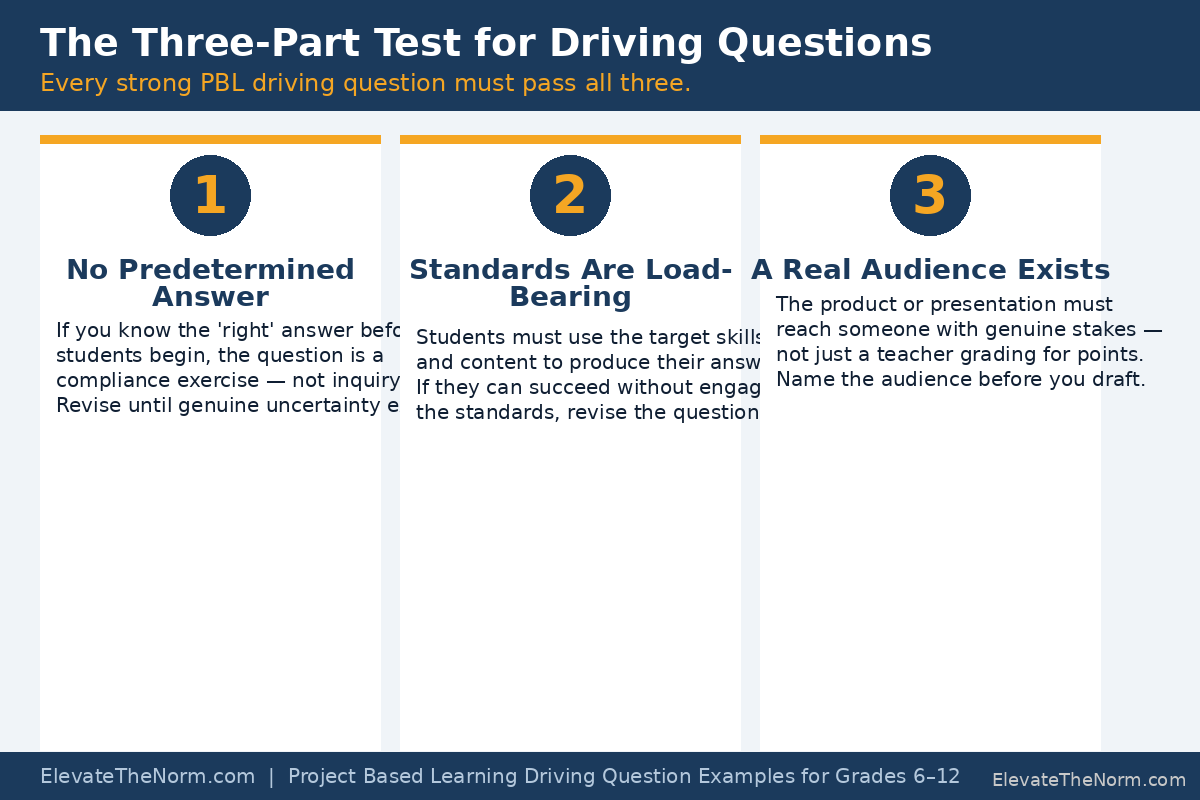
Teacher Emergency Toolkit — practical resources, real classroom support. Shop on TPT.Teacher Emergency Toolkit — practical resources, real classroom support. Shop on TPT.