The Elevate Blog banner: Real Classrooms. Practical Ideas. Higher Expectations. Three students climb a rocky ridge at sunrise, each pulling the next one up, toward a teacher reaching down to help.

Author: Clay Shumate

  • Classroom Seating Charts: What the Research Supports for Grades 6–12

    Classroom Seating Charts: What the Research Supports for Grades 6–12

    By Clay Shumate

    A classroom seating chart for grades 6–12 should match the layout to the work: rows for independent work, pairs for most lessons, groups of four for projects and a horseshoe for discussion. Assigned seats cut disruption in the research, but nearly all of that research studied children under 12. Change seats for the whole room on an announced cycle.

    A classroom seating chart is a deliberate plan for where every student sits and why, built around sightlines, access, documented needs and the kind of work the room is doing that week. For grades 6–12 it isn’t a discipline tool and it isn’t decoration. It’s the quietest piece of classroom management you own.

    Most of the research behind it was done on ten-year-olds, and the people quoting it at you usually don’t say so. That’s named up front here, not buried in a caveat at the bottom. What follows is what the research supports, where it stops, and how to build a chart for teenagers anyway.

    Key Takeaways

    • Assigned seats beat self-selected seats in the cleanest study. When 21 fifth graders picked their own seats, disruptions roughly doubled in groups and more than tripled in rows.
    • No classroom seating layout is best for everything. Rows suit independent work, semicircles draw more student questions, and groups support collaboration.
    • Seating research thins out above age 11. Wannarka and Ruhl’s review of eight seating studies found only one that looked at teenagers and none past age 15.
    • Seating written into an IEP or 504 plan goes on the chart first. It is already decided, and the rest of the chart is built around it.
    • Changing seats for the whole room on an announced cycle reads as housekeeping. Moving one student by themselves reads as a public verdict on that student.

    What Is a Classroom Seating Chart For?

    A classroom seating chart does four jobs: it puts every student where they can see and hear, lets the teacher reach anyone quickly, sets who talks to whom, and ends the daily negotiation over seats at the start of every period.

    Punishment isn’t on that list. The moment a seating chart becomes the thing you rearrange when a student annoys you, it stops being a plan and becomes a consequence — an unpredictable, public one, applied at your discretion. That is the opposite of what a fair consequence looks like, and teenagers read it accurately and immediately.

    A seating chart isn’t a personality test either. You will hear that certain students “are back-row kids.” They are not. They are students who were allowed to sit in the back row and found out nobody came to get them.

    What Does the Research Say About Classroom Seating Charts?

    Research on classroom seating says the task should decide the layout: rows for independent work, semicircles for student questions and groups for collaboration. Most of that research studied 9- to 11-year-olds, so it is a starting point for teenagers, not a finding about them.

    The standard reference is Wannarka and Ruhl’s review in Support for Learning, which pulled together eight studies comparing rows, groups and semicircles. Their conclusion is refreshingly unglamorous: the nature of the academic task and the type of behavior you want should dictate the seating arrangement. Rows produced more on-task behavior for individual work, and in one study seventh graders talked without permission less in rows than in face-to-face pairs. Students asked their teacher significantly more questions in a semicircle than in rows. Grouped seating supported collaborative work. If you want the signs and recording sheets done, my Station Rotation Toolkit on TPT covers eight reusable stations.

    Students who started with the lowest on-task behavior improved most in rows. One special-school study in that review found rows doubled on-task behavior and cut the disruption rate by two thirds.

    Then comes the part that rarely survives the journey into a blog post. The same authors state plainly that participants ranged from 7 to 15, that 9-, 10- and 11-year-olds were the subjects of six of the eight studies, that only one looked at teenagers, and that none looked at students older than 15.

    So when someone tells you “research shows rows increase on-task behavior,” the honest completion of that sentence is “…in primary-aged children, mostly during independent seatwork, in studies largely conducted before your students were born.” That doesn’t make it useless. It makes it a starting hypothesis for a fourteen-year-old rather than a finding about one. Newer work points the same way and has the same limit: Edutopia’s research roundup describes a 2015 study of second graders in which off-task behavior was lowest in rows, and students at the back had a harder time joining discussions.

    Do assigned seats reduce classroom disruption?

    Assigned seats reduced disruption in the most-cited study on who chooses the seats: when students picked their own seats, disruptions roughly doubled in groups and more than tripled in rows.

    That study is Bicard and colleagues in the Journal of Applied Behavior Analysis. It used 21 fifth graders, a reversal design and four conditions crossing group-versus-rows with teacher-assigned-versus-student-selected. The results:

    ConditionStudent-selectedTeacher-assigned
    Group seating1.12 disruptions/min0.47 disruptions/min
    Rows0.55 disruptions/min0.17 disruptions/min

    The authors also say, in their own limitations, that the school was private, the group mostly homogeneous and relatively well behaved, and the tasks easy enough that academic effects may have been masked. Twenty-one ten- and eleven-year-olds in one building isn’t a law of nature. It’s one clean result pointing in an obvious direction.

    Take the direction. Leave the certainty.

    What Is the Best Classroom Seating Arrangement?

    The best classroom seating arrangement is the one that matches the work: rows for independent work, pairs for most secondary lessons, groups of four for projects, and a horseshoe for discussion. When the work changes, the layout should change too, and telling students why is part of the job.
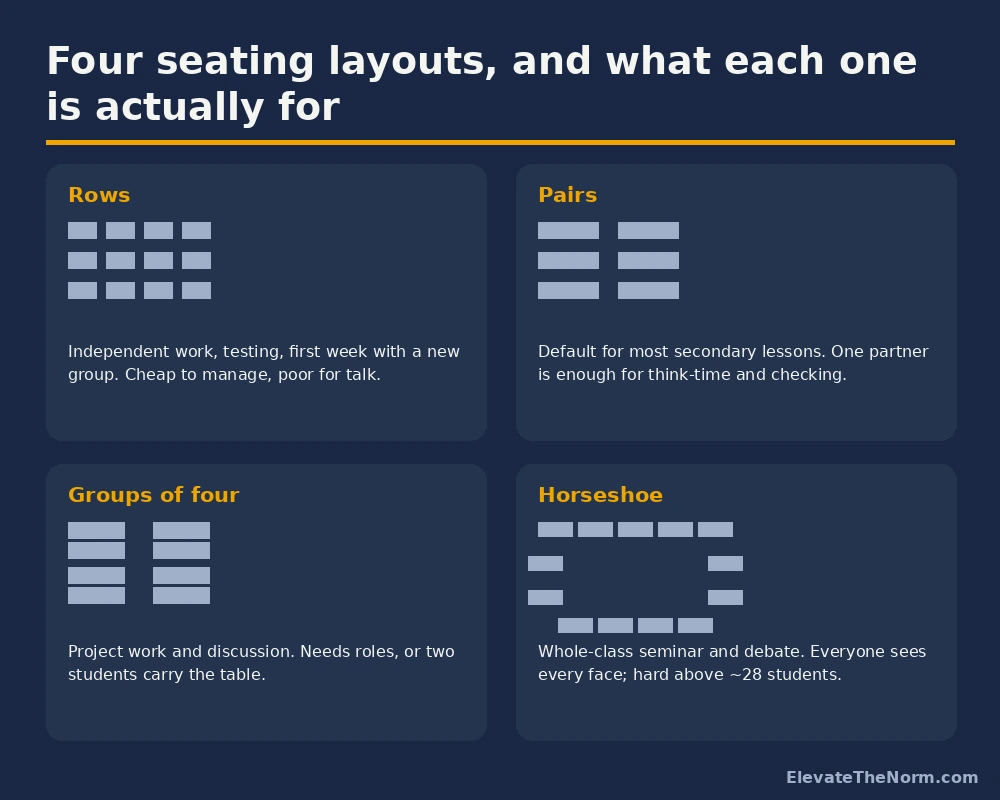
    Comparison of rows, pairs, groups of four and horseshoe classroom seating layouts with the purpose of each
    Each layout is good at something different. Pick the one that matches the lesson.
    • Rows. Independent work, testing, and the first week with a group you do not know yet. Cheap to supervise, poor for talk, and the back row disappears if you let it.
    • Pairs. The workhorse for most secondary lessons. One partner is enough for think-time, for checking an answer before it goes public, and for a student who’ll ask a neighbor what they won’t ask you.
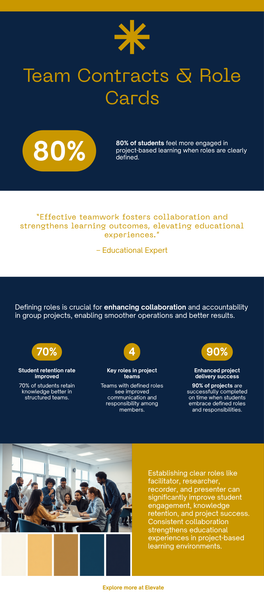
    • Groups of four. Project work and sustained discussion. Requires defined roles, or two students will carry the table and the other two will learn that this is available to them.
    • Horseshoe. Seminar, Socratic discussion, debate. Everybody can see every face, which changes the conversation completely. Gets hard to fit with a large class and eats floor space.

    Marx, Fuhrer and Hartig found German fourth graders asked more questions in a semicircle than in rows — a result summarized for teachers by Jo Earp alongside Robert Sommer’s older and still-correct point that there is no ideal layout for all activities. The same summary reports Gremmen and colleagues’ survey of fifty Dutch teachers: 48 percent used small groups, 40 percent used rows, and the researchers noted how little attention this gets in teacher training. That last observation is the one worth sitting with. Most of us were never taught this at all.

    What Does a Middle or High School Seating Chart Have to Account For?

    A middle or high school seating chart has to account for six things before any preference: seating written into IEP or 504 plans, sightlines, teacher access, unreported hearing or vision problems, a clear exit path, and new students. Get those right and the rest is preference.
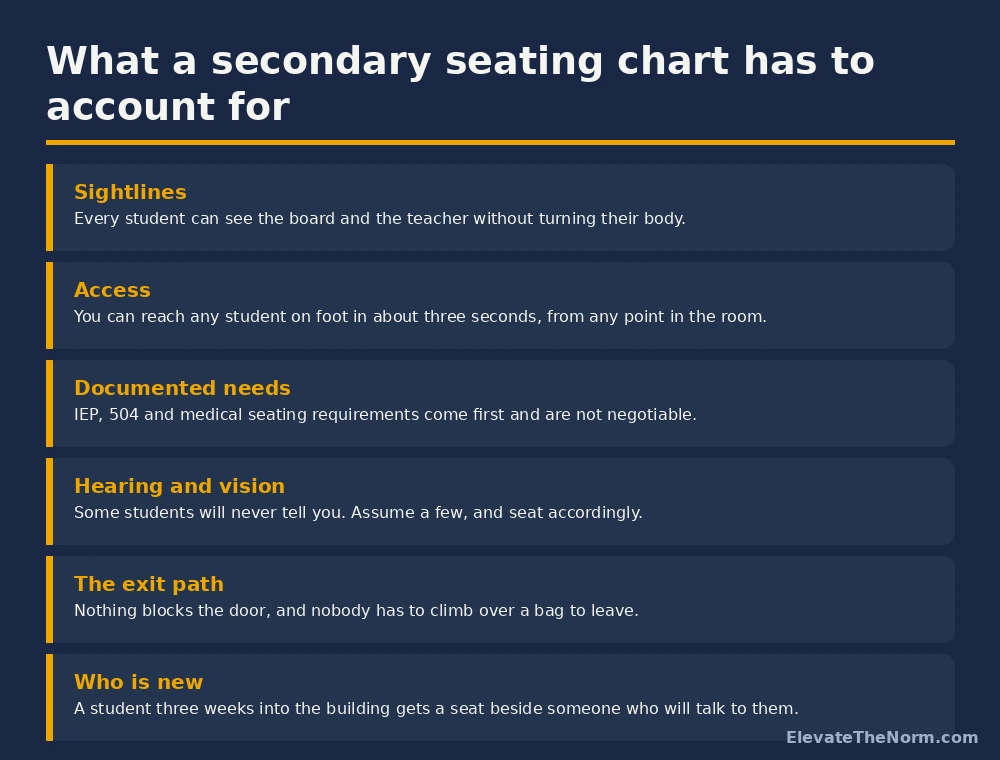
    Checklist of six factors a secondary classroom seating chart has to account for, including sightlines, access and documented needs
    Documented needs come first. Everything else is a judgment call.

    Documented needs come first. If a student has seating written into an IEP or a 504 plan, that is not one input among six — it is already decided, and you build the rest of the chart around it. Read the plans before you draw anything. This is the one item on the list where “I forgot” is not an available answer.

    Sightlines. Every student should be able to see the board and the front of the room without twisting their torso. If a student has to turn their whole body to see you, they will stop turning, and you will read that as disengagement.

    Access. You should be able to reach any student on foot in about three seconds from any point in the room. Draw your actual walking paths on the chart. Most teachers discover a dead zone they have not stood in since August.

    Hearing and vision you do not know about. Some students will never tell you, some have not been screened, and some were screened years ago. Assume a couple in every section and seat accordingly rather than waiting to be informed.

    The exit path. Nothing blocks the door and nobody climbs over a backpack to leave. This is a safety item, not a tidiness one.

    Who is new. A student three weeks into the building gets a seat beside somebody who will actually talk to them. You know who those students are. Use them on purpose.

    Where Should a Small-Group Table Go on a Seating Chart?

    A small-group table works best as the most desirable spot in the room, not the remediation table, so that being invited over reads as access rather than a verdict.

    Clay’s take: I built a whiteboard table for small-group work and put it in a corner under a lower lamp, on a rug, with better chairs than the rest of the room has. Students ask to go there.

    The standard worry about a pull-aside table is that it becomes the remediation table — the place everyone can see you get sent to. The fix is not a policy about who sits there and when. The fix is making it the most desirable spot in the room, so that being invited over reads as access rather than as a verdict.

    For the full routine built around that table — one version for middle school and one for high school — see how to make small group instruction the seat students want.

    Your seating chart governs the default. It should not govern every seat in the room for every minute. Build somewhere a student can be moved to that carries no sting, and a quiet redirect stops being a public event. Light does some of that work as well; our look at classroom lighting covers what changes when the overheads go off.

    The rest of my room runs on tables pushed together in pairs and fours, which means working next to somebody is the resting state rather than a reward I hand out on Fridays. That is a choice about seating as much as it is a choice about instruction, and it connects directly to what a student-centered classroom looks like in practice.

    How Do You Make a Classroom Seating Chart?

    Make a classroom seating chart in seven steps, in this order: read the IEP and 504 plans, draw the real room, pick the layout from the unit, place constrained students, place everyone else, walk it, and tell students the rule. Each step constrains the next.

    1. Read the plans. Pull every IEP and 504 for the section and note any seating language before you draw a single box.
    2. Draw the room, not a grid. Door, board, windows, your desk, outlets, the cabinet everyone bumps into. The obstacles determine the layout more than the furniture does.
    3. Pick the layout from the unit, not the month. If the next three weeks are project work, start in fours. If they are individual writing, start in pairs or rows and say why.
    4. Place the constrained students first. Documented needs, then hearing and vision, then the newest students.
    5. Place the rest, and keep it boring. Alphabetical inside the constraints is defensible, fast, and impossible to argue with on day one.
    6. Walk it before you publish it. Stand at each seat. Anything you cannot see from there, they cannot see either.
    7. Tell them the rule. “This is the chart for the next three weeks. It changes for everybody, not for one person, and I will tell you before it does.”

    Step seven is the one that does the most work and takes the least time. Naming the cycle in advance removes the interpretation that any future change is aimed at somebody. If you want the printable version of the room map and the chart grid, both are on the free download page, in print and typeable form, with no email required.

    Keep a copy of the finished chart where a substitute can find it. The free Sub Survival Kit at SubstitutePlans.com includes blank seating charts along with attendance sheets, a daily report form and backup activities, so a sub has the room mapped on the day you are out.

    How Often Should You Change a Classroom Seating Chart?

    Change a classroom seating chart every two to three weeks, on a cycle you announced in advance, not on a mood. Two to three weeks is long enough to test an arrangement fairly; two days isn’t.
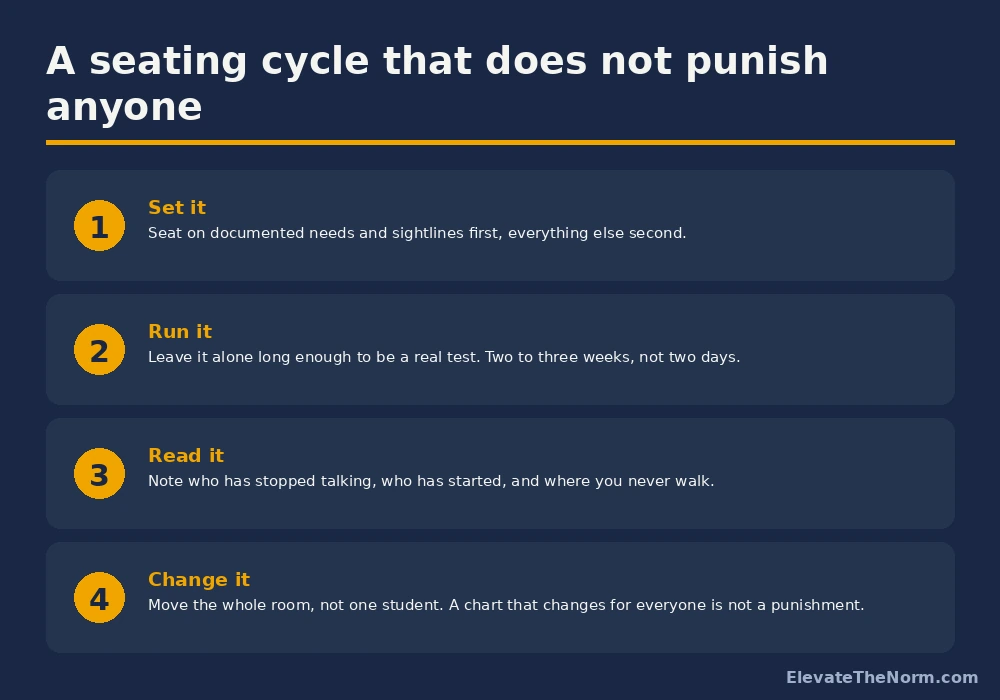
    Four-step cycle for classroom seating: set it, run it, read it, change it
    Move the whole room, not one student.

    Between changes, pay attention to three signals. Who has stopped talking who used to talk. Who has started talking who never did. And which corner of the room you haven’t walked into in a week — because somebody is sitting there, and you have quietly stopped teaching them.

    When you do change it, move everybody. This is the single most useful rule in the article. A chart that reshuffles the whole room is administrative. Pulling one student to the front on a Tuesday is a sentence handed down in front of an audience, and every teenager in the room can read it. If a particular pairing genuinely is not working, you can still fix it — you just fix it inside a change that moves other people too, and you say nothing about why.

    If a student asks to move, ask why before you decide. Sometimes the answer is “I can’t see,” which you want to know. Sometimes it is “my friend is over there,” which is a no, delivered without irritation. Either way, asking treats the request as reasonable, which is most of what respect in a classroom actually costs.

    What Mistakes Do Teachers Make With Seating Charts?

    Five seating chart mistakes undo the plan in secondary classrooms: using the chart as a consequence, never changing it, letting students drift into picking seats, seating by grades, and ignoring seating written into IEP or 504 plans.

    • Using it as a consequence. Covered above, and it is the most common one. It converts a planning tool into an arbitrary punishment.
    • Setting it in August and never touching it. The room you planned for in August is not the room you have in November.
    • Letting students pick “just this once.” Fine as a genuine, announced choice. Corrosive as a drift, because the chart then only exists on days you are annoyed.
    • Seating by grades. A front row of high performers is visible to every student in the room and tells the rest exactly where they rank.
    • Forgetting the plans. A chart that ignores documented seating is not a preference you defend later. Check first.

    How Do I Start a New Seating Chart This Week?

    Start with one classroom seating chart for your hardest section. Read the plans first, draw the actual room, pick the layout from the next three weeks of work, and tell the class the change cycle out loud on launch day.

    Clay’s take: Then leave it alone long enough to find out whether it worked. The most common mistake is not choosing the wrong layout. It is changing it so often, and so obviously in response to individual students, that nobody in the room — including you — ever learns what the arrangement was actually doing.

    Frequently Asked Questions

    What is the best seating arrangement for a classroom?

    No single classroom seating arrangement is best for everything. Match it to the work: rows for independent work and testing, pairs for most everyday secondary lessons, groups of four for projects and sustained discussion, and a horseshoe for seminars and debate. Wannarka and Ruhl’s research review concludes that the academic task and the behavior you want should dictate the arrangement.

    Should a seating chart be used as a punishment?

    A seating chart shouldn’t be used as a punishment. Once a chart becomes the thing a teacher rearranges when a student is annoying, it turns into an unpredictable, public consequence that teenagers read immediately. Change seats on an announced cycle and move the whole room. If a pairing isn’t working, fix it inside a change that moves other students too.

    How often should I change a classroom seating chart?

    Every two to three weeks is a reasonable seating chart cycle for grades 6–12, and the exact number matters less than announcing it in advance. Two weeks is long enough to find out whether an arrangement works; two days isn’t. Change the whole room rather than one student, so a seat change never reads as a verdict on somebody.

    Should students ever choose their own seats?

    Students can choose their own seats as a deliberate, announced choice for a specific activity. The trouble is drift, where the chart only applies on days the teacher is frustrated. In Bicard and colleagues’ study of 21 fifth graders, disruptions roughly doubled in groups and more than tripled in rows when students picked seats. That’s one private school of ten- and eleven-year-olds, so treat it as a strong hint.

    What do I tell a parent who asks why their child was moved?

    Tell a parent the plain truth about the seating chart: the class changes seats on a cycle, everyone moved, and the arrangement is built around sightlines, access and any documented needs. If the whole room moved, that conversation is easy. If one student was moved alone for behavior, it won’t be. Never discuss another student’s needs or plan with a parent who isn’t theirs.

    Does seating in an IEP or 504 plan come before the rest of the seating chart?

    Seating written into an IEP or 504 plan comes first, because it’s already decided. Read every plan for the section before drawing a single seat, place those students, and build the rest of the chart around them. Keep the reason off any chart a student or substitute can see. A substitute only needs to know a seat is assigned, not why.

    How do I handle seating when five different sections use the same room?

    When five sections share a room, keep the furniture layout stable and change only the seating chart. Rearranging tables five times a day isn’t sustainable. Pick a furniture arrangement that serves most of your teaching, which for most secondary teachers is pairs or fours, and give each section its own chart on top of it. Keep the charts where you can see them in seconds.

    How do I know whether the seating chart is actually working?

    A seating chart is working when three signals look right across a cycle: students who used to contribute haven’t gone quiet, students who never contributed have started, and there’s no part of the room the teacher has stopped walking into. A corner the teacher avoids is a corner whose students get less teaching. None of this needs data collection beyond paying attention on purpose.

    Sources

    • Wannarka, R., & Ruhl, K. (2008). Seating arrangements that promote positive academic and behavioural outcomes: A review of empirical research. Support for Learning, 23(2), 89–93. Full text (PDF) · ERIC record
    • Bicard, D. F., Ervin, A., Bicard, S. C., & Baylot-Casey, L. (2012). Differential effects of seating arrangements on disruptive behavior of fifth grade students during independent seatwork. Journal of Applied Behavior Analysis, 45(2), 407–411. Full text (PMC)
    • Earp, J. (2017, March 16). Classroom layout — what does the research say? Teacher Magazine, Australian Council for Educational Research. Read the summary — the source for the Marx, Fuhrer and Hartig (1999), Sommer (1977) and Gremmen et al. (2016) findings described above, which were read here as a summary rather than in the original papers.
    • Terada, Y. (2025, August 18). Research-based tips for optimal seating arrangements. Edutopia. Read the article
    • Marx, A., Fuhrer, U., & Hartig, T. (1999). Effects of classroom seating arrangements on children’s question-asking. Learning Environments Research, 2, 249–263. Journal record

    Where a finding is described from a summary rather than the original paper, the Sources list says so.
    About Clay Shumate

    By Clay Shumate — Clay Shumate is a certified secondary Social Studies teacher in the public schools of West Alabama, with seven years of classroom experience, a B.A. in History, and an M.Ed. in Secondary Education. He writes about project-based learning, student responsibility, respect, and practical ways to hold young people to a higher standard while giving them room to learn from mistakes. He is a member of the Society of Professional Journalists and writes to its Code of Ethics; this site’s editorial standards and corrections policy are published in full.

  • Classroom Expectations Poster for Middle and High School Students

    Classroom Expectations Poster for Middle and High School Students

    By Clay Shumate · Updated October 24, 2026

    The short answer: a classroom expectations poster for middle and high school should list five to eight specific, observable behaviors that every seat can read and you can point to in the moment. The free 11×17 poster below has eight: come in ready, bring your actual effort, listen, disagree respectfully, own your work, stay in the work, respect what isn’t yours, and follow through.

    Every classroom has rules posted somewhere. Most of them say things like “Be Respectful,” “Be Responsible,” and “Be Ready” — alliterative, inoffensive, and almost entirely meaningless to a teenager who doesn’t know what those words look like in practice.

    In my seventh year in the classroom, I’ve stopped treating a posted list of slogans as a finished job. Three phrases in block letters, laminated and mounted near the door, give the impression that expectations have been communicated. They haven’t. Teenagers need specifics. They need to know what “respect” looks like at 8:15 on a Monday when they’re exhausted and the assignment makes no sense. They need to know what “ready” looks like when they forgot a pencil and the lesson starts in thirty seconds.

    A classroom expectations poster, done right, is more than decoration. It’s a reference tool — a shared agreement students can point to and that you can point to when a situation arises. It’s the honest answer to “I didn’t know that was a rule,” because it was, and it was visible the whole time.

    This article gives you the full poster text I use, the thinking behind each line, and how to introduce it so students actually read it instead of walking past it for nine months.

    Why Don’t Most Classroom Expectations Posters Work?

    The three-slogan poster fails for a predictable reason: vague language does not change vague behavior. When a student acts dismissively toward a classmate and you point to “Be Respectful” on the wall, they will look at it and genuinely not see the connection. That’s not defiance — it’s the natural result of abstract words without concrete definition.

    Example classroom expectations poster showing specific observable behaviors for middle and high school students
    Specificity is what separates a useful expectations poster from a decorative wall hanging.

    The IRIS Center at Vanderbilt University makes a useful distinction in their classroom management research: classroom norms are familiar ways of interacting, while expectations are desired behaviors and outcomes. The difference matters because norms require explicit teaching, not just posting. “Be Respectful” is a norm. “When someone is speaking, you are looking at them and waiting your turn” is an expectation — observable, specific, and something a teacher can actually reference in the moment. My free Classroom Norms Poster Set on TPT uses plain, respectful language students in grades 6–12 will not roll their eyes at.

    Research from Education Northwest found that five to ten percent of the variance in student performance is attributable to teacher expectations — not the poster on the wall, but the behavioral expectations teachers communicate, model, and consistently reinforce. That number might sound small, but compounded across a school year for thirty kids, it adds up. The poster is only valuable if it represents what you actually teach and hold students to.

    The secondary-level mistake is slightly different than elementary. High school teachers often skip the poster entirely — “they’re old enough to know how to behave” — or go the opposite direction with a legalistic list of prohibited behaviors. Neither approach works. Students at this age respond to expectations framed as the standards of a serious environment that takes them seriously. They want to know that the rules make sense, not that they’re being controlled.

    Vague poster sloganSpecific expectation students can act on
    “Be Prepared”You come in ready: materials in hand, in your seat, working when the bell rings
    “Be Respectful”You listen when someone is speaking: eyes up, phone down, waiting your turn
    “Give 110%”You bring your actual effort: your today effort, whatever that is
    “Be Responsible”You follow through: if something comes up, talk to me before the due date, not after
    Slogans vs. specific, observable expectations.

    What Should a Classroom Expectations Poster Include?

    Before writing a single word for your poster, decide what job it’s going to do. A classroom expectations poster for middle and high school students should serve three purposes:

    First, it should define what success looks like in your room. Not what’s prohibited — what’s expected. There’s a meaningful difference. A list of don’ts puts students in a defensive posture. A list of expectations frames the room as a place with standards worth meeting.

    Second, it should be specific enough to reference in real situations. If you cannot point to a line on your poster during a conversation with a student and have them immediately understand why that line applies, the language isn’t specific enough.

    Third, it should treat students as capable of meeting the standards listed. Research consistently shows that students perform closer to the level their teachers genuinely believe they can reach. A poster that assumes low capability — or that feels like it was written for elementary students — communicates something you probably don’t intend.

    The research of Rosenthal and Jacobson, which famously showed that teacher expectations influence student performance even when the expectations are communicated unconsciously through treatment and attention, underlines why the framing of a poster matters. A poster that communicates “here’s what I believe students like you actually need reminding about” sets a different tone than one that says “here are the standards of a serious classroom.”

    The Poster Text: Full Copy for Middle and High School

    Here is the full text I use in my room. This version was written with the specific goal of being direct, respectful, and specific enough to be useful. Copy it, adapt it, and make it yours.

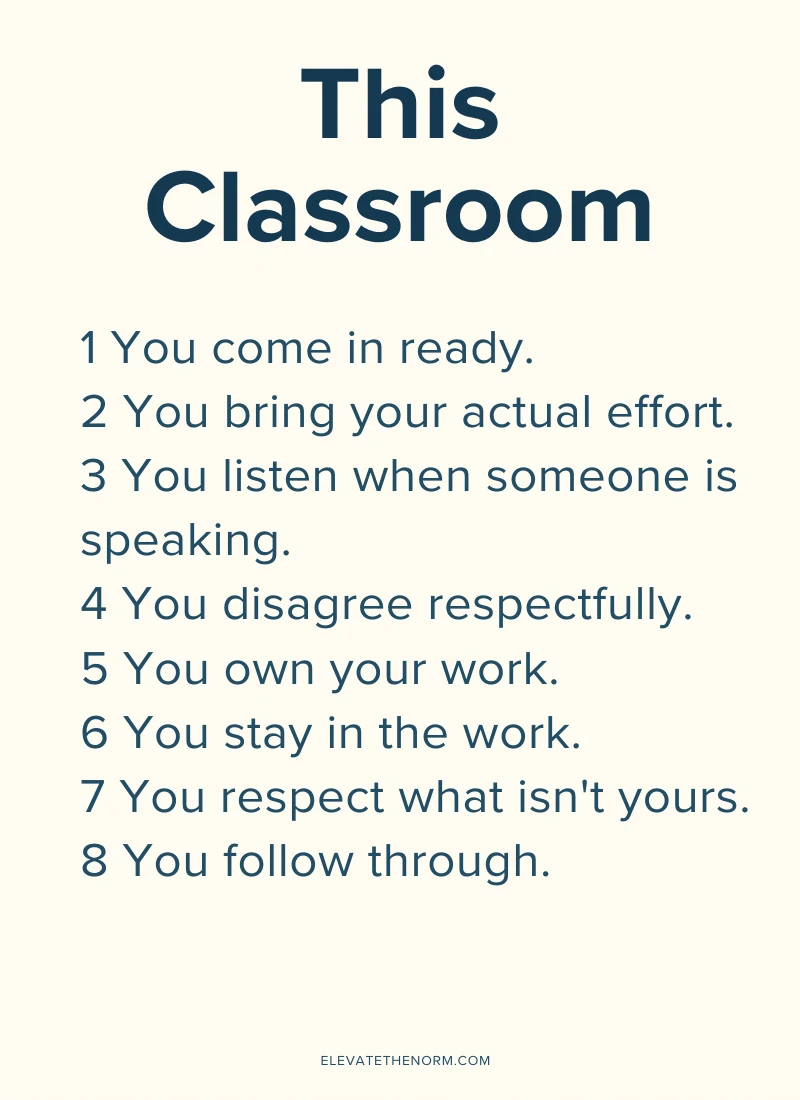
    In This Classroom

    You come in ready.
    Materials in hand, in your seat, working on what’s up when the bell rings. Not almost ready — ready.

    You bring your actual effort.
    Not your best-day effort. Your today effort, whatever that is. Show up and do the work. That’s the standard.

    You listen when someone is speaking.
    Eyes up, phone down, waiting your turn. This applies to me and to your classmates.

    You disagree respectfully.
    If you think something is wrong, you say so — directly, with reasoning. You do not dismiss, ridicule, or roll your eyes.

    You own your work.
    Yours means yours. Mistakes are expected. Excuses are not. If something goes wrong, we figure out what happened and fix it.

    You stay in the work.
    When a task is hard, you stay with it before you ask for help. When you’re lost, you say so. “I don’t get it” is the beginning of learning, not a reason to stop.

    You respect what isn’t yours.
    Desks, supplies, and other people’s belongings are treated accordingly.

    You follow through.
    Deadlines exist. Commitments matter. If something comes up, you talk to me before the due date, not after.

    Download the Classroom Expectations Poster

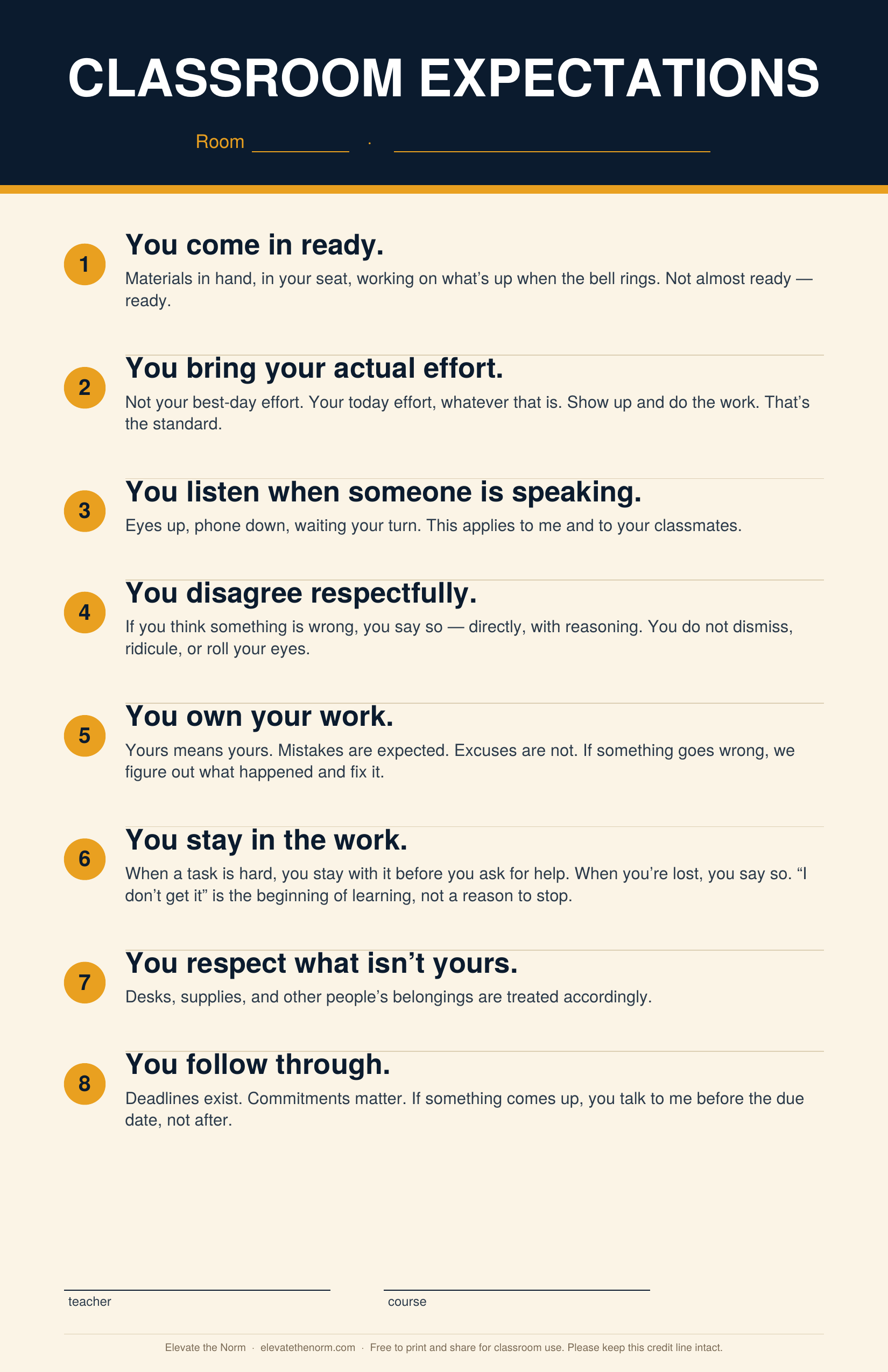
    The poster is free and right here, with no email or signup of any kind. Blanks are built in for your room number, your name, and your course. Print the 11×17 for wall mounting where the back row can read it, or the letter size for a desk-level copy. The PNG is there if you would rather drop it into your own layout first.

    Printable classroom expectations poster for grades 6-12 listing eight numbered expectations: you come in ready, you bring your actual effort, you listen when someone is speaking, you disagree respectfully, you own your work, you stay in the work, you respect what isn't yours, and you follow through, with blank lines for room number, teacher, and course
    The full poster, sized for 11×17. Blanks at the top and bottom are for your room number, name, and course.

    Free. No email address required. Free to print and share for classroom use — please keep the credit line intact. More free classroom packs are on the teacher resources page.

    Why These Lines Are Written This Way

    Each line was written to be as direct and specific as possible while treating students as people who can meet the standard.

    “You come in ready” is more specific than “Be Prepared.” It names the three things ready actually means: materials, seat, and working. First-week students who struggle with this aren’t defying you — they don’t know what ready looks like yet. This line tells them.

    “You bring your actual effort” is specifically not a “give 110%” type of statement, which sounds like a motivational poster and lands about as well. Instead, it acknowledges that effort looks different on different days and asks for whatever today’s version is. This matters for students who check out because they think they’re already behind.

    “You listen when someone is speaking” is specific. Eyes up, phone down, waiting your turn. Those are observable behaviors. If a student has eyes on their phone while a classmate presents, that line directly applies. “Be Respectful” does not.

    “You disagree respectfully” is one of the most important lines on the poster — and the one most teachers skip. When students know that disagreement is not only tolerated but expected to happen in a particular way, they’re more likely to engage substantively rather than disengage silently. Related to the principle of student voice and choice, this expectation tells students that their perspective has a place in the room, with conditions.

    “You own your work” addresses academic integrity and personal responsibility without using either phrase. Teenagers understand “mistakes are expected, excuses are not” faster than they understand a policy statement about academic dishonesty. See also: student responsibility in the classroom.

    “You stay in the work” targets the most common avoidance pattern in secondary school: the student who gives up after thirty seconds and announces they’re done. It gives them a two-step response — stay with it first, ask for help second — and frames “I don’t get it” as a learning step rather than a stopping point. This connects directly to developing student autonomy, where students learn to work through challenges before seeking support.

    “You respect what isn’t yours” is brief on purpose. Students this age know what it means. A long explanation implies you don’t trust them to understand basic respect for property.

    “You follow through” names the expectation most teachers dance around with a long late-work policy. Commitments matter. Deadlines exist. Talk to me before, not after. That’s a relationship-based expectation, not a punitive one, and it sets the stage for a student accountability culture rather than one built on consequences alone.

    How Do You Introduce a Classroom Expectations Poster on Day One?

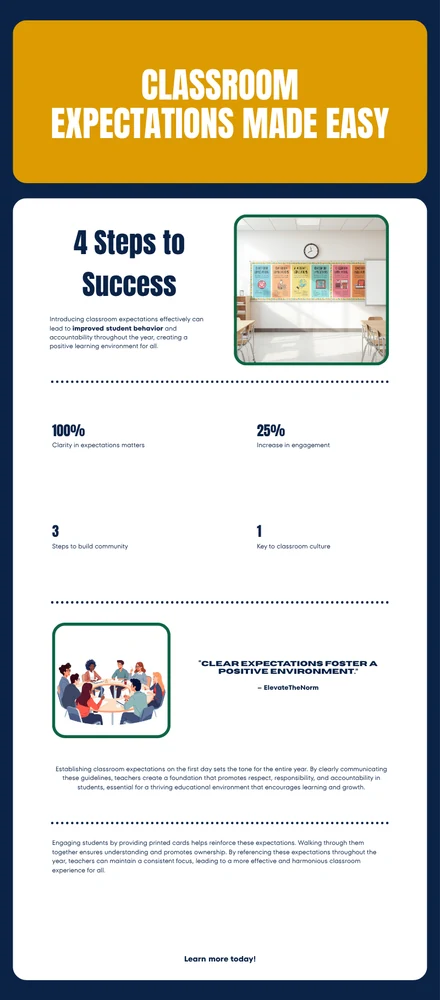
    Posting the expectations is step one. Teaching them is the actual job. The IRIS Center research makes this explicit: simply displaying rules is insufficient. Students need direct instruction, modeling, opportunity for practice, and feedback throughout the year.

    Teacher introducing the classroom expectations poster on the first day of school to middle school students
    The first day introduction of classroom expectations sets the tone for the entire year.

    In my room, on day one, every student gets a printed card — half-sheet size — with the poster text on it. They keep it in their folder or notebook for the first few weeks. Then I walk through each line, one by one, and do two things: explain what it means in practice in our room specifically, and ask students what they think it means.

    This is not a lecture about rules. It’s a conversation about how this room is going to work. I ask: “What would ‘you come in ready’ look like in practice? What might make it harder? What should you do if you need a minute?” The goal is for students to own the expectations, not just receive them.

    The research on high expectations for students consistently shows that the quality of how expectations are communicated matters as much as the expectations themselves. Expectations delivered as a list to be memorized have less impact than expectations discussed, practiced, and genuinely held.

    After the first-day conversation, I reference the poster regularly — not as a threat, but as a natural part of class language. “We’re going to stay in the work here.” “If you disagree, say so with reasoning.” The poster becomes shorthand for a full expectation that students already understand.

    Where Should You Hang a Classroom Expectations Poster?

    Placement matters more than most teachers realize. If the poster is tucked in a corner next to three other posters, it is not functioning as a reference tool — it’s decoration. Put your expectations poster in a location that is:

    • Visible from every seat in the room
    • Large enough to read from the back of the room
    • Not competing with surrounding content for visual attention

    A single-page format works best for a secondary classroom. Font should be readable at a distance — no smaller than 24pt for body text, larger for the title. Design it in a way that fits the aesthetic of your room without making it look childish. A clean, simple design with clear typography communicates professionalism; clip-art borders do not.

    If you use Canva or a similar tool, create the poster in the dimensions for your printer (typically 11×17 for a poster-size sheet) or design it as a digital display if you have a dedicated screen. Watermark it as yours if you’re sharing it externally.

    Consider a smaller companion card — quarter-sheet or half-sheet — that students keep in their folders or journals. The poster is a reference for the room. The card is a personal reference they can access during independent work.

    After Day One: Keeping Expectations Alive

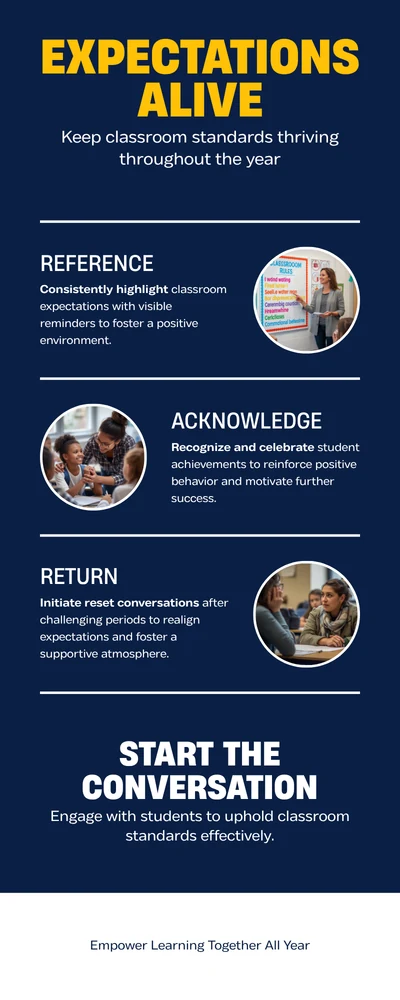
    The most important part of a classroom expectations poster is what happens after you put it up. If you never reference it again, it becomes wallpaper within two weeks. Students are paying attention to what you actually prioritize, not what you display.

    Year-long classroom expectations poster displayed prominently in a secondary classroom for daily student reference
    A year-long classroom expectations reference keeps standards visible and consistent all semester.

    Three practices that keep expectations functional all year:

    Reference by name. When you redirect a student, name the expectation you’re referencing. “Hey — we’re listening when someone’s speaking.” Not “you’re being disrespectful.” The specific language connects the moment to the poster.

    Acknowledge when expectations are met. This is particularly important with secondary students, who often expect correction but not affirmation. When a student owns a mistake without excuses, name it. “That’s exactly what ‘you own your work’ looks like. I appreciate that.” It reinforces the expectation without being saccharine.

    Return to the poster after a rough stretch. Every classroom hits a rough patch — after a long break, during testing, late spring. When behavior patterns shift, a brief return to the poster is more useful than a lecture. “Let’s check in on where we are as a class. Which of these are we doing well? Which are we slipping on?” That conversation treats students as capable of self-assessing, which supports the student voice and choice culture you’re building.

    The research from TNTP’s 2024 literature review on teacher expectations notes that proactive, consistent, and equitable enforcement of expectations is what produces outcomes — not the initial posting or the first-day conversation. The poster is a starting point. How you use it the rest of the year is the actual work.

    Additionally, consider how positive discipline for teens connects here — expectations, when held consistently without shame or power struggles, build the foundation for students to make better choices because they understand the standard, not because they fear the consequence.

    Frequently Asked Questions

    Is this classroom expectations poster free?

    Yes. The poster is free to download with no email or signup. It comes as an 11×17 PDF for wall mounting, a letter-size PDF for a desk-level copy, and a PNG if you want to drop it into your own layout. Blanks are built in for your room number, your name, and your course.

    What size should a classroom expectations poster be for high school?

    Big enough to read from the back row. An 11×17 single-page poster works well in a secondary room, with body text no smaller than 24pt and a larger title. Hang it where it is visible from every seat and not competing with other posters, and give students a half-sheet or quarter-sheet card version to keep in their folders.

    Should students help create the classroom expectations?

    Student-generated expectations have merit, especially for building buy-in. The practical tradeoff: students will often generate vaguer language than you need (‘be nice’), and you may spend the first class period negotiating rather than establishing a clear standard. A middle path that works well is to give students the poster framework and ask them to discuss and refine what each line means in practice — they help define the specifics without starting from a blank slate. If your classroom culture already supports significant student voice and choice, full co-creation is worth the time.

    What’s the difference between classroom rules and classroom expectations?

    Rules prohibit specific behaviors (‘no phones’). Expectations define what success looks like (‘when someone is speaking, you’re looking at them’). For secondary students, expectations framed in terms of what they should do tend to get better results than a list of don’ts, which puts students in a defensive mental posture from the first day.

    How many expectations should be on the poster?

    Research on classroom norms suggests five to eight is a useful range — enough to cover the major categories of behavior in a learning environment without becoming a list students can’t remember. The poster text above has eight lines. If your context requires different emphasis, cut or adapt rather than pile on.

    Should middle school and high school expectations look different?

    The core expectations are similar, but the delivery and design should shift. Middle school students often benefit from more concrete specifics and visual cues alongside the text. High school students respond better to fewer words and more direct language. The poster text above was written to work across grades 6–12 with minor adjustments in tone depending on how you introduce it.

    What do I do when a student violates an expectation repeatedly?

    The poster is a reference tool, not a consequence system. If a student is repeatedly not meeting an expectation, that’s a conversation — not a pointing-at-the-poster moment. The poster helps you name the expectation clearly; the actual work of changing behavior usually requires a private conversation, some investigation of what’s causing the pattern, and sometimes a connection to the school’s support systems. A student accountability sheet can structure those conversations and help students track their own patterns.

    Is it worth posting expectations in a room where students rotate (secondary, multiple classes)?

    Absolutely — arguably more so than in an elementary setting. When students move from class to class, each teacher’s expectations may be different, and ambiguity around those differences is where a lot of secondary classroom behavior issues actually live. Posting clear expectations makes your room legible to students and reduces the mental load of figuring out how this room is different from last period.

    What’s the right response when a student says the expectations are unfair?

    Take it seriously. Ask them to be specific: which expectation do they think is unfair, and why? You may learn something useful. Sometimes students are naming a real inconsistency in how an expectation is enforced (equity concerns are worth listening to). Sometimes they’re testing to see if you mean it. Either way, a direct, calm conversation — ‘Tell me more about what you’re seeing’ — respects their perspective while making clear the expectations themselves aren’t up for negotiation in the moment.

    Sources

    Brophy, J. (1983). Research on the self-fulfilling prophecy and teacher expectations. Journal of Educational Psychology, 75(5), 631–661.

    Education Northwest. (n.d.). Expectations and student outcomes. https://educationnorthwest.org/sites/default/files/expectations-and-student-outcomes.pdf

    IRIS Center, Peabody College, Vanderbilt University. (n.d.). Establishing classroom norms and expectations. https://iris.peabody.vanderbilt.edu/case-study/establishing-classroom-norms-and-expectations/

    Rosenthal, R., & Jacobson, L. (1968). Pygmalion in the classroom: Teacher expectation and pupils’ intellectual development. Holt, Rinehart and Winston.

    TNTP. (2024). The impacts of teacher expectations on student outcomes: A literature review. https://tntp.org/wp-content/uploads/2024/09/The-Impacts-of-Teacher-Expectations-on-Student-Outcomes-Literature-Review-2024.pdf


    About Clay Shumate

    By Clay Shumate — Clay Shumate is a certified secondary Social Studies teacher in the public schools of West Alabama, with seven years of classroom experience, a B.A. in History, and an M.Ed. in Secondary Education. He writes about project-based learning, student responsibility, respect, and practical ways to hold young people to a higher standard while giving them room to learn from mistakes. He is a member of the Society of Professional Journalists and writes to its Code of Ethics; this site’s editorial standards and corrections policy are published in full.

  • Student Accountability Sheet: A Free, Non-Childish Classroom Template

    Student Accountability Sheet: A Free, Non-Childish Classroom Template

    By Clay Shumate · Updated October 24, 2026

    A student accountability sheet is a short, structured form a student completes after something went wrong — a missed deadline, a group conflict, a behavior that affected the room. Done right, it takes about five minutes and produces a useful conversation. Done wrong, it is busywork that teaches students nothing except how to fill out busywork. This guide explains the difference, offers a free template in four versions, and shows exactly how to use it in a secondary classroom without humiliating anyone or generating a paper trail for things that do not belong on one.

    Key Takeaways

    • An accountability sheet supports a conversation — it is not a punishment, a replacement for a school referral, or a way to document a student for later.
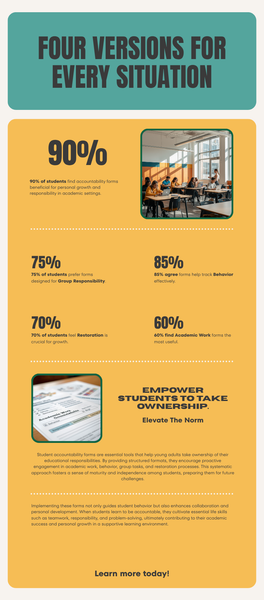
    • Four versions cover the situations teachers actually face: academic work, group responsibility, behavior, and restoration after a conflict.
    • Students complete the sheet themselves. That is the point. If the teacher is doing the writing, the tool is being used incorrectly.
    • The sheet is not a file. Unless a required school procedure calls for documentation, it lives with the student or gets recycled after the conversation.
    • Any teacher can use this the first week of school. No program, no training, and no administrator approval required.

    What Most Accountability Sheets Get Wrong

    Most accountability sheets found in schools — and most of the printables circulating on teacher resource sites — were designed for elementary students and scaled up by changing the font. They ask students to write “what I did wrong” in a box, then “how I will do better next time” in another box, and they expect that sequence to produce insight. It rarely does, because the sequence assumes the student already has a clear picture of what happened and why. They often do not.

    The other common design flaw is that the sheet exists only as a record. A teacher hands it to a student, the student fills it out, the teacher collects it and puts it in a folder. Nothing happens as a result. The student learns that accountability means paperwork, not change — which is exactly the wrong lesson.

    A well-designed student accountability sheet for grades 6–12 does three things that most forms skip. It separates facts from interpretations, so students can describe what actually happened without being led toward a particular framing. It identifies who, specifically, was affected — not just “the class” in the abstract. And it generates a next step the student can actually take, not a vague commitment to “try harder.”

    Classroom accountability sheet template on a student desk in a secondary classroom with warm lamp lighting
    An accountability sheet is a tool for a five-minute conversation, not a substitute for one.

    When Should You Use a Student Accountability Sheet?

    There are four situations where a short accountability sheet is useful in a secondary classroom. Understanding the difference between them matters, because each version of the sheet asks slightly different questions.

    Academic Work

    A student missed a deadline, submitted incomplete work, or disengaged from a task. The goal of the sheet in this case is not to assign blame but to figure out what actually got in the way. Sometimes the answer is workload. Sometimes it is confusion about the assignment. Sometimes it is something happening at home. The sheet creates space to say so without the conversation becoming a confrontation.

    Group Responsibility

    A student did not hold up their part of a group project. Or a group is in conflict about who did what. The group version of the sheet is filled out individually by each member before the group meets together — which means every voice is already on paper before anyone starts defending themselves out loud. This simple sequencing change reduces the volume of these conversations significantly.

    Behavior

    Something happened in the room — a comment that landed wrong, a refusal, an outburst — that the teacher needs to address before moving on. This version is short by design, because a behavior conversation does not benefit from extended written reflection in the moment. The sheet gives the student a minute to collect their thoughts before speaking, which is often all that is needed to de-escalate the temperature.

    One important note: if the behavior requires a school referral, disciplinary report, or any documentation under your district’s required procedures — do that. The accountability sheet is a classroom tool, not a substitute for mandated process. If you are unsure whether a situation requires official documentation, assume it does and act accordingly. The sheet goes with the student afterward, not instead of the referral.

    Restoration

    Something happened between students — a conflict, an unkind comment, a damaged trust — and the class needs to move forward. The restoration version is the most conversational of the four. It is the one most closely aligned with restorative approaches, and it works best when both students complete their own version before sitting down together. For more on restorative approaches in a school context, see restorative practices in schools.

    VersionUse it whenKey question
    Academic workA missed deadline, incomplete work, or disengagement from a task“What got in the way?”
    Group responsibilityA student did not hold up their part, or a group disputes who did what“What do you owe the group at this point?”
    BehaviorA comment, refusal, or outburst the teacher must address before moving on“Who was affected by it?”
    RestorationA conflict or broken trust between students that the class needs to move past“What did the other person lose or experience?”
    The four accountability sheet versions at a glance.

    What Goes on a Student Accountability Sheet? (4 Free Templates)

    Each template below is designed to be reprinted, typed into a shared document, or read aloud and answered verbally depending on the student and the situation. The fields are short. The language is direct. None of it is condescending.

    Four versions of student accountability sheet side by side showing academic work group responsibility behavior and restoration fields
    Four distinct versions of the sheet cover the situations teachers actually face in grades 6–12.

    Version 1 — Academic Work

    Student name: _______________ Date: _______________

    The assignment or task: _______________

    What was supposed to happen? (Describe the expectation — due date, format, what “complete” looked like.)

    What actually happened? (Facts only. Not reasons yet.)

    What got in the way? (This is where reasons belong. Be honest — including “I didn’t prioritize it” is a valid answer.)

    What is one thing you can do in the next 48 hours to move this forward?

    What support, if any, do you need from me?

    Version 2 — Group Responsibility

    Student name: _______________ Project or task: _______________ Date: _______________

    What was your agreed-upon role or task in this group?

    What did you actually complete?

    What did your group expect from you that you did not deliver?

    What happened from your perspective? (State facts and reasons separately.)

    What do you owe the group at this point?

    What is your next step, and when will it be done?

    Version 3 — Behavior

    Student name: _______________ Date: _______________ Period/class: _______________

    Describe what happened. (What you said or did — not what someone else did first.)

    Who was affected by it? (Name the people, not just “everyone.”)

    What do you want those people to know?

    What is one thing you will do differently?

    Note to the teacher: this version is designed for classroom-level situations. If the incident requires a disciplinary referral, complete your school’s required documentation first. This sheet is a follow-up conversation tool, not a replacement for required procedures.

    Version 4 — Restoration

    Student name: _______________ Date: _______________

    What happened between you and the other person? (Your account of it — not what they did, what happened between you.)

    What did the other person lose or experience because of the situation? (This is a perspective-taking question. Answer it honestly even if it is uncomfortable.)

    What do you want to be different going forward?

    Is there something specific you are willing to do or say to move toward that?

    What do you need from me or from the other person to make this work?

    Teacher and student sitting together at a whiteboard table reviewing an accountability sheet in a secondary classroom
    The sheet starts the conversation — it does not replace it. Five minutes at the whiteboard table is worth more than a folder full of completed forms.

    How Do You Use a Student Accountability Sheet?

    The sheet is not the conversation. It is the preparation for one. A student who fills it out in silence and hands it in has not been held accountable — they have completed a writing assignment. The point of the form is that it gives the teacher and the student a shared document to look at together, which is significantly less confrontational than looking at each other across a desk.

    The sequence that works: hand the student the sheet and give them three to five minutes to complete it, without hovering. Sit down together to review it — ideally somewhere that is not the center of the room. Read it together, ask one or two follow-up questions, and agree on the next step before the student returns to work. That is the whole procedure. If it is taking longer than ten minutes, either the situation is more serious than this tool was designed for, or the conversation has turned into a lecture. Stop the lecture.

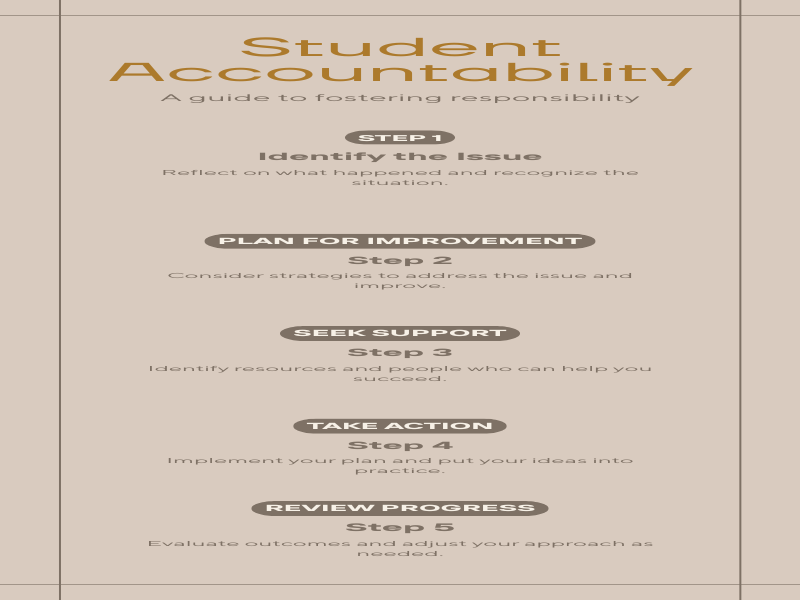
    The anchor question in every version is some variation of “what is your next step?” That is the question that determines whether the sheet produced anything useful. A vague next step (“I’ll try harder,” “I’ll be better”) is not a next step. Push for something specific and time-bound: “I’ll finish the introduction section by Thursday,” or “I’ll ask Morgan what I can do to address what happened.” Specificity is what makes accountability concrete rather than performative.

    A Classroom Anchor: Authority Handed and Held

    The accountability sheet works best when students already understand that authority in the room is real and is held to. A clearly visible classroom expectations poster does much of this work passively — it gives students a reference point before anything goes wrong, so the accountability sheet’s first question (“what was supposed to happen?”) lands with specificity rather than guesswork. In my workshop room — where students are almost always working alongside somebody, and I move between groups rather than lecture from the front — the sheet tends to come up most often around group work, and specifically around moments where a student was trusted with a role and did not follow through on it.

    When that happens, I do not announce it to the room. I slide the Version 2 sheet to the student at their table and give them four or five minutes while I circulate. Then I pull them to the whiteboard table — my small-group conferencing area with a rug, better chairs, and a lower lamp, where students know they are being seen carefully and not put on display — and we work through their answers together.

    The conversation is not about catching them in something. It is about naming what happened clearly enough that we can figure out what comes next. Students who have been given real authority over something — their section of a project, their role in a group, a decision that affects others — understand why the accounting matters. It matches the weight of the responsibility they were given. What does not match it is a form that feels like it was designed for a third-grader. The template above is written at the level the student is actually operating at. That is the difference between accountability and humiliation, and it matters.

    This approach connects directly to what student responsibility looks like in the classroom — real responsibility includes real accounting when things go wrong, not manufactured consequences or empty apologies. For the broader case for high expectations paired with the room to learn from mistakes, see high expectations for students.

    What If a Student Doesn’t Follow Through?

    A student completes the sheet, agrees to a next step, and then does not take it. This happens. Here is the important thing: that outcome does not mean the sheet failed. It means you now have a second conversation with more information than you had before. You know what the student said they would do. You know they did not do it. The conversation gets more specific, not more punitive.

    The escalation path in this case depends on what the situation actually requires. Some students need more support than a single conversation provides — academic, social, or something else entirely. The sheet is not a substitute for identifying that need and addressing it. If a pattern emerges across multiple sheets and conversations, that is information that may need to go to a counselor, an interventionist, or a parent. At that point the sheet is one piece of a larger picture, not the whole solution.

    For students whose accountability issues involve ongoing behavior challenges, the positive discipline framework for teenagers provides a more structured approach that pairs well with the sheet. For situations involving harm between students, the natural consequences framework and the restoration version of the sheet work together. And for the broader question of how to build a classroom where students actually want to hold themselves accountable, see the site’s overview of student responsibility as a developmental skill, not a character judgment.

    The Research Behind It

    Self-regulated learning research has consistently found that students who can reflect on their own performance — identify what went wrong, name contributing factors, and plan a corrective action — outperform students who receive only external evaluation (Zimmerman, 2002). The accountability sheet is applied self-regulated learning: it scaffolds a reflective process that students build over time.

    Self-determination theory (Deci & Ryan, 2000) adds an important dimension: students are far more likely to take a next step they chose than a consequence that was imposed on them. Every version of the sheet ends with the student naming a next step. That ownership matters for what actually happens afterward. Hattie’s (2009) meta-analysis of over 800 studies identified student self-assessment — including structured reflection on what went wrong — as one of the highest-leverage interventions available to teachers. The accountability sheet is a low-cost, no-training version of exactly that.

    Research on restorative approaches in schools (Morrison & Vaandering, 2012; Skiba & Peterson, 2000) supports the same conclusion from the discipline side: punitive responses to student misbehavior consistently underperform restorative ones on measures of recurrence, school climate, and relationship repair. A sheet that asks students to identify who was affected and what they are willing to do to repair it is grounded in that same framework, without requiring a school-wide program or a trained facilitator.

    If you want the same plain, non-childish approach for the days you are not in the room, the free Sub Survival Kit at SubstitutePlans.com has a daily report form a substitute fills out, plus attendance sheets, seating charts and backup activities. It covers the record-keeping so the accountability conversation can still happen when you get back.

    Printables for this

    Two of mine on TPT, both built for this. Behavior Documentation Forms are the other half of the picture — the ABC data and MTSS logs you keep when a pattern does need a record, which the sheet above deliberately is not. The Makeup Work System handles the follow-through on the academic version, so “what is your next step” has a process behind it.

    If a tracking sheet is not enough on its own: see how to build a behavior contract a student will actually respect, including a sample and an honest read on whether contracts work.

    Frequently Asked Questions

    What is a student accountability sheet?

    A student accountability sheet is a short, structured form a student completes after something went wrong, such as a missed deadline, a group conflict, or a behavior that affected the room. It separates facts from reasons, names who was affected, and ends with a specific next step. It supports a private conversation; it is not a punishment or a disciplinary record.

    How long should an accountability sheet conversation take?

    About five minutes. Give the student three to five minutes to complete the sheet without hovering, then sit down together away from the center of the room, ask one or two follow-up questions, and agree on a specific, time-bound next step. If it runs past ten minutes, the situation needs more than this tool or the talk has turned into a lecture.

    Is a student accountability sheet the same as a disciplinary referral?

    No. A disciplinary referral is a formal school document that enters a student’s record, triggers review by an administrator, and may carry consequences under district policy. An accountability sheet is a classroom tool — a short form that supports a private conversation and a next step. It is not filed, not sent to the office, and not part of the student’s disciplinary record unless you deliberately attach it to a referral as supporting documentation. If a situation requires a referral, complete the referral. The accountability sheet is for situations that do not — which is the majority of what happens in a classroom on any given day.

    What if the student doesn’t fill it out honestly?

    Some students will write what they think you want to hear. That is useful information, too. If the sheet reads like a performance rather than a reflection, say so directly and ask one specific follow-up question: “When you wrote you would try harder — what does that look like for you on Monday?” Most students will either give a more honest answer or reveal that they actually do not know. Both are starting points for a real conversation. The sheet is not a truth test. It is a structure for a conversation, and the conversation is where the real work happens.

    Does this go in the student’s permanent file or record?

    No — not unless your school’s procedures specifically require it for a given type of incident. For most classroom-level situations, the sheet lives with the student or gets recycled after the conversation. If you are using it as part of a required disciplinary process, follow your school’s documentation requirements for that process. Do not create an informal file of completed accountability sheets. That is not what this tool is for, and it can create problems if the file is ever requested.

    Can parents request to see these sheets?

    Parents can request records their child’s school maintains about them under FERPA. If you are collecting and storing completed accountability sheets in any systematic way, you should treat them as education records and handle them accordingly. The simplest way to avoid this issue is to not store them: use the sheet, have the conversation, and let the student keep it or discard it. A brief note in your own records of the conversation and the agreed-upon next step is sufficient documentation for your own use.

    What should I do if the student refuses to fill it out?

    A student who refuses to engage with the sheet is telling you something about their state in that moment. Do not escalate over the sheet itself. Give them a minute, check in quietly, and decide whether this is a moment of genuine distress, a test of your authority, or something else. If it is a test, name what you see calmly: “I’m going to give you two more minutes. I’ll come back.” If it is distress, the sheet can wait. If refusal becomes a pattern, that is a separate conversation — about engagement and trust, not about a form.

    At what grade level does this work best?

    The templates above are designed for grades 6–12. The language is appropriate for middle school and can be used as-is with most high school students. Students in grades 6–8 may need more scaffolding during the conversation — they often have the self-awareness but not yet the vocabulary to name what happened clearly. The teacher’s role in those grades is slightly more coaching than questioning. High school students can generally complete the sheet more independently, though the conversation afterward is equally important at both levels.

    How do I use the group responsibility version fairly when students blame each other?

    Have each student complete their own version of the sheet before anyone talks. This is non-negotiable: if students start talking first, they immediately start building a shared story that may not reflect what each person actually experienced. Once each student has answered the questions in writing, bring them together. Start with what each person wrote about their own contribution — not the other person’s failures. The sheet’s structure forces that sequence because the questions are framed around the student’s own actions. It does not eliminate conflict, but it changes the opening move from accusation to accounting.

    Sources

    • Zimmerman, B. J. (2002). Becoming a self-regulated learner: An overview. Theory Into Practice, 41(2), 64–70. https://doi.org/10.1207/s15430421tip4102_2
    • Deci, E. L., & Ryan, R. M. (2000). The “what” and “why” of goal pursuits: Human needs and the self-determination of behavior. Psychological Inquiry, 11(4), 227–268. https://doi.org/10.1207/S15327965PLI1104_01
    • Hattie, J. (2009). Visible Learning: A Synthesis of Over 800 Meta-Analyses Relating to Achievement. Routledge.
    • Morrison, B. E., & Vaandering, D. (2012). Restorative justice: Pedagogy, praxis, and discipline. Journal of School Violence, 11(2), 138–155. https://doi.org/10.1080/15388220.2011.653322
    • Skiba, R. J., & Peterson, R. L. (2000). School discipline at a crossroads: From zero tolerance to early response. Exceptional Children, 66(3), 335–346. https://doi.org/10.1177/001440290006600303

    About Clay Shumate

    By Clay Shumate — Clay Shumate is a certified secondary Social Studies teacher in the public schools of West Alabama, with seven years of classroom experience, a B.A. in History, and an M.Ed. in Secondary Education. He writes about project-based learning, student responsibility, respect, and practical ways to hold young people to a higher standard while giving them room to learn from mistakes. He is a member of the Society of Professional Journalists and writes to its Code of Ethics; this site’s editorial standards and corrections policy are published in full. More about Clay.

  • What Is Student Responsibility? A Clear Definition for Schools and Families

    What Is Student Responsibility? A Clear Definition for Schools and Families

    By Clay Shumate · Updated October 24, 2026

    Student responsibility is a student’s capacity to own their choices, meet their obligations, and make things right when they fall short. It covers academic responsibility—showing up, completing work honestly, asking for help—behavioral responsibility like following class agreements and accepting consequences without deflecting, and interpersonal responsibility: being someone your peers can count on when it matters. Responsibility grows through practice, not through lectures about why it matters.

    Key Takeaways

    • Student responsibility has four overlapping dimensions: academic, behavioral, interpersonal, and community
    • Responsibility is not the same as obedience—obedience asks students to comply; responsibility asks them to own
    • Responsibility develops through meaningful choice, honest feedback, proportionate consequences, and a genuine path back after failure
    • Schools and families each control distinct pieces of the picture—neither can do this alone
    • Students trusted with real responsibility tend to rise to it; students denied any meaningful responsibility often check out
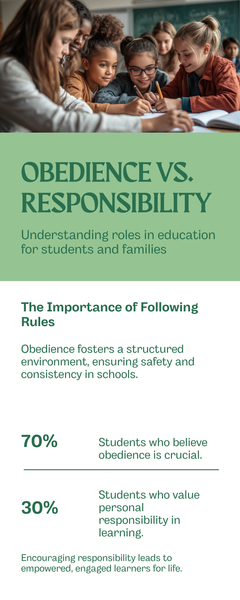
    Comparison chart showing the difference between obedience and student responsibility in school settings
    Obedience follows rules because told to. Responsibility owns choices and their outcomes.

    What Is Student Responsibility?

    Student responsibility, at its core, is a student’s ability to manage their own behavior and obligations without constant adult supervision. It is not perfectionism. A responsible student is not one who never makes mistakes—it is one who owns their mistakes, faces the consequence that was promised, and does not wait for an adult to notice and solve every problem for them.

    Damon (1995) distinguishes between compliance and genuine responsibility, arguing that adolescents develop real responsibility only when they internalize the values behind expectations—not when they follow rules out of fear of punishment. That distinction shapes how schools should approach this: punishing non-compliance produces compliance. Building structures where students experience ownership and consequences produces responsibility.

    The Collaborative for Academic, Social, and Emotional Learning (CASEL) places responsible decision-making as one of five core competencies in social-emotional learning, defining it as the ability to make caring and constructive choices about personal behavior and social interactions (CASEL, 2023). This is not a soft skill—it is a teachable, measurable set of practices.

    What Are the Four Dimensions of Student Responsibility?

    Responsibility is not one thing. Students can be responsible in some dimensions and not others—and understanding which dimension is the problem is the first step to addressing it.

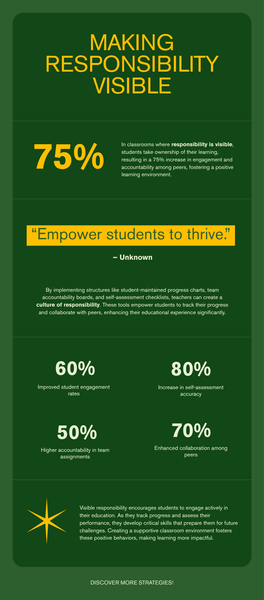
    Classroom structures that make student responsibility visible including progress charts and accountability boards
    Three structures that make responsibility visible: progress charts, accountability boards, and self-assessment checklists.

    Academic Responsibility

    Academic responsibility includes completing assigned work, meeting deadlines, submitting honest work, and asking for help when confused instead of guessing or copying. It also includes managing study time independently and advocating for yourself when you do not understand something.

    Academic responsibility does not mean students work alone all the time. It means that when they work together, they each contribute. A student who coast through group work—contributing nothing while taking credit—is not being academically responsible, even if their final grade does not show it.

    Behavioral Responsibility

    Behavioral responsibility means following class agreements even when the teacher is not watching, accepting consequences proportionately without deflecting blame onto others, and owning mistakes directly. A student who accepts a consequence and then moves on is demonstrating behavioral responsibility. A student who spends more energy disputing the consequence than they spent on the behavior that caused it is not. If you want a think sheet that treats students like young adults, my Behavior Reflection Sheets on TPT come in two levels.

    Interpersonal Responsibility

    Interpersonal responsibility means showing up for group work when you said you would, communicating honestly when something is wrong rather than disappearing, and holding yourself accountable to your peers without waiting for adult intervention. This is where student responsibility in the classroom becomes most visible—and most difficult—because teenagers are still developing the relational skills that make peer accountability possible.

    Community Responsibility

    Community responsibility extends beyond the individual: caring for shared classroom materials, leaving shared spaces as you found them, contributing to class culture rather than just extracting from it. This dimension is often underdeveloped in schools that treat responsibility purely as a compliance matter. A student who only does what serves themselves and ignores what their behavior costs the people around them has not developed full responsibility.

    DimensionWhat it looks like
    AcademicCompleting work, meeting deadlines, submitting honest work, asking for help instead of guessing or copying
    BehavioralFollowing class agreements when no one is watching, accepting consequences without deflecting blame, owning mistakes
    InterpersonalShowing up for group work, communicating honestly when something is wrong, being accountable to peers
    CommunityCaring for shared materials, leaving shared spaces as you found them, contributing to class culture
    The four dimensions of student responsibility at a glance.

    What Is the Difference Between Responsibility and Obedience?

    Obedience asks: Do it because I said so. Responsibility asks: Do it because you understand why it matters.

    A student who only acts responsibly when supervised has learned obedience—or at least its performance. A student who checks their own work before turning it in, admits to the group member that they did not pull their weight, and asks the teacher for an extension before missing a deadline rather than after: that student is practicing responsibility. I use the forms in my Makeup Work System on TPT so absent students know exactly what they missed and when it is due.

    This distinction shapes discipline. Teachers who confuse the two often escalate consequences trying to produce responsibility when what they are getting is compliance or its absence. More pressure can produce more compliance—but it rarely produces more ownership. And once a student is under enough pressure, it produces neither.

    For classroom approaches that build genuine responsibility rather than managed compliance, see positive discipline for teens and natural consequences in the classroom.

    How Do Students Develop Responsibility?

    Ryan and Deci (2000), whose self-determination theory has been among the most replicated frameworks in educational psychology, identify three basic psychological needs that support self-regulation: competence (feeling capable), autonomy (having real choices with real consequences), and relatedness (belonging to a community that cares how you act). Responsibility develops when students experience all three.

    A student who has no choices in class and no voice in outcomes has no reason to develop responsibility—they are compliant at best, resistant at worst. The conditions for responsibility must be built before you can expect students to demonstrate it.

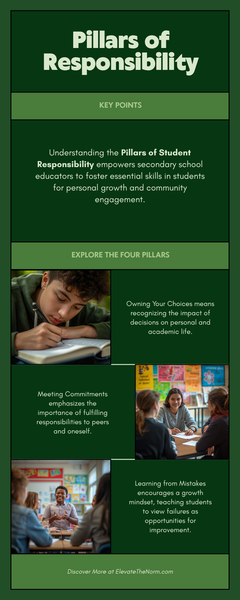
    Four pillars of student responsibility: owning choices, meeting commitments, learning from mistakes, contributing to the group
    The four pillars of student responsibility give students a concrete framework for developing ownership.

    Through Meaningful Choice

    Students cannot develop responsibility for choices they are never allowed to make. This does not mean every class decision is put to a vote. It means giving students real choices within clear boundaries: how they organize their notes, which of three article prompts to respond to, how they divide group roles. Choices with low stakes but genuine consequences—where the student experiences the results of their own decisions—are the practice ground for larger responsibility.

    Through Honest Feedback

    Vague praise tells students nothing useful. “Good work” does not tell a student what to repeat or what to change. Specific, honest feedback—”your argument on page two is clear; the evidence in the third paragraph does not quite support the claim you are making”—gives students something to act on. Feedback that helps students understand the gap between what they did and what was expected builds the self-awareness that responsibility requires.

    Through Proportionate Consequences

    Consequences need to match the behavior and be ones the student can actually learn from. A student who forgets homework and gets a zero learns to hide it next time. A student who forgets homework and has a brief, direct conversation about why—followed by a realistic plan for finishing it—learns something about responsibility. See natural consequences in the classroom for a practical framework for getting this right.

    Through Repair After Failure

    A student who makes a mistake and finds no path back learns to hide mistakes. A student who makes a mistake, owns it, repairs what can be repaired, and still faces the consequence that was agreed upon—that student is learning something real. The repair matters as much as the consequence. Schools that skip repair leave students with the message that once you mess up, you are just in trouble. Schools that include repair leave students with the message that responsibility includes fixing what you broke.

    For a first-person account of letting a consequence stand while keeping the path back open, see Clay’s essay What I Learned the Year I Let Kids Fail, published at The Educator’s Room.

    What Schools Control vs. What Families Control

    Schools control: the structure of the day, the expectations communicated, the consistency with which those expectations are applied, how teachers respond to failure, whether students have any meaningful voice in class decisions, and what happens after a student falls short. Schools decide whether consequences teach something or just punish. They decide whether students get a path back or are simply in trouble.

    Families control: routines at home, how parents model handling their own mistakes, how they talk about school, and whether they support students through consequences or work to eliminate them. A parent who calls in every morning a student misses homework and negotiates the grade is teaching that responsibility is negotiable when someone with enough leverage intervenes. A parent who lets the consequence stand and helps the student think through what went wrong is doing something very different.

    A school that expects families to deliver responsible students and does nothing to build responsibility at school is not doing its job. A family that expects school to do it all while rescuing students from every consequence is not doing theirs either. Responsibility is built in both places—or it struggles in both places.

    Common Misunderstandings About Student Responsibility

    Responsible students do not make mistakes. They do. The goal is not a student who never falls short—it is a student who owns it when they do. Responsibility is about response, not perfection. A student who admits they did not study for a test and accepts the grade is more responsible than a student who argues about why the test was unfair.

    You either have it or you do not. Decades of developmental psychology disagree. Responsibility is a practiced skill that grows through experience, feedback, and appropriately scaled opportunities to make real decisions. Weissberg and colleagues (2015) document clear evidence that social-emotional competencies, including responsible decision-making, are teachable and develop across childhood and adolescence with the right supports.

    Students from low-income or high-poverty backgrounds are less capable of responsibility. This assumption is refuted by the same evidence that shows all students respond to autonomy support and clear, consistent expectations. The conditions that support responsibility—clarity, trust, meaningful choices, and a path back after failure—matter regardless of what a student brings from home. The need is universal. The circumstances that make building it harder are sometimes not.

    How Do You Build a Responsible Classroom Culture?

    A responsible classroom is built on four things: clear expectations that students help shape, consistent follow-through when those expectations are not met, a genuine path back after failure, and enough trust to give students real responsibility rather than scripted tasks. Battistich (2008) argues that character development—including responsibility—requires students to experience themselves as genuine contributors to a community that cares, not just as rule-followers in an institution.

    Giving students real responsibility does not mean lowering supervision. It means giving them decisions that actually matter and letting the consequences of those decisions be real. A student who manages a class library, chairs a Socratic seminar, or leads a project checkpoint is practicing responsibility in a way that a worksheet about the importance of responsibility simply cannot replicate.

    For activities that build these skills, see activities for teaching responsibility. For how high expectations connect to student responsibility, see high expectations for students. For a concrete tracking tool, the student accountability sheet templates put individual student commitments in writing — four versions covering academic work, group responsibility, behavior, and restoration.

    What to Do Next

    Start with one dimension of responsibility and one concrete practice. If academic responsibility is the gap—deadlines, honesty, asking for help—start with a class conversation about what following through actually looks like and what happens when it does not happen. If interpersonal responsibility is the problem, build a team contract the next time students work in groups and actually enforce it.

    Responsibility does not happen through announcements. It happens through the thousands of small decisions students make each day—and whether the classroom is designed to let them own those decisions, or structured in a way that makes those decisions irrelevant before they ever get a chance to practice.

    Frequently Asked Questions

    What are examples of student responsibility?

    Examples across the four dimensions: turning in honest work on time and asking for help instead of copying (academic); following class agreements when the teacher is not watching and owning mistakes (behavioral); showing up for group work and speaking up when something is wrong (interpersonal); and caring for shared materials and leaving shared spaces as you found them (community).

    Why is student responsibility important?

    Responsibility lets students manage their behavior and obligations without constant adult supervision, which is the difference between ownership and compliance. CASEL lists responsible decision-making as one of five core social-emotional competencies. Students trusted with real responsibility tend to rise to it, while students denied any meaningful responsibility often check out.

    Is student responsibility the same as student obedience?

    No. Obedience means following a rule because someone told you to. Responsibility means understanding why the expectation exists and meeting it because you have internalized what is at stake. A student who behaves only when supervised has learned obedience. A student who meets obligations consistently—including when no one is watching—is practicing responsibility. Schools often confuse the two and end up managing compliance rather than building ownership.

    At what age should schools start building student responsibility?

    As early as possible, in age-appropriate ways. By grades 6–12, students are developmentally ready for real responsibility—meaning real choices with real consequences, not just classroom jobs with no stakes. Adolescents who are given meaningful responsibility and supported through mistakes tend to develop stronger self-regulation than those who are either denied responsibility or given it without any guidance or follow-through.

    Can a student be responsible in one area but not another?

    Yes, and this is common. A student might be highly responsible academically—completing every assignment, meeting every deadline—but struggle with interpersonal responsibility: not showing up reliably for group work or deflecting when something goes wrong in a team setting. Recognizing which dimension is the gap helps teachers intervene specifically rather than broadly labeling a student as responsible or irresponsible.

    How can families support responsibility without doing homework for their kids?

    By letting consequences happen. When a student forgets their project at home and a parent drives it to school, the student learns that someone else will fix it. When the student faces the consequence of turning it in the next day—and lives through it—they learn something about ownership. Families can also model responsibility directly: acknowledging their own mistakes, following through on what they say they will do, and talking about how they handle problems honestly.

    What do I do when a student genuinely cannot meet a responsibility?

    Distinguish between cannot and will not—and between a skill gap and a motivation gap. A student who does not know how to manage their time needs direct instruction in time management, not just consequences for missing deadlines. A student who knows how but is not doing it needs a different conversation. In both cases, the next step should include a specific plan, not just a punishment. Responsibility grows when students have a path forward, not just a record of what went wrong.

    How do teachers make responsibility visible rather than just assumed?

    By building structures that make it observable. Team contracts, revision trackers, self-assessment forms, and student-led conferences all make responsibility visible because they create records of what students committed to and what they actually did. When responsibility is only implied—show up, try hard, be good—students cannot develop it systematically. When it is made concrete and specific, students know what it looks like and teachers can respond to it clearly.

    Sources

    • Ryan, R. M., & Deci, E. L. (2000). Self-determination theory and the facilitation of intrinsic motivation, social development, and well-being. American Psychologist, 55(1), 68–78.
    • Damon, W. (1995). Greater expectations: Overcoming the culture of indulgence in our homes and schools. Free Press.
    • Collaborative for Academic, Social, and Emotional Learning (CASEL). (2023). Fundamentals of SEL. CASEL.
    • Weissberg, R. P., Durlak, J. A., Domitrovich, C. E., & Gullotta, T. P. (Eds.). (2015). Social and emotional learning: Past, present, and future. In J. A. Durlak, C. E. Domitrovich, R. P. Weissberg, & T. P. Gullotta (Eds.), Handbook of social and emotional learning: Research and practice. Guilford Press.
    • Battistich, V. A. (2008). Character education, prevention, and positive youth development. In L. Nucci & D. Narvaez (Eds.), Handbook of moral and character education. Routledge.

    About Clay Shumate

    Clay Shumate is a certified secondary Social Studies teacher in the public schools of West Alabama, with seven years of classroom experience, a B.A. in History, and an M.Ed. in Secondary Education. He writes about project-based learning, student responsibility, respect, and practical ways to hold young people to a higher standard while giving them room to learn from mistakes. He is a member of the Society of Professional Journalists and writes to its Code of Ethics; this site’s editorial standards and corrections policy are published in full. More about Clay.

  • Project Based Learning Tools: Free Templates for Teachers

    Project Based Learning Tools: Free Templates for Teachers

    By Clay Shumate

    Project based learning tools are the planning templates, feedback protocols, and assessment forms that give teachers and students a shared system for managing complex, multi-week work. Without them, a PBL project is ambition without infrastructure. With them, students know what they are doing each day, teachers can coach rather than rescue, and the final product reflects actual learning instead of organized chaos.

    Key Takeaways

    • Planning tools—driving question templates, project calendars, and Know/Need to Know charts—keep projects from drifting before they start
    • Group coordination tools like team contracts and role cards shift accountability from the teacher to the students where it belongs
    • Feedback and critique protocols help students improve their work before the final product, not just after it is graded
    • Free digital tools including Google Workspace, Padlet, and PBLWorks educator resources cover most of what a classroom needs without a budget
    • The best PBL programs run on five or six well-understood tools, not twenty barely-understood ones
    Driving question template for project based learning showing structure for open-ended inquiry questions
    A strong driving question is open-ended, connects to a real issue, and has no Googleable answer.

    Why PBL Needs Its Own Toolkit

    A standard assignment can run on a rubric and a due date. A project spanning three weeks—with multiple checkpoints, group coordination, research, revision, and a public product—cannot. Project based learning tools are not busy work. They solve real problems: drift, inequitable group work, surface-level feedback, and final assessments that miss what students actually learned.

    The Buck Institute for Education (now PBLWorks), which has studied project-based learning for over three decades, identifies planning, collaboration, and formative assessment as three essential supports for successful PBL implementation (Larmer, Mergendoller, & Boss, 2015). Tools are how those supports become visible inside a classroom where a teacher has twenty-eight students, five periods, and a bell that rings every fifty minutes.

    This guide covers the most useful tools in each category and points to the best free resources for getting them. For context on what strong PBL actually looks like, the definition of project based learning article explains the essential elements that separate genuine PBL from a decorated assignment.

    Planning Tools: Before the Project Starts

    The Driving Question Template

    A weak driving question makes students shrug. A strong one makes them argue and investigate. The difference is almost always structure. A strong driving question is open-ended, connects to a real issue or audience, and does not have a Googleable answer.

    Use this draft formula to build one: How should [person or group] [action] in order to [goal or value]?

    For example: How should our city council design a park renovation so that it serves both older adults and teenagers who share that space? This forces students to consider competing interests, use subject-area knowledge, and produce something—a recommendation, a proposal, a plan—rather than just a report.

    For a full breakdown of strong versus weak driving questions across multiple subjects, see project based learning driving question examples.

    Project Calendar

    A calendar does two things most teachers underestimate: it shows students how much time they actually have, and it forces the teacher to sequence direct instruction alongside inquiry. A usable PBL calendar has daily or weekly columns, labeled checkpoints, deadlines for specific deliverables (not just one big due date at the end), and built-in days for critique and revision. PBLWorks provides free downloadable planning calendars for teachers at pblworks.org/resources.

    Know/Need to Know Chart

    After launching a project—typically with an entry event that makes the problem feel real—students complete a Know/Need to Know chart. On one side: what they already know. On the other: what they need to find out. This chart does not stay static. It grows as students learn and discover new questions.

    The KNTK serves two purposes. It gives students a research direction and gives teachers a formative snapshot of background knowledge and misconceptions—without a quiz. John Hattie’s synthesis of educational research identifies formative assessment as one of the highest-impact practices in education (Hattie, 2009). The KNTK is one of the simplest formative tools that costs nothing and takes ten minutes.

    Team contracts and rotating role cards for project based learning group coordination
    Team contracts and role cards shift accountability to students where it belongs.

    Group Coordination Tools: While the Work Is Happening

    Team Contract

    Group work fails when accountability is vague. A team contract makes it specific. A good one covers: each member’s role, what happens when someone does not complete their work, how decisions get made, and how the group will handle disagreements before they escalate to the teacher.

    It is not a behavioral management trick. It is a professional practice. Legal teams, software developers, and nonprofit boards all use agreements that define responsibility before problems start. Asking students to do the same is not asking too much—it is asking something real. See the 7 steps of project based learning for where the team contract fits in the full project sequence.

    Role Cards

    Rather than leaving students to decide who does what—which usually means one person does everything—role cards assign rotating responsibilities. Common roles include: Project Manager (keeps the group on schedule and tracks deliverables), Lead Researcher (coordinates inquiry and source evaluation), Editor/Quality Control (reviews for accuracy and coherence), and Presenter Coordinator (organizes the final product and prepares the group). Roles rotate each project so every student practices every skill. Be honest with yourself about which of those cards is doing real work, though—a 36-study review found no evidence that naming roles improves outcomes on its own, so it is worth reading what actually makes a group role earn its place before you print a set.

    Daily Stand-Up Log

    Borrowed from software development, a stand-up is a brief daily check-in with three questions: What did you accomplish? What will you do next? What is blocking your progress? Students fill this in at the start of work time. The teacher scans the logs in three minutes and knows exactly who is stuck without running to every group. Students learn to diagnose their own progress rather than waiting for the teacher to notice a problem.

    Research and Inquiry Tools

    Source Evaluation Checklist

    The standard “is it credible?” instruction is not enough. Students need specific criteria they can apply independently: Who is the author? What organization published this? When was it last updated? Does it cite evidence? Is the purpose to inform, persuade, or sell? This checklist works for websites, journal articles, primary sources, and news coverage.

    Research Notes Organizer

    A research notes organizer gives students one place to record sources, quotations, and their own interpretations. Without it, students either plagiarize because they cannot separate their notes from the source, or they lose track of where information came from. A four-column table works for most subjects: Source | Key Information | My Interpretation | Questions It Raises.

    Feedback and Critique Tools

    Peer critique protocol and self-assessment rubric for project based learning student feedback
    Feedback and critique protocols help students improve their work before the final product, not just after it is graded.

    Peer Critique Protocol: Warm and Cool Feedback

    Developed and refined by educator Ron Berger and the EL Education network, warm and cool feedback is one of the most practical classroom critique tools available (Berger, Rugen, & Woodfin, 2014). Warm feedback names specifically what is working and why. Cool feedback identifies something to strengthen, phrased as a question or suggestion rather than a judgment.

    The distinction matters. “This is good” is not warm feedback. “The evidence you used in paragraph two directly supports your claim—and the contrast you drew with the counter-example is convincing” is warm feedback. “Your conclusion repeats the introduction rather than moving forward—what’s the next step you want the reader to take?” is cool feedback. This structure keeps critique from becoming personal and keeps attention on the work, not the person who made it.

    Gallery Walk with Sticky Notes

    Students post their work-in-progress on walls or tables. Classmates rotate through and leave sticky notes: one warm, one cool. This gives every student feedback from multiple peers without the teacher orchestrating every exchange. It works best mid-project—after a first draft exists but with enough time remaining to act on what they hear.

    Revision Tracker

    A simple document with three columns: Feedback Received → Change Made → Reason for the Change. Students maintain this alongside their work. It prevents revision from being cosmetic—fixing a typo and calling it done—and shows teachers whether students are actually responding to critique or going through the motions. It also gives students a record of how their thinking developed over the course of the project.

    Assessment Tools

    PBL Rubric

    Assessment in project-based learning has to measure the right things. A rubric that only scores the final product misses the inquiry, the revision, the collaboration, and the communication that make PBL valuable. A well-built PBL rubric includes separate rows for content knowledge demonstrated, quality of evidence, revision process, collaboration (assessed individually, not as a group score that hides individual gaps), and communication clarity.

    For a free editable template built specifically for grades 6–12, see the rubric for project based learning.

    Self-Assessment Form

    Before every checkpoint and after every project, students complete a brief self-assessment: What was my strongest contribution? Where did I fall short? What would I do differently? What did I learn? This is not extra busywork. It is the metacognitive habit that makes future projects better. A student who cannot answer “what did I actually learn?” has not finished the project—they have finished the assignment.

    Exhibition Checklist

    When students present to an authentic audience, an exhibition checklist covers: Does the product show evidence-based reasoning? Is the presentation clear to someone unfamiliar with the topic? Did the team handle questions directly and honestly? Does it meet the criteria the project set out to address? This checklist can be used by the presenting team for self-assessment and by the audience for structured feedback during the presentation.

    Free Digital Tools Worth Using

    Many of the most effective project based learning tools are printable and free. A few digital platforms extend them without creating new management problems.

    Google Workspace (free for schools): Google Docs for shared writing and revision history, Google Slides for presentations, Google Forms for self-assessment and checkpoint surveys, Google Drive for organizing project files. Widely available and familiar to most students before they arrive.

    Padlet (free tier available): A shared digital board for gallery walks, Know/Need to Know charts, and collaborative brainstorming. Works on any device with a browser. Students can post text, images, and links—and see what their classmates are contributing in real time.

    Canva for Education (free): Students create posters, infographics, reports, and presentations without graphic design experience. The free version for education has enough templates to cover most public-product deliverables.

    PBLWorks Educator Resources (free with registration): PBLWorks, the organization founded by the Buck Institute for Education, provides free planning templates, rubrics, and project examples at pblworks.org/resources. Their Gold Standard PBL framework is the most research-grounded planning reference currently available for classroom teachers.

    Everything on this page is free to print. If you have a budget and would rather start from a ready-built project library than assemble your own, the comparison of project-based learning kits and tools worth paying for covers PBLWorks, Defined Learning, LEGO Education and the better TPT bundles by cost and by what students actually build.

    What Makes a Tool Worth Using

    A tool earns its place in a classroom when it reduces teacher-student friction, increases student clarity, and produces better work. Apply this test before adding any new form or protocol: what specific problem does this solve, and how will I know if it is working?

    The best PBL programs run on five or six tools that teachers and students both understand well. Adding more does not produce more learning—it produces more confusion. Krajcik and Shin (2014) note that effective project-based learning requires sustained student inquiry, which cannot happen when students are spending cognitive energy managing unfamiliar templates. The tools should fade into the background and let the thinking come forward.

    For broader classroom resources alongside these tools, the project based learning resources article covers free external tools, credible research references, and original ElevateTheNorm.com downloads in one place.

    What to Do Next

    Start with three: a driving question template, a team contract, and a peer critique protocol. Use them consistently for one full project. After the project ends, ask students which tools helped and which felt like extra work without a payoff. Revise based on their honest answers. The tools should be improving student work—if they are not doing that, something needs to change.

    For the sequence that holds these tools together, the 7 steps of project based learning shows where each tool fits from driving question through final reflection.

    Teachers are not the only ones researching this. Parents, administrators and students now put the same questions to an AI assistant before they ever ask a person, and the answers they get are often written from a vendor’s marketing page. The questions people are asking AI about project-based learning collects the twenty-five that come up most — platforms, cost, curriculum fit — and answers them from a classroom instead. Most of it assumes a secondary timetable; the high-school constraints specifically get their own treatment.

    Frequently Asked Questions

    What is the most important project based learning tool to start with?

    Start with the driving question template. Everything else in a PBL project depends on having a strong driving question. A weak question produces vague research, unclear products, and students who cannot explain why any of it matters. Once teachers can write strong driving questions reliably, the rest of the tools start making more sense because students understand what they are working toward.

    Do project based learning tools work without classroom technology?

    Yes. The most effective PBL tools are printable or can be run with a whiteboard and sticky notes. The team contract, peer critique protocol, Know/Need to Know chart, role cards, and self-assessment form all work without a device. Technology expands options for collaboration and presentation, but it is not a requirement for solid project management.

    How do I prevent one student from doing all the group’s work?

    Use role cards with rotating assignments and assess students individually inside a group project. If one student does all the work while others coast, the problem is usually structural—not a character issue. A team contract set up before the project starts, with agreed-upon consequences for not contributing, shifts accountability to the group before the teacher has to intervene. Individual self-assessments and revision trackers also make individual contribution visible.

    What is the difference between a PBL rubric and a regular rubric?

    A regular rubric typically scores the final product only. A PBL rubric also assesses the process: the quality of inquiry, how students responded to feedback and revised their work, how they collaborated, and how clearly they communicated their thinking. Scoring only the product rewards students who produce polished deliverables through luck or prior advantage. A PBL rubric rewards the kind of thinking and revision the project was designed to build.

    At what grade level are these tools appropriate?

    The tools in this guide are designed for grades 6–12. Middle school students generally need more structure—clear role cards, a daily stand-up log, and teacher checkpoints every two to three days. High school students can handle more open-ended planning, longer timelines, and self-directed research with less scaffolding. Adjust the level of detail and frequency of checkpoints based on your students’ experience with project work, not just their grade level.

    How does a driving question template help students?

    A driving question template gives students a structured starting point instead of a blank page. It forces them to identify who is affected by the problem, what action is needed, and why it matters—before they start researching. This clarity shapes the whole project. Students who understand why a question is worth investigating tend to stay more engaged throughout the work than those who were handed a topic without context.

    What should self-assessment include in a project based learning project?

    A useful self-assessment asks students to name their strongest contribution specifically, identify where their work fell short and why, state one thing they would do differently, and describe what they actually learned. Vague questions produce vague answers. “What did you contribute?” gets a list of tasks. “What was your most important contribution to the final product, and what evidence supports that?” gets honest reflection.

    Sources

    • PBLWorks. (n.d.). Educator resources: Free templates and rubrics. PBLWorks / Buck Institute for Education.
    • Larmer, J., Mergendoller, J. R., & Boss, S. (2015). Setting the standard for project based learning. ASCD.
    • Berger, R., Rugen, L., & Woodfin, L. (2014). Leaders of their own learning: Transforming schools through student-engaged assessment. Jossey-Bass.
    • Krajcik, J., & Shin, N. (2014). Project-based learning. In R. K. Sawyer (Ed.), The Cambridge handbook of the learning sciences (2nd ed., pp. 275–297). Cambridge University Press.
    • Hattie, J. (2009). Visible learning: A synthesis of over 800 meta-analyses relating to achievement. Routledge. (Formative assessment effect size d ≈ 0.90 as summarized.)

    About Clay Shumate

    Clay Shumate is a certified secondary Social Studies teacher in the public schools of West Alabama, with seven years of classroom experience, a B.A. in History, and an M.Ed. in Secondary Education. He writes about project-based learning, student responsibility, respect, and practical ways to hold young people to a higher standard while giving them room to learn from mistakes. He is a member of the Society of Professional Journalists and writes to its Code of Ethics; this site’s editorial standards and corrections policy are published in full. More about Clay.

Teacher Emergency Toolkit — practical resources, real classroom support. Shop on TPT.Teacher Emergency Toolkit — practical resources, real classroom support. Shop on TPT.