The Elevate Blog banner: Real Classrooms. Practical Ideas. Higher Expectations. Three students climb a rocky ridge at sunrise, each pulling the next one up, toward a teacher reaching down to help.

Author: Clay Shumate

  • The Three-Week Turn: Why Showing a Student You Care Makes Things Worse First

    The Three-Week Turn: Why Showing a Student You Care Makes Things Worse First

    By Clay Shumate

    Here is a thing that happens in a lot of buildings, and it happens quietly enough that nobody names it.

    A teacher decides to go all in on a student everybody else has given up on. Learns their name properly. Asks about their weekend and actually waits for the answer. Notices when they’re not okay. Treats them like a person with something to offer.

    And that student gets worse.

    Not better. Worse. More mouth, more walkouts, more of whatever their particular version of “no” looks like. The teacher, who did a hard and generous thing, now has evidence that the hard generous thing backfired. And somewhere around day nine, that teacher thinks what almost everybody thinks:

    I tried. That kid doesn’t want help.

    I want to make the case that this is the most misread moment in our profession — that the pushback isn’t the failure of the approach, it’s the first evidence the approach is working, and that it takes about three weeks to come out the other side. staying calm in week two.

    Why does a student push back against a teacher who is being kind to them?

    Because kindness from an adult is unfamiliar data, and unfamiliar data gets tested before it gets trusted.

    A young person who has been let down repeatedly by the adults in their life has built a working model of how adults behave: they’re unreliable, they lose interest, and being cared about is temporary. That model has kept them from being blindsided. It has worked.

    Then you walk in and contradict it.

    Clinicians who work on this describe it directly. Children who’ve been neglected or abused have learned to be wary of adults — even ones who appear reliable — because they’ve been ignored or betrayed by people they depended on, and many haven’t developed the early template that you can trust people and that people will take care of you (Child Mind Institute).

    So when you offer warmth, the student doesn’t experience relief. They experience a discrepancy. And there’s only one way to resolve a discrepancy: run a test.

    The behavior you’re seeing in week one is the test. Practitioner guidance on trauma-informed classrooms says this outright — pushing may be a test of reliability, and the transformative response is some version of “I don’t like what you did, but I care and won’t give up”.

    They are not asking will you let me get away with this. They are asking are you going to quit like the others did.

    How many students are we actually talking about?

    More than most staff rooms assume.
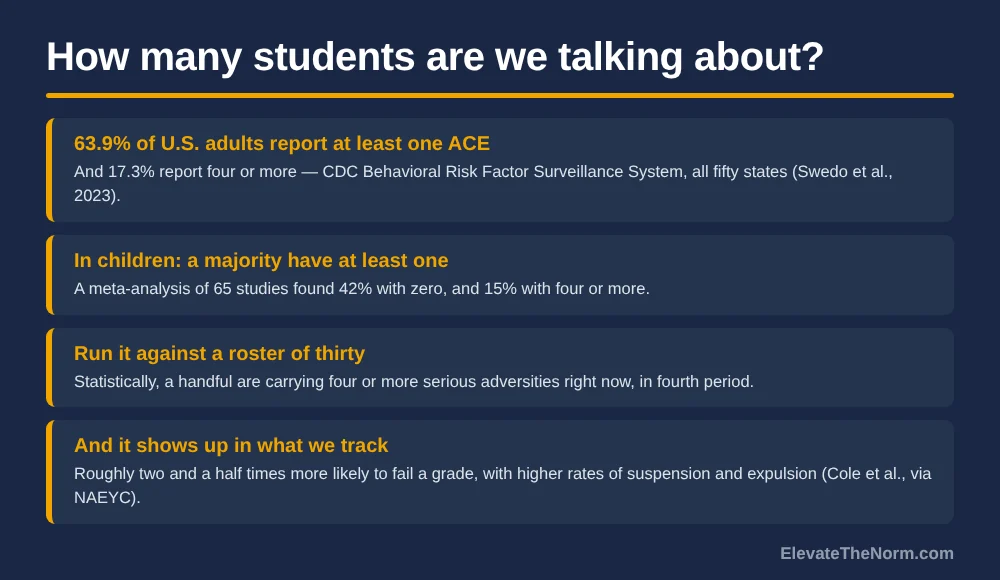
    Graphic titled How many students are we talking about, citing CDC data that 63.9 percent of U.S. adults report at least one adverse childhood experience and 17.3 percent report four or more, a meta-analysis of 65 studies of children, and higher rates of grade failure and suspension.
    The adverse childhood experience data, run against a roster of thirty.

    CDC data from the Behavioral Risk Factor Surveillance System across all fifty states found that 63.9% of U.S. adults reported at least one adverse childhood experience, and 17.3% reported four or more (Swedo et al., 2023). Looking at children directly rather than adults recalling childhood, a meta-analysis of 65 studies found 42% with zero ACEs — meaning a majority had at least one — and 15% with four or more.

    Run that against your roster. Thirty students in a room. Statistically, a handful of them are carrying four or more serious adversities right now, today, in fourth period.

    And it shows up in the data we do track. Children who experience trauma are roughly two and a half times more likely to fail a grade than their peers, score lower on standardized tests, and have higher rates of suspension and expulsion (Cole et al., via NAEYC).

    That last part deserves a hard look. The students most likely to be pushed out of school are the ones for whom school is most likely to be the only stable place they’ve got.

    What the pushback is actually communicating

    There’s a framing from the attachment literature that changed how I read my own room: misbehaviour represents a miscommunication of the student’s need to feel safe in relationships and to be part of a trustworthy community.

    Not defiance. Miscommunication.

    A student who has learned that closeness ends in disappointment will keep adults at a distance on purpose. The same source notes these students may be hypervigilant about being betrayed, humiliated or taken advantage of, and may withdraw from relationships or act as though they don’t need support from adults at all.

    Read that and then picture the kid in your building everybody calls “just doesn’t care.” Acting as though they don’t need anything is the most effective armor available to a person who has needed something and not gotten it. Understanding what is actually happening behind that mask is the first step toward motivating students who have shut down.

    The three-week turn

    Here’s my own observation, offered as exactly that — a pattern I’ve seen repeatedly across multiple schools, not a controlled study.
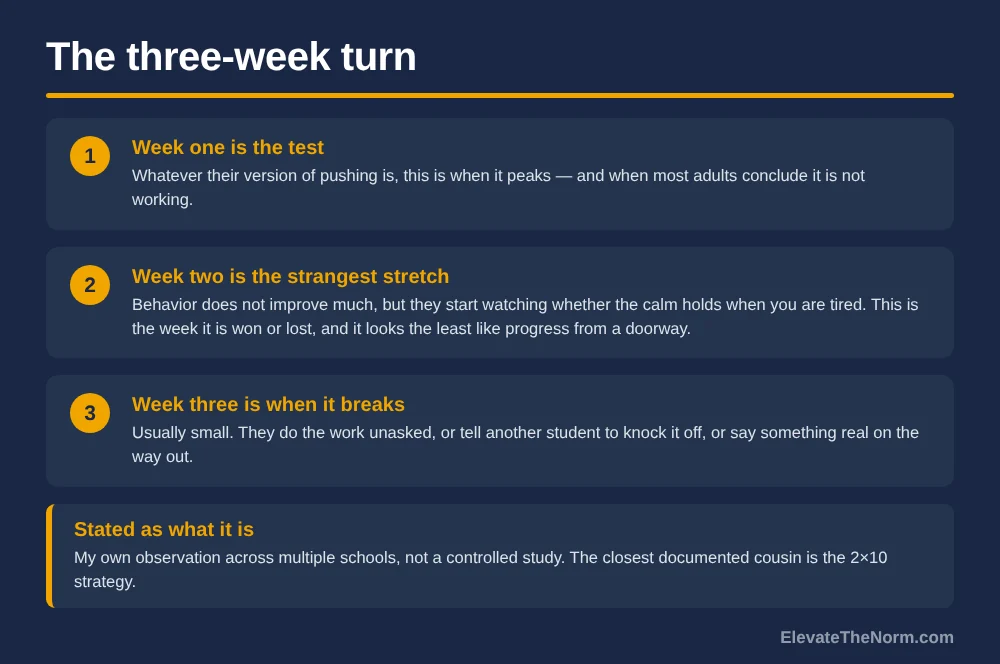
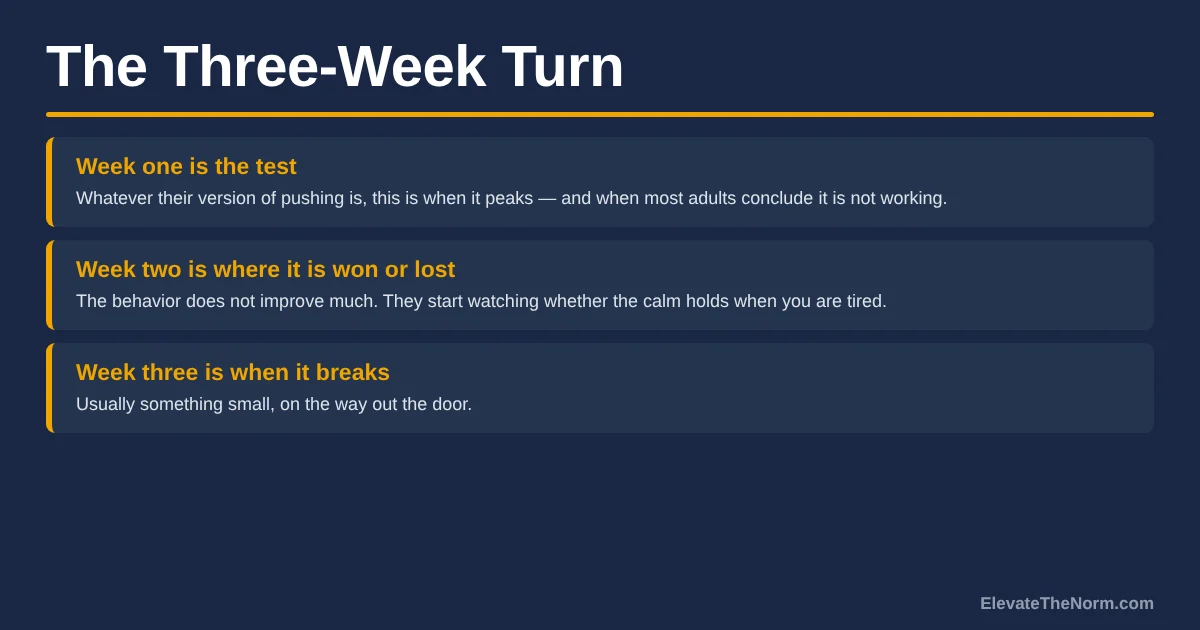
    Graphic titled The three-week turn, describing week one as the peak of pushback, week two as the stretch where students watch whether the calm holds, and week three as when it breaks, with a note that this is a personal observation rather than a controlled study.
    The three-week pattern, labelled as observation rather than study.

    It takes about three full weeks of a student being in my class before the room turns. Not that student alone. The room.

    Week one is the test. Whatever their version of pushing is, this is when it peaks. This is also when most adults conclude it isn’t working.

    Week two is the strangest stretch. The behavior usually doesn’t improve much, but something underneath shifts — they start watching. Checking whether the calm holds when you’re tired, when you’re behind, when they’ve earned a reaction. This is the week the whole thing gets won or lost, and it’s the week that looks the least like progress from a doorway.

    Week three is when it breaks. Not dramatically. Usually it’s small: they do the work without being asked, or they tell another student to knock it off, or they say something real on the way out the door.

    I don’t have a study that says “three weeks.” What I have is the closest documented cousin, and it’s close enough to be worth knowing. The 2×10 strategy — two minutes a day, ten consecutive school days, talking about anything other than academics or behavior — is a long-standing relationship-building practice recommended for exactly these students as a trust-building strategy, repeated throughout the year, especially after a student has shown anger or frustration and after long breaks (ASCD).

    Ten consecutive school days is two calendar weeks. My three weeks accounts for the ones where you miss a day, or there’s a fire drill, or they’re absent Thursday.

    The number matters less than the shape: consistency measured in weeks, not moments. Nobody rebuilds a working model of adults in an afternoon.

    Why it changes the school, not just the room

    This is the part I’d most want administrators to hear.

    The rest of the class is watching how you treat the hardest student in it. All of them. Constantly.

    When thirty people watch an adult stay steady with the one person who is making it most difficult, every one of them learns something about what safety costs in your building. They learn it isn’t conditional. They learn that if they have a bad week, you won’t become a different person.

    The reverse teaches just as fast. Research on classrooms makes the point plainly: once a teacher and student fall into a coercive cycle, it becomes a model for the other students to follow — they learn that this classmate doesn’t deserve their respect, and they learn not to trust the teacher, thinking “if she does that to him, she might do it to me” (Jennings).

    That’s how one relationship becomes a culture. In either direction.

    What leadership has to do in week two

    Almost all of the failure I’ve seen has happened in week two, and most of it was preventable by an adult who wasn’t the teacher.

    Don’t read week two as evidence of failure. If you walk into that room on day nine and see a struggling teacher and an escalating student, you are looking at the middle of a process, not the result of one. Ask how long they’ve been at it before you draw a conclusion.

    Don’t move the student. Schedule changes reset the clock to zero and confirm the exact thing the student predicted: adults tap out. If a move is genuinely necessary for safety, that’s different — but do it knowing what it costs.

    Don’t make the teacher defend it. A teacher who has to justify a not-yet-working approach in week two will abandon it in week three. Give them cover.

    Ask what they need. Two minutes of coverage so they can walk a student to the office and talk about nothing. A counselor looped in. Someone to take a class for ten minutes. These are small asks and they’re usually the difference.

    What to actually do in those three weeks

    Be boring. Same greeting, same tone, same expectations, every day. Predictability is the intervention. Whatever they throw at you, they should get the same version of you back.
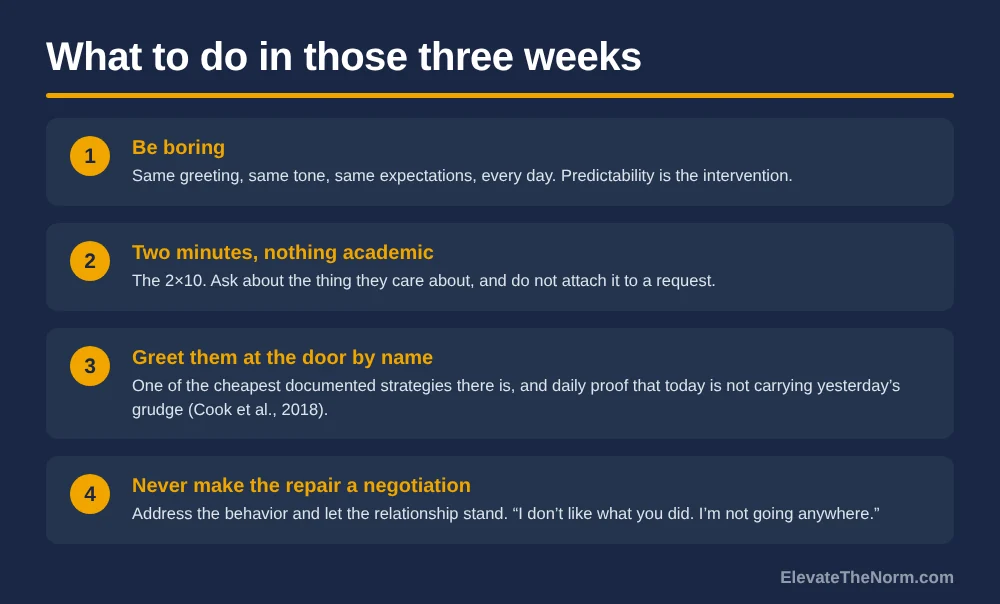
    Graphic titled What to do in those three weeks, listing be boring and predictable, two minutes a day of nothing academic, greeting students at the door by name, and never making the repair a negotiation.
    Four moves for the three weeks before the room turns.

    Two minutes, nothing academic. The 2×10. Ask about the thing they care about, not the thing you want them to care about, and don’t attach it to a request.

    Greet them at the door by name, every day. Positive greetings at the door is one of the cheapest documented classroom strategies there is, and it’s the daily proof that today is not carrying yesterday’s grudge (Cook et al., 2018).

    Never make the repair a negotiation. When something goes sideways and you address it, address the behavior and let the relationship stand. I don’t like what you did. I’m not going anywhere. Full stop, no trade.

    Watch what happens when they come back. A student who has been out for a stretch spends the first minute at the door working out what returning is going to cost them socially. That minute is one of the few parts of chronic absenteeism a classroom teacher genuinely controls.

    Assume you don’t know. You don’t know who they went home to, whether anybody’s there, whether they ate. You don’t need to know. You just need to stop assuming the behavior in front of you is the whole story.

    What not to do

    Don’t make it a project. Students can feel being someone’s redemption arc from across a room, and it’s humiliating. You’re not saving anybody. You’re being consistent with a person who deserves consistency.

    Don’t expect gratitude. It may never come, and if you need it, you’ll quit around day twelve. Do it because it’s the job.

    Don’t confuse warmth with no expectations. The kids who’ve been through the most are often the ones most insulted by low expectations, because they can tell it means you’ve written them off politely. Hold the bar. Hold it warmly. For a concrete framework on what that looks like — clear expectations paired with real ownership — see teaching responsibility through structure, not speeches.

    Frequently Asked Questions

    Isn’t this just letting students get away with things?

    No. Consequences still apply — they’re just delivered by someone who isn’t taking it personally and isn’t withdrawing the relationship as part of the punishment. Warmth and accountability aren’t opposites; the pairing is what makes either one land.

    What if three weeks pass and nothing changes?

    Then you’ve got real information, and it’s time to loop in a counselor, the family, or your student support team — with three weeks of documented consistent effort behind you, which is a much stronger position than three days of frustration. Sometimes what’s happening at home is bigger than a classroom can hold, and recognizing that isn’t giving up.

    I’m a first-year teacher and this feels impossible with 130 students.

    You can’t run this with all 130 at once, and nobody does. Pick two. Run it for three weeks. The change in those two changes the room, and the room makes the next two easier.

    What about the students who don’t have trauma histories?

    Nothing here hurts them. Predictability, being known by name, and an adult who doesn’t withdraw affection as leverage are good for every young person in the building. That’s what makes this a culture strategy rather than an intervention.


    References

    Child Mind Institute. (2025). How trauma affects kids in school. https://childmind.org/article/how-trauma-affects-kids-school/

    Cole, S. F., et al. Helping traumatized children learn, cited in National Association for the Education of Young Children, Creating trauma-sensitive classrooms. https://www.naeyc.org/resources/pubs/yc/may2015/trauma-sensitive-classrooms

    Cook, C. R., Fiat, A., Larson, M., Daikos, C., Slemrod, T., Holland, E. A., Thayer, A. J., & Renshaw, T. (2018). Positive greetings at the door: Evaluation of a low-cost, high-yield proactive classroom management strategy. Journal of Positive Behavior Interventions, 20(3), 149–159.

    Jennings, P. A. (2019). Teaching in a trauma-sensitive classroom. American Educator, 43(2). https://www.aft.org/ae/summer2019/jennings

    Madda, M. J. Trauma-informed teaching strategies. ASCD / Educational Leadership. https://www.ascd.org/el/articles/trauma-informed-teaching-strategies

    Madigan, S., et al. (2023). Prevalence of adverse childhood experiences in child population samples: A systematic review and meta-analysis. JAMA Pediatrics. https://pmc.ncbi.nlm.nih.gov/articles/PMC11555579/

    Swedo, E. A., Aslam, M. V., Dahlberg, L. L., Niolon, P. H., Guinn, A. S., Simon, T. R., & Mercy, J. A. (2023). Prevalence of adverse childhood experiences among U.S. adults — Behavioral Risk Factor Surveillance System, 2011–2020. MMWR, 72(26), 707–715. https://www.cdc.gov/mmwr/volumes/72/wr/mm7226a2.htm

    Trauma informed behaviour support: A practical guide to developing resilient learners — Attachment, school and learning. University of Southern Queensland. https://usq.pressbooks.pub/traumainformedpractice/chapter/4-2-attachment-school-and-learning/

    Once relationships are solid, consider channeling that trust into student-driven work. These 25 project based learning examples show how real projects give students meaningful responsibility while keeping academic standards front and center. For a ready-to-use tool on this, see free parent-teacher communication logs.

    The relationships pay the teacher back, too. Knowing students as individuals, and making the first call home good news, is a big part of staying out of burnout during the long middle of a grading period.


    About Clay Shumate
    Clay Shumate is a certified secondary Social Studies teacher in the public schools of West Alabama, with seven years of classroom experience, a B.A. in History, and an M.Ed. in Secondary Education. He writes about project-based learning, student responsibility, respect, and practical ways to hold young people to a higher standard while giving them room to learn from mistakes. He is a member of the Society of Professional Journalists and writes to its Code of Ethics; this site’s editorial standards and corrections policy are published in full. More about Clay.
  • You Don’t Know What They Know

    You Don’t Know What They Know

    By Clay Shumate

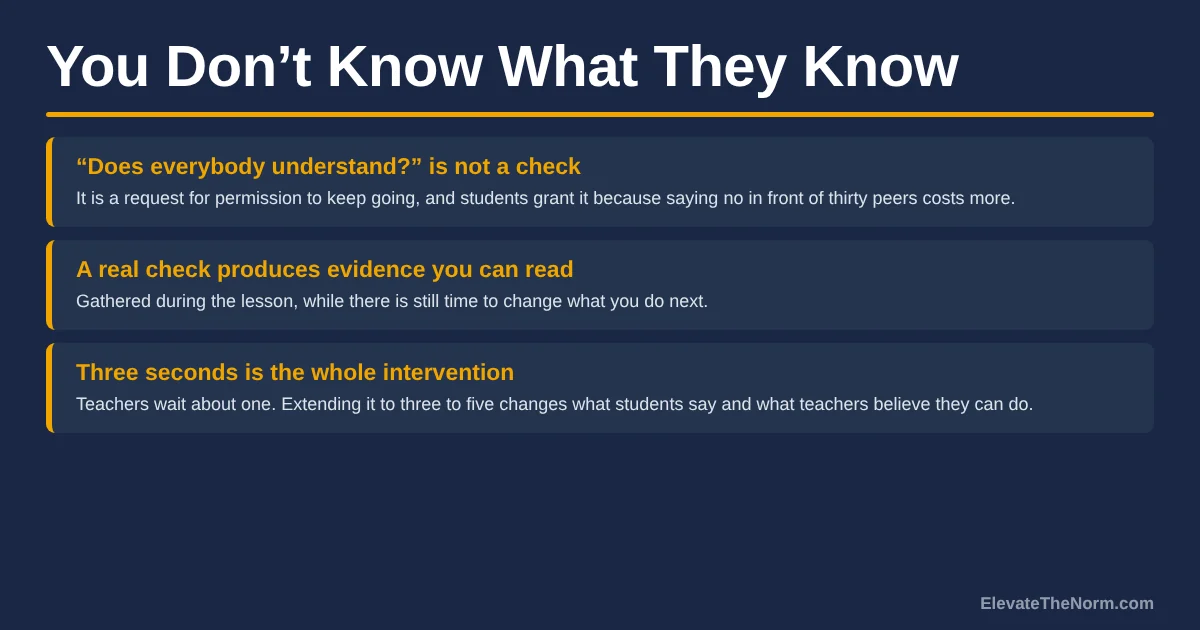
    “Does everybody understand?”

    Thirty heads nod. You move on. Two weeks later the unit test comes back and roughly a third of the room clearly did not understand, and hasn’t for a while.

    The question wasn’t the problem. The problem is that “does everybody understand?” is not a check — it’s a request for permission to keep going, and students give it because saying no in front of thirty peers costs more than staying quiet.

    This is the most fixable gap in a typical classroom, and the research behind fixing it is unusually strong.

    What does “checking for understanding” actually mean?

    It means gathering evidence of what students currently know, during the lesson, in a form that lets you change what you do next. Two conditions, both required: it happens while there’s still time to act, and it produces something you can actually read. Deciding what to do with that evidence is itself a reflective act; teacher reflection examples show what that cycle looks like in practice.

    Where that evidence gets recorded matters too. A gradebook organised around standards rather than assignments gives you somewhere obvious to note which specific thing a student is missing, and somewhere obvious to look next month to see whether it got fixed.

    That distinguishes it from a quiz, which measures after the teaching is finished, and from a show of hands, which measures social confidence.

    The formal name is formative assessment, and it has one of the better evidence bases in education.

    What does the research say?

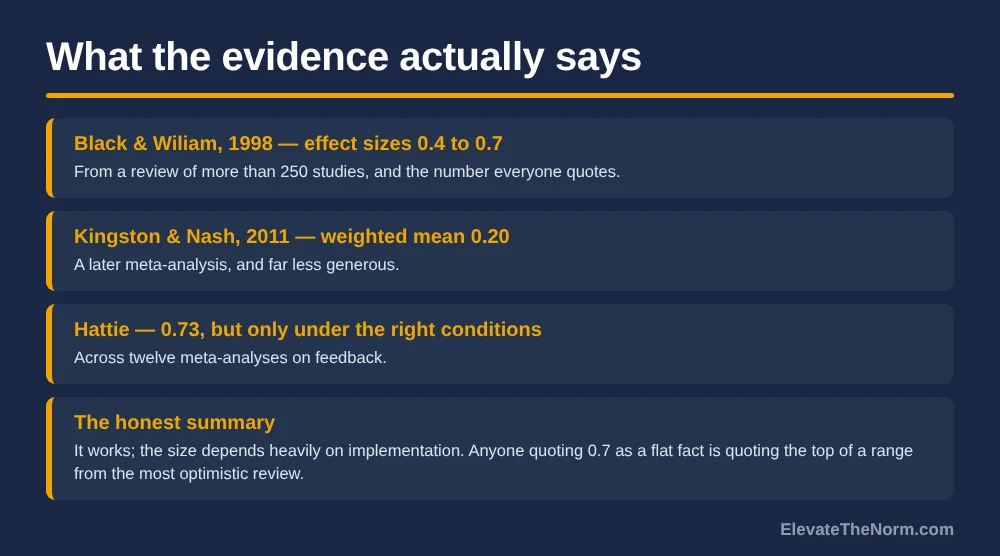
    Paul Black and Dylan Wiliam reviewed more than 250 studies for their 1998 review Inside the Black Box. Their headline finding: studies of formative assessment showed effect sizes between 0.4 and 0.7, larger than most known educational interventions.

    Graphic titled What the evidence actually says, listing Black and Wiliam 1998 effect sizes of 0.4 to 0.7, Kingston and Nash 2011 weighted mean of 0.20, Hattie at 0.73 under the right conditions, and an honest summary that the size depends on implementation.
    The formative assessment effect sizes, including the less generous ones.

    Two details from that work matter more than the headline number.

    It helps struggling students most. Formative assessment had its strongest positive effect on low-achieving students, which narrows the achievement gap. That’s the opposite of most interventions, which tend to help the students already doing well.

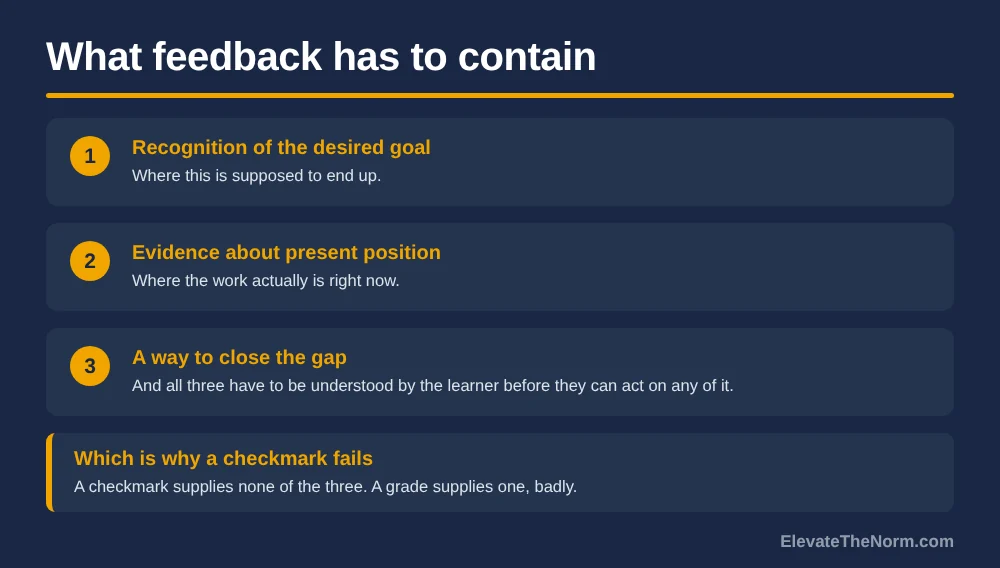
    The mechanism is specific. Black and Wiliam describe feedback as requiring three elements: recognition of the desired goal, evidence about present position, and some understanding of a way to close the gap between the two — and all three have to be understood by the learner before they can act. A checkmark supplies none of those. A grade supplies one, badly.

    Where the claim gets oversold

    Here’s the part most articles on this topic leave out, and it’s worth your skepticism.

    The 0.4–0.7 range is from a 1998 review, and later work has been less generous. Kingston and Nash’s 2011 meta-analysis found a much more modest weighted mean effect size of 0.20. Hattie’s review of 12 meta-analyses on feedback landed at an average effect size of 0.73, but only under the right conditions.

    So the honest summary is: formative assessment works, the size of the effect depends heavily on how it’s implemented, and anyone quoting 0.7 at you as a flat fact is quoting the top of a range from the most optimistic review. For what this looks like on an ordinary school day rather than in a meta-analysis, see the walkthrough of strategies that hold up in real classrooms.

    My take, not a finding: the spread in those numbers is exactly what you’d expect from a practice that got adopted as a label. Once “formative assessment” became something districts could put on a walkthrough form, a lot of things got renamed formative that were really just quizzes with a nicer word attached. I’d bet the low effect sizes are measuring that, not measuring the practice Black and Wiliam described.

    The three seconds that change the room

    If you do one thing from this article, do this one.

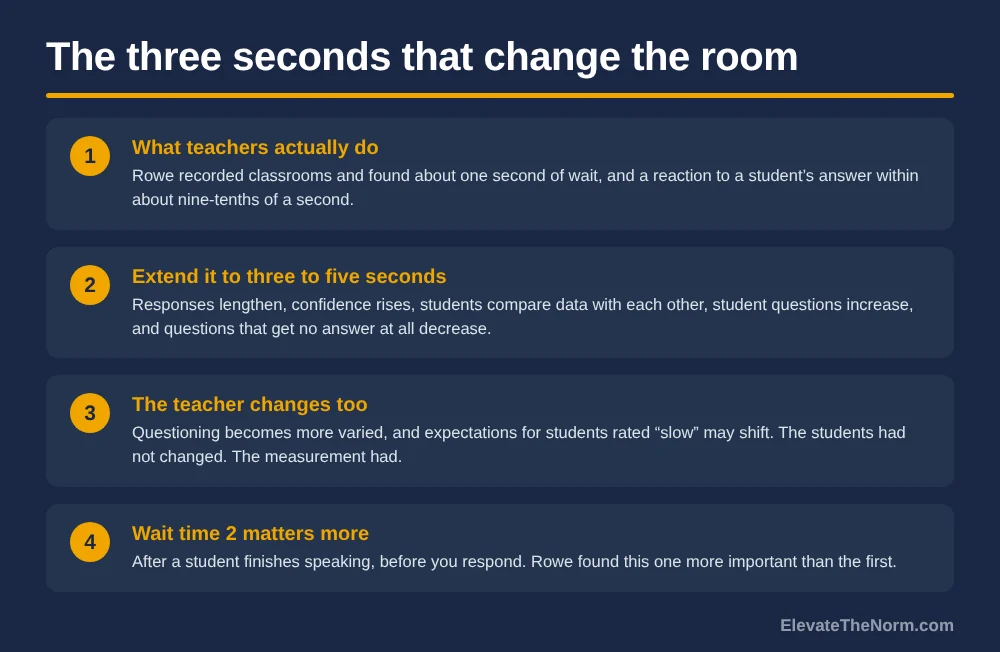
    Four-step graphic titled The three seconds that change the room, covering Rowe’s finding that teachers wait about one second, what changes when wait time extends to three to five seconds, how teacher expectations shift, and why wait time after a student speaks matters more.
    What Mary Budd Rowe found when she timed the silence.

    Mary Budd Rowe recorded classrooms and measured how long teachers actually wait after asking a question. Her finding: teachers allow an average of about one second for a response, and react to a student’s answer within about nine-tenths of a second.

    One second. That’s not enough time to parse the question, retrieve the information, and construct a sentence — for anyone.

    When wait time is extended to three to five seconds, the length of student responses increases, unsolicited appropriate responses increase, student confidence increases, speculative responses increase, students compare data with each other more, student questions increase, and responses from students rated “relatively slow” increase — while the number of teacher questions that get no response at all decreases.

    The teacher changes too. Questioning becomes more flexible and varied, and teacher expectations for students rated “slow” may shift.

    That last one deserves a second read. Waiting three seconds changed what teachers believed their students were capable of. The students hadn’t changed. The measurement had. The same applies to the questions themselves: how long you wait matters more when the question is genuinely open, and what the research says about wait time for open questions is that no upper threshold has been found.

    There are two places to wait, and the second matters more:

    • Wait time 1 — after you ask, before anyone answers.
    • Wait time 2 — after a student finishes speaking, before you respond. Rowe found this one even more important than the first.

    Three seconds feels absurd from the front of the room. It is not absurd from a desk.

    What actually counts as evidence

    The test for any check is simple: does it produce something from every student, that you can read, before the lesson ends?

    Graphic titled What feedback has to contain, listing recognition of the desired goal, evidence about present position, and a way to close the gap, with a note that a checkmark supplies none of the three and a grade supplies one badly.
    Black and Wiliam’s three elements, and why a checkmark supplies none of them.

    Every student. Calling on the raised hand tells you about the raised hand. Cold call, whiteboards, or written responses tell you about the room.

    That you can read. Nodding, “yeah,” and eye contact are not data. A sentence is data. A worked step is data. A ranking is data.

    Before it ends. Information that arrives after the bell is a grade, not a check.

    Checks like these are also what make it possible to stop narrating and start circulating, which is the whole mechanism behind handing more of the period over to students.

    Practices that clear that bar without adding paperwork:

    • Mini whiteboards, all hands up at once. Thirty answers in ten seconds, and you can see the distribution instantly.
    • Cold call with wait time. Ask, wait three seconds, then name someone. Everybody has to think, because nobody knows who’s up. The evidence on what cold calling actually does to participation — and to anxiety is worth reading before you lean on it.
    • Two-sentence exit ticket. Not “did you get it” — a question only someone who got it can answer, and the default closing move when the reading itself happened on a screen rather than on paper.
    • “Explain it to someone who missed today.” Explaining exposes gaps that recognition hides.
    • Show me where you got stuck. Students who can locate their own confusion are close to resolving it.

    My take, not a finding: the mini whiteboard is the highest-return purchase I’ve made for a classroom. It removes the social cost of being wrong, because thirty boards go up at once and nobody’s answer is the event. Students who never volunteer will write things down. That’s not in the research I’ve cited — it’s what I’ve seen.

    What doesn’t count

    “Does everybody understand?” Covered above. It’s a request for permission.

    “Any questions?” Answered honestly only by students who already know enough to know what they’re missing. The students furthest behind can’t formulate the question yet.

    Thumbs up / thumbs down. Students look at each other’s thumbs. You’re measuring conformity.

    The raised hand. Same three students, every period, in every school in the country.

    For administrators: what this looks like in a walkthrough

    None of the above transfers straightforwardly to a piece of writing, which takes a week and gets revised; formative checks for writing are their own set and read a sentence rather than a draft. Checking for understanding is genuinely visible from a doorway, unlike most instructional practice. What to look for:

    • After the teacher asks a question, count. If the gap is under two seconds, wait time isn’t happening — and that’s a specific, coachable, non-threatening piece of feedback.
    • Ask what they’d have done differently. A teacher doing this well can tell you what the last check revealed and how the lesson changed because of it. If the check produced no change, it was decoration.
    • Look for who’s answering. If it’s the same four students, the room is being sampled, not measured.
    • Don’t count the quiz. A quiz at the end measures. It doesn’t inform anything still in progress. A whole-class review game is the exception worth knowing, because it checks and teaches in the same fifteen minutes.

    My take, not a finding: if I could hand every new teacher one number, it would be three seconds — not because it’s the most important practice in teaching, but because it’s the cheapest one with real evidence behind it. It costs nothing, requires no materials, needs no approval, and can be started in the middle of a lesson that’s already going badly.

    Checking against what, exactly? A check for understanding only works if the target is clear first — see how to write a learning target students can use.

    Almost every quick check in this article is low on the complexity scale by design, and that is fine — a thirty-second read is not supposed to be an investigation. It becomes a problem only when the whole unit lives there. Leveling a week of your own tasks is the cheapest way to find out, and a five-step method for assigning a level to a question you already wrote takes under a minute an item.

    Most mid-lesson checks tell you how the confident students are doing. A hinge question is built differently: the wrong answers are designed in advance so that each one points at a specific misconception, which makes the result usable in the thirty seconds you actually have. How to write a hinge question covers Dylan Wiliam’s two-minute and thirty-second rules, what makes a distractor diagnostic rather than merely wrong, and how to decide on the spot whether to move on or go back.

    Frequently Asked Questions

    How often should I check for understanding in one lesson?

    There’s no research-backed number, and anyone giving you one is guessing. The useful standard is before each transition to something that depends on the previous thing being understood. If the next step assumes the last step landed, check first.

    Isn’t this just more assessment on top of everything else?

    It replaces rather than adds, if you do it right. A check that takes ten seconds and changes your next five minutes saves you the reteach later. The version that becomes extra work is the version that gets recorded, graded, and filed — which is no longer formative.

    Does this work in every subject?

    Black and Wiliam reported the effect across kindergarten through college, in different subject areas and different countries. The format changes by subject; the principle doesn’t.

    What do I do when the check shows most of them didn’t get it?

    Reteach it differently, right then — not louder, not slower, differently. That moment is the entire return on the practice. A check you don’t act on is just a slower way of finding out later. And when students know you check because you want to help them learn, it builds the kind of classroom responsibility that makes every other practice work better.


    References

    Black, P., & Wiliam, D. (1998). Inside the black box: Raising standards through classroom assessment. Phi Delta Kappan, 80(2), 139–148.

    Black, P., & Wiliam, D. (1998). Assessment and classroom learning. Assessment in Education, 5(1), 7–74.

    Hattie, J. (2009). Visible learning: A synthesis of over 800 meta-analyses relating to achievement. Routledge.

    Kingston, N., & Nash, B. (2011). Formative assessment: A meta-analysis and a call for research. Educational Measurement: Issues and Practice, 30(4), 28–37.

    Rowe, M. B. (1972). Wait-time and rewards as instructional variables: Their influence on language, logic, and fate control. ERIC ED061103. https://eric.ed.gov/?id=ED061103

    Rowe, M. B. (1986). Wait time: Slowing down may be a way of speeding up. Journal of Teacher Education, 37(1), 43–50. For a ready-to-use tool on this, see a free student-led conference template. For a ready-to-use tool on this, see free student self-assessment forms. For a ready-to-use tool on this, see free standards-based grading rubrics. For a ready-to-use tool on this, see a free formative assessment strategies PDF.


    About Clay Shumate
    Clay Shumate is a certified secondary Social Studies teacher in the public schools of West Alabama, with seven years of classroom experience, a B.A. in History, and an M.Ed. in Secondary Education. He writes about project-based learning, student responsibility, respect, and practical ways to hold young people to a higher standard while giving them room to learn from mistakes. He is a member of the Society of Professional Journalists and writes to its Code of Ethics; this site’s editorial standards and corrections policy are published in full. More about Clay.
  • Classroom Management for New Teachers: Why Calm Beats Control

    Classroom Management for New Teachers: Why Calm Beats Control

    By Clay Shumate

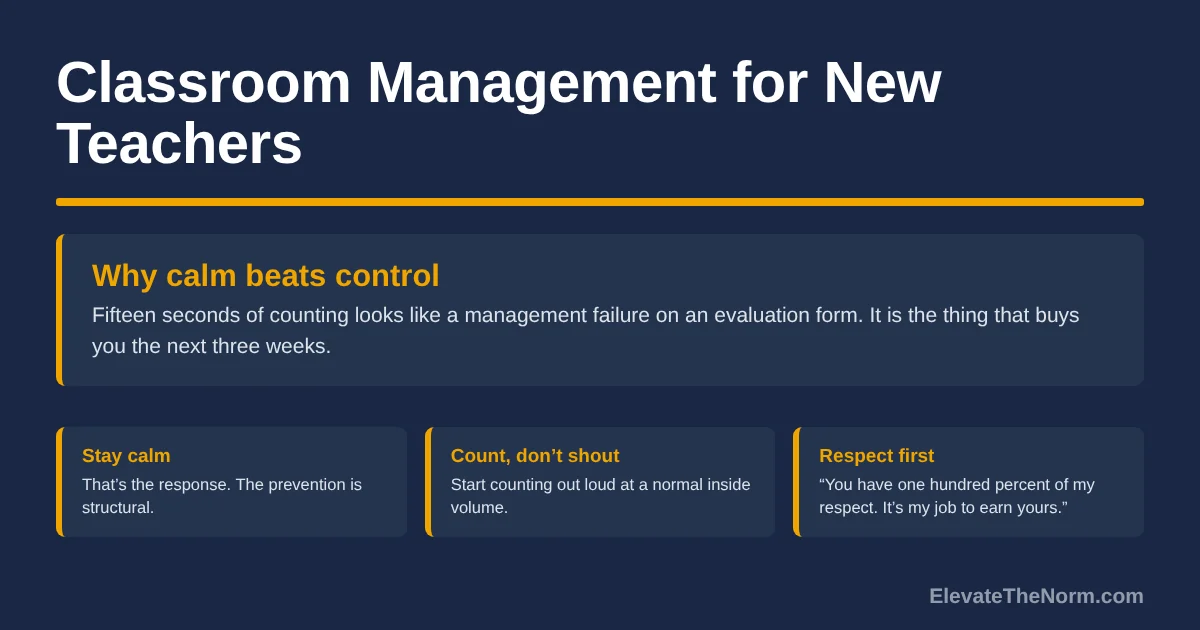
    I want to walk you through fifteen seconds that most evaluators would score as a classroom management failure.

    The room is loud. Students are up, moving, mid-project. I need them back. I don’t raise my voice — I start counting out loud at a normal inside volume. One. Two.

    By two, exactly one student has turned around and is looking at me.

    By the time I round ten, maybe half the class is seated. Somewhere around fourteen or fifteen, the students themselves start telling their peers to sit down and be quiet.

    Fifteen seconds. By any traditional classroom management rubric, that’s a long time to regain a room, and it looks bad on a walkthrough form. Here’s how you twist it — and why I’d take those fifteen seconds over a silent room I got by yelling. My De-escalation Strategies: 100 Scripts on TPT gives you word-for-word lines for the moments that start to go sideways.

    Why does a productive classroom look out of control?

    Because most students have almost no practice at it.

    Think about what we actually ask of a kid in a typical schedule. Sit down. Face forward. Work alone. Don’t talk. Then one day a teacher builds a lesson where students work in groups, get up, move around the room, and make their own decisions — and we’re surprised when it takes a while to run smoothly.

    They’re not being defiant. They’re inexperienced at something we rarely let them do.

    That inexperience is exactly why a student centered learning classroom needs more structure, not less — the container has to be built before the room can be handed over.

    So yes, they’ll get off topic. A group will spend ninety seconds talking about a game or somebody’s shoes. And here’s the question I’d ask any administrator watching that happen:

    If the group is productive and everyone is participating, does the ninety seconds actually matter?

    Think about your last faculty meeting. Or your last PD day. How would you feel if someone stood over you and corrected you for a side comment while you were, on the whole, doing the work?

    What should administrators give new teachers grace on?

    This is the part I’d put in front of every principal and instructional coach reading this.

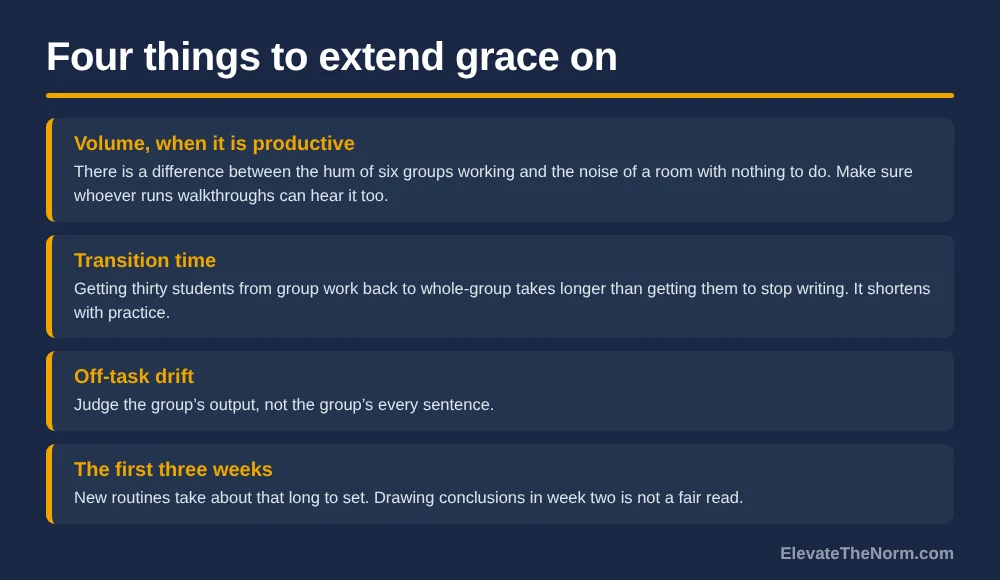
    Graphic titled Four things to extend grace on, listing productive volume, transition time, off-task drift and the first three weeks, each with what an administrator should look for instead.
    What administrators and coaches should extend grace on in a new teacher’s room.

    A new teacher who is genuinely trying to run a group-work classroom is going to have a louder, messier room than the veteran down the hall running rows and worksheets. That is not evidence of weaker classroom management. It’s evidence of a harder lesson design.

    Specific things worth extending grace on:

    • Volume, when it’s productive. There’s a difference between the hum of six groups working and the noise of a room with nothing to do. Learn to hear it, and make sure whoever conducts walkthroughs can hear it too.
    • Transition time. Getting thirty students from group work back to whole-group takes longer than getting them to stop writing. It shortens with practice.
    • Off-task drift. Judge the group’s output, not the group’s every sentence.
    • The first three weeks. New routines take about that long to set. Walking in during week two and drawing conclusions isn’t a fair read.

    If you evaluate a new teacher’s room on silence, you will train that teacher out of group work by October. They’ll go back to rows because rows are safe. And you will have gotten exactly what you measured. A room running project based learning well is loud in ways a silent room never is, and the standard you walk in holding decides which of the two you end up rewarding. That is why stated classroom expectations matter more than any single rule you could write down.

    What do you do when the room won’t settle?

    You stay calm. That’s it. That’s the whole technique, and it’s harder than it sounds.

    Calm is the response. The prevention is structural: most of what makes a room hard to settle is a set of routines nobody ever actually taught, so the class is improvising logistics while you are trying to teach. If you want the whole picture rather than the first move, here are the strategies that pay back most for the effort they cost, ordered by that trade.

    Some of what looks like a settling problem is a seating problem you have not looked at yet. Before you spend another week on tone and volume, it is worth checking what your seating chart is actually doing — who can see you, who you can reach quickly, and which corner of the room you have stopped walking into.

    You are the boss of that room. Nobody assigned that to you and nobody can take it away, which means you don’t have to prove it. Volume is what you reach for when you don’t believe that yet. The counting works because it is completely unbothered — it communicates that I have all the time in the world and this is going to happen either way. The same calm is what you are trying to bottle in plans you leave for a day you are not there.

    Patience isn’t passive. Patience is the demonstration.

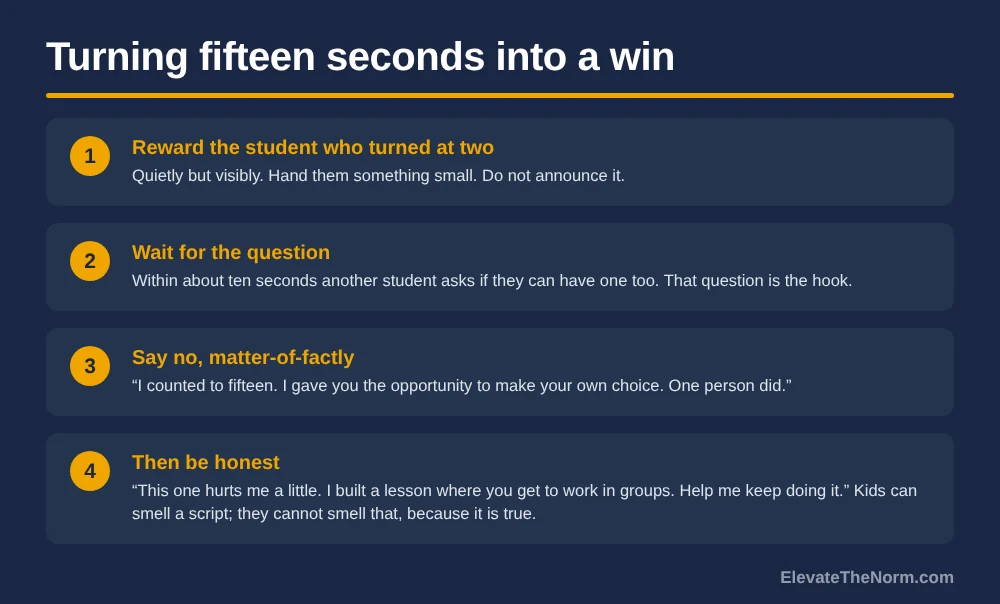
    How do you turn fifteen seconds into a win?

    Here’s the move, and it’s the most useful thing in this article.

    Four-step graphic titled Turning fifteen seconds into a win: reward the student who turned around first, wait for another student to ask, say no matter-of-factly, then be honest with the class about why the lesson design matters.
    The four-step move at the centre of the article, in order.

    You reward the student who turned around at two.

    I keep a supply of small items — clearance lots I buy in bulk off overseas sites, a few dollars for a big batch. Pencils work. Any small tangible thing works. And I go over to that one student, quietly but visibly, and hand them something.

    I don’t announce it. I don’t have to. Within about ten seconds, another student asks if they can have one too.

    That question is the hook. That’s what you’re listening for.

    And you say no. Not harshly — matter-of-factly:

    “No. I counted to fifteen. Fifteen seconds, everybody. I gave you the opportunity to make your own choice. I told you at the start of class to listen for my voice and turn toward me before the lesson began. One person did.”

    Then you be honest with them. This is the part most teachers skip, and it’s the part that lands:

    “I’ll be straight with you — this one hurts me a little. I built a lesson where you get to work in groups and move around this room. Do you know how rare that is? Most of your teachers can’t or won’t do it. I want to keep doing it. Help me keep doing it.”

    Kids can smell a script. They cannot smell that, because it isn’t one. It’s true.

    What you’ve just done has a name in the research literature: behavior-specific praise. You reinforced a precise behavior in a way the whole room could observe, instead of reprimanding the thirty who didn’t do it. There’s a real evidence base here — studies of teachers’ praise-to-reprimand ratios have found a direct positive relationship between how often teachers recognize positive behavior and how much on-task behavior they get, including in middle school classrooms and among students at risk for behavioral difficulties (Caldarella et al., 2020; Caldarella et al., 2023). why yelling backfires.

    You didn’t lose fifteen seconds. You bought the next three weeks. Stepping back to examine which moments actually landed is what structured teacher reflection is built for.

    Why not just use bonus points?

    I’d steer well clear of it.

    The second you attach behavior to the gradebook, the grade stops meaning “what this student knows” and starts meaning “what this student knows, plus how convenient they were.” That’s a problem when a parent asks what a 78 represents. It’s a bigger problem when a compliant student who understands nothing carries a B, and a student who understands the material but has a hard home life carries a D that’s really a behavior score in disguise.

    Keep the recognition tangible and keep it out of the grade. A dollar-store item does the job better than five points, and it doesn’t corrupt your data.

    Why does being kind feel risky to teachers?

    Because a lot of us were told, explicitly or not, that if students find out you’re nice, you lose the room.

    Yeah, nah.

    I understand where it comes from. It isn’t about the students personally — it’s fear. New teachers especially are afraid that warmth reads as weakness and that the room will take the first inch and run. So they open the year hard, and they spend the rest of it trying to climb back down from a posture they never wanted.

    Here’s what I actually say to students, before I’ve even introduced myself:

    “When you walk through that doorframe, you have one hundred percent of my respect. It’s my job to earn yours.”

    I mean it, and I can point to a moment every single year where I could have reasonably chosen anger and chose to take a breath instead. Not once has that cost me the room. Students who feel respected, trusted, and cared for eventually return the same. (For a deeper look at how mutual respect works in the classroom, that article covers the research and the daily practices.) It just takes time to get through the “I’m too cool for this” wall — and the teachers who never get through it are usually the ones who quit knocking in September.

    What does respect actually look like day to day?

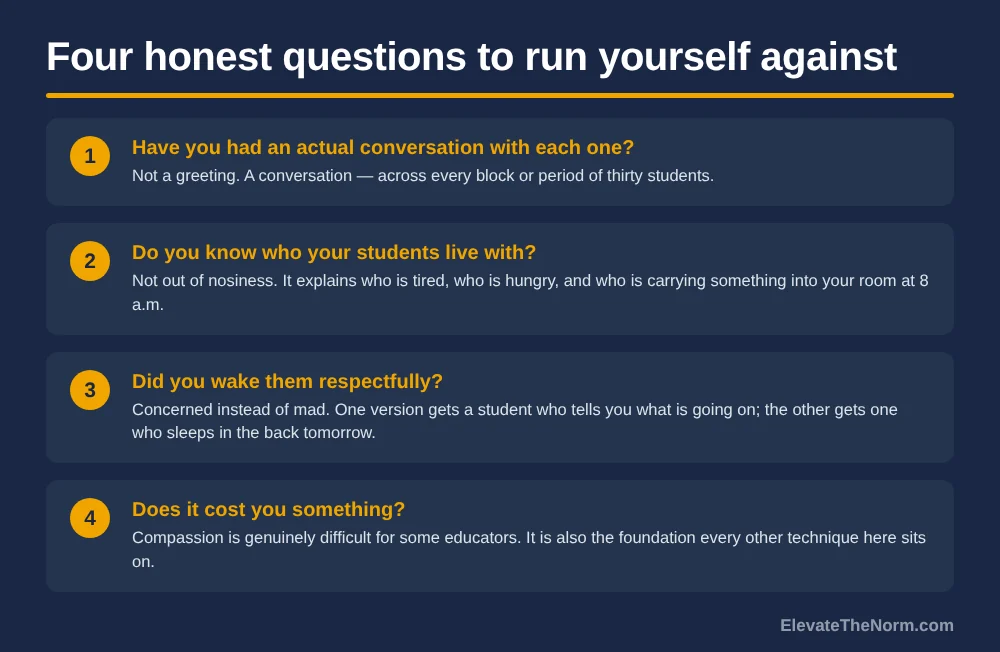
    It’s smaller and less dramatic than people expect. A few honest questions to run yourself against:

    Graphic titled Four honest questions to run yourself against, asking whether you have had a real conversation with each student, whether you know who they live with, whether you woke a sleeping student respectfully, and whether compassion costs you something.
    Four questions the article asks teachers to run themselves against.
    • You have three or four blocks, or seven periods, of thirty students. Have you had an actual conversation with each one? Not a greeting. A conversation.
    • Do you know who your students live with? Not out of nosiness — because it explains an enormous amount about who’s tired, who’s hungry, and who’s carrying something into your room at 8 a.m.
    • When you woke up the young man or young woman asleep at their desk, did you do it respectfully? Did you look concerned instead of mad? Because one of those gets you a student who tells you what’s going on, and the other gets you a student who sleeps in the back tomorrow.

    Compassion is genuinely difficult for some educators, and I don’t say that as an insult. It costs something. But it’s the entire foundation the rest of this sits on. Every technique in this article — the counting, the recognition, the honesty — fails immediately in a room where students don’t believe the adult actually cares about them.

    Calm holds up best when the standard is visible. The place to start is a short set of classroom expectations you actually teach and enforce consistently — that’s the structure calm stands on.

    Calm is also easier to hold when you are not running on empty, and that turns out to be mostly a question of how the job is structured across a full teaching load rather than a question of willpower.

    Frequently Asked Questions

    Isn’t counting to fifteen just letting students disrespect you?

    No — it’s refusing to trade your composure for compliance. A room you got quiet by yelling is quiet because students are managing your emotions. A room that settles because peers tell each other to settle is quiet because the students own it. The second one holds up when you have a substitute.

    What if I try this and nothing happens?

    The first two weeks are the hard part, especially with students who’ve never been given room to make choices. Expect it to feel like running into a rock. You chip away. Consistency is what makes it work, not any single moment.

    Does rewarding one student make the others resent them?

    In my experience, no — because the criteria are transparent and reachable. Everybody heard the count. Everybody knows exactly what that student did. Resentment shows up when rewards look arbitrary, not when they look earned.

    How much does a system like this cost?

    Very little. I run a three-tier recognition system in my own classroom for well under a hundred dollars a year, out of pocket. Bulk clearance lots go a long way.

    I’m a new teacher and my classroom management is genuinely struggling. Where do I start?

    Start with relationships, not consequences. Pick five students you know the least about and have a real conversation with each of them this week. Almost every management problem I’ve had traced back to a student I hadn’t taken the time to know yet. Once those relationships are solid, the next step is teaching responsibility without treating teenagers like children — building structures where students own their choices instead of just following orders.

    For teachers ready to move beyond management into meaningful student work, project based learning examples for grades 6–12 offer a practical starting point.


    References

    Caldarella, P., Larsen, R. A. A., Williams, L., Downs, K. R., Wills, H. P., & Wehby, J. H. (2020). Effects of teachers’ praise-to-reprimand ratios on elementary students’ on-task behaviour. Educational Psychology, 40(10), 1306–1322. https://doi.org/10.1080/01443410.2020.1711872

    Caldarella, P., Larsen, R. A. A., Williams, L., & Wills, H. P. (2023). Effects of middle school teachers’ praise-to-reprimand ratios on students’ classroom behavior. Journal of Positive Behavior Interventions, 25(1), 28–40. https://doi.org/10.1177/10983007211035185

    For a ready-to-adapt poster that pairs well with this advice, see Classroom Expectations Poster for Middle and High School Students.

    If you are still deciding what your five should say, borrow from these examples of classroom expectations. They are written observably and sorted by the kind of room you teach in, which makes the first-week conversation much easier to plan. For a ready-to-use tool on this, see a free classroom seating chart template. For a ready-to-use tool on this, see a free classroom routines and procedures checklist. For a ready-to-use tool on this, see a printable teacher reflection journal. And if the first year is already grinding you down, the research on why that happens is worth twenty minutes — along with what specifically makes year one heavier than the same job will be in year five — most of the biggest causes are not things a new teacher is doing wrong.

    The same problem appears in a sharper form on the days you are not there at all. If you are writing plans for someone else to run your room, it is worth knowing what a substitute can and cannot actually control before you write them.

    If you have never written one down, that is the place to start: what a classroom management plan actually contains is shorter and blunter than most templates suggest.


    About Clay Shumate
    Clay Shumate is a certified secondary Social Studies teacher in the public schools of West Alabama, with seven years of classroom experience, a B.A. in History, and an M.Ed. in Secondary Education. He writes about project-based learning, student responsibility, respect, and practical ways to hold young people to a higher standard while giving them room to learn from mistakes. He is a member of the Society of Professional Journalists and writes to its Code of Ethics; this site’s editorial standards and corrections policy are published in full. More about Clay.
  • What Project Based Learning Actually Is

    What Project Based Learning Actually Is

    By Clay Shumate

    Part of the project-based learning guide, which collects the examples, the planning template, and the rest of the PBL writing on this site in one place.

    I’ve watched project based learning get rolled out in three different buildings now, and it goes the same way almost every time.

    Somebody presents a slide deck during August PD. Teachers nod. There’s a handout. And by the second nine weeks, “project” has quietly come to mean a poster board with a rubric stapled to it, turned in on a Friday, graded over the weekend, and forgotten by Monday.

    That’s not PBL. That’s a craft project with a due date.

    I’m not saying that to be difficult. I’m saying it because the gap between what PBL is and what it usually becomes is the single biggest reason it gets written off in schools that could benefit from it most. So let’s fix the definition first, and then I’ll tell you what to actually look for when you walk into a room.

    Key Takeaways

    • Project based learning is a teaching method where students investigate a complex, authentic question over an extended period and build a product for a real audience. The project is how the learning happens, not what happens after it.
    • The test that separates PBL from a regular project is sequence. In a dessert project, content is taught first and the product comes last. In PBL, the challenge comes first and content is taught at the point of need.
    • PBLWorks names seven Gold Standard design elements. If four of them are missing, what you are looking at is a project, not PBL.
    • You can read a room in about ninety seconds by asking who is doing the thinking, where the teacher is standing, what is on the wall, and who sees the final product.
    • PBL is harder in high-need classrooms, and the reasons are structural rather than a judgment about students.

    What is project based learning?

    Project based learning is a teaching method where students build knowledge and skills by working over an extended period — anywhere from a week to a semester — to investigate a complex, authentic question, and then create a product they present to a real audience. (For a deeper look at what makes those audiences and products genuine, see real world learning.)

    The key word in there is extended. And the key idea is one sentence long:

    The project isn’t what happens after the learning. The project is how the learning happens.

    That’s the whole shift, and the difference is sequence rather than activity. In a traditional unit, I teach the content, I test the content, and then if there’s time left, students make something to show they learned it. In PBL, students are handed the challenge on day one — before they know enough to solve it — and the content gets taught along the way because they need it to finish the build.

    What’s the difference between a project and project based learning?

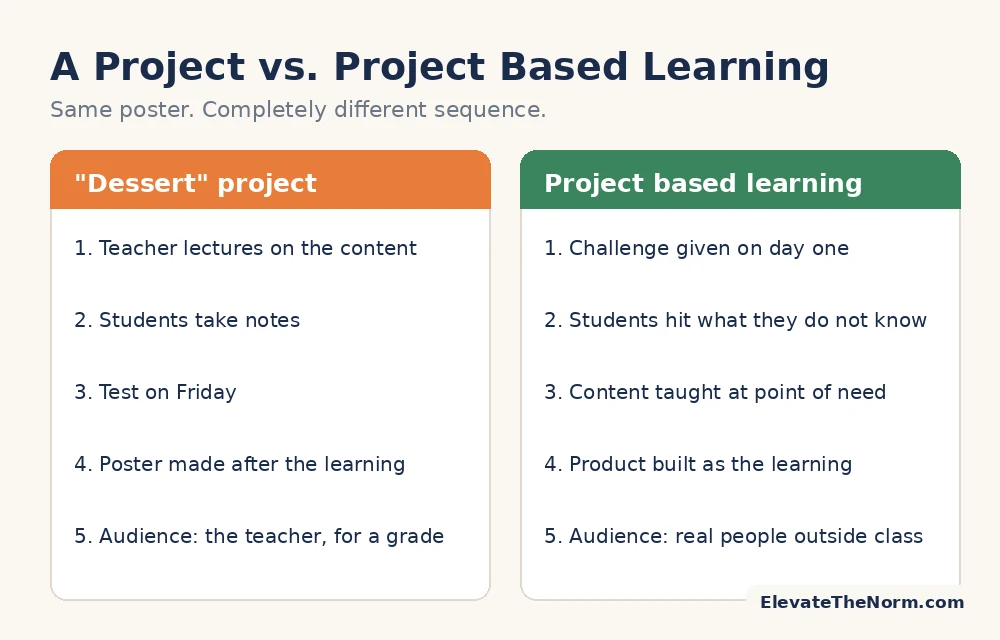
    PBLWorks, the organization that essentially wrote the modern playbook on this, has a name for the poster-board version: “dessert” projects — fun but lightweight. The project is the treat at the end of the meal. In real PBL, the project is the meal.

    Here’s what that looks like in my own subject.

    Dessert version: Two weeks of lecture and notes on the Columbian Exchange. Test on Friday. Then students make a poster showing crops that went east and crops that went west.

    Main course version: Day one, students learn they’re a curation team building a museum exhibit that answers one question — Who gained and who lost in the Columbian Exchange, and who decides? They have three weeks. There will be an audience: another class, a parent night, a panel of adults, somebody real. Now they have to know the crops. They have to know the disease numbers. They have to know the encomienda system, because a visitor is going to ask them about it and they’ll be standing there.

    Same standards. Same content. I still lecture. I still give notes, still give quizzes, still stand up front and directly teach when they need something. That’s worth saying clearly, because it’s the most common misunderstanding I run into with administrators:

    PBL does not mean no direct instruction. It means direct instruction shows up when students have a reason to need it. The teacher is more present in a good PBL classroom, not less.

    If you’re deciding between the two approaches, see our evidence-based comparison of project based learning vs traditional learning, including randomized trials, meta-analyses, and where direct instruction still performs better.

    Side-by-side five-step comparison showing a dessert project sequence against a project based learning sequence
    The poster can look identical. The sequence is what makes it PBL.

    What are the seven elements of high-quality PBL?

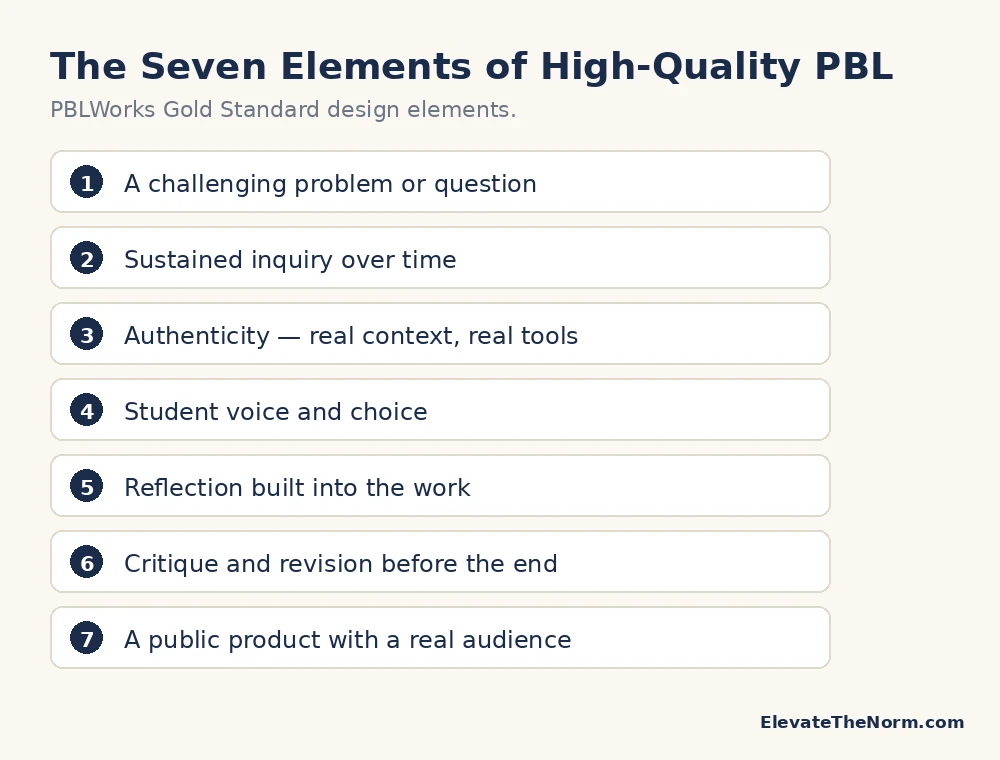
    If you want a defensible standard for what counts, the Gold Standard PBL framework lists seven essential project design elements: a challenging problem or question, sustained inquiry, authenticity, student voice and choice, reflection, critique and revision, and a public product. That framework comes out of Larmer and Mergendoller’s work at the Buck Institute, and it’s the closest thing the field has to a common language. The authenticity element in that framework overlaps with but is distinct from authentic learning as a broader quality standard — one that applies to lectures, discussions, and other formats beyond project-based work.

    Here’s my working translation of each one:

    1. Challenging problem or question — There’s a real question on the wall, and it doesn’t have a Google answer.
    2. Sustained inquiry — This runs for weeks, not a class period. Students go find things out.
    3. Authenticity — It connects to something outside the building, or to the students’ actual lives.
    4. Student voice and choice — They make real decisions about the product, not just which marker color.
    5. Reflection — Built into the process, not just a paragraph at the end.
    6. Critique and revision — Drafts get torn apart and rebuilt. This is the one most classrooms skip.
    7. Public product — Somebody other than the teacher sees it. That’s the accountability engine.

    If you’re evaluating a unit and four of those seven are missing, you’re looking at a dessert project. That’s not a crime — dessert projects have their place — but don’t put it in a school improvement plan as PBL.

    Numbered list of the seven PBLWorks Gold Standard design elements of high-quality project based learning
    PBLWorks’ seven Gold Standard design elements, in plain language.

    What should I look for during a walkthrough?

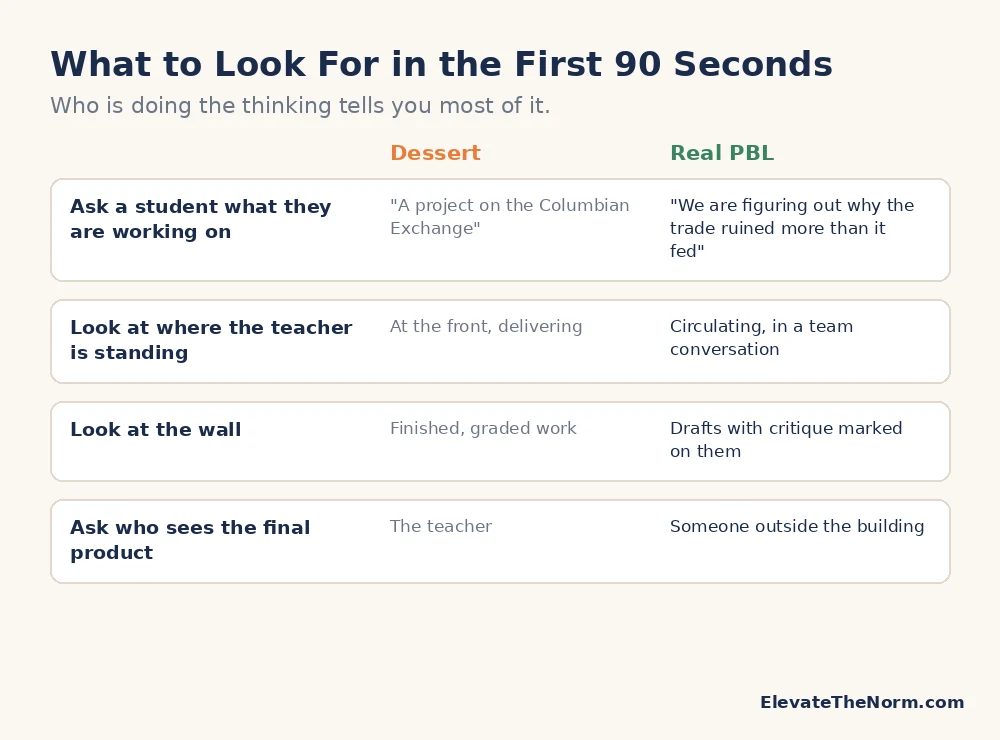
    This is the practical part. A PBL classroom looks chaotic to an untrained eye, and a bad one looks exactly like a good one for the first ninety seconds. Here’s how to tell them apart:

    • Ask a random student what the driving question is. Not the assignment — the question. If three kids in a row can’t tell you, the project has no spine.
    • Look for a visible “need to know” list. Good PBL teachers keep a running list of what students have realized they don’t know yet. If it’s been updated recently, inquiry is actually happening.
    • Ask to see a draft. Then ask to see the version before it. If there’s only one version, critique and revision isn’t real.
    • Find out who’s going to see the final product. “Me” is the wrong answer.
    • Watch the teacher for five minutes. Are they conferencing with small groups, redirecting, pulling a mini-lesson? Or are they at the desk while students “work on their projects”? The second one is the failure mode.
    • Check that content is still being taught. Ask the teacher which standards this unit covers and where the direct instruction lives. A good PBL teacher answers that in about four seconds.
    Four-row comparison table of what a dessert project looks like versus real project based learning during a classroom walkthrough
    Four questions that separate a real PBL room from a poster factory.

    Why is PBL harder in high-need classrooms — and why is it worth doing anyway?

    I’ll be honest with you: the first two weeks are brutal.

    For a complete breakdown of these elements and what separates genuine PBL from regular projects, see the formal definition of project based learning.

    Students who’ve spent years being handed worksheets do not know what to do with an open question. You give them autonomy and they hand it right back. It feels like running into a rock. Teachers who quit PBL almost always quit in that window, and they conclude their kids “can’t handle it.”

    Their kids can handle it. They just haven’t been asked to before.

    You chip away. And somewhere around week three, something turns over, and you’ve got a room of students working together instead of alone. That’s the part that doesn’t show up on a benchmark assessment and matters more than most of what does.

    I spent years in retail management before I taught. At one point I was sorting through roughly 400 active applicants at a time, and I want to tell you what I was actually screening for in an interview — because it wasn’t retail experience. I’d hand a candidate a notepad and tell them to write down five things wrong with my store, then explain them to me. I was listening for how they spoke. Whether they could disagree with me without getting defensive. Whether they could work a problem out loud.

    Those are the exact skills a real project builds and a worksheet cannot. I’ve had the same thing confirmed on the field — across the athletes who came through the program I built, I could count on one hand the ones who didn’t graduate with a 3.0 or better. Not because I taught them content. Because they were on the hook for something bigger than themselves and other people were counting on them.

    That’s what a public product does in a classroom.

    What does a teacher need from you to make this work?

    Short list, and none of it costs money:

    • Planning time, not another initiative. A first PBL unit runs about four or five hours to build — less than most people assume. But it needs to be four or five uninterrupted hours, not stolen twenty minutes at a time between duty and a parent call. Fragment it and you get a half-built project, and the kids can tell within a day.
    • Air cover on noise. A working PBL room is loud. Make sure whoever does walkthroughs knows the difference between productive loud and unproductive loud, or your teachers will shut it down to protect their evaluation.
    • Don’t mandate it building-wide in year one. Find two or three willing teachers, let them run one unit, and let the results recruit for you. Mandated PBL produces compliance projects.
    • Schedule flexibility for the public product. Presentation day is the whole point. If a teacher can’t get 90 minutes or a room or a few outside adults, the seventh element quietly disappears.

    For the step-by-step sequence — from driving question to public product — see 7 steps of project based learning.

    Frequently Asked Questions

    Does PBL work with state standards, or does it compete with them?

    It works with them, but only if the standards drive the project design instead of getting reverse-engineered afterward. Build the unit from the Course of Study first, then find a driving question that requires those standards to answer.

    How long should a first project be?

    Two to three weeks. Do not start with a semester-long capstone. The first one is about the teacher learning to run the room, not about the product.

    Does planning a project get easier?

    Considerably, and faster than you’d expect. The first one takes four or five hours because you’re building the scaffolding and the rubric from nothing. After two or three, it starts to just flow out of your brain — you can visualize the whole thing before you write any of it. Good, bad, and ugly. You can see which group is going to stall in week two and where the driving question is going to get too easy, and you plan around it up front. That’s the point where PBL stops being an initiative and starts being how you teach.

    How do you grade it?

    Separately. Content knowledge gets assessed the way you’d normally assess it — quizzes, writing, whatever you already use. The collaboration and product get a rubric of their own. Grading them as one blended number is how you end up with a student who learned nothing riding a good group to an A.

    Is PBL appropriate for struggling readers and students below grade level?

    Yes, and arguably more so. The scaffolding looks different — more structured roles, shorter checkpoints, more explicit modeling — but the motivation problem PBL solves is usually bigger than the reading gap it has to work around.

    What’s the single most common reason PBL fails in a building?

    Nobody protected the teacher’s planning time, and the project got launched half-built. The kids can tell within a day.


    If you’re considering this in your building, start with one teacher and one unit. Walk in on week two, when it looks like it’s falling apart, and don’t panic. Then walk in on week three.

    Looking for concrete classroom examples? See 25 project based learning examples for middle and high school — each one built around a real driving question and a public product.

    Once the definition is clear, the next question is usually what to actually run. Start with these ideas for project based learning—fifty of them, sorted by subject and grade band, each built around an audience outside the classroom.


    About Clay Shumate
    Clay Shumate is a certified secondary Social Studies teacher in the public schools of West Alabama, with seven years of classroom experience, a B.A. in History, and an M.Ed. in Secondary Education. He writes about project-based learning, student responsibility, respect, and practical ways to hold young people to a higher standard while giving them room to learn from mistakes. He is a member of the Society of Professional Journalists and writes to its Code of Ethics; this site’s editorial standards and corrections policy are published in full. More about Clay.
  • Yelling Doesn’t Restore Order. It Manufactures It.

    Yelling Doesn’t Restore Order. It Manufactures It.

    By Clay Shumate

    Yelling works.

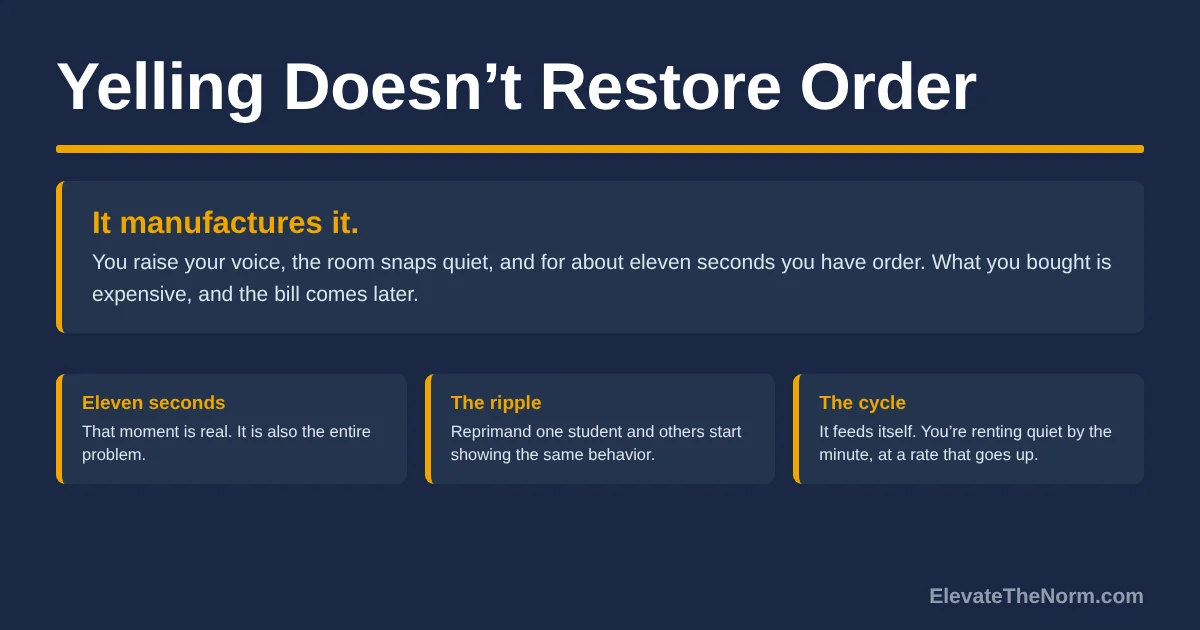
    I want to start there, because pretending it doesn’t is how you lose every teacher who has ever done it — which is every teacher. You raise your voice, the room snaps quiet, and for about eleven seconds you have order. That moment is real. It is also the entire problem.

    Because what you just bought with those eleven seconds is expensive, and the bill comes later in the period, later in the week, and later in the year.

    What actually happens when a teacher yells?

    A reprimand suppresses behavior in the moment without reducing it over time. That’s not an opinion, and it’s been measured directly in classrooms.

    Researchers followed 149 teachers across 19 elementary schools in three states, observing 311 students considered at risk for emotional and behavioral disorders. Using a cross-lag analysis — which tests whether one thing predicts another later — they found that teacher reprimands did not decrease students’ future disruptive behavior or increase their engagement, and that while reprimands may briefly suppress misbehavior, they don’t appear effective at reducing disruption or improving engagement over time (Caldarella et al., 2021).

    Read that carefully, because it’s a strange result. The reprimand does stop the behavior right now. It just doesn’t produce a calmer room tomorrow. You’re not building anything. You’re renting quiet by the minute, at a rate that goes up. If you want language ready before the conflict starts, my De-escalation Strategies: 100 Scripts on TPT covers the situations that come up in grades 6–12.

    Why does yelling at one student make the whole room worse?

    This is the part that most directly answers the question in the title, and it’s the oldest finding in classroom management.

    In the 1950s, psychologists Jacob Kounin and Paul Gump documented something counterintuitive: when a teacher responded to one disruptive student with strict disciplinary measures, that student might stop — but other students would start exhibiting the same misbehavior. They called it the ripple effect, and their conclusion was that a teacher trying to control ripple effects does it better through clear instruction than through pressure on the individual (Kounin & Gump, 1958).

    So the volume doesn’t contain the disruption. It broadcasts it.

    Everyone in the room just watched what happens when the adult loses composure. Some students file that away as a threat. Some file it away as entertainment. A few file it away as a button they now know how to press. None of them file it away as I should get back to work.

    That is what I mean by manufactured chaos. The yelling didn’t respond to disorder. It produced more of it, in more people, a few minutes downstream.

    The escalation game

    There’s a specific trap waiting for a teacher who tries to win an argument with a student who has decided not to comply.

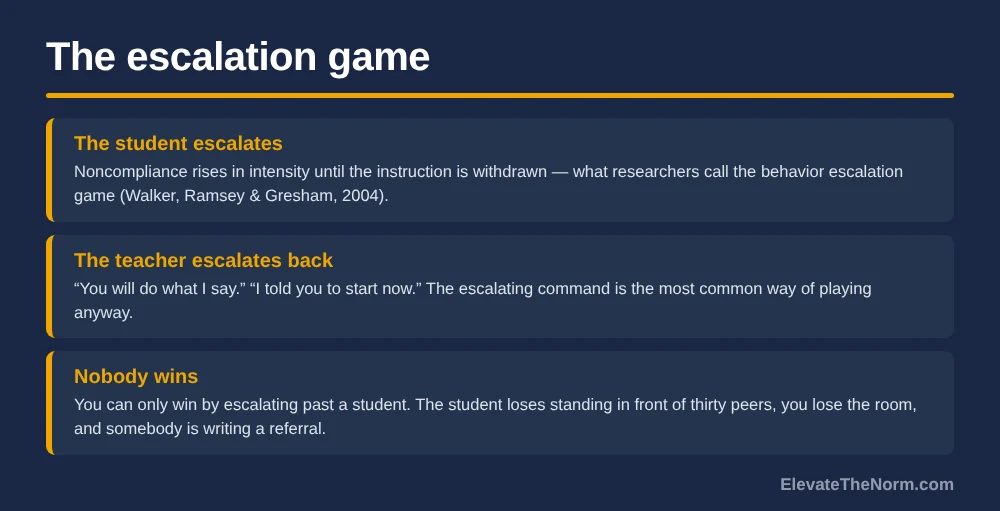
    Graphic titled The escalation game showing three stages: the student escalates noncompliance until the instruction is withdrawn, the teacher escalates back with commands, and nobody wins because the student loses standing, the teacher loses the room and a referral gets written.
    The escalation game, and why a teacher cannot win it.

    Some students arrive at school already fluent in coercion — they’ve had years of practice at home learning exactly how hostile exchanges escalate and which behaviors eventually make an adult back down. When a teacher issues an instruction these students don’t want to follow, they escalate their noncompliance to higher and higher intensity until the instruction is withdrawn — what researchers call the behavior escalation game, and it’s a game teachers cannot win and should not play (Walker, Ramsey, & Gresham, 2004; Walker, 1995).

    The escalating command — “You will do what I say.” “I told you to start now.” — is the most common version of playing anyway.

    Here’s the thing about that game. You can only win it by escalating past a student, and there is no version of an adult escalating past a fifteen-year-old that ends with either of you better off. The student loses standing in front of thirty peers. You lose the room. Somebody’s writing a referral.

    The cycle: how it feeds itself

    The most important research here comes from parenting, not teaching, and I’m going to be upfront about that limitation rather than pretend the transfer is airtight.

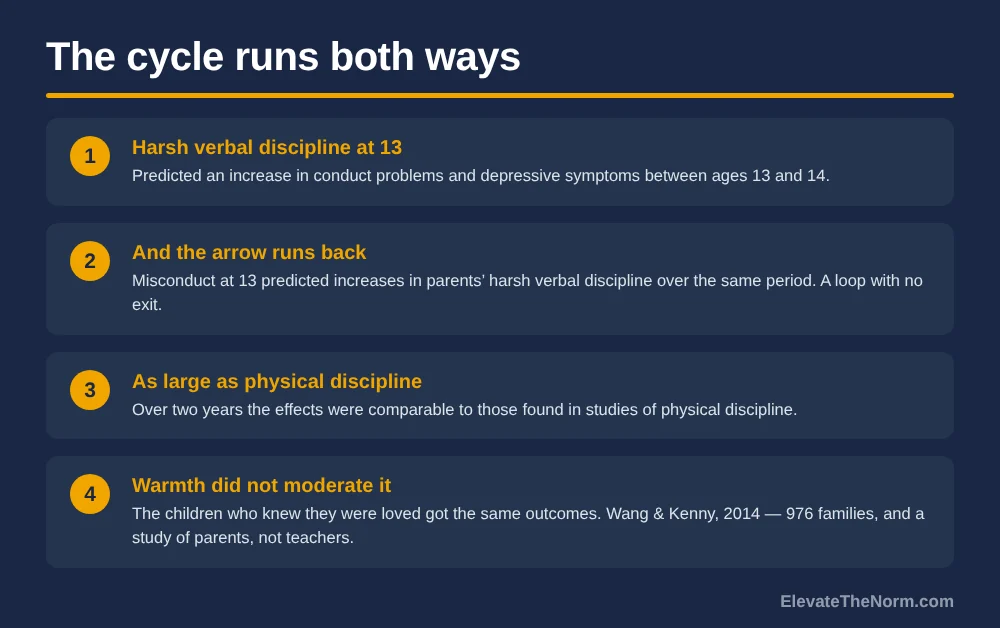
    Graphic titled The cycle runs both ways summarising Wang and Kenny 2014: harsh verbal discipline at 13 predicted more conduct problems at 14, misconduct predicted more harsh discipline, effects were comparable to physical discipline, and parental warmth did not moderate them.
    What Wang and Kenny found, including the limitation that it studied parents rather than teachers.

    Wang and Kenny followed 976 two-parent families and their children over two years. Harsh verbal discipline by mothers and fathers at age 13 predicted an increase in adolescent conduct problems and depressive symptoms between ages 13 and 14 — and a child effect ran the other direction too, with misconduct at 13 predicting increases in parents’ harsh verbal discipline over the same period (Wang & Kenny, 2014).

    Both arrows. The shouting produced more misbehavior, and the misbehavior produced more shouting. That’s not a discipline strategy, that’s a loop with no exit.

    Two more findings from that study are worth sitting with. The negative effects of verbal discipline over two years were comparable to those found in studies of physical discipline over the same period. And warmth did not moderate the relationship at all — meaning the belief that it’s fine because they know you care about them does not hold up. The kids who knew they were loved got the same outcomes.

    Again: that’s a study of parents, not teachers. But if a caring adult with a lifelong bond can’t yell without cost, the case that a teacher gets a pass is thin.

    So why do we keep doing it?

    Because it’s reinforced, and the reinforcement schedule is brutal.

    The behavior stops. You got quiet. If misbehavior stops, the teacher’s reprimanding behavior is reinforced, and teachers continue to use reprimands (Caldarella et al., 2021). You’ve just been rewarded for the thing that’s making your year harder, and the reward arrived within a second while the cost arrives in three weeks. Nobody’s brain is built to weight that correctly.

    There’s also a cost the teacher absorbs directly. Research in classrooms implementing schoolwide positive behavior supports found that teachers with lower ratios of positive to negative interaction, who used higher rates of harsh reprimands and had higher rates of disruption, reported higher levels of emotional exhaustion (Reinke, Herman, & Stormont, 2013).

    Which direction that runs is genuinely hard to untangle, and I won’t claim more than the data supports. But if you’ve ever driven home from a day where you yelled and felt hollowed out, that feeling is in the literature — and hollowed-out is one of the recognized warning signs rather than a personal failing.

    Would you accept it?

    Set the research aside for a second.

    Picture your last faculty meeting. Now picture an administrator standing at the front of it and shouting at you, by name, in front of every colleague you work with, for checking your phone.

    What would you do? Would you feel corrected? Would you feel motivated? Or would you spend the rest of that meeting composing what you wished you’d said, deciding exactly how much you’re willing to give that person going forward, and telling three people about it in the parking lot?

    Now recognize that you’d be doing that as a fully-formed adult with a mortgage and a retirement account and every reason in the world to keep your composure.

    We’re asking a fourteen-year-old to handle the same thing better than we would. They’re not going to, and it isn’t because they’re immature. It’s because being humiliated in front of your peers is a real injury at any age, and the response to it is the same at any age. The difference between us and them is not the reaction. It’s only the number of times we’ve practiced swallowing it.

    What to do instead

    None of this is useful if the alternative is just “don’t yell.” Here’s what actually replaces it.

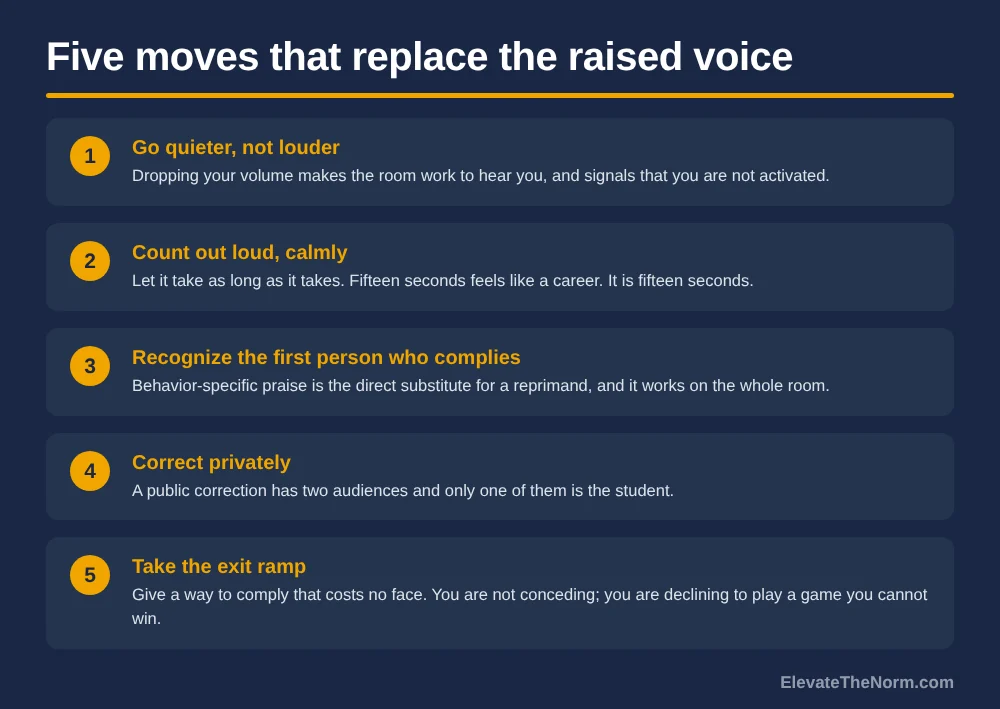
    Graphic titled Five moves that replace the raised voice: go quieter not louder, count out loud calmly, recognize the first person who complies, correct privately, and take the exit ramp instead of escalating.
    Five replacements for the raised voice, in the order they are usually needed.

    Go quieter, not louder. Dropping your volume forces the room to work to hear you. It also signals that you are not activated, which is the single most stabilizing thing an adult can communicate in a loud room. It is the first of several techniques that hold a room without raising your voice.

    Count out loud, calmly, and let it take as long as it takes. I’ve had it take fifteen seconds. Fifteen seconds feels like a career. It’s fifteen seconds.

    Recognize the first person who complies, out loud and specifically. Behavior-specific praise is the most direct substitute for a reprimand, and it works on the whole room instead of one student. Three years of classroom research found a direct positive relationship between teachers’ praise-to-reprimand ratios and students’ on-task behavior, including in middle school and among students at risk for behavioral difficulties (Caldarella et al., 2020; Caldarella et al., 2023). I’ve written about how I use this in classroom management for new teachers.

    Correct privately whenever the situation allows it. A public correction has two audiences and only one of them is the student. (For more on how to handle correction while preserving respect in the classroom, that piece covers the close-range redirect and why it works.) Pull alongside the desk. Say it low. Walk away. You’ve preserved their standing, which means they have nothing to defend and no reason to perform.

    Take the exit ramp instead of playing the game. When a student escalates, the move is to give them a way to comply that doesn’t cost them face: a choice between two acceptable options, a delay, a job to do. You are not conceding. You’re declining to play a game you can’t win.

    And when you do yell anyway

    You will. I have.

    The repair matters more than the lapse, and it’s simpler than people think. You go to the student — privately, not as a performance for the room — and you say something close to: I raised my voice at you and that was on me. I’ll do better. Here’s what I still need from you.

    That’s it. No speech. No trading your apology for their apology.

    I’ll tell you what that does, because it surprised me the first time. It teaches a young person what accountability looks like from someone who has power over them, which for some students in your room is genuinely new information. And it costs you nothing you were actually using. Adults who apologize don’t lose authority. Adults who never do just quietly lose the room instead, one student at a time, in a way nobody announces. My Restorative Conversation Scripts on TPT keep the repair conversation calm and focused on what happens next.

    Frequently Asked Questions

    Is raising my voice ever appropriate?

    Yes — for safety. A fight, a lab accident, something about to get somebody hurt. Volume is a legitimate emergency tool, and it works in an emergency precisely because you don’t use it the rest of the time. Spend it on Tuesday and it isn’t there on Friday.

    What if my students only respond to yelling?

    That’s usually a sign the room has been trained on it, not that the students require it. The escalation research explains why: if volume is the only signal that means this time I’m serious, everything below that volume has been taught to mean not yet. Rebuilding takes a few weeks of consistency, and the first two are the hard ones.

    Does this mean I shouldn’t have consequences?

    No. Calm and permissive aren’t the same thing. A consequence delivered quietly is usually more effective than one delivered loudly, because the student can actually hear it instead of managing their own adrenaline. For a deeper look at consequences that actually teach responsibility, see Teaching Responsibility Without Treating Teenagers Like Children.

    I’m an administrator. What should I do about a teacher who yells?

    Almost certainly not write them up first. Yelling is usually a symptom of a teacher who’s out of tools and out of gas, and punishing them replicates the exact dynamic the article is about. Ask what’s happening in that room. Then get them a real strategy, coverage to observe someone calmer, or both.


    References

    Caldarella, P., Larsen, R. A. A., Williams, L., Downs, K. R., Wills, H. P., & Wehby, J. H. (2020). Effects of teachers’ praise-to-reprimand ratios on elementary students’ on-task behaviour. Educational Psychology, 40(10), 1306–1322. https://doi.org/10.1080/01443410.2020.1711872

    Caldarella, P., Larsen, R. A. A., Williams, L., & Wills, H. P. (2023). Effects of middle school teachers’ praise-to-reprimand ratios on students’ classroom behavior. Journal of Positive Behavior Interventions, 25(1), 28–40. https://doi.org/10.1177/10983007211035185

    Caldarella, P., Larsen, R. A. A., Williams, L., Wills, H. P., & Wehby, J. H. (2021). “Stop doing that!”: Effects of teacher reprimands on student disruptive behavior and engagement. Journal of Positive Behavior Interventions, 23(3), 163–173. https://doi.org/10.1177/1098300720935101

    Kounin, J. S., & Gump, P. V. (1958). The ripple effect in discipline. The Elementary School Journal, 59(3), 158–162.

    Reinke, W. M., Herman, K. C., & Stormont, M. (2013). Classroom-level positive behavior supports in schools implementing SW-PBIS: Identifying areas for enhancement. Journal of Positive Behavior Interventions, 15(1), 39–50.

    Walker, H. M. (1995). The acting-out child: Coping with classroom disruption (2nd ed.). Sopris West.

    Walker, H. M., Ramsey, E., & Gresham, F. M. (2004). How disruptive students escalate hostility and disorder — and how teachers can avoid it. American Educator, 27(4).

    Wang, M.-T., & Kenny, S. (2014). Longitudinal links between fathers’ and mothers’ harsh verbal discipline and adolescents’ conduct problems and depressive symptoms. Child Development, 85(3), 908–923. https://doi.org/10.1111/cdev.12143 For a ready-to-use tool on this, see free classroom transition examples.


    About Clay Shumate
    Clay Shumate is a certified secondary Social Studies teacher in the public schools of West Alabama, with seven years of classroom experience, a B.A. in History, and an M.Ed. in Secondary Education. He writes about project-based learning, student responsibility, respect, and practical ways to hold young people to a higher standard while giving them room to learn from mistakes. He is a member of the Society of Professional Journalists and writes to its Code of Ethics; this site’s editorial standards and corrections policy are published in full. More about Clay.
Teacher Emergency Toolkit — practical resources, real classroom support. Shop on TPT.Teacher Emergency Toolkit — practical resources, real classroom support. Shop on TPT.