The Elevate Blog banner: Real Classrooms. Practical Ideas. Higher Expectations. Three students climb a rocky ridge at sunrise, each pulling the next one up, toward a teacher reaching down to help.

Author: Clay Shumate

  • Classroom Consequences That Teach Instead of Humiliate

    Classroom Consequences That Teach Instead of Humiliate

    Classroom Consequences That Teach Instead of Humiliate

    By Clay Shumate

    Classroom consequences are the responses a teacher uses when a student’s behavior falls below the standard. Consequences that teach are related to the behavior, respectful of the student and realistic to enforce, and they end with a short repair conversation. Public shaming, busywork and removal as a first step punish the student without teaching anything.

    Classroom consequences are the responses a teacher uses when a student’s behavior or choices fall below the standard. Good consequences are predictable, proportionate, connected to the behavior, and respectful enough that the student can still learn from the experience. Bad consequences punish the person instead of addressing the problem. Here’s how to design consequences that teach, and how to avoid the ones that just make teenagers resentful.

    Key Takeaways

    • Classroom consequences and punishment aren’t the same thing: a consequence aims to teach, and a punishment aims to hurt enough to stop the behavior.
    • Effective classroom consequences are related to the behavior, respectful of the student and realistic to carry out, a test often called the three R’s.
    • Natural consequences happen without teacher intervention, while logical consequences are designed by the teacher to connect to the behavior.
    • Humiliation, public call-outs and disproportionate responses damage the teacher-student relationship and don’t teach the behavior you want.
    • A short repair conversation after a classroom consequence, asking what happened, who was affected and what the student will do, is where most of the learning happens.

    Free Printable: Classroom Consequence Planning Sheet

    A one-page teacher reference with the 3 R’s checklist, a behavior-response planner you fill in for your own class, and the three-question repair conversation framework. Print it and keep it at your desk.

    Download Free Planning Sheet (PDF)

    What Is the Difference Between Consequences and Punishment?

    A classroom consequence helps a student understand and repair the impact of a behavior; a punishment tries to make the student uncomfortable enough to stop. Many teachers say “consequences” and deliver punishment, and the difference changes what the student learns.
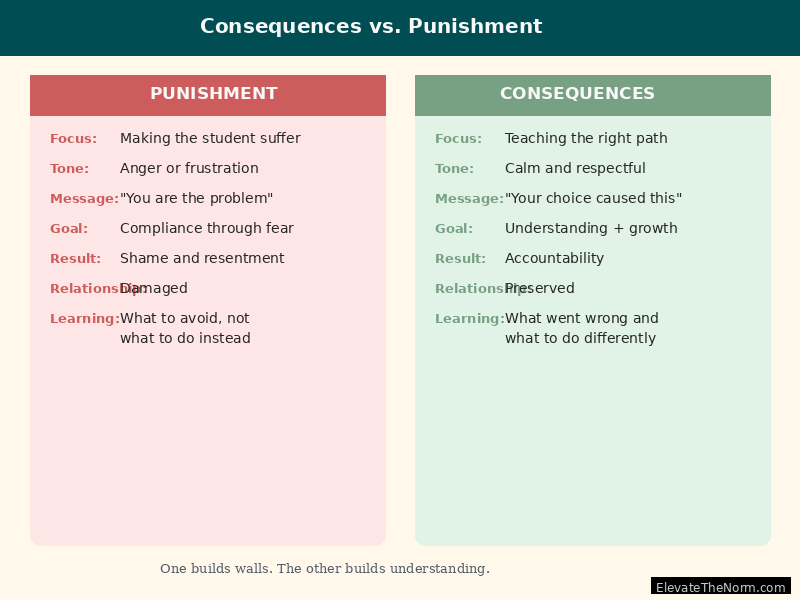
    Side-by-side comparison showing how classroom consequences differ from punishment in focus, tone, message, goal, and result
    One builds walls. The other builds understanding.

    Punishment is designed to cause enough discomfort that the student stops the behavior. It focuses on the adult’s power and the student’s suffering. A student who talks during instruction gets assigned a 500-word essay on respect. A student who is late gets locked out of the classroom. A student who forgets materials sits with nothing to do for the entire period. The message is: you made a mistake, and now you pay. A consequence that teaches needs something written down and owed back, which is what a repair-and-return sheet is for.

    Consequences are designed to help the student understand the impact of their behavior and take responsibility for repairing it. A student who talks during instruction has a brief private conversation about what they missed and what the expectation is. A student who is late makes up the missed work on their own time. A student who forgets materials uses a loaner set and brings their own the next day. The message is: you made a mistake, and here is what you do about it. If you want the exact words for that follow-up talk, my Restorative Conversation Scripts on TPT give you a script for each step.

    The Responsive Classroom framework separates the two by purpose. Punishment aims “to enforce compliance with the rules by using external controls,” while logical consequences aim to help students develop “internal understanding, self-control, and a desire to follow the rules,” the foundation of real student responsibility (Responsive Classroom, 2024).

    The research on punishment points the same way. A 2026 meta-analysis in Frontiers in Psychology pooled 18 effect sizes covering more than six million participants, all from middle school, high school or mixed secondary samples, and found a weak but statistically significant negative association between teacher punishment, mostly suspension and other exclusionary discipline, and academic achievement (r = −0.183, p < 0.001). The authors say to read it as correlational evidence, so it doesn’t prove punishment causes lower grades. It does mean punishment shows no sign of helping them (Li et al., 2026).

    What Are the Types of Classroom Consequences?

    Classroom consequences come in three types: natural consequences, which follow from a behavior without the teacher doing anything; logical consequences, which the teacher designs to connect to the behavior; and restorative consequences, which add repair of the relationship.

    Knowing the types helps a teacher choose a response instead of defaulting to the most convenient one.

    Natural consequences

    These happen without any teacher intervention. A student who does not study performs poorly on the assessment. A student who does not participate in the group project has nothing to present. A student who does not bring supplies to class falls behind on the day’s work.

    Natural consequences are powerful because they come from reality, not from an adult’s decision. The student cannot argue with them, resent the teacher for imposing them, or claim the system is unfair. The work simply did not get done, and the result is what the result is.

    For a deeper look at how natural consequences work—and when they do not—see natural consequences in the classroom.

    But natural consequences have limits. They only work when the natural outcome is safe, timely, and genuinely experienced by the student. A student who runs in the hallway might fall—but you do not wait for that to happen. A student who cheats might not get caught until the consequences are permanent. And some natural consequences fall hardest on students who already have the fewest resources, which is not teaching—it is neglect.

    Logical consequences

    These are teacher-designed responses that connect directly to the behavior. They are the backbone of effective classroom discipline in grades 6–12.

    Responsive Classroom names three logical consequences for teachers to choose from (Responsive Classroom, 2024):

    1. Loss of privilege. The student temporarily loses access to something related to the misuse. A student who misuses a laptop loses laptop access for the rest of the period. A student who abuses the freedom to choose a seat returns to an assigned seat.
    2. Break it, fix it. The student repairs the damage they caused. A student who makes a mess cleans it up. A student who damages a relationship makes a direct apology. A student who disrupts a lesson contributes positively to the next one.
    3. Space and time. The student takes a brief break from the activity to reset. This isn’t punishment. It’s a cooling-off period, and the student returns to the group when they are ready to re-engage.

    The test for whether a logical consequence is actually logical: can you explain the connection between the behavior and the response in one sentence? If the student talked during instruction and the consequence is copying dictionary definitions, you cannot explain that connection—because there is none.

    Restorative consequences

    These go beyond fixing the immediate problem to repairing the relationship. They ask the student to consider who was affected, what the impact was, and what they owe.

    A University of Chicago Crime Lab and Education Lab analysis of restorative practices training in 73 Chicago Public Schools high schools found an 18% decline in suspension days in the four years after rollout and a 19% decrease in student arrests. Reductions in suspension days for Black students were more than double the average. The researchers found no evidence that test scores fell, though they say they can’t tell whether the drop in suspensions came from teachers simply suspending less (Adukia et al., 2025).

    The randomized trials are more mixed. A research summary from the Critical Social Epidemiology Research Collaborative reports promising findings in high schools, but notes that the Pittsburgh trial didn’t significantly improve academic outcomes and a Maine trial found no significant school-level changes (CSERC).

    Restorative consequences are not a replacement for accountability. They add a step: after the consequence, you have a conversation. What happened? Who was affected? What can you do about it? When will you do it? Schools that formalize this into a program are practicing something with a real research base and real limits; the guide to accountability without empty punishment lays out what the randomized evidence does and does not support.

    What Are the Three R’s of Classroom Consequences?

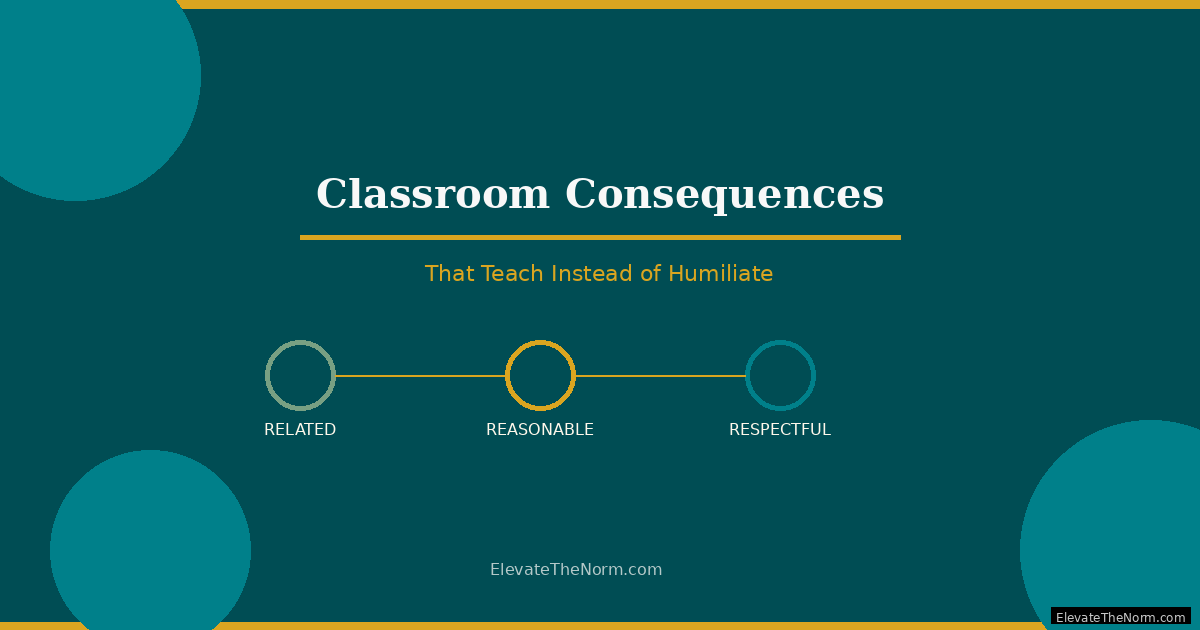
    The three R’s say a classroom consequence should be related to the behavior, respectful of the student’s dignity and realistic for the teacher to enforce and the student to complete. Responsive Classroom lists the same three tests for logical consequences: “respectful, related, and realistic.”
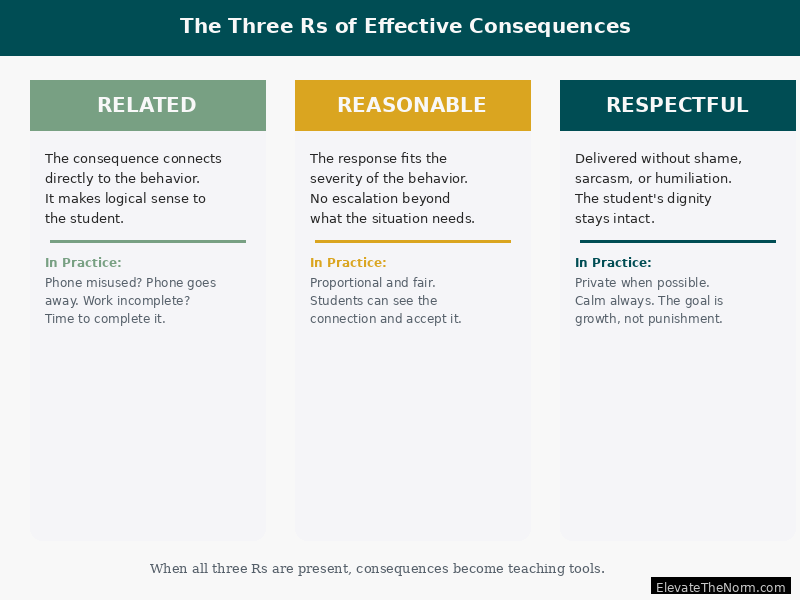
    Three cards showing the three Rs of effective consequences: Related connects to behavior, Reasonable fits severity, Respectful preserves dignity
    When all three Rs are present, consequences become teaching tools.

    The three R’s give teachers a quick test for any consequence they’re considering, and they show up across Responsive Classroom and similar frameworks.

    Related. The consequence connects logically to the behavior. A student who wastes class time makes up the time. A student who is disrespectful to a peer makes a direct apology. A student who turns in poor work revises the work.

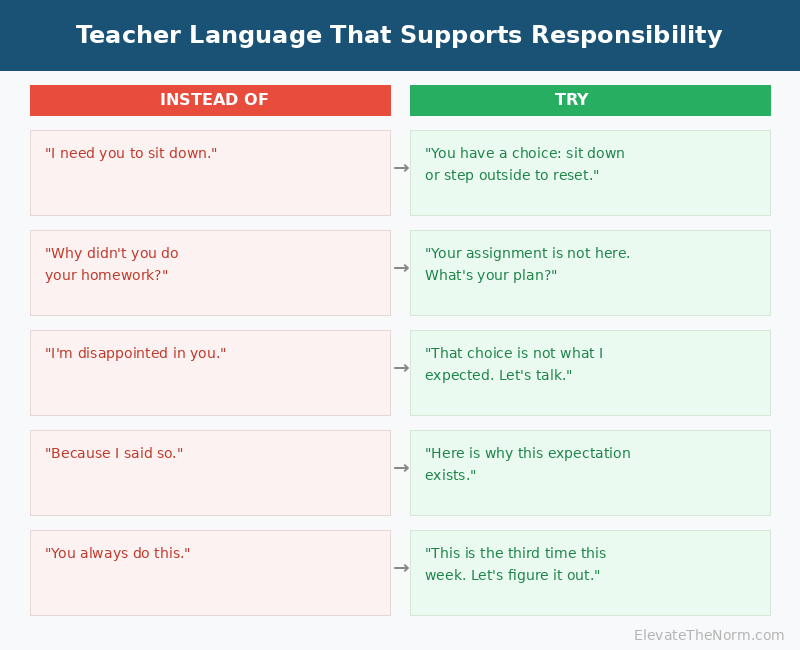
    Respectful. The consequence addresses the behavior without attacking the student’s character. (For a deeper look at why this matters, see Respect in the Classroom.) “You need to redo this section because it doesn’t meet the standard” is respectful. “I guess you didn’t think this was worth your time” is not.

    Realistic. The consequence is something the teacher can actually enforce and the student can actually complete. Assigning a lunch detention every day for a week sounds firm. It also means the teacher has to show up every day for a week, and the student misses the only unstructured time they have. If a consequence is unsustainable, it will collapse—and when it does, the student learns that the teacher’s word does not hold.

    If a consequence fails any one of the three R’s, it is probably punishment dressed up as a consequence.

    What Consequence Fits Common Classroom Behavior Problems?

    A proportionate classroom consequence starts with the smallest response that could work, such as proximity or a private word, and moves up only when the behavior continues or escalates. The response ladder below covers seven common problems, from off-task talk to safety threats.

    It isn’t a rigid escalation chart. Skip steps when the situation requires it, and start lower than you think you need to.

    Before you reach for any of it, check whether the behavior is a broken rule or an untaught procedure. A class that packs up early or crowds the door is usually failing a routine that was announced but never actually taught, and a consequence will not fix that. Most of this work sits upstream of the ladder entirely, which is why prevention comes first on any honest list of what works.

    BehaviorFirst ResponseIf It ContinuesIf It Escalates
    Off-task (phone, talking, zoning out)Proximity + quiet redirectBrief private conversation; remove the distractionLoss of privilege for the period; contact home if pattern develops
    Disrespect toward a peerImmediate, private correctionRestorative conversation between the students with teacher presentSeparate the students; parent contact; administrative referral if repeated
    Refusal to workCheck in privately: “What do you need to get started?”Offer modified entry point; document the patternParent contact; team conference; check for underlying issues
    Late to classNote it; do not interrupt instruction to address itBrief private conversation about the patternMake up missed time; parent contact if chronic
    Incomplete or missing workState the deadline and ask for a planRequire revision or completion before new privilegesParent contact; academic intervention plan
    Cheating or plagiarismPrivate conversation; require honest resubmissionParent contact; academic consequence per school policyAdministrative referral per school policy
    Physical aggression or safety threatImmediate administrative referralFollow school safety protocolFollow school safety protocol

    Notice what is not on this list: writing lines, public humiliation, removing the student’s chair, making students stand in the hallway, or assigning unrelated busywork. Those are punishments. They do not teach anything except that the teacher has more power than the student, which the student already knew.

    What Is a Repair Conversation After a Classroom Consequence?

    A repair conversation is a short, private talk after a classroom consequence in which the student answers three questions: what happened, who was affected and how, and what they’ll do about it and by when. The student does the thinking, and the teacher doesn’t lecture.
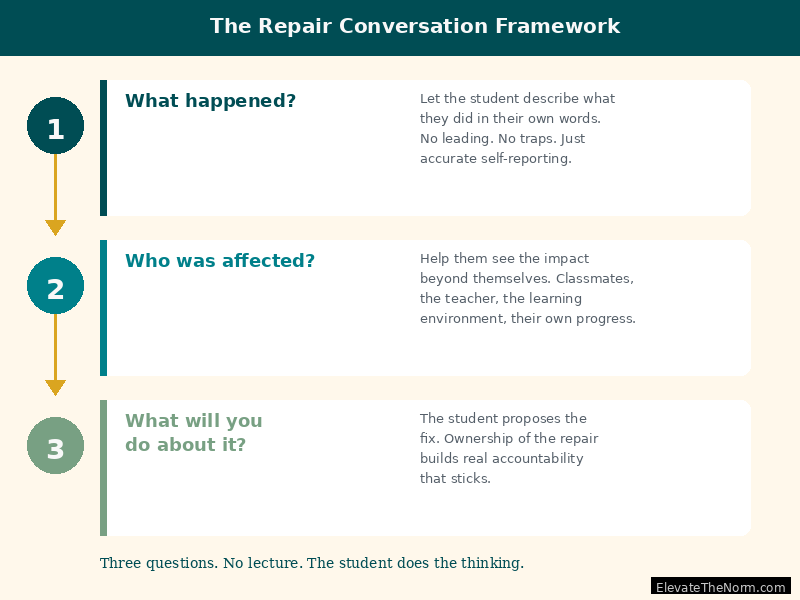
    Three-step repair conversation framework: What happened, Who was affected, What will you do about it - showing the process for accountability after classroom consequences
    Three questions. No lecture. The student does the thinking.

    The consequence isn’t the end. It’s the setup. Once the disruption, the missed deadline or the moment that went sideways is over, pull the student aside somewhere private and comfortable, not at the front of the room with the class watching, and talk through three questions:

    1. What happened? Not “what did you do wrong.” What happened. Let them describe it. Often their version is different from yours, and the difference is where the real issue lives.
    2. Who was affected, and how? This is the question that turns a behavior correction into a moral education moment. When a student can name who was affected—their group partner lost ten minutes of work time, the class lost focus, the teacher had to stop instruction—they are learning something consequences alone cannot teach.
    3. What are you going to do about it, and by when? This is where accountability lives. Not “what will you never do again,” which is a promise teenagers cannot keep. What will you do about this specific situation? Apologize to the partner. Turn in the revised work by Thursday. Show up on time for the next three days. Something concrete, something measurable, something the student commits to with a date attached.

    Clay’s take: a few minutes of that conversation is worth more than a detention, because a detention only asks a student to sit, and the three questions ask the student to think about the people affected and commit to something specific.

    Which Classroom Consequences Should Teachers Stop Using?

    Teachers should stop using public call-outs, writing lines, group punishment, removal as a first resort, delayed or disproportionate consequences, and questions meant to shame. These consequences survive in secondary classrooms because they’re easy, familiar or satisfying in the moment, not because they change behavior.

    Public call-outs

    Naming a student’s misbehavior in front of the class. (This is a close cousin of yelling at students—both use volume and audience as weapons.) This forces the student to choose between backing down (humiliating) and pushing back (escalating). There is no good outcome for either party.

    Writing lines or copying text

    Writing “I will not talk in class” fifty times teaches the student exactly one thing: that their time means nothing to the teacher. It has no connection to the behavior and no instructional value.

    Group punishment

    Punishing the entire class because one or two students misbehaved. This destroys trust, breeds resentment among the students who did nothing wrong, and teaches the class that individual accountability does not exist in this room.

    The one genuine edge case is an environmental change that takes nothing away from anybody and reverses within a day or two — turning the overhead lights back on in a lamp-lit room is the version I use. It still affects students who did nothing, so it still has to be rare, never aimed at one student, and named out loud rather than left to be guessed at.

    Removal as a first resort

    Sending a student out of the room should be a last step, not a first one. A meta-analysis of 274 effect sizes from 40 studies identified exclusionary discipline, meaning suspensions and expulsions, as “an important and meaningful predictor of increased delinquency” (Gerlinger et al., 2021). A school discipline literature review prepared under a U.S. Department of Education grant is blunter: “Excluding students from the classroom is an ineffective and harmful intervention,” with exceptions for real safety emergencies (IDRA, 2022). Understanding what actually motivates students makes it clear why removal does the opposite.

    Delayed or disproportionate consequences

    A consequence that arrives days after the behavior loses its connection to the event. A consequence that is wildly out of proportion to the offense—three weeks of detention for one late assignment—teaches the student that the system is arbitrary, not fair.

    Consequences disguised as questions

    “Do you think that was a good choice?” is not a real question. It is a humiliation ritual. The student knows the answer. The teacher knows the answer. The only purpose is to make the student say it out loud for the teacher’s satisfaction.

    What Should Teachers Do When School Policy Dictates the Consequence?

    When school policy, a district code or state law dictates the response to a behavior, the teacher follows the policy and doesn’t substitute a classroom consequence. The teacher can still hold a repair conversation and welcome the student back once the formal process ends.

    School policies, district codes and state laws dictate certain responses for certain behaviors. Fights may require an automatic suspension. Drugs or weapons may require an automatic referral. Bullying may trigger a mandated investigation.

    In those situations, the teacher’s role is clear: follow the policy. Do not try to handle a legally mandated situation with a classroom consequence. The liability is too high, the situation is too serious, and the student may need supports the teacher cannot provide.

    But following the policy does not mean abandoning the student. After the formal process runs its course, the teacher can still have a repair conversation. The teacher can still welcome the student back without a grudge. Building relationships with students means staying in their corner even after the hard moments. The teacher can still be the adult who says: “We need to talk about what happened, and I still expect good things from you.”

    The American Psychological Association’s Zero Tolerance Task Force review is still relevant here. It found “surprisingly few data that could directly test the assumptions of a zero tolerance approach to school discipline, and the data that are available tend to contradict those assumptions.” Its report adds that schools with higher suspension and expulsion rates appear to have less satisfactory school climate ratings, while noting that the finding doesn’t show causality (APA, 2008). Mandatory does not mean effective. And a teacher who adds humanity to a rigid process is not undermining the policy—they are making the policy survivable for the student on the other end of it.

    How Do You Make Consequences Consistent Without Being Rigid?

    Consistent classroom consequences are predictable, not identical: certain behaviors always get a response, but the response accounts for context such as a first offense, a hard week or an IEP or 504 plan. The standard stays the same for every student.

    A student who is late for the first time gets a different response than a student who is late every day. A student who snaps at a classmate during a terrible week gets a different response than a student who routinely bullies peers. A student with an IEP or a 504 plan may have specific behavioral supports that modify the standard consequence.

    None of this is favoritism. It is professional judgment. Doctors do not give every patient the same prescription. Teachers should not give every student the same consequence. What stays consistent is the standard—not the response.

    Document when you flex. If a parent or administrator asks why Student A received a different consequence than Student B, you need to be able to explain the reasoning. Flexibility without documentation becomes inconsistency, and inconsistency erodes trust.

    How Do You Build a Classroom Consequence System That Lasts?

    A classroom consequence system lasts when it’s simple, taught explicitly, used early, followed through every time and paired with repair. A system that collapses by October was never a system. It was a list of threats.

    Here’s what each of those five habits looks like:

    1. Keep it simple. Three to five clear expectations with predictable responses. Consequences only read as fair when students already know the standard, which is why naming expectations out loud does so much of the work. If you need a flowchart to explain your consequence system, it is too complicated for you to enforce and too complicated for students to follow.
    2. Teach it explicitly. Do not assume students know what will happen when they miss a deadline or disrupt a class. Tell them on day one. Revisit it in week three. Refer to it every time you use it.
    3. Use it early. A teacher who lets small violations slide for two weeks and then suddenly cracks down is not being patient—they are building a credibility problem. Address small things early, calmly, and consistently. This is one of the most important habits for new teachers building classroom management skills.
    4. Follow through. If you say the consequence is losing laptop access for the period, take the laptop. If you say you will call home, call home — which is easier when you have already decided in advance who you contact, through which channel, and at what point. Every time you do not follow through, you teach students that your words are suggestions.
    5. Pair consequences with repair. The consequence addresses the immediate behavior. The repair conversation addresses the relationship and the learning. You need both.

    What’s the Bottom Line on Classroom Consequences?

    Classroom consequences aren’t about making students suffer for their mistakes. They are about helping students understand what went wrong, take responsibility for the impact, and do something concrete to make it right. When consequences are related, respectful, and realistic—and when they are followed by a genuine conversation—they teach more than any lecture on behavior ever could. I hand students a page from my Behavior Reflection Sheets on TPT so the reflection is written down before we talk.

    The alternative is punishment: public, disproportionate, disconnected from the behavior, and designed to make the student feel bad enough to stop. The research cited above points the same way: punishment and removal are linked to worse outcomes, not better ones, and they cost the relationship you need to fix the behavior.

    Hold the standard. Address the behavior. Have the conversation. That is how consequences teach.

    Free Printable: Classroom Consequence Planning Sheet

    A one-page teacher reference with the 3 R’s checklist, a behavior-response planner you fill in for your own class, and the three-question repair conversation framework. Print it and keep it at your desk.

    Download Free Planning Sheet (PDF)

    When one student needs something more specific than a class-wide system: our guide to writing a student behavior contract covers what belongs in it, how to write it with the student rather than at them, and how to end it on purpose.

    Consequences are one piece of classroom management, and the rest of it tends to need small adjustments week to week. That is what Bell to Bell is for — a free Wednesday newsletter for grades 6–12 teachers with classroom-tested ideas, from the first bell ringer to the last exit ticket.

    Repair and consequence are not alternatives, whatever a staff meeting may imply. A student can owe an apology and still owe the work. If your school is moving toward circles, it is worth reading what a restorative circle can and cannot carry first — the guidance is detailed on how to run one and conspicuously silent on when not to.

    Frequently Asked Questions

    When consequences are connected to the behavior and followed by a genuine second chance, students can learn from mistakes rather than just survive the punishment. A complementary framework is positive discipline for teens, which builds on the same idea that consequences should teach rather than humiliate.

    What are examples of classroom consequences?

    Common classroom consequences include loss of a related privilege, such as losing laptop access for the rest of the period or returning to an assigned seat; break it, fix it, such as cleaning up a mess or making a direct apology; and space and time, a brief reset before rejoining the group. A short repair conversation afterward is where most of the learning happens.

    What are the three R’s of classroom consequences?

    The three R’s say a classroom consequence should be related, respectful and realistic. Related means the response connects directly to the behavior. Respectful means no humiliation or public shaming. Realistic means the teacher can enforce it and the student can complete it. If you can’t explain the link between the behavior and the consequence in one sentence, it isn’t a logical consequence.

    What is the difference between natural and logical consequences?

    Natural consequences happen without any teacher action: a student who doesn’t study does poorly on the test. Logical consequences are designed by the teacher to connect to the behavior: a student who misuses a laptop loses it for the period. Both can teach, but logical consequences let the teacher control timing, safety and proportion, which matters when the natural result would be harmful.

    How do I keep classroom consequences from feeling like punishment to students?

    Three things keep classroom consequences from feeling like punishment. Explain the connection between the behavior and the consequence so the student understands why this response. Deliver it calmly and privately, not in anger or in front of the class. Then follow it with a brief repair conversation about what happened and what comes next. When students see the reasoning, consequences read as structure, not retribution.

    What should a teacher do when a student refuses to accept a consequence?

    When a student refuses a consequence, the teacher shouldn’t escalate in the moment. State the consequence once, calmly, and move on: “The laptop is done for today. We can talk about it after class.” If the refusal continues, bring in an administrator, which is part of their job. A power struggle in front of the class has no winner, and it hands the student an audience.

    Should classroom consequences be the same for every student?

    The standard should be the same for every student, but the response can account for context. A student having a crisis week may need a different consequence than one repeating a pattern. A student with an IEP or 504 plan may have behavior supports written into the plan, and those are legal requirements to follow. Document your reasoning so you can explain any difference.

    When should a teacher call home about classroom consequences?

    A teacher should call home when a pattern develops, when the behavior is serious, or when the student needs support the teacher can’t give alone. Calling home after a single minor incident tends to erode trust with both the student and the family. Parents should already know the classroom expectations and system, and the call should be framed as a partnership, not a complaint.

    Do restorative consequences reduce suspensions?

    Restorative consequences have reduced suspensions in some large studies. An analysis of 73 Chicago high schools found suspension days fell 18% in the four years after restorative practices training, with no evidence test scores dropped. Randomized trials are more mixed: a Pittsburgh trial didn’t significantly improve academic outcomes. Restorative work adds repair to accountability; it doesn’t replace the consequence itself.

    Sources


    About Clay Shumate
    Clay Shumate is a certified secondary Social Studies teacher in the public schools of West Alabama, with seven years of classroom experience, a B.A. in History, and an M.Ed. in Secondary Education. He writes about project-based learning, student responsibility, respect, and practical ways to hold young people to a higher standard while giving them room to learn from mistakes. He is a member of the Society of Professional Journalists and writes to its Code of Ethics; this site’s editorial standards and corrections policy are published in full. More about Clay.

    Consequences work best as one section of something larger. Setting the whole thing down in writing is what keeps the response consistent on the days you are least inclined to be.
  • Respect in the Classroom: Why It Must Go Both Ways

    Respect in the Classroom: Why It Must Go Both Ways

    Respect in the Classroom: Why It Must Go Both Ways

    By Clay Shumate · Updated October 24, 2026

    Respect in the classroom means the teacher treats students with dignity and the students extend that same consideration back—but the two sides are not identical. Teachers hold authority. Students hold vulnerability. When both parties take their role seriously, the room works. When either side stops, it falls apart fast. Here is how mutual respect actually functions in a secondary classroom and what you can do when it breaks down.

    Key Takeaways

    • Mutual respect does not mean equal authority—it means equal dignity.
    • Students who feel respected by their teacher are more likely to engage, take academic risks, and follow expectations without being threatened.
    • Respect is taught through daily behavior, not posters or lectures.
    • A teacher who demands respect without modeling it will lose the room.
    • Correction and respect can coexist—if you handle correction at close range and without an audience.

    What Does Respect in the Classroom Mean?

    Respect in a secondary classroom is not everyone being nice all the time. It is a working agreement: I will take you seriously, and you will take this room seriously. That agreement only holds when the adult goes first.

    Researchers have studied this. John Hattie’s meta-analysis of over 1,800 studies found that teacher-student relationships carry an effect size of 0.52, against the 0.40 threshold he identifies as meaningful for student achievement (Visible Learning, 2023). That threshold is worth reading carefully rather than treating as a pass mark — it is an average across a database of largely correlational studies, and what an effect size can and cannot tell you is its own argument. That number does not mean “be friendly.” It means the quality of the working relationship between a teacher and a student measurably changes how much that student learns.

    A 2025 report from Estyn, the Welsh education inspectorate, surveyed secondary students about what drives classroom behavior. The students were blunt: “Behavior probably won’t get that much better unless the teachers respect us.” They valued teachers who listened, avoided shouting, and demonstrated understanding—and they distinguished those teachers from ones who simply enforced rules (Estyn, 2025).

    That matches what I see in my own classroom. The students who push back hardest are not usually the ones who dislike structure. They are the ones who feel like the structure was never for them.

    Why Equal Dignity Does Not Mean Equal Authority

    One of the fastest ways to lose credibility with teenagers is to pretend that the teacher and the student hold the same position. They do not. The teacher sets the standard, owns the pacing, manages safety, and answers to the school and the families. The student is developing, which means they are going to make mistakes that would get an adult written up.

    Mutual respect does not erase that difference. It governs how the difference gets used.

    Whitney Hegseth, writing in Educational Researcher in 2024, proposed a framework for mutual respect that directly addresses this. She argued that most classrooms carry “pervasive power asymmetries” and that respect requires disrupting those asymmetries—not by pretending they do not exist, but by treating student voices, experiences, and reasoning as genuinely worth hearing even when the teacher holds final authority (Hegseth, 2024).

    In practice, that looks like this:

    • You enforce a deadline, but you explain the reason for the deadline.
    • You redirect a student, but you do it without an audience.
    • You hold a standard, but you acknowledge when the student made progress toward it.
    • You make a decision a student disagrees with, and you let them say so—then you make the decision anyway, without punishing the disagreement.

    Authority without dignity is domination. Dignity without authority is chaos. Respect in a secondary classroom is both, running at the same time.

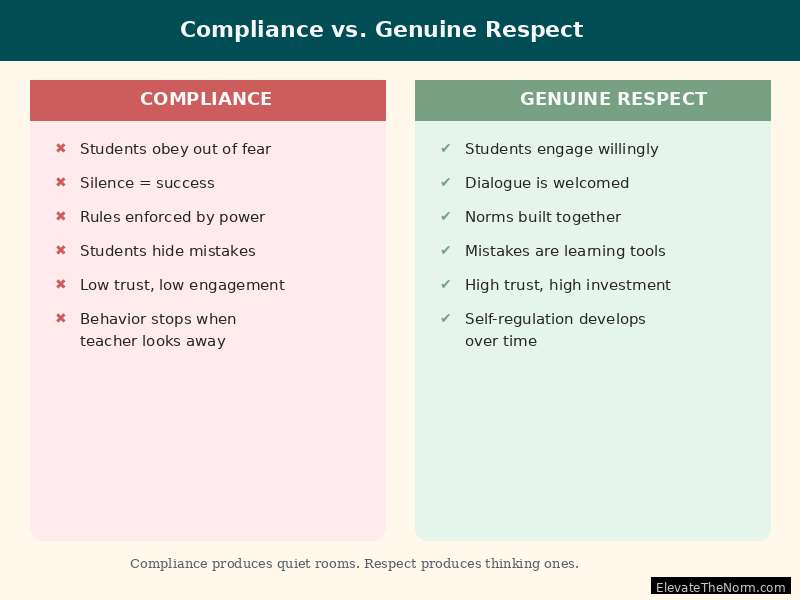
    What Is the Difference Between Respect and Obedience?

    Side-by-side comparison of compliance-based and respect-based classroom approaches showing key differences in student engagement and trust
    Compliance produces quiet rooms. Respect produces thinking ones.

    Obedience is silence. Respect is engagement.

    A quiet room is not necessarily a respectful room. A student can sit silently, produce nothing, and cause no disruptions. That student is obedient. But they are not engaged, they are not learning, and they are not in a relationship with the teacher that will survive the first real disagreement.

    Self-determination theory, developed by Edward Deci and Richard Ryan, identifies three psychological needs that drive motivation: autonomy, competence, and relatedness. When students feel their autonomy is respected—meaning they have some control over how they learn—and when they feel a genuine connection to the adult in the room, engagement rises. When those needs are frustrated, compliance may continue for a while, but motivation drops (Niemiec & Ryan, 2009).

    Respect feeds all three. A respected student is more likely to take an academic risk because they trust the teacher will not humiliate them for getting it wrong. A respected student is more likely to ask a question. A respected student is more likely to accept correction because they believe the correction is about the work, not about power.

    What Disrespect from a Teacher Looks Like

    Teachers rarely think of themselves as disrespectful. But students notice every time. Common forms of teacher disrespect in secondary classrooms include:

    Public correction. Calling out a student’s name across the room to address behavior. This turns a private mistake into a public performance. The student now has an audience, which means they have something to defend.

    Sarcasm. Using humor at a student’s expense. Teenagers can tell the difference between laughing with and laughing at. Sarcasm from a position of authority is not wit—it is a power display wrapped in a joke.

    Dismissal. Cutting off a student’s explanation, waving away a question as obvious, or responding to a wrong answer with visible frustration. Each of these teaches the student that speaking up was a mistake.

    Inconsistency. Enforcing expectations for some students but not others. The Estyn report found that perceived favoritism was one of the top complaints secondary students had about classroom discipline. When the rules bend for some and not for others, students do not see flexibility—they see unfairness (Estyn, 2025).

    Low expectations disguised as kindness. Accepting poor work without feedback, excusing repeated lateness, or never holding a student accountable because “they have a lot going on.” This feels like compassion. It communicates that you do not believe they can do better.

    What Disrespect from a Student Looks Like—and What It Usually Means

    Student disrespect is real. It happens. Pretending it does not happen helps no one. But what it means is almost never what it looks like on the surface.

    A student who rolls their eyes is not always dismissing you. They may be embarrassed. A student who talks back is not always defiant. They may be testing whether you will stay calm or escalate. A student who refuses to work is not always lazy. They may not know where to start and would rather look defiant than lost. When I need the right words in the moment, I lean on my De-escalation Strategies: 100 Scripts on TPT.

    None of this excuses the behavior. All of it changes the response.

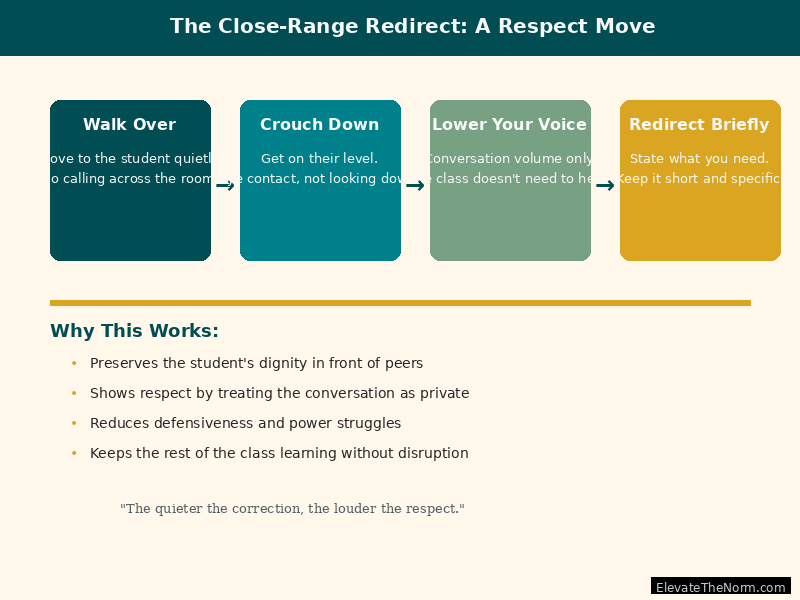
    When I see a student doing something that could derail the room, I do not announce it. I walk over. I get close. I keep my voice low enough that only the two of us can hear it. “Hey—I need you back on this. What do you need?” That question gives them an out that does not require them to perform defiance for the rest of the class. Most of the time, they take it.

    That is what I mean by close-range correction. I am not ignoring the behavior. I am addressing it in a way that does not force the student to choose between their dignity and my authority.

    The Close-Range Redirect: A Workshop-Room Practice

    Visual process showing the close-range redirect technique: walk over, crouch down, lower voice, redirect briefly for respectful classroom correction
    The quieter the correction, the louder the respect.

    In my room, students work alongside each other most of the time. They are paired up, grouped at tables, talking through problems together while I circulate. That physical setup changes how correction works.

    When a student is off track, I do not need to raise my voice across rows of desks—because there are no rows. I am already moving. I am already close. I crouch down next to the table, make eye contact with the student, and say what needs to be said at a volume that does not carry past that group.

    Sometimes it is a redirect: “You’ve been on the phone for three minutes. Put it away and finish the second question.” Sometimes it is a check-in: “You look stuck. Tell me what you have so far.” Sometimes it is both at the same time.

    The key is proximity. A correction delivered from fifteen feet away, across a room of watching peers, is a confrontation. The same correction delivered at arm’s length, at conversation volume, is coaching. Students know the difference. They respond to it differently.

    This is not a technique I read about and decided to try. This is how a teacher-led workshop room naturally works. (For more on building this kind of classroom presence, see Classroom Management for New Teachers.) When you build a room where movement and closeness are the default, correction stops being a performance and starts being a conversation.

    How Do Teachers Build Respect in the Classroom?

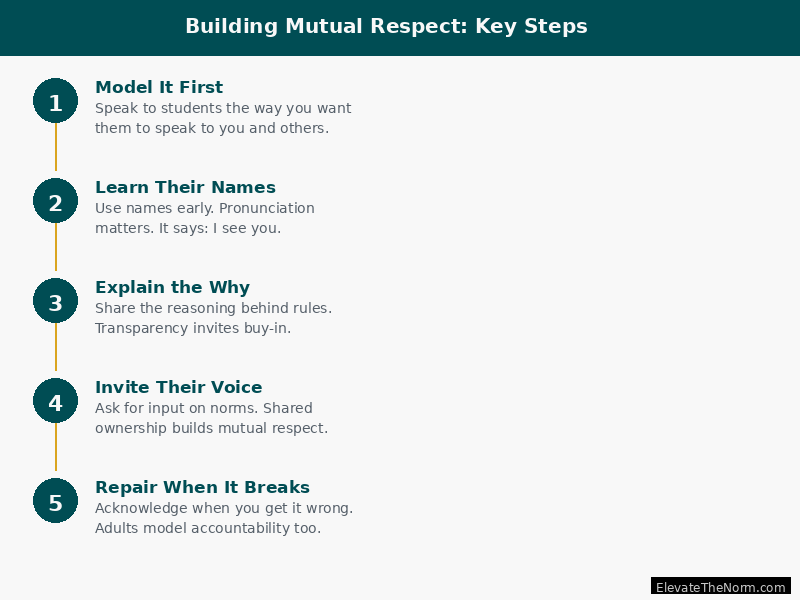
    Five key steps for building mutual respect in the classroom including modeling behavior, learning names, explaining the why, inviting student voice, and repairing when it breaks
    Five practical steps teachers can take to build mutual respect from day one.

    Respect does not appear because you demand it. It appears because you demonstrate it consistently and early enough that students learn to expect it.

    Teach expectations explicitly

    Do not assume students know what respect looks like in your room. Show them. Model it. Practice it. Name it when you see it. Research consistently shows that explicitly taught expectations are followed more consistently than assumed ones (Shumate, 2026).

    Learn names fast

    Using a student’s name is the simplest respect move available. It says: I see you specifically. You are not interchangeable.

    Follow through without escalation

    Say what will happen. Then do what you said. Do not threaten. Do not negotiate publicly. Do not make consequences bigger because you are frustrated. Consistency teaches students that the system is predictable, which is the foundation of trust.

    Admit your mistakes

    If you snap at a student unfairly, say so. If you graded something wrong, correct it openly. Students can forgive an honest mistake. They cannot forgive an adult who pretends it did not happen.

    Protect their time

    Starting class on time, ending activities when you said you would, and not wasting the period on things that do not matter—these are all respect moves. They communicate: your time in this room has value, and I take that seriously.

    How to Respond When Respect Breaks Down

    Even in well-run classrooms, respect breaks down. A student says something cutting. A teacher has a bad day and snaps. A misunderstanding escalates. What matters is what happens next.

    For teacher-to-student repair

    Apologize specifically. “I was short with you earlier, and that was not fair. You did not deserve that.” Do it privately if possible. Do it publicly if the original disrespect happened publicly. Then move on without over-explaining or making the student comfort you about it.

    For student-to-teacher repair

    Give the student space before you process it. A student who was disrespectful in front of the class is not ready to have a repair conversation thirty seconds later. Come back to it when both of you are calm. Ask what happened. State what the impact was. State what you expect going forward. Then let them re-enter the room without a grudge. If the wording is the part that deserts you in the moment, I give away five de-escalation scripts you can use today as a free sample.

    For classroom-wide breakdowns

    If the entire room is off, stop. Name what you see without blaming specific students. Reset the expectation. Give a short, clear direction. Resume. Do not lecture. A ten-minute speech about respect after the room fell apart teaches students exactly one thing: when things go wrong, the teacher talks for ten minutes.

    Respect Across Cultures and Backgrounds

    Respect is not culturally neutral. What looks respectful in one community may look passive or even disrespectful in another.

    Eye contact is the classic example. In many Western classrooms, teachers interpret direct eye contact as a sign of attention and respect. In many Indigenous, East Asian, and African American communities, sustained eye contact with an authority figure can be a sign of disrespect or defiance. A teacher who punishes a student for “not looking at me when I’m talking to you” may be punishing culturally appropriate behavior (Weinstein, Curran, & Tomlinson-Clarke, 2003).

    Volume is another. Some students come from homes and communities where loud, direct communication is normal and expected. A teacher who interprets volume as aggression may be misreading cultural norms as behavioral problems.

    None of this means teachers should abandon expectations. It means teachers should examine whether their version of respect is a universal standard or a cultural preference. If a student’s behavior is not disruptive, harmful, or unsafe, the teacher should question whether it truly needs correcting or whether it simply does not match the teacher’s personal comfort.

    Why Is Respect in the Classroom Important?

    The evidence on respect and relationships in the classroom is not ambiguous. It consistently points in one direction.

    A 2025 longitudinal systematic review published in Social Psychology of Education examined decades of research on teacher-student relationships and school outcomes. The review found that positive relationships predicted better academic achievement, stronger engagement, and fewer behavioral problems—and that these effects held for both typical and vulnerable student populations (Van der Aar et al., 2025).

    A meta-analysis published in Frontiers in Psychology in 2026 synthesized 18 studies involving over six million students and found a statistically significant negative association between teacher punishment and student academic achievement (r = −0.183, p < 0.001). The relationship was consistent across grade levels and strengthened as the proportion of male students increased (Wang et al., 2026).

    Teacher credibility—students’ perception that their teacher is competent, trustworthy, and caring—carries an even larger effect size of 0.90 in Hattie’s research, making it one of the strongest influences on learning in the entire database. Respect is the foundation of that credibility. Without it, nothing else the teacher does lands the way it should.

    A Practical Framework for Mutual Respect

    Here is a simple framework for how respect functions in a secondary classroom. This is not a poster. It is a decision-making guide for everyday interactions.

    SituationRespectful ResponseDisrespectful Response
    Student gives a wrong answer“That’s not quite it, but you’re thinking in the right direction. Let’s look at it again.”“No. Did you even read the material?”
    Student is off taskWalk over, lower your voice, redirect specifically.Call their name across the room: “Are you working or just sitting there?”
    Student challenges a decision“I hear you. Here’s why I’m doing it this way. We can talk more after class.”“Because I said so. That’s why.”
    Student misses a deadline“This was due yesterday. What happened, and when can you get it in?”“I guess you decided this wasn’t important to you.”
    Student is visibly upset“Do you need a minute? I’ll check back with you shortly.”“You need to pull it together. This is class.”
    Teacher makes a mistake“I was wrong about that. Here’s the correction.”Pretend it didn’t happen and move on.

    Conclusion

    Respect in the classroom is not a mood or a personality trait. It is a set of daily decisions. You decide to learn names. You decide to correct behavior privately instead of publicly. You decide to enforce a standard without attacking the person who fell short of it. You decide to apologize when you are wrong.

    None of this makes you soft. Teachers who respect their students are not pushovers—they are the ones students take most seriously. The research confirms this: when students feel respected, they engage more, learn more, and cause fewer problems. When they feel disrespected, they disengage, resist, or leave.

    Respect goes both ways, but the teacher goes first. That is not a burden. That is the job. And when students feel respected, they are far more likely to accept the responsibility teachers ask of them.

    Frequently Asked Questions

    Respect and student responsibility reinforce each other. Students who feel respected take ownership of their behavior and their commitments. This is also the foundation of positive discipline for teens — firm standards delivered with dignity. One small, concrete way to practise it in both directions is a structured noticing routine, where students name a specific person and a specific thing that person did.

    Why is respect important in the classroom?

    Because the quality of the teacher-student relationship measurably changes how much students learn. Hattie’s synthesis puts teacher-student relationships at an effect size of 0.52, and a 2025 systematic review found positive relationships predicted better achievement, stronger engagement, and fewer behavior problems for both typical and vulnerable students. Respected students take more academic risks and accept correction more readily.

    How do teachers show respect to students?

    Through daily behavior: learning names quickly, correcting behavior privately at close range instead of across the room, explaining the reason behind decisions, following through without escalating, admitting and correcting their own mistakes, and protecting class time by starting and ending when they said they would.

    Does mutual respect mean I let students do whatever they want?

    No. Mutual respect means you enforce clear expectations while treating students with dignity. You still hold standards, set deadlines, and address behavior. The difference is in how you do it—privately, consistently, and without humiliation.

    What if a student is openly disrespectful in front of the whole class?

    Address it briefly and calmly in the moment—just enough to stop the disruption. Then follow up privately when both of you are calm. Public confrontations give the student an audience, and audiences make everything worse. The real conversation happens one-on-one.

    How do I earn respect from students who have been mistreated by other teachers?

    Consistency over time. Students who have learned not to trust adults will not change their minds because of one good interaction. (This is related to what I call the three-week turn in relationship building.) Show up reliably, follow through on what you say, admit mistakes, and do not take their testing personally. Trust builds slowly.

    Is it unprofessional to apologize to a student?

    No. It is unprofessional to pretend you did not make a mistake. A specific, brief apology—”I was unfair to you earlier, and I’m sorry”—models exactly the kind of accountability teachers expect from students.

    How do I handle cultural differences in what “respect” looks like?

    Examine whether the behavior you are correcting is actually disruptive or simply unfamiliar. Eye contact, tone of voice, and communication style vary across cultures. If a student’s behavior is not unsafe or disruptive, question whether it needs correcting or just makes you personally uncomfortable.

    What if I feel like students only respect me when I’m strict?

    Strictness and respect are not the same thing. Students may comply out of fear without respecting the teacher at all. Genuine respect comes from consistency, fairness, and competence—not volume or severity. The strictest teacher in the building is often the least respected behind their back.

    Can you have respect in the classroom without good relationships?

    You can have basic courtesy without deep relationships, but real respect—the kind that survives a disagreement or a bad day—requires some degree of relationship. Students need to believe the teacher sees them as a person, not just a seat number. That does not require being friends. It requires being human.

    Sources


    About Clay Shumate
    Clay Shumate is a certified secondary Social Studies teacher in the public schools of West Alabama, with seven years of classroom experience, a B.A. in History, and an M.Ed. in Secondary Education. He writes about project-based learning, student responsibility, respect, and practical ways to hold young people to a higher standard while giving them room to learn from mistakes. He is a member of the Society of Professional Journalists and writes to its Code of Ethics; this site’s editorial standards and corrections policy are published in full. More about Clay.

  • Classroom Expectations: A Practical Framework for Grades 6–12

    Classroom Expectations: A Practical Framework for Grades 6–12

    By Clay Shumate · Updated October 24, 2026

    Classroom expectations are the small set of standards that govern how your room runs — how people treat each other, how work gets done, and what happens when somebody falls short. They only work when you teach them, model them, and enforce them the same way on Thursday that you did on Tuesday. Here’s a complete framework for grades 6–12, plus a sample set you can adapt.

    Key Takeaways

    • Keep the list short. Research supports a small number — three to five — of positively stated expectations, not a wall of rules.
    • Expectations have to be taught like content: defined, modeled, practiced, and revisited. Announcing them in August is not teaching them.
    • Structure is not the enemy of student freedom. A 2025 meta-analysis of 94 studies found that clear structure and support for student autonomy reinforce each other — and both raise motivation and engagement.
    • Consistency is a fairness issue. Expectations enforced by mood teach students to read the teacher instead of the standard.
    • The back half of the framework matters most: what happens after an expectation is broken — the consequence, the repair, and the way back.

    What Classroom Expectations Are — and What They’re Not

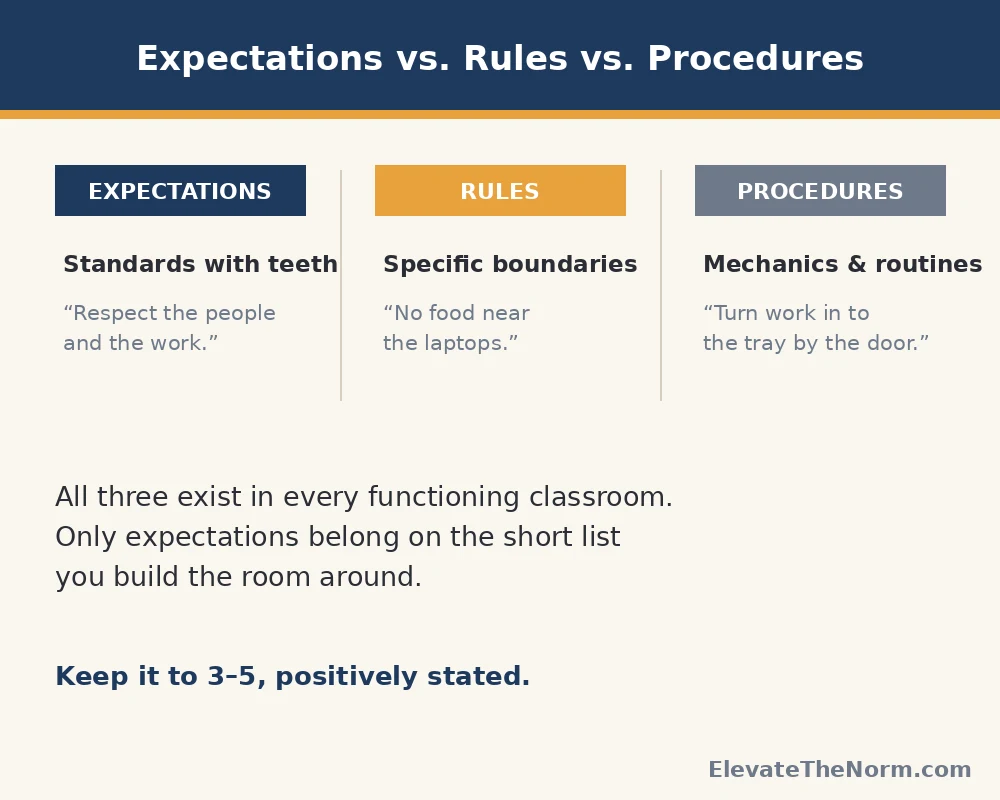
    Classroom expectations are the standards for how the room operates: how people treat each other, what prepared looks like, how work gets done, and what happens when things go wrong. They are not the same thing as procedures, and they are not a list of seventeen don’ts taped by the door.

    Three-column chart distinguishing classroom expectations, rules, and procedures with an example of each
    All three exist. Only expectations belong on the short list.

    The distinction matters because teachers blur these constantly. Procedures are mechanics — how to turn in work, where to sit, what to do when you walk in. Rules are specific boundaries. Expectations sit above both: they’re the values of the room with teeth in them. “Respect the people and the work” is an expectation. “Turn your paper in to the tray by the door” is a procedure. Both matter. Only one belongs on the short list you build the room around. My free Classroom Norms Poster Set on TPT uses plain, respectful language students in grades 6–12 will not roll their eyes at.

    The research here is unusually clear. A widely cited review of evidence-based classroom management practices by Simonsen and colleagues identified 20 practices with sufficient evidence behind them, grouped into five categories — and one entire category is posting, teaching, reviewing, monitoring, and reinforcing expectations. Their guidance on the list itself: keep it to a small number of positively stated expectations, broad enough to cover the behavior you actually want. Tell students what to do. Seventeen versions of what not to do is not a standard; it’s noise.

    Why Are Clear Classroom Expectations Important in Grades 6–12?

    Because teenagers read inconsistency as unfairness, and unfairness kills buy-in faster than strictness ever will. A firm room with a predictable standard feels safe. A loose room with a random standard feels rigged.

    The evidence backs the firm room. The Simonsen review found that high-structure classrooms produce more task involvement, friendlier peer interactions, more attentive behavior, and less aggression. Structure works.

    Here’s where a lot of secondary teachers get stuck, though. We’re told to give students voice, choice, and ownership — and clear expectations can feel like the opposite of that. The research says the tension is imaginary. In a study of 133 public high school classrooms with 1,584 students in grades 9–11, Jang, Reeve, and Deci found that teacher structure and autonomy support were positively correlated and both predicted student engagement — complementary, not antagonistic. A 2025 meta-analysis of 94 studies in Educational Psychology Review went further: structure and autonomy support reinforce each other with a large effect size, and both raise students’ motivation, engagement, and need satisfaction. That same body of research draws the line that matters: structure is not control. Structure tells students how to succeed here. Control tells them who’s in charge. Students can smell the difference from the hallway.

    In my room, the structure is visible before I say a word. The daily plan goes on the whiteboard at the front with times attached. Those times are a budget and a promise — and when I blow one, I say so out loud and say why. Predictability is a form of respect. It tells teenagers I planned for their time like it’s worth something, because it is.

    Clear expectations are also the foundation everything else stands on. Teaching responsibility doesn’t work if students are guessing at the standard. Neither does anything else you care about.

    Expectations set the floor. Student responsibility is what happens when students internalize that floor and hold themselves to it — not because you are watching, but because the standard is clear and they believe it applies to them.

    A Practical Framework for Classroom Expectations

    Five expectation areas, plus the three commitments that make them real: consequences, repair, and improvement.

    1. Respect — and it runs both directions

    This covers how we speak to each other, how we disagree, and how we treat each other’s time and work. The part most frameworks skip: the teacher is inside this expectation, not above it. How you correct a student in front of their peers is the most-watched respect lesson you’ll teach all year. It’s also what this site believes at the foundation: respect isn’t a reward students earn — it’s the operating condition of the room.

    2. Preparation

    Materials and mindset. Define what prepared actually looks like in your room, because “be prepared” means nothing until you do. In a seventh-grade room that might be: notebook, something to write with, yesterday’s exit slip. In a junior-level class it might be: annotated reading done, your section of the group work drafted, questions ready. Say it in specifics or don’t expect it.

    3. Effort and participation

    In a workshop-style room, participation isn’t raising your hand. Students in my room are almost always working alongside somebody, so participation means your partner can count on you — you’re carrying your share of the thinking, not just occupying the chair next to it. Define effort the same way: visible, specific, checkable by the student themselves.

    4. Collaboration and technology

    Set device expectations by task, always inside your school’s policy. Some work needs screens; some work needs them dark. “Use tech for the task” travels better than a blanket ban you can’t hold or a free-for-all you’ll regret. And don’t copy anyone else’s tech expectation — including mine. Align it with your building, your subject, and the rules your school already has.

    5. Deadlines and quality

    Deadlines in a collaborative room are commitments to other people, not just to the gradebook. The quality bar worth teaching: would you put your name on this in public? Pair the deadline expectation with an honest escape valve — renegotiate before it passes, not after. That’s not softness. That’s how deadlines work everywhere adults keep them.

    The back half: consequences, repair, and improvement

    An expectation with no known “what happens next” is a suggestion. So the framework has to include what follows a miss: a consequence that’s connected, proportionate, prompt, and private — the opposite of the public correction that manufactures order instead of restoring it. Then repair: what’s owed, to whom, by when. Then improvement: the expectation that the standard gets easier to hit with practice, and that being re-taught is normal, not shameful.

    One boundary, stated plainly: behaviors involving safety, harassment, threats, or anything else covered by school policy go through the required reporting process every time. Classroom consequences and repair sit alongside formal procedures. They never replace them.

    Expectation areaWhat it coversSample wording
    RespectHow people speak, disagree, and treat each other’s time and work, teacher includedRespect the people and the work. That standard includes me.
    PreparationMaterials and mindset, defined in specifics for your roomCome ready: materials, mindset, and your part of the work.
    Effort and participationCarrying your share of the thinking, not just occupying a chairYour group can count on you.
    Collaboration and technologyDevice use set by task, inside school policyUse tech for the task.
    Deadlines and qualityDeadlines as commitments to other people, with a way to renegotiateMeet the deadline, or renegotiate it before it passes.
    The five expectation areas for grades 6–12 at a glance.

    How Do You Teach Classroom Expectations?

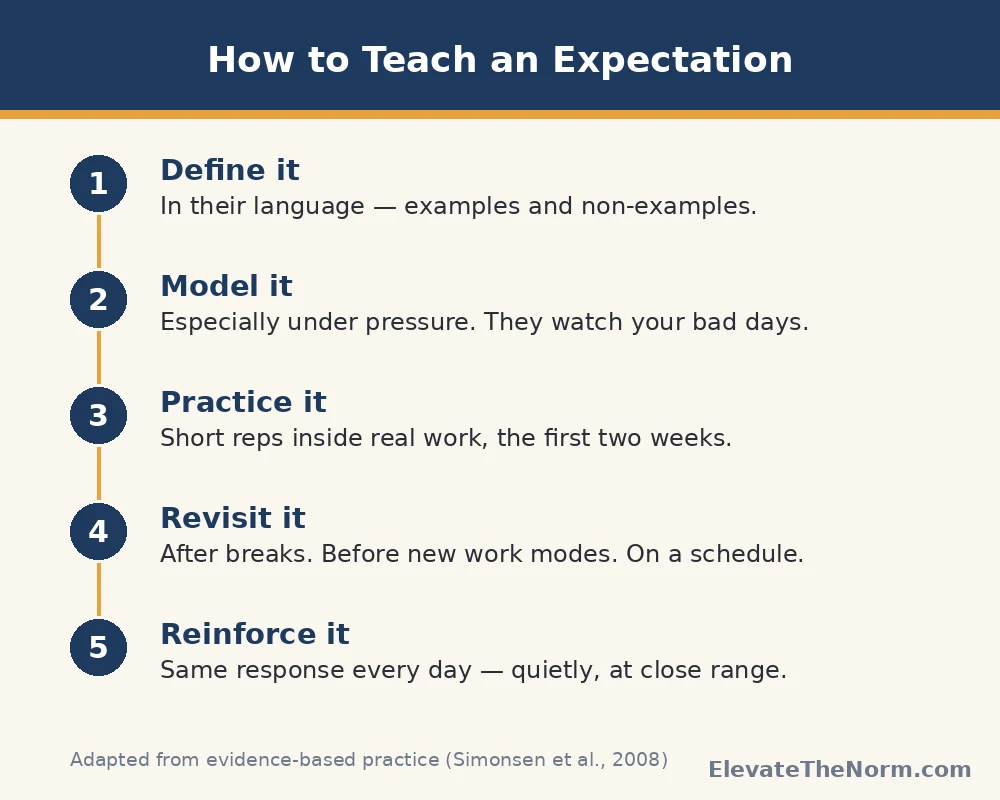
    The same way you’d teach content: define, model, practice, revisit, reinforce. The place this pays off first is the transitions between activities, which is where most of a secondary lesson’s lost minutes actually go. The Simonsen review is specific about what teaching expectations means — explicit instruction with examples and non-examples, frequent review, and active supervision: the teacher moving, looking around, interacting, correcting quietly, and reinforcing what’s going right.

    That last part is just a description of circulating, which is how my room runs anyway. Monitoring doesn’t look like watching from a desk. I’m moving the whole period, so when somebody drifts off an expectation, the correction happens right next to them — a few quiet words at the table, low enough that the rest of the room keeps working. The standard gets held. Nobody gets a scene.

    Five-step cycle for teaching classroom expectations: define, model, practice, revisit, reinforce
    Expectations are taught like content, not announced like warnings.

    The teaching sequence that works:

    1. Define it in their language. For each expectation, show what it looks like and sounds like in a real moment — and what it doesn’t. Examples and non-examples, exactly like teaching a concept.
    2. Model it — especially under pressure. Students learn your real expectations by watching you on a bad day. Handle your own mistakes out loud: name it, fix it, move on.
    3. Practice it early. The first two weeks, run short reps inside real work — a two-minute partner task where the only goal is doing it the way the room does it.
    4. Revisit on a schedule, not just after disasters. After every break. Before a new mode of work — labs, projects, discussions. The National Association of School Psychologists recommends teachers put reteaching on the calendar and track their own habits — like the ratio of encouragement to correction — because positive reinforcement moves behavior further than punitive correction does.
    5. Hold it the same way every day. Same expectation, same response, whoever the student is. If a student needs more support to hit the standard — a visual cue, a private pre-correction, a quiet re-teach — vary the support, never the standard.

    Two additions that pay off. Send the expectations home in the first week, in plain language, so families hear them from you before any problem exists. And when a student keeps missing the same expectation, treat it as information: is it a skill gap, a relationship gap, or something heavier? The answer changes your move. That diagnostic work sits on top of relationships you built before anything went wrong.

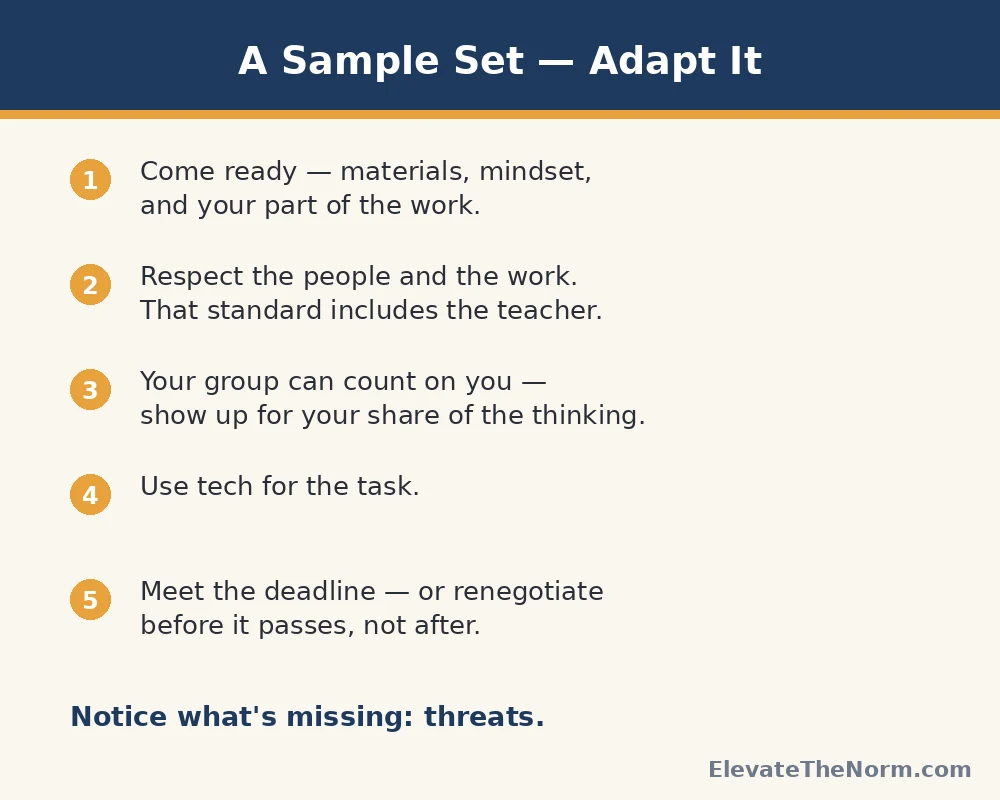
    What Are Good Examples of Classroom Expectations? A Sample Set

    This is a starting point, not gospel. Adapt it to your building, your students, and your policies — an expectations set only works if the person enforcing it actually believes it.

    Card listing five sample classroom expectations teachers can adapt for grades 6-12
    A starting point, not gospel — adapt it to your room.
    1. Come ready — materials, mindset, and your part of the work.
    2. Respect the people and the work — in what you say and how you say it. That standard includes me.
    3. Your group can count on you — show up for your share of the thinking.
    4. Use tech for the task.
    5. Meet the deadline — or renegotiate it before it passes, not after.

    Notice what’s missing: threats. The what-happens-next conversation is real and students deserve to know it, but it happens separately and calmly, and it always includes the way back. A list of expectations that reads like a list of warnings tells students you’re expecting the worst. They tend to oblige.

    Where Classroom Expectations Fall Apart

    Too many to remember. Seventeen rules function like zero rules. If students can’t recite the list, the list isn’t running the room — your mood is.

    Announced once, never taught. One speech in August plus a laminated poster is decoration. Laminated is not learned.

    Enforced by mood. The expectation that flexes with your energy level teaches students to scan you instead of the standard — and the students who already trust school the least pay the highest price for that unpredictability. Consistency isn’t just management. It’s fairness.

    Consequences without repair. If a miss just costs and never leads anywhere, students stop investing in the standard. The path back is what makes the standard worth meeting.

    Expectations for students but not the adult. You are the most-watched person in the room. A teacher who demands punctuality and starts class late, or demands respect and corrects with sarcasm, is teaching the real expectations — and they aren’t the ones on the wall.

    Conclusion

    Classroom expectations come down to this: a short list you actually believe in, taught like it matters, enforced the same way every day, with a real path back when somebody blows it. For a deeper look at why classroom expectations are important and the specific research on how they protect instructional time, reduce student anxiety, and build independence, that article breaks down the evidence. So start here this week. Draft three to five expectations, positively stated. Cut anything you’re not willing to enforce on your worst Tuesday. Plan how you’ll teach and model each one — with examples, non-examples, and a rep or two inside real work. Then put a reminder on your calendar for three weeks out, because you’ll need to revisit them, and that’s not failure. That’s maintenance. The room you want isn’t built by the list. It’s built by what you do about the list, every single day.

    Frequently Asked Questions

    What are student expectations in the classroom?

    Student expectations are the small set of standards that govern how a classroom runs: how people treat each other, what prepared looks like, how work gets done, and what happens when someone falls short. A practical set for grades 6 through 12 covers five areas: respect, preparation, effort and participation, collaboration and technology, and deadlines and quality.

    What are good examples of classroom expectations for middle and high school?

    Short, positive statements students can act on: Come ready with materials, mindset, and your part of the work. Respect the people and the work, a standard that includes the teacher. Your group can count on you. Use tech for the task. Meet the deadline, or renegotiate it before it passes. Adapt the wording to your building and policies.

    How many classroom expectations should I have?

    Three to five, positively stated. The research on evidence-based classroom management specifically supports a small number of broad, positive expectations rather than a long list of prohibitions. Past five, students stop remembering them and start ignoring them — and so, honestly, do teachers.

    Should students help create the classroom expectations?

    Their input, yes — final ownership, no. Students can genuinely shape what respect looks like in this room, refine the language, and name what a fair deadline policy feels like. That input builds real buy-in. But the teacher owns the final set and the enforcement of it. Co-created doesn’t mean committee-run, and students respect a teacher who takes their input seriously more than one who pretends the room is a democracy.

    What’s the difference between expectations, rules, and procedures?

    Expectations are standards for how the room operates — the values with teeth. Rules are specific boundaries, often set by school policy. Procedures are mechanics: how to enter, submit work, transition. All three exist in every functioning classroom. The mistake is putting procedures on the poster and calling them your expectations.

    What do I do when a student keeps breaking the same expectation?

    Privately, and as a diagnosis, not just a penalty. Figure out whether it’s a skill gap, a relationship gap, or something heavier going on — the answer changes your response. Re-teach the expectation, apply a consequence connected to the behavior, and set a repair with a path back. For persistent patterns, bring the family in with facts and a plan, and involve the counselor or administration when the situation calls for it under your school’s process.

    Do the same expectations work for middle school and high school?

    The same categories work; the teaching changes. Middle schoolers need more reps, shorter loops, and more explicit modeling — expect to re-teach often and treat that as normal. High schoolers need more rationale and can handle more negotiated specifics. Both deserve expectations written in adult language. Nothing loses a ninth grader faster than a poster that talks to them like they’re eight.

    What about cell phones?

    Set a device expectation by task — “use tech for the task” — inside whatever your school or district policy requires. Then hold it with the same calm consistency as everything else. The rooms that lose the phone war usually lose it to inconsistency and escalation, not to the phones themselves. And don’t let the phone battle become the identity of your classroom; it’s one expectation among five, not the mission.

    When should I revisit or re-teach expectations?

    On a schedule: after every break, before any new mode of work — labs, projects, discussions, presentations — and any time you notice slippage. Put it on the calendar at the start of the year so re-teaching is maintenance instead of a reaction. A ten-minute refresher in January is cheaper than a February you spend fighting the room.

    Sources

    For ready-to-use tools built around these expectations, see the free classroom routines and procedures checklist and the free classroom transitions toolkit. Expectations tell students what the standard is; the daily procedures that carry them are covered in what to teach students about classroom routines, and when.

    If you want a ready-to-print version of these expectations for your wall, see Classroom Expectations Poster for Middle and High School Students for a complete secondary poster template and introduction sequence.

    If you would rather start from wording than from the framework, the collection of examples of classroom expectations gives observable, ready-to-adapt sets for a middle school room, a discussion-heavy high school course, a lab or shop, a performance class, and a one-to-one device classroom.

    The framework above is built on the assumption that students can meet your expectations when those expectations are taught and held consistently. For the research behind that assumption—and specific classroom moves that translate genuine belief into practice—see the guide on high expectations for students.


    About Clay Shumate
    Clay Shumate is a certified secondary Social Studies teacher in the public schools of West Alabama, with seven years of classroom experience, a B.A. in History, and an M.Ed. in Secondary Education. He writes about project-based learning, student responsibility, respect, and practical ways to hold young people to a higher standard while giving them room to learn from mistakes. He is a member of the Society of Professional Journalists and writes to its Code of Ethics; this site’s editorial standards and corrections policy are published in full. More about Clay.

  • Teaching Responsibility Without Treating Teenagers Like Children

    Teaching Responsibility Without Treating Teenagers Like Children

    By Clay Shumate

    Teaching responsibility means giving students real ownership over their choices, holding them to clear expectations, and following through with honest consequences that teach when they fall short—without stripping them of their dignity in the process. It does not mean lecturing them about responsibility while making every decision for them. If you want students to act like responsible young adults, you have to treat them like developing young adults and then hold them to that standard. The hardest version of that is handing a student authority that is genuinely theirs and then not quietly taking it back.

    Key Takeaways

    • Responsibility is not the same thing as obedience. A student who follows orders without thinking is compliant, not responsible.
    • Teaching responsibility requires transferring real decision-making power to students—then holding them accountable for what they decide.
    • Adolescent brains are still developing the prefrontal cortex, which means teenagers need structured practice with responsibility, not excuses to avoid it.
    • The most effective consequences are connected to the behavior, preserve the student’s dignity, and include a clear path back.
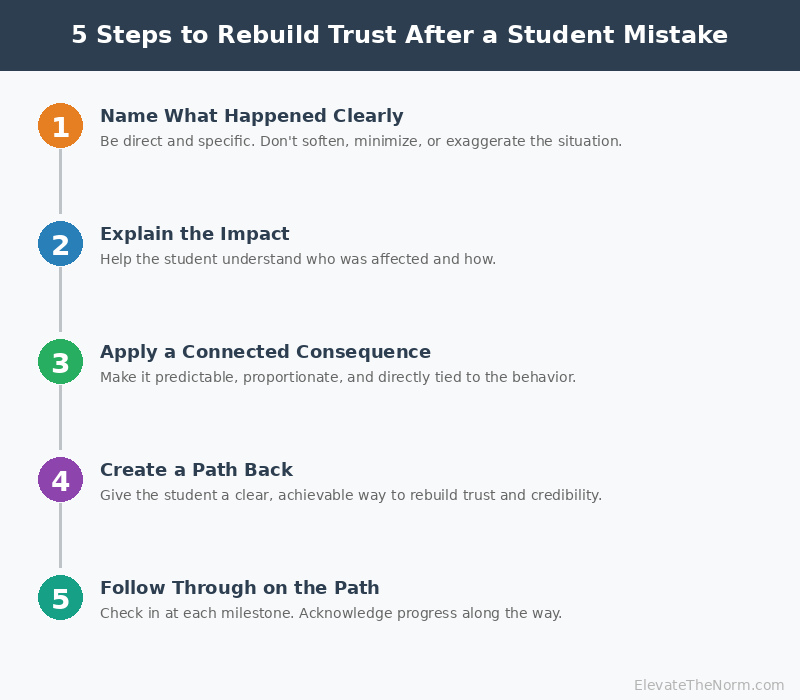
    • Rebuilding trust after a student makes a serious mistake is part of the work, not an exception to it.

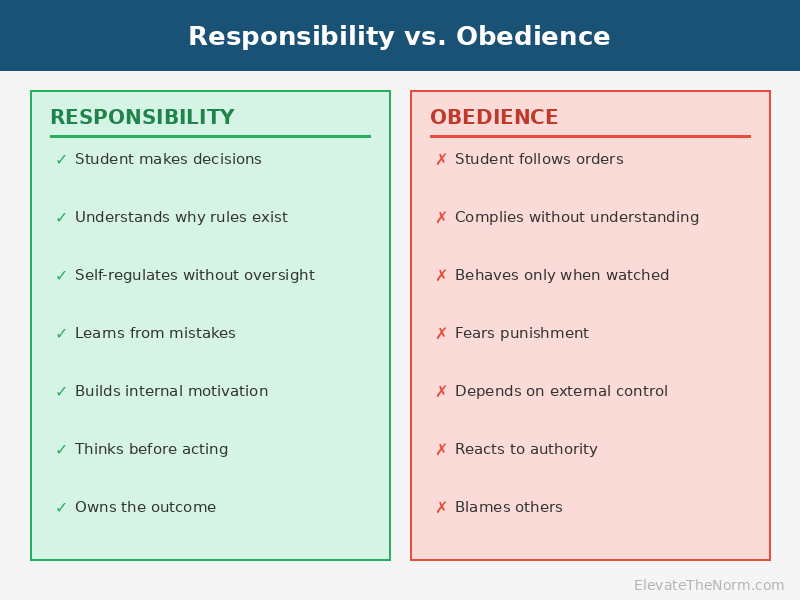
    Responsibility Is Not Obedience

    This distinction matters more than most educators realize. A responsible student makes thoughtful decisions, follows through on commitments, and accepts the consequences when things go wrong. An obedient student does what they are told.

    When mistakes happen — and they will — the question is whether the system turns them into learning. A clear process for learning from mistakes makes accountability productive instead of punitive.

    Those are not the same thing.

    Comparison chart showing the differences between teaching responsibility and demanding obedience in secondary classrooms
    Responsibility produces self-directed learners. Obedience produces students who behave only when watched.

    A classroom built entirely on obedience produces students who behave well when someone is watching and fall apart when no one is. A classroom built on responsibility produces students who can manage themselves, make reasonable choices under pressure, and recover from mistakes without an adult directing every step.

    Self-determination theory, developed by psychologists Edward Deci and Richard Ryan and applied to education by Niemiec and Ryan in a 2009 review published in Theory and Research in Education, identifies three basic psychological needs that drive human motivation: autonomy, competence, and relatedness. When teachers satisfy those needs—by offering meaningful choices, providing feedback focused on mastery, and building genuine relationships—students develop what the researchers call “autonomous self-regulation.” They do the right thing because they understand why it matters, not because they fear what happens if they do not.

    Obedience skips all three. It removes autonomy, ignores competence, and replaces relationship with compliance. That works for short-term control. It does not work for building the kind of young adults who can handle college, a job, a relationship, or the ordinary pressure of adult life.

    Why Adolescents Need Structured Practice, Not Speeches

    Here is what the brain science actually says—and what it does not.

    The American Academy of Child and Adolescent Psychiatry explains that the prefrontal cortex, the brain region responsible for reasoning, planning, and impulse control, continues developing well into early adulthood. Teenage decisions are guided more by the amygdala—the emotional, reactive part of the brain—and less by the prefrontal cortex.

    But the AACAP makes a critical clarification that too many educators skip: these brain differences “don’t mean that young people can’t make good decisions or tell the difference between right and wrong. It also doesn’t mean that they shouldn’t be held responsible for their actions.”

    The developing brain is not an excuse to lower expectations. It is a reason to provide more structured opportunities for students to practice making decisions, living with the results, and doing better next time. Teenagers get better at responsibility the same way they get better at algebra—through guided practice, honest feedback, and the chance to try again after getting it wrong.

    A longitudinal study published in Developmental Psychology by Wray-Lake, Syvertsen, and Flanagan found that social responsibility values actually decline from ages 9 to 16 before leveling off in later adolescence. The researchers identified ecological factors that predicted whether individual students bucked that trend: family compassion messages, democratic climates at home and school, community trust, and strong peer relationships. Every ecological asset they examined—except school democratic climate alone—predicted positive within-person change in responsibility.

    The takeaway is not that teenagers are naturally irresponsible. The takeaway is that responsibility does not develop automatically. The environments adults create—in classrooms, at home, in communities—determine whether adolescents practice responsibility or simply lose it during the years when they need it most.

    What Teaching Responsibility Actually Looks Like

    Teaching responsibility is not a single lesson. It is a set of daily practices built into how your classroom runs. Here is what it looks like in a secondary classroom where responsibility is taught, not just expected.

    Transfer Real Ownership

    Students cannot learn responsibility for decisions they never get to make. Start by identifying places where you currently make every choice—and hand some of them over.

    This does not mean chaos. It means structured choice within clear boundaries:

    • Let students choose how they demonstrate mastery—a paper, a presentation, a project, a recorded explanation—within your assessment criteria.
    • Give students deadlines with flexibility in how they manage their time across days, not minute by minute.
    • Allow students to set some of their own goals for a unit and explain why those goals matter to them.
    • Let students choose their own working groups for some assignments, with the understanding that they are responsible for the outcome.

    The key is that choices must come with accountability. If a student chooses to work alone and the result is weak, that is a conversation about planning and self-assessment—not a bailout. If a group chooses their members and the group falls apart, that is a conversation about collaboration and repair—not a teacher reassigning everyone. This kind of structured ownership is also foundational to project-based learning, where students manage real decisions throughout extended projects.

    Set Expectations That Respect the Age Group

    Expectations for middle and high school students should sound like what you would say to a young colleague, not to a kindergartner. Compare these:

    Sounds like elementary school: “We use kind words in this classroom. Put your name on your paper. Raise your hand before speaking.”

    Sounds like a secondary classroom: “Disagree with ideas, not people. Meet your deadlines or communicate in advance. If you damage something—a relationship, a piece of equipment, someone’s trust—you are responsible for repairing it.”

    The second set treats students as developing young adults. It assumes they can handle direct language, reasonable expectations, and the responsibility that comes with both.

    When you set expectations, teach them explicitly. Do not assume students know what “take responsibility” means in practice. Model it. Show what it looks like when you make a mistake—apologize, explain what you will do differently, and follow through. Students learn more about responsibility from watching how adults handle their own failures than from any poster on the wall. If you are new to teaching, setting these expectations early and consistently will save you from relying on control-based management later.

    Follow Through Every Time

    Inconsistent follow-through is the fastest way to destroy a responsibility-centered classroom. If you tell students they are responsible for meeting deadlines and then quietly accept late work without conversation, you have taught them that deadlines are suggestions. If you tell students they are responsible for respectful communication and then ignore disrespect because you are tired or the student is popular, you have taught them that respect is optional.

    Following through does not mean being harsh. It means being consistent:

    • When a student misses a deadline, have the conversation. Ask what happened. Ask what their plan is. Hold them to a next step.
    • When a student is disrespectful, address it directly and privately. Explain the impact. Expect repair.
    • When a student does something well—meets a commitment, helps a peer, follows through without being reminded—say so. Responsibility deserves recognition, not just correction.

    Consistency is what makes expectations real. Without it, your expectations are decoration.

    Use Consequences That Teach

    The Responsive Classroom framework identifies three types of logical consequences that maintain dignity while teaching responsibility:

    1. “You break it, you fix it.” If a student damages something—a relationship, a piece of equipment, another student’s work—they take direct action to repair it.
    2. Loss of privilege. If a student misuses a privilege—technology, independent work time, a flexible seating arrangement—they lose that specific privilege until they demonstrate they can handle it.
    3. Positive time-out. If a student needs to regain self-control, they move to a designated space to regroup—not as punishment, but as a skill.

    The common thread is that every consequence connects directly to the behavior. A student who disrupts a lab loses lab privileges until they demonstrate readiness. A student who plagiarizes rewrites the assignment and has a conversation about academic integrity. A student who damages a relationship writes or speaks a genuine apology and follows it with changed behavior.

    What does not work: consequences designed to humiliate, embarrass, or punish without teaching. Making a student stand in the hallway while the class watches teaches shame, not responsibility. Reading a student’s poor grade aloud teaches public failure, not reflection. Calling a parent in front of the class teaches distrust, not accountability. As we have discussed before, yelling does not restore order—it manufactures it temporarily while destroying the relationship that makes real accountability possible.

    Build Reflection Into the Routine

    Responsibility without reflection is just compliance that worked out. Students need regular opportunities to think about what they chose, what happened, and what they would do differently.

    Build reflection into your classroom routines:

    • Weekly self-assessment: Students rate their effort, preparation, and collaboration for the week and identify one specific thing to improve.
    • Post-project reflection: After completing a project, students answer: What did I do well? Where did I struggle? What would I change next time? What did I learn about working with others?
    • After-mistake reflection: When a student makes a poor decision, the reflection conversation replaces or accompanies the consequence: What happened? Who was affected? What will you do to repair it? What will you do differently?

    Don Hellison’s Teaching Personal and Social Responsibility (TPSR) model, developed for working with at-risk youth, structures responsibility into five progressive levels: respecting others’ rights and feelings, participation and effort, self-direction, helping others and showing leadership, and demonstrating responsibility outside the classroom. Students journal about their choices and use self-assessment to track their own growth. The model has been studied extensively with adolescents and consistently shows improvements in both personal and social responsibility when implemented with fidelity.

    Reflection turns experience into learning. Without it, students repeat mistakes not because they are irresponsible but because no one helped them think about what went wrong.

    Common Mistakes That Undermine Responsibility

    Even teachers who believe in student responsibility sometimes undermine it without realizing it. Here are the most common mistakes I have seen—and made.

    Rescuing Students From Consequences

    When a student forgets their materials, borrowing a pencil is reasonable. When a student chronically forgets materials and you supply everything every day without conversation, you are teaching them that someone will always cover for them. The same applies to deadlines, group responsibilities, and behavioral expectations.

    There is a difference between supporting a student who is struggling and protecting a student from the natural results of their choices. Support says, “Let’s figure out a plan so this does not keep happening.” Rescue says, “Don’t worry about it.”

    Confusing Accountability With Humiliation

    Accountability is a private conversation about what happened, what needs to change, and what happens next. Humiliation is a public performance designed to make a student feel bad enough to behave.

    Carl Pickhardt, writing in Psychology Today, frames the teaching of responsibility as helping adolescents understand the “choice/consequence connection”—recognizing that they make choices and are obligated to cope with the outcomes. He emphasizes non-evaluative correction: address the decision, not the character. “We disagree with the choice you made, and here is why” is accountability. “What is wrong with you?” is humiliation.

    When accountability feels safe, students are more likely to be honest about what happened. When accountability feels dangerous, students learn to lie, hide, and blame.

    Assigning Responsibility Without Teaching It

    Telling a student to “be more responsible” without showing them what that looks like is the same as telling a student to “write better” without teaching writing. Responsibility is a set of skills: planning, time management, self-assessment, communication, follow-through, and repair. Each one can be modeled, practiced, and improved.

    If your students are struggling with responsibility, the first question is not “What is wrong with these kids?” The first question is “Have I taught them what responsible behavior looks like, practiced it with them, and given them honest feedback?” Good checking for understanding applies here too—do not assume students understood the expectation just because you stated it once.

    Punishing the Whole Group for One Student’s Behavior

    Group punishment teaches one thing: resentment. It does not teach the offending student to take responsibility. It teaches every other student that fairness is not a priority in your classroom. Address individual behavior individually.

    Ignoring Executive Function Differences

    Some students struggle with responsibility not because they do not care but because executive function skills—planning, organizing, managing time, shifting between tasks—develop unevenly. Students with ADHD, learning disabilities, or trauma histories often need additional scaffolding: visual checklists, broken-down steps, shorter planning horizons, and more frequent check-ins. Scaffolding is not lowering the standard. It is building the ramp so the student can reach the standard. If you offer the same support to every student and call it fair, you have confused equality with equity.

    Working Outside Your School’s Existing Framework

    Responsibility-centered classroom practices work best when they align with your school’s broader behavior system—whether that is PBIS, MTSS, restorative justice, or a homegrown discipline framework. If your classroom expects repair conversations and your administration expects only referrals and suspensions, students receive conflicting messages. Talk with your administrator about how your approach fits the schoolwide structure. Where conflicts exist, advocate for alignment rather than working around the system.

    When to Handle It Yourself and When to Involve Administration

    Not every responsibility failure belongs in the classroom. As a general guide:

    Handle it yourself when the behavior is a normal adolescent mistake—missed deadlines, low-level disrespect, disorganization, minor conflict between students, failure to follow through on a commitment. These are teaching moments. Use them.

    Involve administration when safety is at risk, when the behavior violates school policy in ways that require formal documentation, when a pattern persists despite consistent classroom-level intervention, or when the situation involves harassment, threats, substance use, or any mandatory reporting obligation. Handling these alone is not brave—it is negligent.

    The line between classroom-level and administrative-level is not always clean. When in doubt, consult your administrator. A quick conversation about whether something warrants a referral is always better than finding out later that it did.

    How to Rebuild Trust After a Student Makes a Serious Mistake

    Five-step process for rebuilding trust after a student makes a serious mistake in the classroom
    Rebuilding trust follows a predictable sequence—from naming what happened to following through on the path back.

    Students will make serious mistakes. They will cheat. They will say something cruel. They will break a promise, damage property, or betray a peer’s confidence. How you handle those moments determines whether the student learns from the mistake or decides they are permanently defined by it.

    Rebuilding trust after a serious mistake follows a predictable sequence:

    Step 1: Name what happened clearly. Do not soften, minimize, or exaggerate. “You copied three paragraphs from a website and submitted them as your own work” is clear. “You kind of had some issues with the assignment” is not.

    Step 2: Explain the impact. Who was affected? How? “When you copy someone else’s work, you are lying about what you know. That hurts your credibility with me and cheats yourself out of learning.”

    Step 3: Apply the consequence. The consequence should be predictable, proportionate, and connected to the behavior. For plagiarism, rewriting the assignment and having a conversation about academic integrity makes sense. For a first offense, a failing grade on the assignment without the chance to rewrite teaches punishment, not responsibility.

    Step 4: Create a path back. This is where most systems fail. A student who is permanently labeled “cheater” after one incident has no incentive to improve. A student who rewrites the assignment, demonstrates understanding of academic integrity, and earns back the teacher’s trust has a reason to grow.

    Step 5: Follow through on the path. If you told a student they could rebuild trust by meeting three consecutive deadlines, check in at each one. Acknowledge progress. A path back means nothing if nobody notices when the student walks it. Strong student-teacher relationships make this follow-through natural rather than forced.

    Research on restorative practices from the Learning Policy Institute shows that approaches focused on repairing harm rather than merely punishing offenders reduce suspensions, decrease disciplinary disparities, improve school climate, and strengthen student-teacher relationships. A large-scale California study found that the more students experienced restorative practices, the more student behavior, mental health, and disciplinary outcomes improved—with stronger effects for Black and Latino students.

    Repair is not softness. It is accountability with a future attached.

    Starting Responsibility Practices: The First Two Weeks

    If you are introducing these practices to a class that has not experienced them, the first two weeks set the tone.

    Days 1–3: Explain your expectations in plain language. Do not read a list from a slide. Talk to students like people. Explain why each expectation exists. Ask students what they think is missing. Listen. This is not a negotiation—you are still setting the standards—but student input on the front end builds investment.

    Days 4–7: Practice the routines. Model the opening check-in. Walk through the self-assessment. Run a short reflection. Practice the repair protocol with a low-stakes hypothetical, such as one of these responsibility scenarios for middle school students. This is the same approach a coach uses: you do not play the game on day one. You practice the plays.

    Week 2: Start holding students accountable with the system you taught. The first time a student misses a deadline, have the conversation. The first time a student is disrespectful, use the repair protocol. Consistency during week two teaches students that you meant what you said in week one.

    Expect resistance. Some students have spent years in classrooms where expectations were announced and never enforced. They will test whether you are serious. The answer is yes, every time, without anger and without exceptions.

    Classroom Routines That Build Responsibility Daily

    Responsibility is not a unit you teach in September and hope sticks. These daily and weekly routines keep it alive:

    Side-by-side examples of teacher language that undermines versus supports student responsibility
    The words you use shape how students understand responsibility. Address the behavior, not the person.

    Morning or class-opening check-in: Students identify their main goal for the period and what they need to accomplish it. This takes two minutes and builds the habit of intentional work.

    Assignment tracker: Students maintain a simple tracker—paper or digital—of their commitments, deadlines, and completion status. The teacher reviews it periodically, not to micromanage but to have informed conversations about patterns.

    End-of-week accountability conversation: Pairs of students spend three minutes discussing what they accomplished, what they did not, and what they will do differently next week. The teacher circulates and listens.

    Repair protocol: When conflict or harm occurs, the classroom has a clear process: name what happened, identify the impact, agree on repair, follow through. Students know this process because it has been taught and practiced.

    Student-led conferences: At least once per semester, students present their own work, progress, and goals to their families. The student runs the meeting. The teacher facilitates. This is one of the most powerful responsibility-building practices available because it requires students to own and explain their own learning.

    Teacher Language That Supports Responsibility

    The words you use shape how students understand responsibility. Here are phrases that work—and phrases that do not.

    Instead of: “I need you to sit down.”
    Try: “You have a choice: sit down and join the discussion, or step outside for a minute to reset. What works for you?”

    Instead of: “Why didn’t you do your homework?”
    Try: “Your assignment is not here. What happened, and what is your plan?”

    Instead of: “I’m disappointed in you.”
    Try: “That choice is not what I expected from you. Let’s talk about what happened and what comes next.”

    Instead of: “Because I said so.”
    Try: “Here is why this expectation exists, and here is what happens when people do not meet it.”

    Instead of: “You always do this.”
    Try: “This is the third time this week. Let’s figure out what’s making this hard and what you can change.”

    The pattern is consistent: address the behavior, not the person. Offer a choice when possible. Ask the student to think, plan, and commit to a next step. Treat the student as someone capable of improvement, because they are.

    Conclusion

    Teaching responsibility to teenagers is not complicated, but it is demanding. It requires you to transfer real decisions to students and then hold them to the results. It requires consequences that teach instead of humiliate. It requires rebuilding trust after failures instead of writing students off. And it requires daily routines that make responsibility a habit, not a lecture topic.

    The research is consistent: when adults provide structure, autonomy, honest feedback, and a genuine relationship, adolescents develop responsibility. When adults provide only control, students learn obedience—and obedience has an expiration date.

    Your students are developing young adults. Treat them that way. Hold them to a higher standard. Give them room to fail. And when they fail, show them how to get back up and do better. That is what teaching responsibility looks like. For specific classroom activities that put these principles into practice — from deadline choice contracts to repair letters to structured second chances — see activities for teaching responsibility in middle and high school.

    For a deeper look at what student responsibility actually looks like across seven observable domains—and the critical difference between responsibility and compliance—see student responsibility in the classroom on this site.


    One prerequisite worth naming: none of this works if students are guessing at the standard. If you’re building that foundation, start with a practical framework for classroom expectations — fewer, clearer, taught, and held the same way every day.

    Frequently Asked Questions

    What is the difference between teaching responsibility and just expecting it?

    Teaching responsibility means explicitly showing students what responsible behavior looks like, practicing it, providing feedback, and giving students structured opportunities to improve. Just expecting responsibility means announcing standards and then being frustrated when students do not meet them. If you have not taught it, practiced it, and followed up on it, you have not taught it—you have wished for it.

    How do I teach responsibility without giving up classroom control?

    Responsibility and classroom control are not opposites. You can offer students meaningful choices—how they demonstrate learning, how they manage their time, who they work with—while maintaining clear boundaries on safety, respect, and academic standards. The teacher still sets the expectations and enforces them. The difference is that students have genuine ownership over some decisions, which makes them more invested in the outcomes.

    What do I do when a student keeps making the same mistake?

    First, check whether the student has actually been taught a better alternative. Repeating a consequence without changing the support is unlikely to produce different results. Have a private conversation: “This keeps happening. Let’s figure out why and make a specific plan.” If the pattern continues despite genuine support, involve a counselor, administrator, or family member—not to escalate punishment, but to add resources.

    Should I let natural consequences do the work, or should I intervene?

    Use natural consequences when they are safe, timely, and proportionate. If a student does not study, a low test score is a natural consequence. If a student does not prepare for a presentation, an awkward moment in front of peers is a natural consequence. But intervene when a natural consequence would be dangerous, delayed so long that a student cannot connect it to their behavior, or so severe that it damages the student’s wellbeing beyond what the situation warrants.

    How do I handle parents who think I am being too strict—or too lenient?

    Communicate your system proactively. At the start of the year, explain your expectations, your approach to consequences, and your commitment to treating students as developing young adults. When a parent raises a concern, listen first. If you are being consistent, fair, and focused on teaching responsibility rather than punishment, most parents will support the approach once they understand it. If a parent insists on no consequences for their child, explain that accountability in a safe classroom is practice for the real world—and the real world does not offer that exemption.

    Is this approach realistic with 30 students in a classroom?

    Yes, because most of these practices are routines, not individual interventions. A two-minute opening check-in, a weekly self-assessment, a standard repair protocol—these work at scale because they are systematic. You are not having a 20-minute conversation with every student every day. You are building a classroom culture where responsibility is the norm, not the exception, and then intervening individually when a student struggles.

    What about students with ADHD or executive function challenges?

    Students with executive function difficulties often need more scaffolding to practice responsibility—not lower expectations. Break large assignments into smaller checkpoints with intermediate deadlines. Use visual checklists students can reference independently. Check in more frequently at the start, then gradually reduce support as the student builds capacity. The goal is the same standard with a more supported path to get there. If a student has an IEP or 504 plan, their accommodations should be integrated into your responsibility framework, not treated as exceptions to it.

    How can parents reinforce these practices at home?

    The core principles translate directly: give teenagers real decisions with real consequences, follow through consistently, address behavior without attacking character, and provide a clear path to rebuild trust after mistakes. If you know your child’s teacher uses a responsibility-centered approach, ask about it at conferences and use similar language at home. Consistency between school and home accelerates the learning.


    Sources


    About Clay Shumate
    Clay Shumate is a certified secondary Social Studies teacher in the public schools of West Alabama, with seven years of classroom experience, a B.A. in History, and an M.Ed. in Secondary Education. He writes about project-based learning, student responsibility, respect, and practical ways to hold young people to a higher standard while giving them room to learn from mistakes. He is a member of the Society of Professional Journalists and writes to its Code of Ethics; this site’s editorial standards and corrections policy are published in full. More about Clay.
  • Example of Project Based Learning: 25 Middle and High School Projects That Matter

    Example of Project Based Learning: 25 Middle and High School Projects That Matter

    By Clay Shumate · Updated October 24, 2026

    Part of the project-based learning guide — the full hub covering how PBL differs from a regular project, planning, and the practical constraints of a secondary schedule.

    An example of what counts as project based learning is any classroom project where students investigate a real question, make meaningful decisions, and create something for an audience beyond the teacher. The difference between PBL and a regular assignment is simple: in PBL, the project is the learning—not a reward for finishing the textbook chapter. Below you will find 25 concrete examples organized by subject and grade band, each one built around a real question, a public product, and standards worth teaching.

    Key Takeaways

    • Project based learning requires a driving question, sustained inquiry, student voice, and a public product—not just a poster or presentation tacked onto the end of a unit.
    • A strong PBL example connects students to real audiences, real decisions, and real consequences for their work.
    • These 25 projects span English, social studies, science, math, and electives for grades 6–12, and most can be adapted for limited technology or resources.
    • Research shows PBL students in secondary schools outperform peers by significant margins on standardized assessments, with the strongest effects at the high school level.
    • The easiest way to start is small: pick one project, one class period, and one semester. Do not try to redesign your entire curriculum at once.

    What Makes a Project “PBL” Instead of Just a Project?

    Before the examples, this distinction matters. A lot of teachers assign projects. That does not mean they are doing project based learning.

    According to PBLWorks, Gold Standard PBL includes seven essential design elements: a challenging problem or question, sustained inquiry, authenticity, student voice and choice, reflection, critique and revision, and a public product. If the project is missing most of those—if students are just following directions to build a diorama after the unit test—it is a project, but it is not PBL.

    For a full breakdown of the seven essential design elements and how they distinguish PBL from regular projects, see the definition of project based learning.

    Here is the quick test I use: Who is doing the thinking? If students are making decisions about what to investigate, how to present their findings, and who their audience is, you are in PBL territory. If the teacher made every decision and the students are executing a recipe, that is an assignment with craft supplies.

    A 2023 meta-analysis examining 66 empirical studies found that PBL produced a moderate overall effect on student learning (SMD = 0.441), with the strongest results at the high school level (SMD = 0.720). The gains were largest for academic achievement (SMD = 0.650), followed by thinking skills and emotional attitudes toward learning. Those numbers matter because they show that PBL is not just engaging—it produces measurable learning gains when done well.

    Infographic contrasting project based learning with traditional classroom projects, including research-backed results from PBL studies
    PBL vs traditional projects: what peer-reviewed research shows.

    What Are Some Examples of Project Based Learning? 25 for Grades 6–12

    #ProjectSubjectGradesDriving question
    1Community Oral History ArchiveELA6–8Whose stories in our community are not being told?
    2Op-Ed CampaignELA9–12What issue in our school or community deserves a public argument?
    3Podcast Series on Student IdentityELA7–10What does it mean to grow up in this place, at this time?
    4Literary Magazine With an Editorial BoardELA6–12What original writing and art from our school deserves a public audience?
    5Local Policy InvestigationSocial studies8–12How does one local policy affect real people in our community?
    6Historical Marker ProjectSocial studies6–9What happened here that people should know about?
    7Immigration DocumentarySocial studies9–12How has immigration shaped our community’s economy, culture, and identity?
    8Election Simulation With Real DataSocial studies7–12How do campaigns actually persuade voters, and what role does evidence play?
    9Water Quality InvestigationScience6–9Is the water in our community safe, and how do we know?
    10School Energy AuditScience7–12How much energy does our school waste, and what would it cost to fix?
    11Biodiversity SurveyScience6–10What species live in our schoolyard or local park, and what does that tell us about ecosystem health?
    12Public Health CampaignScience9–12What health issue in our community needs better public information?
    13Small Business Financial PlanMath9–12Could our business idea actually survive its first year?
    14School Redesign ProposalMath7–10If we could redesign one space in our school, what would the data say we should change?
    15Statistical Investigation of School DataMath8–12What does our school’s data actually tell us about fairness, access, or student experience?
    16Community Mapping ProjectMath6–8What resources does our neighborhood have—and what is missing?
    17School Podcast NetworkCross-curricular6–12What conversations should our school community be having?
    18Mentorship CurriculumCross-curricular9–12What do incoming freshmen actually need to know, and how should they learn it?
    19Community Art InstallationCross-curricular6–12What message should our school send to our community through public art?
    20Bilingual Community Resource GuideCross-curricular7–12What essential information in our community is not available in the languages families actually speak?
    21Career Investigation and Job Shadow ReportCross-curricular8–12What does this career actually look like on a regular Tuesday?
    22School Improvement ProposalCross-curricular6–12What is one thing about our school we could change with evidence and a plan?
    23Climate Action PlanCross-curricular9–12What can our school realistically do to reduce its carbon footprint in the next two years?
    24Peer Mediation Training ProgramCross-curricular7–12How can students help resolve conflicts fairly and reduce the need for adult intervention?
    25Local History Walking TourCross-curricular6–10What stories does our neighborhood tell if you know where to look?
    All 25 project based learning examples at a glance. Full write-ups for each follow below.

    English Language Arts

    1. The Community Oral History Archive (Grades 6–8)

    Driving question: Whose stories in our community are not being told?

    Students identify community members whose experiences are underrepresented—veterans, immigrants, retired workers, elders—and conduct recorded interviews using oral history protocols. They transcribe, edit, and publish the interviews as an online or physical archive donated to the local library or historical society. Projects like that one sit close to the border with experiential learning, where the reflection does as much work as the doing.

    Why this is PBL: Students choose their subjects, conduct sustained research, practice interview and writing skills, revise based on feedback from both their teacher and the interview subjects, and produce a public product with a real audience and lasting value. A book report does not do any of that.

    Standards connection: Speaking and listening, narrative and informational writing, primary source analysis, digital literacy.

    2. The Op-Ed Campaign (Grades 9–12)

    Driving question: What issue in our school or community deserves a public argument?

    Students research a local issue—school policy, city budget allocation, environmental concern, public health—draft an opinion editorial, workshop it through peer critique and revision cycles, and submit it to a local newspaper, school publication, or community blog. The goal is actual publication, not a grade.

    Why this is PBL: The audience is real. The stakes are real. Students must build an evidence-based argument strong enough to survive an editor’s review. Revision matters because rejection is possible.

    Standards connection: Argumentative writing, evidence evaluation, audience awareness, media literacy.

    3. The Podcast Series on Student Identity (Grades 7–10)

    Driving question: What does it mean to grow up in this place, at this time?

    Students plan, script, record, edit, and publish a multi-episode podcast exploring aspects of adolescent identity—culture, language, family expectations, pressure, belonging. Each episode requires research, interviews, narrative structure, and production quality good enough for public release.

    Why this is PBL: Students control the content, format, and production decisions. The public product (a published podcast) creates accountability that a classroom presentation cannot replicate.

    Standards connection: Narrative techniques, speaking and listening, research, digital media production.

    4. The Literary Magazine With an Editorial Board (Grades 6–12)

    Driving question: What original writing and art from our school deserves a public audience?

    Students run every aspect of a literary magazine: soliciting submissions, forming an editorial board, establishing selection criteria, editing accepted pieces with authors, designing layout, and distributing the finished publication. The teacher advises. The students decide. For a longer worked example of that split, see a civics project that started in one class and ended up school-wide.

    Why this is PBL: Editorial decision-making, quality control, collaboration, revision, and publication for a real audience. This is not a creative writing assignment turned in for a grade—it is a functioning publication.

    Standards connection: Writing across genres, editing, design, collaboration, project management.

    Social Studies and History

    5. The Local Policy Investigation (Grades 8–12)

    Driving question: How does one local policy affect real people in our community?

    Students select a local government policy—zoning, school discipline, curfew laws, water usage regulations—research its history, interview affected community members and officials, analyze data, and present findings and recommendations at a city council meeting, school board session, or community forum. If you teach history or civics, my Social Studies Teacher Toolkit Bundle on TPT has ready-made pieces you can build a project around.

    Why this is PBL: The audience is a decision-making body. Students produce evidence for people who can act on it. That changes how seriously students treat research and revision.

    Standards connection: Civic engagement, primary and secondary source analysis, data interpretation, persuasive communication.

    6. The Historical Marker Project (Grades 6–9)

    Driving question: What happened here that people should know about?

    Students research a local site with historical significance—a building, intersection, park, or neighborhood—write the text for an official historical marker, and submit a proposal to the local historical society or city government. The proposal includes a researched essay defending why the site deserves recognition.

    Why this is PBL: The product has a real approval process. Students must build an argument backed by primary sources convincing enough for adults outside the school to accept. The stakes are authentic because the marker could actually be installed.

    Standards connection: Historical research, primary source analysis, persuasive and informational writing, civic participation.

    7. The Immigration Documentary (Grades 9–12)

    Driving question: How has immigration shaped our community’s economy, culture, and identity?

    Students research immigration patterns in their region, conduct interviews with immigrants and longtime residents, analyze census and economic data, and produce a short documentary screened at a community event or submitted to a student film festival.

    Why this is PBL: Students investigate a complex, relevant issue using multiple sources and perspectives. The documentary requires sustained inquiry, revision, and presentation to a public audience. Sensitivity to real people’s stories adds ethical weight the classroom rarely provides.

    Standards connection: Historical analysis, geography, economics, media production, ethical research practices.

    8. The Election Simulation With Real Data (Grades 7–12)

    Driving question: How do campaigns actually persuade voters, and what role does evidence play?

    Students research real candidates and ballot measures using primary sources—voting records, financial disclosures, policy statements—develop informed positions, create campaign materials, hold structured debates, and vote. The simulation ends with a published voter guide distributed to school families.

    Why this is PBL: The voter guide is a real product for a real audience. Students must evaluate claims critically rather than parrot slogans. The project connects classroom learning to democratic participation.

    Standards connection: Government, media literacy, argumentative writing, data analysis, civic responsibility.

    Science

    9. The Water Quality Investigation (Grades 6–9)

    Driving question: Is the water in our community safe, and how do we know?

    Students test water from local sources—taps, wells, creeks, fountains—using scientific protocols. They analyze results, compare them to EPA standards, and present their findings to the school board, city water department, or a community meeting. If results are concerning, students draft a formal letter to the appropriate authority.

    Why this is PBL: Students collect real data, follow scientific methods, and present findings to an audience that may actually respond. The data is not hypothetical. If the water tests badly, students learn what it means to report uncomfortable truths backed by evidence.

    Standards connection: Scientific investigation, data collection and analysis, environmental science, technical writing, civic engagement.

    10. The School Energy Audit (Grades 7–12)

    Driving question: How much energy does our school waste, and what would it cost to fix?

    Students audit the school’s energy consumption—lighting, heating, cooling, electronics—calculate waste, research solutions, estimate costs and savings, and present a formal proposal to the principal or school board. The proposal includes a cost-benefit analysis and implementation timeline.

    Why this is PBL: The data is real. The audience has budget authority. Students learn that persuading decision-makers requires more than good intentions—it requires numbers, evidence, and a realistic plan.

    Standards connection: Physics (energy), mathematics (data analysis, financial literacy), environmental science, persuasive communication.

    11. The Biodiversity Survey (Grades 6–10)

    Driving question: What species live in our schoolyard or local park, and what does that tell us about ecosystem health?

    Students conduct a systematic biodiversity survey using transects, quadrats, and species identification. They compile data, compare results to historical records or regional databases, and publish findings through a report to the local parks department or a citizen-science platform like iNaturalist.

    Why this is PBL: Students contribute real data to real scientific databases. Their work has value beyond the classroom. The survey requires sustained fieldwork, accurate data collection, and scientifically defensible conclusions.

    Standards connection: Ecology, data collection, species identification, scientific writing, environmental stewardship.

    12. The Public Health Campaign (Grades 9–12)

    Driving question: What health issue in our community needs better public information?

    Students research a local health concern—teen vaping, nutrition access, mental health stigma, sleep deprivation—analyze data, consult local health professionals, and design and distribute an evidence-based awareness campaign. Products might include infographics, social media content, presentations to younger students, or informational materials for a community health fair.

    Why this is PBL: The campaign targets a real audience with real health stakes. Students must verify claims, cite sources, and design communication that actually reaches people—not just earns a grade.

    Standards connection: Health science, biology, statistics, graphic design, persuasive communication, media literacy.

    Mathematics

    13. The Small Business Financial Plan (Grades 9–12)

    Driving question: Could our business idea actually survive its first year?

    Students develop a business concept, research market conditions, create financial projections using algebra and statistics, and present their business plan to a panel of local business owners or entrepreneurs. The panel provides real feedback on whether the numbers hold up.

    Why this is PBL: The math serves a real purpose—convincing skeptical adults that the numbers work. Students cannot hide behind procedures. They must defend their assumptions, explain their models, and revise when challenged.

    Standards connection: Algebra, statistics, financial literacy, functions, modeling, oral presentation.

    14. The School Redesign Proposal (Grades 7–10)

    Driving question: If we could redesign one space in our school, what would the data say we should change?

    Students survey peers and staff, collect usage data, measure dimensions, create scale drawings or digital models, calculate material costs, and propose a redesign to the administration. The proposal includes blueprints, a budget, and evidence that the redesign addresses a real need.

    Why this is PBL: The math—geometry, measurement, ratio, budgeting—serves a visible purpose. The audience (administration) has the authority to act on the proposal. Students see whether their calculations survive adult scrutiny.

    Standards connection: Geometry, measurement, ratio and proportion, data analysis, scale drawing, budgeting.

    15. The Statistical Investigation of School Data (Grades 8–12)

    Driving question: What does our school’s data actually tell us about fairness, access, or student experience?

    Students obtain anonymized school data—attendance patterns, discipline referrals, course enrollment, extracurricular participation—and conduct a statistical analysis looking for patterns, disparities, or trends. They present findings and recommendations to school leadership.

    Why this is PBL: The data is real and the findings might be uncomfortable. Students practice statistical reasoning on questions that matter to their own school community. Presenting to administration makes accuracy and honesty non-negotiable.

    Standards connection: Statistics and probability, data representation, bias and sampling, ethical data use, persuasive communication.

    16. The Community Mapping Project (Grades 6–8)

    Driving question: What resources does our neighborhood have—and what is missing?

    Students map community assets—parks, clinics, grocery stores, bus stops, libraries—using measurement, coordinate systems, and data collection. They identify gaps in access, calculate distances and travel times, and present their findings to a community organization or neighborhood association.

    Why this is PBL: Mathematics becomes a tool for understanding equity and access. The map and analysis serve a real community organization, and students must defend their data collection methods.

    Standards connection: Coordinate geometry, measurement, ratios, data analysis, geography, civic awareness.

    Cross-Curricular and Elective Projects

    17. The School Podcast Network (Grades 6–12)

    Driving question: What conversations should our school community be having?

    Students pitch, produce, and publish regular podcast episodes covering school news, student perspectives, interviews with staff and community members, and student-reported stories. An editorial team manages content review, scheduling, and quality standards.

    Why this is PBL: Students run a real media operation with real deadlines, audience feedback, and editorial standards. They must balance free expression with responsibility and accuracy—skills that no worksheet teaches.

    Standards connection: Speaking and listening, research, writing, media production, journalism ethics, project management.

    18. The Mentorship Curriculum (Grades 9–12)

    Driving question: What do incoming freshmen actually need to know, and how should they learn it?

    Older students design and deliver a mentorship program for incoming ninth graders. They research transition challenges, develop lesson plans, create resources, facilitate sessions, collect feedback, and revise the program based on results. The final product is a reusable curriculum guide for future mentors.

    Why this is PBL: Students design instruction for a real audience and measure whether it works. The responsibility is genuine—younger students are depending on them. Revision is based on real feedback from real participants, not a teacher’s rubric alone.

    Standards connection: Research, instructional design, leadership, communication, data collection, program evaluation.

    19. The Community Art Installation (Grades 6–12)

    Driving question: What message should our school send to our community through public art?

    Students research public art, develop a concept, pitch it to school or city officials, design and create the installation, and manage the project from proposal through completion. The installation is displayed publicly—in the school, a local business, a community center, or a public space.

    Why this is PBL: The approval process, budget constraints, material limitations, and public audience make this project authentic in ways classroom art projects rarely are. Students must persuade, plan, execute, and accept public reaction.

    Standards connection: Visual arts, research, proposal writing, project management, budgeting, community engagement.

    20. The Bilingual Community Resource Guide (Grades 7–12)

    Driving question: What essential information in our community is not available in the languages families actually speak?

    Students identify critical community resources—health services, legal aid, school enrollment, emergency contacts, transportation—and create a bilingual or multilingual guide. They verify accuracy with service providers, translate carefully, design for clarity, and distribute through schools, churches, clinics, or community organizations.

    Why this is PBL: The product fills a real gap. Families who speak languages other than English will actually use this guide. Students must verify information, translate accurately, and design for people who need clear communication—not for a grade.

    Standards connection: World languages, research, informational writing, design, community service, cultural competency.

    21. The Career Investigation and Job Shadow Report (Grades 8–12)

    Driving question: What does this career actually look like on a regular Tuesday?

    Students research a career field, arrange a job shadow or informational interview with a professional, observe and document the daily realities of the work, and produce a detailed report comparing their expectations to reality. Reports are compiled into a career resource available to other students.

    Why this is PBL: Students interact with real professionals, confront the gap between expectations and reality, and produce a resource other students will actually consult. The job shadow requires initiative, communication, and follow-through outside the classroom.

    Standards connection: Research, informational writing, career readiness, professional communication, self-assessment.

    22. The School Improvement Proposal (Grades 6–12)

    Driving question: What is one thing about our school we could change with evidence and a plan?

    Students identify a school problem—cafeteria waste, hallway congestion, library usage, schedule concerns—collect data, research solutions from other schools, calculate costs, and deliver a formal proposal to administration. The proposal follows a standard format with an executive summary, evidence section, implementation plan, and budget.

    Why this is PBL: The audience makes real decisions. Students learn that complaining is easy but proposing evidence-based solutions is hard. If the proposal is good enough, the school might actually implement it.

    Standards connection: Research, data analysis, persuasive writing, financial literacy, problem-solving, civic participation.

    23. The Climate Action Plan (Grades 9–12)

    Driving question: What can our school realistically do to reduce its carbon footprint in the next two years?

    Students calculate the school’s carbon footprint, research reduction strategies, analyze costs and feasibility, consult with facilities staff, and present a phased action plan to school leadership. The plan includes measurable targets, timelines, responsible parties, and progress indicators.

    Why this is PBL: The word “realistically” does a lot of work. Students cannot propose fantasy solutions. They must account for budgets, building codes, contracts, staff capacity, and political will. The constraints are what make it authentic.

    Standards connection: Environmental science, chemistry, mathematics, economics, project management, persuasive communication.

    24. The Peer Mediation Training Program (Grades 7–12)

    Driving question: How can students help resolve conflicts fairly and reduce the need for adult intervention?

    Students research conflict resolution, restorative practices, and mediation techniques. They design a training program, pilot it with volunteers, collect data on outcomes, revise based on results, and present the finished program to administration for adoption. Trained mediators then serve the school community.

    Why this is PBL: Students create a lasting program that changes how their school handles conflict. The work is sustained over weeks, requires research and revision, and produces a public product that affects real people. Success is measured by whether the program actually works—not by a rubric score.

    Standards connection: Psychology, communication, research, program design, leadership, data analysis, social-emotional learning.

    25. The Local History Walking Tour (Grades 6–10)

    Driving question: What stories does our neighborhood tell if you know where to look?

    Students research the history of locations within walking distance of the school—buildings, monuments, former businesses, sites of historical events. They write informative scripts, create a mapped route, design signage or a digital guide, and lead public tours for families, community members, or younger students.

    Why this is PBL: The walking tour is a real product for a real audience. Students must verify historical claims using primary sources, write for non-expert audiences, design for clarity, and perform publicly. A bad tour gets noticed. A good tour changes how people see their neighborhood.

    Standards connection: Historical research, primary source analysis, informational writing, geography, public speaking, design.

    Download it: All 25 projects below are also packaged as a 14-page PDF with a one-page project planning template covering driving question, audience, checkpoints, assessment, and modifications. It is free on the teacher resources page — no email required.

    How Do You Tell Whether a Project Qualifies as PBL?

    If you are looking at a project and wondering whether it counts, ask these five questions:

    1. Is there a driving question worth investigating? If the question can be answered with a Google search, it is not driving anything.
    2. Are students making real decisions? If every step is predetermined, students are following instructions—not learning through inquiry.
    3. Is the inquiry sustained? A one-day activity is an activity. PBL takes weeks because real investigation takes time.
    4. Is there a public product? If the only person who sees the work is the teacher, the project lacks the accountability that makes PBL effective.
    5. Did students revise based on feedback? First drafts are not final products. Critique and revision are where the deepest learning happens.

    Research from PBLWorks identifies these as part of seven essential design elements that separate genuine PBL from dressed-up assignments.

    Checklist infographic with five diagnostic questions teachers can use to determine whether a classroom project qualifies as genuine project based learning
    Use these five questions to test whether your classroom project qualifies as genuine PBL.

    Does Project Based Learning Work? What the Research Says

    The examples above are not just engaging—they produce results. I compare PBL and traditional instruction in more detail elsewhere, but here is the short version of what the research shows.

    A meta-analysis published in Frontiers in Psychology in 2023 analyzed 66 empirical studies with 190 effect values. The combined effect was a moderate positive impact (SMD = 0.441) on student learning outcomes. High school students showed the strongest gains (SMD = 0.720), outperforming primary, junior high, and university levels. Groups of four to five students produced the highest effects (SMD = 0.909), and projects lasting 9–18 weeks yielded the strongest results.

    Lucas Education Research funded four peer-reviewed studies that reinforce these findings. In the Knowledge in Action study led by Anna Saavedra at the University of Southern California, over 3,600 students in project-based AP courses outperformed traditional AP classrooms by 8 percentage points in year one and 10 percentage points in year two. Low-income students showed similar gains as their wealthier peers. A Stanford University study found middle school science students outperformed comparison groups by 11 percentage points on NGSS-aligned assessments, with English language learners showing improved language proficiency as a side benefit.

    PBLWorks reported in 2025 that over 66 percent of high school students report being bored daily in school, with 75 percent citing uninteresting material and 39 percent noting lack of relevance. Gold Standard PBL addresses both problems by building authenticity, student voice, and sustained inquiry into the structure of the learning itself.

    The MDRC literature review by Barbara Condliffe further confirmed that well-implemented PBL improves content knowledge, problem-solving, and student engagement, particularly when projects include authentic tasks and audiences.

    How Do You Start Your First PBL Project?

    You do not need to overhaul your entire curriculum to try project based learning. Start with one project in one class.

    Step 1: Pick a real question. Look at your standards and ask: what question connected to these standards would a real person actually want answered? That is your driving question.

    Step 2: Identify an audience. The school board. A local business. Younger students. A community organization. The audience does not need to be impressive—it needs to be real.

    Step 3: Define the product. What will students create that the audience will actually see, read, hear, or use? A proposal? A guide? A presentation? A published piece? Name it clearly.

    Step 4: Build in checkpoints. PBL is not “assign the project and see what happens in six weeks.” Plan weekly check-ins, draft deadlines, peer critique sessions, and opportunities for revision.

    Step 5: Protect the inquiry. Resist the urge to give students the answers. Your job during the project is to ask better questions, provide resources, and hold students accountable for doing the thinking themselves.

    Step 6: Let the audience respond. The power of PBL comes from students hearing honest feedback from someone other than their teacher. An administrator who asks a tough question about their proposal teaches more in one moment than a week of lectures about “real-world relevance.”

    Step-by-step infographic showing six steps for teachers to launch their first project based learning experience in the classroom
    Six steps to launch your first project based learning experience.

    Practical Considerations Before You Begin

    PBL works, but it works better when you plan for the realities that research papers do not always cover.

    Preparation time is front-loaded. Your first PBL project will take more planning time than a traditional unit. You are designing a learning experience, not just a sequence of lessons. That investment pays off—once the project structure exists, you can reuse and refine it for years. But be honest with yourself about the time the first round requires.

    Safety and supervision matter for community-based projects. Any project involving student contact with community members—interviews, job shadows, field investigations—requires appropriate parental consent, supervision protocols, and compliance with your district’s policies on off-campus activities and outside visitors. Plan these logistics early, not as an afterthought.

    Equity and access must be designed in, not assumed. Not every student has transportation to visit a community partner, technology at home to edit a podcast, or family connections to arrange a job shadow. Design projects so the essential work can happen during school hours, using school resources. Offer alternatives for components that require outside access. A project that only works for students with advantages is not good PBL—it is privilege dressed up as pedagogy.

    Communicate with families. Parents who experienced traditional education may be skeptical when their child comes home talking about “a project” instead of tests and textbook chapters. Send a brief explanation home at the start: what students will learn, what standards are being addressed, what the product will be, and how you will assess it. Transparency prevents the assumption that PBL means less rigor.

    Differentiation is part of the structure. PBL naturally allows differentiation through student choice—in topic, product format, research depth, and role within a group. Students with IEPs or 504 plans should receive their accommodations within the project structure, not as a separate track. Build in scaffolds like research guides, planning templates, and sentence starters for students who need them, while allowing advanced students to pursue deeper questions.

    Be ready for uncomfortable findings. Some of these projects—water quality testing, school data analysis, equity mapping—may produce results that are inconvenient for the school or community. That is a feature, not a bug. Teach students to report findings accurately and respectfully, and prepare administration for the possibility that student research might surface real problems worth addressing.

    Conclusion

    An example of project based learning is not hard to find—this article gives you 25 of them. The harder part is making sure the project actually qualifies as PBL rather than a dressed-up assignment. Real PBL puts students in charge of investigating questions that matter, making decisions that affect the outcome, creating products for audiences who will respond honestly, and revising until the work is genuinely good. For more on this approach, see experiential learning.

    Start with one project. Choose a real question. Find a real audience. Build in checkpoints and revision. Let students make decisions you would normally make for them. Watch what happens when they realize the work matters to someone other than you.

    The research supports it. The students deserve it. And your classroom will not be the same once you try it.


    Frequently Asked Questions

    Which is the best example of project-based learning?

    The best example is one where students produce something for a real audience through sustained inquiry — for instance, producing a community guide such as the Bilingual Community Resource Guide above. Answering exercises after a lecture, practicing isolated skills at stations, or discussing a case within one class period are not PBL, because none involves a driving question, sustained inquiry, student decisions, and a public product.

    What are examples of project based learning in high school?

    Strong high school (grades 9–12) examples include the Op-Ed Campaign, the Immigration Documentary, the Public Health Campaign, the Small Business Financial Plan presented to local business owners, the Mentorship Curriculum for incoming ninth graders, and the Climate Action Plan presented to school leadership. Each one has a driving question, a real audience, and standards worth teaching.

    How is project based learning different from assigning a project at the end of a unit?

    In project based learning, the project is the unit—students learn content and skills through the investigation, not before it. A traditional end-of-unit project asks students to demonstrate what they already learned. PBL asks students to learn by doing the work. The driving question, sustained inquiry, and public product are built into the learning from day one, not added at the end.

    Do students actually learn content through PBL, or just “soft skills”?

    They learn both, and the research is clear. A 2023 meta-analysis of 66 studies found PBL’s largest effect was on academic achievement (SMD = 0.650), followed by thinking skills and emotional attitudes. High school PBL students showed even stronger academic gains (SMD = 0.720). The idea that PBL sacrifices content for engagement is not supported by the evidence.

    How do I grade 25 different student projects fairly?

    You do not grade 25 different projects—you grade against common criteria. A well-designed PBL rubric assesses content knowledge, quality of inquiry, evidence use, communication, and revision regardless of the specific product. Students can choose different formats and still be evaluated on the same standards. The rubric is the constant; the product varies.

    What if I do not have time for long projects in my curriculum?

    Start with a shorter project—three to four weeks—on a topic where your required standards align naturally with a real question. You do not need six months. Some of the strongest PBL happens within a single unit when the driving question is focused and the product is well-defined. One genuine project per semester teaches students more about inquiry and responsibility than no projects at all.

    What about students who struggle with open-ended work or self-direction?

    Scaffolding is essential. PBL does not mean handing students a question and disappearing. Teachers build in checkpoints, model inquiry skills, provide structured templates for research and planning, and check in regularly. Students who struggle with self-direction often need more structure at the beginning and less as the project progresses—not an exemption from the work.

    How do I handle group projects when some students do not contribute equally?

    Assign clear individual roles with visible deliverables so every student’s contribution is documented. Use individual accountability alongside group assessment. Peer evaluations, individual reflection, and graded individual components within the group project prevent free-riding. If a student is not contributing, the structure should make that visible early enough to intervene—not after the project is turned in.

    Can I do PBL without much technology?

    Absolutely. Many of the examples in this article—oral histories, community surveys, walking tours, art installations, mentorship programs—require little or no technology. A clipboard, a notebook, and access to the community are enough. Technology can enhance PBL, but the essential elements are a real question, sustained inquiry, student decision-making, and a public product. None of those require a device.

    How do I get started if my school has never done PBL before?

    Start alone if you have to. Pick one class, one project, one semester. Choose a driving question connected to your existing standards. Find an audience—even one administrator willing to listen to student presentations counts. Run the project, reflect on what worked and what did not, and adjust for next time. You do not need a schoolwide initiative to try project based learning. You need a question worth answering and students willing to do the work.


    Sources

    If you want a wider net rather than these twenty-five worked examples, the companion list of ideas for project based learning gives you fifty project premises sorted by subject, with timelines and a real audience attached to each one.


    About Clay Shumate

    Clay Shumate is a certified secondary Social Studies teacher in the public schools of West Alabama, with seven years of classroom experience, a B.A. in History, and an M.Ed. in Secondary Education. He writes about project-based learning, student responsibility, respect, and practical ways to hold young people to a higher standard while giving them room to learn from mistakes. He is a member of the Society of Professional Journalists and writes to its Code of Ethics; this site’s editorial standards and corrections policy are published in full. More about Clay.

Teacher Emergency Toolkit — practical resources, real classroom support. Shop on TPT.Teacher Emergency Toolkit — practical resources, real classroom support. Shop on TPT.