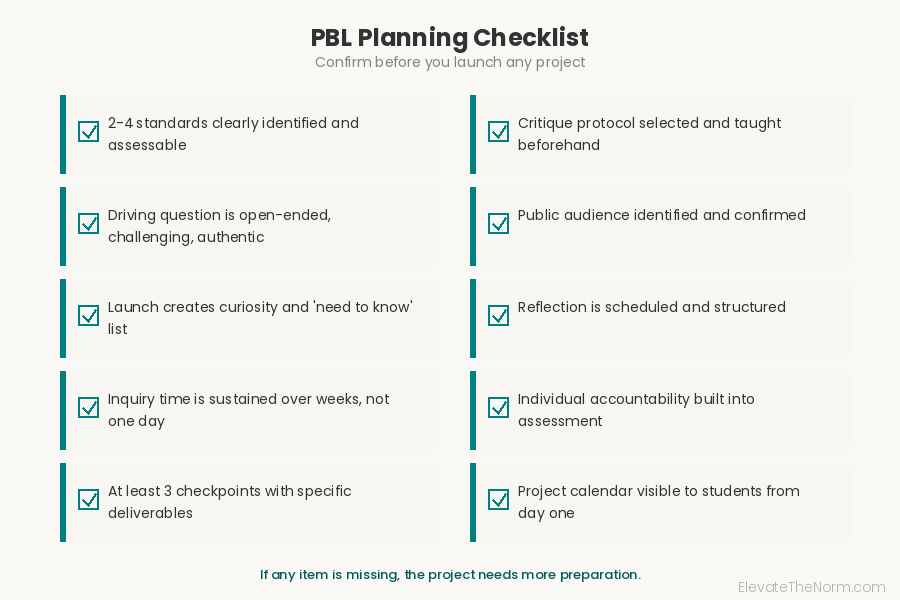
The Elevate Blog banner: Real Classrooms. Practical Ideas. Higher Expectations. Three students climb a rocky ridge at sunrise, each pulling the next one up, toward a teacher reaching down to help.

Category: Project Based Learning

Project based learning in real classrooms: what it is, how to plan it, and what to look for when you walk into the room.

  • Activities for Student Centered Learning That Give Students Real Ownership

    Activities for Student Centered Learning That Give Students Real Ownership

    By Clay Shumate

    Activities for student centered learning only work when students are doing the thinking — not just following instructions that feel participatory. The activities below transfer real decision-making to students while keeping the teacher present, circulating, and holding the standard. Each one works in grades 6–12 without requiring a technology budget, a flexible schedule, or permission from anyone outside your room.

    Key Takeaways

    • Student-centered activities shift the cognitive load to students — they think, decide, and defend rather than listen and record.
    • The teacher does not disappear. The teacher circulates, intervenes at the right moment, and holds the standard.
    • Structure prevents confusion. Every activity below includes a clear task, a time frame, and an accountability check.
    • A 2023 meta-analysis of 31 studies found that student-centered approaches produced the largest effect sizes at the secondary level — stronger than primary or higher education.
    • Start with one activity. Trying to overhaul everything at once is how student-centered learning gets abandoned by October.

    What Makes an Activity Student Centered — and What Just Looks Like It
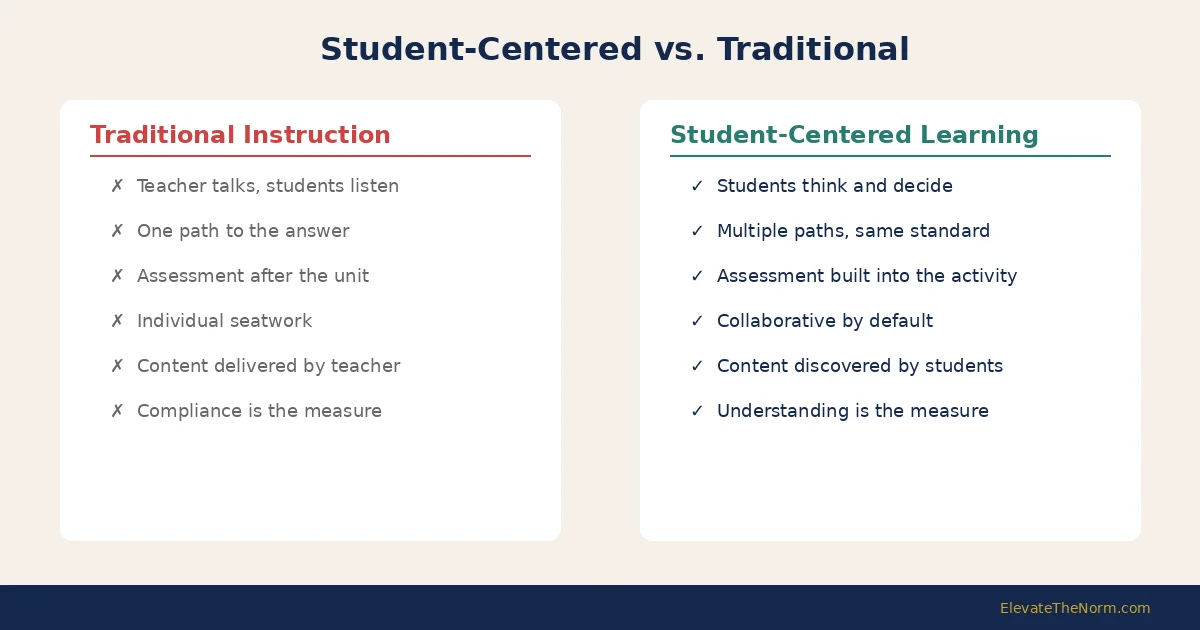
    Side-by-side comparison of student centered learning versus traditional instruction showing who does the thinking in each model
    In student-centered activities, students do the thinking — not just the moving.

    A lot of activities get called student centered because students are moving, talking, or using colored markers. That is not the test. The test is: who is doing the thinking?

    If students are following a step-by-step handout, filling in blanks, or rotating through stations that ask nothing beyond recall, the teacher is still doing the cognitive work — just delivering it through a different medium. Student-centered means students are making decisions about what to investigate, how to approach a problem, or how to present evidence. It means they encounter genuine uncertainty — not a question where the answer is already written on the back of the card.

    A meta-analysis by Baeten, Dochy, Struyven, Parmentier, and Vanderbruggen (2023), published in SAGE Open, reviewed 31 studies and found a large overall effect of student-centered education on learning outcomes (SMD = 0.72, p < .001). The finding that matters most for middle and high school teachers: secondary education showed the strongest effect of any level, with an SMD of 0.98 — meaning student-centered approaches produced nearly a full standard deviation of improvement at the grades where many teachers still default to lecture. Programs that ran longer than six months showed the largest gains (SMD = 1.08), which means this is not a novelty effect. It is a sustained instructional advantage.

    That said, the study’s heterogeneity was very high (I² = 99.7%), which means the quality of implementation matters enormously. Poorly structured student-centered activities will not produce these results. The activities below are designed with that constraint built in: every one of them includes the structure that makes the approach work, not just the freedom that makes it sound good.

    Activities That Transfer Real Thinking to Students
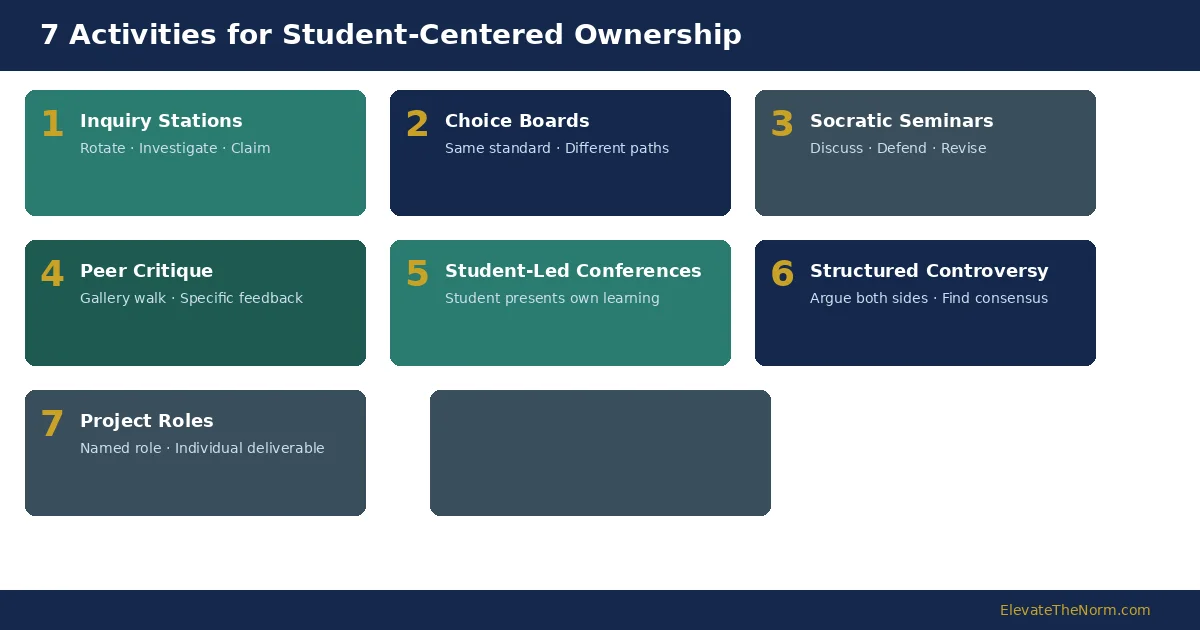
    Overview of seven student centered learning activities including inquiry stations, choice boards, Socratic seminars, peer critique, student-led conferences, structured controversy, and project roles
    Seven activities that transfer real decision-making to students.

    Inquiry Stations

    What it is: Students rotate through three to five stations, each presenting a different primary source, data set, image, or short text related to the same question. At each station, they record observations, generate questions, and build toward a claim they will defend at the end of the rotation.

    Why it works: Students encounter evidence before they encounter the teacher’s interpretation. They have to look at something, decide what it means, and compare it against what they found at the previous station. The thinking is theirs.

    The structure that prevents confusion: Post the driving question where everyone can see it. Give each station a task card with one or two specific prompts — not open-ended “discuss what you see” instructions that lead to three minutes of silence followed by off-task conversation. Set a timer for each rotation. Have students record individually, even if they talk in groups, so there is an accountability artifact.

    In my room, I set up inquiry stations on trapezoid tables pushed together, which means groups of three or four are already facing each other when they sit down. I circulate during rotations. More than once, I have caught a group building a misconception from one station’s source — they misread a chart or drew a conclusion the data did not support — and the only reason I caught it was because I was standing close enough to hear them reason through it before they wrote it down. That is the teacher’s job in a student centered learning classroom: not to deliver the content from the front, but to be close enough to redirect the thinking before it hardens into a wrong answer. The same demand on your attention runs through the longer bank of experiential activities for grades 6–12.

    Choice Boards Within Standards

    What it is: A grid of options — typically three-by-three or four-by-four — where each cell is a different way to demonstrate understanding of the same learning target. Students choose which cells to complete. Every option meets the same standard; only the mode of expression changes.

    Why it works: A meta-analysis by Patall, Cooper, and Robinson (2008) reviewed 41 studies on the effects of choice on intrinsic motivation and found a moderate positive effect (d = 0.30–0.36). More importantly for teachers, choice also improved perceived competence (d = 0.59) and task performance (d = 0.32). The authors found that younger learners benefited more than older ones, and that a moderate number of options — two to four — worked better than an overwhelming menu.

    The structure that prevents confusion: The board is not a buffet of busywork. Every cell must require the same depth of thinking — do not put “draw a poster” next to “write an analytical paragraph” and pretend those are equivalent. Build the board so a student who picks any combination of cells has demonstrated the target. Include a rubric that applies across all cells. Require students to commit to their choices before starting, not to switch mid-task when the first one gets hard.

    Choice boards are one of the clearest ways to give students real student responsibility without lowering the bar. The standard does not move. The path to it does.

    Socratic Seminars

    What it is: A structured discussion in which students — not the teacher — drive the conversation about a text, question, or problem. Participants sit in a circle (or an inner-outer circle variation), reference evidence, build on each other’s ideas, and disagree respectfully. The teacher observes, tracks participation, and intervenes only to redirect or probe.

    Why it works: Students practice every skill that matters and cannot be tested on a multiple-choice exam: listening, articulating a position, responding to disagreement, revising their thinking in real time. Research from the Association for Supervision and Curriculum Development describes Socratic seminars as developing “listening, speaking, and critical-thinking abilities” through peer dialogue rather than teacher-directed Q&A (ASCD, 2023). In one documented middle school implementation, students who participated in regular seminars began using structured discussion moves spontaneously during regular class activities — evidence of transfer, not performance. For grading it, see the Socratic seminar rubric for high school and middle school.

    The structure that prevents confusion: Assign the text in advance. Require students to come with at least two prepared questions. Use a fishbowl format (inner circle discusses, outer circle evaluates and rotates in) if your class is larger than fifteen. Set a participation tracker — a simple grid where the teacher tallies contributions — so quiet students are noticed and dominant talkers learn to make space. Follow every seminar with a written reflection: “What changed in your thinking today, and why?”

    Socratic seminars work in every subject. A history class argues over primary sources. A science class debates competing hypotheses. An English class examines authorial intent. The format is the same; the content changes. It is one of the most powerful activities for student centered learning because the students genuinely cannot predict where the conversation will go — and neither can the teacher. The long version — six moves, six norms, and an honest read of what the discussion research does and does not support — is in the full walkthrough of running a seminar in a secondary classroom.

    Peer Critique Protocols

    What it is: A structured process in which students review each other’s work using specific criteria. The most effective version is the gallery walk, where student work is posted around the room and classmates circulate, leaving written feedback on sticky notes or feedback forms. Ron Berger’s framework from EL Education requires that feedback be “kind, specific, and helpful” — three words that do more than any rubric to prevent critique from becoming cruelty or flattery.

    Why it works: Students learn to evaluate quality by evaluating someone else’s work against a standard. That is harder than evaluating their own, and it builds the judgment they need to self-assess later. PBLWorks, which runs this protocol constantly, reports from its own practice that giving participants a specific focus — such as content accuracy, argument structure, or evidence quality — helps generate higher-quality feedback, where open-ended instructions produced superficial comments like “good DQ!”. That is practice knowledge rather than a study; the article cites no research. What is well evidenced is the peer assessment underneath the protocol — a meta-analysis of 54 control-group studies put it at g = 0.31 on achievement, and higher at secondary level.

    The structure that prevents confusion: Give students the rubric or success criteria before the gallery walk, not after. Require written feedback — verbal feedback disappears the moment the bell rings. Use structured stems: “I notice…,” “I wonder…,” “One thing that would strengthen this is….” Set a time limit per station. Debrief as a class afterward, pulling patterns from the feedback rather than singling out individual work. The six-step version of this protocol, and the four ways it most often collapses, are in the full walkthrough of running one so the feedback is worth reading.

    Peer critique teaches respect in the classroom through practice, not through a poster. When students learn to disagree with someone’s work without attacking the person who made it, they are learning a skill most adults have not mastered.

    Student-Led Conferences

    What it is: Instead of the teacher reporting to the parent about the student, the student leads the conversation. They present their work, explain their progress, identify their strengths and weaknesses, and set goals — with the teacher and parent as listeners and questioners, not narrators.

    Why it works: The student has to articulate what they know, what they do not know, and what they plan to do about it. That requires self-assessment, organization, and the ability to speak about learning — not just perform it. It also shifts the parent-teacher conference from a conversation about the student to a conversation with the student, which is what project based learning looks like when it extends beyond the classroom walls.

    The structure that prevents confusion: Give students a preparation template at least a week in advance. Include sections for: “one piece of work I am proud of and why,” “one area where I need to improve,” “my plan for improvement,” and “questions I have for my teacher or parent.” Rehearse the conference format in class. Set a time limit — ten to fifteen minutes is enough. Have the teacher take brief notes during the conference and follow up privately if anything the student said needs correction or support.

    Structured Academic Controversy

    What it is: Pairs of students are assigned a position on a debatable question. They research and present their side, then switch sides and argue the opposite. Finally, the group drops the assigned positions and reaches a consensus based on the evidence from both sides.

    Why it works: Students cannot settle for their first opinion. They have to argue a position they may disagree with, which forces them to engage with evidence rather than preference. The consensus requirement at the end prevents the activity from becoming a performance — it requires synthesis, not just persuasion.

    The structure that prevents confusion: Choose a question where both sides have legitimate evidence — not a question with a clear factual answer. Provide curated sources so the research phase is productive, not a twenty-minute Google detour. Set time limits for each phase: five minutes to prepare, three minutes to present each side, five minutes for consensus. Require each group to write a one-paragraph consensus statement citing evidence from both sides.

    Project Roles With Built-In Accountability

    What it is: Within a group project, each student holds a named role with a specific deliverable that the group depends on. Roles might include project manager (owns the timeline and check-ins), lead researcher (synthesizes sources), quality controller (evaluates drafts against the rubric), or presentation coordinator (designs the final product). The key: each role has a visible individual deliverable, not just a title.

    Why it works: The most common complaint about group projects — “one person does all the work” — is a design problem, not a student problem. When the role includes a deliverable that the group cannot complete without, freeloading becomes structurally difficult. Students learn to manage real project work rather than divide a poster into four corners.

    The structure that prevents confusion: Define each role on a printed card with the title, the deliverable, the deadline, and how the role connects to the final product. Rotate roles across projects so students build multiple skills. Include a brief individual reflection at the end: “What did your role require? What did you do well? What would you do differently?” This makes individual accountability visible without turning group work into individual work in disguise.

    Reflection Protocols

    What it is: A structured end-of-task or end-of-week routine in which students write about what they learned, how their thinking changed, what confused them, and what they would do differently. This is not a journal entry. It is a directed reflection with specific prompts and a purpose.

    Why it works: Learning that is not reflected on tends to stay shallow. A student who completes an inquiry station, participates in a seminar, or finishes a project but never pauses to consolidate what happened will forget most of it by the following week. Reflection is where experience becomes understanding — which is exactly why experiential learning frameworks like Kolb’s cycle put reflection at the center of the process, not the end.

    The structure that prevents confusion: Use three to four specific prompts, not “reflect on your learning.” Try: “What did you think before this activity? What do you think now? What evidence changed your mind?” or “Name one thing that confused you today. Write down what you tried before asking for help.” Keep it to five minutes. Read the reflections — they are your best formative data, and students write more honestly when they know the teacher actually reads them.

    The Teacher’s Role: Present, Not Passive
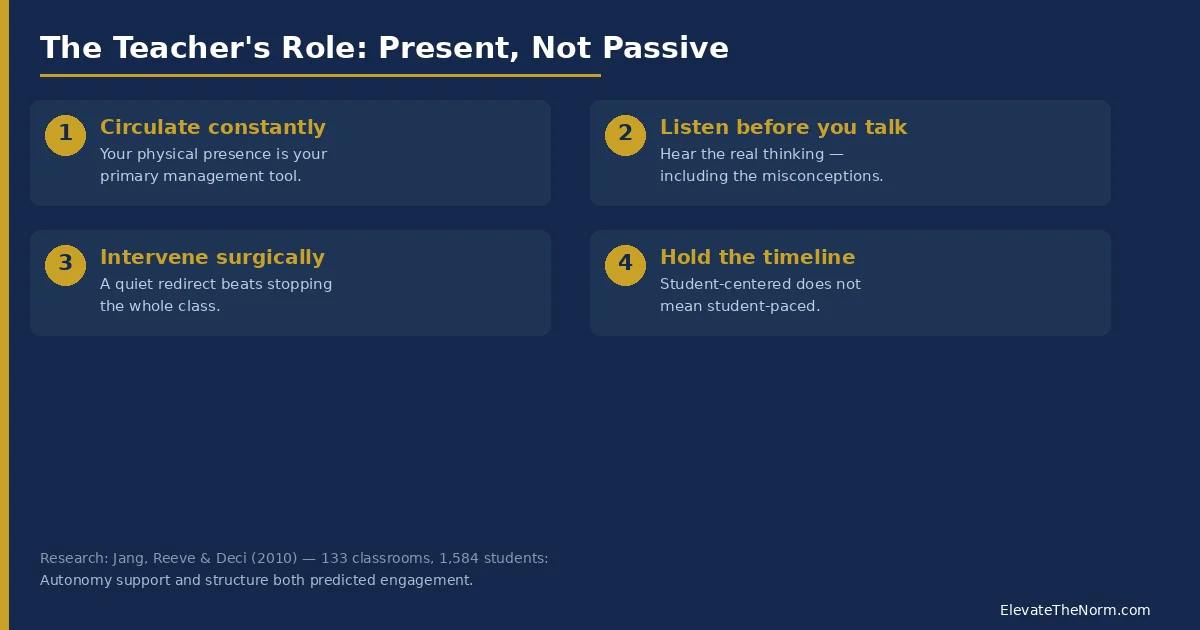
    Four teacher roles in student centered learning: circulate constantly, listen before talking, intervene surgically, hold the timeline — based on Jang, Reeve, and Deci research
    The teacher’s role in student-centered learning: present, active, and strategic.

    Every activity above requires a teacher who is actively working the room — not sitting at a desk, not grading papers, and certainly not treating “student centered” as a synonym for “teacher absent.” The research is clear on this. Jang, Reeve, and Deci (2010) studied 133 high school classrooms with 1,584 students and found that autonomy support and structure were positively correlated — teachers who gave students meaningful choices also provided clear expectations and active guidance. Both predicted behavioral engagement, and autonomy support uniquely predicted students’ self-reported engagement.

    That finding should end the false dichotomy between “teacher-directed” and “student-centered.” The best version of student-centered instruction is teacher-led in terms of structure and student-led in terms of thinking. The teacher builds the frame. The students fill it.

    In practical terms, this means:

    • Circulate constantly. Every activity in this article assumes the teacher is moving. If you are standing in one spot, you are missing what is happening across the room.
    • Listen before you talk. When you approach a group, listen for thirty seconds before saying anything. You will hear the real thinking — including the misconceptions you need to address.
    • Intervene surgically. A quiet redirect to one group is more effective than stopping the whole class. Save the full-class interruption for patterns, not individual mistakes.
    • Hold the timeline. Student-centered does not mean student-paced. Post the schedule. Keep it visible. Name the time remaining. Students work better inside a boundary they can see.

    How to Prevent Freedom From Becoming Confusion

    The number one reason teachers abandon student-centered activities is not that the activities failed — it is that the room fell apart during the transition. Students did not know what to do, took too long to start, or interpreted “work with your group” as “talk to your friends about the weekend.”

    Here is the fix, and it is not complicated:

    1. Explain the activity in under two minutes. If your instructions take longer than that, the activity is too complicated or your explanation is too detailed. Students learn the activity by doing it, not by listening to you describe every contingency.
    2. Post the task, the time, and the product. Every student should be able to look at the board and answer three questions without asking you: What am I doing? How long do I have? What do I turn in?
    3. Start with a model. The first time you run a Socratic seminar, model it with a small group while the rest of the class watches. The first time you use peer critique, walk through one example piece of feedback as a class. This takes ten minutes and saves you from answering the same question thirty times.
    4. Build in a two-minute check. Two minutes after students begin, stop and ask: “Raise your hand if you are not sure what you should be doing right now.” Fix the confusion immediately. Do not wait until the end of the period to discover that half the room was lost from the start.
    5. Debrief every time. Spend the last three minutes of the activity debriefing what worked and what did not. This is where student motivation builds — when they see that the activity had a point, that their effort produced something, and that the teacher noticed.

    Starting Small: A Realistic Entry Point

    Do not try to run all of these activities next Monday. Pick one. Run it once. See what happens. Adjust. Run it again.

    If you have never done anything student-centered beyond group work, start with a choice board. It requires the least classroom management adjustment, gives you a visible product to assess, and lets students practice making decisions within a structure you control. Once that feels routine — two or three times, usually — add a Socratic seminar or a gallery walk. Build the repertoire over weeks, not days.

    The Baeten et al. (2023) meta-analysis found that student-centered interventions lasting longer than six months produced effect sizes nearly double those of shorter interventions (SMD = 1.08 vs. 0.63–0.72). Translation: this is a long game. The activities get more effective the more students experience them, which means the worst thing you can do is try everything once, decide it did not work, and go back to lecture. It did not fail. It had not started yet.

    Teach the way you want students to learn: start with what is manageable, build from experience, and treat the mistakes as data, not as evidence that you should quit. For a ready-to-use tool on this, see a printable student-led conference toolkit.

    Student-centered activities work best when students also have a real say in how the work is structured. For a framework on how much say students can hold at each level — and where teacher authority must stay — see student voice and choice.


    Once you have a bank of student-centered tasks, the next question is how to run them without losing the room. Station rotation is one answer and it is not a neutral one: it costs three transitions in a period that already loses more instructional time in high school than in elementary school. What a station rotation costs and what it buys sets out the station counts teachers actually use, the device-access problem, and the test to apply at the end of your first attempt.

    Frequently Asked Questions

    Do student-centered activities work in large classes?

    Yes, but the structure matters more. Inquiry stations, choice boards, and peer critique protocols all scale to thirty-plus students because they operate in small groups. Socratic seminars work best with fifteen or fewer in the inner circle — use the fishbowl format for larger classes. The key is that every student has a specific task, not that every student is doing the same thing at the same time.

    How do I assess student-centered activities?

    Use the products the activities produce. Inquiry stations generate claim statements. Choice boards produce varied demonstrations of the same standard. Peer critique generates written feedback. Socratic seminars pair with participation trackers and written reflections. Every activity in this article includes a built-in artifact you can grade, which means assessment does not require a separate test.

    What if students are not used to this kind of work?

    Expect the first attempt to be messy. Students who have spent years in teacher-directed classrooms need time to adjust to making decisions, and that adjustment sometimes looks like confusion or off-task behavior. The fix is not to abandon the approach — it is to start with the most structured option (choice boards), build routines over several weeks, and explicitly teach the behaviors each activity requires before running it.

    Can student-centered activities cover required standards?

    They must. Student-centered is not a license to skip the curriculum. Every activity in this article is designed around a learning target tied to standards. Choice boards offer multiple paths to the same standard. Inquiry stations present evidence aligned to specific content. Socratic seminars and structured academic controversies require engagement with course material. If the activity does not serve the standard, redesign the activity — do not lower the standard.

    Is student-centered learning the same as project based learning?

    No, but they overlap. Project based learning is one type of student-centered instruction — one that is sustained, inquiry-driven, and produces a public product. The activities in this article are shorter, can fit inside a single class period, and do not require a multi-week project structure. A teacher running PBL will use many of these activities within a project. A teacher who does not run PBL can still use all of them.

    How do I handle students who refuse to participate in group activities?

    First, find out why. A student who refuses to participate is telling you something — about the group, the task, the social dynamics, or their own confidence. Offer a structured alternative that meets the same objective individually, and check in privately. Do not force public participation as a compliance test. That said, opting out of collaboration entirely is not a long-term option in a classroom that values it, so build toward participation gradually with low-risk entry points like written peer feedback before verbal discussion.

    Do these activities work for students with IEPs or 504 plans?

    Student-centered activities are often more accessible than traditional instruction, not less. Choice boards allow students to demonstrate learning through their strongest mode. Inquiry stations can include differentiated source materials at different reading levels. Socratic seminars can be supported with sentence stems and pre-discussion preparation time. The built-in flexibility of student-centered work makes accommodation a design feature, not an add-on — but you still need to review each activity against the specific accommodations in each student’s plan.


    Sources

    1. Baeten, M., Dochy, F., Struyven, K., Parmentier, E., & Vanderbruggen, A. (2023). “Student-Centered Education: A Meta-Analysis of Its Effects on Non-Academic Achievements.” SAGE Open, 13(2). https://doi.org/10.1177/21582440231168792
    2. Patall, E. A., Cooper, H., & Robinson, J. C. (2008). “The Effects of Choice on Intrinsic Motivation and Related Outcomes: A Meta-Analysis of Research Findings.” Psychological Bulletin, 134(2), 270–300. https://doi.org/10.1037/0033-2909.134.2.270
    3. Jang, H., Reeve, J., & Deci, E. L. (2010). “Engaging Students in Learning Activities: It Is Not Autonomy Support or Structure but Autonomy Support and Structure.” Journal of Educational Psychology, 102(3), 588–600. https://doi.org/10.1037/a0019682
    4. Association for Supervision and Curriculum Development (ASCD). (2023). “Socratic Seminars: Engaging Students in Intellectual Discourse.” Educational Leadership. https://www.ascd.org/el/articles/socratic-seminars-engaging-students-in-intellectual-discourse
    5. PBLWorks. (2024). “Using Gallery Walks for Critique & Revision in PBL.” Buck Institute for Education. https://www.pblworks.org/blog/using-gallery-walks-critique-revision-pbl
    6. Berger, R., Rugen, L., & Woodfin, L. (2014). Leaders of Their Own Learning: Transforming Schools Through Student-Engaged Assessment. Jossey-Bass/EL Education.

    About Clay Shumate

    Clay Shumate is a certified secondary Social Studies teacher in the public schools of West Alabama, with seven years of classroom experience, a B.A. in History, and an M.Ed. in Secondary Education. He writes about project-based learning, student responsibility, respect, and practical ways to hold young people to a higher standard while giving them room to learn from mistakes. He is a member of the Society of Professional Journalists and writes to its Code of Ethics; this site’s editorial standards and corrections policy are published in full. More about Clay.
  • Experiential Learning High Schools Can Actually Use

    Experiential Learning High Schools Can Actually Use

    Experiential Learning High Schools Can Actually Use

    By Clay Shumate

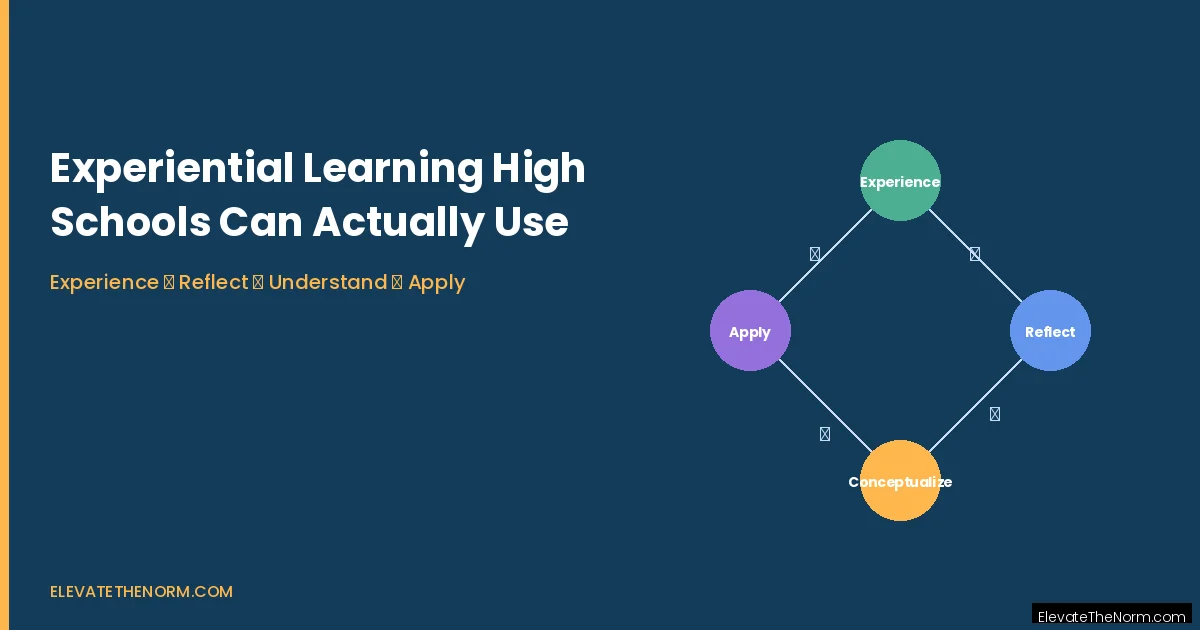
    Experiential learning in high schools is learning that comes from doing something real, reflecting on what happened, and applying what you figured out to the next challenge. It is not a field trip. It is not a hands-on activity tacked onto the end of a lecture unit. It is a structured cycle of experience, reflection, and transfer — and high schools can use it inside ordinary schedules and budgets without rebuilding anything. Students can then present what they learned to families with a student-led conference template.

    Key Takeaways

    • Experiential learning is a structured cycle — experience, reflection, conceptualization, application — not just any activity where students use their hands.
    • High schools can implement experiential learning within existing courses, bell schedules, and budgets. The barrier is design, not money.
    • Reflection and transfer are what separate experiential learning from mere activity. Without them, students have an experience but do not learn from it.
    • Types range from simulations and case studies that never leave the classroom to internships, service learning, and community partnerships that extend beyond it.
    • The teacher’s role shifts from delivering information to designing experiences, supporting learners through difficulty, and facilitating reflection — not disappearing.

    What Experiential Learning Actually Is

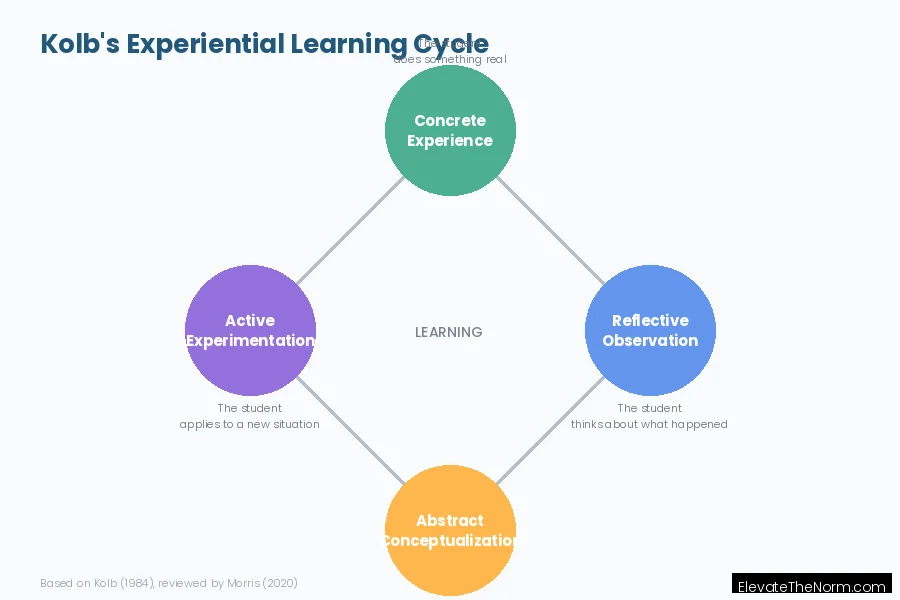
    The term goes back to John Dewey, who argued in the 1930s that education must be grounded in real experience — not experience for its own sake, but experience organized to produce growth. David Kolb formalized the idea into a four-stage cycle in 1984: concrete experience, reflective observation, abstract conceptualization, and active experimentation. That cycle remains the dominant framework (Morris, 2020).

    The Association for Experiential Education defines it as “a teaching philosophy that informs many methodologies in which educators purposefully engage with learners in direct experience and focused reflection in order to increase knowledge, develop skills, clarify values, and develop people’s capacity to contribute to their communities” (AEE).

    The key word in that definition is purposefully. A student who dissects a frog has had an experience. A student who dissects a frog, records what they observe, connects it to the circulatory system they studied, and applies that understanding to a comparative anatomy problem has had experiential learning. The difference is not the activity. The difference is the reflection and the transfer.

    The Kolb Cycle in a High School Classroom

    Kolb’s four stages look abstract on paper. In a classroom, they look like this:

    Kolb's four-stage experiential learning cycle showing concrete experience, reflective observation, abstract conceptualization, and active experimentation
    Based on Kolb 1984, reviewed by Morris 2020

    Stage 1 — Concrete Experience. The student does something. They run a simulation of a historical negotiation. They conduct an interview with a local business owner. They attempt to solve a problem with incomplete data. The experience is real enough that it produces genuine confusion, interest, or difficulty — not a rehearsal of something the teacher already explained.

    Stage 2 — Reflective Observation. The student steps back and thinks about what happened. What worked? What did not? What surprised them? This stage is where most high school implementations fail — the activity ends, the bell rings, and nobody processes anything. Without reflection, the experience is a memory, not learning.

    Stage 3 — Abstract Conceptualization. The student connects the experience to bigger ideas, theories, or principles. This is where content instruction lives. The difference is that the student encounters the concept after the experience, not before — so the concept explains something they have already encountered rather than something they have only been told about.

    Stage 4 — Active Experimentation. The student applies what they have learned to a new situation. This is the transfer. A student who ran a Treaty of Versailles simulation, reflected on why negotiations collapsed, and connected it to concepts of national self-interest now applies that understanding to analyzing a current diplomatic dispute. The cycle starts again.

    I have a whiteboard table in my classroom — a table I built, surrounded by better chairs and a low lamp, in the corner of the room where students actually ask to sit. That table is where the reflection stage happens for most of my small-group work. When I pull a group there after a simulation or a document analysis, the shift in setting signals that we are moving from doing to thinking. The conversation changes. Students are not performing for the room anymore. They are processing what just happened, and the physical space — quieter, closer, more intentional — makes that processing better.

    Types of Experiential Learning That Work in High Schools

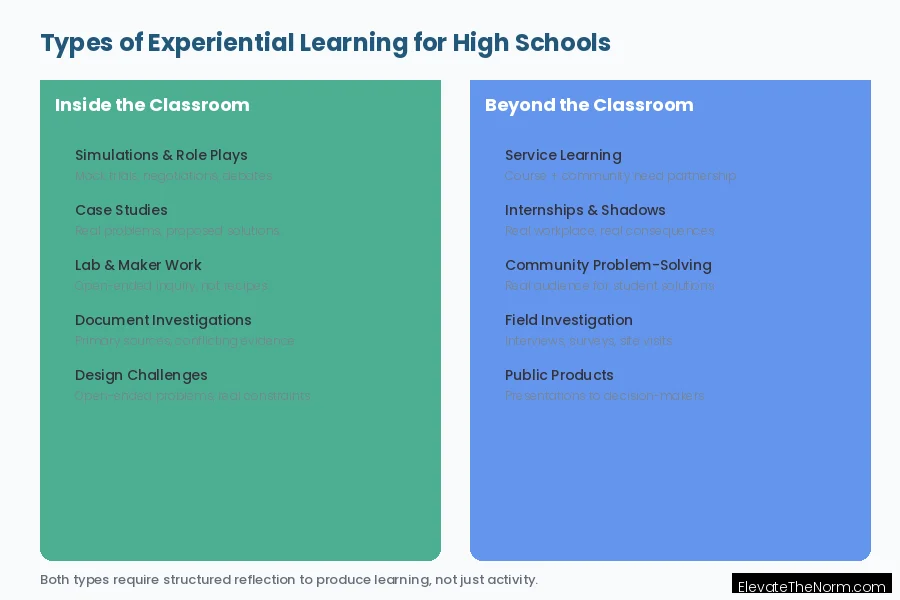
    Not every form of experiential learning requires a bus, a budget, or a community partner. Many of the most effective types happen inside the building, during regular class periods, with materials already available. A set of worked project examples across subjects shows what this looks like in school-based, community-connected, and cross-curricular formats. My Social Studies Teacher Toolkit Bundle on TPT covers world history and civics if you want finished materials for the content side.

    Two-column comparison of experiential learning types: inside the classroom including simulations, case studies, and labs, and beyond the classroom including service learning and internships
    Both types require structured reflection to produce learning, not just activity

    Inside the Classroom

    Simulations and role plays. A mock trial. A constitutional convention with competing delegates. A town-hall debate on a local zoning decision. Simulations compress real-world complexity into a classroom-sized experience and force students to make decisions under constraints. The learning lives in the debrief — the conversation afterward about why they made the choices they made and what those choices reveal about the subject.

    Case studies. Give students a real problem — a business decision, a public health crisis, an engineering failure, a historical dilemma — and ask them to analyze it, propose a solution, and defend their reasoning. Case-based learning is experiential because the student is doing the intellectual work of a practitioner, not memorizing someone else’s conclusions.

    Laboratory and maker work. Science labs are the oldest form of experiential learning in secondary schools. The challenge is ensuring that labs are genuine inquiry — where the student does not know the answer before they start — rather than confirmation exercises where they follow a recipe to arrive at a predetermined result. The same principle applies to maker spaces, fabrication labs, and design challenges: the value is in the open-ended problem, not the equipment.

    Document-based investigations. In a social studies class, this means handing students primary sources, conflicting accounts, or incomplete evidence and asking them to construct an interpretation. The experience is the intellectual struggle of the discipline itself — weighing evidence, identifying bias, tolerating ambiguity, building an argument.

    Beyond the Classroom

    Service learning. Service learning is not community service with a reflection worksheet. It is a structured partnership between a course and a community need, where the service advances the academic learning and the academic learning improves the service. A biology class monitoring water quality for a local watershed organization is service learning. A class picking up trash for a day is community service — valuable, but not the same thing.

    Internships and job shadows. Extended placements in professional settings give students access to the real pace, decisions, and consequences of adult work. Several states have begun requiring or incentivizing these: Mississippi now provides career coaches in every public high school, Indiana requires all graduates to complete a work-based learning experience, and Delaware has built a statewide career pathway system that connects classroom learning to industry credentials.

    Community problem-solving and public products. Students identify a real problem in their community, research it, propose a solution, and present that solution to a genuine audience — a city council, a school board, a local business, a nonprofit. The audience is what makes it experiential rather than hypothetical. A student who presents to someone who might actually implement their idea is having a fundamentally different experience from a student who presents to their teacher for a grade. This is also the heart of strong project-based learning.

    Field investigation. Site visits, interviews, environmental surveys, oral history projects, archaeological-style artifact analysis. The fieldwork does not need to be exotic. Interviewing a grandparent about their experience during a historical period is field investigation. Photographing and documenting the architectural history of a single block downtown is field investigation. What matters is that the student encounters primary evidence in its natural context rather than in a textbook.

    Why Reflection Makes or Breaks the Whole Thing

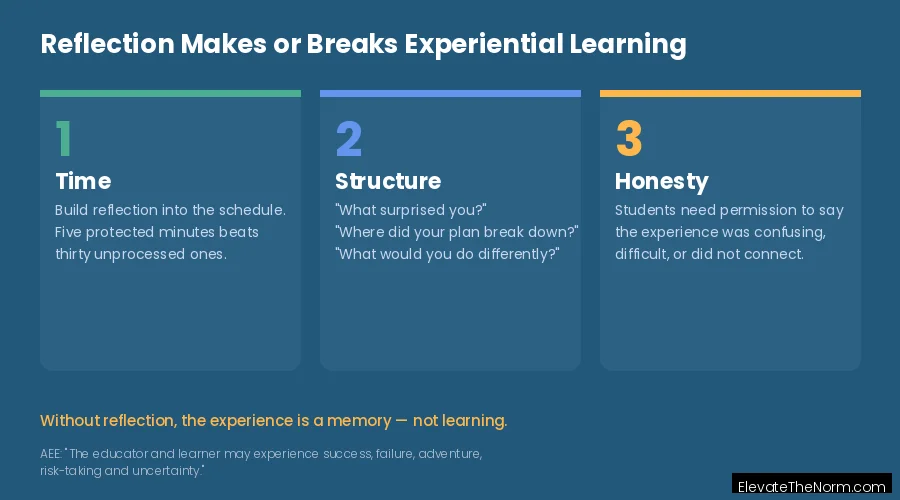
    An experience without reflection is just something that happened. Reflection is the mechanism that converts an event into understanding. Kolb’s model, Dewey’s philosophy, and the AEE’s principles all agree on this point: the learning does not live in the experience. It lives in what the learner makes of the experience afterward.

    Three requirements for effective reflection in experiential learning: time, structure, and honesty
    Without reflection, the experience is a memory — not learning

    In practice, reflection requires three things from the teacher:

    Time. This is the hardest resource to protect. When the simulation runs long or the lab takes the full period, reflection gets cut. Plan for it. Build it into the schedule, not the leftover minutes. Even five protected minutes of structured reflection are worth more than thirty minutes of unprocessed activity.

    Structure. “What did you think?” is not reflection. It is an invitation to say “It was cool” and move on. Effective reflection questions are specific: What surprised you? Where did your plan break down? What would you do differently if you ran the simulation again? What does this experience suggest about how [concept] works in practice?

    Honesty. Students need permission to say the experience did not work, was confusing, or did not connect. The AEE’s principles explicitly state that “the educator and learner may experience success, failure, adventure, risk-taking and uncertainty.” If every reflection ends with a tidy success narrative, the reflection is performative, and students will learn to produce the expected answer rather than the honest one.

    Making It Work Inside an Ordinary Schedule

    The most common objection to experiential learning in high schools is time. Block schedules help, but plenty of schools run 45-minute periods. Experiential learning is still possible. It just requires different design.

    Break the cycle across days. Kolb’s cycle does not need to happen in one period. Run the experience on Monday, the reflection on Tuesday, connect to the content on Wednesday, and apply to a new situation on Thursday. This is no different from what good teachers already do — it just makes the structure explicit.

    Use the classroom for what the classroom can do. Simulations, case studies, document analyses, design challenges, and problem-solving protocols are all experiential and all fit inside a regular class period. A bank of ready-to-run activities across those categories shows how each one fits a single period. Not every experiential activity requires leaving the building. Some of the strongest experiences are intellectual, not physical — the struggle of interpreting conflicting evidence, the difficulty of building a persuasive argument, the challenge of solving a problem with incomplete information.

    Start with one unit. You do not need to redesign an entire course. Take one unit you already teach, identify where students currently receive information passively, and replace that section with an experience that forces them to encounter the concept before you explain it. Then add structured reflection. That is the whole conversion. You can scale from there.

    Budget is not the barrier — design is. A simulation costs nothing. A case study costs nothing. A structured interview protocol costs nothing. An oral history project costs nothing. The expensive forms of experiential learning — internship programs, community partnerships, off-campus placements — are valuable, but they are not the only forms, and waiting for the budget to build them should not prevent you from using the forms you can start tomorrow.

    What the Research Says

    Ranken’s 2025 rapid evidence assessment, published in The Curriculum Journal, examined studies on the effect of experiential learning on academic achievement for students aged 4–14. The assessment found positive effects overall but noted wide variation by implementation quality, with the strongest outcomes in programs that included structured reflection and explicit connection to curriculum content (Ranken, 2025).

    Morris (2020), in a systematic review and revision of Kolb’s model published in Interactive Learning Environments, confirmed the experiential learning cycle’s continued relevance while noting that Kolb’s original four-stage model benefits from greater emphasis on the social context of learning — the idea that experiences are more powerful when learners process them with others, not just internally (Morris, 2020).

    Data from CapSource and other employer surveys consistently find a gap between what high school and college graduates can do and what employers need them to do. CapSource reported that 72 percent of graduates felt unprepared for workplace challenges and 84 percent of hiring managers identified readiness gaps. Experiential learning directly addresses this by giving students practice with the skills — problem-solving, communication, adaptation, professional judgment — that traditional instruction often describes but rarely lets students perform.

    The evidence does not suggest that experiential learning is a universal replacement for direct instruction. Some content is efficiently taught through explanation, practice, and feedback. The evidence suggests that experiential learning fills a gap that direct instruction cannot: the gap between knowing about something and knowing how to do it, between receiving information and constructing understanding. Strong project-based learning uses the same principle at a larger scale.

    Common Mistakes to Avoid

    Activity without purpose. An experience that is fun but unconnected to learning goals is not experiential learning. It is a field trip. Every activity needs to produce a struggle, a question, or a problem that the curriculum can then help resolve.

    Skipping the reflection. This is the most common failure, and it reduces experiential learning to busy hands. If the bell rings before students process what happened, the learning did not happen. Protect the reflection time the way you protect the test — it is not optional.

    Assuming experiences must leave the building. Internships and community partnerships are excellent, but they are not the definition. Simulations, case analyses, structured debates, and design challenges are experiential, and they work inside a regular classroom during a regular period.

    Removing the teacher. Experiential learning shifts the teacher’s role — it does not eliminate it. The AEE’s principles describe the educator’s role as setting suitable experiences, posing problems, supporting learners, ensuring physical and emotional safety, and facilitating the learning process. A teacher who launches an activity and then retreats to a desk has not implemented experiential learning. They have implemented unsupervised activity.

    Confusing experiential learning with entertainment. Difficulty is not a design flaw. It is the point. An experience that challenges, confuses, or frustrates the student is exactly where learning happens — provided the teacher supports the student through it and the reflection helps them make sense of it. Ease and fun are not the goal. Growth is.

    Conclusion

    Experiential learning in high schools does not require a new building, a grant, or a revolution. It requires a teacher who is willing to let students encounter a problem before the answer, sit with difficulty long enough to learn from it, and reflect honestly on what happened. That cycle — experience, reflection, understanding, application — is how people actually learn outside of school. There is no reason school should be different.

    Start with one simulation, one case study, one structured interview, one investigation. Build in the reflection. Connect it to the content. Let the student apply what they figured out to something new. That is experiential learning. It works in a 45-minute period, in a regular classroom, on a regular budget. And it produces students who can actually use what they learned the moment they walk out the door.

    Looking for the community-facing form? Our companion piece on service learning in grades 6–12 follows the same structure and adds the partner, permission and liability questions an in-school project never has to plan around.

    Frequently Asked Questions

    What is the difference between experiential learning and hands-on learning?

    Hands-on learning means the student physically manipulates materials or does an activity. Experiential learning adds three critical layers: the experience must produce a genuine question or challenge, the student must reflect on what happened, and the student must apply the insight to a new situation. A student building a volcano model is doing hands-on learning. A student designing a structure to withstand a simulated earthquake, reflecting on why it failed, and revising the design based on engineering principles is doing experiential learning. The difference is the reflection and the transfer, not the materials.

    Can experiential learning work in a 45-minute class period?

    Yes. Kolb’s learning cycle does not need to happen in a single period. Run the experience on one day and the reflection on the next. Alternatively, use shorter experiential activities that fit inside a standard period: a 15-minute simulation followed by 10 minutes of structured reflection and 15 minutes of content connection. Many classroom-based forms — case studies, document analyses, structured debates, design challenges — are designed for exactly these time constraints.

    What is the teacher’s role in experiential learning?

    The teacher designs the experience, sets up the problem, supports students through difficulty, ensures physical and emotional safety, and facilitates reflection. The teacher does not disappear. The Association for Experiential Education explicitly names educator presence and intentional facilitation as foundational principles. The role shifts from delivering information to creating the conditions for students to encounter, struggle with, and make sense of that information through experience.

    What are examples of experiential learning that stay inside the classroom?

    Simulations and role plays, such as a mock trial or a historical negotiation. Case studies where students analyze a real problem and propose solutions. Document-based investigations using primary sources, conflicting accounts, or incomplete evidence. Design challenges and maker projects with open-ended problems. Laboratory investigations structured as genuine inquiry rather than recipe-following. Structured debates where students must argue positions they did not choose. All of these produce authentic intellectual struggle, which is what makes them experiential.

    How is experiential learning different from project-based learning?

    Experiential learning is the broader philosophy — learning through direct experience, reflection, and application. Project-based learning is one methodology that uses experiential principles at an extended scale, typically involving a driving question, sustained inquiry, and a public product. All strong PBL is experiential, but not all experiential learning is PBL. A 20-minute simulation is experiential but is not a project. A two-week investigation culminating in a community presentation is both.

    Does experiential learning work for all subjects?

    Yes, though it looks different across disciplines. In science, it may involve laboratory inquiry or field investigation. In social studies, it may involve simulations, primary-source analysis, or oral history. In English, it may involve real-world writing for an actual audience. In math, it may involve data collection and analysis on a genuine question. In career and technical education, it may involve internships, job shadows, or client projects. The principle is universal: students learn more deeply when they encounter problems before solutions and reflect on what they discover.

    How do I assess experiential learning?

    Assess both the process and the product. Reflection journals, debriefing discussions, self-evaluations, and peer feedback capture what the student learned from the experience. Rubrics, portfolios, and final products measure the quality of work produced. The key is aligning assessment with the learning goals, not the activity itself. A student who had a strong experience but a weak reflection has not completed the cycle. A student who produced a polished product without engaging genuinely in the experience has performed, not learned.

    Sources


    About Clay Shumate

    Clay Shumate is a certified secondary Social Studies teacher in the public schools of West Alabama, with seven years of classroom experience, a B.A. in History, and an M.Ed. in Secondary Education. He writes about project-based learning, student responsibility, respect, and practical ways to hold young people to a higher standard while giving them room to learn from mistakes. He is a member of the Society of Professional Journalists and writes to its Code of Ethics; this site’s editorial standards and corrections policy are published in full. More about Clay.
  • Project Based Learning Resources: Free Tools for Middle and High School Teachers

    Project Based Learning Resources: Free Tools for Middle and High School Teachers

    By Clay Shumate

    Short answer: The best free project based learning resources for grades 6–12 are a planning template, a driving-question test, a critique protocol, a rubric with your own content rows, and short reflection prompts. PBLWorks and EL Education supply most of them at no cost. Pick the one that fixes your weakest step and learn it before adding another.

    Project based learning resources are the templates, protocols, rubrics and prompts a teacher uses to plan, run and grade a project. The ones worth using solve a specific problem in your planning, not the ones that look impressive in a Pinterest folder. This page evaluates free options for grades 6–12 and says what each does well and where it falls short. A companion piece answers the questions teachers are actually asking AI about PBL.


    Key Takeaways

    • The most useful project based learning resources solve one clear problem: planning, critique, assessment or reflection.
    • Free PBL templates almost always need adapting to your students, your standards and your schedule before they work.
    • Any free digital PBL tool should be checked for student data privacy, under FERPA and COPPA, before students use it.
    • A driving-question test and a structured critique protocol improve projects faster than any other single resource.
    • A generic PBL rubric only grades process until you add rows for the content standards the project teaches.

    Why Are Most Project Based Learning Resource Lists Hard to Use?

    Most project based learning resource lists are hard to use because they dump dozens of links with no evaluation, no context and no explanation of what each resource does when you sit down to plan. That’s not a resource hub. That’s a reading assignment.

    Everything evaluated on this page is free. If you’re shopping instead of browsing, looking for the best tools for project-based learning you can actually buy, including kits, bundles and paid curriculum, that comparison has its own page, and it’s the better starting point for that question.

    Teachers don’t need more links. They need someone to say what a tool does, what it doesn’t, where it breaks down and whether it’s worth limited planning time.

    The evidence for PBL is promising but uneven. A 2023 meta-analysis in Frontiers in Psychology pooled 66 experimental or quasi-experimental studies (190 effect sizes) and found positive effects on academic achievement, attitudes and thinking skills, but it also found the effects in Asia were “significantly better than those in Western Europe and North America” (Zhang & Ma, 2023). There’s more on how PBL compares with traditional instruction on this site. The practical barrier is whether teachers can plan and manage a project without burning out. Good resources lower that barrier. Bad ones raise it.


    Which Free Project Based Learning Resources Are Best for Each Job?

    The best free project based learning resource depends on the job: PBLWorks for planning and rubrics, EL Education for critique, a simple driving-question test for aiming the project, and your own checkpoint prompts for reflection. The table sums up the verdicts below.

    JobFree resourceDoes wellFalls shortVerdict
    PlanningPBLWorks Project Design OverviewPuts every design element on one page, so gaps showAssumes you already know the Gold Standard frameworkUse it
    PacingYour own project calendarShows fast whether the timeline is realisticNo template fits every schedule; you build itBuild it in a spreadsheet
    Driving questionsPBLWorks Driving Question TubricTests a question before you commit to itWritten for teachers, not studentsEssential
    CritiqueEL Education Peer Critique protocolGives students norms for honest, useful feedbackDense formatting; needs a student handoutBest free critique resource
    Critique launchAustin’s Butterfly videoShows feedback plus revision improving workAn elementary exampleUse on day one of critique
    AssessmentPBLWorks rubricsSeparates skills from contentGeneric until you add content rowsUse, then customize
    FeedbackSingle-point rubricForces written, personal feedbackSlow with large rostersUse for major products
    ReflectionCheckpoint reflection promptsStudents catch problems mid-projectOnly works if you read and answer themBuild your own
    Free project based learning resources compared, from the evaluations on this page

    What Is the Best Free PBL Planning Template?

    The best free PBL planning template for most grades 6–12 teachers is the PBLWorks one-page project design form, paired with a project calendar you build yourself. PBLWorks lists its project planner and project design rubric on its resources page, with a free My.PBLWorks.org account.

    PBLWorks Project Design Overview

    What it is: A one-page planning template from PBLWorks (formerly the Buck Institute for Education) that walks you through the Gold Standard PBL design elements: driving question, sustained inquiry, authenticity, student voice and choice, reflection, critique and revision, and a public product.

    Five-question checklist for evaluating a project based learning resource: does it solve one specific problem, is it free and openly licensed, does it need heavy customization, does it respect student privacy, and has someone credible reviewed it
    Five questions to ask before spending planning time on a project based learning resource

    What it does well: Forces you to think about every essential element before you start building lessons. The format fits on a single page, so you can’t hide vague thinking behind long paragraphs. If you leave a box blank, you know something is missing.

    Where it falls short: The template assumes you already understand the Gold Standard framework. If you’re new to PBL, the boxes won’t teach you what belongs in them. Pair it with the PBLWorks “Getting Started” guide or with the definition of project based learning article on this site.

    Verdict: Use it. It’s free, it’s well structured, and it keeps you honest about whether your project is actually PBL or just a long assignment.

    Project Calendar Template

    What it is: A week-by-week or day-by-day calendar that maps your project phases onto actual class periods.

    What it does well: Solves the most common PBL planning failure: not knowing how long things take. When you map inquiry, research, drafting, critique, revision and presentation onto real days, you find out right away whether the timeline is realistic. It also gives students a visible schedule so they can pace themselves.

    Where it falls short: No single calendar template fits every project, schedule or block length. You’ll need to build your own or heavily modify whatever you find.

    Verdict: Build your own from a simple spreadsheet. Map the project phases onto your actual bell schedule. Share it with students on day one. Adjust publicly when reality changes the plan. That’s modeling real project management, not admitting failure.


    How Do I Know if a Driving Question Is Strong Enough?

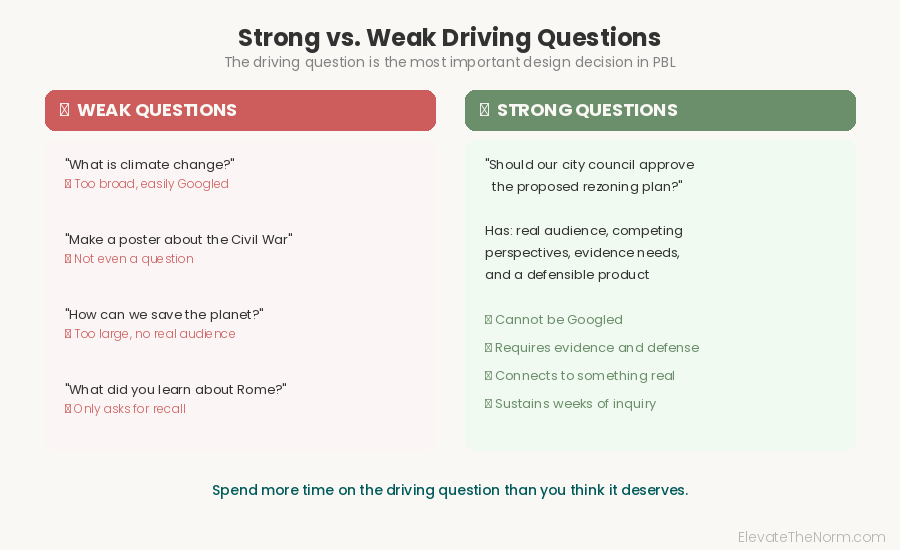
    A driving question is strong enough when students can’t answer it in one class period, it’s open-ended, it ties to your standards, and it can carry weeks of investigation. A strong driving question is the difference between a project that sustains inquiry and one that collapses into a quick search on day two.

    PBLWorks Driving Question Tubric

    What it is: A “tubric,” a mix of a rubric and a tutorial, that helps you test whether a driving question is open-ended, engaging, aligned to standards and complex enough to sustain an investigation.

    What it does well: Gives you specific criteria for testing a question before you commit to it. “Can students answer this in one class period?” is the single most useful check. If the answer is yes, it isn’t a driving question.

    Where it falls short: The language is written for teachers, not students. If you want students to help develop or judge driving questions, and you should, simplify the criteria for them.

    Verdict: Essential. It won’t write the question for you, but it will tell you whether the one you wrote can carry a project. For the full project sequence, see the seven steps of project based learning, and for models, these driving question examples for grades 6–12 walk through strong and weak versions in science, social studies, math and ELA, with a five-step formula for revising a question that isn’t working yet.


    What Is the Best Free Critique Protocol for Project Based Learning?

    The best free critique protocol for secondary project based learning is EL Education’s Peer Critique protocol, built on three norms: be kind, be specific, be helpful. It sits in a free EL Education classroom protocols collection. Structured critique tells a student what’s working, what isn’t and what to do next, without making it personal.

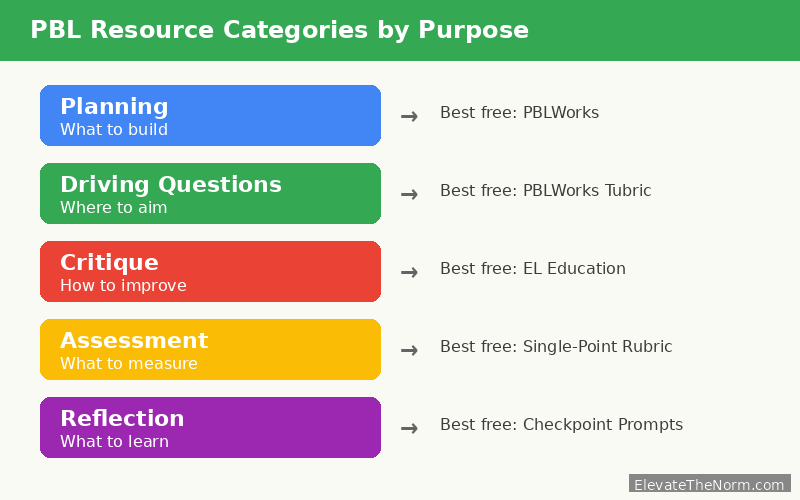
    Project based learning resource categories by purpose: planning (PBLWorks), driving questions (PBLWorks Tubric), critique (EL Education), assessment (single-point rubric) and reflection (checkpoint prompts)
    The best free project based learning resource for each planning job

    EL Education Peer Critique and Classroom Protocols

    What it is: A free collection of structured discussion and critique protocols from EL Education (formerly Expeditionary Learning), including Peer Critique, Praise-Question-Suggestion, Poster Walk, Fishbowl and Socratic Seminar.

    What it does well: The Peer Critique norms are “Be Kind,” “Be Specific” and “Be Helpful,” and partners give “kind, specific, and helpful feedback based on criteria.” That gives students language for feedback that’s honest without being destructive, which matters in grades 6–12, where peer feedback can go sideways fast.

    Where it falls short: The protocols were written for EL Education’s own curriculum, so some need adapting for standalone PBL use. The formatting is dense, so you may need to pull out the protocol you want and turn it into a student handout. If you’re an instructional coach supporting a teacher’s first project, model the critique protocol in that teacher’s room before asking them to run it alone. Cold handoffs of complex protocols rarely work.

    Verdict: The single best free critique resource for secondary PBL. Learn the three norms and use them every time students give feedback on each other’s work.

    Clay’s take: Partner work is the default condition in my room, not a reward. Students almost always work alongside somebody at tables pushed together, not in rows facing the front. In a room set up that way, peer critique doesn’t need to be a special event scheduled once before the final product. It can fit into ordinary work time, once students have been taught how to do it well, which is exactly what the EL Education protocols are for.

    Austin’s Butterfly (Video)

    What it is: A short video in which Ron Berger shares a first grader’s drafts of a scientific butterfly drawing with elementary students and draws out their “kind, specific and helpful critique,” as EL Education’s Models of Excellence page describes it. The drawing improves across multiple drafts.

    What it does well: Shows students what critique looks like in practice. The principle holds at any age: specific feedback plus revision equals better work. It’s a fast way to teach a class that critique isn’t criticism.

    Where it falls short: It’s an elementary example. Some secondary students need you to connect it to their own work level. Use it as a launch, not the only model.

    Verdict: Show it on the first day you introduce peer critique. Then move to structured protocols for ongoing use.


    Which Free Rubrics Work for Project Based Learning?

    Free PBL rubrics work when they grade content and skills separately. PBLWorks offers rubric templates on topics “from Project Design to Creativity and Innovation,” and a single-point rubric adds written, personal feedback. Either one needs rows for your own content standards before it can grade learning.

    PBLWorks Rubrics

    What it is: Free rubric templates from PBLWorks, aligned to the Gold Standard PBL framework, for skills such as collaboration, presentation and creativity.

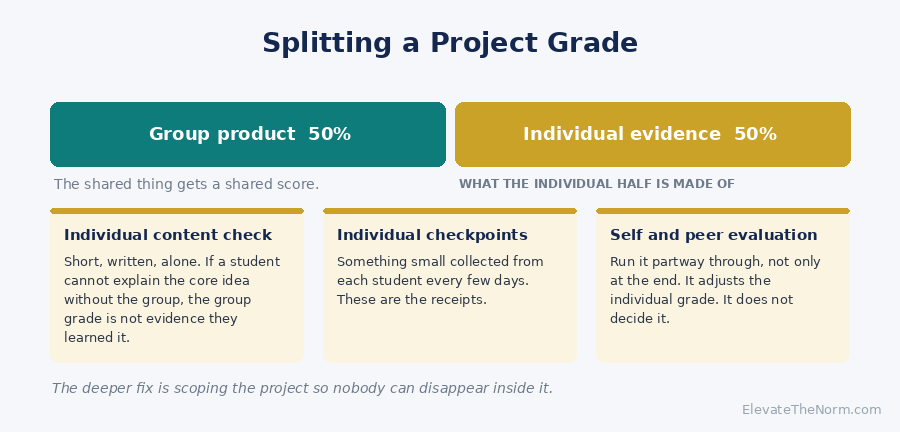
    What it does well: Separates content knowledge from PBL skills, which answers the grading question that makes many teachers hesitate: how do I give an individual grade for a group project? You can assess academic understanding separately from how well a group collaborated.

    Where it falls short: The rubrics are generic by design. A PBL rubric that doesn’t include your actual standards is a process rubric, not an assessment rubric.

    Verdict: Use the framework, but customize. Add a row for the specific content standards your project addresses and make sure the content row carries most of the grade weight. See this editable eight-category PBL rubric for a deeper breakdown.

    Single-Point Rubrics

    What it is: A rubric with one column of criteria in the center, blank space on the left for “not yet meeting” and blank space on the right for “exceeding.” Teachers write specific feedback in the blanks instead of circling a pre-written level.

    What it does well: Forces personalized feedback rather than a checked box, and students read it because it’s about their work. Grading support matters: in a 2024 Phi Delta Kappan review of PBL research, Saavedra and Rapaport report that teachers “crave support for developing a grading system” for projects.

    Where it falls short: It takes longer than a traditional rubric. With 150 students, that time is real. Use it for the final product and a simpler checklist for interim checkpoints. There’s a full guide to the single-point rubric on this site.

    Verdict: Worth the time for major products. Use checklists for checkpoints.


    How Should Students Reflect During a PBL Project?

    Students should reflect at set checkpoints during a project, not only at the end, by answering three questions: What did I learn since the last checkpoint? What isn’t working? What will I do differently before the next one? Reflection is the step most teachers cut when time runs short, and that’s a mistake.

    Structured Reflection Prompts

    What it is: A short set of questions students answer at defined points during and after the project.

    What it does well: When reflection happens at checkpoints, it becomes a self-regulation tool, not just a postmortem. Students who reflect mid-project catch their own problems earlier. For reflection activities across all four stages of the learning cycle, see these experiential learning activities.

    Where it falls short: Reflection prompts only work if students believe their answers matter. If you collect reflection forms and never mention them again, students will write the minimum. Read the reflections, respond to them and use them in conferences.

    Verdict: Build your own from the three questions above and add project-specific ones as needed. Put reflection on the project calendar, or it won’t happen.


    Are Free Digital PBL Tools Safe for Student Privacy?

    Free digital PBL tools are only safe for students once your district has reviewed them. Shared documents, project boards and discussion platforms can collect student data in ways that conflict with FERPA, and COPPA covers online services that collect data from children under 13, which includes many middle schoolers.

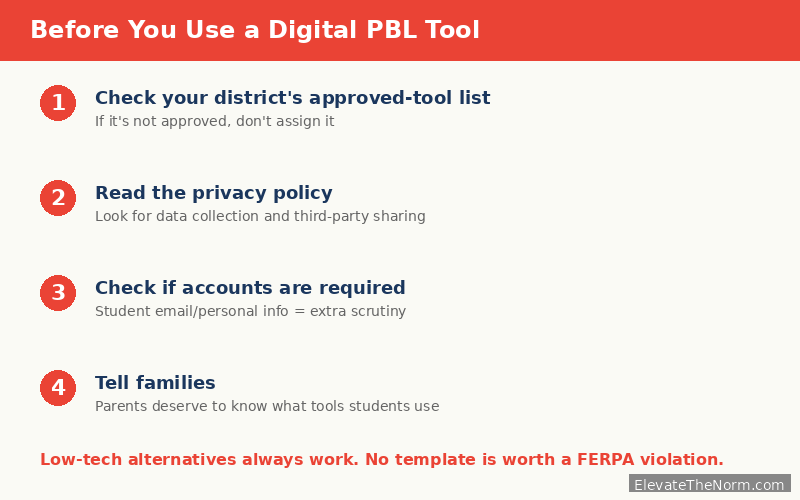
    Four checks before using a digital project based learning tool: check the district approved-tool list, read the privacy policy, check whether student accounts are required, and tell families
    Four checks to complete before students use any digital project based learning tool

    Before you put any digital tool in front of students, check four things:

    1. Does your district have a signed data privacy agreement with this platform? Many districts keep approved-tool lists. Check yours before adopting a new platform, no matter how popular it is with other teachers.
    2. What data does the platform collect, and who can access it? Read the privacy policy. If you can’t find a clear answer, that’s your answer.
    3. Can students use the tool without creating personal accounts? Platforms that require student email addresses or personal information deserve extra scrutiny.
    4. Have you told families what tools students will use? Parents reasonably expect to know what platforms their children use at school. A brief note home listing the tools and their purpose prevents problems later and builds the trust that makes PBL possible across the year.

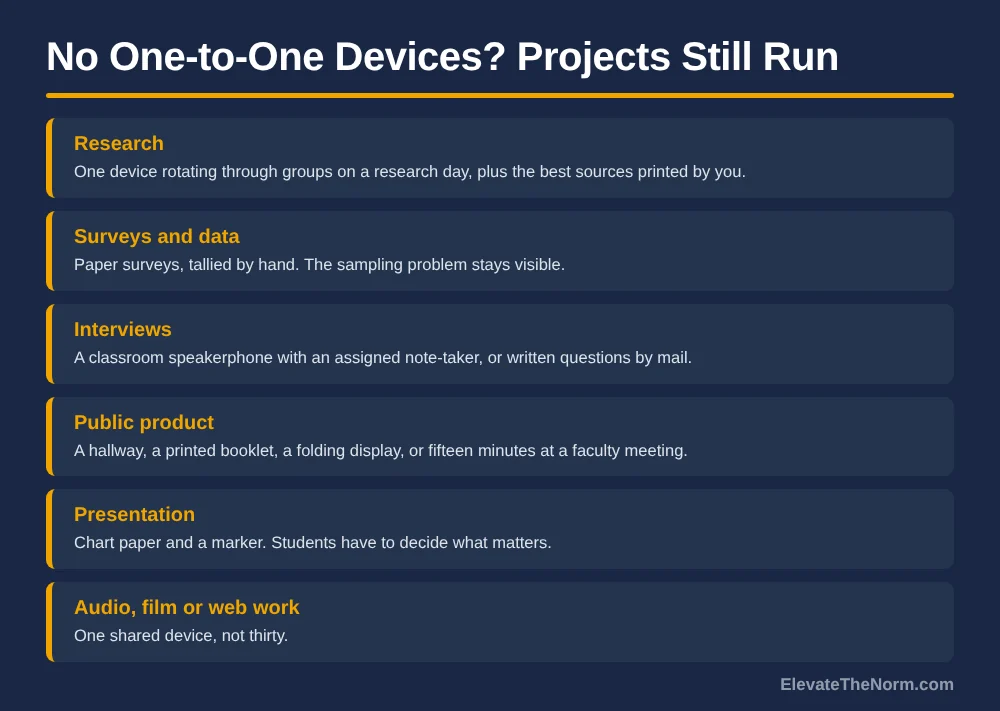
    Low-tech alternatives work. Shared physical whiteboards, paper critique forms, printed calendars on the wall and in-person presentations to real audiences are PBL resources too, and they don’t collect data on anyone. The technology is optional. Don’t let a tool’s convenience override students’ privacy.

    The same check applies to the reading platforms projects tend to lean on. Several well-known ones have moved features behind a school license since teachers first started recommending them, so check which classroom reading tools are actually still free before building a project around one.


    Does Elevate the Norm Offer Free PBL Resources?

    Elevate the Norm offers free PBL resources for grades 6–12 with no email required: a 25-project examples pack with a one-page planning template on the free resources page, an editable PBL rubric, a single-point rubric guide and driving question examples.

    I keep the forms I use most in my Teacher Emergency Kit ULTIMATE Bundle on TPT, so the planning time goes to students instead of formatting.


    What Should I Do Before Using Any PBL Resource?

    Before using any PBL resource, pick one, adapt it, teach it to students on low-stakes work, and let students help choose between formats. Those four steps decide whether a free template improves your projects or just adds paperwork.

    1. Pick one resource and learn it well. Don’t download everything on this list at once. Choose the tool that fixes your biggest current weakness, whether that’s planning, critique or assessment, and use it for one full project before adding another.
    2. Adapt it for your students. Every template here was designed for a general audience. Simplify the language for sixth graders, add content criteria for your subject and adjust timelines for your schedule. A resource you’ve customized will outperform a polished one used as-is.
    3. Teach the tool before you rely on it. A critique protocol students meet for the first time during a high-stakes review won’t produce useful feedback. Practice it on low-stakes work first.
    4. Let students help choose. When you’re deciding between two reflection formats or two critique structures, let the class weigh in. Students who helped pick a tool use it more seriously. That’s not making every decision a vote; it’s giving students real voice where their input improves the result.

    Clay’s take: If you only have time for one project based learning resource this semester, make it a driving-question test. Every other tool on this page works better when the question at the center of the project is strong.


    Sources

    1. Zhang, L. & Ma, Y. (2023). “A study of the impact of project-based learning on student learning effects: a meta-analysis study.” Frontiers in Psychology, 14, Article 1202728. 66 studies, 190 effect sizes. https://www.frontiersin.org/articles/10.3389/fpsyg.2023.1202728/full
    2. Saavedra, A. R. & Rapaport, A. (2024). “Key lessons from research about project-based teaching and learning.” Phi Delta Kappan, 105(5), 19–25. https://kappanonline.org/research-project-based-teaching-and-learning-saavedra-rapaport/
    3. PBLWorks. “Projects & Resources.” https://www.pblworks.org/resources-overview
    4. PBLWorks. “8 Ways to Get Started with Project Based Learning.” https://www.pblworks.org/get-started
    5. EL Education. “Classroom Protocols” (Peer Critique, p. 24). https://curriculum.eleducation.org/sites/default/files/curriculumtools_classroomprotocols_053017.pdf
    6. EL Education Models of Excellence. “Austin’s Butterfly.” https://modelsofexcellence.eleducation.org/resources/austins-butterfly
    7. U.S. Department of Education, Student Privacy Policy Office. “FERPA.” https://studentprivacy.ed.gov/ferpa
    8. Federal Trade Commission. “Children’s Online Privacy Protection Rule (COPPA).” https://www.ftc.gov/legal-library/browse/rules/childrens-online-privacy-protection-rule-coppa

    Frequently Asked Questions

    What are the best free project based learning resources for teachers?

    The best free project based learning resources for grades 6–12 teachers are the PBLWorks project planner and rubric templates, EL Education’s Peer Critique protocol, a driving-question test, a single-point rubric and short checkpoint reflection prompts. Each one solves a different planning problem. Start with the resource that fixes your weakest step, use it for a full project, and add another only after that one feels routine.

    Do I need special training to use project based learning resources?

    No special training is needed, but a teacher should understand a PBL resource before students see it. A planning template assumes you know what belongs in each box, and a critique protocol assumes you’ve practiced it yourself. Spend about thirty minutes with any new resource, adapt it for your students, and try it on low-stakes work before a major project depends on it.

    Are these PBL resources appropriate for both middle school and high school?

    These PBL resources work in both middle school and high school with adaptation. The categories, planning, critique, rubrics and reflection, apply across grades 6–12. Language usually needs simplifying for sixth graders, and complexity expectations usually need raising for older students. Adjust timelines to your schedule and add your own content standards so the resource fits the course you actually teach.

    How do I know if a PBL resource is backed by research?

    A PBL resource is more trustworthy when its source names the studies or framework behind it and says who the studies involved. PBL research is promising but uneven; a 2023 meta-analysis found stronger effects in Asia than in North America or Western Europe. Be wary of any resource that makes bold claims about student outcomes and cites nothing a teacher can open and read.

    How do I protect student privacy when using free online PBL tools?

    Protect student privacy by checking your district’s approved-tool list before assigning any free online PBL tool. If a tool isn’t listed, ask your technology coordinator to review it. Prefer platforms that don’t need student accounts, read the privacy policy on data collection and sharing, and tell families which tools students will use. When in doubt, use the paper version instead.

    What if my school blocks the digital PBL tools I want to use?

    If your school blocks a digital PBL tool, use the paper version. Every digital PBL tool has a low-tech equivalent: printed project calendars, paper critique forms, physical whiteboards and face-to-face presentations to a real audience. Project based learning doesn’t depend on software. It depends on a strong driving question, sustained inquiry, critique and revision, and a real audience for student work.

    Can I use these resources if I have never done PBL before?

    A teacher new to PBL can use these resources by starting small: one project in one unit. Plan it with the PBLWorks one-page form, run peer feedback with the EL Education Peer Critique protocol, and use a short reflection prompt at two checkpoints and at the end. Don’t try every resource on the first project. Build skill with one tool at a time.

    How should a teacher grade individual students in a group PBL project?

    A teacher can grade individuals in a group PBL project by scoring content and skills separately. Use a rubric row, or a separate rubric, for each student’s grasp of the content standards, and score collaboration on its own. Give the content row most of the weight, so a student’s grade reflects what that student learned rather than how well the group worked together.


    About Clay Shumate

    Clay Shumate is a certified secondary Social Studies teacher in the public schools of West Alabama, with seven years of classroom experience, a B.A. in History, and an M.Ed. in Secondary Education. He writes about project-based learning, student responsibility, respect, and practical ways to hold young people to a higher standard while giving them room to learn from mistakes. He is a member of the Society of Professional Journalists and writes to its Code of Ethics; this site’s editorial standards and corrections policy are published in full. More about Clay.
  • 7 Steps of Project Based Learning: From Driving Question to Public Product

    7 Steps of Project Based Learning: From Driving Question to Public Product

    By Clay Shumate

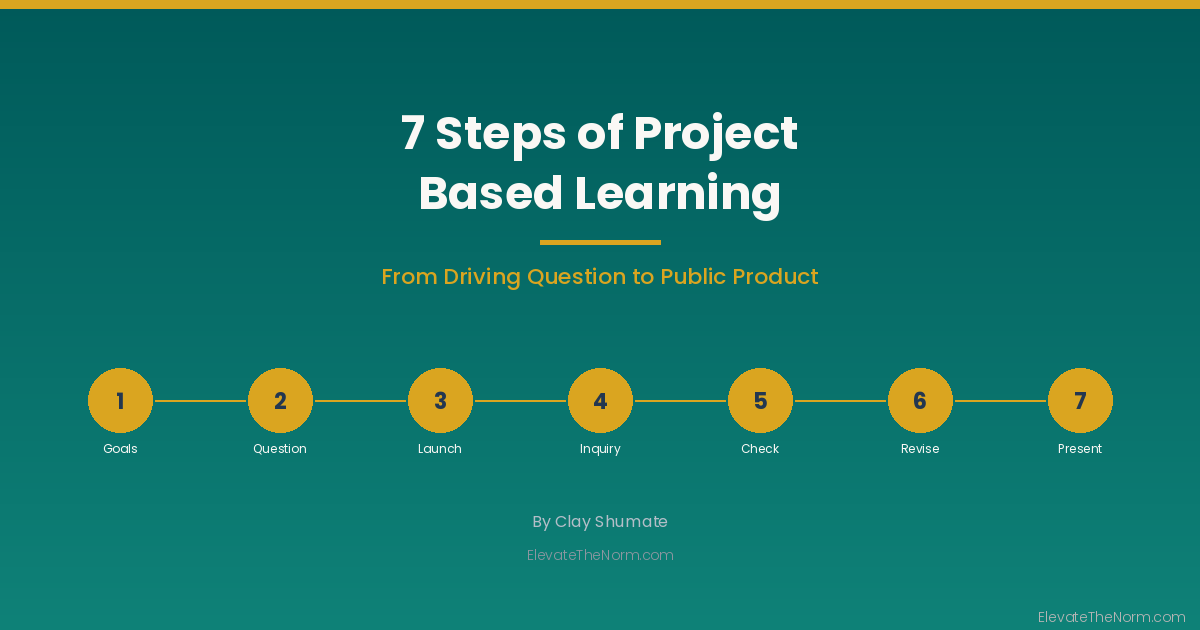
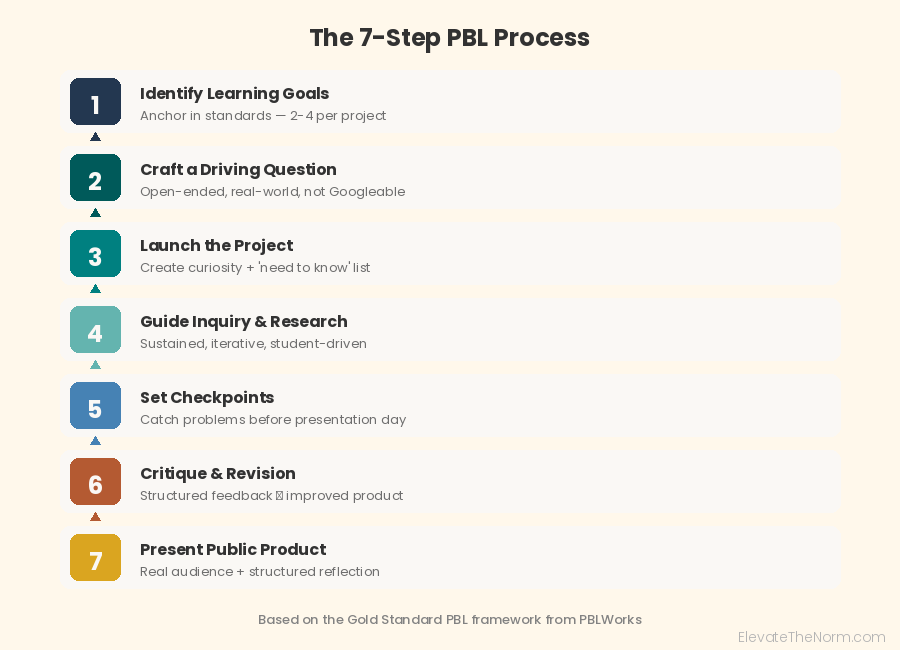
    The 7 steps of project based learning move a class from a question worth answering to a product worth defending. They are: identify learning goals, craft a driving question, launch the project, guide inquiry and research, set checkpoints and manage the work, facilitate critique and revision, and present the public product with reflection. Each step has a teacher role and a student role, and skipping any of them is how PBL collapses into a decorated group assignment. Each step works better when teachers and students have reliable project based learning tools—the planning templates, role cards, and critique protocols that keep the process on track. There is also a reviewed list of outside PBL resources worth the download, with the weak ones named.

    Why Steps Matter: PBL Without Structure Falls Apart

    Project based learning has a reputation problem. Teachers who have tried it and watched it fail usually did not fail at the project — they failed at the process. A class that jumps from “here is your project” to “present on Friday” without the steps in between produces exactly the kind of shallow, off-task, unequal group work that gives PBL a bad name.

    The Gold Standard PBL framework from PBLWorks, developed by John Larmer, John Mergendoller, and the Buck Institute for Education, identifies seven essential project design elements: a challenging problem or question, sustained inquiry, authenticity, student voice and choice, reflection, critique and revision, and a public product. Those elements are not decorations. They are structural requirements. Remove any one of them and the project loses what makes it PBL.

    The seven steps below translate those design elements into a sequence a teacher can actually follow. They are grounded in PBLWorks’ framework, supported by the research comparing PBL vs traditional teaching, and tested in real classrooms — including mine, where the tables are pushed together, students are always working with somebody, and the projects run while I circulate between groups.

    Step 1: Identify Learning Goals and Standards

    The teacher’s job: Decide what students must know and be able to do by the end of the project. Anchor these goals in your actual standards — state standards, Common Core, NGSS, C3, whatever your district uses. This is not optional. A project without clear learning goals is an activity, not instruction. If you need a refresher on the definition of project based learning and what separates it from traditional group work, start there.

    The common mistake: Designing the fun part first and then trying to reverse-engineer the standards into it. That produces projects where the academic content is an afterthought — the poster looks great but the student cannot explain what they learned.

    What to do instead: Start with the standards. Identify two to four that the project will assess directly, then plan the checkpoints where each one produces evidence. Then ask: what kind of work would require students to use these standards to answer a real question or solve a real problem? The project grows from the learning, not the other way around.

    A practical tip: write the standards on one side of a sheet of paper and the project idea on the other. If you cannot draw clear lines connecting them, the project needs to change or the standards need to change. One or the other.

    Step 2: Craft a Driving Question

    The teacher’s job: Write a question that is open-ended, challenging, anchored in real concerns, and aligned to the learning goals from Step 1. This question drives the entire project. If the question is weak, everything after it will be shallow.

    Comparison of strong and weak driving questions for project based learning showing what makes an effective PBL question
    Strong versus weak driving questions — the most important design decision in PBL

    What makes a strong driving question:

    • It cannot be answered with a Google search.
    • It requires students to gather evidence, weigh competing claims, and defend a position.
    • It connects to something real — a community issue, a professional challenge, a decision someone actually has to make.
    • It is specific enough to be answerable and broad enough to sustain weeks of inquiry.

    What makes a weak driving question:

    • “What is climate change?” — Too broad, easily Googled.
    • “Make a poster about the Civil War.” — Not a question at all.
    • “How can we save the planet?” — Too large, no real audience, no defensible product.
    • “What did you learn about ancient Rome?” — Only asks for recall, not application.

    A strong example: “Should our city council approve the proposed rezoning plan for the neighborhood south of Main Street?” This question has a real audience (the council), competing perspectives (residents, developers, environmental groups), evidence requirements (zoning data, traffic studies, community input), and a defensible product (a recommendation with data).

    Spend more time on this step than you think it deserves. A mediocre driving question produces mediocre projects no matter how well you execute the other six steps. If you want side-by-side models to work from, these driving question examples across four subject areas show what the revision from weak to strong actually looks like.

    Step 3: Launch the Project

    The teacher’s job: Introduce the driving question in a way that creates genuine curiosity, not just compliance. The launch is the moment students go from “we have a project” to “I actually want to know the answer to this.”

    Effective launches include:

    • A real-world entry event: a guest speaker, a site visit, a video of the actual problem, a letter from someone who needs the answer.
    • A “need to know” list: after the launch, students generate questions about what they need to learn to answer the driving question. This list becomes their research agenda.
    • Clear project parameters: timeline, deliverables, team structures, and how the work will be assessed.

    The trap: Over-explaining everything on day one. If students walk away from the launch knowing exactly what the final product should look like, you have removed the inquiry. Give them the question and the constraints. Let them figure out the path.

    Step 4: Guide Inquiry and Research

    The teacher’s job: This is the sustained inquiry step — the one that separates PBL from a group assignment with a poster. Students are not following a worksheet. They are identifying what they need to know, finding sources, evaluating evidence, and building understanding over days or weeks.

    Seven step project based learning process from identifying learning goals to presenting the public product
    The seven-step PBL process based on PBLWorks’ Gold Standard framework

    What this looks like in practice:

    • Students work from their “need to know” list and add to it as new questions emerge.
    • The teacher provides direct instruction when the whole class needs it — a lesson on evaluating sources, a skill workshop on data analysis, a mini-lecture on background content — but these lessons serve the project, not the other way around.
    • Research is iterative. Students may find that their initial approach does not work and need to change direction. That is not a failure. That is inquiry.

    I spend most of this step circulating. The tables in my room are already grouped, so students are working in pairs or small teams by default. Most of what I do is listen. I stop at a group, hear what they are discussing, and decide whether to step in or move on. If I overhear a group building on a premise that is factually wrong — and it happens more often than you would think — I do not announce it to the room. I sit down with that group and ask them to show me where they found it. Usually, the source is a single website or a misread paragraph. We look at it together, and they see the problem themselves. That is more valuable than a correction from the front of the room.

    A note on diverse learners: Students with IEPs, 504 plans, or English language needs may require adjusted entry points for inquiry — a modified source list, a graphic organizer, a shorter initial reading, or a paired research partner. The inquiry itself does not change. The scaffolding that gets a student into the inquiry does. Work with your special education and ELL colleagues to design those entry points before the project launches, not after a student stalls.

    The common failure point: Letting inquiry drift. Without regular check-ins, some groups will spend two weeks on research and produce nothing usable. Step 5 prevents that.

    Step 5: Set Checkpoints and Manage the Work

    The teacher’s job: Build structured checkpoints into the project timeline where you review student progress, provide feedback, and catch problems before they compound. This is the project management step, and skipping it is the single most common reason PBL fails.

    What checkpoints look like:

    • End of week one: Groups submit a research plan — what they are investigating, where they are looking, what they have found so far, and what is still missing.
    • Midpoint: Groups present a rough draft, preliminary findings, or a prototype. This is not graded. It is feedback.
    • Before the final product: Groups present a near-final version for critique (Step 6).

    The teacher’s role during checkpoints:

    At my whiteboard table, I pull groups one at a time. They show me what they have. I ask questions: What is your claim? Where is your evidence? What would someone who disagrees say? If the answers are thin, we talk about what needs to happen before the next check-in. If the answers are solid, I push harder: What have you left out? What are you unsure about?

    These conversations are not optional. They are the mechanism that prevents the end-of-project crash where one group has done everything and another has done nothing.

    A practical tool: A project calendar posted where students can see it, with checkpoint dates circled. Students should know exactly when they will be expected to show progress and in what form.

    Step 6: Facilitate Critique and Revision

    The teacher’s job: Teach students to give and receive specific, constructive feedback — and then give them structured time to use it. This step is what turns a first draft into a defensible product.

    Why critique and revision matter:

    PBLWorks identifies critique and revision as one of the seven essential design elements for a reason. A project that is never revised is not PBL. It is an assignment that took longer. Real-world work — journalism, engineering, policy, research, design — goes through multiple drafts. Students need to practice that process, not skip it.

    How to structure critique:

    • Use a protocol. Unstructured “peer review” devolves into “looks good” within minutes. A simple protocol works: the presenting group shares their work, the audience asks clarifying questions, the audience offers specific feedback (what is strong, what is unclear, what is missing), and the presenting group records the feedback without defending their work.
    • Model it first. Show students what specific, useful feedback sounds like versus vague or personal feedback. “Your graph does not label the axes” is useful. “I do not like it” is not.
    • Schedule revision time. Feedback without time to use it is performative. Build revision days into the calendar.

    The teacher’s additional role: Give your own feedback alongside the peer critique. Students respect peer feedback more when the teacher is also participating in the same process rather than standing outside it. Critique works best when everyone is scoring against the same published criteria, which is what a shared project scoring guide is for.

    Step 7: Present the Public Product with Reflection

    The teacher’s job: Create an authentic presentation opportunity where students share their work with an audience beyond the classroom — and then lead a structured reflection on what they learned.

    What “public” means:

    The audience does not need to be the United Nations. It needs to be someone other than you. Options that work in an ordinary school:

    • Another class.
    • Parents and families at an evening showcase.
    • A community panel invited for the occasion — a local business owner, a council member, a professional in the field.
    • A recorded presentation shared with a real organization.
    • A published piece — a blog, a letter to the editor, a recommendation submitted to the actual audience named in the driving question. For a concrete example of project based learning in action, see how one classroom handled the full cycle.

    Why the public audience matters:

    When the only audience is the teacher, students calibrate their effort to “good enough to pass.” When someone else will see it — someone they want to impress, someone who might ask hard questions — the standard shifts. The work gets better not because you demanded it, but because the audience did.

    Reflection is the step most teachers skip:

    After the presentation, students need structured time to think about what they learned — not just the content, but the process. What worked? What did they struggle with? What would they do differently? What did the critique feedback change?

    This is not a journal entry for a grade. It is the metacognitive step that turns experience into learning. Without it, students finish the project knowing what they made, but not necessarily what they learned.

    A useful reflection prompt: If you had to do this project again with a new group and a different driving question, what is the one thing you would do differently and why?

    Common Failure Points Across All Seven Steps

    Skipping Step 2 (the driving question): Teachers who start with the product — “we are making a documentary” — instead of the question produce projects where students focus on production quality rather than learning. The documentary looks polished but says nothing original.

    Rushing Step 4 (inquiry): In a tight schedule, it is tempting to hand students the information and skip the research. But if students do not find the information themselves, they do not own it. PBL without inquiry is craft time.

    Ignoring Step 5 (checkpoints): Every PBL horror story — the group that did nothing, the student who carried the team, the project that went completely off track — is a checkpoint failure. You had weeks to catch it. You did not check.

    Treating Step 6 (critique) as optional: Students who present their first draft as their final product have not experienced PBL. They have experienced a long assignment with a due date.

    A Practical Planning Checklist

    Project based learning planning checklist with ten items to confirm before launching any student project
    Confirm every item before launching a project

    Before you launch a project, confirm:

    • Two to four standards are clearly identified and assessable through the project.
    • The driving question is open-ended, challenging, authentic, and connected to standards.
    • The launch creates curiosity and generates a student “need to know” list.
    • Inquiry time is built into the calendar — not just one day, but sustained over weeks.
    • At least three checkpoints are scheduled with specific deliverables for each.
    • A critique protocol is selected and taught before the critique session.
    • The audience for the public product is identified and confirmed.
    • Reflection is scheduled and structured.
    • Individual accountability is built into the group assessment so one student cannot carry or hide.
    • The project calendar is visible to students from day one.

    Conclusion

    The 7 steps of project based learning are not a formula. They are a sequence of decisions — learning goals, driving question, launch, inquiry, checkpoints, critique and revision, and public product — that keep a project from becoming busywork with a poster board. Skip any step and you will feel it. Rush the driving question and the research is shallow. Skip checkpoints and you find out too late. Skip critique and the product never improves. Skip the public audience and students treat it like homework.

    Get the sequence right — and if you need ideas for project based learning to get started — PBL produces something most classroom assignments cannot: students who know what they learned, why it matters, and how to defend it to someone who was not in the room.

    For strategies on implementing this sequence inside a standard high-school bell schedule, see project based learning high schools can use without rebuilding the schedule.


    How long should a PBL project take?

    Most projects that follow all seven steps need at least two to three weeks of class time, though some run a full semester. Shorter projects — one to two days — can incorporate PBL elements, but they rarely sustain the inquiry and revision cycle that makes PBL distinct. The driving question should determine the timeline, not the other way around.

    Can I use PBL in a class with a tight pacing guide?

    Yes, but it requires planning. Identify two to four standards the project will cover and use the project as the vehicle for teaching those standards, not an addition to your existing lessons. Replace instruction on those standards with the project, do not stack them. PBL is the main course, not the dessert.

    What if some groups finish early and others are behind?

    This is a checkpoint problem. If you are checking progress at regular intervals, you will catch the groups that are behind before the final deadline. For groups that finish early, add an extension question or have them prepare to serve as peer critics for other groups — a role that deepens their own understanding.

    How do I grade individual students in a group project?

    Build individual accountability into the assessment. Require each student to submit their own written reflection, defend a specific part of the project during the presentation, or complete an individual component alongside the group work. The group product shows collaboration. The individual assessment shows learning.

    What if I have never done PBL before? Should I start with all seven steps?

    Start with a smaller project — two to three weeks, one driving question, one product — and include all seven steps even if you simplify them. Skipping steps is what causes PBL to fail, so it is better to do all seven simply than to do three of them elaborately. Your first project will be imperfect. That is normal. Reflect on what worked and adjust the next one.

    Do I need special materials or technology for PBL?

    No. Some of the strongest projects use nothing but paper, community access, and the students themselves. Technology can enhance research and production, but the seven steps work with or without it. A driving question, a library, and a real audience are more important than a 1:1 device ratio.

    How do I handle a student who does not contribute to the group?

    Address it at checkpoints, not at the end. When you pull a group to the whiteboard table and one member has done nothing, that is a conversation — not a grade penalty. Ask what the barrier is. Sometimes it is confusion, sometimes it is a group dynamic problem, sometimes it is disengagement that needs a different intervention. The answer changes the response.


    Sources

    1. Larmer, J., Mergendoller, J. R., & Boss, S. (2015). Setting the Standard for Project Based Learning. ASCD/Buck Institute for Education.
    2. PBLWorks. “Gold Standard PBL: Essential Project Design Elements.” Buck Institute for Education.
    3. PBLWorks. “Gold Standard PBL: Project Based Teaching Practices.” Buck Institute for Education.
    4. Condliffe, B. (2017). “Project-Based Learning: A Literature Review.” MDRC Working Paper.
    5. Larmer, J., & Mergendoller, J. R. (2010). “Seven Essentials for Project-Based Learning.” Educational Leadership, 68(1), 34–37.
    6. Hattie, J. (2023). Visible Learning: The Sequel. Routledge.

    About Clay Shumate

    Clay Shumate is a certified secondary Social Studies teacher in the public schools of West Alabama, with seven years of classroom experience, a B.A. in History, and an M.Ed. in Secondary Education. He writes about project-based learning, student responsibility, respect, and practical ways to hold young people to a higher standard while giving them room to learn from mistakes. He is a member of the Society of Professional Journalists and writes to its Code of Ethics; this site’s editorial standards and corrections policy are published in full. More about Clay.
  • Ideas for Project Based Learning: 50 Real-World Projects for Grades 6–12

    Ideas for Project Based Learning: 50 Real-World Projects for Grades 6–12

    By Clay Shumate

    The best ideas for project based learning start with a real question somebody outside your classroom wants answered and end with a product that person actually sees. This list gives grades 6–12 teachers 50 of them, sorted by subject, with the grade band, time, workload and audience for each one.

    Key Takeaways

    • A project idea only counts as a project if it has an open question, real research, revision and an audience beyond the gradebook. Otherwise it’s an activity with a poster attached.
    • Clay’s view: the strongest secondary projects solve a problem the school or town actually has, because a real problem comes with a real audience and needs no invented scenario.
    • Teachers new to project based learning should start with one project, two to three weeks long, with low materials cost and an audience they can secure with one email.
    • Research on project based learning in grades 6–12 is promising but not settled: a randomized AP study found an 8-point gain in credit-qualifying scores, and a middle school science program saw gains carry into math and ELA.
    • Nearly all of these 50 project ideas can run without one-to-one devices. The few built on audio, film or a website need one shared device, not thirty.

    What Makes an Idea for Project Based Learning Worth Running?

    An idea for project based learning is worth running when it has an open question, real research, revision and an audience beyond the gradebook. Without those four, it’s an activity with a poster attached.

    Project based learning is a way of teaching where students learn the content by working through a real question over time and showing the result to someone who isn’t their teacher.

    I want to be straight with you about what this list is. It is not 50 activities. Activities are easy to find and mostly interchangeable. These are project premises—each one has a question worth arguing about, a decision that has not been made yet, and somebody on the other end who will look at the result. That last part is what makes the difference, and it is the part most “PBL idea” lists skip.

    Before the list, a filter. PBLWorks names seven essential project design elements: a challenging problem or question, sustained inquiry, authenticity, student voice and choice, reflection, critique and revision, and a public product. The Framework for High Quality Project Based Learning lists six overlapping criteria, adding project management as its own skill students have to be taught rather than assumed to have. For social studies teachers, my Social Studies Teacher Toolkit Bundle on TPT gives you a head start on the materials.

    You do not need to memorize either list. In practice, five questions will tell you whether an idea is a project or a costume. If you teach a single subject and want the narrower version of this list, these ten history project ideas for grades 7–12 are built the same way:

    1. Do I already know the answer? If you do, and every group will arrive at the same place, it is an assignment. Real projects have room for defensible disagreement.
    2. Who sees this besides me? Name the person. Not “the community”—a name, a role, an inbox.
    3. What decision does it inform? Somebody should be able to do something differently because of the work.
    4. Where does the revision happen? If the first draft is the final product, you have skipped the part where the learning lives.
    5. What is the academic content students cannot avoid? If a group could produce something impressive without touching the standard, the project is decorative.
    Side-by-side comparison of a project idea and an activity idea across five tests: open question, audience, decision, revision, and required content
    The same topic can be a project or an activity. These five tests are what separate them.

    If an idea below does not survive those five questions in your building, adapt it until it does. I would rather you run a modified version that fits your reality than a faithful version that collapses in week two. For the full breakdown of what does and does not count, see the definition of project based learning, and for projects explained in depth rather than listed, see these examples of project based learning.

    What Are 50 Ideas for Project Based Learning in Grades 6–12?

    These 50 ideas for project based learning run across nine subject groups, from social studies and science to world languages, and every one names who will see the finished work.

    Each table gives the project premise, the grade band it fits best, a realistic time estimate with how much lift it takes on you, and the audience that makes it public. “Low lift” means you can run it without new materials, outside partners, or a schedule change. “High lift” means you will be making phone calls. Several of these touch permissions, privacy, or school policy—read the three conversations below before you commit to one.

    Social Studies and History

    ProjectGradesTime & liftWho sees it
    1. Marker audit. Which local historical markers tell the whole story, and which leave something out? Research and write corrected text.8–123 weeks · mediumCounty historical society
    2. Oral history archive. Interview long-time residents about one decade, transcribe, and index the collection.9–126 weeks · highPublic library collection
    3. Attendance-zone proposal. Use real census and enrollment data to propose a fairer school zone map.10–124 weeks · highSchool board member
    4. Plain-language ballot guide. Translate the next local ballot into language a first-time voter can actually use.9–123 weeks · mediumCommunity center, church bulletins
    5. Name that street. A blank or badly named street needs a name. Build the historical case for one.6–92 weeks · lowCity council
    6. Disputed event investigation. Take a contested local event and reconstruct it from primary sources only.9–124 weeks · mediumSchool news site
    7. Century story map. Map where families in this county came from across a hundred years, with sourcing.7–105 weeks · mediumLibrary display
    8. Museum in a hallway. Build a docent-led exhibit on a world history unit and tour younger students through it.6–103 weeks · mediumSixth-grade classes

    English Language Arts

    ProjectGradesTime & liftWho sees it
    9. Podcast series. Four episodes on a question students genuinely argue about, scripted, sourced, and edited.8–125 weeks · highPublic feed or school site
    10. Handbook rewrite. Rewrite the student handbook in language students can read, keeping every rule intact.7–123 weeks · mediumAdministration
    11. Hard-concept picture book. Explain something difficult to a second grader in a bound, illustrated book, then read it to them.6–104 weeks · mediumPartner elementary class
    12. Literary walking tour. Sign a downtown route with writing tied to each stop, QR-coded to student audio.9–125 weeks · highDowntown businesses
    13. Edited anthology. Solicit, select, edit, design, and print a collection of student writing.7–126 weeks · mediumFamilies at a reading night
    14. Change one rule. Build an evidence-based case to change a single school rule and present it.6–123 weeks · lowPrincipal and student government
    15. Reviews on spec. Write book or film reviews to a real publication’s submission guidelines and pitch them.9–122 weeks · lowLocal paper editor

    Science

    ProjectGradesTime & liftWho sees it
    16. Creek watch. Test a local waterway weekly for two months and report the trend, not the snapshot.8–128 weeks · highCounty environmental office
    17. Energy audit. Audit the building’s energy use and recommend one change with a payback period attached.9–124 weeks · mediumFacilities director
    18. Room-by-room air quality. Map CO2 and comfort across the building and correlate it with when students fade.8–123 weeks · mediumPrincipal
    19. Pollinator plan. Design a native pollinator planting for school grounds with species list and budget.6–105 weeks · mediumGrounds crew and PTA
    20. Cafeteria waste study. Measure food waste, run one intervention, then measure again and report honestly.6–124 weeks · mediumChild nutrition director
    21. Weather station. Build and calibrate a station, then publish a weekly hyper-local forecast with accuracy tracking.8–126 weeks · highSchool website
    22. Does the expensive one work? Test a consumer product claim under controlled conditions and publish the results.7–113 weeks · lowPublic consumer guide
    23. Invasive species survey. Survey school grounds, identify invasives, and write a phased removal plan.7–124 weeks · mediumCounty extension office

    Mathematics

    ProjectGradesTime & liftWho sees it
    24. Cut the lunch line. Time the cafeteria line, model the bottleneck, and propose a layout that shortens it.7–113 weeks · mediumCafeteria manager
    25. Cost per use. Analyze a real purchase the school is weighing and recommend for or against with the math shown.8–122 weeks · lowBookkeeper or principal
    26. Price the tickets. Build a pricing model for a school event that hits a stated revenue target without pricing families out.9–123 weeks · mediumAthletic director, boosters
    27. Bus route math. Analyze one route’s time and mileage and propose a defensible alternative.10–124 weeks · highTransportation director
    28. Courtyard to scale. Produce scaled drawings and a materials budget for an unused outdoor space.7–114 weeks · mediumPTA
    29. Fair split. Design and defend a fair-cost-sharing rule for a class trip or shared supplies, then adopt it.6–92 weeks · lowThe class itself
    30. Audit the claim. Take a statistic from an ad or news story and verify or refute it with the underlying data.8–122 weeks · lowPublished explainer

    Arts and Music

    ProjectGradesTime & liftWho sees it
    31. Mural pitch. Propose a mural for a blank wall with sketches, budget, and a written rationale.7–125 weeks · mediumAdministration or city
    32. Score the silence. Compose and perform an original score for a public-domain silent film clip.8–125 weeks · highSchool assembly
    33. The people nobody photographs. Portrait series of custodians, bus drivers, and cafeteria staff, with their own words.6–124 weeks · lowHallway exhibition
    34. Rebrand a nonprofit. Redesign a small local nonprofit’s logo and basic brand kit to their actual brief.9–124 weeks · mediumThe nonprofit’s board
    35. One business, one film. Document the history of a single local business in a five-minute film.9–125 weeks · highThe business’s customers

    Career Tech, Business, and Technology

    ProjectGradesTime & liftWho sees it
    36. Run the store. Write the business plan for a school store, then actually operate it for a month and report the P&L.9–126 weeks · highReal customers
    37. Accessibility audit. Audit the school website against WCAG basics and file a prioritized fix list.9–123 weeks · mediumDistrict tech director
    38. Repair café. Fix donated items, document each repair, and hold a community drop-off day.7–124 weeks · mediumCommunity attendees
    39. Prototype and test. Build a working prototype that solves one school problem and user-test it with real students.9–126 weeks · highStudent body
    40. Career guide for eighth graders. Interview working adults and turn it into a guide for students choosing a pathway.9–124 weeks · lowCounselor’s office
    41. Family cybersecurity night. Research the scams that actually hit your community and teach families to spot them.8–123 weeks · mediumParents at an evening event
    42. Maker corner proposal. Cost out a maker space corner and submit a real budget request.7–124 weeks · mediumPrincipal and PTA

    Health and Physical Education

    ProjectGradesTime & liftWho sees it
    43. PE for people who hate PE. Design and run a two-week unit aimed at the students who dread the gym.7–124 weeks · mediumOther PE sections
    44. Sleep and the schedule. Study your grade level’s actual sleep and report what the schedule costs.8–123 weeks · mediumSchool leadership
    45. Menu inside the rules. Redesign a week of cafeteria menus inside real federal nutrition rules and the real budget.9–124 weeks · highNutrition director
    46. Concussion explainer. Produce a short video explaining the school’s concussion protocol to athletes and parents.8–123 weeks · lowAthletic department

    World Languages

    ProjectGradesTime & liftWho sees it
    47. Bilingual welcome. Produce bilingual signage and a welcome packet for the front office, reviewed by a fluent adult.8–124 weeks · mediumFront office and new families
    48. Community resource guide. Translate a guide to local services, verified for accuracy before it goes out.10–125 weeks · highPublic library

    Cross-Curricular

    ProjectGradesTime & liftWho sees it
    49. Readiness research memo. Research national best practices in school emergency preparedness and deliver a private findings memo to the people responsible. Never published, never posted.9–125 weeks · highSafety committee, privately
    50. Time capsule with a defense. Curate artifacts and write the argument for why each one deserves to represent this year.6–103 weeks · lowSealing ceremony now, opening later

    What Should I Do Before Running a Project With a Real Audience?

    Before running a project with a real audience, have three short conversations: one with your administrator about scope, one with families and interviewees about consent, and one with yourself about supervision.

    Real audiences are what make these projects work, and they are also what makes them capable of causing you a problem. Three conversations, none of them long, prevent almost all of it.

    • With your administrator, about scope. Any project that contacts someone outside the building, examines a school decision, or asks for a policy change needs a heads-up first. That is not permission-seeking for its own sake—a principal who has agreed in advance to genuinely consider a student proposal turns the project real. A principal ambushed by one turns it into a lesson about how adults do not listen, which is the opposite of the point.
    • With families and interviewees, about consent. Anyone interviewed, recorded, or photographed for a public product gives written consent first, including staff. Follow your district’s policy on student names and images in public work; default to first names. Any project that gathers information about other students stays anonymous and aggregated, and never gets framed as health or psychological data.
    • With yourself, about supervision. Water sampling, tool use, repair work, and off-campus contact all need an adult plan, not just a student plan. If a project cannot be supervised properly with the staffing you actually have, run a different one. There are forty-nine others.

    Two of the ideas above deserve a specific flag. The attendance-zone proposal touches genuinely contested local politics—run it only where a board member has agreed to receive it in that spirit. The readiness memo stays private by design; students research public best practices and deliver findings to the people responsible, and none of it gets posted anywhere.

    None of this is a reason to shrink the work. Clear expectations and honest guardrails are what let you hand students something real in the first place—the same argument as in classroom expectations.

    Does Project Based Learning Actually Work in Grades 6–12?

    Project based learning works in grades 6–12 when it’s well implemented, and the evidence is promising rather than settled. The research supports well-run PBL, not the idea of PBL.

    A clever premise badly run is worse than a good lecture. If you are weighing whether to hand part of your course over to projects at all, start with the research comparing PBL with traditional teaching and decide from the numbers rather than the enthusiasm.

    At the high school level, researchers at the University of Southern California ran a randomized study of a project-based curriculum called Knowledge in Action in AP U.S. Government and AP Environmental Science across five predominantly urban districts. The share of students earning a credit-qualifying score on the AP test was 8 percentage points higher in the project-based courses, and the gain was estimated at 10 points after teachers had used the curriculum and its supports for two years (Saavedra et al., Lucas Education Research, 2021). Edutopia’s coverage puts the sample at over 3,600 students and reports that students from low-income households saw similar gains to their wealthier peers.

    At the middle school level, the Learning Through Performance science curriculum developed at Stanford produced an 11 percentage-point gain in science achievement, and the effect did not stay in science: students also outperformed peers on state assessments in mathematics (12 to 18 points across years one and two) and English language arts (8 to 10 points) (Deutscher et al., Lucas Education Research, 2021). That brief gives no sample size, so read those as headline numbers.

    That is a real result and I do not want to undersell it. I also do not want to oversell it, which is why the limits get their own section below.

    How Can You Run These Projects Without One-to-One Devices?

    You can run these projects without one-to-one devices by rotating one shared device, printing the sources, and using paper surveys, speakerphone interviews and hallway displays. Nearly every idea on the list works this way.

    I have taught with no devices, with one cart shared between two classrooms, and with one-to-one. Scarcity forces you to decide what the technology was actually for. Projects built on audio, film or a website, like the podcast, the film and the accessibility audit, still need a device, but one shared device will do.

    Chart pairing project needs such as research, surveys, interviews and presentation with low-tech versions, plus one shared device for audio, film or web work
    Most of what a project needs from technology has a low-tech version.
    • Research: One device rotating through groups on a research day beats thirty devices open all week. Print the three or four best sources yourself and let the argument be about the evidence rather than the searching.
    • Surveys and data: Paper surveys, tallied by hand, teach the sampling problem better than a form that auto-charts the answer.
    • Interviews: A speakerphone in the classroom and a designated note-taker works. So does a written question set mailed to somebody who answers in writing.
    • Public product: A hallway, a printed booklet, a folding display, or fifteen minutes at a faculty meeting are all public. Public means seen by someone who is not you—not published online.
    • Presentation: Chart paper and a marker force students to decide what matters. A slide deck lets them avoid deciding.

    The one thing worth protecting is contact with the real audience. If you have to cut something, cut the polish, not the person on the other end.

    How Do You Grade Individuals Inside a Group Project?

    You grade individuals inside a group project by giving the shared product a group score and giving each student a separate score from a content check, checkpoints, and self and peer evaluation.

    Group grading is a common objection to projects, and it is a fair one. A single group grade rewards the student who did nothing and punishes the one who carried it. It also lets weak content knowledge hide behind a strong product. Assigning job titles does not fix it either; the accountability underneath the card is what carries the weight, which is why most standard group roles fail the deliverable test.

    Diagram splitting a project grade into a shared group product score and an individual score drawn from checkpoints, an individual assessment, and self and peer evaluation
    Splitting the grade is what keeps a group project from grading the group instead of the student.

    Carnegie Mellon’s Eberly Center, writing for university instructors, says to assess individual as well as group work. It notes that some faculty make it 50/50 between the group grade and the individual grade, and others split it 80/20. Its examples include a short individual essay and teammate evaluations that feed into the individual grade (Eberly Center, Carnegie Mellon University). It also tells instructors to decide when to run evaluations: mid-semester, at the end, or both. Pick both, so the information can still change something.

    A simple version, in plain terms:

    1. The product gets a group grade. It is a shared thing; it gets a shared score.
    2. Every student takes an individual assessment on the content. Short, written, no group. If a student cannot explain the project’s core idea alone, the group grade is not evidence they learned it.
    3. Checkpoints are individual. Collect something small from each student every few days. Those are the receipts.
    4. Self and peer evaluation adjusts, it does not decide. A peer rating is one input, not a verdict.

    The deeper fix is not a grading scheme. It is scoping the project so nobody can disappear inside it, which is really a planning problem. More on that idea in student responsibility, and the full walk-through is in how to grade group projects fairly.

    For free planning templates, critique protocols, and assessment tools that support PBL implementation, see project based learning resources for middle and high school teachers.

    How Do You Catch a Project That Is Failing Quietly?

    You catch a quiet project failure by circulating and listening in week one, when a driving question can shrink into something a search bar can answer while the group still looks busy.

    I catch it by moving. I am on a stool most of the period, going table to table, and I listen more than I talk. A few days into a project I will hear a group planning around a question that has quietly stopped being a question—they have already settled the answer and are now decorating it. So I sit down with them and ask them to walk me through their reasoning from the beginning, out loud. Not to correct it. To make them hear it. Nine times out of ten somebody at the table catches the collapse before I have to name it, and the fix is theirs instead of mine.

    That is the whole argument for circulating instead of monitoring. You cannot hear a premise go soft from the front of the room.

    Where Does Project Based Learning Struggle?

    Project based learning struggles on proof, coverage, access and the first run. MDRC’s literature review calls the evidence for PBL “promising but not proven.”

    The same review notes a lack of consensus on what has to be present for a classroom to count as PBL, and says evaluation has been hampered by a shortage of valid, usable measures of the deeper learning PBL aims for. It also names the real implementation problem: teachers have to move from directors to facilitators and tolerate ambiguity, more noise and more movement (Condliffe et al., MDRC, 2017).

    Know who’s behind the numbers, too. Lucas Education Research is listed as a co-author on both reports cited above, and MDRC says an earlier version of its review was funded and published by the same group.

    Three practical cautions:

    • Coverage is real. A four-week project has to carry four weeks of standards, not one week of standards and three weeks of production. Map it backward: list every standard the project will assess, then name the specific checkpoint or artifact where you will see each one. Any standard without an artifact next to it is a standard you are hoping happens.
    • Access is not equal. A project that depends on a parent’s connections, a car, or an evening free is a project that sorts students by circumstance. Build it so it can be completed inside the school day.
    • The first run will be rough. The AP gain was larger after two years with the curriculum. Plan to run the same project twice before you judge it.

    How Do I Start With One Project Based Learning Idea?

    Start with one low-lift idea that takes two or three weeks and has an audience you can secure in a single email. Offer the class two or three options that fit and let them pick.

    Do not redesign your course. Good options from the list are the change-one-rule case, the cost-per-use analysis, the expensive-product test and the concussion explainer. Student voice is one of the design elements, and the cheapest place to honor it is the choice of project itself. Run it once. Keep notes on what broke. Run it again in the spring with the breakage fixed. For the handful of students who want to keep going past three weeks, a capstone scoped by grade level is the structure that holds a semester of independent work together. If you want one written up all the way through — the weekly formats, the family note, what it cost — this mock election is that account.

    Clay’s take: The point of any of these ideas for project based learning is not the project. It is that students spend three weeks being treated as people whose work is worth showing to somebody. That treatment is the intervention. The project is just the excuse to deliver it. If that framing is new, start with what project based learning actually is, then look at how the same principle shows up in real world learning.

    How many projects should I run in a school year?

    Two done well beats six done thinly. Most teachers new to project based learning should run one project in the fall and one in the spring, ideally the same project twice. In a randomized AP study, the estimated gain grew from 8 to 10 percentage points after teachers had two years with the curriculum, which is a good argument for repeating a project rather than constantly starting over.

    What if my school does not have devices for every student?

    Nearly every idea on this list can run on paper or on one shared device. Rotate devices through groups on research days, print the strongest sources yourself, tally paper surveys by hand, and run interviews on a classroom speakerphone with an assigned note-taker. A hallway exhibit, a printed booklet, or fifteen minutes at a faculty meeting all count as public products. Protect contact with the real audience and cut the polish instead.

    How do I grade individual students in a group project?

    Carry both a group score and an individual score. The shared product gets a shared grade, and each student also gets an individual content check, individual checkpoints, and a self and peer evaluation that adjusts but doesn’t decide the grade. Carnegie Mellon’s Eberly Center says some college faculty split group and individual grades 50/50 and others 80/20. Run evaluations partway through, while the information can still change something.

    Will a project cover enough standards to justify the time?

    A project covers enough standards only if you map them before you commit to the product. A four-week project must carry four weeks of curriculum, not one week of content plus three weeks of building. Write down every standard the project will assess, then check whether a group could produce the final product without touching them. If they could, the project is decorative and needs redesigning.

    What makes a project audience genuinely public?

    A public audience is any person outside your classroom who will actually look at the work and could plausibly act on it. A facilities director reading an energy audit, a librarian accepting an oral history collection, a second-grade class hearing a book read aloud, or a school board member receiving a proposal all qualify. Your gradebook, a classroom presentation to peers, and a folder that goes home do not.

    How do I keep one student from carrying the whole group?

    Scope the project so there is no place to hide. Assign individual checkpoints every few days, require each student to be able to explain the core idea alone, and define roles that produce visible artifacts rather than vague responsibilities. If a student can still disappear inside the project, that is usually a planning problem on the teacher’s end rather than a character problem on the student’s.

    Are these ideas appropriate for struggling readers or English learners?

    Yes, with scaffolding. In a randomized science study of 2,371 third graders, both struggling and highly proficient readers outperformed peers in traditional classrooms, though that’s elementary evidence. In a middle school program, English learners beat peers on a language proficiency test by 8 percentage points in year one and 28 with second-year teachers. Scaffold the reading, and don’t treat the written product as the only evidence.

    What permissions do I need before students interview people or photograph them?

    Get written consent from any adult who is interviewed, recorded, or photographed for a public product, and clear the project with your administrator before students contact anyone outside the building. Follow your district policy on student names and images appearing publicly, and default to first names only. Any project that collects information about other students should be anonymous, aggregated, and never framed as health or psychological data.

    Sources


    About Clay Shumate
    Clay Shumate is a certified secondary Social Studies teacher in the public schools of West Alabama, with seven years of classroom experience, a B.A. in History, and an M.Ed. in Secondary Education. He writes about project-based learning, student responsibility, respect, and practical ways to hold young people to a higher standard while giving them room to learn from mistakes. He is a member of the Society of Professional Journalists and writes to its Code of Ethics; this site’s editorial standards and corrections policy are published in full. More about Clay.
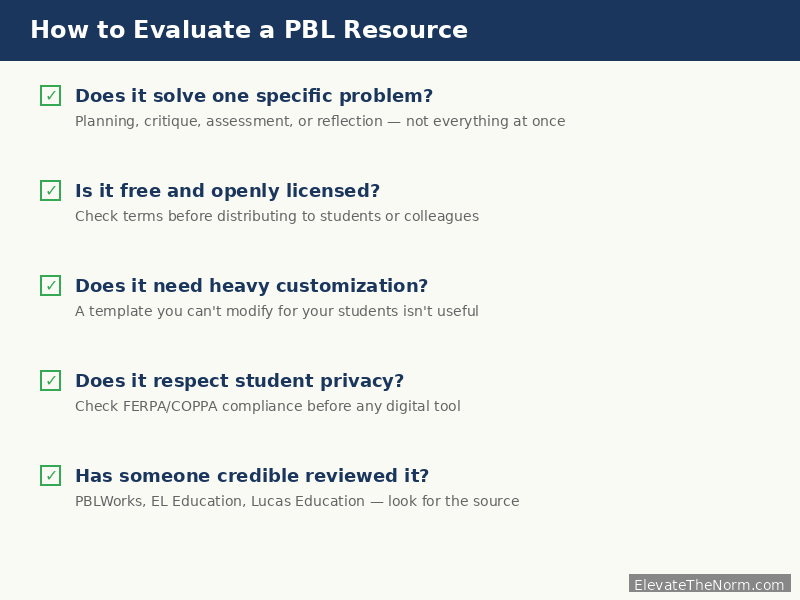
Teacher Emergency Toolkit — practical resources, real classroom support. Shop on TPT.Teacher Emergency Toolkit — practical resources, real classroom support. Shop on TPT.