The Elevate Blog banner: Real Classrooms. Practical Ideas. Higher Expectations. Three students climb a rocky ridge at sunrise, each pulling the next one up, toward a teacher reaching down to help.

Tag: education research

  • Brain Breaks for High Schoolers: What Works When They Are Too Old for the Dance Video

    Brain Breaks for High Schoolers: What Works When They Are Too Old for the Dance Video

    By Clay Shumate

    Brain breaks for high schoolers are short, deliberate pauses — usually two to ten minutes — that interrupt sustained work before attention falls apart. The evidence at this age is thinner than the advice suggests: a review limited to 13- to 16-year-olds found only three studies. What support exists points at classroom behaviour, not test scores.

    That is the honest version, and it is worth starting there, because almost everything written about brain breaks was researched on nine-year-olds and then handed to people teaching sixteen-year-olds. The practices can transfer. The evidence does not automatically come with them, and a teenager can tell the difference between a break designed for them and one borrowed from a third-grade classroom.

    Key Takeaways

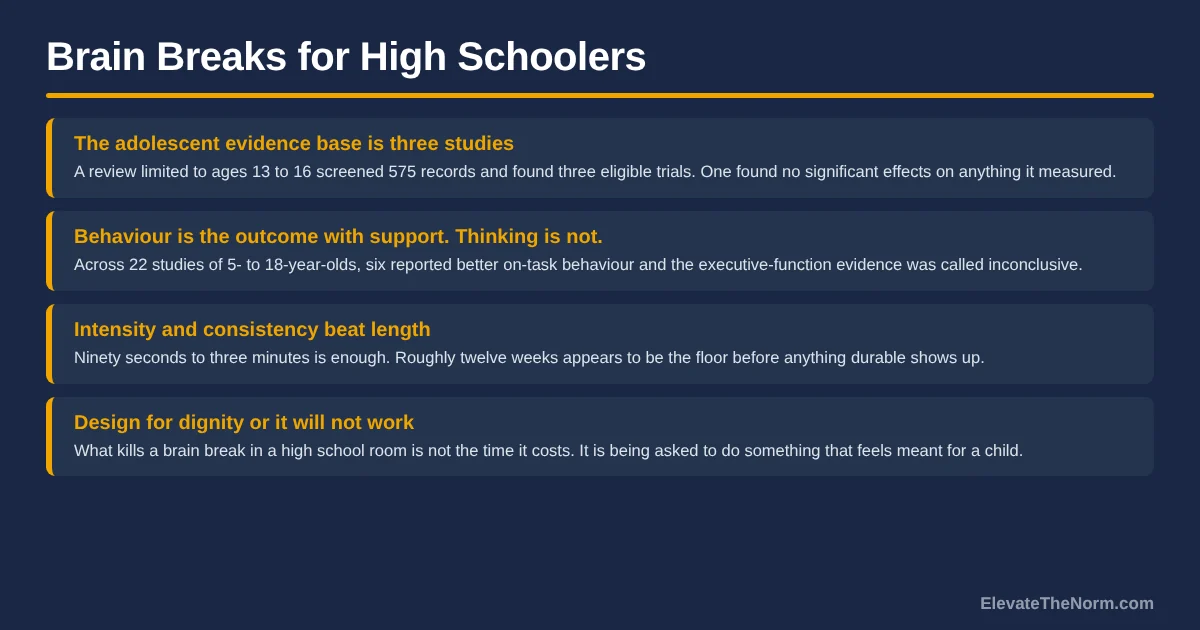
    • The adolescent evidence base is three studies. A 2022 systematic review restricted to secondary and high school students aged 13 to 16 screened 575 records and found three eligible trials. One of the three found no significant effects on anything it measured.
    • The strongest single result is recent, large and heavily caveated. A cluster-randomised trial of 529 Italian adolescents averaging 14.3 years found a large gain on a standardised concentration test after four months of two ten-minute active breaks a day. The authors list baseline imbalance, possible contamination and no pre-planned sample-size calculation among the limits.
    • Behaviour is the outcome with support. Thinking is not. Across 22 studies of 5- to 18-year-olds, six reported improved on-task behaviour, five reported executive-function gains the reviewers called inconclusive, and most of the studies were rated poor or fair quality.
    • The famous “brief diversions” lab finding did not replicate. A 498-participant study testing it directly found the same attention decline in every group, with the statistics favouring the null.
    • Design for dignity or it will not work. The thing that kills a brain break in a high school classroom is not the time it costs. It is being asked to do something that feels like it was meant for a child.

    What Are Brain Breaks for High Schoolers?

    A brain break is a short, planned interruption to sustained cognitive work — a change of posture, task or physical state — taken before students stop being able to work, not after. In the research literature the term usually means an active break: a few minutes of movement inside the lesson, distinct from a physically active lesson where the content itself is taught through movement.

    Two things separate a break from an interruption. A break is scheduled or triggered by something you decided in advance, and it has a defined end. A class that drifts for four minutes because the teacher lost the room has had an interruption. A class that stands up for ninety seconds at a planned point and sits back down has had a break. The difference is entirely about who called it.

    The grade level matters more here than almost anywhere else on this site. In most studies the participants are primary-aged, the activity is a dance video or an animal-themed movement sequence, and the measured outcome is on-task behaviour. None of that is useless, but a room of fifteen-year-olds will refuse the format long before they refuse the idea.

    Do Brain Breaks Actually Work for Teenagers?

    The evidence says probably, mostly for classroom behaviour, and there is much less of it than the volume of advice would suggest.

    A 2022 systematic review set out to answer exactly this question and restricted itself to pre-adolescent and adolescent students in secondary and high schools. It screened 575 records. After title, abstract and full-text screening, three studies met the criteria — one in Norway, one in the UK, one in Australia, with participants aged 13 to 16 and samples from 97 to 447. Most of what was excluded was primary-school research.

    What those three found, honestly:

    • All three reported the breaks were feasible and acceptable in a real secondary timetable. That is not nothing — feasibility is where most classroom interventions die.
    • Two reported improvements in classroom behaviour and in vitality or quality of life.
    • One found no significant effects on physical activity, sedentary time, behaviour or wellbeing.
    • None of the three reported a direct cognitive measure, even though cognitive function was named in the review’s own aims.

    Study quality was rated poor, fair and good — one each. The reviewers urged caution interpreting three heterogeneous studies and noted that around twelve weeks appears to be the minimum duration before anything durable shows up. That last point is the one most likely to matter to you: nobody has shown that a brain break on Tuesday improves anything on Tuesday.

    The broader picture across all school ages is consistent with that. A 2025 systematic review of 22 studies covering 3,615 participants aged 5 to 18 found six studies reporting positive effects on classroom behaviour, mostly on-task behaviour, with moderate-to-vigorous activity appearing more beneficial. On executive functions — inhibitory control, cognitive flexibility, working memory — five studies reported improvements and the reviewers called the overall evidence inconclusive. Physical fitness results were unclear. Most included studies were rated poor or fair quality, and the review pooled nothing, so there is no overall effect size to quote.
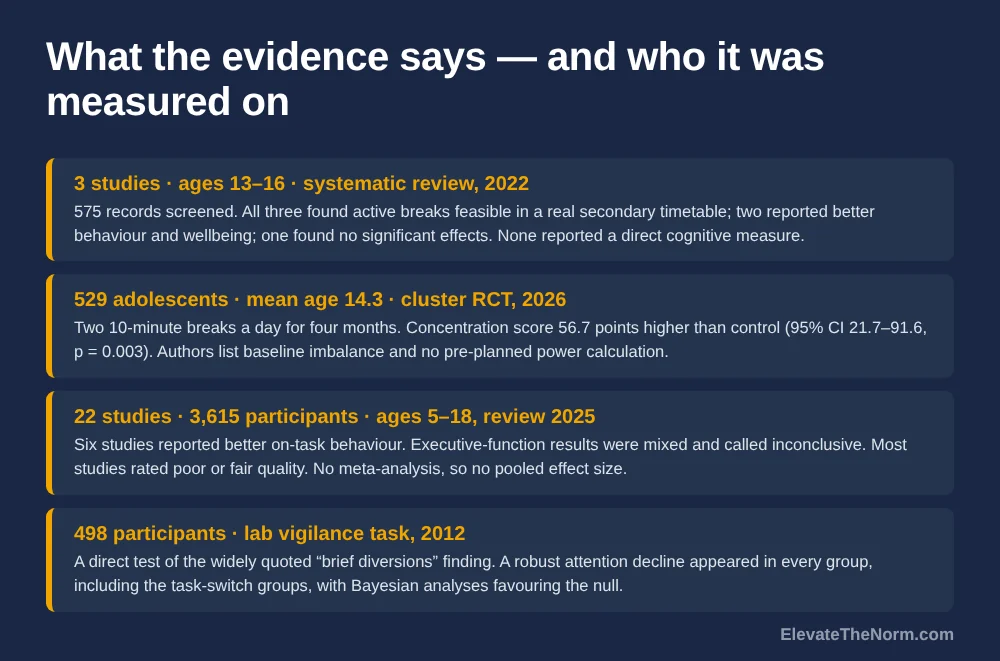
    Four research findings on brain breaks with the population of each named: a 2022 review limited to ages 13 to 16 that found three studies, a cluster randomised trial of 529 adolescents, a 2025 review of 22 studies covering ages 5 to 18, and a 498-participant laboratory test of the brief diversions finding
    Four sources, with the population attached to each one.

    What Does the Best Secondary Study Show?

    A large concentration gain, in a well-run trial, with a limitations section long enough to take seriously. It is the single most relevant result available and it deserves to be read properly rather than reduced to a headline.

    Martone and colleagues ran a cluster-randomised controlled trial across four upper secondary schools in Campania, in southern Italy. Thirty-nine classes were allocated — 20 intervention, 19 control — covering 529 adolescents with a mean age of 14.3 years. The intervention was two ten-minute active breaks every school day for four months, in the second and fifth lesson periods: mobilisation, stretching, strengthening, coordination and balance, run from one of twelve music-based videos on the interactive whiteboard with a teacher present. Fidelity was high — 180 of 192 scheduled breaks delivered, about 94% attendance — and in a subsample of 150 students the mean heart rate during a break was 155 beats per minute, which the authors describe as moderate-to-vigorous at group level.

    Attention was measured with the Italian d2-R test. After four months the adjusted concentration score was 151.3 in the intervention group against 94.7 in the control group — a difference of 56.7 points (95% CI 21.7 to 91.6), p = 0.003, holding at 54.7 points in a fully adjusted model. Exploratory checks found no significant moderation by sex, sport participation, sleep, smartphone use or diet.

    Now the caveats the authors themselves list, because they change how much weight this carries. Randomisation was not stratified, and the groups differed at baseline on age, weight, baseline concentration score, sleep and smartphone use. Intervention and control classes sat in the same schools, so contamination is possible. No a priori sample-size calculation accounting for clustering was done, and no standardised effect size is reported for the main result. Repeated testing may have produced a practice effect. There was no long-term follow-up, teacher acceptability was not assessed, and the impact on instructional time was not measured — which, for a school giving up twenty minutes a day, is the question an administrator will ask first.

    None of that makes the finding worthless. It makes it one good trial in one region, pointing in a direction the weaker evidence also points. Treat it as encouraging rather than settled, and notice what the design required: twenty minutes a day, every day, for four months, with specialists involved. That is not “a quick stretch when they get restless.”

    What About the “Brief Diversions” Study Everyone Cites?

    It did not replicate, and the replication attempt was four times the size. This one is worth knowing because it turns up constantly in professional development on attention, usually as a hard number about how long focus lasts.

    The original is Ariga and Lleras (2011), in Cognition. Participants did a long visual vigilance task while holding digits in memory. Those who recalled the digits only at the end showed a steep decline in performance over time; those asked to recall them sporadically during the task did not. The authors argued that briefly deactivating and reactivating the task goal prevents the drop-off — the result that got written up as brief diversions dramatically improving focus.

    In 2012, Helton and Russell published a direct test in Experimental Brain Research with 498 participants, pitting that goal-habituation account against two rivals. They found a robust vigilance decrement in every group, including the task-switch groups. Self-reported workload and task-unrelated thoughts did not differ. Bayesian analyses favoured the null hypothesis.

    Two honest conclusions follow. First, if someone tells you research proves attention resets after a short diversion, the strongest direct test of that claim says otherwise. Second — and this is the part worth holding onto — neither study was run in a classroom on teenagers. A lab vigilance task is not a fourth-period lesson. The case for brain breaks in a high school room does not rest on that literature and should not be made from it.

    How Long Should a High School Brain Break Be?

    Short enough to come back from, long enough to change physical state: ninety seconds to three minutes for a routine break, ten if you are running something structured. There is no validated number, and the honest answer is that duration has not been isolated as a variable in the adolescent research.

    What you can take from the evidence is the shape rather than the figure. The Italian trial used ten minutes twice a day and got its result over four months. The adolescent review found interventions ranging from 14 to 60 minutes, two to six times a week, over 11 weeks to 12 months, and suggested roughly twelve weeks as the floor for anything lasting. The across-ages review found moderate-to-vigorous intensity looked more useful than gentle movement.

    So the practical reading is: intensity and consistency matter more than length. Ninety seconds of actually standing up and moving beats five minutes of sitting and chatting, and doing it most days for a term beats doing it brilliantly for a fortnight.

    What Brain Breaks Actually Work With 14- to 18-Year-Olds?

    The ones that do not require a teenager to perform enthusiasm. That is the whole selection rule. A high schooler will do almost anything that has a point and almost nothing that makes them look like a child in front of people whose opinion they care about.

    BreakLengthWhy it survives a high school room
    Stand and finish the thought60–90 secEveryone stands; nobody performs. Posture change with no social cost
    Walk and talk2–3 minMovement plus a content question. Pairs walk the perimeter and come back with one sentence
    Board race, low stakes3 minCompetitive, physical, content-adjacent. Teams, not individuals, so nobody is exposed
    Reset and re-read2 minStand, stretch, sit, reread the last paragraph. Honest about being a reset rather than a game
    Two-minute silence with a pen2 minNo talking, no phones, write anything about the topic. The quiet students’ favourite
    Choice of three2–3 minOffer three options and let the class pick. Autonomy does most of the work
    Six formats that hold up with older students, and the reason each one does.

    Notice that four of the six involve standing and two involve talking about the content. That is deliberate. A break does not have to be empty to be a break — a change of posture and a change of task is enough, and tying it loosely to the lesson makes it far easier to defend and far easier to restart from. If you want the talking version to carry real weight, the same two minutes can be run as student-to-student discourse about the content rather than as filler.
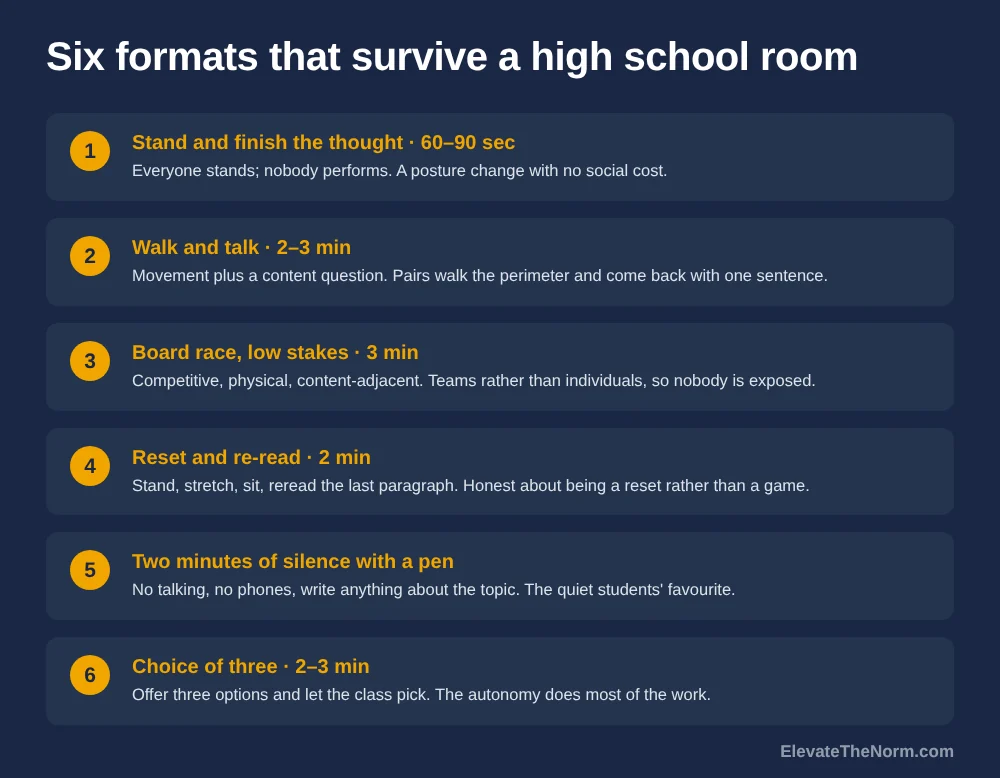
    Six numbered brain break formats for high schoolers with their lengths: stand and finish the thought, walk and talk, a low-stakes board race, reset and re-read, two minutes of silence with a pen, and a choice of three options
    Six formats that hold up with older students.

    What Should You Never Do?

    Four things, each of which ends the practice in one lesson.

    1. Anything that requires a volunteer to be funny in front of the class. You are asking a self-conscious sixteen-year-old to take a social risk for your pacing. The answer will be no, and after it is no once it is no permanently.
    2. Elementary branding. The dance video, the animal sounds, the cartoon timer. The activity may be fine; the packaging tells students what you think of them.
    3. Using it as a reward. The moment the break is contingent on behaviour, it is a management lever, not a break — and the class that most needs it is the class that will never earn it.
    4. Taking it away as a punishment. Same reason, reversed, and it teaches students that the pause was never actually about how their brain works.

    There is a fifth that is less obvious: not ending it on time. If you say ninety seconds and take four minutes, you have taught the room that your numbers are approximate, and the next one will be harder to end. Standing by your word is the mechanism here, same as everywhere else. Set a timer where students can see it.
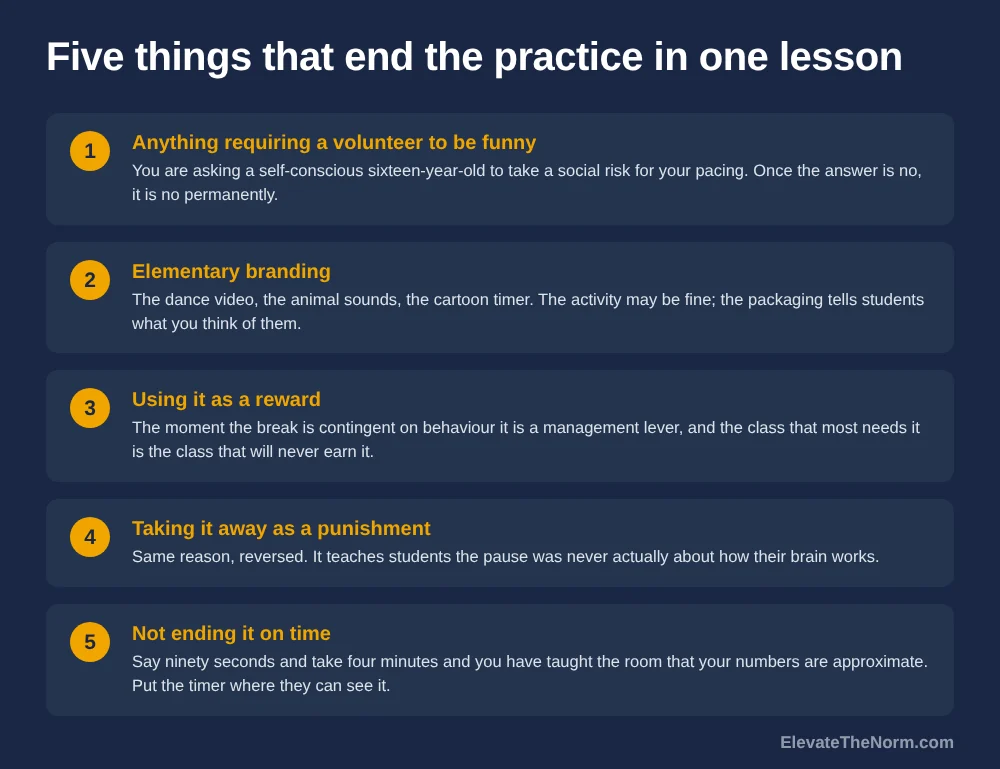
    Five numbered mistakes that end brain breaks in a high school classroom: requiring a volunteer to be funny, elementary branding such as dance videos and cartoon timers, using the break as a reward, taking it away as a punishment, and not ending it on time
    Any one of these ends the practice in a single lesson.

    How Do You Run One Without Losing the Room?

    You make the start and the end routine, and you never improvise either one. A break goes wrong in exactly two places: getting them out of the work and getting them back into it. Both are procedure problems and both are solvable in advance.

    1. Name it before it starts. “Ninety seconds. Stand up. Timer is on the board.” Students who know the shape of the next ninety seconds do not need to test it.
    2. Use a visible countdown. Not your watch. On the board, where every student can see how much is left, so nobody has to ask.
    3. Use one consistent signal to return. Whatever you already use — a signal the class already responds to works better than a new one invented for breaks.
    4. Give the first thirty seconds back a defined task. The return is harder than the break. “Sit down, read the question on the board, start writing” beats “okay, where were we.” This is the same principle that makes transitions between activities cost less time than they usually do.
    5. Do it at the same points for two weeks. A break at a predictable moment becomes a routine. A break at a random moment stays an event, and events need managing every time.

    If getting the room back is the part that worries you, build the break into a structure you already run well. A planned pause between two parts of a lesson, landing on an established routine, is a much smaller risk than a break dropped into open work time.

    When Does a Class Actually Need One?

    Before the attention goes, not after. Once a class has lost focus, a break reads as a reward for drifting and you have to rebuild from further back. The skill is spotting the slide early.

    Three reliable signals, in the order they appear: pen-stopping — the proportion of students writing drops while the proportion looking at the board stays the same; question quality falling — questions turn procedural, about format and length rather than content; and ambient noise rising at a constant task. Any two of those at once and you are past the point where pushing on gains you anything.

    And let students call it. A class that can request a break — one per period, by a signal rather than a speech, with the teacher keeping the right to say “finish this paragraph first” — will use it about as often as you would have, and will use it at better moments, because they can feel the slide before you can see it. It also changes what the break is: a tool a young adult is trusted to reach for rather than something administered to them. If that feels risky, cap it at one and try it for a fortnight. The classes that abuse it are usually the classes that were never told what it was for.

    The honest caveat: no study has validated those signals. They are the sort of thing experienced teachers watch for, and the research cannot tell you when to call a break because it has not studied that question. What the research does say is that consistency over about twelve weeks is what produced measurable change, which argues for a scheduled break most days rather than a reactive one on bad days.

    What Do You Tell an Administrator Who Walks In?

    What you are doing, why it is scheduled, and what the evidence does and does not support. That conversation goes much better if you have decided the honest version in advance.

    The defensible claim is narrow: short activity breaks have been found feasible in real secondary timetables, and the outcome with the most consistent support across school ages is on-task classroom behaviour. The claim to avoid is that brain breaks raise test scores — the adolescent studies did not measure cognition directly, and the executive-function evidence across ages is inconclusive. One cluster-randomised trial of 529 adolescents found a large concentration gain over four months, and its own authors list baseline imbalance and no pre-planned power calculation among the limits.

    On equity, there is one useful data point and it is worth having ready. The Italian trial ran exploratory checks on whether the concentration effect differed by sex, sport participation, sleep duration, smartphone use or diet, and found no significant interaction on any of them after correction for multiple testing. The authors label those analyses exploratory, so it is a weak finding rather than a strong one. It points the same way as everything else on this site: the benefit did not turn out to belong to the students who were already doing well.

    On safety and space, decide before the first break whether your room can actually hold it. Thirty-two desks in a room built for twenty-eight means standing in place rather than moving around, and a walk-and-talk needs a route that does not run between a bag and a chair leg. A student with a mobility limitation, an injury or a reason they have not shared should never have to say anything to sit one out — which is why the written version exists and why it is offered to the whole class rather than to individuals.

    On instructional time, do the arithmetic before you are asked. Ninety seconds twice a period is three minutes out of fifty — six percent. The Italian trial spent twenty minutes a day, which is a real cost and was a school-level decision rather than a teacher’s. If the claim is that the remaining 94% of the period is more productive, say that is the claim, and say nobody has measured it in your subject.

    What Should Families Know?

    That it is scheduled, it is brief, and it is not a reward or a punishment. Worth saying plainly, because “we did a brain break” can sound to a parent like a period went missing.

    Three things are fair to promise. It is not graded and it is not tied to behaviour — nobody loses a break for a bad day and nobody earns one for a good one. Participation is movement-optional; a student who cannot or does not want to move can stand, or stay seated and do the written version, and no explanation is owed. And the time is accounted for — a few minutes a period, scheduled, with the lesson built around it rather than interrupted by it.

    If a family asks whether it helps, the accurate answer is that the evidence supports better classroom behaviour and does not yet support better grades, and that most of the research was done on younger students. That is a less exciting answer than the one on most school newsletters, and it is the one that will still be true next year.

    What to Do This Week

    Pick one class and one slot. Do not roll this out across a timetable.

    Choose the moment first. Find the point in that period where the pens reliably stop — most teachers already know it — and put the break three or four minutes before it.

    Pick one format and keep it. Ninety seconds, standing, timer on the board. Do not vary it for two weeks; you are building a routine, not entertaining anybody.

    Define the first thirty seconds back. Write the return task on the board before the break starts, so coming back is reading rather than deciding.

    Count one thing. How many students are writing five minutes after the break compared with five minutes before it. One number, twice a week. It will not prove anything, and it will tell you whether to keep going.

    And if the first week is awkward, that is the normal result rather than a verdict. The research that found anything durable ran for twelve weeks or more. A format that feels forced on Tuesday and ordinary three weeks later is working exactly as the evidence says it should. If you want a lower-stakes place to start, the same ninety seconds slots neatly into the routines around how a period opens and around what students do when they finish early, both of which you are probably already running.

    Frequently Asked Questions

    What are brain breaks for high schoolers?

    Short, planned interruptions to sustained work — usually ninety seconds to ten minutes — that change a student’s posture, task or physical state before attention falls apart. In the research they are usually called active breaks: a few minutes of movement inside the lesson, as distinct from a physically active lesson where the content itself is taught through movement. The two things that make it a break rather than an interruption are that you called it in advance and that it has a defined end.

    Do brain breaks actually work for teenagers?

    Probably, mostly for classroom behaviour, and the evidence is thinner than the advice suggests. A 2022 systematic review restricted to students aged 13 to 16 screened 575 records and found only three eligible studies; all three reported the breaks were feasible, two reported improved behaviour and wellbeing, one found no significant effects on anything, and none measured cognition directly. Across all school ages, a 2025 review of 22 studies found six reporting better on-task behaviour and called the executive-function evidence inconclusive.

    How long should a brain break be in high school?

    Ninety seconds to three minutes for a routine break, up to ten if you are running something structured. There is no validated number — duration has not been isolated as a variable in the adolescent research. What the evidence does suggest is that intensity and consistency matter more than length: moderate-to-vigorous movement looked more useful than gentle movement, and roughly twelve weeks appears to be the minimum before anything durable shows up.

    What brain breaks work with older students?

    The ones that do not require a teenager to perform enthusiasm. Stand and finish the thought (60–90 seconds). Walk and talk in pairs with a content question (2–3 minutes). A low-stakes team board race (3 minutes). Stand, stretch, sit and reread the last paragraph (2 minutes). Two minutes of silence with a pen and no phones. Or offer three options and let the class choose — the autonomy does most of the work. Four of those six are just a change of posture, which is enough.

    What should you avoid with high school brain breaks?

    Four things end the practice in one lesson: anything requiring a volunteer to be funny in front of the class; elementary packaging like dance videos and cartoon timers; using the break as a reward, which makes it a management lever and means the class that needs it most never earns it; and taking it away as a punishment. A fifth is quieter — not ending it on time. If you say ninety seconds and take four minutes, you have taught the room your numbers are approximate.

    Do brain breaks improve test scores?

    There is no good evidence that they do, and claiming it will not survive scrutiny. The three studies in the adolescent-only review reported no direct cognitive measure at all. Across ages, executive-function findings were called inconclusive by the reviewers. One cluster-randomised trial of 529 Italian adolescents did find a large gain on a standardised concentration test after four months of two ten-minute breaks a day — but its own authors list baseline imbalance, possible contamination between groups and no pre-planned sample-size calculation among the limitations. The defensible claim is about classroom behaviour, not grades.

    Does the research say attention resets after a short break?

    Not reliably. The widely quoted finding is Ariga and Lleras (2011), who reported that briefly switching tasks during a long vigilance task prevented the usual decline in performance. In 2012 Helton and Russell tested that account directly with 498 participants and found a robust decline in every group, including the task-switch groups, with Bayesian analyses favouring the null. Both studies were lab vigilance tasks rather than classrooms, and neither was run on teenagers, so the case for brain breaks in a high school room should not be built on either one.

    Should a brain break be earned?

    No. The moment it is contingent on behaviour it stops being a break and becomes a management lever, and the class most likely to need a reset is the class least likely to earn one. The same logic rules out removing it as a punishment. A better move in the other direction is letting students request one — capped at one per period, by a signal rather than a speech, with the teacher keeping the right to say “finish this paragraph first.” They can usually feel the slide before you can see it.

    Sources

    1. Martone, D., Vitucci, D., Gillo, A., Dei, S., Cosco, L. F., Valerio, G., Ghirelli, R., Alfieri, A., Mancini, A., and colleagues (2026). Classroom Active Breaks Effects on Attention and Concentration Performance Among Adolescents Attending Upper Secondary Schools in Southern Italy. Sports, 14(9), 404. Cluster-randomised controlled trial in four upper secondary schools in Campania; 39 classes allocated (20 intervention, 19 control), 529 adolescents, mean age 14.3 ± 0.9 years; two 10-minute active breaks per school day for four months in the second and fifth lesson periods, run from music-based videos with a teacher present; fidelity 180 of 192 scheduled breaks (93.8%) and about 93.1% attendance; mean heart rate 155 ± 5.3 bpm in a 150-student subsample. Outcome was the Concentration Performance score of the Italian d2-R Test of Attention. Adjusted post-intervention CP 151.3 (95% CI 127.1–176.0) intervention versus 94.7 (68.3–121.0) control; adjusted between-group difference 56.7 points (95% CI 21.7–91.6), F(1, 34.6) = 10.16, p = 0.003, and 54.7 points (19.5–89.8, p = 0.004) fully adjusted. Exploratory moderator analyses found no significant interactions after Holm correction. The authors’ own limitations include possible contamination between intervention and control classes in the same schools; unstratified randomisation with baseline differences in age, weight, baseline CP, sleep and smartphone use; no a priori sample-size calculation accounting for clustering; no standardised effect size reported; a possible practice effect from repeated d2-R testing; no assessment of teacher acceptability or impact on instructional time; and no long-term follow-up. Read in full. mdpi.com
    2. Systematic review of school-based physical activity “active break” interventions in pre-adolescent and adolescent students (2022). Canadian Journal of Public Health. PRISMA-guided, PROSPERO-registered, five databases searched March 2021; described by its authors as the first review limited to this age group. 575 records identified; three studies met the criteria — Schmidt et al. (2020, Norway), Gammon et al. (2019, UK) and Mavilidi et al. (2021, Australia) — two randomised controlled trials and one quasi-experimental RCT, ages 13 to 16, samples of 97 to 447, sessions of 14–60 minutes, 2–6 times weekly, over 11 weeks to 12 months. All three reported feasibility and acceptability in secondary settings; two reported improved classroom behaviour and vitality or quality of life; Gammon found no significant effects on physical activity, sedentary time, behaviour or wellbeing. Study quality was rated poor, fair and good respectively. Cognitive function was named in the review’s aims but none of the included studies reported a direct cognitive measure. The review cites roughly 12 weeks as a minimum duration for meaningful change, and its authors urge caution given only three heterogeneous studies. Note: the review’s own text is internally inconsistent on the Gammon intervention length, giving 11 weeks in the results and “only 3 weeks” in the discussion; that discrepancy is reported here rather than resolved. link.springer.com
    3. Reyes-Amigo, T., Mota, J., and colleagues (2025). Effectiveness of School-Based Active Breaks on Classroom Behavior, Executive Functions and Physical Fitness in Children and Adolescent: A Systematic Review. Frontiers in Public Health, 13. 22 studies from 145 records, 3,615 participants aged 5 to 18 (35 to 512 per study); 15 randomised controlled trials, five controlled trials, two repeated crossover studies. Six studies reported positive effects on classroom behaviour, mainly on-task behaviour, with moderate-to-vigorous activity appearing more beneficial. Five studies reported executive-function improvements but results were mixed across inhibitory control, cognitive flexibility and working memory, and the authors describe that evidence as inconclusive. Only two reported fitness increases, with unclear results. No meta-analysis was performed and no effect sizes are reported — the review counted significant outcomes. Most included studies were rated poor or fair on the PEDro scale, and the authors say findings should be interpreted cautiously. frontiersin.org
    4. Ariga, A., & Lleras, A. (2011). Brief and Rare Mental “Breaks” Keep You Focused: Deactivation and Reactivation of Task Goals Preempt Vigilance Decrements. Cognition, 118(3), 439–443. Observers performed a visual vigilance task while holding digits in memory; those who recalled the digits only at the end showed a steep decline in performance over time, while those asked to recall them sporadically during the task did not. The authors argue the vigilance decrement comes from the cognitive control system failing to keep the task goal active, which they call goal habituation. A laboratory vigilance task, not a classroom study. Cited from the PubMed record, which was read; that record does not state the sample size or participant population and neither is claimed here. pubmed.ncbi.nlm.nih.gov
    5. Helton, W. S., & Russell, P. N. (2012). Brief Mental Breaks and Content-Free Cues May Not Keep You Focused. Experimental Brain Research, 219, 37–46. 498 participants. A direct test of the goal-habituation account above against mindlessness and resource theories, inserting brief task switches into a visual vigilance task. A robust vigilance decrement was found in every group, including the cue and task-switch groups, measured by declining perceptual sensitivity and slowing response times; self-reported workload and task-unrelated thoughts did not differ across groups; Bayesian analyses favoured the null hypothesis, consistent with resource theory and contradicting the prediction that a brief task switch eliminates the decrement. Cited from the published abstract and record, which were read; the full text is paywalled, so no effect sizes are quoted. Like the study it tests, this is a laboratory vigilance experiment rather than classroom research. link.springer.com
    About Clay Shumate

    Clay Shumate is a certified secondary Social Studies teacher in the public schools of West Alabama, with seven years of classroom experience, a B.A. in History, and an M.Ed. in Secondary Education. He writes about project-based learning, student responsibility, respect, and practical ways to hold young people to a higher standard while giving them room to learn from mistakes. He is a member of the Society of Professional Journalists and writes to its Code of Ethics; this site’s editorial standards and corrections policy are published in full. More about Clay.

  • Student Discourse: How to Get Students Talking to Each Other, Not Just to You

    Student Discourse: How to Get Students Talking to Each Other, Not Just to You

    By Clay Shumate

    Student discourse is students talking to each other about the content — explaining, challenging, building on and revising ideas — rather than taking turns answering the teacher. It is not the same thing as participation, and it is not the same thing as volume. The research that holds up says the part that pays is elaboration spread across the whole room, not how much noise it makes.

    That distinction is the whole article. Almost every piece of advice on this topic is about getting students to talk more. The best available evidence says more talk helps only when most of the room is in it and when what gets said builds on something — and the first of those two conditions is the one nearly every classroom misses.

    Key Takeaways

    • Student discourse is student-to-student, about the content. If every utterance routes through the teacher, that is recitation with a nicer name. The research calls the real version dialogic, and its two markers are authentic questions and uptake.
    • Broad participation is the condition, not a bonus. In 72 English Year 6 classes, elaborated and querying talk predicted maths and spelling-grammar results only where student participation was rated high. Where it was low, the same talk produced no measurable benefit.
    • Individual talk time tracked achievement for every group of students. Across 639 ninth graders, a student’s own talk time and reasoning utterances were strongly linked to a standardised reading score, regardless of socio-economic background or gender.
    • Discussion-based teaching has secondary-level evidence behind it. In 64 middle and high school English classrooms, discussion-based approaches predicted spring performance after controlling for fall performance, and worked for low- and high-achieving students alike.
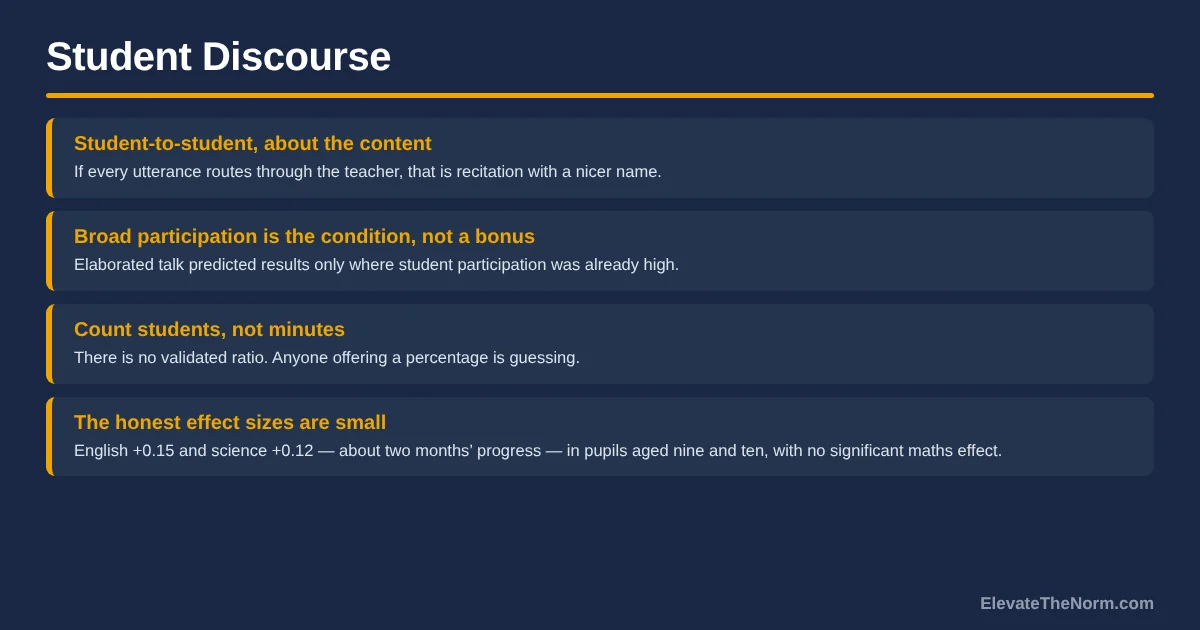
    • The honest effect sizes are small, and the strongest trial was not run on teenagers. The best randomised test found +0.15 in English and +0.12 in science — about two months’ progress — with no significant maths effect, in pupils aged nine and ten.

    What Is Student Discourse?

    Student discourse is sustained, content-focused talk in which students respond to each other’s reasoning rather than to the teacher’s prompt. The test is simple: pick any student utterance and ask what it is answering. If the answer is always “the teacher’s last question,” you have a recitation pattern — teacher asks, student answers, teacher evaluates, repeat. That pattern is not useless. It checks coverage fast and keeps a room steady. It just is not discourse, and it does not do what discourse does.

    Two pieces of research vocabulary are worth borrowing because they name what actually changes. An authentic question seeks a student’s thinking rather than checking whether they already know the answer in the teacher’s head. “What year did it start?” is not authentic. “Which of those three causes mattered most, and what makes you say that?” is. Uptake means your next move is built from what the student just said rather than from the plan’s next bullet. Uptake is the cheapest high-value habit on this page and it costs nothing but attention.

    Both ideas come out of a long research programme on eighth- and ninth-grade English classes — one of the few large bodies of classroom-talk research done on students the age this site writes for. The original report followed classes across eight midwestern communities over two school years, testing more than 1,100 students in the fall and spring of each. It is cited here for the two definitions and nothing else: it reports descriptive comparisons rather than a modelled effect, and no effect size for discussion is claimed anywhere on this page.

    Why Does Student Discourse Matter More Than Participation?

    Because participation is a count and discourse is a structure. A class where eleven students each said one sentence has high participation and no discourse. A class where four students argued for twenty minutes has discourse and a participation problem. The evidence says you need both, and the second is usually what is missing.

    This is the most useful finding in the literature and it is almost never quoted. A naturalistic study of 72 Year 6 classes across 48 English schools coded two video-recorded lessons per class turn by turn, then matched the codes against end-of-year tests taken months later. Two features came out positive: elaborated talk, where a student extends or explains an idea, and querying, where a student questions or challenges a claim. Both predicted maths and spelling-punctuation-grammar scores only in classes rated high for student participation. In low-participation classes the same talk showed no benefit.

    Read that the way a teacher has to. Getting four articulate students to reason beautifully in front of twenty-two silent ones did nothing for test scores in that study. The talk has to be distributed before its quality starts to matter. A five-minute structure that puts every student on the record is one cheap way to check whether it is.

    The same study is worth citing for what it failed to find. Reasoned talk — statements giving an explicit reason — did not predict attainment. Not in maths, not in reading, not on a purpose-built reasoning test. The authors call the work a staging post rather than a conclusion, note the design is correlational and cannot support causal claims, and record that their talk-rules measure had to be discarded because most lessons scored zero on it. That last detail is its own finding: across 72 real classrooms, almost nobody had explicit talk rules.

    What Does the Research Actually Say About Student Talk?

    That it helps, that the effects are modest, and that most of the strongest studies were run on children younger than the students in a 6–12 building. All three are true at once, and an article giving you only the first is selling something.

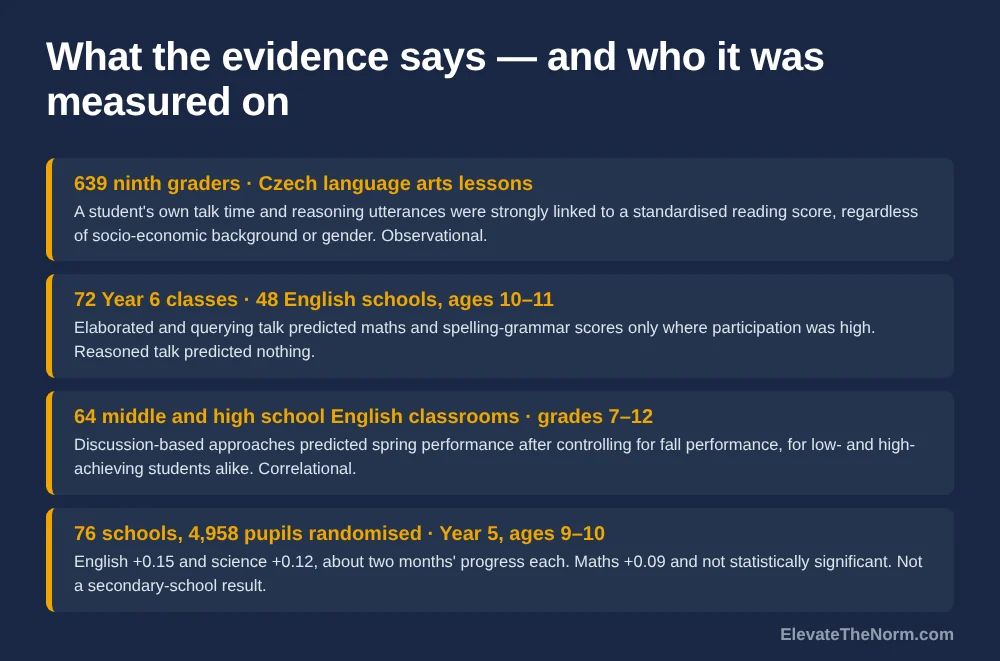
    StudyWho it was run onWhat it foundWhat it cannot tell you
    Šeďová & Sedláček (2019)639 ninth graders, Czech language artsA student’s own talk time and reasoning utterances were strongly linked to a standardised reading score. Talkative classrooms also did better. The individual link held regardless of socio-economic background or gender.Observational — cannot separate “talking makes you better” from “better readers talk more.” Classroom-level reasoning showed no link.
    Applebee, Langer, Nystrand & Gamoran (2003)64 middle and high school English classrooms, grades 7, 8, 10, 11, 12Discussion-based approaches were significantly related to spring performance after controlling for fall performance and background, for low- and high-achieving students alike.Correlational. The authors note instruction was unequally distributed across tracks.
    Howe, Hennessy, Mercer, Vrikki & Wheatley (2019)72 Year 6 classes (ages 10–11), 48 English schoolsElaborated and querying talk predicted maths and SPAG scores, but only where participation was high. Reasoned talk predicted nothing.Correlational, primary-aged, one country. The authors ask for intervention trials.
    EEF Dialogic Teaching trial (2017)76 schools, 4,958 pupils randomised — Year 5, ages 9–10English +0.15 and science +0.12, about two months’ progress each. Free-school-meals pupils gained +0.16 in maths.Maths overall was +0.09 and not significant. 21% of pupils dropped out of the analysis. Effects fell below the trial’s own detectable threshold. Not a secondary result.
    Murphy and colleagues (2009), meta-analysisStudies of discussion approaches; most participants in grades 4–6Several approaches strongly increased student talk, reduced teacher talk, and substantially improved text comprehension.Few improved critical thinking and reasoning, or literal and inferential comprehension. Effects varied by design, measure and student ability.
    Five sources, with the population stated every time.

    Three things follow from the table rather than from a summary of it. The strongest causal evidence is about nine- and ten-year-olds — the EEF trial is the cleanest test anyone has run, across 76 schools in three English cities all above 20% free school meals, and it is a Year 5 result. The practices transfer to a secondary room; the numbers do not automatically transfer with them.

    The secondary-level evidence is correlational, and it is still the most relevant evidence you have. The 64-classroom study and the 639-student study are both observational and neither can prove talk caused the learning. Both were run on students aged thirteen to eighteen, which no trial of this size has managed. Careful correlational work on the right students beats a clean trial on the wrong ones, as long as nobody dresses the first up as the second.

    And discussion is not a reasoning intervention. The 2009 meta-analysis found several approaches reliably moved comprehension and reliably increased student talk, and that few moved critical thinking. Howe and colleagues found the same from the other direction: reasoning was the one outcome with no main effects. If your pitch is “it teaches them to think critically,” the literature does not have your back yet. If it is “it moves comprehension and gets more students into the content,” it does.

    What About the Effect Size Everyone Quotes?

    Treat it carefully. A large effect size for “classroom discussion” circulates widely in professional development materials, usually traced to the Visible Learning synthesis. Two things are worth knowing first. The official Visible Learning glossary entry for classroom discussion carries a definition and no effect size at all. And the synthesis has a documented correction history: Hattie has acknowledged that the Common Language Effect size figures throughout the original book were calculated incorrectly, with only the Cohen’s d values correct, and a 2014 paper by Schulmeister and Loviscach catalogued further problems with study selection and method.

    Four research findings on student discourse with the population of each study named: 639 Czech ninth graders, 72 English Year 6 classes, 64 middle and high school English classrooms, and a randomised trial of 76 schools with pupils aged nine and ten
    The defensible numbers, with the population attached to each one.

    None of that makes classroom discussion a bad idea. It makes the headline number a bad citation. Use the trial figures instead — +0.15, +0.12, two months, one non-significant result, primary-aged pupils. They are smaller and they are defensible, and a claim that survives a sceptical administrator is worth more than one that impresses a staff meeting.

    How Much Should Students Be Talking?

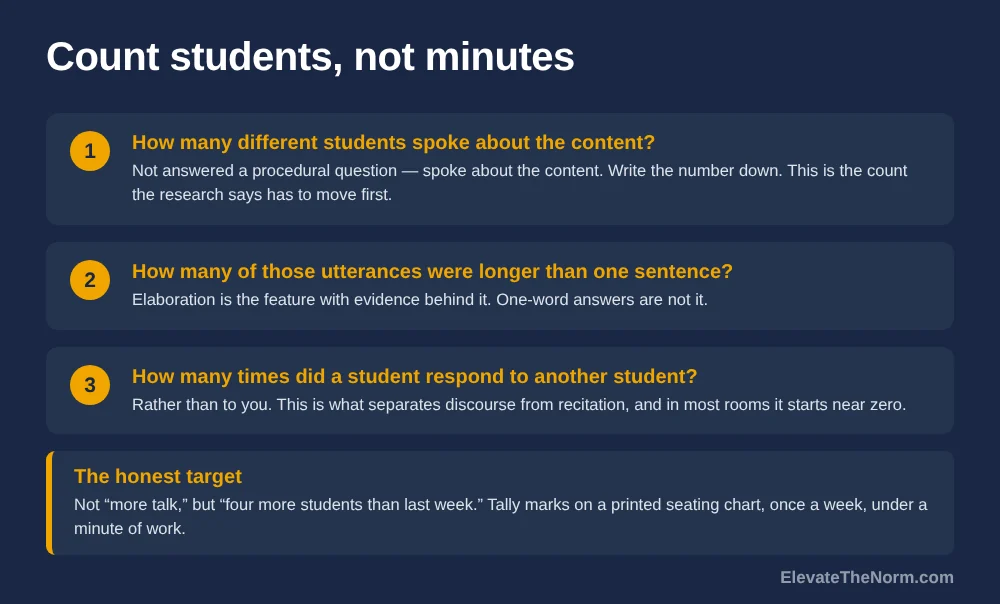
    There is no validated ratio, and anyone who gives you one is guessing. The research supports a direction and a distribution, not a percentage. So stop counting minutes and count students. Three questions, answerable from a seating chart and a pencil:

    1. How many different students spoke about the content today? Not answered a procedural question — spoke about the content. Write the number down.
    2. How many of those utterances were longer than one sentence? Elaboration is the feature with evidence behind it. One-word answers are not it.
    3. How many times did a student respond to another student rather than to you? This is what separates discourse from recitation, and in most rooms it starts near zero.

    Those three numbers, taken weekly for a month, will tell you more about your classroom than any observation rubric, and they make an honest target: not “more talk,” but “four more students than last week.”

    On scope, honestly: tally marks on a printed seating chart during one discussion, once a week. Under a minute of work, no grades, no data entry, nothing to upload. And nothing here is a record of individual students’ speech that anyone else needs to see — the chart is a working note, and it belongs in the recycling at the end of the month rather than in a file.

    A word on class size, because the advice gets harder as the roster grows. In a section of thirty-two on a fifty-minute period, whole-class discourse will not reach everybody and pretending otherwise wastes the period. Pairs and fours are not the training-wheels version — in a large room they are the version that satisfies the participation condition the research identified. One two-minute paired exchange gets more students reasoning out loud than twenty minutes of whole-class discussion will.

    Three questions a teacher can count weekly to track student discourse: how many different students spoke about the content, how many said more than one sentence, and how many responded to another student rather than to the teacher
    Three counts from a seating chart. Under a minute a week.

    What Are the Five Moves That Produce Student Discourse?

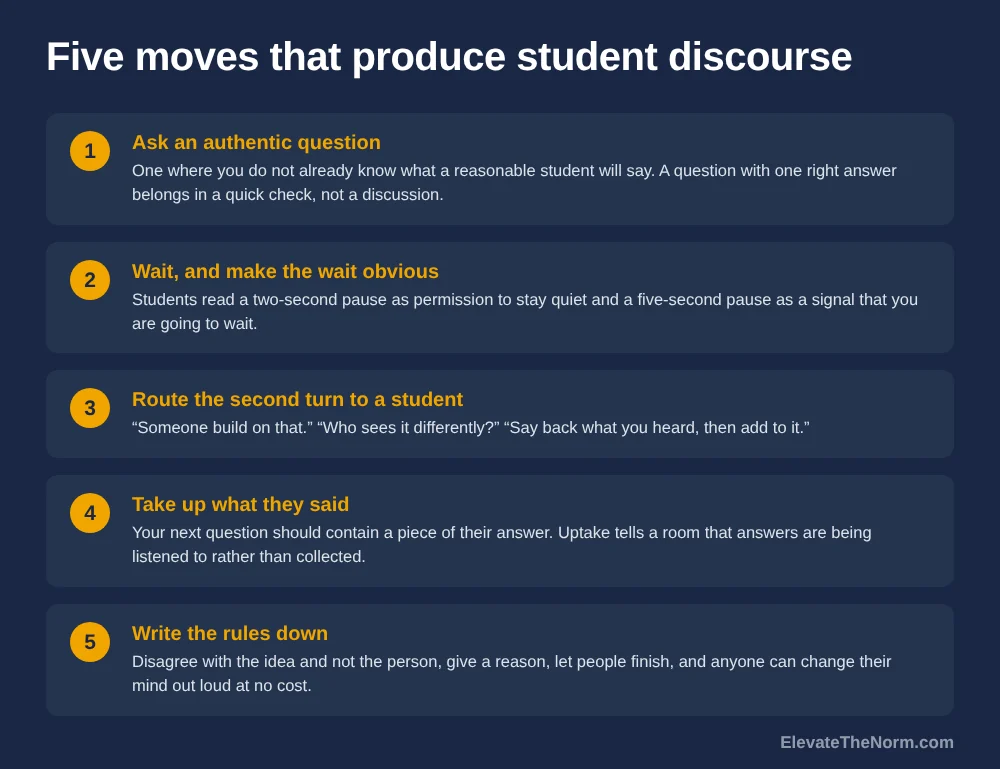
    Ask something that has no answer in your head, wait, make students respond to each other, keep the thread alive, and write down the rules. Each move is small enough to add to a lesson you have already planned.

    1. Ask an authentic question. One where you do not already know what a reasonable student will say. “Was the compromise worth it?” rather than “What did the compromise do?” A question with one right answer belongs in a quick check, not a discussion.
    2. Wait, and make the wait obvious. Ask, then say nothing and let the silence be visible. Students read a two-second pause as permission to stay quiet and a five-second pause as a signal that you are going to wait.
    3. Route the second turn to a student, not to yourself. After a student answers, the default next move is the teacher evaluating. Replace it: “Someone build on that.” “Who sees it differently?” “Say back what you heard, then add to it.” This one substitution turns recitation into conversation.
    4. Take up what they said. Your next question should contain a piece of their answer. “You said it was about money — whose money?” Uptake tells a room that answers are being listened to rather than collected. It is the operational version of standing by your word: if you ask what someone thinks, do something with what they tell you.
    5. Write the rules down. In 72 observed classrooms the talk-rules measure was thrown out because most lessons scored zero. Four lines on the wall is enough: disagree with the idea and not the person, give a reason, let people finish, and anyone can change their mind out loud at no cost.

    That fifth rule carries more weight than it looks. A room where changing your mind is embarrassing will produce confident nonsense and nothing else, because the only safe move is to defend your first answer. Say early that revising a position in public is the point — then praise it the first time it happens, by name, in front of everybody.

    Numbered list of five teaching moves for student discourse: ask an authentic question, wait visibly, route the second turn to a student, take up what a student said, and write the talk rules down
    The five moves in order. Each one works on its own.

    How Do You Run Discourse Without It Going Off the Rails?

    You plan the structure, not the content of what students will say. If a discussion in a grades 6–12 classroom collapses into chaos or dead silence, that is almost always a planning result rather than a student result. Four decisions, made before the lesson:

    • Decide the unit of talk. Whole class, pairs, or small groups. A room with no student-to-student history should not start whole class — pairs first, then fours, then the floor. If you are moving toward groups, defined roles inside each group remove the most common failure, which is one student talking and three watching.
    • Decide what everyone writes before anyone speaks. Thirty seconds of writing raises the number of students who can enter the discussion, which is the condition the research says matters most. It also gives the quiet student something to read from instead of something to invent under pressure.
    • Decide how you will call on people. Hands-up alone concentrates talk in the already-confident, which is exactly the low-participation pattern that made elaborated talk worthless in the 72-class study. A warm, predictable version of calling on students who did not volunteer — after writing time, with a route to pass once — distributes talk without ambushing anybody.
    • Decide where it ends. A discussion with no landing point teaches students that talk is filler. Name the product: a written claim, a revised answer, one sentence on the strongest counterargument. Then use it in the next thing you do.

    And decide, out loud, what a student who does not want to talk is allowed to do. Most discourse advice skips this, and it is the part students notice first. Give an explicit route: a pass, once, with no explanation owed and no penalty, and the answer written instead. Then honour it the first time somebody uses it, in front of everyone, without a sigh — a pass that costs social capital is not a pass. The same provision quietly does the work for a student with a speech difference, a student still acquiring English, and a student having a bad week, none of whom should have to disclose anything to get it. Sentence stems on the wall (“I agree with… because…”, “I see it differently because…”, “Can you say more about…”) raise the floor for all three at once and cost one piece of paper.

    For a structured version of all of this at once, a Socratic seminar is the most forgiving format to start with, because the protocol does the management for you. It lives or dies on the prompt, so it is worth borrowing questions already known to open up rather than writing your own on the first attempt. In a smaller setting, the same five moves work inside small-group instruction at the secondary level, where the participation problem is easier to see and easier to fix. To grade one, use this free Socratic seminar rubric.

    What Happens When the Discussion Gets Near Something Contentious?

    You separate the question you are asking from the question students bring, and you decide which one the lesson is for before you open the floor. A room full of teenagers reasoning out loud will eventually reach something a family has strong feelings about. That is a reason to prepare, not a reason to avoid discourse.

    Three things keep it clean. Frame the prompt around evidence rather than personal position — “what does this source let us conclude” travels much further than “what do you believe.” State the standard you are grading against, if anything is graded, so nobody can reasonably believe their conclusion is what is being scored. And have the redirect sentence ready: name the move, not the student — “that is about a person rather than the idea, so try it again on the idea.” Rehearse it once and it stops being a crisis. If a discussion does go somewhere you did not intend, the useful question afterward is what the prompt invited. A fifteen-year-old cannot derail a conversation that had a clear question, a clear product and clear rules.

    Can a School Actually Roll This Out?

    Yes, with one condition stated plainly: the trial that produced those numbers tested a supported programme, not a handout. The EEF study trained teachers and ran a mentoring cycle inside each school. Fidelity was high for training attendance and the mentor-cycle format, and more variable for how the approach reached the curriculum. So the +0.15 belongs to that package — training, a mentor, two terms — and nobody should promise it for a one-hour staff meeting and a PDF.

    The cost line is small by district standards. No purchase, no platform, no licence, no staffing change. What it needs is time: somebody who can sit in a colleague’s room, watch for the three numbers above, and talk about them afterward without it being an evaluation. A peer-observation cycle with no rating attached is the cheapest intervention on this page and the one most likely to get cut first.

    It is also unusually coachable, which matters for anyone allocating instructional-coach hours. The five moves are observable from the back of a room, countable in one period, and separable — a teacher can work on routing the second turn for three weeks without changing anything else. Standards alignment mostly takes care of itself, because speaking-and-listening standards already require this and are usually the least-taught strand in the document.

    Does Student Discourse Work for Every Student?

    The best data says the individual benefit did not depend on background. In the 639-student Czech study, the link between a student’s own talk time and their reading score, and between their reasoning utterances and that score, held across students regardless of socio-economic background or gender. That is observational and should be stated as such. It is also the most direct evidence available on a question teachers ask constantly, usually in the form of an assumption: that students from harder circumstances need tighter control and less open talk.

    There is no support for that assumption here. The EEF trial’s schools were all above 20% free school meals, and its one statistically significant maths result was for the free-school-meals subgroup specifically. The 64-classroom secondary study found discussion-based approaches working for low- and high-achieving students alike, and the Czech study found the link between a student’s own participation and achievement held regardless of socio-economic background or gender.

    Be careful what that adds up to. It does not say discourse closes gaps; nobody has shown that. It says the appetite to talk about something that matters is not the thing that varies by zip code — and the burden of proof sits with whoever claims some students need silence instead.

    What Goes Wrong, and How Do You Fix It?

    FailureWhat you will seeThe repair
    Four voices, twenty silencesRich talk, flat resultsWrite first, then pairs, then floor. Track distinct speakers, not volume
    Questions with answersShort replies, then nothingRewrite the prompt until you cannot predict a reasonable answer
    Teacher as the hubEvery turn routes through youHand the second turn to a student every time, for two weeks, until it is habit
    No stated rulesInterrupting, or point-scoringFour lines on the wall. Most observed classrooms have none
    Talk with no product“Why are we doing this?”Name the written output before the talk starts, and collect it
    Five common discourse failures and the repair for each.

    One more, because it is the hardest to see from the front of the room: grading the talk. The moment a discussion carries points, some students stop reasoning and start performing, and the least confident get quieter rather than louder. If a discussion needs assessing, assess the written product that came out of it, and keep the quick checks that tell you whether they understood separate from the conversation that got them there.

    How Long Does This Take to Work?

    Longer than one unit, and the best trial we have says its own window was too short. Teachers in the EEF study reported two terms was not enough to embed the approach, which the evaluators recorded as a reason the measured effects may be underestimates. That is an unusually honest thing for a trial report to say, and it sets a realistic expectation: the five moves are easy to start and slow to pay.

    Expect three phases. In the first week or two the distinct-speaker count moves and the talk is awkward. Over the next month students start responding to each other without being told to, which is when your third weekly number stops being zero. After that the content of the talk gets better, and the elaboration the research cares about shows up on its own. Skipping to phase three by demanding sophisticated reasoning in week one produces the four-voices pattern, which the evidence says buys nothing.

    What Should Families Expect to See?

    More talking at school, the same expectations, and nothing new to do at home. Worth saying to parents before they hear a version of it from their child, because “we just talked today” can sound like a wasted period from the outside.

    Three things are fair to promise, and they are what a quiet student’s parent will want to hear. A student is not graded on how much they say — talk is not a behaviour category or a participation score, and the written product is what gets assessed. There is a real route to not speaking, used without explanation, with the answer written instead. And a student who thinks out loud and changes their mind is doing it correctly, not backing down; if that reads as weakness at school the whole method stops working, so it gets named as a strength out loud.

    The honest caveat for a family who asks about evidence: the gains in the strongest study were about two months’ progress in English and science, in a trial on nine- and ten-year-olds, with no significant maths effect. That is worth doing and it is not a transformation. The clearer case for a 6–12 classroom is the Czech ninth-grade data — students who talked more and reasoned out loud more did better on a standardised reading test, across backgrounds.

    What to Do This Week

    Pick one class. Do four things.

    Monday: count the distinct students who say something about the content, and the number of student-to-student responses. Change nothing yet. You need the baseline, and it will probably be worse than you expect.

    Tuesday: rewrite one question in your existing plan so you cannot predict a reasonable answer to it. One question. Ask it, then wait five visible seconds.

    Wednesday: hand the second turn to a student every time, all period. “Build on that.” “Who disagrees?” Nothing else changes.

    Friday: put four talk rules on the wall and count again. If the distinct-speaker number went up, you have the result the research says has to come first.

    Then go find the person in your building who is already good at this and ask how they start. Keeping your ears open and asking a direct question pays off more reliably than reading another article, this one included — and most of the teachers worth asking are waiting for somebody to ask.

    Frequently Asked Questions

    What is student discourse?

    Student discourse is students talking to each other about the content — explaining, challenging, building on and revising ideas — rather than taking turns answering the teacher. The research tradition calls the real version dialogic, and its two markers are authentic questions (ones with no prespecified answer in the teacher’s head) and uptake (the teacher’s next question built out of what a student just said). If every utterance routes through the teacher, that is recitation rather than discourse.

    What is the difference between student discourse and participation?

    Participation is a count; discourse is a structure. Eleven students each saying one sentence is high participation and no discourse. Four students arguing for twenty minutes is discourse with a participation problem. The evidence says you need both: in a study of 72 Year 6 classes, elaborated and querying talk predicted maths and spelling-grammar scores only in classes where student participation was rated high. Where participation was low, the same quality of talk produced no measurable benefit.

    How much should students be talking in class?

    There is no validated ratio, and anyone offering a percentage is guessing. What the research supports is a direction — several discussion approaches increased student talk and reduced teacher talk — and a distribution, which matters more than the total. Instead of counting minutes, count three things weekly: how many different students spoke about the content, how many said more than one sentence, and how many responded to another student rather than to you. The third number starts near zero in most rooms.

    Does student discourse improve test scores?

    Modestly, and the strongest evidence is not from secondary classrooms. The best randomised trial of dialogic teaching found +0.15 in English and +0.12 in science — about two months’ progress — with maths at +0.09 and not statistically significant, in pupils aged nine and ten. At the secondary level the evidence is correlational: discussion-based approaches predicted spring performance across 64 middle and high school English classrooms, and across 639 ninth graders a student’s own talk time tracked their standardised reading score. Discussion is not a reasoning intervention — a meta-analysis found several approaches improved text comprehension while few improved critical thinking.

    What are examples of student discourse moves?

    Five, in order. Ask an authentic question you cannot predict a reasonable answer to. Wait, visibly, for about five seconds rather than two. Route the second turn to a student instead of evaluating yourself — “build on that,” “who sees it differently,” “say back what you heard, then add to it.” Take up what a student said by putting a piece of their answer into your next question. And write four talk rules on the wall: disagree with the idea not the person, give a reason, let people finish, and anyone can change their mind out loud at no cost.

    How do you include a student who does not want to speak?

    Give an explicit route and honour it. A pass, once, with no explanation owed and no penalty, and the answer written instead — then accept it the first time somebody uses it, in front of everyone, without a sigh. A pass that costs social capital is not a pass. Thirty seconds of writing before anyone speaks raises the number of students who can enter the discussion, and sentence stems posted on the wall (“I agree with… because…”, “I see it differently because…”) raise the floor for a reluctant speaker, a student with a speech difference and a student still acquiring English at the same time, without anyone having to disclose anything.

    Should student discourse be graded?

    Assess the written product that comes out of the discussion, not the talking. The moment a discussion carries points, some students stop reasoning and start performing, and the least confident get quieter rather than louder. Keep quick checks for understanding separate from the conversation that produced the understanding. Telling families plainly that a student is not graded on how much they say is also the single most effective thing you can do to head off the question a quiet student’s parent will otherwise ask.

    Sources

    1. Jay, T., Willis, B., Thomas, P., Taylor, R., Moore, N., Burnett, C., Merchant, G., & Stevens, A. (2017). Dialogic Teaching: Evaluation Report and Executive Summary. Education Endowment Foundation / Sheffield Hallam University. Three-level clustered randomised controlled trial; 76 schools randomised (38 intervention, 38 control) in Leeds, Bradford and Birmingham, all with over 20% of pupils eligible for free school meals; 4,958 pupils randomised and 3,912 analysed. Pupils were in Year 5, aged nine and ten — this is not a secondary-school result. English +0.15 (95% CI 0.00 to 0.30, p = 0.05, about two months); science +0.12 (0.01 to 0.23, p = 0.04, about two months); maths +0.09 (−0.04 to 0.20, p = 0.19, not statistically significant). Free-school-meals pupils: maths +0.16 (0.01 to 0.30). Rated three padlocks (moderate security). Reported limitations include 21% attrition, with 7 of 38 intervention schools providing no post-test data; a baseline EAL imbalance; effects below the trial’s own minimum detectable effect size of roughly 0.25; and teachers reporting that two terms was too short to embed the approach. Read in full. shura.shu.ac.uk (PDF)
    2. Howe, C., Hennessy, S., Mercer, N., Vrikki, M., & Wheatley, L. (2019). Teacher–Student Dialogue During Classroom Teaching: Does It Really Impact on Student Outcomes? Journal of the Learning Sciences. 72 Year 6 classes (ages 10–11) in 48 schools across England; two video-recorded lessons per class coded turn by turn; outcomes were end-of-year tests and a pupil attitude survey taken months later, analysed in two-level models with measured confounds controlled. Elaborated and querying talk were positively associated with mathematics and spelling-punctuation-grammar scores only where the lesson-level rating for student participation was high; with low participation there was no benefit. Reading showed the same pattern but not significantly. Reasoned talk predicted nothing, there were no significant science effects, and there were no main effects on the reasoning test. The talk-rules scale was discarded because most lessons scored zero. Authors’ own caveats: the design is correlational and cannot support causal claims; the sample is England-only and primary-aged; the science and reasoning tests were newly designed; they describe the work as a “staging post” and call for intervention trials. Accepted manuscript read in full; the Cambridge copy of that manuscript has since gone offline, so this links to the published article. doi.org/10.1080/10508406.2019.1573730
    3. Šeďová, K., & Sedláček, M. (2019). Do Those Who Talk More Learn More? The Relationship Between Student Classroom Talk and Student Achievement. Learning and Instruction. 639 ninth-grade students in Czech schools; talk time and the number of utterances featuring reasoning were recorded for each individual student during language arts lessons; achievement was measured with a standardised reading literacy test. A strong link was found between a student’s own talk time and reasoning utterances and that student’s achievement, and at classroom level students in talkative classrooms did better. At classroom level, reasoning utterances were not linked to better results. The positive link between individual participation and achievement was observed in all students regardless of socio-economic background or gender. Observational, so it cannot separate whether talking raises achievement or stronger readers talk more. Abstract read in full from the publisher’s record. pedagogika.phil.muni.cz
    4. Applebee, A. N., Langer, J. A., Nystrand, M., & Gamoran, A. (2003). Discussion-Based Approaches to Developing Understanding: Classroom Instruction and Student Performance in Middle and High School English. American Educational Research Journal, 40(3). 64 middle and high school English classrooms spanning grades 7, 8, 10, 11 and 12. Discussion-based approaches were significantly related to spring performance in hierarchical linear models controlling for fall performance and background variables, and appeared effective across a range of situations and for both low- and high-achieving students. Non-experimental; the authors note that instruction was unequally distributed across tracks, which complicates interpretation. Cited from the ERIC record, which was read; the journal’s full text was not opened in this session. eric.ed.gov
    5. Murphy, P. K., Wilkinson, I. A. G., Soter, A. O., Hennessey, M. N., & Alexander, J. F. (2009). Examining the Effects of Classroom Discussion on Students’ Comprehension of Text: A Meta-Analysis. Journal of Educational Psychology, 101(3). Several discussion approaches produced strong increases in the amount of student talk with reductions in teacher talk, and substantial improvements in text comprehension. Few approaches were effective at improving literal or inferential comprehension, or critical thinking and reasoning. Effects were moderated by study design, the nature of the outcome measure and student academic ability. The age range was wide but most studies involved fourth through sixth graders, so this is not a secondary-school finding. Cited from the published abstract and record; the full article was not opened in this session. pure.psu.edu
    6. Murphy, P. K., Greene, J. A., Firetto, C. M., Hendrick, B. D., Li, M., Montalbano, C., & Wei, L. (2018). Quality Talk: Developing Students’ Discourse to Promote High-Level Comprehension. American Educational Research Journal, 55(5). A year-long study of a teacher-facilitated small-group discussion approach in two fourth-grade classrooms. Teacher-initiated discourse decreased, student discourse showed more critical-analytic thinking, and written measures of basic and high-level comprehension increased. The authors describe it as an initial study; two classrooms is a small sample and the abstract reports no effect sizes. Cited from the abstract, which was read; the full text is behind access controls. journals.sagepub.com
    7. Nystrand, M., & Gamoran, A. (1990). Student Engagement: When Recitation Becomes Conversation. National Center on Effective Secondary Schools, Wisconsin Center for Education Research, University of Wisconsin–Madison. The source of the two terms used above: authentic questions, which open the floor to what students actually think, and uptake, where the next question is built out of what a student just said. Eighth- and ninth-grade English classes across eight midwestern communities — 16 middle schools feeding nine high schools — with over 1,100 students tested in the fall and spring of 1987–88 and 1988–89. Cited for the definitions only. This report gives descriptive comparisons rather than regression models, publishes no effect size for discussion, and none is claimed here. The research centre’s own summary page for the wider programme is currently unreachable — its TLS certificate does not match its hostname — so it is not cited. files.eric.ed.gov (PDF)
    8. On the widely quoted “classroom discussion” effect size: the official Visible Learning glossary entry for classroom discussion gives a definition and no effect size and no meta-analyses. Separately, Hattie has acknowledged that the Common Language Effect size figures throughout the original book were calculated incorrectly, with only the Cohen’s d values correct — raised by Topphol (2011) in Norsk pedagogisk tidsskrift — and Schulmeister and Loviscach (2014), Errors in John Hattie’s “Visible Learning”, argued there are considerable issues with study selection and method. No formal published erratum or revised edition is documented. This article therefore does not cite a Visible Learning figure for discussion and uses the trial estimates instead. visible-learning.org glossary · overview of the criticism

    About Clay Shumate

    Clay Shumate is a certified secondary Social Studies teacher in the public schools of West Alabama, with seven years of classroom experience, a B.A. in History, and an M.Ed. in Secondary Education. He writes about project-based learning, student responsibility, respect, and practical ways to hold young people to a higher standard while giving them room to learn from mistakes. He is a member of the Society of Professional Journalists and writes to its Code of Ethics; this site’s editorial standards and corrections policy are published in full. More about Clay.

  • Differentiated Instruction Strategies for Grades 6–12 That Don’t Need Five Lesson Plans

    Differentiated Instruction Strategies for Grades 6–12 That Don’t Need Five Lesson Plans

    By Clay Shumate

    Differentiated instruction strategies are the moves a teacher makes so that students who arrive at a lesson with different knowledge, skills and language can all reach the same standard. The standard does not move. The route to it does. Everything useful in differentiation lives in that one sentence, and most of what goes wrong is a violation of it.

    The version sold in professional development usually looks like three lesson plans for one period. Nobody does that for five preps in February, and the people who tell you to do it are not currently teaching five preps in February.

    Key Takeaways

    • Change the route, not the destination. The learning target, the standard and the final criteria stay the same for everyone. If those move, you are running two courses in one room.
    • The evidence is encouraging and genuinely thin. A systematic review of secondary differentiation found only 12 usable studies out of 1,029 screened, and its authors named “severe knowledge gaps” in the same abstract that reported a positive effect.
    • Ability grouping is not differentiation. In primary education, homogeneous grouping showed a small negative effect on low-ability students and no effect on anyone else.
    • Do not differentiate by learning style. There is no adequate evidence base for matching instruction to a preferred modality, and the studies designed properly to test it mostly contradict it.
    • Five strategies carry most of the load: tiered questioning, scaffolds that come back, choice of product, grouping that actually changes, and pre-assessment that changes the plan. Four of the five are nearly free.

    What Is Differentiated Instruction?

    It is adjusting content, process, product or environment in response to what students actually need, while holding the learning goal constant. The adjustment has to be driven by evidence about this group of students, in this unit, right now — not by a label attached to a child in sixth grade.

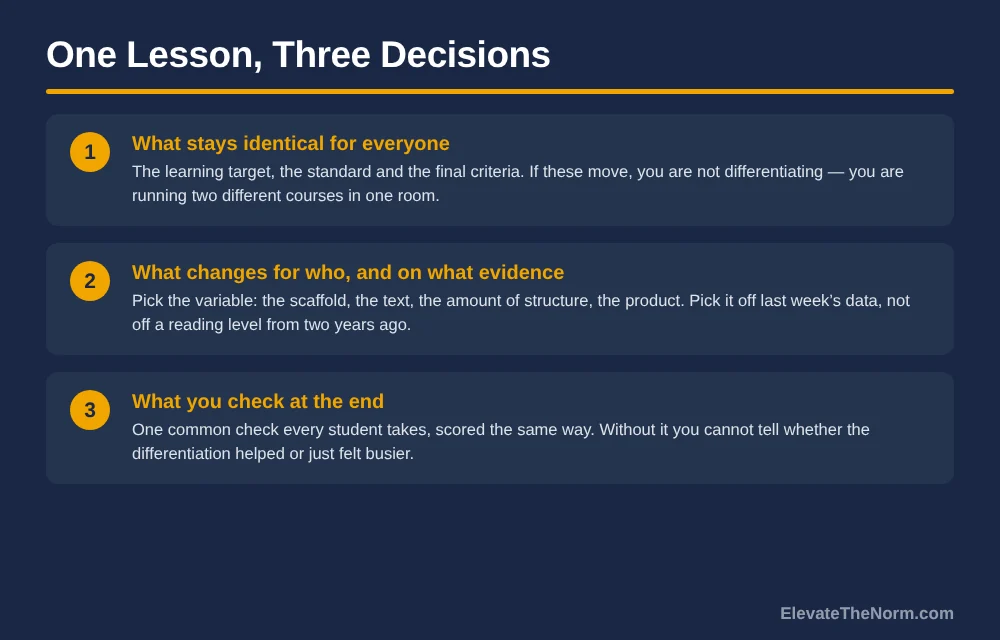
    Numbered three-card framework graphic for differentiating one lesson: what stays identical for everyone, what changes for which students and on what evidence, and what common check happens at the end
    Three decisions per lesson. That is the whole planning load.

    In practice, one lesson is three decisions.

    One: what stays identical for everybody. The target, the standard, the criteria for good work. Nail these down first, because everything after is a variation on them.

    Two: what changes, for whom, on what evidence. Pick one variable — the scaffold, the text, the amount of structure, the product. One. Then name why those students and not others, and point at the data that says so. If the only answer is “they’re my low group,” you have a track, not a differentiation plan.

    Three: what you check at the end. One common check every student takes, scored the same way. Without it, you cannot distinguish a lesson that helped from a lesson that was busier.

    Does Differentiated Instruction Actually Work?

    Probably, somewhat, and we know less than the training implies. The best secondary-specific review found a positive average effect across a small number of mostly quasi-experimental studies, and said so alongside a warning about how thin the base is.

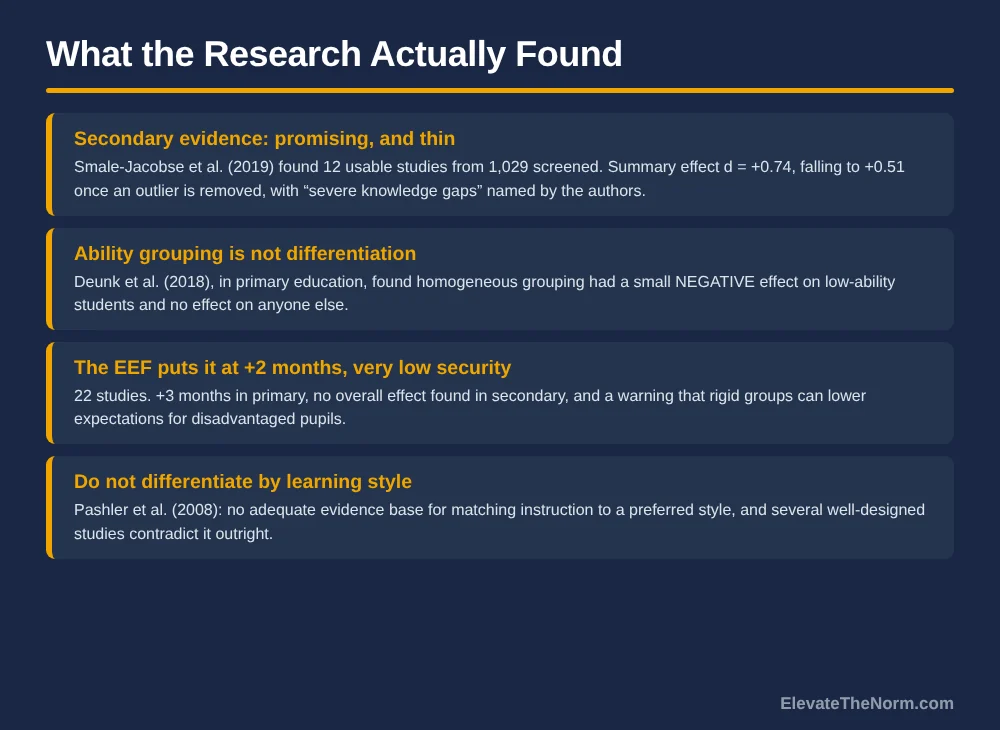
    Four-row research graphic on differentiated instruction: Smale-Jacobse and colleagues 2019 finding 12 usable secondary studies with an effect of 0.74 falling to 0.51 without an outlier, Deunk and colleagues 2018 finding homogeneous grouping slightly negative for low-ability students, the Education Endowment Foundation rating within-class attainment grouping at plus two months with very low security, and Pashler and colleagues 2008 on the absence of evidence for learning styles
    Four findings worth knowing before anyone sells you a differentiation initiative.

    Smale-Jacobse, Meijer, Helms-Lorenz and Maulana screened 1,029 papers and ended up with 12 unique studies of differentiated instruction in secondary education, mostly in maths and science, with students roughly 11 to 17. The summary effect was d = +0.741. Remove one extreme outlier and it drops to d = +0.509. Heterogeneity was enormous (Q = 507.7), the larger studies produced the smaller effects, only two studies had at least 15 cases per condition at the randomization level, and many of the outcome tests were researcher-made. The authors’ own summary is that the findings “give some indication of the possible benefits” but “point out that there are still severe knowledge gaps.”

    That is an honest finding and it is worth something. It is not a mandate.

    The Education Endowment Foundation puts within-class attainment grouping at +2 months of additional progress, at very low cost, with the security of the evidence rated very low — 22 studies, few of them recent. Their breakdown matters more than the headline: about +3 months in primary, +4 in maths, no difference on average in literacy, and no overall impact found at secondary, where there are few studies to begin with.

    And in primary education, Deunk, Jacobse, de Boer, Doolaard and Bosker reviewed 21 studies and 78 effect sizes. Computerized differentiation tools and differentiation embedded in a broader program produced small to moderate positive effects. Homogeneous ability grouping on its own produced a small negative effect on low-ability students and no effect on anyone else. Their conclusion is the one to carry into a department meeting: grouping by itself does not constitute differentiated instruction.

    Worth saying plainly: Deunk and the EEF’s strongest results are primary findings. They do not transfer to a ninth-grade classroom automatically, and I am not going to pretend they do. What transfers is the warning.

    What Differentiation Is Not

    It is not teaching to learning styles

    Pashler, McDaniel, Rohrer and Bjork tested what they called the meshing hypothesis — the idea that a “visual learner” learns more from visual material. Credible evidence would require grouping students by style, randomly assigning instruction methods, testing everyone the same way, and finding a crossover interaction. They found “virtually no evidence” of that pattern, and noted that several studies using an adequate method flatly contradict it. Their conclusion: there is no adequate evidence base for building learning-styles assessment into general educational practice.

    If a differentiation plan starts with a learning-styles inventory, it is starting from a dead end. Vary the representation because the content calls for it — a map, a graph, a demonstration — not because a survey labelled a student kinesthetic in seventh grade.

    It is not lowering the bar for some students

    A shorter task with the same standard is differentiation. A simpler standard quietly substituted for one group is not, and it is the single most common failure mode. Students work out within a week whose work is being graded against what. Holding the same expectations for every student in the room is not in tension with support; support is how you make the expectation reachable.

    It is not permanent groups with friendly names

    The Eagles, the Falcons and the Hawks, unchanged since September, are a tracking system with a bird theme. The students know. Rigid grouping carries a documented equity risk — the EEF names lower teacher expectations for disadvantaged pupils and damage to low attainers’ belief that effort changes anything.

    Differentiated Instruction Strategies, Ranked by What They Cost

    Start with the ones that cost nothing. Most teachers who “cannot differentiate” have simply been handed the most expensive version first.

    Numbered five-card graphic ranking differentiated instruction strategies by preparation cost: tiered questioning, scaffolding the task rather than the standard, choice of product, flexible grouping that actually changes, and pre-assessment that changes the lesson
    Ranked by what they cost you, cheapest first.

    1. Tiered questioning — costs nothing

    Before class, write your key question three ways: one that gets anyone in, one at grade level, one that pushes. Same content, different entry points. You are not assigning questions to students; you are making sure the discussion has a door at every height. Every student should still meet the hardest version before the period ends — that is the difference between tiering and sorting.

    2. Scaffold the task, not the standard — costs minutes

    Sentence stems, a worked example at the top of the page, a graphic organizer with two boxes already filled in, a word bank for the four terms that will otherwise stop a student cold. The rule that keeps this honest: scaffolds are temporary and you must plan their removal. If a student has had the same organizer since September, the organizer is now the skill.

    3. Choice of product — costs one planning block

    Same claim, same evidence rules, same criteria — written paragraph, annotated diagram, or a recorded two-minute defense. This is where a choice board earns its keep, as long as the options differ in form and not in difficulty. Three options is plenty. Nine is a craft fair.

    4. Flexible grouping that actually changes — costs five minutes a week

    Group off this week’s evidence, not last year’s. Sometimes by readiness, sometimes by interest, sometimes at random, often mixed on purpose. If your groups have not changed in a month, they are not flexible. Small-group instruction in a secondary classroom works best when the rest of the room has something genuinely worth doing, which is a planning problem before it is a grouping problem.

    5. Pre-assessment that changes the lesson — costs the most, pays the most

    Five questions on Friday about Monday’s content. Not graded. The point is to find out who already has it and what the two common misconceptions are. Here is the test of whether it was worth doing: if the results do not change Monday’s plan, stop giving it. A pre-assessment you collect and file is paperwork.

    Any of the quick formative checks works for this. What matters is the twenty minutes afterward where you actually look.

    Differentiated Instruction Examples for Grades 6–12

    Each of these is one lesson, one variable changed, same standard for everybody.

    • Grade 9 history, document analysis. Everyone analyzes the same three documents against the same criteria. Two students get a version with the archaic vocabulary glossed in the margin. One group that finished the skill last unit gets a fourth document that contradicts the other three.
    • Grade 7 science, data claims. Same data set for the room. Some students get a claim-evidence-reasoning frame with the first sentence started; some get a blank page; the ones who have the structure cold get asked to write the strongest objection to their own claim.
    • Grade 8 algebra, error analysis. Everyone finds the mistake in a solved equation. One table gets problems with the error in the first two lines; another gets it buried in line five; a third gets two errors, one of which is not actually an error.
    • Grade 11 English, revision. Same paragraph, same revision criteria. Some students revise on paper with a checklist; some revise aloud to a partner first; some revise a second paragraph after the first one is done.
    • Any subject, same day. The whole class gets the same exit check: one question, four minutes, scored the same way. That single common measure is what makes the rest of it defensible.

    How Do You Differentiate When You Teach 150 Students?

    You differentiate the lesson, not the student. Build one lesson with planned variation inside it, and let students move through the variation, rather than writing a plan per child.

    Three things make this survivable.

    Sample instead of reading everything. You do not need to read 150 exit tickets. Read fifteen — five you expect to be strong, five middling, five you are worried about — and sort the rest into three piles by a single criterion. That takes ten minutes and tells you nearly as much as an hour would.

    Reuse the structures. The same tiered-question frame and the same CER scaffold work across a whole unit. You build them once, in August or over a weekend, and spend the rest of the semester choosing which to deploy. The planning cost is front-loaded, which is the only way it ever gets paid.

    Pick one class to start. Not all five. One section, one unit, one variable. If it works there, it transfers; if it does not, you have lost a week instead of a semester.

    What About the Students Who Already Got It?

    They are the group most often skipped, and the evidence says so directly.

    Ziernwald, Hillmayr and Holzberger reviewed 49 studies published 2000–2019 on differentiated instruction for high-achieving students in mixed-ability classrooms, spanning primary and secondary. Effects on achievement and on motivational outcomes were mostly positive but varied a great deal. The finding that should sting: teachers typically did not use differentiation for high achievers proactively or regularly, and both students and school staff reported it was rarely used. The barriers were time, resources, training, misconceptions about high-achieving students, and a focus on struggling students.

    Their caution is important too. Only six studies had a pretest-posttest control group design, so they did not run a meta-analysis at all. No study met every quality criterion. Treat this as a well-documented description of practice, not a proven intervention effect.

    The practical move is cheap: for the students who already have it, extend sideways rather than forward. One more document, a counter-argument, a constraint added to the problem, a request to teach the step to someone else. Sideways keeps them in the same conversation. Forward just sends them into next week alone.

    Sideways is also the whole argument for what you hand a student who simply finishes first. Our guide to what to do with the minutes after a student says “I’m done” orders six options by what each one costs you to run, and starts from the rule that finishing early can never cost the student anything.

    Why Does Differentiation Fail in Real Schools?

    Mostly for reasons that are not about teacher willingness.

    Gibbs interviewed seven teachers and two school leaders at an Australian secondary school of roughly 1,250 students. Every one of the seven teachers named limited resources as a barrier. Three named student behaviour, and three named limited planning and instruction time. Leaders named their own time and administrative load, including inconsistent records arriving from feeder primary schools. Four of the seven reported no pre-service training in differentiation at all, and the training the other three described focused on inclusion and disability — which suggests differentiation is widely confused with special education provision.

    It is a small, single-site qualitative study and the author says so. But the pattern is recognizable in any building.

    Two of those barriers are leadership decisions rather than teacher decisions. Planning time and class size are set in a master schedule. A district that mandates differentiation without changing either has bought a slogan. The same applies to the second adult in the room: which co-teaching model a pair can realistically run is decided by the master schedule, not by the two teachers. If you lead a building and want to know whether this is happening, do not add a differentiation box to a walkthrough form — that produces visible differentiation and nothing else. Look at whether groups changed between September and November, and whether anyone can show you a pre-assessment that altered a plan.

    It is also worth being honest that behaviour showed up in that list. Differentiation assumes a room where several things can happen at once, and that is downstream of the management work that makes multiple simultaneous activities possible. Trying to run four stations in a room that cannot hold one task is not a differentiation problem. If the room can hold it, the station-rotation model is the version of this with the clearest set of rules.

    A Planning Checklist

    • Can every student in the room name the same learning goal for today?
    • Did I change exactly one variable, and can I say what evidence picked it?
    • Is the final criterion identical for everyone?
    • Is there one common check at the end, scored the same way?
    • Do the scaffolds I handed out have a removal date?
    • Have the groups changed in the last three weeks?
    • If a student asked “why do I have this version?” could I answer honestly in one sentence?

    That last question is the one that keeps this ethical. If the honest answer is one you would not say out loud to the student, the plan needs changing, not the phrasing.

    What to Say to Students and Parents

    Students know when the work is different. Pretending otherwise costs you more credibility than telling the truth does: “Everyone is being graded against the same four criteria. You’ve got the version with the vocabulary glossed because that was slowing you down last week, not because I expect less from you. It comes off the next one.” That is a sentence a fifteen-year-old can respect, and it has the advantage of being true. Giving students some say in which version they take — real student voice and choice — removes most of the sting on its own.

    Parents ask a sharper version: is my kid getting the easy work? Answer it directly. Name the standard, show the common criteria, show the common end-of-unit check, and explain which support is in place and when it comes off. A parent who hears “same standard, different scaffolding, here is the removal plan” is usually satisfied. A parent who hears “we differentiate” is not, and should not be.

    Differentiated Instruction Strategies: What to Do Next Week

    Pick one section and one unit. Write your key question three ways. Build one scaffold and decide now which lesson it comes off at. Give one five-question pre-assessment and change something in the plan because of it. Give the same exit check to everybody and score it the same way.

    That is five moves, four of them nearly free, and it is more differentiation than most buildings are actually running. If it works, add the sixth thing in November. If it does not, you will know exactly which move failed, because you only changed one.

    And whatever else you cut, keep the common check at the end. Without it you are differentiating on faith, and the research base is nowhere near strong enough to carry that.

    Differentiation needs something to stand on. Our guide to scaffolding strategies for grades 6–12 covers the three characteristics that make a support a scaffold rather than a crutch, and when to take it away.

    Differentiation adjusts a lesson once you know who needs what; there is a separate question about how the lesson was built before you knew anything. That is the whole claim of Universal Design for Learning, and it is worth reading with the evidence attached rather than the enthusiasm. What UDL asks for, and what the research will and will not carry covers the three principles, the federal law that calls the framework scientifically valid, and the secondary-level review that found 22 studies and two randomized designs.

    Differentiating on a guess is the expensive way to do it, and pre-assessing on reflex is the other. A short check before a unit is the usual way teachers are told to find out where students actually are — but the research behind it is thin and mostly from college classrooms. What a pre-assessment should look like in grades 6–12 covers how long it should take, whether it should be graded, and when it is the wrong move entirely.

    Frequently Asked Questions

    What are differentiated instruction strategies?

    They are the adjustments a teacher makes to content, process, product or learning environment so that students with different prior knowledge, skills and language can all reach the same standard. The standard and the criteria for good work stay constant; the route changes. The five that carry most of the load in a secondary classroom are tiered questioning, temporary scaffolds, choice of product, flexible grouping that actually changes, and pre-assessment that alters the plan.

    Does differentiated instruction improve achievement?

    The secondary-specific evidence is positive but thin. Smale-Jacobse, Meijer, Helms-Lorenz and Maulana (2019) screened 1,029 papers and found 12 usable studies, reporting a summary effect of d = +0.741 that falls to +0.509 once an outlier is removed. Heterogeneity was very large, most designs were quasi-experimental, and the authors named “severe knowledge gaps.” The Education Endowment Foundation rates within-class attainment grouping at +2 months with very low evidence security and found no overall impact at secondary level.

    Is ability grouping the same as differentiated instruction?

    No, and treating it that way can do harm. Deunk and colleagues (2018), reviewing 21 studies in primary education, found homogeneous ability grouping produced a small negative effect on low-ability students and no effect on other students. Their conclusion is that grouping by itself does not constitute differentiation and must be embedded in a broader instructional approach. Permanent groups that never change are a tracking system, whatever they are called.

    Should I differentiate by learning style?

    No. Pashler, McDaniel, Rohrer and Bjork (2008) concluded there is no adequate evidence base for incorporating learning-styles assessment into general educational practice. They found virtually no evidence for the crossover interaction the theory predicts, and noted that several studies using an adequate experimental method flatly contradict it. Vary how content is represented because the content calls for it, not because a survey labelled a student visual or kinesthetic.

    How do you differentiate with 150 students and five preps?

    Differentiate the lesson rather than the student. Build one lesson with planned variation inside it; sample student work instead of reading all of it, by marking fifteen carefully and sorting the rest into three piles on one criterion; build reusable structures like a tiered-question frame or a CER scaffold once and deploy them across the unit; and start with one section and one unit rather than all five preps at once.

    What about students who already understand the material?

    They are the group most often skipped. Ziernwald, Hillmayr and Holzberger (2022) reviewed 49 studies and found that teachers typically did not use differentiation for high-achieving students proactively or regularly, with students and staff both reporting it was rare. Their evidence base was weak enough that no meta-analysis was possible, so read it as a description of practice. Practically, extend sideways rather than forward: an extra contradictory source, an added constraint, the strongest objection to their own answer.

    How do I explain differentiated work to a student without embarrassing them?

    Say it plainly and tie it to the standard. Something like: everyone is graded against the same four criteria, you have the version with the vocabulary glossed because that slowed you down last week, and it comes off the next assignment. Students work out within a week whose work is being graded against what, so concealment costs more credibility than honesty does. Letting students choose which version to take removes most of the sting on its own.

    Why does differentiated instruction fail in practice?

    Usually for reasons outside a teacher’s control. In Gibbs’s (2023) interview study at an Australian secondary school, all seven teachers named limited resources as a barrier, and three each named student behaviour and limited planning time. Four reported no pre-service training in differentiation at all, and the training the others described focused on inclusion and disability. Planning time and class size are set in the master schedule, so a mandate that changes neither is a slogan.

    Sources

    1. Smale-Jacobse, A. E., Meijer, A., Helms-Lorenz, M., & Maulana, R. (2019). Differentiated Instruction in Secondary Education: A Systematic Review of Research Evidence. Frontiers in Psychology, 10, Article 2366. 1,029 papers screened; 14 papers reporting 12 unique studies and 15 effect sizes; summary effect d = +0.741 (95% CI 0.397–1.085), falling to d = +0.509 (95% CI 0.215–0.803) with one outlier removed; Q = 507.701. Mostly quasi-experimental, only two studies with 15+ cases per condition at randomization level, many researcher-made tests; the authors name “severe knowledge gaps.” https://doi.org/10.3389/fpsyg.2019.02366
    2. Deunk, M. I., Smale-Jacobse, A. E., de Boer, H., Doolaard, S., & Bosker, R. J. (2018). Effective Differentiation Practices: A Systematic Review and Meta-Analysis of Studies on the Cognitive Effects of Differentiation Practices in Primary Education. Educational Research Review, 24, 31–54. 21 studies, 78 effect sizes; computerized differentiation and differentiation embedded in broader programs showed small to moderate positive effects; homogeneous ability grouping showed a small negative effect on low-ability students and no effect on others. Primary education only — these findings do not transfer automatically to grades 6–12. https://doi.org/10.1016/j.edurev.2018.02.002
    3. Education Endowment Foundation. Within-Class Attainment Grouping. Teaching and Learning Toolkit, last updated August 2021. Impact +2 months; cost very low; security of the evidence rated very low; 22 studies; +3 months in primary and +4 in mathematics, no average difference in literacy, and no overall impact found at secondary level, where studies are few; warns that rigid grouping may lower teacher expectations for disadvantaged pupils. https://educationendowmentfoundation.org.uk/education-evidence/teaching-learning-toolkit/within-class-attainment-grouping
    4. Ziernwald, L., Hillmayr, D., & Holzberger, D. (2022). Promoting High-Achieving Students Through Differentiated Instruction in Mixed-Ability Classrooms: A Systematic Review. Journal of Advanced Academics, 33(4), 540–573. 49 studies published 2000–2019, primary and secondary, mostly US and Canada; effects mostly positive but highly variable; teachers rarely used differentiation for high achievers proactively. Only six pretest-posttest control-group studies were analyzable, so no meta-analysis was conducted and no study met all quality criteria. https://doi.org/10.1177/1932202X221112931
    5. Pashler, H., McDaniel, M., Rohrer, D., & Bjork, R. (2008). Learning Styles: Concepts and Evidence. Psychological Science in the Public Interest, 9(3), 105–119. Found “virtually no evidence” for the crossover interaction the meshing hypothesis requires, noted that several adequately designed studies contradict it, and concluded there is no adequate evidence base for incorporating learning-styles assessment into general educational practice. https://digitalcommons.usf.edu/psy_facpub/1765/
    6. Gibbs, K. (2023). Voices in Practice: Challenges to Implementing Differentiated Instruction by Teachers and School Leaders in an Australian Mainstream Secondary School. The Australian Educational Researcher, 50(4), 1217–1232. Semi-structured interviews with seven teachers and two leaders at one Queensland secondary school of about 1,250 students; limited resources named by all seven teachers, behaviour and planning time by three each; four teachers reported no pre-service differentiation training. Small, single-site, convenience sample; the author notes limited generalisability. https://doi.org/10.1007/s13384-022-00551-2

    About Clay Shumate

    Clay Shumate is a certified secondary Social Studies teacher in the public schools of West Alabama, with seven years of classroom experience, a B.A. in History, and an M.Ed. in Secondary Education. He writes about project-based learning, student responsibility, respect, and practical ways to hold young people to a higher standard while giving them room to learn from mistakes. He is a member of the Society of Professional Journalists and writes to its Code of Ethics; this site’s editorial standards and corrections policy are published in full. More about Clay.

  • Learning Targets: How to Write One a Student Can Actually Use

    Learning Targets: How to Write One a Student Can Actually Use

    By Clay Shumate

    A learning target is a short statement, in student language, of what a student should be able to do by the end of one lesson, paired with success criteria that show what good work looks like. Learning targets aren’t objectives: an objective is written for the teacher. Write one clear verb, one reason, today’s task and three criteria.

    A learning target isn’t the standard, and it isn’t the objective in your plan book. Those are written for you. The target is written for them.

    That distinction sounds like semantics until you walk into a room at minute twenty-five and ask three students what they are working on. If you get three different answers, there was no target. There was a sentence on a whiteboard.

    Key Takeaways

    • A target answers three student questions: what am I learning, why does it matter, and how will I know when I have it. Drop the third and you have a topic, not a target.
    • Objectives and learning targets are not the same document. An objective is a planning tool written in standards language. A target is a communication tool written in student language.
    • The evidence for learning targets is thinner than the training says. Seidel’s video study of 13 physics classes found real benefits from goal clarity, but Seidel and Shavelson’s broader review put “goal setting and orientation” near the bottom of the list at .03.
    • In real classrooms, lesson goals are usually implicit. Across 146 videotaped lower-secondary maths lessons in five Nordic systems, goals were explicit in only about 19 percent of cases. Most of the time they were vague or left unsaid.
    • Don’t quote the famous 0.88 effect size for success criteria. It traces back to a synthesis whose method has been published as statistically unsound. Argue for learning targets on what they do for students, not on a number.

    What Is a Learning Target?

    A learning target is a lesson-sized piece of learning, stated from the student’s point of view, that a student could repeat back in their own words and use to judge their own work before the teacher grades it.

    Four-row comparison graphic showing an instructional objective written in standards language, the same content rewritten as a student-facing learning target, the matching success criteria, and a test for whether the target was actually shared
    The same lesson, written three ways. Only one of them is for the student.

    Connie Moss, Susan Brookhart and Beverly Long put it plainly in Educational Leadership: a shared learning target “unpacks a ‘lesson-sized’ amount of learning” and frames the lesson from where the student is sitting. They argue instructional objectives “are not designed for students but for the teacher,” and that targets have to be translated into language that is developmentally appropriate and culturally respectful before they are worth anything.

    They also name the part most people skip. The single best way to share a target, they argue, is a strong “performance of understanding” that embodies it — a task where finishing the task is the evidence. Not a sentence read aloud at the bell and never mentioned again.

    How Is a Learning Target Different From an Objective?

    An objective tells the teacher what is being taught. A learning target tells a student what they’re learning and how they’ll know they got there. Teachers need both, written at different times, for different readers, in different words.

    VersionWritten forWhere it livesLanguage
    StandardThe state or districtCurriculum documents and the gradebookStandards language
    ObjectiveThe teacherThe plan bookStandards language, “Students will…”
    Learning targetThe studentOn the board and in their mouthsStudent language, “I can…” plus success criteria

    Here is the same lesson three ways.

    • The standard: “Analyze the causes and effects of industrialization in the late nineteenth century.”
    • The objective, in your plan book: “Students will analyze primary and secondary sources to evaluate the relative significance of three causes of the Second Industrial Revolution.”
    • The target, on the board and in their mouths: “I can explain which two causes of the Second Industrial Revolution mattered most, and back it up with evidence from the documents.”

    The third one is the only version a fifteen-year-old can act on. It also tells them what you will not be asking for, which matters more than teachers usually admit. Students spend a lot of class time guessing at the real assignment.

    Do Learning Targets Actually Improve Learning?

    Learning targets improve learning in a few careful classroom studies of goal clarity, but goal setting averages close to nothing across the wider research. That’s a reason to write good targets, not a reason to build a school initiative on them.

    Four-row research graphic on learning targets: Seidel, Rimmele and Prenzel 2005 on goal clarity in 13 physics classes; Seidel and Shavelson 2007 placing goal setting near the bottom at .03; Selling, Klette and Nortvedt 2025 finding goals explicit in only about 19 percent of cases in Nordic maths lessons; and Bergeron and Rivard 2017 on why the 0.88 success-criteria figure should not be quoted
    Four findings that should change how confidently anyone sells you learning targets.

    Start with the study that supports the practice. Tina Seidel, Rolf Rimmele and Manfred Prenzel video-recorded introductory lessons for two topics across 13 physics classes and rated how clear and coherent the lesson goals were. Classes with high goal clarity and coherence reported more supportive learning conditions, more self-determined motivation, and better organization of their own learning activities. Over a school year, high clarity was also linked to positive competence development. It had no effect on individual interest.

    Thirteen classes, one subject. That is a careful study, not a large one, and the abstract does not report the grade level or an effect size. Treat it as suggestive.

    Now the part the professional development rarely includes. Two years later Seidel co-authored a review of a decade of teaching-effectiveness research with Richard Shavelson in the Review of Educational Research. Across the field, “goal setting and orientation” averaged .03. Domain-specific processing — the actual thinking students do inside your subject — averaged .21, by far the largest component. The same researcher who found goal clarity mattered in physics classrooms also found that, averaged across everything, goal setting is one of the smallest levers in teaching.

    Both of those can be true. Clarity probably matters most when it is the thing that is missing, and almost not at all once it is adequate. That is how most classroom variables behave.

    There is also a related body of work on teacher clarity, which is broader than learning targets. Titsworth, Mazer, Goodboy, Bolkan and Myers ran two meta-analyses, one covering 144 reported effects across more than 73,000 participants. They found a moderate overall relationship, with clarity accounting for roughly 13 percent of the variance in student learning, and a larger effect on affective learning than on cognitive learning. Worth knowing — but the ERIC record does not state what education levels those studies drew on, so I am not going to hand it to you as a secondary-school finding.

    Why Shouldn’t I Quote the Effect Size I Was Shown in Training?

    Teachers shouldn’t quote the popular effect sizes for learning intentions and success criteria, because those numbers come from a synthesis whose statistical method has been formally challenged in print by a statistician.

    Pierre-Jérôme Bergeron’s critique of John Hattie’s Visible Learning, translated by Lysanne Rivard in the McGill Journal of Education, lays out the specifics: common language effect values that come out negative or above 100 percent, averaging incompatible effects together, converting correlations into Cohen’s d in ways that make weak relationships look strong, and a 0.4 “desired effect” threshold with no stated basis. He notes that a correlation of .196 lands in the desired zone while explaining under four percent of the variability. His conclusion is blunt: the method should be qualified as pseudoscience.

    You will still see 0.88 quoted for success criteria. It turns up, for example, in a 2023 practitioner article in the NECTFL Review, attributed onward to Almarode and colleagues. That article collects no original data and reports no sample. The number has a long life because it is convenient, not because it was measured in rooms like yours.

    None of this means targets are useless. It means you should defend them the way you would defend any other practice that asks students to be treated as capable adults — on the grounds that a student who knows what they are doing and why can do something about it.

    Why Don’t Students Know the Target Even When It’s on the Board?

    Students often don’t know the learning target because, in most lessons, the goal is never stated clearly. Video studies of real classrooms find lesson goals are usually vague or implicit.

    Selling, Klette and Nortvedt analyzed 146 videotaped lessons from 48 lower-secondary mathematics classrooms across Norway, Sweden, Finland, Denmark and Iceland. Using the PLATO observation protocol’s Purpose score, they found goals were explicit in only about 19.4 percent of cases (the paper describes this as “a number of classrooms”), and just 3.7 percent of lessons got the top score. In Sweden, roughly 94 percent of segments scored a 2, meaning the goals were “mostly vague or implicit.”

    They also found that in Iceland, Norway and Sweden, more than 40 percent of segments made no reference at all to what students already knew. A goal with no bridge from prior knowledge is a destination with no road to it.

    Two honest caveats. This study measured instruction, not outcomes — it did not test whether clearer goals produced more learning. And the only relationship it reports is a weak correlation (r = 0.265) between the Purpose score and references to prior knowledge. What it shows is simply that the practice everyone says they do is rare when someone puts a camera in the room.

    How Do You Write a Learning Target?

    A usable learning target has four parts: what the student will be able to do, why it’s worth doing, how they’ll show it today, and what good looks like. If a teacher can’t write all four in under two minutes, the target is too big for one lesson.

    Numbered four-card graphic listing the parts of a usable learning target: what you will be able to do, why it is worth doing, how you will show it today, and what good looks like
    Four parts. Drop any one of them and the target stops working.

    1. What you will be able to do. One verb a student can picture. Explain, rank, graph, defend, revise, predict, trace. Not “understand,” not “be exposed to,” not “explore.” If a student cannot tell from the verb whether they are writing, talking, building or calculating, pick a different verb.

    2. Why it is worth doing. One sentence tying it to the unit question or to something outside the building. Skip this and the best you get is compliance. Teenagers give you compliance cheaply and it is worth exactly what you paid.

    3. How you will show it today. Name the actual task. The paragraph, the labeled model, the two-minute defense, the corrected problem set. Students should hear the target and already know what they are about to be doing.

    4. What good looks like. Two or three concrete criteria, in student language, visible before they start. Not a point total handed back afterward.

    What Are Good Learning Target Examples for Grades 6–12?

    Good learning target examples for grades 6–12 name one lesson’s worth of work with a verb a student can picture, and attach two to four success criteria in student language. The four below cover social studies, science, algebra and English.

    Each of these is one lesson, with criteria attached. Steal the shape, not the content.

    Social studies, grade 9

    Target: “I can rank three causes of an event by importance and defend my ranking with evidence.”
    Criteria: Names all three causes accurately. Puts them in an order and says why. Uses at least two documents. Names the strongest objection to my ranking.

    Science, grade 7

    Target: “I can tell the difference between a result my data supports and one it doesn’t.”
    Criteria: Points to the specific numbers behind each claim. Says what the data cannot tell us. Does not use the word “prove.”

    Algebra, grade 8

    Target: “I can find my own mistake in a solved equation and explain what rule I broke.”
    Criteria: Circles the exact line. Names the property or step. Rewrites from that line forward instead of starting over.

    English, grade 11

    Target: “I can rewrite a paragraph so the evidence comes before the opinion, and say why that order is stronger.”
    Criteria: Quote appears before the claim is restated. Explains the quote in my own words. Cuts at least one sentence that was doing no work.

    Notice what is missing from all four: a standard code. Put the code in your plan book and your standards-based gradebook where it belongs. A student does not need to read “SS.9.3b” to learn anything.

    What Are Success Criteria, and How Are They Different?

    Success criteria describe what work looks like when a student has met the learning target; the target itself names what they’re learning. The criteria are the half that gets dropped, and they’re the half students actually use.

    Moss, Brookhart and Long describe success criteria as “developmentally appropriate descriptions and concrete examples” of quality — not grades and not item counts. Three to five points. Rubrics and real work samples help, because most students cannot picture “well organized” until they have seen two versions side by side.

    The strongest version of this is letting students help build the criteria from exemplars. Hand two anonymous pieces of past work to a table group, ask them what the better one does that the other does not, and write their answers on the board. Much of your rubric tends to come back in their words, which makes it more likely to be used. It also pairs naturally with student self-assessment, which is close to pointless when students are guessing at the standard.

    How Do I Check a Learning Target Before I Post It?

    Check a learning target before posting it by asking six questions: can a student say what they’ll be doing, is it one lesson, does it survive “so what,” are the criteria specific, is it free of jargon, and can you check it at the end of class?

    • Can a student read it and say what they will be doing in the next ten minutes?
    • Is there exactly one lesson in it? Two verbs usually means two days.
    • Does it survive the “so what” question without a speech?
    • Are the criteria specific enough that two students would grade the same paper the same way?
    • Is there any jargon in it you would not use at a dinner table?
    • Can you check it at the end of class in under four minutes? Pick one of the quick formative checks and name it before the lesson starts. If you cannot, you have no way of knowing whether the target landed.

    That last one matters more than the wording. A target with no check at the end of the period is a prediction nobody ever scores.

    What Mistakes Make Learning Targets Fail?

    Learning targets usually fail in four ways: they become a compliance item, they get rewritten for every prep every night, they’re read aloud once and abandoned, or an agenda gets posted in their place.

    They become a compliance item

    The fastest way to kill the practice is to audit it. When a walkthrough form has a box for “objective posted,” every board in the building gets a sentence on it before the first bell and nothing else changes. If you lead a building and you want to know whether targets are working, do not look at the wall. Ask three students in the hallway what they were working on and why. That takes ninety seconds and it is the only version of this audit that measures anything.

    They get written for five preps every night

    Nobody is writing twenty-five fresh targets a week in December. The realistic move is to write targets at the unit level once, during planning, and break them into lesson-sized pieces as you go. Most units have four to six real targets in them, not twenty. Reusing a target across two days is fine and honest — it tells students the thing is hard enough to take two days.

    They are read aloud and then abandoned

    A target mentioned at the bell and never again is theater, and students know it faster than adults do. Come back to it twice: once in the middle, when you stop and ask what part of it they have so far, and once at the end, when the exit check is visibly the same thing the target promised.

    They get confused with a schedule

    “Today we will finish the packet and start the lab” is an agenda. Agendas are useful. They are not targets, and posting one in the target’s slot is how most classrooms end up believing they do this already.

    What About Targets for a Multi-Day Project?

    A multi-day project needs one project-length learning target for the whole arc, plus a smaller daily target underneath it that names today’s piece.

    On a three-week project, “I can design and defend a solution to a real problem” is the arc. Today’s is “I can write two interview questions that will get me something I cannot find online.” Students need both: the arc so the work has a point, the daily piece so they know what finished looks like by the end of the period. This is also where students setting their own goals stops being an add-on — once the criteria are public, a student can name their own next step without you assigning it.

    How Do I Explain Learning Targets to a Parent?

    Explain learning targets to a parent by showing the week’s target, what good work looks like on it, and where their child stands against those criteria. That turns a grade from a mystery into something the family can act on.

    You will get the question eventually, usually phrased as “what are they actually supposed to be learning?” A posted target makes that a short conversation. “Here is the target for this week, here is what good work looks like on it, and here is where your son is against those three criteria” is a different conference than reading a column of percentages aloud. It also makes a low grade explicable instead of mysterious, which is most of what parents want from a conference.

    How Do I Start Using Learning Targets in My Next Lesson?

    Start using learning targets with one lesson this week: write the target in a student’s voice, add three success criteria, name a four-minute end-of-class check, and ask three students mid-lesson what they’re working on.

    1. Pick one lesson you’re teaching this week.
    2. Write the target in a student’s voice, starting with “I can.”
    3. Add three success criteria in student language.
    4. Name the four-minute check that will tell you whether it landed.
    5. Halfway through, ask three students what they’re working on and how they’ll know they did it well.

    Pick one lesson you are teaching this week. Write the target in a student’s voice, add three criteria, and name the four-minute check that will tell you whether it landed. That is the entire practice.

    Then do the thing that actually tests it: stop the class halfway through and ask three students what they are working on and how they will know they did it well. If you get the same answer three times, the target is doing its job. If you get three different answers, the problem is not that your students were not listening. The sentence was never written for them in the first place.

    Clay’s take: if you only change one thing, add the criteria. The target without them is a topic.

    Check the target at the bell. The fastest way to find out whether students hit today’s learning target is a one-question exit ticket. Our sister site has free exit tickets and exit slips for grades 6–12, plus daily bell ringers to open the period.

    A target and the task that checks it can sit at different depths, and when they do the target is decoration. The four-level scale teachers use to tell them apart is Webb’s, and what depth of knowledge actually measures — the kind of thinking a task demands, not how hard it is — is the piece that makes a target checkable rather than aspirational.

    Frequently Asked Questions

    What is a learning target?

    A learning target is a short statement of what a student should be able to do by the end of one lesson, written in the student’s own language and paired with a description of what good work looks like. It is distinct from an instructional objective, which is written in standards language for the teacher’s planning. Moss, Brookhart and Long describe a shared learning target as unpacking a “lesson-sized” amount of learning from the student’s point of view.

    What is the difference between a learning target and an objective?

    An objective is a planning document written in standards language for the teacher, such as “students will analyze primary sources to evaluate the relative significance of three causes.” A learning target is written for the student, such as “I can explain which two causes mattered most, and back it up with evidence from the documents.” Teachers need both, written at different times in different words.

    Do learning targets improve student achievement?

    Learning targets have mixed and thinner evidence than most training implies. Seidel, Rimmele and Prenzel (2005) found clearer, more coherent lesson goals in 13 physics classes predicted more self-determined motivation and competence growth over a year. But Seidel and Shavelson (2007) placed “goal setting and orientation” near the bottom of a decade of teaching research at .03. Clarity likely matters most when it is missing.

    Why shouldn’t I quote the 0.88 effect size for success criteria?

    The 0.88 effect size for success criteria traces back to a synthesis whose statistical method has been formally challenged in print. Bergeron and Rivard (2017), in the McGill Journal of Education, document impossible common language effects, averaging of incompatible effects, correlation-to-d conversions that make weak relationships look strong, and an unexplained 0.4 threshold, and call the method pseudoscience. Argue for learning targets on what they do for students instead.

    How many learning targets should one lesson have?

    One. If your target contains two verbs, you most likely have two lessons. A realistic planning approach is to write four to six real targets at the unit level during planning and break them into lesson-sized pieces as you go, rather than drafting a fresh target every night for every prep. Reusing a target across two days is honest — it tells students the content is hard enough to need two days.

    What are success criteria?

    Success criteria describe what it will look like when a student has met the target. Moss, Brookhart and Long call them developmentally appropriate descriptions and concrete examples of quality — not grades and not item counts. Three to five specific points works. The strongest version is building them with students from two anonymous work samples, because most students cannot picture “well organized” until they have seen a better and a worse version side by side.

    Do students actually hear the learning target?

    Students often don’t hear a clear learning target. Selling, Klette and Nortvedt (2025) analyzed 146 videotaped lessons from 48 lower-secondary mathematics classrooms in five Nordic systems and found goals were explicit in only about 19 percent of cases; in Sweden, about 94 percent of segments had vague or implicit goals. A quick test in any room is to stop mid-lesson and ask three students what they’re working on.

    Should administrators check whether learning targets are posted?

    Checking whether learning targets are posted measures the wall, not the learning. If a walkthrough form has a box for “objective posted,” every board will carry a sentence and nothing else will change. The useful version takes ninety seconds: ask three students in a hallway what they were working on and how they would know they did it well. That shows whether the target was actually shared.

    Sources

    1. Seidel, T., Rimmele, R., & Prenzel, M. (2005). Clarity and Coherence of Lesson Goals as a Scaffold for Student Learning. Learning and Instruction, 15(6), 539–556. Video ratings of introductory lessons in 13 physics classes; high goal clarity and coherence predicted supportive learning conditions, self-determined motivation, better organization of learning, and positive competence development over a year, with no effect on individual interest. Thirteen classes, one subject; the ERIC abstract does not state grade level, country, or effect sizes, and the full text is paywalled. https://eric.ed.gov/?id=EJ724179
    2. Seidel, T., & Shavelson, R. J. (2007). Teaching Effectiveness Research in the Past Decade: The Role of Theory and Research Design in Disentangling Meta-Analysis Results. Review of Educational Research, 77(4), 454–499. Weighted Fisher’s Z-based effects across all outcomes: domain-specific processing .21; goal setting and orientation .03; organization of learning .01. These are not Cohen’s d and should not be read as such; cited from the abstract and published tables, as the full article is paywalled. https://journals.sagepub.com/doi/10.3102/0034654307310317
    3. Selling, A. J. V., Klette, K., & Nortvedt, G. A. (2025). Teachers’ Goal Communication in Nordic Mathematics Classrooms. Mathematics Education Research Journal, 37(3), 483–506. 146 videotaped lessons from 48 lower-secondary mathematics classrooms in Norway, Sweden, Finland, Denmark and Iceland; goals explicit in about 19.4 percent of cases (“a number of classrooms”; no denominator given), 3.7 percent of lessons scored 4 on Purpose, and about 94 percent of Swedish segments scored 2 (“mostly vague or implicit”). The study measured instruction, not student outcomes. https://link.springer.com/article/10.1007/s13394-024-00498-w
    4. Titsworth, S., Mazer, J. P., Goodboy, A. K., Bolkan, S., & Myers, S. A. (2015). Two Meta-analyses Exploring the Relationship Between Teacher Clarity and Student Learning. Communication Education, 64(4), 385–418. 144 reported effects (N = 73,281) and a second random-effects analysis of 46 studies (N = 13,501); clarity accounted for roughly 13 percent of the variance in student learning, with a larger effect on affective than cognitive learning and significant unexplained heterogeneity. The ERIC record does not state the education levels sampled, so this is not presented here as a secondary-school finding. https://eric.ed.gov/?id=EJ1082982
    5. Bergeron, P.-J., & Rivard, L. (trans.) (2017). How to Engage in Pseudoscience With Real Data: A Criticism of John Hattie’s Arguments in Visible Learning From the Perspective of a Statistician. McGill Journal of Education, 52(1), 237–246. A critique of John Hattie’s Visible Learning; documents common language effects that give negative probabilities or probabilities above 100 percent, averaging of incompatible effects, unreliable correlation-to-d conversion, and an unexplained 0.4 threshold. https://mje.mcgill.ca/article/view/9475
    6. Moss, C. M., Brookhart, S. M., & Long, B. A. (2011). Knowing Your Learning Target. Educational Leadership, 68(6), 66–69. Defines a shared learning target, recommends a strong “performance of understanding” as the best way to share it, distinguishes it from an instructional objective, and describes success criteria as developmentally appropriate descriptions and concrete examples rather than grades. A practitioner article, cited for its definitions rather than as empirical evidence. https://www.montanalanguageteachers.org/uploads/6/6/4/8/66489615/3_excerpts_brookhart_knowing_your_learning_target_march_2011.pdf
    7. Eagan, T. (2023). Unlocking Student Success: The Power of Success Criteria, Relationships, and Clarity. NECTFL Review, Number 90, 95–102. Cited as an example of the .88 success-criteria figure circulating in practitioner literature (Eagan attributes it to Almarode et al., 2021); the article reports no original data and no sample. https://files.eric.ed.gov/fulltext/EJ1382629.pdf

    About Clay Shumate

    Clay Shumate is a certified secondary Social Studies teacher in the public schools of West Alabama, with seven years of classroom experience, a B.A. in History, and an M.Ed. in Secondary Education. He writes about project-based learning, student responsibility, respect, and practical ways to hold young people to a higher standard while giving them room to learn from mistakes. He is a member of the Society of Professional Journalists and writes to its Code of Ethics; this site’s editorial standards and corrections policy are published in full. More about Clay.

  • Formative Assessment Strategies in Science That Catch a Misconception Before the Unit Test

    Formative Assessment Strategies in Science That Catch a Misconception Before the Unit Test

    By Clay Shumate

    Formative assessment strategies in science are the short, ungraded checks you run mid-lesson to find out what model a student is actually using — not just whether the answer is right. In science that distinction matters more than in most subjects, because a student can reach the correct result from a wrong theory and nobody finds out until a transfer question in March.

    That is the case for doing this. The case against overselling it comes next, and it is stronger than most articles on this topic will tell you.

    Key Takeaways

    • The famous effect size is not real. The often-quoted 0.40–0.70 for formative assessment was not supported when somebody went and checked. The best meta-analysis found a weighted mean of 0.20 — and 0.09 in science, the lowest of the three subjects.
    • That 0.09 is contested too. A published commentary by five assessment researchers challenged the study selection and the effect-size calculations. Do not use the small number as a reason to skip formative assessment any more than you should have used the big one as proof.
    • Chase the model, not the answer. The checks that pay in science are the ones that make a student’s underlying theory visible — a written prediction, a forced choice plus an explanation, a piece of reasoning.
    • Reasoning is the part they cannot do. In the claim-evidence-reasoning framework, the claim is the easiest piece for students. A correct claim is close to no information on its own.
    • If it takes an evening to read, it will not survive October. Every strategy below is designed to be readable in the time between classes.

    What Are Formative Assessment Strategies in Science?

    They are checks run during instruction, for the purpose of changing instruction, and they are not graded. That last clause is the one people drop. A quiz you record is a small summative assessment, and the moment students know it counts they start writing what they think you want instead of what they believe — which destroys the only thing you were collecting it for.

    The Developing Assessments for the Next Generation Science Standards report from the National Research Council puts classroom assessment at the centre of instruction and separates its two jobs cleanly: formative assessment guides instructional decisions and lesson planning, summative assessment assigns grades. The same report sets the bar that makes science assessment hard. Three-dimensional science learning asks students to use science practices and crosscutting concepts in the context of disciplinary core ideas, and assessment tasks therefore need multiple components reflecting that connected use. The committee is blunt that tasks like these are challenging to design, implement and interpret, and that teachers will need real professional development to do it.

    This is the general version of the argument we make in the main list of formative assessment strategies. What follows is the part that is specific to a science room.

    Does Formative Assessment Actually Work Better in Science?

    On the measured evidence, science is the weakest of the three subjects studied — and the measurement itself is disputed. Anyone who tells you formative assessment is a 0.7-effect intervention in your biology class is quoting a number that was checked and did not hold up.

    Four-row graphic on formative assessment evidence: the 0.40 to 0.70 claim is unsupported, Kingston and Nash found a weighted mean of 0.20 from 13 usable studies, subject effect sizes of 0.32 for English language arts, 0.17 for mathematics and 0.09 for science, and a published critique of that estimate
    Science scores lowest of the three subjects, on a very thin evidence base.

    Here is what happened. Neal Kingston and Brooke Nash reviewed more than 300 studies that appeared to address formative assessment in grades K–12. Their abstract states plainly that the commonly claimed effect of about 0.70, or 0.40 to 0.70, “is not supported by the existing research base.” Many studies had severely flawed designs yielding uninterpretable results. Only 13 provided enough information to calculate an effect size at all, producing 42 independent estimates. The median observed effect was 0.25; the weighted mean under a random-effects model was 0.20. Their moderator analysis estimated 0.32 for English language arts, 0.17 for mathematics and 0.09 for science.

    Then the argument got better rather than worse. Derek Briggs, Maria Araceli Ruiz-Primo, Erin Furtak, Lorrie Shepard and Yue Yin published a commentary in the same journal challenging the analysis on four grounds: that the keyword search was not validated and could not be fully replicated, that the inclusion criteria were applied inconsistently — they name two studies that met the criteria and were excluded and one that was wrongly included — that effect sizes computed without pretest data diverge substantially from adjusted ones, and that the analysis never examined whether outcome measures close to the taught curriculum inflated results differently across subjects.

    So the responsible reading is not “formative assessment barely works in science.” It is that 13 usable studies out of 300 is not an evidence base, and the subject-level split sits on a fraction of those 13. We treat contested evidence as contested on this site, and this is as contested as school research gets.

    Which leaves you with a practical standard instead of a statistical one: use a check because it makes student thinking visible to you in time to act on it. That is a claim you can verify in your own room by Friday, and it does not depend on anyone’s meta-analysis.

    Why Science Is Different From Reading and Writing

    Because the wrong ideas students bring in are coherent, useful to them, and survive being taught the right answer. A student who thinks heavier objects fall faster is not missing information; they have a working theory built from a decade of watching things fall, and it predicts most of what they have seen. Telling them the correct rule does not remove the theory. It adds a second one they use on tests.

    This is why the science version of “check for understanding” has to go after the model. A thumbs-up, a right answer on a plug-in-the-formula problem, or a confident nod all leave the old theory completely intact. Our broader piece on checking for understanding makes the case against compliance signals generally; in science the gap between the signal and the understanding is just wider.

    The second difference is the three-dimensional structure described above. A check that only asks students to recall a core idea is assessing one third of what the standards ask for and none of the practice. The strategies below are chosen because most of them put a practice — arguing from evidence, analysing data, constructing an explanation — into a five-minute container.

    Nine Formative Assessment Strategies That Fit Inside One Science Period

    Every one of these is readable in a planning period and none of them needs to be graded. Pick two and run them until they are automatic rather than trying all nine in a week.

    Numbered graphic listing nine formative assessment strategies for science: misconception probe, prediction before data, claim evidence reasoning exit slip, card sort, graph read, one-criterion notebook check, confidence rating, error analysis, and student-written question
    Nine checks, each short enough to run inside one period.

    1. The misconception probe. A short forced choice among several plausible student ideas, followed by “explain your thinking.” NSTA has published these for years as the Uncovering Student Ideas series by Page Keeley, and the teacher notes that come with them summarise the research behind each misconception. You can write your own in ten minutes once you know the common wrong answers in your unit. The choices are the hook; the explanations are the data.

    2. Prediction before data. Before the lab or the demo runs, every student writes down what will happen and why. Thirty seconds. The “why” is the whole point — a wrong prediction with sound reasoning is a different student than a right prediction with no reasoning, and only one of them needs reteaching. It also stops the quiet rewrite where students adjust their memory of what they expected once they see the result.

    3. The claim-evidence-reasoning exit slip. One claim, one piece of evidence from today’s data, one sentence of reasoning. Ten minutes at the end of class gives you a whole-class picture of who can connect data to a conclusion. More on what to look for below.

    4. Card sort. Twelve items to sort into examples and non-examples of a concept — physical and chemical change, or inherited and acquired traits. Sorting takes four minutes. The assessment is the argument over the three hard cards, and you should be circulating with a notebook while it happens.

    5. The graph read. Hand them an unfamiliar graph from the same system and ask one question: what does the slope mean here? Students who have learned a procedure answer the shape; students who understand the science answer the quantity. This is the fastest way to separate the two.

    6. One-criterion notebook check. Walk the room and check every notebook against exactly one thing — units, or the controlled variable, or whether the axis is labelled. A full notebook review does not scale and so it does not happen. A single-criterion pass takes six minutes and actually happens.

    7. Confidence rating. Answer the question, then rate how sure you are. The quadrant that matters is confident-and-wrong, because those students will not ask for help and will not revise. Unsure-and-right is a different problem and needs reassurance rather than reteaching.

    8. Error analysis. Give them a flawed explanation and ask them to find the fault. Catching a bad inference is cognitively harder than producing a tidy one, and it tells you whether a student can evaluate reasoning or only generate it. Write the flawed version yourself from the errors you saw last year.

    9. The student-written question. Ask each student to write a test question on today’s objective. What they think is worth testing tells you exactly what they think the lesson was about, which is frequently not what you thought it was about.

    What If You Teach 150 Students?

    Then you read a sample, not a set. Nobody reads 150 exit slips in a planning period, and pretending otherwise is how a good strategy dies in week three.

    Take one class’s worth — thirty slips — and sort them into three piles as you go: has it, partly has it, does not have it. Do not write on them. Count the piles, read four or five from the middle pile properly, and that is your instructional decision made in eight minutes. If the sampled class is wildly different from what you saw while circulating in the others, sample a second class before you change anything.

    The sample is for the decision. The individual feedback is a separate job and does not have to happen on every check — which is the trade most teachers get backwards, giving thin comments to everyone instead of a real decision to themselves.

    How Do You Check Reasoning and Not Just the Answer?

    Use claim, evidence and reasoning as three separate things to look at, and spend your attention on the third one. Katherine McNeill and Joseph Krajcik, writing for NSTA Press on assessing middle school students’ written scientific explanations, are direct about the asymmetry: the claim is the easiest component for students to construct.

    Three-card graphic breaking down the claim, evidence and reasoning framework and what a teacher should check in each part, with a fourth row on giving specific feedback
    Reasoning is the part that tells you whether they understand the science.

    Their framework splits the work. The claim is a statement that answers the question. The evidence is scientific data supporting it, and they give you two criteria for judging it: appropriateness, meaning the data is actually relevant to the problem, and sufficiency, meaning students use more than one piece rather than resting on a single data point. The reasoning is the justification for why that evidence supports that claim, and it usually requires applying a scientific principle — which is also what tells students what counts as evidence in the first place.

    They report that students often struggle to justify their claims appropriately, which is the finding with the most practical consequence here. If you mark a CER response by checking whether the claim is right, you will grade a lot of students as proficient who cannot explain why anything follows from anything.

    One caution the framework does not raise and a science teacher has to. A written explanation is a literacy task sitting inside a science check, and a student who understands the chemistry but cannot yet produce a paragraph in English will score as not understanding the chemistry. That is a measurement error, not a finding. Sentence stems fix most of it — “My claim is… The evidence that supports this is… This matters because…” — and for students on language or writing accommodations, take the reasoning verbally or as a labelled diagram. You are assessing whether they can justify a claim, not whether they can type it.

    On feedback, their guidance is specific rather than encouraging: identify the particular strength, identify the particular weakness, suggest an improvement, and ask a question that pushes on the thinking. “Good evidence — explain more” is not feedback. “Your evidence is relevant but it is one trial; what would a second trial have to show for your claim to hold?” is.

    Where Science Formative Assessment Goes Wrong

    Four failure modes, and three of them are about what happens after the data arrives.

    You collect and do not act. This is the big one. A probe you read on Saturday and never mention again is a worksheet. If you are not willing to change Monday, do not run it on Friday.

    You reteach by repeating. If a dozen explanations contain the same wrong idea, you have found a shared model, and volume does not displace a model. Find the case their theory cannot explain and build ten minutes around that instead.

    You grade it. Covered above and worth repeating, because it is the most common way a good probe gets ruined. Record completion if you must record something.

    Say that part out loud to the room, and be ready to say it to a parent. Teenagers are not stupid about ungraded work; left unexplained, “this does not count” reads as “this does not matter,” and the effort drops accordingly. The version that works is the honest one: this is not graded because I need to know what you actually think, and if it counted you would write what you think I want. A parent asking why work in the gradebook is marked complete rather than scored gets the same sentence. It is a better answer than most grading policies can give.

    The other half of the dignity question is what you do with a wrong answer once you have it. Patterns go on the board; names do not. The whole arrangement depends on students believing that telling you what they really think is safe, and one wrong explanation read aloud with an author attached ends that for the year.

    You run too many. Nine strategies in one article is a menu, not a schedule. Two strategies you run every week beat nine you run once, both for your sanity and because students get fluent in a format and stop spending their effort decoding the task. That is the same argument as the one for stable classroom routines, applied to assessment.

    What to Do Next

    Pick two. One that runs before instruction — the misconception probe or the written prediction — and one that runs after, which for most science rooms should be the CER exit slip. Run them for three weeks before you judge them, because the first week measures how well students understand the format rather than the content.

    Then write down what you changed. If after three weeks you cannot name a lesson you taught differently because of what a check told you, the problem is not the strategy. It is that the data is arriving somewhere that does not feed a decision, and that is fixable in a way a 0.09 effect size is not.

    One note for anyone reading this with a department rather than a classroom in mind. Eight of these nine checks run on paper and none of them needs a device, a subscription or a consumable, which matters in a building where the lab budget and the technology cart are not evenly distributed. What they do need is the thing the National Research Council flagged: the skill to design and interpret them. That is a department-level job. A shared bank of probes for the three units everyone teaches, built once and reused, is worth considerably more than nine teachers each inventing their own in September.

    The sibling guides for other subjects are built the same way: formative assessment in reading and in writing, and the printable strategy guide collects the cross-subject versions in one free download.

    Ready to build the whole unit? Our guide to project based learning science for grades 6–12 has 25 projects, the randomized evidence with its caveats, and the safety and standards questions that shut science projects down.

    Need tomorrow’s check already written? Our sister site has free science bell ringers for the start of class and science exit tickets for the last five minutes, both built for grades 6–12.

    Frequently Asked Questions

    What are formative assessment strategies in science?

    They are the short, low-stakes checks a science teacher runs during a lesson or unit to find out what students actually think before the summative assessment does it for them. In science specifically they have to surface the student’s model of how something works — not just whether they got the answer — because a student can produce a correct result from a wrong mental model and nobody notices until the transfer question.

    Is formative assessment proven to work in science?

    Less than you have been told. Kingston and Nash’s meta-analysis found a weighted mean effect size of 0.20 across subjects and an estimated 0.09 in science — the lowest of the three subject areas they examined — from only 13 studies that were methodologically usable out of more than 300 reviewed. A published commentary then challenged that estimate on several grounds. The honest summary is that the research base is too thin to give you a number in either direction.

    How is science formative assessment different from reading or writing?

    Two things. First, science misconceptions are durable — students arrive with working theories about force, heat, inheritance and seasons that instruction often fails to displace, so a check has to go after the model and not the vocabulary. Second, the Next Generation Science Standards ask for three dimensions at once: a disciplinary core idea, a science practice and a crosscutting concept. A check that only tests recall is not assessing what you are teaching.

    How long should a formative check take?

    Five to ten minutes, and the reading of it should take less than that. If a strategy costs you twenty minutes of class and an evening of marking, it will not survive October, which means it is not a strategy — it is a one-off. The one-criterion notebook check exists precisely because a full notebook review does not scale and a single-criterion pass does.

    Do I have to grade formative assessments?

    No, and grading them usually ruins them. The moment a probe counts, students answer what they think you want rather than what they believe, and the data you wanted disappears. Record completion if your gradebook needs something. Keep the content ungraded.

    What is a misconception probe?

    A short question — often a forced choice between several plausible student ideas — followed by “explain your thinking.” NSTA publishes a long-running series of them under the title Uncovering Student Ideas, written by Page Keeley, with teacher notes that summarise the research on each misconception. The choice is only the hook. The explanation is the assessment.

    What do I do when half the class gets it wrong?

    Reteach, but not by repeating. If the same wrong idea shows up in a dozen explanations you have found a shared model, and saying the correct version louder does not displace a model — confronting it with a case it cannot explain does. Pick the piece of evidence their idea gets wrong and build the next ten minutes around that.

    Can I use these strategies without lab equipment?

    Most of them, yes. The misconception probe, card sort, graph read, error analysis and student-written question all run on paper. Prediction before data needs a demonstration rather than a full lab, and a single front-of-room demo works. The claim-evidence-reasoning exit slip needs data, which can be a data set you hand out rather than one the class collected.

    Sources

    1. Kingston, Neal, and Brooke Nash. “Formative Assessment: A Meta-Analysis and a Call for Research.” Educational Measurement: Issues and Practice, vol. 30, no. 4, 2011, pp. 28–37. More than 300 K–12 studies reviewed; only 13 allowed effect-size calculation, yielding 42 independent effect sizes. Median 0.25; random-effects weighted mean 0.20. Moderator estimates: ELA 0.32, mathematics 0.17, science 0.09. Cited from the published abstract via the ERIC record; the full article sits behind a publisher paywall and was not read in full. https://eric.ed.gov/?id=EJ951173
    2. Briggs, Derek C., Maria Araceli Ruiz-Primo, Erin Furtak, Lorrie Shepard, and Yue Yin. “Meta-Analytic Methodology and Inferences About the Efficacy of Formative Assessment.” Educational Measurement: Issues and Practice, 2012. Commentary challenging Kingston and Nash on four grounds: unvalidated and non-replicable keyword search; inconsistently applied inclusion criteria, naming Andrade et al. (2008) and Bonner (2009) as wrongly excluded and one study as wrongly included; divergence between effect sizes computed with and without pretest data; and unexamined effects of curriculum-proximal outcome measures. A commentary, not an independent meta-analysis — it argues the estimate is unreliable, not that a different number is correct. https://www.colorado.edu/education/sites/default/files/attached-files/EMIP_Commentary_FINAL_082012.pdf
    3. National Research Council. Developing Assessments for the Next Generation Science Standards. National Academies Press, 2014. Places classroom assessment at the centre of instruction; distinguishes formative assessment (guiding instructional decisions) from summative (assigning grades); states that three-dimensional assessment tasks require multiple components reflecting the connected use of science practices, crosscutting concepts and disciplinary core ideas, and that such tasks are challenging to design, implement and interpret. https://nap.nationalacademies.org/read/18409/chapter/2
    4. McNeill, Katherine L., and Joseph S. Krajcik. “Assessing middle school students’ content knowledge and reasoning through written scientific explanations.” National Science Teachers Association Press. Defines the claim-evidence-reasoning framework; identifies the claim as the easiest component for students to construct, sets appropriateness and sufficiency as the two criteria for evidence, and describes reasoning as the justification that applies a scientific principle. Reports that students often have difficulty appropriately justifying their claims, and recommends explicit, specific feedback over general comments. A book chapter written for practitioners, not a peer-reviewed empirical report; the version read is the authors’ accepted manuscript and carries no publication year on its face. https://websites.umich.edu/~krajcik/McNeill&Krajcik_NSTA.pdf
    5. “Uncovering Student Ideas Probes.” National Science Teaching Association. Describes the probe series by Page Keeley as questions designed to reveal what all students are thinking and to uncover initial ideas and misconceptions about core concepts, with teacher notes containing research summaries and instructional suggestions. A publisher’s description of a commercial series, cited for what a probe is rather than as evidence of effect. https://www.nsta.org/uncovering-student-ideas-probes

    About Clay Shumate

    Clay Shumate is a certified secondary Social Studies teacher in the public schools of West Alabama, with seven years of classroom experience, a B.A. in History, and an M.Ed. in Secondary Education. He writes about project-based learning, student responsibility, respect, and practical ways to hold young people to a higher standard while giving them room to learn from mistakes. He is a member of the Society of Professional Journalists and writes to its Code of Ethics; this site’s editorial standards and corrections policy are published in full. More about Clay.

Teacher Emergency Toolkit — practical resources, real classroom support. Shop on TPT.Teacher Emergency Toolkit — practical resources, real classroom support. Shop on TPT.