By Clay Shumate
Student self assessment for parent teacher conferences is a short written judgment a student makes about their own work — against stated criteria, with evidence attached — that goes into the conference and gets talked about there. It is one page. Its job is to stop the meeting being a conversation about a teenager conducted without the teenager.
That is the entire idea, and it works in a traditional conference where the parent and the teacher are the ones talking. The student does not have to run the meeting for their own assessment to change what happens in it.
Key Takeaways
- The sheet is not a feelings inventory. Every rating on it points at a specific piece of work. “I try hard in this class” is not evidence. “My last two lab write-ups had no analysis section” is.
- Secondary students are better at this than people assume. A 2023 meta-analysis of 160 studies found students overestimate their own work on average — but that the overestimation is smaller in primary and secondary students than in university students.
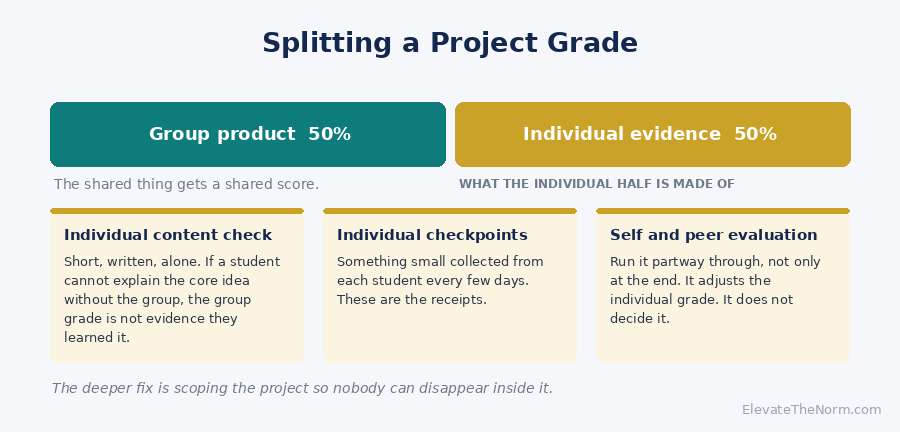
- Never let the rating count for points. The moment a self-rating carries a grade, it inflates, and the research on that is consistent enough to treat as settled.
- What families do with the information matters more than the meeting. Across 50 studies of middle-school parental involvement, the form most strongly tied to achievement was academic socialization — talking about expectations, plans and strategies. Helping with homework was the one form that was not.
- Expect a modest, real effect. A meta-analysis of self-assessment interventions puts the secondary-level effect at about g = 0.37. Useful. Not transformative.
What Is Student Self Assessment for Parent Teacher Conferences?
It is a one-page document a student completes in class, in the week before conferences, in which they rate their own work against criteria you have taught, name the evidence for each rating, and write one thing they intend to do about it. The student keeps a copy. A copy goes to the conference. The adults read it before anyone starts talking.
Three things it is not, because each of them is a version teachers accidentally build.
It is not a progress report in the student’s handwriting. If the sheet just restates grades the parent can already see in the portal, it has added nothing and cost a class period. The value is in the judgment, not the numbers.
It is not a behavior confession. A sheet whose questions are all about effort, attitude and talking in class turns the conference into a disciplinary meeting with extra steps. Some of that may belong in the conversation. It does not belong on this document.
It is not a student-led conference. A student-led conference is a format in which the student runs the meeting. This is an artifact, and it works inside either format. If your school runs ten-minute traditional conferences down a cafeteria table, this still works. It might work better there, because it is the only thing in the room written by the person everyone is discussing. If you are weighing which conference format to run in the first place, the sixteen formats sorted by time and constraint lay out which ones survive a single evening and which need a full class period. My Parent-Teacher Conference Forms on TPT give you a script for the opening, the hard part, and the next steps, so nobody leaves confused.
If you want the broader practice this sits inside — what self-assessment is, and the evidence behind it generally — that is in the guide to the general grades 6–12 guide to the practice. This page is about the conference version specifically. If conduct is what the meeting is really about, the behavior version of the same four-step routine is the better sheet to start from. If you do run the student-led format, pair this sheet with a free student-led conference template so the student has a structure for the meeting itself.
Why Bring a Student Self Assessment to a Conference at All?
Because the research on what families actually do with school information points away from monitoring and toward conversation — and a self-assessment gives them something to have a conversation about.
Nancy Hill and Diana Tyson’s meta-analysis of 50 studies of parental involvement in middle school found that involvement was positively associated with achievement across almost every form they measured, with one exception: parental help with homework. The form with the strongest positive association was what they call academic socialization — communicating expectations, discussing strategies, connecting schoolwork to a future the student can picture.1 That is a correlational finding across a mixed body of studies, and it should not be read as proof that a particular conversation causes a grade to move. But it tells you what to aim a conference at. Not “here is the number.” Closer to “here is what your kid thinks is hard, and here is what they plan to do.”
The federal family-engagement framework used by many districts lands in the same place from a policy direction. The Dual Capacity-Building Framework for Family-School Partnerships lists the essential conditions for engagement that works, and the first two are that it is “relational: built on mutual trust” and “linked to learning and development.”2 A conference built around a student’s own account of their work is both of those by construction. A conference built around a gradebook printout is neither.
There is a plainer reason too. A conference is a meeting about a fifteen-year-old’s work, held between two adults, often while the fifteen-year-old sits in the hallway or at home. If you believe teenagers are developing young adults, that arrangement is hard to defend. The self-assessment is the cheapest available fix — it puts their judgment in the room even when they are not.
Will a Teenager Rate Themselves Honestly?
More honestly than most adults expect, and less honestly the moment you attach points to it. Those two findings are the whole design brief for the sheet.
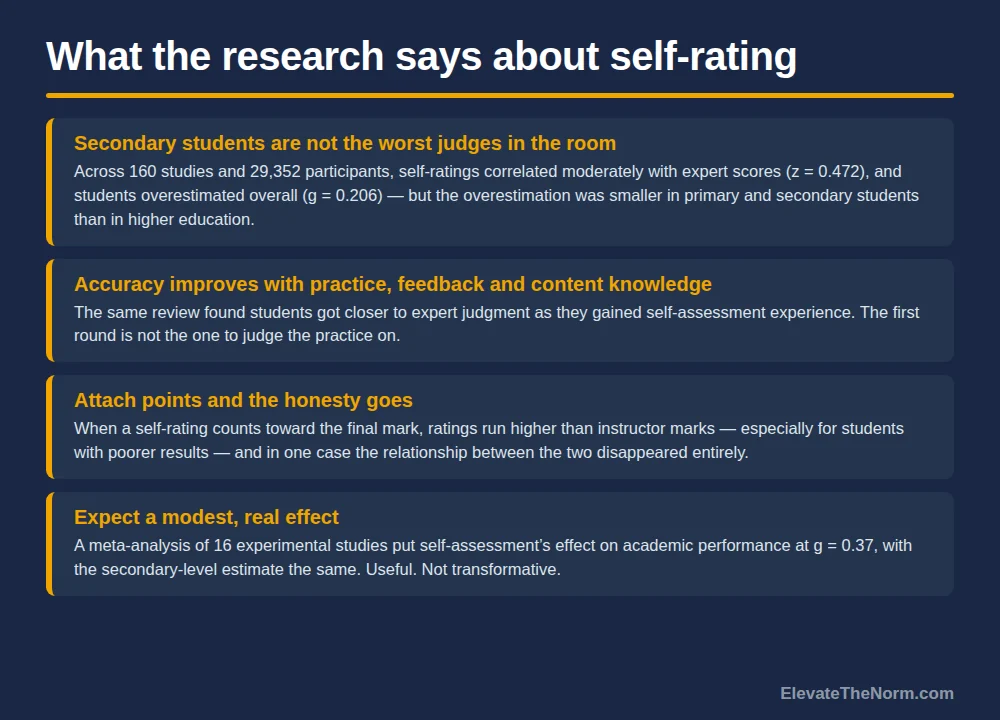
Start with accuracy. Sam P. León, Ernesto Panadero and Inmaculada García-Martínez pooled 160 articles covering 29,352 participants to ask how close student self-ratings come to expert scores. The average correlation was moderate — z = 0.472 — and students did overestimate on the whole, with a small overall effect of g = 0.206. The part worth knowing, because it runs against the staffroom assumption, is that the overestimation was smaller in primary and secondary students than in higher education.3 Your ninth graders are not the worst judges in the building.
The same review found that accuracy improves with feedback, with content knowledge, and with experience of self-assessing. That is not a reason to skip it in October because they are bad at it. It is a reason to do it more than once.
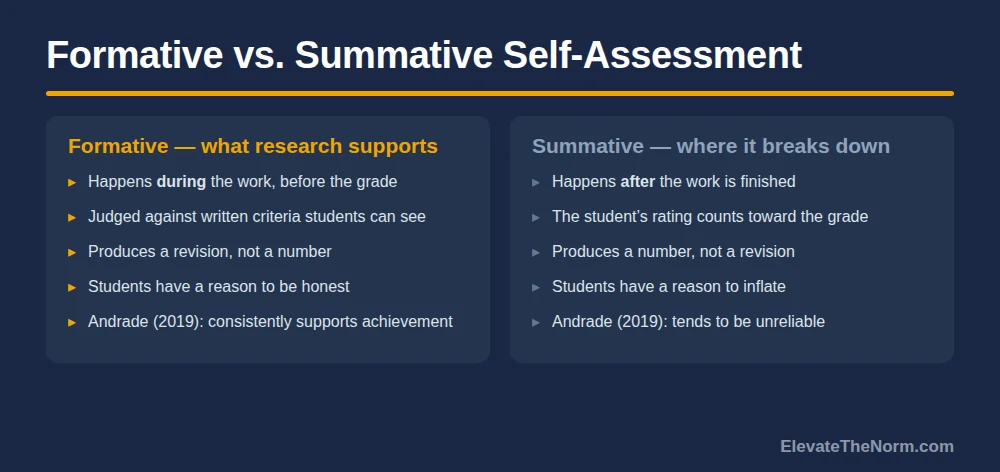
Now the part that is closer to settled. Heidi Andrade’s critical review of the field is direct about what happens when self-assessment becomes summative: in one study she cites, students’ self-assessments ran higher than the marks given by their instructors, “especially for students with poorer results,” and when the self-grade counted toward the final mark, “no relationship was found” between the two sets of judgments at all.4 Her own position is stated flatly: “My commitment to keeping self-assessment formative is firm,” and “if there is no opportunity for adjustment and correction, self-assessment is almost pointless.”
Read together, those give you three non-negotiables for a conference sheet:
- No points. Not for accuracy, not for completion, not extra credit. The instant it is worth something, it stops being information.
- Criteria the student has actually been taught. A rating against a rubric nobody explained is a guess with a number on it.
- Somewhere to go afterwards. If the conference ends and nothing the student wrote can be acted on, you have run a ceremony.
And keep the expected size of the effect honest. Pinar Karaman’s meta-analysis of 16 experimental and quasi-experimental studies — 46 effect sizes, 7,654 participants — found an overall effect of self-assessment interventions on academic performance of g = 0.37, with the secondary-level estimate also at 0.37.5 That is a real, small-to-moderate effect from a small body of studies. It is not a reason to promise a parent anything.
What Actually Goes On the Sheet?
Five fields, one page, no more. Anything longer gets filled in during homeroom on the morning of, which is the failure mode this format exists to prevent.
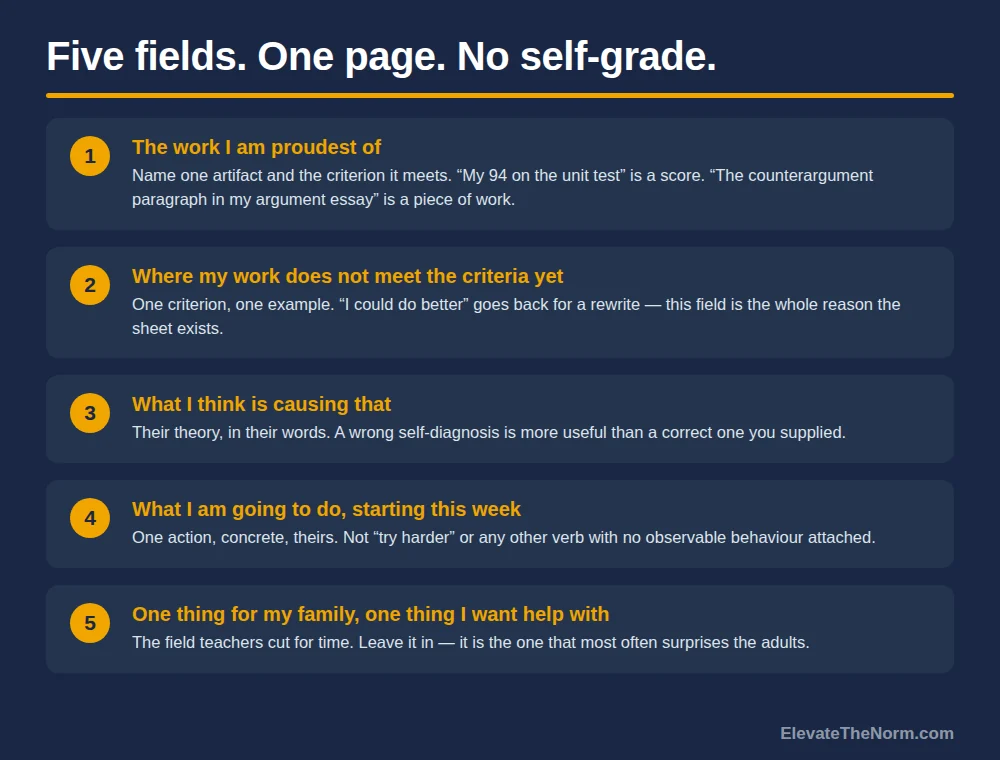
Here is what each field is asking for, and the common way each one gets ruined.
1. The work I am proudest of, and why it meets the criteria. The student names one artifact — an essay, a lab, a project, a problem set — and points at the specific criterion it satisfies. Ruined by: letting them name a grade instead of a piece of work. “My 94 on the unit test” is a score. “The counterargument paragraph in my argument essay” is a piece of work.
2. Where my work does not meet the criteria yet. One criterion, one example. Ruined by: accepting “I could do better.” Send it back. This field is the entire reason the sheet exists, and vagueness here is almost always a sign the criteria were never concrete enough to apply.
3. What I think is causing that. Their theory, in their words. Time, confusion about the task, not knowing where to start, a skill gap, not asking. Ruined by: leading them to the answer you want. A wrong self-diagnosis is more useful than a correct one you supplied — it is the thing the conference can actually correct.
4. What I am going to do about it, starting this week. One action, concrete, theirs. Ruined by: “try harder,” “focus more,” and every other verb with no observable behavior attached.
5. One thing I want my family to know, and one thing I want help with. This is the field that changes the temperature of the meeting, and it is the one teachers cut for time. Leave it in. It is also the field that most often surprises the adults in the room.
Notice what is not on the list: a numeric self-grade, an effort rating, and a behavior self-report. The first two inflate, and the third turns the page into something a student would be foolish to answer honestly.
If you want a ready-made version rather than building your own, the free student self-assessment forms on this site cover the same structure and print on one page — no email address required.
How Do You Prepare Students Without Losing a Week?
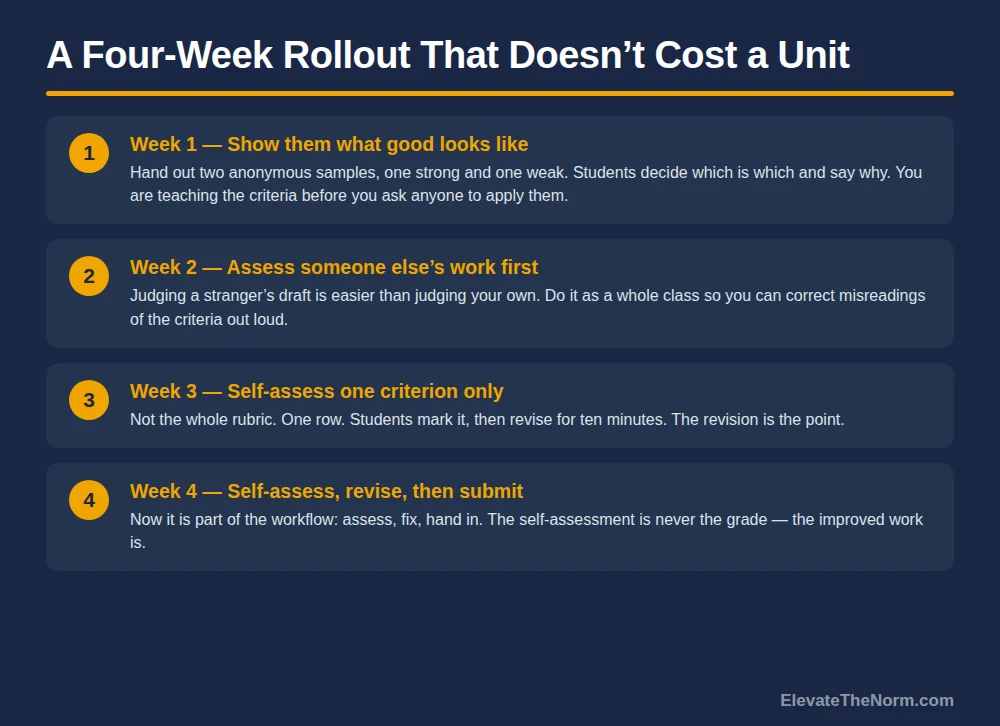
Three class periods, spread across the week before conferences, totalling about forty-five minutes. Less than that and the sheets come back empty. More than that and it will not survive contact with a pacing guide.

Day one, fifteen minutes — read the criteria. Put the rubric or standards list in front of them and read it aloud while they follow. Then take one piece of anonymous work — last year’s, or one you wrote badly on purpose — and have the class rate it together against one criterion. Judging someone else’s work first is substantially easier than judging your own, and it is how students learn what the criterion actually means.
Day two, twenty minutes — fill in fields one to four with the work in front of them. Not from memory. Folders open, portal open, papers on the desk. A self-assessment written from memory is a self-assessment about how the semester felt. Circulate and ask one question of anyone who has written a vague line in field two: which assignment, and which sentence in it?
Day three, ten minutes — field five and a read-back. They write what they want their family to know and what they want help with, then reread the whole sheet once and change anything they would not want said out loud. That last instruction matters. A student who knows they can edit before it leaves the room writes more honestly in the first place, not less.
Two practical notes. Do this on paper even if your school is one-to-one — a sheet you can hand across a table is doing a different job than a document you have to open. And make a copy before the conference, because a meaningful number of them will not come back.
On the obvious objection: if you teach 140 students, you are not reading 140 sheets closely. You do not have to. Read field two and field five on all of them — that is genuinely about fifteen seconds each, call it thirty-five minutes — and read the full page only for the students whose conference is actually scheduled. The rest of the sheets did their work in the writing, which is where most of the value sits anyway.
What Do You Do With the Sheet Once Everyone Is in the Room?
Read it first, out loud or silently, before anyone gives an opinion. The sequence is the whole technique. If the teacher speaks first, the sheet becomes a document that gets evaluated. If the sheet goes first, it becomes the agenda.
A workable ten-minute shape, whether or not the student is present:
- Minute 1 — everyone reads the sheet. Hand the parent a copy. Say nothing while they read it. This is more uncomfortable than it sounds and it is worth sitting through.
- Minutes 2–4 — confirm or complicate field two. Your job here is to say whether you see the same gap the student named. Agreeing is useful. So is “I actually see something different, and here it is.” What it is not is a correction. When your read and the student’s read disagree, both stay on the table and you say why you see it differently. A student whose judgment gets overruled the first time they offer it has learned exactly what the sheet is worth.
- Minutes 5–7 — talk about field three, the cause. This is where a parent usually knows something you do not. It is the most valuable three minutes in the meeting and the ones most often spent on grade arithmetic instead.
- Minutes 8–9 — make field four specific enough to check. Turn the student’s intention into something with a day attached. “Come to tutoring Tuesday” beats “get more help.”
- Minute 10 — name the follow-up. Who checks, when, and how the family will hear. Then actually do it, because a conference with no follow-up teaches everyone that the meeting was the point.
If the student is in the room, they read field one aloud and you stay quiet. If they are not, read their words rather than paraphrasing them — “here is what she wrote” carries a weight that “she feels like” does not. The broader ground rules for these conversations are set out in the guide to talking with families all year, not just at the meeting.
How Do You Make This Work for Every Student and Every Family?
Fix the criteria first. Almost every access problem with self-assessment turns out to be a reading problem in the rubric.
Rubric language is some of the densest prose in a school building — multi-clause, comparative, written for teachers marking rather than students applying. Before you reach for accommodations, rewrite each criterion as one short present-tense sentence naming something you could point at in the work. Cut the list to three. That single move does more for students with IEPs, 504 plans and English learners than any scaffold you add on top of a bad rubric.
Beyond that:
- Sentence stems, printed on the sheet. My evidence for this is on page ___. I still need to ___. The part I get stuck on is ___.
- Translation of the sheet itself, not just the conference. If your district provides interpretation for conferences, the one-page document is a far easier translation job than a live conversation, and a family that reads it beforehand arrives ready.
- Say up front who will see it. Students calibrate their honesty to the audience. Tell them the audience before they write, not after — and tell them plainly that it is going home, because field five occasionally surfaces something a student would not have chosen to send to a parent. If something a student writes triggers your mandatory-reporting duty or your counseling referral process, that duty runs first and the conference sheet is not the venue. Know what your school’s process is before you hand the pages out, not while you are holding one.
- For families who do not attend — and there will be some — the sheet still has a job. Send it home with a two-sentence note naming field four and one way to reply. That is not a substitute for a conference. It is the version that costs you four minutes and reaches people a scheduled evening meeting never will.
Three Ways This Goes Wrong
It becomes a grade recap. The sheet fills with scores and percentages, the conference becomes a reading of the portal, and everybody leaves having learned nothing. The fix is field two: if the student cannot name a specific criterion their work does not meet, the sheet is not finished.
Somebody attaches points to it. Usually with good intentions — a completion grade, to get them turned in. The result is predictable and documented: ratings go up, and the relationship between self-assessment and teacher judgment weakens, most for the students who are struggling most.4 If you need them submitted, use a deadline, not a grade.
Nothing happens afterwards. The sheets go in a folder, the follow-up never runs, and next year the students fill them in exactly as carefully as the process deserves. Teenagers are good at working out which school rituals are real. If you can only protect one part of this, protect the follow-up.
What to Do Before the Next Conference Window
Pick one class. Take the rubric you already use and rewrite three criteria in plain sentences. Build the five-field page — or print the existing form — and give it the three short periods above in the week before conferences. Do not grade it. Read it first in the room.
Then, at the next conference cycle, do it again with the same students. The accuracy research is clear that this gets better with repetition and feedback, and almost nothing in the first round will be as good as the third.3 The honest promise is a modest one: a meeting that is about the student’s actual work rather than their average, and a teenager who was treated as a participant in a conversation about their own life. That is worth forty-five minutes of class time on its own. And when the meeting itself arrives, families who walk in with a short list of questions worth the fifteen minutes get more out of it than the ones who open with “how is she doing?”
Frequently Asked Questions
What is student self assessment for parent teacher conferences?
It is a one-page document the student completes in class before conferences, rating their own work against criteria the teacher has taught, naming the evidence for each rating, and writing one thing they intend to do about it. A copy goes into the conference and the adults read it before anyone gives an opinion. It works in a traditional conference as well as a student-led one — the student does not have to run the meeting for their own assessment to change what happens in it.
Should the self-assessment count toward the student’s grade?
No. This is the closest thing to a settled finding in the area. When a self-rating carries points, ratings inflate, most sharply among the students who are struggling most, and in at least one study the relationship between student and instructor judgments disappeared entirely. If you need the sheets submitted, use a deadline rather than a grade.
Won’t students just say what they think the adults want to hear?
Some will, at first. Three things reduce it: tell them plainly who will read the sheet before they write it, give them a read-back step where they can edit anything they would not want said aloud, and never attach points. The accuracy research also suggests this improves with repetition — students get closer to expert judgment as they gain experience self-assessing, so the first round is not the one to judge the practice on.
What if the student’s self-assessment disagrees with my assessment?
Say so, and say why, and leave both on the table. That disagreement is usually the most useful thing in the meeting — it tells you the criteria were not concrete enough, or that the student cannot yet see the gap, and either of those is worth more than agreement. What it is not is an occasion to correct them. A student whose judgment is overruled the first time they offer it has learned exactly what the sheet is worth.
I teach 140 students. How am I supposed to read all of these?
You are not. Read field two and field five on every sheet — about fifteen seconds each, call it thirty-five minutes — and read the full page only for students whose conference is actually scheduled. The rest of the sheets did most of their work in the writing.
What if a student writes something concerning on the sheet?
Know your school’s counseling referral and mandatory reporting process before you hand the pages out, not while you are holding one. If something a student writes triggers that duty, the duty runs first and the conference is not the venue. Tell students up front that the sheet is going home, so nobody is surprised by where their words end up.
Should a district require every teacher to use the same form?
Be careful. The value of this comes from criteria students have actually been taught in a specific course, and a district-wide form tends to drift toward generic effort-and-attitude questions that produce nothing usable. Requiring that students bring a self-assessment is reasonable. Dictating its contents usually is not.
Does this actually improve achievement?
Modestly, on current evidence, and you should not promise a family more than that. A meta-analysis of 16 experimental and quasi-experimental studies put the effect of self-assessment interventions on academic performance at about g = 0.37, with the same figure at secondary level, drawn from a small body of studies. The stronger argument for doing it is not the effect size. It is that a meeting about a teenager’s work should include the teenager’s account of it.
Sources
- Hill, Nancy E., and Diana F. Tyson. “Parental Involvement in Middle School: A Meta-Analytic Assessment of the Strategies That Promote Achievement.” Developmental Psychology, vol. 45, no. 3, 2009, pp. 740–763. https://pubmed.ncbi.nlm.nih.gov/19413429/
- Mapp, Karen L., and Eyal Bergman. Dual Capacity-Building Framework for Family-School Partnerships (Version 2), 2019. Retrieved from www.dualcapacity.org
- León, Samuel P., Ernesto Panadero, and Inmaculada García-Martínez. “How Accurate Are Our Students? A Meta-analytic Systematic Review on Self-assessment Scoring Accuracy.” Educational Psychology Review, vol. 35, no. 4, art. 106, 2023. https://link.springer.com/article/10.1007/s10648-023-09819-0
- Andrade, Heidi L. “A Critical Review of Research on Student Self-Assessment.” Frontiers in Education, vol. 4, art. 87, 2019. https://www.frontiersin.org/journals/education/articles/10.3389/feduc.2019.00087/full
- Karaman, Pinar. “The Impact of Self-assessment on Academic Performance: A Meta-analysis Study.” International Journal of Research in Education and Science, vol. 7, no. 4, 2021, pp. 1151–1166. https://files.eric.ed.gov/fulltext/EJ1319061.pdf
Every source above was opened and read on September 22, 2026. One figure was deliberately left out: the NCES Parent and Family Involvement in Education: 2023 tables on conference attendance by grade level could not be transcribed reliably from the published PDF in this session, so no attendance percentage is quoted here rather than quoting one that could not be checked.