The Elevate Blog banner: Real Classrooms. Practical Ideas. Higher Expectations. Three students climb a rocky ridge at sunrise, each pulling the next one up, toward a teacher reaching down to help.

Category: Classroom Management

Behavior, routines, and what actually holds a room together without raising your voice.

  • Questions for Socratic Seminar: 40 That Work in Grades 6–12

    Questions for Socratic Seminar: 40 That Work in Grades 6–12

    By Clay Shumate

    Good questions for a Socratic seminar have no answer you could look up, no answer the teacher is holding, and at least two defensible readings in the text itself. That is the whole test. A question that a prepared student can settle in one sentence is a comprehension check — useful, but it will not carry thirty minutes of discussion.

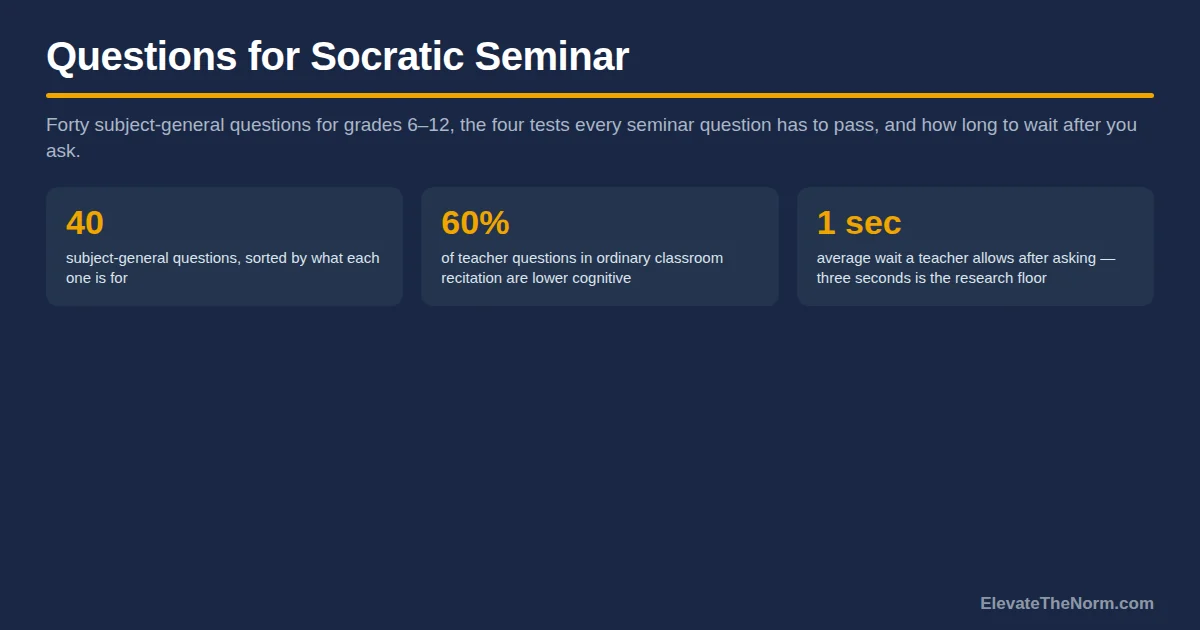
    Below are forty questions you can use tomorrow, sorted by what they are for, plus the way to write your own out of whatever text you are already teaching.

    Key Takeaways

    • Three kinds of question run a seminar: one opening question, several core questions you may never need, and closing questions that ask what changed.
    • The research on “higher-order questions” is weaker than the training says. One meta-analysis of 20 studies found a significant positive effect; a second, of 14 studies, found the effect small. Both are true and both are old.
    • What does hold up is the authentic question — one the teacher does not already have an answer to. In a study of more than 1,100 eighth and ninth graders, that predicted higher literature achievement.
    • Wait longer than feels reasonable. Teachers average about one second. Three is the floor for a recall question, and for a genuinely open one there appears to be no ceiling.
    • Students should be writing questions too. A seminar where only the teacher asks is a recitation with the chairs moved.

    Free Download · PDF

    40 Socratic Seminar Questions

    All forty questions in five groups, the six stems to post for students, and the ten-minute method for turning a text of your own into seminar questions.

    Download the free PDF

    Free. No email address required. Designed for grades 6–12. Browse every printable in Your Free Library.

    What Makes a Good Socratic Seminar Question?

    Four things, and you can test all four in about a minute. Write your question down, then run it against this list before you take it anywhere near a class.

    1. You cannot answer it in one sentence. Try. If you finish in a line, you have written a comprehension check. Keep it — just do not open with it, and file it with your other ways of checking what landed.
    2. You do not already know the answer. This is the hard one, because teachers are trained to ask questions we can assess. A seminar question is one where you would genuinely take notes on the replies.
    3. The text can support more than one answer. Not “what do you think” — opinions with no evidence anchor produce a conversation nobody can lose or learn from. The disagreement has to be arguable from the page.
    4. It cannot be Googled. If a phone settles it in twenty seconds, it will get settled in twenty seconds.

    The fourth one has quietly become the most important. A question like “what were the causes of the conflict” is a research task. “Which of the causes the author lists is doing the most work, and which one is there to make the argument look balanced?” is a seminar, because the answer is not written down anywhere.

    The Three Kinds of Question a Seminar Needs

    An opening question, a stack of core questions, and a closing question — and you should expect to use the opening one and maybe two others. The stack is insurance, not a script.
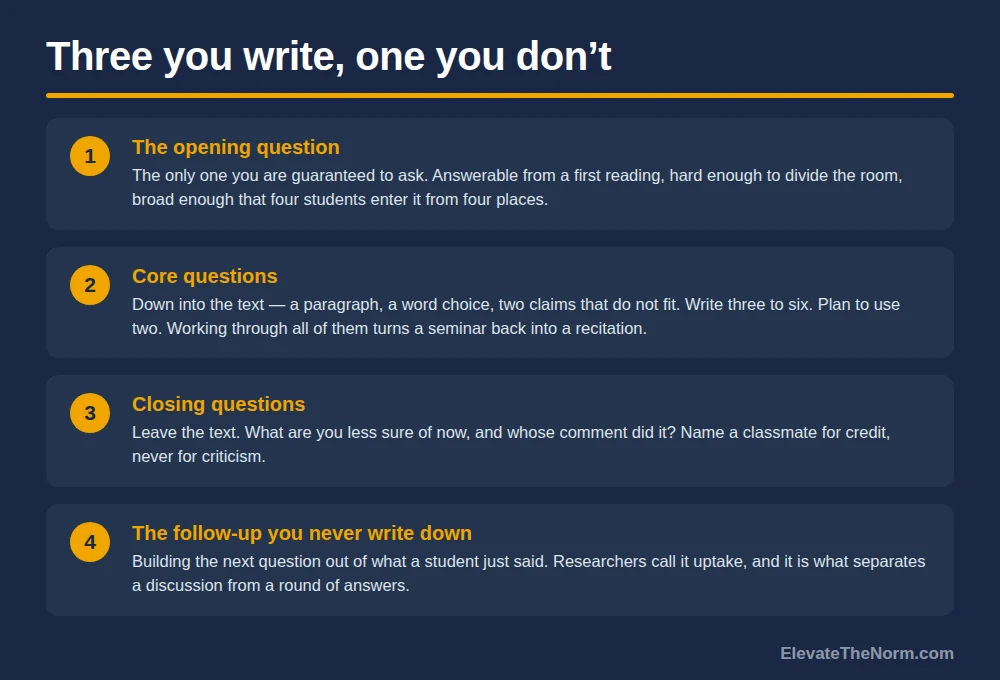
    Numbered list of four question types for a Socratic seminar: the opening question, core questions, closing questions, and the follow-up built on what a student just said
    Three kinds you write down, and the one you cannot.

    The opening question is the only one you are guaranteed to ask. It should be answerable from a first reading, hard enough to divide the room, and broad enough that four different students can enter it from four different places. It usually points at the whole text rather than a line.

    Core questions go down into the text. These are the ones that name a paragraph, a word choice, a contradiction between two claims. Write six and plan to use two — and if you have five preps and six is not happening, write three. Three real ones beat six you assembled at 10pm. The worst thing you can do with a good stack is work through it, because then you are running the agenda and the students are answering it.

    Closing questions leave the text. What does this mean for something the students actually deal with? What changed in your thinking, and whose comment did it? That second one belongs in the post-seminar writing, and it is the single best assessment item this format produces. One guard on it: ask students to name a classmate for credit, never for criticism. “What did this conversation get wrong?” is a question about the conversation, and it is worth saying so out loud before they write.

    There is a fourth kind that never gets written down, and it is the one that matters most in the room: the follow-up. Building the next question out of what a student just said — researchers call it uptake — is what separates a discussion from a round of answers.

    Does Asking Harder Questions Actually Improve Achievement?

    Less clearly than the training slides claim, and it is worth knowing why before you rebuild your question bank around Bloom’s taxonomy. Two meta-analyses looked at the same question and did not agree.

    Kathleen Cotton’s synthesis for the Northwest Regional Educational Laboratory lays both out. Redfield and Rousseau’s 1981 meta-analysis of 20 studies “concludes that asking higher cognitive questions has a significant and positive effect on student performance.” Samson and colleagues ran a second meta-analysis in 1987 across 14 studies and found that students exposed to higher cognitive questions did outperform others, “but that the effect size is small.”

    A later critical review by Mikyeong Yang went further, concluding that this body of work “reported incoherent results” and that the evidence cannot support the expectation that higher-cognitive questions are more effective than fact questions. So: a real effect, a small effect, and a serious argument that the whole line of research is not measuring what it thinks it is.

    Here is what survives all three, and it is not about difficulty at all. Nystrand and Gamoran studied eighth- and ninth-grade English classes across sixteen middle schools feeding nine high schools, testing more than 1,100 students in fall and spring. Students whose teachers asked a higher proportion of authentic questions — ones the teacher did not already have an answer to — and who practiced uptake scored significantly higher on literature achievement.

    Authentic is not the same as hard. “Analyze the author’s use of irony” is high on Bloom’s and completely inauthentic if you have a rubric in your hand describing the right answer. “Is the last line a joke?” is simple, open, and genuinely contested. Write for authentic, not for the taxonomy. It is the same trade as anywhere else on this site: real questions hand students something to do, which is what giving students a genuine decision rather than a cosmetic one actually looks like inside one class period.

    One more number worth carrying, from the same Cotton synthesis: in ordinary classroom recitation, about 60 percent of teacher questions are lower cognitive, 20 percent higher cognitive, and 20 percent procedural. A seminar is one of the few structures that changes that ratio on purpose.

    40 Questions for Socratic Seminar

    Eight questions in each of five categories, written to be subject-general so you can drop your own text into them. Every one of these is a shell — swap in your author, your document, your data set.

    Two things before you use them. They are subject-general on purpose, which means the question is only as safe as the text you put under it; choosing a text on a contested public issue is a decision that belongs to you and your school’s policy, not to a question bank on the internet. And the fourth group — the ones that surface disagreement — is asked to the room, never to a named student. “Who read that line differently?” is an invitation. “Marcus, you disagree, right?” is an ambush, and the student you do it to will remember it longer than the text.

    Opening questions (use one)

    1. What is the most important sentence in this text, and what does the rest of it do?
    2. What is this author afraid of?
    3. If you had to remove one paragraph without losing the argument, which one goes?
    4. Who is this written for? How can you tell?
    5. What does this text refuse to say?
    6. Is the author describing the world or arguing about it?
    7. What would have to be true for this to be right?
    8. What question is this text an answer to?

    Core questions: evidence and claims

    1. Which claim here has the least support behind it?
    2. Where does the author stop explaining and start assuming?
    3. Are the two claims in the second and fourth paragraphs compatible?
    4. What counts as evidence in this text, and who decided that?
    5. Is the strongest objection to this argument in the text, or did the author leave it out?
    6. Which detail would change your reading if it turned out to be wrong?
    7. Does the author distinguish what they know from what they think?
    8. If this were written by someone on the other side, which sentence would survive?

    Core questions: language and choice

    1. Why that word and not the obvious one?
    2. What work is the title doing?
    3. Where does the tone shift, and what happens right before it?
    4. Who is given a name in this text, and who is not?
    5. What is the effect of the thing the author repeats?
    6. Is the ending earned by what came before it?
    7. What would be lost if this were written plainly?
    8. Which sentence do you think the author rewrote the most times?

    Questions that surface disagreement

    1. Who in this room read that line differently than you did?
    2. What is the strongest version of the argument you disagree with?
    3. Is this a disagreement about the text or about something outside it?
    4. What would change your mind?
    5. Can both readings be true at once?
    6. What are we assuming that the text never says?
    7. Which of us is using a word to mean two different things?
    8. Is the disagreement about what happened or about whether it was right?

    Closing and reflection questions

    1. What did you come in believing that you are less sure of now?
    2. Whose comment changed or sharpened your thinking, and what did they say?
    3. What question do we still not have an answer to?
    4. What would you need to read next to settle this?
    5. Where does this argument show up outside of school?
    6. If you had to explain this text to someone in one sentence, what would you leave out?
    7. What did this conversation get wrong?
    8. What is the question you wanted to ask and did not?

    Question Stems Students Can Use

    The fastest upgrade to a seminar is teaching students to ask each other questions instead of taking turns making statements. Most students arrive with one move — say your opinion and stop — and a short posted list fixes it faster than any amount of coaching.
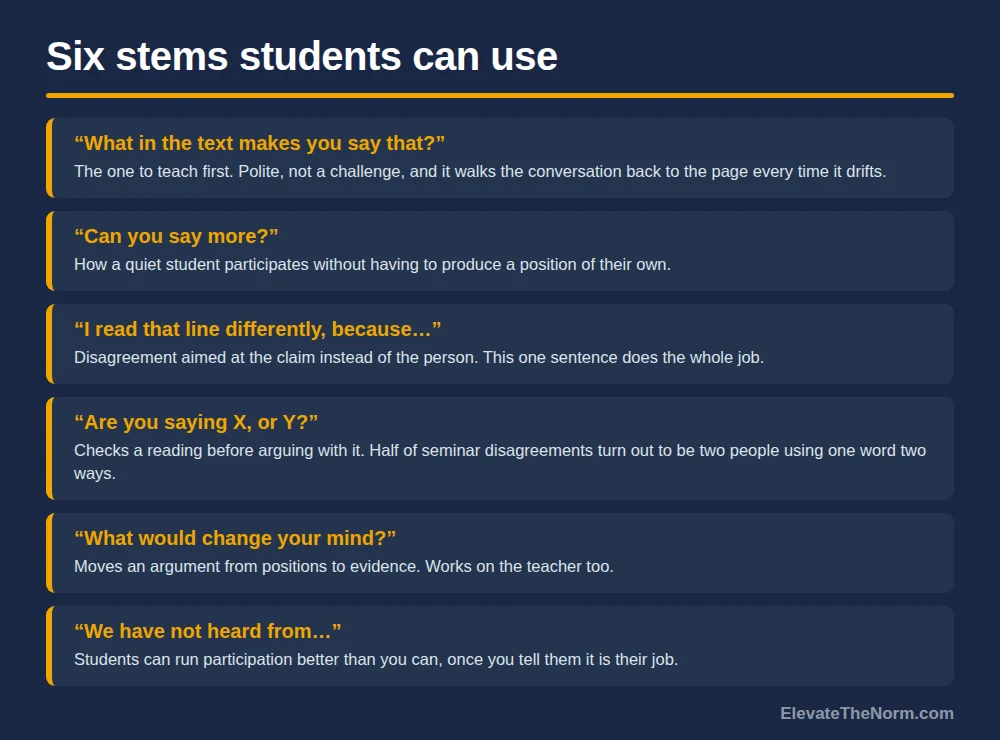
    Six question stems students can use in a Socratic seminar, including what in the text makes you say that, can you say more, I read that line differently because, are you saying X or Y, what would change your mind, and we have not heard from
    Post six. Nobody reads twenty.

    Post six stems and refer to them by name. Do not post twenty; nobody reads twenty.

    The other half of this is teaching students to write a question, since you are requiring one at the door. Give them one frame and it stops being mysterious: point at a specific place in the text, say what confused or bothered you about it, and end with a question you cannot answer yourself. “On page two the author says X, but earlier they said Y — which one are they actually arguing?” is a better seminar question than most of mine, and a fourteen-year-old can produce it on the second try.

    For a student who found the text hard, say plainly that the question can be about the part they did understand. A question from paragraph one is a real contribution. Nobody has to have finished the text to have something worth asking about it.

    Two of these deserve a note. “What in the text makes you say that?” does most of the work of a facilitator and it is the one stem I would teach first — it is polite, it is not a challenge, and it forces the conversation back to the page every time it drifts. And “Can you say more?” is how a quiet student participates without having to produce a position of their own, which matters more than it sounds like.

    How Long Should You Wait After Asking?

    Three seconds minimum, and for a genuinely open question, longer than you think you can stand. This is the oldest finding in the questioning literature and it is still the one teachers violate most.
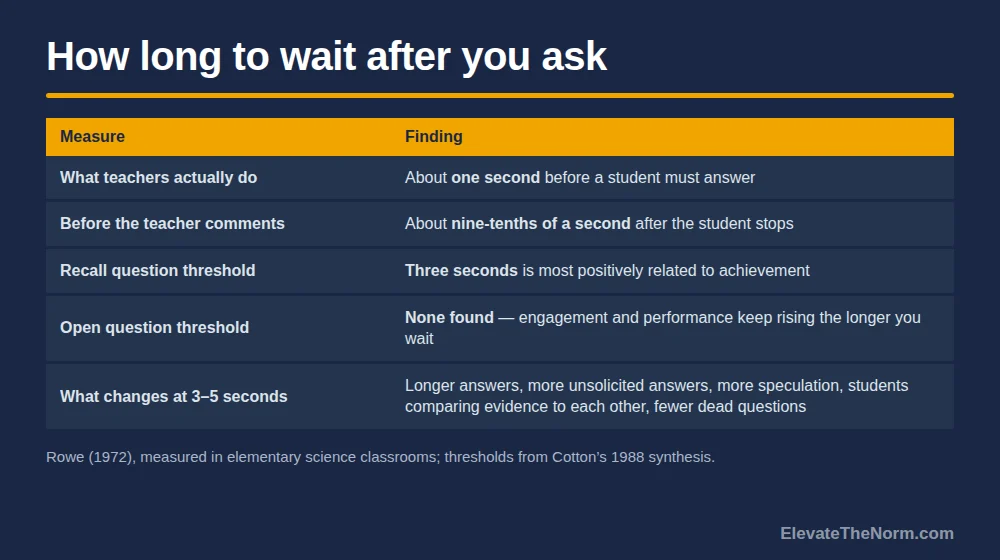
    Table of wait-time research findings: teachers wait about one second, comment within nine-tenths of a second, three seconds is the recall-question threshold, no threshold was found for open questions, and answers lengthen at three to five seconds
    Teachers average about one second. Eight costs you nothing.

    Mary Budd Rowe measured it in the early 1970s. Teachers allowed an average of about one second for a student to respond, and followed a student’s answer with a comment within roughly nine-tenths of a second. When those two waits were stretched to three to five seconds, student responses got longer, more students answered without being called on, speculative thinking went up, students began comparing their evidence to each other’s rather than to the teacher, and fewer questions went unanswered. Worth naming honestly: Rowe’s classrooms were elementary science. The effect has held up widely, but that is the population she measured.

    One cheap adjustment that goes with the wait: put the opening question in writing as well as saying it. On the board, on the handout, anywhere it stays. A student who processes slowly, who missed the first three words, or who is rereading the text while you talk should not lose the question because it only existed as sound. It costs nothing and it changes who is able to answer.

    Cotton’s synthesis adds the part that matters for seminars specifically: three seconds is the threshold for lower cognitive questions, and for higher cognitive questions there appears to be no threshold at all — students “seem to become more and more engaged and perform better and better the longer the teacher is willing to wait.”

    I have tested the ceiling on this and I would not recommend the experiment. I once waited more than five minutes. It was one of the most awkward moments of my life, that section finished nine minutes behind my other classes, and it is the only time I have ever assigned homework. I am not telling that story as a technique. I am telling it because the price of waiting is real and it is worth knowing what it costs before you decide the silence is unbearable at eight seconds. Eight seconds costs you nothing.

    How to Turn Your Own Text Into Questions in Ten Minutes

    Read for the seams, not for the content. You are not looking for what the text says. You are looking for the places where it strains.

    1. Mark every hedge. “Arguably,” “some have suggested,” “it is possible that.” Each one is a place the author was not sure, and each one is a question.
    2. Find two sentences that do not quite fit together. Not a contradiction — a tension. “Are these both true?” is a seminar question that writes itself.
    3. Note what is missing. Who is not quoted. Which objection is not answered. What the author had to leave out to make the piece work.
    4. Write your opening question from the whole text, and three core questions from the marks you made.
    5. Answer your own opening question in one sentence. If you can, go back to step two.

    That is the whole process, and it gets faster. The fourth time you do it you will find yourself marking hedges while you read for other reasons, which is a better outcome than any question bank.

    Questions That Wreck a Seminar

    Four shapes, and all four are easy to write by accident.

    • The question you already answered in class. Students will give you your own words back, correctly, and nothing will happen.
    • The yes-or-no question with an obvious side. “Was the narrator wrong to lie?” gets twenty-eight yeses. Ask instead what the lie cost, and who paid.
    • The question that requires a personal disclosure. “Have you ever been treated this way?” will get an honest answer from a fifteen-year-old in front of twenty-seven peers, and that is exactly the problem. Keep the question on the text and let students bring themselves to it if they choose. If a text is likely to pull the room in that direction, that is a conversation to have with an administrator before it is a seminar question.
    • The question with a correct answer you will eventually supply. Students can smell this within four minutes, and once they have, the seminar becomes a guessing game about you.

    The third one is the one worth being most careful with, because it usually comes from a good instinct. Relevance is not the same as exposure. A question can matter to a student’s life without requiring them to narrate it to the class.

    What to Do Next

    Take the text you are teaching this week and spend ten minutes on the five steps above. Write one opening question, three core questions, and one closing question. Then pull four questions from the bank here that fit the same text, so you have something in reserve you did not have to invent.

    Ask your opening question once, and count to eight in your head before you do anything else. That is the whole practice. If you want the rest of the format — the norms, the seating, what to do about the students who will not talk — it is in the full guide to running a Socratic seminar. And if the questions you write keep coming out as comprehension checks, that is not a failure; it means you have a set of quick checks for understanding and a seminar question still to write. To score the discussion itself, use the Socratic seminar rubric.

    Before you go: grab the free 40 Socratic Seminar Questions (PDF) — ElevateTheNorm.com branded, printable, no email required.

    Frequently Asked Questions

    What makes a good Socratic seminar question?

    One you cannot answer in a sentence, that you do not already have an answer to, that the text can support more than one answer to, and that a phone cannot settle in twenty seconds. The first two are the ones teachers miss. We are trained to ask questions we can assess, and a question you can assess is usually a question you already answered.

    How many questions should I prepare for a seminar?

    One opening question, about six core questions, and two closing questions — and expect to use three of them. The stack is insurance against a dead room, not an agenda. Working through all nine is how a seminar turns back into a recitation with the chairs moved.

    What is the difference between an authentic question and a higher-order question?

    An authentic question is one the teacher does not have an answer to. A higher-order question is one high on Bloom’s taxonomy. They are not the same thing, and the research suggests the first matters more. “Analyze the author’s use of irony” is higher-order and completely inauthentic if you are holding a rubric describing the right answer.

    How long should I wait after asking a seminar question?

    Three seconds is the research floor, and for open questions there appears to be no ceiling — students engage more and perform better the longer the teacher is willing to wait. Teachers average about one second, which is why this feels so unnatural. Eight seconds costs you nothing and changes who answers.

    Should students write their own seminar questions?

    Yes, and it is the change that most reliably fixes a flat seminar. Require one written question from every student, collected on the way in. Make it an expectation rather than a bar — a student who arrives without one writes it in the first two minutes. A seminar where only the teacher asks questions is not a seminar.

    Can I use the same questions for any text?

    Most of them, yes. The forty here are deliberately subject-general: “what does this text refuse to say?” works on a court opinion, a poem, a lab report and a political speech. What does not transfer is the core questions, because those name a specific paragraph or word choice. Write those yourself from the text in front of you.

    What questions should I avoid in a Socratic seminar?

    Anything you already answered in class, yes-or-no questions with an obvious side, questions with a correct answer you plan to supply eventually, and questions that require a student to disclose something personal in front of the class. That last one usually comes from a good instinct — relevance — but relevance is not the same as exposure.

    Do harder questions actually raise achievement?

    The evidence is genuinely split. A 1981 meta-analysis of 20 studies found asking higher cognitive questions had a significant positive effect on performance; a 1987 meta-analysis of 14 studies found the effect small; and a later critical review argued the whole line of research reported incoherent results. What holds up better is the authentic question and the follow-up built on what a student just said.

    Sources

    1. Cotton, Kathleen. Classroom Questioning. School Improvement Research Series, Northwest Regional Educational Laboratory, May 1988. Reports Redfield and Rousseau (1981), 20 studies, “significant and positive effect” for higher cognitive questions, against Samson et al. (1987), 14 studies, effect “small”; a three-second wait-time threshold for lower cognitive questions and no apparent threshold for higher cognitive ones; and a 60 / 20 / 20 split of lower cognitive, higher cognitive and procedural questions in ordinary recitation. https://educationnorthwest.org/sites/default/files/ClassroomQuestioning.pdf
    2. Rowe, Mary Budd. Wait-Time and Rewards as Instructional Variables: Their Influence on Language, Logic, and Fate Control. 1972. ERIC ED061103. Teachers allowed an average of about one second for a response and commented within about nine-tenths of a second; extending both to three to five seconds produced longer responses, more unsolicited appropriate answers, more speculative thinking, more student-to-student evidence comparison and fewer unanswered questions. Population: elementary science classrooms. https://eric.ed.gov/?id=ED061103
    3. Nystrand, Martin, and Adam Gamoran. Student Engagement: When Recitation Becomes Conversation. National Center on Effective Secondary Schools, 1990. ERIC ED323581. Eighth- and ninth-grade English classes in sixteen middle schools feeding nine high schools across eight Midwestern communities; over 1,100 students tested fall and spring. Higher proportions of authentic questions and uptake predicted significantly higher literature achievement. https://files.eric.ed.gov/fulltext/ED323581.pdf
    4. Yang, Mikyeong. “A Critical Review of Research on Questioning in Education: Limitations of Its Positivistic Basis.” Asia Pacific Education Review, vol. 7, no. 2, 2006, pp. 195–204. Argues that the teacher-questioning meta-analyses “reported incoherent results” and that the evidence cannot support the expectation that higher-cognitive questions outperform fact questions. https://files.eric.ed.gov/fulltext/EJ752340.pdf
    5. Applebee, Arthur N., Judith A. Langer, Martin Nystrand, and Adam Gamoran. “Discussion-Based Approaches to Developing Understanding: Classroom Instruction and Student Performance in Middle and High School English.” American Educational Research Journal, vol. 40, no. 3, 2003, pp. 685–730. 64 middle and high school English classrooms, grades 7, 8, 10, 11 and 12. https://eric.ed.gov/?id=EJ782328
    6. National Paideia Center. “Paideia Seminar.” The seminar defined as a collaborative intellectual dialogue facilitated with open-ended questions about a text, run as a pre-seminar / seminar / post-seminar cycle. https://paideia.org/blogs/npc/paideia-socratic-seminar
    About Clay Shumate

    Clay Shumate is a certified secondary Social Studies teacher in the public schools of West Alabama, with seven years of classroom experience, a B.A. in History, and an M.Ed. in Secondary Education. He writes about project-based learning, student responsibility, respect, and practical ways to hold young people to a higher standard while giving them room to learn from mistakes. He is a member of the Society of Professional Journalists and writes to its Code of Ethics; this site’s editorial standards and corrections policy are published in full. More about Clay.

  • Socratic Seminar: How to Run One That Grades 6–12 Take Seriously

    Socratic Seminar: How to Run One That Grades 6–12 Take Seriously

    By Clay Shumate

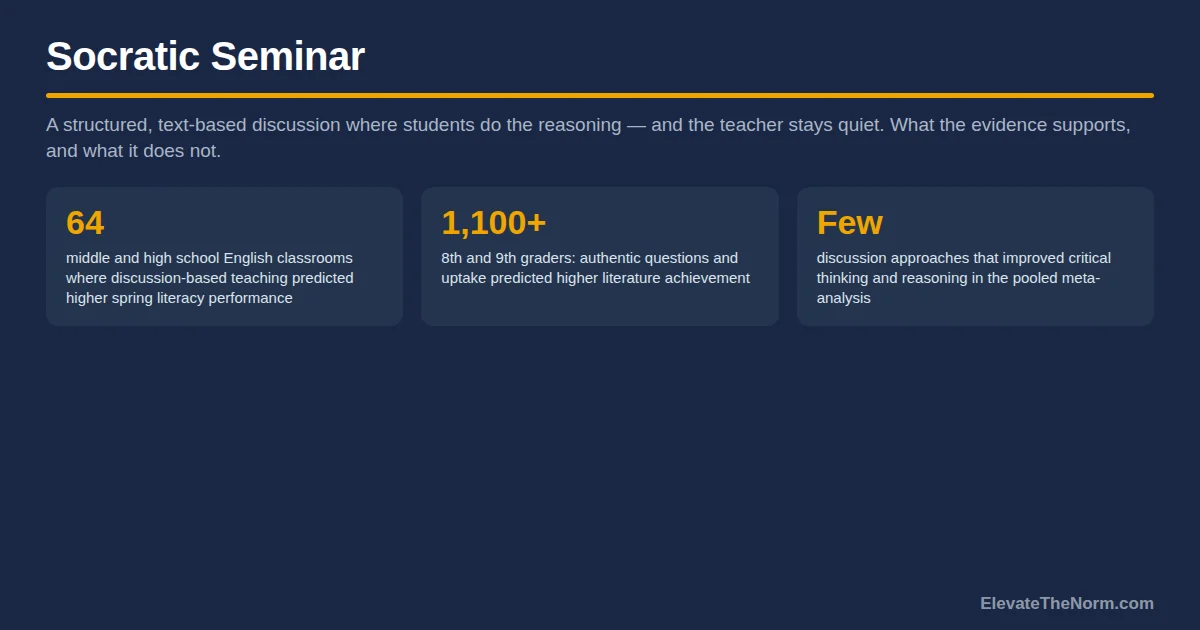
    A Socratic seminar is a structured, whole-group discussion in which students question a shared text and each other while the teacher stays mostly silent. There is no winner and no correct answer to arrive at. The point is that students do the reasoning out loud, in front of each other, using evidence from something they all read.

    That is the definition. What follows is the part most guides skip: what the research actually supports, what it does not, and how to run one in a real secondary class without the same five kids carrying it.

    Key Takeaways

    • A seminar is not a debate. Nobody is assigned a side, nobody is trying to win, and the question has to be one you cannot settle by looking something up.
    • The strongest evidence is about discussion generally, not this format specifically. A study of 64 middle and high school English classrooms found discussion-based teaching predicted higher spring literacy performance — for low-achieving students as well as high-achieving ones.
    • The most honest finding is a mixed one. A meta-analysis found discussion produced big jumps in student talk and real gains in text comprehension, but few approaches moved critical thinking and reasoning.
    • Preparation is the whole game. A seminar with an unread text is twenty minutes of opinions.
    • Silence is not failure. The most common way a teacher wrecks a seminar is by answering the question they just asked.

    Free Download · PDF

    The Socratic Seminar Prep Sheet

    A text-selection check, the opening-question test, the six moves in order, six norms worth posting, a turn-count tally for you, and the four-way autopsy for a seminar that died.

    Download the free PDF

    Free. No email address required. Designed for grades 6–12. Browse every printable in Your Free Library.

    What Is a Socratic Seminar?

    A Socratic seminar is a formal, text-based dialogue where students ask and answer open-ended questions with each other, and the teacher facilitates instead of teaching. The National Paideia Center — which has trained schools in this format for decades — defines it as “a collaborative intellectual dialogue facilitated with open-ended questions about a text.” That definition is doing more work than it looks like.

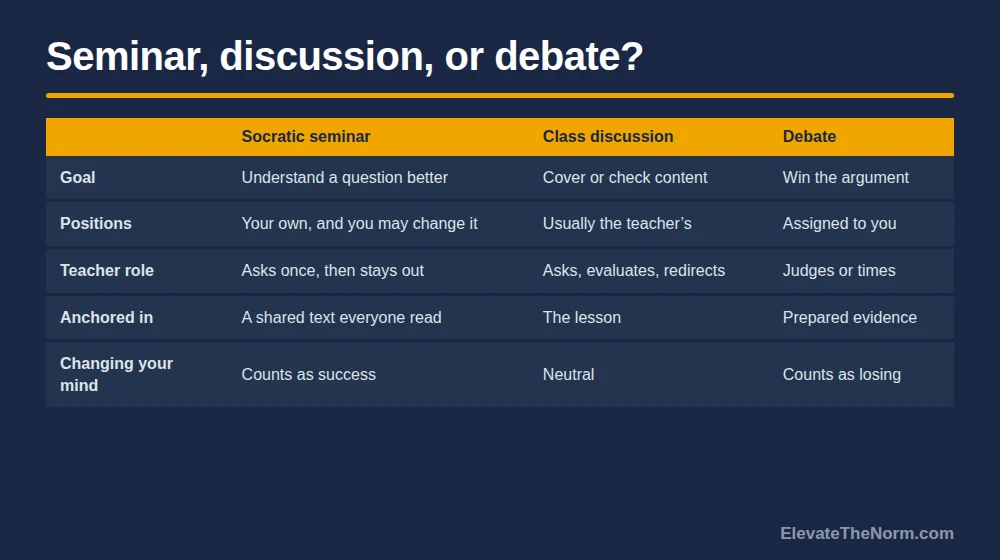
    Every word in it rules something out. Collaborative rules out debate. Open-ended rules out questions with answers. About a text rules out a free-floating conversation on a topic. Take away any one and you have something else — possibly useful, but not a seminar. Here is the distinction that matters most in a secondary room, because teenagers assume it is a debate unless you tell them otherwise. When a debate is what you actually want, run it on purpose with a format rather than letting a seminar slide into one.

    Comparison table of a Socratic seminar, a class discussion and a debate across goal, positions, teacher role, what the talk is anchored in, and whether changing your mind counts as success
    A seminar is not a debate. Nobody is assigned a side and nobody wins.

    Does the Research Actually Support Discussion-Based Teaching?

    Yes for discussion in general — and more cautiously than most professional development admits when it comes to thinking. Two studies point in slightly different directions, and both are worth knowing before you build a unit around this.

    The strong one is squarely in our grade band. Applebee, Langer, Nystrand and Gamoran studied 64 middle and high school English classrooms across grades 7, 8, 10, 11 and 12. Controlling for fall performance and background, discussion-based approaches were significantly related to spring literacy performance. Their own summary of why: students in discussion-heavy rooms “internalize the knowledge and skills necessary to engage in challenging literacy tasks on their own.” And the finding held “for low-achieving as well as high-achieving students” — which is the opposite of what people assume about discussion, and the single best argument for not reserving it for honors sections.

    An earlier study from the same research group found the mechanism. Across sixteen middle schools feeding nine high schools in eight Midwestern communities, more than 1,100 eighth and ninth graders were tested in fall and spring. Students whose teachers asked a higher proportion of authentic questions — questions the teacher did not already have an answer to — and who practiced uptake, building the next question out of what a student just said, scored significantly higher on literature achievement. Not more questions. Different questions.

    There is an equity finding buried in the first study that deserves more attention than it gets. Applebee and colleagues note that their interpretation is “complicated because instruction is unequally distributed across tracks.” Translated: the discussion-based teaching that helps low-achieving students the most was not what low-achieving students were mostly getting. If a school is going to act on this research at all, the action is not “add seminars” — it is checking which sections currently get them.

    Now the cautious one, and it is the reason this section exists. Murphy and colleagues ran a meta-analysis of classroom discussion approaches in the Journal of Educational Psychology. They found “strong increases in the amount of student talk and concomitant reductions in teacher talk, as well as substantial improvements in text comprehension.” Then they found this: “Few approaches to discussion were effective at increasing students’ literal or inferential comprehension and critical thinking and reasoning.”

    Read that twice. The talk goes up reliably. Comprehension of the text goes up. Whether students get better at thinking is not established by the pooled evidence, and the majority of the studies in that analysis were conducted in fourth through sixth grade, not with teenagers. If someone tells you seminars teach critical thinking, that is a hope, not a result.

    The same gap shows up in a study built specifically around Socratic dialogue. Mahoney and colleagues ran an eight-week Socratic dialogue series in Dutch vocational secondary education with 85 students and five teachers. Teachers found it deliverable but cognitively demanding, and all five asked for more facilitation training. The study’s own limitations section says there was “no measurement of actual critical thinking skill development.” A paper with “learning to think critically” in the title did not measure whether anyone did. The researchers said so themselves; it is a warning about how this format gets sold, not about them.

    One more, because the number gets quoted at teachers without its age attached. England’s Education Endowment Foundation ran a randomised controlled trial of Dialogic Teaching across 76 schools and roughly 5,000 pupils and found two additional months’ progress in English and science, with larger gains for pupils on free school meals. Those pupils were nine and ten years old. The practices probably transfer to a secondary room. The effect size does not automatically come with them.

    The defensible version: structured, text-anchored discussion with authentic questions is one of the better-evidenced things you can do with a secondary class, and the evidence for it is about comprehension and engagement rather than about producing better reasoners in eight weeks. If you want a structure where changing your mind is visible rather than merely permitted, philosophical chairs builds that move into the furniture: students cross the room the moment an argument persuades them.

    One implication for anyone above the classroom level: this is not a practice you mandate in August and audit in October. Every teacher in the Dutch study asked for more training in facilitation specifically, and facilitation is the whole skill. A department that runs four seminars and talks about them afterward will get further than a district that requires one per unit.

    What Do You Need Before the First Seminar?

    Three things: a text worth arguing about, a question with no answer, and students who have actually read it. Skip any one and the seminar fails in a predictable way.

    The text. Short beats long. One or two pages that every student can hold and mark up beats a chapter half of them skimmed. It needs genuine ambiguity — a primary source with a point of view, a court opinion, a poem, a paragraph from a science paper where the authors hedge. If the text has one obvious reading, there is nothing to discuss and students will know it within four minutes.

    Two constraints on that choice, both easy to miss when you are excited about a text. Every student has to be able to read it. A twelfth-grade primary source in a mixed ninth-grade class produces a conversation among the strongest readers while everyone else decodes. If the text is hard, read it aloud together or gloss the four words that will stop people — but do not let reading level decide who participates. And check the text against your own building’s ground. Ambiguity is the point; a text likely to pull a student into disclosing something personal in front of twenty-eight peers is a different situation, and it is worth a conversation with an administrator before it is worth a seminar.

    The opening question. Write it down before the seminar and test it against one standard: could a well-prepared student answer this in one sentence and be finished? If yes, it is a comprehension check, not a seminar question. “What does the author claim?” is a warm-up. “Is the author being honest about what they do not know?” is a seminar. If writing them is the part you get stuck on, there are forty subject-general seminar questions and a ten-minute way to write your own.

    The reading. This is what quietly kills most first attempts. The Paideia model puts multiple close readings in a pre-seminar phase before any discussion and writing in a post-seminar phase afterward. That three-part shape is the format, not an optional extra. Read the text once ten minutes before the circle forms and you get opinions instead of evidence — then conclude your class cannot handle seminars. Your class is fine. The prep was missing.

    A note on when they read it. The obvious move is to send the text home the night before, and I would push back on that — not on principle, but because it decides in advance that the students who read at home get to participate and the ones who do not, do not. Read it in class. Ten minutes of everyone reading the same page in the same room is not lost time; it is the thing that makes the next twenty minutes possible.

    One practical note about the room. The tables in my room are trapezoids pushed together in groups rather than desks in rows, which is closer to a discussion shape than a lecture hall — but it still is not a circle, and the furniture has to move. Build that into the clock. A seminar that starts with four minutes of scraping chairs starts four minutes late, every time, and you will feel it at the end.

    How Do You Actually Run One?

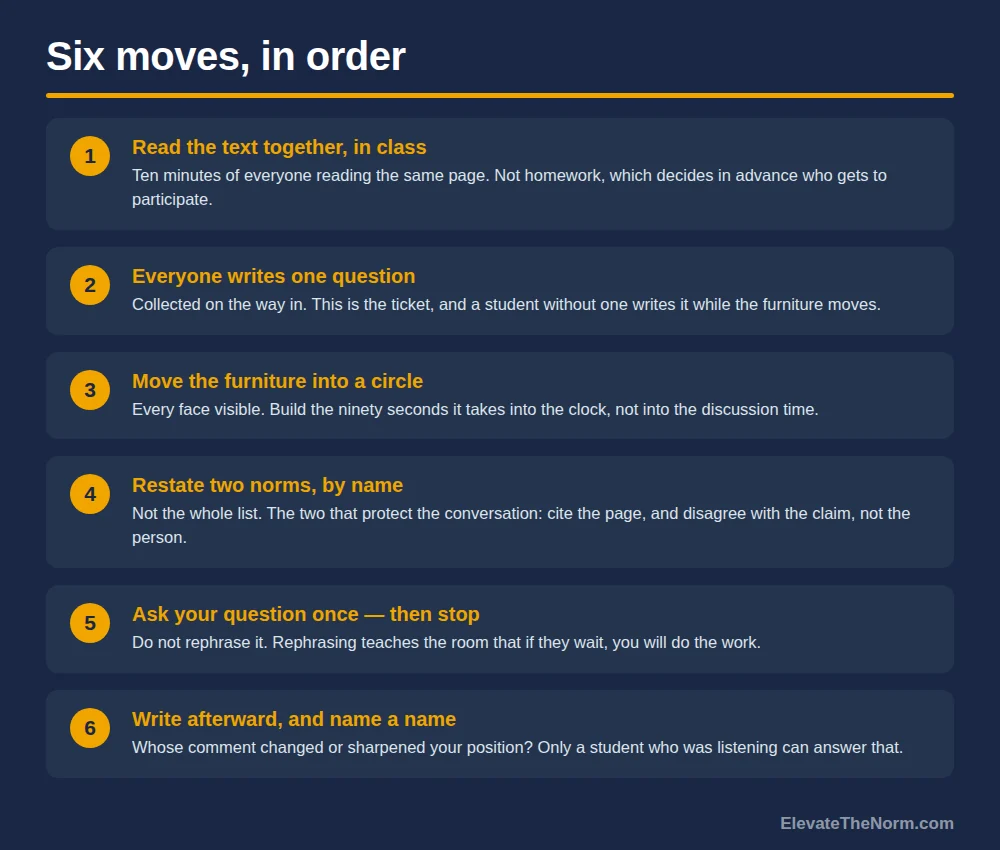
    Six moves, in order, and the hardest is the fifth. You can run this sequence in a single period and repeat it until it stops feeling like an event.

    Numbered list of six moves for running a Socratic seminar: read the text together in class, everyone writes one question, move the furniture into a circle, restate two norms by name, ask the question once then stop, and write afterward naming whose comment changed your position
    Six moves you can run in a single period. The fifth is the hard one.

    The sequence is deliberately boring in the middle. Step five is the interesting one, and the one I get wrong most often.

    In my own room I have landed on roughly a fifteen-count before I respond to something that is off track — and I mean roughly. It is an average, not a rule, because real classes change day to day and a number you enforce mechanically stops being judgment. A seminar asks for that same discipline in a different situation. You ask the opening question, nobody talks, and everything in you wants to rephrase it. Rephrasing is how you teach a room that if they wait long enough, you will do the work. Ask it once. Then sit there.

    The related move is refusing to evaluate. The instant you say “good point,” you have told twenty-eight teenagers that the goal is to produce points you approve of, and the conversation reorients toward you. Write the comment down instead. Nod. Look at somebody else. The Applebee study’s mechanism — authentic questions and uptake — only works if students believe you do not already have the answer, and praise is the fastest way to convince them you do.

    What Are the Rules, and Who Enforces Them?

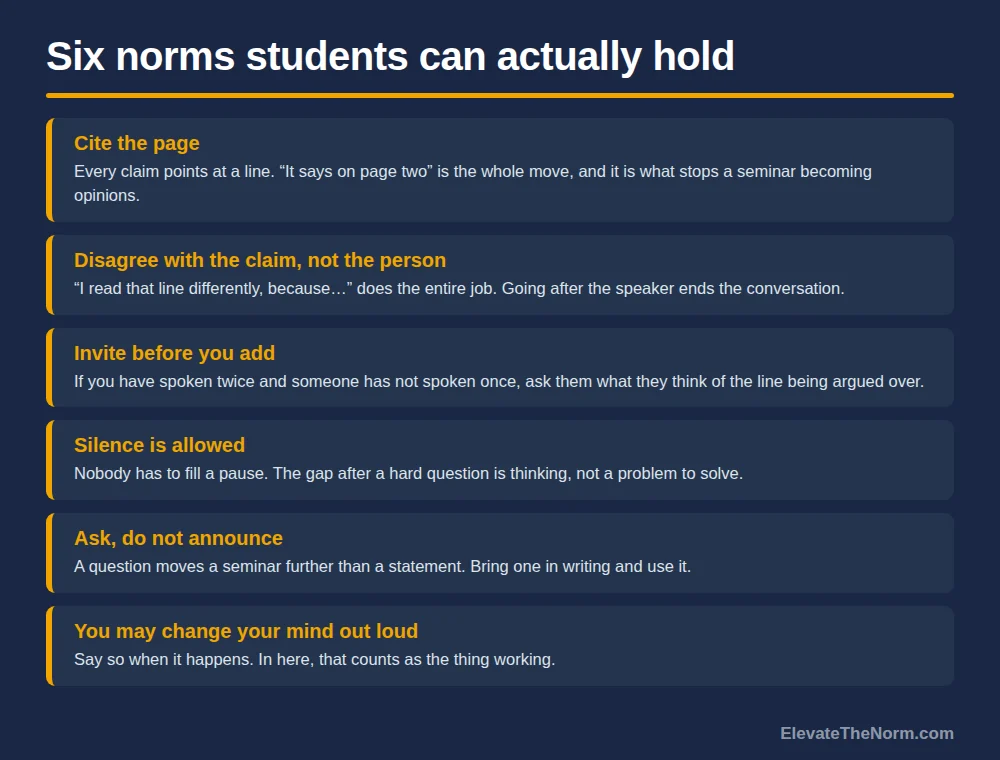
    Keep the list short enough that students can hold it, and hand enforcement to them by the third seminar. Long norm lists get read aloud once and ignored. Five or six behaviors, posted, referred to by name, is enough.

    Six Socratic seminar norms: cite the page, disagree with the claim not the person, invite before you add, silence is allowed, ask rather than announce, and you may change your mind out loud
    Short enough that students can hold them, and short enough to enforce by name.

    The norms that matter protect the conversation from its two failure modes: nobody talking, and three people talking. Everything else is manners.

    There is one behavior worth planning for: the student who is performing for the room rather than talking to it. Do not handle that inside the circle. Naming it publicly makes it a bigger performance, and the seminar stops. Let it pass, keep the conversation moving to someone else, and take it up with the student afterward at normal volume. A seminar is a bad place to win an argument with a teenager.

    Worth saying clearly, because it is where teenagers get this wrong: disagreeing with an idea is the job. A seminar where everyone agrees has not happened yet. What is off-limits is going after the person instead of the claim, and the fix is a sentence frame, not a lecture — “I read that line differently, because…” does the whole job. The broader argument for why this works in a secondary room is the same one behind holding students to an adult standard of disagreement rather than a polite one.

    What About the Fishbowl Format?

    A fishbowl Socratic seminar puts one group in an inner circle discussing while an outer circle observes, then swaps them. It exists to solve two real problems: a class of thirty is too big for one conversation, and students who never get observed never get feedback on how they discuss.

    It works, with one condition. The outer circle needs a job. An outer ring with nothing to do is a ring of spectators with phones. Give each outer student one inner-circle partner to track, and one thing to record — how many times their partner cited the text, or the one question their partner asked that moved the conversation. Keep the record behavioral: what the partner did, not how well they did it. “You went back to the text three times” is feedback. “You seemed nervous” is not, and a fifteen-year-old should not be handed that by a classmate. Hand the note to the partner rather than reading it to the room. That feedback is usually more useful than anything I would have said, because it comes from a peer who was watching only them — but it belongs to the person it is about.

    Do not make it your first seminar of the year, though. Students end up learning two unfamiliar procedures at once and the period goes to logistics.

    How Do You Handle the Students Who Won’t Talk?

    Stop treating silence as a single problem, because it is at least three problems with different fixes. Some students have nothing prepared. Some have something prepared and cannot find an opening. Some are genuinely afraid of the sound of their own voice in a quiet room, and no amount of encouragement touches that.

    A study of quiet students by Medaille and Usinger is instructive here, with a caveat stated up front: the participants were ten undergraduates, not teenagers, so treat it as a description of an experience rather than a finding about your seventh period. Nine of the ten struggled with instructor expectations for verbal participation. Six reported physical reactions — trembling, blushing, stuttering — when speaking aloud. And one of them described the thing I now believe is the actual mechanism: “When I speak [in class] I plan out what I want to say.”

    That is not shyness. That is a student who needs a draft, and the fix is not calling on them warmly — it is giving the whole room ninety seconds to write before the circle opens, so the students who need a draft have one and nobody is singled out for needing it.

    Three more moves that cost nothing:

    • Give the quiet student a job that is not an opinion. Tracking which page the group keeps returning to, or reporting the one question nobody answered, is a real contribution that does not require volunteering a view.
    • Use written entry. A sticky note with one question on it, collected at the door and read aloud anonymously, gets a reticent student’s thinking into the room without their voice attached to it. Read them yourself before you read any of them out. Anonymous is not the same as safe — a question can identify the student who wrote it, or disclose something that should not be discussed in a circle, and the two seconds it takes to scan the stack is the whole safeguard.
    • Do not grade volume. More on that next, because it is the single change that most reliably changes who talks.

    I would not promise that a seminar fixes this. Some students will speak twice all year and write the best post-seminar reflection in the class. That is a real outcome, and the format should be built to catch it.

    Should You Grade a Socratic Seminar?

    Grade the preparation and the reflection. Do not grade how many times a student spoke. The moment participation counts, you have created an incentive to talk rather than to think, and the students who most need the practice are the ones the incentive punishes.

    Count what you can defend. Did they annotate the text? Did they bring a written question? Does the post-seminar writing show they changed or sharpened a position — and can they name whose comment did it? That last one is the best assessment item this format produces, because only a student who was listening can answer it. Three comments in a circle are easy to fake. “I came in thinking X, and the point about the second paragraph is why I do not think that anymore” is not.

    This is also the answer when a parent asks why their quiet child is not being penalized, or why their talkative one is not being rewarded: the grade is on the thinking you can see on paper, and it is the same standard for everyone in the room. If your school requires a participation grade, take it from the written pre- and post-work and say out loud, to the students, that the talking is not scored. There is a four-criterion rubric that scores it this way, free and printed on the page. Then hold to it. The first seminar after they believe you is a different conversation. This is the same logic behind treating ungraded checks as information rather than points — the second you attach a score, you stop learning what students actually think.

    Four Ways a Seminar Goes Wrong

    Every one of these is a design problem, not a student problem. If a seminar dies, the autopsy is almost always in the prep.

    1. The question had an answer. Students find the answer in six minutes and then sit there. Fix: write the question the night before and try to answer it yourself in one sentence. If you can, it is not the question.
    2. The teacher kept talking. You clarified, you rephrased, you summarized, and the conversation routed through you every time. Fix: count your own turns. More than four in a thirty-minute seminar and you are running a recitation with the chairs moved.
    3. Three students ran it. Not because they are hogging it — because they are the only ones who prepared. Fix: require a written question from everyone, collected as they come in. Make it an expectation, not a bar — a student who arrives without one writes it in the first two minutes while the furniture moves. Nobody gets locked out of the conversation for being unprepared; they get two minutes and then they are in it.
    4. It happened once. A seminar in October and a seminar in March are two events. Students never get past the awkwardness of the format itself. Fix: shorter and more often. Fifteen minutes on a half-page every other week will outperform two forty-minute showpieces.

    The fourth is the one I would push hardest. Frequency turns this from a special activity into the way the class talks, and the same logic runs through any structure that hands students the thinking: the first run is about the structure, and only the fourth or fifth is about the content.

    What to Do Next

    Pick a one-page text you already teach — something with a hedge or a contradiction in it — and write one question you cannot answer in a sentence. Give students ten minutes in class to read it, mark two places they disagree, and write one question. Move the furniture. Ask your question once, and then do not talk for as long as you can stand.

    Then do it again in two weeks. The first one will be rough, and that is not information about your students. Run four before you decide whether this works in your room.

    If you want the underlying argument for why handing teenagers this much of the conversation is worth the mess, it is the same one behind giving students real decisions rather than cosmetic ones. A seminar is just the version of that argument you can run on a Tuesday.

    Before you go: grab the free The Socratic Seminar Prep Sheet (PDF) — ElevateTheNorm.com branded, printable, no email required.

    Want the everyday version, without the protocol? Our guide to student discourse in grades 6–12 covers the five moves that get students answering each other, and the research finding that explains why a brilliant discussion between four students changes nothing.

    A seminar on a story runs aground fastest when nobody can say what the story is arguing. Theme is the claim under the discussion, and most students arrive with a one-word topic instead of a claim. How to teach theme so a discussion has something to stand on covers the definition, the difference between topic and theme, and how students test a proposed theme against the whole text rather than one scene.

    Frequently Asked Questions

    What is a Socratic seminar in simple terms?

    It is a structured discussion where students question a shared text and each other while the teacher mostly stays quiet. There is no assigned side, no winner, and no single correct answer to land on. The National Paideia Center calls it a collaborative intellectual dialogue facilitated with open-ended questions about a text. If the question has an answer, or if the teacher is doing most of the talking, it is a class discussion rather than a seminar.

    How long should a Socratic seminar last?

    Fifteen to thirty minutes of actual discussion is plenty for grades 6–12, and shorter is better when you are starting. A full class period sounds ambitious and usually produces twenty good minutes followed by fifteen of people repeating themselves. Frequency beats length. A fifteen-minute seminar every other week on a half-page text will build the skill faster than two long ones a year.

    What is the difference between a Socratic seminar and a debate?

    A debate assigns positions and produces a winner. A seminar assigns nothing and produces a better-understood question. That difference changes student behavior immediately: in a debate, changing your mind is losing, and in a seminar, changing your mind is the evidence that it worked. Tell students this explicitly before the first one, because teenagers default to debate unless you rule it out.

    Do Socratic seminars actually improve student learning?

    The evidence is genuinely mixed and worth knowing honestly. A study of 64 middle and high school English classrooms found discussion-based approaches significantly predicted spring literacy performance, including for low-achieving students. But a meta-analysis in the Journal of Educational Psychology found that while discussion produced strong increases in student talk and substantial gains in text comprehension, few approaches improved critical thinking and reasoning — and most of those studies were in grades 4 through 6. Discussion is well supported. The claim that it teaches thinking is not settled.

    How do you get quiet students to participate in a Socratic seminar?

    Give the whole class ninety seconds of writing time before the circle opens, so students who need to plan what they say have a draft and nobody is singled out for needing one. Beyond that, offer jobs that are not opinions — tracking which passage the group keeps returning to, or reporting the question nobody answered. And do not grade how often a student speaks. That single change does more than any amount of encouragement, because it removes the reason a struggling student is performing rather than thinking.

    Should I grade a Socratic seminar?

    Grade the preparation and the reflection, not the talking. Annotated text, a written question brought to the circle, and a post-seminar piece of writing are all defensible and all reward thinking. Counting comments rewards volume and penalizes the students who most need the practice. If a participation grade is required, pull it from the written work and tell students plainly that speaking is not scored.

    What makes a good Socratic seminar question?

    One you cannot answer in a sentence and cannot settle by looking something up. Test your question by trying to answer it yourself before the seminar; if you finish in one line, it is a comprehension check. Questions that work usually ask about a tension inside the text — whether the author is being honest about what they do not know, whether two of their claims can both be true, or what the text refuses to say.

    How many students should be in a Socratic seminar?

    Twelve to fifteen is the practical ceiling for one circle. Above that, the students at the edges stop being participants. That is what the fishbowl format is for: put half the class in an inner circle discussing and half in an outer circle observing a specific partner, then swap. Do not run a fishbowl as your first seminar though — students end up learning two unfamiliar procedures at once and the period goes to logistics.

    Sources

    1. Applebee, Arthur N., Judith A. Langer, Martin Nystrand, and Adam Gamoran. “Discussion-Based Approaches to Developing Understanding: Classroom Instruction and Student Performance in Middle and High School English.” American Educational Research Journal, vol. 40, no. 3, 2003, pp. 685–730. 64 middle and high school English classrooms, grades 7, 8, 10, 11 and 12; discussion-based approaches significantly related to spring performance controlling for fall performance, and effective for low-achieving as well as high-achieving students. https://eric.ed.gov/?id=EJ782328
    2. Murphy, P. Karen, Ian A. G. Wilkinson, Anna O. Soter, Maeghan N. Hennessey, and John F. Alexander. “Examining the Effects of Classroom Discussion on Students’ Comprehension of Text: A Meta-Analysis.” Journal of Educational Psychology, vol. 101, no. 3, Aug. 2009, pp. 740–764. Strong increases in student talk and substantial improvements in text comprehension; “few approaches to discussion were effective at increasing students’ literal or inferential comprehension and critical thinking and reasoning.” Majority of included studies were conducted in grades 4–6. https://eric.ed.gov/?id=EJ861185
    3. Nystrand, Martin, and Adam Gamoran. Student Engagement: When Recitation Becomes Conversation. National Center on Effective Secondary Schools, 1990. ERIC ED323581. Eighth- and ninth-grade English classes in sixteen middle schools feeding nine high schools across eight Midwestern communities; over 1,100 students tested fall and spring, 1987–88 and 1988–89. Higher proportions of authentic questions and uptake predicted significantly higher literature achievement. https://files.eric.ed.gov/fulltext/ED323581.pdf
    4. Jay, Tim, et al. Dialogic Teaching: Evaluation Report and Executive Summary. Education Endowment Foundation, July 2017. ERIC ED581114. Three-level clustered randomised controlled trial, 38 intervention schools (2,492 pupils) and 38 control schools (2,466 pupils); +2 months English, +2 months science, +1 month maths; three-padlock security rating. Pupils were in Year 5, aged nine and ten — this is not a secondary-school result. Evaluators note 21% of pupils excluded from analysis. https://files.eric.ed.gov/fulltext/ED581114.pdf
    5. Mahoney, Bethany, Ron Oostdam, Hessel Nieuwelink, and Jaap Schuitema. “Learning to Think Critically Through Socratic Dialogue: Evaluating a Series of Lessons Designed for Secondary Vocational Education.” Thinking Skills and Creativity, vol. 50, 2023, article 101422. 85 students and 5 teachers, Netherlands, eight weekly lessons; teachers found the format deliverable but demanding and all five requested more facilitation training. The study states as a limitation that there was no measurement of actual critical thinking skill development. https://www.sciencedirect.com/science/article/pii/S1871187123001906
    6. Medaille, Ann, and Janet Usinger. “Quiet Students’ Experiences with the Physical, Pedagogical, and Psychosocial Aspects of the Classroom Environment.” Educational Research: Theory and Practice, vol. 31, no. 2, 2020, pp. 41–55. Qualitative study of ten upper-division undergraduates — not secondary students; nine of ten struggled with verbal participation expectations and six reported physical symptoms when speaking aloud. https://files.eric.ed.gov/fulltext/EJ1274336.pdf
    7. National Paideia Center. “Paideia Seminar.” Definition of the seminar as a collaborative intellectual dialogue facilitated with open-ended questions about a text, and the pre-seminar / seminar / post-seminar cycle. https://paideia.org/blogs/npc/paideia-socratic-seminar
    About Clay Shumate

    Clay Shumate is a certified secondary Social Studies teacher in the public schools of West Alabama, with seven years of classroom experience, a B.A. in History, and an M.Ed. in Secondary Education. He writes about project-based learning, student responsibility, respect, and practical ways to hold young people to a higher standard while giving them room to learn from mistakes. He is a member of the Society of Professional Journalists and writes to its Code of Ethics; this site’s editorial standards and corrections policy are published in full. More about Clay.

  • Classroom Review Games That Actually Review: Two Formats for Grades 6-12

    Classroom Review Games That Actually Review: Two Formats for Grades 6-12

    By Clay Shumate

    Classroom review games work because they force retrieval, not because they make content fun. The ones that hold up give every student a real job instead of four, keep questions short and frequent, and end with kids asking when you are playing again. The ones that fail almost always fail the same way: twenty-four students watching four.

    What follows is the mechanism the research actually supports, two formats broken down far enough to run on Monday, and the design failures that turn a review game into a spectator sport.

    Key Takeaways

    • Retrieval is the mechanism. Pulling an answer out of memory builds retention; re-reading it does not. The game is the packaging.
    • A format without a sideline job is not a whole-class review game. It is four students reviewing and the rest of the room waiting.
    • Two formats are broken down in full below: a four-square court built around eight assigned roles, and a five-minute trash-can format that needs nothing but a ball.
    • The evidence is good and it is not unlimited. Games reliably move content knowledge. The strongest school-based meta-analysis found no significant effect on metacognitive outcomes at all.
    • Short and repeated beats long and once. Fifteen minutes on three days does more than a full period the day before the test.

    Free Download · PDF

    Formative Assessment Quick-Use Pack

    A strategy decision matrix, an evidence tracker, four exit-ticket formats, and a next-day response planner — for turning what a review game surfaces into the next day’s lesson.

    Download the free PDF

    Free. No email address required. Designed for grades 6–12. Browse every printable in Your Free Library.

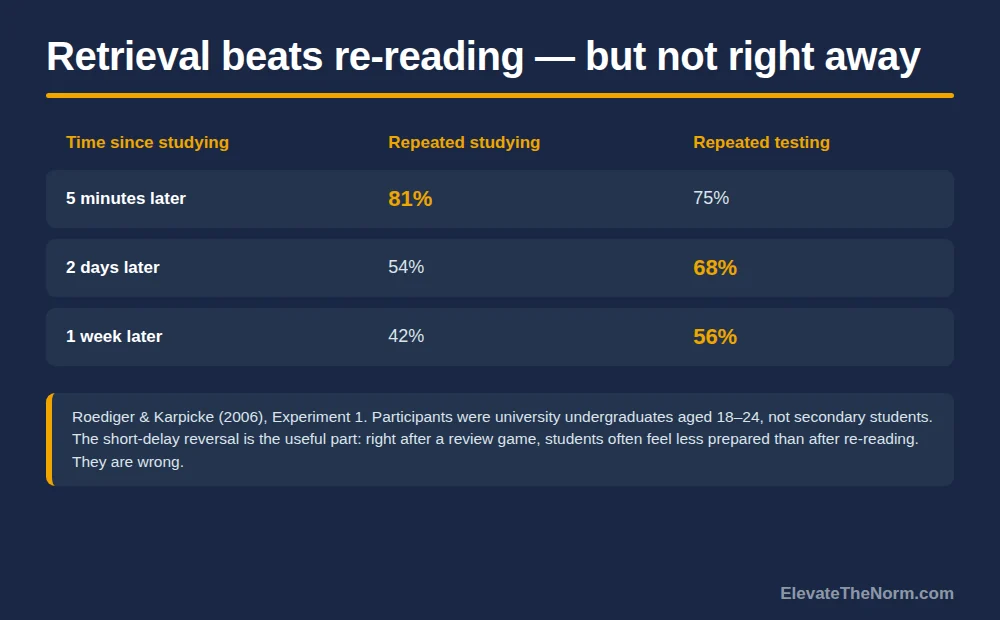
    Three-row table comparing recall after repeated studying and repeated testing at five minutes, two days and one week: 81 versus 75 percent, 54 versus 68 percent, and 42 versus 56 percent
    Five minutes after studying, re-reading looks better. A week later it is not close.

    Why Do Classroom Review Games Work?

    Because retrieving an answer from memory strengthens it more than reading it again does. That effect has a name — the testing effect, or retrieval practice — and it is one of the better-replicated findings in learning science.

    The landmark demonstration is worth knowing precisely, including the part that gets left out. Roediger and Karpicke had readers either study a passage repeatedly or study it once and then take repeated recall tests. Five minutes later, the repeated studiers were ahead — 81% recall against 75%. A week later the result had flipped hard: 56% for the testers, 42% for the studiers. In their second experiment the gap was wider still, 61% against 40%.

    Two honest caveats belong with that study. The participants were university undergraduates, ages 18 to 24, not teenagers. And the short-delay reversal is the most useful part of the finding for a teacher: immediately after a review game, students will often feel less prepared than they would after twenty minutes of re-reading their notes. They will be wrong, and they will tell you so. Knowing that in advance is what keeps you from abandoning a format that is working.

    The classroom evidence runs in the same direction. A five-year applied research project across more than 1,400 middle school students found that retrieval practice built into normal classroom quizzing improved long-term learning, that delayed quizzes were more potent than immediate ones, and that quizzes with feedback beat quizzes without. A 2021 systematic review screened nearly 2,000 abstracts and coded 50 classroom experiments covering 5,374 students: 57% of effect sizes showed medium or large benefits. The authors flag their own limit plainly — only 6% of the experiments were run outside WEIRD countries.

    A review game is a low-stakes retrieval quiz wearing a costume. The costume is not decoration; it is what gets a room of teenagers to willingly retrieve the same content twelve times without it feeling like a test. It belongs in the same toolbox as any other strategy built around real thinking rather than visible compliance.

    What Does the Research Not Say?

    It does not say that making something a game teaches students how to learn. This is where most review-game advice quietly oversells.

    The strongest recent synthesis of game-based learning in schools — Barz and colleagues, in Review of Educational Research — pooled studies of digital game-based learning and found a medium overall effect (g = .54), a solid cognitive effect (g = .67), a small affective-motivational effect (g = .32), and no significant effect on metacognitive outcomes. The authors found no evidence of publication bias, which makes the null finding harder to wave away.

    Two things follow. First, that meta-analysis covers digital games, and the formats below are a taped floor and a trash can — the content-knowledge finding transfers by mechanism, the effect size does not transfer automatically. Second, and more practically: a review game will help students remember what you taught. It will not teach them to study, to plan, or to notice what they do not know. If you want that, the reflective work has to be built in on purpose — which is what a separate student self-assessment routine is for.

    Why Do Most Classroom Review Games Fail?

    Because the format only has room for four players and no plan for everyone else.

    Almost every teacher has lived this period. Four students play a game-show format at the front. Twenty-four watch. The four are genuinely engaged and learning. The twenty-four are half-watching, half on their phones, and the review reached a sixth of the room. That is not a review game. It is a spectator sport with a curriculum connection.

    The failure is not the game and it is not the students. It is a design gap, and it is fixable before the first round: if a format has room for a handful of active participants, it needs a real job for everybody else. “Pay attention” is not a job.

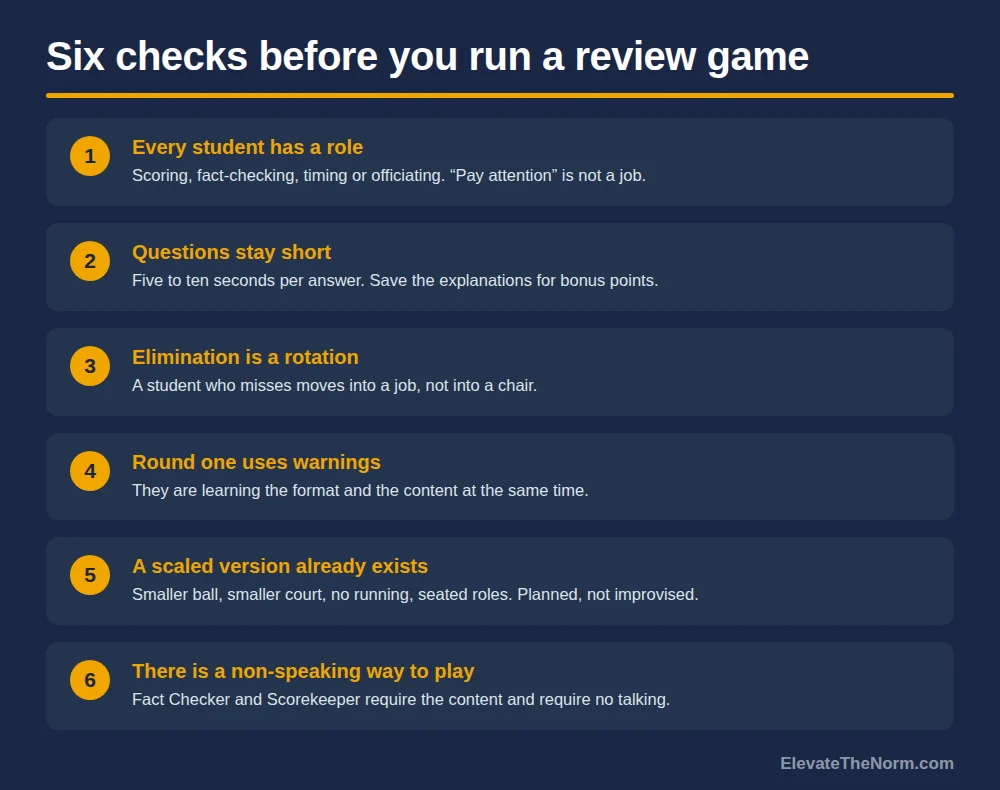
    Numbered checklist of six design checks for a classroom review game: every student has a role, questions stay short, elimination is a rotation, round one uses warnings, a scaled version already exists, and there is a non-speaking way to play
    Six checks. Miss the first one and the rest do not matter.

    How Do You Design a Review Game That Actually Works?

    Run it against six checks before you build it or borrow it.

    • Every student has a role. The students not currently answering should be scoring, checking answers, timing or officiating — not spectating.
    • Questions stay short. Five to ten seconds per answer keeps the pace up. Save the multi-sentence explanations for bonus points, not the base question.
    • Elimination does not mean disappearing. A student who misses rotates into another job. A student who is “out” with nothing to do will find something to do, and it will not be what you wanted.
    • The first round uses warnings, not eliminations. Students are learning the format and the content at the same time; do not punish them for the first. This is the same logic behind teaching a routine explicitly before holding anyone to it.
    • A scaled version exists before you need it. Smaller ball, smaller court, no running, seated variant. Planned, not improvised.
    • There is a non-speaking way to play. Scorekeeper, fact checker and timekeeper all require knowing the content and none requires answering out loud. Build that in from the start rather than after a student has to ask for it.

    Those six are the difference between a format that runs itself after the first week and one you referee forever. Most of them are the same principle underneath any student-centered activity: the structure works when students genuinely own a piece of it, not when they have permission to join in.

    What Does a Full Format Look Like? The 4 Square Review Game

    A four-square court, four players, and eight assigned jobs for everyone else. It is built specifically to solve the spectator problem, and the roles do not change by subject — only the question cards do.

    Setup. Tape a 16′ × 16′ court split into four 8′ × 8′ squares, labeled A through D. Square A is the top position; D is the entry point. Split the class into four teams, one player from each team on the court, the next four in a marked Sub Zone.

    The round. Before a player serves or returns, the Question Master asks a content question. The player has about five seconds. A correct answer makes the ball live and standard four-square rules apply — one bounce before the return. A wrong answer eliminates the player unless a challenge changes the ruling, and they rotate to the end of their team’s line. The next player enters at D and everyone on the court steps up one square.

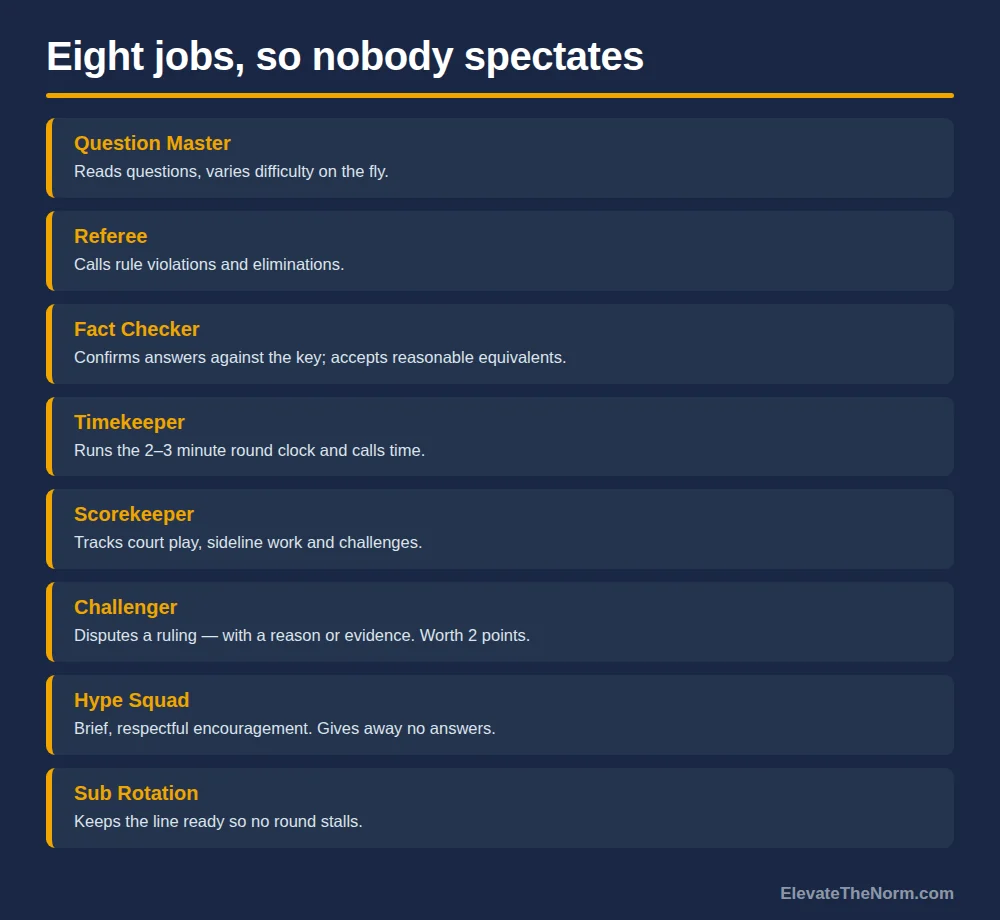
    The eight jobs. This is the part that makes it a whole-class format:

    • Question Master reads the questions and varies the difficulty.
    • Referee calls rule violations and eliminations.
    • Fact Checker confirms answers against the key and accepts reasonable equivalents.
    • Timekeeper runs a two-to-three-minute round clock and calls time.
    • Scorekeeper tracks points for court play, sideline jobs and challenges.
    • Challenger can dispute a ruling — but only with a reason or a piece of evidence, which turns disagreement into an academic move instead of an argument with you.
    • Hype Squad keeps energy up with brief, respectful encouragement and gives away no answers.
    • Sub Rotation manages the line so the next players are always ready.

    Roles rotate every round, so the student who spent one round scoring is playing the next. Scoring stays simple: a point for a correct answer, a point for a successful serve or return, a point for reaching Square A, a point for a clean sideline call, two points for a successful challenge. Small bonuses for a team lifeline, strong supporting evidence, or a team that covers every assigned role keep the sideline jobs from reading as busywork.

    Adapting 4 Square to Any Subject

    The court and the roles never change. The question bank does. A social studies class can run cause-and-effect recall one round and source-analysis the next. A math class swaps in problem-solving questions with a slightly longer answer window. An English class runs vocabulary in context. Build more questions than you think you need, sorted by difficulty, so the Question Master can adjust live when a round runs hot or cold. Running out of questions kills the pace faster than anything else on this page.

    List of eight assigned student roles for a review game: Question Master, Referee, Fact Checker, Timekeeper, Scorekeeper, Challenger, Hype Squad and Sub Rotation, each with a one-line description of the job
    Four players. Eight jobs. Nobody spectates.

    What If You Only Have Five Minutes to Set Up? Trashketball

    A question, a correct answer, then a shot at the trash can from a distance the student picks. Trashketball is a long-standing, widely used classroom format, and it earns its place here for one reason: it delivers the same retrieval mechanism with no court to tape and no roles to assign.

    I did not invent it and I want to be clear about that, because how I got it is the more useful part of the story. In my first year I did not have many review formats that were actually enjoyable, and another teacher on my hall noticed. I asked. They walked me through Trashketball, and I have been running some version of it ever since.

    Keeping your ears open and your mouth shut pays off some of the time. Asking a direct question pays off faster. If you are in your first years and your review days are flat, the fix is probably already being run two doors down by somebody who would be glad you asked. That is not a soft lesson about collegiality — it is the cheapest professional development available and it costs one conversation.

    The basic loop is a question to a team, a short answer window, and a shot worth more points from further out. The self-chosen distance is the good part — it gives a student who is sure of the content a way to press the advantage and a student who is not a way to stay in without being exposed.

    Two upgrades are worth building in. First, give the non-shooting teams a job: one team fact-checks the answer, one keeps score, and both rotate. Second, have each question lead into a one-or-two-sentence note rather than a full explanation, so movement and note-taking land in the same fifteen minutes instead of competing for them. My Station Rotation Toolkit on TPT has eight reusable station frames, signs, and recording sheets if you would rather not build them.

    The lesson from both formats is the same. A physically engaged class and a content-reviewing class are not in competition. They can be the same fifteen minutes.

    What Do You Watch For While It Runs?

    The answers you overhear, not the score.

    My room runs as a workshop — tables grouped rather than in rows, me on a wheeled stool moving between them instead of standing at the front. That habit is worth more during a review game than during almost anything else I do. Circulating while a round plays, you hear a group land on a confident wrong answer before it reaches anybody’s notes, and you can fix it in the next question instead of on the test. The scoreboard tells you who is winning. The sideline conversation tells you what you still have to teach.

    That is also the honest answer to whether a review game is “real” instruction. It is, if you are listening. It is not, if you are refereeing.

    What Are the Most Common Mistakes?

    • No job for the sideline. The single most common failure, and the one that turns a review game into a spectator sport.
    • Elimination with nowhere to go. Rotate eliminated students into a job instead of into a chair.
    • No warning period. Hard eliminations from question one punish students for not knowing a format they have never played.
    • Speed rewarded over accuracy. A five-second window is fine. A game that rewards the fastest guess over the most defensible answer teaches the wrong thing.
    • The same students in the low-status seat every time. If the fast recallers always play and the same kids always keep score, you have built a ranking system, not a review game. Rotate on a schedule, not on volunteering.
    • No safety plan. Any physical format needs its scaled version ready before somebody asks for it.
    • Treating it as a time-filler. If the game does not require retrieving real content, it is recess with a curriculum label.

    What Should You Do Next?

    Pick one format — 4 Square if your class needs structure and assigned roles, Trashketball if you need something running in five minutes — and build a question bank of about thirty questions sorted into three difficulty tiers. Run it for fifteen minutes on three separate days before your next unit test rather than for a full period the day before it. The spacing is doing as much work as the game.

    Then watch two things. Whether the sideline stays engaged, which tells you if the roles are real. And whether students ask when you are playing again, which tells you whether you have a repeatable Friday or a one-time novelty. A review game also fits an awkward period well — the kind covered in teaching after a long weekend, when a straight lecture is fighting uphill no matter how good it is.

    Before you go: grab the free Formative Assessment Quick-Use Pack (PDF) — ElevateTheNorm.com branded, printable, no email required.

    Both formats here are built to be repeatable: five minutes of prep, run most weeks. The opposite end of that trade is the one-off designed event, where you spend a weekend building a locked puzzle sequence around a single unit and run it once. If that is what you are after, the honest costs and evidence are in the guide to building a classroom escape room — including why students reliably enjoy one and still struggle to tell you what they learned.

    A review game needs questions, and the week before a midterm the best source is the exam itself. Mid-Terms.org gives every course a Form A and a Form B, so you can run the review off one form and test with the other, and the Midterm Maker will trim either one down to the units you actually taught.

    A review that stays inside one question type is not reviewing much. Mixing the kinds of problem is what forces a student to decide which method applies before using it, which is the thing a unit test asks and a blocked set never does. The evidence behind mixed practice includes a randomized trial in seventh-grade math and an honest account of the materials where mixing makes things worse.

    Frequently Asked Questions

    Do classroom review games actually work, or do they just feel productive?

    They work when they force retrieval — students pulling an answer out of memory rather than recognizing it on a page in front of them. That mechanism has been tested directly. Roediger and Karpicke found repeated testing beat repeated studying by 14 points of recall a week later. The game format is the delivery system, not the mechanism. A game where students look up every answer is a worksheet with a ball in it.

    How do I keep 28 students engaged when only four can play at a time?

    Assign every non-playing student a real job and rotate the jobs every round — scorekeeper, fact checker, timekeeper, referee, challenger. “Pay attention” is not a job, it is a hope. If a format has no work for the twenty-four students who are not currently answering, it is not a whole-class review game and you should expect it to behave like one.

    Won’t the competition discourage my students who are already behind?

    It can, and the design has to answer for it. Three things keep it from landing on the same students every time: rotate the jobs so nobody sits in the low-status seat all period, score sideline work as heavily as court play, and score teams rather than individuals so a wrong answer is absorbed. If a specific student is visibly shrinking during a game, give them the Fact Checker role — it is high-status, it requires knowing the content, and it never requires answering in front of the room.

    What if my class is not ready for something physical?

    Scale it before ruling it out. A softer or larger ball, a smaller court, a no-running rule, or a fully seated version of every role keeps the structure intact. The roles and scoring do not depend on anyone moving. Plan the scaled version before the first round rather than improvising it after someone gets hurt or someone gets left out.

    How long should a review game run?

    Rounds of two to three minutes with a role rotation between them, for a total of fifteen to twenty minutes. That is long enough to cycle the whole class through several retrievals and short enough that it does not eat the period. A game that runs forty minutes has stopped being retrieval practice and started being an activity.

    Do these formats work outside social studies?

    Yes, because nothing in the court, the roles or the scoring references a subject. Only the question bank changes. A math class can lengthen the answer window for a multi-step problem; an English class can run vocabulary-in-context questions; a science class can run prediction questions. The one thing that does not travel is a question bank written the morning of.

    A student is arguing with my ruling. How do I handle it without losing the room?

    Build the argument into the format. A Challenger role that requires a brief reason or a piece of evidence turns a dispute into an academic move and takes you out of the middle of it. Award points for a successful challenge. Students who would never volunteer an answer will absolutely argue a call, and a challenge is a retrieval too.

    Is a review game a good use of a class period before a test?

    It is a good use of fifteen to twenty minutes of one, run more than once. The retrieval research is consistent that spaced, repeated retrieval beats one long session, so a short game on three different days will do more than a single period-long game the day before the exam. It is also worth being honest about what games do not do: the best meta-analysis of game-based learning in schools found solid gains in content knowledge and no significant effect on metacognitive outcomes. A game will help students remember. It will not, on its own, teach them how to study.

    Sources

    1. Roediger, Henry L., III, and Jeffrey D. Karpicke. “Test-Enhanced Learning: Taking Memory Tests Improves Long-Term Retention.” Psychological Science, vol. 17, no. 3, 2006, pp. 249–255. Participants were university undergraduates aged 18–24. https://journals.sagepub.com/doi/10.1111/j.1467-9280.2006.01693.x
    2. Agarwal, Pooja K., Ludmila D. Nunes, and Janell R. Blunt. “Retrieval Practice Consistently Benefits Student Learning: A Systematic Review of Applied Research in Schools and Classrooms.” Educational Psychology Review, vol. 33, no. 4, 2021, pp. 1409–1453. 50 coded experiments, 5,374 participants; 57% of effect sizes medium or large; only 6% of experiments conducted outside WEIRD countries. https://link.springer.com/article/10.1007/s10648-021-09595-9
    3. Agarwal, Pooja K., Patrice M. Bain, and Roger W. Chamberlain. “The Value of Applied Research: Retrieval Practice Improves Classroom Learning and Recommendations from a Teacher, a Principal, and a Scientist.” Educational Psychology Review, vol. 24, no. 3, 2012, pp. 437–448. Five-year project with more than 1,400 middle school students. https://eric.ed.gov/?id=EJ977134
    4. Barz, Nathalie, Manuela Benick, Laura Dörrenbächer-Ulrich, and Franziska Perels. “The Effect of Digital Game-Based Learning Interventions on Cognitive, Metacognitive, and Affective-Motivational Learning Outcomes in School: A Meta-Analysis.” Review of Educational Research, 2024. Overall g = .54; cognitive g = .67; affective-motivational g = .32; no significant effect on metacognitive outcomes; no evidence of publication bias. https://journals.sagepub.com/doi/10.3102/00346543231167795

    About Clay Shumate

    Clay Shumate is a certified secondary Social Studies teacher in the public schools of West Alabama, with seven years of classroom experience, a B.A. in History, and an M.Ed. in Secondary Education. He writes about project-based learning, student responsibility, respect, and practical ways to hold young people to a higher standard while giving them room to learn from mistakes. He is a member of the Society of Professional Journalists and writes to its Code of Ethics; this site’s editorial standards and corrections policy are published in full. More about Clay.

  • Visual Classroom Transitions: Cues Students Can Actually See

    Visual Classroom Transitions: Cues Students Can Actually See

    By Clay Shumate · Updated October 24, 2026

    Visual classroom transitions use something students can see — a projected timer, a posted sequence, a slide, a hand signal — to carry the instructions for moving from one activity to the next, instead of your voice carrying them. The point is not decoration. It is that a visible instruction stays available after you have stopped talking, and a spoken one does not.

    That distinction is the whole article. Most transition advice tells you to be clearer. Visual cues are a structural fix rather than a delivery fix: they change where the instruction lives, so a student who missed it, tuned out for ten seconds, or is still finishing a sentence can recover without asking you or asking the person next to them.

    Key Takeaways

    • A visual cue is persistent; your voice is not. That is the entire mechanism. Anything a student can look back at removes a reason to ask a neighbor, and asking a neighbor is how a thirty-second transition becomes ninety.
    • Transitions are a real time cost, and the honest number is a range. Estimates put off-task behavior, transitions and wait time at somewhere between 17 and 29 percent of instructional time.
    • More visuals is not better. The same literature that supports visual cues also finds that visual clutter predicts less on-task behavior — and that finding has a published reanalysis you should know about.
    • The evidence base is strong for some students and thin for whole classrooms. Visual schedules are well supported for students with intellectual disability and autism. Nobody has shown a general secondary-classroom effect.
    • One permanent cue beats five clever ones. The cue only works once it is automatic, and a cue that changes weekly never becomes automatic.

    Free Download · PDF

    Classroom Transitions Planning Toolkit

    A transition audit sheet, a cue-type guide, and a planning template for building and timing the three moves that cost you the most.

    Download the free PDF

    Free. No email address required. Designed for grades 6–12. Browse every printable in Your Free Library.

    What Counts as a Visual Classroom Transition?

    Anything a student can look at that tells them what happens next, where to be, and how long they have. Four families cover almost everything worth using in a secondary room:

    • A countdown. A projected timer, or a number on the board you change. It answers “how long” without a single word from you, and “how long” is the question most students are actually asking.
    • A sequence. The steps of the move, posted or projected: what to close, what to get, where to sit. Three to five steps, in order, in the order a student would do them.
    • A state signal. Something that shows what mode the room is in right now — a colored slide, a magnet on the board, a word in the corner of the projection. Silent work, partner talk, whole class.
    • A gesture. A hand signal that means one specific thing and never means anything else. Free, instant, and the only one that works when the projector is down.
    Cue typeWhat it answersSecondary-classroom example
    CountdownHow long do I have?Full-screen projected timer or a number on the board
    SequenceWhat do I do, in what order?Three to five posted steps: what closes, what comes out, where to go
    State signalWhat mode is the room in?A word in a fixed slide corner: independent, partner, whole class
    GestureOne specific instructionTwo fingers means thirty seconds left; works when the projector is down
    The four families of visual transition cue at a glance.

    What does not count: a decorative poster nobody reads, a slide so crowded that finding the instruction takes longer than hearing it, and a sign that has been up since August and has therefore become furniture.

    Graphic describing four families of visual classroom transition cue: a countdown, a posted sequence of steps, a mode marker showing what the room is doing, and a hand gesture
    Four families cover almost everything worth using in a secondary room. Most teachers need two of them, used consistently.

    Visual cues sit inside the broader practice of running the four moments where a lesson actually loses time, and they are one signal among several. They pair naturally with an audio cue — the music and sound cue guide covers that half — and the pairing is often better than either alone, because one catches the student who is looking up and the other catches the student who is not.

    How Much Time Do Transitions Actually Cost?

    Enough to matter, and less precisely than most articles claim. Anyone quoting you a clean figure is rounding somebody else’s estimate.

    The most careful recent synthesis is Kraft and Novicoff’s 2024 paper on time in school. Reviewing the available studies, they report that estimates of off-task behavior, transitions and wait time together occupy between 17 and 29 percent of instructional time — a range, drawn from several different measurement methods, and covering three things at once rather than transitions alone.

    Their own district analysis is more concrete and more sobering. In Providence Public Schools they found instructional time lost running at 16 percent in elementary, 21 percent in middle school and 25 percent in high school. The largest single contributor was unexcused absence, followed by outside interruptions and teacher absence; interruptions and teacher absence alone cost the average high school student 97.3 hours a year. My free First 10 Days Procedures Checklist on TPT walks through which routine to teach on which day.

    Read that honestly. Those Providence figures are not a transition statistic. They count absence and building-level interruption, and the authors explicitly call the estimate a lower bound that does not capture how usable hours are further eroded by disruptions inside the classroom. The transition number lives inside the 17-to-29 percent range, and that range is wide because the measurement is hard.

    What you can say without overstating: transitions are a nontrivial recurring cost, they are one of the few losses a single teacher can act on without anyone’s permission, and a room that moves in thirty seconds instead of ninety recovers real minutes across a semester. That is a good enough reason. It does not need inflating.

    Why Does a Visual Cue Work Better Than Saying It Again?

    Because it is still there after you stop talking. A spoken instruction exists for about four seconds and then only in the memory of whoever was listening. A projected one is available to the student who looks up late.

    That sounds small. It is the entire difference, and you can watch it happen: the student who missed the instruction turns to a neighbor, the neighbor stops working to answer, and one missed instruction has now taken two students off task and generated the noise that pulls a third. A visible instruction gives that student a way to recover without recruiting anyone.

    It also tells you who benefits most, and it is not the student you were picturing. It is the one who was absent yesterday and does not know the routine, the one who needs a few extra seconds to process a spoken instruction, and the one who will not ask you a question in front of the room under any circumstances. All three are students a voice-only transition leaves behind, and none of them will tell you so.

    There is a second effect, harder to see. Instructions delivered only by voice make you the sole source of the answer, so every uncertainty routes through you. That is what makes a transition feel like crowd control. Moving the instruction onto the wall or the screen means the room can answer its own question, which is the same principle behind writing down the routines a class is expected to run without prompting rather than re-explaining them.

    The research on the cueing side is worth being precise about, because it is frequently overstated. Visual activity schedules have a real evidence base: van Dijk and Gage’s 2019 meta-analysis in the Journal of Intellectual & Developmental Disability pooled 13 single-case studies and found a meaningful effect on independent skills, across middle school, high school and adult participants. Milam and Sutton’s 2024 article in Beyond Behavior extends the practice to students with emotional and behavioral disorders as a proactive transition strategy, at the elementary and middle school level.

    Notice what that evidence is and is not. It is single-case research with students who have identified disabilities. It is good evidence that visual schedules help those students become more independent. It is not evidence that adding a projected timer raises achievement in a general-education eleventh-grade classroom, and nobody should tell you it is. The honest case for visual cues in a mainstream secondary room is mechanical and modest: it costs nothing, it removes a known friction point, and the practice it generalizes from is well supported for the students who need it most.

    There is one adjacent evidence-based practice worth naming, because it is cheap and it pairs with every cue on this page. Ennis, Royer, Lane and Griffith’s 2017 systematic review in Education and Treatment of Children applied Council for Exceptional Children standards to precorrection — telling students what is about to be expected, before the moment arrives — and concluded it qualifies as an evidence-based practice. A visual cue is a precorrection you did not have to say.

    Does More Visual Support Make a Room Work Better?

    No, and this is the part most articles about classroom visuals leave out. The same research tradition that supports targeted visual cues also finds that a visually busy room costs attention.

    Godwin, Seltman, Scupelli and Fisher observed 58 elementary classrooms with a structured on-task protocol and analyzed panoramic photographs of each room’s visual environment. Students were on task 72.7 percent of the time. Greater visual noise significantly predicted less on-task behavior — each standard deviation increase in visual noise was associated with roughly a 10 percent reduction in the odds of being on task. Adherence to design-composition principles predicted nothing. Peer distraction, incidentally, accounted for 46.4 percent of all off-task behavior, which is worth remembering the next time a seating decision seems minor.

    The better-known version of this finding comes from Fisher, Godwin and Seltman’s 2014 study in Psychological Science, where kindergarteners in a heavily decorated room were more distracted and scored lower than the same children in a sparse one. It is quoted constantly. It also has a published reanalysis that you should know about before you quote it. Imuta and Scarf, writing in Frontiers in Psychology the same year, reanalyzed the data and found that children’s distraction in the decorated room decreased considerably across lessons — habituation. Their argument is that the study conflated novelty with irrelevance, and that 45 minutes total across two weeks is nowhere near enough time to habituate the way students do to a real classroom they sit in daily.

    So the strong claim — decorations harm learning — does not survive contact with the reanalysis. Two weaker claims do survive, and both are useful: visual noise measured in real classrooms predicts less on-task behavior, and novel visual material draws attention. Both point the same direction for transitions. If everything on your walls is competing, the one thing you actually need students to look at is competing too. And because novelty is what draws the eye, a cue that appears only at transitions has an advantage over one that is always up. My Brain Breaks for Middle and High School on TPT give you 60 quick resets that do not feel childish to teenagers.

    The caveat on all of it: these are K–4 samples. A sixteen-year-old is not a kindergartener, and no equivalent study of secondary classrooms turned up here. Treat this as a reason to keep the signal clean, not as a proven high school effect.

    How Do You Build a Visual Cue That Actually Gets Used?

    Five steps, and step four is the one that decides whether it works.

    1. Pick the transition that costs you the most. Not all of them. Time three of them with your phone for a week — entry, the move into group work, and the last five minutes — and fix the worst one first. Most teachers guess wrong about which one it is.
    2. Write the move as three to five steps, in student order. What closes, what comes out, where people go. If it takes more than five steps, the transition itself is too complicated and no cue will save it.
    3. Put the steps and a countdown in the same place every time. Same corner of the slide, same spot on the board. A cue that moves is a cue students have to search for, and searching is the cost you were trying to remove.
    4. Teach it, then rehearse it twice. Show the cue, walk the steps, do it once badly and name what went wrong, do it again. This is fifteen minutes and it is the entire difference between a cue and a decoration. A visual nobody has been taught to read is wall art.
    5. Leave it alone for a month. The cue works when it is automatic, and automatic takes repetition. Changing it because you thought of a better version resets the clock.
    Numbered five-step graphic for building a visual classroom transition cue: pick the costliest transition, write the move as three to five steps, put it in the same place every time, teach and rehearse it twice, and leave it alone for a month
    Step four is the one that decides whether it works. A visual nobody has been taught to read is wall art.

    Two practical notes. Make the cue legible from the worst seat in the room — back corner, at an angle, with the lights on. Text that reads fine on your laptop frequently does not survive the projector, and a student who cannot read the cue will ask a neighbor, which is the exact behavior you were trying to prevent. Check it from that seat once.

    And have a version that works when the technology does not. Projectors fail, and plenty of secondary teachers float between rooms or share a space where the board is not theirs to write on. A hand signal plus three steps on a half sheet at each table, or on a single laminated card you carry, covers the same ground and needs no bulb and no wall. If your whole transition system depends on a screen you do not control, you have built a system that breaks on the morning the network is down — which is the same reason a room needs a procedure a substitute could run without you in the building.

    What Do Visual Cues Look Like in a Secondary Classroom?

    Plainer than the internet suggests. Most published visual-transition material is built for elementary rooms, and a fourteen-year-old reads a cartoon carpet-time card as an insult. The design rule for grades 6–12 is that the cue should look like something adults use.

    Worth using:

    • A full-screen countdown for any move with a deadline. No decoration, large numerals, visible from the back.
    • A three-line slide that appears only during a transition and shows what closes, what opens, and where to be.
    • A mode marker in a fixed corner of the slide — independent, partner, whole class. Use a word, not a color alone. Roughly one boy in twelve has a red–green color vision deficiency, so a red-versus-green block is a cue a few students in every section cannot read. A colored block with the word on it works for everyone, and it ends the “can we talk?” question permanently.
    • A two-finger signal that means one thing: thirty seconds left. One gesture, one meaning, used every day.
    • A materials diagram for any recurring setup with a physical arrangement — lab stations, a debate layout, group clusters. Drawn once, reused all year.

    Worth skipping: animated slide transitions, anything with a cartoon character, a different cue for every activity, and a countdown with sound effects. All of them add novelty to a moment that needs predictability.

    One more: the cue should not require you to be at the front of the room. The value of a visual signal is that it frees you to move — to be next to the group that always stalls, instead of at the board narrating. If your system requires you to stand somewhere and press something, you have built a cue that costs you the thing it was supposed to buy.

    Why Do Visual Classroom Transitions Fail?

    Four failure modes, all predictable, all cheaper to avoid than to fix.

    The cue is never taught. It goes up, students do not know it is load-bearing, and it becomes background within a week. This is the most common failure and the easiest to prevent: fifteen minutes of explicit instruction and two rehearsals.

    The cue competes with everything else on the wall. This is the visual-noise finding applied to your own room. If the signal sits in a field of posters, student work and reference charts, it is one more thing in a busy field. Give it a clear zone with nothing around it.

    The cue is treated as a substitute for the transition being sensible. No timer fixes a move that requires twenty-eight people to cross the room to a single supply table. Redesign the move first. A visual cue makes a good procedure faster; it cannot make a bad one work.

    The cue becomes a countdown to a punishment. If the timer’s only meaning is that something unpleasant happens at zero, students learn to watch you rather than the screen, and the cue has acquired a tone you did not intend. The timer answers “how long do I have,” which is a fair question a student is entitled to ask. Keep it answering that.

    Graphic listing four failure modes for visual classroom transitions: the cue is never taught, it competes with wall clutter, it substitutes for redesigning a bad move, and it becomes a countdown to a punishment
    All four are predictable, and all four are cheaper to avoid than to fix.

    How Do You Start Using Visual Transitions This Week?

    Time your three worst transitions for a week and write the numbers down. Pick the slowest one. Write that move as four steps in the order a student would do them, put those steps plus a countdown in one fixed spot, and spend fifteen minutes teaching it with two rehearsals. Then leave it alone for a month and time it again.

    While you are at it, look at the wall behind the cue and take down anything that is not doing work. That is the one piece of advice in this article with direct classroom observation behind it, even if the classrooms were younger than yours.

    Visual classroom transitions will not transform a room. What they do is remove one specific friction — the gap between when you said the instruction and when a student needed it — and hand students a way to solve their own problem without asking anybody. That is worth fifteen minutes and a slide. For the concrete versions, the transition examples and free planning toolkit includes a cue guide and an audit sheet for timing the moments that leak the most.

    Before you go: grab the free Classroom Transitions Planning Toolkit (PDF) — ElevateTheNorm.com branded, printable, no email required.

    Frequently Asked Questions

    What is a visual transition in the classroom?

    A visual transition uses something students can see, such as a projected timer, a posted sequence of steps, a mode marker on a slide, or a hand signal, to carry the instructions for moving from one activity to the next. Because the instruction stays visible after the teacher stops talking, a student who missed it can recover without asking a neighbor.

    How much instructional time do classroom transitions take?

    Kraft and Novicoff’s 2024 synthesis reports that off-task behavior, transitions and wait time together take somewhere between 17 and 29 percent of instructional time. That is a range across several measurement methods and covers three things at once, so there is no clean transitions-only figure. It is still a recurring cost a single teacher can reduce.

    Do visual transition cues work with high school students, or are they an elementary thing?

    The design has to change; the mechanism does not. A sixteen-year-old reads a cartoon cue card as condescension and will treat it accordingly. A full-screen countdown, a three-line slide and a hand signal are the same tool in a form that looks like something adults use. Be aware that the research base is mostly elementary and mostly students with identified disabilities — there is no study here showing a general effect in a mainstream high school classroom. The case for using them at this level is that they cost nothing and remove a known friction, not that they are proven.

    Isn’t a timer just pressure? Some of my students get anxious about it.

    A timer is pressure when zero means something bad happens. It is information when zero means the next thing starts. Two things keep it on the information side: say what happens at zero before you start it, and make sure what happens at zero is a transition rather than a consequence. If a particular student finds a visible countdown genuinely difficult, a posted sequence without a clock does most of the same work — the persistence of the instruction is the part that matters, not the ticking.

    How many visual cues should a classroom have?

    Fewer than you think. One for time, one for the sequence, one for mode, and one gesture is a complete system, and most rooms would do better with two of those used consistently than four used occasionally. The observational research on visual noise points the same way: more visual material in a room predicts less on-task behavior, so every additional cue is competing with the ones you actually need.

    Does this mean I should take everything off my classroom walls?

    No, and the study that gets quoted for that claim has a published reanalysis worth knowing about. Fisher, Godwin and Seltman found kindergarteners more distracted in a decorated room — but Imuta and Scarf reanalyzed the data and showed the distraction dropped considerably across lessons, which points to novelty rather than decoration as the cause, in a setting where children never had time to habituate. The defensible version is narrower: keep a clear zone around the cue you need students to read, and take down what is genuinely doing no work. Student work on the walls is doing work.

    What do I do when the projector dies mid-transition?

    Have the analog version ready before it happens, because it will. A hand signal that means thirty seconds and four steps written on the board in marker do the same job and never need a bulb. Teach the backup at the same time you teach the main cue so it is not a novelty on the day you need it. Any transition system that only works when the technology works is a system that fails on exactly the mornings that are already going badly.

    Should students help design the cue?

    It is worth asking them which transition is worst and what the current cue does not tell them. They are the ones experiencing the ambiguity and they will name things you cannot see from the front — the slide is unreadable from the back row, or nobody knows whether the move includes getting a laptop. Take their information and keep the design decision. A cue that changes because of student preference every few weeks never becomes automatic, and automatic is the whole point.

    How do I make sure a visual cue is readable for every student?

    Three checks, none of which takes long. Sit in the worst seat in the room — back corner, off angle, lights on — and read the cue yourself; projector contrast is much worse than laptop contrast. Never let color alone carry meaning, because a red-versus-green signal is unreadable for the students in every section with a color vision deficiency; put the word on the block. And say the cue out loud the first few times you use it, which covers a student with low vision and costs you four seconds. A cue that a few students cannot read is worse than no cue, because those students now have to ask someone.

    How long before a new visual cue actually starts saving time?

    Expect a few weeks, and expect the first several days to look worse rather than better, because students are learning a new routine on top of doing the old one. Time the transition before you start so you have a real baseline, then time it again after a month. If nothing has improved after a month of consistent use, the problem is almost certainly the transition itself rather than the cue — a move with too many steps or a physical bottleneck will not be fixed by putting a timer on it.

    Sources

    1. Kraft, Matthew A., and Sarah Novicoff. “Time in School: A Conceptual Framework, Synthesis of the Causal Research, and Empirical Exploration.” EdWorkingPaper, February 2024. https://edworkingpapers.com/sites/default/files/Kraft Novicoff – Time In School – Feb 2024_1.pdf
    2. Godwin, Karrie E., Howard Seltman, Peter Scupelli, and Anna V. Fisher. “Attentional Competition in Genuine Classrooms.” Proceedings of the 42nd Annual Meeting of the Cognitive Science Society, 2020. https://cognitivesciencesociety.org/cogsci20/papers/0524/0524.pdf
    3. Imuta, Kana, and Damian Scarf. “When too much of a novel thing may be what’s ‘bad’: commentary on Fisher, Godwin, and Seltman (2014).” Frontiers in Psychology, vol. 5, art. 1444, 2014. https://www.frontiersin.org/journals/psychology/articles/10.3389/fpsyg.2014.01444/full (The Fisher, Godwin and Seltman 2014 Psychological Science study is described here as reported in this commentary and in the Godwin et al. 2020 paper above; the original article was not read directly.)
    4. van Dijk, Wilhelmina, and Nicholas A. Gage. “The effectiveness of visual activity schedules for individuals with intellectual disabilities: A meta-analysis.” Journal of Intellectual & Developmental Disability, vol. 44, no. 4, 2019, pp. 384–395. https://eric.ed.gov/?id=EJ1234224
    5. Milam, Molly E., and Kimberly Kode Sutton. “Using Visual Activity Schedules to Improve Transitioning for Students With Emotional and Behavioral Disorders.” Beyond Behavior, vol. 33, no. 3, 2024. https://journals.sagepub.com/doi/10.1177/10742956241276003
    6. Ennis, Robin Parks, David James Royer, Kathleen Lynne Lane, and Claire E. Griffith. “A Systematic Review of Precorrection in PK-12 Settings.” Education and Treatment of Children, vol. 40, no. 4, 2017, pp. 465–495. https://eric.ed.gov/?id=EJ1157923

    About Clay Shumate

    Clay Shumate is a certified secondary Social Studies teacher in the public schools of West Alabama, with seven years of classroom experience, a B.A. in History, and an M.Ed. in Secondary Education. He writes about project-based learning, student responsibility, respect, and practical ways to hold young people to a higher standard while giving them room to learn from mistakes. He is a member of the Society of Professional Journalists and writes to its Code of Ethics; this site’s editorial standards and corrections policy are published in full. More about Clay.

  • What Is a Classroom Management Plan? The Version That Actually Runs

    What Is a Classroom Management Plan? The Version That Actually Runs

    A classroom management plan is a written document setting out how your room runs: the structure students walk into, the expectations you have taught them, how you acknowledge the behavior you want, and what you do about the behavior you don’t. It is not a poster of rules and it is not a philosophy statement. It is the answer you have decided in advance, so that you are not inventing it at 1:40 on a Thursday with twenty-nine people watching. If you want wording to start from rather than a blank page, there are worked examples of expectations written for teenagers.

    Most plans fail the same way. They are written for an evaluator, they are full of words like “respectful” and “responsible,” and they cannot be run. A plan you cannot run on a bad day is not a plan.

    So that is what a classroom management plan is. What follows is the harder part: what the research says it has to contain, the test that separates a real plan from a decorative one, and how to write one that survives contact with an actual class. The individual moves that go inside the plan, and how strong the evidence is behind each one, are handled separately in the strategy-by-strategy breakdown.

    Key Takeaways

    • A plan is a decision made early, not a description written late. Its value is that it removes improvisation from the moments you improvise worst.
    • The research converges on five areas. A 2008 review identified 20 evidence-based classroom management practices grouped into five categories: structure, taught expectations, active engagement, acknowledging appropriate behavior, and responding to inappropriate behavior.
    • The test is enforceability, not tone. “Be respectful” cannot be enforced consistently by anyone, including you. A narrow, specific line can.
    • Write it for yourself first. A plan aimed at an evaluator produces language that sounds defensible and does nothing at 1:40.
    • Many teachers were never taught this. In one study of 110 teacher candidates, roughly half of one group reported no behavior management training at all before the intervention — which is a curriculum gap, not a personal failing.

    What is a classroom management plan, specifically?

    The IRIS Center at Vanderbilt frames comprehensive classroom behavior management as doing two things: creating an organized, consistent, culturally responsive classroom environment that supports instruction, and engaging and communicating with students and families on an ongoing basis. Developing a written plan is named as one of the foundational practices within that, alongside creating a positive climate and a structured classroom.

    That framing is useful because of what it excludes. A management plan is not your discipline ladder. The ladder is one component, and in a good plan it is one of the smaller ones. The bulk of the document is about the conditions that make the ladder rarely necessary — how the room is arranged, what happens in the first four minutes, what students do when they finish early, how they get help without waiting with a hand up.

    One more distinction worth holding onto: classroom-level management sits underneath any school-wide system. If your building runs three to five posted expectations, your plan translates those into the specific, contextual version that applies in your room. It does not compete with them, and it does not ignore them.

    The five things the research says a plan has to cover

    The most useful single source here is Simonsen, Fairbanks, Briesch, Myers and Sugai’s 2008 review, which set a deliberately high bar: a practice counted as evidence-based only if it had been evaluated with sound experimental design and supported by at least three empirical studies in peer-reviewed journals. Twenty practices cleared it, sorted into five categories.

    1. Maximize structure. Physical arrangement, predictable routines, teacher-directed activity. The least glamorous category and the one that prevents the most.
    2. Post, teach, review, monitor and reinforce expectations. Note the verbs. Posting is one of five, and it is the one most plans stop at.
    3. Actively engage students in observable ways. Opportunities to respond, direct instruction, peer tutoring, guided notes. Engagement is a management strategy, not a separate department.
    4. Use a continuum of strategies to acknowledge appropriate behavior. Specific praise, group contingencies, behavior contracts.
    5. Use a continuum of strategies to respond to inappropriate behavior. Error correction, performance feedback, differential reinforcement, planned ignoring.
    Five numbered categories of evidence-based classroom management: maximize structure, teach expectations, actively engage, acknowledge behavior, respond to behavior
    From Simonsen and colleagues’ 2008 review of evidence-based classroom management practices.

    The word doing the most work in categories four and five is continuum. A plan with one response in it — a referral, a call home, a warning system — will be used for everything or nothing. A continuum means the smallest effective response is available and gets used first.

    An honest caveat on that review, because it matters for how much weight to put on it: the authors themselves note that roughly 48% of the studies in their table were published before 1987. The categories have held up and are widely replicated, but this is an older evidence base than its frequent citation implies, and it was not assembled with today’s secondary classrooms specifically in view.

    Why “Be Respectful” is not a plan

    Here is the test I would apply to every line in a management plan: could a substitute enforce this without asking you what it means? If not, it is a value, not a rule — and values belong in the first paragraph, not in the enforcement section.

    Two-column comparison of unenforceable classroom rules such as be respectful beside enforceable, specific rules a substitute could apply
    Could a substitute enforce this without asking you what it means?

    “Be respectful” fails immediately. Two reasonable adults will disagree about whether a particular eye-roll qualifies, which means the students experience it as arbitrary, which is the precise thing that costs you a room. Inconsistency is not a small flaw in a plan. It is the flaw.

    Compare it to an actual line from my room: making fun of how unusual someone’s name is stops the class. It is narrow. It is unmistakable. Nobody has to interpret it, there is no version of it I would let go on a Friday because I am tired, and a student can tell you in advance exactly what will happen. That is what an enforceable expectation looks like, and it is worth more than a wall of adjectives.

    You do not need many of these. Three or four lines that are genuinely non-negotiable, that you will enforce identically in October and in May, will do more for a room than a laminated list of twelve. The rest of what you want — effort, kindness, people taking care of each other — is built through how the room is run day to day, not through rules about it.

    What actually goes in the document

    Here is the structure I would use. It maps onto the five research categories without reading like a compliance form.

    • The room. How seating is arranged and why. Where materials live. What students do when they walk in, and what they do when they finish early. Most of a management plan is logistics, and the logistics are load-bearing.
    • The opening. What the first four minutes look like every single day. A routine students can run without you is worth more than any consequence you could write down.
    • The non-negotiables. Three or four specific, enforceable lines. Apply the substitute test to each one.
    • How students get help. Genuinely part of management. A student who cannot get unstuck will find something else to do, and then you have a behavior problem that was originally an access problem.
    • What you notice, and how. Your continuum for acknowledging the behavior you want. Specific rather than generic — naming what a student did beats telling them they are great.
    • What happens when something goes wrong. Your continuum of responses, smallest first, written out. Include what you do, not just what the student gets.
    • Repair. What is owed, to whom, by when. A plan that ends at the consequence is only half-written.
    • Families. When you contact home, for what, and how often it is for something good.
    Eight sections of a classroom management plan: the room, the opening, non-negotiables, how students get help, what you notice, when something goes wrong, repair, families
    Two pages is enough. Twelve means you are writing a philosophy statement.

    That is two pages, not twelve. If yours is running to twelve, you are probably writing a philosophy statement with a consequence ladder stapled to the back.

    The response section, and the part people get wrong

    Most consequence sections are written as an escalating list of things that happen to a student. The useful version also specifies what you do, because your behavior is the variable you actually control.

    The smallest effective response is usually proximity and a quiet word. In my room a redirect happens at close range, to one student, at their eye level — not announced across the room. That is a deliberate choice and it belongs in a written plan, because it is the thing you will abandon first when you are frustrated. Announcing a correction to the whole room gives the class a performance to react to and hands the student an audience they now have to save face in front of. It reliably makes a small thing bigger.

    Write down the pause, too. A deliberate beat before you respond — for me it averages around fifteen seconds, though it genuinely varies with the room, the day, and the student — is not a technique with a fixed number. It is a commitment to not answer a behavior with your first reaction. Put it in the plan as a commitment rather than a count, because a count is the first thing that breaks.

    And be careful what your consequences are actually teaching. A response that only makes a student feel worse has done nothing about the thing that happened. The question the plan should answer is what gets repaired, not what gets paid.

    What the plan does not get to decide

    This section is short and it is the one most plans omit entirely. Some things outrank your document, and writing as though they do not is how a well-intentioned plan creates a real problem.

    • An IEP or a behavior intervention plan. If a student has one, it governs. Your classroom plan does not override it, cannot be applied to that student in place of it, and should say so explicitly. If you do not know which of your students have one, that is the first thing to find out — before you write a consequence section, not after you have applied it.
    • District and building policy. Your plan operates inside them. Where your preference and the policy disagree, the policy wins and you raise the disagreement through the actual channel rather than quietly running your own version.
    • Anything that has to leave the room. Threats, weapons, harassment, anything involving a student’s safety, and anything that triggers mandatory reporting are not classroom-management matters and do not belong on a continuum of responses. Name them in the plan as the category that goes straight to an administrator, so that the decision is already made.

    A plan that quietly assumes the teacher handles everything is not a strong plan. It is an unsupported one, and the cost of that lands on a student.

    Who the plan is for

    In order: you, then your students, then anyone covering your room, then your evaluator. That order matters and it is usually inverted.

    A plan written for an evaluator optimizes for language that sounds defensible in a post-observation conference. It will use the word “proactive” and it will not help you at 1:40. A plan written for yourself is blunter, shorter, and contains the things you actually forget — which is why the good ones read a little like notes.

    Your students should be able to read it, or a version of it. Not as a handout on day one that nobody retains, but because everything in it should be something they could accurately predict by October. If a student could not tell you what happens when work is late, that section is not real yet.

    Which raises a fair question: should students help write it? My honest answer is that it depends on which part. The non-negotiables are yours — they exist precisely because they do not move, and putting them to a vote tells the room they are negotiable after all. But a great deal of a management plan is not about safety or dignity at all. It is about how the room works, and on that, teenagers have opinions worth hearing and a much better sense than adults expect of what actually helps them work. Asking them what gets in their way, and then visibly changing something, does more for buy-in than any explanation of why your rules are reasonable.

    Families should be able to see it too, or at least the part that affects them — what you contact home about, when, and what happens before you do. A parent who learns your system for the first time during a difficult phone call is meeting it at the worst possible moment. Send the short version early, while nothing is wrong.

    And a plan is the single most useful thing you can hand to someone covering your class. If you cannot hand it over and have it make sense to a stranger, it is not finished.

    If nobody ever taught you this

    It is worth saying plainly that the preparation gap here is real and documented, because a lot of teachers privately treat it as a personal deficiency.

    A 2025 study in the Journal of Emotional and Behavioral Disorders worked with 110 teacher candidates in student-teaching internships at a large public southeastern university. Among the group receiving a specialized 16-hour classroom management curriculum, 49.3% reported having had no behavior management training beforehand; in the comparison group the figure was 31.7%. The authors also note that while most states require classroom management coursework, estimates of how many programs offer a focused course on it range from under 50% to 74%.

    Those numbers deserve their limits stated. It is a quasi-experimental study at a single university, the training figures are self-reported, and the classroom observation subsample was fourteen teachers. It does not establish a national rate. What it does support — alongside the range the authors cite for program offerings — is that arriving in a classroom without formal management training is common rather than exceptional. If that is you, you are in a large group, and writing the plan is how you close the gap yourself.

    What a plan will not do

    It will not make a class comply because it exists. It will not survive being written once in August and never opened again. And it will not substitute for knowing the students in front of you — the same line lands differently depending on what a kid walked in carrying, and no document accounts for that.

    It also will not fix a task that was badly built. A very large share of what gets logged as a behavior problem is a student who could not access the work and found something else to do. Before adding a consequence for off-task behavior, check whether the work was doable. That is a planning question wearing a discipline costume, and treating it as discipline makes it permanent.

    Writing one this week

    Do it in one sitting and keep it to two pages. Draft the eight sections above quickly and badly — the first version is for finding out what you have not actually decided, and you will find two or three things you have been improvising all year.

    Then run the substitute test on every enforcement line, cut anything you would not enforce in May, and use it for two weeks. Mark the places you did something other than what you wrote. Those are the real edits, and they are worth more than anything you would have thought of at the desk. If a blank page is the obstacle, our free classroom management plan builder gives you an editable first-week draft to cut down from.

    So: what is a classroom management plan, in the end? It is a short, specific, honest document that tells you what you have already decided, so that the version of you who is tired on a Thursday afternoon does not have to decide it again, worse. Structure first. A handful of lines you will actually hold. A continuum of responses, smallest first. And a way back for a student who got it wrong — which is the part that turns a set of rules into a room worth being in.

    Printables for this

    Two of mine on TPT, both built for this. The Classroom Norms Poster Set is free and gives you the posted version of the expectations section — written narrowly enough to pass the substitute test. De-escalation Strategies: 100 Scripts is the continuum the response section asks for, with actual wording for each rung instead of one referral.

    A written plan earns its keep when the calendar gets messy. Our guide to the weeks between Thanksgiving and winter break shows how to hold the same routines when schedules and attendance are unpredictable.

    Sources

    • Simonsen, B., Fairbanks, S., Briesch, A., Myers, D., & Sugai, G. (2008). Evidence-based practices in classroom management: considerations for research to practice. Read the review (PDF) — source for the 20 evidence-based practices, the five categories, and the inclusion bar of at least three peer-reviewed empirical studies per practice. Limitation stated by the authors: roughly 48% of the studies in their table were published before 1987.
    • Hart, K. C., Poznanski, B., & Cramer, E. D. (2025). Preparing teacher candidates in classroom management prior to entering the teaching profession. Journal of Emotional and Behavioral Disorders. Read the study — source for the 49.3% / 31.7% no-prior-training figures and the “under 50% to 74%” range for programs offering a focused course. Quasi-experimental, n = 110 at a single southeastern university, self-reported training history, observation subsample of 14. Not a national estimate.
    • The IRIS Center, Vanderbilt University. Classroom and school-wide behavior management. Read the module — source for the two-part framing of comprehensive classroom behavior management, the four foundational practices, and the classroom-versus-school-wide distinction. Practitioner training material from a federally funded center, not a primary study.

    Every link above was checked on September 20, 2026. The classroom practices described in the first person — the close-range redirect, the deliberate pause before responding, and the line about mocking an unusual name — are my own and are used across this site.

    Frequently Asked Questions

    What is a classroom management plan?

    It is a written document setting out how your classroom runs: the structure students walk into, the expectations you have taught them, how you acknowledge the behavior you want, and how you respond to the behavior you do not. It is not a poster of rules and it is not a philosophy statement. Its purpose is to decide things in advance so you are not improvising them under pressure.

    What should a classroom management plan include?

    Eight sections cover it: how the room and materials are arranged, what the opening routine looks like every day, three or four genuinely non-negotiable expectations, how students get help when stuck, how you acknowledge the behavior you want, a continuum of responses when something goes wrong, what repair looks like afterward, and when you contact families. Two pages is usually enough. Twelve pages usually means a philosophy statement with a consequence ladder stapled to the back.

    Why is “be respectful” a bad classroom rule?

    Because it cannot be enforced consistently. Two reasonable adults will disagree about whether a given eye-roll counts, so students experience enforcement as arbitrary — and arbitrary enforcement is what costs a teacher a room. Respect belongs in the plan as a value in the opening paragraph. The enforcement section needs lines narrow enough that a substitute could apply them without asking what they mean.

    What does the research say classroom management plans should cover?

    A 2008 review by Simonsen, Fairbanks, Briesch, Myers and Sugai identified 20 evidence-based practices grouped into five categories: maximize structure; post, teach, review, monitor and reinforce expectations; actively engage students in observable ways; use a continuum of strategies to acknowledge appropriate behavior; and use a continuum of strategies to respond to inappropriate behavior. Worth knowing its limit — the authors note about 48% of the underlying studies predate 1987.

    Does my classroom management plan apply to a student with an IEP or behavior plan?

    No. An IEP or behavior intervention plan governs, and your classroom plan does not override it or get applied in its place. Say so explicitly in the document. Find out which of your students have one before you write the consequence section rather than after you have applied it to someone it should not have applied to. District and building policy outrank your plan the same way.

    Should students help write the classroom management plan?

    Partly. The non-negotiables are yours — they exist because they do not move, and putting them to a vote signals the opposite. But much of a management plan is about how the room works rather than about safety or dignity, and on that students have useful opinions and a better sense than adults expect of what gets in their way. Ask them, then visibly change something. That does more for buy-in than explaining why your rules are reasonable.

    Is a classroom management plan the same as a discipline plan?

    No, and treating them as the same is the most common mistake. A discipline or consequence ladder is one section of a management plan, and in a good one it is among the smaller sections. The bulk of the document covers the conditions that make consequences rarely necessary: room arrangement, opening routines, how students get help, what happens when they finish early.

    What if I was never trained in classroom management?

    That is common rather than exceptional. In a 2025 study of 110 teacher candidates at one southeastern university, 49.3% of one group reported no prior behavior management training, and the authors cite estimates that between under 50% and 74% of preparation programs offer a focused course on it. Those figures come from a single-university quasi-experimental study with self-reported training history, so they are not a national rate — but the gap is documented, and writing a plan is the practical way to close it for yourself.


    About Clay Shumate

    By Clay Shumate — Clay Shumate is a certified secondary Social Studies teacher in the public schools of West Alabama, with seven years of classroom experience, a B.A. in History, and an M.Ed. in Secondary Education. He writes about project-based learning, student responsibility, respect, and practical ways to hold young people to a higher standard while giving them room to learn from mistakes. He is a member of the Society of Professional Journalists and writes to its Code of Ethics; this site’s editorial standards and corrections policy are published in full.

Teacher Emergency Toolkit — practical resources, real classroom support. Shop on TPT.Teacher Emergency Toolkit — practical resources, real classroom support. Shop on TPT.