By Clay Shumate
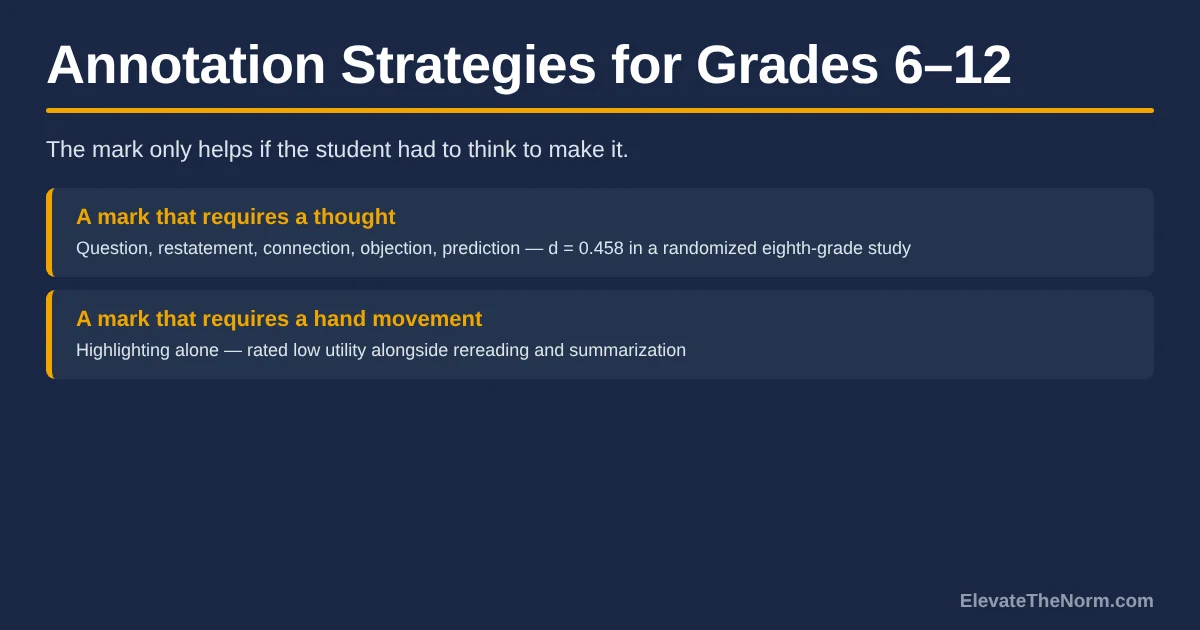
Annotation strategies work when the mark forces a student to think — write a question, restate a chunk in their own words, flag a contradiction. They stop working when students only highlight. A randomized eighth-grade study found structured annotation beat normal instruction by d = 0.46; highlighting alone is rated low utility, alongside rereading.
Key Takeaways
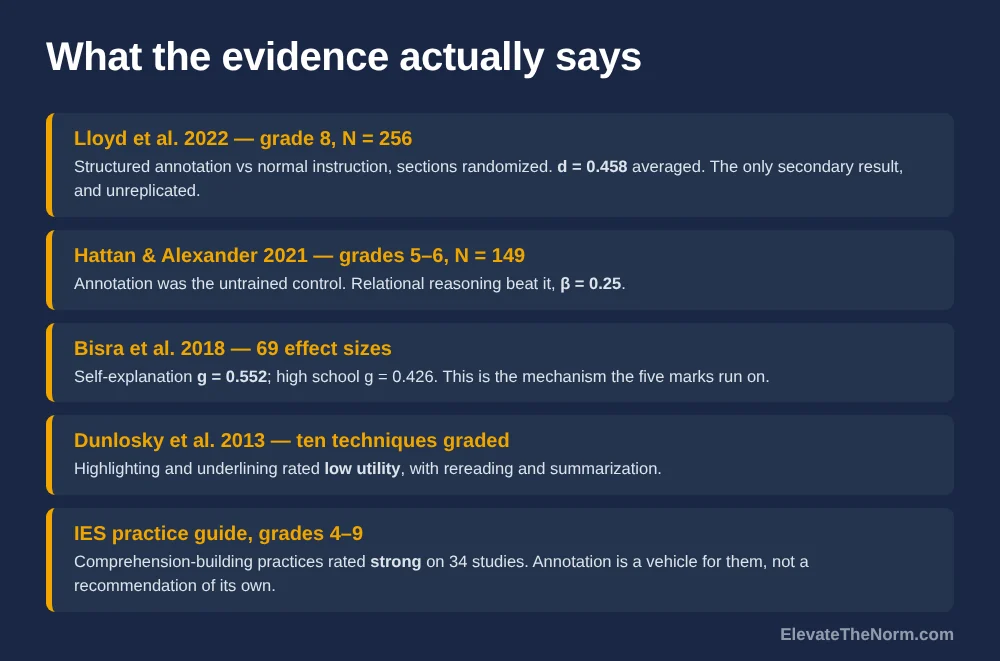
- Annotation has one real randomized result in a secondary classroom. In 256 eighth-grade social studies students across five teachers, a structured annotating condition gained an average of 44.19 points pre-to-post against 40.95 for the control, d = 0.458 — a medium effect.
- Highlighting is not the same thing as annotating, and the distinction decides whether this works. Dunlosky and colleagues rated highlighting and underlining low utility in their review of ten learning techniques, alongside summarization and rereading.
- When annotation is the untrained control condition, it loses. In 149 fifth and sixth graders reading textbook chapters on ancient Greece and Rome, a trained relational-reasoning group outscored the annotation group (β = 0.25) and the other trained group (β = 0.41).
- The mechanism that carries the weight is self-explanation. A meta-analysis of 69 effect sizes and 5,917 participants found g = 0.552 for prompting learners to explain material to themselves, with a detectable effect at every level of schooling (high school k = 13, g = 0.426).
- The federal practice guide for grades 4–9 puts strong evidence behind a bundle, not a marking system: build word and world knowledge, ask and answer questions about the text, determine the gist of short sections, and monitor your own comprehension. Annotation is a vehicle for those four, nothing more.
Most annotation advice is a list of symbols. Circle unfamiliar words, star the main idea, underline evidence, question mark where you are lost. Students learn the symbols in four minutes and then produce pages that look annotated and prove nothing. I have graded stacks of those pages.
The research is not about symbols. It is about whether the student had to generate a thought to make the mark. That distinction separates the one condition that produced a medium effect in a real middle school from the condition that lost to a trained comparison group in a journal article the same year. Below: what the evidence shows, the five marks worth teaching, the one most classrooms default to that does nothing, how often to run it, and where the research stops.
What are annotation strategies?
Annotation strategies are the specific marks and notes a reader makes directly on a text while reading it — questions, restatements, connections, objections, and symbols — in order to make their own thinking visible. The marks are not the point. The thought required to produce the mark is the point.
That definition matters because it cuts the category in two. Marking that requires a decision about importance, meaning or disagreement is generative. Marking that requires only a hand movement — a highlighter dragged across a line that felt important — is not. Both get called annotation. Only one has evidence behind it.
It also separates annotation from note-taking, which it is often confused with. Notes live somewhere else: a page, a document, a two-column template. Annotation lives on the text, which is its one structural advantage — the thought stays attached to the sentence that caused it. If you want the other half of this, the evidence on what belongs on a separate page is a different literature with different numbers.
Do annotation strategies actually improve comprehension?
Yes, when it is explicitly taught and structured. The best secondary evidence is one study: 256 eighth graders, randomized by class section, d = 0.458 on unit tests. One school, never replicated — and still more than most classroom reading strategies can show at this grade level.
The study is worth the detail because the detail is where the usefulness lives. Lloyd, Kim, Cox, Doepker and Downey (2022) ran it in a middle school in the southern United States where over 90 percent of students were economically disadvantaged. Each of five teachers taught two sections; one section per teacher was randomly assigned to annotate. Both groups read the same texts — ReadWorks, Newsela and the standard textbook — and answered the same 20-question pre- and post-tests across a six-week unit.
The intervention was not a handout. Teachers got two hours of training. Students annotated at least twice a week, a minimum of ten sessions, at least ten minutes each. Series one came out at d = 0.320, series two at d = 0.353, and the averaged comparison at d = 0.458, p < .001. Gender showed no significant main effect.
Two things in that design are easy to skim past and both matter. First, the dose: twenty-plus sessions over six weeks. Nobody tested whether one lesson on annotation symbols does anything, and there is no reason to assume it does. Second, the population: a high-poverty eighth-grade cohort, which is the population most annotation advice is written for and almost never tested on.
What annotation strategies don’t work well?
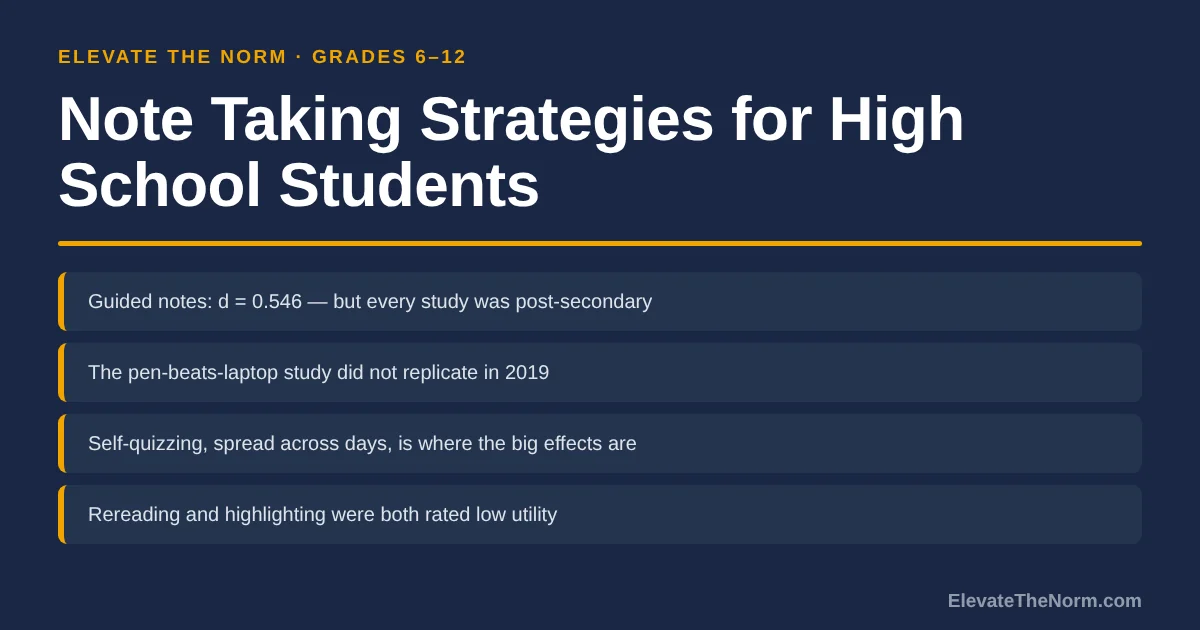
Highlighting alone is the one to stop teaching as a strategy. Dunlosky and colleagues rated highlighting and underlining low utility across learners, materials and outcome measures, and placed it with summarization and rereading rather than with practice testing.
Their 2013 review in Psychological Science in the Public Interest graded ten techniques students actually use. Practice testing and distributed practice earned high utility. Elaborative interrogation, self-explanation and interleaved practice earned moderate. Highlighting or underlining, summarization, the keyword mnemonic, imagery for text, and rereading all earned low. The review’s own framing is blunt: the techniques students lean on hardest do not consistently boost performance.
Why highlighting fails is not mysterious. Deciding what matters in a passage requires already knowing what matters in the passage. A student who can reliably pick the important sentence has largely already comprehended the text, and a student who cannot will highlight the sentence that sounded impressive. Timothy Shanahan made this point in a trade report on the question, arguing that annotation can hinder comprehension specifically when readers lack the knowledge to separate important from unimportant information. That is commentary rather than a trial, and it is worth reading as such.
The other honest problem is that annotation can lose to something better. Hattan and Alexander (2021), in the Journal of Educational Psychology, randomly assigned 149 rural students to one of three conditions reading textbook chapters on ancient Greece and Rome: a traditional knowledge-mobilization technique, a relational-reasoning technique, or text annotation as the control. Relational reasoning — comparing what the text says against what you already know — scored significantly higher than annotation (β = 0.25) and than mobilization (β = 0.41).
Read that result precisely. Annotation was the business-as-usual condition and received no training, while the comparison groups did. It does not show annotation is harmful. It shows that untrained annotation is a low bar, and that a trained thinking routine clears it. Note also the grade band: fifth and sixth graders, which sits at the bottom edge of a grades 6–12 audience and below it for half the sample.
Which annotation strategies work best?
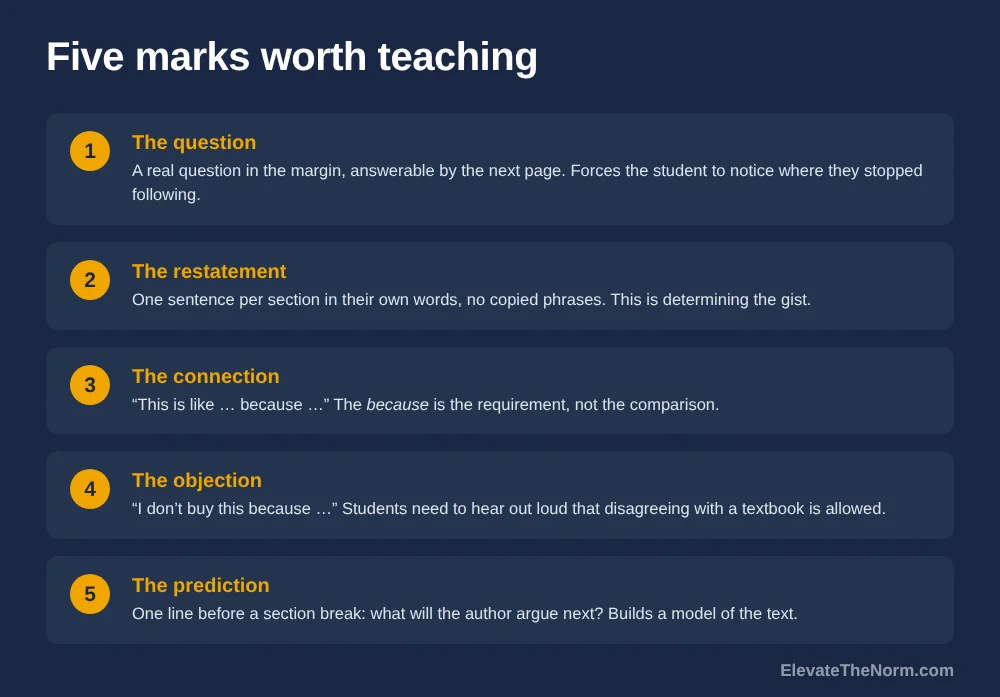
The five that survive the evidence all require the student to generate language rather than mark a location: ask a question, restate a chunk, name the connection, flag the disagreement, and predict what comes next. Each one is a self-explanation prompt wearing a reading-strategy costume.
That is not a rhetorical flourish. Self-explanation is the single best-evidenced mechanism available here. Bisra, Liu, Nesbit, Salimi and Winne (2018) pooled 69 effect sizes from 64 reports covering 5,917 participants and found g = 0.552 (95% CI 0.454 to 0.650) for prompting learners to explain material to themselves. Grade level did not moderate it significantly (QB = 3.051, p = .384): elementary g = 0.483, high school g = 0.426, undergraduate g = 0.611. Social sciences specifically came in at g = 0.555 across six effect sizes.
| The mark | What the student writes | What it forces | Where it fails |
|---|---|---|---|
| The question | A real question in the margin, ending in a question mark | Naming what you do not understand, which requires monitoring comprehension | Students write “what?” Require the question to be answerable by the next page |
| The restatement | One sentence per section, in their own words, no copied phrases | Determining the gist — the practice named in the federal guide | Copying. Ban any clause that appears in the text |
| The connection | “This is like … because …” | Relational reasoning against prior knowledge | Vague connections to personal life. Require the because |
| The objection | “I don’t buy this because …” | Evaluating a claim against evidence rather than absorbing it | Students think disagreeing with a textbook is not allowed. Say out loud that it is |
| The prediction | One line before a section break: what happens or follows next | Building a model of the text rather than decoding sentence by sentence | Fiction-style guessing on expository text. Ask what the author will argue next |
| Highlighting only | Nothing | Nothing it can be held to | Rated low utility. Keep it as a locator, not a strategy |
Highlighting still earns a small place. As a locator — mark the three lines you will come back to, then write beside them — it saves time and the writing does the work. The failure mode is highlighting as the finished product.
What does the strongest evidence actually recommend?
The federal practice guide for grades 4–9 puts strong evidence behind a bundle of four comprehension practices, and annotation is not one of them. It is a delivery method for three of them.
The What Works Clearinghouse guide Providing Reading Interventions for Students in Grades 4–9 makes four recommendations. Three carry a strong evidence rating: build decoding of multisyllabic words, provide purposeful fluency-building, and “routinely use a set of comprehension-building practices to help students make sense of the text.” The fourth — practice with stretch text — carries moderate evidence. The comprehension recommendation rests on 34 studies, 23 meeting WWC standards without reservations and 11 with reservations.
Its four parts are worth naming because they map almost exactly onto the marks in the table above: build world and word knowledge relevant to the passage; give students repeated chances to ask and answer questions about the text; teach a routine for determining the gist of a short section; and teach students to monitor their comprehension as they read. The question mark, the restatement and the comprehension check are items two, three and four.
A caution for anyone reading this at district level, because it is the predictable way this gets ruined. Annotation is free, which makes it attractive to mandate, and it is visible on a page, which makes it attractive to put on a walkthrough form. Both of those are mistakes. The only result here came from a six-week routine with teacher training behind it, and an annotation box on an observation rubric reliably produces annotated-looking pages rather than thinking — the same substitution of the visible for the real that makes highlighting feel productive. Fund the training and the short texts; do not count the marks.
This is the most useful reframe in the whole topic. You are not teaching annotation. You are teaching four comprehension practices, and annotation is the cheapest way to make them visible and gradeable on a page you can collect. The same logic applies to what you can actually see a student understanding in any format.
How often should students annotate?
The only dose with a result attached is twice a week for at least ten minutes, across at least ten sessions in a six-week unit. That is the schedule the eighth-grade study ran, and the effect belongs to that schedule, not to annotation in general.
Which means the honest answer to “should I do an annotation day?” is no. One lesson on symbols has no evidence behind it and considerable evidence against the general class of one-off strategy lessons. Annotation that works is a recurring routine on short texts, not an event on a long one.
It also means short texts. Ten minutes of real annotation covers one or two pages at this grade level, not a chapter. A teacher assigning fifteen pages of annotated reading is assigning highlighting, whatever the directions say.
And it means solving the problem nobody writing about annotation seems to have: most students in grades 6–12 cannot write in the book. School textbooks are inventoried and reissued, which makes the core instruction physically impossible on the main text in most buildings. The workarounds are all fine and worth choosing deliberately rather than improvising on the day. Print the one page. Use sticky notes, which is what the eighth-grade study did. Put a two-inch margin column on a half-sheet that sits beside the book. Or move the text to a device. What does not work is assigning annotation on a consumable students do not have, which produces nothing and teaches them the assignment was not serious.
One accessibility note that belongs here rather than in a footnote. The requirement is that the student generate the thought, not that they write it by hand. A restatement spoken to a partner who writes it down, dictated to a phone, or typed is the same cognitive act. Students with writing disabilities, slow handwriting or a hand injury should not be locked out of the one practice here with evidence behind it because the delivery got confused with the strategy.
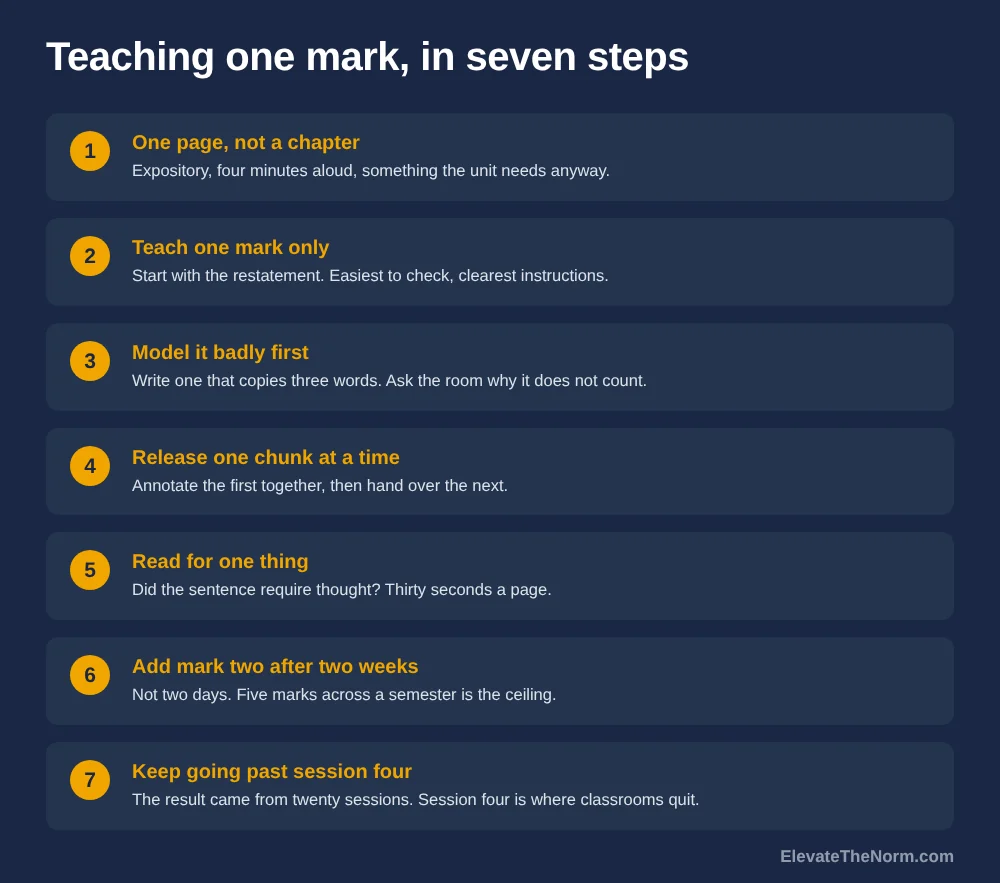
Here is the sequence I would run, built from the two studies and the practice guide rather than from the symbol charts:
- Pick a text you could read aloud in four minutes. One page. Expository. Something they need for the unit anyway, not a strategy exercise.
- Teach one mark. One. Start with the restatement, because determining the gist is the practice with the clearest instructions in the federal guide and the easiest to check.
- Model it badly on purpose, then well. Write a restatement that copies three words from the text and ask the room why it does not count. The rule becomes theirs instead of yours.
- Annotate the first chunk together, then release one chunk at a time. This is the gradual release the practice guide’s comprehension studies almost all use.
- Collect and read for one thing only. Did the sentence require thought? That is a thirty-second judgment per page and you can do a class set in a planning period.
- Add the second mark after two weeks, not two days. The question mark next, then the objection. Five marks across a semester is a realistic ceiling.
- Keep doing it after it stops feeling new. The result came from twenty sessions. Session four is where most classrooms quit.
How do you stop students from faking it?
Make the mark impossible to produce without thinking, then grade the thinking rather than the quantity. Every faked annotation page shares one feature: the marks could have been made without reading. Remove that possibility and the problem mostly disappears.
Three requirements do most of the work. Ban copied clauses in a restatement — any phrase lifted from the text makes the line void. Require the word because in a connection or an objection, which is the self-explanation prompt in its smallest possible form. And cap the number of marks per page, which kills the volume strategy outright; six good marks beats forty.
The grading question is where teachers rightly get nervous, because an annotation assignment sounds like a stack of unquantifiable pages. It is not. One mark, read for whether it required thought, scored out of two. Collect six pages a semester rather than sixty, and spot-check the rest during the lesson while students are still writing — which is also when the information is useful to you rather than historical.
Does annotation work on a screen?
Probably, but nobody has demonstrated it for grades 6–12 with the clarity of the paper study, so treat digital annotation as a reasonable extension rather than an evidenced equivalent.
The honest state of play: the secondary result above was produced with symbols, highlighters and sticky notes on paper. The sizeable research literature on social annotation tools — shared margins where students see and reply to each other’s notes — sits overwhelmingly in higher education, and transferring an undergraduate result to a ninth-grade room is exactly the move this site tries not to make.
What does carry over is the mechanism, since self-explanation showed a detectable effect at every level of schooling and did not vary significantly by subject. A comment box that demands a because is doing the same cognitive work as a margin that demands one. The practical differences are mundane: a shared margin changes who the annotation is performed for, and you can see every student’s thinking at once, which beats carrying a paper set around. If devices are the constraint you are working around, reading on screens has its own set of problems worth sorting out first.
Where does the evidence run out?
It runs out early, and the gaps are large enough to name plainly: one secondary randomized study, no comparison between marking systems, no high school sample at all, and no test of whether annotation skill lasts past the unit.
- One study carries the grade band. Lloyd and colleagues is a single eighth-grade cohort in one school. It was randomized by section rather than by student, five teachers delivered it, and it has not been replicated. A medium effect from one site is a reason to try something, not a reason to mandate it.
- No high school evidence. The two classroom studies here are grades 5–6 and grade 8. For grades 9–12 the argument is entirely mechanistic: self-explanation works at high school level (g = 0.426, k = 13), and these marks are self-explanation prompts. That is a reasonable inference and it is not a result.
- Nobody has compared marking systems. There is no trial showing a five-symbol code beats a three-symbol code, or that AVID-style marking beats a plain question margin. Anyone selling you a specific system is selling a preference.
- Durability is untested. Both studies measured outcomes inside or just after the intervention. Whether a student who annotated for six weeks in eighth grade still does it in tenth is unknown.
- The one measured comparison went against annotation. Hattan and Alexander found a trained alternative beat it. If you have time to teach one thinking routine properly, the evidence does not clearly say annotation should be that routine.
Clay’s take: the margin is the only place I can see them think
I teach history, so most of what I assign was written by somebody who wanted students to believe it. A question mark in the margin is worth more to me than any comprehension question I could write. The margin tells me where the student stopped following; my question only tells me whether they can answer my question.
The place this pays off is the whiteboard table. I built that table and it sits in the corner under a lower lamp with a rug and the better chairs, and students ask to go there. When a kid comes over with a page they have marked up, I am not diagnosing them from scratch. The page already tells me where it went wrong, and we start from that sentence. Without the margin I would be asking questions until I found the gap, which costs the whole conference.
What I will not claim is that I taught annotation well my first few years. I taught the symbols. Students learned the symbols, handed in colorful pages, and understood the reading no better than before. The change was dropping four symbols and keeping one requirement: write a sentence that proves you thought about this, and do not use the author’s words to do it. The pages got uglier and the conferences got shorter.
And the thing the research says that I would say anyway: a highlighter is a confidence machine. It makes a student feel like they studied. Ask them to write one sentence instead and the feeling goes away, which is the first honest signal either of you has had.
What to do next week
Pick one page, not a chapter. Teach the restatement only, ban copied phrases, and require one sentence per section. Collect it on Friday and read for a single question: did this require thought? Then do it again the following week, because the only result anyone has was produced by doing it twenty times.
If you want the companion pieces: what the evidence says about the separate page covers guided notes and the laptop-versus-longhand fight, five checks that fit a real week is where annotation becomes information you can act on, and the engagement guide has the version of this that sits inside a wider set of routines. Document-based projects are where the objection mark starts earning its keep, and checking who made a source before you read it is the same habit pointed at the open web. Everything on this site is free and nothing asks for your email address.
Annotation is a reading method, not a revision method. If a text is too hard for students to start alone, an interactive read aloud can carry the class through the first pages before the marking begins. When students move from reading the text to preparing for an assessment on it, the study techniques with the strongest evidence are practice testing and spacing — and highlighting rates near the bottom of the same list.
The payoff shows up fastest on a timed task. Margin notes that record a document’s position rather than its content are what make the grouping step possible when students have to build one argument from several sources.
Annotation is a during-reading move; it assumes students are already in the text. The before-reading counterpart asks them to take a position first and then go hunting for whatever supports or demolishes it — how to build an anticipation guide covers the three-phase version, including why the column students fill in after reading is the one that does the work. The more open version of the same before-reading move is the KWL chart, which asks what students already know instead of asking them to take a position.
Marking a text up is one pass, not the whole job. The protocol that surrounds it gives each reading its own question — what the text says, how it is built, what it means — and confines the marking to the middle one. How close reading works in grades 6–12 sets out that sequence, along with an honest account of why the comparison studies behind it do not exist.
Marking the page and talking about the page are different acts, and only one of them is audible. Reciprocal teaching puts four comprehension jobs into a student-led conversation, which is the part its originator says is load-bearing. The four roles, and why the dialogue is the piece that works covers what each role asks for, what the roles look like when students are performing them rather than doing them, and how to pick a text that gives the clarifier something to do.
Before a student can annotate usefully, somebody has to show them what the marks are for. A margin note is the visible residue of a decision, and most students have never watched an adult make one out loud. How to narrate your own reading so the decision is audible sets out the difference between a think aloud and reading a passage aloud, what the federal guides actually rate as strong, and the one head-to-head test in which narration beat nothing at all.
Annotation gets students to the evidence. It does not get them to the point. Pulling the theme out of a marked-up text is a separate move with its own failure mode: students name a topic in one word and stop. Teaching theme in grades 6–12 gives a definition students can use, a sentence frame that forces a claim rather than a label, and the two questions — what changed, and why did the author let it — that do most of the work.
Frequently Asked Questions
What are the best annotation strategies for students?
The five with the best support all require the student to generate language: write a real question, restate a section in their own words with no copied phrases, name a connection using the word because, record a disagreement, and predict what the author argues next. Each is a self-explanation prompt, and self-explanation is the mechanism with the strongest evidence behind it.
Does annotating actually improve reading comprehension?
In the one randomized secondary study available, yes. Lloyd and colleagues (2022) assigned 256 eighth graders by class section to structured annotation or normal instruction across a six-week unit and found an average effect of d = 0.458 on unit tests. It is a single school and has not been replicated, so treat it as promising rather than settled.
What annotation strategies don’t work well?
Highlighting on its own. Dunlosky and colleagues rated highlighting and underlining low utility in their review of ten learning techniques, grouping them with rereading and summarization rather than with practice testing. The problem is that choosing what to highlight requires already knowing what matters, so it rewards students who have comprehended and gives the others nothing.
How often should students annotate?
The only schedule with a result attached is at least twice a week, ten minutes or more per session, for at least ten sessions. A single lesson on annotation symbols has no evidence behind it. Short texts matter too: ten minutes of genuine annotation covers one or two pages in grades 6 through 12, not a full chapter.
Is annotation the same as taking notes?
No. Annotation lives on the text, so the thought stays attached to the sentence that caused it. Notes live on a separate page or document. They draw on different research literatures with different numbers, and a student can be good at one and poor at the other. Both are worth teaching, but not in the same week.
How do you grade annotation without drowning in paper?
Grade one thing: did the mark require thought? That is a judgment of a few seconds per page, scored out of two. Cap the number of marks per page so volume cannot substitute for quality, collect six pages a semester rather than sixty, and spot-check the rest while students are still writing, when the information is useful to you.
Does annotation work for struggling readers?
The eighth-grade study was run in a school where over 90 percent of students were economically disadvantaged, which is more relevant than most reading research. But one literacy researcher has argued annotation can hinder comprehension when readers cannot separate important from unimportant information, which is a real caution. Teaching the restatement first rather than importance-marking addresses it directly.
What if students cannot write in the textbook?
That is the normal case in grades 6 through 12, and it has four workable answers: print the single page, use sticky notes as the eighth-grade study did, add a wide margin column to a half-sheet that sits beside the book, or move the text to a device. Choose one deliberately. Assigning annotation on a consumable students do not have produces nothing.
Sources
- Lloyd, Z. T., Kim, D., Cox, J., Doepker, G. M., & Downey, S. E. (2022). Using the annotating strategy to improve students’ academic achievement in social studies. Journal of Research in Innovative Teaching & Learning, 15(2), 218–231. 256 eighth graders, five teachers, sections randomly assigned; over 90% economically disadvantaged. Series 1 d = 0.320; series 2 d = 0.353; averaged d = 0.458, p < .001. No significant gender effect.
- Hattan, C., & Alexander, P. A. (2021). The effects of knowledge activation training on rural middle-school students’ expository text comprehension: A mixed-methods study. Journal of Educational Psychology, 113(5), 879–897. 149 rural fifth and sixth graders randomly assigned to knowledge mobilization, relational reasoning, or text annotation as the control. Relational reasoning scored higher than mobilization (β = 0.41) and than the annotation control (β = 0.25). Note the grade band and that annotation received no training.
- Bisra, K., Liu, Q., Nesbit, J. C., Salimi, F., & Winne, P. H. (2018). Inducing self-explanation: A meta-analysis. Educational Psychology Review. 69 effect sizes from 64 reports, 5,917 participants. Random-effects g = 0.552 (SE = .050, 95% CI 0.454–0.650). No significant moderation by grade level (QB = 3.051, p = .384): elementary g = 0.483, high school g = 0.426 (k = 13), undergraduate g = 0.611. Social sciences g = 0.555.
- Dunlosky, J., Rawson, K. A., Marsh, E. J., Nathan, M. J., & Willingham, D. T. (2013). Improving students’ learning with effective learning techniques. Psychological Science in the Public Interest, 14(1), 4–58. Practice testing and distributed practice rated high utility; elaborative interrogation, self-explanation and interleaved practice moderate; highlighting/underlining, summarization, keyword mnemonic, imagery for text and rereading all rated low. Read via the journal’s abstract and summary page; the full text sits behind a login.
- Institute of Education Sciences, What Works Clearinghouse. Providing Reading Interventions for Students in Grades 4–9 (Educator’s Practice Guide). Recommendation 3, “routinely use a set of comprehension-building practices,” carries a strong evidence rating based on 34 studies (23 meeting WWC standards without reservations, 11 with reservations). Its parts: build world and word knowledge; ask and answer questions about the text; determine the gist of short sections; monitor comprehension while reading.
- Barnum, M. (2023). Annotation can hinder reading comprehension compared to other literacy strategies. K-12 Dive. Cited as a trade report, not a study. Carries Timothy Shanahan’s argument that annotation can hinder comprehension when readers lack the knowledge to distinguish important from unimportant information, and points to the two studies above.