Tag: secondary teaching

  • Effective Parent Teacher Communication: What Actually Works in Grades 6–12

    Effective Parent Teacher Communication: What Actually Works in Grades 6–12

    Effective parent teacher communication is short, specific, about one student, and sent on a schedule — and it starts before anything goes wrong. The strongest evidence in this corner of education research is not for longer conferences or better newsletters. It is for brief individual messages that reach a phone the family actually checks. That is the finding, and it is unusually consistent.

    Most writing on this subject treats the problem as tone. Be warm. Build partnerships. Assume good intent. None of that is wrong and none of it is the part that moves a student. What moves a student is a parent who knows something specific and current that they did not know an hour ago.

    This page covers what researchers actually tested, what they found, where the evidence runs out, and how a secondary teacher carrying 140 students can run the thing without giving up their evenings.

    Key Takeaways

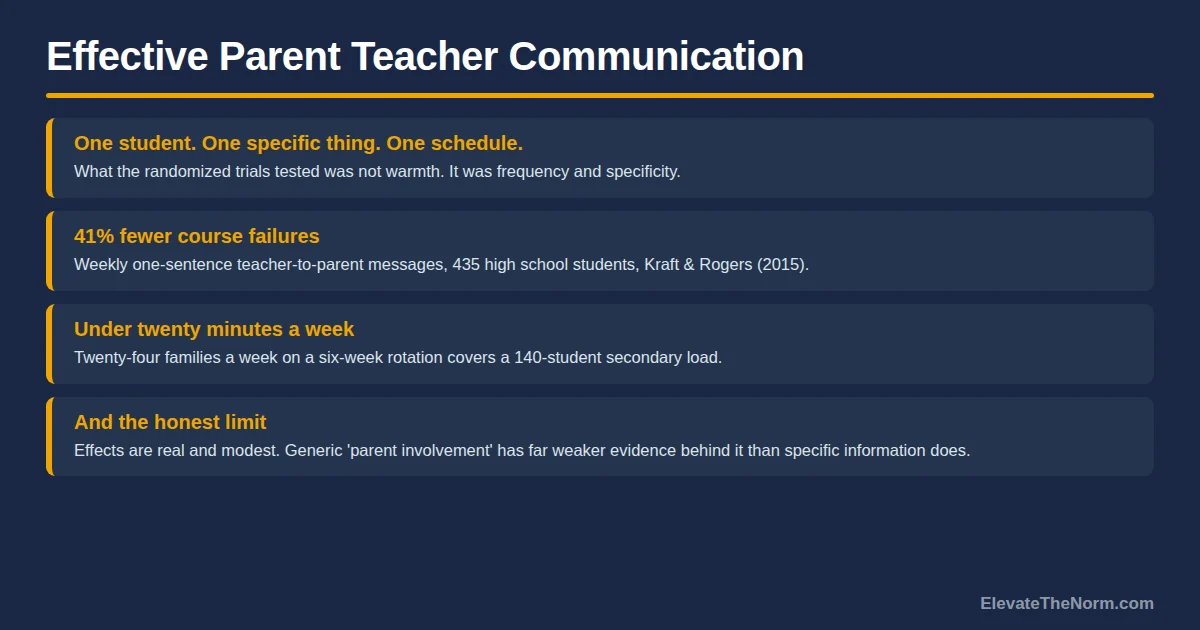
    • Weekly one-sentence messages cut course failure. In a randomized field experiment with 435 high school students in summer credit recovery, weekly individualized teacher-to-parent messages raised credit earning by 6.5 percentage points — a 41% reduction in the failure rate.
    • “Here is what to fix” outperformed “here is what went well.” In that same trial, improvement-focused messages produced an 8.8-point gain. Positive-only messages produced 4.5 points and did not reach statistical significance.
    • Frequency matters more than length. A daily phone call plus a written message in a sixth- and ninth-grade summer program raised the odds of homework completion by 40% and cut the number of times a teacher had to redirect a student by 25%.
    • Parents are wrong about their own kids in a predictable direction. They overestimate how much work their child is doing. Correcting that with regular reports on missed assignments improved achievement.
    • Not everything called “parent involvement” helps. Across 63 involvement measures in two national datasets, helping with homework and setting homework rules were not associated with gains, and several forms were linked to worse outcomes.
    • The barrier is structural, not attitudinal. Teachers spend about an hour a week on family contact — roughly 8% of their noninstructional hours — and report missing contact information, no protected time, and no stated expectation from the building.

    What does effective parent teacher communication actually look like?

    Four things: it names one student, it names one specific and recent thing, it arrives on a predictable schedule, and it reaches a device the family checks. Everything else is decoration.

    The cleanest evidence comes from a randomized field experiment run by Matthew Kraft and Todd Rogers and published in Economics of Education Review. Teachers in a five-week summer credit recovery program wrote one sentence a week about each student. Not a paragraph. Not a form. One sentence, delivered to the parent by phone, text or email in whichever of four languages the family used. Students were randomly assigned to receive improvement-focused messages, positive messages, or nothing beyond an introductory call. I track every call in my free Parent Contact Log on TPT, which also has opener scripts for the first thirty seconds.

    Credit earning rose 6.5 percentage points in the combined treatment group, which the authors describe as a 41% reduction in the course failure rate. Absenteeism fell 2.5 percentage points. The gain was driven largely by a 6.1-point drop in students dropping the program altogether.

    Pay attention to how small the teacher’s job was in that design. The whole intervention was one sentence per student per week. That is the reason it is worth your attention: it is a finding about something a real teacher can actually sustain, not a finding about an ideal that collapses in October.
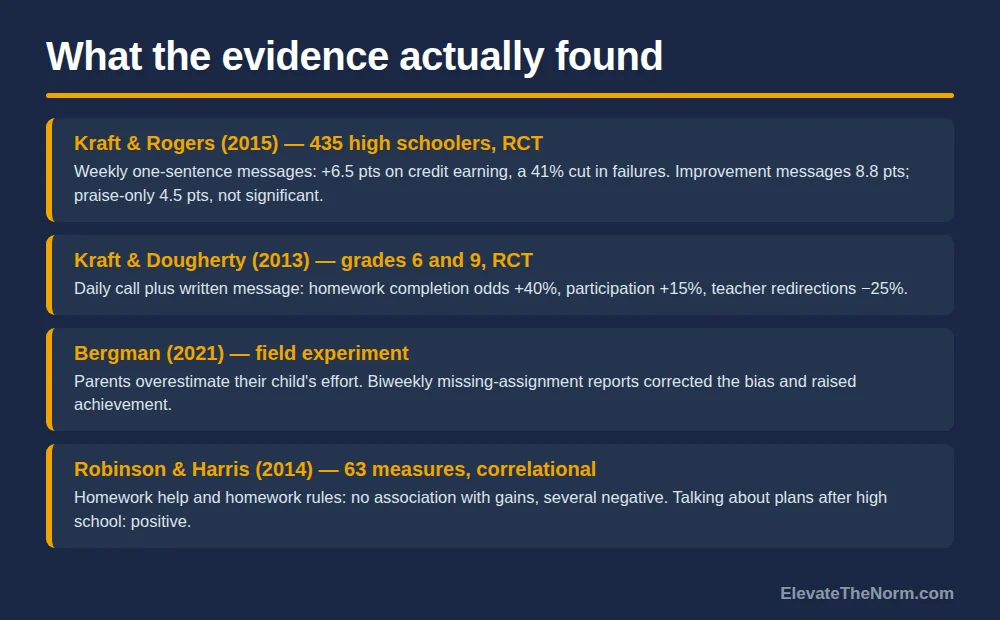
    Four research summaries on parent teacher communication: Kraft and Rogers 2015, Kraft and Dougherty 2013, Bergman 2021, and Robinson and Harris 2014
    Three randomized trials and one finding that cuts against the grain.

    The honest limits matter too, and the authors state them. The sample was 435 students, predominantly Black and Hispanic, 81% eligible for free or reduced-price lunch, in one large urban district in the Northeast. External validity, in their words, is likely limited to low-performing urban high school students. Their planned replication never happened, for an unusually good reason — the district liked the result enough to roll parent outreach out everywhere, which erased the comparison group.

    Should the message name the problem or the good news?

    Name the problem. In the one trial that separated them, improvement messages moved the outcome by 8.8 percentage points and praise-only messages moved it 4.5 points without reaching statistical significance.

    Be careful how far you carry that. The positive condition’s point estimate was still positive. What the study shows is that the improvement message was the one researchers could be confident about, not that praise is worthless. The practical reading is narrower and more useful: if you only get one message a week, spend it on something the family can act on.

    There is a second reason not to write off positive contact, and it comes from the earlier Kraft study. Kraft and Shaun Dougherty ran a randomized experiment in a mandatory summer program with sixth and ninth graders, where the treatment was a daily phone call home plus a written message. Homework completion odds rose 40%, class participation rose about 15%, and instances requiring teacher redirection fell 25%. The authors traced those gains to three mechanisms: stronger teacher-student relationships, expanded parental involvement, and increased student motivation. The first of those does not get built out of bad news alone.

    My own read, stated as opinion rather than finding: the first contact of the year should be the one with nothing wrong in it, because it buys you the credibility to make the second one count. The research does not test that sequence. It is a judgment call.

    How often is often enough?

    Weekly is the tested dose. Daily works better and will not survive a secondary teaching load. Monthly is close to nothing.

    Three studies bracket the range. Kraft and Rogers sent one message a week. Kraft and Dougherty called daily. A third randomized trial, run by Samuel Berlinski and colleagues across seven low-income schools in Santiago, Chile, texted parents weekly attendance and monthly grade and behavior updates, and found a 0.083 standard deviation gain in math GPA and a 4.5 percentage point increase in students meeting the attendance requirement.

    That Chilean study is worth citing and worth qualifying in the same breath. It covered grades 4 through 8, so much of the sample was younger than the students this site is about. The effects were smaller than comparable U.S. interventions, which the authors attribute to Chile’s exam-based grading. Only about 60% of the messages were confirmed delivered. And its most interesting result for a secondary teacher is the heterogeneity: students at higher baseline risk showed effects roughly two to three times larger than their lower-risk peers. Where you spend your twenty minutes is not a neutral choice.

    What should the message actually say?

    Four parts, one sentence or two. A name, a specific and recent thing, the current status, and either one clear ask or an explicit statement that there is nothing to do.

    That last part is the one most teachers skip, and it is the one that keeps families reading. If every message you send implies homework for the parent, the messages stop getting opened by November.
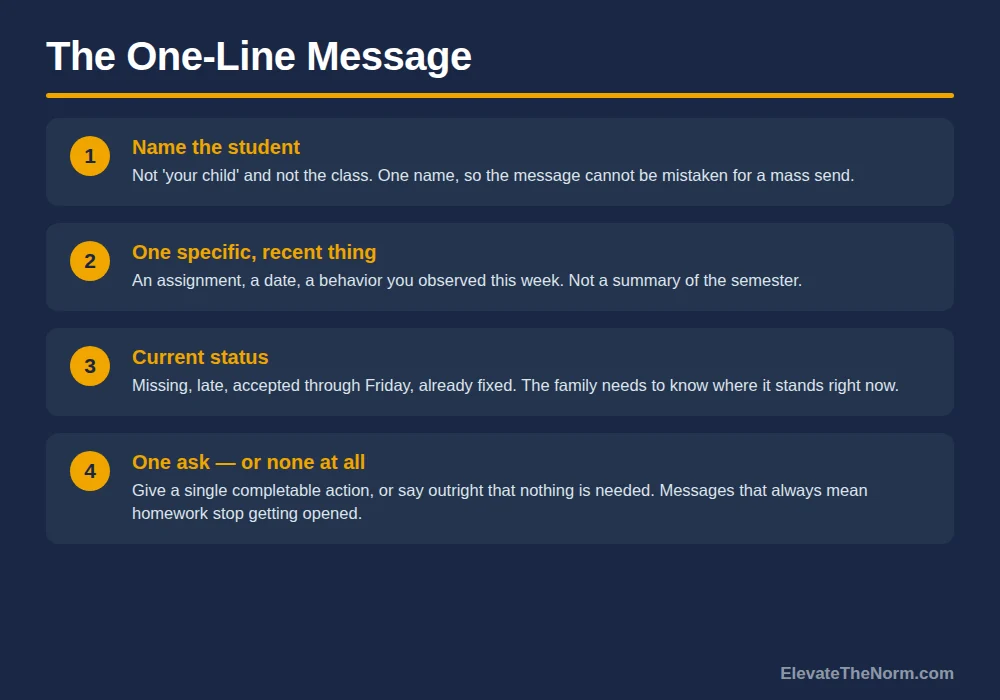
    Four numbered parts of a one-line message home: name the student, one specific recent thing, current status, and one ask or none
    Four parts, two sentences at most, about forty-five seconds.

    Three patterns that work

    • Nothing needed. “[Name] turned in the unit argument paper today and it was one of the strongest drafts in the period. Nothing needed on your end — just wanted you to know.”
    • Actionable and time-bound. “[Name] has two missing practice sets from last week. Both can still be turned in by Friday for full credit.”
    • Early flag, no verdict. “[Name] has been quiet in discussion for about two weeks. Not in trouble, not a discipline thing. Flagging it in case something is going on.”

    What to leave out

    • Adjectives about character. “Disrespectful,” “lazy,” “doesn’t care.” Report the behavior and the date. The parent can draw conclusions about their own child; that is their job, not yours.
    • Anything that sounds like a diagnosis. You are not qualified to speculate about attention, anxiety, or home life in a text message, and a guess in writing follows a kid around.
    • An ask the family cannot complete. “Please talk to him about his attitude” is not an action. “Two practice sets, due Friday” is.
    • A consequence the office has already assigned. Relitigating a referral by text puts you between the family and the administrator, and it will not go well for you.

    What does not work — and what the research does not say

    Generic “parent involvement” is not the same thing as specific information, and the evidence for the first is much weaker than schools assume.

    Keith Robinson and Angel Harris examined 63 different parental-involvement indicators across two national longitudinal datasets spanning three decades. Helping with homework was not associated with achievement gains. Setting rules about homework or GPA was not either. Several forms of involvement were linked to negative outcomes. What did show an association: conversations between parents and children about plans after high school, and parents holding high educational expectations.

    The authors are careful, and anyone citing them should be too. Their data are correlational, and they say outright that their findings cannot definitively confirm or deny whether parental involvement improves outcomes. Their sharper point is a policy point: telling parents to be “involved” without specifying which involvement is unlikely to accomplish anything.

    Put their work next to the randomized trials and a reading emerges, though I want to be clear this is my interpretation and not a claim either set of authors makes. The experiments that worked did not ask parents to teach. They handed parents accurate, current, specific information and let the family decide what to do with it. That is a materially different intervention from “be more involved,” and it happens to be the one with random assignment behind it.

    Peter Bergman’s field experiment, published in the Journal of Political Economy, points the same direction. He found that parents hold upwardly biased beliefs about how much effort their child is putting in. Biweekly information about missed assignments attenuated that bias and improved achievement, and he attributes the effect to more accurate beliefs and lower monitoring costs. Parents were not short on willingness. They were short on facts.

    How do you do this with 140 students?

    Run a rotation. Roughly two dozen families a week, in a fixed block you protect, so that every family in your roster hears from you inside six weeks.

    The arithmetic is the whole argument. 140 students divided across a six-week cycle is about 24 contacts a week. At forty-five seconds a message — which is what a one-sentence text actually takes once you stop drafting it like an email — that is under twenty minutes. Five minutes a day, four days a week.
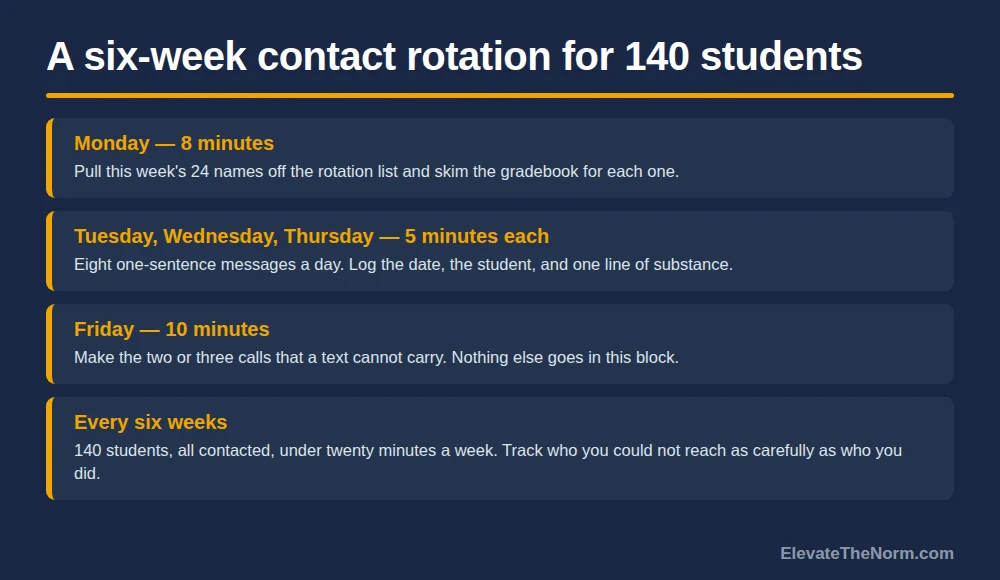
    Day-by-day weekly schedule for a parent contact rotation showing Monday planning, eight messages on each of three days, and a Friday call block
    Twenty-four families a week. Under twenty minutes of actual work.
    DayWhat happensTime
    MondayPull the week’s 24 names off the rotation list. Skim the gradebook for each.8 min
    TuesdaySend eight messages. Log each one with date and substance.5 min
    WednesdaySend eight more. Handle any replies from Tuesday.5 min
    ThursdaySend the last eight. Flag anything that needs a call instead of a text.5 min
    FridayMake the two or three actual phone calls. Nothing else.10 min

    Four rules that keep a rotation alive past October

    1. Audit contact information in the first two weeks. Outdated and missing numbers are the single most reported structural barrier, and a rotation built on a bad roster quietly stops reaching the families who most need it.
    2. Never let a family’s first message be a problem. Front-load the cycle so every family gets a neutral or positive contact before anything goes wrong.
    3. Log it. Date, student, medium, one line of substance. A simple contact log is the difference between a practice and a vague memory of having called somebody.
    4. Do not automate the sentence. An auto-generated “missing assignment” alert is a different product from a teacher writing one line. Both have a place, and the apps built for this are genuinely useful for logistics. Neither replaces the other.
    5. Put all four rules written down on one page. A rotation that lives only in your head is a rotation that ends the first week you are covering someone else’s class.

    What about the conversation you do not want to have?

    Lead with the fact, hand the family the floor, and leave with one agreed next step and a date on it.

    1. Open with the specific, not the summary. “There were four missing assignments in the last two weeks and a zero on the unit test” is a starting point. “He is struggling” is not.
    2. Stop talking. Ask what they are seeing at home and then actually wait. Families often know the reason and will not volunteer it into a monologue.
    3. Say what you can and cannot change. Deadlines you control, you can move. School policy you do not control, you should not pretend to.
    4. Agree on one thing, not five. One action, one owner, one date. A plan with five parts is a plan nobody completes.
    5. Write it down and send it. Two sentences, same day, so the family and the file both have the same version.

    If a parent is angry, do not defend and do not re-argue a consequence the office assigned. Restate what you heard, confirm the facts you are sure of, and say plainly which part of it is not yours to decide. If the subject is academic dishonesty, the documentation matters more than usual and the wording is its own problem — that is covered separately in how to write the academic integrity email.

    Teenagers should know these conversations are happening. A student who finds out their teacher and their parent have been talking for six weeks behind them learns something about you that you did not intend to teach. Tell them the rotation exists and that everyone is on it. It also removes the signal value of a phone call, which is most of what makes students dread one.

    Three ways this practice goes wrong

    A message that improves a student’s grade can still do harm. None of the trials cited above measured what happened at home after the text arrived, and that gap deserves to be named rather than glossed.

    • It can turn into punishment you did not order. An improvement message lands in a house you know nothing about. Most families handle it fine. Some do not. Write messages that describe work and deadlines rather than character, keep “he refuses” and “she does not care” out of writing entirely, and pair a problem with the path back to fixing it in the same sentence. If you have reason to believe a message will make a student’s evening worse, that is a conversation with a counselor, not a text.
    • It can leak through the wrong channel. Use the district’s approved platform, school email, or a school-provided number. Not your personal cell. That is partly a records question — family communication about a student is often a record — and partly self-protection. Once your personal number is in a hundred phones you do not get it back.
    • It can quietly skip the families hardest to reach. A parent working nights, a family sharing one phone, a household that needs a language you do not have, a number disconnected in September. A rotation that only reaches the easy 80% will read as a success in your log and will be a failure in the only place it matters. Track who you could not reach as carefully as who you did, and hand that list to someone in the building who can do something about it.

    One more, from the student’s side. Grades 6–12 students are old enough to be told what is being said about them, and old enough to resent finding out later. Tell your classes the rotation exists, tell them everyone is on it, and be willing to show a student the sentence you sent about them. If you would not show it to them, do not send it.

    What administrators owe teachers here

    Accurate contact data, protected time, and a stated expectation. Without those three this is a volunteer program, and volunteer programs produce unequal coverage.

    The Federal Reserve Bank of Boston’s Communities & Banking reported that teachers give roughly an hour a week to parent communication — about 8% of their noninstructional work hours — while principals spend around 3% of their workday on it. The barriers teachers named were not about caring: inaccessible or outdated parent contact information, language barriers, no noninstructional time during the school day, and no clear expectation from the building about when or why to contact families.

    That last one is the cheapest to fix and the one most worth fixing. A building that states an expectation — every family hears from a teacher inside the first three weeks, and again at least monthly — and then protects twenty minutes a week for it, has done more than any platform purchase will. A building that buys the platform and states nothing has bought a log of messages nobody sent.

    There is an equity argument here that superintendents should hear plainly. When contact is voluntary, the families who get contacted are disproportionately the families who already contact you. The Chilean trial found the largest effects among the highest-risk students. If the practice is left to individual initiative, those are precisely the students it will reach last.

    What to do next

    Pick one class period, not all six. This week, verify the contact information for every student in it and find out which families prefer text, which prefer a call, and which need another language. Next week, send twenty-four one-sentence messages and write down that you sent them. Six weeks after that, put your failure list next to your contact log and see whether the names overlap.

    That is what effective parent teacher communication comes down to in practice, and it is unglamorous: under twenty minutes a week, and it has better randomized evidence behind it than most of what gets presented at professional development. Build it into the routines you already run rather than treating it as one more initiative, and pair it with expectations students can actually see so the message a family gets matches the room their kid sits in. If attendance is your presenting problem rather than grades, the absenteeism evidence points at family messaging for that too. And when the conference itself comes around, what families should actually ask in those fifteen minutes is worth sending home in advance — it turns the meeting into a working session rather than a status update.

    Frequently Asked Questions

    What is the most effective way for teachers to communicate with parents?

    Short, individual messages sent on a regular schedule, through whatever channel the family actually checks. In a randomized field experiment with 435 high school students, teachers who sent one individualized sentence per week to each family raised course credit earning by 6.5 percentage points, a 41% reduction in the failure rate. The medium mattered less than the fact that the message named one student and one specific, recent thing. Newsletters, group emails, and general updates were not what was tested and are not what produced the result.

    How often should teachers contact parents in middle and high school?

    Weekly is the dose with the best evidence behind it, and it is achievable if you run a rotation rather than trying to contact everyone every week. Roughly two dozen families a week across a six-week cycle covers a 140-student load in under twenty minutes of actual work. Daily contact produced larger effects in one summer-program study, but that study involved a handful of students per teacher and does not transfer to a full secondary schedule. Monthly is better than nothing and close to nothing.

    Should the first contact home be positive or about a problem?

    The research is narrower than the advice you usually hear. In the one trial that separated them, improvement-focused messages produced an 8.8 percentage point gain while positive-only messages produced 4.5 points and did not reach statistical significance. That is an argument for spending a scarce message on something actionable, not an argument that praise is useless — the positive estimate was still positive. Making the first contact of the year a neutral or good one is a judgment call about credibility, not a research finding.

    Does texting parents actually improve student grades?

    In several randomized trials, yes, with modest effect sizes. Weekly texts and calls reduced course failure in a U.S. high school credit recovery program. Biweekly reports on missed assignments corrected parents’ overly optimistic beliefs about their child’s effort and improved achievement. A trial in Chile covering grades 4 through 8 found a 0.083 standard deviation gain in math GPA, with effects two to three times larger for higher-risk students. These are real but moderate gains from a very cheap intervention, not a transformation.

    What should a teacher never put in a message home?

    Adjectives about character, anything that reads as a diagnosis, an ask the family cannot actually complete, and any attempt to relitigate a consequence the office already assigned. Report the behavior and the date rather than your conclusion about the student. “Two missing practice sets, both accepted through Friday” gives a family something to do. “He does not care” gives them nothing and follows the kid around in writing. Use the district’s approved channel, not your personal phone number.

    How can one teacher contact 140 families without losing their evenings?

    Divide the roster across a six-week rotation: about 24 families a week, eight messages a day on three days, with one short block on Friday for the two or three situations that need an actual phone call. A one-sentence text takes about forty-five seconds once you stop drafting it like an email. Log the date, the student, and one line of substance each time. The log is what turns this from a vague sense of having called somebody into a practice you can check against your failure list.

    Do parent-teacher conferences still matter if short messages work better?

    They do different jobs. A conference is the right setting for a complicated situation, a plan involving several adults, or a conversation that needs faces. What the evidence suggests is that a conference is a poor substitute for frequency — twice a year cannot carry the information load that a weekly sentence can. Conferences also reach the families who can attend, which is not the same set as the families who need contact. Treat conferences as a supplement to a rotation, not as the system itself.

    What do schools need to do to make this work?

    Three things, and none of them is buying software. Keep parent contact information accurate and current, because outdated numbers are the most commonly reported barrier. Protect actual time in the schedule for it. And state an explicit expectation — every family hears from a teacher within the first three weeks and at least monthly after that. Teachers give roughly an hour a week, about 8% of their noninstructional hours, to family contact. Without a stated expectation, coverage skews toward families who already reach out.

    Sources

    • Kraft, Matthew A., and Todd Rogers. “The Underutilized Potential of Teacher-to-Parent Communication: Evidence from a Field Experiment.” Economics of Education Review, vol. 47, 2015, pp. 49–63. Full text (PDF).
    • Kraft, Matthew A., and Shaun M. Dougherty. “The Effect of Teacher–Family Communication on Student Engagement: Evidence From a Randomized Field Experiment.” Journal of Research on Educational Effectiveness, vol. 6, no. 3, 2013, pp. 199–222. ERIC record EJ1164707.
    • Bergman, Peter. “Parent-Child Information Frictions and Human Capital Investment: Evidence from a Field Experiment.” Journal of Political Economy, vol. 129, no. 1, 2021, pp. 286–322. Journal listing.
    • Berlinski, Samuel, Matias Busso, Taryn Dinkelman, and Claudia Martínez A. “Reducing Parent-School Information Gaps and Improving Education Outcomes: Evidence from High-Frequency Text Messages.” IDB Working Paper Series No. IDB-WP-1221, Inter-American Development Bank, 2021. Working paper (PDF). Sample was grades 4–8 in Chile; cited here with that limit stated.
    • Robinson, Keith, and Angel L. Harris. The Broken Compass: Parental Involvement with Children’s Education. Harvard University Press, 2014. Summary of findings via the Center for the Study of Religion and Society, University of Notre Dame. Cited from this summary, which is what was read; the book itself was not obtained.
    • “The Underutilized Potential of Teacher-Parent Communication.” Communities & Banking, Federal Reserve Bank of Boston, Spring 2016. Article (PDF).

    A note on the evidence. Four of the six sources above are randomized experiments or peer-reviewed research, and one is deliberately included because it cuts against the grain. The effect sizes here are real and modest. Anyone telling you that texting parents transforms a school is selling something.

    About Clay Shumate

    By Clay Shumate — Clay Shumate is a certified secondary Social Studies teacher in the public schools of West Alabama, with seven years of classroom experience, a B.A. in History, and an M.Ed. in Secondary Education. He writes about project-based learning, student responsibility, respect, and practical ways to hold young people to a higher standard while giving them room to learn from mistakes. He is a member of the Society of Professional Journalists and writes to its Code of Ethics; this site’s editorial standards and corrections policy are published in full.

  • A List of Formative Assessment Strategies That Work in Real Classrooms

    A List of Formative Assessment Strategies That Work in Real Classrooms

    By Clay Shumate

    Formative assessment strategies are the moves a teacher makes to find out what students understand while there is still time to do something about it. Not a quiz average. Not a unit test. A signal you collect during the lesson and act on before the lesson is over. Below is a working list of them — organised by the five strategies the research actually names, then by the point in the period where you would reach for each one.

    One warning before the list: collecting the information is the easy half, and it is the half most lists stop at.

    Key Takeaways

    • There are five key formative assessment strategies, not fifty. Everything else on this page is a technique serving one of them.
    • A technique is only formative if you change something because of it. An exit ticket you never read is a closing routine, not an assessment.
    • The honest effect size is about 0.20, not 0.70. Real, worth doing, not magic.
    • Attaching a grade undercuts the feedback. Comments alone outperformed comments-plus-a-grade in the most-cited study on this.
    • Pick two techniques and run them for a month rather than sampling twenty. The routine is what produces the data, not the novelty.

    What Are Formative Assessment Strategies?

    A formative assessment strategy is any deliberate method for gathering evidence of student understanding during instruction and using that evidence to adjust what happens next. The two halves are equally load-bearing. Gathering evidence you never use is not formative assessment; it is data collection. Adjusting instruction based on a hunch is not formative assessment either; it is guessing.

    The distinction people usually reach for is timing — formative during, summative after — and that is mostly right but slightly off. A unit test can be used formatively if you read it, find that two-thirds of the class missed the same standard, and reteach it. A daily exit ticket is not formative if it goes in a pile. The word describes what you do with the information, not when you collected it. If you want the slips themselves, I give away ten free exit ticket templates for secondary classrooms.

    What Are the 5 Formative Assessment Strategies?

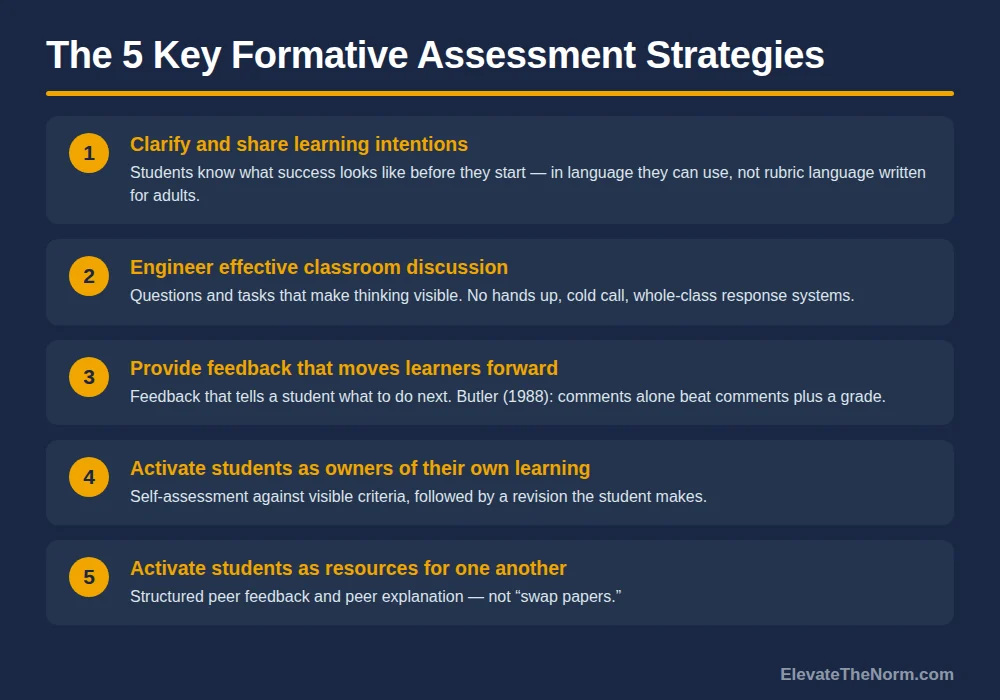
    The framework almost every other list is downstream of comes from Siobhan Leahy, Christine Lyon, Marnie Thompson and Dylan Wiliam, writing in Educational Leadership in 2005. They identified five core strategies:1

    Numbered graphic listing the five key formative assessment strategies: clarify and share learning intentions, engineer effective classroom discussion, provide feedback that moves learners forward, activate students as owners of their own learning, and activate students as resources for one another
    The five key strategies identified by Leahy, Lyon, Thompson and Wiliam (2005).
    1. Clarifying and sharing learning intentions and criteria for success. Students cannot hit a target they cannot describe.
    2. Engineering effective classroom discussions, questions and tasks that elicit evidence of learning. The key word is engineering — designing the question so that the answer tells you something.
    3. Providing feedback that moves learners forward. Feedback that describes the gap and names the next action.
    4. Activating students as owners of their own learning. Self-assessment and self-monitoring.
    5. Activating students as instructional resources for one another. Structured peer feedback and peer explanation.

    Notice that only the second one is about collecting information. The other four are about what surrounds the collection — whether students know the target, whether the feedback is usable, and whether students can act on it without you. That ratio is the whole point, and it is why a list of twenty exit-ticket variations is not a formative assessment programme.

    A List of Formative Assessment Strategies You Can Use Tomorrow

    These are the techniques, grouped by where they fit in a period. None of them requires technology, a purchase, or a planning period you do not have.

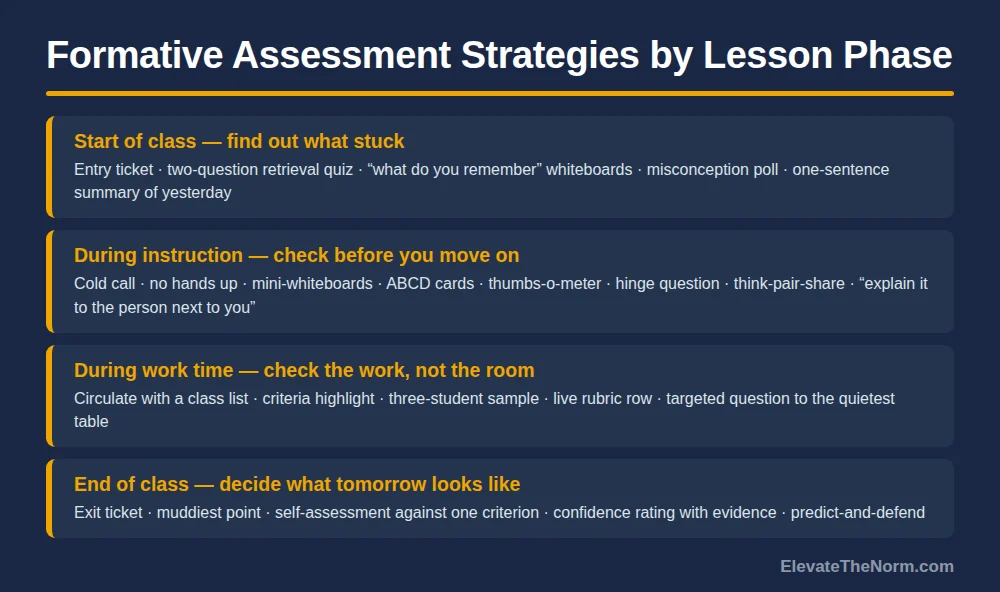
    Reference chart grouping formative assessment techniques by lesson phase: start of class, during instruction, during work time, and end of class, with specific techniques listed under each
    The same techniques, sorted by when in the lesson you would actually reach for them.

    Start of class — find out what survived the night

    • Entry ticket. Two questions on yesterday’s material, answered before anything else happens.
    • Retrieval quiz, ungraded. Three questions, self-scored, no record kept. The point is the retrieval, not the score.
    • Misconception poll. Offer the wrong answer students usually give as one of the options and see how many take it.
    • One-sentence summary of yesterday. Fast, and the vagueness of the sentences tells you as much as the content.

    During instruction — check before you move on

    • Cold call with no hands up. Hands-up sampling tells you what your four most confident students think. Nothing else.
    • Mini-whiteboards. Every student answers, every answer is visible at once, and it takes eight seconds. Still the highest-yield low-tech move available.
    • Hinge question. One multiple-choice question at the pivot point of the lesson, written so each wrong option corresponds to a specific misunderstanding. If more than a quarter of the room misses it, you do not go on.
    • ABCD cards or finger votes. A mini-whiteboard substitute when you have thirty seconds and no markers.
    • Think-pair-share with a required report-out. The report-out is what makes it assessment rather than conversation.
    • Ask a student to explain it to the person beside them. Explanation exposes gaps that recognition hides.

    During work time — assess the work, not the room

    • Circulate with a class list. Tick who you actually looked at. Most of us overestimate this badly.
    • The three-student sample. Read one strong, one middling and one struggling student’s work in the first five minutes. You will know whether the task is landing before you have wasted the period.
    • Criteria highlight. Students mark the sentence or step meeting each criterion. What they cannot highlight is the revision.
    • Live rubric row. Score one row of the rubric, out loud, on a volunteer’s work, on the document camera.

    End of class — decide what tomorrow looks like

    • Exit ticket. One question. One that actually discriminates — not one everybody gets right.
    • Muddiest point. “What is still unclear?” Students are more honest here than on a content question.
    • Self-assessment against one criterion. Not the whole rubric. One row.
    • Confidence rating with evidence. A number plus one sentence defending it. The sentence is the data.

    A note on cold call, because it is easy to do badly

    Cold call is the most effective technique on that list and the one most likely to go wrong. Done carelessly it is a gotcha, and a teenager who has been embarrassed in front of thirty peers will not take a risk in your room again for a long time. Three things make it safe. Ask the question, then pause, then name the student — so everyone has to think, and the named student has had the same processing time as everyone else. Accept “I need a minute” and come back to them, genuinely, so it is not a way out but is also not a trap. And make a wrong answer useful out loud — “that is the answer most people give, and here is why it is tempting” — so being wrong in public is survivable. Students who need more processing time, students still acquiring English, and students with anxiety-related plans all benefit from the pause; so does everyone else. There is a longer, more careful treatment of running cold call without the gotcha, including what the research does and does not support for grades 6–12.

    The same principle applies to every technique here. A student will only tell you honestly that they do not understand something if doing so is safe. Every formative assessment strategy on this page depends on that, and none of them will work in a room where it is not true.

    If you want these in a printable form rather than rebuilding the list each term, the four-page pack that matches each check to the decision it answers collects them in one place. No email required.

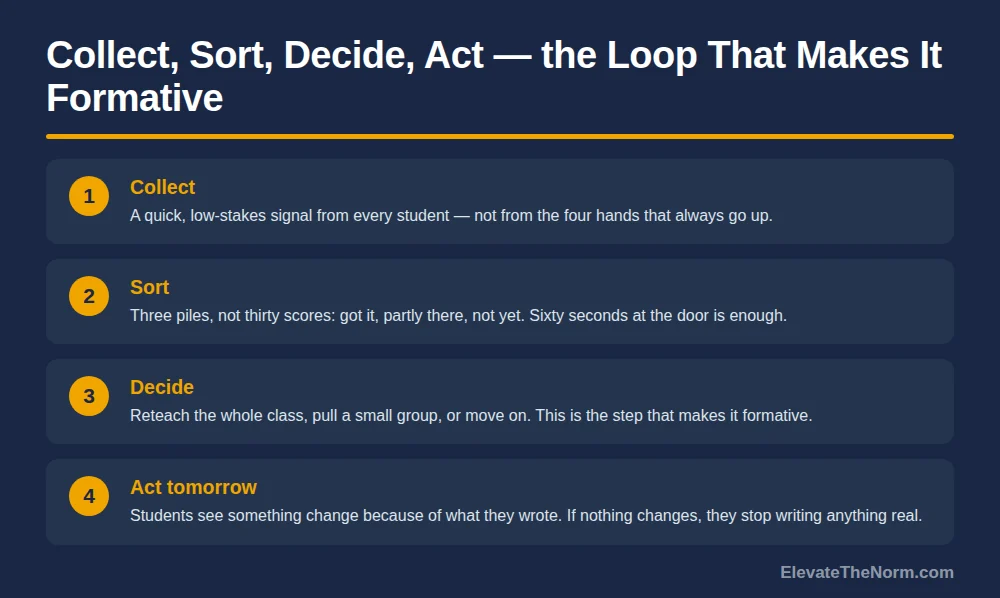
    The Part Most Lists Skip: What You Do With the Information

    Here is the failure I would bet on if I walked into a school that had just done a formative assessment PD day. Teachers will be running exit tickets. Very few will have changed a lesson because of one.

    Four-step process graphic showing the formative assessment response loop: collect a signal from every student, sort responses into three piles, decide whether to reteach or move on, and act on it the next day
    Collecting the information is the easy half. The loop only becomes formative at step three.

    Collect. A signal from every student, not from volunteers. This is the part everyone already does.

    Sort. Three piles, not thirty scores: got it, partly there, not yet. You can do this standing at the door as students leave. Sixty seconds. Resist the urge to record anything.

    Decide. Reteach the whole class, pull a small group tomorrow, or move on. That is the entire decision space, and making it is what converts a technique into formative assessment. If the answer is always “move on,” your question was not discriminating enough to be worth asking.

    Act, visibly. Students need to see something change because of what they wrote. Say it out loud: “Eleven of you missed the second question yesterday, so we are starting there.” A class that never sees its exit tickets change anything will start writing whatever gets them out the door fastest, and they will be right to.

    What the Evidence Honestly Shows

    Formative assessment has a reputation problem of the unusual kind: it is oversold, and the overselling has made careful people suspicious of something that is genuinely worth doing.

    The number you have heard in a staff meeting is probably 0.70. It traces to Paul Black and Dylan Wiliam’s landmark 1998 review, which cited a 1986 meta-analysis by Fuchs and Fuchs reporting a mean effect of 0.70 across 21 studies — rising to 0.92 where teachers systematically reviewed the data and planned a response, against 0.42 where the response was left to teacher judgment.2 That last contrast is the most useful thing in the whole literature for a practising teacher, and it almost never gets quoted. Black and Wiliam themselves attached a caveat that also rarely travels: there is “no guarantee that it will do so irrespective of the context and the particular approach adopted.”2

    Then the correction. Neal Kingston and Brooke Nash screened more than 300 K–12 formative assessment studies and concluded that most had “severely flawed research designs yielding uninterpretable results.” Thirteen were usable. Across those thirteen, the weighted mean effect size was 0.20, median 0.25 — and they published the paper explicitly as a corrective to the 0.70 figure.3 By subject: 0.32 in English language arts, 0.17 in mathematics, 0.09 in science. Professional development and computer-delivered implementations came in around 0.30 and 0.28.

    An effect of 0.20 is not nothing. It is a modest, real gain from a practice that costs no money and adds no grading. But it is not the transformation the 0.70 implies, and the subject variation should make a science department sceptical of a one-size district mandate. If a consultant quotes you 0.70 without mentioning Kingston and Nash, you now know more than they do.

    One more finding worth building policy around. In a study Black and Wiliam highlight, Ruth Butler found students given comments only improved substantially, while students given comments alongside a grade showed a significant decline — the grade appears to crowd out the comment entirely.2 If your formative assessment initiative ends with a number in the gradebook, you may have spent the effort and cancelled the benefit.

    Additional Formative Assessment Strategies for Specific Situations

    When the class is too large to read everything. Sample deliberately rather than comprehensively. Three students per period, rotated, gets you a picture of the whole room across a week without a single extra hour of reading.

    When students will not write anything real. Usually a trust problem, not a compliance one. Make it anonymous for two weeks, act visibly on what comes back, then put names on it.

    When you teach a skills subject rather than a content subject. Watch the process, not the product. A student who arrives at the right answer by a method that will fail next week has not understood it, and only the process shows you that.

    When you need it to survive a substitute or a bad week. Pick the two lowest-effort techniques on this page — an entry ticket and a hinge question — and run only those. A routine that survives a bad week beats a system that collapses in one.

    When students need to own it themselves. That is the fourth strategy on the list above, and it is substantial enough to have its own guide: what student self assessment is and how to introduce it without losing a week of class.

    What Goes Wrong

    Collecting more than you can act on. Four techniques in one period produces a pile of paper and no decisions. Two per week, acted on, beats ten per week filed.

    Questions that do not discriminate. If everyone gets it right, you learned nothing. A good hinge question should split the room.

    Grading it. See Butler, above. The moment it counts, students optimise for the score rather than tell you the truth.

    Mistaking participation for understanding. A lively discussion carried by six students tells you about six students. This is what the general discipline of asking every student for evidence is for, and it is why every-student-responds techniques beat hands-up every time. When discussion itself is the format you want, the fix is structural rather than motivational: a text-anchored seminar that requires a written question from every student puts a prepared contribution in every hand before the circle opens.

    Making it an initiative. Formative assessment implemented as a compliance requirement — exit tickets collected and audited by an administrator — produces exit tickets and no instructional change. The 0.92-versus-0.42 contrast in the Fuchs data points at teachers systematically reviewing and planning, which is professional judgment, not paperwork.2

    Where This Connects

    Formative assessment only pays off if the grading system it feeds can absorb it. A grading scale built on four proficiency levels instead of percentages makes that easier, because evidence gathered mid-unit has somewhere to go that is not an average. And the mirror-image practice for the adult in the room is the same loop turned on your own teaching, written out entry by entry — same logic, different subject.

    Where to Start

    Writing is the one place where this general list does not transfer cleanly, because a draft takes days and is too long to read thirty times a week; the checks built for writing are a separate set, and the five checks built for reading a text are another. Do not try to implement a list of formative assessment strategies. Pick two. One at the start of class and one at the end is a reasonable pairing — an entry ticket and an exit ticket, or a hinge question and a muddiest point. Run them for a month without adding anything. Sort the results into three piles and let one decision each week come from that sorting. My Daily Bell Ringers on TPT give students a short journal prompt to start on the moment they sit down.

    That is a smaller ambition than most professional development sells, and it is the version that is still running in March. The techniques on this page are not the hard part. Changing a lesson because of what a student wrote is the hard part, and it is the only part that makes any of it formative.

    Teaching science? Our companion piece on formative assessment strategies in science focuses on the checks that surface a misconception before the unit test.

    Frequently Asked Questions

    What are the 5 formative assessment strategies?

    Leahy, Lyon, Thompson and Wiliam named five in Educational Leadership in 2005: clarifying and sharing learning intentions and success criteria; engineering classroom discussions, questions and tasks that elicit evidence of learning; providing feedback that moves learners forward; activating students as owners of their own learning; and activating students as instructional resources for one another. Every technique on this page serves one of those five.

    What is the difference between formative and summative assessment?

    Summative assessment measures what a student has learned at the end of something and produces a record. Formative assessment gathers evidence during learning and produces a decision about what to do next. The cleanest test is not timing but consequence: if nothing about your teaching changes because of it, it was not formative, whatever it was called.

    Should formative assessment be graded?

    Generally no. In a study highlighted in Black and Wiliam’s 1998 review, Ruth Butler found students who received comments only improved substantially while students who received the same comments with a grade attached showed a significant decline. The grade appears to crowd out the comment. If credit must be given, give it for completing and acting on the work, not for how correct the first attempt was.

    Is cold call unfair to anxious or quiet students?

    It can be, and how you run it decides. Ask the question first, pause, then name the student, so everyone thinks and the named student gets the same processing time. Accept a request for a moment and genuinely come back. Treat wrong answers as useful information out loud. Handled that way, cold call reaches the students that hands-up questioning silently skips, which is usually the students who most need reaching.

    How many formative assessment strategies should I use in one lesson?

    One or two, and the same one or two for weeks. Four techniques in a period generates a pile of information and no decisions. The routine is what produces usable data, not the variety. Pick an entry point and an exit point, run them for a month, and let one instructional decision each week come out of them.

    How does this work for students with IEPs, 504 plans, or English learners?

    Build in processing time and give more than one way to respond. A pause before naming a student, a written option alongside a verbal one, sentence stems, and mini-whiteboards instead of on-the-spot speaking all widen access without changing the technique. These adjustments help the whole room, which is usually the sign that they are the right ones.

    Why does my child seem to be assessed every single day?

    Because these checks are not tests. Most take under two minutes, almost none are graded, and their purpose is to tell the teacher what to teach tomorrow rather than to judge your child. A student who writes down that they are confused has done the task correctly. If any of it is going into a gradebook, that is a fair question to ask the teacher, because the research suggests it should not be.

    Does formative assessment actually raise test scores?

    Modestly, on the best available evidence. Kingston and Nash screened more than 300 K-12 studies, found only 13 methodologically usable, and reported a weighted mean effect size of 0.20 with a median of 0.25, varying by subject from 0.32 in English language arts to 0.09 in science. That is a real gain from a practice that costs nothing, but it is well short of the 0.70 often quoted in professional development.

    Sources

    1. Leahy, Siobhan, Christine Lyon, Marnie Thompson, and Dylan Wiliam. “Classroom Assessment: Minute by Minute, Day by Day.” Educational Leadership, vol. 63, no. 3, November 2005, pp. 18–24. ERIC EJ745452. https://eric.ed.gov/?id=EJ745452
    2. Black, Paul, and Dylan Wiliam. “Assessment and Classroom Learning.” Assessment in Education: Principles, Policy & Practice, vol. 5, no. 1, 1998, pp. 7–74. (Full text copy hosted by UC Riverside; includes the Fuchs & Fuchs 1986 and Butler 1988 findings discussed above.) https://assess.ucr.edu/sites/default/files/2019-02/blackwiliam_1998.pdf
    3. Kingston, Neal, and Brooke Nash. “Formative Assessment: A Meta-Analysis and a Call for Research.” Educational Measurement: Issues and Practice, vol. 30, no. 4, 2011, pp. 28–37. ERIC EJ951173. https://eric.ed.gov/?id=EJ951173
    4. Andrade, Heidi L. “A Critical Review of Research on Student Self-Assessment.” Frontiers in Education, vol. 4, art. 87, 2019. https://doi.org/10.3389/feduc.2019.00087
    5. Panadero, Ernesto, Anders Jonsson, and Juan Botella. “Effects of self-assessment on self-regulated learning and self-efficacy: Four meta-analyses.” Educational Research Review, vol. 22, 2017, pp. 74–98. https://doi.org/10.1016/j.edurev.2017.08.004

    About Clay Shumate

    Clay Shumate is a certified secondary Social Studies teacher in the public schools of West Alabama, with seven years of classroom experience, a B.A. in History, and an M.Ed. in Secondary Education. He writes about project-based learning, student responsibility, respect, and practical ways to hold young people to a higher standard while giving them room to learn from mistakes. He is a member of the Society of Professional Journalists and writes to its Code of Ethics; this site’s editorial standards and corrections policy are published in full. More about Clay.

  • What Is Student Self Assessment? A Practical Guide for Grades 6–12

    What Is Student Self Assessment? A Practical Guide for Grades 6–12

    By Clay Shumate

    Student self assessment is the practice of having students judge their own work against criteria they can see and understand, while there is still time to improve it. Done before the grade, it is one of the more useful things a teacher can hand a class. Done after the grade, as a number that counts, it mostly teaches students to inflate.

    That distinction — formative before, not summative after — is the whole argument of this article, and it is the part most schools skip.

    Key Takeaways

    • Self-assessment is a judgment against criteria, not a feeling about effort. “I worked hard” is not self-assessment. “My thesis states a position but my second paragraph never supports it” is.
    • Formative and summative self-assessment are not the same practice. The research supports the first far more comfortably than the second.
    • The honest effect sizes are modest, not miraculous. Anyone selling you a 0.70 is quoting a number with a long history of caveats.
    • Accuracy is the wrong first question. The point is not whether a fifteen-year-old guesses the right score. It is whether they can find the gap in their own work.
    • Four weeks of small steps beats one big rollout. Students cannot apply criteria they have never been taught.

    What Is Student Self Assessment?

    Student self assessment is a structured process in which a student compares their own work to a set of stated criteria, identifies where the work does and does not meet those criteria, and then does something about the gap. Three parts, and all three have to be there. A rating with no criteria is a guess. Criteria with no follow-up action is paperwork.

    It is worth separating this from two things it gets confused with. It is not self-grading, where a student assigns themselves a score that lands in the gradebook. And it is not reflection in the loose sense — the end-of-unit “what did you learn about yourself” paragraph that produces a stack of pleasant, unusable sentences. Reflection has its place. This is a narrower and more mechanical thing: here is the standard, here is my work, here is the distance between them.

    Paul Black and Dylan Wiliam, in the review that largely launched the modern formative assessment movement, put the case for it about as strongly as it can be put, citing Royce Sadler’s argument that self-assessment is “a sine qua non for effective learning” — a student who cannot tell good work from their own work has no way to close the gap without an adult standing over them.1 That is a theoretical claim, not an empirical one, and it is worth saying so. But it is a sound one. Every student eventually leaves a classroom where someone else is holding the rubric.

    Formative or Summative? The Distinction That Decides Whether It Works

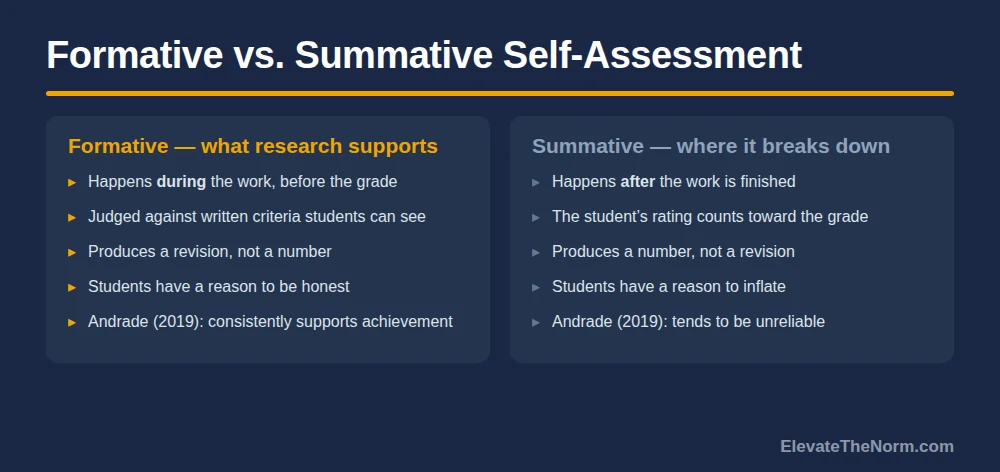
    Heidi Andrade’s 2019 review in Frontiers in Education examined 76 empirical studies published between 2013 and 2018, and the cleanest finding in it is a split.2 Formative self-assessment — ungraded, criteria-referenced, attached to a chance to revise — consistently supported achievement. Summative self-assessment, where the student’s own rating counted toward the final mark, did not hold up nearly as well, and produced a predictable problem: students inflated their estimates, with males over-estimating more than females.

    This should not surprise anyone who has taught teenagers. If you tell a student their number goes in the gradebook, you have not asked them to assess their work. You have asked them to negotiate. The honest answer and the advantageous answer point in opposite directions, and you have handed them the pen.

    Andrade makes a second point that is easy to miss and worth sitting with: she argues the field’s long preoccupation with accuracy — how closely a student’s self-rating matches a teacher’s — may be the wrong question, and that what matters more is the cognitive and affective work happening inside the student while they do it.2 That reframes the classroom goal. You are not training students to predict your grading. You are training them to look at their own paragraph and see what is missing.

    Two-column comparison chart showing formative student self assessment happening during the work against written criteria and producing a revision, versus summative self assessment happening after the work and counting toward the grade
    Formative self-assessment happens before the grade; summative self-assessment counts toward it. The research treats them very differently.

    The practical rule that falls out of this is short enough to put on a sticky note: the student’s self-assessment never becomes the grade. The improved work becomes the grade. Keep that line and most of the failure modes below never start. The same rule holds for the forward-facing half of this work: a goal a student sets is instrumentation, not a grade, and grading it is how you get goals set low enough to guarantee.

    What the Research Actually Shows — Including the Unimpressive Parts

    Here is where a lot of professional development goes wrong, so it is worth being precise.

    The most rigorous quantitative work on self-assessment specifically is Ernesto Panadero, Anders Jonsson and Juan Botella’s 2017 set of four meta-analyses, covering 19 studies and 2,305 students.3 On self-efficacy — a student’s belief that they can do the work — they found a large effect, d = 0.73 across 27 comparisons. On self-regulated learning, the effect was much smaller: d = 0.23 across 12 comparisons.

    Those numbers come with conditions the authors state plainly, and skipping them would be dishonest. Their publication-bias analysis suggested the self-efficacy effect is probably overestimated in magnitude, though they were satisfied the effect itself is real. The sample skewed roughly 70% female. The mean age was 17.5, ranging from 10.5 to 26 — ten of the nineteen studies were in secondary schools, which makes this more relevant to grades 6–12 than most assessment research, but eight were in higher education. And two of the four analyses rested on six and three studies respectively, which the authors themselves call too few for reliable bias testing.

    Now the wider counterweight. Neal Kingston and Brooke Nash screened more than 300 studies of formative assessment in K–12 and found that most had “severely flawed research designs yielding uninterpretable results.” Thirteen survived. The weighted mean effect size across those thirteen was 0.20, with a median of 0.25 — and they published it specifically as a correction to the widely repeated 0.70 figure.4 Effects varied sharply by subject: 0.32 in English language arts, 0.17 in mathematics, 0.09 in science.

    That 0.70, for the record, traces back through Black and Wiliam to a 1986 meta-analysis by Fuchs and Fuchs, and Black and Wiliam themselves attached a caveat to it that almost never travels with the number: there is, they wrote, “no guarantee that it will do so irrespective of the context and the particular approach adopted.”1

    So what is a teacher supposed to do with all that? Something like this: self-assessment is a reasonable, low-cost, well-supported classroom practice with a real but moderate payoff, strongest on students’ confidence and willingness to revise. It is not a program, it does not need a budget, and it will not move a school’s scores by itself. Anyone promising otherwise is selling something.

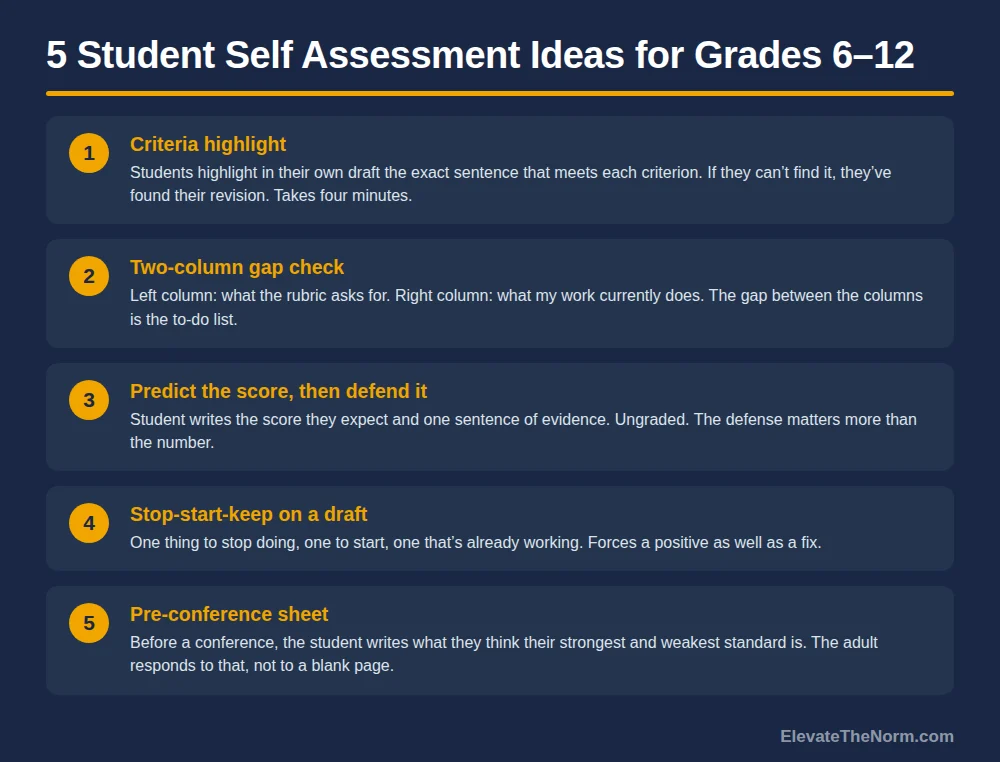
    Five Student Self Assessment Ideas That Fit in One Class Period

    These are deliberately small. A self-assessment that eats thirty minutes will get cut the first week the pacing guide gets tight, which means it will never become a habit. Each of these runs in four to ten minutes.

    Numbered list graphic of five student self assessment ideas: criteria highlight, two-column gap check, predict the score then defend it, stop-start-keep on a draft, and pre-conference sheet
    Five student self assessment ideas that fit inside a normal class period.

    1. The criteria highlight

    Students take their own draft and highlight the exact sentence that satisfies each criterion on the rubric — one color per row. The instruction is deliberately unforgiving: if you cannot find the sentence, you cannot highlight it. Students who finish with a blank criterion have just diagnosed their own revision without you saying a word. This is the single highest-yield version for writing-heavy courses. It sits inside a wider set of checks built for writing rather than recall.

    2. The two-column gap check

    Left column: what the assignment asks for, in the student’s own words. Right column: what their work currently does. The gap between the columns is the to-do list. Rewriting the criteria in their own words is half the value here — students who cannot restate the requirement usually did not understand it, and now you both know that.

    3. Predict the score, then defend it

    The student writes the score they expect and one sentence of evidence for it. Ungraded, always. The sentence is the assessment; the number is just the hook that makes them write it. When you hand the work back, the interesting conversations are with the students whose prediction was furthest off in either direction — and the under-predictors matter as much as the over-predictors.

    4. Stop, start, keep

    One thing to stop doing, one to start, one that is already working. The third one is not filler. Students who only ever hear what is broken stop believing the feedback, and a student who cannot name a single thing they do well is not going to revise with any confidence.

    5. The pre-conference sheet

    Before any conference, the student writes which standard they think they are strongest on and which they are weakest on. You respond to that instead of to a blank page. This is also the cleanest on-ramp into student-led conferences, where the student is expected to walk an adult through their own evidence. Those meetings can take a lot of different shapes — there is a breakdown of sixteen conference formats for grades 6–12 if you are deciding which one fits your schedule.

    If you want these as a printable rather than something you rebuild every term, the printable pack that asks for evidence behind every rating on this site cover the same ground in a ready-to-copy format. No email required.

    How to Introduce Self-Assessment Without Losing a Week

    The most common failure is not resistance. It is asking students to apply criteria nobody taught them. A rubric is a technical document written in teacher language, and handing it to a fourteen-year-old with “rate yourself” produces exactly what you would expect.

    Four-step process graphic showing a four-week rollout for student self assessment: show what good looks like, assess someone else's work first, self-assess one criterion only, then self-assess revise and submit
    A four-week sequence for introducing student self assessment without giving up a unit of instruction.

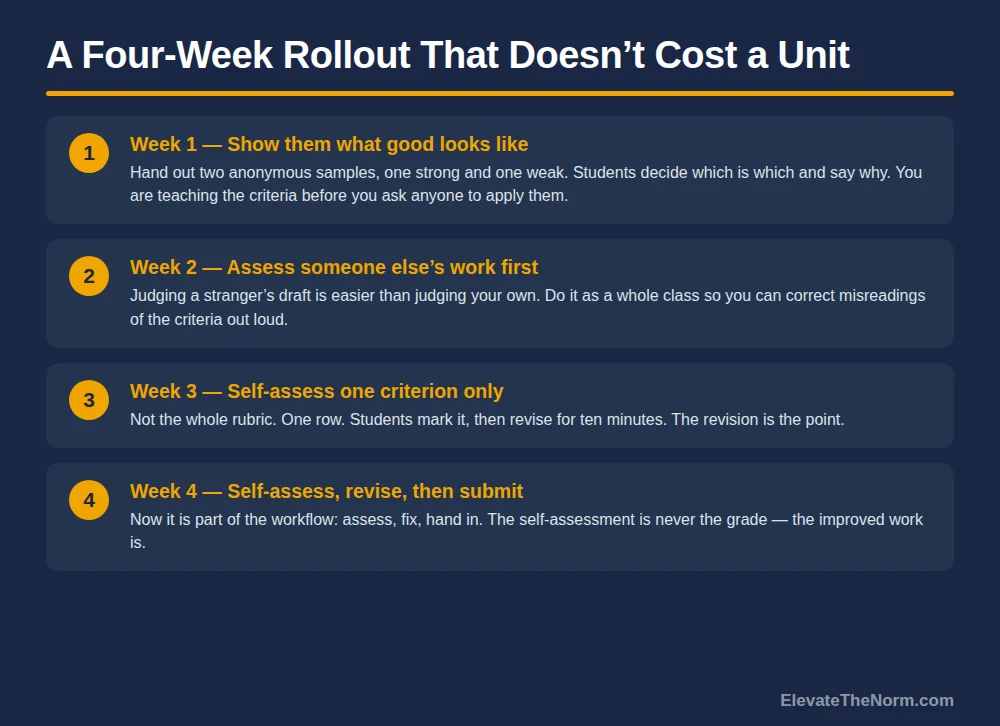
    Week one: show them what good looks like. Two anonymous samples, one strong and one weak. Students decide which is which and say why. You are teaching the criteria, not assessing anything yet. Ten minutes.

    Week two: assess a stranger’s work. Judging someone else’s draft is easier than judging your own, and doing it as a whole class lets you correct misreadings of the criteria out loud, in front of everyone, before those misreadings get baked in.

    Week three: one criterion only. Not the whole rubric — one row. Students mark it, then revise for ten minutes. The revision is the point; the marking is just what makes the revision specific.

    Week four: assess, revise, submit. Now it is part of the workflow rather than an event. And because the self-assessment never enters the gradebook, you have not created a single new grading obligation for yourself.

    Four weeks, roughly forty minutes of class time total, and at the end of it students have a habit rather than a worksheet.

    One adjustment that is not optional. Self-assessment depends entirely on a student being able to read and understand the criteria, which means the rubric language is an access issue before it is an instructional one. Rewrite each criterion in student-facing language — one sentence, present tense, naming a thing you could point at in the work. For students on IEPs or 504 plans, for English learners, and honestly for everyone, a checklist of three concrete criteria will produce better self-assessment than a four-column analytic rubric written for a grading conversation among adults. Reading the criteria aloud while students follow along costs ninety seconds and removes most of the barrier.

    What it looks like when it is working. Do not measure this by whether students’ ratings match yours. Watch for three things instead: students start pointing at specific places in their own work rather than describing their effort; the revisions they make after self-assessing are the revisions you would have asked for; and students begin asking clarifying questions about the criteria before they start the assignment rather than after it comes back. That last one is the real signal. It means the criteria have moved from your document into their planning.

    What Goes Wrong

    Vague criteria. “Shows understanding” cannot be self-assessed by anyone, including the teacher who wrote it. If a criterion cannot be checked against a specific sentence, paragraph, calculation or step, it is not usable for self-assessment and it probably was not usable for grading either.

    Letting the self-assessment count. Covered above, but it is the mistake that reappears every time a school tries to formalize this. The moment a self-rating carries points, Andrade’s inflation problem arrives on schedule.2

    No time to act on it. A self-assessment that is not followed by a revision window is a compliance exercise. Students figure that out in about two rounds and start filling it in on the way to the door.

    Treating honesty as a character test. A student who rates themselves generously is usually responding rationally to the incentives in front of them, or genuinely cannot see the gap yet. Neither is a discipline matter. Both are instructional problems — either the criteria are unclear or the stakes are wrong.

    Confusing it with self-esteem work. Self-assessment is not about how students feel about themselves. Panadero and colleagues did find a real confidence effect, but it came from students getting better at the work, not from being told they were doing fine.3

    Where It Fits With Grading, Feedback and Conferences

    Self-assessment is one of five core formative assessment strategies identified by Siobhan Leahy, Christine Lyon, Marnie Thompson and Dylan Wiliam — alongside clarifying success criteria, engineering classroom discussion, providing actionable feedback, and using students as instructional resources for one another.5 It is not a standalone initiative. It is the piece that makes the other four stick, because a student who can assess their own work can actually use the feedback you give them. The same machinery works when what a student is judging is their own conduct rather than their work — see the guide to what changes when the thing being judged is behavior rather than work for the behavior-side version, including why it must stay out of the gradebook. The group-work variant narrows the question again to how each student accounts for what they personally contributed to a product carrying one shared grade. The other four are worth having in practical form too — there is a longer rundown of checks that surface what students understand while there is still time to act on it.

    There is a hard-edged finding from Black and Wiliam’s review that bears directly on this. Ruth Butler’s 1988 study found students who received comments only improved substantially, while students who received comments with a grade attached showed a significant decline — the grade appears to crowd out the comment.1 If you are going to invest in getting students to examine their own work honestly, stapling a number to the front of it works against you.

    This is also why self-assessment sits naturally alongside a standards-based grading scale: when a grade refers to a specific standard rather than an average of everything, a student can actually locate themselves on it. And it pairs with checking for understanding during instruction — the same information, gathered from the other direction. Teachers who want the mirror image of this practice for themselves will find it in teacher reflection, which runs on the same logic: criteria, evidence, gap, action.

    The place this becomes most visible to people outside the classroom is conference night. A self-assessment written before a parent teacher conference puts the student’s own account of their work in front of the adults who are about to discuss it — and it works whether or not the student runs the meeting.

    One last connection worth naming. Self-assessment is a form of student voice — a small, structured place where a teenager’s judgment about their own work is treated as worth hearing. That is not a soft addition to the practice. It is most of why it works.

    Where to Start Tomorrow

    Student self assessment is worth doing, and it is worth doing in the smallest version you can sustain. Pick one assignment you already give. Pick one criterion from its rubric. Ask students to find the sentence in their own work that meets it, give them ten minutes to fix it if they cannot, and do not put their rating in the gradebook. That is the whole practice. Everything above is detail.

    The payoff is not a test-score jump, and anyone who promises you one is overstating a literature that does not support it. The payoff is a room full of students who can look at their own work and tell you what is wrong with it — which is the skill you actually wanted them to leave with.

    Frequently Asked Questions

    Does student self assessment mean students grade themselves?

    No. In the version supported by the research, the student’s rating never enters the gradebook. They judge their work against stated criteria, find what is missing, and revise it. The teacher grades the improved work. Heidi Andrade’s 2019 review found that when a self-rating does count toward the final mark, students inflate their estimates, which defeats the purpose of asking.

    What if a student rates their work far higher than it deserves?

    Treat it as an instructional problem, not an honesty problem. Nine times out of ten the criteria were too vague to apply, or the student genuinely cannot see the gap yet. Sit with them and ask them to point to the exact sentence, step or calculation that meets the criterion. If they cannot find it, the conversation has already done its work. A student is never penalised for an inaccurate self-assessment.

    Are self-assessments private, or do parents and administrators see them?

    That is your call, and it is worth deciding before you start rather than after. Most teachers keep routine self-assessments as working documents that stay between the student and the teacher, and bring them out only at conferences, where the student presents them. Tell students the answer up front. A student who thinks their candid self-criticism is going home in a folder will write nothing useful.

    How do you make this work for students with IEPs, 504 plans, or English learners?

    Fix the criteria first. A four-column analytic rubric written in grading language is an access barrier for a lot more students than the ones with formal plans. Rewrite each criterion as one short present-tense sentence naming something you could point at in the work, cut the list to three criteria, and read them aloud while students follow along. Sentence stems help too: My evidence for this is on page ___ , or I still need to ___ .

    How much class time does this actually take?

    Each activity in this article runs in four to ten minutes, and the four-week introduction totals roughly forty minutes of instructional time. Keep it small on purpose. A self-assessment routine that takes half a period will be the first thing cut when the pacing guide gets tight, and a routine that gets cut never becomes a habit.

    How do I know it is working?

    Not by whether students’ ratings match yours. Watch for three signals instead: students start pointing at specific places in their own work rather than describing how hard they tried, the revisions they make on their own are the ones you would have assigned, and they begin asking about the criteria before starting an assignment instead of after it comes back. The last one means the criteria have moved into their planning.

    What is the difference between self-assessment and reflection?

    Reflection is open-ended thinking about an experience, usually after it is over. Self-assessment is narrower and more mechanical: here is the stated criterion, here is my work, here is the distance between them, here is what I will change. Both are useful. Only one of them reliably produces a revision, and confusing the two is how self-assessment turns into a stack of pleasant sentences nobody acts on.

    Should self-assessment ever count toward a grade?

    The evidence says be very careful. Formative self-assessment, done before the grade and attached to a chance to revise, consistently supports achievement. Summative self-assessment, where the rating carries points, tends to be unreliable. If a school wants to give credit, give it for completing the process and acting on it, never for the accuracy of the number the student wrote.

    Sources

    1. Andrade, Heidi L. “A Critical Review of Research on Student Self-Assessment.” Frontiers in Education, vol. 4, art. 87, 2019. https://doi.org/10.3389/feduc.2019.00087
    2. Panadero, Ernesto, Anders Jonsson, and Juan Botella. “Effects of self-assessment on self-regulated learning and self-efficacy: Four meta-analyses.” Educational Research Review, vol. 22, 2017, pp. 74–98. https://doi.org/10.1016/j.edurev.2017.08.004
    3. Black, Paul, and Dylan Wiliam. “Assessment and Classroom Learning.” Assessment in Education: Principles, Policy & Practice, vol. 5, no. 1, 1998, pp. 7–74. (Full text copy hosted by UC Riverside.) https://assess.ucr.edu/sites/default/files/2019-02/blackwiliam_1998.pdf
    4. Kingston, Neal, and Brooke Nash. “Formative Assessment: A Meta-Analysis and a Call for Research.” Educational Measurement: Issues and Practice, vol. 30, no. 4, 2011, pp. 28–37. ERIC EJ951173. https://eric.ed.gov/?id=EJ951173
    5. Leahy, Siobhan, Christine Lyon, Marnie Thompson, and Dylan Wiliam. “Classroom Assessment: Minute by Minute, Day by Day.” Educational Leadership, vol. 63, no. 3, November 2005, pp. 18–24. ERIC EJ745452. https://eric.ed.gov/?id=EJ745452

    About Clay Shumate

    Clay Shumate is a certified secondary Social Studies teacher in the public schools of West Alabama, with seven years of classroom experience, a B.A. in History, and an M.Ed. in Secondary Education. He writes about project-based learning, student responsibility, respect, and practical ways to hold young people to a higher standard while giving them room to learn from mistakes. He is a member of the Society of Professional Journalists and writes to its Code of Ethics; this site’s editorial standards and corrections policy are published in full. More about Clay.

  • What Is a Classroom Management Plan? The Version That Actually Runs

    What Is a Classroom Management Plan? The Version That Actually Runs

    A classroom management plan is a written document setting out how your room runs: the structure students walk into, the expectations you have taught them, how you acknowledge the behavior you want, and what you do about the behavior you don’t. It is not a poster of rules and it is not a philosophy statement. It is the answer you have decided in advance, so that you are not inventing it at 1:40 on a Thursday with twenty-nine people watching. If you want wording to start from rather than a blank page, there are worked examples of expectations written for teenagers.

    Most plans fail the same way. They are written for an evaluator, they are full of words like “respectful” and “responsible,” and they cannot be run. A plan you cannot run on a bad day is not a plan.

    So that is what a classroom management plan is. What follows is the harder part: what the research says it has to contain, the test that separates a real plan from a decorative one, and how to write one that survives contact with an actual class. The individual moves that go inside the plan, and how strong the evidence is behind each one, are handled separately in the strategy-by-strategy breakdown.

    Key Takeaways

    • A plan is a decision made early, not a description written late. Its value is that it removes improvisation from the moments you improvise worst.
    • The research converges on five areas. A 2008 review identified 20 evidence-based classroom management practices grouped into five categories: structure, taught expectations, active engagement, acknowledging appropriate behavior, and responding to inappropriate behavior.
    • The test is enforceability, not tone. “Be respectful” cannot be enforced consistently by anyone, including you. A narrow, specific line can.
    • Write it for yourself first. A plan aimed at an evaluator produces language that sounds defensible and does nothing at 1:40.
    • Many teachers were never taught this. In one study of 110 teacher candidates, roughly half of one group reported no behavior management training at all before the intervention — which is a curriculum gap, not a personal failing.

    What is a classroom management plan, specifically?

    The IRIS Center at Vanderbilt frames comprehensive classroom behavior management as doing two things: creating an organized, consistent, culturally responsive classroom environment that supports instruction, and engaging and communicating with students and families on an ongoing basis. Developing a written plan is named as one of the foundational practices within that, alongside creating a positive climate and a structured classroom.

    That framing is useful because of what it excludes. A management plan is not your discipline ladder. The ladder is one component, and in a good plan it is one of the smaller ones. The bulk of the document is about the conditions that make the ladder rarely necessary — how the room is arranged, what happens in the first four minutes, what students do when they finish early, how they get help without waiting with a hand up.

    One more distinction worth holding onto: classroom-level management sits underneath any school-wide system. If your building runs three to five posted expectations, your plan translates those into the specific, contextual version that applies in your room. It does not compete with them, and it does not ignore them.

    The five things the research says a plan has to cover

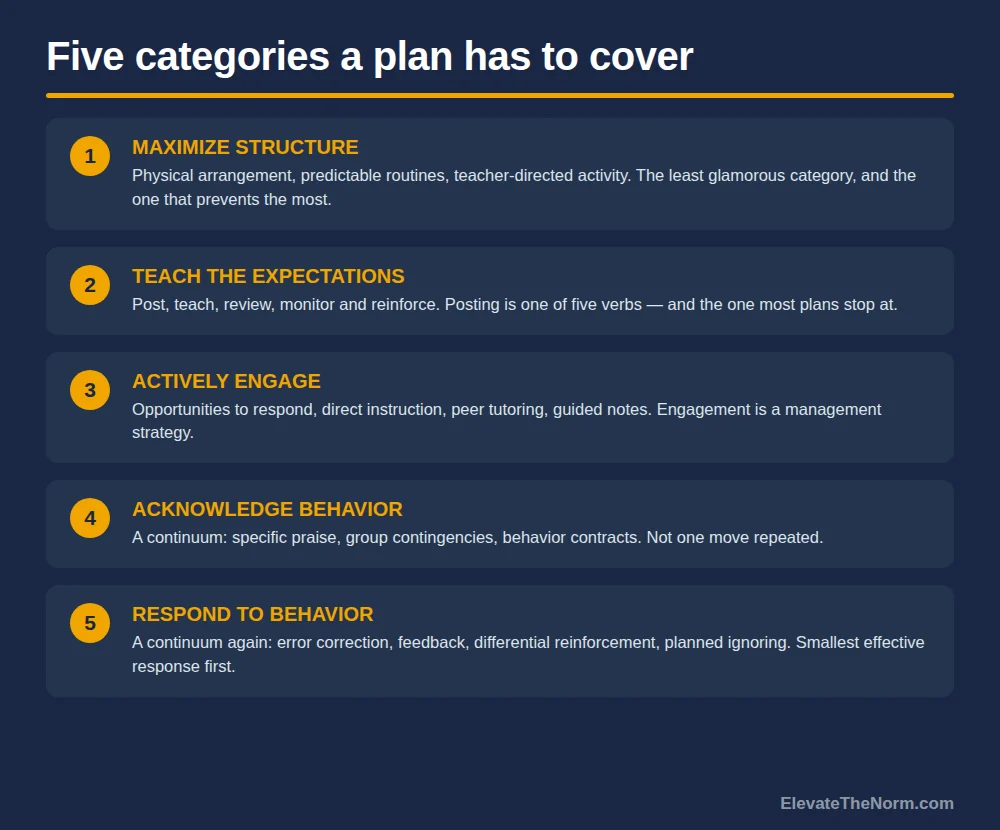
    The most useful single source here is Simonsen, Fairbanks, Briesch, Myers and Sugai’s 2008 review, which set a deliberately high bar: a practice counted as evidence-based only if it had been evaluated with sound experimental design and supported by at least three empirical studies in peer-reviewed journals. Twenty practices cleared it, sorted into five categories.

    1. Maximize structure. Physical arrangement, predictable routines, teacher-directed activity. The least glamorous category and the one that prevents the most.
    2. Post, teach, review, monitor and reinforce expectations. Note the verbs. Posting is one of five, and it is the one most plans stop at.
    3. Actively engage students in observable ways. Opportunities to respond, direct instruction, peer tutoring, guided notes. Engagement is a management strategy, not a separate department.
    4. Use a continuum of strategies to acknowledge appropriate behavior. Specific praise, group contingencies, behavior contracts.
    5. Use a continuum of strategies to respond to inappropriate behavior. Error correction, performance feedback, differential reinforcement, planned ignoring.
    Five numbered categories of evidence-based classroom management: maximize structure, teach expectations, actively engage, acknowledge behavior, respond to behavior
    From Simonsen and colleagues’ 2008 review of evidence-based classroom management practices.

    The word doing the most work in categories four and five is continuum. A plan with one response in it — a referral, a call home, a warning system — will be used for everything or nothing. A continuum means the smallest effective response is available and gets used first.

    An honest caveat on that review, because it matters for how much weight to put on it: the authors themselves note that roughly 48% of the studies in their table were published before 1987. The categories have held up and are widely replicated, but this is an older evidence base than its frequent citation implies, and it was not assembled with today’s secondary classrooms specifically in view.

    Why “Be Respectful” is not a plan

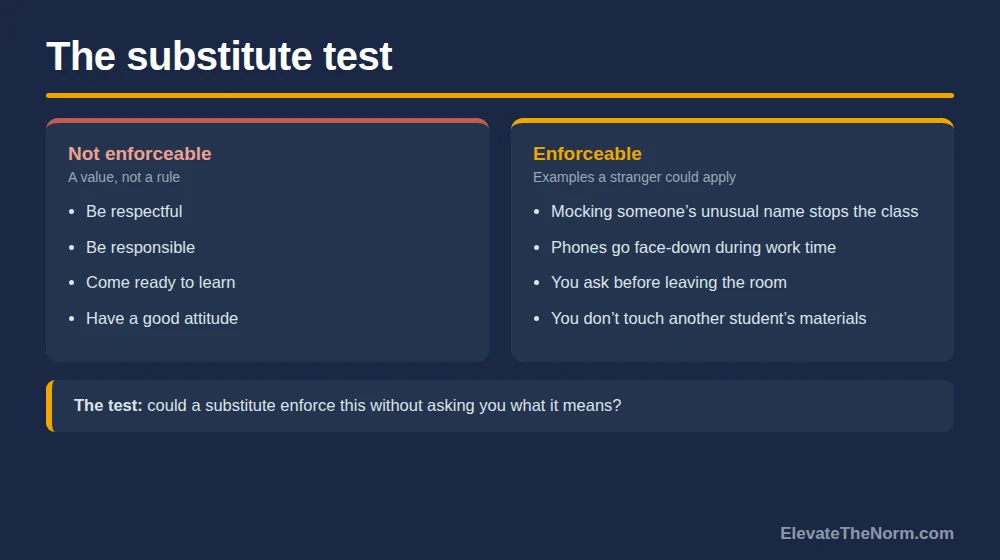
    Here is the test I would apply to every line in a management plan: could a substitute enforce this without asking you what it means? If not, it is a value, not a rule — and values belong in the first paragraph, not in the enforcement section.

    Two-column comparison of unenforceable classroom rules such as be respectful beside enforceable, specific rules a substitute could apply
    Could a substitute enforce this without asking you what it means?

    “Be respectful” fails immediately. Two reasonable adults will disagree about whether a particular eye-roll qualifies, which means the students experience it as arbitrary, which is the precise thing that costs you a room. Inconsistency is not a small flaw in a plan. It is the flaw.

    Compare it to an actual line from my room: making fun of how unusual someone’s name is stops the class. It is narrow. It is unmistakable. Nobody has to interpret it, there is no version of it I would let go on a Friday because I am tired, and a student can tell you in advance exactly what will happen. That is what an enforceable expectation looks like, and it is worth more than a wall of adjectives.

    You do not need many of these. Three or four lines that are genuinely non-negotiable, that you will enforce identically in October and in May, will do more for a room than a laminated list of twelve. The rest of what you want — effort, kindness, people taking care of each other — is built through how the room is run day to day, not through rules about it.

    What actually goes in the document

    Here is the structure I would use. It maps onto the five research categories without reading like a compliance form.

    • The room. How seating is arranged and why. Where materials live. What students do when they walk in, and what they do when they finish early. Most of a management plan is logistics, and the logistics are load-bearing.
    • The opening. What the first four minutes look like every single day. A routine students can run without you is worth more than any consequence you could write down.
    • The non-negotiables. Three or four specific, enforceable lines. Apply the substitute test to each one.
    • How students get help. Genuinely part of management. A student who cannot get unstuck will find something else to do, and then you have a behavior problem that was originally an access problem.
    • What you notice, and how. Your continuum for acknowledging the behavior you want. Specific rather than generic — naming what a student did beats telling them they are great.
    • What happens when something goes wrong. Your continuum of responses, smallest first, written out. Include what you do, not just what the student gets.
    • Repair. What is owed, to whom, by when. A plan that ends at the consequence is only half-written.
    • Families. When you contact home, for what, and how often it is for something good.
    Eight sections of a classroom management plan: the room, the opening, non-negotiables, how students get help, what you notice, when something goes wrong, repair, families
    Two pages is enough. Twelve means you are writing a philosophy statement.

    That is two pages, not twelve. If yours is running to twelve, you are probably writing a philosophy statement with a consequence ladder stapled to the back.

    The response section, and the part people get wrong

    Most consequence sections are written as an escalating list of things that happen to a student. The useful version also specifies what you do, because your behavior is the variable you actually control.

    The smallest effective response is usually proximity and a quiet word. In my room a redirect happens at close range, to one student, at their eye level — not announced across the room. That is a deliberate choice and it belongs in a written plan, because it is the thing you will abandon first when you are frustrated. Announcing a correction to the whole room gives the class a performance to react to and hands the student an audience they now have to save face in front of. It reliably makes a small thing bigger.

    Write down the pause, too. A deliberate beat before you respond — for me it averages around fifteen seconds, though it genuinely varies with the room, the day, and the student — is not a technique with a fixed number. It is a commitment to not answer a behavior with your first reaction. Put it in the plan as a commitment rather than a count, because a count is the first thing that breaks.

    And be careful what your consequences are actually teaching. A response that only makes a student feel worse has done nothing about the thing that happened. The question the plan should answer is what gets repaired, not what gets paid.

    What the plan does not get to decide

    This section is short and it is the one most plans omit entirely. Some things outrank your document, and writing as though they do not is how a well-intentioned plan creates a real problem.

    • An IEP or a behavior intervention plan. If a student has one, it governs. Your classroom plan does not override it, cannot be applied to that student in place of it, and should say so explicitly. If you do not know which of your students have one, that is the first thing to find out — before you write a consequence section, not after you have applied it.
    • District and building policy. Your plan operates inside them. Where your preference and the policy disagree, the policy wins and you raise the disagreement through the actual channel rather than quietly running your own version.
    • Anything that has to leave the room. Threats, weapons, harassment, anything involving a student’s safety, and anything that triggers mandatory reporting are not classroom-management matters and do not belong on a continuum of responses. Name them in the plan as the category that goes straight to an administrator, so that the decision is already made.

    A plan that quietly assumes the teacher handles everything is not a strong plan. It is an unsupported one, and the cost of that lands on a student.

    Who the plan is for

    In order: you, then your students, then anyone covering your room, then your evaluator. That order matters and it is usually inverted.

    A plan written for an evaluator optimizes for language that sounds defensible in a post-observation conference. It will use the word “proactive” and it will not help you at 1:40. A plan written for yourself is blunter, shorter, and contains the things you actually forget — which is why the good ones read a little like notes.

    Your students should be able to read it, or a version of it. Not as a handout on day one that nobody retains, but because everything in it should be something they could accurately predict by October. If a student could not tell you what happens when work is late, that section is not real yet.

    Which raises a fair question: should students help write it? My honest answer is that it depends on which part. The non-negotiables are yours — they exist precisely because they do not move, and putting them to a vote tells the room they are negotiable after all. But a great deal of a management plan is not about safety or dignity at all. It is about how the room works, and on that, teenagers have opinions worth hearing and a much better sense than adults expect of what actually helps them work. Asking them what gets in their way, and then visibly changing something, does more for buy-in than any explanation of why your rules are reasonable.

    Families should be able to see it too, or at least the part that affects them — what you contact home about, when, and what happens before you do. A parent who learns your system for the first time during a difficult phone call is meeting it at the worst possible moment. Send the short version early, while nothing is wrong.

    And a plan is the single most useful thing you can hand to someone covering your class. If you cannot hand it over and have it make sense to a stranger, it is not finished.

    If nobody ever taught you this

    It is worth saying plainly that the preparation gap here is real and documented, because a lot of teachers privately treat it as a personal deficiency.

    A 2025 study in the Journal of Emotional and Behavioral Disorders worked with 110 teacher candidates in student-teaching internships at a large public southeastern university. Among the group receiving a specialized 16-hour classroom management curriculum, 49.3% reported having had no behavior management training beforehand; in the comparison group the figure was 31.7%. The authors also note that while most states require classroom management coursework, estimates of how many programs offer a focused course on it range from under 50% to 74%.

    Those numbers deserve their limits stated. It is a quasi-experimental study at a single university, the training figures are self-reported, and the classroom observation subsample was fourteen teachers. It does not establish a national rate. What it does support — alongside the range the authors cite for program offerings — is that arriving in a classroom without formal management training is common rather than exceptional. If that is you, you are in a large group, and writing the plan is how you close the gap yourself.

    What a plan will not do

    It will not make a class comply because it exists. It will not survive being written once in August and never opened again. And it will not substitute for knowing the students in front of you — the same line lands differently depending on what a kid walked in carrying, and no document accounts for that.

    It also will not fix a task that was badly built. A very large share of what gets logged as a behavior problem is a student who could not access the work and found something else to do. Before adding a consequence for off-task behavior, check whether the work was doable. That is a planning question wearing a discipline costume, and treating it as discipline makes it permanent.

    Writing one this week

    Do it in one sitting and keep it to two pages. Draft the eight sections above quickly and badly — the first version is for finding out what you have not actually decided, and you will find two or three things you have been improvising all year.

    Then run the substitute test on every enforcement line, cut anything you would not enforce in May, and use it for two weeks. Mark the places you did something other than what you wrote. Those are the real edits, and they are worth more than anything you would have thought of at the desk.

    So: what is a classroom management plan, in the end? It is a short, specific, honest document that tells you what you have already decided, so that the version of you who is tired on a Thursday afternoon does not have to decide it again, worse. Structure first. A handful of lines you will actually hold. A continuum of responses, smallest first. And a way back for a student who got it wrong — which is the part that turns a set of rules into a room worth being in.

    Printables for this

    Two of mine on TPT, both built for this. The Classroom Norms Poster Set is free and gives you the posted version of the expectations section — written narrowly enough to pass the substitute test. De-escalation Strategies: 100 Scripts is the continuum the response section asks for, with actual wording for each rung instead of one referral.

    Sources

    • Simonsen, B., Fairbanks, S., Briesch, A., Myers, D., & Sugai, G. (2008). Evidence-based practices in classroom management: considerations for research to practice. Read the review (PDF) — source for the 20 evidence-based practices, the five categories, and the inclusion bar of at least three peer-reviewed empirical studies per practice. Limitation stated by the authors: roughly 48% of the studies in their table were published before 1987.
    • Hart, K. C., Poznanski, B., & Cramer, E. D. (2025). Preparing teacher candidates in classroom management prior to entering the teaching profession. Journal of Emotional and Behavioral Disorders. Read the study — source for the 49.3% / 31.7% no-prior-training figures and the “under 50% to 74%” range for programs offering a focused course. Quasi-experimental, n = 110 at a single southeastern university, self-reported training history, observation subsample of 14. Not a national estimate.
    • The IRIS Center, Vanderbilt University. Classroom and school-wide behavior management. Read the module — source for the two-part framing of comprehensive classroom behavior management, the four foundational practices, and the classroom-versus-school-wide distinction. Practitioner training material from a federally funded center, not a primary study.

    Every link above was checked on September 20, 2026. The classroom practices described in the first person — the close-range redirect, the deliberate pause before responding, and the line about mocking an unusual name — are my own and are used across this site.

    Frequently Asked Questions

    What is a classroom management plan?

    It is a written document setting out how your classroom runs: the structure students walk into, the expectations you have taught them, how you acknowledge the behavior you want, and how you respond to the behavior you do not. It is not a poster of rules and it is not a philosophy statement. Its purpose is to decide things in advance so you are not improvising them under pressure.

    What should a classroom management plan include?

    Eight sections cover it: how the room and materials are arranged, what the opening routine looks like every day, three or four genuinely non-negotiable expectations, how students get help when stuck, how you acknowledge the behavior you want, a continuum of responses when something goes wrong, what repair looks like afterward, and when you contact families. Two pages is usually enough. Twelve pages usually means a philosophy statement with a consequence ladder stapled to the back.

    Why is “be respectful” a bad classroom rule?

    Because it cannot be enforced consistently. Two reasonable adults will disagree about whether a given eye-roll counts, so students experience enforcement as arbitrary — and arbitrary enforcement is what costs a teacher a room. Respect belongs in the plan as a value in the opening paragraph. The enforcement section needs lines narrow enough that a substitute could apply them without asking what they mean.

    What does the research say classroom management plans should cover?

    A 2008 review by Simonsen, Fairbanks, Briesch, Myers and Sugai identified 20 evidence-based practices grouped into five categories: maximize structure; post, teach, review, monitor and reinforce expectations; actively engage students in observable ways; use a continuum of strategies to acknowledge appropriate behavior; and use a continuum of strategies to respond to inappropriate behavior. Worth knowing its limit — the authors note about 48% of the underlying studies predate 1987.

    Does my classroom management plan apply to a student with an IEP or behavior plan?

    No. An IEP or behavior intervention plan governs, and your classroom plan does not override it or get applied in its place. Say so explicitly in the document. Find out which of your students have one before you write the consequence section rather than after you have applied it to someone it should not have applied to. District and building policy outrank your plan the same way.

    Should students help write the classroom management plan?

    Partly. The non-negotiables are yours — they exist because they do not move, and putting them to a vote signals the opposite. But much of a management plan is about how the room works rather than about safety or dignity, and on that students have useful opinions and a better sense than adults expect of what gets in their way. Ask them, then visibly change something. That does more for buy-in than explaining why your rules are reasonable.

    Is a classroom management plan the same as a discipline plan?

    No, and treating them as the same is the most common mistake. A discipline or consequence ladder is one section of a management plan, and in a good one it is among the smaller sections. The bulk of the document covers the conditions that make consequences rarely necessary: room arrangement, opening routines, how students get help, what happens when they finish early.

    What if I was never trained in classroom management?

    That is common rather than exceptional. In a 2025 study of 110 teacher candidates at one southeastern university, 49.3% of one group reported no prior behavior management training, and the authors cite estimates that between under 50% and 74% of preparation programs offer a focused course on it. Those figures come from a single-university quasi-experimental study with self-reported training history, so they are not a national rate — but the gap is documented, and writing a plan is the practical way to close it for yourself.


    About Clay Shumate

    By Clay Shumate — Clay Shumate is a certified secondary Social Studies teacher in the public schools of West Alabama, with seven years of classroom experience, a B.A. in History, and an M.Ed. in Secondary Education. He writes about project-based learning, student responsibility, respect, and practical ways to hold young people to a higher standard while giving them room to learn from mistakes. He is a member of the Society of Professional Journalists and writes to its Code of Ethics; this site’s editorial standards and corrections policy are published in full.

  • Substitute Teacher Classroom Management: Running a Room That Isn’t Yours

    Substitute Teacher Classroom Management: Running a Room That Isn’t Yours

    Substitute teacher classroom management is not the same job as classroom management. A regular teacher builds authority over weeks. A substitute has to borrow it in the first four minutes, from a room that already has its own rules, its own seating, and its own sense of what is normal — none of which they wrote. The work is not installing your system. It is running theirs well enough that the day holds.

    Most advice on this subject is written as though the substitute controls the outcome. They control some of it. The rest was decided before they ever walked in, by the teacher who wrote the plans — which is the half of this that almost nobody writes about, and the half I can speak to directly. If the room a substitute walks into has no written system behind it, the document a stranger is actually handed is where that work starts.

    This page covers what the person walking in actually has to work with, what they can control on the day, and what the regular teacher owes them before leaving.

    Key Takeaways

    • A substitute’s authority is borrowed, not built. The fastest way to lose a room is to replace its norms with your own on day one. Run the room that exists.
    • The person walking in may have twenty hours of training. In Missouri, a substitute certificate requires either 36 semester hours of college or 20 clock hours of approved training. That is the floor in one state, and it is worth knowing before you judge how a day went.
    • The first four minutes decide most of it. A visible plan, stated out loud, followed by a pause — not a raised voice.
    • Teacher absence is measurable and it is not small. Ten additional days of teacher absence are associated with a decline of roughly 1.7% to 3.3% of a standard deviation in math achievement. The sub day is not a throwaway day.
    • Half of substitute classroom management is written the week before, by someone else. Plans that assume the sub knows the room are the single most common failure, and they are entirely preventable.
    • A class that tests a substitute is usually not scheming. Nobody knows their name, the day reads as a holding pattern, and the adult has no history with them. Using names and making the work visibly real addresses all three.

    The job is not “teach the lesson.” It is “keep the room intact.”

    This is the reframe that makes the rest of it workable. A substitute who measures the day by how much content got delivered will almost always finish feeling like they failed. A substitute who measures it by whether the room is handed back in the condition it was handed over — work attempted, norms intact, nobody humiliated, an honest note left behind — has done the actual job.

    That is not a lowered standard. It is the correct one. The regular teacher can reteach a lesson. What they cannot easily undo is a room that learned, over one day, that the expectations it runs on are negotiable when a stranger is standing there.

    What the person walking in actually has

    It is worth being precise about the preparation the job actually requires, because a lot of staffroom commentary about substitutes assumes a level of training that the credential does not demand.

    Missouri, as one published example, issues a Content Substitute Certificate to an applicant who has completed either a minimum of 36 semester hours from an accredited college or university, or twenty clock hours of department-approved substitute teacher training. Requirements vary by state and some are higher. But twenty clock hours is a real, current, published floor in at least one state — and the person it describes is expected to walk into a room of thirty teenagers and hold it.

    Two things follow. If you are the substitute: the gap you feel between what you were trained for and what the day demands is real, and it is structural rather than personal — the same gap first-year teachers describe in their own rooms. If you are the regular teacher: the plans you leave are not a courtesy. For some of the people who will use them, they are the entire preparation.

    A third thing follows for anyone who sets policy. Nothing in the rest of this article is a substitute for a district actually orienting the people it puts in front of students — a building walkthrough, the safety procedures, where the office is, what the behavior system is called. Most of what gets written about substitute classroom management, including everything below, is individuals compensating for a system that hired someone and pointed at a door. The individual workarounds are worth knowing. They are not the fix.

    The first four minutes: organization to the minute, and then the pause

    The method I use in my own room transfers to a substitute almost unchanged, and it is the one piece of this I would put above everything else: taking control of a room is done by organization to the minute, and then you pause.

    Four numbered steps for a substitute’s first four minutes: post the plan, say it once, stop talking, name the miss
    The pause is the enforcement. Filling it says you doubt the plan will hold.

    Put the plan where they can see it before the bell. Not “bellwork, then reading” — actual minutes. Ten minutes on the first task. Twenty on the second. Five to clean up. Write it on the board you found it on. Then say it out loud, once, in a normal voice.

    Then stop talking.

    The pause is the part people skip, and it is the part that works. You have laid out a plan that is visibly organized, and then you let the silence do the enforcement instead of your volume. The instinct is to fill it — to repeat yourself, to add a threat, to get louder. Filling it tells the room you are not sure the plan will hold. Waiting tells them you are.

    I should be honest about what that costs, because most versions of “just wait them out” leave the price out. I once held a pause for more than five minutes. It was one of the most awkward moments of my life, that section finished nine minutes behind my other classes, and it is the only time I have ever assigned homework. It worked. It also cost nine minutes and a homework assignment I did not want to give. A substitute will rarely have nine minutes to spend, which is exactly why the posted plan matters — it shortens the pause you need.

    One clarification, since this gets misread: the posted times are a budget and a promise, not a script. When you miss them, say so out loud and give the reason. A substitute who announces “we are four minutes behind, so we are cutting the last question” has just demonstrated that the plan is real. That is worth more than hitting the times.

    Run their room, not yours

    This is where most substitute days are quietly lost, and it rarely looks like a discipline problem. It looks like a reasonable adult correcting something that was never wrong.

    Two-column comparison of classroom things a substitute should leave alone and write down beside things that require immediate action
    If you can’t explain it, it’s probably deliberate.

    In my room, students are almost always working alongside somebody. Partner work is the resting state, not a reward and not a special occasion — the tables are literally grouped that way and there are no rows to return to. A substitute who walks in, sees students talking, and reads it as the room falling apart will spend the period fighting the room’s actual design. They will separate students who were doing exactly what they were supposed to do, and by second period they will have spent all their credibility on a rule that does not exist in that room.

    The same goes for the lights. I do not turn the overhead fluorescents on — the room runs on floor lamps around the perimeter. It is a deliberate choice about sensory load, and it helps far more students than the ones who would ever have asked for an accommodation. A substitute’s first instinct on walking into a dim room is to find the switch. Flipping it is a small thing that changes the room the students walked into.

    So the working rule is: anything you cannot explain, leave alone and write down. If the seating looks odd, it is probably deliberate. If the lights are off, someone turned them off. If four students get up without asking, there is probably an established procedure for that. Note it, ask afterward, and do not spend your authority correcting a room’s design.

    Reserve your authority for the things that are wrong in any room: cruelty, danger, and a flat refusal to engage with work that has been made doable.

    That last one needs its qualifier. A student who will not start a worksheet nobody explained is not defying you — they are stuck, and “refusal” is the wrong word for it. Check whether the task is actually doable before you treat not-doing-it as a behavior problem. Most of the time on a substitute day, it is not defiance. It is an instruction gap.

    The one line that overrides all of this: if something is unsafe, or a student is being hurt, you do not need permission or context. Send for the neighboring teacher or the office immediately. Knowing where the phone is and who is next door is a two-minute check when you arrive, and it is the only part of this you should never improvise.

    Substitute teacher classroom management: five things you can actually control

    1. Where you stand. Circulating beats presiding. A redirect delivered quietly at close range, to one student, does the work without announcing the problem to twenty-nine other people — and it does not give the room a performance to react to.
    2. What you say first. Names if you have them, the plan if you do not. “Here is what we are doing and how long it takes” outperforms any version of “I expect you to behave for me today.”
    3. Your volume. It is the one resource that only decreases. Every notch you spend is gone for the rest of the day.
    4. What you write down. An honest, specific, unemotional note is the most valuable thing you leave behind. “Third period did not start the reading; two students, seated front left, were the reason” is useful. “Terrible class” is not, and it will be read by someone who has to work with those students tomorrow.
    5. Whether anybody gets humiliated. This one is not negotiable and it is entirely within your control. You will be gone tomorrow. They will not.

    What the regular teacher owes the substitute

    If you are reading this as the teacher who is going to be out, this is the section that changes your sub’s day, and it takes about fifteen minutes to write once and reuse all year.

    Six items that belong in substitute teacher plans, including timed plans, how the room runs, and a fallback activity
    Fifteen minutes to write once, and it changes every sub day that follows.

    Write it assuming it will be read in five minutes, standing up, by someone who was called at six that morning and has never been in your building. That is the realistic case, not the exception. Put the timed plan and the three things a stranger would misread on the first page, in that order. Everything else can be on page two, where it may or may not get read.

    • Timed plans, not task lists. Minutes next to every item. It is the single highest-value thing on the page, for exactly the reason in the section above.
    • A one-paragraph description of how your room normally runs. Partner work is expected. The lights stay off. Students may get water without asking. Write the three things a stranger would most likely misread — you already know what they are.
    • Work that can actually be done without you. A task that depends on your explanation is a task that will not happen, and the gap gets filled with whatever the room decides to do instead.
    • Two names, and what they are for. The colleague next door and the student who genuinely knows the routine. Not a list of “problem” students — a list of doors to knock on.
    • What a substitute is allowed to decide. Can they let a student use the restroom? Move a seat? Skip the last activity? Say so, or you have left someone to guess and then be wrong.
    • Where the day goes if it falls apart. One genuinely usable fallback that requires no setup. Every sub plan should have a floor under it.

    One thing that does not belong in sub plans: a discipline ladder invented for the occasion. Your substitute cannot enforce consequences that do not already exist in the room, and asking them to try is how a day gets worse rather than better. Tell them what the room already does.

    Why the day is worth taking seriously

    There is a habit of treating substitute days as time that does not count. The measured picture disagrees, though it needs stating carefully.

    Analysis published by Brookings reports that roughly 29% of teachers were chronically absent — missing ten or more school days — in the 2015–16 federal civil rights data, and that ten additional days of teacher absence are associated with a decline of between 1.7% and 3.3% of a standard deviation in math achievement. Substitute costs run to roughly 1% of all public education spending.

    Two honest caveats. These are associations drawn from observational data, not the result of an experiment, and the effect sizes are modest per unit. And the federal absence figures are from 2015–16, which is the most recent comparable collection but is now several years old. What the numbers support is a modest claim, and the modest claim is enough: sub days are frequent, they cost real money, and they are associated with measurably less learning. They are not a rounding error, and the room deserves a plan.

    What the students are doing, and why

    Almost everything written about substitute teaching treats the students as weather — a condition to be survived. It is worth saying plainly what is actually happening on their side of it, because it changes what you do.

    A class that tests a substitute is usually not running a scheme. Three ordinary things are true at once: nobody in the room knows their name, the day has been signalled to them as a holding pattern, and the adult in front of them has no history with them in either direction — no credit built up, and no relationship to damage. Teenagers read all three accurately and respond to them rationally. If the day looks like it does not count, some of them will treat it as though it does not count. A spoken routine a substitute has never run will not hold either, which is why cues a stranger can read off the wall survive your absence when verbal ones do not.

    Which means the two highest-leverage moves are both about signalling the opposite. Learn some names and use them — from a seating chart, from their work, by asking. And make the work visibly real: something that gets collected, that the regular teacher will see, that connects to what they did yesterday. “Your teacher is going to read these tomorrow” is a true sentence that changes a room, and it costs nothing.

    Students are also owed something on these days, and it is not complicated: to know what they are doing and how long it takes, to not be punished as a group for individuals, to not be talked about as a category in a note they will never see, and to be able to ask a question and get a real answer rather than “I’m just the sub.” That last one is worth retiring. You are the teacher in that room today. Not knowing an answer is fine. Saying you do not count is not, and they will believe you.

    Should a substitute actually teach?

    Sometimes, and the honest answer depends on what the plans ask for rather than on how confident you feel.

    If the plan is practice, review, reading or a project work session — which is the large majority of well-written sub plans — then teaching it is mostly circulating, answering, and keeping the work moving. Do that, and do it properly. If the plan introduces genuinely new content in a subject you do not know, delivering it badly is worse than not delivering it: students will learn it wrong, and the regular teacher will have to undo that before they can teach it. Run the practice portion, write down exactly where the class stopped, and say so.

    One small tool worth borrowing from special-education practice, where it is standard: a visible timer. Putting the remaining minutes somewhere the whole room can see them makes an abstract instruction concrete, and it takes the countdown out of your voice — the clock says it instead of you. It is a phone on the document camera, and it works for far more students than the ones it was designed for.

    The part that is actually hard

    Everything above is manageable on a normal day. The genuinely hard version is the room that has decided, collectively and before you said a word, that today is a day off. No single student is doing anything you could name. The work is simply not starting.

    There is no technique that fixes that in thirty seconds, and any article that tells you otherwise is selling something. What works is narrow and unglamorous: get one table started. Not the room — one table. Sit down next to them, at their height, and do the first item with them. A room that is entirely not working is very hard to move. A room where one group is visibly working is a different room, and the second group is much easier than the first.

    And if it does not turn: finish the period without making it worse, write the honest note, and hand the room back. That is not defeat. On some days that is competence, and a teacher who has been out sick will understand the difference between a sub who lost a room and a sub who protected one.

    Which is the whole of it, really. Substitute teacher classroom management is not a set of tricks for controlling somebody else’s students — it is the practice of running a room you did not build, on borrowed authority, without spending down what the regular teacher has spent months constructing. Post the plan. Pause instead of getting louder. Leave the room’s own rules alone. Use names. Make the work real. Write the honest note.

    And if you are the one writing the plans: fifteen minutes on a page that assumes nothing will do more for that day than anything the substitute can do once they are standing in it.

    Printables for this

    I write these for my own room and put them on TPT. The Any-Day Emergency Sub Plan Card is free — one page a stranger can run cold, in any subject. If you teach history, World History Emergency Sub Plans is five full days of strange-but-true readings with questions and answer keys, written so a sub can hand them out without knowing the content.

    Out the week of Halloween? A Halloween sub day does not have to be a word search. Halloween Sub Plans is five strange-but-true spooky history readings a sub can run cold. For math, the free Halloween color by number samplers for middle school and high school check themselves, so the sub never needs the answer key.

    If you are buying during a sitewide sale, the TPT sale guide walks through how the discounts stack and what is actually worth the money.

    Sources

    • Brookings Institution. We should be focusing on absenteeism among teachers, not just students. Read the analysis — source for the 29% chronic-absence figure (U.S. Department of Education Office for Civil Rights, 2015–16), the 1.7–3.3% of a standard deviation math association, and the ~1% of public education spending figure. These are observational associations, not causal estimates, and the federal absence data is from 2015–16.
    • Missouri Department of Elementary and Secondary Education. Substitute Teachers — certification requirements. Read the requirements — source for the 36 semester hours / 20 clock hours standard. One state’s rule, cited because it is current and published; requirements vary considerably by state and your own state’s rule governs.
    • Substitute teaching: evidence-based practices for inclusive classrooms. Helen: The Journal of Human Exceptionality, April 2024. Read the guide — consulted for the visual-schedule and visual-timer practices. Cited as practitioner guidance, not as research: the article describes itself as drawing on evidence-based practice but names no studies and reports no data.

    Every link above was checked on September 20, 2026. The classroom practices described in the first person — the timed plan and the pause, partner work as the room’s resting state, and the lamps — are my own and are used across this site.

    Worth saying plainly: a day covered by a substitute is not a day lost, and taking the day you need before you badly need it is one of the few moves a teacher fully controls. It is also a small part of what climbing back out of exhaustion actually asks of you.

    Frequently Asked Questions

    What is the single most important thing a substitute teacher should do first?

    Put a timed plan where the room can see it, say it out loud once in a normal voice, and then stop talking. The visible plan does most of the work and the pause does the rest. What does not work is opening with a speech about expectations — it spends authority before anything has happened and invites the room to test it.

    Should a substitute enforce their own rules or the regular teacher’s?

    The regular teacher’s, with three exceptions that apply in any room: cruelty, danger, and refusal to attempt the work. A substitute’s authority is borrowed from the room’s existing norms, and replacing those norms is what burns it. If something looks wrong but you cannot explain it, the odds are good that it is deliberate — leave it alone, write it down, and ask afterward.

    How much training do substitute teachers actually have?

    Less than most people assume, and it varies a great deal by state. Missouri, as one published example, issues a substitute certificate to applicants with either 36 semester hours of college credit or 20 clock hours of approved training. Some states require more. The practical point for administrators and teachers is that sub plans are, for some of the people using them, the entire preparation for the day.

    What should a substitute do when the whole class refuses to start work?

    Get one table started rather than trying to move the room. Sit down at their height and do the first item with them. A room in which nothing is happening is very hard to shift; a room in which one group is visibly working is a different problem and a much easier one. If it does not turn, finish the period without making it worse and leave an honest, specific note. Protecting a room is not the same as losing it.

    What belongs in sub plans for a middle or high school class?

    Timed plans rather than task lists, a short paragraph on how the room normally runs, work that can be completed without the regular teacher’s explanation, the name of a colleague next door and a student who knows the routine, an explicit statement of what the substitute is allowed to decide, and one genuinely usable fallback activity. Leave out any discipline ladder invented for the occasion — a substitute cannot enforce consequences the room does not already have.

    Does it actually matter how a substitute day goes, or is it a lost day either way?

    It matters, though the evidence supports a modest claim rather than a dramatic one. Brookings reports that ten additional days of teacher absence are associated with a decline of roughly 1.7% to 3.3% of a standard deviation in math achievement, and that substitute costs approach 1% of public education spending. Those are observational associations from older federal data, not experimental results. Read together they support something narrow and sufficient: these days are frequent, expensive, and associated with less learning.

    How should a substitute write the note they leave behind?

    Specifically, honestly, and without adjectives about character. Name what happened, when, and what was or was not completed. “Third period did not start the reading; two students seated front left were the reason” gives the regular teacher something to act on. “Terrible class” does not, and it will be read by an adult who has to face those students the next morning. Report behavior, not verdicts about people.

    Why do students behave differently for a substitute?

    Usually because three things are true at once and teenagers read all three correctly: nobody in the room knows their name, the day has been signalled to them as a holding pattern, and the adult in front of them has no history with them in either direction. That is a rational response to the situation rather than a character flaw, and it points at the fix. Use names, and make the work visibly real — something that gets collected and that the regular teacher will actually see. Telling a class truthfully that their teacher will read this tomorrow changes a room and costs nothing.


    About Clay Shumate

    By Clay Shumate — Clay Shumate is a certified secondary Social Studies teacher in the public schools of West Alabama, with seven years of classroom experience, a B.A. in History, and an M.Ed. in Secondary Education. He writes about project-based learning, student responsibility, respect, and practical ways to hold young people to a higher standard while giving them room to learn from mistakes. He is a member of the Society of Professional Journalists and writes to its Code of Ethics; this site’s editorial standards and corrections policy are published in full.

Teacher Emergency Toolkit — practical resources, real classroom support. Shop on TPT.Teacher Emergency Toolkit — practical resources, real classroom support. Shop on TPT.