The Elevate Blog banner: Real Classrooms. Practical Ideas. Higher Expectations. Three students climb a rocky ridge at sunrise, each pulling the next one up, toward a teacher reaching down to help.

Author: Clay Shumate

  • History Project Ideas: 10 Classroom-Tested Units for Grades 7–12

    History Project Ideas: 10 Classroom-Tested Units for Grades 7–12

    By Clay Shumate

    These are ten history projects I have actually run with middle and high school students, written for the teacher who has to plan them. Each one includes the driving question, the grade band, how long it takes, what students produce, and the part most project lists leave out — where it goes wrong and what to do about it.

    Every one of them is free to use and adapt. Nothing here requires a field trip, a budget, or a schedule change.

    Key Takeaways

    • A history project is worth the time when students cannot complete it without learning the content — not when it decorates content they already covered.
    • Every project below starts from a real question with more than one defensible answer.
    • Project-based learning does not replace direct instruction. Most of these units start with it.
    • The checkpoint that saves a project is almost always the one in the middle, where students have facts but not yet an argument.
    • Group size is not the problem teachers think it is. Preparation is.

    What Makes a History Project Worth the Time

    Most lists of history project ideas are lists of activities. Build a model. Make a poster. Do a timeline. Those can be fine, but they are usually assigned after the teaching is finished, which makes them a reward rather than a method.
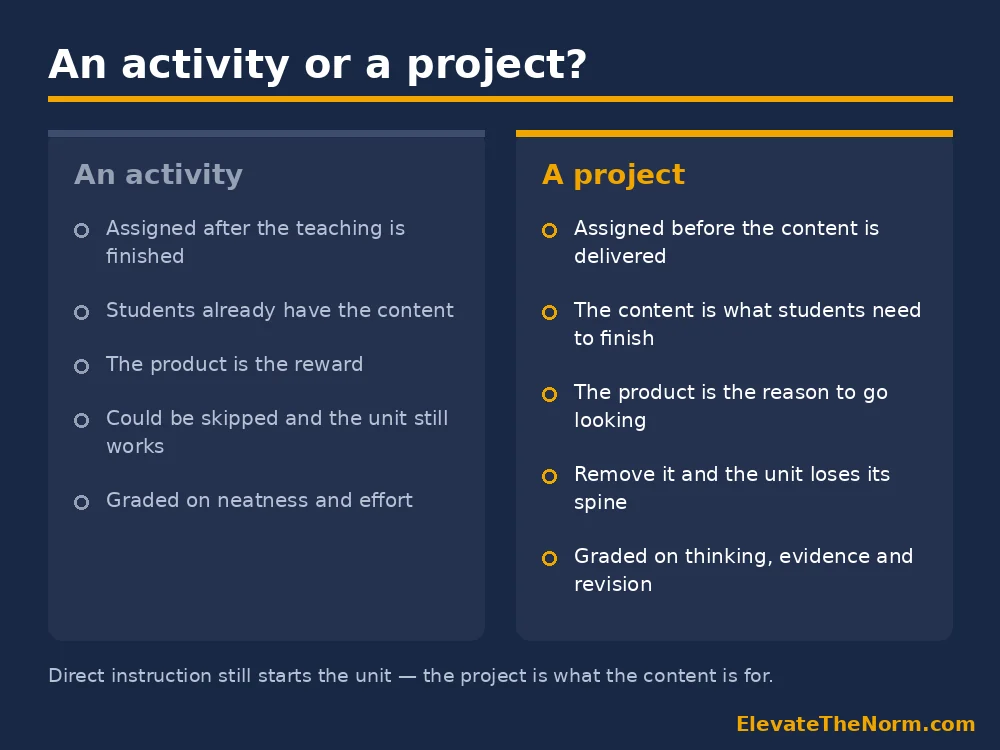
    Comparison of a history activity and a history project, showing an activity is assigned after the teaching while a project is assigned before the content is delivered
    The difference is not the product. It is when you assign it and what students need the content for.

    The projects below are built the other way around. The content is what students need in order to finish, which means they go looking for it. That is the difference between a project and project-based learning, and it is worth being precise about, because the two get used interchangeably and they are not the same thing. The definition of project based learning covers that distinction in more detail.

    One thing I want to be clear about up front, because it is the objection I hear most: none of this means abandoning direct instruction. I start almost every unit with it, and it often comes back in the middle. Direct instruction and project work should be working together, not competing for the same minutes.

    If you want the structure behind these before you pick one, the 7 steps of project based learning walks the process from driving question to public product, and there are more driving question examples if you want to write your own.

    World History Project Ideas

    These five world history project ideas work in a survey course and do not depend on where you are in the sequence. Two of them are period-specific; three will adapt to almost any unit.
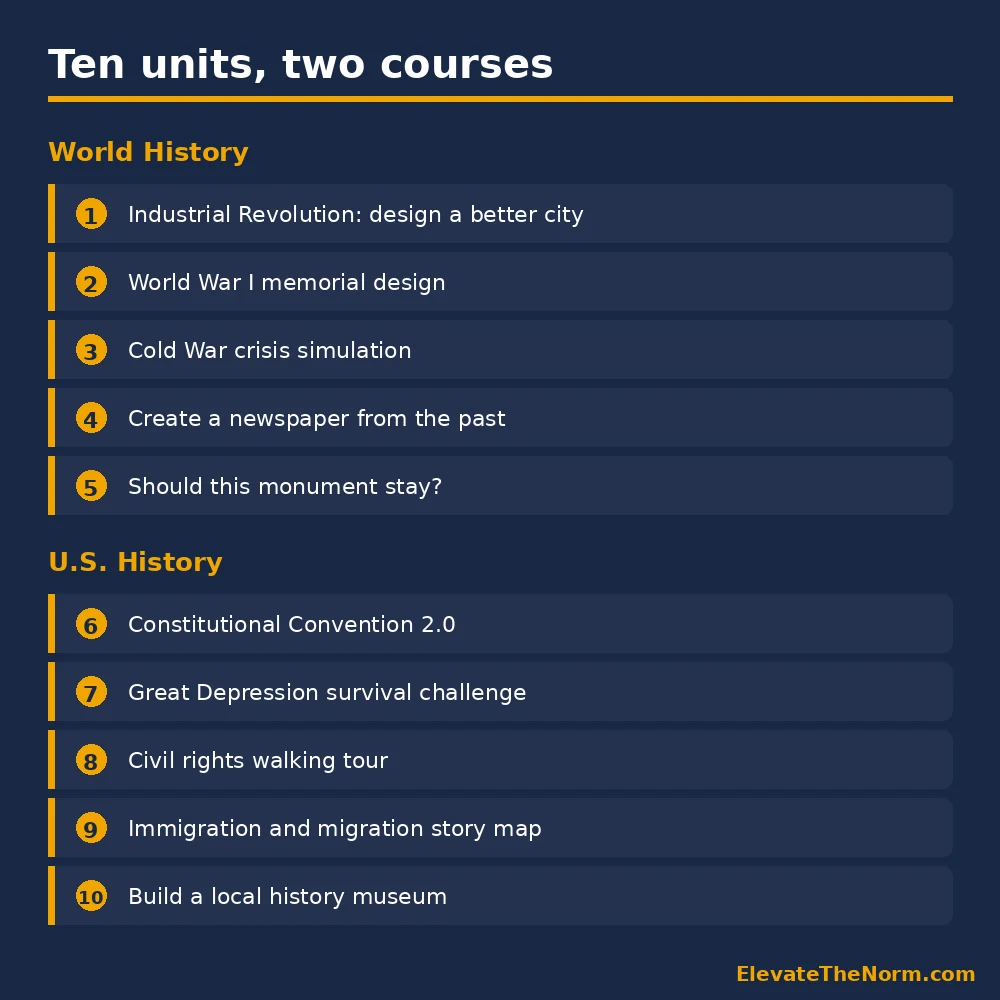
    Numbered list of ten history project ideas split into five World History units and five U.S. History units
    Five for world history, five for U.S. history. Most of them move between courses with small changes.

    1. Industrial Revolution: Design a Better City

    Driving question: How could an industrial city grow without sacrificing the lives of its workers?
    Grades 8–10 · 2–3 weeks

    Hand students a fictional industrial city with real problems — overcrowding, pollution, child labor, unsafe factories, disease, housing nobody should live in. They are the reformers. They build a plan covering housing, sanitation, transportation, worker protections, and factory regulation.

    The design constraint is what does the teaching: students cannot propose a fix until they can explain the problem. Want a sewer system? Show why disease spread. Want a child labor law? Show what children were actually doing. The content stops being something to study for a test and becomes something they need to finish the work.

    Where it goes wrong: groups jumping to solutions on day one. The fix is a hard checkpoint — problems only, with a historical cause attached to each, before any solution is allowed on paper.

    2. World War I Memorial Design

    Driving question: How should future generations remember a war?
    Grades 7–10 · 2 weeks

    Students investigate the war through soldiers, civilians, technology, casualties, and propaganda, then design a memorial and defend every major choice in writing.

    A memorial forces students to decide what matters. There is room for one, and it cannot hold everything. If you have space for five ideas about this war, which five deserve to survive? One pair centers the soldiers. Another centers civilians, or what the new technology did to the human body. The products look nothing alike and they hit exactly the same standards.

    Where it goes wrong: grading the art. The written defense is the assessment, and students need to hear that on day one or your strongest historians will panic about their drawing.

    3. Cold War Crisis Simulation

    Driving question: How do national leaders make decisions when every option carries serious consequences?
    Grades 9–10 · 1–2 weeks

    Students become a presidential advisory team during a fictional crisis modeled on something real. Intelligence arrives in stages. They decide whether to negotiate, blockade, use force, or gather more information — and they log why, every time.

    The Cold War makes sense once students feel the uncertainty. We teach these events knowing how they ended. The people in the room did not. So the information comes in pieces, and students decide without knowing what comes next.

    What I am actually measuring is not whether they pick the historically correct option. It is whether they change a decision when new evidence arrives. That is not indecisiveness. That is exactly what we want.

    Where it goes wrong: releasing all the intelligence at once, which destroys the whole mechanism. Also write the third packet so it genuinely undercuts a reasonable conclusion from the first two — if nothing ever contradicts, you teach students that first instincts are always right.

    4. Create a Newspaper From the Past

    Driving question: What would this event have looked like to people living through it?
    Grades 7–9 · 1–2 weeks

    Students produce a newspaper dated to one specific day in the period you are teaching. The rule that makes it work: nothing in the paper can reference anything that had not happened yet. A student writing about the Boston Tea Party cannot mention the Constitutional Convention. It has not happened.

    That single constraint teaches chronology, point of view, and sourcing at once, and it teaches them by making students enforce it on each other. Sourcing is doing most of that work, and it holds up better when taught on its own first. Because a newspaper has different jobs — reporter, editor, cartoonist, advertisement designer — every student has a way in.

    This one is a group of four to six, and that is fine. Do not be afraid of that size. If you have taken the time to understand where the project goes and where the questions will come from, you have control of the room. I call that controlled chaos, and it is the good kind.

    Where it goes wrong: modern voice. Show one real front page from the period and have a student read a paragraph out loud. They hear it immediately.

    5. Should This Historical Monument Stay?

    Driving question: Who should we memorialize, and how should communities remember the past?
    Grades 8–10 · 1–2 weeks

    Teams investigate a monument and recommend what a community should do with it: keep it, remove it, relocate it, or leave it up with new signage that reinterprets it. They present to a mock city council that asks questions back.

    The point is not the verdict. Students arrive with an opinion already formed and are required to investigate before they are allowed to decide. That order is the entire design. It forces them into conflicting evidence and competing perspectives, which is where the gray area lives — and history is not black and white, which is genuinely hard for students who think in straight lines.

    A fictional monument works as well as a real one and lowers the temperature, which some rooms need. Invent a mill owner who founded the town, employed half of it, and broke a strike in 1913. All four recommendations become defensible.

    Where it goes wrong: the teacher’s own position leaking. Do not tell students what side you are on, not once. Decide in advance how you will deflect the question and use the same move every time. The room only argues honestly if they cannot read you.

    U.S. History Project Ideas

    These five U.S. history project ideas map onto standard survey units. The first and last will work in a world history course too, with different content.

    6. Constitutional Convention 2.0

    Driving question: If we had to design a government from scratch, what powers should it have?
    Grades 8–10 · 1–2 weeks

    Students represent fictional states with different populations, economies, and interests, then negotiate representation, taxation, executive power, voting, rights, and the line between federal and state authority — and draft a constitution they all have to live under.

    The Constitution makes sense when students live the problem that produced it. Otherwise it is a piece of paper they are told is important. Instead of memorizing the Great Compromise, they sit in a room where large states and small states actually disagree about representation, and suddenly compromise has a purpose, because they need one.

    Participation climbs in this unit, and not because I asked better questions. Students are not answering the teacher. They are defending their state.

    Where it goes wrong: state profiles that let one bloc win every vote. Rebalance them before you run it. And when the first session deadlocks, let it sit — that frustration is what makes the compromise land two days later.

    7. Great Depression Family Survival Challenge

    Driving question: How would an ordinary family survive an economic crisis?
    Grades 9–10 · 1–2 weeks

    Each student gets a fictional family with jobs, savings, housing costs, and a location. Then history happens to them — unemployment, a bank failure, drought, illness, a wage cut, a New Deal program. They decide, and they write down why.

    Students usually learn the Depression as a list. Bank failures. Unemployment. Dust Bowl. New Deal. That is four disconnected facts. This makes them interact: lose a job and housing is at risk, lose housing and you migrate, a bank fails and the savings are simply gone. So when a New Deal program appears, students already understand the problem it was built to solve.

    That is a mental model. Memorizing ten acronyms is not.

    Where it goes wrong: students treating it as a game to win. Say on day one that some families do not recover, and that this is not a failing grade. Then mean it.

    8. Civil Rights Community Walking Tour

    Driving question: How did ordinary people and local communities contribute to the Civil Rights Movement?
    Grades 8–10 · 2–3 weeks

    Students research Civil Rights history in their own state or region and build a walking tour of five to eight stops, each with photographs, a map, quotations, biographies, and an explanation of why that spot earned its place.

    This one destroys the idea that history happened somewhere else. Students find out that national history took place a few miles from where they live. It also widens the story past the handful of names that make the textbook — the organizers, the drivers, the people who housed marchers, the teachers who lost jobs, the students who walked out.

    The tour can be entirely digital. No buses, no permission slips, no budget.

    Where it goes wrong: students defaulting to the national figures they already know. Build in a checkpoint that requires three local participants by name, with what each one did.

    9. Immigration and Migration Story Map

    Driving question: Why do people leave one place and build a life somewhere else?
    Grades 7–10 · 2 weeks

    Students trace a real migration — westward expansion, the Great Migration, Ellis Island, the Dust Bowl, a modern movement — and map it, annotating push factors at the origin, pull factors at the destination, obstacles along the way, and consequences in both places.

    What makes this one work is that cause and effect becomes visible. I am not handing students a definition of push and pull factors to memorize. They follow actual people across actual distance and explain why the movement happened, and the map shows the answer. Where geography and history are taught together, this is the unit that justifies it.

    Where it goes wrong: routes too vague to research. “Immigration” is not a route. “Sicilian families through Ellis Island, 1900 to 1914” is. Lock the group, the origin, the destination, and the years before anyone starts.

    10. Build a Local History Museum

    Driving question: How can we preserve and explain the history of our community?
    Grades 7–10 · 2–3 weeks

    Students research a local person, building, business, school, event, or tradition and build a museum-style exhibit — artifact, photographs, captions, a map, and a written historical interpretation. The class combines them into one museum, physical or digital.

    Instead of me telling students what happened in their community, they become the historians. They locate the evidence, decide what is important, and explain it to somebody else. The museum label format does a lot of the teaching on its own, because being short, accurate, and clear at the same time is harder than writing a page.

    Where it goes wrong: topics that are too big, and one website used as the only source. A required source log, checked early rather than at the due date, fixes the second one. If students need practice with the sourcing itself before the exhibit work starts, sorting a local legend into checkable claims and folklore is a short way in. Forcing every group to one specifically named subject fixes the first.

    How to Pick One

    If you have never run a project like this, start with the newspaper or the memorial. Both have clear products, both forgive a rough first attempt, and neither depends on a simulation staying under control.
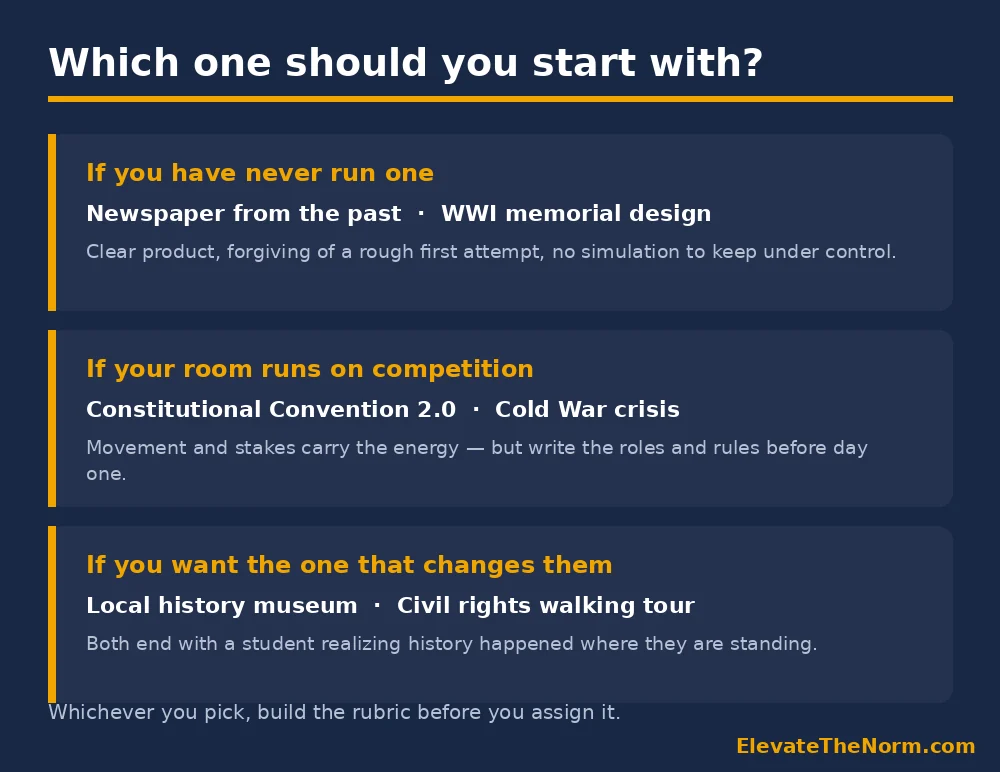
    Decision guide matching three classroom situations to the history projects that suit them best
    Pick for the room you actually have, not the one you wish you had.

    If your room responds to competition and movement, start with the Constitutional Convention or the Cold War simulation — or, if an election is anywhere near, the mock election that grew into a school-wide vote, which is written up start to finish.

    If you want the one that changes how students see the subject, it is the local museum or the walking tour, because both end with a student realizing history happened where they are standing.

    And if you teach more than one social studies course, these sit inside a longer list — twenty-five social studies projects grouped by course for grades 6–12 — which adds civics, geography and economics alongside the history ones here.

    Whichever you pick, build the rubric before you assign it — there is a free editable PBL rubric if you want a starting point, and more planning tools and templates alongside it.

    The Part That Matters Most

    Every one of these projects asks students to do something historians actually do. Use evidence. Defend a decision. Hold two perspectives at once. Revise an argument when the evidence changes. Those are also, not coincidentally, the things people who do well in life tend to be good at.

    And for the student who struggles in a traditional history class, a project gives them a reason to read the source, learn the vocabulary, and know the content — because they need it to build the thing.

    The project is not what students do after they learn the history. The project is how they learn the history.

    Teaching the week of Halloween? The holiday is a good small history unit in its own right: Samhain, souling and guising, turnip lanterns, and the Irish and Scottish immigrants who brought it to America. I wrote five-day Halloween Week Units for middle school and high school, each with a nonfiction article, a comparison of fall traditions around the world, and a writing project.

    Need a five-minute hook before a project? Our fun history facts for students pair 55 sourced facts with opinion questions, grouped by era, with free bell ringer cards.

    What is a good history project for high school students?

    The best history projects give students a real question with more than one defensible answer and require them to use evidence to answer it. A monument recommendation, a Cold War crisis simulation, and a memorial design all work well at the high school level because students cannot complete them without understanding the content first.

    How long should a history project take?

    Most of these run one to three weeks. Anything shorter than about a week does not allow for the research, feedback, and revision that make a project worth doing. A single class period activity is a good activity, but it is not project-based learning.

    Do history projects replace lectures and notes?

    No. Almost every project here starts with direct instruction, and several bring it back in the middle when students hit a skill they are missing. Project work and direct instruction should be working together. The project changes when and why the content is delivered, not whether it is.

    How do you grade a history project fairly?

    Grade the thinking, not the craftsmanship. On a memorial design, the written defense of the design choices carries the weight, not the drawing. Build the rubric before you assign the project, share it with students at the start, and keep the criteria tied to evidence use, reasoning, and historical accuracy.

    What if students just divide the work and never collaborate?

    Assign specific roles with specific deliverables and check individual work at a midpoint rather than group output at the end. On the newspaper project, every student has a different job. On the migration map, one student owns the source log. The checkpoint in the middle is what catches an uneven group while there is still time to fix it.

    Can these history projects work in a middle school classroom?

    Most of them are written for grades 7 through 10. The newspaper, the local history museum, the migration story map, and the memorial design all work well in middle school. The Cold War simulation and the Great Depression challenge are better suited to grades 9 and 10 because they depend on sustained decision-making.

    How do you handle controversial topics in a history project?

    Do not tell students where you stand, and require investigation before they are allowed to reach a conclusion. Using a fictional example instead of a real local one lowers the temperature without lowering the rigor. The goal is that students’ reasoning becomes more sophisticated, not that their opinions move in a particular direction.


    About Clay Shumate
    Clay Shumate is a certified secondary Social Studies teacher in the public schools of West Alabama, with seven years of classroom experience, a B.A. in History, and an M.Ed. in Secondary Education. He writes about project-based learning, student responsibility, respect, and practical ways to hold young people to a higher standard while giving them room to learn from mistakes. He is a member of the Society of Professional Journalists and writes to its Code of Ethics; this site’s editorial standards and corrections policy are published in full. More about Clay.
  • Apps for Parent-Teacher Communication: How to Choose One You Can Defend

    Apps for Parent-Teacher Communication: How to Choose One You Can Defend

    Apps for parent-teacher communication are tools for reaching families quickly, usually with translation and a record of what was sent. Choosing one is less a question of which app is best than of which one you can defend — to your principal, to a parent who asks where their child’s data went, and to yourself in June when you have been using it every day.

    Almost every article on this subject is a ranked list. This one is not, for two reasons. Feature lists go stale within months, and the thing that actually decides whether one of these works in a secondary school is not features at all.

    It is whether the tool is approved, whether it reaches the families who are hardest to reach, and whether you can keep using it in week thirty.

    Key Takeaways

    • Start with your district’s approved list. A tool a teacher adopts alone usually has no written agreement behind it, and that is the part that matters legally.
    • The privacy picture is genuinely bad. One widely reported figure puts 96 percent of apps regularly used in K–12 schools as having data-sharing practices not adequately safe for children.
    • Four categories, four different jobs. Mass notification, two-way messaging, gradebook portals and behaviour-points systems are not competitors — they do different things.
    • Behaviour-points apps were built for elementary. Think hard before importing a public points economy into a room of fifteen-year-olds.
    • Reach is a hardware question first. If a family has no reliable smartphone, the best app in the world is a way of not contacting them.
    • No app fixes a bad ratio. If every message you send is bad news, sending it faster does not help.

    Before You Choose: The Privacy Problem Nobody Mentions

    This belongs first because it is the part that can land on you personally.

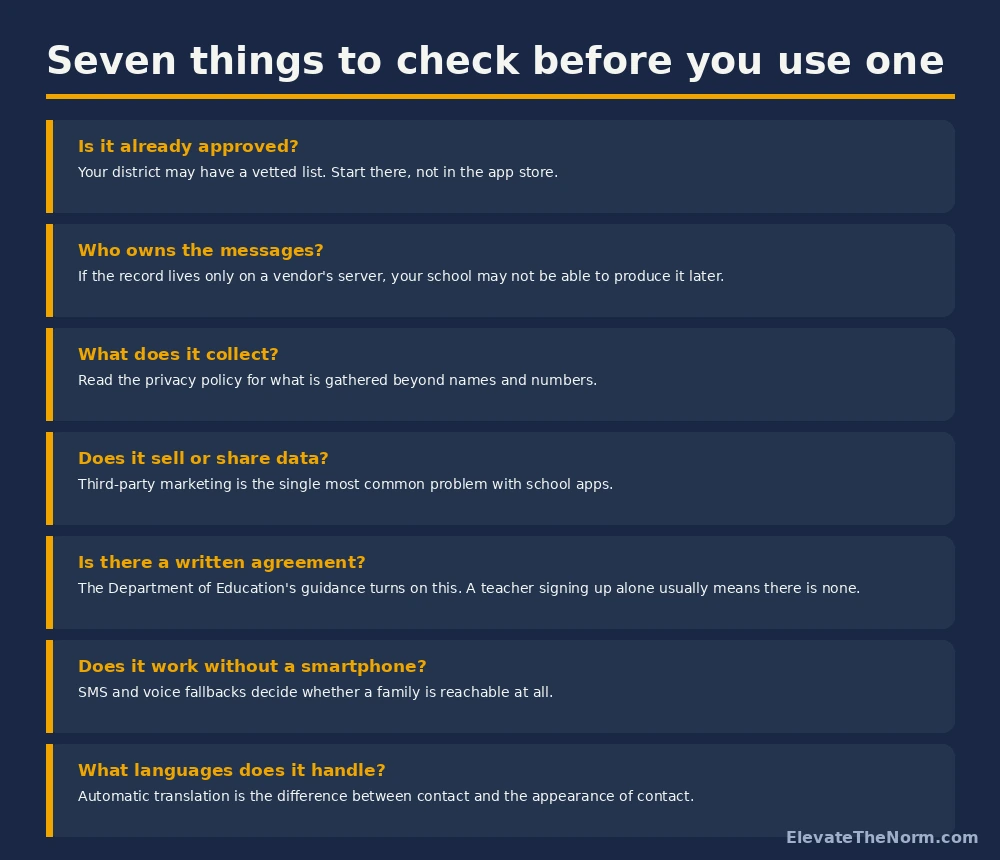
    Checklist of seven things to check before using a parent-teacher communication app, including approval, data sharing and written agreements
    Most of these take ten minutes. Skipping them is how a teacher ends up personally responsible.

    Writing for Edutopia, Roxi Thompson reports a striking figure: 96 percent of apps used regularly in K–12 schools have data-sharing practices that are “not adequately safe for children”, with many sharing personal information with third-party marketers without the school’s knowledge or consent. Thompson is reporting that figure from other research rather than producing it, so treat it as a well-circulated finding rather than one this article has verified at source — but the direction is not seriously disputed.

    Her practical advice is the right starting point: use the vetted list your district has already produced, because somebody trained has read the privacy documents. If you are evaluating something yourself, read the terms of service and the privacy policy for what is collected and how it is secured, and check a service like the Common Sense Privacy Program, which rates tools across ten privacy dimensions.

    The legal frame sits above that. The US Department of Education’s Student Privacy Policy Office explains that FERPA generally bars sharing personally identifiable student information without consent, with exceptions covering contractors and others performing services for the school — and that written agreements must in many cases be developed to protect student data, with requirements varying by circumstance. The office publishes a written agreement checklist for exactly this.

    Read that sentence again with a teacher’s eyes. A written agreement is a thing a district does. It is not a thing that exists when one teacher downloads an app on a Sunday and starts entering student names.

    None of this is a reason to avoid these tools. It is a reason to use the ones your school has already cleared, and to ask before adopting one it has not. The tool matters less than the habit behind it — what the randomized trials say about reaching families, and a rotation that survives a full roster, is the part no app solves for you.

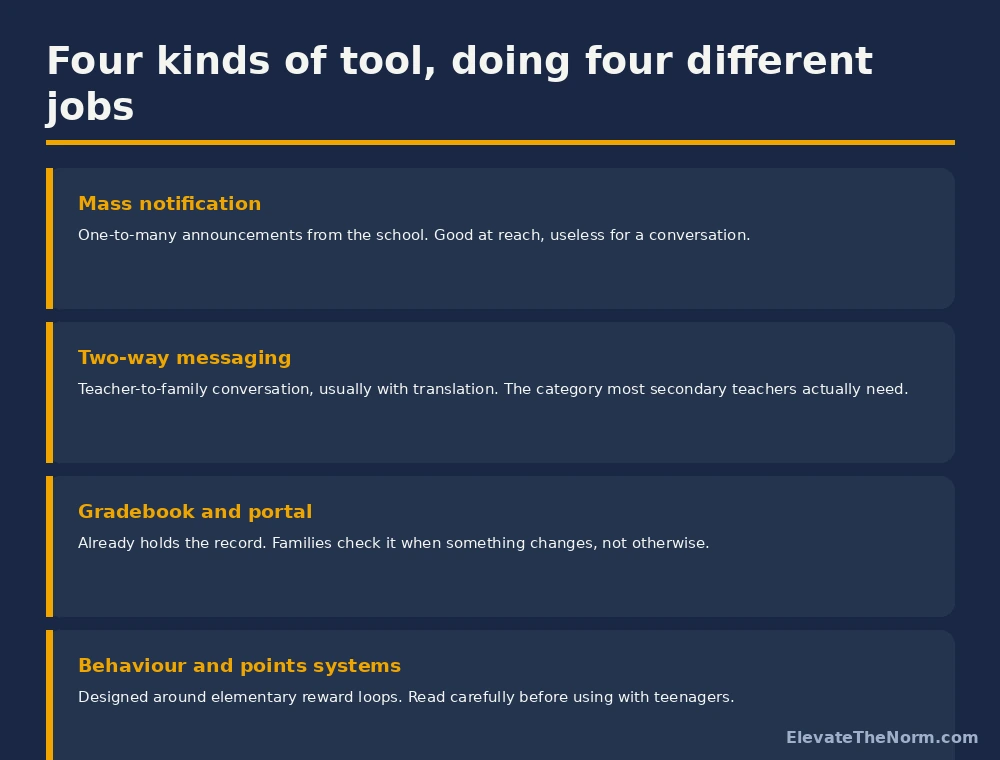
    Four Kinds of Tool, Doing Four Different Jobs

    Most arguments about which app is best are really arguments about which job you are doing. Sort the category first and the shortlist gets very short.

    Four categories of parent communication tool: mass notification, two-way messaging, gradebook portal, and behaviour points systems
    Most arguments about which app is best are really arguments about which job you are doing.

    Mass notification platforms push announcements from the school to everybody. They are excellent at reach and terrible at conversation, and they are usually chosen at district level, so you probably do not get a vote.

    Two-way messaging is the category most secondary teachers actually need — a way to message one family, get a reply, and have it translated. This is where the meaningful differences between products live.

    Gradebook portals already hold the record and already have every family’s login. They are chronically underused as a communication channel because families check them when something changes rather than habitually, which is a notification problem rather than a portal problem.

    Behaviour and points systems deserve a specific warning. Most were designed around elementary reward loops, and several make a student’s standing visible to their family in close to real time. A points economy that a nine-year-old finds motivating is something a fifteen-year-old is likely to find humiliating, and a running public score sits awkwardly with firm standards held without shame. Read what the tool actually shows families before you switch it on.

    I Have Taught With No Devices, Shared Carts and One-to-One

    In my second year, devices arrived as a single cart shared between two classrooms. By my final year at my previous school it was one-to-one, and it is one-to-one again now. I have taught at all three levels of access.

    That progression is the reason I am wary of any communication plan that assumes a smartphone on the other end. Writing the channel down in advance, family by family, is what keeps that assumption from going unexamined. Device access is not evenly distributed among students, and it is distributed even less evenly among their families. A teacher who has only ever worked in a one-to-one building can genuinely believe that “I sent it on the app” is the same sentence as “I contacted the family.”

    It is not. It is the same sentence as “I did the part that was convenient for me.”

    The practical version: whatever app you use, know which families it does not reach, and have a second route for them. Usually that is a phone call, and usually it is three or four families per section. That is an afternoon, once, and it removes the largest blind spot in the whole system. A free Parent Contact Log on TPT makes it easy to see which families you have not reached yet.

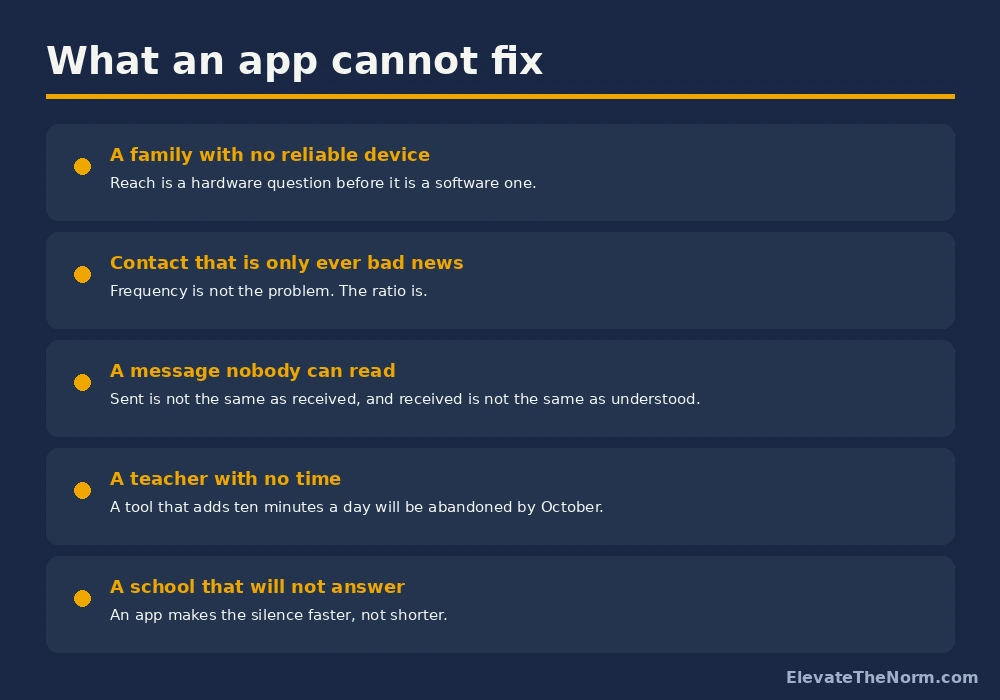
    What an App Cannot Fix

    Worth being blunt, because the marketing for all of these implies otherwise.

    Five problems a parent-teacher communication app cannot solve, including families without devices and contact that is only bad news
    An app makes the silence faster, not shorter.

    The ratio is the one worth dwelling on. If a family only hears from you when something has gone wrong, the app notification itself becomes a bad-news alert, and people stop opening those. Nothing in the software fixes that — it is a decision about when you make contact, not about how.

    The time cost is the second. A tool that adds ten minutes to your day will be quietly abandoned by October, and an abandoned channel that families were told to use is worse than never having offered it. Pick something you will still be using in week thirty.

    And translation deserves a flag rather than a tick. Automatic translation is genuinely one of the most valuable features in this category and it is genuinely imperfect. It is fine for a homework reminder. For anything consequential — a behaviour incident, a failing grade, a meeting request — get a human interpreter the way your school does for any other serious conversation.

    How to Choose One in About Twenty Minutes

    1. Ask what is already approved. One email to whoever handles technology in your building. If something is on the list, your decision is made and the agreement exists.
    2. Name the job. Announcements, conversation, grades, or behaviour. Pick one — a tool that claims all four usually does two of them badly.
    3. Check the fallbacks. Does it reach a family by SMS or voice when there is no app installed? This single question eliminates several popular options for a lot of schools.
    4. Check the languages against the languages actually spoken by your families, not the marketing list.
    5. Read what families see. Log in as a parent if you can. Some tools show far more than teachers realise, and some show it in real time.
    6. Decide who owns the record. If a dispute arises in March, can your school produce what was sent? If the answer is “the vendor has it,” raise that before you start, not after.

    If nothing is approved and you need something now, the lowest-risk option is usually the tool your district already pays for — the gradebook portal — plus a phone call for the families it does not reach. It is unglamorous and it creates no new data-sharing relationship at all.

    Keep the Record Somewhere You Control

    Whatever tool you land on, keep your own log of substantive contact — date, family, method, what was discussed, what was agreed. Not every message, just the ones that matter.

    Two reasons. The first is practical: you will be asked what you did about a student, sometimes months later, and “I think I messaged them in October” is not an answer. The second is structural: a log that lives with you survives a vendor change, a contract expiry, or a platform your district drops over the summer.

    A printable version is on the free parent-teacher communication log page, no email required. Paper is genuinely fine for this. The point is that the record is yours.

    What to Do Next

    Send the email asking what is approved in your building. While you wait, work out which families in your hardest section you could not reach today if you had to, and how you would reach them instead. That list is short, and it is the most useful thing in this article.

    Then make the first contact of the year a good one, before anything has gone wrong. Every app in every category works better when the notification is not automatically bad news, and that is a choice you make rather than a feature you buy.

    The app gets you to the family. What you say when you get there is the harder question. The evidence on frequency, message content, and what the research actually found — including two randomized trials with effect sizes a secondary teacher can use — is covered in the companion guide to reaching families in grades 6 through 12. For the once-a-term meeting itself, handing the talking over to the student instead of talking about them changes what a family walks out with.

    Product landscapes in this category change quickly. This page describes how to evaluate a tool rather than ranking specific products, so it should stay useful longer than a feature comparison would. Privacy and legal guidance linked here was checked on September 12, 2026.

    Frequently Asked Questions

    Can I just download an app and start using it with my class?

    Usually you should not, and in many districts you are not permitted to. FERPA allows schools to share student information with contractors performing services for them, but the Department of Education’s guidance is clear that written agreements are often required to protect that data. A written agreement is something a district puts in place — it does not exist because an individual teacher accepted a terms-of-service box. Ask what is already approved first; it is one email and it moves the responsibility to where it belongs.

    Which parent-teacher communication app is best?

    There is no single answer, and any article that gives you one is either out of date or selling something. The right tool depends on which job you need done — mass announcements, two-way conversation, grades, or behaviour — and on what your district has already cleared. Sort the category and check the approved list, and the shortlist usually comes down to one or two options you can actually use.

    What about families who do not have a smartphone?

    Plan for them explicitly, because they exist in every school and they are frequently the families you most need to reach. Check whether your tool falls back to SMS or a voice call when no app is installed — several do, and it is one of the more meaningful differences between products. Then identify the handful of families in each section it still will not reach and use the phone. It is usually three or four per class, which is an afternoon once.

    Is automatic translation good enough?

    For routine messages, generally yes, and it is one of the genuinely valuable features in this category. For anything consequential — a behaviour incident, a failing grade, a meeting about placement — use a human interpreter, the same way your school would for any other serious conversation. Machine translation errors in a routine reminder are an inconvenience; the same error in a disciplinary message is a real problem.

    Should I use a behaviour points app with high school students?

    Be careful. Most of these were designed around elementary reward loops, and several display a running score to families in close to real time. What a nine-year-old experiences as a game a fifteen-year-old may experience as a public verdict delivered to their parents. If you are considering one, log in as a parent first and look at exactly what is visible and how quickly. There are secondary classrooms where these work; there are more where they quietly damage the relationship you were trying to build.

    How often should I be messaging families?

    The ratio matters more than the frequency. If the only time a family hears from you is when something has gone wrong, they learn to dread the notification and eventually stop opening it. Making the first contact of the year a positive or simply neutral one costs a few minutes per family and changes how every later message is received. No app feature substitutes for that decision.

    Do I still need a paper log if the app keeps a record?

    Keep your own record of substantive contact, yes. Not every message — the ones that matter. Vendor records can become hard to retrieve, districts change platforms, and contracts end. A short log of date, family, method, what was discussed and what was agreed takes seconds to maintain and answers the question you will eventually be asked months later.

    Sources

    • U.S. Department of Education, Student Privacy Policy Office. Privacy and data sharing. Read the guidance — the source for the FERPA contractor exception and the requirement for written agreements, and the home of the Written Agreement Checklist.
    • Thompson, R. (2023, March 15). Protecting student data privacy. Edutopia. Read the article — the source for the 96 percent figure, which Thompson reports from other research rather than producing, and for the recommendation to use district-vetted lists and the Common Sense Privacy Program.

    Every link above was checked on September 12, 2026. This page deliberately does not rank named products, because feature and pricing claims in this category go out of date faster than an article can be maintained honestly.


    About Clay Shumate

    By Clay Shumate — Clay Shumate is a certified secondary Social Studies teacher in the public schools of West Alabama, with seven years of classroom experience, a B.A. in History, and an M.Ed. in Secondary Education. He writes about project-based learning, student responsibility, respect, and practical ways to hold young people to a higher standard while giving them room to learn from mistakes. He is a member of the Society of Professional Journalists and writes to its Code of Ethics; this site’s editorial standards and corrections policy are published in full.

  • Classroom Transitions: How to Stop Losing Six Minutes a Lesson

    Classroom Transitions: How to Stop Losing Six Minutes a Lesson

    Classroom transitions are the moments between things — arriving, switching tasks, moving into groups, coming back, packing up. In a secondary room they are where most lost instructional time actually goes, and they are almost never taught. Fixing them is not about speed. It is about removing the ambiguity that makes thirty teenagers wait to see what everyone else does first.

    Nobody sets out to lose this time. It goes in ninety-second pieces, six or seven times a period, and none of the pieces feels big enough to be worth addressing.

    Added up over a year, it is one of the largest recoverable resources a teacher has.

    Key Takeaways

    • The measured figure is about six minutes per lesson start — and the researcher who found it calculated that as roughly five weeks of teaching across a year.
    • Attention comes before instruction. Every transition that fails, fails at that step.
    • One signal, one word, every time. Changing the word, or raising the volume instead, teaches students to wait for the shouting.
    • Four transitions carry most of the loss. Script those and leave the rest alone.
    • A thirty-second warning before stopping group work costs nothing and protects the thing you were trying to build.
    • Be careful with the research. The best figures here come from Finnish primary and lower-secondary classrooms with a mean class size of 17, and the author calls the study preliminary.

    How Much Time Do Transitions Actually Cost?

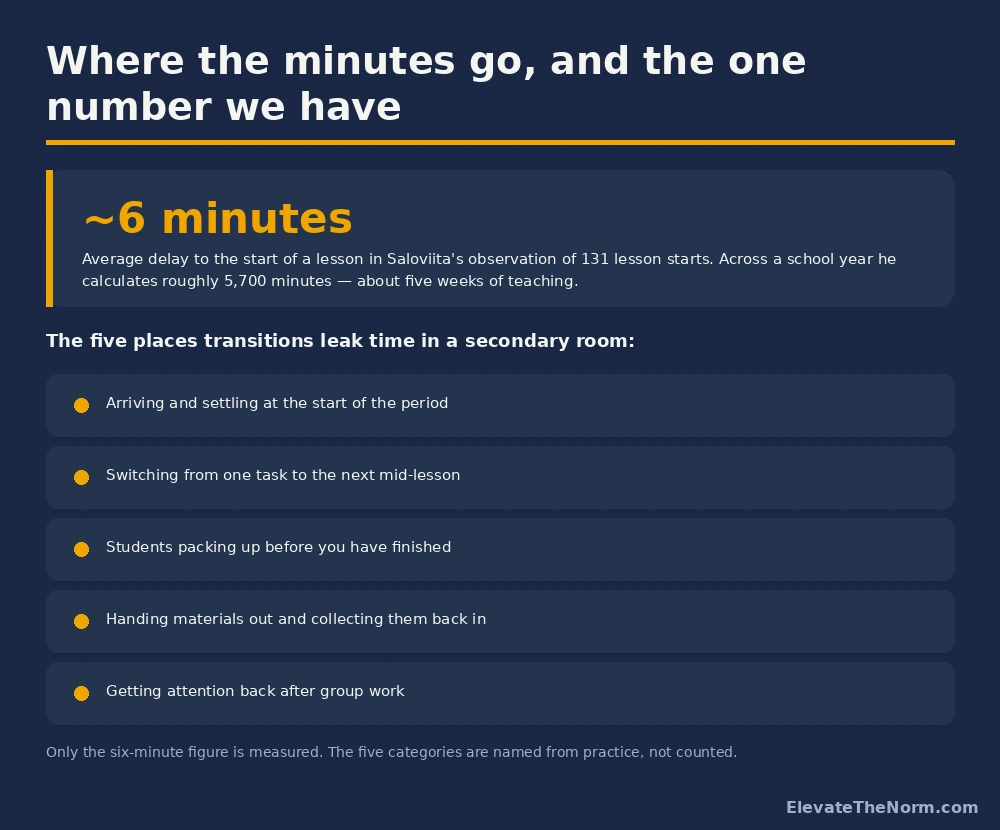
    The most concrete number available comes from Timo Saloviita’s observational study in the International Journal of Environmental & Science Education. Observers recorded 131 lesson starts across 131 teachers and found that the teacher was on average two minutes late and the lesson started six minutes late. In four cases the delay reached fifteen minutes.

    Graphic showing the six-minute average lesson start delay from Saloviita's study alongside five places transitions leak time
    Six minutes a lesson start, across a year, is about five weeks of teaching.

    Saloviita then does the arithmetic that makes the number land: six minutes per lesson start becomes about 150 minutes a week, and roughly 5,700 minutes across a school year — around 127 lessons, or five full weeks of teaching. The counterweight is having something on the board students can start without you, so the opening minutes are already spoken for.

    Before anyone puts that on a staff-meeting slide, the caveats, which are the author’s own. This was Finland, in comprehensive schools spanning grades 1–9, and only a fifth of the observed lessons were in grades 7–9. Mean class size was seventeen students. Saloviita describes it as a preliminary study and says replication is needed.

    So treat five weeks as an order of magnitude rather than a measurement of your building. A room of thirty American fifteen-year-olds changing classes every period is not the room that was observed. The direction is almost certainly right; the precision is not yours to claim.

    A more recent synthesis puts a much wider band around the same idea. Reviewing the available research on time in school, Kraft and Novicoff report that off-task behavior, transitions and wait time together occupy between 17 and 29 percent of instructional time — a range, drawn from several different measurement methods, and covering three things at once rather than transitions alone. Both numbers on this page point the same way and neither is precise, which is the honest summary: the loss is large and nobody has measured it cleanly. If you want that evidence worked through at more length, the companion guide takes the measurement problem head on.

    Todd Finley, writing for Edutopia, offers the same idea from the other end: saving fifteen minutes a day works out at roughly 45 extra hours of instruction across a year. Different route, same conclusion — this is the cheapest time on the timetable to recover.

    Five Steps That Make a Transition Hold

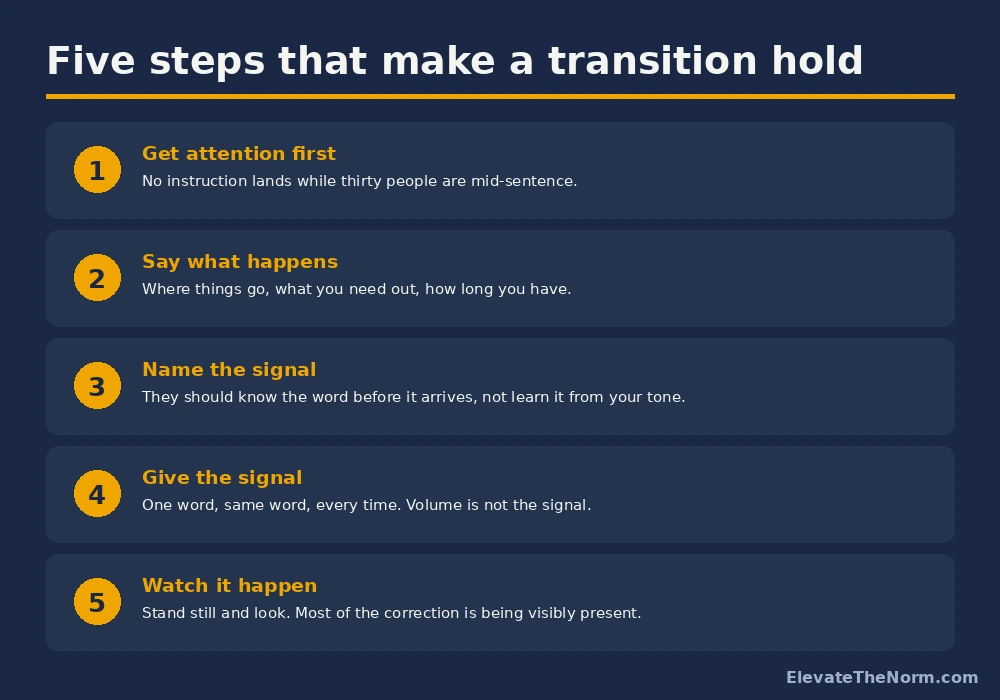
    Finley sets out a five-step sequence that works at any grade: get attention, explain the procedure, prepare students for the signal, give the signal, then watch what happens. The order is the point, and almost every failed transition failed at step one.

    Five steps for running a classroom transition: get attention, say what happens, name the signal, give the signal, watch it happen
    Attention first. Every step after it fails without it.

    Attention before instruction. Nothing you say while thirty people are mid-sentence reaches more than about six of them. The other twenty-four will ask their neighbour, and the neighbour will be wrong.

    Say the whole thing before anyone moves. Where things go, what needs to be out, how long they have. Once bodies are moving, no further instruction is getting in.

    Name the signal in advance. Finley suggests using a word like “smooth” rather than “go” — partly because it is distinctive, partly because “go” is a starting gun. Whatever you pick, students should know the word before they hear it.

    Then stand still and watch. Most of the correction you need is being visibly present while it happens, which is also the least tiring form of classroom management there is.

    Finley also mentions a competitive timing approach — one teacher uses a stopwatch and challenges classes to beat other sections. It works for some groups and backfires badly with others, particularly where a slower student becomes the reason the class “lost.” Use it knowing that.

    The Four Transitions Worth Scripting

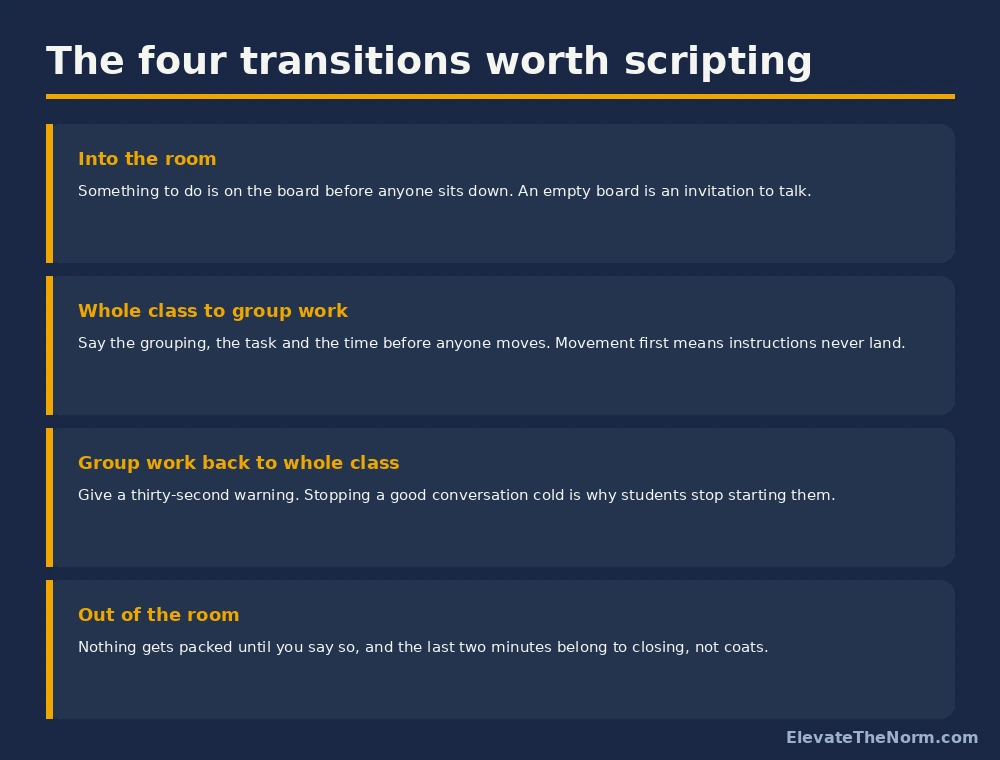
    You do not need a procedure for every movement in the room. Four moments carry most of the loss, and scripting those is enough.

    Four classroom transitions worth scripting: into the room, into group work, back to whole class, and out of the room
    Four moments carry most of the lost time. Script those and ignore the rest.

    Into the room. Something to do is on the board before anyone sits down. An empty board is an invitation to talk, and it is a reasonable one. This is the single highest-return transition to fix, because it is also the one Saloviita measured. Half sheets, pencils and dry-erase sleeves stacked by the door help too, and the budget supplies that keep an opener moving cost less than most teachers expect.

    Whole class into group work. Grouping, task and time, all announced before a single chair moves. This is where most secondary transitions collapse, because the instruction competes with the movement and loses.

    Group work back to whole class. Give a thirty-second warning. Cutting off a working conversation with no notice teaches students that engaging deeply is risky, and after a few weeks of it they stop starting.

    Out of the room. Nothing gets packed until you say so. The last two minutes belong to closing the lesson, and surrendering them is how a forty-five minute period becomes a forty-minute one.

    All four are routines, and they follow the same rules as every other routine in the room — named, demonstrated, practised and re-taught rather than announced once in August.

    Why My Room Transitions Quietly

    I do not turn the overhead fluorescents on. The room runs on floor lamps around the perimeter and a few smaller desk lamps, which makes it warm and low rather than institutional.

    That was a deliberate choice about sensory load, and it helps far more students than the ones who would ever have asked for an accommodation. What I did not expect was how much it changes transitions specifically. Transitions are the loudest, brightest, most chaotic thirty seconds of any lesson — everything moving at once, and every voice rising to be heard over the others. In a room that is already quieter and dimmer than the corridor, the ceiling on that noise is lower to start with.

    It is not a technique and I would not sell it as one. But if transitions in your room feel like the volume doubles every time, it is worth asking whether the room itself is part of what students are reacting to before you decide it is a behaviour problem.

    Signals That Work With Teenagers

    Most published transition signals were designed for eight-year-olds, and using them with fifteen-year-olds produces exactly the reaction you would expect. The ones students can see are covered in more depth in a separate guide to the cues students actually look back at, including how to build one that does not just become wall decoration. Getting the room quiet in the first place is a separate problem from telling it what to do next, and a countdown the class has a reason to answer holds up with teenagers far better than anything that asks them to chant a phrase back. What survives into secondary:

    • One consistent word. Unglamorous and the most effective thing on this list. It works because it is predictable, not because it is clever.
    • A visible countdown. A timer on the board removes the argument about how long is left. Finley points at simple countdown tools for exactly this.
    • A hand signal for routine requests. Finley describes a teacher whose students use one finger for help, two for the bathroom, three for a pencil — the request happens without interrupting anyone.
    • Standing in one particular place. Silent, costs nothing, and works because the room learns what it means.
    • Music, used carefully. A track of a set length is a countdown students can hear. It needs to be chosen for a secondary audience, which is a separate and slightly fraught question.

    What does not survive: anything that requires teenagers to repeat a phrase back to you in unison, and raising your voice. Volume is not a signal. It is the absence of one, and students learn to wait for it.

    The music question is the one people ask most and it deserves its own answer, because almost everything written about classroom transition songs was written for elementary rooms. The mechanism transfers to secondary; the track choice does not. I worked through what a track has to do to survive a room of fifteen-year-olds — length, lyrics, familiarity — in a separate piece on choosing transition songs and cues for teenagers.

    Where Transitions Break Down

    • Instructions given while students move. The most common failure. Say it all first, then release.
    • No warning before stopping group work. Reads as arbitrary, and it quietly punishes the students who were most engaged.
    • A different signal every week. Consistency is doing all the work. Changing it resets the learning to zero.
    • Volume as the signal. Teaches the room to ignore everything below shouting.
    • Blaming the class. A transition that fails repeatedly was designed badly. That is a planning problem, not a character problem.
    • Never practising it. Same as any routine: announcing is not teaching.

    What to Do Next

    Time your own start for one week. Note when the bell went and when the first real instruction landed, every period, without changing anything else. If the gap is bigger than you expected, the cheapest thing to change first is the opener — a posted five-minute task students start without being told moves that number more than any amount of asking for quiet. Most teachers are surprised, and the surprise is more persuasive than any study.

    Transitions are also the procedure observers score hardest, because they are named in all four levels of the rubric. If you are being evaluated on this, see what an observer is looking for under managing classroom procedures.

    Then fix that one transition — something on the board before they sit, one consistent signal, said and practised — and leave the other three alone until it holds. If you want concrete versions to borrow, the worked examples and the printable pack behind them has scripts and cue cards you can print, no email required.

    Printables for this

    Two of mine on TPT, both built for this. The Station Rotation Toolkit has the signs and recording sheets that make the whole-class-into-groups transition run without a second round of instructions. Brain Breaks is 60 cards for the reset between tasks — short, timed, and written for teenagers rather than eight-year-olds.

    Frequently Asked Questions

    How long should a classroom transition take?

    Thirty to sixty seconds for most secondary transitions, and the number matters less than announcing it. Tell students how long they have and then hold that time. The problem in most rooms is not that transitions are slow, it is that nobody knows when they are supposed to be finished, so everyone waits to see what everyone else does.

    Do transitions really cost that much time?

    The clearest measurement available found lessons starting about six minutes late on average, which the researcher calculated as roughly five weeks of teaching across a year. That study was Finnish, spanned grades 1–9 with only a fifth in grades 7–9, had a mean class size of 17, and its author calls it preliminary. So treat it as a strong indication rather than a precise measure of your own timetable. The honest version: the losses are real and larger than they feel, and the exact figure for your room is something you would have to time yourself.

    What signal works best with high school students?

    One consistent word, used every time, with no volume behind it. Consistency is what makes a signal work, not cleverness — students respond to predictability. Countdown timers on the board work well because they remove the argument about how much time is left. Avoid anything that asks teenagers to chant a response back in unison; it reads as being treated like a child and you will lose the room’s goodwill faster than you gain the seconds.

    How do I stop students packing up early?

    Decide what the last two minutes are for and use them every single day. Students pack up early when the end of a lesson has no content in it, which is a reasonable read of the situation. A consistent closing task — a sentence on what changed today, a question to answer on the way out — gives the time a purpose. Then hold the line that nothing goes in a bag until you say so, and be the person who does not start packing up first.

    What if my transitions fail with one particular class?

    Look at the design before the students. A transition that works in four sections and collapses in the fifth usually differs in something structural: the time of day, the room, the size, who arrives late from across the building, or what lesson they came from. Re-teach the transition with that class specifically and adjust the timing to their reality. Treating it as defiance when the structure is different will make it worse.

    Should I use music for transitions in a secondary classroom?

    It can work well, because a track of known length is a countdown students can hear rather than watch. The difficulty is selection — music aimed at younger children will get exactly the reaction you expect from teenagers, and anything with lyrics needs checking against what your school would consider appropriate. If you use it, keep the track consistent so the sound itself becomes the signal.

    Is scripting transitions not a bit rigid?

    The script is for you, not for them. What students experience is a room where they know what happens next, which is the opposite of rigid — it is what makes the unpredictable parts of a lesson possible. Rooms without scripted transitions are not freer; they just spend their unstructured time on logistics rather than on anything interesting.

    Sources

    • Saloviita, T. (2008). Classroom management and loss of time at the lesson start: A preliminary study. International Journal of Environmental & Science Education, 3(3). Full text (PDF) — 131 observed lesson starts in Finnish comprehensive schools, grades 1–9, mean class size 17. The author describes it as preliminary and calls for replication.
    • Finley, T. (2017, March 13). Mastering classroom transitions. Edutopia. Read the article — the source for the five-step transition sequence, the hand-signal and countdown examples, and the 45-hours-a-year figure, which Finley attributes to a behaviour-management resource rather than to original research.
    • Kraft, M. A., & Novicoff, S. (2024, February). Time in school: A conceptual framework, synthesis of the causal research, and empirical exploration. EdWorkingPaper. Full text (PDF) — the 17–29 percent figure is a range assembled from several studies using different measurement methods, and it covers off-task behavior, transitions and wait time together rather than transitions alone.

    Every link above was checked on September 12, 2026; the Kraft and Novicoff paper was added and checked on September 30, 2026. Where a figure comes with limits on how far it travels, those limits are stated in the text rather than left in a footnote.


    About Clay Shumate

    By Clay Shumate — Clay Shumate is a certified secondary Social Studies teacher in the public schools of West Alabama, with seven years of classroom experience, a B.A. in History, and an M.Ed. in Secondary Education. He writes about project-based learning, student responsibility, respect, and practical ways to hold young people to a higher standard while giving them room to learn from mistakes. He is a member of the Society of Professional Journalists and writes to its Code of Ethics; this site’s editorial standards and corrections policy are published in full.

  • What Is Academic Honesty? A Plain-Language Guide for Grades 6–12

    What Is Academic Honesty? A Plain-Language Guide for Grades 6–12

    Academic honesty means the work you hand in represents what you actually did and actually understand, and that anyone whose thinking you used gets credited. That is the whole definition. What makes it hard in grades 6–12 is not that students disagree with it — most of them do not — but that nobody has ever told them precisely where the line falls, and it moves between classrooms.

    Schools tend to treat academic honesty as a rule to be enforced. It works far better as a thing to be taught, because the evidence on why students cheat points almost entirely at pressure, confusion and exhaustion rather than at character.

    This guide is written for middle and high school, not for universities, and it takes the AI question seriously without pretending the world started in 2023.

    Key Takeaways

    • Cheating is near-universal and long predates AI. McCabe’s surveys of more than 70,000 high school students found 64 percent admitted cheating on a test and 95 percent admitted some form of it.
    • ChatGPT did not change the numbers. Stanford researchers surveying 40 high schools found rates held at 60–70 percent — the same as the year before ChatGPT existed.
    • The causes are mundane. Time, fear, disengagement, exhaustion, and genuinely not knowing where the line is.
    • Integrity has six named values — honesty, trust, fairness, respect, responsibility and courage. Courage is the one schools leave out.
    • Teach the line explicitly, per assignment. “Ask me” has to be a real, safe option or students will guess.
    • A policy nobody can recite is not a policy. If your students cannot state the rule for your class, you do not have one.

    What Is Academic Honesty?

    Academic honesty is the practice of representing your own work accurately and crediting the work of others. Academic integrity is the broader commitment that makes it possible — the set of values a school and its students agree to hold, including when holding them is inconvenient.

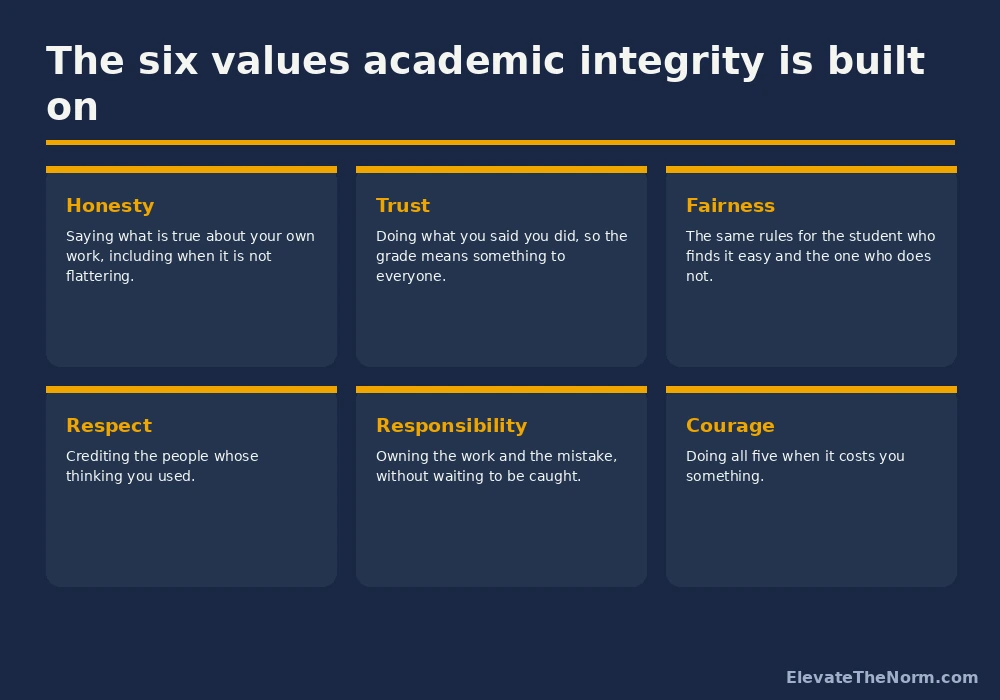
    Six values of academic integrity: honesty, trust, fairness, respect, responsibility and courage, each with a short definition
    The International Center for Academic Integrity names six. Courage is the one schools skip.

    The International Center for Academic Integrity defines integrity as a commitment, even in the face of adversity, to six fundamental values: honesty, trust, fairness, respect, responsibility and courage.

    Five of those six get printed in handbooks. The sixth rarely does, and it is the one that actually costs a teenager something. Courage is what a student needs to hand in an unfinished assignment rather than a copied finished one, in a building where the finished one is safer. If your academic honesty policy demands courage from students without offering them a survivable way to be honest, you have written a rule that punishes the value you claim to want.

    That is a design problem, not a student problem, and it is fixable.

    How Common Is Cheating, Really?

    Common enough that any policy assuming otherwise is fiction. The International Center for Academic Integrity reports Donald McCabe’s surveys of more than 70,000 high school students across two dozen schools: 64 percent admitted cheating on a test, 58 percent admitted plagiarism, and 95 percent admitted participating in some form of cheating.

    Sit with that last number before designing a consequence ladder around it. A policy built on the idea that cheating is what a few dishonest students do is a policy built on a false premise.

    What AI did and did not change

    The expected answer was that generative AI would send those numbers up. It did not.

    Denise Pope and Victor Lee of Stanford’s Graduate School of Education surveyed students across 40 high schools in autumn 2023 and found cheating rates essentially unchanged, at 60 to 70 percent — the same range as autumn 2022, before ChatGPT was widely available. Pope said she had expected higher numbers and was surprised. Lee reported that students found the output underwhelming: “It just sounds very sterile and vanilla to them.”

    Pope’s summary of the cause is the sentence worth pinning above a department meeting: when students do cheat, it is typically for reasons that have very little to do with their access to technology.

    This is a survey of self-reported behaviour at one point in time, so it is a snapshot rather than a settled law, and the tools have kept changing since. But it is the best evidence available on the specific question everyone was asking, and it points away from detection software and toward assignment design.

    Why Students Actually Cheat

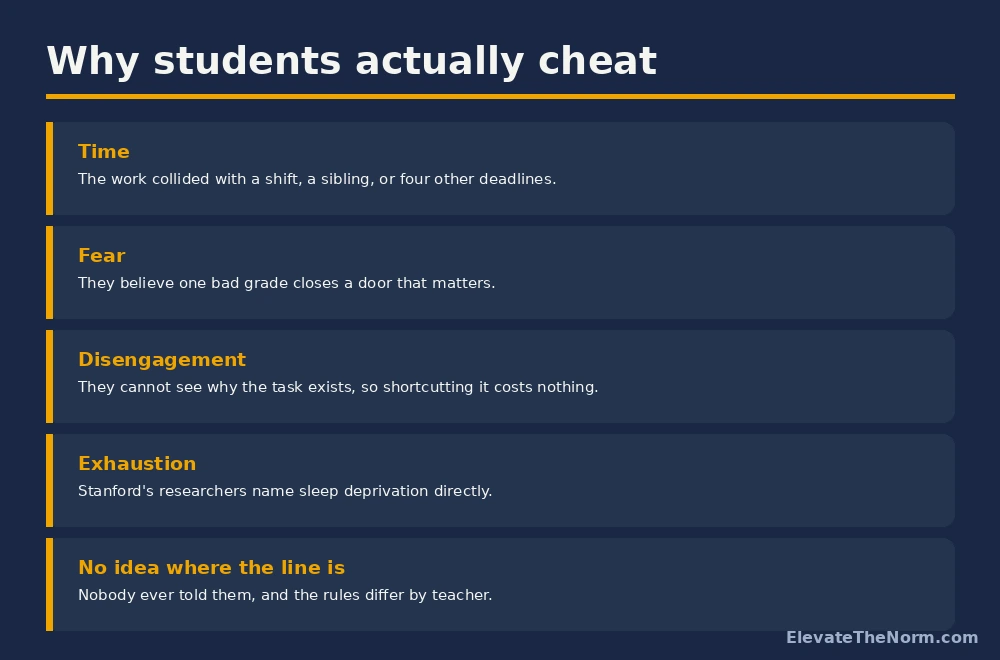
    Five reasons cover almost all of it, and only one of them is about wanting to get away with something.

    Five reasons students cheat: time, fear, disengagement, exhaustion and not knowing where the line is
    Stanford’s researchers found the reasons had very little to do with access to technology.

    Pope named disengagement, feeling undervalued and sleep deprivation among the drivers. Add time pressure and simple confusion about the rules and you have the set.

    Notice what this means practically. Four of the five are things a teacher has some control over. Assignment design, deadline stacking, whether a single grade is allowed to feel catastrophic, and whether the rules were ever stated — those are adult decisions. The fifth, exhaustion, is largely outside your control, but knowing it is in the mix should change how you read a 2 a.m. submission.

    None of this means the behaviour is acceptable or that consequences disappear. It means a school that responds to cheating only with detection and punishment is treating the symptom, and the numbers above suggest how well that has worked so far. What a fair response looks like once a violation is confirmed — notice, the evidence, a real chance to answer, and a required honest redo — is walked through step by step here.

    Where the Line Actually Falls

    Most students are not choosing to cheat. They are guessing, because the same action is encouraged in one room and punished in the next, and nobody has written it down.

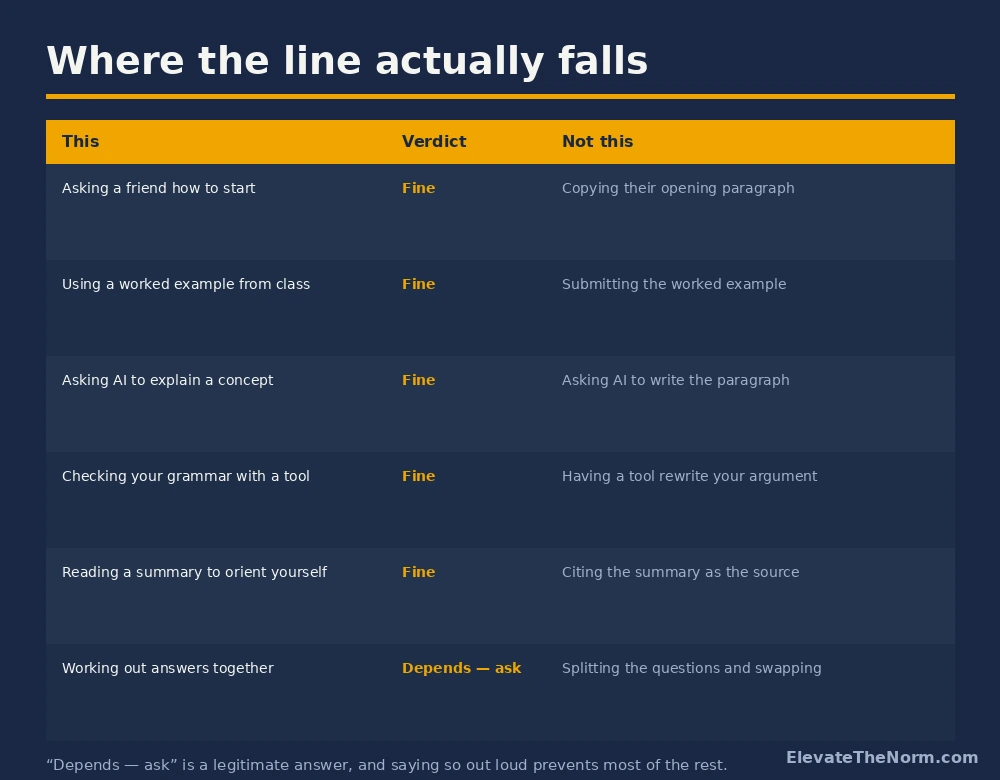
    Table showing acceptable and unacceptable versions of six common study situations, including AI use and group work
    Most students are not choosing to cheat. They are guessing where the line is.

    The useful principle underneath the table: help with your thinking is fine, substitution for your thinking is not. A friend explaining how to start, a worked example, a tool that explains a concept — all of those leave the thinking with the student. A copied paragraph, a rewritten argument, a split-and-swap worksheet do not.

    That principle handles AI without needing a separate AI policy. “Did the tool help you think, or did it think instead of you?” is answerable by a thirteen-year-old, and it will still be answerable when whatever replaces today’s tools arrives.

    The row marked “depends — ask” matters as much as the clear ones. Collaboration is genuinely ambiguous, it varies by assignment, and students need a safe way to check. If asking gets a student a suspicious look, they will stop asking and start guessing, and you have chosen the worse outcome.

    If you want the longer version of that table, eighteen real situations sorted by category works through the ones that come up weekly — reused essays, invented sources, shared worksheets — including what fabrication actually means and the five that depend entirely on what you said beforehand.

    How to Teach It Instead of Just Enforcing It

    Six moves, none of which require a new school-wide policy.

    1. State the rule per assignment, not per year. One line at the top of the task: what help is allowed here. It takes ten seconds and removes most of the guessing.
    2. Make “ask me” genuinely safe. Answer the question plainly, without an eyebrow. A student checking the line is doing exactly what you asked for.
    3. Teach citation as crediting people, not as formatting. Middle schoolers grasp “say whose idea it was” long before they grasp a style guide.
    4. Stop stacking deadlines. Look at what else your students have due that week. Time pressure is a cause, and it is partly yours.
    5. Design tasks that are harder to substitute. Work grounded in this class, this discussion, this local question is difficult to outsource and more interesting anyway.
    6. Separate the honesty conversation from the grade conversation. A student who admits copying and gets both a zero and a referral has learned that honesty is the expensive option.

    The last one is where most policies quietly fail, and it connects directly to whether a student has a route back after a mistake. If there is no survivable path, the rational move for a frightened fifteen-year-old is to deny it.

    What Academic Honesty Is Not

    • It is not a detection problem. Detection tools produce false positives, fall hardest on students who write unusually, and do nothing about the five causes above.
    • It is not a character verdict. With 95 percent of students admitting some form of it, treating an incident as evidence of a bad kid is statistically indefensible.
    • It is not the same conversation as a school discipline referral. Some incidents require formal procedures. Most do not, and running everything through the formal route guarantees students stop telling you the truth.
    • It is not a university policy shrunk down. Thirteen-year-olds are still learning what counts as their own idea. Expecting undergraduate judgment from them and then punishing its absence is unfair.
    • It is not solved by banning tools. The Stanford numbers are the argument: rates did not move when the tools arrived, and they will not move when the next ones do.

    What to Do Next

    Pick your next assignment and write one line at the top stating exactly what help is allowed on it. Say it out loud when you set the task, and say that asking is fine. That single habit removes more academic dishonesty than any detection tool available to a secondary teacher, because it removes the guessing that produces most of it.

    Then look at what happens in your room when a student is caught. If the honest route costs them more than the dishonest one, fix that before you fix anything else. When a violation does need a formal response, having a consistent process for responding to an academic integrity violation keeps it fair and keeps it out of the realm of mood.

    The message home is part of that process. Deciding what belongs in the email to a family and what to leave out usually sets the tone for everything that follows it.

    Frequently Asked Questions

    What is the difference between academic honesty and academic integrity?

    Academic honesty is the behaviour — your work represents what you actually did, and you credit the people whose thinking you used. Academic integrity is the wider commitment that makes the behaviour possible, which the International Center for Academic Integrity frames as six values: honesty, trust, fairness, respect, responsibility and courage. In practice, honesty is what a student does on a Tuesday and integrity is the culture that makes doing it survivable.

    Is using AI cheating?

    It depends entirely on what it replaced. The workable test is whether the tool helped you think or thought instead of you. Asking a model to explain a concept you did not follow in class is help. Asking it to produce the paragraph you were assigned to write is substitution. That distinction handles the tools we have now and the ones arriving next, which is why it is better than a rule naming specific products. The essential part is stating which you mean on each assignment rather than leaving students to guess.

    Did AI make cheating worse in high schools?

    The best evidence available says no. Stanford researchers surveying 40 high schools in autumn 2023 found cheating rates of 60–70 percent, essentially unchanged from autumn 2022 before ChatGPT was widely used. That is self-reported survey data at one point in time rather than a settled finding, and the tools keep changing. But it is a strong signal that the drivers are pressure and disengagement rather than opportunity.

    How should a teacher respond the first time a student is caught?

    Privately, quickly, and with the conversation separated from the penalty. Find out what actually happened — a copied paragraph at midnight and a smuggled answer key are different situations with different causes. Follow whatever your school’s policy requires, because you do not get to skip that, but do not let the formal process be the whole response. A student who is never asked why will learn only to be more careful next time.

    Should a first offence go on a permanent record?

    That is a school policy question rather than a teacher one, and the answer will be set above you. What is worth arguing for internally is proportionality. A system where a thirteen-year-old’s first misunderstanding of collaboration rules carries the same permanent weight as deliberate, repeated fraud will make students and families fight every accusation, which costs everyone more than it saves.

    How do I teach citation to students who find it pointless?

    Drop the style guide at first and teach it as crediting a person. “Whose idea was this, and did you say so?” is the whole concept, and middle schoolers get it immediately because they already care intensely about who gets credit for things. Formatting is a separate, smaller skill you can layer on afterwards. Starting with the punctuation is why so many students think citation is an arbitrary hoop.

    What if the whole class is doing it?

    Then treat it as a design problem, because it is one. Widespread copying on a particular task usually means the task was too long for the time given, too disconnected from anything that happened in class, or too easy to substitute. Change the assignment before escalating the enforcement. Punishing thirty students for a structural problem is both unjust and ineffective.

    Sources

    • International Center for Academic Integrity. Facts and statistics. Read the page — the source for Donald McCabe’s high school survey figures (more than 70,000 students; 64 percent cheating on a test, 58 percent plagiarism, 95 percent some form). ICAI attributes the high school figures to McCabe’s work rather than to a single dated publication.
    • International Center for Academic Integrity. The fundamental values of academic integrity. Read the page — honesty, trust, fairness, respect, responsibility and courage.
    • Bay, J. (2024, February 6). High school cheating increase from ChatGPT? Research finds not so much. The 74. Read the article — reporting on Denise Pope and Victor Lee’s Stanford Graduate School of Education survey across 40 high schools. The Stanford survey itself was not read directly; this article is the source for the figures and quotations given above.

    Every link above was checked on September 12, 2026. Where a finding is reported through journalism rather than read in the original study, the text says so.


    About Clay Shumate

    By Clay Shumate — Clay Shumate is a certified secondary Social Studies teacher in the public schools of West Alabama, with seven years of classroom experience, a B.A. in History, and an M.Ed. in Secondary Education. He writes about project-based learning, student responsibility, respect, and practical ways to hold young people to a higher standard while giving them room to learn from mistakes. He is a member of the Society of Professional Journalists and writes to its Code of Ethics; this site’s editorial standards and corrections policy are published in full.

  • Classroom Routines and Procedures for Grades 6–12: What to Teach and When

    Classroom Routines and Procedures for Grades 6–12: What to Teach and When

    Classroom routines and procedures are the taught, repeated ways a room handles its ordinary business — entering, getting materials, asking for help, moving between tasks, handing work in, leaving. In grades 6–12 they are worth explicit teaching for one reason: every minute a class spends negotiating a procedure is a minute nobody is learning anything, and there are a lot of those minutes. There is a second reason as well: a taught routine is one less thing a student has to hold in their head.

    The word “taught” is doing the work in that sentence. Most secondary teachers have a set of procedures. Far fewer have taught them the way they would teach content — named, demonstrated, practised, and re-taught weeks later when they slip.

    This is the part of classroom management with the most evidence behind it and the least glamour attached to it.

    Key Takeaways

    • Structure is one of five evidence-based features of classroom management identified in the standard review of this literature — alongside explicitly teaching and reviewing expectations.
    • Routines are held with reminders, not consequences. If forgetting a pencil costs a mark, you have a discipline system, not a routine.
    • Teach them like content. Name it, show it, practise it, remind it. The practice step is the one everybody skips.
    • Re-teach at the start of every term, not just in August. Routines decay. Planning for the decay is cheaper than reacting to it.
    • Twelve routines cover most secondary rooms. More than that and nobody remembers them, including you.
    • Be honest about the evidence. About half the studies in the main review are more than twenty years old, and the authors say they do not know how these practices should vary by school level.

    What Classroom Routines and Procedures Actually Are

    A procedure is how something gets done. A routine is that procedure once it has been practised enough that nobody thinks about it. The gap between the two is entirely teaching time, and the mistake is assuming teenagers skip that gap because they are old enough to have worked it out.

    They have worked something out. They have worked out what the previous four teachers wanted, and those four all wanted different things. A fourteen-year-old moving through six rooms a day is running six different operating systems. Assuming they will intuit yours is not high expectations — it is just an unwritten test.

    This is also why routines are not the same thing as rules. Rules say what is forbidden. Routines say what happens. A room that has taught and modelled what it expects of students but has no routines will still lose ten minutes a period to logistics.

    What the Research Supports

    The standard reference is Simonsen, Fairbanks, Briesch, Myers and Sugai’s review in Education and Treatment of Children, which screened the literature for practices meeting a real evidentiary bar — sound design, empirical validation, clear procedures, replication across sites, and evidence of sustainability — and identified twenty practices across five critical features.

    Two of those five features are what this article is about: maximise structure, and post, teach, review, monitor and reinforce expectations. Not post. Post and teach and review and monitor. The verbs are the finding.

    Parsonson’s review in Kairaranga lands in the same place from the behaviour-analysis side, listing clear consistently applied rules and predictable routines among the antecedent strategies that reduce disruption — the ones that work by preventing the problem rather than responding to it. The same paper reports that teacher greetings and brief small talk raised on-task behaviour from around 45 percent to around 75 percent, which is a striking figure for something that costs nothing and takes place before the lesson starts.

    The caveats, stated by the authors themselves

    Simonsen and colleagues note that roughly half the studies in their review were conducted twenty or more years ago, and that the literature does not tell us how these practices should be adjusted across school levels, ability levels or demographic contexts. That last gap is the one that matters here: this is a grades 6–12 site, and the evidence base does not cleanly separate a seventh grader from a second grader.

    So the honest position is that structure and explicitly taught expectations are about as well supported as anything in classroom management, and that the specific shape they should take in a secondary room is professional judgment rather than settled science.

    Twelve Classroom Routines Worth Teaching

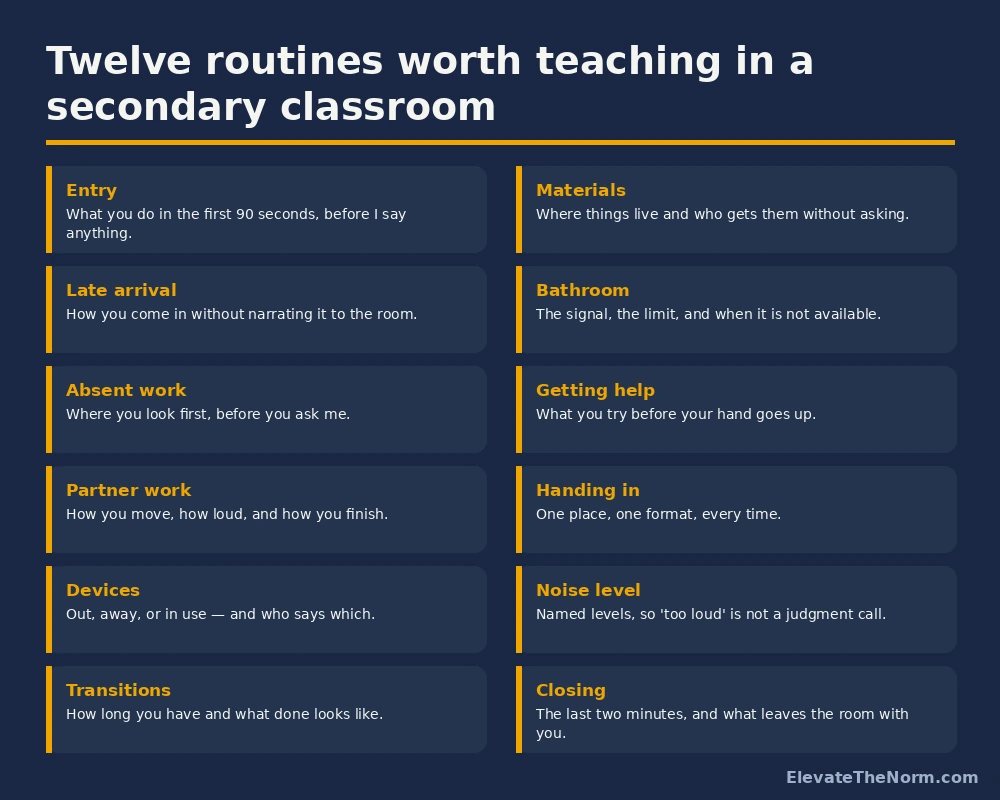
    Twelve is not a target to hit. It is roughly what a secondary room actually needs, and going much past it means nobody remembers any of them, including you.

    Grid of twelve classroom routines worth teaching in a secondary classroom, from entry and materials to transitions and closing
    Twelve is not a target. It is the list most secondary rooms actually need.

    The Indiana classroom management primer for middle and secondary teachers, written by Mary Ellen Adams and Pamela Ray, names a similar core: arriving, submitting work, group work, restroom, getting supplies, and getting help from the teacher. Their instruction is to put routines in writing and teach them, at the start of each term, with periodic review.

    Three on the list above are worth singling out because secondary teachers most often leave them implicit.

    Getting help. “What do you try before your hand goes up?” If you have never answered that out loud, half your class is waiting for you and the other half has given up. Name two or three moves — check the board, ask your partner, look at the example — and the queue at your desk halves.

    Late arrival. A student who is late is already having a worse day than you are. A taught routine — come in, sit down, catch up from the board, see me at the end if it matters — removes the performance entirely. What goes on that board matters as much as the routine does: a do-now built on retrieving last week’s material settles a room as well as a word search and does something on the way. Without one, every late arrival becomes a small public event. When lateness becomes a pattern rather than a one-off, the routine needs a tardy response that escalates by pattern rather than by mood standing behind it.

    Noise level. “Too loud” is a judgment you are making that students cannot predict. Named levels — silent, partner voice, group voice — turn an argument into a correction that takes one word. Where the talking is the whole period rather than one task, the strategies written for a chatty class start by scheduling the talk instead of suppressing it.

    The routine that pays back fastest is not on that list as a single item, because it runs through several of them. The handful of moves between activities — into the room, into group work, back out of it, and out of the door — are where the measured time actually goes, and they are worth scripting before anything else here. If you want the signal itself to carry the timing rather than your voice, a transition track students can hear is the cheapest version of that. None of it starts, though, until the room actually stops, and getting a secondary class quiet without raising your voice is worth sorting out before you script anything else.

    How to Teach a Routine So It Actually Holds

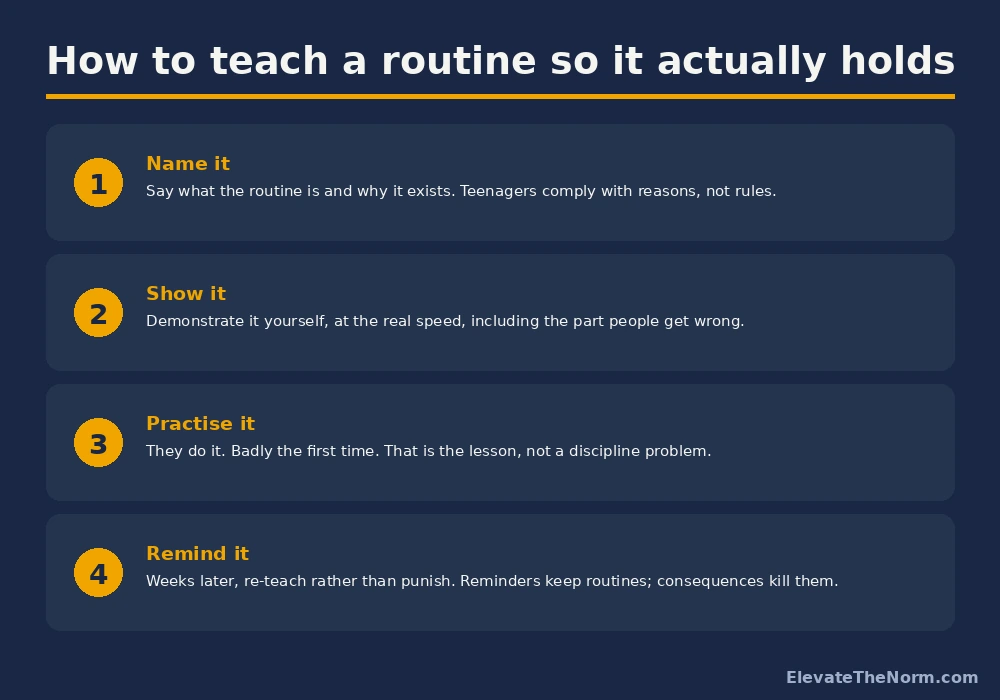
    Four moves, in order. It takes about six or seven minutes per routine the first time and almost nothing afterwards.

    Four-step process for teaching a classroom routine: name it, show it, practise it, remind it
    Naming a routine is not teaching it. Practice is the part people skip.

    Name it, with the reason. Teenagers comply with reasons far more reliably than with rules. “We hand in to one tray so that nobody’s work goes missing and I am not carrying six piles” takes four seconds and buys you the rest of the year.

    Show it. Do it yourself, at real speed, including the bit people get wrong. Demonstrating the failure mode is more useful than demonstrating the ideal.

    Practise it. They do it. It will be bad the first time — that is the lesson working, not a behaviour problem. This is the step that separates a room where routines hold from a room where they were announced once in August.

    Remind it. Six weeks later it will have decayed. Re-teach it to the whole class rather than correcting individuals, because individual correction turns a decayed routine into a story about particular students.

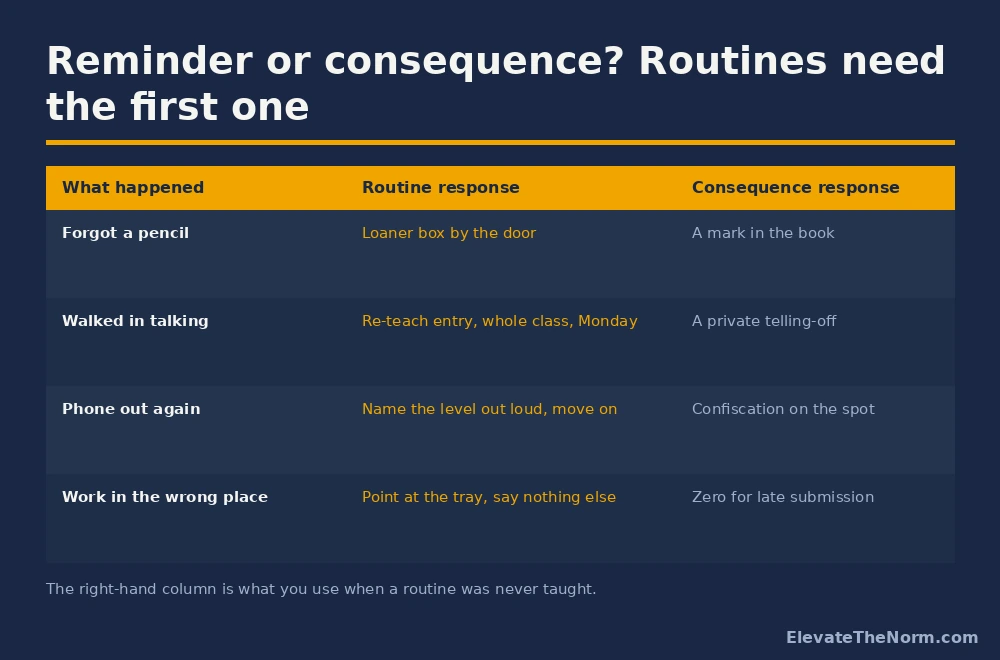
    Reminders Hold Routines. Consequences Do Something Else.

    This is the single most useful distinction in the article, and the Indiana primer states it directly: routines are enforced through reminders rather than consequences. Their example is the pencil — keep loaners rather than punishing the student who forgot one.

    Table comparing a routine reminder response and a consequence response to four common classroom situations
    Routines are held with reminders. Consequences are for something else.

    The reason is practical rather than soft. A consequence attached to a routine failure teaches students that the routine is a trap, and their attention moves from doing the thing to avoiding the penalty. A reminder keeps the routine a piece of housekeeping, which is what it is.

    Consequences are still real and still necessary — for choices, for harm, for repeated refusal after the routine has genuinely been taught. That is a different system, and it is worth keeping the two apart deliberately. Consequences that teach rather than humiliate are a separate piece of work from a room that runs smoothly.

    The test: if your response to a routine failure would feel strange applied to the whole class at once, it is a consequence and it does not belong here.

    The Routine That Does the Most Work in My Room

    Working next to somebody is the resting state of my classroom, not a reward I hand out on a Friday. The tables are pushed together in pairs and fours and they stay that way, which means partner work needs no setup, no announcement and no transition.

    That is a routine decision disguised as a furniture decision. When collaboration is the default, the only thing that ever needs announcing is silence — and silence is easy to ask for and easy to get. When rows are the default, every piece of partner work costs you ninety seconds of scraping chairs, and you start quietly avoiding it.

    The other half of it is telling them the plan for the day down to the minute, on the board, before anything starts. Those times are a budget and a promise rather than a script — when I miss them I say so out loud and give the reason, which is the part that keeps it honest. A room that knows what is coming and roughly how long it has does not need most of the routines on that list of twelve enforced at all. They just happen.

    When to Establish Classroom Routines

    The first week, obviously. Less obviously: the first week of every term, and the week after any long break.

    Adams and Ray put it as teaching routines at the start of each term with periodic review throughout, and that is the right cadence. Routines decay — not because students are testing you, but because six weeks is long enough to forget which of six teachers wanted which thing.

    Three moments worth putting in your calendar now:

    • Week one of the year. Teach four or five routines properly rather than twelve badly. Entry, materials, getting help, handing in. The rest can wait.
    • Week one of each new term. Re-teach, do not re-announce. Fifteen minutes, whole class, no reference to anyone’s behaviour.
    • The day back after a long break. Assume everything has decayed and plan for it, and the day costs you nothing instead of costing you a week.

    If you want the printable version to plan from, the free checklist pack built for grades 6 through 12 lists them with space to write your own wording, no email required.

    Routines also decide what supplies a room actually needs. The guide to cheap classroom supplies for grades 6–12 builds its shopping list from the borrowing and materials procedures.

    Where Routines Break Down in Secondary Classrooms

    • Announced but never practised. The most common failure by a distance. Saying it once is not teaching it.
    • Too many at once. Twelve routines in week one is twelve routines nobody retains. Four, properly, beats twelve badly.
    • Enforced with consequences. Turns housekeeping into a discipline system and makes the room adversarial over pencils.
    • Never re-taught. Then the November version gets treated as defiance rather than decay.
    • Inconsistent from the adult. If the tray is the routine, it is the routine on the day you are tired too.
    • Unexplained. A routine without a reason reads to a teenager as arbitrary, and they are not wrong.

    The honest test of whether a routine has taken hold is what happens on a day when you are not there. If the room only runs because you are standing in it, the routine was never the routine — you were. That is why a day with someone else running the room tells you more about your procedures than any week you teach yourself. It is also the argument for leaving sub plans that run without you rather than a worksheet and an apology. The Tuesday after a three-day weekend tests the same routines in a different direction.

    If the reason you are reading this is that an evaluator put a number next to your routines, the companion piece on what the managing classroom procedures rubric actually asks for walks through the four levels in the rubric’s own words.

    What to Do Next

    Pick the single routine costing you the most time right now — for most secondary teachers it is entry or getting help — and teach it properly this week. Name it with the reason, demonstrate it including the failure mode, have the class practise it, and put a reminder in your calendar for six weeks out. If the routine you need is the one that governs reading on a screen rather than on paper, the twenty-minute digital reading routine is already scripted minute by minute and can be taught the same four ways.

    One routine, taught properly, will buy back more minutes than a list of twelve announced on the first day and never mentioned again. Then do the next one next month. This is slow work, and it is the kind that compounds.

    Routines are one section of something larger. If you have never written that larger thing down, the eight sections a written plan actually needs shows where routines sit relative to expectations and consequences.

    Printables for this

    Two of mine on TPT, both built for this. The First 10 Days procedures checklist is free and sequences which routines to teach on which day. Daily Reset Bell Ringers is the entry routine itself: 180 prompts so the first five minutes run the same way every day, which is the routine that stops the others from decaying.

    If you are stocking up during a sitewide sale, the TPT sale guide explains how the discounts stack and what is worth the money.

    Frequently Asked Questions

    What is the difference between a classroom routine and a classroom rule?

    A rule says what is not allowed. A routine says how something gets done. “No phones out” is a rule; “phones go face down in the top corner of the table unless I say otherwise” is a routine. Rules need enforcement, routines need teaching and reminders. Most secondary rooms have plenty of rules and not enough routines, which is why so much time goes on logistics.

    How many routines should I actually teach?

    Four or five properly in the first week, building to around a dozen over the term. Twelve announced on day one is twelve nobody remembers. Start with the ones costing you the most time — usually entry, materials, getting help, and handing work in — and add the rest as they become necessary.

    Isn’t this a bit young for high school students?

    The content is not young; the assumption that teenagers already know your procedures is just untested. A student moving through six rooms a day is running six different systems, none of which they chose. Teaching yours explicitly is not treating them like children — it is removing a guessing game. What would be condescending is the tone, not the practice, so teach them the way you would teach anything else to an adult: name it, give the reason, move on.

    What do I do when a routine stops working in November?

    Re-teach it to the whole class, without reference to anyone in particular. Routines decay on a predictable schedule and November is right on it. Treating decay as defiance is the most common way a functioning routine turns into a behaviour problem. Fifteen minutes of whole-class re-teaching costs less than a term of individual corrections.

    Should students help decide the routines?

    For some of them, yes, and it works better in secondary than people expect. Noise levels, how partner work ends, and what counts as a reasonable bathroom signal are all genuinely negotiable and students will hold a standard they helped set. Safety procedures, anything your school mandates, and anything involving how work is recorded are not negotiable, and pretending otherwise creates a problem later.

    How do routines work if I share a room or teach on a cart?

    Focus on the routines that live in people rather than furniture — entry, getting help, handing in, noise levels, closing. Anything depending on a fixed physical setup will not survive a shared room, so do not build your system on it. Write your core routines on something portable and post it in the same place every period; the consistency of the location matters more than the location itself.

    Do routines actually improve learning, or just behaviour?

    Honestly, the direct evidence is about behaviour and time on task rather than achievement. The reviews that support structure and explicitly taught expectations measure disruption, on-task behaviour and engagement. The learning argument is an inference: time not spent on logistics is time available for instruction. That inference is reasonable, and it is not the same thing as a study showing routines raise test scores.

    Routines are also what a stranger inherits. A procedure that is obvious to your students is invisible to someone covering the class, which is why running a room that isn’t yours depends so much on what the regular teacher wrote down.

    Sources

    • Simonsen, B., Fairbanks, S., Briesch, A., Myers, D., & Sugai, G. (2008). Evidence-based practices in classroom management: Considerations for research to practice. Education and Treatment of Children, 31(3), 351–380. Full text (PDF) — the source for the five critical features, and for the authors’ own caution that about half the reviewed studies are twenty or more years old.
    • Parsonson, B. S. (2012). Evidence-based classroom behaviour management strategies. Kairaranga, 13(1), 16–23. Full text (PDF) — the source for predictable routines as an antecedent strategy and for the greeting figures, which Parsonson reports from other studies rather than testing directly.
    • Adams, M. E., & Ray, P. (2016). A classroom management primer for middle and secondary school teachers. Indiana Commission for Higher Education. Read the primer (PDF) — the source for teaching routines at the start of each term and for enforcing them through reminders rather than consequences.

    Every link above was checked on September 12, 2026. Where a figure is reported by a review rather than measured in it, the text says so.


    About Clay Shumate

    By Clay Shumate — Clay Shumate is a certified secondary Social Studies teacher in the public schools of West Alabama, with seven years of classroom experience, a B.A. in History, and an M.Ed. in Secondary Education. He writes about project-based learning, student responsibility, respect, and practical ways to hold young people to a higher standard while giving them room to learn from mistakes. He is a member of the Society of Professional Journalists and writes to its Code of Ethics; this site’s editorial standards and corrections policy are published in full.

Teacher Emergency Toolkit — practical resources, real classroom support. Shop on TPT.Teacher Emergency Toolkit — practical resources, real classroom support. Shop on TPT.