Author: Clay Shumate

  • High Expectations for Students: The Difference Between Belief and Pressure

    High Expectations for Students: The Difference Between Belief and Pressure

    By Clay Shumate

    High expectations for students means holding a standard you genuinely believe a teenager can reach, and then building the path that lets them reach it. Belief without a path is not a high expectation. It is pressure. The research is clear that expectations move outcomes — and just as clear that they move them only when support moves with them.

    Key Takeaways

    • Teacher expectations really do change outcomes. A national study of 10th graders found that a teacher expecting a student to finish college, rather than not, was associated with roughly a 15-percentage-point increase in the odds that the student actually did.
    • But the effect is smaller than the Pygmalion legend. The most careful review of the field concluded that self-fulfilling prophecies in classrooms are real, typically small, and more likely to fade than to compound.
    • Expectations are mostly accurate, which is its own problem. When a teacher’s read on a student is wrong, it is usually wrong in a patterned way — and the pattern tracks race, income, and prior grades.
    • Press without support does almost nothing. Chicago middle-grades students with high academic press and low support gained about half as much math as students who had both.
    • One sentence changes how criticism lands. Seventh graders who were told the comments came from high expectations and a belief they could meet them revised at more than twice the rate of students who got the same comments without the sentence.
    • The bar stays. The runway changes. Every honest version of high expectations keeps the task and adds the scaffolding, the conference, and the second attempt.

    What high expectations for students actually means
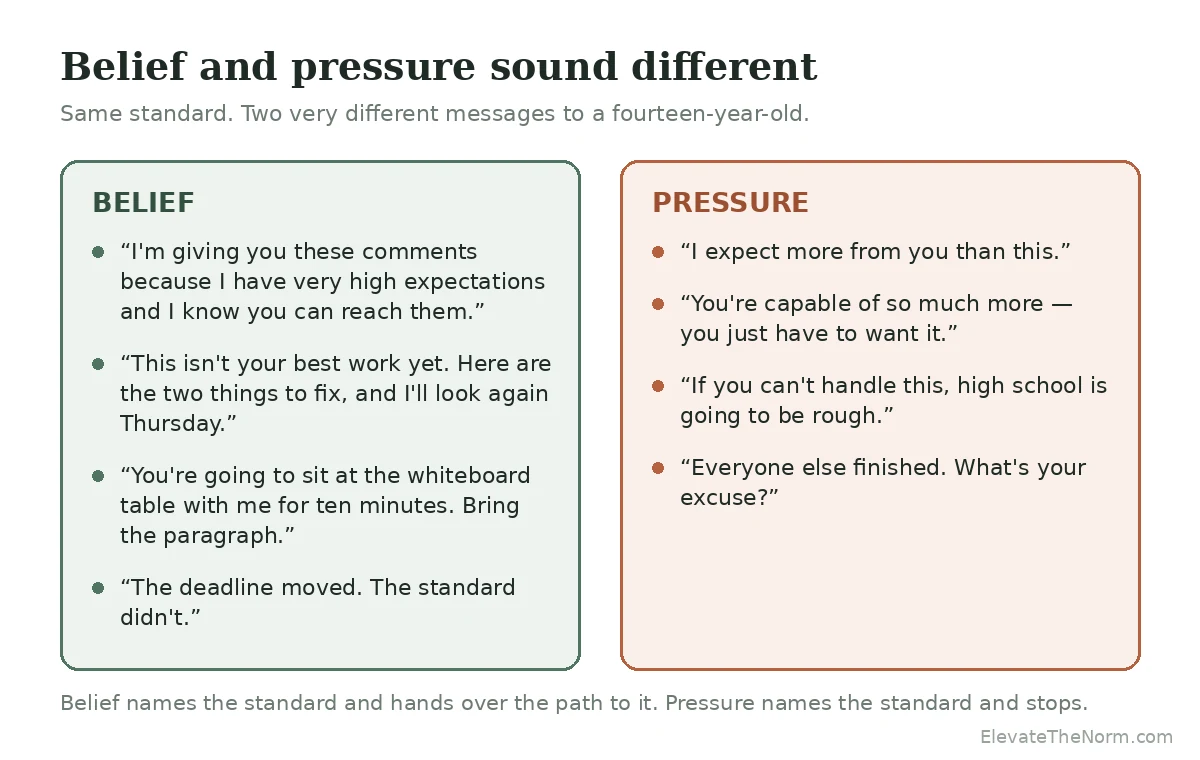
    Two-column comparison of teacher phrasing. The belief column names a standard and a next step; the pressure column names a standard and stops.
    The same standard can be delivered as belief or as pressure. The difference is whether a path comes with it.

    Most schools say they have high expectations. Very few can tell you what that sentence commits them to on a Tuesday.

    Here is a working definition. A high expectation has three parts: a standard the student can actually see, a stated belief that this particular student can reach it, and a route from where they are now to there. Drop the third part and you have a slogan. Drop the second and you have a syllabus.

    This is different from classroom expectations in the behavior sense — how we treat each other, how we start class, what happens when work is late. Those matter, and teaching them explicitly — including with a well-designed classroom expectations poster that students can reference all year — is most of the job in September. This article is about the other kind: what you believe a student is academically capable of, and what that belief does to them.

    The two get confused constantly. A teacher can run a tightly managed room with airtight procedures and still quietly expect very little of half the students in it.

    The evidence: real, causal, and smaller than the legend

    Short answer: expectations move outcomes, but not by magic, and not by much on their own.

    Everyone in education has heard some version of the 1968 Pygmalion study — tell teachers a random group of kids are late bloomers, and the kids bloom. It is one of the most repeated findings in the field and one of the least accurately repeated.

    The most thorough review of what came after it is blunt. Lee Jussim and Kent Harber concluded that self-fulfilling prophecies in classrooms do occur, but that the effects are “typically small,” do not accumulate much across teachers or years, and “may be more likely to dissipate than accumulate” (Jussim & Harber, 2005). They also found something more uncomfortable: teacher expectations predict student outcomes largely because those expectations are accurate, not because they are self-fulfilling. Teachers are generally reading students correctly.

    That is worth sitting with before you assume belief alone will carry a kid. It usually will not.

    What Jussim and Harber also found is where this gets useful: the powerful self-fulfilling effects show up selectively, among students from stigmatized groups. The students most affected by what a teacher believes are the students the system already treats worst.

    The strongest causal estimate available comes from Nicholas Papageorge, Seth Gershenson, and Kyung Min Kang, who used a national sample of 10th graders in which two different teachers each predicted the same student’s educational future. Comparing the two predictions strips out the student’s own characteristics and isolates the teacher. When a teacher expected a student to complete a four-year degree rather than not, that student’s likelihood of actually earning one rose by about 15 percentage points (Papageorge, Gershenson & Kang, 2018/2020).

    Read that carefully. It is a large effect attached to a large swing — from a teacher writing a student off to a teacher expecting a degree. It is not a promise that raising your general enthusiasm raises test scores.

    Where the expectation goes wrong before the student ever sees it

    If expectations are mostly accurate, the interesting question is what happens when they are not.

    Using the same national data, Gershenson and colleagues compared the two teachers each student had. Non-Black teachers of Black students were about 9 percentage points less likely than Black teachers to expect that student to finish a four-year degree — about 11 points for Black boys. That single mismatch accounted for more than half of the overall Black–white gap in teacher expectations, and it was larger among math teachers than reading teachers (Gershenson, Holt & Papageorge, 2016).

    Two teachers. Same student. Same transcript in front of both of them. Different forecast.

    The related finding in the Papageorge paper is stranger and worth naming honestly: white teachers were more optimistic overall, and their optimism about white students was the least accurate of the lot. The problem is not simply that some teachers are pessimistic. It is that optimism gets handed out unevenly, and the students who receive less of it are the ones for whom it matters most.

    You are not going to fix this by deciding you are unbiased. Nobody has ever found their own expectation gap by introspection. You find it by looking at what you handed back.

    Why expectations without support turn into pressure
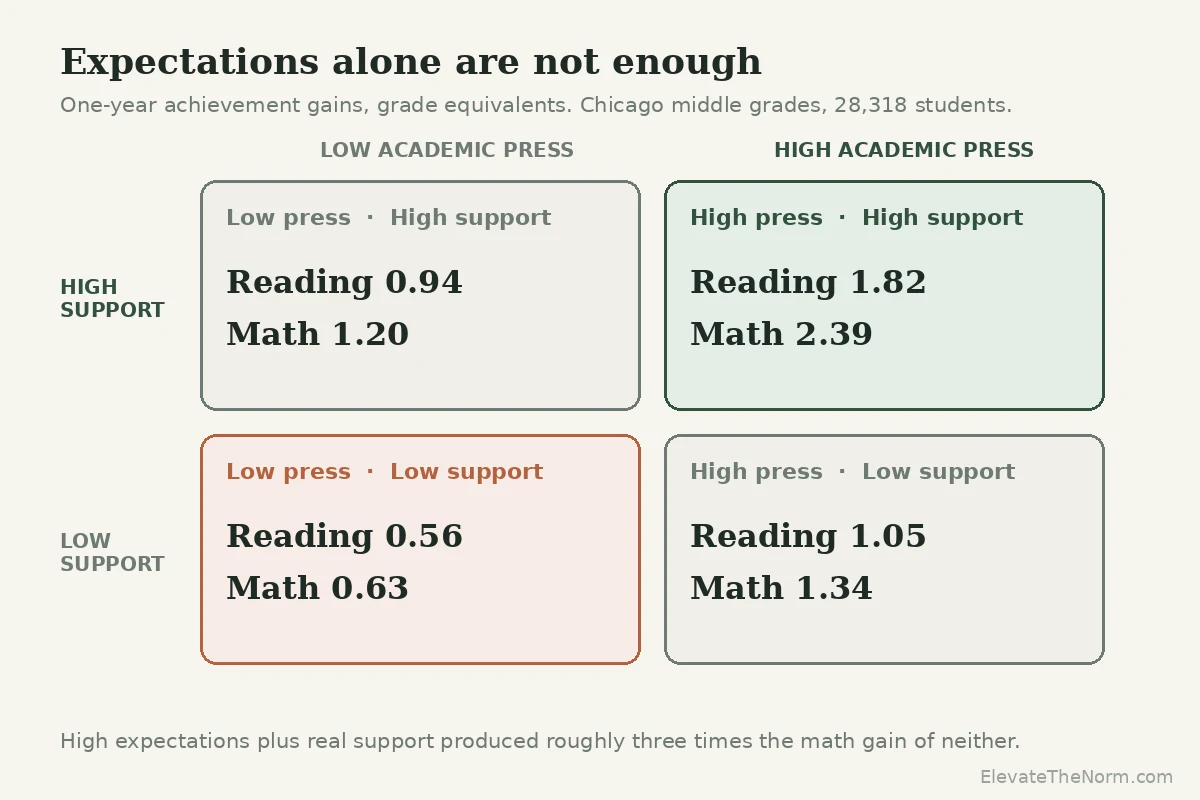
    Two-by-two grid of one-year achievement gains in grade equivalents by level of academic press and social support, from the Chicago middle-grades study.
    High press with high support produced 2.39 grade equivalents of math growth in a year; low press with low support produced 0.63.

    Researchers have a term for the demand side of this: academic press. It just means how strongly a school signals that academic achievement is expected and non-negotiable. The other side is social support — the adults and peers a student can actually go to for help.

    Valerie Lee, Julia Smith, Tamara Perry, and Mark Smylie put 28,318 sixth and eighth graders across 304 Chicago schools into that two-by-two and measured a year of achievement growth in grade equivalents (Lee, Smith, Perry & Smylie, 1999).

    ConditionReading gainMath gain
    High press + high support1.822.39
    High press + low support1.051.34
    Low press + high support0.941.20
    Low press + low support0.560.63
    One-year achievement gains in grade equivalents. Lee, Smith, Perry & Smylie (1999), Chicago middle grades.

    Look at the middle two rows. High expectations without support and warm support without expectations land in almost the same place. Neither one is worth much alone. Together they roughly triple the math growth of a school that has neither.

    One honest caveat: this is sixth and eighth grade in one large urban district in the 1990s, and it is correlational. It does not prove that adding support to a demanding classroom causes the jump. It does show that the two travel together in the data, at scale, and that the version of “high expectations” that arrives as pressure alone is the version with the weakest results attached to it.

    That is the whole argument of this article in one table. If you take nothing else, take the fact that the demand and the help are not in tension. They are the same intervention.

    What high-expectation teachers do differently

    Christine Rubie-Davies and colleagues ran something rare in this field: an actual randomized intervention that trained teachers in the practices of high-expectation teachers rather than just measuring their beliefs. Eighty-four teachers across twelve schools; students in the intervention classrooms gained roughly 28% more in mathematics over the year than the control group, an effect size of about 0.24 (Rubie-Davies, Peterson, Sibley & Rosenthal, 2014).

    The caveat that matters for this site: that study was run in New Zealand with students aged roughly 6 to 13. It is not a secondary-school result and I am not going to pretend it is. What transfers is the list of practices, which are recognizably about older students too. The number does not automatically transfer with them.

    The practices the intervention taught, summarized by the Society for Personality and Social Psychology:

    • Flexible grouping instead of fixed ability grouping. High-expectation teachers move students between groups based on the task in front of them, not on a permanent read of who is smart.
    • Goal setting with the student, not for them. Which is also how student autonomy gets built without losing the room.
    • A warm class climate. Not soft. Warm. Those are different words.
    • Different feedback. More specific, more forward-looking, and delivered to everyone rather than saved for the students most likely to use it.
    • Attention to non-verbal signals. Who you stand near, who you wait longer for, whose answer you finish for them.

    Notice that none of these are about announcing higher standards. They are about the ordinary mechanics of a class period.

    The one sentence that makes criticism land

    If you only change one thing this week, change this.

    In a study of seventh graders earning Bs and Cs, researchers had teachers return marked-up essays with one of two notes attached. The control note read: “I’m giving you these comments so that you’ll have feedback on your paper.” The other read: “I’m giving you these comments because I have very high expectations and I know that you can reach them.”

    The comments themselves were identical. Among African-American students, 64% of those who got the second note revised their essay, against 27% of those who got the first. When revision was required, 88% of students who had received the high-expectations note improved from first draft to second, compared with 34% in the control condition (Stanford SPARQ summary of Yeager et al., 2014).

    The mechanism is not flattery. Critical feedback across a trust gap is ambiguous — a student who has good reason to wonder whether an adult has written them off cannot tell from the red pen alone whether the comments mean I think you can do better or I already knew you couldn’t. The sentence removes the ambiguity. That is all it does, and it is enough to more than double a revision rate.

    Write it on the paper. Say it out loud when you hand the work back. Do not save it for the students you think need encouragement, because deciding who needs it is exactly the judgment the research says you should not trust.

    What this looks like at the whiteboard table

    I built a whiteboard table for small-group work. It sits in a corner under a lower lamp, on a rug, with the better chairs. Students ask to go there.

    That was deliberate, and it is the most useful thing I have done about expectations. The standard pull-aside table has a problem everyone in a school can name: it becomes the table where the kids who are behind get sent. Students read that instantly. Being called over becomes a public statement about what the adult thinks of you, which means the support itself starts carrying a message that undercuts the expectation.

    I did not solve that with a policy about not calling it the remediation table. I solved it by making that corner the best seat in the room. When it is the place people want to be, sitting down there stops being a verdict and starts being a normal thing that happens to everybody — the student who is lost, the student who is three steps ahead and bored, the group that needs a decision made.

    The general version: if your support is visibly reserved for the students you have low expectations of, the support and the expectation cancel each other out. Whatever your version of the table is, everybody has to end up there.

    What high expectations cannot fix

    This is the part that usually gets left out of the assembly speech.

    • They cannot substitute for course access. If a student is not enrolled in the class that leads to the next class, no amount of belief in that student’s potential changes the transcript. Master-schedule decisions outrank classroom optimism.
    • They cannot replace an IEP or 504 team. Goals for a student with a disability are set by a team through a legal process. “I have high expectations” is not a reason to disregard an accommodation, and a teacher does not get to raise a documented goal unilaterally. Bring the observation to the team.
    • They cannot compensate for missing instruction. A student who never learned to cite evidence needs to be taught to cite evidence. Believing harder is not a curriculum.
    • They cannot fix a schedule with no time for revision in it. If the pacing guide leaves no room for a second attempt, the school has decided the standard is a filter. That is an administrative choice, not a teacher’s failure of will.
    • They are not a district initiative. A campaign that tells staff to expect more, with no change to grouping, feedback, planning time, or course access, costs nothing and does about as much. The Rubie-Davies work changed practices, not slogans.

    Being honest about the limits is what keeps the rest credible. A teacher who claims expectations can overcome anything will be disbelieved on the parts that are true.

    A four-week way to check yourself
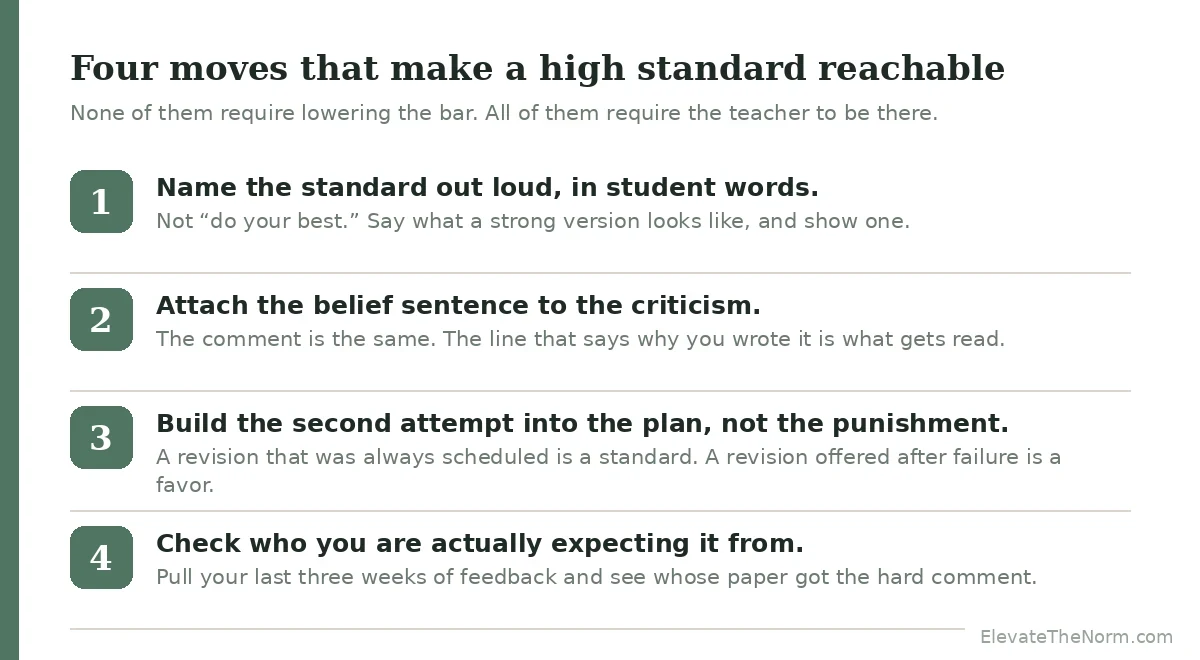
    Numbered list of four classroom moves: name the standard in student words, attach the belief sentence to criticism, schedule the second attempt, and audit who receives the hard feedback.
    Four moves that keep the standard high and make it reachable.

    None of this requires a program. It requires four weeks and a willingness to look at your own paperwork.

    1. Week one — the feedback audit. Pull every piece of work you handed back in the last three weeks. Sort it into “got a demanding comment” and “got a pleasant one.” Then look at the names. You are not looking for villainy. You are looking for a pattern you did not choose.
    2. Week two — the sentence. Attach the high-expectations line to every marked-up paper. Every student, no exceptions, no editing the list.
    3. Week three — the call list. Track who you call on for the question that requires reasoning rather than recall. Most teachers find they have a small rotation of four or five students they trust with the hard question, and that the rotation formed itself.
    4. Week four — the second attempt. Put one revision cycle into the calendar in advance, before anyone has failed anything. Announce it when you assign the work, not after the grades come back.

    Four weeks of this will tell you more about your expectations than any survey will. It also pairs naturally with what already works for students who look like they have stopped caring — disengagement is frequently a reasonable response to being quietly written off.

    Holding the standard when a student misses it

    The test of a high expectation is not what happens when a student meets it. It is what happens the first time they do not.

    Two failure modes, and both are common. The first is quietly dropping the bar for that student from then on — usually dressed up as being realistic. The second is holding the bar and treating the miss as a character finding, which teaches the student that the standard was really a test of who they are.

    The honest third option is that the standard holds, the miss gets named plainly, and the student does the work of getting there. That is the same logic behind accountability paired with another chance, and, when the miss involved harming somebody else, behind structured repair rather than empty punishment. In every case the standard is the constant. What flexes is the route back to it.

    Students can tell the difference between a teacher who lowered the bar for them and a teacher who kept it and stayed. They tend to remember the second one.

    Conclusion: what to do Monday

    High expectations for students are not a posture. They are a set of decisions about who gets the hard question, whose paper gets the demanding comment, who gets pulled to the table, and whether anybody gets a second attempt.

    The evidence says expectations matter, that they are unevenly distributed along lines nobody would defend out loud, and that they do very little on their own. It also says the fix is not more enthusiasm. It is attaching one sentence to your feedback, scheduling the revision before the failure, making your support desirable rather than remedial, and auditing what you actually handed back.

    Start with the feedback audit. It costs an hour and it is the only one of these that will tell you something you do not already believe about yourself.

    Frequently Asked Questions

    What does “high expectations for students” actually mean in a classroom?

    It means naming a standard you believe a specific student can reach, saying out loud what reaching it looks like, and then building the instruction, feedback, and second attempts that make it reachable. Belief is half of it. The path is the other half. An expectation with no path attached is not a high expectation — it is a demand.

    Can high expectations be harmful?

    Yes, when they arrive without support. In the Chicago middle-grades data, students in schools with high academic press but low social support gained about 1.34 grade equivalents in math in a year, compared with 2.39 for students who had both. The standard was the same in both groups. What differed was whether anyone helped. Pressure by itself mostly teaches students that the adult’s opinion of them is already fixed.

    How do I hold a high standard for a student who is several grade levels behind?

    Keep the standard and change the runway. The grade-level task stays; you add the vocabulary front-loading, the worked example, the sentence frames, the extra conference, and the built-in revision. What you do not do is hand that student an easier assignment and call it differentiation. Scaffolding is temporary and comes off. A lowered task is permanent and the student knows it.

    Isn’t this just growth mindset again?

    No, and the distinction matters. Growth mindset research is about what students believe about their own ability, and the intervention literature there is contested. This is about what teachers believe about students and what they do as a result — a different body of evidence with different findings. You can hold accurate, high expectations for a student without ever saying the word “mindset.”

    How would I know if I have lower expectations for some students without realizing it?

    Audit the artifacts instead of your intentions. Pull three weeks of graded work and look at whose paper got a demanding comment and whose got “nice job.” Look at who you called on for the hard question, who you pulled for a conference, and who you told about the honors option. Bias in expectations rarely shows up as a thought you would recognize. It shows up as a pattern in what you actually handed back.

    What should I tell a parent who says my class is too demanding?

    Show them the standard and the support in the same conversation. Say what the assignment asks, what a strong version looks like, what help is available and when, and how many attempts their child gets. Most families are not objecting to rigor. They are objecting to rigor that arrived without a plan, which is a fair objection.

    Do high expectations mean no second chances?

    The opposite. A standard you only get one shot at is a sorting device, not a standard. Building the revision into the calendar from the start — rather than offering it as mercy after a failure — is what makes the bar credible. The student who has to redo the work has been held to more, not less.


    Sources


    About Clay Shumate

    Clay Shumate is a certified secondary Social Studies teacher in the public schools of West Alabama, with seven years of classroom experience, a B.A. in History, and an M.Ed. in Secondary Education. He writes about project-based learning, student responsibility, respect, and practical ways to hold young people to a higher standard while giving them room to learn from mistakes. He is a member of the Society of Professional Journalists and writes to its Code of Ethics; this site’s editorial standards and corrections policy are published in full. More about Clay.
  • Restorative Practices in Schools: Accountability Without Empty Punishment

    Restorative Practices in Schools: Accountability Without Empty Punishment

    By Clay Shumate

    Restorative practices in schools are structured ways of responding to harm that require a student to face what happened, hear who it affected, and do something about it. They are not the opposite of accountability. Done well they are harder on a student than a suspension, because a suspension asks nothing of anyone. Done badly they ask nothing either.

    Key Takeaways

    • Restorative practices are a response system, not a mood. They run on a continuum from a two-sentence affective statement to a formal conference, and most of the work is the informal end.
    • The suspension evidence is genuinely strong. Almost every study finds exclusionary discipline goes down, and the one large randomized trial found the racial discipline gap narrowed too.
    • The academic evidence is not. That same trial found achievement did not improve, and got worse in grades 6–8 — the exact band most of this site’s readers teach.
    • Partial implementation is close to useless. Researchers reviewing failed rollouts concluded that doing some of it looked about the same as doing none of it.
    • Restoration does not replace safety procedures. Weapons, assault, threats, abuse disclosures, and anything your code of conduct defines as mandatory still go through the office, every time.
    • A single teacher can still use most of this. The repair conversation works in one classroom without a district initiative, a consultant, or a budget line.

    What restorative practices in schools actually are

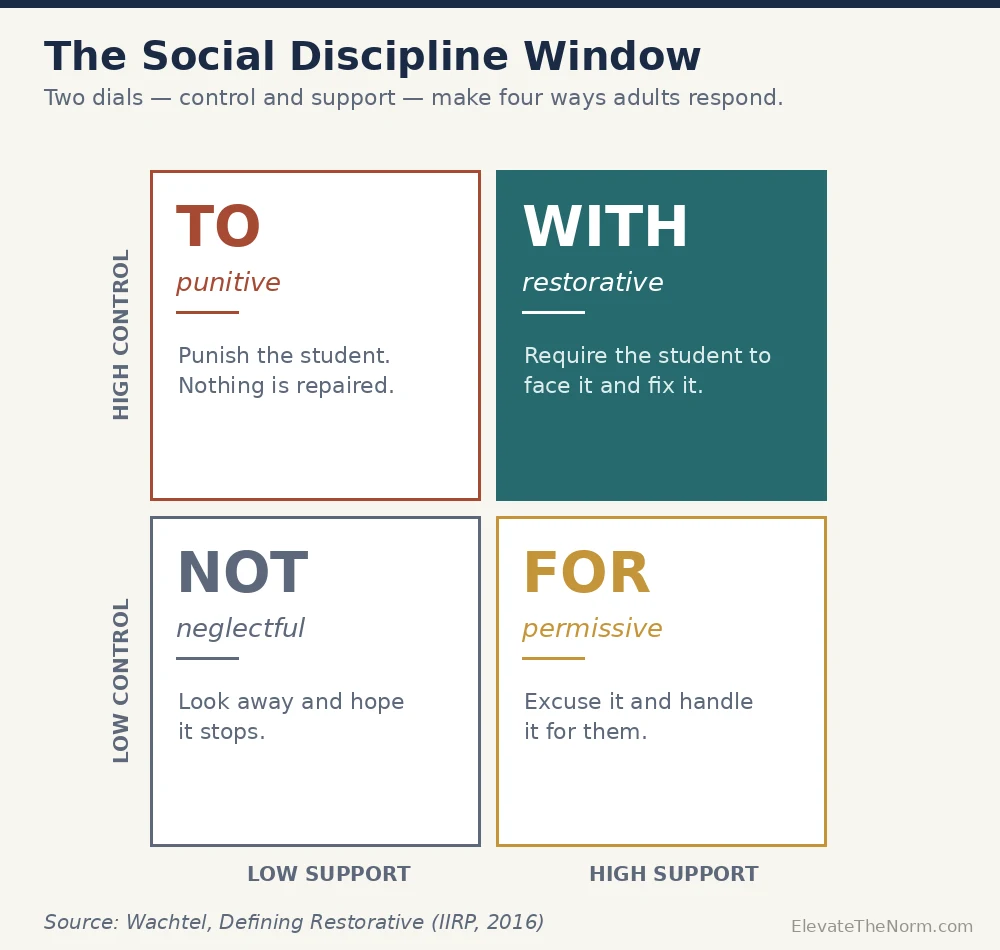
    The International Institute for Restorative Practices defines restorative practices as “a social science that studies how to build social capital and achieve social discipline through participatory learning and decision-making” (Wachtel, 2016). Strip the academic phrasing and it means this: you deal with problems with students rather than to them or for them.

    Four-quadrant social discipline window showing the TO, FOR, NOT and WITH approaches to student discipline
    The social discipline window: restorative practice is the high-support, high-control quadrant, not the permissive one.

    Wachtel’s “social discipline window” is the clearest picture of that idea. Cross high and low control with high and low support and you get four quadrants. TO is high control and low support — punitive. FOR is low control and high support — permissive, doing everything for the student. NOT is low control and low support, which is neglect. WITH is high control and high support, and that is the restorative quadrant.

    That last point is where most staff-room arguments about restorative practice go wrong. People hear “restorative” and picture the FOR box: a teacher who lets things slide, a school where nothing happens after a fight. The framework says the opposite. High control stays. What changes is that the student is required to participate in fixing it instead of just absorbing a penalty.

    The continuum, from two sentences to a formal conference

    Restorative practice is not one event. Wachtel describes a continuum that runs from informal to formal: affective statements, affective questions, small impromptu conferences, groups and circles, and formal conferences. The formal end — the circle with a facilitator and a signed agreement — is the part that gets photographed for district newsletters. It is also the rarest and the most expensive.

    The informal end is where a classroom teacher lives. An affective statement is one sentence naming the effect of a behavior: “When you talk over her, she stops offering answers, and I lose the best thinker in the room.” An affective question asks the student to do that work instead: “Who else is affected when this table doesn’t finish?” Neither takes more than fifteen seconds, and neither requires anyone’s permission.

    What the research on restorative practices actually shows

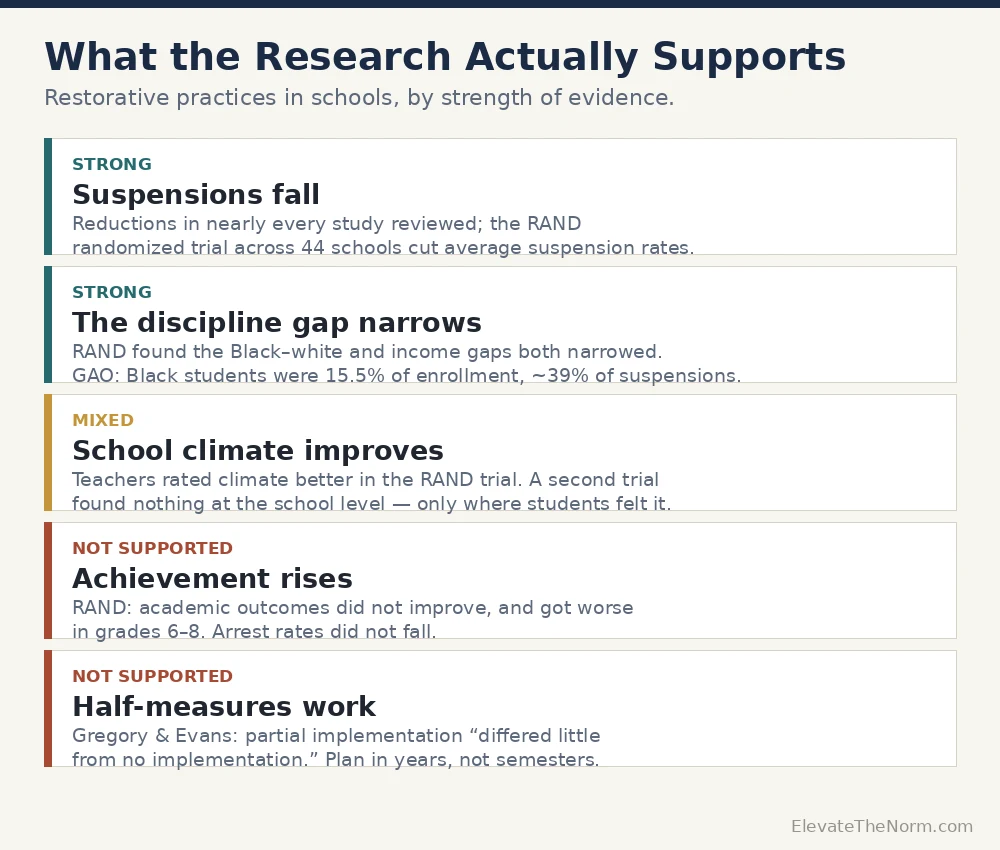
    Short version: strong and consistent evidence that suspensions fall, promising evidence on racial discipline gaps, weak evidence on climate, and one real warning sign on middle-school achievement. Anyone who tells you the research is settled in either direction has not read it.

    Suspensions go down, and the discipline gap narrows

    WestEd’s research review found reductions in exclusionary discipline in nearly every study it examined (Fronius, Darling-Hammond, Persson, Guckenburg, Hurley & Petrosino, 2019). The strongest single piece of evidence is a randomized controlled trial that RAND ran across 44 Pittsburgh schools over the 2015–16 and 2016–17 school years (Augustine et al., 2018). Average suspension rates dropped. The gap between Black and white students narrowed, and so did the gap between lower- and higher-income students. Teachers rated school climate better.

    Chart comparing what restorative practices research supports strongly, partially, and not at all
    What the evidence supports, what it does not, and where the honest gaps are.

    That matters because the disparities are real and documented. The Government Accountability Office found that Black students made up 15.5 percent of public school enrollment but about 39 percent of students suspended from school in 2013–14 (GAO-18-258, 2018). Boys and students with disabilities were also disciplined out of proportion to their share of enrollment. Any approach that shrinks that gap without lowering the standard deserves a serious look.

    The grades 6–8 result nobody quotes

    The same RAND trial found that academic outcomes did not improve — and that they got worse in grades 6–8. Arrest rates did not fall either. RAND did not explain the middle-grades result, and neither will I; a single trial in one district is not a verdict. But if you teach middle school, that is the finding most directly about your students, and you will not usually hear it from a vendor.

    A second randomized trial, run across 13 middle schools with about 2,771 students over two years, found no significant effects at the school level at all (Acosta, Chinman, Ebener, Malone, Phillips & Wilks, 2019). What it did find is more interesting: students who reported actually experiencing restorative practices showed better school connectedness, peer attachment, and social skills, and less cyberbullying victimization. Assignment to the program did nothing. Exposure to the practice did something. That is a fidelity finding wearing a null result’s clothes.

    Half-implemented is barely different from not implemented

    Reviewing what goes wrong in restorative rollouts, Anne Gregory and Katherine Evans concluded that partial implementation “differed little from no implementation” (Gregory & Evans, 2020). They name the common failure patterns: top-down mandates that contradict restorative values, a narrow focus on student behavior while adult behavior stays the same, inadequate training — the “train and hope” approach — and short, under-resourced initiatives. They argue meaningful change should be measured over three to five years, not one.

    Read that next to the two trials and a pattern shows up. The program that was implemented deeply moved suspensions. The program that was assigned but not really lived produced nothing. This is not a practice that rewards a one-day August in-service.

    What restorative practices cannot replace

    A repair conversation is not a substitute for a mandatory procedure, and treating it as one puts students at risk and puts you in real trouble. Your school’s code of conduct and your state’s law decide these, not you and not a circle.

    • Weapons, credible threats, and anything your district defines as a mandatory referral or reportable offense.
    • Assault, sexual harassment, and hazing — these have investigation and notification requirements attached to them.
    • Any disclosure of abuse or neglect. You are a mandated reporter and that obligation does not pause for a restorative process.
    • Situations where a student who was harmed does not want to sit down with the student who harmed them. Requiring that is not restoration; it is a second harm.
    • Documentation. If the incident requires a written referral, write it. A repair conversation can happen alongside the paperwork, not instead of it.

    This is also where restorative practice and ordinary classroom consequences that teach rather than humiliate meet. Restoration answers “what do we do about the harm.” It does not answer “what does the handbook require.” Both questions have to get answered.

    What one teacher can do without a schoolwide program

    Most of the informal continuum needs nothing but your own consistency. You cannot run a whole-school initiative from one room, but you can run the conversation, and the conversation is the part the research suggests students actually have to experience for anything to change.

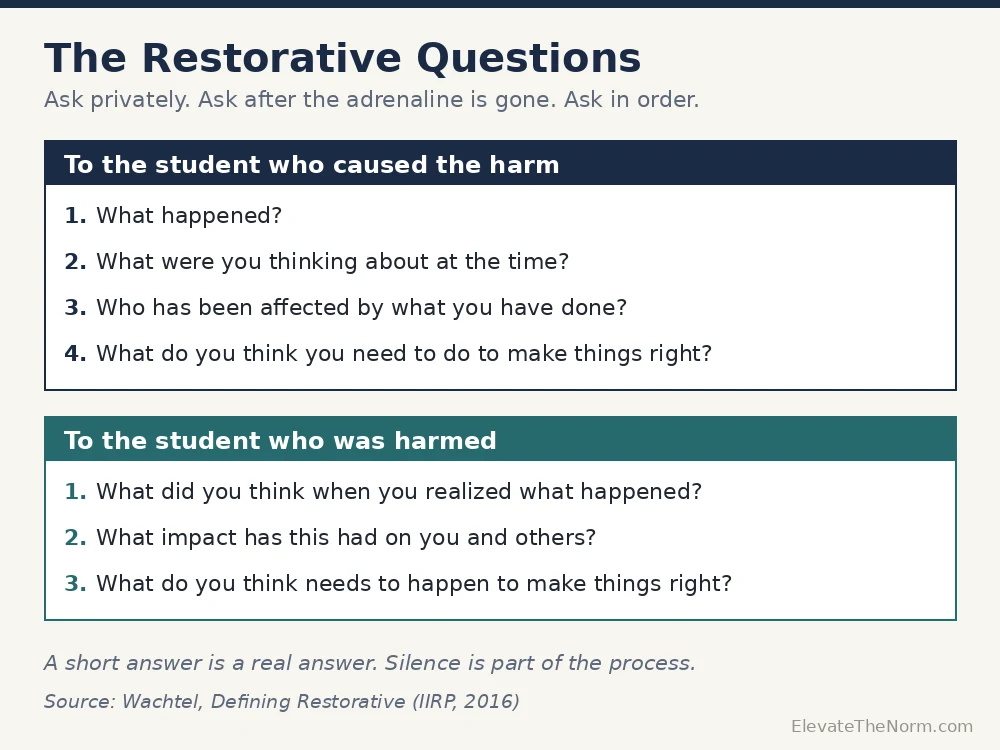
    The five restorative questions used in a repair conversation with a secondary student
    The restorative questions, in the order that keeps the conversation from turning into an interrogation.

    Wachtel’s restorative questions are the script, and they are short enough to memorize. For the student who caused harm: What happened? What were you thinking about at the time? Who has been affected by what you have done? What do you think you need to do to make things right? For the student who was harmed: What did you think when you realized what happened? What impact has this had on you and others? What do you think needs to happen to make things right?

    Four things make that script work with teenagers rather than sound like a booklet. Ask it privately, not in front of the room. Ask it after the adrenaline is gone, usually the next period or the next day. Ask the questions in order and let the silence sit. And accept a short answer — a fourteen-year-old saying “I wasn’t thinking, I was just mad” is a real answer, not a dodge. This is the same principle behind holding students accountable while still giving them another chance: the goal is a student who can name the harm, not a student who performs remorse well.

    A response ladder that keeps restoration in proportion

    The most common mistake is using a heavy tool on a light problem. A circle for a missed deadline wastes a period and teaches students that the process is theater. Match the response to the size of the harm.

    SituationRestorative responseTime cost
    Side conversation, phone out, off taskAffective statement — name the effect, move on15 seconds
    Group member coasting on a projectAffective question to the group, not the individual1 minute
    Rudeness to you or to another studentSmall impromptu conference, privately, next day4–5 minutes
    Conflict between two students that is still liveSeparate conversations first; joint only if both agree10–15 minutes
    Harm affecting the whole classCircle, with a plan and a follow-up dateHalf a period
    Anything in the mandatory-referral list aboveOffice referral first; repair later, if at allFollow policy

    Notice that the top three rows cover most of a school year. That is deliberate. Restorative practice at the classroom level is mostly small, fast, and unremarkable, which is exactly why it is sustainable — the same reason consequences that connect naturally to the behavior outlast elaborate point systems. When a repair conversation ends with a concrete student commitment, a student accountability sheet gives that agreement a trackable written form for the follow-up conversation.

    How to tell whether it is actually working

    Suspension counts are the easiest number to move and the easiest to fake. A school can cut suspensions by simply declining to write referrals, which improves the spreadsheet and makes teachers feel abandoned. Watch these instead:

    1. Repeat incidents involving the same student. If repair is working, the second conversation should be about something different than the first.
    2. Whether the harmed student came back. Restoration that only serves the student who caused the harm is not restoration.
    3. Teacher referral rates. If referrals collapse while classroom complaints rise, staff have stopped reporting, not stopped having problems.
    4. Who is still being removed. Run the disparity numbers by race, disability status, and grade level. That is the whole point of the intervention.
    5. Whether adults changed anything. Gregory and Evans are blunt that initiatives focused only on student behavior fail. If nothing about adult practice looks different, nothing has been implemented.

    None of that requires a data dashboard. A page in a notebook and a willingness to look honestly will do, which is the same standard I would apply to any discipline approach that promises firm standards without shame.

    Where this leaves you

    Restorative practices in schools are worth using, and they are worth using honestly. The evidence that they reduce suspensions and narrow discipline gaps is about as good as school-level evidence gets. The evidence that they raise achievement is not there, and in the one rigorous trial that looked, middle-grades achievement went the wrong way. Both of those sentences are true at once, and a teacher can hold both.

    So start where the evidence is strongest and the cost is lowest. Learn the seven restorative questions. Use affective statements this week instead of the sigh and the raised eyebrow. Keep writing the referrals your handbook requires. If your school is considering a formal rollout, ask the two questions Gregory and Evans would ask: how many years is the plan, and what is changing about adult practice? If the answers are “one” and “nothing,” the money is better spent elsewhere. And whatever the program, the floor stays the same — respect in the classroom has to run both directions before any of this works.

    Printables for this

    The repair conversation is the hard part to hold onto in the moment, so I wrote mine down. Restorative Conversation Scripts is the follow-up conversation, laid out line by line, and Behavior Reflection Sheets is the written half at two levels. Both are written for teenagers rather than third graders.

    Frequently Asked Questions

    Are restorative practices just a way to avoid disciplining students?

    No. In the framework restorative practice comes from, the restorative response is the high-control, high-support quadrant — the same firmness as a punitive response, with the addition of support and a requirement that the student help repair the harm. A student who has to face the person affected and agree to a fix is doing more work than a student sent home for a day, not less.

    Do restorative practices actually reduce suspensions?

    Yes, and this is the best-supported claim in the whole field. A WestEd review found reductions in exclusionary discipline in nearly every study examined, and a randomized controlled trial across 44 Pittsburgh schools found average suspension rates fell while the gaps between Black and white students and between lower- and higher-income students both narrowed.

    Do restorative practices improve grades or test scores?

    The evidence says no. The Pittsburgh randomized trial found academic outcomes did not improve, and that they got worse in grades 6–8. Arrest rates did not fall either. Restorative practice should be adopted for the discipline and climate outcomes it can support, not sold as an achievement strategy.

    When should a teacher not use a restorative approach?

    Whenever school policy or state law requires something else. Weapons, credible threats, assault, sexual harassment, hazing and any disclosure of abuse go to the office and follow mandated procedures. Also skip it when the student who was harmed does not want to sit down with the student who harmed them — requiring that meeting is a second harm, not a repair.

    How long does a repair conversation take?

    Usually four or five minutes, held privately and after the adrenaline has worn off — typically the next period or the next day. Most classroom-level restorative work is much shorter than that: a one-sentence affective statement naming the effect of a behavior takes about fifteen seconds and covers the majority of daily incidents.

    Can one teacher use restorative practices if the school has no program?

    Yes, for the informal end of the continuum. Affective statements, affective questions and small impromptu conferences need nothing but your own consistency. Schoolwide circles, formal conferences and any change to the discipline code are administrative decisions. Notably, a second randomized trial found that program assignment predicted nothing while students’ actual experience of restorative practice predicted better connectedness and social skills — which suggests one teacher’s practice is not wasted.

    What is the difference between restorative practices and restorative justice?

    Restorative justice is the older criminal-justice concept: responding to an offense by addressing harm and involving those affected. Restorative practices is the broader school-and-community application, and it includes the everyday preventive side — circles, affective language, relationship-building — not just what happens after something goes wrong. In schools the two terms are often used interchangeably.

    Sources


    About Clay Shumate

    Clay Shumate is a certified secondary Social Studies teacher in the public schools of West Alabama, with seven years of classroom experience, a B.A. in History, and an M.Ed. in Secondary Education. He writes about project-based learning, student responsibility, respect, and practical ways to hold young people to a higher standard while giving them room to learn from mistakes. He is a member of the Society of Professional Journalists and writes to its Code of Ethics; this site’s editorial standards and corrections policy are published in full. More about Clay.
  • Authentic Learning: How to Make Schoolwork Matter Beyond the Grade

    Authentic Learning: How to Make Schoolwork Matter Beyond the Grade

    By Clay Shumate

    Most students will tell you, if you ask them directly, that they don’t always understand why they’re doing what they’re doing in school. Not because they’re disengaged, but because no one has made the connection between the task and anything that matters outside the classroom. Authentic learning is the attempt to close that gap — and the evidence behind it is more specific, and more compelling, than the phrase usually suggests.

    What Authentic Learning Actually Means

    The phrase gets used loosely. Teachers call hands-on projects authentic. Administrators call anything real-world authentic. Some people use it to mean simply “not worksheets.”

    Fred Newmann, a University of Wisconsin researcher who spent decades studying what makes student work worth doing, defined it more precisely. In a 1993 paper with Gary Wehlage, Newmann proposed five standards of authentic instruction — not as a lesson format, but as a quality standard for asking whether the intellectual work students do in school resembles the intellectual work that matters outside of it.

    Those five standards are:

    Higher-order thinking. Students analyze, synthesize, and evaluate rather than recall and reproduce. They construct interpretations rather than retrieve stored answers.

    Depth of knowledge. Students develop genuine understanding of a topic rather than covering as much material as possible as quickly as possible. Breadth is sacrificed for meaning.

    Connectedness to the world beyond the classroom. The work has value or application outside school. Students produce something, solve something, or engage with something that exists beyond the classroom walls — not just as a simulation, but as a real contribution or genuine inquiry.

    Substantive conversation. Students and teachers engage in real dialogue about ideas, not just question-and-answer recitation. Talk is generative — it produces new understanding rather than merely correcting mistakes.

    Social support for student achievement. The environment communicates that every student is capable of high-quality intellectual work. High expectations are paired with genuine support — not as a slogan, but as a visible daily practice.

    These five standards are not a lesson format or a curriculum design. They are a quality standard. You can teach a lecture that hits all five. You can run a week-long project that hits none. The question is whether the work asks students to think in ways that are worth thinking.

    five standards of authentic learning framework for middle and high school classrooms
    Newmann’s five standards frame authentic learning as a quality judgment, not a lesson format.

    What the Research Actually Shows

    The phrase “research-based” appears on so many practices and products that it has largely lost meaning. So let me be specific about what the research on authentic learning actually demonstrates.

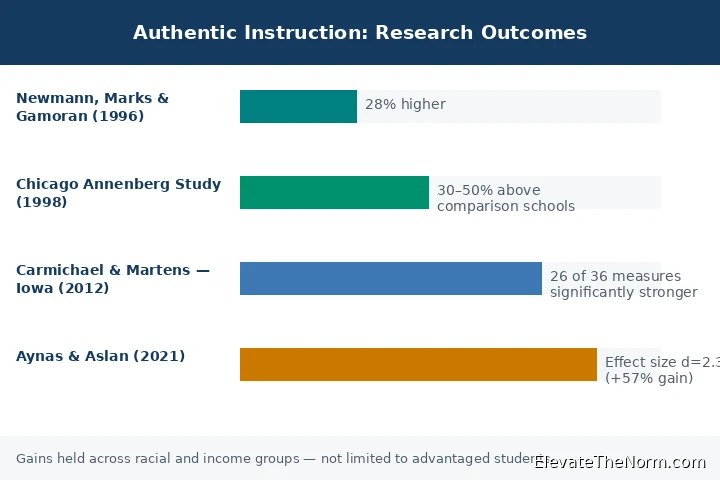
    In 1996, Newmann, Marks, and Gamoran studied 2,128 students in grades 3, 6, and 8 across 24 restructured schools — schools given autonomy to try new instructional approaches. Students in classrooms that scored high on the authentic instruction standards outperformed students in low-scoring classrooms by roughly 28 percent on assessments measuring genuine understanding. That gap held across racial and income groups, which matters: the gain was not confined to already-advantaged students.

    A separate Chicago Annenberg Challenge study by Newmann, Lopez, and Bryk (1998) found that schools implementing authentic intellectual work produced student achievement margins of 30 to 50 percent above comparison schools across reading and mathematics.

    A 2012 study by Carmichael and Martens followed students in 27 Iowa schools implementing Authentic Intellectual Work frameworks. In 26 of 36 measured comparisons, students showed significantly stronger performance on state assessments than matched comparison groups.

    More recently, a 2021 study by Aynas and Aslan worked with 92 sixth-grade students comparing authentic problem-based tasks against traditional instruction. Students in the authentic learning group improved problem-solving scores from 30.06 to 47.41 — a 57 percent gain — with an effect size of Cohen’s d = 2.37. That effect size is extraordinarily large by social science standards.

    These are not studies of elite schools or specially selected students. They are studies of ordinary classrooms where teachers changed the quality of the intellectual work expected, not the subject, not the schedule, and not the student population.

    authentic learning vs traditional instruction student achievement comparison research findings
    Research across multiple large-scale studies shows authentic instruction produces meaningful achievement gains regardless of student background.

    The Gap Between Authentic and Traditional

    Here is the practical difference in concrete terms.

    In a traditional classroom, a student studying a local water-quality issue might read an article about pollution, answer comprehension questions, and write a paragraph summarizing the article’s main points. In an authentic classroom, that same student might analyze actual water-quality data from a local river, identify a trend, and present findings — with recommendations — to someone who could act on them: a city council member, a county health board, a local environmental organization.

    The content knowledge is identical in both cases. The intellectual demand is not. The authentic version requires the student to ask what the data means, not just what the article says. It requires judgment about the strength of evidence, not just recall of facts. And it produces something that exists in the world — a report, a presentation, a recommendation — rather than a paper graded and returned.

    This distinction matters because students are not fooled. They understand when work is made up. They understand when nobody outside the classroom will ever read it, use it, or care about it. And they calibrate their effort accordingly — not because they are lazy, but because they are rational. They are treating manufactured tasks with the seriousness manufactured tasks deserve.

    What connects all of this to real-world learning at its best is the shift from performing school to producing understanding. The goal is not an assignment. It is thinking that goes somewhere.

    Three Moves That Bring Authentic Learning Within Reach

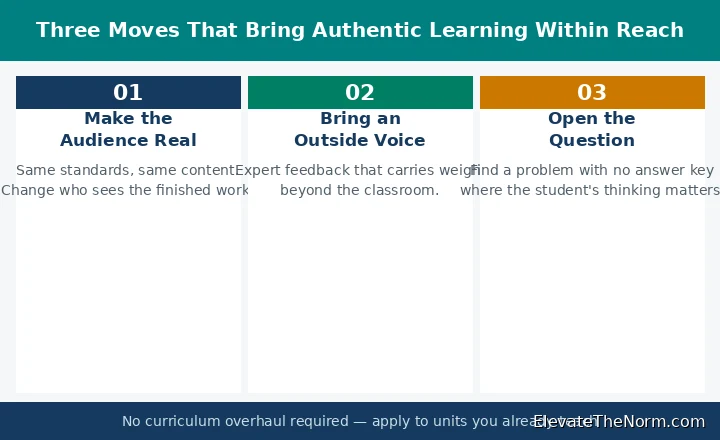
    None of these require a complete curriculum overhaul. Each can be applied to a unit you already teach.

    Make the audience real. The simplest shift is changing who sees the work. A persuasive essay written for the teacher is different from a persuasive essay written for the school board, the principal, or the local newspaper. Same standards, same skills. The audience changes the stakes, and the stakes change the thinking. Students who know their work will be read by someone other than their teacher tend to revise it more carefully and argue more precisely.

    Bring in an outside voice. Experiential learning research consistently finds that outside expert feedback is one of the most powerful levers available to classroom teachers. The expert does not need to be famous or formally credentialed — they need to be someone whose opinion carries weight beyond the classroom. A local engineer reviewing a student’s bridge design. A small-business owner reading a marketing proposal. A retired teacher critiquing an educational policy argument. The outside voice introduces a standard that is not just the teacher’s standard, and that shift changes what students produce.

    Connect to a question that does not have an answer yet. This works in every subject. History teachers can ask what a historical decision should have been, given the evidence available at the time. Science teachers can ask what a data set actually suggests, before revealing what researchers concluded. English teachers can ask what a character’s choice means for how we should read the rest of the novel. The key is finding a question where the student’s thinking actually matters — where there is no answer key and where the argument has to hold up under scrutiny.

    three strategies for authentic learning in secondary classrooms real audience outside expert open questions
    Three practical moves that introduce authentic learning without redesigning an entire course.

    A Project Check-In

    Midway through most projects, I run a check-in where I ask each group — or each student individually — to defend their decisions to me.

    Not present their work. Not summarize what they have done. Defend their specific choices: why did they organize the information this way, why did they select this source over another one, what does their argument actually claim, and what would someone with the opposing view say in response?

    The conversation takes three to five minutes. It sounds like this: “Walk me through why you went in this direction.” Then silence. Then: “What is the strongest argument against that position?” Then silence again.

    Students who are doing genuine intellectual work — who have actually wrestled with the material — can answer those questions. Students who have been arranging surface information rather than thinking with it usually cannot, not because they are unwilling, but because the work they have been doing has not required that kind of thinking. The check-in reveals which kind of work the project is producing, and it reveals it early enough to do something about it.

    This kind of mid-process accountability is one of the most direct expressions of student autonomy in its genuine form — students who are making decisions they can account for, not students who are completing tasks according to directions. The check-in is how I know whether those two things are happening at the same time.

    It is also how I find out whether the project structure itself is supporting the right kind of thinking. When multiple students cannot defend their choices in the same way, the problem is usually with the task design, not with the students. That feedback is worth more than any rubric.

    What Authentic Learning Is Not

    Three distinctions worth making explicit, because the term is misused often enough that they are not obvious:

    Authentic learning is not permissiveness or reduced rigor. High-quality intellectual work is more demanding than recall, not less. Students who engage with ambiguous real-world questions must manage genuine uncertainty, revise their thinking when evidence cuts against them, and produce something that can withstand scrutiny from a real audience. That is harder than filling in a blank or summarizing a chapter. Teachers who worry that authentic learning “lowers the bar” have it backward.

    Authentic learning is not project-based learning by another name. Project-based learning is a specific instructional approach with its own design elements — a sustained inquiry, a driving question, a public product, and formal critique and revision cycles. Authentic learning is a quality standard that can apply to many different instructional formats, including short lessons, discussions, and even well-designed lectures. A lecture can satisfy all five of Newmann’s standards. A poorly designed three-week project may satisfy none of them. The format is not the point.

    Authentic learning is not simply making class engaging or enjoyable. Engagement without intellectual demand is not authentic instruction. A fun simulation that produces only surface-level recall has failed the depth-of-knowledge standard and the higher-order-thinking standard simultaneously. The goal is not enthusiasm — it is thinking that holds up under scrutiny and produces understanding that transfers beyond the classroom.

    Starting Without Overhauling Everything

    A student-centered classroom does not require redesigning every unit at once, and neither does authentic learning. The research Newmann and his colleagues conducted was not research on schools that had replaced their entire curriculum. It was research on classrooms where individual teachers made a persistent, specific effort to raise the intellectual quality of the work they assigned.

    One starting point: take one unit you already teach and add a real audience to the final product. Keep the standards you are covering. Keep the content. Change only who sees the finished work and why. That single shift — from “turn it in to the teacher” to “present it to people who might actually respond to it” — tends to change the quality of the thinking that leads up to it.

    Another starting point: find one question in your current curriculum that genuinely has not been settled. Not a trick question. A real question where reasonable people who have examined the evidence still disagree. Give students the evidence, the frameworks, and the time to form a defensible position. Require them to engage with the counterargument. That is authentic intellectual work by Newmann’s standard, and it costs no additional planning time beyond what you are already doing.

    The experiential learning activities that stay with students years after the course are almost always the ones that produced something real — a genuine discovery, a real audience, a question that did not have an answer in the back of the book. The difference is not the format. It is whether the work produced understanding that goes somewhere.

    Sources

    1. Newmann, F. M., & Wehlage, G. G. (1993). Five standards of authentic instruction. Educational Leadership, 50(7), 8–12. Available at the ASCD archive.
    2. Newmann, F. M., Marks, H. M., & Gamoran, A. (1996). Authentic pedagogy and student performance. American Journal of Education, 104(4), 280–312. https://doi.org/10.1086/444136
    3. Newmann, F. M., Lopez, G., & Bryk, A. S. (1998). The quality of intellectual work in Chicago schools: A baseline report. Consortium on Chicago School Research. Consortium on Chicago School Research
    4. Carmichael, D. L., & Martens, K. (2012). Authentic intellectual work: Improving teaching for rigorous learning. Corwin Press.
    5. Aynas, N., & Aslan, S. (2021). The effect of authentic learning on problem-solving skills of secondary school students. Malaysian Online Journal of Educational Sciences, 9(4), 1–16.
    6. Newmann, F. M. (Ed.). (1996). Authentic achievement: Restructuring schools for intellectual quality. Jossey-Bass.

    Frequently Asked Questions

    What is authentic learning in simple terms?

    Authentic learning means schoolwork that asks students to think in ways that matter outside the classroom — work that connects to real questions, real audiences, or real problems rather than to manufactured tasks designed only to be graded. The term comes from Fred Newmann’s research framework, which defines authentic instruction by five standards: higher-order thinking, depth of knowledge, connectedness to the world beyond the classroom, substantive conversation, and social support for student achievement.

    What does authentic learning look like in a 50-minute class period?

    It does not have to span multiple class periods or require a full project. A single class period can include authentic elements: a discussion that generates new thinking rather than reciting correct answers, a short writing task with a real audience (even if that audience is only a schoolmate or a department head), or an analysis of real data rather than textbook examples. The format matters less than whether the intellectual demand is genuine.

    Does authentic learning prepare students for standardized tests and college?

    The research suggests it does. Newmann, Marks, and Gamoran (1996) found that students in classrooms with high authentic instruction scores outperformed comparison students not just on open-ended assessments but also on standardized measures. This is consistent with what cognitive science suggests: students who develop deep understanding of material — rather than surface familiarity — tend to perform better on varied assessment formats, including multiple-choice and short-answer tests.

    How do I grade authentic learning fairly?

    Grading authentic work requires making the criteria explicit before students begin — what makes an argument defensible, what distinguishes strong evidence from weak evidence, what a well-reasoned recommendation includes. Rubrics that describe quality thinking (rather than just format compliance) work better for authentic tasks than rubrics that reward procedure. It also helps to involve students in understanding the criteria before the work begins, which is itself an authentic intellectual task.

    Can I use authentic learning when I have a prescribed textbook curriculum?

    Yes. Authentic learning is a quality standard applied to the intellectual work students do — it is not a curriculum. You can add a real audience to a textbook writing assignment, find a genuine open question within a textbook chapter, or bring in outside expert feedback on work students produce from textbook content. None of that requires replacing the curriculum. It requires adjusting the intellectual demand placed on students while using the same material.

    Does authentic learning work for all students, including those who struggle academically?

    The research by Newmann and colleagues found that the achievement gains from authentic instruction held across racial and income groups — not just for already-advantaged students. Carmichael and Martens’ Iowa study showed consistent results across diverse student populations. This matters: one concern about raising intellectual demand is that it benefits strong students while leaving struggling students further behind. The available evidence does not support that concern. Genuine intellectual demand, paired with genuine support, appears to improve outcomes across the range.

    What is the difference between authentic learning and just making class more fun or engaging?

    Engagement without intellectual demand is not authentic learning. A fun simulation that produces only surface recall has failed Newmann’s higher-order-thinking and depth-of-knowledge standards, regardless of how much students enjoyed it. The goal of authentic learning is not enthusiasm — it is understanding that transfers. Students should leave a well-designed authentic task able to think with what they learned, not just remember that they had a good time. Both things can happen at once, but enjoyment is not the measure.


    About Clay Shumate
    Clay Shumate is a certified secondary Social Studies teacher in the public schools of West Alabama, with seven years of classroom experience, a B.A. in History, and an M.Ed. in Secondary Education. He writes about project-based learning, student responsibility, respect, and practical ways to hold young people to a higher standard while giving them room to learn from mistakes. He is a member of the Society of Professional Journalists and writes to its Code of Ethics; this site’s editorial standards and corrections policy are published in full. More about Clay.
  • Experiential Learning Activities: 30 Real-World Ideas for Grades 6–12

    Experiential Learning Activities: 30 Real-World Ideas for Grades 6–12

    By Clay Shumate

    Experiential learning activities put students inside the subject instead of in front of it. The 30 ideas below follow Kolb’s experiential learning cycle — act, observe, reflect, conceptualize, apply — and are built for grades 6–12 classrooms with limited budgets, real schedules, and students who will check out the moment an activity feels pointless. Every one of them can run in a public school without special funding, a field trip bus, or a rewritten master schedule.

    Key Takeaways

    • An experience is not the same thing as experiential learning. The difference is the reflection and conceptualization that follow.
    • Kolb’s cycle has four stages: concrete experience, reflective observation, abstract conceptualization, and active experimentation. Activities that skip stages produce fun, not learning.
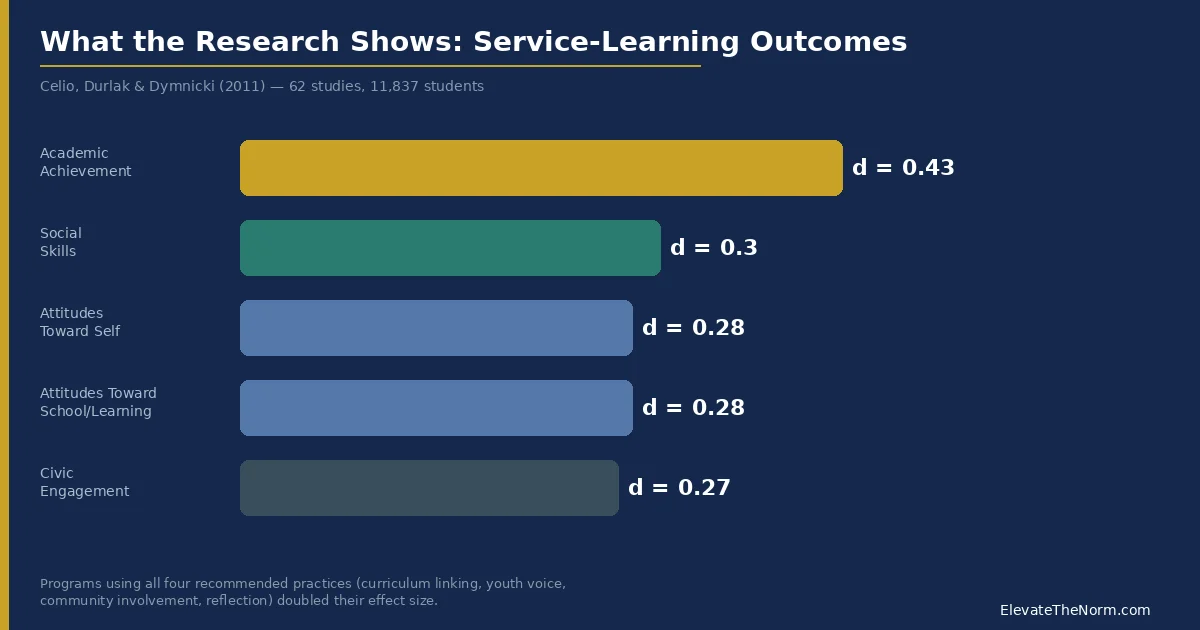
    • A meta-analysis of 62 studies found that service-learning — one category of experiential activity — improved academic achievement by an effect size of 0.43, the strongest of any outcome measured.
    • Most activities below require no budget, no technology, and no administrative approval beyond what a classroom teacher already has.
    • Partner and group work is the default format for experiential learning — not an add-on. Students learn from each other during the experience, not just during the debrief.

    The Difference Between an Experience and Experiential Learning

    A student who watches a documentary has had an experience. A student who watches a documentary, writes down what surprised them, connects those surprises to a concept from class, and then uses that concept to analyze a second documentary has done experiential learning. The difference is not the activity — it is what happens after the activity.

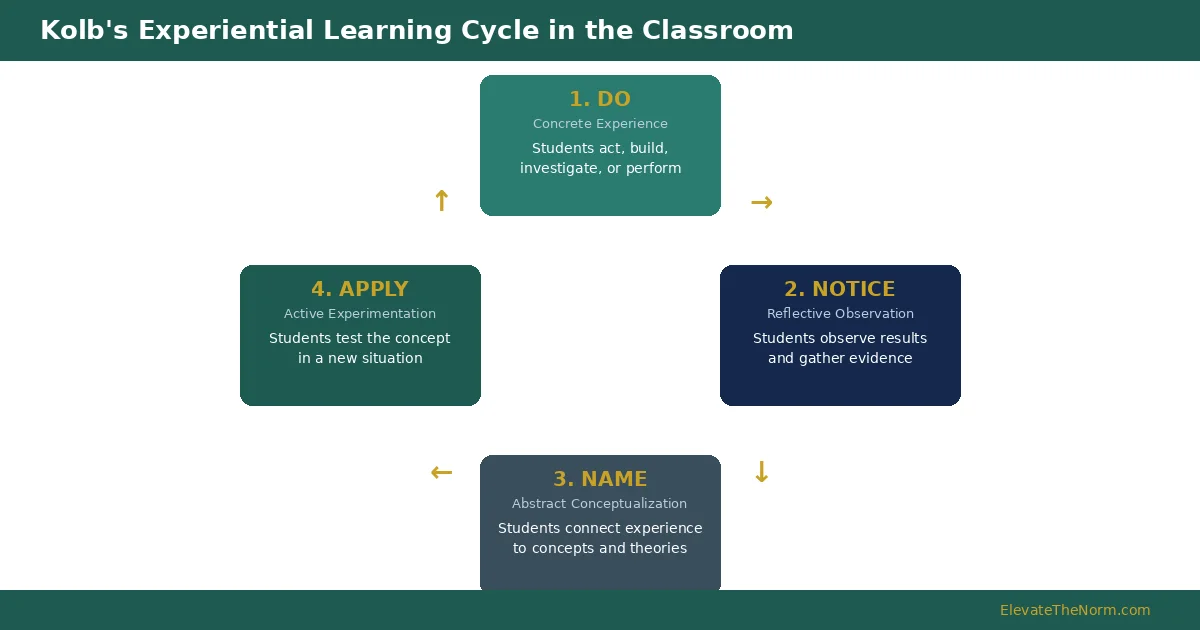
    David Kolb formalized this in 1984 with a four-stage cycle that still holds up: concrete experience (do something), reflective observation (think about what happened), abstract conceptualization (connect the experience to a principle or theory), and active experimentation (apply the principle to a new situation). John Dewey made the same point forty-six years earlier in Experience and Education (1938): “The belief that all genuine education comes about through experience does not mean that all experiences are genuinely or equally educative.” Dewey called experiences that do not lead to learning “miseducative” — and he was talking about exactly the kind of activity that keeps students busy without making them think.

    Every activity in this article is designed to complete the full cycle. If you strip out the reflection or the conceptualization step to save time, you have a field trip, not a lesson.

    How Kolb’s Cycle Works in a Real Classroom

    Kolb's four-stage experiential learning cycle diagram showing do, notice, name, and try again stages for classroom use
    Kolb’s four-stage cycle in classroom language: do, notice, name, try again.

    Here is the cycle in plain terms, because the academic language makes it sound more complicated than it is:

    1. Do. Students participate in an activity, investigation, simulation, or task. They are inside the experience, not watching it.
    2. Notice. Students observe what happened — what worked, what surprised them, what went wrong. This is not a grade. It is data collection about their own experience.
    3. Name. Students connect their observations to a concept, theory, or principle. This is the bridge between “that was interesting” and “here is what it means.”
    4. Try again. Students apply what they named to a new situation. This is the test of whether they actually learned something transferable or just had a one-time experience.

    In my room, the tables are pushed together in groups, and students are almost always working alongside somebody. That is not a choice I made to be trendy — it is the structure experiential learning requires. When students do something and then need to reflect on what happened, the reflection is richer when they can talk through it with a partner who was in the same experience and noticed different things. Partner work is the default condition of the room, not a reward for finishing early, and that matters for every activity below. The experience happens collaboratively; the reflection deepens because of it.

    30 Experiential Learning Activities for Grades 6–12

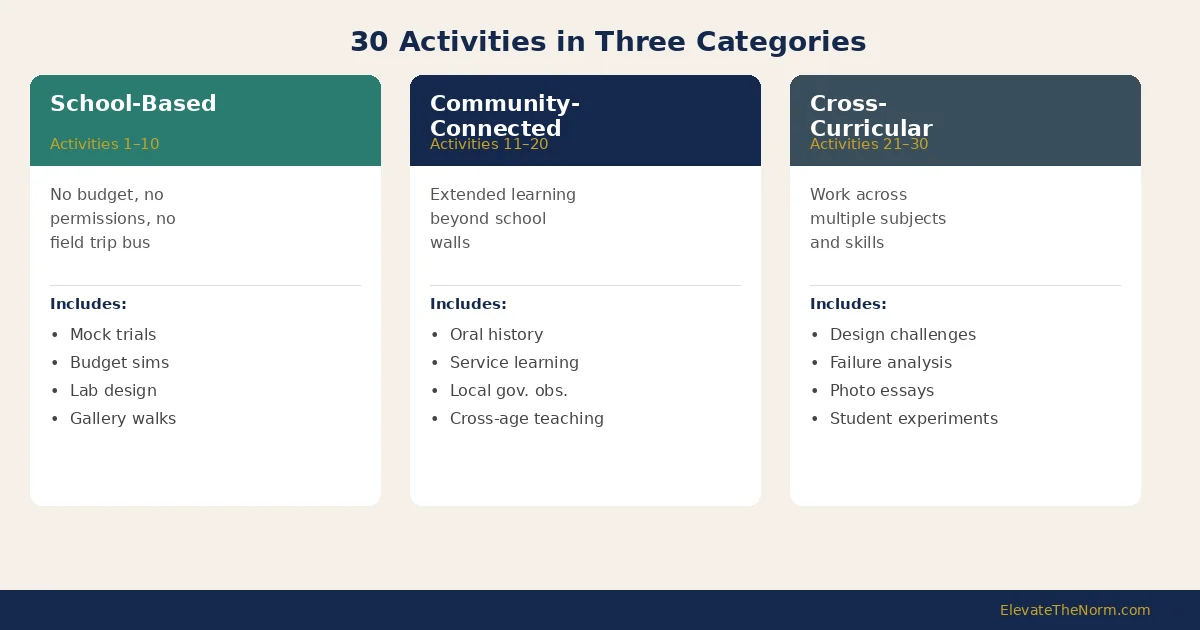
    Three categories of experiential learning activities: school-based, community-connected, and cross-curricular with example counts for each
    30 activities organized in three categories from classroom-only to community-connected.

    These are organized by type: school-based activities that need nothing beyond your classroom, community-connected activities that extend learning outside the building, and cross-curricular activities that work in multiple subjects. Budget notes are included where relevant.

    School-Based Activities (No Special Permissions Needed)

    1. Mini Mock Trial. Students take roles — prosecution, defense, witnesses, judge, jury — in a simplified trial based on a historical event, a literary conflict, or a current ethical question. The experience is arguing a position under rules. The reflection is: “What evidence was most persuasive, and why did the jury weigh it that way?” Runs in one to two class periods.

    2. Budget Simulation. Give each group a fixed income and a list of expenses for a household — rent, food, transportation, insurance, taxes. They allocate, make trade-offs, encounter unexpected expenses (car repair, medical bill), and rebuild their plan. The conceptualization: what does this reveal about economic decision-making, poverty, or policy? Cost: zero. A printed handout is all you need.

    3. Primary Source Investigation. Place three to five primary sources on a table — documents, photographs, maps, or objects. Students examine them physically (or high-quality printouts), generate questions, and build a hypothesis about what they reveal. The reflection compares their hypothesis to the textbook account. A history teacher’s bread and butter, and it works in science (lab observation logs) and English (author manuscripts, historical editions) just as well.

    4. Peer Teaching Rounds. Each student or pair prepares a five-minute lesson on one section of a unit. They teach it to a rotating group of classmates, receive written feedback, revise, and teach it again. The experience is teaching — which forces deeper understanding than listening ever does. The reflection: “What question from your students made you realize you did not understand this as well as you thought?”

    5. Data Collection and Analysis. Students collect real data — classroom survey results, school lunch waste measured by weight, hallway traffic patterns, library usage statistics — then analyze it using methods from the curriculum. The experience is measurement. The conceptualization is: “What does this data actually tell us, and what does it not tell us?” This is project based learning in miniature.

    6. Fishbowl Debate. A small group discusses a debatable question in the center of the room while the rest of the class observes, takes notes, and tags in to replace a speaker. The experience is both performing and observing. Reflection prompt: “What did you notice about how the conversation changed when a new voice entered?”

    7. Lab Design Challenge. Instead of following a pre-written lab procedure, students receive a question and design their own procedure, predict outcomes, run the experiment, and compare results to predictions. The teacher provides safety parameters and materials — students provide the method. Works in any science class and teaches the difference between following instructions and doing science.

    8. Role-Play Negotiation. Assign students roles in a historical or contemporary negotiation — treaty talks, labor disputes, environmental policy. They research their position, negotiate with opposing parties, and attempt to reach an agreement. Reflection: “What did you have to give up, and why? What would have changed if you had different information?” One class period, no budget.

    9. Gallery Walk With Feedback. Students display their work — drafts, diagrams, solutions, prototypes — and classmates circulate, leaving specific written feedback using structured prompts. The experience is both creating and evaluating. The reflection: “What feedback surprised you? What will you change, and what will you keep?” Gallery walks teach respect in the classroom through practice, not a poster.

    10. Simulation of Scarcity. Give groups limited resources (paper, tape, time) to complete a task that requires more than they have. Watch how they allocate, trade, cooperate, or compete. Debrief with the question: “What does this show about how people behave when resources are scarce?” This is economics, psychology, and history in one forty-minute block.

    Community-Connected Activities

    11. Community Problem Investigation. Students identify a real problem in their school or neighborhood — a safety concern, an access issue, an environmental hazard — research it, interview stakeholders, and propose a solution they present to an actual decision-maker (principal, city council member, local business owner). The service-learning research is strong here: Celio, Durlak, and Dymnicki (2011) reviewed 62 studies involving 11,837 students and found an effect size of 0.43 for academic achievement — the largest of any outcome category they measured. Programs that incorporated structured reflection doubled their effect.

    12. Oral History Project. Students interview a community member — a grandparent, a veteran, a local business owner, a longtime resident — about a topic connected to the curriculum. They record, transcribe, and analyze the interview against historical or sociological sources. The experience is the conversation. The conceptualization: “How does one person’s story confirm or complicate what the textbook says?”

    13. Environmental Audit. Students measure something real — water quality in a nearby stream, energy usage in the school building, waste generated by the cafeteria over a week — and compare their findings to published standards or benchmarks. The product is a written report with recommendations presented to administration or a community group. Works in science, math, and social studies.

    14. Job Shadow Reflection. If your school allows it, students spend a half-day observing a professional in a field connected to the curriculum. The activity is not the shadow itself — that is just the experience. The learning happens in the structured reflection afterward: “What skills did you see this person use? Which ones are you already building in this class? Which ones surprised you?” Not every school can do this, but the schools that can should.

    15. Community Mapping. Students map resources, hazards, demographics, or services in their neighborhood using walking surveys, public data, or online tools. The product is a visual map with analysis. The conceptualization: “What patterns do you see, and what might cause them?” This teaches geography, data literacy, and civic awareness simultaneously.

    16. Public Service Announcement Production. Students research a public health or safety issue, create a thirty-to-sixty-second video or audio PSA, and share it with a real audience (school announcements, a local nonprofit, social media with school approval). The experience is production. The reflection: “What choices did you make about what to include and what to leave out? How did your audience change your message?”

    17. Small Business Plan. Students develop a simple business plan for a product or service that addresses a real need in their community. They research costs, identify customers, create a marketing pitch, and present to a panel that includes at least one real business owner or community member. No actual money changes hands — the value is in the planning and the presentation to a real audience.

    18. Local Government Observation. Students attend (in person or via livestream) a city council meeting, school board meeting, or county commission session. They take notes on how decisions are made, who speaks, what evidence is presented, and how the process compares to what they learned in class. Reflection: “What surprised you about how this process actually works?” This is civics as experience, not vocabulary.

    19. Service-Learning Project. Students identify a community need, plan a service response, carry it out, and reflect on what they learned about the issue and about themselves. This is different from community service because the learning is explicit — tied to curriculum standards, assessed, and reflected on. Celio et al. found that programs using four recommended practices (curriculum linking, youth voice, community involvement, reflection) yielded effect sizes of 0.35, compared to 0.17 for programs using none.

    20. Cross-Age Teaching. High school students design and deliver a lesson to elementary or middle school students on a topic from the curriculum. The experience forces them to simplify, explain, and anticipate misconceptions — skills that require deep understanding. The reflection: “What question from a younger student exposed a gap in your own understanding?”

    Cross-Curricular Activities

    21. Design Challenge. Give groups a problem (build a bridge from paper that holds a textbook, design a water filtration system from household items, create a container that keeps an egg intact from a second-floor drop) and limited materials. The experience is building and testing. The reflection: “What did your first failure teach you that led to your second design?” Engineering, physics, and teaching responsibility through consequential tasks.

    22. Socratic Seminar on a Controversial Question. Students prepare evidence on a debatable topic — historical, scientific, ethical, or literary — and discuss it in a structured circle. The experience is sustained, evidence-based conversation. The conceptualization: “Where did you change your mind, and what evidence made you do it?” Works in every subject that asks debatable questions, which is all of them.

    23. Process Journal. Students keep a running journal during a multi-day activity or project, documenting decisions, setbacks, changes in thinking, and reflections. The journal itself becomes the conceptualization artifact — a record of learning over time, not just the final product. Pair with project based learning ideas to give students ownership of the process, not just the outcome.

    24. Simulation of a Historical Event. Assign students roles within a historical event — the Constitutional Convention, a UN Security Council debate, the Montgomery Bus Boycott planning meetings — and run a compressed simulation. Students must research their historical figure’s actual positions and argue from evidence. The reflection connects the simulation to the outcomes: “What decisions could have gone differently, and how would history have changed?”

    25. Measurement Lab. Students measure something real using disciplinary tools — pH, temperature, distance, weight, density, sound levels, population counts — and use the data to answer a question. The experience is measurement and observation. The conceptualization: “What did the data show that you did not expect? What would you measure next?” This is how science and math become tangible.

    26. Ethical Dilemma Discussion. Present students with a genuine ethical dilemma — medical triage, resource allocation during a disaster, whistleblowing, journalistic responsibility — and have them work through it in small groups using a structured framework (stakeholder analysis, consequence mapping, principled reasoning). The experience is the moral reasoning. The reflection: “Where did your group disagree, and what value was each person prioritizing?”

    27. Recipe Scaling and Cooking. Students scale a recipe up or down for a different number of servings, calculate costs per serving, and (if facilities allow) prepare the food. Math, nutrition, chemistry, and real world learning in one activity. The reflection: “What math did you actually use, and how was it different from doing a worksheet problem?” Even without a kitchen, the scaling and cost analysis are worthwhile on their own.

    28. Photo Essay. Students use phone cameras to document a theme — “systems in our school,” “geometry in our neighborhood,” “evidence of change over time” — and curate their photos into a narrative with captions that connect observations to course concepts. The experience is seeing. The conceptualization is framing what they see in disciplinary language.

    29. Failure Analysis. Give students a case study of a real engineering failure, a business collapse, a policy disaster, or a historical miscalculation. They analyze what went wrong, identify the decision points where a different choice could have changed the outcome, and present their findings. The experience is forensic thinking. The reflection: “What is the difference between a mistake and a systemic failure?” This pairs directly with the site’s core belief that learning from mistakes is how people grow — but only if they understand what actually went wrong.

    30. Student-Designed Experiment. Students choose a question, design an experiment or investigation, carry it out, analyze results, and present findings to the class. The teacher provides the framework (hypothesis, method, data collection, analysis, conclusion) and the safety boundaries. Students provide everything else. This is the capstone version of experiential learning — students own every stage of the cycle, and the teacher’s job is to keep the guardrails in place while the students do the driving.

    What the Research Says About Experiential Learning Outcomes

    Bar chart showing service-learning effect sizes from Celio et al. meta-analysis: academic achievement 0.43, social skills 0.30, attitudes toward self 0.28, attitudes toward school 0.28, civic engagement 0.27
    Service-learning effect sizes from Celio et al. (2011): academic achievement led all outcomes.

    The evidence base for experiential learning is substantial, but it is important to be honest about what it shows and what it does not.

    Morris (2020) conducted a systematic review of Kolb’s model and found that while the four-stage cycle remains the most widely used framework for experiential learning, its effectiveness depends entirely on implementation — particularly the reflection and conceptualization stages. Activities that skip those stages consistently produce weaker outcomes. The cycle is not optional, and Kolb himself argued this: “Learning is the process whereby knowledge is created through the transformation of experience.”

    The Celio, Durlak, and Dymnicki (2011) meta-analysis remains the strongest quantitative evidence for service-learning specifically. Across 62 studies and 11,837 students, service-learning produced significant gains in academic achievement (d = 0.43), social skills (d = 0.30), attitudes toward self (d = 0.28), attitudes toward school (d = 0.28), and civic engagement (d = 0.27). The academic achievement effect was notably the largest — a finding the authors called “probably the most important for educators.” This is not a soft skill gain masquerading as rigor. Students who did service-learning learned more content, measured by the same assessments their peers took.

    Research on simulation-based learning in secondary education, reviewed across 145 studies, found that simulations produce strong overall effects on achievement across disciplines. Students who learned through simulations showed better problem-solving abilities compared to traditional methods, improved collaboration skills, and rated simulations as the most effective learning method compared to lectures and case studies. However, the research is clear that effectiveness depends on instructional design, not just the tool — a poorly designed simulation is no better than a poorly designed lecture.

    The honest summary: experiential learning works when it includes all four stages of the cycle, when reflection is structured rather than optional, and when the teacher stays involved throughout. It does not work when “experiential” is used as a synonym for “fun” or when the reflection step is cut because the bell is about to ring.

    Making It Work: Practical Considerations

    Most of these activities require no budget. A few need minimal supplies (printed handouts, poster paper, tape). The community-connected activities may require coordination with administrators, parents, or community partners, but none of them require spending money the school does not have.

    Time is the real constraint. A full experiential learning cycle — do, reflect, conceptualize, apply — takes longer than a lecture-and-worksheet class. That is a fact, not an objection. The research consistently shows that the time invested produces stronger learning outcomes, which means the apparent time cost is actually a time savings: students who understand a concept through experience need less reteaching than students who memorized it from a slide.

    For teachers working within tight pacing guides, start with activities that fit inside a single period (1–10 on the list above) and expand as you learn what your students can handle. The community-connected activities (11–20) require more planning but produce deeper engagement. The cross-curricular activities (21–30) are where experiential learning becomes genuinely student centered — students are not just experiencing content, they are experiencing the process of learning itself.

    One final note: student responsibility in the classroom is not something you can lecture into existence. It is built through activities where students have real decisions to make and real consequences to learn from — consequences bounded by planning and presence, not by manufactured stakes designed to punish mistakes. These thirty activities are how that happens.


    Frequently Asked Questions

    What is the difference between experiential learning and hands-on learning?

    Hands-on learning means students are physically doing something — building, measuring, manipulating materials. Experiential learning includes hands-on work but adds structured reflection, conceptualization, and application. A student who builds a bridge out of paper has done hands-on learning. A student who builds it, analyzes why it failed, connects that analysis to engineering principles, and redesigns it has done experiential learning. The reflection and conceptualization stages are what separate the two.

    How do I fit experiential activities into a packed curriculum?

    Start with single-period activities from the school-based list. Many of them replace a lecture and worksheet with a more effective learning experience that covers the same content. The time investment pays off in reduced reteaching — students who learn through experience retain more than students who memorize from slides. If your pacing guide is truly immovable, use experiential activities for the concepts students struggle with most. That is where the return on time is highest.

    Do experiential learning activities work for students who struggle academically?

    The research says yes. The Celio et al. meta-analysis found that service-learning programs using structured reflection and curriculum linking — two features that directly support struggling learners — produced the strongest results. Experiential activities provide multiple entry points (visual, kinesthetic, verbal, social) that traditional instruction often does not. That said, struggling students need more scaffolding, not less — provide clearer task cards, shorter rotations, and more frequent check-ins during the experience phase.

    What if my school does not allow field trips or community partnerships?

    Activities 1 through 10 require nothing beyond your classroom. Simulations, mock trials, data collection, design challenges, and gallery walks all create experiential learning inside the building. Community connections enrich the work but are not required for it. Many of the community-connected activities (oral history, local government observation via livestream, community mapping using public data) can be adapted to work within school walls if your district restricts off-campus activities.

    How do I grade experiential learning activities?

    Grade the products the cycle produces, not the experience itself. Reflection journals, analysis papers, design reports, presentation rubrics, and peer feedback forms all generate gradeable artifacts. Do not grade participation in the experience — that turns a learning activity into a compliance check. Grade what students demonstrate they learned from the experience, which is visible in the reflection and application stages.

    Are experiential learning activities appropriate for every subject?

    Yes, though the format varies. Science uses labs and investigations. History uses primary sources and simulations. Math uses data collection and measurement. English uses discussion protocols and creative production. The common thread is the cycle: do something, reflect on it, connect it to a concept, and apply it to a new situation. Any subject that asks students to think — which is all of them — can use experiential learning.

    How do I manage behavior during experiential activities?

    Structure prevents most behavior problems. When students know what they are doing, how long they have, and what they will produce, off-task behavior drops. Circulate constantly — your physical presence in the room is your primary management tool. Set expectations before the activity starts, not during it. Use a two-minute check at the beginning to catch confusion early. If a specific group is off task, redirect quietly and individually rather than stopping the whole class. The teacher’s job during experiential learning is to move, listen, and intervene surgically.


    Sources

    1. Kolb, D. A. (1984). Experiential Learning: Experience as the Source of Learning and Development. Prentice-Hall.
    2. Dewey, J. (1938). Experience and Education. Kappa Delta Pi/Macmillan.
    3. Celio, C. I., Durlak, J., & Dymnicki, A. (2011). “A Meta-Analysis of the Impact of Service-Learning on Students.” Journal of Experiential Education, 34(2), 164–181. https://doi.org/10.1177/105382591103400205
    4. Morris, T. H. (2020). “Experiential Learning — A Systematic Review and Revision of Kolb’s Model.” Interactive Learning Environments, 28(8), 1064–1077. https://doi.org/10.1080/10494820.2019.1570279
    5. SmartSims. (2024). “Simulation-Based Learning in Secondary Education: What the Research Shows.” https://www.smartsims.com/news/simulation-based-learning-secondary-education-research/
    6. Baeten, M., Dochy, F., Struyven, K., Parmentier, E., & Vanderbruggen, A. (2023). “Student-Centered Education: A Meta-Analysis of Its Effects on Non-Academic Achievements.” SAGE Open, 13(2). https://doi.org/10.1177/21582440231168792

    About Clay Shumate

    Clay Shumate is a certified secondary Social Studies teacher in the public schools of West Alabama, with seven years of classroom experience, a B.A. in History, and an M.Ed. in Secondary Education. He writes about project-based learning, student responsibility, respect, and practical ways to hold young people to a higher standard while giving them room to learn from mistakes. He is a member of the Society of Professional Journalists and writes to its Code of Ethics; this site’s editorial standards and corrections policy are published in full. More about Clay.
  • Project Based Learning vs Traditional Learning: What the Evidence Actually Says

    Project Based Learning vs Traditional Learning: What the Evidence Actually Says

    By Clay Shumate

    Project based learning and traditional learning differ in where the content lives. Traditional instruction delivers knowledge first and asks students to apply it afterward. Project based learning has students build that knowledge while solving a real problem for a real audience. The research favors projects for transfer and retention, and favors direct instruction for teaching brand-new material to beginners.

    Key Takeaways

    • The comparison is not projects versus lectures. It is when content gets delivered and who does the thinking while it happens.
    • Meta-analytic evidence gives project based learning a moderate advantage on academic achievement, with the strongest effects at the high school level.
    • Explicit, guided instruction still beats minimally guided approaches for novices meeting new content. That finding is not a rebuttal of PBL — it is a scheduling instruction.
    • Most classrooms that say they run project based learning are running the visible half of it. Products and presentations are common; driving questions and revision cycles are not.
    • You do not have to pick a side for the whole year. You pick one for each unit, and you should be able to say why.

    What “Project Based Learning vs Traditional Learning” Actually Compares

    Most of the arguments about project based learning vs traditional learning are arguments about caricatures. One side pictures a teacher droning through slides while thirty kids copy notes. The other pictures a room full of poster board and glue sticks where nobody learns anything. Neither is a real classroom, and comparing them settles nothing.

    The real difference is sequence and ownership. In a traditional unit, the teacher delivers the content, students practice it, and then — if there is time — a project shows that the learning happened. The project is the dessert. In project based learning, the project is the main course. Students are handed a question worth answering, and they build the content knowledge on the way to answering it, with the teacher pulling groups aside, correcting misconceptions, and teaching directly at the moments it is needed.

    That distinction matters because it is the one that gets lost. If you want the precise version, the definition of project based learning comes down to sustained inquiry, authenticity, student voice, critique and revision, and a public product. Strip any one of those out and you have a graded assignment with better packaging.

    What the Research Says About Project Based Learning vs Traditional Learning

    The evidence is stronger than skeptics assume and softer than advocates claim. Both of those things can be true, and if you read only one camp’s summary you will get a distorted picture.

    The strongest single study is a randomized trial in AP courses

    Saavedra and colleagues ran a randomized controlled trial of the Knowledge in Action project based curriculum in AP U.S. Government and Politics and AP Environmental Science across five predominantly urban districts. In year one, 3,645 students and 74 teachers in 68 schools participated. Students in the project based classrooms passed their AP exams at 45 percent, against 37 percent for the control group — an eight percentage-point gap. For teachers in their second year of implementation, the gap widened to ten points.

    Two details are worth holding onto. First, this was a randomized trial with a real external outcome measure — the College Board’s own exam, not a test the researchers wrote. Second, the effect held for lower-income students, in a sample where 38 to 46 percent qualified for free or reduced-price lunch. The common objection that projects only work in well-resourced schools does not survive contact with this study.

    It is one study of one curriculum in two courses. It is not proof that any project beats any lecture. It is good evidence that a carefully built project based course can outperform a conventional one on a test neither side designed.

    The meta-analyses point the same direction, with caveats

    Zhang and Ma (2023) pooled 66 experimental and quasi-experimental studies into 190 effect values in Frontiers in Psychology. The overall standardized mean difference for project based learning was 0.441, and for academic achievement specifically it was 0.650 — a moderate effect, and the strongest of the three outcome categories they examined. Effects were most pronounced at the high school level, which is the band this site writes for.

    The authors are candid about the limitations, and so should we be. Heterogeneity was high (I² = 87.4 percent), meaning the studies disagreed with each other a great deal. Results from Asian school systems substantially outperformed those from North America and Western Europe. Engineering and technology subjects outperformed others. An average across that much variation tells you the direction of the effect, not the size you should expect in your own room.

    Balemen and Keskin (2018) found an even larger effect — 1.063 across 48 science-education studies — but a number that large in a body of small quasi-experimental studies should make you more careful, not more excited. The direction is consistent. The magnitude is not settled.

    Where Traditional Instruction Still Wins

    Here is the part that PBL advocates skip, and it is the part that makes the rest of the argument credible.

    Kirschner, Sweller, and Clark argued in Educational Psychologist (2006) that minimally guided instruction is less effective and less efficient than guided instruction, and that the disadvantage shrinks only as learners accumulate prior knowledge. Their case is built on human cognitive architecture: a novice working memory does not have the spare capacity to search for a solution and learn the underlying content at the same time. Handing a beginner an open problem does not build expertise. It builds frustration and a lot of confidently wrong conclusions.

    Rosenshine’s Principles of Instruction (2012) is the practical version of the same evidence. Review prior learning. Present new material in small steps with practice after each step. Ask a lot of questions and check everyone’s response. Model. Guide practice. Aim for a high success rate. Scaffold hard tasks and withdraw the scaffolds gradually. None of that is out of fashion because it works, and none of it is incompatible with running projects.

    So the finding is not “projects are bad.” The finding is that a project is a terrible place to meet a concept for the first time and an excellent place to use one. That is a sequencing rule, and it is the most useful thing in this entire literature. For practical implementation strategies inside a standard high-school schedule, see project based learning high schools can use without rebuilding the schedule.

    Project Based Learning vs Traditional Learning: A Side-by-Side

    DimensionTraditional learningProject based learning
    Where content livesDelivered first, applied afterwardBuilt while solving the problem
    Student’s jobReceive, practice, reproduceInvestigate, decide, revise, defend
    AudienceThe teacher and the gradebookSomeone outside the room
    PacingSet by the teacher’s calendarSet by checkpoints inside the project
    What failure looks likeA low score on one attemptFeedback that triggers a revision
    Teacher’s positionFront of the room, deliveringCirculating, conferencing, teaching on demand
    Strongest use caseNew content, novice learners, tight pacingTransfer, application, retention, motivation
    Most common failureStudents comply without thinkingStudents produce without learning
    Neither column is the villain. The question is which one a given lesson needs.

    The Implementation Problem Nobody Puts on the Brochure

    Markula and Aksela (2022) studied 17 student projects at 12 schools across seven countries — schools that had volunteered for an international science programme and considered themselves to be doing project based learning. Collaboration showed up in 11 of the 12. All 12 produced artifacts. All 12 presented results.

    And none of the 12 showed evidence of a driving question. None had students setting their own learning goals. Hypothesis testing appeared in none of the projects. Student-generated questions shaped the work in only four.

    That is a portrait of committed teachers running the visible half of PBL — groups, products, presentations — while the parts that actually generate the learning were missing. It also explains a lot of the disagreement between studies. When a research team compares “PBL” against traditional instruction, what they are actually comparing depends entirely on which half the treatment classrooms implemented.

    If you are deciding whether to move a unit to project based learning, the honest comparison is not PBL against your current teaching. It is well-implemented PBL against your current teaching, and the difference between well-implemented and decorative is a driving question, a real audience, and a revision cycle. The seven steps of project based learning exist mostly to keep those three from getting dropped when the calendar gets tight.

    What This Looks Like on an Ordinary Tuesday

    My room is not a lecture hall and it is not a free-for-all. There are no rows. Tables are pushed together in pairs and groups of four, and that is the resting state of the furniture — not a configuration students move into on project days. Working alongside somebody is the default condition, not a reward for finishing early.

    That setup does not mean I disappear. I am on a wheeled stool, moving between groups, and I pull students to a whiteboard table when something needs to be taught directly. Some days that whiteboard table is where I deliver five minutes of straight instruction to four kids who need it, and the rest of the room keeps working. That is direct instruction and project work happening in the same forty minutes, which is what the research actually supports and what the “versus” framing hides.

    The mistake I see teachers make — and made myself — is treating the choice as an identity. You are not a PBL teacher or a traditional teacher. You are a teacher deciding, unit by unit, what a particular group of students needs in order to learn a particular thing. A student-centered classroom is not one where the teacher stopped teaching. It is one where the teaching happens closer to the student and later in the process.

    How to Decide Which One a Lesson Needs

    Five questions, asked before you plan the unit rather than after.

    1. Is this content brand new to students? If yes, teach it directly first. Guidance beats discovery for novices, and pretending otherwise costs you a week.
    2. Do students already have the background? If yes, a project can carry the load without overloading working memory. This is the condition that makes PBL work.
    3. Is there a real question here that I cannot answer in one sentence? That is a driving question. If you can Google the answer, it is a research assignment, not a project.
    4. Does anybody outside this room care about the result? A real audience is the difference between a project and a poster. It does not have to be the city council. The class next door counts. Anything that involves outside adults, off-campus work, or publishing student names should clear your administration and your district’s policies first, before you promise students an audience you cannot deliver.
    5. Will students revise based on feedback before it is graded? No revision cycle, no PBL. Revision is where most of the learning lives, and it is the first thing cut when the calendar gets tight.

    If you answer no to questions three, four, or five, do not call it project based learning. Call it a good assignment, grade it fairly, and move on. There is nothing wrong with a good assignment. There is something wrong with claiming research support that only applies to a structure you did not build. A set of worked project examples is a faster way to see the difference than any definition.

    What to Do Next

    Pick one unit. Not a semester, not a course — one unit, in one section, on content your students already have some footing in. Write a driving question you genuinely cannot answer in a sentence. Find an audience, even a small one. Build two checkpoints and one revision cycle into the calendar before you launch, because you will not add them once you are inside the unit.

    Be honest with yourself about the cost. The first time you build a project it will take more planning hours than the unit it replaces, and most of those hours go into the checkpoints and the rubric rather than the launch. The second time you run it, it takes less time than the traditional unit did. That front-loaded cost is the real reason projects get abandoned, and knowing it in advance is most of the fix.

    Teach everything else the way you already teach it. Then compare — your own students, your own assessment, two versions of the same content. That comparison will tell you more about project based learning vs traditional learning in your building than any meta-analysis can, and you will have run it at a cost of one unit. If you want a wider version of the same idea, experiential learning approaches high schools can actually use covers the models that fit inside an ordinary schedule.

    The teachers who get this right are not the ones who picked a side. They are the ones who can tell you, for any given day, why they are teaching the way they are teaching.

    Frequently Asked Questions

    Is project based learning better than traditional learning?

    It depends on what you are asking students to do. Meta-analytic evidence, including Zhang and Ma’s 2023 synthesis of 66 studies, shows a moderate positive effect for project based learning on academic achievement compared with conventional instruction, and the effect was strongest at the high school level. But Kirschner, Sweller, and Clark (2006) make the opposite case just as clearly for novices encountering brand-new content, where guided, explicit instruction outperforms minimally guided approaches. The honest answer is that PBL is better for transfer, application, and retention once students have something to work with, and direct instruction is better for building that something in the first place.

    What is the main difference between project based learning and traditional learning?

    Where the content lives. In traditional learning, the teacher delivers the content first and students apply it afterward in a quiz, an essay, or an end-of-unit project. In project based learning, the project is the instruction — students build the knowledge while investigating a real question for a real audience, with checkpoints, critique, and revision along the way. A project assigned after the unit is a demonstration. A project that carries the unit is PBL.

    Does project based learning cover fewer standards?

    It covers fewer standards per week and more standards per project, and that trade is the real planning decision. A well-built project can carry several standards at once because students are using them together instead of one at a time. What it cannot do is race. If your pacing guide gives you three days on a topic, that topic is not a project. Pick the two or three units a year where the depth is worth the calendar and teach the rest directly.

    Is project based learning harder to grade fairly?

    It is harder if you grade the product and nothing else. It gets fair when you grade the individual thinking inside the group — checkpoint work, a research log, a short defense of the student’s own decisions — separately from the shared final product. Group grades that average everyone together are the single most common reason students and families lose faith in projects, and they are avoidable.

    What does the research say about project based learning and lower-income students?

    The randomized trial of the Knowledge in Action project based AP curriculum, run across five largely urban districts, found that students in project based classrooms passed their AP exams at 45 percent versus 37 percent for the control group in year one, and reported comparable gains for lower-income students and their higher-income peers. That is one strong study in one setting, not a universal finding, but it directly contradicts the assumption that projects are a luxury for well-resourced schools.

    Do students need technology for project based learning?

    No. The requirements for PBL are a genuine question, a real audience, time for revision, and a teacher who is circulating. None of that is a device. Interviews, archival work, community problems, physical builds, and public presentations all run on paper. Technology can widen the audience and speed the revision cycle, but a project that only works with one-to-one devices was designed around the tool rather than the learning.

    How do I start if my school teaches traditionally?

    Start with one unit in one course, not a program. Pick content your students already have some background in, write a driving question that you personally cannot answer in one sentence, find an audience outside your classroom even if it is only the class next door, and build two checkpoints and one revision cycle into the calendar before you launch. Teach the rest of your year the way you already do. Nobody has to rebuild a schedule to run a project.

    Sources

    1. Saavedra, A. R., Rapaport, A., Morgan, K. L., Garland, M., Liu, Y., Hu, A., Hoepfner, D., & Korn, S. “Project-Based Learning Boosts Student Achievement in AP Courses.” College Board / Lucas Education Research.
    2. Zhang, L., & Ma, Y. (2023). “A study of the impact of project-based learning on student learning effects: a meta-analysis study.” Frontiers in Psychology, 14, 1202728.
    3. Kirschner, P. A., Sweller, J., & Clark, R. E. (2006). “Why Minimal Guidance During Instruction Does Not Work: An Analysis of the Failure of Constructivist, Discovery, Problem-Based, Experiential, and Inquiry-Based Teaching.” Educational Psychologist, 41(2), 75–86.
    4. Rosenshine, B. (2012). “Principles of Instruction: Research-Based Strategies That All Teachers Should Know.” American Educator, 36(1), 12–19, 39.
    5. Markula, A., & Aksela, M. (2022). “The key characteristics of project-based learning: how teachers implement projects in K-12 science education.” Disciplinary and Interdisciplinary Science Education Research, 4, 2.
    6. Balemen, N., & Keskin, M. Ö. (2018). “The Effectiveness of Project-Based Learning on Science Education: A Meta-Analysis Search.” International Online Journal of Education and Teaching, 5(4), 849–865.

    About Clay Shumate

    Clay Shumate is a certified secondary Social Studies teacher in the public schools of West Alabama, with seven years of classroom experience, a B.A. in History, and an M.Ed. in Secondary Education. He writes about project-based learning, student responsibility, respect, and practical ways to hold young people to a higher standard while giving them room to learn from mistakes. He is a member of the Society of Professional Journalists and writes to its Code of Ethics; this site’s editorial standards and corrections policy are published in full. More about Clay.
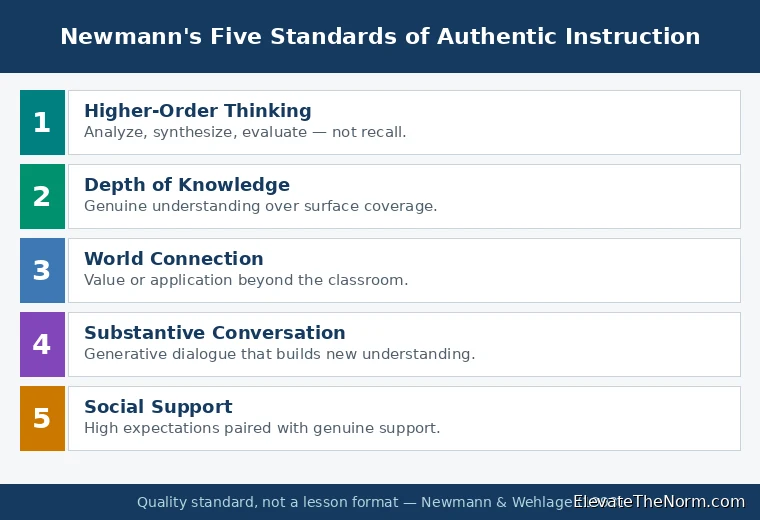
Teacher Emergency Toolkit — practical resources, real classroom support. Shop on TPT.Teacher Emergency Toolkit — practical resources, real classroom support. Shop on TPT.