Author: Clay Shumate

  • Activities for Teaching Responsibility to Middle and High School Students

    Activities for Teaching Responsibility to Middle and High School Students

    By Clay Shumate

    The best activities for teaching responsibility to middle and high school students give students something to actually own, not a lecture about character. Below are ten activities built around real ownership, structured reflection, and clear repair after mistakes, sequenced from ones you can add to a class you already run to ones that take more trust to pull off. Before selecting activities, it helps to clarify what you are building—the article on what is student responsibility offers a definition that distinguishes genuine ownership from simple compliance.

    Key Takeaways

    • Responsibility is a practiced behavior, not a character trait you either have or lack. Adolescents develop it through repeated opportunities to own tasks, meet deadlines, and deal honestly with what happens when they fall short.
    • The best responsibility activities for secondary students involve real stakes within safe boundaries — meaning the work matters, but a failure does not destroy a student’s standing or grade.
    • Self-regulation research confirms that adolescents benefit most from structured responsibility practice paired with warm, responsive adult relationships (Murray & Rosanbalm, 2017).
    • Reflection is where responsibility actually grows. An activity without a reflection step is just compliance — the student did the thing but never examined why it mattered.
    • Repair after mistakes is the hardest part to teach and the most important. It requires activities that go beyond “say sorry” and into “what do you owe, to whom, and by when?”

    Why Activities — Not Lectures — Teach Responsibility

    Most educators agree that responsibility matters. The disagreement is about how it develops. One approach treats responsibility as a character trait: talk about it, model it, hope students absorb it. The other approach treats responsibility as a skill: design situations where students practice it, receive feedback, and try again.
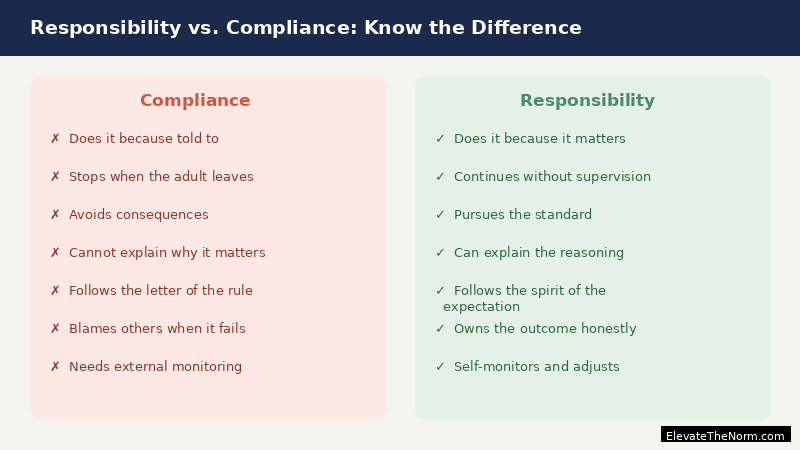
    Comparison showing the difference between teaching responsibility and teaching compliance, with responsibility involving genuine choice and self-assessment while compliance involves following rules without reflection
    Responsibility internalizes through genuine choice and honest reflection — not through compliance alone.

    The research supports the second approach. Self-determination theory, developed by Deci and Ryan and applied extensively in educational settings, identifies autonomy, competence, and relatedness as the three psychological needs that drive internalized motivation (Ryan & Deci, 2020). Responsibility does not internalize through compliance — it internalizes when students experience genuine choice, see evidence of their own competence, and feel connected to the people holding them accountable. Understanding what actually motivates students is the foundation for designing responsibility activities that work.

    That is what the activities below are designed to create. Each one gives students something real to own, a clear standard to meet, a structure for reflection when they fall short, and a path back after a mistake.

    Activities That Build Responsibility Through Real Ownership

    1. The Deadline Choice Contract

    Instead of assigning a single due date, give students a planning window. They choose when to submit — within a defined range — and commit to that date in writing. If they meet their chosen deadline, the work is graded normally. If they miss it, they complete a brief reflection: what happened, what they would change, and what their revised deadline is.

    Why it works: It shifts the locus of control. The teacher is no longer the person imposing the deadline — the student chose it. Missing it becomes a broken commitment to themselves, not just a rule violation.

    What to watch: Some students will choose the latest possible date every time. That is fine. The skill is making a plan and keeping it, not choosing the earliest date to impress the teacher.

    2. The Group Role Rotation

    Assign clear, named roles within group work — timekeeper, recorder, quality checker, presenter — and rotate them across projects. Each role comes with specific deliverables. After each project, every student writes a one-paragraph self-assessment of how they handled their role, and the group writes a brief evaluation of how the rotation worked.

    Why it works: Named roles with deliverables make responsibility visible. A student who was the quality checker either caught errors or did not — there is evidence. The rotation prevents students from hiding in the same comfortable role every time.

    What to watch: Do not let the “quality checker” role become a way for strong students to redo weak students’ work. The role checks quality and identifies problems — it does not fix them for the other person.

    3. The Missing-Work Conversation

    When a student misses an assignment, replace the zero-and-move-on approach with a structured conversation. The student answers three questions in writing before the conversation: What was the assignment? What got in the way? What is your plan to complete it?

    This is not optional and it is not a punishment. It is the practice of taking responsibility for an incomplete obligation.

    Why it works: It requires the student to acknowledge the gap honestly and propose a solution — two components of genuine responsibility that a zero on a gradebook never teaches.

    What to watch: Keep it brief and private. This is a five-minute conversation at the whiteboard table, not a public interrogation. The goal is a plan, not a confession. And account for circumstances beyond the student’s control — transportation problems, family obligations, lack of internet access at home, or a job that keeps them up late. The conversation should distinguish between a student who chose not to do the work and a student who could not. Both need a plan. Only the first needs a conversation about choices.
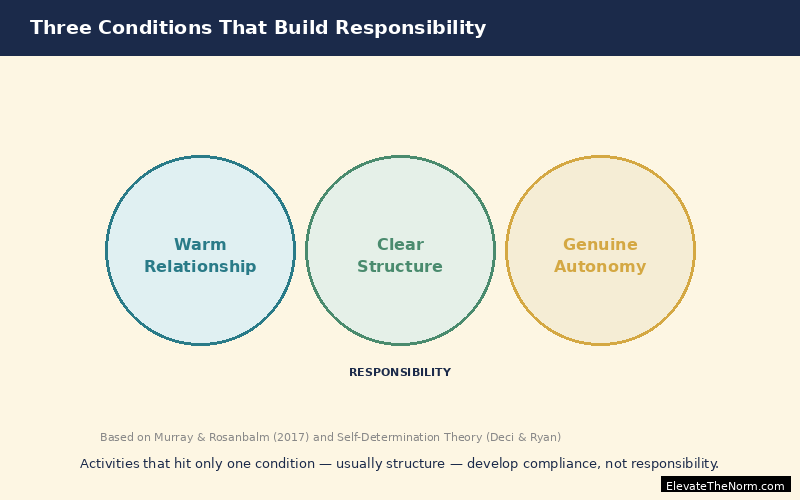
    Diagram showing the three conditions research identifies for building adolescent responsibility: warm adult relationships, structured environment with clear expectations, and genuine autonomy within structures
    Self-regulation research identifies three conditions that help adolescents build genuine responsibility.

    4. The Repair Letter

    After a significant behavioral incident — not every small disruption, but the ones that damage trust or affect other students — ask the student to write a letter addressing three things: what happened (facts, not excuses), who was affected and how, and what they will do differently. The letter is not graded. It is reviewed by the teacher, discussed, and then the incident is considered addressed.

    I use this after repair conversations in my room. When something goes wrong — when a student lets a group down, or says something they should not have — we sit down and talk about what is owed, to whom, and by when. The letter is the student’s record of that conversation. It matters because writing it requires them to articulate what they are taking responsibility for, not just nod and leave. The repair process connects directly to the broader idea of helping students learn from their mistakes rather than simply penalizing them.

    Why it works: It connects behavior to impact. Most adolescents are not trying to cause harm — they are impulsive, reactive, or unaware. The letter forces awareness without humiliation.

    What to watch: Never require a forced apology. The letter should be honest. If a student genuinely believes they were not wrong, the conversation that follows the letter is more useful than the letter itself. And be clear: a repair letter does not replace required school discipline documentation. If your school policy requires an incident report, a referral, or a parent contact for the behavior in question, complete those first. The repair letter is an addition to the process, not a substitute for it.

    5. The Project Check-In Protocol

    For any multi-day assignment or project, build in structured check-ins where the student — not the teacher — reports on progress. The format is simple: What have I done? What is next? What am I stuck on?

    During check-ins, the student explains their choices and defends their decisions. “I chose to focus on the primary source analysis first because…” is more useful than a teacher looking over a shoulder and saying “You’re behind.”

    Why it works: It practices the professional skill of giving a progress report — something adults do constantly and students almost never practice. It also creates a record: if a student says “I’m on track” at the check-in and then is not on track at the deadline, the gap between their self-assessment and their output becomes the teaching moment.

    What to watch: Do not turn check-ins into micromanagement. The point is for the student to report and reflect, not for the teacher to direct every decision.

    6. The Self-Assessment Before the Grade

    Before returning a graded assignment, have students assess their own work against the rubric. They predict their score, identify their strongest section, and name one area where they fell short. Then they receive the actual grade and compare.

    Why it works: Self-assessment accuracy is a metacognitive skill directly tied to responsibility. Students who consistently overestimate their work are not being arrogant — they are not seeing their own gaps. Students who consistently underestimate may not be recognizing their own competence. Either pattern is worth a conversation.

    What to watch: This works best with a clear, student-friendly rubric distributed before the assignment. If students do not know what “proficient” looks like in advance, the self-assessment is just guessing.
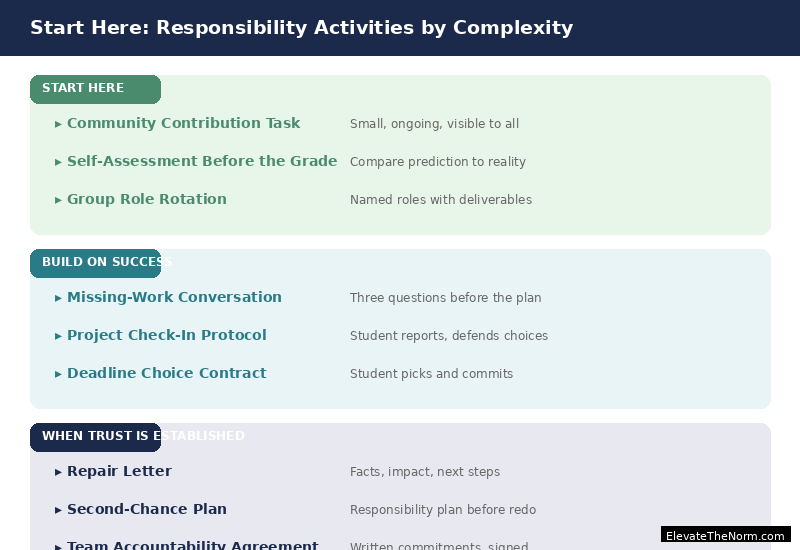
    Chart organizing ten responsibility activities by complexity level from simple to advanced, showing which work best for middle school versus high school students
    Start with two or three activities and add more as you and your students get comfortable.

    7. The Responsibility Debrief

    At the end of a unit, project, or quarter, students write a responsibility reflection: What commitment did I keep this unit? What commitment did I break? What did I learn about how I work? What will I do differently next time?

    Why it works: It normalizes honest self-evaluation. Most schools give students grades but never ask them to reflect on the habits that produced those grades. The debrief is where students connect effort to outcome — or more importantly, connect avoidance to outcome.

    What to watch: Students will write what they think you want to hear unless you make it clear that honesty is valued more than optimism. Share your own example if you can: a time this semester when you planned poorly, fell behind, and had to adjust.

    8. The Team Accountability Agreement

    Before any group project, each team writes a brief agreement: what each person is responsible for, when each piece is due, what happens if someone does not deliver, and how the group will handle conflict. The agreement is signed and kept by the teacher.

    Why it works: It front-loads responsibility instead of back-loading blame. When a group falls apart — and some will — the agreement provides a reference point for a conversation that is about commitments, not feelings.

    What to watch: Do not let the “what happens if someone does not deliver” section become punitive. The healthiest answer is usually “We have a conversation and make a plan” — not “They get a zero.” Effective classroom consequences are always about what comes next, not just what went wrong.

    9. The Community Contribution Task

    Assign each student a real, ongoing responsibility that serves the class: maintaining the supply station, updating the assignment board, organizing returned work, or keeping the shared digital folder clean. The task is small, consistent, and visible.

    Why it works: It gives students a piece of the room to own. Not a pretend ownership — an actual, ongoing responsibility where others notice if it does not get done. The student is not doing it for a grade. They are doing it because the room needs it done.

    What to watch: Rotate tasks quarterly so the same students do not get stuck with the least appealing jobs. And acknowledge it when it is done well — not with a reward, but with a thank-you that names what they contributed.

    10. The Second-Chance Plan

    When a student bombs an assignment or test, offer a structured second attempt. The catch: before they can redo the work, they must complete a responsibility plan. What happened the first time? What will they do differently? What specific support do they need? They submit the plan, the teacher approves it, and then they redo the work.

    Why it works: It separates the failure from the identity. “You failed this assignment” is a fact. “You are a failure” is a conclusion students draw when there is no path forward. The second-chance plan keeps the standard high — you still have to meet it — while making the path back visible.

    What to watch: Set a clear window for the redo. “Whenever you get around to it” is not a plan — it is an invitation to never complete it. A deadline on the redo teaches the same skill as the original deadline.

    How Responsibility Activities Fail (and How to Prevent It)

    The most common failure is not the activities themselves — it is the gap between the activity and the follow-through.

    Responsibility activities fail when teachers assign them but do not follow up on the reflections. They fail when the consequences for not completing a responsibility task are identical to the consequences for not completing any other assignment — a zero in the gradebook. And they fail when the activities are age-inappropriate, making teenagers feel like they are being managed rather than developed.

    Research on adolescent self-regulation confirms that young people build responsibility most effectively when three conditions are present: a warm relationship with the adult holding them accountable, a structured environment where classroom expectations are clear, and genuine autonomy within those structures (Murray & Rosanbalm, 2017). Activities that check all three boxes develop responsibility. Activities that hit only one — usually structure — develop compliance.

    Before You Start: Tell Families What You Are Doing

    Responsibility activities work best when families understand the framework. Early in the year — ideally before the first missed assignment or behavioral conversation — communicate to parents and guardians what your classroom responsibility process looks like: that students will be asked to reflect on missed work rather than simply receive zeros, that repair conversations focus on what is owed rather than punishment, and that second chances come with plans attached. A family that understands the system can reinforce it. A family that encounters it only when their child is in trouble will question it.

    What Teaching Responsibility Actually Looks Like Day to Day

    It looks like follow-through. It looks like a teacher who says “I will check your progress on Thursday” and then checks on Thursday. It looks like a room where a student who missed a deadline has a conversation — not a lecture, not a zero entered silently — about what happened and what comes next.

    It also looks like grace. Not the kind of grace that eliminates standards, but the kind that maintains them while holding the door open. A student who writes an honest responsibility reflection about why they did not finish a project — and then finishes it — has learned more about responsibility than a student who met every deadline without ever having to recover from a miss.

    The goal is not to produce students who never fail. It is to produce students who know what they owe when they do. For a deeper look at how teaching responsibility connects to broader classroom culture, and the research behind why student responsibility is a skill rather than a trait, those articles explore the framework in more detail.


    At what age should responsibility activities start in school?

    Responsibility activities should be developmentally appropriate at every grade, but the version described here — involving self-assessment, planning, written reflection, and repair — is designed for grades 6–12. Middle schoolers can handle simpler versions (the community contribution task, the group role rotation). High schoolers can handle the full range, including the deadline choice contract and the second-chance plan. The key is matching the complexity of the activity to the student’s capacity for abstract thinking and self-reflection.

    How do you teach responsibility without making it feel like a punishment?

    By separating the activity from consequences. A repair letter is not a punishment — it is a process for honest self-examination. A second-chance plan is not a penalty — it is a structured path to improvement. The tone of the teacher matters more than the structure of the activity. If you approach a responsibility conversation with curiosity (“What happened?”) rather than judgment (“Why didn’t you…?”), students are more likely to engage honestly.

    What if a student refuses to participate in a responsibility activity?

    Start with a private conversation. Ask what is getting in the way. Sometimes refusal is about the activity; sometimes it is about something else entirely. If the student still refuses after the conversation, document the refusal and follow your classroom or school procedure — but do not abandon the expectation. The activity stands. The student may need more time, a different format, or a different adult to have the conversation with.

    Do responsibility activities work for students with IEPs or behavioral plans?

    Yes, with modifications. Consult the IEP or 504 plan first — some students have specific accommodations around deadlines, reflection activities, or self-assessment that must be followed. The principles of responsibility still apply: students with behavioral plans deserve the same expectation of honest self-assessment, repair, and follow-through. The accommodations adjust the how, not the whether.

    How do you grade responsibility?

    Most of these activities should not carry a traditional grade. Grading a reflection on what went wrong creates an incentive to lie. The activities that are graded — the project, the assignment, the group work — carry grades based on the quality of the academic work. The responsibility activities support the academic work but are evaluated through conversation, not points.

    Can these activities backfire?

    Yes, if they are applied inconsistently. If one student writes a repair letter and another student who did the same thing does not, the first student learns that the system is arbitrary. Consistency across students is non-negotiable. The activities also backfire if the teacher does not follow through — assigning a responsibility reflection and then never reading it teaches students that the activity is busywork.

    How many of these activities should a teacher use at once?

    Start with two or three. The deadline choice contract, the self-assessment before the grade, and the project check-in protocol are a strong starting combination because they integrate into work you are already assigning. Add the repair letter and the responsibility debrief as you get comfortable. Trying all ten at once will overwhelm you and your students.


    Sources


    About Clay Shumate

    Clay Shumate is a certified secondary Social Studies teacher in the public schools of West Alabama, with seven years of classroom experience, a B.A. in History, and an M.Ed. in Secondary Education. He writes about project-based learning, student responsibility, respect, and practical ways to hold young people to a higher standard while giving them room to learn from mistakes. He is a member of the Society of Professional Journalists and writes to its Code of Ethics; this site’s editorial standards and corrections policy are published in full. More about Clay.
  • Chronic Absenteeism: What Actually Brings Students Back to Class

    Chronic Absenteeism: What Actually Brings Students Back to Class

    By Clay Shumate

    Chronic absenteeism means missing 10 percent or more of the school year — about eighteen days, excused and unexcused combined — and it’s sitting near a quarter of all U.S. students. Most of that isn’t about your lesson plans: illness and lost sleep outrank boredom by a wide margin. But re-entry, what happens the day a student walks back in, is squarely a teacher’s job, and most classrooms have no plan for it at all.

    Key Takeaways

    • Chronic absenteeism counts a student missing 10 percent or more of enrolled school days, excused and unexcused together — it is not the same thing as truancy, which is specifically about unexcused absences and can trigger legal consequences for a family.
    • The national rate peaked near 28.5 percent in 2022, fell to roughly 23.5–25 percent by 2024, and has stalled — the decline slowed enough in 2024 that a full return to the 15 percent pre-pandemic baseline is no longer guaranteed.
    • When students are asked directly why they missed school, illness and lack of sleep dominate the answers. Boredom and disengagement are real but smaller, and high schoolers actually report fewer disengagement reasons after the pandemic than before.
    • Attendance Works sorts causes into four categories — barriers, aversion, disengagement, and misconceptions — and a classroom teacher has real leverage over only two of them.
    • The best-evidenced classroom-adjacent lever isn’t a lesson plan; it’s what happens on re-entry day, and separately, honest and consistent family communication is one of the few things correlated with meaningfully lower rates.

    What Chronic Absenteeism Actually Means

    Chronic absenteeism is a student missing 10 percent or more of enrolled school days in a year — roughly eighteen days in a standard 180-day calendar, or about two days a month. Every state and most districts now track it because it correlates with weaker outcomes at every level, from third-grade reading to ninth-grade credit accumulation to graduation. The count includes excused and unexcused absences together. A student out with the flu for two weeks, a student with a broken attendance streak from oversleeping, and a student who simply stopped coming all land in the same statistic, and the number alone tells you nothing about which one you’re looking at.

    That combined counting is also what separates chronic absenteeism from truancy, and the two get confused constantly in casual conversation. Truancy is specifically about unexcused absences, and in most states it is a legal category with a defined escalation path — a set number of unexcused absences triggers truant status, repeated truancy can trigger a referral, and in the most severe cases a district attorney can pursue charges against a parent or guardian. Chronic absenteeism carries no such court process on its own. A student who is chronically absent because of documented illness has never been truant a single day. Confusing the two terms is how a school ends up applying a punitive, legal-track response to a problem that is, for most students, not a compliance problem at all.

    How Bad Is It, and Is It Getting Better?

    Nationally, chronic absenteeism held steady around 15 percent through the 2018 and 2019 school years. It jumped to roughly 28.5 percent at its 2022 peak, then eased to about 25.4 percent in 2023 and 23.5 percent in 2024. RAND’s 2024–25 district survey put the most recent figure at approximately 22 percent — nearly 11 million students. The trend line is real improvement, and it is also slowing down. Nat Malkus, who tracks the numbers for the American Enterprise Institute, has written plainly that the deceleration raises “the very real possibility that absenteeism rates might never return to pre-pandemic levels.”

    The average also hides where the actual crisis sits. Low-achieving districts went from about 19 percent chronically absent in 2018 to 35 percent in 2022; high-achieving districts moved from 10 percent to 19 percent over the same stretch — both got worse, but the gap between them widened. RAND found urban districts were five to six times more likely than rural or suburban ones to report extreme chronic absence, meaning 30 percent of students or more. If your school sits in that first group, the national “one in four” statistic is understating your actual room by a wide margin.

    The Four Root Causes — and Which Ones Are Actually Yours

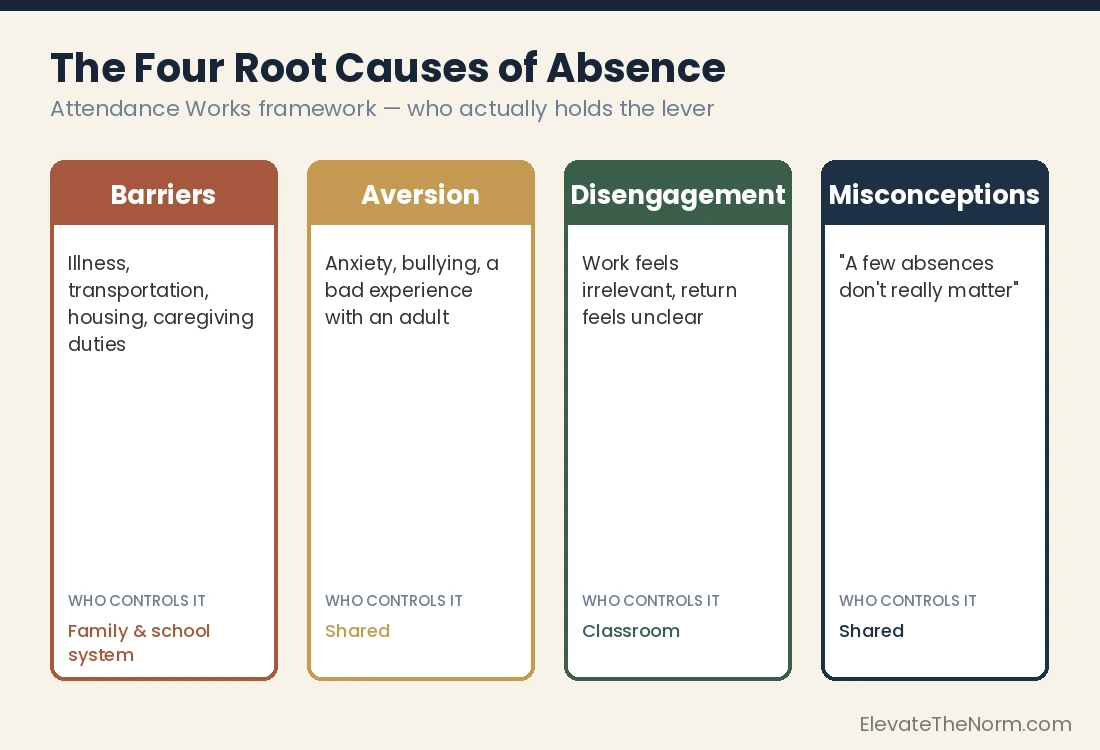
    Attendance Works, the research and policy organization most state departments of education cite on this topic, sorts every reason a student misses school into four categories: barriers, aversion, disengagement, and misconceptions about how much a few absences really matter. It’s a useful framework precisely because it forces an honest answer to the question every overwhelmed teacher eventually asks: which part of this is mine to fix?

    CategoryWhat it looks likeWho actually controls it
    BarriersIllness, unreliable transportation, unstable housing, caregiving duties for a sibling or family memberFamily, school system, community resources — not the classroom teacher
    AversionAnxiety about a specific class or hallway, bullying, a bad experience with a particular adultShared — a teacher can remove one specific aversion, but not the underlying anxiety
    DisengagementThe student sees no point in showing up because the work feels irrelevant or the return is unclearLargely the classroom — relevance, relationship, and clarity are teacher-level moves
    MisconceptionsBelief that a handful of absences “doesn’t really matter” as long as grades hold upShared — a teacher’s re-entry practice and a family’s messaging both shape this
    Four-category chart showing the root causes of chronic absenteeism: barriers, aversion, disengagement, and misconceptions, with who controls each one
    The Attendance Works framework for chronic absenteeism, showing which causes a classroom teacher can actually influence.

    Look at that middle column honestly and the division of labor gets clear fast. Barriers are not solvable from a classroom. No lesson plan fixes a broken car, an undiagnosed illness, or a kid watching a younger sibling because there’s nobody else. Pretending otherwise is how teachers end up carrying blame for outcomes they were never equipped to move, and it’s a big part of why attendance initiatives that live entirely inside individual classrooms tend to disappoint — they’re aimed at maybe half the problem.

    Why Most of It Isn’t About Your Classroom

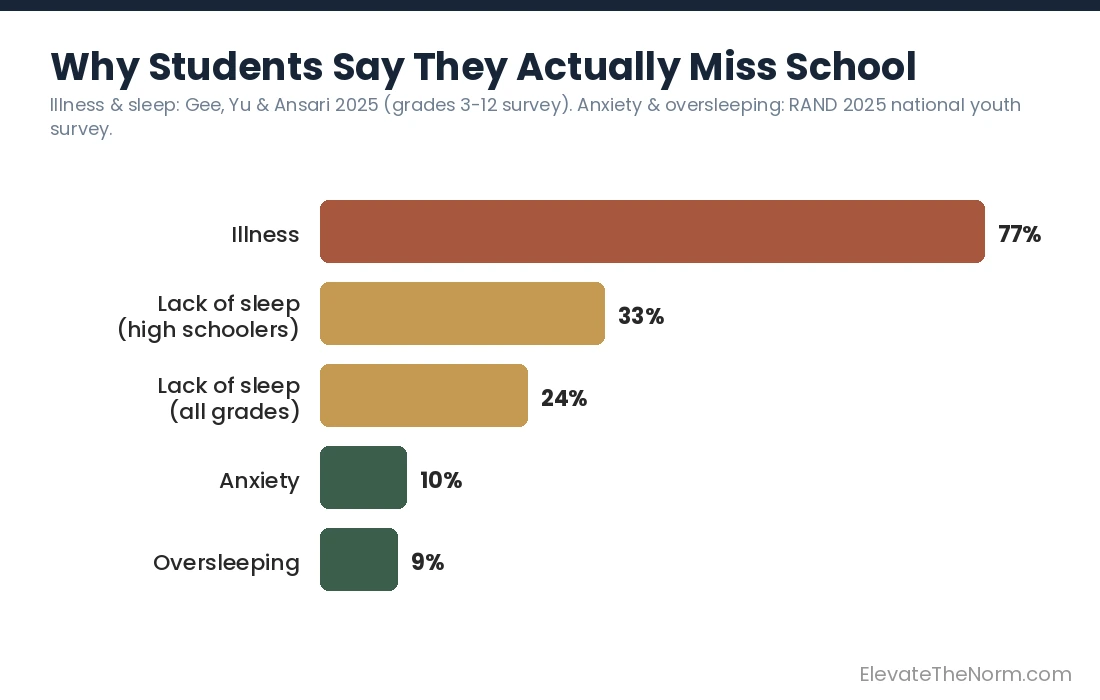
    When you ask students directly why they missed school, the answer that comes back most is not the one teacher-facing advice usually assumes. A 2025 analysis of Rhode Island survey data covering grades 3–12 found illness reported by roughly three-quarters of students both before and after the pandemic — 77 percent post-pandemic specifically. Lack of sleep came in second at 24 percent overall and a striking 33 percent among high schoolers. Boredom and safety concerns did rise after the pandemic, but from a much smaller base, and — this is the finding that should reshape how engagement gets talked about — high school students actually reported fewer disengagement reasons after the pandemic than before it. RAND’s national youth survey landed in the same place: 67 percent sickness, 10 percent anxiety, 9 percent oversleeping.

    Bar chart showing self-reported reasons students miss school: illness 77 percent, lack of sleep 33 percent among high schoolers and 24 percent overall, anxiety 10 percent, oversleeping 9 percent
    Illness and lost sleep outrank boredom by a wide margin in student-reported reasons for absence.

    That doesn’t mean engagement is irrelevant. It means engagement is not the lever most teacher-facing advice on this topic claims it is. If a school’s entire absenteeism strategy is “make class more interesting,” it is aimed at a real but minority slice of the problem, and it will underdeliver — not because the advice is wrong, but because it was never sized to the actual distribution of causes. For the students where disengagement genuinely is the driver, the deeper diagnosis and fix belong in a companion piece on what actually motivates students once rewards and speeches stop working — this page is about the much larger group whose absence has nothing to do with motivation at all.

    What’s Actually Yours: The Four Minutes That Change the Semester

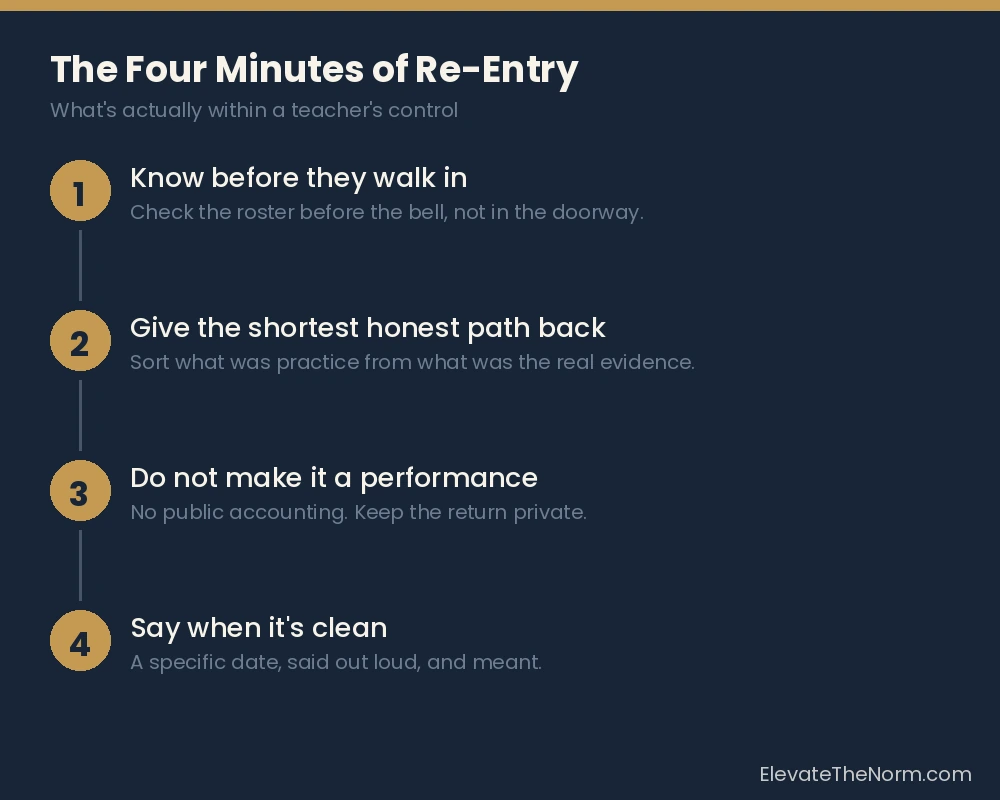
    Here’s the honest, narrower claim. A classroom teacher cannot fix a transportation gap or an untreated illness. What a classroom teacher controls almost completely is what an absence costs a student once they’re back — and that cost is what determines whether eighteen missed days becomes thirty.

    I check the roster before the bell, not after. When I see a student has been out, I already know before they walk through the door — deciding what they need in the doorway, with the rest of the class watching, guarantees a bad decision made badly. If it’s a longer absence, that student gets pulled to the whiteboard table early — the same table I use for regular small-group work, not a separate “catch-up corner.” Low lamp, rug, better chairs. Students already know that table is where you go to be worked with, not managed. That matters more than it sounds like it should: a student coming back from eighteen missed days is highly sensitive to whether re-entry feels like punishment or like being picked back up.

    Reserve the full version of this for absences that actually need it — three or more days, or a pattern, not a single day for a dentist appointment. And none of what follows replaces your school’s required attendance reporting or truancy referral process. If a student’s pattern of absence raises a safety concern — signs of neglect, abuse, homelessness, or anything that meets your district’s mandated-reporting threshold — that goes to your counselor or administrator through the normal protocol immediately, separate from and before any classroom routine. Re-entry is about what a teacher does with the students in front of them; it is not a substitute for the systems built to catch the more serious cases.

    Four things make re-entry actually work.

    Know before they walk in. Check attendance history before class starts, not during it. A decision made in the doorway, in front of an audience, by a teacher who is also trying to start the lesson, is reliably the worst version of that decision.

    Give the shortest honest path back. Not every missed assignment carries the same weight. Ask yourself which pieces were practice and which ones were the actual evidence that the student learned the standard — the practice can often be waived or condensed; the evidence usually can’t. Sorting the pile down to what genuinely matters is a judgment call only the teacher can make, and it’s the difference between a student who can start today and a student who takes one look at forty backlogged items and shuts down. Better still, ask the student what they think is realistic before you hand them the final list — a plan a student helped build survives contact with a hard week better than one that was simply issued to them. This is student responsibility in its most practical form — the student still owns finishing the list, but the list has to be one a person could actually finish, and building it together is what makes it theirs. For an absence stretching past a week or two, or anything with a doctor’s note attached, loop in a counselor or your 504/IEP team before you finalize the plan alone — some of that catch-up may need to be a formal accommodation, not an informal favor.

    Do not make the return a performance. No public accounting of the absence, no comment in front of the class, no sarcasm at the door, and no requirement that the student explain themselves out loud. Some reasons are private — a medical diagnosis, a family situation, a mental health day — and a teacher doesn’t need the full story to run a fair re-entry process. A teenager who’s been gone is already running the social math on what walking back in will cost. Raise that cost and the cheapest option left is to stay gone. This is the same standard covered in respect in the classroom applied to a specific moment: a student’s absence is not public material, and treating it that way trades a little teacher satisfaction for a much worse attendance problem next month. Apply it the same way to every student, every time — the fastest way to make a re-entry routine feel arbitrary is to run it warmly for some students and coldly for others.

    Say when it’s clean. Give a specific date and a specific list, and when the list is finished, say so out loud and mean it. Open-ended debt is what convinces a student the hole is unclimbable. A defined end is what makes climbing rational.

    In practice this is a thirty-second exchange, not a meeting: “Good to see you back. Here’s what actually matters from the last few days — these three things. Everything else, let it go. Can you have these done by Friday?” That’s the whole script. It names what matters, drops what doesn’t, and ends with a date the student agreed to rather than one you handed down.

    Four-step checklist for helping a student return after an absence: know before they walk in, give the shortest honest path back, do not make it a performance, and say when it is clean
    The four re-entry moves that are genuinely within a classroom teacher’s control after chronic absenteeism.

    None of this is softness. The standard doesn’t move — the work still has to be real and the deadline still has to be a deadline. What moves is how much guesswork a student has to do to find their way back to it, and guesswork is where students who are already behind quietly give up. This is the same logic behind natural consequences instead of punishment: the goal is a consequence that teaches something, not one that simply makes the return more painful.

    Expect it to look worse before it looks better, especially with a student who’s been checked out for a while. A kid who suddenly gets real attention after being invisible will often test whether that attention is real — that’s a normal, predictable phase, not proof the approach isn’t working, and it connects directly to what happens the first few weeks after building a relationship with a student who’s been guarded. Most adults quit right at the point where the testing is actually a good sign.

    What the Research Says Works Beyond Your Classroom

    Honesty about the ceiling matters here too. The best-evidenced attendance interventions in the research aren’t classroom practices — they’re family communication, and the effect sizes are real but modest. Which tool carries that communication matters less than whether families can actually receive it — the questions to ask before adopting a communication app start with reach, not features.

    Rogers and Feller, publishing in Nature Human Behaviour in 2018, tested personalized mailings sent to the parents of 28,080 high-risk K–12 students. The most effective versions reduced chronic absenteeism by 10 percent or more, largely by correcting parents’ underestimates of how many days their child had actually missed — many parents simply didn’t know the number was as high as it was. A smaller trial run by the Regional Educational Laboratory Mid-Atlantic in the School District of Philadelphia found a single October postcard cut absences by a more modest 2.4 percent, with no measurable difference between message variations.

    A 2023 analysis by Harvard researchers Karen Mapp and Todd Rogers, working with Learning Heroes and TNTP across more than 3,000 Illinois schools, found something adjacent and worth taking seriously: schools with strong pre-pandemic family engagement — measured through trust, involvement, and parent influence on school decisions — had chronic absenteeism rates roughly six percentage points lower than similar schools with weak engagement, even after controlling for poverty. Between 2019 and 2022, the strong-engagement schools saw a 39 percent smaller increase in chronic absenteeism than everyone else. This is a correlational finding from one state, not a randomized trial, and the researchers themselves describe it as the first phase of a larger project — it should be read as suggestive, not proof that family engagement alone moves the number. But it lines up with the honest re-entry advice above: families who already trust the school and understand what the classroom is doing are the same families likely to reinforce a re-entry plan rather than fight it. In practice that trust gets built with plain, non-alarmist language rather than a form letter — something closer to “I noticed six absences this month, is there anything the school can help with?” than an automated warning that reads like a legal notice. The first invites a conversation. The second reads like the truancy-court track discussed above, even for a family whose child has never come close to it.

    None of this reaches a transportation gap, an untreated health condition, or a family in crisis, and no classroom teacher should feel responsible for the part of the number that genuinely isn’t theirs. What is genuinely theirs — re-entry, and a habit of honest, non-alarmist communication home — is smaller than the whole problem and still worth doing well, because it’s the piece within reach on a Tuesday afternoon, not a district initiative that takes a year to fund.

    What to Do With This on Monday

    Start with one thing: check the roster before the bell and know, before a returning student walks in, what the shortest honest path back looks like for them. Add the no-performance rule next — it costs nothing and it’s the fastest way to stop making re-entry harder than it needs to be. Everything else on this page — the barriers your school actually controls, the family-communication research, the honest accounting of what disengagement is and isn’t driving — belongs to a bigger conversation about chronic absenteeism than one classroom can solve alone. Your four minutes with a returning student is the part that starts today. For a ready-to-use tool on this, see a printable parent-teacher communication log pack.


    Is chronic absenteeism the same thing as truancy?

    No. Chronic absenteeism counts a student missing 10 percent or more of enrolled school days, whether the absences are excused or unexcused. Truancy is a narrower legal category built specifically from unexcused absences, and in most states it comes with a defined escalation process that can eventually involve a district attorney and consequences for a parent or guardian. A student who is chronically absent because of documented illness has never been truant. Treating the two as interchangeable is how schools end up applying a legal, punitive response to a problem that, for most students, was never about defiance.

    Whose fault is chronic absenteeism — the school, the family, or the student?

    Usually none of the above, at least not in the way the question assumes. National survey data shows the leading reasons students miss school are illness and lost sleep, not defiance or indifference. Framing absence as a fault to assign tends to produce blame instead of a fix. The more useful question is which piece of the problem a given adult actually has leverage over — a classroom teacher, a family, and a school system each control a different slice.

    What can one classroom teacher realistically do about chronic absenteeism?

    Less than district-level interventions, and that’s fine — a teacher’s real leverage is re-entry, not prevention. Checking the roster before class, sorting missed work down to what actually matters, keeping a returning student’s absence private, and giving a clear date when the catch-up is finished are all inside a single teacher’s control and take a few minutes per student. Preventing the absence in the first place usually depends on factors — transportation, health, housing — that sit outside any one classroom.

    Does missing school always mean a student doesn’t care about class?

    No, and the data says the opposite more often than not. When students are asked directly why they were out, illness and lack of sleep dominate the answers, and one national analysis found high schoolers reporting fewer disengagement-related reasons for absence after the pandemic than before it. Assuming apathy is usually wrong, and assuming it out loud to a student who was actually sick or exhausted damages the relationship for no reason.

    How should a teacher handle makeup work without overwhelming a student who’s behind?

    Sort before you hand anything over. Separate what was practice from what was the actual evidence that a student learned the standard, and let most of the practice go. Ask the student what they think is realistic before finalizing the list — a plan they helped build holds up better than one that was simply issued. For anything longer than a week or two, or work tied to a documented medical absence, loop in a counselor or the student’s 504/IEP team rather than solving it alone.

    What if a student’s pattern of absences seems like a sign of something more serious?

    That goes to your school’s counselor or administrator through your normal mandated-reporting and attendance-review process immediately — before, and separate from, any classroom re-entry routine. Signs like a sudden pattern change, indications of neglect or abuse, or signs of homelessness are outside what a classroom-level practice is built to address, and they need the systems your school already has for exactly that purpose.

    Do attendance letters or family outreach actually reduce absences?

    Some forms do, modestly. A large study of personalized parent mailings correcting misperceptions about how many days a child had actually missed reduced chronic absenteeism by roughly 10 percent in its most effective version; a simpler single postcard trial produced a smaller 2.4 percent reduction. The tone matters — plain, non-alarmist language that reads like a conversation (‘is there anything the school can help with?’) is associated with better outcomes than a form letter that reads like a legal warning, even though neither approach comes close to solving the problem on its own.

    What’s a realistic first step for a teacher who wants to get better at this?

    Start with one habit: check attendance before the bell so you already know, before a student walks in, what their shortest honest path back looks like. Add the no-performance rule next — keeping the return private costs nothing and prevents the single most common way teachers accidentally make attendance worse. Everything else on this page is worth knowing, but those two moves are where an ordinary Tuesday actually changes.


    Sources


    About Clay Shumate

    Clay Shumate is a certified secondary Social Studies teacher in the public schools of West Alabama, with seven years of classroom experience, a B.A. in History, and an M.Ed. in Secondary Education. He writes about project-based learning, student responsibility, respect, and practical ways to hold young people to a higher standard while giving them room to learn from mistakes. He is a member of the Society of Professional Journalists and writes to its Code of Ethics; this site’s editorial standards and corrections policy are published in full. More about Clay.
  • Why Are Classroom Expectations Important? Because Students Deserve Clarity

    Why Are Classroom Expectations Important? Because Students Deserve Clarity

    By Clay Shumate

    Why are classroom expectations important? Because a room without them runs on guesswork, and guesswork is unfair to the student who can’t read your mood on a given day. Clear, taught expectations tell a class exactly what the room requires and what it promises back — protected instructional time, predictable fairness, and a real path toward independence.

    Key Takeaways

    • Clear expectations reduce discipline problems and protect instructional time — Marzano’s research found teachers with strong management practices and high-quality relationships had 31 percent fewer discipline issues over a full year.
    • Expectations are not rules posted on a wall. They are behaviors you teach, model, practice, and revisit — the same way you teach content.
    • Adolescents respond better to expectations they understand the reasoning behind. Stating a standard without explaining why it exists invites testing.
    • Consistency matters more than severity. A predictable room where small things are addressed early is calmer than a room where nothing happens until someone explodes.
    • Expectations must go both ways. If students are expected to be prepared, on time, and respectful, the adult in the room owes them the same.

    What Classroom Expectations Actually Are

    Classroom expectations are the specific, observable behaviors that define how a learning environment operates. They cover how students enter the room, how they participate, how they treat each other, how they handle materials, what happens when they finish early, and what happens when they need help.

    That is different from rules. Rules tell students what not to do. Expectations tell them what to do instead — and the research consistently favors the second approach. Positively stated expectations (“Be prepared with your materials before the bell”) give students a target to hit rather than a minefield to avoid. If you are building a complete set of classroom expectations for the first time, starting with positively stated behaviors is the most important decision you will make.

    Side-by-side comparison showing the difference between classroom rules and classroom expectations, with rules focused on what not to do and expectations focused on what to do
    Rules tell students what not to do. Expectations tell them what to do instead.

    The distinction matters more than it sounds. “No talking” is a rule. “Use a voice level appropriate to the activity” is an expectation. The first one creates a room where students are trying not to get caught. The second creates a room where students are making judgments about what the moment requires — and that judgment is a skill worth developing.

    Why Expectations Change Everything in a Secondary Classroom

    They Protect Instructional Time

    Research from the IRIS Center at Vanderbilt University is direct about this: teachers who establish and maintain clear norms for behavior spend more time teaching because less time goes to discipline (Brophy, 2000). Every minute spent restating a procedure that was never taught properly is a minute taken from the content students came to learn.

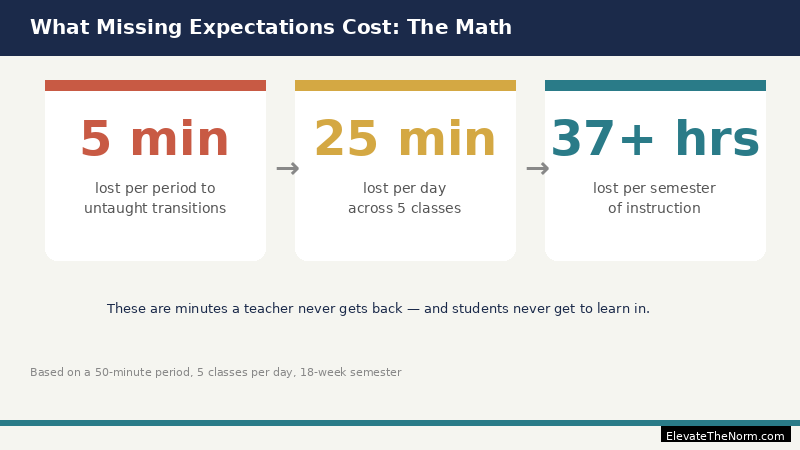
    In a secondary classroom with 50-minute periods — or in some cases, 90-minute blocks — lost minutes compound fast. If a teacher loses five minutes every period to transitions that were never practiced, that is 25 minutes a day across five classes. Over a semester, that is roughly 2,250 minutes — more than 37 hours of instruction gone.

    They Reduce Anxiety and Guesswork

    This is the part most teachers underestimate. Adolescents are performing a complicated identity negotiation every period of every day. They are testing who they are, what their peers think of them, how much authority to accept, and how much risk to take. A room with clear expectations removes one variable from that equation: they do not have to guess what the teacher wants.

    The Australian Education Research Organisation reviewed the evidence and found that when behavioral standards are transparent, “students feel more secure because they know where they stand” (DeNobile, 2021). Security does not mean softness. It means the room is predictable — and predictable rooms are calmer rooms.

    They Make Fairness Visible

    One of the fastest ways to lose a teenager’s trust is to enforce something they did not know existed. When expectations are public, taught, and consistent, a correction becomes a reference to a shared agreement rather than a personal attack. “We said prepared means materials out before the bell — grab your notebook” is a different conversation than “Why aren’t you ready?”

    The first version holds the standard. The second version questions the student. Adolescents can feel the difference, and they respond accordingly. This same principle applies to how teachers handle respect in the classroom — fairness is not about treating every moment identically, but about making every standard visible and every correction consistent.

    They Build Independence Over Time

    Here is what gets overlooked: clear expectations are not about control. They are a scaffold. When students know the procedures, they stop relying on the teacher to direct every transition, every material distribution, and every shift between activities. They run the routines themselves — and that frees the teacher to do the work that actually requires a human being: circulating, checking understanding, pulling small groups, and responding to what students need in real time.

    I spend most of my class period moving between groups, sitting down with students at the whiteboard table I built in the corner of my room. That table is the best seat in the house — low lamp, a rug, better chairs. Students ask to come there. But the only reason I can spend my time that way is because the rest of the room is running on expectations we practiced until they became automatic. If I had to stand at the front managing every transition, that table would just be furniture.

    How to Teach Expectations (Not Just State Them)

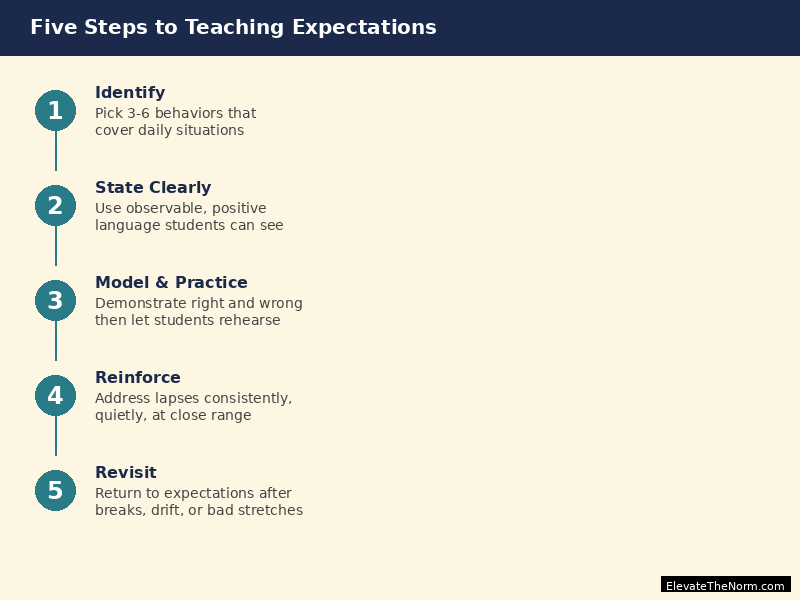
    Posting expectations on a wall is step one of a five-step process. Stopping there is the most common mistake secondary teachers make — and it is the reason so many give up on expectations by October. If you have already created a classroom expectations poster, that visual is useful — but it is the beginning of the work, not the end of it.

    Infographic showing the five steps to teaching classroom expectations: identify key behaviors, state them in observable language, model and practice, reinforce consistently, and revisit and adjust
    Teaching expectations requires five deliberate steps — not just posting them on a wall.

    Step 1: Identify the Behaviors That Matter Most

    You cannot have 30 expectations. You can have five or six — the ones that cover the situations your students encounter every day. Start with the moments that consistently cause problems: entering the room, transitions between activities, asking for help, working with a partner, and what to do when you finish early.

    Step 2: State Them in Observable Language

    An expectation is only useful if you can see whether someone is meeting it. “Be respectful” is not observable. “Listen without interrupting when someone is speaking to the class” is. “Be responsible” is not observable. “Turn in your work by the deadline or communicate with me before it passes” is.

    The IRIS Center recommends keeping rules few, universal, and positively stated — then linking specific procedures to each one (IRIS Center, 2003). A general expectation like “Be prepared” needs concrete procedures attached: what “prepared” looks like in this room, by this bell, for this type of activity.

    Step 3: Model and Practice

    This is where secondary teachers get uncomfortable. Modeling expectations feels elementary — and most of us skipped it. But the research is clear: students perform better when expectations are explicitly taught through demonstration, not merely announced (Archer & Hughes, 2011).

    Model what a good transition looks like. Model what asking for help looks like. Model the wrong way, too, if you can do it with humor and not sarcasm — so students see the contrast. Then let them practice. The first three days of the year are not lost instruction. They are the most important instruction you will give all year. This is especially critical if you are in your first years and still working out classroom management as a new teacher.

    Step 4: Reinforce Consistently, Not Loudly

    Marzano’s meta-analysis found that the quality of teacher-student relationships was the most important variable in effective classroom management — teachers with strong relationships and clear expectations had 31 percent fewer discipline problems across the year (Marzano et al., 2003). That finding matters because it means enforcement does not require volume. It requires consistency and connection.

    When a student does not meet an expectation, address it immediately, briefly, and at close range. A quiet redirect while you are already circulating — “Materials out, please” — costs less social capital than a public correction from across the room. And it preserves the relationship that makes the expectation stick. Strong relationships with students are not a separate initiative from classroom management — they are the mechanism that makes management work.

    Step 5: Revisit and Adjust

    Expectations are not a September activity. They need to be revisited after breaks, after schedule changes, after a stretch of bad days, and after you realize one of your expectations was unreasonable in the first place. Acknowledging that an expectation needs adjusting is not weakness. It is modeling exactly the kind of honest self-assessment you want from students.

    What Happens When Expectations Are Missing

    The consequences of vague or absent expectations are not dramatic. They are gradual — and that is what makes them dangerous.

    Visual showing the costs of missing classroom expectations: lost instructional time, reactive discipline cycles, eroded trust, and disproportionate impact on marginalized students
    Without clear expectations, teachers spend more time managing confusion than teaching content.

    Without clear expectations, teachers tend to rely on reactive discipline: waiting for something to go wrong and then responding. That pattern creates an exhausting cycle. The teacher feels like they are constantly putting out fires. The students feel like the rules change depending on the teacher’s mood. Both sides get frustrated, and the relationship erodes. That fire-fighting cycle is one of the most reliable routes into exhaustion, and most of what prevents it is structural rather than a matter of willpower.

    Research on teacher expectations confirms this pattern. A 2024 narrative review published in the Journal of the Royal Society of New Zealand found that teachers’ expectations significantly influence student outcomes, and that inconsistent or unclear expectations disproportionately affect students from marginalized backgrounds (Rubie-Davies et al., 2024). Students who already face barriers outside of school should not have to decode a second set of hidden expectations inside it.

    For a practical look at what those belief-driven expectations actually require—the specific moves, language, and mindset that separate genuine high expectations from surface-level optimism—see holding students to high expectations in secondary classrooms.

    Expectations Go Both Ways

    This is the part that separates a set of classroom expectations from a set of classroom rules. Rules flow in one direction — from the teacher to the student. Expectations, done well, apply to everyone in the room.

    If students are expected to arrive on time, the teacher starts on time. If students are expected to be prepared, the teacher has the plan posted and the materials ready. If students are expected to listen without interrupting, the teacher does the same when a student is speaking.

    That does not mean teachers and students hold identical authority. They do not. But mutual respect for each other’s time, effort, and presence is what turns expectations from a behavior-management tool into a culture.

    Three Things Your Expectations Cannot Decide for You

    No classroom expectations list exists in isolation. Before you finalize yours, account for these:

    Your school’s behavior framework comes first. If your building uses PBIS, a schoolwide behavior matrix, or a restorative practices model, your classroom expectations must align with it — not contradict it. A classroom expectation that conflicts with the schoolwide framework confuses students who are trying to follow both, and it puts you in an awkward position with administrators when a situation escalates beyond your room.

    IEPs and 504 plans take legal precedence. A student’s documented behavior intervention plan overrides your classroom expectations for that student. This is not optional, and it is not a weakening of your standards. It is the law. Consult with the special education team before the year starts and whenever a new student with a plan enters your class.

    Families should know what you expect in week one. Send your expectations home — in writing, not just verbally through students. A parent who understands what the room requires can support it. A parent who discovers your expectations only when their child gets a consequence feels blindsided, and that damages a relationship you may need later.

    A Practical Starting Point

    If you are starting from scratch — or starting over — here is what works:

    Pick three to five expectations that cover the broadest range of daily situations. State each one in observable, positive language. On the first day, explain each one, model it, let students practice it, and explain why it exists. Then hold it — every day, every period, for every student — without exceptions that are not also explained publicly.

    It is not complicated. But it is relentless, and the relentlessness is the point. Students do not learn expectations from a poster. They learn them from a teacher who means what they say and says it every single day until the room runs on its own. The same principle applies to teaching student responsibility — it is a daily practice, not a one-time conversation.


    How many expectations should a secondary classroom have?

    Three to six. More than that and students cannot remember them, teachers cannot enforce them consistently, and the list starts contradicting itself. Each expectation should be broad enough to cover multiple situations but specific enough to be observable. If you need more than six, you probably need better procedures underneath fewer expectations.

    Are classroom expectations the same as classroom rules?

    Not exactly. Rules typically tell students what they cannot do and carry stated consequences. Expectations tell students what the room requires and are stated positively — what to do, not what to avoid. In practice, many teachers use a small set of expectations supported by procedures, with consequences understood but not the headline. The research favors positively stated expectations because they give students a behavior to perform, not just a behavior to suppress.

    When should expectations be introduced — the first day or after content starts?

    The first day. Marzano’s research and the IRIS Center’s synthesis both agree: explicitly teaching expectations during the first days of school produces better outcomes than announcing rules and moving to content. Time spent modeling, practicing, and discussing expectations in week one saves far more time than it costs over the remaining weeks of the semester.

    Do expectations work with students who have behavioral challenges?

    Clear expectations help every student, but they are especially important for students with behavioral challenges, including those with IEPs or 504 plans. Predictability reduces anxiety, and publicly stated expectations prevent the perception that consequences are personal or arbitrary. That said, individual behavior plans required by an IEP or 504 take legal precedence over classroom expectations — always follow the documented plan and consult with the special education team.

    How do you handle a student who refuses to follow expectations?

    Start with a private, calm conversation — not a public confrontation. Ask what happened. Restate the expectation. Give the student a clear path to meet it. If the behavior continues, follow your escalation process and document. Never abandon the expectation itself because one student resists it. The other 25 students are watching to see whether the standard is real.

    Should students help create classroom expectations?

    Research supports involving students in the process when it is genuine — not performative. A class discussion about why an expectation exists and what it should look like increases buy-in, especially with adolescents who need to understand the reasoning behind a standard. What does not work is asking students to create the expectations entirely and then overriding them when you do not like the result. If you ask for input, use it.

    Do expectations need to be revisited after the first week?

    Yes — after every long break, after a schedule change, after a substitute teacher, and after any stretch where the room has drifted. Expectations are not a contract signed and filed. They are a practice maintained through repetition and honest conversation about what is working and what is not.


    Sources


    About Clay Shumate

    Clay Shumate is a certified secondary Social Studies teacher in the public schools of West Alabama, with seven years of classroom experience, a B.A. in History, and an M.Ed. in Secondary Education. He writes about project-based learning, student responsibility, respect, and practical ways to hold young people to a higher standard while giving them room to learn from mistakes. He is a member of the Society of Professional Journalists and writes to its Code of Ethics; this site’s editorial standards and corrections policy are published in full. More about Clay.
  • Example of Classroom Expectations for Middle and High School Students

    Example of Classroom Expectations for Middle and High School Students

    By Clay Shumate

    A good example of classroom expectations for middle and high school says exactly what a student is supposed to do, not how they are supposed to be. “Be in your seat and working when the bell rings” is an expectation. “Be respectful” is a mood. This page gives you observable examples for several different kinds of secondary classrooms, the reasoning behind each one, and the words to teach them with.

    I am going to skip the part where I tell you expectations matter. You know that. What most teachers actually need is not the argument, it is the wording—a set of examples specific enough to steal from, and honest about the edge case each one is designed to survive.

    Key Takeaways

    • An expectation is only usable if two people watching the same student would agree on whether it happened. If they would not, you have written a judgment call, not an expectation.
    • Five is the ceiling. The IRIS Center’s guidance for secondary classrooms is no more than five, stated positively, in observable terms.
    • Vague expectations are not just ineffective—they are where discipline disparities concentrate. Subjectively defined infractions like “willful defiance” show the largest racial gaps in referral research.
    • The examples below are written for different rooms: a middle school classroom, a high school seminar, a lab or shop, a performance class, and a one-to-one device room. Take the wording, not the whole list.
    • An expectation you will not enforce on your worst day is not an expectation. It is a wish, and students identify it within two weeks.

    Two notes before the examples. If you want the underlying framework—why expectations work, how they differ from rules, how to build a set from scratch—that lives in classroom expectations: a practical framework for grades 6–12. If you want print-ready wall copy, that is the classroom expectations poster. This page is the examples themselves, sorted by the kind of room you actually teach in.

    What Separates a Good Example of Classroom Expectations From a Bad One

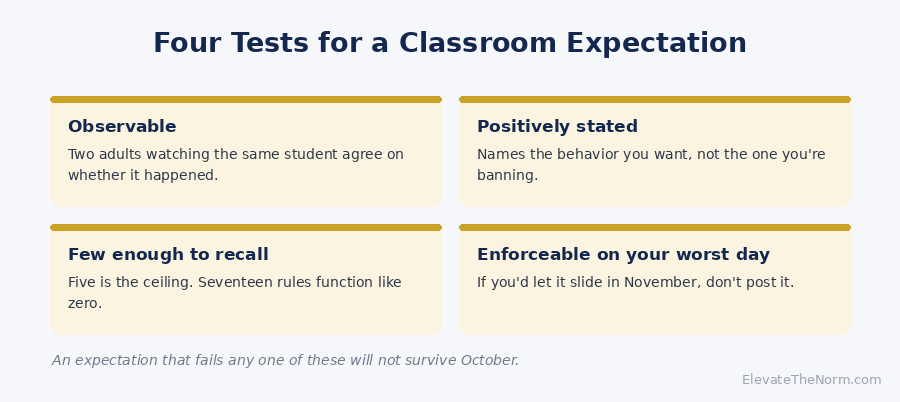
    Four tests. An expectation has to pass all four to be worth posting.

    Four tests for a classroom expectation: observable, positively stated, few enough to recall, and enforceable on your worst day
    Four tests. An expectation that fails any one of them will not survive October.
    1. Observable. Two adults watching the same student agree on whether it happened. The IRIS Center puts it as “observable and measurable,” and offers the useful contrast: “Follow directions” beats “Be respectful,” because one of those can be seen (IRIS Center, Vanderbilt University).
    2. Positively stated. Name the behavior you want, not the one you are banning. “Phones stay in the caddy until the work needs one” tells a student what to do. “No phones” only tells them what you will be annoyed about.
    3. Few enough to recall. No more than five. Seventeen rules function like zero, because nobody—including you—is holding seventeen standards consistently.
    4. Enforceable on your worst day. This is the test nobody writes down and everybody fails. If you would let it slide on a Friday in November when you are tired and behind, do not post it. Students learn which expectations are real by watching what you do when you are worn out.

    Rewriting Vague Expectations Into Usable Examples

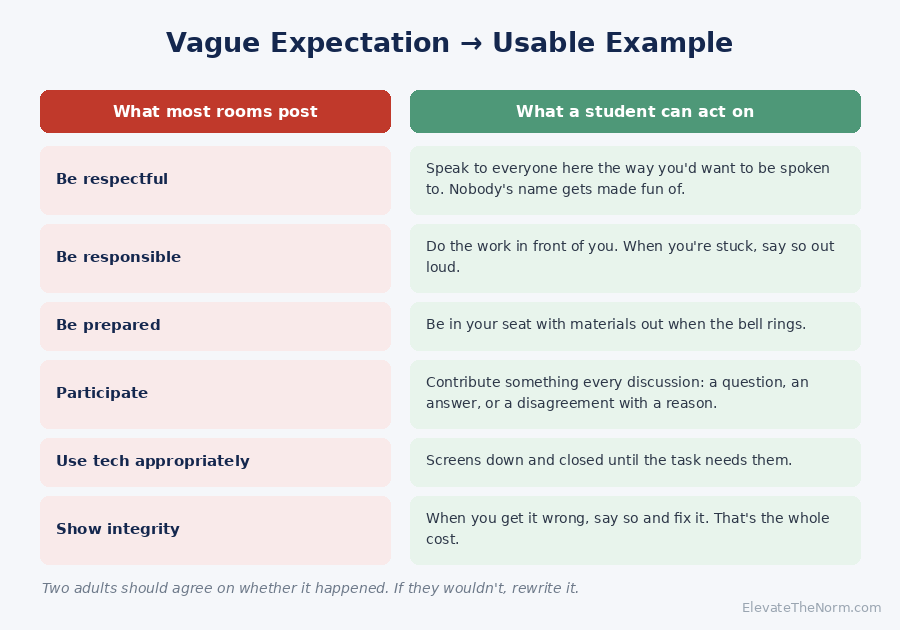
    Most expectation sets are not wrong, they are just unfinished. The words on the wall are the category; the usable version is the behavior underneath it. Here is the same standard written both ways.

    The category most rooms postThe observable example a student can act on
    Be respectfulSpeak to everyone in this room the way you would want to be spoken to. Nobody’s name gets made fun of.
    Be responsibleDo the work in front of you. When you are stuck, say so out loud—to me or to your table.
    Be preparedBe in your seat with your materials out when the bell rings.
    ParticipateContribute something to every discussion: a question, an answer, or a disagreement with a reason attached.
    Use technology appropriatelyScreens are down and closed until the task needs them. When it does, I will say so.
    Show integrityWhen you get something wrong, say so and fix it. That is the whole cost.
    Be on taskBetween the bell and the last five minutes, you are working on this class’s work.
    CooperateYour group can name what you contributed by the end of the period.
    Chart converting vague classroom expectations such as be respectful and be responsible into specific observable behaviors students can act on
    The wall version is the category. The usable version is the behavior underneath it.

    This is not only a clarity problem. It is a fairness problem with data behind it. Research summarized by Brookings found that Black students in North Carolina were less likely to face exclusionary discipline when taught by Black teachers than by white teachers within the same school, and that the gap was strongest for office referrals categorized as “willful defiance”—the most subjectively defined infraction available (Brookings, summarizing Lindsay & Hart, 2017).

    Read that as a design instruction. Every vague expectation you post is a place where a judgment call gets made, and judgment calls are where the disparities live. Writing “be in your seat when the bell rings” instead of “be respectful of class time” is not pedantry. It shrinks the space where bias operates.

    Examples of Classroom Expectations by Type of Room

    A set that works in a discussion-heavy history room will not work in a shop with power tools. Below are five worked examples, each capped at five expectations, each with the specific problem it is built to survive. Take the wording. Do not take the whole list—an expectation set only works if the person enforcing it believes it.

    Middle school, grades 6–8

    Sixth graders are still learning what school even is at this level. The wording has to be concrete without sounding like elementary school, because nothing loses a twelve-year-old faster than being talked to like a child.

    ExpectationWhat it is built to survive
    Be in your seat with materials out when the bell rings.The four-minute settling period that eats a week of instruction per semester.
    One person talks at a time, and it is whoever has the floor.Enthusiastic interrupting, which at this age is usually not defiance.
    Nobody’s name gets made fun of. Ever.The specific cruelty that middle schoolers are best at and adults most often miss.
    When you are stuck, say so out loud before the period ends.Students who have learned that silence hides not knowing.
    When you get it wrong, say so and fix it.The instinct to lie about small things because the cost feels enormous.

    High school, grades 9–12, discussion-heavy course

    Older students will meet a higher bar if the bar is explained. This set assumes disagreement is the point of the class, not a disruption of it.

    ExpectationWhat it is built to survive
    Be working within a minute of the bell.The senior-year drift where arrival becomes negotiable.
    Disagree with the idea, by name, with a reason. Never with the person.Debate collapsing into personal shots—or into nobody saying anything.
    Contribute something every discussion: a question, an answer, or a disagreement.Four students carrying every conversation while twenty coast.
    Screens down and closed until the task needs them.The device that is technically for notes.
    Meet the deadline, or renegotiate it before it passes.The after-the-fact excuse, replaced with a before-the-fact conversation.

    Lab, shop, or any room with equipment

    Safety expectations are the one category where “positively stated” bends. A hard prohibition tied to a real hazard should be stated as a prohibition, and it should be the shortest sentence on the wall.

    ExpectationWhat it is built to survive
    Eye protection on before you touch anything, off when you leave the bench.The five-second task nobody thought needed goggles.
    Hands stay off equipment until you have been checked out on it.Confidence outrunning training.
    Report every spill, break, or injury immediately. Nothing bad happens to you for reporting.The student who hides a small problem until it becomes a large one.
    Clean and return everything before the last five minutes.The bell as an exit from responsibility.
    If you are unsure, stop and ask. Stopping is never the wrong call.Guessing under time pressure.

    Performance class: PE, band, theater, athletics

    These rooms run on effort in front of an audience, which makes them the easiest place for a student to protect themselves by not trying. The expectations have to make trying safe.

    ExpectationWhat it is built to survive
    Dressed, present, and in your spot on time.The slow leak of five minutes per class.
    Attempt everything. You are graded on the attempt, not the outcome.Opting out to avoid being seen failing.
    Nobody laughs at somebody else’s attempt. That is the one that ends a class.The single behavior that makes a performance room unsafe.
    Take the correction, run it again.Feedback treated as an insult.
    If something hurts, say so immediately.Playing through an injury to look tough.

    One-to-one device classroom

    I have taught with no devices, with one cart shared between two classrooms, and with one-to-one. The one-to-one year needed the most explicit expectations, not the fewest, because the distraction is inside the tool students are required to use.

    ExpectationWhat it is built to survive
    Lids at forty-five degrees when I am talking, open when you are working.The ambiguity of “pay attention” in a room full of screens.
    One tab for the task. If a second one is open, be able to say why.Tab-switching as a reflex rather than a decision.
    Charged and ready is part of being prepared.The dead battery as a daily out.
    If you use an AI tool, say where and what you changed. (Check your district’s policy first—yours may already answer this.)Pretending the question does not exist.
    Nothing about a person in this room gets typed, shared, or posted.The fight that starts in a document and finishes in the hallway.

    Notice what is missing from all five sets: threats. Students deserve to know what happens after a miss, and that conversation is real—but it happens calmly, separately, and it always includes the way back. That is covered in classroom consequences that teach instead of humiliate. A list of expectations that reads like a list of warnings tells students you are expecting the worst from them, and teenagers are accommodating people.

    How to Teach an Expectation Instead of Announcing It

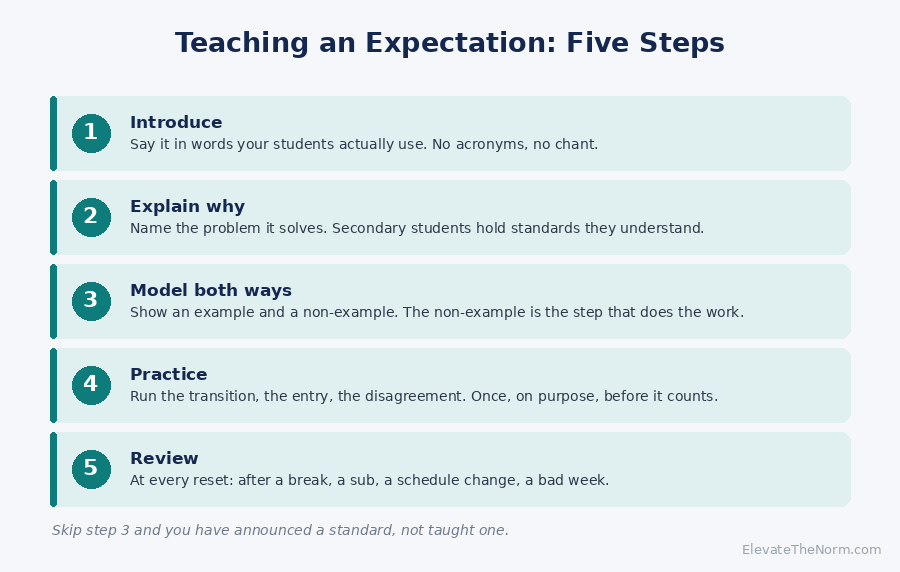
    A posted expectation is a claim. A taught expectation is a skill. The IRIS Center’s sequence for secondary classrooms has five steps: introduce it in student-friendly language, discuss why it exists, model it with examples and non-examples, practice it, and review it—especially at transitions and whenever it starts slipping (IRIS Center, Vanderbilt University).

    Five-step sequence for teaching a classroom expectation: introduce, explain why, model with examples and non-examples, practice, and review
    A posted expectation is a claim. A taught one is a skill.

    The step teachers skip is the non-example, and it is the one that does the work. Secondary students do not need “what respect looks like.” They need the eight-inch difference between a joke that lands and a joke that costs somebody something. Show both. Let them argue about where the line is. They will hold a line they helped draw.

    The Australian Education Research Organisation makes the companion point: high expectations only function when the belief comes packaged with instruction. “I believe you can do it” has to be followed by “here is how” (AERO). An expectation announced without a method is a standard you have set and then declined to teach toward.

    The Launch-Day Script

    Here is roughly what I say on day one. It takes about six minutes and I do not read it off a slide.

    “When you walk through that doorframe, you have 100% of my respect. You don’t earn it in here. You already have it. What you do with it is up to you, and it’s yours to lose—but it starts full.”

    “Here’s what I need from you. Five things. That’s the whole list, and I’m not adding to it in October.”

    [Read the five. One sentence each on why it exists.]

    “Two of these I will hold on my worst day, and you should know which. You will not make fun of anybody’s name in here—not how it’s spelled, not how it sounds, not where it came from. And when you get something wrong, you’ll say so and fix it, and that’s the end of it. No speech from me, no bringing it back up in April.”

    “Everything else on that list, I’ll remind you about. Those two I’ll hold.”

    Then I stop talking. That pause is doing more than the speech was. The room decides in that silence whether I meant it, and filling the gap is how you tell them you did not.

    Two things about that script are worth stealing regardless of your wording. First, respect starts at full rather than being earned—which changes what a correction means later, because you are restoring something rather than withholding it. More on that in respect in the classroom. Second, name which expectations are absolute and which are coachable. Pretending all five carry equal weight is a lie students catch by week three, and once one expectation turns out to be soft, they will test all of them.

    What Follow-Through Actually Looks Like

    The expectations are the easy part. Three practices decide whether they survive past September.

    • Precorrect before the moment, not after it. Prompt the expectation right before the transition where it usually breaks—”Materials out, we’re moving to the lab in ninety seconds”—rather than correcting the eleven students who got it wrong. The OSEP classroom PBIS guide lists prompts before difficult routines as a core practice (Simonsen et al., 2015).
    • Acknowledge the expectation being met, roughly five times for every correction. That same guide puts the target at about five praise statements per corrective one. In a secondary room this is not gold stars—it is naming the behavior quietly and moving on. “Whole table was working before the bell finished. Thanks.”
    • Correct at close range, at conversation volume. A redirect delivered across the room is a performance, and the audience changes what the student has to do to save face. Walking over costs you four seconds and removes the audience entirely.

    Consistency here is not a management preference. It is fairness. The expectation that flexes with your energy teaches students to read your mood instead of the standard, and the students who already trust school least pay the highest price for that unpredictability.

    Three Things These Examples Cannot Decide for You

    Any set you borrow has to survive contact with three things that are specific to your building.

    • The schoolwide behavior matrix. If your building runs a schoolwide system with its own three or four expectations, yours have to sit underneath those, not compete with them. A student who hears one standard in the hallway and a different one in your room learns that standards are a matter of whose room they are in. Map each of your five to the schoolwide expectation it makes concrete—that alignment is the point, and it is usually a ten-minute exercise.
    • Students with an IEP, a 504, or an individual behavior plan. A written plan takes precedence over a classroom list, and it is not an exception you are granting—it is a legal document you are following. Read the plans before you finalize the wording, because sometimes a small rewrite makes an expectation workable for a student instead of setting up a conflict every day. “Be in your seat when the bell rings” and “be in the room and settled within two minutes” hold the same standard; only one of them is reachable for some students.
    • How families find out. Send the five home in the first week, in plain language, without a signature line. Families who know the standard can back it; families who first hear about it when something has gone wrong will reasonably assume it was invented on the spot. It costs one email and it removes most of the arguments you would otherwise have in October.

    Where These Examples Go Wrong

    • Copied wholesale. An expectation set in someone else’s words is one you will not enforce, because you do not believe it in your body. Rewrite every line until it sounds like you saying it out loud.
    • Posted and never revisited. Laminated is not learned. Reteach at every natural reset: after a long break, after a bad week, after a schedule change.
    • Written for the student you dread. A set designed around your hardest class reads as suspicion to the other four sections. Write for the room you want and handle the outlier individually.
    • No route back. If missing an expectation only costs and never leads anywhere, students stop trying to recover once they have missed one. The way back has to be built in, not improvised. See learning from mistakes.
    • Enforced for compliance instead of for the room. If a student cannot tell you who the expectation protects, it is a rule about your convenience. Some of those are legitimate. Just be honest about which ones they are.

    Take the Wording, Not the List

    Pick the set closest to your room. Cut it to five. Rewrite every line in your own words until you could say it to a class without looking at the page, and cross out anything you would let slide in November. What is left is your actual expectations set, and it will be shorter and more honest than what you started with.

    Then teach it—introduce, explain, model both ways, practice, review—and hold it at close range and low volume for the first three weeks. That is the entire job. The example of classroom expectations you land on matters far less than whether the students watching you decide the standard is real. For what happens after a student misses one, keep reading in student responsibility.

    How many classroom expectations should I have?

    No more than five. The IRIS Center’s guidance for secondary classrooms is to limit the list to five or fewer, stated positively and in observable terms, so students can actually recall them. Seventeen rules function like zero, because neither you nor your students are holding seventeen standards consistently. If your list is longer, most of the items are procedures rather than expectations and belong in a routine you teach, not on the wall.

    What is the difference between classroom rules and classroom expectations?

    Expectations are broad goals for behavior; rules are explicit statements defining what those goals look like in a specific context. “Take care of this room and the people in it” is an expectation. “Return tools to the board before the last five minutes” is a rule that shows what it means in a shop. Most secondary classrooms need a small number of expectations and a slightly larger number of taught procedures.

    Should students help write the classroom expectations?

    Student input works best on wording and on the non-examples, not on whether a standard exists. Bring the five you need, then let the class argue about where each line actually falls and rewrite the phrasing together. Students hold a line they helped draw. What does not work is a blank-slate vote, which either produces the list you were going to write anyway or produces one you cannot enforce.

    Why is “be respectful” considered a weak classroom expectation?

    Because two adults watching the same student will not agree on whether it happened. That ambiguity is not only a clarity problem: research summarized by Brookings found racial disparities in office referrals were strongest for subjectively defined infractions like willful defiance. Every vague expectation is a place where a judgment call gets made, and judgment calls are where disparities concentrate. Replacing it with an observable behavior shrinks that space.

    How do I teach expectations without sounding like an elementary teacher?

    Explain the reasoning and use real non-examples. Secondary students do not need a chant or an acronym; they need to know what problem the expectation solves and where exactly the line falls. Show a case that clearly crosses it, a case that clearly does not, and one genuinely ambiguous case, then let them argue. Treating the line as debatable is what makes it land with teenagers.

    When should I reteach classroom expectations during the year?

    At every natural reset: after a long break, after a schedule change, after a substitute, after a bad week, and any time a specific expectation starts slipping. Reteaching is not punishment and should not be delivered as a lecture about disappointment. Two minutes naming the expectation, why it exists, and what it looks like today is enough.

    What if a student refuses to follow an expectation?

    Handle it at close range and at conversation volume rather than across the room, which removes the audience the student would otherwise have to perform for. Address the behavior, name the expectation, and give a path back in the same breath. Follow your school’s policy for anything involving safety or repeated refusal, and keep the what-happens-next conversation separate, calm, and always inclusive of the route to repair.

    Sources


    About Clay Shumate
    Clay Shumate is a certified secondary Social Studies teacher in the public schools of West Alabama, with seven years of classroom experience, a B.A. in History, and an M.Ed. in Secondary Education. He writes about project-based learning, student responsibility, respect, and practical ways to hold young people to a higher standard while giving them room to learn from mistakes. He is a member of the Society of Professional Journalists and writes to its Code of Ethics; this site’s editorial standards and corrections policy are published in full. More about Clay.

  • Ideas for Project Based Learning: 50 Real-World Projects for Grades 6–12

    Ideas for Project Based Learning: 50 Real-World Projects for Grades 6–12

    By Clay Shumate

    Good ideas for project based learning start with a real question somebody outside your classroom actually wants answered, and end with a product that person actually sees. Everything else—the subject, the length, the technology—is negotiable. The 50 ideas below are organized by subject and grade band, each one built around a genuine audience, so you can find one that fits Monday.

    I want to be straight with you about what this list is. It is not 50 activities. Activities are easy to find and mostly interchangeable. These are project premises—each one has a question worth arguing about, a decision that has not been made yet, and somebody on the other end who will look at the result. That last part is what makes the difference, and it is the part most “PBL idea” lists skip.

    Key Takeaways

    • A project idea is only a project if it has an open question, real research, revision, and an audience beyond the gradebook. Otherwise it is an activity with a poster attached.
    • The strongest secondary projects solve a problem the school or the town actually has. Those beat invented scenarios every time, and they cost nothing.
    • Start with one project, not a semester of them. Pick something two to three weeks long with a low materials cost and a real audience you can secure with one email.
    • Evidence for PBL at the secondary level is genuinely good—an 8 to 10 percentage-point advantage on AP exams, gains in middle school science that carried into math and ELA—but it depends on implementation, not on the idea being clever.
    • Every idea here can be run without one-to-one devices. The low-tech swaps are in their own section, because most PBL writing quietly assumes technology that plenty of schools do not have.

    What Makes an Idea for Project Based Learning Worth Running

    Before the list, a filter. PBLWorks names seven essential project design elements: a challenging problem or question, sustained inquiry, authenticity, student voice and choice, reflection, critique and revision, and a public product. The Framework for High Quality Project Based Learning lists six overlapping criteria, adding project management as its own skill students have to be taught rather than assumed to have.

    You do not need to memorize either list. In practice, five questions will tell you whether an idea is a project or a costume. If you teach a single subject and want the narrower version of this list, these ten history project ideas for grades 7–12 are built the same way:

    1. Do I already know the answer? If you do, and every group will arrive at the same place, it is an assignment. Real projects have room for defensible disagreement.
    2. Who sees this besides me? Name the person. Not “the community”—a name, a role, an inbox.
    3. What decision does it inform? Somebody should be able to do something differently because of the work.
    4. Where does the revision happen? If the first draft is the final product, you have skipped the part where the learning lives.
    5. What is the academic content students cannot avoid? If a group could produce something impressive without touching the standard, the project is decorative.

    If an idea below does not survive those five questions in your building, adapt it until it does. I would rather you run a modified version that fits your reality than a faithful version that collapses in week two. For the full breakdown of what does and does not count, see the definition of project based learning, and for projects explained in depth rather than listed, see these examples of project based learning.

    Side-by-side comparison of a project idea and an activity idea across five tests: open question, audience, decision, revision, and required content
    The same topic can be a project or an activity. These five tests are what separate them.

    50 Ideas for Project Based Learning, Grades 6–12

    Each table gives the project premise, the grade band it fits best, a realistic time estimate with how much lift it takes on you, and the audience that makes it public. “Low lift” means you can run it without new materials, outside partners, or a schedule change. “High lift” means you will be making phone calls. Several of these touch permissions, privacy, or school policy—read the three conversations below before you commit to one.

    Social Studies and History

    ProjectGradesTime & liftWho sees it
    1. Marker audit. Which local historical markers tell the whole story, and which leave something out? Research and write corrected text.8–123 weeks · mediumCounty historical society
    2. Oral history archive. Interview long-time residents about one decade, transcribe, and index the collection.9–126 weeks · highPublic library collection
    3. Attendance-zone proposal. Use real census and enrollment data to propose a fairer school zone map.10–124 weeks · highSchool board member
    4. Plain-language ballot guide. Translate the next local ballot into language a first-time voter can actually use.9–123 weeks · mediumCommunity center, church bulletins
    5. Name that street. A blank or badly named street needs a name. Build the historical case for one.6–92 weeks · lowCity council
    6. Disputed event investigation. Take a contested local event and reconstruct it from primary sources only.9–124 weeks · mediumSchool news site
    7. Century story map. Map where families in this county came from across a hundred years, with sourcing.7–105 weeks · mediumLibrary display
    8. Museum in a hallway. Build a docent-led exhibit on a world history unit and tour younger students through it.6–103 weeks · mediumSixth-grade classes

    English Language Arts

    ProjectGradesTime & liftWho sees it
    9. Podcast series. Four episodes on a question students genuinely argue about, scripted, sourced, and edited.8–125 weeks · highPublic feed or school site
    10. Handbook rewrite. Rewrite the student handbook in language students can read, keeping every rule intact.7–123 weeks · mediumAdministration
    11. Hard-concept picture book. Explain something difficult to a second grader in a bound, illustrated book, then read it to them.6–104 weeks · mediumPartner elementary class
    12. Literary walking tour. Sign a downtown route with writing tied to each stop, QR-coded to student audio.9–125 weeks · highDowntown businesses
    13. Edited anthology. Solicit, select, edit, design, and print a collection of student writing.7–126 weeks · mediumFamilies at a reading night
    14. Change one rule. Build an evidence-based case to change a single school rule and present it.6–123 weeks · lowPrincipal and student government
    15. Reviews on spec. Write book or film reviews to a real publication’s submission guidelines and pitch them.9–122 weeks · lowLocal paper editor

    Science

    ProjectGradesTime & liftWho sees it
    16. Creek watch. Test a local waterway weekly for two months and report the trend, not the snapshot.8–128 weeks · highCounty environmental office
    17. Energy audit. Audit the building’s energy use and recommend one change with a payback period attached.9–124 weeks · mediumFacilities director
    18. Room-by-room air quality. Map CO2 and comfort across the building and correlate it with when students fade.8–123 weeks · mediumPrincipal
    19. Pollinator plan. Design a native pollinator planting for school grounds with species list and budget.6–105 weeks · mediumGrounds crew and PTA
    20. Cafeteria waste study. Measure food waste, run one intervention, then measure again and report honestly.6–124 weeks · mediumChild nutrition director
    21. Weather station. Build and calibrate a station, then publish a weekly hyper-local forecast with accuracy tracking.8–126 weeks · highSchool website
    22. Does the expensive one work? Test a consumer product claim under controlled conditions and publish the results.7–113 weeks · lowPublic consumer guide
    23. Invasive species survey. Survey school grounds, identify invasives, and write a phased removal plan.7–124 weeks · mediumCounty extension office

    Mathematics

    ProjectGradesTime & liftWho sees it
    24. Cut the lunch line. Time the cafeteria line, model the bottleneck, and propose a layout that shortens it.7–113 weeks · mediumCafeteria manager
    25. Cost per use. Analyze a real purchase the school is weighing and recommend for or against with the math shown.8–122 weeks · lowBookkeeper or principal
    26. Price the tickets. Build a pricing model for a school event that hits a stated revenue target without pricing families out.9–123 weeks · mediumAthletic director, boosters
    27. Bus route math. Analyze one route’s time and mileage and propose a defensible alternative.10–124 weeks · highTransportation director
    28. Courtyard to scale. Produce scaled drawings and a materials budget for an unused outdoor space.7–114 weeks · mediumPTA
    29. Fair split. Design and defend a fair-cost-sharing rule for a class trip or shared supplies, then adopt it.6–92 weeks · lowThe class itself
    30. Audit the claim. Take a statistic from an ad or news story and verify or refute it with the underlying data.8–122 weeks · lowPublished explainer

    Arts and Music

    ProjectGradesTime & liftWho sees it
    31. Mural pitch. Propose a mural for a blank wall with sketches, budget, and a written rationale.7–125 weeks · mediumAdministration or city
    32. Score the silence. Compose and perform an original score for a public-domain silent film clip.8–125 weeks · highSchool assembly
    33. The people nobody photographs. Portrait series of custodians, bus drivers, and cafeteria staff, with their own words.6–124 weeks · lowHallway exhibition
    34. Rebrand a nonprofit. Redesign a small local nonprofit’s logo and basic brand kit to their actual brief.9–124 weeks · mediumThe nonprofit’s board
    35. One business, one film. Document the history of a single local business in a five-minute film.9–125 weeks · highThe business’s customers

    Career Tech, Business, and Technology

    ProjectGradesTime & liftWho sees it
    36. Run the store. Write the business plan for a school store, then actually operate it for a month and report the P&L.9–126 weeks · highReal customers
    37. Accessibility audit. Audit the school website against WCAG basics and file a prioritized fix list.9–123 weeks · mediumDistrict tech director
    38. Repair café. Fix donated items, document each repair, and hold a community drop-off day.7–124 weeks · mediumCommunity attendees
    39. Prototype and test. Build a working prototype that solves one school problem and user-test it with real students.9–126 weeks · highStudent body
    40. Career guide for eighth graders. Interview working adults and turn it into a guide for students choosing a pathway.9–124 weeks · lowCounselor’s office
    41. Family cybersecurity night. Research the scams that actually hit your community and teach families to spot them.8–123 weeks · mediumParents at an evening event
    42. Maker corner proposal. Cost out a maker space corner and submit a real budget request.7–124 weeks · mediumPrincipal and PTA

    Health and Physical Education

    ProjectGradesTime & liftWho sees it
    43. PE for people who hate PE. Design and run a two-week unit aimed at the students who dread the gym.7–124 weeks · mediumOther PE sections
    44. Sleep and the schedule. Study your grade level’s actual sleep and report what the schedule costs.8–123 weeks · mediumSchool leadership
    45. Menu inside the rules. Redesign a week of cafeteria menus inside real federal nutrition rules and the real budget.9–124 weeks · highNutrition director
    46. Concussion explainer. Produce a short video explaining the school’s concussion protocol to athletes and parents.8–123 weeks · lowAthletic department

    World Languages

    ProjectGradesTime & liftWho sees it
    47. Bilingual welcome. Produce bilingual signage and a welcome packet for the front office, reviewed by a fluent adult.8–124 weeks · mediumFront office and new families
    48. Community resource guide. Translate a guide to local services, verified for accuracy before it goes out.10–125 weeks · highPublic library

    Cross-Curricular

    ProjectGradesTime & liftWho sees it
    49. Readiness research memo. Research national best practices in school emergency preparedness and deliver a private findings memo to the people responsible. Never published, never posted.9–125 weeks · highSafety committee, privately
    50. Time capsule with a defense. Curate artifacts and write the argument for why each one deserves to represent this year.6–103 weeks · lowSealing ceremony now, opening later

    Before You Run Any of These: Three Conversations

    Real audiences are what make these projects work, and they are also what makes them capable of causing you a problem. Three conversations, none of them long, prevent almost all of it.

    • With your administrator, about scope. Any project that contacts someone outside the building, examines a school decision, or asks for a policy change needs a heads-up first. That is not permission-seeking for its own sake—a principal who has agreed in advance to genuinely consider a student proposal turns the project real. A principal ambushed by one turns it into a lesson about how adults do not listen, which is the opposite of the point.
    • With families and interviewees, about consent. Anyone interviewed, recorded, or photographed for a public product gives written consent first, including staff. Follow your district’s policy on student names and images in public work; default to first names. Any project that gathers information about other students stays anonymous and aggregated, and never gets framed as health or psychological data.
    • With yourself, about supervision. Water sampling, tool use, repair work, and off-campus contact all need an adult plan, not just a student plan. If a project cannot be supervised properly with the staffing you actually have, run a different one. There are forty-nine others.

    Two of the ideas above deserve a specific flag. The attendance-zone proposal touches genuinely contested local politics—run it only where a board member has agreed to receive it in that spirit. The readiness memo stays private by design; students research public best practices and deliver findings to the people responsible, and none of it gets posted anywhere.

    None of this is a reason to shrink the work. Clear expectations and honest guardrails are what let you hand students something real in the first place—the same argument as in classroom expectations.

    Does Project Based Learning Actually Work in Grades 6–12?

    Yes, with a caveat worth stating up front: the evidence supports well-implemented PBL, not the idea of PBL. A clever premise badly run is worse than a good lecture. If you are weighing whether to hand part of your course over to projects at all, start with the research comparing PBL with traditional teaching and decide from the numbers rather than the enthusiasm.

    At the high school level, researchers at the University of Southern California studied a project-based curriculum called Knowledge in Action in AP U.S. Government and AP Environmental Science across five predominantly urban districts. Students in the project-based courses passed their AP exams at rates 8 percentage points higher than students in traditional sections, rising to an estimated 10 points when teachers were in their second year with the curriculum (Saavedra et al., Lucas Education Research, 2021). Edutopia’s coverage puts the sample at more than 3,600 students across 114 schools, with over half from low-income households—and the gains held for those students at the same rate as for their wealthier peers.

    At the middle school level, the Learning Through Performance science curriculum developed at Stanford produced an 11 percentage-point gain in science achievement, and the effect did not stay in science: students also outperformed peers on state assessments in mathematics and English language arts (Deutscher et al., Lucas Education Research, 2021).

    That is a real result and I do not want to undersell it. I also do not want to oversell it, which is the next section.

    How to Run Any of These Without One-to-One Devices

    Every project above can run on paper. I have taught with no devices, with one cart shared between two classrooms, and with one-to-one, and the shared-cart year taught me more about project design than the one-to-one years did—because scarcity forces you to decide what the technology was actually for.

    Chart pairing common project technology needs with low-tech substitutes such as paper surveys, printed photo boards, and speakerphone interviews
    Every technology need in a project has a paper equivalent that costs nothing.
    • Research: One device rotating through groups on a research day beats thirty devices open all week. Print the three or four best sources yourself and let the argument be about the evidence rather than the searching.
    • Surveys and data: Paper surveys, tallied by hand, teach the sampling problem better than a form that auto-charts the answer.
    • Interviews: A speakerphone in the classroom and a designated note-taker works. So does a written question set mailed to somebody who answers in writing.
    • Public product: A hallway, a printed booklet, a folding display, or fifteen minutes at a faculty meeting are all public. Public means seen by someone who is not you—not published online.
    • Presentation: Chart paper and a marker force students to decide what matters. A slide deck lets them avoid deciding.

    The one thing worth protecting is contact with the real audience. If you have to cut something, cut the polish, not the person on the other end.

    Grading Individuals Inside a Group Project

    This is the objection I hear most from teachers, and it is a fair one. A single group grade rewards the student who did nothing and punishes the one who carried it. It also lets weak content knowledge hide behind a strong product.

    Diagram splitting a project grade into a shared group product score and an individual score drawn from checkpoints, an individual assessment, and self and peer evaluation
    Splitting the grade is what keeps a group project from grading the group instead of the student.

    Carnegie Mellon’s Eberly Center recommends carrying both a group component and an individual component in the project grade—commonly split 50/50 or 80/20—and assessing the process as well as the product, using individual assessments, self-evaluation, and peer evaluation that adjusts individual grades (Eberly Center, Carnegie Mellon University). Their other point is the one teachers skip: run the evaluations partway through, not only at the end, so the information can still change something.

    What I do, in plain terms:

    1. The product gets a group grade. It is a shared thing; it gets a shared score.
    2. Every student takes an individual assessment on the content. Short, written, no group. If a student cannot explain the project’s core idea alone, the group grade is not evidence they learned it.
    3. Checkpoints are individual. I am collecting something small from each student every few days anyway. Those are the receipts.
    4. Self and peer evaluation adjusts, it does not decide. Students are honest more often than teachers expect, but a peer rating is one input, not a verdict.

    The deeper fix is not a grading scheme. It is scoping the project so nobody can disappear inside it, which is really a planning problem. More on that idea in student responsibility.

    For free planning templates, critique protocols, and assessment tools that support PBL implementation, see project based learning resources for middle and high school teachers.

    The Failure I Catch Most Often, and How

    Projects rarely fail loudly. They fail quietly, in week one, when a driving question shrinks into something a search bar can answer, and nobody notices because the group looks busy.

    I catch it by moving. I am on a stool most of the period, going table to table, and I listen more than I talk. A few days into a project I will hear a group planning around a question that has quietly stopped being a question—they have already settled the answer and are now decorating it. So I sit down with them and ask them to walk me through their reasoning from the beginning, out loud. Not to correct it. To make them hear it. Nine times out of ten somebody at the table catches the collapse before I have to name it, and the fix is theirs instead of mine.

    That is the whole argument for circulating instead of monitoring. You cannot hear a premise go soft from the front of the room.

    Where Project Based Learning Genuinely Struggles

    The most honest summary of the research is still MDRC’s literature review, which calls the evidence for PBL “promising but not proven,” notes that the field lacks agreement on what the core elements even are, and points out that evaluation has been hampered by a shortage of valid, usable measures for the deeper learning PBL claims to produce. It also names the real implementation problem: teachers have to shift from directing to facilitating, and manage a great deal of ambiguity while they do it (Condliffe et al., MDRC, 2017).

    Three practical cautions from my own room:

    • Coverage is real. A four-week project has to carry four weeks of standards, not one week of standards and three weeks of production. Map it backward: list every standard the project will assess, then name the specific checkpoint or artifact where you will see each one. Any standard without an artifact next to it is a standard you are hoping happens.
    • Access is not equal. A project that depends on a parent’s connections, a car, or an evening free is a project that sorts students by circumstance. Build it so it can be completed inside the school day.
    • The first run will be rough. The AP result got better in year two for a reason. Plan to run the same project twice before you judge it.

    Pick One and Start

    Do not redesign your course. Choose two or three ideas from the list marked low lift, two or three weeks, with an audience you can secure in a single email—the plain-language ballot guide, the cost-per-use analysis, the portrait series, the concussion explainer—and then let the class pick between them. Student voice is one of the design elements, and the cheapest place to honor it is the choice of project itself. Run it once. Keep notes on what broke. Run it again in the spring with the breakage fixed. If you want one written up all the way through — the weekly formats, the family note, what it cost — this mock election is that account.

    The point of any of these ideas for project based learning is not the project. It is that students spend three weeks being treated as people whose work is worth showing to somebody. That treatment is the intervention. The project is just the excuse to deliver it. If that framing is new, start with what project based learning actually is, then look at how the same principle shows up in real world learning.

    How many projects should I run in a school year?

    Two done well beats six done thinly. Most teachers new to project based learning should run one project in the fall and one in the spring, ideally the same project twice so the second run benefits from what the first one taught you. The AP research found the effect grew from 8 to 10 percentage points when teachers were in their second year with the curriculum, which is a good argument for repeating rather than constantly starting over.

    What if my school does not have devices for every student?

    Every idea on this list can run on paper. Rotate one or two devices through groups on designated research days, print the strongest sources yourself, use paper surveys tallied by hand, and conduct interviews on a classroom speakerphone with an assigned note-taker. A hallway exhibit, a printed booklet, or fifteen minutes at a faculty meeting are all genuinely public products. Protect contact with the real audience and cut the polish instead.

    How do I grade individual students in a group project?

    Carry both a group score and an individual score. The shared product gets a shared grade; each student also completes an individual content assessment, individual checkpoints throughout the project, and a self and peer evaluation that adjusts but does not decide the individual grade. Carnegie Mellon’s Eberly Center recommends splits around 50/50 or 80/20 and stresses running the evaluations partway through, while the information can still change something.

    Will a project cover enough standards to justify the time?

    Only if you map the standards before you commit to the product. A four-week project must carry four weeks of curriculum, not one week of content plus three weeks of building. Write down every standard the project will assess, then check whether a group could produce the final product without touching them. If they could, the project is decorative and needs redesigning.

    What makes a project audience genuinely public?

    A public audience is any person outside your classroom who will actually look at the work and could plausibly act on it. A facilities director reading an energy audit, a librarian accepting an oral history collection, a second-grade class hearing a book read aloud, or a school board member receiving a proposal all qualify. Your gradebook, a classroom presentation to peers, and a folder that goes home do not.

    How do I keep one student from carrying the whole group?

    Scope the project so there is no place to hide. Assign individual checkpoints every few days, require each student to be able to explain the core idea alone, and define roles that produce visible artifacts rather than vague responsibilities. If a student can still disappear inside the project, that is usually a planning problem on the teacher’s end rather than a character problem on the student’s.

    Are these ideas appropriate for struggling readers or English learners?

    Yes, and the research supports it. The elementary science study found gains that held across all reading ability levels, and the middle school study found English learners gained 8 percentage points in language proficiency in year one and 28 points with second-year teachers. Projects give students more ways to demonstrate understanding than a text-only assessment does, provided you scaffold the reading and do not treat the written product as the only evidence.

    What permissions do I need before students interview people or photograph them?

    Get written consent from any adult who is interviewed, recorded, or photographed for a public product, and clear the project with your administrator before students contact anyone outside the building. Follow your district policy on student names and images appearing publicly, and default to first names only. Any project that collects information about other students should be anonymous, aggregated, and never framed as health or psychological data.

    Sources


    About Clay Shumate
    Clay Shumate is a certified secondary Social Studies teacher in the public schools of West Alabama, with seven years of classroom experience, a B.A. in History, and an M.Ed. in Secondary Education. He writes about project-based learning, student responsibility, respect, and practical ways to hold young people to a higher standard while giving them room to learn from mistakes. He is a member of the Society of Professional Journalists and writes to its Code of Ethics; this site’s editorial standards and corrections policy are published in full. More about Clay.
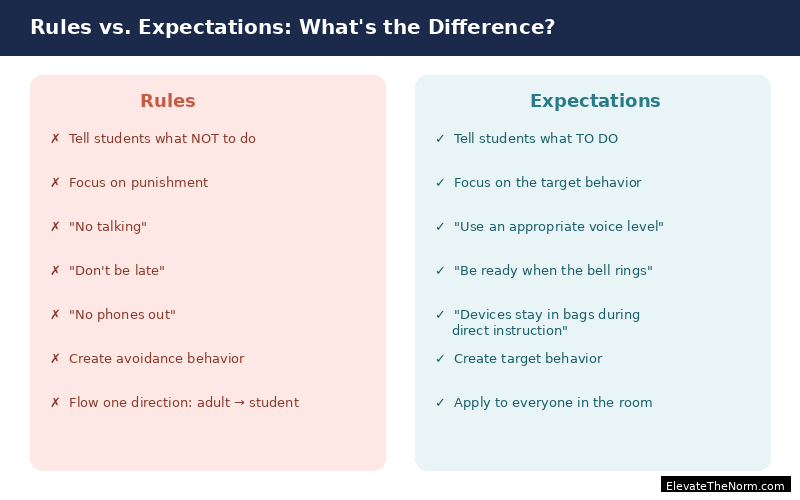
Teacher Emergency Toolkit — practical resources, real classroom support. Shop on TPT.Teacher Emergency Toolkit — practical resources, real classroom support. Shop on TPT.