Student responsibility in the classroom means students consistently do what needs to be done—prepare for class, participate honestly, meet deadlines, collaborate fairly, own their mistakes, ask for help, and repair what they break—without needing to be monitored every minute. This article explains what responsible behavior actually looks like in grades 6–12 and how teachers build it through structure, not speeches.
Key Takeaways
Responsibility is observable behavior, not a personality trait. You can see it, teach it, and measure growth.
Responsibility and compliance are not the same thing. A student who follows rules out of fear is compliant. A student who meets a standard because they understand why it matters is responsible.
Students learn responsibility through practice, feedback, and natural consequences—not lectures, reward charts, or shame.
The teacher’s job is to build the structure that makes responsible behavior possible and then hold the standard when students fall short.
Responsibility grows when students have genuine choices, real stakes, and a clear path to repair after mistakes.
Responsibility Is Not Compliance
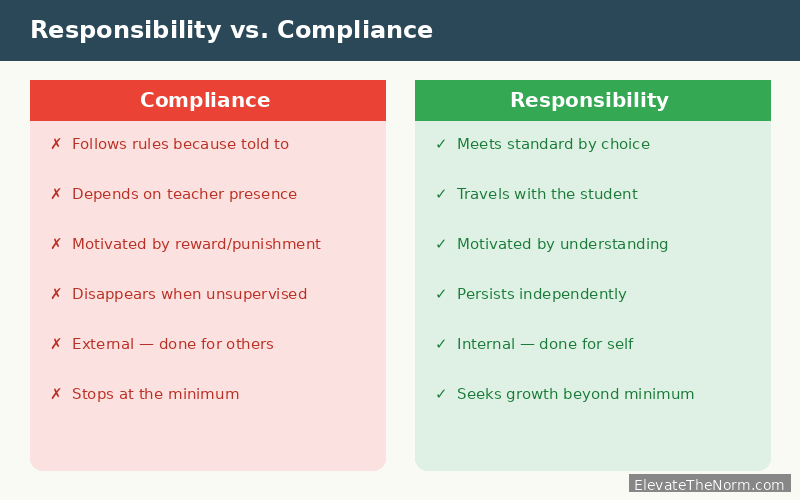
The difference between student responsibility and compliance in the classroom
This is the distinction that changes everything.
A compliant student does what you say because you said it. A responsible student does what needs to be done because they understand the purpose. Compliance depends on the teacher being in the room. Responsibility travels with the student.
Research on self-determination theory makes this concrete. Niemiec and Ryan (2009) found that students who experience autonomy, competence, and relatedness in the classroom are more likely to internalize the value of academic behaviors—not just perform them for a grade or to avoid trouble. When students feel controlled rather than supported, motivation drops and so does the quality of their effort.
Most classroom management systems are built to produce compliance. They work—until the teacher steps out of the room, until the reward loses its appeal, or until the student decides the consequence is worth the trade. Responsibility requires a different design: one where students understand the reason behind the expectation and have practiced meeting it enough times that it becomes automatic.
This does not mean you stop enforcing standards. It means the enforcement is a tool for building capacity, not just maintaining order.
What Student Responsibility Actually Looks Like
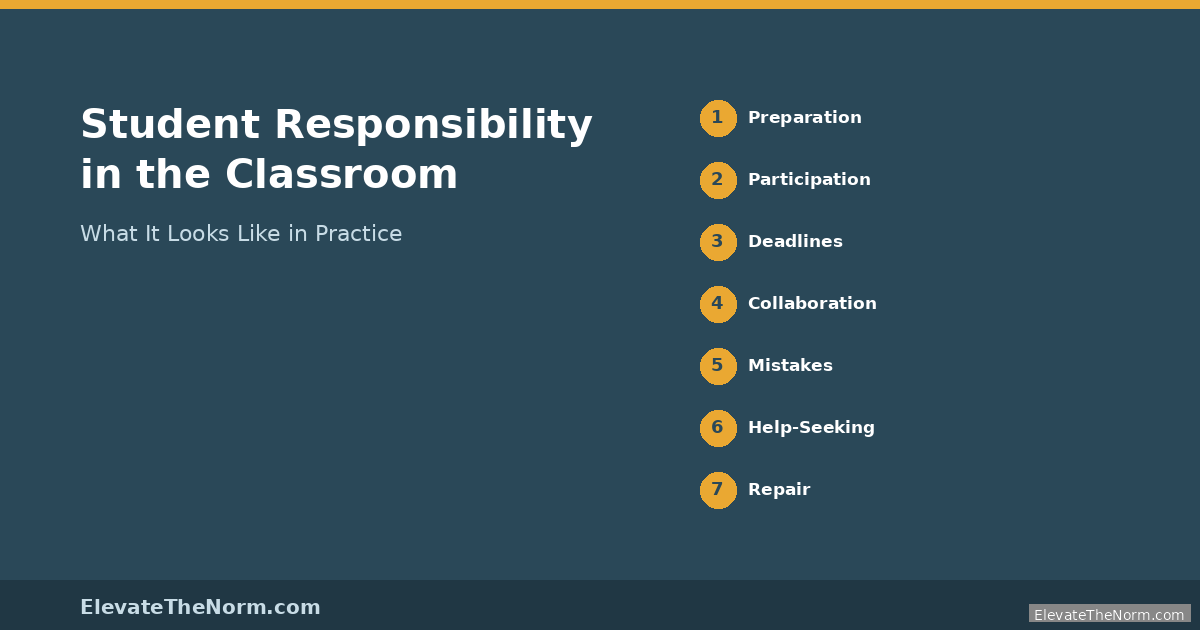
Talking about responsibility in the abstract does not help anyone. Teachers need to know what responsible behavior looks like when it walks into the room on a Tuesday morning. Here are seven domains where responsibility becomes visible.
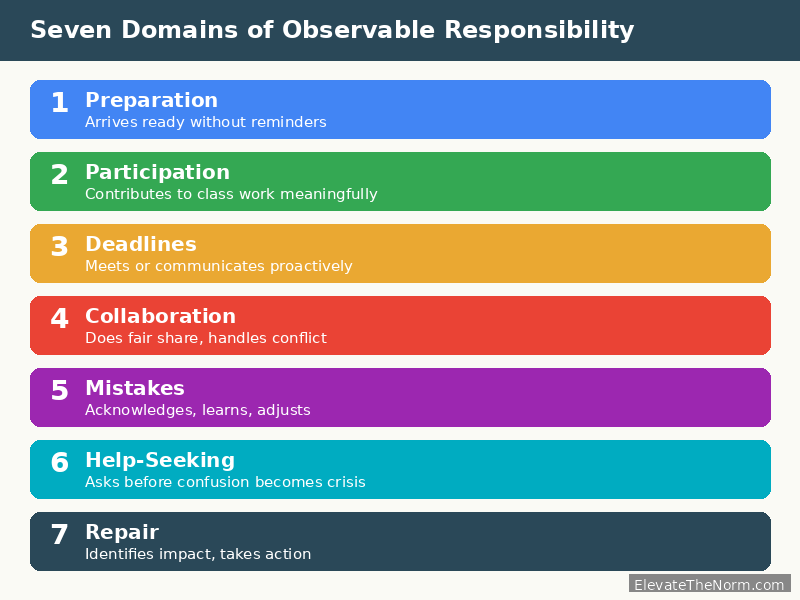
The seven observable domains of student responsibility in the classroom
1. Preparation
A responsible student arrives with materials, has completed required preparation, and is ready to begin when class starts. This does not mean perfect compliance every day—it means a pattern of readiness that the student maintains without being reminded.
What to watch for: Does the student bring what they need without being asked? When they forget something, do they solve the problem or wait for you to notice? For a precise definition that distinguishes responsibility from obedience, the companion article on what is student responsibility gives teachers and families a clear shared starting point.
2. Participation
Participation is not the same as talking. A responsible student contributes to the work of the class—through discussion, through written response, through active listening, through collaboration. Quiet students can participate responsibly. Loud students can participate irresponsibly.
What to watch for: Is the student engaged with the content, or performing engagement for your benefit?
3. Deadlines
A responsible student meets deadlines or communicates proactively when they cannot. The communication matters as much as the deadline itself. A student who emails you the night before to say they are stuck and asks for help is showing more responsibility than a student who turns in mediocre work on time to avoid a consequence.
What to watch for: When a student misses a deadline, what happens next? Do they take the initiative to address it, or do they wait for you to chase them?
4. Collaboration
Working with other people is where responsibility gets tested hardest. A responsible student does their share, communicates honestly with group members, handles disagreement without withdrawal or domination, and gives credit where it is owed.
What to watch for: Does the student contribute to the group’s success, or simply avoid being the one who gets blamed for failure? There is a difference.
5. Mistakes
Every student makes mistakes. A responsible student acknowledges the mistake, understands its impact, and takes action to repair it. This is not about guilt or shame—it is about ownership. That balance between accountability and a second chance is what makes the difference.
Zimmerman’s research on self-regulated learning (2002) shows that self-regulated learners treat errors as information rather than evidence of failure. They adjust their approach based on what went wrong. That is a skill, not a character trait, and it can be taught through structured reflection and consistent adult modeling.
What to watch for: When a student makes a mistake, do they deflect, shut down, or face it? Your response in that moment teaches them which option is safe.
6. Help-Seeking
Asking for help when you are stuck is an act of responsibility, not weakness. A responsible student monitors their own understanding and reaches out before a small problem becomes a crisis.
What to watch for: Does the student ask for help at the right time—after a genuine attempt but before the frustration becomes unproductive? Students who never ask for help are not necessarily independent. They may be hiding confusion.
7. Repair
When a student’s behavior damages a relationship, disrupts the class, or violates an expectation, repair is the responsible response. Repair means identifying what went wrong, acknowledging its impact on others, and taking specific action to make it right.
What to watch for: Can the student articulate what happened, who was affected, and what they will do differently? If they can, they are practicing responsibility. If they cannot, they need you to teach them how—not punish them for not knowing.
How Teachers Build Responsibility
Students do not arrive responsible or irresponsible. They arrive with whatever habits their previous environments rewarded. Your job is to build an environment where responsible behavior is taught, expected, practiced, and reinforced—not assumed.
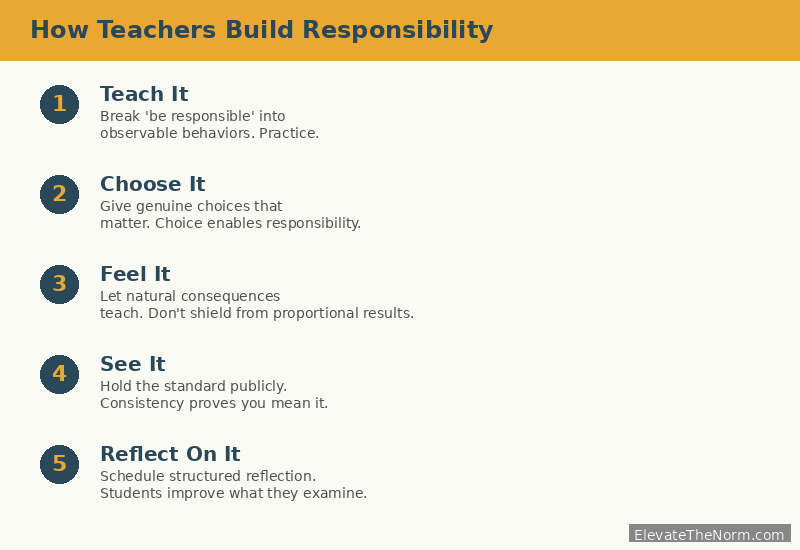
Five strategies teachers use to build genuine student responsibility in the classroom
Teach the Behavior You Expect
This sounds obvious, but most teachers skip it. They state the expectation—”Be responsible”—and then are frustrated when students do not meet it. “Be responsible” is not an instruction. It is a category. Break it into the observable behaviors listed above, the same way you would build a set of clear classroom expectations. Teach each one explicitly. Practice it. Give feedback. Reteach when necessary.
Give Real Choices
Responsibility requires choice. If students have no decisions to make, they have no opportunity to practice being responsible. Offer choices that matter: which topic to investigate, which format to present in, which resource to use, which role to play in a group. The choice does not have to be enormous. It has to be genuine. This is the practical core of teaching responsibility without treating teenagers like children.
The CASEL framework for social and emotional learning identifies responsible decision-making as one of five core competencies—and defines it as the ability to make caring and constructive choices about personal behavior and social interactions across diverse situations. That definition matters because it links responsibility to decision-making, not obedience.
Use Natural Consequences
When a student does not prepare for a group meeting, the group’s work suffers. When a student misses a deadline, the revision cycle shrinks. When a student damages a relationship, trust takes time to rebuild. These are natural consequences, and they teach more than any punishment chart.
Your job is not to shield students from consequences. It is to ensure the consequences are proportional, educational, and accompanied by a path back. A student who loses a day of revision time because they did not draft on schedule has experienced a natural consequence. A student who gets a zero with no chance to recover has experienced a dead end. One builds responsibility. The other builds resentment.
Students watch whether you mean what you say. If the expectation is that work is due on Thursday and half the class turns it in Friday with no conversation, the real expectation is Friday. Hold the standard—but hold it with respect. If you want structured ways to practice this, these activities for teaching responsibility give students repeated low-stakes reps.
I count before I respond—roughly fifteen, adjusted to the room and the day and the student. It is not a script. It is a deliberate pause that gives me time to respond with clarity instead of reacting with frustration. When a student falls short of an expectation, the conversation that follows needs to be about the behavior and the path forward, not about how disappointed I am. Disappointment is about me. Accountability is about them.
That pause does something else, too. It models self-regulation for students who have never seen an adult choose not to react immediately. In a room where the tables are pushed together and students are almost always working alongside somebody, composure travels. When I stay calm, the room stays calm. When I raise my voice, the room raises its guard.
Build in Reflection
Students cannot improve what they do not examine. Schedule structured reflection at regular intervals—not just at the end of a project. Ask students to assess their own responsibility across the seven domains. Compare their self-assessment to your observations. Use the gap as a conversation starter, not a gotcha.
What Responsibility Is Not
Responsibility is not doing what adults want without questioning it. It is not silence. It is not never making mistakes. And it is not something you can grade on a report card the same way you grade a math test.
A student who pushes back on an assignment because they think it is pointless is not being irresponsible—they are expressing a judgment. Whether that judgment is right or wrong, your response should address the substance of their concern, not just the fact that they raised it. A student who questions an expectation respectfully and then meets it after the conversation is demonstrating more responsibility than a student who never questions anything.
Responsibility also does not mean handling everything alone. A student who asks for help, communicates a struggle, or admits they do not understand is acting responsibly. The mythology of the independently responsible student—the one who never needs support—is a fantasy that harms the students who believe it.
When Students with IEPs or 504 Plans Need Different Structures
Responsibility expectations must account for students whose plans include specific accommodations. Extended deadlines, modified assignments, alternative assessments, and additional support structures are not exceptions to responsibility—they are the framework within which that student practices it.
A student with an IEP who uses their extended time and meets the adjusted deadline is meeting their standard. A student with a 504 plan who uses their accommodations and still comes prepared is demonstrating responsibility within the structure designed for them.
When in doubt, coordinate with the special education team. The goal is the same: build the student’s capacity to manage their own learning. The path may look different, and that is by design.
A Note for Administrators
Student responsibility is not a classroom-level problem with a classroom-level solution. It is a school-culture issue.
If the schoolwide discipline system is built entirely on compliance—silent hallways, no talking during transitions, consequences that escalate without teaching—then individual teachers who try to build genuine responsibility are fighting the current. Administrators who want responsible students need to audit whether their own systems reward compliance or build capacity.
Ask your teachers: Do students in your school practice making decisions, or do they practice following directions? The answer will tell you more about responsibility than any behavior data report. One concrete place to start is handing students the job of rating their own conduct against observable criteria rather than waiting to be told how they did. For a ready-to-use tool on this, see a free academic integrity response pack.
Sources
Niemiec, C. P. & Ryan, R. M. (2009). “Autonomy, competence, and relatedness in the classroom: Applying self-determination theory to educational practice.” Theory and Research in Education, 7(2), 133–144. https://journals.sagepub.com/doi/10.1177/1477878509104318
Zimmerman, B. J. (2002). “Becoming a self-regulated learner: An overview.” Theory Into Practice, 41(2), 64–70. https://eric.ed.gov/?id=EJ656632
Batdı, V., Elaldı, Ş., & Sönmez, A. (2026). “Project-based learning in schools: a multi-complementary study of its effectiveness.” Humanities and Social Sciences Communications, Nature. https://www.nature.com/articles/s41599-026-06684-4
Frequently Asked Questions
How is student responsibility different from student compliance?
Compliance means a student follows rules because an authority figure is enforcing them. Responsibility means a student meets a standard because they understand its purpose and have internalized its value. Compliance disappears when the authority figure leaves. Responsibility travels with the student. Both have a place in schools—safety rules require compliance regardless of understanding—but building genuine responsibility produces students who function independently, which is the whole point of education.
Can you actually teach responsibility, or is it just a personality trait?
You can teach it. Responsibility is a set of observable behaviors—preparing, communicating, meeting deadlines, repairing mistakes—and behaviors are learned through practice, feedback, and consistent expectations. Some students arrive with stronger responsibility habits than others because of their previous environments, not because of their character. Your job is to build the environment where all students practice these behaviors regularly.
What do I do when a student is consistently irresponsible?
Look at the pattern, not the incident. A student who is consistently unprepared, missing deadlines, or avoiding help may be struggling with something you cannot see—a home situation, a learning difficulty, a trust issue with adults. Start with a private conversation that asks what is getting in the way, not one that lists everything they have done wrong. Build a plan together. Set one small, achievable target. Check in regularly. Responsibility grows through supported practice, not through accumulated consequences.
How do I balance responsibility expectations with IEP and 504 accommodations?
Accommodations are not exceptions to responsibility—they are the structure within which a student practices it. A student with extended time who uses that time and meets the adjusted deadline is being responsible. The standard is the same: do what needs to be done, communicate when you are stuck, and repair what goes wrong. The path to that standard may look different for different students, and that is exactly how it should work. Coordinate with the special education team when expectations and accommodations seem to conflict.
Should I grade students on responsibility?
Be careful. Responsibility behaviors—preparation, participation, deadline management—are legitimate learning outcomes, but grading them requires clear, observable criteria and consistent application. If “responsibility” becomes a subjective judgment call that penalizes quiet students or rewards charming ones, it does more harm than good. If you grade it, define exactly what you are measuring, use the same criteria for every student, and separate it from content grades so a student’s mastery of your subject is not buried under a behavior score.
How do I build responsibility in a classroom where students have had no previous practice?
Start with the smallest unit of responsibility you can find. Ask students to bring one specific material. Ask them to self-assess one assignment before turning it in. Ask them to communicate one problem before it becomes a crisis. Celebrate the behavior when it happens—not with a reward, but with acknowledgment. Build from there. Students who have never been trusted with responsibility will test whether you mean it. They are supposed to test it. Hold the standard, keep the relationship, and give them time.
What role do parents play in building student responsibility?
A significant one, but not the one schools usually assign them. Telling families to “make sure your child is responsible” is outsourcing the school’s job. Instead, communicate clearly about what responsibility looks like in your classroom, what you are doing to teach it, and how families can reinforce it at home. When a student is struggling, bring the family in as a partner, not a target. Most parents want their child to be responsible—they may just need to know what you are working on and how to support it.
About Clay Shumate
Clay Shumate is a certified secondary Social Studies teacher in the public schools of West Alabama, with seven years of classroom experience, a B.A. in History, and an M.Ed. in Secondary Education. He writes about project-based learning, student responsibility, respect, and practical ways to hold young people to a higher standard while giving them room to learn from mistakes. He is a member of the Society of Professional Journalists and writes to its Code of Ethics; this site’s editorial standards and corrections policy are published in full. More about Clay.
Project based learning resources worth using are the ones that solve a specific problem in your planning, not the ones that look impressive in a Pinterest folder. This article evaluates free planning templates, rubrics, critique protocols, driving-question tools, reflection forms, and project calendars for grades 6–12 teachers—and tells you what each one actually does well and where it falls short.
Key Takeaways
The best PBL resources solve one clear problem—planning, assessment, critique, or reflection—rather than trying to do everything.
Free does not mean ready to use. Most templates need adaptation for your students, your standards, and your schedule.
Evaluate every digital tool for student data privacy before putting it in front of a class. Free platforms often collect data that schools have a legal obligation to protect.
A driving-question tool and a critique protocol will improve your projects faster than any other single resource.
ElevateTheNorm.com will be building original, downloadable PBL planning templates designed specifically for grades 6–12. Those are coming.
The Problem with Most PBL Resource Lists
Search for project based learning resources and you will find dozens of lists. Most of them share the same problem: they dump thirty links on you with no evaluation, no context, and no explanation of what each resource actually does when you sit down to use it.
That is not a resource hub. That is a reading assignment.
Teachers do not need more links. They need someone to say: here is what this tool does, here is what it does not do, here is where it breaks down, and here is whether it is worth your limited planning time. That is what this article does.
A 2023 meta-analysis published in Frontiers in Psychology examined 106 studies on PBL’s impact on student learning and found a significant positive effect across subjects and grade levels (Zhang & Ma, 2023). The evidence for PBL is strong, and it holds up when you look at how PBL compares with traditional instruction on content knowledge and skill transfer. The barrier is not whether it works—it is whether teachers can plan and manage it without burning out. Good resources lower that barrier. Bad ones raise it by adding confusion.
Planning Templates
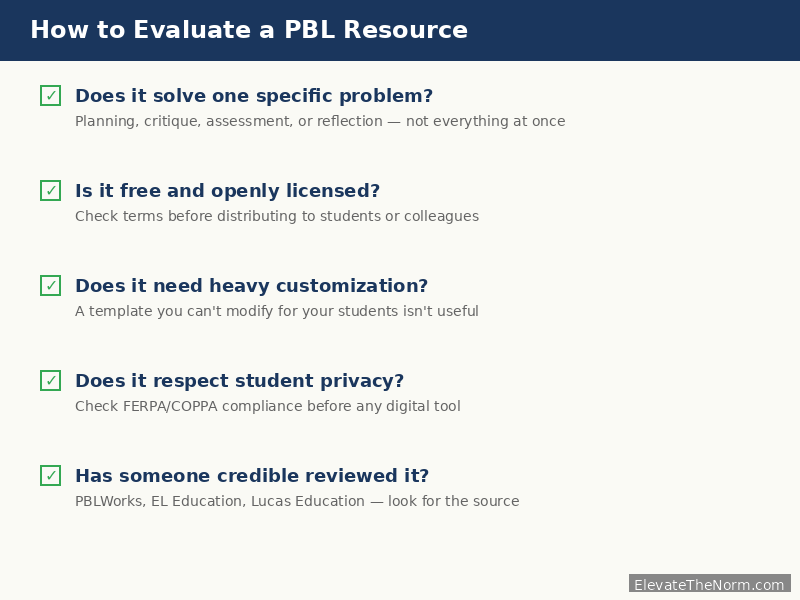
Five criteria for evaluating whether a project based learning resource is worth your time
PBLWorks Project Design Overview
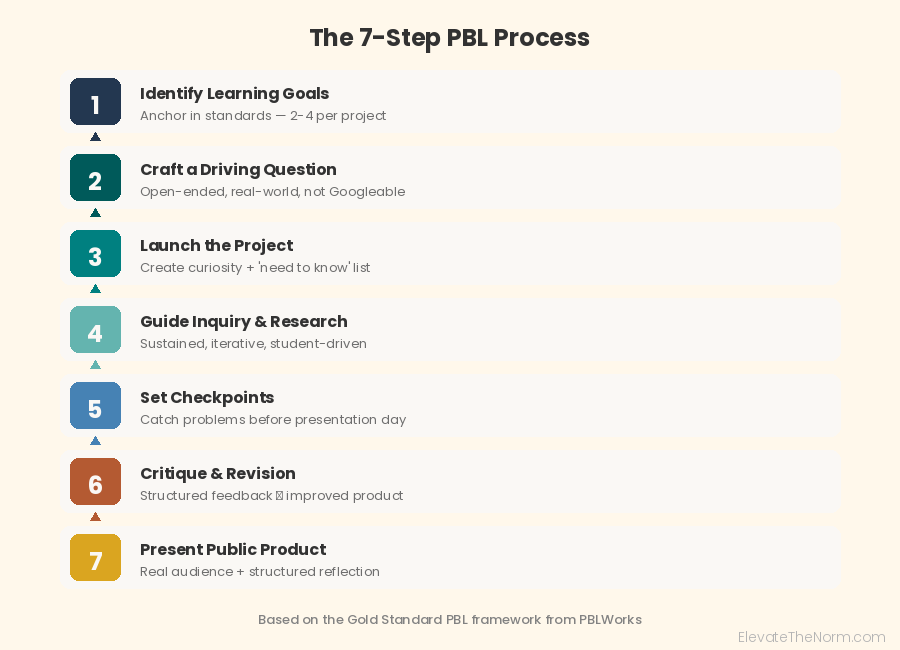
What it is: A one-page planning template from PBLWorks (formerly the Buck Institute for Education) that walks you through the Gold Standard PBL design elements—driving question, sustained inquiry, authenticity, student voice and choice, reflection, critique and revision, and a public product.
What it does well: Forces you to think about every essential element before you start building lessons. The format is tight enough to fit on a single page, which means you cannot hide vague thinking behind long paragraphs. If you leave a box blank, you know something is missing.
Where it falls short: The template assumes you already understand the Gold Standard framework. If you are new to PBL, the boxes will not teach you what belongs in them. Pair it with the PBLWorks “Getting Started” guide or with the definition of project based learning article on this site.
Verdict: Use it. This is the most widely used PBL planning template for a reason. It is free, it is well-structured, and it keeps you honest about whether your project is actually PBL or just a long assignment.
Project Calendar Template
What it is: A week-by-week or day-by-day calendar that maps your project phases onto actual class periods.
What it does well: Solves the most common PBL planning failure—not knowing how long things take. When you map inquiry, research, drafting, critique, revision, and presentation onto real days, you find out immediately whether your timeline is realistic. It also gives students a visible schedule so they can pace themselves.
Where it falls short: No single calendar template fits every project, schedule, or block length. You will need to build your own or heavily modify whatever you find. The PBLWorks template above does not include one.
Verdict: Build your own from a simple spreadsheet. Map the Gold Standard phases onto your actual bell schedule. Share it with students on day one. Adjust publicly when reality changes the plan—that is modeling real project management, not admitting failure.
Driving-Question Tools
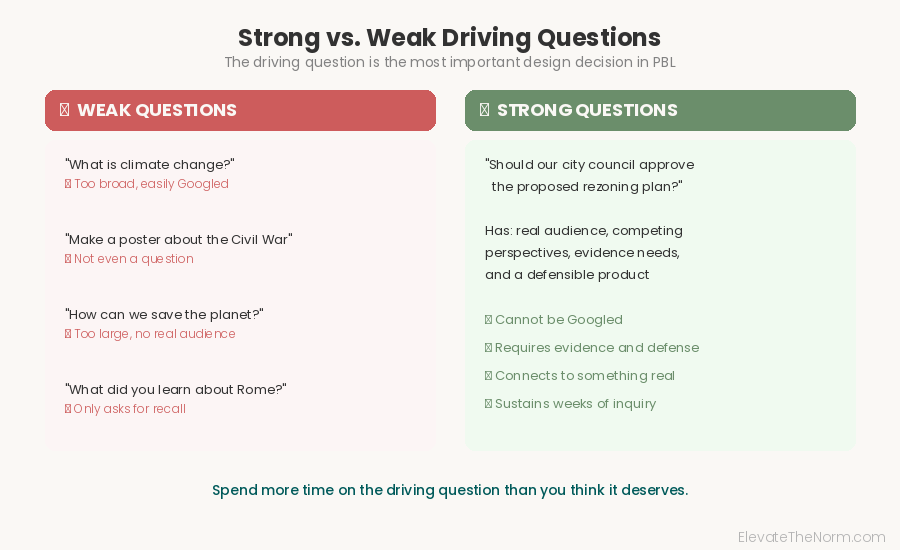
A strong driving question is the difference between a project that sustains genuine inquiry and a project that collapses into a Google search on day two. If you are going to invest time in one PBL resource, invest it here.
PBLWorks Driving Question Tubric
What it is: A “tubric”—a combination of a rubric and a tutorial—that helps you evaluate whether your driving question is open-ended, engaging, aligned to standards, and complex enough to sustain weeks of investigation.
What it does well: Gives you specific criteria for testing a question before you commit to it. “Can students answer this in one class period?” is the single most useful diagnostic. If the answer is yes, the question is not a driving question.
Where it falls short: The language is written for teachers, not students. If you want students to help develop or evaluate driving questions—and you should—you will need to simplify the criteria for them.
Verdict: Essential. Weak driving questions are the number-one reason PBL projects fail. This tool will not write the question for you, but it will tell you whether the one you wrote is strong enough to carry a project.
Critique is where student work gets better. Not praise, not grades—structured critique that tells a student specifically what is working, what is not, and what to do next. These protocols make that process fair and productive instead of awkward and personal.
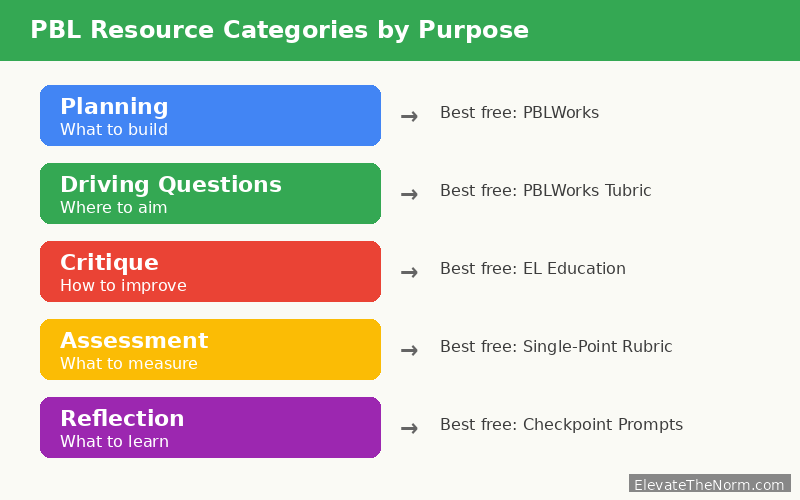
Project based learning resources organized by category with the best free source for each
What it does well: These are some of the most carefully designed classroom protocols available anywhere, and they are free. The critique protocols in particular—especially the “kind, specific, helpful” framework—give students language for feedback that is honest without being destructive. That matters enormously in grades 6–12, where peer feedback can go sideways fast.
Where it falls short: The protocols were designed for EL Education’s own curriculum, so some require adaptation for standalone PBL use. The formatting is dense. You may need to extract the protocol you need and reformat it as a student-facing handout. If you are an instructional coach supporting a teacher’s first project, model the critique protocol in the teacher’s room before asking them to run it independently—cold handoffs of complex protocols do not work.
Verdict: The single best free critique resource for secondary PBL. Download the protocols PDF, learn the “kind, specific, helpful” framework, and use it every time students give feedback on each other’s work. It will change the quality of your projects.
I use partner work as the default condition in my room—students are almost always working alongside somebody, not sitting in rows facing the front. That means critique is not a special event I schedule once before the final product. It is woven into every work session. A student finishes a draft, turns to their partner, and gets immediate feedback using the protocol we practiced together. The whiteboard table groups make this natural—when your tables are already pushed together, you do not have to rearrange the room to make peer critique happen. You just have to teach students how to do it well, which is exactly what the EL Education protocols are for.
Austin’s Butterfly (Video Protocol)
What it is: A short video by Ron Berger showing first graders giving specific, actionable feedback on a student’s scientific illustration of a butterfly—and watching the drawing improve dramatically through multiple drafts.
What it does well: Shows students what critique looks like in practice. Even high school students respond to this video because the principle is the same regardless of age: specific feedback plus revision equals better work. It is the fastest way to teach your class that critique is not criticism.
Where it falls short: It is an elementary example. Some secondary students will need you to connect it explicitly to their own work level. Use it as a launch, not as the only model.
Verdict: Show it on the first day you introduce peer critique. Then move to structured protocols for ongoing use.
Rubrics and Assessment Tools
PBLWorks Rubrics
What it is: Free rubrics from PBLWorks covering collaboration, presentation, critical thinking, and creativity—aligned to the Gold Standard PBL framework.
What it does well: Separates content knowledge from PBL skills, which solves the grading problem that makes many teachers hesitate: how do I give an individual grade for a group project? The rubrics allow you to assess academic understanding independently of collaboration quality.
Where it falls short: The rubrics are generic by design. You will need to add your content-specific criteria. A PBL rubric that does not include your actual standards is a process rubric, not an assessment rubric.
Verdict: Use the framework, but customize. Add a row for the specific content standards your project addresses. Make sure the content row carries the majority of the grade weight. See this editable eight-category PBL rubric for a deeper breakdown.
Single-Point Rubrics
What it is: A rubric format with one column of criteria in the center, blank space on the left for “not yet meeting,” and blank space on the right for “exceeding.” Teachers write specific feedback in the blank spaces instead of circling a pre-written performance level.
What it does well: Forces you to give personalized feedback rather than checking a box. Students read the feedback because it is written specifically about their work. Research from Lucas Education Research confirms that PBL students perform as well or better on standardized assessments when projects are well-designed (Saavedra & Rapaport, 2021)—and strong assessment tools are part of that design.
Where it falls short: Takes more time to complete than a traditional rubric. If you have 150 students, the time investment is real. Consider using it for the final product and a simpler checklist for interim checkpoints.
Verdict: Worth the time for major products. Use checklists for checkpoints.
Reflection Tools
Reflection is the step most teachers cut when time runs short. That is a mistake. Without structured reflection, students finish a project and move on without understanding what they learned, how they learned it, or what they would do differently.
Structured Reflection Prompts
What it is: A set of questions students answer at defined points during and after the project—not just at the end.
What it does well: When reflection happens at checkpoints throughout the project, it becomes a self-regulation tool, not just a postmortem. Students who reflect mid-project catch their own problems earlier. For structured reflection activities across all four stages of the learning cycle, see these experiential learning activities.
What to include: At minimum, ask students to answer three questions at each checkpoint: What did I learn since the last checkpoint? What is not working? What will I do differently before the next checkpoint?
Where it falls short: Reflection prompts only work if students believe their answers matter. If you collect reflection forms and never reference them, students will write the minimum. Read the reflections. Respond to them. Use them in conferences.
Verdict: Build your own using the three questions above. Add project-specific questions as needed. Schedule reflection into your project calendar—if it is not on the calendar, it will not happen.
Digital Tools: A Privacy Warning
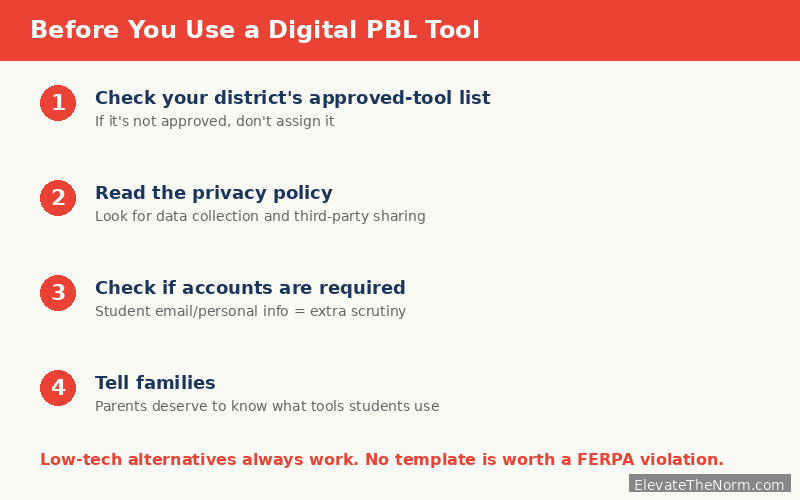
Four privacy checks to complete before using any digital project based learning tool with students
Free digital tools for PBL collaboration—shared documents, project management boards, discussion platforms—can be genuinely useful. They can also collect student data in ways that violate FERPA and COPPA if your district has not reviewed them.
Before you put any digital tool in front of students, check four things:
Does your district have a signed data privacy agreement with this platform? Many districts maintain approved-tool lists. Check yours before adopting a new platform, no matter how popular it is with other teachers.
What data does the platform collect, and who can access it? Read the privacy policy. If you cannot find a clear answer, that is your answer.
Can students use the tool without creating personal accounts? Platforms that require student email addresses or personal information deserve extra scrutiny.
Have you told families what tools students will use? Parents have a reasonable expectation of knowing what platforms their children are accessing at school. A brief note home listing the tools and their purpose prevents problems later—and builds the trust that makes PBL possible across the school year.
A multi-complementary study published in 2026 found that PBL’s positive effects on academic achievement and motivation held across diverse school contexts (Batdı et al., 2026). The method works. The technology is optional. Do not let a tool’s convenience override your students’ privacy rights.
Low-tech alternatives work. Shared physical whiteboards, paper critique forms, printed calendars posted on the wall, and in-person presentations to real audiences are PBL resources too—and they do not collect data on anyone.
The same evaluation applies to the reading platforms projects tend to lean on. Several of the best-known ones have moved features behind a school licence since teachers first started recommending them, so it is worth checking which classroom reading tools are actually still free before you build a project around one.
What This Site Is Building
ElevateTheNorm.com is developing original, downloadable PBL resources specifically designed for grades 6–12 teachers. These are not reformatted versions of existing tools. They are built from the ground up for secondary classrooms where you have 50-minute periods, 27 students, and no extra planning time.
Planned resources include:
A one-page PBL project planner that includes a built-in calendar and standards-alignment section
A student-facing critique protocol adapted from the “kind, specific, helpful” framework for secondary use
A single-point rubric template with content and process rows pre-built
A mid-project reflection form designed for 10-minute checkpoint conversations
A driving-question development worksheet students can use to strengthen their own questions
These will be free, downloadable, and designed to be used without training. Watch the resources page for availability.
The driving-question worksheet is the one most teachers reach for first, and it is also the hardest to fill in cold. If you want models before you write your own, these driving question examples for grades 6–12 walk through strong and weak versions in science, social studies, math, and ELA, along with a five-step formula for revising a question that is not working yet.
Three Things to Do Before You Use Any of These Resources
Before you download a single template, do three things that will determine whether the resources actually improve your projects:
1. Pick one resource and learn it well. Do not download everything on this list at once. Choose the tool that addresses your biggest current weakness—planning, critique, or assessment—and use it for one full project before adding another.
2. Adapt it for your students. Every template on this list was designed for a general audience. Your students are not a general audience. Simplify the language for sixth graders. Add content-specific criteria for your subject. Adjust timelines for your block length. A resource you have customized will outperform a polished one you use as-is.
3. Teach the tool before you use it. A critique protocol that students encounter for the first time during a high-stakes project review will not produce useful feedback. Practice the protocol on low-stakes work first. Let students get comfortable with the structure before the quality of their feedback matters.
4. Let students help choose. When you are deciding between two reflection formats or two critique structures, let your class weigh in. Students who helped select the tool will use it more seriously than students who had it handed to them. This is not about making every decision a vote—it is about giving students real voice where their input genuinely improves the outcome.
Sources
Zhang, L. & Ma, Y. (2023). “A study of the impact of project-based learning on student learning effects: a meta-analysis study.” Frontiers in Psychology, 14, Article 1202728. https://pubmed.ncbi.nlm.nih.gov/37564309/
Batdı, V., Elaldı, Ş., & Sönmez, A. (2026). “Project-based learning in schools: a multi-complementary study of its effectiveness.” Humanities and Social Sciences Communications, Nature. https://www.nature.com/articles/s41599-026-06684-4
Do I need special training to use project based learning resources effectively?
No, but you do need to understand the resource before putting it in front of students. A planning template assumes you know what belongs in each section. A critique protocol assumes you have practiced the process yourself. Spend 30 minutes with any new resource before your first use. Modify it for your students. Most PBL resources are designed to be self-explanatory, but “self-explanatory” and “ready to use cold” are not the same thing.
Are these resources appropriate for both middle school and high school?
Yes, but with adaptation. A driving-question rubric designed for general use will work for both, but the language may need simplifying for sixth graders and the complexity expectations may need raising for eleventh graders. The resource categories—planning, critique, rubrics, reflection—apply across grades 6–12. The specific templates within each category need adjustment for your students.
How do I know if a PBL resource is actually backed by research?
Look for the source. A resource from PBLWorks is built on the Gold Standard PBL framework, which is grounded in decades of research. A resource from a random education blog may or may not be. Check whether the organization behind the resource cites peer-reviewed studies, has been evaluated by independent researchers, or is affiliated with a university or established research organization. If a resource makes bold claims about student outcomes and cites nothing, treat it with skepticism.
What if my school does not allow certain digital tools?
Use the paper versions. Every digital PBL tool has a low-tech equivalent: printed calendars, paper critique forms, physical whiteboards, and face-to-face presentations. PBL existed before project management software. The method does not depend on the technology—it depends on a strong driving question, sustained inquiry, and a real audience for student work.
How do I protect student privacy when using free online PBL tools?
Check your district’s approved-tool list first. If the tool is not on it, ask your technology coordinator to review it before assigning it to students. Look for platforms that do not require student accounts or personal information. Read the privacy policy—specifically the sections on data collection, third-party sharing, and data retention. When in doubt, use the paper version. No planning template is worth a FERPA violation.
Can I use these resources if I have never done PBL before?
Yes, and you should start small. Pick one project for one unit. Use the PBLWorks Project Design Overview to plan it. Use the EL Education critique protocol to structure peer feedback. Use a simple reflection prompt at two checkpoints and at the end. Do not try to use every resource on this list for your first project. Build your capacity one tool at a time.
What is the most important PBL resource for a teacher just getting started?
A driving-question tool. Everything in a PBL project flows from the driving question. If the question is weak—too narrow, too Googleable, too disconnected from standards—no amount of beautiful templates will save the project. Start by learning how to write and test a strong driving question, then add planning, critique, and assessment tools as you gain experience.
About Clay Shumate
Clay Shumate is a certified secondary Social Studies teacher in the public schools of West Alabama, with seven years of classroom experience, a B.A. in History, and an M.Ed. in Secondary Education. He writes about project-based learning, student responsibility, respect, and practical ways to hold young people to a higher standard while giving them room to learn from mistakes. He is a member of the Society of Professional Journalists and writes to its Code of Ethics; this site’s editorial standards and corrections policy are published in full. More about Clay.
I counted my own talk time and did not like the number. That is the honest reason this article exists.
A student centered learning classroom is a room where students do most of the thinking, talking, and deciding — and where the teacher is more present than in a lecture room, not less. The adult does not step back. The adult stops narrating and starts circulating.
Everything below is what that costs, where it breaks, and who it is hardest on.
Key takeaways
Researchers summarizing prior work across classroom, small-group, and tutoring settings put teacher talk time in the 72–88% range (Demszky et al., 2023). That is a summary of mixed settings, not a measurement of American secondary classrooms — but nobody who has measured it has come back with a low number.
In one study of 639 Czech ninth graders in language arts classes, the average student spoke for roughly 12 seconds of whole-class talk in a lesson, and 46 spoke for zero seconds (Šeďová & Sedláček, 2022).
Student-centered does not mean teacher-absent. Across 133 observed high school classrooms, autonomy support and structure were positively correlated and both predicted students’ observed behavioral engagement — complementary, not opposed (Jang, Reeve, & Deci, 2010).
Structure comes first. If your routines are not solid, build those before you release talk time. Handing over a room that has no container is not student-centered, it is unmanaged.
Talk ratio is a diagnostic, not a scoreboard. In one large elementary math dataset, baseline student talk percentages did not by themselves correlate with observation scores or value-added scores (Demszky & Hill, 2022).
One plan gets submitted. If you teach four sections of the same course, four get taught — and the four variants belong on the submitted copy, not only in your head.
Post the plan with times. Then say out loud when you change it, and why.
Lay out the plan, then pause and let the silence do the work. It is expensive — I once waited five minutes and put a section nine minutes behind — so decide in advance that you are willing to pay for it.
How much are you talking at your class?
More than most of us would guess. That is not an insult. It is close to a law of the profession.
Researchers summarizing prior work across whole-classroom, small-group, and one-to-one contexts put teacher talk time in the range of 72% to 88% (Demszky et al., 2023). That range comes from a paper about online math tutoring, so treat it as a summary of what has been measured across mixed settings rather than a number pinned to a tenth-grade history room. In a dataset of 1,660 elementary math lessons, teachers produced 87.7% of all the words spoken while taking only about half the turns (Demszky & Hill, 2022). Words, not minutes — but the two track closely enough to make the point. That study is fourth and fifth grade math, not a high school room, and I am not going to pretend otherwise.
Here is the number that got me. In a study of 639 Czech ninth graders across 32 language arts classes, the average individual student talked for about 12 seconds of whole-class discourse in a lesson. Forty-six of those students spoke for zero seconds (Šeďová & Sedláček, 2022).
Two things about that 12 seconds, because it gets misused. It measures whole-class talk. It is the strongest argument I know for not making whole-class discussion the main event — it is not a scoreboard for a room already running on partner work. And the same researchers were careful about the students who stay quiet: they treat silent thinking as a real form of participation, not as passivity. Their two highest-scoring profiles both involved a lot of talk, so talk does appear to add something. But a silent student is a question, not a verdict.
When students do talk, it is usually because they were asked a question that already had an answer. Martin Nystrand and Adam Gamoran observed 58 eighth-grade English classes and found discussion occupied “an average of less than a minute per day,” with only 12% of teacher questions authentic — questions the teacher did not already know the answer to (Nystrand & Gamoran, 1989). That is 1989, and it is fair to ask whether anything changed. Sean Kelly and colleagues checked across four studies of grades 6–12 English classrooms spanning three decades. Authentic questions ran from 18% to 35% (Kelly et al., 2018). Better. Not fixed.
My take, not a finding: most of us do not talk that much because we love the sound of it. We talk because talking is the one part of the period we can fully control, and a silent room feels like proof that we are the problem. Filling it is a nervous habit.
One warning before you go count anything. Talk ratio is a symptom, not a target. In that same elementary dataset, baseline student talk percentages did not by themselves correlate with observation scores or value-added scores (Demszky & Hill, 2022). You can hand a room to students and get thirty minutes of nothing.
There is better news on the other side of that, from the same paper the 72–88% range came from. In a randomized trial on a tutoring platform, feedback on talk time raised student talk ratios by about 13–14% — and when the feedback went to students rather than only to the tutor, student reasoning rose 24% and the number of distinct mathematical terms students used rose 18% (Demszky et al., 2023). That is 1:1 online tutoring with mostly elementary students, so hold it loosely. But it suggests the ratio is worth moving when what fills the gap is thinking, and worth nothing when it isn’t.
The harder question: whose class is it?
I catch myself saying “my class” and “my room” constantly. Every teacher does. But listen to what is buried in that phrasing. My time. My plan. My period getting derailed.
It is their education. It is their class too. Being the adult means you are responsible for the room — not that you are entitled to every decision inside it.
This is not a soft point. It is the part of adolescent development that secondary schools are worst at.
David Yeager, Ronald Dahl, and Carol Dweck argue that adult interventions with teenagers fail specifically when they ignore what adolescents want most: “traditional interventions fail when they do not align with adolescents’ enhanced desire to feel respected and be accorded status,” while approaches that give adolescents more respectful treatment from adults can produce internalized change (Yeager, Dahl, & Dweck, 2018). The National Academies put the institutional version bluntly in The Promise of Adolescence: “Requirements for stringent adherence to rule-following and conformity in secondary schools may be at odds with such self-discovery,” in a period when “optimal development is stimulated through exploration, making and learning from mistakes, and trying on identities” (National Academies of Sciences, Engineering, and Medicine, 2019).
Read that as a design constraint. A room built entirely around compliance is working against the developmental stage of everyone in it.
There is also a reason correcting a sophomore in front of thirty people lands differently than correcting an adult in a staff meeting. Leah Somerville and colleagues scanned 69 people aged 8 to 22 while they believed a peer was watching them on camera. Believing they were observed was “sufficient to induce self-conscious emotion that rose in magnitude from childhood to adolescence,” with self-reported embarrassment peaking around age 17 and matching physiological arousal (Somerville et al., 2013). That is a lab paradigm, not a classroom study, so applying it to a public redirect is my inference — but it is a short one, and it lines up with the case for handling correction quietly at close range instead of announcing it, which is the same argument as what volume actually costs you.
Quiet means volume and audience, not proximity and not secrecy. Stay at normal conversational distance, never between a student and the door, visible to the rest of the room, no contact with the student or their desk. If their body language says closeness is making it worse, back off and come back. And quiet does not mean undocumented — if you redirect the same student for the same thing three times, that goes in your log, because a pattern nobody wrote down is a pattern nobody can help with.
Separate case, and I want to be unambiguous: in an actual emergency — a fight, an injury, a lockdown — a loud, direct, unmistakable voice is exactly the right tool and you should not hesitate for a second.
What does a student centered learning classroom actually look like?
No rows. Every seat is beside somebody, before anyone walks in.
It looks busier than a lecture room and louder than most observers expect. The adult is rarely in one place. Students are working next to somebody most of the time. And there is usually a small group pulled aside getting something retaught.
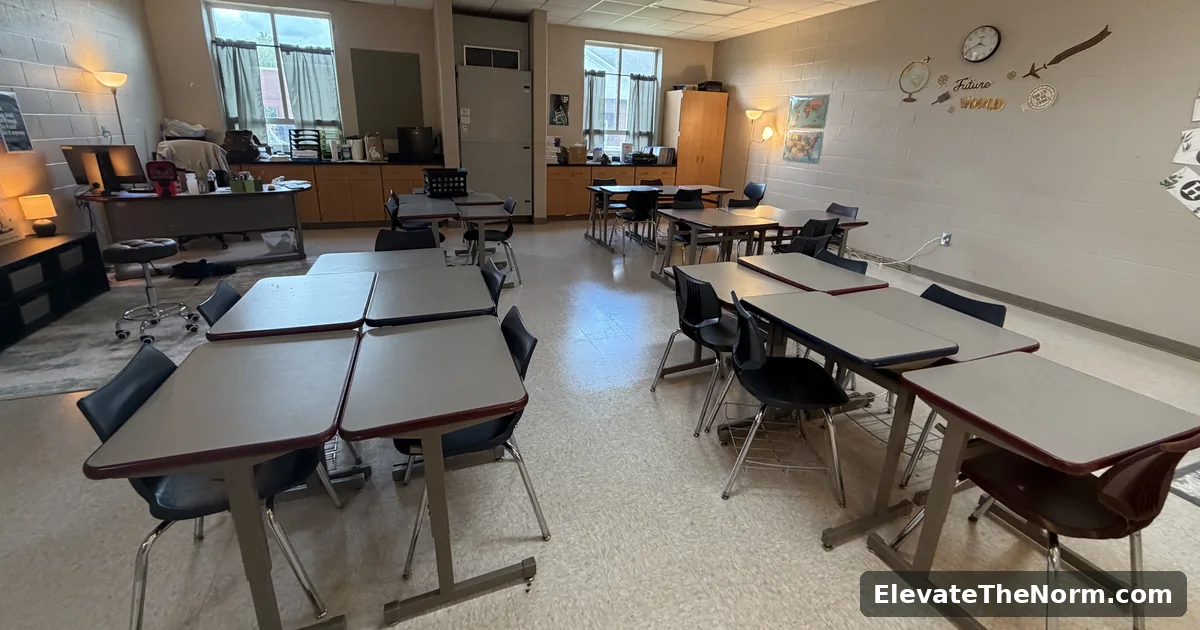
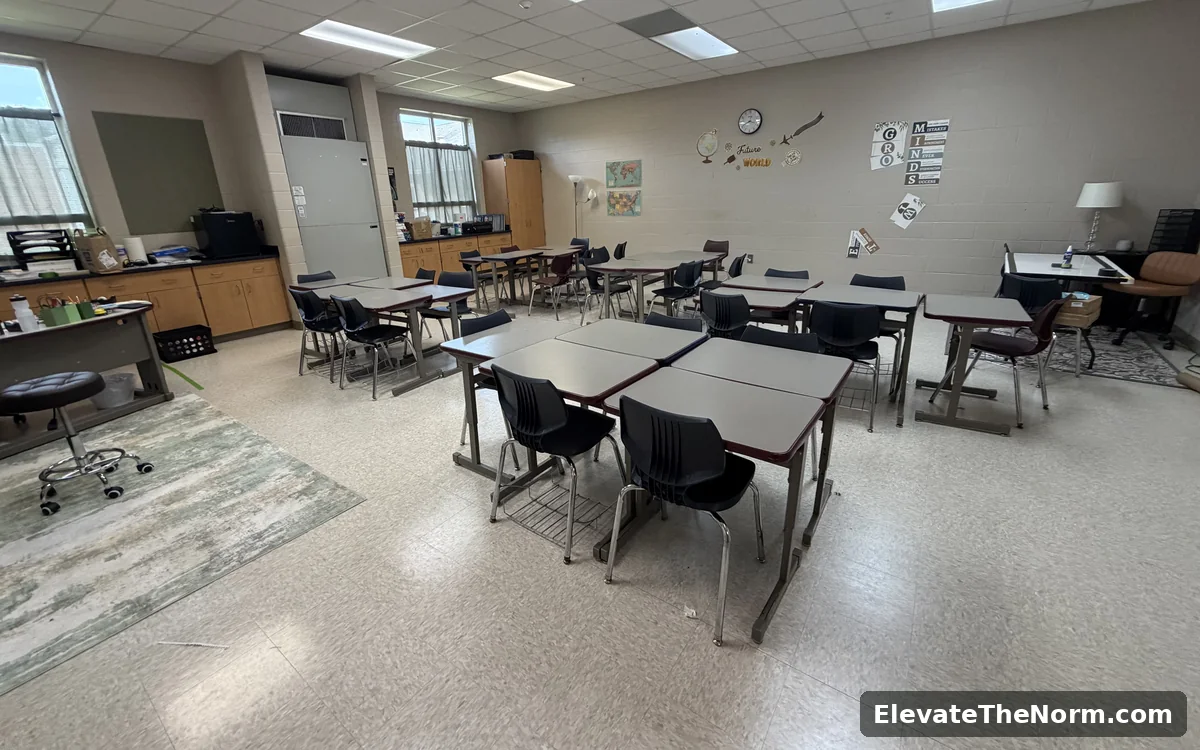
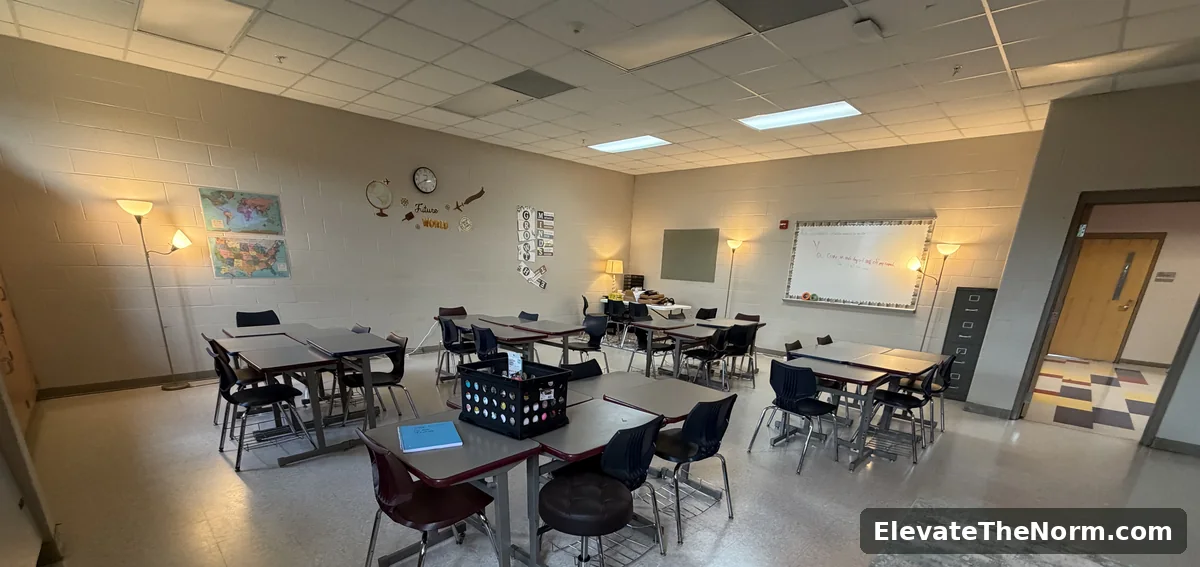
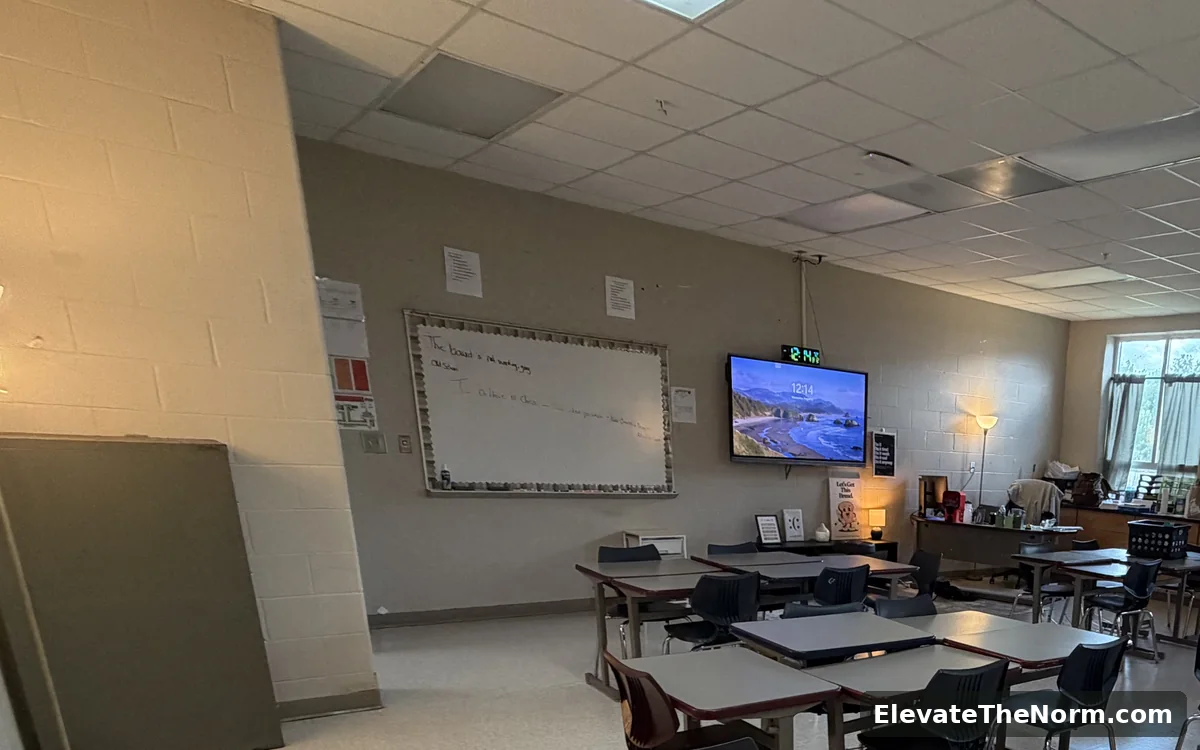
I do not run a face-front, take-notes room, and I do not turn the overhead lights on. The room runs on floor lamps instead of the overhead fluorescents. There are rugs. The tables are pushed together in pairs and fours, so there is no version of my room where a student sits alone by default — every seat is beside somebody.
The whiteboard table is one I built myself. It sits in the lowest-lit corner, on a rug, with the better chairs.
That placement was deliberate, and it fixed a problem most writing about small-group instruction never mentions: a designated table where the teacher takes struggling students becomes the dumb table by the third week of school. Teenagers name things fast, and they name them cruelly. You cannot policy your way out of it.
What worked was making it the best seat in the room. Students ask to go there. When I bring a pair over, nobody reads it as a verdict, because half the class has been angling for that table since August. I also bring pairs over for reasons that have nothing to do with being stuck — to steal an approach I want everyone to see, or to argue with somebody about a claim they got right.
None of that was expensive. The lamps came from a big-box store, the rugs were cheap, and the table is a thing I made.
One practical rule that goes with all of it: when I sit down with a pair, I sit facing the room, and the conference runs five or eight minutes, not twenty. You are still the only adult responsible for everyone in there, and “I was conferencing” is not an answer anyone will accept.
Observable
Teacher-dominated room
Student-centered room
Where the teacher is
Front, mostly stationary
Moving; frequently seated with a pair or small group, facing the room
Who talks
Teacher does most of it — measured ranges run about 72–88%, which is near the profession-wide average rather than a mark of a bad room
Still a lot of teacher — but in short bursts, to fewer people at a time
Questions asked
Mostly known-answer
More authentic questions; follow-ups that build on what a student just said
What “on task” sounds like
Silence as the default and the goal
Working noise, with the teacher able to name what each group is stuck on
Who fixes a misunderstanding
Teacher, to the whole room, at the end
Teacher, to the two students who need it, right now
Where the plan lives
In the teacher’s head
On the board, with times, visible to everyone
What happens when it goes sideways
Volume goes up
Plan changes out loud, and the room is told why
Working silence and compliance silence are different things. Thirty people writing is a mode. Thirty people waiting is a symptom. Nothing in that table asks the teacher to disappear — there is no column where the adult sits down and lets it run. If you want the longer version of that argument in a project context, it is the same one I made about the teacher being more present, not less.
Is it a working room or a lost room?
I have heard teachers who had genuinely lost a class repeat the “a working room is louder” line as cover. So here is the test, and you should run it on yourself honestly, because your administrator is running it on you.
Working room
Lost room
You can stop it in under five seconds at normal volume
You have to raise your voice to be heard
You can name what every group is working on
There are groups you have not spoken to in fifteen minutes
The noise is about the task
You do not know what two of them are doing
Every student has something in front of them
Students are moving without a reason
If you are in the right-hand column, the answer is not more student-centered. It is routines and procedures first, then release.
The students this is hardest on
Overheads off, lamps on, floor kept clear enough to walk.
A louder, busier, more socially demanding room is exactly the room that is hardest for an autistic student, a student with ADHD, a student with auditory processing differences, a student with anxiety, and a student who is new and does not know anybody. If you change your room and do not plan for them, you have improved the average and hurt the specific.
Every IEP and 504 accommodation applies in a workshop room exactly as it does in a lecture room. A louder room is not a reason an accommodation lapses. It is a reason to check that it is still working. If a student’s plan calls for reduced distraction, talk to their case manager before you change the room, not after a parent calls.
What that looks like in practice:
A designated lower-stimulus seat away from the highest-traffic path, offered without a conversation about why. Some of this you can build into the room itself — I run mine on floor lamps instead of overhead fluorescents, which costs nothing and quietly helps more students than the handful who would ever have asked.
Standing permission to use noise-reducing headphones during work time, without asking each time.
The posted agenda doing double duty as the visual schedule some plans already require.
A pre-arranged, non-verbal way to take a break.
A real solo option for at least one task a week, and a private way to ask for it — a card, a form, a two-word email — that does not require negotiating in front of an audience.
You assign the pairs. Always. No student is ever asked to find a partner in front of the class, and no student is ever left standing. That single rule prevents more damage than anything else in this article. Rotate pairings on a schedule so nobody is locked in, and give students a quiet way to request a change that you honor the first time without an interrogation.
And participation is not the same thing as speaking. A written or drawn response is an equal deliverable. For a multilingual learner in the silent period, quiet is what second-language acquisition predicts, not disengagement — get their thinking in writing, with a partner, or in their first language before you conclude anything. Some students have accommodations that explicitly exempt them from required oral participation. Check before you change how you call on someone.
What the students actually decide
If I stopped here, I would have described a well-run room where a thoughtful adult makes every decision. That is better than most classes. It is not ownership, and I am not going to claim it is.
Ownership means students decide things that actually change the class — through activities for student centered learning that hand over real decisions, not cosmetic ones. Here is what I hand over, with the guardrail on each:
Students decide
I keep
The form the product takes — write it, build it, present it, record it
The criteria it is judged against, which are the same for every form
The order they work through the day’s tasks
That all of it is finished by the checkpoint
Whether a task is worth the time — answered on a Friday exit slip, anonymous
Whether I change anything, and I say so on Monday either way
Who they would work well with, submitted privately
The final pairings, and the rule that nobody is stranded
The other thing they get a real vote on is the room itself. The last one was a class pet, and they wanted one badly enough that it is now happening. I will say the quiet part, because it surprises people: high school students want a class pet. They want cheap prizes. They want to be recognized by name. They just will not show you any of that on the outside, and if you read the outside as the answer you will conclude they do not care about anything.
The Friday slip is the one that matters most and costs the least. One question: what part of this week was a waste of your time? Read two or three out loud on Monday and say what you are doing about them. A room where the adult never asks is a room the students correctly understand as not theirs.
Every class period has a shape. Second period is not fourth period, and the same lesson does not land the same way at 8:05 and 1:40. The five-minute pause I describe below is the extreme version — one section ended up nine minutes behind the others off a single decision I made on the spot. Sections drift apart whether or not you plan for it. The only question is whether you are tracking the drift.
You cannot plan for that shape in advance. You can only watch for it, and watching requires evidence. A room can look engaged and be lost. This is why three seconds of silence changes who talks, and why a check that produces something readable from every student beats scanning faces for nodding.
What I watch for, in order:
The first stall. Not the loud group — the quiet pair who stopped writing four minutes ago and have not asked for anything.
Repeat questions. If three groups ask a version of the same question, that is usually one bad instruction I gave. Before I stop the room, I ask the third group to tell me what the task is. If they can say it correctly and still cannot start, my directions were fine and the content needs reteaching — a different interruption entirely.
The energy drop. Usually two-thirds of the way through. It is predictable enough to plan a transition for.
Who I have not talked to. Not who has not addressed the room — who I personally have not had thirty seconds with this week.
That last one needs a system or it becomes a good intention. Keep the roster on a clipboard and mark a date every time you conference with a student. On Friday, look at the blank rows, not the full ones. Anybody blank for two weeks gets time the following week whether or not they look stuck. The kid who nods, writes something down, and quietly does not understand is invisible in a lecture room and invisible at a table, and she is the whole reason to keep the list.
If your room gets loud while you are learning to run it this way, that is not automatically a management failure — but “not automatically” is doing real work in that sentence, and the two-column test above is how you tell. I made the longer case in why a working room sounds louder than a quiet one.
When partner work doesn’t work
Somewhere on your schedule is the section where this falls apart. Nobody writes about that section, which is why teachers try this once, watch twenty minutes evaporate, and go back to rows.
Before you decide partner work is wrong for that section, check who is sitting with whom. Pairings are a seating decision as much as an instructional one, and building the chart deliberately — on a cycle you announce, changed for the whole room rather than one student — fixes more of this than most people expect.
What has actually helped me:
Do not start with your hardest section. Build the routine where it will work, get the language right, then carry it over.
Start short. If a section cannot hold twenty minutes, it holds eight. Build up. Eight minutes that work beat twenty that don’t.
Every pair produces something visible, with a checkpoint in the middle. “We’re thinking about it” stops being an available answer.
Every student turns in their own paper, even when the thinking was shared. Or assign the two jobs out loud before you release — one drafts, one challenges, swap at the halfway mark.
The students who cannot handle a partner yet work near your circulation path, in an assigned pair. Near you, not exiled.
Write your sub plans for a different room than the one you run. A substitute cannot circulate, pull groups, and read four sections. Leave them something structured, seat-based, and self-contained. That is not a retreat — it is the only version that is safe with an adult who does not know your students’ names.
Week two is where people quit. The first three times you run this, some of it will be wasted and you will want the microphone back. Run it anyway, and afterward tell the room specifically what worked and what you are changing tomorrow. You are training a routine, not delivering a lesson, and routines take about three weeks.
One lesson plan turned in. Four plans taught.
If you teach four sections of the same course, you do not have one lesson plan. You have four. The objective, the materials, and the assessment hold still. The delivery moves.
My take, not a finding: I have not found research testing whether varying delivery across sections of the same course improves outcomes. This is my practice and my name for it, not an evidence base. Weigh it as practitioner experience.
Write the four variants on the submitted copy — two lines each. 2nd period: 8-minute mini-lesson, pull Group C first. 4th: model 15, checkpoint at minute 25. Ninety seconds of writing keeps your plan of record accurate for an evaluator, for a substitute, and for anyone checking that an IEP’s grouping or timing requirement was actually delivered. If your school runs common pacing or an adopted program, clear the variation with your department chair first; the objective and assessment staying fixed is usually what makes it fine.
Honest cost: about ten extra minutes per section the first month, closer to three once you know your sections. That is real time out of a planning period that is already spoken for. And if you have three preps across six sections rather than four sections of one course, do not attempt this everywhere — pick the course you teach most often and let the others run as written.
Stays the same in every section
Gets modified per section
Standard and objective
Length of direct instruction before release
Core text, task, or problem set
Where the mid-period checkpoint lands in the period
What the checkpoint asks — same prompt everywhere, or the results are not comparable
Which supports are out without asking: sentence frames, a worked example left visible, chunked directions
The assessment and its criteria
How much is modeled versus attempted first
IEP and 504 accommodations — these follow the student, never the section
Which pairs get a check-in in the first five minutes
The non-negotiable expectations
Which small groups get time, and in what order
Two limits on this. Grouping changes week to week based on what the last check showed — if the same five names are in the same group in October and in March, that is not grouping, that is tracking inside your own classroom, and you built the thing you were trying to avoid. And modifying delivery never means one section gets less content. Same standard, same task, same assessment, every section. You should be able to say that out loud to a parent without hedging.
Structure itself has real evidence behind it, even if my four-plan habit does not. Brandi Simonsen and colleagues reviewed the classroom management literature and identified 20 practices with enough evidence for adoption across K–12, organized under five critical features. The first is “maximize structure,” which they define as “the amount of teacher or adult-directed activity, the extent to which routines are explicitly defined, and the design or physical arrangement of the classroom” (Simonsen et al., 2008).
Tell them the plan for the day — down to the minute
Where the plan goes up, with a clock the whole room can see.
Put the plan on the board with times attached and go over it in the first ninety seconds. Not “today we’re doing the Industrial Revolution.” Actual segments, with actual minutes.
Bell work, 5. Mini-lesson, 8. One problem together, 4. Partner work, 20. Table conferences run during partner work. Debrief, 6. Exit ticket, 2.
Those four minutes where you do one with them are the cheapest insurance in the period, and they are the first thing everybody cuts. Going straight from your model to partner work is the most common reason three groups ask the same question ten minutes later.
Those minutes are also a high school period. In a sixth- or seventh-grade room, cut partner work to eight or ten, give each student a named job, and build up. The structure holds; the block lengths don’t.
When you shorten the mini-lesson, cut in this order. First: logistics and announcements — put them on the board. The four-sentence “why this matters” preamble — make it one sentence. Vocabulary front-loading — move it into the materials where students actually hit the words. Second: your second and third examples, replaced by one fully worked example plus one partial one students finish with you. Never cut the one complete worked example or the model of what a finished product looks like. If you cannot state the objective and show one worked example in ten minutes, the task is too big for one period. The mini-lesson is not the problem.
Two things happen when you post times. Students stop wondering what is coming. And you commit to a talk budget in front of witnesses. Eight minutes means eight minutes. It is the single most effective device I have found for keeping myself from talking for thirty.
Photograph the board or paste the same agenda into your learning platform each day. Ten seconds, and it gives an absent student a way to reconstruct the period and a parent a way to see what actually happened.
The research here is real but should be stated carefully. Across 144 reported effects (N = 73,281), students who rated their teachers as clearer also reported more learning — a correlation working out to roughly 13% of the variance, and one that runs stronger for how students feel about a course than for what they can do at the end of it (Titsworth et al., 2015). That literature leans heavily on college samples and on students’ perceptions, so read it as a reason to be clear rather than a mechanism you can bank on. On routines, the IRIS Center at Vanderbilt, a federally funded teacher-training resource, advises that “predictable classroom routines can help to create a sense of calm and order and ease some students’ anxiety and related behaviors” (IRIS Center, n.d.) — practitioner guidance, not a study, and I am labeling it as such.
My take, not a finding: the posted plan is a promise. The point is not that you hit the times. It is that when you miss them, you owe the room an explanation. “We’re cutting the debrief to three minutes because the partner work was better than I planned for” costs four seconds and buys an enormous amount of credibility. Silently taking twenty minutes of their time and never mentioning it is how students learn that the schedule was never really theirs.
Organization to the minute, and then the pause
Here is the half of it nobody tells you. Once the plan is laid out, you stop talking and wait. Confidently. You do not fill the silence, and you do not raise your voice into it.
I once waited more than five minutes.
It is one of the most awkward things I have ever done. Five minutes of silence in front of a room of teenagers is far longer than it sounds — long enough that you start negotiating with yourself about whether you have made a serious mistake, and long enough that every instinct you have is screaming at you to say something and take the pressure off. I did not say anything.
That section finished the period nine minutes behind my other classes. It is the only time I have ever assigned homework.
I want both halves of that on the page, because this story usually gets told with only the first one. The pause worked. It also cost nine minutes I did not have, and the students paid part of that bill at home. If you are going to wait, decide in advance that you are willing to pay for it — and then tell the room plainly what it cost. That is the posted plan doing its actual job. The alternative is talking over them, which buys you about eleven seconds and a much larger bill later.
The wait is not theater, and it is not new. Mary Budd Rowe recorded classrooms and found teachers leave about one second after asking a question before someone has to fill it; stretching that to three to five seconds lengthens student answers, raises the number of students who volunteer, and pulls in the students rated as slower. I wrote about that at length in three seconds of silence changes who talks. Five minutes is a different animal — that is waiting for a room, not for an answer — but it runs on the same principle. Silence is a tool. Most of us are too uncomfortable to pick it up.
My take, not a finding: the confidence is the whole thing. A pause you are comfortable with reads as authority. The same pause, delivered by somebody who is visibly dying inside, reads as a teacher who has lost the room — and teenagers can tell the difference instantly. If you cannot hold thirty seconds yet, do not start with five minutes. Hold ten, then twenty, then a minute. Build it the way you would build any other routine.
Tell families before they hear it secondhand
Here is the sentence that generates every phone call: “We don’t really do anything in that class, we just work with a partner.” It will be said at somebody’s dinner table in the first two weeks, and if the first version a parent hears is from a fifteen-year-old, you are explaining your practice from behind.
Three sentences in the syllabus, on a back-to-school slide, or in one email:
This class runs as a workshop. There is direct instruction every day — usually a short mini-lesson — and then students spend most of the period working on the task with an assigned partner while I move between pairs and conference with small groups. The room is louder than a lecture room; that is intended and it is not a discipline problem. The daily plan with time blocks is posted on the board and online. Grades are based on individual work — no student’s grade depends on another student’s effort. All IEP and 504 accommodations continue exactly as written. If your student is ever lost, stuck with a partner who isn’t working, or overwhelmed by the noise, email me. Those are fixable and I want to hear about them early.
Ten minutes once. It prevents the version where you find out in a conference.
Doesn’t this just mean the teacher does less?
No, and this is the misreading that has done the most damage to the phrase “student-centered.”
Johnmarshall Reeve and Sung Hyeon Cheon draw the line directly: autonomy support and a laissez-faire style both look student-focused from a distance, but “autonomy support is a motivationally supportive approach that energizes students’ autonomy satisfaction while laissez-faire is a demotivating approach that leads to students’ autonomy frustration” (Reeve & Cheon, 2021). The difference shows the moment a student struggles. The autonomy-supportive teacher moves toward them. The laissez-faire teacher leaves them to figure it out.
The best secondary-level evidence says the same thing in its title. Hyungshim Jang, Reeve, and Edward Deci observed 133 public high school classrooms and surveyed 1,584 students in grades 9 through 11. Autonomy support and structure were positively correlated, and both predicted students’ observed behavioral engagement — though only autonomy support uniquely predicted what students said about their own engagement. The paper is called “It Is Not Autonomy Support or Structure but Autonomy Support and Structure” (Jang, Reeve, & Deci, 2010). It is observational data, so read it as “these travel together,” not “do both and engagement follows.”
From the other direction, Paul Kirschner, John Sweller, and Richard Clark’s well-known critique holds that “minimally guided instruction is less effective and less efficient than instructional approaches that place a strong emphasis on guidance of the student learning process” (Kirschner, Sweller, & Clark, 2006). Their target is minimal guidance. A workshop room with a circulating teacher, posted expectations, a worked example, and small-group reteaching is not minimally guided. A room where the adult assigns a project and sits down is. That same line runs through the evidence comparing project based and traditional learning — the project studies that hold up are the guided ones.
One more thing worth knowing before you try this. In a randomized crossover study, Harvard undergraduates in active-learning physics sections scored about half a standard deviation higher on a 12-question test given immediately afterward (+0.46 SD) — and rated their own feeling of learning more than half a standard deviation lower than students who sat through a polished lecture (−0.56 SD) (Deslauriers et al., 2019). College physics and immediate recall, not tenth-grade history, so hold it loosely. But the mechanism travels: a smooth lecture feels like learning, and the harder thing that produces learning feels worse while you are doing it.
Which means you should expect pushback — and sort it rather than dismiss it. “This is harder than watching you talk” is the work doing its job. “My partner does nothing,” “I can’t hear in here,” “I never know what my grade is based on,” “I never get help” are not complaints about rigor. Those are defect reports about your design, and if you hear the same one twice, assume it is true and go look.
A five-day audit you can start Monday
Measure before you redesign. One standing rule: nothing in this audit should create a file about a student. If a step would produce a recording, a photo, or a named list that leaves your hands, stop and check your district’s policy first.
On recording specifically — do not put your phone on the desk and record the class. Recording minors is governed by your state’s consent law, your district’s policy, and student-data rules, and a personal phone that backs up to a cloud account has just moved a recording of thirty children somewhere nobody approved. If you genuinely want audio, that is a written-approval conversation with your principal, not a Monday task.
If you currently teach mostly from the front:
Monday — count yourself, without recording. Set a silent timer to buzz every 60 seconds. At each buzz mark one tally: T if you were talking, S if a student was. Thirty tallies is a solid ratio and it captures nothing about any child. Or ask a colleague on their planning period to run a stopwatch for twenty minutes.
Tuesday — count who you heard from, in any form. On a seating chart, mark three things: spoke to the class, spoke with you one-on-one, gave you something readable in writing. All three count. The names with nothing in any column are the ones to look at — not the names with nothing in the first. Then shred the chart or file it where you keep grades. It is a diagnostic for you, never a participation grade, and some students on your roster have accommodations that make required speaking inappropriate.
Wednesday — count your questions. Two columns: questions you already know the answer to, and questions you don’t. If the second column is under about a fifth, you are at the low end of what researchers have measured in secondary English classrooms, where authentic questions ran 18% to 35% (Kelly et al., 2018). If you only run one day of this, run Wednesday — question quality has a better-established link to learning than raw talk share does.
Thursday — post the plan with times. One section. Ninety seconds to go over it. Announce every change out loud when it happens.
Friday — cut ten minutes and collect something. Move ten minutes of your talking into partner work with a written checkpoint, and collect the checkpoint. Compare that pile to the same kind of check from a lesson you taught the old way. The talk numbers tell you what changed in the room. Only the checkpoints tell you whether it was worth it.
If your room is already a workshop, the audit above measures the wrong thing — a phone on the desk in a room with twelve simultaneous conversations tells you nothing. Run this version instead: after each period, write the names of every student you actually spoke with; on Friday count who you never reached. Tally authentic versus known-answer questions at the table only. Time your mini-lesson against the number you posted. And ask one colleague for a ten-minute drop-in with a single job — can I name what each group is stuck on?
Four of those five days need no budget and no permission. Recording is the exception, and the answer in many districts will be no. That is a legitimate answer.
A note for coaches, chairs, and administrators
Do not roll this out as an initiative. Run the five days with one volunteer department, have them share their Wednesday numbers with each other and nobody above them, and let the second cohort be people who asked. Three walkthrough look-fors that work: can the teacher name what each group is stuck on, is the plan posted with times, and can two students you pick at random say what they are doing and why. Protect the planning time before you ask for the four-plan habit — if you add thirty minutes a day to a teacher’s prep without taking anything off, you will get compliance for about three weeks.
What this actually asks of you
Not to talk less for its own sake. To notice that the period belongs to thirty other people, and to build it like you believe that.
Watch how each section moves and plan for the one in front of you instead of the one you imagined in July. Put the plan where they can see it, and say something when it changes. Bring the two students who are stuck to a table and work it out with them instead of reteaching it to everyone who already has it. Assign the pairs so nobody is left standing. Ask them on Friday what wasted their time, and answer on Monday.
That last one is the difference between a room that is run well and a room that is theirs. As I have written before, the goal was never a quiet room. It was a room the students own.
Frequently Asked Questions
What is a student centered learning classroom, in one sentence?
A classroom where students do most of the thinking, talking, and deciding, while the teacher stays highly active — circulating, conferencing with pairs and small groups, and adjusting the plan in real time — rather than delivering content from the front for most of the period.
Is there a target percentage for how much a teacher should talk?
No, and be suspicious of anyone who gives you one. Prior research across mixed settings puts typical teacher talk at 72–88% (Demszky et al., 2023), so most of us have room to move. But in one large elementary dataset, student talk percentages did not by themselves correlate with observation scores or value-added scores (Demszky & Hill, 2022). Use the ratio to find where your time goes, then judge what fills the gap.
My child says they “don’t do anything” in this class. What is actually happening?
There is direct instruction every day — a short mini-lesson, a worked example, and usually one problem done together. Then students spend most of the period doing the work with an assigned partner while the teacher moves between pairs. What has changed is that the practice moved from homework into class, where an adult is standing next to it. Ask to see the posted daily agenda; it should show exactly how the period was spent.
How do I know my child gets individual attention and not just the loud kids?
Ask the teacher to check their conference log. A teacher running this well keeps a roster and marks a date each time they sit with a student, then looks at the blank rows on Friday. If your child has not had one-to-one time in two weeks, that is a fair question, and a teacher using a log can answer it with a date.
What about students with an IEP, 504, or anxiety — or a student who has nobody to work with?
Accommodations apply in a workshop room exactly as written, and a louder room is a reason to check that they are still working, not a reason they lapse. Teachers should assign every pairing so no student is ever asked to find a partner in front of the class, offer a lower-stimulus seat and headphones without a conversation, and provide a private way to request a solo task. Participation is not the same as speaking; written work counts.
Doesn’t this take more prep time?
Yes. About ten extra minutes per section the first month, closer to three once you know your sections, because only the delivery notes change. If you have three preps across six sections, do it for one course rather than all of them. On paperwork: daily checks and exit tickets are read, not graded — sort them into three stacks at the door and record only which names landed in “not yet.” Those names are tomorrow’s table conferences.
My evaluation framework rewards a quiet room. What do I do?
Start with the rubric rather than the room. Most instruments in use score student discourse, questioning, and monitoring of student learning directly, and those descriptors usually describe this practice at the top end. Use the pre-conference, name the indicators you are targeting, and tell your evaluator what to look for. Then invite them in for ten minutes on an ordinary day, before any formal observation. If your evaluator scores a fixed rubric and reads noise as off-task, run the observed lesson closer to the front and run the workshop the other four days. That is not a compromise of principle — it is knowing which day is being scored.
Does this mean I should stop giving direct instruction?
No. Minimal guidance is less effective than well-guided instruction (Kirschner, Sweller, & Clark, 2006), and the best secondary evidence says autonomy support and structure travel together rather than against each other (Jang, Reeve, & Deci, 2010). Keep the mini-lesson, the worked example, and the one you do together. Shorten them, put a time on them, and spend the reclaimed minutes at the table with students who need you.
References
Demszky, D., & Hill, H. C. (2022). The NCTE Transcripts: A dataset of elementary math classroom transcripts (EdWorkingPaper No. 22-682). Annenberg Institute at Brown University. https://files.eric.ed.gov/fulltext/ED672127.pdf
Demszky, D., Wang, R. E., Geraghty, S., & Yu, C. (2023). Does feedback on talk time increase student engagement? Evidence from a randomized controlled trial on a math tutoring platform (EdWorkingPaper No. 23-891). Annenberg Institute at Brown University. https://files.eric.ed.gov/fulltext/ED638947.pdf
Deslauriers, L., McCarty, L. S., Miller, K., Callaghan, K., & Kestin, G. (2019). Measuring actual learning versus feeling of learning in response to being actively engaged in the classroom. Proceedings of the National Academy of Sciences, 116(39), 19251–19257. https://doi.org/10.1073/pnas.1821936116
IRIS Center. (n.d.). Page 6: Create a structured classroom. In Classroom management (Part 1): Learning the components of a comprehensive behavior management plan. Peabody College, Vanderbilt University. https://iris.peabody.vanderbilt.edu/module/beh1/cresource/q2/p06/
Jang, H., Reeve, J., & Deci, E. L. (2010). Engaging students in learning activities: It is not autonomy support or structure but autonomy support and structure. Journal of Educational Psychology, 102(3), 588–600. https://eric.ed.gov/?id=EJ892818
Kelly, S., Olney, A. M., Donnelly, P., Nystrand, M., & D’Mello, S. K. (2018). Automatically measuring question authenticity in real-world classrooms. Educational Researcher, 47(7), 451–464. https://files.eric.ed.gov/fulltext/EJ1192954.pdf
Kirschner, P. A., Sweller, J., & Clark, R. E. (2006). Why minimal guidance during instruction does not work: An analysis of the failure of constructivist, discovery, problem-based, experiential, and inquiry-based teaching. Educational Psychologist, 41(2), 75–86. Open University of the Netherlands repository
National Academies of Sciences, Engineering, and Medicine. (2019). The promise of adolescence: Realizing opportunity for all youth. The National Academies Press. https://doi.org/10.17226/25388
Nystrand, M., & Gamoran, A. (1989). Instructional discourse and student engagement. National Center on Effective Secondary Schools, University of Wisconsin–Madison. https://files.eric.ed.gov/fulltext/ED319780.pdf
Šeďová, K., & Sedláček, M. (2022). How vocal and silent forms of participation in combination relate to student achievement. Instructional Science, 50, 549–567. https://doi.org/10.1007/s11251-022-09609-1
Simonsen, B., Fairbanks, S., Briesch, A., Myers, D., & Sugai, G. (2008). Evidence-based practices in classroom management: Considerations for research to practice. Education and Treatment of Children, 31(3), 351–380. https://eric.ed.gov/?id=EJ798223
Somerville, L. H., Jones, R. M., Ruberry, E. J., Dyke, J. P., Glover, G., & Casey, B. J. (2013). The medial prefrontal cortex and the emergence of self-conscious emotion in adolescence. Psychological Science, 24(8), 1554–1562. https://doi.org/10.1177/0956797613475633
Titsworth, S., Mazer, J. P., Goodboy, A. K., Bolkan, S., & Myers, S. A. (2015). Two meta-analyses exploring the relationship between teacher clarity and student learning. Communication Education, 64(4), 385–418. https://eric.ed.gov/?id=EJ1082982
Yeager, D. S., Dahl, R. E., & Dweck, C. S. (2018). Why interventions to influence adolescent behavior often fail but could succeed. Perspectives on Psychological Science, 13(1), 101–122. https://escholarship.org/uc/item/9mm4q4fb
About Clay Shumate
Clay Shumate is a certified secondary Social Studies teacher in the public schools of West Alabama, with seven years of classroom experience, a B.A. in History, and an M.Ed. in Secondary Education. He writes about project-based learning, student responsibility, respect, and practical ways to hold young people to a higher standard while giving them room to learn from mistakes. He is a member of the Society of Professional Journalists and writes to its Code of Ethics; this site’s editorial standards and corrections policy are published in full. More about Clay.
The 7 steps of project based learning move a class from a question worth answering to a product worth defending. They are: identify learning goals, craft a driving question, launch the project, guide inquiry and research, set checkpoints and manage the work, facilitate critique and revision, and present the public product with reflection. Each step has a teacher role and a student role, and skipping any of them is how PBL collapses into a decorated group assignment. Each step works better when teachers and students have reliable project based learning tools—the planning templates, role cards, and critique protocols that keep the process on track.
Why Steps Matter: PBL Without Structure Falls Apart
Project based learning has a reputation problem. Teachers who have tried it and watched it fail usually did not fail at the project — they failed at the process. A class that jumps from “here is your project” to “present on Friday” without the steps in between produces exactly the kind of shallow, off-task, unequal group work that gives PBL a bad name.
The Gold Standard PBL framework from PBLWorks, developed by John Larmer, John Mergendoller, and the Buck Institute for Education, identifies seven essential project design elements: a challenging problem or question, sustained inquiry, authenticity, student voice and choice, reflection, critique and revision, and a public product. Those elements are not decorations. They are structural requirements. Remove any one of them and the project loses what makes it PBL.
The seven steps below translate those design elements into a sequence a teacher can actually follow. They are grounded in PBLWorks’ framework, supported by the research comparing PBL vs traditional teaching, and tested in real classrooms — including mine, where the tables are pushed together, students are always working with somebody, and the projects run while I circulate between groups.
Step 1: Identify Learning Goals and Standards
The teacher’s job: Decide what students must know and be able to do by the end of the project. Anchor these goals in your actual standards — state standards, Common Core, NGSS, C3, whatever your district uses. This is not optional. A project without clear learning goals is an activity, not instruction. If you need a refresher on the definition of project based learning and what separates it from traditional group work, start there.
The common mistake: Designing the fun part first and then trying to reverse-engineer the standards into it. That produces projects where the academic content is an afterthought — the poster looks great but the student cannot explain what they learned.
What to do instead: Start with the standards. Identify two to four that the project will assess directly. Then ask: what kind of work would require students to use these standards to answer a real question or solve a real problem? The project grows from the learning, not the other way around.
A practical tip: write the standards on one side of a sheet of paper and the project idea on the other. If you cannot draw clear lines connecting them, the project needs to change or the standards need to change. One or the other.
Step 2: Craft a Driving Question
The teacher’s job: Write a question that is open-ended, challenging, anchored in real concerns, and aligned to the learning goals from Step 1. This question drives the entire project. If the question is weak, everything after it will be shallow.
Strong versus weak driving questions — the most important design decision in PBL
What makes a strong driving question:
It cannot be answered with a Google search.
It requires students to gather evidence, weigh competing claims, and defend a position.
It connects to something real — a community issue, a professional challenge, a decision someone actually has to make.
It is specific enough to be answerable and broad enough to sustain weeks of inquiry.
What makes a weak driving question:
“What is climate change?” — Too broad, easily Googled.
“Make a poster about the Civil War.” — Not a question at all.
“How can we save the planet?” — Too large, no real audience, no defensible product.
“What did you learn about ancient Rome?” — Only asks for recall, not application.
A strong example: “Should our city council approve the proposed rezoning plan for the neighborhood south of Main Street?” This question has a real audience (the council), competing perspectives (residents, developers, environmental groups), evidence requirements (zoning data, traffic studies, community input), and a defensible product (a recommendation with data).
Spend more time on this step than you think it deserves. A mediocre driving question produces mediocre projects no matter how well you execute the other six steps. If you want side-by-side models to work from, these driving question examples across four subject areas show what the revision from weak to strong actually looks like.
Step 3: Launch the Project
The teacher’s job: Introduce the driving question in a way that creates genuine curiosity, not just compliance. The launch is the moment students go from “we have a project” to “I actually want to know the answer to this.”
Effective launches include:
A real-world entry event: a guest speaker, a site visit, a video of the actual problem, a letter from someone who needs the answer.
A “need to know” list: after the launch, students generate questions about what they need to learn to answer the driving question. This list becomes their research agenda.
Clear project parameters: timeline, deliverables, team structures, and how the work will be assessed.
The trap: Over-explaining everything on day one. If students walk away from the launch knowing exactly what the final product should look like, you have removed the inquiry. Give them the question and the constraints. Let them figure out the path.
Step 4: Guide Inquiry and Research
The teacher’s job: This is the sustained inquiry step — the one that separates PBL from a group assignment with a poster. Students are not following a worksheet. They are identifying what they need to know, finding sources, evaluating evidence, and building understanding over days or weeks.
The seven-step PBL process based on PBLWorks’ Gold Standard framework
What this looks like in practice:
Students work from their “need to know” list and add to it as new questions emerge.
The teacher provides direct instruction when the whole class needs it — a lesson on evaluating sources, a skill workshop on data analysis, a mini-lecture on background content — but these lessons serve the project, not the other way around.
Research is iterative. Students may find that their initial approach does not work and need to change direction. That is not a failure. That is inquiry.
I spend most of this step circulating. The tables in my room are already grouped, so students are working in pairs or small teams by default. Most of what I do is listen. I stop at a group, hear what they are discussing, and decide whether to step in or move on. If I overhear a group building on a premise that is factually wrong — and it happens more often than you would think — I do not announce it to the room. I sit down with that group and ask them to show me where they found it. Usually, the source is a single website or a misread paragraph. We look at it together, and they see the problem themselves. That is more valuable than a correction from the front of the room.
A note on diverse learners: Students with IEPs, 504 plans, or English language needs may require adjusted entry points for inquiry — a modified source list, a graphic organizer, a shorter initial reading, or a paired research partner. The inquiry itself does not change. The scaffolding that gets a student into the inquiry does. Work with your special education and ELL colleagues to design those entry points before the project launches, not after a student stalls.
The common failure point: Letting inquiry drift. Without regular check-ins, some groups will spend two weeks on research and produce nothing usable. Step 5 prevents that.
Step 5: Set Checkpoints and Manage the Work
The teacher’s job: Build structured checkpoints into the project timeline where you review student progress, provide feedback, and catch problems before they compound. This is the project management step, and skipping it is the single most common reason PBL fails.
What checkpoints look like:
End of week one: Groups submit a research plan — what they are investigating, where they are looking, what they have found so far, and what is still missing.
Midpoint: Groups present a rough draft, preliminary findings, or a prototype. This is not graded. It is feedback.
Before the final product: Groups present a near-final version for critique (Step 6).
The teacher’s role during checkpoints:
At my whiteboard table, I pull groups one at a time. They show me what they have. I ask questions: What is your claim? Where is your evidence? What would someone who disagrees say? If the answers are thin, we talk about what needs to happen before the next check-in. If the answers are solid, I push harder: What have you left out? What are you unsure about?
These conversations are not optional. They are the mechanism that prevents the end-of-project crash where one group has done everything and another has done nothing.
A practical tool: A project calendar posted where students can see it, with checkpoint dates circled. Students should know exactly when they will be expected to show progress and in what form.
Step 6: Facilitate Critique and Revision
The teacher’s job: Teach students to give and receive specific, constructive feedback — and then give them structured time to use it. This step is what turns a first draft into a defensible product.
Why critique and revision matter:
PBLWorks identifies critique and revision as one of the seven essential design elements for a reason. A project that is never revised is not PBL. It is an assignment that took longer. Real-world work — journalism, engineering, policy, research, design — goes through multiple drafts. Students need to practice that process, not skip it.
How to structure critique:
Use a protocol. Unstructured “peer review” devolves into “looks good” within minutes. A simple protocol works: the presenting group shares their work, the audience asks clarifying questions, the audience offers specific feedback (what is strong, what is unclear, what is missing), and the presenting group records the feedback without defending their work.
Model it first. Show students what specific, useful feedback sounds like versus vague or personal feedback. “Your graph does not label the axes” is useful. “I do not like it” is not.
Schedule revision time. Feedback without time to use it is performative. Build revision days into the calendar.
The teacher’s additional role: Give your own feedback alongside the peer critique. Students respect peer feedback more when the teacher is also participating in the same process rather than standing outside it. Critique works best when everyone is scoring against the same published criteria, which is what a shared project scoring guide is for.
Step 7: Present the Public Product with Reflection
The teacher’s job: Create an authentic presentation opportunity where students share their work with an audience beyond the classroom — and then lead a structured reflection on what they learned.
What “public” means:
The audience does not need to be the United Nations. It needs to be someone other than you. Options that work in an ordinary school:
Another class.
Parents and families at an evening showcase.
A community panel invited for the occasion — a local business owner, a council member, a professional in the field.
A recorded presentation shared with a real organization.
A published piece — a blog, a letter to the editor, a recommendation submitted to the actual audience named in the driving question. For a concrete example of project based learning in action, see how one classroom handled the full cycle.
Why the public audience matters:
When the only audience is the teacher, students calibrate their effort to “good enough to pass.” When someone else will see it — someone they want to impress, someone who might ask hard questions — the standard shifts. The work gets better not because you demanded it, but because the audience did.
Reflection is the step most teachers skip:
After the presentation, students need structured time to think about what they learned — not just the content, but the process. What worked? What did they struggle with? What would they do differently? What did the critique feedback change?
This is not a journal entry for a grade. It is the metacognitive step that turns experience into learning. Without it, students finish the project knowing what they made, but not necessarily what they learned.
A useful reflection prompt: If you had to do this project again with a new group and a different driving question, what is the one thing you would do differently and why?
Common Failure Points Across All Seven Steps
Skipping Step 2 (the driving question): Teachers who start with the product — “we are making a documentary” — instead of the question produce projects where students focus on production quality rather than learning. The documentary looks polished but says nothing original.
Rushing Step 4 (inquiry): In a tight schedule, it is tempting to hand students the information and skip the research. But if students do not find the information themselves, they do not own it. PBL without inquiry is craft time.
Ignoring Step 5 (checkpoints): Every PBL horror story — the group that did nothing, the student who carried the team, the project that went completely off track — is a checkpoint failure. You had weeks to catch it. You did not check.
Treating Step 6 (critique) as optional: Students who present their first draft as their final product have not experienced PBL. They have experienced a long assignment with a due date.
A Practical Planning Checklist
Confirm every item before launching a project
Before you launch a project, confirm:
Two to four standards are clearly identified and assessable through the project.
The driving question is open-ended, challenging, authentic, and connected to standards.
The launch creates curiosity and generates a student “need to know” list.
Inquiry time is built into the calendar — not just one day, but sustained over weeks.
At least three checkpoints are scheduled with specific deliverables for each.
A critique protocol is selected and taught before the critique session.
The audience for the public product is identified and confirmed.
Reflection is scheduled and structured.
Individual accountability is built into the group assessment so one student cannot carry or hide.
The project calendar is visible to students from day one.
Conclusion
The 7 steps of project based learning are not a formula. They are a sequence of decisions — learning goals, driving question, launch, inquiry, checkpoints, critique and revision, and public product — that keep a project from becoming busywork with a poster board. Skip any step and you will feel it. Rush the driving question and the research is shallow. Skip checkpoints and you find out too late. Skip critique and the product never improves. Skip the public audience and students treat it like homework.
Get the sequence right — and if you need ideas for project based learning to get started — PBL produces something most classroom assignments cannot: students who know what they learned, why it matters, and how to defend it to someone who was not in the room.
Most projects that follow all seven steps need at least two to three weeks of class time, though some run a full semester. Shorter projects — one to two days — can incorporate PBL elements, but they rarely sustain the inquiry and revision cycle that makes PBL distinct. The driving question should determine the timeline, not the other way around.
Can I use PBL in a class with a tight pacing guide?
Yes, but it requires planning. Identify two to four standards the project will cover and use the project as the vehicle for teaching those standards, not an addition to your existing lessons. Replace instruction on those standards with the project, do not stack them. PBL is the main course, not the dessert.
What if some groups finish early and others are behind?
This is a checkpoint problem. If you are checking progress at regular intervals, you will catch the groups that are behind before the final deadline. For groups that finish early, add an extension question or have them prepare to serve as peer critics for other groups — a role that deepens their own understanding.
How do I grade individual students in a group project?
Build individual accountability into the assessment. Require each student to submit their own written reflection, defend a specific part of the project during the presentation, or complete an individual component alongside the group work. The group product shows collaboration. The individual assessment shows learning.
What if I have never done PBL before? Should I start with all seven steps?
Start with a smaller project — two to three weeks, one driving question, one product — and include all seven steps even if you simplify them. Skipping steps is what causes PBL to fail, so it is better to do all seven simply than to do three of them elaborately. Your first project will be imperfect. That is normal. Reflect on what worked and adjust the next one.
Do I need special materials or technology for PBL?
No. Some of the strongest projects use nothing but paper, community access, and the students themselves. Technology can enhance research and production, but the seven steps work with or without it. A driving question, a library, and a real audience are more important than a 1:1 device ratio.
How do I handle a student who does not contribute to the group?
Address it at checkpoints, not at the end. When you pull a group to the whiteboard table and one member has done nothing, that is a conversation — not a grade penalty. Ask what the barrier is. Sometimes it is confusion, sometimes it is a group dynamic problem, sometimes it is disengagement that needs a different intervention. The answer changes the response.
Sources
Larmer, J., Mergendoller, J. R., & Boss, S. (2015). Setting the Standard for Project Based Learning. ASCD/Buck Institute for Education.
PBLWorks. “Gold Standard PBL: Essential Project Design Elements.” Buck Institute for Education.
PBLWorks. “Gold Standard PBL: Project Based Teaching Practices.” Buck Institute for Education.
Condliffe, B. (2017). “Project-Based Learning: A Literature Review.” MDRC Working Paper.
Larmer, J., & Mergendoller, J. R. (2010). “Seven Essentials for Project-Based Learning.” Educational Leadership, 68(1), 34–37.
Hattie, J. (2023). Visible Learning: The Sequel. Routledge.
About Clay Shumate
Clay Shumate is a certified secondary Social Studies teacher in the public schools of West Alabama, with seven years of classroom experience, a B.A. in History, and an M.Ed. in Secondary Education. He writes about project-based learning, student responsibility, respect, and practical ways to hold young people to a higher standard while giving them room to learn from mistakes. He is a member of the Society of Professional Journalists and writes to its Code of Ethics; this site’s editorial standards and corrections policy are published in full. More about Clay.
Motivating students who don’t care starts with questioning the assumption. Most students labeled “unmotivated” are not indifferent — they are protecting themselves from failure, irrelevance, or a classroom that has already told them they do not belong. The fix is not enthusiasm or entertainment. It is competence, relevance, relationship, and a standard worth rising to.
What “Not Caring” Actually Means
A student who puts their head down, turns in nothing, shrugs when you ask a question, or disrupts every transition looks like someone who does not care. That is what makes this problem so frustrating — the visible behavior and the internal reality rarely match.
Research on learned helplessness, first described by Martin Seligman and now studied specifically in adolescent populations, shows that students who repeatedly experience failure without a clear path to improvement eventually stop trying — not because they lack desire, but because effort has not produced results before and they see no reason to believe it will now. A 2026 longitudinal study by Chang and colleagues, published in the Journal of Research on Adolescence, tracked this trajectory in adolescent students and found that learned helplessness increases over time when students experience controlling rather than autonomy-supportive environments.
Carol Goodenow’s foundational 1993 research on school belonging found a direct link between students’ sense of belonging in a classroom and their academic motivation. Urban adolescents who felt they did not belong reported lower motivation and engagement strategies even when they had the ability to succeed. The research is clear: belonging is not a soft skill. It is a precondition for effort.
So when a student looks like they do not care, start with three questions before you decide what to do:
Has this student experienced enough success in your class to believe more is possible?
Does this student see a connection between what you are asking them to do and anything that matters to them?
Does this student believe that you — specifically you — will follow through on what you say?
If the answer to any of those is no, you have found your starting point. And it is not a motivational speech.
Why the Usual Fixes Make It Worse
Rewards Lose Power
External rewards work in the short term. A pizza party will get homework turned in for a week. But decades of research on self-determination theory, led by Edward Deci and Richard Ryan, demonstrates that extrinsic motivation follows a predictable pattern: the reward must escalate to maintain the same effect, and when it disappears, motivation drops below where it started.
Deci and Ryan identified four types of extrinsic motivation along a continuum from fully external (doing something to avoid punishment or earn a reward) to integrated (doing something because it aligns with who you are). Most classroom reward systems never move students past the first stage. They produce compliance, not motivation. And compliance disappears the moment the reward does.
Three common approaches to student disengagement that make the problem worse
Punishment Backfires
Punishing a student for not caring — zeroes, detention, calls home, public redirection — assumes the student has chosen not to engage and can be pressured into changing that choice. For a student dealing with learned helplessness, fear of failure, or a home life that makes school feel irrelevant, punishment adds another failure to the pile. John Hattie’s meta-analyses of educational research show that teacher-student relationships carry an effect size of 0.52 on student achievement — a correlation rather than a proven cause, which is how these numbers are best read. Punishment does not build relationships. It erodes them.
Lowered Standards Confirm the Problem
This is the trap that well-meaning teachers fall into most often. A student is struggling, so you shorten the assignment, remove the hard parts, or accept work you know is not their best. You do this out of compassion. But the student reads it differently: you do not think I can do it either.
Hattie’s research on self-efficacy — a student’s belief in their own ability to succeed — shows an effect size of 0.92, one of the highest in the entire database. Lowering the standard does not raise self-efficacy. It destroys it. The student needed a scaffold, not a shortcut.
What Actually Works: Competence, Relevance, and Relationship
Eccles and Wigfield’s expectancy-value theory provides a useful framework here. Students are motivated when two conditions are met: they expect they can succeed at the task, and they value the outcome. Remove either one and effort disappears. A student who thinks they can do the work but sees no point will not try. A student who sees the point but believes they will fail will not try either.
This means motivation is not one fix. It is at least two — and usually three.
Three conditions for student motivation based on Eccles and Wigfield’s expectancy-value theory
Competence: They Need to Believe They Can
This comes first because nothing else matters without it. A student who has failed repeatedly in your subject has built a story about themselves: I am not good at this. You cannot talk them out of that story. You have to give them evidence that it is wrong.
That means:
Assign work they can complete successfully today, then raise the bar tomorrow. Not easier work — appropriately scaffolded work. The task stays rigorous. The entry point becomes accessible.
Give feedback that points forward, not backward. “This paragraph needs a stronger claim — here is what a strong one sounds like” beats “This is incomplete” every time. Hattie’s data shows feedback carries an effect size of 0.70 when it is specific, timely, and actionable.
Let them revise. A student who turns in weak work and gets a permanent grade has no reason to improve. A student who turns in weak work and gets a chance to make it better has a reason to try.
Relevance: They Need a Reason
“When will I ever use this?” is not a complaint. It is a genuine question, and if you cannot answer it, the student is right to ask.
Relevance does not mean every lesson needs a TikTok hook. It means the work connects to something real — a question worth answering, a problem worth solving, a product someone will actually see.
During project check-ins in my room, I pull students to the whiteboard table one group at a time. They have to show me what they have and explain why they made the choices they made. I am not grading their progress. I am asking them to defend it. And what I have noticed is that the students who checked out during a textbook reading will fight for a project they chose. Not because the project is fun — sometimes it is not — but because it is theirs. They picked the question. They have to stand behind the answer. That ownership changes the math on whether effort is worth it.
Relationship: They Need an Adult Who Follows Through
Teacher credibility — whether a student believes you are competent, trustworthy, and caring — carries an effect size of 0.90 in Hattie’s research. That is not a small number. It means a student’s perception of you as a teacher matters almost as much as anything you actually teach.
But relationship does not mean being liked. It means being consistent. If you say you will look at their work, look at it. If you say there is a consequence, follow through. If you say you believe they can do it, prove it by holding them to the standard instead of quietly lowering it.
Niemiec and Ryan’s 2009 review of self-determination theory in education found that students assigned to autonomy-supportive teachers — teachers who explained the purpose behind assignments, offered genuine choices, and acknowledged students’ perspectives — showed increased intrinsic motivation, perceived competence, and self-esteem compared to students with controlling teachers. Autonomy support is not a personality trait. It is a set of behaviors. And it can be learned.
Five Practical Moves for Your Classroom
Five practical moves teachers can use to re-engage students who appear not to care
1. Start with the Task, Not the Motivation
Stop trying to motivate students before the work begins. Instead, design work that creates its own motivation. A project with a real audience and a real deadline does not need a pep talk. A worksheet that will be graded and returned does.
2. Pull Them In — Do Not Push Them Forward
When a student is disengaged, the instinct is to push: more reminders, louder redirections, calls home. Try pulling instead. Sit next to them. Ask what they are working on. Ask what part is confusing. Ask what they would change about the assignment if they could. You are not lowering the bar. You are opening the door.
3. Change the Feedback Loop
If the only feedback a disengaged student receives is a grade, they have no reason to change their behavior. Move feedback earlier in the process and make it specific:
“Your first two sentences set up a strong argument. The third one contradicts it — read it again and see if you catch why.”
“You have the right data. Your conclusion does not match it yet. Try again.”
“This is better than last week. Here is what will make it better than this.”
4. Give Them a Role They Cannot Disappear From
In group work, a disengaged student will drift to the margins unless the structure prevents it. Assign specific roles with visible accountability: the person who presents, the person who defends the data, the person who fields questions. When the work has their name on it, invisibility stops being an option.
5. Separate the Standard from the Timeline
Some students disengage because they have missed so much that catching up feels impossible. Let them redo work. Let them turn things in late with a conversation about what happened. Hold the quality standard. Flex the timeline. This is not lowering expectations. It is acknowledging that learning does not always follow a schedule.
A note on this: your school likely has a grading policy, and you need to work within it. If your district has a strict late-work penalty, talk to your administrator about exceptions for specific students before you promise flexibility you cannot deliver. The principle — standard stays, timeline flexes — is sound. How much flex you have depends on your building. Do not make promises your gradebook cannot keep.
What You Cannot Control — And Why That Matters
Not every disengaged student is responding to something in your classroom. Poverty, trauma, food insecurity, unstable housing, family conflict, undiagnosed learning differences — these are real, and they affect motivation in ways a well-designed project cannot fix.
You are not a therapist. You are not a social worker. You are a teacher. Your job is to make your classroom the kind of place where effort makes sense — where the standard is high, the support is real, and the relationship is honest. For some students, that will be enough. For others, it will be one piece of a much larger puzzle that involves counselors, families, community resources, and time.
Do not blame yourself when a student does not respond. But do not stop trying either. Some turns take weeks. Some take months. Some happen long after they leave your room, and you never hear about it.
Before You Assume Poverty Means Disengagement
One more thing. I have worked in high-poverty schools my entire career, and I need to say this plainly: your students’ zip code does not predict their motivation. Research by Bloem and colleagues, published in Social Psychology of Education in 2024, found that teachers in lower-SES schools gave students less autonomy support and more controlling behavior — and that the gap widened among teachers who held biased attitudes toward low-income families. The problem was not the students. It was what the adults assumed about them.
Students in a Title I school want recognition. They want to be trusted with responsibility. They want to communicate with each other and work on something that matters. The need is universal. The assumption that poor kids need control instead of relationship is not supported by the evidence, and it does real damage.
Conclusion
Motivating students who don’t care is not about finding the right trick. It is about diagnosing what killed the motivation in the first place — usually some combination of repeated failure, irrelevant work, and adults who did not follow through — and then rebuilding the conditions that make effort feel worth it. That means scaffolded competence, genuine relevance, honest relationships, and a standard that stays high even when the path to meeting it changes.
Start with the student in front of you. Find out what they can do today. Show them what they could do tomorrow. And then hold them to it.
How do I motivate a student who literally will not do any work?
Start smaller than you think you need to. Find one task they will engage with — even a short one — and build from there. A student who completes one thing successfully is closer to completing two than a student who has completed nothing for weeks. Sit with them. Ask what the barrier is. Sometimes the answer is ‘I do not understand the directions.’ Sometimes it is bigger than that, and you need to loop in a counselor or support team.
Is it okay to give students a choice in what they work on?
Yes, and research supports it. Deci and Ryan’s self-determination theory shows that genuine choice — not the illusion of choice between two identical tasks — increases intrinsic motivation. The key word is genuine. Letting students choose their topic within a framework is meaningful. Letting them choose between worksheet A and worksheet B is not.
Should I call home when a student is disengaged?
It depends on the relationship and the home situation. For some students, a positive call home — ‘I noticed your child contributed a strong idea today’ — builds a bridge. For others, any call home triggers consequences that make school feel less safe, not more. Know your students before you pick up the phone, and lead with something they did well whenever possible.
What about students with IEPs or 504 plans who seem disengaged?
Some disengagement is disability-related, and the strategies here still apply — but with an additional layer. If a student has an IEP or 504, their accommodation plan may already address some of the barriers described in this article. Work with your special education team to make sure your scaffolding, timeline flexibility, and feedback approaches align with the plan rather than duplicating or contradicting it. Disengagement in a student with a learning difference may look identical to disengagement from a student without one, but the causes and appropriate responses can differ. When in doubt, consult the team before changing your approach.
What if the student is dealing with issues outside school that I cannot fix?
You cannot fix them, and you should not try to. But you can make your classroom a place where those issues do not get worse. Consistent routines, clear expectations, honest follow-through, and a teacher who does not give up — those things matter even when you cannot see the result immediately. Refer to counselors and support staff when you notice patterns that are beyond your scope.
Does project-based learning help with disengaged students?
It can, because PBL creates the conditions research shows drive motivation — autonomy, relevance, public accountability, and visible competence. But PBL alone is not a magic fix. A disengaged student placed in a group project without scaffolding and clear roles will simply disengage from the project instead of the worksheet. The structure matters as much as the format.
How do I keep my standards high without pushing disengaged students further away?
Separate the standard from the timeline and the entry point. The quality of work you expect stays the same. The amount of support you provide, the deadline flexibility you offer, and the way you scaffold the first attempt can all change. A student who turns in a rough draft and revises it three times has met the same standard as the student who nailed it the first time — they just took a different path to get there.
Is student disengagement getting worse?
National survey data suggests engagement has declined, particularly after 2020. But disengagement is not new — Goodenow was studying it in 1993, and Seligman described learned helplessness decades before that. What has changed is the visibility. Students who once sat quietly and did the minimum now have phones, social media, and more exit ramps. The underlying needs — competence, belonging, relevance — have not changed at all.
Sources
Deci, E. L., & Ryan, R. M. (2000). “Intrinsic and Extrinsic Motivations: Classic Definitions and New Directions.” Contemporary Educational Psychology, 25(1), 54–67.
Niemiec, C. P., & Ryan, R. M. (2009). “Autonomy, Competence, and Relatedness in the Classroom: Applying Self-Determination Theory to Educational Practice.” Theory and Research in Education, 7(2), 133–144.
Goodenow, C. (1993). “The Psychological Sense of School Membership Among Adolescents: Scale Development and Educational Correlates.” Psychology in the Schools, 30(1), 79–90.
Hattie, J. (2023). Visible Learning: The Sequel. Routledge.
Chang, Y., et al. (2026). “The Longitudinal Trajectory of Learned Helplessness Among Adolescent Students: The Role of Parental Autonomy Support and Control.” Journal of Research on Adolescence.
Bloem, N., et al. (2024). “Teachers’ Autonomy Support and Control Toward Lower- and Higher-SES Students.” Social Psychology of Education.
Eccles, J. S., & Wigfield, A. (2002). “Motivational Beliefs, Values, and Goals.” Annual Review of Psychology, 53, 109–132.
About Clay Shumate
Clay Shumate is a certified secondary Social Studies teacher in the public schools of West Alabama, with seven years of classroom experience, a B.A. in History, and an M.Ed. in Secondary Education. He writes about project-based learning, student responsibility, respect, and practical ways to hold young people to a higher standard while giving them room to learn from mistakes. He is a member of the Society of Professional Journalists and writes to its Code of Ethics; this site’s editorial standards and corrections policy are published in full. More about Clay.