The Elevate Blog banner: Real Classrooms. Practical Ideas. Higher Expectations. Three students climb a rocky ridge at sunrise, each pulling the next one up, toward a teacher reaching down to help.

Category: Teacher Support

For teachers about their own professional survival: mentorship, avoiding isolation, and classroom systems that hold up under real conditions.

  • How to Recover From Teacher Burnout (When the Summer Didn’t Fix It)

    How to Recover From Teacher Burnout (When the Summer Didn’t Fix It)

    You recover from teacher burnout by changing the job, not by toughening up. Subtract a recurring demand, get real mental distance from work on ordinary weeknights, make one specific ask of the person who can grant it, and give it months rather than a long weekend. Recovery is slow, uneven, and mostly structural.

    That is not the answer most of us want. The one we want is a habit — a morning routine, a hard stop at 4:00 — because a habit is something you can start on Monday without asking anybody for permission. The research is not especially kind to that hope, and it is not useless either. This page is about the difference, and about what moves once you are past the point where prevention advice helps.

    Key Takeaways

    • Recovery is a different problem from prevention. Prevention keeps the tank from emptying. Recovery starts after it is empty, and advice for one is often useless for the other.
    • Summer does not do the work. In a Dutch study tracking employees ten times around a long vacation, well-being peaked on the eighth day away and had entirely faded by the first day back.
    • Detachment is the best-supported off-job lever. A meta-analysis of 91 samples and 38,124 employees found mentally switching off from work tracked lower exhaustion, less fatigue and better sleep — though the data are correlational.
    • Subtract before you add. Burnout is a mismatch between demands and resources. Ending one recurring demand moves that equation further, and costs less, than adding one more practice to an already full life.
    • Give it months, and expect an uneven line. In a Swedish follow-up of people treated for clinical exhaustion, recovery was long and fluctuating, and about a third still met the criteria six to ten years later.
    • Programs aimed at the individual teacher help a little. Across 23 controlled trials the overall effect was d = 0.18 — small, real, and close to zero on the cynicism dimension.
    • No web page can tell you what you have. If it follows you home into sleep, appetite, and things that have nothing to do with school, that is a conversation with a person.

    Free Download · 2-page PDF

    The Teacher Burnout Recovery Plan

    A demand audit on page one, the four recovery experiences and a check-back log on page two, and a place to write the one specific ask. A planning worksheet — not a screening tool, not a score, and nothing on it can tell you what you have.

    Download the free PDF

    Free. No email address required. Designed for grades 6–12. Browse every printable in Your Free Library.

    How Do You Actually Recover From Teacher Burnout?

    You change the demands, the resources, or both — and then you wait longer than you think you should have to. There is no version of this where the job stays identical and you come back different.

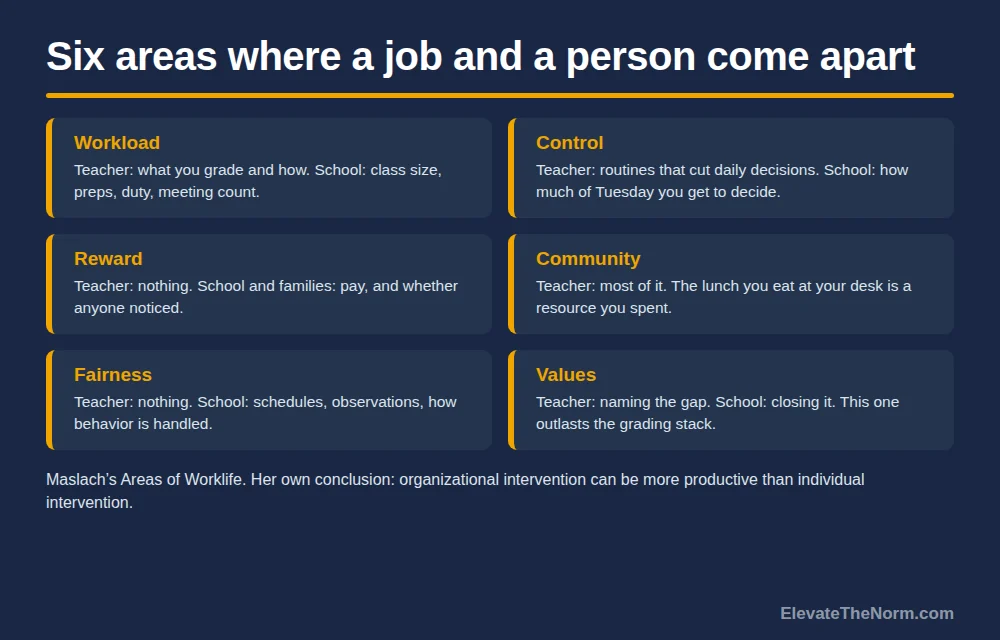
    The reason is in the definition. The World Health Organization calls burn-out “a syndrome conceptualized as resulting from chronic workplace stress that has not been successfully managed,” and says plainly that it is not classified as a medical condition and refers specifically to the occupational context. It is a work problem. Christina Maslach, whose framework has organized this field for forty years, puts the mismatch in six places a job and a person come apart: workload, control, reward, community, fairness and values. Her conclusion after decades of it is blunt: organizational intervention can be more productive than individual intervention.

    Which puts a teacher in an awkward spot. The biggest levers belong to the building, and you still have to do something on Monday. So the honest framing is not “seven habits that will fix you.” It is: here is the part of the equation you can reach, roughly what it is worth, and what to ask someone else for.

    Why Didn’t the Summer Fix It?

    Because time off restores you and then hands you straight back to the thing that emptied you. Vacation works while you are on it. It is not a treatment for the conditions you return to.

    One study makes this uncomfortably concrete. De Bloom, Geurts and Kompier tracked 54 Dutch employees at ten points around a long vacation — before, during, the first day back, and weekly for a month after. Health and well-being climbed during the break and peaked on the eighth day. Then, in the authors’ own words, “on the first day of work resumption, positive vacation effects on H&W have already entirely faded out.”

    Two caveats, because this gets repeated badly. That was 54 people in mixed occupations, not teachers, and a study that small should move your expectations rather than settle anything. And “faded out” does not mean the break was pointless — it means the gain was a state, not a cure. So if you rested all summer and walked back into October feeling exactly the same, nothing is wrong with you. You rested. You did not change anything that was doing the draining.

    How Long Does Recovery From Teacher Burnout Take?

    Nobody can give you a number, and anybody who does is guessing. What the research supports is a direction: months rather than weeks, uneven rather than steady, with setbacks that are part of the shape instead of evidence you failed.

    The closest thing to a long view comes from Sweden, where severe stress-related exhaustion is a clinical diagnosis in its own right. Aronsson and colleagues interviewed 38 people six to ten years after they were treated at a stress rehabilitation clinic. They described what the paper calls a long and ongoing process where recovery activities are needed every step of the way — a fluctuating path, not a ramp. And approximately one third of the participants still fulfilled the criteria for exhaustion disorder at that follow-up.

    Read that carefully, because it is easy to misread toward despair. Those 38 people had a clinical diagnosis severe enough to land them in a rehabilitation program — not the same condition as the occupational burnout the WHO describes, and not a forecast for a teacher who is exhausted in April. It is a small, self-selected Swedish sample and the authors call their own figure tentative. What it is good for is this: if even the severe end takes years and wobbles, a six-week timeline from a blog post is a made-up number.

    The practical version: judge the change by whether the demand actually went away, not by how you feel on any given Thursday. Feelings lag structure by a long way.

    Which Recovery Steps Actually Have Research Behind Them?

    Four off-job experiences come up again and again: detachment, relaxation, control and mastery. Detachment — mentally switching off from work, not merely being off the clock — has the strongest track record of the four.
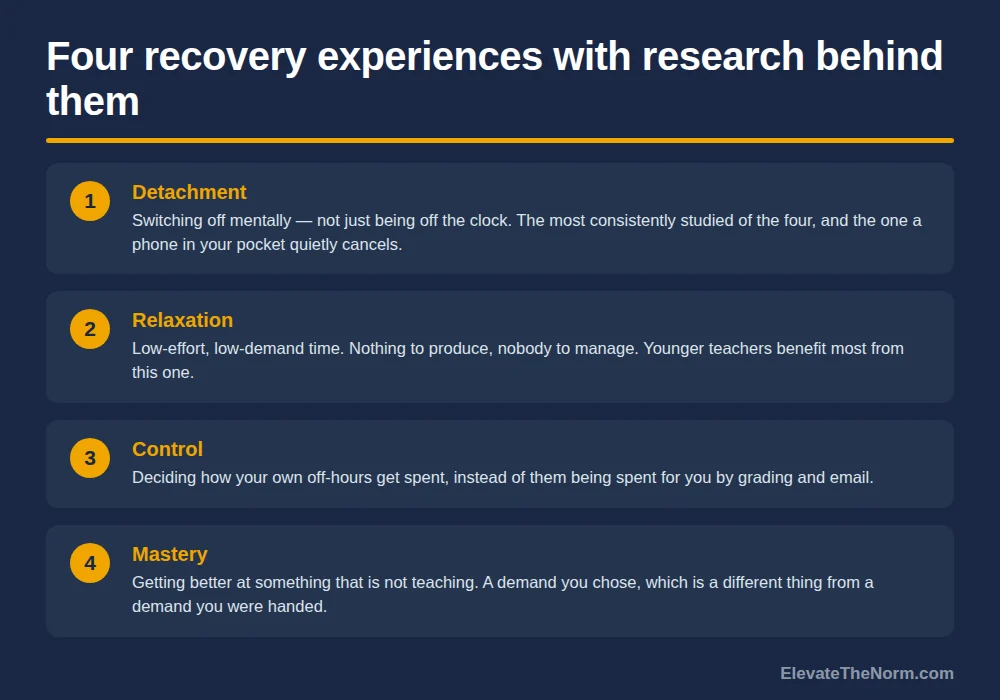
    Numbered chart listing four recovery experiences with research behind them: detachment, relaxation, control, and mastery, each with a short definition.
    Detachment, relaxation, control and mastery are the four off-job experiences with the most evidence behind them.

    Wendsche and Lohmann-Haislah pooled 91 independent samples covering 38,124 employees and found detachment from work correlated at r = −0.36 with burnout-related exhaustion, −0.42 with fatigue, and 0.30 with sleep. Those are not small numbers for this literature.

    They are also not proof, and the authors say so. The evidence is mostly self-reported and individual-level, longitudinal data remain rare, and there is a reverse reading nobody has ruled out: exhausted people may simply find it harder to stop thinking about work. Detaching may be partly a symptom of being okay rather than the cause of it. Treat it as a strong lead, not a prescription.

    The teacher-specific data is thinner but it exists. Virtanen, De Bloom and Kinnunen surveyed 909 Finnish teachers and principals on six off-job experiences. Detachment, relaxation, control and mastery all tracked higher vitality; younger teachers got more out of relaxation, older teachers more out of control and mastery. One caveat that matters: that study measured vitality, life satisfaction and work ability, not burnout. It tells you what feeds teachers, not what cures exhaustion.

    What this looks like in an actual week, for a secondary teacher:

    • Detachment. The school email app is the whole ballgame here. Not a policy, not a boundary speech — the notification badge. If there is one change on this page with evidence behind it that costs nothing and requires nobody’s permission, it is taking work email off the device you look at in bed. If you are worried about being unreachable, check how your building actually contacts staff in an emergency — it is a phone call or an alert system, not your inbox.
    • Relaxation. Low effort, nothing to produce, nobody to manage. Grading in front of the TV is not this. Neither is scrolling the teacher side of the internet, which is mostly work with a different font.
    • Control. One block of time per week that you decide the use of, in advance, and that does not get donated to grading when Thursday arrives.
    • Mastery. Getting better at something that is not teaching. A demand you chose is a completely different animal from a demand you were handed, even when it is harder.

    What Should You Subtract First?

    The one recurring demand that costs you the most hours and that you have some standing to end, shrink, or hand back. One. Not five.

    Numbered five-step graphic: start with the demand side, name the five things that cost the most time, circle one you can end or hand back, make the ask specific and time-bounded, and protect the gap you made.
    The demand side of the equation is usually the cheaper side to move.

    The logic: if burnout is a mismatch between demands and resources, there are two sides to push on. Everybody pushes the resource side, because that is where self-care advice lives. But adding a practice to a life that is already overfull is itself a demand, and the demand side is usually cheaper to move.

    Start with an honest list of the five things that cost you the most hours this month. Not the five that annoy you — different list, and only one of them matters here. The duty you volunteered for in August. The grading practice you invented three years ago that no policy requires. The committee. The thing you do every Sunday because you always have.

    Two guardrails on that list, because the wrong subtraction costs more than it saves. Some duties are contractual or assigned, and a teacher cannot simply end one — those belong in the ask, not on the chopping block. And the thing you cut should not be the thing students depend on most. If feedback is what is eating your weekends, the move is a lighter version of feedback, not less of it: shorter comments, more of it in class, fewer things graded to the same depth. Cutting the practice is fine. Cutting what the practice was for is how a recovery plan turns into a year your students pay for.

    Then circle exactly one and write the ask so it can be answered. “I need help” is unanswerable, so it does not get answered. “I’m stepping back from the data committee for this semester” names the thing, the scope and the end date, and an administrator can say yes or no to it in ten seconds. Ask early in a semester rather than in week fifteen; a principal can usually re-cover a role in August or January and usually cannot in April. A specific ask also survives the meeting it was made in, which a vague one never does.

    Some of what drains a teacher is not a committee at all — it is friction built into the ordinary day. A classroom that runs on established routines costs less to operate than one re-decided every hour, and family contact hurts less on a rotation you set rather than a queue that sets you. Those are demands you can quietly lower without asking anyone.

    And then protect the gap. An hour you free up gets refilled inside two weeks unless something is already sitting in it when it opens. That is where the four recovery experiences go. Subtraction without a plan for the space is just a shorter path back to the same place.

    What If Nothing About the Job Can Change?

    Then you work the small levers honestly, and you stop grading yourself on an outcome you do not control. Some buildings will not move. Pretending otherwise is its own kind of exhaustion.

    It is also worth saying that this advice is not equally available. Detachment, control and mastery all assume some discretionary hours, and a teacher carrying a second job or caring for a parent has fewer of them than the person writing the advice usually imagines. If that is you, the subtraction step is not one option among several — it is the only lever on the page that does not cost you time you do not have.

    The individually-aimed programs do help, a little. Iancu and colleagues pooled 23 controlled trials of interventions built to reduce teacher burnout and found an overall effect of d = 0.18 — statistically significant and genuinely small. On the cynicism dimension it was d = 0.03, which is nothing. Programs running under a month were the least effective of all. So: mindfulness training, coaching, peer groups are real, modest and slow — worth doing if a longer program is on offer, not worth believing in as a substitute for a workload change.

    Two things that are free and are not nothing. The first is community, one of Maslach’s six areas and the one teachers lose first — the planning period you used to spend with a colleague becomes one you spend catching up, and the isolation arrives on schedule. Eating lunch with one adult, on purpose, twice a week is smaller than any intervention a study measures and it is the one I would put money on. Twenty-two minutes and a duty schedule is not much to work with, I know. Do it on the two days you have and let it be unimpressive.

    The second is refusing to read the meaning of the work off how you currently feel. Reduced efficacy is a dimension of burnout, which makes the sense that nothing you do lands a symptom rather than an assessment. Keep some record of the work that is not your own memory of it, because your memory is currently a hostile witness. Written reflection is one way to do that — not as a wellness ritual, but as evidence.

    How Do You Keep It From Coming Back by October?

    You make the change structural rather than motivational. Anything that depends on you continuing to feel like doing it will not survive the first bad week.

    The vacation research is the warning here. A state fades. A structure does not. “I will stop checking email at night” is a state. Deleting the mail app is a structure. “I’ll try to get out by 4:30” is a state; having somewhere you have to be at 5:00 twice a week is a structure — and it need not cost anything. Picking somebody up, a standing walk, a shift at something you already do. What makes it work is that another person notices when you are not there. The question to ask of any recovery plan is simple: what happens to this in week six, when I feel exactly the way I feel right now?

    Then put one date on the calendar, six weeks out, to check whether the demand you removed actually stayed removed. It very often has not — things you hand back have a way of walking home with you, and the check-back is the only reliable way to notice.

    Once you are through it, the work turns into the ordinary, unglamorous business of not getting back here — measuring workload before it becomes a crisis, contacting families before the conference, and taking the day when you need the day rather than after you needed it.

    When Recovery Is the Wrong Word

    When it has stopped being about work. Burn-out, in the WHO’s definition, refers specifically to phenomena in the occupational context and should not be applied to describe experiences in other areas of life. That sentence is doing real work.

    Two-column comparison graphic listing five things that do not work on their own against five recovery steps that have evidence behind them.
    Five things that do not work on their own, and five that have something behind them.

    If the flatness follows you home — into sleep, into appetite, into things you used to enjoy that have nothing to do with a classroom — that is outside what the word covers, and outside what any article can sort out. That is a doctor or a counselor. Not because something is wrong with you in a way that needs whispering about, but because the two things need different help and only a person can tell them apart.

    I want to be direct about the limits of this page and every page like it. There is no checklist here you can score, and there should not be. A list of symptoms on a website is not a screening instrument and it is not the Maslach Burnout Inventory. The worksheet linked above is a planning tool; it returns no number.

    One more thing that belongs on a page like this. Nothing here treats students as the problem. The research puts burnout in job conditions — workload, control, reward, community, fairness, values — and a class of teenagers is not a condition, it is the reason the job exists. A group that can tell their teacher is running on empty is reading the room accurately, not doing something wrong, and what they are owed does not change while an adult is recovering. The whole point of getting the demand off your plate is being able to give them the thing you came here to give them.

    And one thing this page will not say: that pushing through it is admirable. It is not. Exhaustion is not a credential and enduring more of it does not make anybody a better teacher.

    What to Do This Week

    Four things, in order, none of which require becoming a different person.

    1. Take the school email app off your phone — or at minimum off the phone you look at after nine. This is the cheapest evidence-backed change on the page.
    2. Write the five things that cost you the most hours. Honest hours, not annoyance. Twenty minutes with a pen.
    3. Circle one and write the ask in one sentence — the thing, the person who can grant it, the end date. Send it this week, while you can still see the list.
    4. Put a check-back on the calendar six weeks out. One line: did the demand stay gone, and what moved into the gap?

    And one more thing worth saying plainly. Burnout is a persuasive liar about the value of your work — and if you are still working out whether that is what this is, the three symptoms and what separates them from a hard stretch are laid out separately — reduced efficacy is a symptom of the condition, not a verdict on your teaching. Your students are still getting something from you that will never show up on a test. You are just not currently in a position to see it. And if what you want is a checked list of where you can actually go, and what each one costs, that is a separate page.

    Before you go: grab the free Teacher Burnout Recovery Plan (PDF) — ElevateTheNorm.com branded, printable, no email required.

    Frequently Asked Questions

    How long does it take to recover from teacher burnout?

    There is no established timeline, and any specific number you are given is a guess. What the research supports is a direction rather than a date: months rather than weeks, and an uneven line rather than a steady climb. The longest view available comes from Sweden, where Aronsson and colleagues interviewed 38 people six to ten years after treatment for clinical exhaustion disorder and described a long, fluctuating process in which recovery activities were needed at every stage — with about a third still meeting the diagnostic criteria at follow-up. That was a small, self-selected clinical sample and not a forecast for a teacher who is exhausted in April, but it is the reason nobody honest will promise you a six-week turnaround.

    Can you recover from teacher burnout without leaving teaching?

    Yes, but not by leaving everything exactly as it is. Burnout is defined as a mismatch between what a job demands and the resources available to meet it, so something has to move on one side or the other. Ending or shrinking one recurring demand, buying back one block of time you control, or getting one specific request granted all change the equation. Deciding to try harder does not change it, and neither does a summer. Most teachers who recover do it inside the profession, and they do it by changing the shape of the job rather than by changing themselves.

    Will a summer off cure teacher burnout?

    No — it restores you and then hands you back to the conditions that emptied you. In a Dutch study that measured 54 employees at ten separate points around a long vacation, health and well-being peaked on the eighth day away and, in the authors’ words, had entirely faded out by the first day back at work. That was a small study in mixed occupations rather than teaching, so treat it as a strong hint rather than a law. But it matches what most teachers already notice: you come back in August genuinely better, and by late September you cannot find the difference. Rest is necessary. It is not the change.

    What is the single most effective thing a teacher can do on their own?

    Get real mental distance from work on ordinary weeknights — what the research calls psychological detachment. A meta-analysis of 91 samples covering 38,124 employees found detachment correlated at r = −0.36 with burnout-related exhaustion, −0.42 with fatigue, and 0.30 with sleep. The practical version is unglamorous: take the school email app off the phone you look at in bed. Two honest caveats. The evidence is largely self-reported and cross-sectional, so it shows association rather than cause, and exhausted people plausibly find detaching harder in the first place. It is the best-supported lever a teacher owns alone, which is not the same as a cure.

    What should I do if my principal says no to the ask?

    Ask what would make it a yes, and ask when. A no with a reason and a date is workable; an unanswered request is the thing that actually corrodes trust. If the answer is a flat no with nothing behind it, you are back to the levers you control alone — detachment, one protected block of time, one colleague you eat lunch with — and to being honest with yourself that the building is not going to move this year. That is worth knowing clearly rather than discovering slowly. Ask early in a semester, too: a role can usually be re-covered in August or January and usually cannot be in April.

    Does recovering from burnout mean cutting back on what students get?

    It should not, and a plan that does is the wrong plan. The distinction worth holding is between a practice and what the practice was for. If feedback is eating your weekends, the move is a lighter version of feedback — shorter comments, more of it delivered in class, fewer assignments graded to the same depth — not less feedback. Students are not the demand to subtract. The reason to get a committee or a duty off your plate is to be able to do the actual teaching well, and a class can tell the difference between a teacher who has less to give and a teacher who has decided to give less.

    My child’s teacher seems burned out. What actually helps?

    Send the message when something goes right, not only when something goes wrong — recognition and collegial support are two of the six areas where a job and a person come apart, and families are one of the few outside parties who can move them. Raise workload, staffing or coverage concerns with the principal rather than with the teacher, because that is where those decisions live. What does not help is asking a teacher directly whether they are burned out; it puts a professional in the position of discussing their own well-being with a family, which is not a fair thing to ask of them.

    Is burnout the same as being tired, or the same as depression?

    Neither, and a web page cannot sort out which one you are dealing with. The World Health Organization defines burn-out as an occupational phenomenon resulting from chronic workplace stress that has not been successfully managed, states that it is not classified as a medical condition, and says it refers specifically to the work context and should not be applied to other areas of life. Ordinary tiredness lifts with rest. If the flatness follows you home into sleep, appetite, or things you used to enjoy that have nothing to do with school, that is outside what the word covers and it is a conversation with a doctor or a counselor. No article, checklist or online quiz is a screening instrument, and none of them can give you an answer.

    And if the honest answer after all of this is that you are not staying, that is a real option and it deserves real information rather than a slogan. Here is what the federal follow-up data says about where teachers who leave actually go — including the two things that usually get worse, not better.

    Sources

    Every link above was opened and checked on September 23, 2026. Where a figure could not be read verbatim in the source document, it is not quoted here. This article describes burnout as an occupational condition; it is not medical advice, it is not a diagnosis, and nothing on this page or in the linked worksheet is a screening instrument.
    About Clay Shumate

    By Clay Shumate — Clay Shumate is a certified secondary Social Studies teacher in the public schools of West Alabama, with seven years of classroom experience, a B.A. in History, and an M.Ed. in Secondary Education. He writes about project-based learning, student responsibility, respect, and practical ways to hold young people to a higher standard while giving them room to learn from mistakes. He is a member of the Society of Professional Journalists and writes to its Code of Ethics; this site’s editorial standards and corrections policy are published in full.

  • Teacher Burnout: What It Actually Is and Who Can Actually Fix It

    Teacher Burnout: What It Actually Is and Who Can Actually Fix It

    Teacher burnout is what happens when the demands of the job outrun the resources you have to meet them, for long enough that it starts to change you. The World Health Organization calls it an occupational phenomenon, not a medical condition — a work problem, not a personal defect. It shows up in three ways: you are worn out, you go distant on the job, and you stop believing your work is doing anything.

    That definition matters more than it sounds like it does. If burnout is something wrong with you, the fix is to become a tougher person. If burnout is a mismatch between a job and the person doing it, the fix is to change the job — and some of that is in your hands and some of it is not. This page is the honest version of both halves: what the research actually says, what the numbers actually are, and which levers belong to you versus your building.

    Key Takeaways

    • Burnout has three parts, not one. Exhaustion, cynicism or mental distance from the job, and a sense that you are no longer effective. Being tired is only the first third.
    • It is an occupational phenomenon, not a diagnosis. The WHO put it in ICD-11 in 2019 and said explicitly that it is not classified as a medical condition and applies only to the work context.
    • Teachers really do report it at higher rates than comparable workers. In 2026, 55 percent of teachers reported frequent job-related stress, against 34 percent of similar working adults.
    • The “mass exodus” framing is weaker than the stress data. Federal figures put teacher attrition at 8 percent in 2021–22, statistically unchanged from a decade earlier. Teachers are struggling more than they are leaving.
    • Most of the biggest levers are organizational. Workload, control, reward, community, fairness and values are the six places a job and a person come apart, and a teacher only owns part of each one.
    • Programs aimed at individual teachers help a little. A meta-analysis of 23 controlled trials found a small overall effect and almost none on the cynicism dimension. Real, but not a solution on its own.
    • No web page can tell you what you have. If you are past tired — not sleeping, not eating, not able to enjoy anything — that is a conversation with a person, not a checklist.

    Free Download · 2-page PDF

    Teacher Burnout Workload & Resources Audit

    The six areas of worklife on one page, a three-day hours log on the other, and a script for turning the worst area into one specific, time-bounded ask. Not a screening tool and not a score — a sorting sheet.

    Download the free PDF

    Free. No email address required. Designed for grades 6–12. Browse every printable in Your Free Library.

    What Is Teacher Burnout, Exactly?

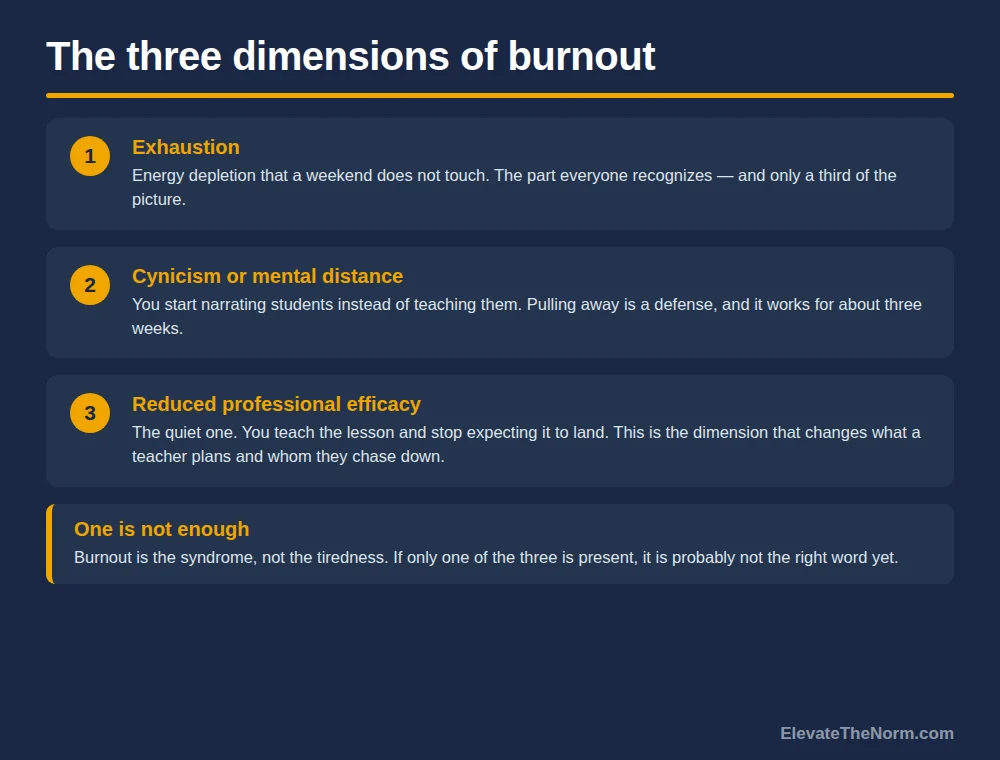
    Teacher burnout is a syndrome with three dimensions: exhaustion, cynicism, and a decline in professional efficacy. That is Christina Maslach’s framing, and it has been the standard in burnout research for four decades. You need more than one of the three before the word fits.

    Numbered chart explaining the three dimensions of burnout: exhaustion, cynicism or mental distance, and reduced professional efficacy.
    Burnout is the syndrome, not the tiredness. One dimension on its own is usually not burnout.

    Here is what each one looks like in a school building.

    • Exhaustion. Not Friday tired. The kind where the tank is empty before first period and stays empty through the weekend. This is the part everybody recognizes, and it is the part people mistake for the whole thing.
    • Cynicism, or mental distance. You start narrating your students instead of teaching them. The kid who forgot his paper is no longer a kid who forgot his paper; he is proof that none of them care. Pulling away is a defense, and it works for about three weeks.
    • Reduced efficacy. The quiet one. You do the same lesson you have taught for years and you cannot tell whether it landed, and you stop expecting it to. Maslach describes the person in this state as overwhelmed, unable to cope, and unmotivated — in that order.

    The third one is why burnout is dangerous for students and not only for teachers. A tired teacher still teaches. A teacher who has stopped believing the work matters makes different decisions about what to plan, whom to call, and which kid to chase down in the hallway.

    One thing worth saying directly to any student who ends up on this page, because you are old enough to hear it: this is not your fault. Burnout comes from workload, scheduling, and how a building is run — not from a class being a class. And if you have noticed that a teacher of yours is running on empty, you are not imagining it. You are reading the room correctly. That is worth knowing, and it is worth being decent about, but it is not yours to fix.

    Is Teacher Burnout Real, or Is Teaching Just Hard?

    It is real, it is measurable, and it is not a diagnosis. Those three things are all true at the same time, and most arguments about teacher burnout are people holding one of them and ignoring the other two.

    In May 2019 the World Health Organization included burn-out in ICD-11 and defined it as “a syndrome conceptualized as resulting from chronic workplace stress that has not been successfully managed.” The same entry says it “refers specifically to phenomena in the occupational context and should not be applied to describe experiences in other areas of life,” and that burn-out is not classified as a medical condition.

    Read that carefully, because both sides misuse it. It is not permission to tell a teacher she is imagining things — the WHO put it in the classification precisely because it is a recognized occupational problem. It is also not a clinical label you can hand yourself after a bad grading period. It describes a relationship between a person and a job that has gone wrong and stayed wrong.

    Researchers still argue about where burnout ends and depression begins, and that argument is not settled. That is a real limit on everything below, and it is the reason this article does not contain a quiz. Nothing on a web page can tell you which one you are dealing with. A person can.

    How Common Is Teacher Burnout, Really?

    Common enough that it is the normal condition of the profession, and stable enough that it is not a crisis that arrived last Tuesday. Both halves of that sentence come out of the same survey.

    Chart of four teacher burnout figures, each labelled with the survey, sample size and year it came from.
    Every number here is traced back to the survey it came from, with its sample and year.

    RAND has run the State of the American Teacher survey every year since 2021, alongside a matched sample of similar working adults so the comparison means something. The 2026 round surveyed 829 K–12 public school teachers and 498 similar working adults between late January and late February 2026. Its headline finding: 55 percent of teachers reported frequent job-related stress, down from 62 percent in 2025, against 34 percent of similar working adults. Teachers came out worse than the comparison group on every well-being indicator the survey measured, which the report notes is consistent with previous years.

    Now the part that gets left out. The same report says the share of teachers reporting burnout and symptoms of depression in 2026 was similar to spring 2023, spring 2024 and spring 2025 — differences of four percentage points or fewer. Burnout in this profession is not spiking. It is sitting still at a high level, which is a different problem and calls for a different response.

    And here is the finding that should make everyone slow down before repeating the exodus story. The federal Teacher Follow-up Survey found that of public school teachers teaching in 2020–21, 84 percent stayed at the same school, 8 percent moved schools, and 8 percent left teaching the following year. Those figures are not statistically different from the same measurement a decade earlier, when it was also 84, 8 and 8.

    So the honest summary is this: teachers report far more job stress than comparable workers, that gap has been steady for years, and most of them stay anyway. Which is worth saying plainly — a profession where half the workforce is running on fumes and staying is not a profession that has been rescued by its own retention numbers.

    What Causes Teacher Burnout?

    Burnout comes from a sustained mismatch between what the job demands and what the job gives you to meet those demands. Maslach’s Areas of Worklife model names six places that mismatch happens: workload, control, reward, community, fairness and values.

    Six-panel chart showing workload, control, reward, community, fairness and values, each split into what a teacher controls and what the school controls.
    Maslach’s six Areas of Worklife, split by who actually owns each half.

    Translated into a school year, they look like this. Workload is the grading stack and the duty roster and the three new initiatives. Control is whether you get to decide how Tuesday goes. Reward is pay, but it is also whether anyone noticed. Community is your hall, your department, the people you eat lunch with. Fairness is whether the schedule, the observations and the consequences apply to everybody. Values is the gap between why you took the job and what the job now asks you to do — and in my experience that last one does more damage than the grading stack, because the grading stack ends in June.

    Maslach’s own argument about what to do with this is blunt: “situational and environmental factors seem to be as important for understanding burnout as are personal variables,” and the field’s habit of asking “what can we do to help the person?” is the wrong first question. She concludes that organizational intervention can be more productive than individual intervention, because fixing a condition that affects forty teachers scales in a way that fixing forty teachers does not.

    A 2024 meta-analysis of 173 studies covering 89,876 participants found burnout and work engagement to be the strongest correlates of overall teacher wellbeing, with disengagement coping among the strongest negative predictors. Worth reporting honestly, though: that analysis is correlational and cross-sectional. It shows what travels together. It does not prove what causes what, and the authors say so.

    What Can a Teacher Actually Control?

    More than nothing and less than the internet suggests. The useful move is to sort your own six areas into things you own, things you can ask for, and things you have to stop spending energy on. That sort is the whole framework, and it takes about twenty minutes with a pen.

    1. Name the demand, not the feeling. “I am exhausted” is not actionable. “I grade 140 essays by hand every two weeks and it costs me eleven hours” is. Log your hours for three days — not a week, three days, because a time log is itself a task and an exhausted person will not finish a week of one. Three days of real numbers beats a month of intentions.
    2. Cut the demand where the standard does not require it. Most teachers are carrying grading practices nobody asked for. Moving to a standards-based system can be partly a workload decision, because it stops you from grading the same skill nine times.
    3. Buy back control with routines. Decision fatigue is a demand. Solid routines and procedures take the same forty daily micro-decisions off your plate every day for 180 days.
    4. Protect community on purpose. The lunch you eat at your desk answering email is a resource you spent. Community is the one area of worklife you can improve in a week without anyone’s permission.
    5. Ask for one specific thing, bounded in time. Not “I need support.” “I need the second duty period covered for six weeks.” The second one is easy for an administrator to say yes to, because it is small, it has an end date, and it does not ask them to admit anything. You are not building a case against your building. You are handing someone a decision they can actually make.
    6. Take the day before you need the week. Rest taken early is a resource. Rest taken after you break is triage. The prevention side of this is its own article, and it is where the practical day-to-day moves live.

    One thing that is never on this list: pushing through. Grinding out an exhausting stretch is not a professional virtue and it is not a plan. It is a way to spend the next month’s energy this week.

    What Can Only the School Fix?

    The big ones. If a building wants to move burnout, these are the levers, and none of them belong to an individual teacher.

    • Actual workload, not workload wellness. Class size, number of preps, duty minutes, meeting count, the number of initiatives running at once. A yoga session added on top of an unchanged workload is one more thing on the calendar.
    • Protected planning time that is actually protected. Planning periods consumed by coverage are a pay cut paid in hours.
    • Fairness in the visible systems. Schedules, observations, and how student behavior is handled. Teachers read fairness off the cases they can see.
    • Response to student behavior that does not end at the classroom door. Behavior is a job demand, and how a school responds to it decides whether it is a shared demand or a private one.
    • Family communication load. One teacher cannot restructure how a building talks to families, but a building can. A real communication system turns a hundred anxious individual contacts into a rotation.
    • Induction that means something. A new teacher given a mentor, a reduced load and honest feedback is a different person in March than one given a key and a room.
    • A real answer when a teacher asks. Including no, with a reason and a date. An unanswered request costs more trust than a declined one.

    Worth separating for anyone who has to budget this. Three of those cost nothing: cutting the meeting count, capping how many initiatives run at once, and answering requests. An instructional coach can carry a fourth — a coach whose job is genuinely instructional support rather than one more evaluator is a resource on the demands side of the ledger, and teachers can tell the difference within a month. Two of them cost real money: class size and staffing coverage. A building that has done only the free ones has still done more than a building that ran a wellness week.

    Does Anything Actually Work?

    Some things help a little. Nothing helps a lot. Anyone selling you more than that is selling something.

    The most direct evidence is a meta-analysis of 23 controlled trials of interventions aimed at reducing teacher burnout. The overall effect was d = 0.18 — small, but statistically significant. Mindfulness-based programs showed significant effects on exhaustion and on personal accomplishment. And the depersonalization dimension — the cynicism, the mental distance — came back at d = 0.03, essentially nothing.

    Two more findings from the same analysis that rarely get quoted in professional development slides. Interventions delivered to primary and middle school teachers showed below-average effects. And programs running less than a month were the least effective of all, which is an unkind description of most of what gets offered.

    Put that beside Maslach’s conclusion that organizational intervention outperforms individual intervention and you get the practical read: a wellness program is not a lie, it is just small. If a district runs one instead of touching workload, control, reward, community, fairness and values, it has bought a d of 0.18 and called it a plan.

    When Burnout Is Not the Right Word

    Burnout is a work word. It describes what a job did to you, and it usually improves when the job changes. There is a point where that stops being the right description.

    If the flatness follows you into the parts of your life that have nothing to do with school — if you are not sleeping, not eating, not enjoying anything you used to enjoy, or if the thought of harming yourself has crossed your mind — that is outside what any article, checklist or self-assessment can sort out, and it is outside what a good weekend fixes. Talk to a doctor, a counselor, or whatever your district’s employee assistance program actually is. In the United States you can also call or text 988 to reach the Suicide and Crisis Lifeline.

    Saying that is not a disclaimer bolted onto the end. It is the single most useful sentence on this page for some of the people reading it.

    What to Do With This

    Do three things this week, in order.

    1. Write down your hours for five days. Not an estimate. The actual clock. You cannot argue about workload — with a principal or with yourself — from a feeling.
    2. Sort your six areas. Workload, control, reward, community, fairness, values. Mark each one fine, strained, or broken. The free audit below is that page, printed.
    3. Take the worst one to a person. One specific, bounded ask, in writing, to whoever can actually grant it. Then read the day-to-day prevention piece and pick one habit to start Monday.

    Going deeper: the rest of this series

    This page is the overview. Each piece below takes one part of it further.

    If you are a parent who landed here worried about your kid’s teacher, the most useful thing you can do is unglamorous: send the email when something goes right, not only when something goes wrong, and raise workload concerns with the principal rather than with the teacher. Reward and community are two of the six areas, and a family is one of the few outside parties who can actually move them.

    And if you are in the stretch right now where none of this feels possible — the students are still showing up for you, and they are still learning things that will never appear on a test. Burnout is a persuasive liar about that. It is not a reliable narrator of your work.

    Before you go: grab the free Teacher Burnout Workload & Resources Audit (PDF) — ElevateTheNorm.com branded, printable, no email required.

    Frequently Asked Questions

    What are the three signs of teacher burnout?

    Burnout has three dimensions rather than one: exhaustion, cynicism or mental distance from the job, and a decline in professional efficacy — the sense that what you do no longer works. Being tired is only the first of the three. The one people miss is the third, because it is quiet: you keep teaching, but you stop expecting the lesson to land. If only one of the three is present, burnout is probably not the right word yet.

    Is teacher burnout the same thing as depression?

    No, and the honest answer is that the boundary between them is still argued about in the research. The World Health Organization classifies burn-out as an occupational phenomenon tied specifically to the work context, and states plainly that it is not classified as a medical condition. Depression is a clinical diagnosis and it is not confined to your job. If the flatness follows you home into things that have nothing to do with school — sleep, appetite, things you used to enjoy — that is a conversation for a doctor or counselor, not a web page. No article, quiz or checklist can tell you which one you are dealing with.

    How common is teacher burnout in secondary schools?

    RAND’s 2026 State of the American Teacher survey found 55 percent of K–12 public school teachers reported frequent job-related stress, down from 62 percent in 2025, compared with 34 percent of similar working adults. That survey covered 829 teachers and 498 comparison adults, fielded from late January to late February 2026. The same report found the share reporting burnout was within four percentage points of spring 2023, 2024 and 2025 — so it is high and steady rather than spiking. RAND reports K–12 teachers together, so it does not isolate a grades 6–12 figure.

    Can a teacher recover from burnout without leaving the profession?

    Yes, and most do — federal data show 84 percent of public school teachers stayed at the same school from 2020–21 to 2021–22, with 8 percent leaving teaching, a rate statistically unchanged from a decade earlier. But recovery is not willpower. Burnout is a mismatch between the demands of a job and the resources available to meet them, so something has to move on one side or the other. Cutting a demand, buying back control, or getting one bounded ask granted changes the equation. Deciding to try harder does not.

    What can a principal do about teacher burnout that costs nothing?

    Three things. Cut the number of meetings. Cap how many initiatives run at once instead of adding one each semester. And answer requests — including saying no, with a reason and a date, because an unanswered ask costs more trust than a declined one. Class size and coverage staffing cost real money, but those three do not. A building that has done only the free ones has still done more for burnout than a building that ran a wellness week.

    Do teacher wellness programs actually reduce burnout?

    A little. A meta-analysis of 23 controlled trials of interventions aimed at reducing teacher burnout found an overall effect of d = 0.18 — small but statistically significant — with mindfulness programs showing effects on exhaustion and on personal accomplishment. On the depersonalization dimension the effect was d = 0.03, essentially nothing. The same analysis found programs running under one month were the least effective of all. So wellness programming is not worthless, it is just small, and it is not a substitute for changing workload, control, reward, community, fairness and values.

    My child’s teacher seems burned out. What should I do?

    Two things that actually help and one that does not. Send the message when something goes right, not only when something goes wrong — reward and community are two of the six areas where a job and a person come apart, and families are one of the few outside parties who can move them. Raise workload or staffing concerns with the principal rather than with the teacher, because that is where those decisions live. What does not help is asking a teacher directly whether they are burned out; it puts a professional in the position of discussing their own well-being with a family.

    Is teacher burnout caused by students?

    No. The research locates burnout in job conditions — workload, control, reward, community, fairness and the gap between your values and what the job asks of you. Student behavior is one demand among several, and how a school responds to behavior matters more than the behavior itself, because it determines whether that demand is shared or carried privately. A class is not the cause of a teacher’s exhaustion, and students who notice a teacher running on empty are reading the room accurately rather than doing something wrong.

    Sources

    Every link above was opened and checked on September 23, 2026. Where a figure could not be read verbatim in the source document, it is not quoted here. This article describes burnout as an occupational condition; it is not medical advice and it is not a screening tool.


    About Clay Shumate

    By Clay Shumate — Clay Shumate is a certified secondary Social Studies teacher in the public schools of West Alabama, with seven years of classroom experience, a B.A. in History, and an M.Ed. in Secondary Education. He writes about project-based learning, student responsibility, respect, and practical ways to hold young people to a higher standard while giving them room to learn from mistakes. He is a member of the Society of Professional Journalists and writes to its Code of Ethics; this site’s editorial standards and corrections policy are published in full.

  • What Is a Classroom Management Plan? The Version That Actually Runs

    What Is a Classroom Management Plan? The Version That Actually Runs

    A classroom management plan is a written document setting out how your room runs: the structure students walk into, the expectations you have taught them, how you acknowledge the behavior you want, and what you do about the behavior you don’t. It is not a poster of rules and it is not a philosophy statement. It is the answer you have decided in advance, so that you are not inventing it at 1:40 on a Thursday with twenty-nine people watching. If you want wording to start from rather than a blank page, there are worked examples of expectations written for teenagers.

    Most plans fail the same way. They are written for an evaluator, they are full of words like “respectful” and “responsible,” and they cannot be run. A plan you cannot run on a bad day is not a plan.

    So that is what a classroom management plan is. What follows is the harder part: what the research says it has to contain, the test that separates a real plan from a decorative one, and how to write one that survives contact with an actual class. The individual moves that go inside the plan, and how strong the evidence is behind each one, are handled separately in the strategy-by-strategy breakdown.

    Key Takeaways

    • A plan is a decision made early, not a description written late. Its value is that it removes improvisation from the moments you improvise worst.
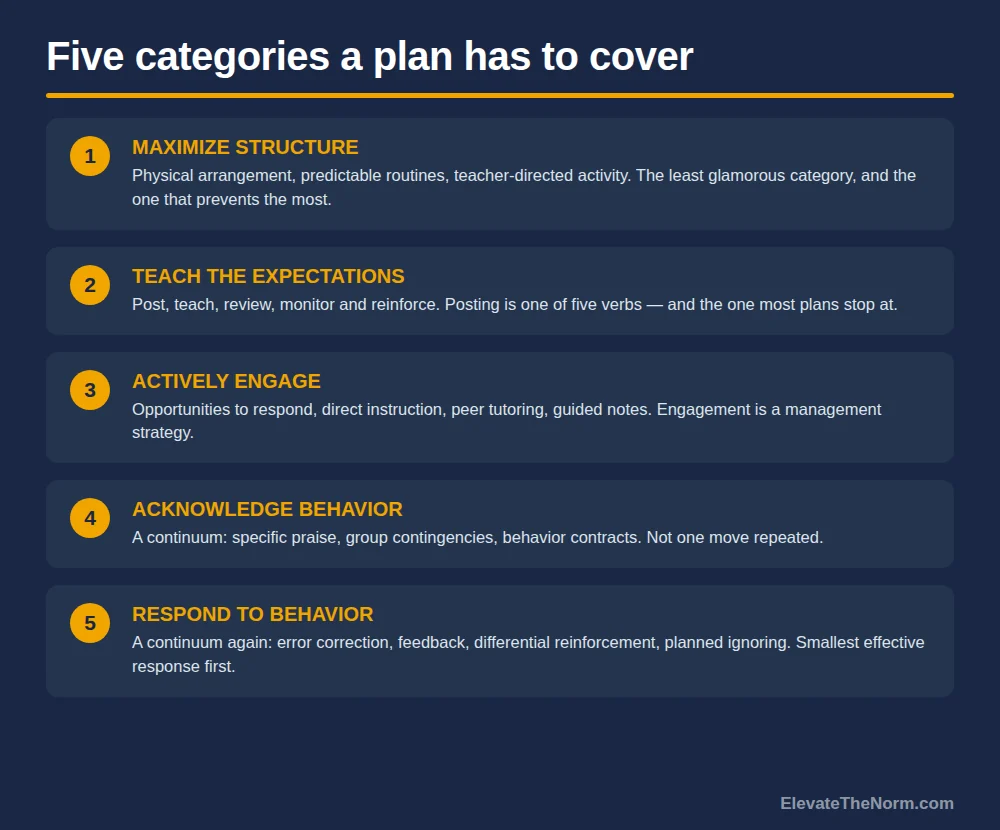
    • The research converges on five areas. A 2008 review identified 20 evidence-based classroom management practices grouped into five categories: structure, taught expectations, active engagement, acknowledging appropriate behavior, and responding to inappropriate behavior.
    • The test is enforceability, not tone. “Be respectful” cannot be enforced consistently by anyone, including you. A narrow, specific line can.
    • Write it for yourself first. A plan aimed at an evaluator produces language that sounds defensible and does nothing at 1:40.
    • Many teachers were never taught this. In one study of 110 teacher candidates, roughly half of one group reported no behavior management training at all before the intervention — which is a curriculum gap, not a personal failing.

    What is a classroom management plan, specifically?

    The IRIS Center at Vanderbilt frames comprehensive classroom behavior management as doing two things: creating an organized, consistent, culturally responsive classroom environment that supports instruction, and engaging and communicating with students and families on an ongoing basis. Developing a written plan is named as one of the foundational practices within that, alongside creating a positive climate and a structured classroom.

    That framing is useful because of what it excludes. A management plan is not your discipline ladder. The ladder is one component, and in a good plan it is one of the smaller ones. The bulk of the document is about the conditions that make the ladder rarely necessary — how the room is arranged, what happens in the first four minutes, what students do when they finish early, how they get help without waiting with a hand up.

    One more distinction worth holding onto: classroom-level management sits underneath any school-wide system. If your building runs three to five posted expectations, your plan translates those into the specific, contextual version that applies in your room. It does not compete with them, and it does not ignore them.

    The five things the research says a plan has to cover

    The most useful single source here is Simonsen, Fairbanks, Briesch, Myers and Sugai’s 2008 review, which set a deliberately high bar: a practice counted as evidence-based only if it had been evaluated with sound experimental design and supported by at least three empirical studies in peer-reviewed journals. Twenty practices cleared it, sorted into five categories.

    1. Maximize structure. Physical arrangement, predictable routines, teacher-directed activity. The least glamorous category and the one that prevents the most.
    2. Post, teach, review, monitor and reinforce expectations. Note the verbs. Posting is one of five, and it is the one most plans stop at.
    3. Actively engage students in observable ways. Opportunities to respond, direct instruction, peer tutoring, guided notes. Engagement is a management strategy, not a separate department.
    4. Use a continuum of strategies to acknowledge appropriate behavior. Specific praise, group contingencies, behavior contracts.
    5. Use a continuum of strategies to respond to inappropriate behavior. Error correction, performance feedback, differential reinforcement, planned ignoring.
    Five numbered categories of evidence-based classroom management: maximize structure, teach expectations, actively engage, acknowledge behavior, respond to behavior
    From Simonsen and colleagues’ 2008 review of evidence-based classroom management practices.

    The word doing the most work in categories four and five is continuum. A plan with one response in it — a referral, a call home, a warning system — will be used for everything or nothing. A continuum means the smallest effective response is available and gets used first.

    An honest caveat on that review, because it matters for how much weight to put on it: the authors themselves note that roughly 48% of the studies in their table were published before 1987. The categories have held up and are widely replicated, but this is an older evidence base than its frequent citation implies, and it was not assembled with today’s secondary classrooms specifically in view.

    Why “Be Respectful” is not a plan

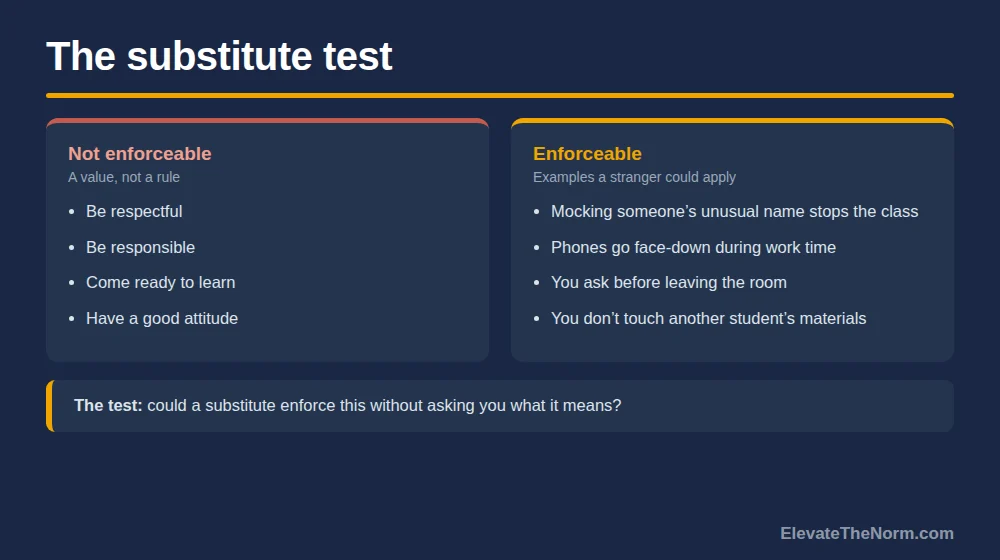
    Here is the test I would apply to every line in a management plan: could a substitute enforce this without asking you what it means? If not, it is a value, not a rule — and values belong in the first paragraph, not in the enforcement section.

    Two-column comparison of unenforceable classroom rules such as be respectful beside enforceable, specific rules a substitute could apply
    Could a substitute enforce this without asking you what it means?

    “Be respectful” fails immediately. Two reasonable adults will disagree about whether a particular eye-roll qualifies, which means the students experience it as arbitrary, which is the precise thing that costs you a room. Inconsistency is not a small flaw in a plan. It is the flaw.

    Compare it to an actual line from my room: making fun of how unusual someone’s name is stops the class. It is narrow. It is unmistakable. Nobody has to interpret it, there is no version of it I would let go on a Friday because I am tired, and a student can tell you in advance exactly what will happen. That is what an enforceable expectation looks like, and it is worth more than a wall of adjectives.

    You do not need many of these. Three or four lines that are genuinely non-negotiable, that you will enforce identically in October and in May, will do more for a room than a laminated list of twelve. The rest of what you want — effort, kindness, people taking care of each other — is built through how the room is run day to day, not through rules about it.

    What actually goes in the document

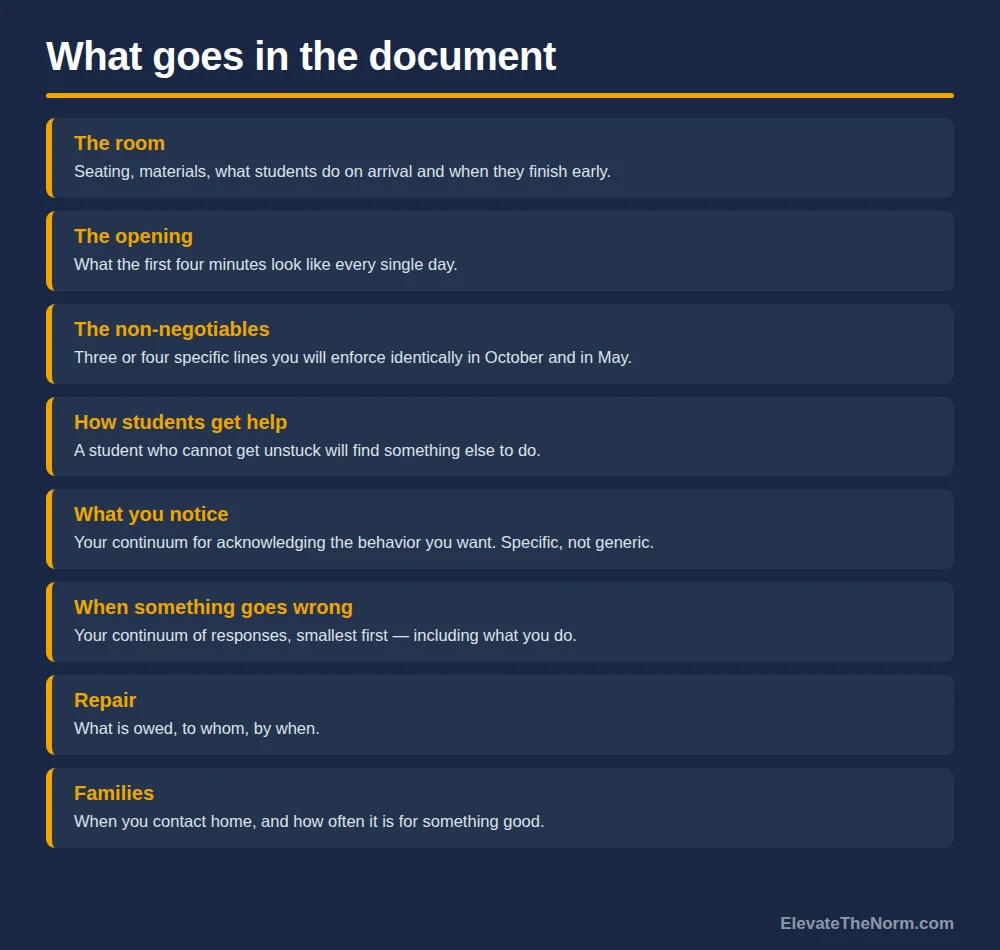
    Here is the structure I would use. It maps onto the five research categories without reading like a compliance form.

    • The room. How seating is arranged and why. Where materials live. What students do when they walk in, and what they do when they finish early. Most of a management plan is logistics, and the logistics are load-bearing.
    • The opening. What the first four minutes look like every single day. A routine students can run without you is worth more than any consequence you could write down.
    • The non-negotiables. Three or four specific, enforceable lines. Apply the substitute test to each one.
    • How students get help. Genuinely part of management. A student who cannot get unstuck will find something else to do, and then you have a behavior problem that was originally an access problem.
    • What you notice, and how. Your continuum for acknowledging the behavior you want. Specific rather than generic — naming what a student did beats telling them they are great.
    • What happens when something goes wrong. Your continuum of responses, smallest first, written out. Include what you do, not just what the student gets.
    • Repair. What is owed, to whom, by when. A plan that ends at the consequence is only half-written.
    • Families. When you contact home, for what, and how often it is for something good.
    Eight sections of a classroom management plan: the room, the opening, non-negotiables, how students get help, what you notice, when something goes wrong, repair, families
    Two pages is enough. Twelve means you are writing a philosophy statement.

    That is two pages, not twelve. If yours is running to twelve, you are probably writing a philosophy statement with a consequence ladder stapled to the back.

    The response section, and the part people get wrong

    Most consequence sections are written as an escalating list of things that happen to a student. The useful version also specifies what you do, because your behavior is the variable you actually control.

    The smallest effective response is usually proximity and a quiet word. In my room a redirect happens at close range, to one student, at their eye level — not announced across the room. That is a deliberate choice and it belongs in a written plan, because it is the thing you will abandon first when you are frustrated. Announcing a correction to the whole room gives the class a performance to react to and hands the student an audience they now have to save face in front of. It reliably makes a small thing bigger.

    Write down the pause, too. A deliberate beat before you respond — for me it averages around fifteen seconds, though it genuinely varies with the room, the day, and the student — is not a technique with a fixed number. It is a commitment to not answer a behavior with your first reaction. Put it in the plan as a commitment rather than a count, because a count is the first thing that breaks.

    And be careful what your consequences are actually teaching. A response that only makes a student feel worse has done nothing about the thing that happened. The question the plan should answer is what gets repaired, not what gets paid.

    What the plan does not get to decide

    This section is short and it is the one most plans omit entirely. Some things outrank your document, and writing as though they do not is how a well-intentioned plan creates a real problem.

    • An IEP or a behavior intervention plan. If a student has one, it governs. Your classroom plan does not override it, cannot be applied to that student in place of it, and should say so explicitly. If you do not know which of your students have one, that is the first thing to find out — before you write a consequence section, not after you have applied it.
    • District and building policy. Your plan operates inside them. Where your preference and the policy disagree, the policy wins and you raise the disagreement through the actual channel rather than quietly running your own version.
    • Anything that has to leave the room. Threats, weapons, harassment, anything involving a student’s safety, and anything that triggers mandatory reporting are not classroom-management matters and do not belong on a continuum of responses. Name them in the plan as the category that goes straight to an administrator, so that the decision is already made.

    A plan that quietly assumes the teacher handles everything is not a strong plan. It is an unsupported one, and the cost of that lands on a student.

    Who the plan is for

    In order: you, then your students, then anyone covering your room, then your evaluator. That order matters and it is usually inverted.

    A plan written for an evaluator optimizes for language that sounds defensible in a post-observation conference. It will use the word “proactive” and it will not help you at 1:40. A plan written for yourself is blunter, shorter, and contains the things you actually forget — which is why the good ones read a little like notes.

    Your students should be able to read it, or a version of it. Not as a handout on day one that nobody retains, but because everything in it should be something they could accurately predict by October. If a student could not tell you what happens when work is late, that section is not real yet.

    Which raises a fair question: should students help write it? My honest answer is that it depends on which part. The non-negotiables are yours — they exist precisely because they do not move, and putting them to a vote tells the room they are negotiable after all. But a great deal of a management plan is not about safety or dignity at all. It is about how the room works, and on that, teenagers have opinions worth hearing and a much better sense than adults expect of what actually helps them work. Asking them what gets in their way, and then visibly changing something, does more for buy-in than any explanation of why your rules are reasonable.

    Families should be able to see it too, or at least the part that affects them — what you contact home about, when, and what happens before you do. A parent who learns your system for the first time during a difficult phone call is meeting it at the worst possible moment. Send the short version early, while nothing is wrong.

    And a plan is the single most useful thing you can hand to someone covering your class. If you cannot hand it over and have it make sense to a stranger, it is not finished.

    If nobody ever taught you this

    It is worth saying plainly that the preparation gap here is real and documented, because a lot of teachers privately treat it as a personal deficiency.

    A 2025 study in the Journal of Emotional and Behavioral Disorders worked with 110 teacher candidates in student-teaching internships at a large public southeastern university. Among the group receiving a specialized 16-hour classroom management curriculum, 49.3% reported having had no behavior management training beforehand; in the comparison group the figure was 31.7%. The authors also note that while most states require classroom management coursework, estimates of how many programs offer a focused course on it range from under 50% to 74%.

    Those numbers deserve their limits stated. It is a quasi-experimental study at a single university, the training figures are self-reported, and the classroom observation subsample was fourteen teachers. It does not establish a national rate. What it does support — alongside the range the authors cite for program offerings — is that arriving in a classroom without formal management training is common rather than exceptional. If that is you, you are in a large group, and writing the plan is how you close the gap yourself.

    What a plan will not do

    It will not make a class comply because it exists. It will not survive being written once in August and never opened again. And it will not substitute for knowing the students in front of you — the same line lands differently depending on what a kid walked in carrying, and no document accounts for that.

    It also will not fix a task that was badly built. A very large share of what gets logged as a behavior problem is a student who could not access the work and found something else to do. Before adding a consequence for off-task behavior, check whether the work was doable. That is a planning question wearing a discipline costume, and treating it as discipline makes it permanent.

    Writing one this week

    Do it in one sitting and keep it to two pages. Draft the eight sections above quickly and badly — the first version is for finding out what you have not actually decided, and you will find two or three things you have been improvising all year.

    Then run the substitute test on every enforcement line, cut anything you would not enforce in May, and use it for two weeks. Mark the places you did something other than what you wrote. Those are the real edits, and they are worth more than anything you would have thought of at the desk.

    So: what is a classroom management plan, in the end? It is a short, specific, honest document that tells you what you have already decided, so that the version of you who is tired on a Thursday afternoon does not have to decide it again, worse. Structure first. A handful of lines you will actually hold. A continuum of responses, smallest first. And a way back for a student who got it wrong — which is the part that turns a set of rules into a room worth being in.

    Printables for this

    Two of mine on TPT, both built for this. The Classroom Norms Poster Set is free and gives you the posted version of the expectations section — written narrowly enough to pass the substitute test. De-escalation Strategies: 100 Scripts is the continuum the response section asks for, with actual wording for each rung instead of one referral.

    Sources

    • Simonsen, B., Fairbanks, S., Briesch, A., Myers, D., & Sugai, G. (2008). Evidence-based practices in classroom management: considerations for research to practice. Read the review (PDF) — source for the 20 evidence-based practices, the five categories, and the inclusion bar of at least three peer-reviewed empirical studies per practice. Limitation stated by the authors: roughly 48% of the studies in their table were published before 1987.
    • Hart, K. C., Poznanski, B., & Cramer, E. D. (2025). Preparing teacher candidates in classroom management prior to entering the teaching profession. Journal of Emotional and Behavioral Disorders. Read the study — source for the 49.3% / 31.7% no-prior-training figures and the “under 50% to 74%” range for programs offering a focused course. Quasi-experimental, n = 110 at a single southeastern university, self-reported training history, observation subsample of 14. Not a national estimate.
    • The IRIS Center, Vanderbilt University. Classroom and school-wide behavior management. Read the module — source for the two-part framing of comprehensive classroom behavior management, the four foundational practices, and the classroom-versus-school-wide distinction. Practitioner training material from a federally funded center, not a primary study.

    Every link above was checked on September 20, 2026. The classroom practices described in the first person — the close-range redirect, the deliberate pause before responding, and the line about mocking an unusual name — are my own and are used across this site.

    Frequently Asked Questions

    What is a classroom management plan?

    It is a written document setting out how your classroom runs: the structure students walk into, the expectations you have taught them, how you acknowledge the behavior you want, and how you respond to the behavior you do not. It is not a poster of rules and it is not a philosophy statement. Its purpose is to decide things in advance so you are not improvising them under pressure.

    What should a classroom management plan include?

    Eight sections cover it: how the room and materials are arranged, what the opening routine looks like every day, three or four genuinely non-negotiable expectations, how students get help when stuck, how you acknowledge the behavior you want, a continuum of responses when something goes wrong, what repair looks like afterward, and when you contact families. Two pages is usually enough. Twelve pages usually means a philosophy statement with a consequence ladder stapled to the back.

    Why is “be respectful” a bad classroom rule?

    Because it cannot be enforced consistently. Two reasonable adults will disagree about whether a given eye-roll counts, so students experience enforcement as arbitrary — and arbitrary enforcement is what costs a teacher a room. Respect belongs in the plan as a value in the opening paragraph. The enforcement section needs lines narrow enough that a substitute could apply them without asking what they mean.

    What does the research say classroom management plans should cover?

    A 2008 review by Simonsen, Fairbanks, Briesch, Myers and Sugai identified 20 evidence-based practices grouped into five categories: maximize structure; post, teach, review, monitor and reinforce expectations; actively engage students in observable ways; use a continuum of strategies to acknowledge appropriate behavior; and use a continuum of strategies to respond to inappropriate behavior. Worth knowing its limit — the authors note about 48% of the underlying studies predate 1987.

    Does my classroom management plan apply to a student with an IEP or behavior plan?

    No. An IEP or behavior intervention plan governs, and your classroom plan does not override it or get applied in its place. Say so explicitly in the document. Find out which of your students have one before you write the consequence section rather than after you have applied it to someone it should not have applied to. District and building policy outrank your plan the same way.

    Should students help write the classroom management plan?

    Partly. The non-negotiables are yours — they exist because they do not move, and putting them to a vote signals the opposite. But much of a management plan is about how the room works rather than about safety or dignity, and on that students have useful opinions and a better sense than adults expect of what gets in their way. Ask them, then visibly change something. That does more for buy-in than explaining why your rules are reasonable.

    Is a classroom management plan the same as a discipline plan?

    No, and treating them as the same is the most common mistake. A discipline or consequence ladder is one section of a management plan, and in a good one it is among the smaller sections. The bulk of the document covers the conditions that make consequences rarely necessary: room arrangement, opening routines, how students get help, what happens when they finish early.

    What if I was never trained in classroom management?

    That is common rather than exceptional. In a 2025 study of 110 teacher candidates at one southeastern university, 49.3% of one group reported no prior behavior management training, and the authors cite estimates that between under 50% and 74% of preparation programs offer a focused course on it. Those figures come from a single-university quasi-experimental study with self-reported training history, so they are not a national rate — but the gap is documented, and writing a plan is the practical way to close it for yourself.


    About Clay Shumate

    By Clay Shumate — Clay Shumate is a certified secondary Social Studies teacher in the public schools of West Alabama, with seven years of classroom experience, a B.A. in History, and an M.Ed. in Secondary Education. He writes about project-based learning, student responsibility, respect, and practical ways to hold young people to a higher standard while giving them room to learn from mistakes. He is a member of the Society of Professional Journalists and writes to its Code of Ethics; this site’s editorial standards and corrections policy are published in full.

  • Substitute Teacher Classroom Management: Running a Room That Isn’t Yours

    Substitute Teacher Classroom Management: Running a Room That Isn’t Yours

    Substitute teacher classroom management is not the same job as classroom management. A regular teacher builds authority over weeks. A substitute has to borrow it in the first four minutes, from a room that already has its own rules, its own seating, and its own sense of what is normal — none of which they wrote. The work is not installing your system. It is running theirs well enough that the day holds.

    Most advice on this subject is written as though the substitute controls the outcome. They control some of it. The rest was decided before they ever walked in, by the teacher who wrote the plans — which is the half of this that almost nobody writes about, and the half I can speak to directly. If the room a substitute walks into has no written system behind it, the document a stranger is actually handed is where that work starts.

    This page covers what the person walking in actually has to work with, what they can control on the day, and what the regular teacher owes them before leaving.

    Key Takeaways

    • A substitute’s authority is borrowed, not built. The fastest way to lose a room is to replace its norms with your own on day one. Run the room that exists.
    • The person walking in may have twenty hours of training. In Missouri, a substitute certificate requires either 36 semester hours of college or 20 clock hours of approved training. That is the floor in one state, and it is worth knowing before you judge how a day went.
    • The first four minutes decide most of it. A visible plan, stated out loud, followed by a pause — not a raised voice.
    • Teacher absence is measurable and it is not small. Ten additional days of teacher absence are associated with a decline of roughly 1.7% to 3.3% of a standard deviation in math achievement. The sub day is not a throwaway day.
    • Half of substitute classroom management is written the week before, by someone else. Plans that assume the sub knows the room are the single most common failure, and they are entirely preventable.
    • A class that tests a substitute is usually not scheming. Nobody knows their name, the day reads as a holding pattern, and the adult has no history with them. Using names and making the work visibly real addresses all three.

    The job is not “teach the lesson.” It is “keep the room intact.”

    This is the reframe that makes the rest of it workable. A substitute who measures the day by how much content got delivered will almost always finish feeling like they failed. A substitute who measures it by whether the room is handed back in the condition it was handed over — work attempted, norms intact, nobody humiliated, an honest note left behind — has done the actual job.

    That is not a lowered standard. It is the correct one. The regular teacher can reteach a lesson. What they cannot easily undo is a room that learned, over one day, that the expectations it runs on are negotiable when a stranger is standing there.

    What the person walking in actually has

    It is worth being precise about the preparation the job actually requires, because a lot of staffroom commentary about substitutes assumes a level of training that the credential does not demand.

    Missouri, as one published example, issues a Content Substitute Certificate to an applicant who has completed either a minimum of 36 semester hours from an accredited college or university, or twenty clock hours of department-approved substitute teacher training. Requirements vary by state and some are higher. But twenty clock hours is a real, current, published floor in at least one state — and the person it describes is expected to walk into a room of thirty teenagers and hold it.

    Two things follow. If you are the substitute: the gap you feel between what you were trained for and what the day demands is real, and it is structural rather than personal — the same gap first-year teachers describe in their own rooms. If you are the regular teacher: the plans you leave are not a courtesy. For some of the people who will use them, they are the entire preparation.

    A third thing follows for anyone who sets policy. Nothing in the rest of this article is a substitute for a district actually orienting the people it puts in front of students — a building walkthrough, the safety procedures, where the office is, what the behavior system is called. Most of what gets written about substitute classroom management, including everything below, is individuals compensating for a system that hired someone and pointed at a door. The individual workarounds are worth knowing. They are not the fix.

    The first four minutes: organization to the minute, and then the pause

    The method I use in my own room transfers to a substitute almost unchanged, and it is the one piece of this I would put above everything else: taking control of a room is done by organization to the minute, and then you pause.

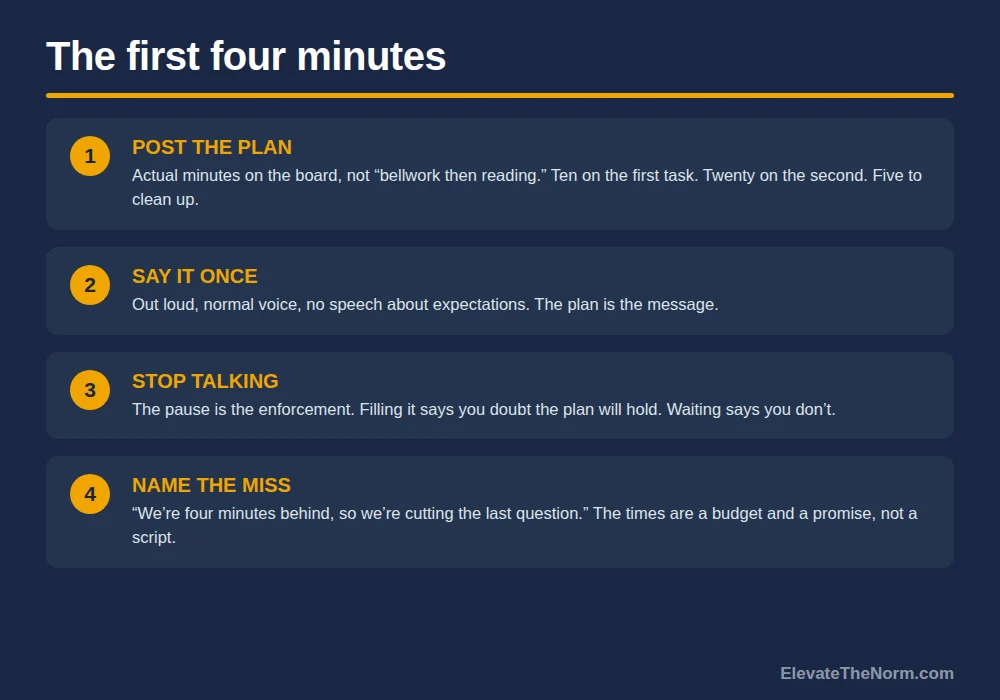
    Four numbered steps for a substitute’s first four minutes: post the plan, say it once, stop talking, name the miss
    The pause is the enforcement. Filling it says you doubt the plan will hold.

    Put the plan where they can see it before the bell. Not “bellwork, then reading” — actual minutes. Ten minutes on the first task. Twenty on the second. Five to clean up. Write it on the board you found it on. Then say it out loud, once, in a normal voice.

    Then stop talking.

    The pause is the part people skip, and it is the part that works. You have laid out a plan that is visibly organized, and then you let the silence do the enforcement instead of your volume. The instinct is to fill it — to repeat yourself, to add a threat, to get louder. Filling it tells the room you are not sure the plan will hold. Waiting tells them you are.

    I should be honest about what that costs, because most versions of “just wait them out” leave the price out. I once held a pause for more than five minutes. It was one of the most awkward moments of my life, that section finished nine minutes behind my other classes, and it is the only time I have ever assigned homework. It worked. It also cost nine minutes and a homework assignment I did not want to give. A substitute will rarely have nine minutes to spend, which is exactly why the posted plan matters — it shortens the pause you need.

    One clarification, since this gets misread: the posted times are a budget and a promise, not a script. When you miss them, say so out loud and give the reason. A substitute who announces “we are four minutes behind, so we are cutting the last question” has just demonstrated that the plan is real. That is worth more than hitting the times.

    Run their room, not yours

    This is where most substitute days are quietly lost, and it rarely looks like a discipline problem. It looks like a reasonable adult correcting something that was never wrong.

    Two-column comparison of classroom things a substitute should leave alone and write down beside things that require immediate action
    If you can’t explain it, it’s probably deliberate.

    In my room, students are almost always working alongside somebody. Partner work is the resting state, not a reward and not a special occasion — the tables are literally grouped that way and there are no rows to return to. A substitute who walks in, sees students talking, and reads it as the room falling apart will spend the period fighting the room’s actual design. They will separate students who were doing exactly what they were supposed to do, and by second period they will have spent all their credibility on a rule that does not exist in that room.

    The same goes for the lights. I do not turn the overhead fluorescents on — the room runs on floor lamps around the perimeter. It is a deliberate choice about sensory load, and it helps far more students than the ones who would ever have asked for an accommodation. A substitute’s first instinct on walking into a dim room is to find the switch. Flipping it is a small thing that changes the room the students walked into.

    So the working rule is: anything you cannot explain, leave alone and write down. If the seating looks odd, it is probably deliberate. If the lights are off, someone turned them off. If four students get up without asking, there is probably an established procedure for that. Note it, ask afterward, and do not spend your authority correcting a room’s design.

    Reserve your authority for the things that are wrong in any room: cruelty, danger, and a flat refusal to engage with work that has been made doable.

    That last one needs its qualifier. A student who will not start a worksheet nobody explained is not defying you — they are stuck, and “refusal” is the wrong word for it. Check whether the task is actually doable before you treat not-doing-it as a behavior problem. Most of the time on a substitute day, it is not defiance. It is an instruction gap.

    The one line that overrides all of this: if something is unsafe, or a student is being hurt, you do not need permission or context. Send for the neighboring teacher or the office immediately. Knowing where the phone is and who is next door is a two-minute check when you arrive, and it is the only part of this you should never improvise.

    Substitute teacher classroom management: five things you can actually control

    1. Where you stand. Circulating beats presiding. A redirect delivered quietly at close range, to one student, does the work without announcing the problem to twenty-nine other people — and it does not give the room a performance to react to.
    2. What you say first. Names if you have them, the plan if you do not. “Here is what we are doing and how long it takes” outperforms any version of “I expect you to behave for me today.”
    3. Your volume. It is the one resource that only decreases. Every notch you spend is gone for the rest of the day.
    4. What you write down. An honest, specific, unemotional note is the most valuable thing you leave behind. “Third period did not start the reading; two students, seated front left, were the reason” is useful. “Terrible class” is not, and it will be read by someone who has to work with those students tomorrow.
    5. Whether anybody gets humiliated. This one is not negotiable and it is entirely within your control. You will be gone tomorrow. They will not.

    What the regular teacher owes the substitute

    If you are reading this as the teacher who is going to be out, this is the section that changes your sub’s day, and it takes about fifteen minutes to write once and reuse all year.

    Six items that belong in substitute teacher plans, including timed plans, how the room runs, and a fallback activity
    Fifteen minutes to write once, and it changes every sub day that follows.

    Write it assuming it will be read in five minutes, standing up, by someone who was called at six that morning and has never been in your building. That is the realistic case, not the exception. Put the timed plan and the three things a stranger would misread on the first page, in that order. Everything else can be on page two, where it may or may not get read.

    • Timed plans, not task lists. Minutes next to every item. It is the single highest-value thing on the page, for exactly the reason in the section above.
    • A one-paragraph description of how your room normally runs. Partner work is expected. The lights stay off. Students may get water without asking. Write the three things a stranger would most likely misread — you already know what they are.
    • Work that can actually be done without you. A task that depends on your explanation is a task that will not happen, and the gap gets filled with whatever the room decides to do instead.
    • Two names, and what they are for. The colleague next door and the student who genuinely knows the routine. Not a list of “problem” students — a list of doors to knock on.
    • What a substitute is allowed to decide. Can they let a student use the restroom? Move a seat? Skip the last activity? Say so, or you have left someone to guess and then be wrong.
    • Where the day goes if it falls apart. One genuinely usable fallback that requires no setup. Every sub plan should have a floor under it.

    One thing that does not belong in sub plans: a discipline ladder invented for the occasion. Your substitute cannot enforce consequences that do not already exist in the room, and asking them to try is how a day gets worse rather than better. Tell them what the room already does.

    Why the day is worth taking seriously

    There is a habit of treating substitute days as time that does not count. The measured picture disagrees, though it needs stating carefully.

    Analysis published by Brookings reports that roughly 29% of teachers were chronically absent — missing ten or more school days — in the 2015–16 federal civil rights data, and that ten additional days of teacher absence are associated with a decline of between 1.7% and 3.3% of a standard deviation in math achievement. Substitute costs run to roughly 1% of all public education spending.

    Two honest caveats. These are associations drawn from observational data, not the result of an experiment, and the effect sizes are modest per unit. And the federal absence figures are from 2015–16, which is the most recent comparable collection but is now several years old. What the numbers support is a modest claim, and the modest claim is enough: sub days are frequent, they cost real money, and they are associated with measurably less learning. They are not a rounding error, and the room deserves a plan.

    What the students are doing, and why

    Almost everything written about substitute teaching treats the students as weather — a condition to be survived. It is worth saying plainly what is actually happening on their side of it, because it changes what you do.

    A class that tests a substitute is usually not running a scheme. Three ordinary things are true at once: nobody in the room knows their name, the day has been signalled to them as a holding pattern, and the adult in front of them has no history with them in either direction — no credit built up, and no relationship to damage. Teenagers read all three accurately and respond to them rationally. If the day looks like it does not count, some of them will treat it as though it does not count. A spoken routine a substitute has never run will not hold either, which is why cues a stranger can read off the wall survive your absence when verbal ones do not.

    Which means the two highest-leverage moves are both about signalling the opposite. Learn some names and use them — from a seating chart, from their work, by asking. And make the work visibly real: something that gets collected, that the regular teacher will see, that connects to what they did yesterday. “Your teacher is going to read these tomorrow” is a true sentence that changes a room, and it costs nothing.

    Students are also owed something on these days, and it is not complicated: to know what they are doing and how long it takes, to not be punished as a group for individuals, to not be talked about as a category in a note they will never see, and to be able to ask a question and get a real answer rather than “I’m just the sub.” That last one is worth retiring. You are the teacher in that room today. Not knowing an answer is fine. Saying you do not count is not, and they will believe you.

    Should a substitute actually teach?

    Sometimes, and the honest answer depends on what the plans ask for rather than on how confident you feel.

    If the plan is practice, review, reading or a project work session — which is the large majority of well-written sub plans — then teaching it is mostly circulating, answering, and keeping the work moving. Do that, and do it properly. If the plan introduces genuinely new content in a subject you do not know, delivering it badly is worse than not delivering it: students will learn it wrong, and the regular teacher will have to undo that before they can teach it. Run the practice portion, write down exactly where the class stopped, and say so.

    One small tool worth borrowing from special-education practice, where it is standard: a visible timer. Putting the remaining minutes somewhere the whole room can see them makes an abstract instruction concrete, and it takes the countdown out of your voice — the clock says it instead of you. It is a phone on the document camera, and it works for far more students than the ones it was designed for.

    The part that is actually hard

    Everything above is manageable on a normal day. The genuinely hard version is the room that has decided, collectively and before you said a word, that today is a day off. No single student is doing anything you could name. The work is simply not starting.

    There is no technique that fixes that in thirty seconds, and any article that tells you otherwise is selling something. What works is narrow and unglamorous: get one table started. Not the room — one table. Sit down next to them, at their height, and do the first item with them. A room that is entirely not working is very hard to move. A room where one group is visibly working is a different room, and the second group is much easier than the first.

    And if it does not turn: finish the period without making it worse, write the honest note, and hand the room back. That is not defeat. On some days that is competence, and a teacher who has been out sick will understand the difference between a sub who lost a room and a sub who protected one.

    Which is the whole of it, really. Substitute teacher classroom management is not a set of tricks for controlling somebody else’s students — it is the practice of running a room you did not build, on borrowed authority, without spending down what the regular teacher has spent months constructing. Post the plan. Pause instead of getting louder. Leave the room’s own rules alone. Use names. Make the work real. Write the honest note.

    And if you are the one writing the plans: fifteen minutes on a page that assumes nothing will do more for that day than anything the substitute can do once they are standing in it.

    Printables for this

    I write these for my own room and put them on TPT. The Any-Day Emergency Sub Plan Card is free — one page a stranger can run cold, in any subject. If you teach history, World History Emergency Sub Plans is five full days of strange-but-true readings with questions and answer keys, written so a sub can hand them out without knowing the content.

    Out the week of Halloween? A Halloween sub day does not have to be a word search. Halloween Sub Plans is five strange-but-true spooky history readings a sub can run cold. For math, the free Halloween color by number samplers for middle school and high school check themselves, so the sub never needs the answer key.

    If you are buying during a sitewide sale, the TPT sale guide walks through how the discounts stack and what is actually worth the money.

    Sources

    • Brookings Institution. We should be focusing on absenteeism among teachers, not just students. Read the analysis — source for the 29% chronic-absence figure (U.S. Department of Education Office for Civil Rights, 2015–16), the 1.7–3.3% of a standard deviation math association, and the ~1% of public education spending figure. These are observational associations, not causal estimates, and the federal absence data is from 2015–16.
    • Missouri Department of Elementary and Secondary Education. Substitute Teachers — certification requirements. Read the requirements — source for the 36 semester hours / 20 clock hours standard. One state’s rule, cited because it is current and published; requirements vary considerably by state and your own state’s rule governs.
    • Substitute teaching: evidence-based practices for inclusive classrooms. Helen: The Journal of Human Exceptionality, April 2024. Read the guide — consulted for the visual-schedule and visual-timer practices. Cited as practitioner guidance, not as research: the article describes itself as drawing on evidence-based practice but names no studies and reports no data.

    Every link above was checked on September 20, 2026. The classroom practices described in the first person — the timed plan and the pause, partner work as the room’s resting state, and the lamps — are my own and are used across this site.

    Worth saying plainly: a day covered by a substitute is not a day lost, and taking the day you need before you badly need it is one of the few moves a teacher fully controls. It is also a small part of what climbing back out of exhaustion actually asks of you.

    Frequently Asked Questions

    What is the single most important thing a substitute teacher should do first?

    Put a timed plan where the room can see it, say it out loud once in a normal voice, and then stop talking. The visible plan does most of the work and the pause does the rest. What does not work is opening with a speech about expectations — it spends authority before anything has happened and invites the room to test it.

    Should a substitute enforce their own rules or the regular teacher’s?

    The regular teacher’s, with three exceptions that apply in any room: cruelty, danger, and refusal to attempt the work. A substitute’s authority is borrowed from the room’s existing norms, and replacing those norms is what burns it. If something looks wrong but you cannot explain it, the odds are good that it is deliberate — leave it alone, write it down, and ask afterward.

    How much training do substitute teachers actually have?

    Less than most people assume, and it varies a great deal by state. Missouri, as one published example, issues a substitute certificate to applicants with either 36 semester hours of college credit or 20 clock hours of approved training. Some states require more. The practical point for administrators and teachers is that sub plans are, for some of the people using them, the entire preparation for the day.

    What should a substitute do when the whole class refuses to start work?

    Get one table started rather than trying to move the room. Sit down at their height and do the first item with them. A room in which nothing is happening is very hard to shift; a room in which one group is visibly working is a different problem and a much easier one. If it does not turn, finish the period without making it worse and leave an honest, specific note. Protecting a room is not the same as losing it.

    What belongs in sub plans for a middle or high school class?

    Timed plans rather than task lists, a short paragraph on how the room normally runs, work that can be completed without the regular teacher’s explanation, the name of a colleague next door and a student who knows the routine, an explicit statement of what the substitute is allowed to decide, and one genuinely usable fallback activity. Leave out any discipline ladder invented for the occasion — a substitute cannot enforce consequences the room does not already have.

    Does it actually matter how a substitute day goes, or is it a lost day either way?

    It matters, though the evidence supports a modest claim rather than a dramatic one. Brookings reports that ten additional days of teacher absence are associated with a decline of roughly 1.7% to 3.3% of a standard deviation in math achievement, and that substitute costs approach 1% of public education spending. Those are observational associations from older federal data, not experimental results. Read together they support something narrow and sufficient: these days are frequent, expensive, and associated with less learning.

    How should a substitute write the note they leave behind?

    Specifically, honestly, and without adjectives about character. Name what happened, when, and what was or was not completed. “Third period did not start the reading; two students seated front left were the reason” gives the regular teacher something to act on. “Terrible class” does not, and it will be read by an adult who has to face those students the next morning. Report behavior, not verdicts about people.

    Why do students behave differently for a substitute?

    Usually because three things are true at once and teenagers read all three correctly: nobody in the room knows their name, the day has been signalled to them as a holding pattern, and the adult in front of them has no history with them in either direction. That is a rational response to the situation rather than a character flaw, and it points at the fix. Use names, and make the work visibly real — something that gets collected and that the regular teacher will actually see. Telling a class truthfully that their teacher will read this tomorrow changes a room and costs nothing.


    About Clay Shumate

    By Clay Shumate — Clay Shumate is a certified secondary Social Studies teacher in the public schools of West Alabama, with seven years of classroom experience, a B.A. in History, and an M.Ed. in Secondary Education. He writes about project-based learning, student responsibility, respect, and practical ways to hold young people to a higher standard while giving them room to learn from mistakes. He is a member of the Society of Professional Journalists and writes to its Code of Ethics; this site’s editorial standards and corrections policy are published in full.

  • How to Avoid Teacher Burnout: Teach 120 Students, Not Five Classes

    How to Avoid Teacher Burnout: Teach 120 Students, Not Five Classes

    Every teacher hits a wall. It does not matter if you are in your first year or your twenty-fifth — though the year-one version of it is a different shape, and a different fix. It usually shows up a few weeks into a grading period, when the calendar has no days off in sight and you have to grind it out, the same way the long stretch after spring break feels every year. If you are searching for how to avoid teacher burnout right now, you are probably in that stretch. And if you are not yet sure whether it is the stretch or something that is no longer lifting, the three symptoms and what separates them from an ordinary hard patch are worth reading first.

    I want to start with something you may not believe yet: if your students are showing up, smiling, talking to you and to each other, and picking up the soft skills and life skills that do not show up on a test, you are doing an incredible job. Burnout lies to you about that, and the research on what it actually costs students is far less damning than the version you have probably read. The rest of this article is what I actually do to keep the wall from winning.

    Key Takeaways

    • Burnout is a work problem, not a character flaw. The World Health Organization defines it as the result of chronic workplace stress that has not been successfully managed.
    • Teachers report it far more than other workers. In RAND’s 2025 survey, 53 percent of teachers reported burnout, compared with 29 percent of similar working adults.
    • Ask “what can I do today,” not “what do I need to do today.” One question is a to-do list you can never finish. The other is a day you can win.
    • Teach 120 students, not five classes. Every room is its own ecosystem, and every student in it needs something different.
    • Make the first call home a compliment. Then stop talking and listen. It changes every call that comes after it.
    • Treat your observer as a second set of eyes, and take the day off before you need a week off.

    Free Download · 2-page PDF

    Compliment-First Parent Call Planner

    The four-step first call and the five-move follow-up call on one page, a log to track who you have reached, and a tracker for three-minute one-on-one conversations with every student.

    Download the free PDF

    Free. No email address required. Designed for grades 6–12. Browse every printable in Your Free Library.

    What Teacher Burnout Actually Is

    Teacher burnout is exhaustion that comes from the job itself and does not go away with a normal weekend. The World Health Organization classifies burn-out as an occupational phenomenon, not a medical condition, and defines it as a syndrome resulting from chronic workplace stress that has not been successfully managed. It has three parts: feeling drained of energy, feeling mentally distant or cynical about your job, and feeling like you are no longer effective at it. If you want the fuller picture — the three dimensions the research actually measures, what the 2026 survey numbers say, and which parts of the problem belong to the building rather than to you — start with the complete guide to what burnout is and who can fix it.

    That third part is the one I see teachers underestimate. Burnout does not just make you tired. It convinces you that you are bad at teaching, and that belief makes the tiredness worse. So avoiding teacher burnout is partly about rest, and partly about measuring your work correctly. And if a percentage you have seen quoted is part of why you are here, it is worth knowing which survey it came from and what it actually asked — the four best-known figures measured four different things.

    Why It Hits a Few Weeks Into the Grading Period

    The numbers explain why so many of us feel it at the same time. In RAND’s 2025 State of the American Teacher survey, 61 percent of teachers reported frequent job-related stress and 53 percent reported burnout, compared with 41 percent and 29 percent of similar working adults. Teachers averaged about 49 hours a week, roughly ten more than they were contracted for. The burnout number was down from 60 percent the year before, which is good news, but it is still more than half of us.

    Then there is the calendar. The first weeks of a grading period run on adrenaline. By the middle, the adrenaline is gone, grades are due, the next break is far away, and every small problem feels heavier than it is. Nothing about you changed. The load did.

    Measure Your Day the Right Way

    When I feel the wall coming, I go back to what actually matters. Are the kids coming to class? Are they smiling? Are they talking? Am I helping them get better at the things they will need for the rest of their lives: showing up, communicating, working with people they did not choose? If the answer is yes, then I am doing my job, and so are you.

    That is not a pep talk. It is a correction. A 2026 systematic review of 55 studies of middle and secondary school teachers found that positive teacher-student relationships were associated with every aspect of teacher wellbeing the researchers measured, from positive emotion to a sense of accomplishment. The authors are careful to say most of those studies used tools designed for elementary classrooms, and the studies show association, not cause. But the direction lines up with what most of us feel: the relationships are not a distraction from the work. They are the part of the work that refills you.

    Measuring the day well also means being able to see it later. Ten minutes a week in a running record of what you tried and what happened will tell you in February whether the bad weeks are a pattern or a run of bad luck — and which of the two you are dealing with changes what you should do about it.

    Side-by-side comparison of two questions to start a school day. What do I need to do today is described as an endless list measured against a plan; what can I do today admits the day has a limit and points at who is in the room
    One question is a list you can never finish. The other is a day you can win.

    Ask “What Can I Do Today?” Instead of “What Do I Need to Do Today?”

    This is the biggest mindset shift I know of for avoiding teacher burnout. “What do I need to do today” is a list that never ends. There is always another stack to grade, another email, another form. You go home every single day having failed the list.

    “What can I do today” is a different question. It admits that the day has a limit, and it points you at what is actually in front of you. It is also the question that makes the next idea possible, because what you can do today depends on who is actually in your room today.

    Stop Teaching a Class. Teach 120 Students.

    Every classroom is its own ecosystem. Inside an ecosystem, every living thing needs something different to survive. Students are not animals, obviously, but the principle holds: every student in your room needs something different to succeed.

    If you view a class as one class, in my opinion, you will fail as a teacher. If you view it as 20 to 30 individual students who all need different things, you have a chance. So if you have 120 students across your day, think of it as 120 different lesson plans. That sounds like a faster road to burnout, not a way out of it. It is not, and here is why: you stop fighting the day for being different from the plan.

    This is also why I do not put much faith in extremely detailed lesson plans. Say you teach the same subject five periods a day. I can write the plan, and so can you. But the only thing on it I can guarantee is that my students will work on the driving question and keep moving toward it. I do not know if first period will get interrupted, if a fight will break out in fourth, or if sixth will need more one-on-one time and slow down. Plan the goal firmly. Plan the path loosely. The day you stop expecting every period to follow the script is the day the script stops making you feel like a failure.

    Spend the First Days Getting to Know People, Not Reading Rules

    Most of us spend the first three or four days of school reciting rules. If you teach high school, you do not need to. Hand out the syllabus and let students read most of it themselves. A fill-in-the-blank version moves even faster, and you can spot-check it for a first grade in the gradebook. If you want a plan for the routines themselves, start with this guide to classroom routines and procedures.

    Use the time you save to genuinely get to know every student. At the start of every new year or semester, I sit down one-on-one with each student for about three minutes, and I get through all of them within the first three school days. Three minutes is short enough to fit and long enough for a student to realize you actually want to know who they are. It is also where you learn, without making a big production of it, who lives at home and who to call.

    Do the math and it is less than it sounds: 30 students at three minutes each is about 30 minutes a class period across three days, which is roughly the time the rules speech was going to take anyway. One caution from the parent and student side of this: keep anything touching home life optional. The point is to learn which adult to call, not to collect a family’s business.

    Make the First Call Home a Compliment

    When you call from a school number, you will scare a parent. Back when I worked as a retail manager, every time a customer asked for the manager, I took a deep breath, because I knew what was coming. Nine times out of ten, I was right. Parents answering a call from the school feel exactly the same way.

    So the first call is always a compliment, and it does not matter how small. Something like: I am really glad your son was in my class today, because the pencil sharpener fell and he cleaned the whole mess up without being asked, and I wanted you to know you have a thoughtful kid. Then stop talking.

    Four numbered steps for a compliment-first call home: call with good news first, be specific, stop talking, and truly listen and remember
    The first call home should be good news. Then stop talking and listen.

    They will talk. And when they do, you have two jobs. The first is to truly listen. That is a skill I think teachers are losing, with students and with the adults who raise them, and without it we have no idea what is actually going on in a kid’s head. The second job is to remember what you heard, because you will need it.

    I also send a general letter home to every family early in the year saying how excited I am to have their student in class. Between the letter and the first call, the second conversation starts from trust instead of fear. If you want a simple way to keep track of who you have reached, a parent-teacher communication log does the job, and there are apps built for this if your families prefer text.

    When the Next Call Is About a Problem

    Here is what the compliment call buys you. This year, I had to call about a student who was not progressing the way I had hoped. The guardian picked up, I explained the situation, and because we had already talked once about something good, and because she had already gotten my letter, she worked with me instead of against me. Now that student is turning in work, keeping their head up in class, and at least thinking about participating. They are involved in a way they were not before.

    Years ago, teaching middle school, I made the same kind of call to the grandmother of a student who would not stop talking and was interrupting class. Because we had spoken before, I could say: last time I told you how strong he is at verbal communication, so I am confused about why his written work does not match. Can you help me understand? Then I stopped. I had told her the grade, the problem, and the specific gap between what he does well and what he does not. She filled in the rest, and you would be surprised how much information you get when you leave room for it.

    Five steps for a parent call about a concern: start from the last good conversation, give the facts, name the gap, ask for help and then stop, and listen for the missing piece
    When the next call is about a problem, the first call has already built the trust you need.

    The research backs the pattern. In a randomized experiment with sixth and ninth graders in a summer program, daily teacher contact with families increased the odds of homework completion by 40 percent, cut the times teachers had to redirect students by 25 percent, and raised participation by 15 percent. The researchers credited stronger teacher-student relationships, more parent involvement, and more student motivation.

    There is an honest wrinkle worth knowing. In a follow-up high school study, weekly messages about what students could improve produced the largest gains in earning course credit, somewhat larger than messages about what they were doing well, though the difference between the two was not statistically clear. I read that as support for doing both in order: the compliment call earns the trust, and the next call spends it on something specific and actionable.

    Treat Your Observer as a Second Set of Eyes

    Newer teachers panic about observations. Remember that, like in any other job, your observer is there first to give you another set of eyes, and they can give you extremely useful information if you listen when they come back. If you stop listening the moment you see a low score and decide you know better than they do, you lose.

    There is evidence on this, too. A study of mid-career teachers in a classroom-observation-based evaluation system found that teachers were more effective in the years after being evaluated, with the largest improvements among teachers who had been performing relatively poorly beforehand. The feedback only worked because the teachers used it. Ask for one specific change, make it, and invite the observer back to see it. If you want a structure for that thinking, these teacher reflection examples are a good place to start.

    Take the Mental Health Day Before You Need a Week

    If you remember three words from this article, make them mental health days. A day off taken when you first notice the signs costs far less than a week taken after you have run empty. Leave a sub plan that works without you, and do not spend the day grading. If you teach on an IEP caseload, the special education version of this is a different set of demands and the coverage question is harder.

    RAND’s 2025 work-life balance findings say the same thing from a different direction: 46 percent of teachers said their job left them too tired for their private lives, compared with 13 percent of similar working adults, and teachers said that leadership support for flexibly using paid leave improved their balance. Fewer than half said their school or district was making efforts to help — and what those efforts would have to consist of to count is its own question. So until yours does, take the leave you have earned. I will write more about mental health days on their own soon. And if rest does not lift the exhaustion, that is a reason to talk with a doctor or your district’s employee assistance program, not a reason to push harder.

    The Short Version

    How to avoid teacher burnout comes down to a few habits you can start tomorrow: measure your day by whether students showed up, smiled, and grew; ask what you can do today; teach individuals instead of a class; make the first call home good news and then listen; hear your observer out; and take the day before you need the week. If you are newer to all of this, the guide to classroom management for new teachers and this piece on building relationships with students pick up where this one leaves off.

    You are doing a better job than the wall is telling you.

    Before you go: grab the free Compliment-First Parent Call Planner (PDF) — ElevateTheNorm.com branded, printable, no email required.

    And if you are reading this past the point where prevention is the right word — if the summer came and went and nothing changed — that is a different problem with a different answer. Here is what the research actually supports once the tank is already empty. And if what you want is the list of places to go once prevention has stopped applying, that is a separate page.

    Frequently Asked Questions

    What is the fastest way to avoid teacher burnout in the middle of a grading period?

    Change the question you start the day with. Instead of listing everything you need to do, ask what you can do today, and let the rest wait until tomorrow. Then make one positive phone call. It is the most reliably good conversation a teacher can have in a school day, and it pays you back the next time you have to call that same family about a problem.

    Do I really have to call every family? I have more than a hundred students.

    No one can make 120 calls in a week, and trying to is its own route to burnout. Spread them out: three to five a day across the first several weeks reaches everyone by the end of the grading period. A short welcome letter home covers every family on day one while the calls catch up. If a family prefers text or email, or does not have reliable phone access, use that instead. The point is that the first contact is good news, not that it happens by phone.

    What if I cannot find anything positive to say about a student yet?

    Look smaller. The compliment does not need to be about grades. A student who held the door, helped someone find the page, or came in and sat down without being asked has given you something true to say. If you truly have nothing after a week, that tells you something too: you have not gotten to know that student yet, and that is the first thing to fix.

    How do you fit a three-minute conversation with every student into the first three days?

    Do the math first: 30 students at three minutes each is 90 minutes per class, or about 30 minutes a class period across three days. That is time most of us already spend reading the syllabus aloud. Hand out the syllabus, let students work through it, and pull students one at a time for a short conversation. Keep any question about home life optional. The goal is to learn who a student is and which adult to call, not to collect details about a family.

    My school requires detailed daily lesson plans. Does this approach conflict with that?

    It does not have to. Turn in what your school requires. The point is where you put your confidence: the one part of the plan you can guarantee is the learning goal or driving question, and everything else will bend around the interruptions, pull-outs, and bad days that no plan predicts. Plan the goal firmly and plan the path loosely.

    How should I handle a low observation score?

    Listen before you defend. An observer is one more set of eyes in a room you usually see alone, and research on classroom-observation evaluation found that mid-career teachers got measurably better after being evaluated, with the biggest gains among those who started lowest. Ask for one specific thing to change, change it, and invite the observer back to see it.

    When is it time to take a mental health day?

    Before you need a week. A day off taken when you notice the early signs, such as dreading the building every morning or feeling that nothing you do is working, costs far less than one taken after you have run completely empty. Know your district’s leave policy, leave a sub plan that works without you, and do not spend the day grading. If the exhaustion does not lift with rest, talk with a doctor or your district’s employee assistance program.

    Prevention is the cheapest version of this, and it is not the only version. If you are already past it and weighing whether to stay at all, the numbers on what actually happens to teachers who leave are worth reading before you decide either way — they are less one-sided than the career-change advice suggests.

    Sources

    • RAND Corporation. Steiner, E. D., Levine, P. R., Doan, S., & Woo, A. (2025). Teacher Well-Being, Pay, and Intentions to Leave in 2025: Findings from the State of the American Teacher Survey. Report — surveyed January–March 2025; 61% frequent job-related stress and 53% burnout among teachers vs. 41% and 29% of similar working adults; 49-hour average work week.
    • RAND Corporation. (2025). To Make Teaching Sustainable, Help Teachers Balance Work and Personal Demands: Findings from the 2025 State of the American Teacher Survey. Report — 46% of teachers vs. 13% of similar adults too tired for private life; leadership support for flexible leave use.
    • World Health Organization. (2019). Burn-out an “occupational phenomenon”: International Classification of Diseases. News release — ICD-11 definition and its three dimensions.
    • Allen, K.-A., Lai, R., Southam, J., Mageean, L., & Roffey, S. (2026). Associations between teacher-student relationship quality and middle and secondary school teachers’ wellbeing: A systematic review. Educational Psychology Review. Article — 55 studies; associations, with measurement mostly borrowed from primary-school research.
    • Kraft, M. A., & Dougherty, S. M. (2013). The effect of teacher-family communication on student engagement: Evidence from a randomized field experiment. Journal of Research on Educational Effectiveness, 6(3). ERIC record — sixth and ninth graders, mandatory summer program.
    • Kraft, M. A., & Rogers, T. (2015). The underutilized potential of teacher-to-parent communication: Evidence from a field experiment. Economics of Education Review, 47. Abstract — high school credit recovery; improvement-focused messages produced the largest effects.
    • Taylor, E. S., & Tyler, J. H. (2012). The effect of evaluation on teacher performance. American Economic Review, 102(7), 3628–3651. Abstract — mid-career teachers more productive after evaluation, largest gains among lower performers.

    Every link above was checked on September 18, 2026. The classroom stories on this page are the author’s own, with identifying details removed; nothing in them is invented or composited.

    If prevention habits are not landing, the next question is which demand is defeating them. Which of those loads is actually yours, and what the evidence behind each one is worth walks through the ranked national figures, what they do and do not establish, and a five-day log you can run to find out.


    About Clay Shumate

    By Clay Shumate — Clay Shumate is a certified secondary Social Studies teacher in the public schools of West Alabama, with seven years of classroom experience, a B.A. in History, and an M.Ed. in Secondary Education. He writes about project-based learning, student responsibility, respect, and practical ways to hold young people to a higher standard while giving them room to learn from mistakes. He is a member of the Society of Professional Journalists and writes to its Code of Ethics; this site’s editorial standards and corrections policy are published in full.

Teacher Emergency Toolkit — practical resources, real classroom support. Shop on TPT.Teacher Emergency Toolkit — practical resources, real classroom support. Shop on TPT.