The Elevate Blog banner: Real Classrooms. Practical Ideas. Higher Expectations. Three students climb a rocky ridge at sunrise, each pulling the next one up, toward a teacher reaching down to help.

Tag: secondary education

  • Natural Consequences in the Classroom: A Fair Alternative to Punishment

    Natural Consequences in the Classroom: A Fair Alternative to Punishment

    By Clay Shumate

    Natural consequences are the outcomes that happen on their own when a student makes a choice—without the teacher adding anything. A student who does not study gets a low grade. A student who refuses to participate in group work gets left behind while the group moves forward. Nobody imposed those results. They just happened, because actions have outcomes. Using natural consequences in the classroom means stepping back, when it is safe to do so, and letting reality do the teaching.

    That is the short answer. The longer one involves knowing when natural consequences work, when they do not, where teachers confuse them with logical consequences and punishment, and how to use all three honestly without pretending that any single approach solves everything.

    Key Takeaways

    • Natural consequences happen without teacher intervention. The outcome follows directly from the student’s choice.
    • Logical consequences require a teacher to set up a related, respectful, reasonable response. They are different from natural consequences.
    • Neither natural nor logical consequences should be disguised punishment—if it involves humiliation, excessive severity, or unrelated penalties, it is punishment regardless of what you call it.
    • Natural consequences have limits. They do not work when safety is at risk, when the consequence is too far in the future to matter, or when the student lacks the ability to make a different choice.
    • The goal of any consequence in a secondary classroom is learning, not suffering.

    What Natural Consequences Actually Are

    Rudolf Dreikurs, the psychiatrist who brought the concept into education, drew a clear line: natural consequences are results that occur without any adult arrangement. The parent or teacher does not create the consequence, does not announce it, and does not have to enforce it. It simply happens (Dreikurs and Soltz, Children: The Challenge, 1964).

    In a secondary classroom, natural consequences show up constantly:

    • A student who does not prepare for a class discussion has nothing to contribute when their turn comes.
    • A student who puts off a long-term project until the last night turns in weak work.
    • A student who treats group members badly finds that nobody wants to work with them next time.

    Notice what the teacher does in each of these examples: nothing extra. The teacher does not need to add a punishment. Reality handled it.

    That is the power of natural consequences—and also their limitation. They only work when the natural outcome is immediate enough, visible enough, and meaningful enough to teach the lesson on its own.

    Natural Consequences vs. Logical Consequences

    This is where most of the confusion lives. Teachers use the terms interchangeably, but they are not the same thing.

    Natural consequences require no adult action. The outcome happens on its own.

    Logical consequences require the teacher to create a response that is directly connected to the behavior. The teacher sets it up. The connection is deliberate.

    Jane Nelsen, author of Positive Discipline, identifies four criteria that logical consequences must meet to avoid becoming disguised punishment. She calls them the Four Rs: Related, Respectful, Reasonable, and Helpful. If any of the four is missing, the consequence has crossed the line into punishment—even if the teacher does not intend it that way (Nelsen, “Logical Consequences,” Positive Discipline).
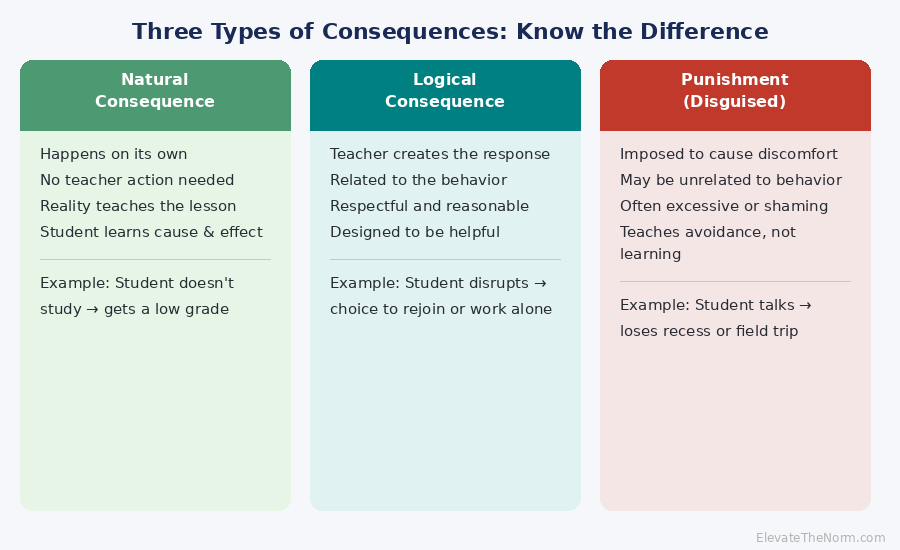
    Three-column comparison showing differences between natural consequences, logical consequences, and disguised punishment
    Three types of consequences—and how to tell if a consequence has crossed into punishment.

    Logical Consequences in the Classroom: Examples for Grades 6–12

    A logical consequence is a response the teacher chooses because it follows directly from what the student did: fix what you broke, lose the privilege you misused, or step away long enough to reset. Responsive Classroom names exactly those three types: “you break it, you fix it,” loss of privilege, and positive time-out, which it calls “space and time” in middle school. It describes all three as a non-punitive response, and it says anything taken away has to be directly related to the misbehavior (Responsive Classroom, “Three Types of Logical Consequences,” 2023).

    Here is what that looks like with teenagers. The last column matters as much as the second one, because it shows where a logical consequence turns into punishment.

    What the student didLogical consequenceWhy it is relatedWhen it becomes punishment
    Left the lab station or work area a messResets it before the bellFixes the exact thing that was left undoneAdding a lunch detention on top of the reset
    Used a phone during instructionPhone goes to a set spot for the rest of the periodRemoves the item that was misused, for the time it was misusedKeeping it for a week, or reading what is on it
    Stayed off task in a seat they choseSits in a teacher-chosen seat for the rest of the period and gets to choose again tomorrowLoses the privilege they misused, and only that oneLosing seat choice for the semester, or being moved in front of everyone with commentary
    Wrote in or damaged a shared book or supplyCleans it, or repairs it within reasonYou break it, you fix itDemanding a replacement cost the family cannot afford
    Said something hurtful to a classmateA private repair conversation and an agreed way to make it rightRepairs the relationship that was harmedA forced public apology
    Was escalating during a discussionTakes space and time at a reset spot, then rejoins when readyGives them a reset without removing them from learningGetting sent out for the whole period by default
    Copied a classmate’s homeworkRedoes the work under supervision, with help if they need itPuts back the practice that was skippedA zero with no chance to show the learning. Your school’s academic integrity process may still apply.

    A one-sentence test before you use one. Say it out loud, starting with “Because you…” For example: “Because you left the station a mess, you’ll reset it before you go.” If the second half does not follow from the first, it is not logical. Run it through Nelsen’s Four Rs above too. A logical consequence that is not Respectful is still punishment.

    Two habits keep logical consequences honest. First, decide on them before you need them. A consequence you make up in the moment carries your mood with it, which is why a written response ladder for common problems helps. Second, because the teacher creates a logical consequence, the teacher’s delivery decides how it lands. Say it privately, calmly, and once. Then let the student do it without an audience or a lecture.

    When Natural Consequences Work in a Secondary Classroom

    Natural consequences are strongest when three conditions are met:

    1. The outcome is close in time. A teenager who puts off studying sees the grade within days. That connection is tight enough to teach. But a student who does not develop study habits in ninth grade may not feel the real consequence until college—and that is too far away to function as a classroom teaching tool.

    2. The outcome is meaningful to the student. If a student genuinely does not care about the grade, the natural consequence of not studying has no teaching power. This is not a flaw in the student. It means the teacher needs a different approach—probably a conversation about what the student does care about and whether there is a connection.

    3. The student has the ability and resources to make a different choice. This is the most important condition and the one teachers miss most often. A student who does not bring materials because the family cannot afford them is not choosing to be unprepared. A student who does not finish homework because there is no safe, quiet place at home is not choosing to be irresponsible. Letting the natural consequence land in those situations is not teaching. It is punishing poverty or circumstance and calling it accountability.

    When Natural Consequences Do Not Work

    There are situations where letting natural consequences play out is wrong, dangerous, or irresponsible. Every teacher needs to recognize these clearly.

    Safety is at risk. If a student’s behavior could cause physical harm—to themselves or others—the teacher intervenes immediately. You do not let a student learn from the natural consequences of unsafe lab behavior. You stop it.

    The consequence is invisible or delayed. Some choices have consequences that are real but too slow or abstract for an adolescent to feel. Skipping reading assignments, for instance, produces a gradual erosion of comprehension that does not announce itself until weeks later. The natural consequence exists, but it is not effective as a teaching tool because the student cannot draw a line between the choice and the result. My Behavior Reflection Sheets on TPT ask students for reasons, not apologies, and come in two reading levels.

    The consequence falls on other people. When a student’s irresponsibility damages the group—a partner who did no work, a lab team missing a component—the natural consequence punishes the students who did their part. That is not fair, and it is not a lesson worth teaching.

    The student is already struggling. For a student who is disengaged, anxious, dealing with instability at home, or behind in multiple classes, piling on another failure through natural consequences does not teach resilience. It teaches the student that school is one more place where things do not work out. The teacher’s job at that point is support, not observation.

    School policy requires a specific response. Some behaviors—threats, harassment, weapons, substance use—require immediate administrative action regardless of any teacher’s philosophy about consequences. Natural consequences do not override mandatory reporting or school safety protocols.
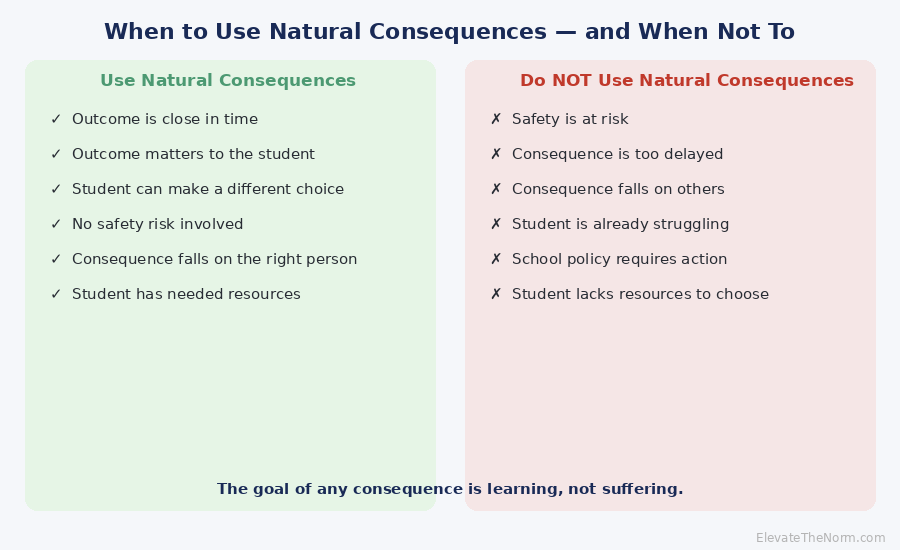
    Two-column checklist showing when to use natural consequences and when to avoid them in the classroom
    Natural consequences work when conditions are right—and fail when they are not.

    The Punishment Problem

    The biggest risk with consequences—natural or logical—is that they become punishment wearing a better name.

    Alfie Kohn has argued for decades that most classroom consequences function as punishment: “Do this or else” dressed in gentler language (Kohn, Punished by Rewards, 1993). Nelsen’s framework offers a useful test. If the consequence triggers resentment, revenge, rebellion, or retreat in the student, it has become punishment—regardless of the teacher’s intention.

    Here are three warning signs that a “consequence” is actually punishment:

    1. It is not connected to the behavior. A student who talks during instruction loses recess or has a phone taken away. Those responses are not related to the behavior. They are penalties applied to get compliance.

    2. It includes humiliation. A student who turns in incomplete work has their name posted on a “missing work” list. The consequence is now about shame, not about the work.

    3. It is excessive. A student who is late to class once gets a week of after-school detention. The severity has nothing to do with learning. It is about power — and power is what most “control” techniques quietly optimize for, which is why so few of them hold.

    When I notice a student making a choice that is heading toward a natural consequence, I do not broadcast it to the room. I walk over—close range, conversation volume—and say something like, “I can see where this is going. What do you want to do about it?” That is not me rescuing them from the consequence. It is me giving them a chance to redirect before the consequence lands. If they choose not to redirect, the outcome follows. But they had the information and the opportunity.

    That is what separating consequences from punishment looks like in practice. The student keeps their dignity. The standard stays in place. The teacher stays close.
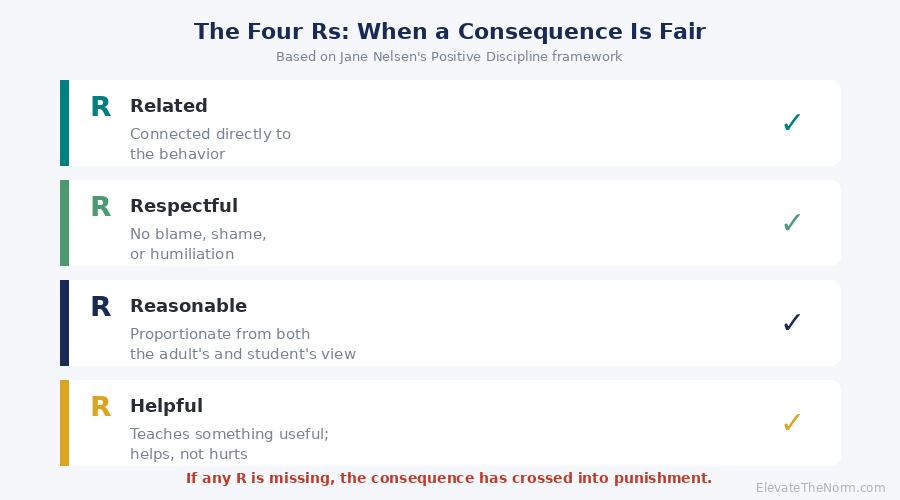
    The four Rs framework for logical consequences: Related, Respectful, Reasonable, and Helpful from Jane Nelsen Positive Discipline
    Jane Nelsen’s Four Rs: if any one is missing, the consequence has crossed into punishment.

    A Practical Framework: Choosing the Right Response

    Not every situation calls for the same type of response. Here is a framework for deciding:

    Step 1: Is anyone at risk? If yes, intervene immediately. Safety overrides every other consideration.

    Step 2: Will the natural consequence teach the lesson? Check the three conditions: Is the outcome timely? Does the student care? Can the student actually make a different choice? If all three are yes, step back and let it play out. Stay close enough to debrief afterward.

    Step 3: If natural consequences will not work, is there a logical consequence? Apply Nelsen’s Four Rs: Related, Respectful, Reasonable, Helpful. If you cannot make the consequence meet all four criteria, it is probably not a logical consequence—it is a punishment you are trying to justify.

    Step 4: If no consequence fits, use a conversation. Sometimes the best response is pulling the student aside and talking through what happened, what they were thinking, and what they want to do next. Not every problem needs a consequence. Some problems need a plan. If you want the exact words for that follow-up talk, my Restorative Conversation Scripts on TPT give you a script for each step.

    Step 5: Record and follow through. Whatever approach you choose, do it consistently and follow through. Consequences that change based on the teacher’s mood are not consequences. They are reactions.

    What This Looks Like Across Common Classroom Situations

    Late work. The natural consequence of late work is a lower grade or missed feedback cycle. But check whether the student had the resources to complete the work on time. If they did, the natural consequence stands. If they did not, a conversation and a revised plan are more honest than a zero. And if the lateness is recurring rather than a one-time lapse, check attendance before you check effort — chronic absenteeism produces exactly this pattern, and it calls for a different response than a motivation problem does.

    Phone use during instruction. There is no natural consequence fast enough to teach this lesson. A logical consequence—put the phone away or it goes to a designated spot for the period—is appropriate, as long as it is applied consistently and without a lecture.

    Disrespect toward a peer. The natural consequence is social: damaged trust, fewer willing partners. The logical consequence is a teacher-facilitated conversation about what happened and what repair looks like. This is also where school policy may require documentation.

    Refusal to work. Before assigning any consequence, ask a question. A student who refuses to work is telling you something—about the task, about their confidence, about something outside the classroom. The consequence should follow only after you understand the refusal.

    Group work problems. When one student is not contributing, the natural consequence falls on the group, not the individual. That makes it a poor teaching tool. A logical consequence—a private conversation, a role reassignment, or an individual accountability check—is more appropriate.

    Conclusion

    Natural consequences are one tool in a larger set. They work best when the outcome is timely, meaningful, and fair—and when the student has the resources to make a different choice. When those conditions are not met, logical consequences, conversations, and plans often do the job better.

    The real skill is knowing which tool fits the moment. And the real test is not whether the student suffered the right amount—it is whether they learned something they can use next time. Consequences that teach are worth keeping. Consequences that humiliate are not consequences at all.

    Stay close to your students. Handle correction at close range. Give them information and a chance to redirect before the consequence lands. And when the consequence does land, help them understand it—without piling on. And when the harm landed on another person rather than on the student’s own grade, a consequence by itself will not finish the job—that is the point where a structured repair conversation does work a consequence cannot.

    What is the difference between natural consequences and punishment?

    Natural consequences happen without any teacher action—they are the direct result of a student’s choice. Punishment is imposed by an authority figure and may or may not be connected to the behavior. A student who does not study and gets a low grade experienced a natural consequence. A student who does not study and loses a field trip privilege experienced punishment.

    What are examples of logical consequences in the classroom?

    A logical consequence is connected directly to the behavior. For example, a student who leaves a lab station a mess resets it before the bell. A student who uses a phone during instruction puts it in a set spot for the rest of the period. A student who is off task in a seat they chose moves to a teacher-chosen seat for the period. A student who says something hurtful has a private repair conversation. Each one is related, respectful, reasonable in scale and focused on learning. If it adds an unrelated penalty or embarrasses the student, it has become punishment.

    When should a teacher NOT use natural consequences?

    Do not rely on natural consequences when safety is at risk, when the consequence is too delayed to be meaningful, when the consequence falls on other students instead of the one who made the choice, when the student lacks the resources or ability to choose differently, or when school policy requires a specific response.

    How do I know if a logical consequence has crossed the line into punishment?

    Use Jane Nelsen’s Four Rs test. Is the consequence Related to the behavior, Respectful of the student, Reasonable in scale, and Helpful toward learning? If any R is missing—especially respect—it has become punishment. Another signal: if the student responds with resentment, revenge-seeking, rebellion, or withdrawal, the consequence is functioning as punishment regardless of your intent.

    Can natural consequences work with students who genuinely do not seem to care?

    If a student does not care about the outcome, the natural consequence has no teaching power. That does not mean the student is broken. It means the teacher needs to find out what the student does care about and whether the current work connects to it. Sometimes the answer is a different approach entirely—a conversation, a relationship, a different entry point into the material.

    Should I warn a student before a natural consequence happens?

    In most cases, yes—briefly and privately. A quick check-in like “I can see where this is going—what do you want to do about it?” gives the student a chance to redirect. You are not rescuing them. You are giving them information and an opportunity. If they choose not to redirect, the outcome follows.

    How do natural consequences work alongside school discipline policies?

    Natural consequences operate within the classroom space the teacher controls. They do not replace school-level discipline for serious behaviors like threats, harassment, or safety violations. Teachers should know their school’s required responses and follow them. Natural and logical consequences handle the daily, classroom-level situations that make up the vast majority of behavior decisions.

    Are natural consequences fair for all students?

    Not automatically. If a student cannot make a different choice—because of poverty, disability, trauma, or lack of support—letting the natural consequence land punishes their circumstances, not their decisions. Fairness requires asking whether the student had what they needed to succeed before holding them accountable for the result.

    Sources

    1. Rudolf Dreikurs and Vicki Soltz, Children: The Challenge. Plume, 1964.
    2. Jane Nelsen, “Logical Consequences.” Positive Discipline. https://www.positivediscipline.com/articles/logical-consequences/
    3. Alfie Kohn, Punished by Rewards: The Trouble with Gold Stars, Incentive Plans, A’s, Praise, and Other Bribes. Houghton Mifflin, 1993. https://www.alfiekohn.org/punished-rewards/
    4. Melissa Institute for Violence Prevention and Treatment, “Natural Consequences and Child Development.” 2018.
    5. Becky Bailey, “The Three Types of Consequences and How to Give Them.” Conscious Discipline. https://consciousdiscipline.com/blog/three-types-of-consequences/
    6. American SPCC, “What Is Positive Discipline?” https://americanspcc.org/what-is-positive-discipline/
    7. Helpful Professor, “18 Natural Consequences Examples.” 2026. https://helpfulprofessor.com/natural-consequences-examples/
    8. Bonfire Leadership Solutions, “Natural Consequences: A Powerful, Evidence-Based Approach to Discipline.” https://bonfireleadershipsolutions.com/blog/natural-consequences/
    9. Responsive Classroom, “Three Types of Logical Consequences.” July 7, 2023, updated September 18, 2024. Names “you break it, you fix it,” loss of privilege, and positive time-out (“space and time” in middle school). A practitioner organization’s guidance, not a research study. https://www.responsiveclassroom.org/three-types-of-logical-consequences/

    About Clay Shumate
    Clay Shumate is a certified secondary Social Studies teacher in the public schools of West Alabama, with seven years of classroom experience, a B.A. in History, and an M.Ed. in Secondary Education. He writes about project-based learning, student responsibility, respect, and practical ways to hold young people to a higher standard while giving them room to learn from mistakes. He is a member of the Society of Professional Journalists and writes to its Code of Ethics; this site’s editorial standards and corrections policy are published in full. More about Clay.
  • Student Responsibility: How to Raise the Standard Without Removing Grace

    Student Responsibility: How to Raise the Standard Without Removing Grace

    By Clay Shumate

    Student responsibility is what happens when a young person owns their preparation, effort, deadlines, collaboration, and mistakes — not because an adult is standing over them, but because the standard is clear and the student believes it applies to them. Raising that standard in grades 6–12 requires both firmness and a genuine path back when students fall short. Neither half works alone.

    Key Takeaways

    • Responsibility is practiced, not preached — students learn it by doing it, not by hearing about it.
    • What students, teachers, families, and schools each control is different, and mixing those up creates most of the conflict.
    • High standards without support create failure. Support without standards creates dependence.
    • Responsibility has four dimensions: academic, behavioral, interpersonal, and community. Most schools only measure the first two.
    • Grace and accountability are not opposites. They are the same system working correctly.

    What Student Responsibility Actually Means

    Student responsibility means a student can answer three questions honestly: What is expected of me? Am I doing it? If not, what am I going to do about it? Those three questions are unpacked at length in the plain-language definition.

    There is a format built almost entirely around making a student answer those three questions out loud. Student-led conferences put the student in front of their own work and their own family, which is a far harder audience than a teacher and a much better test of whether the responsibility is real.

    That sounds simple. It is not simple at all for a fourteen-year-old who has spent years in systems that either removed their choices or removed the consequences of their choices. Responsibility requires practice the same way reading requires practice — and like motivation, it develops when conditions support it — you do not get better at it by listening to someone talk about it.

    Self-determination theory, developed by Edward Deci and Richard Ryan, identifies three psychological needs that drive motivation and responsible behavior: autonomy (some genuine control over choices), competence (belief that effort leads to improvement), and relatedness (connection to people who matter). When those three conditions are present, students are far more likely to internalize the standards around them rather than comply because they’ve been forced to (Ryan & Deci, 2000; Guay, 2022).

    This is not a soft finding. It is one of the most replicated results in motivational psychology. And it means that the first job in building student responsibility is structural: does your classroom give students real choices, achievable challenges, and relationships worth protecting?

    The Four Dimensions of Student Responsibility

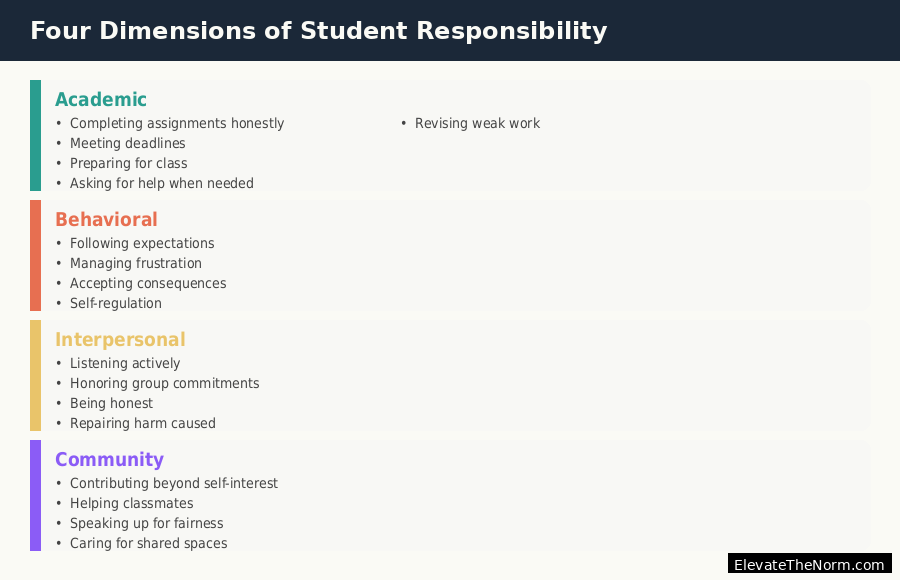
    Most schools define responsibility narrowly — turn in your work, follow the rules. That covers two dimensions and misses two others that matter just as much.

    Infographic showing four dimensions of student responsibility: academic, behavioral, interpersonal, and community
    Four dimensions of student responsibility most schools need to measure

    Academic Responsibility

    This is the one schools measure most: completing assignments, meeting deadlines, preparing for class, doing honest work, and asking for help when needed. Academic responsibility means the student treats their own learning as their job.

    What this looks like in practice: a student who doesn’t understand the assignment asks for clarification instead of guessing. A student whose first draft is weak revises it. A student who misses a deadline explains why and finishes the work.

    What this does not look like: a student who turns in someone else’s work. A student who consistently arrives unprepared and shrugs. A student who does the minimum to avoid a zero.

    Behavioral Responsibility

    Following classroom expectations, treating shared spaces with care, managing frustration without harming others, and accepting consequences when behavior falls short. Behavioral responsibility is the hardest dimension for adolescents because it requires impulse control that is still developing neurologically.

    This is where the pause matters. When a student pushes back — argues a deadline, refuses a task, challenges a grade — my first move is not to respond. I pause. It runs roughly a fifteen count, on average, but that number changes with the student, the day, and what just happened. The pause is not a technique from a book. It is a habit I built because the first thing I want to say is almost never the most useful thing I can say.

    That pause does two things. It gives me time to think. And it shows the student that their behavior did not control my response. Both of those outcomes are lessons in responsibility — mine and theirs.

    Interpersonal Responsibility

    How a student treats the people around them: listening, following through on commitments to a group, being honest, handling disagreement without personal attacks, and repairing harm when they cause it. This dimension is where responsibility becomes relational — it is no longer about the student and the standard. It is about the student and other people.

    Schools that treat interpersonal responsibility as a bonus rather than a requirement produce students who can pass tests and follow rules but cannot collaborate, resolve conflict, or maintain trust. Those skills do not develop on their own. They develop when teachers name them, model them, and hold students to them.

    Community Responsibility

    The broadest dimension: contributing to the classroom, the school, and eventually the community beyond school. Picking up something that isn’t yours. Helping a classmate who is lost. Speaking up when something unfair is happening. Community responsibility is the hardest to teach because it requires students to act on behalf of someone other than themselves.

    This is also where responsibility intersects with leadership. A student who takes community responsibility seriously is already leading — they just may not have the title. Closing that gap between doing the work and holding the role is the whole point of giving teenagers genuine authority in the building.

    What Students Control, What Teachers Control, What Families Control

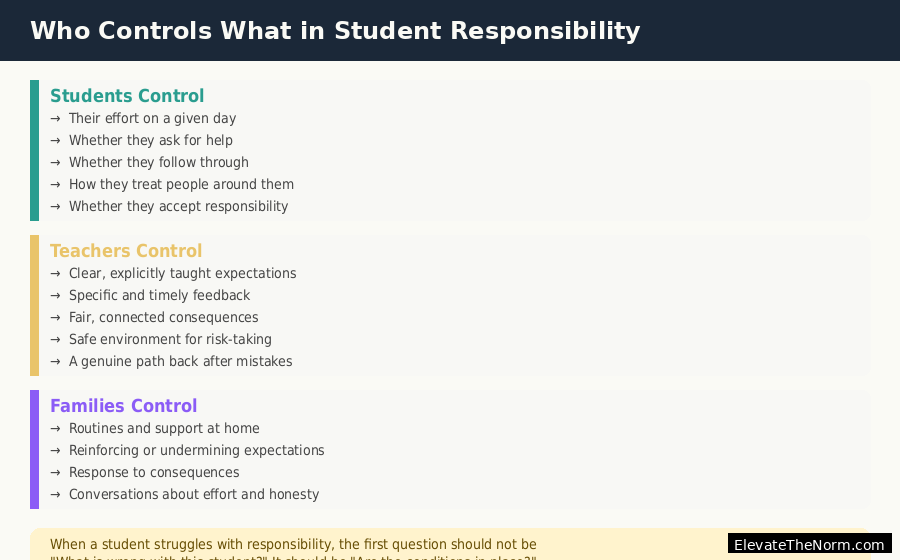
    Most conflict around student responsibility comes from blurring these lines.

    Graphic breaking down what students, teachers, and families each control in building student responsibility
    Responsibility works when everyone knows what they control

    Students Control

    • Their effort on a given day
    • Whether they ask for help
    • Whether they follow through on commitments
    • How they treat the people around them
    • Whether they accept responsibility when they fall short

    Teachers Control

    • Whether expectations are clear and explicitly taught
    • Whether feedback is specific and timely
    • Whether consequences are fair and connected to the behavior
    • Whether the classroom feels safe enough to take risks
    • Whether there is a genuine path back after a mistake
    • Whether the standard stays consistent or quietly shifts based on the student

    Families Control

    • The routines and support available at home
    • Whether they reinforce or undermine the school’s expectations
    • How they respond when their child faces consequences
    • The conversations they have about effort, honesty, and responsibility

    Schools Control

    • Whether policies support responsibility or undermine it (a grading system that averages a zero with later scores teaches learned helplessness, not responsibility)
    • Whether teachers have the time, training, and backing to follow through
    • Whether the culture treats mistakes as learning opportunities or permanent marks

    When a student is struggling with responsibility, the first question should not be “What is wrong with this student?” It should be “Are the conditions for responsibility actually in place?” If the expectations are unclear, the feedback is absent, the consequences are disconnected, or the path back doesn’t exist, then the system is failing — not the student.

    What High Standards Actually Look Like

    High standards are not the same as high pressure. A teacher with high standards believes every student can meet the expectation and builds the structure to make that possible. A teacher with high pressure demands performance without building the structure.

    The difference shows up in how you handle the student who falls short.

    High standards: “This isn’t at the level we discussed. Here’s specifically what needs to change. You have until Thursday to revise it. I’m available Tuesday during advisory if you need help.”

    High pressure: “This is unacceptable. You should know better by now. I’m very disappointed.”

    The first response holds the standard and provides a path. The second response holds the standard and provides shame. Both sound firm. Only one teaches responsibility.

    Research on teacher expectations consistently shows that what teachers believe about students’ capabilities shapes student outcomes. Rosenthal and Jacobson’s classic 1968 study on teacher expectancy effects — where students whose teachers were told they were “intellectual bloomers” showed greater IQ gains — has been replicated and refined across decades. The finding holds: high expectations, communicated through specific support rather than general pressure, produce better results (Rosenthal & Jacobson, 1968; Jussim & Harber, 2005).

    How to Teach Responsibility — Not Just Demand It

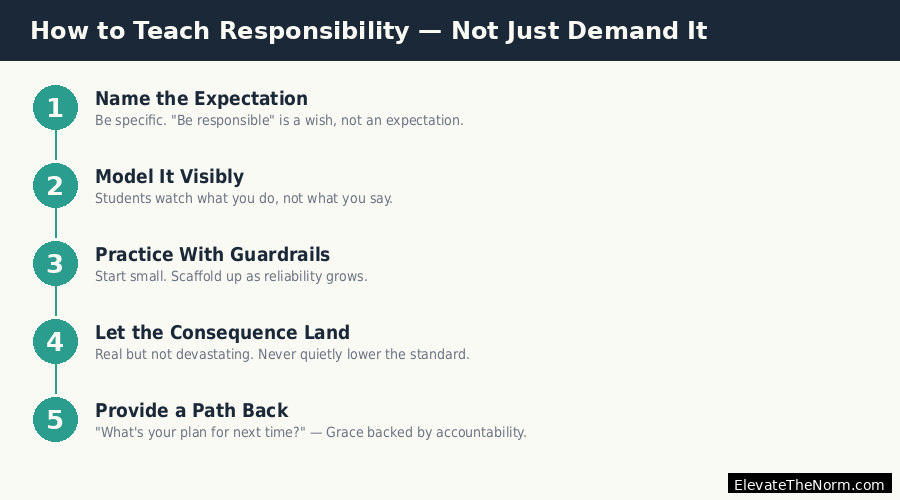
    Responsibility is a set of behaviors, and behaviors can be taught. Here is a practical sequence for building responsibility in grades 6–12.

    Five-step sequence for teaching student responsibility: name expectations, model it, practice with guardrails, let consequences land, provide a path back
    Five steps to teach responsibility instead of just demanding it

    1. Name the Expectation Specifically

    “Be responsible” is not an expectation. It is a wish. Clear classroom expectations sound different. An expectation sounds like: “When you arrive, your materials are out and you’re looking at the board for the first task within two minutes.” Specificity removes guesswork and gives students a clear target to hit.

    2. Model It Visibly

    Students watch what you do, not what you say. This is one reason classroom management starts with the teacher, not the student. If you expect them to meet deadlines, meet yours. If you expect them to admit mistakes, admit yours publicly. If you expect them to prepare, show them what your preparation looks like. Responsibility is taught as much by example as by instruction.

    3. Practice It With Guardrails

    Give students real responsibility in small doses with scaffolding. A student who has never managed a deadline doesn’t need a month-long project on day one. They need a three-day task, a check-in at the midpoint, and a clear consequence for missing the end date. As they demonstrate reliability, extend the timeline and reduce the check-ins. My Makeup Work System on TPT puts the tracking on the student, which is where the responsibility belongs.

    This is not coddling. This is what teaching actually looks like. You do not hand a student a novel and say “read it” if they have never finished a chapter book. You scaffold. Responsibility deserves the same approach.

    4. Let the Consequence Land

    When a student doesn’t meet the expectation, the consequence has to be real. Not devastating. Not humiliating. But real. A student who doesn’t prepare for a group presentation should feel that — through honest feedback from peers, through a required individual follow-up, through the visible gap between what they delivered and what was expected.

    The worst thing you can do is quietly lower the standard. The student learns nothing. The other students learn that the standard is fake.

    5. Provide a Path Back

    After the consequence, the conversation should end with a question: “What’s your plan for next time?” Not a lecture. Not a threat. A question that places the responsibility back where it belongs — with the student.

    The path back is where grace lives. It is also where learning from mistakes actually happens — not in the consequence itself, but in the moment after, when the student decides what to do next. It does not erase the consequence. It says: the standard is still here, I still believe you can meet it, and here is your chance to prove it.

    Common Mistakes Teachers Make With Student Responsibility

    Confusing Responsibility With Obedience

    Obedience is doing what you’re told because someone told you. Responsibility is doing what needs to be done because you understand why it matters. A classroom full of obedient students looks orderly. A classroom full of responsible students looks orderly and keeps running when the teacher steps out.

    If your system requires your constant presence and enforcement to function, you have built obedience. If your system runs because students have internalized the standard, you have built responsibility. The difference matters because obedience does not transfer. Responsibility does.

    Rescuing Students From Consequences

    When a student fails to meet a deadline and the teacher extends it without conversation, the teacher has just taught the student that deadlines are negotiable. When a parent calls to argue a grade and the teacher changes it, the student learns that consequences can be outsourced. When an administrator overrides a classroom consequence to avoid a complaint, the student learns that persistence beats integrity.

    Each of these moments, individually, seems small. Together, they build a system where responsibility is optional.

    Punishing Without Teaching

    A detention for missing homework teaches a student to sit in a room. It does not teach them to manage their time, prioritize their work, or ask for help before the deadline passes. If the consequence doesn’t include a conversation about what went wrong and what the student will do differently, it is punishment, not accountability.

    Applying Standards Unevenly

    Students have a ruthless eye for inconsistency. If one student gets a pass and another doesn’t, every student in the room notices. Responsibility flourishes in systems that are predictable, fair, and built on mutual respect. It collapses in systems where the rules depend on who you are or how the teacher is feeling that day.

    A Responsibility Framework for the Classroom

    DimensionWhat It Looks LikeWhat the Teacher DoesWhat It Doesn’t Look Like
    AcademicPrepared, on time, honest work, asks for helpClear expectations, specific feedback, revision opportunitiesPlagiarism, chronic unpreparedness, helplessness
    BehavioralFollows expectations, manages frustration, accepts consequencesConsistent follow-through, private correction, a path backDisruption without accountability, forced compliance without understanding
    InterpersonalListens, follows through on group commitments, repairs harmModels respect, names expectations, holds students to themPersonal attacks, broken commitments with no consequence
    CommunityContributes beyond self-interest, helps others, speaks upCreates opportunities, recognizes contribution, makes it visibleTreating shared spaces or people as someone else’s problem

    If you want specific classroom activities that put this framework into practice, activities for teaching responsibility walks through ten structured approaches — from deadline choice contracts to repair letters — designed for grades 6–12. And because none of these activities work without a predictable room, understanding why classroom expectations are important is the foundation everything else sits on. When a student has stopped engaging with responsibility altogether, motivating students who don’t care addresses that harder starting point directly. And when the pattern traces back to missed class time rather than a change in effort, chronic absenteeism is the first thing worth ruling out.


    What is the difference between student responsibility and student accountability?

    Responsibility is internal — it is the student’s sense of ownership over their preparation, effort, and behavior. Accountability is external — it is the system of expectations, feedback, and consequences that supports responsibility. A student needs both. Accountability without internal motivation produces compliance. Responsibility without external accountability can drift into good intentions with no follow-through.

    How do you teach responsibility to a student who has never been held to a standard?

    Start small, be explicit, and be patient. Name one expectation clearly. Practice it. Follow through when the student misses it — with a consequence that teaches, not one that punishes. Then add the next expectation. A student who has spent years in systems without standards needs time to adjust. That is not a reason to lower the standard. It is a reason to scaffold the path to it.

    What do you do when a student says they do not care?

    Take it seriously but do not take it literally. A student who says they do not care usually means one of three things: they care but are protecting themselves from failure, they do not see the relevance, or they are overwhelmed and shutting down. The response is not a motivational speech — it is a specific question: “What part of this is getting in the way?” That question respects their intelligence and opens a conversation instead of closing one.

    How do you handle responsibility in group projects?

    Structure the group so individual responsibility is visible. Each student should have a defined role, a personal deliverable, and a moment where they present or defend their own contribution. When a group member does not follow through, the consequence falls on that individual — not the group. Group grades that allow one student to carry others teach the wrong lesson about both effort and fairness.

    Should families be involved in building student responsibility?

    Yes, but with clear boundaries. Families can reinforce expectations, support routines, and have honest conversations about effort. They should not do the student’s work, argue consequences down, or remove the productive struggle that builds responsibility. The most useful family partnership is one where the school’s expectations and the family’s expectations align — and where both adults agree that the student is the one who needs to do the work.

    What if the school’s grading system undermines responsibility?

    Many do. A system that averages a zero with later scores can make it mathematically impossible for a student to recover from one missing assignment. A system that gives points for compliance — bringing a pencil, sitting quietly — measures obedience, not learning. If your grading system punishes honest effort and rewards strategic gaming, the system needs to change before student responsibility can improve. Advocate for grading policies that reflect actual mastery and allow recovery.

    For a detailed breakdown of what each domain looks like in practice—preparation, participation, deadlines, collaboration, mistakes, help-seeking, and repair—see student responsibility in the classroom.


    Sources

    1. Ryan, R. M., & Deci, E. L. (2000). Self-determination theory and the facilitation of intrinsic motivation, social development, and well-being. American Psychologist, 55(1), 68–78. https://selfdeterminationtheory.org/SDT/documents/2000_RyanDeci_SDT.pdf
    2. Guay, F. (2022). Applying self-determination theory to education: Regulations types, psychological needs, and autonomy supporting behaviors. Canadian Journal of School Psychology, 37(1), 75–92. https://journals.sagepub.com/doi/10.1177/08295735211055355
    3. Responsive Classroom. (2025). Secondary practices (Grades 6–12). https://www.responsiveclassroom.org/secondary-practices/
    4. Rosenthal, R., & Jacobson, L. (1968). Pygmalion in the Classroom: Teacher Expectation and Pupils’ Intellectual Development. Holt, Rinehart and Winston. https://psycnet.apa.org/record/1968-08876-000
    5. Jussim, L., & Harber, K. D. (2005). Teacher expectations and self-fulfilling prophecies: Knowns and unknowns, resolved and unresolved controversies. Personality and Social Psychology Review, 9(2), 131–155. https://journals.sagepub.com/doi/10.1207/s15327957pspr0902_3
    6. González-Villora, S., et al. (2017). Program to promote personal and social responsibility in the secondary classroom. Frontiers in Psychology, 8, 809. https://www.frontiersin.org/journals/psychology/articles/10.3389/fpsyg.2017.00809/full
    7. Niemiec, C. P., & Ryan, R. M. (2009). Autonomy, competence, and relatedness in the classroom: Applying self-determination theory to educational practice. Theory and Research in Education, 7(2), 133–144. https://selfdeterminationtheory.org/SDT/documents/2009_NiemiecRyan_TRE.pdf
    8. Edutopia. (2023). Perceptions of mistakes in the classroom. https://www.edutopia.org/article/perceptions-mistakes-classroom/

    About Clay Shumate
    Clay Shumate is a certified secondary Social Studies teacher in the public schools of West Alabama, with seven years of classroom experience, a B.A. in History, and an M.Ed. in Secondary Education. He writes about project-based learning, student responsibility, respect, and practical ways to hold young people to a higher standard while giving them room to learn from mistakes. He is a member of the Society of Professional Journalists and writes to its Code of Ethics; this site’s editorial standards and corrections policy are published in full. More about Clay.
  • Motivating Students: What Works When Rewards and Speeches Stop Working

    Motivating Students: What Works When Rewards and Speeches Stop Working

    Motivating Students: What Works When Rewards and Speeches Stop Working

    By Clay Shumate

    Motivating students does not start with a better reward system or a more inspiring speech. It starts with what research consistently confirms: students engage when they feel competent, connected to the people around them, and in control of something that matters. When the rewards and speeches stop working — and they will — what remains is the environment you built and whether it gives students a genuine reason to invest.

    Key Takeaways

    • Rewards can undermine the motivation they are supposed to build. Research on the overjustification effect has shown this for decades.
    • Autonomy, competence, and belonging are the three drivers that hold up under pressure — not points, prizes, or pep talks.
    • A student who looks unmotivated may be protecting themselves from failure, not choosing laziness.
    • Relevance means connecting work to something real, not performing enthusiasm about a worksheet.
    • The teacher’s job is not to motivate. It is to stop accidentally killing motivation and build a room where it can survive.

    Why Rewards and Motivational Speeches Have an Expiration Date

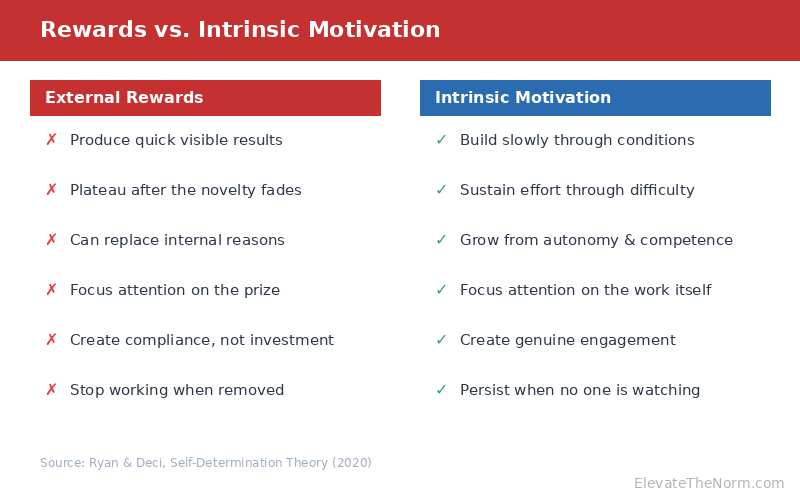
    Every teacher has tried it. The class Dojo points, the pizza party for the best-behaved table, the impassioned Monday morning speech about potential. These tools feel productive because they produce visible results — for a while. Then they stop.

    Research explains why. Ryan and Deci’s self-determination theory, refined over more than four decades, identifies a consistent pattern: when you offer an external reward for something a person was already willing to do, the reward replaces the internal reason. Psychologists call this the overjustification effect. The student who used to read because the book was interesting now reads because reading earns points — and when the points disappear, so does the reading.

    A 2024 review in Contemporary Educational Psychology reinforced this finding while adding nuance: rewards that provide informational feedback — telling a student something useful about their progress — can support motivation under the right conditions. But rewards that function as control — do this, get that — consistently erode it. The difference is whether the student walks away thinking about their work or thinking about the prize.

    Comparison of extrinsic rewards versus intrinsic motivation showing how control-based rewards undermine student engagement
    Rewards that control behavior erode motivation — rewards that inform progress can support it.

    Motivational speeches have a different shelf life but the same problem. They rely on an emotional spike that cannot sustain daily effort. A teacher who depends on inspiration is performing, not teaching. The kid who felt fired up on Monday has a bad lunch period on Tuesday and the fire is out.

    This does not mean you never celebrate, never recognize effort, and never speak with conviction. It means none of those things are your motivation strategy. They are supplements to something more durable.

    What Research Actually Says About Motivating Students

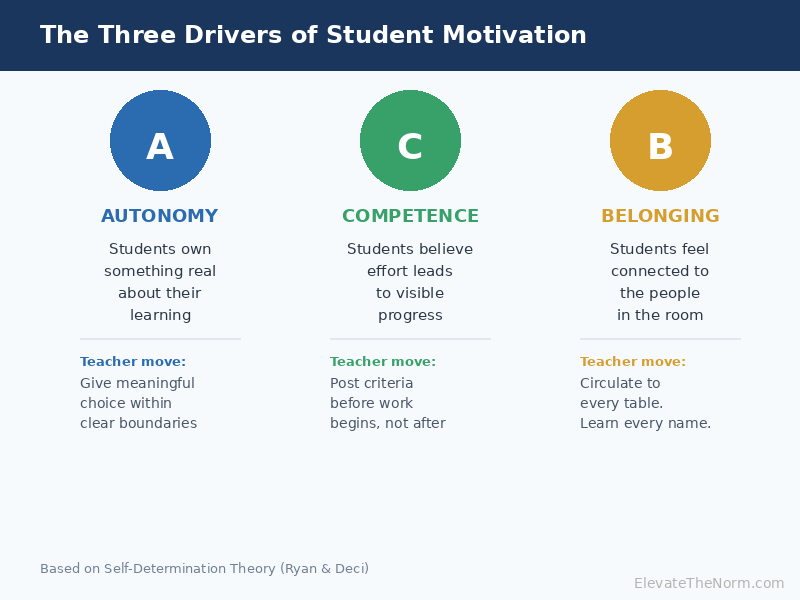
    The most widely supported framework for understanding student motivation is self-determination theory, developed by Edward Deci and Richard Ryan. The theory identifies three psychological needs that, when met, produce the kind of motivation that survives bad days and boring units:

    1. Autonomy — a sense of ownership over what you are doing and why.
    2. Competence — the belief that effort leads to growth, and that you can actually do the work in front of you.
    3. Relatedness — a genuine connection to other people in the room, especially the adult running it.
    Three drivers of student motivation — autonomy, competence, and relatedness — based on self-determination theory
    Autonomy, competence, and relatedness — the three drivers that hold up when rewards wear off.

    Harvard researcher Rhonda Bondie adds a fourth driver: meaning. Students engage when the work feels important, interesting, or useful — not because someone told them it was, but because they can see it for themselves. She also makes a point that should change how every teacher talks about this topic: “The biggest misconception about motivation is that students aren’t motivated.” Every student is motivated. The question is whether your classroom connects to what motivates them or blocks it.

    A Gallup survey of Gen Z students puts numbers on the problem. Only 18 percent of students strongly agree that teachers make their schoolwork feel important. Only 17 percent report learning something interesting in the past week. Only 11 percent say they get opportunities to do what they do best. These are not students who refuse to care. These are students telling us, clearly, that the work is not giving them a reason to.

    Research on productive failure shows that students who struggle before receiving instruction outperform those who receive direct teaching first — as long as the failure is followed by explicit teaching. A structured approach to learning from mistakes turns errors into one of the most powerful motivators available.

    Autonomy: Real Choices, Not Fake Ones

    Autonomy does not mean letting students do whatever they want. In a grades 6–12 classroom, it means giving students genuine control over some part of their learning — the topic within a standard, the format of a product, the order they tackle a set of tasks, or how they demonstrate what they know.

    The word genuine is doing work there. Asking students to choose between a blue worksheet and a green worksheet is not autonomy. Letting a student pick which historical figure to research within a unit on leadership — and then defend that choice — is. ASCD’s review of the ABC+M framework recommends curated choice: a structured set of meaningful options rather than wide-open freedom that becomes confusion.

    Where autonomy gets tricky is the boundary. Too little choice and students feel controlled. Too much choice without scaffolding and students feel abandoned — especially students who already struggle. The answer is graduated release. You start with structured choices in September and widen them as students demonstrate they can handle the responsibility — the same graduated approach behind teaching responsibility without treating teenagers like children. Some classes earn more latitude faster than others. That is not unfair. It is honest.

    Competence: Students Will Not Try What They Are Sure They Cannot Do

    This one gets misunderstood. Competence does not mean making the work easy. It means making it clear — clear enough that a student can see what good work looks like, understand the distance between where they are and where they need to be, and believe that the distance is crossable.

    Carol Dweck’s work on growth mindset gets cited so often that it has become wallpaper in some schools. The poster goes up. The language shifts. Nothing changes. The reason, according to a 2025 meta-analysis by Dweck and Yeager, is that mindset interventions only work inside classrooms that actually respond to effort with better outcomes. Telling a student “you can grow” while running a grading system that punishes first attempts is not a growth mindset environment. It is a contradiction.

    Practical competence support looks like this: visible criteria posted before students start the work, not revealed after they finish. Short-term goals that students can track themselves. Feedback that says something specific — “your claim is strong but your evidence doesn’t connect to it yet” — instead of “good job” or a letter grade with no explanation. And opportunities to revise, because competence develops through iteration, not through getting it right the first time.

    Belonging: The Motivation Driver Most Teachers Underestimate

    A student who does not feel like they belong in your room will not risk effort in it. This is not a soft claim — it is one of the most consistent findings in motivation research. Kumar and colleagues (2018) found that when students feel a genuine sense of membership in a school, it can counteract the negative effects of prejudice and discrimination on motivation and learning outcomes. Belonging is not a nice-to-have. It is a prerequisite.

    And belonging is built in small moments, not grand gestures. It is built in how you respond when a group laughs at a wrong answer. In whether you learn how to pronounce a student’s name correctly on the first day and never stop trying. In whether you circulate to every table or just the ones that are already performing. This is the daily work of building relationships with students — and it matters more than any opening-week icebreaker.

    In my room, one of my hard stops is mocking someone’s name. You do not get to make fun of how unique another person’s name is. That is not a negotiation and it is not a warning — it is a line, and everyone in the room knows where it is. I hold that line because names are identity — because respect in the classroom is built or broken in moments exactly like that one. When you let a room laugh at a kid’s name, you are telling that kid they do not belong here. And a kid who does not believe they belong will not invest in anything you are teaching.

    The workshop room helps. When students are already sitting in groups, facing each other, working alongside somebody — the default condition, not a special arrangement — belonging has a physical structure to grow in. A student who sits in a row facing the back of someone’s head for fifty minutes does not feel like a member of anything.

    Relevance Without Faking It

    When a student asks “when am I ever going to use this,” they are not being rude. They are telling you something important: they cannot see the connection between the work and anything they care about. The honest answer is sometimes “you might not use this specific skill.” The better answer is to build work where the question does not come up because the connection is visible.

    Relevance does not mean every lesson needs to tie to a career. It means the work should connect to a question worth answering, a problem worth solving, or a skill the student can see themselves using. A history lesson about primary-source analysis becomes relevant when students use those same skills to evaluate a news article that showed up on their feed that morning. A math unit on data becomes relevant when the data is about something in the school or community — not a made-up scenario about a fictional bakery.

    The Gallup data is clear on this. When asked what makes them interested in a class, 60 percent of students say “the teacher made it exciting and interesting” and 60 percent say “the topic aligned with a personal interest.” But 35 percent say “real-world connection explained.” That last number is the most actionable because it requires the least talent and the most planning. You do not have to be naturally charismatic. You have to show why the work matters.

    When Students Look Unmotivated but Are Not

    Some students have given up before your class period starts. Not because they are lazy, defiant, or indifferent — because they have learned that effort does not lead anywhere good for them. Research on learned helplessness in middle school students describes a specific pattern: after repeated experiences where effort did not produce results, students adopt a protective posture. They stop trying — not because they do not care, but because trying and failing again is worse than not trying at all.

    This is the student who puts their head down, gives one-word answers, refuses to start, or turns in blank work. The instinct is to push harder: “I know you can do this if you just try.” But for a student in this pattern, that statement confirms the problem. They have heard it before. They tried. It did not work. For the narrower version of this — the student in front of you right now who will not start — there is a calm plan for the first ninety seconds of a work refusal.

    What works instead is small, private, low-stakes evidence that effort produces a result. Not a public declaration — a quiet conversation at the table. Not a massive assignment — a single manageable step with clear criteria and honest feedback when the step is done. You are not trying to inspire them. You are trying to give them one piece of evidence that their effort connects to an outcome.

    A 2026 longitudinal study in the Journal of Research on Adolescence found that parental autonomy support — not control — reduced learned helplessness trajectories in adolescents over time. The classroom parallel is that pushing harder on a helpless student makes the helplessness worse. Supporting their autonomy — giving them a small, real choice and then honoring it — begins to reverse it.

    Environmental Barriers You Cannot Speech Your Way Past

    A student who did not eat breakfast is not unmotivated. A student who slept three hours because they share a room with a crying infant is not disengaged. A student carrying stress from an unstable home is not choosing not to care.

    Some barriers to motivation are outside your classroom. You cannot fix food insecurity with a growth mindset poster. Attendance works the same way — the reasons students give for missing school are led by illness and lost sleep, not boredom, which is why chronic absenteeism responds so poorly to engagement-only strategies. But you can acknowledge what is real, adjust your expectations for a given day without abandoning your standards permanently, and make sure the room itself is not adding to the burden. The lamps instead of overhead fluorescents. The warm light and the rug. A room that does not assault a student’s senses the moment they walk in is not a luxury — it is a basic condition for any of the motivation strategies above to work.

    What you do control: the pacing of the period, the volume of your voice, whether a student who is struggling gets a quiet check-in or a public callout, whether your consequences teach or just punish, whether the room feels safe enough to take a risk. The OECD’s 2025 data found a 40 percent student engagement strategies drop in peer environments that do not prioritize learning. You build the peer environment. That is a motivation lever you hold every day.

    What to Do Tomorrow Morning

    If you walked into your room tomorrow with nothing new except a different approach, here is what the research says will move the needle:

    Stop doing these things:

    • Publicly calling out a student who is not working. Walk over. Sit down. Ask what they need — at conversation volume, not announcement volume.
    • Rewarding compliance and calling it motivation. A quiet class is not a motivated class.
    • Assigning work without explaining why it matters, then blaming students for not caring.
    • Lecturing for thirty minutes and expecting teenagers to sit still for it.

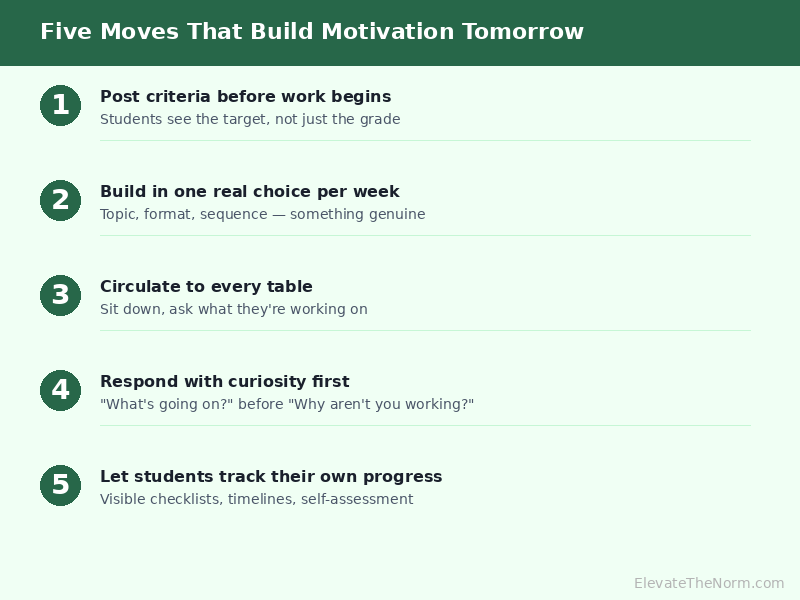
    Start doing these things:

    • Post the criteria for quality work before students begin, not after they finish. Make the target visible.
    • Build in one meaningful choice per week — topic, format, sequence, or method. Real choice, not cosmetic choice.
    • Check in with every student, not just the struggling ones and not just the stars. Circulate to every table. Sit down. Ask what they are working on.
    • Respond to disengagement with curiosity before correction — the calm-over-control approach that actually works. “What’s going on today?” lands differently than “Why aren’t you working?”
    • Use progress tracking students can see — a simple checklist, a visible timeline, a self-assessment. Let them see they are moving.
    Five practical moves for motivating students tomorrow morning including visible criteria, meaningful choice, and curiosity before correction
    Five concrete shifts you can make tomorrow morning to support student motivation.

    The Room Matters More Than the Speech

    Motivating students is not a talent you either have or do not. It is not about being the inspiring teacher from a movie. It is about building a room where students feel competent enough to try, connected enough to care, and autonomous enough to own something real. When those three conditions exist, motivation does not have to be manufactured. It shows up because the room gives it a reason to.

    The rewards and speeches will always stop working. The environment never does.

    For the students who look like they have given up entirely rather than just coasting, see motivating students who don’t care, which works through what changes when disengagement looks total. Once you have found the barrier and want something to run this week, the hands-on companion to this guide collects goal setting, real choices, progress tracking and peer recognition.

    Frequently Asked Questions

    How do I motivate students who have completely shut down?

    Start small, start private, and start with something they can actually do. A student who has shut down is usually protecting themselves from failure, not refusing to work. Give them one manageable task with clear criteria, check in quietly at their table, and respond honestly when they complete it. You are not trying to fix everything in one period. You are trying to give them a single piece of evidence that their effort connects to a result. Over time, those small pieces rebuild what learned helplessness took apart.

    Are rewards always bad for student motivation?

    No — but the type of reward matters. Rewards that provide informational feedback about a student’s progress can support motivation. Rewards that function as control — do this specific thing, receive this specific prize — tend to undermine intrinsic motivation over time. The research question is not whether you ever celebrate or recognize effort. It is whether the reward system replaces the student’s internal reasons for engaging or reinforces them.

    What is the difference between engagement and motivation?

    Motivation is internal — the drive, interest, or purpose behind effort. Engagement is what it looks like from the outside — participation, focus, persistence. A student can be behaviorally engaged (sitting quietly, completing work) without being motivated. And a motivated student who lacks the right conditions can look disengaged. Effective teaching targets the motivation because the engagement follows naturally when the conditions are right.

    Does giving students choices really improve motivation?

    Yes, when the choices are meaningful and structured. Self-determination theory identifies autonomy as one of three core drivers of intrinsic motivation. But choice only works when students have enough information to choose well, when the options are genuinely different, and when the teacher provides scaffolding. Asking a student to pick between identical worksheets in different colors is not autonomy. Letting them choose which historical figure to research within a unit — and defend that choice — is.

    How do I motivate students when the content is genuinely boring?

    Not every lesson will feel exciting, and pretending otherwise insults teenagers. When the content itself is dry, connect it to a question or product that is not. A grammar unit becomes tolerable when students are editing a real piece of writing they care about. A data unit becomes relevant when the data is about something in their school. You are not making the content entertaining — you are giving it a purpose the student can see.

    What role do relationships play in student motivation?

    Relationships are the single most consistent factor in motivation research. A Gallup study found that students with access to at least one teacher who makes them excited about the future are 30 times more likely to report high engagement. But the relationship that matters is not performative warmth — it is the kind built by knowing a student’s work, checking in consistently, and responding to struggle with support instead of judgment.

    Can a teacher really control student motivation?

    No — and you should not try to. Motivation belongs to the student. What you control is the environment: the clarity of the work, the quality of the feedback, the safety of the room, whether students have meaningful choices, and whether effort leads to visible progress. Build those conditions and motivation has room to exist. Remove them and no amount of enthusiasm from the front of the room will compensate.

    Sources


    About Clay Shumate
    Clay Shumate is a certified secondary Social Studies teacher in the public schools of West Alabama, with seven years of classroom experience, a B.A. in History, and an M.Ed. in Secondary Education. He writes about project-based learning, student responsibility, respect, and practical ways to hold young people to a higher standard while giving them room to learn from mistakes. He is a member of the Society of Professional Journalists and writes to its Code of Ethics; this site’s editorial standards and corrections policy are published in full. More about Clay.
  • Classroom Consequences That Teach Instead of Humiliate

    Classroom Consequences That Teach Instead of Humiliate

    Classroom Consequences That Teach Instead of Humiliate

    By Clay Shumate

    Classroom consequences are the responses a teacher uses when a student’s behavior or choices fall below the standard. Good consequences are predictable, proportionate, connected to the behavior, and respectful enough that the student can still learn from the experience. Bad consequences punish the person instead of addressing the problem. Here is how to design consequences that teach—and how to avoid the ones that just make teenagers resentful.

    Key Takeaways

    • Consequences and punishment are not the same thing. Consequences aim to teach; punishment aims to hurt enough to stop the behavior.
    • Effective classroom consequences are related, respectful, and realistic—often called the three R’s.
    • Natural consequences happen without teacher intervention. Logical consequences require teacher design.
    • Humiliation, public shaming, and disproportionate responses damage the teacher-student relationship and make future behavior worse.
    • Repair after a consequence is where real learning happens. The conversation matters more than the penalty.

    Free Printable: Classroom Consequence Planning Sheet

    A one-page teacher reference with the 3 R’s checklist, a behavior-response planner you fill in for your own class, and the three-question repair conversation framework. Print it and keep it at your desk.

    Download Free Planning Sheet (PDF)

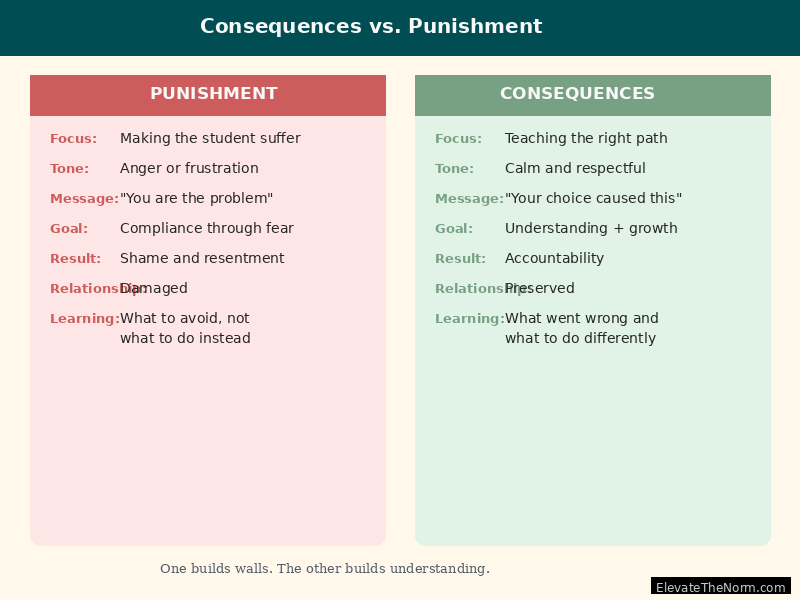
    The Difference Between Consequences and Punishment

    Side-by-side comparison showing how classroom consequences differ from punishment in focus, tone, message, goal, and result
    One builds walls. The other builds understanding.

    This is where most classroom discipline goes wrong. Teachers use the word “consequences” but deliver punishment. The difference is not semantic. It changes what the student learns.

    Punishment is designed to cause enough discomfort that the student stops the behavior. It focuses on the adult’s power and the student’s suffering. A student who talks during instruction gets assigned a 500-word essay on respect. A student who is late gets locked out of the classroom. A student who forgets materials sits with nothing to do for the entire period. The message is: you made a mistake, and now you pay. A consequence that teaches needs something written down and owed back, which is what a repair-and-return sheet is for.

    Consequences are designed to help the student understand the impact of their behavior and take responsibility for repairing it. A student who talks during instruction has a brief private conversation about what they missed and what the expectation is. A student who is late makes up the missed work on their own time. A student who forgets materials uses a loaner set and brings their own the next day. The message is: you made a mistake, and here is what you do about it. If you want the exact words for that follow-up talk, my Restorative Conversation Scripts on TPT give you a script for each step.

    The Responsive Classroom framework describes effective logical consequences as fundamentally different from punishment in purpose: punishment enforces compliance through external controls, while consequences develop “internal understanding, self-control, and a desire to follow the rules”—the foundation of genuine student responsibility (Responsive Classroom, 2023).

    That distinction matters because of what the research shows about punishment. A 2026 meta-analysis in Frontiers in Psychology, synthesizing 18 studies and over six million students, found a statistically significant negative association between teacher punishment and student academic achievement (r = −0.183, p < 0.001). Punitive approaches did not improve outcomes. They made them measurably worse (Wang et al., 2026).

    Types of Classroom Consequences

    Not all consequences work the same way. Understanding the categories helps teachers choose the right response instead of defaulting to the most convenient one.

    Natural consequences

    These happen without any teacher intervention. A student who does not study performs poorly on the assessment. A student who does not participate in the group project has nothing to present. A student who does not bring supplies to class falls behind on the day’s work.

    Natural consequences are powerful because they come from reality, not from an adult’s decision. The student cannot argue with them, resent the teacher for imposing them, or claim the system is unfair. The work simply did not get done, and the result is what the result is.

    For a deeper look at how natural consequences work—and when they do not—see natural consequences in the classroom.

    But natural consequences have limits. They only work when the natural outcome is safe, timely, and genuinely experienced by the student. A student who runs in the hallway might fall—but you do not wait for that to happen. A student who cheats might not get caught until the consequences are permanent. And some natural consequences fall hardest on students who already have the fewest resources, which is not teaching—it is neglect.

    Logical consequences

    These are teacher-designed responses that connect directly to the behavior. They are the backbone of effective classroom discipline in grades 6–12.

    The Responsive Classroom approach identifies three types of logical consequences:

    1. Loss of privilege. The student temporarily loses access to something related to the misuse. A student who misuses a laptop loses laptop access for the rest of the period. A student who abuses the freedom to choose a seat returns to an assigned seat.
    2. Break it, fix it. The student repairs the damage they caused. A student who makes a mess cleans it up. A student who damages a relationship makes a direct apology. A student who disrupts a lesson contributes positively to the next one.
    3. Space and time. The student takes a brief break from the activity to reset. This is not punishment—it is a cooling-off period, and the student returns to the group when they are ready to re-engage.

    The test for whether a logical consequence is actually logical: can you explain the connection between the behavior and the response in one sentence? If the student talked during instruction and the consequence is copying dictionary definitions, you cannot explain that connection—because there is none.

    Restorative consequences

    These go beyond fixing the immediate problem to repairing the relationship. They ask the student to consider who was affected, what the impact was, and what they owe.

    Research from Chicago Public Schools found that schools implementing restorative practices saw an 18% decline in suspension days and a 19% decrease in student arrests over four years. The effects were strongest for Black students, who had faced the starkest disciplinary disparities before implementation. Importantly, the changes did not negatively impact academic outcomes for other students in the classroom (Brookings, 2022).

    Restorative consequences are not a replacement for accountability. They add a step: after the consequence, you have a conversation. What happened? Who was affected? What can you do about it? When will you do it? Schools that formalize this into a program are practising something with a real research base and real limits; the guide to accountability without empty punishment lays out what the randomized evidence does and does not support.

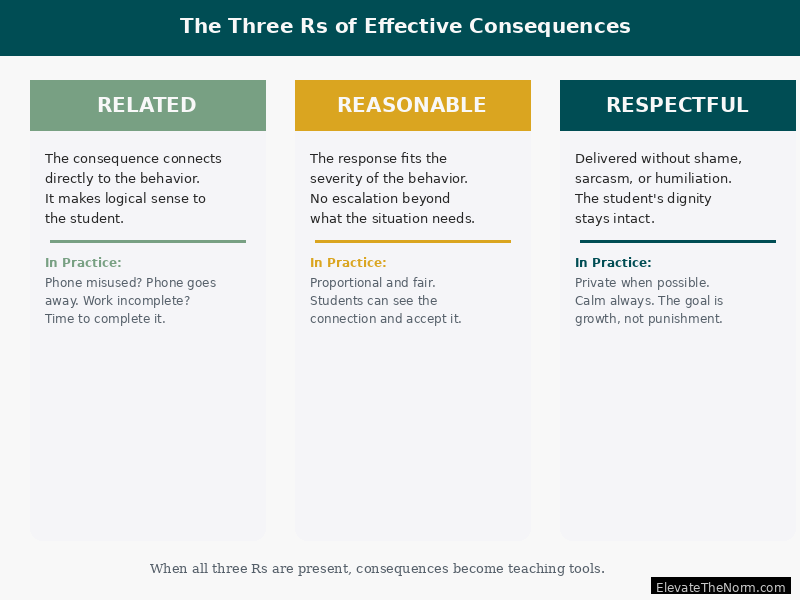
    The Three R’s: Related, Respectful, Realistic

    Three cards showing the three Rs of effective consequences: Related connects to behavior, Reasonable fits severity, Respectful preserves dignity
    When all three Rs are present, consequences become teaching tools.

    This framework, drawn from the work of Rudolf Dreikurs and adapted by the Responsive Classroom and Positive Discipline traditions, gives teachers a quick test for any consequence they are considering.

    Related. The consequence connects logically to the behavior. A student who wastes class time makes up the time. A student who is disrespectful to a peer makes a direct apology. A student who turns in poor work revises the work.

    Respectful. The consequence addresses the behavior without attacking the student’s character. (For a deeper look at why this matters, see Respect in the Classroom.). “You need to redo this section because it doesn’t meet the standard” is respectful. “I guess you didn’t think this was worth your time” is not.

    Realistic. The consequence is something the teacher can actually enforce and the student can actually complete. Assigning a lunch detention every day for a week sounds firm. It also means the teacher has to show up every day for a week, and the student misses the only unstructured time they have. If a consequence is unsustainable, it will collapse—and when it does, the student learns that the teacher’s word does not hold.

    If a consequence fails any one of the three R’s, it is probably punishment dressed up as a consequence.

    A Practical Response Ladder for Common Problems

    This is not a rigid escalation chart. It is a guide for proportionate responses. Skip steps when the situation requires it. Start lower than you think you need to.

    Before you reach for any of it, check whether the behavior is a broken rule or an untaught procedure. A class that packs up early or crowds the door is usually failing a routine that was announced but never actually taught, and a consequence will not fix that. Most of this work sits upstream of the ladder entirely, which is why prevention comes first on any honest list of what works.

    BehaviorFirst ResponseIf It ContinuesIf It Escalates
    Off-task (phone, talking, zoning out)Proximity + quiet redirectBrief private conversation; remove the distractionLoss of privilege for the period; contact home if pattern develops
    Disrespect toward a peerImmediate, private correctionRestorative conversation between the students with teacher presentSeparate the students; parent contact; administrative referral if repeated
    Refusal to workCheck in privately: “What do you need to get started?”Offer modified entry point; document the patternParent contact; team conference; check for underlying issues
    Late to classNote it; do not interrupt instruction to address itBrief private conversation about the patternMake up missed time; parent contact if chronic
    Incomplete or missing workState the deadline and ask for a planRequire revision or completion before new privilegesParent contact; academic intervention plan
    Cheating or plagiarismPrivate conversation; require honest resubmissionParent contact; academic consequence per school policyAdministrative referral per school policy
    Physical aggression or safety threatImmediate administrative referralFollow school safety protocolFollow school safety protocol

    Notice what is not on this list: writing lines, public humiliation, removing the student’s chair, making students stand in the hallway, or assigning unrelated busywork. Those are punishments. They do not teach anything except that the teacher has more power than the student, which the student already knew.

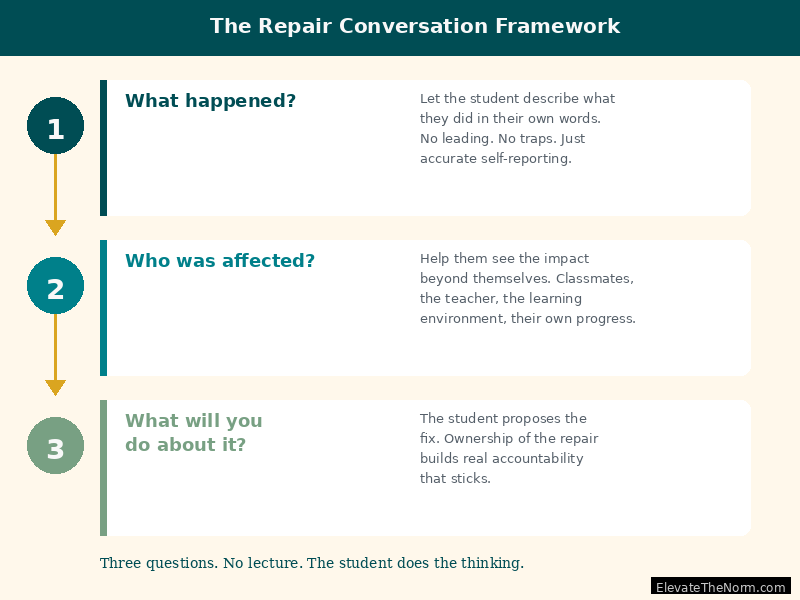
    The Repair Conversation: Where Real Learning Happens

    Three-step repair conversation framework: What happened, Who was affected, What will you do about it - showing the process for accountability after classroom consequences
    Three questions. No lecture. The student does the thinking.

    The consequence is not the end. It is the setup. The real teaching happens in the conversation that follows.

    In my classroom, when a student and I have gotten through whatever happened—the disruption, the missed deadline, the moment that went sideways—we have a conversation. Not a lecture. A conversation. I pull the student aside, usually at the whiteboard table where the lighting is low and the chairs are better, and we talk through three questions:

    1. What happened? Not “what did you do wrong.” What happened. Let them describe it. Often their version is different from yours, and the difference is where the real issue lives.
    2. Who was affected, and how? This is the question that turns a behavior correction into a moral education moment. When a student can name who was affected—their group partner lost ten minutes of work time, the class lost focus, the teacher had to stop instruction—they are learning something consequences alone cannot teach.
    3. What are you going to do about it, and by when? This is where accountability lives. Not “what will you never do again,” which is a promise teenagers cannot keep. What will you do about this specific situation? Apologize to the partner. Turn in the revised work by Thursday. Show up on time for the next three days. Something concrete, something measurable, something the student commits to with a date attached.

    That conversation takes four minutes. It does more than any detention I could assign.

    Consequences Teachers Should Stop Using

    Some consequences survive in secondary classrooms not because they work but because they are easy, familiar, or satisfying in the moment. Here are the ones that consistently backfire.

    Public call-outs

    Naming a student’s misbehavior in front of the class. (This is a close cousin of yelling at students—both use volume and audience as weapons.) This forces the student to choose between backing down (humiliating) and pushing back (escalating). There is no good outcome for either party.

    Writing lines or copying text

    Writing “I will not talk in class” fifty times teaches the student exactly one thing: that their time means nothing to the teacher. It has no connection to the behavior and no instructional value.

    Group punishment

    Punishing the entire class because one or two students misbehaved. This destroys trust, breeds resentment among the students who did nothing wrong, and teaches the class that individual accountability does not exist in this room.

    The one genuine edge case is an environmental change that takes nothing away from anybody and reverses within a day or two — turning the overhead lights back on in a lamp-lit room is the version I use. It still affects students who did nothing, so it still has to be rare, never aimed at one student, and named out loud rather than left to be guessed at.

    Removal as a first resort

    Sending a student out of the room should be a last step, not a first one. A meta-analysis of 40 studies and 274 effect sizes found that exclusionary discipline—suspensions, expulsions, and removals—is “an important and meaningful predictor of increased delinquency.” Students who are removed do not improve. They disengage further (Novak, 2021). Understanding what actually motivates students makes it clear why removal does the opposite.

    Delayed or disproportionate consequences

    A consequence that arrives days after the behavior loses its connection to the event. A consequence that is wildly out of proportion to the offense—three weeks of detention for one late assignment—teaches the student that the system is arbitrary, not fair.

    Consequences disguised as questions

    “Do you think that was a good choice?” is not a real question. It is a humiliation ritual. The student knows the answer. The teacher knows the answer. The only purpose is to make the student say it out loud for the teacher’s satisfaction.

    When School Policy Requires a Specific Response

    Teachers do not operate in a vacuum. School policies, district codes, and state laws dictate certain responses for certain behaviors. Fights may require an automatic suspension. Drugs or weapons may require an automatic referral. Bullying may trigger a mandated investigation.

    In those situations, the teacher’s role is clear: follow the policy. Do not try to handle a legally mandated situation with a classroom consequence. The liability is too high, the situation is too serious, and the student may need supports the teacher cannot provide.

    But following the policy does not mean abandoning the student. After the formal process runs its course, the teacher can still have a repair conversation. The teacher can still welcome the student back without a grudge. Building relationships with students means staying in their corner even after the hard moments. The teacher can still be the adult who says: “We need to talk about what happened, and I still expect good things from you.”

    The American Psychological Association’s 2008 Zero Tolerance Task Force review is still relevant here. The task force concluded that zero-tolerance policies have “not been shown to improve school climate or school safety” and that schools with higher suspension rates actually reported lower overall climate ratings (APA, 2008). Mandatory does not mean effective. And a teacher who adds humanity to a rigid process is not undermining the policy—they are making the policy survivable for the student on the other end of it.

    How to Make Consequences Consistent Without Being Rigid

    Consistency does not mean identical. It means predictable. Students need to know that certain behaviors will always produce a response—but the specific response can and should account for context.

    A student who is late for the first time gets a different response than a student who is late every day. A student who snaps at a classmate during a terrible week gets a different response than a student who routinely bullies peers. A student with an IEP or a 504 plan may have specific behavioral supports that modify the standard consequence.

    None of this is favoritism. It is professional judgment. Doctors do not give every patient the same prescription. Teachers should not give every student the same consequence. What stays consistent is the standard—not the response.

    Document when you flex. If a parent or administrator asks why Student A received a different consequence than Student B, you need to be able to explain the reasoning. Flexibility without documentation becomes inconsistency, and inconsistency erodes trust.

    Building a Consequence System That Lasts

    A consequence system that collapses by October was never a system. It was a list of threats. Here is what makes a system durable:

    1. Keep it simple. Three to five clear expectations with predictable responses. Consequences only read as fair when students already know the standard, which is why naming expectations out loud does so much of the work. If you need a flowchart to explain your consequence system, it is too complicated for you to enforce and too complicated for students to follow.
    2. Teach it explicitly. Do not assume students know what will happen when they miss a deadline or disrupt a class. Tell them on day one. Revisit it in week three. Refer to it every time you use it.
    3. Use it early. A teacher who lets small violations slide for two weeks and then suddenly cracks down is not being patient—they are building a credibility problem. Address small things early, calmly, and consistently. This is one of the most important habits for new teachers building classroom management skills.
    4. Follow through. If you say the consequence is losing laptop access for the period, take the laptop. If you say you will call home, call home — which is easier when you have already decided in advance who you contact, through which channel, and at what point. Every time you do not follow through, you teach students that your words are suggestions.
    5. Pair consequences with repair. The consequence addresses the immediate behavior. The repair conversation addresses the relationship and the learning. You need both.

    Conclusion

    Classroom consequences are not about making students suffer for their mistakes. They are about helping students understand what went wrong, take responsibility for the impact, and do something concrete to make it right. When consequences are related, respectful, and realistic—and when they are followed by a genuine conversation—they teach more than any lecture on behavior ever could. I hand students a page from my Behavior Reflection Sheets on TPT so the reflection is written down before we talk.

    The alternative is punishment: public, disproportionate, disconnected from the behavior, and designed to make the student feel bad enough to stop. Decades of research confirm what experienced teachers already know—punishment does not fix behavior. It suppresses it temporarily and damages the relationship permanently.

    Hold the standard. Address the behavior. Have the conversation. That is how consequences teach.

    Free Printable: Classroom Consequence Planning Sheet

    A one-page teacher reference with the 3 R’s checklist, a behavior-response planner you fill in for your own class, and the three-question repair conversation framework. Print it and keep it at your desk.

    Download Free Planning Sheet (PDF)

    When one student needs something more specific than a class-wide system: our guide to writing a student behavior contract covers what belongs in it, how to write it with the student rather than at them, and how to end it on purpose.

    Frequently Asked Questions

    When consequences are connected to the behavior and followed by a genuine second chance, students can learn from mistakes rather than just survive the punishment. A complementary framework is positive discipline for teens, which builds on the same idea that consequences should teach rather than humiliate.

    What is the difference between natural and logical consequences?

    Natural consequences happen without any teacher action—a student who does not study performs poorly on the test. Logical consequences are designed by the teacher to connect directly to the behavior—a student who misuses a tool loses access to the tool for the period. Both teach, but logical consequences give the teacher control over timing, safety, and proportionality.

    How do I keep consequences from feeling like punishment to students?

    Three things help. First, explain the connection between the behavior and the consequence so the student understands why this response and not something else. Second, deliver it calmly and privately, not in anger and not in front of an audience. Third, follow it with a brief conversation about what happened and what comes next. When students understand the reasoning, consequences feel like structure rather than retribution.

    What should I do when a student refuses to accept a consequence?

    Do not escalate in the moment. State the consequence clearly and move on. “The laptop is done for today. We can talk about it after class.” If the student continues to refuse, involve administration—that is what they are there for. A power struggle in front of the class has no winner.

    Are there consequences that work better for middle school than high school?

    The principles are the same, but the delivery shifts. Middle school students often need more explicit teaching of what consequences mean and why they exist. High school students respond better to brief, private, adult-to-adult conversations. The three R’s framework—related, respectful, realistic—works across both levels.

    Should consequences be the same for every student?

    The standard should be the same. The response can and should account for context. A student having a crisis week may need a different consequence than a student engaging in a repeated pattern. This is not favoritism—it is professional judgment. Document your reasoning so you can explain it if asked.

    How do I handle consequences when a student has an IEP or 504 plan?

    Follow the plan. Students with IEPs or 504 plans may have specific behavioral interventions, modified consequences, or positive behavior supports written into their documentation. Those provisions are legal requirements, not suggestions. Consult with the special education team before applying consequences that may conflict with the student’s plan.

    What role should parents play in classroom consequences?

    Parents should know your system, understand the expectations, and be informed when patterns develop. Do not call home after a single minor incident—that erodes trust and creates the impression that you cannot manage your own classroom. Do call home when a pattern emerges, when the behavior is serious, or when the student needs support you cannot provide alone. Frame the call as a partnership, not a complaint.

    Sources


    About Clay Shumate
    Clay Shumate is a certified secondary Social Studies teacher in the public schools of West Alabama, with seven years of classroom experience, a B.A. in History, and an M.Ed. in Secondary Education. He writes about project-based learning, student responsibility, respect, and practical ways to hold young people to a higher standard while giving them room to learn from mistakes. He is a member of the Society of Professional Journalists and writes to its Code of Ethics; this site’s editorial standards and corrections policy are published in full. More about Clay.
    Consequences work best as one section of something larger. Setting the whole thing down in writing is what keeps the response consistent on the days you are least inclined to be.

Teacher Emergency Toolkit — practical resources, real classroom support. Shop on TPT.Teacher Emergency Toolkit — practical resources, real classroom support. Shop on TPT.