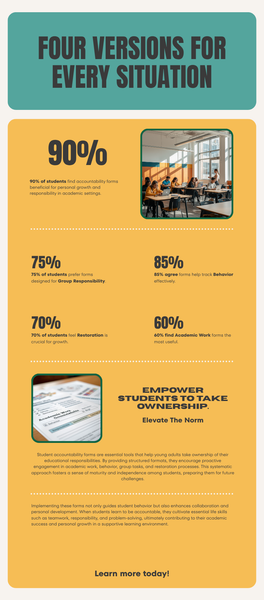
The Elevate Blog banner: Real Classrooms. Practical Ideas. Higher Expectations. Three students climb a rocky ridge at sunrise, each pulling the next one up, toward a teacher reaching down to help.

Tag: secondary education

  • How to Recover From Teacher Burnout (When the Summer Didn’t Fix It)

    How to Recover From Teacher Burnout (When the Summer Didn’t Fix It)

    You recover from teacher burnout by changing the job, not by toughening up. Subtract a recurring demand, get real mental distance from work on ordinary weeknights, make one specific ask of the person who can grant it, and give it months rather than a long weekend. Recovery is slow, uneven, and mostly structural.

    That is not the answer most of us want. The one we want is a habit — a morning routine, a hard stop at 4:00 — because a habit is something you can start on Monday without asking anybody for permission. The research is not especially kind to that hope, and it is not useless either. This page is about the difference, and about what moves once you are past the point where prevention advice helps.

    Key Takeaways

    • Recovery is a different problem from prevention. Prevention keeps the tank from emptying. Recovery starts after it is empty, and advice for one is often useless for the other.
    • Summer does not do the work. In a Dutch study tracking employees ten times around a long vacation, well-being peaked on the eighth day away and had entirely faded by the first day back.
    • Detachment is the best-supported off-job lever. A meta-analysis of 91 samples and 38,124 employees found mentally switching off from work tracked lower exhaustion, less fatigue and better sleep — though the data are correlational.
    • Subtract before you add. Burnout is a mismatch between demands and resources. Ending one recurring demand moves that equation further, and costs less, than adding one more practice to an already full life.
    • Give it months, and expect an uneven line. In a Swedish follow-up of people treated for clinical exhaustion, recovery was long and fluctuating, and about a third still met the criteria six to ten years later.
    • Programs aimed at the individual teacher help a little. Across 23 controlled trials the overall effect was d = 0.18 — small, real, and close to zero on the cynicism dimension.
    • No web page can tell you what you have. If it follows you home into sleep, appetite, and things that have nothing to do with school, that is a conversation with a person.

    Free Download · 2-page PDF

    The Teacher Burnout Recovery Plan

    A demand audit on page one, the four recovery experiences and a check-back log on page two, and a place to write the one specific ask. A planning worksheet — not a screening tool, not a score, and nothing on it can tell you what you have.

    Download the free PDF

    Free. No email address required. Designed for grades 6–12. Browse every printable in Your Free Library.

    How Do You Actually Recover From Teacher Burnout?

    You change the demands, the resources, or both — and then you wait longer than you think you should have to. There is no version of this where the job stays identical and you come back different.

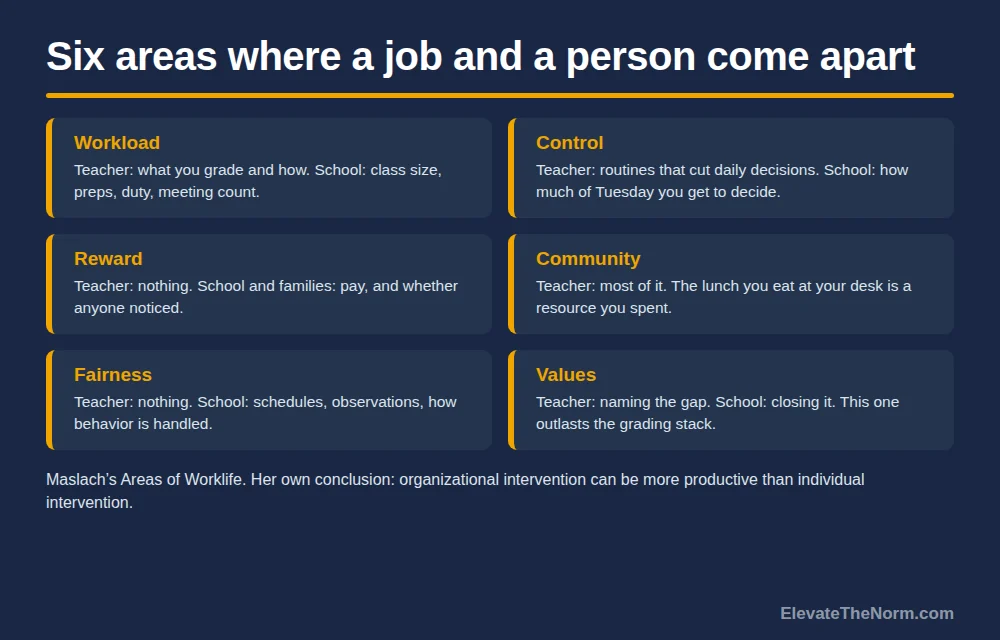
    The reason is in the definition. The World Health Organization calls burn-out “a syndrome conceptualized as resulting from chronic workplace stress that has not been successfully managed,” and says plainly that it is not classified as a medical condition and refers specifically to the occupational context. It is a work problem. Christina Maslach, whose framework has organized this field for forty years, puts the mismatch in six places a job and a person come apart: workload, control, reward, community, fairness and values. Her conclusion after decades of it is blunt: organizational intervention can be more productive than individual intervention.

    Which puts a teacher in an awkward spot. The biggest levers belong to the building, and you still have to do something on Monday. So the honest framing is not “seven habits that will fix you.” It is: here is the part of the equation you can reach, roughly what it is worth, and what to ask someone else for.

    Why Didn’t the Summer Fix It?

    Because time off restores you and then hands you straight back to the thing that emptied you. Vacation works while you are on it. It is not a treatment for the conditions you return to.

    One study makes this uncomfortably concrete. De Bloom, Geurts and Kompier tracked 54 Dutch employees at ten points around a long vacation — before, during, the first day back, and weekly for a month after. Health and well-being climbed during the break and peaked on the eighth day. Then, in the authors’ own words, “on the first day of work resumption, positive vacation effects on H&W have already entirely faded out.”

    Two caveats, because this gets repeated badly. That was 54 people in mixed occupations, not teachers, and a study that small should move your expectations rather than settle anything. And “faded out” does not mean the break was pointless — it means the gain was a state, not a cure. So if you rested all summer and walked back into October feeling exactly the same, nothing is wrong with you. You rested. You did not change anything that was doing the draining.

    How Long Does Recovery From Teacher Burnout Take?

    Nobody can give you a number, and anybody who does is guessing. What the research supports is a direction: months rather than weeks, uneven rather than steady, with setbacks that are part of the shape instead of evidence you failed.

    The closest thing to a long view comes from Sweden, where severe stress-related exhaustion is a clinical diagnosis in its own right. Aronsson and colleagues interviewed 38 people six to ten years after they were treated at a stress rehabilitation clinic. They described what the paper calls a long and ongoing process where recovery activities are needed every step of the way — a fluctuating path, not a ramp. And approximately one third of the participants still fulfilled the criteria for exhaustion disorder at that follow-up.

    Read that carefully, because it is easy to misread toward despair. Those 38 people had a clinical diagnosis severe enough to land them in a rehabilitation program — not the same condition as the occupational burnout the WHO describes, and not a forecast for a teacher who is exhausted in April. It is a small, self-selected Swedish sample and the authors call their own figure tentative. What it is good for is this: if even the severe end takes years and wobbles, a six-week timeline from a blog post is a made-up number.

    The practical version: judge the change by whether the demand actually went away, not by how you feel on any given Thursday. Feelings lag structure by a long way.

    Which Recovery Steps Actually Have Research Behind Them?

    Four off-job experiences come up again and again: detachment, relaxation, control and mastery. Detachment — mentally switching off from work, not merely being off the clock — has the strongest track record of the four.
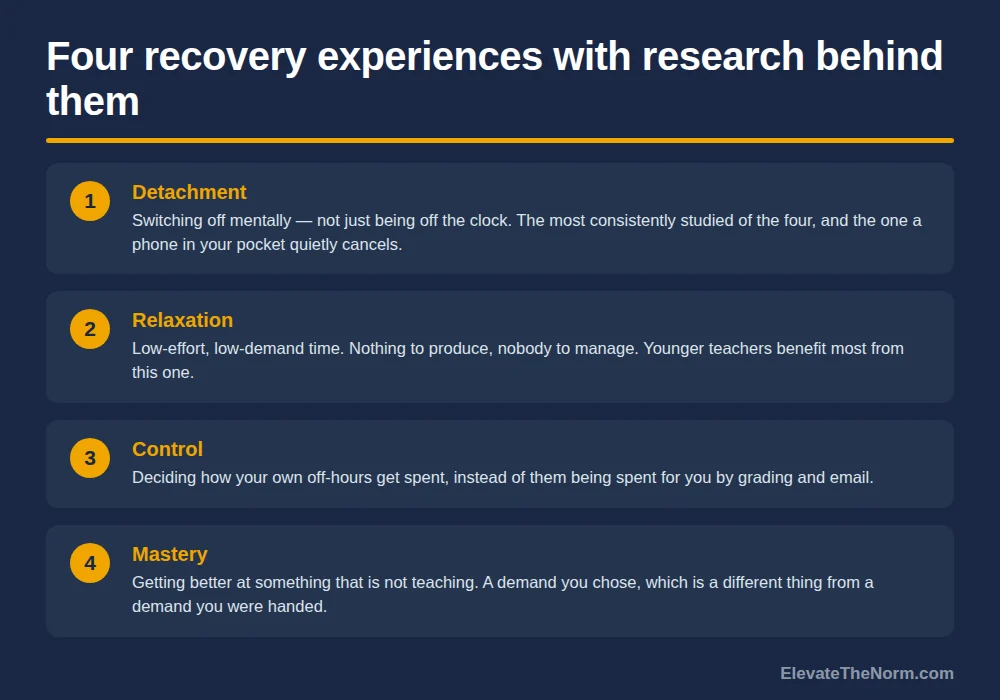
    Numbered chart listing four recovery experiences with research behind them: detachment, relaxation, control, and mastery, each with a short definition.
    Detachment, relaxation, control and mastery are the four off-job experiences with the most evidence behind them.

    Wendsche and Lohmann-Haislah pooled 91 independent samples covering 38,124 employees and found detachment from work correlated at r = −0.36 with burnout-related exhaustion, −0.42 with fatigue, and 0.30 with sleep. Those are not small numbers for this literature.

    They are also not proof, and the authors say so. The evidence is mostly self-reported and individual-level, longitudinal data remain rare, and there is a reverse reading nobody has ruled out: exhausted people may simply find it harder to stop thinking about work. Detaching may be partly a symptom of being okay rather than the cause of it. Treat it as a strong lead, not a prescription.

    The teacher-specific data is thinner but it exists. Virtanen, De Bloom and Kinnunen surveyed 909 Finnish teachers and principals on six off-job experiences. Detachment, relaxation, control and mastery all tracked higher vitality; younger teachers got more out of relaxation, older teachers more out of control and mastery. One caveat that matters: that study measured vitality, life satisfaction and work ability, not burnout. It tells you what feeds teachers, not what cures exhaustion.

    What this looks like in an actual week, for a secondary teacher:

    • Detachment. The school email app is the whole ballgame here. Not a policy, not a boundary speech — the notification badge. If there is one change on this page with evidence behind it that costs nothing and requires nobody’s permission, it is taking work email off the device you look at in bed. If you are worried about being unreachable, check how your building actually contacts staff in an emergency — it is a phone call or an alert system, not your inbox.
    • Relaxation. Low effort, nothing to produce, nobody to manage. Grading in front of the TV is not this. Neither is scrolling the teacher side of the internet, which is mostly work with a different font.
    • Control. One block of time per week that you decide the use of, in advance, and that does not get donated to grading when Thursday arrives.
    • Mastery. Getting better at something that is not teaching. A demand you chose is a completely different animal from a demand you were handed, even when it is harder.

    What Should You Subtract First?

    The one recurring demand that costs you the most hours and that you have some standing to end, shrink, or hand back. One. Not five.

    Numbered five-step graphic: start with the demand side, name the five things that cost the most time, circle one you can end or hand back, make the ask specific and time-bounded, and protect the gap you made.
    The demand side of the equation is usually the cheaper side to move.

    The logic: if burnout is a mismatch between demands and resources, there are two sides to push on. Everybody pushes the resource side, because that is where self-care advice lives. But adding a practice to a life that is already overfull is itself a demand, and the demand side is usually cheaper to move.

    Start with an honest list of the five things that cost you the most hours this month. Not the five that annoy you — different list, and only one of them matters here. The duty you volunteered for in August. The grading practice you invented three years ago that no policy requires. The committee. The thing you do every Sunday because you always have.

    Two guardrails on that list, because the wrong subtraction costs more than it saves. Some duties are contractual or assigned, and a teacher cannot simply end one — those belong in the ask, not on the chopping block. And the thing you cut should not be the thing students depend on most. If feedback is what is eating your weekends, the move is a lighter version of feedback, not less of it: shorter comments, more of it in class, fewer things graded to the same depth. Cutting the practice is fine. Cutting what the practice was for is how a recovery plan turns into a year your students pay for.

    Then circle exactly one and write the ask so it can be answered. “I need help” is unanswerable, so it does not get answered. “I’m stepping back from the data committee for this semester” names the thing, the scope and the end date, and an administrator can say yes or no to it in ten seconds. Ask early in a semester rather than in week fifteen; a principal can usually re-cover a role in August or January and usually cannot in April. A specific ask also survives the meeting it was made in, which a vague one never does.

    Some of what drains a teacher is not a committee at all — it is friction built into the ordinary day. A classroom that runs on established routines costs less to operate than one re-decided every hour, and family contact hurts less on a rotation you set rather than a queue that sets you. Those are demands you can quietly lower without asking anyone.

    And then protect the gap. An hour you free up gets refilled inside two weeks unless something is already sitting in it when it opens. That is where the four recovery experiences go. Subtraction without a plan for the space is just a shorter path back to the same place.

    What If Nothing About the Job Can Change?

    Then you work the small levers honestly, and you stop grading yourself on an outcome you do not control. Some buildings will not move. Pretending otherwise is its own kind of exhaustion.

    It is also worth saying that this advice is not equally available. Detachment, control and mastery all assume some discretionary hours, and a teacher carrying a second job or caring for a parent has fewer of them than the person writing the advice usually imagines. If that is you, the subtraction step is not one option among several — it is the only lever on the page that does not cost you time you do not have.

    The individually-aimed programs do help, a little. Iancu and colleagues pooled 23 controlled trials of interventions built to reduce teacher burnout and found an overall effect of d = 0.18 — statistically significant and genuinely small. On the cynicism dimension it was d = 0.03, which is nothing. Programs running under a month were the least effective of all. So: mindfulness training, coaching, peer groups are real, modest and slow — worth doing if a longer program is on offer, not worth believing in as a substitute for a workload change.

    Two things that are free and are not nothing. The first is community, one of Maslach’s six areas and the one teachers lose first — the planning period you used to spend with a colleague becomes one you spend catching up, and the isolation arrives on schedule. Eating lunch with one adult, on purpose, twice a week is smaller than any intervention a study measures and it is the one I would put money on. Twenty-two minutes and a duty schedule is not much to work with, I know. Do it on the two days you have and let it be unimpressive.

    The second is refusing to read the meaning of the work off how you currently feel. Reduced efficacy is a dimension of burnout, which makes the sense that nothing you do lands a symptom rather than an assessment. Keep some record of the work that is not your own memory of it, because your memory is currently a hostile witness. Written reflection is one way to do that — not as a wellness ritual, but as evidence.

    How Do You Keep It From Coming Back by October?

    You make the change structural rather than motivational. Anything that depends on you continuing to feel like doing it will not survive the first bad week.

    The vacation research is the warning here. A state fades. A structure does not. “I will stop checking email at night” is a state. Deleting the mail app is a structure. “I’ll try to get out by 4:30” is a state; having somewhere you have to be at 5:00 twice a week is a structure — and it need not cost anything. Picking somebody up, a standing walk, a shift at something you already do. What makes it work is that another person notices when you are not there. The question to ask of any recovery plan is simple: what happens to this in week six, when I feel exactly the way I feel right now?

    Then put one date on the calendar, six weeks out, to check whether the demand you removed actually stayed removed. It very often has not — things you hand back have a way of walking home with you, and the check-back is the only reliable way to notice.

    Once you are through it, the work turns into the ordinary, unglamorous business of not getting back here — measuring workload before it becomes a crisis, contacting families before the conference, and taking the day when you need the day rather than after you needed it.

    When Recovery Is the Wrong Word

    When it has stopped being about work. Burn-out, in the WHO’s definition, refers specifically to phenomena in the occupational context and should not be applied to describe experiences in other areas of life. That sentence is doing real work.

    Two-column comparison graphic listing five things that do not work on their own against five recovery steps that have evidence behind them.
    Five things that do not work on their own, and five that have something behind them.

    If the flatness follows you home — into sleep, into appetite, into things you used to enjoy that have nothing to do with a classroom — that is outside what the word covers, and outside what any article can sort out. That is a doctor or a counselor. Not because something is wrong with you in a way that needs whispering about, but because the two things need different help and only a person can tell them apart.

    I want to be direct about the limits of this page and every page like it. There is no checklist here you can score, and there should not be. A list of symptoms on a website is not a screening instrument and it is not the Maslach Burnout Inventory. The worksheet linked above is a planning tool; it returns no number.

    One more thing that belongs on a page like this. Nothing here treats students as the problem. The research puts burnout in job conditions — workload, control, reward, community, fairness, values — and a class of teenagers is not a condition, it is the reason the job exists. A group that can tell their teacher is running on empty is reading the room accurately, not doing something wrong, and what they are owed does not change while an adult is recovering. The whole point of getting the demand off your plate is being able to give them the thing you came here to give them.

    And one thing this page will not say: that pushing through it is admirable. It is not. Exhaustion is not a credential and enduring more of it does not make anybody a better teacher.

    What to Do This Week

    Four things, in order, none of which require becoming a different person.

    1. Take the school email app off your phone — or at minimum off the phone you look at after nine. This is the cheapest evidence-backed change on the page.
    2. Write the five things that cost you the most hours. Honest hours, not annoyance. Twenty minutes with a pen.
    3. Circle one and write the ask in one sentence — the thing, the person who can grant it, the end date. Send it this week, while you can still see the list.
    4. Put a check-back on the calendar six weeks out. One line: did the demand stay gone, and what moved into the gap?

    And one more thing worth saying plainly. Burnout is a persuasive liar about the value of your work — and if you are still working out whether that is what this is, the three symptoms and what separates them from a hard stretch are laid out separately — reduced efficacy is a symptom of the condition, not a verdict on your teaching. Your students are still getting something from you that will never show up on a test. You are just not currently in a position to see it. And if what you want is a checked list of where you can actually go, and what each one costs, that is a separate page.

    Before you go: grab the free Teacher Burnout Recovery Plan (PDF) — ElevateTheNorm.com branded, printable, no email required.

    Frequently Asked Questions

    How long does it take to recover from teacher burnout?

    There is no established timeline, and any specific number you are given is a guess. What the research supports is a direction rather than a date: months rather than weeks, and an uneven line rather than a steady climb. The longest view available comes from Sweden, where Aronsson and colleagues interviewed 38 people six to ten years after treatment for clinical exhaustion disorder and described a long, fluctuating process in which recovery activities were needed at every stage — with about a third still meeting the diagnostic criteria at follow-up. That was a small, self-selected clinical sample and not a forecast for a teacher who is exhausted in April, but it is the reason nobody honest will promise you a six-week turnaround.

    Can you recover from teacher burnout without leaving teaching?

    Yes, but not by leaving everything exactly as it is. Burnout is defined as a mismatch between what a job demands and the resources available to meet it, so something has to move on one side or the other. Ending or shrinking one recurring demand, buying back one block of time you control, or getting one specific request granted all change the equation. Deciding to try harder does not change it, and neither does a summer. Most teachers who recover do it inside the profession, and they do it by changing the shape of the job rather than by changing themselves.

    Will a summer off cure teacher burnout?

    No — it restores you and then hands you back to the conditions that emptied you. In a Dutch study that measured 54 employees at ten separate points around a long vacation, health and well-being peaked on the eighth day away and, in the authors’ words, had entirely faded out by the first day back at work. That was a small study in mixed occupations rather than teaching, so treat it as a strong hint rather than a law. But it matches what most teachers already notice: you come back in August genuinely better, and by late September you cannot find the difference. Rest is necessary. It is not the change.

    What is the single most effective thing a teacher can do on their own?

    Get real mental distance from work on ordinary weeknights — what the research calls psychological detachment. A meta-analysis of 91 samples covering 38,124 employees found detachment correlated at r = −0.36 with burnout-related exhaustion, −0.42 with fatigue, and 0.30 with sleep. The practical version is unglamorous: take the school email app off the phone you look at in bed. Two honest caveats. The evidence is largely self-reported and cross-sectional, so it shows association rather than cause, and exhausted people plausibly find detaching harder in the first place. It is the best-supported lever a teacher owns alone, which is not the same as a cure.

    What should I do if my principal says no to the ask?

    Ask what would make it a yes, and ask when. A no with a reason and a date is workable; an unanswered request is the thing that actually corrodes trust. If the answer is a flat no with nothing behind it, you are back to the levers you control alone — detachment, one protected block of time, one colleague you eat lunch with — and to being honest with yourself that the building is not going to move this year. That is worth knowing clearly rather than discovering slowly. Ask early in a semester, too: a role can usually be re-covered in August or January and usually cannot be in April.

    Does recovering from burnout mean cutting back on what students get?

    It should not, and a plan that does is the wrong plan. The distinction worth holding is between a practice and what the practice was for. If feedback is eating your weekends, the move is a lighter version of feedback — shorter comments, more of it delivered in class, fewer assignments graded to the same depth — not less feedback. Students are not the demand to subtract. The reason to get a committee or a duty off your plate is to be able to do the actual teaching well, and a class can tell the difference between a teacher who has less to give and a teacher who has decided to give less.

    My child’s teacher seems burned out. What actually helps?

    Send the message when something goes right, not only when something goes wrong — recognition and collegial support are two of the six areas where a job and a person come apart, and families are one of the few outside parties who can move them. Raise workload, staffing or coverage concerns with the principal rather than with the teacher, because that is where those decisions live. What does not help is asking a teacher directly whether they are burned out; it puts a professional in the position of discussing their own well-being with a family, which is not a fair thing to ask of them.

    Is burnout the same as being tired, or the same as depression?

    Neither, and a web page cannot sort out which one you are dealing with. The World Health Organization defines burn-out as an occupational phenomenon resulting from chronic workplace stress that has not been successfully managed, states that it is not classified as a medical condition, and says it refers specifically to the work context and should not be applied to other areas of life. Ordinary tiredness lifts with rest. If the flatness follows you home into sleep, appetite, or things you used to enjoy that have nothing to do with school, that is outside what the word covers and it is a conversation with a doctor or a counselor. No article, checklist or online quiz is a screening instrument, and none of them can give you an answer.

    And if the honest answer after all of this is that you are not staying, that is a real option and it deserves real information rather than a slogan. Here is what the federal follow-up data says about where teachers who leave actually go — including the two things that usually get worse, not better.

    Sources

    Every link above was opened and checked on September 23, 2026. Where a figure could not be read verbatim in the source document, it is not quoted here. This article describes burnout as an occupational condition; it is not medical advice, it is not a diagnosis, and nothing on this page or in the linked worksheet is a screening instrument.
    About Clay Shumate

    By Clay Shumate — Clay Shumate is a certified secondary Social Studies teacher in the public schools of West Alabama, with seven years of classroom experience, a B.A. in History, and an M.Ed. in Secondary Education. He writes about project-based learning, student responsibility, respect, and practical ways to hold young people to a higher standard while giving them room to learn from mistakes. He is a member of the Society of Professional Journalists and writes to its Code of Ethics; this site’s editorial standards and corrections policy are published in full.

  • Teacher Burnout: What It Actually Is and Who Can Actually Fix It

    Teacher Burnout: What It Actually Is and Who Can Actually Fix It

    Teacher burnout is what happens when the demands of the job outrun the resources you have to meet them, for long enough that it starts to change you. The World Health Organization calls it an occupational phenomenon, not a medical condition — a work problem, not a personal defect. It shows up in three ways: you are worn out, you go distant on the job, and you stop believing your work is doing anything.

    That definition matters more than it sounds like it does. If burnout is something wrong with you, the fix is to become a tougher person. If burnout is a mismatch between a job and the person doing it, the fix is to change the job — and some of that is in your hands and some of it is not. This page is the honest version of both halves: what the research actually says, what the numbers actually are, and which levers belong to you versus your building.

    Key Takeaways

    • Burnout has three parts, not one. Exhaustion, cynicism or mental distance from the job, and a sense that you are no longer effective. Being tired is only the first third.
    • It is an occupational phenomenon, not a diagnosis. The WHO put it in ICD-11 in 2019 and said explicitly that it is not classified as a medical condition and applies only to the work context.
    • Teachers really do report it at higher rates than comparable workers. In 2026, 55 percent of teachers reported frequent job-related stress, against 34 percent of similar working adults.
    • The “mass exodus” framing is weaker than the stress data. Federal figures put teacher attrition at 8 percent in 2021–22, statistically unchanged from a decade earlier. Teachers are struggling more than they are leaving.
    • Most of the biggest levers are organizational. Workload, control, reward, community, fairness and values are the six places a job and a person come apart, and a teacher only owns part of each one.
    • Programs aimed at individual teachers help a little. A meta-analysis of 23 controlled trials found a small overall effect and almost none on the cynicism dimension. Real, but not a solution on its own.
    • No web page can tell you what you have. If you are past tired — not sleeping, not eating, not able to enjoy anything — that is a conversation with a person, not a checklist.

    Free Download · 2-page PDF

    Teacher Burnout Workload & Resources Audit

    The six areas of worklife on one page, a three-day hours log on the other, and a script for turning the worst area into one specific, time-bounded ask. Not a screening tool and not a score — a sorting sheet.

    Download the free PDF

    Free. No email address required. Designed for grades 6–12. Browse every printable in Your Free Library.

    What Is Teacher Burnout, Exactly?

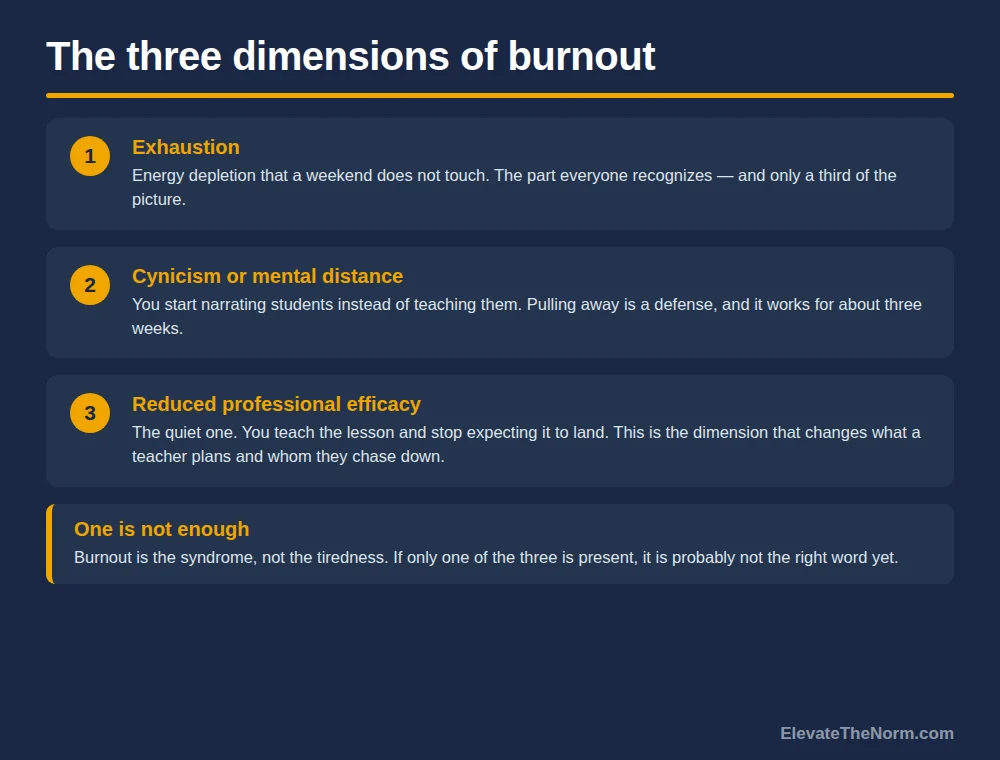
    Teacher burnout is a syndrome with three dimensions: exhaustion, cynicism, and a decline in professional efficacy. That is Christina Maslach’s framing, and it has been the standard in burnout research for four decades. You need more than one of the three before the word fits.

    Numbered chart explaining the three dimensions of burnout: exhaustion, cynicism or mental distance, and reduced professional efficacy.
    Burnout is the syndrome, not the tiredness. One dimension on its own is usually not burnout.

    Here is what each one looks like in a school building.

    • Exhaustion. Not Friday tired. The kind where the tank is empty before first period and stays empty through the weekend. This is the part everybody recognizes, and it is the part people mistake for the whole thing.
    • Cynicism, or mental distance. You start narrating your students instead of teaching them. The kid who forgot his paper is no longer a kid who forgot his paper; he is proof that none of them care. Pulling away is a defense, and it works for about three weeks.
    • Reduced efficacy. The quiet one. You do the same lesson you have taught for years and you cannot tell whether it landed, and you stop expecting it to. Maslach describes the person in this state as overwhelmed, unable to cope, and unmotivated — in that order.

    The third one is why burnout is dangerous for students and not only for teachers. A tired teacher still teaches. A teacher who has stopped believing the work matters makes different decisions about what to plan, whom to call, and which kid to chase down in the hallway.

    One thing worth saying directly to any student who ends up on this page, because you are old enough to hear it: this is not your fault. Burnout comes from workload, scheduling, and how a building is run — not from a class being a class. And if you have noticed that a teacher of yours is running on empty, you are not imagining it. You are reading the room correctly. That is worth knowing, and it is worth being decent about, but it is not yours to fix.

    Is Teacher Burnout Real, or Is Teaching Just Hard?

    It is real, it is measurable, and it is not a diagnosis. Those three things are all true at the same time, and most arguments about teacher burnout are people holding one of them and ignoring the other two.

    In May 2019 the World Health Organization included burn-out in ICD-11 and defined it as “a syndrome conceptualized as resulting from chronic workplace stress that has not been successfully managed.” The same entry says it “refers specifically to phenomena in the occupational context and should not be applied to describe experiences in other areas of life,” and that burn-out is not classified as a medical condition.

    Read that carefully, because both sides misuse it. It is not permission to tell a teacher she is imagining things — the WHO put it in the classification precisely because it is a recognized occupational problem. It is also not a clinical label you can hand yourself after a bad grading period. It describes a relationship between a person and a job that has gone wrong and stayed wrong.

    Researchers still argue about where burnout ends and depression begins, and that argument is not settled. That is a real limit on everything below, and it is the reason this article does not contain a quiz. Nothing on a web page can tell you which one you are dealing with. A person can.

    How Common Is Teacher Burnout, Really?

    Common enough that it is the normal condition of the profession, and stable enough that it is not a crisis that arrived last Tuesday. Both halves of that sentence come out of the same survey.

    Chart of four teacher burnout figures, each labelled with the survey, sample size and year it came from.
    Every number here is traced back to the survey it came from, with its sample and year.

    RAND has run the State of the American Teacher survey every year since 2021, alongside a matched sample of similar working adults so the comparison means something. The 2026 round surveyed 829 K–12 public school teachers and 498 similar working adults between late January and late February 2026. Its headline finding: 55 percent of teachers reported frequent job-related stress, down from 62 percent in 2025, against 34 percent of similar working adults. Teachers came out worse than the comparison group on every well-being indicator the survey measured, which the report notes is consistent with previous years.

    Now the part that gets left out. The same report says the share of teachers reporting burnout and symptoms of depression in 2026 was similar to spring 2023, spring 2024 and spring 2025 — differences of four percentage points or fewer. Burnout in this profession is not spiking. It is sitting still at a high level, which is a different problem and calls for a different response.

    And here is the finding that should make everyone slow down before repeating the exodus story. The federal Teacher Follow-up Survey found that of public school teachers teaching in 2020–21, 84 percent stayed at the same school, 8 percent moved schools, and 8 percent left teaching the following year. Those figures are not statistically different from the same measurement a decade earlier, when it was also 84, 8 and 8.

    So the honest summary is this: teachers report far more job stress than comparable workers, that gap has been steady for years, and most of them stay anyway. Which is worth saying plainly — a profession where half the workforce is running on fumes and staying is not a profession that has been rescued by its own retention numbers.

    What Causes Teacher Burnout?

    Burnout comes from a sustained mismatch between what the job demands and what the job gives you to meet those demands. Maslach’s Areas of Worklife model names six places that mismatch happens: workload, control, reward, community, fairness and values.

    Six-panel chart showing workload, control, reward, community, fairness and values, each split into what a teacher controls and what the school controls.
    Maslach’s six Areas of Worklife, split by who actually owns each half.

    Translated into a school year, they look like this. Workload is the grading stack and the duty roster and the three new initiatives. Control is whether you get to decide how Tuesday goes. Reward is pay, but it is also whether anyone noticed. Community is your hall, your department, the people you eat lunch with. Fairness is whether the schedule, the observations and the consequences apply to everybody. Values is the gap between why you took the job and what the job now asks you to do — and in my experience that last one does more damage than the grading stack, because the grading stack ends in June.

    Maslach’s own argument about what to do with this is blunt: “situational and environmental factors seem to be as important for understanding burnout as are personal variables,” and the field’s habit of asking “what can we do to help the person?” is the wrong first question. She concludes that organizational intervention can be more productive than individual intervention, because fixing a condition that affects forty teachers scales in a way that fixing forty teachers does not.

    A 2024 meta-analysis of 173 studies covering 89,876 participants found burnout and work engagement to be the strongest correlates of overall teacher wellbeing, with disengagement coping among the strongest negative predictors. Worth reporting honestly, though: that analysis is correlational and cross-sectional. It shows what travels together. It does not prove what causes what, and the authors say so.

    What Can a Teacher Actually Control?

    More than nothing and less than the internet suggests. The useful move is to sort your own six areas into things you own, things you can ask for, and things you have to stop spending energy on. That sort is the whole framework, and it takes about twenty minutes with a pen.

    1. Name the demand, not the feeling. “I am exhausted” is not actionable. “I grade 140 essays by hand every two weeks and it costs me eleven hours” is. Log your hours for three days — not a week, three days, because a time log is itself a task and an exhausted person will not finish a week of one. Three days of real numbers beats a month of intentions.
    2. Cut the demand where the standard does not require it. Most teachers are carrying grading practices nobody asked for. Moving to a standards-based system can be partly a workload decision, because it stops you from grading the same skill nine times.
    3. Buy back control with routines. Decision fatigue is a demand. Solid routines and procedures take the same forty daily micro-decisions off your plate every day for 180 days.
    4. Protect community on purpose. The lunch you eat at your desk answering email is a resource you spent. Community is the one area of worklife you can improve in a week without anyone’s permission.
    5. Ask for one specific thing, bounded in time. Not “I need support.” “I need the second duty period covered for six weeks.” The second one is easy for an administrator to say yes to, because it is small, it has an end date, and it does not ask them to admit anything. You are not building a case against your building. You are handing someone a decision they can actually make.
    6. Take the day before you need the week. Rest taken early is a resource. Rest taken after you break is triage. The prevention side of this is its own article, and it is where the practical day-to-day moves live.

    One thing that is never on this list: pushing through. Grinding out an exhausting stretch is not a professional virtue and it is not a plan. It is a way to spend the next month’s energy this week.

    What Can Only the School Fix?

    The big ones. If a building wants to move burnout, these are the levers, and none of them belong to an individual teacher.

    • Actual workload, not workload wellness. Class size, number of preps, duty minutes, meeting count, the number of initiatives running at once. A yoga session added on top of an unchanged workload is one more thing on the calendar.
    • Protected planning time that is actually protected. Planning periods consumed by coverage are a pay cut paid in hours.
    • Fairness in the visible systems. Schedules, observations, and how student behavior is handled. Teachers read fairness off the cases they can see.
    • Response to student behavior that does not end at the classroom door. Behavior is a job demand, and how a school responds to it decides whether it is a shared demand or a private one.
    • Family communication load. One teacher cannot restructure how a building talks to families, but a building can. A real communication system turns a hundred anxious individual contacts into a rotation.
    • Induction that means something. A new teacher given a mentor, a reduced load and honest feedback is a different person in March than one given a key and a room.
    • A real answer when a teacher asks. Including no, with a reason and a date. An unanswered request costs more trust than a declined one.

    Worth separating for anyone who has to budget this. Three of those cost nothing: cutting the meeting count, capping how many initiatives run at once, and answering requests. An instructional coach can carry a fourth — a coach whose job is genuinely instructional support rather than one more evaluator is a resource on the demands side of the ledger, and teachers can tell the difference within a month. Two of them cost real money: class size and staffing coverage. A building that has done only the free ones has still done more than a building that ran a wellness week.

    Does Anything Actually Work?

    Some things help a little. Nothing helps a lot. Anyone selling you more than that is selling something.

    The most direct evidence is a meta-analysis of 23 controlled trials of interventions aimed at reducing teacher burnout. The overall effect was d = 0.18 — small, but statistically significant. Mindfulness-based programs showed significant effects on exhaustion and on personal accomplishment. And the depersonalization dimension — the cynicism, the mental distance — came back at d = 0.03, essentially nothing.

    Two more findings from the same analysis that rarely get quoted in professional development slides. Interventions delivered to primary and middle school teachers showed below-average effects. And programs running less than a month were the least effective of all, which is an unkind description of most of what gets offered.

    Put that beside Maslach’s conclusion that organizational intervention outperforms individual intervention and you get the practical read: a wellness program is not a lie, it is just small. If a district runs one instead of touching workload, control, reward, community, fairness and values, it has bought a d of 0.18 and called it a plan.

    When Burnout Is Not the Right Word

    Burnout is a work word. It describes what a job did to you, and it usually improves when the job changes. There is a point where that stops being the right description.

    If the flatness follows you into the parts of your life that have nothing to do with school — if you are not sleeping, not eating, not enjoying anything you used to enjoy, or if the thought of harming yourself has crossed your mind — that is outside what any article, checklist or self-assessment can sort out, and it is outside what a good weekend fixes. Talk to a doctor, a counselor, or whatever your district’s employee assistance program actually is. In the United States you can also call or text 988 to reach the Suicide and Crisis Lifeline.

    Saying that is not a disclaimer bolted onto the end. It is the single most useful sentence on this page for some of the people reading it.

    What to Do With This

    Do three things this week, in order.

    1. Write down your hours for five days. Not an estimate. The actual clock. You cannot argue about workload — with a principal or with yourself — from a feeling.
    2. Sort your six areas. Workload, control, reward, community, fairness, values. Mark each one fine, strained, or broken. The free audit below is that page, printed.
    3. Take the worst one to a person. One specific, bounded ask, in writing, to whoever can actually grant it. Then read the day-to-day prevention piece and pick one habit to start Monday.

    Going deeper: the rest of this series

    This page is the overview. Each piece below takes one part of it further.

    If you are a parent who landed here worried about your kid’s teacher, the most useful thing you can do is unglamorous: send the email when something goes right, not only when something goes wrong, and raise workload concerns with the principal rather than with the teacher. Reward and community are two of the six areas, and a family is one of the few outside parties who can actually move them.

    And if you are in the stretch right now where none of this feels possible — the students are still showing up for you, and they are still learning things that will never appear on a test. Burnout is a persuasive liar about that. It is not a reliable narrator of your work.

    Before you go: grab the free Teacher Burnout Workload & Resources Audit (PDF) — ElevateTheNorm.com branded, printable, no email required.

    Frequently Asked Questions

    What are the three signs of teacher burnout?

    Burnout has three dimensions rather than one: exhaustion, cynicism or mental distance from the job, and a decline in professional efficacy — the sense that what you do no longer works. Being tired is only the first of the three. The one people miss is the third, because it is quiet: you keep teaching, but you stop expecting the lesson to land. If only one of the three is present, burnout is probably not the right word yet.

    Is teacher burnout the same thing as depression?

    No, and the honest answer is that the boundary between them is still argued about in the research. The World Health Organization classifies burn-out as an occupational phenomenon tied specifically to the work context, and states plainly that it is not classified as a medical condition. Depression is a clinical diagnosis and it is not confined to your job. If the flatness follows you home into things that have nothing to do with school — sleep, appetite, things you used to enjoy — that is a conversation for a doctor or counselor, not a web page. No article, quiz or checklist can tell you which one you are dealing with.

    How common is teacher burnout in secondary schools?

    RAND’s 2026 State of the American Teacher survey found 55 percent of K–12 public school teachers reported frequent job-related stress, down from 62 percent in 2025, compared with 34 percent of similar working adults. That survey covered 829 teachers and 498 comparison adults, fielded from late January to late February 2026. The same report found the share reporting burnout was within four percentage points of spring 2023, 2024 and 2025 — so it is high and steady rather than spiking. RAND reports K–12 teachers together, so it does not isolate a grades 6–12 figure.

    Can a teacher recover from burnout without leaving the profession?

    Yes, and most do — federal data show 84 percent of public school teachers stayed at the same school from 2020–21 to 2021–22, with 8 percent leaving teaching, a rate statistically unchanged from a decade earlier. But recovery is not willpower. Burnout is a mismatch between the demands of a job and the resources available to meet them, so something has to move on one side or the other. Cutting a demand, buying back control, or getting one bounded ask granted changes the equation. Deciding to try harder does not.

    What can a principal do about teacher burnout that costs nothing?

    Three things. Cut the number of meetings. Cap how many initiatives run at once instead of adding one each semester. And answer requests — including saying no, with a reason and a date, because an unanswered ask costs more trust than a declined one. Class size and coverage staffing cost real money, but those three do not. A building that has done only the free ones has still done more for burnout than a building that ran a wellness week.

    Do teacher wellness programs actually reduce burnout?

    A little. A meta-analysis of 23 controlled trials of interventions aimed at reducing teacher burnout found an overall effect of d = 0.18 — small but statistically significant — with mindfulness programs showing effects on exhaustion and on personal accomplishment. On the depersonalization dimension the effect was d = 0.03, essentially nothing. The same analysis found programs running under one month were the least effective of all. So wellness programming is not worthless, it is just small, and it is not a substitute for changing workload, control, reward, community, fairness and values.

    My child’s teacher seems burned out. What should I do?

    Two things that actually help and one that does not. Send the message when something goes right, not only when something goes wrong — reward and community are two of the six areas where a job and a person come apart, and families are one of the few outside parties who can move them. Raise workload or staffing concerns with the principal rather than with the teacher, because that is where those decisions live. What does not help is asking a teacher directly whether they are burned out; it puts a professional in the position of discussing their own well-being with a family.

    Is teacher burnout caused by students?

    No. The research locates burnout in job conditions — workload, control, reward, community, fairness and the gap between your values and what the job asks of you. Student behavior is one demand among several, and how a school responds to behavior matters more than the behavior itself, because it determines whether that demand is shared or carried privately. A class is not the cause of a teacher’s exhaustion, and students who notice a teacher running on empty are reading the room accurately rather than doing something wrong.

    Sources

    Every link above was opened and checked on September 23, 2026. Where a figure could not be read verbatim in the source document, it is not quoted here. This article describes burnout as an occupational condition; it is not medical advice and it is not a screening tool.


    About Clay Shumate

    By Clay Shumate — Clay Shumate is a certified secondary Social Studies teacher in the public schools of West Alabama, with seven years of classroom experience, a B.A. in History, and an M.Ed. in Secondary Education. He writes about project-based learning, student responsibility, respect, and practical ways to hold young people to a higher standard while giving them room to learn from mistakes. He is a member of the Society of Professional Journalists and writes to its Code of Ethics; this site’s editorial standards and corrections policy are published in full.

  • Project-Based Learning: 25 Questions People Are Asking AI Right Now, Answered by a Classroom Teacher

    Project-Based Learning: 25 Questions People Are Asking AI Right Now, Answered by a Classroom Teacher

    The AI questions about project-based learning that teachers and school leaders ask most are rarely the ones a vendor page answers. People type platform, curriculum, assessment and funding questions into ChatGPT and Google Gemini and get back a tidy feature list with no sense of what survives an ordinary Tuesday. This roundup answers the 25 most common versions in one place — real tool and organization names, and a classroom teacher’s read on what actually matters. For the framework questions — Responsive Classroom, PBIS, Conscious Discipline and the rest — see the companion roundup on classroom culture frameworks.

    1. What are the best online platforms for managing project-based learning in K-12?

    Two different jobs get lumped into “managing PBL,” and they call for different tools. If you need a full curriculum with the projects already designed, PBLWorks TEACH provides its Gold Standard framework with lesson plans and rubrics built in. If you’re building your own units, the free tier of MyPBLWorks gives teachers a library of more than 70 standards-aligned PBL units, rubric templates, and a Project Designer tool that walks you through building a unit from scratch. If what you actually need is a place to distribute assignments and collect student work, that’s a general LMS job, not a PBL-specific platform.

    2. How do you implement project-based learning in a blended classroom?

    Split the project into what has to happen live and what can happen async. Launch day, critique protocols, and final presentations work best face-to-face. Research, drafting, and peer feedback on written work hold up fine asynchronously in Google Docs or your LMS’s discussion boards. The failure mode in blended PBL isn’t the tech — it’s letting the driving question and milestones live only in your head instead of posted somewhere every student can check without asking you.

    3. What are the top apps for tracking student progress in project-based learning environments?

    For standards-level tracking with real-time evidence, FreshGrade lets teachers capture learning through photos, videos, audio, and notes, and track progression against standards or custom district objectives, including IEP goals. For lighter-weight, portfolio-style tracking, Seesaw for Schools gives students a place to complete and share assignments and projects while building a record of progress over time, with a companion app that keeps parents in the loop. If you’re already inside PBLWorks TEACH, its embedded assessment resources cover progress tracking without adding a second tool.

    4. What online platforms support collaborative project-based learning activities?

    Google Workspace (Docs, Slides, Sites) remains the default for real-time group drafting because every student already has an account through the school. Padlet works well for brainstorming and gallery-walk-style sharing between teams. For the collaboration piece that actually improves project quality — structured peer critique — PBLWorks TEACH builds critique protocols directly into its units rather than leaving you to invent a peer-feedback structure from scratch.

    5. How do you integrate project-based learning with virtual classroom software?

    Treat your video platform (Zoom, Google Meet) as the room, not the curriculum. Use breakout rooms for team check-ins at each project milestone, keep the driving question and rubric posted in your LMS so it doesn’t get lost in chat, and build in a short public share-out at the end of each session. Virtual PBL loses momentum fast when teams only ever talk to themselves.

    Illustration of a teacher's desk with a laptop, notebook, and checklist icons representing comparing project-based learning tools
    Comparing PBL platforms means matching the tool to the job — curriculum, collaboration, or evidence.

    6. Are there professional development workshops for project-based learning educators?

    Yes, several. PBLWorks runs a three-day PBL 101 workshop based on its Gold Standard model that walks teachers through designing their own PBL project, plus more advanced PBL 201 and equity-focused sessions. ISTE offers a “Leading Project-Based Learning With Technology” course developed in collaboration with PBLWorks. ASCD+ISTE also runs Custom Learning Services that bring practitioners directly to a school or district for multi-session PD rather than a single event.

    7. Where can I find project-based learning curriculum resources for middle school?

    PBLWorks TEACH launched its middle school units first — standards-aligned projects for math, science, ELA, and social studies — before rolling out elementary and high school versions. Its free project library (MyPBLWorks) also has middle-school-ready units teachers can pull without a subscription. ElevateTheNorm’s own project-based learning resources page has free tools organized by category as well.

    8. Which curriculum providers specialize in project-based learning models?

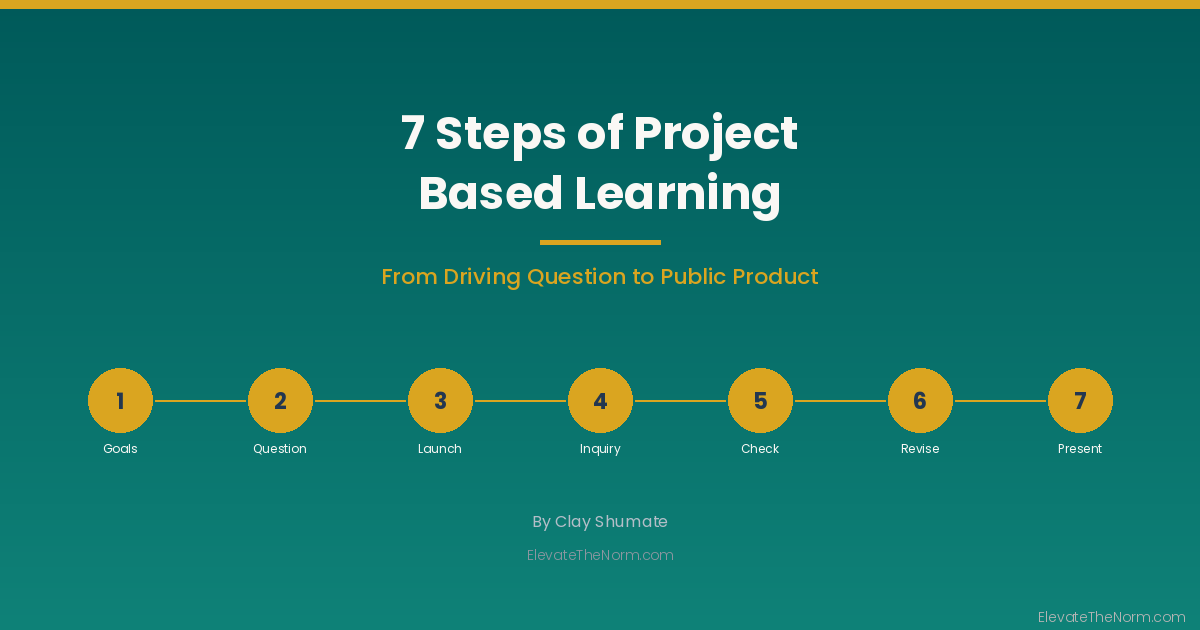
    PBLWorks (formerly the Buck Institute for Education) is the organization most schools point to when they talk about “real” project-based learning, built around its Gold Standard framework — the same Seven Essential Project Design Elements that underlie the seven-step PBL process. Defined Learning takes a different angle, framing every project through a real-world career connection. ThoughtStretchers Education works more at the district-consulting level, building custom PD around its own PBL model rather than selling packaged units.

    9. What are affordable tools for creating project-based learning presentations and reports?

    Google Slides costs nothing if the school already runs Google Workspace. Canva for Education is free for verified K-12 teachers and students and handles both presentations and printed reports without a design background. Neither requires a purchase order, which matters more than any feature comparison if you’re paying out of pocket.

    10. What software tools help manage student projects in project-based learning?

    For the teacher-side work of building the unit, PBLWorks’ Project Designer tool structures that process. For the student-side work of tracking tasks, due dates, and deliverables within a team, a shared Google Sheet or Trello-style board is usually enough — most PBL projects don’t have enough moving parts to justify dedicated project-management software built for adults.

    11. Is there project-based learning software that supports collaboration and peer feedback?

    PBLWorks TEACH is the one built specifically around this — its units include structured critique protocols as part of the curriculum, not as an add-on. Outside of that, Google Docs’ comment and suggestion tools cover peer feedback on written work well, and a shared Padlet board works for feedback on presentations or physical prototypes.

    12. What are best practices for assessing student work in project-based learning?

    Score content knowledge and collaboration separately — don’t let strong teamwork points cover for weak understanding of the actual material, and don’t let a struggling group member’s grade sink because a teammate carried the content. That’s the whole idea behind ElevateTheNorm’s own free editable PBL rubric. Use exemplars so students know what “done well” looks like before they start, not after they’re graded. Build in a real formative checkpoint partway through the project, not just a final grade. And use structured peer critique.

    13. What services offer training for teachers on project-based learning strategies?

    PBLWorks’ National Faculty — seasoned teachers, administrators, and coaches — lead its workshops directly. ISTE+ASCD’s Custom Learning Services send practitioners to work with a school or district across a longer engagement rather than a single training day. ThoughtStretchers Education offers on-site, virtual, or hybrid PBL workshops aimed at districts building implementation plans, not just individual teachers.

    14. What companies offer consulting services for project-based learning integration?

    ThoughtStretchers Education partners with schools and districts to design and scale high-quality PBL across classrooms, including a sustainable implementation plan tied to a district’s own accountability requirements. PBLWorks also does district-level partnership work beyond its public workshops, and ASCD+ISTE’s Custom Learning Services can be scoped specifically around PBL and instructional technology integration.

    Illustration of middle-school students working together at a table on a hands-on project-based learning task
    Most of the collaboration problem isn’t a software problem — it’s a structure problem.

    15. How do project-based learning management systems for schools compare?

    They’re not really competing with each other — they solve different problems. PBLWorks TEACH is a curriculum-plus-assessment bundle: you get the projects and the grading tools together. A general LMS like Canvas or Schoology is a delivery and gradebook system: it organizes courses into modules, delivers content through pages and files, manages assignments with rubrics, and tracks activity through analytics, but it doesn’t design the projects for you. FreshGrade and Seesaw sit in between, layering standards-tracking or portfolio evidence on top of whatever curriculum you’re already running. Most schools end up using one from each category, not picking a single winner.

    16. What ed tech solutions exist for K-12 project-based learning?

    Group them by the job: curriculum (PBLWorks TEACH, Defined Learning), collaboration (Google Workspace, Padlet), evidence and portfolios (FreshGrade, Seesaw), and hands-on STEM builds (VEX Robotics, LEGO Education). Trying to find one platform that does all four is usually why “ed tech for PBL” searches feel unsatisfying — no single tool owns the whole workflow.

    17. Which companies provide project-based learning kits for STEM education?

    VEX Robotics organizes its kits as a learning pathway by age — VEX 123 for early learners, VEX GO for grades 3–5, VEX EXP for grades 8–12, and VEX V5 from middle school through competitive robotics. LEGO Education runs a similar age-tiered lineup, with SPIKE Prime aimed at grades 6–8 and tied into FIRST LEGO League and the World Robot Olympiad. Both build actual PBL structure into the kits — driving problem, build, test, iterate — rather than being generic construction toys with a curriculum bolted on.

    18. Where can teachers find grant opportunities for project-based learning initiatives?

    A few worth checking every cycle: the NEA Foundation’s Learning and Leadership Grants fund individual educators or groups pursuing high-quality professional learning, up to $5,000, with a mid-September deadline most years. AdoptAClassroom’s Spotlight Fund offers $500 awards in categories including STEM and Arts on a rolling basis. DonorsChoose remains the fastest path for smaller, classroom-specific project funding. Toshiba America Foundation funds project-based math and science learning specifically, with quarterly deadlines for smaller awards. PLTW also runs funding programs aimed at STEM and CTE program implementation for schools already using its curriculum.

    19. How do you set up project-based learning assignments using popular learning management systems?

    Build one module per project phase rather than one long assignment: launch/driving question, research, drafting, checkpoint critique, final product, reflection. Attach the rubric to the module itself so students see the grading criteria before they start, not after they submit. Use the LMS’s discussion or peer-review feature for the critique step instead of trying to manage that over email.

    20. Which learning management systems have robust project-based learning features?

    None are PBL-native, but some flex better than others. Canvas organizes courses with modules, rubrics, and an analytics dashboard for tracking activity, and its SpeedGrader supports rubric-based grading with inline and audio/video feedback — useful for the kind of detailed, iterative feedback PBL requires. Schoology is built specifically for K-12 and supports blended learning with built-in assessment tools and Google/Microsoft integrations. Google Classroom is the lightest option — fine for smaller projects, thinner on rubric and analytics depth than the other two.

    21. What are the best digital platforms for student portfolios in project-based learning projects?

    Seesaw for Schools lets students complete and share assignments while tracking their progress, with a free companion app for families — it’s the most common choice for elementary and middle school. FreshGrade is designed for K-12 and supports individualized goals, including IEPs, alongside standards tracking, which makes it the stronger pick if a school needs portfolio evidence to double as documentation. For older students building something they’ll actually take with them past graduation, a simple Google Sites portfolio still works and costs nothing.

    Illustration of a chat bubble icon beside a coin, gear, and document icon representing grants and STEM kits for project-based learning
    Funding and hands-on STEM kits are two of the most-asked, least-answered PBL questions.

    22. What are examples of successful project-based learning units for high school science?

    The strongest high school science PBL units share a structure regardless of topic: a real, unresolved question, a genuine deliverable such as a proposal, a design, or a public data set, and an audience beyond the teacher. PBLWorks’ high school science units, rolling out as part of its TEACH library, and Edutopia’s PBL video library both document real classroom examples at this level. ElevateTheNorm’s own 50 real-world PBL project ideas includes several science-specific options worth adapting.

    23. Where can teachers buy project-based learning materials for elementary classrooms?

    VEX GO is a STEM construction system built for grades 3–6 and includes standards-aligned lesson plans, not just parts. LEGO Education’s WeDo and early SPIKE lines cover younger elementary grades. If budget is the obstacle rather than the source, STEM-specific grants are usually a faster path than a district purchase order.

    24. What resources help design authentic project-based learning experiences?

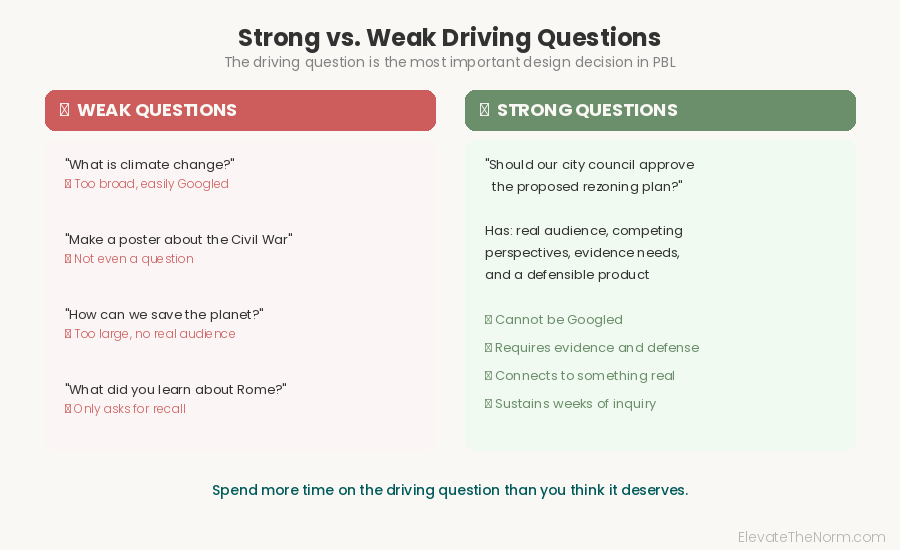
    PBLWorks’ Seven Essential Project Design Elements framework is the standard reference for what separates a real PBL project from what PBLWorks calls a “dessert project” — an activity bolted onto content that was already going to be taught the same way regardless. MyPBLWorks’ free Project Designer tool applies that framework step by step. For a plain-language walkthrough of the same idea, see what project-based learning actually is.

    25. What project-based learning platforms offer real-time analytics and reporting features?

    FreshGrade captures learning in real time and lets teachers track progression against standards or custom district objectives as it happens, rather than after the fact. Seesaw for Schools adds school-wide reporting on top of its portfolio features for schools that need to roll data up past the individual classroom. Canvas’s analytics dashboard covers activity-level reporting — logins, submission rates, grade trends — if the “reporting” need is closer to general engagement data than PBL-specific evidence.

    Frequently Asked Questions

    Do I need to pay for a platform to run project-based learning, or can I do this with free tools?

    Free tools cover most of what a single classroom needs — Google Workspace for collaboration, MyPBLWorks’ free tier for curriculum, Google Sites or Seesaw’s free tier for portfolios. Paid platforms save time by bundling those pieces together, but nothing on this list is required to run a real PBL unit.

    Do students need their own devices for these platforms?

    Most assume at least shared or rotating access to a device, since the collaboration and documentation pieces are digital. Projects can still run with limited devices by keeping research and drafting digital while collaboration, building, and presenting happen on paper or in person.

    How much of this do I actually need for my first PBL unit?

    Almost none of it. A first unit works with a driving question, a shared document, a rubric, and a way for students to present to a real audience. Add platforms once you know which specific problem — tracking, portfolios, STEM materials — is actually slowing you down.

    Is ChatGPT or another general AI tool itself useful for planning a PBL unit?

    It’s useful for drafting a first version of a driving question, a rubric, or a project outline to revise, the same way it’s useful for lesson planning generally. It’s not a substitute for a purpose-built PBL curriculum like PBLWorks TEACH, which was designed and classroom-tested specifically for this format.

    If a district can only fund one thing from this list, what should it prioritize?

    Professional development over software. A teacher who understands the Seven Essential Project Design Elements can run strong PBL with free tools. A teacher without that training will get a weak project even with an expensive platform.

    Do any of these platforms raise student data privacy concerns?

    Any tool that collects behavior data, portfolios, or communication between students and families is worth a look at its privacy policy before rostering students, especially for younger grades. Check what data is collected, how long it’s retained, and whether it’s shared with third parties before adopting anything district-wide.

    How can I tell if a “PBL platform” is legitimate versus repackaged worksheets with a new name?

    Legitimate PBL tools are built around a driving question, sustained inquiry, and a public product, not just a sequence of assignments. If a platform’s “projects” could be completed by one student working alone with no real audience for the final product, it’s not project-based learning regardless of what it’s called.

    Sources

    Platform features, pricing tiers and grant terms change. Every link above was checked on September 12, 2026 — confirm current details with the provider before committing school money.

    About Clay Shumate

    By Clay Shumate — Clay Shumate is a certified secondary Social Studies teacher in the public schools of West Alabama, with seven years of classroom experience, a B.A. in History, and an M.Ed. in Secondary Education. He writes about project-based learning, student responsibility, respect, and practical ways to hold young people to a higher standard while giving them room to learn from mistakes. He is a member of the Society of Professional Journalists and writes to its Code of Ethics; this site’s editorial standards and corrections policy are published in full. More about Clay.

  • Student Accountability Sheet: A Free, Non-Childish Classroom Template

    Student Accountability Sheet: A Free, Non-Childish Classroom Template

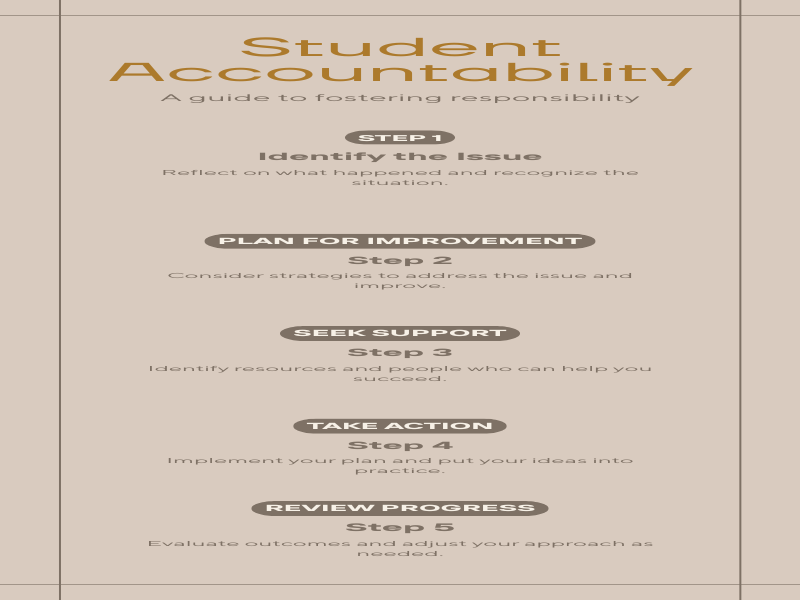
    A student accountability sheet is a short, structured form a student completes after something went wrong — a missed deadline, a group conflict, a behavior that affected the room. Done right, it takes about five minutes and produces a useful conversation. Done wrong, it is busywork that teaches students nothing except how to fill out busywork. This guide explains the difference, offers a free template in four versions, and shows exactly how to use it in a secondary classroom without humiliating anyone or generating a paper trail for things that do not belong on one.

    Key Takeaways

    • An accountability sheet supports a conversation — it is not a punishment, a replacement for a school referral, or a way to document a student for later.
    • Four versions cover the situations teachers actually face: academic work, group responsibility, behavior, and restoration after a conflict.
    • Students complete the sheet themselves. That is the point. If the teacher is doing the writing, the tool is being used incorrectly.
    • The sheet is not a file. Unless a required school procedure calls for documentation, it lives with the student or gets recycled after the conversation.
    • Any teacher can use this the first week of school. No program, no training, and no administrator approval required.

    What Most Accountability Sheets Get Wrong

    Most accountability sheets found in schools — and most of the printables circulating on teacher resource sites — were designed for elementary students and scaled up by changing the font. They ask students to write “what I did wrong” in a box, then “how I will do better next time” in another box, and they expect that sequence to produce insight. It rarely does, because the sequence assumes the student already has a clear picture of what happened and why. They often do not.

    The other common design flaw is that the sheet exists only as a record. A teacher hands it to a student, the student fills it out, the teacher collects it and puts it in a folder. Nothing happens as a result. The student learns that accountability means paperwork, not change — which is exactly the wrong lesson.

    A well-designed student accountability sheet for grades 6–12 does three things that most forms skip. It separates facts from interpretations, so students can describe what actually happened without being led toward a particular framing. It identifies who, specifically, was affected — not just “the class” in the abstract. And it generates a next step the student can actually take, not a vague commitment to “try harder.”

    Classroom accountability sheet template on a student desk in a secondary classroom with warm lamp lighting
    An accountability sheet is a tool for a five-minute conversation, not a substitute for one.

    When to Use an Accountability Sheet

    There are four situations where a short accountability sheet is useful in a secondary classroom. Understanding the difference between them matters, because each version of the sheet asks slightly different questions.

    Academic Work

    A student missed a deadline, submitted incomplete work, or disengaged from a task. The goal of the sheet in this case is not to assign blame but to figure out what actually got in the way. Sometimes the answer is workload. Sometimes it is confusion about the assignment. Sometimes it is something happening at home. The sheet creates space to say so without the conversation becoming a confrontation.

    Group Responsibility

    A student did not hold up their part of a group project. Or a group is in conflict about who did what. The group version of the sheet is filled out individually by each member before the group meets together — which means every voice is already on paper before anyone starts defending themselves out loud. This simple sequencing change reduces the volume of these conversations significantly.

    Behavior

    Something happened in the room — a comment that landed wrong, a refusal, an outburst — that the teacher needs to address before moving on. This version is short by design, because a behavior conversation does not benefit from extended written reflection in the moment. The sheet gives the student a minute to collect their thoughts before speaking, which is often all that is needed to de-escalate the temperature.

    One important note: if the behavior requires a school referral, disciplinary report, or any documentation under your district’s required procedures — do that. The accountability sheet is a classroom tool, not a substitute for mandated process. If you are unsure whether a situation requires official documentation, assume it does and act accordingly. The sheet goes with the student afterward, not instead of the referral.

    Restoration

    Something happened between students — a conflict, an unkind comment, a damaged trust — and the class needs to move forward. The restoration version is the most conversational of the four. It is the one most closely aligned with restorative approaches, and it works best when both students complete their own version before sitting down together. For more on restorative approaches in a school context, see restorative practices in schools.

    The Templates

    Each template below is designed to be reprinted, typed into a shared document, or read aloud and answered verbally depending on the student and the situation. The fields are short. The language is direct. None of it is condescending.

    Four versions of student accountability sheet side by side showing academic work group responsibility behavior and restoration fields
    Four distinct versions of the sheet cover the situations teachers actually face in grades 6–12.

    Version 1 — Academic Work

    Student name: _______________ Date: _______________

    The assignment or task: _______________

    What was supposed to happen? (Describe the expectation — due date, format, what “complete” looked like.)

    What actually happened? (Facts only. Not reasons yet.)

    What got in the way? (This is where reasons belong. Be honest — including “I didn’t prioritize it” is a valid answer.)

    What is one thing you can do in the next 48 hours to move this forward?

    What support, if any, do you need from me?

    Version 2 — Group Responsibility

    Student name: _______________ Project or task: _______________ Date: _______________

    What was your agreed-upon role or task in this group?

    What did you actually complete?

    What did your group expect from you that you did not deliver?

    What happened from your perspective? (State facts and reasons separately.)

    What do you owe the group at this point?

    What is your next step, and when will it be done?

    Version 3 — Behavior

    Student name: _______________ Date: _______________ Period/class: _______________

    Describe what happened. (What you said or did — not what someone else did first.)

    Who was affected by it? (Name the people, not just “everyone.”)

    What do you want those people to know?

    What is one thing you will do differently?

    Note to the teacher: this version is designed for classroom-level situations. If the incident requires a disciplinary referral, complete your school’s required documentation first. This sheet is a follow-up conversation tool, not a replacement for required procedures.

    Version 4 — Restoration

    Student name: _______________ Date: _______________

    What happened between you and the other person? (Your account of it — not what they did, what happened between you.)

    What did the other person lose or experience because of the situation? (This is a perspective-taking question. Answer it honestly even if it is uncomfortable.)

    What do you want to be different going forward?

    Is there something specific you are willing to do or say to move toward that?

    What do you need from me or from the other person to make this work?

    Teacher and student sitting together at a whiteboard table reviewing an accountability sheet in a secondary classroom
    The sheet starts the conversation — it does not replace it. Five minutes at the whiteboard table is worth more than a folder full of completed forms.

    How to Use the Sheet

    The sheet is not the conversation. It is the preparation for one. A student who fills it out in silence and hands it in has not been held accountable — they have completed a writing assignment. The point of the form is that it gives the teacher and the student a shared document to look at together, which is significantly less confrontational than looking at each other across a desk.

    The sequence that works: hand the student the sheet and give them three to five minutes to complete it, without hovering. Sit down together to review it — ideally somewhere that is not the center of the room. Read it together, ask one or two follow-up questions, and agree on the next step before the student returns to work. That is the whole procedure. If it is taking longer than ten minutes, either the situation is more serious than this tool was designed for, or the conversation has turned into a lecture. Stop the lecture.

    The anchor question in every version is some variation of “what is your next step?” That is the question that determines whether the sheet produced anything useful. A vague next step (“I’ll try harder,” “I’ll be better”) is not a next step. Push for something specific and time-bound: “I’ll finish the introduction section by Thursday,” or “I’ll ask Morgan what I can do to address what happened.” Specificity is what makes accountability concrete rather than performative.

    A Classroom Anchor: Authority Handed and Held

    The accountability sheet works best when students already understand that authority in the room is real and is held to. A clearly visible classroom expectations poster does much of this work passively — it gives students a reference point before anything goes wrong, so the accountability sheet’s first question (“what was supposed to happen?”) lands with specificity rather than guesswork. In my workshop room — where students are almost always working alongside somebody, and I move between groups rather than lecture from the front — the sheet tends to come up most often around group work, and specifically around moments where a student was trusted with a role and did not follow through on it.

    When that happens, I do not announce it to the room. I slide the Version 2 sheet to the student at their table and give them four or five minutes while I circulate. Then I pull them to the whiteboard table — my small-group conferencing area with a rug, better chairs, and a lower lamp, where students know they are being seen carefully and not put on display — and we work through their answers together.

    The conversation is not about catching them in something. It is about naming what happened clearly enough that we can figure out what comes next. Students who have been given real authority over something — their section of a project, their role in a group, a decision that affects others — understand why the accounting matters. It matches the weight of the responsibility they were given. What does not match it is a form that feels like it was designed for a third-grader. The template above is written at the level the student is actually operating at. That is the difference between accountability and humiliation, and it matters.

    This approach connects directly to what student responsibility looks like in the classroom — real responsibility includes real accounting when things go wrong, not manufactured consequences or empty apologies. For the broader case for high expectations paired with the room to learn from mistakes, see high expectations for students.

    What Happens When a Student Doesn’t Follow Through

    A student completes the sheet, agrees to a next step, and then does not take it. This happens. Here is the important thing: that outcome does not mean the sheet failed. It means you now have a second conversation with more information than you had before. You know what the student said they would do. You know they did not do it. The conversation gets more specific, not more punitive.

    The escalation path in this case depends on what the situation actually requires. Some students need more support than a single conversation provides — academic, social, or something else entirely. The sheet is not a substitute for identifying that need and addressing it. If a pattern emerges across multiple sheets and conversations, that is information that may need to go to a counselor, an interventionist, or a parent. At that point the sheet is one piece of a larger picture, not the whole solution.

    For students whose accountability issues involve ongoing behavior challenges, the positive discipline framework for teenagers provides a more structured approach that pairs well with the sheet. For situations involving harm between students, the natural consequences framework and the restoration version of the sheet work together. And for the broader question of how to build a classroom where students actually want to hold themselves accountable, see the site’s overview of student responsibility as a developmental skill, not a character judgment.

    The Research Behind It

    Self-regulated learning research has consistently found that students who can reflect on their own performance — identify what went wrong, name contributing factors, and plan a corrective action — outperform students who receive only external evaluation (Zimmerman, 2002). The accountability sheet is applied self-regulated learning: it scaffolds a reflective process that students build over time.

    Self-determination theory (Deci & Ryan, 2000) adds an important dimension: students are far more likely to take a next step they chose than a consequence that was imposed on them. Every version of the sheet ends with the student naming a next step. That ownership matters for what actually happens afterward. Hattie’s (2009) meta-analysis of over 800 studies identified student self-assessment — including structured reflection on what went wrong — as one of the highest-leverage interventions available to teachers. The accountability sheet is a low-cost, no-training version of exactly that.

    Research on restorative approaches in schools (Morrison & Vaandering, 2012; Skiba & Peterson, 2000) supports the same conclusion from the discipline side: punitive responses to student misbehavior consistently underperform restorative ones on measures of recurrence, school climate, and relationship repair. A sheet that asks students to identify who was affected and what they are willing to do to repair it is grounded in that same framework, without requiring a school-wide program or a trained facilitator.

    Printables for this

    Two of mine on TPT, both built for this. Behavior Documentation Forms are the other half of the picture — the ABC data and MTSS logs you keep when a pattern does need a record, which the sheet above deliberately is not. The Makeup Work System handles the follow-through on the academic version, so “what is your next step” has a process behind it.

    If a tracking sheet is not enough on its own: see how to build a behavior contract a student will actually respect, including a sample and an honest read on whether contracts work.

    Frequently Asked Questions

    Is a student accountability sheet the same as a disciplinary referral?

    No. A disciplinary referral is a formal school document that enters a student’s record, triggers review by an administrator, and may carry consequences under district policy. An accountability sheet is a classroom tool — a short form that supports a private conversation and a next step. It is not filed, not sent to the office, and not part of the student’s disciplinary record unless you deliberately attach it to a referral as supporting documentation. If a situation requires a referral, complete the referral. The accountability sheet is for situations that do not — which is the majority of what happens in a classroom on any given day.

    What if the student doesn’t fill it out honestly?

    Some students will write what they think you want to hear. That is useful information, too. If the sheet reads like a performance rather than a reflection, say so directly and ask one specific follow-up question: “When you wrote you would try harder — what does that look like for you on Monday?” Most students will either give a more honest answer or reveal that they actually do not know. Both are starting points for a real conversation. The sheet is not a truth test. It is a structure for a conversation, and the conversation is where the real work happens.

    Does this go in the student’s permanent file or record?

    No — not unless your school’s procedures specifically require it for a given type of incident. For most classroom-level situations, the sheet lives with the student or gets recycled after the conversation. If you are using it as part of a required disciplinary process, follow your school’s documentation requirements for that process. Do not create an informal file of completed accountability sheets. That is not what this tool is for, and it can create problems if the file is ever requested.

    Can parents request to see these sheets?

    Parents can request records their child’s school maintains about them under FERPA. If you are collecting and storing completed accountability sheets in any systematic way, you should treat them as education records and handle them accordingly. The simplest way to avoid this issue is to not store them: use the sheet, have the conversation, and let the student keep it or discard it. A brief note in your own records of the conversation and the agreed-upon next step is sufficient documentation for your own use.

    What should I do if the student refuses to fill it out?

    A student who refuses to engage with the sheet is telling you something about their state in that moment. Do not escalate over the sheet itself. Give them a minute, check in quietly, and decide whether this is a moment of genuine distress, a test of your authority, or something else. If it is a test, name what you see calmly: “I’m going to give you two more minutes. I’ll come back.” If it is distress, the sheet can wait. If refusal becomes a pattern, that is a separate conversation — about engagement and trust, not about a form.

    At what grade level does this work best?

    The templates above are designed for grades 6–12. The language is appropriate for middle school and can be used as-is with most high school students. Students in grades 6–8 may need more scaffolding during the conversation — they often have the self-awareness but not yet the vocabulary to name what happened clearly. The teacher’s role in those grades is slightly more coaching than questioning. High school students can generally complete the sheet more independently, though the conversation afterward is equally important at both levels.

    How do I use the group responsibility version fairly when students blame each other?

    Have each student complete their own version of the sheet before anyone talks. This is non-negotiable: if students start talking first, they immediately start building a shared story that may not reflect what each person actually experienced. Once each student has answered the questions in writing, bring them together. Start with what each person wrote about their own contribution — not the other person’s failures. The sheet’s structure forces that sequence because the questions are framed around the student’s own actions. It does not eliminate conflict, but it changes the opening move from accusation to accounting.

    Sources

    • Zimmerman, B. J. (2002). Becoming a self-regulated learner: An overview. Theory Into Practice, 41(2), 64–70. https://doi.org/10.1207/s15430421tip4102_2
    • Deci, E. L., & Ryan, R. M. (2000). The “what” and “why” of goal pursuits: Human needs and the self-determination of behavior. Psychological Inquiry, 11(4), 227–268. https://doi.org/10.1207/S15327965PLI1104_01
    • Hattie, J. (2009). Visible Learning: A Synthesis of Over 800 Meta-Analyses Relating to Achievement. Routledge.
    • Morrison, B. E., & Vaandering, D. (2012). Restorative justice: Pedagogy, praxis, and discipline. Journal of School Violence, 11(2), 138–155. https://doi.org/10.1080/15388220.2011.653322
    • Skiba, R. J., & Peterson, R. L. (2000). School discipline at a crossroads: From zero tolerance to early response. Exceptional Children, 66(3), 335–346. https://doi.org/10.1177/001440290006600303

    About Clay Shumate

    By Clay Shumate — Clay Shumate is a certified secondary Social Studies teacher in the public schools of West Alabama, with seven years of classroom experience, a B.A. in History, and an M.Ed. in Secondary Education. He writes about project-based learning, student responsibility, respect, and practical ways to hold young people to a higher standard while giving them room to learn from mistakes. He is a member of the Society of Professional Journalists and writes to its Code of Ethics; this site’s editorial standards and corrections policy are published in full. More about Clay.

  • 7 Steps of Project Based Learning: From Driving Question to Public Product

    7 Steps of Project Based Learning: From Driving Question to Public Product

    By Clay Shumate

    The 7 steps of project based learning move a class from a question worth answering to a product worth defending. They are: identify learning goals, craft a driving question, launch the project, guide inquiry and research, set checkpoints and manage the work, facilitate critique and revision, and present the public product with reflection. Each step has a teacher role and a student role, and skipping any of them is how PBL collapses into a decorated group assignment. Each step works better when teachers and students have reliable project based learning tools—the planning templates, role cards, and critique protocols that keep the process on track. There is also a reviewed list of outside PBL resources worth the download, with the weak ones named.

    Why Steps Matter: PBL Without Structure Falls Apart

    Project based learning has a reputation problem. Teachers who have tried it and watched it fail usually did not fail at the project — they failed at the process. A class that jumps from “here is your project” to “present on Friday” without the steps in between produces exactly the kind of shallow, off-task, unequal group work that gives PBL a bad name.

    The Gold Standard PBL framework from PBLWorks, developed by John Larmer, John Mergendoller, and the Buck Institute for Education, identifies seven essential project design elements: a challenging problem or question, sustained inquiry, authenticity, student voice and choice, reflection, critique and revision, and a public product. Those elements are not decorations. They are structural requirements. Remove any one of them and the project loses what makes it PBL.

    The seven steps below translate those design elements into a sequence a teacher can actually follow. They are grounded in PBLWorks’ framework, supported by the research comparing PBL vs traditional teaching, and tested in real classrooms — including mine, where the tables are pushed together, students are always working with somebody, and the projects run while I circulate between groups.

    Step 1: Identify Learning Goals and Standards

    The teacher’s job: Decide what students must know and be able to do by the end of the project. Anchor these goals in your actual standards — state standards, Common Core, NGSS, C3, whatever your district uses. This is not optional. A project without clear learning goals is an activity, not instruction. If you need a refresher on the definition of project based learning and what separates it from traditional group work, start there.

    The common mistake: Designing the fun part first and then trying to reverse-engineer the standards into it. That produces projects where the academic content is an afterthought — the poster looks great but the student cannot explain what they learned.

    What to do instead: Start with the standards. Identify two to four that the project will assess directly. Then ask: what kind of work would require students to use these standards to answer a real question or solve a real problem? The project grows from the learning, not the other way around.

    A practical tip: write the standards on one side of a sheet of paper and the project idea on the other. If you cannot draw clear lines connecting them, the project needs to change or the standards need to change. One or the other.

    Step 2: Craft a Driving Question

    The teacher’s job: Write a question that is open-ended, challenging, anchored in real concerns, and aligned to the learning goals from Step 1. This question drives the entire project. If the question is weak, everything after it will be shallow.

    Comparison of strong and weak driving questions for project based learning showing what makes an effective PBL question
    Strong versus weak driving questions — the most important design decision in PBL

    What makes a strong driving question:

    • It cannot be answered with a Google search.
    • It requires students to gather evidence, weigh competing claims, and defend a position.
    • It connects to something real — a community issue, a professional challenge, a decision someone actually has to make.
    • It is specific enough to be answerable and broad enough to sustain weeks of inquiry.

    What makes a weak driving question:

    • “What is climate change?” — Too broad, easily Googled.
    • “Make a poster about the Civil War.” — Not a question at all.
    • “How can we save the planet?” — Too large, no real audience, no defensible product.
    • “What did you learn about ancient Rome?” — Only asks for recall, not application.

    A strong example: “Should our city council approve the proposed rezoning plan for the neighborhood south of Main Street?” This question has a real audience (the council), competing perspectives (residents, developers, environmental groups), evidence requirements (zoning data, traffic studies, community input), and a defensible product (a recommendation with data).

    Spend more time on this step than you think it deserves. A mediocre driving question produces mediocre projects no matter how well you execute the other six steps. If you want side-by-side models to work from, these driving question examples across four subject areas show what the revision from weak to strong actually looks like.

    Step 3: Launch the Project

    The teacher’s job: Introduce the driving question in a way that creates genuine curiosity, not just compliance. The launch is the moment students go from “we have a project” to “I actually want to know the answer to this.”

    Effective launches include:

    • A real-world entry event: a guest speaker, a site visit, a video of the actual problem, a letter from someone who needs the answer.
    • A “need to know” list: after the launch, students generate questions about what they need to learn to answer the driving question. This list becomes their research agenda.
    • Clear project parameters: timeline, deliverables, team structures, and how the work will be assessed.

    The trap: Over-explaining everything on day one. If students walk away from the launch knowing exactly what the final product should look like, you have removed the inquiry. Give them the question and the constraints. Let them figure out the path.

    Step 4: Guide Inquiry and Research

    The teacher’s job: This is the sustained inquiry step — the one that separates PBL from a group assignment with a poster. Students are not following a worksheet. They are identifying what they need to know, finding sources, evaluating evidence, and building understanding over days or weeks.

    Seven step project based learning process from identifying learning goals to presenting the public product
    The seven-step PBL process based on PBLWorks’ Gold Standard framework

    What this looks like in practice:

    • Students work from their “need to know” list and add to it as new questions emerge.
    • The teacher provides direct instruction when the whole class needs it — a lesson on evaluating sources, a skill workshop on data analysis, a mini-lecture on background content — but these lessons serve the project, not the other way around.
    • Research is iterative. Students may find that their initial approach does not work and need to change direction. That is not a failure. That is inquiry.

    I spend most of this step circulating. The tables in my room are already grouped, so students are working in pairs or small teams by default. Most of what I do is listen. I stop at a group, hear what they are discussing, and decide whether to step in or move on. If I overhear a group building on a premise that is factually wrong — and it happens more often than you would think — I do not announce it to the room. I sit down with that group and ask them to show me where they found it. Usually, the source is a single website or a misread paragraph. We look at it together, and they see the problem themselves. That is more valuable than a correction from the front of the room.

    A note on diverse learners: Students with IEPs, 504 plans, or English language needs may require adjusted entry points for inquiry — a modified source list, a graphic organizer, a shorter initial reading, or a paired research partner. The inquiry itself does not change. The scaffolding that gets a student into the inquiry does. Work with your special education and ELL colleagues to design those entry points before the project launches, not after a student stalls.

    The common failure point: Letting inquiry drift. Without regular check-ins, some groups will spend two weeks on research and produce nothing usable. Step 5 prevents that.

    Step 5: Set Checkpoints and Manage the Work

    The teacher’s job: Build structured checkpoints into the project timeline where you review student progress, provide feedback, and catch problems before they compound. This is the project management step, and skipping it is the single most common reason PBL fails.

    What checkpoints look like:

    • End of week one: Groups submit a research plan — what they are investigating, where they are looking, what they have found so far, and what is still missing.
    • Midpoint: Groups present a rough draft, preliminary findings, or a prototype. This is not graded. It is feedback.
    • Before the final product: Groups present a near-final version for critique (Step 6).

    The teacher’s role during checkpoints:

    At my whiteboard table, I pull groups one at a time. They show me what they have. I ask questions: What is your claim? Where is your evidence? What would someone who disagrees say? If the answers are thin, we talk about what needs to happen before the next check-in. If the answers are solid, I push harder: What have you left out? What are you unsure about?

    These conversations are not optional. They are the mechanism that prevents the end-of-project crash where one group has done everything and another has done nothing.

    A practical tool: A project calendar posted where students can see it, with checkpoint dates circled. Students should know exactly when they will be expected to show progress and in what form.

    Step 6: Facilitate Critique and Revision

    The teacher’s job: Teach students to give and receive specific, constructive feedback — and then give them structured time to use it. This step is what turns a first draft into a defensible product.

    Why critique and revision matter:

    PBLWorks identifies critique and revision as one of the seven essential design elements for a reason. A project that is never revised is not PBL. It is an assignment that took longer. Real-world work — journalism, engineering, policy, research, design — goes through multiple drafts. Students need to practice that process, not skip it.

    How to structure critique:

    • Use a protocol. Unstructured “peer review” devolves into “looks good” within minutes. A simple protocol works: the presenting group shares their work, the audience asks clarifying questions, the audience offers specific feedback (what is strong, what is unclear, what is missing), and the presenting group records the feedback without defending their work.
    • Model it first. Show students what specific, useful feedback sounds like versus vague or personal feedback. “Your graph does not label the axes” is useful. “I do not like it” is not.
    • Schedule revision time. Feedback without time to use it is performative. Build revision days into the calendar.

    The teacher’s additional role: Give your own feedback alongside the peer critique. Students respect peer feedback more when the teacher is also participating in the same process rather than standing outside it. Critique works best when everyone is scoring against the same published criteria, which is what a shared project scoring guide is for.

    Step 7: Present the Public Product with Reflection

    The teacher’s job: Create an authentic presentation opportunity where students share their work with an audience beyond the classroom — and then lead a structured reflection on what they learned.

    What “public” means:

    The audience does not need to be the United Nations. It needs to be someone other than you. Options that work in an ordinary school:

    • Another class.
    • Parents and families at an evening showcase.
    • A community panel invited for the occasion — a local business owner, a council member, a professional in the field.
    • A recorded presentation shared with a real organization.
    • A published piece — a blog, a letter to the editor, a recommendation submitted to the actual audience named in the driving question. For a concrete example of project based learning in action, see how one classroom handled the full cycle.

    Why the public audience matters:

    When the only audience is the teacher, students calibrate their effort to “good enough to pass.” When someone else will see it — someone they want to impress, someone who might ask hard questions — the standard shifts. The work gets better not because you demanded it, but because the audience did.

    Reflection is the step most teachers skip:

    After the presentation, students need structured time to think about what they learned — not just the content, but the process. What worked? What did they struggle with? What would they do differently? What did the critique feedback change?

    This is not a journal entry for a grade. It is the metacognitive step that turns experience into learning. Without it, students finish the project knowing what they made, but not necessarily what they learned.

    A useful reflection prompt: If you had to do this project again with a new group and a different driving question, what is the one thing you would do differently and why?

    Common Failure Points Across All Seven Steps

    Skipping Step 2 (the driving question): Teachers who start with the product — “we are making a documentary” — instead of the question produce projects where students focus on production quality rather than learning. The documentary looks polished but says nothing original.

    Rushing Step 4 (inquiry): In a tight schedule, it is tempting to hand students the information and skip the research. But if students do not find the information themselves, they do not own it. PBL without inquiry is craft time.

    Ignoring Step 5 (checkpoints): Every PBL horror story — the group that did nothing, the student who carried the team, the project that went completely off track — is a checkpoint failure. You had weeks to catch it. You did not check.

    Treating Step 6 (critique) as optional: Students who present their first draft as their final product have not experienced PBL. They have experienced a long assignment with a due date.

    A Practical Planning Checklist

    Project based learning planning checklist with ten items to confirm before launching any student project
    Confirm every item before launching a project

    Before you launch a project, confirm:

    • Two to four standards are clearly identified and assessable through the project.
    • The driving question is open-ended, challenging, authentic, and connected to standards.
    • The launch creates curiosity and generates a student “need to know” list.
    • Inquiry time is built into the calendar — not just one day, but sustained over weeks.
    • At least three checkpoints are scheduled with specific deliverables for each.
    • A critique protocol is selected and taught before the critique session.
    • The audience for the public product is identified and confirmed.
    • Reflection is scheduled and structured.
    • Individual accountability is built into the group assessment so one student cannot carry or hide.
    • The project calendar is visible to students from day one.

    Conclusion

    The 7 steps of project based learning are not a formula. They are a sequence of decisions — learning goals, driving question, launch, inquiry, checkpoints, critique and revision, and public product — that keep a project from becoming busywork with a poster board. Skip any step and you will feel it. Rush the driving question and the research is shallow. Skip checkpoints and you find out too late. Skip critique and the product never improves. Skip the public audience and students treat it like homework.

    Get the sequence right — and if you need ideas for project based learning to get started — PBL produces something most classroom assignments cannot: students who know what they learned, why it matters, and how to defend it to someone who was not in the room.

    For strategies on implementing this sequence inside a standard high-school bell schedule, see project based learning high schools can use without rebuilding the schedule.


    How long should a PBL project take?

    Most projects that follow all seven steps need at least two to three weeks of class time, though some run a full semester. Shorter projects — one to two days — can incorporate PBL elements, but they rarely sustain the inquiry and revision cycle that makes PBL distinct. The driving question should determine the timeline, not the other way around.

    Can I use PBL in a class with a tight pacing guide?

    Yes, but it requires planning. Identify two to four standards the project will cover and use the project as the vehicle for teaching those standards, not an addition to your existing lessons. Replace instruction on those standards with the project, do not stack them. PBL is the main course, not the dessert.

    What if some groups finish early and others are behind?

    This is a checkpoint problem. If you are checking progress at regular intervals, you will catch the groups that are behind before the final deadline. For groups that finish early, add an extension question or have them prepare to serve as peer critics for other groups — a role that deepens their own understanding.

    How do I grade individual students in a group project?

    Build individual accountability into the assessment. Require each student to submit their own written reflection, defend a specific part of the project during the presentation, or complete an individual component alongside the group work. The group product shows collaboration. The individual assessment shows learning.

    What if I have never done PBL before? Should I start with all seven steps?

    Start with a smaller project — two to three weeks, one driving question, one product — and include all seven steps even if you simplify them. Skipping steps is what causes PBL to fail, so it is better to do all seven simply than to do three of them elaborately. Your first project will be imperfect. That is normal. Reflect on what worked and adjust the next one.

    Do I need special materials or technology for PBL?

    No. Some of the strongest projects use nothing but paper, community access, and the students themselves. Technology can enhance research and production, but the seven steps work with or without it. A driving question, a library, and a real audience are more important than a 1:1 device ratio.

    How do I handle a student who does not contribute to the group?

    Address it at checkpoints, not at the end. When you pull a group to the whiteboard table and one member has done nothing, that is a conversation — not a grade penalty. Ask what the barrier is. Sometimes it is confusion, sometimes it is a group dynamic problem, sometimes it is disengagement that needs a different intervention. The answer changes the response.


    Sources

    1. Larmer, J., Mergendoller, J. R., & Boss, S. (2015). Setting the Standard for Project Based Learning. ASCD/Buck Institute for Education.
    2. PBLWorks. “Gold Standard PBL: Essential Project Design Elements.” Buck Institute for Education.
    3. PBLWorks. “Gold Standard PBL: Project Based Teaching Practices.” Buck Institute for Education.
    4. Condliffe, B. (2017). “Project-Based Learning: A Literature Review.” MDRC Working Paper.
    5. Larmer, J., & Mergendoller, J. R. (2010). “Seven Essentials for Project-Based Learning.” Educational Leadership, 68(1), 34–37.
    6. Hattie, J. (2023). Visible Learning: The Sequel. Routledge.

    About Clay Shumate

    Clay Shumate is a certified secondary Social Studies teacher in the public schools of West Alabama, with seven years of classroom experience, a B.A. in History, and an M.Ed. in Secondary Education. He writes about project-based learning, student responsibility, respect, and practical ways to hold young people to a higher standard while giving them room to learn from mistakes. He is a member of the Society of Professional Journalists and writes to its Code of Ethics; this site’s editorial standards and corrections policy are published in full. More about Clay.

Teacher Emergency Toolkit — practical resources, real classroom support. Shop on TPT.Teacher Emergency Toolkit — practical resources, real classroom support. Shop on TPT.