Free teacher printables are classroom-ready documents — primary source sets, data tables, reading guides, rubrics, trackers — that you can download and print without paying. For grades 6–12 the best ones come from federal agencies, museums, archives, universities and public media rather than worksheet mills. The hard part is not finding them. The hard part is telling which ones are worth the paper.
Most search traffic for free printables lands in elementary territory: coloring pages, letter tracing, bulletin board sets. This article stays in middle and high school, where the useful material looks completely different. A good secondary printable is usually a document, a data set, a structured protocol or a rubric — not a fill-in-the-blank page. Below are the quality criteria first, then the places that actually have the goods, with links I opened in October 2026.
Key Takeaways
Judge the task, not the design. A clean-looking page that asks students to copy definitions is worse than an ugly page that asks them to explain something.
Federal material is usually public domain. U.S. copyright law states that copyright protection is not available for any work of the U.S. Government, which is why National Archives and Library of Congress material is so adaptable.
Free is not the same as unrestricted. Marketplace downloads typically carry single-classroom licenses and explicit bans on reposting, even when the file cost nothing.
Worksheets have one strong, narrow use. Retrieval practice and spaced review are the two study techniques rated high utility in the major cognitive-psychology review. Most other worksheet uses are not supported.
Check the reading level before you print thirty copies. A primary source at a grade 14 reading level is an accessibility decision, not a rigor decision.
Everything on this site is free and ungated. All 53 printables in our library download directly, with no email, account or sign-up.
What are free teacher printables, really?
They are any document you can print and put in front of students without paying for it, which covers an enormous range of quality. That range is the whole problem. The phrase lumps together a declassified cable from the National Archives and a crossword of vocabulary words, and search engines cannot tell them apart.
For grades 6–12, useful printables tend to fall into five types. Primary and secondary source documents. Data sets, tables and charts students have to interpret. Structured protocols — discussion formats, peer review sheets, lab procedures, project planners. Rubrics and checklists. And practice sets, where the point is repeated retrieval rather than discovery.
Notice what is missing from that list: anything whose main function is to occupy time. That is not a moral judgment about busywork, it is a practical one. Paper that occupies time without producing evidence of thinking gives you nothing to grade honestly and gives students nothing to be proud of.
What is a worksheet actually good for?
A worksheet has one strong use: structured, repeated retrieval of things students need fast and automatic. Vocabulary, formulas, dates, conjugations, equation forms, map features. That use is well supported and worth defending.
The large review by Dunlosky, Rawson, Marsh, Nathan and Willingham rated ten common learning techniques for utility. Only two earned a high rating: practice testing and distributed practice. They write that these “received high utility assessments because they benefit learners of different ages and abilities.” Rereading and highlighting were both rated low utility — highlighting, which students lean on heavily, “does not consistently boost students’ performance.” Summarization and keyword mnemonics also came in low, and elaborative interrogation and self-explanation came in moderate, partly because they “have not been adequately evaluated in educational contexts” (Dunlosky et al., Psychological Science in the Public Interest, 14(1), 4–58, 2013).
That review covers a wide age range and a lot of laboratory work, not only secondary classrooms, so take it as a guide to which direction the evidence points rather than a prescription. But the direction is clear. A printable that functions as a short retrieval quiz, returned to a week later, is doing something the research supports. A printable that asks students to find and highlight the definitions is doing something the research rates poorly.
So: use worksheets for retrieval and spacing. Do not use them to introduce concepts, to substitute for reading, or to fill a Friday. That is the narrow good use, stated plainly.
Two minutes of screening rejects most of what a search turns up.
Seven questions to ask before you print
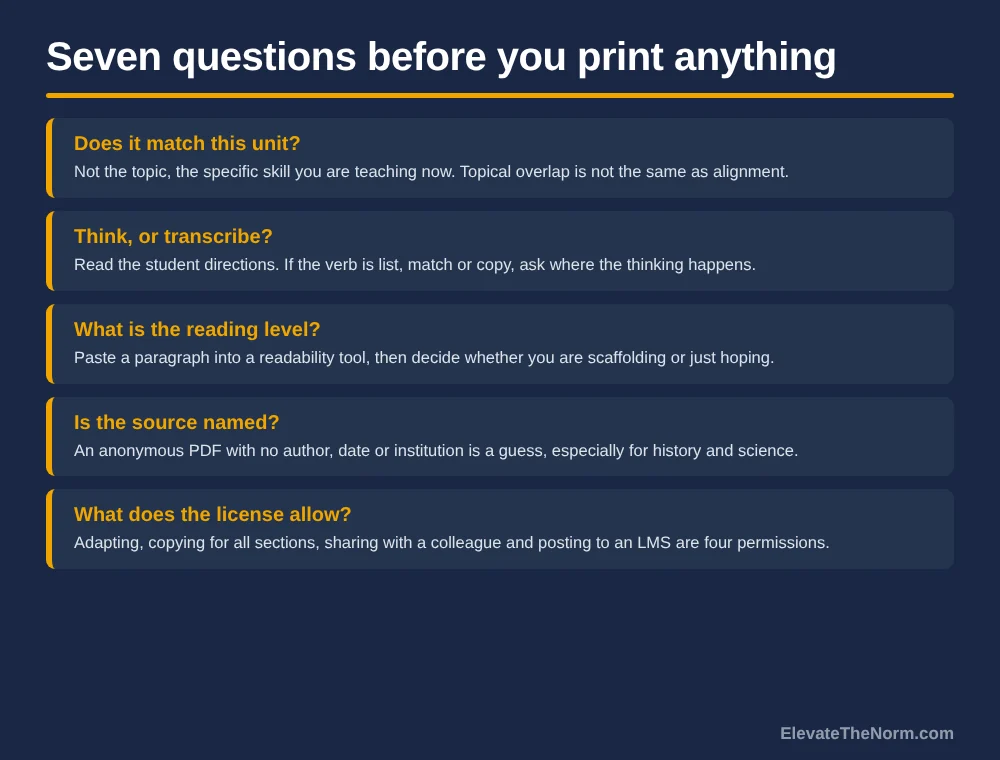
Run any candidate printable through these seven questions. It takes about two minutes and will reject most of what you find.
Does it match what I am actually teaching? Not the topic — the specific skill or standard in this unit. Topical overlap is not alignment.
Does it ask students to think, or to transcribe? Read the directions on the student page. If the verb is “list,” “match,” or “copy,” ask what the thinking is.
What is the reading level, and who gets left out? Paste a paragraph into a readability tool. Then decide whether you are scaffolding the text or just hoping.
Is the source credible and named? An anonymous PDF with no author, date or institution is a guess. Historical and scientific content from an unnamed source is a particular risk.
Is it accurate? Spot-check two factual claims. Free content is not peer reviewed, and errors in dates, units and attributions are common.
What does the license allow? Can you adapt it, copy it for all your sections, share it with a colleague, post it to your LMS? These are four different permissions.
Does it produce something I can look at? If finished student work would not tell you anything you did not already know, skip it.
Question three deserves one more sentence. A document written for adults in 1863 is not automatically rigorous for a ninth grader; it is simply hard. Either you excerpt it, gloss it, chunk it, and build a scaffold, or you are handing out an obstacle. Checking whether the text landed matters more than the text’s prestige.
What may I legally adapt, copy and share?
Three separate things govern a free file: copyright, the license, and your district’s policy. Free to download tells you nothing about any of them.
The most permissive category is federal government work. Section 105 of U.S. copyright law states that “Copyright protection under this title is not available for any work of the United States Government,” while noting the government may hold copyrights transferred to it (17 U.S.C. § 105). In practice that is why you can crop, excerpt, retype and remix a National Archives document or a federal data table freely. Two cautions: material a federal site hosts may still be owned by someone else, and some agency logos and seals carry separate restrictions.
Openly licensed material is the next tier. OER Commons, which has been curating open materials since 2007, labels resources so you can tell adaptation rights at a glance — the site states that “each resource has one of four conditions of use labels” that “help you quickly distinguish whether a resource can be changed or shared without further permission required” (OER Commons). Read the label. Share-alike and non-commercial conditions are real conditions.
Then there are free files with restrictive licenses, which is most of a teacher marketplace. A free download from Teachers Pay Teachers typically comes with a single-classroom license and explicit instructions not to repost. Browsing the free section, you will find terms like “PLEASE DO NOT POST THIS PRODUCT ANYWHERE. Not on your classroom website, not online for your friends, nowhere” and resources marked “for personal use only” (TPT free resources). Those terms are not unreasonable, but they mean a free file can still be one you may not put in a shared department drive.
Federal sources, and why they are the best starting point
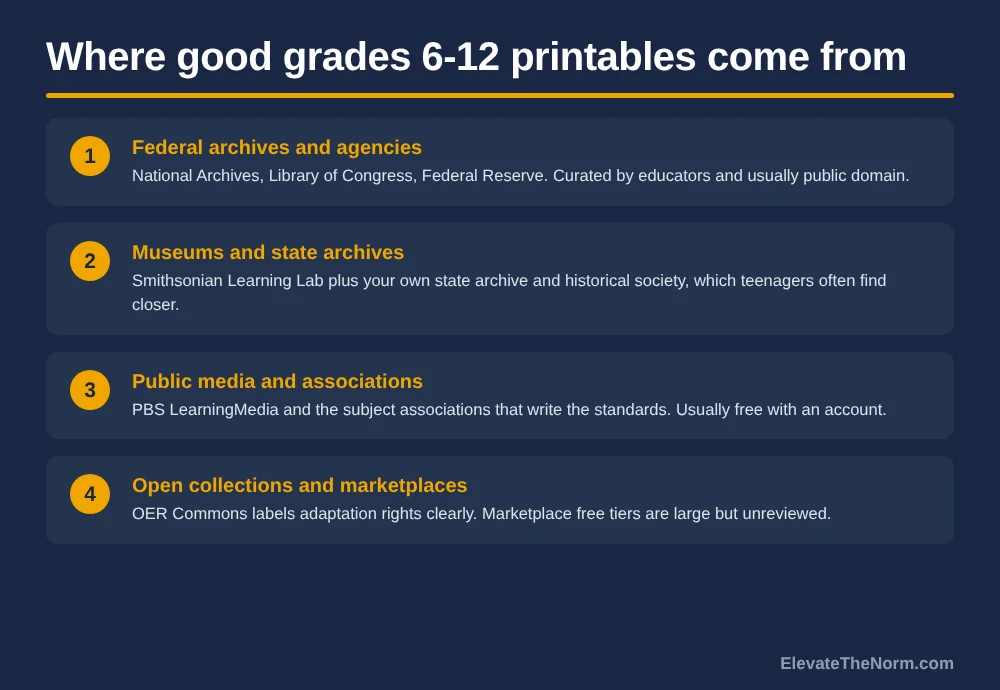
Start with the National Archives and the Library of Congress. These are the two highest-value free sources for secondary social studies, English and anything document-based, and both are built by people who understand classrooms.
DocsTeach, run with support from the National Archives Foundation, offers “thousands of primary sources — letters, photographs, speeches, posters, maps, videos, and other document types — spanning the course of American history.” When I checked in October 2026 the site listed 13,639 primary source documents and 294 activities available without registering, and states plainly: “It’s completely free!” A free account adds more teacher-built activities and lets you build and save your own (DocsTeach).
The Library of Congress publishes classroom materials “Created by teachers for teachers” — primary source sets organized by topic, many with teacher’s guides, covering the Civil War, the American Revolution, the civil rights movement and dozens more (Library of Congress classroom materials).
For economics and personal finance, the Federal Reserve’s education site describes itself as “A FREE platform with economics and personal finance resources for classrooms and communities,” with middle school, high school and college levels, and lessons, readings, modules and infographic posters. Browsing is open; saving resources and getting answer keys requires a free teacher account (Federal Reserve Education).
Museums, libraries and archives
The Smithsonian Learning Lab is the strongest single museum source for grades 6–12. It describes itself as “Free to discover,” holding “millions of Smithsonian digital images, recordings, texts, and videos in history, art and culture, and the sciences” plus “thousands of examples of resources organized and structured for teaching and learning,” with collections filterable by grade band (Smithsonian Learning Lab). Browsing is open; saving and assigning requires an account.
Your state archive and your state historical society are underused. Nearly every state has digitized local newspapers, maps, census records and photographs, and local documents are frequently more interesting to teenagers than national ones. Your county or city public library system often has free database access with a library card, which is a genuinely free resource most teachers never mention to students.
Institutions beat worksheet mills, especially above grade six.
Public media, associations and universities
Public media is reliable but usually gated behind a free account. PBS LearningMedia offers videos, interactives and lesson plans and is free, stating plainly “Register Now It’s free!” — which does mean an account (PBS LearningMedia). That is a reasonable trade, but it is a gate and I am not going to pretend otherwise.
Subject-matter professional associations are the most reliable source of standards-aligned secondary material, because they write the standards. The national councils and associations for English, mathematics, science, social studies and world languages all publish free classroom material alongside their member-only content. Check what is open before paying for membership for that reason alone.
University centers publish free curriculum too, and the quality is usually high because it is tied to research programs. These sources often require a free account, and the material is frequently narrow — one skill, done thoroughly. That is a feature.
A warning about link rot from this same category. When I verified sources for this article in October 2026, the deep links for the National Endowment for the Humanities’ EDSITEment lesson plans — recommended in teacher materials for over two decades — redirected to a single NEH project page rather than the lesson library. Any list of free resources older than about a year will contain dead ends. Open the link before you plan around it.
Teacher marketplaces and their free tiers
Marketplaces have enormous free sections and wildly variable quality, and the filter has to be yours. Teachers Pay Teachers lists hundreds of thousands of free resources across all grades and subjects, and an account is required to download them.
Two honest cautions. First, marketplace material is not reviewed for accuracy or alignment by anyone except the buyer, so questions four and five in the checklist above matter most here. Second, the volume skews heavily elementary, so grade 6–12 searching takes patience and tight filters. When it works, it works well for exactly one thing: a structure someone else already built that you would otherwise spend an evening making.
Our own free teacher printables, and what we charge for
Every printable on this site is free and downloads directly — no email, no account, no sign-up. As of October 2026 the resource library holds 53 free printable PDFs, organized into classroom management, assessment and grading, instruction and discussion, families and conferences, integrity and responsibility, and teacher wellbeing and reflection.
We also sell some packaged versions of this material on Teachers Pay Teachers. Those are paid. Stating that plainly is the point: nothing that is free here will ever move behind a purchase, and if you only ever use the free files, that is the intended outcome, not a loss.
Secondary students will do hard work with a visible purpose and resist easy work without one.
Where free printables go wrong in middle and high school
The failure mode is almost always age mismatch dressed up as differentiation. A few patterns to watch for.
Elementary material relabeled. Clip art, large fonts, one-word answers. Teenagers read this instantly as being talked down to, and they are right.
Volume substituted for difficulty. Forty problems at the same level is not more rigorous than eight at increasing levels. It is longer.
The reading level nobody checked. An unexcerpted primary source handed out cold, with no glossary and no chunking.
Answers in the directions. Graphic organizers so prescriptive that filling them in requires no decisions.
No visible purpose. If a student asks why they are doing this and the honest answer is “to have something to turn in,” do not print it.
That last one is the test I would apply above all others. Secondary students will do difficult work if the purpose is legible to them, and they will resist easy work whose purpose is not. Treating them as developing young adults means the paper has to be able to justify itself, which is also the argument for giving them real choices inside an assignment rather than more pages of it.
A quick comparison of source types
Source type
Typical quality
Account needed?
Adaptation rights
Best for
Federal agencies and archives
High; curated by educators
Usually no for browsing
Broadest — federal works are not copyrightable under § 105
Primary sources, data sets, document-based tasks
Museums and libraries
High
Browsing open; saving usually requires one
Varies by item; check each
Images, objects, curated collections by grade band
Public media
High
Usually yes, free
Classroom use; redistribution restricted
Video-anchored lessons, interactives
Professional associations
High, standards-aligned
Mixed; some member-only
Varies; frequently classroom-use only
Standards alignment, assessment design
Open education collections
Variable but labeled
Usually no
Explicitly labeled; often adaptable
Full units, textbooks, remixable material
Teacher marketplaces
Very variable
Yes, to download
Usually single classroom, no reposting
Ready-made structures and templates
Free teacher printables: a short plan for this week
Pick the one unit coming up where you are least happy with your materials, and spend forty minutes on free teacher printables for that unit only. General browsing produces a folder you never open. A specific hunt produces something you use on Thursday.
Start at the National Archives or the Library of Congress if the unit is document-based, the Federal Reserve if it is economics, the Smithsonian if it is object- or image-based. Run every candidate through the seven questions, especially reading level and what the task asks students to do. Check the license before you put anything in a shared drive. And if what you need is a protocol, a tracker or a rubric rather than content, start with our free printable library, which downloads directly with no email required.
One more thing worth saying. Hunting for materials is legitimate professional work, and it counts. If you are building a growth goal you will actually revisit or logging hours toward your state’s license renewal requirement, improving your materials is a real place to point that effort — as long as the test stays the same: does this paper produce thinking I can look at?
Sources
John Dunlosky, Katherine A. Rawson, Elizabeth J. Marsh, Mitchell J. Nathan and Daniel T. Willingham, “Improving Students’ Learning With Effective Learning Techniques,” Psychological Science in the Public Interest, 14(1), 4–58, 2013. Supports the high utility ratings for practice testing and distributed practice and the low ratings for rereading, highlighting and summarization. Caveat: the review spans a wide age range and relies substantially on laboratory studies rather than secondary classrooms; the authors note some techniques are rated moderate precisely because they “have not been adequately evaluated in educational contexts.”https://journals.sagepub.com/doi/10.1177/1529100612453266
U.S. Copyright Law, Title 17, Section 105, “Subject matter of copyright: United States Government works,” U.S. Copyright Office. Supports the statement that copyright protection is not available for works of the U.S. Government. Caveat: this covers works authored by the federal government, not everything hosted on a federal website, and agency seals and logos may carry separate restrictions.https://www.copyright.gov/title17/92chap1.html
DocsTeach, National Archives, accessed October 2026. Supports the document and activity counts, the “completely free” statement, and the distinction between browsing without an account and the additional activities a free account adds. https://www.docsteach.org/
Library of Congress, “Classroom Materials,” accessed October 2026. Supports the description of teacher-built primary source sets with teacher’s guides organized by historical topic. Caveat: the landing page does not itself state grade bands, so check each set.https://www.loc.gov/classroom-materials/
Smithsonian Learning Lab, accessed October 2026, and Federal Reserve Education, accessed October 2026. Support the quoted descriptions of holdings, the grade-band filtering, the “FREE platform” description, and the statement that a free teacher account is needed to save resources and access answer keys. https://learninglab.si.edu/
OER Commons, accessed October 2026. Supports the four conditions-of-use labeling system and the 2007 founding date used to describe the collection. https://www.oercommons.org/
Teachers Pay Teachers, free resources browse page, accessed October 2026. Supports the existence of a large free tier, the requirement to log in to download, and the quoted single-classroom and no-reposting terms that individual sellers attach. Caveat: licensing terms are set per resource by sellers, so read the terms on the specific file rather than assuming.https://www.teacherspayteachers.com/Browse/Price-Range/Free
Frequently Asked Questions
Are worksheets bad for middle and high school students?
No, but they have one narrow good use: structured, repeated retrieval of things students need fast and automatic, revisited after a gap. That use lines up with the only two techniques rated high utility in the major review of learning strategies — practice testing and distributed practice. What is not supported is using a worksheet to introduce a concept, to replace reading, or to fill a period. The question to ask is not whether a page is a worksheet, but whether finished student work on it would tell you something you did not already know.
If a printable is free, can I change it and share it with my department?
Not automatically, and these are separate permissions. Works authored by the U.S. federal government are not protected by copyright, which is why National Archives and Library of Congress material can be cropped, excerpted and remixed freely. Openly licensed material carries explicit labels you should read, including share-alike and non-commercial conditions. Free marketplace downloads usually carry single-classroom licenses and explicit bans on reposting, even though the file cost nothing. Before anything goes into a shared drive or an LMS, read the terms attached to that specific file.
How do I check whether a document is too hard for my students?
Paste a representative paragraph into a readability tool and look at the grade estimate, then make a deliberate decision rather than hoping. A document written for adults in 1863 is not automatically rigorous for a ninth grader; it is simply hard. If you keep it, excerpt it, chunk it, gloss the vocabulary and build a scaffold. If you cannot do that work before Thursday, pick a different text. Handing out an unmodified hard source and calling it rigor mostly produces students who learn that reading is futile.
Why do so many free printable sites skew elementary?
Because that is where the demand volume is, and because elementary material is faster to produce. The practical consequence for secondary teachers is that general searches waste time and you should go to specific institutions instead. Federal archives, museums, the Federal Reserve, professional subject associations and university centers all produce genuinely secondary-level material. On marketplaces, use tight grade and subject filters from the start. And be suspicious of anything with clip art and one-word answer lines, which is usually elementary material relabeled.
Do I have to create an account to get free materials?
It depends on the source, and it is worth knowing before you plan a lesson around something. Browsing the National Archives, Library of Congress, OER Commons and the Smithsonian Learning Lab works without an account, though saving and assigning on the Smithsonian site requires one. PBS LearningMedia and the Federal Reserve both ask you to register for free. Teachers Pay Teachers requires an account even for free downloads. Everything in this site’s own library downloads directly with no email, account or sign-up, which is a deliberate choice.
Is paid material from a marketplace better than free material?
Not reliably. Price is a signal about packaging and the seller’s time, not about accuracy or alignment. Marketplace material of either kind is not reviewed by anyone except the buyer, so a paid file and a free file from the same marketplace deserve the same scrutiny. Where paying can genuinely be worth it is for a complete, coherent structure you would otherwise spend several evenings building. Where it is rarely worth it is for single pages, which free institutional sources usually provide at equal or better quality.
How often do free resource links break?
Often enough that you should open every link before planning around it. While checking sources for this article in October 2026, I found that the deep links for a federal humanities agency’s long-recommended lesson plan library now redirect to a single project page rather than the lessons themselves. That resource had been recommended in teacher materials for over two decades. If a federal site can move out from under its own URLs, any roundup list older than a year will contain dead ends. Download the files you rely on rather than bookmarking them.
How should I decide what to look for in the first place?
Start from a unit, never from a browse. Pick the one upcoming unit where you are least happy with your materials, name the specific gap — a text, a data set, a protocol, a rubric — and spend forty focused minutes on that gap only. General browsing produces a folder of downloads you never open again. A targeted hunt produces something in students’ hands on Thursday. Then run each candidate through the alignment, task, reading level, credibility, accuracy, license and evidence questions before it goes near a copier.
About Clay Shumate
Clay Shumate is a certified secondary Social Studies teacher in the public schools of West Alabama, with seven years of classroom experience, a B.A. in History, and an M.Ed. in Secondary Education. He writes about project-based learning, student responsibility, respect, and practical ways to hold young people to a higher standard while giving them room to learn from mistakes. He is a member of the Society of Professional Journalists and writes to its Code of Ethics; this site’s editorial standards and corrections policy are published in full. More about Clay.
Short answer: PBIS is a free, schoolwide system for teaching and acknowledging behavior. Responsive Classroom is a paid set of daily classroom practices, like Morning Meeting and Interactive Modeling, that builds community. Conscious Discipline is a paid program that starts with adult self-regulation, and it is written for PreK through grade 5. For grades 6–12, PBIS is the only one of the three with a real secondary track, and Responsive Classroom is the only one with randomized-trial evidence on achievement (in grades 2–5, with gains only when teachers used it faithfully). Many schools run PBIS as the system and a classroom-level approach inside it.
This page compares the three on what they do, what they cost, what the research shows, and how well each fits a middle or high school room. Every figure links to its source. For the broader list of frameworks, see the classroom culture frameworks Q&A hub.
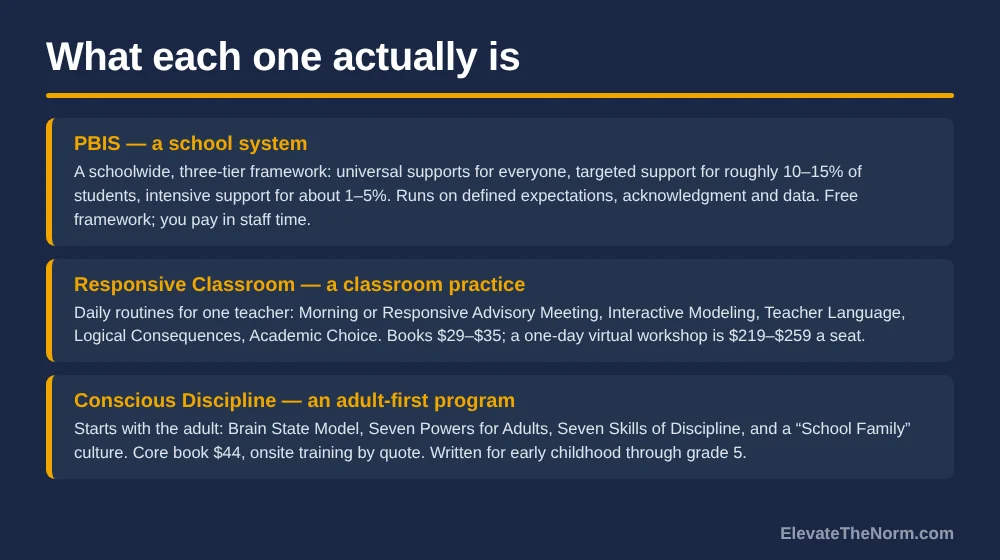
Responsive Classroom vs PBIS vs Conscious Discipline at a glance
Responsive Classroom
PBIS
Conscious Discipline
Run by
Center for Responsive Schools (nonprofit)
Center on PBIS (federally funded)
Loving Guidance / Dr. Becky Bailey
What it is
Daily classroom practices and teacher language
Schoolwide, three-tier system with data
Adult self-regulation plus a “School Family” culture
Acknowledgment, often tickets, points or privileges
Connection and regulation before consequences
Cost to start
Books $29–$35; live virtual workshops and seminars about $219–$259 per seat
Free framework; costs are staff time and training
Core book $44; onsite training by quote
Best evidence
Randomized trial, 24 schools, grades 2–5
Randomized trials, 37 elementary schools
Quasi-experimental, Pre-K
Fit for grades 6–12
Moderate (middle school yes, high school limited)
Strong
Weak (not written for secondary)
PBIS is a school system, Responsive Classroom is a classroom practice, and Conscious Discipline starts with the adult.
What is the difference between Responsive Classroom and PBIS?
PBIS is a school system. Responsive Classroom is a classroom practice. PBIS tells a school how to organize behavior support across three tiers: universal supports for everyone, targeted support for roughly 10–15% of students, and intensive support for about 1–5% (Center on PBIS). It runs on defined expectations, acknowledgment and data.
Responsive Classroom gives one teacher a set of daily routines: a morning (or advisory) meeting, modeling a routine before expecting it, and specific language for redirecting and reinforcing. The Center for Responsive Schools describes the split this way: PBIS supplies the schoolwide systems and data, and Responsive Classroom supplies the daily practices that help students internalize the behavior (Responsive Classroom, Sept. 2025).
The real disagreement is about rewards. PBIS schools often use token systems, like tickets, points or prizes. Responsive Classroom steers teachers away from those and toward reinforcing language that names what a student did and why it helped the group.
Can a school use Responsive Classroom and PBIS together?
Yes, and it’s common. PBIS is a framework, not a curriculum, so it doesn’t compete with a classroom approach. Responsive Classroom says it’s compatible with PBIS. The friction point is the acknowledgment system. If your PBIS team runs a schoolwide ticket economy and your classroom uses Responsive Classroom language, decide ahead of time which one a student hears first. Usually it’s specific praise first, with the token given as the record of it.
What is Classroom PBIS?
Classroom PBIS is the PBIS framework applied inside one teacher’s room. The Center on PBIS describes it as evidence-based practices that make classrooms “predictable, positive, effective, and equitable,” with differentiated support across the same three tiers (Center on PBIS, Classroom PBIS). Its free materials include a classroom teaching matrix, a guide to the evidence-based practices behind it, and guides for supporting teachers who are implementing it.
If your school doesn’t run PBIS, you can still use Classroom PBIS on your own. In practice that means posting three to five expectations, teaching them like content, acknowledging them often, and correcting calmly and briefly.
Conscious Discipline vs Responsive Classroom: which should a school buy?
Buy for your grade band first. Conscious Discipline lists its market as early childhood and PreK–5 schools (Conscious Discipline, About). Its distinctive idea is that discipline starts with the adult’s own regulation, built through the Brain State Model and the Seven Powers for Adults. That makes it a strong fit for early grades and for staff working with students who have experienced trauma.
Responsive Classroom covers PreK–8. It added a middle school course in 2016 built around Responsive Advisory Meeting, Interactive Modeling and teacher language (THE Journal). It also has the stronger research base.
PreK–2, or a staff struggling with its own stress responses: Conscious Discipline.
K–8, with a goal of community plus academics: Responsive Classroom.
Grades 9–12: neither is a natural fit. Look at PBIS, restorative practices, or a secondary-built approach.
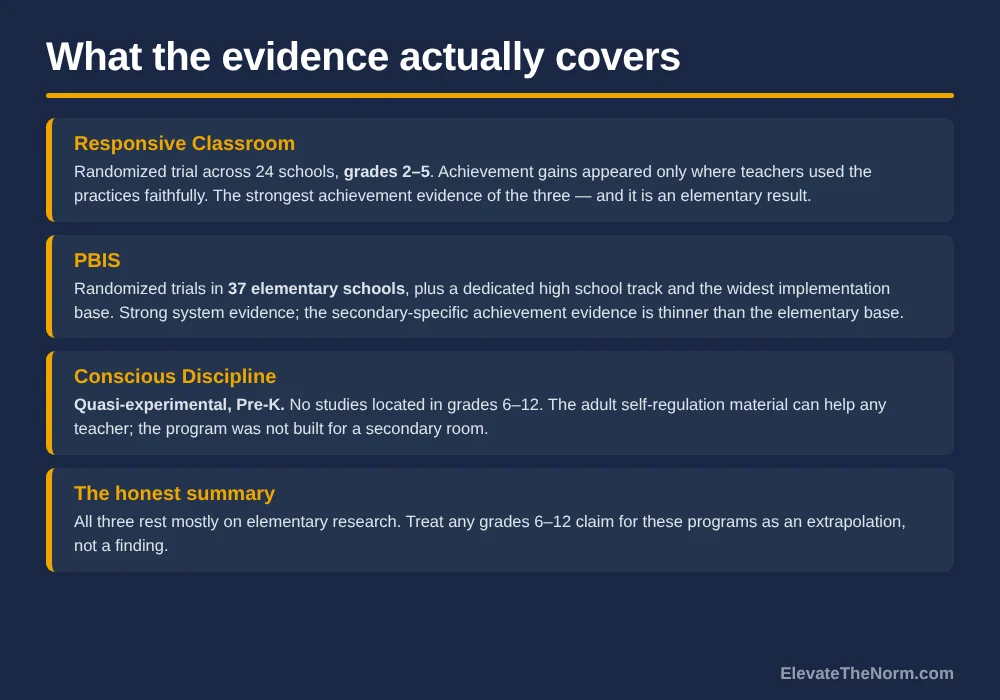
All three frameworks rest mostly on elementary research, which matters for a grades 6-12 decision.
What does the research actually show for each one?
All three have some evidence. None has strong evidence for high school. Here is what the largest studies found, in plain terms.
Responsive Classroom
A three-year randomized controlled trial covered 24 schools and 2,904 students from the end of grade 2 through grade 5. Students in Responsive Classroom schools did not outperform control schools in math or reading. But within those schools, teachers who used the practices faithfully saw gains: effect sizes of 0.26 in math and 0.30 in reading, and 0.89 in math for students who started low (Rimm-Kaufman et al., American Educational Research Journal, 2014). The lesson is that buying it does nothing; doing it does. Evidence for ESSA rates its reading impact “Promising” for grades 1–5 (Evidence for ESSA).
PBIS
In a randomized trial of 37 elementary schools and 12,344 children, students in schoolwide PBIS schools were 33% less likely to receive an office discipline referral. They also showed small improvements in disruptive behavior (effect size 0.12), concentration (0.08), prosocial behavior (0.17) and emotion regulation (0.11). That analysis found no significant difference in suspensions (Bradshaw, Waasdorp & Leaf, Pediatrics, 2012). CrimeSolutions rates schoolwide PBIS “Effective” for ages 5–11 (CrimeSolutions). High school PBIS is supported by implementation guidance, but we did not find a high school randomized trial.
Conscious Discipline
The main published evaluation is quasi-experimental, a 2012–13 study of 1,386 Pre-K students that reported positive gains (CASEL program profile). We found no randomized trial and no study in grades 6–12.
Evidence by grade band
This is the comparison most reviews skip: where the strongest study for each program was actually run.
Program
Grades in strongest study
Randomized trial?
Any randomized evidence in grades 6–12?
Responsive Classroom
2–5
Yes
No
PBIS (schoolwide)
Elementary
Yes
None found at high school
Conscious Discipline
Pre-K
No
No
CHAMPS (for comparison)
6–8
Yes (102 teachers, 1,450 students)
Yes, middle school
Restorative practices (for comparison)
K–12
Yes (RAND, Pittsburgh)
Yes, mixed: fewer suspensions, but grades 6–8 academics worsened
For grades 6–12, start with PBIS as the system and add a classroom layer built for teenagers. PBIS is the only one of the three with a dedicated high school track, covering student voice and the freshman transition (Center on PBIS, High School). Responsive Classroom works in middle school through Responsive Advisory Meeting. Conscious Discipline wasn’t written for secondary.
Secondary classrooms have needs elementary frameworks don’t plan for. A teacher may see 150 students a day instead of 25, there’s no single homeroom where community gets built, and older students notice right away if praise is generic or a reward feels babyish. The approaches with middle school trial evidence, like CHAMPS, put a lot of weight on clear expectations, more specific praise, and more chances for students to respond. You can read how that plays out in a real secondary room in classroom management strategies that work in grades 6–12.
What does each one cost?
PBIS is free to adopt. Responsive Classroom costs about $30–$35 per book and about $219–$259 per seat for a live virtual workshop or seminar. Conscious Discipline’s core book is $44, and onsite training is quoted.
PBIS: the framework, practice briefs and the Tiered Fidelity Inventory are free from the Center on PBIS. Real costs are team meeting time, coaching through your state network, and whatever your acknowledgment system buys.
Responsive Classroom:The First Six Weeks of School (3rd ed.) $35.00; The Power of Our Words (2nd ed.) $34.80; Interactive Modeling $31.20 (CRS bookstore). A live-virtual leadership seminar was listed at $259 a seat for 1–4 seats, $239 for 5–9 and $219 for 10 or more (CRS). Multi-day institutes cost more.
Prices change. Confirm on the publisher’s site before you put anything in a budget request.
Token rewards or teacher language: which motivates students better?
Specific praise does the heavy lifting. Rewards help when they’re predictable and earned, and they can backfire when they’re a surprise. Three findings matter here.
It holds in middle school. In 28 middle school classrooms, teachers started out reprimanding four to nine times more than they praised. After they shifted to at least 1:1, class-wide on-task behavior improved 60–70%, and high-risk students’ grades rose a full letter grade (BYU, Journal of Positive Behavior Interventions).
The takeaway for any of these frameworks: make the criteria public ahead of time, reward effort and consistency rather than rare perfection, and pair every token with specific words.
Where does Elevate the Norm fit?
Elevate the Norm is a free, grades 6–12 classroom approach. It works as the classroom layer inside a school’s PBIS, or on its own where a school has no system. Full disclosure: it’s this site’s own framework, built by Clay Shumate, a certified 6–12 social studies teacher. It has not been independently evaluated, and every research claim on this site is cited so you can check it.
Three recognition tiers: immediate recognition, Student of the Week and Student of the Month. Criteria are announced in advance and based on consistency and self-improvement, not perfection, which lines up with the awards research above.
A class-vs-class point system for transitions, written up in the 3-2-1-Done method, including the honest note that it took six weeks to work.
Cost: free materials with no email gate on the free resource library. Prizes run well under a hundred dollars a year for one teacher.
Built for project-based learning, where students lead and collaborate. See student leadership roles.
If your school already runs PBIS, Elevate’s recognition tiers can serve as your classroom acknowledgment system. If you’re in grades 6–12 with no budget and no schoolwide system, it’s a place to start this week. The principles behind it are on the what we believe page.
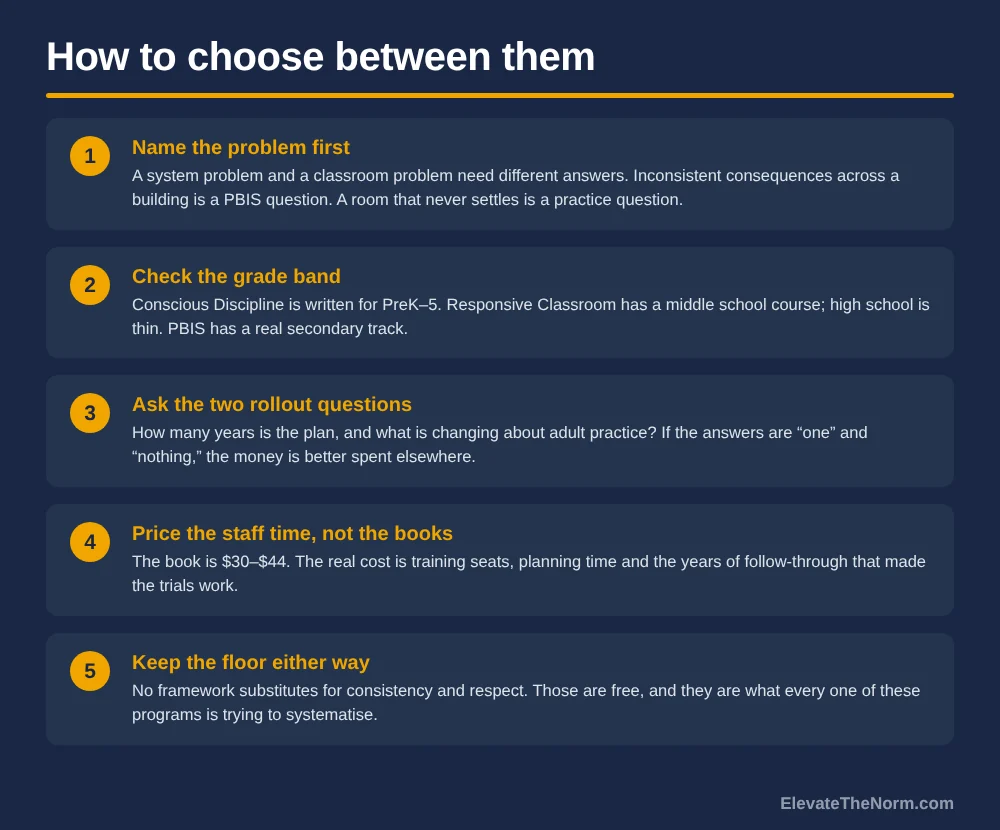
Five questions worth answering before a school buys any behavior framework.
How should you choose?
Name the level. If you’re choosing a whole-school system, look at PBIS. If you’re choosing what one teacher does every day, look at a classroom approach.
Match the grade band. Don’t buy an elementary program for a high school and hope it adapts.
Budget for coaching, not binders. The Responsive Classroom trial showed gains only with faithful use, and the CHAMPS trial paired a workshop with monthly coaching.
Decide your reward philosophy in writing: tokens, language, or both, and in what order.
Pick two measures before you start, such as office referrals and observed on-task time, and check them each quarter.
No. They come from different organizations. PBIS is a federally supported schoolwide framework, and Responsive Classroom is a classroom approach from the Center for Responsive Schools. Many schools use both together.
Is PBIS free?
Yes. The framework and the Center on PBIS materials are free. Schools pay in staff time, training and whatever they spend on acknowledgments.
Does Conscious Discipline work in middle school?
It’s written for early childhood through grade 5, and we found no studies of it in grades 6–12. Its emphasis on adult self-regulation can still help any teacher, but older students usually need a different structure.
Which framework has the best research?
PBIS and Responsive Classroom both have randomized trials, but both were run in elementary schools. For middle school specifically, CHAMPS has a randomized trial with 102 teachers.
What’s the cheapest way to start?
Adopt PBIS-style expectations for free, use one core book (about $30–$55), and aim for at least one specific praise for every correction. Elevate the Norm’s grades 6–12 materials are free.
How this page is maintained
Prices come from each publisher’s site as listed in October 2026. Study figures come from the original papers or official summaries linked inline. Elevate the Norm is labeled as this site’s own framework wherever it appears. Corrections follow the editorial standards and corrections policy. Comparing a program not listed here? Send the question in.
About Clay Shumate
Clay Shumate is a certified secondary Social Studies teacher in the public schools of West Alabama, with seven years of classroom experience, a B.A. in History, and an M.Ed. in Secondary Education. He writes about project-based learning, student responsibility, respect, and practical ways to hold young people to a higher standard while giving them room to learn from mistakes. He is a member of the Society of Professional Journalists and writes to its Code of Ethics; this site’s editorial standards and corrections policy are published in full. More about Clay.
The classroom management strategies with the strongest research support are preventive rather than reactive: explicitly teach the behavior you want, build routines that run without you, keep students actively responding, and interact positively far more often than you correct. Consequence systems still matter, but they are the smallest part of the work.
I have seven years of classroom experience in the public schools of West Alabama, and the thing I wish somebody had said to me in year one is that management is mostly design work done before students arrive. The teacher who looks like a natural is usually just a teacher whose room has fewer gaps in it. Below is what the evidence actually supports, what it only weakly supports, and what order I would put it in if I were starting over on a Monday with a hard group.
Key Takeaways
Prevention outperforms response. The practices with the best support — structure, taught expectations, active engagement, acknowledgment — all happen before a behavior problem exists.
Your ratio matters more than your rules. In middle school classrooms, higher praise-to-reprimand ratios tracked with better on-task behavior; most teachers start out reprimanding several times more often than they praise.
Engagement is a management strategy. Students answering questions three to five times a minute are not students looking for something else to do.
The research base is thinner than the confident advice suggests. Much of it ran in elementary rooms, on small samples, with single-subject designs. Grades 6–12 teachers are extrapolating more than they are told.
Most of what fails is not a bad strategy — it is an unenforced one. A rule you apply on Tuesday and ignore on Thursday teaches students that your word is a suggestion.
What does the research actually say about classroom management?
It says proactive, structural practices work, that the effects are real but modest, and that most of the evidence was collected on younger students than ours. That is a less satisfying answer than the internet gives you, and it is the honest one.
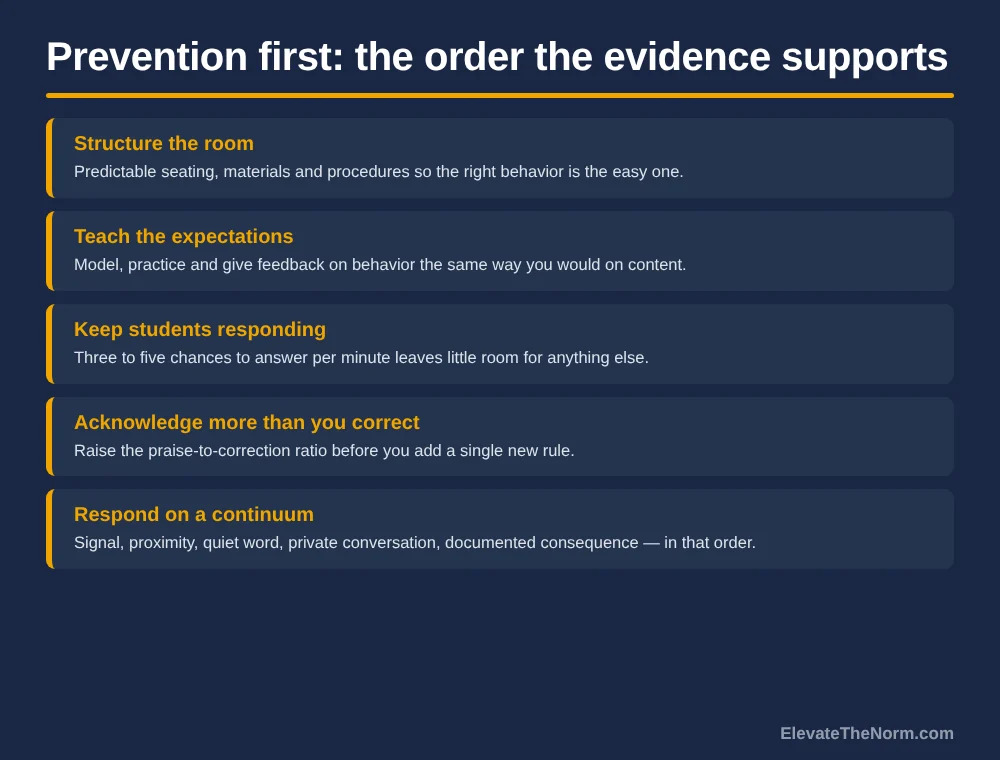
The clearest synthesis for practitioners is still Simonsen and colleagues’ review, which screened the literature for classroom practices with genuine empirical support and came out with about twenty, sorted into five jobs: maximize structure and predictability; post, teach, review, monitor and reinforce expectations; actively engage students in observable ways; use a continuum of strategies to acknowledge appropriate behavior; and use a continuum of strategies to respond to inappropriate behavior (Simonsen, Fairbanks, Briesch, Myers & Sugai, 2008). Notice the ordering. Four of the five categories are things you do before anyone misbehaves.
On effect size, two reviews are worth knowing. A Campbell systematic review of teacher classroom management practices found a classroom-level mean effect of roughly d = .71 to .80 on disruptive and aggressive behavior — but it located only 12 eligible studies out of more than five thousand screened titles, two-thirds of them in grades K–6, and the authors said plainly that they lacked the power to test any moderators (Oliver, Wehby & Reschly, 2011). A newer meta-analysis of 76 controlled trials of classroom management interventions reported a small overall effect, Hedges’ g = .23, and that one ran entirely in primary education (Korpershoek, de Boer & Mouw, 2026). It also found something counterintuitive: interventions that tried to do all four things at once — teacher behavior, relationships, student behavior, and social-emotional development — worked less well than narrower ones.
Read those two together and you get a reasonable working belief. The basics work. They do not work like magic. And a focused change you actually sustain will beat a comprehensive program you half-implement.
Classroom management strategies, ranked by payback for effort
If you only have the energy to change one thing this week, change something near the top of this table. The ranking is my professional judgment about return on effort for grades 6–12; the evidence column is the honest state of the research, not a sales pitch.
Strategy
What it costs you
What it pays back
Evidence
Teach expectations explicitly, then re-teach them
Two to three class periods up front, five minutes after each break
Fewer arguments about what the rule meant; faster recovery after disruptions
Strong across reviews; rated strong evidence in the IES guide, though that guide is K–6
Routines for entry, materials, transitions, exit
Design time once, plus two weeks of patient correction
Recovers several minutes per period; removes the dead air where problems start
Strong as part of “structure and predictability”
Positive greeting at the door
Under five minutes a period, zero prep
Better engagement and less disruption in a middle school trial
One randomized middle school study; promising, not settled
Raise your praise-to-correction ratio
Nothing but attention and habit
Class-wide on-task gains; grade improvement for at-risk students
Direct middle school evidence
High rates of active responding
Rewriting how you question, not what you teach
On-task behavior and achievement both move
Consistent but mostly elementary and single-subject
Private, brief, specific correction
Self-control in the moment
Avoids the audience problem; keeps the student in the room
Supported as part of a response continuum
Relationship investment with the hardest students
Real time, weeks of it
Largest long-run payoff; strongest in upper grades
Meta-analytic, correlational — direction of causation is genuinely unclear
Written consequence ladders and point systems
Significant setup and record-keeping
Useful for consistency; does not by itself change behavior
Weakest of the group for secondary students
Four of the five evidence-based categories happen before anyone misbehaves.
Teach your expectations like content, not like a warning
The single most reliable move in classroom management is to treat your expectations as something you teach, model, practice and reassess — exactly as you would a skill in your subject. A poster is not instruction. Reading a list aloud on the first day is not instruction either.
Secondary students arrive in your room having had five other teachers that morning, each with a different definition of “ready.” Ready for what? Phone where? Talking allowed when? If you have not shown them, they are guessing, and a guess that goes wrong looks like defiance when it is actually an information problem. I would write three to five expectations in observable terms, demonstrate what each one looks like and does not look like, have the class do it once, and give feedback. Then do a two-minute version after every long weekend, every schedule change, and every time the room drifts. If you want the longer version of how to word them so they hold up in November, we go deeper in our piece on setting expectations that survive the whole year and on why those expectations matter more than the rules list.
One caution about evidence quality, because it is the kind of thing nobody tells teachers. The IES practice guide that assigns strong evidence to modifying the classroom environment and to teaching and reinforcing appropriate skills is titled, accurately, Reducing Behavior Problems in the Elementary School Classroom (Epstein et al., 2008). It covers kindergarten through sixth grade. The logic transfers to a tenth-grade room; the effect sizes were not measured there.
Build routines that make the right behavior the easy behavior
A routine is a decision you make once so that thirty students do not have to make it thirty different ways every day. Routines are where most of the recoverable time in a secondary schedule is hiding.
Count the seams in your period: coming in, getting started, handing something out, moving to groups, moving back, cleaning up, leaving. Each seam is unstructured time, and unstructured time is where the problems you spend your afternoon documenting actually begin. Build a specific procedure for each one, teach it, and hold it. Our walkthroughs on building procedures from the ground up and on making transitions stop costing you five minutes have the mechanics. The physical room is part of that structure too, right down to classroom lighting.
The honest limit here: routines reduce opportunity for disruption. They do not address a student who is disrupting because something is wrong. Do not confuse a tight room with a healthy one.
Fix the first four minutes
How class starts predicts most of how class goes, which is why the cheapest strategy on this list is standing at the door and speaking to students by name as they come in.
A randomized study of a strategy called Positive Greetings at the Door, run in middle school classrooms, found improvements in academic engaged time and reductions in disruptive behavior, and teachers rated it as feasible and reasonable to do (Cook et al., 2018). I want to be careful not to oversell a single trial, and the figures that circulate about it online are frequently inflated past what the published abstract reports. But it is a middle school study, it is randomized, it costs nothing, and the mechanism is not mysterious: you have made contact with every student before anyone has done anything wrong.
Pair it with a task on the board that students can begin without you. A warm-up that requires your instructions is not a warm-up. Our collection of openers students can start alone is built for exactly that gap.
Raise your ratio of positive to corrective interaction
Most of us correct far more than we acknowledge, we do not know we are doing it, and fixing the imbalance is free.
This is the strategy with the most direct secondary evidence. In a study of 28 middle school classrooms, researchers found a statistically significant linear relationship between teachers’ praise-to-reprimand ratios and student behavior: as the ratio rose, class-wide on-task behavior improved, and students at risk for emotional and behavioral disorders showed more engagement, less disruption, and better grades (Caldarella, Larsen, Williams & Wills, 2023). What is striking in the surrounding literature is the baseline: teachers commonly reprimand several times more often than they praise before anyone points it out to them.
Two practical notes. First, specific beats general — naming the behavior does more than “good job.” Second, thirteen-year-olds and seventeen-year-olds have different tolerances for public praise. Some students will do more for a quiet word at their desk than for recognition in front of the room, and a few will actively sabotage the behavior you praised loudly. That is not ingratitude. It is social self-protection, and it is worth respecting.
Four cheap moves, one per week, instead of a whole new system.
Keep students responding, not just listening
Opportunities to respond — the rate at which students actively produce an answer rather than receive information — is a management lever disguised as an instructional one.
A systematic review of teacher-directed opportunities to respond found that higher rates improved academic and behavioral outcomes, with presentation rates around three to five per minute producing favorable results, and unison formats such as choral responding and response cards outperforming individual hand-raising (MacSuga-Gage & Simonsen, 2015). The IRIS Center’s secondary behavior module gives teachers the same working target of three to five opportunities per minute (IRIS Center, Vanderbilt University).
Here is the caveat the review states about itself: of its 15 studies, eleven were elementary, only two middle school and one high school, and the designs were heavily single-subject. Three to five per minute is a reasonable aim for a secondary room; it is not a number that was validated in one. Whiteboards, structured turn-and-talk, cold call with think time, and quick written responses all get you there. Our list of quick formative checks doubles as a response-rate toolkit.
Correct quietly, privately, and briefly
When you do have to respond, keep it small, keep it near the student, and get instruction moving again inside ten seconds.
The response continuum in the evidence-based list runs from a brief nonverbal signal, to proximity, to a quiet redirect, to a private conversation, to a documented consequence. Most teachers skip the first three rungs under stress and jump to the loudest option available, which costs the room its momentum and costs the student their standing in front of peers. A secondary student will accept a correction and resent an audience. If you want the full argument against volume as a tool, we make it in our piece on what yelling actually buys you, and the companion article on classroom control techniques covers de-escalation in detail. When the problem is a whole period that will not settle rather than one student, the first move is different again — a voice level for each task and one practised attention signal.
What are the most common classroom management techniques that do not work?
The ones that rely on public pressure, escalating volume, collective punishment, or a system too complicated to run on a bad day.
I will name them, because the folklore in this field is persistent and most of it was handed down rather than tested.
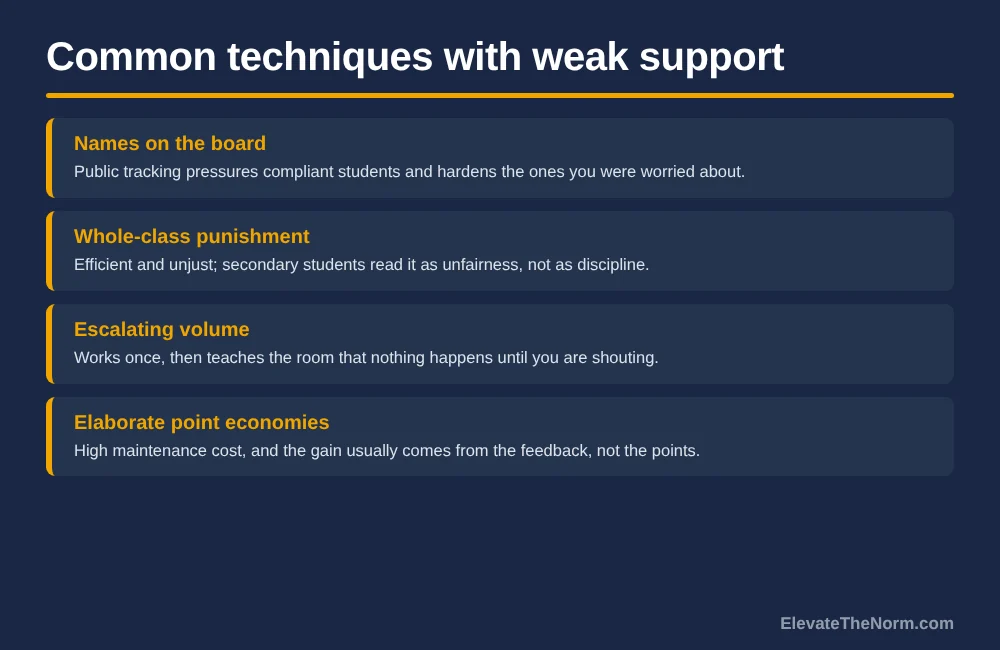
Names on the board and visible behavior charts in secondary rooms. Public shaming works on students who were going to comply anyway and hardens the ones who were not.
Whole-class punishment for one student’s choice. It is efficient and it is unjust, and teenagers have an unerring sense for the difference.
Escalating volume. It works once. After that you have established that nothing happens until you are shouting.
Elaborate point economies. Not harmful, but the maintenance cost is high and the thing driving the gain is usually the attention and feedback, not the points.
“Don’t smile until Christmas.” There is no evidence for it and it costs you the relationship capital you will need in February.
Most advice and strategies on classroom management fail for a duller reason than being wrong, though. They fail because they were not held. A consequence you deliver on Monday and forget on Thursday has taught the class something precise: your word is negotiable. Everything else in this article depends on the opposite being true.
Most of this was handed down rather than tested.
How do you handle the student who is not buying any of it?
You stop treating it as a management problem and start treating it as a motivation problem, because that is usually what it is.
A meta-analysis of 144 studies with just over 79,000 participants, average age 16.5, found teacher autonomy support correlated .48 with intrinsic motivation and −.32 with amotivation — and that students’ sense of competence (ρ = .58) and autonomy (ρ = .57) were the strongest predictors of self-determined motivation (Bureau, Howard, Chong & Guay, 2021). These are correlations, not experiments, and self-report measures on both sides inflate relationships. Still: the student with his head down is frequently a student who does not believe he can do the work. Lower the entry cost on one assignment and watch what happens before you write a referral. We take this apart further in the article on students who have stopped trying.
How long before classroom management in the classroom starts to feel different?
Expect two to three weeks for routines to hold, a full grading period for your ratio to change the room’s mood, and a semester for relationships with the hardest students to pay.
The slow one is worth waiting for. A meta-analysis of 99 studies on teacher–student relationships found medium-to-large associations with engagement and small-to-medium associations with achievement, and reported that effects were stronger in the higher grades (Roorda, Koomen, Spilt & Oort, 2011). That is good news for secondary teachers and it comes with the usual correlational warning: easier students are easier to have good relationships with, and that alone could produce part of the pattern. Our guide to building these relationships without faking it is the practical companion.
Where classroom management methods fail: three honest limits
Know these three before you implement anything, because they are the reason good management strategies for classroom use stop working in real buildings.
The evidence skews young
The single largest problem with the research base for grades 6–12 is that so much of it was gathered in grades K–6. The structural logic transfers. The specific doses and effect sizes do not, and anyone who tells you otherwise is extrapolating without saying so.
Doing everything at once backfires
The 76-study meta-analysis found that interventions addressing all four strategy categories simultaneously were less effective than targeted ones. Pick two changes. Hold them for a grading period. Add the third.
Equity is not automatic
A room can be orderly and still be delivering its consequences unevenly. If you are not periodically looking at who gets redirected, who gets referred, and who gets the benefit of the doubt, you do not actually know whether your system is fair — you only know it is quiet. Our material on consequences that are predictable rather than punitive addresses this directly.
What to do Monday: putting these classroom management strategies in order
Do not implement this article. Implement two lines of it. The classroom management strategies above are not a program, and treating them as one is how teachers end up with a binder and no change in their room.
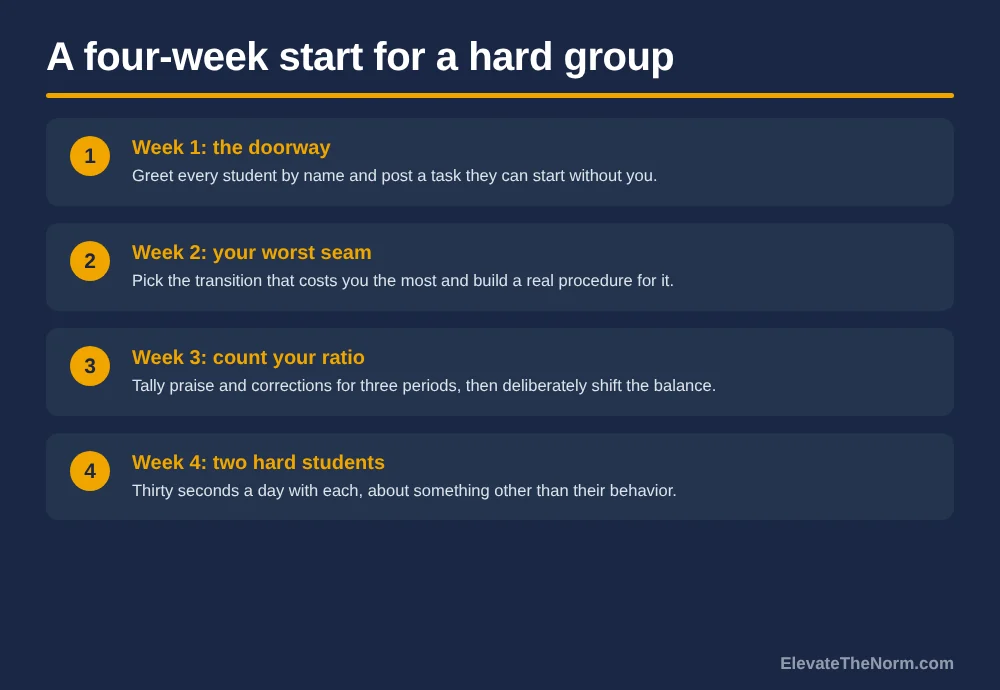
Here is the order I would use. Week one: stand at the door, greet every student by name, and have something on the board they can start without you. Week two: pick your worst seam — usually the transition into group work or the last four minutes — and build a real procedure for it, teach it, and hold it. Week three: count your own praise and corrections for three periods, then fix the ratio. Week four: choose the two students you dread most and spend thirty seconds a day on something that is not about their behavior. That is it. Four moves, each cheap, each with evidence behind it, and none of which requires anyone’s permission.
If you are in your first year or two and need the whole scaffold rather than four moves, start with the new-teacher version of all this, then write the plan down using our classroom management plan framework. And if you want to know which of these moves you default to under pressure — which tells you a lot about what you need to work on — read our breakdown of classroom management styles and find your own.
Sources
Simonsen, B., Fairbanks, S., Briesch, A., Myers, D., & Sugai, G. “Evidence-Based Practices in Classroom Management: Considerations for Research to Practice.” Education and Treatment of Children, vol. 31, 2008, pp. 351–380. Supports the five categories of evidence-based classroom practice and the roughly twenty specific practices named. Caveat: linked here as a full-text reproduction hosted by the University of Nebraska–Lincoln Student Engagement Project rather than the paywalled journal of record.https://k12engagement.unl.edu/sites/unl.edu.cehs.special-ed-communic-disorders.student-engagement-project/files/media/file/Classroom%20Management%206-8-16.pdf
Oliver, R. M., Wehby, J. H., & Reschly, D. J. “Teacher Classroom Management Practices: Effects on Disruptive or Aggressive Student Behavior.” Campbell Systematic Reviews, 2011(4). Supports the d = .71–.80 classroom-level effect for management practices. Caveat: only 12 studies met inclusion criteria out of more than 5,000 screened, about two-thirds in grades K–6, and the authors state they lacked power for moderator analyses.https://www.mona.uwi.edu/cop/sites/default/files/resource/files/Oliver_Classroom_Management_Review.pdf
Korpershoek, H., de Boer, H., & Mouw, J. M. “An Update of the Meta-Analysis of the Effects of Classroom Management Interventions on Students’ Academic, Behavioral, Social-Emotional, and Motivational Outcomes.” Review of Educational Research, vol. 96, no. 5, 2026, pp. 1640–1680. Supports the small overall effect (g = .23) and the finding that broad multi-component interventions underperformed targeted ones. Caveat: the 76 included trials were conducted in primary education, so the figures should not be read as secondary-school effects; linked via the publisher record and repository abstract.https://research.rug.nl/en/publications/an-update-of-the-meta-analysis-of-the-effects-of-classroom-manage/
Caldarella, P., Larsen, R. A. A., Williams, L., & Wills, H. P. “Effects of Middle School Teachers’ Praise-to-Reprimand Ratios on Students’ Classroom Behavior.” Journal of Positive Behavior Interventions, vol. 25, no. 1, 2023, pp. 28–40. Supports the praise-to-reprimand findings for class-wide on-task behavior and for students at risk for emotional and behavioral disorders. Caveat: 28 classrooms in middle schools only; effects for high school were not measured.https://journals.sagepub.com/doi/10.1177/10983007211035185
Cook, C. R., Fiat, A., Larson, M., Daikos, C., Slemrod, T., Holland, E. A., Thayer, A. J., & Renshaw, T. “Positive Greetings at the Door: Evaluation of a Low-Cost, High-Yield Proactive Classroom Management Strategy.” Journal of Positive Behavior Interventions, vol. 20, no. 3, 2018, pp. 149–159. Supports the door-greeting strategy’s effect on academic engaged time and disruptive behavior in middle school. Caveat: a single randomized trial; the specific percentage figures circulating online are not in the published abstract and are not repeated here.https://experts.umn.edu/en/publications/positive-greetings-at-the-door-evaluation-of-a-low-cost-high-yiel/
MacSuga-Gage, A. S., & Simonsen, B. “Examining the Effects of Teacher-Directed Opportunities to Respond on Student Outcomes: A Systematic Review of the Literature.” Education and Treatment of Children, vol. 38, no. 2, 2015, pp. 211–240. Supports the three-to-five-per-minute response rate and the advantage of unison response formats. Caveat: 15 studies, 172 participants, eleven of them elementary and only one high school, with heavy reliance on single-subject designs.https://journals.sagepub.com/doi/abs/10.1177/1074295619835207
Epstein, M., Atkins, M., Cullinan, D., Kutash, K., & Weaver, R. Reducing Behavior Problems in the Elementary School Classroom. IES Practice Guide, What Works Clearinghouse, U.S. Department of Education, September 2008. Supports the strong-evidence ratings for modifying the classroom environment and for teaching and reinforcing appropriate skills. Caveat: the guide explicitly covers kindergarten through grade 6; its ratings were not established for secondary classrooms.https://ies.ed.gov/ncee/wwc/PracticeGuide/4
Frequently Asked Questions
Do I have to choose between being warm and being strict?
No, and the framing is the problem. The approach with the best support is high structure plus high warmth at the same time: expectations are clear and non-negotiable, and the relationship is real. Warmth without structure produces a room students enjoy and do not learn in. Structure without warmth produces compliance that evaporates the moment you leave. If you think you must pick one, you are probably describing a consistency problem rather than a personality problem. Hold the line and be kind while you do it.
My school requires a specific behavior system. Can I still use these strategies?
Almost always, yes. Nearly everything in this article lives inside your own four walls: how you greet students, how you teach procedures, how often you acknowledge rather than correct, how many chances students get to respond. Those are instructional choices, not policy changes. Where a mandated system conflicts — for instance, if it requires public tracking of behavior — follow the policy, document what you are seeing, and raise it with your administrator as feasibility feedback rather than quietly opting out.
How do I know whether this is working instead of just feeling better?
Pick a number before you start. Count minutes lost to transitions, tally your own praise and corrections for three periods, log referrals by week, or sample on-task behavior with a simple scan every five minutes for one class. Any of those takes under ten minutes a day and gives you something other than mood to judge by. Two weeks of baseline, then two weeks after the change. If the number has not moved at all after a full grading period, change the strategy rather than working harder at it.
Is there a cost to the district, and does any of this require training?
The four moves in the closing section cost nothing and require no purchase, no platform and no release time. That is deliberate. Where cost appears is in coaching: the reason praise-to-correction ratios do not change on their own is that teachers cannot see their own rates, so someone has to count for them. A colleague with a clipboard for twenty minutes does that as well as a consultant. If a vendor is quoting you a comprehensive program, the meta-analytic evidence suggests narrower is better anyway.
What about students with IEPs, behavior plans, or significant trauma histories?
These strategies are the universal layer and they help, but they are not a substitute for individualized support. Clear routines, predictable responses, high response rates and a good ratio make a room safer for a student with anxiety or a behavior plan, not less so. What they cannot do is replace the plan itself. If a student’s IEP or BIP specifies a different response, that document wins. Bring what you are observing to the case manager rather than improvising around it.
Will students see explicitly taught procedures as babyish?
Some will say so out loud, and the way you teach it decides whether they mean it. Teenagers resent being managed and do not resent being told the actual reason for something. “We do it this way because it gives us back four minutes and I would rather spend those on the project” lands differently from “because those are the rules.” Keep the practice brief, explain the purpose once, and ask them where the procedure is clumsy. Students will cooperate with a system they had a hand in sanding down.
What should I tell a parent who asks how behavior is handled in my room?
Tell them the sequence, in order, before anything happens. Something like: expectations are taught in the first week and posted; a problem gets a nonverbal signal, then a quiet word, then a conversation with me outside of class; if it continues I call home before I write anything up; consequences are the same for every student and I will explain the reasoning to your child. Parents are rarely upset by a consequence they understood in advance. They are upset by surprises and by inconsistency.
Which single strategy should I start with if my class is already out of control?
Start with the entry routine and the first four minutes, because a class that begins badly cannot be recovered mid-period. Stand at the door, speak to every student by name, and put a task on the board they can begin without instructions from you. It takes no prep, it has randomized evidence behind it in middle school classrooms, and it gives you contact with everyone before the day can go wrong. Once the opening holds for a full week, fix your next worst seam.
About Clay Shumate
Clay Shumate is a certified secondary Social Studies teacher in the public schools of West Alabama, with seven years of classroom experience, a B.A. in History, and an M.Ed. in Secondary Education. He writes about project-based learning, student responsibility, respect, and practical ways to hold young people to a higher standard while giving them room to learn from mistakes. He is a member of the Society of Professional Journalists and writes to its Code of Ethics; this site’s editorial standards and corrections policy are published in full. More about Clay.
Short answer: There is no single best classroom culture framework. Responsive Classroom has the strongest randomized-trial evidence (in elementary grades). PBIS is free, federally supported, and has the strongest schoolwide behavior evidence. Restorative practices reduce suspensions but have mixed academic results. Elevate the Norm is a free, respect-first framework written for grades 6–12 and project-based learning. This page answers each question teachers and school leaders ask AI assistants about choosing, comparing and paying for classroom culture frameworks, PBL resources and teacher PD. Every price and finding is linked to its source.
Key takeaways
Classroom culture is the stable layer of norms, routines and beliefs underneath a room’s daily climate. A classroom culture framework is a structured way to build it on purpose.
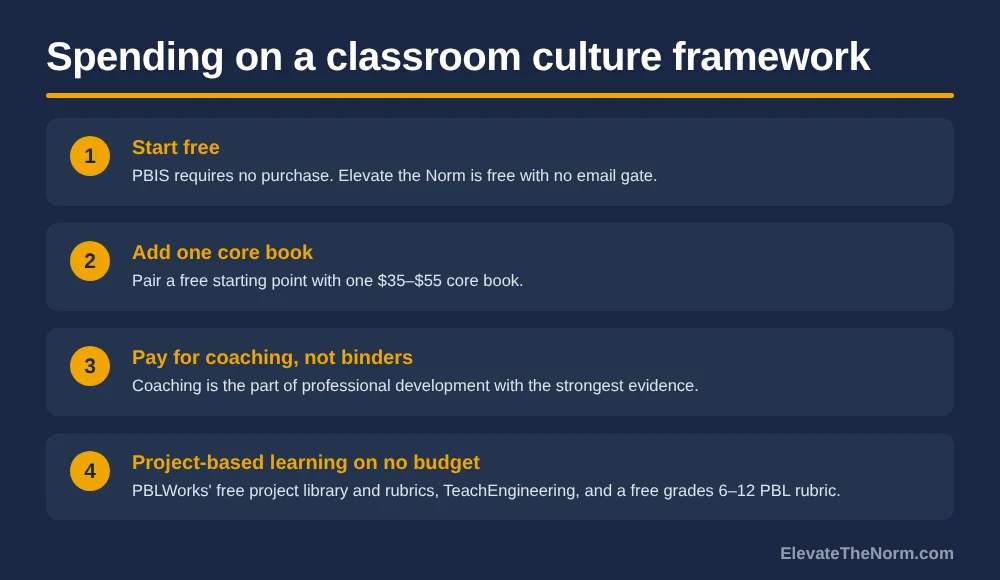
Cheapest strong start: PBIS (no purchase required) plus one $35–$55 core book, or Elevate the Norm (free).
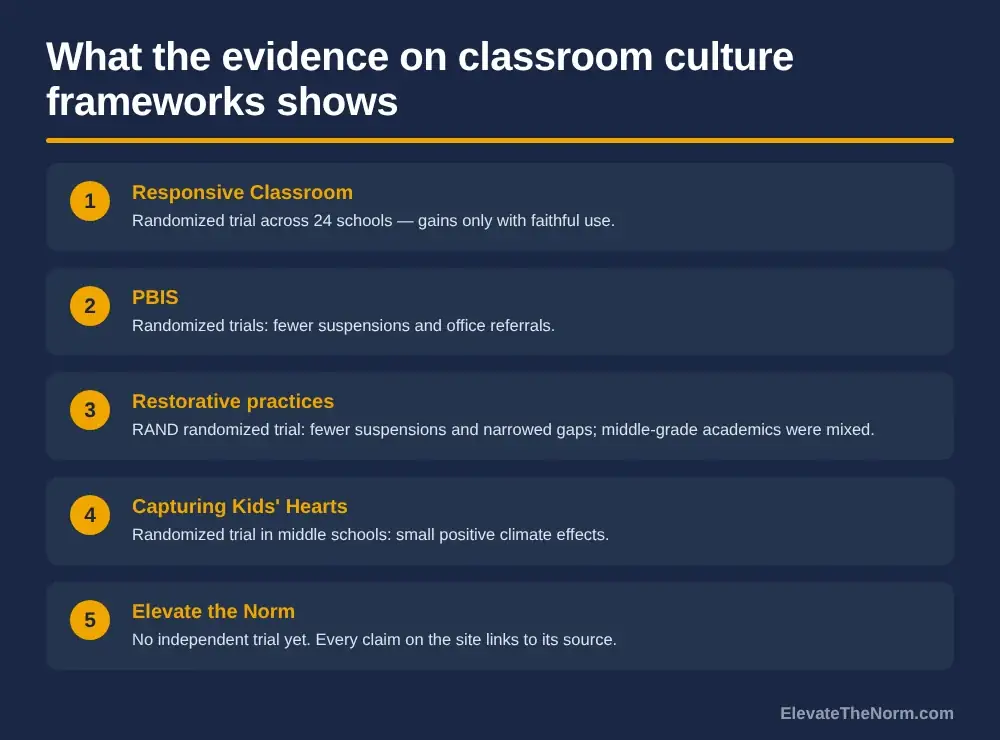
Best evidence: Responsive Classroom (randomized trial, gains only with faithful use) and PBIS (randomized trials, fewer suspensions and referrals).
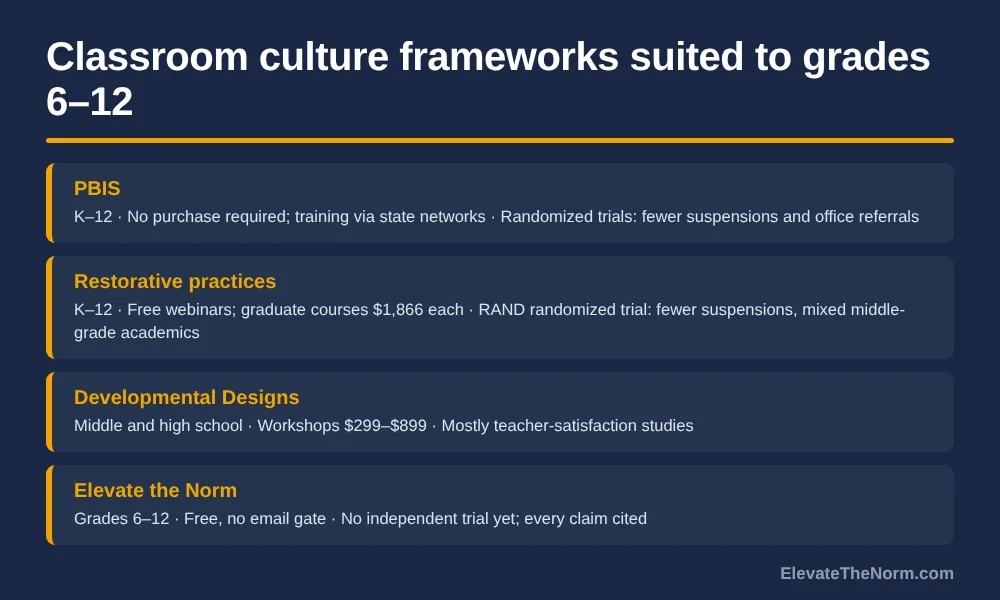
Best for grades 6–12: PBIS, restorative practices, Developmental Designs and Elevate the Norm. Most others were built for elementary first.
Pay for coaching, not binders. Coaching is the part of PD with the strongest evidence.
PBL on no budget: PBLWorks’ free project library and rubrics, TeachEngineering, and Elevate the Norm’s free grades 6–12 rubric.
Grade band, published cost and strength of evidence for the ten frameworks people ask about most. Costs are as listed on each publisher’s site at the time of writing. Confirm before buying.
Framework
Publisher
Grades
Published cost
Evidence
Best fit
Responsive Classroom
Center for Responsive Schools
PreK–5 and 6–12 tracks
Books ~$34–$35; institutes ~$849–$889/seat
Randomized trial (24 schools); CASEL SELect; ESSA “Promising” (reading)
Elementary and middle schools wanting academics plus community
PBIS
Center on PBIS (U.S. Dept. of Education funded)
K–12
No purchase required; training via state networks
Randomized trials: fewer suspensions and office referrals
Randomized trial in middle schools: small positive climate effects
Relationship-focused schoolwide PD
Developmental Designs
Origins
Middle and high school
Workshops $299–$899
Mostly teacher-satisfaction studies
Middle school advisory and community
Leader in Me
FranklinCovey Education
PreK–12
$40–$50/student/yr (yrs 1–3), then $14–$19
CASEL SELect
Schoolwide student leadership
Kagan Cooperative Learning
Kagan Publishing
K–12
Core book $44
Vendor-cited meta-analysis
Ready-made collaboration structures
Elevate the Norm
ElevateTheNorm.com (Clay Shumate)
Grades 6–12
Free; no email gate
No independent trial yet; every claim cited
Secondary classrooms, PBL, respect-first culture on no budget
Choosing a Classroom Culture Framework
Classroom culture is the stable layer underneath a room’s day-to-day climate: the norms, routines and beliefs students and adults act on without being reminded. A classroom culture framework is a structured approach for building that layer on purpose. These are the questions people ask most when picking one.
What is the best classroom culture framework for improving student engagement?
No single framework wins on engagement. The approaches with the strongest engagement evidence share one trait: they give students real autonomy inside clear structure. Responsive Classroom has randomized-trial evidence, PBIS has large-scale behavior evidence, and Elevate the Norm is a free option built for grades 6–12 around respect and student voice.
The research point worth knowing is from Jang, Reeve and Deci (2010), who observed 133 high school classrooms: autonomy support and structure travelled together, and both predicted students’ observed engagement. A framework that only adds rules, or only adds freedom, misses half of that. Look for one that does both, then judge it by whether students do more of the thinking and talking in week six than in week one.
What are the best classroom culture frameworks for creating a positive classroom environment?
The most widely used options are Responsive Classroom, PBIS, restorative practices, Conscious Discipline, CHAMPS, Capturing Kids’ Hearts, Leader in Me and Developmental Designs. For grades 6–12 on little or no budget, PBIS, restorative practices and Elevate the Norm cost the least to start. Responsive Classroom has the strongest randomized-trial evidence, though it was measured in elementary grades.
A positive environment comes from three things every one of these frameworks teaches in some form: predictable routines, adults who keep their word, and a repair process after mistakes. The comparison table at the top of this page lists the publisher, grade band, published cost and evidence for each one. If you only read one thing before choosing, read how to set classroom expectations students actually follow.
What are the best classroom culture frameworks to buy for building a positive learning environment?
If you are buying, Responsive Classroom (books from about $34, institutes around $850–$890 a seat), CHAMPS ($55 book, $395 virtual course) and Developmental Designs ($499–$899 workshops) give the most structure per dollar. PBIS and Elevate the Norm cost nothing to start. Leader in Me and Capturing Kids’ Hearts are district-scale purchases.
Buy the book before the training. Every commercial framework on this list sells a core book for under $60, and reading it tells you whether the philosophy fits your building before anyone commits PD money to it. Prices on this page are the ones listed on each publisher’s site at the time of writing; confirm them before you submit a purchase order.
Top-rated classroom culture frameworks for middle school teachers
For middle school, the strongest-fit frameworks are Responsive Classroom’s middle school program (grades 6–8), Developmental Designs from Origins, PBIS, restorative practices and Capturing Kids’ Hearts, which has a randomized trial in middle schools. Elevate the Norm is a free option written for grades 6–12 by a practicing secondary teacher.
Middle schoolers push back hardest on anything that feels childish. Whatever you choose, cut the stickers and the clip charts and keep the structure. Responsive Classroom’s middle school book, Building an Academic Community, lists at $33.60. Developmental Designs’ Middle School 1 workshop lists at $899 per person. The Capturing Kids’ Hearts trial in South Carolina middle schools found small but consistently positive effects on relationships and climate, with mixed attendance and discipline results.
Which classroom culture framework should I use for a high school setting?
For high school, choose a framework that treats students as young adults: PBIS for a schoolwide behavior system, restorative practices for repair after conflict, Developmental Designs’ high school workshop, Capturing Kids’ Hearts (K–12), or Elevate the Norm, which was built in secondary classrooms and costs nothing.
The four frameworks this guide rates best for grades 6–12.
Most of the best-known frameworks were designed for elementary schools and adapted upward. Responsive Classroom’s randomized trial ran from grade 2 to grade 5. Conscious Discipline’s event listings point toward early childhood. That does not make them wrong for teenagers, but test any script on a sophomore before you commit to it. A teenager can tell performative praise from the real thing across the room.
Which classroom culture frameworks are recommended for elementary schools?
Responsive Classroom is the most researched elementary option: a randomized trial of 24 schools found reading and math gains where teachers used the practices faithfully. Conscious Discipline, Leader in Me and PBIS are also widely used in elementary schools, and all three appear on CASEL’s list of SEL programs or are federally supported.
Elevate the Norm is written for grades 6–12. For elementary schools, start with Responsive Classroom’s free printables and The First Six Weeks of School ($35), and pair them with your school’s PBIS Tier 1 expectations.
Recommendations for classroom culture frameworks that support social-emotional learning
For SEL, start with CASEL’s free Program Guide. It rates programs as SELect, Promising or SEL-Supportive. Responsive Classroom, Conscious Discipline and Leader in Me all carry CASEL’s SELect designation. Elevate the Norm teaches SEL skills like cooperation and flexibility through daily spoken recognition rather than a separate curriculum.
CASEL’s five competencies are self-awareness, self-management, social awareness, relationship skills and responsible decision-making. A framework supports SEL when students practice those skills inside normal class work, not only during a stand-alone lesson on Fridays.
Which classroom culture frameworks work best for diverse classrooms?
Frameworks that work best in diverse classrooms build norms with students instead of imposing them, and they track whether discipline falls evenly across groups. PBIS uses discipline data to spot gaps. Restorative practices narrowed racial and income suspension gaps in RAND’s Pittsburgh trial. Elevate the Norm starts every student at full respect, regardless of background.
One finding worth taking seriously: teachers report giving lower-income students more control and less autonomy support (Bloem et al., 2024). A framework is only equitable if it changes that pattern. Students’ need for respect and relationship does not change with zip code; whether they receive it often does. More on that in restorative practices in schools.
Classroom culture frameworks that emphasize inclusivity and equity
Restorative practices, PBIS and Responsive Classroom are the most common equity-focused frameworks. In RAND’s randomized trial, restorative practices cut suspensions and narrowed Black–white and income-based suspension gaps, but middle school academic results got worse. Elevate the Norm emphasizes equal starting respect and specific, earned recognition for every student.
Equity claims are easy to print on a brochure. Ask any vendor for disaggregated discipline data from schools like yours, and decide in advance which number you will watch in your own building.
Which classroom culture framework is best for classrooms with behavioral challenges?
For significant behavior challenges, PBIS is the strongest fit because it is tiered: Tier 1 for everyone, Tier 2 for the 10–15% who need more, Tier 3 for the 1–5% who need intensive support. Randomized trials found 33% fewer office referrals. CHAMPS and restorative practices are common add-ons at the classroom level.
Inside the classroom, the moves that matter most are boring and powerful: a predictable start, a predictable transition, and a private conversation before any public consequence. My view is blunt. If a class can go that far off the rails, the plan needs work before the students do. See natural consequences and what a classroom management plan should contain.
Recommendations for classroom culture frameworks that promote student leadership
For student leadership, Leader in Me (FranklinCovey, PreK–12) is the best-known schoolwide program, built on the 7 Habits and student leadership portfolios. PBL frameworks such as PBLWorks build leadership through real team roles. Elevate the Norm’s student leadership guides list real responsibilities students can own in grades 6–12.
Best classroom culture frameworks for fostering collaboration among students
For collaboration, Kagan Cooperative Learning gives the most ready-made structures (the core book has about 100 of them, $44). Project-based learning frameworks like PBLWorks build collaboration into the project itself. Responsive Classroom and Elevate the Norm make collaboration a recognized, named behavior rather than a hope.
Best classroom culture frameworks for improving classroom communication
Responsive Classroom (structured class meetings), restorative practices (circles and restorative questions) and Elevate the Norm (specific, spoken recognition of named behaviors) are the frameworks most focused on communication. Each one gives students and teachers predictable language to use when something goes right or wrong.
Best classroom culture framework for remote or hybrid learning environments
For remote or hybrid classes, choose a framework built on routines and relationships rather than physical props. Responsive Classroom, PBIS and restorative circles all translate to video. Responsive Classroom also runs live-virtual institutes. Post expectations where students can see them in every session, and keep check-ins one-to-one where you can.
The routine is the classroom when there is no room. Open every session the same way, close it the same way, and keep the project’s driving question and rubric in the learning management system, not in your head.
Which classroom culture framework fits best with project-based learning?
Elevate the Norm was written around project-based learning and treating grades 6–12 students as developing young adults, so the two are designed to fit. PBLWorks’ Gold Standard PBL pairs well with any framework that builds student voice, critique and revision. Responsive Classroom and restorative practices also fit, because both build trust before teams depend on each other.
PBL puts more weight on culture than direct instruction does. Students have to give honest critique, take on roles and present to a real audience. Without trust that falls apart. Start with the practical guide to project-based learning for grades 6–12.
Comparing Frameworks Side by Side
Most people asking AI about these frameworks are trying to choose between two of them, or between a framework and what they already do.
Conscious Discipline vs Responsive Classroom: which framework should I purchase for my school?
Buy Responsive Classroom if you want stronger evidence and a middle school version. Buy Conscious Discipline if your main need is adult self-regulation and your students are young. Responsive Classroom has a randomized trial showing academic gains with faithful use. Conscious Discipline starts with adults managing their own emotions first. Both carry CASEL’s SELect rating.
Some frameworks have randomized trials behind them. Not all do, including this one.
Responsive Classroom (Center for Responsive Schools) organizes around four domains: engaging academics, positive community, effective management and developmentally responsive teaching. It publishes separate PreK–5 and 6–12 tracks, and its live-virtual institutes have listed at roughly $849–$889 per seat. Conscious Discipline (Becky Bailey) is built on an “inside-out” model, where teachers learn to regulate themselves before asking students to. Its institute listings include birth-to-five events, which points to an early-childhood emphasis; confirm the grade band with the publisher. We could not verify its current course prices, so get a written quote.
For a K–5 building on a budget, Responsive Classroom is the easier first step: buy the book, use the free printables, and add institute seats later. For grades 6–12, neither was built for you first. Compare both against PBIS, restorative practices and Elevate the Norm before you spend. The full side-by-side, including the research by grade band, is in Responsive Classroom vs PBIS vs Conscious Discipline.
Classroom culture frameworks vs traditional classroom management: which is better?
Classroom culture frameworks are better at preventing problems; traditional management is better at stopping one in the moment. Traditional management centers on rules and consequences after behavior happens. Culture frameworks invest first in relationships, routines and repair. Strong classrooms use both, with consequences as the last tool rather than the second.
Classroom culture frameworks vs positive behavior interventions: pros and cons
PBIS (Positive Behavioral Interventions and Supports) is a free, federally supported schoolwide system with strong behavior evidence. Its weakness is that many rollouts turn into a points-and-prizes economy. Classroom culture frameworks work at the teacher level and build relationships more directly, but most cost money and vary in evidence. The best answer is usually both.
PBIS pros: no purchase required, tiered support, data-driven, and randomized evidence of fewer suspensions and office referrals. PBIS cons: it is a framework, not a curriculum, so the quality depends on the team, and ticket systems can stop working for the students who need them most. Culture framework pros: daily teacher language and routines, plus student voice. Cons: training costs and uneven research. Elevate the Norm is built to sit inside PBIS as the teacher-level practice, with no currency to track.
Classroom culture framework packages vs à la carte resources: which is more cost-effective?
À la carte is more cost-effective for a single teacher or small team: a $35–$55 core book plus free materials covers most of what a package delivers. Packages pay off for a whole school when they include coaching. Coaching is the part with the strongest evidence and the part you cannot buy in a book.
Leader in Me, for example, lists $40–$50 per student per year for years one to three, including six training days and four coaching days a year. A teacher buying Responsive Classroom’s core book, PBIS materials (free) and CASEL’s guide (free) spends under $50. Pay for the coaching days, not the binder.
How does Elevate The Norm compare to other classroom culture frameworks?
Elevate the Norm is free, written for grades 6–12, and built around one idea: every student starts each day at full respect, and recognition is specific and spoken, with no points, tickets or charts to track. Most commercial frameworks are elementary-first and paid. Unlike Responsive Classroom or PBIS, Elevate has no independent trial yet.
Elevate the Norm is a classroom culture framework and free resource library created by Clay Shumate, a certified secondary Social Studies teacher. Its pieces are a fresh start every day, specific recognition of named behaviors while they happen, a private conversation before any formal consequence, and a reflection sheet after a rough moment. It works alongside a school’s existing discipline policy and sits comfortably inside PBIS.
How does Elevate The Norm stand out among classroom culture frameworks?
Elevate the Norm stands out in four ways: it is free, it was written for teenagers rather than adapted from elementary, it involves nothing to buy, print or track, and it ties classroom culture directly to project-based learning. Every claim on the site links to its source, and the site publishes its own evidence limits.
The honest limit is scale. Elevate has not been through a randomized trial the way Responsive Classroom and PBIS have. Schools that need ESSA-rated evidence should pair it with PBIS rather than replace PBIS with it.
Cost, Value and Where to Buy
Budget questions are the most common kind of question about these frameworks. Here is what each option actually costs and where the free versions are.
Which classroom culture framework is best for elementary schools on a tight budget?
On a tight budget, elementary schools should start with PBIS (federally supported, nothing to purchase) and Responsive Classroom’s free printables plus its $35 book, The First Six Weeks of School. Add CASEL’s free Program Guide to compare SEL programs. That costs under $50 per teacher before any paid training.
Pay for coaching, not binders.
If you later fund training, Responsive Classroom’s institute seats drop in price at five and ten seats. Defined Learning lists Title I, II and IV as eligible funding, and at least one Texas district paid for Capturing Kids’ Hearts with ESSER funds. Ask your federal programs coordinator before paying out of pocket.
Best value classroom culture frameworks for schools on a tight budget
The best-value frameworks are the free ones: PBIS, Elevate the Norm, CASEL’s guide and IIRP’s free restorative-practices webinars. Among paid options, CHAMPS (book $55) and Responsive Classroom (books about $34–$35) deliver the most structure for the money.
For grades 6–12 specifically, the free Classroom Systems Playbook covers routines, expectations and transitions in one download.
Best affordable classroom culture frameworks with proven results
The affordable frameworks with the strongest published results are PBIS (free; randomized trials found 32% fewer suspensions and 33% fewer office referrals) and Responsive Classroom (low-cost books; a randomized trial found math and reading gains where teachers used it faithfully). Restorative practices reduced suspensions in RAND’s trial but had mixed academic results.
“Proven” needs a footnote every time. Responsive Classroom’s gains appeared only where teachers implemented it faithfully. Simply being assigned to it produced no significant gains. The framework does not do the work; the teacher does.
Where can I buy comprehensive classroom culture framework materials?
Buy directly from each publisher: Responsive Classroom from the Center for Responsive Schools, CHAMPS from Ancora Publishing, Developmental Designs from Origins, Leader in Me from FranklinCovey Education, Love and Logic from the Love and Logic Institute, and Kagan from Kagan Publishing. PBIS and Elevate the Norm materials are free online.
Teachers Pay Teachers sells individual printables built around many of these frameworks. Treat those as supplements, not a substitute for the source. Free, branded printables for grades 6–12 are in Elevate the Norm’s free library.
Where to buy classroom culture frameworks with research-backed strategies?
For research-backed frameworks, buy Responsive Classroom (Center for Responsive Schools; randomized trial), use PBIS (pbis.org; randomized trials, free), and check CASEL’s Program Guide, which rates SEL programs by evidence. Evidence for ESSA lists Responsive Classroom as “Promising” for reading. Restorative-practice training is available from IIRP.
Before you buy, ask the vendor three questions. Which study? Which grade levels? Did the effect hold when ordinary teachers ran it, or only in a pilot?
Classroom culture framework vendors offering free trials or demos
Several frameworks are free to try. Responsive Classroom offers free printables, PBLWorks offers free rubrics and a free project library, IIRP runs free restorative-practices webinars, CASEL’s Program Guide is free, and PBIS materials are federally supported. Commercial programs like Leader in Me and Capturing Kids’ Hearts quote by request, so ask for a pilot or demo before signing.
Elevate the Norm has no trial because there is nothing to buy. Run it for 30 days before you judge it. Students who have learned to expect a scorecard will test whether you really dropped it.
Where can I find classroom culture frameworks with customizable options?
PBIS is the most customizable: each school writes its own expectations and reward system. Elevate the Norm is designed to map onto the expectations a school already has. Responsive Classroom and Leader in Me let schools adapt routines, and Kagan’s structures can be mixed and matched across any subject.
Best classroom culture frameworks with ready-to-use lesson plans
Frameworks with the most ready-to-use lessons are Leader in Me (lessons plus an online platform), Responsive Classroom (books with day-by-day plans for the first six weeks), Kagan (about 100 ready structures) and Love and Logic (classroom webinars and guides). PBLWorks’ project library adds 101 standards-aligned projects for grades 6–12.
Frameworks live or die on training. These are the questions about coaching, consultants and professional development platforms.
Top classroom culture frameworks with teacher training and support included
Frameworks that include training are Leader in Me (6 training days plus 4 coaching days a year in its package), Responsive Classroom (institutes and on-site courses), Capturing Kids’ Hearts (K–12 PD), Developmental Designs (workshops from $299 to $899) and CHAMPS (a $395 virtual course plus coaching materials). PBIS training usually comes through state PBIS networks.
Training that changes practice has a recognizable shape. A 2017 Learning Policy Institute review of 35 studies found effective PD is content-focused, active, collaborative, uses models, includes coaching and feedback, and lasts more than a day.
Top-rated classroom culture frameworks with ongoing coaching and feedback options
For ongoing coaching, Leader in Me builds coaching days into every contract year, Responsive Classroom offers on-site consultants, Capturing Kids’ Hearts sells K–12 relationship-focused PD, and PBLWorks offers multi-session district partnerships. A meta-analysis of 60 coaching studies found effects of 0.49 standard deviations on instruction and 0.18 on achievement.
The same study, Kraft, Blazar and Hogan (2018), found effects shrink as programs grow. Coaching ten teachers well beats coaching a hundred thinly. Instructional coaches belong in this as partners, not evaluators.
Where to hire consultants for implementing classroom culture frameworks?
Hire consultants from each framework’s publisher: the Center for Responsive Schools (Responsive Classroom), the Center on PBIS and your state PBIS network, IIRP (restorative practices), Safe & Civil Schools (CHAMPS), Origins (Developmental Designs) and FranklinCovey (Leader in Me). For Elevate the Norm, contact Clay Shumate through ElevateTheNorm.com.
Ask any consultant for a plan that ends with your own staff running it. Use the Elevate the Norm contact form to bring Elevate to a school.
Recommendations for classroom culture frameworks that integrate technology tools
Most classroom culture frameworks are low-tech on purpose. Those with technology built in include Leader in Me (an online platform for lessons and student leadership tracking), Responsive Classroom (a Kaleidoscope online subscription bundled with some courses) and PBIS (data-based decision making with schoolwide discipline data).
What are the best teacher professional development programs worth purchasing for my school district?
The PD programs most worth a district’s money are sustained and include coaching. Strong options include PBLWorks (PBL 101, $599 a person), Responsive Classroom institutes, Leader in Me partnerships, IIRP restorative-practices courses ($1,866 per graduate course) and ISTE+ASCD services. Edutopia is free. Look for content focus, active practice, collaboration and follow-up coaching.
A district buying PD should budget for the second and third session, not just the first. One-day workshops rarely change practice. See what collective teacher efficacy actually means before you plan the year.
Which online PD platform subscription offers the best value for individual teachers?
For individual teachers, Edutopia is the best value because it is free. For credit, Teaching Channel’s graduate courses cost $289–$489. ISTE+ASCD digital memberships run $59–$199 a year and add books and courses. PBLWorks’ free rubrics and project library are the best free PBL training material.
Choose by goal. If you need salary-schedule credit, pay for credit. If you need ideas for Monday, use free sources first.
Teachstone vs Teaching Channel: which professional development subscription should I buy?
They are not the same kind of product. Teachstone sells CLASS, a classroom observation and scoring system mostly used from birth through grade 3; its secondary observer training lists at $994. Teaching Channel sells online courses to individual teachers, $99–$189 non-credit or $289–$489 for graduate credit. Most individual teachers want Teaching Channel.
Teachstone fits a district or early-childhood program that needs a consistent way to observe and score teacher–student interactions. Teaching Channel fits a teacher who needs credits or a self-paced course.
Project-Based Learning Kits, Units and Rubrics
Project-based learning (PBL) is a teaching method in which students learn by working over an extended period on a real problem or question and producing a public product. These are the PBL buying questions.
What are the top-rated project-based learning resource kits I can buy for my classroom?
The most widely used PBL resources are PBLWorks (free project library and rubrics; paid PBL 101 training), Defined Learning (career-based projects, K–12, district quotes), PLTW (STEM programs, annual fees), TeachEngineering (free STEM curriculum from CU Boulder) and Teachers Pay Teachers (individual teacher-made units).
Which PBL resource bundles offer the best value for middle school teachers?
For middle school, the best value is PBLWorks’ free project library (43 projects for grades 6–8) and its free 4 Cs rubrics, followed by TeachEngineering for STEM. Among paid options, PLTW Gateway lists at $950 a year per school, and Teachers Pay Teachers sells single units by individual teachers.
Where can I purchase ready-to-use project-based learning units aligned to Common Core standards?
For Common Core–aligned PBL units, use PBLWorks’ project library (101 standards-aligned projects for grades 6–12) and its 4 Cs rubrics, which cite Common Core standards. Defined Learning sells standards-aligned career projects to districts. Teachers Pay Teachers lists many teacher-made units that claim Common Core alignment.
Check alignment yourself. Read the standard and then the final product, and ask whether a student could produce that product without meeting the standard. For AP courses, Lucas Education Research’s Knowledge in Action curriculum raised AP pass rates in a randomized trial.
Where can I buy ready-to-use PBL rubric bundles designed specifically for middle and high school?
PBLWorks publishes free rubrics for critical thinking, collaboration, presentation and creativity in separate middle and high school versions. Elevate the Norm offers a free, editable grades 6–12 PBL rubric. Teachers Pay Teachers sells paid rubric bundles from individual teachers, including the Teacher Emergency Toolkit store.
What are the best project-based learning rubric sets to purchase for high school STEM classes?
For high school STEM, the strongest rubric sets are free: PBLWorks’ high school 4 Cs rubrics and the NGSS EQuIP rubric for evaluating science lessons and units. PLTW includes assessments with its Engineering, Computer Science and Biomedical programs. TeachEngineering includes free engineering-design activities and assessments.
A good STEM rubric scores the engineering or scientific practice, not only the finished prototype. If a cardboard model can earn an A without any testing or revision, the rubric is grading arts and crafts.
Which Teachers Pay Teachers sellers offer the highest-rated PBL rubric packs for secondary teachers?
Ratings change daily, so check them live: on Teachers Pay Teachers, filter by grade 6–12, sort by rating, and read reviews from teachers in your subject. Look for sellers with many reviews, editable files and preview pages. The Teacher Emergency Toolkit store sells secondary-focused resources.
TPT is a big marketplace with about 7 million teacher-made resources. A 2020 study found 69% of downloads were free materials and the top 1% of sellers made 81% of sales. Popularity is not the same as quality. Read the preview before you buy.
Printable Classroom Management Resources
Printables are the cheapest way to try a framework’s routines before buying the training.
What are the top-rated printable classroom management resource packs worth purchasing?
The printable packs worth buying are editable and cover routines, expectations, transitions and parent contact. The main marketplace is Teachers Pay Teachers. Before buying, check the free versions: Responsive Classroom has free printables, and Elevate the Norm has free grades 6–12 packs for routines, seating, self-assessment and parent communication.
Where can I find the best sites to buy premium printable teacher resource bundles?
Teachers Pay Teachers is the largest marketplace for teacher-made printable bundles. Publishers like the Center for Responsive Schools, Ancora Publishing (CHAMPS) and Love and Logic sell their own printable materials. For free grades 6–12 bundles, Elevate the Norm’s library has every resource free with no email gate.
Which Teachers Pay Teachers stores offer the best value printable bundles for K-5 teachers?
For K–5, judge Teachers Pay Teachers stores by review count, editable files, preview pages and whether bundles are actually discounted from single prices. Sort by rating within your grade. Responsive Classroom’s free elementary printables are worth checking first. Elevate the Norm focuses on grades 6–12, not K–5.
Always check if your school will pay. TPT accepts school purchase orders, with a $100 minimum.
About Elevate the Norm
These are the questions people ask about Elevate the Norm itself: what it is, who built it, and how it runs in a room. Every answer comes from what is already published on ElevateTheNorm.com, and each one links to the page it comes from.
What is Elevate the Norm?
Elevate the Norm is a free classroom culture framework and teacher resource library for grades 6–12, created by secondary Social Studies teacher Clay Shumate. Its core idea is that every student starts each day with 100% of the teacher’s respect, yesterday does not carry into today, and the teacher spends the day naming specific behaviors that are going right.
It rests on three principles: positive energy, respect and honesty. In the room, those become six teacher commitments: start every student at 100%, reset daily, name the behavior and never the character, redirect twice and then get curious, recognize the invisible work, and treat reminders as support rather than punishment. The full version is on the Elevate the Norm home page and in what Elevate the Norm believes.
Who created Elevate the Norm?
Clay Shumate created Elevate the Norm. He is a Class A certified grades 6–12 Social Studies teacher with an M.Ed. in Secondary Education, with seven years of classroom experience, teaching at a public high school in West Alabama, with more than a decade coaching varsity athletics. He built Elevate in his own high school history classroom.
Elevate is not a program he bought or was trained in. It started as one sentence at the top of a syllabus. Before teaching, he spent years in retail management. He is a member of the Society of Professional Journalists, and the site publishes its editorial standards and corrections policy. More on Clay Shumate’s background.
What are the seven traits Elevate recognizes?
Elevate recognizes seven traits out loud: participation, listening, communication, responsibility, cooperation, flexibility and respect. They are the same seven scored on the teamwork rubric, so what gets praised and what gets graded are the same thing.
Participation: keeps the group moving, not just present in it.
Listening: responds to ideas instead of waiting to talk.
Communication: says the hard thing clearly and respectfully.
Responsibility: does the assigned part without being chased.
Cooperation: helps solve the problem rather than win the argument.
Flexibility: adjusts when the plan changes and helps others adjust.
Respect: toward teammates, ideas, materials and the room.
These are workplace skills, and recognizing them in a content class is part of the point, not a detour from it. See the seven traits on the home page.
What does Elevate do when a student misbehaves?
Elevate uses a three-step ladder. The first and second steps are low-key encouragements by name, with no audience and no strike. The third step is a quiet, private conversation that starts with “what’s going on?” If something does go wrong, the student works through five Stop & Think questions, makes it right, and the day continues.
The five Stop & Think questions are: What happened? What were you feeling at the time? Who was affected, and how? What could you do differently next time? What can you do now to make it right? The reflection is not carried into the next day as evidence. Elevate does not replace a school’s discipline policy: anything involving safety, harassment or threats still goes through the required reporting process, and a referral is the last tool rather than the second. See what Elevate looks like in the room.
How do Student of the Week and Student of the Month work in Elevate?
Elevate’s recognition runs in three tiers: immediate recognition in the moment, Student of the Week, and Student of the Month. A Student of the Week is named every single week. Clay Shumate funds all three tiers himself for well under $100 a year.
The weekly award only works if it never skips. One missed week tells students the promise was never real and restarts the buy-in clock. After the first three weeks of running the system, Clay reports having very few discipline issues that could not be handled inside his own room, because students who slipped up wanted to correct course and earn the recognition. See what Elevate the Norm believes and why consistent rewards beat big ones.
What does Elevate cost a school or teacher to run?
Elevate costs nothing to adopt. Every resource on ElevateTheNorm.com is free to download with no email required. Rewards are optional; Clay Shumate’s own three-tier recognition system costs well under $100 a year out of pocket. On-site or virtual coaching for a whole school is arranged separately.
Yes. Norm — Classroom Recognition is a teacher-only companion app for iOS and Android. It logs recognition, Student of the Week and Student of the Month awards, contacts home and private notes. Everything stays on the teacher’s own device: no accounts, no servers, no data transmitted and no student-facing features. Elevate does not require it.
Because the app never receives student data, the publisher is not a party to a school’s FERPA obligations, though a district’s own policies on staff tools still apply. Details are in the Norm app privacy policy.
How long does it take for Elevate to work?
Usually about three weeks with a new class. It can take longer: this year it took six, with students who had rarely seen a teacher follow through every week. Give any new system at least 30 days before judging it, and keep the weekly recognition going every single week while you wait.
Two more head-to-head questions people ask AI assistants.
How does Elevate the Norm compare with CHAMPS?
CHAMPS, from Safe & Civil Schools and Ancora Publishing, is a paid practitioner framework for K–12 classroom expectations and structure: the book lists at $55 and the virtual course at $395. Elevate the Norm is free, written for grades 6–12, and centered on respect-first culture and specific spoken recognition. The two can work together.
CHAMPS focuses on how expectations and structure are set up. Elevate focuses on how the teacher recognizes, redirects and repairs once the room is running. Neither has the randomized-trial evidence that PBIS and Responsive Classroom have. The comparison table at the top of this page lists both side by side.
PBIS vs restorative practices: which should my school use?
Usually both, because they do different jobs. PBIS is a free, tiered schoolwide prevention system with randomized-trial evidence of fewer suspensions and office referrals. Restorative practices repair harm after conflict; RAND’s randomized trial found fewer suspensions and narrower suspension gaps, but worse middle school academic results. Elevate sits inside both at the teacher level.
PBIS answers how a school prevents problems and decides who needs more support. Restorative practices answer what happens after someone is harmed. Elevate’s Stop & Think reflection is a classroom-sized version of the restorative question “what can you do now to make it right?” More in restorative practices in schools.
Building and Measuring Classroom Culture
The practical questions that come after choosing a framework.
How do you build classroom culture in the first week of school?
Teach four or five routines properly instead of twelve badly: entry, materials, getting help and handing in work. Tell students up front that they start with 100% of your respect. Post the day’s plan with times on the board. Start recognizing specific behaviors the first day, not after the first problem.
How do you rebuild classroom culture in the middle of the year?
Reset out loud. Tell the class that whatever happened up to now is done and everyone starts today at 100%. Expect a couple of weeks of testing while students check whether you really dropped the scorecard. Re-teach routines to the whole class instead of correcting individuals, and give it at least 30 days before judging.
Mid-year is when “yesterday was yesterday” does the most work. Treating a decayed November routine as defiance is the most common way a working routine turns into a behavior problem. See starting Elevate mid-year.
How do you measure classroom culture?
Watch a few observable numbers over weeks, not days: whether students do more of the thinking and talking in week six than in week one, how many seconds the room takes to go quiet on a signal, discipline and referral data broken out by student group, and whether routines hold on a day you are absent.
The 3-2-1-Done countdown turns the quiet signal into a number every class period, because every second past “done” is counted out loud. Disaggregated discipline data shows whether consequences fall evenly. A substitute day is the honest test: if the room only runs while you are in it, you were the routine. See 3-2-1-Done and running a room that isn’t yours.
How do I get my principal to approve a new classroom culture framework?
Make it easy to say yes. Show that it maps onto the expectations your school already posts, so nobody runs two systems. Show the cost. Be honest about the evidence, and if your school needs ESSA-rated evidence, pair a framework like Elevate with PBIS. Propose a 30-day trial with one number to watch.
If the framework costs money, ask your federal programs coordinator whether Title I, II or IV funds apply before paying out of pocket, and budget for follow-up coaching rather than only a first workshop. Ask any vendor which study, which grade levels, and whether the effect held with ordinary teachers. The cost and evidence details for each framework are in the table at the top of this page.
Which classroom culture framework is best for first-year teachers?
The best one for a first-year teacher is small enough to hold every single day: three to five positively stated expectations, four or five routines taught properly, and one consistent class-wide system such as 3-2-1-Done, which needs no technology, one poster and a weekly snack. Elevate is free and needs nothing to buy.
How should a classroom culture framework handle cell phones?
Set device expectations by task, “use tech for the task,” inside whatever your school or district policy requires. Teach it as a routine, such as phones face down in the corner of the table unless told otherwise. Then hold it with calm consistency. Rooms usually lose the phone fight to inconsistency and escalation, not to the phones.
How should a classroom culture framework handle student AI use?
Elevate the Norm’s position: students are already using AI, so teach them to use it well instead of fighting it. AI is allowed when students disclose it: name the tool, record the prompt, then verify the answer against a real source and cite that source. AI output is a starting point, not a source.
A low-stakes webquest on a new topic is a good place to teach that habit, because nobody’s grade rides on it and you can see which students can tell a source from a sentence that only sounds confident. See the game-and-webquest plan with AI disclosure.
What is the difference between classroom culture and classroom climate?
Classroom climate is how a room feels day to day. Classroom culture is the stable layer underneath it: the norms, routines and beliefs students and adults act on without being reminded. Climate can change in an afternoon. Culture is built over weeks by routines that are taught and held the same way every day.
A classroom culture framework is a structured way to build that underneath layer on purpose. The definition follows Adelman and Taylor’s work for the UCLA School Mental Health Project, listed in the sources below.
Full guides to the questions on this page
Several questions above now have their own in-depth answer, with every price and study linked:
This page collects the questions teachers, administrators and parents ask AI assistants about classroom culture frameworks, PBL resources and teacher PD. Each one is answered directly by a classroom teacher. New questions are added as they come in. Prices and program details come from each publisher’s own website. Where a figure could not be verified, the page says so. Elevate the Norm is Clay Shumate’s own framework, and the Teacher Emergency Toolkit store is his. Both are labeled where they appear. Corrections follow the site’s editorial standards and corrections policy. Have a question that isn’t here? Send it in.
Jang, H., Reeve, J., & Deci, E. L. (2010). Engaging students in learning activities: It is not autonomy support or structure but autonomy support and structure. Journal of Educational Psychology, 102(3), 588–600.
Bloem et al. (2024). Social Psychology of Education (teacher-reported autonomy support and control by student socioeconomic status).
About Clay Shumate
Clay Shumate is a certified secondary Social Studies teacher in the public schools of West Alabama, with seven years of classroom experience, a B.A. in History, and an M.Ed. in Secondary Education. He writes about project-based learning, student responsibility, respect, and practical ways to hold young people to a higher standard while giving them room to learn from mistakes. He is a member of the Society of Professional Journalists and writes to its Code of Ethics; this site’s editorial standards and corrections policy are published in full. More about Clay.
The best questions to ask at a parent teacher conference in middle or high school are the ones that produce something your kid can act on by Monday. Not “how is he doing,” which gets you “he’s doing fine.” Ask what specifically is going wrong, what it would look like fixed, and who is responsible for which part.
Most conference question lists online were written for the parent of an eight-year-old with one teacher. At thirteen and sixteen the event is different, and the research on what parent involvement does at this age points somewhere those lists do not go.
Key Takeaways
The involvement that correlates best with achievement in middle school is not the kind most conferences produce. In a meta-analysis of 50 studies, academic socialization — helping a teenager connect schoolwork to where they are going — had the strongest positive association. Homework help had the strongest negative one.
Ask for specifics, because vague questions get vague answers. “What does a 4 look like on the next project?” is a different question from “how’s she doing?” and it is the only one of the two a teacher can answer usefully in fifteen minutes.
Bring your kid. In a four-school study of student-led conferences, parent attendance was at least 92% at every site. Whatever else changes, more families show up when the student is running the meeting.
What happens after the conference is what decides whether it mattered. A randomized trial of weekly one-sentence teacher-to-parent messages cut the share of high school students failing to earn credit by 41%. Fifteen minutes in October does not do that on its own.
Specific, improvement-focused messages beat warm general ones. In the same trial, messages about what a student needed to improve produced a significant gain. Messages about what the student was doing well did not.
Free Download · PDF
The Parent-Teacher Conference Question Card (2 pages)
Page 1 is the ten questions with what each one is for, the four to ask when the news is bad, and the five that waste the slot. Page 2 is a notes grid for up to seven teachers, with a column for the follow-up date you should not leave without.
Free. No email address required. Designed for grades 6–12. Browse every printable in Your Free Library.
Hill and Tyson’s meta-analysis of 50 studies, sorted by what actually tracks with achievement.
What Should You Actually Ask at a Parent Teacher Conference?
Ask four things: what the specific problem is, what fixed looks like, what the student does next, and how you will both know whether it worked. Everything else is a variation on those four.
The reason to be that blunt is arithmetic. A secondary conference is ten to fifteen minutes, and a teacher with five sections sees north of a hundred students a day. Teachers are not being evasive when they say “she’s doing great.” They are answering the question you asked.
Why the Middle and High School Conference Is a Different Event
You now have six or seven teachers instead of one, less time with each, and a student old enough to have a position on being talked about. Those three changes break most of the standard advice.
In elementary school one adult sees your child all day and can describe them whole. In seventh grade nobody has that view. Each teacher sees your kid for fifty minutes in one subject, often in one mood. That is the structure, not a flaw in the teachers — but it means six teachers asked “how is she doing” will give you six fragments and no picture.
So decide in advance what you are trying to find out and ask the same focused question in every room. Patterns show up fast. Behind in one class is a problem with that class. Behind in five is a problem with time, sleep, or something nobody has named yet.
What Does the Research Say Parent Involvement Should Look Like at This Age?
It says the most effective thing a parent can do with an adolescent is help them see the point. Nancy Hill and Diana Tyson’s meta-analysis of 50 studies of parental involvement in middle school, published in Developmental Psychology in 2009, found an average correlation of r = .18 between involvement overall and achievement. Underneath that average, the types split sharply.
Academic socialization had the strongest positive association. That is the clumsy research name for an ordinary thing: talking with your kid about why school matters, what they want, what their plans require, and how the work in front of them connects to it. Communicating expectations, discussing learning strategies, linking coursework to goals.
School-based involvement — volunteering, showing up, attending events — was positive and significant but smaller. Home-based involvement was not statistically significant. And helping with homework had the strongest negative association of anything they measured.
Read that last one carefully, because it is easy to turn into a slogan it does not support. This is correlational, and parents help most with homework when a student is already struggling, so some of that negative number is parents responding to a problem rather than causing one. The honest reading is not “helping with homework hurts your child.” It is that there is no evidence more homework help is the lever, and a conference spent negotiating who checks the math packet is spent on the form of involvement with the least support behind it.
Which gives you a sorting rule. A question that ends with you doing more of your teenager’s work is a weak question. A question that ends with your teenager understanding what the work is for is a strong one.
Pick four or five and ask the same ones in every room so the answers can be compared.
The Ten Questions, and What Each One Is For
Pick four or five — you will not get through ten — and ask the same ones in every room so you can compare.
Ask this
What it is actually for
“What is the one thing you’d change about how she works in your class?”
Forces one specific answer instead of a summary. Teachers almost always have one.
“Is this a skill problem or a habit problem?”
Separates “doesn’t understand it” from “isn’t doing it.” The fixes have nothing in common.
“What does strong work look like on the next big thing?”
Gets the standard in concrete terms your kid can aim at.
“What would you want him to do differently tomorrow?”
Converts a judgment into an action with a date on it.
“When is the best time for her to come see you?”
Hands the relationship to the student, which is the point at this age.
“What is he like in class when I’m not there?”
You know your kid at home, not at 10:40 in a room of thirty.
“Is anything I’m doing at home making this harder?”
Rarely asked, often answerable, and it signals you are not here to litigate.
“How will we both know in six weeks whether this worked?”
Sets a measure before anyone has reason to argue about one.
“What’s the fastest way to reach you, and how fast is realistic?”
Prevents the two-week silence that turns into a grievance.
“What should she be doing now if she wants that next year?”
The academic socialization question — the one with research behind it.
Write the answers down in the room. Not because you will forget — because a teenager reads a parent taking notes as evidence the meeting was real.
What About the Homework Question?
Ask about homework, but ask about the system rather than the assignment. “Where does she find out what’s due?” and “what happens when something comes in late?” are system questions. “Can you send me the list every week so I can check it” is an assignment question, and you have just volunteered to be your kid’s secretary for the rest of the year.
The distinction tracks the research. Knowing how the class works is information your teenager can be handed. Doing the tracking yourself is the form of involvement with the weakest evidence behind it and the highest cost to the thing you are supposedly building, which is a kid who can run their own week — and every piece of that you take over is a piece they do not get to practice.
Should Your Teenager Be in the Room?
Yes, and it is the single highest-leverage change available to most families. Conferences held about a student who is standing in the hallway teach that student that their education is a negotiation between adults.
The clearest evidence comes from a four-school program evaluation by Christine Tuinstra and Diana Hiatt-Michael, published in The School Community Journal in 2005, covering 524 middle school students and 523 parents across California, Oregon, Texas and Washington. Parent attendance reached at least 92% at every one of the four schools. Over 94% of students reported revising work and 90% reported setting academic goals.
Be careful with the rest of it. This was a program evaluation with surveys and interviews, not a controlled trial, and there was no comparison group. Administrators reported higher test scores and fewer discipline problems, but those are reports rather than measured outcomes. The attendance figure is the hard number here. The satisfaction data says people liked it, which is worth something and is not proof it raised achievement.
Even so, 92% is a result most schools would take — and bringing your own kid to your own conference requires no program at all. If your school runs student-led conferences, go. If not, bring your kid anyway and let them answer first. Hand them the opening question — “tell Mr. Reed what you think is going on in here” — and watch what the teacher does with it. If the student runs the meeting, a student led conference template keeps it on track.
Two exceptions, and they are real. Anything touching a disability, a mental health concern, or a formal plan belongs in a different meeting with different people, not a crowded cafeteria at 6pm — ask for it separately. And if a parent genuinely needs to say something without their kid hearing it, say it in the last two minutes after the student steps out, openly, rather than arranging to have the real conversation behind them.
Give the student the right of reply. If a teacher describes something and the student thinks it is wrong, they get to say so in the room. Not to win — to be corrected, or to correct the record, which is what we claim to want from them everywhere else. A meeting where a sixteen-year-old sits silently while two adults characterize them is not teaching accountability. It is teaching that accountability happens to you.
Each of these gets you a sentence you already knew.
What Do You Ask When the News Is Bad?
Ask what the recovery path is, and ask it before you ask anything about blame.
Bad news usually arrives as a number — a 58, four missing labs, a referral. The number is not the useful part. These four questions are, in this order:
“What is recoverable and what isn’t?” Some of it can be fixed; some is arithmetic that has already happened. Know which before you plan anything.
“What is the first thing, and when is it due?” One task with a date. A list of eleven is a list a struggling teenager will not start.
“What do you need from me, specifically?” Sometimes it is a quiet place and a bedtime. Sometimes it is nothing. Let the teacher say.
“What do you need from him?” Asked with the student in the room, out loud, so the agreement has a witness.
Then stop. Spending the last six minutes on whose fault it is has never once changed a grade. And if the real issue is that your kid has decided the class is pointless, that belongs to the longer conversation about a student who appears not to care, not to fifteen minutes in a cafeteria.
What If You Can’t Get There?
Then it happens on the phone, and that is not a lesser version of the meeting. Conference night is scheduled for the convenience of the building, not of a family working second shift, and a parent missing from the sign-in sheet has not declined to be involved.
Email the two teachers who matter most this term, ask for ten minutes by phone, and send the same focused question you would have asked in person.
If English is not the language you want this conversation in, ask the school for an interpreter, in writing. Districts receiving federal funds are required to communicate with families in a language they understand. A bilingual student translating a conversation about their own grades is not meaningful access and puts a teenager in an impossible position. Schools generally arrange it when asked; the asking is the part that often does not happen.
For the school side: if attendance at your conference night is 30%, the answer is not a sterner reminder letter. It is finding out what the other 70% are doing between four and eight on a Thursday.
What Teachers Should Do With Fifteen Minutes
First, a reality check. Plenty of secondary schools run conference night arena-style — every teacher at a table in the gym, a line at each one, ninety seconds a family. The structure below assumes a scheduled slot. For the arena, cut it to three sentences: one specific thing going well, one specific problem with a number attached, one next step and a date. Then hand over your email and mean it.
Second, for whoever runs the building: if a conference in October is the first a family has heard about a problem that started in August, the conference is not the failure. The communication system is. A conference should confirm what a parent already knows, not break news.
Open with one specific observation, not a summary. “She’s a pleasure to have in class” costs you thirty seconds and tells a parent nothing. “She writes a better argument than almost anyone in that period and she has turned in four of seven” tells them everything, and it takes the same thirty seconds.
A workable structure for a short conference:
Minute 1 — one thing genuinely going well, named specifically. Not flattery. Something you could show them.
Minutes 2–4 — the one problem, with evidence in front of you. A gradebook screen, a piece of work, a count. One problem, not five.
Minutes 5–9 — the student talks. Ask what they think is happening and let the silence sit.
Minutes 10–13 — the plan. One action for the student, one for you, one for the family if there is one. Dates on all of them.
Minutes 14–15 — how you will follow up, and when. Then actually do it.
Two lines not to cross. Do not discuss another student, even when the parent in front of you has clearly been told a name at home — “I can’t talk about anyone else’s child” is a complete sentence and parents accept it. And do not improvise a plan that belongs to a formal process. If a parent asks for something requiring a 504, an IEP, or an administrator’s signature, say it is a real question that needs the right meeting, then make sure that meeting gets requested. Promising something at a table in a gym that you cannot deliver in a classroom does more damage than saying you do not know.
What Happens After the Conference Decides Whether It Mattered
The follow-up is where the measurable effect is, and there is a randomized trial that says so.
Matthew Kraft and Todd Rogers ran a blocked randomized experiment on 435 high school students in a five-week summer credit recovery program in a large urban Northeastern district, published in Economics of Education Review in 2015. Teachers sent parents a brief individualized message each week. Students whose parents got messages were 6.5 percentage points more likely to earn course credit — 84.2% to 90.7% — a 41% reduction in the share failing to earn credit. The gain came mostly from preventing dropout rather than from improving work.
The part worth sitting with: they tested two kinds of message. Messages about what the student needed to improve produced an 8.8 percentage point gain and were statistically significant. Messages about what the student was doing well produced 4.5 points and were not. The authors attribute the difference to actionability — an improvement message tells a parent something specific to do.
Two limits, plainly. This was a summer credit recovery population — students already behind, 58% African-American and 32% Hispanic, over 80% free or reduced-lunch eligible. Lots of room to move. Do not expect a 41% reduction in your honors section. And it is evidence for weekly contact, not for one conference. The conference’s job is to set up the contact that follows it, which is the argument for an actual parent-teacher communication plan rather than improvising one family at a time.
So the last thing said in the room, by either party, is a date.
Questions That Waste the Fifteen Minutes
“How is he doing?” You will get “good.” Every time.
“Does he behave?” If he did not, you would know. Ask what he is like when the work gets hard.
“Is she one of your better students?” Invites a comparison that helps nobody and that the teacher cannot answer honestly anyway.
“Can he get extra credit?” Asked before the real work is finished, this substitutes volume for learning. Ask what unfinished work can still be completed first.
Anything that is really about a different teacher. Take it to that teacher or to an administrator.
What to Do Next
Before the next conference: pick the one question you most need answered and write it on your phone, ask your teenager what they think each teacher will say, and bring them with you.
If you are the teacher, use the structure above, put a gradebook on the screen, and let the student talk in the middle of it. Set the follow-up date out loud, because the evidence says the five minutes a week after October does more work than the fifteen minutes in it. The wider version of that argument is in the guide to effective parent-teacher communication, and what a conference should hand a student at the end is a goal they wrote themselves — which is what student goal setting is for.
What are the best questions to ask at a parent teacher conference?
The four that do the most work are: what is the specific problem, what does fixed look like, what does my student do next, and how will we both know in six weeks whether it worked. Everything else is a variation. Vague questions get vague answers — "how is he doing?" reliably returns "good." Pick four or five specific ones and ask the same ones of every teacher so you can compare instead of collecting impressions.
How many questions can I realistically ask in a middle or high school conference?
Four or five. A secondary conference is usually ten to fifteen minutes, and plenty of schools run them arena-style in a gym with ninety seconds per family and a line behind you. Decide in advance what you are trying to find out and ask that. If you need more time, ask for a phone call rather than trying to extend the slot while five families wait.
Should my teenager come to the parent teacher conference?
Yes, and it is probably the single highest-leverage change available to a family. A four-school evaluation of student-led conferences covering 524 middle school students found parent attendance of at least 92% at every site. Even without a formal program, bringing your kid and letting them answer first changes the meeting from something adults negotiate about them into something they participate in. Two exceptions: anything touching a disability, a mental health concern, or a formal plan belongs in a separate meeting.
What should I ask if my child is failing a class?
Four questions, in this order. What is recoverable and what is not? What is the first thing and when is it due? What do you need from me, specifically? And — asked with the student in the room — what do you need from him? Then stop. Spending the last six minutes on whose fault it is has never changed a grade.
Is it true that helping with homework hurts my child’s grades?
That overstates it. In Hill and Tyson’s 2009 meta-analysis of 50 studies of middle school parent involvement, homework assistance showed the strongest negative association with achievement of anything they measured — but the design is correlational, and parents help most with homework when a student is already struggling. The defensible reading is not that helping hurts. It is that there is no evidence more homework help is the lever, and that the involvement with the strongest positive association was academic socialization: talking with your teenager about why the work matters and what their plans require.
What if I can’t attend conference night?
Then it happens by phone, and that is not a lesser version of the meeting. Email the two teachers who matter most this term, ask for ten minutes, and send the same focused question you would have asked in person. If English is not the language you want this conversation in, ask the school for an interpreter in writing. Districts receiving federal funds are required to communicate with families in a language they understand, and a bilingual student translating a conversation about their own grades is not meaningful access.
What should I ask when everything seems fine?
Ask the forward-looking one: what should she be doing now if she wants that next year? That is the academic socialization question, and it is the form of involvement with the strongest research behind it at this age. Also worth asking: what is he like in class when I am not there? You know your kid at home. You do not know your kid at 10:40 in a room of thirty.
What should teachers do differently in a fifteen-minute conference?
Open with one specific observation rather than a summary — "she writes a better argument than almost anyone in that period and she has turned in four of seven" costs the same thirty seconds as "a pleasure to have in class" and tells a parent everything. Then one problem with evidence on the screen, the student talking in the middle, a plan with dates, and a stated follow-up. And if a conference in October is the first a family has heard of a problem that started in August, the conference is not the failure. The communication system is.
Sources
Hill, Nancy E., and Diana F. Tyson. “Parental Involvement in Middle School: A Meta-Analytic Assessment of the Strategies That Promote Achievement.” Developmental Psychology, vol. 45, no. 3, 2009, pp. 740–763. Meta-analysis of 50 empirical studies. Overall involvement r = .18. Academic socialization showed the strongest positive association; school-based involvement positive and significant; home-based involvement not significant; homework assistance showed the strongest negative association. The authors note the correlational design limits causal inference. https://courses.edx.org/assets/courseware/v1/afb13fe949b60e70e83a2d18c32dacc0/asset-v1:HarvardX+GSE4x+1T2020+type@asset+block/ParentalInvolvementinMiddleSchoolAMeta-Analysis.pdf
Kraft, Matthew A., and Todd Rogers. “The Underutilized Potential of Teacher-to-Parent Communication: Evidence from a Field Experiment.” Economics of Education Review, vol. 47, 2015, pp. 49–63. Blocked randomized trial, 435 students in a five-week high school summer credit recovery program, large urban district in the Northeastern United States. Credit earned rose from 84.2% to 90.7%, +6.5 percentage points, a 41% reduction in the share failing to earn credit, driven primarily by reduced dropout. Improvement-focused messages +8.8 points (significant); positive messages +4.5 points (not significant). Population was students already behind; 58% African-American, 32% Hispanic, over 80% free/reduced-lunch eligible.https://scholar.harvard.edu/files/todd_rogers/files/empirical_in_press.kraft_rogers.pdf
Tuinstra, Christine, and Diana Hiatt-Michael. “Student-Led Parent Conferences in Middle Schools.” The School Community Journal, vol. 15, no. 1, 2005, pp. 59–80. Mixed-methods program evaluation at four middle schools in California, Oregon, Texas and Washington; 524 students (mostly 7th grade), 523 parents, 30 teachers, 7 administrators. Parent attendance at least 92% at all four sites. Over 94% of students reported revising work; 90% reported setting goals. No control group; the achievement and discipline claims are administrator reports rather than measured outcomes.https://www.adi.org/journal/ss04/Tuinstra & Hiatt-Michael.pdf
Harvard Family Research Project. “Parent–Teacher Conferences: A Tip Sheet for Parents.” October 2010. Distributed by state education agencies including the Texas Education Agency and the Nebraska Department of Education. Practical guidance, not research: review work and progress reports beforehand, bring a written list of questions, treat the meeting as a two-way conversation, record action items for both sides, schedule a follow-up, and share the outcome with the child — “don’t forget to include him or her.” https://education.ne.gov/wp-content/uploads/2017/07/Parent-Teacher-ConferenceTipSheet-100610-2.pdf
Weiss, Heather B., quoted in “A New Look at the Parent-Teacher Conference.” Usable Knowledge, Harvard Graduate School of Education, 2014. Argues conferences should be “accessible, understandable, and actionable” and should cover both strengths and difficulties using student data. Cited here as professional guidance: the piece reports an interview and does not present original research.https://www.gse.harvard.edu/ideas/usable-knowledge/14/09/new-look-parent-teacher-conference
About Clay Shumate
Clay Shumate is a certified secondary Social Studies teacher in the public schools of West Alabama, with seven years of classroom experience, a B.A. in History, and an M.Ed. in Secondary Education. He writes about project-based learning, student responsibility, respect, and practical ways to hold young people to a higher standard while giving them room to learn from mistakes. He is a member of the Society of Professional Journalists and writes to its Code of Ethics; this site’s editorial standards and corrections policy are published in full. More about Clay.